Category Archives: philosophy

“If Only…” Thinking about the Tapestry of Life

img_3416

Friends of Padre Steve’s World

It is interesting to think about life, what has transpired, and what might have been if only…

Like anyone I wonder about all of the “what ifs” and “might have been” parts of my life. Of course there are many, going back to things that I could not control, such as the choices that my parents made regarding their lives, career, family, and home. Then there are my own choices, choices that I made, some for better, and some maybe for worse. Then there were the choices of men and women in my life and career that impacted my life and the decisions that I made, again for better or worse.

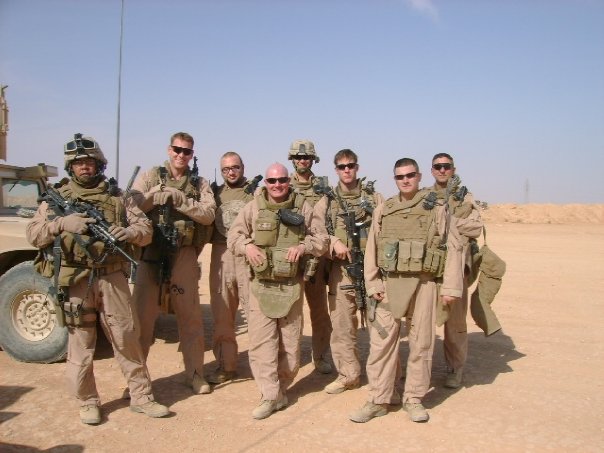
Some of my dreams, and nightmares too, involve those decisions, particularly the ones that I could not control; but then there were those decisions, particularly regarding my military career choices, that come back to haunt my dreams. Those can be troubling; the things that I volunteered to do and the costs of those to Judy as a result of those decisions. Many of those decisions, particularly my decisions to volunteer for certain deployments and operations have come at a great cost to both of us, the struggle with the effects of PTSD even ten years after my return from Iraq is still very real.

But then I am reminded that none of us have a crystal ball that allows us to see what the result of our decisions will be; none of us are God, or some other omniscient being. We make our decisions based on what we know, and what we think might be the outcome of our decisions.

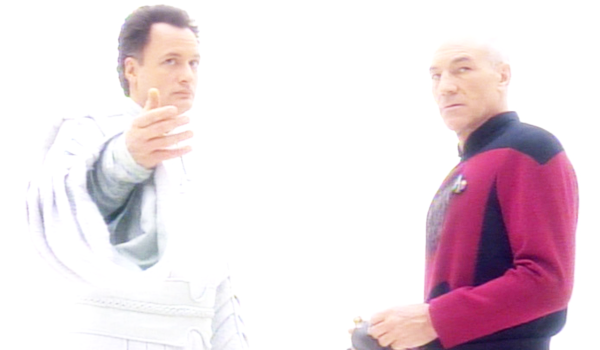
I love the television series Star Trek the Next Generation. One of my favorite episodes is called Tapestry. In the episode Captain Picard is killed. He is then met by the being known as Q, played by John De Lancie for a do-over, a second chance to reverse a choice that he made as a young officer.

On Q’s promise that his choice will not alter history Picard takes the chance and he ends up regretting it. In his second chance to avoid the incident that allowed him to be killed he alienates himself from his friends, and turns him in to a different person, unwilling to take chances and doomed to insignificance. When he returns to his new present he finds himself alive but a different person. Instead of a starship captain is a nondescript lieutenant junior grade doing a job that he hates as an assistant astrophysics officer.

tapestry2

Distraught Picard complains to Q:

Picard: You having a good laugh now, Q? Does it amuse you to think of me living out the rest of my life as a dreary man in a tedious job?

Q: I gave you something most mortals never experience: a second chance at life. And now all you can do is complain?

Picard: I can’t live out my days as that person. That man is bereft of passion… and imagination! That is not who I am!

Q: Au contraire. He’s the person you wanted to be: one who was less arrogant and undisciplined in his youth, one who was less like me… The Jean-Luc Picard you wanted to be, the one who did not fight the Nausicaan, had quite a different career from the one you remember. That Picard never had a brush with death, never came face to face with his own mortality, never realized how fragile life is or how important each moment must be. So his life never came into focus. He drifted through much of his career, with no plan or agenda, going from one assignment to the next, never seizing the opportunities that presented themselves. He never led the away team on Milika III to save the Ambassador; or take charge of the Stargazer’s bridge when its captain was killed. And no one ever offered him a command. He learned to play it safe – and he never, ever, got noticed by anyone.

It is a fascinating exchange and one that when I wonder about the choices that I have made that I think about; because when all is said and done, my life, like all of ours is a tapestry. On reflection Picard tells Counselor Troi, “There are many parts of my youth that I’m not proud of. There were… loose threads – untidy parts of me that I would like to remove. But when I… pulled on one of those threads – it’d unravel the tapestry of my life.”

I think that I can agree with that. All the things in my life, the good things and the bad, as well as the paths not taken have all been a part of the tapestry of my life. I would not be who I am without them; and that I cannot comprehend. I would rather be the flawed me that is me, than the perfect me that never existed. Thus, all of those threads of my tapestry are in a sense, precious and even holy.

I’ll keep all of them.

Peace

Padre Steve+

Leave a comment

Filed under faith, life, Loose thoughts and musings, philosophy, PTSD, star trek

Dietrich Bonhoeffer and the Martyrs of Flossenburg: A Lesson for Christians in the Age of Trump

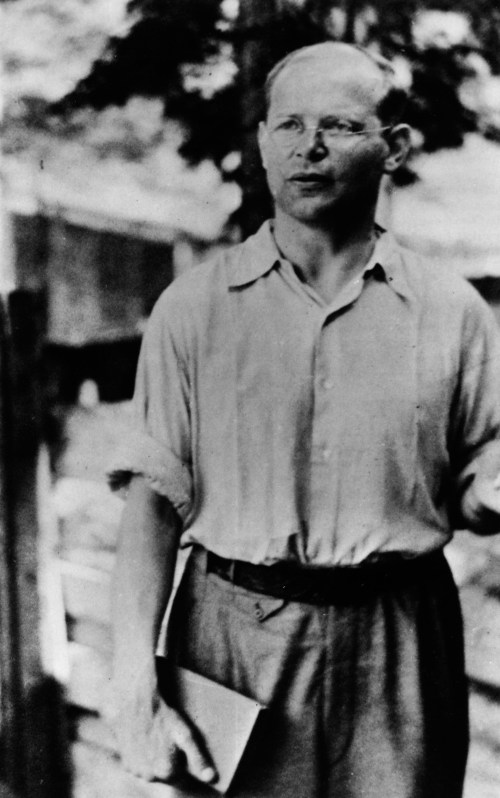
D.Bonhoeffer im Gefaengnis Berlin-Tegel

Friends of Padre Steve’s World,

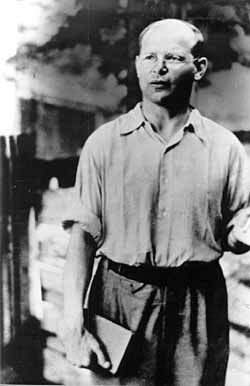
Seventy-three years ago at the Flossenburg Concentration Camp near the German-Czech border a pastor, an Admiral, and a General were martyred on the specific order of Adolf Hitler. The pastor was the eminent Dietrich Bonhoeffer, the Admiral, Wilhelm Canaris the former head of the German military intelligence service; the Abwehr, the General, Hans Oster, Canaris’s deputy. All three were Christians and all three opponents of Hitler’s regime. Condemned with them were Karl Sack a senior military jurist, retired General Friedrich Von Rabenau who was also a theologian, and several others connected with the Abwehr and the resistance.

I think that in an age where politically conservative Christians have trampled their own faith to support of a leader who makes a mockery of the Christian faith as he blasphemes the very name of Christ and the teachings of Jesus in his words and deeds. While I am not comparing the President to Hitler I am comparing the corrupt and evil Christian leaders and organizations which support him to the German Christians who eagerly supported Hitler and his diabolical regime. Thus the men who lost their lives in the fight against Hitler on April 9th 1945 and their courage need to be remembered and emulated should the Trump administration continue down its path to trample the Constitution and crush civil and human rights, and quite possibly engage in aggressive preemptive wars that would be illegal under the precedents of the Nuremberg Trials; all in the name of Making America Great Again.

But it is Bonhoeffer that I will focus on tonight. As early as 1932 Bonhoeffer realized the menace and evil of Hitler’s growing Nazi Party and movement. In a sermon the recently ordained Bonhoeffer, then only 26 years old noted that danger and the complicity of all Germans in it, especially Christians.  He warned that resistance to it could well involve martyrdom. But he believed that the the evil of the tyrant gave no one the luxury of claiming innocence:

“the blood of martyrs might once again be demanded, but this blood, if we really have the courage and loyalty to shed it, will not be innocent, shining like that of the first witnesses for the faith. On our blood lies heavy guilt, the guilt of the unprofitable servant who is cast into outer darkness” 

On February 1st 1933, two days after Hitler’s accession to power Bonhoeffer was beginning a previously scheduled speech on what was known as the concept known as the Fuhrerprinzep. The speech was not a direct attack on Hitler but a warning of the limits of power. He had barely begun the speech when for unexplained circumstances he was cut off. While there was no proof that this was deliberately done it would not have been unlike the Nazis to engage in such subterfuge. The speech was printed in a non-Nazi conservative newspaper and he was invited to give the speech in early March at the University of Berlin’s college of political science. At the end of the speech, which included no remarks on current events Bonhoeffer criticized the Fuhrerprinzep which he believed could easily become an idolatrous cult. However, Hitler had ridden into power upon upon that concept as people sought a strong leader to bring Germany out of political, social, and economic turmoil.

“The fearful danger of the present time is that above the cry for authority, be it of a Leader or of an office, we forget that man stands alone before the ultimate authority and that anyone who lays violent hands on man here is infringing eternal laws and taking upon himself superhuman authority which will eventually crush him. The eternal law that the individual stands alone before God takes fearful vengeance where it is attacked and distorted. Thus the Leader points to the office, but Leader and office together point to the final authority itself, before which Reich or state are penultimate authorities. Leaders or offices which set themselves up as gods mock God and the individual who stands alone before him, and must perish.”

german-christians-march

At that early stage Hitler whose office was conditional on the support of President Paul Von Hindenburg and headed a cabinet in which his Nazis were a minority partner realized that he had to say the right things to maintain it, he could not appear too radical. One group that he courted were politically conservative German Christians. In a speech delivered the same day as Bonhoeffer’s curtailed speech, Hitler claimed that the Christian faith would serve as “the basis of our collective morality.” It was a lie but it assuaged the fears of Christians in non-Nazi conservative and moderate parties, many who became a part of the Nazi German Christian movement which decidedly in the service of Hitler espousing Nazi racial doctrines and attacks upon the Jews.

As Hitler and the Nazis stepped up their persecution of their political opponents and the Jews based on the emergency provisions of the Reichstag Fire Decree Bonhoeffer both worked and spoke his opposition to the tyranny that was beginning to envelop Germany. In April 1933 while speaking of the responsibility of Christians and the church to stand against injustice he wrote in his essay The Church and the Jewish Question: 

“The church has an unconditional obligation to the victims of any ordering society, even if they do not belong to the Christian community.” and also“We are not to simply bandage the wounds of victims beneath the wheels of injustice, we are to drive a spoke into the wheel itself.”

He became a key member of what became known as the Confessing Church and the Pastors Emergency League where he helped draft the Barmen Declaration. He ran an underground seminary to train theology students. He had the chance to remain in the United States in June of 1939 but refused the pleas of his American friends to do so. He explained his position to the American theologian Reinhold Niebuhr:

“I have come to the conclusion that I made a mistake in coming to America. I must live through this difficult period in our national history with the people of Germany. I will have no right to participate in the reconstruction of Christian life in Germany after the war if I do not share the trials of this time with my people… Christians in Germany will have to face the terrible alternative of either willing the defeat of their nation in order that Christian civilization may survive or willing the victory of their nation and thereby destroying civilization. I know which of these alternatives I must choose but I cannot make that choice from security.”

On his return to Germany he was forbidden to speak in public, prohibited from publishing and required to report his movements to the police. However he did have friends. His brother in law, the lawyer Hans Dohnányi who was a member of the opposition, recruited Bonhoeffer for the Abwehr the German military service in order to prevent him from being conscripted into the Wehrmacht based on the proposition that his contacts with British and American could prove useful to to German intelligence. While Bonhoeffer remained suspect to Nazi officials the appointment brought him into the orbit of Admiral Wilhelm Canaris, General Hans Oster, and other leaders of the military opposition to Hitler.

From these men he began to comprehend the fulness of the Nazi evil and learned of early plots against Hitler’s life. Bonhoeffer, a pacifist realized that he must become an active part of the resistance and wrote: “the ultimate question for a responsible man to ask is not how he is to extricate himself heroically from the affair, but how the coming generation shall continue to live.” By participating in the conspiracy Bonhoeffer can be accused of hypocrisy, and he knew it. He explained his position in a letter to his sister:

“If I sit next to a madman as he drives a car into a group of innocent bystanders, I can’t, as a Christian, simply wait for the catastrophe, then comfort the wounded and bury the dead. I must try to wrestle the steering wheel out of the hands of the driver.”

During his tenure with the Abwehr he served as a courier to make contact with Allied leaders in Switzerland in order to gain support for opposition efforts, attempts that the Allies ignored, even as he wrote his book Ethics. Bonhoeffer worked with Dohnányi and others in the Abwehr to smuggle fourteen Jews out of German to Switzerland along with large sums of currency. However, the Sicherheitsdienst, the intelligence branch of Heinrich Himmler’s SS  became aware of their activities and both were arrested in April 1943, not so much for that but in order to discredit the rival Abwehr. While the Abwehr was able to cover for most of their activities they were charged with breaking the Nazi laws regarding the Jews.

He was imprisoned in Berlin’s Tegel Prison while awaiting trial but during that time he produced many theological writings which were smuggled out of the prison to his student Eberhard Bethage by his fiancé and sympathetic guards. These uncensored works would become the book Letters and Papers from Prison. He expressed no bitterness in his arrest but reflected on what he and others in the resistance had learned, lessons that privileged Christians in the United States who worship the ungodly political, economic, and military power reveled in by President Trump would be wise to heed:

“We in the resistance have learned to see the great events of world history from below, from the perspective of the excluded, the ill treated, the powerless, the oppressed and despised… so that personal suffering has become a more useful key for understanding the world than personal happiness.”

Documents that exposed Bonhoeffer’s connection to the anti-Hitler plot that resulted in the July 20th 1944 assassination attempt on Hitler by Lieutenant Colonel Claus von Stauffenberg were discovered by the Gestapo in September 1944 and he was moved to the SS Prison at the Reichssicherheitshauptamt, the Reich Security Main Office. When that facility was bombed in February 1945 he was moved to Buchenwald and finally to Flossenburg where he would die.

Two of his writings which he produced while in prison have had a profound impact on my faith.

“During the last year or so I’ve come to know and understand more and more the profound this-worldliness of Christianity.  The Christian is not ahomo religiosus, but simply a man, as Jesus was a man…I’m still discovering right up to this moment, that it is only by living completely in this world that one learns to have faith. One must completely abandon any attempt to make something of oneself, whether it be a saint, or a converted sinner, or a churchman (a so-called priestly type!) a righteous man or an unrighteous one, a sick man or a healthy one.  By this-worldliness I mean living unreservedly in life’s duties, problems, successes and failures, experiences and perplexities.  In so doing we throw ourselves completely into the arms of God, taking seriously, not our own sufferings, but those of God in the world—watching with Christ in Gethsemane. That, I think, is faith; that is metanoia; and that is how one becomes a man and a Christian.”

“I discovered later, and I’m still discovering right up to this moment, that is it only by living completely in this world that one learns to have faith. By this-worldliness I mean living unreservedly in life’s duties, problems, successes and failures. In so doing we throw ourselves completely into the arms of God, taking seriously, not our own sufferings, but those of God in the world. That, I think, is faith.”

Bonhoeffer’s fate was sealed when on April 4th 1945 Canaris’s secret diaries were found. When Hitler read them he became enraged and demanded that the Abwehr traitors be destroyed. Bonhoeffer and his companions were taken to Flossenburg, but at a stop Bonhoeffer became separated from them and was held with other prisoners in the small town of Schoenberg. While there on Sunday 8 April 1945, Bonhoeffer was asked to conduct a service on the second Sunday of Easter. He had just finished conducting the service at a schoolhouse when plainclothes Gestapo agents arrived to arrest him. British prisoner Payne Best noted that Bonhoeffer:

“spoke to us in a manner which reached the hearts of all, finding just the right words to express the spirit of our imprisonment and the thoughts and resolutions which it had brought.”

As Bonhoeffer was taken he said to another prisoner, “This is the end – but for me, the beginning of life.” He was driven to Flossenburg where he along with the other Abwehr conspirators was condemned at a drumhead trial by SS Judge Sturmbannfuhrer (Major) Otto Thorbeck without witnesses or records of proceedings or defense and hanged the next day, two weeks before American soldiers liberated the camp.

The only account of his death was written by the SS doctor of the camp.

“On the morning of that day between five and six o’clock the prisoners, among them Admiral Canaris, General Oster, General Thomas and Reichgerichtsrat Sack were taken from their cells, and the verdicts of the court martial read out to them. Through the half-open door in one room of the huts I saw Pastor Bonhoeffer, before taking off his prison garb, kneeling on the floor praying fervently to his God. I was most deeply moved by the way this lovable man prayed, so devout and so certain that God heard his prayer. At the place of execution, he again said a short prayer and then climbed the steps to the gallows, brave and composed. His death ensued after a few seconds. In the almost fifty years that I worked as a doctor, I have hardly ever seen a man die so entirely submissive to the will of God.”

So until tomorrow,

Peace

Padre Steve+

Leave a comment

Filed under christian life, ethics, faith, History, holocaust, nazi germany, News and current events, philosophy, Political Commentary, Religion, world war two in europe

Heresies and Drumheads: Evangelicals and Trump through the Lens of Star Trek

galaxy_universe-normal

Friends of Padre Steve’s World,

The German theologian, pastor and martyr Dietrich Bonhoeffer wrote:

“Man no longer lives in the beginning–he has lost the beginning. Now he finds he is in the middle, knowing neither the end nor the beginning, and yet knowing that he is in the middle, coming from the beginning and going towards the end. He sees that his life is determined by these two facets, of which he knows only that he does not know them”  

There is an episode of Star Trek Voyager called Distant Origin where a scientist of a race in the Delta Quadrant believes that genetic evidence indicated that their race originated on Earth. His thesis is challenged the doctrine of his species and he was accused of “heresy against Doctrine” for positing something different than his people believed. He ends up being persecuted and punished for his beliefs.

Now I want to be diplomatic about this. I am not someone who simply is contrary to established doctrines, be they theological, scientific or even military theories. That being said I think it is only right to question our presuppositions, as Anselm of Canterbury did through faith seeking understanding.

That understanding as a Christian is based on the totality of the message of the Christian faith. Hans Kung said it well:

“Christians are confident that there is a living God and that in the future of this God will also maintain their believing community in life and in truth. Their confidence is based on the promise given with Jesus of Nazareth: he himself is the promise in which God’s fidelity to his people can be read.” 

What we have to admit is that our belief is rooted in our faith, faith which is given to us through the witness of very imperfect people influenced by their own culture, history and traditions. Even scripture does not make the claim to be inerrant, and the Bible cannot be understood like the Koran or other texts which make the claim to be the infallible compendium of faith delivered by an angel or dictated by God himself. It is a Divine-human collaboration so symbolic of the relationship that God has with his people, often confusing and contradictory yet inspiring.

themiddle

There is a certain sense of relationship between God and humanity within scripture and that relationship creates certain tensions between God and those people. The interesting thing is that Scripture is a collection of texts which record often in terrible honesty the lack of perfection of both the writers and their subjects. They likewise record the sometimes unpredictable and seemingly contradictory behavior of God toward humanity in the Old Testament. They bear witness to the weaknesses, limitations and lack of understanding of the people of God of the message of God but even in that those limitations and weaknesses that God is still faithful to humanity in the life death and resurrection of Jesus of Nazareth.

The real fact of the matter is that fixed doctrines are much more comfortable than difficult questions than honestly examining the contradictions that exist within Scripture, history and tradition. The fact is this makes many people uncomfortable and thus the retreat into the fortress of fixed and immutable doctrine found in the various incarnations of Fundamentalism.

The fact is the world is not a safe place, and our best knowledge is always being challenged by new discoveries many of which make people nervous and uncomfortable, especially people who need the safety of certitude. So in reaction the true believers become even more strident and sometimes, in the case of some forms of Islam and Hinduism violent.

Picard

Christianity cannot get away unscathed by such criticism. At various points in our history we have had individuals, churches and Church controlled governments persecute and kill those that have challenged their particular orthodoxy. Since Christian fundamentalists are human they like others have the capacity for violence if they feel threatened, or the cause is “holy” enough. Our history is full of sordid tales of the ignorance of some Christians masquerading as absolute truth and crushing any opposition. It is as Eric Hoffer wrote:

“A doctrine insulates the devout not only against the realities around them but also against their own selves. The fanatical believer is not conscious of his envy, malice, pettiness and dishonesty. There is a wall of words between his consciousness and his real self.”

This is the magnetic attraction of fundamentalism in all of its forms, not just Christian fundamentalism.  Yet for me there is a comfort in knowing that no matter how hard and fast we want to be certain of our doctrines, that God has the last say in the matter in the beginning and the end. We live in the uncomfortable middle but I have hope in the faith that God was in the beginning. Besides as Bonhoeffer well noted “A God who let us prove his existence would be an idol” 

But there some Christians who now faced with the eloquence of men like Neil DeGrasse Tyson and Bill Nye who make legitimate challenges respond in the most uncouth and ignorant manners. The sad thing is that their response reveals more about them and their uncertainty than it does the faith that they boldly proclaim.

Our doctrines, the way we interpret Scripture and the way we understand God are limited by our humanity and the fact that no matter how clever we think we are that our doctrines are expressions of faith. This is because we were not in the beginning as was God and we will not be at the end, at least in this state. We live in the uncomfortable middle, faith is not science, nor is it proof, that is why it is called faith, even in our scriptures.

We are to always seek clarity and understanding but know that it is possible that such understanding and the seeking of truth, be it spiritual, historical, scientific or ethical could well upset our doctrines, but not God himself. As Henri Nouwen wrote: “Theological formation is the gradual and often painful discovery of God’s incomprehensibility. You can be competent in many things, but you cannot be competent in God.” Is that not the point of the various interactions of Jesus with the religious leaders of his day? Men who knew that they knew the truth and even punished people who had been healed by Jesus such as the man born blind in the 9th Chapter of John’s Gospel.

vasily-surikov-christ-healing-the-man-born-blind

“You are that man’s disciple; we are disciples of Moses! We know that God spoke to Moses, but we do not know where this one is from.” The man answered and said to them, “This is what is so amazing, that you do not know where he is from, yet he opened my eyes. We know that God does not listen to sinners, but if one is devout and does his will, he listens to him. It is unheard of that anyone ever opened the eyes of a person born blind. If this man were not from God, he would not be able to do anything.” They answered and said to him, “You were born totally in sin, and are you trying to teach us?” Then they threw him out.”

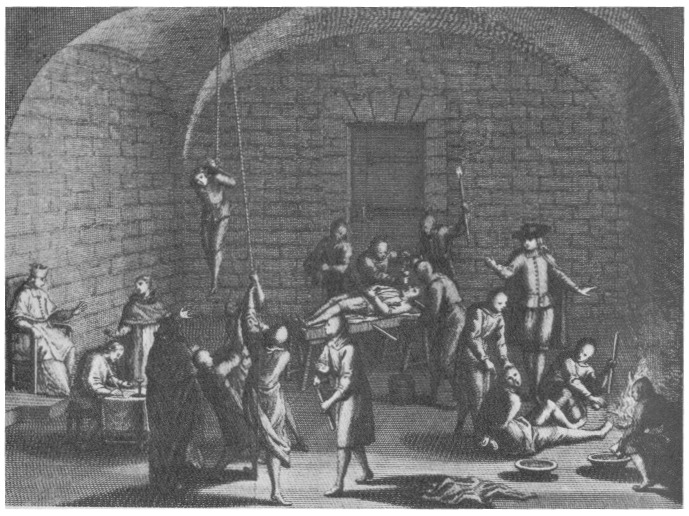
The interchange between the religious leaders and the man is not an indictment on Judaism, but rather on religious certitude in any time or place. The fact is that the Pharisees are no different than those who ran the Inquisition, or those who conducted Witch Trials or those who attempt to crush anyone who questions their immutable doctrine no matter what their religion.

They were and many of their theological and ecclesiastical descendants still are true believers. That has been demonstrated over and over again in regards to biblically and theologically challenged yet politically fanatical American Evangelical Christians who have willingly surrendered any pretense of following Christ to paying obeisance to President Trump; a would be dictator who plays to their perpetual sense of victimhood in order to cement his power over them and to use them as his willing foot soldiers.

What Trump has done has turned the Gospel on its head, the Christian faith has become a political bludgeon to support laws and policies that are in diametric opposition to the message of Jesus. Sadly, a large majority of Evangelicals and their leaders have become Trump’s willing accomplices.

In the episode of Star Trek the Next Generation called The Drumhead Captain Picard counsels Lieutenant Worf after their encounter with a retired admiral who turned an investigation involving a Klingon exchange scientist into a witch hunt aboard the Enterprise. That episode is well worth watching especially because it anticipates what is going on in the United States today, where a President, his party, and a reactionary fear filled cabal of religious followers has declared war on all who oppose them.

At the end of the episode Lieutenant  Worf comes to Captain Picard’s office. He is apologetic about having believed and cooperated with the Admiral. The dialogue is striking and should be heeded, especially by Evangelical Christians and others who have with open eyes sacrificed their faith even as they tear up the Constitution thinking that they are defending it.

WORF: Am I bothering you, Captain?
PICARD: No. Please, Mister Worf. Come in.
WORF: It is over. Admiral Henry has called an end to any more hearings on this matter.
PICARD: That’s good.
WORF: Admiral Satie has left the Enterprise.
PICARD: We think we’ve come so far. The torture of heretics, the burning of witches, it’s all ancient history. Then, before you can blink an eye, it suddenly threatens to start all over again.
WORF: I believed her. I helped her. I did not see what she was.
PICARD: Mister Worf, villains who wear twirl their moustaches are easy to spot. Those who clothe themselves in good deeds are well camouflaged.
WORF: I think after yesterday, people will not be as ready to trust her.
PICARD: Maybe. But she, or someone like her, will always be with us, waiting for the right climate in which to flourish, spreading fear in the name of righteousness. Vigilance, Mister Worf, that is the price we have to continually pay.

And that is true and despite the certitude of the true believers that we do live in the uncomfortable middle.

Peace

Padre Steve+

1 Comment

Filed under ethics, faith, News and current events, philosophy, Political Commentary, Religion, star trek

The Most Dangerous Error… Vietnam, Iraq, and Wars to Come

481801_10151367001287059_1003164983_n

Friends of Padre Steve’s World,

I mentioned yesterday that I was going to do some more writing about the Iraq War. This article discusses the war in the context of strategy and the fact that Americans seldom learn the lessons of war and repeat our mistakes regularly. I sense that under the leadership of Donald Trump that we will find ourselves in new and vastly more bloody and destructive wars that will make the wars of the past 15 years seem like child’s play.

We need to learn from history and we seldom do, as B. H. Liddell-Hart wrote:

“All of us do foolish things, but the wiser realize what they do. The most dangerous error is the failure to recognize our own tendency to error. That error is a common affliction of authority.” 

In 1986 an Army Major working at the Office of the Secretary of Defense wrote a book about the history of the US Army in the Vietnam War, and it turned out to be a work of military prophecy. The young officer, Andrew Krepinevich wrote in his book, The Army in Vietnam: 

“In the absence of a national security structural framework that address the interdepartmental obligations associated with FID operations, and considering the lack of incentives for organizational change within the Army, it is presumptuous for the political leadership to believe that the Army (or the military) alone will develop the capability to successfully execute U.S. security policy in Third World countries threatened by insurgency. This being the case, America’s Vietnam experience takes on a new and tragic light. For in spite of its anguish in Vietnam, the Army has learned little of value. Yet the nation’s policy makers have endorsed the service’s misconceptions derived from the war while contemplating an increased role in Third World low-intensity conflicts. This represents a very dangerous mixture that in the end may see the Army again attempting to fight a conventional war against a very unconventional enemy.” (The Army in Vietnam, Andrew F Krepinevich Jr., The Johns Hopkins University Press, Baltimore and London, 1986. p.275)

Krepinevich retired from the Army in the 1990s as a Lieutenant Colonel and has been busy in the world of think tanks and national security policy. Unlike his book, which is probably one of the best accounts of the Vietnam War and as I said before a book that is somewhat prophetic his later work has not been as well received. He has his critics. But despite that criticism once cannot deny the accuracy of his predictions concerning the Army’s subsequent operations in low intensity, or counter-insurgency campaigns beginning in Somalia and encompassing the wars in Iraq and Afghanistan.

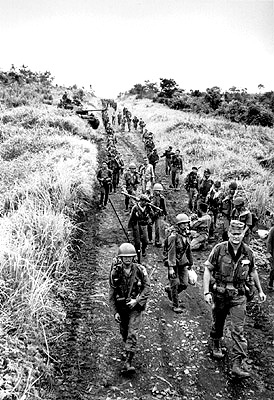
If Krepinevich had been alone in his criticism, or his book not been widely read one might excuse policy makers of the 1990s and 2000s who sent the Army and the military into counterinsurgency campaigns involving massive numbers of troops and the commitment of blood and treasure that had practically no value to the national security of the United States. Instead thousands of American and Allied lives were sacrificed, tens of thousands wounded and one nation, Iraq that had nothing to do with the attacks of 9-11-2001 left devastated and crippled empowering Iran the sworn enemy of the United States no regional rival. The exhaustion of the war and the subsequent war against the Islamic State in Iraq and Syria allowed Vladimir Putin’s Russian to become a major player in the Middle East for the first time since the days of the Soviet Union.

n671902058_1153793_4043

One cannot say that the Iraq war was worth the lives and treasure spent to cover the lies and hubris of the Bush Administration. Nor can one say that the effort to change the tribal structure of the fiercely independent Afghan peoples after driving Al Qaeda from that “Graveyard of Empires” been worth the expenditure of so many American lives and treasure. In fact the wars in Iraq and Afghanistan damaged the United States in more ways than their proponents could every admit. The military, now drained by years of war is hamstrung and will be hard pressed to meet legitimate threats to our national security around the world because of the vast amounts of blood and treasure expended in these wars.

In 1920 T.E. Lawrence wrote about the follies of the British government in Mesopotamia, what is now Iraq. His words could have been written about the Bush Administrations 2003 war in Iraq. Lawrence wrote in a letter to the Sunday Times:

The people of England have been led in Mesopotamia into a trap from which it will be hard to escape with dignity and honour. They have been tricked into it by a steady withholding of information. The Bagdad communiqués are belated, insincere, incomplete. Things have been far worse than we have been told, our administration more bloody and inefficient than the public knows. It is a disgrace to our imperial record, and may soon be too inflamed for any ordinary cure. We are to-day not far from a disaster.”

Krepinevech, like Lawrence before him was right, but he was not the only one. In 1993 Ronald H Spector wrote in his book After Tet:

“Americans dislike problems without solutions. Almost from the beginning of the U.S. involvement in Vietnam they have attempted to find “lessons” in the war. The controversy about the appropriate lessons to be learned continues with the same vigor and lack of coherence as the debates about the war itself.

Lessons are controversial and fleeting but lessons long. The memories of 1968 have remained and served to influence attitudes and expectations well into the 1990s. The ghosts of Vietnam haunted all sides of the recent deliberations about the Gulf War. In the wake of that war, President Bush hastened to announce that “we have kicked the Vietnam syndrome.” 

Doubtless many Americans would like to agree. It is easier to think of the Vietnam War as a strange aberration, a departure from the “normal” kind of war, like World War II and the recent war in the Gulf, where the course of military operations were purposeful and understandable and the results relatively clear cut. Yet the Vietnam War may be less of an aberration than an example of a more common and older type of warfare, reaching back before the Thirty Years’ War and including World War I. A type of warfare in which a decision is long delayed, the purposes of the fighting become unclear, the casualties mount, and the conflict acquires a momentum of its own. In a world which had recently been made safe for conventional, regional and ethnic wars, Vietnam rather than World War II may be the pattern of the future.” (After Tet: The Bloodiest Year in Vietnam, Ronald H Spector Vintage Books, a division of Random House, New York 1993 pp. 315-316

That is certainly the case in the wars that the U.S. has waged since Vietnam, with the exception of the First Iraq War and Operation Desert Storm which was an anomaly. While there is a good chance that such wars will continue, it is also possible that major wars between nuclear armed powers or those armed with other weapons of mass destruction or those using cyber warfare to cause mass casualties and disruption to the world.

After serving in Iraq with the advisors to the Iraqi 7th and 1st Divisions and 2nd Border Brigade in 2007-2008 and seeing the results of the great misadventure brought upon our nation and Iraq by the Bush administration I cannot help but recognize how disastrous the wars unleashed after 9-11-2001 have been. I have lost friends and comrades in them, I have seen the human costs in our Navy hospitals and still deal with men and women whose lives have been turned upside down by war.

I believe that had we actually accomplished anything enduring it would be another matter. But the human, economic, strategic and even more importantly the moral costs of this war have been so disastrous to our nation as to make the loss of the Twin Towers and the victims of 9-11-2001 pale in significance.

sch0-017

It is tragic that these wars have gone on so long that many of the young Marines and Soldiers fighting them have no understanding of why they deploy and deploy to Iraq and then Afghanistan, and they are far more knowledgeable than the population at large, many of whom are untouched by the personal costs of the war. We as Americans love to say “we support the troops” but most don’t even know one. For the most part big bases from where our troops train and deploy are far from where most Americans live and might as well be on a different planet. We are invisible to most of the country, except when they see a color guard at a sporting event or bump into one of us in uniform at an airport.

3rd Infantry Places American Flags At The Graves Of U.S. Soldiers

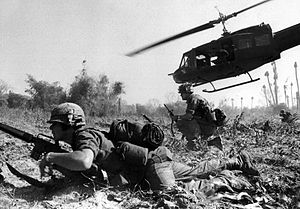
The sad thing is that we don’t learn from history. Krepinevech, Spector and Lawrence could have written what they wrote yesterday. Instead they all wrote many years before the 9-11 attacks and our military response to them. As a historian, a career officer and a chaplain I cannot help but think of the terrible costs of such wars and how they do not do anything to make us more secure. The fact is that we do not learn from history much to our detriment despite the great human, spiritual, moral and economic effects of such wars.

300px-Battle_of_Ia_Drang_Valley-1

What is the cost of war? what is the bill? Major General Smedley Butler wrote: “This bill renders a horrible accounting. Newly placed gravestones. Mangled bodies. Shattered minds. Broken hearts and homes. Economic instability. Depression and all of its attendant miseries. Back -breaking taxation for generations and generations. For a great many years as a soldier I had a suspicion that war was a racket; not only until I retired to civilian life did I fully realize it….”

Until tomorrow,

Peace

Padre Steve+

2 Comments

Filed under History, iraq, leadership, Military, national security, philosophy, Political Commentary, vietnam, War on Terrorism

Read, Observe, or Pee on the Electric Fence

Friends of Padre Steve’s World,

The great American humorist Will Rogers once said, “There are three kinds of men. The one that learns by reading. The few who learn by observation. The rest of them have to pee on the electric fence for themselves.”

I wish that more people would take time to read and reflect than to allow themselves to be force fed by their televisions. Timothy Snyder in his book On Tyranny:

“More than half a century ago, the classic novels of totalitarianism warned of the domination of screens, the suppression of books, the narrowing of vocabularies, and the associated difficulties of thought. In Ray Bradbury’s Fahrenheit 451, published in 1953, firemen find and burn books while most citizens watch interactive television. In George Orwell’s 1984, published in 1949, books are banned and television is two-way, allowing the government to observe citizens at all times. In 1984, the language of visual media is highly constrained, to starve the public of the concepts needed to think about the present, remember the past, and consider the future. One of the regime’s projects is to limit the language further by eliminating ever more words with each edition of the official dictionary.”

I am slowing down my writing for the next few days to spend more time thinking, reflecting, reading and observing. I have been writing a lot on the Civil War, Civil Rights and Reconstruction, as well as the Nazi era, totalitarianism and their importance today. I will continue to do that but I am going to slow down a bit, and for the next week or so the articles here will be slightly edited posts from the archives so I can catch up on some reading and do some reflecting. Of course if something really notable happens I will probably at least comment on it, but for now I want to pull back a bit and read.

I do this because as a historian I known that for all of our great advances, especially in the form of technology that the character of people, the nature of humanity remains fairly constant. Technology may change the way we look the world, how we gather information, how and what we produce, how we fight wars, and even how we relate to each other, but humanity remains the same. Our forms of government and even religious faith may evolve, but the character of humanity is the one constant.

There has been a lot going on in this country and around the world and the one thing that I notice is that few seem to be taking the time to observe and seem to be more interested in immediately framing the events of the day into their particular ideology. This tendency is not limited to any one segment the population and goes across ideological divides.  We live in a time of great political and social upheaval and drastic change and if we are to ride out the storm we must continue to learn and not be satisfied with the banal and insipid sound bites that the Unholy Trinity of pundits, politicians and preachers spew out as wisdom.  The pundits, politicians and preachers who cite history usually do so completely out of context and do so in the form of bad analogies rather than by using any semblance of deductive or inductive reasoning.

Our culture has for the most part abandoned any serious attempt at learning. Schools teach to standardized tests, state school boards ensure that textbooks include nothing too controversial; universities sacrifice faculty and academic programs to prop up bloated administration and non-academic programs. We are consumers of corporate owned news networks that consider their programing entertainment and value market share more than truth. American philosopher Eric Hoffer quite rightly said, “In a time of drastic change it is the learners who inherit the future. The learned usually find themselves equipped to live in a world that no longer exists.” But sadly many people, including learned people who should know better and who have great responsibility in political, economic and even education, are content to live in a world that no longer exists.  

Over the past few months I have plowed through a number of books including David Halberstam’s The Best and the Brightest, H.R. McMaster’s Dereliction of Duty, Deborah Lipstadt’s Denying the Holocaust,  Mark Bowden’s Hue 1968, and Volker Ullrich’s Hitler: Ascent 1889-1939.  All are very substantial volumes. Additionally I am almost finished reading German historian Paul Carrel’s Unternehem Barbarossa im Bild (Operation Barbarossa in Pictures) in which the text is in German. I am also about sixty percent of the way through Max Boot’s The Toad Not Taken: Edward Lansdale an the American Tragedy in Vietnam.  My goal over the next week or so is to finish reading the last two books and to take on Ron Chernow’s massive biography of Ulysses S. Grant, and David Frum’s Trumpocracy: The Corruption of the American Republic. 

Learning comes from reading, observation and experience. Otto Von Bismarck, one of the most remarkable statesmen that ever lived said, “only a fool learns from his own mistakes, a wise man from the mistakes of others,” while Arthur Wellesley, the First Duke of Wellington and victor of Waterloo wrote, “Wise people learn when they can; fools learn when they must.”

I for one would rather not be one of those that learn by the last named method.  Learning from my mistakes has never been enjoyable and has usually been quite painful, but then as the late Baltimore Orioles Manager Earl Weaver said, “It’s what you learn after you know it all that counts.”

While I know I will make mistakes and hope to learn from them when I do I would much rather learn from the mistakes of others. Let’s hope that our leaders decide to actually pay attention and learn instead of making us pay for their mistakes. Sadly, I think that most people, especially those who claim to be leaders would rather pee on the electric fence themselves.

Anyway, it is time to do some reading and reflecting.

Peace

Padre Steve+

1 Comment

Filed under History, Loose thoughts and musings, philosophy

Adjusting to the Worship of Power: Evangelicalism in 2018

Dietrich Bonhoeffer 

Friends of Padre Steve’s World,

One of the most frightening things to me as a historian who happens of claim to be a Christian is the propensity for the Church and its leaders to be attracted to the worship of power and all of its folly. This has been the case since Constantine made Christianity the State religion of the Roman Empire. Leaders of the church in every place and clime as well as almost every denomination have cozied up to rulers in the pursuit of power almost always to the detriment the Church and sometimes their nation. The hierarchies of different churches were in the forefront of the extermination of supposed “heretics,” the persecution of non-state favored religions, the slave trade, the conquest, subjugation, and extermination of indigenous peoples in the Americas, Africa, parts of Asia; they were often the supporters of disastrous wars, and at home used their place of power to wealthy beyond all measure.

Conversely, on the occasions where the Church and its leaders have advocated for the poor, the marginalized, and others who had no earthly power it lead to advances in human rights and liberty. The abolition of slavery in Great Britain was led by William Wilberforce against heated opposition in Parliament and even the Church of England that spanned decades. During the period of the Industrial Revolution, some churches and Christians made a determined effort to end child labor, support workers’ rights, and advocate for the poor, but many others feasted upon the wealth that their rich benefactors lavished upon them and remained silent. Dr. Martin Luther King Jr. and other African American church leaders helped lead the Civil Rights movement and were joined by some white religious leaders, but many others, including men who were early leaders of the Christian Right opposed the Civil rights movement and used their pulpits to advocate for segregation. Many other just remained silent, just as their forbears had from Constantine one. Silence and the acquiescence to injustice has been a hallmark of the Christian church.

The German martyr Dietrich Bonhoeffer saw the disastrous effects of the German church’s subservience to the Nazi regime and before that to the Kaiser. He wrote:

“Christianity stands or falls with its revolutionary protest against violence, arbitrariness and pride of power and with its plea for the weak. Christians are doing too little to make these points clear rather than too much. Christendom adjusts itself far too easily to the worship of power. Christians should give more offense, shock the world far more, than they are doing now. Christian should take a stronger stand in favor of the weak rather than considering first the possible right of the strong.”

Sophie Scholl (Center)

Bonhoeffer spoke those words in a 1934 sermon, just a bit over a year following the Nazi takeover as Hitler was still consolidating his power and before he and his regime began their war of conquest and extermination. Some German Christians did take the chance to stand up for those oppressed by the Nazis, both in Germany in in the areas the Nazis conquered. Many of those who did would pay for their opposition with either their freedom or their lives, but most of the church was silent. One of the young Christians who opposed the Nazis was Sophie Scholl, a 22 year old student at the University of Munich. She and a number of fellow students formed a group called the White Rose to distribute anti-Nazi materials and to speak out against the crimes of the regime. She wanted those Christians of her day that silence was not an option. She wrote:

“The real damage is done by those millions who want to ‘survive.’ The honest men who just want to be left in peace. Those who don’t want their little lives disturbed by anything bigger than themselves. Those with no sides and no causes. Those who won’t take measure of their own strength, for fear of antagonizing their own weakness. Those who don’t like to make waves—or enemies. Those for whom freedom, honor, truth, and principles are only literature. Those who live small, mate small, die small. It’s the reductionist approach to life: if you keep it small, you’ll keep it under control. If you don’t make any noise, the bogeyman won’t find you. But it’s all an illusion, because they die too, those people who roll up their spirits into tiny little balls so as to be safe. Safe?! From what? Life is always on the edge of death; narrow streets lead to the same place as wide avenues, and a little candle burns itself out just like a flaming torch does. I choose my own way to burn.”

The same is true today in the United States. The vast majority of Evangelical Christians who support the policies of the Trump presidency in order to be at the table of temporal power have cast the church into the pigsty of lies. Likewise they vocally support polices that crush the lives of people who have no power and in doing so mock the words of Jesus. I can only shake my head that it has come to this.

img_0476

There is a choice to be made by anyone who claims the mantle of Jesus the Christ or claims to follow him. Will we do better than our ancestors or will we to silently slide down the road to perdition?

Sadly, I think that most Evangelical Christians have made that choice and that it is not the one that Bonhoeffer and Scholl made.

With that I will end for the day. Until tomorrow,

Peace

Padre Steve+

10 Comments

Filed under christian life, civil rights, ethics, faith, History, News and current events, philosophy, Political Commentary, Religion

The Contempt for Facts and the Power of those Who Fabricate Them

Friends of Padre Steve’s World,

A Short thought to begin the weekend that kind of follows my posts of the last several days. Hannah Arendt wrote in her book The Origins of Totalitarianism this poignant fact and warning:

“Before mass leaders seize the power to fit reality to their lies, their propaganda is marked by its extreme contempt for facts as such, for in their opinion fact depends entirely on the power of man who can fabricate it.” 

In my life which now spans almost 58 years I have never seen an American political leader attempt to present a full-blown counter-factual narrative to support their desire for power; but that was before the presidential campaign and presidency of Donald Trump. This not only comes from watching the campaigns of various presidential candidates and the actions of those men who have gained the Presidency, but from my study of history. Yes, I have seen Presidents lie with varying degrees of success. I have seen politicians twist facts and numbers for specific ends, but I have never seen one do so on such a scale and magnitude as our current President; nor have I seen any President so boldly attack and attempt to discredit the institutions established as checks and balances in the Constitution.

Hannah Arendt’s words describe in terribly precise detail the kind of propaganda campaign that has been waged by the President and his advisers since the beginning of his Presidency, which is reinforced by his spokespeople on a daily basis. Arendt wrote: “The outstanding negative quality of the totalitarian elite is that it never stops to think about the world as it really is and never compares the lies with reality.” Arendt’s statement is very descriptive of this administration. I am going to leave things here for now.

So until tomorrow,

Peace

Padre Steve+

1 Comment

Filed under History, News and current events, philosophy, Political Commentary

Watershed Moments: Trump, Hope Hicks and the Problem of Truth

Friends of Padre Steve’s World,

A watershed moment in the Trump administration occurred a few days ago. Longtime advisor and White House Communications Director Hope Hicks admitted telling “white lies” to protect the President to a Congressional committee. Shortly after she either voluntarily resigned or was forced to resign by an infuriated President. I have read accounts that indicate both. I lean to the latter, but I cannot say that without absolute certainty.

Over 1800 years ago the Roman Emperor and philosopher Marcus Aurelius wrote:

“If someone is able to show me that what I think or do is not right, I will happily change, for I seek the truth, by which no one was ever truly harmed. It is the person who continues in his self-deception and ignorance who is harmed.”

When it came out last year I wrote a review of Timothy Snyder’s book  On Tyranny: Twenty Lessons from the Twentieth Century and today I wanted to follow up on one of the key points made by Dr. Snyder in that work.

Snyder wrote: “To abandon facts is to abandon freedom. If nothing is true, then no one can criticize power, because there is no basis to do so. If nothing is truth, then all is spectacle. The biggest wallet pays for the most blinding lights.”  I have been worried about that since the 2016 election campaign where Snyder noted that seventy-eight percent of the claims and statements made by President Trump on the election trail were demonstrably false. Sadly, that has not changed, in his first year in office, as of the anniversary of Mr. Trump’s inauguration he had told over 2000 verifiable lies and distortions, that’s a rate of about six a day.

As Snyder noted the falsehoods during the election campaign came so fast that they were overwhelming, and they still are today. The assertions were presented as if they were the truth, as if they were fact, creating as Kellyanne Conway said, a world of “alternate facts” and “alternative truths.” Of course there are no such thing as “alternative facts” or “alternative truths” when it comes to the reality that we know. There may be arguments about things that we cannot fully observe or understand, such as the ultimate issues of whether there is a God or not, and if so what is true about him, her, or it; likewise there are things that change the way that we see the world such as when scientists make new discoveries.

But in neither case do these examples posit that there are alternative truth, there are things like God that cannot be proven, and there is a universe that we do not fully understand, but those have nothing to do with people who flagrantly lie about things that are commonly known and claim that the lies are the truth. Such claims are cynical and designed to ensure that those in power cannot be challenged, and when deployed by demagogues in a society in which fear has become an overriding factor, can be frighteningly effective. Thus when the President says “I alone can fix it” or “I am your voice” those who have lost the ability to think critically and who have surrendered to the unending mantras of the demagogue do not question them, they are not matters of reason, they are matters of faith.

Throughout the campaign Trump and his campaign surrogates not only twisted truth, but lied so many times that fact checkers could hardly keep up with their untruths. After the election, Trump surrogate Scottie Nell Hughes told Diane Rehm of NRP: “There’s no such thing, unfortunately, anymore, of facts,” she continued, “Mr. Trump’s tweet, amongst a certain crowd, a large — a large part of the population, are truth. When he says that millions of people illegally voted, he has some — in his — amongst him and his supporters, and people believe they have facts to back that up. Those that do not like Mr. Trump, they say that those are lies, and there’s no facts to back it up.” The biggest problem in this interview was that Ms. Hughes lied and twisted what happened to fit the Trump campaign narrative that truth did not matter. The fact was that then candidate Trump’s tweets were devoid of fact and the criticism of them was based on fact.

I have written about how some people and parties present myths as truth, twisting history to meet their craven desire for power and control. This appeal to myth was the genus of the President’s campaign slogan “Make America great again.” Such slogans are the instruments by which demagogues in every place and time have used to not only gain power, but to convince people to do things that in normal times they would never consider doing.

Such propaganda campaigns are distortions of history that blind their followers to real truth, even worse, they compel people to never learn history and thus accept the lies as truth with all too often fatal consequences. Snyder calls this “the politics of eternity” which “performs a masquerade of history… It is concerned with the past, but in a self-absorbed way, free of any real concern with facts. Its mood is a longing for past moments that never really happened during epochs that were, in fact, disastrous.”

To the politicians who like the President rely on them, the past is “a vast misty courtyard of illegible monuments to national victimhood, all of them equally distant from the present, all of them equally accessible for manipulation. Every reference to the past seems to involve an attack by some mortal enemy upon the purity of the nation.” These are the basis for things like the Myth of the Lost Cause, and the Noble South, and the Stab in the Back.

This is dangerous distortion of history. George Santayana wrote, “Those who cannot remember the past are condemned to repeat it.” But I think that Howard Zinn said it the best:

“History can come in handy. If you were born yesterday, with no knowledge of the past, you might easily accept whatever the government tells you. But knowing a bit of history–while it would not absolutely prove the government was lying in a given instance–might make you skeptical, lead you to ask questions, make it more likely that you would find out the truth.”

I cannot help but think that the rapidity of the lies, the incessant attacks on the institutions of our country’s democracy, and the rights established in the Constitution by the President, people in his administration, and his supporters, especially those in the Breitbart universe of alternative media, are nothing but an attempt to delegitimize those institutions in order to gain total control and establish some kind of authoritarian and totalitarian state.

The deluge of lies and distortions practiced by this administration and so many others who have taken power after being legally elected or appointed is designed to ensure that people no longer believe in truth. Hannah Arendt wrote: “The ideal subject of totalitarian rule is not the convinced Nazi or the convinced Communist, but people for whom the distinction between fact and fiction ( i.e., the reality of experience) and the distinction between true and false ( i.e ., the standards of thought) no longer exist.”

That is the very danger that we face today because many people, especially the President’s most stalwart and sometime violent defenders, as well as his enablers in Congress do not care, and others are so confused and distracted by the tactics of denial and deflection coming from the administration that they are growing weary. Polls show that many people are quite alright with limiting freedom of the press, freedom of speech, the role of the courts and other institutions designed to check executive power, and have no problem with limiting the rights of groups that they have identified as their enemy, and even limitations placed on their own freedom if it serves to absolve them of responsibility for things that they are too uncomfortable to deal with. The British military historian and theorist B.H. Liddell-Hart observed:

“We learn from history that in every age and every clime the majority of people have resented what seems in retrospect to have been purely matter-of-fact comment on their institutions. We learn too that nothing has aided the persistence of falsehood, and the evils resulting from it, more than the unwillingness of good people to admit the truth when it was disturbing to their comfortable assurance. Always the tendency continues to be shocked by natural comment and to hold certain things too “sacred” to think about.”

Believe me I desperately want to be wrong about this, but my study of history tells me that I am not. Thus I believe that every claim of the President and the administration must be questioned and its veracity determined, before it is accepted as truth. The time has come when we cannot simply wait to see what happens and give this administration the benefit of the doubt. Immediately after the election I was prepared to do that, but the actions of the President and his advisors have demonstrated to me that this is no longer an option. I will of course remain true to my oath under the Constitution, I will still respect the office of the Presidency, but I will always stand for the Constitution and defend those rights, and the institutions that are established by it.

Truth: historical, scientific, and verifiable is not our enemy. However, lies, and distortions, and the trampling of truth under the guise of “alternative truth,” “alternative fact,” and “alternative history” is the moral enemy of our republic and its democratic institutions. Thus truth must be upheld and fought for at all costs, because once you have sacrificed truth on the altar of political expediency you pave the way for freedom to be sacrificed.

Marcus Aurelius was right. The truth is not harmful but those who persist in self deception and ignorance can not escape harm. Hope Hicks placed her faith in Donald Trump, even being willing and able to lie for him, now she is firmly in the eye of the Muller investigation and will forever have her reputation tarnished by her work and support for President Trump. Sadly, there will be more.

So until tomorrow.

Peace

Padre Steve+

1 Comment

Filed under culture, ethics, History, News and current events, philosophy, Political Commentary

The Courageous Versus the Ideologues

7852066-12185069

Friends of Padre Steve’s World,

Today is a bit of a detour following my last two articles dealing with the Reichstag Fire and Reichstag Fire Decree, but it does have some ties to them and I will pick up on the Reichstag Fire theme tomorrow.

Being an ideologue of any kind is easy, you adopt an ideology and then use it to interpret the world. That is why there are so many of them of so many different varieties: right wing, left wing, religious and so many more. In fact if you take a look at the most strident supporters of any ideology, politician, or religious leader you can see that they are little different from one another. But in terms of the ideologies they espouse the most enduring of them, and the only to have ever been the foundation of state power or those dealing with economics such as the Soviet Union; or race such as Nazi Germany or the American Southern Confederacy. Hannah Arendt wrote:

“For an ideology differs from a simple opinion in that it claims to possess either the key to history, or the solution for all the “riddles of the universe,” or the intimate knowledge of the hidden universal laws which are supposed to rule nature and man. Few ideologies have won enough prominence to survive the hard competitive struggle of persuasion, and only two have come out on top and essentially defeated all others: the ideology which interprets history as an economic struggle of classes, and the other that interprets history as a natural fight of races. The appeal of both to large masses was so strong that they were able to enlist state support and establish themselves as official national doctrines. But far beyond the boundaries within which race-thinking and class-thinking have developed into obligatory patterns of thought, free public opinion has adopted them to such an extent that not only intellectuals but great masses of people will no longer accept a presentation of past or present facts that is not in agreement with either of these views.” 

The fact is that there is a difference between people who lean a certain way politically or religiously, and the people Eric Hoffer called, the “true believers,” the people who chose a side and never wrestle with the hard choices of life. They simply declare all who oppose their ideology or theology to be unworthy of life.

I am a liberal and a progressive, but I often find left-wing ideologues to be as off putting as militant right wingers. I guess that is because despite everything I am a realist. I wake up every day to try to do the hard thing of deciding what is right and what to believe.

My favorite television character, Raymond Reddington, played by James Spader in The Blacklist once said “I know so many zealots, men and women, who chose a side, an ideology by which to interpret the world. But, to get up every single day and to do the hard work of deciding what to believe. What’s right, today? When to stand up or stand down. That’s courage.” The fact is, no matter how stridently they espouse their beliefs, ideologues are by definition not courageous, because courage takes critical thinking, something that ideologues of any persuasion are incapable of doing. I see examples of this every day, especially in my Twitter feed and on Facebook.

While I’m sure that many, if not most of these people are good and well meaning people, they seldom display any originality of thought or true character. I had one left wing Twitter follower attack repeatedly me because to her I was supposedly a sellout. I have had right wing religious friends and followers on social media do the same.  While they attack me and each other from different ends of the political spectrum, the intellectual commonality they share is the fact that they are ideologues and zealots; and while they espouse different beliefs they are almost indistinguishable from each other in their inability to think critically and that wears me out.

I guess that is one of the things that bothers me the most about so much of what I see going on in the United States today. Too many ideologues, not enough critical thinkers. Too many people who value absolute consistently of thought without asking if what they preach is still true today, or if it might be tomorrow.

One thing that I have learned over the past eight years or so is that I have to ask what is right today, and make a choice of when to stand up, or to stand down. Sometimes, I don’t like those choices, but I make them.

I guess that is why I like reading about the lives of complicated and often conflicted people; men like T.E. Lawrence, William Tecumseh Sherman, and the fictional Raymond Reddington. I find much to admire and to criticize in all of them even as I empathize and understand each one of them. Interestingly, each of my heroes all have feet of clay. As Reddington said, “We become who we are. We can’t judge a book by its cover… But you can by its first few chapters, and most certainly by its last.” 

Have a great day, until tomorrow.

Peace,

Padre Steve+

1 Comment

Filed under ethics, philosophy, Political Commentary

Finding Tipperary 10 Years After Iraq

Friends of Padre Steve’s World,

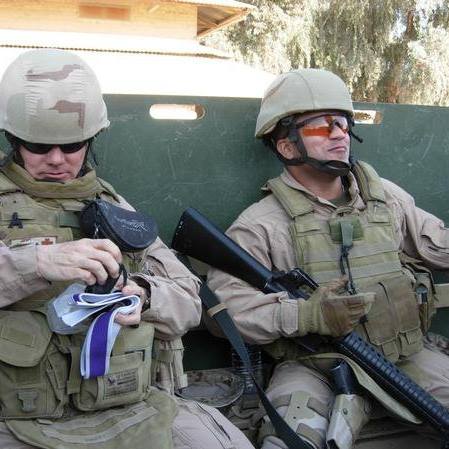
Ten years ago today I stepped off a plane with the man who had been my body guard and assistant for the past seven months in Iraq. War had changed me more than I had every imagined that it would. Even though I was physically home I wasn’t and over the next decade the war remained with me, and in some ways it still does.

I have written about my struggles with what I sometimes describe as the “Demons of PTSD” and while I am doing much better now than even two years ago I still suffer from it. But being a historian has allowed me to find connections to other men who have suffered from their experience of war, came home changed, and struggled for their existence in the world that they came home to.

The words of those men have helped me to frame my experience even in the darkest times often in ways that my faith did not. One of the things that I struggled with the most and still do is sleep. When I was conducting my research on the Battle of Gettysburg I got to know through biographies and their own writings a good number of the men who fought that battle who are now remembered as heroes. One of these was Major General Gouveneur Warren who has shattered by his experiences during the war. He wrote to his wife after the war: “I wish I did not dream that much. They make me sometimes dread to go to sleep. Scenes from the war, are so constantly recalled, with bitter feelings I wish to never experience again. Lies, vanity, treachery, and carnage.” 

About every year around this time I feel a sense of melancholy as I reflect on war and my return from it. Today I was reading a number of George Santayana’s Soliloquies in England, in particular one entitled Tipperary which he wrote in the time shortly after the war. I think that the first time that I heard the song was when I saw a Charlie Brown special where Snoopy as the World War One Flying Ace alternates between happiness and tears as Schroeder plays the song on his piano.

In Santayana’s soliloquy he comments on the wounded officers that he sees singing the song in a coffee house and he wonders if they understand how different the world is now. I love the song, the chorus is below.

It’s a long way to Tipperary
it’s a long was to go
It’s a long way to Tipperary
to the sweetest gal I know
farewell to Piccadilly
so long Leister Square
It’s a long way to Tipperary
but my heart lies there

Santayana wrote:

“It had been indeed a long, long way to Tipperary. But they had trudged on and had come round full circle; they were in Tipperary at last.

I wonder what they think Tipperary means for this is a mystical song. Probably they are willing to leave it vague, as they do their notions of honour or happiness or heaven. Their soldiering is over; they remember, with a strange proud grief, their comrades who died to make this day possible, hardly believing that it ever would come ; they are overjoyed, yet half ashamed, to be safe themselves ; they forget their wounds ; they see a green vista before them, a jolly, busy, sporting, loving life in the old familiar places. Everything will go on, they fancy, as if nothing had happened…

So long as the world goes round we shall see Tipperary only, as it were, out of the window of our troop-train. Your heart and mine may remain there, but it s a long, long way that the world has to go.” 

In the same work Santayana mused on the nature of humanity and war, making one of his most famous observation “only the dead have seen the end of war.”

In the United States we live in a world where war is an abstraction and the vast majority of people have no clue about it or its cost. When I hear the American President make wild threats of war and the cavalier attitude of his sycophants toward it I realize that Santayana was right, only the dead have seen the end of war.

When I returned to the United States in 2008 it was incredibly hard to readjust to life in a country that knew not war and I was reminded of the words of Guy Sajer in his book The Forgotten Soldier. Sajer was a French Alsacian of German descent who spent nearly four years fighting as an ordinary infantry soldier on the Eastern Front. When he returned home he struggled and he wrote:

“In the train, rolling through the sunny French countryside, my head knocked against the wooden back of the seat. Other people, who seemed to belong to a different world, were laughing. I couldn’t laugh and couldn’t forget.”

A similar reflection was made by Erich Maria Remarque in All Quite on the Western Front:

“I imagined leave would be different from this. Indeed, it was different a year ago. It is I of course that have changed in the interval. There lies a gulf between that time and today. At that time I still knew nothing about the war, we had been only in quiet sectors. But now I see that I have been crushed without knowing it. I find I do not belong here any more, it is a foreign world.”

I have to admit that for the better part of the past decade when I get out of my safe spaces I often feel the same way. I don’t like crowed places, confined area, and other places that I don’t feel safe in. When I am out I always am on alert, and while I don’t have quite the hyper-arousal and hyper-vigilance that I once lived with, I am much more aware of my surroundings and always plan an escape route from any public venue that I happen to find myself.

As I read and re-read Santayana words I came back to his observation of the officers that he saw in the coffee house and I could see myself in them:

“I suddenly heard a once familiar strain, now long despised and out of favour, the old tune of Tipperary. In a coffee-house frequented at that hour some wounded officers from the hospital at Somerville were singing it, standing near the bar; they were breaking all rules, both of surgeons and of epicures, and were having champagne in the morning. And good reason they had for it. They were reprieved, they should never have to go back to the front, their friends such as were left could all come home alive. Instinctively the old grumbling, good-natured, sentimental song, which they used to sing when they first joined, came again into their minds.

It had been indeed a long, long way to Tipperary. But they had trudged on and had come round full circle; they were in Tipperary at last.” 

I too am now in my own Tipperary on this side of the Atlantic. I have been reprieved, at least temporarily,  but as Santayana noted  “it s a long, long way that the world has to go.” 

Until tomorrow,

Peace

Padre Steve+


1 Comment

Filed under History, iraq, Military, philosophy, PTSD, to iraq and back, Tour in Iraq, travel