Category Archives: philosophy

Perpetrators and Bystanders

Jewish Men being Rounded Up in Baden with Citizens looking on  

Friends of Padre Steve’s World,

Holocaust historian Yehuda Bauer wrote: “Thou shalt not be a victim, thou shalt not be a perpetrator, but, above all, thou shalt not be a bystander.”  These words from his book Perpetrators, Victims, Bystanders: The Jewish Catastrophe 1933-1945 serve as a warning to members of a society where various minority groups are being labeled as enemies of the state and often less than human.

I the past couple of days I have written about the need to try to understand people who in the past have committed genocide, mass murder, starvation, and other crimes against humanity. I did this not to give any basis whatsoever to justify their actions, but so that we might not think ourselves so different that we make the mistake of believing that we are not capable of such crimes, or looking on and allowing them to happen.

It is all too easy for it to happen. All that is needed is a population that has been conditioned by propaganda, based on historical myth, untruth, a prevailing climate of fear, and in which the threat of crisis, real or imagined, can delude even good, able, and even extraordinary people to commit crimes that if they were not real, would be incomprehensible to the mind. In such times decisions have to be made, difficult decisions, the decision to stand for what is right, even if the country’s leaders, and their most vocal followers threaten violence and the use of government force against those who dissent.

Being a perpetrator is one thing, but being a bystander is worse. As Hannah Arendt noted: “The sad truth is that most evil is done by people who never make up their minds to be good or evil.

Until Tomorrow,

Peace

Padre Steve+

1 Comment

Filed under ethics, History, holocaust, News and current events, philosophy, Political Commentary

The Deadly Illusion: Ignorance, Myth, and Alternative Reality

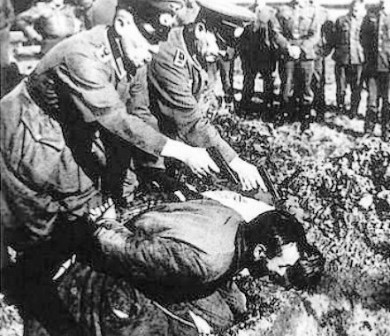
ordinary men can find themselves standing over death pits with guns in their hands…

Friends of Padre Steve’s World,

My longtime readers know that I write about the Holocaust and Nazi Germany a lot. Likewise I also write about other historical events and periods where the worst of humanity is on display. This is not because I am negative or due to some morbid fascination with such events, but because as a historian I see them as a warning because the one constant in history is humanity. While history may not repeat itself, it does as Mark Twain noted, often rhyme, the fact is that human nature and human beings have tended to act similarly to their ancestors more often than not during times of social, economic, or political upheaval distress and crisis.

Timothy Snyder notes that “The European history of the twentieth century shows that societies can break, democracies fall, ethics can collapse, and ordinary men can find themselves standing over death pits with guns in their hands…”

I tell my students this all the time whether I am teaching ethics or history. Economic theories, technology, and so many other ways in which we do life change, but ultimately human nature remains pretty constant. So when I write about these topics it is with that in mind. Historian Gerhard Weinberg wrote:

“It’s very, very important for people to get a sense of what the potentialities of people really are, what the dangers of ignorance can be. It is in this context, that a supposedly advanced society risks descending into the sewer, that the Holocaust is a warning to people who think of themselves as an advanced, modern society.”

Ignorance of history, ignorance of reality, and denial of facts are deadly to the individual and fatal to the society that allows itself to become ignorant and to believe in an illusion of knowledge based on myth and unreality. This deadly illusion based on ignorance and knowledge that is not knowledge allows people and societies to embrace deadly ideologies without thinking. When that happens ordinary people, law abiding people, people who go to church, can commit great atrocities or stand by in silent agreement.

When I hear people who support some of most inhuman of President Trump’s policies makes statements about “I can’t wait for the liberal genocide to begin,” or tell Jews and Muslims to leave the country, who talk of racial and ethnic minorities as if they were less than human than I do in fact worry that it can happen here. When I see Mosques burned, synagogues defaced with Nazi graffiti, Jewish centers targeted by callers making bomb threats, churches of ethnic and minority congregations vandalized, LGBTQ people being discriminated against and sometimes physically attacked, I know it can happen here.

When I see these things happening I am reminded of Spencer Tracy’s monologue at the end of the film Judgment at Nuremberg. The words are chilling because they are so true. Despots and dictators, and authoritarian leaders, cannot commit great acts of violence without a part of the population that is willing to carry out their orders and the majority who for whatever reason acquiesce and stand by silently.

“Janning’s record and his fate illuminate the most shattering truth that has emerged from this trial: If he and all of the other defendants had been degraded perverts, if all of the leaders of the Third Reich had been sadistic monsters and maniacs, then these events would have no more moral significance than an earthquake, or any other natural catastrophe.

But this trial has shown that under a national crisis, ordinary – even able and extraordinary – men can delude themselves into the commission of crimes so vast and heinous that they beggar the imagination…”

We cannot allow ourselves to live in ignorance and pretend that these things cannot happen here. To do this we have to have to go to a dark place. We have to decide to understand what brings people to commit such actions. We have to understand what allows people to stand by and say nothing. We have to understand what goes through the mind or those who make the conscious choice to know nothing when the evidence stares them in the face, and those who feign ignorance to attempt to keep a clean conscience. Burt Lancaster’s character in Judgment at Nuremberg remarked:

“My counsel says we were not aware of the extermination of the millions. He would give you the excuse: We were only aware of the extermination of the hundreds. Does that make us any the less guilty? Maybe we didn’t know the details. But if we didn’t know, it was because we didn’t want to know.”

It is one thing to empathize with the victims of past genocides and crimes against humanity. It is easy to say never again; but it is not possible to prevent them without going to the dark place of trying to understand the perpetrators and bystanders. As Timothy Snyder notes:

“It is easy to sanctify policies or identities by the deaths of victims. It is less appealing, but morally more urgent, to understand the actions of the perpetrators. The moral danger, after all, is never that one might become a victim but that one might be a perpetrator or a bystander.” 

I will continue this tomorrow, until then,

Peace

Padre Steve+

5 Comments

Filed under ethics, history, holocaust, News and current events, philosophy, Political Commentary

Character: “The Decisive Factor in the Life of an Individual and of Nations Alike.”

Friends of Padre Steve’s World,

I teach ethics, and as I observe the words and actions of President Trump and his closest advisors I see a massive attack on facts, truth, reason, intellectualism, and with them, more importantly, on integrity and character. It is actually very disconcerting to see those in power attempting to re-write facts, history, and even their own statements and promises before our eyes, denying truth, subverting facts, and pretending that with the exception of what they say today, there is no truth.

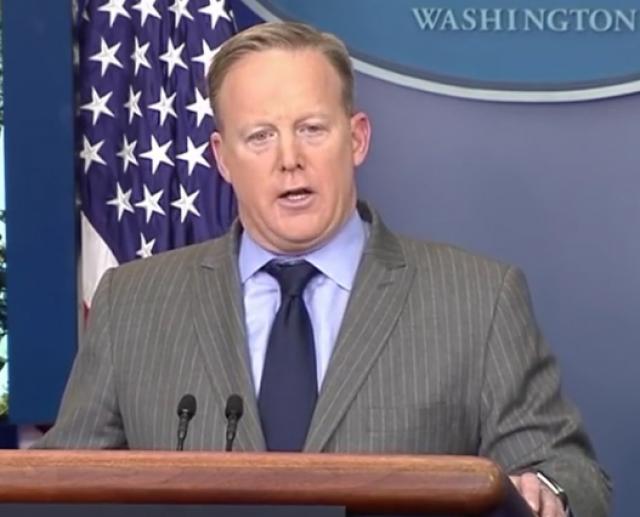
When Sean Spicer praised the February jobs report, a report that he and the President used refer to as “phony” he was asked if President Trump thought that this report was accurate. He grinned and said “They may have been phony in the past, but it’s very real now.”

But then what can be expected from an administration that when contradicted calls the contractions lies, and those who insist on facts to be liars? It has insisted that alone of Federal Government employees that White House staffers don’t need to follow government ethics rules, and removes them from required ethics training. This goes to the heart of the problem with this administration, it does not care for truth and has long given up, if it ever had it. President Trump’s long history of not being an honest businessman, his numerous adulterous affairs during his marriages, and a list of people that he has cheated that runs into the hundreds with thousands of lawsuits against his business practices should have warned us that he would be the same man that he has always has been, and now he is in a position not only to continue to destroy any hint of his own integrity, but that nations as well, and many of his followers do not seem to give a damn.

Ethics do matter and facts do matter. Steven Covey wrote that “Moral authority comes from following universal and timeless principles like honesty, integrity, treating people with respect.” This is sadly lacking in the current administration, and it will be the death of the Republic. When the American President cannot be trusted to tell the truth and when his administration works to shield themselves from the law there will be reverberations. The moral authority of the American nation is at stake, and that matters more than the power of our economy or the military might of the nation. Once that trust, once that moral authority is eroded, the very foundations of the country are undermined, and quite possibly fatally undermined. As Thomas Paine noted: “Character is much easier kept than recovered.”

A nation founded as ours on the proposition that “all men are created equal” which depends on its leaders and citizens caring about their fidelity to the Constitution must understand that its character is linked to how we live up to those great secular scriptures. Character as Theodore Roosevelt noted is “in the long run, is the decisive factor in the life of an individual and of nations alike.” 

So until tomorrow,

Peace

Padre Steve+

1 Comment

Filed under ethics, News and current events, philosophy, Political Commentary

The Totalitarian Contempt for Facts

A Short thought to begin the week that kind of follows my posts of the last several days. Hannah Arendt wrote in her book The Origins of Totalitarianism this poignant fact and warning:

“Before mass leaders seize the power to fit reality to their lies, their propaganda is marked by its extreme contempt for facts as such, for in their opinion fact depends entirely on the power of man who can fabricate it.” 

In my life which now spans almost 57 years I have never seen an American political leader attempt to present a full-blown counter-factual narrative to support their desire for power; but that was before the presidential campaign of Donald Trump. This not only comes from watching the campaigns of various presidential candidates and the actions of those men who have gained the Presidency, but from my study of history. Yes, I have seen Presidents lie with varying degrees of success. I have seen politicians twist facts and numbers for specific ends, but I have never seen one do so on such a scale and magnitude as our current President; nor have I seen any President so boldly attack and attempt to discredit the institutions established as checks and balances in the Constitution.

Hannah Arendt’s words describe in terribly precise detail the kind of propaganda campaign that has been waged by the President and his chief advisor, Steve Bannon since last summer, which is reinforced by his spokespeople on a daily basis. Arendt wrote: “The outstanding negative quality of the totalitarian elite is that it never stops to think about the world as it really is and never compares the lies with reality.” Arendt’s statement is very descriptive of this administration. I am going to leave things here for now.

So until tomorrow,

Peace

Padre Steve+

1 Comment

Filed under News and current events, philosophy, Political Commentary

Abandon Facts and Abandon Freedom: Contending Against Alternative Truth, Facts, and History

Friends of Padre Steve’s World,

Marcus Aurelius wrote:

“If someone is able to show me that what I think or do is not right, I will happily change, for I seek the truth, by which no one was ever truly harmed. It is the person who continues in his self-deception and ignorance who is harmed.”

I wrote a review of Timothy Snyder’s book On Tyranny: Twenty Lessons from the Twentieth Century on Tuesday and today I wanted to follow up on one of the key points made by Dr. Snyder in that work. Snyder wrote: “To abandon facts is to abandon freedom. If nothing is true, then no one can criticize power, because there is no basis to do so. If nothing is truth, then all is spectacle. The biggest wallet pays for the most blinding lights.”  I have been worried about that since the election campaign where Snyder noted that seventy-eight percent of the claims and statements made by President Trump on the election trail were demonstrably false.

As Snyder noted the falsehoods came so fast that they were overwhelming. The assertions were presented as if they were the truth, as if they were fact, creating as Kellyanne Conway said, a world of “alternate facts” and “alternative truths.” Of course there are no such thing as “alternative facts” or “alternative truths” when it comes to the reality that we know. There may be arguments about things that we cannot fully observe or understand, such as the ultimate issues of whether there is a God or not, and if so what is true about him, her, or it; likewise there are things that change the way that we see the world such as when scientists make new discoveries.

But in neither case do these examples posit that there are alternative truth, there are things like God that cannot be proven, and there is a universe that we do not fully understand, but those have nothing to do with people who flagrantly lie about things that are commonly known and claim that the lies are the truth. Such claims are cynical and designed to ensure that those in power cannot be challenged, and when deployed by demagogues in a society in which fear has become an overriding factor, can be frighteningly effective. Thus when the President says “I alone can fix it” or “I am your voice” those who have lost the ability to think critically and who have surrendered to the unending mantras of the demagogue do not question them, they are not matters of reason, they are matters of faith.

Throughout the campaign Trump and his campaign surrogates not only twisted truth, but lied so many times that fact checkers could hardly keep up with their untruths. After the election, Trump surrogate Scottie Nell Hughes told Diane Rehm of NRP: “There’s no such thing, unfortunately, anymore, of facts,” she continued, “Mr. Trump’s tweet, amongst a certain crowd, a large — a large part of the population, are truth. When he says that millions of people illegally voted, he has some — in his — amongst him and his supporters, and people believe they have facts to back that up. Those that do not like Mr. Trump, they say that those are lies, and there’s no facts to back it up.” The biggest problem in this interview was that Ms. Hughes lied and twisted what happened to fit the Trump campaign narrative that truth did not matter. The fact was that then candidate Trump’s tweets were devoid of fact and the criticism of them was based on fact.

I have written about how some people and parties present myths as truth, twisting history to meet their craven desire for power and control. This appeal to myth was the genus of the President’s campaign slogan “Make America great again.” Such slogans are the instruments by which demagogues in every place and time have used to not only gain power, but to convince people to do things that in normal times they would never consider doing. They are distortions of history that blind their followers to real truth, even worse, they compel people to never learn history and thus accept the lies as truth with all too often fatal consequences. Snyder calls this “the politics of eternity” which “performs a masquerade of history… It is concerned with the past, but in a self-absorbed way, free of any real concern with facts. Its mood is a longing for past moments that never really happened during epochs that were, in fact, disastrous.” To the politicians who like the President rely on them, the past is “a vast misty courtyard of illegible monuments to national victimhood, all of them equally distant from the present, all of them equally accessible for manipulation. Every reference to the past seems to involve an attack by some mortal enemy upon the purity of the nation.” These are the basis for things like the Myth of the Lost Cause, and the Noble South, and the Stab in the Back.

This is dangerous distortion of history. George Santayana wrote, “Those who cannot remember the past are condemned to repeat it.” But I think that Howard Zinn said it the best:

“History can come in handy. If you were born yesterday, with no knowledge of the past, you might easily accept whatever the government tells you. But knowing a bit of history–while it would not absolutely prove the government was lying in a given instance–might make you skeptical, lead you to ask questions, make it more likely that you would find out the truth.”

I cannot help but think that the rapidity of the lies, the incessant attacks on the institutions of our country’s democracy, and the rights established in the Constitution by the President, people in his administration, and his supporters, especially those in the Breitbart universe of alternative media, are nothing but an attempt to delegitimize those institutions in order to gain total control and establish some kind of authoritarian and totalitarian state. The deluge of lies and distortions practiced by this administration and so many others who have taken power after being legally elected or appointed is designed to ensure that people no longer believe in truth. Hannah Arendt wrote: “The ideal subject of totalitarian rule is not the convinced Nazi or the convinced Communist, but people for whom the distinction between fact and fiction ( i.e., the reality of experience) and the distinction between true and false ( i.e ., the standards of thought) no longer exist.”

That is the very danger that we face today because many people, especially the President’s most stalwart and sometime violent defenders, as well as his enablers in Congress do not care, and others are so confused and distracted by the tactics of denial and deflection coming from the administration that they are growing weary. Polls show that many people are quite alright with limiting freedom of the press, freedom of speech, the role of the courts and other institutions designed to check executive power, and have no problem with limiting the rights of groups that they have identified as their enemy, and even limitations placed on their own freedom if it serves to absolve them of responsibility for things that they are too uncomfortable to deal with. The British military historian and theorist B.H. Liddell-Hart observed:

“We learn from history that in every age and every clime the majority of people have resented what seems in retrospect to have been purely matter-of-fact comment on their institutions. We learn too that nothing has aided the persistence of falsehood, and the evils resulting from it, more than the unwillingness of good people to admit the truth when it was disturbing to their comfortable assurance. Always the tendency continues to be shocked by natural comment and to hold certain things too “sacred” to think about.”

Believe me I desperately want to be wrong about this, but my study of history tells me that I am not. Thus I believe that every claim of the President and the administration must be questioned and its veracity determined, before it is accepted as truth. The time has come when we cannot simply wait to see what happens and give this administration the benefit of the doubt. Immediately after the election I was prepared to do that, but the actions of the President and his advisors have demonstrated to me that this is no longer an option. I will of course remain true to my oath under the Constitution, I will still respect the office of the Presidency, but I will always stand for the Constitution and defend those rights, and the institutions that are established by it.

Truth: historical, scientific, and verifiable is not our enemy. However, lies, and distortions, and the trampling of truth under the guise of “alternative truth,” “alternative fact,” and “alternative history” is the moral enemy of our republic and its democratic institutions. Thus truth must be upheld and fought for at all costs, because once you have sacrificed truth on the altar of political expediency you pave the way for freedom to be sacrificed.

So until tomorrow.

Peace

Padre Steve+

5 Comments

Filed under culture, ethics, History, News and current events, philosophy, Political Commentary

Reflections on a Sanity Day


Friends of Padre Steve’s World,

Today I am just going to share some reflections of a restful day off regarding friendship, family, and being deliberate rather than reactive in the way I get information. 

I was able to take a comp day for my trip to Gettysburg yesterday. I am coming to enjoy taking a day once in a while to do little but hang out with Judy, each on of us with at least one dog on our lap while I take time to read and reflect. There is nothing more relaxing, comforting, and therapeutic than having a content and happy dog on my lap as I read or write, or just think and muse about various topics. Doing this helps me put priorities back in order and keep me from obsessing about the craziness of the world. 

I spent some time with an old friend Tuesday night. He and I attended the Army ROTC program and were commissioned together at UCLA in 1983. His path took him into academia well before mine, he is a history professor and published author who like me enjoys good craft beer. Though we hadn’t seen each other since my wedding, where he was a part of the wedding party, we have stayed in contact and we picked up where we left off talking about friends, our families, careers, and interests, not to mention our political and social views which are quite similar. Maybe part of that’s because we are both Californians who have lived most of our adult lives outside the state and long for the day when we retire and go back to the Golden State. 

I think days like yesterday and visits like the one with my friend are necessary to keep ones balance and sanity. I know for me that is the case, especially when it comes to disconnecting a bit from social media.  I find that the vast amount of information of all kinds on social media can seam almost overwhelming at times, and attempting to sort truth from fiction can be more than a full time job. The fact is we are not designed to be continually bombarded by information, especially that which is presented as urgent but which is designed by those who put it out to manipulate us and our emotional response to it. It was nice yesterday morning to wake up and not immediately reach for my iPhone, iPad, or e-mail, but simply to enjoy the quiet, laying in bed with Judy and three adorably sweet Papillons. 

When I did get up I first read the comics, then I read through the online editions of major U.S. And European newspapers and periodicals. I leisurely took my time to read articles on a number of different topics from news, politics, sports, arts and literature, and even food. It was a deliberate yet relaxing effort because the news wasn’t cascading against my screen faster than I could digest it. I did share some of those articles on my social media feeds, but I was very deliberate and careful in what I shared. When I finally went to my Facebook page I was taking the time to see what was happening in the lives of my friends. That too was rewarding. 

So anyway, I wish you a good day, tomorrow I’ll be posting an article which is kind of a follow up to my review of Timothy Snyder’s new book On Tyranny that I posted yesterday. 

Peace,

Padre Steve+ 

Leave a comment

Filed under Loose thoughts and musings, philosophy

“If nothing is true…” A Review of “On Tyranny: Twenty Lessons from the Twentieth Century” by Timothy Snyder

On Tyranny: Twenty Lessons from the Twentieth Century, 128 pages, Tim Duggan Books, March 2017

Timothy Snyder is the Housum Professor of History at Yale University and a permanent fellow at the Institute for Human Sciences in Vienna. Among his publications are several award-winning books, all of which have been translated: The Red Prince: The Secret Lives of a Habsburg Archduke (2008); Bloodlands: Europe Between Hitler and Stalin (2010), Black Earth: The Holocaust as History and Warning, Snyder is also the co-editor of Wall Around the West: State Borders and Immigration Controls in Europe and North America (2001) and Stalin and Europe: Terror, War, Domination (2013). He helped Tony Judt to compose a thematic history of political ideas and intellectuals in politics, Thinking the Twentieth Century (2012). He is a member of the Committee on Conscience of the United States Holocaust Memorial Museum and sits on the advisory councils of the Yivo Institute for Jewish Research and other organizations.

Friends of Padre Steve’s World,

Today a short review of a very timely new book. Dr. Timothy Snyder’s On Tyranny: Twenty Lessons from the Twentieth Century.

The book is a must read for anyone concerned with the direction that the United States and Western Europe are heading at this time. If we have an expert in understanding tyranny today it is Dr. Snyder. His research and writing in that field, highlighted by his books and publications on the history of Germany and Eastern Europe should be read in order to grasp the full implications of totalitarianism.

This book is timely and concise. It easily can be read in one sitting, but you will want to go back and read it again and again as his salient points need to be thought about, digested, and taken for action, not only in public but in our private lives.

Snyder’s premise is that Americans are no wiser than the peoples of Europe in the 1920s and 1930s in their response and acceptance of totalitarian movements. He asserts that we must grapple with history to understand what is going on and to warn us that temptation “to think our democratic heritage automatically protects us from threats,” is a “misguided reflex.”

In the twenty short chapters of the book Snyder presents twenty historical lessons from the twentieth century which he has adapted to the situation that we find ourselves today. Our founders were aware of the dangers to the republic that they founded, and from their study of Greece and Rome, particularly the threats of oligarchy and empire which overcame those ancient democracies. He explains that the founders attempted to mitigate those dangers in the institutions that they created but did not think that what they created was immune to those threats. James Madison wrote that tyranny rises “on some favorable emergency.”  The understood as Aristotle did that inequity brought instability and Plato’s belief that demagogues exploited free speech to install themselves as tyrants. They “fought to avoid the evil that they, like the ancient philosophers, called tyranny.”  That is an ongoing struggle today, both in the United States and Western Europe.

His talks about the means that authoritarians use to gain and keep power, particularly in their cynical derision of truth, claims to different truths, and alternative facts. One particular point that he makes is that we have to believe in truth, and fight for it. He writes: “To abandon facts is to abandon freedom. If nothing is true, then no one can criticize power, because there is no basis to do so. If nothing is truth, then all is spectacle. The biggest wallet pays for the most blinding lights.”

In each chapter he makes very practical observations and recommendations which can be implemented in our public and private lives. One of the most important of these is real human contact, meeting and getting to know people who came from different backgrounds and experiences than us; simple things like making eye contact, and having private lives, building friendships, and hobbies, even as he notes former Czech dissident and later President Vaclav Havel even suggested brewing beer.

But he also mentions the importance of remembering professional ethics, investigating truth claims, standing out in the crowd, not obeying authority in advance, defend democratic institutions including the press and the courts, to listen for dangerous words such as extremism and terrorism, as well as what he calls the “fatal notions of emergency and exception” and the “treacherous use of patriotic vocabulary.”

I could go on, but I would rather that you read his words. The book can be purchased for under seven dollars, and the Kindle edition for under three dollars.

I highly recommend this book, it is a must for our day.

Peace

Padre Steve+

4 Comments

Filed under ethics, History, News and current events, philosophy, Political Commentary

The Psychology of Dictatorship: A Historical Retrospective

by Howard Coster, half-plate film negative, 1939

                  Sir B.H. Liddell-Hart

Friends of Padre Steve’s World,

Last year I read the short but poignant little but by the British military historian B.H. Liddell-Hart entitled Why Don’t We Learn from History. The book was written in not long before his death in 1970 and it is good quite good. It deals with a number of issues, including the conflict between history and propaganda, or when faith, especially religious faith as treated as historic or scientific fact; especially when propaganda or faith is preached as if it were history, if it were truth. But he also contrasted democracy and totalitarianism.

Liddell-Hart was a realist, especially about democracy and totalitarianism. While he admitted the inefficiencies of democracy, he realized that it was far less dangerous than the “stupidity” of totalitarianism. In fact it was important for him to note just how this inefficient system was for freedom. He wrote:

“What is of value in “England” and “America” and worth defending is its tradition of freedom, the guarantee of its vitality. Our civilization, like the Greek, has, for all its blundering way, taught the value of freedom, of criticism of authority, and of harmonising this with order. Anyone who urges a different system, for efficiency’s sake, is betraying the vital tradition.”

There is much to ponder in his book and I will probably write some more of my thoughts on it, but when I read it I was struck by just how much Liddell-Hart in his description of a despot described President Donald Trump through the his campaign and after his election and inauguration.

“We learn from history that self-made despotic rulers follow a standard pattern. In gaining power: They exploit, consciously or unconsciously, a state of popular dissatisfaction with the existing regime or of hostility between different sections of the people. They attack the existing regime violently and combine their appeal to discontent with unlimited promises (which, if successful, they fulfil only to a limited extent). They claim that they want absolute power for only a short time (but “find” subsequently that the time to relinquish it never comes). They excite popular sympathy by presenting the picture of a conspiracy against them and use this as a lever to gain a firmer hold at some crucial stage.” 

Once authoritarian, despotic, or dictatorial leaders gain power through the democratic process they seldom deviate from how they behave when seeking power. Liddell-Hart wrote:

“We learn from history that time does little to alter the psychology of dictatorship. The effect of power on the mind of the man who possesses it, especially when he has gained it by successful aggression, tends to be remarkably similar in every age and in every country.”

So please, take a breathe for a second and think about this in terms of President Trump and his actions during his first two weeks in office. Liddell-Hart noted that once a despot achieves power that their reign is marked by the following types of events:

“On gaining power:  They soon begin to rid themselves of their chief helpers, “discovering” that those who brought about the new order have suddenly become traitors to it. 

They suppress criticism on one pretext or another and punish anyone who mentions facts which, however true, are unfavourable to their policy. They enlist religion on their side, if possible, or, if its leaders are not compliant, foster a new kind of religion subservient to their ends. 

They spend public money lavishly on material works of a striking kind, in compensation for the freedom of spirit and thought of which they have robbed the public. 

They manipulate the currency to make the economic position of the state appear better than it is in reality. 

They ultimately make war on some other state as a means of diverting attention from internal conditions and allowing discontent to explode outward. 

They use the rallying cry of patriotism as a means of riveting the chains of their personal authority more firmly on the people. 

They expand the superstructure of the state while undermining its foundations by breeding sycophants at the expense of self-respecting collaborators, by appealing to the popular taste for the grandiose and sensational instead of true values, and by fostering a romantic instead of a realistic view, thus ensuring the ultimate collapse, under their successors if not themselves, of what they have created. 

This political confidence trick, itself a familiar string of tricks, has been repeated all down the ages. Yet it rarely fails to take in a fresh generation.”

Now pause for a moment. Donald Trump has been in office barely two weeks. Look at how he is behaving. Read his words, examine his actions, and not just during the past two weeks but throughout his business career and his campaign for the presidency. Then, take the time to let Liddell-Hart’s words sink in, hours, days, weeks, or even months. Contemplation and reflection are far better than visceral and emotional reactions.

This is something to think about.

Peace

Padre Steve+

Leave a comment

Filed under History, News and current events, philosophy, Political Commentary

Where the Distinction Between Fact and Fiction, True and False, No Longer Exists

hannah-arendt

Hannah Arendt 

Friends of Padre Steve’s World,

Yesterday I wrote about presidential spokesperson Kellyanne Conway who defended a number of outright lies posited by Press Secretary Sean Spicer as alternative truth. The statement was astounding and was met with much criticism and ridicule, but it reflects an attitude that of cynicism that has swept our nation that facts as they are, are unimportant, that truth itself is malleable.

In her book The Origins of Totalitarianism Hannah Arendt wrote: “The ideal subject of totalitarian rule is not the convinced Nazi or the dedicated communist, but people for whom the distinction between fact and fiction, true and false, no longer exists.”

The world that most of us grew up with is changing before our eyes and it is happening around the world and it is hard to say what is going to happen. I started re-reading Hannah Arendt’s book last night. It was one of my texts as an undergraduate when studying Hitler’s Germany. The book deals with both Naziism and Stalinism which makes it in some sense like Timothy Snyder’s Bloodlands: Europe Between Hitler and Stalin. While the latter focuses more on how Hitler and Stalin used their power on their own people as well as the Poles, the Ukrainians, the Belorussians, and others who happened to find themselves swallowed up by the two totalitarian states; Arendt’s book more at the underlying social conditions. In a time when populist politicians around the world are speaking in the the language of authoritarians, and promising to deliver their people from various political, racial, and religious enemies, it is important to remember where such talk almost always ends, totalitarian states.

But the fact is based on numerous polls in this country and around the world going back two decades show a rise in people of all ages and ideologies who are willing to accept authoritarian government and to abandon democracy. Well before President Trump ever announced his run for the presidency in 2015 the stage was set for an authoritarian leader to arise in the United States just as many are doing in Europe. Whether President Trump actually ends up ruling as an authoritarian is not yet clear, but the signs keep pointing that he may be heading in that direction, and that his followers will have no problem with it. His inaugural address was marked by his distain for both political parties and the political establishment and linking himself with the people. It was loaded with populism and nationalism, as are the messages of  Vladimir Putin, Nigel Farage, Marine Le Pen, and others in Europe.

William Shirer wrote of how Adolf Hitler convinced many Germans to follow him. His message was basic populism in which certain groups were responsible for their problems and he promised to fix it. Yes Hitler was anti-semitic and especially blamed the Jews, but most Germans, many who were raised in a culture of anti-Semitism, just ignored that part and followed him because anti-Semitism was normal for them. Shier wrote:

“To all the millions of discontented Hitler in a whirlwind campaign offered what seemed to them, in their misery, some measure of hope. He would make Germany strong again, refuse to pay reparations, repudiate the Versailles Treaty, stamp out corruption, bring the money barons to heel (especially if they were Jews) and see to it that every German had a job and bread.”

So how did we get here? How did we get to the point that a presidential spokesperson can defend lies and refer to them as alternative facts?

I won’t answer that today in fact I want to think about it more, and do more research, but much is based on the constant repetition of simple propaganda messages that are designed to bypass the intellect and appeal to raw passion. I have written about this trend for several years using different historical examples but today I am just going to leave you with one other thing that Arendt wrote:

“In an ever-changing, incomprehensible world the masses had reached the point where they would, at the same time, believe everything and nothing, think that everything was possible and that nothing was true. … Mass propaganda discovered that its audience was ready at all times to believe the worst, no matter how absurd, and did not particularly object to being deceived because it held every statement to be a lie anyhow. The totalitarian mass leaders based their propaganda on the correct psychological assumption that, under such conditions, one could make people believe the most fantastic statements one day, and trust that if the next day they were given irrefutable proof of their falsehood, they would take refuge in cynicism; instead of deserting the leaders who had lied to them, they would protest that they had known all along that the statement was a lie and would admire the leaders for their superior tactical cleverness.”


I will discuss that passage in depth at another time but I think it is good just to let it sink in.

Have a good day,

Peace,

Padre Steve+

Leave a comment

Filed under ethics, History, News and current events, philosophy, Political Commentary

The Terrible Danger of Unreason and Demagoguery

lemmi_cliff

Friends of Padre Steve’s World

As the inauguration of Donald Trump as President draws near it is important to remember the words of the late Adlai Stevenson who once wrote:

“Unreason and anti-intellectualism abominate thought. Thinking implies disagreement; and disagreement implies nonconformity; and nonconformity implies heresy; and heresy implies disloyalty. So, obviously, thinking must be stopped. But shouting is not a substitute for thinking and reason is not the subversion but the salvation of freedom.”

I have traveled to a lot of places, in this country and around the world where reason has been a scarce commodity and to me that has always been a frightening specter; a world where reason is all too often sacrificed on the altar of political, ideological or religious expediency. Over the past year, and more frighteningly over the past few weeks what was once a specter is beginning to look like reality.

But reason does matter, and those who ignore it do so at their own peril as Christopher Hitchens once said “That which can be asserted without evidence, can be dismissed without evidence.” History shows us in times like this, where reason is tossed as primordial urges rise, that people all too often fall back on old hatreds and myth rather than seeking answers; instead of trying to figure out what is really important; instead of studying the details of the great questions; that frustrated people become intellectually lazy and gravitate towards angry demagogues who play to their often legitimate anger and frustration. As such we have entered an era where Facebook and Twitter memes with little truth but much emotion form the basic thoughts of many people.

But populist demagogues with authoritarian leanings like the President Elect do not need to appeal to reason. Instead they appeal to something more primal; they appeal to fear, anger, and the need of desperate people to find someone to blame.

Appealing to fear and loathing is so much easier than using reason. To call an opponent a Communist or Nazi, Fascist or imperialist, unbeliever, heretic or even a racist; and then connect them to the evil we want to demonize them is far easier than it is to actually engage them in a truthful debate and to see things in their historical context.

Too often we allow people of little learning but whose great charm and salesmanship ability, to sell us myth in place of fact and this happens across the political, social, economic and theological spectrum. That is a tragedy for all of us no matter what our political, ideological, or religious views.

Such salesmanship may comfort the true believer in whatever cause may be, and it may even make them feel superior to those that disagree with them. But it blinds them to reality and ensures that they never become aware of their own envy, malice, pettiness and dishonesty. The untruths they believe serve as protection against any thought, fact, presumption or doctrine that contradicts them.  John F Kennedy said, “Too often we enjoy the comfort of opinion without the discomfort of thought.” Thus we are inundated with fake news, fake history, outright lies and propaganda that go unchallenged by people who should know better.

In times like ours, it is most important to take the time to learn from history, not just generalities that mix fact and myth but the little details that make up history and for that matter the sciences, philosophy, sociology, political thought and theology.  As a society we have ceased to do this and until we take the time to return to such study, dialogue and put aside our blinders we will be doomed to remain as we are no matter what political party is in power or ideology dominates the airwaves and cyber space.

Reason, it is important, and the dangers that we face as a nation, society, and world demand that we return to it, no-matter what our occupation or station in life. If we do not stand for truth and the freedom of thought maintained in reason and objectivity we will see freedom die. George Orwell wrote something that we should not forget: “Threats to freedom of speech, writing and action, though often trivial in isolation, are cumulative in their effect and, unless checked, lead to a general disrespect for the rights of the citizen.”

Have a great day.

Peace

Padre Steve+

2 Comments

Filed under History, leadership, News and current events, philosophy, Political Commentary