Category Archives: Political Commentary

A Difference of Degree: Thoughts on Discimination and Xenophobia

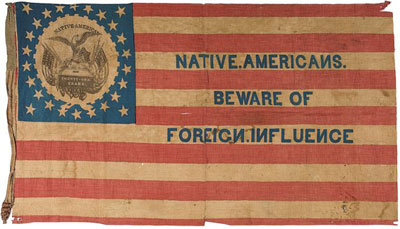
know-nothing_flag

Flag of the Know Nothing Party

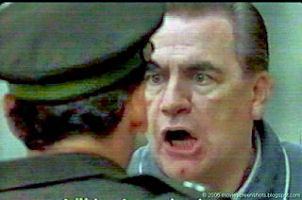
“The segregation laws in your country and the anti-Semitic laws in mine, are they not just a difference of degree? Herman Goering (Brian Cox) to Captain Gustave Gilbert (Matt Craven) in the Miniseries “Nuremberg

Today a rather short post as I had a rough night sleeping and in the midst of a nightmare screamed and threw a body block into the bookcase that serves as my nightstand. You will be happy to know that though I woke up my wife, my trusty dog slept comfortably through the episode. But I digress….

Tonight I am taking a break from writing about the rise of the Islamic State and our war against it. Instead I am going back to a favorite subject of mine; that of civil rights and liberties. I find it strange that there are a host of people, mostly on the political right that are doing their best in their local communities, state legislatures and even Congress to roll back civil liberties for various groups of people. This includes the outright disenfranchisement being legislated in several states to roll back voting days and hours that disproportionally affect African Americans, students and the poor.

Likewise there are numerous attempts to roll back the rights of women, especially working women; the use of the legislature by religious conservatives to place limits on the reproductive rights of women, holding them to the standard of a religion that they do not practice. There are numerous attempts to curb any civil rights, including the right to marriage or civil unions of the LGBT community. There is also a certain amount of xenophobia in regard to immigrants of all types, especially those with darker skin white Americans, but some of the worst is reserved for Arabs and other Middle-Easterners, even Arab Christians who are presumed as all Middle Easterners are to be Moslem terrorists, even those who have been here decades and hold respectable places in their communities.

See what bothers me about all this is not that it is new, but rather these are a new twist on old formerly acceptable means of discrimination. The proponents just clothe them in new terminology and play on fear to rile up support for their policies. Their words and actions are actually very similar to the virulently anti-emigrant (especially toward the Irish), anti-Catholic and anti-Black groups known collectively as the Know Nothings. While I would not call them a new incarnation of the Know Nothings, I have to notice the similarities in their message and the way that they push their agenda. The late Spencer Perkins who worked to reconcile whites and blacks in Mississippi noted: “They saw no contradictions in how they treated me and Christianity.”

Abraham Lincoln wrote to Joshua Speed about the Know Nothing Party:

“I am not a Know-Nothing. That is certain. How could I be? How can any one who abhors the oppression of negroes, be in favor or degrading classes of white people? Our progress in degeneracy appears to me to be pretty rapid. As a nation, we began by declaring that “all men are created equal.” We now practically read it “all men are created equal, except negroes” When the Know-Nothings get control, it will read “all men are created equal, except negroes, and foreigners, and Catholics.” When it comes to this I should prefer emigrating to some country where they make no pretence of loving liberty — to Russia, for instance, where despotism can be taken pure, and without the base alloy of hypocracy [sic].”

photo-jugement-a-nuremberg-judgment-at-nuremberg-1961-1

Likewise it is a very similar spirit that existed in many European countries in the years leading up to the First World War which was magnified, especially in Germany, Austria and Eastern Europe following that war, a spirit which animated the National Socialist movement in Germany, a movement which carried such intolerance toward those deemed racially inferior to an extent unimagined by a supposedly civilized “Christian” country. There is a great scene at the end of the movie Judgment at Nuremberg where Burt Lancaster plays a jurist who served the Nazi regime, a jurist who before the Nazis was considered to be one of the best legal minds not only in Germany but in Europe. In the film the character played by Lancaster, Ernst Janning discussed who he and others like him ended up doing what they did. It is a penetrating look at how people justified their actions.

“There was a fever over the land. A fever of disgrace, of indignity, of hunger. We had a democracy, yes, but it was torn by elements within. Above all, there was fear. Fear of today, fear of tomorrow, fear of our neighbors, and fear of ourselves. Only when you understand that – can you understand what Hitler meant to us. Because he said to us: ‘Lift your heads! Be proud to be German! There are devils among us. Communists, Liberals, Jews, Gypsies! Once these devils will be destroyed, your misery will be destroyed.’. It was the old, old story of the sacrificial lamb. What about those of us who knew better? We who knew the words were lies and worse than lies? Why did we sit silent? Why did we take part? Because we loved our country! What difference does it make if a few political extremists lose their rights? What difference does it make if a few racial minorities lose their rights? It is only a passing phase. It is only a stage we are going through. It will be discarded sooner or later. Hitler himself will be discarded… sooner or later. The country is in danger. We will march out of the shadows. We will go forward. Forward is the great password. And history tells how well we succeeded, your honor. We succeeded beyond our wildest dreams. The very elements of hate and power about Hitler that mesmerized Germany, mesmerized the world! We found ourselves with sudden powerful allies. Things that had been denied to us as a democracy were open to us now…”

Likewise, those with a more religious view who attempt to enact laws specifically designed to give their religion more protections, and allow discrimination based on religious preference are startlingly similar to the Taliban and other extremist groups that use religion to limit the rights of people that do not agree with their interpretation of Islam, including other Moslems.

There is a remarkable scene in the 2001 movie Nuremberg which is about the major war crimes trials following the Second World War. There is a scene where the American Army psychologist assigned to the confined war criminals goes to Herman Goering after he hears the testimony of and then questions the commandant of the Auschwitz concentration camp. The climax of that scene involves Goering dressing down the psychologist in words that make one think, and I have included a link to that scene below.

goering3

http://www.youtube.com/watch?v=WjbsD-TYi3s

Unfortunately this is what happens when people or groups, be they political or religious are more committed to their ideology than they are to their fellow citizens. It matters not if they are Christians, Moslems, Jews, Hindus, secularists, or others that hold the purity of their political, social, ideological, racial or economic theories as more important than people. It occurs when old prejudices are used under the banner of patriotism and nativism to confront real or imagined danger.

My comparison to the Taliban and the Know Nothings while I am sure that it is offensive to some is fitting. Because the spirit of such beliefs is the same, even if they differ in the degree in which people will go to enforce them. Like Hermann Goering’s comments at Nuremberg to Gustav Gilbert the difference between the ideology and actions of the Taliban, or the Know Nothings or the authors of the Jim Crow Laws as opposed to militant Christians and others, who attempt to use the power of the State to suppress, control and persecute those that they find offensive is only a matter of degree.

That may not seem important to some. But it is the difference between a divided society that can agree to disagree respecting the differences within it, and one for which factions attempt to use the police power of the State and the law of the land to persecute those that are different.

Goering in his critique of America in the 1930s and 1940s was correct; what we as a society enshrined in law and in our culture to discriminate against others differed little from what the Nazis did, only in the matter of degree. The sad thing is there are those today that work tirelessly to bring about a return to such practices.

It is something for us all to think about.

Peace

Padre Steve+

1 Comment

Filed under civil rights, film, laws and legislation, Political Commentary

Can you Live With It? The Moral Costs of the War Against the Islamic State

pale-moonlight

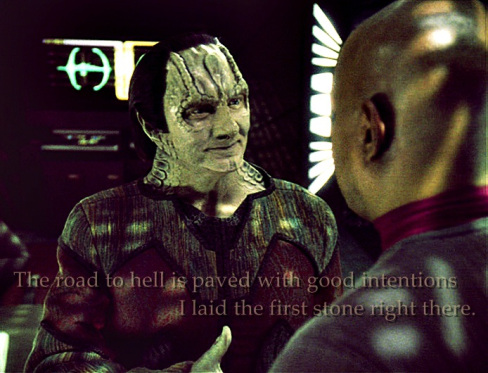
“My father used to say that the road to Hell is paved with good intentions. I laid the first stone right there. I’d committed myself. I’d pay any price, go to any lengths, because my cause was righteous. My… intentions were good. In the beginning, that seemed like enough.” Captain Benjamin Sisko (Avery Brooks) Star Trek Deep Space Nine, In the Pale Moonlight

I think that among the Star Trek series that my favorite is Star Trek Deep Space Nine. Of course all of the series deal with ethics, philosophy and morality to some extent, but Deep Space Nine is perhaps the most interesting to me. Don’t get me wrong I think that the Original Series and Start Trek the Next Generation were and are leap years ahead of most television series when it comes to addressing ethical, moral and existential issues, but somehow living in the post 9-11 “War on Terrorism” world I find Deep Space Nine to be the most compelling. I think that is that the fact that the moral issues get blurred which attracts me to the series, and to this episode in particular.

One of my favorite episodes is from season six and is entitled “In the Pale Moonlight.” The episode deals with the unsavory matter of contriving a reason to get the Romulan Empire to join with the Federation and the Klingons to fight the Dominion-Cardassian alliance that is threatening those entities as well as potentially the entire Alpha Quadrant. I have included a link to the conclusion of that episode here:

http://www.youtube.com/watch?v=dTgGtJ-PisA

The ethics of this episode seem very timely as I look at the new phase of the conflict that the United States has been engaged for the past thirteen years. The fact is that in spite of our appeal to higher ideals we are having to make alliances with powers that are only slightly less unsavory than ISIS, powers whose polices have help ISIS grow. In a sense it is the classic scenario of making a deal with the devil to defeat one’s enemy. Of course this is not new, individuals and nations have made such deals, sometimes with mortal enemies throughout history.

Unfortunately we usually judge such decisions based on their results, rather than wrestle with the ethical issues involved and how we might behave in similar situations. For me the philosophical and ethical issues involved in such alliances have a special interest and as such I tend to notice or recall instances where I saw, read or heard something that makes a connection to an ethical or moral dilemma faced by policy makers and planners today.

Some of the issues involved for policy makers are related to the traditional Just War Theory, and what is called the “Supreme Emergency” exemption. This exemption basically posits that when faced with a supreme and existential emergency a person or state may engage in behaviors that ordinarily would be considered unethical if the situation were not of a supreme emergency.

Of course such decisions in the real world are difficult. Those who have a system of beliefs that help them define right and wrong behaviors, even if they are not codified in law may struggle with with such decisions, while those who act according to what they deem necessary or expedient, unbridled by religious, philosophical or other similar codes may not, instead making their decisions based on what appears to be necessary at the time.

This Deep Space Nine episode is remarkable because we get to see an actor playing a military commander dealing with the morality of the course of action that he is taking. In one of the early scenes Captain Sisko expresses his doubts relating to the morality of a decision that he is making in a war that has already consumed the lives of tens of millions of people.

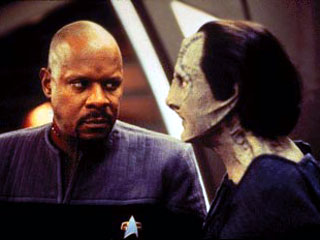
siskogarak


After an incident where a Federation starship was destroyed, Sisko went to Elim Garak (Andrew Robinson), an exiled Cardassian intelligence officer to uncover any evidence about Dominion-Cardassian collusion to attack the Romulans. When none was uncovered and Garak’s sources on Cardassia were compromised he agreed to allow Garak to manufacture evidence in order to get the Romulans into the war on the side of the Federation and Klingons. Sisko compounded the situation by having the Kilingons release a master forger who was on death row to help Garak. Sisko knew it was wrong and confided in his log:

“Why I didn’t listen to the voice in the back of my mind telling me not to believe a word he said, I’ll never know… But it didn’t take long for me to come face to face with the fact that I’d made a mistake.”

When the former prisoner gets drunk and attacks the owner of a tavern on the space station Sisko was in a bind. He wanted no evidence that the man had been on his station and in order to keep Quark, the bar owner quite had to bribe him. Sisko again expressed his doubts in his personal log:

“Maybe I should have put a stop to it right there. Maybe I should have said, “Thank you very much for your input, Mister Garak, I will take your suggestion under advisement,” and then gone back to my office and forgotten the whole thing. But I didn’t. Because in my heart, I knew what he was saying made sense.”

Even so Sisko still had doubts:

“That was my first moment of real doubt, when I started to wonder if the whole thing was a mistake. So I went back to my office. And there was a new casualty list waiting for me. People are dying out there every day! Entire worlds are struggling for their freedom! And here I am still worrying about the finer points of morality! No, I had to keep my eye on the ball! Winning the war, stopping the bloodshed, those were the priorities! So I pushed on. And every time another doubt appeared before me, I just found another way to shove it aside.”

When nations feel they are engaged in a life and death struggle, those who serve as policy makers, planners and military commanders often make uncomfortable compromises with their own religious, ethical or philosophical codes. Sisko continued down the path despite his doubts but justified his actions by the fact that Starfleet had approved them:

“Maybe… I was under more pressure than I realized. Maybe it really was starting to get to me, but I was off the hook. Starfleet Command had given the plan their blessing and I thought that would make things easier. But I was the one who had to make it happen. I was the one who had to look Senator Vreenak in the eye and convince him that a lie… was the truth.”

The forgery was completed and the Romulan Senator secretly arrived on the station to examine the evidence and as he did so all Sisko could do was wait, confiding in his log:

“So all I could do was wait… and see how masterful Tolar’s forgery really was. So I waited… tried to catch up on my paperwork, but I find it very difficult to focus on criminal activity reports, cargo manifests… So I went back to pacing, staring out of the window. I’m not an impatient man, I’m not one to agonize over decisions once they’re made. I got that from my father. He always says, “Worry and doubt are the greatest enemies of a great chef. The soufflé will either rise or it won’t – there’s not a damn thing you can do about it, so you might as well just sit back and wait and see what happens.” But this time the cost of failure was so high, I found it difficult to take his advice. If Vreenak discovered that the data rod was a forgery, if he realized that we were trying to trick them into the war it could push the Romulans even farther into the enemy camp. They could start to openly help the Dominion. If worst came to worst they could actually join the war against us. I had the distinct feeling that victory or defeat would be decided in the next few minutes.”

In-The-Pale-Moonlight

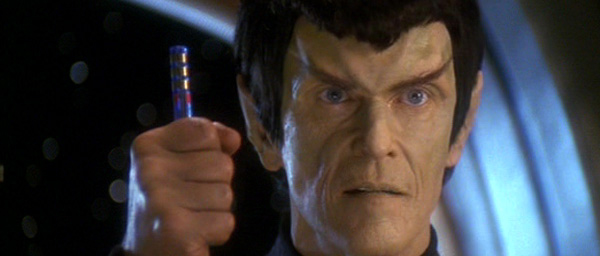
It did not work, Vreenak discovered that the data rod was a forgery and threatened to expose Sisko’s deception and possibly bring the Romulans into alliance with the Dominion. When Sisko’s actions blew up in his face and his deceit was revealed he was not happy and resigned himself to face the consequences:

“So it all blew up in my face. All the lies and the compromises, the inner doubts and the rationalizations – all for nothing. Vreenak was furious. I can’t say I blamed him; I’d have reacted the same way. After telling me in no uncertain terms that he intended to expose this “vile deception” to the entire Alpha Quadrant, he got back in his shuttle and headed home. There didn’t seem to be anything more to do… so I went back to work. Two days later we got the news.”

Sisko learned in a Starfleet communication that Vreenak’s shuttle had blown up and that is was suspected to be the work of the Dominion. When Sisko found that Vreenak was dead he went to Garak and forcefully confronted him, striking him in the process. He accused Garak of sabotaging the senator’s ship and killing him as well as the forger, Tolar. Instead of backing down Garak confronted the results and the ethical issue. The heated exchange between the two men is fascinating:

Garak: If you can allow your anger to subside for a moment, you’ll see that they did not die in vain! The Romulans will enter the war!

Captain Sisko: There’s no guarantee of that!

Garak: Oh, but I think that there is. You see, when the Tal Shiar finishes examining the wreckage of Vreenak’s shuttle, they’ll find the burnt remnants of a Cardassian optolythic data rod which somehow miraculously survived the explosion. After painstaking forensic examination, they’ll discover that the rod contains a recording of a high-level Dominion meeting, at which the invasion of Romulus was being planned.

Captain Sisko: And then they’ll discover that it is a fraud!

Garak: Oh, I don’t think they will! Because any imperfections in the forgery will appear to be a result of the explosion. So – with a seemingly legitimate rod in one hand, and a dead senator in the other, I ask you, Captain – what conclusion would you draw?

As Sisko’s anger subsided Garak continued:

“That’s why you came to me, isn’t it, Captain? Because you knew I could do those things that you weren’t capable of doing? Well, it worked. And you’ll get what you want: a war between the Romulans and the Dominion. And if your conscience is bothering you, you should soothe it with the knowledge that you may have just saved the entire Alpha Quadrant. And all it cost was the life of one Romulan senator, one criminal, and the self-respect of one Starfleet officer. I don’t know about you, but I’d call that a bargain.”

Shortly thereafter Sisko found out that the out that the deception was successful as Garak had said it would be. The Romulans who recovered the damaged data rod believed that it was genuine and declared war on the Dominion-Cardassian alliance and had entered the war on the side of the Federation. He completed his personal log:

“At oh-eight-hundred hours, station time… the Romulan Empire formally declared war against the Dominion. They’ve already struck fifteen bases along the Cardassian border. So, this is a huge victory for the good guys! This may even be the turning point of the entire war! There’s even a “Welcome to the Fight” party tonight in the wardroom!… So… I lied. I cheated. I bribed men to cover up the crimes of other men. I am an accessory to murder. But most damning of all… I think I can live with it… And if I had to do it all over again… I would. Garak was right about one thing – a guilty conscience is a small price to pay for the safety of the Alpha Quadrant. So I will learn to live with it…Because I can live with it…I can live with it. Computer – erase that entire personal log.”

DS9SiskoToast

My guess is that before this war is over, there will be men and women serving in positions of responsibility in our or allied militaries, policy makers and government officials who will make similar deals, violating their own moral codes and even laws in order to defeat the Islamic State and prevent acts of terror against their citizens. Most, like Sisko will not be happy but will live with their decisions. The fact is that long asymmetrical wars in which nation states have to fight non-state terrorist entities get really ugly and the longer and more bloody that they become the more decent and honorable people will make decisions like Sisko and resort to actions that in normal times they would never countenance.

This is nothing new. Those who have fought in such wars throughout history have found ways to “live” with actions that they would not approve of had things been different. Wars such as the one that we are fighting and continue to fight in the years ahead have a corrosive affect on the human spirit. They corrupt and destroy even when they are “successful.”

The question is: Can we live with it? Sadly, as much as I hate to admit it, in a similar situation I think like Sisko, that I could condone or be complicit in something like this. I too could probably convince myself that the end justified the means and that I could live with it.

Peace

Padre Steve+

4 Comments

Filed under ethics, leadership, News and current events, philosophy, Political Commentary, star trek, War on Terrorism

War is Cruelty, and You Cannot Refine it… The War Against ISIL

Iraq-unrest

The war that we are in, and please let’s call it that, which we have been in for over thirteen years now; and which has been extended indefinitely by the actions of the Islamic State and the announced intentions of President Obama to fight it will become much worse than people want to believe regardless of whether it is a long or a short war.

Americans have grown up for the past twenty years with hi-tech wars that with a few exceptions of terrorism inflicted on American civilians have been waged by a comparatively small professional military; a military that at any given time over the last 20 years has comprised less than one percent of the American population. As such war is a spectator sport for most Americans, we watch it on television, or on You Tube videos on the internet, but it is a distant thing, happening to others that doesn’t touch us too deeply because most of us think that we have no skin in the game. In fact people that bet on baseball have more skin in the game than most Americans do in the current war, but that will probably change.

Since I have written much about that military at its sacrifices in the war that began on September 11th 2001 I am not going to belabor that today. Instead I am going to go back to the nature of war, even wars that may be fought in self-defense and with just cause. It was General William Tecumseh Sherman who wrote:

“You cannot qualify war in harsher terms than I will. War is cruelty, and you cannot refine it; and those who brought war into our country deserve all the curses and maledictions a people can pour out…

Chris Hedges wrote: “Violence is a disease, a disease that corrupts all who use it regardless of the cause,” and as Clausewitz noted of war’s nature, that it is: “a paradoxical trinity-composed of primordial violence, hatred and enmity…”

We try to use language to soften war; to make it more palatable, but to do so is an Orwellian charade that is deceptive and destructive to the soul. Dave Grossman, the army infantry officer who has spent his post military life writing about the psychology of war and killing wrote:

“Even the language of men at war is the full denial of the enormity of what they have done. Most solders do not “kill,” instead the enemy was knocked over, wasted, greased, taken out, and mopped up. The enemy is hosed, zapped, probed, and fired on. The enemy’s humanity is denied, and he becomes a strange beast called a Jap, Reb, Yank, dink, slant, or slope. Even the weapons of war receive benign names- Puff the Magic Dragon, Walleye, TOW, Fat Boy, Thin Man- and the killing weapon of the individual soldier becomes a piece or a hog, and a bullet becomes a round.”

Likewise Thucydides wrote:

“Words had to change their ordinary meaning and to take that which was now given them. Reckless audacity came to be considered the courage of a loyal supporter; prudent hesitation, specious cowardice; moderation was held to be a cloak for unmanliness; ability to see all sides of a question incapacity to act on any….”

Such language gives those who have never been to war but cannot live without it to bring it on, but as Sherman noted: “It is only those who have neither fired a shot nor heard the shrieks and groans of the wounded who cry aloud for blood, more vengeance, more desolation. War is hell.”

President Obama in his address to the nation, and the world on the eve of September 11th talked of a war against the Islamic State, using far more diplomatic, restrained and less warlike language than did Vice President Biden who said:

“As a nation we are united and when people harm Americans we don’t retreat, we don’t forget. We take care of those who are grieving and when that’s finished, they should know we will follow them to the gates of hell until they are brought to justice because hell is where they will reside. Hell is where they will reside.”

I commend the President for his humanity and desire to fight the Islamic State with a matter of restraint. That restraint will last so long as the Islamic State is unable or unwilling to strike at American civilians in the American homeland, or in a country that is not in the war zone, or an American ship or military installation at home or abroad. But once that happens, and it will the pretense of restraint will drop and what the Vice President said will become our goal, even if we do not officially say it. But once those restraints are passed, the war will get really messy. Michael Walzer wrote in his book Just and Unjust Wars:

“We don’t call war hell because it is fought without restraint. It is more nearly right to say that, when certain restraints are passed, the hellishness of war drives us to break with every remaining restraint in order to win. Here is the ultimate tyranny: those who resist aggression are forced to imitate, and perhaps even to exceed, the brutality of the aggressor.”

The problem with this war is that it has lasted so long already, and such long wars are detrimental to the nations and peoples that fight them, as Sun Tzu wrote: “There is no instance of a nation benefitting from prolonged warfare,” as such the longer we drag this war against the Islamic State and other similar groups out, the longer the war continues, the crueler it will become and the more damage it will do to our civil liberties, our economy and even more importantly to the spirit of our nation. One can only look at the Patriot Act and related measures undertaken in the name of national security after 9-11-2001 and recall the words of President John F Kennedy who said in respect to the epidemic of loyalty oaths and restrictions on civil liberties enacted in the 1950s:

“We have also seen a sharpening and refinement of abusive power. The legislative investigation, designed and often exercised for the achievement of high ends, has too frequently been used by the Nation and the States as a means for effecting the disgrace and degradation of private persons. Unscrupulous demagogues have used the power to investigate as tyrants of an earlier day used the bill of attainder.

The architects of fear have converted a wholesome law against conspiracy into an instrument for making association a crime. Pretending to fear government they have asked government to outlaw private protest. They glorify “togetherness” when it is theirs, and call it conspiracy when it is that of others.”

Thus the place that we now find ourselves is not good. On one hand by using restraint the war goes on and on, war without end, and if we embrace Sherman’s realism and admit that “War is cruelty. There’s no use trying to reform it. The crueler it is, the sooner it will be over” is that we will imitate or exceed the brutality of the Islamic State. Either way, we lose something of ourselves. But as Abraham Lincoln said “There’s no honorable way to kill, no gentle way to destroy. There is nothing good in war. Except its ending.”

My hope is that somehow, when this is war is done, maybe in our time or in another generation or two, that we will be able to establish peace by making our enemies our friends.

Peace

Padre Steve+

3 Comments

Filed under History, iraq,afghanistan, middle east, Military, national security, News and current events, Political Commentary, War on Terrorism

The Dangers of the Reductionist Religion of Fundamentalism

IMG_1915.JPG

My friends, today will be a busy day so I wanted to share a few thoughts about religious fundamentalism in it’s various forms. Now I want to say up front this is not an attack on God or people that believe it God, or in what God they choose to believe in for either their eternal salvation or just getting through life. Instead it is some observations about fundamentalist, or absolutist belief systems that allow no room for doubt or that any other view of God might have some measure of truth and how some groups use political, police and military power, even terror to impose those views on others.

It occurred to me a few years back that many Christians, among them Evangelicals, certain Reformed types, Fundamentalists, and even some conservative Roman Catholics practice a reductionist form of the Christian faith. It is a form that woefully short changes those that embrace it. Now I am speaking very general terms right now and the subject probably needs to be fleshed out some for each particular form. I probably will do that sometime soon, but let me continue.

What I have observed is that the richness, the history, the intellectual achievements, and the diverseness of the Christian experience, whether it that of the mystics like Hildegarde of Bingen, the patristic theologians such as Basil, Origen or Gregory of Nyssia, the scholastics such as Anselm of Canterbury who penned a philosophy that I much admire, “faith seeking understanding” the reformers such as Martin Luther, those of the awakenings such as John and Charles Wesley, the humanists such as Erasmus of Rotterdam, those of the enlightenment such as Schleiermacher, and Kierkegaard, the Neo-Orthodox of the early part of the Twentieth Century like Karl Barth, Dietrich Bonhoeffer, Emil Brunner and Paul Tillich, or the Catholic reformers leading up to and following Vatican II like Pierre Teilhard de Chardin, Hans Kung, Yves Congar, Bernhard Haring, and Andrew Greeley, and the Theologians of Hope led by Jurgen Moltmann.

This list is certainly not exclusive by any means. However, the one common thing about these men was that they understood their faith in the context of the society, history, culture and learning of their day. They used reason informed by faith and wrestled with subjects that are for the most part denied to the reductionists of Christian Fundamentalism. The fact is that most fundamentalists of any stripe tend to disregard history, science, philosophy and other disciplines that seek to interpret the world and instead place their own understanding of God, their scriptures or creeds above all others. Various groups of Christians, Jews, Moslems, Buddhists, Hindus and other religions all do this, even some Atheists and other Secularists are not immune. It is a reality of many people’s need for certitude in a world that is full of too many troubles and contradictions.

Christian fundamentalism in its various forms reduces the faith to a small set of absolute principles from which no deviation is allowed. As I mentioned there are different forms of this, but in a sense adherents to any version of Christian Fundamentalism treat the Bible, their Statement of Faith, catechism or Creed as a sort of “tech manual” that provides quick solutions to those that “know the truth.”

By this I mean is that when there is a really difficult question that requires critical thinking, reasoning and nuance, instead of wrestling with it they throw out a Bible verse or a credal type statement to shut down the person asking the question. I think I remember the classic line that I heard when I was in high school: “Jesus is the answer, what was the question?” The sad thing was this was not a joke, the person who said it meant it.

Now I admit for some people a simple faith works well, that is human nature, but when religious leaders present the faith in such reductionist and absolute terms they impoverish their followers and end up driving off those who ask the hard questions. These are questions which cannot be answered by the shibboleths thrown out by these leaders because they are not easy, and defy attempts to simplify them. This is because they often deal with existential matters and the mysteries of human life and nature.

The fundamentalism in all it’s forms reduces life to a dualism in which one is either on God’s side (that is whoever’s God) or not in which all life’s questions are resolved by faith or religion. I would dare say that most of people’s most difficult questions, issues and needs are not religious at all and that is why so many people reject fundamentalism, either because they see the fallacies inherent in such inflexible systems of belief, or because they experience disappointment in those groups when the ideal of God presented, either as individuals or the community does not match reality.

As for as what people believe as individuals or within their religious communities that does not bother me one bit, even if I disagree with them. I fact I think the discussion of religion should be allowed in the public square. However, I believe that to discussion should include everyone, not just which religious group has the most power in government or influence in society.

The problem that I see is when such groups, regardless of what God they believe in decide to impose their beliefs on others through the power of the government, and for that matter even use their beliefs to silence others in the public square. The danger is when any such group decides it is superior, that it’s leaders have a lock on the truth, are “anointed” or whatever term they call it, hear directly from God, authoritatively speak for God and then use that to suppress dissenters or control unbelievers through the power of the state, of in the case of the new Islamic State, the power of military conquest and terror.

In fact the leaders and followers of such groups almost practice a form of Gnosticism, where if you have the right understanding of “the truth” you are superior to those that do not. Since God is the ultimate trump card in any argument those who believe they have the direct line are the most dangerous.

In spirit, this reductionist understanding of faith is ultimately destructive and when people take it to its logical end use it to justify the most heinous crimes against their fellow human beings. What we see with the Islamic State is really no different than other fundamentalist religions with absolute control of their society do to unbelievers. The ultimate choice for those under their rule, is to “convert or die.”

Christians have done this numerous times since Christianity became the state religion of the Empire under Constantine, and Catholics, Orthodox and Protestants have all exercised that option. One only has to look at the persecution of various Protestants by Roman Catholics, the persecution of the Anabaptists by Catholic and Protestant State Churches, the burning of heretics and witches, even in Colonial America, and the persecution of Catholic immigrants from Europe by American Protestants in the 1800s, not to mention the pogroms conducted against the Jews in Europe, the Holocaust, or the extermination of Native Americans in the name of the Christian God.

Moslems have done this too throughout history and in the present,where the Islamic State and other groups like it, Boko Haram, Al Shabab, and Hezbollah among them practice it in its worst form.

It is also part of the earliest forms of Judaism in the conquest of Canaan where God’s command, to put it in the modern vernacular was “kill them all and let God sort them out later.” In fact I remember scandalizing my Old Testament class in seminary by blurting that out. But when I read supposedly Christian apologists defending the legitimacy of what even they refer to as genocide it sickens me.

Likewise it was fascinating thing for me this week was to hear the star of the Duck Dynasty Phil Robertson, a Christian fundamentalist explain that “convert or die” was the choice that the people in the Islamic State should be offered. Others have said similar things and not just in regard to Islamic radicals.

Again, I have no problem who need to believe in a God of absolutes, some people need that and it is a free country. But I think that such beliefs shortchange and deprive them of the richness of faith, life and the mystery of God and faith, even the great mystery of the Christian faith that we proclaim in the celebration of the Eucharist “Christ has died, Christ is risen, Christ will come again.” The mystery of God who became man, or as Anselm of Canterbury wrote “cur Deus homo” “Why God Man?” or what Christians call the Incarnation, is central to the the Christian faith.  Like creation and the eschaton is a mystery, as Bonhoeffer wrote and we would be so wise to remember:

“Man no longer lives in the beginning–he has lost the beginning. Now he finds he is in the middle, knowing neither the end nor the beginning, and yet knowing that he is in the middle, coming from the beginning and going towards the end. He sees that his life is determined by these two facets, of which he knows only that he does not know them.”

The fact is that no matter what we say, we do not know and when we make absolutist claims based on our scriptures we have to remember that they as well are shrouded in mystery, but then Eric Hoffer noted “We can be absolutely certain only about things we do not understand.”

The mystery associated with the Canon of Scripture, includes the authorship as well as the contents of scripture. Since we don’t have the original autographs of any book of the Bible, or for that matter any major religions scriptures there is a certain mystery associated with the scriptures. We believe them by faith, just as we do in the existence of God. The reality is that in many cases we don’t know who the actual authors were and even as to when some of them were written.

This might make the Christian Canon of scriptures as well as those of other major religions sources of inspiration, spirituality, sources of good advice, lessons and ethics; but not absolute truth and fact in matters of history, science or anything else we might want them to be. The fact is we believe in God by faith, and we trust scriptural accounts by faith.

However, for those who must claim the Bible as absolute there is a need to prove it, and that need brings about the controversies of “inerrancy” that are part and parcel of Protestant fundamentalism as well as the absolutist claims of others in regards to their scriptures. Sadly, for many, their absolutist understandings of scripture or creedal claims are dogma to be defended to the death and to force upon others, rather than mysteries by which we experience the love and grace of God.

The problem is that such beliefs, even if they are from antagonistic or competing groups are all variations on a theme. They are all variations of the same species of religion, religion that must control or suppress dissenters at all costs, and if given the chance to use the police and military power of the state to succeed when dialogue fails. The only differences these religions have, besides the God that they believe is right, is the matter of degree with which they apply those beliefs. For some they are quite happy with keeping such matters in house and leave outsiders alone. But there are others in every major religion who have a need to impose their beliefs on others using any means necessary, including special privileges for themselves that no other groups get as well as to use the state to persecute, terrorize against or conquer by brute military force those who do not believe.

That is why the Islamic State must be defeated and why we must be ever vigilant at home to such beliefs, no matter what religious group utters them. Sadly the reality is that there are Americans as well as those in Western Europe and other countries

Now I am sure that I have offended some today, but that was not the intention. I believe in a person’s right to believe in anything they chose to believe or not to believe and to defend those rights, while at the same time defending others from anyone that wants to use the state to impose those beliefs on others.

Have a great night,

Peace.

Padre Steve+

1 Comment

Filed under faith, History, Loose thoughts and musings, philosophy, Political Commentary, Religion

The Only Church that Truly Feeds the Soul

163017_10150113444907059_3944470_n

“The Only church that truly feeds the soul, day-in day-out, is the Church of Baseball” Annie Savoy (Susan Sarandon) in Bull Durham (MGM 1989)

Tonight I am going to the last home game of the Norfolk Tides. The Tides are our local Triple-A Minor League farm team of the Baltimore Orioles who are now 7 games up on the Yankees in the American League East. I love baseball. For me it is a source of peace, comfort and meaning in the sea of so much hatred, violence, inequity and injustice, angst and despair that fills our world.

Now honestly, while things seem are not good we tend to see life at any given time through they could be worse and certainly could be better they are not nearly as apocalyptic as the bearers of bad news make them out to be. Barbara Tuchman wrote “Disaster is rarely as pervasive as it seems from recorded accounts….The fact of being reported multiplies the apparent extent of any deplorable development by five-to tenfold.”

This is especially true for those who follow that loathsome Trinity of Evil, the Politicians, Pundits and Preachers who make their living causing people to be angry, covetous, anxious and on edge.

When I read or hear some of the vile things being said by allegedly conservative Bible believing Christian leaders be they politicians, pundits or preachers, or in the case of Mike Huckabee a despicable combination of all three, I become more convinced that Annie Savoy was right… the only church that truly feeds the soul is baseball.

In fact when I hear the likes of the Partisan Political Parsons, any of the big Mega-Church Pastors or television ministry hosts, or even some Catholic bishops start spouting off I feel like I have left this country and ended up in Medieval Europe or maybe Saudi Arabia. I wonder where the love has gone. When I read the words of men like Pat Robertson, James Robison, James Dobson, Bryan Fischer, Scott Lively, Franklin Graham, Tony Perkins, Gary Bauer and so many others I understand why people are fleeing the church in droves and so many hold the Christian faith, as well as other religions in such disdain.

Jonathan Swift once mused about the religion of his time, “We have just enough religion to make us hate, but not enough for us to love one another.”   Swift’s words are a perfect description of the American Religious Right as much as they are of non-Christian groups who hate, the Moslem extremists of ISIS, Al Qaeda, Hamas, Boko Haram and the Taliban; the Ultra-Orthodox Jews who think that they are the only acceptable form of Judaism and physically attack other Jews for not being Jewish enough even while persecuting Israeli citizens who are Christian or Moslem; and the Hindu fundamentalists that burn down Christian and Moslem villages in India.

Thankfully, though I am still a Christian and at that a rather miscreant Priest and Chaplain that struggles with faith and belief, I also belong to the Church of Baseball. I am so because I agree with the late Commissioner of Baseball A. Bartlett Giamatti, who said, “there is nothing bad that accrues from baseball.” 

While I am very frustrated at what I see going on in the Christian church as well as in other religions that dominate other countries or cultures, when I think about baseball I know that God still cares. Every time that I look at that beautiful green diamond that sits in the middle of the great cathedrals and parish churches of the Church of Baseball, my sense of hope and faith is renewed.

To true believers, that may seem like heresy. But God even loves heretics and unbelievers. For me baseball speaks to the soul, maybe it is because baseball is more than a game.  Conservative political commentator and long suffering Chicago Cubs fan George Will said “Baseball is only a game. True. And the Grand Canyon is only a hole in Arizona. Not all holes or games are created equal.” 

If that is heresy I don’t care. But then what is heresy? I don’t actually think that Jesus would recognize a lot of what we Christians do today as even being Christian.  I could be wrong but I recall Jesus was really big into the whole “two commandment” “love God with your whole heart and love your neighbor as yourself” way of life; and he wasn’t really cool with pompous religious leaders that give preference to the rich and powerful, and seek their own political power so they can use the state to enforce their religious views on non-believers like we do.

That is why I find something so right about baseball. Unlike the message of the political preachers that specialize in making themselves rich by keeping their followers anxious and angry while preaching the message that “God loved the world so much that he can’t wait to come back, judge and destroy it because of fouled up humanity” especially women and homosexuals; baseball caters to our hopes and dreams while recognizing that none of us, even those who play at the Hall of Fame level are perfect.

Unlike the false religious message preached by so many members of the Trinity of Evil, baseball deals with reality and life so well because of its ebb and flow. It deals with the grind of the long season, the constant demand for excellence and quest for perfection; but there is a realization that most of the time you won’t get there, and if you do, tomorrow you won’t and that is part of life.

Personally I don’t understand why if the Gospel of Jesus and God’s grace and love is actually true that we can’t apply this to our faith. Jesus, at least in the Gospel accounts seemed to accept the imperfections and foul ups of his followers, and not only that seemed to accept the people who the really righteous, religious leaders rejected and treated as less than human.

In fact, my paradigm of understanding the Christian faith comes from baseball. In baseball perfection is illusory and that life is full of times when things don’t go our way. It is much like real life and what is presented in Scripture. Ted Williams, the last player to hit for .400 said “Baseball is the only field of endeavor where a man can succeed three times out of ten and be considered a good performer.”

For some of us it seems like reaching the Mendoza Line* is the best we will ever do, and if we believe in God’s grace, that is probably okay.

Tommy Lasorda the Hall of Fame Los Angeles Dodgers’ manager put things in excellent perspective “No matter how good you are, you’re going to lose one-third of your games.  No matter how bad you are you’re going to win one-third of your games.  It’s the other third that makes the difference.”  That is true in life and faith.

While I am definitely a Christian I struggle and I admit it. I have enough of my own problems to empathize with others that struggle, but who in embracing the wacky formulas offered by greedy self-serving preachers treat Jesus and his message like some sort of magical talisman or good luck charm. But sorry, I agree with what Pedro Cerrano (Dennis Haysbert) said in the movie Major League: “Jesus, I like him very much, but he no help with curveball.”

Thus I have many problems with the perfidious political and prosperity preachers that seem to have forgotten the Gospel, who are basically Elmer Gantry like snake-oil salesmen more attuned to keeping their market share than tending their flock. In fact, I think are actually driving people away from Jesus, and the polls of Barna, the Pew Religious survey, Gallup and others as well as the statistics kept by various denominations say that I am right.

When I watch baseball I feel renewed. As Sharon Olds wrote back in the early 1970s “Baseball is reassuring.  It makes me feel as if the world is not going to blow up.” That my friends is why I agree with Annie Savoy that the only church that truly feeds the soul day in and day out is baseball.

Churchofbaseball


The late great and legendary Detroit Tigers announcer Ernie Harwell said: “Baseball?  It’s just a game – as simple as a ball and a bat.  Yet, as complex as the American spirit it symbolizes.  It’s a sport, business – and sometimes even religion.”   Yes, for me, the heretic that I am it is the latter, and tonight I am happy to be going to the Church of Baseball, Harbor Park Parish.

Peace,

Padre Steve+

*Mario Mendoza was a Major League Shortstop who played for the Pittsburgh Pirates and other organizations. He was an outstanding defensive player but was not much of a hitter. His career batting average was only .215 but a batting average of .200 is considered the minimum that a player can have to remain at the level that he plays.  I think that my career batting average in both baseball and softball barely clears the Mendoza Line. 

Leave a comment

Filed under Baseball, Batlimore Orioles, faith, movies, Political Commentary, Religion

Reembracing the New Birth of Freedom

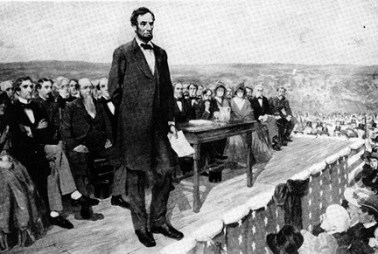
gburg address

I am always humbled when I travel to Gettysburg as I did a week and a half ago. It is hard to believe in that now peaceful pastoral setting that over 157,000 Americans, almost 82,000 Union and 75,000 Confederate met in a three day battle. In those three days over 28,000 Confederates and 23,000 Union soldiers were killed, wounded, missing or captured. It was the greatest number of casualties inflicted in one battle on American soil in history.

The places that the battle was fought have become legendary, for they are “hallowed ground” as President Abraham Lincoln so eloquently put it. The places, McPherson’s and Herr’s Ridge, Seminary Ridge, the Railroad Cut, Barlow’s Knoll, Cemetery Hill, Culp’s Hill, The Wheat Field, Devil’s Den, the Peach Orchard, Little Round Top, Cemetery Ridge, the Apse of Trees, the Angle and the High Water Mark are in a sense holy, or hallowed, consecrated by those who struggled there, those who lived and those who gave the last full measure of devotion to their country. When I take my students there I always finish at the Soldier’s Cemetery where Abraham Lincoln delivered the Gettysburg Address.

I think about those men of both sides, fully convinced of the rightness of their cause who fought valiantly in the struggle. That being said when I go there though my family predominantly fought for the Confederacy my heart is drawn to those men who remained loyal to the Union and those who answered the call of Abraham Lincoln to serve in a cause greater than their own interests, the great and the small alike.

Lincoln was a masterful orator who managed to rally the Union and bring hundreds of thousands of men volunteer before Gettysburg. They came for an ideal an ideal which Lincoln’s oratory was probably the most effective at articulating in a way that men would volunteer to suffer hardship, fight and die to bring about. It was well put in the movie Gettysburg where Colonel Joshua Chamberlain, played by Jeff Daniels said:

“This is a different kind of army. If you look at history you’ll see men fight for pay, or women, or some other kind of loot. They fight for land, or because a king makes them, or just because they like killing. But we’re here for something new. This has not happened much, in the history of the world: We are an army out to set other men free. America should be free ground, all of it, from here to the Pacific Ocean. No man has to bow, no man born to royalty. Here we judge you by what you do, not by who your father was. Here you can be something. Here is the place to build a home. But it’s not the land. There’s always more land. It’s the idea that we all have value, you and me. What we’re fighting for, in the end… we’re fighting for each other…” [1]

On November 19th 1863 Lincoln delivered a “few words” at Gettysburg which were in all practical aspects a benediction at the dedication of the battlefield cemetery. Lincoln was the second speaker at the ceremony following former Pennsylvania Congressman Edward Everett who spoke for more than two hours, a typical speech from the period.

Everett was one of the leading orators of his day. Everett was “a scholar and Ivy-League diplomat who could hold mass audiences in thrall. His voice, diction, and gestures were successfully dramatic, and he always performed his carefully written text, no matter how long, from memory.” [2]

The 270 words of Lincoln’s address are perhaps the most important of any speech or document in American history save the Declaration of Independence and the Constitution of the United States, in those words “Lincoln, nevertheless managed to justify the ways of democracy more than anyone, then or now.” [3]

The speech was so powerful that Everett wrote Lincoln the next day:

“Permit me also to express my great admiration of the thoughts expressed by you, with such eloquent simplicity & appropriateness, at the consecration of the Cemetery. I should be glad, if I could flatter myself that I came as near to the central idea of the occasion, in two hours, as you did in two minutes.” [4]

The speech is short, but its eloquence is unmatched. Lincoln wrapped ideas, concepts and ideals that men have written volumes about into a speech so powerful that many have memorized it.

But few realize the context that it must be placed. Though the Union had defeated Lee’s Army at Gettysburg and Grant had taken Vicksburg to cut the Confederacy in half the North was growing war weary. During the fall of 1863 after a series of inconclusive battles in northern Virginia both Lee and Meade’s armies had sent significant numbers of troops to the west, to support operations in eastern Tennessee.

Lee sent Longstreet’s First Corps, which took part in the bloody battle of Chickamauga, which “is a Cherokee word meaning “river of death.” [5] where on September 19th and 20th the Federal Army of the Cumberland under General Rosecrans “were soundly whipped at …and driven back into the strategic point of Chattanooga.” [6] The number of casualties on both sides, over 16,000 Federal and 18,000 Confederate, a “combined total of 34,634 was exceeded only the three day slaughter at Gettysburg and by the week-long series of five battles known collectively as the Seven Days.” [7] Despite the number of casualties it was one of the biggest Confederate victories of the war. A clerk in Richmond wrote “The whole South will be filled again with patriotic fervor, and in the North there will be a corresponding depression.” [8] That changed rapidly when the Union reacted quickly and reversed the strategic situation. One action taken was to deploy Oliver Howard’s XI Corps and Henry Slocum’s XII Corps west, where “they would be commanded by Joe hooker, who was conveniently at hand and unemployed.” [9]

In the east during the following weeks “Lee and Meade, like two wounded, spent gladiators, sparred listlessly along the Rapidan. It seemed to Northerners that the fruits of Gettysburg had been thrown away.” [10] Lee sensed an opportunity to go back on the offensive against Meade’s weakened army, but his offensive was stopped on October 14th when “the Union Second Corps shattered a reckless attack by A.P. Hill’s corps at Bristoe Station, five miles south of Manassas.[11]

There was a faction in the North, the Copperheads, who were willing even after Gettysburg and Vicksburg to end the war on terms favorable to the Confederacy, even allowing for Confederate independence and the continuation of slavery. The efforts of the Copperheads to gain governorships in Ohio and Pennsylvania met defeat in November 1863, although their efforts would persist through the 1864 Presidential election.

However, the anti-abolitionist and racist views espoused by the northern Democrat Copperheads had begun to lose their potency in the North after July of 1863 with the onset of “the New York draft riot, which shocked many northerners into a backlash against the consequences of virulent racism” [12] and the sacrifice of the African American 54th Massachusetts Infantry when it assaulted Fort Wagoner outside of Charleston South Carolina, which occurred “just after the Democratic rioters in New York had lynched black people and burned the Colored Orphan Asylum. Few Republican newspapers failed to point the moral: black men who fought for the Union deserved more respect than white men who fought against it.” [13]

The speeches of Everett and Lincoln are deeply connected with Romanticism, the Greek revival and the Transcendentalist movement in the United States. Both were children of the enlightenment, and Everett, a former President of Harvard was well versed in these subjects and Lincoln, though a politician who appealed to the tenets of the Enlightenment, the Declaration of Independence and the Constitution. Lincoln appealed to the “sacred principles of the laws of nature,” and hailed “the constitution and laws” as “hewn from the solid quarry of sober reason.” For Lincoln, the war was a test of the practical worth of liberalism.” [14]

Everett had been a mentor to some of the leading Transcendentalist thinkers of his era including Ralph Waldo Emmerson who found that the experience of “Everett’s classroom gave him an entirely new direction in life. He wrote:

“Germany had created [literary] criticism in vain for us until 1820, when Edward Everett returned from his five years in Europe, and brought to Cambridge his rich results, which no one was so fitted by natural grace and splendor of his rhetoric to introduce and recommend….The novelty of the learning lost northing in the skill and genius of its interpreter, and the rudest undergraduate found a new morning opening to him in the lecture room at Harvard.” [15]

Everett, who had previously dedicated battlefields at Bunker Hill, as well as Lexington and Concord, was at his best when dedicating battlefields and cemeteries. He spent weeks preparing his speech. Everett had studied the battle and knew it well from official reports and talks with those who fought it. Everett painted a vivid picture of the battle for his audience and connected the sacrifice of those who fought and died to preserve the Union form antiquity and from those who founded the nation. In his narrative Everett aspired to more than mere accuracy. Along “with Bancroft and other romantic historians of his time, he meant to create a tradition that would inspire as well as inform. Like the Attic orators- and dramatists- he knew the power of symbols to create a people’s political identity.” [16]

Lincoln was sick when he delivered the address having what was mostly likely a mild form of Smallpox when he gave the address. Thus the tenor, simplicity and philosophical depth of the address are even more remarkable. It is a speech given in the manner of Winston Churchill’s “Blood sweat toil and tears” address to Parliament upon being appoint Prime Minister in 1940. Likewise it echoes the Transcendentalist understanding of the Declaration of Independence as a “test for all other things.” Many in the United States and Europe did not agree and argued that no nation found on such principles could long survive. But Lincoln disagreed. He believed that the “sacrifices of Gettysburg, Shiloh, Murfreesboro, Chancellorsville, and a hundred other places demonstrated otherwise, that men would die rather than to lose hold of that proposition. Reflecting on that dedication, the living should themselves experience a new birth of freedom, a determination….”that government of the people, by the people, for the people, shall not perish from the earth.[17]

The Unitarian pastor and leading Transcendentalist Theodore Parker wrote:

“Our national ideal out-travels our experience, and all experience. We began our national career by setting all history at defiance- for that said, “A republic on a large scale cannot exist.” Our progress since that has shown that we were right in refusing to be limited by the past. The practical ideas of the nation are transcendent, not empirical. Human history could not justify the Declaration of Independence and its large statements of the new idea: the nation went beyond human history and appealed to human nature.” [18]

Likewise Lincoln’s address echoes the thought of George Bancroft who wrote of the Declaration:

“The bill of rights which it promulgates is of rights that are older than human institutions, and spring from the eternal justice…. The heart of Jefferson in writing the Declaration, and of Congress in adopting it, beat for all humanity; the assertion of right was made for the entire world of mankind and all coming generations, without any exceptions whatsoever.” [19]

Parker’s words also prefigured an idea that Lincoln used in his address, that being: The American Revolution, with American history since, is an attempt to prove by experience this transcendental proposition, to organize the transcendental idea of politics. The ideal demands for its organization a democracy- a government of all, for all, and by all…” [20]

Lincoln delivered these words on that November afternoon:

Four score and seven years ago our fathers brought forth on this continent, a new nation, conceived in Liberty, and dedicated to the proposition that all men are created equal.

Now we are engaged in a great civil war, testing whether that nation, or any nation so conceived and so dedicated, can long endure. We are met on a great battle-field of that war. We have come to dedicate a portion of that field, as a final resting place for those who here gave their lives that that nation might live. It is altogether fitting and proper that we should do this.

But, in a larger sense, we cannot dedicate — we can not consecrate — we can not hallow — this ground. The brave men, living and dead, who struggled here, have consecrated it, far above our poor power to add or detract. The world will little note, nor long remember what we say here, but it can never forget what they did here. It is for us the living, rather, to be dedicated here to the unfinished work which they who fought here have thus far so nobly advanced. It is rather for us to be here dedicated to the great task remaining before us — that from these honored dead we take increased devotion to that cause for which they gave the last full measure of devotion — that we here highly resolve that these dead shall not have died in vain — that this nation, under God, shall have a new birth of freedom — and that government of the people, by the people, for the people, shall not perish from the earth.[21]

In a time where many are wearied by the foibles and follies of our politicians, even wondering about our form of government can survive Lincoln’s words matter. Dr. Allen Guelzo, Professor of Civil War Studies at Gettysburg College wrote in the New York Times:

“The genius of the address thus lay not in its language or in its brevity (virtues though these were), but in the new birth it gave to those who had become discouraged and wearied by democracy’s follies, and in the reminder that democracy’s survival rested ultimately in the hands of citizens who saw something in democracy worth dying for. We could use that reminder again today.” [22]

Dr. Guelzo is quite correct. Many people in this country and around the world are having grave doubts about our democracy. I wonder myself, but I am an optimist. I do believe that we will recover because for the life of me I see no nation anywhere else with our resiliency and ability to overcome the stupidity of politicians, pundits and preachers.

The amazing thing was that in spite of everything the Union survived. Lincoln was a big part of that but it was the men who left lives of comfort and security like Joshua Chamberlain and so many others who brought about that victory. Throughout the war, even to the end Southern political leaders failed to understand that Union men would fight and die for an ideal, something greater than themselves, the preservation of the Union and the freedom of an enslaved race. For those men that volunteered to serve, the war was not about personal gain, loot or land, it was about something greater. It was about freedom.

Now I for one do not think that we are currently living up to the ideals enunciated by Lincoln that day at Gettysburg. I can understand the cynicism disillusionment of Americans as well as those around the world who have for over 200 years looked to us and our system as a “city set on a hill.” That being said, when I read these words and walk that hallowed ground I am again a believer. I believe that we can realize the ideal, even in our lifetime should we desire.

[1] Shaara, Michael. The Killer Angels, Ballantine Books, New York. 1974 p.28

[2] Wills, Garry. Lincoln at Gettysburg: The Words that Remade America Simon and Schuster Paperbacks, New York 1992 p.25

[3] Guelzo Allen C. Fateful Lightening: A New History of the Civil War Era and Reconstruction Oxford University Press, Oxford and New York 2012 p.407

[4] Everett, Edward Letter from Edward Everett to Abraham Lincoln, (Transcription) 20 November 1863 retrieved from http://www.in.gov/judiciary/citc/files/everett-to-lincoln.pdf July 18th 2014

[5] Ibid. Guelzo Fateful Lighteningp.352

[6] Hebert, Walter H. Fighting Joe Hooker University of Nebraska Press, Lincoln and London 1999. Originally published by Bobbs-Merrill, New York 1944

[7] Foote, Shelby, The Civil War, A Narrative. Volume Two Fredericksburg to Meridian Random House, New York 1963 p.758

[8] Ibid. Foote The Civil War, A Narrative. Volume Two p.757

[9] Ibid. Foote The Civil War, A Narrative. Volume Two p.764

[10] Sears, Stephen W. Gettysburg Mariner Books, Houghton Mifflin Company Boston, New York 2004 p.513

[11] McPherson, James M. Tried by War: Abraham Lincoln as Commander in Chief Penguin Books, New York and London 2008 p.200

[12] McPherson, James. The Battle Cry of Freedom: The Civil War Era Oxford University Press, Oxford and New York 1988 p.686

[13] Ibid. McPherson The Battle Cry of Freedom p.687

[14] Ibid. Guelzo. Fateful Lightening pp.406-407

[15] Ibid. Wills. Lincoln at Gettysburg p.45

[16] Ibid. Wills. Lincoln at Gettysburg p.51

[17] Ibid. Guelzo. Fateful Lightening p.408

[18] Ibid. Wills. Lincoln at Gettysburg p.110

[19] Ibid. Wills. Lincoln at Gettysburg p.105

[20] Ibid. Wills. Lincoln at Gettysburg p.105

[21] Lincoln, Abraham The Gettysburg Address the Bliss Copy retrieved from http://www.abrahamlincolnonline.org/lincoln/speeches/gettysburg.htm

[22] Guelzo, Allen C. Lincoln’s Sound Bite: Have Faith in Democracy New York Time Opinionator, November 17th 2013 retrieved from http://opinionator.blogs.nytimes.com/2013/11/17/lincolns-sound-bite-have-faith-in-democracy/?_php=true&_type=blogs&_r=0 July 18th 2014

 

4 Comments

Filed under civil war, History, philosophy, Political Commentary

Remembering the Sacrifice: A Weekend in Gettysburg

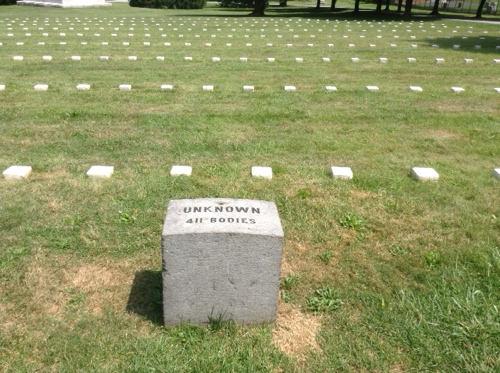
Gettysburg_Unknowns.JPG

I am on the way home from Gettysburg with my students after concluding the second day of our Staff Ride. As always it has been a really good experience. We concluded the event by going to the Soldier’s Cemetary, which is located on the western section of Cemetary Hill. It is the place that Abraham Lincoln delivered the Gettysburg address as well as the final resting place of many of the Union soldiers who died during the battle or shortly thereafter from their wounds. Many of these men are unknowns. They are buried in sections which simply note how many unknown soldiers are in that section, and each of these graves is marked by a small stone engraved with a number.

I strongly believe that all citizens should have to make a pilgrimage to Gettysburg. I do not limit this belief to the military professionals who have to prepare for war and fight it when it breaks out, like the men and women of my class. But I  especially believe others need to walk the battlefield and be taught by someone that can put the events of the battle into proper perspective. This includes the politicians and policy makers that get us into wars, the think tank wonks and business leaders who profit from war, and the pundits and preachers who stir up the passions of people to support war, need to walk the battlefield.

Guy Sager wrote in his book The Forgotton Soldier:

“Too many people learn about war with no inconvenience to themselves. They read about Verdun or Stalingrad without comprehension, sitting in a comfortable armchair, with their feet beside the fire, preparing to go about their business the next day, as usual…One should read about war standing up, late at night, when one is tired, as I am writing about it now, at dawn, while my asthma attack wears off. And even now, in my sleepless exhaustion, how gentle and easy peace seems!”

The same is true today. Too many people, especially those with “no skin in the game” eagerly urge the President to throw U.S. Military power into conflicts that have little chance of being solved by the application of that power. To me it seems like the lives of our military personnel are cheap for many people, especially the politicians, pundits and preachers; but also the war profiteers, while most citizens are apathetic at best, as bumper sticker patriotism is easy.

Basically this is because for most people war is remote from their lives. The military is a voluntary organization with comparatively stringent standards required for enlistees. Even at the peak of our Iraq-Afghanistan wartime strength under one percent of the population actually served in the military. So when I hear people yammering about committing troops to places that many citizens, including the politicians, pundits and preachers, cannot even find on a map, with no plan or purpose once we commit ourselves to war, I get spun up.

For me Gettysburg, and many other battlefields are powerful reminders of the cost of war. They are also reminders of the grave responsibility of those who take a nation into war or who counsel leaders to go to war, responsibilities that many people seem to take lightly. I think that those with that responsibility, which in a democracy is all of us, need that reminder and most of us don’t get it.

Since so few citizens actually serve in the military, I think that everyone should spend two or three days walking that battlefield and learn the lessons as they stand in the elements, exposed to whatever the weather gods can throw at them. People should learn the lessons when they are tired and uncomfortable. This weekend the weather was very similar to what the men than fought at Gettysburg experienced, it was warm and humid, and walking across the field that Pickett’s soldiers advanced, or over the craggy rocks of Little Round Top gave us an appreciation for what those soldiers experienced, without the shooting and death.

As I walked the cemetary with my students spent some time talking about the number of casulaties incurred at Gettysburg, because there is a real flesh and blood cost associated with war, it’s not like the movies or a video game.

Abraham Lincoln reminded the nation of that cost, and the responsibility of the nation, when he spoke “a few words” following the main speech dedicating the Soldier’s Cemetary. Those immortal words are known as the Gettysburg Address. I read them to my students as I dispatched them to walk around the cemetary, and I post them here as well:

 “Four score and seven years ago our fathers brought forth on this continent, a new nation, conceived in Liberty, and dedicated to the proposition that all men are created equal. 

Now we are engaged in a great civil war, testing whether that nation, or any nation so conceived and so dedicated, can long endure. We are met on a great battle-field of that war. We have come to dedicate a portion of that field, as a final resting place for those who here gave their lives that that nation might live. It is altogether fitting and proper that we should do this.

But, in a larger sense, we can not dedicate — we can not consecrate — we can not hallow — this ground. The brave men, living and dead, who struggled here, have consecrated it, far above our poor power to add or detract. The world will little note, nor long remember what we say here, but it can never forget what they did here. It is for us the living, rather, to be dedicated here to the unfinished work which they who fought here have thus far so nobly advanced. It is rather for us to be here dedicated to the great task remaining before us — that from these honored dead we take increased devotion to that cause for which they gave the last full measure of devotion — that we here highly resolve that these dead shall not have died in vain — that this nation, under God, shall have a new birth of freedom — and that government of the people, by the people, for the people, shall not perish from the earth.”

I don’t know about you, but I don’t like it when soldiers die in vain.

Peace

Padre Steve+

Leave a comment

Filed under civil war, History, philosophy, Political Commentary

The Night the Lights Went Out in Europe: August 3rd 1914

grey-bastard

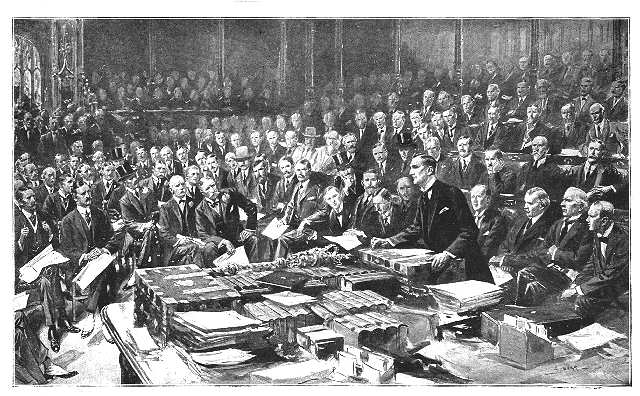
Sir Edward Grey addressing the House of Commons 

The mobilization of millions of soldiers across Europe was moving rapidly as the sun set on the night of August 2nd 1914 when the German Ambassador to Belgium Klaus Bulow-Selaske delivered an ultimatum to the Belgian government. The ultimatum gave the Belgians 12 hours to decide if they would allow the German armies free passage through the country. The Belgians, treasuring their independence and led by a truly heroic leader, the young and humble King Albert refused the German ultimatum and vowed to fight.

The next morning the British House of Commons met and for the first time since 1893 every member was present, with many spectators in attendance, Britain’s participation in a war on the European Continent in nearly 100 years was being contemplated. Britain was divided between interventionists and non-interventionists, and the pressure was on the government.

The British Foreign Minister, Sir Edward Grey urged giving support to France. He told the assembled Members of Parliament about, British military understandings with France, and the German ultimatum to Belgium. Grey asked them whether Britain “would quietly stand by and witness the perpetration of the dirtiest crime that ever stained the pages of history, and thus become participators in the sin.” He added that “we are going to suffer, I am afraid in this war, whether we are in it or stand aside.” If Britain dis stand aside, forfeiting her “Belgian Treaty obligations” the she would “sacrifice our respect and good name and reputation before the world.” Grey had not convinced everyone, but he had carried the day. However, the Germans did not believe that Britain would go to war over Belgium.

At seven that evening the German Ambassador to France Baron Schoen delivered a declaration of war against France, his counterpart in Berlin, the French Ambassador was given his passports.

As Grey pondered the content of an ultimatum to be sent to Berlin he returned to his office in Whitehall. “Watching with his failing eyes, the lamps being lit in St. James Park, Grey was heard to remark that “the lamps are going out all over Europe; we shall not see them again in our lifetime.”

The next morning the German army began its assault on the Belgian fortress city of Liege. That afternoon Poincare and Foreign Minister Viviani addressed the combined houses of the French Parliament, asking for war credits, discussing German violations of French territory and “implored the deputies, and the French people “to help us in bearing the burden of our heavy responsibility, the comfort of a clear conscience and the conviction that we have done our duty.”

The members of all parties, from the nationalists, the Catholic right and the Socialists overwhelming committed themselves to a sacred union. Poincare recalled later “Never has there been a spectacle as magnificent as that which they have just participated….In the memory of man, there has never been anything more beautiful in France.”

kw31_reichstagsprotokolle_bild

Bethmann-Hollweg address the Reichstag 

In Berlin Prime Minister Bethmann-Hollweg accused the French of violating German borders and of the Russian mobilization. He asked the Reichstag deputies “Were we to wait in further patience until the nations on either side of us chose the moment for their attack?” He was interrupted with cries of “No! No!”

Bethmann went on and admitted that Germany had violated Belgian territory and that it was a “breach of international law” ironically what he had just accused the French of doing, but Bethmann promised that “this wrong- I speak openly-the wrong we thereby commit we will try to make good as soon as our military aims have been attained.” Grand Admiral Tirpitz considered the admission of wrongdoing “the greatest blunder ever spoken by a German statesman.”

Bethmann called the nation to stand behind the military and as in France “Reichstag party leaders rose as one to vote war credits.”

A similar ultimatum was delivered to Russia by the German Ambassador and a similar scene repeated as Russia declared war.

That evening the British Ambassador to Germany Sir Edward Goschen paid a visit to Foreign Minister Jagow with a British ultimatum for the Germans to withdraw from Belgium within twelve hours, or face war. Bethmann, who had helped lead his nation into war believing that the British would remain neutral was stunned. Likewise, none had counted on the Russians to fight. The Germans had given Austria-Hungary a “blank check” and that nation’s leaders cashed it with grave consequences for the world. Austria’s actions led to Czar Nicholas making the fateful decision to mobilize on July 29th, which set Europe on course for war.

There was no turning back, in four hours the two greatest military powers in the world, Great Britain and Germany would be at war.

All all of the leaders in their speeches had left out information that would be embarrassing to their claims in their addresses, duplicity was the order of the day. The lights were going out across Europe. And the leaders of all of the nations, with the exception of Belgium shared some degree of responsibility.

The questions for us today are similar: Will all of our leaders allow the lights to go out again, not just in Europe but the Middle East and Asia? and will world leaders allow some foolish action somewhere to bring about more war?

Admittedly the situation is not identical, but there are troubling similarities. It is something to think long and hard about.

Peace

Padre Steve+

1 Comment

Filed under History, history, national security, Political Commentary, world war one

The Beginning of the Never Ending End: August 1914

wwimobilization

“An event of great agony is bearable only in the belief that it will bring about a better world. When it does not, as in the aftermath of another vast calamity in 1914-18, disillusion is deep and moves on to self-doubt and self-disgust.” Barbara Tuchman

On August 1st 1914 the armies of Europe were mobilizing for war. The last feeble efforts at diplomacy were failing as leaders, and diplomats sought a way out of the situation that their policies had brought about. They had allowed the military instrument to drive policy, rather than for policy to dictate how the military should be employed as an instrument of national strategy. As such they became prisoners to their military mobilization plans, all of which depended on speed in order to gain advantage over their adversaries.

The nations and militaries of Europe were devoted to the “cult of the offensive” by which they would crush their enemy’s armies in a quick campaign. In Germany there was the modified Schlieffen Plan that was about to be executed by the army commanded by Von Molkte the younger in which Germany would violate the neutrality of Belgium in order to invade France, risking war with England in the process. In France, the offense was also the rule of the day, Plan 17 dictated an advance to recapture the Alsace and drive into the heart of Germany. Russia had “Plan 19” nicknamed by some “the Russian Steamroller,” while Austria-Hungary, the chief protagonist of the War dithered with plans to attack Serbia and defend against Russia, which her military commander Conrad von Hotzendorf neither shared with his German allies, or the politicians leading his country to war.

The numbers of troops were massive, the Germans mobilizing nearly four million troops in less than two weeks, the Austrians three point three million, the French over three million and the Russians nearly five million. Serbia, Belgium and Great Britain were mobilizing as well, but the numbers of soldiers that they mobilized were a fraction the size of the major land powers. Soon other nations would become involved, the Ottoman Empire on the side of Austria and Germany, Italy on the side of England and France. Bulgaria and Romania would become involved as well as far away Japan, which saw the opportunity to expand its empire and influence at the expense of Germany.

No leaders had planned for a long war; they did not believe such a war could last. “One constant among the elements of 1914—as of any era—was the disposition of everyone on all sides not to prepare for the harder alternative, not to act upon what they suspected to be true.”

But they were wrong and in the opening weeks and months of the war, every army lost massive numbers of troops ensuring that victory would not come quickly or cheaply. Between August and December 1914 the Germans had sustained about 800,000 casualties, the French about the same, the Austrians close to a million, the Russians at least 500,000 and the tiny British expeditionary force took about 87,000 casualties of the 110,000 troops deployed to France.

The war dragged on until November 1918. An armistice was signed; a peace treaty made, territory divided but the war never really ended, and in a way continues today in the Middle East, Africa and Eastern Europe. The “War to end all War” really never ended, it continues today in some many places. It really was a war without end.

Of course in August 1914 the leaders of Europe gambled everything on a roll of the dice. The decisions that they made were made deliberately and with forethought, but the logic of those leaders was fatally flawed, and the implications of their flawed decision making process are still haunting us today. Unfortunately it doesn’t look like the politicians, pundits and preachers, that “Trinity of Evil” that find glory and profit in war have learned anything. Like Conrad von Hotzendorf many leaders today believe that “the essence of politics lies in the use of the means called “war.” As Barbara Tuchman said “Learning from experience is a faculty almost never practiced”

Peace

Padre Steve+

1 Comment

Filed under Foreign Policy, History, leadership, Military, Political Commentary

The National Security State thru the Lens of Star Trek Deep Space Nine

nsa-operations-center

Inter Arma Enim Silent Leges, in time of war the law stands silent…

James Madison wrote that “A popular government, without popular information, or the means of acquiring it, is but a prologue to a farce or a tragedy; or, perhaps both.”

I am amazed when I read the reports about the activities of the National Security Agency and the reactions of citizens to them. I know that I feel a sense of apprehension about those activities. The national security state and the seeming all pervasive security and surveillance apparatus which demolishes any sense of privacy, especially the protections enunciated in the Fourth Amendment and to some extent the First Amendment.

I also feel, or rather understand from history and empirical evidence that many others, many from unfriendly countries do not share those apprehensions. It makes for an ethical, legal and even constitutional conundrum that I am not sure if anyone of us is quite comfortable with and perhaps maybe we shouldn’t be.

It is very easy on one hand in light of history, our Constitution and democratic process to condemn the NSA, the FISA courts and other lawfully constituted agencies and those that drafted the laws over the decades that allow the activities which they now conduct. The same can be said of foreign intelligence agencies which all engage in similar activities including the British GCHQ, the German Bundesnachrichtendienst and so many others including the Chinese and Russians.

Likewise it is equally easy in light of history, current events and national security to jump to the other side of the fence and not only defend the activities of the NSA and agencies like it, and to demonize those that expose such activities.

I find looking at such issues in light of Star Trek sometimes more interesting and provocative than simply doing the whole moralizing pundit thing. The fact that the particular episode of  Star Trek Deep Space Nine was aired well before the events of 9-11-2001, and the subsequent Global War on Terror, make it more interesting. The episode deals with an agency in Starfleet that is secretive, but legal operating in the gray areas between the ideals of the Federation and the threats that it faces. Even when the Federation is a peace, Section 31, as it is called is engaged in activities against historic or potential enemies.

At the beginning of the Deep Space Nine Episode Inter Arma Enim Silent Leges the head of Section 31, a man only known as Sloan comes back to Doctor Bashir to involve him in an operation, spying on the Romulans who are working with the Federation against the Dominion.

BASHIR: You want me to spy on an ally.

SLOAN: To evaluate an ally. And a temporary ally at that. I say that because when the war is over, the following will happen in short order. The Dominion will be forced back to the Gamma Quadrant, the Cardassian Empire will be occupied, the Klingon Empire will spend the next ten years recovering from the war and won’t pose a serious threat to anyone. That leaves two powers to vie for control of the quadrant, the Federation and the Romulans.

BASHIR: This war isn’t over and you’re already planning for the next.

SLOAN: Well put. I hope your report is equally succinct.

BASHIR: How many times do I have to tell you, Sloan? I don’t work for you.

SLOAN: You will. It’s in your nature. You are a man who loves secrets. Medical, personal, fictional. I am a man of secrets. You want to know what I know, and the only way to do that is to accept the assignment.

The fact is that the situation we face today and the arguments of both sides should make us uncomfortable. The fact is that like it or not or not the incredibly rapid technical and communication advances of the past couple of decades have primed us for our present time. Likewise they have also enabled a generation to grow up in a virtual world in many ways detached from the moral and ethical balances of individual rights and liberties as well responsibility to community. All the wonderful gadgets that we employ in everyday life make it easy for enemies and “friends” to do things that were unimaginable to people other than science fiction writers even twenty to thirty years ago. Likewise they were must certainly beyond the wildest imaginations of any of the founders of this country or drafters of the Constitution. The reality is, the things that make are lives so easy are also the things that are potential instruments of our destruction.

That being said throughout history, even our own there have been operatives within the government in charge of secrets, and even spies. In the Inter Arma Enim Silent Leges episode we see an operation that is full of duplicity and moral ambiguity all committed in the name of security. It involves the mysterious Section 31 and Starfleet Admiral Ross who attempt to use Doctor Bashir to double cross a Romulan Senator who had been working with the Federation to keep the secret of the head of the Romulan secret police who is a Federation agent. When Doctor Bashir figures out the plot he confronts the Admiral. Part of their exchange is very enlightening because it practically mirrors how many on both the civil liberties and the national security side of the current controversy feel about the War on Terror.

BASHIR: You don’t see anything wrong with what happened, do you.

ROSS: I don’t like it. But I’ve spent the last year and a half of my life ordering young men and young women to die. I like that even less.

BASHIR: That’s a glib answer and a cheap way to avoid the fact that you’ve trampled on the very thing that those men and women are out there dying to protect! Does that not mean anything to you?

ROSS: Inter arma enim silent leges.

BASHIR: In time of war, the law falls silent. Cicero. So is that what we have become? A twenty fourth century Rome driven by nothing more than the certainty that Caesar can do no wrong!

ROSS: This conversation never happened.

In light of the controversy of today, that of the NSA, FISA and government secrecy and gathering information on its own citizens we face a growing tide of reporters and others seeking to reveal those secrets. Back in 1989 ethicist Sissela Bok wrote something very important in her book Secrets: Moral Choice in Public and Private Life:

“…as government secrecy expands, more public officials become privy to classified information and are faced with the choice of whether or not to leak … growing secrecy likewise causes reporters to press harder from the outside to uncover what is hidden. And then in a vicious circle, the increased revelations give government leaders further reasons to press for still more secrecy.”

As we wade through this controversy we will see people do exactly this and the these exact arguments are being made by the people and officials directly involved as well as former elected and appointed officials as well as the press. The interesting thing to me is that very few of the people or agencies, past and present, Republican and Democrat involved really have clean hands. It is amazing to see former champions of civil liberties defend the NSA actions and those that empowered the NSA in the Patriot Act now condemn it. I find it fascinating.

At the end of the Inter Arma Enim Silent Leges episode the mysterious Sloan pops back in on Doctor Bashir who is in his quarters, asleep and depressed by what he experienced during the operation on Romulus and with Admiral Ross.

SLOAN: Good evening.

BASHIR: Are you expecting applause? Have you come to take a bow?

SLOAN: I just wanted to say thank you.

BASHIR: For what? Allowing you to manipulate me so completely?

SLOAN: For being a decent human being. That’s why we selected you in the first place, Doctor. We needed somebody who wanted to play the game, but who would only go so far. When the time came, you stood your ground. You did the right thing. You reached out to an enemy, you told her the truth, you tried to stop a murder. The Federation needs men like you, Doctor. Men of conscience, men of principle, men who can sleep at night. You’re also the reason Section Thirty one exists. Someone has to protect men like you from a universe that doesn’t share your sense of right and wrong.

BASHIR: Should I feel sorry for you? Should I be weeping over the burden you’re forced to carry in order to protect the rest of us?

SLOAN: It is an honor to know you, Doctor. Goodnight.

We live in this kind of world and maybe it is good sometimes to find other ways to look at it. I really don’t have the answers. I am a civil libertarian who places a high value on the openness of a government to its people. I also know that there are those that have no regard for such openness or, to quote Sloan don’t “share your sense of right and wrong.”

Maybe that is not a good answer. I really don’t know. All I know is that as uncomfortable as this all is that those on both sides of the issue have valid points and concerns and they come back to the balance that a society needs to have between individual rights and responsibility to the community, openness and secrecy, civil liberties and national security. But that being said it is a debate that needs to happen, even if it makes us uncomfortable. I for one think that it is better that we be uncomfortable when looking at such an important debate than to be prisoners of our certitude.

Peace

Padre Steve+

1 Comment

Filed under civil rights, Foreign Policy, national security, Political Commentary, star trek