Tag Archives: abner doubleday

Fort Sumter Pt 1: The First Flash of Gunpowder and Shell

fort-sumter-higher-res

Friends of Padre Steve’s World,

Here is another part one of another two-part installment of my Civil War text. The story follows the implosion of the Democratic Party, the election of Abraham Lincoln, and the secession crisis. It describes who the attack came about and the reactions of people in all parts of the country, as well as the Army to those fateful shots. I hope that you enjoy.

Peace

Padre Steve+

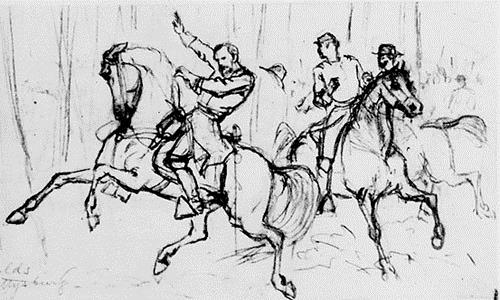
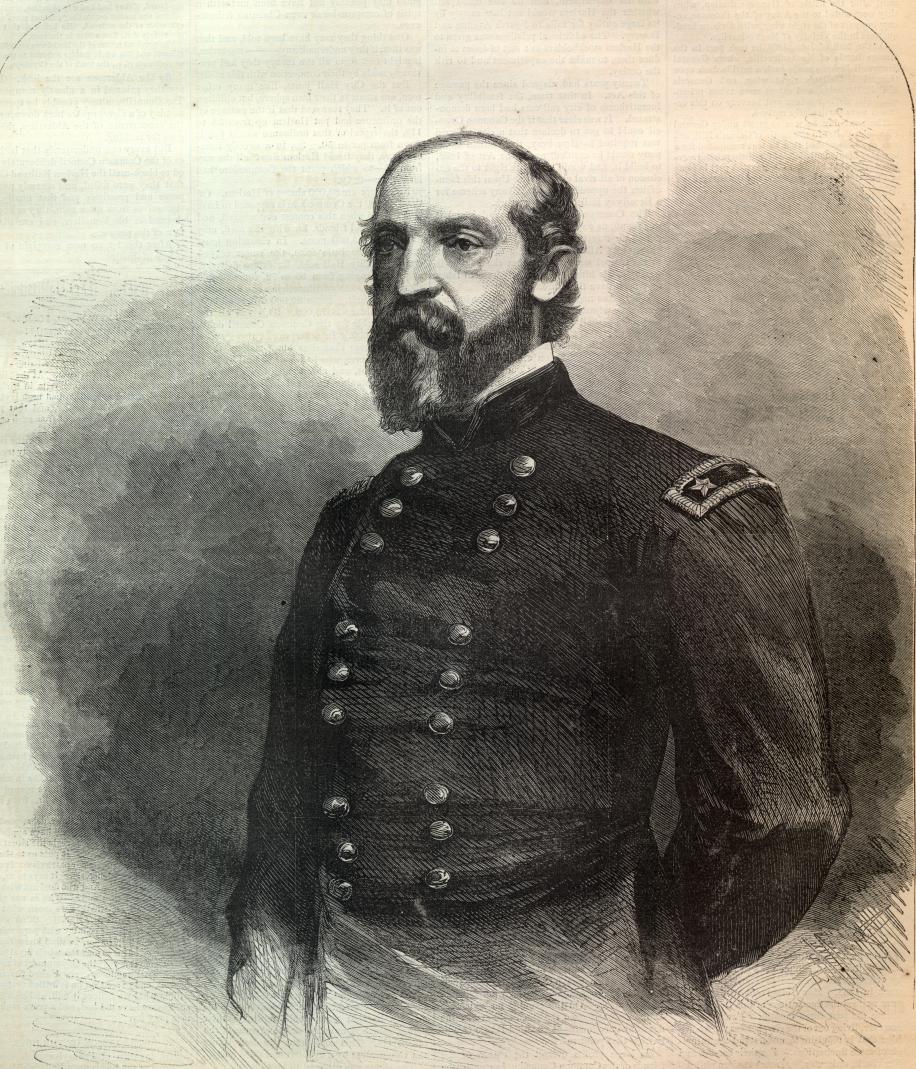
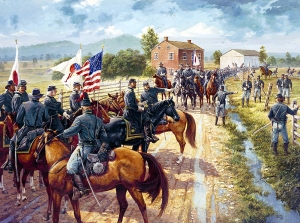
The remaining forts under Federal control in the South were a thorn in the side and a constant reminder to Jefferson Davis of the power of the federal government. As such he attempted to negotiate to obtain the forts, and when that offer was rejected out of hand by both Buchanan and Lincoln he began military preparations to seize them if negotiations failed. His task was complicated in Charleston where the Federal commander, Major Robert Anderson unexpectedly withdrew his entire garrison from the mainland to Fort Sumter in Charleston harbor. The move was prompted by President Buchanan’s dithering on the status of the fort and garrison. Anderson was a Southerner who had decided to remain loyal to the Union, his second in command was Captain Abner Doubleday, a strongly committed abolitionist.

Under the cover of darkness the Union officers withdrew their men from old and weak Fort Moultrie in Charleston to Fort Sumter gaining him instant adulation in the North and condemnation in the South. Buchanan wanted to abandon the fort but “when it appeared that Northern public opinion was solidly behind Anderson, Buchanan changed his mind and attempted to persuade the South Carolinians to accept Anderson’s occupation of Fort Sumter as a legitimate exercise of federal authority.” [1] Jefferson Davis, who had not yet resigned from the Senate awaiting Mississippi’s declaration of secession complained that he “pleaded with Buchanan to give up Sumter and avert impending calamity. Once again the old imbecile refused, after his fashion, which is to say that he muttered to himself, nodded and tilted his head as if in agreement, begged leave to say a prayer, and then did nothing at all. Plainly the reins of state were in feeble hands. Had this lame-duck President withdrawn the troops from Sumter, he might have turned away the threatening of civil war.” [2]But Davis was blind to the political realities in the North that secession and seizure of other Federal installations had brought about. A prominent Northern Democrat wrote that “Anderson’s course of action is universally approved and that if he is recalled or if Sumter is surrendered… Northern sentiment will be unanimous in favor of hanging Buchanan….I am not joking – Never have I known the entire people more unanimous on any question. We are ruined if Anderson is disgraced or Sumter given up.” [3] Congressman Dan Sickles who had been such a friend of the South for so many years, even backing peaceful secession, spoke out against the Southern seizure of federal installations, said that the secessionists had committed “a fatal error” and said “it will never do, sir, for them to protest against coercion, and, at the same moment seize all the arms and arsenals and forts and navy yards, and ships that may, through our forbearance, fall within their power. This is not peaceful secession. These acts, whensoever or whomsoever done, are overt acts of war.” [4]

major anderson

Buchanan made a belated attempt to reinforce and resupply the fort and on January 9th 1861, an unarmed civilian ship, the Star of the West entered Charleston harbor. But the operation was bungled, secrecy was broken and the South Carolinians knew the ship was coming, even as Anderson did not get the message about the relief expedition and permission to fire if the Star of the West was fired upon. As a result when Confederate gunners opened fire on the steamer, Anderson, who had instructions to defend himself and not for an instance such as this, did nothing to intervene. “If he opened fire, the United States and South Carolina would be at war…. Major Anderson hesitated, plainly uncertain, an immense weight of responsibility resting on him….” [5] As a result the Star of the West retreated, leaving the garrison unreinforced. But the secessionists “had overplayed their hand. The South Carolina gunners who fired on the Star of the West had, in effect, invited the Federal government to start the war then and there if it wanted a war….” [6] The firing on the Star of the West further inflamed Northerners. Dan Sickles thundered in the House chambers “the authorities of South Carolina, through their military forces, opened fire upon that defenseless ship, and compelled her to retire and abandon the peaceful and legitimate mission in which she was engaged. Now, sir, that was an act of war, unqualified war.” [7]

The debate continued as Buchanan eased out of office and the new Confederate government of Jefferson Davis took ownership of the situation in Charleston. Buchanan did not want to do anything overt to tip the balance in undecided slave states toward secession and Davis did not want South Carolina to act alone and risk a premature attack on the fort. But as both sides waited the balance of power in Charleston shifted, “as local troops day by day strengthened the ring of batteries confronting Sumter’s garrison.” [8] In incoming Lincoln administration debated what to do with some of the incoming cabinet members counseling withdraw and others resistance to Confederate demands. Lincoln gave serious thought to abandoning the fort but could not bring himself to authorize the action. He understood that if he ordered evacuation, “the credibility of his presidency and the Republican administration would be in pieces before either had scarcely begun.” [9]

Instead the new President sought more information and sent three men “down to Charleston to observe the situation and report on what they saw. The first two, both southern-born, were Illinois law associates, both reported reconciliation impossible…. The third, a high-ranking naval observer who secured and interview with Anderson at the fort, returned to declare a relief expedition was feasible.” [10] He also continued to meet with his cabinet members to decide on the appropriate policy to meet the challenge to federal authority in Charleston. “He met with Francis Blair, who, like his son, Monty, believed passionately that the surrender of Sumter “was virtually a surrender of the Union unless under irresistible force – that compounding with treason was treason to the Govt.” [11] On March 29th Lincoln again met with his cabinet and having weighed all of the options, decided to resupply the fort. His decision was to “not send guns or bullets to Sumter, only food and medicine. He would resupply, but not rearm, it. And he would announce the plan in advance so the South could not regard the effort as an act of hostility by an enemy.” [12] If the attempt succeeded “federal authority in South Carolina had been preserved, and Charleston could do little short of war to change it; if it failed, the failure would be due to Charleston’s decision to open fire, and the onus of beginning a civil war would lie on their hands.” [13]

Even as the Confederate moved even more troops and guns into position around the Sumter, more and more people of influence were growing impatient with the delays in gaining Fort Sumter and feared that if something was not done that in some places there might be a call to return to the Union. Jefferson Davis was under great pressure to act, a newspaper in Mobile Alabama editorialized that “If something is not done pretty soon…the whole country will be so disgusted with the sham of independence that the first chance the people get at a popular election the y will turn the whole movement topsy-turvy.” [14] Likewise, “Southern ardor was chafing at the bit anyway, and failure to meet the challenge threatened to undermine the government and weaken Southern resolve.” [15]

P.G.T._Beauregard

General P.T.G. Beauregard C.S.A.

Knowing from Southern sympathizers still in Washington that a relief expedition was coming, General P.T.G. Beauregard “had already cut off Major Anderson’s purchases in the Charleston market the day before Governor Pickens received Lincoln’s message about the intention to provision Sumter.” [16] Pickens forwarded the message to Davis in Montgomery and Davis was forced to either back down on their threats or fire the first shot of the war, and even worse from a messaging standpoint, “that first shot would be for the immediate purpose of keeping food from hungry men.” [17]

Davis was extremely angry when he went into conference with his cabinet on April 9th upon getting the news of the relief expedition. The debate in the cabinet “ran long and heated. Davis favored proceeding with the bombardment. Charleston’s batteries were ready, and the South Carolinians were more than anxious,” [18] and the majority of the cabinet, with the exception of Robert Toombs concurred. He wrote:

“I summoned the Cabinet and told them that negotiation was now at an end, and that it was time to bombard the fort. Yes, I said, we would now be firing the first shot, but that was not our fault. It was Lincoln who intended war. He and that lying Seward had drawn the sword, and we were responding to them. We were defending our honor.

Toombs, my Secretary of State disagreed. “Sir,” he said to me, “firing at the fort is suicide. It’s unnecessary, it puts us in the wrong, it’s fatal.”

“Sir,” I said, “you are wrong.”

On April tenth, I ordered General Beauregard to demand the evacuation of Fort Sumter, and if refused, to reduce it with his guns.” [19]

Beauregard delivered the ultimatum to Anderson, who rejected it noting that “his sense of honor and obligations to his government prevented him his complying; but in conversation with Beauregard’s aides he remarked that in any event, the garrison would be starved out in a few days.” [20] But the fear of the Confederates that the relief force might actually arrive and succeed in its mission prompted them to open fire on the fort at 4:30 a.m. on the morning of the 12th. The relief force was scattered by a gale and could not resupply Anderson. The bombardment lasted thirty-three hours, and while Anderson’s troops resisted but could not man all of their guns and were short on ammunition and powder. With the fort heavily damaged by over 4,000 hits and interior of the fort on fire, a fire that was threatening the powder magazines, Anderson gave the order to surrender. Beauregard allowed the assembled U.S. Navy ships to evacuate the garrison and as a parting gesture the Confederate General allowed Anderson’s troops to fire a last salute to Old Glory. They hauled down the smoke stained and torn Star Spangled Banner and marched to the ship taking them off the island with their drums beating the tune “Yankee Doodle.” Lincoln realized the importance of what had happened all too well. He noted, “They attacked Sumter. It fell and thus did more service than it otherwise would.” [21]

Notes

[1] Ibid. Guelzo Fateful Lightening p.136

[2] Ibid. Oates The Approaching Fury p.367

[3] Ibid. McPherson The Battle Cry of Freedom pp.265-266

[4] Ibid. Keneally American Scoundrel p.211

[5] Ibid. Catton The Coming Fury pp.180-181

[6] Ibid. Catton The Coming Fury p.184

[7] Ibid. Keneally American Scoundrel pp.211-212

[8] Ibid. Potter The Impending Crisis p.544

[9] Ibid. Guelzo Fateful Lightening p.137

[10] Ibid. Foote The Civil War, A Narrative. Volume One p.46

[11] Ibid. Goodwin Team of Rivals p. 335

[12] Holzer, Harold Lincoln: How Abraham Lincoln Ended Slavery in America Newmarket Press for itbooks an imprint of Harper Collins, New York 2012 p.80

[13] Ibid. Guelzo Fateful Lightening p.137

[14] Ibid. McPherson The Battle Cry of Freedom p.272

[15] Ibid. Catton Two Roads to Sumter p.278

[16] Weigley, Russell F. A Great Civil War: A Military and Political History 1861-1865 Indiana University Press, Bloomington and Indianapolis 2000 pp.20-21

[17] Ibid. Foote The Civil War, A Narrative. Volume One p.47

[18] Ibid. Davis Jefferson Davis p.323

[19] Ibid. Oates The Approaching Fury pp.416-417

[20] Ibid. Weigley A Great Civil War p.21

[21] Ibid. Goldfield America Aflame p.202

1 Comment

Filed under civil war, History, Military, Political Commentary

The Unappreciated Hero of Gettysburg

Friends of Padre Steve’s World

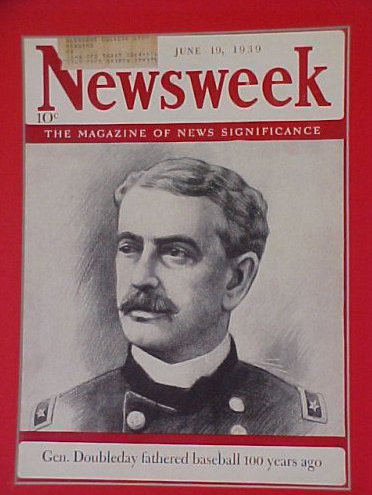
I am up at Gettysburg with my students today, so I am posting the final excerpt from the chapter of my Gettysburg text that I have been posting throughout the week. This section wraps up that chapter and discusses the treatment that Abner Doubleday received from George Meade and the subsequent myth surrounding Doubleday and the invention of baseball. The irony about Doubleday is that he is best remembered for a game that he did not invent, and his most heroic performance is forgotten and dismissed. I hope you enjoy.

Peace

Padre Steve+

GettysburgIdols

Abner Doubleday’s Best Performance and Disgraceful Treatment

On the other hand Abner Doubleday proved himself as a capable commander who was able to provide effective leadership during a crisis situation. Although he is one of the most under-appreciated Union commanders at Gettysburg he “ably rose to the occasion, as did divisional commanders James Wadsworth and John Robinson.” [1] Though his abilities were suspect, especially by George Meade and Colonel Wainwright, the Corps artillery commander Doubleday managed to hold off superior Confederate forces, and even inflicted a significant defeat on the divisions of Harry Heth and Robert Rodes. During the fighting against ever increasing numbers of Confederates, First Corps inflicted massive casualties on their opponents. “Seven of the ten Southern brigades incurred casualties from 35 to 50 percent, and the total for all brigades came to an estimated 6,300 officers and men, or about 40 percent of their strength.” [2] Doubleday’s troops held on long enough to support the left flank of Eleventh Corps as it was being assaulted by Early’s division.

When Winfield Scott Hancock arrived on Meade’s behest to take command at Gettysburg Oliver Howard informed him that First Corps “had given way at first contact” [3] implicitly blaming Doubleday for the collapse of the Federal line. Hancock delivered the report in a note to Meade which said “Howard says that Doubleday’s command gave way” [4] This false report fixed in Meade’s mind that his doubts about Doubleday’s ability were correct. To Doubleday’s amazement Meade then cancelled his order appointing Doubleday to command First Corps and ordered John Newton, a division commander, far junior to Doubleday in Sedgwick’s Sixth Corps to replace Doubleday. A badly disappointed Doubleday resumed command of his division. In large part Meade’s appointment of Newton over Doubleday was also political. Doubleday’s fellow abolitionist division commander in First Corps, James Wadsworth said that “Meade’s “animosity” toward Doubleday rested in a “past political difference.” [5] Doubleday, the abolitionist Republican was not acceptable to Meade, the conservative Unionist Democrat and ally of Gorge McClellan. The fact that Newton “was not regarded as daring or brilliant” [6] and was regarded by many as a “pet” of Meade, did not matter. Meade’s volcanic temper and temptation to allow politics to cloud his military judgement meant that “Newton was the only other major general he could trust politically.” [7] When Doubleday formally protested to Meade he was dismissed from Army of the Potomac.

He left the Army of the Potomac never held a field command during the war, however, he was brevetted in the Regular Army to both brigadier and major general. Doubleday served in administrative capacities in Washington D.C. until the end of the war and testified against Meade during the politically charged hearings of the Committee on the conduct of the War. Doubleday remained bitter toward Meade and he “was never reconciled to Meade’s relieving him as acting commander of First Corps in Favor of Maj. Gene. John Newton, who was his junior in rank and the reproach that it implied.” [8] After the war Doubleday reverted to his rank as a Colonel in the Regular Army and was made Colonel of the 35th U.S. Infantry in San Francisco. From 1871 until his retirement in 1873 Doubleday commanded the African American “Buffalo Soldier” 24th Infantry Regiment in Texas. He died in New York on January 25th 1893, and was buried in Arlington National Cemetery. Among the members of the honor guard at his funeral in New York was a man named Abraham Mills who would play a major role in Doubleday’s future fame.

Baseball_article_large

A Myth and Legend Greater than Gettysburg: Abner Doubleday and Baseball

Interestingly enough Doubleday, who was unappreciated as a general became linked forever to the game known as America’s national pastime and to Cooperstown New York, the home of Baseball’s Hall of Fame. As such he is probably better known to most Americans, particularly baseball fans than any Union general who fought at Gettysburg.

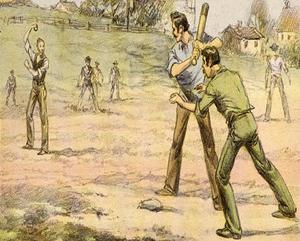
Like the Civil War, Baseball too is filled with myths which connect it to our culture, and one “is the myth that Abner Doubleday invented the sport one fine day in 1839 at the farmer Phinney’s pasture at Cooperstown.” [9] It was early American baseball star Albert G. Spaulding who linked the creation of baseball to the Civil War and in particular to Abner Doubleday by way of an apocryphal story of one of Doubleday’s childhood friends, years after Doubleday’s death. In 1907, Spaulding worked with Abraham G. Mills the fourth President of the National League, the same man who had served in Doubleday’s funeral honor guard to conclude that “that the first scheme for playing it, according to the best evidence obtained to date, was devised at Cooperstown New York, in 1839.” [10] But this is simply myth and the under-appreciated hero of the first day of battle at Gettysburg is much better known for something that he did not do.

The ironies of history and myth are fascinating. Interestingly Mills paid homage to Doubleday noting, “in the years to come, in the view of hundreds of thousands of people who are devoted to baseball, Abner Doubleday’s fame will rest evenly, if not quite so much that he was its inventor…as upon his brilliant and distinguished career as an officer in the Federal Army.” [11]

Notes

[1] Ibid. Sears Gettysburg p.245

[2] Ibid. Coddington, The Gettysburg Campaign: A Study in Command, p.307

[3] Ibid. Wert The Sword of Lincoln p.294

[4] Ibid. Guelzo Gettysburg: The Last Invasion p.224

[5] Ibid. Wert The Sword of Lincoln p.294

[6] Ibid. Cleaves Meade of Gettysburg p.143

[7] Ibid. Guelzo Gettysburg: The Last Invasion p.224

[8] Ibid. Pfanz Gettysburg: The First Day p.355

[9] Will, George F Men at Work: The Craft of Baseball Harper Collins Publishers, New York 1990 p.294

[10] Kirsch, George B. Baseball in Blue and Gray: The National Pastime in the Civil War Princeton University Press, Princeton and Oxford, 2003 p.xiii

[11] Ibid.. Kirsch Baseball in Blue and Gray p.xii

Leave a comment

Filed under Baseball, civil war, Gettysburg, History, leadership, Military

Bungled from the Start: Confederate Disaster at Oak Ridge

Friends of Padre Steve’s World

Since I taking a group of my students from the Staff College to Gettysburg this weekend another excerpt from a chapter of my Gettysburg text. This deals with the badly bungled Confederate attack on Oak Ridge on the afternoon of July 1st 1863. I hope that you enjoy.

Peace

Padre Steve+

88thPAcharge

The 88th Pennsylvania Charging Rodes’ Division

The arrival of Rodes’s division as on the field in the van of the Confederate Second Corps was decisive in turning the tide of the battle toward the Confederates that afternoon. When Rodes arrived with Ewell, the Federal First Corps was facing west against Heth and Pender’s divisions and its line only extended about a quarter mile north of the Railroad Cut.

The Union First Corps and Buford’s cavalry division had fought Heth’s poorly coordinated and led attacks to a standstill, but when Rodes arrived he found “a golden opportunity spread before him.” [1] From his position at Oak Ridge he saw the opportunity to take the Federal troops opposing Hill in the flank though his position did not “provide him as comprehensive view as he thought.” [2] His desire was to advance south along Oak Ridge using it to screen his movements in order to execute an attack on the Federal right flank. But before he could do this “the First Corps Generals had made preparations to oppose him.” [3] Robinson’s two brigades under Baxter and Paul deployed and “hurried in line stone and wood fences approximately at right angles to Rodes proper line of advance.” [4] Rodes could see the deployment but the fences obscured the exact positions of Robinson’s troops from him. Seeing the advance of the First Corps units as well as the emergence of Schurz’s troops from Eleventh Corps advancing out of the town the aggressive Confederate commander decided to launch an immediate attack.

dilger

Captain Hubert Dilger

Carter’s artillery, which had deployed in the open and was had “opened an enfilading fire all along the line to the Fairfield road” [5] now drew the fire of Captain Hubert Dilger’s Battery I First Ohio Artillery from Howard’s XI Corps which had just arrived near Oak Ridge. Dilger commanded one of the best artillery units in the army. He was a German immigrant and professional artilleryman who had served in the Grand Duke of Baden’s Horse Artillery. He came to the United States at beginning of the war at the invitation of a distant uncle, to “practice the war-making he had only previously rehearsed.” [6] Dilger was “blunt and a bit arrogant…loved by his men but not by his superiors.” At Chancellorsville he and his battery had helped save the Federal right “when it used a leapfrogging technique to keep the victorious Confederate infantry at bay.” [7] At Gettysburg Dilger again displayed his talent.

Upon its arrival Dilger’s battery opened “a storm of counter-battery fire” [8] on Carter’s battalion as well as the infantry brigade of O’Neal which was near it. The effect of Dilger’s fire on Carter’s artillery disrupted its operation and was successful in blowing up several caissons and guns causing significant numbers of casualties among the men. [9] Seeing the carnage to one battery that he had not placed, Carter “accosted Rodes and asked, “General, what fool put that battery up yonder?” Only to realize after an “awkward pause and a queer expression on the face of all Rodes’ staffers that Rodes himself had placed it there.” [10] In response, the chastised division commander replied “You had better take it away, Carter.” [11] Throughout the rest of the engagement Dilger’s battery would make itself known, shattering Confederate infantry assaults and damaging Southern artillery batteries.


battle-of-gettysburg-oak-ridge-july-1

Rodes’ Division attacks Oak Ridge July 1st

The young division commander was overconfident as he ordered the attack. Thinking he had an adequate grasp of the situation he did not order a reconnaissance before launching the attack, nor did the commanders of the brigades spearheading the attack put out skirmishers, the normal precaution when advancing in the face of the enemy. [12] Rodes deployed his troops over the rough ground of the ridge as quickly as he could and dashed off a note to Jubal Early stating “I can burst through the enemy in an hour.” [13] He was to be badly mistaken, and “like Heth in the south, he paid in disproportionate blood for the ready aggressiveness which in the past had been the hallmark of the army’s greatest victories, but now seemed mere rashness and the hallmark of defeat.” [14]

Rodes deployed George Doles’ excellent brigade to guard his left against the advancing Eleventh Corps units until Early’s division could arrive, something he expected momentarily. Doles and his brigade conducted this task admirably until the arrival of Jubal Early’s division, which enabled it to join the attack on Eleventh Corps divisions north of the town. Initially the movement of the brigade opened a potentially dangerous gap between Doles brigade and O’Neal’s brigade to its right, but this could not be exploited by the Federals. To hold this gap between Doles and O’Neal Rodes pulled one regiment, the 5th Alabama from O’Neal.

To make his main attack Rodes initially deployed his division on a one brigade front as they arrived on the battlefield in line-of-march. As the leading elements of the division neared the Federal positions Rodes, made what appeared to be a simple change of plan to “attack on a two brigade front, sending in O’Neal’s and Iverson’s men simultaneously, then following up with Daniel’s brigade in echelon on the right.” [15] Ramseur’s brigade was held in close reserve. In theory it was a sound plan, but everything is more complicated when bullets start flying. The execution of this change in plan was “bungled right at the start.” [16] None of “the three brigade commanders was sure what the signal for the advance would be” [17] and since Rodes had made no reconnaissance, and none of the brigades put out skirmishers the direction of the attack was faulty, units were mingled and a gap developed between O’Neal and Iverson. [18] The attack “though vigorous, was a disaster” [19] and the plan floundered due to the stout resistance of Robinson’s troops and the “nicely matched incompetence of O’Neal and Iverson” [20] neither of who advanced with their assaulting troops.

O’Neal’s brigade became disoriented and “went in with only three regiments and at an angle different from that indicated by Rodes. Instead of leading his troops in the attack O’Neal remained in the rear with the Fifth Alabama, a reserve regiment,” [21] the regiment Rodes had left behind to guard the gap between O’Neal and Doles’s brigades. The last regiment, the Third Alabama had been aligned on the flank of Doles’s brigade and since Rodes had moved it “evidently concluded…that it was no longer his to direct.” [22] When Rodes discovered this he had to send a staff officer to ensure that the regiment was properly attached to Daniel’s brigade. That regiment was thus left out of the initial advance. The attack stalled almost immediately when O’Neal’s three attacking regiments were fired upon by Union troops of Robinson’s division who had been hidden by a wall which had obscured them from Rodes’s view.

Striking O’Neal’s advancing troops at the oblique, Robinson’s battle hardened Union troops slaughtered the unsuspecting Confederates. Though they were outnumbered the Union men were solid veterans from Henry Baxter’s brigade who were aided by Dilger’s artillery which delivered “effective canister fire at O’Neal’s brigade.” [23] The combined fire of Baxter’s troops as well as Dilger’s artillery “killed or wounded about half of the advancing men with a series of point blank volleys pumped directly into their flank.” [24] O’Neal’s decision to remain back with his reserve regiment rather than “going forward to direct the advancing regiments” [25] caused further problems because there was no officer on the spot to direct the action of the three regiments.

Rodes noted in his after action report that O’Neal’s three attacking regiments “moved with alacrity (but not in accordance with my orders as to direction)” and that when he ordered the 5th Alabama up to support “I found Colonel O’Neal, instead of personally superintending the movements of his brigade, had chosen to remain with his reserve regiment. The result was that the whole brigade was repulsed quickly and with loss….” [26] As O’Neal’s troops fell back in confusion they exposed Iverson’s brigades flank to the Federal fire.

As Rodes’s continued bad luck would have it, Iverson, like O’Neal on his right did not advance simultaneously with O’Neal or on the same axis, but instead waited to see O’Neal’s advance. [27] When it advanced, the brigade “about 1,450 strong, kept on under artillery fire through the open field “as evenly as if on parade.” Then its alignment became faulty, and without Iverson on hand to correct it, the brigade with strange fatality began to bear left toward the stone wall…” [28] As a result the brigade drifted right it’s exposed left was subject to attack from Baxter’s and Gabriel Paul’s brigades of Robinson’s division still hidden behind the stone wall.

When the Confederates got to about fifty yards of Baxter’s troops the commander of the 83rd New York, the Swiss born lieutenant Colonel Joseph A. Moesch shouted: “Up men, and fire.” Moesch rode behind his line cheering his men on, but they needed no urging. In the words of one of one, “The men are no longer human, they are demons; a curse from the living here, a moan from the dying there. ‘Give them —- shouts one.’ See them run’ roars another.” [29] The well concealed veterans of Baxter regiments slaughtered them as they had O’Neal’s men just minutes before. “One regiment went down in such a neat row that when its survivors waves shirt tails, or any piece of cloth remotely white, Iverson thought that the whole regiment of live men were surrendering.” [30] As the Confederate attack collapsed some “of the regiments in Robinson’s division changed front again, charged, and captured nearly all the men who were left unhurt in three of Iverson’s regiments.” [31] Official Confederate reports list only 308 missing but that number differs from the Union reports, Robinson reporting 1000 prisoners and three flags and Baxter’s brigade nearly 400. [32] As Robinson’s troops smashed the brigades of O’Neal and Iverson, they were joined by the remnants of Cutler’s brigade which changed its face from west to north to deliver more devastating fire into the Confederates.

iverson

Brigadier General Alfred Iverson CSA

Iverson was badly shaken by the slaughter and “went to pieces and became unfit for further command,” [33] after being just close enough to the action to observe it. He panicked and notified Rodes that one of his regiments had surrendered in masse though Iverson later retracted that in claim in his official report where he noted “when I found afterward that 500 of my men were left lying dead and wounded on a line as straight as a dress parade, I exonerated …the survivors.” [34] His brigade had lost over two-thirds of its strength in those few minutes, one regiment the 23rd North Carolina lost 89 percent of those it took into battle, and at the end of the day would “count but 34 men in its ranks.” [35] Iverson’s conduct during the battle was highly criticized by fellow officers after it. Accused of cowardice, drunkenness and hiding during the action he was relieved of his command upon the army’s return to Virginia “for misconduct at Gettysburg” [36] and sent back to Georgia. Some complained after the war that Iverson was helped by politicians once he returned to Richmond and instead of facing trial “got off scot free & and had brigade of reserves given to him in Georgia.” [37]

With the center of his attacking forces crushed the brigades of Junius Daniels and Stephen Ramseur entered the fray to the right of Iverson’s smashed brigade. These capable officers achieved a link up with the battered brigades of Harry Heth at the Railroad cut after Daniel’s brigade had fought a fierce battle with Culter’s and Stone’s brigades in the area [38] and allowed the Confederates of A.P. Hill and Dick Ewell’s Corps to form a unified front from which they were able to resume their attack in even greater numbers against the battered remnants of First Corps.

To the east Doles’s brigade advanced with Jubal Early’s division smashed the outnumbered and badly spread out divisions of Oliver Howard’s Eleventh Corps. The timely arrival of that division coupled with the skillful work of Daniel and Ramseur saved Rodes from even more misfortune on that first day of battle, but Rodes’ plan “to burst through the enemy” with his division had evaporated. [39] By the end of the day his division had lost nearly 3000 of the 8000 that it had begun the afternoon.

The battle at Oak Ridge was a series of tactical debacles within a day of what appeared to be a “Confederate strategic bonanza.” [40] Despite the mistakes Rodes never lost his own self-control. He recovered from each mistake and continued to lead his division. He “kept his men on the ridge driving forward until with Hill, and on the flats left joined Early’s right to form a continuous line into Gettysburg.” [41] It was a hard lesson for the young Major General, but one that he learned from. Rodes continued to serve with distinction as a division commander would be killed in action while leading a counterattack by his division against Philip Sheridan’s army at the Third Battle of Winchester on September 19th 1864.

Notes

[1] Ibid. Foote, Shelby, The Civil War, A Narrative. Volume Two p.472

[2] Ibid. Guelzo Gettysburg: The Last Invasion p.170

[3] Ibid. Coddington The Gettysburg Campaign p.286

[4] Ibid. Krick Three Confederate Disasters on Oak Ridge p.119

[5] Ibid. Coddington The Gettysburg Campaign p.286

[6] Ibid Trudeau, Gettysburg: A Testing of Courage p.208

[7] Gottfried, Bradley The Artillery of Gettysburg Cumberland House Publishing, Nashville TN 2008 pp.59-60 Dilger was awarded the Medal of Honor for his actions at Chancellorsville in 1893, part of the citation stating that Dilger: “fought his guns until the enemy were upon him, then with one gun hauled in the road by hand he formed the rear guard and kept the enemy at bay by the rapidity of his fire and was the last man in the retreat.”

[8] Ibid. Krick Three Confederate Disasters on Oak Ridge p.118

[9] Ibid Trudeau, Gettysburg: A Testing of Courage p.210

[10] Ibid. Guelzo Gettysburg: The Last Invasion p.170

[11] Ibid. Gottfried The Artillery of Gettysburg p.61

[12] Ibid. Guelzo Gettysburg: The Last Invasion p.170

[13] Ibid. Guelzo Gettysburg: The Last Invasion p.170

[14] Ibid. Foote, Shelby, The Civil War, A Narrative. Volume Two p.473

[15] Ibid. Sears Gettysburg p.197

[16] Ibid. Sears Gettysburg p.197

[17] Ibid. Guelzo Gettysburg: The Last Invasion p.170

[18] Ibid Freeman, Lee’s Lieutenant’s a Study in Command p.565

[19] Ibid. Pfanz, Donald Richard S. Ewell p.305

[20] Ibid. Krick Three Confederate Disasters on Oak Ridge p.120

[21] Ibid. Pfanz, Donald Richard S. Ewell p.305

[22] Ibid. Krick Three Confederate Disasters on Oak Ridge p.124

[23] Ibid. Sears Gettysburg p.198

[24] Ibid. Foote, Shelby, The Civil War, A Narrative. Volume Two p.473

[25] Ibid Freeman, Lee’s Lieutenant’s a Study in Command p.565

[26] Ibid Luvaas The U.S. Army War College Guide to the Battle of Gettysburg p.36

[27] Ibid. Krick Three Confederate Disasters on Oak Ridge p.132

[28] Ibid. Coddington The Gettysburg Campaign p.289

[29] Ibid. Pfanz Gettysburg: The First Day p.172

[30] Ibid. Dowdy, Lee and His Men at Gettysburg: The Death of a Nation p.134

[31] Ibid. Coddington The Gettysburg Campaign p.290

[32] Ibid Pfanz Gettysburg: The First Day p.175

[33] Ibid. Coddington The Gettysburg Campaign: A Study in Command p.290

[34] Ibid Luvaas The U.S. Army War College Guide to the Battle of Gettysburg p.37

[35] Ibid. Sears Gettysburg p.201

[36] Ibid. Guelzo Gettysburg: The Last Invasion p.173

[37] Ibid. Krick Three Confederate Disasters on Oak Ridge p.136

[38] Ibid. Coddington, The Gettysburg Campaign: A Study in Command, p.292

[39] Ibid. Guelzo Gettysburg: The Last Invasion p.173

[40] Ibid. Krick Three Confederate Disasters on Oak Ridge p.138

[41] Ibid. Dowdy Lee and His Men at Gettysburg: The Death of a Nation p.138

Leave a comment

Filed under civil war, Gettysburg, History, leadership, Military

Abner Doubleday’s Finest Day: July 1st at Gettysburg

Friends of Padre Steve’s World

I am getting ready to take another group of students from the Staff College up to Gettysburg this weekend, so for the next few days I will be putting out excepts of a chapter that I have been working on dealing with the fight conducted by Abner Doubleday and First Corps following the death of John Reynolds.

I hope you enjoy,

Peace

Padre Steve+

fw-baseball-doubleday

Major General Abner Doubleday

As the initial Confederate attacks were driven back by the actions of Reynolds, Doubleday and their subordinate commanders, Harry Heth’s battered brigades fell back and regrouped to prepare for another assault. As Heth reorganized his division he was bolstered by the arrival Major General Dorsey Pender’s Division powerful division.

With John Reynolds dead and Oliver Howard moving his Eleventh Corps into position on Cemetery Hill and to the north of Gettysburg, Major General Abner Doubleday had assumed command of First Corps on McPherson and Seminary Ridge and successfully parried Heth’s initial attacks, in the process shattering the brigades of James Archer and Joseph Davis.

Doubleday was an experienced soldier but did not enjoy a stellar reputation in the Army of the Potomac, despite the fact that he was the senior division commander in First Corps. Doubleday came from a prominent New York family; his grandfather had fought in the American Revolution and had fought at Bunker Hill. His father served four years in Congress. By the time he was admitted to West Point Doubleday had worked for two years as a civil engineer. Doubleday graduated 24th in a class of 52 in the West Point Class of 1842 along with future Gettysburg commanders “Longstreet, McLaws, Richard Anderson and John Newton.” [1] After his graduation he served a rather uneventful career as an artillery officer, including service in Mexico and on the frontier. Shortly before the war he was transferred to South Carolina where he was second in command at Fort Sumter when the Confederates opened fire on the fort and began the Civil War.

Doubleday was definitely an unusual character by the standards of the ante-bellum army officer corps. The “mustachioed, barrel-chested Doubleday considered himself a thoroughly modern man, unencumbered by the cheap affections of honor and chivalry with which so many officers bedecked themselves.” [2] He had few real friends in the army. He was a rather vocal abolitionist “which endeared him to few of the army’s socially conservative generals” [3] and he allowed his political opinions to infringe on his relationships with other officers. In the days before the war at Fort Sumter “he relished being hissed in the streets as a “Black Republican” when his official duties took him over the water to downtown Charleston.” [4]

Doubleday fired the first shot on the Union side at Fort Sumter, and with the expansion of the army to meet the rebellion he “expected that his anti-slavery credentials would guarantee a rise to the top of Lincoln’s army.” [5] However, he was to be disappointed. While promotion came to him it was not to the top of the army. Doubleday had the “reputation of being a cautious, deliberate plodder,” [6] and the artillery commander of First Corps, the somewhat curmudgeonly but honest, Colonel Charles Wainwright noted “Doubleday knows enough, but he is entirely impractical, and so slow at getting an idea through his head.” [7] Likewise, the new army commander George Meade had formed an unfavorable opinion of Doubleday’s leadership ability, when both served as division commanders in First Corps. Meade considered Doubleday “slow and pedantic.” [8]

Doubleday was somewhat portly and his physical appearance did little to inspire his soldiers or officers, and some of his troops nicknamed him “Old Forty-Eight Hours” for his deliberate, even slothful style.” [9] His promotion in the wartime army was rather typical for a career officer. He was “promoted to Brigadier General in February 1862 and commanded a brigade at Second Bull Run and a division at South Mountain and in later battles.” [10] As a brigade commander his best work was at Brawner’s Farm on the eve of Second Manassas, where Doubleday on his own initiative threw “two of his regiments into line to bolster Brig. Gen. John Gibbon’s brigade against a larger Confederate force…together the fought a superior force to a standstill.” [11] He was promoted to Major General in November 1862 and received command of the First Division Third Division of First Corps. At Antietam Doubleday led the division “into the carnage of the Cornfield and West Woods, and one colonel described him as a “gallant officer…remarkable cool and at the very front of battle.” [12] He led the division again at Fredericksburg, but the division saw little action. After the reorganization of the army following Fredericksburg he was given command of Third Division of First Corps at Chancellorsville, but again saw no action.

At Gettysburg Doubleday went into battle “stiff and pompous, still wearing his laurels as an “old Sumter hero” [13] and complaining about the Henry Slocum to command Twelfth Corps, even though he was senior to Slocum. That being said, Doubleday’s actions in the wake of Reynolds’s death demonstrated that he was capable of quick thinking and leadership from the front and in the next few hours Doubleday “had his best command hours of the war.” [14]

A Brief Lull

After the initial repulse of the Heth’s division, Doubleday continued to organize his defenses. He could see Heth’s division reforming its lines on Herr’s Ridge and Pender’s division as it arrived and deployed to Heth’s left. Doubleday had no directions from Reynolds as to that General’s defensive plan but be believed was that the ridges could be a redoubt and his instinct was “to hold on to the position until ordered to leave it,” an officer of the 149th Pennsylvania heard Doubleday say that “all he could do was fight until he got sufficient information to form his own plan.” [15] Doubleday wrote in his after action report, “to fall back without orders from the commanding general might have inflicted lasting disgrace upon the corps, and as general Reynolds, who was high in the confidence of General Meade, had formed his lines to resist the entrance of the enemy into Gettysburg, I naturally supposed that it was the intention to defend the place.” [16] Wadsworth’s division, bloodied but unbeaten remained in place in McPherson’s woods and across the Cashtown Road where Cutler’s brigade had fought the Confederates to a standstill at the Railroad Cut. During the lull these brigades had their ammunition replenished by his recently arrived ammunition trains.

To counter the Confederate move to his right he deployed his own small Third Division under the acting command of Brigadier General Thomas Rowley. He placed Rowley’s brigade to the left of the Iron Brigade to extend the line to the south and the brigade of Colonel Roy Stone to occupy the area around the McPherson House and Barn which had been left open when Cutler’s brigade advanced to the railroad cut.

When the Second Division under the command of Brigadier General John Cleveland Robinson arrived Doubleday placed it in reserve around the Lutheran Seminary where they and some of John Buford’s dismounted troopers began to set up a hasty “barricade of fence rails and fieldstone on the seminary’s west side.” [17] Doubleday and Wadsworth deployed every artillery piece of that the Corps had available to support their infantry, sometimes over the objections of the Corps artillery commander Colonel Charles Wainwright. Wainwright “had no confidence in Doubleday, and felt that he would be a weak reed to lean upon,[18] and on his own initiative deployed most of his batteries on Seminary Ridge where he believed that they could affect the battle but not be torn to pieces by Confederate artillery or shredded by close range musket fire. Despite the “pleas from infantry officers along the rise, Wainwright would send guns forward only under peremptory orders to do so.” [19] Wainwright was hesitant to risk his guns in exposed positions along McPherson’s Ridge and deployed most of his available artillery near the seminary in good defensive positions and stationed his limbers not far off so in the event of a retreat that he might have the opportunity to save his guns.

About Two o’clock Major General Oliver Howard, commander of the Eleventh Corps who was now the senior officer on the field made his way to seminary ridge where he met with Doubleday. Howard had already been working to support First Corps by ordering Schurz, who was now in acting command of Eleventh Corps to move north of the town to connect with Doubleday’s flank and securing Cemetery Hill as a natural redoubt and fallback position. While little is known what was said between the two commanders it is certain that Howard notified Doubleday of the locations of his corps headquarters and that of his divisions. Howard asked Doubleday “to continue his work of protecting the left of the Union position, while he would take care of the right…..Before leaving, Howard, repeated the instructions he had given Wadsworth, to hold the position as long as he could and then retire.” [20] Doubleday asked Howard for reinforcements, but there were none available, the best that either man could hope was that Henry Slocum’s Twelfth Corps, now about five miles distant could arrive soon. “If Slocum could make Gettysburg in the next hour and a half, Howard could post the 12th Corps on the right flank of his own corps and firm up the defensive arc that now stretched north and west of Gettysburg.” [21] However, despite the repeated requests of Howard, Slocum never came and did not advance toward Gettysburg until about three-thirty in the afternoon. Howard’s aid Captain Daniel Hall who delivered the messages and briefed Slocum on the situation at Gettysburg later stated that Slocum’s “conduct on that occasion was anything but honorable, soldierly, or patriotic.” [22]

With his troops under heavy artillery fire and Heth and Pender’s divisions advancing, a new threat emerged from the north. Messengers from Gamble’s cavalry scouts of Buford’s division to the north of town reported the arrival of Ewell’s Second Corps. To meet the threat Doubleday was obliged to send Robinson’s division north to occupy the extension of Seminary Ridge known as Oak Ridge. His lead brigade under the command of Brigadier General Henry Baxter advanced to the end of the ridge near the Mummasburg Road and were joined by Brigadier General Gabriel Paul’s brigade.

Unlike the relatively small brigades of Third Division whose command structures were disrupted by Reynold’s death and Doubleday’s acting command of the corps, these brigades were comparatively large and powerful units and very well led. Their commander, Robinson “an old regular whose flowing beard lent him the look of a biblical prophet, had seen considerable fighting but was yet to be tested as a division commander.” [23] During this battle he more than met the test of an effective division commander. As the advance regiments of the division moved into position on Oak Ridge and the Mummasburg road they were greeted by a few of Gamble’s cavalrymen who told them “You stand alone between the Rebel army and your homes. Fight like hell!” [24] Upon their arrival Robinson refused the line in order to connect to the advance elements of Eleventh Corps which were arriving to the north of Gettysburg.

Notes

[1] Pfanz Harry W. Gettysburg: The First Day University of North Carolina Press, Chapel Hill and London 2001 p.121

[2] Goodheart, Adam 1861: The Civil War Awakening Vintage Books a division of Random House, New York 2011 p.5

[3] Wert, Jeffry D. The Sword of Lincoln: The Army of the Potomac Simon and Schuster, New York and London 2005 p.276

[4] Ibid. Goodheart 1861 p.5

[5] Guelzo, Allen C. Gettysburg: The Last Invasion Vintage Books, a Division of Random House, New York 2013 p.30

[6] Sears, Stephen W. Gettysburg. Houghton Mifflin Co. Boston and New York 2003 p.181

[7] Wainwright, Charles S. A Diary of Battle: The Personal Journal of Colonel Charles S. Wainwright 1861-1865 edited by Allan Nevins, Da Capo Press, New York 1998 p.172

[8] Cleaves, Freeman Meade of Gettysburg University of Oklahoma Press, Norman and London 1960 p.143

[9] Tagg, Larry The Generals of Gettysburg: The Leaders of America’s Greatest Battle Da Capo Press Cambridge MA 1998 Amazon Kindle Edition p.25

[10] Ibid. Pfanz Harry Gettysburg: The First Day p.122

[11] Ibid. Tagg The Generals of Gettysburg p.26

[12] Ibid. Tagg The Generals of Gettysburg p.26

[13] Catton, Bruce The Army of the Potomac: Glory Road Doubleday and Company, Garden City New York, 1952 p.273

[14] Ibid. Sears Gettysburg p.181

[15] Ibid. Guelzo Gettysburg: The Last Invasion p.161

[16] Trudeau, Noah Andre. Gettysburg: A Testing of Courage, Harper Collins Publishers, New York 2002 p.206

[17] Ibid. Guelzo Gettysburg: The Last Invasion p.162

[18] Ibid. Wainwright A Diary of Battle p.233

[19] Ibid. Trudeau Gettysburg: A Testing of Courage p.200

[20] Coddington, Edwin B. The Gettysburg Campaign: A Study in Command, A Touchstone Book, Simon and Schuster New York, 1968 p.282

[21] Ibid. Guelzo Gettysburg: The Last Invasion p.162

[22] Melton, Brian C. Sherman’s Forgotten General: Henry W. Slocum University of Missouri Press, Columbia and London 2007 p.121

[23] Ibid. Sears Gettysburg p.34

[24] Ibid. Trudeau Gettysburg: A Testing of Courage p.206

Leave a comment

Filed under civil war, Gettysburg, History, leadership, Military

The Last Stand of the Iron Brigade

Friends of Padre Steve’s World

Tonight a section from one of my Gettysburg text chapters. This one is about the stand of the Iron Brigade on the ridges west of Gettysburg on the afternoon of July 1st 1863.

Have a great night,

Peace

Padre Steve+

IronBrigade12021001

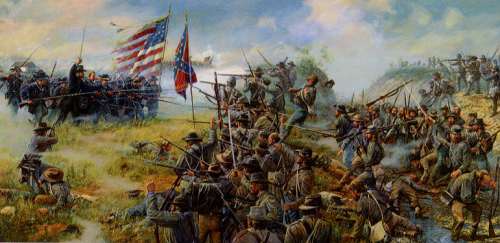
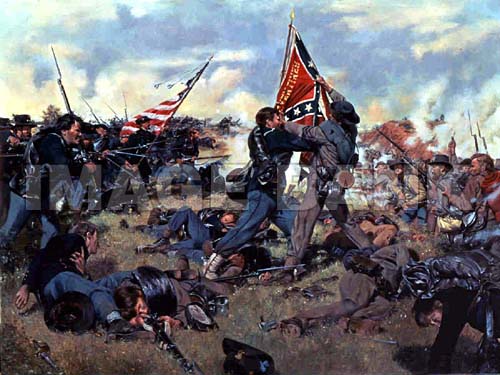
Harry Heth launched his two uncommitted brigades, those of Pettigrew and Brockenbrough to wrest control of the Herbst Woods from the Iron Brigade. The battle around the seminary and in Herbst wood ahead of it was fierce and the casualties enormous. The Iron Brigade still held on to Herbst Woods and was attacked by Pettigrew’s brigade of Heth’s division and it’s commander Solomon Meredith ensured that his veterans would hold the woods as Doubleday had instructed, “at all costs.” “At the apex of the curved line of the Iron Brigade in the woods stood the 24th Michigan. Straight ahead, ascending the slope was the 26th North Carolina, a huge regiment of 850 officers and men. For the next twenty minutes, hell enveloped both regiments.” [1] In the maelstrom of musketry the Confederates suffered heavily, a North Carolina sergeant recalled “could not even begin to estimate the number of “deadly missiles [that] were sent into our ranks, which mowed us down like wheat before the sickle.” [2]

Despite their immense losses the Confederates finally drove the Iron Brigade back to the seminary but it was at great cost to both sides. The battle for the woods was a wholesale slaughter, the 26th North Carolina lost “549 out of the 843 men it had lined up that afternoon; its regimental flag went through thirteen sets of hands” [3] in a fight where “seven out of every ten men on both sides fell killed or wounded.” [4] The 26th North Carolina lost its commanding officer, the young Colonel Henry Burgwyn Jr., who had picked up the regimental colors when the color guard was shot down. “He called out to the regiment to “dress on the colors.” He turned to hand the colors to a private, only to be hit in the left side, puncturing both lungs; the impact twisted him around and entangled Burgwyn in the flag.” [5]

But by now the outnumbered soldiers of the Iron Brigade were being flanked by part of the 11th North Carolina, which had worked its way around the left. These North Carolina troops began raking the Union line with their musket fire, and a soldier of the 19th Indiana noted, “The slaughter in our flanks became frightful beyond description,” [6] Even so the 11th North Carolina lost heavily in the attack, its losses included its colonel and senior major, the Iron Brigade “inflicted such heavy losses on the Confederates that there were not enough men left even for a successful bayonet charge.” [7]

Harry Heth’s division had finally wrested the McPherson’s Ridge from the determined Yankees but it was now a spent force. Archer and Davis’s brigades had been shattered in the morning fighting and now Pettigrew and Brockenbrough’s were shattered and his men were out of ammunition. Heth claimed “his division had lost 2,300 men in thirty minutes. Pettigrew’s brigade, which had borne the brunt of the afternoon’s fight had lost over 1,000 men killed and wounded.” [8]

Solomon Meredith was among the wounded and the Iron Brigade, now under the command of Colonel Henry Morrow of the 24th Michigan were forced to withdraw back to the seminary. The westerners fought stubbornly and withdrew “step by step, contesting every foot of ground.” [9] They withdrew “by echelon of alternate battalions, turning and stopping six times to beat back the Confederate pressure.” [10] On Seminary Ridge the survivors joined with the remnants of Biddle’s and Stone’s brigades and Wainwright’s artillery. The gallant First Corps was now but a shadow of its former self formed near the seminary for a last stand against the advancing Confederates. “Ordered to hold onto the ridge as long as possible, “the shattered remnants of the Iron Brigade” – Doubleday’s description – moved in behind the barricade to face the onslaught to come.” [11]

Abner Doubleday had ordered his troops to hold their positions “at all hazards” and when the assaulting waves of the Confederates “neared Willoughby Run, the Union ranks exploded in a gale of musketry.” [12] These Confederates from Dorsey Pender’s division were fresh and ready to fight, having taken the lead as Heth’s battered formations were given time to reform. Pender chose the North Carolina brigade of Alfred Scales and the South Carolina brigade of Abner Perrin for the assault, but the Carolinians encountered the same stubborn resistance from the depleted Federals as Heth’s men had earlier in the day. Doubleday remained at the Seminary directing the action and contributed his own headquarters guard company to the defense and “lent a hand sighting the artillery.” [13]

The Iron Brigade and Stone’s brigade were in a good position and covered by a “stone wall and some rough fence-rail breastworks and opened a blistering fire on the advancing Carolinians.” [14] Wainwright had eighteen guns concentrated in this sector on a front of less than 200 yards, and they added to the carnage in the Confederate ranks, one battery was enfilading the Confederate left and Wainwright wrote, “round shot, together with the canister poured in from all the other guns, was cutting great gaps in the front line of the enemy. But still they came on, the gaps being closed by regiments from the second line, and this again filled up by a third column which was coming over the hill. Never have I seen such a charge. Not a man seemed to falter….” [15]

The recipients of this blast were the men of Scales brigade and to one of the Confederates the Federal redoubt seemed “a sheet of fire and smoke, sending its leaden missiles…in the faces of men who had often, but never so terribly, met it before.” [16] Colonel William Robinson of the 7th Wisconsin wrote that “the Confederate ranks went down like grass before the scythe” [17] The casualties suffered by Scales’ brigade in their assault on Seminary Ridge were devastating, “Scales was wounded by a shell fragment, and in his five regiments every field officer but one was killed or wounded. Scales had launched his attack that afternoon with 1,350 men. That evening barely 500 answered roll call.” [18]

With Scales and his brigade out of action it was left to Perrin and his South Carolinians to press the fight. These troops were also met with a terrible reception, but Perrin detected a slight gap between Biddle’s brigade and Gamble’s cavalrymen “and drove straight for it. Perrin himself led the charge. Filled with admiration for such courage as defied the whole fire of the enemy,” wrote J.F.J. Caldwell of the 1st South Carolina “…the brigade followed, with a shout that itself half a victory.” [19] Perrin’s troops broke through the Union line just south of the seminary, and once he penetrated the Union line Perrin exploited his advantage and “neatly fanned out his regiments to the left and to the right so as to attack his opponent on the flanks.” [20] By now the 1st and 14th South Carolina had pushed around the flank of the Seminary redoubt, “while the 12th and 13th South Carolina struck Biddle’s brigade through “a furious storm of musketry and shells,” forcing Biddle’s thinned-out regiments to fall back behind the seminary.” [21]

Retreat to Cemetery Hill

By now there was little that could be done by the battered remnants of First Corps to hold on to Seminary Ridge or Oak Ridge. Doubleday and Wadsworth gave the order to withdraw to Cemetery Hill, Wadsworth noted “Outflanked on both right and left, heavily pressed in front, and my ammunition nearly exhausted,… I ordered the command to retire.” [22] The survivors of the corps withdrew under heavy Confederate pressure as the 6th Wisconsin and Battery “B” 4th U.S. Artillery covered the retreat. Doubleday noted “from behind the feeble barricade of rails these brave men stemmed the fierce tide which pressed upon them incessantly, and held the rebel lines…at bay until the greater portion of the corps had retired.” [23] Gamble’s cavalrymen also contributed by so effectively resisted Lane’s brigade that it could not support Perrin in the assault, causing Perrin to complain that it “never came up until the Yankees were clear out of reach.” [24]

“The Iron Brigade and Stone’s Bucktails generally fell back toward Gettysburg under some semblance of control, but this was not as easily done in units with the enemy closing in right at their heels.” [25] These units took more causalities during and lost some men as prisoners while withdrawing, but they were able to work their way through the chaotic streets of Gettysburg, to Cemetery Hill where “the men were re-formed and were ready for service.” [26] The remnants of the Iron Brigade were then directed by Abner Doubleday to Culp’s Hill to support an artillery battery on that vital ground.

Some units did not get the word directly and only found out when supporting units withdrew, such was the case with Wainwright’s artillery. Wainwright was still under the impression that the ridge was to be held at all costs and only withdrew when he found that his infantry supports and already withdrawn, leaving his gunners alone against the advancing Confederates. However, they had already done such damage to the Confederates that the Southerners to their front advanced with caution. One federal artilleryman noted “I was astonished at the caution of the enemy at this time. He seemed utterly paralyzed at the punishment he had received from First Corps, and was literally ‘feeling every inch of the way’ in his advance on our front.” [27]

Wainwright and his gunners executed their guns withdraw from Seminary Ridge under heavy Confederate fire, though the Confederate infantry failed to follow up its success by rushing his guns. He directed his batteries to “move at a walk towards town” [28] as he believed that sending them through at a trot or gallop could panic the infantry. He lost one gun in the retreat, something that as an artilleryman he found upsetting, but he realized that “our getting out of that place as quite a feat, and I wish it could have been without the loss of a gun. The more I think of it, the more I wonder how we got off at all. Our front fire must have shaken the rebel lines badly or they would have been upon us.” [29]

To the north on Oak Ridge the survivors of John Robinson’s division were threatened with complete disaster. Hard pressed on three sides by Rodes’s division and threatened from the east by the collapse of Eleventh Corps and by of the rest of First Corps withdraw from Seminary Ridge. These troops had successfully repelled every Confederate attack and had suffered terribly as they did so. Brigadier General Gabriel Paul’s First Brigade had relieved Baxter’s brigade, which had been withdrawn to replenish ammunition after mauling Iverson and O’Neal’s brigades at the northern apex of Oak Ridge. After its arrival Paul’s excellent brigade beat back an attack by Ramseur’s brigade but in the process lost their commander. General Paul was “shot in the head and blinded” and his place was taken by Colonel Adrian R. Root. [30]

However now, under pressure from the brigades of Daniel, Ramseur and Doles Robinson had to act to save First Brigade. He ordered Colonel Charles Tilden and the 16th Maine to act as a rearguard. Forced to withdraw by overwhelming Confederate numbers “an effort was made to retire in good order, but the pressure was too great.” [31] Tilden’s Maine men were cornered in the Railroad cut they were caught in the crossfire of several Confederate regiments, and for most the only option was surrender or death. Of “the 275 men who entered the battle with the 16th Maine, only 39 reached the hill.” [32] The regiment’s adjutant recalled “They swarmed down upon us….they engulfed us, and swept away the last semblance of organization that marked us a separate command.” [33] To ensure that the regiment’s colors did not become a trophy for the Confederates Tilden ordered his color bears to tear the flags from their staffs and rip them into pieces too small to become souvenirs. Many of the Maine men kept these shreds of their precious colors for the rest of their lives. The gallant 6th Wisconsin which had been at the Railroad cut to turn back the initial assault of Davis’s brigade in the morning which covered the retreat fought its way through town and finally “its men saw “the colors of the Union, floating over well ordered line of men in blue, who were arrayed along the slope of Cemetery Hill.” [34]

Notes

[1] Ibid. Wert The Sword of Lincoln p.278

[2] Ibid. Trudeau Gettysburg: A Testing of Courage p.225

[3] Ibid. Guelzo Gettysburg: The Last Invasion p.196

[4] Ibid. Wert The Sword of Lincoln p.278

[5] Ibid. Guelzo Gettysburg: The Last Invasion p.196

[6] Ibid. Trudeau Gettysburg: A Testing of Courage p.228

[7] Ibid. Coddington The Gettysburg Campaign: A Study in Command, p.293

[8] Ibid. Pfanz The First Day at Gettysburg p.292

[9] Nolan, Alan T. The Iron Brigade: A Military History Indiana University Press, Bloomington IN, 1961 and 1994 p.245

[10] Ibid. Guelzo Gettysburg: The Last Invasion p.196

[11] Ibid. Nolan, The Iron Brigade p.247

[12] Ibid. Wert The Sword of Lincoln p.278

[13] Ibid. Guelzo Gettysburg: The Last Invasion p.200

[14] Ibid. Sears, Gettysburg pp.193-194 and Coddington p.218

[15] Ibid. Wainwright A Diary of Battle p.236

[16] Ibid. Nolan, The Iron Brigade p.247

[17] Ibid. Nolan, The Iron Brigade p.247 and Sears p.218

[18] Ibid. Sears, Gettysburg p.218

[19] Ibid. Sears, Gettysburg p.218

[20] Ibid. Coddington The Gettysburg Campaign: A Study in Command, p.294

[21] Ibid. Guelzo Gettysburg: The Last Invasion p.201

[22] Ibid. Nolan, The Iron Brigade p.248

[23] Ibid. Nolan, The Iron Brigade p.248

[24] Ibid. Pfanz The First Day at Gettysburg p.318

[25] Ibid. Sears, Gettysburg p.220

[26] Ibid. Nolan, The Iron Brigade p.252

[27] Ibid. Gottfried, The Artillery of Gettysburg p.53

[28] Ibid. Sears, Gettysburg p.220

[29] Ibid. Wainwright A Diary of Battle p.237

[30] Ibid. Trudeau Gettysburg: A Testing of Courage p.233

[31] Ibid. Trudeau Gettysburg: A Testing of Courage p.235

[32] Ibid. Pfanz The First Day at Gettysburg p.193

[33] Ibid. Trudeau Gettysburg: A Testing of Courage p.235

[34] Ibid. Pfanz The First Day at Gettysburg p.330

Leave a comment

Filed under Loose thoughts and musings

A Christian & an Enthusiast: General Oliver O. Howard

Friends of Padre Steve’s World,

A change of pace as I get ready for a new class and a section of my Gettysburg Text about Major General Oliver O. Howard. Howard is interesting because alone of senior Union generals his Christian Faith guided his actions and he was maligned by some for that faith. 

This section is only biographic sketch before his Eleventh Corps went into action at Gettysburg. Likewise it does not discuss his very successful command of a corps and army in the West under William Tecumseh Sherman, nor his post war service. I think that he makes an interesting character study; after all, the one constant in history is humanity. We learn from men like Howard and that is important.

Peace

Padre Steve+

Oliver-Otis-Howard-9345101-1-402

Major General Oliver O. Howard, U.S. Army

With John Reynolds dead and Abner Doubleday directing First Corps in its defense west of Gettysburg Major General Oliver O. Howard, commander of Eleventh Corps assumed command of the Federal forces around Gettysburg. Howard was one of the more unusual characters in the senior leadership of the Army of the Potomac, and later when he served under William Tecumseh Sherman’s command in the west, mostly because of his strong Evangelical Christian religious convictions and the fact that he did not drink. Sherman remarked to a group of generals who were mocking Howard’s temperance, “Let Howard alone! I want one officer who don’t drink!” [1]

“A Christian and an Enthusiast”

The thirty-three year old Howard was from Maine, his father had died when he was ten and in 1846 at the age of sixteen he entered Bowdoin College. He graduated from Bowdoin in 1850 near the top of his small class, and education, far from being something simply to prepare himself for a career was important of itself, and he told his mother, “Education is my first aim…. I seek not money, but a cultivated and enlightened mind, becoming & corresponding with the age in which we live.” [2] During his time at Bowdoin Howard was introspective and frequently mused on his own shortcomings and failures. He also showed little interest in world or national events, including the war with Mexico, but in his first year at Bowdoin he did take an interest in the cousin of a classmate, Elizabeth Ann Waite, or Lizzie who eventually became his wife.

While he was finishing his time at Bowdoin he was still uncertain of what he would do. It was then that his uncle, Congressman John Otis who had help to raise him following the death of his father secured for him an appointment to West Point. He did very well academically but at times struggled with some of his fellow students, some of who considered him “priggish, self-righteous, and opinionated.” [3] This was most likely due to a number of reasons, first his moderate abolitionist views, which were unpopular with many cadets, his active participation in the Bible class, which some classmates ridiculed, and his high academic standing, which provoked the jealousy of others. Howard was also resented by some for his friendship with Sergeant Warren Lothrop, a Mexican War veteran, a childhood friend who was “the son of a close friend of his own father” [4] as well as maintaining a friendship with a cadet “who had been “cut” – shunned – by the corps.” [5] While he stood by the cadet, he was forbidden to maintain the friendship by the Commandant of Cadets due to rules on fraternization, but in the eyes of some classmates, the damage had been done. One cadet who never accepted Howard was Custis Lee, an academic rival and the son of Robert E. Lee.

Despite a rough start Howard became friends with many cadets, including some who had shunned him early in his West Point experience. However, one friend who stood by Howard throughout was a cadet from Virginia named J.E.B. Stuart, who he knew from the Bible class. Howard wrote of that friendship, “I can never forget the manliness of J.E.B. Stuart…. He spoke to me, he visited me, and we became warm friends, often, on Saturday afternoons, visiting the young ladies of the post together.” [6] Howard’s friends included cadets from north and south, and never appeared to let political or ideological differences influence his choice of friends.

He graduated fourth in the class of 1854 and commissioned as a Brevet Second Lieutenant in the highly technical Ordinance Corps. He married Lizzie the following year and held a number of assignments in his corps before being assigned to Florida at the tail end of the Seminole Wars where as an Ordinance officer he saw no action. However, during his time in Florida he experienced his conversion to Evangelical Christianity, following his attendance of a number of Methodist revival meetings and his future life would bear evidence of the influence of the founder of Methodism, John Wesley. His faith became a facet of his life that he would never waver from incurring the praise as well as the criticism of various contemporaries. He wrote Lizzie:

“I then bore hat the text above in mind, & said in my heart oh! My Saviour, I know that thou canst save me! I made an effort to fully believe that my sins were washed in the blood of the Lamb, that my dear Saviour had actually saved me at that moment, i.e. had pardoned all my transgressions of the laws of God, & all the wickedness of a corrupt heart – The fullness of the glow of happiness came into my heart, the tugging & burning left me – the choking sensation was gone…my mind is as clear as when making out an Ordinance Return…” [7]

Following his conversion he led prayers and Bible studies, had enlisted me to his quarters for morning devotions and even considered leaving the army for the ministry. It was fortunate for Howard that his commander, an elderly Colonel, Gustavus Loomis, was a devout Christian who had first taken him to the Methodist revival meetings, for many other senior officers would have not approved of such overtly evangelical behavior.

Howard was transferred back to West Point in September of 1857 where now as a First Lieutenant he was assigned as an instructor in Mathematics, and was able to again be with Lizzie and their children. At West Point he continued his religious activities, leading Bible studies and became the superintendent of a Sunday school for the children of enlisted men and briefly explored the possibility of entering the ministry with a local Episcopal priest and even studied Hebrew for a time.

During his time as an instructor at West Point the young officer, like many devout converts to any religion, wrestled with his faith. Always introspective Howard became even more so, do much soul-searching and with two issues that he recognized in himself, vanity and pride. He wrote: “the pride & haughtiness of my heart is more than pen can tell, but I believe God will so school me, by failures when I act without Christ, by disappointments & afflictions, as to bring my miserably foolish soul into full subjection to himself…. I fear if God would give me success with my heart as it is now, that I would be puffed up with pride & thus lose the countenance of my blessed Saviour.” [8] That struggle to harmonize the tension between his desire to excel in the army and life, with his concerns for his soul should he become consumed by ambition and vanity would become more pronounced within a few very short years.

As he had for most of his life Howard took little interest in political questions and the growing movement toward secession. This was not surprising because Howard, whose religious commitment was continuing to grow was planning to take a leave of absence from the army to attend Bangor Theological Seminary, where his brother, Charles was already a student. However, when Fort Sumter was fired on Howard “abandoned the plan to enter the ministry and determined to stay as a regular or volunteer until the war was over.” [9]

As the officers who made their choice to remain loyal to the Union were now confronted with the decision to remain in the Regular Army or join the new volunteer regiments being formed by Northern states. For many, loyalty and the desire to fight to protect the Union was mixed with a certain amount of pragmatic ambition. Remaining in the relatively small Regular Army might leave them in the position of assisting the training of new volunteer units, or involved with the administration or organizing and equipping them, possibly with limited promotion opportunity while taking a volunteer commission could lead to rapid promotion, command of a regiment or even a brigade.

But initially “the was “a prevalent opposition to regular officers accepting commissions in the volunteers,” [10] but soon the reality that the Regular army was insufficient to bring the rebellious states back into the Union caused the army to allow officers to serve with the volunteers. Howard’s fellow Mathematics instructor, Lieutenant Gouverneur Warren was one of the first young officers at West Point to accept a volunteer commission in the Fifth New York Infantry, the Duryea Zouaves. Howard wrote to Maine’s governor, Israel Washburne offering his services to the State, and after an initial rebuff was offered command of the Third Maine Volunteer Infantry. When he received the offer from Maine Howard took it to Lieutenant Colonel John Reynolds, the Commandant of Cadets and told Reynolds of the offer and asked, “I’ve had the tender, or what amounts to it, of a Maine Regiment. What answer would you give, colonel?’ Reynolds replied, “You’ll accept, of course, Howard,” [11] and then preceded to give the young officer a lesson on what colonels needed to know.

One thing Howard had settled in his mind was the legitimacy of war. As a cadet at West Point he had studied the works of Henry Wager Halleck, who wrote one of the first comprehensive books on strategy by an American and who included in his work a synopsis of the traditional Just War Theory. Halleck, like Howard, was a devout Christian and in his book he wrote “The prevention and punishment of crime causes much human suffering; nevertheless the good of the community requires that crime should be prevented and punished. So, as a nation, we employ military officers to man our ships and forts, to protect our property and our persons, and to repel and punish those who seek to rob us of our life, liberty, and pursuit of happiness…” [12] When Fort Sumter was attacked and other Federal installations in the South being overrun Howard believed that “it was a citizen’s duty to defend his country just as a father would defend his wife and children from an assassin.” [13] When the regiment arrived in New York on its way to Washington it was presented a flag by patriotic Maine citizens living there. Upon receiving it, Howard thanked them and his words reflected his thoughts about war and duty, as well as his religious faith: “I was born in the East, but I was educated by my country. I know no section; I know no party; I never did. I know only my country to love it, and my God who is over my country. We go forth to battle in defense of righteousness and liberty, civil and religious. We go strong in muscle, strong in heart, strong in soul, because we are right…” [14]

Howard’s faith would be a source of personal strength throughout the war and while some like Joseph Hooker ridiculed his faith saying “He was always taken up with Sunday Schools and the temperance cause. Those things are all very good, you know, but have little to do with commanding an army corps. He would command a prayer meeting with a good deal more ability than he would an army.” [15] Likewise his “reputation as a Christian “hampered his acceptance by both fellow officers and enlisted men.” [16] Despite this, many soldiers and officers in every unit Howard commanded came to admire him

Despite this Howard did eventually succeed and became the only officer of his West Point class of 1854 to become a Major General in the Regular Army of the United States. It was not always an easy road, but Howard displayed a resiliency in the face difficulty and even defeat, a resiliency that enabled him to grow as an officer and commander as the war went on.

Shortly after the Third Maine joined the army at Washington Howard was made a brigade commander. His brigade was involved in the final attack at Bull Run were it was caught up in the disaster that overtook the army of Irvin McDowell. He was promoted to brigadier general and commanded a brigade during McClellan’s inept Peninsular Campaign and “at Fair Oaks on June 1, he was hit twice in the right arm while leading a charge; a second bullet shattered the bone near the elbow, and the arm had to be amputated.” [17] Howard’s bravery in the face of the enemy was noted, especially after having received the first wound he continued to lead his men despite having three horses shot from under him. One of his regimental commanders wrote, “The General was the only Brigadier that I saw on the field who led his men into battle & handled them there – He acted with a bravery bordering on rashness & nobly sustained his reputation as a brave and efficient officer.” [18]

Within two months Howard was back with the army, his former officers writing McClellan to recommend that Howard be given command of a division. He did not immediately get that, but was given command of a brigade of Pennsylvania Reserves, the Philadelphia Brigade in John Sedgwick’s division. He took command of that division when Sedgwick was wounded at Antietam. He commanded the division when it was thrown into General Ambrose Burnside’s ill-advised and doomed assault of Marye’s Heights at the Battle of Fredericksburg. Though his division could not break the Confederate line he was commended by Major General Charles Sumner and Major General Darius Couch for his actions. Sumner noted Howard’s “judicious disposition” in driving the Confederates from Fredericksburg” while “Couch, in speak of the corps losses, stated: “Howard, coming up late, lost 700 men, besides 150 on the 11th. He did well in the part assigned to him.” [19]

During the winter following Burnside’s relief and the appointment of Major General Joseph Hooker to command the Army of the Potomac, Howard remained in command of his division. The vanity that he wrestled with in his spiritual life got the better of him when Daniel Sickles, a political general with no formal military training was appointed to command the Third Corps. Howard, who was senior to Sickles protested to Hooker and was promised the newly arrived Eleventh Corps. The corps, which had just become part of Hooker’s army was never “accepted as a true part of the Army of the Potomac,” where it was viewed as a “foreign contingent,” [20] “and was looked upon by the older units with some distain, despite its having seen considerable action.” [21] The previous Corps commander, Major General Fritz Sigel had just left the army after a disagreement regarding not receiving a larger command during the reorganization of the army. When he left many of the corps’ soldiers remained very loyal to their old commander, and “thought Howard was being advanced at Sigel’s expense.” [22]

But Hooker had created a problem for himself. Eleventh Corps was the only large unit in the Federal Army with a high concentration of Germans. Many of the soldiers had enlisted to serve under men that they knew and trusted, Fritz Sigel and Carl Schurz. When Sigel left command Hooker could have appointed Carl Schurz to command the corps, but “Hooker had little use for Schurz’s generalship,” [23] and bluntly told Secretary of War Stanton that he would not appoint Schurz to corps command. For Howard, this was not good, for “in his anxiety to receive a command commensurate with his rank he had failed to consider all the consequences.” [24]

Howard took command of Eleventh Corps barely a month before Hooker launched his offensive against Robert E. Lee’s Army of Northern Virginia, which culminated in the Battle of Chancellorsville. Howard struggled to gain the acceptance of the German soldiers of his new command, many of whom were resentful of having to serve under a non-German officer who did not understand them. Howard’s overtly Evangelical Christian approach to command and stress on temperance, which included the distribution of religious tracts did not endear him to the Germans, many of who were Catholics, free-thinkers and beer drinkers. While Howard’s piety was appreciated many soldiers of English and Scottish descent with Protestant roots, the “Germans of the Eleventh Corps, many of whom were freethinkers, the activities of “Old Prayer Book” were not welcome…. The Eleventh Corps would go on campaign under a general it neither liked nor trusted, and Howard was marching quite out of step with his command.” [25] Some understood this, Colonel Charles Wainwright, commander of the First Corps artillery wrote, “Howard, who succeeds Sigel in the Eleventh is brave enough, and a most perfect gentleman. He is a Christian and an enthusiast, as well as a man of ability, but there is some doubt as to his having snap enough to manage the Germans, who require to be ruled with a rod of iron.” [26]

In the ensuing battle Howard’s Eleventh Corps was taken in the flank by Stonewall Jackson’s troops which outnumbered his badly situated corps by nearly three-to-one, his only reserve brigade having been taken by Hooker to support Sickle’s Third Corps. The ensuing action was a disaster as regiment after regiment was rolled up by the rapidly advancing Confederate phalanx.

Blame could be assigned to both Hooker and Howard, Hooker for leaving Eleventh Corps unsupported and isolated on the flank without a reserve, and Howard for not taking better precautions to secure his right flank from a surprise attack. Neither Howard, nor his senior division commander Brigadier general Charles Devens “personally investigated any of the reports of Rebel activity on their front, and Howard compounded his negligence by leaving his command for two critical hours.” [27] Only Carl Schurz took any action to protect the corps flank and rear by quietly facing three of his regiments west. When the night was over Howard admitted “I wanted to die…. That night I did all in my power to remedy the mistake, and I sought death everywhere I could find an excuse to go to the field.” [28] However, Jackson’s victory was more tactical than strategic and as one historian noted “the corps had generally acquitted itself well in a nearly hopeless situation and delayed Confederate progress until dark,” [29]at which time the Confederates experienced the loss of Stonewall Jackson who was mortally wounded in the darkness by his own troops as he tried to push his corps forward.

However, the morale of the Eleventh Corps was crushed and it would not get a chance to redeem itself during the rest of the Chancellorsville campaign. When Hooker lost his nerve, refused to counter-attack, and then decided to withdraw he was opposed by Howard, George Meade, Darius Couch and John Reynolds who advocated a renewal of the offensive against Lee who they knew to have taken heavy casualties and had to be outnumbered by the Army of the Potomac.

The ever insightful Charles Wainwright wrote, “Some of the papers are very severe on Hooker, and insist upon that he was drunk, which I do not believe. Others go quite as far the other way, and try to screen him from all blame, seeking to throw it on one or the other of his subordinates. The attacks on General Howard are outrageous. He had been in command of the Eleventh Corps but a month before the fight, and was previously unknown to its officers and men…. He is the only religious man of high rank I know in this army, and, in the little intercourse I have had with him, shewed himself the most polished gentleman I have met. I know that he was very anxious to attack Lee on Monday, and together with Couch, Reynolds, and Meade was decidedly opposed to our withdraw on Wednesday night…” [30]

But the damage to the Eleventh Corps had been done. In the search for blame the old line prejudice and sentiment of the “Know nothings” against the immigrant Germans was once again unleashed. Inside and outside the Army of the Potomac, the Eleventh Corps was given the derisive nickname of “the flying Dutchmen” despite the fact that approximately half of its soldiers were of old line Yankee stock. The Eleventh Corps was not without good soldiers or good leaders, the real issue came from “the prejudice of Americans and the defensive attitude of the Germans…” [31] The soldiers of the corps had to endure the mocking of soldiers of other units and the scorn of the press, which “spoke of the “unexampled conduct” of the Eleventh Corps and how “the whole failure of the Army of the Potomac was owing to [its] scandalous poltroonery.” [32] In defense of the Corps Brigadier General Alexander Schimmelpfennig wrote “It would seem a nest of vipers had but waited for an auspicious moment to spit out their poisonous slanders upon this heretofore honored corps…. I have been proud to command the brave men in this brigade; but I am sure that unless these infamous falsehoods be retracted and reparations made, their good will and soldierly spirit will be broken…” [33]

Like his army commander, Fighting Joe Hooker, Howard never “conceded that he was in any way negligent, but he once hinted that at Chancellorsville he was inexperienced and that he had learned a lesson. “When I was a lad, a larger boy gave me a drubbing, but I grew in size and strength till he could do it no longer. The war experience of some of us was like that.” [34] To his credit, Howard did learn from his mistakes and never was surprised again as Eleventh Corps commander or the Commander of the Army of Tennessee under the command of William Tecumseh Sherman. However, Hooker, not only refused to take any blame, but proceeded to blame “squarely upon three of the army’s eight corps commanders…” [35] Howard, John Sedgwick and cavalry corps commander George Stoneman.

The troops were discouraged and resentful of their treatment; one officer wrote of the corps’ withdraw from Chancellorsville “I recrossed with a heavy heart, and… I felt tears rolling down my cheeks. I was ashamed of the battle, and deplored the sad experience of the Eleventh Corps…” while Howard noted, “there was no gloomier period during the great war than the month which followed the disasters at Chancellorsville.” [36] Carl Schurz wrote “The spirit of this corps is broken, and something must be done to revive it.” [37] It was in this depressed environment, commanding a corps that was defeated and demoralized that Oliver Howard advanced into Gettysburg on July 1st 1863.

Notes

[1] Hebert, Walter H. Fighting Joe Hooker University of Nebraska Press, Lincoln and London 1999. Originally published by Bobbs-Merrill, New York 1944 p.178

[2] Carpenter, John A. Sword and Olive Branch: Oliver Otis Howard Fordham University Press, New York 1999 p.3

[3] Thomas, Emory M. Bold Dragoon: The Life of J.E.B. Stuart University of Oklahoma Press, Norman OK 1986 and 1999 p.24

[4] Ibid. Carpenter Sword and Olive Branch p.8

[5] Ibid. Thomas Bold Dragoon p.24

[6] Ibid. Thomas Bold Dragoon p.25

[7] Ibid. Carpenter Sword and Olive Branch p.17

[8] Ibid. Carpenter Sword and Olive Branch p.20

[9] Ibid. Carpenter Sword and Olive Branch p.21

[10] Jordan, David M. Happiness is Not My Companion: The Life of G.K. Warren Indiana University Press, Bloomington Indiana 2001 p.34

[11] Howard, Oliver O. Autobiography of Oliver Otis Howard, Major General, U.S. Army Volume 1 The Baker and Taylor Company, New York 1907 Made available by the Internet Achieve through Amazon Kindle location1627 of 9221

[12] Halleck, Henry Wager. Elements of Military Art and Science Or, Course Instruction In Strategy, Fortification Tactics of Battles, &c. Embracing the Duties of Staff, Infantry, Cavalry, Artillery, and Engineers, Adapted for the Use of Volunteers and Militia Third Edition D. Appleton & Company, New York and London 1862 Amazon Kindle edition location 149 of 6332

[13] Ibid. Carpenter Sword and Olive Branch p.21

[14] Ibid. Howard Autobiography of Oliver Otis Howard location 1983 of 9221

[15] Girardi, Robert I. The Civil War Generals: Comrades, Peers, Rivals in Their Own Words Zenith Press, MBI Publishing, Minneapolis MN 2013 p.92

[16] Ibid. Carpenter Sword and Olive Branch p.25

[17] Tagg, Larry The Generals of Gettysburg: The Leaders of America’s Greatest Battle Da Capo Press Cambridge MA 1998 Amazon Kindle Edition p. 121

[18] Ibid. Girardi The Civil War Generals: Comrades, Peers, Rivals in Their Own Words p.91

[19] Ibid. Carpenter Sword and Olive Branch p.41

[20] Ibid. Hebert Fighting Joe Hooker p.178

[21] Ibid. Carpenter Sword and Olive Branch p.43

[22] Ibid. Hebert Fighting Joe Hooker p.178

[23] Sears, Stephen W. Chancellorsville Houghton Mifflin Co. Boston and New York 1996 p.64

[24] Ibid. Carpenter Sword and Olive Branch p.43

[25] Ibid. Sears Chancellorsville p.65

[26] Wainwright, Charles S. A Diary of Battle: The Personal Journal of Colonel Charles S. Wainwright 1861-1865 edited by Allan Nevins, Da Capo Press, New York 1998 p.183

[27] Ibid. Sears Chancellorsville p.270

[28] Ibid. Sears Chancellorsville p.286

[29] Greene, A. Wilson. From Chancellorsville to Gettysburg: O. O. Howard and Eleventh Corps Leadership in The First Day at Gettysburg edited by Gallagher, Gary W. Kent State University Press, Kent Ohio 1992 p.57

[30] Ibid. Wainwright A Diary of Battle p.210

[31] Coddington, Edwin B. The Gettysburg Campaign: A Study in Command, A Touchstone Book, Simon and Schuster New York, 1968 p.306

[32] Ibid. Green From Chancellorsville to Gettysburg: O. O. Howard and Eleventh Corps Leadership p.58

[33] Ibid. Green From Chancellorsville to Gettysburg: O. O. Howard and Eleventh Corps Leadership p.58

[34] Ibid. Carpenter Sword and Olive Branch p.49

[35] Sears, Stephen W Gettysburg Houghton Mifflin Company, New York 2003 pp.193-194 and Coddington p.20

[36] Ibid. Green From Chancellorsville to Gettysburg: O. O. Howard and Eleventh Corps Leadership p.57

[37] Ibid. Sears Gettysburg p.37

Leave a comment

Filed under civil war, Gettysburg, History, leadership, Military

Midsummer Dreaming: The MLB All-Star Game

espn_a_prosets_600

“Baseball is an allegorical play about America, a poetic, complex, and subtle play of courage, fear, good luck, mistakes, patience about fate, and sober self-esteem.”  Saul Steinberg

Friends of Padre Steve’s World,

Those that have followed my writing on this site for any length of time know that perhaps more than any other thing on earth that the game of Baseball is an important part of my life and spirituality.

Baseball, unlike most sports is very much a game with a calendar that is almost liturgical in its makeup. It is also a game where those who “have gone before” are as much a part of the present as a part of history. It is a game that people like me ascribe an almost mystical or religious significance.

I have grown up with baseball. My dad ingrained it in me, my mom came to my little league games when my dad was in Vietnam and even my paternal grandmother had a baseball game on whenever one was on.

me-and-lefty-phillips

The author with California Angels” Manager Lefty Phillips in 1970

I like to say that God speaks to me through Baseball, and I do think that I am right about this, much more so than Scripture which I never know if I am interpreting correctly, especially because so many learned people tell me that I’m a heretic. So I guess I have to let God speak to me in other ways, like Baseball.

The All Star Game is part of my “Church Calendar.” it is a moment in the summer where the game and I pause. I pause to reflect on life and remember so many things about the specific All Star Games, my dad and life.

All Star games in any sport are problematic. Most have no meaning. The NFL Pro-Bowl is such bad football that it has almost no relationship to the game as it is played every Sunday. The NBA and NHL games are better, but again because of the nature of those games little resemble their regular season or playoff games. Added to this as that none of those games have any bearing on what happens in the sport where the Baseball All Star Game matters, it determines home field advantage in the World Series.

I fell in love with the All Star Game in 1970, the game that Pete Rose ended in extra innings when he ran over Cleveland Indians catcher Ray Fosse to win the game for the National League. Likewise I remember the 1999 All Star Game at Fenway Park when Ted Williams was honored and the All-Century Team was named. I found it interesting that Pete Rose, arguably the best hitter in the history of the game who was banned from baseball for life by A Bartlett Giamatti for betting on the game was included on that team. I agreed with the selection then and in light of the fact that so many other men of sometimes questionable morals and character are in the Hall of Fame think that the ban on Rose should be lifted and that he be voted into the Hall of Fame.

The All Star Game is a celebration of the game, its history and players, not just the ones playing in the current year. I am interested in this game in some ways because I have seen quite a few players at some level of their minor league careers in the South Atlantic, Carolina, Southern, Eastern, International or Pacific Coast Leagues. For me it is really cool to see men that I watched when they were in the minors now playing in the All Star Game. For those that don’t follow the minor leagues it provides a certain amount of perspective because most players in the minors never make the majors and even many of those who do don’t stay there. It is a hard life and for most the money is not that great, thus I do not begrudge the salaries that they make when they get to the majors. It takes a tremendous amount of talent, hard work, determination and sometimes luck to make it in the majors, to stay there and to become an All Star. Those that do it consistently year after year are amazing.

I appreciate their work, because in my calling and career as a Priest, Chaplain and military officer I am a journeyman. I’ve been around a long time, in a sense been up and down in the majors and minors in a number of different positions. I have had some good seasons so to speak, but I have also had plenty of bad ones and spent a lot of time in the military and church versions of the minor leagues. I think it gives me a manner of perspective when appreciating the hard work and excellence needed to be an All Star. If I was ever to be honored in such a way I would have to say something like John Kruk said back in 1993 when he was elected to the All Star Team “It’s amazing that fans want to see me play. What is our society coming to?”

Tonight’s game will be played at the Great American Ballpark in Cincinnati, the home of the Cincinnati Reds. The game will mark the return of the Baseball’s all-time hit leader, Pete Rose to such festivities. Rose’s on the field accomplishments are clouded by the fact that he bet on baseball as a manager, and new allegations that he may have did so as a player as well.

In spite of that nothing can take away from Rose’s on field accomplishments and as with all of history baseball has myths and legends that need to be scrutinized but at the end of the day have to be acknowledged. This is true for Pete Rose as much as it is for any historical figure, including Abner Doubleday who was unappreciated as a general but became linked forever to the game known as America’s national pastime and to Cooperstown New York, the home of Baseball’s Hall of Fame. As such Doubleday is probably better known to most Americans, particularly baseball fans than any Union general who fought at Gettysburg.

fw-baseball-doubleday

Abner Doubleday

Like the Civil War, Baseball too is filled with myths which connect it to our culture, and one “is the myth that Abner Doubleday invented the sport one fine day in 1839 at the farmer Phinney’s pasture at Cooperstown.”  It was early American baseball star Albert G. Spaulding who linked the creation of baseball to the Civil War and in particular to Abner Doubleday by way of an apocryphal story of one of Doubleday’s childhood friends, years after Doubleday’s death.

In 1907, Spaulding worked with Abraham G. Mills the fourth President of the National League, the same man who had served in Doubleday’s funeral honor guard to conclude that “that the first scheme for playing it, according to the best evidence obtained to date, was devised at Cooperstown New York, in 1839.” 2625 But this is simply myth and the underappreciated hero of the first day of battle at Gettysburg is much better known for something that he did not do.

The ironies of history and myth are fascinating. Interestingly enough Abraham Mills paid homage to Doubleday noting, “in the years to come, in the view of hundreds of thousands of people who are devoted to baseball, Abner Doubleday’s fame will rest evenly, if not quite so much that he was its inventor…as upon his brilliant and distinguished career as an officer in the Federal Army.”

History, myth, scoundrels and baseball. What else can be said about this wonderful game which is so much a part of American lore?

Have a great night,

Peace

Padre Steve+

1 Comment

Filed under Baseball

I Will Fight Them: John Reynolds at Gettysburg

IronBrigade10161001

Friends of Padre Steve’s World

This is another part of my Gettysburg text Chapter on John Reynolds. I have divided it up into three sections. The first was the biographic section, the second, published yesterday was about Kate Hewitt, the girl he left behind.  Today is an expanded version of what was the original chapter which focused almost exclusively on Reynolds’s and his actions at Gettysburg on the morning of July 1st 1863.

I hope that you enjoy.

Peace

Padre Steve+

On the night of June 30th Reynolds was awash in reports, some of them conflicting and even though he was without Meade’s course of action for the next day “concluded that Lee’s army was close by and in force.” [1] He spent the night at his headquarters “studying the military situation with Howard and keeping in touch with army headquarters.” [2] Howard noted Reynolds anxiety and “received the impression that Reynolds was depressed.” [3] After Howard’s departure Reynolds took the opportunity to get a few hours of fitful sleep before arising again at 4 a.m. on July 1st.

When morning came, Reynolds was awakened by his aide Major William Riddle with Meade’s order to “advance the First and Eleventh Corps to Gettysburg.” [4] Reynolds studied the order and though he expected no battle that morning, expecting “only moving up to be in supporting distance to Buford” [5] took the prudent and reasonable precautions that his Confederate opponents A.P. Hill and Harry Heth refused to take as they prepared to move on Gettysburg.

His troops were in fine spirits that morning even though it had been busy. After a breakfast of hardtack, pork and coffee the troops moved out. An officer of the Iron Brigade noted that the soldiers of that brigade were “all in the highest spirits” while Lieutenant Colonel Rufus Dawes of the “placed the fifes and drums at the head of the Sixth Wisconsin and ordered the colors unfurled” as the proud veterans marched forward into the sound of the raging battle to the tune of “The Campbell’s are Coming.” [6]

Though Reynolds was not expecting a fight he organized his march in a manner that ensured if one did happen that he was fully prepared. The precautionary measures that he took were those that any prudent commander having knowledge that strong enemy forces were nearby would take. Reynolds certainly took to heart the words of Napoleon who said “A General should say to himself many times a day: If the hostile army were to make its appearance in front, on my right, or on my left, what should I do?” [7]

This was a question that A.P. Hill and Harry Heth seemed not to consider on that warm and muggy July morning when Heth was committing Lee’s army to battle on his own authority. Reynolds was also about to commit the Army of the Potomac to battle, but unlike Heth who had no authority to do so, Reynolds “had at least been delegated the authority for making such a decision” [8] by his army commander George Meade. Though Meade was unaware of what was transpiring in the hills beyond Gettysburg he implicitly trusted the judgement of Reynolds, and Meade been with the advanced elements of Reynold’s wing he too “probably would have endorsed any decision he made.” [9]

Reynolds placed himself with the lead division, that of Wadsworth, and “directed Doubleday to bring up the other divisions and guns of the First Corps and had ordered Howard’s Eleventh Corps up from Emmitsburg.” [10] Reynold’s also understood the urgency of the situation and “wanted all the fighting troops to be up front, so he instructed Howard not to intermingle his supply wagons with his infantry. Similar instructions had been given to Abner Doubleday; to ensure that the First Corps wagons would wait until the Eleventh Corps foot soldiers had passed.” [11]

Instead operating in the normal fashion of rotating units on the march, Reynolds opted to save time. Since Wadsworth’s First Division was further advanced than his other First Corps divisions, Reynolds instructed it to move out first with Cutler’s brigade in the lead followed by the Iron Brigade under Brigadier General Solomon Meredith. In doing so Reynolds countermanded the order of the acting corps commander Doubleday who had ordered Wadsworth’s division to allow the other divisions of First Corps to pass his before advancing. Reynolds told Wadsworth that Doubleday’s order “was a mistake and that I should move on directly.” [12]

He went forward with Wadsworth’s division and gave Doubleday his orders for the coming engagement. Doubleday later recalled that when Reynolds arrived to discuss the situation that Reynolds:

“read to me the various dispatches he had received from Meade and Buford, and told me that he should go at once forward with the leading division – that of Wadsworth – to aid the cavalry. He then instructed me to draw in my pickets, assemble the artillery and the remainder of the corps and join him as soon as possible. Having given me these orders, he rode off at the head of the column, and I never saw him again.” [13]

Reynolds ordered Howard’s Eleventh Corps to follow First Corps and according to Doubleday directed an aid of Howard to have Howard “bring his corps forward at once and form them on Cemetery Hill as a reserve.” [14] Howard received the order and since his troops were ready to move out “no time was lost in setting them in motion.” [15] While some writers believe that Reynolds directed Oliver Howard to prepare Cemetery Hill as a fallback position [16] there is more evidence that points to Howard selecting the that commanding hill himself. [17] Regardless of which is correct the result was that both Reynolds and Howard recognized the importance of the position and took action to secure it.

Likewise Reynolds ordered Sickles’ III Corps to come up from Emmitsburg where that corps had bivouacked the previous night. [18] Sickles had heard the guns in the distance that morning and sent his senior aide, Major Henry Tremain to find Reynolds. Reynolds told Tremain “Tell General Sickles I think he had better come up” but the order left Sickles in a quandary. He recalled “he spend an anxious hour deciding what to do” [19] for he had “been ordered by Meade to hold his position at Emmitsburg” [20] and Sickles sent another rider to Reynolds and awaited the response of his wing commander instead of immediately advancing to battle on 1 July and it would not be until after 3 P.M. that he would send his lead division to Gettysburg.

According to Doubleday Reynolds’s intention was “to fight the enemy as soon as I could meet him.” [21] Reynolds rode forward with some of his staff into the town as the infantry of the First Corps and the Eleventh Corps moved advanced. As they rode through the town Reynolds and his party were met by “a fleeing, badly frightened civilian, who gasped out the news that the cavalry was in a fight.” [22] When he came to the Lutheran Seminary he came across Buford. It was a defining moment of the Civil War, a moment that shaped the battle to come. It has been recounted many times and immortalized on screen in the movie Gettysburg, a time “when the entire battle would come down to a matter of minutes getting one place to another.” [23]

As the rough and tumble Kentuckian, Buford, and Reynolds, the dashing Pennsylvanian, discussed the situation they had to know that odd that they were facing. With close to 32,000 rebels from the four divisions of Hill’s and Ewell’s corps closing in from the west and the north and with only about 18,000 men of First Corps, Eleventh Corps and Buford’s cavalry division to meet them, the odds were not in his favor, but unlike other battles that the army of the Potomac faced, this time the army and its commanders were determined not to lose the battle and not to retreat and for the first time John Reynolds “led the advance” and for the first time in the war “might have some say about fighting.” [24]

Reynolds and Buford committed their eighteen thousand men against Lee’s thirty-two thousand in a meeting engagement that develop into a battle that would decide the outcome of Lee’s invasion. Likewise it was a battle for the very existence of the Union. Abner Doubleday noted the incontestable and eternal significance of the encounter to which Buford and Reynolds were committing the Army of the Potomac on July 1st 1863:

“The two armies about to contest on the perilous ridges of Gettysburg the possession of the Northern States, and the ultimate triumph of freedom or slavery….” [25]

Even though they understood that they were outmanned and outgunned by the advancing Confederates, both Buford and Reynolds knew that this was where the battle must be waged. It was here on this spot, for the ground gave them an advantage that they would not have elsewhere; but only if they could hold on long enough for the rest of the army to arrive. As Alan Nolan wrote: “this Pennsylvania ground – was defensible, and behind it, through the town, loomed Cemetery Hill, another natural point of defense if the battle at Seminary Ridge went against the Federals.” [26]
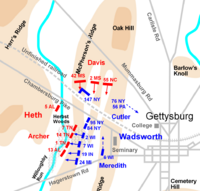
200px-Gettysburg_Day1_1045

Reynolds vs. Heth July 1st

When John Buford saw Reynolds infantry advancing as the Confederates increased the pressure on his outnumbered cavalry, he remarked to a staff member “now we can hold this place.” [27] Buford was not mistaken, when Reynolds rode up to the scene of the battle on Seminary Ridge he greeted Buford, who was in the cupola of the seminary. He called out “What’s the matter John?” to which Buford replied “The devil’s to pay” before he came down to discuss the tactical situation with Reynolds. [28] Buford explained the situation noting that “I have come upon some regiments of infantry…they are in the woods…and I am unable to dislodge them.” [29]

Reynolds needed no other convincing. He asked Buford if he could hold and quickly sent off a number of messages. One officer wrote: “The Genl ordered Genl Buford to hold the enemy in check as long as possible, to keep them from getting into town and at the same time sent orders to Genl Sickles…& Genl Howard to come as fast as possible.” [30] Additionally, Reynolds sent a message to Meade stating: “The enemy are advancing in strong force. I fear they will get to the heights beyond the own before I can. I will fight them inch by inch, and if driven into the town, I will barricade the streets and hold them back as long as possible.” [31] He directed Major Weld of his staff to take it to Meade with all haste as Weld recalled: “with the greatest speed I could, no matter if I killed my horse.” [32] When Meade received the report he was concerned, but with great confidence in Reynolds’s ability he remarked “Good!…That is just like Reynolds; he will hold on to the bitter end.[33]

After dictating his instructions and sending off his messengers, Reynolds then did what no senior Confederate commander did during the entirety of the battle, he rode back and took personal charge of the movements of his troops to hurry them forward. Unlike Heth who so badly misjudged the tactical situation, he had taken note of the ground and recognized from Buford’s reports that “the Confederates were marching only on that single road and thus would not be able to push their forces to the front any faster than Reynolds could reach the battlefield with his First Corps divisions.” [34] It was a key observation on his part which again allowed him to make appropriate decisions as to how he shaped the battle.
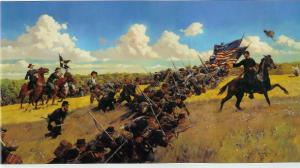
explorepahistory-a0h4p1-a_349

Reynolds leadership at this point might be considered reckless by the standards of our day when senior commanders control battles from miles away with the help of real time intelligence and reporting, including live video feeds, or even the standards of the Second World War. But then in the Civil War a commander in combat could only really control the actions of troops that he could see and because of the time that it took to get messages to subordinate commanders, and the real possibility that verbal orders could be badly misinterpreted in the heat of battle.

Reynolds exercised command directing infantry formations into battle and assisting his artillery battery commanders in the placement of their guns. This was far different than the way that most senior Confederate leaders, including Lee, Longstreet, Hill and Ewell directed their units during the battle of Gettysburg. But such action such action was in keeping with Reynolds’s character, especially in the defense of his home state. Reynolds’ philosophy of command regarding volunteer troops was that they “were better led than driven” [35] and as such he led from the front and Abner Doubleday noted that Reynolds was “inflamed by at seeing the devastation of his native state, was most desirous of getting at the enemy as soon as possible.” [36]
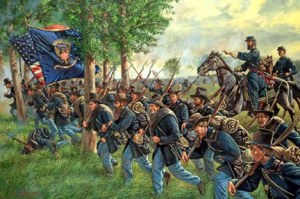
iron brigade forward

“For God’s Sake Forward!” McPherson’s Ridge

John Reynolds recognized that time was of the essence if his forces were to hold the ground west of the town selected a shortcut around the town for First Corps. Those forces were directed across the fields near the Condori farm toward the back side of Seminary Ridge, with Reynolds’ staff helping to remove fences to speed the advance. [37] It was not an easy advance as the troops had to move across the farm fields at an oblique and have to “double-quick for a mile and a quarter in the thick humidity just to reach the seminary.” [38] One member of the corps recalled “I never saw men more willing to fight than they were at Gettysburg.” [39]

Recognizing that “after two full hours of fighting, Buford’s troopers” fighting on McPherson’s Ridge, were “at the limits of their endurance,” Reynolds ordered Wadsworth’s brigades “to bolster the cavalry and oppose the rebel infantry coming at them.” [40]

As troops arrived Reynolds directed them into position. He directed the artillery of Captain James Hall’s 2nd Maine Battery to McPherson’s Ridge instructing Hall “I desire you to damage their artillery to the greatest possible extent, and to keep their fire from our infantry until they are deployed….” [41]

The leading infantry of First Corps was Major General James Wadsworth’s understrength division containing just two brigades, just over 3000 soldiers, its losses from Chancellorsville not being made good and as the result of the loss of regiments discharged because their enlistments had expired. [42] Wadsworth was not a professional soldier, but like many generals on both sides was a political general who despite his lack of military experience was a natural leader of men. Wadsworth was “a vigorous white-haired old man who had been a well-to-do gentleman farmer in New York State before the war” [43] and he “had interrupted his service in the war to run for and lose his state’s governorship the preceding fall.” [44] He ran against the anti-war, anti-administration and frequently pro-Southern Copperhead Horatio Seymour, but he did not leave the army in order return to the state to mount a personal campaign “on the ground that it did not befit a soldier.” [45]

“What the gray haired general lacked in experience and skill, he compensated with a fighting spirit.” [46] Oliver Howard of Eleventh Corps said that Wadsworth was “always generous and a natural soldier” [47] and while Wadsworth was no professional but he performed admirably on July 1st 1863. Wadsworth was beloved by his men because he demonstrated true concern and care for their living conditions and training and on that morning Wadsworth was commanding his division leading it into action with “an old Revolutionary War saber in his hand.” [48] The gallant Wadsworth would be mortally wounded ten months later leading a division of Gouverneur Warren’s Fifth Corps in the opening engagements of the Wilderness. Secretary of the Navy Gideon Welles noted in his diary when Wadsworth died that Wadsworth “should, by right and fair-dealing, have been at this moment Governor of New York…No purer or single-minded patriot than Wadsworth has shown himself in this war. He left home and comforts and wealth to fight the battles of the Union.” [49]

With their gallant commander at their head the division may not have had much in force in the way of numbers, but the units of the division were “good ones,” composed of hardened combat veterans that went into battle with an eye to victory. In the van was Brigadier General Zylander Cutler’s brigade of New Yorkers and Pennsylvanians, the “celebrated Bucktails.” [50] When they were mustered into service the soldiers of the 13th Pennsylvania had adopted a “bucktail” attached to their service caps as a distinctive insignia, a practice that spread to other regiments of the brigade and for which the brigade became known throughout the army.

Cutler had spent much of his early life in Maine working in a number of fields and businesses. He made a fortune several times and lost it, first when his mill burned down, but he rebuilt his businesses and diversified and “as a leading businessman, Cutler was elected to the Maine senate, college trusteeships and a railroad directorship, but he was financially ruined by the panic of 1866 and moved to Milwaukee to start his career over again.” [51] The tough-minded Cutler had some previous military experience fighting Indians as a member of the Maine militia and was made Colonel of the 6th Wisconsin. Cutler was described by one of his soldiers as “being as “rugged as a wolf” and was “a tenacious fighter, a trait that endeared him to the tough-minded Gibbon.” [52] After Antietam Gibbon recommended Cutler for promotion to Brigadier General and command of the Iron Brigade, but Cutler had been wounded at the bloody Battle of Brawner’s Farm and Solomon Meredith gained a promotion and command of that celebrated brigade. However, in on November 29th 1862 having recuperated from his wounds Cutler was promoted to brigadier general and received command of his Bucktails in March of 1863. The brigade saw only minor action at Chancellorsville and Gettysburg would be the fierce brigadier’s first chance since being wounded to command in combat.

This fine brigade was followed by Brigadier General Solomon Meredith’s “Iron Brigade” composed of westerners in their distinctive black “Jefferson Davis” or “Hardie” hats. The brigade had been initially commanded by Major General John Gibbon, now commanding a division in Winfield Scott Hancock’s Second Corps. Gibbon turned the brigade into one of the finest in the army. At the Battle of Turner’s Gap on South Mountain during the Antietam campaign, the brigade earned its name.

After that bloody battle George McClellan exclaimed “They must be made of Iron!” and Hooker replied, “By the Eternal, they are iron! If you had seen them at Bull Run as I did, you would know them to be iron.” [53] In the fierce battle at South Mountain the brigade had lost over a quarter of its strength, but had gained a share of immortality among the ranks of the United States Army. “The Western soldiers immediately seized on this as their title, and the reputation of the brigade and its new name were soon broadcast around Federal campfires.” [54] The regiments of the brigade rivalled many Regular Army units in effectiveness and discipline and “the black hats became their trademark.” [55] Often committed to the fiercest battles the brigade had been decimated, but now along with the Bucktails it advanced up down Seminary Ridge and up the back side of McPherson’s Ridge. A member of an artillery battery who saw the Bucktails and the Iron Brigade advance recalled:

“No one…will ever again see those two brigades of Wadsworth’s Division – Cutler’s and the Iron Brigade – file by as they did that morning. The little creek made a depression in the road, with a gentle ascent on either side, so that from our point of view the column, as it came down the slope and up the other, had the effect of huge blue billows of men topped with a spray of shining steel, and the whole spectacle was calculated to give nerve to a man who never had one before.[56]

Reynolds directed Cutler’s Bucktails to proceed north of the Cashtown Pike and then “called the Iron Brigade into action on the south side” [57] leading the hearty Westerners himself. Reynolds directed then Wadsworth to take change of the action on the north side of the road while he looked after the left. [58] When Reynolds made that decision he made another. He ordered the 6th Wisconsin of the Iron Brigade into reserve, leaving the Iron Brigade a regiment short but giving him the advantage of having a ready reserve which “permitted them to take full advantage of their interior lines, shift their strength about, and apply it where most needed.” [59]

At about 10:30 the 2nd Wisconsin advanced into the woods Reynolds urged them forward: “Forward men, for God’s sake and drive those fellows out of those woods….” [60] As he looked around toward the seminary to see the progress of reinforcements, Reynolds was struck in the back of the neck by a bullet and fell dead. “Had it come a short time earlier, Reynolds’s death might have thrown the I Corps into fatal confusion.” [61] But Doubleday, who command now fell was up to the task on that sultry July morning.

MenBrooklyn

Cutler’s brigade moved north and engaged Davis’ men near the railroad cut. Here the Cutler’s line was “hardly formed when it was struck by Davis’s Confederate brigade on its front and right flank.” [62] His troops were heavily outnumbered by the advancing Confederates and Davis’ troops initially had the upper hand. In a savage fight they inflicted massive casualties on Cutler’s regiments which outnumbered and being flanked were ordered to withdraw by Wadsworth in order to save them, with the exception of one regiment, the 147th New York nicknamed the Ploughboys which “did not get the order” [63] and though isolated held its ground, “with the support of a fresh six-gun battery whose gunners simply refused to quit.” [64] This was the 2nd Maine Battery under the command of Captain James Hall. Though caught in a cross fire of Rebel artillery and assailed by skirmishers Hall’s artillerymen gamely continued the fight withdrawing by sections, “fighting a close canister range and suffering severely.” [65] The New Yorkers and Hall’s battery battled the Mississippians and the “Ploughboys fell “like autumn leaves; the air was full of lead.” [66]
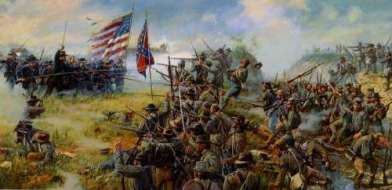
railroad_cut

The inexperienced Davis and his green troops were buoyed by this “gratifying local success” [67] and attempted to exploit it. At this point the Confederates were fatigued by the long march and the fighting and the troops of the 2nd Mississippi and 55th North Carolina “were all jumbled together without regiment or company.” [68] Davis attempted to use the unfinished railroad cut “as cover for getting on the enemy’s flank without exposure.[69] It was a decision that Davis lived to regret. As his troops his units crowed into it, the two regiments of Cutler’s brigade south of the turnpike, the 14th Brooklyn and the 95th New York turned to meet them and were joined by the reserve regiment of the Iron Brigade, the 6nd Wisconsin under Lieutenant Colonel Rufus Dawes. Dawes ordered an immediate advance and called out to Major Edward Pye of the 95th “Let’s go for them Major.” The 6th Wisconsin and the New Yorkers took the Confederates in the flank with enfilade fire, “it was like shooting fish in a barrel.” [70] Dawes’ men slaughtered many of those unfortunate soldiers, and the battle soon became a hand to hand struggle as North Carolinians and Mississippians struggled with the Wisconsin men and New Yorkers.
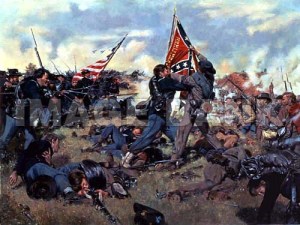
fightforthecolors2la

The melee in and around the cut did not last long:

“for the Confederates were unable to resist their attackers….From the brow of the cut Dawes shouted down to the Confederates below him: “Where is the colonel of this regiment?” A Confederate field officer heard him and replied, “Who are you?” Dawes answered, “I command this regiment. Surrender or I will fire.” [71] Dawes’s men took over 200 prisoners, [72] and the battle flag of the 2nd Mississippi. [73]

The charge had last but minutes yet had shattered Joe Davis’s brigade. Davis was wholly unprepared for this reverse and signaled his forces to pull back convinced that “a heavy force was…moving rapidly to our right.” [74] However, the cost to the 6th Wisconsin was great, “Dawes estimated that 160 men of the 6th fell, not including the brigade guard, whose casualties he did not know.” [75]

Brigadier General Solomon Meredith’s Iron Brigade, which had been brought forward by Doubleday hit Archer’s brigade in the front in the woods on McPherson’s Ridge. Meredith was an unmarried North Carolina Quaker who had moved to Indiana in 1840 owning little more than the clothes that he was wearing. He became a farmer but found politics more to his liking and was elected as a county sheriff and to the state legislature. When the war came he was serving as the Clerk of Wayne County. Meredith, like so many volunteer officers on both sides owed much of his advancement in the army to his political connections. In Meredith’s case this was to Meredith’s friend Governor Oliver Morton. Critics of Meredith decried his appointment as Colonel of the 19th Indiana as “a damnable swindle.” [76] Yet Meredith commanded the regiment effectively and received command of the brigade in November 1862. John Gibbon, the regular officer who initially commanded the brigade was critical of Meredith’s appointment but the soldiers appreciated their kind, six-foot seven-inch tall commander who they affectionately knew as “Long Sol.” But despite the carping of his political enemies and the opposition of Gibbon, Meredith like so many others like him who, “extroverted and ambitious by nature, accustomed to asserting themselves, these men did the best that they could, for themselves and their responsibilities, and they somehow sufficed” [77] though they had no formal military training or experience.

As the Iron Brigade advanced toward McPherson’s Ridge and engaged the enemy, Doubleday “urged the men…to hold it all hazards.” Doubleday later wrote that the troops of the brigade, “full of enthusiasm and the memory of their past achievements they said to me proudly, “If we can’t hold it, where will you find men who can?” [78]

Animated by the leadership of Reynolds and now Doubleday they “rushed to the charge, struck successive heavy blows, outflanked and turned the enemy’s right, captured General Archer and a large portion of his brigade, and pursued the remainder across Willoughby Run.” [79] The effect was dramatic as the Iron Brigade overwhelmed Archer’s brigade, whose soldiers now realized they were facing “the first team.” Members of the Iron Brigade recalling the voices of Confederate soldiers exclaiming “Here are those damned black-hat fellers again…’Taint no militia-that’s the Army of the Potomac.” [80] As they attempted to withdraw they piled up at a fence near Willoughby Run and were hit in the flank by “a Michigan regiment that had worked its way around through the woods to the south.” [81] Archer’s Confederates were unable to resist the assault of the Iron Brigade, “Some fled; others threw down their arms and trembling asked where they should go, while others simply dropped their rifles and ducked through the Union formations to the Union rear.” [82]

As for their commander, Archer the ignominy only got worse. “A muscular Irish private in the 2nd Wisconsin ran forward and seized General Archer bodily and made a prisoner of him.” [83] Coddington wrote: “It was a bad moment for the Army of Northern Virginia, and Archer gained the unenviable distinction of being the first of its general officers to be captured after Lee took command.” [84] Doubleday, who knew Archer from the old army, wrote of meeting Archer after that very angry general after had been taken prisoner and roughed up by the aforementioned Private Maloney. Doubleday greeted his old comrade saying: “Archer! I’m glad to see you,” and reached out his hand to greet his friend, to which Archer replied “Well, I’m not glad to see you by a damn sight” and refused to shake Doubleday’s hand. [85]

With the Archer’s brigade whipped and Davis’s in flight Solomon Meredith pulled back the brigade and “was reforming his lines when a shell exploded near him.” [86] Meredith’s horse was killed and fell on him and the tall general was struck in the head by a shell fragment which fractured his skull and rendered him hors d ’combat for the rest of the battle.

Contrary to the reports of many of the Confederates involved, stating that they were outnumbered, some of which have achieved nearly mythic status in some accounts of the battle, the forces engaged were relatively evenly matched. [87] Clifford Dowdey says that the Iron Brigade “heavily outnumbered the one brigade they met. Archer’s….” [88] Such accounts are usually based on the reports of Heth and other confederate commanders. Heth in his after action report wrote that “Archer, encountered heavy masses in his front, and his gallant little brigade, after being almost surrounded by overwhelming forces in front and on both flanks, was forced back….” [89]

However, such was not the case. The reason for this repulse was not that the Union forces had “overwhelming forces” or “greatly superior numbers.” Instead the Archer’s brigade and the Iron Brigade were fairly evenly matched with Archer having about 1,130 men and the Iron Brigade 1,400 while Davis outnumbered Cutler nearly two to one having between 2,400 and 2,600 men in the battle to Cutler’s 1,300. [90]

Following the repulse of Archer and Davis’s brigades by Reynolds’s First Corps, Heth withdrew his badly mauled brigades back to Herr’s Ridge in order to reform them and bring up the brigades of Brockenbrough and Pettigrew before he could resume his attack. In his next assault he would also be supported by Pender’s fresh division which was now coming up.

Coddington notes that the outcome of the opening engagement came down to leadership and “the superior tactical skills of the Northern generals,” who “created a reserve force” with one regiment of the Iron Brigade which “permitted them to take full advantage of their interior lines, shift their strength about, and apply it where most needed.” [91] It was a “calculated risk,” for it assumed that the depleted Iron Brigade could handle Archer’s brigade effectively with only four of their five assigned regiments. [92] Again, even with the loss of Reynolds it was a case of Harry Heth being out-generaled, this time by Abner Doubleday. Heth “had not exercised the close field command by means of which Doubleday had won the brief, furious action.” [93]
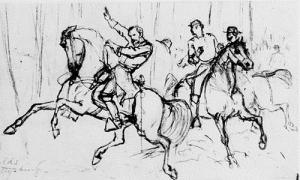
death of reynolds

The Death of Reynolds

Reynolds was dead, but the series of command decisions reached by Reynolds under the pressure of a meeting engagement “where neither side held an immediate advantage” [94] were critical to the army. Likewise, because he had effectively communicated his intent to his subordinate commanders they were able to continue the fight despite his death, and his superiors and successors were able to effectively continue the battle that he had initiated. When he went into action he had “barely a third of his corps available, and confronting a force of unknown size, he had put himself at the head of his troops to lead them in a vigorous attack.” [95]

Though shaken by Reynolds’ loss, the Union troops fought on at McPherson and Seminary Ridge under the command of Doubleday until the assault of Ewell on their left and the arrival of Pender’s fresh division forced them from their positions. However Reynolds’s death was a major blow for the Federal forces for it “removed from the equation the one person with enough vision and sense of purpose to manage this battle.” [96] Despite this Reynolds, by pushing forward with his troops on McPherson’s Ridge ensured that Howard was able to secure Cemetery Hill and Cemetery Ridge, without which Gettysburg would have been lost.

The contrast between Reynolds and his opponents was marked. Hill was ten miles away from the action. Heth was too far to the rear of his troops to direct their advance when they ran into trouble and did not begin to take control until after the brigades of Davis and Archer had staggered “back up the ravine, with Davis’s temporarily wrecked.” [97] In contrast to Heth, Reynolds “hurried to the front, where he was able to inspirit the defense and throw troops into the decisive zone.” [98] At every point in the brief encounter John Reynolds showed himself superior to his opponents as he directed the battle. “Dedicated to an aggressive forward defense in the vanguard of the entire Army of the Potomac, Reynolds, at the cost of his own life had blunted the Rebel thrust and bought valuable time that permitted the balance of Meade’s army to take possession of the coveted high ground….” [99]

Though he paid for his efforts with his life but his sacrifice was not in vain. Reynolds’s tactics “gave the First Corps room for maneuver in front of Gettysburg and upset General Hill’s timetable.” [100] Harry Hunt noted: “…by his promptitude and gallantry he had determined the decisive field of the war, and he opened brilliantly a battle which required three days of hard fighting to close with a victory.” [101]

Notes

[1] Ibid. Pfanz Gettysburg: The First Day p.48

[2] Ibid. Coddington The Gettysburg Campaign: A Study in Command p.261

[3] Ibid. Pfanz Gettysburg: The First Day p.48

[4] Ibid. Coddington The Gettysburg Campaign: A Study in Command, p.261

[5] Ibid. Sears, Gettysburg. p. 158

[6] Nolan, Alan T. The Iron Brigade: A Military History Indiana University Press, Bloomington IN, 1961 and 1994 pp.233-234

[7] Napoleon Bonaparte, Military Maxims of Napoleon in Roots of Strategy: The Five Greatest Military Classics of All Time edited by Phillips, Thomas R Stackpole Books Mechanicsburg PA 1985 p.410

[8] Ibid. Sears, Gettysburg. p. 165

[9] Ibid. Pfanz Gettysburg: The First Day p.49

[10] Ibid. Nolan The Iron Brigade p.233

[11] Trudeau, Noah Andre. Gettysburg: A Testing of Courage, Harper Collins Publishers, New York 2002 p.159

[12] Ibid. Trudeau, Gettysburg: A Testing of Courage p.156

[13] Doubleday, Abner Chancellorsville and Gettysburg: Campaigns of the Civil War VI Charles Scribner’s Sons, Bew York 1882 pp.70-71

[14] Ibid. Doubleday Chancellorsville and Gettysburg p.71

[15] Carpenter, John A. Sword and Olive Branch: Oliver Otis Howard Fordham University Press, New York 1999 p.51

[16] Ibid. Pfanz Gettysburg: The First Day p.76

[17] Green, A. Wilson. From Chancellorsville to Gettysburg: O. O. Howard and Eleventh Corps Leadership in The First Day at Gettysburg edited by Gallagher, Gary W. Kent State University Press, Kent Ohio 1992 p. 70

[18] Ibid. Sears, Gettysburg. p. 158

[19] Keneally, Thomas American Scoundrel: The Life of the Notorious Civil war General Dan Sickles Anchor Books, a Division of Random House, New York 2003 p.275

[20] Swanberg, W.A. Sickles the Incredible Copyright by the author 1958 and 1984 Stan Clark Military Books, Gettysburg PA 1991 p.202

[21] Ibid. Trudeau, Gettysburg: A Testing of Courage p.156

[22] Ibid. Sears, Gettysburg. p. 165

[23] Ibid. Guelzo, Gettysburg: The Last Invasion p.142

[24] Ibid. Nichols Toward Gettysburg p.200

[25] Ibid. Doubleday Chancellorsville and Gettysburg p.68

[26] Ibid. Nolan The Iron Brigade p.235

[27] Ibid. Guelzo, Gettysburg: The Last Invasion p.142

[28] Ibid. Sears, Gettysburg. p. 172

[29] Ibid. Guelzo, Gettysburg: The Last Invasion p.143

[30] Ibid. Trudeau, Gettysburg: A Testing of Courage p.172-173

[31] Schultz, Duane The Most Glorious Fourth: Vicksburg and Gettysburg July 4th 1863. W.W. Norton and Company New York and London, 2002 p.202

[32] Ibid. Trudeau, Gettysburg: A Testing of Courage p.173

[33] Huntington, Tom Searching for George Gordon Meade: The Forgotten Victor of Gettysburg Stackpole Books, Mechanicsburg PA 2013 p.154

[34] Ibid. Sears, Gettysburg. p. 166

[35] Ibid. Coddington The Gettysburg Campaign: A Study in Command, p.277

[36] Doubleday, Abner. Chancellorsville and Gettysburg: Campaigns of the Civil War – VI Charles Scribner’s Sons, New York 1882 p.68

[37] Ibid. Pfanz Gettysburg: The First Day p.75

[38] Ibid. Guelzo, Gettysburg: The Last Invasion p.145

[39] Ibid. Wert The Sword of Lincoln p.275

[40] Foote, Shelby, The Civil War, A Narrative. Volume Two Fredericksburg to Meridian Random House, New York 1963 p.469

[41] Gottfried, Bradley The Artillery of Gettysburg Cumberland House Publishing, Nashville TN 2008 pp.28-29

[42] Ibid. Sears, Gettysburg. p. 34 Sears notes that in between Chancellorsville and Gettysburg, First Division of I Corps had lost a full brigade due to the expiration of enlistments.

[43] Catton, Bruce The Army of the Potomac: Glory Road Doubleday and Company, Garden City New York, 1952 p.270

[44] Ibid. Sears, Gettysburg. p. 34

[45] Ibid. Catton The Army of the Potomac: Glory Road p.271

[46] Ibid. Wert The Sword of Lincoln p.275

[47] Ibid. Howard Autobiography of Oliver Otis Howard 5995 of 9221

[48] Ibid. Catton The Army of the Potomac: Glory Road p.271

[49] Girardi, Robert I. The Civil War Generals: Comrades, Peers, Rivals in Their Own Words Zenith Press, MBI Publishing, Minneapolis MN 2013 p.184

[50] Ibid. Sears, Gettysburg. p. 34

[51] Ibid. Nolan The Iron Brigade p.16

[52] Tagg, Larry The Generals of Gettysburg: The Leaders of America’s Greatest Battle Da Capo Press Cambridge MA 1998 Amazon Kindle Edition p.19

[53] Hebert, Walter H. Fighting Joe Hooker University of Nebraska Press, Lincoln and London 1999. Originally published by Bobbs-Merrill, New York 1944 p.137

[54] Ibid. Nolan The Iron Brigade p.130

[55] Ibid. Nolan The Iron Brigade p. 54

[56] Ibid. Nolan The Iron Brigade p. 234

[57] Ibid. Catton The Army of the Potomac: Glory Road p.271

[58] Ibid. Pfanz Gettysburg: The First Day pp.75-76

[59] Ibid. Coddington The Gettysburg Campaign: A Study in Command, p.275

[60] Ibid. Coddington The Gettysburg Campaign: A Study in Command, p.271

[61] Longacre, Edward G. John Buford: A Military Biography Da Capo Press, Perseus Book Group, Cambridge MA p.194

[62] Ibid. Hunt, The First Day at Gettysburg in Battles and Leaders of the Civil War Volume III, The Tide Shifts p.277

[63] Ibid. Catton The Army of the Potomac: Glory Road p.272

[64] Dowdy, Clifford. Lee and His Men at Gettysburg: The Death of a Nation Skyhorse Publishing, New York 1986, originally published as Death of a Nation Knopf, New York 1958 p.96

[65] Ibid. Hunt, The First Day at Gettysburg in Battles and Leaders of the Civil War Volume III, The Tide Shifts p.277

[66] Ibid. Pfanz Gettysburg: The First Day p.86

[67] Ibid. Dowdy Lee and His Men at Gettysburg p.96

[68] Ibid. Pfanz Gettysburg: The First Day p.104

[69] Ibid. Dowdy Lee and His Men at Gettysburg p.96

[70] Ibid. Dowdy Lee and His Men at Gettysburg p.97

[71] Ibid. Pfanz Gettysburg: The First Day p.112

[72] Ibid. Guelzo, Gettysburg: The Last Invasion p.153

[73] Ibid. Sears, Gettysburg. p. 178

[74] Ibid. Guelzo, Gettysburg: The Last Invasion p.153

[75] Ibid. Pfanz Gettysburg: The First Day p.109

[76] Ibid. Nolan The Iron Brigade p.20

[77] Ibid. Nolan The Iron Brigade p.173

[78] Ibid. Doubleday Chancellorsville and Gettysburg p.73

[79] Hunt, Henry. The First Day at Gettysburg in Battles and Leaders of the Civil War Volume III, The Tide Shifts. Edited by Robert Underwood Johnson and Clarence Clough Buel Castle, Secaucus NJ p.277

[80] Ibid. Catton The Army of the Potomac: Glory Road p.273

[81] Foote, Shelby, The Civil War, A Narrative. Volume Two Fredericksburg to Meridian Random House, New York 1963 pp.470-471

[82] Ibid. Pfanz Gettysburg: The First Day p.99

[83] Ibid. Catton The Army of the Potomac: Glory Road p.274

[84] Ibid. Coddington The Gettysburg Campaign: A Study in Command, p.271

[85] Ibid. Foote The Civil War, A Narrative. Volume Two Fredericksburg to Meridian p.470

[86] Ibid. Tagg The Generals of Gettysburg p.17

[87] Ibid. Foote The Civil War, A Narrative. Volume Two Fredericksburg to Meridian p.469 Even Foote in his account of Archer’s brigade makes the comment “Staggered by the ambush and outnumbered as they were….”

[88] Dowdy. Lee and His Men at Gettysburg: The Death of a Nation p.95

[89] Luvaas, Jay and Nelson Harold W editors. The U.S. Army War College Guide to the Battle of Gettysburg South Mountain Press, Carlisle PA 1986 p.9

[90] Ibid. Coddington The Gettysburg Campaign: A Study in Command, p.274

[91] Ibid. Coddington The Gettysburg Campaign: A Study in Command, p.274

[92] Ibid. Coddington The Gettysburg Campaign: A Study in Command, p.274

[93] Ibid. Dowdy Lee and His Men at Gettysburg: The Death of a Nation p.97

[94] Ibid. Sears, Gettysburg. p. 168

[95] Ibid. Coddington The Gettysburg Campaign: A Study in Command, p.277

[96] Ibid. Trudeau, Gettysburg: A Testing of Courage p.171

[97] Ibid. Dowdy. Lee and His Men at Gettysburg: The Death of a Nation p.97

[98] Krick, Robert K. Three Confederate Disasters on Oak Ridge: Failures of Brigade Leadership on the First Day of Gettysburg in The First Day at Gettysburg edited by Gallagher, Gary W. Kent State University Press, Kent Ohio 1992 p.113

[99] Ibid. Tagg The Generals of Gettysburg p.12

[100] Ibid. Coddington The Gettysburg Campaign: A Study in Command, p.277

[101] Ibid. Hunt, The First Day at Gettysburg in Battles and Leaders of the Civil War Volume III, The Tide Shifts p.277
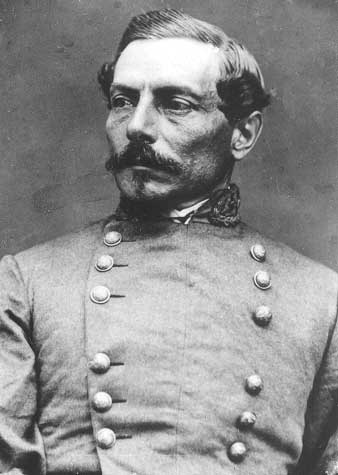
4 Comments

Filed under civil war, Gettysburg, History, leadership, Military

Obedience to the Powers that Be: John Reynolds

220px-GenJFRenyolds

Friends of Padre Steve’s World

I am continuing to periodically intersperse and publish short articles about various commanders at Gettysburg on the site. These all are drawn from my student text and may become a book in their own right.  The reason is I am going to do this is because I have found that readers are often more drawn to the lives of people than they are events. As I have noted before that people matter, even deeply flawed people, and we can learn from them.

This article deals with Major General John Fulton Reynolds who in large part is responsible for bringing about the Battle of Gettysburg and whose actions on that field in the opening hours of the engagement helped decide the course of the Civil War. This segment does not include the details of that battle, those are reserved for the rest of this chapter which I am currently revising for the student text.

I have come to admire Reynold’s more and more and I hope that in this brief treatment of his life and career leading to Gettysburg that you will be inspired by his single dovotion to the Union and the humanity compassion that he treated the victims of war.

Peace

Padre Steve+

There is much written about the supposed superiority of Robert E. Lee and the generals of the Army of Northern Virginia over those of the Army of the Potomac. Their eventual defeat is often blamed on the Union’s superior manpower and attrition with scant recognition of times where the Union commanders, particularly at Gettysburg out-generaled them. Not only did Harry Heth have the misfortune of battling John Buford and John Reynolds, but division, brigade and regimental leaders who performed their duties magnificently. Despite being greatly outnumbered by the Confederates these men and their soldiers turned back the initial Confederate assaults and shattering Confederate infantry formations.

Likewise if chance plays a role in war, the Army of the Potomac had good fortune smiling upon it that fateful morning of July 1st 1863. Part of that good fortune was having Major General John Fulton Reynolds, one of the finest commanders on either side during the Civil War directing its operations. During the engagement Reynolds, his subordinates and his successor in command Abner Doubleday dealt with the unforeseen elements of this engagement far better than any Confederate General on the battlefield that morning. Reynolds exemplified the indispensable qualities described by Clausewitz regarding commanders who must deal with the role of chance and the unforeseen elements that so often cloud the battlefield:

“first, an intellect that, even in the darkest hour, retains the glimmerings of the inner light which leads to truth; and second, the courage to follow this faint inner light wherever it may lead.” [1]

John Reynolds was a native Pennsylvanian, born in Lancaster to descendants of Irish Protestants. His maternal grandfather, Samuel Moore fought as a Captain in the Continental Line during the American Revolution. Reynold’s father, was a lawyer and moved to Lancaster where he “owned and published the Journal.” The elder Reynolds had served two terms in the Pennsylvania legislature and in the early 1830s was a political ally and friend of Senator and later President James Buchannan for whom “he was attending to local business affairs” in Lancaster. [2] Buchannan helped one of Reynold’s brother William gain an appointment to the Naval Academy and in 1837 obtained the appointment to West Point.

The young Pennsylvanian graduated from West Point in 1841, twenty-sixth in a class of fifty-two and was commissioned as a Brevet Second Lieutenant in the artillery. Among his classmates were the future Union generals Israel Richardson, Don Carlos Buell and Horatio Wright and Confederate generals Richard Garnett and J.M. Jones. Graduating in the class ahead of him was a man who would become a lifelong friend, William Tecumseh Sherman. He graduated at a time of military cutbacks, the Army was about to be reduced from 12,000 to 9,000 the following year. Chances for promotion were so bad, especially from First Lieutenant to Captain, “so unlikely that in a single year 117 officers resigned.” [3] Many of these officers would find their way back to the army but even so, army life did not promise much.

Despite this Reynolds found army life to his liking. He served in Florida during the Seminole War, as well as in Mexico “where he was cited for bravery at Monterey and Buena Vista.” [4] During the campaign in Mexico he served with the army commanded by General Zachary Taylor and in the artillery battery commanded by the future Confederate general, Captain Braxton Bragg. He acquitted himself well and also had compassion for the Mexican soldiers that he fought against. Visiting Mexican wounded who had been left with “little medical care and less food” he gave them money to help with their needs. At Buena Vista a number of senior officers wrote official citations praising the artillery and Reynolds by name. General John Wool wrote

“Without our artillery,” he said, “we could not have maintained our position a single hour,” and also: “…a section of artillery, admirably served by Lieutenant Reynolds, 3rd Arty, played an important part in checking and dispersing the enemy in the rear of our left. They retired before him whenever he approached them.” [5]

Those actions brought him fame and two brevet promotions for bravery, [6] to Captain at Monterrey and Major at Buena Vista. However, Reynolds saw little value in them if the army’s promotion system was not fixed. He wrote his brother Jim “The system is a complete humbug and until it changes I believe it is to be rather more of a distinction to be passed over than to be breveted…that is, amongst us who know facts.” [7]

Reynold’s skill as an artilleryman would be used to great effect on the morning of July 1st 1863 on McPherson’s Ridge at Gettysburg. Following the war he remained in the army predominantly with the artillery. He served in field and coastal batteries and like John Buford had “participated in the Utah Expedition.” [8] The Utah expedition is little known and nearly forgotten incidents in United States history which involved the territory of Utah, and it left a bitter taste in the mouths of many of the officers and soldiers who served in it, including John Reynolds.

The Territory of Utah had been created after the Compromise of 1850 and President Millard Fillmore named Mormon leader Brigham Young as Governor. The Mormons settled Utah after having been driven out of Illinois and Missouri as a result of their religious beliefs which included polygamy and well as the political concept Theodemocracy, which had been formulated by Mormon founder Joseph Smith Jr. Theodemocracy was a concept which is a blend of theocracy and republican principles. Though it largely died out after the replacement of Young as Governor it has many similarities with theology, political ideology and goals of the leaders of the current Christian Dominion concepts of the leaders of what is called The New Apostolic Reformation which has gained much power among the leadership of the current Republican Party.

In Illinois Smith had “founded an autonomous community, with its own militia, where Smith was eventually called “King of the Kingdom of God.” [9] Smith believed that it was a necessary step until a true theocracy could be established. Smith had taught his ruling Council of Fifty, which included a few non-Mormons “that in the initial stages of the millennium the council would participate in concert with men of differing religious and political persuasions” and the earth would still have a pluralism of governments and religions in the early part of those thousand years…” [10] Tensions between Smith, the Mormon community and surrounding communities grew and “eventually, an unruly mob lynched the prophet and one of his followers.” [11]

Two years after the territory was formed Young “declared that Smith had a vision, until then kept secret, reinstituting polygamy.” [12] To be fair, Young did not require this of his followers, but the introduction produced a furor among many Americans. The situation with Utah was complicated further by the actions of Congress which in throwing out the Missouri Compromise that Utah and New Mexico “when admitted as a State or States…shall be received into the Union, with or without slavery, as their constitution may prescribe at the time of their admission.” [13]

The combination of a growing theocracy, the introduction of polygamy and the possibility of slavery brought many tensions. The 1856 convention of the new Republican Party condemned “the twin relics of barbarism” – slavery and polygamy.” Midwesterners who joined that part remembered their clashes with the Mormons and “few voters were sympathetic to the Mormons” [14] or their growing power in the Utah Territory. In 1857 this tension led to President James Buchannan to appoint a non-Mormon Governor for the territory which led to conflict between Young’s government and its militias and the United States. Young considered U.S. Troops to be those of a “foreign power” and prepared for war “insisting as strongly on the independence of his people from Washington as the capital insisted on its jurisdiction over the territory.” [15]

Like many officers and Americans in general, Reynolds had negative views of the Latter Day Saints. Some were gained in his introduction to the territory, where he found that as a “gentile” he was treated as an outsider by the Mormon community. His initial bad disposition was only deepened through his interactions with Governor Brigham Young. The most important of these to Reynolds was an attempt to bring to justice the Indians who had massacred a party of army engineers under the command of Captain Gunnison the previous summer. Reynolds for that the Mormon led government, particularly Governor Young had convicted the Indians of manslaughter and sentenced them to prison for manslaughter. This act angered Reynolds. He wrote his sisters:

“They have been since tried by the Mormons and found guilty of manslaughter, tho’ the proof was positive and clear. But their jury was counseled by Brigham Young as to their verdict and perjured themselves. May God have mercy upon them, they would hang two Indians for killing two Mormon boys last summer when there was scarcely any proof at all, but when a Gentile is murdered it is only manslaughter!! I cannot write the truth about these people here – but will sometime later.” [16]

After Utah Reynolds served in Kansas and briefly in the Pacific Northwest. During that time he developed a dislike for radical abolitionists who he believed were responsible for much of the division of the country.

But with tensions growing in 1860 Reynolds was appointed as Commandant of the Corps of Cadets at West Point. During the interregnum of the election of Abraham Lincoln and his inauguration he “hoped for a moderate course that might avoid war.” [17] However, the Confederate seizure of U.S. facilities and siege of Fort Sumter and the tensions building between Southerners and Northerners at the Academy weighed on Reynolds and soon brought about a break with his family’s longtime political ally and benefactor President James Buchannan. Though normally not outspoken about his political beliefs on thing was sure, he valued the Union and as with the Mormons opposed those who sought to undermine it. He wrote his sister Ellie about his feelings for the President at his administration:

“What will history say of us, our Government, and Mr. B’s Administration makes one wish to disown him….”I have said but little, except among ourselves here, on the present difficulties that surround the Government but a more disgraceful plot, on the part of our friend B’s cabinet and the leading politicians of the South, to break up our Government, without cause, has never blackened the pages of history in any nation’s record.” [18]

However, Reynolds’s harshest and most bitter words were reserved for Jefferson Davis who he had served with in Mexico:

“…Who would have believed that when I came here last September and found Mr. Jeff Davis laboring with a Committee of Congress and civilians to re-organize the Academy; our national school! Whose sons, never until the seeds sown by his parricidal hand had filled it with the poisonous weed of secession, had known any other allegiance than the one to the whole country, or worshipped any other flag, than that which has moved our own youthful hopes and aspirations and under which we marched so proudly in our boyish days – who! I dare say, would have believed, that he was brooding over his systematic plans for disorganizing the whole country. The depth of his treachery has not been plumbed yet, but it will be.” [19]

Reynolds served at the Academy until June of 1861 when it graduated its final class before the war began. Departing West Point he was initially appointed as Lieutenant Colonel of the 14th U.S. Infantry regiment. [20] He would have preferred the artillery but wrote that he “could not refuse this promotion offered me under any circumstances, much less at this time, when the Government has a right to my services in any capacity.” [21] How much different was Reynolds than another politically moderate and illustrious soldier, Robert E. Lee, who barely a month after accepting a promotion to full Colonel in the Regular Army resigned his commission to serve his state of Virginia and the Confederacy rather than lead an army “in an invasion of the Southern States” whatever Virginia decided.” [22]

Before Reynolds could take command of the 14th United States, he was promoted to Brigadier General. He commanded a brigade of Pennsylvania volunteers during the Peninsula Campaign and was captured on June 28th after leading his troops successful at Gaines Mill, as McClellan began his withdraw from the gates of Richmond. He spent six weeks in Confederate captivity but was released in a general prisoner exchange on August 15th 1862. [23] Despite being captured Reynolds’s performance during the Seven Days was praised by friend and foe alike and even his Confederate enemies in the city of Fredericksburg petitioned Richmond to release Reynolds who they said:

“when inasmuch as we were prisoners in the hands of General Reynolds we received from him a treatment distinguished by a marked and considerable respect for our opinions and feelings, it becomes us to use our feeble influence in invoking for him, now a prisoner of our Government as kind and as considerate as was extended by him to us. We would therefore hope that he might be placed on parole…” [24]

In doing so they returned to the Army of the Potomac the man who would help decide the fate of the Confederacy barely ten months later.

Reynolds returned to command a division at Second Bull Run where his division held firm as much of the army retreated. Reynolds missed the battle of Antietam as he was called to “the fruitless and frustrating task of trying to organize Pennsylvania’s militia” [25] by Governor Curtin. He returned to the Army of the Potomac and again commanded First Corps at Fredericksburg and again at Chancellorsville.

Reynolds was reportedly offered command of the Army of the Potomac by Lincoln in early June of 1863 but declined it. He went to the White House when he heard that he was under consideration for the post and ensured that he would not get the job by stating the his conditions for taking it. However, he did “urge the president to appoint Meade in Hooker’s place.” [26] He told his artillery chief Colonel Wainwright that he “refused it because he would have been under the same constraints as Burnside and Hooker.” [27] Colonel Wainwright believed that it was in large part due to “Reynolds’s recommendation that General Meade received his appointment.” [28]

The Army of the Potomac’s senior leadership had been the source of much political consternation during 1862 and 1863 for Abraham Lincoln. It was split among Lincoln’s supporters and detractors, Radical Republican abolitionists and moderate Democrats. To complicate matters some of senior leaders of the Army of the Potomac including McClellan, Hooker and Sickles had their own, scarcely hidden aspirations for the presidency.

However, Reynolds was of a different character than the politically connected and conniving commanders who used their position in the army to advance their career. Reynolds was a moderate Pennsylvania Democrat and prior to the war had been no supporter of Lincoln, once comparing him to a “baboon.” That opinion being noted, Reynolds did not allow his political beliefs and opinions to influence the manner in which he upheld his oath to the nation in time of civil war. Lincoln was President and was attempting to hold the Union together against forces that Reynolds found decidedly treacherous. It was a tribute to Reynold’s personal manner of keeping politics out of his command, which allowed him, a moderate Democrat to successfully command a corps whose divisions “were commanded by some of the Army’s most fervent abolitionists – Abner Doubleday, James S. Wadsworth, and John Cleveland Robinson.” [29]

Reynolds was “a serious unbending professional, who unlike McClellan, actually lived by the principle of “obedience to the powers that be.” [30] The Pennsylvanian was “universally respected” in the army “for his high character and sterling generalship” [31] it was noted that unlike others who so quickly interjected themselves into the political turmoil which had embroiled the nation that Reynolds had a policy of holding back. He stood “stoutly aloof from all personal or partisan quarrels, and keeping guardedly free from any of the heart-burnings and jealousies that did so much to cripple the usefulness and endanger the reputation of many gallant officers.” [32]

Oliver Howard noted that unlike many commanders that Reynolds was a commander “who had a steady hand in governing, were generous to a fault, quick to recognize merit, trusted you and sought to gain your confidence, and, as one would anticipate, were the foremost in battle.” [33] George McClellan noted that Reynolds was “remarkably brave and intelligent, an honest, true gentleman.” [34] In his autobiography Howard wrote about Reynolds:

“From soldiers, cadets, and officers, junior and senior, he always secured reverence for his serious character, respect for his ability, care for his uniform discipline, admiration for his fearlessness, and love for his unfailing generosity.” [35]

On the night of June 30th Reynolds was awash in reports, some of them conflicting and even though he was without Meade’s course of action for the next day “concluded that Lee’s army was close by and in force.” [36] He spent the night at his headquarters “studying the military situation with Howard and keeping in touch with army headquarters.” [37] Howard noted Reynolds anxiety and “received the impression that Reynolds was depressed.” [38] After Howard’s departure Reynolds took the opportunity to get a few hours of fitful sleep before arising again at 4 a.m. on July 1st.

When morning came, Reynolds was awakened by his aide Major William Riddle with Meade’s order to “advance the First and Eleventh Corps to Gettysburg.” [39] Reynolds studied the order and though he expected no battle that morning, expecting “only moving up to be in supporting distance to Buford” [40] took the prudent and reasonable precautions that his Confederate opponents A.P. Hill and Harry Heth refused to take as they prepared to move on Gettysburg.

His troops were in fine spirits that morning even though it had been busy. After a breakfast of hardtack, pork and coffee the troops moved out. An officer of the Iron Brigade noted that the soldiers of that brigade were “all in the highest spirits” while Lieutenant Colonel Rufus Dawes of the “placed the fifes and drums at the head of the Sixth Wisconsin and ordered the colors unfurled” as the proud veterans marched forward into the sound of the raging battle to the tune of “The Campbell’s are Coming.” [41]

Though Reynolds was not expecting a fight he organized his march in a manner that ensured if one did happen that he was fully prepared. The precautionary measures that he took were those that any prudent commander having knowledge that strong enemy forces were nearby would take. Reynolds certainly took to heart the words of Napoleon who said “A General should say to himself many times a day: If the hostile army were to make its appearance in front, on my right, or on my left, what should I do?” [42]

This was a question that A.P. Hill and Harry Heth seemed not to consider on that warm and muggy July morning when Heth was committing Lee’s army to battle on his own authority. Reynolds was also about to commit the Army of the Potomac to battle, but unlike Heth who had no authority to do so, Reynolds “had at least been delegated the authority for making such a decision.” [43] While Meade was unaware of what was transpiring in the hills beyond Gettysburg he implicitly trusted the judgement of Reynolds, and he been with the advanced elements of Reynold’s wing Meade too “probably would have endorsed any decision he made.” [44]

Reynolds placed himself with the lead division, that of Wadsworth, and “had directed Doubleday to bring up the other divisions and guns of the First Corps and had ordered Howard’s Eleventh Corps up from Emmitsburg.” [45] Reynold’s also understood the urgency of the situation and “wanted all the fighting troops to be up front, so he instructed Howard not to intermingle his supply wagons with his infantry. Similar instructions had been given to Abner Doubleday; to ensure that the First Corps wagons would wait until the Eleventh Corps foot soldiers had passed.” [46]

Instead operating in the normal fashion of rotating units on the march, Reynolds opted to save time. Since the First Division under the command of James Wadsworth was further advanced than other I Corps divisions, Reynolds instructed it to move first with Cutler’s brigade in the lead followed by the Iron Brigade under Colonel Solomon Meredith. In doing so he countermanded the order of the acting corps commander Doubleday who had ordered that division to allow the other divisions of First Corps to pass his before advancing. Reynolds told Wadsworth that Doubleday’s order “was a mistake and that I should move on directly.” [47]

He went forward with Wadsworth’s division and gave Doubleday his orders for the coming engagement. Doubleday later recalled that when Reynolds arrived to discuss the situation that Reynolds:

“read to me the various dispatches he had received from Meade and Buford, and told me that he should go at once forward with the leading division – that of Wadsworth – to aid the cavalry. He then instructed me to draw in my pickets, assemble the artillery and the remainder of the corps and join him as soon as possible. Having given me these orders, he rode off at the head of the column, and I never saw him again.” [48]

Reynolds ordered Howard’s XI Corps to follow and according to Doubleday directed an aid of Howard to have Howard “bring his corps forward at once and form them on Cemetery Hill as a reserve.” [49] While some writers that he directed Oliver Howard to prepare Cemetery Hill as a fallback position [50] there is more evidence that points to Howard selecting the that commanding hill himself. [51]

Likewise Reynolds ordered Sickles’ III Corps to come up from Emmitsburg where that corps had bivouacked the previous night. [52] Sickles had heard the guns in the distance that morning and sent his senior aide, Major Henry Tremain to find Reynolds. Reynolds told Tremain “Tell General Sickles I think he had better come up” but the order left Sickles in a quandary. He recalled “he spend an anxious hour deciding what to do” [53] for he had “been ordered by Meade to hold his position at Emmitsburg” [54] and Sickles sent another rider to Reynolds and awaited the response of his wing commander instead of immediately advancing to battle on 1 July and it would not be until after 3 P.M. that he would send his lead division to Gettysburg.

Reynolds’ intention according to Doubleday was “to fight the enemy as soon as I could meet him.” [55] Reynolds rode forward with some of his staff into the town as the infantry of I Corps and XI Corps moved advanced. In the town they were met by “a fleeing, badly frightened civilian, who gasped out the news that the cavalry was in a fight.” [56] When he came to the Lutheran Seminary he came across Buford. It was a defining moment of the Civil War, a moment that shaped the battle to come. It has been recounted many times and immortalized on screen in the movie Gettysburg, a time “when the entire battle would come down to a matter of minutes getting one place to another.” [57]

As the rough and tumble Kentuckian, Buford, and Reynolds, the dashing Pennsylvanian, discussed the situation they had to know that odd that they were facing. With close to 32,000 rebels from the four divisions of Hill’s and Ewell’s corps closing in from the west and the north with only about 18,000 men of First Corps, Eleventh Corps and Buford’s cavalry division the odds did not favor them, but unlike other battles that the army of the Potomac faced, this time the army and its commanders were determined not to lose and not to retreat.

Reynolds and Buford committed their eighteen thousand men against Lee’s thirty-two thousand in a meeting engagement that develop into a battle that would decide the outcome of Lee’s invasion. Likewise it was a battle for the very existence of the Union. Abner Doubleday noted the incontestable and eternal significance of the encounter to which Buford and Reynolds were committing the Army of the Potomac:

“The two armies about to contest on the perilous ridges of Gettysburg the possession of the Northern States, and the ultimate triumph of freedom or slavery….” [58]

Notes

[1] Ibid. Clausewitz On War p.102

[2] Nichols, Edward J. Toward Gettysburg: A Biography of John Fulton Reynolds Pennsylvania State University Press, Philadelphia 1958. Reprinted by Old Soldier Books, Gaithersburg MD 1987 p.4

[3] Ibid. Nichols Toward Gettysburg p.13

[4] Tagg, Larry The Generals of Gettysburg: The Leaders of America’s Greatest Battle Da Capo Press Cambridge MA 1998 Amazon Kindle Edition p.10

[5] Ibid. Nichols Toward Gettysburg pp.43-44

[6] Pfanz Harry W. Gettysburg: The First Day University of North Carolina Press, Chapel Hill and London 2001pp.47-48

[7] Ibid. Nichols Toward Gettysburg p.46

[8] Ibid. Pfanz Gettysburg: The First Day p.48

[9] Gonzalez, Justo L. The History of Christianity Volume 2: The Reformation to the Present Day Harper and Row Publishers San Francisco 1985 p.259

[10] Ehat, Andrew” It Seems Like Heaven Began on Earth”: Joseph Smith and the Constitution of the Kingdom of God in BYU Studies Vol 20. No 3 1980) retrieved from https://ojs.lib.byu.edu/spc/index.php/BYUStudies/article/view/5144/4794 20 May 2015 p.258

[11] Ibid. Gonzales p.259

[12] Ibid. Gonzales p.259

[13] Potter, David M. The Impending Crisis: America before the Civil War 1848-1861 completed and edited by Don E. Fehrenbacher Harper Collins Publishers, New York 1976 p.158

[14] Goldfield, David. America Aflame: How the Civil War Created a Nation Bloomsbury Press, New York 2011 p.122

[15] Ibid. Nichols Toward Gettysburg p.58

[16] Ibid. Nichols Toward Gettysburg p.58

[17] Ibid. Nichols Toward Gettysburg p.73

[18] Ibid. Nichols Toward Gettysburg p.73

[19] Ibid. Nichols Toward Gettysburg p.73

[20] Ibid. Pfanz Gettysburg: The First Day p.48

[21] Ibid. Nichols Toward Gettysburg p.75

[22] Korda, Michael. Clouds of Glory: The Life and Legend of Robert E. Lee Harper Collins Publishers, New York 2014 p.228


[23] Foote, Shelby, The Civil War, A Narrative. Volume One Fort Sumter to Perryville Random House, New York 1958 p.493

[24] Ibid. Nichols Toward Gettysburg p.100

[25] Ibid. Pfanz Gettysburg: The First Day p.48

[26] Sears, Stephen W. Controversies and Commanders Mariner Books, Houghton-Mifflin Company, Boston and New York 1999 p.162

[27] Sears, Stephen W. Gettysburg. Houghton Mifflin Co. Boston and New York 2003 pp. 40-42

[28] Nevins. Allan editor. A Diary of Battle: The Personal Journals of Colonel Charles Wainwright 1861-1865 with an introduction by Stephen W. Sears Da Capo Press, New York 1998 p.229

[29] Guelzo, Allen C. Gettysburg: The Last Invasion Vintage Books a Division of Random House, New York 2013 p.30

[30] Ibid. Guelzo Gettysburg: The Last Invasion pp.29-30

[31] Ibid. Sears, Gettysburg. p. 34

[32] Ibid. Guelzo, Gettysburg: The Last Invasion p.30

[33] Howard, Oliver O. Autobiography of Oliver Otis Howard, Major General, U.S. Army Volume 1 The Baker and Taylor Company, New York 1907 Made available by the Internet Achieve through Amazon Kindle location 5908 of 9221

[34] Wert, Jeffry D. The Sword of Lincoln: The Army of the Potomac Simon and Schuster, New York and London 2005 p.101

[35] Ibid. Howard Autobiography of Oliver Otis Howard location 5908 of 9221

[36] Ibid. Pfanz Gettysburg: The First Day p.48

[37] Ibid. Coddington The Gettysburg Campaign: A Study in Command p.261

[38] Ibid. Pfanz Gettysburg: The First Day p.48

[39] Ibid. Coddington The Gettysburg Campaign: A Study in Command, p.261

[40] Ibid. Sears, Gettysburg. p. 158

[41] Nolan, Alan T. The Iron Brigade: A Military History Indiana University Press, Bloomington IN, 1961 and 1994 pp.233-234

[42] Napoleon Bonaparte, Military Maxims of Napoleon in Roots of Strategy: The Five Greatest Military Classics of All Time edited by Phillips, Thomas R Stackpole Books Mechanicsburg PA 1985 p.410

[43] Ibid. Sears, Gettysburg. p. 165

[44] Ibid. Pfanz Gettysburg: The First Day p.49

[45] Ibid. Nolan The Iron Brigade p.233

[46] Trudeau, Noah Andre. Gettysburg: A Testing of Courage, Harper Collins Publishers, New York 2002 p.159

[47] Ibid. Trudeau, Gettysburg: A Testing of Courage p.156

[48] Doubleday, Abner Chancellorsville and Gettysburg: Campaigns of the Civil War VI Charles Scribner’s Sons, Bew York 1882 pp.70-71

[49] Ibid. Doubleday Chancellorsville and Gettysburg p.71

[50] Ibid. Pfanz Gettysburg: The First Day p.76

[51] Green, A. Wilson. From Chancellorsville to Gettysburg: O. O. Howard and Eleventh Corps Leadership in The First Day at Gettysburg edited by Gallagher, Gary W. Kent State University Press, Kent Ohio 1992 p. 70

[52] Ibid. Sears, Gettysburg. p. 158

[53] Keneally, Thomas American Scoundrel: The Life of the Notorious Civil war General Dan Sickles Anchor Books, a Division of Random House, New York 2003 p.275

[54] Swanberg, W.A. Sickles the Incredible Copyright by the author 1958 and 1984 Stan Clark Military Books, Gettysburg PA 1991 p.202

[55] Ibid. Trudeau, Gettysburg: A Testing of Courage p.156

[56] Ibid. Sears, Gettysburg. p. 165

[57] Ibid. Guelzo, Gettysburg: The Last Invasion p.142

[58] Ibid. Doubleday Chancellorsville and Gettysburg p.68


Leave a comment

Filed under civil war, History, leadership, Military

“Well, We May as Well Fight it out Here” Meade Decides to Fight at Gettysburg

general-george-meade

“General Meade will commit no blunder in my front, and if I commit one he will make haste to take advantage of it.” Robert E Lee June 28th 1863

The choosing of the place to give battle, at any level of war, but particularly at the operational level is always of the utmost importance and has been so from time immemorial. Despite advances in technology terrain and weather are major factors that a commander or staff must consider in terms of their courses of action. Knowing the terrain features as well as the infrastructure such as road networks that they are operating on allows commanders to choose courses of action which accentuate their strengths and expose their opponent’s weaknesses. To understand this is a key part of Course of Action (COA) development, Operational Art and Operational Design as well as analyzing Centers of Gravity, especially in determining decisive points.

While the commanders at Gettysburg did not use such terminology, they did understand the effects of terrain and weather, friction and the importance of occupying “good ground.” Our understanding of these concepts can help us draw from the actions of the commanders at Gettysburg lessons that we can employ today, despite the vast changes in technology and expansion of the battlefield.

As he looked at the dispositions of the Confederate army on June 30th George Gordon Meade “felt he had move his forces in such a way as to challenge the enemy advance while at the same time protecting Washington and Baltimore.” 1 To do this he decided to concentrate the Army of the Potomac along what is known as the Pipe Creek line, a line along Parr’s Ridge just behind Pipe Creek to the south of Meade’s Taneytown headquarters. As an engineer Meade recognized the The decision was made because he realized that his advance had caused Lee’s army to abandon its threatening movement toward Harrisburg and the Susquehanna and was concentrating in the general area of Cashtown, South Mountain and possibly advancing toward Gettysburg.

The Pipe Creek line offered Meade a number of advantages; “it covered his own supply line and blocked the direct route to Baltimore.” 2 The positions of his intrenched army there would be “almost impossible to storm by frontal attack” 3 as well as allow his army to concentrate quickly. By placing himself in that position Meade believed that it would force Lee to attack him on good ground of his own choosing, offer him the chance to attack should Lee divide his forces, or by allowing Lee to exhaust his forage and supplies to withdraw from Pennsylvania without giving battle. Meade’s intention at Pipe Creek was to fight the “kind of battle he was to fight at Gettysburg.” 4

However Meade’s carefully laid plan became a victim of circumstances as events progressed during the evening of June 30th and morning of July 1st. When Reynolds was told by Buford that contact had been made and the Confederates were advancing on Gettysburg he brought I Corps and XI Corps up as quickly as he could and issued orders for III Corps under Sickles to join them at Gettysburg.

About 1130 a.m. Meade received word from John Reynolds’ aide Captain Stephen Weld that Reynolds had engaged the enemy at Gettysburg and had not received Meade’s Pipe Creek circular, which jeopardized his plan. Meade, having not known that Reynolds was not acting on his latest plan had assumed that Reynolds was conducting a temporary holding action at Gettysburg, but at 1 p.m. he was given the message that “Reynolds was dead or severely wounded and that Otis Howard was in command on the field.” 5 At this point Meade wasted no time and appointed Winfield Scott Hancock to go to Gettysburg and take charge of the situation, not trusting Howard’s abilities and instructed him “If you think the ground and position there are a better one to fight under existing circumstances, you will so advise the General, and he will order his troops up.” 6 He placed John Gibbon in command of II Corps and because he was concerned that Lee might cut off the embattled I Corps and XI Corps.

It was at this point that Meade decided to abandon his Pipe Creek plan and even before getting Hancock’s report, issued orders to his Corps commanders. At about 4:30 p.m. Meade ordered Sedgwick and his VI Corps up to Taneytown and put Slocum’s XII Corps and Sykes V Corps on the road to “move up to Gettysburg at once.” 7

Throughout the afternoon Meade kept his wits and “may have restrained a natural impulse to rush to the battleground and take over control of affairs himself.” 8 After the battle some criticized Meade for this, but it was from a perspective of command, and what we now call Mission Command did the right thing. He stayed at his headquarters to better control the movements and communicate with all his forces, which he could not have done had he rushed to the front, and instead “delegated authority to a highly competent subordinate, while he himself stayed close to the center of operations at army headquarters.” 9

Had Meade done what many commanders might have done in his position, and moved to the battle he might not have been able to do the more important job of ensuring the in a moment of crisis that his subordinate commanders received his orders and moved their units where they were needed. In fact any delay of getting the Union forces to Gettysburg could have been fatal to his army and allowed Lee to gain the advantage and possibly defeat his forces in detail. Likewise if Hancock arrived and found that the position could not be held, Meade would still be in position to ensure that the Pipe Creek position could be held.

The man he appointed in his stead, Hancock was someone that was not only capable but someone that “was a man who he knew and could trust,” 10 and who despite being junior to Howard, Slocum and Sickles was able to diplomatically handle the awkwardness of the situation. After Hancock arrived on the field he took in the tactical situation and judged it “the strongest position by nature on which to fight a battle that I ever saw.” 11

Howard objected to Hancock taking charge of the battlefield due to seniority, and although Howard had selected the position, demurred to Howard and said “and if it meets your approbation I will select this as the battlefield.” After Howard concurred Hancock announced “Very well, sir. I select this as the battlefield.” 12 While Howard could make the claim that he actually selected the ground of where to fight by emplacing Steinwehr’s division on the Hill as a reserve and withdrawing the battered remnants of I Corps and XI Corps to it during the afternoon, it was Hancock that “organized the all-round defense of the position.” 13 After consulting with Howard and directing Slocum’s XII Corps to occupy Culp’s Hill Hancock sent his aide Major William Mitchell to tell Meade that the position “could not well be taken.” 14 He had III Corps extend the line down Cemetery Ridge and directed his own II Corps to protect the flank in case Lee attempted to turn the Federal left. Upon Slocum’s arrival Hancock relinquished command and rode to Taneytown to personally brief Meade on the situation.

When Meade received word that from Hancock that he believed that “Gettysburg could maintain itself until dark” he dispatched a message to Hancock and Doubleday “It seems to me that we have so concentrated that a battle at Gettysburg is now forced upon us.” 15 Meade then sent a dispatch to Henry Halleck in Washington: “A.P. Hill and Ewell are certainly concentrating…Longstreet’s whereabouts I do not know. If he is not up tomorrow, I hope with the force I have concentrated to defeat Hill and Ewell; at any rate I see no other course that to hazard a general battle.” 16 He added “Circumstances during the night may alter this decision, of which I will try to advise you.” 17 Upon sending out his final orders directing all units to Gettysburg he had his headquarters strike its tents and equipment and begin to move to Gettysburg, being briefed by Hancock before he set off at 10 p.m.

Meade arrived on the field about midnight to the surreal scene of soldiers of the I Corps and XI Corps encamped on the grounds of the cemetery, many exhausted and asleep having thrown back the last Confederate attacks, and met Slocum, who had taken charge when Hancock went back to brief Meade, as well as Howard, his artillery chief Henry Hunt and chief engineer, Gouverneur Warren, Dan Sickles of III Corps his and by Hancock when that weary general arrived back from Taneytown.

Howard was anxious due to the disaster that had befallen his Corps, but Meade assured him that he was not assigning any blame. He then asked their opinions about the position. Howard declared “I am confident that we can hold this position.” He was joined by Slocum who noted “It is good for defense,” and Sickles added “It is a good place to fight from.”
Meade was satisfied with their conclusions and replied: “I am glad to hear you say so, gentlemen for it is too late to leave it.” 18

Meade then began a thorough inspection of his lines, the placement of his forces and disposition of his artillery, which he directed Hunt “to see that the artillery was properly posted.” 19 An engineer officer made a sketch of the position, and “Meade used to indicate where he wanted to post his troops” 20 and he had copies made and “sent to the corps commanders.” 21 After consulting with Slocum about the position on Culp’s Hill, and the “practicability of attacking the enemy in that quarter.” Slocum indicated that it was excellent for defense but “not favorable for attack,” 22 Warren added his “his doubts about attacking across ground that was sullied and uneven” 23 and Meade gave up the option of taking the offensive there, which he had considered to do when Sedgwick arrived with VI Corps later in the day. He and Warren also directed XII Corps to construct “breastworks and abatis” on the peaks of Culp’s Hill,” 24 a measure that would prove to be of decisive importance on the night of July 2nd and morning of July 3rd. He also moved V Corps into a reserve position behind Cemetery Hill on the Baltimore Pike, and used his command authority to replace Doubleday, who he did not feel able enough to command a Corps, who had been in acting command of I Corps since the death of Reynolds’ with Brigadier General John Newton who commanded a division in Sedgwick’s V Corps, earning himself Doubleday’s undying enmity.
About 3 a.m. still unsure of Lee’s intent Meade wrote Halleck informing him that the army “was in a strong position for the defensive” and though hoped to attack had considered all possibilities, and attempted to prepare for anything, even Lee attempting to move around his flank to interpose himself between Meade and Washington, exactly as Longstreet had recommended to Lee. If that occurred he told Halleck that he would “fall back to my supplies at Westminster….” 25 (the Pipe Creek line).

Meade made his headquarters at the Liester House behind Cemetery Ridge where he continued planning. Meade’s headquarters offered him a central position from which he could easily reach any position on the battlefield and speed communications with his commanders. The position he had taken was strong, with his Corps all occupying good ground and positions being continuously improved and reinforced as more troops arrived. To the north XII Corps occupied a very strong position on Culp’s Hill while I Corps and XI Corps occupied Cemetery Hill. II Corps now occupied the central area of Cemetery Ridge with Sickles III Corps extend that line south toward the Round Tops. V Corps was in reserve and cavalry was posted to cover each flank. Sedgwick’s VI Corps was nearing Gettysburg and expect to arrive in the afternoon after completing a 36 mile forced march from Manchester Maryland. His army occupied interior lines allowing rapid reinforcements to any threatened area. It was as strong as a position as could be imagined.

After sunrise Meade met Carl Schurz, who had so ably helped maintain XI Corps on July 1st and whose troops occupied the northern face of Cemetery Hill. Schurz observed that though Meade “looked careworn and tired, as though he had not slept the night before-probably because he hadn’t” but that “his mind was evidently absorbed by a hard problem. But this simple, cold, serious soldier with his business-like air did inspire confidence….” 26

As Schurz watched Meade survey the Federal defenses he asked how many soldiers Meade expected to have on hand. Meade told him that he expected about 95,000. 27 Meade then told Schurz: “Well, we may fight it out here just as well as anywhere else” and then rode off. 28

During the night of July 1st Meade did what Lee failed to do. Lee failed to control his units or commanders, while Meade maintained control of his units, ensured that his commanders understood his intent and replaced ones that he felt unable to do what was needed. Lee conducted no reconnaissance of any importance, the only attempt sending his staff engineer to look around Little Round Top, a task that he failed in, while Meade and his subordinates made a thorough reconnaissance of their lines and fortified them. Lee, in an almost fatalistic manner did no real contingency planning, leaving things to the elan’ of his troops and the Providence of God, but Meade planned for contingencies that Lee might attempt, even the possibility that Lee might do what Longstreet so strongly advocated.

In the end Meade did almost everything that a commander could do to ensure that his army not only was in position to succeed in the tactical and operational levels, but also through his contact with his superiors linked his operations to larger strategic considerations.

Notes

1 Trudeau, Noah Andre. Gettysburg: A Testing of Courage Harper Collins Publishers, New York 2002 p.118

2 Sears, Stephen W. Gettysburg Houghton Mifflin Co. Boston and New York p.150

3 Coddington, Edwin B. The Gettysburg Campaign: A Study in Command A Touchstone Book, Simon and Schuster, New York 1968 p.239

4 Ibid. Coddington The Gettysburg Campaign p.239

5 Ibid. Sears Gettysburg p.188

6 Huntington, Tom Searching for George Gordon Meade: The Forgotten Victor of Gettysburg Stackpole Books, Mechanicsburg PA 2013 p.154

7 Guelzo, Allen C. Gettysburg: The Last Invasion Vintage Books a Division of Random House, New York 2013 p.159

8 Ibid. Coddington The Gettysburg Campaign p.323 9 Ibid Coddington. The Gettysburg Campaign p.323

10 Ibid. Guelzo Gettysburg: The Last Invasion p.158

11 Jordan, David M. Winfield Scott Hancock: A Soldier’s Life University of Indiana Press, Bloomington and Indianapolis 1988 p.84 

12 Foote, Shelby The Civil War a Narrative: Fredericksburg to Meridian Random House, New York 1963 p.48313 Ibid. Foote The Civil War a Narrative: Fredericksburg to Meridian p.483

14 Ibid. Coddington The Gettysburg Campaign p.321

15 Ibid. Trudeau pp.264-265

16 Ibid. Sears Gettysburg p.241

17 Ibid. Trudeau p.265

18 Ibid. Huntington Searching for George Meade p. 159

19 Hunt, Henry J. The Second Day at Gettysburg in Battles and Leaders of the Civil War, Volume III The Tide Shifts, edited by Robert Underwood Johnson and Clarence Clough Buel, Castle Books Secaucus New Jersey p.293

20 Ibid. Huntington. p.15921 Ibid. Coddington The Gettysburg Campaign p.330

22 Ibid. Foote The Civil War a Narrative: Fredericksburg to Meridian p.494

23 Ibid. Guelzo Gettysburg: The Last Invasion p.228 

24 Ibid. Guelzo Gettysburg: The Last Invasion p.228

25 Ibid. Foote The Civil War a Narrative: Fredericksburg to Meridian p.464

26 Ibid. Huntington Searching for George Meade p.160

27 An overestimate based on unit reports, which included many troops not present for duty, or able to perform their duties. He actually had about 83,000-85,000 on the field during the battle. 

28 Ibid. Huntington Searching for George Meade p.160


1 Comment

Filed under civil war, History, leadership, Military