Tag Archives: adolf hitler

Character, Insight, and Honor: The Uncomfortable Legacy of General Ludwig Beck

Friends of Padre Steve’s World,

I am dipping into the archives today because the article is exceptionally relevant, at least to me with the rise of Donald Trump and the real possibility that he could become President of the United States. That is something that based on his lack of character, his bellicose threats against civil liberties, his disregard for the Constitution, and his exceptional narcissism and what I believe is psychological instability, frighten the hell out of me.

Most of my undergraduate and non-theological graduate studies focused on the conundrum faced by German military officers during the rise of Hitler. Did those not immediately cashiered or murdered after Hitler’s assumption of power resign, retire, or continue to serve, either supporting the new regime, or attempting to mitigate he evil. Sadly, most ended up giving their support to the Nazi regime as Hitler, but some did attempt to mitigate the evil of the Hitler regime. One was General Ludwig Beck, and his legacy is an uncomfortable one for anyone who has sworn an oath as an officer.  Beck said: 

“It is a lack of character and insight, when a soldier in high command sees his duty and mission only in the context of his military orders without realizing that the highest responsibility is to the people of his country.” 

It is with that in mind that I repost this article.

Peace

Padre Steve+

Bundesarchiv_Bild_183-C13564,_Ludwig_Beck

General Ludwig Beck

This is one of those uncomfortable posts to write partially because I know that some people will take it completely wrong or ascribe meaning to it that I do not intend. I by training am a military historian, probably better at that than I am theology. One thing that fascinates me in the study of military history is the actions of men in the face of evil and the meetings of such people at the intersections of where military and government policy intersect. It is a timeless theme. The bulk of my study until the past few years was the German Army, particularly that of the Weimar Republic and the Wehrmacht to include policies, leaders, political attitudes and behavior in war and peace. Thus it makes sense for me to look at Colonel General Ludwig Beck who held the post of Chief of the German General Staff during the early part of the Nazi era.

Ludwig Beck is one of those characters in military history that makes professional military officers uncomfortable. Beck is not the perfect example of righteousness nor was he always correct in things that he supported. As an artillery regiment commander he defended the rights of soldiers and officers to be Nazi Party members though he himself was not one. He, like many military officers was a conservative military officer by nature and became Chief of Staff of the Wehrmacht in 1935 two years after Hitler’s ascension to power. Taking office Beck was troubled by some Nazi policies but not by the need for Germany to expand to areas that it had once controlled, he opposed the plan to attack Czechoslovakia not because of any love for the Czech state which he desired to be eliminated, but rather it being a war that Germany could not win. He resigned from his position a Chief of Staff in 1938 when he could not persuade the rest of the General Staff to resign in protest over Hitler’s plan which he felt would be disastrous for Germany. Had the western powers led by Neville Chamberlain not caved at Munich it is likely that the Germans would have suffered badly against the Czech army and fortifications and with the entry of France into the war would have suffered a defeat that would have ended the Hitler regime. In fact German officers who saw the extent of Czech preparations on the frontier following the Munich deal were greatly relieved that they did not have to fight their way into the Czech state.

After his resignation Beck played a key role in the resistance movement. He was involved in the planning for a number of attempts on Hitler’s life. Yet it was his leadership in the July 20th 1944 attempt on the life of Hitler that ensured his place in history. With Colonel Klaus Von Stauffenberg and others in the General Staff at the Front and in Germany he acted to avert further destruction in Europe and the certain destruction of Germany. The plot, Operation Valkyrie was marred by poor execution and failed to kill Hitler of seize power but for a few hours. The planners had left too much to chance and once Hitler had restored communications the coup attempted ended swiftly. Had the attempt succeeded Beck was in line to become either the leader of Germany or the Head of the Army. Instead while being interrogated after his capture he took his own life depriving Nazi leaders of the ability to put him up for a public trial at which he would have been humiliated and then executed. The Kasserne in Sonthofen where the Bundeswehr MP School and Staff School as well as NATO and EU military schools are located is named for him. It is there, ironically a former Adolf Hitler School that his memory and sacrifice is honored by the nation which emerged from the rubble of World War Two. He is honored in a small museum and with a plaque recognizing his sacrifice.

492

The reason that General Beck makes many of us in uniform uncomfortable (and I do include myself) is that he recognized that senior officers, especially those in high command who help set and execute policy cannot isolate themselves in the purely military aspects of the operations. Instead he believed that officers have a higher duty to the constitution and people and not just the military mission that they have been assigned. When he realized that he could not stop Hitler’s invasion of Czechoslovakia he resigned and worked in the obscurity of a small and often divided resistance movement against Hitler. The bulk of the German high command, including many officers idolized in the United States did not recognize the higher duty. Many of these men were consummate professionals who did not support the evil of the Nazi regime and who conducted themselves honorably. Yet they effectively abetted its crimes by not opposing actions of their government that were against international law and morality as well as dangerous from purely a pragmatic military standpoint.

The problem is that military officers in any nation, including ours can face situations such as Beck faced. A military’s character is demonstrated in how leaders deal with such situations. Beck recognized the situation early, the bulk of his fellow officers did not recognize a problem until Germany was embroiled in a war that it could no longer win. Even then most could not mount an opposition to Hitler because they did not want to be considered to be mutineers and violate their oath. The potential to abet evil when military professionals bury their heads by planning and executing purely military aspects of a campaign is great. If they ignore questionable policy or even policies that they know that have been judged by the international community to be illegal or immoral, such as torture of prisoners or waging wars of aggression against countries that have not attacked their nation they become complicit in their nations crimes. This was the case with German Officers who may not have committed any personal crime and even tried to mitigate the evils of the Nazi regime were morally complicit in that evil.

In the United States the military shows its fidelity by remembering our oath to the Constitution and being faithful to it and the people that we serve. As officers we represent all Americans and not just those of our political party, religious faith or social or economic interests, nor any political leader, faction or interest group within the nation. The Constitution, our military regulations, traditions and the Uniform Code of Military Justice are the standard by which we operate and by which we conduct ourselves and tools that protect us when policies or actions taken by the government or people within it violate those codes or international law. The UCMJ makes it clear those officers who take part in, plan or a complicit in illegal actions in war are committing crimes.

When a nation become involved in wars which are non-traditional, revolutionary wars or insurgencies that barriers to professional conduct can be broken down. The Mai Lai massacre committed by 2LT William Calley’s platoon with the certain knowledge and maybe even approval of individuals in the chain of command is one example as were the uncontrolled chaos of prisoner abuse and torture at Abu Ghraib.

Times are difficult and we do not know what the future brings. Stress in societies caused by economic conditions, natural disasters, lawlessness on the streets and divided and ineffective governments sometimes remove the moral restraints of the society and even affect the military. One sees this in Weimar Germany as well as the 4th Republic in France which had to deal with post World War II economic difficulties, exacerbated by recriminations of political opponents for actions the others did during the war while France was occupied by Germany as well as the wars in Indo-China and Algeria which further divided the nation and the military.

It is in stressful and uncertain times that officers have to be men and women of principle who always uphold the highest traditions of their military as well as be the voice of conscience when governments, political parties, special interests or leaders begin to violate international norms in the conduct of war. Beck was not a perfect officer. He supported some of Hitler’s policies until after his resignation but like much of the resistance believed that the Nazi regime could only end up destroying Germany. It is important to remember that like Ludwig Beck that officers do not need to sacrifice their honor to be faithful to their oath.


Leave a comment

Filed under ethics, History, leadership, Military, Political Commentary

I Alone Can Fix It: Trump’s Dictatorial Message

RTSJ4HR-1024x635

Friends of Padre Steve’s World

Last night I watched the entirety of Donald Trump’s acceptance speech at the Republican National Convention. I am not going to go ever all of the details of it, especially the myriad of lies, distortions, and half-truths which the nominee proclaimed, but instead I am going to talk about what has happened to my former political party in its deification of a man who portrayed himself as the savior of the country. He bluntly said as much And proclaimed that he said “nobody knows the system better than me, which is why I alone can fix it.” The response from the crowd was “Yes you will!” From the purely visual standpoint one could not help but notice that there were few symbols of the Republican Party in evidence and the supersized TRUMP name over the stage which was shown over a background of gold, as if you were entering the Trump tower in New York. It dwarfed all symbols of the Republican Party, as well as the nation, including the American flag.

His speech was dystopian and apocalyptic; his words fed the real and the imagined fears of people, amplifying them in such a way that catered to the view that without him as the savior the United States would perish. As he talked he railed on enforcing the laws of the country and making people safe immediately, but he ignored the Constitution, made no mention of the role of Congress, or for that matter our state governments; and only referred to the courts as means of enforcing security. Not once did he talk about freedom, except of giving the Unconstitutional freedom for Churches to advance their sectarian beliefs at government expense and with the full backing of the police state. Jefferson, Madison, and Virginia Baptist leader John Leland would be rolling in their graves over a proposal which would destroy the First Amendment. 

Enemies, were identified. They included immigrants, Muslims, and American liberals, not to mention dissenters in the GOP. Eric Hoffer wrote, “Mass movements can rise and spread without belief in a God, but never without belief in a devil. Usually the strength of a mass movement is proportionate to the vividness and tangibility of its devil.” Trump mentioned several “Devils” and cast every one of them into the image of Hillary Clinton. Clinton is certainly a flawed candidate and person, but she is not a devil, and to not reign in supporters who openly talk about killing her is unbecoming for the leader of the Republican Party, but this is not the party of Lincoln, Teddy Roosevelt, Eisenhower, Reagan, or either Bush. That party is dead. Its desiccated body died during Trump’s speech last night. Now, what remains is Republican in Name Only. Hoffer wrote,

“It seems that, like the ideal deity, the ideal devil is one. We have it from Hitler—the foremost authority on devils—that the genius of a great leader consists in concentrating all hatred on a single foe, making “even adversaries far removed from one another seem to belong to a single category.” When Hitler picked the Jew as his devil, he peopled practically the whole world outside Germany with Jews or those who worked for them. “Behind England stands Israel, and behind France, and behind the United States.” 

Richard Evans in his book The Coming of the Third Reich discussed one of Hitler’s first speeches after coming to power.

“As so often in his career, Hitler, beginning slowly and quietly so as to secure the rapt attention of his enormous audience, went over the history of the Nazi Party and the alleged crimes of the Weimar Republic since 1919—the inflation, the impoverishment of the peasantry, the rise of unemployment, the ruin of the nation. What would his government do to change this parlous situation? His answer avoided any specific commitments at all. He said grandly that he was not going to make any ‘cheap promises’. Instead, he declared that his programme was to rebuild the German nation without foreign aid, ‘according to eternal laws valid for all time’, on the basis of the people and the soil, not according to ideas of class. Once more, he held up the intoxicating vision of a Germany united in a new society that would overcome the divisions of class and creed that had racked it over the past fourteen years. The workers, he declared, would be freed from the alien ideology of Marxism and led back to the national community of the entire German race. This was a ‘programme of national resurrection in all areas of life.'” 

If those words seem somewhat familiar, compare the basic message to that of Trump. Blame your opponents and proclaim a new era without saying how you will actually implement your program, except to build a wall, demonize opponents, threaten allies, praise dictators, and promise that all the problems will be solved by you quickly, without regard to economic, military, diplomatic reality, and people in the hall loved it, “Yes you will! Yes you will! Yes you will!”  It was the worship of a would be dictator, and it was most noticeable among supposedly conservative Christians. I wonder how many of them, like German pastor Martin Niemoller who came to regret his support of Hitler, will regret theirs. Niemoller wrote, “I hated the growing atheistic movement, which was fostered by the Social Democrats and the Communists. Their hostility toward the Church made me pin my hopes on Hitler for a while. I am paying for that mistake now; and not me alone, but thousands of other persons like me.” 

German pastor and martyr Dietrich Bonhoeffer had words for the kind of “truth” that Trump and his supporters are proclaiming. He called it Satanic Truth. Bonhoeffer wrote of it, “It’s essence is that under the semblance of truth it denies everything that is real. It lives upon the hatred of the real and the world that which is created and loved by God. It pretends to be executing the judgment of God…”

Trump’s overwhelming message was that he and he alone could save the country, there was no reference to how the constitutional system of our nation’s government is to work; the checks and balances of the executive branch working with the legislature to pass laws, and the courts to ensure that those laws are enforced fairly, but also to make sure that they are constitutional. Trump’s words show a contempt for that system of government, a system which is not perfect, but which regardless of its flaws is still the last best hope for enlightened civil government, of the people, by the people, and for the people on the face of the earth.

While watching the Trump speech, and and his claim that he alone can make us safe, I was reminded of these words of Abraham Lincoln wh9o sounded a warning about the real defense against tyranny, that is the love of liberty and the preservation of its spirit, for all people, in all lands.

“These [the armed forces] are not our reliance against a resumption of tyranny in our fair land. All of them may be turned against our liberties, without making us stronger or weaker for the struggle. Our reliance is in the love of liberty which God has planted in our bosoms. Our defense is in the preservation of the spirit which prizes liberty as the heritage of all men, in all lands, every where…. Familiarize yourselves with the chains of bondage, and you are preparing your own limbs to wear them. Accustomed to trample on the rights of those around you, you have lost the genius of your own independence, and become the fit subjects of the first cunning tyrant who rises.”

I was frightened last night, not by Trump’s distortion of reality in his dystopian and apocalyptic picture of the United States, I have much more faith and hope in our country and its resiliency than fear mongers like Trump and scare out of me. Instead I was frightened by the fact that a man like him has now captured a major American political party, whose most loyal “Christian” adherents are ready to overthrow our republic and remake it as a dictatorship, and in which all opponents are to be silenced or swept off the streets.

The convention was like watching Leni Riefenstahl’s Triumph of the Will without her artistry or the Hitlerian charm. 

So, until tomorrow, I bid you peace,

Padre Steve+

2 Comments

Filed under faith, History, leadership, nazi germany, News and current events, Political Commentary

Power and Folly

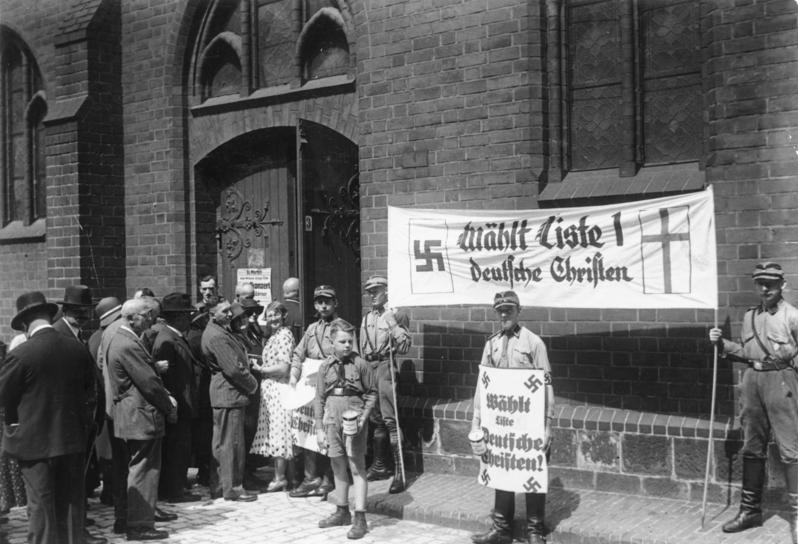
ADN-ZB/Archiv Kirchenwahl am 23.7.1933 in Berlin. Wahl in der Marien Kirche am Neuen Markt. Nazistische Wahlpropaganda unter Maske des Christentums.

I have refrained from tackling any politics for over a week now, and that was a good thing. My time of deliberate rest from jumping into any of the major political, judicial, or social controversies the past week has been good. It has allowed me to re-center myself. As I have done so I have taken a step back just to observe, to watch and listen, and to continue to read, study, reflect, and yes, to relax. .

Of course, much of that study and reflection turns back to history. Barbara Tuchman wrote, “Chief among the forces affecting political folly is lust for power, named by Tacitus as “the most flagrant of all passions.” One go a minute without observing this.

Dietrich Bonhoeffer was a German pastor and theologian who openly opposed Hitler and his policies in an age when the bulk of German Christians either threw their wholehearted allegiance behind Hitler, or simply did nothing. Bonhoeffer wrote about the violence of Nazi power, and how it, like other brazen displays of power produces outbursts of folly. He noted:

“If we look more closely, we see that any violent display of power, whether political or religious, produces an outburst of folly in a large part of mankind; indeed, this seems actually to be a psychological and sociological law: the power of some needs the folly of others. It is not that certain human capacities, intellectual capacities for instance, become stunted of destroyed, but rather that the upsurge of power makes such an overwhelming impression that men are deprived of their independent judgment, and…give up trying to assess the new state of affairs for themselves.”

It is important for all of us, no matter what our political ideology, or who our chosen candidate is, not to get caught up in the violence of power. We must retain our capacity for independent judgment and never give up our individual and collective responsibility to assess what is going on and make informed judgments.

Unfortunately, that can be quite an undertaking when we are bombarded with an endless assault by politicians, pundits, and preachers, and their media allies and enablers every minute of the day. Even so, we cannot abandon our duty to think and ask the hard questions, even of those we agree with and support.

Anyway, until tomorrow,

Peace

Padre Steve+

Leave a comment

Filed under ethics, History, News and current events, Political Commentary

Wansee, Problem Solvers & Trump

1200x-1

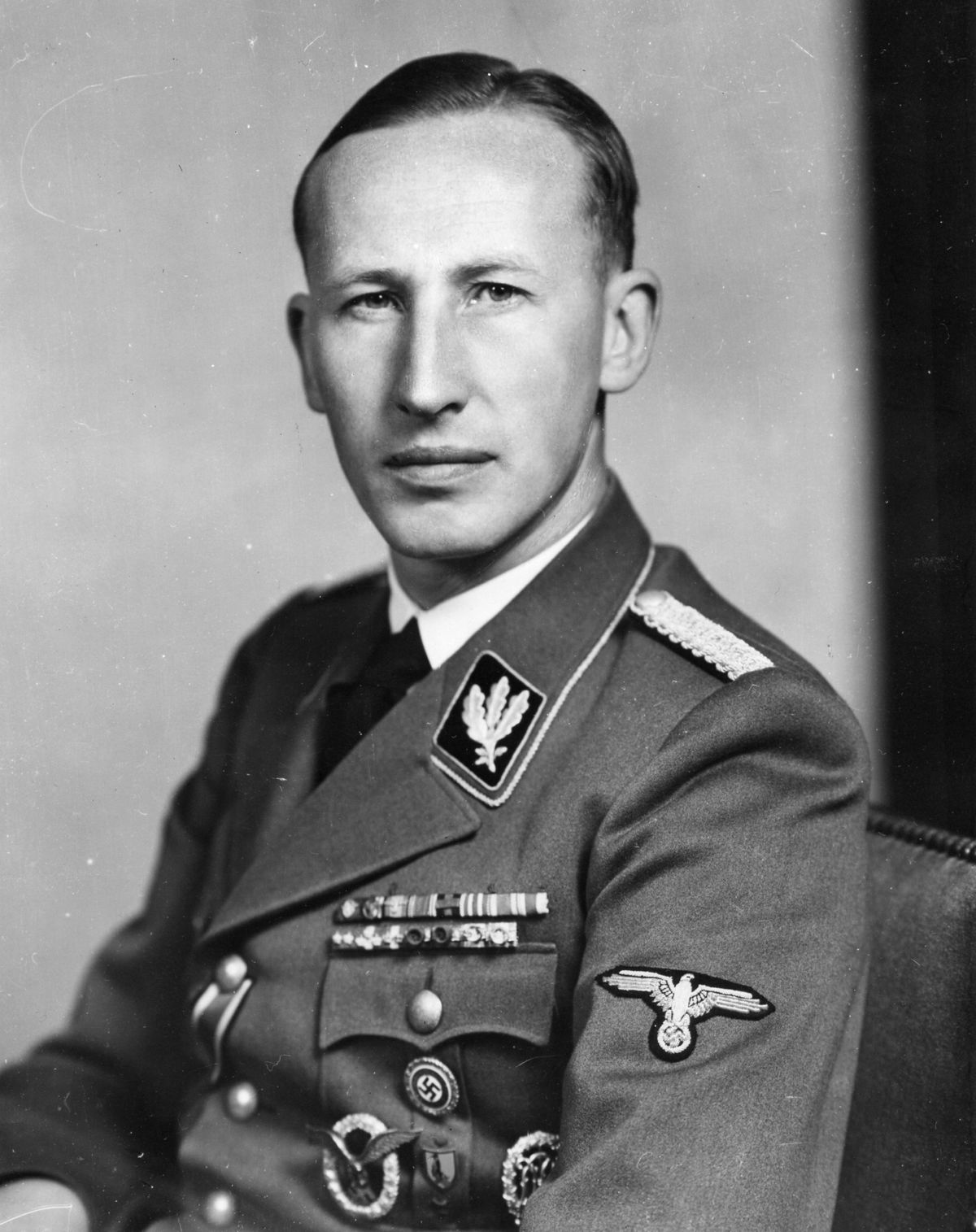
Reinhard Heydrich

Friends of Padre Steve’s World,

The great American philosopher, Eric Hoffer once wrote, “Hatred is the most accessible and comprehensive of all the unifying agents. Mass movements can rise and spread without belief in a god, but never without a belief in a devil.”

Hatred is an amazing emotion. In the final scene of the movie Conspiracy which is about the Wansee Conference, at which fifteen officials of the Nazi government met to coordinate what became the Holocaust, the “Final Solution” of what the Nazis called, “the Jewish problem.” The movie is troubling because the men in the room were well-educated, high to mid-level officials from a variety of agencies who were called together to ensure that their respective agencies worked together.

At beginning of the movie, Kenneth Branagh who plays SS Lieutenant General Reinhard Heydrich describes the “problem to be solved”

“To begin, we have a storage problem in Germany with these Jews…. The laws enacted at Nuremberg, and we should drink a toast to Dr. Stuckart for devising them….They established the fundamental legality for the creation of a Jew-free society, a Jew-free economy for the world to see. And we, indeed, have eliminated the Jew from our national life. Now, more than that, the Jew himself must be physically eradicated from our living space…

Then, in acquiring Poland, we acquired two and a half million more. By last July,
we were met with a new situation, we would, in very short order, be acquiring some five million Jews as we conquered Russia. The dimensions of this problem
have magnified astoundingly. Five million…

At that time, last July, confronting this new situation, Reichsmarshal Goering
prepared a directive, you have a copy. The operative words, if you’ll permit me to read:
“I hereby charge you with making all preparations.in regard to organizational
and financial matters for bringing about a complete solution of the Jewish question in the German sphere of influence in Europe.”

Now, for that, I read the cleansing of the entire continent of Europe.

…in the second paragraph: “Wherever other governmental agencies
are involved these are to cooperate with you.” I hope. So on, so on… “as necessary for the accomplishment of the desired solution of the Jewish question.” This is our mandate, all of us.

Donald Trump has talked about expelling and deporting over 11 million Mexicans and other South or Central Americans from this country. True, many are here illegally, but at the same time most are working and paying taxes, doing the things that many Americans consider themselves too good to do. He has mentioned similar things in regard to Muslims, as well as banning any Muslim from coming to the country. He has talked about going along with the desire of the Christian Right to roll back the hard earned rights of Homosexuals, and he has no regard for African Americans and their rights, with the possible exception of Ben Carson, but I digress…

At the close of the meeting the decision to exterminate the Jews was agreed to by the assembled officials who pledged to work with each other, once they had been told of how the logistics of the operation would take place. Not all were happy, some were shocked, but all rolled over and agreed to cooperate with Heydrich.

At the end of the movie Heydrich is asked to share an allegorical story that one of the less enthusiastic conference participants, Reich Chancellery State Secretary, Dr. Wilhelm Kritzinger, told him about hatred of the Jews. Heydrich recalled the story to SS Major General Heinrich Mueller and SS Lieutenant Colonel Adolf Eichmann:

“Yes, he told me a story about a man he’d known all his life, a boyhood friend. This man hated his father. Loved his mother fiercely.
The mother was devoted to him……but the father beat him, demeaned him, disinherited him.
Anyway, this boy grew to manhood and was still in his 30s when the mother died…this mother who had nurtured and protected him.
She died. The man stood as they lowered her casket and tried to cry…but no tears came.
The man’s father lived to old age, died when the son was in his 50s.
At the father’s funeral, much to his son’s surprise…he could not control his tears. He was wailing, sobbing. He was apparently inconsolable. Lost, even.
That was the story Kritzinger told me.

Eichmann said, “I don’t understand.”

Heydrich answered: “No? The man had been driven his whole life by hatred of his father.
When the mother died, that was a loss. When the father died…when the hate had lost its object…then the man’s life was empty. Over.

Eichmann replied: “Interesting. That was Kritzinger’s warning. What? That we should not hate the Israelites?”

To which Heydrich said, “No, that it should not so fill our lives…that when they are gone, we have nothing left to live for. So says the story. I will not miss them”

After the film was over one of the students brought up who pertinent the comments about hate were in our current political climate. Again I cannot go into details, but I can assure you that the conversation was subdued and sobering. I think that all of us left better for it.

The story is pertinent when one looks at what Donald Trump is doing right now. I really have to wonder how deep hatred such as his runs in this country, because unlike love, hatred is easy to conjure up. It is kind of like what you need to build a fire; fuel, oxygen and heat. To generate hatred on a massive scale all you need is a disaffected populace, a convenient target, and an agent to ignite the mixture.

Shrewd politicians, preachers, and pundits do this well. Donald Trump is showing himself to be a master of this. He, and others like him, and not just American politicians, pundits or preachers, mind you, demonize the target group or population and then let the hatred of their disaffected followers flow.

Leaders who are consumed with hate need a disaffected and angry base in order to rise to power; such was how Hitler, Stalin, and so many other despots gained power. They took advantage of a climate of fear, and found others to blame. For Hitler it was the Jews; while for Stalin it was various groups like the Ukrainians, or the Poles who were the devil to be feared and destroyed. For Trump it is Muslims, Mexicans, immigrants, liberals, and sometimes, even Jews.

Timothy Snyder in his book Bloodlands: Europe Between Hitler and Stalin wrote:

“Dead human beings provided retrospective arguments for the rectitude of policy. Hitler and Stalin thus shared a certain politics of tyranny: they brought about catastrophes, blamed the enemy of their choice, and then used the death of millions to make the case that their policies were necessary or desirable. Each of them had a transformative utopia, a group to be blamed when its realization proved impossible, and then a policy of mass murder that could be proclaimed as a kind of ersatz victory.”

Snyder is quite correct, demonizing a people and making them some kind of “other”, “they”, or “them”, is a wonderful way to blame a group of people for the ills of society. It is also a good way to deflect the blame for the corporate failures of societies and governments onto a convenient scapegoat; and to blame others for the personal failures and petty jealousies of the people doing the demonizing. It also allows people to abandon ethics and the simple notion of the Golden Rule an engage in genocide.

Mass movements and their leaders; of which Trump is such a leader, are masters of hatred and demonizing any opponents. The technique Trump is using is not at all new, it has been used from antiquity but has become much more dangerous in the modern era with the spread of instant communications technology. History shows us all too clearly how it has happened and how easily it can happen again. Witch hunts, slavery and Jim Crow, the extermination of the Native Americans which inspired Hitler in his campaign of genocide and the Holocaust; the Soviet gulags and ethnic cleansings, the Rape of Nanking, the Chinese Communist “Cultural Revolution” the Rwandan genocide, Srebrenica, the Turkish genocide of the Armenians, and the current crimes against humanity of the so called Islamic State. Sadly, the list can go on and on.

All of these events simply required the elements of a disaffected population, a devil or scapegoat to blame, and a leader or leaders to ignite the volatile mixture; fuel, oxygen and heat. Hoffer was quite correct that “Mass movements can rise and spread without belief in a god, but never without a belief in a devil.” The really successful leaders of such movements understand this. For Hitler it was the Jews and other untermenschen; for American Southerners after the Civil it was the Blacks and their white supporters. For the American “Know Nothings” of the 1840s and 1850s it was immigrants, especially Irish and Germans who were Catholic; for Stalin it was non-Russian ethnic minorities. For the leaders of the Islamic State, it is Jews, Shi’ite Moslems, less than “faithful” Sunnis, Christians and well for that matter anyone who does not line up one hundred percent with them on every issue. The examples are so plentiful to support this fact that it is almost overwhelming.

The problem is that when any society, or government begins to label or stigmatize a race, religion, ethnicity, sexual preference, or political ideology, and then in the process demonize those people to the point that they become less than human we have reached a tipping point. We reach the point where we are just one crisis away from all of those crimes against humanity that we believe that we are no longer capable of doing. But sadly, we human beings are not nearly as evolved as we think and I think that the tipping point in the United States may be far closer than we could ever imagine.

I really do not think that we are too far from some tipping point where the politicians, pundits and preachers; especially those of the political right and the media whores who are more concerned about market share than truth, decide that their “devils” must be exterminated. Of course when they will do they will claim a higher moral, religious, or racial, purpose; or perhaps use the language of Manifest Destiny, the Lost Cause, or the Stab in the Back or some other historical myth that suffices to justify their actions.

In response to Trump and those who stoke the same kind of fear and hatred, I wonder just how many men that there are like Heydrich, who would execute the orders of someone like Trump that there are in our country this very minute. I shudder to think of it, and when I do, I am reminded of the closing words of Spencer Tracy when he pronounces judgement on the Nazi judges in the film Judgment at Nuremberg:

But this trial has shown that under a national crisis, ordinary – even able and extraordinary – men can delude themselves into the commission of crimes so vast and heinous that they beggar the imagination. No one who has sat through the trial can ever forget them: men sterilized because of political belief; a mockery made of friendship and faith; the murder of children. How easily it can happen. There are those in our own country too who today speak of the “protection of country” – of ‘survival’. A decision must be made in the life of every nation at the very moment when the grasp of the enemy is at its throat. Then, it seems that the only way to survive is to use the means of the enemy, to rest survival upon what is expedient – to look the other way. Well, the answer to that is ‘survival as what’? A country isn’t a rock. It’s not an extension of one’s self. It’s what it stands for. It’s what it stands for when standing for something is the most difficult! Before the people of the world, let it now be noted that here, in our decision, this is what we stand for: justice, truth, and the value of a single human being.”

I do hope that we follow a saner and less horrifying path. But I ask this question: If Trump or someone like him is elected, in this election or in a future election; who will be his problem solvers? I dread to think about the answer to that question.

Peace

Padre Steve+

1 Comment

Filed under ethics, History, News and current events, philosophy, Political Commentary

Be Careful What You Vote Against

Friends of Padre Steve’s Worl

Since the Illinois and Missouri primary results will not be settled before I pass out tonight I will save my article about the results of what happened last night until tomorrow. As such I see no reason to do much commentary other than to note that Missouri is going to be close in both the Republican and Democratic races. 

Because of that  I am republishing an article that I wrote almost four years ago. Truthfully, no matter what your political leanings are I think that is important and well worth the read. I find that too many people don’t take the time to examine the second, third, and fourth order consequences of their actions, and that includes the action of casting a vote. Far to many votes are cast out of emotions, especially those of fear and anger, and without thought of the long term consequences. That was the case in less than a century ago in Germany. 

was reminded oft his article when a friend of mine remembered it and posted a link to it on Facebook a couple of days ago. In his note about it he noted that I was well ahead of the media. I hate it when that happens, but such is the danger of being a historian who has the capacity of self-reflection. The article is here in its entirety. I have not updated it with any references to Donald Trump or the violence that is occurring with startling regularity on the campaign trail. Even so it is decidedly uncomfortable reading, especially when I see quite a few Evangelical leaders, including pastors, and media pundits endorsing Trump. 

Peace

Padre Steve+

German Pastor Martin Niemoller wrote: “I hated the growing atheistic movement, which was fostered and promoted by the Social Democrats and the Communists. Their hostility toward the Church made me pin my hopes on Hitler for a while. I am paying for that mistake now; and not me alone, but thousands of other persons like me.” 

79623

Martin Niemöller

Martin Niemöller was a war hero. He had served on U-Boats during the First World War and commanded a U-Boat in 1918 sinking a number of ships. After the war he resigned his commission in the Navy in opposition to the Weimar Republic and briefly was a commander in a local Freikorps unit. His book Vom U-Boot zur Kanzel (From U-boat to Pulpit) traced his journey from the Navy to the pastorate. He became a Pastor and as a Christian opposed what he believed to be the evils of Godless Communism and Socialism. This placed him in the very conservative camp in the years of the Weimar Republic and he rose in the ranks of the United Evangelical Church of the Old Prussian Union. Active in conservative politics, Niemöller initially support the appointment of Adolf Hitler as Chancellor.

However, he quickly soured on Hitler due to his insistence on the state taking precedence over the Church. Niemöller was typical of many Germans of his era and harbored ant-Semitic sentiments that he only completely abandoned his anti-Semitic views until after he was imprisoned. He would spend 8 years as a prisoner of the Nazis a period hat he said changed him including his views about Jews, Communists and Socialists. Niemöller was one of the founding members of the Pfarrernotbund (Pastor’s Emergency Federation) and later the Confessing Church. He was tried and imprisoned in concentration camps due to his now outspoken criticism of the Hitler regime.

338101

Herman Maas

Herman Maas was another Evangelical Pastor. Unlike Niemöller, Maas was a active participant in the ecumenical movement, built bridges to the Jewish community and defended the rights of Jews as German citizens. He received a fair amount of criticism for his attendance of Reichspräsident Friedrich Ebert’s funeral. Ebert was both a Socialist and avowed atheist. Maas too was active in the Pfarrernotbund and the Confessing church, and unlike Niemöller maintained his opposition to anti-Semitism and the Nazi policies against the Jews. He would help draft the Barmen declaration. He too would be imprisoned and survive the war. Maas was the first non-Jewish German to be officially invited to the newly formed state of Israelin 1950. In July 1964 Yad Vashem recognized the Maas as one of the Righteous Among the Nations.

Bonhoeffer-194x300

Dietrich Bonhoeffer

Dietrich Bonhoeffer a young Pastor and theologian would also step up to oppose the Nazis and offer support for the Jews. He helped draft the Bethel Confession which among other things rejected “every attempt to establish a visible theocracy on earth by the church as a infraction in the order of secular authority. This makes the gospel into a law. The church cannot protect or sustain life on earth. This remains the office of secular authority.” He also helped draft the Barmen declaration which opposed and condemned Nazi Christianity. Bonhoeffer would eventually along with members of his family take an active role in the anti-Nazi resistance as a double agent for Admiral Canaris’ Abwehr. For this he would be executed after his final sermon in the concentration camp at Flossenburg just a month prior to the end of the war. Bonhoeffer wrote “If you board the wrong train, it is no use running along the corridor in the other direction.”

Another opponent of the Nazis in the Confessing Church was Swiss-German theologian Karl Barth. Barth went into exile as a Swiss citizen but remained active in the criticism of the Nazi regime.

P8-Bernard

Bernard Lichtenberg

Catholic Bishop Galen of Münster and others including Father Rupert Meyer in Munich who opposed Hitler in the early 1920s would also oppose the Nazi policies toward the Church and the Jews. Some like Meyer would end up in concentrations camps with some like Canon Bernard Lichtenberg of Berlin dying at the hands of the Nazis.

mayer

Rupert Meyer

All these men took risks to defend the Jews who were religious minority group that had been traditionally discriminated against in Germany. They opposed the Nazi policies which were widely supported by much of the German populace making them unpopular in their own churches as among the traditionally conservative supporters of the Evangelical and Catholic Churches. The Jews were not simply discriminated against as a racial or religious group but also identified with the political left, especially the Social Democrats, Independent Socialists, Communists and the Spartacists.

Since the Independent Socialists, Communists and Spartacists were all involved in attempts to create a Soviet state during the early tumultuous years of Weimar and been involved in many acts of violence against traditional German institutions and the state, they were viewed by Hitler and others as part of the Bolshevik-Jewish threat to Germany. A sentiment harbored by many non-Nazi conservatives and Christians.

Karl Liebnicht and Rosa Luxembourg were among the high profile leaders of this movement in Germany and both were Jewish. The fact that many in the leadership of the Bolshevik movement in theSoviet Union were Jewish added fuel to the fire that the Nazis stoked in Germany. Hitler and the Nazis played on the historic, but muted prejudice against German Jews who in many cases were more secular and German than religious and had assimilated well in Germany. Hitler’s rhetoric as well as that of other Nazis and Nazi publications helped identify the Jews as part of the “Stab in the back” myth that was commonly used by the German right to explain the defeat in the First World War. Thus they were painted as a political and social threat to Germany.

sachs-pris

Nazi Political and Religious Opponents in Concentration Camps

When Hitler took power persecution of the Jews began in earnest. Jews were along with Communists, Trade Unions and Socialists enemies of the state. They were banned from the military, civil service and other government employment, professional associations and forced to wear a gold Star of David on their clothing. Their property was seized, many were abused by SA men acting as deputized auxiliary police and many times their businesses, Synagogues and homes were vandalized, burned or seized by the state. Many would be forced to flee in order not to be sent to ghettos and concentration camps. Even those leaving only escaped with the minimum of their possessions as the Nazi regime extorted anything of value from them as they left Germany. This was all done because Hitler and those like him portrayed the Jews as not only an inferior race, but enemies of the state and the German people.

Hitler portrayed himself and his movement as defenders of Christianity. He was not the first or last to do so but his speech of February 1st 1933, the day after he was appointed Chancellor by President Hindenburg made it abundantly clear that he was bent on securing the support of Christians to solidify his grip on power: “The National Government will regard it as its first and foremost duty to revive in the nation the spirit of unity and co-operation. It will preserve and defend those basic principles on which our nation has been built. It regards Christianity as the foundation of our national morality, and the family as the basis of national life. . . .”

23nazibrownshirtschurch

The Sturmabteilung (SA) at Church

Churches became sponsors of Nazi meetings, the Swastika banner hung in the sanctuaries of churches throughout the Reich and Bishops, Priests and Pastors joined Nazi organizations and gave the Nazi salute. They had sold their soul to Hitler and the Nazis out of fear of the Communists, Socialists, Jews and Slavs.

Eric Hoffer noted that “It is when power is wedded to chronic fear that it becomes formidable.” Hitler and his enablers spread fear and took advantage of it to bring those fearful of the left to his support.

20hitlercatholicchurch

Hitler leaving a Church

Today we face a similar phenomena in conservative circles in the United States. This time it is not the Jews but Moslems, Gays, immigrants and racial minorities who are the targets of the xenophobic rage by many influential members of the “conservative” media including Rush Limbaugh, Sean Hannity and numerous others. Their popularity in voicing support for “Christian morale values” such as being against abortion has ingratiated them with conservative Christians. It is so bad that that many “conservative” Christians cannot differentiate between their vitriolic and un-Christian rage against Moslems, Gays and Lesbians, trade unionists, Democrats or anyone else portrayed by the big media talkers and the Gospel.

It is if they have become an appendage to Republican or “conservative” politicians rather than a Christian church. It is not uncommon to see Christians on the web or on the call in talk radio programs identify lock stock and barrel with Limbaugh and others identifying the crass materialism and social Darwinism of “pure” Capitalism and the anti-Christian policy of pre-emptive war. That may seem harsh, but many of these people in the “Conservative Bible project” seek to re-translate the Bible into their own political, social and economic policies even seeking to change or minimize any Scripture that might be equated with the “Social Gospel.” Unfortunately many Christians and others have jumped in on the anti-Moslem and anti-immigrant crusades and anti-Gay launched by those on the far right.

There are those on the far right that advocate eliminating all Moslems from the military, government, security intelligence and police forces and even universities. Similar threats are made against non-European immigrants, legal and illegal alike especially those from Mexico or Latin America. I have a friend; a Navy Officer who served a year in Iraq that was confronted by a member of the “Minutemen” in Texas to show his Green Card and threatened simply because he is Mexican. Others especially conservative Christians suggest criminalizing homosexuality, jailing homosexuals or putting them in concentration camps, deporting them or even punishing gays with the death penalty.

This is so similar to the Nuremberg Laws and the Aryan Paragraph issued by the Nazis that it is scary. Likewise the threats to American Moslems or Gays of placing them “behind razor wire” as we did to American Japanese citizens in World War II are chilling. I wonder how Christians would react if an atheist or someone on the political left suggested all conservative Christians or members of pro-Life groups be imprisoned for the actions of Christians or pro-Life movement members like Scott Roeder or Eric Rudolph who killed to stop abortion or Fred Phelps and his Westboro Baptist Church?

This new found militancy has swept up the “Christian right” and others since 9-11 and has reached proportions that I could never have imagined. After my tour in Iraq I realized that much of what these people were saying was not Christian at all and when taken to their logical conclusion would be a police state in which anyone who opposed them would be persecuted. I question the motivations of the leaders of the movement but believe that most of the Christian conservatives have been caught up in the anger and the emotion of the times versus being true believers in what these men say. That being said, you don’t have to be a true believer to be a willing accomplice in actions that first are not Christian and second trample on the Constitutional rights of American citizens.

I could keep citing examples but if someone can show me where this is condoned in the Gospels I would like to know. The fact is that Christians are to place God first and defend the rights of others, even non-believers. This is found not only in Scripture but runs through the Christian tradition across the denominational spectrum.

The persecution of American Moslems, minorities, Gays and others is dangerous, not just for those minorities but ultimately for Christians who endorse and advocate against those groups. American and English law is based on legal precedence. Once something has been determined to be legal, or constitutional it is considered by the law to be settled law. This is a point made by Chief Justice Roberts regarding Roe v. Wade at his confirmation hearings. If Christians want to use the law against Moslems or for that matter any other minority be it religious or political they tread on very dangerous ground. Not only do they make a mockery of the Gospel command to love our neighbors, care for the foreigners among us and to be a witness to non-Christians support policies or laws that if enacted could and very well would be used against them by their opponents.

During the Republican Presidential primaries major leaders of the Evangelical movement and churches did all that they could to paint Mitt Romney as a religious cultist because he is Mormon. When Romney secured the nomination those same people started backtracking and committing their support to him because they believe that President Obama is an enemy of the country. They don’t like Romney, they are just against Obama. Romney will remember what they called him and their tepid support. If he becomes President he will not be beholden to them and will govern as he desires. Laws and Executive orders that give expanded power to the Executive Branch will not be overturned and if Evangelicals decide that they don’t like what he is doing and act toward him as they have President Obama they could find themselves on the outside and abandoned by the man that they supported.

Law is all about precedent and if such laws were enacted and upheld by the courts they would be settled law that could be used against anyone. What these dear brothers and sisters fail to realize is that such laws can be turned against them if the state should ever decided based on the statements of actions of some that the Christian community is a threat to state security of the public welfare. With the actions of some radical Christians who have committed murder and violence against political, social and religious opponents it would not be hard for the government to label whole churches as enemies of the state. The law is a two edged sword and those who want to use it to have the state enforce their religious, social, ideological or political beliefs on others need to remember what comes around goes around.

The Confessing church understood this and many were imprisoned, exiled or killed for this belief. The founding fathers of this country understood this too, that is why there is the Constitutional protection of Religion in the First Amendment. This was put in because Virginia Baptists who had been persecuted by Anglicans lobbied James Madison for the amendment in the Bill of Rights threatening to withdraw their support for his candidacy if he did not. Niemöller would discover the depths of his earlier folly in prison telling one interviewer after the war:

“I find myself wondering about that too. I wonder about it as much as I regret it. Still, it is true that Hitler betrayed me. I had an audience with him, as a representative of the Protestant Church, shortly before he became Chancellor, in 1932. Hitler promised me on his word of honor, to protect the Church, and not to issue any anti-Church laws. He also agreed not to allow pogroms against the Jews, assuring me as follows: ‘There will be restrictions against the Jews, but there will be no ghettos, no pogroms, in Germany. I really believed given the widespread anti-Semitism in Germany, at that time—that Jews should avoid aspiring to Government positions or seats in the Reichstag. There were many Jews, especially among the Zionists, who took a similar stand. Hitler’s assurance satisfied me at the time. On the other hand, I hated the growing atheistic movement, which was fostered and promoted by the Social Democrats and the Communists. Their hostility toward the Church made me pin my hopes on Hitler for a while. I am paying for that mistake now; and not me alone, but thousands of other persons like me.”

It is easy for well meaning people Niemöller to be bought with promises of support by politicians and media types who speak the words they want to hear in difficult times. So today I suggest the formation of an ecumenical Pastor’s Emergency League which will not be bought by the empty and godless promises of hate mongers on the right or the left. Such a group of men and women spanning the breadth of the Christian tradition and others that see the danger of extremism of all types is becoming necessary. Such a step is becoming necessary due to the militancy of the Christian right as well as the militancy of atheist groups who lobby against all public religious expression by any religion. Such a League would respect the various creeds and statements of faith of each member’s denomination. The movement of the right has set a dangerous course fraught with perils that they do not comprehend.

We have entered a dangerous phase of American history. These movements have the potential not only to oppress law-abiding and patriotic Americans of all faiths and to crush the religious freedoms of all in this county. Suggesting that American citizens, including those who serve the county in the military or government of entire religious, ethnic, political, religious affiliation or sexual preference be jailed, banned from office or fired is totalitarian and dare I say Nazi like.

Niemöller would say it well in this poem:

First they came for the communists, and I did not speak out—because I was not a communist;
Then they came for the socialists, and I did not speak out—because I was not a socialist;
Then they came for the trade unionists, and I did not speak out—because I was not a trade unionist;
Then they came for the Jews, and I did not speak out—because I was not a Jew;
Then they came for me—and there was no one left to speak out for me.

1 Comment

Filed under civil rights, ethics, faith, History, nazi germany, News and current events, Political Commentary

Reflections on Indoctrination & Personal Responsibility

IMG_1931

Friends of Padre Steve’s World

I have written a lot about the dehumanization of people and genocide, and some of the things that create a climate where such events take place, and how political and religious leaders stir the primal passions of otherwise good, decent and law abiding citizens. I wrote yesterday how I am afraid of what is going on in our country, especially in regard to the violence being sanctioned and even promoted by Republican Presidential candidate and real estate mogul Donald Trump.

Sunday night I finished reading a book by World War II German Luftwaffe ace Johanes Steinhoff. Steinhoff was unlike many of the German officers who wrote memoirs following the war, memoirs that historian Williamson Murray wrote “fell generally into two categories; generals writing in the genre of “if the fuhrer had only listened to me!” and fighter pilots or tank busters writing about their heroics against the productive flood from America or the primitively masses of the Soviet Union.”

steinhoff6

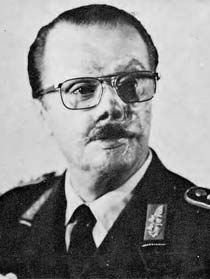
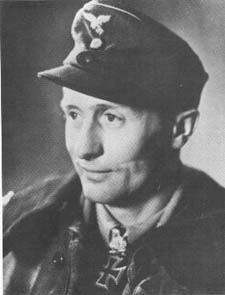
General Johannes Steinhof (above) as a Bundeswehr and NATO officer, showing his burns and before his crash (below)

steinhoff WW II

In his books, Steinhoff does something that you do not see authors do in most military or political memoirs, he actually does serious self reflection on his role in supporting an evil regime. In his introduction to his book The Final Hours the legendary fighter ace who was horribly disfigured when his Me-262 jet fighter crashed and burned two weeks prior to the end of the war wrote:

“In recalling these events, which had been long buried in my memory, it has not been my intention to make excuses. Our unconditional self-sacrifice in the service of the Third Reich is too well documented for that….

So it is because of what is happening today—with freedom threatened in virtually every respect by its own abuse—that I offer this contribution, in the form of an episode in which I was myself involved, to the history of the soldier in the twentieth century. Soldiers have always, in every century of their existence, been victims of the ruthless misuse of power; indeed, given the opportunity, they have joined in the power game themselves. But it fell to our own century to accomplish, with the aid of a whole technology of mass extermination, the most atrocious massacres in the history of mankind. This fact alone makes pacifism a philosophy worthy of respect, and I have a great deal of sympathy with those who profess it. 

The figure of the soldier in all his manifestations is thus symptomatic of the century now nearing its close, and it is to the history of that figure that I wish to contribute by describing what happened to me. I have tried to show what it is possible to do to men, how insidiously they can be manipulated by education, how they can be hoisted onto a pedestal as “heroes,” how they can be so corrupted as even to enjoy the experience—and how they can be dropped and denounced as mutineers when they discover that they have scruples. The complete lack of scruples that such treatment implies is peculiar to rulers who believe that the problems of their own and other peoples can be solved by imposing, through the use of military force, peace on their, the rulers’, terms—in our case a pax germanica, but the second Latin word is readily interchangeable.” from “The Final Hours: The Luftwaffe Plot Against Goring (Aviation Classics)” by Johannes Steinhoff

Since I am a historian and and a career military officer with service in the Iraq War, a war that was illegal and unjust by all measure I can understand Steinhof’s words. Because much of my undergraduate and graduate work focused on German history, particularly that of Imperial Germany after the unification, the Weimar Republic, and the Nazi Reich, I draw a lot of lessons from the period. I also understand how people in this country can fall for the same kind of vitriolic propaganda that the Germans of that era did. I can understand because for years I fell for the lies and propaganda being put out by the politicians, pundits and preachers of the American political right.

10665323_10154041610267059_5277331492232210946_n

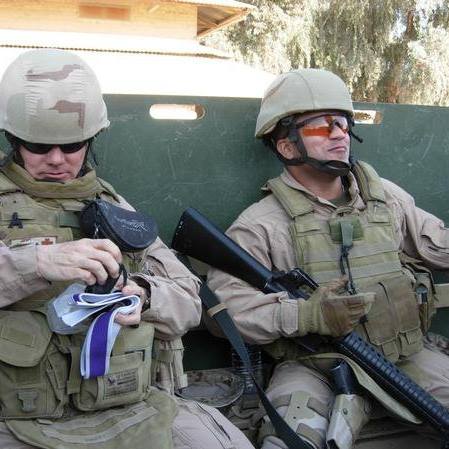
A picture of me (on left) in Iraq 2007 with my assistant and bodyguard RP1 Nelson Lebron

One of those lessons is that in times of crisis, that people, no matter what their race, culture, religious belief system, educational, or economic background are still human. Humanity is the one constant in all of history, our prejudices are often ingrained in us during childhood and reinforced by the words of politicians, pundits, and preachers. In times of stress, crisis, and societal change or upheaval even good people, moral people, people of great intellectual, scientific abilities can fall prey to demagogues who preach hate and blame others, usually racial, ethnic, or religious minorities, as well as civil libertarians who champion the rights of those minorities for the problems of the nation.

Shrewd politicians, preachers, and pundits do this well. They demonize the target group or population and then let the hatred of their disaffected followers flow. The leaders need that disaffected and angry base in order to rise to power; such was how Hitler, Stalin, and so many other despots gained power. They took advantage of a climate of fear, and found others to blame. For Hitler it was the Jews, Slavs, Socialists and Communists; while for Stalin it was various groups like the Ukrainians, or the Poles who were the devil to be feared and destroyed. Timothy Snyder in his book Bloodlands: Europe Between Hitler and Stalin wrote:

“Dead human beings provided retrospective arguments for the rectitude of policy. Hitler and Stalin thus shared a certain politics of tyranny: they brought about catastrophes, blamed the enemy of their choice, and then used the death of millions to make the case that their policies were necessary or desirable. Each of them had a transformative utopia, a group to be blamed when its realization proved impossible, and then a policy of mass murder that could be proclaimed as a kind of ersatz victory.”

But that being said, there are a lot of people who from childhood believe the lies about others without question. In good times such people continue on with life as normal, but in crisis those hatreds and prejudices come to the fore. Rudolf Höss, the notorious sociopath who commanded Auschwitz told American Army psychologist Gustave Gilbert about his reaction when ordered to turn the camp into an extermination center. He said that the order “fitted in with all that had been preached to me for years,” and “at the same time I didn’t think of it as propaganda, but as something one just had to believe.” 

Eugene Davidson in his book on the Nuremberg Trials wrote:

“Every society has in it at all times negative, criminal, sadistic, asocial forces. What holds them in check more than law and police is the consensus of the society – a general belief that despite everything wrong and stupid and muddleheaded in politics, the state is a going concern that will somehow make its way into the future.” (Davidson, The Trial of the Germans p.581)

But when things do not go well, when people do not feel that things will be okay, that the future will be better, and that they have a purpose they look for answers. However, they tend to find their answers in the rantings of demagogues, race baiters, conspiracy theorists, and others who they would tend to dismiss out of hand in good times. In Germany it was the loss of the First World War, the humiliation of Versailles and the economic chaos and social change of the Weimar period which allowed Hitler to gain an audience, then a following, then political power. The demagogues played to what was already in the hearts and minds of the disaffected masses, without that fertile soil, the rantings of Hitler and his propagandists would have never succeeded. Albert Speer wrote:

“As I see it today, Hitler and Goebbels were in fact molded by the mob itself, guided by its yearnings and its daydreams. Of course, Goebbels and Hitler knew how to penetrate through to the instincts of their audiences; but in the deeper sense they derived their whole existence from these audiences. Certainly the masses roared to the beat set by Hitler’s and Goebbels’ baton; yet they were not the true conductors. The mob determined the theme. To compensate for misery, insecurity, unemployment, and hopelessness, this anonymous assemblage wallowed for hours at a time in obsessions, savagery and license. The personal unhappiness caused by the breakdown of the economy was replaced by a frenzy that demanded victims. By lashing out at their opponents and vilifying the Jews, they gave expression and direction to fierce primal passions.”

In a sense a similar thing has happened in the United States which has experienced a series of wars beginning with Vietnam, the shock of the 9-11-2001 attacks, the economic crash of 2007 and 2008 which devastated the savings, home ownership, and investments of many Americans while at the same time benefiting the banking and brokerage houses whose government assisted policies brought about the crash. Of course there are other issues, many religious conservatives hate the progress made by the Women’s and Gay Rights movements, and their leaders play to their fears in apocalyptic terms. I could go on, but I am sure that my readers can identify other issues which demagogues and others use to spread fear and hate to further their goals. The fact is that without the the fertile soil that lays in the hearts of their most fervent followers they would never have a following.

In Weimar Germany hate mongers like Julius Streicher and propagandist Josef Goebbels stuck a chord with disenchanted people who felt that they had lost their country. They were fearful, angry, and desired a leader who would “make Germany great again.” Hitler and his Nazi media sycophants played to that fear, and took advantage of their anger at the existing order. Davidson wrote such people “exist everywhere and in a sick society they can flourish.” 

For decades the way has been prepared for true extremists to take advantage of the fears and doubts of people as modern American versions of Streicher and Goebbels have been at work for years. Rush Limbaugh was a modern pioneer of this in the United States, and he has been joined by so many who are even more extreme in their rantings that it is hard to name them all. Likewise, whole media corporations, websites, and political networks spread such fear every minute of the day, claiming that they, and they alone are real Americans. They actively support politicians who condemn, and sometimes even threaten people who oppose them, and all the while claim that “make America great again.”

When I was younger I devoured that propaganda, despite all of my learning I followed the rantings of men who I realize today are propagandists who promote the basest of lies, and hatred, often in the name of God. I was changed when I was at war, and when I returned home from Iraq in 2008 I realized through hard experience that I had been lied to, and that as a result that thousands of my brothers and sisters were dead, and tens of thousands shattered in body, mind, and spirit. Likewise I saw the massive destruction levied on Iraq and realized how terrible war really is. That was my epiphany, that is what it took to see how much I had been lied to, and it called me to question everything else that I had so willingly believed, things which had been fed to me by years of indoctrination in church, through the media, and by politicians who I believed were truly Christian. I can understand now how Martin Niemoller felt after the Nazi seizure of power when he said, “I hated the growing atheistic movement, which was fostered and promoted by the Social Democrats and the Communists. Their hostility toward the Church made me pin my hopes on Hitler for a while. I am paying for that mistake now; and not me alone, but thousands of other persons like me.”

There was a time that I hated people who espouse the views that I hold today, the views that I write about so often here on this site. I can remember how angry I would get as I listened to the propaganda being put out by Limbaugh, Hannity, the Fox News Channel and all of the others that I listened to every time that I had the chance. But when I changed after Iraq, I felt the sting of that hatred in very real ways. I remember the day I was called by my bishop in my former church, who told me that I had to leave because my views on women, gays, and Moslems were to use his words were now “too liberal.” After that, many men who I considered to be the best of friends turned their backs on me, some in the most bitter and vindictive of ways.

But I realize now that what they did was because I had in a sense left the cult, and had to be ostracized. I can understand that now, because when I was under the spell I too turned my back on people who had fallen out of favor, or people who had rejected the tenants of the church or the political movement, and those are things that I can never undo. But at the time it made sense, it fitted in with all I had been taught for decades, as Albert Speer wrote of Hitler, “One seldom recognizes the devil when he is putting his hand on your shoulder.”

What happened to Steinhoff’s generation is threatening to happen again, in our country, an authoritarian movement is threatening to destroy our democracy and republic. In it soldiers are esteemed, until they realize what is going on and speak out, but by then it is usually too late. I am understanding that fact more and more every day, and having had people troll this blog and call me a traitor and worse, I understand just a bit of what happened to Steinhoff and his fellow officers when they protested to the highest levels what was happening to Germany in early 1945.

Tomorrow we will know more about our nation’s slide into the abyss if authoritarianism as Donald Trump continues his unrelenting march to the GOP nomination. 

Peace

Padre Steve+

3 Comments

Filed under ethics, History, holocaust, Military, News and current events, Political Commentary

A Frenzy that Demands Victims 

  
Friends of Padre Steve’s World

I am afraid. Over the past few weeks violence has become commonplace at the campaign rallies of Donald Trump. In the past week a reporter from the Breitbart News service, an organization that is solidly behind Trump was assaulted by Trump’s campaign manager, and Breitbart threw her under the bus for him. Protesters have been assaulted, reporters threatened, Trump not only condones the actions, he encourages them, threatening to use the law and courts to ruin people’s lives, and offering to pay the legal bills of his supporters who have been charged with crimes. He labels any opponents as “bad people” who need to be punished. The ultimate cruelty is that though he is the one inciting the violence, he and his supporters blame that violence on the victims, be they Democrats or Republicans, protestors or media, pundits, politicians or preachers. He is creating a frenzy among his most violent supporters that demands victims to satiate their new found bloodlust. 

This is a phenomena practically unheard of in American politics. It is not the behavior of someone concerned with the democratic process or representative government, but of someone using that process to promote crass and brutal authoritarianism, and a large number of followers willing to embrace a strong, authoritarian leader.  It is most often seen in movements that become dictatorships, such as happened in Germany, Italy, the Soviet Union, Red China, and other dictatorships. 

As a historian who has devoted much study to the social, political, economic conditions in Weimar Germany that helped fuel the rise of left and right wing extremists that led to the legal takeover of the Republic by Hitler and the Nazi Party, I am concerned with what is going on. 

When Albert Speer discussed the ability of Adolf Hitler to captivate the German people he noted something important. He discussed how Hitler and his minions played to them set by the disgruntled and angry German population. Speer wrote, “The mob determined the theme. To compensate for misery, insecurity, unemployment, and hopelessness, this anonymous assemblage wallowed for hours at a time in obsessions, savagery and license. The personal unhappiness caused by the breakdown of the economy was replaced by a frenzy that demanded victims. By lashing out at their opponents and vilifying the Jews, they gave expression and direction to fierce primal passions.”

Hitler played to that misery, insecurity and the obsessions of the politically and economically disaffected “conservative base” that no longer trusted the party establishments of the old-line conservative parties. He also played to the deep-rooted racism and anti-Semitism of those people. Hitler was an outsider, he was not indebted to any traditional party hierarchy and as such was able to throw away convention and play to the fear and anger of many Germans.

Donald Trump is doing today and he is running circles around the traditional politicians of the Republican Party. Every time Trump says something that would have gotten himself blown out of the race twenty years ago, but today his poll numbers keep going up. Trump spends no time on policy, all questions go back to how he will solve people’s problems and those of the nation. Unlike Hitler or Stalin, Trump shows no particular political ideology, except perhaps that might makes right, and that certain groups (minorities, immigrants, Muslims, liberals) are to blame for the mess created by the American political and business elites over the past fifty years. And for the most part the press is afraid of him and will not call him on it just as his Republican opponents cannot find the courage to openly stand up to him.  

He continues to poll around 35% to 50% in most polls of GOP voters and my guess is that those numbers are low, as some supporters may not be willing to tell a pollster that they are for Trump, at least yet. The party hierarchy and most of Trump’s primary rivals consistently criticize Trump, but most say that they will back him if he is the nominee, although John Kasich and Marco Rubio seem to be waffling on their support should Trump be the GOP nominee. And it appears that the GOP establishment seems to be trying to find a way to stop Trump from becoming the nominee. I doubt if they will succeed in stopping him, but if they do Trump and his supporters will have no problem leaving the Grand Old Party and ashen ruin. Even now his most strident supporters are calling Republican opponents of Trump “traitors.” 

Trump understands the mood of much of the traditionally conservative public better than his Republican establishment competitors. Trump is not stupid, unlike Hitler who actually believed in his message, Trump is not a radical, he cannot be, he has too much invested in the system. Instead, he is a street smart and pragmatic businessman who is exploiting the situation on the ground to his advantage and he is an authoritarian, something that appeals to many frustrated voters, most of whom are not racist or bad people. That being said one cannot ignore the embrace of many neo-Nazi, White Supremacist, and White Nationalist leaders and organizations who are latching onto him to expand their influence among disenchanted and frustrated voters. 

His opponents and the GOP establishment are frightened, but like the hidebound conservatives of the Weimar Republic who either dismissed or Hitler or thought that they could contain him are not willing to make a stand. As a result, Trump is able to play to the mood of the base and to coin a phrase, to “trump the establishment” by channeling the deepest anger, fear, hatred, xenophobia, and racism that the GOP establishment refuses to acknowledge. When there is a push back by the establishment it further angers the base, and Trump, quite adroitly threatens to leave the party; something which would doom the GOP in the 2016 general election, and destroy the party that created him. 

Trump’s GOP opponents have terribly underestimated him, and the anger of the conservatives that they have radicalized for decades and failed to comprehend. There are a lot of establishment Democrats who underestimate him too, as well as the discontent in their own party, something that they will eventually pay for if they are not careful. The Trump phenomena is not ideological, it is a rage against the GOP establishment that the establishment has no answer for because it is bankrupt. There are a lot of Democrats that are incredibly frustrated with thier party, and that frustration can and will turn into an anti-Democratic Party establishment rage if Democrats do not do something to fix their party’s failings. Even now some of that rage is being played out in the race between Hillary Clinton and Bernie Sanders, albeit, without the violence of the Trumped GOP race. 

Trump is using his celebrity bombast and the democratic process to take control of a major political party, and he is a lot smarter than most political analysts give him credit. As such, as a non-establishment outsider, Trump has a chance at taking over a long established political party, something that has never before happened in the United States. If he continues to chum the water by giving grist and cover to his more violent supporters, people will die, just like what happened in Weimar Germany as the Nazis battled their opponents on the streets and in beer halls. 

If he succeeds in his takeover bid, it will forever change American politics, especially if he is able to ride the fear, hatred, and fear to the White House. I don’t think the latter will happen, but I would not exclude it from the realm of the possible. To paraphrase Speer’s words about Hitler and Goebbels: By lashing out at their opponents and vilifying the Muslims and immigrants, Trump gave expression and direction to fierce primal passions of a disaffected GOP base.

Tomorrow is anothe big primary day and I am working on a follow up article to this and will also republish an article entitled Be Careful what You Vote Against that I wrote about four years ago in the next few days. 

Peace

Padre Steve+

3 Comments

Filed under History, News and current events, Political Commentary

Stalingrad at 73

Friends of Padre Steve’s World

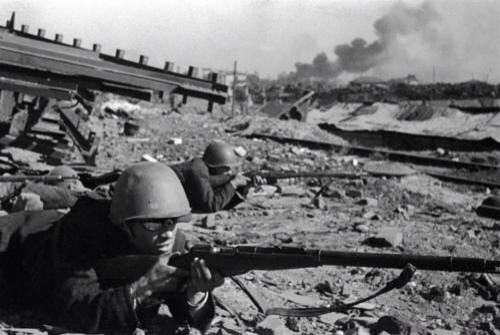
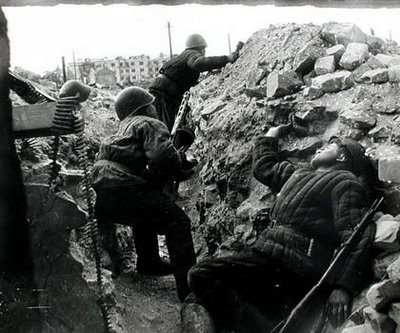
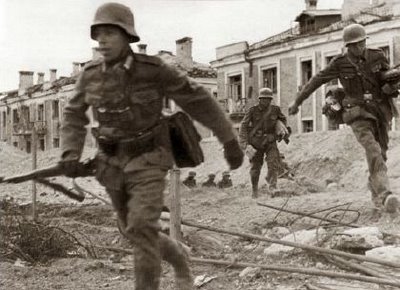
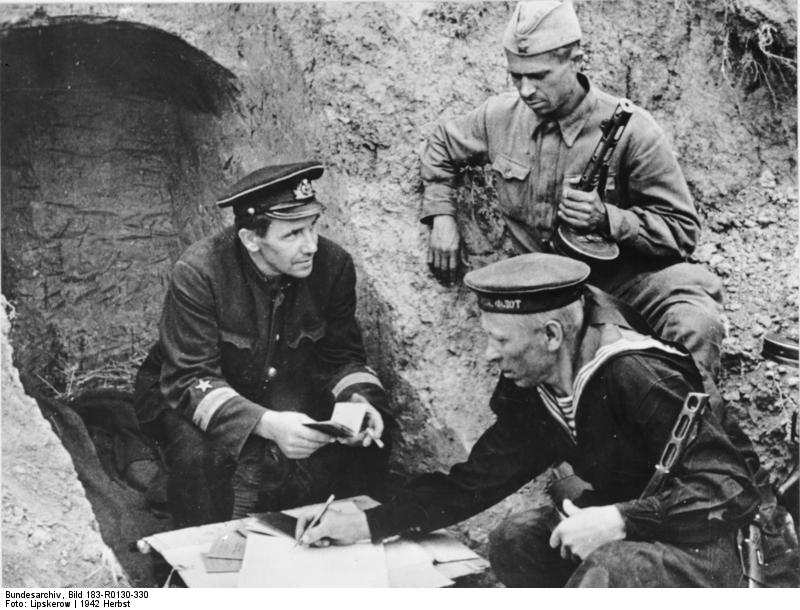
Sunday the 31st of January marked 73rd anniversary of  the surrender of the remnants of the German 6th Army to the Soviets at Stalingrad. The focus of this article is on how the Germans and Russians fought the Stalingrad campaign. In particular it is an analysis of the way the governments and military’s of both Nazi Germany and the Soviet Union planned and executed strategy during the course of the campaign adjusted to the situation and how the campaign ended. It is also a reminder of the price that ordinary soldiers can pay when a country commits them to war. In all nearly two million Axis and Soviet personnel, including civilians were killed, wounded, or captured during the campaign.

That being said, it is a reminder to all of us of the consequences of how xenophobic and racist politics of self-anointed leaders, and their followers can lead nations into disaster.

Peace 

Padre Steve+

Stalingrad: Primary or Secondary Objective
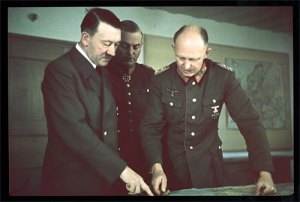
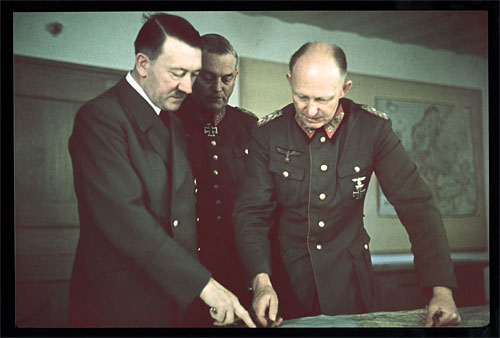
 keitel-jodl-hitler

The mistakes began early in the planning and conduct of the operation

Following the Soviet winter offensive and the near disaster in front of Moscow the German High Command was faced with the strategic decision of what to do in the 1942 campaign.  Several options were considered and it was decided to seize the Caucasus oilfields and capture or neutralize the city of Stalingrad on the Volga.  However, the German High Command was divided on the actual objective of the campaign.

operation blau map

The Oberkommando des Heer or the OKH (Army High Command) under the guidance of General Franz Halder assumed that Stalingrad was the objective and the advance into the Caucasus was a blocking effort.[i] Hitler and Oberkommando des Wehrmacht or the OKW planned to capture the Caucasus oil fields and capture or neutralize Stalingrad to secure the left flank.[ii] Both OKH and OKW considered Stalingrad significant but “German commanders initially regarded it as a weigh station en route to the Caucasus oil fields.” [iii] The conflict echoed in the ambiguity of Directive No. 41, which “included the ‘seizure of the oil region of the Caucasus’ in the preamble concerning the general aim of the campaign, yet made no mention of this in the main plan of operations.” [iv] At the planning conference held at Army Group South in early June “Hitler hardly mentioned Stalingrad. As far as his Generals were concerned it was little more than a name on the map. His obsession was with the oil fields of the Caucasus.” [v] Manstein noted, “Hitler’s strategic objectives were governed chiefly by the needs of his war economy….” [vi] Historian Anthony Beevor noted that at this stage of planning “the only interest in Stalingrad was to eliminate the armaments factories there and secure a position on the Volga. The capture of the city was not considered necessary.” [vii] German planners “expected that the Soviets would again accept decisive battle to defend these regions.” [viii]

In Moscow Stalin and his Generals attempted to guess the direction of the impending German offensive.  “Stalin was convinced that Moscow remained the principle German objective…Most of the Red Army’s strategic reserves…were therefore held in the Moscow region.” [ix] The Soviet High Command, Stavka attempted to disrupt the German offensive and to recover Kharkov by launching three offensives three offensives of their own. The largest of these, an attack on Kharkov was defeated by the Germans between the 12th to the 22nd of May, with the loss of most of the armor in southern Russia. This disaster was accompanied by an equally disastrous defeat of Red Army forces in Crimea by Erich Von Manstein’s 11th Army, and the combination meant that the Red Army would face the Germans in a severely weakened condition. [x]

Operation Blau: Opening Moves and Divergent Objectives
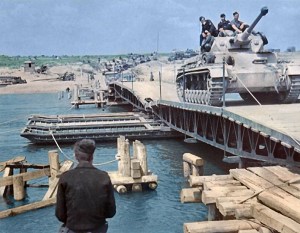
panzers_across_the_don

Panzers cross the Don

The German offensive began on 28 June under the command of Field Marshal Fedor von Bock. Von Bock’s command included two separate army groups, Army Group B under General Maximilian Von Weichs with 2nd Army, 6th Army and 4th Panzer Army operated in the northern part of the operational area. Army Group A under Field Marshall Wilhelm List was to the south with 17th Army and 1st Panzer Army, with the goal of driving into the Caucasus. [xi] Army Group B provided the main effort for the offensive and its forces quickly smashed through the defending Soviet armies and by the 20th Hitler believed that “the Russian is finished.” [xii] One reason for the German success in the south was that until July 7th Stalin believed that Moscow was still the primary objective for any German summer offensive. [xiii] Despite his success, Hitler prevented Von Bock from destroying the Soviet formations that had been left behind and was relieved of command by Hitler. This enabled many of those units to escape the German onslaught. For his trouble Von Bock was replaced by Von Weichs, which created a difficult command and control problem.  Manstein noted that this created a “grotesque chain of command on the German southern wing” with the result that Army Group A had “no commander of its own whatever” and Army Group B had “no few than seven armies under command including four allied ones.” [xiv]

Bild 169-0894

Destroyed Soviet T-34s

This decisions made next proved fateful.  Hitler’s decided to redirect the advance of the 4th Panzer Army to support an early passage of the lower Don, diverting it from its drive on Stalingrad.  Additionally the army groups became independent of each other when Bock was relieved of command.  They were “assigned independent-and diverging-objectives” under the terms of Directive No.45. [xv] This combination of events had a decisive impact on the campaign.  Hitler’s decision prevented a quick seizure of Stalingrad by 4th Panzer Army followed by a hand over to 6th Army to establish the “block” as described by Directive No.41.  Kleist noted that he didn’t need 4th Panzer Army’s help to accomplish his objectives and that it could have “taken Stalingrad without a fight at the end of July….” [xvi]
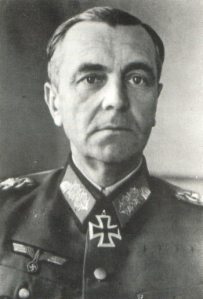
 general-paulus

Field Marshall Von Paulus

The result was damning. The Luftwaffe air support and fuel needed by Army Group A was transferred to 6th Army, denuding Army Group A of the resources that it needed to conclude its conquest of the Caucasus. [xvii] At the same time it denied Army Group B of the Panzer Army that could have seized Stalingrad when it was still possible to do so.  Anthony Beevor called Hitler’s decision a disastrous compromise, [xviii] while Halder believed that Hitler’s decision underestimated the enemy and was “both ludicrous and dangerous.” [xix]

Focus on Stalingrad

battle-stalingrad-ww2-second-world-war-two-russian-eastern-front-unseen-pictures-photos-images

Sturmgeschutz Battalion Advancing toward Stalingrad

On July 22nd as the Wehrmacht ran short on fuel and divisions to commit to the Caucasus, and 6th Army fought for control of Voronezh the Soviets created the Stalingrad Front. Stavka moved an NKVD Division to the city [xx] and rapidly filled the new front with formations transferred from the Moscow Front. [xxi] Stalin then issued Stavka Order 227, better known as “No Step Back” on July 28th. The order mandated that commanders and political officers who retreated would be assigned to Penal battalions[xxii] and each field army was to form three to five special units of about 200 men each as a second line “to shoot any man who ran away.” [xxiii] Russian resistance west of the Don slowed the German advance. German commanders were astonished “at the profligacy of Russian commanders with their men’s lives.” [xxiv] Von Kleist compared the stubbornness of Russians in his area to those of the previous year and wrote that they were local troops who fought more stubbornly because they were fighting to defend their homes.” [xxv] Additionally, Stalin changed his commanders frequently in the “vain hope that a ruthless new leader could galvanize resistance and transform the situation.” [xxvi] General Chuikov brought the 64th Army into the Stalingrad Front in mid-July to hold the Germans west of the Don.[xxvii]

The OKW further weakened the German offensive by transferring several key SS Panzer Divisions and the Grossdeutschland Panzer Division to France. The Hungarian, Italian and Romanian armies that were part of the army group lacked motorization; modern armored and anti-tank units, and were unable to fulfill the gaps left by the loss of the experienced German divisions that had been transferred and the expectations of Hitler. [xxviii] The German 6th Army was virtually immobilized for 10 days due to lack of supplies allowing the Russians to establish a defense on the Don Bend. [xxix]

To the south the Germans were held up by lack of fuel and increased Soviet resistance including the introduction of a force of 800 bombers, which took away the total domination of the air that the Germans had previously enjoyed.[xxx] David Glantz and House note that after the fall of Rostov on July 23rd “Hitler abruptly focused on the industrial and symbolic value of Stalingrad.” [xxxi] Hitler was undeterred by warnings from Halder that fresh Russian formations were massing east of the Volga and those of Quartermaster General Erich Wagner, who guaranteed that he could supply either the thrust to the Caucasus or Stalingrad but not both operations simultaneously. [xxxii] Again frustrated by the slow progress to take Stalingrad, Hitler reverted to the original plan for the 4th Panzer Army to assist the 6th Army at Stalingrad, but the cost in time and fuel to move that army from the Caucasus to Stalingrad were significant to the operation and the question was whether “they could make up for Hitler’s changes in plan.” [xxxiii]

Strategic Implications

The changes in the German plan had distinct ramifications for both sides.  Friedrich Von Mellenthin wrote, “the diversion of effort between the Caucasus and Stalingrad ruined our whole campaign.” [xxxiv] The Germans could not secure the Caucasus oil fields that Hitler considered vital to the German war effort.  The Germans advanced deep into the region and captured the Maikop oil fields, though the drilling and refining facilities were almost completely destroyed by the retreating Russians when they withdrew.[xxxv] Due to the lack of fuel and increased Soviet resistance Army Group A was halted along the crests of the Caucasus on August 28th. [xxxvi] This setback left Hitler deeply “dissatisfied with the situation of Army Group A.” [xxxvii] Kleist and others attributed much of the failure to a lack of fuel [xxxviii] while Gunther Blumentritt observed that Mountain divisions that could have made the breakthrough were employed along the Black Sea coast in secondary operations. [xxxix]

battle_stalingrad65

JU-87 Stuka over Stalingrad

Meanwhile on the Stalingrad front, fuel and supply shortages hampered 6th Army’s advance while Hermann Hoth’s 4th Panzer Army was needlessly shuttled between Rostov and Stalingrad. By the time the 4th Panzer Army resumed its advance the Russian forces around Stalingrad “had sufficiently recovered to check its advance.” [xl] As the 6th Army advanced into Stalingrad the “protection of Army Group B’s ever-extending northern flank was taken over by the 3rd Rumanian, the 2nd Hungarian and the newly formed 8th Italian Army.” [xli] The allied armies had to occupy overextended fronts, and these formations were neither trained equipped for the Russian campaign, nor well motivated to die for Germany. [xlii] The supply shortage in both German army groups was not helped by a logistics bottleneck. All supplies for both army groups had to transit over a single crossing on the Dnieper River, which Manstein noted, also prevented swift movement of troops from one area to another. [xliii]

 pzdiv-24-motorcycle-stalingrad

Reconnaissance Battalion of 24th Panzer Division near Stalingrad

Von Paulus’ 6th Army attempted to capture Stalingrad with a swift attack between the 25th and 29th of July, even as Hoth’s 4th Panzer Army milled about on the lower Don.  However, Paulus’s piecemeal commitment of his divisions and failure to concentrate in the face of unexpectedly strong Soviet resistance caused the attacks to fail.  Paulus then halted the 6th Army on the Don so it could concentrate its forces and build its logistics base, [xliv] and to allow Hoth’s army to come up from the south. This further delay allowed the Russians to build up even more forces west of Stalingrad, to reinforce the Stalingrad front, and to strengthen the defenses of the city. [xlv] Likewise, due to the distances involved it now was easier for the Russians to reinforce the Stalingrad front than it was for the Germans. [xlvi] As they strengthened their positions, the Soviets filled a number of key leadership positions with competent and tough Generals who would skillfully fight the coming battle for the city.[xlvii]

russian marines stalingrad

Hitler now focused on the capture of Stalingrad despite the fact that “as a city Stalingrad was of no strategic importance.” [xlviii] Strategically, its capture would cut Soviet supply lines to the Caucasus, [xlix] but this could be achieved without its capture. The check of the German advance in the Caucasus “began to give Stalingrad a moral importance-enhanced by its name-which came to outweigh its strategic value.” [l] To Hitler Stalingrad would gain “a mystic significance” [li] and along with Leningrad became “not only military but also psychological objectives.” [lii]

battle_stalingrad79

Red Army Armored troops using Lend-Lease American M3 Stuart and M3 Grant tanks

Despite the risks the Germans now mounted a frontal assault using the 6th Army and elements of 4th Panzer Army despite having intelligence reports supported by airiel reconnaissance that “the Russians are throwing forces from all directions at Stalingrad.” [liii] Friedrich von Paulus as the senior General was in charge of the advance, with Hoth subordinated to him, but the attack had to wait until Hoth’s army could fight its way up from the south. [liv] Von Mellenthin comments rightly, “when Stalingrad was not taken on the first rush, it would have been better to mask it….” [lv] Such a decision would have enabled the Germans to strengthen their lines and prepare for the inevitable Soviet counter-offensive. In retrospect it is clear that the German advance had actually reached its culminating point with the failure of the advance into the Caucasus and Paulus’s initial setback on the Don, but it was not yet apparent to many involved. [lvi] The proper course of action would have been to halt and build up the front and create mobile reserve to parry any Russian offensive along northern flank while reinforcing success in the Caucasus. Manstein wrote, “by failing to take appropriate action after his offensive had petered out without achieving anything definite, he [Hitler] paved the way to the tragedy of Stalingrad!” [lvii]

Transfixed by Stalingrad

Bild 183-B22413

German Stug III at Stalingrad

On August 19th Paulus launched a concentric attack against the Russian 62nd and 64th Armies.  The attack ran into problems, especially in Hoth’s sector. [lviii] Yet, on the 22nd the 14th Panzer Corps of 6th Army “forced a very narrow breach in the Russian perimeter at Vertyachi and fought their way across the northern suburbs of Stalingrad,” [lix] reaching the Volga on the 23rd. That day 4th Air Fleet launched some 1600 sorties against the city dropping over 1,000 tons of bombs. [lx] The breakthrough by the 6th Army imperiled the Soviet position as they had concentrated their strongest forces against Hoth. [lxi] For the moment the Germans held air superiority and continued heavy bombing attacks.  During the last days of August 6th Army “moved steadily forward into the suburbs of the city, setting the stage for battle.” [lxii] As the Soviets reacted to Paulus, Hoth’s army achieved a breakthrough in the south that threatened the Russian position.  However the 6th Army was unable to disengage its mobile forces from inside Stalingrad to link up with the 4th Panzer Army and another opportunity to defeat major Soviet forces in the area and secure the city was missed. [lxiii]
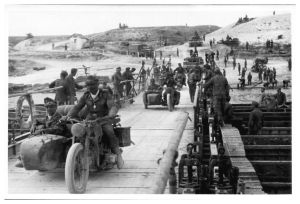
battle-stalingrad-ww2-second-world-war-germans-don-river-rare-pictures-unseen-photos-images

German unit crossing the Don

As the 6th Army moved into the city General Yeremenko ordered attacks against General Hube’s 16th Panzer Division. Soviet resistance increased as more formations arrived the Germans suffered one of their heaviest casualty rates. [lxiv] Though unsuccessful the Soviet counterattacks “managed to deflect Paulus’s reserves at the most critical moment.” [lxv] The Germans remained confident the first week of September as 6th Army and the 4th Panzer Army linked up, but Yeremenko saved his forces by withdrawing and avoided encirclement west of the city, retiring to an improvised line closer to the Stalingrad. [lxvi] On September 12th Vasily Chuikov was appointed to command 62nd Army in Stalingrad.  Chuikov understood that for the Soviets in Stalingrad there “was only one way to hold on. They had to pay in lives. ‘Time is blood,’ as Chuikov put it later.” [lxvii] Stalin sent Nikita Khrushchev to the front “with orders to inspire the Armies and civilian population to fight to the end.” [lxviii] In the next few days the 13th Guards Rifle Division arrived and saved the Volga landings, which allowed the Soviets to continue to resupply Stalingrad, but the division last 30% of its troops as casualties in its first 24 hours of combat. [lxix]
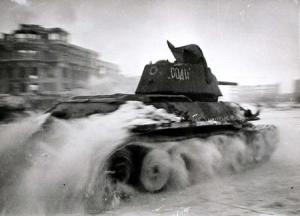
t-34 stalingrad

T-34 in Stalingrad

An NKVD regiment and other units held the strategically sited Mamaev Kurgan, keeping German guns from controlling the Volga.[lxx] The defenders contucted a house to house and block by block fight, and the Red Army and NKVD units were reinforced by Naval Infantry.  Chuikov conducted the defense with a brutal ferocity, relieving senior commanders who showed a lack of fight and by sending many officers to penal units.  Chuikov’s defensive plan was masterful; he funneled German attacks into “breakwaters” where the panzers and infantry could be separated from each other causing heavy German casualties. [lxxi]

Bype36yIQAASUVK

resized_battle-stalingrad-6

resized_battle-stalingrad-4

Now for Hitler the “city became a prestige item, its capture ‘urgently necessary for psychological reasons,’ as Hitler declared on October 2. A week later he declared that Communism must be ‘deprived of its shrine.’” [lxxii] The Germans continued to gain ground in the city, but slowly and at great cost, especially among their infantry, so much so that decimated companies had to be combined to form combat effective units.
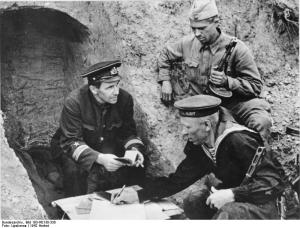
Bild 183-R0130-330

person_chuikov1

Chuikov used his artillery to interdict the Germans from the far side of the Volga while assault squads with incredible ferocity fought the fight in the city.   The close-quarters combat in the city was dubbed, “Rattenkrieg by German soldiers.” [lxxiii] Paulus continued to bring more units into the city, further thinning his flanks, but his troops continued to slowly drive the Russians back against the river, and by early October Chuikov wondered if he would be able to hold. [lxxiv] It appeared that the Germans might finally capture Stalingrad, and by November Chuikov “was altogether holding only one-tenth of Stalingrad – a few factory buildings and a few miles of river bank.” [lxxv] Paulus now expected “to capture the entire city by 10 November,” [lxxvi] despite the fact that many of his units were fought out. The causalities had been massive; an analysis by 6th Army determined that 42% of the battalions of 51st Corps were fought out. [lxxvii] Even so on November 9th, a confident Hitler declared “No power on earth will force us out of Stalingrad again!” [lxxviii] However, that boast was misplaced.

Soviet Counteroffensive: Disaster on the Flanks

stalingrad-map-counterattack

T34_Stalingrad-Offensive-px800

soviet infantry attacking

Soviet Forces Advancing

As 6th Army fought its way into Stalingrad some officers in the German High Command attempted to warn Hitler of the danger. Hitler now tolerated no interference, and on September 24th he relieved Halder for persisting to explain, “what would happen when new Russian reserve armies attacked the over-extended flank that ran out to Stalingrad.” [lxxix] Many on others the German side recognized the danger. Blumentritt said, “The danger to the long-stretched flank of our advance developed gradually, but it became clear early enough for anyone to perceive it who was not willfully blind.” [lxxx] Rumanian Marshall Antonescu, and the staffs of both Army Group B and Paulus’s 6th Army warned Hitler too, [lxxxi] but Hitler was transfixed on Stalingrad.  By their sole focus on Stalingrad the Germans gave up the advantage of uncertainty and once the German “aim became obvious…the Russian Command could commit its reserves with assurance.” [lxxxii]

person_chuikov4

Chuikov and his staff

Despite Stalin’s concern about Stalingrad the Stavka planners never lost sight of their goal to resume large-scale offensive operations and destroy at least one German Army Group. [lxxxiii] Unlike Hitler, the ever suspicious Stalin had begun to trust his Generals and Stavka under the direction of Marshal Vasilevsky produced a concept in September to cut off the “German spearhead at Stalingrad by attacking the weak Rumanian forces on its flanks.” [lxxxiv] At first Stalin “showed little enthusiasm” for the attack, fearing that Stalingrad might be lost, but on 13 September he gave his full backing to the proposal [lxxxv] which Marshals Zhukov, Vasilevsky and Vatutin developed into a plan involving three operations; Operation Uranus, to destroy the German and allied forces at Stalingrad, and Operation Saturn to destroy all the German forces in the south, and a supporting attack to fix German forces in the north, Operation Mars aimed at Army Group Center. [lxxxvi]

Russian-Ground-Mount-Rocket

Soviet Katusha Rockets

To accomplish the destruction of 6th Army and at least a part of 4th Panzer Army around Stalingrad the Stavka planners employed over 60% of the “whole tank strength of the Red Army.” [lxxxvii] Strict secrecy combined with numerous acts of deception was used by the Red Army to disguise the operation. [lxxxviii] The plan involved an attack against 3rd Romanian Army on the northern flank by the Soviet 5th Tank Army and two infantry armies and their supporting units. [lxxxix] In the south another force of over 160,000 men and 430 tanks were deployed against 4th Rumanian Army and weak element of 4th Panzer Army. [xc] Despite warnings from his Intelligence Officer, Paulus did not expect a deep offensive into his flanks and rear and made no plans to prepare to face the threat. [xci] Other senior officers believed that the attack would take place against Army Group Center. [xcii] Walter Warlimont who served at OKW noted that there was a “deceptive confidence in German Supreme Headquarters.” [xciii]

 ju-52 stalingrad

Luftwaffe JU-52s made many resupply runs into the pocket but suffered great losses

The storm broke on 19 November as Soviet forces attacked rapidly crushing Romanian armies to the north and the south of Stalingrad [xciv] linking up to encircle the Germans in the city on the 23rd. [xcv] The German 48th Panzer Corps supporting the Romanians was weakened by the exhausting campaign and had few operational tanks. [xcvi] It attempted a counterattack but was “cut to pieces” in an engagement against the 5th Tank Army. [xcvii] A promising attempt by the German 29th Motorized division against the flank of the southern Russian pincer was halted by the Army Group and the division was ordered to defensive positions south of Stalingrad. [xcviii] To compound German problems the Luftwaffe was neutralized by bad weather. [xcix] Inside the city Paulus continued to do nothing as since the attacks were outside of his area of responsibility and rather than taking the initiative to extricate his forces, waited for instructions. [c] As a result the 6th Army’s 16th and 24th Panzer Divisions that could have assisted matters to the west remained “bogged down in street-fighting in Stalingrad.” [ci] Without support of the army’s Panzer formations, the 6th Army units west of Stalingrad were forced back in horrific conditions.  By the 23rd of November the 6th Army was cut off along with one corps of the 4th Panzer Army and assorted Romanian units, over 330,000 men.  Though they had the Germans surrounded, the entrapped force would require the Soviets to use seven rifle armies and much staff attention to eliminate. [cii]

von Paulus surrenders to the Soviets

Paulus Surrenders

Hitler ordered Von Manstein to form a new, composite, Army Group Don, to relieve Stalingrad. Hitler would not countenance a break out by the encircled forces and wanted Manstein to break through and relieve the 6th Army.[ciii] Hitler refused a request by Paulus on 23 November to move troops to prepare for a possible a break out attempt, and assured him that he would be relieved. [civ] Albert Speer noted that General Kurt Zeitzler who replaced Halder at OKW insisted that the Sixth Army “must break out to the west.” [cv] Hitler, completely obsessed with capturing Stalingrad told Zeitzler, “We should under no circumstances give this up. We won’t get it back once it’s lost.” [cvi] The ever boastful Herman Goering promised that his Luftwaffe would be able to meet the re-supply needs of 6th Army by air, even though his own Generals knew that it was impossible with the number of transport aircraft available. [cvii] However, Hitler took his Luftwaffe chief at his word and exclaimed “Stalingrad can be held! It is foolish to go on talking any more about a breakout by Sixth Army…” [cviii] Hitler then issued a Führer decree ordering that the front be held at all costs. [cix] Walter Goerlitz stated, “Hitler was incapable of conceiving that the 6th Army should do anything but fight where it stood.” [cx] Likewise Manstein had precious few troops with which to counterattack, as he also had to protect the flank of Army Group A, which was still deep in the Caucasus.

hungarian withdraw

hungarian dead stalingrad

Hungarian Dead and Wounded

Manstein’s “army group” was only corps strength and was spread across a 200 mile front. [cxi] Any relief attempt had to wait for more troops, especially Panzers.  Manstein believed that the best chance for a breakout had passed and that it was a serious error for Paulus to put the request to withdraw through to Hitler rather than the Army Group or act on his own [cxii] and many soldiers, long conditioned to believe in the promises of their Hitler were optimistic that Hitler would get them out of the caldron. [cxiii] Other German generals like Guderian, Reichenau, Heinrici, Hoeppner, or even the Waffen SS General Sepp Dietrich might have acted to save their army, but Paulus, surrounded in the city, was knew nothing but obedience.[cxiv]
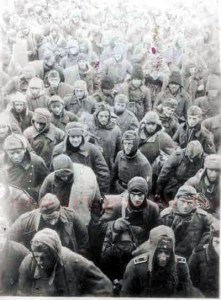
pows stalingrad

German POWs only 5000 of some 90,000 would see home again

Operation Saturn began on 7 December destroying the Italian 8th Army and forcing the Germans to parry the threat.[cxv] A relief attempt by 57th Panzer Corps under Hoth on 12 December made some headway until a massive Soviet counterattack on 24 December drove it back.[cxvi] This attack was hampered by OKW’s refusal to allocate the 17th Panzer and 16th Motorized divisions to Manstein,[cxvii] and by 6th Army not attacking out to link with the relief force.[cxviii]By 6 January Paulus signaled OKW: Army starving and frozen, have no ammunition and cannot move tanks anymore.”[cxix] On 10 January the Soviets launched Operation Ring to eliminate the pocket and despite all odds German troops fought on. On the 16th Paulus requested that battle worthy units be allowed to break out, but the request was not replied to.[cxx] On the 22nd the last airfield had been overrun and on 31 January Paulus surrendered.[cxxi]

Analysis: What Went Wrong

Stalingrad had drawn the attention Hitler and Stalin and the lives of their soldiers into a giant vortex of death. However, the Soviet Stavka, even when facing disaster never lost sight of their primary objectives during the campaign. The Germans on the other hand committed numerous unforced errors mostly caused by Hitler and or von Paulus. The German mistakes began early in their planning process and continued throughout the campaign. Overconfident, they failed to follow up success, and allowed the Soviets to regroup and then smash their forces at Stalingrad.
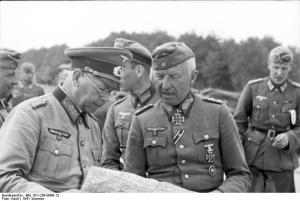
Russland-Nord, Erich von Manstein, Brandenberger

Von Manstein

After the fall of Stalingrad as the Soviets attempted to follow up their success by attempting to cut off Army Group “A.” Manstein, with the meager forces at hand was permitted by Hitler to wage a mobile defense while Von Kleist managed to withdraw his army group with few losses. [cxxii] The superior generalship of Manstein and Von Kleist prevented the wholesale destruction of German forces in southern Russia and Manstein’s counter offensive inflicted a severe defeat on the Soviets, showing them that the German army, though wounded was not without the power to fight back.

But the German Army had suffered a massive defeat.  The seeds of defeat were laid early, the failure to destroy bypassed Soviet formations in July, the diversion of 4th Panzer Army from Stalingrad, and the divergent objectives of trying to capture the Caucasus and Stalingrad at the same time.  This diluted both offensives ensuring that neither succeeded.  Likewise the failure to recognize the culminating point when it was reached and to adjust operations accordingly was disastrous for the Germans. The failure create a mobile reserve to meet possible Russian counter offensives, and the fixation on Stalingrad took the German focus off of the critical yet weakly held flanks.

The hubris of Hitler and OKW to believe that the Russians were incapable of conducting major mobile operations even as Stavka commenced massive offensive operations on the thinly held flanks all contributed to the defeat.  Alan Clark notes these facts but adds that the Germans “were simply attempting too much.” [cxxiii] Likewise, the Soviet advantage in numbers allowed them to wear down the Germans even early in the campaign when they were suffering defeat after defeat. [cxxiv] Stalin, whose decisions had nearly lost the war in 1941 gave his commanders a chance to revive the mobile doctrine of deep operations with mechanized and shock armies that he had discredited in the 1930s. [cxxv] All through the campaign Zhukov and other commanders maintained both their nerve even when it appeared that Stalingrad was all but lost. They never lost sight of their goal of destroying major German formations though they failed to entrap Army Group A with 6th Army.

Notes

[i] Clark, Alan. Barbarossa: The Russian-German Conflict: 1941-45. Perennial Books, An imprint of Harper Collins Publishers, New York, NY 1965. p.191

[ii] Ibid.

[iii] Glantz, David M. and House, Jonathan. When Titan’s Clashed: How the Red Army Stopped Hitler. The University Press of Kansas, Lawrence KS, 1995. p.111

[iv] Ibid. Clark. p.191

[v] Beevor, Anthony. Stalingrad: The Fateful Siege: 1942-1943. Penguin Books, New York NY 1998. p.69

[vi] Manstein, Erich von. Forward by B.H. Liddle Hart, Introduction by Martin Blumenson. Lost victories: The War Memoirs of Hitler’s Most Brilliant General. Zenith Press, St Paul MN 2004. First Published 1955 as Verlorene Siege, English Translation 1958 by Methuen Company. p.291 This opinion is not isolated, Beevor Quotes Paulus “If we don’t take Maikop and Gronzy…then I must put an end to the war.” (Beevor pp. 69-70)  Halder on the other hand believed that Hitler emphasized that the objective was “the River Volga at Stalingrad. (Clark. p.190)

[vii] Ibid. Beevor. p.70.

[viii] Ibid. Glantz and House. p.106

[ix] Ibid. p.105-106

[x] Ibid. Clark. p.203.  The offensive did impose a delay on the German offensive.

[xi] Ibid. Clark. p.191 Each group also contained allied armies.

[xii] Ibid. p.209.

[xiii] Ibid. Glantz and House. p.119

[xiv] Ibid. Manstein. p.292.

[xv] Ibid. Clark. p.209

[xvi] Ibid. Clark.  p.211

[xvii] Ibid. Glantz and House. p.120. There is a good discussion of the impact of this decision here as 6th Army’s advance was given priority for both air support and fuel.

[xviii] Ibid. Beevor. p.74

[xix] Warlimont, Walter. Inside Hitler’s Headquarters 1939-45. Translated by R.H. Berry, Presido Press, Novato CA, 1964. p.249

[xx] Ibid. Beevor. p.75 This was the 10th NKVD Division and it took control of all local militia, NKVD, and river traffic, and established armored trains and armor training schools.

[xxi] Ibid. Clark. p.212

[xxii] Ibid. Glantz and House. p.121

[xxiii] Ibid. Beevor. p.85

[xxiv] Ibid. p.89

[xxv] Liddell-Hart, B.H. The German Generals Talk. Quill Publishers, New York, NY 1979. Originally published by the author in 1948. p.202

[xxvi] Ibid. Beevor. p.88

[xxvii] Ibid. Beevor. p.90

[xxviii] Ibid. Beevor. p.81

[xxix] Ibid. Glantz and House. p.121

[xxx] Ibid. Liddell-Hart. p.202

[xxxi] Ibid. Glantz and House. p.120

[xxxii] Goerlitz, Walter. History of the German General Staff. Westview Press, Frederick A. Praeger Publisher, Boulder, CO. 1985 p.416

[xxxiii] Ibid. Beevor. pp.95-96.

[xxxiv] Von Mellenthin, F.W. Panzer Battles: A Study of the Employment of Armor in the Second World War. Translated H. Betzler, Edited by L.C.F. Turner. Oklahoma University Press 1956, Ballantine Books, New York, NY. 1971. p.193

[xxxv] Shirer, William L. The Rise and Fall of the Third Reich. A Touchstone Book published by Simon and Schuster, 1981, Copyright 1959 and 1960. p.914

[xxxvi] Ibid. Glantz and House. p.122

[xxxvii] Ibid. Warlimont. p.256

[xxxviii] Ibid. Liddell-Hart. p.203

[xxxix] Ibid. p.204

[xl] Ibid. Shirer. p.914

[xli] Ibid. Goerlitz. p.416

[xlii] Ibid. Goerlitz. p.416

[xliii] Ibid. Manstein. p.293

[xliv] Ibid. Clark. p.214

[xlv] Ibid. Beevor. pp.97-99. The mobilization included military, political, civilian and industrial elements.

[xlvi] Liddell-Hart, B.H. Strategy. A Signet Book, the New American Library, New York, NY. 1974, Originally Published by Faber and Faber Ltd., London. 1954 & 1967. p.250

[xlvii] Ibid. Beevor. p.99.  Two key commanders arrived during this time frame, Colonel General Andrei Yeremenko, who would command the Stalingrad Front  and General Chuikov commander of 64th Army who would conduct the defense of the city.

[xlviii] Carell, Paul Hitler Moves East: 1941-1943. Ballantine Books, New York, NY 1971, German Edition published 1963. p.581

[xlix] Ibid. Shirer.  p.909.

[l] Ibid. Liddell-Hart, Strategy. p.250

[li] Wheeler-Bennett, John W. The Nemesis of Power: The German Army in Politics 1918-1945. St. Martin’s Press, New York, NY 1954.  p.531

[lii] Ibid. Wheeler-Bennett. p.531

[liii] Ibid. Beevor. p.96

[liv] Ibid. Clark. p.216.

[lv] Ibid. Von Mellenthin. P.193

[lvi] See Von Mellinthin pp.193-194.  Von Mellinthin quotes Colonel Dinger, the Operations Officer of 3rd Motorized Division at Stalingrad until a few days before its fall. Dingler noted that the Germans on reaching Stalingrad “had reached the end of their power. Their offensive strength was inadequate to complete the victory, nor could they replace the losses they had suffered.” (p.193) He believed that the facts were sufficient “not only to justify a withdrawal, but compel a retreat.” (p.194)

[lvii] Ibid. Manstein. p.294

[lviii] Ibid. Clark. p.216

[lix] Ibid. Clark. p.217

[lx] Ibid. Beevor. p.107

[lxi] Ibid. Beevor. p.107

[lxii] Ibid. Glantz and House. p.122

[lxiii] Ibid. Carell. P.601

[lxiv] Ibid. Beevor. p.118

[lxv] Ibid. Beevor. p.118

[lxvi] Ibid. Carell. p.602

[lxvii] Ibid. Beevor. p.128

[lxviii] Ibid. Carell. p.603

[lxix] Ibid. Beevor. p.134

[lxx] Ibid. Beevor. pp.136-137

[lxxi] Ibid. Beevor. p.149

[lxxii] Fest, Joachim. Hitler. Translated by Richard and Clara Winston, Harcourt, Brace, Jovanovich Publishers, San Diego, New York, London. 1974. p.661

[lxxiii] Ibid. Beevor. pp. 149-150

[lxxiv] Ibid. Beevor. p.164

[lxxv] Ibid. Carell. p.618

[lxxvi] Ibid. Glantz and House. p.123

[lxxvii] Ibid. Beevor. p.218

[lxxviii] Ibid. Carell. p.623

[lxxix] Ibid. Goerlitz. p.418

[lxxx] Ibid. Liddell-Hart. The German Generals Talk. p.207

[lxxxi] Ibid. Manstein. p292

[lxxxii] Ibid. Liddell-Hart. History of the Second World War. p.258

[lxxxiii] Ibid. Glantz and House. p.129

[lxxxiv] Ibid. Glantz and House. p.130

[lxxxv] Ibid. Beevor. pp.221-222 Glantz and House say that Stalin gave his backing in mid-October but this seems less likely due to the amount of planning and movement of troops involved to begin the operation in November.

[lxxxvi] Ibid. Glantz and House. p.130

[lxxxvii] Ibid. Beevor. p.226

[lxxxviii] Ibid. Glantz and House. p.132

[lxxxix] Ibid. Glantz and House. p.130

[xc] Ibid. Beevor. p.227

[xci] Ibid. Beevor. p.228

[xcii] Ibid. Clark. p.235

[xciii] Ibid. Warlimont. p.274

[xciv] Ibid, Carell. p.627 3rd Rumanian Army lost 75,000 men in three days.

[xcv] Ibid. Clark.pp.247-248

[xcvi] The condition of the few German Panzer Divisions in position to support the flanks was very poor, the 22nd had suffered from a lack of fuel and maintenance and this many of its tanks were inoperative. Most of the armor strength of the 48th Panzer Corps was provided by a Rumanian armored division equipped with obsolete Czech 38t tanks provided by the Germans.

[xcvii] Ibid. Clark. pp.251-252. The designation of 2nd Guards Tank Army by Clark has to be wrong and it is the 5th Tank Army as 2nd Guards Tank was not involved in Operation Uranus.  Carell, Beevor and Glantz properly identify the unit.

[xcviii] Ibid. Carell. p.630

[xcix] Ibid. Beevor. p.244

[c] Ibid. Beevor. p.247

[ci] Ibid. Beevor. p.245

[cii] Ibid. Glantz and House. p.134

[ciii] Ibid. Glantz and House. p.134

[civ] Ibid. Clark. p.256

[cv] Speer, Albert. Inside the Third Reich. Collier Books, a Division of MacMillan Publishers, Inc. New York, NY 1970. p.248

[cvi] Heiber, Helmut and Glantz, David M. Editors. Hitler and His Generals: Military Conferences 1942-1945. Enigma Books, New York, NY 2002-2003.  Originally published as Hitlers Lagebsprechungen: Die Protokollfragmente seiner militärischen Konferenzen 1942-1945. Deutsche Verlags-Anstalt GmbH, Stuttgart, 1962. p.27

[cvii] Ibid. Glantz and House. p.135 Glantz and House note that the amount of aircraft estimated to successfully carry out the re-supply operation in the operational conditions was over 1,000.  The amount needed daily was over 600 tons of which the daily reached only 300 tons only one occasion.

[cviii] Ibid. Speer. p.249

[cix] Ibid. Carell. p.636

[cx] Ibid. Goerlitz. p.426

[cxi] Ibid. Clark. p.252

[cxii] Ibid. Manstein. p.303

[cxiii] Ibid. Beevor. p.276

[cxiv] Ibid. Carell. p.640

[cxv] Ibid. Glantz and House. p.140

[cxvi] Ibid. Glantz and House. p.140

[cxvii] Ibid. Clark. p.264

[cxviii] Ibid. Manstein. p.337

[cxix] Ibid. Beevor. p320

[cxx] Ibid. Beevor. p.365

[cxxi] Of the approximately 330,000 in the pocket about 91,000 surrendered, another 45,000 had been evacuated.  22 German divisions were destroyed.

[cxxii] Ibid. Liddell-Hart. The German Generals Talk. p.211

[cxxiii] Ibid. Clark. p.250

[cxxiv] Ibid. Glantz and House. p.124

[cxxv] Ibid. Beevor. p.221


Bibliography

Beevor, Anthony. Stalingrad: The Fateful Siege: 1942-1943. Penguin Books, New York NY 1998

Carell, Paul Hitler Moves East: 1941-1943. Ballantine Books, New York, NY 1971, German Edition published 1963.

Clark, Alan. Barbarossa: The Russian-German Conflict:1941-45. Perennial Books, An imprint of Harper Collins Publishers, New York, NY 1965.

Fest, Joachim. Hitler. Translated by Richard and Clara Winston, Harcourt, Brace, Jovanovich Publishers, San Diego, New York, London. 1974

Glantz, David M. and House, Jonathan. When Titan’s Clashed: How the Red Army Stopped Hitler. The University Press of Kansas, Lawrence KS, 1995.

Goerlitz, Walter. History of the German General Staff. Westview Press, Frederick A. Praeger Publisher, Boulder, CO. 1985

Heiber, Helmut and Glantz, David M. Editors. Hitler and His Generals: Military Conferences 1942-1945. Enigma Books, New York, NY 2002-2003.  Originally published as Hitlers Lagebsprechungen: Die Protokollfragmente seiner militärischen Konferenzen 1942-1945. Deutsche Verlags-Anstalt GmbH, Stuttgart, 1962.

Liddell-Hart, B.H. The German Generals Talk. Quill Publishers, New York, NY 1979. Originally Published by the author in 1948.

Liddell-Hart, B.H. Strategy. A Signet Book, the New American Library, New York, NY. 1974, Originally Published by Faber and Faber Ltd., London. 1954 & 1967

Manstein, Erich von. Forward by B.H. Liddle Hart, Introduction by Martin Blumenson. Lost victories: The War Memoirs of Hitler’s Most Brilliant General. Zenith Press, St Paul MN 2004. First Published 1955 as Verlorene Siege, English Translation 1958 by Methuen Company

Shirer, William L. The Rise and Fall of the Third Reich. A Touchstone Book published by Simon and Schuster, 1981, Copyright 1959 and 1960

Speer, Albert. Inside the Third Reich. Collier Books, a Division of MacMillan Publishers, Inc. New York, NY 1970.

Von Mellenthin, F.W. Panzer Battles: A Study of the Employment of Armor in the Second World War. Translated H. Betzler, Edited by L.C.F. Turner. Oklahoma University Press 1956, Ballantine Books, New York, NY. 1971.

Warlimont, Walter. Inside Hitler’s Headquarters 1939-45. Translated by R.H. Berry, Presido Press, Novato CA, 1964.

Wheeler-Bennett, John W. The Nemesis of Power: The German Army in Politics 1918-1945. St. Martin’s Press, New York, NY 1954

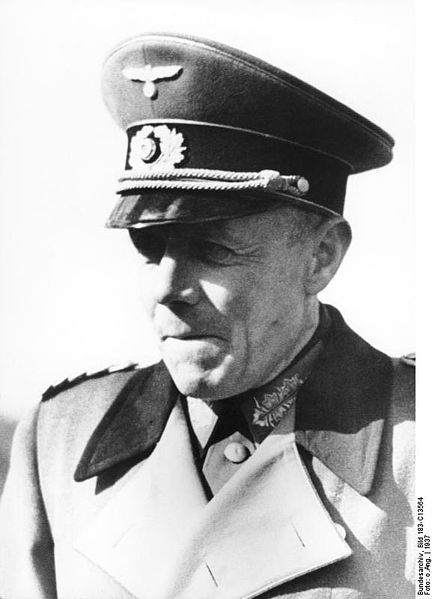
2 Comments

Filed under History, Military, world war two in europe

The Four Freedoms

FDR_Memorial_wall

Friends of Padre Steve’s World,

On January 6th 1941 President Franklin Delano Roosevelt delivered his State of the Union Message to Congress and the nation. I spent the time to both both read it and listen to it the other day. It is a profoundly moving speech, not without controversy of course, but one which we need to hear again. It is a speech that like the Declaration of Independence, Lincoln’s  Gettysburg Address, and Dr. Martin Luther King Jr.’s I have a Dream speech calls us to higher ideals, ideals that we often come up short in living up to, but ideals worth living for.

When Roosevelt spoke the nation was in the midst of crisis. It was still recovering from the Great Depression, war threatened as Hitler’s Nazi German legions had overrun all of Western Europe, much of North Africa, and German U-Boats and surface ships were prowling the North Atlantic. Britain stood alone between Germany’s complete domination of Europe. Even the Soviet Union, a mortal enemy of Fascism had concluded a concordat with Hitler to divide Eastern Europe. Though no one yet knew it, Hitler was already planning to break his accord with Stalin and invade the Soviet Union.

In the speech, which was largely focus on the threat of Nazi Germany, support of Britain and the exiled governments of nations conquered by Hitler, and preparations to defend the United States, Roosevelt called on Congress to pass Lend Lease to help those fighting the dictators, as well as increased opportunity at home. In response to the emerging threats and the unwillingness of some, including big business to face up to them. He noted:

“As a nation we may take pride in the fact that we are soft-hearted; but we cannot afford to be soft-headed.  We must always be wary of those who with sounding brass and a tinkling cymbal preach the “ism” of appeasement.  We must especially beware of that small group of selfish men who would clip the wings of the American eagle in order to feather their own nests.”

On the domestic front Roosevelt reiterated the message of the New Deal, for even with war looming he did not want to see Americans lost in the exchange and he linked freedom abroad to the same at home. He noted:

“As men do not live by bread alone, they do not fight by armaments alone. Those who man our defenses and those behind them who build our defenses must have the stamina and the courage which come from unshakable belief in the manner of life which they are defending. The mighty action that we are calling for cannot be based on a disregard of all the things worth fighting for.”

He continued:

“Certainly this is no time for any of us to stop thinking about the social and economic problems which are the root cause of the social revolution which is today a supreme factor in the world. For there is nothing mysterious about the foundations of a healthy and strong democracy.

The basic things expected by our people of their political and economic systems are simple. They are:

Equality of opportunity for youth and for others.

Jobs for those who can work.

Security for those who need it.

The ending of special privilege for the few.

The preservation of civil liberties for all.

The enjoyment — The enjoyment of the fruits of scientific progress in a wider and constantly rising standard of living.

These are the simple, the basic things that must never be lost sight of in the turmoil and unbelievable complexity of our modern world. The inner and abiding strength of our economic and political systems is dependent upon the degree to which they fulfill these expectations.”

But the real heart of the message, applicable to all people everywhere Roosevelt enunciated a number of principles that are a beacon to all people. Firmly grounded in words of the Declaration of Independence and the Gettysburg Address they are called the Four Freedoms. Those freedoms are an ideal, in fact they certainly were not practiced well then by Americans, nor now, but they are worth working to: Roosevelt said:

“In the future days, which we seek to make secure, we look forward to a world founded upon four essential human freedoms.

The first is freedom of speech and expression—everywhere in the world.

The second is freedom of every person to worship God in his own way—everywhere in the world.

The third is freedom from want—which, translated into world terms, means economic understandings which will secure to every nation a healthy peacetime life for its inhabitants—everywhere in the world.

The fourth is freedom from fear—which, translated into world terms, means a world-wide reduction of armaments to such a point and in such a thorough fashion that no nation will be in a position to commit an act of physical aggression against any neighbor—anywhere in the world.

That is no vision of a distant millennium. It is a definite basis for a kind of world attainable in our own time and generation. That kind of world is the very antithesis of the so-called new order of tyranny which the dictators seek to create with the crash of a bomb.”

The speech was important, and now as it did then it calls Americans to higher purposes, to higher ideals, and it recognizes that we have never fully measured up to our own words. At the time it was spoken, Jim Crow was still the law of the land, Mexican Americans were often treated as poorly as blacks, Native Americans had few rights; and barely a year later Japanese Americans would be taken from the homes, lose their business and be sent to detention camps for the duration of the war after Pearl Harbor, simply because they were of Japanese descent. But those abiding principles are things that we should never lose sight of, and always strive to realize.

In an age of uncertainty, turbulence, division, inequity, and deeply ingrained cynicism like ours, it is time to reflect on them, to strive for a higher purpose, and not to lose hope or give in to fear.

Peace,

Padre Steve+

3 Comments

Filed under History, philosophy, Political Commentary

The Mob Determined the Theme

Borowitz-Trump-Vietnam-1200

Friends of Padre Steve’s World

When Albert Speer discussed the ability of Adolf Hitler to captivate the German people he noted something important. He discussed how Hitler and his minions played to them set by the disgruntled and angry German population. Speer wrote, “The mob determined the theme. To compensate for misery, insecurity, unemployment, and hopelessness, this anonymous assemblage wallowed for hours at a time in obsessions, savagery and license. The personal unhappiness caused by the breakdown of the economy was replaced by a frenzy that demanded victims. By lashing out at their opponents and vilifying the Jews, they gave expression and direction to fierce primal passions.”

Hitler played to that misery, insecurity and the obsessions of the politically and economically disaffected “conservative base” that no longer trusted the party establishments of the old-line conservative parties. He also played to the deep-rooted racism and anti-Semitism of those people. Hitler was an outsider, he was not indebted to any traditional party hierarchy and as such was able to throw away convention and play to the fear and anger of many Germans.

heres-what-donald-trump-supporters-really-believe

Donald Trump is doing today and he is running circles around the traditional politicians of the Republican Party. Every time trump says something that would have gotten himself blown out of the race twenty years ago had he said such things, today his poll numbers keep going up. He is now trending around 35% in most polls of GOP voters and my guess is that those numbers are low, as some supporters may not be willing to tell a pollster that they are for Trump, at least yet. My guess is that Trump’s support in the GOP is probably higher than 40% and won’t go down much. The party hierarchy and most of Trump’s primary rivals consistently criticize Trump, but most say that they will back him if he is the nominee. I cannot imagine that being the case twenty years ago when both the party establishment and the voters would have dumped him in a New York minute.

Aug. 21. 2015 Mobile, AL, Trump supporters at his campaign pep rally in Ladd Peebles Stadium. These women are all party of the Republican Party and plan to vote for Trump.  Over 20 thousand came to the Ladd-Peebles Stadium to attend Trumps campaign pep rally. 40,000 were expected to come.

Trump understands the mood of much of the traditionally conservative public better than his Republican establishment competitors. Trump is not stupid, unlike Hitler who actually believed in his message, Trump is not a radical, he cannot be, he has too much invested in the system. Instead, he is a street smart and pragmatic businessman who is exploiting the situation on the ground to his advantage. His opponents and the GOP establishment are frightened, but like the hidebound conservatives of the Weimar Republic who either dismissed or Hitler or thought that they could contain him are not willing to make a stand. As a result, Trump is able to play to the mood of the base and to coin a phrase, to “trump the establishment” by channeling the deepest anger, fear, hatred, xenophobia, and racism that the GOP establishment refuses to acknowledge. When there is a push back by the establishment it further angers the base, and Trump, quite adroitly threatens to leave the party; something which would doom the GOP in the 2016 general election, and possibly shatter the party.

Trump’s GOP opponents should not underestimate him and neither should establishment Democrats. Trump is using his celebrity bombast and the democratic process to take control of a major political party, and he is a lot smarter than most political analysts give him credit. As such, as a non-establishment outsider, Trump has a chance at taking over a major political party, something that has never before happened in the United States.

If he succeeds in his takeover bid, it will forever change American politics, especially if he is able to ride the fear, hatred, and fear to the White House. I don’t think the latter will happen, but I would not exclude it from the realm of the possible. To paraphrase Speer’s words about Hitler and Goebbels: By lashing out at their opponents and vilifying the Muslims and immigrants, Trump gave expression and direction to fierce primal passions of a disaffected GOP base.

Peace

Padre Steve+

7 Comments

Filed under History, News and current events, Political Commentary