Tag Archives: afghanistan

Stalingrad: Disaster on the Volga

Madonna of Stalingrad: Drawn by a German Chaplain and physician the piece was taken out of the city by one of the last officers to get out. It is now displayed in the Kaiser Wilhelm Memorial Church in Berlin

Sunday the 31st of January marks the surrender of the remnants of the German 6th Army to the Soviets at Stalingrad. The focus of this article is on how the Germans and Russians fought the Stalingrad campaign. In particular it is an analysis of the way the governments and military’s of both Nazi Germany and the Soviet Union planned and executed strategy during the course of the campaign adjusted to the situation and how the campaign ended. It is also a reminder of the price that ordinary soldiers can pay when a country commits them to war. I conclude with a potential modern application for the US and NATO in Afghanistan.

Stalingrad: Primary or Secondary Objective
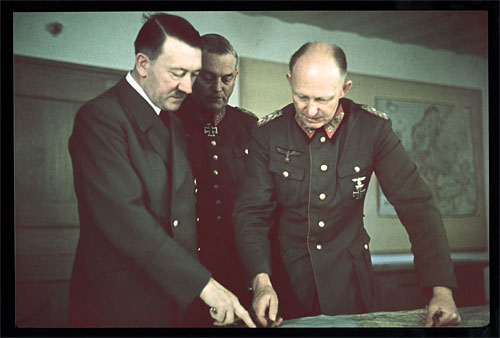
The mistakes began early in the planning and conduct of the operation

Following the Soviet winter offensive and the near disaster in front of Moscow the German High Command was faced with the strategic decision of what to do in the 1942 campaign.  Several options were considered and it was decided to seize the Caucasus oilfields and capture or neutralize the city of Stalingrad on the Volga.  However, the High Command was divided on the actual objective of the campaign.

OKH under the guidance of General Halder assumed that Stalingrad was the objective and the advance into the Caucasus was a blocking effort.[i] Hitler and OKW planned to capture the Caucasus oil fields and capture or neutralize Stalingrad to secure the left flank.[ii] Both OKH and OKW considered Stalingrad significant but “German commanders initially regarded it as a weigh station en route to the Caucasus oil fields.”[iii] The conflict echoed in the ambiguity of Directive No. 41 which “included the ‘seizure of the oil region of the Caucasus’ in the preamble concerning the general aim of the campaign, yet made no mention of this in the main plan of operations.”[iv] At the planning conference held at Army Group South in early June “Hitler hardly mentioned Stalingrad. As far as his Generals were concerned it was little more than a name on the map. His obsession was with the oil fields of the Caucasus.”[v] Manstein noted that “Hitler’s strategic objectives were governed chiefly by the needs of his war economy….”[vi] Anthony Beevor notes that at this stage of planning “the only interest in Stalingrad was to eliminate the armaments factories there and secure a position on the Volga. The capture of the city was not considered necessary.”[vii] German planners “expected that the Soviets would again accept decisive battle to defend these regions.”[viii]

In Moscow Stalin and his Generals attempted to guess the direction of the impending German offensive.  “Stalin was convinced that Moscow remained the principle German objective…Most of the Red Army’s strategic reserves…were therefore held in the Moscow region.”[ix] To disrupt the German offensive and to attempt to recover Kharkov three offensives were launched by Red Army forces under the direction of Stavka. The largest of these on Kharkov was defeated between 12-22 May with the loss of most of the armor in southern Russia. This coupled with an equally disastrous defeat of Red Army forces in Crimea by Von Manstein’s 11th Army meant that the Red Army would face the Germans in a severely weakened condition.[x]

Operation Blau: Opening Moves and Divergent Objectives
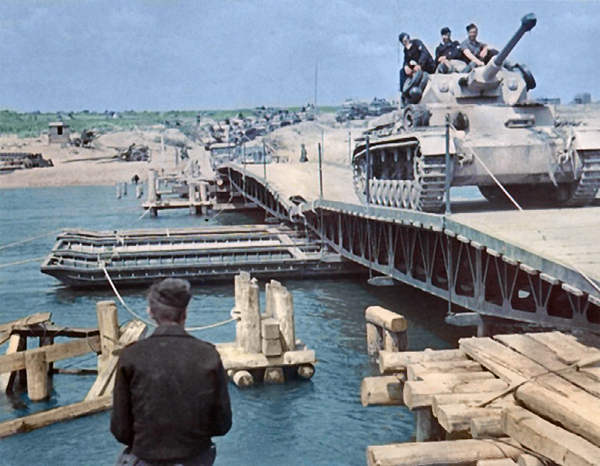
Panzers cross the Don

The German offensive began on 28 June under the command of Field Marshal von Bock. Bock’s command included two separate army groups, Army Group B under General Von Weichs with 2nd Army, 6th Army and 4th Panzer Army operated in the northern part of the operational area. Army Group A was to the south with 17th Army and 1st Panzer Army.[xi] Army Group B provided the main effort and quickly smashed through the defending Soviet armies and by the 20th Hitler believed that “the Russian is finished.”[xii] One reason for the German success in the south was that until July 7th Stalin believed that Moscow was still the primary objective.[xiii] Bock was prevented by Hitler from destroying Soviet formations left behind and was relieved of command by Hitler. He was replaced by Von Weichs which created a difficult command and control problem.  Manstein noted that this created a “grotesque chain of command on the German southern wing” with the result that Army Group A had “no commander of its own whatever” and Army Group B had “no few than seven armies under command including four allied ones.”[xiv]

Destroyed Soviet T-34s

This decision proved fateful.  Hitler’s decided to redirect the advance of the 4th Panzer Army to support an early passage of the lower Don, diverting it from its drive on Stalingrad.  Additionally the army groups became independent of each other when Bock was relieved of command.  They were “assigned independent-and diverging-objectives” under the terms of Directive No.45.[xv] This combination of events would have a decisive impact on the campaign.  The decision prevented a quick seizure of Stalingrad by 4th Panzer Army followed by a hand over to 6th Army to establish the “block” as described by Directive No.41.  Kleist noted that he didn’t need 4th Panzer Army’s help to accomplish his objectives and that it could have “taken Stalingrad without a fight at the end of July….”[xvi]

Field Marshall Von Paulus

The result was damning. Air support and fuel needed by Army Group A was transferred to 6th Army, denuding Army Group A of the resources that it needed to conclude its conquest of the Caucasus.[xvii] At the same time it denied Army Group B of the Panzer Army that could seize Stalingrad when it was still possible to do so.  Beevor calls Hitler’s decision a disastrous compromise.[xviii] Halder believed the decision underestimated the enemy and was “both ludicrous and dangerous.”[xix]

Focus on Stalingrad
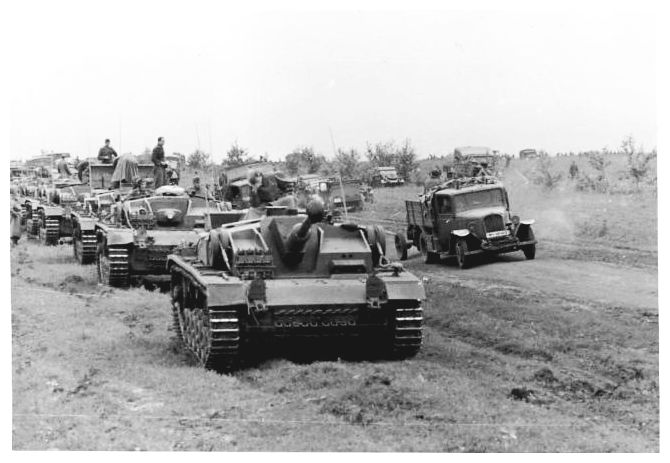
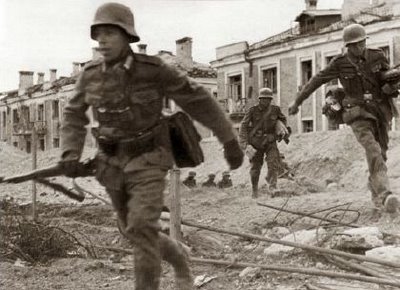
Sturmgeschutz Battalion Advancing toward Stalingrad

On July 22 as the Wehrmacht ran short on fuel and divisions to commit to the Caucasus, and 6th Army fought for control of Voronezh the Soviets created the Stalingrad Front. Stavka moved an NKVD Division to the city,[xx] and rapidly filled the new front with formations transferred from the Moscow Front.[xxi] Stalin issued Stavka Order 227, better known as “No Step Back” on 28 July. The order mandated that commanders and political officers who retreated would be assigned to Penal battalions[xxii] and armies were to form three to five special units of about 200 men each as a second line “to shoot any man who ran away.”[xxiii] Russian resistance west of the Don slowed the German advance. German commanders were astonished “at the profligacy of Russian commanders with their men’s lives.”[xxiv] Von Kleist compared the stubbornness of Russians in his area to those of the previous year and wrote that they were local troops “who fought more stubbornly because they were fighting to defend their homes.”[xxv] Additionally, Stalin changed commanders frequently in the “vain hope that a ruthless new leader could galvanize resistance and transform the situation.”[xxvi] General Chuikov brought the 64th Army into the Stalingrad Front in mid-July to hold the Germans west of the Don.[xxvii]

German Militarpfarrer (Chaplain) leading field service in August 1942

Further weakening the Germans OKW transferred key SS Panzer Divisions and the Grossdeutschland Division to France. Supporting Hungarian, Italian and Romanian allied armies which lacked motorization, modern armor or anti-tank units were unable to fulfill the gaps left by the loss of experienced German divisions and the expectations of Hitler.[xxviii] 6th Army was virtually immobilized for 10 days due to lack of supplies allowing the Russians to establish a defense on the Don Bend.[xxix] To the south the Germans were held up by lack of fuel and increased Soviet resistance including the introduction of a force of 800 bombers.[xxx] Glantz and House note that with the fall of Rostov on July 23rd “Hitler abruptly focused on the industrial and symbolic value of Stalingrad.”[xxxi] Undeterred by warnings from Halder that fresh Russian formations were massing east of the Volga and Quartermaster General, Wagner, who guaranteed that he could supply either the thrust to the Caucasus or Stalingrad but not both.[xxxii] Again frustrated by slow progress Hitler reverted to the original plan for 4th Panzer Army to assist 6th Army at Stalingrad, but the cost in time and fuel were significant to the operation and the question was whether “they could make up for Hitler’s changes in plan.”[xxxiii]

Strategic Implications
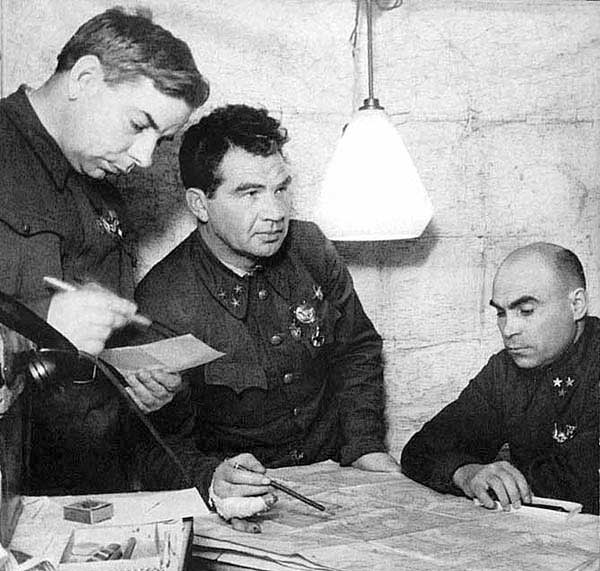
General Chuikov who directed the defense of Stalingrad during the battle
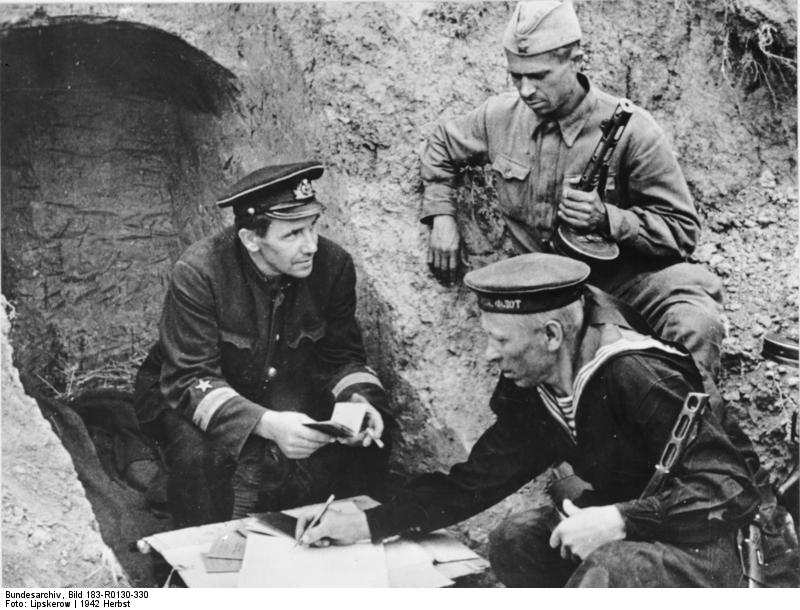
Soviet Naval Infantry and Political Officer

The changes in the German plan had distinct ramifications for both sides.  Von Mellenthin wrote that “the diversion of effort between the Caucasus and Stalingrad ruined our whole campaign.”[xxxiv] The Germans could not secure the Caucasus oil fields which Hitler considered vital to the German war effort.  They advanced deep into the region and captured the Maikop oil fields, though they were almost completely destroyed by the retreating Russians.[xxxv] Army Group A was halted by the Russians along the crests of the Caucasus on August 28th.[xxxvi] This left Hitler deeply “dissatisfied with the situation of Army Group A.”[xxxvii] Kleist and others attributed much of the failure to a lack of fuel[xxxviii] and Blumentritt noted that Mountain divisions that could have made the breakthrough were employed along the Black Sea coast in secondary operations.[xxxix]

JU-87 Stuka over Stalingrad

Fuel and supply shortages delayed 6th Army’s advance while Hoth’s 4th Panzer Army was needlessly shuttled between Rostov and Stalingrad. By the time it resumed its advance the Russians “had sufficiently recovered to check its advance.”[xl] As 6th Army advanced the “protection of Army Group B’s ever-extending northern flank was taken over by the 3rd Rumanian, the 2nd Hungarian and the newly formed 8th Italian Army.”[xli] The allied armies were neither equipped for the Russian campaign nor well motivated.[xlii] The supply shortage in both army groups was not helped by a logistics bottleneck. All supplies came over a single Dnieper crossing, which Manstein noted, prevented swift movement of troops from one area to another.[xliii]
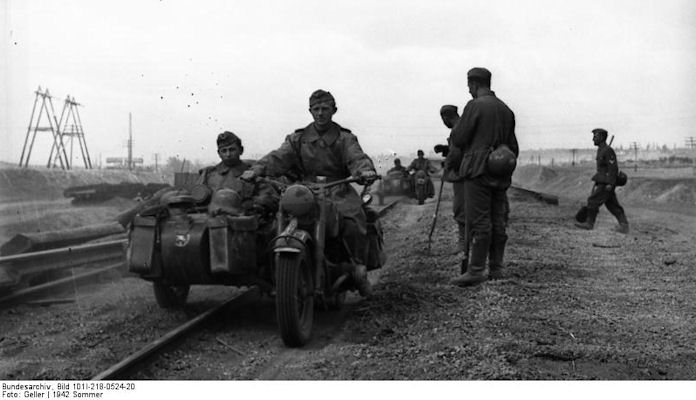
Reconnaissance Battalion of 24th Panzer Division near Stalingrad

Von Paulus’ 6th Army now attempted to rush Stalingrad between the 25th and 29th of July, while Hoth milled about on the lower Don.  However, Paulus’s piecemeal commitment of his divisions and failure to concentrate in the face of unexpectedly strong Soviet resistance caused the attacks to fail.  Paulus halted 6th Army on the Don so it could concentrate its forces and build its logistics base,[xliv] and to allow Hoth to come up from the south. This delay allowed the Russians to build up forces west of Stalingrad and reinforce the Stalingrad front and strengthen the defenses of the city,[xlv] and due to the distances involved it was easier for the Russians to reinforce the Stalingrad front.[xlvi] It also allowed the Russians to fill a number of key leadership positions with Generals who would skillfully fight the battle.[xlvii]

Russian Naval Infantry during early phase of battle

Hitler now focused on the capture of Stalingrad despite the fact that “as a city Stalingrad was of no strategic importance.”[xlviii] Strategically, its capture would cut Soviet supply lines to the Caucasus,[xlix] but this could be achieved without its capture. The checks in the south “began to give Stalingrad a moral importance-enhanced by its name-which came to outweigh its strategic value.”[l] To Hitler Stalingrad would gain “a mystic significance”[li] and along with Leningrad became “not only military but also psychological objectives.”[lii]
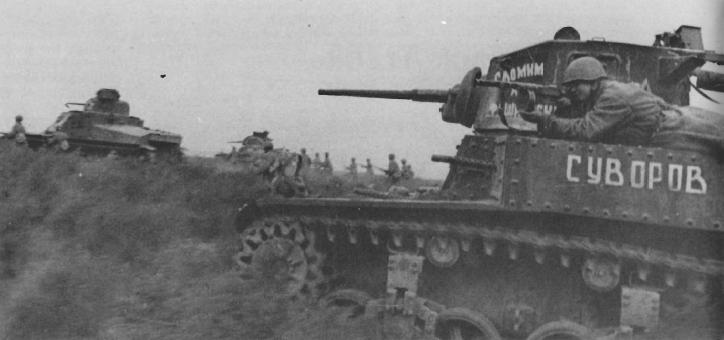
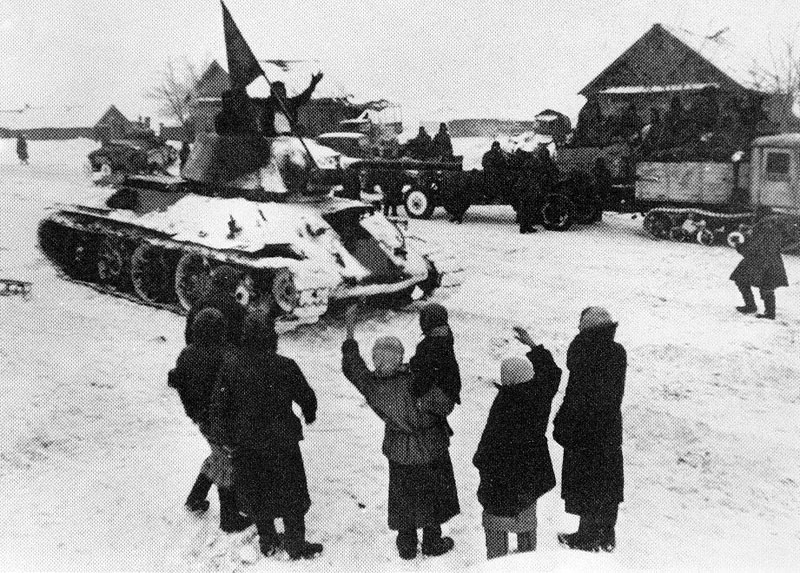
Red Army Armored troops using Lend-Lease American M3 Stuart and M3 Grant tanks

The Germans mounted a frontal assault with 6th Army and elements of 4th Panzer Army despite air reconnaissance that “the Russians are throwing forces from all directions at Stalingrad.[liii] Paulus as the senior General was in charge of the advance, with Hoth subordinated to him, but the attack had to wait until Hoth’s army could fight its way up from the south.[liv] Von Mellenthin comments rightly that “when Stalingrad was not taken on the first rush, it would have been better to mask it….”[lv] It is clear that the German advance had actually reached its culminating point with the failure of the advance into the Caucasus and Paulus’s initial setback on the Don, but it was not yet apparent to many involved.[lvi] The proper course of action would have been to halt and build up the front and create mobile reserve to parry any Russian offensive along northern flank while reinforcing success in the Caucasus. Manstein wrote that “by failing to take appropriate action after his offensive had petered out without achieving anything definite, he [Hitler] paved the way to the tragedy of Stalingrad!”[lvii]

Transfixed by Stalingrad

German Stug III at Stalingrad

On August 19th Paulus launched a concentric attack against the Russian 62nd and 64th Armies on the Don.  The attack ran into problems, especially in Hoth’s sector.[lviii] Yet, on the 22nd the 14th Panzer Corps “forced a very narrow breach in the Russian perimeter at Vertyachi and fought its way across the northern suburbs of Stalingrad,”[lix] and reached the Volga on the 23rd. That day 4th Air Fleet launched 1600 sorties against the city dropping over 1,000 tons of bombs.[lx] The breakthrough imperiled the Soviet position they had concentrated their strongest forces against Hoth.[lxi] The Germans held air superiority and continued heavy bombing attacks.  During the last days of August 6th Army “moved steadily forward into the suburbs of the city, setting the stage for battle.”[lxii] As the Soviets reacted to Paulus, Hoth achieved a breakthrough in the south which threatened the Russian position.  However 6th Army was unable to disengage its mobile forces to link up with the 4th Panzer Army and another opportunity had been missed.[lxiii]

German unit crossing the Don

As 6th Army moved into the city Yeremenko ordered attacks against Hube’s 16th Panzer Division and Soviet resistance increased as more formations arrived the Germans suffered one of their heaviest casualty rates.”[lxiv] Though unsuccessful the counterattacks “managed to deflect Paulus’s reserves at the most critical moment.”[lxv] The Germans remained confident the first week of September as 6th Army and 4th Panzer Army linked up, but Yeremenko saved his forces by withdrawing and avoiding encirclement west of the city, retiring to an improvised line close to the city.[lxvi] On September 12th Chuikov was appointed to command 62nd Army in Stalingrad.  Chuikov understood that there “was only one way to hold on. They had to pay in lives. ‘Time is blood,’ as Chuikov put it later.”[lxvii] Stalin sent Nikita Khrushchev to the front “with orders to inspire the Armies and civilian population to fight to the end.”[lxviii] 13th Guards Rifle Division arrived on the 14th saved the Volga landings but it lost 30% casualties in its first 24 hours of combat.[lxix]

T-34 in Stalingrad

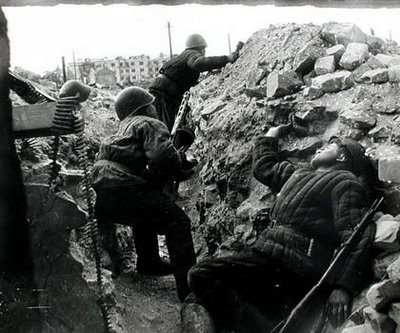
An NKVD regiment and other units held the strategically sited Mamaev Kurgan, keeping German guns from controlling the Volga.[lxx] The defenders fought house to house and block by block, Army and NKVD were reinforced by Naval Infantry.  Chuikov conducted the defense with a brutal ferocity, relieving senior commanders who showed a lack of fight and sending many officers to penal units.  Chuikov funneled massed German attacks into “breakwaters” where the panzers and infantry could be separated from each other causing heavy German casualties.[lxxi]

Street Fighting


Now the “city became a prestige item, its capture ‘urgently necessary for psychological reasons,’ as Hitler declared on October 2. A week later he declared that Communism must be ‘deprived of its shrine.’”[lxxii] The Germans did continue to gain ground, however slowly and at great cost, especially among their infantry, so much so that companies had to be combined.   Chuikov used his artillery to interdict the Germans from the far side of the Volga and the fight in the city was fought by assault squads with incredible ferocity and the close-quarter combat was dubbed “’Rattenkrieg’ by German soldiers.”[lxxiii] Paulus brought more units into the city and continued to slowly drive the Russians back against the river, by early October Chuikov wondered if he would be able to hold.[lxxiv] By early November Chuikov “was altogether holding only one-tenth of Stalingrad-a few factory buildings and a few miles of river bank.”[lxxv] Paulus expected “to capture the entire city by 10 November,”[lxxvi] despite the fact that many units were fought out. The 6th Army judged that 42% of the battalions of 51st Corps were fought out.[lxxvii] On 9 November Hitler declared “No power on earth will force us out of Stalingrad again!”[lxxviii]

Soviet Counteroffensive: Disaster on the Flanks
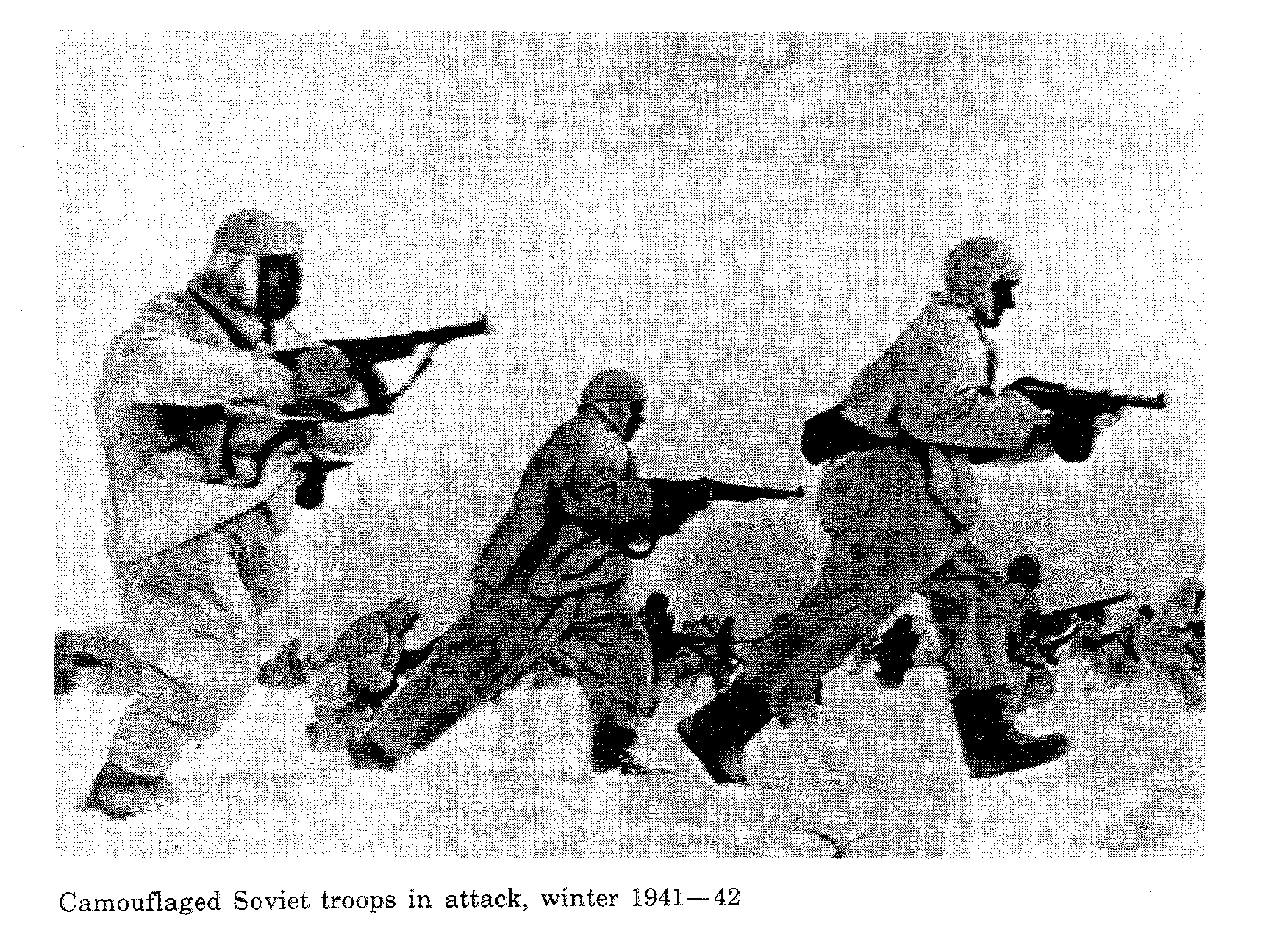
Soviet offensive on the flanks

Hungarian withdraw

Hungarian dead

On September 24th Hitler relieved Halder for persisting in explaining “what would happen when new Russian reserve armies attacked the over-extended flank that ran out to Stalingrad.”[lxxix] Many in the German side recognized the danger. Blumentritt said “The danger to the long-stretched flank of our advance developed gradually, but it became clear early enough for anyone to perceive it who was not willfully blind.”[lxxx] Warnings were also given by Rumanian Marshall Antonescu and the staff’s of Army Group B and 6th Army[lxxxi] but Hitler was transfixed on Stalingrad.  In doing so the Germans gave up the advantage of uncertainty and once their “aim became obvious…the Russian Command could commit its reserves with assurance.”[lxxxii]
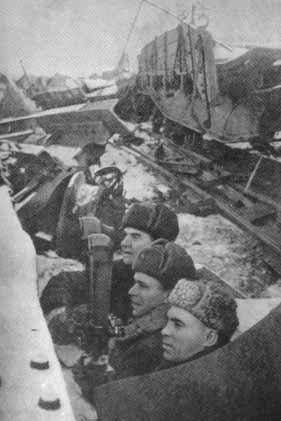
Chuikov and his staff

In the midst of Stalin’s concern about Stalingrad Stavka planners never lost sight of their goal to resume large scale offensive operations and destroy at least one German Army Group.[lxxxiii] Unlike Hitler Stalin had begun to trust his Generals and Stavka under the direction of Marshal Vasilevsky produced a concept in September to cut off the “German spearhead at Stalingrad by attacking the weak Rumanian forces on its flanks.”[lxxxiv] At first Stalin “showed little enthusiasm” for the attack, fearing that Stalingrad might be lost, but on 13 September he gave his full backing to the proposal[lxxxv] which Zhukov, Vasilevsky and Vatutin developed into a plan involving two operations, Operation Uranus, to destroy the German and allied forces at Stalingrad, Operation Saturn to destroy all the German forces in the south and a supporting attack to fix German forces in the north, Operation Mars aimed at Army Group Center.[lxxxvi]

Soviet Katusha Rockets

To accomplish the destruction of 6th Army and part of 4th Panzer Army the Red Army employed over 60% of the “whole tank strength of the Red Army.”[lxxxvii] Strict secrecy combined with numerous acts of deception was used by the Red Army to disguise the operation.[lxxxviii] The plan involved an attack against 3rd Romanian Army on the northern flank by 5th Tank Army and two infantry armies with supporting units.[lxxxix] In the south against 4th Rumanian Army and weak element of 4th Panzer Army another force of over 160,000 men including 430 tanks were deployed.[xc] Despite warnings from his Intelligence Officer, Paulus did not expect a deep offensive into his flanks and rear and made no plans to prepare to face the threat.[xci] Other senior officers believed that the attack would take place against Army Group Center.[xcii] Warlimont notes that there was a “deceptive confidence in German Supreme Headquarters.”[xciii]

Luftwaffe JU-52s made many resupply runs into the pocket but suffered great losses

The storm broke on 19 November as Soviet forces attacked rapidly crushing Romanian armies in both sectors[xciv] linking up on the 23rd.[xcv] 48th Panzer Corps supporting the Romanians was weak and had few operational tanks.[xcvi] It attempted a counterattack but was “cut to pieces” in an encounter with 5th Tank Army.[xcvii] A promising attempt by 29th Motorized division against the flank of the southern Russian pincer was halted by the Army Group and the division was ordered to defensive positions south of Stalingrad.[xcviii] German airpower was neutralized by bad weather.[xcix] Paulus continued to do nothing as since the attacks were outside of his area of responsibility and waited for instructions.[c] As a result the 16th and 24th Panzer Divisions which could have assisted matters to the west remained “bogged down in street-fighting in Stalingrad.”[ci] Without support 6th Army units west of Stalingrad were forced back in horrific conditions.  By the 23rd 6th Army was cut off along with one corps of 4th Panzer Army and assorted Romanian units, over 330,000 men.  This now entrapped force that would require seven rifle armies and much staff attention to eliminate.[cii]

The Death of 6th Army

Paulus Surrenders

Hitler ordered Manstein to form Army Group Don to relieve Stalingrad. Hitler would not countenance a break out and wanted Manstein to break through and relieve 6th Army.[ciii] Hitler refused a request by Paulus on 23 November to move troops to prepare for a possible a break out attempt, assuring him that he would be relieved.[civ] Albert Speer notes that Zeitzler who replaced Halder insisted that the Sixth Army must break out to the west.”[cv] Hitler told Zeitzler that “We should under no circumstances give this up. We won’t get it back once it’s lost.”[cvi] Goering promised the Luftwaffe would be able to meet the re-supply needs of 6th Army by air, even though his Generals knew that it was impossible with the number of transport aircraft available.[cvii] Hitler took Goering at his word and exclaimed “Stalingrad can be held! It is foolish to go on talking any more about a breakout by Sixth Army…”[cviii] and a Führer decree was issued ordering that the front be held at all costs.[cix] Goerlitz states that “Hitler was incapable of conceiving that the 6th Army should do anything but fight where it stood.”[cx] Likewise Manstein had precious few troops with which to counterattack and had to protect the flank of Army Group A deep in the Caucasus. His army group was only corps strength and was spread across a 200 mile front.[cxi] Any relief attempt had to wait for more troops, especially Panzers.  Manstein too believed that the best chance for a breakout had passed and that it was a serious error for Paulus to put the request to withdraw through to Hitler rather than the Army Group or act on his own.[cxii] Many soldiers were optimistic that Hitler would get them out.[cxiii] Other generals like Guderian, Reichenau or Hoeppner might have acted, but Paulus was no rebel.[cxiv]
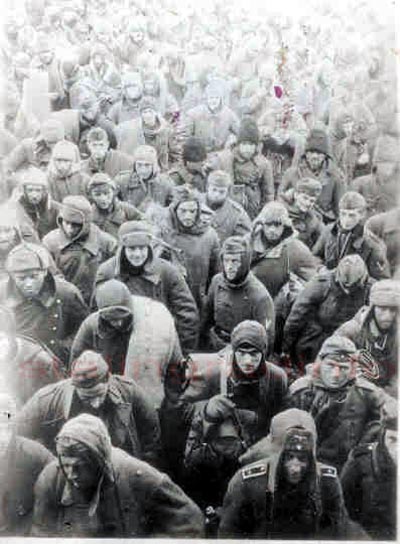
German POWs only 5000 of some 90,000 would see home again

Operation Saturn began on 7 December destroying the Italian 8th Army and forcing the Germans to parry the threat.[cxv] A relief attempt by 57th Panzer Corps under Hoth on 12 December made some headway until a massive Soviet counterattack on 24 December drove it back.[cxvi] This attack was hampered by OKW’s refusal to allocate the 17th Panzer and 16th Motorized divisions to Manstein,[cxvii] and by 6th Army not attacking out to link with the relief force.[cxviii]By 6 January Paulus signaled OKW: Army starving and frozen, have no ammunition and cannot move tanks anymore.”[cxix] On 10 January the Soviets launched Operation Ring to eliminate the pocket and despite all odds German troops fought on. On the 16th Paulus requested that battle worthy units be allowed to break out, but the request was not replied to.[cxx] On the 22nd the last airfield had been overrun and on 31 January Paulus surrendered.[cxxi]

Analysis: What Went Wrong

Stalingrad had strangely drawn the attention of both sides, but the Russians never lost sight of their primary objectives during the campaign. The Germans on the other hand committed numerous unforced errors mostly caused by Hitler and or von Paulus. These mistakes began early in the planning and After the fall of Stalingrad as the Soviets attempted to follow up their success by attempted to cut off Army Group “A” Manstein was permitted to wage a mobile defense while Von Kleist managed to withdraw with few losses.[cxxii] The superior generalship of Manstein and Von Kleist prevented the wholesale destruction of German forces in southern Russia and Manstein’s counter offensive inflicted a severe defeat on the Soviets. However the German Army had been badly defeated.  The seeds of defeat were laid early, the failure to destroy bypassed Soviet formations in July, the diversion of 4th Panzer Army from Stalingrad, and the divergent objectives of trying to capture the Caucasus and Stalingrad at the same time.  This diluted both offensives ensuring that neither succeeded.  Likewise the failure to recognize the culminating point when it was reached and to adjust operations accordingly was disastrous for the Germans. The failure create a mobile reserve to meet possible Russian counter offensives, and the fixation on Stalingrad took the German focus off of the critical yet weakly held flanks. The hubris of Hitler and OKW to believe that the Russians were incapable of conducting major mobile operations even as Stavka commenced offensive operations on those flanks all contributed to the defeat.  Clark notes these facts but adds that the Germans “were simply attempting too much.”[cxxiii] Soviet numbers allowed them to wear down the Germans even in defeat.[cxxiv] At the same time Stalin gave his commanders a chance to revive the mobile doctrine of deep operations with mechanized and shock armies that he had discredited in the 1930s.[cxxv] All through the campaign Zhukov and other commanders maintained both their nerve even when it appeared that Stalingrad was all but lost. They never lost sight of their goal of destroying major German formations though they failed to entrap Army Group A with 6th Army.

A Modern Application

It is well and good to attempt to remain on the offensive.  The U.S. currently has forces spread thinly over two combat theaters with possibilities that other threats in the same region could flare up.  Like the Germans the U.S. is operating in areas, especially Afghanistan where overland supply lines are vulnerable and where weather can and does affect resupply operations by both ground and air.  The fact that the U.S. is operating with just barely enough forces in areas where others have met disaster calls for a circumspect look at what our enemy’s capabilities really are and not allowing ourselves to be surprised when they do things that have worked for them in the past against the Russians.  While it is unlikely that the U.S. and NATO would face a Stalingrad type situation in Afghanistan it is possible that isolated forces could be overrun as the Afghans reprise tactics used so successfully against the Soviets and as they begin to operate in larger units, concentrate them quickly and with more firepower to catch NATO forces when they are most vulnerable.  It is true that they will not mass large numbers of tanks and artillery as the Soviets did against the Germans, but the principle of speed, concentration at the critical point and surprise can inflict defeats, even small ones like the attack on the US outpost in Wanat that can turn public sentiment in the U.S. and Europe against further commitments and against the war and force the NATO governments as well as the U.S. to give up the effort.

Notes

[i] Clark, Alan. Barbarossa: The Russian-German Conflict: 1941-45. Perennial Books, An imprint of Harper Collins Publishers, New York, NY 1965. p.191

[ii] Ibid.

[iii] Glantz, David M. and House, Jonathan. When Titan’s Clashed: How the Red Army Stopped Hitler. The University Press of Kansas, Lawrence KS, 1995. p.111

[iv] Ibid. Clark. p.191

[v] Beevor, Anthony. Stalingrad: The Fateful Siege: 1942-1943. Penguin Books, New York NY 1998. p.69

[vi] Manstein, Erich von. Forward by B.H. Liddle Hart, Introduction by Martin Blumenson. Lost victories: The War Memoirs of Hitler’s Most Brilliant General. Zenith Press, St Paul MN 2004. First Published 1955 as Verlorene Siege, English Translation 1958 by Methuen Company. p.291 This opinion is not isolated, Beevor Quotes Paulus “If we don’t take Maikop and Gronzy…then I must put an end to the war.” (Beevor pp. 69-70)  Halder on the other hand believed that Hitler emphasized that the objective was “the River Volga at Stalingrad. (Clark. p.190)

[vii] Ibid. Beevor. p.70.

[viii] Ibid. Glantz and House. p.106

[ix] Ibid. p.105-106

[x] Ibid. Clark. p.203.  The offensive did impose a delay on the German offensive.

[xi] Ibid. Clark. p.191 Each group also contained allied armies.

[xii] Ibid. p.209.

[xiii] Ibid. Glantz and House. p.119

[xiv] Ibid. Manstein. p.292.

[xv] Ibid. Clark. p.209

[xvi] Ibid. Clark.  p.211

[xvii] Ibid. Glantz and House. p.120. There is a good discussion of the impact of this decision here as 6th Army’s advance was given priority for both air support and fuel.

[xviii] Ibid. Beevor. p.74

[xix] Warlimont, Walter. Inside Hitler’s Headquarters 1939-45. Translated by R.H. Berry, Presido Press, Novato CA, 1964. p.249

[xx] Ibid. Beevor. p.75 This was the 10th NKVD Division and it took control of all local militia, NKVD, and river traffic, and established armored trains and armor training schools.

[xxi] Ibid. Clark. p.212

[xxii] Ibid. Glantz and House. p.121

[xxiii] Ibid. Beevor. p.85

[xxiv] Ibid. p.89

[xxv] Liddell-Hart, B.H. The German Generals Talk. Quill Publishers, New York, NY 1979. Originally published by the author in 1948. p.202

[xxvi] Ibid. Beevor. p.88

[xxvii] Ibid. Beevor. p.90

[xxviii] Ibid. Beevor. p.81

[xxix] Ibid. Glantz and House. p.121

[xxx] Ibid. Liddell-Hart. p.202

[xxxi] Ibid. Glantz and House. p.120

[xxxii] Goerlitz, Walter. History of the German General Staff. Westview Press, Frederick A. Praeger Publisher, Boulder, CO. 1985 p.416

[xxxiii] Ibid. Beevor. pp.95-96.

[xxxiv] Von Mellenthin, F.W. Panzer Battles: A Study of the Employment of Armor in the Second World War. Translated H. Betzler, Edited by L.C.F. Turner. Oklahoma University Press 1956, Ballantine Books, New York, NY. 1971. p.193

[xxxv] Shirer, William L. The Rise and Fall of the Third Reich. A Touchstone Book published by Simon and Schuster, 1981, Copyright 1959 and 1960. p.914

[xxxvi] Ibid. Glantz and House. p.122

[xxxvii] Ibid. Warlimont. p.256

[xxxviii] Ibid. Liddell-Hart. p.203

[xxxix] Ibid. p.204

[xl] Ibid. Shirer. p.914

[xli] Ibid. Goerlitz. p.416

[xlii] Ibid. Goerlitz. p.416

[xliii] Ibid. Manstein. p.293

[xliv] Ibid. Clark. p.214

[xlv] Ibid. Beevor. pp.97-99. The mobilization included military, political, civilian and industrial elements.

[xlvi] Liddell-Hart, B.H. Strategy. A Signet Book, the New American Library, New York, NY. 1974, Originally Published by Faber and Faber Ltd., London. 1954 & 1967. p.250

[xlvii] Ibid. Beevor. p.99.  Two key commanders arrived during this time frame, Colonel General Andrei Yeremenko, who would command the Stalingrad Front  and General Chuikov commander of 64th Army who would conduct the defense of the city.

[xlviii] Carell, Paul Hitler Moves East: 1941-1943. Ballantine Books, New York, NY 1971, German Edition published 1963. p.581

[xlix] Ibid. Shirer.  p.909.

[l] Ibid. Liddell-Hart, Strategy. p.250

[li] Wheeler-Bennett, John W. The Nemesis of Power: The German Army in Politics 1918-1945. St. Martin’s Press, New York, NY 1954.  p.531

[lii] Ibid. Wheeler-Bennett. p.531

[liii] Ibid. Beevor. p.96

[liv] Ibid. Clark. p.216.

[lv] Ibid. Von Mellenthin. P.193

[lvi] See Von Mellinthin pp.193-194.  Von Mellinthin quotes Colonel Dinger, the Operations Officer of 3rd Motorized Division at Stalingrad until a few days before its fall. Dingler noted that the Germans on reaching Stalingrad “had reached the end of their power. Their offensive strength was inadequate to complete the victory, nor could they replace the losses they had suffered.” (p.193) He believed that the facts were sufficient “not only to justify a withdrawal, but compel a retreat.” (p.194)

[lvii] Ibid. Manstein. p.294

[lviii] Ibid. Clark. p.216

[lix] Ibid. Clark. p.217

[lx] Ibid. Beevor. p.107

[lxi] Ibid. Beevor. p.107

[lxii] Ibid. Glantz and House. p.122

[lxiii] Ibid. Carell. P.601

[lxiv] Ibid. Beevor. p.118

[lxv] Ibid. Beevor. p.118

[lxvi] Ibid. Carell. p.602

[lxvii] Ibid. Beevor. p.128

[lxviii] Ibid. Carell. p.603

[lxix] Ibid. Beevor. p.134

[lxx] Ibid. Beevor. pp.136-137

[lxxi] Ibid. Beevor. p.149

[lxxii] Fest, Joachim. Hitler. Translated by Richard and Clara Winston, Harcourt, Brace, Jovanovich Publishers, San Diego, New York, London. 1974. p.661

[lxxiii] Ibid. Beevor. pp. 149-150

[lxxiv] Ibid. Beevor. p.164

[lxxv] Ibid. Carell. p.618

[lxxvi] Ibid. Glantz and House. p.123

[lxxvii] Ibid. Beevor. p.218

[lxxviii] Ibid. Carell. p.623

[lxxix] Ibid. Goerlitz. p.418

[lxxx] Ibid. Liddell-Hart. The German Generals Talk. p.207

[lxxxi] Ibid. Manstein. p292

[lxxxii] Ibid. Liddell-Hart. History of the Second World War. p.258

[lxxxiii] Ibid. Glantz and House. p.129

[lxxxiv] Ibid. Glantz and House. p.130

[lxxxv] Ibid. Beevor. pp.221-222 Glantz and House say that Stalin gave his backing in mid-October but this seems less likely due to the amount of planning and movement of troops involved to begin the operation in November.

[lxxxvi] Ibid. Glantz and House. p.130

[lxxxvii] Ibid. Beevor. p.226

[lxxxviii] Ibid. Glantz and House. p.132

[lxxxix] Ibid. Glantz and House. p.130

[xc] Ibid. Beevor. p.227

[xci] Ibid. Beevor. p.228

[xcii] Ibid. Clark. p.235

[xciii] Ibid. Warlimont. p.274

[xciv] Ibid, Carell. p.627 3rd Rumanian Army lost 75,000 men in three days.

[xcv] Ibid. Clark.pp.247-248

[xcvi] The condition of the few German Panzer Divisions in position to support the flanks was very poor, the 22nd had suffered from a lack of fuel and maintenance and this many of its tanks were inoperative. Most of the armor strength of the 48th Panzer Corps was provided by a Rumanian armored division equipped with obsolete Czech 38t tanks provided by the Germans.

[xcvii] Ibid. Clark. pp.251-252. The designation of 2nd Guards Tank Army by Clark has to be wrong and it is the 5th Tank Army as 2nd Guards Tank was not involved in Operation Uranus.  Carell, Beevor and Glantz properly identify the unit.

[xcviii] Ibid. Carell. p.630

[xcix] Ibid. Beevor. p.244

[c] Ibid. Beevor. p.247

[ci] Ibid. Beevor. p.245

[cii] Ibid. Glantz and House. p.134

[ciii] Ibid. Glantz and House. p.134

[civ] Ibid. Clark. p.256

[cv] Speer, Albert. Inside the Third Reich. Collier Books, a Division of MacMillan Publishers, Inc. New York, NY 1970. p.248

[cvi] Heiber, Helmut and Glantz, David M. Editors. Hitler and His Generals: Military Conferences 1942-1945. Enigma Books, New York, NY 2002-2003.  Originally published as Hitlers Lagebsprechungen: Die Protokollfragmente seiner militärischen Konferenzen 1942-1945. Deutsche Verlags-Anstalt GmbH, Stuttgart, 1962. p.27

[cvii] Ibid. Glantz and House. p.135 Glantz and House note that the amount of aircraft estimated to successfully carry out the re-supply operation in the operational conditions was over 1,000.  The amount needed daily was over 600 tons of which the daily reached only 300 tons only one occasion.

[cviii] Ibid. Speer. p.249

[cix] Ibid. Carell. p.636

[cx] Ibid. Goerlitz. p.426

[cxi] Ibid. Clark. p.252

[cxii] Ibid. Manstein. p.303

[cxiii] Ibid. Beevor. p.276

[cxiv] Ibid. Carell. p.640

[cxv] Ibid. Glantz and House. p.140

[cxvi] Ibid. Glantz and House. p.140

[cxvii] Ibid. Clark. p.264

[cxviii] Ibid. Manstein. p.337

[cxix] Ibid. Beevor. p320

[cxx] Ibid. Beevor. p.365

[cxxi] Of the approximately 330,000 in the pocket about 91,000 surrendered, another 45,000 had been evacuated.  22 German divisions were destroyed.

[cxxii] Ibid. Liddell-Hart. The German Generals Talk. p.211

[cxxiii] Ibid. Clark. p.250

[cxxiv] Ibid. Glantz and House. p.124

[cxxv] Ibid. Beevor. p.221

Bibliography

Beevor, Anthony. Stalingrad: The Fateful Siege: 1942-1943. Penguin Books, New York NY 1998

Carell, Paul Hitler Moves East: 1941-1943. Ballantine Books, New York, NY 1971, German Edition published 1963.

Clark, Alan. Barbarossa: The Russian-German Conflict:1941-45. Perennial Books, An imprint of Harper Collins Publishers, New York, NY 1965.

Fest, Joachim. Hitler. Translated by Richard and Clara Winston, Harcourt, Brace, Jovanovich Publishers, San Diego, New York, London. 1974

Glantz, David M. and House, Jonathan. When Titan’s Clashed: How the Red Army Stopped Hitler. The University Press of Kansas, Lawrence KS, 1995.

Goerlitz, Walter. History of the German General Staff. Westview Press, Frederick A. Praeger Publisher, Boulder, CO. 1985

Heiber, Helmut and Glantz, David M. Editors. Hitler and His Generals: Military Conferences 1942-1945. Enigma Books, New York, NY 2002-2003.  Originally published as Hitlers Lagebsprechungen: Die Protokollfragmente seiner militärischen Konferenzen 1942-1945. Deutsche Verlags-Anstalt GmbH, Stuttgart, 1962.

Liddell-Hart, B.H. The German Generals Talk. Quill Publishers, New York, NY 1979. Originally Published by the author in 1948.

Liddell-Hart, B.H. Strategy. A Signet Book, the New American Library, New York, NY. 1974, Originally Published by Faber and Faber Ltd., London. 1954 & 1967

Manstein, Erich von. Forward by B.H. Liddle Hart, Introduction by Martin Blumenson. Lost victories: The War Memoirs of Hitler’s Most Brilliant General. Zenith Press, St Paul MN 2004. First Published 1955 as Verlorene Siege, English Translation 1958 by Methuen Company

Shirer, William L. The Rise and Fall of the Third Reich. A Touchstone Book published by Simon and Schuster, 1981, Copyright 1959 and 1960

Speer, Albert. Inside the Third Reich. Collier Books, a Division of MacMillan Publishers, Inc. New York, NY 1970.

Von Mellenthin, F.W. Panzer Battles: A Study of the Employment of Armor in the Second World War. Translated H. Betzler, Edited by L.C.F. Turner. Oklahoma University Press 1956, Ballantine Books, New York, NY. 1971.

Warlimont, Walter. Inside Hitler’s Headquarters 1939-45. Translated by R.H. Berry, Presido Press, Novato CA, 1964.

Wheeler-Bennett, John W. The Nemesis of Power: The German Army in Politics 1918-1945. St. Martin’s Press, New York, NY 1954

17 Comments

Filed under History, Military, world war two in europe

A Global Force for Good

A Global Force for Good: A Sailor holds the hand of a Haitian Child

The Navy A Global Force For Good TV Spot

http://www.youtube.com/watch?v=6DriBYQvG_4

“I can imagine no more rewarding a career. And any man who may be asked in this century what he did to make his life worthwhile, I think can respond with a good deal of pride and satisfaction: ‘I served in the United States Navy.’” President John F Kennedy 1 August 1963, at the Naval Academy

“It follows than as certain as that night succeeds the day, that without a decisive naval force we can do nothing definitive, and with it, everything honorable and glorious.” George Washington 15 November 1781 to the Marquis de Lafayette

“A good Navy is not a provocation to war. It is the surest guaranty of peace.” President Theodore Roosevelt 2 December 1902, second annual message to Congress

“For in this modern world, the instruments of warfare are not solely for waging war. Far more importantly, they are the means for controlling peace. Naval officers must therefore understand not only how to fight a war, but how to use the tremendous power which they operate to sustain a world of liberty and justice, without unleashing the powerful instruments of destruction and chaos that they have at their command.” Admiral Arleigh Burke CNO 1 August 1961 at the Naval Academy

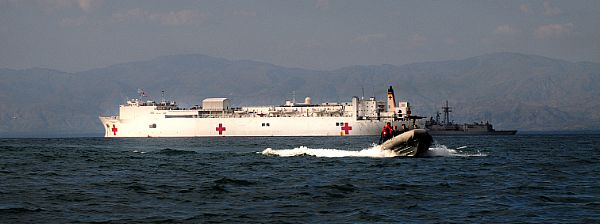
USNS Comfort off of Haiti

The newest Navy recruiting and public relations campaign features a comment “America’s Navy: A Global Force for Good.”  When it first came out some expressed their dislike of the new slogan; however as a Navy and Army veteran as well as a long time “Navy Brat” I found the slogan and the accompanying commercial inspiring and I can be extremely jaded and cynical when it comes to such advertisements and slogans.  See my post Memorable Recruiting Slogans and the All Volunteer Force. http://https://padresteve.wordpress.com/2009/05/03/memorable-recruiting-slogans-and-the-all-volunteer-force/

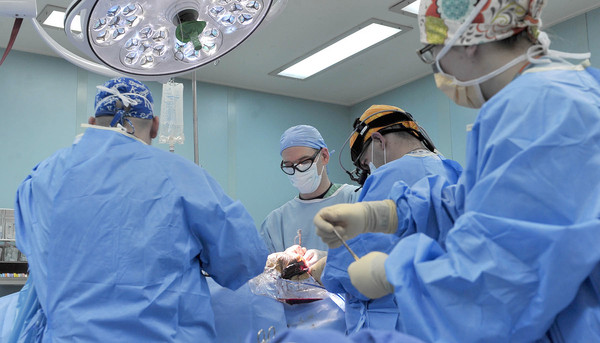
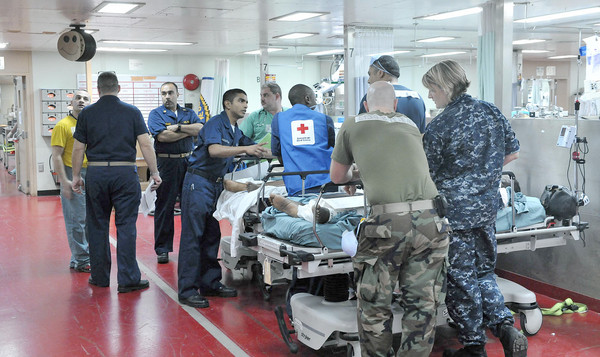
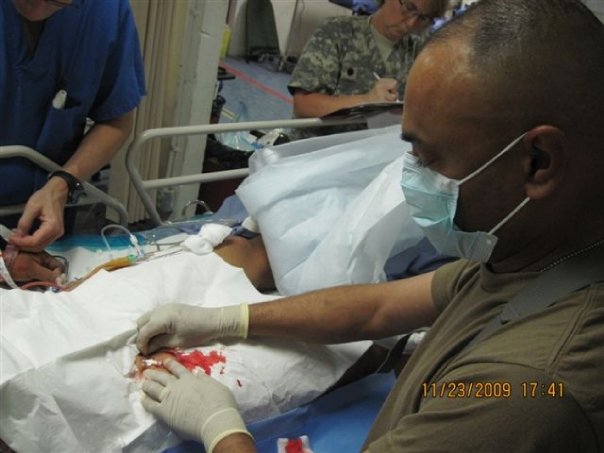
Neurosurgeons from Naval Medical Center Portsmouth operating on a patient aboard the Comfort- Baltimore Sun Photo

Maybe it is because I serve with a lot of great people who make up the Navy that I think this way. I have served with the brave souls of our EOD force, the Navy Expeditionary Combat Command, the crew of an elite Guided Missile Cruiser, the USS Hue City CG-66 and the professionals of Navy Medicine.  All these professionals be they war-fighters or care givers give so much of themselves to serve this country and protect others while at the same time laying their lives on the line to defend the people of the United States and others around the world.  For me this understanding of the Navy being a global force for good is relational and it goes beyond the crass cynicism of so many in the world who find little good about our nation.  I know that we have our faults but I really do believe that the good that we have done over the years and now outweighs our sins of commission and omission.  I was really offended when I saw some of the comments from some people in other countries condemning our efforts in Haiti.  I know of no other country that will empty itself to care for the people of a devastated and impoverished nation without expecting any form of repayment even while it is still in difficult economic straits.

Comfort receiving casualties- Baltimore Sun Photo

In the forefront of the humanitarian effort are my friends and shipmates in Navy Medicine on the USNS Comfort and ashore who are caring for the injured, sick and dying Haitian people.  These men and women were pulled out of our medical treatment facility and others with as little as 24 hours notice to deploy on a mission of incredible difficulty and undetermined length.  The emotional toll can be difficult as many of these professionals, physicians, nurses, corpsmen and others have deployed at least once if not two or three times to Iraq or Afghanistan.

Navy Pediatric Intensivist performs a procedure on a Afghan child

While the staff of the Comfort and those ashore toils to save lives others serve in Afghanistan running medical facilities often in conjunction with our allies.   These professionals are deployed from 7 months to a year and include some of the finest clinicians in the Navy.  Serving in Afghanistan the care for American wounded and sick, those of our NATO and Afghanistan National Army allies as well as the unfortunate civilians including children who are victims of terrorists acts, IEDs or military action mostly initiated by Taliban or Al Qaida forces.  Serving in harm’s way they see their compounds bombarded by incoming rockets, mortars and occasional artillery fire.  They also know that the vehicles that they travel in and helicopters that they fly in are targeted by Taliban forces and they care for those who are injured by IEDs on the same routes that they travel.  Having experienced this in Iraq I can say that it is a sobering and often eerie feeling that you get after you have been with Marines or Soldiers wounded by IEDs and ambushes on routes that you travel.  These men and women see the worst that humanity can do and still care about the victims.

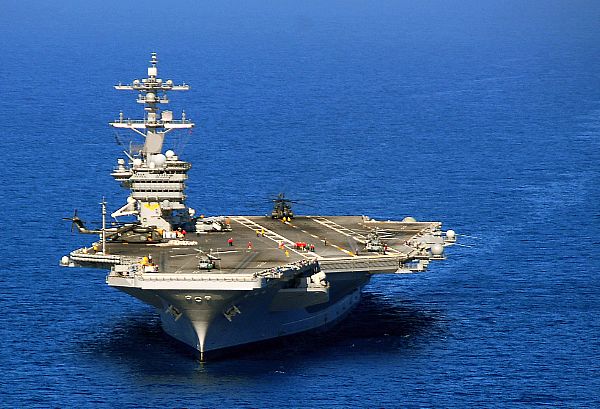
USS Carl Vinson arrived quickly and began relief operations

Others serve in Iraq now supporting our Army troops with medical care working alongside Army and Air Force medical personnel, others are in the Horn of Africa and still others involved with other humanitarian missions or operational support of US Forces abroad.

One has to remember that these medical professionals do not just come out of a vacuum but are normally assigned to medical treatment facilities in the United States. As they depart to serve abroad those left behind continue the mission of caring for our military, their families, and military retirees going back to the Greatest Generation and other combat wounded veterans still entitled to medical care.   The workload back at home does not let up and the professionals back here work harder and longer to provide the quality care that our beneficiaries deserve. Dealing with patients and families I always hear about how much they appreciate the kindness and superior care that they get from our physicians, nurses, corpsmen and other medical professionals.

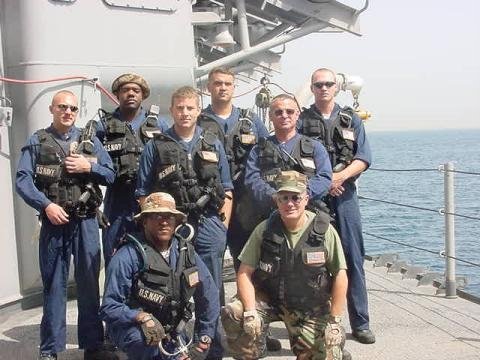
Boarding Team from USS Hue City

If you do not believe that these men and women are a “global force for good” then I am sorry that you cannot see the labor of love that these men and women provide to those entrusted to their care.  I am ashamed when I hear prominent media personalities call these “meals on wheels” missions. Personally I think it is hateful and demeaning towards the proud professionals who serve in these human tragedies and care for God’s people.  Likewise those that claim that this is being done to further US influence in Haiti are so clueless, in Haiti there is no payback even from a military or strategic point of view and even with our forces stretched thin around the world we still go out and do what no other country can do when we use our military to care for those afflicted by disaster.

In Haiti we are working hand in hand and side by with numerous Non-Governmental Organizations and other military medical professionals from the United States, Canada and other nations who are giving of themselves to serve the Haitian people.

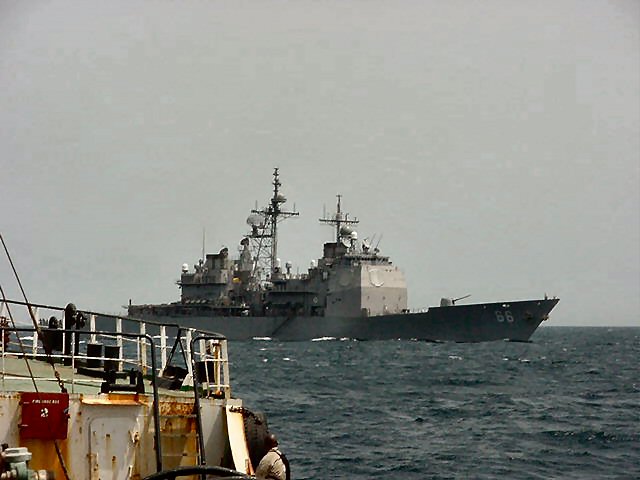
USS Hue City 565 Feet of Naval Power on Patrol

I think that for once a recruiting phrase actually captures the essence of the Navy.  This is not about just being a better individual or improving your life or getting an education and experience.  It is about serving our nation and people as well as others around the world whether that mission is combating terrorists, pirates, protecting our vital interests or like in Haiti, or during the Indonesian Tsunami, Hurricane Katrina or at the World Trade Center and hundreds of other places, this Navy is a global force for good.

Tonight as you go to bed and sleep soundly after eating well and spending time with family, friends or enjoying some form of entertainment remember those of our Navy who serve at sea, in the mountains and deserts of Afghanistan, the cities of Iraq, the desolation of the Horn of Africa and around the world defending our interests, caring for our military personnel and their families and deploying to serve in harm’s way and in areas of devastation.  They are America’s “Global Force for Good.”  They are my shipmates.  They are the United States Navy.

Peace,

Padre Steve+

2 Comments

Filed under Military, national security, US Navy

A Previous Generation of Sailor Insults the Current Generation of Sailors

A Different Kind of Navy

Today I received an e-mail forwarded by a retired Navy Chief and actually a dear friend of my family.  However the e-mail was so insulting to the present generation of sailors that I sent a very blunt response back to him and everyone in else by replying to all recipients.

As readers of this site know I constantly go out of my way to make sure that the sacrifices of the previous generations of military personnel are recognized, honored and not forgotten.  In fact I am not alone in this, many like me have been touched by these veterans of World War II, Korea, Vietnam, the Cold War, Desert Shield and Storm and the Balkans and honor their service in thought word and deed. In fact I and thousands like me are deeply appreciative of the service and sacrifice of those who have gone before us.  However with the exception of the Vietnam vets I don’t think that this honor and appreciation is shown much to the current generation.

We have been at war coming up on 9 years. This is nearly three times as long as the US involvement in World War II and will certainly go well beyond that.  Unlike that war where the whole nation was mobilized and millions of men and women served in all components of the armed forces all over the world in the current war only a tiny minority of the population has served. In fact if you look around the country we are a nation that doesn’t even act like we are at war unless it benefits someone’s political agenda.  While various individuals and organizations, especially professional sports take time to publicly acknowledge the service of the current generation for most people the war is something abstract that really doesn’t affect them or change how they live in any appreciable manner.

What is even more insulting is getting e-mail and hearing some of the older generation demean those who serve now, while saying “Support our Troops” they then spread horse manure like this:

Then – If you smoked, you had an ashtray on your desk.
Now – If you smoke, you get sent outside and treated like a leper, if you’re lucky.

Then – Mail took weeks to come to the ship.
Now – Every time you get near land, there’s a mob topside to see if their cell phones work.

Then – If you left the ship it was in Blues or Whites, even in home port.
Now – The only time you wear Blues or Whites is for ceremonies..

Then – You wore bell-bottoms everywhere on the ship.
Now – Bell-bottoms are gone and 14 year-old girls wear them everywhere.

Then – You wore a Dixie cup all day, with every uniform.
Now – It’s not required and you have a choice of different hats..

Then – If you said “damn,” people knew you were annoyed and avoided you.
Now – If you say “damn” you’d better be talking about a hydroelectric plant.

Then -The Ships Office Yeoman had a typewriter on his desk for doing daily reports.
Now – Everyone has a computer with Internet access and they wonder why no work is getting done.

Then – We painted pictures of pretty girls on airplanes to remind us of home.
Now – We put the real thing in the cockpit.

Then – Your girlfriend was at home, praying you would return alive.
Now – She is on the same ship, praying your condom worked.

Then – If you got drunk off duty, your buddies would take you back to the ship so you could sleep it off.
Now – If you get drunk off duty, they slap you in rehab and ruin your career.

Then – Canteens were made out of steel and you could heat coffee or hot chocolate in them.
Now – Canteens are made of plastic, you can’t heat them because they’ll melt, and anything inside always tastes like plastic.

Then – Our top officers were professional sailors first.  They commanded respect.
Now – Our top officers are politicians first.  They beg not to be given a wedgie.

Then – They collected enemy intelligence and analyzed it.
Now – They collect our pee and analyze it.

Then – If you didn’t act right, they’d put you on extra duty until you straightened up.
Now – If you don’t act right, they start a paper trail that follows you forever.

Then – Medals were awarded to heroes who saved lives at the risk of their own.
Now – Medals are awarded to people who show up for work most of the time.

Then – You slept in a barracks, like a soldier.
Now – You sleep in a dormitory, like a college kid.

Then – You ate in a Mess Hall or Galley.  It was free and you could have all the food you wanted.
Now – You eat in a Dining Facility.  Every slice of bread or pat of butter costs, and you can only have one.

Then – If you wanted to relax, you went to the Rec Center, played pool, smoked and drank beer.
Now – You go to the Community Center and can still play pool, maybe.

Then – If you wanted a quarter beer and conversation, you could go to the Chief’s or Officers’ Club.
Now – The beer will cost you three dollars and someone is watching to see how much you drink.

Then – The Exchange had bargains for sailors who didn’t make much money.
Now – You can get better merchandise and cheaper at Wal-Mart.

Then – If an Admiral wanted to make a presentation, he scribbled down some notes and a YN3 spent an hour preparing a bunch of charts.
Now – The Admiral has his entire staff spending days preparing a PowerPoint presentation.

Then – We called the enemy things like “Commie Bastards” and “Reds” because we didn’t like them.
Now – We call the enemy things like “Opposing Forces” and “Aggressors” or “Insurgents” so we won’t offend them.

Then – We declared victory when the enemy was dead and all his things were broken.
Now – We declare victory when the enemy says he is sorry and won’t do it again.

Then – A commander would put his butt on the line to protect his people.
Now – A commander will put his people on the line to protect his butt.

ALOHA!

“IN GOD WE TRUST”

Now there are some elements of truth in the e-mail there is also a lot of fiction and patent falsehoods which are cobbled together to insult and put down those who serve now.  Maybe this is done because a lot of the “greatest generation” never got into combat, maybe they resent the changes in society and culture, and maybe the only paradigm of war that they know is World War Two and the Cold War.  In fact if you look at history the Vietnam vets didn’t get the support or respect of the World War II generation.

I don’t want to sound like an ass or ungrateful but my generation has honored and respected those that have gone before us as “the greatest generation” while some who served in that war and during the 1950s and early 1960s run us down.  In fact I imagine that this was written by someone who did little but sit on their ass and complain when they were in the Navy and pretty sure that they didn’t serve in World War II, or see anything more than a hostile coast when they served.

Maybe I should re-write this in this manner, of course just like what was in the e-mail above it is filled with half-truths, it makes the point of what it feels like to have your service made light of by another generation.  Please know that I write this not to put down those who served before us but to show that such ad hominem attacks can go both directions, so let’s try it:

Then: Physical fitness meant if you got to fat you purchased a new uniform to waddle down a passage way.

Now: Physical Fitness standards are such that if you don’t stay in good physical condition and stay within weight standards that your career will be over.

Then: Physical abuse of sailors and hazing was acceptable and even encouraged.

Now: We don’t tolerate assault and battery.

Then: If you didn’t smoke you were forced to inhale the smoke of others in cramped and poorly ventilated spaces ensuring that you had an equal opportunity at sharing in the joys of lung cancer.

Now: If you don’t smoke you can breathe in peace and if you do smoke you still can just not whenever and wherever you want.

Then: Senior leaders both officer and enlisted who did criminal things were quietly removed and allowed to continue in service or retire as if nothing happened.

Now: Senior leaders, especially Commanding Officers and Command Master Chiefs are held to a higher standard and when relieved for cause it is public and the offense is not swept under the rug.

Then: Only a minority of sailors were married.

Now: The majority are married.

Then: Intelligence collection was pretty straight forward; you monitored Soviet communications and movements.

Now:  The bad guys use a multitude of means to communicate that were undreamed of in years past.

Then: Drug abuse was not a big problem in society at large and there was little need to test for them.

Now: The proliferation of drugs throughout society presents risks to our sailors, our security and mission that it is necessary to test for them.

Then: Women had little opportunity in the service and were regulated to support jobs.

Now: Women serve honorably in almost every Navy community at sea, in the air or ashore.

Then: Racial prejudice was pervasive and individual and institutional racism tolerated.

Now: For the most part racism is a thing of the past and sailors of all races have the opportunity not only to serve but to rise to the highest ranks.

Then: Being drunk on duty was okay if your Chief or Divo liked you and your buddies covered it up.

Now: Being drunk on duty is recognized for what it is, endangerment of your shipmates and the mission.

Then: Going on deployment meant being on a ship with regular deployment schedules and plenty for port calls and being on shore duty meant just that.

Now:  Sailors can be deployed at a moment’s notice from shore assignments and rotate from deployment to deployment to deployment with little time in between and up serving with boots on the ground where people are trying to kill you.

Then: Pay was low but since you weren’t married and lived on ship or the barracks you had plenty of disposable income.

Now: Pay is better but since you are married you have to support them and subject them to the uncertain life of being a sailor at war.

Then: Pay and benefits were so low that many in the civilian world believed that “only losers joined the military.”

Now: Pay and benefits are better so we get so of the best professionals in their fields.

Then: Medical care for life was a given and you never paid out of pocket for it for you or your family.

Now: Even with the most affordable health coverage sailors pay something out of pocket for their family’s medical care and sometimes their own.

Then: Navy housing was usually old, dilapidated and substandard and Navy families frequently lived in worse conditions than civilians lived in.

Now: Navy housing is being built to comparable standards of homes and apartments in the civilian community.

Then: There was no “Wal-Mart” or any other discount stores so the Exchange was your best option.

Now: Competition in the civilian world often makes the Exchange less attractive an option.

Then: The Navy was stingy with awards figuring that your paycheck was your award.

Now: Hard work deployed and non-deployed is better recognized and no sailors don’t get personal awards for showing up to work on time.

Then: War was different, we fought actual countries and professional militaries who played by the rules.

Now: War is fought against shadowy groups that use terrorism and other asymmetric means to fight and have no government to end the war and do not follow the rules of conventional warfare.

Then: Education was not encouraged.

Now: Education both military and civilian is encouraged to make better sailors.

Then: A sailor’s only interactions with Soldiers, Airmen or Marines were at bar fights.

Now: Now we serve alongside Soldiers, Marines and Airmen on small isolated outposts in dangerous combat zones.

Need I go on?

Now I am not saying any of this to demean or put down those who served before this generation. However I put it out here to show just how insulting the referenced e-mail was.  My gut reaction is that people who put out stuff like this didn’t do much in their own career and maybe were embarrassed by others of their generation who did. Perhaps the only way they can value their service is to put down others.  If so they are a pitiful and bitter bunch.  Now as I said up front there are plenty of veterans from past wars who honor us who serve today, however the vocal minority who put out crap like this need to be called on it.  If you see such e-mails please register your objection to them by replying to all and maybe, just maybe this will stop.  If you want past my “then and now” into your e-mail to throw it back at them.

Finally as always I thank all who served before us, men and women, especially the Korea and Vietnam vets who had their service ignored or put down by fellow vets as well as society in general. I do not want their service to be forgotten or dishonored and if anyone interprets this essay in that manner they have missed my point entirely.  But moreover I want to thank the new “greatest generation” who though small in number volunteer to serve knowing that they will see action likely in a ground combat zone serving alongside Soldiers, Marines and Airmen in places that would have been impossible for previous generations to imagine serving. It is us, we few, we happy few who fight together that hold the line, not the pundits, not the politicians and not those who sit back under the protection that we provide demean our service and criticize how we do that job.  Such people can kiss my ass, otherwise they can sign up, pick up a weapon, put on a pack or shut the hell up.

Peace

Padre Steve+

3 Comments

Filed under Military, philosophy

Learning to Apply the Principles of Counterinsurgency Part One: Introduction to the Soviet-Afghan War

Soviets Enter Afghanistan

Note: This is the First Part of a Series which I will be writing on Afghanistan and Counterinsurgency strategy in that country. Part of this will be a review of various historical materials especially from Russian sources as well as analysis of the Afghan insurgency and its foreign supporters including Al Qaeda. I have written a number of other articles on the Afghan War and associated topics.  Links are provided at the end of this article.

Counterinsurgency is not just thinking man’s warfare—it is the graduate level of war. Special Forces Officer in Iraq, 2005

“Protracted conflicts favor insurgents, and no approach makes better use of that asymmetry than the protracted popular war. The Chinese Communists used this approach to conquer China after World War II. The North Vietnamese and Algerians adapted it to fit their respective situations. And some Al Qaeda leaders suggest it in their writings today. This approach is complex; few contemporary insurgent movements apply its full program, although many apply parts of it. It is, therefore, of more than just historical interest. Knowledge of it can be a powerful aid to understanding some insurgent movements.”[i]

Introduction

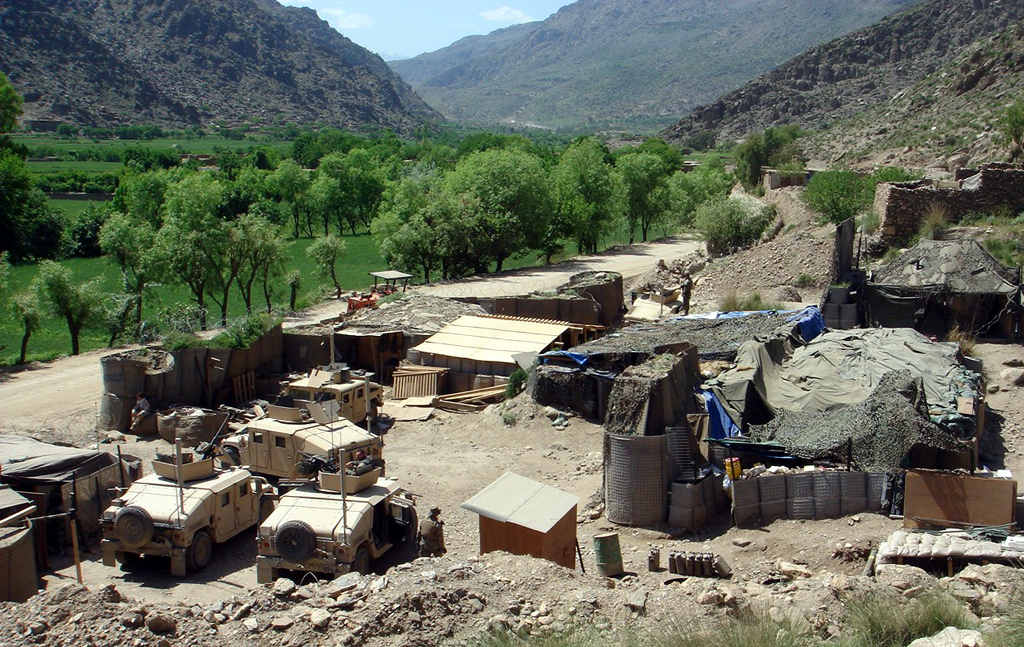
US Training Team Base

The United States has entered its 9th year of military involvement in Afghanistan following the October 2001 invasion that came as a response to the attacks on the World Trade Center and Pentagon of September 11th 2001.  In that time the United States, its NATO allies and the United Nations have endeavored to bring stability as well as a more democratic and accountable government to the country in the face of resistance from various political, religious and tribal groups with a diverse and sometimes conflicting agendas.  The foremost of these resistance groups was and is the Taliban which arose during the Soviet occupation of the country and eventually took power after winning a civil war against a number of other Mujahidin groups.   As the United States diverted force and focused its efforts on Iraq’s insurgency the Taliban using bases in remote areas along the Pakistani border and monetary and political support from Moslem groups with similar goals rehabilitated and reorganized its forces and began the process of regaining influence in Afghanistan.  By 2008 it was apparent that the situation had reached a crisis point.  The vast majority of Afghans as well as many in the international community came to view the Karzai government as corrupt, weak and unpopular.  The Taliban and other groups began to work more closely together despite differing agendas and the political and military situation deteriorated to the point that the incoming Obama administration appointed a new commander, General Stanley McChrystal to evaluate the situation and based on his recommendations and those of General David Petreus, Secretary of Defense Robert Gates and others announced a “surge” to try to regain the initiative in the country.  That troop buildup is currently underway. By the time it reaches its maximum the United States will have approximately 100, 000 troops in Afghanistan and the NATO and ISAF allies approximately another 38,000.  These are supporting and training the Afghan National Army and Police which number approximately 97,000 in the Army and another 98,000 in the National Police.  The Afghan forces have not proven to be reliable and have been infiltrated by Taliban and Al Qaeda members and the NATO and ISAF allies are often limited in the scope of their mission and have restrictive rules of engagement.  Thus the bulk of the fight rests on the United States and some allies with more robust rules of engagement such as Canada, Britain and France.  The lack of internal credibility of the Afghan Government, the weakness of its army and security forces coupled with the numerical weakness of US and ISAF forces has given the various indigenous insurgent groups, especially the Taliban to make a comeback that threatens the mission.  General McChrystal noted:

“The situation in Afghanistan is serious; neither success nor failure can be taken for granted. Although considerable effort and sacrifice have resulted in some progress, many indicators suggest the overall situation is deteriorating. We face not only a resilient and growing insurgency; there is also a crisis of confidence among Afghans—in both their government and the international community—that undermines our credibility and emboldens the insurgents. Further, a perception that our resolve is uncertain makes Afghans reluctant to align with us against the insurgents.”[ii]

Taliban Insurgents

The situation is such in Afghanistan that many Americans are struggling how the “good war” could go “bad.”  Many armchair strategists, many political and media figures and even some in the military fail to understand the nature of Counterinsurgency and its complexity as opposed to conventional warfare. In fact many of these assume that the simple application of combat force using conventional tactics is the cure for the situation, however history shows that such is not the case especially in Afghanistan.

This introduction to this study will focus on some commonalities of the Soviet and American experiences in Afghanistan.

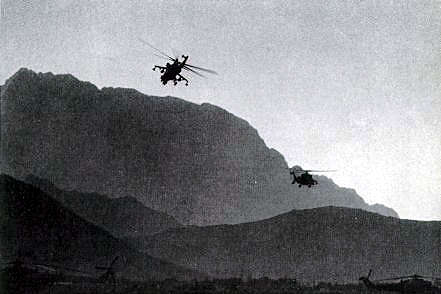
Soviet Mi-24s

The Soviets invaded Afghanistan in 1979 they used their 40th Army which initially was composed of “two motorized rifle divisions, an airborne division, an air assault brigade and separate motorized rifle regiments.”[iii] These forces totaled about 52,000 troops and were “considered sufficient to guarantee the viability of Afghanistan.”[iv] The 40th Army was a standard Cold War Soviet Combined Arms Army designed for high tempo conventional operations.  It was not designed for nor trained in counterinsurgency operations or what the Soviets and Russians class as “anti-guerilla operations.” It was poorly suited to mountain and dessert combat and at the beginning “not only had no practical skills in the conduct of counter-guerilla warfare, they also did not have a single well-developed theoretical manual, regulation or tactical guideline for fighting such a war.”[v]

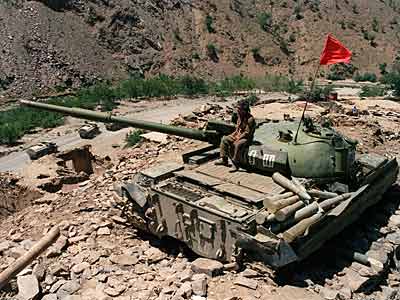
Soviet Tank Guarding Convoy

The Soviets did not expect to be involved in combat operations and the Afghan population reacted to their presence with resistance which spread across the country both against their own government which they viewed as a puppet of the Soviets but also against the Soviet Forces.  As time went on the Soviets attempted to use raids and large scale operations to attempt to bring Mujahidin forces to battle, however the insurgents were very skillful and the Soviets attempted to increase the training of their forces as well as their numbers.  By 1986 the numbers on the ground had increased to 108,000 personnel in four divisions, five separate brigades, four separate regiments and six separate battalions.[vi] In the nearly 10 years of operations over a half million Soviet soldiers and support personnel served in Afghanistan. Tours for enlisted personnel who were primarily conscripts served 12-18 months in country and officers 2 years.  Few returned for subsequent tours meaning that the 40th Army had few personnel very familiar with the country, its people and the challenges faced by Soviet forces.  According to official sources the 40th Army suffered 13,833 killed in action or died of wounds, 49,985 wounded and 311 missing in action a figured of 1 in 8 Soviet Soldiers being casualties.  14.3 percent of the casualties were officers.[vii] Of course the official figure is doubted many believing the number killed in action or died of wounds to be closer to 26,000.[viii]

Soviet Troops Preparing to Leave Afghanistan 1989

The Soviet Forces supported the Army of the Democratic Republic of Afghanistan which numbered at their peak on average between 120,000-150,000 soldiers.[ix] The Afghan forces, then as now were at the mercy of tribal, familial and communist party affiliations. Over 70 percent of the DRA was conscripted, desertions averaged 1,500 to 2,000 soldiers a month and units were usually optimistically 25-40 percent under their TO&E strength.[x] Limitations on training and leadership meant that typically DRA units could not conduct large scale missions without Soviet help. As such most of the fighting was done by Soviet formations.

Many of these problems have plagued the United States and ISAF throughout the first 8 years of the current Afghan War.  As General McChrystal has noted in his assessment “ISAF is a conventional force that is poorly configured for COIN, inexperienced in local languages and culture, and struggling with the challenges inherent to coalition warfare. These intrinsic disadvantages are exacerbated by our current culture and how we operate.”[xi]

End of part one to be continued…

Links:

Lessons on Coalition Warfare: The Dysfunctional Coalition German and the Axis Partners on the Eastern Front

The Afghan War 2009-2012: Lessons from Algeria 1954-1960 A Review of “A Savage War of Peace

Unequal Allies: Lessons from The German’s and Their Allies on the Eastern Front for Today

The Effects of Counter-Insurgency Operations on U.S. and French Forces in Vietnam and Algeria and Implications for Afghanistan

Brothers to the End…the Bond between those Who Serve Together in Unpopular Wars


[i] ______________ “The Army/Marine Corps Counterinsurgency Manual FM 3-24 MCWP 3-33.5,” HQ Department of the Army and HQ Marine Corps Combat Development Command, Washington DC 2006.  p. 1-6

[ii] MCChrystal, Stanley. “Commander’s Initial Assessment Commander International Security Assistance Force Afghanistan” dated 30 August 2009 p. 1-1

[iii] The Russian General Staff. The Soviet Afghan War: How a Superpower Fought and Lost” translated and edited by Lester A. Grau and Michael A. Gress, University Press of Kansas, Lawrence KS 2002 p.17.

[iv] Ibid. p.18

[v] Ibid. p.43

[vi] Ibid. p.28

[vii] Ibid. p.309

[viii] Ibid. p.xix

[ix] Ibid. p.48

[x] Ibid. pp.48-51

[xi] McChrystal. p.1-2

1 Comment

Filed under counterinsurency in afghanistan, History, iraq,afghanistan, Military

Padre Steve’s Decade in Review: Up Down Tryin’ to Get the Feeling Again

Happy New Year!

Well, we have killed off the first decade of the new millennium and I hate to say it but I miss the 1970s, 1980s and 1990s.  Somehow despite the threat of double secret nuclear annihilation, disco, and bad hair those decades seemed somehow more civil, more hopeful and dare I say just a bit nicer than the current decade has been.  However this decade is what it is, or maybe was what it was.  I think that most of us could say like the Barry Manilow  song that “I’ve been up down tryin’ to get that feeling again” but like Blobdie sang “Dreaming is Free.”

Personally Padre Steve had recently embarked on another phase of military service having left the Army Reserve in February 1999 to enter the Navy. Since that time my career has been pretty good and I’m glad that I made the switch.  I have had the chance to serve with some great folks and see a lot more of the world and do a lot of cool things, including going to war. This time in 1999 I was assigned to the 2nd Marine Division at Camp LeJeune North Carolina.  The big thing going on back then was the world being up in arms about the threat of something called Y2K.  Y2K was supposed to end life as we knew it as anything using computer technology was going to quit working, airplanes would fall from the sky, power plants would shut down and personal computers would stop working in the middle of trying to get a dial-up connection to AOL or Compuserve. We YTK fizzed and those that had made doomsday preparations felt pretty silly as they looked over their shoulders for Black Helicopters and hundreds of thousands of UN troops hiding out in our National Parks building detainment camps for real Americans.

Who the Hell Was this Guy Voting For?

As YTK fizzled the 2000 Presidential campaign got spun up.  Padre Steve missed a lot of it because he spent about 10 weeks in the dessert at 29 Palms with two different Marine battalions during two Combined Arms Exercises, or CAX.  He then left in December for a deployment to the Far East. Just before the election the destroyer USS Cole was attacked and heavily damaged by terrorists in an explosive laden boat while refueling in Yemen.  2000 ended without a decision in the election and the campaign culminated in January 2001 with a razor thin Electoral College victory for George W. Bush full of controversy over disputed ballots in Florida with an Army Corps of lawyers getting involved and taking the whole thing up the Supreme Court.  This process dragged on for what seemed like forever until I was in Okinawa with my battalion.  A new term was coined “the hanging chad.” Once the election nightmare was over things did not get better.  In 2000 lost some notable folks, former Dallas Cowboys Head Coach and Pro-Football Hall of Famer Tom Landry called his last play, Sir Alec Guinness crossed over the River Kwai and Montreal Canadiens Hockey legend Maurice “Rocket” Richard broke away and got his final hat trick.

9-11 Twin Towers Under Attack

As 2001 began it did seem that things were starting to settle down despite lingering hatred on both sides of the political aisle about the election.  But then there were the attacks of September 11th 2001 where terrorists flew hijacked airliners into both of the World Trade Center towers and the Pentagon. This caused a number of congressmen and senators to break forth in song outside the Capital and for a brief time it seemed that the whole country had united in common cause.  Soon US Special Forces, Rangers and Marines were fighting in Afghanistan to overthrow the Taliban and hunt for Osama Bin Laden, the mastermind of the terror attacks and the head of the Al Qaeda terrorist network.  US forces overran Afghanistan quickly with the help of Afghan tribes known as the Northern Alliance and it looked like despite not finding Bin Laden that the US goals were being accomplished even as the President was telling Americans to “go shopping” to many in the military giving the impression that while the military was at war that the nation was not.  In December 2001 Padre Steve was transferred from the Marines to the Guided Missile Cruiser USS Hue City, CG-66. The ship would complete a couple of underway periods and exercises before departing for the Middle East in early February.  This was Padre Steve’s first tour in a war zone and the ship conducted operations off the Horn of Africa, in the Northern Arabian Gulf as part of the UN Oil Embargo on Iraq intercepting smugglers, during which time Padre Steve was with a boarding team that made 75 boarding missions of Iraqi and other smugglers.

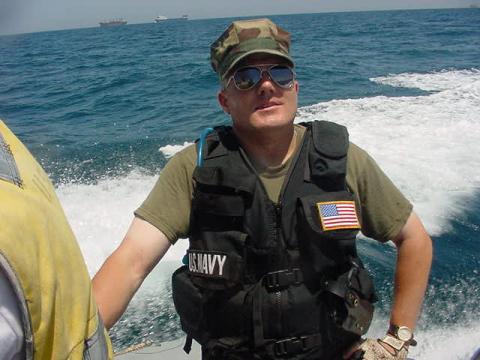
Iconic Picture of Padre Steve on a Boarding Mission

From there Hue City operated with the USS John F Kennedy conducting operations in the Gulf of Oman where our air controllers helped direct strikes against Al Qaida and the Taliban and during which time the ship was detached to keep watch on the Indians and Pakistanis who were on the brink of having a nuclear war.  Acting great and Academy Award winner Jack Lemmon, former Beatle George Harrison and NASCAR great Dale Earnhardt all made their final lap around the planet. In Baseball the Arizona Diamondbacks defeated the New York Yankees to win the World Series in 7 games.

2004 The Red Sox Break the Curse

2002 also saw John Allen Mohammed, the Beltway Sniper bring terror to Washington DC, Northern Virginia and Maryland, the Congress passed a joint resolution to allow President Bush to use US Military Forces as he deemed fit in Iraq and the Iraq War Resolution.  Shortly thereafter the Department of Homeland Security was established.  The San Francisco Giants lost the World Series to the Anaheim Angels after leading in the 7th inning of game six much to the consternation of Padre Steve and the other Giants faithful.  Calls for the public water boarding of Giants Manager and former “Evil Dodger” Dusty Baker to find why he took out Russ Ortiz went unheeded. Dave Thomas the founder of Wendy’s flipped his last burger, country music legend Waylon Jennings sang his last song and Baseball immortal Ted Williams all died in 2002 with Williams and his family trying to make him a real immortal by having his remains cryogenically frozen.

The Challenger Disintigrates

For Padre Steve 2003 was relatively uneventful, the Hue City was in the yards when Operation Iraqi Freedom was launched and was just getting ready for a deployment when he was reassigned to the Marine Security Force Battalion.  In short order he was travelling around the globe and before the end of the year had visited his Marines in Bahrain, Rota Spain and Guantanamo Bay Cuba and he and the Abbess celebrated their 20th wedding anniversary. The Iraq War and overthrow of Saddam Hussein was the big story of 2003 however there was other news. The Space Shuttle Columbia blew up on re-entry killing the 7 astronauts on board, California recalled Governor Gray Davis and replaced him with the Governator Arnold Schwarzenegger and the Florida Marlins defeated the New York Yankees to win the World Series. We lost some legends in 2003 comedian Bob Hope died at the age of 100 and is now doing his Christmas show for the Archangel Michael and the Armies of Heaven; US Senator Strom Thurman filibustered his last bill at the age of 100, Fred Rogers left the neighborhood and Joseph Coors brewed his last batch of really bad beer.

George Bush on the USS Abraham Lincoln

2004 saw yet another nasty Presidential election riddled with controversy as George W. Bush defeated Senator John Kerry to win re-election.  In Iraq Saddam Hussein was finally caught hiding in a hole in the ground by US Special Forces, the war in Iraq went south as the insurgency of former Ba’athists, disaffected Sunnis aided by Al Qaida and other foreign fighters and terrorists took up President Bush on his challenge to “bring it on.”  Facebook was founded in Cambridge Massachusetts, simultaneous suicide bombs devastated trains in Madrid in what became known as Spain’s 9-11, Lance Armstrong won his 6th consecutive Tour de France, Chechen terrorists seized a school in Beslan Russia and over 300 are killed and 700 wounded by the terrorists as the school was stormed by Russian security forces and the Boston Red Sox won the 2004 World Series to break the curse of the Bambino after coming back to defeat the Yankees in the ALCS after being down three games to none.  Death took no holidays in 2004 as Bob Keeshan better known as Captain Kangaroo was piped over the side, Rick James dated his last Super Freaky Girl without taking her home to mother and former President Ronald Reagan died of Alzheimer’s Disease after seeing his successors destroy his coalition and “big tent” and hopeful vision of conservatism.   Padre Steve continued to travel around the world with his Marines going to Japan, France, and Spain, Bahrain and Guantanamo Bay as well as a number of trips within the United States.  In France he taught seminars at the Belleau Wood battlefield site and in Normandy.

Hurricane Katrina as a Category 5 Storm

The war in Iraq continued to heat up in 2005 with the insurgency spreading throughout the country with the focal point being Sunni stronghold Al Anbar Province.  Hurricane Katrina ravaged Gulf coast devastating New Orleans and southern Mississippi killing over 1800 and forcing millions from their homes. The ineffective and inept government response beginning with the “fly by visit” of President Bush helped the Democrats regain control of the House and Senate in 2006.  Terrorism was alive and well as a terrorist attack on London’s Underground and a bus killed 56 and injured over 700.  As for Padre Steve well he was selected for promotion to Lieutenant Commander, completed the Marine Corps Command and Staff College and continued to travel around the world with his Marines going to Japan, France, Spain, Bahrain and Guantanamo Bay as well as a number of trips within the United States.  The highlight of this was being able to have the Abbess accompany him to Guantanamo Bay for the Marine Corps Birthday Ball. The Chicago White Sox defeated the Houston Astros in the World Series. In Washington DC baseball stars were hauled before a Congressional committee to testify on steroids in baseball or interrogated about their possible use of steroids. This wasted millions of dollars in taxpayer money as loser Congressmen who tolerate all sorts of illegal and immoral actions of their own sought to embarrass and destroy the careers and reputations of ballplayers in a grand act of inquisitional hypocrisy. Death came knocking for comedian Richard Pryor, Johnny Carson gave his last monologue, Pope John Paul II met Saint Peter and James Doohan, Mr. Scott from Star Trek was beamed up for the last time.

Israeli Merkeva Tank Destroyed by Hezbollah

In 2006 Padre Steve was promoted the Lieutenant Commander and was transferred to EOD Group Two after completing another year of travel with the Marine Security Forces.  Within months there was talk of a deployment to Iraq or Afghanistan for him and his trusty assistant and body guard Nelson Lebron. He also began a Masters Degree program in Military History at American Military University.  In the rest of the world the Republicans lost their majorities in Congress, the war in Iraq continued to grow in intensity and Israel went to war with Hezbollah forces on their northern border.  The attack was ill conceived and was a military failure revealing weaknesses in the Israeli ground forces training and tactical abilities forcing investigations of the military and the resignation of the head of the military.  Pope Benedict XVI the successor to Pope John Paul II published his first encyclical.  In the World Series Tony LaRussa’s St Louis Cardinals defeated the Detroit Tigers and Barry Bonds though tainted by controversy continued his march to the Baseball Home Run title.  Death paid a visit to former Secretary of Defense Caspar Weinberger, sportscaster Curt Gowdy called his last game and Don Knotts, Televisions Barney Fife gave up his bullet for the last time.

Barry Bonds the All Time Home Run Leader

The war in Iraq reached a climax in 2007 as President Bush heeded the advice of General David Petreus and initiated a “surge” of forces to help wage an actual counterinsurgency campaign.  Combined with the Al Anbar Awakening where the Sunni turned on the insurgents and allied themselves with the Americans the course of the war changed as insurgents lost support and the US and better trained and equipped Iraqi forces launched successful offensives to drive the insurgents out of key areas.  Padre Steve deployed to Iraq and served in Al Anbar Province working with US Marine and Army advisers to the Iraqi Army, Police and Border forces travelling thousands of miles in the province to go where few others went.

Padre Steve in Iraq with Bedouin on Syrian Border

Barry Bonds broke Hank Aaron’s all-time home run record while track star Marion Jones surrendered 5 Olympic Gold Medals after admitting to blood doping and the Boston Red Sox swept the Colorado Rockies to claim their second World Series title of the decade.  Meanwhile death came to Jerry Falwell who preached his last sermon; Tammy Faye (Baker) Messner applied her last coat of Bondo, Ike Tuner played his last guitar riff while Pavarotti exited the stage with Marcel Marceau who went rather silently I am told.

Barak Obama the 44th President

In 2008 Padre Steve returned from Iraq with a pretty good case of PTSD, chronic pain and anxiety coupled with depression and a crisis in faith.  He finished his tour at EOD and was assigned to Portsmouth Naval Medical Center. He and the Abbess celebrated thier 25th wedding anniversary.  The war in Iraq was now moving in a successful direction with the Iraqis taking more control of their security and the various religious, political and ethnic factions beginning to talk and work with one another rather than shoot at each other.  However the war in Afghanistan took a nasty turn as the Taliban came back with a vengeance and the Afghan government was revealed as weak, ineffective and corrupt.  The 2008 Presidential election was waged with bitterness and the Democrats sent Senator Barak Obama, who had defeated Senator Hillary Clinton up against Senator John McCain.  Obama won the election becoming the first African American man to become president while strengthening their majorities in Congress. The world entered a major economic crisis in 2008 and the United States suffered massive losses in financial markets, housing and rising unemployment.  Bank bailouts were the order of the day as President Bush left office and Obama took over.  A massive earthquake in Sichuan China killed over 80,000 people while American swimmer Michael Phelps won 8 gold medals to set an Olympic record.  The Philadelphia Phillies won the World Series defeating the surprising Tampa Bay Rays.  Death as always came along taking actors Heath Ledger and Charlton “Moses” Heston, comedian George Carlin and former Senator Jesse Helms.

Sarah Palin the New Leader of the GOP?

2009 came in with the inauguration of Barak Obama as President something that Padre Steve witnessed with a elderly African American women in her ICU room while holding her hand as she cried not believing that she would see an event of this kind in her lifetime.  The war in Iraq began to wind down as the US began to increase it’s withdraw of ground forces and turn over more security to the Iraqis.  In Afghanistan the war reached a crisis point as the military and political situation deteriorated within the country and support for the war dwindled in the US and Europe. Amid this President Obama agreed to a “surge” for Afghanistan.  The worldwide economic continued but by the end of the year some economic indicators were pointing upward again even as the US unemployment rate continued to rise. A bitter fight was waged over health care reform and economic policies while President Obama’s support and approval ratings crashed as people on both the left and right of the political spectrum criticized his leadership and policies.  Republican Vice-Presidential nominee and former Vice President Dick Cheney took the Republican lead in attacking the President while conservative talk radio delivered a daily barrage of criticism.  Some of Obama’s own actions did not help his cause especially in the manner in which he was viewed to respond to terrorist attacks including an attempted Christmas Eve bombing of a US airliner.  Tensions continued to grow between the West and Iran regarding that nation’s nuclear program even as widespread demonstrations wracked that country after an election which appeared to be rigged by the Iranian government. An outbreak of H1N1 Influence reached pandemic proportions across the globe but did not reach the lethality that it had the potential to do.  The Vatican announced a historic plan to allow conservative and traditionalist Anglicans come into the Catholic Church and retain their Anglican traditions and some measure of autonomy.

The Yankees Return

In baseball a revitalized New York Yankees team dominated the American league and went on to dominate their playoff and World Series opponents defeating the Phillies in 6 games. In football a good number of teams in both the NFL and NCAA were a parody of the sport and coaching scandals plagued the sport while at the box office Star Trek came back with a vengeance and a twist. Padre Steve continued his hospital work, battled PTSD, depression, his father’s Alzheimer’s disease and his own spiritual crisis but completed the academic requirements for his Masters Degree in Military History and by the end of the year began to experience some measure of healing.  He launched this site in February of 2009 and as of this post will have made 328 posts on the site.  He also bought his first ever season tickets for a baseball team and now claims Section 102, Row B seats 1 & 2 as his pew at the Church of Baseball, Harbor Park Parish.  Death prowled the earth looking for recruits finding legendary news anchorman Walter Cronkite who signed off of the last time, Pop Superstar Michael Jackson who “moon walked” the stairway to heaven or wherever, Senator Edward Kennedy who finalized his last legislation with his maker and Patrick Swayze who reprised his role in “Ghost.”

So it has been quite a decade personally for your friend Padre Steve as well as an eventual decade for the United States and the World.  The decade has been “interesting” and as the ancient Chinese curse says “may you live in interesting times.”  I hope that the next year and decade are a lot less interesting, that wars will cease and that people all over the world will join together like the old 1960’s Coca Cola commercial.

I’d Like to Teach the World to Sing?

Peace and Blessings in the New Year,

Padre Steve+

1 Comment

Filed under History, Loose thoughts and musings

More Lies and Distortions from WorldNet Daily’s Bob Unruh

Note: It has been a good number of months since I have addressed the Lies of WorldNet Daily and it’s leadership Joe Farah and his designated hit man Bob Unruh. I stumbled across an article yesterday evening when my curser hit the Worldnet Daily link on my “favorites.” I seldom go there unless I think that they might be getting crazy, but this was accidental, or if I was a Calvinist possibly God’s will. Unfortunately late last night I saw an attack on a fellow officer by this influential “Conservative Christian” website.  The attack was gratuitous and directed at an officer currently serving in Afghanistan Major Brian Stuckert who as part of a military education course published a monograph which is in the public domain entitled “Strategic Implications of American Millennialism.” As I mentioned the last time that I wrote against something that Unruh and WND published that I would limit myself to military issues as I do in this article.  I try to ignore the folks at WND but feel in this case that that are again in the process of attempting to stir up opinion against an officer who has done nothing wrong but to disagree with their political-religious ideology. While the folks at WND and those like them have every right to their opinions an beliefs, which are defended by those of us in uniform, they are way out of line in this article and owe Major Stuckert an apology. Unfortunately the WND leadership doesn’t do this as is evidenced in their past treatment of the Commanding Officers of Gordon Klingenschmitt. These men have no honor and stoop to the basest means to attack those that disagree with their narrow point of view. Some will not like what I write. That is fair, I do not claim to be infallible not do I practice censoring those that disagree with me. But I will not let a fellow officer who is serving in a combat zone be the subject of an egregious attack by the folks at WND. If it were an attack by a “liberal” website I would feel the same way. The fact that it is a “conservative” website which claims to “support the troops” that attacks Major Stuckert and other military officers who disagree with their point of view only makes me angry.  Now to my response:

Just when you think it is safe to go in the water and just enjoy the Christmas season Joe Farah and the good folks at Worldnet Daily come out with another whopper to attempt to whip people up against those in the military with differing opinions than that of their own.  Written by noted propagandist Bob Unruh who helped spin the lies of former Navy Chaplain, defrocked Evangelical Episcopal Priest Gordon Klingenschmitt into a frenzy that had many Christians believe that the Navy was attempting to muzzle Klingenschmitt’s religious rights, the article takes aim at an monograph written by Army Major Brian Stuckert ( the link to Stuckert’s monograph is here: http://www.wnd.com/files/Millennial.pdf ) for the Advanced Military Studies program. Officers who attend courses such as this are often required to produce a research paper on a subject that deals with political, military and foreign policy topics to include how social, ideological or religious can impact military operations at the strategic and operational levels including effects on foreign policy and diplomacy.  The Worldnet Daily article is linked here:   http://www.wnd.com/index.php?fa=PAGE.view&pageId=119315

Unruh in his usual manner has manipulated the facts to make it appear that Stuckert and the Army is attempting to silence what Unruh calls “Evangelical beliefs.”  In fact the title of the article U.S. Army Major: Lose evangelical Christian beliefs” is a straw man intentional thrown out by Unruh to chum the waters so to speak.  Unruh takes a research paper which he does not agree with and demonizes the writer.  These papers are akin to any research paper done for a graduate level academic program. They reflect the opinion of the author and not the institution.  Like all papers of this type they have to be evidenced based, in other words the author has to have data to show that his hypothesis and conclusions actually are not simply whims but have impact in the world in which the writer serves and for the topic that he or she addresses.  One does not have to agree with them and in fact in the future other officers might actually write articles to refute what Stuckert says.  This is an academic program and as such differing points of view are sought.

Instead of just leaving this be both Unruh and undoubtedly Joe Farah is using this article to again whip up the faithful against any idea that might contradict their political-religious views.  Stuckert has criticized the foundational philosophy of the Worldnet Daily leadership that of Pre-millennial Dispensationalist theology which does have very real foreign policy implications for the United States.   As such Stuckert’s article is important because it draws attention to how Pre-Millennial Dispensationalist effects how many Americans view the world and international relations to include how such beliefs can influence policy making.  Stuckert’s premise is found in his abstract:

“Since the beginning of the Republic, various forms of millennial religious doctrines, of which dispensational pre-millennialism is the most recent, have shaped U.S. national security strategy. As the dominant form of millennialism in the U.S. evolves, it drives changes in U.S. security policy and subsequent commitment of the instruments of national power. Millennial ideas contribute to a common American understanding of international relations that guide our thinking irrespective of individual religious or political affiliation. Millennialism has great explanatory value, significant policy implications, and creates potential vulnerabilities that adversaries may exploit.”

This is a fair characterization of the effect of pre-millennial dispensational theology on American national thought.  Thus it is fair to examine its effect on current policy both foreign and domestic.

Instead of taking Stuckert’s observations and critiques for what they are Unruh and his co-conspirators turn this into a conspiracy of people in the Army and government against true Christians. In the usual manner Unruh quotes someone that he agrees with on the article: Unruh quotes John McTernan a writer on Biblical Prophecy who says that Stuckert’s article is “the most dangerous document to believers that I have ever read in my entire life” and “After reading this document, it is easy to see the next step would be to eliminate our Constitutional rights and herd us into concentration camps.”

I am sorry, this is beyond reason: “eliminate our Constitutional rights and herd us into concentration camps?  That is nothing more than propaganda. In fact it is delusional paranoia designed implicitly to scare people and move them further into WorldNet Daily’s orbit turning good people against honest and decent military officers.  Unruh did this with Klingenschmitt in grand fashion through character assassination of Captain Carr, Klingenschmitt’s Commanding Officer on USS Anzio and Captain Pyle, the Commanding Officer of Naval Station Norfolk.  This got so bad regarding Captain Pyle, a conservative evangelical Christian of the Assemblies of God denomination that he was ostracized by his own church and demonized by the Christians who were the closest to his theological views.  It was shameful; people still believe the lies about Klingenschmitt spewed by the WorldNet Daily crowd.  Now they attack an Army Major who is serving in combat in Afghanistan.  Such conduct is beyond crude and unseemly, it is dishonest, disingenuous and dishonorable.

Unruh, no stranger to such behavior ends his article with a totally unrelated reference to the terrorist who killed 13 and wounded many others at Fort Hood just a month ago.  Major Stuckert’s article was published in 2008 and has nothing to do with the actions of Major Hasan.  The implication is that Stuckert supports the traitorous terrorist Hasan. This is another disingenuous attempt to link someone who disagrees with them with terrorists or other extremists.  Such behavior by alleged “journalists” is simply dishonest and to use a term from American history is “Yellow Journalism.”

The conduct of WorldNet Daily and in particular Bob Unruh is shameful and shows none of the graces associated with true Christian faith. Lying and mischaracterizing what others say and demonizing them in apocalyptic terms is not Christian behavior. It is crass cynical propaganda and WorldNet Daily is one of the worst offenders around.  Unfortunately these people are vicious in their attacks.  The article talks of “losing evangelical beliefs” however many evangelicals either oppose or have out rightly condemned pre-Millennial Dispensationalist as heresy. Yet many pre-millennial dispensationalists, especially the type found at WorldNet Daily effectively write off all evangelicals who do not hold to one of their several Rapture theories: “All people who believe the Bible believe in a Rapture” Mark Hitchcock “What Jesus Says About Earth’s Final Days” (p. 96).  This is just one example of how this camp views other Christians. If you do not believe in the Rapture as they define it you do not believe the Bible. The deduction is that Christians believe the Bible, you disagree with the Rapture, and you don’t believe the Bible and are thus not a Christian.

Even Prominent Evangelicals such as A. W. Pink (1886-1952) have disagreed with the tenants of Dispensationalism:

“Dispensationalism is a device of the enemy, designed to rob the children of no small part of that bread which their heavenly Father has provided for their souls; a device wherein the wily serpent appears as an angel of light, feigning to “make the Bible a new book” by simplifying much in it which perplexes the spiritually unlearned. It is sad to see how widely successful the devil has been by means of this subtle innovation.”

Many conservative Christian churches and individuals do not hold this position; in fact to take the view of Unruh is to assume that Stuckert is attacking Evangelical Christianity.  Stuckert is not doing so, he is simply critiquing one of several competing Christian Eschatological theories and how its influence helps shape US foreign policy and the worldview of many Americans.  He asserts that such beliefs when not recognized by those that propagate them can leave the United States vulnerable to our enemies, nothing more, nothing less. In fact Stuckert is careful to differentiate the various factions in what is considered by some radical secularists to be a monolithic “Evangelical” movement.

“Millennialism, and especially dispensational pre-millennialism, derives in large part from extraordinary literalism of even the most figurative passages of the Bible. In America, literalism in biblical interpretation is most closely associated with fundamentalism. Theologically, it is best to begin a discussion of American millennialism with a brief review of fundamentalism as the term applies to the contemporary American religious tradition. Fundamentalism is a frequently misunderstood term in America. Although it has connections to each, fundamentalism is distinct from evangelicalism, the charismatic movement or conservative Christianity in general. Fundamentalism is also poorly understood when we attempt to define it as a personality style, a form of militancy, or a particular worldview.” (Stuckert pp. 6-7)

Stuckert is fair in this; to not admit that religious, ideological or philosophical views do not serve is “filters” as McTernan and Unruh seem loathe doing is simply wrong. To understand the prism of how religious, ideological and other beliefs can influence worldview and decision making is important. This is what Stuckert does as pre-millennial dispensationalism is one of the major shapers of American thought; not only for Fundamentalist Christians but anyone who follows the popular fictional writings of Tim LaHaye’s Left Behind series.

Stuckert continues his monograph by discussing the importance of how Christian Fundamentalists view the Bible and the influence of pre-millennial eschatology on American political thought and foreign policy.   Since the popularized version of this eschatology influences the way that many Americans view the world it is appropriate that the effects of it be analyzed by those who study foreign and domestic policy. In his summery and conclusions Stuckert makes an erudite observation that is lost on many people:

“Because religion in America directly impacts policy, military leaders and planners must learn to recognize the tenets and implications of American millennial thought. Millennialism has always been a feature of the American culture and has shaped not only the objectives of U.S. government policy, but also the way in which we interpret the words and actions of other actors on the international stage. Millennial ideas contribute to a common American understanding of international relations that guide our thinking regardless of individual religious or political affiliation. Millennialism has great explanatory value, significant policy implications, and creates potential vulnerabilities that adversaries may exploit. By gaining insight into and embracing intellectual honesty where our own prejudices and proclivities are concerned, we can greatly improve the quality and clarity of our decision-making.” (Stuckert pp. 58-59)

Unruh “cherry picks” what he wants from Stuckert’s monograph in order to paint Stuckert as some kind of anti-Christian officer.  The use of McTernan’s claims to buttress his article shows how biased that Unruh as since McTernan’s livelihood is based on writing books and speaking about Bible prophecy from a pre-millennial dispensational point of view.  He claims to be a “student of American history” but has no academic credentials save a BA from Virginia Commonwealth University in an unnamed field. He has no military experience, no education in military or political theory other than what he may have learned on his own “study” and is in no position to be a legitimate critic of Major Stuckert’s work.  McTernan claims that the “last third (of Stuckert’s work) is an interpretation of Bible belief on world events. “This report blames all the world evils on believers! World peace would break out if it were not for Bible believers in America.” In fact it says no such thing.  It is not a “report” as McTernan calls it, but simply the equivalent of a graduate level thesis. This is nothing but a hit piece on a fellow officer who disagrees with McTernan and the crowd at WorldNet Daily.  McTernan talks about an argument that he had with Colonel Stefan Banack of the School for Advanced Military Studies who McTernan attacks:

“The conversation was extremely heated between us, and he hid behind the freedom of speech to produce it. He refused to let me write an article to refute this attack on Bible believers. He refused to tell me what this study was used for and who within the military was sent copies. I believe that it represents an official military view of Bible believers as Col. Banack said there was no study or article refuting this one.”

The fact that these papers are in the public domain and on the center’s website makes no difference to McTernan. He attempts to paint this is a some kind of conspiracy against Evangelical Christians when in fact it is the equivalent of an academic thesis in a Masters Degree program.  The fact that he says that Colonel Banack “hid behind the freedom of speech to produce it” sends a chilling message. Freedom of speech for McTernan goes only for McTernan not for those who disagree with him. Likewise McTernan uses the refusal of Colonel Banack to allow him to “refute this attack on Bible believers” is a red-herring. The School’s academic publications are for students to publish not for people with no standing in the military to use the platform to propagate their beliefs.  Mr. McTernan to my knowledge is not a student at the Advanced Military Studies program and would not be using the forum for actual academic debate but to advance his own cause which he does on his own website without any restriction.

So once again WorldNet Daily drops a whopper on its readers and attacks the character beliefs and academic thought of a military officer. Their conduct in this is much more like the Taliban and the Iranian Ayatollah’s than anyone who claims to value the right to freedom of speech and religion as they do. Like the early Puritans who came to the New World for “religious freedom” the only religious freedom or freedom of speech that Unruh, Farah and other like them value is their own. Those who dissent from their narrow understanding of eschatology stand condemned as do those who ask legitimate questions about the policy implications of their belief system. If they were ever to be in a position to impose their beliefs in this country men like Major Stuckert and probably yours truly would be persecuted.

Although I am but a “pip-squeak” in comparison to the WorldNet Daily behemoth but I cannot let a fellow officer who is serving in harm’s way be the subject of a gratuitous attack by these people. May God keep Major Stuckert and those he serves with in harm’s way safe and may they accomplish the mission that they have been sent to do.  As far as WorldNet Daily goes…I hope that they continue to have the freedom to speak in the manner that they would deny to those who disagree with them, especially those who serve in the uniform of the United States of America in harm’s way.

Peace,

Padre Steve+

10 Comments

Filed under Foreign Policy, Lies of World Net Daily, Military, national security

Lessons on Coalition Warfare: The Dysfunctional Coalition German and the Axis Partners on the Eastern Front

“The Dysfunctional Coalition: The Axis Powers and the Eastern Front in World War Two” by R. L. DiNardo. Published in The Journal of Military History October 1996, 60 Research Library pp. 711-730

A Romanian Renault 35 Light Tank Rather Than

The question of the German dominated European Axis alliance in the Second World War is one of the more neglected subjects of World War Two and has application to today’s multi-national campaign in Afghanistan. In most accounts of World War Two the relationship of the Germans to their coalition partners is minimal.  This includes the standard works on the subject of B.H. Liddell-Hart, Williamson Murray, Chester Wilmot and David M Glantz,   Of Germany’s Allies Italy usually receives some attention in the context of the campaign in North Africa and Mediterranean.  Its efforts on the Eastern Front are usually neglected except for how the Italian 8th Army was shattered during the Stalingrad campaign.  The efforts of Hungary, Rumania and Finland receive scant attention from anyone. Popular German memoirs provide little substantive help as most German commanders looked down on their military capabilities. Kesselring’s memoirs and Rommel’s papers give some views, mostly negative of the Italians and Manstein some mention on the Italians, Hungarians and Rumanians in the Stalingrad campaign.

Field Marshal Von Mannerheim of Finland Kept an Independent Course from Germany

In this badly needed essay Robert DiNardo examines the relationship of Germany to her allies on the Eastern Front where they came closest to fighting coalition warfare. This is a subject that he would expand on in his book “Germany and the Axis Powers: from Coalition to Collapse” (University of Kansas Press, 2005).  DiNardo believes that it is important to learn from the failure of Germany and its coalition just as we do from the success of the Allies.  This perhaps is his greatest contribution in an age where the United States must work with coalitions whose members have significant military weaknesses.  The situation in some ways places he United States in a similar position to Germany in the current wars on terror and campaigns in Iraq and especially Afghanistan.

Hungarian Soldiers on Obsolete CV-35 Tankettes at the Beginning of Barbarossa

DiNardo asserts “the way in which Germany conducted coalition warfare was reflective of the manner in which Hitler and the German military looked at the world, as well as the war in general” was a key factor in her defeat. German arrogance and hubris frequently kept them from gaining any advantage from their coalition partners. DiNardo believes that it was “a significant factor that contributed to the ultimate defeat of Nazi Germany.” (p.712)  He then notes the few successes of the coalition, particularly the German work with Rumanian air defense around the Ploesti oil refineries and the German-Finnish Winter Warfare School.  Apart from these he characterizes Axis coalition warfare on the eastern front as “poor” with “failures at every level.” (p.713)

DiNardo analyzes language barriers, the wide disparity between the modernity of the armies and the levels of technology and training of her coalition partners. He also deals with Germany’s failure to become the “arsenal of Fascism” as well as the lack of understanding of all the partners of the “relationship between national objectives, strategy and the morale of soldiers of officers and soldiers alike.” (p.713)  He provides a good description of the German liaison detachments allotted to the coalition armies, dealing with language, tactical communications weaknesses and the generally haughty attitude that the Germans displayed to their partners. He provides an excellent illustration of this in analyzing with the failure of XLVIII Panzer Corps at Stalingrad when the German Liaison to the Rumanian 1st Panzer Division was wounded and the division was destroyed for lack of German support.  So bad was the German attitudes toward their Allies at higher levels that DiNardo describes the German policies and attitudes as “imperialist.” (p.718)

Hungarian Withdraw from the Donets Bend

DiNardo also looks at the wide gap in transportation capabilities of the various armies and the failure of the Germans to better provide for the needs of their partners in contrast to the United States assistance to her allies.  In his analysis he notes how the Germans provided obsolete captured Czech and French weapons and vehicles to the allies instead of providing them with the plans to build German designs in Rumanian and Hungarian industrial concerns capable of their manufacture. (pp.718-719) The lack of modern equipment among the German allies impacted operations against the Red Army and was a factor the eventual defeat of the Germans the hands of the Red Army.

While even elite German formations often had significant equipment shortages and sometimes substandard equipment he does not note that the principle reason for this was that German did not go to a “total war” industrial production until Albert Speer took over as Armaments Minister.  This is perhaps the one weakness in the essay. The final part of the essay deals with the strategic goals and conflicts among the Axis coalition which were never worked out.  In this discussion he again goes to the relationships of the Germans at every level to their partners and how the Germans had a general distain for their allies’ capabilities. He discusses how various partners refused to cooperate with the Germans in different ways and times.

These problems impacted German efforts in significant way. The Finns never signed a formal alliance with Germany and pursued their own war goals, the underlying tensions between Hungary and Rumania over their own territory disputes meant that the Germans could not count on these key partners to work together in the campaign in Russia.  He finishes his essay by detailing the morale problems in the Hungarian, Italian and Rumanian armies as they fought on the Eastern front.

He sources this article well using histories, archival sources, operational orders and analysis by the various armies as well as interviews. Of particular note is that he goes to sources of the coalition partners and not just German sources.  This allows him to be far more nuanced and detailed in his discussion as opposed to others who simply ignore the contributions of the Axis partners.  His footnotes provide added detail and provide and lend support to his arguments.

The importance of this essay is twofold; first it provides a look at the relationship of German to her coalition partners on the Eastern Front.  This is important from a historic standpoint simply because it is such a neglected topic in most histories of the period and gives added depth to the reasons for Germany’s defeat.  One has to ask the “what if questions” in regard to had the Germans better treated, equipped and recognized their allies’ contributions to the war effort.

The second point of interest pertains to how history can inform the leaders of the United States and NATO in the Afghanistan campaign.  The lessons provided to any nation which has to engage in coalition warfare are important, especially of one of the partners enjoys significant military advantages over its allies.  This is the case in Afghanistan and the War on Terror where United States has found itself as the senior and vastly superior partner in a war which has multiple coalition partners in several theaters of operations.  Each coalition partner has certain military weaknesses in relationship to the United States as well as their own national interests, geo-political and economic relationships with competitors to the United States and internal political realities which impact their cooperation in the war.  As such the United States cannot allow itself to be cast in the role of a haughty imperialistic senior partner as did Germany and it must cultivate an attitude of assistance, respect and trust among its partners to assure their full cooperation and assistance in relation to U.S. goals in the war.  Failure to head the German lesson will ensure failure in the current campaigns.

1 Comment

Filed under History, iraq,afghanistan, world war two in europe

The Afghan War 2009-2012: Lessons from Algeria 1954-1960 A Review of “A Savage War of Peace

“A Savage War of Peace.” By Alistair Horne. The New York Review of Books, 1977, 1987, 1996, 2006.  Maps. Photographs. Bibliography. Index. 608 pp.

Foreign Legion in Algeria

In light of the developing situation in Afghanistan and the plan to apply the counterinsurgency techniques of clear and hold, or “the oil slick” in that country it is wise to look at other instances of this type of warfare before criticizing those about to implement the strategy.  Of course when doing this the best place to look is history, especially where the strategy worked, at least until the DeGaulle government abandoned the nearly complete military success achieved by French forces in Algeria triggering a national crisis.

Alistair Horne’s “A Savage War of Peace” is a most needed addition for anyone seriously interested in studying the dynamics of insurgency and counterinsurgency warfare; especially political and military leaders of a western nation occupying a Moslem country.  Horne’s work is important and one of the few in English that cover this subject.  The two other books in English to cover the subject, albeit only on part of the campaign is Paul Aussaresses’ controversial memoir “The Battle of the Casbah” and Ted Morgan’s memoir “My Battle of Algiers” though useful suffer from the fact that they are limited in scope to the events the individuals experienced while serving as French Army officers in Algeria. In both the author’s personal biases are readily in evidence and by the fact that they were written many years after the events in question.  Since those books are heavily dependent on the author’s memories.

Paratroops of the First Colonial Paratroop Regiment in Algeria

Horne is not limited by these factors.  Horne is a historian who served as a British Army officer assigned to the MI5 in the Middle East and later as a foreign correspondent for the Daily Mail who has written a trilogy of excellent works on the Franco-German wars: The Fall of Paris: The Siege and the Commune 1870-1871, The Price of Glory: Verdun 1916 and To Lose a Battle: France 1940. As such his account is as close to being objective as any could be in the case of writing this particular history.

Horne approaches the subject from the perspective of the broader issues that France and the Fourth Republic were facing in 1954, economic, military and psychological recovery from the Second World War, the loss of colonies, defeat in Indochina culminating in the Dien Bien Phu debacle.  Such is important when examining a military campaign as the latter do not take place in isolation of other events in the life of a nation. When the history of the US campaigns in Iraq and Afghanistan are written they will have to take into account many other factors apart from the military operations.

Horne tackles the complex issues of the Algerian war in a multifaceted manner looking not only at the military issues, but the political and social issues faced by the French, the European Pied-Noir Algerians and the Algerian natives, both Berber and Arab alike.  Horne also looks at the conflict in the broader context of the Cold War, the emergence of the Non-Aligned nation movement and the rise of Arab nationalism, skillfully weaving the actions of these movements and key individuals such as Egypt’s Nasser, Khrushchev of the Soviet Union and the most influential, and President Jacques de Gaulle into the story of the Algerian conflict. Unlike other writers Horne had access to many of the individuals involved, including leaders from each rebel faction, the Pied-Noir and the French government and military.  Included in those he interviewed is Algerian President Boumedienne who had commanded rebels during the conflict and was instrumental in Algeria’s independence as well as Jacque Soustelle who had been Governor General from 1955 through 1956. These sources as well as numerous others help give his narrative a depth and subtlety lacking in the first hand English language memoirs and accounts.

Terrorism by FLN Militias and Sympathizers Caused Great Problems for the French

Horne begins his account with the story of the aborted revolt and massacre at Setif on May 8th, VE Day, 1945 and the attempt by the French government to reassert its control over Algeria. Of particular interest in this section is Horne’s analysis of the mistake of the Pied Noirs and the French government in not offering a settlement to the Algerian separatists under magnanimous terms due to the scale of the victory they had won following the Setif uprising and their security forces “decapitation” of the leadership of the various Algerian nationalist factions.  He compares the victory to that of the Israelis in the 1967 War and the political reaction of the Pied Noir to the Israelis, who instead of negotiating a settlement that could have long term effects advantageous to them from a position of strength determined to humiliate and subjugate their foe.[1] If the US military is able to reverse the situation in Afghanistan the United States and the Afghan government will need to be magnanimous to a defeated foe in order to prevent yet another repetition of another Al Qaida and Taliban resurgence.

French Paratroops Going House to House in Algiers

In examining the period before the actual outbreak of the war in 1954 Horne looks at the missed opportunities of the French to prevent it.  He also examines the development of the Algerian independence movement, especially the senior leaders of the movement; many of whom had served in the French Army during the Second World War with distinction. His portrayal of the conflicts within the independence movement, show that this was not a monolithic movement, but that each faction had its own goals which often were in conflict with other groups.  This is also the case in Afghanistan where a disparate number of ethnic, political, criminal, nationalist and terrorist groups who often are at war with each other.  Likewise, Horne’s treatment of the Pied Noir and certain parts of the French leadership examine how they too were divided at some points in regard to the ultimate plan for the relationship of Algeria to France.
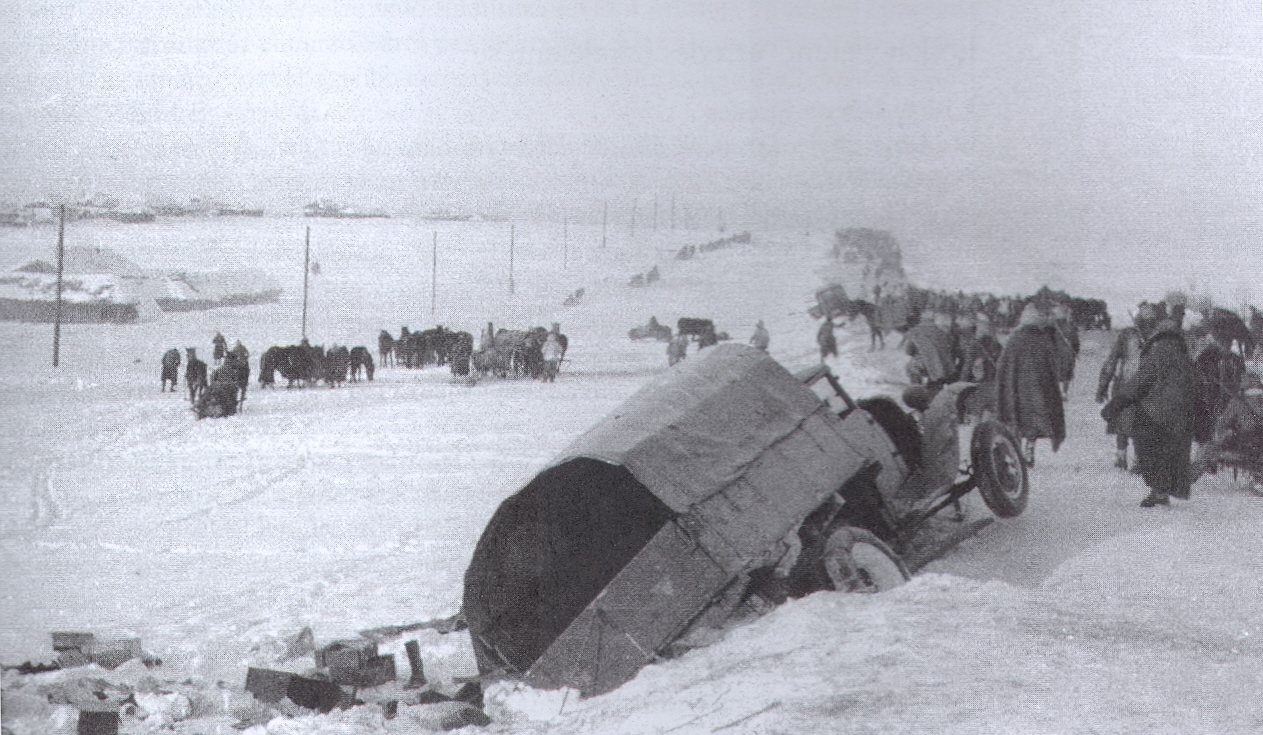
Horne makes much of political mistakes and machinations of French leaders that culminated in the end of the Fourth Republic and subsequent impact on de Gaulle when he became president in June 1958.  Some mistakes that Horne explores are those committed in the immediate wake of Setif. He also examines mistakes during the revolt; such as not taking it seriously, to individuals in the National Assembly impeding the efforts of Soustelle to effect reforms and compromise between hard line factions in the Pied Noir and Moslem communities.[2] Likewise he notes how the draconian treatment of Algerian Moslems by the French Army in the early phases of the counter-insurgency effort, including the assignment of “collective responsibility” to punish communities for the actions of individuals helped alienate the populace and strengthen the insurgency.  Such was the case in the first part of the Iraq occupation and helped inspire that insurgency.  One member of Soustelle’s cabinet noted: “the cycle of repression getting ever tougher, and the rebellion ever stronger, will ruin all your efforts of pacification.”[3]

Besides political mistakes Horne examines issues in military tactics that seem to plague counterinsurgency efforts to the present time.  He describes the early application of heavy conventional forces in an attempt to defeat the insurgency.  Horne discusses unsuccessful efforts in 1954-1955 and how they not only did not destroy the insurgency but how the insurgency spread in response to the efforts.  The question: “Did ‘pacification’, for instance mean trying to regain the confidence of the inhabitants; or did it mean crushing the rebellion by whatever means available?”[4] This question is still asked today by soldiers fighting insurgencies and often the latter is counseled by those who still think along the lines of the conventional tactics of the Cold War and World War Two, which many conservative pundits are enamored with.  Horne also discusses the successful tactics of commando units used by General Challe to effectively combat the insurgency.[5]

Horne examines the attitudes of the French Army which in a sense fought the war for itself.  Armies that have fought many campaigns together often have a sense of comradeship that transcends even the loyalty that they have to their nation.  It is the understanding of a “Band of Brothers” and can be found throughout history.  When the histories of Iraq and Afghanistan are written they will certainly include the fact that many soldiers, Marines and Sailors engaged in actual combat operations fought for the men and women with whom they served more than for anything else.

The French Army felt little affinity for the Pied Noir who they often saw as only interested in their interest at the expense of the campaign.  Likewise the Army, felt little more than contempt for the French government which they felt had betrayed them. General Lorillot noted “They made fools of us in Indo-China…they screwed in Tunisia…We are being screwed in Morocco. But they will never screw us in Algeria. I swear to you. Let this be known in Paris.”[6] Instead attitudes of not losing, stopping the humiliations were animated by the feeling of anti-communism in French ranks, especially in the Elite Parachute, Foreign Legion, Commando and Colonials (Marines). The novel The Centurions and voiced the feelings of one Paratroop commander “We want to halt the decadence of the West and the march of Communism.”[7]

Horne provides a narrative analysis of the military campaigns within the Algerian War.  In particular he describes the successes of units designed to live among and better the lives of the Algerians and the SAS,[8] He describes the building of the border wall to keep weapons out of rebel hands.  He describes the “success” of units which specialized in torture,[9] which turned out to be helpful in the short run but which ultimately damaged the fabric of the Army.  Horne notes the effects of torture on soldiers who participated and how it negatively affected support of the war in France and internationally.[10] The use of torture in Algeria has parallels with Iraq. Horne notes: “one has to take into account all those factors…horror at the atrocities of the F.L.N., a determination not to lose yet another campaign, and the generally brutalizing effect of so cruel and protracted war.”[11]

The most powerful part of the narrative is the drama when French President de Gaulle was faced with the revolts of 1959. At this time the Pied Noir militias, dissatisfied with potential political settlements went to the barricades in Algiers and other major cities, assisted in some cases by Army units.  These forces again revolted against his attempts to mediate a settlement and were followed by the General’s revolt of April 1961 which nearly became a military coup in France itself.   President de Gaulle’s role in bringing these revolts to an end, without the collapse of the government or a civil war was miraculous.  Though his actions undercut the military success of the Army in Algeria which had virtually eliminated the insurgency his foresight in recognizing that France had a future not dependant on Algeria remaining French was exceptional.  The actions of de Gaulle should be studied by those who closely link their country’s future to holding a foreign country, even one that is considered an integral part of the mother country, as Algeria was to France.

Horne’s book is as timely as it was when first published, maybe more so with the current escalation in Afghanistan.  Along with works by David Galula “Pacification In Algeria 1956-1958, Bernard Fall “Street Without Joy” and “Hell in a Very Small Place,” Andrew Krepinevich’s  “The Army in Vietnam,” Brian McAllister Linn’s “The Philippine War: 1899-1902” and Ben Shepherd’s “War in the Wild East: The German Army and Soviet Partisans” Horne’s work is vital reading for military and political leaders fighting counter-insurgency operations.  Unfortunately many militaries are often enamored by high tech innovation are not often receptive to the decidedly human factors and strategies necessary to fight insurgencies until they experience frustration and failure attempting to use conventional forces and tactics to win a counter-insurgency campaign.  Effective intelligence, efforts to win the hearts and minds of the populace by protecting them, knowledge of public affairs and the effect of media on operations are all key elements of a proper counter-insurgency campaign are covered by Horne. Horne’s work reminds us that these conflicts are not won by the forces with the greatest firepower or most modern weapons. This is something that the United States and its NATO and other Allies in Afghanistan should never forget.


[1] Horne, Alistair. A Savage War f Peace: Algeria 1954-1962. The New York Review of Books, New York, NY 1977, 1987, 1996 2006. p.69

[2] Ibid. pp. 113-114

[3] Ibid. p.115  Some would later compare the attitudes of the French Army to those of the Nazis. In one point of his narrative Horne notes the attitude of an officer who saw nothing wrong with the tactics used by the Nazis in the Second World War.

[4] Ibid. p.112.  Another question noted is something that seems to be commonplace in the Iraq War ““Limited Repression” did not always make the clearest sense to a patrol of young soldiers caught in a vicious ambush.” When one reads Horne’s accounts one sometimes almost feels that he is writing about the current American experience in Iraq.

[5] Ibid. pp. 334-335

[6] Ibid. pp.175-176

[7] Ibid. p.176

[8] The SAS Section Administrative Specialise first set up by Soustelle.  These units had great success but also suffered heavy losses as their efforts were recognized as having a positive effect by the FLN and other Algerian rebel groups.

[9] Such as the 11th Shock Regiment

[10] See pp. 195-207.

[11] Ibid. p.198.

2 Comments

Filed under Foreign Policy, History, iraq,afghanistan, Military

Lessons in Coalition Warfare: Admiral Ernest King and the British Pacific Fleet

The genesis and strategy of British Royal Navy’s participation in the Pacific in 1945 is a little studied aspect of the Pacific campaign.  Prior to 1945 the participation of the Royal Navy in the Pacific ended at the Battle of the Java Sea.  After that the Royal Navy operated in the Indian Ocean in support of British operations in Burma and against German surface raiders. Michael Coles in “Ernest King and the British Pacific Fleet: The Conference at Quebec, 1944 (Octagon) published in The Journal of Military History January 2001, 65, 1 Research Library pp. 105-129 provides a good analysis of the Allied decision to allow the Royal Navy a role in the Pacific and the objections of Admiral Ernest King to the proposal.

The renewal of the Royal Navy’s Pacific role began at the 1944 Octagon Conference where the Allied Joint Staff made the decision to bring the Royal Navy back to the Pacific. Admiral Ernest King was the only dissenter in the question of Royal Navy operations in the Pacific.  The strategic aspects of this decision are seldom addressed by most who chronicle the Pacific war.[i] William Kimball in “Forged in War: Roosevelt Churchill and the Second World War” never mentions the naval strategy discussed at the Octagon conference. Samuel Elliott Morison in “The Two-Ocean War” described the decision for the Royal Navy to enter the Pacific as “important” and outlines King’s opposition to it without addressing strategic considerations.[ii] John Costello in “The Pacific War” described how Churchill insisted on the Royal Navy being committed to operations against Japan and how Roosevelt’s agreed to “to avoid a bitter clash.”[iii] Likewise Williamson Murray and Allen R. Millett in “War to Be Won” note that one of the goals of Octagon was “to determine the level and nature of British in the air-naval war in the Pacific.” However they do so as do the others without addressing the naval strategy.[iv] Max Hastings mentions Octagon in “Retribution: The Battle for Japan, 1944-1945” again without specific reference to naval strategy.  However later in the book later discusses the Royal Navy’s limitations in ships, manning, logistics and operational art as it entered the Pacific campaign.[v] Other writers chronicle British operations in the Pacific but usually focus in the gallantry and determination of the Royal Navy and not its weaknesses.[vi]

Coles’ article is invaluable to understand the decision in relation to the political, military and economic considerations which influenced both King’s opposition to the deployment and the performance of the British fleet in the Pacific.  Coles analyzes tensions between King and the other participants at Octagon. He judges King to be more realistic and informed regarding Royal Navy capabilities and more importantly its limitations than British leaders especially Churchill.[vii]

King was surprised at Roosevelt’s decision to accept Churchill’s offer of the Royal Navy without prior discussion by the Combined Chiefs of Staff.  Coles notes that King may have kept silent at subsequent meetings of the Combined Chiefs, because he either assumed that his positions were logical and apparent to all or that he believed that Churchill was lying about his navy’s capabilities. Of course it was politically impossible for King to suggest such.[viii]

King’s realism on the subject was a directly related to the political tensions between American and British visions for the outcome of the Pacific war, and the pressing strategic considerations necessitated by Japanese offensives in Burma and China. The British goal of re-establishing colonial rule in Southeast Asia was a major bone of contention.  Many Americans believed that the British goals were “aimed primarily at the resurgence of British political and economic ascendancy in South East Asia and restoration of British prestige.”[ix] Yet the US wanted to defeat Japan’s formidable Army in Asia without the sacrifice of large numbers of American troops or material which necessitated British participation.[x] The introduction of large numbers of American troops on the Asian continent was impossible due to the lineation of the US Army to 90 divisions, most of which were engaged in Europe.  Likewise US domestic issues regarding war production and the Navy’s share of it in relations to changing wartime conditions was a major concern for King.  King and the Navy argued for high naval production while others including George Marshall were beginning to question it, especially if the British could provide “make substantial Naval forces available in the Pacific.”[xi]

American Lend Lease aid to Britain was another issue.  Roosevelt calculated that the US needed Britain to be active in post-war Europe, this required significant post war aid. Roosevelt viewed “vigorous participation” by the Royal Navy as a means to gain congressional support in spite of the fact that Britain could no longer play a global military role without US support.[xii] One of the problems faced in the Pacific was how British mandated modifications to weapons systems supplied by the United States caused problems in production and caused shortages in key weapons systems, especially naval aircraft.  Coles’ notes how King had problems with this and wondered if supplying the Royal Navy’s Pacific operations “represented the most effective use of American industrial capacity.[xiii] However King did not chose to argue this point at the conference, once again demurring to President Roosevelt.

The most compelling factor discussed by Coles was the operational and logistic problems related to the deployment, supply and operation of the Royal Navy. There were a number of problems that the Royal Navy faced as it deployed to the Pacific.  First among them was the fact that the Royal Navy was in large part short-legged and cold water Navy.  Its ships were designed mainly for service in the Atlantic and Mediterranean and ill-suited for the Pacific. The Royal Navy did not have the operational experience of the Americans in regard to Fast Carrier Task Forces, especially coordination of refueling and resupply operations or coordination of air group operations.  Admiral Philip Vian insisted that “Before joining the Americans…we needed to be adept at using a great many more aircraft at a time, and for longer periods.”[xiv] Max Hastings’ noted that the Royal Navy was “overstretched and war weary”[xv] and Coles goes to great lengths to illustrate British weakness while analyzing tensions in the British-American relationship particularly the shift in the relationship as the Americans took the leading role.

King had the foresight to recognize that the British contribution would be more of a liability than help.[xvi] The principal Royal Navy purpose in the Pacific was political, not military and Coles asks if it helped or hindered “the achievement of the respective nations’ policy objectives.” Coles does not believe that it helped; that in fact the Royal Navy would not have been able to continue had the war continued.  He quoted a British liaison officer who wrote that the Royal Navy would have “been unable to continue operations because of lack of logistic support.”[xvii] Coles calls the Royal Navy’s effort in the Pacific an “expensive instrument of failed policy” and that Admiral King seemed to have recognized this better than others, arguing that King’s opinions were not based on simple personal prejudice.[xviii]

Coles uses an excellent mix of primary and secondary sources including diaries, operational reports, histories and journal articles from American and British sources to document his work providing ample references throughout his article. His work is important in recognizing the importance strategy plays in making political decisions in coalition warfare.  Likewise he places value on individuals such as King who are able to recognize the strategic aims and limitations in coalition warfare by various partners.

Though the Royal Navy’s participation in the Pacific War was a relatively insignificant in terms of its overall role in the war it provides lessons for our time. Coalition warfare requires that members of the coalition be able to function our time we can see a similar situation where many of the NATO forces in Afghanistan are dependent on the US for most of their operational and logistic support. It also requires that the members of the coalition have a firm grip on the overall strategy and understand the capabilities and limitations of each.  In Afghanistan the United States faces a situation where it needs capable alliance partners.  It does not have the force capacity to go it alone and political support for additional troops has weakened in congress and in the public.  It is a somewhat similar situation to the Second World War where the United States needed significant British participation in the Asian ground war to ensure that the United States would not have to make major commitments to on the Asian mainland.  Likewise it was needed to get congressional support for post war aid to Britain.  Likewise George Marshall and others wondered if the British could provide significant naval support which would alleviate the need for high naval production which they questioned.  Strategy and the desired end state must be central to how coalitions fight wars.


[i] See Spector, Ronald H. Eagle Against the Sun: The American War With Japan. The Free Press and Division of MacMillan, Inc. New York, NY 1985. Spector nowhere mentions the British Navy in his history of the campaign  and in his short reference to Octagon he does not mention the debate over the Royal Navy’s inclusion in the campaign. p.419

[ii] Morison, Samuel Eliot. The Two Ocean War: A Short History of the United States Navy in the Second World War. An Atlantic Monthly Press Book, Boston MA 1963. pp. Morrison does also mention some of the specific actions of Royal Navy in the Pacific. Pp.423-424.

[iii] Costello, John. The Pacific War: 1941-1945 Quill Publishers, New York, NY 1981. p.495.

[iv] Murray, Williamson and Millett, Allan R. A War to Be Won: Fighting the Second World War.  The Belknap Press of Harvard University, Cambridge, MA. 2000. pp.484-485.

[v] Hastings, Max. Retribution: The Battle for Japan, 1944-1945. Alfred A Knopf, New York, NY 2008. Originally published in Great Britain as Nemesis: The Battle for Japan, 1944-45, Harper Press, London, 2007.  p.112-113 and 400-402.

[vi] “Ernest King and the British Pacific Fleet: The Conference at Quebec, 1944 (Octagon). By Michael  Coles.  Published in The Journal of Military History January 2001, 65, 1 Research Library. p.127

[vii] Ibid. pp.111-112

[viii] Ibid. p.111

[ix] Ibid. p.113

[x] Ibid. p.114

[xi] Ibid. p.117

[xii] Ibid. p.118

[xiii] Ibid. p.120 Coles describes several instances where the “Anglicized” systems delayed deliveries and lengthened transportation to operational British units.  Modifications included flight helmets, radios and aircraft modifications. He also discusses how ineffectively the British used the large number of Escort Carriers provided by the US.

[xiv] Ibid. p.123

[xv] Hastings. p.400

[xvi] Coles. p.127. This is something that Morison does with utmost deference to the British.

[xvii] Ibid. p.128

[xviii] Ibid. p.129

8 Comments

Filed under Foreign Policy, History, iraq,afghanistan, world war two in the pacific

Veteran’s Day: Goodbye to 666 Lake of Fire Circle, a Golf Outing and Remembering the Veterans in my Life

veteransday2009

Today was Veteran’s Day. Amid the solemnity of the day I am still in California where I came this week to try to help my mom with my dad’s affairs and to also see my dad who is definitely in the end stages of Alzheimer’s disease.  This has been the hardest trip home in my life.  I knew I had to come, although the Abbess was against it fearing for my emotional health and perhaps she was right.  Tonight I sit in a hotel room self medicating and trying to regain some sense of sanity.

Me and last last picDad and Me back in May…He Still knew Me then

The past few days have been hell.  My dad does not know me anymore; he has almost no response to anything and stares straight ahead.  The hardest part is when I realized that he didn’t know me.  So I asked if he had seen my mother who I had taken to visit him the day before and my brother.  He said that he had seen them, and even seen my mom the morning I asked him the question.  However she had not been there that day.  So I asked if “Steve had visited yesterday.”  He got agitated and said “I don’t know any Steve yesterday.”  Today was much the same, I asked if he knew who Steve was, and he said “yes” and I asked if he had seen him and he said “no he hasn’t been here.”  This whole trip he has probably spoken under 50 words in 4 visits.  There is nothing left. For all practical purposes he is dead in a body that won’t die.  If that was not bad enough my mother has not skipped any opportunity to attack and pick at me until I broke.  I begged her to lay off, told her that I was not up to fighting with her and tried to keep my cool but she wouldn’t let up.   I cannot deal with constant conflict and a mother who calls me “a weak, politically correct pansy.”  I’m a combat veteran and went to war unarmed into hostile territory with little groups of Americans far away from the big battalions with all the heavy weapons and the women called me a “weak, politically correct pansy.  She has put me down, belittled my education, vocation and career and insulted my wife for the last time. When I told her that “everything in her life that was wrong was somebody else’s fault and not hers” she agreed.  I knew it was over at that point. This may sound un-Christian but I will not go see her again.   Tomorrow I will see my dad for what it is worth, see my brother and his family and then early Friday I will get the hell out of Dodge.  She had offered to pay for my trip out but I can’t prostitute myself for that kind of abuse.    The next time I come back it will be for my father’s funeral.  I love my brother and his family.  He and his wife are saints.  I couldn’t live that near my mother without ending up in a psychotic state, something that I came perilously close to this week.  God bless Jeff, Mel and their kids.

Me and Jeff at mickey groveWith my Brother back in May

I went golfing with my brother and nephews today.  For much of the day I couldn’t hit water if I fell out of the damned boat.  My mind was so gooned up and upset by the events of the week I couldn’t concentrate worth a shit.  Even my well hit shots were mainly slicing to the right and I embarked on a tree killing expedition.  I hit 7 trees solidly, took down a couple of decent sized branches, grazed three other trees and nailed an outhouse.  However it was really good to be out with Jeff, Darren and Nate.  Nate can really hit the ball for an 8 year old; he has the potential to be a really good golfer.  Darren doesn’t really care and is out to have fun.  He enjoyed my sarcasm as I commented on my shots and helped keep track of the number of trees that I hit and I told him that I would see how many I could try to kill before the day was out.  By the end of the round I was hitting the ball a lot better and it was going more often than not where I wanted it to go, but the first 7 holes were hell.  It makes me think of Robin Williams’ golf routine. http://www.youtube.com/watch?v=xDQd49rEF_0

As I mentioned today was Veteran’s day.  After I got my hotel I went to a local Applebee’s where I had a sirloin steak and potatoes and a couple beers on their Veterans’ day salute.  I sat at the bar with a couple about 10 years older than me; he had served on a Navy Minesweeper in Vietnam.  They were nice; I think that is why I like sitting at the bar when I go out to eat, there is a sense of community that you don’t find a lot of other places.

As it is Veteran’s day I think I will take some time to remember some of the Veterans in my life who have helped my through my life and career.  This is taken from a post that I did around Memorial Day.

I’ve been in the military for almost 28 years now.  I enlisted in the National Guard while in college and entered Army ROTC back in 1981.  Since then it has been to quote Jerry Garcia “a long strange trip.”  My dad served twenty years in the Navy.  He retired in 1974 as a Chief Petty Officer and did time surrounded in the South Vietnamese city of An Loc when it was surrounded by the North Vietnamese for 80 days in 1972.  He didn’t talk about it much when he came back; in fact he came back different from the war.  He probably suffered from PTSD.  All the markers were there but we had no idea about it back then, after all he was in the Navy not the Army.

breedlove-ness2LCDR Breedlove and Chief Ness

My second view of war came from the Veterans of Vietnam that I served with in the National Guard and the Army.  Some of these men served as teachers and mentors.  LCDR Jim Breedlove and Senior Chief John Ness at the Edison High School Naval Junior ROTC program were the first who helped me along. They have both passed away in the past year and a half.  I will never forget them.  A post dedicated to them is on this blog. Colonel Edgar Morrison was my first battalion commander.  He was the most highly decorated member of the California National Guard at that time and had served multiple tours in Vietnam.  He encouraged me as a young specialist and officer cadet and showed a tremendous amount of care for his soldiers.  Staff Sergeant’s Buff Rambo and Mickey Yarro taught me the ropes as a forward observer and shared many of their Vietnam experiences. Buff had been a Marine dog handler on the DMZ and Mickey a Forward Observer.  Sergeant First Class Harry Zilkan was my training NCO at the UCLA Army ROTC program.  He was a Special Forces Medic with 7th Group in Vietnam.  He still had part of a VC bayonet embedded in his foot.  He received my first salute as a newly commissioned Second Lieutenant as well as a Silver Dollar.  I understand that after the Army he became a fire fighter.  He had a massive heart attack on the scene of a fire and died a few years later from it.  Sergeant Major John Butler was our senior enlisted at UCLA.  He served with the 173rd Airborne in Vietnam.  Sergeant First Class Harry Ball was my drill sergeant at the ROTC pre-commissioning camp at Fort Lewis Washington in 1982.  He was also Special Forces and a Ranger and served multiple tours in Vietnam.  He was quite influential in my life, tearing me apart and then building me back up.  He was my version of Drill Sergeant Foley in An Officer and a Gentleman. Like Zack Mayo played by Richard Gere in the movie I can only say: Drill Sergeant “I will never forget you.”

As I progressed through my Army career I encountered others of this generation who also impacted my life. First among them was First Sergeant Jim Koenig who had been a Ranger in the Mekong Delta.  I was the First Sergeant that I would measure all others by.  Once during a ARTEP we were aggressed and all of a sudden he was back in the Delta. This man cared so much for his young soldiers in the 557th Medical Company.   He did so much for them and I’m sure that those who served with him can attest to this as well as me. Jim had a brick on his desk so that when he got pissed he could chew on it.   He was great.  He played guitar for the troops and had a song called Jane Fonda, Jane Fonda You Communist Slut. It was a classic.  He retired after he was selected to be a Command Sergeant Major because he valued his wife and family more than the promotion.  It hurt him to do this, but he put them first. Colonel Donald Johnson was the commander of the 68th Medical Group when I got to Germany in January 1984.  Colonel “J” as well all called him was one of the best leaders I have seen in 28 years in the military.  He knew everything about everything and his knowledge forced us all to learn and be better officers and NCOs.  On an inspection visit you could always find him dressed in coveralls and underneath a truck verifying the maintenance done on it.  He served a number of Vietnam tours.  He died a few years back of Multiple Myeloma and is buried at Arlington.  Chaplain (LTC) Rich Whaley who had served as a company commander in Vietnam on more than one occasion saved my young ass at the Army Chaplain School.  He remains a friend and is the Endorsing Agent for the Church of Jesus Christ of Latter Day Saints. As a Mormon he was one of the most “Christian” men that I have ever met.  I know some Christians who might have a hard time with that, but Rich demonstrated every trait of a Christian who loved God and his neighbor.

MVC-023SMe with Major General Frank Smoker USAF (Ret) and Colonel Tom Allmon 2005

When I was the Installation Chaplain at Fort Indiantown Gap PA I was blessed to have some great veterans in my Chapel Parish.  Major General Frank Smoker flew 25 missions as a B-17 pilot over Germany during the height of the air war in Europe. He brought his wonderful wife Kate back from England with him.  Henry Boyd who I buried was one of the 101st Airborne soldiers epitomized in Band of Brothers. He had a piece of shrapnel lodged next to his heart from the Battle of the Bulge until the day he died. Scotty Jenkes was an Air Force pilot in Vietnam flying close air support. Colonel Ray Hawthorne served several tours both in artillery units and as an adviser in 1972.  CWO4 Charlie Kosko flew helicopters in Vietnam.  All these men made a deep impact on me and several contributed to my career in very tangible ways.

051Ray and his Crew from The Vietnam Veterans of America at Harbor Park

My life more recently has been impacted by others.  My friends of the veterans of the Battle of Hue City including General Peter Pace, Barney Barnes,  Tony “Limey Cartilage ” Sergeant Major Thomas and so many others have become close over the years, especially after I did my time in Iraq. They and all the Vietnam vets, including the guys from the Vietnam Veterans of America like Ray and John who man the beer stand behind the plate at Harbor Park all mean a lot to me.  My friends at Marine Security Forces Colonel Mike Paulovich and Sergeant Major Kim Davis mean more than almost any people in the world.  We traveled the globe together visiting our Marines.  Both of these men are heroes to me as well as friends.

boarding teamUSS HUE CITY Boarding Team 2002

Finally there are my friends and brothers that I have served with at sea on USS HUE CITY during Operation Enduring Freedom and the advisers on the ground in Al Anbar mean more than anything to me. Perhaps the most important is my RP, RP2 Nelson Lebron who helped keep me safe and accompanied me all over the battlefield.  Nelson who has done Iraq 3 times, Afghanistan, Lebanon and the Balkans is a hero.  The men and women of Navy EOD who I served with from 2006-2008 have paid dearly in combating IEDs and other explosive devices used against us in Iraq and Afghanistan are heroes too.  There is no routine mission for EOD technicians.

307With 1st Brigade 1st Iraqi Division Advisers in East Ramadi January 2008

I give thanks for all them men that I mention in this post, especially my dad. God bless all of you guys. Please honor the Veterans that you know not only on Memorial Day or Veterans’ Day but every day.   Honor also those who gave their lives in the defense of liberty in all of the wars of our nation. They have earned it.

Today as I write many of my friends serve in harm’s way.  I hope that my recovery, spiritually, emotionally and physically goes well enough that I can go back with them.  For now I need to recover. My boss is right about that, if this week is any indication I’m in no shape to go back to a combat zone, bit Lord willing I will be so I can be with those I care for and serve alongside.

Peace,

Padre Steve+

Post Script: I do pray that no one takes offense at my words regarding my dealings with my mother. If someone thinks that I am wrong, or out of line they can contact me privately.  However, I have to protect me now.  I can’t help her or save her so I’m done.

12 Comments

Filed under alzheimer's disease, golf, iraq,afghanistan, Military, PTSD