Tag Archives: american slavery

The Lingering Presence of Manifest Destiny in Trump’s America First Message

Manife4

Manifest Destiny

Friends of Padre Steve’s World,

This is a part of my yet to be published book, Mine Eyes Have Seen the Glory: Race, Religion, and Ideology in the Civil War Era.  I have posted it before, but as I watch what is going on in the world and President Trump’s militantly isolationist America First foreign policy which often uses the words and images of Manifest Destiny and American Exceptionalism I thought it might be good to post it again.

That past was mythologized in American history and popularized often on film and in print. Since the President admits that does little reading and engages in less critical thought it is obvious that most of what he knows of American history comes from the mythologized past.  This includes the concept of Manifest Destiny and American Exceptionalism. These concepts are the result of a racially and religiously based glorification of imperialistic conquest that resulted in the extermination or enslavement of millions of people in North America, as well as in the Philippines, Mexico, Central America and the Caribbean.

When you have a President of such limited historical knowledge who represents a party controlled by hyper-political religionists who are convinced that God is with them it portends trouble. As true Conservative icon Barry Goldwater once noted:

“Mark my word, if and when these preachers get control of the [Republican] party, and they’re sure trying to do so, it’s going to be a terrible damn problem. Frankly, these people frighten me. Politics and governing demand compromise. But these Christians believe they are acting in the name of God, so they can’t and won’t compromise. I know, I’ve tried to deal with them.” (November, 1994, in John Dean, Conservatives Without Conscience.)

While the President himself shows little evidence of actually believing in any God but himself he certainly does relish the accolades of these political creatures who call themselves Christian preachers. Goldwater in his later years exhibited a certain insight into the dangers of the movement that has taken over the GOP.

Until tomorrow,

Peace,

Padre Steve+

Manifest Destiny and American Exceptionalism

The foreign policy of the United States nearly always reflects to one degree or another a quasi-religious belief in the continued importance of the United States in spreading democracy around the world.

The United States was an anomaly among western nations in the early 1800s. During that time the percentage of people in Europe who were active churchgoers was shrinking and the number of skeptics rising as the industrial revolution, and advances in science, and the philosophies and theology of classic Liberalism permeated the elites of the continent. But in the United States, the situation was different. The Second Great Awakening helped shape and define the purpose of the nation, and by the “mid-nineteenth century, from North to South, was arguably Christendom’s most churchgoing nation, bristling with exceptionalist faith and millennial conviction.” [1] This was especially true of American Protestantism were “church attendance rose by a factor of ten over the period 1800 to 1860, comfortably outstripping population growth. Twice as many Protestants went to church at the end of this period as the beginning.” [2]

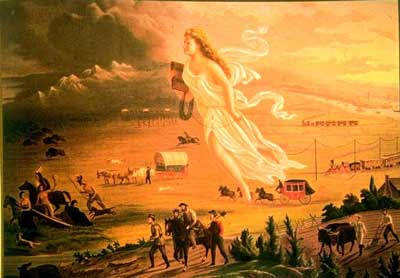
This exceptionalist faith kindled a belief in the nation’s Manifest Destiny in large part was an outgrowth of the Second Great Awakening which was particularly influential among the vast numbers of people moving into the new western territories. As people moved west, Evangelical religion came with them, often in the form of vast revival and camp meetings which would last weeks and which would be attended by tens of thousands. The first of these was at Cane Ridge Kentucky in 1801, organized by a Presbyterian others, including Baptists and Methodists joined in the preaching, and soon the revivals became a fixture of frontier life and particularly aided the growth of the Methodist and Baptists who were willing to “present the message as simply as possible, and to use preachers with little or no education,” [3] and which soon became the largest denominations in the United States. These meetings appealed to common people and emphasized emotion rather than reason. Even so the revivals “not only became the defining mark of American religion but also played a central role in the nation’s developing identity, independence, and democratic principles.” [4]

The West came to be viewed as a place where America might be reborn and “where Americans could start over again and the nation fulfill its destiny as a democratic, Protestant beacon to inspire peoples and nations. By conquering a continent with their people and ideals, Americans would conquer the world.” [5] The westward expansion satiated the need for territorial conquest and the missionary zeal to transform the country and the world in the image of Evangelical Christianity.

The man who coined the term “Manifest Destiny,” New York journalist John O’Sullivan a noted that “Manifest Destiny had ordained America to “establish on the earth the moral dignity and salvation of man,” to disseminate its principles, both religious and secular abroad,” [6] and New York Journalist Horace Greely issued the advice, “Go West, young man” which they did go, by the millions between 1800 and 1860.

But the movement also had a dark side. Americans poured westward first into the heartland of the Deep South and the Old Northwest, then across the Mississippi, fanning westward along the great rivers that formed the tributaries of the new territories. As they did so, the “population of the region west of the Appalachians grew nearly three times as fast as the original thirteen states” and “during that era a new state entered the Union on the average of three years.” [7]

The combination of nationalism fueled by Evangelical religion was combined with the idea from revolutionary times that America was a “model republic” that could redeem the people of the world from tyranny,” [8] as well an ascendant rational nationalism based on the superiority of the White Race. This, along with the belief that Catholicism was a threat to liberty was used as reason to conquer Mexico as well as to drive Native Americans from their ancestral homes. “By 1850 the white man’s diseases and wars had reduced the Indian population north of the Rio Grande to half of the estimated million who had lived there two centuries earlier. In the United States all but a few thousand Indians had been pushed west of the Mississippi.” [9] The radical racism used pseudo-scientific writings to “find biological evidence of white supremacy, “radical nationalism” cast Mexicans as an unassimilable “mixed “race “with considerable Indian and some black blood.” The War with Mexico “would not redeem them, but would hasten the day when they, like American Indians, would fade away.” [10]

Manifest Destiny and American Foreign Policy

Just as the deeply Evangelical Christian religious emphasis of Manifest Destiny helped shape American domestic policy during the movement west, it provided similar motivation and justification for America’s entry onto the world stage as a colonial power and world economic power. It undergirded United States foreign policy as the nation went from being a continental power to being an international power; claiming as Hawaii, and various former Spanish possessions in 1890s, and which would be seen again in the moralizing of Woodrow Wilson in the years leading up to America’s entry into World War One.

The belief in Manifest Destiny can still be seen in the pronouncements of American politicians, pundits, and preachers who believe that that this message is to be spread around the world. Manifest Destiny is an essential element of the idea of American Exceptionalism which often has been the justification for much recent American foreign policy, including the Freedom Agenda of former President George W. Bush. Bush referenced this during his 2003 State of the Union Address, “that freedom is the right of every person and the future of every nation. The liberty we prize is not America’s gift to the world, it is God’s gift to humanity.” [11] Bush frequently used language in his speeches in which biblical allusions were prominent in justifying the morality of his policy, and by doing this “Bush made himself a bridge between politics and religion for a large portion of his electorate, cementing their fidelity.” [12]

Throughout the Bush presidency the idea that God was directing him even meant that his faith undergirded the policy of the United States and led to a mismatch of policy ends and the means to accomplish them. Former Israeli Ambassador to the U.S. and historian Michael Oren wrote:

“Not inadvertently did Bush describe the struggle against Islamic terror as a “crusade to rid the world of evildoers.” Along with this religious zeal, however, the president espoused the secular fervor of the neoconservatives…who preached the Middle East’s redemption through democracy. The merging of the sacred and the civic missions in Bush’s mind placed him firmly in the Wilsonian tradition. But the same faith that deflected Wilson from entering hostilities in the Middle East spurred Bush in favor of war.” [13]

Policy makers and military leaders must realize that if they want to understand how culture and religious ideology drive others to conquer, subjugate and terrorize in the name of God, they first have to understand how our ancestors did the same thing. It is only when they do that that they can understand that this behavior and use of ideology for such ends is much more universal and easier to understand.

One can see the influence of Manifest Destiny abroad in a number of contexts. Many American Christians became missionaries to foreign lands, establishing churches, colleges, schools, and hospitals in their zeal to spread the Gospel. As missionaries spread across the globe, American policy makers ensured their protection through the presence of the United States Navy, and missionaries frequently called upon the United States Government for help and the naval strength of the United States during the period provided added fuel to their zeal. In 1842, Dabney Carr, the new American ambassador to the Ottoman Empire“declared his intention to protect the missionaries “to the full extent of [his] power,” if necessary “by calling on the whole of the American squadron in the Mediterranean to Beyrout.” [14] Such episodes would be repeated in the Middle East, Asia, the Pacific, and Central America over and over again until the 1920s.

The White Man’s Burden, Imperialism, Business, and Faith: Manifest Destiny and the Annexation of the Philippines

If one wants to see how the use of this compulsion to conquer in the name of God in American by a national leader one needs to go no farther than to examine the process whereby President McKinley, himself a veteran of the Civil War, decided to annex the Philippine in 1898 following the defeat of the Spanish. That war against the Filipinos that the United States had helped liberate from Spanish rule saw some of the most bloodthirsty tactics ever employed by the U.S. Army to fight the Filipino insurgents. The Filipino’s who had aided the United States in the war against Spain were now being subjugated by the American military for merely seeking an independence that they believed was their right. While the insurgency was suppressed in a violent manner and American rule was established, some Americans came to see the suppression of the Filipino’s as a stain on our national honor which of which Mark Twain wrote: “There must be two Americas: one that sets the captive free, and one that takes a once-captive’s new freedom away from him, and picks a quarrel with him with nothing to found it on; then kills him to get his land. . .” [15]

William McKinley was a cautious man, and after the United States had defeated the Spanish naval squadron at Manila Bay and wrestled with what to do with the Philippines. McKinley was a doubtless sincere believer, and according to his words, he sought counsel from God about whether he should make the decision to annex the Philippines or not. For him this was not a mere exercise, but a manifestation of his deep rooted faith which was based on Manifest Destiny. Troubled, he sought guidance, and he told a group of ministers who were vesting the White House:

“Before you go I would like to say a word about the Philippine business…. The truth is I didn’t want the Philippines, and when they came to us as a gift from the gods, I did not know what to do with them…. I sought counsel from all sides – Democrat as well as Republican – but got little help…. I walked the floor of the White House night after night until midnight; and I am not ashamed to tell you, gentlemen, that I went down on my knees and prayed Almighty God for guidance more than one night. And late one night it came to me this way – I don’t know how it was but it came….” [16]

He then went on to discuss what he supposedly heard from God, but reflected more of a calculated decision to annex the archipelago. He discussed what he believed would be an occupation of just a few islands and Manila, ruled out returning them to Spain as that would be “dishonorable,” ruled out turning them over to France or Germany because “that would be bad for business,”or allowing Filipino self-rule, as “they were unfit for self-government.”[17] The last was a reflection of the deep-rooted opinion of many Americans that the dark skinned Filipinos were “niggers.”

Barbara Tuchman described McKinley’s comments to the ministers:

“He went down on his knees, according to his own account, and “prayed to Almighty God for light and guidance.” He was accordingly guided to conclude “that there was nothing left to do for us but to take them all, and to educate the Filipinos. And uplift and civilize and Christianize them, by God’s grace to do the very best we could by them, as our fellowmen for whom Christ died.” [18]

But the result, regardless of whether McKinley heard the voice of God, or took the advice of advisers with imperialist, business, or religious views, he made the choice to annex the Philippines, believing it to be the only rational course of action, and something that he could not avoid. In a sense McKinley, of who Barbara Tuchman wrote “was a man made to be managed,” and who was considered spineless by Speaker of the House Thomas Reed who said “McKinley has no more backbone than a chocolate éclair.” [19] It appears that McKinley was more convinced by the arguments of those who desired to annex the Philippines for military reasons, a business community which saw the islands as a gateway to the markets of Asia, and by Protestant clergy, who saw “a possible enlargement of missionary opportunities.”[20] He rejected a proposal by Carl Schurz who urged McKinley to “turn over the Philippines as a mandate to a small power, such as Belgium or Holland, so the United States could remain “the great neutral power in the world.” [21]The combination of men who desired the United States to become an imperialist and naval power, business, and religion turned out to be more than McKinley could resist, as “the taste of empire was on the lips of politicians and business interests throughout the country. Racism, paternalism, and the talk of money mingled with the talk of destiny.” [22] Though there was much resistance to the annexation in congress and in the electorate, much of which was led by William Jennings Bryant, but which crumbled when Bryant with his eyes on the Presidency embraced imperialism.

The sense of righteousness and destiny was encouraged by magazine publisher S.S. McClure, who published a poem by Rudyard Kipling addressed to Americans debating the issue entitled The White Man’s Burden:

Take up the White Man’s burden–
Send forth the best ye breed–
Go bind your sons to exile
To serve your captives’ need;
To wait in heavy harness,
On fluttered folk and wild–
Your new-caught, sullen peoples,
Half-devil and half-child…

Take up the White Man’s burden–
The savage wars of peace–
Fill full the mouth of Famine
And bid the sickness cease…

Take up the White Man’s burden–
Ye dare not stoop to less–
Nor call too loud on Freedom
To 
cloke your weariness;
By all ye cry or whisper,
By all ye leave or do,
The silent, sullen peoples
Shall weigh your gods and you…
 [23]

McKinley’s decision and the passage of the peace treaty with Spain to acquire the Philippines sparked an insurrection led by Filipino revolutionary Emilio Aguinaldo who had been leading resistance to Spanish rule on the island of Luzon for several years prior to the American defeat of Spanish naval forces at the Battle of Manila Bay, and the subsequent occupation of Manila. The following war lasted nearly three years and was marked by numerous atrocities committed by American forces against often defenseless civilians and it would help to change the nature of the country. After American troops captured Manila, Walter Hines Page, the editor of the Atlantic Monthly believed that Americans would face greater challenges and difficulties in the coming years than they had known in previous years. He wrote:

“A change in our national policy may change our very character… and we are now playing with the great forces that may shape the future of the world – almost before we know it…. Before we knew the meaning of foreign possessions in a world ever growing more jealous, we have found ourselves the captors of islands in both great oceans; and from our home staying policy of yesterday we are brought face to face with world-wide forces in Asia as well as Europe, which seem to be working, by the opening of the Orient, for one of the greatest challenges in human history…. And to nobody has the change come more unexpectedly than ourselves. Has it come without our knowing the meaning of it?” [24]

Within the span of a few months, America had gone from a nation of shopkeepers to an imperial power, and most people did not realize the consequences of that shift. Manifest destiny and American Exceptionalism had triumphed and with it a new day dawned, where subsequent generations of leaders would invoke America’s mission to spread freedom and democracy around the world, as President George W. Bush said, “that freedom is the right of every person and the future of every nation. The liberty we prize is not America’s gift to the world, it is God’s gift to humanity.”

Notes

[1] Ibid. Phillips American Theocracy: The Peril and Politics of Radical Religion, Oil and Borrowed Money in the 21st Century p.143

[2] McGrath, Alister Christianity’s Dangerous Idea: The Protestant Revolution A History from the Sixteenth Century to the Twenty-First Harper Collins Publishers, New York 2007 p.164

[3] Gonzalez, Justo L. The History of Christianity Volume 2: The Reformation to the Present Day Harper and Row Publishers San Francisco 1985 p.246

[4] Ibid. McGrath Christianity’s Dangerous Idea: The Protestant Revolution A History from the Sixteenth Century to the Twenty-First p.164

[5] Goldfield, David America Aflame: How the Civil War Created a Nation Bloomsbury Press, New York, London New Delhi and Sidney 2011 p.5

[6] Ibid. Oren Power, Faith and Fantasy: America and the Middle East 1776 to the Present p130

[7] McPherson, James. The Battle Cry of Freedom: The Civil War Era Oxford University Press, Oxford and New York 1988 p.42

[8] Varon, Elizabeth R. Disunion! The Coming of the American Civil War 1789-1858 University of North Carolina Press, Chapel Hill NC 2008 p.183

[9] Ibid. McPherson The Battle Cry of Freedom: The Civil War Era p,45

[10] Ibid. Varon. Disunion! The Coming of the American Civil War 1789-1858p.183

[11] Bush, George W. State of the Union Address Washington D.C. January 28th2003 retrieved from Presidential Rhetoric.com http://www.presidentialrhetoric.com/speeches/01.28.03.html 10 June 2015

[12] Ibid. Phillips American Theocracy: The Peril and Politics of Radical Religion, Oil and Borrowed Money in the 21st Century p.252

[13] Oren, Michael Power, Faith and Fantasy: America and the Middle East 1776 to the Present W.W. Norton and Company, New York and London 2007 p.584

[14] Ibid. Oren Power, Faith and Fantasy: America and the Middle East 1776 to the Present p130

[15] Twain, Mark To the Person Sitting in Darkness February 1901 Retrieved from The World of 1898: The Spanish American War The Library of Congress http://www.loc.gov/rr/hispanic/1898/twain.html 12 December 2014

[16] Zinn, Howard A People’s History of the United States Harper Perennial, New York 1999 pp.312-313

[17] Ibid. Zinn A People’s History of the United States p.313

[18] Ibid. Tuchman Practicing History p.289

[19] Tuchman, Barbara The Proud Tower: A Portrait of the World Before the War, 1890-1914 Random House Trade Paperbacks Edition, New York 2008 originally published 1966 by McMillan Company. Amazon Kindle edition location 2807 of 10746

[20] Hofstadter, Richard The Paranoid Style in American Politics Vintage Books a Division of Random House, New York 1952 and 2008 p167

[21] Ibid. Tuchman The Proud Tower: A Portrait of the World Before the War, 1890-1914 location 3098 of 10746

[22] Ibid. Zinn A People’s History of the United States p.313

[23] Kipling, Rudyard “The White Man’s Burden: The United States and the Philippine Islands” 1899 retrieved from https://public.wsu.edu/~brians/world_civ/worldcivreader/world_civ_reader_2/kipling.html 6 August 2016

[24] Ibid. Hofstadter The Paranoid Style in American Politics pp.183-184

1 Comment

Filed under Foreign Policy, History, leadership, News and current events, Political Commentary, Religion

“The Time for All Good Men Not to go to the Aid of Their Party, But to Come to the Aid of Their Country” Flake, Douglas, and McCarthy: Profiles In Senatorial Courage

Jeff-Flake-800x430

Friends of Padre Steve’s World,

I’m up late tonight because of a snowstorm that is allowing me to go in to work late in the morning. But that allowed me to spend more time putting this article together and that is not a bad thing.

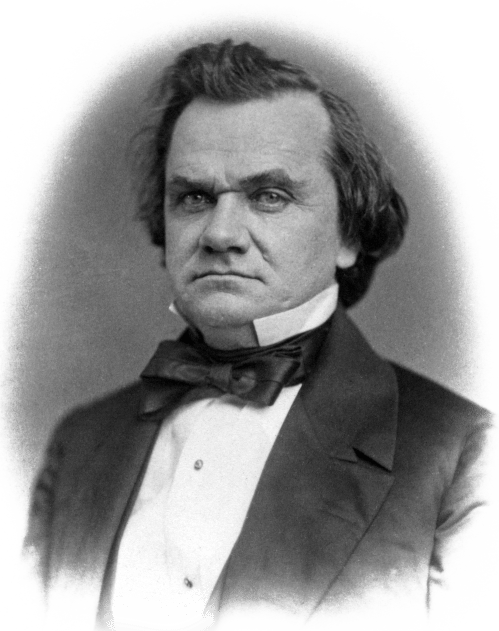
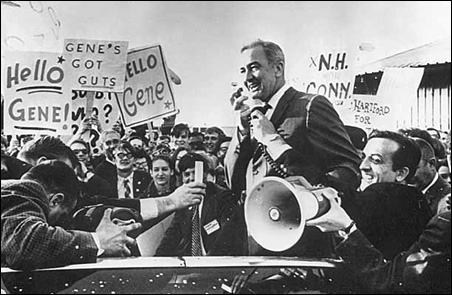
Yesterday Senator Jeff Flake of Arizona made a speech on the Senate floor. I do not think that I have seen one like it since Stephen A. Douglas opposed President James Buchanan in 1858 regarding the LeCompton Constitution. I am trying to remember the last time I have seen a sitting U.S. Senator compare a President of his own party one of the worst dictators in the history of the world. I both watched it and read it and honestly I don’t think that I have seen anything close to it since Senator Eugene McCarthy destroyed Lyndon Johnson’s hopes for a second term in 1968.

Stephen_A_Douglas_by_Vannerson,_1859

In 1858 Douglas warned his fellow Democrats about Buchanan, saying:

“I warned the anti-Lecompton Democrats of the North that the President intended to put the knife to the throat of every man who dared to think for himself on this question and carry out principles in good faith. “God forbid,” I said “that I ever surrender my right to differ from a President of the United States for my own choice. I am not a tool of any President!”

Events like this are truly rare, they don’t happen often and when they do they are quite remarkable and are portents of bigger things to come. Douglas’s opposition ushered in a split in the Democratic Party and helped elect Abraham Lincoln who through his courage helped to overthrow the institution of slavery that Buchanan had sought to expand. McCarthy’s opposition to Johnson helped to not only torpedo Johnson’s hopes for a second term but helped to galvanize the nation against the Vietnam War, fracture the Democratic Party, and elect Richard Nixon.

mccarthy

McCarthy was equally courageous. He noted: “This is, I say, the time for all good men not to go to the aid of their party, but to come to the aid of their country.”

Senator Flake’s speech was a real watershed, try as they might to shun Flake his Republican opponents like Senator Roger Wicker of Mississippi who said: “I don’t think that sort of speech is helpful, I disagree with those quotes and I don’t know why it’s helpful. … I don’t see any need to further stir that pot.” Richard Shelby of Alabama noted: “He’s certainly crossed the Rubicon with Trump. Strife is not productive.” Jim Inhofe of Oklahoma railed against Flake “He hates him. He doesn’t like the president, I can’t imagine anyone questioning that. As it gets closer to the end of his time here, I think he’s going to accelerate his wrath against the president.” Senator John McCain defended his colleague from Arizona.

In previous times both Douglas and McCarthy were attacked by members of their own Party, McCarthy by men who would later become Republicans answering Nixon’s call to a Southern Strategy, Douglas by those who led the drive for secession and Civil War in 1860 and 1861.

Flake, for all of his flaws, and yes he does have them has been pretty much a loyal Republican voting with the GOP on Trump’s legislation the majority of the time, just like Douglas did with much of Buchanan’s legislation and McCarthy with Johnson’s. But all of them as loyal as they had been to their President and parties found something that they had to stand against.

With Douglas is was Buchanan’s assault on the Constitution and law, McCarthy it was the lies of the Johnson administration about Vietnam. Today it is Jeff Flake comparing President Trump to Josef Stalin. In fact one of his GOP critics pointed out how often that Flake had voted with Trump and asked if he would have done that with Stalin. It is a good question for anyone who ignores so much about a President so long that the legislation that they like gets approved, but that being said what Flake did was big and it demonstrated a moral courage that most politicians of both parties are lacking when they vote for legislation solely based on political expediency. So in the case of Senator Flake I say better late than never.

What the Arizona Senator was big and it is an ominous portent of the future regardless of what happens next. I say that very dispassionately as a historian.

If you have not read it or watched it here is what Senator Flake said:

Mr. President, near the beginning of the document that made us free, our Declaration of Independence, Thomas Jefferson wrote: “We hold these truths to be self-evident.” So, from our very beginnings, our freedom has been predicated on truth. The founders were visionary in this regard, understanding well that good faith and shared facts between the governed and the government would be the very basis of this ongoing idea of America.

As the distinguished former member of this body, Daniel Patrick Moynihan of New York, famously said: “Everyone is entitled to his own opinion, but not to his own facts.” During the past year, I am alarmed to say that Senator Moynihan’s proposition has likely been tested more severely than at any time in our history.

It is for that reason that I rise today, to talk about the truth, and its relationship to democracy. For without truth, and a principled fidelity to truth and to shared facts, Mr. President, our democracy will not last.

2017 was a year which saw the truth — objective, empirical, evidence-based truth — more battered and abused than any other in the history of our country, at the hands of the most powerful figure in our government. It was a year which saw the White House enshrine “alternative facts” into the American lexicon, as justification for what used to be known simply as good old-fashioned falsehoods. It was the year in which an unrelenting daily assault on the constitutionally-protected free press was launched by that same White House, an assault that is as unprecedented as it is unwarranted. “The enemy of the people,” was what the president of the United States called the free press in 2017.

Mr. President, it is a testament to the condition of our democracy that our own president uses words infamously spoken by Josef Stalin to describe his enemies. It bears noting that so fraught with malice was the phrase “enemy of the people,” that even Nikita Khrushchev forbade its use, telling the Soviet Communist Party that the phrase had been introduced by Stalin for the purpose of “annihilating such individuals” who disagreed with the supreme leader.

This alone should be a source of great shame for us in this body, especially for those of us in the president’s party. For they are shameful, repulsive statements. And, of course, the president has it precisely backward – despotism is the enemy of the people. The free press is the despot’s enemy, which makes the free press the guardian of democracy. When a figure in power reflexively calls any press that doesn’t suit him “fake news,” it is that person who should be the figure of suspicion, not the press.

I dare say that anyone who has the privilege and awesome responsibility to serve in this chamber knows that these reflexive slurs of “fake news” are dubious, at best. Those of us who travel overseas, especially to war zones and other troubled areas around the globe, encounter members of U.S. based media who risk their lives, and sometimes lose their lives, reporting on the truth. To dismiss their work as fake news is an affront to their commitment and their sacrifice.

According to the International Federation of Journalists, 80 journalists were killed in 2017, and a new report from the Committee to Protect Journalists documents that the number of journalists imprisoned around the world has reached 262, which is a new record. This total includes 21 reporters who are being held on “false news” charges.

Mr. President, so powerful is the presidency that the damage done by the sustained attack on the truth will not be confined to the president’s time in office. Here in America, we do not pay obeisance to the powerful – in fact, we question the powerful most ardently – to do so is our birthright and a requirement of our citizenship — and so, we know well that no matter how powerful, no president will ever have dominion over objective reality.

No politician will ever get to tell us what the truth is and is not. And anyone who presumes to try to attack or manipulate the truth to his own purposes should be made to realize the mistake and be held to account. That is our job here. And that is just as Madison, Hamilton, and Jay would have it.

Of course, a major difference between politicians and the free press is that the press usually corrects itself when it gets something wrong. Politicians don’t.

No longer can we compound attacks on truth with our silent acquiescence. No longer can we turn a blind eye or a deaf ear to these assaults on our institutions. And Mr. President, an American president who cannot take criticism – who must constantly deflect and distort and distract – who must find someone else to blame — is charting a very dangerous path. And a Congress that fails to act as a check on the president adds to the danger.

Now, we are told via Twitter that today the president intends to announce his choice for the “most corrupt and dishonest” media awards. It beggars belief that an American president would engage in such a spectacle. But here we are.

And so, 2018 must be the year in which the truth takes a stand against power that would weaken it. In this effort, the choice is quite simple. And in this effort, the truth needs as many allies as possible. Together, my colleagues, we are powerful. Together, we have it within us to turn back these attacks, right these wrongs, repair this damage, restore reverence for our institutions, and prevent further moral vandalism.

Together, united in the purpose to do our jobs under the Constitution, without regard to party or party loyalty, let us resolve to be allies of the truth — and not partners in its destruction.

It is not my purpose here to inventory all of the official untruths of the past year. But a brief survey is in order. Some untruths are trivial – such as the bizarre contention regarding the crowd size at last year’s inaugural.

But many untruths are not at all trivial – such as the seminal untruth of the president’s political career – the oft-repeated conspiracy about the birthplace of President Obama. Also not trivial are the equally pernicious fantasies about rigged elections and massive voter fraud, which are as destructive as they are inaccurate – to the effort to undermine confidence in the federal courts, federal law enforcement, the intelligence community and the free press, to perhaps the most vexing untruth of all – the supposed “hoax” at the heart of special counsel Robert Mueller’s Russia investigation.

To be very clear, to call the Russia matter a “hoax” – as the president has many times – is a falsehood. We know that the attacks orchestrated by the Russian government during the election were real and constitute a grave threat to both American sovereignty and to our national security. It is in the interest of every American to get to the bottom of this matter, wherever the investigation leads.

Ignoring or denying the truth about hostile Russian intentions toward the United States leaves us vulnerable to further attacks. We are told by our intelligence agencies that those attacks are ongoing, yet it has recently been reported that there has not been a single cabinet-level meeting regarding Russian interference and how to defend America against these attacks. Not one. What might seem like a casual and routine untruth – so casual and routine that it has by now become the white noise of Washington – is in fact a serious lapse in the defense of our country.

Mr. President, let us be clear. The impulses underlying the dissemination of such untruths are not benign. They have the effect of eroding trust in our vital institutions and conditioning the public to no longer trust them. The destructive effect of this kind of behavior on our democracy cannot be overstated.

Mr. President, every word that a president utters projects American values around the world. The values of free expression and a reverence for the free press have been our global hallmark, for it is our ability to freely air the truth that keeps our government honest and keeps a people free. Between the mighty and the modest, truth is the great leveler. And so, respect for freedom of the press has always been one of our most important exports.

But a recent report published in our free press should raise an alarm. Reading from the story:
“In February…Syrian President Bashar Assad brushed off an Amnesty International report that some 13,000 people had been killed at one of his military prisons by saying, “You can forge anything these days, we are living in a fake news era.”

In the Philippines, President Rodrigo Duterte has complained of being “demonized” by “fake news.” Last month, the report continues, with our President, quote “laughing by his side” Duterte called reporters “spies.”

In July, Venezuelan President Nicolas Maduro complained to the Russian propaganda outlet, that the world media had “spread lots of false versions, lots of lies” about his country, adding, “This is what we call ‘fake news’ today, isn’t it?”

There are more:

A state official in Myanmar recently said, “There is no such thing as Rohingya. It is fake news,” referring to the persecuted ethnic group.

Leaders in Singapore, a country known for restricting free speech, have promised “fake news” legislation in the new year.”

And on and on. This feedback loop is disgraceful, Mr. President. Not only has the past year seen an American president borrow despotic language to refer to the free press, but it seems he has in turn inspired dictators and authoritarians with his own language. This is reprehensible.

We are not in a “fake news” era, as Bashar Assad says. We are, rather, in an era in which the authoritarian impulse is reasserting itself, to challenge free people and free societies, everywhere.

In our own country, from the trivial to the truly dangerous, it is the range and regularity of the untruths we see that should be cause for profound alarm, and spur to action. Add to that the by-now predictable habit of calling true things false, and false things true, and we have a recipe for disaster. As George Orwell warned, “The further a society drifts from the truth, the more it will hate those who speak it.”

Any of us who have spent time in public life have endured news coverage we felt was jaded or unfair. But in our positions, to employ even idle threats to use laws or regulations to stifle criticism is corrosive to our democratic institutions. Simply put: it is the press’s obligation to uncover the truth about power. It is the people’s right to criticize their government. And it is our job to take it.

What is the goal of laying siege to the truth? President John F. Kennedy, in a stirring speech on the 20th anniversary of the Voice of America, was eloquent in answer to that question: “We are not afraid to entrust the American people with unpleasant facts, foreign ideas, alien philosophies, and competitive values. For a nation that is afraid to let its people judge the truth and falsehood in an open market is a nation that is afraid of its people.”

Mr. President, the question of why the truth is now under such assault may well be for historians to determine. But for those who cherish American constitutional democracy, what matters is the effect on America and her people and her standing in an increasingly unstable world — made all the more unstable by these very fabrications. What matters is the daily disassembling of our democratic institutions.

We are a mature democracy – it is well past time that we stop excusing or ignoring – or worse, endorsing — these attacks on the truth. For if we compromise the truth for the sake of our politics, we are lost.

I sincerely thank my colleagues for their indulgence today. I will close by borrowing the words of an early adherent to my faith that I find has special resonance at this moment. His name was John Jacques, and as a young missionary in England he contemplated the question: “What is truth?” His search was expressed in poetry and ultimately in a hymn that I grew up with, titled “Oh Say, What is Truth.” It ends as follows:

Then say, what is truth? ‘Tis the last and the first,
For the limits of time it steps o’er.
Tho the heavens depart and the earth’s fountains burst.
Truth, the sum of existence, will weather the worst,
Eternal… unchanged… evermore.

Thank you, Mr. President. I yield the floor.

Senator Flake’s words reminded me a bit of the closing section of Dr. Martin Luther King Jr.’s Beyond Vietnam speech in which he said:

As that noble bard of yesterday, James Russell Lowell, eloquently stated:

Once to every man and nation comes a moment do decide,
In the strife of truth and Falsehood, for the good or evil side;
Some great cause, God’s new Messiah offering each the bloom or blight,
And the choice goes by forever ‘twixt that darkness and that light.
Though the cause of evil prosper, yet ‘tis truth alone is strong
Though her portions be the scaffold, and upon the throne be wrong
Yet that scaffold sways the future, and behind the dim unknown
Standeth God within the shadow, keeping watch above his own.

And if we will only make the right choice, we will be able to transform this pending cosmic elegy into a creative psalm of peace. If we will make the right choice, we will be able to transform the jangling discords of our world into a beautiful symphony of brotherhood. If we will but make the right choice, we will be able to speed up the day, all over America and all over the world, when justice will roll down like waters, and righteousness like a mighty stream. 

That being said I wish that Flake would be much more like Douglas and fight to remain in the Senate and not retire. Douglas noted about his fight with Buchanan:

“After the Christmas recess, the Administration unleashed its heavy horsemen: Davis, Slidell, Hunter, Toombs, and Hammond, all southerners. They damned me as a traitor and demanded that I be stripped of my chairmanship of the Committee on Territories and read out of the Democratic party. Let the fucking bastards threaten, proscribe, and do their worst, I told my followers; it would not cause any honest man to falter. If my course divided the Democratic party, it would not be my fault. We were engaged in a great struggle for principle, I said, and we would defy the Administration to the bitter end.”

I wish more Republicans had the courage of Flake and even more Douglas who sacrificed his ambitions as the presumed front-runner for the 1860 Presidential election. His opposition to Buchanan and the Slave Power Southern Democrats ensured his defeat. When his opponents led the South to secede Douglas remained with the Union rallying Northern Democrats to the cause. Likewise despite a lot of popular support McCarthy was opposed by the party establishment and lost his bid to be the Democratic nominee in 1968. But he said something about the office of the Presidency that every American should support and defend:

“We do not need presidents who are bigger than the country, but rather ones who speak for it and support it.”

What is going on today is as big if not bigger than the crises that led loyal party men like Douglas and McCarthy to defy their President and Party.

So until tomorrow,

Peace

Padre Steve+


3 Comments

Filed under History, laws and legislation, leadership, News and current events, Political Commentary

What Does it take to Become a War Criminal? 


Friends of Padre Steve’s World,

Over the past few days I have been writing about the German invasion of the Soviet Union and the fact that senior leaders of the Wehrmacht actively cooperated with the crimes of the Nazi regime against the Jews, Soviet prisoners of war, and Soviet citizens. I have pointed out that Hitler’s ideology of the racial superiority of his Aryan Master Race and the corresponding view that the Jews and Slavs were untermenschen or subhuman justified the most extreme measures that the Nazis used to kill millions of innocent people through extermination, ethnic cleansing, and extermination. 

There was a common myth after the Second World War that the regular German Army, the Wehrmacht, fought an honorable and clean war while the criminal actions of war crimes and genocide were the fault of Hitler, the Nazi Party, and the SS. It was a comforting myth because it allowed a great number of men who agreed with Hitler’s policies, and often assisted in them to maintain a fiction of honor and respectability. While for the most part the German Army in the West fought according to international norms of conduct, it was a different matter on the Easter Front, where following Hitler’s lead the Wehrmacht from its senior officers in down was often at the tip of the spear in enforcing Hitler’s racial and ideological war. 


                                                                                       Field Marshal Wilhelm Keitel 

This came form the top. In addition to the Commissar order, also known as the Criminal Order, Field Marshal Keitel offered this directive to units fighting on the Easter Front:

“In view of the vast size of the conquered territories in the East, the forces available for establishing security in these areas will be sufficient only if instead of punishing resistance by sentencing the guilty in a court of law, the occupying forces spread such terror as is likely, by its mere existence, to crush every will to resist amongst the population.

The commanders concerned, together with all available troops, should be made responsible for maintaining peace within their areas. The commanders must find the means of keeping order within their areas, not by demanding more security forces, but by applying suitable drastic measures.”

                                                                                  Field Marshal Walter Von Reichenau 

Field Marshal Walter Reichenau issued what is something’s known as the Severity Order to his 6th Army which was part of Field Marshal Gerd Von Rundstedt’s Army Group South. Von Rundstedt, who was not a Nazi and who maintained his reputation after the war expressed his “complete agreement” with it and urged other subordinates to issue similar orders. 

“The most important objective of this campaign against the Jewish-Bolshevik system is the complete destruction of its sources of power and the extermination of the Asiatic influence in European civilization. … In this eastern theatre, the soldier is not only a man fighting in accordance with the rules of the art of war, but also the ruthless standard bearer of a national conception. … For this reason the soldier must learn fully to appreciate the necessity for the severe but just retribution that must be meted out to the subhuman species of Jewry…” 

An order was issued by General Erich Von Manstein’s Eleventh Army in November 1941 which stated in part:

“Jewry constitutes the middleman between the enemy in the rear and the remainder of the Red Armed Forces which is still fighting, and the Red leadership. More strongly than in Europe it holds all the key positions in the political leadership and administration, controls commerce and trades, and further forms the nucleus for all unrest and possible uprisings.

The Jewish-Bolshevist system must be exterminated once and for all. Never again must it encroach upon our European living space.

The German soldier has therefore not only the task of crushing the military potential of this system. He comes also as the bearer of a racial concept and as the avenger of all the cruelties’ which have been perpetrated on him and on the German people…

The food situation at home makes it essential that the troops should as far as possible be fed off the land and that furthermore the largest possible stocks should be placed at the disposal of the homeland. Particularly in enemy cities a large part of the population will have to go hungry. Nevertheless nothing which the homeland has sacrificed itself to contribute may, out of a misguided sense of humanity, be given to prisoners or to the population unless they are in the service of the German Wehrmacht.

The soldier must appreciate the necessity for the harsh punishment of Jewry, the spiritual bearer of the Bolshevist terror. This is also necessary in order to nip in the bud all uprisings which are mostly plotted by Jews…

Manstein claimed that he did not remember the order at his trial and that he sought to ensure that his troops did not engage in conduct not fitting of the honor of soldiers. He included the following in the order: “Severest action to be taken: against despotism and self-seeking; against lawlessness and lack of discipline; against every transgression of the honor of a soldier.”

In his defense at Nuremberg Manstien attempted to mitigate the damning words of the order. He explained that “I do want to point out to you that if it says here that the system must be exterminated, then that is extermination of the Bolshevik system, but not the extermination of human beings.” Despite Manstein’s clarification of what he meant in the order it would be hard for soldiers and commanders receiving the order as written could hardly have been expect not to interpret it literally. Likewise his order mentions the intentional starvation of Soviet citizens and harsh invectives against the Jews. 

Like Von Rundstedt, Manstein too would be rehabilitated and for the most part his complicity in Hitler’s racial and ideological war forgotten. 


There are many other examples of German Army commanders at various levels issuing orders similar to Von Reichenau and Von Manstein as well as accounts of Wehrmacht units cooperating with the Einsatzgruppen in various mass extermination actions against the Jews, including the action at Babi Yar. In many cases the cooperation was quite close as evidenced by the report of the commander of Einsatzgruppe C to Berlin on November 3rd 1941:

In a great number of cases, it happened that the support of the Einsatzkommandos was requested by the fighting troops. Advance detachments of the Einsatzgruppe also participated in every large military action. They entered newly captured localities side by side with the fighting troops. Thus, in all cases, the utmost support was given. For example, in this connection, it is worth mentioning the participation in the capture of Zhitomir, where the first tanks entering the city were immediately followed by three cars of Einsatzkommando 4a.

As a result of the successful work of the Einsatzgruppe, the Security Police is also held in high regard, in particular by the HQ of the German Army. The liaison officers stationed in Army HQ are loyally briefed of all military operations, and, besides, they receive the utmost cooperation. The Commander of the 6th Army, Generalfeldmarschall von Richenau, has repeatedly praised the work of the Einsatzkommandos and, accordingly, supported the interests of the SD with his staff.

It is true that in some cases individual Wehrmacht officers refused to cooperate with the Einsatzgruppen in their operational areas, but without the cooperation of the Wehrmacht the extermination campaigns against the Jews and other Soviet citizens could not have been successful. 

                                                                                                 The Rape of Nanking 

One has to ask what it takes for otherwise ordinary and law abiding people to carry out crimes of such magnitude. I do believe that the answer is found in the racial ideology that posits certain races as being less than human. The examples of such belief in action litter human history and are not limited to the Germans of the Nazi era. The disturbing thing as that the men who perpetrated the Nazi crimes against humanity and genocide were not unique. The actions of the Japanese army in China, Korea, and Southeast Asia to include the Rape of Nanking and their Unit 731; the American genocide committed against the Native American tribes and the enslavement of Blacks; the extermination of the Herero in German Southwest Africa, the Rwandan genocide, the mass killings of Bosnians by Bosnian Serbs,  the Armenian genocide committed by the Turks, and far too many more examples show this to be the case. 

I think one of our problems is that we want to believe that evil is simply done be evil people. That is why when we see a Hitler, Stalin, Pol Pot, or the monsters of the so-called Islamic State, we are often strangely comforted. This is often because we can point to a single person with a wicked ideology and say “they are evil,” all the while forgetting that they are, or were, like us, also human. 


There is a scene in the movie Nuremberg in which an American psychologist named Gustave Gilbert questions the commandant of Auschwitz. When he asks the commandant if he felt guilty for the extermination of the Jews in his camp the commandant said “does a rat catcher feel guilty for killing rats.” Thereafter Gilbert confronts Herman Goering pointedly asking the number two Nazi “A rat catcher catching rats”. Is that the kind of thinking it takes to carry out state sanctioned mass murder? Not just blind obedience but also a belief that your victims are not human?” 

Goering replies: Let me ask you this. What was Hiroshima? Was it not your medical experiment? Would Americans have dropped bombs as easily on Germany as it did upon Japan killing as many civilians as possible? I think not. To an American sensibility, a Caucasian child is considerably more human than a Japanese child…. 

What about the negro officers in your own army? Are they not allowed to command troops in combat? Can they sit on the same buses as the whites? The segregation laws in your country and the anti Semitic laws in mine, are they not a difference of degree? 

The tragic thing is that while Gilbert was certainly correct in his question to Goering, Goering was also right. For all that is good about America there is a persistent strain of this kind of thinking which deems other people, especially non-white people as inferior racially, culturally, and intellectually. Over the decades we like to think that we have become better but the underlying attitudes are still present today, sometimes in plain view, but often just under our veneer of civility and good manners, but what maintains that civility is quite fragile. In his history of Auschwitz British historian Laurence Rees wrote:

“human behavior is fragile and unpredictable and often at the mercy of the situation. Every individual still, of course, has a choice as to how to behave, it’s just that for many people the situation is the key determinate in that choice.” The German military officers who took part in the campaign in the East were terrifyingly normal. They were raised in an advanced society, highly cultured, well educated, and raised in the cradle of Protestantism. Yet many of them became willing participants in crimes of their nation that are unimaginable. But the fact is that the character of nations can be as fragile as that if individuals. As Americans we like to think that we are different but our history often belies this, even our military history and this is part of our conundrum. 

Aleksandr Solzhenitsyn wrote of the struggle:

 “If only it were all so simple! If only there were evil people somewhere insidiously committing evil deeds, and it were necessary only to separate them from the rest of us and destroy them. But the line dividing good and evil cuts through the heart of every human being. And who is willing to destroy a piece of his own heart?”

When I taught ethics at the Joint Forces Staff College I challenged my students to deal with these kinds of questions. They are not easy and they require that we look into the darkest reaches of our hearts to see what we will do when we are confronted with choices to obey orders that go against the values of the institution but may reflect the more troubling aspects of our culture. Some of these men and women I am sure understood and will not break under pressure, but I am not so sure about others, and I worry about them in the crisis. The fact is we are only as good as we are in the crisis. Historian Timothy Snyder wrote something that we should not discount when asking the question about how ordinary men become war criminals:

“The European history of the twentieth century shows us that societies can break, democracies can fall, ethics can collapse, and ordinary men can find themselves standing over death pits with guns in their hands. It would serve us well today to understand why.”

This is something that we most ponder because it would not take much in our present day where the old ethnic race hatreds, religious hatreds, and resurgent nationalism are again raising their head not only in our own country, but around the world. I will address this in the recent American context next week. So until tomorrow, when I publish something more personal and unrelated to this subject.

Peace

Padre Steve+

1 Comment

Filed under ethics, History, holocaust, Military, movies, world war two in europe

Trump’s Hatchet Men: Christian Pastors Who Should Know Better

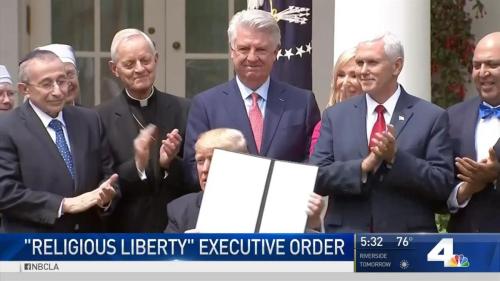
Trump_Signs_Religious_Liberty_Order_1200x675_936791107605

Friends of Padre Steve’s World,

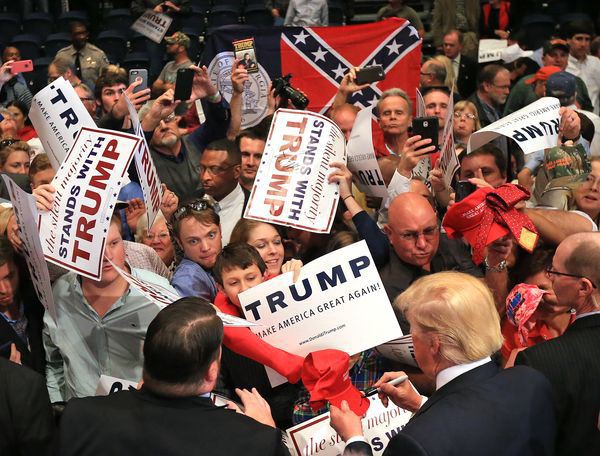
Just a brief thought to start out the week. Since the beginning of the Trump Campaign his most vocal supporters other that the Alt-Right crowd and people like Roger Stone have been Christian pastors. This really bothered me all weekend so I need to get it off my chest early so I can go on to better things.

To me this has been one of the most perplexing things of the past two years. I wonder how men and women who castigated Democrats, and even some moderate Republicans with epithets often too vile to print ended up supporting a man who exhibits no trace at all of a genuine Christian faith. How they not only support but defend a man whose life if nothing else epitomizes everything that Jesus preached against, even threatening the wrath of God on Trump’s opponents.

I am not alone. Conservative columnist Erick Erickson, who is a Christian by the way noted in a column last week:

“Watergate may have turned Charles Colson from hatchet man to pastor, but defense of President Trump is turning a lot of pastors into hatchet men. Few people come away from Trump’s orbit without compromising their characters.”

Admittedly some of Trump’s big time clerical supports had little in the way of character to begin with, fleecing their flocks and often being caught doing so by law enforcement, some like Jim Bakker even going to jail. However, it is scary that quite a few who even if you disagreed with their politics, theology, or social views, still showed a modicum of Christian character have thrown it away to defend the indefensible. These hatchet men are truly dangerous because they poison the souls of their flocks and in the process demean the entirety of the Gospel message of reconciliation and peace.

But this is nothing new. Ever since Constantine various clerics and preachers have cozied up to rulers in order to gain temporal power for their part of the church. These American preachers today do not believe in the equality of human beings, they delight in condemning people, and frequently use the legislative process to impinge upon or limit the rights of others. Although they said they loved the Constitution when Barak Obama was in office their actions show that they despise it as well as the Preamble of the Declaration of Independence. Their attitudes towards the heart of American democracy are much like the Southern planters and slaveowners. One of them, George Fitzhugh of Virginia wrote in 1850:

“We must combat the doctrines of natural liberty and human equality, and the social contract as taught by Locke and the American sages of 1776. Under the spell of Locke and the Enlightenment, Jefferson and other misguided patriots ruined the splendid political edifice they erected by espousing dangerous abstractions – the crazy notions of liberty and equality that they wrote into the Declaration of Independence and the Virginia Bill of Rights. No wonder the abolitionists loved to quote the Declaration of Independence! Its precepts are wholly at war with slavery and equally at war with all government, all subordination, all order. It is full if mendacity and error. Consider its verbose, newborn, false and unmeaning preamble…. There is, finally, no such thing as inalienable rights. Life and liberty are not inalienable…. Jefferson in sum, was the architect of ruin, the inaugurator of anarchy. As his Declaration of Independence Stands, it deserves the appropriate epithets which Major Lee somewhere applies to the thought of Mr. Jefferson, it is “exuberantly false, and absurdly fallacious.”

Southern preachers condemned opponents of slavery in the abolition movement, including fellow evangelicals as “atheists, infidels, communists, free-lovers, Bible-haters, and anti-Christian levelers.”  Like the Southern preachers of the ante-bellum era the political pastors of today stand against the weak, the outcast, the poor, and the alien. Instead of standing for the weak, these preachers lead their congregations to despise them as they accommodate themselves to the service of the powerful represented by President Trump. Dietrich Bonhoeffer summed it up well when wrote about the “German Christians” who followed Hitler:

“Christianity stands or falls with its revolutionary protest against violence, arbitrariness and pride of power and with its plea for the weak. Christians are doing too little to make these points clear rather than too much. Christendom adjusts itself far too easily to the worship of power. Christians should give more offense, shock the world far more, than they are doing now. Christian should take a stronger stand in favor of the weak rather than considering first the possible right of the strong.”

The sad thing is that the so-called Christianity of our day is not far removed from that of the ante-bellum South or that of Nazi Germany. It worships power and riches and the only rights that it desires to protect are its own. Led by the hatchet men in the pulpits this church have soiled themselves with a stain that they will never shed, and they will stand condemned even more than the man that they support, because unlike him, they know better, or at least they should. 

Conservative scion Barry Goldwater warned us about them in 1994: 

“Mark my word, if and when these preachers get control of the [Republican] party, and they’re sure trying to do so, it’s going to be a terrible damn problem. Frankly, these people frighten me. Politics and governing demand compromise. But these Christians believe they are acting in the name of God, so they can’t and won’t compromise. I know, I’ve tried to deal with them.”

But Goldwater also knew that the leaders of the Christian Right who now are solidly behind Trump were easily manipulated by the hard right. In 1981 he told an interviewer:

“I don’t want to see religious bigotry in any form. It would disturb me if there was a wedding between the religious fundamentalists and the political right. The hard right has no interest in religion except to manipulate it.”

Donald Trump is manipulating the hell out of them, speaking to their deepest fears and promising them that they will be the ones that come out on top in his America. He has cultivated that by signing executive orders designed to cater to their every desire in exchange for their fealty which they readily give him. He is a nearly cult like messiah figure to many of them and their preachers bask in the favor he shows them without thinking twice about the true cost both to their faith, and the freedom of all people in the United States. 

Charles Morgan Jr., a lawyer in Birmingham Alabama wrote after the bombing of the 16th Street Baptist Church by Ku Klux Klansmen who claimed to be Christians and by the Christian preachers who over the course of decades had given them sanction:

“It is not by great acts but by small failures that freedom dies. . . . Justice and liberty die quietly, because men first learn to ignore injustice and then no longer recognize it.”

He was right, as was Bonhoeffer.  So anyway, that’s a hell of a way to start the week.

Until tomorrow,

Peace

Padre Steve+

2 Comments

Filed under civil rights, faith, History, ministry, nazi germany, News and current events, Political Commentary

Hedonism and Fundamentalism: The Hallmarks of Ante-Bellum Pro-Slavery and Modern Evangelicalism

Friends of Padre Steve’s World,

I spent part of yesterday reviewing my text of Mine Eyes Have Seen the Glory! so I could continue to write what I need for my literary agent to help in the process of getting it marketed and published. To quote the President “who ever thought it could be so complex?” but I digress…

In re-reading the text I came across a passage that struck me as entirely contemporary in its application and I had to stop. It was the fundamentalist theology of Southern Evangelicals that both justified slavery as well as the most hedonistic aspect of Southern life. It was a religion that defended slavery from biblical literalism and excused the worst aspects of the greedy, slothful, and lust filled life of the Southern slaveowners and oligarchs. This is the same kind of theology that today permits the enrichment of oligarchs and preachers while neglecting almost every other aspect of the Gospel simply because those in power promise to protect and empower Christians over others, especially white Christians, the more affluent the better. The love of prosperity Gospel and the gilded cage of Donald Trump’s Christianity are a great combination.

Some things never change, especially for Christian fundamentalists who in order to maintain their temporal power must justify the worst and most repugnant aspects of their culture; as the British Evangelical Anglican theologian Alister McGrath wrote: “the arguments used by the pro-slavery lobby represent a fascinating illustration and condemnation of how the Bible may be used to support a notion by reading the text within a rigid interpretive framework that forces predetermined conclusions to the text. How else could supposed Christians support a leader who mocks their beliefs and tramples on the example of Jesus? Of course that too as a rhetorical question. It is a fact that throughout history many Christians in Europe, America, and in other parts of the world have had no problems supporting the most anti-Christian leaders and regimes and even participated in genocide for their benefit justifying it in the name of God.

So anyway, until tomorrow,

Peace

Padre Steve+

1 Comment

Filed under civil rights, civil war, History, News and current events, Political Commentary

President Trump, I Wish to Remind You that General Jackson is Dead

President Trump, President Andrew Jackson, and President James Buchanan 

Friends of Padre Steve’s World,

I am never surprised when President Trump demonstrates his ignorance of American History or our Constitution as he when he discussed how the Civil War could have been avoided in only a dealmaker like Andrew Jackson been around to stop it. During an interview with the Washington Examiner’s Selina Zito, the President explained:

“I mean had Andrew Jackson been a little later you wouldn’t have had the Civil War. He was a very tough person, but he had a big heart. He was really angry that he saw what was happening with regard to the Civil War, he said, “There’s no reason for this.” People don’t realize, you know, the Civil War, if you think about it, why? People don’t ask that question, but why was there a Civil War? Why could that one not have been worked out?”

The President’s remarks were so bumblingly inaccurate that it was painful to listen to. First in his comments about President Jackson, a man whose “big heart” caused him to defy the Supreme Court to order the mass resettlement of the Native American tribes of the Southeast in the midst of winter which led to thousands of deaths in the what is known now as the Trail of Tears. Likewise, the one time Jackson opposed the secession of a state, that of South Carolina during the Nullification Crisis of 1828-1832 it had to deal with tariffs and not slaves, which the President owned. Likewise Jackson never uttered “There’s no reason for this” because Jackson was dead and buried long before the Civil War, and even years before the threats of secession to preserve and expand slavery were proposed in the early 1850s.

Senator Stephen Douglas

There was no deal to be made. Slavery and its expansion were the issues at hand. In 1858 a minority of slave holders in Kansas attempted through election fraud to get a pro-slavery constitution passed in order for the state to be admitted to the Union as a Slave State, a move the President James Buchanan fully supported and fought an unsuccessful battle with Congress to pass. The measure would have set precedent to open every territory of the Union to slavery, but Democratic Senator Stephen A. Douglas of Illinois stood his ground and organized bi-partisan opposition to the measure which was supported by Southern Democrats.

When Buchanan threatened him Douglas stood his ground:

The Illinois Senator found out about the President Buchanan’s new support of the measure when he read the newspaper. He was outraged when he saw the news in the Washington Union that Buchanan had decided to support Lecompton. He was infuriated and the fury showed when he wrote with characteristic honesty:

“This left no doubt were the old bastard stood. “Can you believe his Goddamned arrogance?” I told a friend. “I run the Committee on Territories. He should have consulted me before approving the Lecompton fraud. He’ll pay for that. By God, sir, I made Mr. James Buchanan, and by God, sir, I’ll unmake him.” 

As such, the Little Giant threw caution to the wind and stormed to the White House “to confront Buchanan on the “trickery and juggling of the Lecompton constitution.” He warned the president of that his actions in support of the Lecompton party would “destroy the Democratic party in the North,” and we warned that “if Buchanan insisted on going through with it, Douglas swore to oppose him in Congress.” 

It was an epic confrontation. Douglas recalled, “The Lecompton constitution, I told Buchannan bluntly, was a blatant fraud on the people of Kansas and the process of democracy, I warned him not to recommend acceptance of it. With his head titled forward in that bizarre habit of his, he said that he intended to endorse the constitution and send it to Congress. “If you do,” I thundered, “I’ll denounce it the moment that it is read.” His face turned red with anger. “I’ll make Lecompton a party test,” he said. “I expect every democratic Senator to support it.” I will not, sir!” 

Angry and offended by the confrontation of Douglas, Buchanan cut the senator off and issued his own threat to Douglas and his political career saying, “I desire you to remember that no Democrat ever yet differed from an administration of his own choice without being crushed….Beware of the fate of Tallmadge and Rives,” two senators who had gone into political oblivion after crossing Andrew Jackson.” The redoubtable Senator from Illinois was undeterred by the President’s threat and fought back,“Douglas riposted: “Mr. President, I wish to remind you that General Jackson is dead, sir.” It was an unprecedented action by a sitting Senator, to confront a President of one’s own party and threaten to oppose him in Congress was simply not done, but now Douglas was doing it, but doing so to his President’s face, and the consequences for him, his party, and the country would be immense. (You can find my full article about the Lecompton Constitution at https://padresteve.com/2016/10/16/when-political-parties-implode-mr-president-i-wish-to-remind-you-that-general-jackson-is-dead/)

Every State that seceded from the Union included the preservation and expansion of slavery as the primary reason of secession. There were no deals to be made to avoid the Civil War except for the Northern Free states to submit to becoming Slave states again and African Americans to be forever subordinated to the less than human state of being mere property.

President Trump may actually believe what he said, in fact I think that he does, which is why I think is why that he habitually demonstrates such supreme ignorance of American History and the Constitution.

Until tomorrow,

Peace

Padre Steve+


1 Comment

Filed under civil war, History, News and current events, Political Commentary

Mine Eyes Have Seen the Glory: The Beginnings of a Book

Friends of Padre Steve’s World,

Hannah Arendt wrote:

“Slavery’s crime against humanity did not begin when one people defeated and enslaved its enemies (though of course this was bad enough), but when slavery became an institution in which some men were ‘born’ free and others slave, when it was forgotten that it was man who had deprived his fellow-men of freedom, and when the sanction for the crime was attributed to nature.”

It has been a very busy few weeks and one of the exiting things that is in the process of happening is that my literary agent has informed me that he has some promising leads in trying to get one of my book drafts published. The book, which I have given the tentative title Mine Eyes Have Seen the Glory! Race, Religion, Ideology, and Politics in the Civil War Era began as one of the introductory chapters to my Gettysburg Staff Ride text and took on a life of its own. As I read, researched, and wrote my search led me to more and more aspects of slavery and abolition that opened my eyes to the very religious, and Christian justifications for both, especially the words of Southern preachers which I have a hard time getting out of my head because of how perverse those views were, and still are.

Over the past couple of years I have posted parts of it on this site and I feel that it is really important work as so many of the issues of the ante-bellum era in regard to the institution of slavery: the Civil War with emancipation and the Thirteenth Amendment that outlawed slavery in the United States; Reconstruction with the Fourteenth Amendment which granted citizenship to freed African Americans, and which became foundational for other Civil Rights causes, and the Fifteenth Amendment which gave Black men the right to vote. These were followed by the Civil Rights act of 1875, and then with the end of Reconstruction came the return of White Rule, the overthrow of the Civil Rights Act, and the reestablishment of slavery by another name with Black Codes, Jim Crow, and violent White Supremacist groups, and finally the emergence of a new Civil Rights movement in the late 1940s. First Baseball and then the military were desegregated, then finally in 1964 the Voter’s Rights Act was passed and then in 1965 the a new Civil Rights Act.

During the interregnum between the end of Reconstruction and the high point of the Civil Rights movement, many African Americans, famous, and those not so famous worked to establish equality. Men like Frederick Douglass, W.E.B DuBois, Jackie Robinson, Benjamin O. Davis and Benjamin O. Davis Jr., James Meredith, John Lewis, Dr. Martin Luther King Jr., and women like Rosa Parks fought discrimination, segregation and racism through peaceful protests and strong personal leadership and example. The Buffalo Soldiers served their country proudly even though they faced discrimination almost everywhere in the United States. But they all persevered.

Their story is the story of America, and intertwined in it are the themes of religion, racism, ideology, and politics; sometimes used for the purpose of freedom, but all too often perverted to deprive others of that same freedom. The institution of slavery needed racist ideology and a theology to cover the evil that it was, and can be again. That is why I write about it, and why I led this article with the quote by Hannah Arendt. The fact that after a great Civil War that claimed the lives of about 750,000 American soldiers, North and South, that others within months attempted to re-establish slavery by other means, and then when Reconstruction ended succeeded in using the law to make Blacks both second class citizens as well treating them as less than human. The poison of this philosophy spread to Europe where Hitler and his Nazi Party zealots crafted race laws against the Jews that were based in part on the American model of Jim Crow and the Black Codes.

The resurgence of White Supremacist groups across the United States and in Europe show us that we cannot ignore history without ourselves committing similar crimes against humanity. I guess that’s why I started this article with the quote by Hannah Arendt. It wasn’t just the enslavement of people, it was the institutionalization of that as well as its defense by ideologues, business leaders, politicians, and worst of all, supposedly Christian religious leaders.

So anyway, that is why I write. Anyway, I’m going to have a lot to do working with my agent over the coming days and weeks. Have a great day. I’ll keep you posted.

Peace

Padre Steve+


3 Comments

Filed under civil rights, civil war, History, News and current events, Political Commentary

“I am not a tool of any President!” Will a Republican Emulate Stephen A. Douglas?

Stephen A. Douglas

Friends of Padre Steve’s World,

Barbara Tuchman wrote in her book The March of Folly: From Troy to Vietnam something that we are observing up close and personal as President Trump and his administration flounder in a sea of make believe, a cloud cuckoo land of alternative facts, alternative truth, and alternative history:

“Wooden-headedness, the source of self-deception, is a factor that plays a remarkably large role in government. It consists in assessing a situation in terms of preconceived fixed notions while ignoring or rejecting any contrary signs. It is acting according to wish while not allowing oneself to be deflected by the facts.”

To be true, the Trump administration is not the first in history, in fact not even in our own country to ignore facts when making decisions. However, it is remarkable in its ability not only to shun facts but to make up its own narrative that depends on denying reality while impugning the character, honesty, and decency of those who present facts and truth that is verifiable. To be sure, competence and prudence are not and probably will never be marks of President Trump, his closest advisors, or his enablers in Congress. My hope is that some Republican in either the House or Senate rises up to confront the ineptitude and folly being demonstrated on a daily basis.

President James Buchanan

In some ways the incompetence and refusal to deal with reality by the Trump administration reminds me of the administration of James Buchanan during the years before the American Civil War. Buchanan’s collusion with Chief Justice Roger Taney regarding the Dred Scott decision before his inauguration stained him from the beginning and poisoned his relationship with Congress by declaring that the Congress never had the right to limit slavery as it had in the Missouri Compromise. Buchanan’s presidency is considered by most historians to be the worst in American history, incompetent, arrogant, and ineffective.

Likewise, Buchanan’s attempt to jam the Lecompton Constitution through Congress as a reward to Southern Democrats blew up in his face. The Lecompton Constitution was a gerrymandered bill which ignored the will of the vast majority of Kansas’s settlers who were anti-slavery. The work of the pro-slavery element in Kansas was so onerous that it brought Republicans and Northern Democrats together for the first time as Southern Democrats threatened secession if Kansas was not admitted as a Slave State. Ignoring warnings that supporting a measure that would open the door to slavery in all the western territories would split his party, Buchanan pushed on. His intransigence on the matter brought Democratic Senator Stephen A. Douglas of Illinois to the fore in opposing it. Nicknamed “the Little Giant,” Douglas was the odds on favorite to be the Democratic nominee for the Presidency. Douglas was not against the institution of slavery, and he was a racist, but he had no tolerance for those who would upend carefully crafted compromises to expand it through the whole country. Thus he  took his case to the floor of the Senate and to the President himself.

The Confrontation between the Senator and the President was unparalleled. Douglas recalled, “The Lecompton constitution, I told Buchannan bluntly, was a blatant fraud on the people of Kansas and the process of democracy, I warned him not to recommend acceptance of it. With his head titled forward in that bizarre habit of his, he said that he intended to endorse the constitution and send it to Congress. “If you do,” I thundered, “I’ll denounce it the moment that it is read.” His face turned red with anger. “I’ll make Lecompton a party test,” he said. “I expect every democratic Senator to support it.” I will not, sir!

Angry and offended by the confrontation of Douglas, Buchanan cut the senator off and issued his own threat to Douglas and his political career saying, “I desire you to remember that no Democrat ever yet differed from an administration of his own choice without being crushed….Beware of the fate of Tallmadge and Rives,” two senators who had gone into political oblivion after crossing Andrew Jackson.” The redoubtable Senator from Illinois was undeterred by the President’s threat and fought back, “Douglas riposted: “Mr. President, I wish to remind you that General Jackson is dead, sir.”  It was an unprecedented action by a sitting Senator, to confront a President of one’s own party and threaten to oppose him in Congress was simply not done, but now Douglas was doing it, but doing so to his President’s face, and the consequences for him, his party, and the country would be immense.

Undeterred by facts, Buchanan and Southern Democrats fought for the bill’s passage. When Buchanan’s supporters pushed for Lecompton’s approval and the admission of Kansas as a Slave State, Douglas fired back, warning “You do,” I said, “and it will lead directly to civil war!” I warned the anti-Lecompton Democrats of the North that the President intended to put the knife to the throat of every man who dared to think for himself on this question and carry out principles in good faith. “God forbid,” I said “that I ever surrender my right to differ from a President of the United States for my own choice. I am not a tool of any President!”

Under Douglas the Northern Democrats joined with Republicans for the first time to defeat the admission of Kansas as a Slave State. Douglas recalled the battle:

“After the Christmas recess, the Administration unleashed its heavy horsemen: Davis, Slidell, Hunter, Toombs, and Hammond, all southerners. They damned me as a traitor and demanded that I be stripped of my chairmanship of the Committee on Territories and read out of the Democratic party. Let the fucking bastards threaten, proscribe, and do their worst, I told my followers; it would not cause any honest man to falter. If my course divided the Democratic party, it would not be my fault. We were engaged in a great struggle for principle, I said, and we would defy the Administration to the bitter end.”

Douglas and his supporters did just that, Buchanan and his supporters were outfought and outmaneuvered by Douglas’s Democrats and their Republican allies. The bill was sent back to Kansas where in a new election the people of Kansas voted solidly against the Lecompton Constitution. In the following Congressional elections the thoroughly discredited Democrats lost their majority, their party now hopelessly divided with Southerners determined to destroy Douglas at any cost, even if it meant losing the presidency, the conflict opened the door for the election of Abraham Lincoln in 1860.

I wonder if there will be a Republican in the Congress with the courage that Stephen A. Douglas displayed in confronting the incompetent and vindictive President Buchanan during the Lecompton Crisis. Will there be a Republican with enough courage to stop the insanity of the Trump administration even if it means in the short term to divide the party and doom their political future? Honestly I doubt it, but if Trump’s march of folly is to be stopped, someone in the Republican Senate or House will have to have the courage to stand up and defend the necessity of thinking for themselves, and doing what is right.

Have a great day.

Peace

Padre Steve+

1 Comment

Filed under History, laws and legislation, leadership, News and current events, Political Commentary

The “Chosen People” of the Confederacy and the Mission to Advance Slavery

Friends of Padre Steve’s World,

Another in my series dealing with aspects of Black history in the United States which is in every bit a part of American history as any other historical narrative about our nation. One thing that constantly amazes me is the way that some people, in fact many people, including the School Board of the State of Texas go out of their way to minimize the real and tragically crime against humanity that American slavery represented. Like many of the proponents of the whitewashing of slavery out of school textbooks, many of the most vehement supporters of the institution of slavery and its supposed Divine mandate were Christian churches, preachers, and writers. They were in the forefront of the secession movement and at the beginning of the Civil War bragged about how “God was on their side.” One again this is not an easy read if you take your Christian faith seriously, and it has direct application in how american Christians treat other despised races, ethnic groups, religions, and lifestyles today.

So have a great day,

Peace

Padre Steve+

OTCauction


“Lo! Suddenly, to the amazement of the world a mighty kingdom arose…. [of strictly providential Divine origin….The One like the Son of Man has appeared in the ride of the Confederate States.” Reverend William Seat 1862 [1]

Perhaps more than anything, the denominational splits helped prepare the Southern people as well as clergy for secession and war. They set precedent by which Southerners left established national organizations. When secession came, “the majority of young Protestant preachers were already primed by their respective church traditions to regard the possibilities of political separation from the United States without undue anxiety.” [2]

One of the most powerful ideological tools since the days of the ancients has been the linkage of religion to the state. While religion has always been a driving force in American life since the days of the Puritans in the Massachusetts Bay Colony, especially in the belief about the destiny of the nation as God’s “Chosen People,” it was in the South where the old Puritan beliefs took firm root in culture, society, politics and the ideology which justified slavery and became indelibly linked to Southern nationalism. “Confederate independence, explained a Methodist tract quoting Puritan John Winthrop, was intended to enable the South, “like a city set on a hill’ [to] fulfill her God given mission to exalt in civilization and Christianity the nations of the earth.” [3]

Religion and the churches “supplied the overarching framework for southern nationalism. As Confederates cast themselves as God’s chosen people.” [4]  the defense of slavery was a major part of their mission. Southern clergymen had to find a balance between the two most important parts of their political and religious identity, evangelicalism and republicanism. Since these concepts could mean different things to different people Southern clergy and politicians had to find a way to combine the two. Depending on the interpreter “republicanism and evangelicalism could be reactionary or progressive in implication, elitist or democratic.” [5] This can be seen in how Northern and Southern evangelicals supported abolition or the institution of slavery.

A group of 154 clergymen calling themselves “The Clergy of the South” “warned the world’s Christians that the North was perpetuating a plot of “interference with the plans of Divine Providence.” [6] A Tennessee pastor bluntly stated in 1861 that “In all contests between nations God espouses the cause of the Righteous and makes it his own….The institution of slavery according to the Bible is right. Therefore in the contest between the North and the South, He will espouse the cause of the South and make it his own.” [7]

The effect of such discourse on leaders as well as individuals was to unify the struggle as something that linked the nation to God, and God’s purposes to the nation identifying both as being the instruments of God’s Will and Divine Providence. As such, for Southern preachers to be successful agents of the state, the “key to their success as the foundation of a hegemonic ideology lay in making” [8] evangelicalism and republicanism to seem to be both elitist and democratic at the same time.  This resulted in a need to convince the “Southern people to acknowledge God’s authority was bound up with a legitimization of both clerical and civil rulers. Christian humility became identified with social and political deference as the clergy urged submission to both God and Jefferson Davis.” [9]

“Sacred and secular history, like religion and politics, had become all but indistinguishable… The analogy between the Confederacy and the chosen Hebrew nation was invoked so often as to be transformed into a figure of everyday speech. Like the United States before it, the Confederacy became a redeemer nation, the new Israel.” [10]

jackson-prayer

This theology also motivated men like the convinced hard line Calvinist-Presbyterian, General Stonewall Jackson on the battlefield. Jackson’s brutal, Old Testament understanding of the war caused him to murmur: “No quarter to the violators of our homes and firesides,” and when someone deplored the necessity of destroying so many brave men, he exclaimed: “No, shoot them all, I do not wish them to be brave.” [11] He told Richard Ewell after that General order his men not to fire on a Union officer galloping on a white horse during the Valley campaign, “Never do such a thing again, General Ewell. This is no ordinary war. The brave Federal officers are the very kind that must be killed. Shoot the brave officers and the cowards will run away with their men with them.” [12]

For Southerner’s, both lay and clergy alike “Slavery became in secular and religious discourse, the central component of the mission God had designed for the South….The Confederates were fighting a just war not only because they were, in the traditional framework of just war theory, defending themselves against invasion, they were struggling to carry out God’s designs for a heathen race.” [13]

From “the beginning of the war southern churches of all sorts with few exceptions promoted the cause militant” [14] and supported war efforts.  The early military victories of Robert E. Lee’s Army of Northern Virginia and the victories of Stonewall Jackson in the Shenandoah Valley   were celebrated as “providential validations of the cause that could not fail…” Texas Methodist minister William Seat wrote: “Never surely since the Wars of God’s ancient people has there been such a remarkable and uniform success against tremendous odds. The explanation is found in the fact that the Lord goes forth to fight against the coercion by foes of his particular people. Thus it has been and thus it will be to the end of the War.”  [15]

lee-jackson-in-prayer

This brought about a intertwining of church and state authority, a veritable understanding of theocracy as “The need for the southern people to acknowledge God’s authority was bound up with a legitimation of the authority of clerical and civil rulers. Christian humility became identified with social and political deference to both God and Jefferson Davis.” [16]

Jefferson Davis and other leaders helped bolster this belief:

“In his repeated calls for God’s aid and in his declaration of national days of fasting, humiliation, and prayer on nine occasions throughout the war, Jefferson Davis similarly acknowledged the need for a larger scope of legitimization. Nationhood had to be tied to higher ends. The South, it seemed, could not just be politically independent; it wanted to believe it was divinely chosen.” [17]

Davis’s actions likewise bolstered his support and the support for the war among the clergy. A clergyman urged his congregation that the people of the South needed to relearn “the virtue of reverence – and the lesson of respecting, obeying, and honoring authority, for authority’s sake.” [18]

leonidas-polk

Bishop Leonidas Polk

Confederate clergymen not only were spokesmen and supporters of slavery, secession and independence, but many also shed their clerical robes and put on Confederate Gray as soldiers, officers and even generals fighting for the Confederacy. Bishop Leonidas Polk, the Episcopal Bishop of Louisiana, who had been a classmate of Jefferson Davis at West Point was commissioned as a Major General and appointed to command the troops in the Mississippi Valley. Polk did not resign his ecclesiastical office, and “Northerners expressed horror at such sacrilege, but Southerners were delighted with this transfer from the Army of the Lord.” [19] Lee’s chief of Artillery Brigadier General Nelson Pendleton was also an academy graduate and an Episcopal Priest.

Southern churches were supremely active in the war effort. Churches contributed to the Confederate cause through donations of “everything from pew cushions to brass bells, Southern churches gave direct material aid to the cause. Among all the institutions in Southern life, perhaps the church most faithfully served the Confederate Army and nation.” [20] Likewise, many Southern ministers were not content to remain on the sidelines in the war and “not only proclaimed the glory of their role in creating the war but also but also went off to battle with the military in an attempt to add to their glory.” [21]

Sadly, the denominational rifts persisted until well into the twentieth century. The Presbyterians and Methodists both eventually reunited but the Baptists did not, and eventually “regional isolation, war bitterness, and differing emphasis in theology created chasms by the end of the century which leaders of an earlier generation could not have contemplated.” [22]  The Southern Baptist Convention is now the largest Protestant denomination in the United States and many of its preachers are active in often-divisive conservative social and political causes. The denomination that it split from, the American Baptist Convention, though much smaller remains a diverse collection of conservative and progressive local churches. Some of these are still in the forefront of the modern civil rights movement, including voting rights, women’s rights and LGBT issues, all of which find some degree of opposition in the Southern Baptist Convention.

But the religious dimensions were far bigger than denominational disagreements about slavery; religion became one of the bedrocks of Confederate nationalism. The Great Seal of the Confederacy had as its motto the Latin words Deo Vindice, which can be translated “With God as our Champion” or “Under God [Our] Vindicator.” The issue was bigger than independence itself; it was intensely theological. Secession “became an act of purification, a separation from the pollutions of decaying northern society, that “monstrous mass of moral disease,” as the Mobile Evening News so vividly described it.” [23]

The arguments found their way into the textbooks used in schools throughout the Confederacy. “The First Reader, For Southern Schools assured its young pupils that “God wills that some men should be slaves, and some masters.” For older children, Mrs. Miranda Moore’s best-selling Geographic Reader included a detailed proslavery history of the United States that explained how northerners had gone “mad” on the subject of abolitionism.” [24] The seeds of future ideological battles were being planted in the hearts of white southern children by radically religious ideologues, just as they are today in the Madrassas of the Middle East.

While the various theological and ideological debates played out and fueled the fires of passion that brought about the war, they also provided great motivation to their advocates.  This was true especially to Confederates during the war, that their cause was righteous. While this fueled the passion of the true believers, other very real world decisions and events in terms of politics, law and lawlessness, further inflamed passions.

Notes

[1] Ibid. Daly When Slavery was called Freedom p.147

[2] Brinsfield, John W. et. al. Editor, Faith in the Fight: Civil War Chaplains Stackpole Books, Mechanicsburg PA 2003 p.67

[3] Ibid. Faust The Creation of Confederate Nationalism p.27

[4] Ibid. Gallagher The Confederate War pp.66-67

[5] Ibid. Faust The Creation of Confederate Nationalism p.32

[6] Ibid. Daly When Slavery Was Called Freedom  p.145

[7] Ibid. Daly When Slavery Was Called Freedom p.138

[8] Ibid. Faust The Creation of Confederate Nationalism p.32

[9] Ibid. Faust The Creation of Confederate Nationalism p.33

[10] Ibid. Faust The Creation of Confederate Nationalism p.29

[11] Fuller, J.F.C. Grant and Lee: A Study in Personality and Generalship, Indiana University Press, Bloomington IN 1957 p.129

[12] Davis, Burke They Called Him Stonewall: A Life of T.J. Jackson CSA Random House, New York 1954 and 2000 p.192

[13] Ibid. Faust, The Creation of Confederate Nationalism p.60

[14] Ibid. Thomas The Confederate Nation 1861-1865 pp.245-246

[15] Ibid. Daly When Slavery Was Called Freedom pp.145 and 147

[16] Ibid. Faust The Creation of Confederate Nationalism p.26

[17] Ibid. Faust The Creation of Confederate Nationalism p.33

[18] Ibid. Faust The Creation of Confederate Nationalism p.32

[19] Foote, Shelby, The Civil War, A Narrative. Volume One: Fort Sumter to Perryville Random House, New York 1963 1958 p.87

[20] Ibid. Thomas The Confederate Nation p.246

[21] Ibid. Daly When Slavery Was Called Freedom p.142

[22] Ibid. McBeth The Baptist Heritage pp.392-393

[23] Ibid. Faust The Creation of Confederate Nationalism p.30

[24] Ibid. Faust The Creation of Confederate Nationalism p.62

2 Comments

Filed under christian life, civil rights, civil war, faith, History, News and current events, Political Commentary, Religion

“An Example of Somebody Who’s done an Amazing Job” Frederick Douglass’s Immortal Words for the Church and Trump

Douglass.JPG

Frederick Douglass 

Friends of Padre Steve’s World,

A couple of weeks ago President Trump made an interesting acknowledgement of African American Abolitionist and civil rights champion, Frederick Douglass. The President said:   “Frederick Douglass is an example of somebody who’s done an amazing job and is getting recognized more and more, I notice.” But I really wonder if the President, and the 80% plus continent of Evangelical and other conservative Christians really understand what Douglass stood for, or have ever heard his harsh words for the church of his day, which are as applicable now as when he penned them in 1845. It is hard read if you claim to be a follower of Jesus, because while the issue of slavery has been resolved, at least officially, there are many others who reside in this country now who are with the blessing of many “Christians” are discriminated against, persecuted, and even hated. Yes, Douglass’s words still echo loudly in our land.

Anyway, have a good day.

Peace,

Padre Steve+

slave-coffle2

But African Americans too had an effect on the debate. In the 1820s Black abolitionists organized with white abolitionists and of their own accord “in order to improve their lives and to attack slavery.” [1] Even before “Garrison published his famous Liberator in Boston in 1831, the first national convention of Negroes had been held, David Walker had already written his “appeal,” and a black abolitionist magazine named Freedom’s Journal had appeared.” [2] Initially most blacks that could simply desired to improve their lives and hoped that their self-improvement would result in less discrimination and more opportunity. This was known as the self-improvement doctrine. But in the face of continued discrimination in the North and in a society where slavery was expanding and slavery proponents “philosophical and political defenders became ever more in intransigent, and where racism became an increasingly rigid barrier even to the most highly talented blacks, the self-improvement doctrine lost viability.” [3]

Escaped former slaves like Frederick Douglass, Sojourner Truth and others added their voices to the debate. Unlike the white abolitionists these leaders “formative years and antislavery educations were spent on southern plantations, and not in organizations dedicated to moral suasion.” [4] Douglass became a prominent abolitionist leader and was very critical of the role of churches, especially Southern churches, in the maintenance of slavery as an institution.

However, Douglass did not spare Northern churches from criticism for buttressing the peculiar institution. Douglass’s polemics against Northern and Southern churches in the South in his autobiography reads like the preaching of an Old Testament prophet such as Amos, or Jeremiah railing against the corrupt religious institutions of their day:

“I find, since reading over the foregoing Narrative, that I have, in several instances, spoken in such a tone and manner, respecting religion, as may possibly lead those unacquainted with my religious views to suppose me an opponent of all religion. To remove the liability of such misapprehension, I deem it proper to append the following brief explanation. What I have said respecting and against religion, I mean strictly to apply to the slaveholding religion of this land, and with no possible reference to Christianity proper; for, between the Christianity of this land, and the Christianity of Christ, I recognize the widest possible difference‐‐so wide, that to receive the one as good, pure, and holy, is of necessity to reject the other as bad, corrupt, and wicked. To be the friend of the one, is of necessity to be the enemy of the other. I love the pure, peaceable, and impartial Christianity of Christ: I therefore hate the corrupt, slaveholding, women‐whipping, cradle‐plundering, partial and hypocritical Christianity of this land.

“Indeed, I can see no reason, but the most deceitful one, for calling the religion of this land Christianity. I look upon it as the climax of all misnomers, the boldest of all frauds, and the grossest of all libels. Never was there a clearer case of “stealing the livery of the court of heaven to serve the devil in.” I am filled with unutterable loathing when I contemplate the religious pomp and show, together with the horrible inconsistencies, which every where surround me. We have men-stealers for ministers, women-whippers for missionaries, and cradle-plunderers for church members. The man who wields the blood-clotted cowskin during the week fill the pulpit on Sunday, and claims to be a minister of the meek and lowly Jesus. The man who robs me of my earnings at the end of each week meets me as a class-leader on Sunday morning, to show me the way of life, and the path of salvation. He who sells my sister, for purposes of prostitution, stands forth as the pious advocate of purity. He who proclaims it a religious duty to read the Bible denies me the right of learning to read the name of the God who made me. He who is the religious advocate of marriage robs whole millions of its sacred influence, and leaves them to the ravages of wholesale pollution. The warm defender of the sacredness of the family relation is the same that scatters whole families, — sundering husbands and wives, parents and children, sisters and brothers, — leaving the hut vacant and the heart desolate. We see the thief preaching against theft, and the adulterer against adultery. We have men sold to build churches, women sold to support the gospel, and babes sold to purchase Bibles for the poor heathen! All for the glory of God and the good of souls.”

The Christianity of America is a Christianity, of whose votaries it may be as truly said, as it was of the ancient scribes and Pharisees, ʺThey bind heavy burdens, and grievous to be borne, and lay them on menʹs shoulders, but they themselves will not move them with one of their fingers. All their works they do for to be seen of men.‐‐They love the uppermost rooms at feasts, and the chief seats in the synagogues, . . . . . . and to be called of men, Rabbi, Rabbi.‐‐But woe unto you, scribes and Pharisees, hypocrites! for ye shut up the kingdom of heaven against men; for ye neither go in yourselves, neither suffer ye them that are entering to go in. Ye devour widowsʹ houses, and for a pretence make long prayers; therefore ye shall receive the greater damnation. Ye compass sea and land to make one proselyte, and when he is made, ye make him twofold more the child of hell than yourselves.‐‐Woe unto you, scribes and Pharisees, hypocrites! for ye pay tithe of mint, and anise, and cumin, and have omitted the weightier matters of the law, judgment, mercy, and faith; these ought ye to have done, and not to leave the other undone. Ye blind guides! which strain at a gnat, and swallow a camel. Woe unto you, scribes and Pharisees, hypocrites! for ye make clean the outside of the cup and of the platter; but within, they are full of extortion and excess.‐Woe unto you, scribes and Pharisees, hypocrites! for ye are like unto whited sepulchres, which indeed appear beautiful outward, but are within full of dead menʹs bones, and of all uncleanness. Even so ye also outwardly appear righteous unto men, but within ye are full of hypocrisy and iniquity.ʺ  Dark and terrible as is this picture, I hold it to be strictly true of the overwhelming mass of professed Christians in America. They strain at a gnat, and swallow a camel… They attend with Pharisaical strictness to the outward forms of religion, and at the same time neglect the weightier matters of the law, judgment, mercy, and faith. They are always ready to sacrifice, but seldom to show mercy. They are they who are represented as professing to love God whom they have not seen, whilst they hate their brother whom they have seen. They love the heathen on the other side of the globe. They can pray for him, pay money to have the Bible put into his hand, and missionaries to instruct him; while they despise and totally neglect the heathen at their own doors.

Such is, very briefly, my view of the religion of this land; and to avoid any misunderstanding, growing out of the use of general terms, I mean by the religion of this land, that which is revealed in the words, deeds, and actions, of those bodies, north and south, calling themselves Christian churches, and yet in union with slaveholders. It is against religion, as presented by these bodies, that I have felt it my duty to testify. [5]

Douglass and other African American abolitionists were cognizant of the fact that in spite of their good intentions that many Northern abolitionists were unconscious of their own racism and many black abolitionists were repelled by it. As such black abolitionists were characterized by “racial independence and pragmatism” while white abolition leaders though “still committed to antislavery principles, increasingly divided over doctrines such as political action or evangelical reform.” [6] Douglass and others realized that blacks had to take control of their own destiny and take an active role in the abolitionist movement. In 1854 Douglass declared “it is emphatically our battle; no one else can fight it for us….Our relations to the Anti-Slavery movement must be and are changed. Instead of depending on it we must lead it.”  [7] Douglass and other black abolitionist leaders found this necessary because many white abolitionists were unable to “comprehend the world in other than moral absolute, as well as their unwillingness to confront issues of racial prejudice and poverty….” [8] As a result Douglass and other black abolitionist leaders went into the critical decade before the Civil War with a clear idea that the fight would be much more difficult and complicated than many of their white counterparts could image.

Notes

[1] Blight, David W. Beyond the Battlefield: Race, Memory and the American Civil War University of Massachusetts Press Amherst and Boston 2002 p.30

[2] Ibid. Zinn The Other Civil War p.23

[3] Ibid. Blight Beyond the Battlefield p.31

[4] Ibid. Blight Beyond the Battlefield p.31

[5] Douglass, Frederick. Life and Times of Frederick Douglass: His Early Life as a Slave, His Escape From Bondage, and His Complete History. Anti-Slavery Office, Boston, 1845. Retrieved from http://antislavery.eserver.org/narratives/narrativeofthelife/narrativeofthelife.pdf/view February 24, 2017  copyright © 2005 by the Antislavery Literature Project.

[6] Ibid. Blight Beyond the Battlefield p.32

[7] Ibid. Zinn The Other Civil War p.24

[8] Ibid. Blight Beyond the Battlefield p.32

1 Comment

Filed under christian life, civil rights, History, News and current events, Political Commentary, Religion