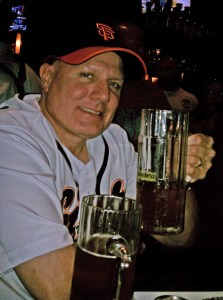
I love all things baseball as my regular readers can tell you. In fact God speaks to me through baseball, even baseball movies when I cannot get to a ball park. Of course as most readers know I am also a big fan of comedy and when baseball and comedy get together it is like beer and pizza, two great tastes that go great together. Yeah, you were thinking I would say peanut butter cups, what a waste of calories, but I digress.
I love baseball movies, comedies for sure but also serious films. Here are my favorite baseball movies in no particular order, although I’m sure that the order I place them has some subconscious meaning or maybe it doesn’t. But whatever, these are some of my favorite baseball movies with a few reasons why I like them.
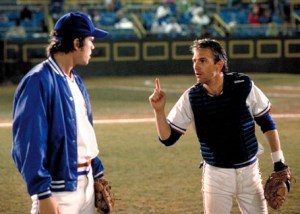
Bull Durham
Ebby Calvin LaLoosh: How come you don’t like me?
Crash Davis: Because you don’t respect yourself, which is your problem. But you don’t respect the game, and that’s my problem. You got a gift.
I guess my favorite baseball movie of all time has to be Bull Durham starring Kevin Costner, Susan Sarandon and Tim Robbins. Set in the Single-A Carolina League the film is about a journeyman minor league Catcher named Crash Davis played by Kevin Costner. Davis is a journeyman but was playing in Triple A at the beginning of the season and is sent down to Durham to help a top prospect pitcher named Ebby Calvin LaLoosh get ready for the major leagues.
In the process Davis meets Annie Savoy (Susan Sarandon) a part time junior college English instructor and baseball guru that hooks up with a player on the team for 142 games. The movie is a great sports and life movie as it deals with transitions. For Davis it is the transition from active ball player to life and love after baseball, for LaLoosh who goes from minor league prospect to the majors and Annie Savoy who falls for a man for more than a season. For the past ten years or so I have identified with Crash Davis, the journeyman who ends up mentoring young players. In fact I recommend this movie to young chaplains that seek out my counsel simply because many are wild like “Nuke” LaLoosh and simply need a blunt and honest veteran at the end of his career to bring them along.
One of my favorite scenes in this movie is when Crash gets throw out of a game. It reminds me of when I got thrown out of the Army Chaplain Officer Advanced Course in October 1992.
But also I have spent a lot of evenings watching games in the quaint ballparks of the Carolina League. The movie shows the closeness of these teams, players, fans and communities that is had to match elsewhere. So when I watch this movie it takes me back to good times that I had in places like Kinston, North Carolina with friends and people I will never forget.
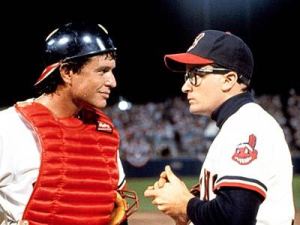
Major League
“Jesus, I like him very much, but he no help with curveball.” Pedro Cerrano
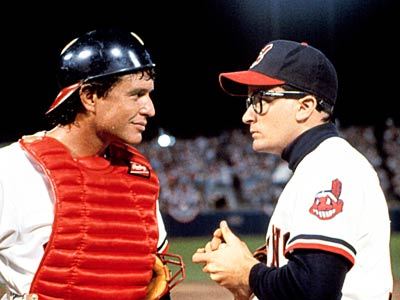
The film Major League is another of my favorites. Set in Cleveland in the late 1980s the film as about a perpetually losing team with a new owner who wants to move the historic franchise from Cleveland to Miami. Her instruction to the team’s General Manager is to lose enough games to ensure that so few fans will come that she can legally move the team.
This is a team of misfits is put together from veterans who have seen their best times, overpaid free agents that don’t perform and unknown rookies. Like Bull Durham there is the veteran but somewhat washed up catcher, this time Jake Taylor played by Tom Berenger who is the glue that holds the team together. The team includes a Cuban defector who can’t hit a curve ball named Pedro Cerrano played by Dennis Haysbert, an underperforming veteran Third Baseman named Roger Dorn, played by Corbin Bernsen and two rookies; outfielder Willie Mays Hays played by Wesley Snipes and pitcher Ricky Vaughn played by Charlie Sheen.
During the season the team has everything taken from them by owner Rachel Phelps played by Margaret Whitton as they embark on a journey from cellar dwellers to American League East Champions. Once again I relate to the veteran catcher but I also have an affinity for the rebellious rookie Ricky “Wild Thing” Vaughn.
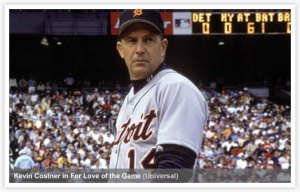
For Love of the Game
“And you know Steve you get the feeling that Billy Chapel isn’t pitching against left handers, he isn’t pitching against pinch hitters, he isn’t pitching against the Yankees. He’s pitching against time. He’s pitching against the future, against age, and even when you think about his career, against ending. And tonight I think he might be able to use that aching old arm one more time to push the sun back up in the sky and give us one more day of summer.” Vin Scully playing himself in For the Love of the Game
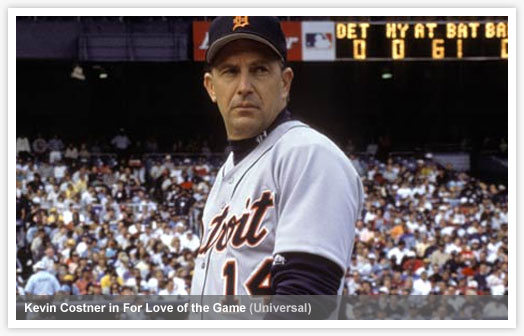
For Love of the Game is a movie about life. The film is based on the Michael Shaara novel The Perfect Game. This is a film about a pitcher named Billy Chapel played by Kevin Costner who is facing the end of his career.
Chapel has been with the team 19 years and has seen good times and bad, pitched in the World Series and suffered a grievous injury to his pitching hand in the off season. He is a man who has struggled with love yet forged lasting friendships with teammates, even those now on other teams. The movie is set at Yankee Stadium with Chapel pitching in a meaningless game for the cellar dweller Tigers against the playoff bound New York Yankees.
The game revolves around Chapel and his relationships with his catcher, Gus Sinski (John C. Reilly), his lover Jane Aubrey (Kelly Preston), her daughter Heather (Gina Malone), former teammate and current Yankee Davis Birch and the team owner Gary Wheeler (Brian Cox) who is in the process of selling the team. The new owners are looking to deal Chapel to another team, likely the San Francisco Giants when the season is over and Chapel has to decide if he is going to be traded or retire.
With all of this swirling in his mind Billy Chapel pitches a perfect game and with every pitch the audience is introduced to the people and events that shaped his life. One of the most poignant moments is toward the end of the game when the pain of his injured hand is killing him and his is tired that his catcher Gus pays a visit to the mount and says:
“the boys are all here for ya, we’ll back you up, we’ll be there, cause, Billy, we don’t stink right now. We’re the best team in baseball, right now, right this minute, because of you. You’re the reason. We’re not gonna screw that up, we’re gonna be awesome for you right now. Just throw.” http://www.youtube.com/watch?v=WLrqdqBfqcw&feature=related
The team which had nothing to play for finds its heart and soul backing up their pitcher making great plays and getting the all critical hits. I relate to Billy Chapel a lot because of my long career with all of its ups and downs. The game is a microcosm of life and tells a story through baseball that runs deeper than the game itself. It is about life, family, friendship, love, commitment, good times and bad. I cannot watch this movie without being moved to tears. Of course having Vin Scully call the game as if it were a real game makes it all the better.
The Natural
Iris Gaines: You know, I believe we have two lives.
Roy Hobbs: How… what do you mean?
Iris Gaines: The life we learn with and the life we live with after that.
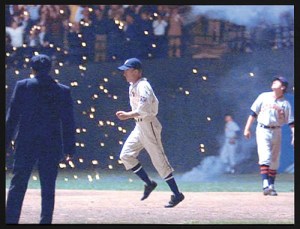
The Natural was adapted from the 1952 novel by the same name by Bernard Malamud. In the film Robert Redford plays Roy Hobbs a hot prospect that is badly wounded by a female admirer who shoots him. After years away from the game he returns to the game as an old rookie.
The novel is a tragedy while the movie was changed to make Hobbs triumph over adversity. Hobbs has to battle his past, the press and his age and the ever present affects of his injury as he plays a game that he loves all the while kindling a relationship with Iris Gaines played by Glenn Close. After a remarkable season Hobbs is sidelined by after effects of the shooting and the press publicizing his chequered past.
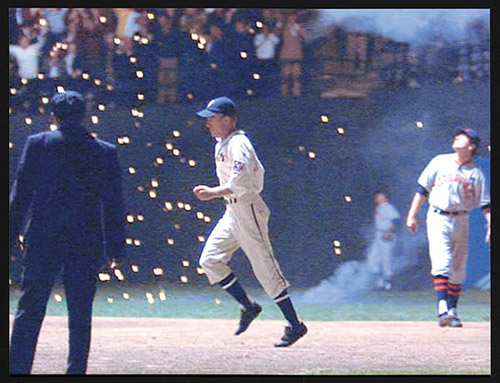
Hobbs leaves his sick-bed to play in the game that will decide the pennant. He comes to bat with 2 on and 2 out in the bottom of the 9th inning bleeding from his side due to the injury. Hobbs crushes a pitch that goes just foul and breaks his bat which had been carved from the wood of a tree struck by lightning. He asks his batboy for a bat saying “Pick me out a winner Bobby” and goes back to the batter’s box. As the catcher attempts to exploit Hobbs injury call for an inside fastball which Hobbs takes yard into the lights causing them to explode as he rounds the bases as the Knights win the pennant.
The book ends differently and is kind of depressing. I like the film better.

Field of Dreams
“The one constant through all the years, Ray, has been baseball. America has rolled by like an army of steamrollers. It has been erased like a blackboard, rebuilt and erased again. But baseball has marked the time. This field, this game: it’s a part of our past, Ray. It reminds of us of all that once was good and it could be again. Oh… people will come Ray. People will most definitely come.” Terrance Mann (James Earl Jones)
“You know we just don’t recognize the most significant moments of our lives while they’re happening. Back then I thought, well, there’ll be other days. I didn’t realize that that was the only day.” Dr. Archibald “Moonlight” Graham (Burt Lancaster)
The last film that I will discuss in this post is Field of Dreams. This is one of the three films that I call the Kevin Costner Baseball trilogy and like For the Love of the Game was adapted from a novel, in this case Shoeless Joe by W. P. Kinsella.
The film is a baseball fantasy about a novice farmer named Ray Kinsella (Costner) the son of a baseball player who during the 1960s walks away from his father and baseball. While in his fields he hears a voice saying “If you build it, he will come.” He has a vision of a baseball field and plows under some of his crops to construct a field.
Nothing happens at first but the next summer “Shoeless Joe Jackson” (Ray Liotta) shows up and after meeting Ray brings with him the seven other players from the 1919 Chicago White Sox implicated in the “Black Sox” scandal and banned from baseball.
The film is shows a search for redemption as Kinsella who tries to make sense of the voice and the ball players. Eventually goes to Boston to find 1960s author and activist Terrance Mann (based on J. D. Salinger) played by James Earl Jones after he hears the voice say “ease his pain.” He meets with the reclusive and somewhat unfriendly Mann and it does not go well.
Ray Kinsella: [being rushed out of Mann’s loft] You’ve changed – you know that?
Terence Mann: Yes – I suppose I have! How about this: “Peace, love, dope”? Now get the hell out of here!
He finally gets Mann to go with him to a Red Sox game but even that does not go well. Ray thinks that he has wasted his time when Mann stops him and the pair drives to Chisholm Minnesota to find a former ballplayer named Archibald “Moonlight Graham.” They discover Graham, the beloved town doctor died 16 years before. As Kinsella walks the street he finds himself transported back in time and meets the old Doctor Graham. He cannot get Graham to come with them but on the road back home he and Mann pick up a young hitch hiker looking to play baseball, named Archie Graham. They arrive back home and while the players who have grown in number they find that his farm is being foreclosed on be foreclosed on by a group of businessmen and bankers headed up by his brother in law.

During the argument between Ray and his brother in law the daughter fall off the small set of bleachers and appears to be severely injured. Young Archie Graham walks off the field, becomes old doctor Graham and saves the girl’s life. The brother in law is transformed by what happened and sees the ballplayers for the first time.
He stops the action against his Ray who after thinking Ray was crazy finally sees the magic of this diamond as Archie Graham becomes the elderly Doctor Moonlight Graham and saves the Kinsella’s daughter’s life after she fell from the bleachers. Mann gets to go with Shoeless Joe and the others into the mystical cornfield and a young ballplayer, Ray’s father John Kinsella is introduced. Ray recognizes him introduces him to his family without identifying him as his father or admitting that he is his son. The classic exchange between the two explains the essence of the film.
John Kinsella: Is this heaven?
Ray Kinsella: It’s Iowa.
John Kinsella: Iowa? I could have sworn this was heaven. [John starts to walk away]
Ray Kinsella: Is there a heaven?
John Kinsella: Oh yeah. It’s the place where dreams come true. [Ray looks around, seeing his wife playing with their daughter on the porch]
Ray Kinsella: Maybe this is heaven
The two end up “having a catch” as the lights of cars wind across the Iowa farmlands heading to this little ball field. The movie has a special place in my heart because of the father-son relationship. When my dad returned from Vietnam I had emotionally moved away from him and baseball. I kept an interest in the game but for a number of years it was not a passion. The exchange between Ray Kinsella and Terrance Mann still gets me, now later in life my dad and I reconnected as father and son and I came back to baseball.
Ray Kinsella: By the time I was ten, playing baseball got to be like eating vegetables or taking out the garbage. So when I was 14, I started to refuse. Could you believe that? An American boy refusing to play catch with his father.
Terence Mann: Why 14?
Ray Kinsella: That’s when I read “The Boat Rocker” by Terence Mann.
Terence Mann: [rolling his eyes] Oh, God.
Ray Kinsella: Never played catch with him again.
Terence Mann: You see? That’s the sort of crap people are always trying to lay on me. It’s not my fault you wouldn’t play catch with your father.
In 2004 while going to a reunion of my Continental Singers tour in Kansas City Judy and I made a few stops watching minor league games in Louisville and Cedar Rapids before making a trip to Dyersville Iowa. Dyersville is the place where the Field of Dreams was filmed and where the you can still play ball on that magical diamond. Judy indulged me by playing catch with me on that diamond. It is true that if you build it he will come…I did.
I could go on about other baseball movies as there are many more but these above the others are the ones that I find a special connection with. I think I may write about some of the philosophy and faith that I draw from these films over the coming season.
Peace
Padre Steve+







 The Inglorius Padre Steve's World
The Desegregation of Baseball and Its Importance Today
John Jorgensen, Pee Wee Reese, Ed Stanky and Jackie Robinson on opening day 1947
“Jackie, we’ve got no army. There’s virtually nobody on our side. No owners, no umpires, very few newspapermen. And I’m afraid that many fans will be hostile. We’ll be in a tough position. We can win only if we can convince the world that I’m doing this because you’re a great ballplayer, a fine gentleman.” Branch Rickey to Jackie Robinson
My friends, in just a few days pitchers and catchers report for the 2015 Baseball Spring Training and it is time to reflect again on how Branch Rickey’s signing of Jackie Robinson helped advance the Civil Rights of Blacks in the United States. What Rickey did was a watershed, and though it took time for every team in the Major Leagues to integrate, the last being the Boston Red Sox in 1959, a dozen years after Jackie Robinson broke the color barrier.
Branch Rickey shook the foundations of America when he signed Jackie Robinson to a Major League deal in 1947, a year before President Truman desegregated the military and years before Jim Crow laws were overturned in many states.
Robinson and the early pioneers of the game did a service to the nation. They helped many white Americans see that Blacks were not only their equals as human beings, and as it was note about Ernie Banks and others that soon “little white boys wanted to grow up and be Ernie Banks.”
Charles Thomas
But for Rickey the crusade to integrate baseball began long before 1947. In 1903, Rickey, then a coach for the Ohio Wesleyan University baseball team had to console his star player, Charles Thomas when a hotel in South Bend Indiana refused him a room because he was black. Rickey found Thomas sobbing rubbing his hands and repeating “Black skin. Black skin. If only I could make them white.” Rickey attempted to console his friend saying “Come on, Tommy, snap out of it, buck up! We’ll lick this one day, but we can’t if you feel sorry for yourself.”
The Young Branch Rickey
Thomas, encouraged by Rickey was remembered by one alumnus who saw a game that Thomas played in noted that “the only unpleasant feature of the game was the coarse slurs cast at Mr. Thomas, the catcher.” However, the writer noted something else about Thomas that caught his eye: “But through it all, he showed himself far more the gentleman than his insolent tormentors though their skin is white.”
Baseball like most of America was not a place for the Black man. Rickey, a devout Christian later remarked “I vowed that I would always do whatever I could to see that other Americans did not have to face the bitter humiliation that was heaped upon Charles Thomas.”
In April 1947 Rickey, now the owner of the Brooklyn Dodgers had one African-American ballplayer at the Dodgers’ Spring Training site in Daytona Beach Florida. The South was still a hotbed of racial prejudice, Jim Crow was the law of the land and Blacks had no place in White Man’s baseball. That player was Jackie Robinson.
Jackie Robinson and Branch Rickey
The Dodgers had been coming to Florida for years. Rickey moved the Dodgers from Jacksonville to Daytona Beach in 1947 after Jacksonville had refused to alter its segregation laws to allow an exhibition game between the Dodgers International League affiliate the Montreal Royals, for whom Robinson starred.
That was the year that Rickey signed Robinson to a minor league contract with the Royals. When Rickey called up Robinson 6 days prior to the 1947 season, it was Robinson broke the color barrier for the Dodgers and Major League Baseball. However it would take another 12 years before all Major League teams had a black player on their roster.
It is hard to imagine now that even after Jackie Robinson had broken the color barrier that other teams did not immediately sign black players. However Rickey and Robinson broke the color barrier a year before Harry Truman had integrated the Armed Forces and seven years before the Supreme Court ruled the segregation of public schools illegal. But how could that be a surprise? The country was still rampant with unbridled racism. Outside of a few Blacks in the military and baseball most African Americans had few rights. In the North racism regulated most blacks to ghettos, while in the South, Jim Crow laws and public lynchings of progressive or outspoken Blacks.
But Jackie Robison and Branch Rickey helped bring about change, and soon other teams were following suit.
Larry Doby (above) and Satchel Paige signed by the Indians
The Cleveland Indians under their legendary owner Bill Veeck were not far behind the Dodgers in integrating their team. They signed Larry Doby on July 5th 1947. Doby would go on to the Hall of Fame and was a key player on the 1948 Indian team which won the 1948 World Series, the last that the storied franchise has won to this date.
Hank Thompson and Roy Campanella
The St. Louis Browns signed Third Baseman Hank Thompson 12 days after the Indians signed Doby. But Thompson, Robinson and Doby would be the only Blacks to play in that inaugural season of integration. They would be joined by others in 1948 including the immortal catcher Roy Campanella who signed with the Dodgers and the venerable Negro League pitcher, Satchel Paige who was signed by the Indians.
Monte Irvin (Above) and Willie Mays
It was not until 1949 when the New York Giants became the next team to integrate. They brought up Monte Irvin and Hank Thompson who they had acquired from the Browns. In 1951 these men would be joined by a young, rookie Willie Mays to become the first all African-American outfield in the Major Leagues. Both Mays and Irvin would enter the Hall of Fame and both are still a key part of the Giants’ story. Despite their age have continued to be active in with the Giants and Major League Baseball.
Samuel “the Jet” Jethroe
The Boston Braves were the next to desegregate calling up Samuel “the Jet” Jethroe to play Center Field. Jethroe was named the National League Rookie of the Year in 1950.
Minnie Minoso
In 1951 the Chicago White Sox signed Cuban born Minnie Minoso who had played for Cleveland in 1949 and 1951 before signing with the White Sox. Minoso would be elected to 9 All-Star teams and win 3 Golden Gloves.
Ernie Banks (above) and Bob Trice
The Chicago Cubs and Philadelphia Athletics integrated at the end of the 1953 season. The Cubs signed Shortstop Ernie Banks who would go on to be a 14 time All-Star, 2 time National League MVP and be elected to the Hall of Fame in 1977 on the first ballot. The Athletics called up pitcher Bob Trice from their Ottawa Farm team where he had won 21 games. Trice only pitched in 27 Major League games over the course of three seasons with the Athletics.
Curt Roberts
Four teams integrated in 1954. The Pittsburgh Pirates acquired Second Baseman Curt Roberts from Denver of the Western League as part of a minor league deal. He would play 171 games in the Majors. He was sent to the Columbus Jets of the International League in 1956 and though he played in both the Athletics and Yankees farm systems but never again reached the Majors.
Tom Alston
The St. Louis Cardinals, the team that had threatened to not play against the Dodgers and Jackie Robinson in 1947 traded for First Baseman Tom Alston of the Pacific Coast League San Diego Padres. Alston would only play in 91 Major League games with his career hindered by bouts with depression and anxiety.
Nino Escalara (above) and Chuck Harmon
The Cincinnati Reds brought up Puerto Rican born First Baseman Nino Escalera and Third Baseman Chuck Harmon. Harmon had played in the Negro Leagues and had been a Professional Basketball player in the American Basketball League. Harmon who was almost 30 when called up played just 4 years in the Majors. Both he and Escalera would go on to be Major League scouts. Escalera is considered one of the best First Baseman from Puerto Rico and was elected to the Puerto Rican Baseball Hall of Fame. Harmon’s first game was recognized by the Reds in 2004 and a plaque hangs in his honor.
The Washington Senators called up Cuban born Center Fielder Carlos Paula from their Charlotte Hornets’ farm team in September 1954. Paula played through the 1956 season with the Senators and his contract was sold to the Sacramento Salons of the Pacific Coast League. He hit .271 in 157 plate appearances with 9 home runs and 60 RBIs. He died at the age of 55 in Miami.
Elston Howard
In April 1955 the New York Yankees finally integrated 8 years after the Dodgers and 6 years after the Giants. They signed Catcher/Left Fielder Elston Howard from their International League affiliate where he had been the League MVP in 1954. Howard would play 13 years in the Majors with the Yankees and later the Red Sox retiring in 1968. He would be a 12-time All Star and 6-time World Series Champion as a player and later as a coach for the Yankees. He died of heart disease in 1980. His number #32 was retired by the Yankees in 1984.
The Philadelphia Phillies purchased the contract of Shortstop John Kennedy from the Kansas City Monarchs of the Negro League at the end of the 1956 season. Kennedy played in just 5 games in April and May of 1957.
Ozzie Virgil Sr.
In 1958 the Detroit Tigers obtained Dominican born Utility Player Ozzie Virgil Sr. who had played with the Giants in 1955 and 1956. Virgil would play 9 seasons in the Majors with the Giants, Tigers, Athletics and Pirates and retire from the Giants in 1969. He later coached for 19 years in the Majors with the Giants, Expos, Padres and Mariners.
The last team to integrate was the Boston Red Sox who signed Infielder Pumpsie Green. Green made his debut on 21 July 1959 during his three years with the Red Sox was primarily used as a pinch runner. He played his final season with the New York Mets in 1963. He was honored by the Red Sox in 2009 on the 50th anniversary of breaking the Red Sox color barrier.
It took 12 years for all the teams of the Major Leagues to integrate, part of the long struggle of African Americans to achieve equality not just in baseball but in all areas of public life. These men, few in number paved the way for African Americans in baseball and were part of the inspiration of the Civil Rights Movement itself. They should be remembered by baseball fans, and all Americans everywhere for their sacrifices and sheer determination to overcome the obstacles and hatreds that they faced. It would not be until August of 1963 that Martin Luther King Jr. would give his I Have a Dream speech and 1964 that African Americans received equal voting rights.
Spring training for the 2015 season is about to begin in Florida and Arizona, in what are called the Grapefruit and Cactus Leagues. It is hard to believe that only 68 years ago that only one team and one owner dared to break the color barrier that was, then, and often today is still a part of American life.
However in those 68 years despite opposition and lingering prejudice African Americans in baseball led the way in the Civil Rights Movement and are in large part responsible for many of the breakthroughs in race relations and the advancement of not only African Americans, but so many others.
We can thank men like Charles Thomas, Jackie Robinson and Branch Rickey for this and pray that we who remain, Black and White, Asian, and Latin American, as well as all others who make up our great nation will never relinquish the gains that have been won at such a great cost.
President Obama throwing out the First Pitch for the Washington Nationals
Today we have a Black President who has the same kind of racial epitaphs thrown at him every day by whites who as they did to Charles Thomas, Jackie Robinson and so many other pioneers, Frankly such behavior can only be called what is it, unrepentant, unabashed, and evil racism. The fact is that such people don’t think that any Black man should hold such high an office, just as they did not think that Blacks should be allowed to play integrated baseball. It is anathema to them, and that is why their unabashed hatred for Obama runs so deep. They may disagree with his policies, but I guarantee if Obama was white, their opposition to him would be far more civil and respectful. But because he is half-black, and has a funny name they hate him with a passion, a passion that scares me, because words and hateful beliefs can easily become actions.
Racism still exists, but one day thanks to the efforts of the early ball-players as well as pioneers like President Obama, and the undying commitment of decent Americans to accept people regardless of race, ethnicity, gender, religion, or even sexual orientation, we will see a new birth of freedom.
Peace
Padre Steve+
Share this:
Leave a comment
Filed under Baseball, civil rights, History, political commentary
Tagged as 1964 civil rights act, Baseball, bob trice, boston braves, boston red sox, branch rickey, brooklyn dodgers, carlos paula, charles thomas, chicago cubs, chicago white sox, chuck harmon, cincinnati reds, civil rights, cleveland indians, curt roberts, elston howard, equal rights, ernie banks, hank thompson, harry truman, i have a dream speech, integration of baseball, jackie robinson, jim crow laws, john kennedy baseball player, larry doby, martin luther king jr, minnie minoso, monte irvin, new york giants, new york yankees, nino escalera, ossie davis, ozzie virgil sr, pee wee reese, philadelphia athletics, pittsburgh pirates, president barak obama, pumpsie green, racism, roy campanela, samuel jethroe, satchel paige, spring training, st louis cardinals, st. Louis browns, tom alston, voting rights act of 1964, washington senators, willie mays