Tag Archives: battle of gettysburg

The Tragedy of Friends Divided By War: Winfield Scott Hancock and Lewis Armistead on Cemetery Ridge


Friends of Padre Steve’s World,

I have been rating but continuing to work on my Civil War and Gettysburg texts this weekend, and because of that I am retiring to an older post about the relationships of close friends in war. In this case, friends who had served together for many years who ended up fighting each other at Gettysburg. The story is tragic, because none of them hated each other, or held any animosity towards each other, but instead had followed what they believed to be their duty, some in the continued service of the Union, and others to that of their home states. Even so the bonds of friendship were never severed. Of course, unless you have served with people in war and in the military it it hard to comprehend such a fate. Even now, I know men that I consider friends, men who now hold very different political and social beliefs than me, and if God forbid there was ever another civil war, we would be on opposite sides, but they would still be friends, and I would grieve the fact that we would be fighting. 

I do plan on reworking this section of my Gettysburg text again, adding to it and further exploring the dynamics of the relationships at play in this story. But for now, since I have been working on other things, this will have to do.

Have a great day,

Peace

Padre Steve+

The bonds of friendship forged by soldiers are some of deepest and long lasting that are formed anywhere.  For American military professionals those bonds are formed in the small rather closed society that is the regular United States military. They are formed in war and peace, and are marked by years of deployments, isolated duty and combat. They are part of a culture that is often quite different than that of civilian society. That is the case now as it was in 1860.

When the Southern States seceded from the Union men who had spent much of their adult lives serving together discovered had to say goodbye and prepare to fight each other. Most did so with a heavy heart even though many had strong convictions about the rightness of their region’s cause. Those who left the army to serve the Confederate states were often torn by doubt and questions of where their loyalty lay. Robert E. Lee was a good example of the conflict that many Southern officers faced. “The Southern professional officer in 1861 was confronted with a cruel choice symbolized by Lee’s anguished pacing at Arlington. On one hand, the Southern officer’s political allegiances drew him to the Confederacy; on the other his professional responsibility drew him to the Union.” [1] They wrestled with their oath of office and the costs of perhaps having to face their dearest friends on future battlefields. Lee’s letter to his sister Ann Marshall, who remained a supporter of the Union, after he resigned from the army he had served for 32 years reflects that anguish, torn between his loyalties Lee wrote “With all my devotion to the Union, and the dear feeling of loyalty and duty of an American citizen, I have not been able to make up my mind to raise my hand against my relatives, my children, my home.” [2] He added: “I know you will blame me…but you must think as kindly of me as you can, and believe that I have endeavored to do what I think right.” [3]

They were different from the mass levies of civilian volunteers who rallied to the flags of the Union and Confederacy in 1861. The volunteers, most of whom did not have the deep and abiding friendships of the professionals were often motivated by ideological, sectional or religious hatred of the other and went to war with great aplomb. However, the professionals for the most part went to war against former comrades with heavy heart, “old army colleagues found themselves wrenched from the normal course of their lives when their states joined the Confederacy.” [4]

The American Civil War has many such tales. Porter Alexander wrote of his final words with his superior James B. McPherson, who later went on to be a highly successful corps commander under Grant and Sherman before being killed outside Atlanta in 1864. McPherson desired that Alexander remain in California as an Engineering officer and warned him about the nature of the coming war and gave him his counsel as a friend:

“Now this is not going to be any 90 day or six months affair as some of the politicians are predicting. Both sides are in deadly earnest & it is long & desperate & fought to the bitter end. ..God only knows what may happen to you individually, but for your cause there can be but one possible result. It must be lost….” [5]

Alexander wrote: “Nothing could exceed the kindness & real affection with which McPherson urged these views on me…. His earnest talk impressed me deeply & made me realize that a crisis in my life was at hand. But I felt helpless to avert it or even to debate the question what I should do. I could not controvert one of McPhersons’ statements or arguments; I could only answer this: “Mac, My people are going to war, & and for their liberty. If I don’t come & bear my part they will believe me a coward…” [6]

One of the most remembered is that of Union General Winfield Scott Hancock and Confederate General Lewis Armistead. It was key story line in Michael Shaara’s Pulitzer Prize winning novel The Killer Angels was immortalized in the movie Gettysburg which is based on Shaara’s novel.
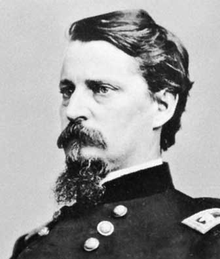

                                                                            Major General Winfield Scott Hancock USA

Hancock was from Pennsylvania. He was a career soldier and Infantry officer, a graduate of West Point Class of 1844. He served in Mexico and held numerous positions. In 1861 he was stationed in California as a Quartermaster under the command of Colonel (Brevet Brigadier General) Albert Sidney Johnston with the Sixth Infantry Regiment. One of his fellow officers was Captain Lewis Armistead, a twice widowed Virginian who also served as a commander of the New San Diego Garrison under Johnston’s command, and Richard Garnett commanding a company at Fort Yuma. Hancock and his wife Almira became fast friends with the widowed Virginian.

Armistead was a nephew of the officer who defended Fort McHenry from the British in the War of 1812. Armistead had academic and personal difficulties at West Point and “was bounced out, not once but twice.” [7] His troubles included an altercation with Jubal Early in which he broke a plate over Early’s head.  Between his academic difficulties and the fight with Early he resigned from the Academy. However, his father helped him obtain a commission as an Infantry officer in 1839. Armistead’s career from that point on was similar to many other officers of his day. He served with distinction in Mexico, the Great Plains, Kansas, Utah and California.

As the war clouds built and various southern states seceded from the Union numerous officers from the South were torn between their oath, their friendships and their deep loyalty to their home states and families. In the end most Southern officers resigned their commissions, many with mixed feelings and quite often sadness. A large minority, some “40 to 50 per cent of Southern West Point graduates on active duty in 1860 held on to their posts and remained faithful to the Union.” [8] The most prominent of these men were General Winfield Scott and Major General George Thomas, the “Rock of Chickamauga.” Likewise Union Brigadier General John Buford’s family in Kentucky supported the Confederacy.

For those southern officers who remained loyal to the Union to was often at a great personal cost. Thomas’s action cost him his relationship with his immediate family who deemed him to be a traitor. He and others were pilloried and demonized in the basest ways by many in the South. Some Southerners who served the Union were executed when they were captured. George Pickett, who called for his fellow Virginian Thomas’ death ordered 22 North Carolinians who he captured fighting for the Union in Kinston North Carolina to be executed. Pickett was not alone in such sentiments.


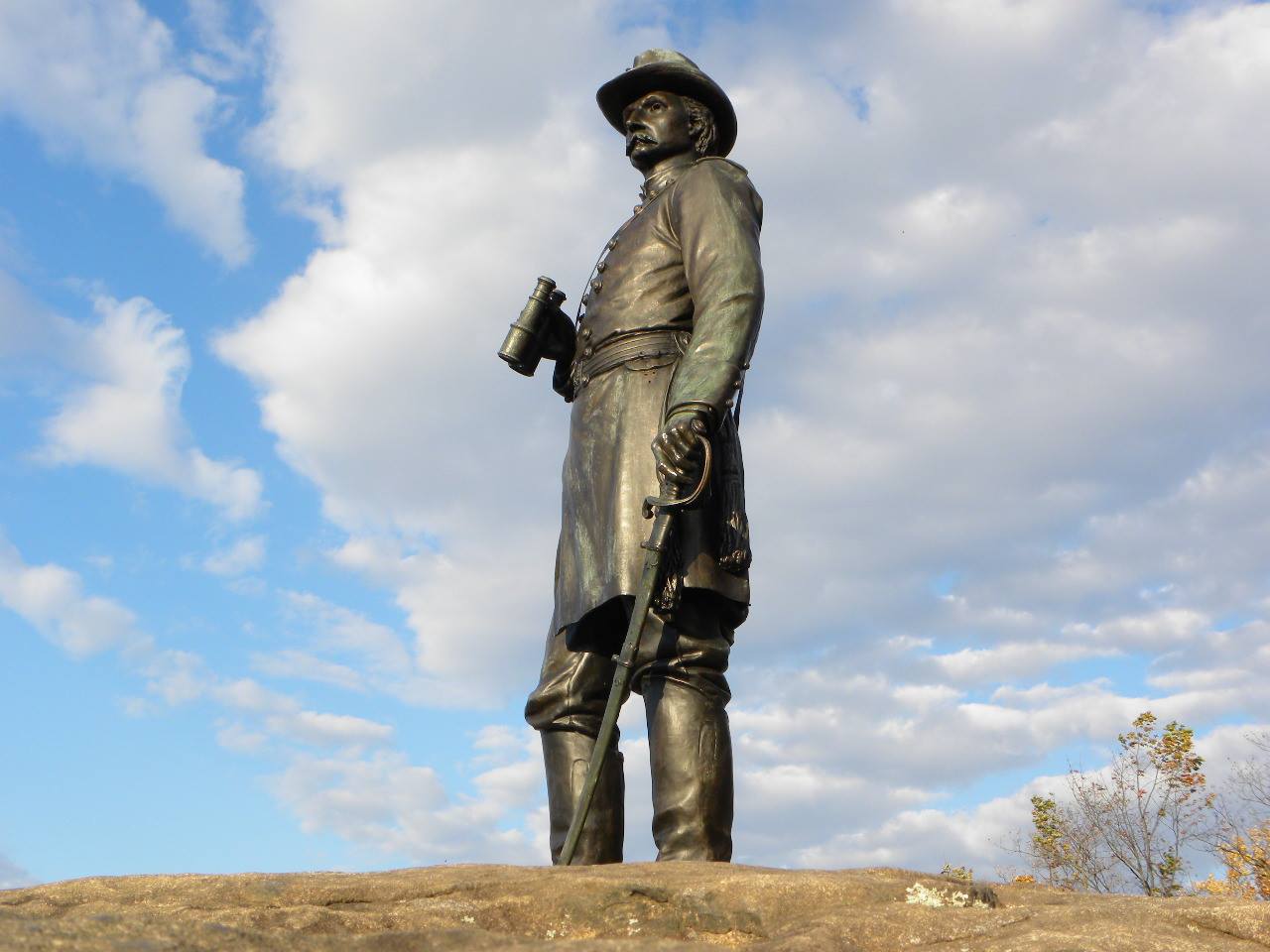
                                                                               Brigadier General Lewis Armistead CSA

However, for most it was different. As talk of secession and war heated up officers stationed on the frontier debated the issues and asked each other what they would do if war came. In California Armistead and other officers asked Hancock, who was a Democrat and not openly hostile to the South, advice on what he would do if war came. Hancock’s reply was simple. I shall not fight upon the principle of state-rights, but for the Union, whole and undivided” [9]

The parting came in 1861. When it was apparent that many officers would be resigning and heading home to join their state’s forces the Hancock’s hosted a going away party for their friends. Almira Hancock wrote of the party that “Hearts were filled with sadness over the surrendering of life-long ties.” [10]

Colonel Albert Sidney Johnston’s wife Eliza went to a piano and sang sentimental songs such as Mary of Argyle and the popular Irish song Kathleen Mavourneen. [11] Almira Hancock wrote “Those songs…will ever be remembered by survivors of that mournful gathering.” [12]

“Mavourneen, Mavourneen, my sad tears are falling, 

to think that from Erin and thee I must part!

It may be for years, and it may be forever, 

Then why art thou silent, thou voice of my heart?

The parting was especially emotional for Armistead who had been a friend of the Hancock’s for 17 years. They had helped in following the death of both of his wives and children. He was tearful. He put his arm on his friend’s shoulder as he said: “Hancock, good-by; you can never know what this has cost me, and I hope God will strike me dead if I am ever induced to leave my native soil, should worse come to worse.” [13] As he departed Armistead gave a wrapped Bible and Prayer book to Almira Hancock, in case of his death, inscribed were the words “Trust in God and fear nothing.” [14]

Armistead led his brigade during the Peninsula campaign and battles around Richmond and his brigade was decimated in Lee’s failed assault on prepared Federal positions at Malvern Hill. Armistead did not endear himself to many of the volunteer officers who served in the Confederate ranks. One of his Colonels resigned over Armistead’s supposedly harsh treatment to which Armistead replied: “I have felt obliged to speak to him as one military man would to another and as I have passed nearly all my life in camps my manner may not be understood or appreciated by one who has been all his life a civilian.” [15] Armistead’s words can easily be understood by military professionals whose lives have been shaped in a different manner than their civilian counterparts.

At Gettysburg Armistead spoke his fears about the charge to his comrades. One was Brigadier General Dick Garnett, another of Armistead and Hancock’s comrades from the California days on the night of July 2nd. Garnett’s career had paralleled that Armistead, the same age Garnett struggled at West Point in his third year “he failed and withdrew. Taking the same courses again during the next term, he finished fourteenth among his new classmates, then graduated in 1841 standing 29th of fifty-two graduates.” [16]

Armistead and Garnett served together in the Sixth Infantry for most of their careers. They were promoted at similar times, a pattern of promotion that continued into their Confederate service. The next afternoon, the two friends who had served together so long and whose careers were so similar led their brigades of Pickett’s Division across the valley between Seminary Ridge and Cemetery Ridge against their friend and comrade Winfield Scott Hancock’s II Corps which was defending Cemetery Ridge.

Garnett had to lead his brigade on horseback, having been injured during the army’s march to Gettysburg. During the engagement Garnett was killed just before reaching the Union lines and Hancock gravely wounded. Armistead, lead the remnants of his decimated brigade to the Stone Wall, near the Copse of Trees. He rallied his troops fearing that some were faltering calling out: “Come on boys, give them the cold steel! Who will follow me?” [17]

His troops breached the Union line and his black hat atop his sword led his troops forward. He reached the now unmanned artillery of Cushing’s battery and called to his remaining men “The day is ours men, come and turn this artillery on them.” [18] It was then that he met more Federal troops who unleashed a volley of musket fire that cut down many of the survivors. Armistead was wounded in the right arm and shoulder and fell near one of the Union artillery pieces, a point now known as “The High Water Mark” of the Confederacy.


As Armistead lay wounded he was approached by Major Bingham of Hancock’s staff. Bingham, a Mason noticed that Armistead was making a Masonic sign of distress. When Bingham told Armistead of Hancock’s injury Armistead was grieved and told Bingham to “Say to General Hancock for me that I have done him, and you all, an injury, which I shall always regret.” [19]

The meaning of those words is debated, especially by Southerners who cherish the myth of the Lost Cause. However, based on Armistead’s conduct and behavior in the time before he left California, it is not unreasonable to assume that as he lay dying he truly regretted what he had done. Armistead died from infections caused by his wounds which were initially not thought to be life threatening. A Union surgeon described him as: “seriously wounded, completely exhausted, and seemingly broken-spirited.” [20]

Garnett’s body was never found and was probably buried in a mass grave with other Confederate soldiers and was likely taken after the war to his native Virginia “together with thousands of unidentified bodies from Gettysburg, for burial in Richmond’s Hollywood Cemetery.[21] Armistead was buried by a member of the 107th Ohio near the XI Corps field hospital. About a month later a physician from Philadelphia tracked down the soldier and “dug up the “Rough box” containing the body and embalmed poor Armistead’s remains for sale to grieving family members.” [22] Armistead’s family buried the remains in Old Saint Paul’s Cemetery in Baltimore.

Robert Krick wrote: “Death on adjacent bits of blood soaked ground in Adams County, Pennsylvania, yielded a final common thread, that of indignity: Lewis Armistead’s corpse wound up a hostage to petty human greed, while Dick Garnett’s entirely disappeared.” [23]

Hancock’s injuries were severe, but he recovered. He would go on to continued fame and be one of the most admired and respected leaders of the Army during and after the war. He was gracious as a victor and spoke out against reprisals committed against Southerners after the war.

In 1880 Hancock was the Democratic nominee for President. He lost a close election to James Garfield, losing the popular vote by fewer than 40,000 votes. It was an era of great political corruption and Hancock was one of the few major public figures viewed favorably for his integrity. Even his political opponents respected him for his integrity and honesty. Former President Rutherford B Hayes said:

“if when we make up our estimate of a public man, conspicuous both as a soldier and in civil life, we are to think first and chiefly of his manhood, his integrity, his purity, his singleness of purpose, and his unselfish devotion to duty, we can truthfully say of Hancock that he was through and through pure gold.” [24]

A few years after his death Republican General Francis A Walker, lamenting the great corruption of the time said:

“Although I did not vote for General Hancock, I am strongly disposed to believe that one of the best things the nation has lost in recent years has been the example and the influence of that chivalric, stately, and splendid gentleman in the White House. Perhaps much which both parties now recognize as having been unfortunate and mischievous during the past thirteen years would have been avoided had General Hancock been elected.” [25]

The story of Hancock, Armistead and Garnett is one that reminds us of the depth of friendships that many military professionals develop and cherish. It is also a story that reminds us of how hardened ideologues can divide a nation to the point of civil war. It is a story that should give pause to any political or spiritual leader that incites people to war against their neighbor and uses their ideology to slander, demean or even enslave and brutalize their political opponents.

The blood of the approximately 50,000 soldiers that were killed or wounded during the three days of the Battle of Gettysburg is ample reminder of the tragedy of war, especially war that forces the dearest of friends to fight and even kill one another.

Notes 

[1] Huntington, Samuel P. The Soldier and the State: The Theory and Politics of Civil-Military Relations, The Belknap Press of Harvard University Press, Cambridge MA and London 1957 p.212

[2] Thomas, Emory Robert E. Lee W.W. Norton and Company, New York and London 1995 p.188

[3] Korda, Michael. Clouds of Glory: The Life and Legend of Robert E. Lee Harper Collins Publishers, New York 2014 pp.230-231

[4] Jordan, David M. Winfield Scott Hancock: A Soldier’s Life Indiana University Press, Bloomington and Indianapolis 1988 p.33

[5] Alexander, Edward Porter. Fighting for the Confederacy: The Personal Recollections of General Edward Porter Alexander edited by Gary Gallagher University of North Carolina Press, Chapel Hill 1989 p.24

[6] Ibid. Alexander. Fighting for the Confederacy p.25

[7] Guelzo, Allen C. Gettysburg: The Last Invasion Vintage Books a Division of Random House, New York 2013 p.379

[8] Ibid. Huntington The Soldier and the State p.213

[9] Ibid. Jordan Winfield Scott Hancock p.33

[10] Ibid. Jordan Winfield Scott Hancock p.34

[11] Ibid. Jordan Winfield Scott Hancock p.34

[12] Ibid. Jordan Winfield Scott Hancock p.34

[13] Ibid. Jordan Winfield Scott Hancock p.34

[14] Krick, Robert K. The Parallel Lives of Two Virginia Soldiers Armistead and Garnett in The Third Day at Gettysburg and Beyond edited by Gary Gallagher, University of North Carolina Press, Chapel Hill and London 1994 p.112

[15] Tagg, Larry The Generals of Gettysburg: The Leaders of America’s Greatest Battle Da Capo Press Cambridge MA 1998 Amazon Kindle Edition p.244


[16] Ibid. Krick Armistead and Garnett p.101

[17] Stewart, George R. Pickett’s Charge: A Micro-History of the Final Attack at Gettysburg, July 3rd 1863 Houghton Mifflin Company Boston 1959 pp.216-217

[18] Hess, Earl J. Pickett’s Charge: The Last Attack at Gettysburg University of North Carolina Press, Chapel Hill and London 2001 p.262

[19] Ibid. Stewart Pickett’s Charge pp.254-255

[20] Ibid. Stewart Pickett’s Charge pp.254

[21] Ibid. Krick Armistead and Garnett p.123

[22] Ibid. Krick Armistead and Garnett p.123

[23] Ibid. Krick Armistead and Garnett p.123

[24] Ibid. Jordan Winfield Scott Hancock p.319

[25] Stone, Irving They Also Ran Doubleday, New York 1943 and 1981 pg. 188
1 Comment

Filed under civil war, Gettysburg, History, leadership, Military

This Fiery Line: Freeman McGilvery at Plum Run


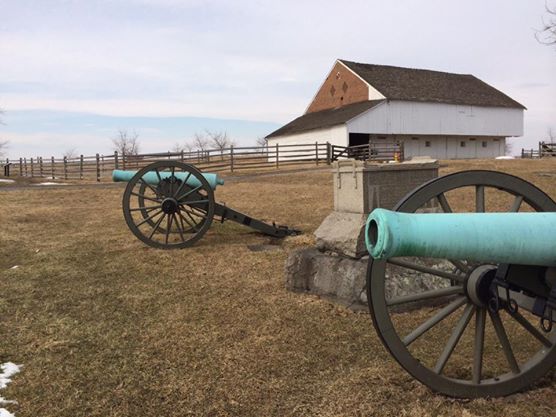
Artillery at the Trostle Farm

Friends of Padre Steve’s World,

Today another excursion into my archives dealing with the Battle of Gettysburg as I muse about my Independence Day article. I hope you enjoy.

Peace

Padre Steve+

The disaster that engulfed Sickles’ III Corps now threatened the Federal center. Meade and Hancock rushed reinforcements in the form of V Corps and much of II Corps. The tip of the Sickle’s salient at Sherfy’s Peach Orchard manned by Graham’s brigade of David Birney’s division was overwhelmed and retreated in disorder. Once “the angle had been breached, the lines connecting to it on the east and north were doomed.” [1] This exposed the left of Humphery’s division and it too was forced to retreat under heavy pressure sustaining heavy casualties. The final collapse of Humphrey’s division a large gap opened in the Federal lines between the elements of V Corps fighting along Devil’s Den and Little Round Top and II Corps along the central portion of Cemetery Ridge.

When Meade realized the seriousness of the situation he gave Sickles’ free reign to call for reinforcements from Harry Hunt’s Artillery Reserve as III Corps had only batteries organic to it. Those five batteries were in the think of the fighting providing invaluable support to Sickles’ hard pressed and outnumbered corps. Firing canister they cut swaths of death and destruction through the massed ranks of wildly cheering Confederates of Kershaw and Semmes and Barkdale’s brigades of McLaws’ division.

The Confederates believed that they had cut the Union line in half and advanced through the Peach Orchard and across the Wheat Field toward Cemetery Ridge.


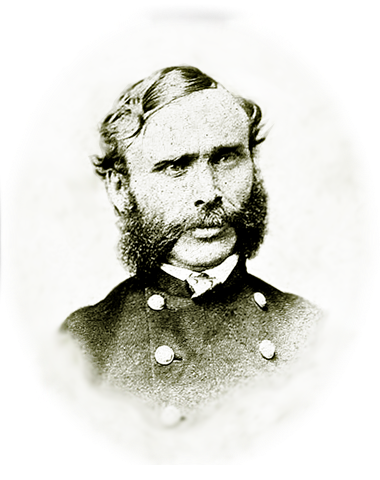
Among the artillery called into action was the First Volunteer Brigade under the command of Lieutenant Colonel Freeman McGilvery. McGilvery, a Maine native was a former sea captain who had organized and commanded the 6th Maine Battery at the beginning of the war. He commanded it with distinction in a number of engagements. Promoted to Major in early 1863 he assumed command of the Brigade and fought at Chancellorsville and was promoted to Lieutenant Colonel in June as the Army of the Potomac pursued Lee’s Army.

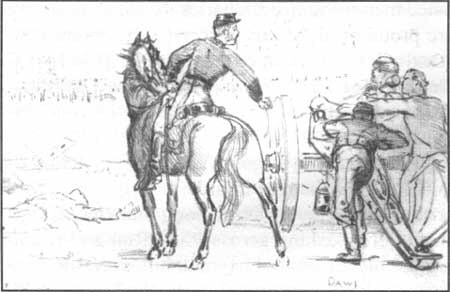
McGilvery rode into the maelstrom of the retreating III Corps soldiers and broken guns. His horse was hit four times but he remained unwounded despite “exposing himself to enemy missiles on all parts of the field from Cemetery Ridge to the Peach Orchard.” [2] He noted that there was no infantry anywhere that could plug the gap and acted instantly on his own authority to make a decision that likely saved the Union line. In the confusion of III Corps disintegration three of his batteries had withdrawn leaving Captain John Bigelow’s 9th Massachusetts battery alone at the Trostle farm telling them they must “hold at all hazards.” [3] Bigelow later explained that McGilvery said that “for 4 or 500 yards in my rear there were no Union troops.” He was then instructed by McGilvery “For heavens [sic] sake hold that line…until he could get some other batteries in position…” [4] In another account Bigelow recorded “Captain Bigelow…there is not an infantryman back of you along the whole line which Sickles moved out; you must remain where you are and hold your position at all hazards, and sacrifice your battery if need be, until at least I can find some batteries to put in position and cover you.” [5]

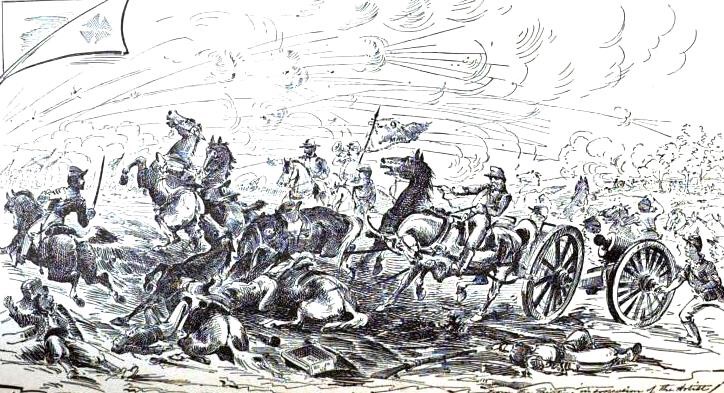
The order could have been considered suicidal; the 21st Mississippi was nearly upon them and they were but one battery and barely one hundred troops. Bigelow did not hesitate to obey; he brought his guns into line at the Trostle house “facing one section slightly to the southwest and the other two sections directly into the path of the oncoming Confederates.” [6]


Bigelow’s artillerymen fought like demons he described the effect of his fire on Kershaw’s South Carolinians “the Battery immediately enfiladed them with a rapid fire of canister, which tore through their ranks and sprinkled the field with their dead and wound, until they disappeared in the woods on our left, apparently a mob.” [7] They poured a merciless stream of fire into the advancing Confederates until “they had exhausted their supply of canister and the enemy began to close in on his flanks.” [8] A German born gunner noted “we mowed them down like grass, but they were thick and rushed up.” [9] A hand to hand fight ensued among the guns but the Massachusetts men escaped losing 28 of its 104 men engaged,[10] the brave commander Bigelow was wounded and nearly captured but one of his men helped him to the rear.


Their sacrifice was not in vain. They bought McGilvery an additional 30 minutes to set up a line of guns along Plum Run. Hunt praised the battery “As the battery had sacrificed itself for the safety of the line, its work is specially noticed as typical of the service that artillery is not infrequently called to render, and did render in other instances at Gettysburg besides this one.”[11]

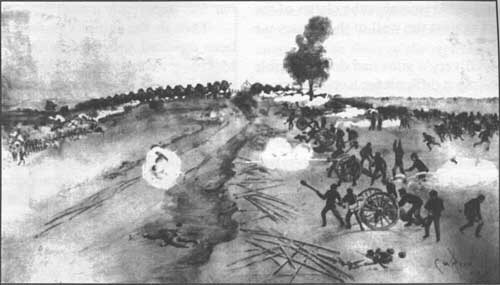
Barksdale’s brigade did not pause and continued in their relentless advance towards Cemetery Ridge, sweeping Union stragglers up as they moved forward led by their irrepressible Colonel. Before them was McGilvery’s new line, hastily cobbled together from any batteries and guns that he could find. Initially composed of 13-15 guns of four different batteries he was joined by two more batteries giving him about 25 guns in all. Subjected to intense Confederate artillery fire and infantry attacks his guns held on even as their numbers were reduced until only six guns remained operational. “Expertly directed by McGilvery a few stouthearted artillerymen continued to blaze away and keep the low bushes in front of them clear of lurking sharpshooters. Although they had no infantry supports, they somehow managed to create the illusion that the woods to their rear were filled with them, and they closed the breach until the Union high command could bring up reinforcements.” [12]

The reinforcements came in the form of Colonel George Willard’s “Harper’s Ferry” Brigade which was looking for revenge and redemption. This unit hit Barksdale’s now disorganized force which had reached its cumulating point hard. Willard was killed and Barksdale mortally wounded and captured in the violent clash which spelled the end of one of the greatest threats to the Union line of the entire battle. Philip Tucker in his book Barksdale’s Charge: The True High Tide of the Confederacy at Gettysburg, July 2, 1863 refers to Barksdale’s charge as the real “high water mark of the Confederacy.”

Plum Run Line

However it was McGilvery who recognized the emergency confronting the line and on his own took responsibility to rectify the situation. He courageously risked “his career in assuming authority beyond his rank” [13] and without his quick action, courage under fire and expert direction of his guns Barksdale’s men might have completed the breakthrough that could have won the battle for General Lee despite all of the mistakes committed by his senior leaders that day.


The action of McGilvery was another example of an officer who had the trust of his superiors who did the right thing at the right time. It is an example of an officer used the principles of what we today call Mission Command to decisively impact a battle. McGilvery rose higher in the Federal service and was promoted to Colonel and command of the artillery of X Corps. He was slightly wounded in a finger at the battle of Deep Bottom in August 1864. The wound did not heal properly so surgeon’s decided to amputate the finger. However they administered a lethal dose of chloroform anesthesia and he died on September 9th, the Union losing one its finest artillerymen. He was buried in his native Maine and the State legislature designated the first Saturday in September as Colonel Freeman McGilvery Day in 2001.

Notes

[1] Trudeau, Noah Andre Gettysburg: A Testing of Courage Harper Collins, New York 2002 p.368

[2] Coco, Gregory A A Concise Guide to the Artillery at Gettysburg Colecraft Industries, Orrtanna PA 1998 p.31

[3] Hunt, Henry I Proceeded to Cemetery Hill in Battles and Leaders of the Civil War Bradford, Ned editor, Meridian Books, New York 1956 p.378

[4] Guelzo, Allen C Gettysburg, The Last Invasion Vintage Books, a Division of Random House, New York 2013 p.314

[5] Ibid. Trudeau p.385

[6] Ibid.

[7] Bigelow, The Peach Orchard, 54; History of the Fifth, 638 retrieved from WE SAVED THE LINE FROM BEING BROKEN: Freeman McGilvery, John Bigelow, Charles Reed and the Battle of Gettysburg by Eric Campbell http://www.nps.gov/history/history/online_books/gett/gettysburg_seminars/5/essay4.htm#52

[8] Coddington, Edwin. The Gettysburg Campaign: A Study in Command Touchstone Books, New York 1960 p.416

[9] Ibid. Guelzo pp.314-315

[10] Ibid Hunt p.379

[11] Ibid. Hunt. P.379

[12] Ibid. Coddington p.417.

[13] Ibid. Coddington.

1 Comment

Filed under civil war, Gettysburg, History, leadership, Military

Foul Weather, and Learning about War

Willoughby Run at Herbst Woods at Gettysburg

Friends of Padre Steve’s World,

Yesterday I was with my students conducting the Staff Ride at Gettysburg. About a week ago the mid-Atlantic region was experiencing record high temperatures and abnormally warm weather. In fact has the temperatures just been normal for this time of year we would have counted ourselves lucky to have such good weather, however, the trended changed and instead of warm weather we had temperatures in the low fifties, wind and rain. The weather was raw, but that is part of life, and if you want to really learn and experience military history you need to do more than sit back in a recliner sipping a nice beverage, and reading a book in comfort.

Guy Sager, who wrote the classic soldier’s account of the Second World War on the Easter front wrote in his book, The Forgotten Soldier: 

“Too many people learn about war with no inconvenience to themselves. They read about Verdun or Stalingrad without comprehension, sitting in a comfortable armchair, with their feet beside the fire, preparing to go about their business the next day, as usual…One should read about war standing up, late at night, when one is tired, as I am writing about it now, at dawn, while my asthma attack wears off. And even now, in my sleepless exhaustion, how gentle and easy peace seems!”

Our weather was by my standards not bad, but for some of my students, including veterans of Iraq and Afghanistan it was miserable. For me, adverse conditions that we cannot change are one of the best ways to learn about war. The fact is that war is inconvenient, it is uncomfortable, and it is more often than not quite inhuman.  War is nothing to celebrate, battles, even victories are to be commemorated not celebrated, and not celebrated as our President said this week this week in reference to the Battle of the Coral Sea. Sadly, the current American President is neither a historian, nor a soldier; he is a draft dodger who loves the instruments of military power without appreciating the sacrifice of those who serve in combat.

Yesterday was a relatively miserable day as far as weather goes, but we had it easy. We can ride around the battlefield in vans and cars, we take a long lunch break, there are restrooms, and we don’t have to lay our bodies down in the dirt, grass, or mud to sleep.

For me that is one of the most important lessons of going on a Staff Ride or visiting a battlefield. Those are lessons that our civilian leadership and those who are cheerleaders of war need to learn. Sadly, very few Americans understand this. Too few of us have been to war to understand this, and many who have gone to war have stayed on well protected bases with air conditioning, heat, plentiful food, and even internet and television access. That wasn’t my war i n Iraq out with our advisors in  Al Anbar Province, but I digress…

Today we will do the third day of the Battle of Gettysburg. We will walk the path trod by Pickett’s Division during Pickett’s Charge, we will visit General Meade’s headquarters, and then go the the Soldier’s Cemetery where Abraham Lincoln delivered the Gettysburg Address. The weather will be cool, but clear with no rain, although there will be quite a few places that we will have to walk through muddy ad very wet ground, but c’est le guerre.

Until tomorrow,

Peace

Padre Steve+


1 Comment

Filed under civil war, Gettysburg, History, Military, weather

Walking the Lines: A Day on McPerson, Seminary, and Oak Ridge at Gettysburg


Friends of Padre Steve’s World,

Today’s post is a bit late but I had a great day yesterday with my students as we had dinner and I taught about the strategic and operational conundrums faced by the Union and the Confederacy in early 1863 and the operational and command aspects of the Gettysburg campaign. This first night helps my students to link the lessons faced by commanders in the Civil War with what they are learning at the Staff College.

I went up to the battlefield early yesterday as we had stayed with friends near Washington DC where Judy and the Papillon puppies are staying with friends who have four Papillons. I arrived on the  battlefield a little after 11AM and did some exploring of the grounds around the Seminary building before going in to the building to see the Seminary Ridge Museum which opened there in 2013. It is worth the visit. One floor deals with the first day of the battle; another, slavery and abolition; another, the wounded and dead including fascinating exhibits on medical care; and the last which dealt with religion in that era. I was able to go up to the famous cupola of the Seminary from which the Union Cavalry commander, John Buford directed the initial phase of the battle.


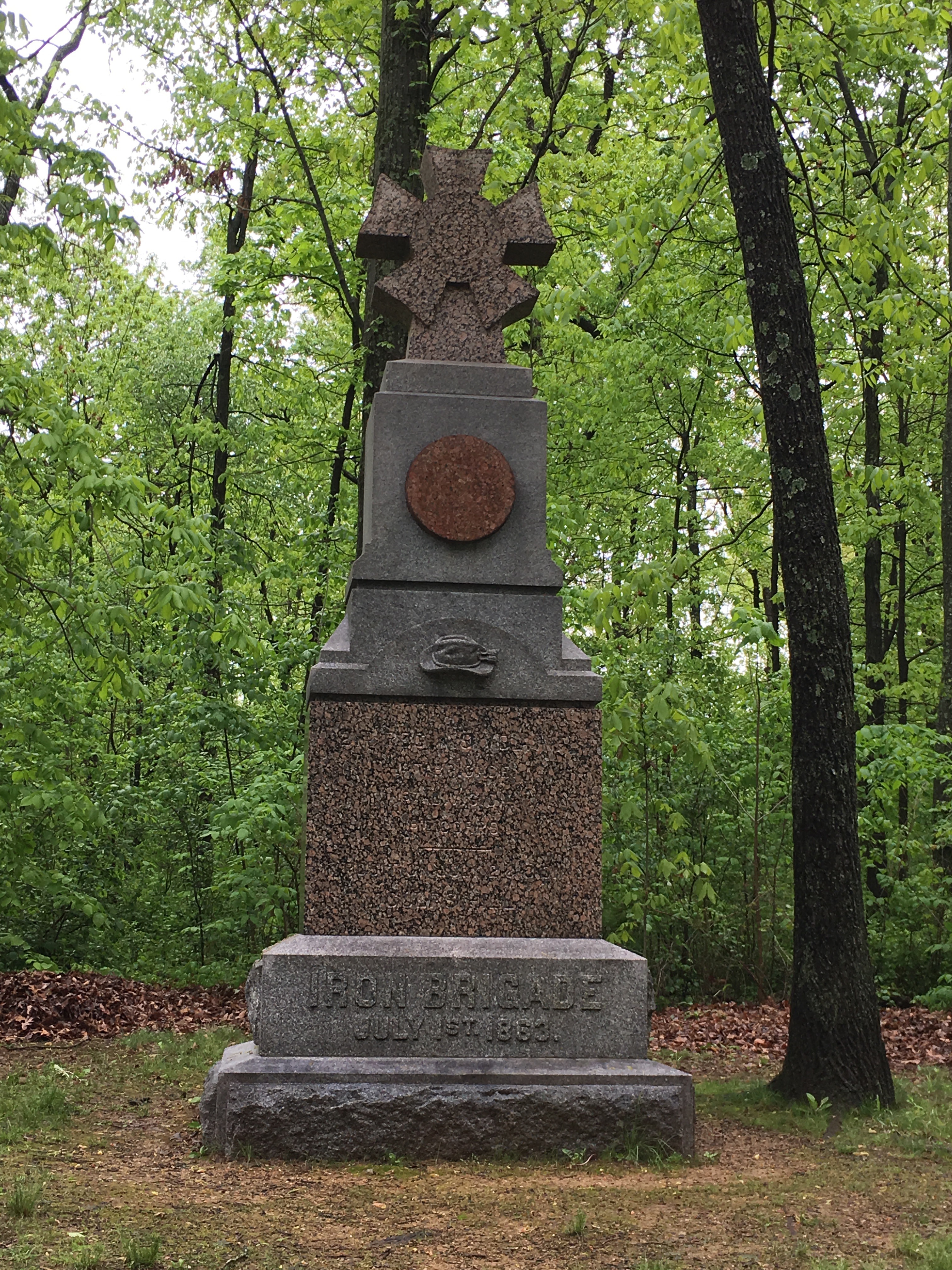
After that I drove over to McPherson’s Ridge, where I parked my car and  walked the lines of the Union First Corps along McPherson. Seminary, and Oak Ridge. Arriving early I as able to walk and see parts of that portion of the battlefield that I had only read about before, despite my many trips here. For those who have never walked the ground of such a battle it is a remarkable experience. As I walked the Union line I could almost see the massed ranks of Union infantry; walking through Herbst Woods I could imagine the chaos that enveloped Archer’s Confederate Brigade as it was hit by the Union Iron Brigade; descending into the railroad cut I could imagine the desperation of the Confederate soldiers whose commanders had led them into a trap from which few would emerge alive, unwounded, or uncaptured. When I got to Oak Ridge I was able to walk out to the spot the the 88th Pennsylvania had destroyed Iverson’s Confederate Brigade and captured its colors. As I walked through those places I could  sense the desperation and the need to win a victory by the men on both sides.

After a long time on the battlefield I checked into my hotel, and in the evening met my students for dinner, drinks and the introductory class on the campaign  of 1863 which helps to tie together the understanding of strategy and the operational art involved in the Gettysburg campaign and the broader aspects of what was happening in 1863 and what drove Robert E. Lee to insist on the invasion of the North instead of sending his troops west to relieve Vicksburg, or perhaps attempt to relieve Vicksburg by defeating Rosecran’s Union army in East Tennessee and then moving to Threaten Cincinnati and the Ohio River which potentially could have drawn Grant away from Vicksburg.

I spent today with my students on the battlefield and hopefully will post something about that tomorrow.

So have a great night,

Peace,

Padre Steve+


Leave a comment

Filed under civil war, Gettysburg, History

Gettysburg and the Era of Trump

Friends of Padre Steve’s World,

I’ll be traveling to Gettysburg this weekend to lead another Staff Ride and as I listened to President Trump’s remarks about the Civil War and on altering the American Constitution to fit his needs for his success this week that I was incredulous. I cannot believe that we have a President who is such an ignoramus about history and the Constitution.

I guess that is why that is even more important that I keep making these trips and conducting these Staff Rides. When I think of the deluge of the President’s executive orders, as well as various State and Federal legislative and executive actions which are for all intents making many Americans second class citizens or worse, I am reminded of Abraham Lincoln’s words well before the Civil War. Lincoln, speaking of the anti-Black, and anti-immigrant sentiment that was rife throughout the country said:

“As a nation, we began by declaring that ‘all men are created equal.’ We now practically read it ‘all men are created equal, except negroes.’ When the Know-Nothings get control, it will read ‘all men are created equal, except negroes, and foreigners, and Catholics.’ When it comes to this I should prefer emigrating to some country where they make no pretense of loving liberty – to Russia, for instance, where despotism can be taken pure, and without the base alloy of hypocrisy.”

damned before Sadly, despite all the blood shed and the sacrifices made by slaves, free Blacks, abolitionists, Union Soldiers, civil rights advocates and others it seems that the President and his supporters are fully intent on rolling back Constitutional protections for many people in this country. In fact the President this week declared that the Constitution and our system of government were “archaic,” and suggested that they needed to be changed. Many of his supporters who for decades have claimed to be defending the Constitution seem to have no problem with with what he says, showing that their words are mere hyperbole and cover to prevent others from enjoying the same liberties that they have; be they African Americans, Hispanics, LGBTQ, Women, Native Americans, Muslims, and immigrants deemed less than worthy.

As for me I will be damned before I stop speaking out against such measures. These are not the measures of preserving liberty, but are the kind of despotism that allowed Southern Slave owners to call slavery “freedom.”

So I will go to Gettysburg this weekend and as always I will take my students to the Soldier’s Cemetery where we will talk about the Gettysburg Address and the meaning of it and our Constitution, at a place where Lincoln said that we highly resolve that these dead shall not have died in vain — that this nation, under God, shall have a new birth of freedom — and that government of the people, by the people, for the people, shall not perish from the earth.

Until tomorrow,

Peace

Padre Steve+

1 Comment

Filed under civil rights, civil war, Gettysburg, History, Political Commentary

Tragic Heroes of Little Round Top, Part Two

The Professor: Joshua Lawrence Chamberlain

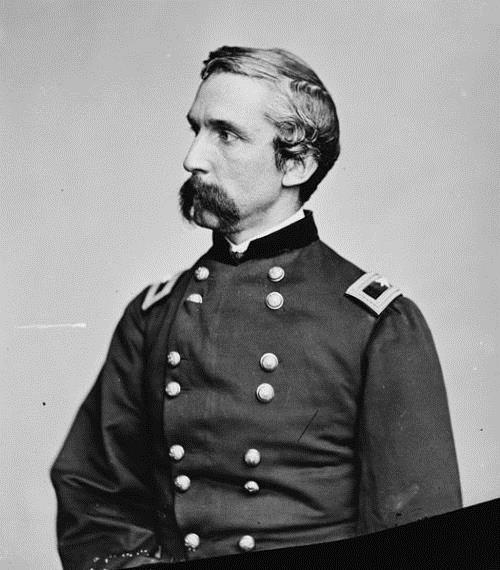
While Colonel Joshua Chamberlain’s story is much better known than his brigade commander, Strong Vincent, he was another of the citizen soldiers whose performance and leadership on Little Round Top saved the Union line that hot July evening. Chamberlain was a graduate of Bowdoin College and Bangor Theological Seminary. Fluent in nine languages other than English, he remained at Bowdoin as Professor of Rhetoric and was deeply unhappy at missing the war even as his students left and were commissioned as officers in newly raised regiments.

In June of 1862 Chamberlain wrote to Governor Israel Washburn requesting an appointment in a newly raised Maine Regiment without consulting either the college or his wife Fannie, who was “shocked, hurt, and alarmed by the decision he had made without consulting her…She remonstrated, she raised her voice, and quite possibly wept over the injustice he had done to both by this unilateral act that threatened to send their world careening in all directions.” [1]

As far as Bowdoin went, Chamberlain actually deceived the college by requesting a “scholarly sabbatical when in fact he had applied to the governor of Maine in the new 20th Maine Infantry in the late summer of 1862.” [2] When the faculty of Bowdoin found out of Chamberlain’s action many of them “were livid over what they considered his duplicity, and some shunned him during the brief period that he remained in Brunswick before reporting to training camp. [3]

The letter that Chamberlain wrote to Governor Israel Washburn details Chamberlain’s desire to serve and in some ways shows his considerable political skill in presenting his case to join the army:

“For seven years past I have been Professor in Bowdoin College. I have always been interested in military matters, and what I do not know in that line I know how to learn.

Having been lately elected to a new department here, I am expecting to have leave, at the approaching Commencement, to spend a year or more in Europe, in the service of the College. I am entirely unwilling, however, to accept this offer, if my Country needs my service or example here.

Your Excellency presides over the Educational as well as the military affairs of our State, and, I am well aware, appreciates the importance of sustaining our Institutions of Learning. You will therefore be able to decide where my influence is most needed.

But, I fear, this war, so costly of blood and treasure, will not cease until the men of the North are willing to leave good positions, and sacrifice the dearest personal interests, to rescue our Country from Desolation, and defend the National Existence against treachery at home and jeopardy abroad. This war must be ended, with a swift and strong hand; and every man ought to come forward and ask to be placed at his proper post.

Nearly a hundred of those who have been my pupils, are now officers in our army; but there are many more all over our State, who, I believe, would respond with enthusiasm, if summoned by me, and who would bring forward men enough to fill up a Regiment at once. I can not free myself from my obligations here until the first week in August, but I do not want to be the last in the field, if it can possibly be helped.” [4]

Chamberlain’s pre-war experiences gave no indication that he would emerge as a military hero. His father, a veteran of the War of 1812 had named him after Captain James Lawrence, the commanding officer of the frigate USS Chesapeake in the War of 1812 who uttered the famous words “Don’t give up the ship” as he lay mortally wounded when that ship was defeated by the HMS Shannon off Boston Harbor in 1813. However, Chamberlain’s mother added the name Joshua as his first name in the town’s books. While his father hoped that the young Chamberlain would pursue a military career, his mother earnestly desired that he would pursue a ministerial career. Chamberlain did become a licensed minister but had no desire to become a pastor, and was never ordained. This was reinforced by Fannie, who though the daughter of a minister was “too much a free thinker” and “did not share the devotion her father and Chamberlain held for organized religion.”  [5]

Chamberlain debated attending West Point after graduation, a path that his classmate Oliver O. Howard took. Instead he attended Bangor Theological Seminary and following graduation took up his academic career at Bowdoin. It was during this time that he met, fell in love with, pursued, courted and finally married Frances Caroline Adams, who played the organ at the local Congregational Church that he attended. Known by most as “Fannie,” she was the adopted daughter of the eminent Congregationalist minister, Dr. George Adams who served as pastor. Fannie had a strong independent streak and was as an accomplished musician and artist.

The couple was an interesting match. Chamberlain was impressed by Fannie’s “artistic gifts. Fannie had talent not only in music but in poetry and, especially; art…” [6] but he ignored potential areas of conflict that would create difficulties throughout their marriage. However, Fannie was beset by numerous fears, as well as a desire not to be dominated by any man. Chamberlain pursued her with abandon but for a time she resisted, until her widowed father married a woman not much older than herself. She desired to pursue the study of music and went away to New York to do so, but in 1852 she decided that she was in love with him. “Yet she harbored doubts about her ability to return his feelings for her measure for measure.” [7]

Fannie suffered from depression and a constant worry about her eyesight which began failing her and an early age. It was a malady that eventually left her completely blind by then turn of the century. Compounding her struggles was that fact that her new husband struggled with his own doubts and depression, a depression that only seamed to lift during the war years.

“During most of his life, Chamberlain struggled with bouts of deep depression and melancholy. But not during the war years. It was as if the war and soldiering had made a new man out of him.” [8]

Chamberlain was offered command of the 20th Maine but asked Governor Washburn that he was appointed as a Lieutenant Colonel, which he was in August 1862. He fought with the regiment at Fredericksburg and was named commander of it when Colonel Adelbert Ames, his commander was transferred to preform staff duties prior to obtaining a brigade command in Oliver Howard’s XI Corps following the debacle at Chancellorsville.

Chamberlain at his heart, through his association with abolitionists and other prior to the war was a staunch Unionist. Before going into the army he wrote:

“We have this war upon is & we want to stop it. It has cost us already too much precious blood. It has carried stagnation, starvation & grief in to too many villages of our fair land – brought death to too many noble hearts that we could ill afford to lose. But the only way to stop this war, is first to show that we are strongest…I feel that we are fighting for our country – for our flag- not as so many Stars and Stripes, but as the emblem of a good &  powerful nation – fighting to settle the question whether we are a nation or a basket of chips. Whether we shall leave our children the country we have inherited – or leave them without a country – without a name – without a citizenship among the great nations of the earth – take the chief city of the rebels. They will have no respect for us unless we whip them & and I say it in all earnestness….” [9]

Like Vincent, Chamberlain was also a quick student or military science and rapidly adapted to being a soldier, officer and commander of troops in combat. He spent as much time studying the art of war under the supervision of Colonel Ames including Henri Jomini’s Art of War which he wrote to Fannie “The Col. & I are going to read it. He to instruct me, as he is kindly doing everything now.” [10] He excelled at his studies under Ames, but since most of the manuals that he studied were based on Napoleonic tactics and had not incorporated the changes brought about by the rifled musket, Chamberlain like so many others would have to learn the lesson of war the hard way.

Chamberlain was with the regiment at Antietam, but it saw no action.  He was in the thick of the fighting at Fredericksburg and Burnside’s subsequent “Mud March” which were both disastrous for the army.

He took command of the regiment in late April after Ames left on detached duty before assuming a brigade command. As the new commander of the regiment, Chamberlain and the 20th Maine missed the Battle of Chancellorsville as the regiment had been quarantined due to an epidemic of smallpox, which they had probably received from “poorly prepared serum with which the regiment was vaccinated” [11] in April.

From the regiment’s quarantined location Chamberlain and his men could hear the sound of battle. One of his soldiers wrote “We could hear the firing plain but there we lay in glorious idleness without being able to lift a finger or fire a gun.” [12] In frustration Chamberlain rode to Major General Joseph Hooker’s headquarters and asked Hooker’s Chief of Staff Dan Butterfield for the chance to enter the fight. Refused the chance Chamberlain told Butterfield “If we couldn’t do anything else we would give the rebels the smallpox!” [13] The regiment spent the battle guarding a telegraph line must to Chamberlain and his soldier’s disgust.

On the march up to Gettysburg, Chamberlain was ordered to take a number of veterans of the 2nd Maine who had signed three year, rather than two year enlistment contracts and were angry at remaining in the army when the regiment was mustered out. The men were angry and Chamberlain was given permission by Meade to fire on them “if they refused to do duty. The new colonel realized he had a crisis on his hands.” [14] The soldiers were bitter but Chamberlain treated them graciously and “almost all of them agreed to take up their muskets again the service of the 20th Maine.” [15] Chamberlain later remarked of how these men “we’re afterward among my best men, worthy of the proud fame of the 2nd, and the hard earned laurels of the 20th.” [16]

On receiving his orders from Vincent, Chamberlain deployed his small regiment halfway down the southern slope facing the small valley between Little Round Top and Big Round Top. By the time he arrived at Gettysburg he had become “a great infantry officer, and among his valuable qualities was [understanding] where an attack would come….” [17]

Since Chamberlain’s account is so important I will forgo a discussion of his tactics and instead quote the sections of his after action report that explains his actions. Chamberlain wrote:

“On reaching the field at about 4 p.m. July 2d, Col. Vincent commanding the Brigade, placing me on the left of the Brigade and consequently on the extreme left of our entire line of battle, instructed me that the enemy were expected shortly to make a desperate attempt to turn our left flank, and that the position assigned to me must be held at every hazard.

I established my line on the crest of a small spur of a rocky and wooded hill, and sent out at once a company of skirmishers on my left to guard against surprise on that unprotected flank.

These dispositions were scarcely made when the attack commenced, and the right of the Regt. found itself at once hotly engaged. Almost at the same moment, from a high rock which gave me a full view of the enemy, I perceived a heavy force in rear of their principal line, moving rapidly but stealthily toward our left, with the intention, as I judged, of gaining our rear unperceived. Without betraying our peril to any but one or two officers, I had the right wing move by the left flank, taking intervals of a pace or two, according to the shelter afforded by rocks or trees, extending so as to cover the whole front then engaged; and at the same time moved the left wing to the left and rear, making a large angle at the color, which was now brought to the front where our left had first rested.

This hazardous maneuvre [sic] was so admirably executed by my men that our fire was not materially slackened in front, and the enemy gained no advantage there, while the left wing in the meantime had formed a solid and steady line in a direction to meet the expected assault. We were not a moment too soon; for the enemy having gained their desired point of attack came to a front, and rushed forward with an impetuosity which showed their sanguine expectations.

Their astonishment however was evident, when emerging from their cover, they met instead of an unsuspecting flank, a firm and ready front. A strong fire opened at once from both sides, and with great effect, the enemy still advancing until they came within ten paces of our line, where our steady and telling volleys brought them to a stand. From that moment began a struggle fierce and bloody beyond any that I have witnessed, and which lasted in all its fury, a full hour. The two lines met, and broke and mingled in the shock. At times I saw around me more of the enemy than of my own men. The edge of conflict swayed to and fro -now one and now the other party holding the contested ground. Three times our line was forced back, but only to rally and repulse the enemy. As often as the enemy’s line was broken and routed, a new line was unmasked, which advanced with fresh vigor. Our “sixty rounds” were rapidly reduced; I sent several messengers to the rear for ammunition, and also for reinforcements. In the mean time we seized the opportunity of a momentary lull to gather ammunition and more serviceable arms, from the dead and dying on the field. With these we met the enemy’s last and fiercest assault. Their own rifles and their own bullets were turned against them. In the midst of this struggle, our ammunition utterly failed. The enemy were close upon us with a fresh line, pouring on us a terrible fire. Half the left wing already lay on the field. Although I had brought two companies from the right to its support, it was now scarcely more than a skirmish line. The heroic energy of my officers could avail no more. Our gallant line withered and shrunk before the fire it could not repel. It was too evident that we could maintain the defensive no longer. As a last desperate resort, I ordered a charge. The word “fix bayonets” flew from man to man. The click of the steel seemed to give new zeal to all. The men dashed forward with a shout. The two wings came into one line again, and extending to the left, and at the same time wheeling to the right, the whole Regiment described nearly a half circle, the left passing over the space of half a mile, while the right kept within the support of the 83d Penna. thus leaving no chance of escape to the enemy except to climb the steep side of the mountain or to pass by the whole front of the 83d Penna. The enemy’s first line scarcely tried to run-they stood amazed, threw down their loaded arms and surrendered in whole companies. Those in their rear had more time and gave us more trouble. My skirmishing company threw itself upon the enemy’s flank behind a stone wall, and their effective fire added to the enemy’s confusion. In this charge we captured three hundred and sixty eight prisoners, many of them officers, and took three hundred stand of arms. The prisoners were from four different regiments, and admitted that they had attacked with a Brigade.” [18]

Colonel William Oates of the 15th Alabama gave Chamberlain and his regiment the credit for stopping his attack. Oates wrote: “There have never been harder fighters than the Twentieth Maine and their gallant Colonel. His skill and persistency and the great bravery of his men saved Little Round Top and the Army of the Potomac from defeat.” [19]

As with any firsthand account, aspects of Chamberlain’s accounts are contested by others at the scene. But in another way Chamberlain’s accounts of battle have to be carefully examined, because they often reflect his romanticism, and because he was not always a realist. Unlike others in his command like Major Ellis Spear, who played such an important role on Little Round Top that day, a realist who “saw things plainly and remembered them clearly, in stark, unadorned hues. Joshua Chamberlain was a romanticist; even when describing the horrors of bloodbath his prose could be colorful, lyrical, even poetic.” [20]

There are accounts that differ from Chamberlain’s; Oates wrote that he ordered the retreat and that there were not as many prisoners taken as Chamberlain states. Likewise, one of Chamberlain’s company commanders disputed the account of the Chamberlain’s order of the bayonet charge. But even these accounts take nothing away from what Chamberlain accomplished that day. The fact is that Chamberlain’s regiment was outnumbered nearly two to one by the 4th 15th and 47th Alabama regiments. Chamberlain “offset this superiority with strength of position, iron determination and better tactics.” [21]

While the actions of Chamberlain, Vincent, Warren and others on the Union side, another factor was at play. This was the fatigue of the Confederate soldiers. The regiments attacking Little Round Top and their parent unit, Law’s brigade of Hood’s division, had conducted a grueling 28 mile march to get to the battlefield. By the time that they arrived and made their assault, most soldiers were exhausted and dehydrated. This was something that their commander, Colonel Oates believed was an important factor in what happened. While Oates gives tremendous credit to Chamberlain and the 20th Maine he wrote that the fatigue and dehydration of his soldiers “contributed largely to our failure at Little Round Top.” [22]

Vincent was mortally wounded while leading the defense of the hill. As the men of Robertson’s Texas brigade rushed the hill and threatened to crack “the stout 16th Michigan defense…” [23] Vincent rushed to bolster the defenders. He was standing on a large boulder with a riding crop as the men of the 16th Michigan were beginning to waiver. Fully exposed to enemy fire he attempted to drive the retreating men back into the fight. Brandishing the riding which he cried out: “Don’t yield an inch now men or all is lost,” [24] and moments later was struck by a “minié ball which passed through his left groin and lodged in his left thigh. He fell to the ground and as he was being carried from the field, “This is the fourth or fifth time they have shot at me…and they have hit me at last.” [25]

To be continued…

Notes

[1] Ibid. Longacre Joshua Chamberlain p.52

[2] Ibid. LaFantasie Twilight at Little Round Top pp.44-45

[3] ibid. Longacre Joshua Chamberlain p.52

[4] Chamberlain, Joshua Lawrence Letter From Joshua L. Chamberlain to Governor [Israel] Washburn, Brunswick, July 14, 1862 retrieved from Bowdoin College, Joshua Lawrence Chamberlain Documents http://learn.bowdoin.edu/joshua-lawrence-chamberlain/documents/1862-07-14.html 8 November 2014

[5] Longacre, Edward Joshua Chamberlain: The Soldier and the Man Combined Publishing Conshohocken PA 1999 p.39

[6] Ibid. Longacre, Edward Joshua Chamberlain: The Soldier and the Man p.28

[7] Ibid. Longacre  Joshua Chamberlain: The Soldier and the Man p.30

[8] Ibid. LaFantasie Twilight at Little Round Top p.45

[9] Smith, Diane Monroe Fanny and Joshua: The Enigmatic Lives of France’s Caroline Adams and Joshua Lawrence Chamberlain Thomas Publications, Gettysburg PA 1999 p.120

[10] Ibid. Longacre Joshua Chamberlain p.80

[11] Ibid. Wallace The Soul of the Lion p.66

[12] Ibid. Golay, To Gettysburg and Beyond p.132

[13] Ibid. Wallace The Soul of the Lion p.66

[14] Ibid. Longacre Joshua Chamberlain p.116

[15] Ibid. LaFantasie Twilight at Little Round Top p.45

[16] Ibid. Longacre Joshua Chamberlain p.117

[17] Ibid. Wallace The Soul of the Lion p.94

[18] Chamberlain, Joshua Lawrence. Official Narrative of Joshua Chamberlain of July 6th 1863, Maine Military Historical Society, Inc., Augusta, Maine, copyright 1989 U.S. Army Combat Studies Institute Reprint, retrieved from http://usacac.army.mil/cac2/cgsc/carl/download/csipubs/chamberlain.pdf June 15th 2014

[19] Oates, William C. and Haskell, Frank A. Gettysburg Bantam Books edition, New York 1992, originally published in 1905 p.98

[20] Ibid. Longacre Joshua Chamberlain p.94

[21] Ibid. Coddington The Gettysburg Campaign: A Study in Command p.393

[22] Ibid. Oates and Haskell Gettysburg p.87

[23] Ibid. Wallace The Soul of the Lion p.95

[24] Ibid. Guelzo Gettysburg: The Last Invasion Vintage p.272

[25] Ibid. Trudeau, Gettysburg: A Testing of Courage p.361

3 Comments

Filed under Loose thoughts and musings

“To Act in the Light of Truth” Another Staff ride at Gettysburg

chamberlain

Joshua Lawrence Chamberlain

Friends of Padre Steve’s World,

Today I am travelling up to Gettysburg for another Staff Ride with students from the Staff College. The weather this weekend looks like it will be spectacular for the visit, praise be Al Gore for the great weather, but admittedly weather like this probably isn’t that great for us in the long run, so say the climate scientists and researchers that I trust to tell the truth, but I digress…

Gettysburg is a good place for me to visit. It is a place that helps remind me that even in the midst of the most hateful, politically divided period of our history since the Civil War Era, which spans the 1850s, the war, Reconstruction, and the return of White Rule, Black Codes, and Jim Crow, that good has triumphed over evil more than once. That fact helps keep me grounded in history and reminds me that no-matter how hard the fight is that we must resist tyranny, racism, discrimination, and injustice at every opportunity, even when the odds are against us.

IMG_1249

Gettysburg inspires me for many reasons. I cannot go there without sensing the spirits of the men whose blood hallowed that ground, to preserve the Union, and helped pave the way for the slow but steady advances in liberty that our nation experienced, despite often violent opposition, which appear to be threatened again today. I may be a realist, but I still have a sense of idealism that will not let me give up.

One of my inspirations is Joshua Lawrence Chamberlain, a hero of the Battle of Little Round Top at Gettysburg. He was a Professor of Natural and Revealed Religion at Maine’s Bowdoin College, who against the wishes of his wife volunteered to serve, going on to great distinction during the war. He wrote:

“It is something great and greatening to cherish an ideal; to act in the light of truth that is far-away and far above; to set aside the near advantage, the momentary pleasure; the snatching of seeming good to self; and to act for remoter ends, for higher good, and for interests other than our own.”

We have to fight for the higher good, and not our own interests now. We have to act in the light of truth against the phalanx of lies deployed by the President, his advisors, and the propagandists that spread those lies as much as the press of the South encouraged disunion, and the hate of the North. When I hear the lies, distortions, and hatred being spread by them I get angry, but then I remember something else that Chamberlain wrote:

“But the cause for which we fought was higher; our thought wider… That thought was our power.”  

So, have a great day and never give up.

Peace

Padre Steve+

4 Comments

Filed under civil rights, civil war, History, Political Commentary

Dan Sickles Part Two: Murder in Lafayette Square

Friends of Padre Steve’s World,

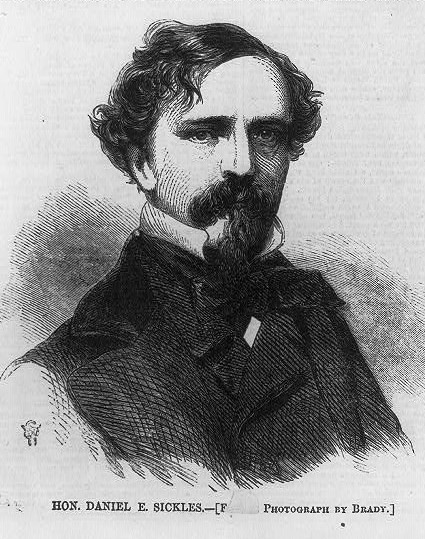
I am taking a break over this Thanksgiving weekend and am re-posting some articles from my Gettysburg text dealing with a man that I consider one of the most fascinating , salacious, scandalous, heroic, and incredible figures ever to grace and disgrace American history, Congressman, and Civil War General Daniel E. Sickles.

I hope that you enjoy,

Peace

Padre Steve+

philip-barton-key-granger


Within a year of his assignment Sickles returned to the United States to help prepare the Democratic nomination for his friend Buchanan who had long desired the office, and return to his lucrative post in New York. In the spring of 1856 Sickles began to work on Buchanan’s nomination for the Presidency and while doing so began his own campaign for New York’s Third District’s Congressional seat. Buchanan won the election of 1856 against an opposition divided between the Know Nothing candidacy of former President Millard Fillmore and the candidate of the new Republican Party, John C. Fremont.

In the election of 1856, Sickles carried the district easily. For Sickles it was a triumph, he was “riding a flood tide of political fortune that might carry him far,” [1] and like any wife Teresa too was delighted with the result. Even so, Teresa must have wondered if her husband would mend his ways now that he was on the national spotlight, or if he would continue his extramarital romps around the nation’s capital. Following the election Dan and Teresa moved to Washington D.C. where they took up a fashionable residence, the Stockton Mansion, on Lafayette Square, not far from the White House and Sickles friend, James Buchanan.

Once he was established in Washington Sickles was in his element, politics at its grandest. It was a different style than of politics than Tammany, where brass knuckled force often ruled, but it suited Sickles, who was “a fixer who knew all the tricks of Tammany at its crookedest but who seems not to have taken graft himself. He had his sights fixed on the presidency, and he was making about as much progress in that direction as a Tammany man can,” [2]   until a strange combination of unrequited love, infidelity, the personal betrayal of a friend, and a murder intervened.

HarpersMagazineMrs.Sickles

Teresa Sickles

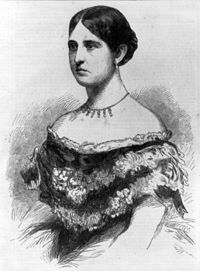
While her husband politicked along the Potomac, the new congressman’s wife was adapting to her life in Washington D.C. The wives were expected to entertain and host parties on a regular basis at their residences, but they also knew their share of loneliness and neglect. Since legislators routinely were “busy with night sessions, committee meetings, and plain nocturnal politicking over whiskey punch, that their wives either accepted other escorts or spent lonely evenings at home with fancywork or a book.” thus it was not surprising that Teresa, “should seek the gayety of the capital in her first year there.” [3] In the absence of their husbands it “was not uncommon for available bachelors to act as escorts for married women when their husbands were unavailable.” [4] Since Dan Sickles was frequently unavailable and since Teresa probably still suspected that Dan was still engaged in extramarital affairs, it is not surprising that the young Mediterranean beauty found comfort in another man.

The years of 1857 and 1858 would be a tumultuous time for the nation as well as the Sickles. Buchanan had been elected because of his stability and moderation in an age of pro and anti-slavery radicalism. However, over the next year his presidency, and his would be overwhelmed by events and Buchanan’s decisions supporting the expansion of slavery. While Sickles was neither a slave owner, nor himself fond of the institution, it was part of life, and many of his friends in Washington D.C. and in Congress were slave holders. Buchanan had schemed before his inauguration with Chief Justice of the Supreme Court Roger Taney in the Dred Scott decision, which was handed down in the days following Buchanan’s inauguration, followed by the fiasco over the Lecompton constitution and the attempted admission of Kansas as a Slave State, an event which split the Democratic party in the 1860 election, ensuring Abraham Lincoln’s defeat of Buchanan’s Lecompton foe in the Senate, Senator Stephen A. Douglas who would have been the prohibitive favorite in the election had the split not occurred.

Likewise, Sickles and his beautiful young wife would become part of one of the most sensational trials of American history, rivaling the Lindbergh kidnapping trial, the trial of O.J. Simpson, the Scopes Monkey Trial, and the Impeachment of President Bill Clinton in its captivation of America. As in London, Teresa became popular and she and Dan were much sought after and their home “became the scene of a gradual number of and entertainments,” [5] and even as Sickles continued his robust politicking and philandering Teresa became the object of another’s affection, the District of Attorney for the District of Columbia, Philip Barton Key, the son Francis Scott key, the writer of the Star Spangled Banner. Interestingly enough it was Sickles who had helped Key the troubled man to be reappointed to his office in early 1857 after Key had helped Sickles overcome legal and financial difficulties to secure Sickles in the Stockton Mansion and the two men developed a warm friendship.

Philip Key was extraordinarily handsome, especially when outfitted in his green and gold militia uniform of the Montgomery Guards, and was considered one of the most desirable men in Washington. An accomplished horsemen he rode about town on his “horse Lucifer – a nobly bred, dapple gray hunter.”[6] When he gained Sickles’ friendship many of his well to do political and society friends became frequent visitors to the Sickles household. After Sickles had helped Key to be reappointed to his office, Key was instrumental in helping make the arrangements for Sickles to rent the Stockton Mansion.

During his first term in office Key was not known for being a particularly good District Attorney and spent much time away from the office complaining about his allegedly poor health. But his health did not keep him away from Washington’s party scene and “One hostess called him “the handsomest man in all Washington… he was a prominent figure at all the principle functions; a graceful dancer, her was a favorite of every hostess of the day.” [7] When he met Teresa, the dashing bachelor took an intense interest in the wife of the man who had helped him retain his job. The two were soon attending many functions together that Sickles, due to his work schedule could seldom attend.

Within weeks Key became a frequent guest at the Sickles home and few were surprised at this, as most observers knew that Sickles was responsible for Key’s reappointment. With Sickles now fully engaged in the dramatic political battles of late 1857, Teresa and Key began to spend much more time together. The two were seen together at the “theater, at teas, at hops. But most of all they went riding together.” [8] The frequency of these visits was noted and became the source of much gossip but Sickles was unaware of it and entertained no suspicions that his new friend was becoming deeply involved with his wife, and that Key had rented a room where the two could intimate.

That was until a young man equally smitten by Teresa had a few drinks with a colleague and the colleague shared the information with a loyal Sickles ally who then told Sickles. Sickles was shocked and called for a meeting with Key, however, after a brief conversation, Key convinced Sickles that there was nothing to the rumors, and Sickles was satisfied.

Though Sickles had been satisfied by the explanation, “despite his own well-publicized moral lapses, Daniel Sickles was a man of intense personal pride who would not countenance the breath of scandal attaching to his wife.” [9] He took the time to warn her to make sure that she was not involved in any other indiscretions, and left the subject. However, Key and Teresa continued to see each other, and “she and Barton thought that they were taking more care, and being less observed by people than they were.” [10] Yet as they pursued one another their affair became increasingly public, and seen by too many people not to go unnoticed. The two were seen together in at the Congressional Cemetery, and frequently at a house at “385 15th Street where he would enter the by the front door – and she the back.” [11] When a mutual friend expressed his concerns, Key shrugged off the warning, and “with the bravado of a proud weakling, he still held his course. And Teresa, ductile, enamored, blindly followed his lead.” [12] Another friend of Key suggested to him that he could be in danger, but Key “bridled and patted the breast of his coat. “I am prepared for any emergency,” he snapped. Key was a crack pistol shot and his friend believed that Key was preparing for a possible confrontation. [13]

Like so many people young spouses who find their needs unfulfilled at home, and who suspect their spouse of infidelity, , “Teresa did not see this love affair as tragic and dangerous. She lived within it as a secret fantasy, as in a virtual and time-consuming experience that lacked any power to inflict damage on other areas of her life.” [14] She became less discreet, Key would signal to her from across the street to confirm their dalliances and despite their insipidly inept attempt to hide the affair it became clear to Sickles’ coachman and household maids that the two were engaged in sexual encounters in the Sickles carriage and in the Stockton Mansion itself.

The situation finally came to a head in February 1859 following Sickles reelection and return to Washington. “Made more reckless than ever by their recent separation, Barton and Teresa now again were seen everywhere together.” [15] The couple were now making clandestine liaisons on a nearly daily basis, and eventually, one of the observers decided to tell Sickles. The anonymous source, using the initials of R.P.G. sent Sickles a letter detailing the affair. Sickles received the letter from a butler on the night of Thursday February 24th as he was leaving the usual dinner party at his house for the traditional hop that followed at the Willard Hotel.

Sickles did not read the letter until after the couple returned home and Teresa had gone to bed. Sickles was stunned and at first did not believe the contents as he placed little stock in anonymous messages. So he had George Wooldridge, a longtime friend and congressional clerk investigate, and on Saturday February 26th Wooldridge confirmed Sickles worst fears. That evening at their home Sickles confronted Teresa about the letter and as he stormed about angrily in their bedroom she confessed, after which Sickles had her write out her confession detailing everything. He may have been desolate and angry, but he was a lawyer, and he got his written proof.

But scandal was the last thing that Sickles wanted, as he had higher aspirations in politics, so he immediately called his friends for counsel and by Sunday morning several, including Wooldridge and Samuel Butterworth were at the Stockton Mansion with Sickles. As always, Sickles’ “first thoughts were for himself, and he melodramatically”[16] exclaimed to Butterworth, “I am a dishonored and ruined man…I cannot look you in the face.” [17]

4P8V9475

Murder

His friends “were profoundly touched by the depth of his feeling, and were convinced that he needed to be saved from a severe derangement of his senses; from lunacy, that is.” [18] his friends attempts to calm him, Sickles was beside himself with anger, and his anger now swirled around his marriage and what he believed was the scandal that would cost hi his career. That afternoon, Key again tempted fate, this time, for the last time. He had been tipped off by an anonymous letter that the affair was public, but he was determined to see Teresa. He made several passes by the house, each time signaling with a handkerchief, until Sickles observed him. Sickles called out to Butterworth “That villain has just passed my house! My God, this is horrible!” [19]

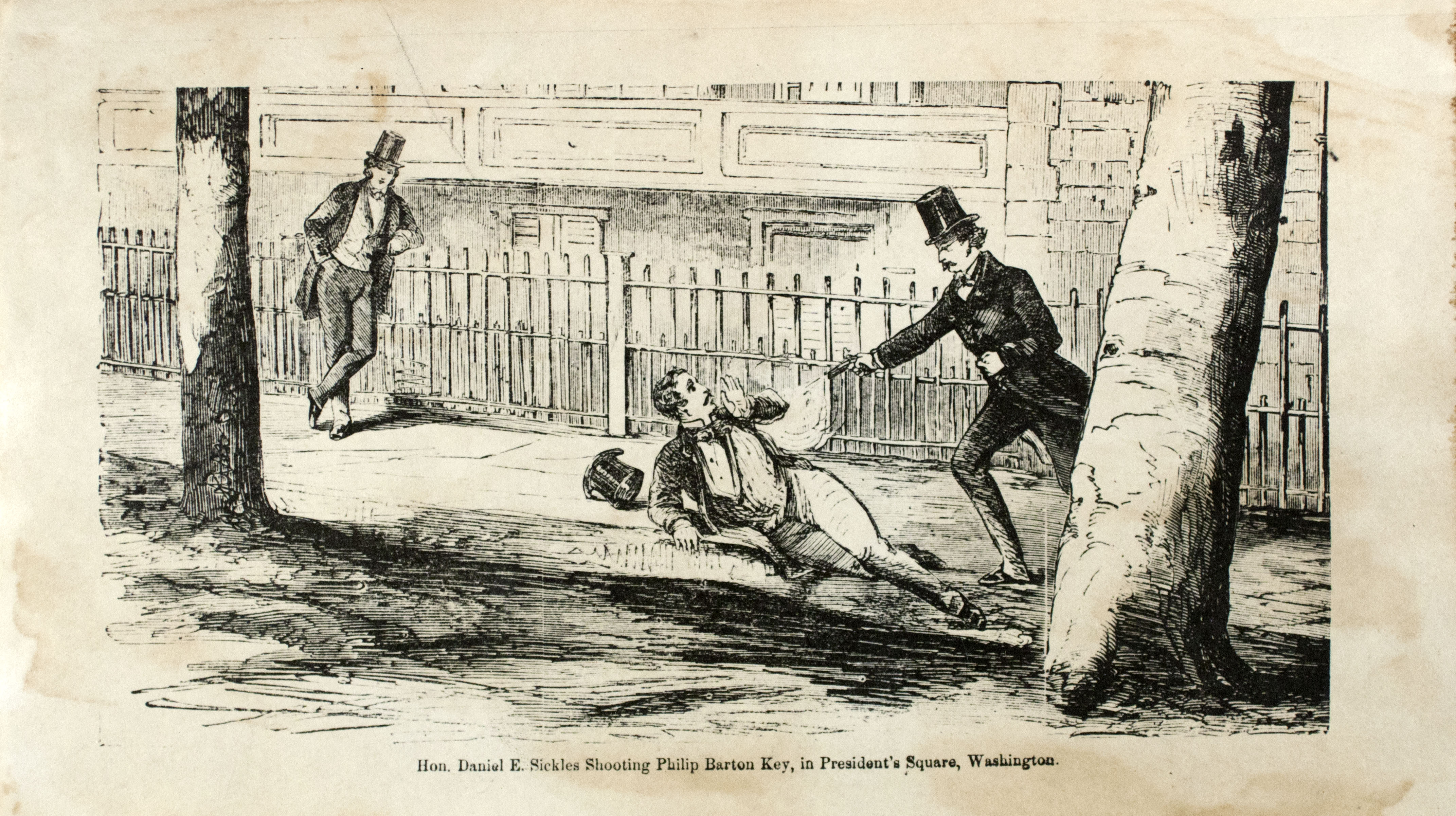
Butterworth left the house first and met Key at the southeast corner of Lafayette Square across from the White House. Allegedly not knowing Sickles intended any harm, Butterworth walked with Key to for a few minutes and then left. The exchange delayed Key and gave Sickles, who had armed himself with a single shot large caliber Derringer, and a muzzle-loading Colt revolver, enough time to catch up with Key near the Club House on Madison on the east side of the square. Sickles was raving but Dan’s fury transcended reality,” [20] as at least a dozen witnesses were nearby as he screamed, “Key, you scoundrel, … you have dishonored my bed – and you must die!” [21] Sickles pulled out the revolver, the first shot from which grazed Key, and the second which misfired. A brief scuffle ensued as Key lunged at his assailant, but Sickles flung him to the ground, and drew the Derringer as Key threw the opera glasses that he viewed Teresa at Dan. A third shot hit Key in the groin and he slumped to the ground screaming “Murder! Murder!… Don’t shoot!” [22]

If there was a chance for Sickles to prove that he acted in self-defense it was now, but he could not control himself. He fired the revolver yet again and it misfired. He placed the weapon in his pocket and drew the Derringer, and fired a shot which hit Key in the Liver. As Key writhed on the ground Sickles tossed the Derringer to the ground and he again drew the Colt. As the stunned witnesses to the attack looked on, Sickles advanced toward the fallen Key and placed the gun at his head and pulled the trigger, but again the weapon misfired. As Sickles attempted to place another cap in the pistol, a number of witnesses began to intervene. One man, “a member of the club, running up, stopped him. Mr. sickles – for God’s sake!” And Butterworth, coming forward, took Dan by the arm. Without a word, they walked away together.” [23] Witnesses took the mortally wounded Key away to the Club, where he expired.

President Buchanan was almost immediately told of the murder by a White House page boy, was aware of the implications of the scandal, Sickles was a friend and political ally with much promise. Buchanan told the boy leave town and gave him a sum of money to facilitate his departure. Soon after Sickles and Butterworth went by carriage “to the home of Attorney General Black, where the Congressman formally surrenders himself to the silver-haired Cabinet member who had regarded him as a protégé.” [24]He declined bail in favor of a speedy trial, was allowed to go home where he told Teresa that he had killed her lover, retrieved some personal items and then went to the District jail, “a foul hole, swarming with vermin, destitute of sewage, bath, water, ventilation, and so inadequate to its purpose that often a dozen or more prisoners were herded into a single narrow cell.” [25] When he arrived he reportedly asked the jailer if they were the best accommodations available, to which the jailer responded “this is the best place you members of Congress have afforded us.” [26] Dejected, but undeterred Sickles sent a message to the public, “In doing what I had to do I have broken the law. Therefore I place myself behind bars. It is for you to set me free.” [27] The stage was now set for the one of the most unbelievable and storied trials in American history.

Notes

[1] Ibid. Swanberg Sickles the Incredible p.4

[2] Ibid. Catton The Army of the Potomac: Glory Road p.151

[3] Ibid. Swanberg Sickles the Incredible p.15

[4] Ibid. Hessler Sickles at Gettysburg p.8

[5] Ibid. Swanberg Sickles the Incredible p.16

[6] Ibid. Pinchon Dan Sickles p.74

[7] Ibid. Hessler Sickles at Gettysburg p.9

[8] ibid. Swanberg Sickles the Incredible p.20

[9] Ibid. Swanberg Sickles the Incredible p.25

[10] Ibid. Keneally American Scoundrel p.92

[11] Ibid. Wilson and Clair They Also Served p.99

[12] Ibid. Pinchon Dan Sickles p.94

[13] Ibid. Swanberg Sickles the Incredible p.44

[14] Ibid. Keneally American Scoundrel p.92

[15] Ibid. Pinchon Dan Sickles p.93

[16] Ibid. Hessler Sickles at Gettysburg p.10

[17] Ibid. Swanberg Sickles the Incredible p.53

[18] Ibid Keneally American Scoundrel p.121

[19] Ibid. Hessler Sickles at Gettysburg p.10

[20] Ibid. Keneally American Scoundrel p.127

[21] Ibid. Swanberg Sickles the Incredible p.54

[22] Ibid. Hessler Sickles at Gettysburg p.11

[23] Ibid. Pinchon Dan Sickles p.112

[24] Ibid. Swanberg Sickles the Incredible p.55

[25] Ibid. Pinchon Dan Sickles p.114

[26] Ibid. Keneally American Scoundrel p.135

[27] Ibid. Swanberg Sickles the Incredible p.114

Leave a comment

Filed under crime, History, laws and legislation

Dan Sickles the Incredible Scoundrel and Patriot Part One

Friends of Padre Steve’s World,

I am taking a break over this Thanksgiving weekend and am re-posting some articles from my Gettysburg text dealing with a man that I consider one of the most fascinating , salacious, scandalous, heroic, and incredible figures ever to grace and disgrace American history, Congressman, and Civil War General Daniel E. Sickles.

I hope that you enjoy,

Peace

Padre Steve+

6517740_orig


George Meade had made his dispositions on July 2nd 1863 with care, but there was one notable problem, the commander of III Corps, Major General Dan Sickles did not like the position assigned to his corps on the south end of Cemetery Ridge. But before discussing that it is worth chasing the rabbit so to speak and spend some time on the life of a man referred to by one by one biographer as an American Scoundrel and another as Sickles the Incredible. The interesting thing is that lie most complex characters in history that Dan Sickles was both and, “he might have had more faults than virtues, but everything about him was perfectly genuine.” [1] That is one of the reason that he is so fascinating.

Sickles was certainly a scoundrel and at the same time incredible, charming yet terribly vain and often insincere. “He was quick-witted, willful, brash, and ambitious, with pliable moral principles.” [2] But he was also incredibly brilliant, far sighted, patriotic, and civic minded. He was a political general, “flamboyant, impulsive, and brave, some would wonder about his discipline and military judgement.” [3] His notoriety and unpopularity among the West Point trained professional officers in the Army of the Potomac, as well as his tactical decision to move his corps on the afternoon of July 2nd 1863, and his subsequent political machinations ensured that he would be the only corps commander of that army not commemorated with a monument at Gettysburg.

Dan Sickles was one of the most colorful, controversial, and perhaps the most scandalous officer ever to command a corps in the history of the United States Army. While he lacked professional training he had done a fair amount of study of the military arts in his spare time, and he “made up for his lack of military training by acting on the battlefield with reckless courage, and was much admired for it by his men.” [4]

After having served as a brigade and division commander Sickles was promoted to corps command. “Sickles owed his elevation to corps command to the patronage of his friend Joseph Hooker…. And while man of the West Point officer….regarded Sickles military acumen with the greatest skepticism, many in the volunteer ranks were of a different mind. “Sickles is a great favorite in this corps,” asserted Private John Haley of the 17th Maine. “The men worship him. He is every inch a soldier and looking like a game cock. No one questions his bravery or patriotism.” [5] General Alpheus Williams who commanded a division in the Union Twelfth Corps despised Sickles, and after Chancellorsville Williams wrote “A Sickles’ would beat Napoleon in winning glory not earned,,, He is a hero without a heroic deed! Literally made by scribblers.” [6] Likewise, Sickles, the political general was no favorite of George Gordon Meade.

On July 2nd 1863 Sickles would be responsible for an act that threw George Meade’s defensive plan into chaos, and according to most historians and analysts nearly lost the battle, however, there are some who defend his actions and give him credit for upsetting Lee’s plan of attack. However, the truth lays somewhat in the middle as both observations are correct. Sickles’ decision created a massive controversy in the months following the battle as public hearings in Congress, where Sickles, a former congressman from New York had many friends, as well as enemies, sought a political advantage from a near military disaster.

Sickles was a mercurial, vain and scandal plagued man who “wore notoriety like a cloak” and “whether he was drinking, fighting, wenching or plotting, he was always operating with the throttle wide open.” [7]Sickles was born in New York to George and Susan Marsh Sickles in late 1819, though a number of sources, including Sickles himself cite dates ranging from 1819 through 1825. “There is little reliable information about Sickles’ early days,” [8] and he did not talk much about them, especially after the war, when Gettysburg and the Civil War became his main subjects of conversation. His father, a sixth generation American whose family were early Dutch settlers in Manhattan became wealthy through real estate speculation, “and he passed on to his son a pride in being a congenital Knickerbocker,” charming, witty, and clever, in whom “hardheadedness and impulsiveness were combined.” [9]

The young Sickles was an impetuous child and his father’s wealth ensured that Dan Sickles had “the finest of tutors…. And an unceasing bankroll of funding for lascivious escapades.” [10] To get their son special tutoring to prepare him for college, his parents “arranged for him to live in the scholarly house of the Da Pont family…. It was a household like few others in that hardheaded, mercantile city, at a time when New York had little of the Italian character it would later take on.” [11]The home was a place of learning, culture, and unusual relationships. The head of the house was Lorenzo L. Da Pont, a Professor at Columbia, as well as a practicing attorney. Also living in the home was Da Pont’s father, the ninety-year-old Professor Lorenzo Da Pont, who “had been the librettist for three of Mozart’s operas” [12] and “held the chair of Italian and Columbia University” [13] Additionally, the elder Da Pont’s “adopted daughter Maria and her husband, Antonio Bagioli, a successful composer and music teacher” [14] lived under the same roof.

Maria was only about twenty-years-old when Sickles moved in. By this time she and Bagioli already had a child of their own, a three year old daughter named Teresa, which Sickles would eventually marry. While the elder Da Pont claimed Maria as an adopted daughter, it was “widely believed that she was his “natural child” … from an American liaison conducted when he was near the age of seventy.” [15] This spawned rumors, even at the time of Gettysburg that the young Sickles “and his future mother-in-law had a sexual affair.” [16]

Whether the liaison with Maria Bagioli occurred is a matter of innuendo and conjecture, but it would not be out of character for Sickles, who, to put it mildly, had a wild proclivity for the opposite sex. As a young man he frequented brothels, and as his social and political status increased, he moved from the brothels frequented by the middle class to those which catered to the more socially well to do. One of his affairs was with the a prostitute named Fanny White, a woman who was smart, pretty, and upwardly mobile who ran her own bordello. His affair with Fanny was well publicized, but did not prevent him from being elected to the state legislature in 1847. She and Sickles would continue their relationship for years with her asking nothing more than expensive gifts, and there are inklings that Fanny help to fund Sickles’ early political campaigns. There is also speculation that in 1854 following his marriage, that Fanny spent time with him in London while he was working with James Buchanan and that that he “may have brought Fanny to one of the Queens’s receptions and introducing the prostitute to Her Majesty.” [17] But Fanny eventually moved on to a man older and richer than Sickles. Eventually she retired from her business and married another New York lawyer but died of complications of tuberculosis and possibly syphilis in 1860. Her property at the time of her death was conservatively “estimated at $50,000 to $100,000”[18] a considerable fortune for a woman of her day and age.

While he lived with the Da Pont family, Sickles gained an appreciation for foreign languages, as well as theater and opera. The elder Professor Da Pont was a major part of his academic life and quite possibly in the development of Sickles liberal education and his rather libertine morality. Lorenzo had been a Catholic Priest and theologian in Italy, but like his young American admirer had quite the attraction for women, and was a connoisseur of erotic literature and poetry. His activities resulted in him being expelled from his teaching position in the seminary, after which he became fast friends with a man whose name is synonymous with smooth talking, suave, amorous men, Giacomo Casanova, and in Europe “his affairs with women had been almost as notorious as those of his good friend.” [19] Certainly the elder Lorenzo’s tales “of Casanova, the fabled prince of Priapus, did nothing to quell Dan’s adolescent sexual appetite.” [20]

Noted Civil War and Gettysburg historian Allen Guelzo describes the Sickles in even less flattering terms, “Sickles was from the beginning, a spoiled brat, and he matured from there into a suave, charming, pathological liar, not unlike certain characters in Mozart operas.”[21]

Following the deaths of both the elder and younger Professor Da Pont, Sickles was stricken with grief. At the funeral of the younger Professor Da Pont Sickles “raved and tore up and down the graveyard shrieking,” [22] forcing other mourners to take him away by force. Soon after, Sickles left New York University and began to work in the law office of the very formidable New York lawyer and former U.S. Attorney General, Benjamin F. Butler.

While he was studying for the bar under Butler, he was joined by his father who would also become an attorney. It was under the influence of his father, who was now a wealthy Wall Street investor, and the Democrats of Tammany Hall that the incredibly talented Sickles was groomed for political leadership. Tammany was a rough and tumble world of hardnosed politics, backroom deals, corruption and graft.

He passed the bar in 1843 and soon was making a name for himself in the legal world, and in politics, despite his well-known questionable ethics and morality. His political career began in 1844 when “he wrote a campaign paper for James Polk and became involved in the Tammany Hall political machine.” [23] The ever ambitious Sickles “clambered up the city’s Democratic party ladder, on the way collecting allies and enemies with utter disregard for the consequences, attending the typically unruly Tammany meetings armed with bowie knife and pistol.” [24]

Like many of his fellow New York Democrats he was a proponent of “Manifest Destiny, and the right of the United States to acquire and hold Texas, New Mexico, California, perhaps the isthmus of Central American, and certainly Cuba.” [25] He was also a political ally of many states rights Southern Democrats and “largely opposed anti-slavery legislation.” [26] This was in large part due to the commercial interests of New York, which between banking and commercial shipping interests profited from the South’s slave economy.

He was elected to the New York State legislature in 1847 and his political star continued to rise even as his personal reputation sank among many of his peers. An attorney who knew him described Sickles as “one of the bigger bubbles in the scum of the profession, swollen, and windy, and puffed out with fetid gas.” [27] Sickles rivals any American politician, before or since in his ability to rise even as the slime ran down his body, the term “Teflon” applied to politicians like Presidents Ronald Reagan and Bill Clinton comes to mind when one studies Sickles’ career. New York lawyer and diarist George Templeton Strong wrote, “One might as well try to spoil a rotten egg as to damage Dan’s career.” [28]

But there was no denying that Sickles was a brilliant lawyer, politician, and debater. One observed that Sickles was “a lawyer by intuition – careful in reaching his conclusions, but quick and bold in pushing them.” [29]New York Governor “William Marcy grudgingly said that as a debater Sickles excelled any man of his years, and the astute Henry Raymond declared that as a parliamentary leader he was unsurpassed.” [30] Soon Sickles was a delegate to the 1848 Democratic Convention where he helped nominate Franklin Pierce for his unsuccessful run at the democratic nomination. The convention enabled Sickles to enter the world of national politics making friends with many influential politicians and financiers, including Pierce, the Van Burens, and James Buchanan. On his return to New York he received an appointed as a Major in the New York Militia.

Even as Sickles rose in the tumultuous world of American law and politics, and chased Fanny White he became enamored with the now teenage daughter of Antonio and Maria Bagioli, Miss Teresa Bagioli who though only fifteen was beautiful, wise beyond her years, fluent in French and Italian, devoted to the arts, and entirely besotted by Dan Sickles. Both the parents of Sickles and Teresa opposed the relationship, but both were madly in love, and Teresa was as headstrong as Dan regarding the relationship. Though such a relationship would be considered completely scandalous today, such marriages were not uncommon then, though they were certainly less common in the upper society of New York. Sickles “was enchanted by her” and “courted her with the sensibility of being a friend of her parents and he must have suspected that he loved her with a fated and exclusive love.” [31] When she was just sixteen Teresa quit school and married the thirty-three year-old assemblyman in a civil ceremony officiated by New York Mayor Ambrose Kingsland on September 27th1852. Six months later, the two were married in the Catholic Church by Archbishop John Hughes, in a “gala and largely attended affair.” [32] Just three months after the church wedding their daughter, Laura, was born. Though there can be no doubt that Sickles loved Teresa, and she him, it did not stop him from other extramarital affairs, nor did it take much away from his political machinations at Tammany Hall.

Following the 1852 Democratic convention where he again supported Franklin Pierce, Sickles hard fighting and influence at in the Wigwam of was rewarded with political plum prize of being appointed “corporation counsel of New York City, a post that paid a flattering salary with extra emoluments and also left room for profitable legal work on the side.” [33] His political and social acumen were again demonstrated as he convinced the state legislature, through personal force of will, to enable the New York City Corporation “to go ahead with creating a great central park,”[34] a park that we now know today as Central Park. He also helped push forward a proposal to create New York’s first mass transportation system, that of horse drawn omnibuses.

Later in the year Sickles was appointed as secretary of the American legation to the Court of St. James n London, headed by former Secretary of State James Buchanan. The position paid a pittance of what Sickles was earning in New York, but he realized that the serving overseas in such a position could not but help him on the national political stage. Though Buchanan and Pierce wanted Sickles, the new Secretary of State, the former New York Governor William Marcy refused to sign Sickles’ commission for the post. Eventually, Pierce prevailed and Sickles got the job.

As their baby, Laura, was still very young and sea travel still quite hazardous, Teresa remained at home, and joined her husband in London the following year. However, when she arrived in London, the teenage wife of Dan Sickles charmed Americans and Britons alike. Aided by her multilingual gifts, which “were rare among American diplomats’ wives,” [35] she became a great success and the unmarried Buchanan appointed her as hostess for the legation. She rapidly became a celebrity due to her stunning beauty and charm, and like he had Fanny, Sickles had Teresa introduced to the Queen. Her celebrity status evoked different responses from those that observed her. “One contemporary described Teresa as an Italian beauty, warm, openhearted, and unselfish. Another described her as being “… without shame or brain and [having] a lust for men.” [36] That “lust for men” coupled with the neglect of her husband may well have been the catalyst for the scandal which overwhelmed them in Dan’s congressional career.

It was during his service in London with Buchanan that Sickles became embroiled in one of the most embarrassing diplomatic incidents in American history. The proponents of Manifest Destiny and American expansion had long desired to take Cuba from Spain through diplomacy, or if needed force. Following a failed attempt by American “Filibusters” to seize the island in 1852 which ended in the execution of fifty Americans, including the son of U.S. Attorney General John Crittenden by Spanish authorities, and in 1854 President Franklin Pierce authorized Buchanan to attempt to negotiate the acquisition of Cuba.

Pierce authorized Buchanan to meet with James Mason, the United States Ambassador to France and Pierre Soule, the United States Ambassador to Spain secretly in order to draft “a statement on the future of Cuba and the proposed role of the United States.” [37] Soule dominated the meeting and the statement, which was in large part drafted by Dan Sickles, was highly inflammatory. Despite this the statement was released to the press in defiance of the order to maintain the strictest secrecy and it resulted in a diplomatic disaster for the Pierce Administration.

The document was prepared by Soule and Sickles and endorsed by Buchanan and Mason was known as the Ostend Manifesto, and it “was one of the most truly American, and at the same time most undiplomatic, documents every devised.” [38] The manifesto prepared by Soule and Sickles proclaimed that “Cuba is as necessary to the North American Republic as any of its present members, and that it belongs naturally to the great family of states of which the Union is the Providential Nursery.” [39] The authors of the manifesto also threatened Spain should the Spanish fail to accede to American demands. The authors declared that if the United States “decided its sovereignty depended on acquiring Cuba, and if Spain would not pass on sovereignty in the island to the United States by peaceful means, including sale, then, “by every law, human and Divine, we shall be justified in wresting it from Spain.” [40]

The Ostend Manifesto “sent shivers through the chancelleries of Europe, provoked hurried conversations between the heads of the French and British admiralties.” [41] European diplomats and leaders reacted harshly to the statement and Secretary of State William Marcy who had previously supported the ideas in the document immediately distance himself and official American policy from it and the authors. Marcy then “forced Soule’s resignation by repudiating the whole thing, but the damage was done.” For months the Pierce administration was on the defensive, and was condemned “as the advocate of a policy of “shame and dishonor,” the supporter of a “buccaneering document,” a “highwayman’s plea.” American diplomacy, said the London Times, was given to “the habitual pursuit of dishonorable object by clandestine means.”[42] The incident ended official and unofficial attempts by Americans to obtain Cuba by legal or extralegal means until the Spanish American War in 1898.

To be continued…

Notes

[1] Catton, Bruce The Army of the Potomac: Glory Road Doubleday and Company, Garden City New York, 1952 p.151

[2] Wert, Jeffry D. The Sword of Lincoln: The Army of the Potomac Simon and Schuster, New York and London 2005 p.222

[3] Ibid. Coddington The Gettysburg Campaign a Study in Command p.45

[4] Sears, Stephen W. Chancellorsville Houghton Mifflin Co. Boston and New York 1996 p.65

[5] Ibid. Trudeau Gettysburg a Testing of Courage p.110

[6] Ibid. Sears Gettysburg p.35

[7] Ibid. Catton The Army of the Potomac: Glory Road pp.150-151

[8] Hessler, James A. Sickles at Gettysburg Savas Beatie New York and El Dorado Hills CA, 2009, 2010 p.1

[9] Keneally, Thomas American Scoundrel: The Life of the Notorious Civil War General Dan Sickles Anchor Books, a Division of Random House, New York 2003 p.7

[10] Ibid. Guelzo, Gettysburg The Last Invasion p.243

[11] Ibid. Keneally American Scoundrel p.3

[12] Ibid. Hessler Sickles at Gettysburg p.2

[13] Ibid. Keneally American Scoundrel p.3

[14] Ibid. Hessler Sickles at Gettysburg p.3

[15] Ibid. Keneally American Scoundrel p.4

[16] Ibid. Hessler Sickles at Gettysburg p.3

[17] Ibid. Hessler Sickles at Gettysburg p.6

[18] Ibid. Keneally American Scoundrel p.215

[19] Swanberg, W.A. Sickles the Incredible copyright by the author 1958 and 1984 Stan Clark Military Books, Gettysburg PA 1991 p.79

[20] Ibid. Swanberg Sickles the Incredible p.80

[21] Ibid. Guelzo, Gettysburg The Last Invasion p.243

[22] Ibid. Swanberg Sickles the Incredible p.81

[23] Ibid. Hessler Sickles at Gettysburg p.4

[24] Sears, Stephen W. Controversies and Commanders Mariner Books, Houghton-Mifflin Company, Boston and New York 1999 p.198

[25] Ibid. Keneally American Scoundrel p.12

[26] Ibid. Swanberg Sickles the Incredible p.82

[27] Ibid. Wert The Sword of Lincoln p.222

[28] Ibid. Hessler Sickles at Gettysburg p.4

[29] Ibid. Swanberg Sickles the Incredible p.84

[30] Ibid. Swanberg Sickles the Incredible p.84

[31] Ibid. Keneally American Scoundrel p.21

[32] Wilson Robert and Clair, Carl They Also Served: Wives of Civil War Generals Xlibris Corporation 2006 p.98

[33] Ibid. Swanberg Sickles the Incredible p.88

[34] Ibid. Keneally American Scoundrel p.21

[35] Ibid. Keneally American Scoundrel p.39

[36] Ibid. Wilson and Clair They Also Served p.98

[37] Ibid. Keneally American Scoundrel p.44

[38] Pinchon, Edgcumb Dan Sickles: Hero of Gettysburg and “Yankee King of Spain” Doubleday, Doran and Company Inc. Garden City NY 1945 p.48

[39] Ibid. Potter The Impending Crisis p.190

[40] Ibid. Keneally American Scoundrel p.45

[41] Ibid. Pinchon Dan Sickles p.48

[42] Potter, David M. The Impending Crisis: America before the Civil War 1848-1861 completed and edited by Don E. Fehrenbacher Harper Collins Publishers, New York 1976 p.193

Leave a comment

Filed under civil war, ethics, History, leadership

Tragic Heroes: Gouverneur Warren, Part One

Friends of Padre Steve’s World

I have been writing about leadership the past couple of days and despite all that is going on in the news I think that I will continue to do so using some parts of my Gettysburg text. I think it is incredibly important to get to know the men and women behind iconic pictures, statues, and biographies that are often not much more than hagiography. In my studies I have encountered people who I find fascinating and not just because of their achievements but also due to their suffering. One of my seminary professors said that you could never come to grips with Jesus until you came to understand suffering.

That is important especially when we deal with men and women who have been traumatized on the battlefield, who when they return from war they come home changed. Many are great leaders and outstanding people whose courage was proven but their lives after the war can only be considered tragic. One of these is Gouverneur Warren, one of the heroes of the Union in the Civil War, and who was instrumental in stopping the Confederate forces at Gettysburg 0n July 2nd 1863. I have written about him before, but I think now is an appropriate time to revisit his life as well as some other men who fought alongside him at Gettysburg.

Have a great day,

Peace

Padre Steve+

Warren

The Statue of Gouverneur Warren on Little Round Top


History, Memory and Myth at Little Round Top 

The battle of Gettysburg is an iconic part of American history. The accounts of Buford’s delaying action and John Reynolds death on July 1st, the savage battle at the Wheat Field, the Peach Orchard and Plum Run on July 2nd and the great charge known as Pickett’s Charge on July 3rd 1863 all draw us to the battlefield. The stories of individual courage and the sacrifice of soldiers from the North and the South that are enshrined on the monuments that now populate the battlefield have a nearly religious quality that draws Americans to Gettysburg by the hundreds of thousands every year.

But there are some places on the battlefield that seem to be the most iconic, the most spiritual, and the most inspirational for various reasons. Two of these places in particular have a nearly magnetic attraction, the “High Water Mark” of the Confederacy on Cemetery Ridge where Pickett’s Charge met its end, and the rocky hill known as Little Round Top. A large part of the reason that these two places hold such an attraction is not just the way that the battle was fought.  Rather, it is often because of the way the stories of those actions and the stories of the men who fought at them have been passed down to us in the accounts of survivors, in history and even in the fictional accounts of the battle. In each of these stories there are elements of courage, devotion, sacrifice, and tragedy that touch us in deeply personal ways and connect us to them and what we see when we experience history tells us as much about us as it does them.

The story of the Battle for Little Round Top has been passed along to us in the many accounts and histories of the battle, but perhaps more importantly in literature and cinema through Michael Shaara’s Pulitzer Prize winning novel, The Killer Angels and that book’s film adaptation, Gettysburg.  Many people who have never read an actual history of the battle know about the Battle for Little Round Top from Jeff Daniels’ inspirational portrayal of Joshua Lawrence Chamberlain in the movie.

The mythic status that we accord Gettysburg is important to Americans as a people. It is a defining moment in our American story and that is why so many of us come to the battlefield. It is a part of who and what we are as a people. Chamberlain said this well a quarter century after the battle at the dedication of the Maine Monuments in 1888:

“In great deeds, something abides. On great fields, something stays. Forms change and pass; bodies disappear; but spirits linger, to consecrate ground for the vision-place of souls… generations that know us not and that we know not of, heart-drawn to see where and by whom great things were suffered and done for them, shall come to this deathless field, to ponder and dream; and lo! the shadow of a mighty presence shall wrap them in its bosom, and the power of the vision pass into their souls.” [1]

While the accounts in the novel and the film are certainly inspiring and allow us to experience the emotion and near spiritual sense of what Chamberlain writes about the battle, there is much more to learn. When we go beyond the mythic portrayal of the battle we find that despite the vast amount of information available that there are a large number of approximations and ambiguities in the accounts of the battle.  So as we endeavor to look at the actions of these leaders on that fateful day it is important to recognize that it is impossible for us to totally separate the actions of the men that helped decide the battle from the mythos that surrounds the story. [2] Likewise, it is important for us to acknowledge, that we cannot completely separate the character of these men and how they lived their lives from their actions on this particular battlefield and afterwards.

That understanding is important if we want to be able to interpret these men and their actions; actions that are recorded in their journals, after action reports, unit histories, individual diaries and letters, as well as the accounts of their contemporaries who served alongside them; accounts which for many reasons are not completely reliable.

As important as these accounts are for us in attempting to sort out the truth of the matter we must apply a hermeneutic of suspicion to them and we must interpret them. [3]  We have to do this because all historical accounts are influenced by the writer’s motivations, ideology or perspective. There are some authors who omit damning or damaging information, especially about their own actions, or the actions of those leaders that they wish to protect, and the writers that “spin” the event in order to build up or destroy the reputations of those present. Even those writers of the contemporary accounts of the battle who wrote their accounts with the best motivations and intentions to record the events as best as they could describe them were often prone to mistakes, even in details such as the time an event took place. The location of people during the event was limited by their physical position on the battlefield and what they could see amid the bullets and bombshells that created carnage around their point of observation. Those not present at the battle, the men who recorded their accounts based on the recollections of those present are similarly limited.

There is also another factor to consider in dealing with these accounts, especially when untrained observers make observations of the actions and behavior of others which seem strange or erratic to them. This is especially true of men who are writing about men who have experienced the horrors of war and combat which might have resulted in some sort of combat stress injury such as PTSD, brain injuries such as TBI or a concussive syndrome or experience which is now called Moral Injury. Thus when we examine the behavior of such leaders and see a marked change in the way that they deal with others after their experience of war, those conditions, unknown to their contemporaries must be considered as a possibility when evaluating their actions.

The problem for the historian or for that matter the writer of military doctrine is how to interpret the information that they have available to them to make it relevant and useful in the art that they practice.  This can be a daunting task with many associated pitfalls that is neither an inductive, nor a deductive process. David Hackett Fischer writes:

“The logic of historical thought is not a formal logic of deductive inference. It is not a symmetrical structure of Aristotelian syllogisms, or Ramean dialectics, or Boolean equations….Instead it is a process of adductive reasoning in the simple sense of adducing answers to specific questions, so that a specific “fit” is obtained. The answers may be general or particular, as circumstances may require. History is, in a sense a problem-solving discipline. A historian is someone (anyone) who asks an open ended question about past events and answers it with selected facts which are arranged in the form of an explanatory paradigm.” [4]

All this is important because it reminds us, that when we study these accounts and attempt to use them as a basis for leadership theories, operation art and strategy, or for any other reason, that all that we know to be “true” is a combination of fact, myth and spin. Our task is to do the best we can with that in mind while admitting that we all have our own prejudices, agendas and ideas that color the glasses by which we interpret the event and the actions of the people involved.

In a sense when we look at the records of the people present or their contemporaries we must entertain a fair amount of suspicion and be able to ask questions as if the writers were talking or writing to us presently. We must ask three questions to do this: Why are they telling this fact or story? Why are they telling it to me? Why are they telling it now? Or more succinctly put “Why this? Why me? Why now?”

Notes

[1] Chamberlain, Joshua Lawrence. Chamberlain’s Address at the dedication of the Maine Monuments at Gettysburg, October 3rd 1888 retrieved from http://www.joshualawrencechamberlain.com/maineatgettysburg.php 4 June 2014

[2] Note: My use of the terms myth, mythology or mythos should not be considered negative, and the use of the terms does not mean that there is not some degree of fact or truth in them. The definitions of the term mythos are important to understanding my use of the term here, first it denotes a traditional or recurrent narrative theme or plot structure of a story, and secondly a set of beliefs or assumptions about something. (See the Oxford American Dictionary.)

[3] I mention the term a hermeneutic of suspicion. Hermeneutics is the theory of understanding and interpreting language and non-linguistic expression. The Stanford Encyclopedia of Philosophy defines it this way: “The term hermeneutics covers both the first order art and the second order theory of understanding and interpretation of linguistic and non-linguistic expressions. As a theory of interpretation, the hermeneutic tradition stretches all the way back to ancient Greek philosophy. In the course of the Middle Ages and the Renaissance, hermeneutics emerges as a crucial branch of Biblical studies. Later on, it comes to include the study of ancient and classic cultures.” 

[4] Fischer, David Hackett Historians’ Fallacies: Toward a Logic of Historical Thought Harper and Row, New York 1970 p.xv  

Leave a comment

Filed under civil war, Gettysburg, History, leadership, mental health, Military, PTSD