On Tyranny: Twenty Lessons from the Twentieth Century, 128 pages, Tim Duggan Books, March 2017
Timothy Snyder is the Housum Professor of History at Yale University and a permanent fellow at the Institute for Human Sciences in Vienna. Among his publications are several award-winning books, all of which have been translated: The Red Prince: The Secret Lives of a Habsburg Archduke (2008); Bloodlands: Europe Between Hitler and Stalin (2010), Black Earth: The Holocaust as History and Warning, Snyder is also the co-editor of Wall Around the West: State Borders and Immigration Controls in Europe and North America (2001) and Stalin and Europe: Terror, War, Domination (2013). He helped Tony Judt to compose a thematic history of political ideas and intellectuals in politics, Thinking the Twentieth Century (2012). He is a member of the Committee on Conscience of the United States Holocaust Memorial Museum and sits on the advisory councils of the Yivo Institute for Jewish Research and other organizations.
Friends of Padre Steve’s World,
Today a short review of a very timely new book. Dr. Timothy Snyder’s On Tyranny: Twenty Lessons from the Twentieth Century.
The book is a must read for anyone concerned with the direction that the United States and Western Europe are heading at this time. If we have an expert in understanding tyranny today it is Dr. Snyder. His research and writing in that field, highlighted by his books and publications on the history of Germany and Eastern Europe should be read in order to grasp the full implications of totalitarianism.
This book is timely and concise. It easily can be read in one sitting, but you will want to go back and read it again and again as his salient points need to be thought about, digested, and taken for action, not only in public but in our private lives.
Snyder’s premise is that Americans are no wiser than the peoples of Europe in the 1920s and 1930s in their response and acceptance of totalitarian movements. He asserts that we must grapple with history to understand what is going on and to warn us that temptation “to think our democratic heritage automatically protects us from threats,” is a “misguided reflex.”
In the twenty short chapters of the book Snyder presents twenty historical lessons from the twentieth century which he has adapted to the situation that we find ourselves today. Our founders were aware of the dangers to the republic that they founded, and from their study of Greece and Rome, particularly the threats of oligarchy and empire which overcame those ancient democracies. He explains that the founders attempted to mitigate those dangers in the institutions that they created but did not think that what they created was immune to those threats. James Madison wrote that tyranny rises “on some favorable emergency.” The understood as Aristotle did that inequity brought instability and Plato’s belief that demagogues exploited free speech to install themselves as tyrants. They “fought to avoid the evil that they, like the ancient philosophers, called tyranny.” That is an ongoing struggle today, both in the United States and Western Europe.
His talks about the means that authoritarians use to gain and keep power, particularly in their cynical derision of truth, claims to different truths, and alternative facts. One particular point that he makes is that we have to believe in truth, and fight for it. He writes: “To abandon facts is to abandon freedom. If nothing is true, then no one can criticize power, because there is no basis to do so. If nothing is truth, then all is spectacle. The biggest wallet pays for the most blinding lights.”
In each chapter he makes very practical observations and recommendations which can be implemented in our public and private lives. One of the most important of these is real human contact, meeting and getting to know people who came from different backgrounds and experiences than us; simple things like making eye contact, and having private lives, building friendships, and hobbies, even as he notes former Czech dissident and later President Vaclav Havel even suggested brewing beer.
But he also mentions the importance of remembering professional ethics, investigating truth claims, standing out in the crowd, not obeying authority in advance, defend democratic institutions including the press and the courts, to listen for dangerous words such as extremism and terrorism, as well as what he calls the “fatal notions of emergency and exception” and the “treacherous use of patriotic vocabulary.”
I could go on, but I would rather that you read his words. The book can be purchased for under seven dollars, and the Kindle edition for under three dollars.
I highly recommend this book, it is a must for our day.
A couple of weeks ago President Trump made an interesting acknowledgement of African American Abolitionist and civil rights champion, Frederick Douglass. The President said: “Frederick Douglass is an example of somebody who’s done an amazing job and is getting recognized more and more, I notice.” But I really wonder if the President, and the 80% plus continent of Evangelical and other conservative Christians really understand what Douglass stood for, or have ever heard his harsh words for the church of his day, which are as applicable now as when he penned them in 1845. It is hard read if you claim to be a follower of Jesus, because while the issue of slavery has been resolved, at least officially, there are many others who reside in this country now who are with the blessing of many “Christians” are discriminated against, persecuted, and even hated. Yes, Douglass’s words still echo loudly in our land.
Anyway, have a good day.
Peace,
Padre Steve+
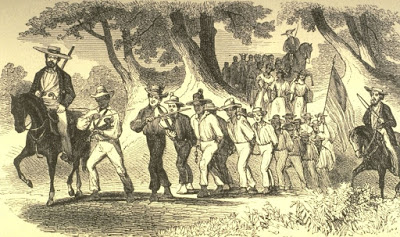
But African Americans too had an effect on the debate. In the 1820s Black abolitionists organized with white abolitionists and of their own accord “in order to improve their lives and to attack slavery.”[1] Even before “Garrison published his famous Liberator in Boston in 1831, the first national convention of Negroes had been held, David Walker had already written his “appeal,” and a black abolitionist magazine named Freedom’s Journal had appeared.”[2] Initially most blacks that could simply desired to improve their lives and hoped that their self-improvement would result in less discrimination and more opportunity. This was known as the self-improvement doctrine. But in the face of continued discrimination in the North and in a society where slavery was expanding and slavery proponents “philosophical and political defenders became ever more in intransigent, and where racism became an increasingly rigid barrier even to the most highly talented blacks, the self-improvement doctrine lost viability.”[3]
Escaped former slaves like Frederick Douglass, Sojourner Truth and others added their voices to the debate. Unlike the white abolitionists these leaders “formative years and antislavery educations were spent on southern plantations, and not in organizations dedicated to moral suasion.”[4] Douglass became a prominent abolitionist leader and was very critical of the role of churches, especially Southern churches, in the maintenance of slavery as an institution.
However, Douglass did not spare Northern churches from criticism for buttressing the peculiar institution. Douglass’s polemics against Northern and Southern churches in the South in his autobiography reads like the preaching of an Old Testament prophet such as Amos, or Jeremiah railing against the corrupt religious institutions of their day:
“I find, since reading over the foregoing Narrative, that I have, in several instances, spoken in such a tone and manner, respecting religion, as may possibly lead those unacquainted with my religious views to suppose me an opponent of all religion. To remove the liability of such misapprehension, I deem it proper to append the following brief explanation. What I have said respecting and against religion, I mean strictly to apply to the slaveholding religion of this land, and with no possible reference to Christianity proper; for, between the Christianity of this land, and the Christianity of Christ, I recognize the widest possible difference‐‐so wide, that to receive the one as good, pure, and holy, is of necessity to reject the other as bad, corrupt, and wicked. To be the friend of the one, is of necessity to be the enemy of the other. I love the pure, peaceable, and impartial Christianity of Christ: I therefore hate the corrupt, slaveholding, women‐whipping, cradle‐plundering, partial and hypocritical Christianity of this land.
“Indeed, I can see no reason, but the most deceitful one, for calling the religion of this land Christianity. I look upon it as the climax of all misnomers, the boldest of all frauds, and the grossest of all libels. Never was there a clearer case of “stealing the livery of the court of heaven to serve the devil in.” I am filled with unutterable loathing when I contemplate the religious pomp and show, together with the horrible inconsistencies, which every where surround me. We have men-stealers for ministers, women-whippers for missionaries, and cradle-plunderers for church members. The man who wields the blood-clotted cowskin during the week fill the pulpit on Sunday, and claims to be a minister of the meek and lowly Jesus. The man who robs me of my earnings at the end of each week meets me as a class-leader on Sunday morning, to show me the way of life, and the path of salvation. He who sells my sister, for purposes of prostitution, stands forth as the pious advocate of purity. He who proclaims it a religious duty to read the Bible denies me the right of learning to read the name of the God who made me. He who is the religious advocate of marriage robs whole millions of its sacred influence, and leaves them to the ravages of wholesale pollution. The warm defender of the sacredness of the family relation is the same that scatters whole families, — sundering husbands and wives, parents and children, sisters and brothers, — leaving the hut vacant and the heart desolate. We see the thief preaching against theft, and the adulterer against adultery. We have men sold to build churches, women sold to support the gospel, and babes sold to purchase Bibles for the poor heathen! All for the glory of God and the good of souls.”
The Christianity of America is a Christianity, of whose votaries it may be as truly said, as it was of the ancient scribes and Pharisees, ʺThey bind heavy burdens, and grievous to be borne, and lay them on menʹs shoulders, but they themselves will not move them with one of their fingers. All their works they do for to be seen of men.‐‐They love the uppermost rooms at feasts, and the chief seats in the synagogues, . . . . . . and to be called of men, Rabbi, Rabbi.‐‐But woe unto you, scribes and Pharisees, hypocrites! for ye shut up the kingdom of heaven against men; for ye neither go in yourselves, neither suffer ye them that are entering to go in. Ye devour widowsʹ houses, and for a pretence make long prayers; therefore ye shall receive the greater damnation. Ye compass sea and land to make one proselyte, and when he is made, ye make him twofold more the child of hell than yourselves.‐‐Woe unto you, scribes and Pharisees, hypocrites! for ye pay tithe of mint, and anise, and cumin, and have omitted the weightier matters of the law, judgment, mercy, and faith; these ought ye to have done, and not to leave the other undone. Ye blind guides! which strain at a gnat, and swallow a camel. Woe unto you, scribes and Pharisees, hypocrites! for ye make clean the outside of the cup and of the platter; but within, they are full of extortion and excess.‐Woe unto you, scribes and Pharisees, hypocrites! for ye are like unto whited sepulchres, which indeed appear beautiful outward, but are within full of dead menʹs bones, and of all uncleanness. Even so ye also outwardly appear righteous unto men, but within ye are full of hypocrisy and iniquity.ʺ Dark and terrible as is this picture, I hold it to be strictly true of the overwhelming mass of professed Christians in America. They strain at a gnat, and swallow a camel… They attend with Pharisaical strictness to the outward forms of religion, and at the same time neglect the weightier matters of the law, judgment, mercy, and faith. They are always ready to sacrifice, but seldom to show mercy. They are they who are represented as professing to love God whom they have not seen, whilst they hate their brother whom they have seen. They love the heathen on the other side of the globe. They can pray for him, pay money to have the Bible put into his hand, and missionaries to instruct him; while they despise and totally neglect the heathen at their own doors.
Such is, very briefly, my view of the religion of this land; and to avoid any misunderstanding, growing out of the use of general terms, I mean by the religion of this land, that which is revealed in the words, deeds, and actions, of those bodies, north and south, calling themselves Christian churches, and yet in union with slaveholders. It is against religion, as presented by these bodies, that I have felt it my duty to testify. [5]
Douglass and other African American abolitionists were cognizant of the fact that in spite of their good intentions that many Northern abolitionists were unconscious of their own racism and many black abolitionists were repelled by it. As such black abolitionists were characterized by “racial independence and pragmatism” while white abolition leaders though “still committed to antislavery principles, increasingly divided over doctrines such as political action or evangelical reform.”[6] Douglass and others realized that blacks had to take control of their own destiny and take an active role in the abolitionist movement. In 1854 Douglass declared “it is emphatically our battle; no one else can fight it for us….Our relations to the Anti-Slavery movement must be and are changed. Instead of depending on it we must lead it.”[7] Douglass and other black abolitionist leaders found this necessary because many white abolitionists were unable to “comprehend the world in other than moral absolute, as well as their unwillingness to confront issues of racial prejudice and poverty….”[8] As a result Douglass and other black abolitionist leaders went into the critical decade before the Civil War with a clear idea that the fight would be much more difficult and complicated than many of their white counterparts could image.
Notes
[1] Blight, David W. Beyond the Battlefield: Race, Memory and the American Civil War University of Massachusetts Press Amherst and Boston 2002 p.30
I have seen a lot of people, especially conservative Christians demanding that critics of our soon to be President Trump to stop criticizing him and fully support him. It is actually fascinating to watch and listen to as for the past eight years neither the President Elect or most of his supporters have stopped questioning the legitimacy of President Obama. My God, for the past eight plus years his policies have not only been criticized, but his very person has been defamed by the very people who now say that criticizing or failing to support the President is “unpatriotic,” “un-American,”and even “treasonable.” I’ve also seen not so subtle threats made against critics of President-Elect Trump, even before he was elected.
Of course that is bullshit. One of the fundamental rights that all of us have as Americans is the right to freedom of speech, freedom of association, and freedom of religion. It’s called the First Amendment of the Constitution. Our founders were terrified that some nutcase might get the idea to become a tyrant and that the people would let them. That’s why we have all the checks and balances between the Executive, Legislative, and Judicial branches of the Federal government, and that is why that freedom of speech has been the cornerstone of the American experiment.
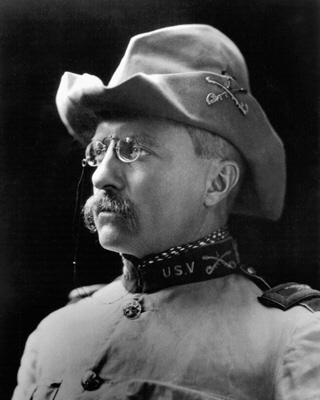
But not anymore. I am not going to say a word about President-Elect Trump or my opinion about him or his possible policies. Instead I am going to note what one of my favorite President’s said about criticizing the President or a Presidential administration. That man was Theodore Roosevelt. Roosevelt, if you recall was no Nansy Pansy. The man volunteered for combat and led troops up San Juan Hill in the face of a fusillade of enemy fire, he sent the Great White Fleet around the World, he helped to end child labor, and he created the National Park system. What he wrote in 1918 is important. The United States was at war having joined Britain and France to fight Imperial Germany.
Roosevelt said this when it came to criticizing the President:
“The President is merely the most important among a large number of public servants. He should be supported or opposed exactly to the degree which is warranted by his good conduct or bad conduct, his efficiency or inefficiency in rendering loyal, able, and disinterested service to the Nation as a whole. Therefore it is absolutely necessary that there should be full liberty to tell the truth about his acts, and this means that it is exactly necessary to blame him when he does wrong as to praise him when he does right. Any other attitude in an American citizen is both base and servile. To announce that there must be no criticism of the President, or that we are to stand by the President, right or wrong, is not only unpatriotic and servile, but is morally treasonable to the American public. Nothing but the truth should be spoken about him or any one else. But it is even more important to tell the truth, pleasant or unpleasant, about him than about any one else.” — The Kansas City Star, 18 May 1918
That being said criticism must be based on fact. Roosevelt was criticizing the Wilson administration because of how badly he thought they were pursuing the war effort against Germany. For this people were castigating him. People said that newspapers should not print what Roosevelt had to say as well as “He should stand by the President” and “He should be stood before a stone wall and shot.”So I guess things haven’t changed too much, but I digress…
The point is that criticism of a President should not be considered unpatriotic nor criminal. If we are to believe Theodore Roosevelt; reasoned, respectful, and truthful criticism of our elected officials, up to and including the President is not only necessary, but it is patriotic. Stephen A. Douglas, who later ran against Abraham Lincoln for President destroyed his own chances of becoming President by opposing James A. Buchanan’s deceitful and illegal attempt to make Kansas a Slave state in 1858. Buchanan said that he would destroy him if he opposed the measure. Douglas stood his ground and he told his congressional colleagues: “God forbid,” I said “that I ever surrender my right to differ from a President of the United States for my own choice. I am not a tool of any President!”
None of us should be regardless of who the President is or what our political beliefs. Principled support, or if need be, opposition, to a President, is both necessary and patriotic. Blind obedience, selling out ones principles, or knuckling under to threats is not. Likewise, those who demand respect, support, and obedience for the person that they voted for without giving it to the other side is not only a hypocrite, but a supporter of tyranny.
This is important, especially when the President-Elect has a long history of lying, cheating small business owners who he contracted with, falsifying, and hiding the truth. His statements in terms of civil liberties, our allies and foreign policy, his questionable relationship with the leader of a hostile foreign power, his manifold conflicts of interest related to his businesses, and his unhinged tirades on social media against any and all critics are all reason to question what he says and does. Those statements are all verifiable, they are not innuendo nor slanderous. They are facts that make a reasonable person question what he says he will do.
Of course, as an American I want President-Elect Trump to do well for all of us and the world. The stakes are too high for me not to care about that. However, to surrender the moral and and Constitutional responsibility to speak out is something that none of us should be prepared to surrender, and those who suggest anyone do should be ashamed of themselves, if they have any sense of shame.
In two days we will have a new President. While his supporters see great things in his Presidency, many others, not just in this country do not. We can try to deduce how President Trump will govern in a number of ways, but the best is through the lens of the past. I am a historian and I am not hopeful of what the future has in store for us, but given that I will not give in to despair. Barbara Tuchman whose books covered many of greatest eras of change and crisis in world history wrote these words:
“The story and study of the past, both recent and distant, will not reveal the future, but it flashes beacon lights along the way and it is a useful nostrum against despair.”
That being said given my study of history and my observations of our soon to be President I am not optimistic. Many people more learned and informed than I have written volumes about what they think will happen in the coming weeks and months. I have read a lot of those analysis and most give me cause for concern. My one hope is that the in spite of his past, including his recent statements, that President Trump will listen to men like soon to be Secretary of defense James Mattis, who alone among our leaders I believe can stand up to Trump’s most unreasonable and problematic actions in regard to NATO, Russia, and China. He actually may be the man who will save the nation from disaster if President Trump makes good on his promises and threats worldwide.
Of course I hope things never reach that point and that some modicum of sanity will possess the President as well as Congress. Likewise I hope that our institutions will be able to survive.
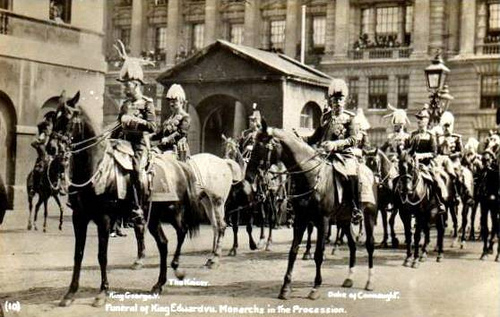
Even so I expect that when President Trump departs the Capital building for the White House that our world will be irrevocably changed. Tuchman wrote of the gathering of leaders at the death of King Edward VII in 1910 in words that I think could easily be modified to 2017 Washington DC.
“The muffled tongue of Big Ben tolled nine by the clock as the cortege left the palace, but on history’s clock it was sunset, and the sun of the old world was setting in a dying blaze of splendor never to be seen again.”
I believe that the world that we knew is never going to be the same. While I have no idea how our future will play out, I still look to the light of the past to keep from despair.
Dr. Martin Luther King Jr. has always been one of my heroes. This time of year I always ponder the importance of his life and work for civil rights, and I wonder what might have been had this man of peace not been cut down in cold blood at the young age of 39 by James Earl Ray on April 4th 1968. He was an amazing and courageous man whose memory should not be let to one day a year.
We live in a world where a minority of voters elected a man as President who through his words and actions demonstrates daily that he cares not for anything that Dr.King stood for. Thus, we have to ensure, though our words and actions that it is not allowed to die. Doing that may involve a high cost as the President-Elect is not known for playing nice with his opponents and now that he will have the police power of the state and a compliant Congress at his back you can expect that opponents will be harassed, intimidated, and maybe worse.
Dr. King was a man of courage, a man of honor, a man of conviction. But he came of age in a time when many people were willing to maintain the status quo and play things safe, like many clergy, even African-American clergy. Many pastors of the era, remained quiet about the conditions of segregation, and the racism of the day. Their lack of action did not mean they were bad people, they just understood that if they spoke up, their lives, and the lives of their families and congregations could be in danger. As such many pastors just hoped to see things slowly improve, without rocking the boat, and without endangering themselves or their families. They had seen what happened to blacks who spoke up or confronted the evil, lynching’s, cross burnings, threats and murder. They had contented themselves with just trying to get along. At the beginning of the movement, many pastors did not support or gave only lukewarm support to Dr. King, Andrew Young, Fred Shuttlesworth, and Ralph Abernathy going into that critical year of 1963.
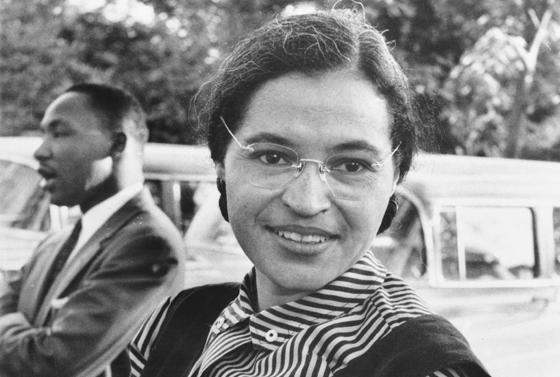
King did not start out to become a Civil Rights leader. However, he was inspired to actively join the movement through the example of Rosa Parks, who defiance of the law for blacks to sit “in the back of the bus” in 1955. He led the Montgomery Bus Boycott which lasted for 385 days. The reaction among segregationists to King and his protest was against violent. King’s house was bombed, and his life threatened. But he refused to stand down.
King’s leadership of the boycott brought the young pastor to national prominence. However, by 1963 much of the Civil Rights movement and the African American community was despairing of the lack of progress. Many people had become disenchanted with King, not considering him bold enough despite his rhetorical abilities.
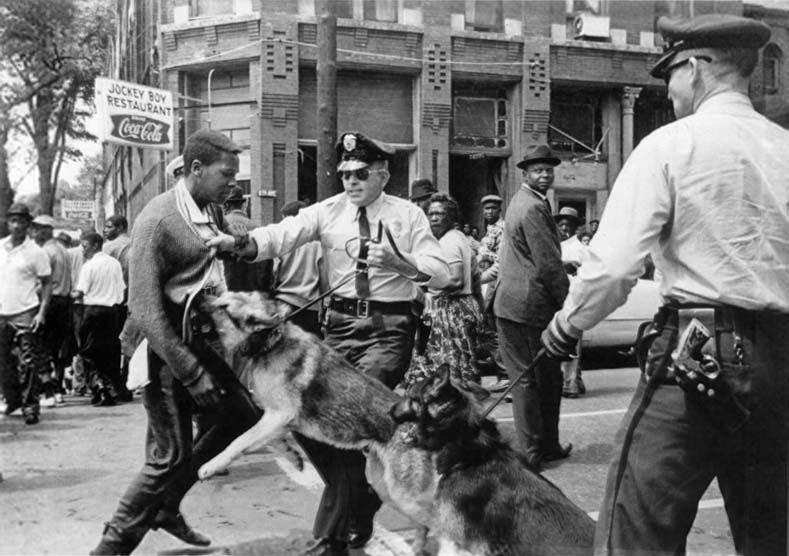
But in April 1963, working with other Civil Rights leaders in Birmingham Alabama King relit the fires of the movement. Montgomery Police Chief “Bull” Conner used his police force to violently attack the demonstrators. Conner ordered his men to unleash their police dogs on the protestors, and used high pressure water cannon against them, including women, children and the elderly. The violent reaction to the protests shocked much of America and the world.
King was arrested and in the Birmingham jail composed one of his most famous works, the Letter from the Birmingham Jail. The letter was a social, political and theological masterpiece. It was some of his harshest criticism was of white liberals, as well as black moderates:
“I have almost reached the regrettable conclusion that the Negro’s great stumbling block in his stride toward freedom is not the White Citizen’s Councilor or the Ku Klux Klanner, but the white moderate, who is more devoted to “order” than to justice; who prefers a negative peace which is the absence of tension to a positive peace which is the presence of justice; who constantly says: “I agree with you in the goal you seek, but I cannot agree with your methods of direct action”; who paternalistically believes he can set the timetable for another man’s freedom; who lives by a mythical concept of time and who constantly advises the Negro to wait for a “more convenient season”
King continued his activism until his assassination. In August 1963 he led the March on Washington for Jobs and Freedom, where before a crowd of an estimated 200,000-300,000 he gave his I Have a Dream Speech.
The crescendo of the speech was remarkable and is perhaps one of the most remembered speeches in American history.
Let us not wallow in the valley of despair, I say to you today, my friends.
And so even though we face the difficulties of today and tomorrow, I still have a dream. It is a dream deeply rooted in the American dream.
I have a dream that one day this nation will rise up and live out the true meaning of its creed: “We hold these truths to be self-evident, that all men are created equal.”
I have a dream that one day on the red hills of Georgia, the sons of former slaves and the sons of former slave owners will be able to sit down together at the table of brotherhood.
I have a dream that one day even the state of Mississippi, a state sweltering with the heat of injustice, sweltering with the heat of oppression, will be transformed into an oasis of freedom and justice.
I have a dream that my four little children will one day live in a nation where they will not be judged by the color of their skin but by the content of their character.
I have a dream today!
I have a dream that one day, down in Alabama, with its vicious racists, with its governor having his lips dripping with the words of “interposition” and “nullification” — one day right there in Alabama little black boys and black girls will be able to join hands with little white boys and white girls as sisters and brothers.
I have a dream today!
I have a dream that one day every valley shall be exalted, and every hill and mountain shall be made low, the rough places will be made plain, and the crooked places will be made straight; “and the glory of the Lord shall be revealed and all flesh shall see it together.”2
This is our hope, and this is the faith that I go back to the South with.
With this faith, we will be able to hew out of the mountain of despair a stone of hope. With this faith, we will be able to transform the jangling discords of our nation into a beautiful symphony of brotherhood. With this faith, we will be able to work together, to pray together, to struggle together, to go to jail together, to stand up for freedom together, knowing that we will be free one day.
And this will be the day — this will be the day when all of God’s children will be able to sing with new meaning:
My country ’tis of thee, sweet land of liberty, of thee I sing.
Land where my fathers died, land of the Pilgrim’s pride,
From every mountainside, let freedom ring!
And if America is to be a great nation, this must become true.
And so let freedom ring from the prodigious hilltops of New Hampshire.
Let freedom ring from the mighty mountains of New York.
Let freedom ring from the heightening Alleghenies of Pennsylvania.
Let freedom ring from the snow-capped Rockies of Colorado.
Let freedom ring from the curvaceous slopes of California.
But not only that:
Let freedom ring from Stone Mountain of Georgia.
Let freedom ring from Lookout Mountain of Tennessee.
Let freedom ring from every hill and molehill of Mississippi.
From every mountainside, let freedom ring.
And when this happens, and when we allow freedom ring, when we let it ring from every village and every hamlet, from every state and every city, we will be able to speed up that day when all of God’s children, black men and white men, Jews and Gentiles, Protestants and Catholics, will be able to join hands and sing in the words of the old Negro spiritual:
Free at last! Free at last!
Thank God Almighty, we are free at last!
King knew the dangers and the risks of appealing to a strategy of non-violence based on love of his enemies. King spoke to the world when he accepted the Nobel Peace Prize in 1964:
“Here and there an individual or group dares to love, and rises to the majestic heights of moral maturity. So in a real sense this is a great time to be alive. Therefore, I am not yet discouraged about the future. Granted that the easygoing optimism of yesterday is impossible. Granted that those who pioneer in the struggle for peace and freedom will still face uncomfortable jail terms, painful threats of death; they will still be battered by the storms of persecution, leading them to the nagging feeling that they can no longer bear such a heavy burden, and the temptation of wanting to retreat to a more quiet and serene life. Granted that we face a world crisis which leaves us standing so often amid the surging murmur of life’s restless sea. But every crisis has both its dangers and its opportunities. It can spell either salvation or doom. In a dark confused world the kingdom of God may yet reign in the hearts of men.” http://www.nobelprize.org/nobel_prizes/peace/laureates/1964/king-lecture.html
Dr. King understood how easy hatred could consume people and movements and urged people not to follow the course of hate, he wrote:
“Returning hate for hate multiplies hate, adding deeper darkness to a night already devoid of stars. Darkness cannot drive out darkness; only light can do that. Hate cannot drive out hate; only love can do that. Hate multiplies hate, violence multiplies violence, and toughness multiplies toughness in a descending spiral of destruction.”
The day before his assassination in Memphis, Dr. King still recognized what he might face. His “I have been to the Mountaintop” speech http://www.americanrhetoric.com/speeches/mlkivebeentothemountaintop.htm recounted many of the things that he had encountered, including an assassination attempt in 1958 which had come close to killing him. It was an amazing speech and one wonders if having lived under threat so long that he almost had a premonition of his death the next day.
And then I got into Memphis. And some began to say the threats, or talk about the threats that were out. What would happen to me from some of our sick white brothers?
Well, I don’t know what will happen now. We’ve got some difficult days ahead. But it really doesn’t matter with me now, because I’ve been to the mountaintop.
And I don’t mind.
Like anybody, I would like to live a long life. Longevity has its place. But I’m not concerned about that now. I just want to do God’s will. And He’s allowed me to go up to the mountain. And I’ve looked over. And I’ve seen the Promised Land. I may not get there with you. But I want you to know tonight, that we, as a people, will get to the promised land!
Dr. King’s dream is not dead and we who live today cannot allow it to die. There is still much work to see justice done for all Americans as well as those suffering from violence, persecution, discrimination and poverty around the world.
It is 2016. It has been 54 years since Dr. King sat in the Birmingham jail. Sadly, there are some who long for a return to the day of Jim Crow. In some states there have been and there are ongoing attempts to return it by stealth, especially through restrictions on voting that predominantly impact African Americans and the poor. Racism is not dead, nor are so many other “isms.” As Dr. King told us, “Now is the time to make real the promises of democracy,” and “It would be fatal for the nation to overlook the urgency of the moment.”
Dr. King and many of the leaders of the Civil Rights Movement have passed on. Likewise, many people today are complacent about the injustices present in our society, injustices experienced by many people. We need a generation of new men and women with hearts like Dr. King’s, who will be the conscience of the nation and confront these injustices.
Likewise we cannot ghettoize Dr. King’s accomplishments as being something that only helped African Americans. They have helped all of us. Dr. King’s courage in standing for Constitutional Amendments that many of his opponents despised, the 13th, 14th, 15th and 19th Amendments, as well as the Civil Rights Act and Voting Rights Acts is of fundamental importance to all Americans, even those that think they don’t matter.
President Ulysses Grant was absolutely correct when he pointed out the plight of white Southerners in the ante-bellum South. They were people so bound to the slavery system and their place in it that they could not see how badly it hurt them so long as they had a group, in this case African American slaves who were below them. Grant wrote:
“The great bulk of the legal voters of the South were men who owned no slaves; their homes were generally in the hills and poor country; their facilities for educating their children, even up to the point of reading and writing, were very limited; their interest in the contest was very meagre–what there was, if they had been capable of seeing it, was with the North; they too needed emancipation. Under the old regime they were looked down upon by those who controlled all the affairs in the interest of slave-owners, as poor white trash who were allowed the ballot so long as they cast it according to direction.”
That my friends is descriptive of how President Elect Trump and the Republican Congress view those who put them in office. Trump supporters do not seem to realize that they will be hurt the most by the incoming administration and congresses policies. They too need emancipation and deliverance, thus we have to remain strong, for they too are our brothers and sisters.
Representative John Lewis, one of the original Freedom Riders was beaten numerous times during those protests. When leading the march across the Pettus Bridge in Selma, Lewis had his skull fractured by a State Trooper when he stopped to pray. Lewis’s words call us to action today:
“If not us, then who? If not now, then when?”
Representative Lewis is still speaking out, and enduring the attacks of the President-Elect, and we must join him. We cannot let Dr. King’s dream die.
On a weekend where we honor the life of Dr. Martin Luther King Jr. we saw our President-Elect stoop to a Twitter tirade against Representative John Lewis, a true hero of the Civil Rights movement because Lewis dared to question his legitimacy. A true statesman would have either ignored it or simply making the comment that Lewis is entitled to his opinion. But our President-Elect has incapable of such behavior. When he was at Liberty University last year on Martin Luther King Day, he only mentioned Dr. King in regard to the fact that he had set a record for attendance at Liberty.
Even longstanding conservatives bastions in Congress who have worked with Mr. Lewis, and conservative media titans were shocked by President-Trump’s action and many rightly commented that the only person that Donald Trump has not attacked is Vladimir Putin.
Like a lot of people it seems it seems that our soon to be President seeks to marginalize Dr. King’s life and work by simply relegating him to the pages of history. The attitude of such people seems to be that maybe Dr. King may important in his day, but that we have advanced to the point that we don’t need to see beyond the King of history, but the President-Elect seems not even to care about that. It is a sad spectacle where the man who was elected to be all of our President dismisses such an important man in our history.
So now more than ever it is important for all Americans remember and act upon the legacy of Dr. King.
Dr. King was a man of tremendous personal courage. Nearly every day of his public ministry and advocacy for the rights of African Americans and the poor his life was in danger. Of course he, like so many other men who throughout history understood that those that champion the cause of justice and peace must ask hard questions. They must engage in hard thinking. They must challenge their own beliefs as well as those that they come in contact, and they must do so from the least safe place to do so, the place of conscience which commands us to do what is right.
In 1968 Dr. King said something that should make us all look in the mirror and ask who we really are and what we represent. He noted how cowardice, expediency and vanity all vie with conscience. He said:
“On some positions, Cowardice asks the question, “Is it safe?” Expediency asks the question, “Is it politic?” And Vanity comes along and asks the question, “Is it popular?” But Conscience asks the question “Is it right?” And there comes a time when one must take a position that is neither safe, nor politic, nor popular, but he must do it because Conscience tells him it is right.”
If you look closely at what Dr. King said one can almost see every political, business or religious leader make decisions about things which matter to people, but without facing the demands of conscience.
It would be easy just to say this of many of our leaders, especially the President-Elect, however, it is also true of most of us as well. I hate to admit it is regardless of our protestations most of us follow the demands of cowardice, expediency or vanity rather than conscience. We do it not because we are bad people, but because we fear the potential negative consequences of doing the right thing, we count the cost and decide we cannot pay it.
Every time we make these decisions not to do the right thing, but to shrink in cowardice, and appeal to the cold calculations of being politic, or choosing to go with what is popular, something in us dies.
Dietrich Bonhoeffer, the German pastor and martyr wrote about the results of such equivocation from prison:
“We have been silent witnesses of evil deeds: we have been drenched by many storms; we have learnt the arts of equivocation and pretense; experience has made us suspicious of others and kept us from being truthful and open; intolerable conflicts have worn us down and even made us cynical. Are we still of any use?”
But to follow the demands of conscience requires us to think, and think critically. Too often we simply do things or support causes because we are comfortable with the ideas, and because we do not want to face inconvenient or uncomfortable ideas. We do not like to be challenged. I think that is why there is such a great appeal to often ignorant loud mouthed politicians, pundits and preachers, the Unholy Trinity, to do our thinking for us. The pundits, preachers and politicians often appeal to the must base human instincts to turn citizens against each other, or to drive up support for their ideology. Such ideas are made more destructive when they appear as “memes” on social media, attached to pictures which are designed to invoke an emotional response of anger, hatred and resentment at person or group being demonized. In following them we can become unthinking fanatics, convinced of our rightness without ever examining what we believe to see if it really true.
This is not thinking when we follow the lead of such people, regardless of their ideology. In doing so we give up our right and responsibility to think for ourselves and ask the hard questions. Eric Hoffer noted how ideology blinds us:
“A doctrine insulates the devout not only against the realities around them but also against their own selves. The fanatical believer is not conscious of his envy, malice, pettiness and dishonesty. There is a wall of words between his consciousness and his real self.”
Dr. King’s words spoken in 1963 are equally true today:
“Rarely do we find men who willingly engage in hard, solid thinking. There is an almost universal quest for easy answers and half-baked solutions. Nothing pains some people more than having to think.”
I hope that in 2017 we may we find in Dr. King’s words inspiration to be people of character and conscience. But to do so we must start doing the hard thinking that allows us to follow the demands of conscience and not cowardice. We must do the hard thinking that places justice over popularity and the hard thinking which exposes the emptiness of brazen political calculation embodied in the easy answers and half-baked solutions of the Unholy Trinity.
Sadly, I don’t think that most people want to do this type of thinking, our materialistic culture does not value it. As a result I fully expect we give up our rights as a people to a few oligarchs who throw a few small breaks our way while they expand their control, power and wealth. It’s a bad formula and we all suffer for it.
In spite of that it is time to stop asking if things are safe, politic, popular, or expedient and do the hard work and thinking that conscience demands. If we don’t we deserve what we get. I’m sure that Dr. King would agree.
As the inauguration of Donald Trump as President draws near it is important to remember the words of the late Adlai Stevenson who once wrote:
“Unreason and anti-intellectualism abominate thought. Thinking implies disagreement; and disagreement implies nonconformity; and nonconformity implies heresy; and heresy implies disloyalty. So, obviously, thinking must be stopped. But shouting is not a substitute for thinking and reason is not the subversion but the salvation of freedom.”
I have traveled to a lot of places, in this country and around the world where reason has been a scarce commodity and to me that has always been a frightening specter; a world where reason is all too often sacrificed on the altar of political, ideological or religious expediency. Over the past year, and more frighteningly over the past few weeks what was once a specter is beginning to look like reality.
But reason does matter, and those who ignore it do so at their own peril as Christopher Hitchens once said “That which can be asserted without evidence, can be dismissed without evidence.” History shows us in times like this, where reason is tossed as primordial urges rise, that people all too often fall back on old hatreds and myth rather than seeking answers; instead of trying to figure out what is really important; instead of studying the details of the great questions; that frustrated people become intellectually lazy and gravitate towards angry demagogues who play to their often legitimate anger and frustration. As such we have entered an era where Facebook and Twitter memes with little truth but much emotion form the basic thoughts of many people.
But populist demagogues with authoritarian leanings like the President Elect do not need to appeal to reason. Instead they appeal to something more primal; they appeal to fear, anger, and the need of desperate people to find someone to blame.
Appealing to fear and loathing is so much easier than using reason. To call an opponent a Communist or Nazi, Fascist or imperialist, unbeliever, heretic or even a racist; and then connect them to the evil we want to demonize them is far easier than it is to actually engage them in a truthful debate and to see things in their historical context.
Too often we allow people of little learning but whose great charm and salesmanship ability, to sell us myth in place of fact and this happens across the political, social, economic and theological spectrum. That is a tragedy for all of us no matter what our political, ideological, or religious views.
Such salesmanship may comfort the true believer in whatever cause may be, and it may even make them feel superior to those that disagree with them. But it blinds them to reality and ensures that they never become aware of their own envy, malice, pettiness and dishonesty. The untruths they believe serve as protection against any thought, fact, presumption or doctrine that contradicts them. John F Kennedy said, “Too often we enjoy the comfort of opinion without the discomfort of thought.” Thus we are inundated with fake news, fake history, outright lies and propaganda that go unchallenged by people who should know better.
In times like ours, it is most important to take the time to learn from history, not just generalities that mix fact and myth but the little details that make up history and for that matter the sciences, philosophy, sociology, political thought and theology. As a society we have ceased to do this and until we take the time to return to such study, dialogue and put aside our blinders we will be doomed to remain as we are no matter what political party is in power or ideology dominates the airwaves and cyber space.
Reason, it is important, and the dangers that we face as a nation, society, and world demand that we return to it, no-matter what our occupation or station in life. If we do not stand for truth and the freedom of thought maintained in reason and objectivity we will see freedom die. George Orwell wrote something that we should not forget: “Threats to freedom of speech, writing and action, though often trivial in isolation, are cumulative in their effect and, unless checked, lead to a general disrespect for the rights of the citizen.”
Since I posted about Franklin D. Roosevelt’s 1941 State of the Union address and the Four Freedoms yesterday, I thought that I would follow it up with just a couple of truths from him:
“Unhappy events abroad have retaught us two simple truths about the liberty of a democratic people.
The first truth is that the liberty of a democracy is not safe if the people tolerate the growth of private power to a point where it becomes stronger than their democratic state itself. That, in its essence, is Fascism—ownership of Government by an individual, by a group, or by any other controlling private power.
The second truth is that the liberty of a democracy is not safe if its business system does not provide employment and produce and distribute goods in such a way as to sustain an acceptable standard of living.
Both lessons hit home.
Among us today a concentration of private power without equal in history is growing…”
Sounds to me like he was well acquainted with our President Elect. A warning to the wise…
On January 6th 1941 President Franklin Delano Roosevelt delivered his State of the Union Message to Congress and the nation. I spent the time to both both read it and listen to it the other day. It is a profoundly moving speech, not without controversy of course, but one which we need to hear again. It is a speech that like the Declaration of Independence, Lincoln’s Gettysburg Address, and Dr. Martin Luther King Jr.’s I have a Dream speech calls us to higher ideals, ideals that we often come up short in living up to, but ideals worth living for and to endeavor to attain in our lifetime.
When Roosevelt spoke the nation was in the midst of crisis. The United States was still recovering from the Great Depression. War threatened as Hitler’s Nazi German legions had overrun all of Western Europe and much much of North Africa. German U-Boats and surface ships were prowling the North Atlantic. Britain stood alone between Germany’s complete domination of Europe. Even the Soviet Union, a mortal enemy of Fascism had concluded a concordat with Hitler to divide Eastern Europe. Though no one yet knew it, Hitler was already planning to break his accord with Stalin and invade the Soviet Union.
In it Roosevelt made a comment that we should remember in light of the knowledge that Russia interfered in our election, and has been working tirelessly to split us from our allies and directly working against our efforts to fight ISIS, and the efforts of our soldiers in Afghanistan. He noted:
“I suppose that every realist knows that the democratic way of life is at this moment being directly assailed in every part of the world — assailed either by arms or by secret spreading of poisonous propaganda by those who seek to destroy unity and promote discord in nations that are still at peace.”
Roosevelt’s speech, which largely focused on the threat of Nazi Germany, also supported Britain and the exiled governments of nations conquered by Hitler. As he outlined preparations to defend the United States, Roosevelt also called on Congress to pass Lend Lease to help those fighting the dictators, as well as increased opportunity at home. In response to the emerging threats and the unwillingness of some, including a strong pro-Germany lobby headed by prominent senators, American aviation hero Charles Lindberg, and and big business, Roosevelt challenged Americans to face up to them. He noted:
“As a nation we may take pride in the fact that we are soft-hearted; but we cannot afford to be soft-headed. We must always be wary of those who with sounding brass and a tinkling cymbal preach the “ism” of appeasement. We must especially beware of that small group of selfish men who would clip the wings of the American eagle in order to feather their own nests.”
On the domestic front Roosevelt reiterated the message of the New Deal, for even with war looming he did not want to see Americans lost in the exchange and he linked freedom abroad to the same at home. He noted:
“As men do not live by bread alone, they do not fight by armaments alone. Those who man our defenses and those behind them who build our defenses must have the stamina and the courage which come from unshakable belief in the manner of life which they are defending. The mighty action that we are calling for cannot be based on a disregard of all the things worth fighting for.”
He continued:
“Certainly this is no time for any of us to stop thinking about the social and economic problems which are the root cause of the social revolution which is today a supreme factor in the world. For there is nothing mysterious about the foundations of a healthy and strong democracy.
The basic things expected by our people of their political and economic systems are simple. They are:
Equality of opportunity for youth and for others.
Jobs for those who can work.
Security for those who need it.
The ending of special privilege for the few.
The preservation of civil liberties for all.
The enjoyment — The enjoyment of the fruits of scientific progress in a wider and constantly rising standard of living.
These are the simple, the basic things that must never be lost sight of in the turmoil and unbelievable complexity of our modern world. The inner and abiding strength of our economic and political systems is dependent upon the degree to which they fulfill these expectations.”
But the real heart of the message, applicable to all people everywhere Roosevelt enunciated a number of principles that are a beacon to all people. Firmly grounded in words of the Declaration of Independence and the Gettysburg Address they are called the Four Freedoms. Those freedoms are an ideal, in fact they certainly were not practiced well then by Americans, nor now, but they are worth working to: Roosevelt said:
“In the future days, which we seek to make secure, we look forward to a world founded upon four essential human freedoms.
The first is freedom of speech and expression—everywhere in the world.
The second is freedom of every person to worship God in his own way—everywhere in the world.
The third is freedom from want—which, translated into world terms, means economic understandings which will secure to every nation a healthy peacetime life for its inhabitants—everywhere in the world.
The fourth is freedom from fear—which, translated into world terms, means a world-wide reduction of armaments to such a point and in such a thorough fashion that no nation will be in a position to commit an act of physical aggression against any neighbor—anywhere in the world.
That is no vision of a distant millennium. It is a definite basis for a kind of world attainable in our own time and generation. That kind of world is the very antithesis of the so-called new order of tyranny which the dictators seek to create with the crash of a bomb.”
The speech was important, and now as it did then it calls Americans to higher purposes, to higher ideals, and it recognizes that we have never fully measured up to our own words. At the time it was spoken, Jim Crow was still the law of the land, Mexican Americans were often treated as poorly as blacks, Native Americans had few rights; and barely a year later Japanese Americans would be taken from the homes, lose their business and be sent to detention camps for the duration of the war after Pearl Harbor, simply because they were of Japanese descent. But those abiding principles are things that we should never lose sight of, and always strive to realize.
Today the four freedoms that Roosevelt enunciated are under threat around the world and in the United States too. We live in an age of uncertainty, turbulence, division, inequity, as well as deeply ingrained cynicism. Unscrupulous authoritarian politicians are using that uncertainty and fear to roll back the very liberties that democratic institutions are founded on.
As a result, as a man who promised during his campaign to roll back the rights of many people it is important not to forget this speech. The same is true as state and local politicians set out to not only roll back the rights of some, but to enable religious people to discriminate against other citizens.
It is also important because the government of Russia led efforts to attack the country by influencing the election, and for years has been committing aggression against American allies and working against American and allied efforts around the world. Yet the the incoming administration is not only welcoming it, but attacking and trying to discredit the American intelligence officials who say that it happened, and condemning senators and congressmen of its own party who want to further investigate those attacks by Russia and impose sanctions.
So I think that it is important to reflect on these events, and then turn to speeches like Roosevelt’s in order for us to strive for a higher purpose, not to lose hope, and give in to fear that would enable our freedoms and the freedoms of any citizen to be curtailed.
I have written a lot about the dehumanization of people and genocide, and some of the things that create a climate where such events take place, and how political and religious leaders stir the primal passions of otherwise good, decent and law abiding citizens. I wrote yesterday how I am afraid of what is going on in our country, especially in regard to the violence being sanctioned and even promoted by President Elect Donald Trump.
Last spring I read a book by World War II German Luftwaffe ace Johannes Steinhoff. Steinhoff was unlike many of the German officers who wrote memoirs following the war, memoirs that historian Williamson Murray wrote “fell generally into two categories; generals writing in the genre of “if the fuhrer had only listened to me!” and fighter pilots or tank busters writing about their heroics against the productive flood from America or the primitively masses of the Soviet Union.” His book, The Final Hours: The Luftwaffe Plot Against Goering should be essential reading for any currently serving officer.
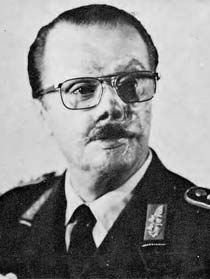
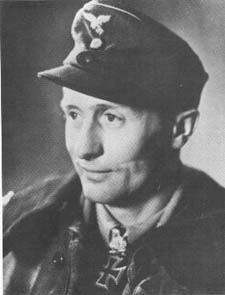
General Johannes Steinhof (above) as a Bundeswehr and NATO officer, showing his burns and before his crash (below)
In his books, Steinhoff does something that you do not see authors do in most military or political memoirs, he actually does serious self reflection on his role in supporting an evil regime. In his introduction to his book The Final Hours the legendary fighter ace who was horribly disfigured when his Me-262 jet fighter crashed and burned two weeks prior to the end of the war wrote:
“In recalling these events, which had been long buried in my memory, it has not been my intention to make excuses. Our unconditional self-sacrifice in the service of the Third Reich is too well documented for that….
So it is because of what is happening today—with freedom threatened in virtually every respect by its own abuse—that I offer this contribution, in the form of an episode in which I was myself involved, to the history of the soldier in the twentieth century. Soldiers have always, in every century of their existence, been victims of the ruthless misuse of power; indeed, given the opportunity, they have joined in the power game themselves. But it fell to our own century to accomplish, with the aid of a whole technology of mass extermination, the most atrocious massacres in the history of mankind. This fact alone makes pacifism a philosophy worthy of respect, and I have a great deal of sympathy with those who profess it.
The figure of the soldier in all his manifestations is thus symptomatic of the century now nearing its close, and it is to the history of that figure that I wish to contribute by describing what happened to me. I have tried to show what it is possible to do to men, how insidiously they can be manipulated by education, how they can be hoisted onto a pedestal as “heroes,” how they can be so corrupted as even to enjoy the experience—and how they can be dropped and denounced as mutineers when they discover that they have scruples. The complete lack of scruples that such treatment implies is peculiar to rulers who believe that the problems of their own and other peoples can be solved by imposing, through the use of military force, peace on their, the rulers’, terms—in our case a pax germanica, but the second Latin word is readily interchangeable.” from “The Final Hours: The Luftwaffe Plot Against Goring (Aviation Classics)” by Johannes Steinhoff
Since I am a historian and and a career military officer with service in the Iraq War, a war that was illegal and unjust by all measure I can understand Steinhof’s words. Because much of my undergraduate and graduate work focused on German history, particularly that of Imperial Germany after the unification, the Weimar Republic, and the Nazi Reich, I draw a lot of lessons from the period. I also understand how people in this country can fall for the same kind of vitriolic propaganda that the Germans of that era did. I can understand because for years I fell for the lies and propaganda being put out by the politicians, pundits and preachers of the American political right.
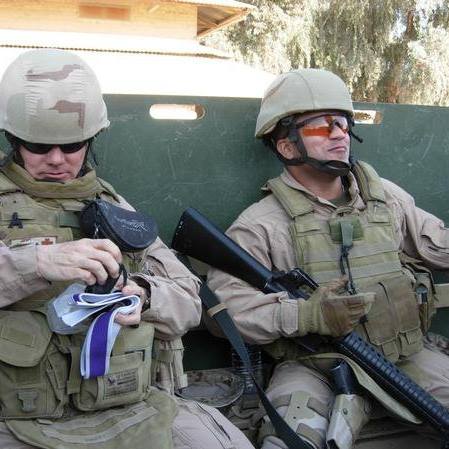
A picture of me (on left) in Iraq 2007 with my assistant and bodyguard RP1 Nelson Lebron
One of those lessons is that in times of crisis, that people, no matter what their race, culture, religious belief system, educational, or economic background are still human. Humanity is the one constant in all of history, our prejudices are often ingrained in us during childhood and reinforced by the words of politicians, pundits, and preachers. In times of stress, crisis, and societal change or upheaval even good people, moral people, people of great intellectual, scientific abilities can fall prey to demagogues who preach hate and blame others, usually racial, ethnic, or religious minorities, as well as civil libertarians who champion the rights of those minorities for the problems of the nation.
Shrewd politicians, preachers, and pundits do this well. They demonize the target group or population and then let the hatred of their disaffected followers flow. The leaders need that disaffected and angry base in order to rise to power; such was how Hitler, Stalin, and so many other despots gained power. They took advantage of a climate of fear, and found others to blame. For Hitler it was the Jews, Slavs, Socialists and Communists; while for Stalin it was various groups like the Ukrainians, or the Poles who were the devil to be feared and destroyed. Timothy Snyder in his book Bloodlands: Europe Between Hitler and Stalin wrote:
“Dead human beings provided retrospective arguments for the rectitude of policy. Hitler and Stalin thus shared a certain politics of tyranny: they brought about catastrophes, blamed the enemy of their choice, and then used the death of millions to make the case that their policies were necessary or desirable. Each of them had a transformative utopia, a group to be blamed when its realization proved impossible, and then a policy of mass murder that could be proclaimed as a kind of ersatz victory.”
But that being said, there are a lot of people who from childhood believe the lies about others without question. In good times such people continue on with life as normal, but in crisis those hatreds and prejudices come to the fore. Rudolf Höss, the notorious sociopath who commanded Auschwitz told American Army psychologist Gustave Gilbert about his reaction when ordered to turn the camp into an extermination center. He said that the order “fitted in with all that had been preached to me for years,” and “at the same time I didn’t think of it as propaganda, but as something one just had to believe.”
Eugene Davidson in his book on the Nuremberg Trials wrote:
“Every society has in it at all times negative, criminal, sadistic, asocial forces. What holds them in check more than law and police is the consensus of the society – a general belief that despite everything wrong and stupid and muddleheaded in politics, the state is a going concern that will somehow make its way into the future.” (Davidson, The Trial of the Germans p.581)
But when things do not go well, when people do not feel that things will be okay, that the future will be better, and that they have a purpose they look for answers. However, they tend to find their answers in the rantings of demagogues, race baiters, conspiracy theorists, and others who they would tend to dismiss out of hand in good times. In Germany it was the loss of the First World War, the humiliation of Versailles and the economic chaos and social change of the Weimar period which allowed Hitler to gain an audience, then a following, then political power. The demagogues played to what was already in the hearts and minds of the disaffected masses, without that fertile soil, the rantings of Hitler and his propagandists would have never succeeded. Albert Speer wrote:
“As I see it today, Hitler and Goebbels were in fact molded by the mob itself, guided by its yearnings and its daydreams. Of course, Goebbels and Hitler knew how to penetrate through to the instincts of their audiences; but in the deeper sense they derived their whole existence from these audiences. Certainly the masses roared to the beat set by Hitler’s and Goebbels’ baton; yet they were not the true conductors. The mob determined the theme. To compensate for misery, insecurity, unemployment, and hopelessness, this anonymous assemblage wallowed for hours at a time in obsessions, savagery and license. The personal unhappiness caused by the breakdown of the economy was replaced by a frenzy that demanded victims. By lashing out at their opponents and vilifying the Jews, they gave expression and direction to fierce primal passions.”
In a sense a similar thing has happened in the United States which has experienced a series of wars beginning with Vietnam, the shock of the 9-11-2001 attacks, the economic crash of 2007 and 2008 which devastated the savings, home ownership, and investments of many Americans while at the same time benefiting the banking and brokerage houses whose government assisted policies brought about the crash. Of course there are other issues, many religious conservatives hate the progress made by the Women’s and Gay Rights movements, and their leaders play to their fears in apocalyptic terms. I could go on, but I am sure that my readers can identify other issues which demagogues and others use to spread fear and hate to further their goals. The fact is that without the the fertile soil that lays in the hearts of their most fervent followers they would never have a following.
In Weimar Germany hate mongers like Julius Streicher and propagandist Josef Goebbels stuck a chord with disenchanted people who felt that they had lost their country. They were fearful, angry, and desired a leader who would “make Germany great again.”Hitler and his Nazi media sycophants played to that fear, and took advantage of their anger at the existing order. Davidson wrote such people “exist everywhere and in a sick society they can flourish.”
For decades the way has been prepared for true extremists to take advantage of the fears and doubts of people as modern American versions of Streicher and Goebbels have been at work for years. Rush Limbaugh was a modern pioneer of this in the United States, and he has been joined by so many who are even more extreme in their rantings that it is hard to name them all. Likewise, whole media corporations, websites, and political networks spread such fear every minute of the day, claiming that they, and they alone are real Americans. They actively support politicians who condemn, and sometimes even threaten people who oppose them, and all the while claim that “make America great again.”
When I was younger I devoured that propaganda, despite all of my learning I followed the rantings of men who I realize today are propagandists who promote the basest of lies, and hatred, often in the name of God. I was changed when I was at war, and when I returned home from Iraq in 2008 I realized through hard experience that I had been lied to, and that as a result that thousands of my brothers and sisters were dead, and tens of thousands shattered in body, mind, and spirit. Likewise I saw the massive destruction levied on Iraq and realized how terrible war really is. That was my epiphany, that is what it took to see how much I had been lied to, and it called me to question everything else that I had so willingly believed, things which had been fed to me by years of indoctrination in church, through the media, and by politicians who I believed were truly Christian. I can understand now how Martin Niemoller felt after the Nazi seizure of power when he said, “I hated the growing atheistic movement, which was fostered and promoted by the Social Democrats and the Communists. Their hostility toward the Church made me pin my hopes on Hitler for a while. I am paying for that mistake now; and not me alone, but thousands of other persons like me.”
There was a time that I hated people who espouse the views that I hold today, the views that I write about so often here on this site. I can remember how angry I would get as I listened to the propaganda being put out by Limbaugh, Hannity, the Fox News Channel and all of the others that I listened to every time that I had the chance. But when I changed after Iraq, I felt the sting of that hatred in very real ways. I remember the day I was called by my bishop in my former church, who told me that I had to leave because my views on women, gays, and Moslems were to use his words were now “too liberal.” After that, many men who I considered to be the best of friends turned their backs on me, some in the most bitter and vindictive of ways.
But I realize now that what they did was because I had in a sense left the cult, and had to be ostracized. I can understand that now, because when I was under the spell I too turned my back on people who had fallen out of favor, or people who had rejected the tenants of the church or the political movement, and those are things that I can never undo. But at the time it made sense, it fitted in with all I had been taught for decades, as Albert Speer wrote of Hitler, “One seldom recognizes the devil when he is putting his hand on your shoulder.”
What happened to Steinhoff’s generation is threatening to happen again, in our country, an authoritarian movement is threatening to destroy our democracy and republic. In it soldiers are esteemed, until they realize what is going on and speak out, but by then it is usually too late. I am understanding that fact more and more every day, and having had people troll this blog and call me a traitor and worse, I understand just a bit of what happened to Steinhoff and his fellow officers when they protested to the highest levels what was happening to Germany in early 1945.
We will soon know how military professionals react to being labeled as traitors. President Elect Trump and his followers have been demonizing the personnel of the nation’s intelligence, law enforcement, and diplomatic communities since before the election. The President Elect lambasts critics of any station on his Twitter feed which results in them receiving death threats from his followers. I expect that when presumptive Secretary of Defense James Mattis speaks his mind and tells the truth that we will find out. Personally I expect that when he does that Trump and his most strident supporters will label him as a traitor for doing so. Like a religious cult they have no capacity to tolerate dissent, loyalty to the man will supersede loyalty to the country or the Constitution. When that happens it will be interesting to see the throngs of people in the military and outside of it who make the choice to throw one of the most courageous, selfless, and intellectual soldiers ever produced by our nation under the bus.
Their’s will be a conscious decision. My opinion is that the Constitution and the country will always come first. I want to give the President Elect the benefit of the doubt and do honestly pray that he will do the right thing for the country, but I am concerned because of his past and current behavior that his only loyalty is to himself. General Ludwig Beck, who resigned rather than obey Hitler’s order to invade Czechoslovakia in 1938 and died in the anti-Hitler coup attempt in 1944 said:
“It is a lack of character and insight, when a soldier in high command sees his duty and mission only in the context of his military orders without realizing that the highest responsibility is to the people of his country.”
I have no doubt that General Mattis understands that and will courageously speak his mind, even if he is condemned for doing so. Sadly I have many doubts about other leaders: be they military, political, business, or religious. There are many people who will sell their souls for their personal advancement, the advancement of their agenda, or an increase in their bottom line. It is after all human nature.
But the question is: will we see true men and women of courage who will stand when it appears there is no chance of success? As Atticus Finch said in To Kill a Mockingbird: “Real courage is when you know you’re licked before you begin, but you begin anyway and see it through no matter what.”
That will be what is demanded in the coming months and years.
Friends of Padre Steve's World
I welcome comments, even those which disagree with my positions and articles. I have done this for years, but recently I have been worn out by some people.
I have just a couple of rules for comments. First, be respectful of me and other commentators. If you are polite and respectful' even if I disagree with you your comment will be posted and I will respond accordingly.
That being said I will not allow people to hijack the comment section to push their religious or ideological views. Unless the comment deals with the meat of the article, don't expect me to allow you to preach, especially if you are a racist, anti-Semetic, or are a homophobe.
Nor will I allow spam comments. Most of those are automatically blocked by Wordpress but some do get through, and deal with them accordingly.
Peace
Padre Steve+





 The Inglorius Padre Steve's World