Tag Archives: franklin roosevelt

Men Who know too Little

heres-what-donald-trump-supporters-really-believe

Friends of Padre Steve’s World

I am on the way to Houston for my annual denomination Chaplain training symposium and as you have gathered from what I wrote last week I spend a good amount of time doing some reading and reflection.

One thing that I seem to be noticing in the current presidential race is the nearly blind certitude of most of the candidates, especially Donald Trump and Ted Cruz, and this reminds me of something that I read. Barbara Tuchman wrote, “No one is so sure of his premises as the man who knows too little.” When I look at Cruz and Trump, I am struck by how this resonates. Now to be sure they are not alone, but they stand out because of the way that they talk about foreign and domestic policy, demonize all that oppose them, and act as if they, and they alone are the political messiah who can save the world, and to borrow Trump’s campaign slogan which is on every Chinese made baseball hat, “Make America Great Again.”

This particularly concerns me in matters of foreign policy and national security. Trump seems to be ready to destroy alliances that do benefit us a nation and to demean the leaders of allied nations even as he brags on totalitarian leaders like Russia’s President Putin. Cruz on the other hand, according to his speeches is willing to “carpet bomb our enemies” seems to be ready to begin a policy of total war to achieve his goals. Honestly, I would be more scared of Cruz than Trump, simply because Cruz masks his ignorance and blind hatred in a belief, that he is anointed by God to lead the United States.

Tuchman wrote, “Strong prejudices in an ill-formed mind are hazardous to government.”

I think that is at the root of many of our political maladies, and not just on the political right, where they their proponents, who show not an ounce of empathy; are stoked by hatred of the other, encouraged by religious intolerance, and bolstered by the power of myth masquerading as fact are incredibly dangerous and proto-fascist.

But to be fair, when I read what many supposed progressives write, they seem more like angry revolutionaries willing to destroy systems at any cost, without replacement systems ready, and without thinking of second, third and fourth order effects on society as a whole. Some seem to be as intolerant of debate and compromise as are their opponents on the political right.

I am a progressive; my beliefs about the banking systems, economic inequalities, universal health care, civil rights, gay rights, women’s rights, and the use of national power in foreign relations, are all progressive. But I am also a pragmatist, you have to think before you act and you have to do things one thing at a time and sometimes, in a democracy that takes time and true political wisdom is to sense the time.

As my real progressive hero Franklin Delano Roosevelt noted in words that seem as pertinent today as when he spoke them during the Great Depression, “From the end of the World War twenty-one years ago, this country, like many others, went through a phase of having large groups of people carried away by some emotion–some alluring, attractive, even speciously inspiring, public presentation of a nostrum, a cure-all….There always exists in a democratic society a large group which, quite naturally, champs at the bit over the slowness of democracy; and that is why it is right for us who believe in democracy to keep the democratic processes progressive–in other words, moving forward with the advances in civilization. That is why it is dangerous for democracy to stop moving forward because any period of stagnation increases the numbers of those who demand action and action now.”

Until tomorrow,

Peace

Padre Steve+

Leave a comment

Filed under History, leadership, News and current events, Political Commentary

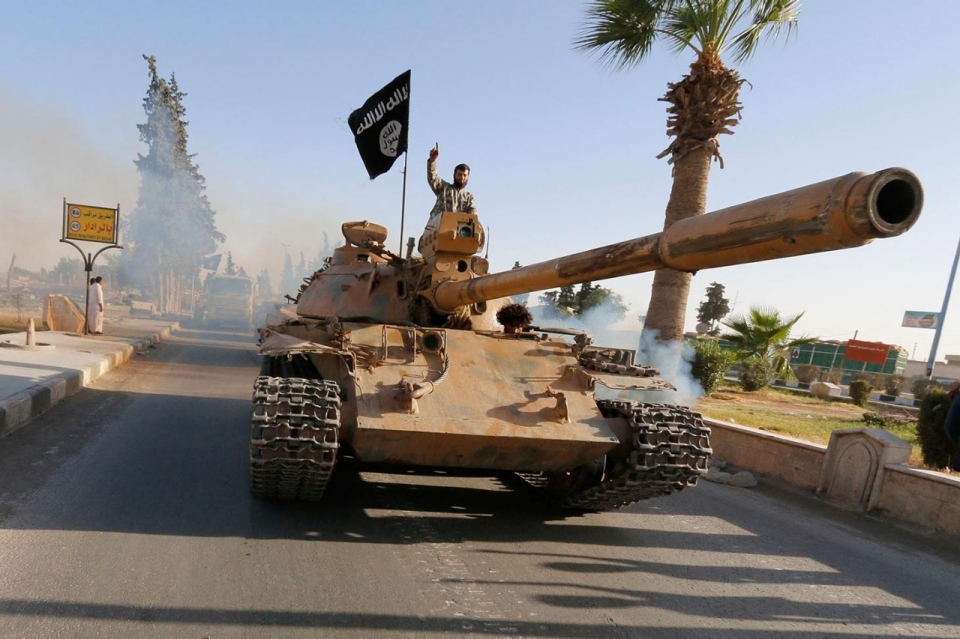
A New Grand Alliance to Defeat DAESH

image.adapt.960.high

Friends of Padre Steve’s World,

We are now waking up to the fourth day in the next phase of a war that began too long ago, a war that too many people have been victimized by, which only is getting worse and more widespread.

Winston Churchill wrote, “If Hitler invaded hell I would make at least a favorable reference to the devil in the House of Commons.” That may seem an odd statement, Churchill made it in reference to the alliance with the Soviet Union to defeat Hitler in World War Two, but it bears a particular relevance to the situation that we find ourselves in with ISIL, or as they are also known, DAESH.

This is a follow up to my posts of the last few days regarding the attacks of Islamic State supporters in Paris and it will not be the last. French President Hollande has correctly noted that the attack was an act of war, and he promised that the French campaign against DAESH would be ruthless. Hollande and other leaders, including President Obama are now beginning to plan a coordinated strategy to defeat DAESH. That being said, any real strategy to defeat DAESH has to include more than a few partners, it must be truly a grand alliance. 

I am a career military officer, an Iraq veteran and an anti-war liberal, but I am also a realist in terms of the world. I have no illusions about the world. I do not believe that the United States always acts with honor and I know in my heart of hearts that much of the chaos that we are seeing in the world, particularly the Middle East comes from years of misbegotten American intrigue and intervention. Of course the Americans were not the only ones involved in creating this mess, we can thank the French and the British for the Sykes-Picot agreement. That agreement and the subsequent post-war agreements artificially divided the Middle East based on British and French colonial interests and disregarded the traditional and historic interests of the people in the region. Those agreements also handed the Arabian Peninsula over to the House of Saud, rather than the more moderate Arabs that fought alongside the British against the Ottoman Empire. We can also thank the Russians for their contributions to the instability of the region, as well as the Israelis who in defending their interests have often made things worse. Finally we cannot forget the role played by many corrupt and despotic Arab leaders who have oppressed their people, and exploited their countries riches for their own gain. Finally, back to the Americans it was the ill-advised and criminal invasion of Iraq by the Bush administration that opened Pandora’s Box and unleashed what we now know as the Islamic State. Sadly, almost all the countries currently involved have had a hand in creating the monster that we know as DAESH and the Islamic State, and all should bear part of the responsibility for defeating it.

That being said, whether any of us like it or not we are at war, a war that has been going on in earnest since 2003. This is not a new war, it is simply DAESH’s continuation of the war that was declared by Al Qaeda, and that Al Qaeda Iraq fought against American, allied, and Iraqi forces from 2003 through 2011.

The genie of war is out of its bottle and it will not return on its own accord, and it will create more chaos, death and destruction, both in the Middle East, but also other parts of the world. The threats of DAESH need to be taken seriously and countered.

We have to understand that this war is not a movie, it is not a video game, and it has the potential to change all of our lives, and not for the better.

Likewise, the fight against DAESH will not be solved or won by military action alone. The falsehoods of the warn porn addicts who believe deploying ground troops without the support of the people in the region, nor dropping more bombs will win the war. President Obama noted correctly, in response to suggestions that large numbers of ground troops be deployed, “that that would be a mistake, because we would see a repetition of what we’ve seen before, which is if you do not have local populations that are committed to inclusive governance and who are pushing back against ideological extremes, that they resurface….” He is right for saying this because those who propose sending in large numbers of ground troops are not committed enough to the hard thing and fully mobilize the nation for war. Instead they would as they always do, put the burden of the war on an already worn out professional volunteer military force without being willing to work with other powers, even rivals that have an interest in defeating DAESH.

The full spectrum of national and international power must be deployed to fight DAESH. This includes the U.S., NATO, Russia, China, Japan, the Arab world, and even Iran. Yes, some of these nations are competitors and rivals, but all have a vested interest in defeating DAESH and all have capabilities that would be helpful in the fight. In the Second World War the President Franklin Roosevelt United States and Britain’s Prime Minister Winston Churchill allied themselves with the Josef Stalin and the Soviet Union in what was then known as the Grand Alliance to defeat Hitler. The Grand Alliance was a real world demonstration of the art of realpolitik. Realpolitik demands compromise and finding common ground with nations that we may not like. Those that practice realpolitik also understand that almost all alliances are temporary. This may be unsavory to idealists, but it is reality, and it is the only thing that will defeat DAESH. It is high time the world leaders to get real in combatting DAESH.

Military force seems always to be the first thing that people think of, and while important, it is not the only kind of power that must be used. If we are going to use military force, we need to work with our allies and commit ourselves to a massive use, on the order of World War II, and coupled with a massive new Marshal Plan for the Middle East. We must use diplomatic and economic power, intelligence and information, coordinate national and international law enforcement efforts, and seek to redress many of the wrongs committed against the people in the region.

Since I am a realist, I understand that whether I want it or not, that this war will most likely remain part of our lives, maybe for a generation or more. Honestly, if we do not make a full effort, I expect that a hundred years from now that young men and women will still be fighting this war. Most will have no idea how it began, even as their governments, corporations, and others make a steady profit off of the war.

I will continue this tomorrow with some thoughts on the civil liberties that we will undoubtedly lose as this war progresses. I think that I will write about the dangers of how xenophobic racists, and others who demonize all Moslems, and who want to punish all Moslems for the actions of DAESH, especially those who are the victims of DAESH who have fled to Europe and other areas to escape them. That is already beginning in this country. 

But that is all for today,

Peace

Padre Steve+

1 Comment

Filed under History, middle east, Military, national security, News and current events, Political Commentary

Coming this Week: Midway, D-Day and the Greatest Generation

Friends of Padre Steve’s World

I hope that your week is starting out well. This week promises to be interesting on Padre Steve’s World as I will be doing some writing about  the Battle of Midway and the Normandy landings. I have done a lot on both subjects before but will try to be doing something different with them. The reason why I do this is because both battles are important. Each in their own way was a watershed that helped to change the course of the war.

Now those who know me and probably many who regularly follow my writings know that I don’t readily fit into anyone’s mold. I am a career military officer, chaplain and military historian and I am certainly a liberal-progressive  in most of my politics, at least as defined in the current American political-ideological climate. I am a curious blend of idealist and realist, I like to think the best about my country, but know that we don’t always live up to the ideals enunciated in the Declaration of Independence. This makes me true minority group. But I digress…

Battle%20of%20Midway%20flat_080817160843

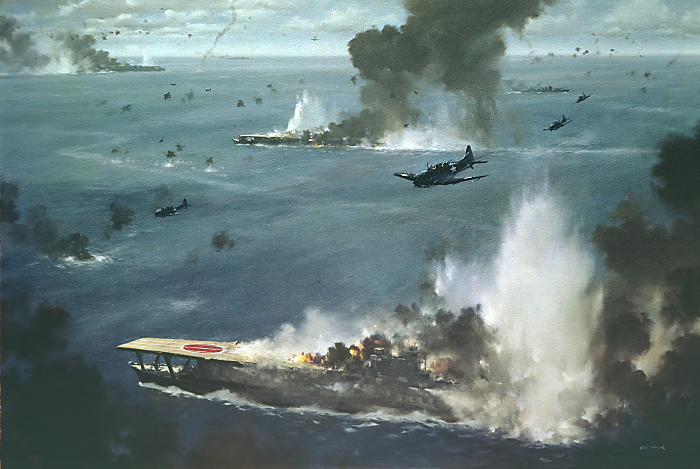
The Battle of Midway, which was fought on June 4-6 1942 turned back the previously undefeated Japanese Imperial Navy by all that the U.S. Navy had left, three aircraft carriers and a handful of surface ships in a classic David versus Goliath encounter. The battle is referred sometimes referred to, with good reason, as the Miracle at Midway or the Incredible Victory. Had the U.S. Navy lost at Midway, the Japanese would have held a dominant position in the Pacific, and though the United States would probably still won the war, it may have taken at least an extra  year, maybe more for that to happen.

british commandos d-day

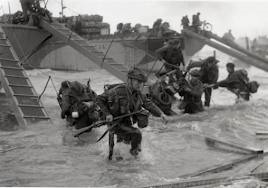
The Allied invasion of France on in Normandy was another watershed moment. In June 1944 Nazi Germany still had a stranglehold on much of Europe. Finally, the Allied Expeditionary Force under Dwight D. Eisenhower was ready to attack. It was the greatest amphibious operation ever conducted. Six Allied Infantry divisions and three Airborne Divisions supported by an invasion fleet of 5,000 ships and landing craft and thousands of warplanes were sent against the Germans. Had the invasion failed, the result would have been disastrous. The Germans would have been able to shift troops to the Eastern Front where Josef Stalin’s Soviet Red Army was about to launch its offensive on the German Army Group Center, an event that might have led to stalemate in the East.

Political pressure was already going against Winston Churchill and Franklin Roosevelt as the war continued and a defeat could have brought to power politicians in Britain and the United States willing to make a deal for peace with the Nazis. Such an occurrence would have led to even more genocide in Nazi occupied territories and the possibility of a Nazi atomic bomb, and please remember the Germans were far beyond the United States in building delivery systems, including ballistic missiles for such weapons. The thought of either instance is too horrifying to imagine. Likewise the thought of Imperial Japan continuing to rape China and Indochina, the East Indies and to possibly even to threaten Australia and India is equally horrifying.

These are things that more than seventy years later that we forget, to our detriment,  but they were the reality that our grandparents and great-grandparents who were part of that Greatest Generation faced.

Now, these seventy years later most of the men and women of that generation who defeated the mortal enemies of freedom, and I do not use that term flippantly are passing away. The young ones are in their late eighties, soon most will be gone, and the question has to be asked: Would we find the wherewithal to stand against mortal enemies of freedom, and then when the war was over, help them rebuild their shattered nations and turn former enemies into friends, even while ensuring that war criminals were brought to justice?

I would hope so, but I don’t know. I guess that is why I am a realist.

So until tomorrow I wish you a good night.

Peace

Padre Steve+

Leave a comment

Filed under History, leadership, Military, World War II at Sea, world war two in europe, world war two in the pacific

Vice Admiral Samuel Gravely Jr. Pioneer of Civil Rights

gravely

Vice Admiral Samuel Gravely Jr.

Vice Admiral Samuel Gravely Jr. is among the great pioneers of civil rights in the U.S. Military. The first African-American ever to be promoted to Flag rank he helped pave the way for so many others. Gravely understood the pressures on him at every stage of his career, He wrote:

“I was sure that I could not afford to fail. I thought that would affect other members of my race if I failed anywhere along the line. I was always conscious of that, particularly in midshipman school and any other schools I went to…I tried to set a record of perfect conduct ashore and at sea.” Vice Admiral Samuel Gravely

gravely_young

Fireman Recruit Samuel Gravely Jr. 

Things have changed much since 1942 when following the attack on Pearl Harbor a young black college student from Richmond Virginia enlisted in the Navy. Samuel Gravely Jr. was the son of a postal worker and Pullman porter while his mother worked as a domestic servant for white families in Richmond. His mother died unexpectedly when he was 15 in 1937 and he remained to help care for his siblings as his father continued to work. Balancing the care of his family with his education he enrolled in Virginia Union College, a Baptist school in Richmond.

It is hard to imagine for most of us now to comprehend the world that the young Gravely grew up in. Segregation was the norm. Blacks in the south and many other locations faced personal as well as entrenched institutional racism. Violence against blacks was quite common and the Ku Klux Klan was strong.

The military was still segregated and a great gulf existed between white military personnel and blacks. Though the selective service law of 1940 called for the conscription of people regardless of race, creed or color the services enjoyed much latitude in determining how minorities could serve. The Secretary of the Navy at the time, Frank Knox resisted integration. Knox determined that African Americans would remain segregated and serve only as Mess Stewards to “prevent undermining and disruptive conditions in the Navy.” Knox told President Roosevelt in the presence of black leaders that “because men live in such intimacy aboard ship that we simply can’t enlist Negroes above the rank of messman. “

That sentiment was strong in both the Navy and the Marines, even more so than in the Army and Army Air Corps. The leaders of both the Navy and Marine Corps resisted attempts to broaden the ability for African Americans to serve and urged that blacks serve in the Army, not the Naval Service.  Marine Corps Commandant Major General Thomas Holcomb agreed with this stance. He commented:

“If we are defeated we must not close our eyes to the fact that once in they [Negroes] will be strengthened in their effort to force themselves into every activity we have. If they are not satisfied to be messmen. they will not be satisfied to go into the constriction or labor battalions. Don’t forger the colleges are turning out a large number of well educated Negroes. I don’t know how long we will be able to keep them out of the V-7 class. I think not very long.”

But Roosevelt was not deterred and by April 1942 changes were announced to allow African Americans to serve in other capacities. Even so African Americans selected for ratings other than messman were to be segregated and commanded by White Officers and Petty Officers.

images-18

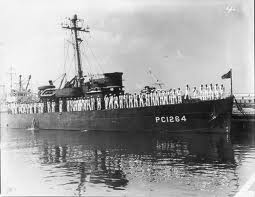
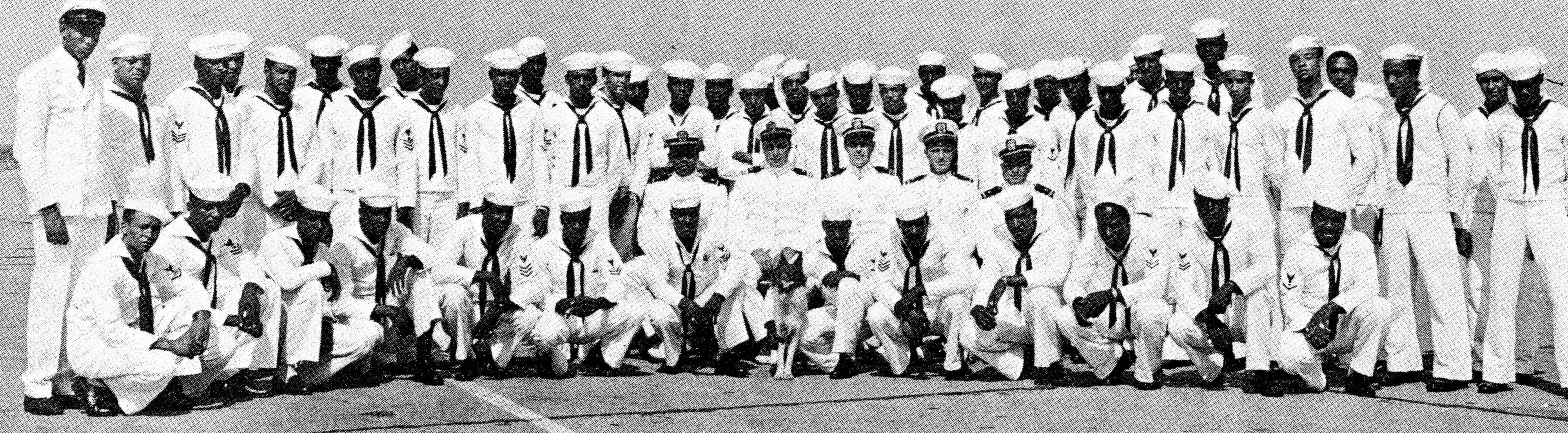
The USS PC-1264 and its crew, Gravely is the lone black officer

USS_PC-1264_officers_and_crew

Gravely enlisted in the Navy under these conditions. Serving as a Fireman Apprentice after receiving training as a Motor Machinist in San Diego he worked in menial jobs. In 1943 Gravely was one of only three sailors in his unit to be selected for the V-12 officer training program. He was the only black to make the cut. He was commissioned as an Ensign on December 14th 1944 and assigned to train black recruits at Great Lakes though the vast majority of his class went to sea. The was mainly due to the policy set forth by the General Board in 1942 that prescribed:

“(a) the white man will not accept the negro in a position of authority over him; (b) the white man considers that he is of a superior race and will not admit the negro as an equal; and (c) the white man refuses to admit the negro to intimate family relationships leading to marriage. These concepts may not be truly democratic, but it is doubtful if the most ardent lovers of democracy will dispute them, particularly in regard to inter-marriage.”

Despite this by 1945 the Navy was beginning to change. Gravely was chosen to serve on one of two ships assigned to the “experiment” of seeing how blacks in general ratings could serve at sea. The USS Mason (DE 539) and the USS PC-1264 were assigned black crews with majority white officers, except that Gravely was assigned to PC-1264. Though his commander was pleased with his service Gravely, who had been denied admittance to Officer Clubs and many other “white only” facilities resigned from the Navy in 1946. He believed that the inherent discrimination of the Navy left him no place for advancement. He returned to complete his bachelors degree at Virginia Union.

In 1949, following President Truman’s integration of the military Gravely was asked by the Navy to return to active duty. But the end of the old order was foreshadowed by a Navy pamphlet published in 1944 entitled The Guide to the Command of Negro Personnel. That publication included the statement that ”The Navy accepts no theories of racial differences in inborn ability, but expects that every man wearing its uniform be trained and used in accordance with his maximum individual capacity determined on the basis of individual performance.”

images-17

300px-USS_Taussig_(DD-746)_port_side_1965

cg29

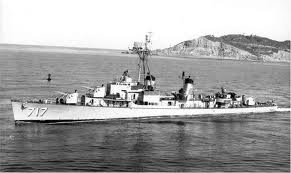
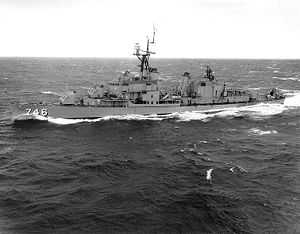
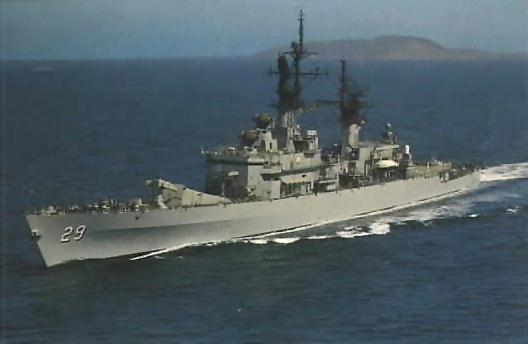
Gravely’s commands (top to bottom) USS Theodore E Chandler, USS Taussig and USS Jouett

Gravely accepted the offer to return to active duty and never looked back. He worked hard for respect and used his natural talents, personality and size to command respect. He was a man who would blaze the way for other African Americans, and later women and most recently gays to go on to greater things.

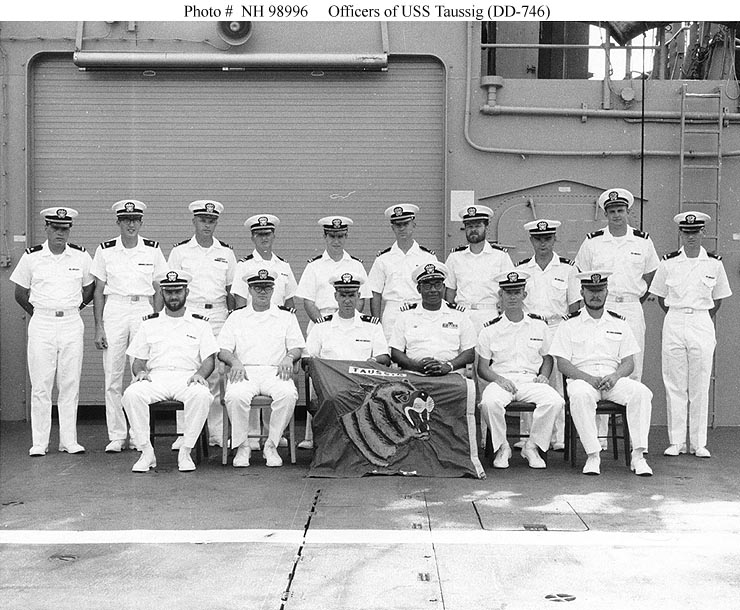
Gravely would go on to command three ships, all surface combatants. He was the first African American Naval Officer to command a Navy warship, the USS Theodore E Chandler (DD 717), the first to command a Navy ship in combat, the USS Taussig (DD 746) and the first to command a major warship, the USS Jouett (CG 29). Promoted to flag rank he eventually became the first to command a Fleet when he took command of 3rd Fleet. He retired in 1980 and passed away in 2004.

h98996

Commander Gravely and his officers on USS Taussig

Gravely gave his parents and conditions of his upbringing much credit for his success. He believed that those conditions which forced him to “capitalize on his strong points, build his weak areas and sustain the positive self-esteem and self-worth that his parents instilled in him as a young child.”

He was a great leader. LCDR Desiree Linson who interviewed him for her Air Command and Staff College project noted that Gravely like many other great military leaders before him learned to manage the image that he presented, be a caretaker for his people, what we would now call a mentor. He said “[If I was CNO] my responsibility would be to make sure enlisted men and families were taken care of. I would do everything in my power to make sure.”

Vice Admiral Gravely’s pursuit of excellence, self confidence and mastery of professional skills empowered him in an institution where he was still an anomaly and where racism still existed. He believed in effective communication, especially verbal communication and in building teams and in being a good follower, listening, learning and proactively anticipating the needs of his superiors. Gravely was also a believer in personal morality and self discipline and preparedness. He said:

“I did everything I could think of to prepare myself. If the opportunity came, I would be prepared for it. [The question would not be] “Why didn’t you prepare for this opportunity.” I would be prepared for whatever opportunity that came. If it came, fine. If it did not, fine, but I would be prepared if it did come.”

USS_Gravely

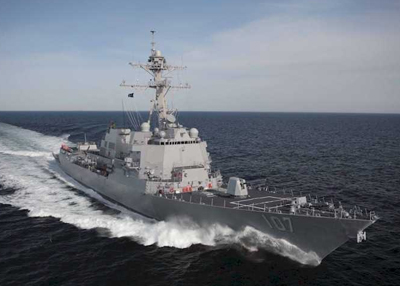
The USS Gravely DDG 107

Vice Admiral Gravely blazed a trail for those that followed him and set an example for all Naval Officers to follow. He did it under conditions that most of us could not imagine. I am proud to serve in the Navy that he helped to make.  I happen to work for an African-American Admiral at the Staff College, and I have served under African American commanders throughout every stage of my military career, in the Army and in the Navy. Admiral Gravely’s vision, service and memory are carried on in this navy and in the ship that bears his name, the USS Gravely DDG-107. Today that ship and her crew stand watch in defense of our nation and our friends around the world. It is a fitting tribute to such an amazing leader.

Peace

Padre Steve+

2 Comments

Filed under civil rights, History, Military, US Navy

December 6th 2014: Remembering the Illusion of Peace

Aerial_View_of_Attack_From_South_Dec_1941_-_1200x900

“A nation brought up on peace was going to war and didn’t know how.” Walter Lord 

December 6th 2014. For most Americans and Western Europeans this is time of peace. Well, at least the illusion of peace.

Tens of thousands of American, NATO and European Union troops operating in a number of mandates are in harm’s way. In some places like Afghanistan they are at war, in others attempting to keep the peace. Around the world regional conflicts, civil wars, insurgencies  and revolutions threaten not only regional peace but the world peace and economy.

Traditional national rivalries and ethnic and religious tensions especially in Asia and the broader Middle East have great potential to escalate into wars that should they actually break will involve the US, NATO and the EU, if not militarily economically and diplomatically.

Even the outright Russian aggression in Crimea and the Ukraine and the shoot down of Malaysian Airlines flight MH-17, or the stunning advance of the Islamic State in Iraq and Syria has not awoken the vast majority of Americans or Europeans to the dangers lurking in this world.

Like our ancestors on December 6th 1941 we live in a dream world an illusory world of peace. as W.H. Auden said in his poem September 1st 1939:

Defenseless under the night
Our world in stupor lies…

On December 6th 1941 the world was already at war and the United States was edging into the war. The blood of Americans has already been shed but for the vast majority of Americans the events in Europe and Asia were far away and not our problem. Though President Roosevelt had began the expansion of the military there were those in Congress seeking to demobilize troops and who fought all attempts at to intervene.

maltese-falcon

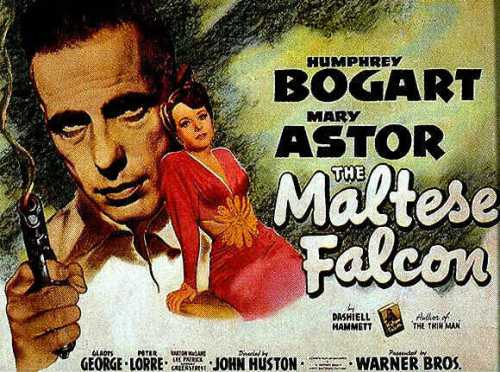
Most people went about their business that last furtive day of peace. People went about doing their Christmas shopping, going to movies like The Maltese Falcon staring Humphrey Bogart or the new short Tom and Jerry cartoon, The Night Before Christmas.

tom-and-jerry1

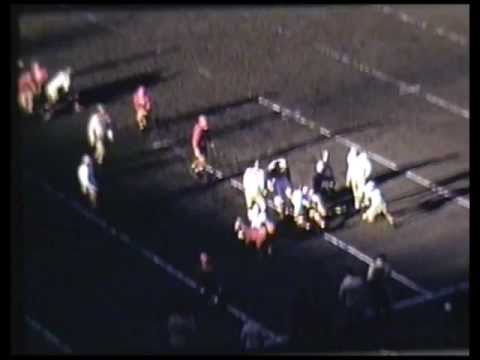
Others went to football games. UCLA and USC had played their annual rivalry game to a 7-7 tie, Texas crushed Oregon in Austin by a score of 71-7 while Texas A&M defeated Washington State in the Evergreen Bowl in Tacoma by a score of 7-0.
0-3a

But war was raging….

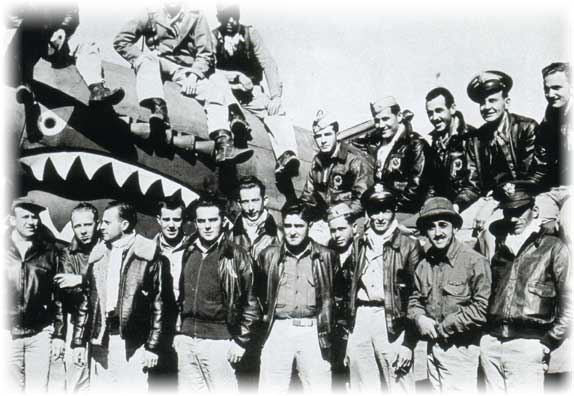
In Europe a Soviet counter-offensive was hammering a freezing and exhausted German Wehrmacht at the gates of Moscow. U-Boats were taking a distressing toll of ships bound for Britain including neutral US merchant ships and warships as well as the destroyer USS Reuben James. Volunteer American airmen were already in action against Japan, these men whose air group was known as the  Flying Tigers stood with the Nationalist Chinese against the Japanese invaders.

Flying_Tigers_personnel

War was everywhere but Americans lived in the dream world of the illusion of peace.

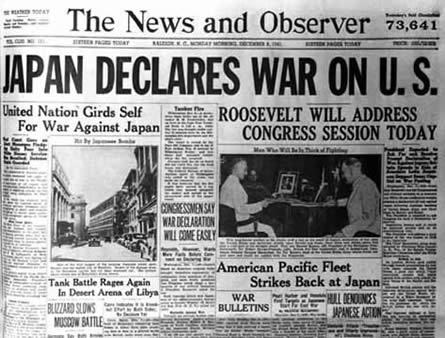
When the messages came out of Pearl Harbor the next morning it was already early afternoon on the East Coast. The Japanese Ambassador had been delayed in delivering the declaration of war, people across the country going about their Sunday business, going to church, relaxing or listening to the radio. Thus when war came, despite all the precursors and warnings war came. When it happened it took the nation by surprise. Walter Lord wrote in his classic account of the Pearl Harbor attack Day of Infamy: “A nation brought up on peace was going to war and didn’t know how.”
pearlharbor_paper

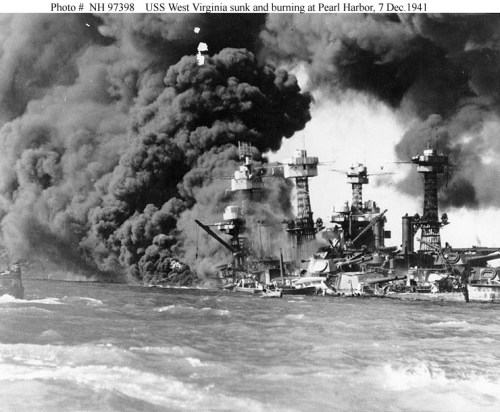
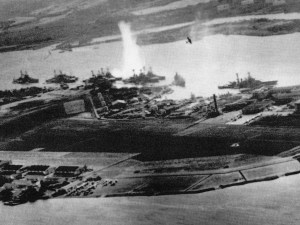
By the end of the day over 2400 Americans were dead and over 1200 more wounded. The battleships of the Pacific Fleet were shattered. 4 sunk, one grounded and 3 more damaged. 10 other ships were sunk or damaged in the attack. 188 aircraft were destroyed and 159 damaged.
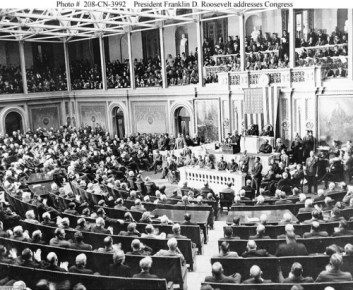
cn3992a

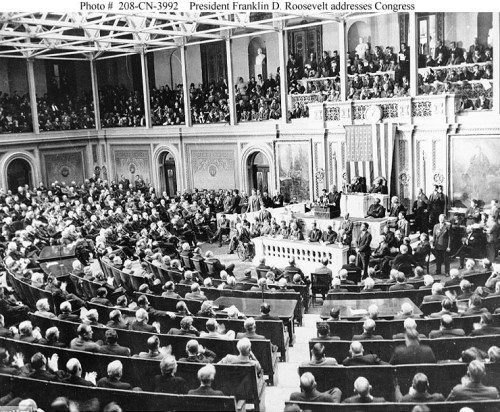
The next day President Franklin D. Roosevelt called the nation to action requesting that Congress declare war on Japan. http://www.youtube.com/watch?v=ufoUtoQLGQY

Mr. Vice President, and Mr. Speaker, and Members of the Senate and House of Representatives:

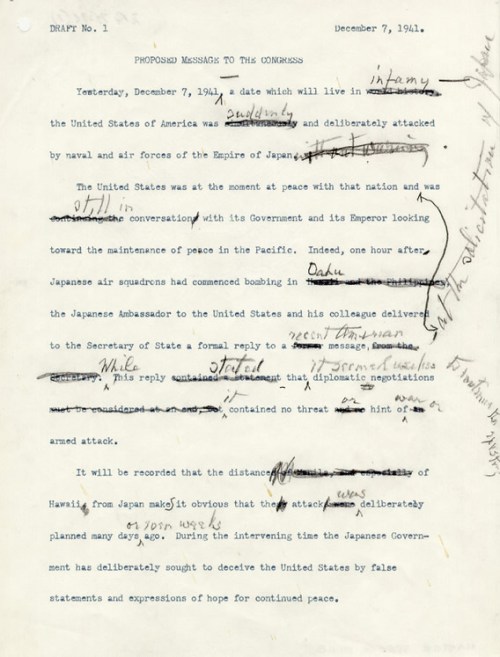
Yesterday, December 7, 1941 — a date which will live in infamy — the United States of America was suddenly and deliberately attacked by naval and air forces of the Empire of Japan.

The United States was at peace with that Nation and, at the solicitation of Japan, was still in conversation with its Government and its Emperor looking toward the maintenance of peace in the Pacific. Indeed, one hour after Japanese air squadrons had commenced bombing in the American Island of Oahu, the Japanese Ambassador to the United States and his colleague delivered to our Secretary of State a formal reply to a recent American message. And while this reply stated that it seemed useless to continue the existing diplomatic negotiations, it contained no threat or hint of war or of armed attack.

It will be recorded that the distance of Hawaii from Japan makes it obvious that the attack was deliberately planned many days or even weeks ago. During the intervening time the Japanese Government has deliberately sought to deceive the United States by false statements and expressions of hope for continued peace.

The attack yesterday on the Hawaiian Islands has caused severe damage to American naval and military forces. I regret to tell you that very many American lives have been lost. In addition American ships have been reported torpedoed on the high seas between San Francisco and Honolulu.

Yesterday the Japanese Government also launched an attack against Malaya.
Last night Japanese forces attacked Hong Kong.
Last night Japanese forces attacked Guam.
Last night Japanese forces attacked the Philippine Islands.
Last night the Japanese attacked Wake Island. And this morning the Japanese attacked Midway Island.

Japan has, therefore, undertaken a surprise offensive extending throughout the Pacific area. The facts of yesterday and today speak for themselves. The people of the United States have already formed their opinions and well understand the implications to the very life and safety of our Nation.

As Commander in Chief of the Army and Navy I have directed that all measures be taken for our defense.

But always will our whole Nation remember the character of the onslaught against us.

No matter how long it may take us to overcome this premeditated invasion, the American people in their righteous might will win through to absolute victory. I believe that I interpret the will of the Congress and of the people when I assert that we will not only defend ourselves to the uttermost but will make it very certain that this form of treachery shall never again endanger us.

Hostilities exist. There is no blinking at the fact that our people, our territory, and our interests are in grave danger.

With confidence in our armed forces- with the unbounding determination of our people- we will gain the inevitable triumph- so help us God.

I ask that the Congress declare that since the unprovoked and dastardly attack by Japan on Sunday, December 7, 1941, a state of war has existed between the United States and the Japanese Empire.

Today there are men and women from the United States and our NATO, European Union and who stand in harm’s way and some of them are dying.  Eleanor Roosevelt reflected:

“Lest I keep my complacent way I must remember somewhere out there a person died for me today. As long as there must be war, I ask and I must answer was I worth dying for?”

Wars, revolutions and other tensions in other parts of the world threaten on every side, but most Americans and Europeans live in the illusion of peace.

A very few professionals are given the task of preparing for and fighting wars that are fomented by often brought about by the willful malfeasance or stunningly ignorant policies of the Politicians, Pundits and Preachers, the Trinity of Evil.  As such many have no idea of the human, material and spiritual cost of war and when it comes again in all of its awful splendor few will be prepared.

We do not know what tomorrow will bring and unfortunately for the vast bulk of Americans and Western Europeans the comments of W.H. Auden are as applicable today as they were when he penned them.

Peace

Padre Steve+

Leave a comment

Filed under Foreign Policy, History, national security, Political Commentary, world war two in the pacific

Remembering the “Mighty Hood” and the Battle of the Denmark Strait

hms-hood-sinking11Artist rendition of the Loss of the HMS Hood

Seventy-three years ago today the “Mighty Hood” was sunk by the German Battleship Bismarck. It is an anniversary that I always mark. I first read about this battle in C.S Forrester’s little book Hunting the Bismarck which was used as the screenplay for the 1960 film Sink the Bismarck. This essay is in honor of the gallant HMS Hood and her crew.  It is fitting although the HMS Hood and her killer, the German battleship Bismarck were American. Both were great ships manned by gallant crews and the loss of both ships was tragic, especially from the aspect of the great loss of human life. May we never forget the sacrifice of these men and all others who have gone down to the sea in great ships.

hood-malta1HMS Hood at Malta

There are some warships and naval engagements which assume legendary proportions.  The Battle of the Denmark Strait on 24 May 1941 between the two largest battleships in commission at the time, the pride of the British Royal Navy the HMS Hood and the German behemoth Bismarck is legendary as are those two mighty ships.  The battle came at a critical time as the Britain stood alone against the seemingly invincible German Blitzkrieg.

hood-at-san-francisco1Hood in San Francisco on 1920s goodwill tour

Britain had been driven from Western Europe and was being bombed regularly by Herman Goering’s Luftwaffe while a British expeditionary force that had been sent to Greece had been defeated and the Germans were assaulting Crete with airborne forces.  In the Western Desert the Afrika Korps under Field Marshall Erwin Rommel had driven off a British counter-offensive on the Libyan-Egyptian frontier and were laying siege to Tobruk and in the Atlantic German U-Boats sank 66 Allied Merchant Ships of over 375,000 tons and the Royal Navy would lose 25 warships not including the Hood.

hms_hood_march_17_19241

The Hood was the pride of the Royal Navy and was world famous due to her inter-war international presence and goodwill visits.  Displacing 47,430 tons full load she was armed with eight 15” guns in four twin turrets.  Designed as a battle cruiser she was less heavily armored than contemporary battleships and had very weak vertical protection from plunging shellfire.  This was a fault which was known but never rectified between the wars and when the war came the Royal Navy could ill-afford to take her out of service for the necessary improvements to her protection system.  She was fast with a designed speed of 31 knots which been reduced to 28 knots by 1939 as a result of modifications which increased her displacement.   This was further reduced by the wear and tear on her propulsion plant to 26.5 knots by 1940.

Hood was designed before the battle of Jutland (May 1916) where the weaknesses in the armor protection of British Battlecruisers was exposed as three, the HMS Invincible, HMS Queen Mary and HMS Indefatigable were destroyed by plunging fire which exploded their magazines.  Though her design was modified during construction she still was vulnerable to plunging fire. She was scheduled for a major refit which would have included significant improvement in armor protection in 1941 but the war prevented the Hood from receiving anything more than improvements to her anti-aircraft batteries.

Combat1lgHood (nearly hidden by falling shells) in action at Mers-El-Kebir

During the war Hood was engaged in patrol and search operations against German raiders in the North Atlantic and in June 1940 joined Force “H” in the Mediterranean.  As Flagship of Force “H” she took part in the sinking of French Fleet Units including the Battleship Bretagne at Mers-El-Kebir on 3 July 1940 following the French surrender to the Germans and remained in operation searching for the German Pocket Battleship Admiral Scheer and Heavy Cruiser Admiral Hipper until she was withdrawn for a brief refit in January 1941. Following another brief refit in mid-March, Hood was underway from mid-March searching for the German raiders Scharnhorst and Gneisenau and a false report of Bismarck breaking out into the Atlantic in April 1941. She returned to Scapa Flow on 6 May 1941.

bismarck1Bismarck

When the British discovered that Bismarck had entered the Atlantic, Hood as the flagship of Vice Admiral Lancelot Holland was dispatched with the newly commissioned battleship HMS Prince of Wales to join the Heavy Cruisers HMS Suffolk and HMS Norfolk at the entrance to the Denmark Strait.  When the cruisers discovered Bismarck along with her consort the Heavy Cruiser Prinz Eugen the two British battleships steamed into naval history.

flagshippg213

Bismarck was slightly larger than Hood and mounted the same main armament but that was about all the two ships had in common. If the battle was a battle between heavyweight prize fighters Hood was the valiant but crippled champion and Bismarck the young and overpowering challenger.  Bismarck was slightly faster than the limping Hood and was one of the most well protected ships ever built.  Her gunnery officers and the men that manned those deadly 15” guns were like previous generations of German sailors’ gunnery experts working some of the finest naval guns ever made.

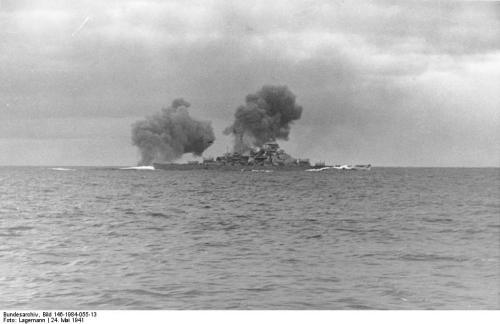
Schlachtschiff Bismarck, SeegefechtBismarck firing on Hood

gallbismdenmarkstrait11

The German ships shadowed at a distance by the Norfolk and Suffolk German task force under the command of Admiral Gunther Lütjens emerged from the strait and was sighted by the British at 0537.  Knowing his ship’s weakness in regard to plunging fire Admiral Holland desired to steer a direct course at the German ships in order to close the range quickly. Events dictated otherwise and the British were forced to close the range much more slowly and exposing Hood and Prince of Wales to German plunging fire for a longer period of time.  Holland turned to close faster with the result that his gunnery was degraded by wind and spray coming over the bows of his ships and the inability to fire his after turrets.

hood0231Hood from Prince of Wales moments before being hit and sunk

At 0553 Holland ordered his ships to open fire without the benefit of Suffolk and Norfolk being in position to engage the Prinz Eugen.  The Hood initially concentrated her fire on Prinz Eugen assuming her to be the Bismarck while Prince of Wales engaged Bismarck.  Prince of Wales drew first blood striking Bismarck three times. One which damaged her seaplane catapult, a second which did minor damage to machinery spaces and a third which passed through the bow near the waterline which severed fuel lines from her forward fuel tanks.

prinzeugen-21Prinz Eugen

Both German ships opened fire at 0555 concentrating on the Hood.  Prinz Eugen immediately hit Hood with at least one 8” shell which set a large fire among the ready to use 4”ammunition stored in lockers near the mainmast. The hit started a large fire which Hood’s damage control teams raced to contain.  At 0600 Holland ordered his ships to turn to port in order to bring his rear turrets into the fight. As the squadron executed the turn Hood was straddled by a salvo from Bismarck and observers on Prince of Wales observed an explosion between “X” turret and the mainmast which consumed the Hood causing her bow to jut sharply out of the water before sinking beneath the waves in under 3 minutes time. Witnesses on both sides of the engagement were stunned by the sudden and violent end of the Hood and the Germans rapidly shifted fire to the Prince of Wales knocking her out of the action.  Against the advice of Bismarck’s Captain Ernst Lindemann, Lütjens did not follow up his advantage to sink the crippled British ship.

hood_explosion_sketch1Hood blows up. Drawing by the Captain of HMS Prince of Wales J.C. Leach

Only three crewmen Petty Officer Ted Briggs, Seaman Bob Tilburn and Midshipman Bill Dundas survived the sinking of Hood out of a total of 1415 souls embarked. They were rescued 4 hours later nearly dead of hypothermia staying awake by sinking “Roll out the Barrel” by the destroyer HMS Electra.

hood_blowup1

Briggs who died in 2008 recounted the sinking:

“Then she started listing to starboard. She righted herself, and started going over to port. When she had gone over by about 40 degrees we realised she was not coming back…” Briggs was sucked under the water “I had heard it was nice to drown. I stopped trying to swim upwards. The water was a peaceful cradle – I was ready to meet my God. My blissful acceptance of death ended in a sudden surge beneath me, which shot me to the surface like a decanted cork in a champagne bottle. I turned, and 50 yards away I could see the bows of the Hood vertical in the sea. It was the most frightening aspect of my ordeal, and a vision which was to recur terrifyingly in nightmares for the next 40 years.” (The Daily Telegraph 5 October 2008)

briggs1Ted Briggs

tilburn4111Bob Tilburn

The Admiralty reported the loss of the Hood later in the day saying Hoodreceived an unlucky hit in a magazine and blew up.”  The official report of the sinking released later in the year said:

That the sinking of Hood was due to a hit from Bismarck’s 15-inch shell in or adjacent to Hood’s 4-inch or 15-inch magazines, causing them all to explode and wreck the after part of the ship. The probability is that the 4-inch magazines exploded first.”

The commission’s findings have been challenged by a number of naval historians and there are several theories of how the magazines might have exploded but all point to a massive magazine explosion but probably not due to a plunging round but from another hit which detonated the unprotected 4” magazines or a hit from Bismarck below Hood’s waterline which stuck a magazine.  Hood’s wreckage was located in 2001 lying across two debris fields and the examination revealed that the after magazines had exploded.  The site is designated as a War Grave by Britain and protected site under the Protection of Military Remains Act of 1986.

bismarck-sinking1Bismarck sinking

Bismarck and her crew did not long survive her victory being crippled by a lucky aerial torpedo hit from a Fairley Swordfish bomber flying from the HMS Ark Royal on 26 May and being scuttled by her crew after absorbing massive damage from the HMS King George V, HMS Rodney and several cruisers including HMS Dorsetshire the plucky and persistent Norfolk and several destroyers. When she went down she took with her all but 115 souls of her crew of over 2200 which included the Fleet Staff of Admiral Lütjens.

hms-prince-of-wales1HMS Prince of Wales

Prince of Wales would take Winston Churchill to Argentia Bay Newfoundland to meet with Franklin Roosevelt from 9-12 August 1941 where the Atlantic Charter was drafted. She reported to the Far East where she was sunk along with the Battlecruiser HMS Repulse on 9 December 1941 by a force of land based Japanese aircraft.  The Prinz Eugen was the only heavy ship of the German Navy to survive the war and was taken by the US Navy at the end of the war. She was expended as a target during the Able and Baker nuclear tests at Bikini Atoll.  Too radioactive to be repaired she was towed to Kwajalein Atoll where she capsized and sank on 22 December 1946. Her wreck is still visible.

The loss of the Hood traumatized the people of Britain and the Royal Navy; she had been the symbol of British Naval power for over 20 years and people around the world were likewise stunned at her demise. The sinking of the Hood and the loss of her crew was a tragedy which all sailors assigned to large and prestigious ships and the nations that they sail for need to keep in mind.

No matter how mighty any ship may be, every ship has an Achilles heel and no ship is unsinkable.  Of the over 3600 officers and crew of the Hood and the Bismarck only 118 survived.

dundasw1

I will remember the Hood, her gallant crew especially my very distant relative Midshipman Bill Dundas who I never met.  He left the Royal Navy about 1960 and was killed in a car wreck in 1965.  According to the Hood Association website he was troubled by the sinking for the rest of his life.  One can understand.

Peace

Padre Steve+

4 Comments

Filed under History, Military, Navy Ships, world war two in europe

D-Day: Brigadier General Theodore “Ted” Roosevelt III Lands at Utah Beach

Theodore Roosevelt Jr4

“Courage, above all things, is the first quality of a warrior.” Carl Von Clausewitz

By the standards of military service on the front line the man was ancient. He was 56 years old, had arthritis and a history of heart problems, but he was his father’s son.

The oldest man to land on the beaches of Normandy was the son of a President, Theodore “Teddy” Roosevelt who had taken leave of his office as Assistant Secretary of the Navy at the outset of the Spanish-American War. With the help of his friend Colonel Leonard Wood, Roosevelt formed the legendary First U.S. Volunteer Cavalry Regiment, the “Rough Riders” and led them in the fight at the Battle of San Juan Hill.

The son of the President entered the business world and then served as a Reserve officer and since he had received prior military training was commissioned as a Major when the United States entered World War One. He volunteered for overseas service and served as a battalion commander and later as commander of the 26th Infantry Regiment of the 1st Infantry Division. Leading from the front he was wounded and gassed at Soissons in 1918. For his service he was awarded the Distinguished Service Cross and the French Chevalier Légion d’honneur.

After the war he helped found the American Legion and entered politics and was elected to the New York State Assembly. However while serving as Assistant Secretary of the Navy in the Harding Administration he was linked to the Teapot Dome Scandal and though cleared of any wrongdoing his name was tarnished. Opposed by his cousin Franklin Delano Roosevelt his political fortunes in elected offices floundered. However he was appointed as Governor of Puerto Rico and later Governor-General of the Philippines a post that he served until 1935 when he returned to the United States and the business world serving as an executive with American Express.

Between the wars “Ted” continued his Army Reserve service attending his annual training periods as well as attending the Infantry Officer Basic and Officer Advanced Courses as well as the Command and General Staff College. When war came to Europe he again volunteered for active service, attended a refresher course and was promoted to Colonel in the Army Reserve. Mobilized in April 1940 he was given command of his old 26th Infantry Regiment assigned to the First Infantry Division and was promoted to Brigadier General in late 1941 becoming the Assistant Division Commander.

Ted_Cane_France

He served well in that role in North Africa and Sicily and earned citations for bravery being constantly on the front lines with his soldiers. However his association with the Division Commander, the unorthodox Terry Allen earned the enmity of George Patton and Omar Bradley. Patton disliked Allen and hated the way both Allen and Roosevelt eschewed “spit and polish” and “dressed down,” often wearing unauthorized uniform items. After Bradley assumed command of 7th Army he relieved both officers, believing that they were guilty of “loving their division too much” something that he admitted was one of the hardest decisions that he made in the war. Roosevelt served as a liaison officer with the Free French Forces in Italy before returning to England to assume duties as Assistant Division Commander of the 4th Infantry Division. Allen would go on to command the 104th Infantry Division in an exemplary manner during the command’s in France and Germany in 1944-45 with even Bradley praising him and his new division as one of the best in Europe.

TeddyJr5-530x414

Roosevelt constantly trained with the troops and asked his commander, Major General Raymond “Tubby” Barton for permission to land with the first wave in the invasion. After being denied twice Roosevelt put his request to Barton in writing:

“The force and skill with which the first elements hit the beach and proceed may determine the ultimate success of the operation…. With troops engaged for the first time, the behavior pattern of all is apt to be set by those first engagements. [It is] considered that accurate information of the existing situation should be available for each succeeding element as it lands. You should have when you get to shore an overall picture in which you can place confidence. I believe I can contribute materially on all of the above by going in with the assault companies. Furthermore I personally know both officers and men of these advance units and believe that it will steady them to know that I am with them.”

Barton reluctantly approved the request not expecting Roosevelt to survive the landings. Roosevelt was in the first wave of assault troops at Utah Beach. On landing he discovered that the first wave was about a mile off course. Armed with a pistol and supported by a cane Roosevelt led a reconnaissance to find the causeways off the beach. He briefed the battalion commanders and then ordered an attack from where the troops had landed telling his officers “We’ll start the war from right here!” a moment immortalized in the film The Longest Day in which Henry Fonda played Roosevelt.

fon2

Henry Fonda Portrays Brigadier General Theodore “Ted” Roosevelt III in “The Longest Day”

His actions were key in the success of the Utah Beach landings and he was recommended for the Distinguished Service Cross by General Barton. Just over a month after the invasion after continuously leading his troops in Normandy Roosevelt died of a heart attack on July 12th 1944, the very day he had been selected for his second star and promotion to Major General and had orders to take command of the 90th Infantry Division. His award was upgraded to the Congressional Medal of Honor which was posthumously awarded on September 28th 1944. He was buried in the American Cemetery in Normandy, the remains of his younger brother Quentin who had been killed in the First World War were exhumed and interred next to his in 1955.

The Medal of Honor citation reads:

For gallantry and intrepidity at the risk of his life above and beyond the call of duty on 6 June 1944, in France. After 2 verbal requests to accompany the leading assault elements in the Normandy invasion had been denied, Brig. Gen. Roosevelt’s written request for this mission was approved and he landed with the first wave of the forces assaulting the enemy-held beaches. He repeatedly led groups from the beach, over the seawall and established them inland. His valor, courage, and presence in the very front of the attack and his complete unconcern at being under heavy fire inspired the troops to heights of enthusiasm and self-sacrifice. Although the enemy had the beach under constant direct fire, Brig. Gen. Roosevelt moved from one locality to another, rallying men around him, directed and personally led them against the enemy. Under his seasoned, precise, calm, and unfaltering leadership, assault troops reduced beach strong points and rapidly moved inland with minimum casualties. He thus contributed substantially to the successful establishment of the beachhead in France.

Roosevelt’s story is quite amazing. In the modern wars of the late 20th and early 21st Centuries few commanders as senior as Roosevelt would ever be in the first wave of an invasion or offensive operation. The personal courage and example set by Roosevelt in both World Wars, leading from the front and maintaining relationships with the troops that he commanded in combat is something that we talk about a lot in various military leadership classes but often seems to be smothered by business models promoted by think tanks and others with money to be made.

Likewise, a commander suffering from Roosevelt’s infirmities would not be allowed to command troops in combat today. But in the Second World War when many other American Generals failed miserably and often could not be found near the front and were relieved of command for incompetence and cowardice the old, crippled and infirm Roosevelt led from the front. He made decisions on Utah Beach on D-Day that helped ensure that the landings were a success. Bradley, who had fired Roosevelt after the Sicilian Campaign with Allen said that the most heroic act that he had seen in combat was “Ted Roosevelt on Utah Beach.”

Roosevelt was an exception to Clausewitz’s axiom that “boldness becomes rarer, the higher the rank.” I think that even if a General wanted to lead in the manner of Roosevelt today that he would be punished by the institution for risking himself.

Peace

Padre Steve+
Leave a comment

Filed under History, Military, movies, world war two in europe

Vice Admiral Samuel Gravely Jr: Pioneer of Integration and Civil Rights in the U.S. Navy

gravely

“I was sure that I could not afford to fail. I thought that would affect other members of my race if I failed anywhere along the line. I was always conscious of that, particularly in midshipman school and any other schools I went to…I tried to set a record of perfect conduct ashore and at sea.” Vice Admiral Samuel Gravely

Things have changed much since 1942 when following the attack on Pearl Harbor a young black college student from Richmond Virginia enlisted in the Navy. Samuel Gravely Jr. was the son of a postal worker and Pullman porter while his mother worked as a domestic servant for white families in Richmond. His mother died unexpectedly when he was 15 in 1937 and he remained to help care for his siblings as his father continued to work. Balancing the care of his family with his education he enrolled in Virginia Union College, a Baptist school in Richmond.

gravely_young

Fireman Apprentice Samuel Gravely Jr

It is hard to imagine for most of us now to comprehend the world that the young Gravely grew up in. Segregation was the norm. Blacks in the south and many other locations faced personal as well as intrenched institutional racism. Violence against blacks was quite common and the Ku Klux Klan was strong.

The military was still segregated and a great gulf existed between white military personnel and blacks. Though the selective service law of 1940 called for the conscription of people regardless of race, creed or color the services enjoyed much latitude in determining how minorities could serve. The Secretary of the Navy at the time, Frank Knox resisted integration. Knox determined that African Americans would remain segregated and serve only as Mess Stewards to “prevent undermining and disruptive conditions in the Navy.” Knox told President Roosevelt in the presence of black leaders that “because men live in such intimacy aboard ship that we simply can’t enlist Negroes above the rank of messman. “

That sentiment was strong in both the Navy and the Marines the leaders of which resisted attempts to broaden the ability for African Americans to serve and urged that blacks serve in the Army, not the Naval Service.  Marine Corps Commandant Major General Thomas Holcomb agreed with this stance. He commented:

“If we are defeated we must not close our eyes to the fact that once in they [Negroes] will be strengthened in their effort to force themselves into every activity we have. If they are not satisfied to be messmen. they will not be satisfied to go into the constriction or labor battalions. Don’t forger the colleges are turning out a large number of well educated Negroes. I don’t know how long we will be able to keep them out of the V-7 class. I think not very long.”

But Roosevelt was not deterred and by April 1942 changes were announced to allow African Americans to serve in other capacities. Even so African Americans selected for ratings other than messman were to be segregated and commanded by White Officers and Petty Officers.

USS_PC-1264_officers_and_crew

images-18

The USS PC-1264 and its crew, Gravely is the lone black officer

Gravely enlisted in the Navy under these conditions. Serving as a Fireman Apprentice after receiving training as a Motor Machinist in San Diego he worked in menial jobs. In 1943 Gravely was one of only three sailors in his unit to be selected for the V-12 officer training program. He was the only black to make the cut. He was commissioned as an Ensign on December 14th 1944 and assigned to train black recruits at Great Lakes though the vast majority of his class went to sea. The was mainly due to the policy set forth by the General Board in 1942 that prescribed:

“(a) the white man will not accept the negro in a position of authority over him; (b) the white man considers that he is of a superior race and will not admit the negro as an equal; and (c) the white man refuses to admit the negro to intimate family relationships leading to marriage. These concepts may not be truly democratic, but it is doubtful if the most ardent lovers of democracy will dispute them, particularly in regard to inter-marriage.”

Despite this by 1945 the Navy was beginning to change. Gravely was chosen to serve on one of two ships assigned to the “experiment” of seeing how blacks in general ratings could serve at sea. The USS Mason (DE 539) and the USS PC-1264 were assigned black crews with majority white officers, except that Gravely was assigned to PC-1264. Though his commander was pleased with his service Gravely, who had been denied admittance to Officer Clubs and many other “white only” facilities resigned from the Navy in 1946. He believed that the inherent discrimination of the Navy left him no place for advancement. He returned to complete his bachelors degree at Virginia Union.

In 1949, following President Truman’s integration of the military Gravely was asked by the Navy to return to active duty. But the end of the old order was foreshadowed by a Navy pamphlet published in 1944 entitled The Guide to the Command of Negro Personnel. That publication included the statement that ”The Navy accepts no theories of racial differences in inborn ability, but expects that every man wearing its uniform be trained and used in accordance with his maximum individual capacity determined on the basis of individual performance.”

images-17

300px-USS_Taussig_(DD-746)_port_side_1965

cg29

Gravely’s commands (top to bottom) USS Theodore E Chandler, USS Taussig and USS Jouett

Gravely accepted the offer to return to active duty and never looked back. He worked hard for respect and used his natural talents, personality and size to command respect. He was a man who would blaze the way for other African Americans, and later women and most recently gays to go on to greater things. Gravely would go on to command three ships. He was the first African American Naval Officer to command a Navy warship, the USS Theodore E Chandler (DD 717), the first to command a Navy ship in combat, the USS Taussig (DD 746) and the first to command a major warship, the USS Jouett (CG 29). Promoted to flag rank he eventually became the first to command a Fleet when he took command of 3rd Fleet. He retired in 1980 and passed away in 2004.

h98996

Commander Gravely and his officers on USS Taussig

Gravely gave his parents and conditions of his upbringing much credit for his success. He believed that those conditions which forced him to “capitalize on his strong points, build his weak areas and sustain the positive self-esteem and self-worth that his parents instilled in him as a young child.”

He was a great leader. LCDR Desiree Linson who interviewed him for her Air Command and Staff College project noted that Gravely like many other great military leaders before him learned to manage the image that he presented, be a caretaker for his people, what we would now call a mentor. He said “[If I was CNO] my responsibility would be to make sure enlisted men and families were taken care of. I would do everything in my power to make sure.”

His pursuit of excellence, self confidence and mastery of professional skills empowered him in an institution where he was still an anomaly and where racism still existed. He believed in effective communication, especially verbal communication and in building teams and in being a good follower, listening, learning and proactively anticipating the needs of his superiors. Gravely was also a believer in personal morality and self discipline and preparedness. He said:

“I did everything I could think of to prepare myself. If the opportunity came, I would be prepared for it. [The question would not be] “Why didn’t you prepare for this opportunity.” I would be prepared for whatever opportunity that came. If it came, fine. If it did not, fine, but I would be prepared if it did come.”

USS_Gravely

The USS Gravely

Vice Admiral Gravely blazed a trail for those that followed him and set an example for all Naval Officers to follow. He did it under conditions that most of us could not imagine. I am proud to serve in the Navy that he helped to make.  His vision, service and memory are carried on in this navy and in the ship that bears his name, the USS Gravely DDG-107.

Peace

Padre Steve+

3 Comments

Filed under History, laws and legislation, leadership, Military, Navy Ships, US Navy

Feet of Clay: The Common Flaw of the Best and Brightest

Charlene and Michel de Carvalho

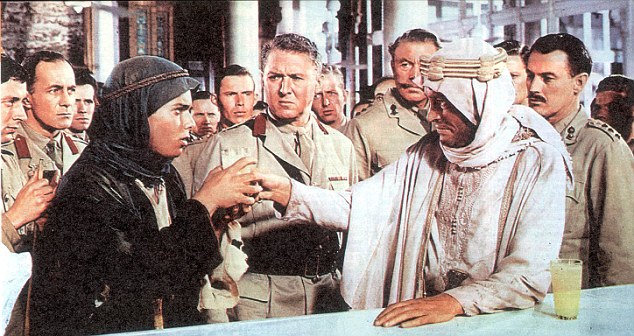
General Allenby: [leafing through Lawrence’s dossier] “Undisciplined… unpunctual… untidy. Knowledge of music… knowledge of literature… knowledge of… knowledge of… you’re an interesting man there’s no doubt about it.” 

Character is a terrible thing to judge. Mostly because those doing the judging also suffer from flaws in their own character.  Yet somehow the temptation is for us to stand as judge, jury and character executioner on those that we find wanting. As a culture we like tearing down those that we at one time built up. It is a rather perverse proclivity that we have as human beings, especially if we can find some kind of religious justification for it.

I think that is part of the complexity of the human condition. As a historian I find that the most exalted heroes, men and women of often great courage both moral and physical, intellect, creativity, humanity and even compassion have feet of clay.

I find that I am attracted to those characters who find themselves off the beaten track. Visionaries often at odds with their superiors, institutions, and sometimes their faith and traditions. Men and women who discovered in themselves visions for what might be and pursued those visions, sometimes at the costs of their families, friends, and in quite a few cases their lives.

Throughout my studies I have been attracted to men as diverse as Peter the Apostle, Martin Luther, T.E. Lawrence, Dietrich Bonhoeffer, Erwin Rommel, Admiral Horatio Nelson, Abraham Lincoln, John F Kennedy, Dwight D Eisenhower, Franklin Roosevelt, Dr Martin Luther King Jr, Jackie Robinson, Teresa of Avila, Nelson Mandela, Vaclav Havel and Emir Feisal Hussein of the Arab Revolt. All had flaws. Some involved fits of temper and violence, others sexual escapades, mistresses, affairs, greed avarice, and maybe some that stretched law and morality in their quest to achieve their goals. But all are considered great men and women.

Feet of clay. Who doesn’t have them? But them I think that I would rather have feet of clay than a heart of stone, an an unchallenged mind, or a lack of courage to do the right thing even if it does not directly benefit me.

Tonight I watched for the first time straight through the cinema classic Lawrence of Arabia. Peter O’Toole plays Lawrence in a most remarkable manner, showing his brilliance, courage, diplomatic ability and understanding of the Arabs with whom he served.

There are many people, leaders and others that we encounter in life or that we study. Even the best of the best are flawed and there is no such thing as a Saint who never sinned. But we love destroying them and their memory when to our “surprise” when we find that their hagiographers built them into an idol.

I am a great believer in redemption and the weight of the whole of a person’s life. Thus I try to put the flaws as they are called in perspective and their impact both positive and negative in history. Studying in this way gives me a greater perspective on what it is to be human and to place my own clay feet in appropriate perspective.

It was an interesting film to watch.

However, speaking of feet of clay I will probably be writing about the Baseball Writers who vote for the inductees for the Hall of Fame. Today for the first time in nearly 4 decades no players were selected for induction, mostly due to the steroid era. But that is a subject for another night.

Peace

Padre Steve+

1 Comment

Filed under faith, film, History

The Illusion of Peace: Remembering the Day Before Pearl Harbor

h97398

“A nation brought up on peace was going to war and didn’t know how.” Walter Lord 

For most Americans and Western Europeans this is time of peace. Well, at least the illusion of peace.

Tens of thousands of American, NATO and European Union troops operating in a number of mandates are in harm’s way. In some places like Afghanistan they are at war, in others attempting to keep the peace. Around the world regional conflicts, civil wars, insurgencies  and revolutions threaten not only regional peace but the world peace and economy. Traditional national rivalries and ethnic and religious tensions especially in Asia and the broader Middle East have great potential to escalate into wars that should they actually break will involve the US, NATO and the EU, if not militarily economically and diplomatically.

But, we live in a dream world an illusory world of peace. as W.H. Auden said in his poem September 1st 1939:

Defenseless under the night
Our world in stupor lies…

On December 6th 1941 the world was already at war and the United States was edging into the war. The blood of Americans has already been shed but for the vast majority of Americans the events in Europe and Asia were far away and not our problem. Though President Roosevelt had began the expansion of the military there were those in Congress seeking to demobilize troops and who fought all attempts at to intervene.

maltese-falcon-by-content-artofmanlinessdotcomw499h371

Most people went about their business that last furtive day of peace. People went about doing their Christmas shopping, going to movies like The Maltese Falcon staring Humphrey Bogart or the new short Tom and Jerry cartoon, The Night Before Christmas.

Tom And Jerry

Others went to football games. UCLA and USC had played their annual rivalry game to a 7-7 tie, Texas crushed Oregon in Austin by a score of 71-7 while Texas A&M defeated Washington State in the Evergreen Bowl in Tacoma by a score of 7-0.

0-3

In Europe a Soviet counter-offensive was hammering a freezing and exhausted German Wehrmacht at the gates of Moscow. U-Boats were taking a distressing toll of ships bound for Britain including neutral US merchant ships and warships, including the USS Reuben James. American Airmen were flying as the volunteer Flying Tigers for the Nationalist Chinese against the Japanese invaders.

decwarp1

War was everywhere but there was still the illusion of peace. When the messages came out of Pearl Harbor the next morning it was already early afternoon on the East Coast. The Japanese Ambassador had been delayed in delivering the declaration of war, people across the country going about their Sunday business, going to church, relaxing or listening to the radio. Thus when war came, despite all the precursors and warnings war came. When it happened it took the nation by surprise. Walter Lord wrote in his classic account of the Pearl Harbor attack Day of Infamy: “A nation brought up on peace was going to war and didn’t know how.”

By the end of the day over 2400 Americans were dead and over 1200 more wounded. The battleships of the Pacific Fleet were shattered. 4 sunk, one grounded and 3 more damaged. 10 other ships were sunk or damaged in the attack. 188 aircraft were destroyed and 159 damaged.

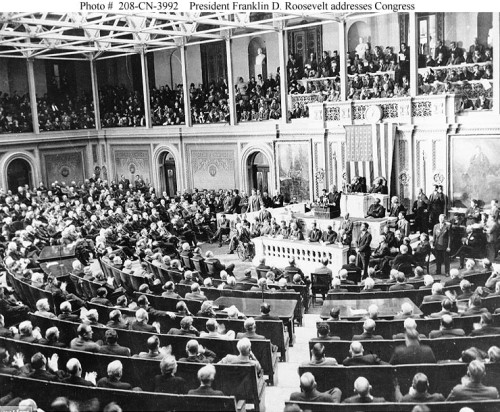
cn3992

The next day President Franklin D. Roosevelt called the nation to action requesting that Congress declare war on Japan. http://www.youtube.com/watch?v=ufoUtoQLGQY

Mr. Vice President, and Mr. Speaker, and Members of the Senate and House of Representatives:

Yesterday, December 7, 1941 — a date which will live in infamy — the United States of America was suddenly and deliberately attacked by naval and air forces of the Empire of Japan.

The United States was at peace with that Nation and, at the solicitation of Japan, was still in conversation with its Government and its Emperor looking toward the maintenance of peace in the Pacific. Indeed, one hour after Japanese air squadrons had commenced bombing in the American Island of Oahu, the Japanese Ambassador to the United States and his colleague delivered to our Secretary of State a formal reply to a recent American message. And while this reply stated that it seemed useless to continue the existing diplomatic negotiations, it contained no threat or hint of war or of armed attack.

It will be recorded that the distance of Hawaii from Japan makes it obvious that the attack was deliberately planned many days or even weeks ago. During the intervening time the Japanese Government has deliberately sought to deceive the United States by false statements and expressions of hope for continued peace.

The attack yesterday on the Hawaiian Islands has caused severe damage to American naval and military forces. I regret to tell you that very many American lives have been lost. In addition American ships have been reported torpedoed on the high seas between San Francisco and Honolulu.

Yesterday the Japanese Government also launched an attack against Malaya.
Last night Japanese forces attacked Hong Kong.
Last night Japanese forces attacked Guam.
Last night Japanese forces attacked the Philippine Islands.
Last night the Japanese attacked Wake Island. And this morning the Japanese attacked Midway Island.

Japan has, therefore, undertaken a surprise offensive extending throughout the Pacific area. The facts of yesterday and today speak for themselves. The people of the United States have already formed their opinions and well understand the implications to the very life and safety of our Nation.

As Commander in Chief of the Army and Navy I have directed that all measures be taken for our defense.

But always will our whole Nation remember the character of the onslaught against us.

No matter how long it may take us to overcome this premeditated invasion, the American people in their righteous might will win through to absolute victory. I believe that I interpret the will of the Congress and of the people when I assert that we will not only defend ourselves to the uttermost but will make it very certain that this form of treachery shall never again endanger us.

Hostilities exist. There is no blinking at the fact that our people, our territory, and our interests are in grave danger.

With confidence in our armed forces- with the unbounding determination of our people- we will gain the inevitable triumph- so help us God.

I ask that the Congress declare that since the unprovoked and dastardly attack by Japan on Sunday, December 7, 1941, a state of war has existed between the United States and the Japanese Empire.

171-0417042317-pearlharbor_paper

Today tens of thousands of US and NATO troops are deployed in Afghanistan. Some of them are dying that people that most of us do not care about in the least might have a chance at peace and a better life. Eleanor Roosevelt reflected:

“Lest I keep my complacent way I must remember somewhere out there a person died for me today. As long as there must be war, I ask and I must answer was I worth dying for?”

Wars, revolutions and other tensions in other parts of the world threaten on every side, but most Americans and Europeans live in the illusion of peace.  A very few professi0onals are given the task of preparing for and fighting wars that our politicians, business leaders, Armageddon seeking preachers and the talking heads of the media sow the seeds. As such many have no idea of the human, material and spiritual cost of war and when it comes again in all of its awful splendor few will be prepared.

We do not know what tomorrow will bring and unfortunately for the vast bulk of Americans and Western Europeans the comments of Walter Lord are as applicable today as they were on December 7th 1941.

Peace

Padre Steve+

6 Comments

Filed under History, Military, national security, world war two in the pacific