Tag Archives: harry truman

The “Saving Principles” of the Declaration of Independence

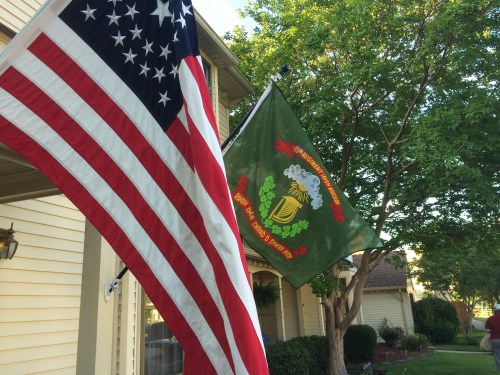
img_2708

Friends of Padre Steve’s World,

Abraham Lincoln spoke these words in Springfield, Illinois on June 26th 1857, nearly 160 years ago. They are part of a continuum in the development of his philosophy of liberty and how he understood the words of the Declaration of Independence, and how he believed that the authors 0f that document understood the words that set the United States apart from all other nations. The words “We hold these truths to be self evident, that all men are created equal” were revolutionary for their time and the Jefferson understood them in that manner.

“They [the signers of the Declaration of Independence] did not mean to assert the obvious untruth that all were then actually enjoying that equality, nor yet that they were about to confer it immediately upon them. In fact, they had no power to confer such a boon. They meant simply to declare the right; so that the enforcement of it might follow as fast as circumstances should permit.”

Though at the time they words of the Declaration only applied to white men, the words and writings of many of the founders were uncomfortable with the actual condition of black slaves as well as Native Americans. The had enough integrity to understand that what they wrote was a proposition that had universal implications which were not yet realized and would take time to happen. Those who mocked the document, the proposition, the founders, and the new nation understood that as well. It was a watershed moment for all of Europe was still under the control of Kings and despots. Thomas Jefferson understood how these words threatened despotic rule around the world and in 1821 he wrote to John Adams:

“The flames kindled on the 4th of July 1776, have spread over too much of the globe to be extinguished by the feeble engines of despotism; on the contrary, they will consume these engines and all who work them.”

But this was something that the people of the United States would have to wrestle with for decades before the most glaring aspect of inequality, that of slavery was overthrown. Frederick Douglass understood the importance of the Declaration even as white Americans on both sides of the Mason-Dixon line crafted compromises that left blacks in slavery and gave unfettered access for slave owners to go to Free States to recover their human property. In 1852 he wrote:

“I have said that the Declaration of Independence is the ring-bolt to the chain of your nation’s destiny; so, indeed, I regard it. The principles contained in that instrument are saving principles. Stand by those principles, be true to them on all occasions, in all places, against all foes, and at whatever cost.”

It is that ring bolt and it must be understood in its universal application and people in the United States and in countries which have embraces some portions of the concept and fight for it, otherwise it could be lost. Harry Truman noted this danger in 1952 when he said:

“We find it hard to believe that liberty could ever be lost in this country. But it can be lost, and it will be, if the time ever comes when these documents are regarded not as the supreme expression of our profound belief, but merely as curiosities in glass cases.”

Today the rights, protections, civil liberties, and opportunity to advance themselves of Americans are being rolled back in a manner that a few decades ago most of us would have found unimaginable. They are under threat many ways, too many to mention today and they must be continually fought for or we will lose them.

As Independence Day draws near I will continue to write about this subject even as I write about the Battle of Gettysburg. It matters too much.

Peace

Padre Steve+


2 Comments

Filed under civil rights, History, laws and legislation, News and current events, philosophy, Political Commentary

So who did the dirty work for us? Armed Forces Day 2016

butler-medals1

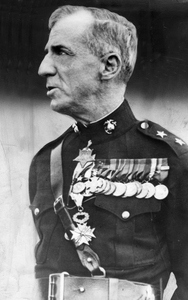
Major General Smedley Butler, USMC

Friends of Padre Steve’s World,

Today I am reposting something I wrote last year regarding Armed Forces Day. I was pretty emotionally raw when I wrote it but at the same time after re-reading it I cannot disagree with anything that I wrote. So today in honor of the fewer than 1% who serve in the uniform of the United States at any given time I am glad to share this. The faux patriotism displayed by so many, the bumper stickers that say “I support the troops” while supporting politicians and corporations that exist solely to make war on the backs of such a small segment of society, while cavalierly tossing veterans aside is no patriotism at all.

This may piss some people off, but as a man who has served 35 years in uniform and who has been to war and seen its horror, I cannot be less than honest.  

So please, take some time today to thank a currently serving Soldier, Sailor, Marine, Airman, or Coastguardsman for their service, and don’t do it flippantly. Recognize that they make sacrifices that go beyond what most people make, and all too many suffer for their service.

Peace

Padre Steve+

Marine Major General and two time Medal of Honor winner Smedley Butler wrote, “What is the cost of war? what is the bill?…“This bill renders a horrible accounting. Newly placed gravestones. Mangled bodies. Shattered minds. Broken hearts and homes. Economic instability. Depression and all of its attendant miseries. Back -breaking taxation for generations and generations. For a great many years as a soldier I had a suspicion that war was a racket; not only until I retired to civilian life did I fully realize it….”

Today is Armed Forces Day and unfortunately most of the country will not notice unless they are attending a Baseball game where it is being observed or some special event on a base, national cemetery, monument or VFW hall. Armed Forces Day was established in 1948 by President Harry Truman after the founding of the Department of Defense.  It was established to honor and remember those currently serving, not the discharged or the retired veteran, they are remembered on Veterans Day, the former Armistice Day, nor the fallen who are commemorated on Memorial Day which we will do next weekend.

Unlike Veterans Day or Memorial Day there is no national holiday for Armed Forces Day. I find this ironic for a nation which claims to support the troops that the men and women who we honor are honored on a day that unless they are deployed in harm’s way or have duty, is regular day off like any Saturday. Personally I think the day should be celebrated by giving the active duty force a real day off and if they are deployed given some kind of down time as operational needs allow, and maybe even given them a ration of beer. We did this for the Marine Corps birthday in Iraq, so why not on Armed Forces Day? But I digress…

Back when Armed Forces Day was established there was still a draft which meant that in theory everyone had skin in the game and that our leaders were far more hesitant to commit the nation to war.

Back in 1952 the New York Times editors wrote:

“It is our most earnest hope that those who are in positions of peril, that those who have made exceptional sacrifices, yes, and those who are afflicted with plain drudgery and boredom, may somehow know that we hold them in exceptional esteem. Perhaps if we are a little more conscious of our debt of honored affection they may be a little more aware of how much we think of them.”

But sadly today in all honesty were think very little of them. Today of course there will be a fair number of local celebrations to honor members of the Armed Forces across the country, but for the most part they will be small and not well publicized. Most of the people in attendance will not even be there for the troops. They will be there for the event and their hearts will be warmed by the tributes paid to the troops. As a career officer and son of a Vietnam veteran Navy Chief I appreciate those events and at least some of the good hearted the people that put them together. Being a veteran of Operation Iraqi Freedom and Operation Enduring Freedom, especially those that have taken the time to honor Iraq and Afghanistan veterans like me who have returned from war totally fucked up. But again I digress, badda bing, badda boom, badda bomb…

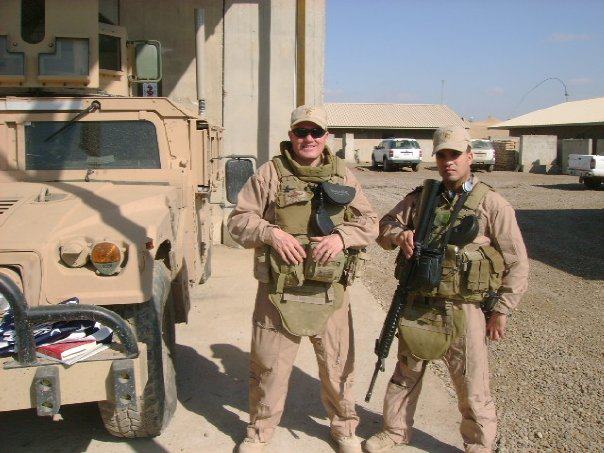
me and nelson

Bu here is what really s upsetting to me, good number of these patriot, flag waving, war porn satiating, yet somehow inspiring ceremonies to honor the troops are not even coming for the heart of the people putting them on. Until it was exposed last year many of these ceremonies, particularly those done by the NFL were coming out of the Pentegon budget and being paid for by the taxpayers. These events are nothing more than faux patriotism and little more than propaganda that exploits the troops. They are being done as a recruiting tool with the Department of Defense which is paying hundreds of millions of dollars to the tax exempt National Football League and its teams to put on shows that give all the appearances of honoring the troops but are really nothing more than propaganda and recruiting commercials. Likewise for all which for all the money we the taxpayers spend on them actually net few recruits if any as a huge number of our current troops are the sons and daughters of men and women who have also served this country. They, like me, serve for something greater than partisan politics  greater than money, greater than anything that can easily be repaid. For most it is the ideal of the love of this country and the principles found in the Declaration of Independence, that all men are created equal. However, that is fodder for another article.

But honestly I am so offended by this faux  patriotism shown by the NFL and God knows who else that it causes me a great deal of anger. I say this because throughout our nation’s history our political leaders, business leaders and the populace as a whole have despised the military, and those who in the absence of a draft chose to serve. That despicable attitude was well recounted in Herman Wouk’s monumental novel, which became a classic film The Caine Mutiny. In the film a defense attorney for those accused of mutiny, Barney Greenwald played to perfection by Jose Ferrer told the acquitted mutineers of the Caine’s wardroom:

“You know something…when I was studying law, and Mr Keefer here was writing his stories, and you, Willie, were tearing up the playing fields of dear old Princeton,method was standing guard over this fat dumb happy country of ours, eh? Not us. Oh no, we knew you couldn’t make any money in the service. So who did the dirty work for us? Queeg did! And a lot of other guys. Tough, sharp guys who didn’t crack up like Queeg.” 

cropped-the-caine-mutiny-1954-1.jpg

For those who are now getting pissed off at me, let us look at facts. At any given time less than 1% of Americans are serving in all components of the military. For nearly 15 years we have been at war in Afghanistan and Iraq as well as other locations that we don’t like to talk about too much. However this has not been the effort of a nation at war, it is the war of a tiny percentage of the population, a segment that everyone is far too willing to exploit.

As a nation we are disconnected from the military and the wars that the military fights. The fact is that most Americans do not have a personal or vested interest in these wars, they have been insulated by political leaders of both parties from them. There is no draft, and no taxes were raised to fund the wars and the military is now worn out.

We have been at war for nearly 15 years and truthfully there is no end in sight. In that time every single Soldier, Sailor, Marine and Airman volunteered for duty or reenlisted during this time period. Motives may have varied from individual to individual, but unlike the World Wars, Korea and Vietnam every single one volunteered to serve in time of war. I think that this makes the current generation of veterans quite unique in our modern history, but not so different than the professionals who served before and after the Civil War,and  those who served before and after the First World War. The situation after the Second Wolrd War and the Cold War required a large standing military and large reserve force. This required the draft, which though hated by many  leavened the professional force with civilians who got a taste of military and when they left did not forget they meaning of their service and the sacrifices made by the professionals. We do not have that anymore. We are no longer are no longer a military composed of citizen soldiers. We who serve,  even in our reserve components are  a Warrior caste, set apart from the society that we serve.

There is a tragic disconnection between the military and civilian society in the United States. This is the result of deliberate public policy since the end of the Vietnam War supported by both political parties. For almost 40 years we have relied on an all volunteer force. It is that relatively small and socially isolated military which is sent to fight wars while the bulk of the population is uninvolved and corporations, lobbyists and think tanks get rich.

Andrew Bacevich wrote in his new book Breach of Trust: How Americans failed their Soldiers and their Country:

“Rather than offering an antidote to problems, the military system centered on the all-volunteer force bred and exacerbated them. It underwrote recklessness in the formulation of policy and thereby resulted in needless, costly, and ill-managed wars. At home, the perpetuation of this system violated simple standards of fairness and undermined authentic democratic practice. The way a nation wages war—the role allotted to the people in defending the country and the purposes for which it fights—testifies to the actual character of its political system. Designed to serve as an instrument of global interventionism (or imperial policing), America’s professional army has proven to be astonishingly durable, if also astonishingly expensive. Yet when dispatched to Iraq and Afghanistan, it has proven incapable of winning. With victory beyond reach, the ostensible imperatives of U.S. security have consigned the nation’s warrior elite to something akin to perpetual war.”

Bacevich, a retired Army Colonel and Vietnam veteran who lost a son in Iraq is dead on, as is Rachel Maddow who wrote in her outstanding book Drift: The Unmooring of American Military Power:

“The reason the founders chafed at the idea of an American standing army and vested the power of war making in the cumbersome legislature was not to disadvantage us against future enemies, but to disincline us toward war as a general matter… With citizen-soldiers, with the certainty of a vigorous political debate over the use of a military subject to politicians’ control, the idea was for us to feel it- uncomfortably- every second we were at war. But after a generation or two of shedding the deliberate political encumbrances to war that they left us… war making has become almost an autonomous function of the American state. It never stops.” 

The lobbyists, pundits, politicians, preachers and war profiteers that promote war don’t care about the troops. This especially applies to the likely GOP Presidential nominee Donald Trump, a man who brazenly and shamelessly equates his time at a military high school as being equal to actually serving while using multiple deferments and medical excuses to dodge the draft during the Vietnam War. Trump called military personnel who were captured by the enemy “cowards,” a man who cares not a whit about real men and women who serve this country. When Trump and other most other politicians say they do care about the troops they are lying out their asses. This is because no matter who is in office or who controls congress these people and corporations will promote policies that keep them employed and their businesses enriched, and yes, Bernie Sanders is on that list, despite his denunciations of war and vote against the Iraq war he has consistently supported weapons programs like the F-35 fighter plane fiasco which is such an example of waste, fraud and abuse,  not to mention overpriced, overdue, and underperforming weapons systems ever, in order to bring jobs to Vermont.

Marine Major General and Medal of Honor winner Smedley Butler was quite right when he said:

“War is a racket. It always has been. It is possibly the oldest, easily the most, surely the most vicious. It is the only one international in scope. It is the only one in which the profits are reckoned in dollars and the losses in lives. A racket is best described, I believe, as something that is not what it seems to the majority of the people. Only a small ‘inside’ group knows what it is about. It is conducted for the benefit of the very few, at the expense of the very many. Out of war a few people make huge fortunes.”

I think that the reason that our current wars have gone on so long is the that misguided policies have brought about a chronic disconnection in our society between those that serve in the military. But how can there not be when in the weeks after 9-11 people like President Bush and others either directly or in a manner of speaking told people to “go shopping” * as we went to war in Afghanistan? When I returned from Iraq I returned to a nation that was not at war whose leaders used the war to buttress their respective political bases.

The results are terrible. Suicide rates are continuing to rise among veterans who have returned to find that neither the VA nor the civilian mental health care sector is prepared to care for them. Even worse the members of the GOP controlled Congress are working their asses off to screw the troops. Ohio GOP Congressman, Tea Party favorite,  supposedly deeply committed Christian and even worse a Colonel in the Ohio Army National Guard has attempted and is attempting again to attach an Ammendment to the 2016 Nation Defense Authorization Act which would keep the Defense Department from enformice rules which would protect young troops from the predatory payday lenders who line the avenues leading to every major military base in the country. My opinion, this man is a traitor to the country even though he wears the uniform and has deployed and led soldiers in in Iraq and other locations during this war. He is selling out the the young troops to protect the payday lending industry with which has had a nearly incestuous relationship since he day that was elected to Congress.

But Congressman Stivers is not alone, Congressmen and women of both parties sell out the troops to prop up banks, insurance companies and Wall Street. Those military health benefits not directly provided in military medical centers are run through an organization called Tricare. Tricare, which is managed by the insurance companies who bid on competitive contracts is a for profit industry. These insurance companies routinely deny services to the families of military members, pay so little or are so mind numbingly  incompetent that many medical providers refuse to deal with them, leaving the troops their families stuck in the middle. That my friends is fact. Now the GOP led by the Koch brothers is attempting to privatize Veterans Admisistration Heath care. Now in all honesty, the chronically underfunded and bureaucratically bound VA. That being said my friends privatization will only make things worse for veterans who will now have to deal with private for profit insurance companies and Heath care systems that see them and their wounds and infirmaries as a way to make a buck off of taxpayer and to screw the veteran.

But let’s not stop there. Politicians of both parties and their backers from the financial sectors have been working overtime since the Adminstration of George W. Bush to roll back retirement benefits which they call  “entitlements” which are supposedly destroying the financial health and well being of the nation. Never mind the fact that these same  politicians have spent trillions of dollars bailing out the corporations which have almost single handed lay destroyed this nation’s economy time after time since the 1970s, and who support corporations who are based in this country but have sold the nation out and work against the interests of Americans.

But never mind, I digress, for as we all know it is the troops who are the leches who are bankrupting the country.

But this isn’t new my friends it began during the Reagan Administration which changed the retirement system from the flat 50% of one’s final active duty pay that one would retire with at 20 years of service or high multiples up to 75% at 30 years to an average of the last three, or the highest three years of pay that one earned while on active duty.  In effect the Reagan Adminstration robbed military retest of hundreds of thousand of dollars of hard earned benefits. But again the beloved Saint Ronald loved the troops, after all he said so.

Likewise, did you know that some GOP legislators want to cut the disability payments to military members who have been wounded or injured during their service?  You probably didn’t and you won’t find that fact out on Fox News or CNN. This is not to be confused with the retirement benefits that they are looking to cut.  This, my friends is the debt of honor that this nation owes to the men and women who have given everything and now are broken in body, mind and spirit. But, those who promote such policies, even those who have worn the uniform, like Congressman Stivers have no honor. Like those that sold out the Union veterans after the Civil War and the Doughboys after World War One they are much more indebted to their political benefactors than they are to te troops no matter what they say.

Now I do believe that Armed Forces Day should be better celebrated and I am grateful to the people that do things every day to thank and support military personnel. These wonderful people that do this come from across the political spectrum. Some are veterans and others non-veterans, but they care for and appreciate the men and women that serve in and fight the wars that no-one else can be bothered to fight.

943043_10151694525692059_632653331_n

Of course the politicians, pundits, preachers and the defense contractors, banks and lobbyists will find a way to profit. They will do so no matter how many more troops are killed, wounded or injured and how badly it affects military personnel or their families and will push to abandon those who fought as they do after every war. After all, to quote Smedley Butler, “war is a racket.”  So that is what I believe; and if God is just, and if there is a Hell, I hope that the people who promote war and profit from it, and then abandon those who fight their wars end up there, especially the preachers who this very morning will invite the troops to their churches to supposedly honor them even as they support the politicians whose policies damn the very troops that they pretend to honor today. 

That may sound harsh, but is it any more harsh than condemning people to Hell who have different beliefs or lifestyles who have harmed no one by their actions? I think not. 

As so to these preachers, I say, to use the words of one of my football coaches, “your actions speak so loud I can’t hear a word that you are saying.” 

Peace

Padre Steve+

President Bush’s actually words were “Now, the American people have got to go about their business. We cannot let the terrorists achieve the objective of frightening our nation to the point where we don’t — where we don’t conduct business, where people don’t shop…” http://georgewbush-whitehouse.archives.gov/news/releases/2001/10/20011011-7.html

3 Comments

Filed under History, Military, Political Commentary

Breaking Barriers: Jackie Robinson

jackie-robinson stealing home

Friends of Padre Steve’s World,

Today I am remembering the immortal Jackie Robinson, one of the most remarkable Americans who ever lived, not to mention that played baseball. Former American League President Gene Budig noted: He led America by example. He reminded our people of what was right and he reminded them of what was wrong. I think it can be safely said today that Jackie Robinson made the United States a better nation.”

April 15th 2016 was the 69th anniversary of Jackie Robinson’s first game in the Major Leagues with the Brooklyn Dodgers.  When he stepped onto the field, Jim Crow was very alive and well when Jackie stepped onto the field that day and no matter how much we want to distance ourselves from those days there are still some in this country who want to go back to that kind of society.

Jackie had experienced the full force of Jim Crow while serving as an Army Officer in the Second World War. While at Fort Hood Texas serving with the 761st Armored Battalion Robinson boarded an army bus and was ordered to the back of the bus by the driver. Robinson refused to comply as the army busses were not segregated, but the drive reported him to the Military Police. He was arrested and charged with a number of crimes and was tried by a Court Martial which acquitted him, however, it did prevent him from going to war with the 761st, which was the first African-American ground-combat unit to see action, and played a part in his determination to succeed.

Robinson’s first game with the Dodgers came a full year before President Truman integrated the military, a move which infuriated many in the South.  Likewise it occurred a full seven years before the Supreme Court ruled school segregation unconstitutional in the Brown vs Board of Education decision.  It came a full 17 years before Congress passed the Voters Rights Act in 1964.

When Jackie Robinson stepped onto the field it was a watershed moment in Civil Rights for African Americans and paved the way for a change in American society that has continued since his Major League debut. Blacks had struggled for years against Jim Crow laws, discrimination in voting rights and even simple human decencies like where they could use a rest room, sit on a bus or what hotel they could stay in.

In baseball many white fans were upset that blacks were allowed to see Robinson in stadiums that they would not have been allowed in before.  Players from other teams heckled Robinson, he received hate mail, people sent made death threats, he was spiked and spit on.  But Jackie Robinson kept his pledge to Dodgers owner Branch Rickey not to lash out at his tormentors, as Rickey told him that he needed a man “with enough guts not to strike back.”

Jackie Robinson played the game with passion and even anger.  He took the advice of Hank Greenberg who as a Jew suffered continual racial epithets throughout his career “the best ways to combat slurs from the opposing dugout is to beat them on the field.” He would be honored as Rookie of the Year in 1947. He was a MVP and played in six World Series and six All Star Games.  He had a career .311 batting average, .409 on base percentage and .474 Slugging percentage. He was elected to Baseball’s Hall of Fame in 1962.

In 1964 Robinson again experienced the hatred of racists when he was a delegate for Nelson Rockefeller at the 1964 GOP Convention. It was yet another reminder of the racism that Robinson had fought all of his live to end. He wrote in his autobiography of the experience:

“I wasn’t altogether caught of guard by the victory of the reactionary forces in the Republican party, but I was appalled by the tactics they used to stifle their liberal opposition.  I was a special delegate to the convention through an arrangement made by the Rockefeller office. That convention was one of the most unforgettable and frightening experiences of my life. The hatred I saw was unique to me because it was hatred directed against a white man.  It embodied a revulsion for all he stood for, including his enlightened attitude toward black people.

A new breed of Republicans had taken over the GOP.  As I watched this steamroller operation in San Francisco, I had a better understanding of how it must have felt to be a Jew in Hitler’s Germany.

The same high-handed methods had been there.

The same belief in the superiority of one religious or racial group over another was here.  Liberals who fought so hard and so vainly were afraid not only of what would happen to the GOP but of what would happen to America.  The Goldwaterites were afraid – afraid not to hew strictly to the line they had been spoon-fed, afraid to listen to logic and reason if it was not in their script.

I will never forget the fantastic scene of Governor Rockefeller’s ordeal as he endured what must have been three minutes of hysterical abuse and booing which interrupted his fighting statement which the convention managers had managed to delay until the wee hours of the morning.  Since the telecast was coming from the West Coast, that meant that many people in other sections of the country, because of the time differential, would be in their beds.  I don’t think he has ever stood taller than that night when he refused to be silenced until he had had his say. 

It was a terrible hour for the relatively few black delegates who were present.  Distinguished in their communities, identified with the cause of Republicanism, an extremely unpopular cause among blacks, they had been served notice that the party they had fought for considered them just another bunch of “niggers”.  They had no real standing in the convention, no clout.  They were unimportant and ignored.  One bigot from one of the Deep South states actually threw acid on a black delegate’s suit jacket and burned it.  Another one, from the Alabama delegation where I was standing at the time of the Rockefeller speech, turned on me menacingly while I was shouting “C’mon Rocky” as the governor stood his ground.  He started up in his seat as if to come after me.  His wife grabbed his arm and pulled him back.

“Turn him loose, lady, turn him loose,” I shouted.

 I was ready for him.  I wanted him badly, but luckily for him he obeyed his wife…” (From Jackie Robinson “I Never Had it Made” Chapter XV On Being Black Among the Republicans)

Today Jackie Robinson’s life, and his feat of breaking the color barrier in baseball is history, but it should not be forgotten.  He was a pioneer who made it possible for others to move forward.  He would be followed by players like Roy Campinella, Satchel Paige, Don Larson, Larry Dobie and   Willie Mays.  His breakthrough had an effect not just on baseball but on society.

Jackie Robinson would have an effect on my life.  In 1975 the Stockton Unified School District voted to desegregate.  I was in the 9th grade and preparing for high school.  As the school board wrestled with the decision anger boiled throughout the town, especially in the more affluent areas.  Vicious letters were sent to the school board and to the Stockton Record by parents as well as other opponents of the move.  Threats of violence and predictions failure were commonplace.  In the summer of 1975 those who went out for the football team, both the sophomore and varsity squads began to practice.  Black, White, Mexican and Asian, we bonded as a team, the Edison Vikings.  By the time the first buses pulled up to the bus stops throughout town on the first day of school, the sense of foreboding ended.  Students of all races discovered common interests and goals.  New friends became guests in each others homes, and all of us became “Soul Vikes.”

30 years later the Class of 1978, the first class to be desegregated from start to finish graduated from Edison held a reunion.  Our class always had a special feel about it.  Looking back we too were pioneers, like Jackie Robinson we were far ahead of our time.  When I look at my friends on Facebook from Edison I see the same faces that I played ball, rode the bus and went to class with.   Things have changed.  Even 30 years ago none of us imagined an African American President, we believed in each other and we saw potential, but I don’t think that anyone believed that we would see this in our day.

I think that Jackie Robinson prepared the way for other pioneers of Civil Rights including Dr. Martin Luther King.  Today, some 69 years later Jackie Robinson looms large in American History; not only in baseball, but for the impact of his life and actions on America.

His number “42” is now retired from baseball. The last player to wear it was Mariano Rivera of the Yankees. Rivera had been granted an exemption to wear it until he retired. At least the last Major League ball player to honor the number was a class act who will certainly be in the Hall of Fame.

Robinson said something that still resonates with me: “Life is not a spectator sport. If you’re going to spend your whole life in the grandstand just watching what goes on, in my opinion you’re wasting your life.” It is something that I take into account every day of my life.

May we not forget and always forge ahead in the constant struggle for civil rights and equality, even as many in our nation sink back into the old ways of apathy, and the toleration of injustice and inequity, even seeking to reverse the hard gotten gains that we all have been blessed to see.

So here’s to you Jackie Robinson, thank you and all the other pioneers who have and who continue to fight for the rights of all people.

Peace,

Padre Steve+

3 Comments

Filed under Baseball, civil rights, History, Political Commentary

Armed Forces Day 2015: The Breach of Trust

2015AFDPoster

“What is the cost of war? what is the bill?…“This bill renders a horrible accounting. Newly placed gravestones. Mangled bodies. Shattered minds. Broken hearts and homes. Economic instability. Depression and all of its attendant miseries. Back -breaking taxation for generations and generations. For a great many years as a soldier I had a suspicion that war was a racket; not only until I retired to civilian life did I fully realize it….” Major General Smedley Butler USMC

Today is Armed Forces Day and unfortunately most of the country will not notice unless they are attending a Baseball game where it is being observed or some special event on a base, national cemetery, monument or VFW hall. Armed Forces Day was established in 1948 by President Harry Truman after the founding of the Department of Defense.  It was established to honor and remember those currently serving, not the discharged or the retired veteran, they are remembered on Veterans Day, the former Armistice Day, nor the fallen who are commemorated on Memorial Day which we will do next weekend. 

Unlike Veterans Day or Memorial Day there is no national holiday for Armed Forces Day. I find this ironic for a nation which claims to support the troops that the men and women who we honor are honored on a day that unless they are deployed in harm’s way or have duty, is regular day off like any Saturday. Personally I think the day should be celebrated by giving the active duty force a real day off and if they are deployed given some kind of down time as operational needs allow, and maybe even given them a ration of beer. We did this for the Marine Corps birthday in Iraq, so why not on Armed Forces Day? But I digress…

Back when Armed Forces Day was established there was still a draft which meant that in theory everyone had skin in the game and that our leaders were far more hesitant to commit the nation to war. 

Back in 1952 the New York Times editors wrote:

“It is our most earnest hope that those who are in positions of peril, that those who have made exceptional sacrifices, yes, and those who are afflicted with plain drudgery and boredom, may somehow know that we hold them in exceptional esteem. Perhaps if we are a little more conscious of our debt of honored affection they may be a little more aware of how much we think of them.”

But sadly today in all honesty were think very little of them. Today of course there will be a fair number of local celebrations to honor members of the Armed Forces across the country, but for the most part they will be small and not well publicized. Most of the people I attendance will not even be there for the troops. They will be there for the event and their hearts will be warmed by the tributes paid to the troops. As a career officer and son of a Vietnam veteran Navy Chief I appreciate those events and at least some of the good hearted the people that put them together. Being a veteran of Operation Iraqi Freedom and Operation Enduring Freedom, especially those that have taken the time to honor Iraq and Afghanistan veterans like me who have returned from war totally fucked up. But again I digress, badda bing, badda boom, badda bomb…

Bu here is what really s upsetting to me, good number of these patriot, flag waving, war porn satiating, yet somehow inspiring ceremonies to honor the troops are not even coming for the heart of the people putting them on. I steady they are coming out of the Pentegon budget and being paid for by the taxpayers. These events are nothing more than faux patriotism and little more than propaganda that exploits the troops. They are being done as a recruiting tool with the Department of Defense which is paying hundreds of millions of dollars to the tax exempt National Football League and its teams to put on shows that give all the appearances of honoring the troops but are really nothing more than propaganda and recruiting commercials. Likewise for all which for all the money we the taxpayers spend on them actually net few recruits if any as a huge number of our current troops are the sons and daughters of men and women who have also served this country. They, like I do, do this for something greater than partisan politics  greater than money, greater than anything that can easily be repaid, the love of this country and the principles found in the Declaration of Independence, that all men are created equal. However, that is fodder for another article. 

But honestly I am so offended by this faux  patriotism shown by the NFL and God knows who else that it causes me a great deal of anger. I say this because throughout our nation’s history our political leaders, business leaders and the populace as a whole have despised the military, and those who in the absence of a draft chose to serve. That despicable attitude was well recounted in Herman Wouk’s monumental novel, which became a classic film The Caine Mutiny. In the film a defense attorney for those accused of mutiny, Barney Greenwald played to perfection by Jose Ferrer told the acquitted mutineers of the Caine’s wardroom:

“You know something…when I was studying law, and Mr Keefer here was writing his stories, and you, Willie, were tearing up the playing fields of dear old Princeton,method was standing guard over this fat dumb happy country of ours, eh? Not us. Oh no, we knew you couldn’t make any money in the service. So who did the dirty work for us? Queeg did! And a lot of other guys. Tough, sharp guys who didn’t crack up like Queeg.” 

For those who are now getting pissed off at me, let us look at facts. At any given time less than 1% of Americans are serving in all components of the military. For over 13 years we have been at war in Afghanistan and Iraq as well as other locations that we don’t like to talk about too much. However this has not been the effort of a nation at war, it is the war of a tiny percentage of the population, a segment that everyone is far too willing to exploit. 

As a nation we are disconnected from the military and the wars that the military fights. The fact is that most Americans do not have a personal or vested interest in these wars, they have been insulated by political leaders of both parties from them. There is no draft, and no taxes were raised to fund the wars and the military is now worn out.

We have been at war for nearly 14 years and truthfully there is no end in sight. In that time every single Soldier, Sailor, Marine and Airman volunteered for duty or reenlisted during this time period. Motives may have varied from individual to individual, but unlike the World Wars, Korea and Vietnam every single one volunteered to serve in time of war. I think that this makes the current generation of veterans quite unique in our modern history, but not so different than the professionals who served before and after the Civil War,and  those who served before and after the First World War. The situation after the Second Wolrd War and the Cold War required a large standing military and large reserve force. This required the draft, which though hated by many  leavened the professional force with civilians who got a taste of military and when they left did not forget they meaning of their service and the sacrifices made by the professionals. We do not have that anymore. We are no longer are no longer a military composed of citizen soldiers. We who serve,  even in our reserve components are  a Warrior caste, set apart from the society that we serve.

There is a tragic disconnection between the military and civilian society in the United States. This is the result of deliberate public policy since the end of the Vietnam War supported by both political parties. For almost 40 years we have relied on an all volunteer force. It is that relatively small and socially isolated military which is sent to fight wars while the bulk of the population is uninvolved and corporations, lobbyists and think tanks get rich.

Andrew Bacevich wrote in his new book Breach of Trust: How Americans failed their Soldiers and their Country:

“Rather than offering an antidote to problems, the military system centered on the all-volunteer force bred and exacerbated them. It underwrote recklessness in the formulation of policy and thereby resulted in needless, costly, and ill-managed wars. At home, the perpetuation of this system violated simple standards of fairness and undermined authentic democratic practice. The way a nation wages war—the role allotted to the people in defending the country and the purposes for which it fights—testifies to the actual character of its political system. Designed to serve as an instrument of global interventionism (or imperial policing), America’s professional army has proven to be astonishingly durable, if also astonishingly expensive. Yet when dispatched to Iraq and Afghanistan, it has proven incapable of winning. With victory beyond reach, the ostensible imperatives of U.S. security have consigned the nation’s warrior elite to something akin to perpetual war.”

Bacevich, a retired Army Colonel and Vietnam veteran who lost a son in Iraq is dead on, as is Rachel Maddow who wrote in her outstanding book Drift: The Unmooring of American Military Power:

“The reason the founders chafed at the idea of an American standing army and vested the power of war making in the cumbersome legislature was not to disadvantage us against future enemies, but to disincline us toward war as a general matter… With citizen-soldiers, with the certainty of a vigorous political debate over the use of a military subject to politicians’ control, the idea was for us to feel it- uncomfortably- every second we were at war. But after a generation or two of shedding the deliberate political encumbrances to war that they left us… war making has become almost an autonomous function of the American state. It never stops.” 

The lobbyists, pundits, politicians, preachers and war profiteers that promote war don’t care about the troops. When they say they do they are lying out their asses. This is because no matter who is in office or who controls congress these people and corporations will promote policies that keep them employed and their businesses enriched. Marine Major General and Medal of Honor winner Smedley Butler was quite right when he said:

“War is a racket. It always has been. It is possibly the oldest, easily the most, surely the most vicious. It is the only one international in scope. It is the only one in which the profits are reckoned in dollars and the losses in lives. A racket is best described, I believe, as something that is not what it seems to the majority of the people. Only a small ‘inside’ group knows what it is about. It is conducted for the benefit of the very few, at the expense of the very many. Out of war a few people make huge fortunes.”

I think that the reason that our current wars have gone on so long is the that misguided policies have brought about a chronic disconnection in our society between those that serve in the military. But how can there not be when in the weeks after 9-11 people like President Bush and others either directly or in a manner of speaking told people to “go shopping” * as we went to war in Afghanistan? When I returned from Iraq I returned to a nation that was not at war whose leaders used the war to buttress their respective political bases.

The results are terrible. Suicide rates are continuing to rise among veterans who have returned to find that neither the VA nor the civilian mental health care sector is prepared to care for them. Even worse the members of the GOP controlled Congress are working their asses off to screw the troops. Ohio GOP Congressman, Tea Party favorite,  supposedly deeply committed Christian and even worse a Colonel in the Ohio Army National Guard has attempted and is attempting again to attach an Ammendment to the 2016 Nation Defense Authorization Act which would keep the Defense Department from enformice rules which would protect young troops from the predatory payday lenders who line the avenues leading to every major military base in the country. My opinion, this man is a traitor to the country even though he wears the uniform and has deployed and led soldiers in in Iraq and other locations during this war. He is selling out the the young troops to protect the payday lending industry with which has had a nearly incestuous relationship since he day that was elected to Congress. 

But Congressman Stivers is not alone, Congressmen and women of both parties sell out the troops to prop up banks, insurance companies and Wall Street. Those military health benefits not directly provided in military medical centers are run through an organization called Tricare. Tricare, which is managed by the insurance companies who bid on competitive contracts is a for profit industry. These insurance companies routinely deny services to the families of military members, pay so little or are so mind numbingly  incompetent that many medical providers refuse to deal with them, leaving the troops their families stuck in the middle. That my friends is fact. Now the GOP led by the Koch brothers is attempting to privatize Veterans Admisistration Heath care. Now in all honesty, the chronically underfunded and bureaucratically bound VA. That being said my friends privatization will only make things worse for veterans who will now have to deal with private for profit insurance companies and Heath care systems that see them and their wounds and infirmaries as a way to make a buck off of taxpayer and to screw the veteran. 

But let’s not stop there. Politicians and their backers from the financial sectors have been working overtime since the Adminstration of George W. Bush to roll back retirement benefits which they call  “entitlements” which are supposedly destroying the financial health and well being of the nation. Never mind the fact that these same  politicians have spent trillions of dollars bailing out the corporations which have almost single handed lay destroyed this nation’s economy time after time since the 1970s, and who support corporations who are based in this country but have sold the nation out and work against the interests of Americans. 

But never mind, I digress, for as we all know it is the troops who are the leches who are bankrupting the country. 

But this isn’t new my friends it began during the Reagan Administration which changed the retirement system from the flat 50% of one’s final active duty pay that one would retire with at 20 years of service or high multiples up to 75% at 30 years to an average of the last three, or the highest three years of pay that one earned while on active duty.  In effect the Reagan Adminstration robbed military retest of hundreds of thousand of dollars of hard earned benefits. But again the beloved Saint Ronald loved the troops, after all he said so. 

Likewise, did you know that some GOP legislators want to cut the disability payments to military members who have been wounded or injured during their service?  You probably didn’t and you won’t find that fact out on Fox News or CNN. This is not to be confused with the retirement benefits that they are looking to cut.  This my friends is the debt of honor  that this nation owes to the men and women who have given everything and now are broken in body, mind and spirit. But then those who promote such policies, even those who have worn the uniform like Congressman Stivers have no honor. Like those that sold out the Union veterans after the Civil War and the Doughboys after World War One they are much more indebted to their political benefactors than they are to te troops no matter what they say. 

Now I do believe 

Armed Forces Day should be better celebrated and I am grateful to the people that do things every day to thank and support military personnel. These wonderful people that do this come from across the political spectrum. Some are veterans and others non-veterans. But they care for and appreciate the men and women that serve in and fight the wars that no-one else can be bothered to fight.

481801_10151367001287059_1003164983_n

Of course the politicians, pundits, preachers and the defense contractors, banks and lobbyists will find a way to profit. They will do so no matter how many more troops are killed, wounded or injured and how badly it affects military personnel or their families and will push to abandon those who fought as they do after every war. After all, to quote Smedley Butler, “war is a racket.”  So fuck them all, and if there is a just God and there is a Hell, I hope that they end up there, especially the preachers who tomorrow will invite the troops to their churches to supposedly honor them even as they support the politicians whose policies damn the very troops that they honor tomorrow. 

Peace

Padre Steve+

President Bush’s actually words were “Now, the American people have got to go about their business. We cannot let the terrorists achieve the objective of frightening our nation to the point where we don’t — where we don’t conduct business, where people don’t shop…” http://georgewbush-whitehouse.archives.gov/news/releases/2001/10/20011011-7.html

Leave a comment

Filed under History, iraq,afghanistan, Military

The Desegregation of Baseball and Its Importance Today

robinson-dodgers

John Jorgensen, Pee Wee Reese, Ed Stanky and Jackie Robinson on opening day 1947

“Jackie, we’ve got no army. There’s virtually nobody on our side. No owners, no umpires, very few newspapermen. And I’m afraid that many fans will be hostile. We’ll be in a tough position. We can win only if we can convince the world that I’m doing this because you’re a great ballplayer, a fine gentleman.” Branch Rickey to Jackie Robinson 

My friends, in just a few days pitchers and catchers report for the 2015 Baseball Spring Training and it is time to reflect again on how Branch Rickey’s signing of Jackie Robinson helped advance the Civil Rights of Blacks in the United States. What Rickey did was a watershed, and though it took time for every team in the Major Leagues to integrate, the last being the Boston Red Sox in 1959, a dozen years after Jackie Robinson broke the color barrier.

Branch Rickey shook the foundations of America when he signed Jackie Robinson to a Major League deal in 1947, a year before President Truman desegregated the military and years before Jim Crow laws were overturned in many states.

Robinson and the early pioneers of the game did a service to the nation. They helped many white Americans see that Blacks were not only their equals as human beings, and as it was note about Ernie Banks and others that soon “little white boys wanted to grow up and be Ernie Banks.” 

robinson2-popup

Charles Thomas 

But for Rickey the crusade to integrate baseball began long before 1947. In 1903, Rickey, then a coach for the Ohio Wesleyan University baseball team had to console his star player, Charles Thomas when a hotel in South Bend Indiana refused him a room because he was black. Rickey found Thomas sobbing  rubbing his hands and repeating “Black skin. Black skin. If only I could make them white.” Rickey attempted to console his friend saying “Come on, Tommy, snap out of it, buck up! We’ll lick this one day, but we can’t if you feel sorry for yourself.”

Branch-Rickey

The Young Branch Rickey

Thomas, encouraged by Rickey was remembered by one alumnus who saw a game that Thomas played in noted that “the only unpleasant feature of the game was the coarse slurs cast at Mr. Thomas, the catcher.” However, the writer noted something else about Thomas that caught his eye: “But through it all, he showed himself far more the gentleman than his insolent tormentors though their skin is white.”

Baseball like most of America was not a place for the Black man. Rickey, a devout Christian later remarked “I vowed that I would always do whatever I could to see that other Americans did not have to face the bitter humiliation that was heaped upon Charles Thomas.”

In April 1947 Rickey, now the owner of the Brooklyn Dodgers had one African-American ballplayer at the Dodgers’ Spring Training site in Daytona Beach Florida. The South was still a hotbed of racial prejudice, Jim Crow was the law of the land and Blacks had no place in White Man’s baseball. That player was Jackie Robinson.

Jackie Robinson Shaking Branch Rickey's Hand

Jackie Robinson and Branch Rickey

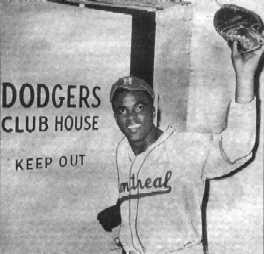
The Dodgers had been coming to Florida for years. Rickey moved the Dodgers from Jacksonville to Daytona Beach in 1947 after Jacksonville had refused to alter its segregation laws to allow an exhibition game between the Dodgers International League affiliate the Montreal Royals, for whom Robinson starred.

That was the year that Rickey signed Robinson to a minor league contract with the Royals.  When Rickey called up Robinson 6 days prior to the 1947 season, it was  Robinson broke the color barrier for the Dodgers and Major League Baseball. However it would take another 12 years before all Major League teams had a black player on their roster.

It is hard to imagine now that even after Jackie Robinson had broken the color barrier that other teams did not immediately sign black players. However Rickey and Robinson broke the color barrier a year before Harry Truman had integrated the Armed Forces and seven years before the Supreme Court ruled the segregation of public schools illegal. But how could that be a surprise? The country was still rampant with unbridled racism. Outside of a few Blacks in the military and baseball most African Americans had few rights. In the North racism regulated most blacks to ghettos, while in the South, Jim Crow laws and public lynchings of progressive or outspoken Blacks.

But Jackie Robison and Branch Rickey helped bring about change, and soon other teams were following suit.

images-24

Larry Doby (above) and Satchel Paige signed by the Indians

pic1

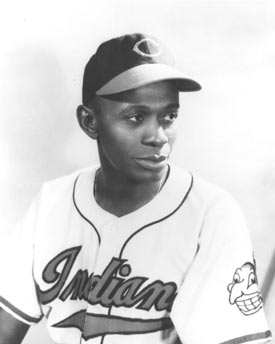
The Cleveland Indians under their legendary owner Bill Veeck were not far behind the Dodgers in integrating their team. They signed Larry Doby on July 5th 1947. Doby would go on to the Hall of Fame and was a key player on the 1948 Indian team which won the 1948 World Series, the last that the storied franchise has won to this date.

Hank THOMPSON - LENNOX PEARSON BOHEMIA ARCHIVE

Hank Thompson and Roy Campanella

roy-campanella-ap2

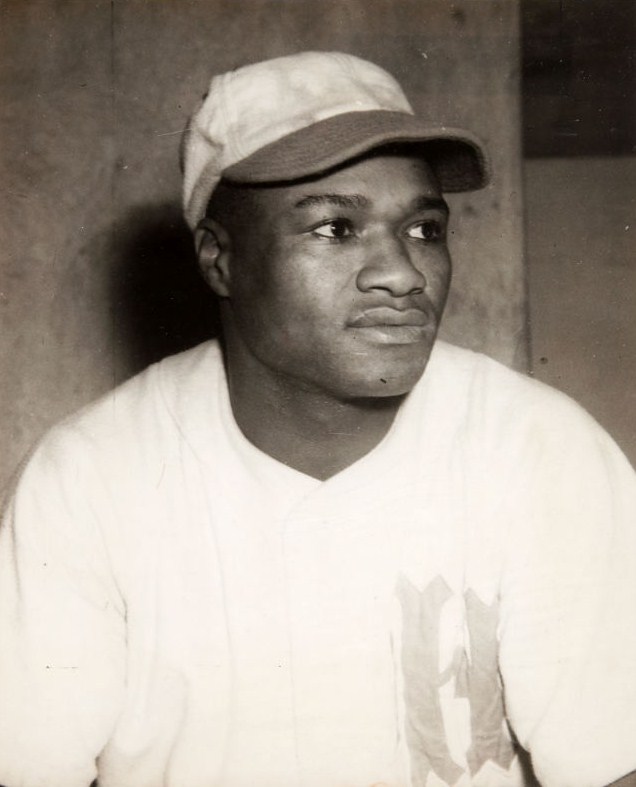
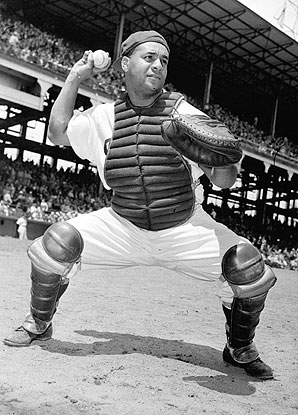
The St. Louis Browns signed Third Baseman Hank Thompson 12 days after the Indians signed Doby. But Thompson, Robinson and Doby would be the only Blacks to play in that inaugural season of integration. They would be joined by others in 1948 including the immortal catcher Roy Campanella who signed with the Dodgers and the venerable Negro League pitcher, Satchel Paige who was signed by the Indians.

monte_irvin

Monte Irvin (Above) and Willie Mays

WillieMays

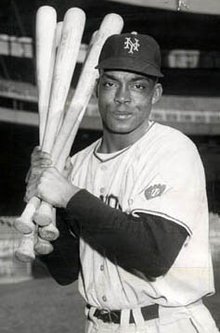
It was not until 1949 when the New York Giants became the next team to integrate. They brought up Monte Irvin and Hank Thompson who they had acquired from the Browns. In 1951 these men would be joined by a young, rookie Willie Mays to become the first all African-American outfield in the Major Leagues. Both Mays and Irvin would enter the Hall of Fame and both are still a key part of the Giants’ story. Despite their age have continued to be active in with the Giants and Major League Baseball.

images-25

Samuel “the Jet” Jethroe

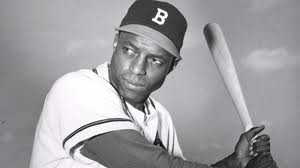
The Boston Braves were the next to desegregate calling up Samuel “the Jet” Jethroe to play Center Field. Jethroe was named the National League Rookie of the Year in 1950.

mlb_a_MinnieMinoso_cmg_600

Minnie Minoso

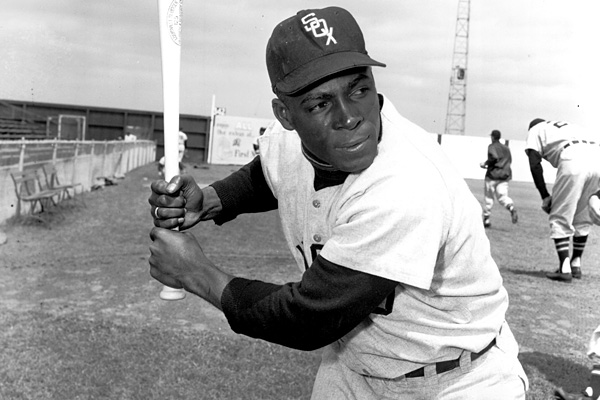
In 1951 the Chicago White Sox signed Cuban born Minnie Minoso who had played for Cleveland in 1949 and 1951 before signing with the White Sox. Minoso would be elected to 9 All-Star teams and win 3 Golden Gloves.

BANKS-ERNIE

Ernie Banks (above) and Bob Trice

Bob_Trice1953

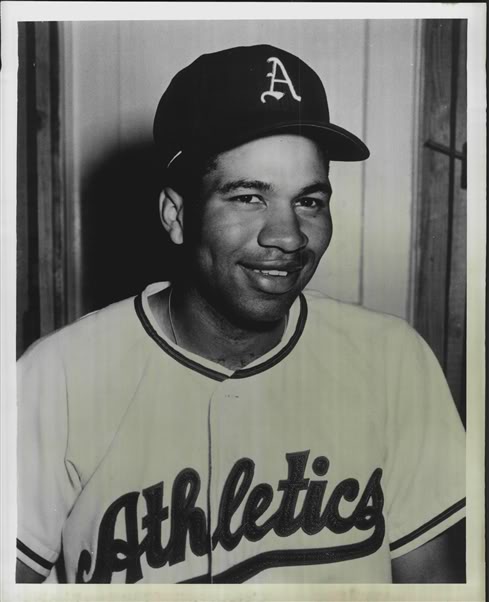
The Chicago Cubs and Philadelphia Athletics integrated at the end of the 1953 season. The Cubs signed Shortstop Ernie Banks who would go on to be a 14 time All-Star, 2 time National League MVP and be elected to the Hall of Fame in 1977 on the first ballot. The Athletics called up pitcher Bob Trice from their Ottawa Farm team where he had won 21 games. Trice only pitched in 27 Major League games over the course of three seasons with the Athletics.

6RI1

Curt Roberts

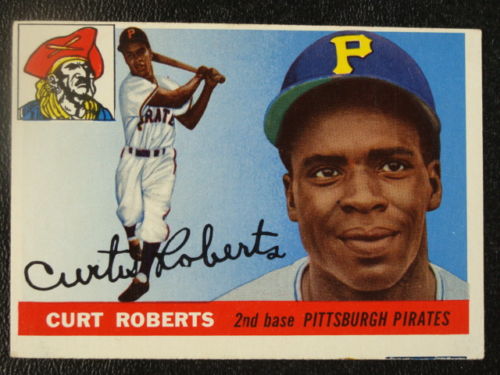
Four teams integrated in 1954. The Pittsburgh Pirates acquired Second Baseman Curt Roberts from Denver of the Western League as part of a minor league deal. He would play 171 games in the Majors.  He was sent to the Columbus Jets of the International League in 1956 and though he played in both the Athletics and Yankees farm systems but never again reached the Majors.

1954_alston_tom

Tom Alston

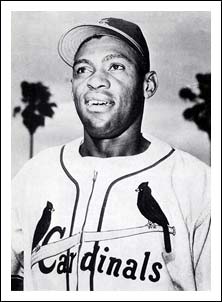
The St. Louis Cardinals, the team that had threatened to not play against the Dodgers and Jackie Robinson in 1947 traded for First Baseman Tom Alston of the Pacific Coast League San Diego Padres. Alston would only play in 91 Major League games with his career hindered by bouts with depression and anxiety.

100005

Nino Escalara (above) and Chuck Harmon

Chuck_Harmon

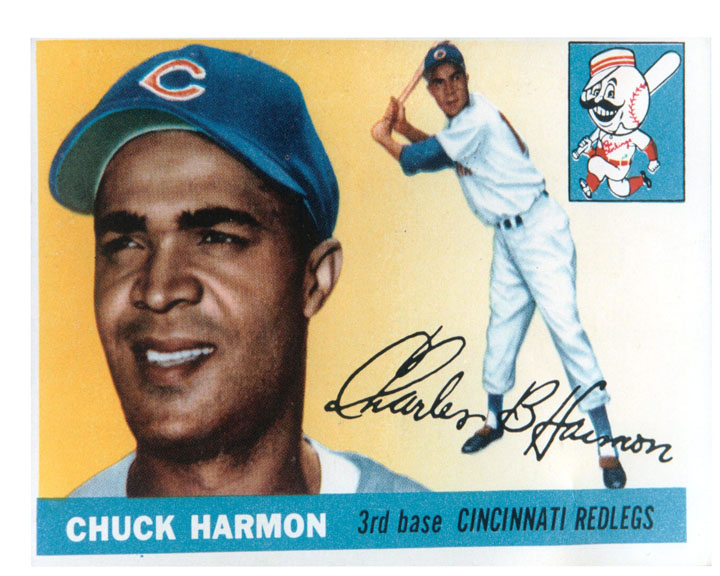
The Cincinnati Reds brought up Puerto Rican born First Baseman Nino Escalera and Third Baseman Chuck Harmon. Harmon had played in the Negro Leagues and had been a Professional Basketball player in the American Basketball League. Harmon who was almost 30 when called up played just 4 years in the Majors. Both he and Escalera would go on to be Major League scouts. Escalera is considered one of the best First Baseman from Puerto Rico and was elected to the Puerto Rican Baseball Hall of Fame. Harmon’s first game was recognized by the Reds in 2004 and a plaque hangs in his honor.

Carlos-Paula

The Washington Senators called up Cuban born Center Fielder Carlos Paula from their Charlotte Hornets’ farm team in September 1954. Paula played through the 1956 season with the Senators and his contract was sold to the Sacramento Salons of the Pacific Coast League. He hit .271 in 157 plate appearances with 9 home runs and 60 RBIs. He died at the age of 55 in Miami.

elston-howard

Elston Howard

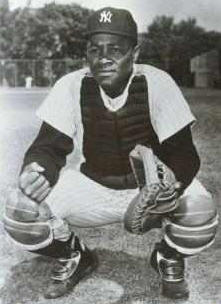
In April 1955 the New York Yankees finally integrated 8 years after the Dodgers and 6 years after the Giants. They signed Catcher/Left Fielder Elston Howard from their International League affiliate where he had been the League MVP in 1954. Howard would play 13 years in the Majors with the Yankees and later the Red Sox retiring in 1968. He would be a 12-time All Star and 6-time World Series Champion as a player and later as a coach for the Yankees. He died of heart disease in 1980.  His number #32 was retired by the Yankees in 1984.

58 kennedy, john f

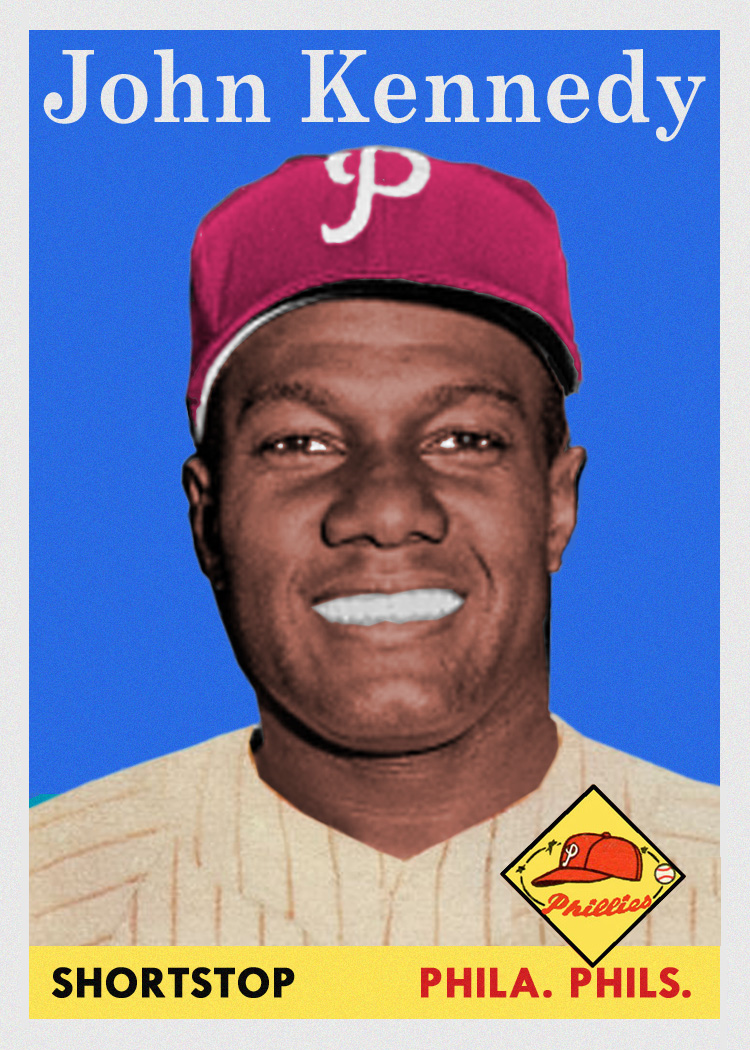
The Philadelphia Phillies purchased the contract of Shortstop John Kennedy from the Kansas City Monarchs of the Negro League at the end of the 1956 season. Kennedy played in just 5 games in April and May of 1957.

osvaldo4_195

 Ozzie Virgil Sr.

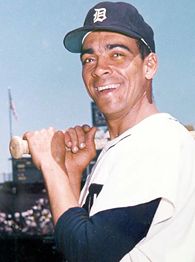
In 1958 the Detroit Tigers obtained Dominican born Utility Player Ozzie Virgil Sr. who had played with the Giants in 1955 and 1956. Virgil would play 9 seasons in the Majors with the Giants, Tigers, Athletics and Pirates and retire from the Giants in 1969. He later coached for 19 years in the Majors with the Giants, Expos, Padres and Mariners.

Pumpsie_Green_1962_Topps

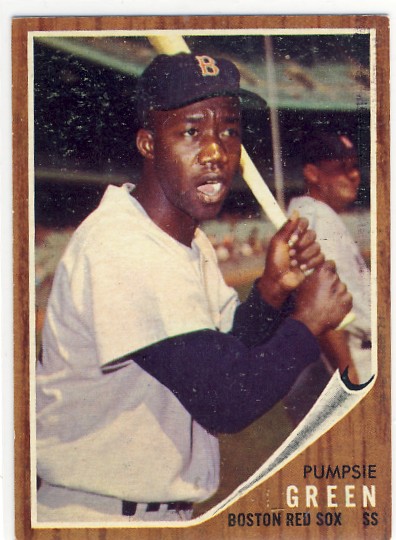
The last team to integrate was the Boston Red Sox who signed Infielder Pumpsie Green. Green made his debut on 21 July 1959 during his three years with the Red Sox was primarily used as a pinch runner. He played his final season with the New York Mets in 1963. He was honored by the Red Sox in 2009 on the 50th anniversary of breaking the Red Sox color barrier.

little-rock-stop-the-race-mixing

voter-registration-mississippi-1960-L-umRewg

luther-king

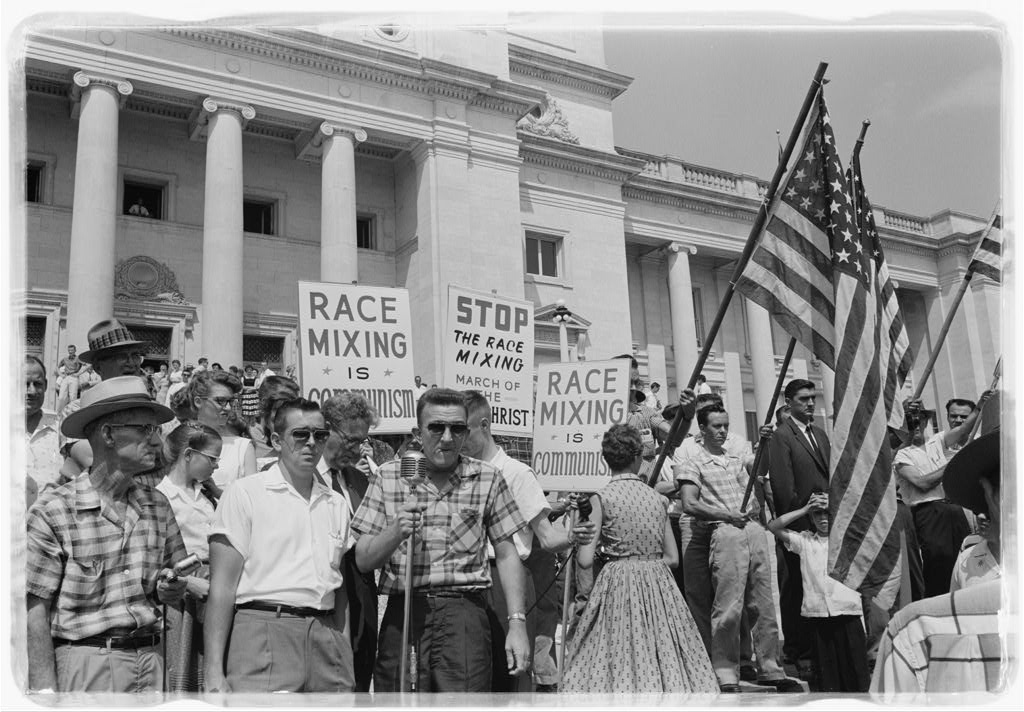
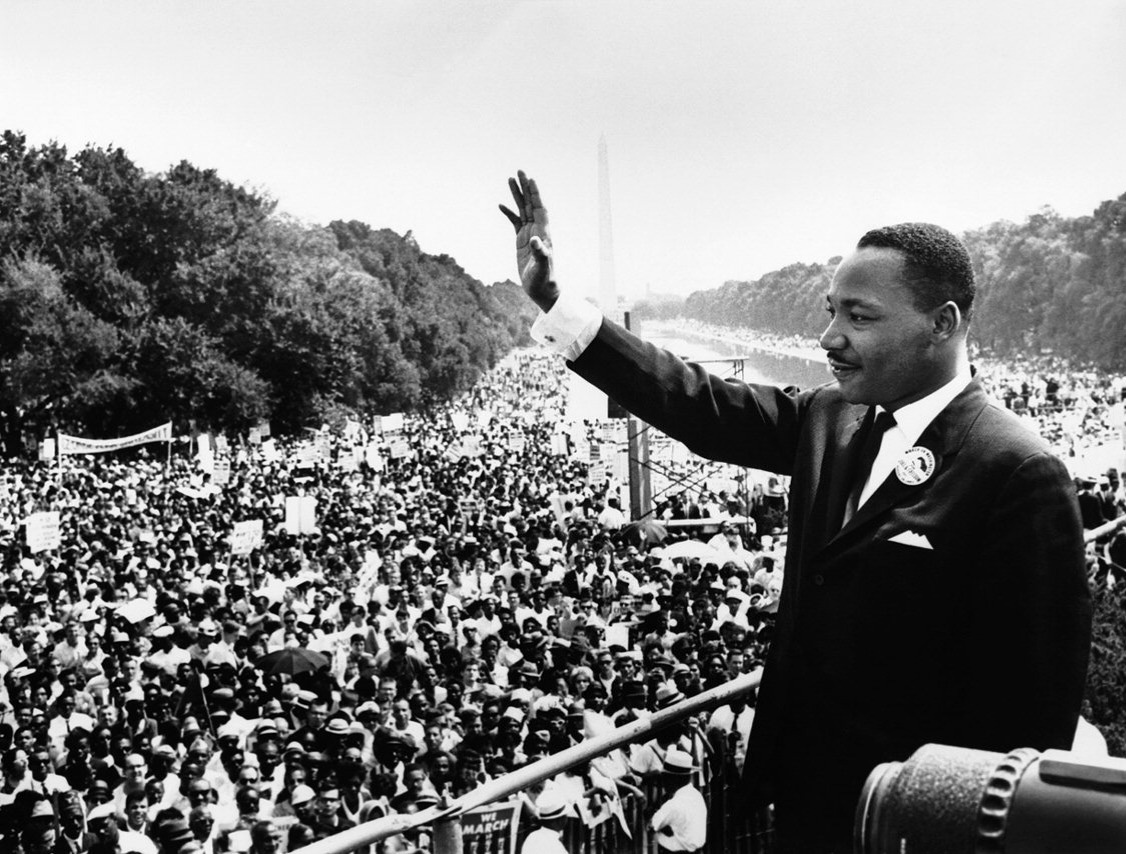
It took 12 years for all the teams of the Major Leagues to integrate, part of the long struggle of African Americans to achieve equality not just in baseball but in all areas of public life.  These men, few in number paved the way for African Americans in baseball and were part of the inspiration of the Civil Rights Movement itself.  They should be remembered by baseball fans, and all Americans everywhere for their sacrifices and sheer determination to overcome the obstacles and hatreds that they faced. It would not be until August of 1963 that Martin Luther King Jr. would give his I Have a Dream speech and 1964 that African Americans received equal voting rights.

robbyii

Spring training for the 2015 season is about to begin in Florida and Arizona, in what are called the Grapefruit and Cactus Leagues. It is hard to believe that only 68 years ago that only one team and one owner dared to break the color barrier that was, then, and often today is still a part of American life.

However in those 68 years despite opposition and lingering prejudice African Americans in baseball led the way in the Civil Rights Movement and are in large part responsible for many of the breakthroughs in race relations and the advancement of not only African Americans, but so many others.

We can thank men like Charles Thomas, Jackie Robinson and Branch Rickey for this and pray that we who remain, Black and White, Asian, and Latin American, as well as all others who make up our great nation will never relinquish the gains that have been won at such a great cost.

obamafirstpitch

President Obama throwing out the First Pitch for the Washington Nationals

Today we have a Black President who has the same kind of racial epitaphs thrown at him every day by whites who as they did to Charles Thomas, Jackie Robinson and so many other pioneers, Frankly such behavior can only be called what is it, unrepentant, unabashed, and evil racism. The fact is that such people don’t think that any Black man should hold such high an office, just as they did not think that Blacks should be allowed to play integrated baseball. It is anathema to them, and that is why their unabashed hatred for Obama runs so deep. They may disagree with his policies, but I guarantee if Obama was white, their opposition to him would be far more civil and respectful. But because he is half-black, and has a funny name they hate him with a passion, a passion that scares me, because words  and hateful beliefs can easily become actions.

Racism still exists, but one day thanks to the efforts of the early ball-players as well as pioneers like President Obama, and the undying commitment of decent Americans to accept people regardless of race, ethnicity, gender, religion, or even sexual orientation, we will see a new birth of freedom.

Peace

Padre Steve+

Leave a comment

Filed under Baseball, civil rights, History, political commentary

Character & Sacrifice: Generals Benjamin O. Davis Sr & Jr.

Benjamin_o_davis

Brigadier General Benjamin O Davis in France 1944

“I have a dream that my four little children will one day live in a nation where they will not be judged by the color of their skin, but by the content of their character.” Dr. Martin Luther King, Jr.

American History would not be the same without the life, work and prophetic ministry of Dr. Martin Luther King Jr. Dr. King was born in a time when most of the country was segregated when “separate by equal” was simply façade to cover the lie that in no way did African Americans have equal rights or privileges in the United States.

Dr King was born less than 60 years after the secession of the Southern states from the Union and the beginning of the American Civil War. Though that blood conflict had freed the slaves it had not freed African Americans from prejudice, violence and discrimination.  When Dr. King began his ministry and was thrust upon the national stage as the strongest voice for equal rights and protections for blacks the discrimination and violence directed towards blacks was a very real and present reality in much of the United States.

However there were cracks beginning to appear in the great wall of segregation in the years preceding Dr. King’s ascent to leadership as the moral voice of the country in the matter of racial equality. In baseball Jackie Robinson became the first African American player in Major League Baseball opening a door for others who would become legends of the game as well as help white America begin its slow acceptance of blacks in sports and the workplace.

Likewise the contributions of a father and son Brigadier General Benjamin O. Davis Sr. and General Benjamin O. Davis Jr. were advancing the cause of blacks in the military which eventually led to the desegregation of the military in 1948.  The impact of these two men cannot be underestimated for they were trailblazers who by their lives, professionalism and character blazed a trail for African Americans in the military as well as society.

Benjamin O. Davis Sr. was a student at Howard University when the USS Maine exploded and sank in Havana Harbor.  He volunteered for service and was commissioned as a temporary 1st Lieutenant in the 8th United States Volunteer Infantry. He was mustered out of service in 1899 but enlisted as a private in the 9th United States Cavalry one of the original Buffalo Soldiers regiments.  He enlisted as the unit clerk of I troop of 3rd Squadron and was promoted to be the squadron Sergeant Major.

Davis was commissioned while the unit was deployed to the Philippines and assigned to the 10th Cavalry.  He was assigned in various positions throughout his career including command, staff and instruction duties including as Professor of Military Science and Tactics in various ROTC programs.  He reached the rank of rank of temporary Lieutenant Colonel and Squadron Commander of 3rd and later 1st Squadron 9th Cavalry from 1917-1920 in the Philippines before reverting to the rank of Captain on his return as part of the post World War I reduction in force.

Davis continued to serve during the inter-war years and assumed command of the 369th Infantry Regiment New York National Guard in 1938. He was promoted to Brigadier General on 25 October 1940 becoming the first African American elevated to that rank in the United States Army and was assigned as Commander 4th Brigade 2nd Cavalry Division. He later served in various staff positions at the War Department and in France and was instrumental in the integration of the U.S. Military. He retired after 50 years service in 1948 in a public ceremony with President Harry S. Truman presiding. He was a member of the American Battle Monuments Commission from 1953-1961 and died in 1970.

davis-3

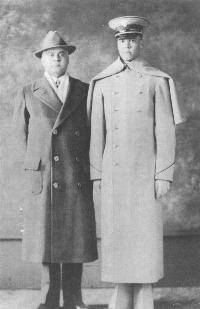
Colonel Davis with his son Cadet Benjamin O Davis Jr.

His son Benjamin O. Davis Jr. was appointed to West Point in 1932.  He graduated and was commissioned in 1936 graduating 35 out of 278, the fourth African American graduate of West Point. During his time at the Academy most of his classmates shunned him and he never had a roommate.  Despite this he maintained a dogged determination to succeed.  The Academy yearbook made this comment about him:

“The courage, tenacity, and intelligence with which he conquered a problem incomparably more difficult than plebe year won for him the sincere admiration of his classmates, and his single-minded determination to continue in his chosen career cannot fail to inspire respect wherever fortune may lead him.”

He was denied entrance to the Army Air Corps because of his race and assigned to the Infantry first to the all lack 24th Infantry Regiment at Ft Benning where he was not allowed in the Officers Club due to his race. Upon his commissioning the Regular Army had just 2 African American Line Officers, 2nd Lieutenant Davis and his father Colonel Davis.

After completion of Infantry School he was assigned as an instructor of Military Science and Tactics and the Tuskegee Institute.  In 1941 the Roosevelt Administration moved to create a black flying unit and Captain Davis was assigned to the first black class at the Tuskegee Army Air Field and in March 1942 one his wings as one of the first 5 African Americans to complete flight training.

In July 1942 he was assigned as Commanding Officer of the 99th Pursuit Squadron which served in North Africa and Sicily flying Curtiss P-40 Warhawks. He was recalled to the United States in September 1943 to command the 332nd Fighter Group. However some senior officers attempted to prevent other black squadrons from serving in combat alleging that the 99th had performed poorly in combat. Davis defended his squadron and General George Marshall ordered an inquiry which showed that the 99th was comparable to white squadrons in combat and during a 2 day period over the Anzio beachhead the pilots of the 99th shot down 12 German aircraft.

davis Library of congress   photo public domain

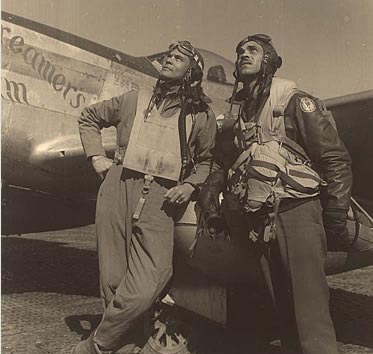
Colonel Benjamin O Davis Jr (left) with one of his Tuskegee Airmen

Davis took the 332nd to Italy where they transitioned to P-47 Thunderbolts and in July 1944 to the P-51 Mustang which were marked with a signature red tail. During the war, the units commanded by Davis flew more than 15,000 sorties, shot down 111 enemy planes, and destroyed or damaged 273 on the ground at a cost of 66 of their own planes.

Tuskegee_01


Their record against the Luftwaffe was outstanding and their protection of the bombers that they escorted was superb with very few bombers lost while escorted by them men that the Luftwaffe nicknamed the Schwarze Vogelmenschen and the Allies the Red-Tailed Angels or simply the Redtails. Davis led his Tuskegee Airmen to glory in the war and their performance in combat helped break the color barrier in the U.S. Military which was ended in 1948 when President Truman signed an executive order to end the segregation of the military. Colonel Davis helped draft the Air Force plan and the Air Force was the first of the services to fully desegregate.

ltgen Benjamindavis

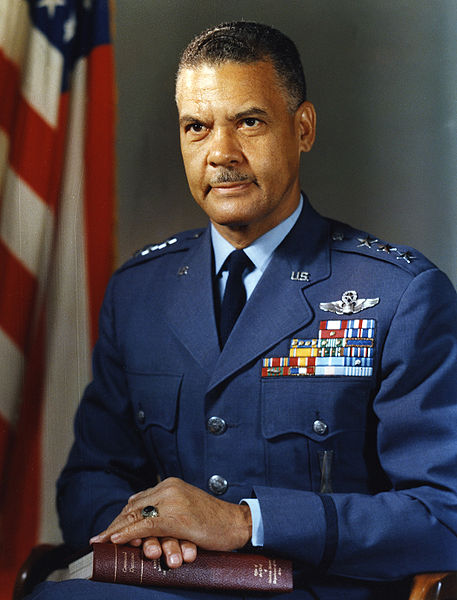
Lieutenant General Benjamin O Davis Jr

Colonel Davis transitioned to jets and let the 51st Fighter Interceptor Wing against Chinese Communist MIGs in the Korean War.  He was promoted to Brigadier General in 1954 and served in numerous command and staff positions. He retired in 1970 with the rank of Lieutenant General and was advanced to General while retired by President Clinton in 1998.  He died in 2002 at the age of 89.

The legacy of Benjamin O. Davis Senior and Benjamin O. Davis Junior is a testament to their character, courage and devotion to the United States of America. They helped pioneer the way for officers such as General Colin Powell and helped change this country for the better.  During times when discrimination was legal they overcame obstacles that would have challenged lesser men.  Benjamin O. Davis Junior remarked:

“My own opinion was that blacks could best overcome racist attitudes through achievements, even though those achievements had to take place within the hateful environment of segregation.”

Such men epitomize the selfless service of so many other African Americans who served the country faithfully and “by the content of their character” triumphed over the evil of racism and helped make the United States a more perfect union.

Peace

Padre Steve+

Leave a comment

Filed under civil rights, History, leadership, Military

Vice Admiral Samuel Gravely Jr. Pioneer of Civil Rights

gravely

Vice Admiral Samuel Gravely Jr.

Vice Admiral Samuel Gravely Jr. is among the great pioneers of civil rights in the U.S. Military. The first African-American ever to be promoted to Flag rank he helped pave the way for so many others. Gravely understood the pressures on him at every stage of his career, He wrote:

“I was sure that I could not afford to fail. I thought that would affect other members of my race if I failed anywhere along the line. I was always conscious of that, particularly in midshipman school and any other schools I went to…I tried to set a record of perfect conduct ashore and at sea.” Vice Admiral Samuel Gravely

gravely_young

Fireman Recruit Samuel Gravely Jr. 

Things have changed much since 1942 when following the attack on Pearl Harbor a young black college student from Richmond Virginia enlisted in the Navy. Samuel Gravely Jr. was the son of a postal worker and Pullman porter while his mother worked as a domestic servant for white families in Richmond. His mother died unexpectedly when he was 15 in 1937 and he remained to help care for his siblings as his father continued to work. Balancing the care of his family with his education he enrolled in Virginia Union College, a Baptist school in Richmond.

It is hard to imagine for most of us now to comprehend the world that the young Gravely grew up in. Segregation was the norm. Blacks in the south and many other locations faced personal as well as entrenched institutional racism. Violence against blacks was quite common and the Ku Klux Klan was strong.

The military was still segregated and a great gulf existed between white military personnel and blacks. Though the selective service law of 1940 called for the conscription of people regardless of race, creed or color the services enjoyed much latitude in determining how minorities could serve. The Secretary of the Navy at the time, Frank Knox resisted integration. Knox determined that African Americans would remain segregated and serve only as Mess Stewards to “prevent undermining and disruptive conditions in the Navy.” Knox told President Roosevelt in the presence of black leaders that “because men live in such intimacy aboard ship that we simply can’t enlist Negroes above the rank of messman. “

That sentiment was strong in both the Navy and the Marines, even more so than in the Army and Army Air Corps. The leaders of both the Navy and Marine Corps resisted attempts to broaden the ability for African Americans to serve and urged that blacks serve in the Army, not the Naval Service.  Marine Corps Commandant Major General Thomas Holcomb agreed with this stance. He commented:

“If we are defeated we must not close our eyes to the fact that once in they [Negroes] will be strengthened in their effort to force themselves into every activity we have. If they are not satisfied to be messmen. they will not be satisfied to go into the constriction or labor battalions. Don’t forger the colleges are turning out a large number of well educated Negroes. I don’t know how long we will be able to keep them out of the V-7 class. I think not very long.”

But Roosevelt was not deterred and by April 1942 changes were announced to allow African Americans to serve in other capacities. Even so African Americans selected for ratings other than messman were to be segregated and commanded by White Officers and Petty Officers.

images-18

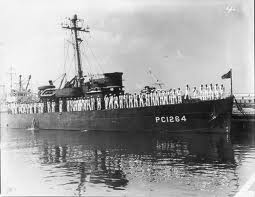
The USS PC-1264 and its crew, Gravely is the lone black officer

USS_PC-1264_officers_and_crew

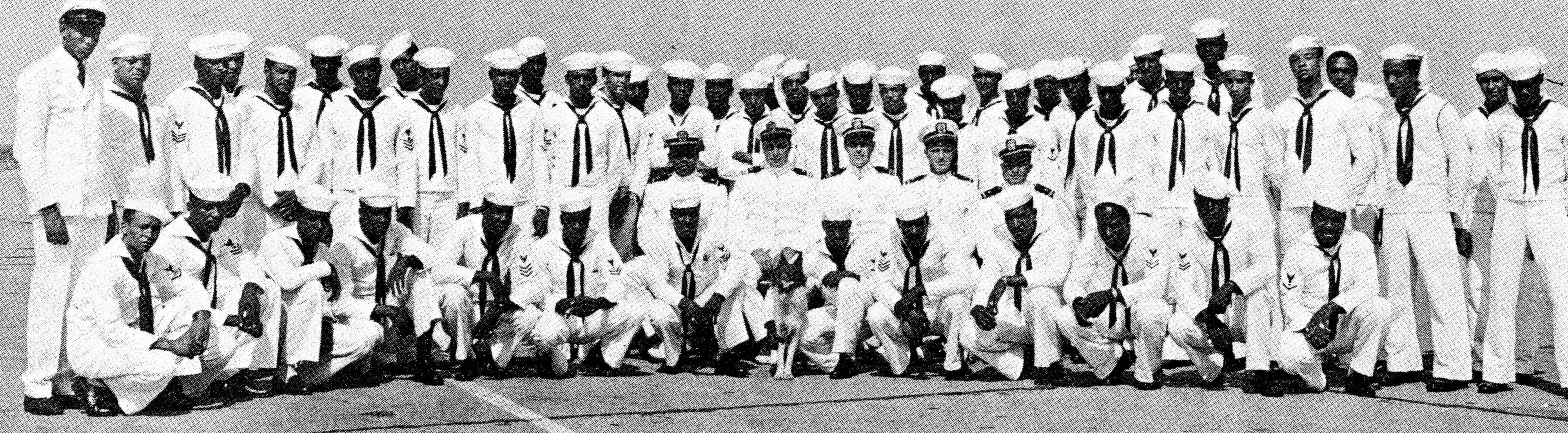
Gravely enlisted in the Navy under these conditions. Serving as a Fireman Apprentice after receiving training as a Motor Machinist in San Diego he worked in menial jobs. In 1943 Gravely was one of only three sailors in his unit to be selected for the V-12 officer training program. He was the only black to make the cut. He was commissioned as an Ensign on December 14th 1944 and assigned to train black recruits at Great Lakes though the vast majority of his class went to sea. The was mainly due to the policy set forth by the General Board in 1942 that prescribed:

“(a) the white man will not accept the negro in a position of authority over him; (b) the white man considers that he is of a superior race and will not admit the negro as an equal; and (c) the white man refuses to admit the negro to intimate family relationships leading to marriage. These concepts may not be truly democratic, but it is doubtful if the most ardent lovers of democracy will dispute them, particularly in regard to inter-marriage.”

Despite this by 1945 the Navy was beginning to change. Gravely was chosen to serve on one of two ships assigned to the “experiment” of seeing how blacks in general ratings could serve at sea. The USS Mason (DE 539) and the USS PC-1264 were assigned black crews with majority white officers, except that Gravely was assigned to PC-1264. Though his commander was pleased with his service Gravely, who had been denied admittance to Officer Clubs and many other “white only” facilities resigned from the Navy in 1946. He believed that the inherent discrimination of the Navy left him no place for advancement. He returned to complete his bachelors degree at Virginia Union.

In 1949, following President Truman’s integration of the military Gravely was asked by the Navy to return to active duty. But the end of the old order was foreshadowed by a Navy pamphlet published in 1944 entitled The Guide to the Command of Negro Personnel. That publication included the statement that ”The Navy accepts no theories of racial differences in inborn ability, but expects that every man wearing its uniform be trained and used in accordance with his maximum individual capacity determined on the basis of individual performance.”

images-17

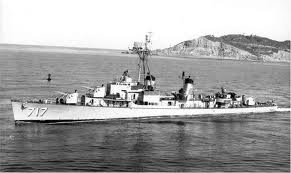
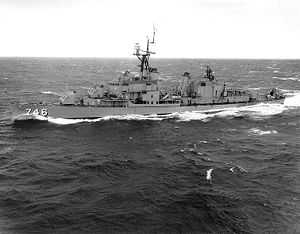
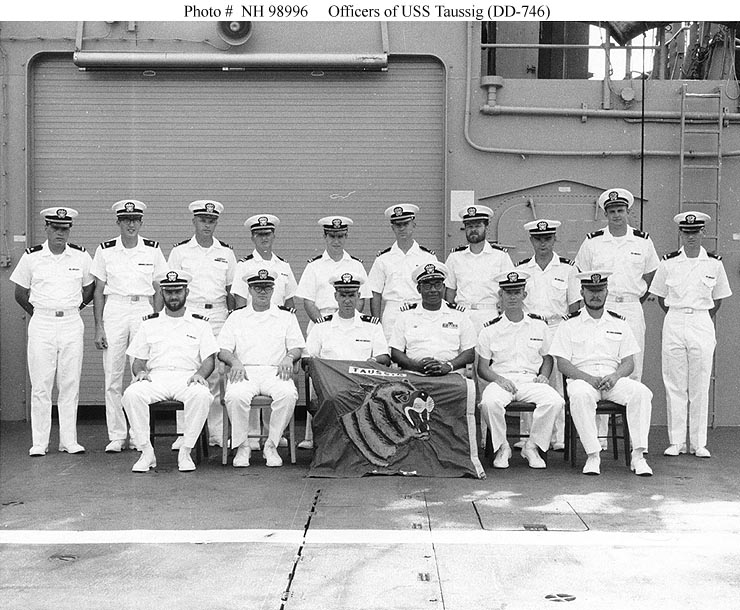
300px-USS_Taussig_(DD-746)_port_side_1965

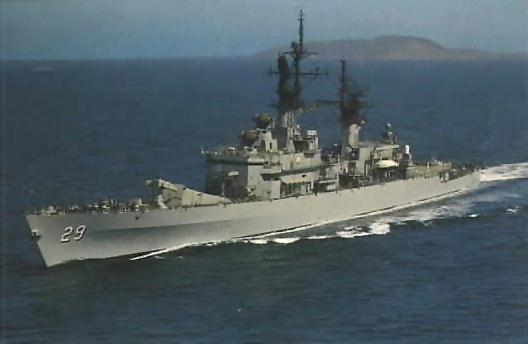
cg29

Gravely’s commands (top to bottom) USS Theodore E Chandler, USS Taussig and USS Jouett

Gravely accepted the offer to return to active duty and never looked back. He worked hard for respect and used his natural talents, personality and size to command respect. He was a man who would blaze the way for other African Americans, and later women and most recently gays to go on to greater things.

Gravely would go on to command three ships, all surface combatants. He was the first African American Naval Officer to command a Navy warship, the USS Theodore E Chandler (DD 717), the first to command a Navy ship in combat, the USS Taussig (DD 746) and the first to command a major warship, the USS Jouett (CG 29). Promoted to flag rank he eventually became the first to command a Fleet when he took command of 3rd Fleet. He retired in 1980 and passed away in 2004.

h98996

Commander Gravely and his officers on USS Taussig

Gravely gave his parents and conditions of his upbringing much credit for his success. He believed that those conditions which forced him to “capitalize on his strong points, build his weak areas and sustain the positive self-esteem and self-worth that his parents instilled in him as a young child.”

He was a great leader. LCDR Desiree Linson who interviewed him for her Air Command and Staff College project noted that Gravely like many other great military leaders before him learned to manage the image that he presented, be a caretaker for his people, what we would now call a mentor. He said “[If I was CNO] my responsibility would be to make sure enlisted men and families were taken care of. I would do everything in my power to make sure.”

Vice Admiral Gravely’s pursuit of excellence, self confidence and mastery of professional skills empowered him in an institution where he was still an anomaly and where racism still existed. He believed in effective communication, especially verbal communication and in building teams and in being a good follower, listening, learning and proactively anticipating the needs of his superiors. Gravely was also a believer in personal morality and self discipline and preparedness. He said:

“I did everything I could think of to prepare myself. If the opportunity came, I would be prepared for it. [The question would not be] “Why didn’t you prepare for this opportunity.” I would be prepared for whatever opportunity that came. If it came, fine. If it did not, fine, but I would be prepared if it did come.”

USS_Gravely

The USS Gravely DDG 107

Vice Admiral Gravely blazed a trail for those that followed him and set an example for all Naval Officers to follow. He did it under conditions that most of us could not imagine. I am proud to serve in the Navy that he helped to make.  I happen to work for an African-American Admiral at the Staff College, and I have served under African American commanders throughout every stage of my military career, in the Army and in the Navy. Admiral Gravely’s vision, service and memory are carried on in this navy and in the ship that bears his name, the USS Gravely DDG-107. Today that ship and her crew stand watch in defense of our nation and our friends around the world. It is a fitting tribute to such an amazing leader.

Peace

Padre Steve+

2 Comments

Filed under civil rights, History, Military, US Navy

They Answered Every Expectation: Black Regiments in the Civil War

41_090_lg

Friends of Padre Steve’s World,

The following is a newly added except to the first chapter of my Gettysburg Text. It is part of the chapter the “First Modern War” which I recently updated on this site. In order not to simply repost a massive article I have only posted the new material.

Peace

Padre Steve+

The war brought about another change to warfare in America. This was a societal and political and a political change that has shaped American military history, culture and life ever since. The Emancipation Proclamation gave African Americans, both Freedmen and recently freed slaves the opportunity to serve in the Union Army. The change of policy instituted by Lincoln was revolutionary as well as controversial and it had strategic implications for the war effort. There were many doubters in the north whose attitudes towards African Americans were not much different than Southerners, especially among the Copperheads.

8thUSCT_Olustee

Prior to the Emancipation some Union commanders in occupied Confederate territory “had unofficially recruited black soldiers in Kansas and in occupied portions of South Carolina and Louisiana in 1862. But the administration had not sanctioned these activities.” [1] But as the war continued on, consuming vast numbers of lives the attitude of Lincoln and the administration began to change.

Lincoln and the closest members of his cabinet were beginning to understand that the “North could not win the war without mobilizing all of its resources and striking against Southern resources used to sustain the Confederate war effort.” [2]

Lincoln’s Secretary of War, Edwin Stanton; who was a passionate believer in the justice of emancipation “Instantly grasped the military value of the proclamation. Having spent more time than any of his colleagues contemplating the logistical problems facing the army, he understood the tremendous advantage to be gained if the massive workforce of slaves could be transferred from the Confederacy to the Union.” [3]

emancipation

Lincoln emphasized the “military necessity” of emancipation and “justified the step as a “fit and necessary war measure for suppressing the rebellion.” [4] The process of emancipation now became not only a moral crusade, but now became a key part of national strategy. Lincoln wrote to his future Vice President, Andrew Johnson, then the military governor of occupied Tennessee that “The colored population is the great available and yet unavailed of, force for restoration of the Union.” [5] The idea of simply mollifying the border states was dropped and policy changed that of “depriving the Confederacy of slave labor. Mobilizing that manpower for the Union- as soldiers as well as laborers- was a natural corollary.” [6] Reflecting President Lincoln’s and Stanton’s argument for the military necessity of emancipation, General Henry Halleck wrote to Ulysses Grant that:

“the character of the war has very much changed within the past year. There is now no possibility of reconciliation with the rebels… We must conquer the rebels or be conquered by them….Every slave withdrawn from the enemy is the equivalent of a white man put hors de combat.” [7]

Grant concurred with the decision. Grant wrote to in a letter to Lincoln after the assault on Battery Wagner “by arming the negro we have added a powerful ally. They will make good soldiers and taking them from the enemy weakens him in the same proportion as it strengthens us.” [8] Lincoln wrote after the Emancipation Proclamation that “the emancipation policy, and the use of colored troops, constitute the heaviest blow yet dealt to the rebellion.” [9] The change was a watershed in both American history as well as the future of the U.S. Military services.

Emancipation allowed for the formation of regiments of United States Colored Troops (USCT), mustered directly into Federal service, which in numbers soon dwarfed the few state raised Black Regiments. However, it was the the inspiration provided by those first state raised regiments as well as the violence directed against Blacks in the draft riots helped to provoke “many northerners into a backlash against the consequences of violent racism.” [10] The valor of the state regiments, as well as the USCT units that managed to get into action was remarkable, especially in regard to the amount of discrimination levied at them by some northerners, and the very real threat of death that they faced of captured by Confederates.

In May of 1863 Major General Nathaniel Banks dared to send the First and Third Regiments of “Louisiana Native Home Guard regiments on a series of attacks on Confederate positions at Port Hudson, Louisiana” [11] where they received their baptism of fire. They suffered heavy losses and “of the 1080 men in the ranks, 271 were hit, or one out of every four.” [12] Banks said of them in his after action report: “They answered every expectation…In many respects their conduct was heroic…The severe test to which they were subjected, and the determined manner in which they encountered the enemy, leave upon my mind no doubt of their ultimate success.” [13]
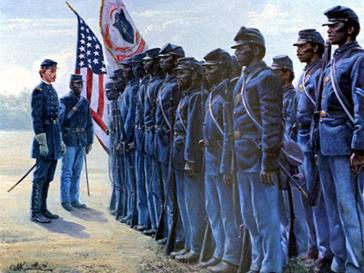
negro-regiment-54th-ma

But the most famous African American volunteer regiment was the 54th Massachusetts, commanded by Colonel Robert Gould Shaw, the “North’s showcase black regiment.” [14] Raised in Boston and officered by many men who were the sons of Boston’s blue blood abolitionist elite, the regiment was authorized in March 1863. Since there was still opposition to the formation of units made up of African Americans, Massachusetts Governor John Andrew authorized the formation of the 54th under the command of white officers, a practice that with few exceptions, became standard in the U.S. military until President Truman desegregated the armed forces in 1948. Governor Andrew was determined to ensure that the officers of the 54th were men of “firm antislavery principles…superior to a vulgar contempt for color.” [15]

220px-WilliamCarney

Sergeant William H Carney of the 54th Massachusetts

The 54th saw action first in early June and at Gould’s urging sent into battle against the Confederate positions at Fort Wagner on July 18th 1863. Leading the attack the 54th lost nearly half its men, “including Colonel Shaw with a bullet through his heart. Black soldiers gained Wagner’s parapet and held it for an hour before falling back.” [16] Though they tried to hold on they were pushed back after a stubborn fight to secure a breach in the fort’s defenses. “Sergeant William H Carney staggered back from the fort with wounds in his chest and right arm, but with the regiment’s Stars and Stripes securely in his grasp. “The old flag never touched the ground, boys,” Carney gasped as he collapsed at the first field hospital he could find.” [17] For his actions at Fort Wagner Carney became the first African American awarded the Medal of Honor.

The_Storming_of_Ft_Wagner-lithograph_by_Kurz_and_Allison_1890a

Shaw was buried with his men by the Confederates and when Union commanders asked for the return of his body were told “We have buried him with his niggers,” Shaw’s father quelled a northern effort to recover his son’s body with these words: We hold that a soldier’s most appropriate burial-place is on the field where he has fallen.” [18] As with so many frontal attacks on prepared positions throughout the war, valor alone could not overcome a well dug in enemy. “Negro troops proved that they could stop bullets and shell fragments as good as white men, but that was about all.” [19]

Despite the setback, the regiment went on to further actions where it continued to distinguish itself. The Northern press, particularly abolitionists papers brought about a change in the way that many Americans in the North, civilians as well as soldiers, saw blacks. The Atlantic Monthly noted “Through the cannon smoke of that dark night, the manhood of the colored race shines before many eyes that would not see.” [20]
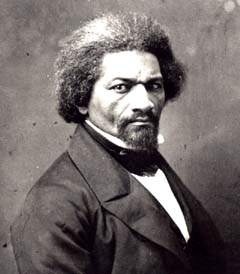
Douglass.JPG

Frederick Douglass, who had two sons serving in the 54th Massachusetts, understood the importance of African Americans taking up arms against those that had enslaved them in order to win their freedom:

“Once let a black man get upon his person the brass letters U.S… let him get an eagle on his button, and a musket on his shoulder and bullets in his pockets, and there is no power on earth which can deny he has won the right to citizenship in the United States.” [21]

HD_NgroWarFL640116p264cz.preview

At the Battle of Milliken’s Bend, Louisiana a training camp where two regiments of newly recruited blacks were camped was attacked by a Confederate brigade attempting to provide relief to the Vicksburg garrison was repulsed by raw, ill-armed and untrained black troops:

“Untrained and armed with old muskets, most of the black troops nevertheless fought desperately. With the aid of two gunboats they finally drove off the enemy. For raw troops, wrote Grant, the freedmen “behaved well.” Assistant Secretary of War Dana, still with Grant’s army, spoke with more enthusiasm. “The bravery of the blacks,” he declared, “completely revolutionized the sentiment in the army with regard to the employment of negro troops. I heard prominent officers who had formerly in private had sneered at the idea of negroes fighting express after that as heartily in favor of it.” [22]
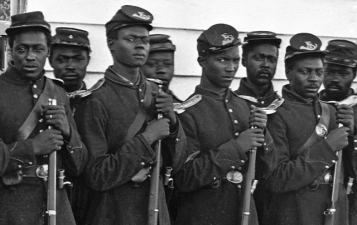
HD_4USCinfantryDetail.preview

Soldiers of the 4th USCT Regiment 

By the end of the war 179,000 African American Soldiers, commanded by 7,000 white officers served in the Union armies. While most were confined to rear area duties or working with logistics and transportation. The policies to regulate USCT regiments to supporting tasks in non-combat roles “frustrated many African American soldiers who wanted a chance to prove themselves in battle.” [23] Many of the soldiers and their white officers argued to be let into the fight as they felt that “only by proving themselves in combat could blacks overcome stereotypes of inferiority and prove their “manhood.” [24] Even so in many places in the army the USCT and state regiments made up of blacks were scorned:

“A young officer who left his place in a white regiment to become colonel of a colored regiment was frankly told by a staff officer that “we don’t want any nigger soldiers in the Army of the Potomac,” and his general took him aside to say: “I’m sorry to have you leave my command, and am still more sorry that you are going to serve with Negroes. I think that it is a disgrace to the army to make soldiers of them.” The general added that he felt this way because he was sure that colored soldiers just would not fight.” [25]

The general of course was wrong. In the engagements they USCT units were allowed to fight, they did so with varying success most often attributable to the direction of their senior officers. When given the chance they almost always fought well, even when badly commanded, this was true even when they were thrown into hopeless situations as when Ferrero’s Division, comprised of colored troops were thrown into the Battle of the Crater at Petersburg when “that battle lost beyond all recall.” [26] They advanced in good order singing as they went, while their commander, General Ferrero took cover in a dugout and started drinking; but the Confederate defenders had been reinforced and “Unsupported, subjected to a galling fire from batteries on the flanks, and from infantry fire in front and partly on the flank,” a witness write, “they broke up in disorder and fell back into the crater.” [27] Pressed into to carnage of the crater with white troops from the three divisions already savaged by the fighting had taken cover, the “black troops fought with desperation, uncertain of their fate if captured.” [28] In the battle the division lost 1327 of just under 4000 men. [29]

When captured by Confederates, black soldiers and their white officers received no quarter from many Confederate opponents. General Edmund Kirby Smith who held overall command of Confederate forces west of the Mississippi instructed General Richard Taylor to simply execute black soldiers and their white officers: “I hope…that your subordinates who may have been in command of capturing parties may have recognized the propriety of giving no quarter to armed negroes and their officers. In this way we may be relieved from a disagreeable dilemma.” [30] This was not only a local policy, but echoed at the highest levels of the Confederate government. In 1862 the Confederate government issued an order that threatened white officers commanding blacks: “any commissioned officer employed in the drilling, organizing or instructing slaves with their view to armed service in this war…as outlaws” would be “held in close confinement for execution as a felon.” [31]

On April 12th 1864 at Fort Pillow, troops under the command of General Nathan Bedford Forrest massacred the bulk of over 231 Union most of them black as they tried to surrender. While it is fairly clear that Forrest did not order the massacre and even attempted to stop it, that he had lost control of his troops, who with the fury of men possessed by hatred of a lesser race slaughtered the Union troops as they either tried to surrender or flee; but he was not displeased with the result. Ulysses Grant wrote that:

“These troops fought bravely, but were overpowered I will leave Forrest in his dispatches to tell what he did with them.

“The river was dyed,” he says, “with the blood of the slaughtered for up to 200 years. The approximate loss was upward of five hundred killed; but few of the officers escaped. My loss was about twenty killed. It is hoped that these facts will demonstrate to the Northern people that negro soldiers cannot cope with Southerners.” Subsequently Forrest made a report in which he left out the part that shocks humanity to read.” [32]

”The bulk of the killing was directed at the black soldiers of the 6th U.S. Colored Heavy Artillery which composed over a third of the garrison. “Of the 262 Negro members of the garrison, only 58- just over 20 percent- were marched away as prisoners; while of the 295 whites, 168- just under sixty percent were taken.” [33] A white survivor of the 13th West Tennessee Cavalry, a Union unit at the fort wrote: “We all threw down our arms and gave tokens of surrender, asking for quarter…but no quarter was given….I saw 4 white men and at least 25 negroes shot while begging for mercy….These were all soldiers. There were also 2 negro women and 3 little children standing within 25 steps of me, when a rebel stepped up to the and said, “Yes, God damn you, you thought you were free, did you?” and shot them all. They all fell but one child, when he knocked it in the head with the breech of his gun.” [34]A Confederate Sergeant wrote home a week after the massacre: “the poor deluded negroes would run up to our men, fall upon their knees and with uplifted hands scream for mercy, but were ordered to their feet and shot down.” [35]

African American soldiers proved themselves during the war and their efforts paved the way for Lincoln and others to begin considering the full equality of blacks as citizens. If they could fight and die for the country, how could they be denied the right to votes, be elected to office, serve on juries or go to public schools? Under political pressure to end the war during the stalemate before Petersburg and Atlanta in the summer of 1864 Lincoln reacted angrily to Copperheads as well as wavering Republicans on the issue of emancipation:

“But no human power can subdue this rebellion without using the Emancipation lever as I have done.” More than 100,000 black soldiers were fighting for the Union and their efforts were crucial to northern victory. They would not continue fighting if they thought the North intended to betray them….If they stake their lives for us they must be prompted by the strongest motive…the promise of freedom. And the promise being made, must be kept…There have been men who proposed to me to return to slavery the black warriors. “I should be damned in time & in eternity for so doing. The world shall know that I will keep my faith to friends & enemies, come what will.” [36]

Despite this, even in the North during and after the war, blacks, including former soldiers would be discriminated against sometimes by the white men that they served alongside. Those rights would be fought for another century and what began in 1863 with the brave service and sacrifice of these African American soldiers began a process of increased civil rights that is still going on today. It would not be until after the war that some blacks were commissioned as officers in the Army. When Governor John Andrew, the man who had raised the 54th Massachusetts attempted to:

“issue a state commission to Sergeant Stephen Swails of the 54th…the Bureau of Colored Troops obstinately refused to issue Swails a discharge from his sergeant’s rank, and Swails promotion was held up until after the end of the war. “How can we hope for success to our arms or God’s blessing,” raged the white colonel of the 54th, Edward Hallowell, “while we as a people are so blind to justice?” [37]

8512218

Lieutenant Stephen Swails 

In the South, politicians and many senior Confederate Officers fought against any allowance for blacks to serve, for they knew if they allowed this, that slavery itself must be swept away. Despite this a few such as General Patrick Cleburne, an Irish immigrant, a non-slave owner who commanded a division in the Army of Tennessee demonstrated the capacity for forward thinking in terms of race, blacks serving as soldiers and emancipation.

fig25

Major General Patrick Cleburne 

Cleburne, known as “the Stonewall Jackson of the West” was a bold fighter who put together a comprehensive plan. He noted that the Confederacy was losing the war because it did not have soldiers, that it did not have supplies or resources and most significantly that “slavery, from being one of our chief sources of strength at the beginning of the war, has now become in a military point of view, one of our chief sources of weakness.” [38] Cleburne recommended that “we immediately commence training a large reserve of the most courageous of our slaves, and further that we guarantee freedom within a reasonable time to every slave in the South who shall remain to the confederacy in this war.” [39]

His proposal was radical. He was asking more from his fellow Southerners than they could risk. He was “asking them to surrender the cornerstone of white racism to preserve their nation” [40] and he presented it in stark terms that few could stomach “As between the loss of independence and the loss of slavery, we can assume that every patriot will freely give up the latter- give up the Negro slave rather than be a slave himself.” [41]

In January 1864 General W.H.T Walker obtained a copy of Cleburne’s proposal and sent it to Davis. Walker opposed it and expressed his outrage over it, rather than being a military matter it was now a political matter and Davis intervened to quash the proposal. “Convinced that the “propagation of such opinions” would cause “discouragements, distraction, and dissention” in the army, Jefferson Davis ordered the Generals to stop discussing the matter…The only consequence of Cleburne’s action seemed to be the denial of promotion to this ablest of the army’s division commanders, who was killed ten months later at the Battle of Franklin.” [42] In fact Cleburne was “passed over for command of an army corps and promotion to lieutenant general” three times in the next eight months, and in “each care less distinguished, less controversial men received the honors.” [43] All copies of Cleburne’s proposal were destroyed by the order of Davis.

Cleburne was not the only military man to advocate the formation of Negro units or even emancipation. Robert E. Lee was one of the chief proponents of this. Lee said after the war that he had told Davis “often and early in the war that the slaves should be emancipated, that it was the only way to remove a weakness at home and to get sympathy abroad, and divide our enemies, but Davis would not hear of it.” [44]

Ten months later Davis raised the issue of arming slaves as he now believed that military necessity left him little choice. He was opposed by some of his closest political allies including Howell Cobb who warned “The day that you make soldiers of them is the beginning of the end of the revolution. If slaves will make good soldiers our whole theory of slavery is wrong.” [45] Lee wrote to a member of Virginia’s legislature “we must decide whether slavery shall be extinguished by our enemies and the slaves used against us, or use them ourselves at the risk of the effects which may be produced on our social institutions…” and he pointed out that “any act for the enrolling of slaves as soldiers must contain a “well digested plan of gradual and general emancipation”: the slaves could not be expected to fight well if their service was not rewarded with freedom.” [46]

The debate began in earnest in the fall of 1864 and revealed a sharp divide in the Confederacy between those who supported the measure and those against it. Cabinet members such as Judah Benjamin and a few governors “generally supported arming the slaves.” [47] They were opposed by the powerful governors of Georgia and North Carolina, Joe Brown and Zebulon Vance as well as the president-pro tem of the Confederate Senate R.M.T. Hunter, who forcibly opposed the measure. Led by Governor “Extra Billy” Smith Virginia’s General Assembly voted “to permit the arming of slaves but included no provision for emancipation, either before or after military service.” [48]

Finally in March of 1865 the Confederate Congress passed by one vote a watered down measure to allow for the recruitment of slaves. It stipulated that “the recruits must all be volunteers” [49] and those who volunteered must also have “the approbation of his master by a written instrument conferring, as far as he may, the rights of a freed man.” [50] While this in itself was a radical proposition for a nation which had went to war to maintain slavery, the fact was that the slave’s service and freedom were granted not by the government, but by his owner, and even at this stage of the war, few owners were willing to part with their property. It was understood by many that giving freedom to a few was a means of saving the “particular institution.” The Richmond Sentinel noted during the November debate: “If the emancipation of a part is the means of saving the rest, this partial emancipation is eminently a pro-slavery measure.” [51] Thus the law made “no mention of emancipation as a reward of military service” [52] and in deference to “state’s rights, the bill did not mandate freedom for slave soldiers.” [53]

But even the watered down measure was opposed by diehards. Robert Kean, who headed the Bureau of War and should have understood the stark reality of the Confederacy’s strategic situation, note in his diary, that the law:

“was passed by a panic in the Congress and the Virginia Legislature, under all the pressure the President indirectly, and General Lee directly, could bring to bear. My own judgment of the whole thing is that it is a colossal blunder, a dislocation of the foundations of society from which no practical results will be reaped by us.” [54]

It was Lee’s prestige alone that allowed the measure to pass, but even that caused some to question Lee’s patriotism. The Richmond Examiner dared to express a doubt whether Lee was “a ‘good Southerner’: that is, whether he is thoroughly satisfied of the justice and beneficence of negro slavery.” [55] Robert Toombs of Georgia stated that “the worst calamity that could befall us would be to gain our independence by the valor of our slaves” [56] and a Mississippi congressman stated that “Victory itself would be robbed of its glory if shared with slaves.” [57] On March 23rd 1865 the War Office issued General Order Number 14, which authorized the call up and recruitment of slaves to the Confederate cause and on March 25th two companies were formed for drill in Richmond’s Capitol Square and as they did so to the sounds of fifes and drums, “Small boys jeered and threw rocks” [58] at them. None of those few volunteers would see action as within a week the Confederate government had fled Richmond.

But some would see that history was moving, and attitudes were beginning to change. It took time, and the process is still ongoing. As imperfect as emancipation was and though discrimination and racism remained, African Americans had reached “levels that none had ever dreamed possible before the war.” [59] In April 1865 as Jefferson Davis and his government fled Richmond, with Davis proclaiming “again and again we shall return, until the baffled and exhausted enemy shall abandon in despair his endless and impossible task of making slaves of a people resolved to be free.” [60]

richmond

Entering Richmond 

The irony in Davis’s empty vow was stunning, with a week Lee had surrendered and in a month Davis himself would be in a Federal prison. The Federal troops who led the army into Richmond came from General Godfrey Weitzel’s Twenty-fifth Corps, of Ord’s Army of the James. The Every black regiment in the Army of the James was consolidated in Weitzel’s Corps, along with Ferrero’s former division which had suffered so badly at the Battle of the Crater. “Two years earlier in New Orleans, Weitzel had protested that he did not believe in colored troops and did not want to command them, and now he sat at the gates of Richmond in command of many thousands of them, and when the citadel fell he would lead them in and share with them the glory of occupying the Rebel capital.” [61] were regiments of black “cavalrymen and infantrymen. Many were former slaves; their presence showed their resolve to be free.” [62]

Some of those early African American soldiers went on to distinguish themselves on the prairie as the immortal Buffalo Soldiers. Other blacks would fight in Cuba and the Philippines during the Spanish American War. In the First World War, despite there being some instances of racial harmony, blacks, including officers faced discrimination and met with violent acts. “Refusals to arrest white soldiers who physically assaulted black soldiers accompanied by the tendency to rescind unpopular racial orders and to discourage black officers from demanding salutes from white soldiers” [63] was common.

The all black 94th Division fought in combat under French command in World War one when it was denied the chance to fight as part of the American Army, which mainly regulated black units to rear echelon duties, something that was the standard practice again in the Second World War. Even after President Truman desegregated the armed forces in 1948 African Americans, as well as other racial minorities, women and gays have faced very real discrimination. The military continues to make great strides, and while overt racist acts and other types of discrimination are outlawed, racism still remains a part of American life.

pride_over_prejudice-reeves-b-of-nashville

USCT Guarding Confederate Prisoners after Battle of Nashville

But things have changed, and that in large part is due to the unselfish sacrifice in the face of hatred and discrimination of the men of the USCT and the State Black Regiments like the 54th Massachusetts and the Louisiana Home Guards who blazed a way to freedom for so many. A white soldier who served with the 49th Massachusetts wrote “all honor to our negro soldiers. They deserve citizenship. They will secure it! There would be much suffering in what he termed “the transition state” but a “nation is not born without pangs.” [64]

Those birth pangs helped to bring about a new birth of freedom for the United States.

Notes

[1] McPherson, James M. Tried by War: Abraham Lincoln as Commander in Chief Penguin Books, New York and London 2008

[2] McPherson, James M. Drawn With the Sword: Reflections on the American Civil War Oxford University Press, Oxford and New York 1996 p.101

[3] Godwin, Doris Kearns Team of Rivals: The Political Genius of Abraham Lincoln Simon and Shuster, New York and London 2005

[4] Egnal, Marc Clash of Extremes: The Economic Origins of the Civil War Hill and Wang a division of Farrar, Straus and Giroux New York 2009 p.318

[5] Ibid. McPherson Tried by War p.159

[6] Ibid. McPherson Drawn With the Sword p.159

[7] McPherson, James M. Abraham Lincoln and the Second American Revolution Oxford University Press, New York and Oxford 1991 p.35

[8] Ibid. Guelzo Fateful Lighteningp.381

[9] Ibid. McPherson Abraham Lincoln and the Second American Revolution p.35

[10] Ibid. McPherson. The Battle Cry of Freedom p.686

[11] Ibid. Guelzo Fateful Lightening p.379

[12] Ibid. Foote , The Civil War, A Narrative. Volume Two p.398

[13] Ibid. Guelzo Fateful Lightening p.379

[14] Ibid. McPherson. The Battle Cry of Freedom p.686

[15] Ibid. McPherson Drawn With the Sword p.101

[16] Ibid. McPherson. The Battle Cry of Freedom p.686

[17] Ibid. Guelzo Fateful Lightening pp. 380-381

[18] Ibid. McPherson. The Battle Cry of Freedom pp.686-687

[19] Ibid. Foote , The Civil War, A Narrative. Volume Two p.697

[20] Ibid. McPherson. The Battle Cry of Freedom p.686

[21] Ibid. Guelzo Fateful Lightening p. 381

[22] Ibid. McPherson. The Battle Cry of Freedom p.634

[23] Gallagher, Gary W. The Union War Harvard University Press, Cambridge MA and London 2011

[24] Ibid. McPherson Drawn With the Sword p.89

[25] Catton, Bruce. A Stillness at Appomattox Doubleday and Company Garden City, New York 1953 p.227

[26] Ibid. Catton A Stillness at Appomattox p.249

[27] Foote, Shelby, The Civil War, A Narrative. Volume Three Red River to Appomattox Random House, New York 1974 p.537

[28] Wert, Jeffry D. The Sword of Lincoln: The Army of the Potomac Simon and Schuster, New York and London 2005 pp.384-385

[29] Ibid. Foote The Civil War, A Narrative. Volume Three p.537

[30] Ibid. Guelzo Fateful Lightening p. 377

[31] Ibid. Guelzo Fateful Lightening p. 377

[32] Grant, Ulysses S. Preparing for the Campaigns of ’64 in Battles and Leaders of the Civil War Volume IV, Retreat With Honor Edited by Robert Underwood Johnson and Clarence Clough Buel Castle, Secaucus NJ pp.107-108

[33] Ibid. Foote The Civil War, A Narrative. Volume Three p.111

[34] Ibid. Guelzo Fateful Lightening p. 378

[35] Ibid. Foote The Civil War, A Narrative. Volume Three p.112

[36] Ibid. McPherson Abraham Lincoln and the Second American Revolution p.89

[37] Ibid. Guelzo Fateful Lightening p. 376

[38] Ibid. Thomas, The Confederate Nation p.262

[39] Ibid. Thomas, The Confederate Nation p.262

[40] Ibid. Guelzo Fateful Lightening p. 370

[41] Ibid. Thomas, The Confederate Nation p.262

[42] Ibid. McPherson. The Battle Cry of Freedom p.833

[43] Ibid. Thomas, The Confederate Nation p.262

[44] Ibid. Gallagher The Confederate War p.47.

[45] Ibid. Guelzo Fateful Lightening p. 370

[46] Korda, Michael. Clouds of Glory: The Life and Legend of Robert E. Lee Harper Collins Publishers, New York 2014 p.643

[47] Ibid. Thomas, The Confederate Nation p.293

[48] Ibid. Foote. The Civil War, A Narrative. Volume Three pp.754-755

[49] Ibid. Foote. The Civil War, A Narrative. Volume Three p. 755

[50] Ibid. Thomas, The Confederate Nation p.296

[51] Ibid. McPherson. The Battle Cry of Freedom p.836

[52] Ibid. Foote. The Civil War, A Narrative. Volume Three p.755

[53] Ibid. McPherson. The Battle Cry of Freedom p.837

[54] Ibid. Foote. The Civil War, A Narrative. Volume Three p.860

[55] Ibid. McPherson. The Battle Cry of Freedom p.837

[56] Ibid. Foote. The Civil War, A Narrative. Volume Three p.860

[57] Ibid. McPherson. The Battle Cry of Freedom p.835

[58] Ibid. Foote. The Civil War, A Narrative. Volume Three p.860

[59] Ibid. Guelzo Fateful Lightening p. 386

[60] Levine, Bruce Half Slave and Half Free: The Roots of the Civil War Revised Edition, Hill and Wang, a division of Farrar, Strauss and Giroux, New York 1992 and 1995 p.241

[61] Catton, Bruce Grant Takes Command Little, Brown and Company Boston, Toronto and London 1968 p.411

[62] Ibid. Levine Half Slave and Half Free pp.241-242

[63] Keene, Jennifer D. Doughboys, the Great War, and the Remaking of America The Johns Hopkins University Press, Baltimore and London 2001 p.88

[64] Ibid Gallagher The Union War p.113

5 Comments

Filed under civil rights, civil war, History, Military

My Way or the Highway: The Zero Sum Game of American Politics in 2013

img00169-20110726-2126

“Politics is an art and not a science, and what is required for its mastery is not the rationality of the engineer but the wisdom and the moral strength of the statesman”Once upon a time in America there was a time when we had people in government who were statesmen.” Hans J Morgenthau 

These men understood something about the Constitution, representative government. pluralism, tolerance and dare I say compromise. Yet all were men of principle. The honestly believed in and worked toward the goals that they believed best embodied the American body politic as well as their own political, ideological and even religious beliefs. Basically when we cut to the chase the real thing that sets them apart from the legislators of today was that they knew that compromise was actually desirable in many cases. They understood that there were times to “duke it out” on Capitol Hill but that at the end of the day that as Americans we could have different opinions yet still come together for the benefit of all Americans, not just those that we were beholden to for the money needed to keep us in office.

But that was a different era. Men like Edward Dirksen, Scoop Jackson, Harry Truman, Dwight Eisenhower, Tip O’Neill and Ronald Reagan or for that matter even Jack, Bobby or Teddy Kennedy would not survive in the zero-sum politics if 21st Century American. They would be despised by their political “allies” even more so than their opponents.

The sad thing is that in the United States of 2013 it is much easier to be against something than it is to be for something. Likewise it is now more beneficial for politicians of both parties in the gerrymandered congressional districts which ensure the safety of the incumbent to adopt a no-quarter attitude. It has allowed elected leaders to adopt a zero-sum game of no-compromise.

The results are a broken system of government, a deep division of the people almost all of whom distrust and even despise the very people that they elected.

As I watch the current proceedings in Washington I am reminded of what I thought when the “deal” to agree to the sequester was reached. I remembered the words of Thomas Jefferson concerning the Missouri Compromise. I knew back in 2011 that the even the threat of sequester would not change the behavior of those in Congress, particularly the Tea Party faction of the Republicans, a group who have in many cases so wedded the most uncompromising aspects of religion to political ideology that there can be no backing down for them. Politics is an extension of God’s will. It is the extension of the theology of Christian Dominionism which has at its center the takeover of the systems of the world by Christians, the Seven Mountains theology. That is why compromise if there is any in the current situation will by only delay the reckoning.

Jefferson noted: “but this momentous question, like a fire bell in the night, awakened and filled me with terror. I considered it at once as the knell of the Union. it is hushed indeed for the moment. but this is a reprieve only, not a final sentence. a geographical line, coinciding with a marked principle, moral and political, once conceived and held up to the angry passions of men, will never be obliterated; and every new irritation will mark it deeper and deeper.” 

We need a revival of statesmanship in our country but in the current political environment I fear that those who would attempt to be statesmen would not survive. Much like Weimar Germany our politicians, pundits and preachers, the Unholy Trinity are paving the way for something unimaginably terrible when they finally wreck our current system of government. They are doing it and those who do not speak out against them regardless of our politics have to take part of the blame.

Martin Niemoller wrote after the Second World War:

In Germany they first came for the Communists,
and I didn’t speak up because I wasn’t a Communist.
Then they came for the Jews,
and I didn’t speak up because I wasn’t a Jew.
Then they came for the trade unionists,
and I didn’t speak up because I wasn’t a trade unionist.
Then they came for the Catholics,
and I didn’t speak up because I was a Protestant.
Then they came for me –
and by that time no one was left to speak up.

Peace

Padre Steve+

2 Comments

Filed under History, leadership, Loose thoughts and musings, Political Commentary, Religion

The Long and Slow Integration of the Major Leagues: A Reflection on Desegregation and Spring Training

robinson-dodgers

John Jorgensen, Pee Wee Reese, Ed Stanky and Jackie Robinson on opening day 1947

“Thomas Jefferson, when he wrote the Declaration, made proper provision for baseball when he declared that ‘all men are, and of right out to be, free and equal.’ That’s why they are at the ball game, banker and bricklayer, lawyer and common laborer.” – Baseball magazine (1921)

“Baseball should be taken seriously by the colored player — and in this effort of his great ability will open the avenue in the near future wherein he may walk hand in hand with the opposite race in the greatest of all American games — baseball.” Ossie Davis

robinson2-popup

Charles Thomas 

It was in 1903 when Branch Rickey, then a coach for the Ohio Wesleyan University baseball team had to console his star player, Charles Thomas when a hotel in South Bend Indiana refused him a room because he was black. Rickey found Thomas sobbing  rubbing his hands and repeating “Black skin. Black skin. If only I could make them white.” Rickey attempted to console his friend saying “Come on, Tommy, snap out of it, buck up! We’ll lick this one day, but we can’t if you feel sorry for yourself.”

Branch-Rickey

Thomas, encouraged by Rickey was remembered by one alumnus who saw a game that Thomas played in noted that “the only unpleasant feature of the game was the coarse slurs cast at Mr. Thomas, the catcher.” However, the writer noted something else about Thomas that caught his eye: “But through it all, he showed himself far more the gentleman than his insolent tormentors though their skin is white.”

Baseball like most of America was not a place for the Black man. Rickey, a devout Christian later remarked “I vowed that I would always do whatever I could to see that other Americans did not have to face the bitter humiliation that was heaped upon Charles Thomas.”

In April 1947 Branch Rickey, now the owner of the Brooklyn Dodgers had one African-American ballplayer at the Dodgers’ Spring Training site in Daytona Beach Florida. The South was still a hotbed of racial prejudice, Jim Crow was the law of the land and Blacks had no place in White Man’s baseball. That player was Jackie Robinson.

Jackie Robinson Shaking Branch Rickey's Hand

The Dodgers had been coming to Florida for years. Rickey moved the Dodgers from Jacksonville to Daytona Beach in 1947 after Jacksonville had refused to alter its segregation laws to allow an exhibition game between the Dodgers International League affiliate the Montreal Royals, for whom Robinson starred.

That was the year that Rickey signed Robinson to a minor league contract with the Royals.  When Rickey called up Robinson 6 days prior to the 1947 season, it was  Robinson broke the color barrier for the Dodgers and Major League Baseball. However it would take another 12 years before all Major League teams had a black player on their roster.

It is hard to imagine now that even after Jackie Robinson had broken the color barrier that other teams did not immediately sign black players. However Rickey and Robinson broke the color barrier a year before Harry Truman had integrated the Armed Forces and seven years before the Supreme Court ruled the segregation of public schools illegal. But how could that be a surprise? The country was still rampant with unbridled racism. Outside of a few Blacks in the military and baseball most African Americans had few rights. In the North racism regulated most blacks to ghettos, while in the South, Jim Crow laws and public lynchings of progressive or outspoken Blacks.

images-24

Larry Doby (above) and Satchel Paige signed by the Indians

pic1

The Cleveland Indians under their legendary owner Bill Veeck were not far behind the Dodgers in integrating their team. They signed Larry Doby on July 5th 1947. Doby would go on to the Hall of Fame and was a key player on the 1948 Indian team which won the 1948 World Series, the last that the storied franchise has won to this date.

Hank THOMPSON - LENNOX PEARSON BOHEMIA ARCHIVE

Hank Thompson and Roy Campanella

roy-campanella-ap2

The St. Louis Browns signed Third Baseman Hank Thompson 12 days after the Indians signed Doby. But Thompson, Robinson and Doby would be the only Blacks to play in that inaugural season of integration. They would be joined by others in 1948 including the immortal catcher Roy Campanella who signed with the Dodgers and the venerable Negro League pitcher, Satchel Paige who was signed by the Indians.

monte_irvin

Monte Irvin (Above) and Willie Mays

WillieMays

It was not until 1949 when the New York Giants became the next team to integrate. They brought up Monte Irvin and Hank Thompson who they had acquired from the Browns. In 1951 they would be joined by rookie Willie Mays to become the first all African-American outfield in the Major Leagues. Both Mays and Irvin would enter the Hall of Fame and both are still a key part of the Giants’ story. Despite their age have continued to be active in with the Giants and Major League Baseball.

images-25

The Boston Braves were the next to desegregate calling up Samuel “the Jet” Jethroe to play Center Field. Jethroe was named the National League Rookie of the Year in 1950.

mlb_a_MinnieMinoso_cmg_600

Minnie Minoso

In 1951 the Chicago White Sox signed Cuban born Minnie Minoso who had played for Cleveland in 1949 and 1951 before signing with the White Sox. Minoso would be elected to 9 All-Star teams and win 3 Golden Gloves.

BANKS-ERNIE

Ernie Banks (above) and Bob Trice

Bob_Trice1953

The Chicago Cubs and Philadelphia Athletics integrated at the end of the 1953 season. The Cubs signed Shortstop Ernie Banks who would go on to be a 14 time All-Star, 2 time National League MVP and be elected to the Hall of Fame in 1977 on the first ballot. The Athletics called up pitcher Bob Trice from their Ottawa Farm team where he had won 21 games. Trice only pitched in 27 Major League games over the course of three seasons with the Athletics.

6RI1

Curt Roberts

Four teams integrated in 1954. The Pittsburgh Pirates acquired Second Baseman Curt Roberts from Denver of the Western League as part of a minor league deal. He would play 171 games in the Majors.  He was sent to the Columbus Jets of the International League in 1956 and though he played in both the Athletics and Yankees farm systems but never again reached the Majors.

1954_alston_tom

Tom Alston

The St. Louis Cardinals, the team that had threatened to not play against the Dodgers and Jackie Robinson in 1947 traded for First Baseman Tom Alston of the Pacific Coast League San Diego Padres. Alston would only play in 91 Major League games with his career hindered by bouts with depression and anxiety.

100005

Nino Escalara (above) and Chuck Harmon

Chuck_Harmon

The Cincinnati Reds brought up Puerto Rican born First Baseman Nino Escalera and Third Baseman Chuck Harmon. Harmon had played in the Negro Leagues and had been a Professional Basketball player in the American Basketball League. Harmon who was almost 30 when called up played just 4 years in the Majors. Both he and Escalera would go on to be Major League scouts. Escalera is considered one of the best First Baseman from Puerto Rico and was elected to the Puerto Rican Baseball Hall of Fame. Harmon’s first game was recognized by the Reds in 2004 and a plaque hangs in his honor.

Carlos-Paula

The Washington Senators called up Cuban born Center Fielder Carlos Paula from their Charlotte Hornets’ farm team in September 1954. Paula played through the 1956 season with the Senators and his contract was sold to the Sacramento Salons of the Pacific Coast League. He hit .271 in 157 plate appearances with 9 home runs and 60 RBIs. He died at the age of 55 in Miami.

elston-howard

Elston Howard

In April 1955 the New York Yankees finally integrated 8 years after the Dodgers and 6 years after the Giants. They signed Catcher/Left Fielder Elston Howard from their International League affiliate where he had been the League MVP in 1954. Howard would play 13 years in the Majors with the Yankees and later the Red Sox retiring in 1968. He would be a 12-time All Star and 6-time World Series Champion as a player and later as a coach for the Yankees. He died of heart disease in 1980.  His number #32 was retired by the Yankees in 1984.

58 kennedy, john f

The Philadelphia Phillies purchased the contract of Shortstop John Kennedy from the Kansas City Monarchs of the Negro League at the end of the 1956 season. Kennedy played in just 5 games in April and May of 1957.

osvaldo4_195

Ozzie Virgil Sr.

In 1958 the Detroit Tigers obtained Dominican born Utility Player Ozzie Virgil Sr. who had played with the Giants in 1955 and 1956. Virgil would play 9 seasons in the Majors with the Giants, Tigers, Athletics and Pirates and retire from the Giants in 1969. He later coached for 19 years in the Majors with the Giants, Expos, Padres and Mariners.

Pumpsie_Green_1962_Topps

The last team to integrate was the Boston Red Sox who signed Infielder Pumpsie Green. Green made his debut on 21 July 1959 during his three years with the Red Sox was primarily used as a pinch runner. He played his final season with the New York Mets in 1963. He was honored by the Red Sox in 2009 on the 50th anniversary of breaking the Red Sox color barrier.

little-rock-stop-the-race-mixing

voter-registration-mississippi-1960-L-umRewg

luther-king

It took 12 years for all the teams of the Major Leagues to integrate, part of the long struggle of African Americans to achieve equality not just in baseball but in all areas of public life.  These men, few in number paved the way for African Americans in baseball and were part of the inspiration of the Civil Rights Movement itself.  They should be remembered by baseball fans, and all Americans everywhere for their sacrifices and sheer determination to overcome the obstacles and hatreds that they faced. It would not be until August of 1963 that Martin Luther King Jr. would give his I Have a Dream speech and 1964 that African Americans received equal voting rights.

robbyii

Spring training for the 2013 season has begun in Florida and Arizona, in what are called the Grapefruit and Cactus Leagues. It is hard to believe that only 66 years ago that only one team and one owner dared to break the color barrier that was, and often still is a part of American life. However in those 66 years despite opposition and lingering prejudice African Americans in baseball led the way in the Civil Rights Movement and are in large part responsible for many of the breakthroughs in race relations and the advancement of not only African Americans, but so many others. We can thank men like  Charles Thomas, Jackie Robinson and Branch Rickey for this and pray that we who remain, Black and White, Asian, and Latin American, as well as all others who make up our great nation will never relinquish the gains that have been won at such a great cost.

Peace

Padre Steve+

1 Comment

Filed under Baseball, History, laws and legislation, Political Commentary