Tag Archives: ijn yamato

From Monitor to Musashi: a Tale of Legendary Warships

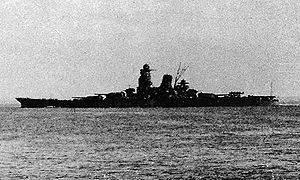
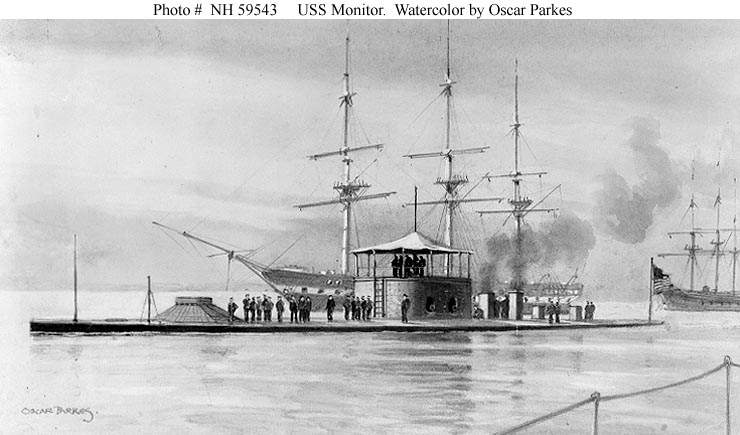
300px-Japanese_battleship_Musashi_cropped monitor watercolor

Musashi and Monitor

I have been thinking about two ships this past week. One of these ships was the Japanese Super-Battleship Musashi. The Musashi was one of the two largest battleships ever constructed and her wreck was discovered last week where she sank in the Sibuyan Sea. The other ship was the USS Monitor. The tiny Monitor was progenitor of all the great battleships that followed and 153 years ago Monitor helped propel naval architecture and warfare into a new era when she challenged the CSS Virginia at the Battle of Hampton Roads.

The Monitor was one of three experimental designs chosen by the Navy’s Ironclad board to deal with the Virginia. Her design and construction were remarkable, especially for her day. The ship was entirely experimental, nothing like Monitor had ever been built before, but even so it was less than five months from the date she was ordered until she was commissioned and just a few days more than that before she was in action. I cannot imagine any warship ship new design ever breaking that record.

Her designer was John Ericsson, a Swede. Ericsson was the inventor of the screw propeller and designer of the first U.S. Navy Screw Frigate the USS Princeton. Ericsson had be shunned by the Navy after a rifled cannon, which was not of his design or construction exploded aboard Princeton during a gunnery demonstration which killed the Secretary of the Navy and others. Ericcson was not planning to submit a design but was persuaded to and his design, the Monitor was one of the three designs selected.

officersondeckweb1

The Officers of Monitor

The Monitor was like nothing ever seen on the ocean. Described by some as a “cheese box on a raft” the small ship had all of her machinery located below the waterline on a completely iron hull that only drew 11 feet of water. She was 179 feet long, had a beam of 41 and a half feet and displaced 987 tons. Her single vibrating lever steam engine powered by two boilers produced 340 horsepower and drove her at a top speed of six knots.

Her hull was protected by armor plate, but the most notable and innovative feature was a heavily armored revolving turret with eight inches of armor, mounted two massive 11 inch Dahlgren smoothbore guns which “could fire a 170-pound shot or 136-pound shell in any direction except straight ahead, where the pilot house sheathed in nine inches of armor was located.” Future ships remedied this defect. Ericcson’s ship was mocked around the navy and by naval designers, but he and it would prove them wrong. The Monitor’s most notable features, full steam propulsion, heavy armor and the revolving turret mounting heavy caliber guns would set the standard to which future battleships would be constructed.
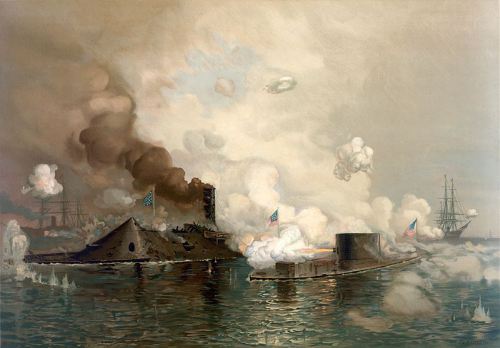
800px-the_monitor_and_merrimac1

The Battle of Hampton Roads

Monitor had a brief service life, she fought the Virginia, took part in actions along the James River and sank in a storm off Cape Hatteras North Carolina on December 31st 1861. The British Royal Navy designed an improved monitor with higher freeboard and finally an ocean going turret ship, the HMS Devastation.

Soon, the navies of the world began to build battleships and in 1906 the Royal Navy built the HMS Dreadnought which like Monitor revolutionized warship construction and naval warfare. Navies around the world began building ever larger, faster and more powerful Dreadnoughts culminating the designs of the late 1930s, the German Bismarck class, the American Iowa class, the British Vanguard, and the Japanese Yamato Class. It is the last ships, the Yamato and her sister Musashi that I want to discuss here, not that the others are not interesting or important, but because of the almost mythic status that these ships maintain in the annals of naval history, as well as their tragic end.
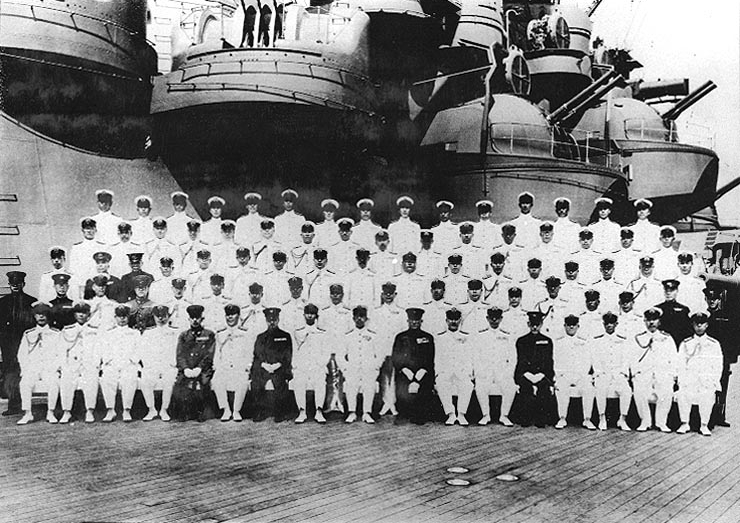
 Hiro-Hito_on_Musashi

Emperor Hirohito on Musashi in 1943

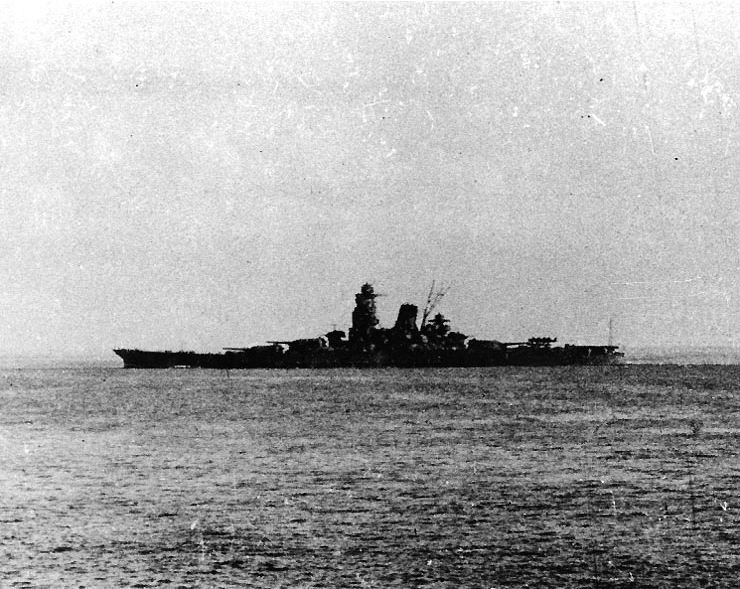
The Yamato and Musashi were the largest and most heavily armed battleships ever built. Shrouded in secrecy by the Imperial Japanese Navy and Government the ships were designed to offset projected American numerical superiority. Their names were symbolic of Japan’s history. Yamato was named after Yamato Province, the ancestral home of the Yamato People, the dominant native ethnic group in Japan. Musashi was named after Musashi Province in which lays Tokyo Prefecture.  A third ship of the class, Shinano, was named after Shinano Province in central Japan which was the home of the prestigious Taketa Shingen family during the Senguku period.
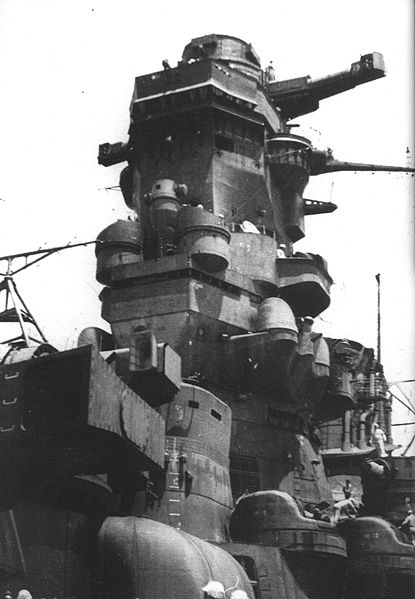
415px-Musashi,Bridge

The Conning Tower and Bridge of Musashi

The secrecy surrounding their design and construction was unprecedented. Those charged with their design and construction were thoroughly checked out by Japan’s secret police and sworn to an oath of secrecy. The oath sworn by builders of Musashi at the Mitsubishi Heavy Industries Nagasaki Shipyard were sworn to the oath shown below:

I am aware that all work involving the construction of the No. 2 Battleship is vital to national security. I will make utmost effort to maintain the secrecy of the project, and swear that I will leak no information relating to the said battleship, even to relatives and close friends. In the event I violate this oath,  I will submit to the punishment determined by the company and the Navy.  

Security measures around the shipyards where Yamato and Musashi were constructed were immense. At Nagasaki where there was a large foreign business and missionary population where the shipyard was visible from most of the city at hemp screen of 75,000 square meters was constructed to shield the ship from prying eyes and spies.
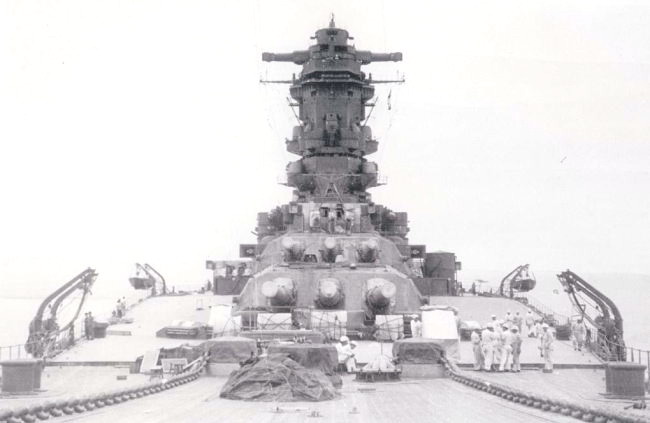
1938_Japan_Navy_battleship

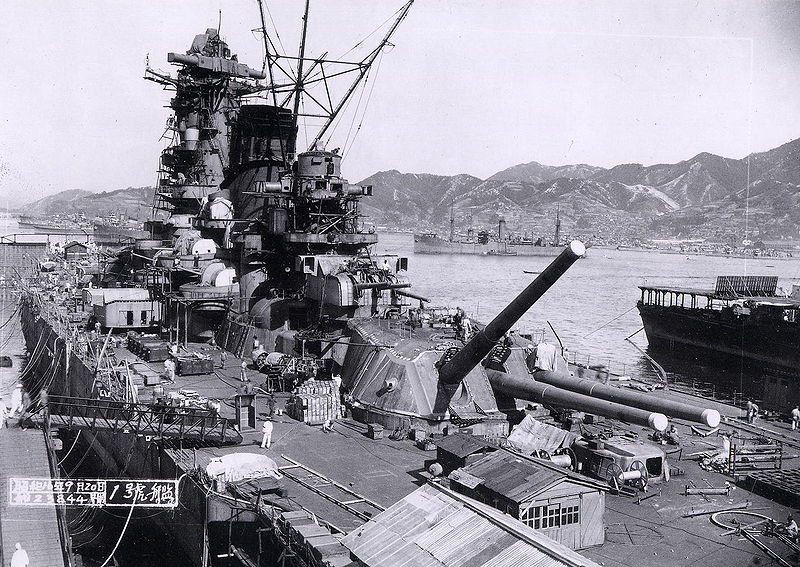
Musashi under Construction

When actual preparations for construction were taken in 1937 secret police swept the areas of foreign, especially Chinese workers. Security was increased inside and outside the shipyard, all blueprints accounted for and placed under strict guard while all shipyard workers were photographed with any having knowledge of the plans or supervising the construction sworn to the secrecy oath.

When a top secret blueprint went missing in 1938 at Nagasaki an intense investigation that included the torture of numerous suspects and the jailing of a blueprinter who accidentally swept the document into the trash was sentenced to 3 years in prison.

heel1

Armor and Protection of Yamato Class

Few pictures exist of the ships and Japanese Naval Officers destroyed many of the records of the ships design and construction just prior to the end of the Second World War. Throughout their existence they were a mystery to the American Navy. During the war the U.S. Navy estimated them to carry nine 16” guns and displace between 40,000-57,000 tons. Even the highly regarded Jane’s Fighting Ships listed them at just 45,000 tons.
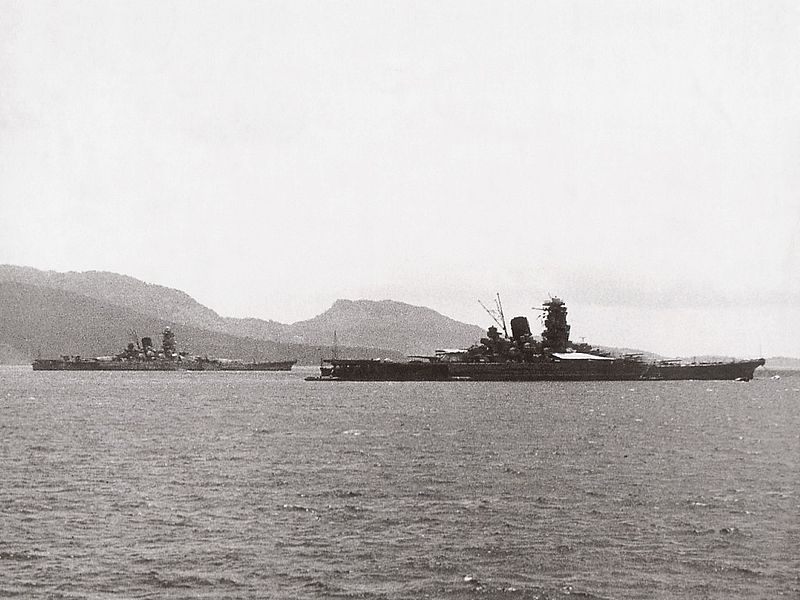
800px-YamatoClassBattleships

Yamato and Musashi together in 1943

Preliminary design work began in 1934 and progressed rapidly following Japan’s withdraw from the League of Nations and renunciation of the Washington and London Naval Treaties and withdraw from the 1936 naval talks in London. The early designs varied in the caliber of guns, size and armor, propulsion systems and endurance. Gun calibers ranged from 16” to 18.1” and a combined diesel-turbine system was considered but rejected in favor of traditional steam turbines.

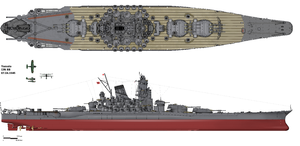
The final design was for a class of five ships. Each would displace 64,000 tons standard displacement and 72,000 tons at full load. They were 862 feet long with a beam of 127 feet.  They were so large that the docks they were built needed to be expanded and special extra-large launch platforms had to be built.  At Nagasaki the dock at to be expanded by cutting into the hill adjacent to it.

They were armed with nine 18.1 inch guns in triple turrets which could fire a projectile weighing over a ton. The secondary armament consisted of 12 6.1 inch guns mounted in triple turrets formerly mounted on the Mogami Class cruisers when those ships were equipped with 8” guns. Anti-aircraft defense included twelve 5” guns and twenty-four 25mm anti-aircraft guns. During the war two of the 6.1 inch turrets were removed and replaced with twelve more 5” guns and the 25mm battery was raised to 162 guns. Fire control systems were designed in such a way that the ships could engage multiple surface targets at the same time.

The ships were protected by a massive armored belt ranging from 16 inches to 8 inches with 26 inch armor on the face plates of the main gun turrets. The armor was advanced with excellent sloping but had a flaw where the upper and lower belts connected just below the waterline which exposed them to damage from torpedoes.
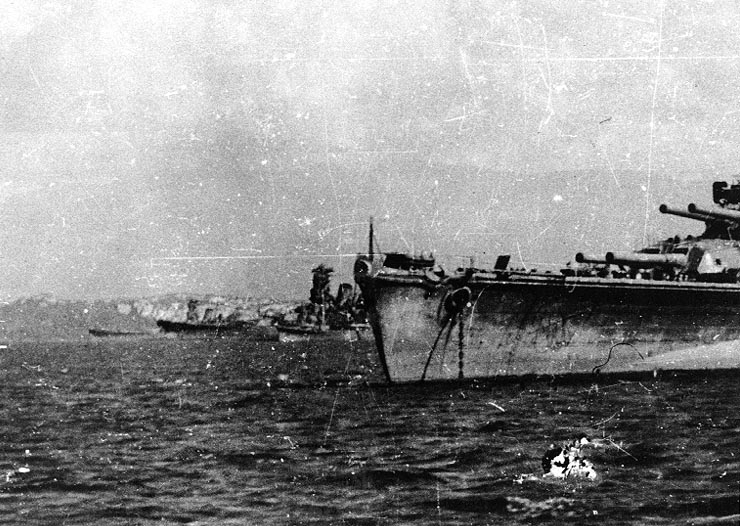
Photographed just prior to the Battle of Leyte Gulf. Ships are, from left to right Musashi, Yamato, a cruiser and Nagato.

Yamato and Musashi viewed beside Battleship Nagato (foreground) just before the Battle of Leyte Gulf

They were powered by 12 Kampon boilers which powered 4 steam turbines and four three bladed propellers. These developed 150,000 shp and could drive the ship at a top speed of 27 knots.

Construction of Yamato began on November 4th 1937 at Kure Naval Shipyard. Musashi on March 28th 1938. Traditionally such events were large public ceremonies but these were limited to just a few Naval Staff and Shipyard executives.  Yamato was launched on August 8th 1940 and commissioned on December 16th 1941, just 9 days after Pearl Harbor. Musashi was launched on November 8th 1940 and commissioned on August 5th 1942 just two days before the U.S. Marines invaded Guadalcanal and two months after the disaster at the Battle of Midway.

Yamato served as Admiral Yamamoto’s flagship at Midway where she saw no action. The next two years she was and Musashi alternated as fleet flagship and conducted operations with Battleship Division One in operations between Mainland Japan and the major Japanese base at Truk. On December 25th 1943 while escorting a convoy she was torpedoed by the submarine USS Skate and suffered heavy damage which flooded a magazine.  On March 29th while underway Musashi was struck near the bow by a torpedo from the USS Tunny.
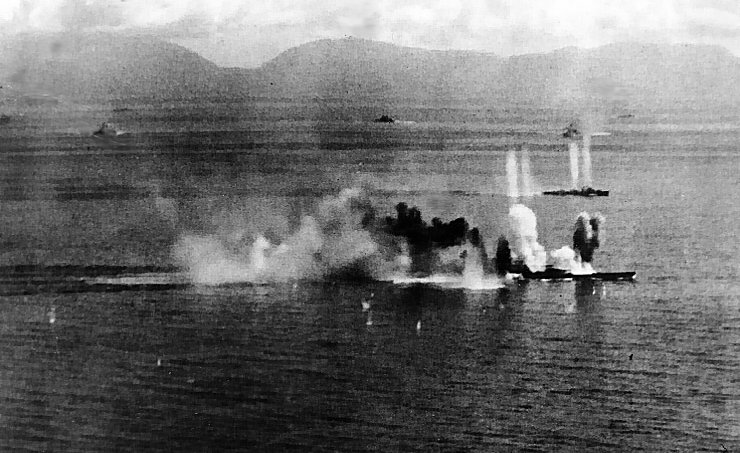
Musashi_under_fire

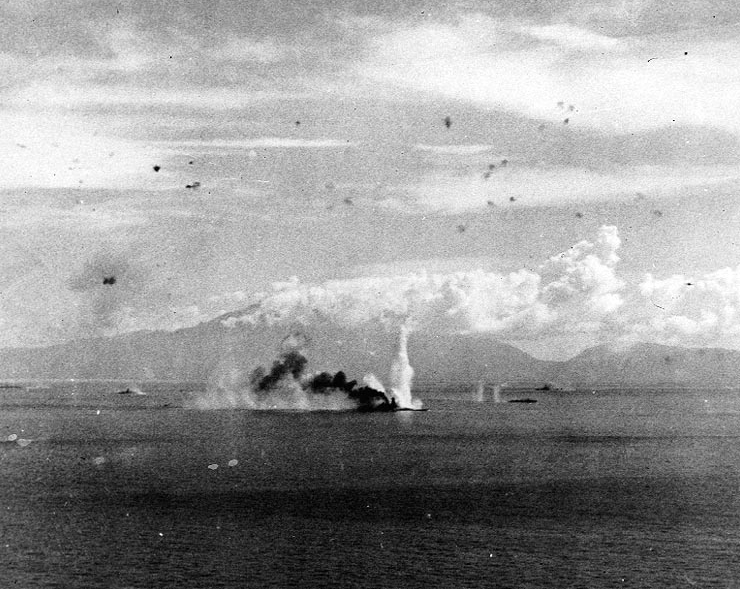
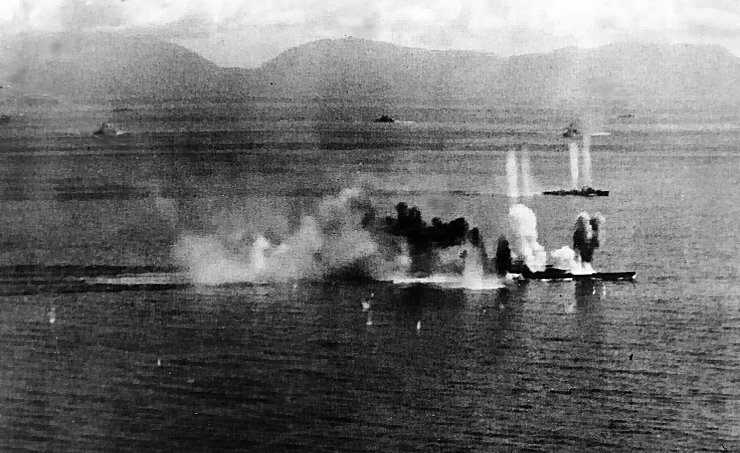
Musashi under attack at the Battle of Sibuyan Sea

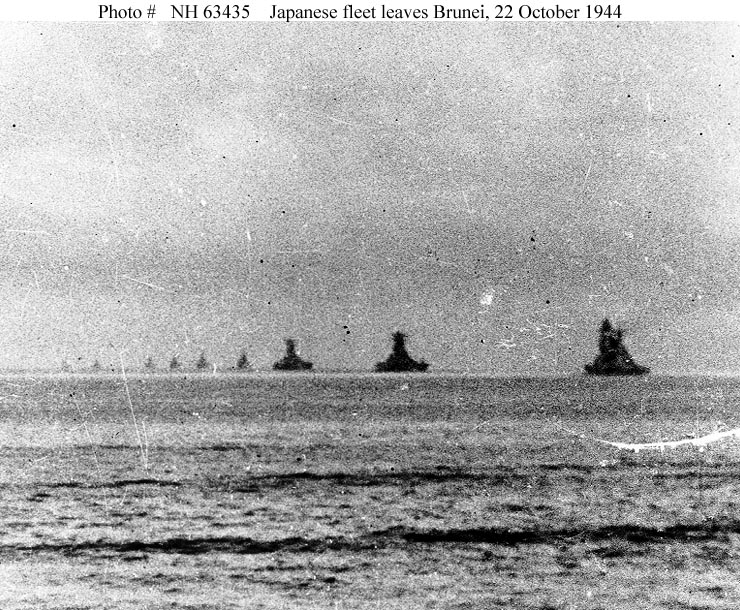
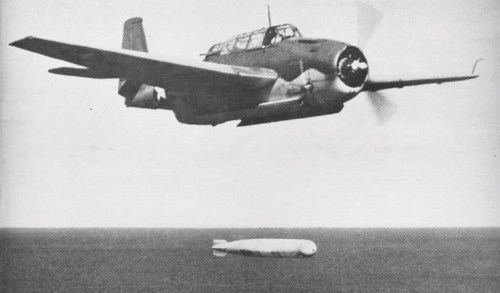
Both ships participated in the Battle of the Philippine Sea and were part of Vice Admiral Takeo Kurita’s Central Force in the Battle of Leyte Gulf. Musashi was sunk by U.S. Navy Carrier aircraft from the Third Fleet on October 24th 1944 during the Battle of the Sibuyan Sea. Hit by 17 bombs and 19 torpedoes she sank with the loss of nearly 1100 of her crew of almost 2400 men. The survivors were rescued by destroyers and disembarked at Corregidor. Some were sent by troop transport to Japan but one of the ships was torpedoed and sunk leaving her survivors adrift for 19 hours before rescue. Those who reached Japan were isolated from the population while about half of the survivors remained in the Philippines where 117 of 146 of those assigned to the defense of Manila were killed in action.
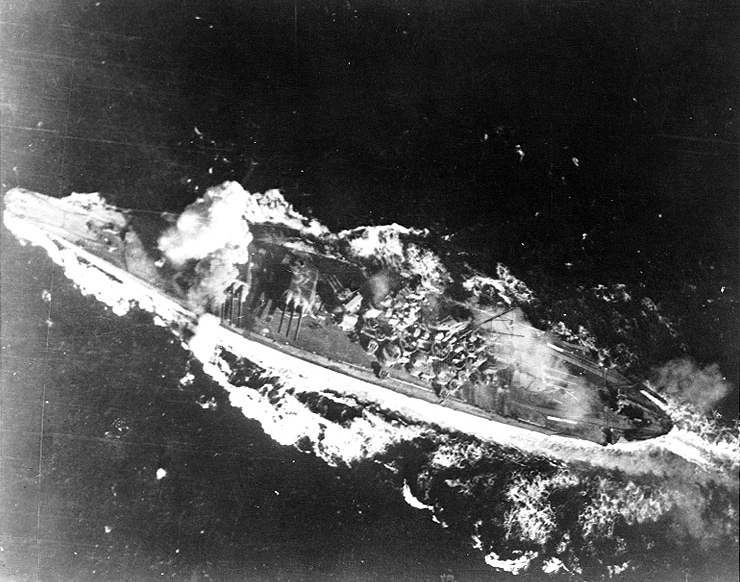
Yamato_hit_by_bomb

Yamato or Musashi under air Attack

Yamato saw action in the surface engagement on October 25th against the Escort Carriers and Destroyers of Taffy-3 during the Battle off Samar. Her guns helped sink the Escort Carrier USS Gambier Bay but was forced away from the action by torpedo attacks from the valiant destroyers of Taffy-3.
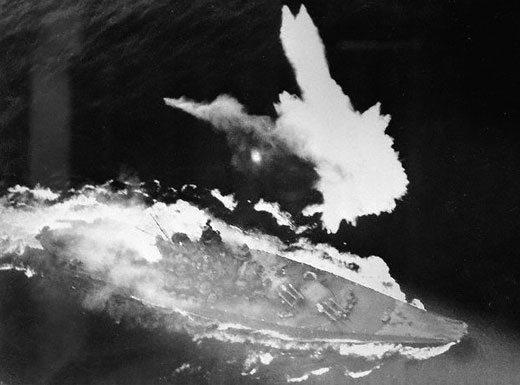
last-05

Yamato under Attack April 7th 1945

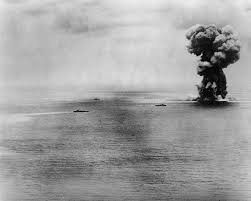
By April 1944 Japan’s Navy was decimated and U.S. Naval Forces were raiding Mainland Japan. When the United States landed on Okinawa the Japanese Navy and air force launched wave after wave of Kamikaze attacks on the ships in the waters around the island. Yamato, along with Light Cruiser Yahagi and eight destroyers were designated the Surface Special Attack Force and loaded with a full load of ammunition but only enough fuel for a one way trip got underway on April 6th. The mission was for Yamato to reach Okinawa, beach herself and serve as an “unsinkable” gun battery until she was destroyed. The force was spotted by U.S. Navy flying boats hours after their departure and on April 7th over 400 aircraft launched from Task Groups 58.1 and 58.3. The first wave began its attack at 1230 and by 1400 the ship was mortally wounded. Stuck by at least 8 torpedoes and 11 bombs she was dead in the water and began to capsize at 1405. At 1420 she turned turtle and at 1423 exploded when her forward blew up sending up a mushroom cloud nearly 20,000 feet.  Under 300 of her crew of nearly 2400 were rescued.
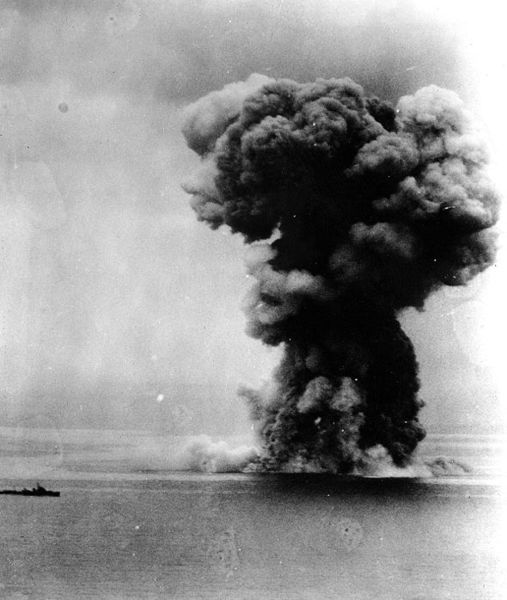
507px-Yamato_explosion

The End: Yamato Explodes

What had begun with the tiny “cheese box on a raft” had culminated in two of the largest warships ever built, designed when naval experts planned for a war where the battleship would rule and aircraft carriers play a supporting role. Instead both never faced enemy battleships in combat and both were destroyed by the weapon that the battleship admirals had discounted. It is somewhat fitting that each was commissioned shortly after the triumphs of Japanese and American Naval air power at Pearl Harbor and Midway. However they have attained an almost mythic status in naval lore and are symbols to many Japanese of the sacrifice and futility of the war. Both of the cities where the ships were constructed were destroyed by Atomic bombs. They are tragic reminders of the cost of war in human lives, suffering, economic cost and destruction.

musashi wreck

Musashi’s wreck was discovered by Microsoft co-founder Paul Allen. He posted the first picture of the ship taken in over seventy years, showing the Chrysanthemum seal on her bow to Twitter. As a devotee of these great ships I was amazed to see this.

In a sense their poetic names and the myth ascribed to them are a tragic requiem to the Japanese Empire and the cost of war. They and their brave sailors were sacrificed when the war was already for all intents and purposes lost. They, especially the Yamato were sacrificed for no military purpose save a convoluted sense of honor. Let us pray that it never happens again.

Peace

Padre Steve+
Leave a comment

Filed under civil war, History, Military, Navy Ships, US Navy, world war two in the pacific

Death of the Yamato

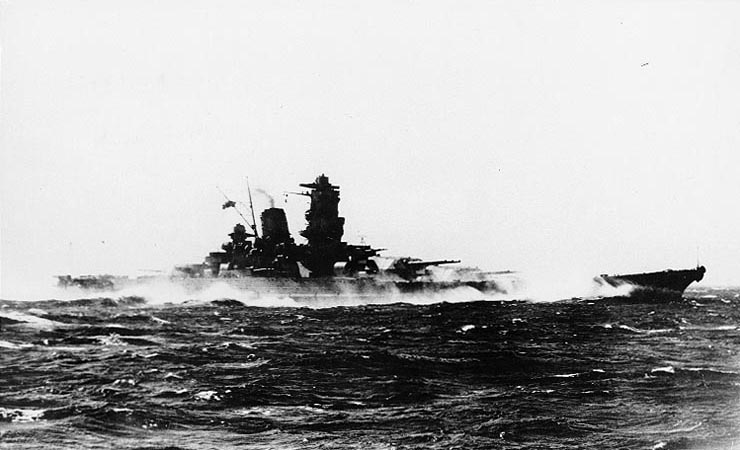
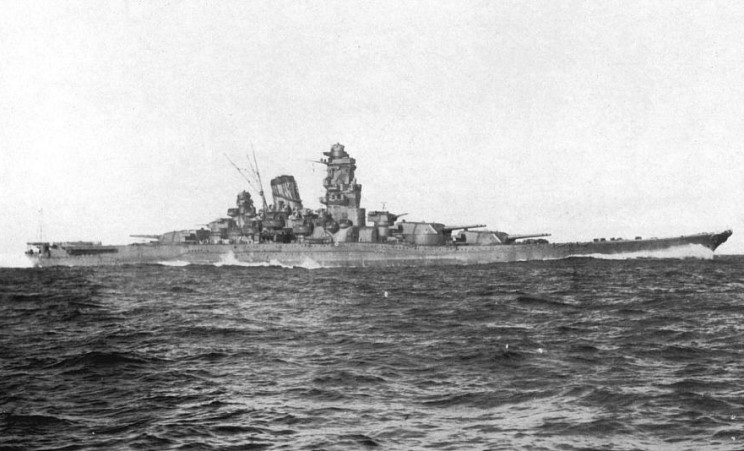
Yamato_sea_trials_2

As dawn broke on April 7th 1945 the great Super-Battleship Yamato, the pride of the Japanese Imperial Navy and nine escorts steamed toward Okinawa on a suicide mission. It was literally the end of empire and the end of a navy. What had begun on December 7th 1941 was now winding down as the Imperial Navy launched its last offensive operation against the United States Navy.

The Imperial Navy was already at the end of its tether. Following the disasters at the Battle of the Philippine Sea which decimated the carrier air arm of the Imperial Navy; the subsequent losses in the defense of Formosa which used up the majority of any remaining carrier aircraft and crews; and the Battle of Leyte Gulf which decimated the surface forces of the navy what remained was a pitiful remnant of a once dominant fleet.

The great battleship Yamato and her sister ship Musashi were the largest warships ever built until the advent of the USS Enterprise CVN-65. Displacing over 72,000 tons 863 feet long and 127 feet in beam these ships mounted the largest artillery battery ever placed on a warship. Their nine 18.1” guns mounted in three triple turrets each weighing over 2500 tons weighed as much or more than the largest destroyers of the time. They could fire their massive shells 26 miles and had the capability of firing a special anti-aircraft shell known as the Sanshiki or beehive round.

Battleship_Yamato_under_air_attack_April_1945

Musashi was sunk during the Battle of the Sibuyan Sea at Leyte Gulf on October 24th 1944 after being hit by 19 ariel torpedoes and 17 bombs. Yamato engaged the American Escort Carriers and destroyers of Taffy-3 at the Battle off Samar the following day but was prevented by the audacity of the inferior American destroyers and timidity of the Japanese commander Vice Admiral Takeo Kurita from achieving any notable success.

The remains of the Imperial Navy were hampered by a lack of fuel, air power and training time. When the United States attacked Iwo Jima in February 1945, barely 700 miles from the home islands of Japan not a single Japanese surface ship sortied to challenge the American Navy.

However when the American attacked Okinawa on April 1st the Navy launched Operation Ten-Go. In spite of overwhelming American superiority in both naval air and surface forces the tiny task force was to fight its way to Okinawa, beach their ships and once the ships were destroyed the crews were to join Japanese Army forces on the island.

The doomed sortie was in part due to the insistence of the Imperial Army which derided the Imperial Navy for its failures at Philippine Sea and Leyte Gulf and pressure from Emperor Hirohito who asked “But what about the Navy? What are they doing to assist in defending Okinawa? Have we no more ships?” In response the Naval High command devised what amounted to a suicide mission for Yamato and her escorts. The plan was opposed by many in the Navy and leaders of the task force who saw it as a futile mission. Only the insistence of Admiral Kusaka who told the reticent commanders that the Emperor expected the Navy to make its best effort to defend Okinawa persuaded the Captains of the doomed force to accept the mission.

g313714

At about 1600 on April 6th the ships of the task force weighed anchor and departed their anchorage at Tokuyama hoping to take advantage of approaching darkness to mask their departure. They were detected and shadowed by American submarines which provided real time information on the course and speed of the Japanese ships to the American leadership.

The next morning the task force was spotted by patrol planes and its position relayed to the American fleet commander, Admiral Raymond Spruance, the victor of Midway. Spruance ordered the six fast battleships battleships, accompanied by two battlecruisers, seven cruisers and 21 destroyers engaged in shore bombardment to intercept the Japanese force. However, Admiral Marc Mitscher of Task Force 58, the fast carriers launched a massive air strike of over 400 aircraft against the Japanese.

Steichin-48

At 1232 the first wave of American aircraft began their attacks on the doomed Japanese force. As the succeeding waves of American aircraft attacked Yamato was hit by 15 bombs and at least 8 torpedoes, almost all of which struck her port side created an imminent risk of capsizing. The damage control teams counter flooded the starboard engine and boiler rooms which kept the ship from turning turtle, but which also further reduced her speed.

images

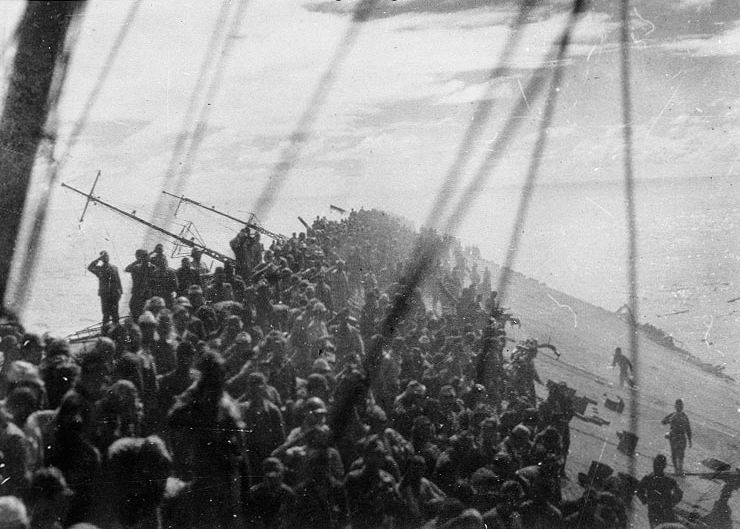
By 1405 the great ship was dead in the water and just minutes before her commander had ordered the crew to abandon ship. At 1420 she capsized and began to sink and at 1423 she blew apart in a massive explosion that was reportedly heard and seen 120 miles away and created a mushroom cloud that reached 20,000 feet.

Captain Tameichi Hara of the light cruiser Yahagi which had already sank described the demise of the great ship in his book Japanese Destroyer Captain:

“We looked and saw Yamato, still moving. What a beautiful sight. Suddenly smoke belched from her waterline. We both groaned as white smoke billowed out until it covered the great battleship, giving her the appearance of a snow-capped Mount Fuji. Next came black smoke mingled with the white, forming to a huge cloud which climbed to 2000 meters. As it drifted away we looked to the surface of the sea again and there was nothing. Yamato had vanished. Tremendous detonations at 1423 of that seventh day of April signaled the end of this “unsinkable” symbol of the Imperial Navy.”

Only 280 men of the estimated 3000 crew members were rescued by the surviving escorts. Of her escorts, the Yahagi and four destroyers were also sunk. The Americans lost a total of ten aircraft and 12 men. Never again would the surface forces of the Imperial Navy threaten U.S. forces or take any meaningful part in the war.

The sacrifice of Yamato and her escorts was a futile was of lives and though many in Japan revere their sacrifice as noble it served no purpose. The loss of Yamato, named after the ancient Yamato province in a sense was symbolic of the demise of the Japanese Empire.

I cannot help but think of gallantry of the doomed crews of these ships, sacrificed for the “honor” of leaders that did not really value their sacrifice.

It is a commentary that is timeless.

Peace

Padre Steve+

2 Comments

Filed under History, Military, Navy Ships, world war two in the pacific

Battleship Row: The Story of the Battleships of Pearl Harbor

the-japanese-attack-on-pearl-harbor-everett-2

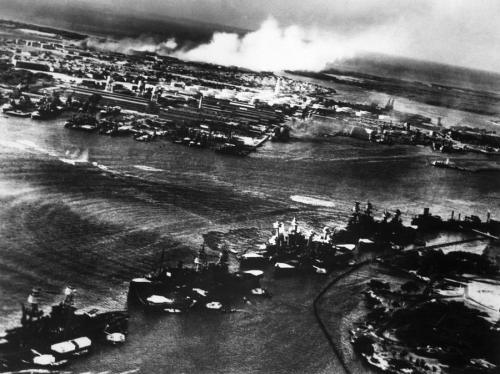
“Yesterday, Dec. 7, 1941 – a date which will live in infamy – the United States of America was suddenly and deliberately attacked by naval and air forces of the Empire of Japan…. The attack yesterday on the Hawaiian Islands has caused severe damage to American naval and military forces. Very many American lives have been lost.” Except of President Franklin D Roosevelt’s Pearl Harbor Speech December 8th 1941

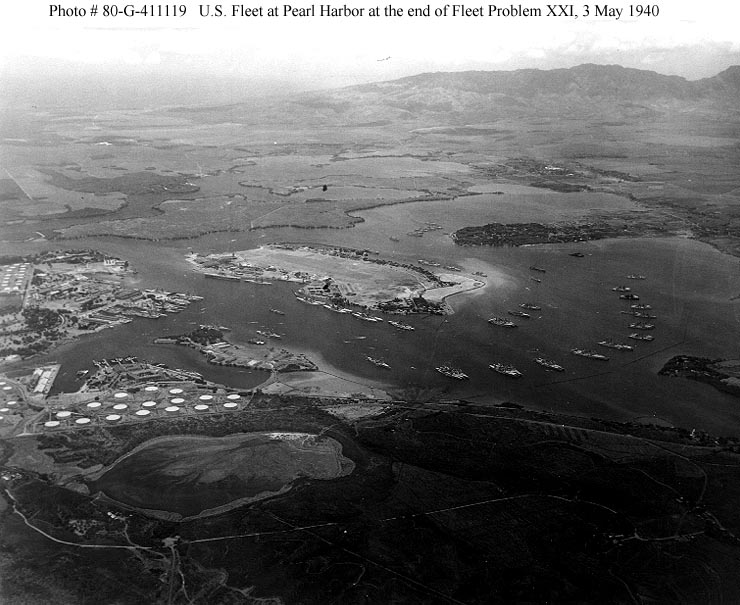
g411119

Today is the 72nd anniversary of the Japanese attack on Pearl Harbor and as we were then we are at war. Of course it is not the same kind of war and most Americans live in the illusion of peace which makes it even more important to remember that terribly day of infamy.

I remember reading Walter Lord’s classic and very readable book about Pearl Harbor “Day of Infamy” when I was a 7th grade student at Stockton Junior High School back in 1972.  At the time my dad was on his first deployment to Vietnam on the USS Hancock CVA-19.  As a Navy brat I was totally enthralled with all things Navy and there was little that could pull me out of the library.  In fact in my sophomore year of high school I cut over one half of the class meetings of the 4th quarter my geometry class to sit in the library and read history, especially naval and military history.

arizon-main-battery2-2

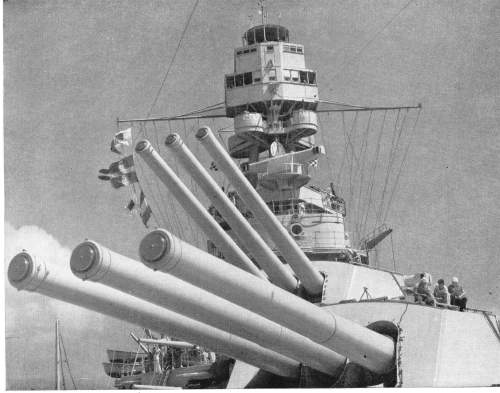
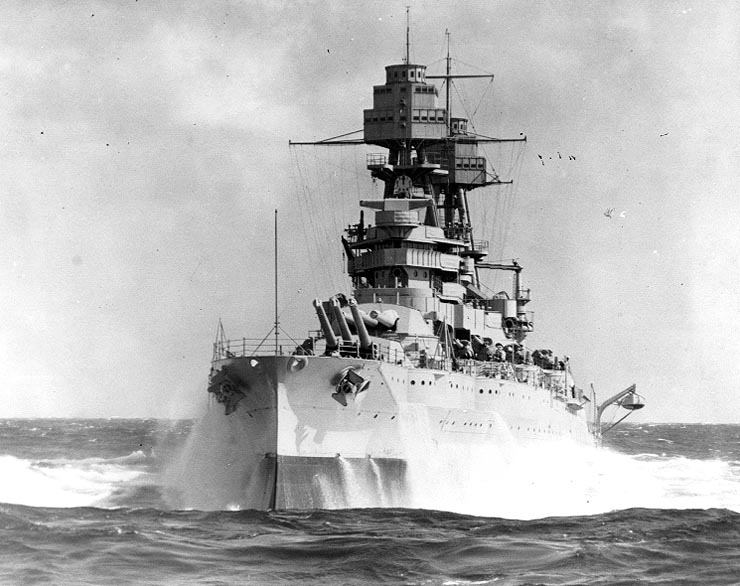
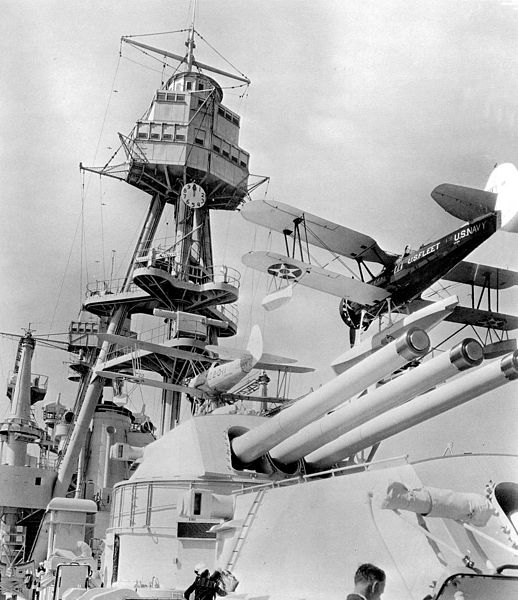
The main battery of either USS Arizona or Pennsylvania 

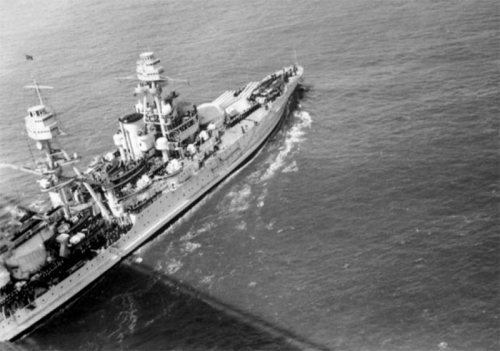
Over the years I have always found the pre-World War Two battleships to be among the most interesting ships in US Navy history.  No they are not the sleek behemoths like the USS Wisconsin which graces the Norfolk waterfront. They were not long and sleek, but rather squat yet exuded power. They were the backbone of the Navy from the First World War until Pearl Harbor.  They were the US Navy answer to the great Dreadnaught race engaged in by the major Navies of the world in the years prior to, during and after World War One.

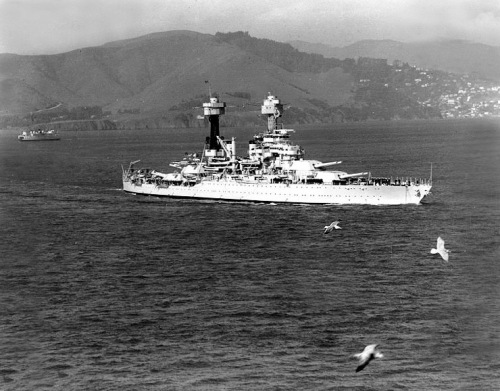
pennsylvania-under-golden-gate

USS Pennsylvania passing under the Golden Gate

Built over a period of 10 years each class incorporated the rapid advances in technology between the launching of the Dreadnaught and the end of the Great War.  While the United States Navy did not engage in battleship to battleship combat the ships built by the US Navy were equal to or superior to many of the British and German ships of the era.

puyBfl

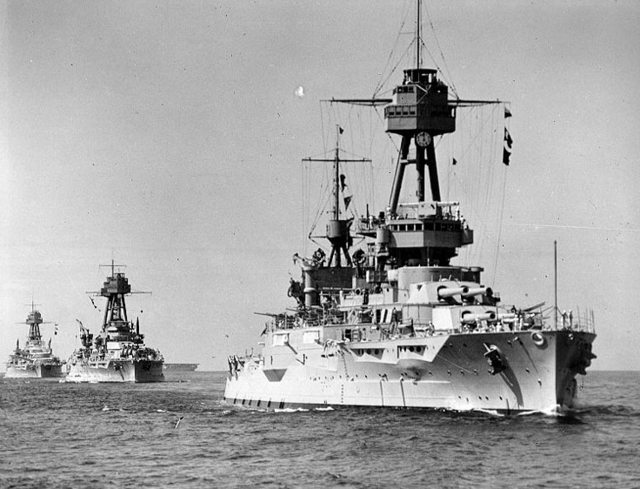
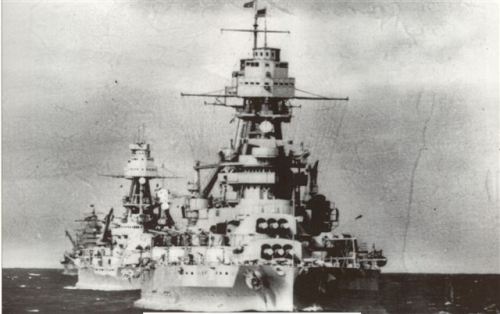
US Battleships at the Grand Fleet Review of 1937

Through the 1920s and 1930s they were the ambassadors of the nation, training and showing the flag. During those years the older ships underwent significant overhaul and modernization.

arizona-and-battleline

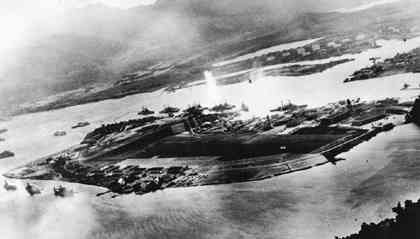
The Battle Force of the Pacific Fleet in 1941 included 9 battleships of which 8 were at Pearl Harbor on the morning of December 7th.  In the event of war the US War Plan, “Orange” called for the Pacific Fleet led by the Battle Force to cross the Pacific, fight a climactic Mahanian battle against the battleships of the Imperial Japanese Navy and after vanquishing the Japanese foe to relieve American Forces in the Philippines.  However this was not to be as by the end of December 7th all eight were out of action, with two, the Arizona and Oklahoma permanently lost to the Navy.

The ships comprised 4 of the 6 classes of battleships in the US inventory at the outbreak of hostilities.  Each class was an improvement on the preceding class in speed, protection and firepower.  The last class of ships, the Maryland class comprised of the Maryland, Colorado and West Virginia, was the pinnacle of US Battleship design until the North Carolina class was commissioned in 1941.  Since the Washington Naval Treaty limited navies to specific tonnage limits as well as the displacement of new classes of ships the United States like Britain and Japan was limited to the ships in the current inventory at the time of the treaty’s ratification.

uss_oklahoma

USS Oklahoma

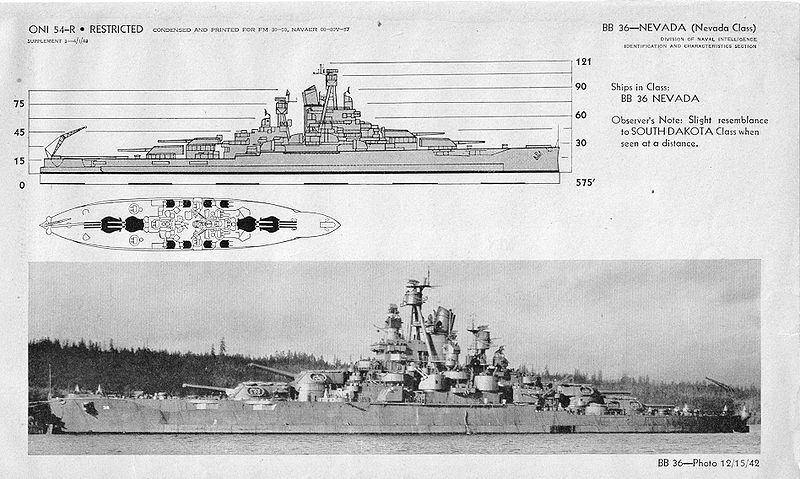
The ships at Pearl Harbor included the two ships of the Nevada class, the Nevada and Oklahoma they were the oldest battleships at Pearl Harbor and the first of what were referred to as the “standard design” battleships. The two ships of the Pennsylvania class, the Pennsylvania and her sister the Arizona served as the flagships of the Pacific Fleet and First Battleship Division respectively and were improved Nevada’s. The California class ships, California and Tennessee and two of the three Maryland’s the Maryland and West Virginia made up the rest of the Battle Force.

california-1938

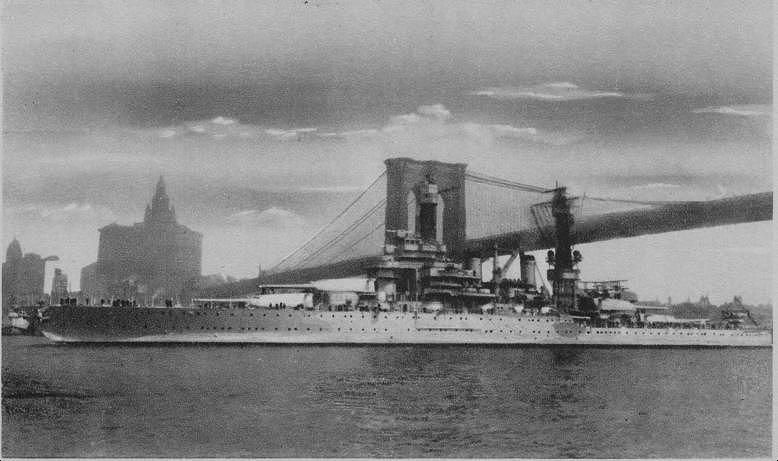
USS California passing under Brooklyn Bridge

The Colorado was undergoing a yard period at Bremerton and the three ships of the New Mexico class, New Mexico, Mississippi and Idaho had been transferred to the Atlantic before Pearl Harbor due to the German threat.  The three oldest battleships  ships of the New York and Wyoming Classes, the New York, Arkansas and Texas also were in the Atlantic. Two former battleships, the Utah and Wyoming had been stripped of their main armaments and armor belts and served as gunnery training ships for the fleet. The Utah was at Pearl Harbor moored on the far side of Ford Island.

9.athumb

The ships that lay at anchor at 0755 that peaceful Sunday morning on “Battleship Row” and in the dry dock represented the naval power of a bygone era, something that most did not realize until two hours later. The age of the battleship was passing away, but even the Japanese did not realize that the era had passed building the massive super-battleships Yamato and Musashi mounting nine 18” guns and displacing 72,000 tons, near twice that of the largest battleships on Battleship Row.

bb36_06

USS Nevada at Pearl Harbor

The Oklahoma and Nevada were the oldest ships in the Battle Force.  Launched in 1914 and commissioned in 1916 the Nevada and Oklahoma mounted ten 14” guns and displaced 27,500 tons and were capable of 20.5 knots. They served in World War One alongside the British Home Fleet and were modernized in the late 1920s. They were part of the US presence in both the Atlantic and Pacific in the inter-war years. Oklahoma took part in the evacuation of American citizens from Spain in 1936 during the Spanish Civil War.

013717


USS Oklahoma Capsized (above) and righted (below)


oklahoma-salvage

During the Pearl Harbor attack Oklahoma was struck by 5 aerial torpedoes capsized and sank at her mooring with the loss of 415 officers and crew. Recent analysis indicates that she may have been hit by at least on torpedo from a Japanese midget submarine. Her hulk would be raised but she would never again see service and sank on the way to the breakers in 1946.

nevada-1

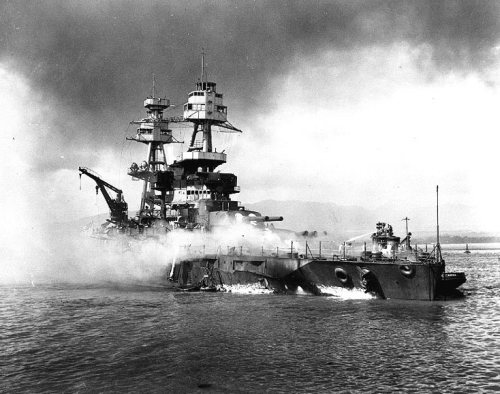
USS Nevada aground off Hospital Point

Nevada was the only battleship to get underway during the attack.  Moored alone at the north end of Battleship Row her Officer of the Deck had lit off a second boiler an hour before the attack.  She was hit by an aerial torpedo in the first minutes of the attack but was not seriously damaged. She got underway between the attack waves and as she attempted to escape the harbor she was heavily damaged. To prevent her from sinking in the main channel she was beached off Hospital Point.

800px-USS_Nevada_(BB-36)_specs

nevada-utah-beach

USS Nevada at Normandy 

Nevada was raised and received a significant modernization before returning to service for the May 1943 assault on Attu.  Nevada returned to the Atlantic where she took part in the Normandy landings off Utah Beach and the invasion of southern France.  She returned to the Pacific and took part in the operations against Iwo Jima and Okinawa where she again provided naval gunfire support.  Following the war the great ship was assigned as a target at the Bikini atoll atomic bomb tests. The tough ship survived these tests and was sunk as a target on 31July 1948.

USS_Arizona_(BB-39)_-_1930s

USS Arizona

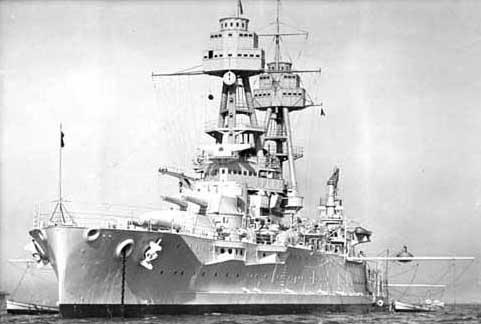
The two ships of the Pennsylvania Class were improved Oklahoma’s.  The Arizona and Pennsylvania mounted twelve 14” guns and displacing 31,400 tons and capable of 21 knots they were both commissioned in 1916. They participated in operations in the Atlantic in the First World War with the British Home Fleet. Both ships were rebuilt and modernized between 1929-1931.

518px-O3U-3s_on_USS_Pennsylvania_(BB-38)_in_1935

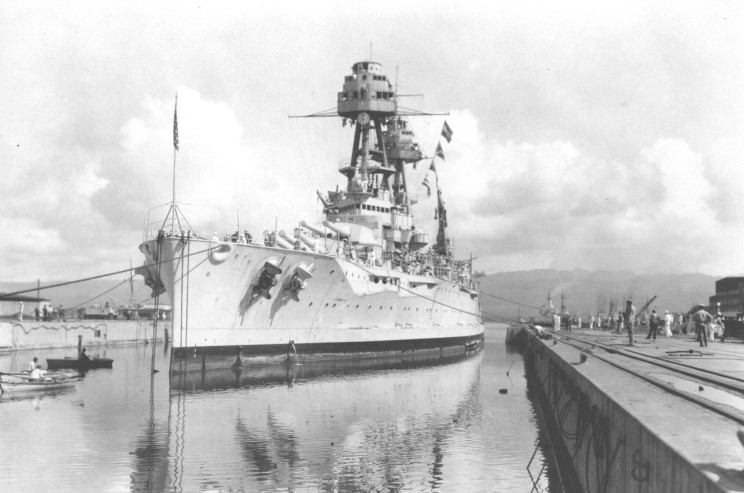
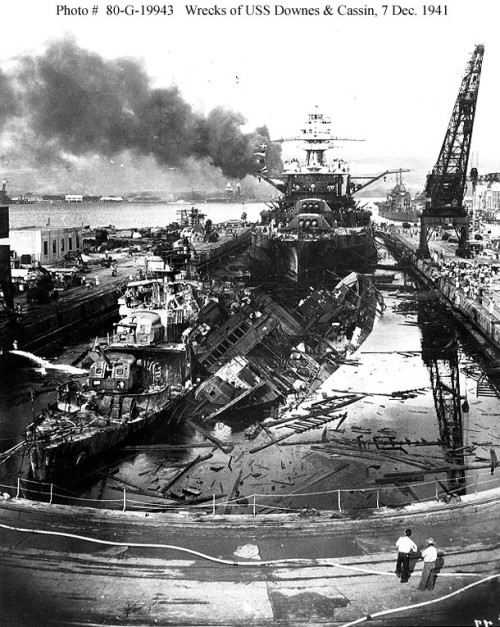
They were mainstays of the fleet being present at Presidential reviews, major fleet exercises and making goodwill visits around the world.  Pennsylvania was the Pacific Fleet Flagship on December 7th 1941 and was in dry dock undergoing maintenance at the time of the attack. She was struck by two bombs and received minor damage.

pennsylania-drydock

She was back in action in early 1942. She underwent minor refits and took part in many amphibious landings in the Pacific and was present at the Battle of Surigao Strait.  She was heavily damaged by an aerial torpedo at Okinawa Pennsylvania and was repaired. Following the war the elderly warrior was used as a target for the atomic bomb tests. She was sunk as a gunnery target in 1948.

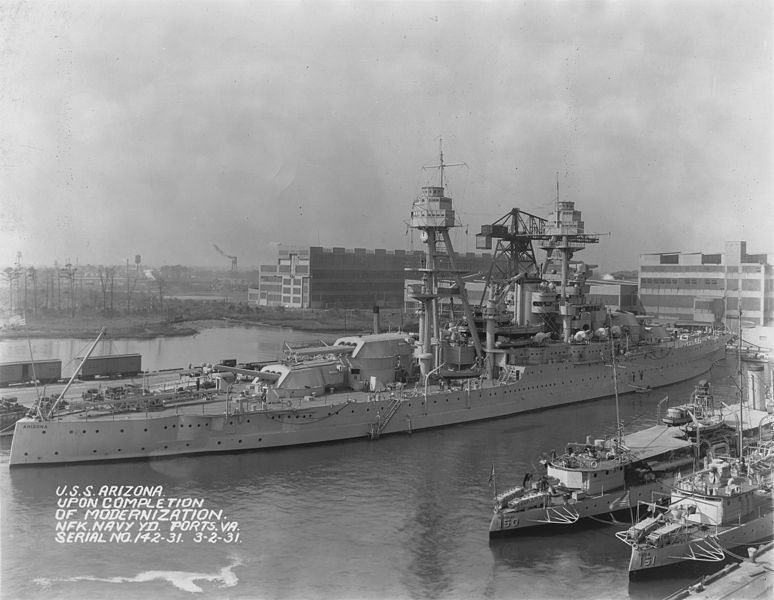
774px-USS_Arizona_after_1931_modernization_NARA_19-LC-19B-1

arizona-buring

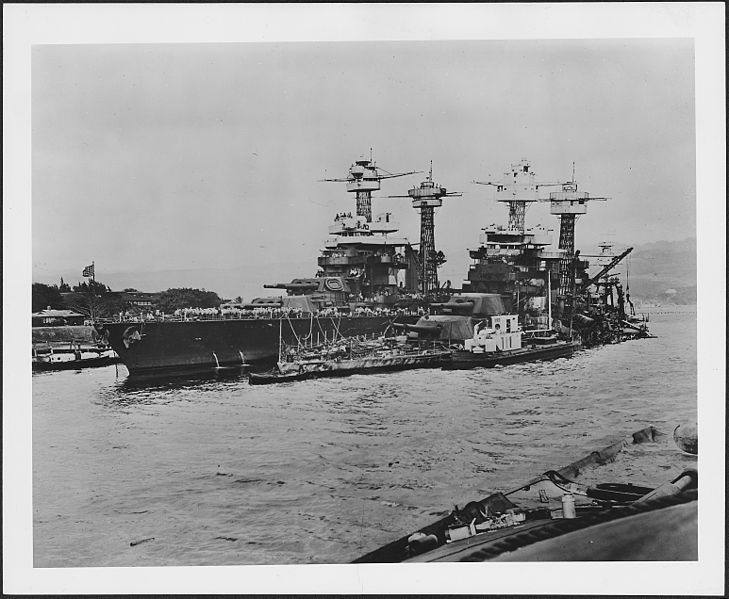
Arizona was destroyed during the attack. As the flagship of Battleship Division One she was moored next to the repair ship USS Vestal.  She was hit by 8 armor piercing bombs one of which penetrated her forward black powder magazine. The ship was consumed by a cataclysmic explosion which killed 1103 of her 1400 member crew including her Captain and Rear Admiral Isaac Kidd, commander of Battleship Division One.  She was never officially decommissioned and the colors are raised and lowered every day over the Memorial which sits astride her broken hull.

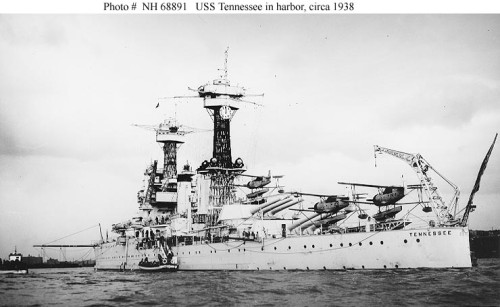
tennessee-1938

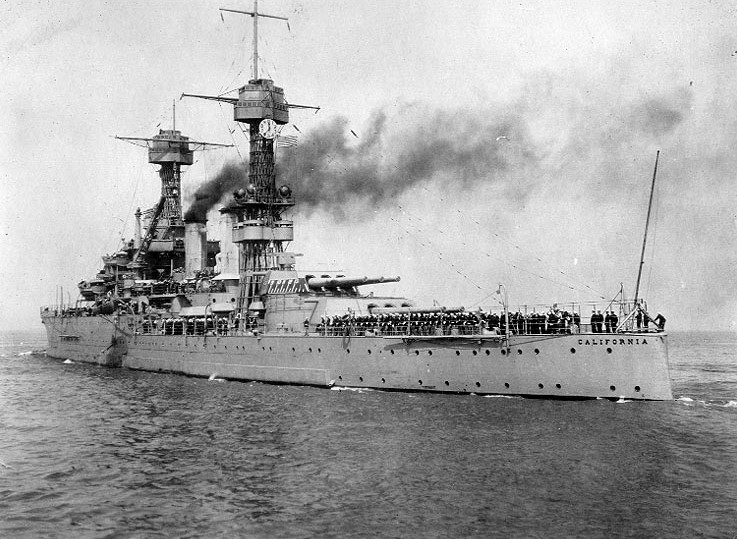
The Tennessee class ships the Tennessee and California were the class following the New Mexico class ships which were not present at Pearl Harbor. These ships were laid down in 1917 and commissioned in 1920. Their design incorporated lessons learned at the Battle Jutland. They mounted twelve 14” guns, displaced 32,300 tons and were capable of 21 knots. At Pearl Harbor Tennessee was moored inboard of West Virginia and protected from the aerial torpedoes which did so much damage to other battleships. She was damaged by two bombs. California the Flagship of Battleship Division Two was moored at the southern end of Battleship Row. She was hit by two torpedoes in the initial attack. However, she had the bad luck to have all of her major watertight hatches unhinged in preparation for an inspection.

uss_california_bb44_03

h64474

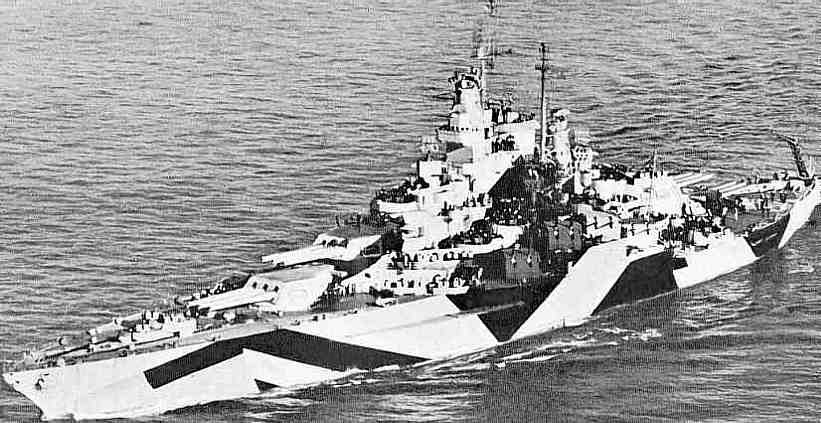
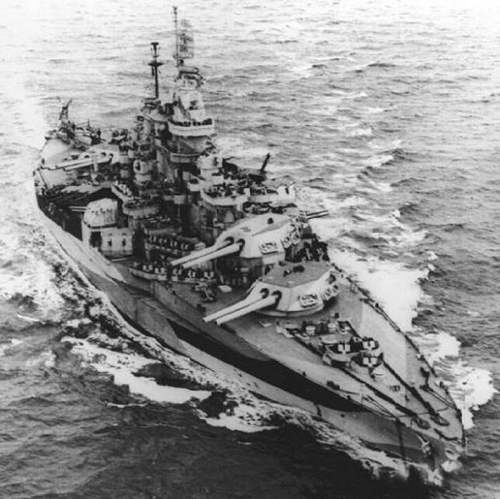
Despite the valiant efforts of her damage control teams she sank at her moorings. She was raised and rebuilt along with Tennessee were completely modernized with the latest in radar, fire control equipment and anti-aircraft armaments. They were widened with the addition of massive anti-torpedo bulges and their superstructure was razed and rebuilt along the lines of the South Dakota class.

USS California Late WWII

USS California following Modernization

014389o

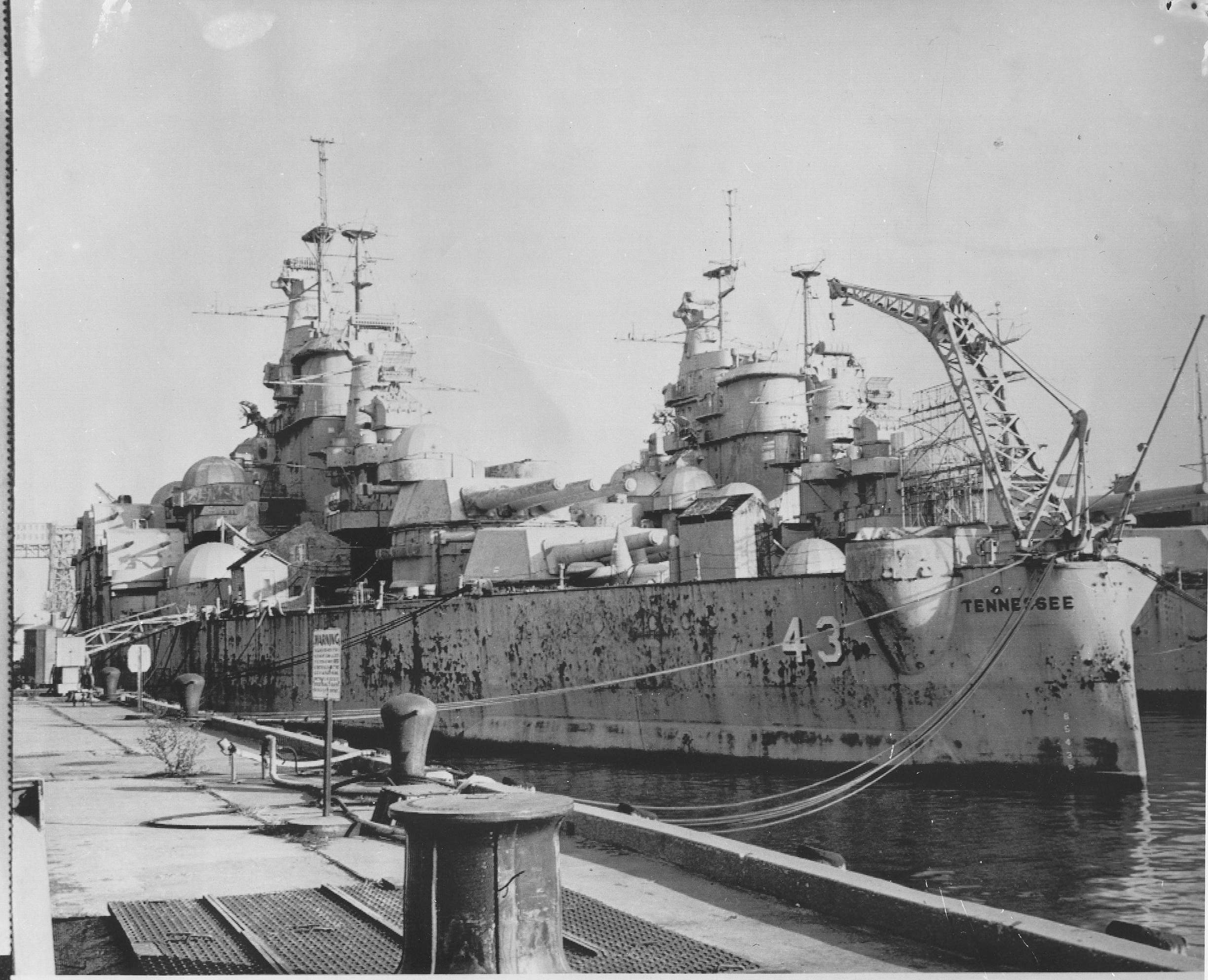
USS Tennessee with another ship, possibly California in reserve awaiting the breakers

When the repairs and modernization work was completed they looked nothing like they did on December 7th. Both ships were active in the Pacific campaign and be engaged at Surigao Strait where they inflicted heavy damage on the attacking Japanese squadron. Both survived the war and were placed in reserve until 1959 when they were stricken from the Navy list and sold for scrap.

west-virginia-1934

USS West Virginia 

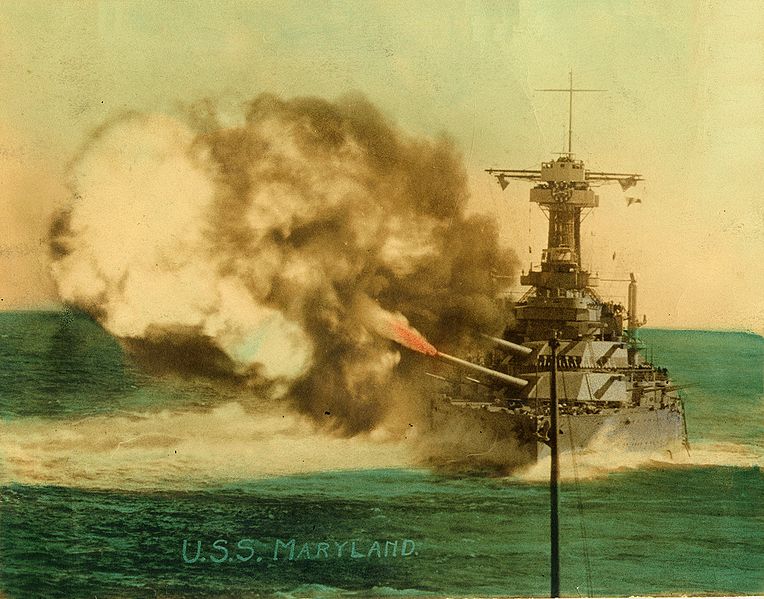
The Maryland and West Virginia were near sisters of the Tennessee class.  They were the last battleships built by the United States before the Washington Naval Treaty. and the first to mount 16” guns. With eight 16” guns they had the largest main battery of any US battleships until the North Carolina class.

764px-USS_Maryland_broadside_1920s

They displaced 32,600 tons and could steam at 21 knots. Laid down in 1917 and commissioned in 1921 they were modernized in the late 1920s. They were the most modern of the Super-Dreadnoughts built by the United States and included advances in protection and watertight integrity learned from both the British and German experience at Jutland.

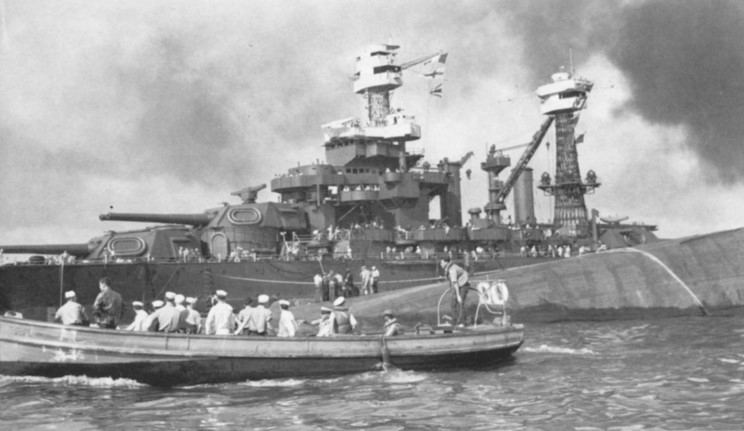
09_maryland_oklahoma_pearl_harbor

USS Maryland behind the capsized Oklahoma

At Pearl Harbor Maryland  was moored inboard of Oklahoma and was hit by 2 bombs and her crew helped rescue survivors of that unfortunate ship.  She was quickly repaired and returned to action.  She received minimal modernization during the war. She participated in operations throughout the entirety of the Pacific Campaign mainly conducting Naval Gunfire Support to numerous amphibious operations. She was present at Surigao Strait where despite not having the most modern fire control radars she unleashed six salvos at the Japanese Southern Force.

729px-Photograph_of_the_damage_done_to_the_USS_West_Virginia,_sunk_in_the_Japanese_raid_on_Pearl_Harbor_-_NARA_-_306536

754px-USS_West_Virginia_5-21-42,_Port_quarter_showing_previous_water_line_(FCP)_-_NARA_-_296915

west-virginia-damage

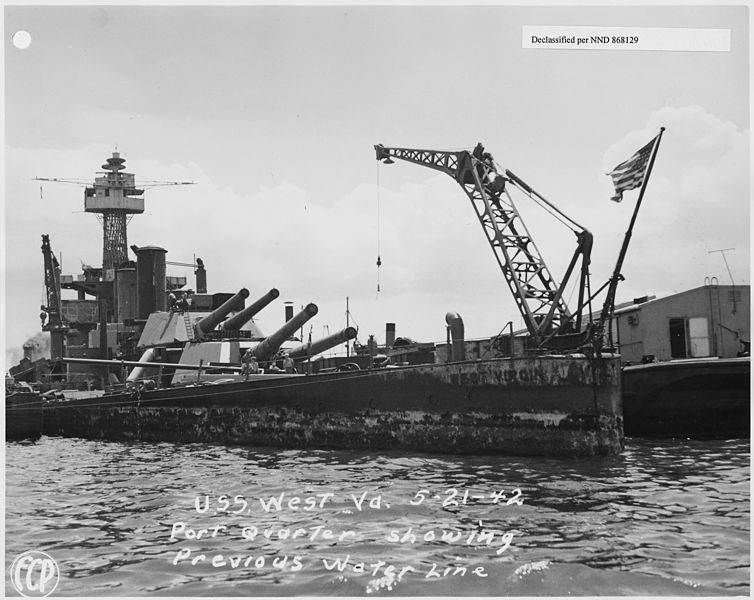
USS West Virginia, sunk, raised and in dry dock, note the massive damage to Port Side

West Virginia suffered some of the worst damage in the attack. She was hit by at least 5 torpedoes and two bombs. She took a serious list and was threatening to capsize. However she was saved from Oklahoma’s fate by the quick action of her damage control officer who quickly ordered counter-flooding so she would sink on an even keel.  She was raised from the mud of Pearl Harbor and after temporary repairs and sailed to the West Coast for an extensive modernization on the order of the Tennessee and California.

west-virginia-final-config

USS West Virginia after salvage and modernization 

West Virginia was the last Pearl Harbor to re-enter service. However when she returned she made up for lost time.  She led the battle line at Surigao Strait and fired 16 full salvos at the Japanese squadron. Her highly accurate gunfire was instrumental in sinking the Japanese Battleship Yamashiro in the last battleship versus battleship action in history.  West Virginia, Maryland and their sister Colorado survived the war and were placed in reserve until they were stricken from the Naval List and sold for scrap in 1959.

The battleships of Pearl Harbor are gone, save for the wreck of the Arizona and various relics such as masts, and ships bells located at various state capitals and Naval Stations.  Unfortunately no one had the forethought to preserve one of the survivors to remain at Pearl Harbor with the Arizona.  Likewise the sailors who manned these fine ships, who sailed in harm’s way are also passing away.  Every day their ranks grow thinner, the youngest are all 89-90 years old.

As this anniversary of the Pearl Harbor attack passes into history it is fitting to remember these men and the great ships that they manned.

Peace,

Padre Steve+

4 Comments

Filed under History, Military, Navy Ships, News and current events, US Navy, world war two in the pacific

The Doomed Fleet: The Ships of the Kido Butai and Their Fates After Pearl Harbor

pearl-harbor

“We won a great tactical victory at Pearl Harbor and thereby lost the war.” Captain Tadaichi Hara 

Note: I have written this article as a compliment to The Ships of Pearl Harbor: A Comprehensive List with Short Histories of Each Ship

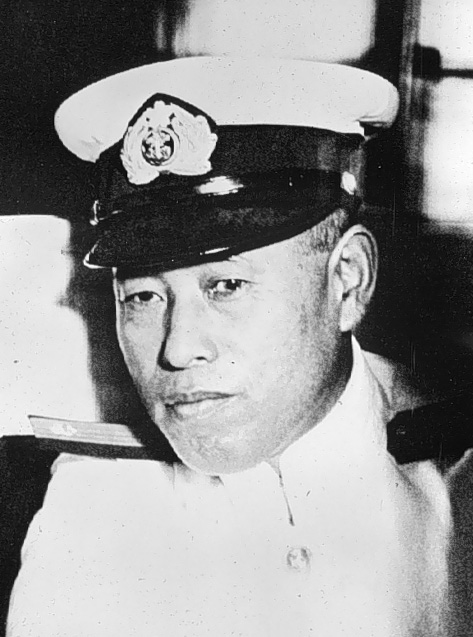
415px-Isoroku_Yamamoto

Isoruku Yamamoto 

The 22 surface warships of Japanese Task Force that struck Pearl Harbor on December 7th 1941 turned west after the last aircraft were recovered. No ships were lost or damaged in the attack. Only 29 aircraft and 55 aircrew were lost. Additionally 5 midget submarines and their 10 crew members were lost, one became the first Japanese Prisoner of War when his sub beached off Diamond Head.

Though the Japanese had heavily damaged the Pacific Fleet, sinking or damaging all 8 battleships that were in port at Pearl Harbor on December 7th the victory was incomplete. Pearl Harbor’s fleet support facilities, dry docks and fuel tank farms remained allowing the fleet to maintain it as a base. Likewise no carriers were in port and they as well as the submarine force were soon in action against the now vastly superior Imperial Navy which after Pearl Harbor wreaked havoc on US, British, Dutch and Australian forces in the Western Pacific and Indian Ocean.

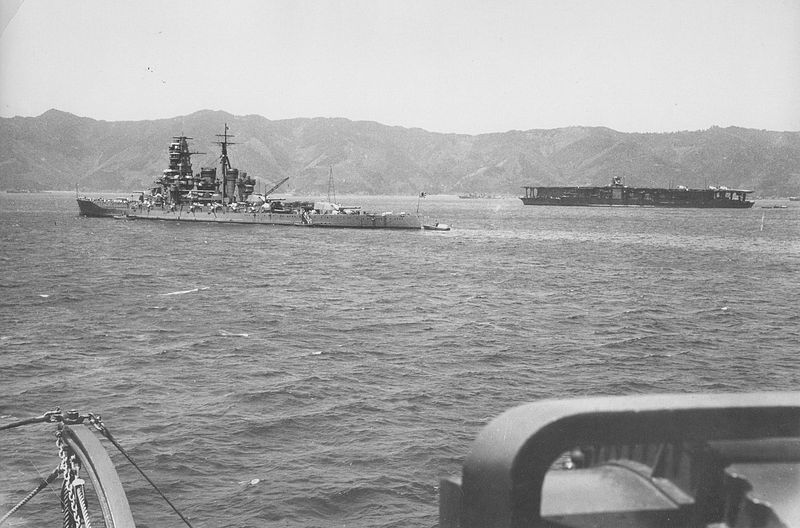
800px-Kirishima_and_Akagi_at_Tsukumowan_1939

Kirishima and Akagi 

Little did the heady Japanese expect that in less than six months that four of the six carriers that carried out the attack would be at the bottom of the Pacific and another heavily damaged. That was only the beginning. When the Japanese forces encountered the American carriers at Coral Sea and Midway the tide turned in the Pacific. Yamamoto’s remarks to Matsumoto and Konoe were more prophetic than even he might have imagined. Less than 18 months later Yamamoto himself would be dead, killed when a Betty bomber carrying him was ambushed and shot down near Buin New Guinea.

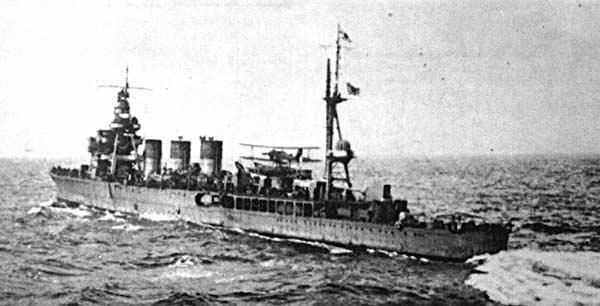
Of the 22 surface ships involved in the attack only one, the Fubuki Class Destroyer Ushio survived the war. What follows is what happened to the other ships in the order of their loss.

800px-Japanese_Navy_Aircraft_Carrier_Kaga

Kaga

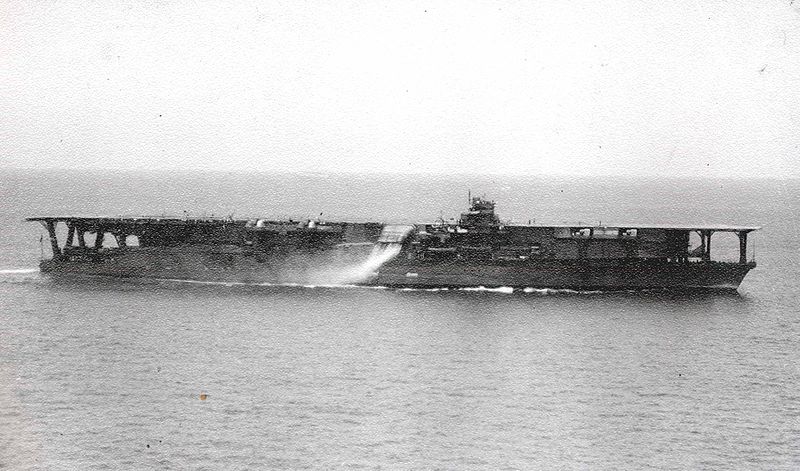
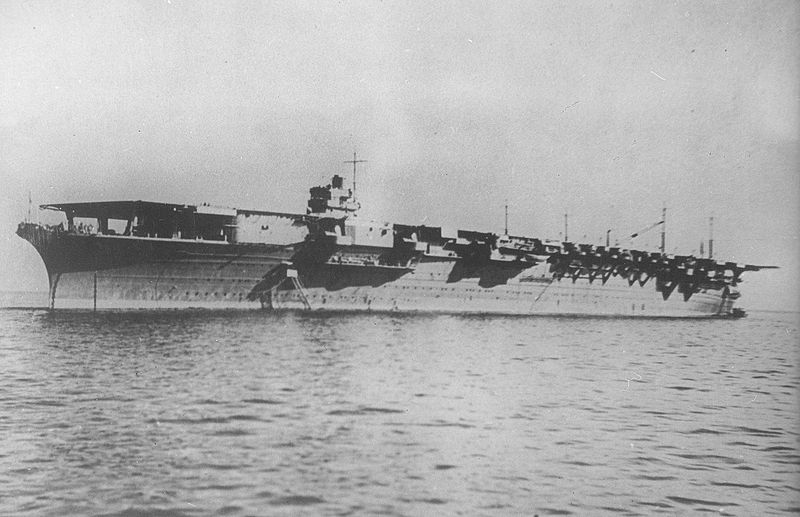
The aircraft carrier Kaga was designed as a battleship but converted to an aircraft carrier during construction as part of the 1922 Washington Naval Treaty. She was active throughout the 1930s in the war against China and participated in every major action of the 1st Air Fleet until she was sunk at Midway on June 4th 1942. Hit by at least 4 bombs  by dive bombers from the USS Enterprise while her flight deck was crowded with fueled and armed aircraft and decks strewn with bombs and torpedoes that in the rush of battle had not been returned to her magazines. That evening with the fires still burning her survivors were taken off and she was scuttled by torpedoes fired by destroyer Hagikaze. Over 800 of her crew of over 1700 including her Captain and most senior officers were lost.

soryu02

Soryu

The Aircraft carrier Soryu at 18,800 tons was roughly the same size as the American Yorktown Class. She was commissioned in 1937 and after Pearl Harbor fought as a unit of the First Air Fleet. She was present at Midway and sunk by dive bombers from the USS Yorktown. Hit by 3 bombs she was ordered abandoned within 15 minutes and sunk   on the evening of June 4th taking down 711 of over 1100 crew members.

Japanese_aircraft_carrier_Akagi_01-2

Akagi

The aircraft carrier Akagi was the Flagship Vice Admiral Nagumo of the 1st Air Fleet at Pearl Harbor and during the operations against Allied forces in the Western Pacific. She retained that role at Midway when on the morning of June 4th 1942 she was hit by a 1000 pound bomb from one of three attacking aircraft from Scouting Six from the Enterprise. With her aircraft on deck fully armed and fueled for a strike against the American carriers she was highly vulnerable. The explosion triggered a chain reaction as fuel and ordnance turned the great ship into a blazing inferno. Admiral Nagumo transferred his flag to the light cruiser Nagara. Damage control teams fought a losing battle against the conflagration but the next morning Admiral Yamamoto ordered his former ship scuttled. 267 Japanese sailors died on Akagi.

800px-Hiryu_burning

Hiryu damaged at Midway

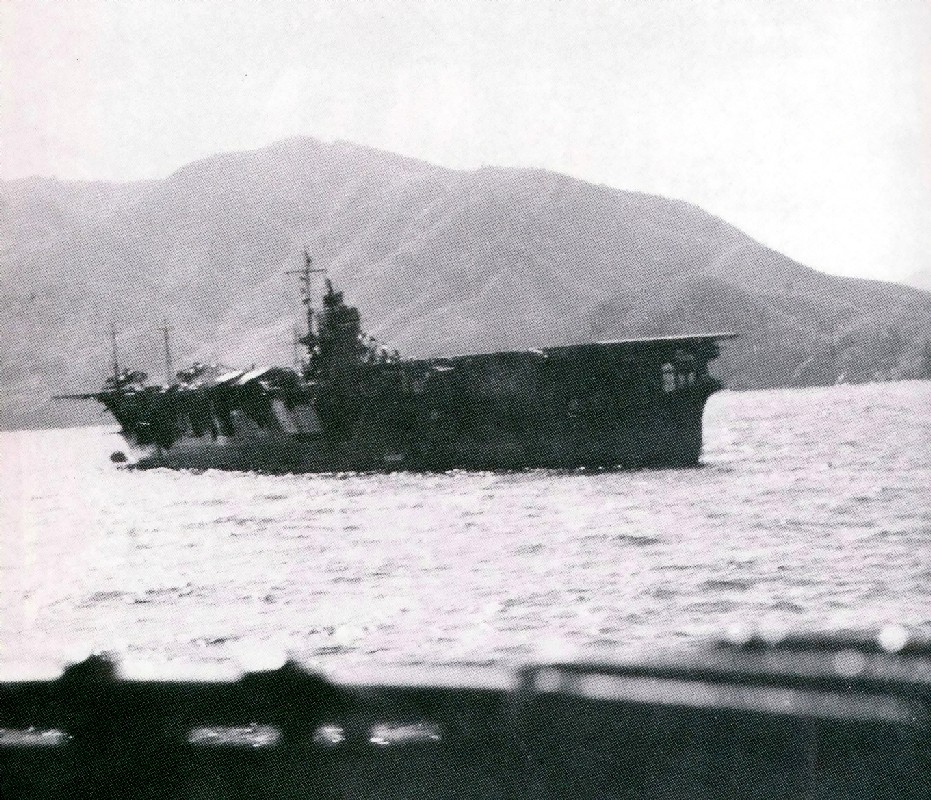
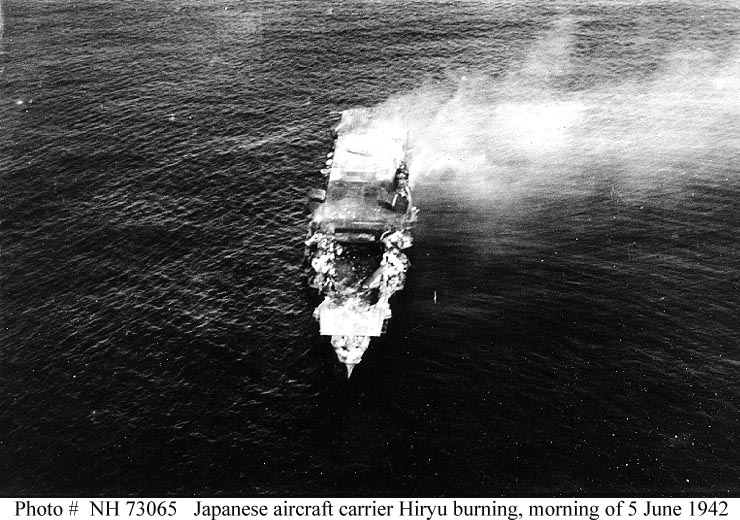
The carrier Hiryu, a close sister of Soryu also participated in the success of the First Air Fleet up to Midway. As flagship of of Carrier Division 2 avoided damage in the initial strike. Her aircraft heavily damaged Yorktown but she suffered the same fate as the other carriers that evening. Hit by four 1000 pound bombs from dive bombers from Enterprise she burned throughout the night and was scuttled on June 5th with the loss of 389 sailors and aviators.

800px-Asashio_II

Asashio Class

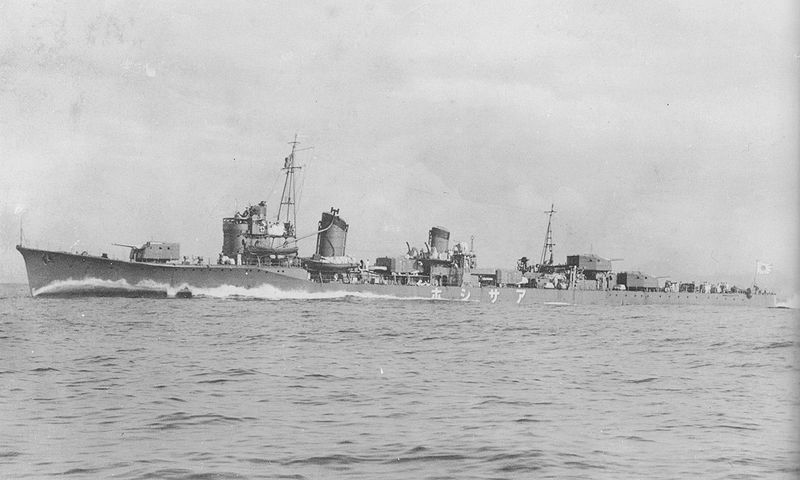
The 2000 ton Asashio class destroyer Arare was torpedoed and sunk by the submarine USS Growler on July 5th 1942 off Kiska Harbor Alaska with the loss of 104 of her crew. At the time of her loss she was escorting seaplane tender Chiyoda on a supply mission.

800px-Hiei_TsukugewanHiei

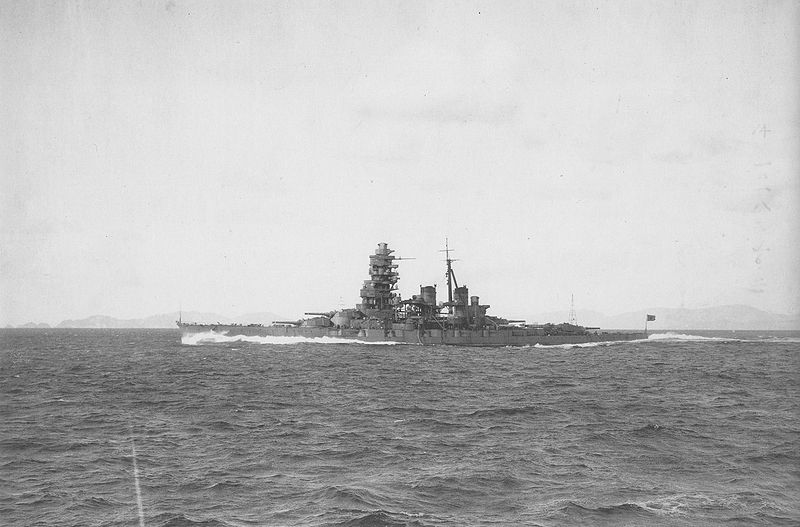
The Kongo Class battleship Hiei was sunk during the first Naval Battle of Guadalcanal. She was the first Japanese battleship sunk during the war. Heavily damaged during a close quarters surface engagement she was sunk by aircraft from Enterprise off Savo Island on November 13th 1942. 188 of her crew were lost with the ship.

03_kirishima

Kirishima

The Battleship Kirishima, a sister ship of Hiei was present with Hiei in the First Naval Battle of Guadalcanal. She survived that fight and was attached to another surface raiding group. The next night while engaging the USS South Dakota, Kirishima was targeted by the Battleship USS Washington and sunk by gunfire. 212 crewmen went down with the battleship.

Yukikaze_2

Kagero

The destroyer Kagero, the lead ship of her class was among the most deadly destroyer types produced in the war. Armed with six 5” guns and 8 24” Long Lance Torpedo tubes she and her sisters wrought fearful damage on allied surface forces in many of the vicious battles in the South Pacific. During a supply run Kagero stuck a mine and was disabled. Unable to maneuver she was sunk by US aircraft on May 7th 1943 off Rendova with the loss of 18 sailors.

The Kagero’s sisters also suffered. Akigumo was torpedoes and sunk by the submarine USS Redfin on April 11th 1944 off Zamboanga the Philippines. Tanikaze was torpedoed and sunk by USS Harder on June 9th 1944 with the loss of 114 sailors.

800px-Japanese.aircraft.carrier.zuikaku

Shokaku

The 27,000 ton carrier Shokaku was one of the newest and most modern carriers in the fleet at Pearl Harbor. She was heavily damaged at Coral Sea and missed the Midway operation. At the Battle of Eastern Solomons her aircraft damaged the Enterprise. At the Battle of Santa Cruz she was again damaged but her aircraft mortally wounded the USS Hornet which was sunk by destroyers. She was part of a reconstituted carrier strike force at the Battle of the Philippine Sea. While sailing to the battle she was struck by 3 torpedoes from the USS Cavalla on June 19th 1944 with the loss of 1272 of over 1800 souls on board.

Lowering_the_flag_on_Zuikaku

Zuikaku’s crew saluting the colors before abandoning ship

The Battle of Leyte Gulf accounted for many of the surviving ships of the Kido Butai. Carrier Zuikaku, sister of Shokaku had fought at Coral Sea, as well as Eastern Solomons and Santa Cruz. She was damaged and lost most of her air group at Philippine Sea. Repaired she was assigned to Admiral Ozawa’s decoy group of four carriers with very few aircraft at Leyte Gulf. Hit by seven torpedoes and nine bombs the gallant ship sunk with the loss of 842 of her crew of over 1700.

745px-HIJMS_Chikuma-2

Chikuma

The Heavy Cruiser Chikuma was served mostly as an escort to the carrier forces and was at Midway as well as Eastern Solomons and Santa Cruz. On October 25th at Leyte Gulf she succumbed to multiple bomb and torpedo hits delivered by US carrier aircraft in the Battle off Samar. Nearly all of her survivors rescued by destroyer Nowaki were lost when that ship was sunk the next day.

Abukuma_cl1941

The elderly Nagara Class light cruiser Abukuma was torpedoed and heavily damaged by a torpedo fired by the US PT-137 at the Battle of Surigao Strait and disabled. She was bombed and sunk by US Army Air Force Aircraft off Negros on October 26th with the loss of 250 sailors.

The Kagero Class destroyer Shiranui had a long and distinguished career and survived a torpedo hit from USS Growler in July 1942 which blew off her bow. She was bombed sunk with the loss of all hands on October 27th 1944 after surviving the Battle of Surigao Strait.

The Fubuki Class destroyer Akebono was sunk at pier side at Cavite Naval Yard, Manila Bay by US Army Air Corps bombers on November 27th 1944.

498px-Hamakaze_II_film

Hamakaze 1941 and Isokaze below

800px-Japanese_destroyer_Isokaze_II

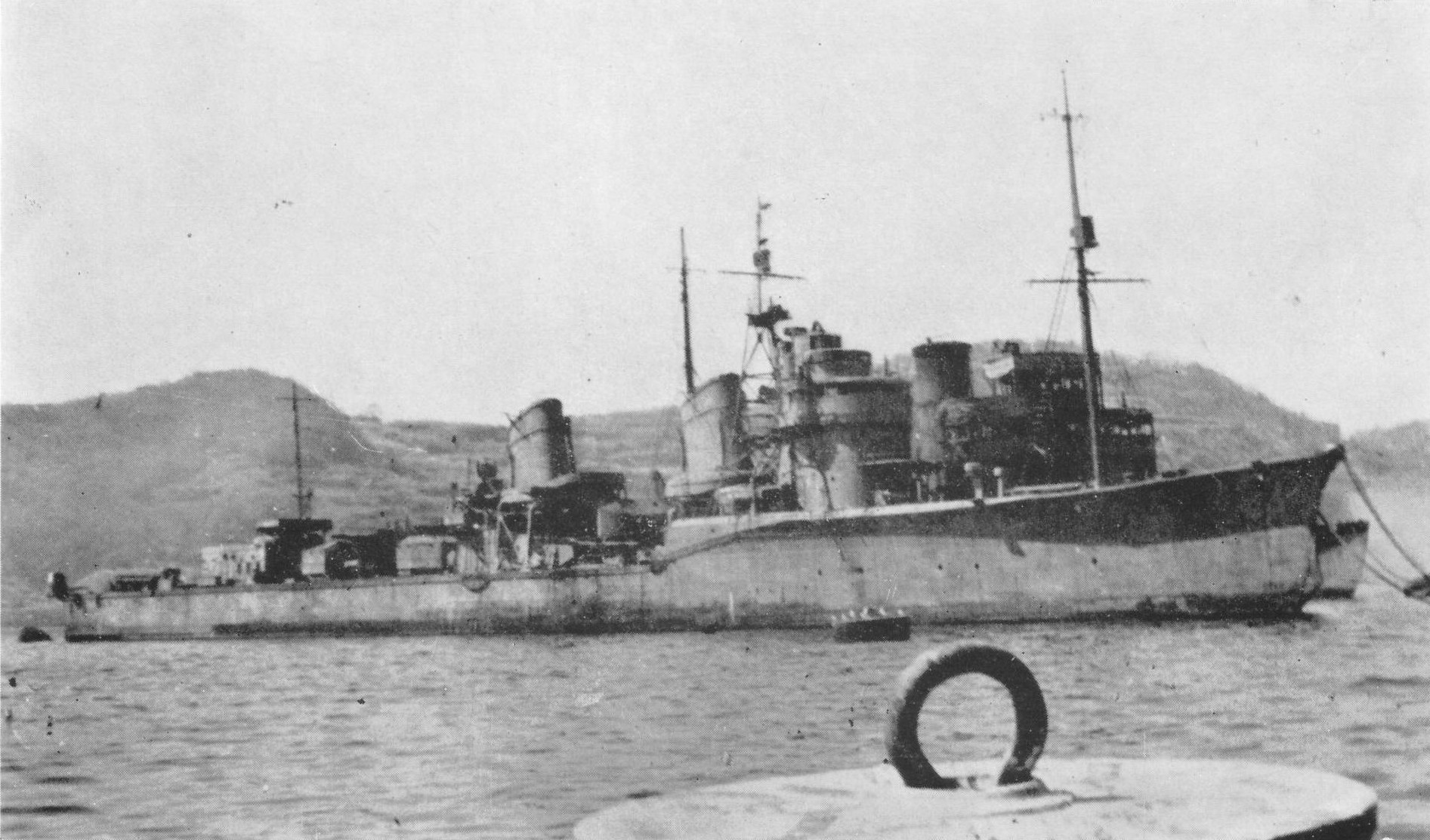
Three of the survivors were sunk during the last offensive sortie of Japanese warships. On April 7th the Kagero Class Isokaze and Hamikaze and Asashio Class Kasumi were sunk by US carrier aircraft while escorting the battleship Yamato on her suicide mission at Okinawa.

ToneWreckage1945

Wreck of Tone at Kure

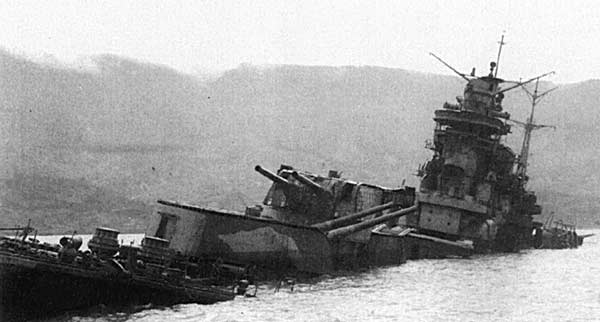
The Heavy Cruiser Tone, sister of Chikuma survived many battles and was sunk at anchor in Kure harbor by US carrier aircraft on July 24th 1945. Her hulk was scrapped between 1947 and 1948.

Japanese_destroyer_Ushio_1946

Ushio after the war

Only Fubuki Class destroyer Ushio survived the war. A survivor of many battles she helped sink the submarine USS Perch in 1942. Surrendered to the US Navy she was scrapped in 1948.

Admiral Yamamoto was right when he told cabinet minister Shigeharu Matsumo to and Japanese prime minister Fumimaro Konoe “In the first six to twelve months of a war with the United States and Great Britain I will run wild and win victory upon victory. But then, if the war continues after that, I have no expectation of success.” 

Peace

Padre Steve+

3 Comments

Filed under History, Military, Navy Ships, world war two in the pacific

Leyte Gulf: The Greatest Naval Battle in the History of the World

gb_at_samar

USS Gambier Bay being attacked by Japanese Surface Forces battle 

I will break into Leyte Gulf and fight to the last man…would it not be shameful to have the fleet remaining intact while our nation perishes?” Vice-Admiral Takeo Kurita – 1944

”In case opportunity for destruction of a major portion of the enemy fleet is offered, or can be created, such destruction becomes the primary task.”

Admiral Chester Nimitz – In his order to Halsey, prior to the Battle of Leyte Gulf – October 1944

battle-line-leyte-gulf_life1

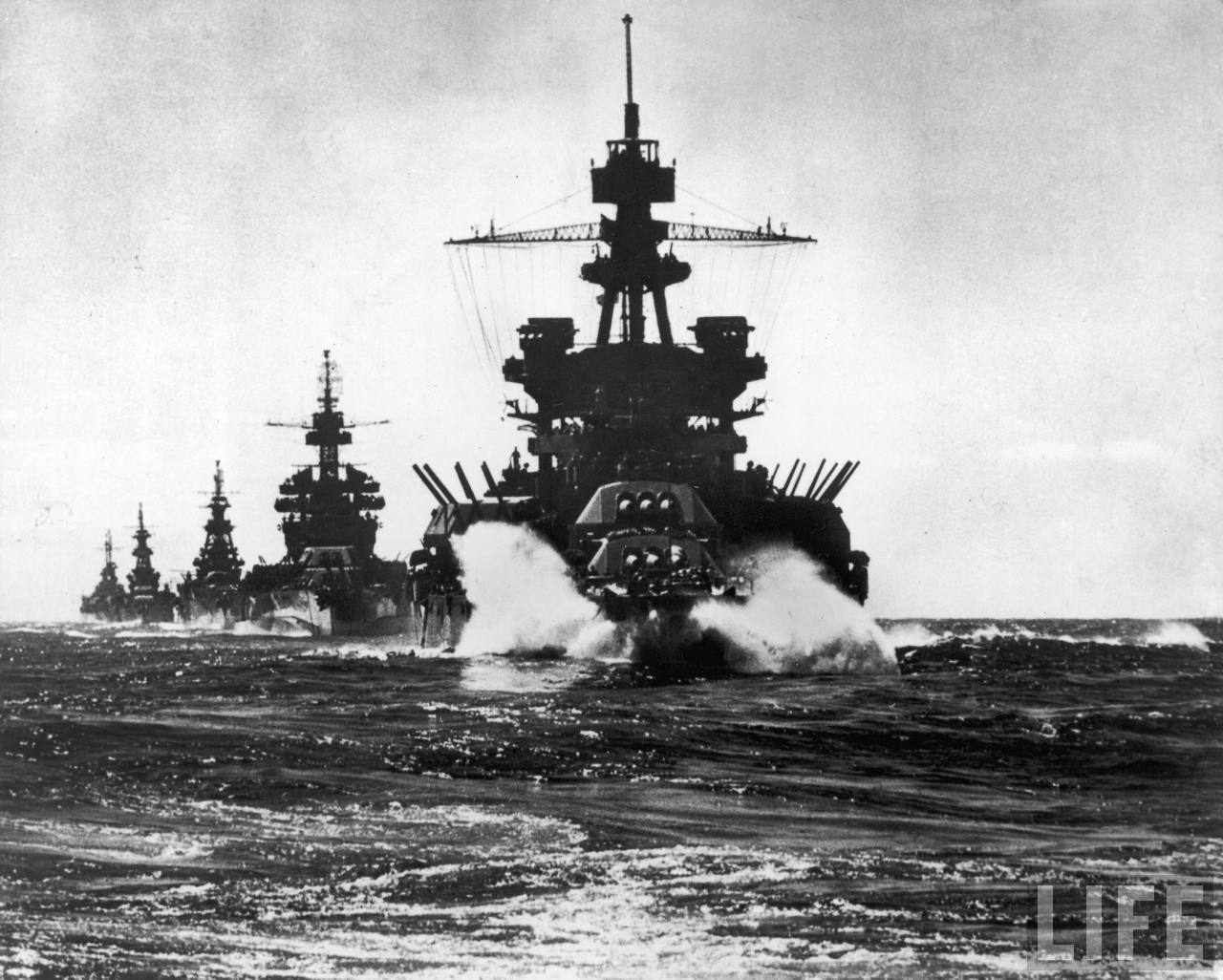
The Old Battleships of the 7th Fleet

Sixty-nine years ago the largest and most geographically expansive naval battle ever fought began. A few days before the forces of General Douglas MacArthur’s Southwest Pacific command and Admiral Chester Nimitz’s Central Pacific command joined to invade and liberate the Philippines from the Japanese. It was less than three years since Japan had attacked Pearl Harbor and two and a half years after MacArthur had left the Philippines vowing “I shall return.” 

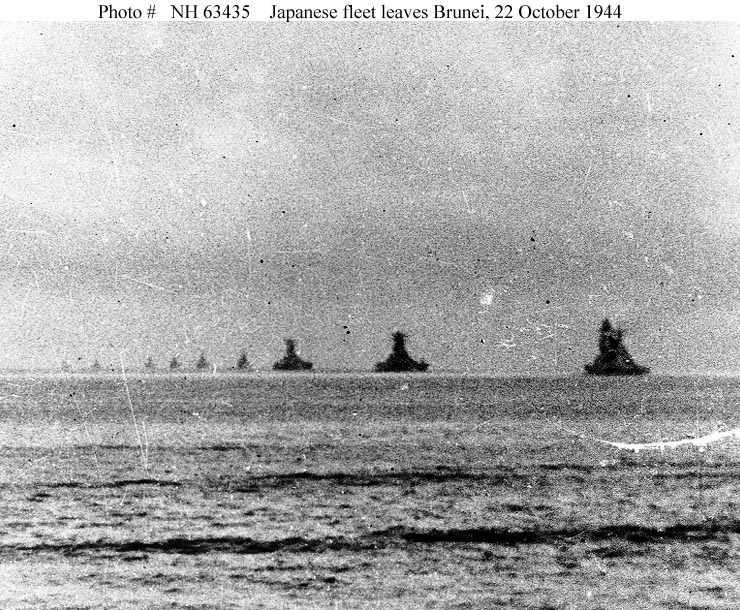
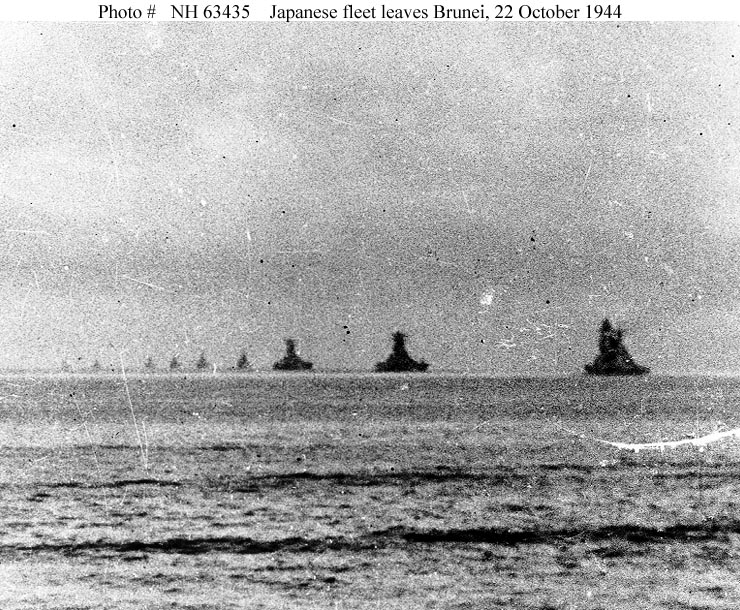
h63435-1

The Japanese knew that the battle for the Philippines was a must win. An American victory would ensure that Japan would be cut off from the vital natural resources of Indo-China, the Dutch East Indies and Borneo, particularly oil, without which it could not remain in the war.

The Imperial Navy was tasked to work with land based air forces to thwart the invasion by drawing off the American Fast Carrier task forces and allowing heavy surface forces to seek out and destroy potentially vulnerable troop transports and supply ships in Leyte Gulf.

It was a complicated plan, but one which had a chance of disrupting the American invasion, and came perilously close to doing so.

Admiral Jisaburo Ozawa’s Northern force of four aircraft carriers without viable air groups was a decoy. Vice Admiral Shoji Nishimura and Vice Admiral Kiyohide Shima commanded separate task forces both committed to breaking into Leyte Gulf through Surigo Strait. Vice Admiral Takeo Kurita who commanded the main effort, the powerful Center Force which was to break into Leyte Gulf through San Bernardino Strait. Vice Admiral Takijirō Ōnishi commanded the Philippines based 1st Air Fleet which turned to the use of Kamikazes as a means to destroy American warships.

Princeton1

Kamikaze attack

The US forces included the American Third Fleet commanded by Admiral William “Bull” Halsey was the primary naval force composed of the Fast Carrier Task Forces and fast battleships. Adusmiral Thomas Kinkaid commanded the 7th Fleet which was the invasion force and its escorts, including a number of carrier task forces built around the Escort Carriers and the old battleships of Jesse Oldendorf’s Task Group. The latter included a number of the survivors of the Pearl Harbor attack including the USS West Virginia, USS California, USS Tennessee, USS Maryland and USS Pennsylvania. Oldendorf’s flagship, the USS Mississippi was not at Pearl Harbor but likewise one of the “old ladies” of the fleet.

g378525

The battle was unique because of how long it went and how many separate engagements were included.  Not counting patrol craft, submarines and auxiliaries close to 300 warships and nearly 2000 aircraft were engaged in 5 separate engagements waged by surface ships, naval air forces and submarines.

886896

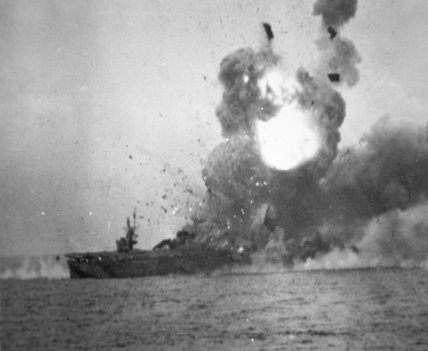
USS St Lo blows up after being hit by Kamikaze 

The battles included an engagement in which American Submarines took on the Center Force, naval aircraft engaged the Center and Southern Forces, the old battleships fought the last battleship against battleship engagement in history, heavy surface forces engaged and were repulsed by light forces and a decoy force which would suffer terribly would keep the bulk of the best American forces out of the main battle. It would also see the first coordinated use of Kamikaze suicide attack aircraft by Japan.

014849

USS West Virginia 

Tonight I am linking a number of articles that I have written previously about this amazing battle. In the next few days I will add a couple new articles to the collection.

The Battle of Leyte Gulf: Introduction and the Battle of Palawan Passage

The Battle of Leyte Gulf: Sinking the Musashi 

Slaughter at Surigao: The Old Ladies get their Revenge

For those unfamiliar with the battle that would like a deeper treatment than I provide in these links I recommend The Battle of Leyte Gulf 23-26 October 1944 by Thomas C Cutler, The Last Stand of the Tin Can Sailors: The Extraordinary World War II Story of the U.S. Navy’s Finest Hour by James Hornfisher, Battle Of Leyte Gulf by Edwin P Hoyt, Leyte: June 1944-January 1945 (History of United States Naval Operations in World War II) by Samuel Elliott Morrison and Battle of Surigao Strait by Anthony P Tully. Hoyt and Morrison’s books were the first that I ever read on the subject back when I was in Junior High School but for an overview I think Cutler’s work is better. The other two works present interesting and informative views of two of the decisive engagements of the battle.

uss roberts 101944

As I said in the next few days I plan on adding more articles on this fascinating battle. If things work out I should have something on the Battle off Samar, the Battle of Cape Engano and the Kamikaze debut.

Have a nice night and never forget the sacrifice of all of the brave sailors.

Peace

Padre Steve+

1 Comment

Filed under History, Military, Navy Ships, US Navy, world war two in the pacific

The Province of Chance: The Battle of Midway, 5 Minutes that Changed the Course of a War

Battle%20of%20Midway%20flat_080817160843

“War is the province of chance. In no other sphere of human activity must such a margin be left for this intruder. It increases the uncertainty of every circumstance and deranges the course of events.” Carl Von Clausewitz 

“Even against the greatest of odds, there is something in the human spirit – a magic blend of skill, faith, and valor – that can lift men from certain defeat to incredible victory.”  Walter Lord

Six months after Pearl Harbor the United States Navy met the Imperial Japanese Navy in battle on the seas and in the airspace around Midway Island. It was a battle between a fleet that had known nothing but victory in the months after Pearl Harbor and one with the exception of a few minor tactical successes was reeling.

images-41

The Japanese had swept across the Pacific and the Indian Oceans and decimated every Allied Naval forces that stood in their way. After Pearl Harbor they had sunk the HMS Prince of Wales and HMS Repulse off of Singapore.  Next in a series of engagements destroyed the bulk of the US Asiatic Fleet in the waters around the Philippines and the Dutch East Indies culminating in the Battle of the Java Sea where the bulk of the American, British, Dutch and Australian (ABDA) naval forces engaged were annihilated attempting to fight superior Japanese forces.

Hermes_sinking

HMS Hermes sinking after Japanese Carrier air attack

In the Indian Ocean Admiral Nagumo’s carriers dispatched a force of Royal Navy cruisers and the Aircraft Carrier HMS Hermes. In only one place had a Japanese Naval task force been prevented from achieving its goal. At the Battle of the Coral Sea where Task Force 11 and Task Force 17 centered on the Carriers USS Lexington and USS Yorktown prevented a Japanese invasion force from taking Port Moresby sinking the light carrier Shoho, damaging the modern carrier Shokaku and decimating the air groups of the Japanese task force.

Hornet_launches

In May US Navy code breakers under the direction of Commander Joe Rochefort at Pearl Harbor discovered the next move of the Imperial Navy an attack on Midway Island and the Aleutian islands. Since the occupation of Midway by Japanese forces would give them an operational base less than 1000 miles from Pearl Harbor Admiral Chester Nimitz committed the bulk of his naval power, the carriers USS Enterprise CV-6, USS Yorktown CV-5 and USS Hornet CV-8 and their 8 escorting cruisers and 15 destroyers, a total of 26 ships with 233 aircraft embarked to defend Midway. Nimitz also sent a force of 5 cruisers and 4 destroyers to cover the Aleutians.

images-42

images-43

Land based air assets on Midway were composed of a mixed Marine, Navy and Army air group of 115 aircraft, many of which were obsolete. Aboard Midway there were 32 US Navy PBY Catalina Flying Boats, 83 fighters, dive bombers, torpedo planes and Army Air Force bombers piloted by a host of inexperienced pilots.

Nimitz’s instructions to his Task Force Commanders was simple “You will be governed by the principle of calculated risk, which you shall interpret to mean the avoidance of exposure of your force to attack by superior enemy forces without good prospect of inflicting … greater damage on the enemy.”

893594c746

Admiral Isoroku Yamamoto commanded the Combined Fleet. The victor of Pearl Harbor and the triumph’s in the first six months of the Pacific War was determined to end the war with a decisive battle at Midway. His plans were opposed by many in the Imperial General Staff, especially those in the Army but when the US raid on Tokyo, the Doolittle Raid, all opposition to the attack was dropped.

10-japanese-carriers-coral-sea-midway

The Japanese sent a force of 7 battleships and 7 carriers against Midway. These included the elite First Carrier Striking Group composed of the Pearl Harbor attackers Akagi, Kaga, Soryu and Hiryu and their highly trained and combat experienced air groups. Among the surface ships was Yamamoto’s flagship, the mighty Battleship Yamato, at 72,000 tons and armed with 9 18” guns, the most powerful and largest battleship ever to see combat.

The strike force included 273 aircraft and was escorted by 14 cruisers and 39 destroyers. They were to take Midway and then destroy the US Navy when it came out to fight. Yamamoto sent a force force of 4 battleships, 12 destroyers assigned screen to the Aleutian invasion force which was accompanied by 2 carriers 6 cruisers and 10 destroyers. The other carriers embarked a further 114 aircraft.

Despite this great preponderance in numbers Yamamoto’s plan was complex and his forces too far apart from each other to offer support should and get into trouble. The powerful Japanese Task forces were scattered over thousands of square miles of the Northern Pacific Ocean where they could not rapidly come to the assistance of any other group.

images-44

With the foreknowledge provided by the code breakers the US forces hurried to an intercept position northeast of Midway eluding the Japanese submarine scout line which the Japanese Commander Admiral Yamamoto presumed would find them when they sailed to respond to the Japanese attack on Midway.  Task Force 16 with the Enterprise and Hornet sailed first under the command of Rear Admiral Raymond A Spruance and Task Force 17 under Rear Admiral Frank “Jack” Fletcher with the Yorktown which had been miraculously brought into fighting condition after suffering heavy damage at Coral Sea. Fletcher assumed overall command by virtue of seniority and Admiral Nimitz instructed his commanders to apply the principle of calculated risk when engaging the Japanese as the loss of the US carriers would place the entire Pacific at the mercy of the Japanese Navy.

On June 3rd a PBY Catalina discovered the Japanese invasion force and US long range bombers launched attacks against it causing no damage. The morning of the 4th the Americans adjusted their search patterns in and the Japanese came into range of Midway and commenced their first strike against the island.

g17056

In response land based aircraft from Midway attacked the Japanese carrier force taking heavy casualties and failing to damage the Japanese task force. The American Carrier task forces launched their strike groups at the Japanese fleet leaving enough aircraft behind of the Combat Air Patrol and Anti-submarine patrol.  As the Americans winged toward the Japanese fleet the Japanese were in a state of confusion. The confusion was caused when a scout plane from the Heavy Cruiser Tone that had been delayed at launch discovered US ships but did not identify a carrier among them until later into the patrol. The carrier  was the Yorktown and TF 17, but for Nagumo who first expected no American naval forces, then received a report of surface ships without a carrier followed by the report of a carrier the reports were unsettling.

a5f7ab19-17c6-4928-90a4-5bb913d156eb

Orders and counter-orders were issued as the Japanese attempted to recover their strike aircraft and prepare for a second strike on the island and then on discovery of the Yorktown task force, orders changed and air crews unloaded ground attack ordnance in favor of aerial torpedoes and armor piercing bombs. The hard working Japanese aircrew did not have time to stow the ordnance removed from the aircraft but by 1020 they had the Japanese strike group ready to launch against the US carriers.

g701850

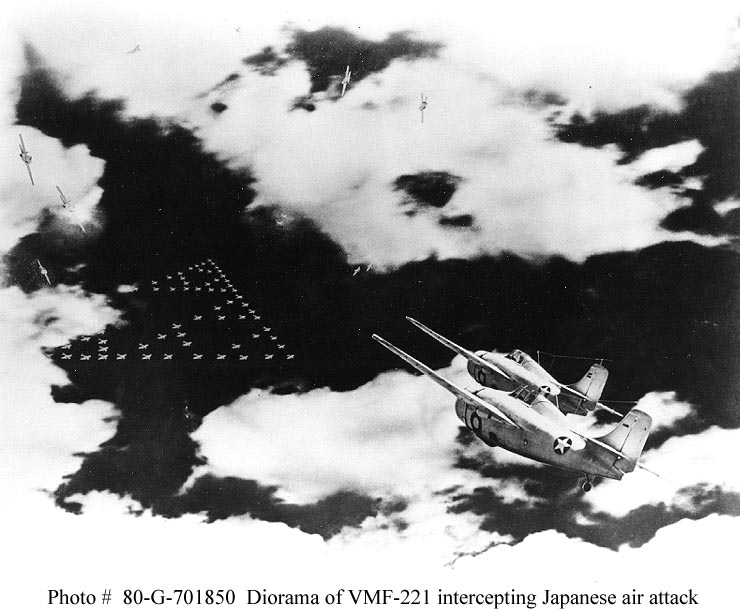
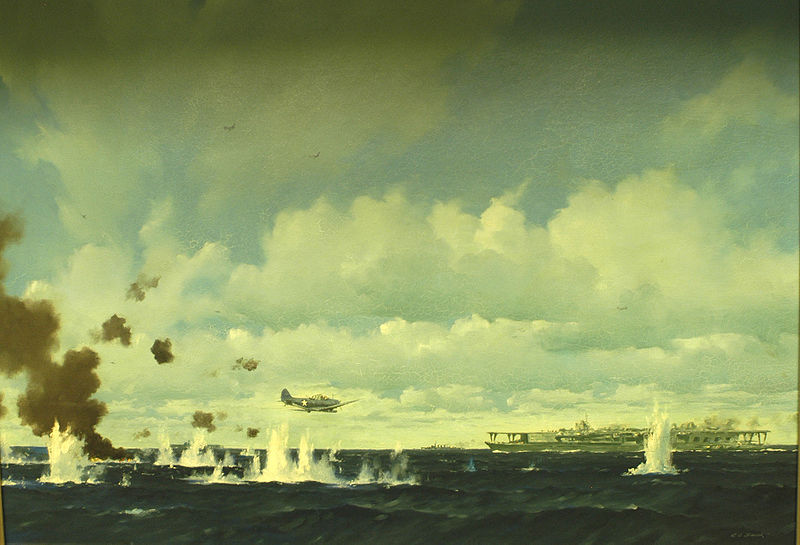
As the Japanese crews worked the Japanese carriers were engaged in fending off attacks by the US torpedo bomber squadrons, VT-6 from Enterprise, VT-8 from Hornet and VT-3 from Yorktown. The Japanese Combat Air Patrol ripped into the slow, cumbersome and under armed TBD Devastators as they came in low to launch their torpedoes.  Torpedo Eight from Hornet under the command of LCDR John C Waldron pressed the attack hard but all 15 of the Devastators were shot down. Only Ensign George Gay’s aircraft was able to launch its torpedo before being shot down and Gay would be the sole survivor of the squadron.

g66074


LCDR Lance Massey CO of VT-3

Page500_163_6

LCDR John Waldron CO of VT-8

220px-Eugene_Lindsey;h84903

LCDR Eugene Lindsey CO of VT-6

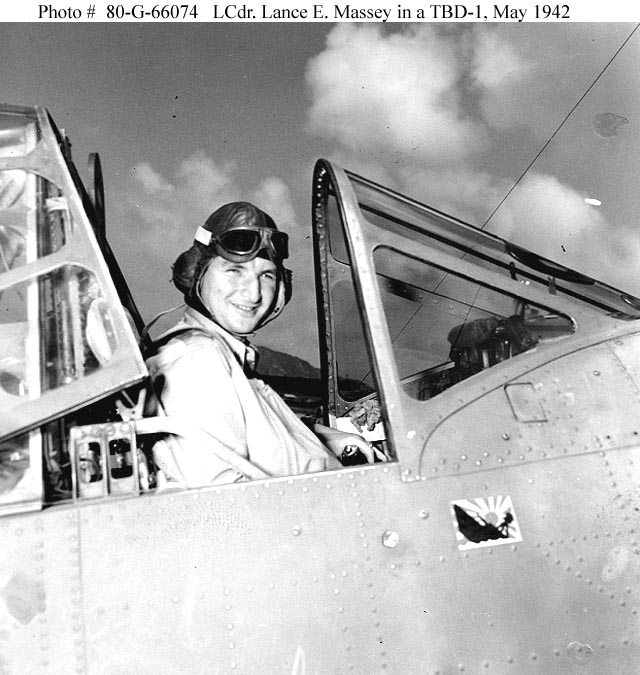
Torpedo 6 from Enterprise under the command of LCDR Eugene Lindsey suffered heavy casualties losing 10 of 14 aircraft with Lindsey being one of the casualties.  The last group of Devastators to attack was Torpedo 3 from Yorktown under the command of LCDR Lem Massey from the Yorktown. These aircraft were also decimated and Massey killed but they had drawn the Japanese Combat Air Patrol down to the deck leaving the task force exposed to the Dive Bombers of the Enterprise and Yorktown.

800px-tbd_attacking_at_midway_painting-1

There had been confusion among the Americans as to the exact location of the Japanese Carriers. Bombing 8 and Scouting 8 from Hornet did not find the carriers and had to return for lack of fuel while losing a number of bombers and their fighter escort having to ditch inn the ocean and wait for rescue. The Enterprise group composed of Bombing-6 and Scouting 6 under CDR Wade McClusky was perilously low on fuel when the wake of a Japanese destroyer was spotted.  McClusky followed it to the Japanese Task Force. The Yorktown’s group under LCDR Max Leslie arrived about the same time.

Dauntless_dive_bombers

When the American dive bombers arrived over the Japanese Carrier Strike Force they found the skies empty of Japanese aircraft. Below, aboard the Japanese ships there was a sense of exhilaration as each succeeding group of attackers was brought down and with their own aircraft ready to launch and deal a fatal blow to the American carrier wondered how big their victory would be. The war would soon be decided.

midway4

At 1020 the first Zero of the Japanese attack group began rolling down the flight deck of the flagship Akagi, aboard Kaga aircraft were warming up as they were on the Soryu.  The unsuspecting Japanese were finally alerted when lookouts screamed “helldivers.” Wade McClusky’s aircraft lined up over the Akagi and Kaga pushing into their dives at 1022. There was a bit of confusion when the bulk of Scouting 6 joined the attack of Bombing 6 on the Kaga. That unprepared ship was struck by four 1000 pound bombs which exploded on her flight deck and hangar deck igniting the fully fueled and armed aircraft of her strike group and the ordnance littered about the hangar deck.  Massive fires and explosions wracked the ship and in minutes the proud ship was reduced to an infernal hell with fires burning uncontrollably. She was abandoned and would sink at 1925 taking 800 of her crew with her.

douglas-sbd5-dauntless-dive-bomber-battle-of-midway-01

LT Dick Best of Scouting 6 peeled off from the attack on Kaga and shifted to the Japanese flagship Akagi. On board Akagi were two of Japan’s legendary pilots CDR Mitsuo Fuchida leader of and CDR Minoru Genda the architect of the Pearl Harbor attack and subsequent string of Japanese victories. Both officers were on the sick list and had come up from sick bay to watch as the fleet was attacked. Seeing Kaga burst into flames they stood mesmerized until Akagi’s lookouts screamed out the warning “helldivers” at 1026.  Best’s few aircraft hit with deadly precision landing two of their bombs on Akagi’s flight deck creating havoc among the loaded aircraft and starting fires and igniting secondary explosions which turned the ship into a witch’s cauldron.  By 1046 Admiral Nagumo and his staff were forced to transfer the flag to the cruiser Nagara as Akagi’s crew tried to bring the flames under control. They would do so into the night until nothing more could be done and abandoned ship at 2000.  Admiral Yamamoto ordered her scuttled and at 0500 on June 5th the pride of the Japanese carrier force was scuttled.

g701870

VB-3 under LCDR Max Leslie from the Yorktown stuck the Soryu with 17 aircraft, however only 13 of the aircraft had bombs due to an electronic arming device malfunction on 4 of the aircraft, including that of Commander Leslie.  Despite this Leslie led the squadron as it dove on the Soryu at 1025 hitting that ship with 3 and maybe as many as 5 bombs. Soryu like her companions burst into flames as the ready aircraft and ordnance exploded about her deck. She was ordered abandoned at 1055 and would sink at 1915 taking 718 of her crew with her.

h73065

The remaining Japanese flattop the Hiryu attained the same fate later in the day after engaging in an epic duel with the Yorktown which her aircraft heavily damaged. Yorktown would be sunk by the Japanese submarine I-168 while being towed to safety.

71380-004-B4724C34

USS Yorktown under attack from Kate Torpedo Bombers from Hiryu on June 4th 1942

In five pivotal minutes the course of the war in the Pacific was changed. Authors have entitled books about Midway Incredible Victory by Walter Lord and Miracle at Midway by Gordon Prange and those titles reflect the essence of the battle.

At Midway a distinctly smaller force defeated a vastly superior fleet in terms of experience, training and equipment. At the very moment that it appeared to the Japanese that they would advance to victory their vision disappeared. In a span of less than 5 minutes what looked like the certain defeat of the US Navy became one of the most incredible and even miraculous victories in the history of Naval warfare. In those 5 minutes history was changed in a breathtaking way. While the war would drag on and the Japanese still inflict painful losses and defeats on the US Navy in the waters around Guadalcanal the tide had turned and the Japanese lost the initiative in the Pacific never to regain it.

The Japanese government hid the defeat from the Japanese people instead proclaiming a great victory. The American government could not fully publicize the victory for fear of revealing the intelligence that led to the ability of the US Navy to be at the right place at the right time and defeat the Imperial Navy.

uss-enterprise-cv-6-1

The American victory at Midway changed the course of the war in the Pacific. The Battle of Midway established the aircraft carrier and the fast carrier task force as the dominant force in naval warfare which some would argue it still remains. Finally those five minutes ushered in an era of US Navy dominance of the high seas which at least as of yet has not ended as the successors to the Enterprise, Hornet and Yorktown ply the oceans of the world and the descendants of those valiant carrier air groups ensure air superiority over battlefields around the world.

Peace

Padre Steve+

1 Comment

Filed under History, Military, Navy Ships, US Navy, world war two in the pacific

An older post of mine about Pearl Harbor as we approach the 71st anniversary of that “Day of Infamy.”

padresteve's avatarThe Inglorius Padre Steve's World

Arizona Leading the Battle Line

“Yesterday, Dec. 7, 1941 – a date which will live in infamy – the United States of America was suddenly and deliberately attacked by naval and air forces of the Empire of Japan…. The attack yesterday on the Hawaiian Islands has caused severe damage to American naval and military forces. Very many American lives have been lost.” Except of President Franklin D Roosevelt’s Pearl Harbor Speech December 8th 1941

Today is the 68th anniversary of the Japanese attack on Pearl Harbor and as we were then we are at war.

A Date that Will Live in Infamy: USS Arizona Burning

I remember reading Walter Lord’s “Day of Infamy” when I was a 7th grade student at Stockton Junior High School back in 1972.  At the time my dad was on his first deployment to Vietnam on the USS Hancock CVA-19.  As…

View original post 1,837 more words

1 Comment

Filed under History, Military, Navy Ships, traumatic national events, US Navy, world war two in the pacific

Requiem of Empire: The Yamato Class Battleships

Emperor Hirohito on Musashi in 1943

The is a long delayed installment of my series on Battleships. Previous were about the Battleships constructed under conditions of the London Naval Conference.  These have dealt with the British King George V Class, French Dunkerque and Richelieu Classes, Italian Vittorio Vento Class and the American North Carolina and South Dakota ClassesI then wrote an introduction to the Post Treaty Super-Battleships. This article is the first in that series which will include articles on the German Bismarck and Tirpitz, British Vanguard and American Iowa Class.

They were the largest and most heavily armed battleships ever built. Shrouded in secrecy by the Imperial Japanese Navy and Government the ships were designed to offset projected American numerical superiority. Their names were symbolic of Japan’s history. Yamato was named after Yamato Province, the ancestral home of the Yamato People, the dominant native ethnic group in Japan. Musashi was named after Musashi Province in which lays Tokyo Prefecture.  A third ship of the class, Shinano, was named after Shinano Province in central Japan which was the home of the prestigious Taketa Shingen family during the Senguku period.

The Conning Tower and Bridge of Musashi

The secrecy surrounding their design and construction was unprecedented. Those charged with their deign and construction were thoroughly checked out by Japan’s secret police and sworn to an oath of secrecy. The oath sworn by builders of Musashi at the Mitsubishi Heavy Industries  Nagasaki Shipyard were sworn to the oath shown below:

I am aware that all work work involving the construction of the No. 2 Battleship is vital to national security. I will make utmost effort to maintain the  secrecy of the project, and swear that I will leak no information relating to the said battleship, even to relatives and close friends. In the event I violate this oath,  I will submit to the punishment determined by the company and the Navy.  

Yamato during Consrtuction

Security measures around the shipyards where Yamato and Musashi were constructed  were immense. At Nagasaki where there was a large foreign business and missionary population where the shipyard was visible from most of the city at hemp screen of 75,000 square meters was constructed to shield the ship from prying eyes and spies.

Musashi under Construction

When actual preparations for construction were taken in 1937 secret police swept the areas of foreign, especially Chinese workers. Security was increased inside and outside the shipyard, all blueprints accounted for and placed under strict guard while all shipyard workers were photographed with any having knowledge of the plans or supervising the construction sworn to the secrecy oath.

When a top secret blueprint went missing in 1938 at Nagasaki an intense investigation that included the torture of numerous suspects and the jailing of a blueprinter who accidentally swept the document into the trash was sentenced to 3 years in prison.

Armor and Protection of Yamato Class

Few pictures exist of the ships and Japanese Naval Officers destroyed many of the records of the ships design and construction just prior to the end of the Second World War. Throughout their existence they were a mystery to the American Navy. During the war the U.S. Navy estimated them to carry nine 16” guns and displace between 40,000-57,000 tons. Even the highly regarded Jane’s Fighting ships listed them at just 45,000 tons.

Yamato and Musashi together in 1943

Preliminary design work began in 1934 and progressed rapidly following Japan’s withdraw from the League of Nations and renunciation of the Washington and London Naval Treaties and withdraw from the 1936 naval talks in London. The early designs varied in the caliber of guns, size and armor, propulsion systems and endurance. Gun calibers ranged from 16” to 18.1” and a combined diesel-turbine system was considered but rejected in favor of traditional steam turbines.

The final design was for a class of five ships. Each would displace 64,000 tons standard displacement and 72,000 tons at full load. They were 862 feet long with a beam of 127 feet.  They were so large that the docks they were built needed to be expanded and special extra large launch platforms had to be built.  At Nagasaki the dock at to be expanded by cutting into the hill adjacent to it.

They were armed with nine 18.1 inch guns in triple turrets which could fire a projectile weighing over a ton. The secondary armament consisted of 12 6.1 inch guns mounted in triple turrets formerly mounted on the Mogami Class cruisers when those ships were equipped with 8” guns. Anti-aircraft defense included twelve 5” guns and twenty-four 25mm anti-aircraft guns. During the war two of the 6.1 inch turrets were removed and replaced with twelve more 5” guns and the 25mm battery was raised to 162 guns. Fire control systems were designed in such a way that the ships could engage multiple surface targets at the same time.

The ships were protected by a massive armored belt ranging from 16 inches to 8 inches with 26 inch armor on the face plates of the main gun turrets. The armor was advanced with excellent sloping but had a flaw where the upper and lower belts connected just below the waterline which exposed them to damage from torpedoes.

Yamato and Musashi viewed beside Battleship Nagato (foreground) just before the Battle of Leyte Gulf

They were powered by 12 Kampon boilers which powered 4 steam turbines and four three bladed propellers. These developed 150,000 shp and could drive the ship at a top speed of 27 knots.

Yamato

Construction of Yamato began on November 4th 1937 at Kure Naval Shipyard. Musashi on March 28th 1938. Traditionally such events were large public ceremonies but these were limited to just a few Naval Staff and Shipyard executives.  Yamato was Launched on August 8th 1940 and commissioned on December 16th 1941, just 9 days after Pearl Harbor. Musashi was launched on November 8th 1940 and commissioned on August 5th 1942 just two days before the U.S. Marines invaded Guadalcanal and two months after the disaster at the Battle of Midway.

Yamato served as Admiral Yamamoto’s flagship at Midway where she saw no action. The next two years she was and Musashi alternated as fleet flagship and conducted operations with Battleship Division One in operations between Mainland Japan and the major Japanese base at Truk. On December 25th 1943 while escorting a convoy she was torpedoed by the submarine USS Skate and suffered heavy damage which flooded a magazine.  On March 29th while underway Musashi was struck near the bow by a torpedo from the USS Tunny.

Musashi Under Attack at the Battle of Sibuyan Sea

Both ships participated in the Battle of the Philippine Sea and were part of Vice Admiral Takeo Kurita’s Central Force in the Battle of Leyte Gulf. Musashi was sunk by U.S. Navy Carrier aircraft from the Third Fleet on October 24th 1944 during the Battle of the Sibuyan Sea. Hit by 17 bombs and 19 torpedoes she sank with the loss of nearly 1100 of her crew of almost 2400 men. The survivors were rescued by destroyers and disembarked at Corregidor. Some were sent by troop transport to Japan but one of the ships was torpedoed and sunk leaving her survivors adrift for 19 hours before rescue. Those who reached Japan were isolated from the population while about half of the survivors remained in the Philippines where 117 of 146 of those assigned to the defense of Manila were killed in action.

Yamato or Musashi under air Attack

Yamato saw action in the surface engagement on October 25th against the Escort Carriers and Destroyers of Taffy-3 during the Battle off Samar. Her guns helped sink the Escort Carrier USS Gambier Bay but was forced away from the action by torpedo attacks from the valiant destroyers of Taffy-3.

Yamato under Attack April 7th 1945

By April 1944 Japan’s Navy was decimated and U.S. Naval Forces were raiding Mainland Japan. When the United States landed on Okinawa the Japanese Navy and air force launched wave after wave of Kamikaze attacks on the ships in the waters around the island. Yamato, along with Light Cruiser Yahagi and eight destroyers were designated the Surface Special Attack Force and loaded with a full load of ammunition but only enough fuel for a one way trip got underway on April 6th. The mission was for Yamato to reach Okinawa, beach herself and serve as an “unsinkable” gun battery until she was destroyed. The force was spotted by U.S. Navy flying boats hours after their departure and on April 7th over 400 aircraft launched from Task Groups 58.1 and 58.3. The first wave began its attack at 1230 and by 1400 the ship was mortally wounded. Stuck by at least 8 torpedoes and 11 bombs she was dead in the water and began to capsize at 1405. At 1420 she turned turtle and at 1423 exploded when her forward blew up sending up a mushroom cloud nearly 20,000 feet.  Under 300 of her crew of nearly 2400 were rescued.

The End: Yamato Explodes

The ships were the largest battleships ever built, designed when naval experts planned for a war where the battleship would rule and aircraft carriers play a supporting role. Instead both never faced enemy battleships in combat and both were destroyed by the weapon that the battleship admirals had discounted. It is somewhat fitting that each was commissioned shortly after the triumphs of Japanese and American Naval air power at Pearl Harbor and Midway. However they have attained an almost mythic status in naval lore and are symbols to many Japanese of the sacrifice and futility of the war. Both of the cities where the ships were constructed were destroyed by Atomic bombs. They are tragic reminders of the cost of war in human lives, suffering, economic cost and destruction.

In a sense their poetic names and the myth ascribed to them are a tragic requiem to the Japanese Empire and the cost of war. They and their brave sailors were sacrificed when the war was already for all intents and purposes lost. They, especially the Yamato were sacrificed for no military purpose save a convoluted sense of honor.

Let us pray that it never happens again.

Peace

Padre Steve+

3 Comments

Filed under Military, Navy Ships, world war two in the pacific

The Battle of Leyte Gulf: Sinking the Musashi

IJNS Musashi

This is the second in a series of articles about the Battle of Leyte Gulf.  The first article in the series is liked here and is entitled

The Battle of Leyte Gulf: Introduction and the Battle of Palawan Passage

Following the loss of Atago, Maya and Takao Vice Admiral Takeo Kurita’s Center Force had an uneventful rest of the day on the 23rd as his ships kept a watchful eye and ear for more US Navy submarines.  At about 0800 on 24 October the Center Force was spotted by 3 B-24 Liberator bombers which promptly reported them.

TBF Avenger dropping its “fish” 19 would hit Musashi

One of the ships in the Center Force was the IJNS Musashi, sister ship of the mighty Yamato which was also in the force. The two battlewagons were the largest battleships ever built.  With a full load displacement of 72,800 tons and an armament of nine 18.1 inch guns, the largest battery ever mounted on a warship the two behemoths also had massive anti-aircraft batteries and the Japanese were counting on them leading the Center Force to a miraculous victory during the battle.  Admiral Kurita addressed his commanders prior to the battle:

“I know that many of you are strongly opposed to this assignment.  But the war situation is far more critical than any of you can possibly know.  Would it not be shameful to have the fleet remain intact while our nation perishes?  I believe that the Imperial General Headquarters is giving us a glorious opportunity.  Because I realize how very serious the war situation actually is, I am willing to accept even this ultimate assignment to storm into Leyte Gulf.  You must all remember that there are such things as miracles.”

Musashi or Yamato under attack October 24th 1944

At 1000 the Musashi’s radar picked up approaching aircraft.  These were from the USS Intrepid and the USS Cabot which were assigned to Rear Admiral Gerard Bogan’s Task Group 38.4. The anti-aircraft crews and damage control teams prepared as the ship’s bugle sounded the alarm.  As the aircraft came closer the main guns of the Musashi fired but ceased fire as the aircraft drew closer.  Helldiver dive bombers plunged downward at the ships of the Center Force and F6F Hellcat fighters unopposed by enemy fighters conducted strafing runs as TBF Avenger torpedo bombers dropped their deadly loads at the Musashi.  The big ship avoided two of the “fish” but a third struck causing little damage and the first wave few away.  Musashi reported that she had sustained a hit and continued on.  The Japanese sailors knew that this would not be the last attack.  Though Musashi had weathered the first strike the American fliers hit the battleships Nagato, Yamato and severely damaged the heavy cruiser Myōkō.

Musashi hit

At 1140 the Musashi’s radar picked up the next wave of attackers and at 1203.  These were from the Intrepid, Essex and Lexington.  Hitting the Center Force in two waves a half hour apart these aircraft delivered punishing blows on Musashi. She was hit by 3 torpedoes and 2 bombs. The torpedoes caused damage that caused a 5 degree list and was down six feet by the bow. The torpedo damage was concentrated midships and one torpedo flooded her number 4 engine room. One of the bombs hit an engine room and disabled her port inline propeller shaft.  With her speed reduced she proceeded on.

Musashi

Thirty minutes following this attack at about 1330 Musashi was attacked again by Helldivers and Avengers. She is hit by 4 1000 pound bombs and 4 torpedoes.  She was now so badly damage that she could no longer keep up with the fleet and dropped behind to fend for herself.  At 1350 this attack ends with her speed reduced to 20 knots and with her down 13 feet by the bow and nearly all of her trim and void tanks full. There is now little room for any more damage forward.

Separated from the fleet Musashi was now attacked by aircraft from the Enterprise, Cabot, Franklin and Intrepid that score hits with 11 bombs including the deadly 1000 pounders and 8 torpedoes.  During the course of these attacks which ended after 1530 Musashi sustained 19 torpedo and 17 bomb hits and taken 18 near hits close aboard. At 1620 her skipper Rear Admiral Toshihira Inoguchi began desperate damage control measures to control the increasing list which had reached 10 degrees to port.  Dead in the water she continued to list further and when the list reached 12 degrees at 1915 Inoguchi ordered preparations to abandon ship.  The surviving crew assembled on the deck, the battle flag and the Emperor’s portrait were removed.  Admiral Inoguchi gave his personal notebook to his Executive officer Captain Kenkichi Kato and directed then him to abandon ship. Admiral Inoguchi retired to his cabin and was not seen again.  At 1930 with the list now 30 degrees Captain Kato gave the order to abandon ship and soon with the list increasing further men began to slide across the decks being crushed in the process.  Panic broke out among the crew which had been assembled by divisions and Captain Kato ordered “every man for himself.”  At 1936 the ship capsized and port and went down by the bow sinking in 4,430 feet of water in the Visayan Sea at 13-07N, 122-32E.

The destroyers Kiyoshimo, Isokaze and Hamakaze rescued 1,376 survivors including Captain Kato, but 1,023 of Musashi’s 2,399 man crew were lost including her skipper, Rear Admiral Inoguchi who was promoted Vice Admiral, posthumously.

The rest of the Center Force under Kurita turned around to get out of range of the aircraft, passing the crippled Musashi as his force retreated. Kurita’s retreat was temporary and Kurita waited until 17:15 before turning around again to head for the San Bernardino Strait hoping to find it empty of American ships.  His force was still battle worthy because the majority of the 259 sorties were directed on Musashi and the Heavy Cruiser Myōkō which retired heavily damaged. The Southern Force which had also been hit by American carrier air strikes also continued its push toward Surigao Strait.  The Battle of Surigao Strait, the revenge of the Pearl Harbor Battleships will be the next article in this series.

Peace

Padre Steve+
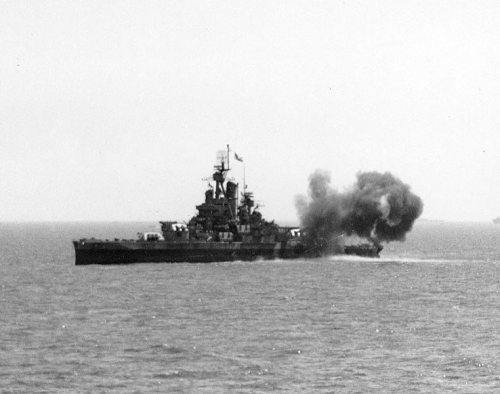
3 Comments

Filed under History, Military, Navy Ships, US Navy, world war two in the pacific

The Battle of Leyte Gulf: Introduction and the Battle of Palawan Passage

This is the first of a four article series on the Battle of Letye Gulf. The battle was the largest in history both in terms of the number of ships involved and the amount of area covered. The action was triggered by the American invasion of the Philippines causing the Japanese to initiate their Shō-Gō 1 (Victory Plan 1) to attempt to defeat the Americans.  The plan relied heavily on land based air power which most of unfortunately for the Japanese was destroyed during the American carrier air strikes on Formosa earlier in the month. 

The battle was necessitated by the absolute need for the Japanese to hold the Philippines and defeat the Americans at all costs. As Admiral Soemu Toyoda the Chief of the Combined Fleet explained under interrogation after the war

Should we lose in the Philippines operations, even though the fleet should be left, the shipping lane to the south would be completely cut off so that the fleet, if it should come back to Japanese waters, could not obtain its fuel supply. If it should remain in southern waters, it could not receive supplies of ammunition and arms. There would be no sense in saving the fleet at the expense of the loss of the Philippines.

The battle was comprised of 5 battles, the Battle of Palawan Passage, the Battle of the Sibuyan Sea, the Battle of Surigao Strait, the Battle of Cape Engaño and the Battle off Samar. All told about 70 Japanese warships and 210 American and Australian ships were engaged.  A further 300 Japanese aircraft, mostly land based and 1500 American carrier aircraft took part in the battle.  The Japanese order of battle included 1 Fleet and 3 Light Fleet Carriers with a minimal air group, 9 Battleships including the two largest ever built the Yamato and Musashi, 14 Heavy and 6 Light Cruisers and about 3 destroyers.  They were divided into four task forces, the Northern Force under the command of Vice-Admiral Jisaburō Ozawa which had all of the Carriers including the last surviving carrier of the Pearl Harbor attack the Fleet Carrier Zuikaku plus the converted hybrid Battleships Ise and Hyuga; the Southern Force which was two distinct and independent task forces under the command of Vice Admirals Shoji Nishimura and Kiyohide Shima and was built around the ancient battleships Fuso and Yamashiro and 3 Heavy Cruisers; and the Center Force under the command of Vice Admiral Takeo Kurita which had the Battleships Yamato, Musashi, Nagato, Kongo and Haruna, 10 Heavy and 2 Light Cruisers and 1 destroyers.  The Center force was to pass through the San Bernardino Strait and converge on the American landing forces off Samar with the Southern Force which as to come through the Surigo Strait.  The Japanese also planned for the first use of Kamikazes as part of the action. 

Takao Class Cruiser 1943

Atago

The American fleet was comprised of the 3rd Fleet under Admiral William Halsey which was built around the Fast Carrier Task Forces and Fast Battleships of Task Force 38 under the Command of Vice Admiral Marc Mitscher and the Battle Line Task Force 34 under the Command of Vice Admiral Willis Lee; and the 7th Fleet under Vice Admiral William Kinkaid which was the naval support for the landings.  It had under its control the old Battleships West Virginia, California, Tennessee, Maryland, Colorado and Pennsylvania and 18 Escort Carriers which provided the close air support for the Invasion.  All told the Americans had 8 Fleet and 8 Light Fleet Carriers, 18 Escort Carriers, 12 Battleships, 24 Cruisers and 141 Destroyers as well as submarines, PT Boats, Transports, Landing Ships and Auxiliaries.

Takao

This series will focus on a number of individual battles and decisions in the battle. Part one will focus on the action of the Submarines Darter and Dace against the Center force in the Palawan Passage. The next will be the sinking of the Musashi during the Battle of the Sibuyan Sea, it will be followed by the revenge of the Old Battleships at Surigo Strait. The next will be the great decision of Admiral Halsey to pursue the Northern Force and leave the San Bernardino Strait unguarded, followed by the Battle off Samar and last the death of the Japanese Naval Aviation at Cape Engaño.

Maya

The Battle of Palawan Passage

Admiral Takeo Kurita and the powerful Center Force departed their anchorage at Bruneion 20 October 1944.  The task force entered the Palawan Passage on the night of 22-23 October where they were sighted by the American Submarines Darter and Dace which had been posted at the strait for such a possibility.  Darter made radar contact at 30,000 yards at 0018 hours on the 23rd and sent out contact reports.   The two submarines shadowed the Center Force on the surface to gain an intercept position and submerged just before dawn.

USS Darter

Darter struck first at 0524 firing a spread of 6 torpedoes scoring 4 hits on Admiral Kurita’s flagship the Heavy Cruiser Atago. She reloaded and stuck the Heavy Cruiser Takao with 2 torpedoes at 0634.  At 0554 Dace hit the Heavy Cruiser Maya with 4 torpedoes.

Vice Admiral Takeo Kurita

The blow was severe.  Atago was mortally wounded she capsized and sank at 0553 with the loss of 360 crew members. She sank so rapidly that Kurita had to swim and was rescued with his Chief of Staff by a destroyer, but many of his staff members were lost with the ship.  Though Kurita transferred his flag to Yamato he was now without the advice and counsel of officers that might have prevented later mistakes during the Battle off Samar.  Takao suffered heavy damage and though she did not sink she had to proceed crippled to Singapore under the guard of two destroyers. Though she survived the war she never saw action again.   Maya, struck at 0554 by 4 torpedoes suffered much damage and was wracked by powerful secondary explosions.  By 0600 she was dead in the water and sank five minutes later with the loss of 337 crew members.

USS Dace

The attack of the two submarines was significant; the Japanese lost 3 powerful Heavy Cruisers and had to send two of their destroyers away to guard Takao. Likewise the loss of Kurita’s experienced staff hindered his conduct of the battle on the 24th.  The cruisers were a big loss, at 13,000 tons and armed with ten 8”guns they could steam at 35 knots.

Darter and Dace conducted a pursuit of the crippled Takao which had to be broken off when Darter ran aground on Bombay Shoal. Despite the best efforts of her crew and that of the Dace to free her she was hopelessly stuck.  Her crew was unable to scuttle her and the Japanese were able to board her after she was abandoned and for the first time get a look at the details of a Gato class submarine.

Kurita’s force would continue on into theSibuyan Seawhere they would be attacked again.  But that is the subject of the next article.

5 Comments

Filed under Navy Ships, US Navy, world war two in the pacific