Tag Archives: john f kennedy

My New Year’s Resolution: The Passionate Pursuit of Truth

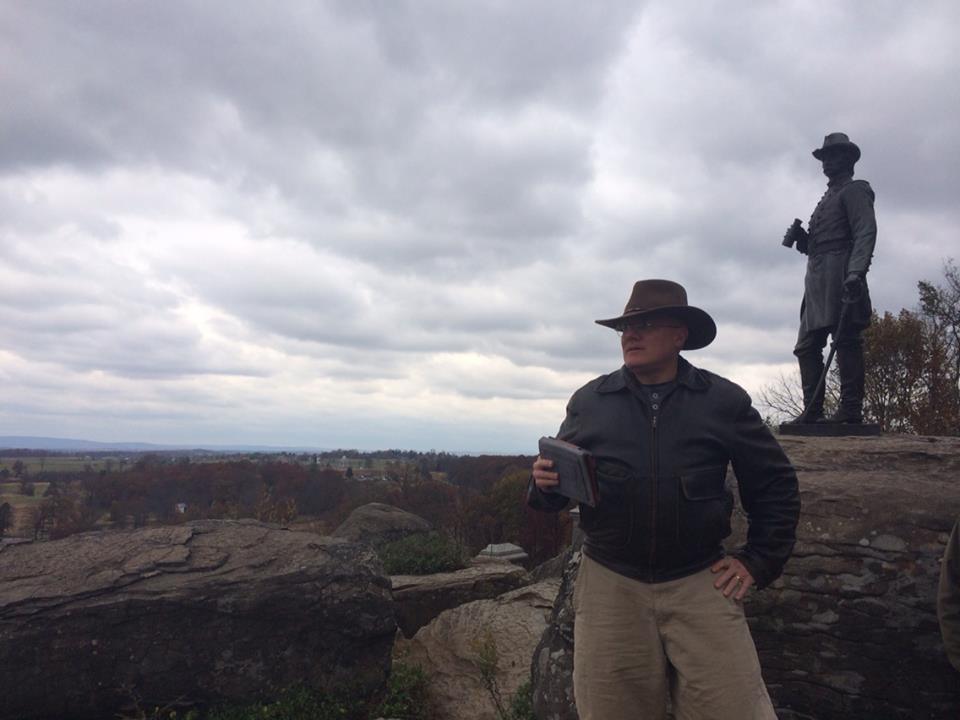
10570298_10152872503382059_5058681841617456899_n

“If someone is able to show me that what I think or do is not right, I will happily change, for I seek the truth, by which no one was ever truly harmed. It is the person who continues in his self-deception and ignorance who is harmed.” – Marcus Aurelius 

Friend’s of Padre Steve’s World. Before I say anything else tonight I just want to thank you for taking the time out of your schedule to read, comment and even share what I write. That matters to me and a good number of you have followed my writings for years. So I truly thank you from the bottom of my heart, and if you like what you see please comment and share with others.

As I get older I realize how valuable time is. There are few commodities that truly cannot be replaced or conserved, time is one that is always fleeting. As Dr. Suess said:

“How did it get so late so soon? It’s night before it’s afternoon. December is here before it’s June. My goodness how the time has flewn. How did it get so late so soon?”

That being said I am not a fan of New Year’s resolutions, in fact I generally don’t make any because frankly I think that most are a waste of time. However, I do not think that the pursuit of truth is a waste, and as Benjamin Disraeli noted so wisely; “Time is precious, but truth is more precious than time.”

To that end I am going to endeavor this year to commit myself to continue to seek truth and to speak truth. Truth matters to me. In my life I have seen so many lies, especially by political and religious leaders that I trusted that I now devote myself to the pursuit of truth. As Captain Jean Luc Picard told the young Cadet Wesley Crusher in Star Trek the Next Generation episode The First Duty: “the first duty of every Starfleet officer is to the truth, whether it’s scientific truth, historical truth or personnel truth…” 

So, I will continue to write, especially about historical subjects that have an impact today: civil rights and social justice, faith, military issues, PTSD and military health issues, the Middle East conflicts and a number of other topics. Of course I will write about baseball, which is often my refuge when things are too much for me and music. I may do more regarding music as I was asked to do an article for a journal about liturgical music, stress and resiliency.

I will continue to be as transparent as I can about my own struggles withPTSD and faith in the hopes that my journey will help others who struggle like me. In fact this was a major reason that I started this site back in February of 2009.

Expect more writing about the Battle of Gettysburg and the Civil War. I have a feeling that that is going going to become a life work, even after I retire from the Navy. The American Civil War is so pertinent to who and what we are as a nation and the more I study it, the people, the issues and the ideologies involved I see many parallels with today; some of which are positively frightening. So expect a lot more about these subjects. In fact the Civil War is one in which debunked myths still hold sway over many, especially among the defenders of the Lost Cause who predominate the Christian Right.

While lies are dangerous the myths can be more so, and the proliferation of lies, half-truths and myth have shriveled the brain cells of those who enjoy the comfort of opinion without the benefit of thought. President John F. Kennedy spoke of this in 1962, and his words are timely, especially when hoards of preachers, pundits and politicians, the Trinity of Evil, do this with abandon:

“The great enemy of truth is very often not the lie–deliberate, contrived and dishonest–but the myth–persistent, persuasive and unrealistic. Too often we hold fast to the cliches of our forebears. We subject all facts to a prefabricated set of interpretations. We enjoy the comfort of opinion without the discomfort of thought.” 

To do this I have to constantly challenge my own thoughts. Even in my work on my Gettysburg and Civil War text I uncover information that points out mistakes in previous editions of my work, and I am not so arrogant that I cannot admit making a mistake or changing my conclusions on a subject. I am actually doing that now on a chapter revision to that work.

As far as other goals, I want to get a publisher for the Gettysburg text, who knows, what I have already written might be two or three books. If you know someone who can help, let me know. I also plan on beginning work on a doctorate to take with me into retirement.

So until tomorrow.

Peace

Padre Steve+

4 Comments

Filed under History, philosophy, Political Commentary

Hell is Where they will Reside: The Expanding War Against ISIL

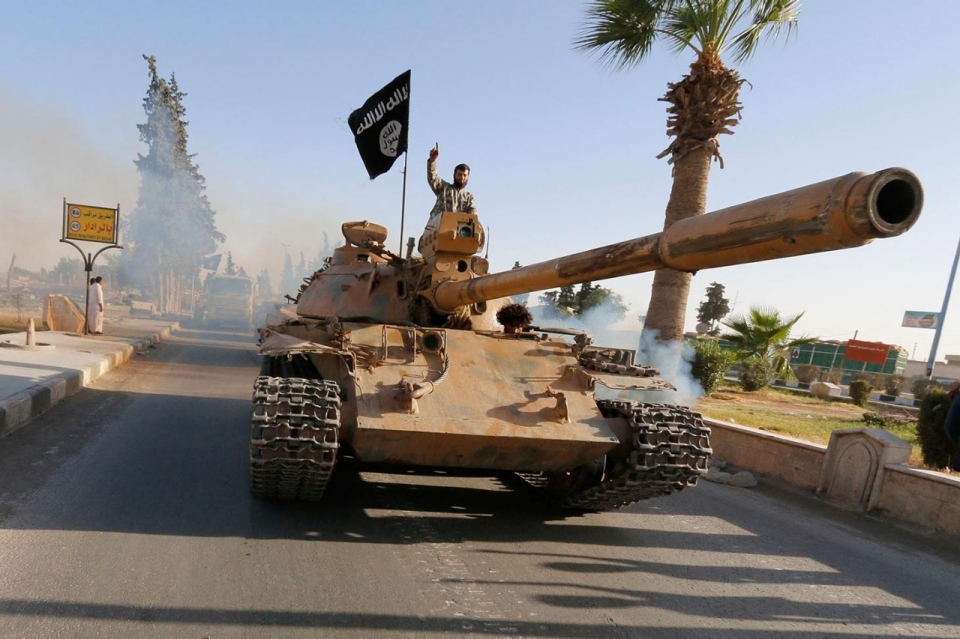
image.adapt.960.high

“This war differs from other wars, in this particular: We are not fighting armies but a hostile people, and must make old and young, rich and poor, feel the hard hand of war.” William Tecumseh Sherman

Note: Please know, I have been to war, I have seen its devastation and heartache and I came back changed from the experience. I hate it. I served in Iraq with the Iraqis in support of our advisors to them. For me the war is personal, I left a huge part of my soul in that unfortunate nation. 


That being said, despite being a progressive who hates war, I am also a realist. I am not one that finds any romance or glory in war, but I know that sometimes it becomes unavoidable. In the past few months I have written about the nature of war, the kind of war we are now engaged in with ISIL and some of the ethical and moral compromises that could easily be made in such a war.

Likewise I realize that we as Americans must take responsibility for the mess that the Bush administrated created in Iraq. We cannot hope to have any peace with justice, nor succeed in the current war against the Islamic State, unless we are honest about the lies that were told to get us into Iraq, and the horrible policy decisions after we succeeded in toppling Saddam Hussein that brought about the collapse of order, the insurgency and the Iraqi Civil War that brought Al Qaeda into Iraq, a country that they had not previously been welcome. 

Thus what I write here is a continuation of those thoughts and I encourage you to look at those articles which can be found at the following links on this page: 
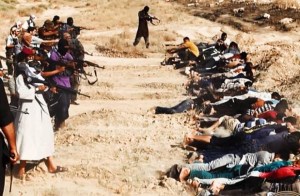
Iraq, ISIS and Al Qaeda: Sowing the Wind…

Iraq 2014: A Disaster Long in the Making

9-11-2014 War Without End…

The Islamic State and the New, Old Nature of War

War is Cruelty, and You Cannot Refine it… The War Against ISIL

Prepare for a Long and Brutal Ideological War Against the Islamic State

Can you Live With It? The Moral Costs of the War Against the Islamic State

Iraq and the Middle East 2013: Lessons from T. E. Lawrence

ISIL: A Generational Problem in Which the Enemy Gets a Vote

Inshallah Iraq (إن شاء الله) Maybe Someday things will be Better

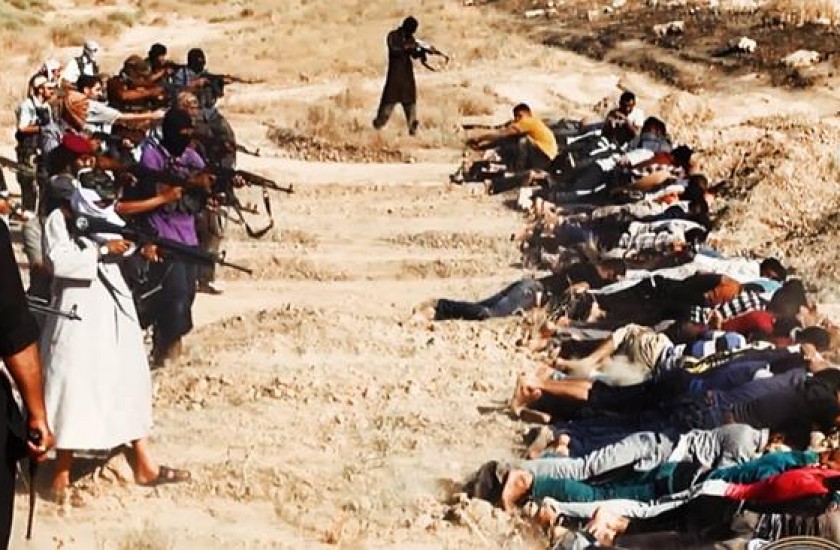
isis3-840x550

The American war against the Islamic State is entering a more sustained mode. Air strikes are occurring daily, thousands of advisors have arrived, backed by Army aviation assets to protect American interests at Baghdad International Airport and the U.S. Embassy complex, and the Chairman of the Joint Chiefs of Staff has again alluded to the possibly of American ground troops engaging ISIL at the side of Iraqi troops.

Whether most of want to admit it or not, and the latter is more descriptive of the vast bulk of Americans, we are at war.  It is a war which we have been fighting  for over thirteen years now. President Obama had hoped that our involvement in Iraq was at and end that that the Iraqis could handle their own affairs. But the hope was misplaced, and now this war has been extended indefinitely by the actions of the Islamic State and the announced intentions of President Obama to fight it. It will become much worse than people want to believe that it will, regardless of whether it is a long or a short war, and even a “short” war will likely extend into the next Presidential administration.

us-fa-18-meask

Americans have grown up for the past twenty years with hi-tech wars that with a few exceptions of terrorism inflicted on American civilians have been waged by a comparatively small professional military; a military that at any given time over the last 20 years has comprised less than one percent of the American population. As such war is a spectator sport for most Americans, we watch it on television, or on You Tube videos on the internet, but it is a distant thing, happening to others that doesn’t touch us too deeply because most of us think that we have no skin in the game. In fact people that bet on baseball have more skin in the game than most Americans do in the current war, but that will probably change.
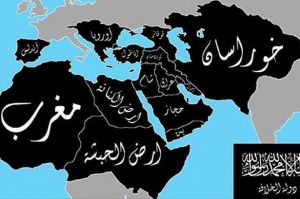
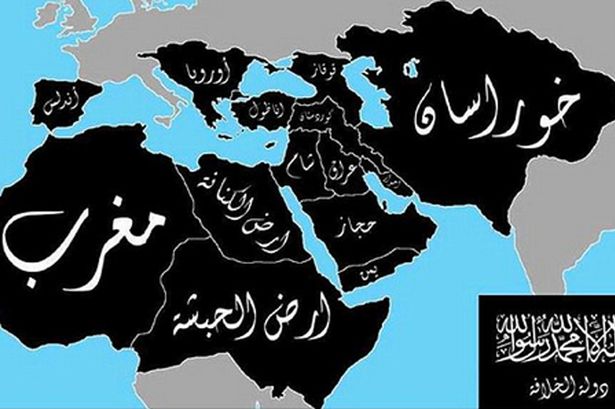
ISIS-MAP

Since I have written much about that military at its sacrifices in the war that began on September 11th 2001 I am not going to belabor that today. Instead I am going to go back to the nature of war, even wars that may be fought in self-defense and with just cause. It was General William Tecumseh Sherman who wrote:

“You cannot qualify war in harsher terms than I will. War is cruelty, and you cannot refine it; and those who brought war into our country deserve all the curses and maledictions a people can pour out…”

Chris Hedges wrote: “Violence is a disease, a disease that corrupts all who use it regardless of the cause,” and as Clausewitz noted of war’s nature, that it is: “a paradoxical trinity-composed of primordial violence, hatred and enmity…”

We try to use language to soften war; to make it more palatable, but to do so is an Orwellian charade that is deceptive and destructive to the soul. Dave Grossman, the army infantry officer who has spent his post military life writing about the psychology of war and killing wrote:

“Even the language of men at war is the full denial of the enormity of what they have done. Most solders do not “kill,” instead the enemy was knocked over, wasted, greased, taken out, and mopped up. The enemy is hosed, zapped, probed, and fired on. The enemy’s humanity is denied, and he becomes a strange beast called a Jap, Reb, Yank, dink, slant, or slope. Even the weapons of war receive benign names- Puff the Magic Dragon, Walleye, TOW, Fat Boy, Thin Man- and the killing weapon of the individual soldier becomes a piece or a hog, and a bullet becomes a round.”

Likewise Thucydides wrote:

“Words had to change their ordinary meaning and to take that which was now given them. Reckless audacity came to be considered the courage of a loyal supporter; prudent hesitation, specious cowardice; moderation was held to be a cloak for unmanliness; ability to see all sides of a question incapacity to act on any….”

Such language gives those who have never been to war but cannot live without it to bring it on, but as Sherman noted: “It is only those who have neither fired a shot nor heard the shrieks and groans of the wounded who cry aloud for blood, more vengeance, more desolation. War is hell.”

President Obama in his address to the nation, and the world on the eve of September 11th talked of a war against the Islamic State, using far more diplomatic, restrained and less warlike language than did Vice President Biden who said:

“As a nation we are united and when people harm Americans we don’t retreat, we don’t forget. We take care of those who are grieving and when that’s finished, they should know we will follow them to the gates of hell until they are brought to justice because hell is where they will reside. Hell is where they will reside.”

I commend the President for his humanity and desire to fight the Islamic State with a matter of restraint, and though our efforts have been limited to air strikes and reengaging with the Iraqi military to retrain it for the fight, it does appear that at least in Iraq the policy is showing signs of working. ISIL troops are having a hard time moving about the battlefield and their more conventional units are taking a beating from the air, while Iraqi and Kurdish forces are slowly beginning to have more success, the Iraqi military having just relieved the beleaguered garrison of the massive Baiji oil refinery complex.

Iraqarmybaiji

This in a sense is part of ISIL’s conundrum, they desire to conquer territory and subjugate people. To do that they need to be able to use conventional military tactics and equipment, not simply using terrorist strikes and the element of surprise to overwhelm unsuspecting or demoralized Iraqi security forces. It is possible that they are now overextend and have reached what Clausewitz termed their “culminating point.” We will have to see if that is the case, and only time will tell.

air strike footage

U.S. Air Strike on ISIL Position 

However, American restraint, particularly with a hawkish, newly elected Republican Congress, of whom many new members are highly militant Christians who will have no compunction in killing Moslems, be they good Moslems or terrorist thugs like ISIL or Al Qaeda; will last as long as the Islamic State is unable or unwilling to strike at American civilians in the American homeland, American interests in a country that is not in the war zone, or an American ship or military installation at home or abroad.

But once that happens, and it will eventually happen, the recent attacks in Canada serving as a foretaste of what will happen here, the pretense of restraint will drop, and what Vice Biden President said will become our goal, even if we do not officially say it. But once those restraints are passed, the war will get really messy. Ethicist and philosopher Michael Walzer wrote in his book Just and Unjust Wars:

“We don’t call war hell because it is fought without restraint. It is more nearly right to say that, when certain restraints are passed, the hellishness of war drives us to break with every remaining restraint in order to win. Here is the ultimate tyranny: those who resist aggression are forced to imitate, and perhaps even to exceed, the brutality of the aggressor.”

The problem with this war is that it has lasted so long already, if we consider American involvement in Iraq as going back to 2003. Long wars such as these are detrimental to the nations and peoples that fight them, as Sun Tzu wrote: “There is no instance of a nation benefitting from prolonged warfare.”

As such the longer we drag this war against the Islamic State and other similar groups out, the longer the war continues, the crueler it will become, the more damage it will do to our civil liberties, our economy, and even more importantly to the spirit of our nation. One can only look at the Patriot Act and related measures undertaken in the name of national security after 9-11-2001 and recall the words of President John F. Kennedy who said in respect to the epidemic of loyalty oaths and restrictions on civil liberties enacted in the 1950s:

“We have also seen a sharpening and refinement of abusive power. The legislative investigation, designed and often exercised for the achievement of high ends, has too frequently been used by the Nation and the States as a means for effecting the disgrace and degradation of private persons. Unscrupulous demagogues have used the power to investigate as tyrants of an earlier day used the bill of attainder.

The architects of fear have converted a wholesome law against conspiracy into an instrument for making association a crime. Pretending to fear government they have asked government to outlaw private protest. They glorify “togetherness” when it is theirs, and call it conspiracy when it is that of others.”

Thus the place that we now find ourselves is not good. On one hand by using restraint the war goes on and on, war without end, but if we embrace Sherman’s realism and admit that “War is cruelty. There’s no use trying to reform it. The crueler it is, the sooner it will be over” is that we will imitate or exceed the brutality of the Islamic State. Either way, we lose something of ourselves. But as Abraham Lincoln said “There’s no honorable way to kill, no gentle way to destroy. There is nothing good in war. Except its ending.”

The young Union hero of Little Round Top at the Battle of Gettysburg, Colonel Strong Vincent wrote his wife about how he believed the Union had to defeat the Confederacy. His words were much like Sherman’s and in dealing with ISIL I would hope that the American, Iraqi and coalition forces will take them to heart in combating ISIL: Vincent wrote:

“We must fight them more vindictively, or we shall be foiled at every step.  We must desolate the country as we pass through it, and not leave a trace of a doubtful friend or foe behind us; make them believe that we are in earnest, terribly in earnest…” 
d41be44594

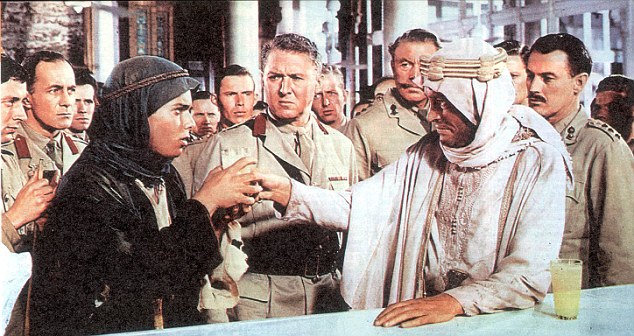
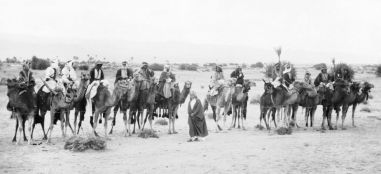
Lawrence with Bedouin after capturing Aqaba 

That is an uncomfortable thought and philosophy, it goes against the grain, it seems terribly brutal; but it is the only philosophy of war that the leaders and jihadists of the Islamic State understand. We may not yet understand it, but I think that in time we and the Iraqis will. However, the lead cannot be taken by us or even if we are “successful” in defeating ISIL, another group will be back and doing the same things; just as ISIL filled the vacuum left by the collapse of Al Qaeda Iraq in 2008.

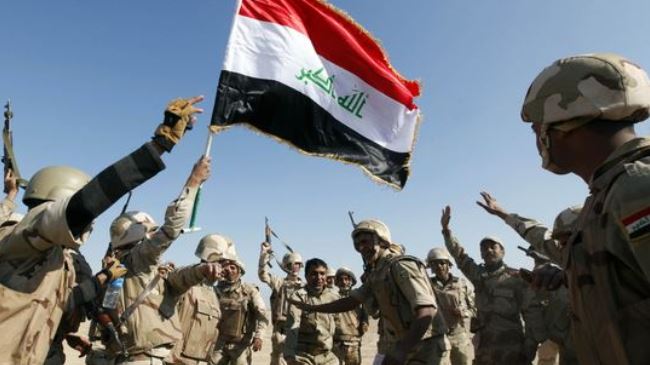
IRAQ_-_1115_-_Stato_islamico

Iraqi Soldiers after retaking Baiji

That is a danger that T.E. Lawrence advised his fellow British officers serving with the Bedouin during the Arab Revolt in 1917 and 1918. It is advice that we need to remember as we assist the Iraqis and Kurds in their fight. That is why this must be an Iraqi and Kurdish fight. When and if the Iraqis and Kurds embrace this philosophy of total war against ISIL, if they are willing to fight ISIL vindictively and desolate every ISIL stronghold, will they bring peace to their country. We can aid them in thee fight, but we cannot win this for them. Lawrence wrote:

“Do not try to do too much with your own hands. Better the Arabs do it tolerably than that you do it perfectly. It is their war, and you are to help them, not to win it for them. Actually, also, under the very odd conditions of Arabia, your practical work will not be as good as, perhaps, you think it is.”
bettertimes

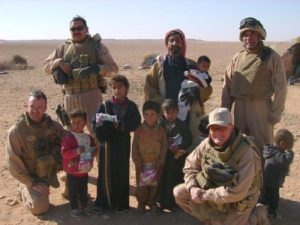
The Author with Bedouin on Syrian Border December 2007

My hope is that somehow, when this is war is done that there will be peace and reconciliation. I would like to see this in my lifetime, but it may take another generation or two that we will finally be able to establish peace by making those who are our enemies our friends. I hope for such a day, because I know that Chris Hedges is all too correct about the corrupting and devastating effect of violence on all that rely on it to achieve their goals and Sun Tzu’s wisdom in noting that prolonged warfare benefits anyone. As Major General Smedley Butler wrote:

“What is the cost of war? what is the bill? This bill renders a horrible accounting. Newly placed gravestones. Mangled bodies. Shattered minds. Broken hearts and homes. Economic instability. Depression and all of its attendant miseries. Back -breaking taxation for generations and generations.”

If you ask me I do not think that we or the people of Iraq can keep adding to that bill.

Peace

Padre Steve+

1 Comment

Filed under ethics, History, iraq,afghanistan, Military, News and current events

D-Day, Midway and a Nation at War: Thoughts on History as the Greatest Generation Passes Away

d-day-orderDwight Eisenhower speaking with men of the 101st Airborne Division before they jumped into Normandy

“At the end of the twentieth century the contributions of this generation would be in bold print in any review of this turbulent and earth-altering time. It may be historically premature to judge the greatness of a whole generation, but indisputably, there are common traits that cannot be denied. It is a generation that, by and large, made no demands of homage from those who followed and prospered economically, politically, and culturally because of its sacrifices. It is a generation of towering achievement and modest demeanor, a legacy of their formative years when they were participants in and witness to sacrifices of the highest order. They know how many of the best of their generation didn’t make it to their early twenties, how many brilliant scientists, teachers, spiritual and business leaders, politicians and artists were lost in the ravages of the greatest war the world has seen.” Tom Brokaw, The Greatest Generation

I was born in 1960 and thankfully for whatever reason I developed a love of history and heritage. I began reading history books as early as second and third grade. The American Heritage Publishing Company had a Junior Library series that I could not get enough of awhile another publisher (it may have also been American Heritage) had a series of biographies which drew me into the lives of many famous people. From 3rd grade on I spent every spare moment at school in the library, even frequently cutting geometry class in 10th grade to explore the history reference books that I could not check out and take home.

tumblr_lahyzakLSB1qbjz0go1_500Marine Colonel Francis I. Fenton, kneeling prays at the foot of his son’s grave on Okinawa 1945

I think that anyone that knew me then could probably associate me with a big stack of books that I lugged to and from class and back and forth from home to school. The ironic thing is that as I pack for work or to come home every day at the Staff College my back pack from my tour in Iraq is filled with the books that I am reading or using for research. Maybe it is not ironic, maybe it is the fact that some things never change. For me the quest for knowledge and historical, philosophical, or scientific truth is something that I cannot get enough of, nor be content to think that I know everything on any given subject.

This little introduction takes me into today’s subject. For those that don’t know we are coming up on the anniversaries of two of the most amazing historical events of the past 100 years next week. They are the battles of Midway, June 4th through June 6th 1942 and the the invasion of France, or D-Day, June 6th 1944.

ts8The pilots of Torpedo 8, only one survived Midway

I have always been amazed by the men who faced the Japanese at Midway, a battle that by any reasonable means should have resulted in a Japanese victory as well as them men that stormed the beaches at Normandy just two years later. When I first started reading about these battles many of the veterans were still alive, many not much older than I am today. However today not many are left, and the few that remain generally served as junior officers or enlisted personnel, none in high command.

Both battles are remarkable because an American or Allied loss could have changed the course of history. Had the United States Navy been defeated at Midway it could have brought about a Japanese victory, or more likely made the ultimate American victory much more costly and drawn out. Had the Allies been repulsed at Normandy it could have split the allied coalition or given the Germans the chance to renew their fight against the Soviet Union and possibly change history.

Thus when I look at these two events, battles that for most are now ancient history I am in awe of the men who fought them. They are not academic exercises for me, but as someone who has served at sea and on land in war I feel a certain camaraderie with these men.

I remember reading Cornelius Ryan’s classic book “The Longest Day” and seeing the movie of the same name in grade school, and reading Walter Lord’s classic on Midway “Incredible Victory” when I was in 7th grade. Both are excellent books which have stood the test of time and though I have read and done much more research and writing on both battles I still keep a copy of each book and probably re-read each every few years and consult them for any new projects. Likewise have been fortunate enough to meet some of the men who served in both of these battles, and even in my time as an Army chaplain be with them in their declining years. Men like Frank Smoker and Henry Boyd, both Normandy vets who have since passed away mean much to me.

442ndRCTThe 442nd Regimental Combat Team

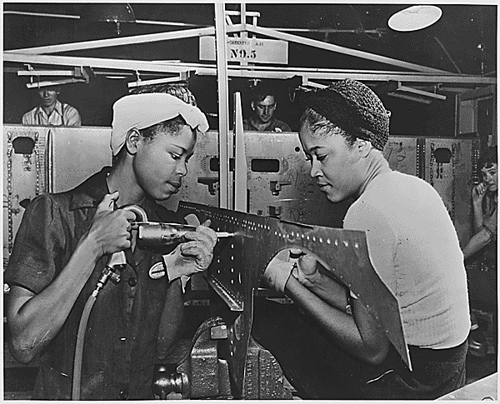
Today when I see a World War Two veteran, no matter where I encounter them, I make sure that I thank them for their service. They are part of an amazing generation of Americans who bequeathed those of us who live today so much, both during the war and after the war. Many millions served in the military, while many more served in war industries. All contributed to war bond drives, victory gardens and yes even increased taxes and decreased civil liberties to win the war.

The fact that Japanese Americans served in the most highly decorated Army units of the war despite their families being incarcerated in American versions of concentration camps is a testimony to sacrifice.

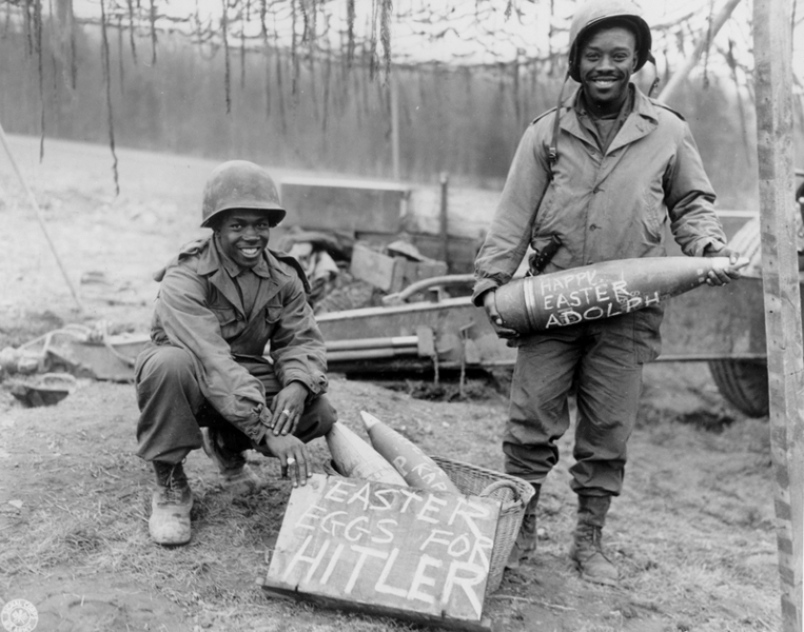
1329663819

Likewise the efforts of African Americans who went to war despite being second class citizens and discriminated against under the Jim Crow Laws, which even Nazis like Hermann Goering recognized were only different from the the Nazi anti-Semitic laws and persecution in manner of degree.

That was an amazing an unique generation of Citizen Soldiers. With few exceptions they were not the professional career soldiers, sailors, marines and airmen who serve today. Most would not have considered themselves “warriors.” They were there to do a job, win a war and go home. It was part of who they were as Americans.

tumblr_mkp1mvf4gC1qbjz0go1_500

How many today would do any of those things? Today we have well under one percent of the population who have served in the wars of the past 13 years, fewer who have served in combat or in a combat zone. Likewise the population in general and in particular the bankers, businesses, lobbyists and defense contractors are not asked to sacrifice anything, instead when the country was attacked the President and others decried the fact that war might prevent people from doing business, shopping or living a normal life. For God’s sake, were at war and that attitude would have been incomprehensible to those of the Greatest Generation who for the most part either went to war, or supported the war effort with their work and other contributions. For them patriotism was not a bumper sticker.

Rachel Maddow said it well in her book Drift The Unmooring of American Military Power:

“When civilians are not asked to pay any price, it’s easy to be at war – not just to intervene in a foreign land in the first place, but to keep on fighting there. The justifications for staying at war don’t have to be particularly rational or cogently argued when so few Americans are making the sacrifice that it takes to stay.”

scan002411-483x600Jimmy Stewart and his Bomber Crew

Because of the sacrifice of people of the Greatest Generation I am grateful for them. I believe that we can learn so much from them. Even A-List Hollywood stars and professional sport heroes left their careers to serve their country. Clarke Gable, Audie Murphy, Glenn Miller, Jimmy Stewart, Bob Feller, Ted Williams and Joe DiMaggio just to name a few sacrificed major portions of their careers to serve. With the exception of Pat Tillman who died in a friendly fire incident in Afghanistan which was covered up by the Army and Bush administration, how many of the 1%, the A-List or professional athletes can you name that have left sacrificed their fortunes to serve in the front lines? I can’t name any others, but in the Second World War even the 1% had skin in the game so to speak, the Kennedy’s, Roosevelt’s and the Bush’s to name just a few.

2339073617_3b27cdf95c

I think that is why I am in awe of those of the Greatest Generation and why as the anniversaries of Midway and D-Day approach I am extra thoughtful, quite reflective and very thankful for those who through their sacrifice made so much of what we have today possible. What bothers me today is how few, especially of those who either advocate for war, lobby for it or profit from it no matter what their political, economic or religious persuasion is, offers to serve or pay for the cost of war.

Today those costs are borne by a tiny minority of Americans, military professionals of the all-volunteer military, both active duty and reserve who have endured deployment after deployment as the bulk of the nation stood by, mostly cheering them on. Of course as one who had his father serve in Vietnam and entered the military not long after had to endure the jeers of Americans, cheers are nice. They are much better than being called a “Nazi” for wearing your uniform to class. However, sometimes I think that many that cheer us on are able to due so because vicarious patriotism is easy. Vicarious patriotism anything, someone else serves, and someone else dies while they “support the troops” without actually doing anything.

crops_0201

Now please don’t get me wrong. There are a lot of good people who have never served in the military and who do care. Men and women who take action to support the troops, both those serving and the veterans, including those disabled in some way by war. For them I am grateful, they donate time, money and personal effort to care, and I do not care if the are conservatives or liberals, Republicans, Democrats or Independents, religious or atheist. They are Americans who are doing something. Likewise I do not disparage those who take the time to learn the issues that the nation faces and the domestic policies that impact the country and in a healthy body politic it doesn’t mean that we have to completely agree with each other to be patriots. Such an understanding would have been unthinkable to our founders much less most of the Greatest Generation. Veterans issues are important but national security also involves so much more, everything from the infrastructure that the Greatest Generation had the vision and wherewithal to build to the environment.

I have been to Normandy as well as other World War II battlefields in Europe and the Pacific. I can only agree with Tom Brokaw who wrote: “there on the beaches of Normandy I began to reflect on the wonders of these ordinary people whose lives were laced with the markings of greatness.”

So, when you read anything I write or re-publish during the next couple of weeks, be it about D-Day, Midway or even Gettysburg, please read what I write though those lenses. It is not that I am bitter. I have chosen my life in the military, but I wonder why so few of us bear the burden. It is a question that every citizen must ask themselves and their political representatives.

Rabbi Roland Gittlesohn, a Navy Chaplain serving with the Marines gave a eulogy at the dedication of a cemetery on Iwo Jima that puts it all in perspective.

“Here lie men who loved America because their ancestors generations ago helped in her founding, and other men who loved her with equal passion because they themselves or their own fathers escaped from oppression to her blessed shores.

Here lie officers and men, Negroes and whites, rich men and poor . . .together. Here are Protestants, Catholics and Jews together. Here no man prefers another because of his faith or despises him because of his color. Here there are no quotas of how many men of each group are admitted or allowed. Among these men there is no discrimination. No prejudices. No hatred. Theirs is the highest and purest democracy.

Whosoever of us lifts his hand in hate against a brother, or who thinks himself superior to those who happen to be in the minority, makes of this ceremony and the bloody sacrifice it commemorates, an empty, hollow mockery. To this, then, as our solemn duty, sacred duty do we the living now dedicate ourselves: to the right of Protestants, Catholics and Jews, of white men and Negroes alike, to enjoy the democracy for which all of them have here paid the price. .

We here solemnly swear that this shall not be in vain. Out of this and from the suffering and sorrow of those who mourn this will come, we promise, the birth of a new freedom for the sons of men everywhere.”

Since the last members of the Greatest Generation are passing away at an ever increasing rate and few will remain among us; I will ask you to ask yourself the question posed by the World War II veteran and hero John F Kennedy: “Ask not what your country can do for you; ask what you can do for your country.”

Peace

Padre Steve+

2 Comments

Filed under History, Military, national security, Political Commentary

Remembering Armistice Day: A Day of Conscience

remembrance_day___poppy_day_by_daliscar-1

“Tomorrow is our day of conscience. For although it is a monument to victory, it is also a symbol of failure. Just as it honors the dead, so must it humble the living. Armistice Day is a constant reminder that we won a war and lost a peace…” General Omar Bradley November 10th 1948, Boston Massachusetts. 

It was the “War to End All War” or so thought President Woodrow Wilson and other American idealists. However that war to end all wars birthed a series of wars which made the losses of the First World War fade into insignificance as wars of ideology replaced wars for the preservation of the state.

In the First World War there were over 22 million casualties including over 5 million dead of which over 116,000 were Americans. President Woodrow Wilson established what we know now as Veteran’s Day as Armistice Day in November 1919, a year after the guns went silent.

Wilson wrote: “To us in America, the reflections of Armistice Day will be filled with solemn pride in the heroism of those who died in the country’s service and with gratitude for the victory, both because of the thing from which it has freed us and because of the opportunity it has given America to show her sympathy with peace and justice in the councils of the nations…

That initial proclamation was followed nearly 40 years later by one of President Dwight D. Eisenhower. Eisenhower signed into law what we now know as Veteran’s Day in 1954. In a sense I wish we had two holidays, one for Veterans from all wars in general and this one which we should never forget. It seems that in combining them we have lost some of the sacredness of the original. As Kurt Vonnegut wrote: “I don’t want to throw away any sacred things.” I will remember all who served this weekend but I will not forget why we do so.

All that being said for many in the United States and Western Europe the experience of  or even the thoughts of such a bloodletting is unimaginable. Yet to those of us who have gone to war and studied past wars the end result is not so distant. It is a part of our lives even today.

This weekend marks the 95th anniversary of the end in World War One.  For the United States the cost in the short time that its forces went into action and the armistice it was costly, though not nearly as costly as it was for the nations of Europe. From the time United States forces went into action in 1917 116,516 Americans were killed, 204,002 wounded, and 4,500 missing; 7.1% of the force of 4,355,000 the nation mobilized for war. (PBS the Great War UNC TV http://www.pbs.org/greatwar/resources/casdeath_pop.html)

However our costs pale in comparison with the European nations who had for over four years bled themselves dry.  If one wonders why Europeans seem to have so little desire for involvement in war one only needs to see how the concentrated killing of the First World War decimated the best and brightest of that generation. Out of nearly 8.5 million Frenchmen mobilized lost 1,357,000 killed, 4,266,000 wounded and 537,000 missing, 6,160,000 casualties or 73.3% of its forces. Other nations has similar casualty figures.

The human costs were horrifying. In all over over 65 million men served under arms in the war. Over 8.5 million were killed, over 21 million wounded, 7.75 million missing or prisoners or almost 37.5 million casualties. That total would be roughly equivalent to every citizen of the 30 largest American cities being killed, wounded or missing.

Much of Europe was devastated, mass numbers of refugees the dissolution of previously stable empires, civil wars, border conflicts between new states with deep seated ethnic hatreds, economic disasters and the rise of totalitarian regimes which spawned another even more costly world war and a 40 year cold war. The bitter results of the First World War are still felt today as conflicts in the Middle East in part fueled by the decisions of Britain and France at the end of the war rage on.

The epic war poem In Flanders Fields written by Canadian Lieutenant Colonel John McCrea symbolizes the cost of that war and the feelings of the warriors who endured its hell.

In Flanders fields the poppies blow
Between the crosses, row on row,
That mark our place; and in the sky
The larks, still bravely singing, fly
Scarce heard amid the guns below.

We are the Dead. Short days ago
We lived, felt dawn, saw sunset glow,
Loved and were loved, and now we lie
In Flanders fields.

Take up our quarrel with the foe:
To you from failing hands we throw
The torch; be yours to hold it high.
If ye break faith with us who die
We shall not sleep, though poppies grow
In Flanders fields.

Yes there are always consequences to actions. This weekend as we remember what we now call Veteran’s Day, or Remembrance Day in Britain let us not forget that the genus of these holidays was the blood shed by so many in places like Verdun, Gallipoli, Caporetto, Passchendaele, the Marne, the Argonne, Tannenberg, Galicia and on Flanders Fields.

flanders field

President John F Kennedy said: “As we express our gratitude, we must never forget that the highest appreciation is not to utter words, but to live by them.”

In the hope of peace and an end to war.

Peace,

Padre Steve+

Leave a comment

Filed under History, Military

A Global Force for Good: Happy 238th Birthday to the US Navy

Navy Heritage WWII Recruitment Poster

http://www.navy.mil/viewVideo.asp?id=17676

“A good Navy is not a provocation to war. It is the surest guaranty of peace.” Theodore Roosevelt 

For me anything to do with the United States Navy is historical as well as decidedly personal. Sunday is the 238th anniversary of the founding of the United States Navy, actually the founding of the Continental Navy but let’s not get too technical.

The fact is that back in 1775 most people and political leaders in the revolting colonies felt that founding a Navy was quite foolish. After all, who in their right mind would ever dare to challenge the might of the British Royal Navy? Even revolting colonies. But like when King George III was told that “the Colonies are revolting” he reportedly said “tell me something I don’t know.” But I digress…

In fact had General George Washington not sent a letter to the Continental Congress say that he had taken some vessels in hand to disrupt the supplies of the the British Army a Navy might not have ever been established. Timing is everything and in this case it was pretty good timing.

Since that fortuitous day in 1775 the United States Navy went from being a piss ant annoyance to the Royal Navy to the premier naval power in the world. Men like John Paul Jones, Edward Preble Stephen Decatur, Thomas Truxtun, William Bainbridge, Oliver Hazard Perry, David Farragut, David Dixon Porter, George Dewey and many more blazed a path of glory which others, great and small would continue to build on the legacy of the iron men who sailed wooden ships into harm’s way. Men like Arleigh Burke, Howard Gilmore, John C. Waldron, Maxwell Leslie, Bull Halsey, Richard O’Kane, Daniel Callahan, Raymond Spruance, Ernest Evans built upon that legacy in the Second World War. Others would do so in the Cold War, Vietnam and the Global War on Terrorism.

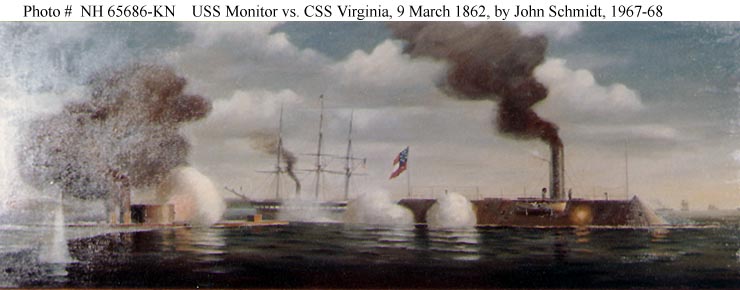
Great ships like the USS Constitution, USS Monitor, USS Kerasarge, USS Olympia, USS Enterprise, USS Hornet, USS Yorktown, USS Growler, USS Tang, USS Hoel, USS Johnston, USS Samuel B Roberts, USS Laffey, USS San Francisco, USS Houston and USS Arizona, USS Nevada, USS West Virginia and USS California helped build a legacy of valiant sacrifice and service often at great cost in the defense of freedom.

But over those 238 years it all it came down to the men and now the men and women who served in every clime and place, many times outnumbered and facing certain defeat who through their courage, honor and commitment helped secure the liberty of their countrymen and others around the world. Most of these men and women served in obscurity in war and peace but all had the distinction of serving in the United States Navy.

As President John F Kennedy said: “I can imagine no more rewarding a career. And any man who may be asked in this century what he did to make his life worthwhile, I think can respond with a good deal of pride and satisfaction: ‘I served in the United States Navy.'”

295_26911932058_5614_n-1

Like my father before me I can say that I am proud to have served and continue to serve in the United States Navy, because we are no matter what some may say or think,  a global force for good.

Peace

Padre Steve+

1 Comment

Filed under History, Navy Ships, US Navy

My Way or the Highway: The Zero Sum Game of American Politics in 2013

img00169-20110726-2126

“Politics is an art and not a science, and what is required for its mastery is not the rationality of the engineer but the wisdom and the moral strength of the statesman”Once upon a time in America there was a time when we had people in government who were statesmen.” Hans J Morgenthau 

These men understood something about the Constitution, representative government. pluralism, tolerance and dare I say compromise. Yet all were men of principle. The honestly believed in and worked toward the goals that they believed best embodied the American body politic as well as their own political, ideological and even religious beliefs. Basically when we cut to the chase the real thing that sets them apart from the legislators of today was that they knew that compromise was actually desirable in many cases. They understood that there were times to “duke it out” on Capitol Hill but that at the end of the day that as Americans we could have different opinions yet still come together for the benefit of all Americans, not just those that we were beholden to for the money needed to keep us in office.

But that was a different era. Men like Edward Dirksen, Scoop Jackson, Harry Truman, Dwight Eisenhower, Tip O’Neill and Ronald Reagan or for that matter even Jack, Bobby or Teddy Kennedy would not survive in the zero-sum politics if 21st Century American. They would be despised by their political “allies” even more so than their opponents.

The sad thing is that in the United States of 2013 it is much easier to be against something than it is to be for something. Likewise it is now more beneficial for politicians of both parties in the gerrymandered congressional districts which ensure the safety of the incumbent to adopt a no-quarter attitude. It has allowed elected leaders to adopt a zero-sum game of no-compromise.

The results are a broken system of government, a deep division of the people almost all of whom distrust and even despise the very people that they elected.

As I watch the current proceedings in Washington I am reminded of what I thought when the “deal” to agree to the sequester was reached. I remembered the words of Thomas Jefferson concerning the Missouri Compromise. I knew back in 2011 that the even the threat of sequester would not change the behavior of those in Congress, particularly the Tea Party faction of the Republicans, a group who have in many cases so wedded the most uncompromising aspects of religion to political ideology that there can be no backing down for them. Politics is an extension of God’s will. It is the extension of the theology of Christian Dominionism which has at its center the takeover of the systems of the world by Christians, the Seven Mountains theology. That is why compromise if there is any in the current situation will by only delay the reckoning.

Jefferson noted: “but this momentous question, like a fire bell in the night, awakened and filled me with terror. I considered it at once as the knell of the Union. it is hushed indeed for the moment. but this is a reprieve only, not a final sentence. a geographical line, coinciding with a marked principle, moral and political, once conceived and held up to the angry passions of men, will never be obliterated; and every new irritation will mark it deeper and deeper.” 

We need a revival of statesmanship in our country but in the current political environment I fear that those who would attempt to be statesmen would not survive. Much like Weimar Germany our politicians, pundits and preachers, the Unholy Trinity are paving the way for something unimaginably terrible when they finally wreck our current system of government. They are doing it and those who do not speak out against them regardless of our politics have to take part of the blame.

Martin Niemoller wrote after the Second World War:

In Germany they first came for the Communists,
and I didn’t speak up because I wasn’t a Communist.
Then they came for the Jews,
and I didn’t speak up because I wasn’t a Jew.
Then they came for the trade unionists,
and I didn’t speak up because I wasn’t a trade unionist.
Then they came for the Catholics,
and I didn’t speak up because I was a Protestant.
Then they came for me –
and by that time no one was left to speak up.

Peace

Padre Steve+
2 Comments

Filed under History, leadership, Loose thoughts and musings, Political Commentary, Religion

Feet of Clay: The Common Flaw of the Best and Brightest

Charlene and Michel de Carvalho

General Allenby: [leafing through Lawrence’s dossier] “Undisciplined… unpunctual… untidy. Knowledge of music… knowledge of literature… knowledge of… knowledge of… you’re an interesting man there’s no doubt about it.” 

Character is a terrible thing to judge. Mostly because those doing the judging also suffer from flaws in their own character.  Yet somehow the temptation is for us to stand as judge, jury and character executioner on those that we find wanting. As a culture we like tearing down those that we at one time built up. It is a rather perverse proclivity that we have as human beings, especially if we can find some kind of religious justification for it.

I think that is part of the complexity of the human condition. As a historian I find that the most exalted heroes, men and women of often great courage both moral and physical, intellect, creativity, humanity and even compassion have feet of clay.

I find that I am attracted to those characters who find themselves off the beaten track. Visionaries often at odds with their superiors, institutions, and sometimes their faith and traditions. Men and women who discovered in themselves visions for what might be and pursued those visions, sometimes at the costs of their families, friends, and in quite a few cases their lives.

Throughout my studies I have been attracted to men as diverse as Peter the Apostle, Martin Luther, T.E. Lawrence, Dietrich Bonhoeffer, Erwin Rommel, Admiral Horatio Nelson, Abraham Lincoln, John F Kennedy, Dwight D Eisenhower, Franklin Roosevelt, Dr Martin Luther King Jr, Jackie Robinson, Teresa of Avila, Nelson Mandela, Vaclav Havel and Emir Feisal Hussein of the Arab Revolt. All had flaws. Some involved fits of temper and violence, others sexual escapades, mistresses, affairs, greed avarice, and maybe some that stretched law and morality in their quest to achieve their goals. But all are considered great men and women.

Feet of clay. Who doesn’t have them? But them I think that I would rather have feet of clay than a heart of stone, an an unchallenged mind, or a lack of courage to do the right thing even if it does not directly benefit me.

Tonight I watched for the first time straight through the cinema classic Lawrence of Arabia. Peter O’Toole plays Lawrence in a most remarkable manner, showing his brilliance, courage, diplomatic ability and understanding of the Arabs with whom he served.

There are many people, leaders and others that we encounter in life or that we study. Even the best of the best are flawed and there is no such thing as a Saint who never sinned. But we love destroying them and their memory when to our “surprise” when we find that their hagiographers built them into an idol.

I am a great believer in redemption and the weight of the whole of a person’s life. Thus I try to put the flaws as they are called in perspective and their impact both positive and negative in history. Studying in this way gives me a greater perspective on what it is to be human and to place my own clay feet in appropriate perspective.

It was an interesting film to watch.

However, speaking of feet of clay I will probably be writing about the Baseball Writers who vote for the inductees for the Hall of Fame. Today for the first time in nearly 4 decades no players were selected for induction, mostly due to the steroid era. But that is a subject for another night.

Peace

Padre Steve+
1 Comment

Filed under faith, film, History

A Loss for the Country and the World: A War Hero and Prophet of Peace George McGovern Dead at 90

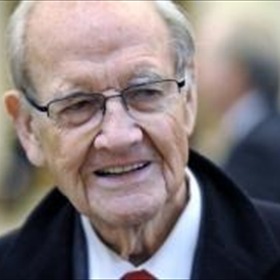
George McGovern in 2012 (AP File Photo)

The United States of America and the world lost a champion of peace and humanity this weekend when former Senator George McGovern died at the age of 90. If you had asked me if I would have written this article 10 or 15 years ago, I probably would not have, but war has a way of changing ones perspective about those that consistently labored for peace and justice.

The son of a Wesleyan Methodist Minister McGovern grew up in the South Dakota during the Great Depression and the Dust Bowl. He volunteered in the Second World War and flew 35 combat missions as the pilot of a B-24 Liberator bomber during which his aircraft was heavily damaged on a number of occasions and his skill as a pilot helped save the aircraft and crew.  For his service he was awarded the Distinguished Flying Cross and four awards of the Air Medal and his memories of being under fire from German FLAK and having his plane set afire during a mission caused him nightmares for years after the war.

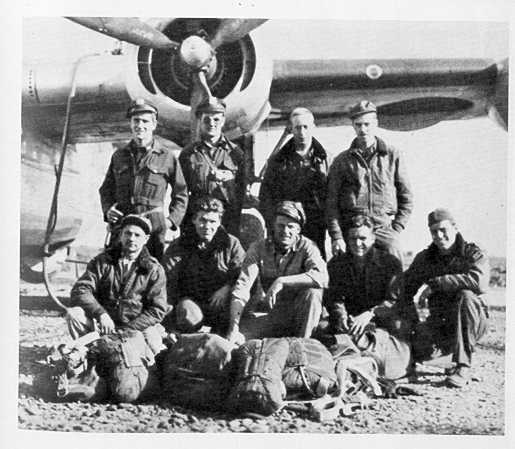
McGovern and his Aircrew (above) and with his Co-pilot and Navigator (below)

His experiences during the Depression and with the victims of war that he encountered in Italy made him a champion of people that suffer. He spent one year in seminary before switching to graduate studies in American History earning a Masters and Ph.D. in History. He served as a Congressman and Senator and represented the liberal wing of the Democratic Party. He served as the director of President Kennedy’s Food for Peace program. He was the first Senator to openly speak out against U.S. Military involvement in Vietnam when President Kennedy began to expand the mission. As a historian who actually studied what was going on in Vietnam for years he warned the Senate in September 1963 that:

“The current dilemma in Vietnam is a clear demonstration of the limitations of military power … [Current U.S. involvement] is a policy of moral debacle and political defeat … The trap we have fallen into there will haunt us in every corner of this revolutionary world if we do not properly appraise its lessons.”

After lending his vote to the Gulf of Tonkin Resolution which gave President Johnson a blank check to expand military involvement in Vietnam he realized that he had made a mistake. After and on January 15th 1965 as the U.S. forces entered into heavy combat against the North Vietnamese Army and the Viet Cong McGovern warned:

“We are fighting a determined army of guerrillas that seems to enjoy the cooperation of the countryside and that grow[s] stronger in the face of foreign intervention… We are further away from victory over the guerrilla forces in Vietnam today than we were a decade ago.” 

McGovern visiting Vietnam in 1965

He continued his outspoken opposition as the war continued and in November 1965 he spent three weeks in country carefully visiting and studying the situation with US military  and diplomatic officials as well as visiting the wounded. His visits to the hospitals in country made a huge impression on him causing him to become even more anti-war, though he voted for appropriations bills in order not to deprive the troops of what they needed.  In September 1969 with President Nixon looking to expand the war into Cambodia he deliberately offended his fellow Senators when fighting for the passage of the McGovern-Hatfield Amendment which would have forced the Administration to begin to end the war:

“Every Senator in this chamber is partly responsible for sending 50,000 young Americans to an early grave. This chamber reeks of blood. Every Senator here is partly responsible for that human wreckage at Walter Reed and Bethesda Naval and all across our land—young men without legs, or arms, or genitals, or faces or hopes. There are not very many of these blasted and broken boys who think this war is a glorious adventure. Do not talk to them about bugging out, or national honor or courage. It does not take any courage at all for a congressman, or a senator, or a president to wrap himself in the flag and say we are staying in Vietnam, because it is not our blood that is being shed. But we are responsible for those young men and their lives and their hopes. And if we do not end this damnable war those young men will some day curse us for our pitiful willingness to let the Executive carry the burden that the Constitution places on us.” 

He ran for President in 1972 and ran what was probably one of the worst campaigns ever. The Democratic party was deeply divided and in disarray and the Nixon campaign took advantage of both his “dovish” stance on the war as well as more progressive stances to demonize him as a person. The late columnist Robert Novak was a vicious critic working hand in hand with Nixon’s Chief of Staff Chuck Colson.

McGovern lost in the most lopsided defeat in modern American history only winning Massachusetts and losing 49 states and only garnering 38% of the vote. Following the defeat he won on more Senate campaign in 1974 and remained in the Senate until 1980 when he was defeated on the coattails of Ronald Reagan’s defeat of Jimmy Carter. He was demoted in the Democratic Party Senate hierarchy and never regained the power he had in the Senate that he had before the 1972 campaign.

In 1972 his campaign was a disaster and some of his policies not well thought out, Nixon and his cohort used everything against him, including some of the most dishonest campaign tactics, culminating in the Watergate break-in.

He remained an active voice in American politics until this year when age, illness and accidents finally caught up with him. He suffered the loss of his wife and two of his children before he died.

He was a voice for the powerless and for the common military man. He was anti-war but never anti-military or anti-troop. He had a great compassion for those that serve in uniform and was a critic of those that would send men and women into battle without taking the risk themselves. He was guided by his Christian faith in is beliefs especially about peace and the care of the poor. He was a Prophet of Peace.

Back in 1972 I was 12 years old and my dad was in Vietnam. Military personnel were frequently treated shamefully by anti-war activists who could not distinguish in their zealotry the difference between the policies of the government and the Soldiers, Marines, Sailors and Airmen that served in that unpopular war. I had a Sunday School Teacher tell me that my dad was a “baby killer.” For years I harbored much resentment for George McGovern. For years I did not appreciate the depth of his integrity and personal courage. In college I savored his loss of his Senate seat in 1980. When he came out against the invasion of Iraq in 2003 I figured that it was more of the same. However my views about him changed after my tour in Iraq and I now appreciate his honesty and foresight regarding both Vietnam and Iraq.

One does not have to agree with all of his policies to admire his personal courage and integrity as well as foresight about the tragedy that would unfold in Vietnam and Iraq. The man was a hero who served is country and the world and I hope someday that we will really come to appreciate him. I wish I had come to such an appreciation of him earlier in life.

Rest in peace,

Padre Steve+

3 Comments

Filed under History, News and current events, Political Commentary

237 Years of Service: Happy Birthday US Navy!

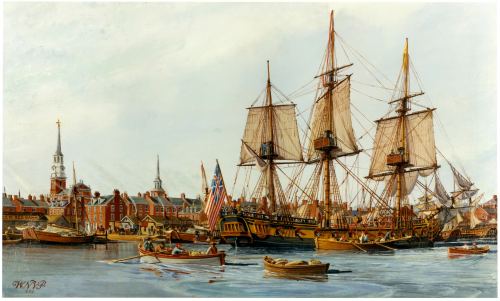
Raising the Flag Aboard the USS Alfred 

“It follows than as certain as that night succeeds the day, that without a decisive naval force we can do nothing definitive, and with it, everything honorable and glorious.” George Washington 15 November 1781 to the Marquis de Lafayette

On October 13th 1775 the Continental Congress passed legislation to establish a Navy for a country that did not yet exist.  It was the first was the first in a long line of legislative actions taken by it and subsequent Congresses that helped define the future of American sea power.

The Battle of Flamborough Head

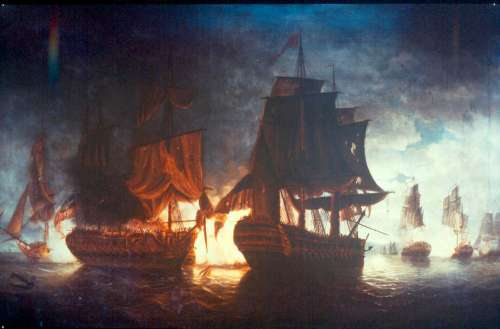
The legislation was the beginning of a proud service that the intrepid founders of our nation could have ever imagined.  Less than two months after it was signed on December 3rd 1775 Lieutenant John Paul Jones raised the Grand Union Flag over the new fleet flagship the Alfred. The fleet set sail and raided the British colony at Nassau in the Bahamas capturing valuable cannon and other military stores.  It was the first amphibious operation ever conducted by the Navy and Marines.

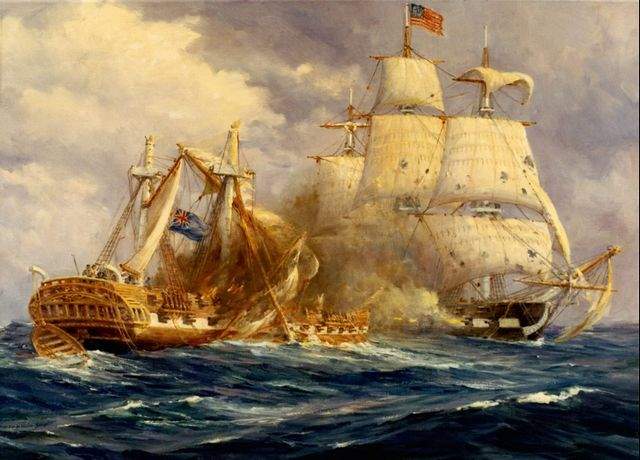
USS Constitution and HMS Guerriere

Jones received the first recognition of the American flag shortly after France recognized the new United States.  In command of the Sloop of War Ranger his ship received a nine-gun salute from the French flagship at Quiberon Bay.

Oliver Hazard Perry at the Battle of Lake Erie

Jones would go on to to greater glory when he in command of the Bonhomme Richard defeated the HMS Serapis at the Battle of Flamborough Head. During the battle when all seemed lost and the colors had been shot away he replied to a British question if he had surrendered replied “I have not yet begun to fight!”

Admiral David Farragut at the Battle of Mobile Bay

When the war ended very few of these ships remained most having been destroyed or captured during the war. But these few ships and the brave Sailors and Marines who manned them blazed a trail which generations of future sailors would build on.  The Navy has served the nation and the world as a “Global Force for Good” for 237 years.

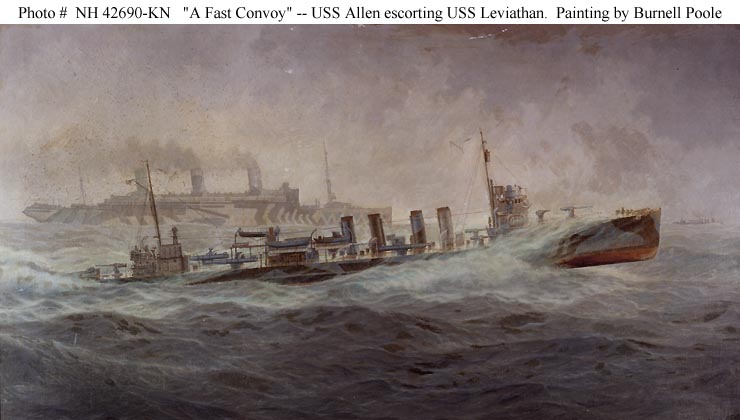
World War One: Convoy Escort USS Allen

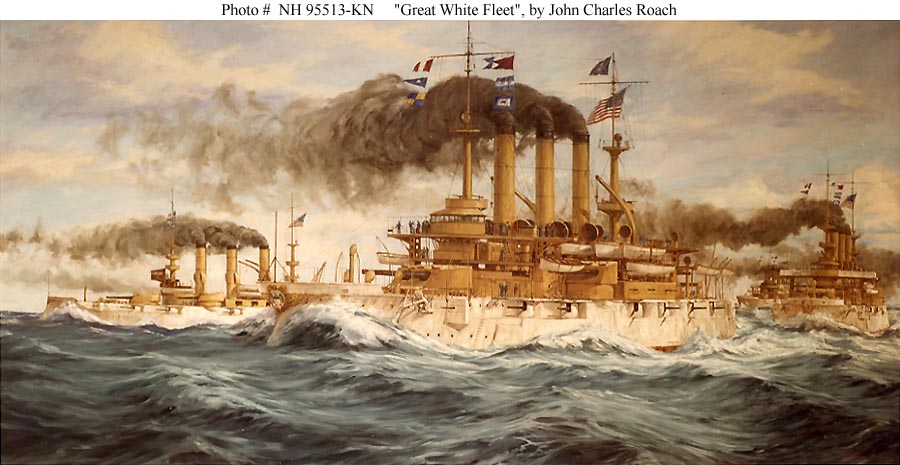
The Great White Fleet

This force for good is on duty today and those that have served over the past 237 years are part of a tradition that is more than honorable. President John F. Kennedy who served as a PT Boat Commander in World War Two remarked:

“I can imagine no more rewarding a career. And any man who may be asked in this century what he did to make his life worthwhile, I think can respond with a good deal of pride and satisfaction: ‘I served in the United States Navy.'”

The Battle of Midway

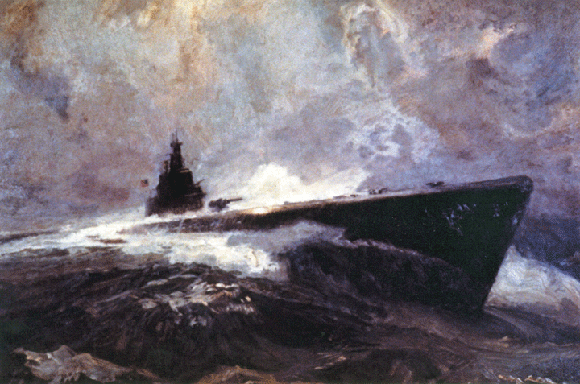
USS Growler

Tonight as you go to bed and sleep soundly after eating well and spending time with family, friends or enjoying some form of entertainment remember those of our Navy who serve at sea at the ready in the Straits of Hormuz, in the mountains and deserts of Afghanistan, the desolation of the Horn of Africa and around the world defending our interests, caring for our military personnel and their families and deploying to serve in harm’s way and in areas of devastation.  They are America’s “Global Force for Good.”  They are my shipmates they are your fellow citizens.  They are the United States Navy.

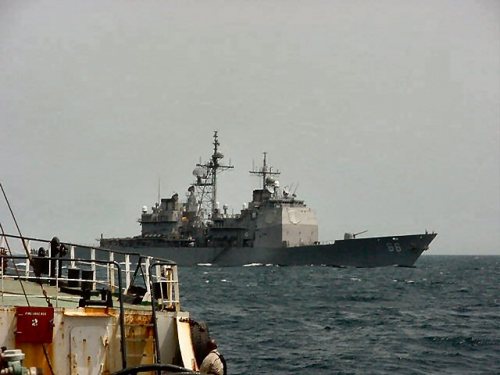
USS Hue City CG-66

Happy Birthday Shipmates.

Peace

Padre Steve+

1 Comment

Filed under History, Military, Navy Ships, US Navy

One Giant Loss for Mankind: Neil Armstrong Dead at 82

http://www.youtube.com/watch?v=sTBIr65cL_E&feature=related

http://www.youtube.com/watch?v=RMINSD7MmT4

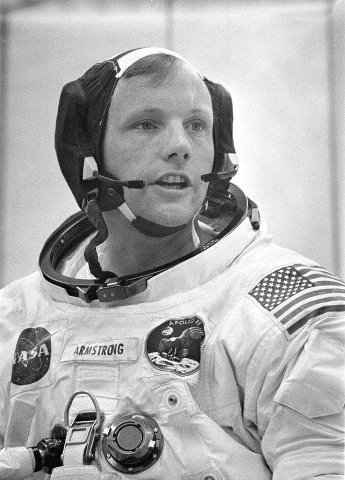
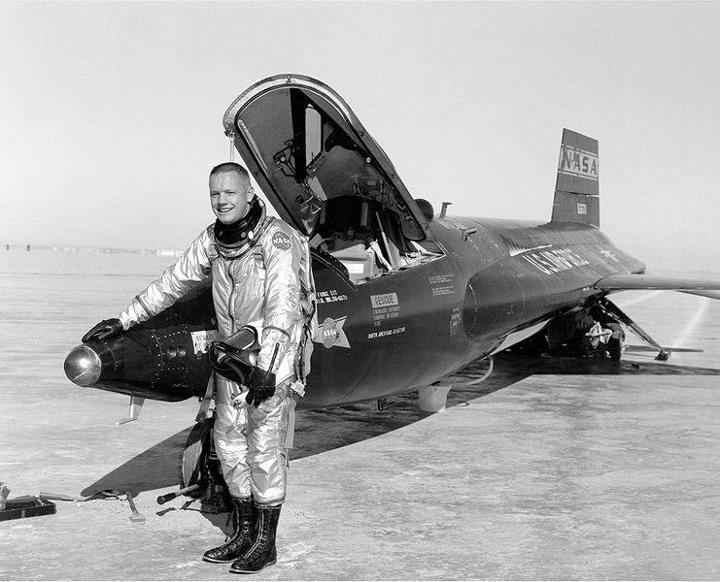
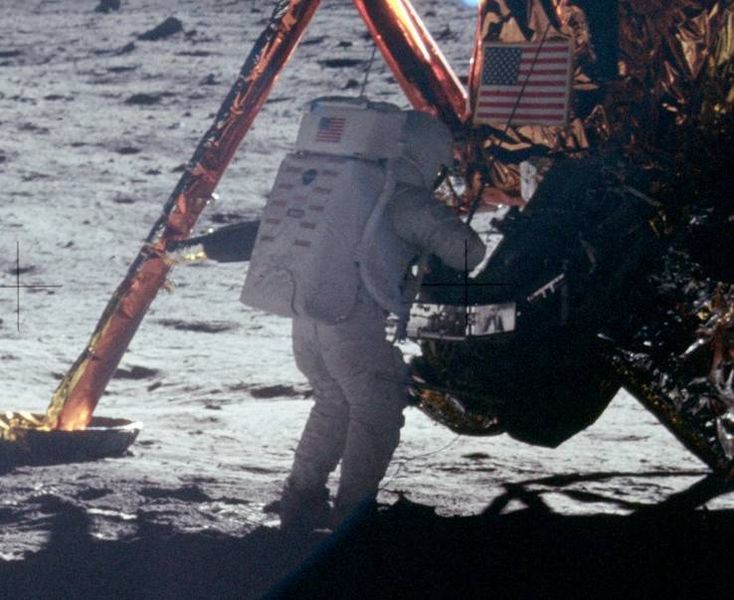
Today the United States and the World lost a true hero. Neil Armstrong, the first man to set foot on the Moon died of complications of heart surgery today at the age of 82.

Armstrong was born on August 5th 1930 in Wapakoneta Ohio. He fell in love with flying at an early age and earned his flight certificate when he was just 15 years of age. He became a Naval Aviator at the age of 20 and flew 78 missions over Korea while assigned to VF-51 aboard the USS Essex (CV-9) flying the F9F Panther.  He transferred to the Naval Reserve in August 1952 and returned to Perdue University where he earned a BS in Aeronautical Engineering and the to the University of Southern California where he earned a MS in the same subject. He became a Test Pilot with the National Advisory Committee for Aeronautics in 1955.

After seven years as a test pilot Armstrong was asked to join the fledgling NASA space program in 1962. He was one of two civilian test pilots to join the program, the other Astronauts were active duty Naval Aviators or Air Force Pilots.

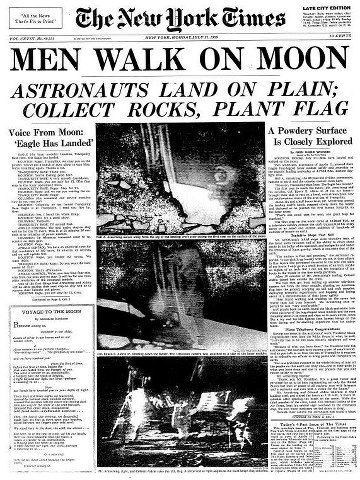
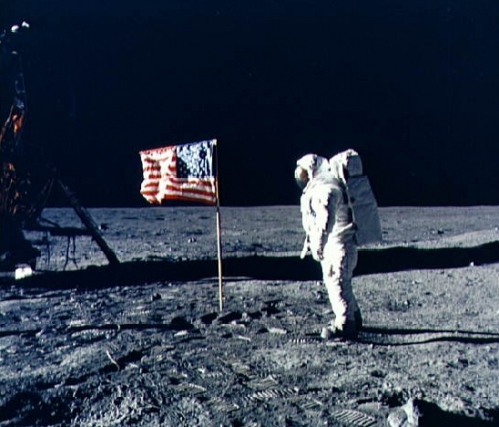
He first flew in space in 1966 as the Command Pilot of Gemini 8 and as Commander of the Apollo 11 flight which made history landing on the Moon on July 20th 1969. I was 9 years old and remember it like it was yesterday. His words on setting foot on the surface of the Moon “That’s one small step for [a] man, one giant leap for mankind.” still echo as one of the most memorable statements in human history.

Armstrong retired from NASA in 1971 but remained active in teaching, business international contact and conferences regarding space travel. He served on NASA accident investigations for Apollo 13 of 1970 and the Space Shuttle Challenger disaster in 1986. He remained a proponent of further manned space expeditions and was openly critical of the cancellation of the Ares 1 Launch Vehicle and Constellation Moon Landing program in 2010. He also spoke out in favor of manned missions to Mars even offering his services to command such a mission in 2010 at the age of 80.

The loss of Armstrong is a great loss. He was both a visionary and an explorer.  Our leaders during the great era of the Space Program, from John F Kennedy to Ronald Reagan were visionaries who could unite disparate groups of Americans for common and great goals. One of our great problems today is that our leaders, especially political and business leaders have ceased being visionaries.  Religious leaders are even worse with the most influential promoting ignorance and fear while ignoring or denying science and anything that might challenge faith or more importantly their stranglehold on power. To me such leaders must have an awfully small God in order to promote such ignorance. There seems no vision on either side of the political divide for anything more than what political power and spoils benefits their side.  As a man who comments a lot on this site noted we cannot even accomplish unambitious goals, which have become “pie in the sky dreams.”  Our leaders seem to forget that without vision the people perish. The greatest accomplishment of humankind have been when when men or women reached for more than they could see, when they took risks, dreamed dreams and even in times of war or crisis were willing to believe that better was possible.

We need men and women of  real vision, courage and good will like Armstrong who are willing to make “that giant step.” We need people who actually believe in causes greater than themselves and their interests. We need men and women who are willing, to use the words of Gene Roddenberry “to boldly go where no one has gone before.”

Rest in peace Neil Armstrong.

Peace

Padre Steve+
3 Comments

Filed under History, News and current events