Tag Archives: jurgen moltmann

Losing Christian America One Election Campaign at a Time: How Christian Leaders are Destroying the Church in Order to Maximize Political Power

“The one will triumph who first died for the victims then also for the executioners, and in so doing revealed a new righteousness which breaks through vicious circles of hate and vengeance and which from the lost victims and executioners creates a new mankind with a new humanity. Only where righteousness becomes creative and creates right both for the lawless and for those outside the law, only where creative love changes when is hateful and deserving of hate, only where the new man is born who is oppressed nor oppresses others, can one speak of the true revolution of righteousness and of the righteousness of God.” 
― Jürgen Moltmann, The Crucified God: The Cross of Christ as the Foundation and Criticism of Christian Theology

The statistics don’t lie. The United States cannot and should not be considered a Christian nation and any sense of the definition. While many people, even a majority describe themselves as Christians the fact is that what is now believed is not a Christianity that is in any sense Biblical, Catholic or Orthodox but rather a packaging of certain “Biblical values” that happen to be great political wedge issues for Christian leaders seeking political and economic power.  Nowhere is this shown more than the brazen flip-flopping of Christian leaders now support but who adamantly opposed the nomination of Mitt Romney on the basis of their understanding of Christianity and Mormonism so long as there was a chance that a non-Mormon had a chance at the Republican nomination. The theological gyrations made by the leaders of the Religious Right in this process have been fascinating to watch, much like a train wreck, but fascinating nonetheless.

A recent Barna survey noted that less than one half of one percent of people aged 18-23 hold what would be considered a “Biblical world view.” This is compared to about one of every nine other adults.  Other surveys bear this out.

This should not be surprising to anyone that has watched the growth of what passes as Evangelical Christianity in the Mega-Church age and the retreat of conservative Catholics into the Church culture and theology of the 1400s, the same ideology that brought about the Reformation.

What has to be said is that the Church cannot really be considered Evangelical or Catholic but rather an Imperial Church that must throw itself at those that hold power in order to maintain their own power.  While these leaders talk about and rail against things that they believe to be “sinful” such as homosexuality, abortion and birth control they willingly turn a blind eye to the treatment of the poor, advocate wars of aggression and bless cultural and economic norms that go entirely against the Christian tradition as they go about with a Bible in one hand and Ayn Rand’s Atlas Shrugged in the other.

One can have legitimate debates in the Church about what the Bible and Christian tradition define as sin and we should have those debates taking into consideration Scripture, Tradition as well as what we have learned from the Sciences and the Social Sciences. But the fact is that those in the Religious Right are terribly inconsistent in this, much like the religious leaders of Jesus’ day who he condemned for the same type of hypocrisy.

Think about it: The Barna Group in another survey of people 18-29 years old asked what phrases best described Christians: The top five answers “Anti-homosexual, judgmental, hypocritical and too involved in politics.” This view was held by 91% of non-Christians and a staggering 80% of young churchgoers.

The fact is that young people are leaving the church in unheard of numbers and it is very evident to me why they are doing so. The Church has embraced the culture wars over preaching the Gospel, which if I recall correctly is based on loving people, even ones enemies.  Jesus said it so well: “By this everyone will know that you are my disciples, if you have love for one another.” John 13:35 NRSV.

The leaders of the Christian Right may be able to bring out enough culture warriors to win this election for the Republican Party, but at what cost? One can debate the merits of the Obama administration, its decisions and policies but to be Christian we cannot simply become the religious appendage of a political movement whose leaders hold the Church and religious people in general in distain even as they mobilize them to support policies that are in the long term detrimental to those who claim the name of Jesus.

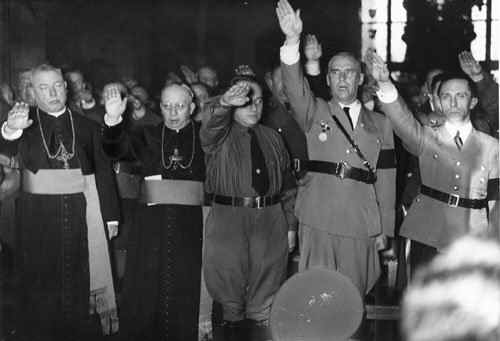
In the 1920s and 1930s the Churches of Germany and many parts of Europe did the same thing. They felt that their values were under attack by Communists, Socialists, Jews and yes, even Homosexuals. In order to maintain their influence and power they willingly allied themselves with the Nazis. When they spoke up against the Nazis it was seldom because they were defending anyone but their own ecclesiastical power and place in society.  When the war was over and young people began to question the actions of those that led the Church in Germany it began a process that has led to the de-Christianization of that country.

The constant hate filled attacks of Christian leaders on those that are not Christians will come back to bite them. This is not fantasy, it is reality. One only has to look at the history of the Church to see it played out time after time. But then, unless we decide to re-write history like David Barton does so well why bother reading it?

I will be writing more about this in the coming months in what will be a number of very well researched and documented articles.  But figured that I would kick open the door today. the actions of many Christian leaders are dangerous to the faith as a whole. The political opportunism is short sighted and ultimately will hasten the decline and fall of what we know as Christianity in America.

Perhaps our Christian leaders should be asking these questions: What does it profit a man to gain the whole world but lose his soul and what does it profit the Church to wield political power but lose its soul?

Peace

Padre Steve+

4 Comments

Filed under christian life, faith, philosophy, Political Commentary, Religion

The Paradox of the Passion: Reflections on Palm or Passion Sunday

I celebrated a quiet Palm Sunday liturgy this morning.  As I read the scriptures, especially the Passion Narrative of Mark the Evangelist I was moved in a way that I have not been for some time and found that my time of prayer following the readings and the recitation of the Creed was perhaps more impassioned on account of all the suffering and injustice that I see in the world.  As such I wondered what to write and thought about the story of Longinus the Centurion who was according to tradition the Centurion at the foot of the Cross of the day of the crucifixion.  I went back through a number of articles that I wrote last year about what I imagined a soldier and officer of his time might imagine in such a situation and I will repost those articles on Good Friday, Holy Saturday and Easter. However today I decided to go back into my archives and repost with a few modification a more theological reflection on this Sunday which marks the beginning of Holy Week for Christians around the world. 

“Although we praise our common Lord for all kinds of reasons, we praise and glorify him above all for the cross. Paul passes over everything else that Christ did for our advantage and consolation and dwells incessantly on the cross. The proof of God’s love for us, he says, is that Christ died for us while we were yet sinners. Then in the following sentence he gives us the highest ground for hope: If, when we were alienated from God, we were reconciled to him by the death of his Son, how much more, now that we are reconciled, shall we be saved by his life!” John Chrysostom (AD 347-407)

“God speaking to Luther: “Discipleship is not limited to what you can comprehend—it must transcend all comprehension. … Not to know where you are going is the true knowledge. My comprehension transcends yours. Thus Abraham went forth from His father… not knowing whither he went. … Behold, that is the way of the cross. You cannot find it yourself, so you must let me lead you as though you were a blind man. Wherefore it is not you, no man… but I myself, who instruct you by my Word and Spirit in the way you should go. Not the work which you choose, not the suffering you devise, but the road which is clean contrary to all you choose or contrive or desire—that is the road you must take. To that I call you and in that you must be my disciple.” Dietrich Bonhoeffer the Cost of Discipleship

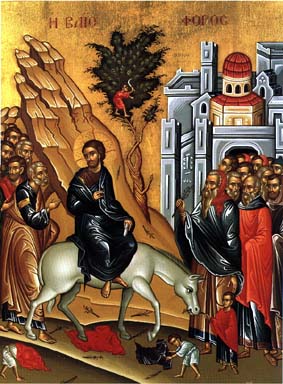
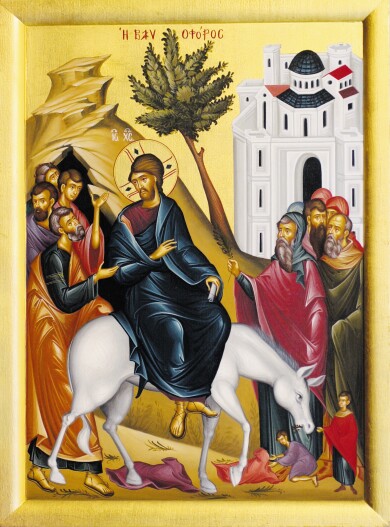
Palm or Passion Sunday always is a day that invokes mixed emotions in me. It is the last Sunday of the Lenten Season and in modern times has become a juxtaposition of two events, the Triumphant Entry of Jesus into Jerusalem where he according to all four Gospels was greeted by crowds of people who lined the street with palms as Jesus riding on a donkey processed from Bethany and Bethphage where he had been staying with Lazarus into Jerusalem and the narrative of the Passion.  As such it is a roller coaster ride in our experience of walking with Jesus in the most difficult times.

This particular occasion is the Sunday where the disciples of Jesus are confronted with the reality that our earthy expectations of him do not meet the reality of his condensation to walk among us fully Divine yet fully Human but one too well acquainted with suffering, rejection and shame.  He shatters our expectations that he will bless any particular political or social ideology that we allow to take pre-eminence over him, even those that invoke his name. Thus our liturgy brings us to this strange day where in a sense we are confronted with celebrating the entrance of the King and in the next breath cursing him and betraying him to those who torture and crucify him.

In the Roman Catholic and Anglican liturgy the observance is divided between the Liturgy of the Palms which takes place outside the Church Nave either outside the church building or in the Narthex in cold or inclement weather.  After an opening collect and reading of the Gospel passage from one of the synoptic Gospels, which one depends on which of the three year liturgical readings that the church is in. Following the reading of the Gospel the congregation led by choir, acolytes and clergy process into the church reciting the words of Psalm 118: 18-29 or singing a hymn such as “All Glory Laud and Honor.”  Once the congregation is in the church the Liturgy of the Word continues and when the Passion Gospel is read and specific roles may be assigned to members of the congregation, while the congregation remains seated through the first part of the Passion the congregation stands at the verse where “Golgotha” is mentioned and remains standing.

The liturgy takes the congregation on an emotional and spiritual roller coaster.  As the congregation begins outside the following is read:

When Jesus had come near Bethphage and Bethany, at the place called the Mount of Olives, he sent two of the disciples, saying, “Go into the village ahead of you, and as you enter it you will find tied there a colt that has never been ridden. Untie it and bring it here. If anyone asks you, ‘Why are you untying it?’ just say this, ‘The Lord needs it.’” So those who were sent departed and found it as he had told them. As they were untying the colt, its owners asked them, “Why are you untying the colt?” They said, “The Lord needs it.” Then they brought it to Jesus; and after throwing their cloaks on the colt, they set Jesus on it. As he rode along, people kept spreading their cloaks on the road. As he was now approaching the path down from the Mount of Olives, the whole multitude of the disciples began to praise God joyfully with a loud voice for all the deeds of power that they had seen, saying,

“Blessed is the king who comes in the name of the Lord!

Peace in heaven, and glory in the highest heaven!”

Some of the Pharisees in the crowd said to him, “Teacher, order your disciples to stop.” He answered, “I tell you, if these were silent, the stones would shout out.” Luke 19:29-40

It is hard when you read this passage and be caught in the reenactment of this procession not to feel the excitement that must have accompanied that procession.  It has the feeling of a victory parade but this road ends in a manner that those present, those seeking an earthly king and Messiah who would drive our the Roman oppressor and restore the kingdom to Israel would not expect with some of them perhaps playing a role in the drama that would take place later in the week.  I particularly like the hymn “All Glory Laud and Honor.”

All glory, laud and honor,
To Thee, Redeemer, King,
To Whom the lips of children
Made sweet hosannas ring.

Thou art the King of Israel,
Thou David’s royal Son,
Who in the Lord’s Name comest,
The King and Blessèd One.
Refrain

The company of angels
Are praising Thee on High,
And mortal men and all things
Created make reply.
Refrain

The people of the Hebrews
With palms before Thee went;
Our prayer and praise and anthems
Before Thee we present.
Refrain

To Thee, before Thy passion,
They sang their hymns of praise;
To Thee, now high exalted,
Our melody we raise.
Refrain

Thou didst accept their praises;
Accept the prayers we bring,
Who in all good delightest,
Thou good and gracious King.

During the Liturgy of the Word one of the following is read, either Isaiah 45:21-25 or Isaiah 52:13-53:12, the second being the Song of the Suffering Servant.  The Psalm is Psalm 22 where the Psalmist foretells Jesus’ anguished cry from the Cross; “My God, my God, why have you forsaken me? and are so far from my cry and from the words of my distress?”And then we have the New Testament reading Philippians 2: 5-11, the hymn to Christ is read:

Let the same mind be in you that was in Christ Jesus, who, though he was in the form of God, did not regard equality with God as something to be exploited, but emptied himself, taking the form of a slave, being born in human likeness. And being found in human form, he humbled himself and became obedient to the point of death– even death on a cross. Therefore God also highly exalted him and gave him the name that is above every name, so that at the name of Jesus every knee should bend, in heaven and on earth and under the earth, and every tongue should confess that Jesus Christ is Lord, to the glory of God the Father.”
This year the Passion Narrative is that of Mark (14:1-15:47) but I find the passage in Luke 22:39-71 and 23:1-49 (50-56) to be more dramatic.  The three parts of Luke’s narrative that stand out in this narrative for me are Peter’s denial of Jesus, the interaction of Jesus with those crucified with him and that of the Centurion:

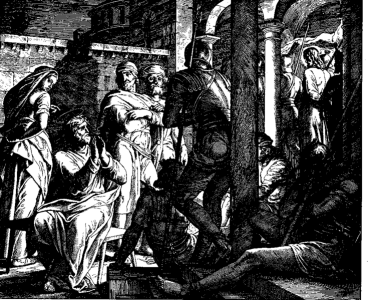
“Then they seized him and led him away, bringing him into the high priest’s house. But Peter was following at a distance. When they had kindled a fire in the middle of the courtyard and sat down together, Peter sat among them. Then a servant-girl, seeing him in the firelight, stared at him and said, “This man also was with him.” But he denied it, saying, “Woman, I do not know him.” A little later someone else, on seeing him, said, “You also are one of them.” But Peter said, “Man, I am not!” Then about an hour later still another kept insisting, “Surely this man also was with him; for he is a Galilean.” But Peter said, “Man, I do not know what you are talking about!” At that moment, while he was still speaking, the cock crowed. The Lord turned and looked at Peter. Then Peter remembered the word of the Lord, how he had said to him, “Before the cock crows today, you will deny me three times.” And he went out and wept bitterly.”

Peter’s denial is in large part because he has had his illusions about Jesus shattered and the fact that he had not understood the message up to that point.  As Bonhoeffer says “Jesus is a rejected Messiah. His rejection robs the passion of its halo of glory. It must be a passion without honor. Suffering and rejection sum up the whole cross of Jesus. To die on the cross means to die despised and rejected of men. Suffering and rejection are laid upon Jesus as a divine necessity, and every attempt to prevent it is the work of the devil, especially when it comes from his own disciples; for it is in fact an attempt to prevent Christ from being Christ.”

Likewise Jesus interaction with the condemned thieves that were crucified with him:

“One of the criminals who were hanged there kept deriding him and saying, “Are you not the Messiah? Save yourself and us!” But the other rebuked him, saying, “Do you not fear God, since you are under the same sentence of condemnation? And we indeed have been condemned justly, for we are getting what we deserve for our deeds, but this man has done nothing wrong.” Then he said, “Jesus, remember me when you come into your kingdom.” He replied, “Truly I tell you, today you will be with me in Paradise.”

Mark (15:25-32) records that interaction in this manner:

“It was nine o’clock in the morning when they crucified him. The inscription of the charge against him read, “The King of the Jews.” And with him they crucified two bandits, one on his right and one on his left. Those who passed by derided him, shaking their heads and saying, “Aha! You who would destroy the temple and build it in three days, save yourself, and come down from the cross!” In the same way the chief priests, along with the scribes, were also mocking him among themselves and saying, “He saved others; he cannot save himself. Let the Messiah, the King of Israel, come down from the cross now, so that we may see and believe.” Those who were crucified with him also taunted him.”

The final passage from this narrative that strikes me is the moment of Jesus’ death on the Cross:

“It was now about noon, and darkness came over the whole land until three in the afternoon, while the sun’s light failed; and the curtain of the temple was torn in two. Then Jesus, crying with a loud voice, said, “Father, into your hands I commend my spirit.” Having said this, he breathed his last. When the centurion saw what had taken place, he praised God and said, “Certainly this man was innocent.” And when all the crowds who had gathered there for this spectacle saw what had taken place, they returned home, beating their breasts. But all his acquaintances, including the women who had followed him from Galilee, stood at a distance, watching these things.”

Mark records that event in Mark 15: 33-39. In Mark’s account the reaction of the Centurion (15:39) to the death of Jesus is even more salient than the account of Luke.

“When it was noon, darkness came over the whole land until three in the afternoon. At three o’clock Jesus cried out with a loud voice, “Eloi, Eloi, lema sabachthani?” which means, “My God, my God, why have you forsaken me?” When some of the bystanders heard it, they said, “Listen, he is calling for Elijah.” And someone ran, filled a sponge with sour wine, put it on a stick, and gave it to him to drink, saying, “Wait, let us see whether Elijah will come to take him down.” Then Jesus gave a loud cry and breathed his last. And the curtain of the temple was torn in two, from top to bottom. Now when the centurion, who stood facing him, saw that in this way he breathed his last, he said, “Truly this man was God’s Son!”

The darkness of this is event is perplexing to those who want to find God in some place where he is untouched by human suffering to them the Cross is folly for what kind of God would submit himself to such ignominy but as Martin Luther wrote “He who does not know Christ does not know God hidden in suffering. Therefore, he prefers works to suffering, glory to the cross, strength to weakness, wisdom to folly. For they hate the cross and suffering and love works and the glory of works. Thus they call the good of the cross, evil and the evil of a deed, good. God can only be found in suffering and the cross.” It is in the contradiction of this week that we come to know God, not a God who seeks not the righteous or the powerful, those who seek the power of an earthy kingdom backed by an ideology of power which tramples the weak, but rather those who will simply walk in the footsteps of Jesus the Christ who rules by serving the least, the lost and the lonely.

The liturgy of this day be from any of the Passion narratives takes us to the heart of the Gospel as we led by the writers through the triumph of the entrance into Jerusalem, to the betrayal of Jesus by Judas, the abandonment of him by the disciples and the denial of Peter.  As the writers lead us through his trial, conviction, scourging and trek to Golgotha we see the gamut of human emotions and reactions to Jesus and we know that we can be there as well in any of the characters simply because we are human and capable of compassion or betrayal.  As Jesus is on the Cross it is not the religious or upstanding that remain with him.  He is left with his mother, the other Mary and John the beloved.  He is shown compassion by a thief and recognized as the Son of God by the Roman Centurion, a gentile serving an empire oppressing the people of Israel and whose governor had pronounced the sentence of death upon him.  In this liturgy we have been taken from the heights of exhilaration in the triumphant entry to the depths of despair felt by his disciples that Friday afternoon. It is in this time that we realize how right Dietrich Bonhoeffer is when he writes “God loves human beings. God loves the world. Not an ideal human, but human beings as they are; not an ideal world, but the real world. What we find repulsive in their opposition to God, what we shrink back from with pain and hostility, namely, real human beings, the real world, this is for God the ground of unfathomable love.”

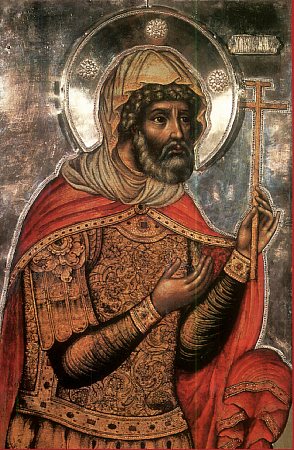
It is the Centurion for which I have the greatest affinity in this story. He is a soldier and in the words of so many soldiers who have obey orders carried out the sentence upon Christ by crucifying him and then as the life ebbs out of Christ’s crucified body exclaims “surely this was a good man” or in other accounts “surely this was the Son of God.” That is the cry of a man who knows that he has executed an unjust sentence, the reaction of a true penitent, the reaction of a man who comes to realize even before many of Jesus’ closest followers understood.  According to tradition the Centurion was named Longinus who left the service of the Imperial Legion, was baptized by the Apostles and was martyred under the orders of Pontius Pilate by soldiers of the unit that he had once commanded.

It is important for the Church not to lose this identification.  The Church is not to become enmeshed and co-opted by those who attempt to use the Gospel to promote ideologies foreign to it as is the temptation in times of crisis.  As Jürgen Moltmann notes:

“In Christianity the cross is the test of everything which deserves to be called Christian… The Christian life of theologians, churches and human beings is faced more than ever today with a double crisis: the crisis of relevance and the crisis of identity. These two crises are complementary. The more theology and the church attempt to become relevant to the problems of the present day, the more deeply they are drawn into the crisis of their own Christian identity….Christian identity can be understood only as an act of identification with the crucified Christ, to the extent to which one has accepted that in him God has identified himself with the godless and those abandoned by God, to whom one belongs oneself.” The Crucified God [pgs. 7, 19]

Nor is our task is not to attempt to invent “crosses” for ourselves in acts of pseudo-martyrdom but simply to be faithful in loving Jesus and our neighbor as Bonhoeffer noted “Must the Christian go around looking for a cross to bear, seeking to suffer? Opportunities for bearing crosses will occur along life’s way and all that is required is the willingness to act when the time comes. The needs of the neighbor, especially those of the weak and downtrodden, the victimized and the persecuted, the ill and the lonely, will become abundantly evident.” The mark of the Christian is not to blindly give his life for a cause or be consumed by the false “messiah’s” promoted by politicians, pundits and even preachers captivated by the lust for power and glory.

As we walk through the mystery of Holy Week together let us renew our faith in the Crucified One and not be conformed to those things that seek to turn us from the way of discipleship and the way of the Cross.

Peace

Padre Steve+

Leave a comment

Filed under christian life, film, Religion

Faith and Doubt: A Reflection on Christmas

“God weeps with us so that we may one day laugh with him.” Jürgen Moltmann

There was a time in my life that faith in God, for me the Christian God, Father, Son and Holy Spirit was something that I pretty much took for granted until I had my own crisis of faith when I returned from Iraq in 2008.  It was that crisis where for all practical purposes I was an agnostic trying to believe while feeling abandoned by God and many of his people.  That crisis has etched a permanent scar in my soul which has led to some fairly major changes in my life but even more so forced me to actually enter what Saint John of the Cross called the “Dark Night of the Soul.”  Not that that is in any way a bad thing as difficult as it is.

I will not tell of how my great spiritual disciplines helped me get through this as they did not. I found it hard to pray or believe in anything for nearly two years as I struggled with abandonment. I felt that God, the Church and the Navy had abandoned me.  I was losing my battle with PTSD during that time, depressed, anxious and despairing I threw myself into my work among the critically ill ICU patients and those that cared for them.  Christmas Eve of 2008 was spent in despair as I wandered through the darkness on a cold night after leaving Mass because I could not get through it.

Though I found a community and camaraderie among those that I worked with and tried to provide spiritual care for my own condition grew worse, so much so that my clinical duties had to be curtailed in September of 2009.  I still stood the overnight duty and filled in for others as needed but for a number of months I had no ward assignments.  On one of the on call nights not long before Christmas I received a call to the ER where I was called to give the last rites to a retired Navy Medical Doctor who was a true Saint, faithful to God, his Church and the community where for years he had dedicated much of his practice to the poorest members of the community to include prisoners in the Portsmouth City Jail. He breathed his last as I prayed this prayer following the anointing of the sick:

Depart, O Christian soul, out of this world;

In the Name of God the Father Almighty who created you;

In the Name of Jesus Christ who redeemed you;

In the Name of the Holy Spirit who sanctifies you.

May your rest be this day in peace,

and your dwelling place in the Paradise of God.

Something happened that night and by Christmas Eve I realized that something was happening to me. As I wrote in Padre Steve’s Christmas Miracle on Christmas Eve of 2009 following an incredibly busy day full of life and death situations and ministry which amazed me:

“Mid afternoon I was walking down the hall and I experienced a wave of emotion flood over me, and unlike the majority of emotions that I have felt in the past couple of years this was different.  It was a feeling of grace and I guess the presence of God.  I went up and talked with Elmer the shrink about what I was feeling and the experience was awesome, I was in tears as I shared, not the tears of sadness, but of grace.  I am beginning to re-experience the grace of God, something that has been so long absent that I did not expect it, at least right now.  I didn’t do anything differently; I certainly was not working extra hard to pray more, get more spiritual or pack my brain full of Bible verses.  I was too far gone to do those things.  It was all I could do many mornings just to get out of bed and come to work.”

Since that time I have continued to recover faith and belief. I cannot say that it is the same kind of faith that I had before Iraq. No this was different, it was faith born of the terrible emptiness and pain of abandonment and despair, a faith that is not content with easy answers and not afraid to ask questions.  It is a faith in Jesus Christ, the crucified one who’s image we see hanging from the crucifix and adorning icons of the Crucifixion. It is as Jürgen Moltmann wrote in The Crucified God:

“The Symbol of the Crucifix in church points to the God who was crucified not between two candles on an altar, but between two thieves in the place of the skull, where the outcasts belong, outside the gates of the city. It is a symbol which therefore leads out of the church and out of religious longing in to the fellowship of the oppressed and abandoned. On the other hand, it is a symbol which calls the oppressed and godless into the church and through the church into the fellowship of the crucified God”

My Philosophy of Religion Professor in seminary, Dr. Yandall Woodfin told us in class that until we had “dealt with the reality of suffering and death we were not doing Christian theology.” At the time the words were offensive to me, but by the time I had graduated and also done a year of Clinical Pastoral Education they became a part of my experience, but even then that did not prepare me for the darkness that I lived in from February of 2008 until that Christmas Eve of 2009.  I would say that in addition to grappling with suffering and death that one has to add the abandonment of the outcast to the equation.

It is from this perspective that I will look at an ancient document that for many Christians is their Baptismal statement of faith or Creed.  ‘Credo in unum Deum’ “I Believe in God” is no longer for me simply a theological proposition which I both ascent to and defend, but rather an experience of God born out of pain, despair, anxiety, doubt, unbelief and abandonment finding almost no Christians willing to walk through the darkness with me, including clergy. It was if I was radioactive, many people had “answers” but none understood the questions and until my therapist Dr. Elmer Maggard asked me “how I was with the big guy?” and Commodore Tom Sitsch asked me “Where does a Chaplain go for help?”

When I finally collapsed in the summer of 2008 and met with Dr. Maggard I made a conscious decision that I would not hide what I was going through because I felt that if someone didn’t speak out then others like me wouldn’t seek help. In the nearly three years since I returned from Iraq I have encountered many people, men and women, current and former military personnel and families of veterans who came to me either in person or through this website.  Included were military chaplains also experiencing life and faith crisis. Most said that I was the first Chaplain or minister that they had met or read who said that he struggled with faith, belief and didn’t know if God existed.  In each of those encounters there was a glimmer of hope for me and I think for them, for the first time we had people that we could be open with.  Co-workers and others said that I was “real” and I certainly do not boast of that because it was painful to try to be transparent with people while in the depths of doubt and despair while hoping that somehow God would touch them with some measure of grace when I found it hard to believe.  I guess it was the fact that I was willing to walk, sometimes in unusual circumstances and locations with them even if it meant facing my own pain and doubt. I was learning something about being what Henri Nouwen called a wounded healer.  Nouwen wrote:

“Nobody escapes being wounded. We all are wounded people, whether physically, emotionally, mentally, or spiritually. The main question is not “How can we hide our wounds?” so we don’t have to be embarrassed, but “How can we put our woundedness in the service of others?” When our wounds cease to be a source of shame, and become a source of healing, we have become wounded healers.”

In the past year I have still had my times of struggle but have also found others that have gone through similar times.  People like me that have experienced the terrible effects of a crisis of faith that leads a person into despair of even to the point of life itself and all that is good. I am fortunate. I was talking with my Bishop recently in regard to the struggle that I have had in recovering the disciplines of the spiritual life. Thankfully she does understand and was encouraging. I guess that is why now when I have more compassion for someone when they tell me that they “lost their faith” especially those that have been changed by their experience of war or other trauma. I don’t necessarily have all the answers for them because I am quite obviously still figuring it out myself. However as I found sometimes it is not the person with the answers but simply the person that takes time to listen and care that is more important to a person when they struggle, especially for those that before the traumatic event had been strong believers.

I’ll write a bit more about Christmas and faith but not tonight.

Peace

Padre Steve+

3 Comments

Filed under christian life, faith, Pastoral Care, Religion

Martin Luther and My Theological Formation: An Old Catholic Priest talks about Luther’s Influence on his Life

The Luther Rose: When they stand under the Cross Christian Hearts turn to Roses

“Grace is given to heal the spiritually sick, not to decorate spiritual heroes.” Martin Luther

When a young Priest and Theology Professor at the University of  Wittenberg named Martin Luther posted the 95 Theses on the door of the Schlosskirche in Wittenberg it changed the course of Western as well as Church history.  He also changed mine.

Martin Luther was the first of a series of theologians that helped make me what I am now. When my Church History professor Dr. Doyle Young and Systematic Theology professor Dr. David Kirkpatrick introduced me to Luther’s writings and his “Theology of the Cross it was earth shaking.  It was his Theology of the Cross brought me to an incarnational understanding of the Christian faith because it is only through the Cross that we come to know God in a truly Christian sense of understanding.  For Luther the Cross was central to understanding the humanity’s relationship to the Trinity, and stands against Calvin whose understanding of God’s will and predestination from before time began tends minimize the Cross, for Calvin it is a mechanism but for Luther it is the most profound and personal revelation of God, Father Son and Holy Spirit. The incarnational and Trinitarian found in the Theology of the Cross also opened for me essential nature of the Eucharist to the Christian faith and which helping bring me to a catholic understanding of the faith.

The relational aspects of the Theology of the Cross were personalized in the Three Solas; Sola fides by faith alone, Sola Gratia by grace alone and Sola Scriptura by scripture alone. These became the hallmarks of the Reformation and without getting into the weeds to dissect all the ramifications for the Church and the world impact the way that many Christians practice and express their faith to the current day.

The Catholic in me tends to discount Sola Scriptura because Luther himself was such an imperfect practitioner of this. I find that the Anglican and Old Catholic triad of Scripture, Tradition and Reason is a more Biblical way of understanding what we can understand of God as well as in bearing witness of the self revelation of God in Christ in our world than is Sola Scriptura.

The Reformation which began when Luther posted his “theses” on the door of the Schlosskirche broke the hold of the Roman Catholic Church on Europe brought about many changes. It was the watershed moment when western church unity was fractured forever. As the years passed this increasingly fractured and diverse church in the west and helped end the primacy of the Church over the State.  The Reformation was also essential to the future Enlightenment as educational institutions, philosophers, historians and scientists gained the freedom to operate free from the all pervasive reach of the Church.

In the beginning when he walked up to the Schlosskirche to post his theses Luther intended nothing more than reforming and curtailing abuses in the Catholic Church and how the Church saw grace, faith and scripture.  Instead he changed the course of history in ways that most modern people, especially conservative Christians fail to comprehend today.  If they did they would not be embracing such heresy as the Dominion movement and it’s Seven MountainsTheology.

I did a lot of study on the Lutheran Reformation in and after seminary. In 1996 while stationed in Germany as a mobilized Army Reserve Chaplain had the privilege of organizing a series of Reformation tours to Wittenberg, Worms and Heidelberg.  We went to Wittenberg on Reformation day where we attended the Reformationstag service at the Schlosskirche.   I led a walking tour of the town that day.  One of the parishioners from the chapel asked me if I had been toWittenberg before because I seemed like I knew every place in the town.  I had to tell her that I had not been there in person but because of my study had imagined it so many times that I knew every place by heart.  When we went to Worms where Luther on trial before Charles V was told to recant his writings it as the same, except that in Worms the town hall where the Imperial Diet met was destroyed long ago.  However a stone in the pavement marks the spot where Luther concluding his defense before the Emperor Charles V and the assembled Princes and prelates with these immortal words:

“Unless I am convicted by scripture and plain reason – I do not accept the authority of the popes and councils, for they have contradicted each other – my conscience is captive to the Word of God. I cannot and I will not recant anything for to go against conscience is neither right nor safe. God help me. Amen.” It is legend that Luther said the words “Here I stand. I cannot do otherwise. God help me, Amen!”  These words were probably only added later by someone else to make the story more interesting as they do not appear in the council notes.  Not that Luther would have objected.  The film version is linked here:

http://www.youtube.com/watch?v=U0tk_EvWXQQ&feature=player_embedded

Likewise Luther’s debate with Swiss Reformer Ulrich Zwingli at the Marburgcolloquy regarding points of doctrine was significant for me. It was held that they might unify their separate reform movements. They agreed on all points except the Eucharist where Luther enunciated a very catholic understanding of the “Real Presence.”  Zwingli argued it to be a symbolic memorial though he conceded that it might have some spiritual component.   Luther would not budge and to each of Zwingli’s arguments pulled back the tablecloth to reveal the words “This is my body, this is my blood” which he had carved on the table.  They departed without achieving unity, something that has plagued Protestants to this day and when Zwingli was killed in battle when leading the militia from Zurich to fight the approaching Catholic Army.  When Luther heard about the Zwingli’s death he commented Zwingli drew his sword. Therefore he has received the reward that Christ spoke of, ‘All who take the sword will perish by the sword’ [Matt. 26:52]. If God has saved him, he has done so above and beyond the rule.” (Table Talk #1451) When I visitedMarburg with my friend Gottfried in 1997 I stood in the room where the men met and standing at that table I imagined Luther arguing with Zwingli.

Martin Luther helped begin the journey to the Priest that I am now. Others similar to Luther, the Catholic theologian and reformer in his own right Father Hans Kung who was able to do what Luther couldn’t do, make a case for Luther’s theology as part of catholic theology.  Lutheran theologian Jürgen Moltmann has brought Luther’s theology to the modern world and Dietrich Bonhoeffer who showed me an example of how to live out the incarnational message of theTheology of the Cross in a world gone mad.  Kung’s book On Being a Christian, Moltmann’s Theology of Hope and The Crucified God have being influential in my theological formation. Bonhoeffer’s contribution was how that theology is important in standing up to oppression in all forms, his writings including The Cost o Discipleship, Ethics Creation Fall and Temptation, Life Together and Letters and Papers from Prison.  All of these men helped me in my transition following seminary to a moderate Anglo-Catholic to an Old Catholic faith that places a high place to Scripture, Apostolic Tradition and Reason in interpreting and living out the faith.

Of course there are others that have influenced me, the early Church Fathers, Francis of Assisi, John Wesley, Karl Barth and Emil Brunner, Henri Nouwen, Father Andrew Greely  and Bernard Häring to name but a few.  But even so I have always had a special place in my heart for Luther even with all of his flaws which were many.  Luther was earthy, spoke his mind often in a direct and coarse way and had no problem with having fun or good beer.  I relate to him a lot and am in his debt because he helped me become who I am today.

Peace

Padre Steve+


2 Comments

Filed under christian life, faith, History, Religion

An Easter People Living in a Good Friday World

Barbara Johnson wrote that Christians are an “Easter People Living in a Good Friday World.”

In the memorial acclamation which is part of many Eucharistic liturgies we proclaim “Christ has died, Christ is risen, Christ will come again” or possibly this variant “Dying you destroyed our death, rising you restored your life, Lord Jesus come in glory.  It has been part of the proclamation of the Gospels and various books of the New Testament and is the faith and prayer of those that call themselves Christians almost regardless of denomination from the very beginning.

Around the world many Christians understand this as they are persecuted for their faith sometimes to the point of death. The reality of Christians and others who are persecuted for their faith in many countries is quite unlike many American Christians who seem to believe that if someone disagrees with them they are being persecuted, despite enjoying tremendous political power and being the majority religion of the land.  Yet even in this country we live in a Good Friday world, maybe not like those that are dying for their faith but certainly in a place where suffering and violence abound, where innocent people are brutally murdered and where natural disasters bring destruction on the just and the unjust alike. In fact our country is experiencing a crisis of an order that it has not seen in many decades even while war, economic collapse and natural disasters and deep political division have left many people in deep despondency as well as in a very angry mood.

Our technology enables us to gather information and to receive news often faster than we can absorb it, thus when deluged by bad news it is easy to lose sight of the things that matter in life, especially relationships with those that we love as well as those that become part of our lives and of the Crucified God.

It is during Lent, Holy Week and in the Easter Triduum of Holy or Maundy Thursday, Good Friday and Easter that the reality of God participating in our world, the real world of pain, suffering, injustice and death becomes something that keeps us, or rather those who profess the Christian faith from simply becoming exponents of what Luther termed the “theology of glory.”  The Cross is that scandal or stumbling block that according to Jürgen Moltmann, the knowledge of which “brings a conflict of interest between God who has become man and man who wishes to become God.” It is the Cross which forces us to deal with the present realities even while we remain fixed upon the hope of Easter.

Unfortunately for many American Christians our focus tends to be less on the Crucified and Risen God than on our attempts to use the raw power of the political process and unsavory compromises with those that would co-opt and compromise the faithful for the advancement of their political, social and economic agendas.  This is nothing new; it has been an unfortunate and painful series of chapters in the history of the Christian Church since the time that Christianity became legal and the State religion during the reign of Constantine.  The sad truth is that in Western Christianity beginning with the Catholic Church and extending out to those that have been the theological heirs of Saint Augustine Catholic and Protestant alike have more often than not allowed their faith to be subordinated to their political, economic and social agendas and thereby becoming captive to things that are often antithetical to the Gospel.

Yet in the midst of this there is the constant call of the Gospel, that “God was reconciling the world to himself counting men’s sins not against them.”  Moltmann puts this paradox well when he says:

“When God becomes man in Jesus of Nazareth, he not only enters into the finitude of man, but in his death on the cross also enters into the situation of man’s godforsakenness. In Jesus he does not die the natural death of a finite being, but the violent death of the criminal on the cross, the death of complete abandonment by God. The suffering in the passion of Jesus is abandonment, rejection by God, his Father. God does not become a religion, so that man participates in him by corresponding religious thoughts and feelings. God does not become a law, so that man participates in him through obedience to a law. God does not become an ideal, so that man achieves community with him through constant striving. He humbles himself and takes upon himself the eternal death of the godless and the godforsaken, so that all the godless and the godforsaken can experience communion with him.” 

It is in this that Christians can fully be Easter People who live in a Good Friday world.  It is in living the paradox of Good Friday and Easter that we find just how God humbled himself for all people. In suffering the wrath of some incredibly religious people Jesus in the eloquent words of Paul the Apostle “though he was in the form of God, did not regard equality with God as something to be exploited, 7but emptied himself, taking the form of a slave, being born in human likeness. And being found in human form, he humbled himself and became obedient to the point of death— even death on a cross.” (Phil 4:7-8) and in that God, “who reconciled us to himself through Christ, and has given us the ministry of reconciliation; that is, in Christ God was reconciling the world to himself, not counting their trespasses against them, and entrusting the message of reconciliation to us.” (2 Cor 5:18-19)

Yes this is what it means to be an Easter people living in a Good Friday World.

Peace

Padre Steve+

2 Comments

Filed under christian life, faith, philosophy, Religion

Introduction to “I Believe please Help Me Believe: The Apostle’s Creed for those Who Struggle with Faith”

“God weeps with us so that we may one day laugh with him.” Jürgen Moltmann

This is the first of a series of essays on the topic of doubt and faith related to the Apostle’s Creed.  There was a time in my life that faith in God, for me the Christian God, Father, Son and Holy Spirit was something that I pretty much took for granted until I had my own crisis of faith when I returned from Iraq in 2008.  It was that crisis where for all practical purposes I was an agnostic trying to believe while feeling abandoned by God and many of his people.  That crisis has etched a permanent scar in my soul which has led to some fairly major changes in my life but even more so forced me to actually enter what Saint John of the Cross called the “Dark Night of the Soul.”

I will not tell of how my great spiritual disciplines helped me get through this as they did not. I found it hard to pray or believe in anything for nearly two years as I struggled with abandonment. I felt that God, the Church and the Navy had abandoned me.  I was losing my battle with PTSD during that time, depressed, anxious and despairing I threw myself into my work among the critically ill ICU patients and those that cared for them.  Christmas Eve of 2008 was spent in despair as I wandered through the darkness on a cold night after leaving Mass because I could not get through it.

Though I found a community and camaraderie among those that I worked with and tried to provide spiritual care for my own condition grew worse, so much so that my clinical duties had to be curtailed in September of 2009.  I still stood the overnight duty and filled in for others as needed but for a number of months I had no ward assignments.  On one of the on call nights not long before Christmas I received a call to the ER where I was called to give the last rites to a retired Navy Medical Doctor who was a true Saint, faithful to God, his Church and the community where for years he had dedicated much of his practice to the poorest members of the community to include prisoners in the Portsmouth City Jail. He breathed his last as I prayed this prayer following the anointing of the sick:

Depart, O Christian soul, out of this world;

In the Name of God the Father Almighty who created you;

In the Name of Jesus Christ who redeemed you;

In the Name of the Holy Spirit who sanctifies you.

May your rest be this day in peace,

and your dwelling place in the Paradise of God.

Something happened that night and by Christmas Eve I realized that something was happening to me. As I wrote in Padre Steve’s Christmas Miracle on Christmas Eve of 2009 following an incredibly busy day full of life and death situations and ministry which amazed me:

“Mid afternoon I was walking down the hall and I experienced a wave of emotion flood over me, and unlike the majority of emotions that I have felt in the past couple of years this was different.  It was a feeling of grace and I guess the presence of God.  I went up and talked with Elmer the shrink about what I was feeling and the experience was awesome, I was in tears as I shared, not the tears of sadness, but of grace.  I am beginning to re-experience the grace of God, something that has been so long absent that I did not expect it, at least right now.  I didn’t do anything differently; I certainly was not working extra hard to pray more, get more spiritual or pack my brain full of Bible verses.  I was too far gone to do those things.  It was all I could do many mornings just to get out of bed and come to work.”

Since that time I have continued to recover faith and belief. I cannot say that it is the same kind of faith that I had before Iraq. No this was different, it was faith born of the terrible emptiness and pain of abandonment and despair, a faith that is not content with easy answers and not afraid to ask questions.  It is a faith in Jesus Christ, the crucified one who’s image we see hanging from the crucifix and adorning icons of the Crucifixion. It is as Jürgen Moltmann wrote in The Crucified God:

“The Symbol of the Crucifix in church points to the God who was crucified not between two candles on an altar, but between two thieves in the place of the skull, where the outcasts belong, outside the gates of the city. It is a symbol which therefore leads out of the church and out of religious longing in to the fellowship of the oppressed and abandoned. On the other hand, it is a symbol which calls the oppressed and godless into the church and through the church into the fellowship of the crucified God”

My Philosophy of Religion Professor in seminary, Dr. Yandall Woodfin told us in class that until we had “dealt with the reality of suffering and death we were not doing Christian theology.” At the time the words were offensive to me, but by the time I had graduated and also done a year of Clinical Pastoral Education they became a part of my experience, but even then that did not prepare me for the darkness that I lived in from February of 2008 until that Christmas Eve of 2009.  I would say that in addition to grappling with suffering and death that one has to add the abandonment of the outcast to the equation.

It is from this perspective that I will look at an ancient document that for many Christians is their Baptismal statement of faith or Creed.  ‘Credo in unum Deum’ “I Believe in God” is no longer for me simply a theological proposition which I both ascent to and defend, but rather an experience of God born out of pain, despair, anxiety, doubt, unbelief and abandonment finding almost no Christians willing to walk through the darkness with me, including clergy. It was if I was radioactive, many people had “answers” but none understood the questions and until my therapist Dr. Elmer Maggard asked me “how I was with the big guy?” and Commodore Tom Sitsch asked me “Where does a Chaplain go for help?”

When I finally collapsed in the summer of 2008 and met with Dr. Maggard I made a conscious decision that I would not hide what I was going through because I felt that if someone didn’t speak out then others like me wouldn’t seek help. In the nearly three years since I returned from Iraq I have encountered many people, men and women, current and former military personnel and families of veterans who came to me either in person or through this website.  Included were military chaplains also experiencing life and faith crisis. Most said that I was the first Chaplain or minister that they had met or read who said that he struggled with faith, belief and didn’t know if God existed.  In each of those encounters there was a glimmer of hope for me and I think for them, for the first time we had people that we could be open with.  Co-workers and others said that I was “real” and I certainly do not boast of that because it was painful to try to be transparent with people while in the depths of doubt and despair while hoping that somehow God would touch them with some measure of grace when I found it hard to believe.  I guess it was the fact that I was willing to walk, sometimes in unusual circumstances and locations with them even if it meant facing my own pain and doubt. I was learning something about being what Henri Nouwen called a wounded healer.  Nouwen wrote:

“Nobody escapes being wounded. We all are wounded people, whether physically, emotionally, mentally, or spiritually. The main question is not “How can we hide our wounds?” so we don’t have to be embarrassed, but “How can we put our woundedness in the service of others?” When our wounds cease to be a source of shame, and become a source of healing, we have become wounded healers.”

My journey through the words of the Apostle’s Creed will be less of a doctrinal exposition than a pastoral narrative of rediscovering faith. It is my hope and prayer that this feeble and imperfect attempt to experience the Apostle’s Creed will be of help to people.  People like me that have experienced the terrible effects of a crisis of faith that leads a person into despair of even to the point of life itself and all that is good.

Peace

Padre Steve+

6 Comments

Filed under christian life, faith, Pastoral Care, philosophy, PTSD, Religion

Good Friday…Ecce Homo! Behold the Man

“God is nowhere greater than in his humiliation. God is nowhere more glorious than in his impotence. God is nowhere more divine than when he becomes man” Jürgen Moltmann Trinity and Kingdom


“So they took Jesus; 17and carrying the cross by himself, he went out to what is called The Place of the Skull, which in Hebrew* is called Golgotha. 18There they crucified him, and with him two others, one on either side, with Jesus between them.” John 19: 16b-18

4Surely he has borne our infirmities
and carried our diseases;
yet we accounted him stricken,
struck down by God, and afflicted.
5But he was wounded for our transgressions,
crushed for our iniquities;
upon him was the punishment that made us whole,
and by his bruises we are healed.
6All we like sheep have gone astray;
we have all turned to our own way,
and the Lord has laid on him
the iniquity of us all. Isaiah 53:4-6

“My God my God why have you forsaken me?”

Today is Good Friday, the Altars are bare and we simply “Behold the Man.” The picture that we have today is paradoxical, it is the picture of a suffering man betrayed by a friend, abandoned by his closest followers and executed in a barbaric fashion under the orders of a man who washes his hands of his own responsibility.  It is a picture that is troubling because of its unpleasantness it is not the kind of picture of God that we want.  While we gladly acknowledge God’s grace and God forgiving our sins through Jesus we want to stay on this side of the resurrection. But like it or not we are confronted with questions about why do the innocent suffer and how could God do this to me or the one that I love.  Much of the problem is that we often buy in to a God untouched by human suffering a God who is arbitrary, unfeeling and cold no matter how much we try to convince ourselves that he cares.  A God incapable of suffering is a cold comfort when we or a loved one suffers. This is not the Christian God even if we try to baptize this “god” in our theology.  “In Christianity the cross is the test of everything that deserves to be called Christian” so writes Jürgen Moltmann in “The Crucified God.”

The Cross and the Passion of Christ is the center of how Christians come to understand God and if we attempt to regulate it to the background we do the message of the Gospel violence.  This is very apparent in the number of churches that do nothing to acknowledge the event on Good Friday even as they adorn their churches for the Easter celebration. It is as if the central event in God’s revelation to humanity and means by which he reconciles humanity to himself is a stepchild to the resurrection, but without the Cross there is no resurrection. It is also seen by some who find the symbol of the Crucifix offensive often derisively saying “Jesus isn’t on the Cross anymore, I worship the Risen Jesus.” While we worship the Risen Christ he also remains the Crucified God who in his human flesh bore the sins of the world. It is as Dietrich Bonhoeffer writes:

“The figure of the reconciler, of the God-man Jesus Christ, steps into the middle between God and the world, into the center of all that happens.  In this figure is disclosed the mystery of the world, just as the mystery of God is revealed in it.  No abyss of evil can remain hidden from him through whom the world is reconciled to God.  But the abyss of the love of God embraces even the most abysmal godlessness of the world.  In an incomprehensible reversal of all righteous and pious thought, God declares himself as guilty toward the world and thereby extinguishes the guilt of the world.  God treads the way of humble reconciliation and thereby sets the world free.  God wills to be guilty of our guilt; God takes on the punishment and suffering that guilt has brought on us.  God takes responsibility for godlessness, love for hate, the holy one for the sinner.  Now there is no more godlessness, hate, or sin that God has not taken upon himself, suffered, and atoned.  Now there is not longer any reality, any world, that is not reconciled with God and at peace.  God has done this in the beloved son, Jesus Christ.  Ecce homo!” –Dietrich Bonhoeffer, Ethics: Dietrich Bonhoeffer Works, Volume 6, edited by Clifford J. Green and translated by Reinhard Krauss, Charles C. West, and Douglas W. Scott (Minneapolis: Fortress, 2005), 83.

In addition to its salvific value the Cross of Christ is also relevant to all who suffer as “the deep meaning of the cross of Christ is that there is no suffering on earth that is not borne by God.” In the Cross God identifies himself with all of humanity especially those afflicted or persecuted.

Today we take the time to reflect and remember this event. Many people will have a day of fasting and accompany it with prayer or service.  My prayer is that in the midst of the various crises that we face in the country and the world that we will take the time as Christians to ponder the depth of God’s love and identification with his all people and the ramifications for how we treat others, even those that we view as our opponents or even enemies.  If God can condescend to love us while we were at enmity with him, just how can we fail to treat others with the same love? To again quote Bonhoeffer with whom I have walked this Lenten season:

“God loves human beings. God loves the world. Not an ideal human, but human beings as they are; not an ideal world, but the real world. What we find repulsive in their opposition to God, what we shrink back from with pain and hostility, namely, real human beings, the real world, this is for God the ground of unfathomable love.”

Ecce Homo! Behold the Man!

Peace

Padre Steve+

Leave a comment

Filed under christian life, faith, Religion

Palm or Passion Sunday…the Paradox of the Triumphant Entry and the Cross

The Triumphant Entry

“Although we praise our common Lord for all kinds of reasons, we praise and glorify him above all for the cross. Paul passes over everything else that Christ did for our advantage and consolation and dwells incessantly on the cross. The proof of God’s love for us, he says, is that Christ died for us while we were yet sinners. Then in the following sentence he gives us the highest ground for hope: If, when we were alienated from God, we were reconciled to him by the death of his Son, how much more, now that we are reconciled, shall we be saved by his life!” John Chrysostom (AD 347-407)

God speaking to Luther: “Discipleship is not limited to what you can comprehend—it must transcend all comprehension. … Not to know where you are going is the true knowledge. My comprehension transcends yours. Thus Abraham went forth from His father… not knowing whither he went. … Behold, that is the way of the cross. You cannot find it yourself, so you must let me lead you as though you were a blind man. Wherefore it is not you, no man… but I myself, who instruct you by my Word and Spirit in the way you should go. Not the work which you choose, not the suffering you devise, but the road which is clean contrary to all you choose or contrive or desire—that is the road you must take. To that I call you and in that you must be my disciple.” Dietrich Bonhoeffer the Cost of Discipleship

Palm or Passion Sunday always is a day that invokes mixed emotions in me. It is the last Sunday of the Lenten Season and in modern times has become a juxtaposition of two events, the Triumphant Entry of Jesus into Jerusalem where he according to all four Gospels was greeted by crowds of people who lined the street with palms as Jesus riding on a donkey processed from Bethany and Bethphage where he had been staying with Lazarus into Jerusalem and the narrative of the Passion.  As such it is a roller coaster ride in our experience of walking with Jesus in the most difficult times.

This particular occasion is the Sunday where the disciples of Jesus are confronted with the reality that our earthy expectations of him do not meet the reality of his condensation to walk among us fully Divine yet fully Human but one too well acquainted with suffering, rejection and shame.  He shatters our expectations that he will bless any particular political or social ideology that we allow to take pre-eminence over him, even those that invoke his name. Thus our liturgy brings us to this strange day where in a sense we are confronted with celebrating the entrance of the King and in the next breath cursing him and betraying him to those who torture and crucify him.

In the Roman Catholic and Anglican liturgy the observance is divided between the Liturgy of the Palms which takes place outside the Church Nave either outside the church building or in the Narthex in cold or inclement weather.  After an opening collect and reading of the Gospel passage from one of the synoptic Gospels, which one depends on which of the three year liturgical readings that the church is in. Following the reading of the Gospel the congregation led by choir, acolytes and clergy process into the church reciting the words of Psalm 118: 18-29 or singing a hymn such as “All Glory Laud and Honor.”  Once the congregation is in the church the Liturgy of the Word continues and when the Passion Gospel is read and specific roles may be assigned to members of the congregation, while the congregation remains seated through the first part of the Passion the congregation stands at the verse where “Golgotha” is mentioned and remains standing.

The liturgy takes the congregation on an emotional and spiritual roller coaster.  As the congregation begins outside the following is read:

When Jesus had come near Bethphage and Bethany, at the place called the Mount of Olives, he sent two of the disciples, saying, “Go into the village ahead of you, and as you enter it you will find tied there a colt that has never been ridden. Untie it and bring it here. If anyone asks you, ‘Why are you untying it?’ just say this, ‘The Lord needs it.'” So those who were sent departed and found it as he had told them. As they were untying the colt, its owners asked them, “Why are you untying the colt?” They said, “The Lord needs it.” Then they brought it to Jesus; and after throwing their cloaks on the colt, they set Jesus on it. As he rode along, people kept spreading their cloaks on the road. As he was now approaching the path down from the Mount of Olives, the whole multitude of the disciples began to praise God joyfully with a loud voice for all the deeds of power that they had seen, saying,

“Blessed is the king who comes in the name of the Lord!

Peace in heaven, and glory in the highest heaven!”

Some of the Pharisees in the crowd said to him, “Teacher, order your disciples to stop.” He answered, “I tell you, if these were silent, the stones would shout out.” Luke 19:29-40

It is hard when you read this passage and be caught in the reenactment of this procession not to feel the excitement that must have accompanied that procession.  It has the feeling of a victory parade but this road ends in a manner that those present, those seeking an earthly king and Messiah who would drive our the Roman oppressor and restore the kingdom to Israel would not expect with some of them perhaps playing a role in the drama that would take place later in the week.  I particularly like the hymn “All Glory Laud and Honor.”

All glory, laud and honor,
To Thee, Redeemer, King,
To Whom the lips of children
Made sweet hosannas ring.

Thou art the King of Israel,
Thou David’s royal Son,
Who in the Lord’s Name comest,
The King and Blessèd One.
Refrain

The company of angels
Are praising Thee on High,
And mortal men and all things
Created make reply.
Refrain

The people of the Hebrews
With palms before Thee went;
Our prayer and praise and anthems
Before Thee we present.
Refrain

To Thee, before Thy passion,
They sang their hymns of praise;
To Thee, now high exalted,
Our melody we raise.
Refrain

Thou didst accept their praises;
Accept the prayers we bring,
Who in all good delightest,
Thou good and gracious King.

During the Liturgy of the Word one of the following is read, either Isaiah 45:21-25 or Isaiah 52:13-53:12, the second being the Song of the Suffering Servant.  The Psalm is Psalm 22 where the Psalmist foretells Jesus’ anguished cry from the Cross; “My God, my God, why have you forsaken me? and are so far from my cry and from the words of my distress?”And then we have the New Testament reading Philippians 2: 5-11, the hymn to Christ is read:

“Let the same mind be in you that was in Christ Jesus, who, though he was in the form of God, did not regard equality with God as something to be exploited, but emptied himself, taking the form of a slave, being born in human likeness. And being found in human form, he humbled himself and became obedient to the point of death– even death on a cross. Therefore God also highly exalted him and gave him the name that is above every name, so that at the name of Jesus every knee should bend, in heaven and on earth and under the earth, and every tongue should confess that Jesus Christ is Lord, to the glory of God the Father.”

Peter Denies Christ

This year the Passion Narrative is that of Luke (22:39-71) 23:1-49 (50-56).  The three parts that stand out in this narrative for me are Peter’s denial of Jesus:

“Then they seized him and led him away, bringing him into the high priest’s house. But Peter was following at a distance. When they had kindled a fire in the middle of the courtyard and sat down together, Peter sat among them. Then a servant-girl, seeing him in the firelight, stared at him and said, “This man also was with him.” But he denied it, saying, “Woman, I do not know him.” A little later someone else, on seeing him, said, “You also are one of them.” But Peter said, “Man, I am not!” Then about an hour later still another kept insisting, “Surely this man also was with him; for he is a Galilean.” But Peter said, “Man, I do not know what you are talking about!” At that moment, while he was still speaking, the cock crowed. The Lord turned and looked at Peter. Then Peter remembered the word of the Lord, how he had said to him, “Before the cock crows today, you will deny me three times.” And he went out and wept bitterly.”

Peter’s denial is in large part because he has had his illusions about Jesus shattered and the fact that he had not understood the message up to that point.  As Bonhoeffer says “Jesus is a rejected Messiah. His rejection robs the passion of its halo of glory. It must be a passion without honor. Suffering and rejection sum up the whole cross of Jesus. To die on the cross means to die despised and rejected of men. Suffering and rejection are laid upon Jesus as a divine necessity, and every attempt to prevent it is the work of the devil, especially when it comes from his own disciples; for it is in fact an attempt to prevent Christ from being Christ.”

Likewise Jesus interaction with the condemned thieves that were crucified with him:

“One of the criminals who were hanged there kept deriding him and saying, “Are you not the Messiah? Save yourself and us!” But the other rebuked him, saying, “Do you not fear God, since you are under the same sentence of condemnation? And we indeed have been condemned justly, for we are getting what we deserve for our deeds, but this man has done nothing wrong.” Then he said, “Jesus, remember me when you come into your kingdom.” He replied, “Truly I tell you, today you will be with me in Paradise.”

The Crucifixion

The final passage from this narrative that strikes me is the moment of Jesus’ death on the Cross:

“It was now about noon, and darkness came over the whole land until three in the afternoon, while the sun’s light failed; and the curtain of the temple was torn in two. Then Jesus, crying with a loud voice, said, “Father, into your hands I commend my spirit.” Having said this, he breathed his last. When the centurion saw what had taken place, he praised God and said, “Certainly this man was innocent.” And when all the crowds who had gathered there for this spectacle saw what had taken place, they returned home, beating their breasts. But all his acquaintances, including the women who had followed him from Galilee, stood at a distance, watching these things.”

The darkness of this is event is perplexing to those who want to find God in some place where he is untouched by human suffering to them the Cross is folly for what kind of God would submit himself to such ignominy but as Martin Luther wrote “He who does not know Christ does not know God hidden in suffering. Therefore, he prefers works to suffering, glory to the cross, strength to weakness, wisdom to folly. For they hate the cross and suffering and love works and the glory of works. Thus they call the good of the cross, evil and the evil of a deed, good. God can only be found in suffering and the cross.” It is in the contradiction of this week that we come to know God, not a God who seeks not the righteous or the powerful, those who seek the power of an earthy kingdom backed by an ideology of power which tramples the weak, but rather those who will simply walk in the footsteps of Jesus the Christ who rules by serving the least, the lost and the lonely.

The liturgy of this day takes us to the heart of the Gospel as we led by the writers through the triumph of the entrance into Jerusalem, to the betrayal of Jesus by Judas, the abandonment of him by the disciples and the denial of Peter.  As the writers lead us through his trial, conviction, scourging and trek to Golgotha we see the gamut of human emotions and reactions to Jesus and we know that we can be there as well in any of the characters simply because we are human and capable of compassion or betrayal.  As Jesus is on the Cross it is not the religious or upstanding that remain with him.  He is left with his mother, the other Mary and John the beloved.  He is shown compassion by a thief and recognized as the Son of God by the Roman Centurion, a gentile serving an empire oppressing the people of Israel and whose governor had pronounced the sentence of death upon him.  In this liturgy we have been taken from the heights of exhilaration in the triumphant entry to the depths of despair felt by his disciples that Friday afternoon. It is in this time that we realize how right Dietrich Bonhoeffer is when he writes “God loves human beings. God loves the world. Not an ideal human, but human beings as they are; not an ideal world, but the real world. What we find repulsive in their opposition to God, what we shrink back from with pain and hostility, namely, real human beings, the real world, this is for God the ground of unfathomable love.”

St Longinus, Centurion at the Cross and Martyr

It is the Centurion for which I have the greatest affinity in this story. He is a soldier and in the words of so many soldiers who have obey orders carried out the sentence upon Christ by crucifying him and then as the life ebbs out of Christ’s crucified body exclaims “surely this was a good man” or in other accounts “surely this was the Son of God.” That is the cry of a man who knows that he has executed an unjust sentence, the reaction of a true penitent, the reaction of a man who comes to realize even before many of Jesus’ closest followers understood.  According to tradition the Centurion was named Longinus who left the service of the Imperial Legion, was baptized by the Apostles and was martyred under the orders of Pontius Pilate by soldiers of the unit that he had once commanded.

It is important for the Church not to lose this identification.  The Church is not to become enmeshed and co-opted by those who attempt to use the Gospel to promote ideologies foreign to it as is the temptation in times of crisis.  As Jürgen Moltmann notes:

“In Christianity the cross is the test of everything which deserves to be called Christian… The Christian life of theologians, churches and human beings is faced more than ever today with a double crisis: the crisis of relevance and the crisis of identity. These two crises are complementary. The more theology and the church attempt to become relevant to the problems of the present day, the more deeply they are drawn into the crisis of their own Christian identity….

Christian identity can be understood only as an act of identification with the crucified Christ, to the extent to which one has accepted that in him God has identified himself with the godless and those abandoned by God, to whom one belongs oneself.” The Crucified God [pgs. 7, 19]

Nor is our task is not to attempt to invent “crosses” for ourselves in acts of pseudo-martyrdom but simply to be faithful in loving Jesus and our neighbor as Bonhoeffer noted “Must the Christian go around looking for a cross to bear, seeking to suffer? Opportunities for bearing crosses will occur along life’s way and all that is required is the willingness to act when the time comes. The needs of the neighbor, especially those of the weak and downtrodden, the victimized and the persecuted, the ill and the lonely, will become abundantly evident.” The mark of the Christian is not to blindly give his life for a cause or be consumed by the false “messiah’s” promoted by politicians, pundits and even preachers captivated by the lust for power and glory.

As we walk through the mystery of Holy Week together let us renew our faith in the Crucified One and not be conformed to those things that seek to turn us from the way of discipleship and the way of the Cross.

Peace

Padre Steve+
2 Comments

Filed under christian life, faith, philosophy, Religion

Lenten Joy

“Joy is the simplest form of gratitude.”  Karl Barth

“Gratitude changes the pangs of memory into a tranquil joy.” Dietrich Bonhoeffer

“Lord deliver us from gloomy saints” Teresa of Avila


Today is the last Friday in Lent and one to reflect on something often forgotten as we get lost in the “necessity” to give up things or do more in our spiritual life.  As one who never enjoyed the Lenten season because I got lost in the legalism of it.  I would become more focused on setting up things to do or to abstain from that were unreasonable and bound to fail no matter how hard I worked to make them work.  Often these were practices that I gleaned from medieval spirituality which focused on the penitential and ascetic aspects of the Christian life which in retrospect only made me more miserable during Lent.  Since I already know that I am a screw up and not very good at many spiritual practices the added “disciplines” were a continual reminder of how screwed up I really am.  This got worse after Iraq dealing with PTSD and all kinds of other issues to the point that last year I did an “un-Lent Lent” avoiding those things but not being very successful in doing better spiritually.

This Lent has been about recovering Joy.  Yes Lent is a penitential season and yes I do examine my conscious and seek to ensure that I go to confession or penitential service.  In fact the acuity of my awareness has gotten better making this less painful than it used to be.  Knowing that I have been able, even when knocked on my ass by a nasty Kidney stone for almost a month have been able to gain something from my Lenten journey, something very spiritual which drew me closer to God and others without a lot of additional religious activity.  For the first time in my life I can say that I have enjoyed Lent.

Part of recovering joy in life is regaining the ability to laugh again and not just with cynical and sarcastic wit.  Instead I have been able to laugh about life, the good and the bad.  As Karl Barth said “laughter is the closest thing to the grace of God.”

Laughter and joy have again become central in my life and I wonder how I lived during the darkest parts of the last two years when I despaired of life itself and wondered if God even existed.  Even with all the turmoil in the country and world, which I do take seriously if you are a regular reader, I have been able to live life, do theology, provide pastoral care and write and study history while living in the moment appreciating the grace and forgiveness of God and looking to the future with hope.  I know for some this may sound a bit daft, but I know that things are not great but I also know that somehow God and humanity continue to move forward in relationship to each other.

When I survey some to the pastors, teachers, and “theologians” in print and on the internet I wonder if they have forgotten the essence of life with God.  As the first question in the Westminster Catechism asks “what is the chief end of man?” The proper answer to this question is “to glorify God and enjoy him forever.” Even the disciples of John “I don’t know how to have fun” Calvin got this one right.

Karl Barth hits the nail on the head in dealing with joyless theologians and pastors.  When I was in seminary and since I have ordained I am amazed at the number of joyless people in ministry.  I know that some people get treated like crap by their churches but to remain in ministry while hating it and loathing people strikes me as just sort of self destructive.   Likewise the “theologian” who loathes the work that he has been called to do and the people that he is called to serve.  Barth notes:

“The theologian who has no joy in his work is not a theologian at all. Sulky faces, morose thoughts and boring ways of speaking are intolerable in this science. May God deliver us from what the Catholic Church reckons one of the seven sins of the monk—taedium [loathing]—in respect of the great spiritual truths with which theology has to do. But we must know, of course, that it is only God who can keep us from it.” Karl Barth, Church Dogmatics, II/1, p. 656.

To have joy in life and rediscover it in a season where even some of the most devout Christians what become immersed in tasks that are meant to bring them closer to God in fact serve to drive them away or become legalistic and unhappy seemingly incapable of knowing joy.  In “giving things up” they also give away the joy and peace of the Lord and the fellowship of his people. Joy should actually serve to remind us of, call us to and awaken us to desire.  C.S. Lewis talked a lot about joy and even wrote a book about it.  He noted in a letter that “All joy…emphasizes our pilgrim status; always reminds, beckons, awakens desire. Our best havings are wantings.”

Lent should not be a season where we take the fact that there are no “alleluias” and that many of the symbols of faith in our churches are covered as being a season of sorrow.  If we allow it to become that we miss the point entirely.  The joy that should we experience in life with God and the people that he loves, even in the most mundane and supposedly “unspiritual” undertakings of life is something to be savored.  Joy is part and parcel part of the Christian hope, and merely the hope of the Christian but the hope of humanity in the midst of a world dominated by politicians, pundits, preachers and a media machine that do nothing to inspire but rather play on people’s fears and seek to drive wedges between people who depend upon one another. The Christian faith is about a future grounded in hope and lived in fullness bathed in joy because of what God has done in Christ, instead of dwelling on death it is fixated on life.   As Jürgen Moltmann said “the origin of hope is birth, not death. The birth of a new life is an occasion for hope. The rebirth of lived life is an occasion for even greater hope. And when the dead are raised, they enter into the fulfilled hope of life. The setting for learning hope in life, therefore, is the possibility of starting anew and a new beginning, the true freedom.”


I have entered into a period where I am again experiencing joy in the simplicity and complexity of life lived with people that I have come to love and with whom I hope to share a great future.  With real joy a part of my life I can look to a great future as I turn 50.

Peace,

Padre Steve+

Leave a comment

Filed under christian life, faith, Religion

Faith, Hope and Identity a Mid-Lent Meditation

“If it is hope that maintains and upholds faith and keeps it moving on, if it is hope that draws the believer into the life of love, then it will also be hope that is the mobilizing and driving force of faith’s thinking, of its knowledge of, and reflections on, human nature, history and society. Faith hopes in order to know what it believes. Hence all its knowledge will be an anticipatory, fragmentary knowledge forming a prelude to the promised future, and as such is committed to hope.” Jürgen Moltmann- Theology of Hope

When someone goes through a spiritual crisis or loss of faith it is a chilling time.  Even when you are trying to believe there is always a time that you really take stock of exactly what you believe and why.  Without regurgitating the crisis in my life and faith that came after my return from Iraq and near physical, emotional and spiritual collapse that came with my PTSD I wanted to just take a few paragraphs to meditate on the grace, mercy and love of God that is a central theme of the Gospel.

I have talked about the miracle that embraced me during the season of Advent and Christmas.  I call it my “Christmas miracle” because the year prior I had spent Christmas Eve walking in the dark and cold wondering if God even existed even as most of the Christian world was celebrating the Incarnation of Christ the Lord.  Since that time my faith has continued to be renewed and restored and with the exception of battling Adolf Von Grosse Schmertzen my very painful and very big Kidney Stone have come to feel like my old self for the first time since Iraq.

As I have entered Lent it has been a time of renewal.  Part of that renewal has been being able to believe again and as the Psalmist says, “be still and know that I am God.” This has been a refreshing time as I have continued to experience God’s grace as well as grown in my faith which is founded on the Anglican Triad of Scripture, Tradition and Reason.  That actually has helped me as I have experienced some measure of healing and recovery from what I experienced.

My time in Iraq was meaningful and I loved my Marines, Soldiers and other advisers as well as our Iraqi allies.  When I came back I felt alone and a lot of that came as my church had endured a series of scandals and splits and even before Iraq I had been thrashed by some of the people at the center of the storm who have all since left the church for other places that they can afflict.  Coming home to that was disillusioning, as isolation that I felt from many in the chaplain community.  I have found that my experience is not uncommon and that others have had similar experiences upon their return from Iraq.

For me this meant a period of almost two years where it seemed that God himself had disappeared from my life.  I struggled to even pray.  That is no longer the case, I seem to be on the rebound and God is real again.  So things have changed, I think that my faith has matured in some ways, I don’t need to go argue points of doctrine that saints, theologians and philosophers much smarter than me have legitimate disagreements about for centuries.  Nor do I need to push my views on people in my church or anywhere else as if I had the latest and last word from the Almighty.  I used to seek approval and want to have input on denominational theological or liturgical committees and I would write in the hope that my “brilliance” would be recognized and that my opinion would be sought after. When I write something now it is because I believe it and to stimulate interest and discussion and occasionally to answer or critique those who use faith as a weapon to bludgeon or intimidate those that they are against.  I do not expect to change anyone’s mind and since I have no position where I can enforce my beliefs on anyone else (nor would I want to thank you) my thoughts are simply that.  I hope that they edify and encourage and if someone has a “wow I could have had a V-8 moment” reading something that I write I’m okay with that.

Hans Kung once said: “Time and again we see leaders and members of religions incite aggression, fanaticism, hate, and xenophobia – even inspire and legitimate violent and bloody conflicts.” I guess to some this will sound “liberal” but I came back different from Iraq and I have seen too many people suffer from those that would use religion as a weapon to control others. In Iraq I had Iraqi officers; including Generals tell me that they did not trust their Islamic clergy Sunni or Shi’a because they by their words and actions had caused so much suffering during the insurgency that followed the US invasion of Iraq.  Unfortunately I am seeing the same kind of attitude that the Iraqi officers describe grow exponentially in this country, especially among the farthest right of the religious right. The use faith and religion to enforce their particular understanding of the Bible on people who are not Christians is troubling and something that our often very secular and not very Christian “Enlightenment” thinker founders understood. Some now declare anyone who doesn’t agree with them 100% as enemies not only of them, but of God and often over things that are not even Biblical like economics, gun control, taxes and a host of other conservative political issues. Now there are those on the far left that do the same thing but most do not use the Christian faith as justification for their intolerance of opposing views.  Somehow while I don’t think God sees things that way that the extremes see them I know that the Al Qaida Iraq, the Taliban and other groups think much in the same way.   However, such speech is protected and even if disagree with it would not support attempting to silence those who hold beliefs that I disagree with be they religious or political. Debate, dialogue and even disagreement on issues are important in both the Church and society in order that we don’t become a tyranny of the right or left, religious or secular.

As such my faith has grown in that I have no agenda other than to care for the people that God allows me to have contact with.  I’m certainly not perfect at this and at times my default setting of being an ass can re-emerge but I know that Christ is working in my life again.  I have emerged from what Saint John of the Cross called “the dark night of the soul.”  My faith is in God and in Christ crucified who in the words of St Paul who said “in Christ God was reconciling the world to himself, not counting their trespasses against them, and entrusting the message of reconciliation to us.” (2 Cor 5:19 NRSV) I like what Chrysostom says about this passage: “For had it been His pleasure to require an account of the things we had transgressed in, we should all have perished….” The fact that God has condescended to reach out to his creation in this manner is evidenced also in 1 John 2:1-2 where the Apostle writes: “My dear children, I write this to you so that you will not sin. But if anybody does sin, we have one who speaks to the Father in our defense—Jesus Christ, the Righteous One. 2He is the atoning sacrifice for our sins, and not only for ours but also for[the sins of the whole world.” For me this Lent is about reconciliation and the forgiveness of sins in an age where so many are drawing lines in the sand and preparing for war, be it religious, social or ideological.

So anyway, it has become more important to me after having gone to war and seeing its effects on people as well as having looked into the abyss of hopelessness to be an advocate for reconciliation, peace and hope for the future especially in my own country where the anger, division and even hatred between the political and religious right and the political, religious and secular left seems to rise to new heights every day.

My identity is not in a political leader, party or ideology, it is in Christ crucified. My optimism is based on him and the creation that he reconciles unto himself and I cannot give up hope or be silent about God’s love and reconciliation .  As Dietrich Bonhoeffer said: “The essence of optimism is that it takes no account of the present, but it is a source of inspiration, of vitality and hope where others have resigned; it enables a man to hold his head high, to claim the future for himself and not to abandon it to his enemy.”

Peace,

Padre Steve+

2 Comments

Filed under faith, philosophy, Religion