Tag Archives: marriage equality

In Exclusion of All Others: Kim Davis & God’s Authority

Marriage-license-denial

Friends of Padre Steve’s World

Thomas Jefferson so eloquently and correctly observed, “History, I believe, furnishes no example of a priest-ridden people maintaining a free civil government. This marks the lowest grade of ignorance, of which their civil as well as religious leaders will always avail themselves for their own purposes.” It appears that we have some Christians stooping to that “lowest grade of ignorance” which Jefferson noted.

I have been holding back on the case of Kim Davis, the Clerk of Rowan County Kentucky who has strenuously refused to issue marriage licenses of Gay couples based on her “strongly held” or “sincere” religious beliefs. After the rule went into effect she has refused to issue marriage licenses to anyone in her county, citing fairness. Personally when this started I thought this was a publicity stunt by the Christian Right, and especially her lawyer, Mat Staver of Liberty Counsel, the legal activist wing of Liberty University and that it would blow over in a few days.

But then forgot just what a self-righteous bigot and extremist that Staver is when it comes to this issue. He has made a fortune demonizing gays over the years and his words are always extreme, polarizing, and play to the basest prejudices of his audience; angry, politically charged conservative Christians. Yes, in some ways this is still a publicity stunt, because Staver and others like him are using Davis, a woman who according to what Jesus said is an adulteress, having been married four times and divorced three, to make a profit and her a martyr for their cause.

So I was wrong and the circus continues. Davis disobeyed orders from the Governor and Attorney General of Kentucky to comply with the law; she has lost in every court including the entire U.S. Supreme Court. Interestingly enough the conservative Supreme Court Justices who were in the minority in the Obergfell v. Hodges case which legalized Marriage Equality; Scalia, Roberts, Alito and Thomas, refused to hear her case and summarily dismissed her appeal. But she still continues.

Today, after the Supreme Court ruling Davis still refuses to obey the law and do the job that by law, and the dictates and responsibilities of the government office she occupies that she is supposed to do. Citing “God’s authority” for her refusal, Davis has again refused to issue marriage licenses. The fact is that she is denying the rights of every couple in Rowan County to a marriage license is of no concern. The fact that if you swear an oath as a public official to uphold the law, likewise, is of no concern to her. All that matters are her rights, not the people she swore an oath to serve, not the law.

It is being framed by Davis, Staver and their allies as s test of religious liberty, in that Mrs. Davis cannot in good conscience issue a marriage license to a Gay couple because it violates her religious beliefs. I do not disregard those beliefs, I defend the beliefs of people like Mrs. Davis on a daily basis. I do not agree with her but I agree that she can believe whatever she wants. But there is an important caviot to this, Mrs. Davis is not a private citizen. She is an officer of the government who has certain legal responsibilities, among them issuing marriage licenses to eligible people in Rowan County, Kentucky. She took an oath to carry out the laws of the State of Kentucky, and she is not doing that. If she does not to comply she needs to resign or face the legal consequences of her actions.  No officer of the government at any level gets to chose what laws they will obey and which they will not. Her actions violate the 14th Amendment rights of all her citizens, as such they are unconstitutional. This is not like abortion where many medical professionals can opt out of based on a conscience clause. In those cases those physicians refer to others. In this case, which is qualitatively different that abortion, in that it does not involve life or potential life, Mrs. Davis gives the people of her county no option. She is the only one who can issue these licenses and she refuses to do so.

The reality is that no one is forcing Mrs. Davis to change her opinion on Gay marriage. She can do that as a private citizen and in her church, but she cannot use her beliefs to deny the legal rights of others. To allow her to do so would set a dangerous precedent, but it seems neither Davis, her lawyers, or many conservative Christian state and local politicians and activists understand this. Once you set the precedent that a public official can use their religious rights to deny the rights of others you open Pandora’s Box. Our founders understood, that, James Madison correctly observed, “Who does not see that the same authority which can establish Christianity, in exclusion of all other religions, may establish with the same ease any particular sect of Christians, in exclusion of all other sects?”

Can you imagine what Staver’s reaction if a fundamentalist Moslem County clerk decided to not issue a marriage license to a Christian, Jew, Hindu, Buddhist or an unbeliever of any kind? You can bet that he would not be defending that Moslem’s right to disobey the law. Instead, he would be apoplectic and claiming that the Moslems were attempting to impose Sharia on non-Moslems would be demanding that the official comply with the law or go to jail.

What if an Orthodox Jewish elected official refused to work alongside or in the same office as a Christian woman? Would Staver defend him? I think not.

But that is the problem here. Davis and so many others like her believe that their sincerely held beliefs trump the law, and their sworn duty as public officials. My friends, to allow that is to open the way for a theocracy, where in the name of God and the church, the rights of non-believers are disregarded. Sadly, it goes beyond simply refusing rights, but it ends up in religious tyranny and persecution; “witch trials,” the killing of “heretics and unbelievers.” In fact as far as Gays are concerned, there are militant Christian proponents of theocracy in this country who openly state that Gays should be killed, and they are not limited to the fringe of the late Fred Phelps and his Westboro Baptist Church. Some of them are frequent speakers at Republican campaign rallies, Tea Party events and court major conservative political leaders and candidates for office.

Barry Goldwater of all people warned us about them as early as 1981, “Mark my word, if and when these preachers get control of the [Republican] party, and they’re sure trying to do so, it’s going to be a terrible damn problem. Frankly, these people frighten me. Politics and governing demand compromise. But these Christians believe they are acting in the name of God, so they can’t and won’t compromise. I know, I’ve tried to deal with them.”

As much as we want to believe differently, we are not nearly as civilized or tolerant as we claim to be; and the words in the Declaration of Independence that “all men are created equal” only apply to a certain in group; in Davis’ and Staver’s case, Christians. All others, especially Gays, need not apply. Believe me, while people like Davis and Staver are a minority they are benign. Their words and their actions demonstrate that. Like the Nazis of the 1920s they claim to be the victims and decry laws that do not allow them to discriminate. Should they ever gain the reins of power, or more likely, succeed in carving out exemptions in the law that allow them to discriminate against others based on their personal, strongly held religious beliefs; they will become tyrannical, and Davis, even without a shred of law to back her up is behaving as a tyrant, and being applauded by many so-called Christians.

That is something to ponder.

Peace

Padre Steve+

5 Comments

Filed under christian life, civil rights, ethics, faith, laws and legislation, LGBT issues, News and current events, Political Commentary, Religion

Not to Be Alone: Why Gay Marriage Matters

Friends of Padre Steve’s World

I have been thinking about the profound legal and moral implications of the Supreme Court ruling on marriage equity, the Obergfell v. Hodges case. One of those impacts in in a very simple and human concern, the ability of people to be with their loved ones during medical crisis or when they are dying. I saw the profound implications of not having this right when I was a young chaplain doing my hospital residency at Parkland Hospital in Dallas, Texas 1993 and 1994. This is the story of those two encounters and how they changed me.

Peace

Padre Steve+

marriage equality

For me it is still hard to comprehend, a young chaplain; two relatively young men dying of AIDS, two partners, two families and two radically different experiences of humanity, faith, religion and authentic loving relationships.

I was still a relatively inexperienced minister and chaplain back when I was doing my Pastoral Care residency at Parkland Memorial Hospital in Dallas Texas back in 1993 and 1994. Yes I had graduated from seminary. Yes I had a bit of chaplain experience as an Army National Guard chaplain and as a counselor at a major evangelical Christian ministry, and yes I had experience in dealing with AIDS as a Medical Service Corps officer in the Army.

Despite that, I was so ill prepared to deal with the massively different treatment of people dying from AIDS from their families. Families that in some cases shared the same Christian faith as me. I think that is one of the things that young ministers struggle with when they enter the nether world between life and death, mortality and immortality, faith and unbelief in the real world. When I was in seminary the senior pastor of the mega-church that I attended told a story about being approached by a family member of someone who was very sick and in hospital. The person wanted him to visit them while they were a patient. He had been their pastor for years. When they ask him if he would come, he refused. He recounted that the “parishioner asked just how sick he would have to be to get a hospital visit?” The pastor told us his response. He laughed and said “you don’t want to be that sick.” The congregation laughed and I was devastated.

The pastor was a leader in the New Apostolic Reformation, a friend of John Wimber, Rick Joyner and others who helped to pave the way to the heartless, unfeeling, political “Christianity” and “Dominion theology” that is in vogue with the Tea Party and Religious Right today. When I questioned him about his comments later he told me that thought that pastoral care of those in his congregation, especially in regard to hospital visits was “below his office as an apostle, that others had that responsibility.” The thing that disturbed me the most was that he had ordained me as an Evangelical minister in that church to be a chaplain barely two years before this. I had respected him and now I felt a tremendous sense of emptiness when I left his office.

So when I began my pastoral care residency at Parkland I found that I had a lot to learn about the real world of religious faith, religious hypocrisy and religious hatred and intolerance.

Early in my residency I dealt with a number of AIDS cases. I wrote about one of those cases last night, although that was not really early in my residency, it was closer to the end of it. There were two cases besides that one that made such deep impressions on me that I can never forget them. Both involved young, white, homosexual men dying of the complications from full blown AIDS. Both came from very “Evangelical Christian” families (both were Southern Baptist) and both were being grieved by what we called then, their “significant others” as well as their biological families. But that was where the similarities ended.

The first case was in the second month of my residency, when I was the chaplain for the Medical ICU, before the Pastoral Care Director wisely moved me to the Trauma and Surgery department. A patient came to us, a man, about my age, a successful architect with many friends who was experiencing pneumonia brought about by his immunodeficiency brought about by HIV.

When he arrived he was still able to communicate and he had many of his friends as well as his significant other visiting him. They loved him and he loved them. There was a sense of community and if I dare say real family as they visited. In those first few days I got to know him and these people, most of who were homosexual but not all. There were a number of women there, who I am sure had the patient, who was a remarkably handsome man, been a heterosexual, would have loved to have been his wife.

My encounter with him, before his condition worsened to the point that he had to go on a ventilator and was sedated was transforming. He grew up in the church, knew that he was homosexual, attempted to live with it and finally came out as gay, and was disowned by his family. Despite this he became a highly successful architect, had many friends, was active in charitable works, and still maintained his faith in Jesus. I came to appreciate him, the man who for was for all purposes his spouse and his friends.

However, when his condition deteriorated his estranged family, the people who had disowned him, rushed to his “rescue.” In good Christian form they brought their pastor who though their son was unconscious proceeded to preach at him regarding his need to “repent” and “to come back to Jesus.” The family also took advantage of the law. They were his biological family and next of kin. They banned the man’s partner and friends from his room as he lay dying.

The family’s pastor preached at the dying man and glared at the people closest to him while he was present.  I was appalled by his, and their behavior. While they isolated their son from those closest to him and allowed their pastor to condemn him as he died, I remained with his partner and friends. I prayed with them, I cried with them, I embraced them. When the family left I went with them to be with this young man’s mortal body. We prayed and after the nurses prepared his body and the doctors completed their final notes, I walked with them as we took his body on that long trip from the ninth floor to basement, where the morgue awaited. I still cry when I think of this encounter, of how supposedly Christian people would not only keep their son, who they had rejected and condemned from those who loved him the most as he lay dying.

A couple of months later I was in my element as the Trauma and Surgery Department Chaplain, but I still had on call duty where I was responsible for crisis situations anywhere in the house. One of those wild nights I got a call from the nursing staff of Nine South, the Medical Step Down unit where the lady that I wrote about last night had passed away, but that was still in the future.

This time there was another young white man, another partner, another family. This young man was not in the ICU fighting for his life, he was passing away in the quiet solitude of his room with his mother and father, his partner and his friends at his side. Like the other young man he was a man of faith. He loved Jesus, he loved his family and he loved his partner.

He was from the area west of Dallas, the area between Fort Worth and Abilene. His mom and dad were ranchers, dad was wearing his cowboy hat, a plaid shirt, classic western Levi’s jeans and cowboy boots. His mom was wearing a simple dress. Both were thing, tanned and their faces lined by the sun and weather and from being out on the range with their cattle. The young man who was with them, the dying man’s partner was casually dressed but though he was from the same area was not a rancher.

I spent time with all of them. The contrast between the “Christian” parents and pastor of the first young man could have not been more profound. Like the architect’s parents, they were Christians. In fact they were Southern Baptists who attended a small country church in the town that they lived. By any sense of the word they could be described as “Fundamentalist” Christians, but unlike so many fundamentalists they focused on loving God and loving people, even people that so many Christians reject out of hand.

I arrived as the patient was breathing his last. I remained with him, his parents, partner and friends as he passed away, and when his parents asked I offered a prayer commending his soul to God. As I did this his partner was in a state of near collapse, exclaiming “I have no one now, I am alone!” His grief was overwhelming, he had no legal status, in the eyes of the law he meant nothing, though the man that he loved had just died. My heart was rent, and I held on to him.

As I did, the patient’s father came alongside of us. The father said to the young man “You are not alone, you are our son now, we love you.” When this dear man said this we all were in tears, as I am right now. I stayed with all of these dear people as the nursing staff prepared the young man’s body to go to the morgue. At some point the parents escorted their son’s now widowed partner out of the hospital. Mom and dad walked on either side of him as they left the ward. If there was anyone couple on this either who were true Christians, it was this dear couple. As we parted I could not hold back the tears, and the father of the deceased gave me a hug and thanked me for being with them and honoring his son.

I remained with the nursing staff and the internal medicine resident as they complete their duties and took the young man’s body to the morgue. After that I went back to the emergency room where some of the nursing staff, including a RN who at one time had been an Assemblies of God pastor, but was now an avowed atheist who loved to torment chaplains, except me, comforted me in my grief. It is funny that an atheist would be comforting the chaplain after such an event, but then if I do believe in God, why can’t I believe that anyone cannot share in the grief of others and of comfort and care.

It was a story that I could only share with my pastoral care residency supervisor, in our residency group and with my wife Judy, as I knew if I shared my experience at church that at best I would only be humored, and most probably be ostracized. In fact I had to keep that story pretty much under wraps until 2010 when was told to leave the church which had ordained me a priest, for among other things speaking out for the rights of Gays, Lesbians and the LGBTQ community. By then I had met and served with far too many Gays who were far better Christians than most of the Christians who condemned them not to do so.

But, in a way it was a step to freedom because I realized that what I had been taught for so long was so horribly at odds with the message of Jesus.

Two deaths, two men, two partners, two families, two experiences of God’s grace, two experiences of a common humanity and the experience of one very flawed, but no longer confused chaplain…

Leave a comment

Filed under christian life, civil rights, ethics, faith, healthcare, laws and legislation, LGBT issues, ministry, Pastoral Care

The Religious Right Unhinged: The Aftermath of Obergfell v. Hodges

313-1qRzQm.AuSt.55

Friends of Padre Steve’s World

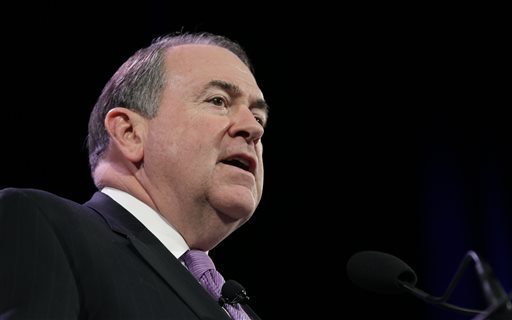
In the past coupled of days since the Supreme Court ruling legalizing Gay marriage and Marriage Equality for all, many conservative Christian leaders, especially those with lofty political aspirations have nearly come unhinged in their responses. Mike Huckabee, the Baptist preacher, seminary dropout and former Governor of Arkansas was perhaps the most ludicrous say that if need be he would call fire down from heaven in his opposition to the ruling. Others like Rick Perry and Rick Santorum have stated that they would work to overturn the decision, Ted Cruz encouraged Texas magistrates, justice of the peace, judges and others who hold government office defy the law if it violates their Christian religion; and Bobby Jindal suggested eliminating the Supreme Court. Funny how that last one works as the Supreme Court is established as one of the three branches of Government in the Constitution and Bobby, Mike, the Ricks and Ted never had a problem with 5-4 decisions that aided conservatives, but I digress…

The sad thing is that none of these men’s arguments come at all from any sense of Christian mission, but rather the raw exercise of hatred directed at a group of people they loath covered in theological gibberish.

Atticus Finch, the hero of the book and film To Kill a Mockingbird said: 

“Sometimes the Bible in the hand of one man is worse than a whisky bottle in the hand of (another)… There are just some kind of men who – who’re so busy worrying about the next world they’ve never learned to live in this one, and you can look down the street and see the results.”

Eric Hoffer wrote, “Hatred is the most accessible and comprehensive of all the unifying agents. Mass movements can rise and spread without belief in a god, but never without a belief in a devil.” We like to believe that religion is a benign or positive influence in the world. As much as I want to believe the positive aspects I have to admit based on the historical and sociological evidence that this is not so, especially during unsettled times of great change. We live in such an era and when it comes to identity and supremacy, God is the ultimate trump card and hatred in the name of God is something that many religious groups and people specialize.

This has been especially true in the lead up to and the aftermath of the Obergfell v. Hodges case that was argued at the Supreme Court regarding Gay marriage. The religious opponents of Gay marriage, in particular conservative Christians have many times resorted to the most unmitigated hatred masked in insipidly shallow theology to condemn the gays and anyone that supports them. Of course the final argument they posit is that God will punish the United States for Gay marriage.

That is fascinating. Ted Cruz called the ruling the “darkest time of American history.” Others proclaimed that God would judge the United States for this and others suggested that Christians flee the country, or that the South should again secede from the United States to form a Christian country.

Really? The darkest time Ted? I guess real oppression committed against American citizens by supposedly Christian citizens doesn’t count.

God will punish the United States for Gay marriage but not for waging unjust, illegal and immoral wars? God will punish the United States for Gay marriage, but not for the way we treat the poor? God will punish the United States for Gay marriage, but not for unabashed materialistic greed that is so condemned throughout the Christian Bible? God will judge the United States for Gay marriage but not the extermination of Native Americans and the enslavement of African Americans? God will punish the United States for Gay marriage, but not the unmitigated quest for material wealth and power that so defines the most popular churches and pastors in the country? God will punish the United States for Gay Marriage but excuse everything else?

I’m sorry these radical supposedly “Christian” politicians, pundits and preachers are the ultimate hypocrites whose hatred is only surpassed by their desire for the temporal power, which if they got it would use against any and all that oppose their theocratic tyranny.

Truthfully I find it stunning that of all the things a supposedly vengeful and just God could punish us for, that Gay marriage is the tipping point. But such is the unhinged message of the preachers, pundits and politicians of the Christian Right who believe in a capricious “God” who coincidently just happens to hate the same people that they hate, which is very convenient. But then as Annie Lamott said: “You can safely assume you’ve created God in your own image when it turns out that God hates all the same people you do.”

Of course they are not alone. In fact the most fanatical individuals and groups on earth are almost all tied to religions, whether it is the Islamic State and Al Qaeda, Boko Haram, Hezbollah, Orthodox Jews, radical Hindus and Buddhists as well as militant Christians. Of course all of these groups have different goals, but their thought and philosophy are quite similar. The fact is that for all of the, God is their trump card, end of argument as one commenter on this blog wrote yesterday “It is finished” a true heretical and blasphemous bastardization of the words of Jesus on the Cross to end his argument that God was against Gay marriage.

Robert Heinlein wrote: “Almost any sect, cult, or religion will legislate its creed into law if it acquires the political power to do so.” Heinlein, the author of the classic Starship Troopers was absolutely correct. Just look at any place in any time where any religion, sect or cult has gained control of a government. They are not loving, they are not forgiving and they use the police power of the state to persecute any individual or group that is judged to be in error, or even worse has the gall to question their authority.

Since the Christian groups tend to thrive in the West, they only speak in terms of violence, most, with the exception of Russian Orthodox Christians in Putin’s Russia do not have a government to translate those words into action. Many, especially conservative Catholics and some Evangelical and Charismatic Protestants seem for a long for the day when they can assume control of a theocratic government.

Samuel Huntington wrote in his book The Clash of Civilizations:

“People do not live by reason alone. They cannot calculate and act rationally in pursuit of their self-interest until they define their self. Interest politics presupposes identity. In times of rapid social change established identities dissolve, the self must be redefined, and new identities created. For people facing the need to determine Who am I? Where do I belong? Religion provides compelling answers….In this process people rediscover or create new historical identities. Whatever universalist goals they may have, religions give people identity by positing a basic distinction between believers and non-believers, between a superior in-group and a different and inferior out-group.”

Huntington was right, you see the true believers, those who follow their religion without question and believe that it is superior to all others also believe that their religion entitles them to be atop the food chain, others who don’t believe like them be damned, if not in this life, the next. That is the certitude of the true believer, especially the religious one. Secular or atheistic fanatics could care less about the next life, for this life is all that they have. But the religious “true believers” are not only interested in destroying someone in this life, but ensuring that in the next that they suffer for eternity, unless they believe in the annihilation of the soul after death, which really spoils the whole Dante’s Inferno perspective of the damned in the afterlife.

Eric Hoffer wrote:

“The impression somehow prevails that the true believer, particularly the religious individual, is a humble person. The truth is the surrendering and humbling of the self breed pride and arrogance. The true believer is apt to see himself as one of the chosen, the salt of the earth, the light of the world, a prince disguised in meekness, who is destined to inherit the earth and the kingdom of heaven too. He who is not of his faith is evil; he who will not listen will perish.”

That is why they, the religious true believers of any faith are capable of such great evil, and why such people can murder innocents in the most brutal manner simply because they do not believe correctly.

Please do not get me wrong. I am a Christian, a priest, a historian and a theologian, but I also know just how insidious those who hold their religion over those of others can be. While I hold faith dear, I know that it can be abused for the claim of some to have God as their final authority is a sort of trump card with which they are able to justify the most obscene and evil acts against others.

One of my heroes of religious liberty is John Leland, a Baptist whose passionate defense of religious freedom prevented Virginia from re-establishing a state church after the American Revolution and whose influence was key in the decision of Madison and Jefferson to amend the Constitution with the Bill of Rights, particularly the First Amendment. In fact, late in life, well after his success in working with Madison and Jefferson Leland wrote:

“The liberty I contend for is more than toleration. The very idea of toleration is despicable; it supposes that some have a pre-eminence above the rest to grant indulgence; whereas all should be equally free, Jews, Turks [Muslims], Pagans and Christians. Test oaths and established creeds should be avoided as the worst of evils.”

Like Leland, I contend for more than tolerance and I contend for acceptance. But that acceptance ends when any person or group is willing to use their religion to enslave, murder, or otherwise dominate other people in the name of their God, not just in this life, but in the next. This is especially true of those who use the police power of the state to enforce their beliefs and hatred on others.  I will do whatever I can to expose them for what they are, regardless of the “faith” they supposedly represent.

I guess that is why I am even more frightened of religious true believers than non-religious true believers. While the non-religious true believer may sacrifice everything for the sake of power and control in this life, and may in fact commit the most heinous crimes against humanity, their hatred is bounded in space and time to this earth. The religious true believer is not content with that; their enemies must be damned and punished in this life, but for eternity, without hope of salvation.

That is why men like Huckabee, Santorum, Jindal, Cruz, Perry and so many others like them are so dangerous for their hatred is unbounded by time, or space, it lasts for eternity, and eternity my friends is a very long time.

With that I wish you a good day, a thoughtful day and try to love someone.

Peace

Padre Steve+

6 Comments

Filed under christian life, civil rights, ethics, faith, History, laws and legislation, leadership, News and current events, Political Commentary, Religion

Dred Scott & Obergfell v. Hodges

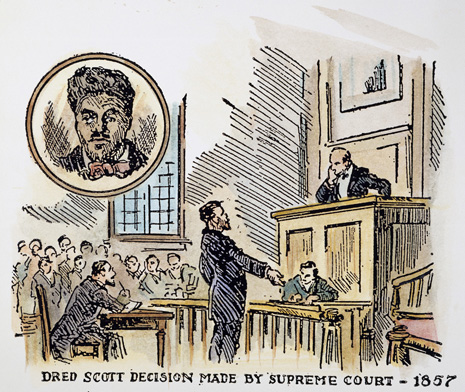
ROGER B. TANEY (1777-1864).  Roger Taney, Chief Justice of the U.S. Supreme Court, handing down his decision on the Dred Scott case, 1857. American illustration.

ROGER B. TANEY (1777-1864).
Roger Taney, Chief Justice of the U.S. Supreme Court, handing down his decision on the Dred Scott case, 1857. American illustration.

Friends of Padre Steve’s World

Court decisions on Civil Rights matter and sometime soon we will get the Supreme Court decision on the Case of Obergfell v. Hodges, the case that will determine if Marriage Equity will become the law of the land or not. Such cases are important. As I mentioned yesterday freedom for all matters and I completely agree with he words of Abraham Lincoln in regard to liberty that the words of the Declaration of Independence that “all men are created equal” is a universal standard. That it is the “the standard maxim of free society …constantly spreading and deepening its influence,” ultimately applicable “to peoples of all colors everywhere.” This should be true for all, people including the LGBTQ community. 

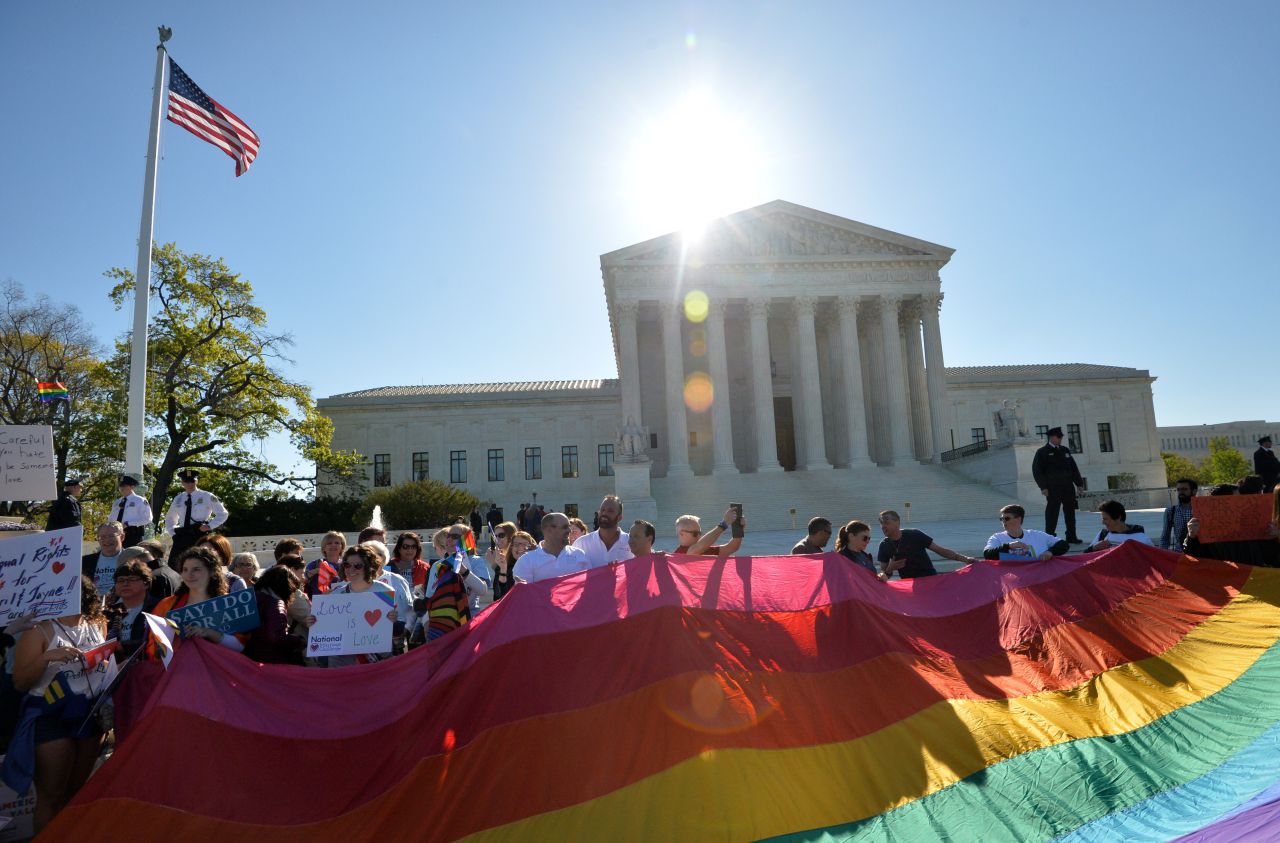
Supporters of same-sex marriages gather outside the US Supreme Court waiting for its decision on April 28, 2014 in Washington, DC. The US Supreme Court is hearing arguments on whether gay couples have a constitutional right to wed -- a potentially historic decision that could see same-sex marriage recognized nationwide.  AFP PHOTO / MLADEN ANTONOV        (Photo credit should read MLADEN ANTONOV/AFP/Getty Images)

Supporters of same-sex marriages gather outside the US Supreme Court waiting for its decision on April 28, 2014 in Washington, DC. The US Supreme Court is hearing arguments on whether gay couples have a constitutional right to wed — a potentially historic decision that could see same-sex marriage recognized nationwide. AFP PHOTO / MLADEN ANTONOV (Photo credit should read MLADEN ANTONOV/AFP/Getty Images)

Since it matters so much I am posting a section from my Civil War and Gettysburg Staff Ride text on the Dred Scott decision. If you read it you will find just how chilling and similar the arguments of the Chief Justice of the Supreme Court Roger Taney are to those who oppose Marriage Equity and other rights being extended to Gay people. 

Peace

Padre Steve+

As the 1850s wore on, the divisions over slavery became deeper and voices of moderation retreated. The trigger for the worsening of the division was the political battle regarding the expansion of slavery; even the status of free blacks in the north who were previously slaves, over whom their owners asserted their ownership. Southerners considered the network to help fugitive slaves escape to non-slave states, called the Underground Railroad “an affront to the slaveholders pride” and “anyone who helped a man or woman escape bondage was simply a thief” who had robbed them of their property and livelihood, as an “adult field hand could cost as much as $2000, the equivalent of a substantial house.” [1]

In 1856 the Supreme Court, dominated by southern Democrats ruled in favor of southern views in the Dred Scott decision, one pillar of which gave slavery the right to expand by denying to Congress the power to prohibit slavery in Federal territories. Taney’s ruling in the case insisted that “Neither the Declaration of Independence nor the Constitution had been intended to apply to blacks he said. Blacks were “so far inferior that they had no rights which the white man was bound to respect.” Taney did not stop with this but he declared the Missouri Compromise itself unconstitutional for “Congress had exceeded its authority when it forbade slavery in the territories by such legislation as the Missouri Compromise, for slaves were private property protected by the Constitution.” [2]

The decision was momentous, but the judicial fiat of Taney and his court majority was a disaster for the American people. It solved nothing and further divided the nation:

“In the South, for instance, it encouraged southern rights advocates to believe that their utmost demands were legitimatized by constitutional sanction and, therefore, to stiffen their insistence upon their “rights.” In the North, on the other hand, it strengthened a conviction that an aggressive slavocracy was conspiring to impose slavery upon the nation, and that any effort to reach an accommodation with such aggressors was futile. While strengthening the extremists, it cut the ground from under the moderates.” [3]

The decision in the case is frightening when one looks upon its tenor and implications. The majority opinion which was written by Chief Justice Roger Taney was chilling, not only in its views of race, but the fact that blacks were perpetually property without the rights of citizens. Taney wrote:

“Can a negro, whose ancestors were imported into this country, sold as slaves, become a member of the political community formed and brought into existence by the Constitution of the United States, and as such become entitled to all the rights, and privileges, and immunities, guaranteed by that instrument to the citizen?…It is absolutely certain that the African race were not included under the name of citizens of a state…and that they were not included, and were not intended to be included, under the word “citizens” in the Constitution, and therefore claim none of the rights and privileges which that instrument provides for and secures to citizens of the United States. On the contrary, they were at that time considered as a subordinate and inferior class of beings, who had been subjugated by the dominant race, and, whether emancipated or not, yet remain subject to their authority, and had no rights or privileges but those who held the power and the Government might choose to grant them” [4]

The effect of the ruling on individuals and the states was far reaching. “No territorial government in any federally administered territory had the authority to alter the status of a white citizen’s property, much less to take that property out of a citizen’s hands, without due process of law or as punishment for some crime.” [5] Free slaves were no longer safe, even in Free States, from the possibility of being returned to slavery, because they were considered property. The tens of thousands of free blacks in the South were effectively stripped of citizenship, and became vulnerable to either expulsion or re-enslavement, something that the legislatures in Virginia, North Carolina and Missouri debated in 1858. Likewise the decision cast doubt on the free status of every African American regardless of residence.” [6]

But the decision had been influenced by President-Elect James Buchanan’s secret intervention in the Supreme Court deliberations two weeks before his inauguration. Buchanan hoped by working with the Justices that he would save the Union from breaking apart by appeasing slave owners and catering to their agenda. “The president-elect wanted to know not only when, but if the Court would save the new administration and the Union from the issue of slavery in the territories. Would the judges thankfully declare the explosive subject out of bounds, for everyone who exerted federal power? The shattering question need never bother President Buchanan.” [7] In his inaugural address he attempted to camouflage his intervention and “declared that the Court’s decision, whatever it turned out to be, would settle the slavery issue forever.” [8]

But Buchanan was mistaken. The case made the situation even more volatile as it impaired “the power of Congress- a power which had remained intact to this time- to occupy the middle ground.” [9] Taney’s decision held that Congress “never had the right to limit slavery’s expansion, and that the Missouri Compromise had been null and void on the day of its formulation.” [10]

The Court’s decision “that a free negro was not a citizen and the decision that Congress could not exclude slavery from the territories were intensely repugnant to many people in the free states” [11] and it ignited a firestorm in the north where Republicans now led by Abraham Lincoln, decried the decision and southerners basked in their judicial victory. Southerners were exultant, the Richmond Enquirer wrote that the Court had destroyed “the foundation of the theory upon which their warfare has been waged against the institutions of the South.” [12] Northerners now quite rightly feared that an activist court would rule to deny their states the right to forbid slavery. As early as 1854 Lincoln posed the idea that the Declaration of Independence was the standard maxim of free society …constantly spreading and deepening its influence,” ultimately applicable “to peoples of all colors everywhere.” [13]

After the Dred Scott decision Lincoln warned that the Declaration was being cheapened and diluted, he remained insistent on this point, he noted:

“Our Declaration of Independence was held sacred by all, and thought to include all” Lincoln declared, “but now, to aid in making the bondage of the Negro universal and eternal, it is assaulted, and sneered at, and construed, and hawked at, and torn, till, its framers could ride from their graves, they could not recognize it at all.” [14]

Lincoln attacked the decision noting that Taney “insists at great length that negroes were no part of the people who made, or for whom made, the declaration of Independence or the Constitution.” But as Doris Kearns Goodwin notes “in at least five states, black voters action on the ratification of the Constitution and were among the “We the People” by whom the Constitution was ordained and established.” Lincoln acknowledged that the founders “did not declare all men equal in all respects. They did not mean to say that all were equal in color, size, intellect, moral developments, or social capacity.” But they dis declare all men “equal in ‘certain inalienable rights, among which are life, liberty, and the pursuit of happiness.’…They meant simply to declare the right, so the enforcement of it might follow as circumstances permit.” [15]

Not only that, Lincoln asked the logical question regarding Taney’s judicial activism. Lincoln and other Republican leaders “noted that all slavery needed was one more Dred Scott decision that a state could not bar slavery and the objective of Slave Power to nationalize slavery would be accomplished.” [16] How long would it be, asked Abraham Lincoln, before the Court took the next logical step and ruled explicitly that the:

“Constitution of the United States does not permit a state to exclude slavery from its limits?” How far off was the day when “we shall lie down pleasantly thinking that the people of Missouri are on the verge of making their State free; and shall awake to the reality, instead, that the Supreme Court has made Illinois a slave State?” [17]

Lincoln discussed the ramification of the ruling for blacks, both slave and free:

“to aid in making the bondage of the Negro universal and eternal….All the powers of the earth seem rapidly combining against him. Mammon is after him; ambition follows, and philosophy follows, and the theology of the day is fast joining the cry. They have him in his prison house;…One after another they have closed the heavy doors upon him…and they stand musing as to what invention, in all the dominions of mind and matter, can be produced the impossibility of his escape more complete than it is.” [18]

Frederick Douglass noted that “Judge Taney can do many things…but he cannot…change the essential nature of things – making evil good, and good, evil.” [19]

Lincoln was not wrong in his assessment of the potential effects of the Dred Scott decision on Free States. State courts in free-states made decisions on the basis of Dred Scott that bode ill for blacks and cheered slave owners. In newly admitted California the state supreme court ominously “upheld a slaveowner’s right to retain his property contrary to the state’s constitution.” [20]

A similar decision by a New York Court was being used by slave-states to bring that issue to the Taney Court following Dred Scott. “In 1852 a New York judge upheld the freedom of eight slaves who had left their Virginia owner while in New York City on their way to Texas.” [21] The Dred Scott decision brought that case, Lemon v. The People back to the fore and “Virginia decided to take the case to the highest New York court (which upheld the law in 1860) and would have undoubtedly appealed it to Taney’s Supreme Court had not secession intervened.” [22] Even non-Republican parties such as the democrats could see the writing on the wall. The national publication of the Democratic Party, the Washington Union “announced that the clear implication of the Dred Scott decision was that all state laws prohibiting a citizen from another state, either permanently or temporarily, were unconstitutional.” [23]

Notes

[1] Goodheart, Adam. Moses’ Last Exodus in The New York Times: Disunion, 106 Articles from the New York Times Opinionator: Modern Historians Revisit and Reconsider the Civil War from Lincoln’s Election to the Emancipation Proclamation Edited by Ted Widmer, Black Dog and Leventhal Publishers, New York 2013 p.15

[2] Ibid. Goodwin Team of Rivals p. 189

[3] Ibid. Potter The Impending Crisis p.291

[4] Guelzo Allen C. Fateful Lightening: A New History of the Civil War Era and Reconstruction Oxford University Press, Oxford and New York 2012 p.91

[5] Ibid. Guelzo Fateful Lightening pp.91-92

[6] Ibid. Goldfield America Aflame p.142

[7] Freehling, William. The Road to Disunion Volume II: Secessionists Triumphant 1854-1861 Oxford University Press, Oxford and New York 2007 p.115

[8] Ibid. Freehling, The Road to Disunion Volume II: Secessionists Triumphant 1854-1861 p.109

[9] Ibid. Potter The Impending Crisis p.291

[10] Ibid. Levine Half Slave and Half Free p.210

[11] Ibid. Potter The Impending Crisis p.279

[12] Ibid. Goodwin Team of Rivals p. 190

[13] Ibid. Catton Two Roads to Sumter p.139

[14] Ibid. Guelzo Fateful Lightening p.93

[15] Ibid. Goodwin Team of Rivals p. 190

[16] Gienapp, William The Republican Party and Slave Power in The Civil War and Reconstruction Documents and Essays Third Edition edited by Michael Perman and Amy Murrell Taylor Wadsworth Cengage Learning Boston MA 2011 p.81

[17] Ibid. Levine Half Slave and Half Free p.211

[18] Ibid. Catton Two Roads to Sumter p.139

[19] Ibid. Goodwin Team of Rivals p. 190

[20] Ibid. Gienapp The Republican Party and Slave Power p.81

[21] Ibid. McPherson The Battle Cry of Freedom p.181

[22] Ibid. McPherson The Battle Cry of Freedom p.181

[23] Ibid. Gienapp The Republican Party and Slave Power p.82

1 Comment

Filed under civil rights, History, laws and legislation, LGBT issues, News and current events

A Meeting of Centurions in Jerusalem

centurions

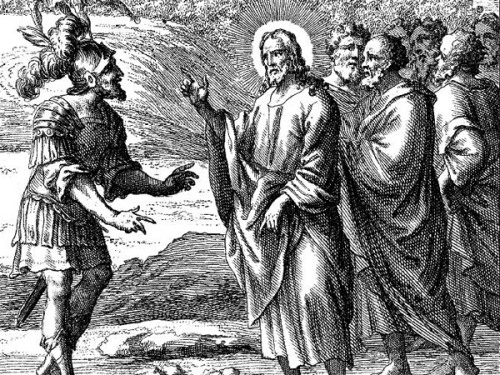
This is another part in the historical fiction series that I am wrote about the Centurion Longinus, who according to tradition was the Centurion at the Cross who put his lance in the side of Jesus and who would exclaim “Surely this was the Son of God” as Jesus breathed his last. This chapter takes up where after the Triumphant Entry of Jesus into Jerusalem and is about a meeting between Longinus and another Centurion who I call Flavius. This second character is based on the Centurion that Jesus meets in Capernaum recorded in Matthew Chapter eight. I began the first trilogy in 2012 and the second trilogy which is the prequel to the first last year as part of my Holy Week meditations. Hopefully I will to a concluding trilogy at some point imagining what things were like for these men in the years after that momentous week.  

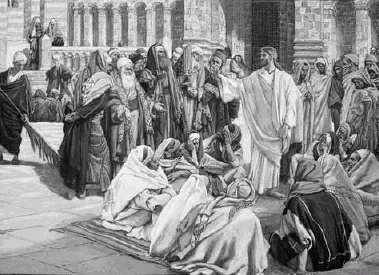
The day after the entry of this Jesus character into Jerusalem was uneventful for Longinus and his fellow Roman officers. Jesus had returned to Bethany after driving out the money changers and other assorted riff-raff out of the Temple but had returned without the tumult of the preceding day, Instead, Jesus with a number of his disciples went to the Temple where he engaged the people and some of the Pharisees in a time of teaching culminating in a series of what Longinus’ Jewish spy said were comments that could be interpreted as threats against the Temple establishment and veiled allusions to Jesus being the Messiah of the Jews.

Jesus left the Temple at the end of the day without incident but Longinus’ spy indicated that the Priests and other religious authorities were discussing ways by which they might rid themselves of this Galilean would be Messiah. Now Longinus and his fellow officers couldn’t care a whit about Jewish religious disputes so long as it did not make their job keeping the peace any more difficult than it already was.

jesus teaching

When his spy reported back Longinus briefed Pilate of the simmering tensions. Pilate was with his wife Bernice when he received the report. Pilate did not like what was going on but had no contact with any of the religious leaders from any faction since his arrival and was troubled. His wife warned him in the presence of Longinus “not to have anything to do with that man” and he told Longinus to continue monitoring the situation, He also dispatched a messenger to the commander of the Legion in Caesarea to send reinforcements to Jerusalem just in case things got out of hand. Until then, Longinus, the Primus Pilus, or senior Centurion of the Legion was to help him maintain a close watch on the situation and hopefully keep the situation from boiling over.

After his meeting with Pilate and Bernice, Longinus sat around the tavern in Fortress Antonia with several others of his officers and Centurions from the Legion currently in Jerusalem. His Optio, or second in command Decius, a Roman from his former unit who had accompanied him to Palestine was there, as were two Decurio officers from the cavalry detachment and his Tesserarius, Quentin, a man who held a position much like a First Sergeant. Late in the evening another Centurion came to the tavern. This Centurion, was accompanied by his young servant was in charge of the Century based in Capernaum in Galilee.

The Centurion, Flavius by name ordered an ale from the barkeeper and walked over to the table where Longinus and the other officers sat. After the exchange of formalities Flavius sat with them. His young servant remained at the bar sitting alone.

Longinus had known Flavius for several years and known him to be an honorable man, though he did not necessarily approve of the very “Greek” arrangement that he had with his Pais,* which was common in the Roman and Greek military units, he respected Flavius’s soldiering abilities, leadership and integrity. Flavius and his Century had arrived in Jerusalem the previous night after Jesus had made his entry into the city. Longinus was glad to see Flavius because he felt that an officer stationed in Galilee might be able to shed more light on this man of mystery who had Jerusalem up in arms and so troubled Pilate.

Flavius asked what Longinus knew about Jesus, and Longinus told him what he had seen the day before as well as the information that he had obtained from his own Jewish spy.

Flavius, nodded and then began to tell Longinus and the other officers of his encounter with Jesus a couple of years before in Capernaum of Galilee.

Flavius began: “Longinus my friend, I met this Jesus in Capernaum and he is no ordinary man.” He paused to take a drink and continued as Longinus nodded for him to continue.

“It was a difficult time my friend. My Pais was very ill, sick to the point of death, He lay in our quarters and I heard that the miracle working Rabbi named Jesus was in town. Now, you know my friends that I care not a thing about what these Jews believe but I was desperate and from what I had heard and seen I believed that the Gods had to be with this man.”

Longinus continued to listen and then asked “Why didn’t you go to our Temple and have our Gods intercede for your Pais?”

“My friend I had already done that but my Pais’ condition had worsened. So I found this Jesus fellow as he was entering the city and sent some Jews that I had befriended to him.” He paused. “Those Jews convinced Jesus that I was a friend of the Jews and had done many good things for their community, and this my friend is true.”

“So the Jews helped you contact this Jesus fellow?” asked Decius. Longinus looked at his subordinate disapprovingly and asked Flavius to continue.

“I tell you my friends, this man is like no one that I have ever met, the Gods are certainly with him, whether our Gods or the Jewish God I know not which but he is not a normal Rabbi.”

The officers looked around the table as Flavius continued.

“Gentlemen, when this Jesus came to me I felt something that I have never felt in my life. Jesus asked what he could do for me and I told him of the sickness of my Pais and he asked if he could come to my quarters. I replied that I didn’t need him to come, because I was not worthy for him to come under my roof but to only say the word and my Pais would be healed.”

centurion1

Longinus looked at his fellow Centurion in disbelief. Flavius sensing this continued. “My friend, I could not believe that I uttered those words but Jesus peered into my eyes and I knew that he knew all about me. Then he replied that “your servant is healed” and then exclaimed to all of the Jews around us that he “had not seen such faith in all of Israel.” Then, he put his hand on my shoulder, blessed me with some Hebrew blessing and walked away with his friends. When I returned to my quarters, my Pais, the young man over at the bar was well.”

Longinus saw the deep emotion that Flavius was expressing and raised his mug. “A toast to this Jesus!, whatever and whoever he he is.”

“Here here” replied those at table as Flavius looked on and several laughed. He had not expected such a reaction and said softly.

“My friends I don’t think you understand.” He paused a second and looked Longinus in the eyes. “I do hope that whatever happens in the next few days that no harm will come to this man. I would hate that my spear could bring harm to him.”

citadel

Longinus responded. “I hope that nothing happens to cause any of us any problems. The city is boiling with emotion and unlike your friend Jesus, most of them hate us and would rather see us dead, and some of their leaders from what I understand wouldn’t mind seeing him dead either.” Longinus paused and emptied his mug, drinking the ale to the last and then continued “My friend, I appreciate what you have to say, but we have to do our duty for the Empire regardless of our personal feelings. We are outnumbered here and this Jesus, as much as we may find him fascinating is the source of much of the current discord.” He looked at Flavius. “You do understand this?”

Flavius looked down at his drink and looked back up at Longinus and then at the officers around the table.

“I do understand my duty my friend, but you have to know what he did for me.”

“We do understand my friend” replied Longinus, “but our honor is loyalty to Caesar, not any other man.”

“I know Longinus, I do know, more than you think, but what if he is more than just a man?”

Longinus and the other officers sat silently pondering Flavius’s words. The silence was deafening and slowly the junior officers individually asked to be excused, begging pressing duties to attend to leaving Flavius and Longinus at the table. The bartender brought each man another ale and the two friends continued to drink in silence.

Note: The Greek word Pais is the word used in many Greek texts to to describe a homosexual relationship. The use by Matthew in his account of the healing of the servant of the Centurion used the word Pais to describe the servant, not the typical Doulos which is used for slave or bond servant as is most common throughout the New Testament. In fact this is the only use of the word Pais in the New Testament. Many Biblical scholars and linguists, though not completely certain do entertain that possibility that the Centurion that I call “Flavius” and his servant were a Gay couple. If so that would add an interesting twist of even more inclusiveness on the part of Jesus to the Gospel narratives.

Peace

Padre Steve+

Leave a comment

Filed under faith, History, Religion