Tag Archives: president george w bush

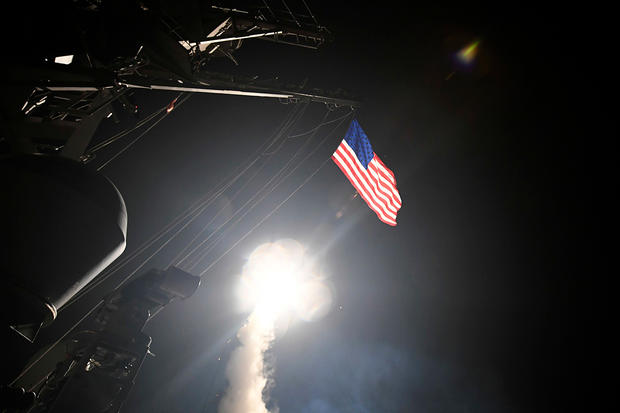
Are the Lamps Going Out Again? Trump Strikes Syria

636272575274687699-XXX-IMG-AP-TRUMP-US-SYRIA-A-1-1-H1I04JT0-90098248

Friends of Padre Steve’s World,

I knew that it was coming. I knew that despite the resistance of James Mattis and the Joint Chiefs that President Trump would hit Syria this week, especially as multiple domestic crises engulf his presidency.

I’m not going to say a lot tonight because we don’t know the full measure of the military strikes nor do we yet know the response of the Russians, Syrians, Iranians, or their Hezbollah allies will be.

That being said the U.S. policy towards Syrian has been confused and contradictory for years and that goes back to the Obama administration’s “Red Line” which turned out to be little more than empty words. However the Obama administration’s strategy to defeat ISIS by backing the Kurds and Arabs in Syria and Iraq was successful enough for President Trump to claim credit for it and then announcing that he wanted a quick withdraw from Syria, despite threats to the people that we had spent lives and treasure to protect, and no ISIS still exists and has the capability of recovering; something that it did in 2012 after the U.S. left Iraq.

I did read the President’s statement about the strikes against Syria. While he left out some details the President was telling to truth about Russia and Syria.

That being said we have to be concerned when a habitual liar involved in the midst of scandal tells the truth about something that previously he showed deep ambivalence. Dietrich Bonhoeffer wrote: “It is worse for a liar to tell the truth than for a lover of truth to lie…. There is a truth which is of Satan. Its essence is that under the semblance of truth it denies everything that is real. It lives upon hatred of the real world which is created and loved by God.” Now we wait to see what happens next; the response of the Russians, Syria, Iran, and Hezbollah, not to mention the Turks, Israelis, Saudis, Iraqis, Kurds, ISIS and others with a stake in the game.

He also failed to get consent of Congress, instead relying on the same, tired, Authorization for the Use of Force that Congress granted President Bush after September 11th 2001. While I despise Assad and his barbaric regime and wouldn’t mind him getting the full Gaddafi treatment from the people that he has persecuted for decades, and I totally oppose the Russian assistance to his criminal regime, I believe that this attack was illegal under international law and a violation of the Constitution and and American law. Congress should have been consulted and given consent in a new authorization for the use of force or a declaration of war.  Instead he ordered the strikes on his own and sadly even though what he said was correct his decision will now be regarded more in light of the swirling scandals surrounding him than the righteousness of the cause, especially when he has fought to ensure that the same people he is defending are denied entry into the United States as refugees.

As the world went to war in August 1914 “Sir Edward Grey, standing with a friend at the window as the street lamps below were being lit, made the remark that has since epitomized the hour: “The lamps are going out all over Europe; we shall not see them lit again in our lifetime.”

Until tomorrow,

Peace

Padre Steve+

1 Comment

Filed under middle east, Military, national security, News and current events, Political Commentary, War on Terrorism

The Exploitation of the Military for Political Ends: The Military as Backdrop for Presidents

Bush Mayport

Friends of Padre Steve’s World,

Every President of the television age has used the military as a background for various speeches and announcements of policy, especially in regard to war. In February 2003 I was at one of these rallies when President George W. Bush rallied us to the upcoming war against Iraq. It was a “go to war” speech and he was cheered wildly and I joined in that cheering, and after all we all knew that the Iraqis had WMD, were part of the Axis of Evil, and were aiding Al Qaeda; and we were all wrong. As a result of that decision thousands of Americans were killed, tens of thousands wounded, and uncounted thousands of Iraqis killed, wounded, or driven from their homes. The result of that war was the complete destabilization and radicalization of the Middle East.  Fifteen years after that ill-fated decision to go to war the situation in the Middle East and the world is worse than it could ever been imagined it to be then.

But that was a go to war speech, the military personnel were used as a backdrop for enunciating the reasons to go to war. We were ordered to attend and ships were positioned for the best possible propaganda effect. My ship had just come out of the yards and had too much scaffolding to be a part of the display, but our crew was assembled as part of the backdrop for the speech.

That being said President Bush never attacked any political enemies or any other Americans, nor did he call opposition to his strategy by members of the media or anyone else as treasonous or called them the enemy. Instead, Saddam Hussein was the enemy and because we believed what we had heard in the media and from others in the military we approved.

Trump_Pledges_Pay_Raise_for_Military_During_Speech

On Tuesday President Trump gave a speech to Marines at Marine Corps Air Station, Miramar in San Diego.  In his speech the President talked of his wall, pay raises for the military, a “space force,”, and pointing to the assembled members of the media attacked the “fake news.” The Marines cheered wildly, and I shook my head because I knew that at one time earlier in my life, carried on by the emotion of being in the presence of the President and a lifetime of absorbing Fox News, talk radio, and conservative internet pundits for hours on end every day I probably would have cheered with them. I did that in 2003. It took me until 2007 while I was deployed in Iraq to figure out just how wrong that I was.

President Bush deserves legitimate criticism of his decision to attack Iraq, he has to be commended for not attempting to silence or demonize his opposition. The conservative media led by Fox News and radio personalities like Rush Limbaugh did but he didn’t. But unlike President Bush, President Trump backs hostile regimes and denounces critics at home. Say what you want about him but President Bush would not have done that in a million years.

What President Trump did was to lead young Marines who are sworn to defend the Constitution into cheerleaders for his attack against the First Amendment. As the did this I looked into the Marines assembled behind him, including officers and I wondered why didn’t anyone object by at least turning their head, or remaining silent instead of cheering or taking selfies.

This is so different than the lead up to the Iraq war. President Trump has declared war against his opponents at home while refusing to condemn the actions of the Russians, and appears by his words and actions leading us to war in the Middle East against Iran and its proxies, as well as North Korea.

General Ludwig Beck who commanded the German Army in 1938 resigned his post because he believed that Hitler in his desire to destroy Czechoslovakia by military force would lead to the destruction of Germany. Beck went into the opposition and died during the failed attempt to kill Hitler and overthrow the Nazi State on July 20th 1944.

Now Beck did have his flaws. He was not a supporter of the Weimar Republic. He was Anti-Semitic, and he was at heart a Monarchist. Despite that he joined with others of various political, ideological, and religious persuasions to try to overthrow Hitler. One thing that he said has stuck with me since my return from Iraq in 2008 and when I see things like the rally at Miramar I have to ask, where were the officers who should have known better?

Beck wrote:

“It is a lack of character and insight, when a soldier in high command sees his duty and mission only in the context of his military orders without realizing that the highest responsibility is to the people of his country.” 

I have spent almost half of my Navy career assigned to the Marines or supporting them. I am a graduate of the Marine Command and Staff College and a Fleet Marine Force qualified Navy Officer. I love and admire the Marine Corps. When I came to the Navy and was serving with the Second Marine Division as it was being readied for a possible invasion of Kosovo in 1999 I was asked by Colonel Robert Neller, “Chaplain, after all those years in the Army, what do you think about the Marine Corps?” My answer was “Colonel, this is the Army that I always wanted to serve in.” Colonel Neller is now the Commandant of the Marine Corps.

But what happened Tuesday reduced the Marines in attendance to political pawns in an ideological war to destroy the Constitution and replace it with a government based on xenophobia, greed, and fear. But then how could they not be?

Polls around the world show an increasing number of young people willing to ditch democracy in favor of authoritarian government models. This applies to both left and right wing variants. This is no different in the United States. The fact is that those who are old enough to remember the tyranny of the Nazi, Fascist, Nationalist, and Racist regimes of the Second World War have for the most part passed away. Likewise it has been nearly thirty years since the end of the Cold War and its existential threat of worldwide nuclear destruction, the Iron Curtain, the enslavement of tens of millions of people behind it, and the proxy wars between United States and Soviet surrogates not to mention the Soviet invasion  of Afghanistan and the Vietnam War. In the United States  and many, if not most of these young Marines were raised in homes where they digested a steady diet of Fox News, conservative talk radio, and right-wing websites. Coupled with the unique and almost mythological culture of the Marine Corps it is not hard to understand.

The terrible thing is, that if the President that these Marines were cheering does what he has repeatedly said he would do, attack North Korea or Iran, that many of the young men and women in attendance at the rally will die or be horribly wounded, and the country that they serve will suffer greatly.

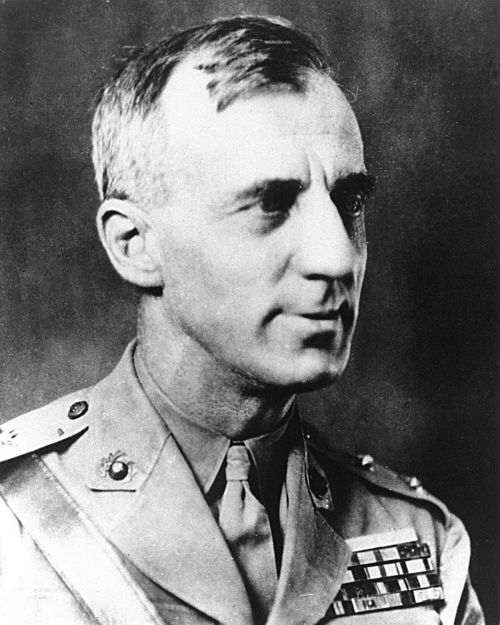
SmedleyButler.jpeg

One of the greatest Marines to ever serve this country understood all too well the threat of men like President Trump to the country and the cost of war. That man was two time Medal of Honor winner Major General Smedley Butler. Butler warned of the costs of war nationalism, and fascism. He wrote:

“What is the cost of war? what is the bill? This bill renders a horrible accounting. Newly placed gravestones. Mangled bodies. Shattered minds. Broken hearts and homes. Economic instability. Depression and all of its attendant miseries. Back -breaking taxation for generations and generations. For a great many years as a soldier I had a suspicion that war was a racket; not only until I retired to civilian life did I fully realize it….”

Butler was cashiered, threatened with court-martial, and retired by President Hoover for speaking the truth about Italian Fascist dictator Benito Mussolini. He would certainly speak the truth about President Trump. If only more veterans and military men would do so today.

Until tomorrow,

Peace,

Padre Steve+

2 Comments

Filed under ethics, History, Military, national security, News and current events, Political Commentary

Missiles and Messages: What is Trump trying to Convey?

Friends of Padre Steve’s World,

If nothing else the events of last week, in particular President Trump’s decision to launch missiles at a Syrian airbase in response to Syria’s renewed use of poison gas on its own population sent a message to different leaders around the world. What that message is and how effective that it is depends on who heard it and how they interpreted it.

The actual type of strike was nothing new and it certainly was justified in relation to war crimes of the Assad regime. President Clinton used similar strikes as punitive measures against Iraq in the 1990s, President Bush used them against various targets outside of Iraq, and opting for a full invasion of that country. While President Obama tended to be more hesitant about the missile strikes he often used Special Forces and drones in many countries pursuant to the 2001 Authorization for the Use of Force pertaining to the War on Terror, he did use missile and air strikes in conjunction with NATO to help Libyan rebels overthrow the Ghaddafi regime.

That being said what is the message that the President was attempting to send, and how does it fit into a larger foreign policy and national security strategy? That is where my concerns lie in regard to this strike. As for me I would have loved to see a Tomahawk fly up Bashir Assad’s ass and blow him to the Hell of his choice, if Ghaddafi and Saddam deserved death, then Assad deserves it many times more. It’s probably a good thing that I’m not President because I think that those 60 Tomahawks would have been much more wisely employed by taking out Assad’s Presidential Palace and maybe taking out him in the process, but there would have been a much bigger blowback to that than striking the airfield, but I digress…

Going back to what I was saying, how does this fit into a broader foreign policy and national security strategy?

The timing of the strike, minutes after the final dinner between President Trump and Chinese President Xi Jinping certainly sent a message to China and North Korea who it might have been the real audience. If the strike forces China to take stronger action to assist the United States in reducing the building North Korean nuclear threat, then it will have served a worthwhile purpose. A Chinese newspaper reported that this was the intent of the strike just yesterday.

But the effect depends on the rationality of the targeted audience. The Chinese are a rational actor, but the North Koreans may not be, so we have to wait and see. In the meantime the Administration dispatched the USS Carl Vinson carrier strike group to Korea waters to coincide with a time of the year when the North Koreans typically become more active.

There is also the possibility that the message was also intended for Putin’s Russia, the Assad regime, and even Iran, but right now other than a few statements by U.N. Ambassador Nikki Haley there has not been any real follow up to the strike. Secretary of State Tillerson is going to Moscow this week so we may glean more from that meeting.

Of course there is the domestic political audience and based on how the Trump campaign and administration has dealt with truth there is the possibility that this is much more to do about Trump’s plunging poll ratings and as a distraction from the ballooning Russia-Trump election scandals.

Regardless of what message the missile strike was intended to convey, we still don’t know how it will play out and it could play out in any number of ways, good or bad, and it might even turn out to be an act of genius, I doubt the latter but it is a possibility.

That is why the Trump and his administration must determine what its policy will be, especially its diplomatic policy. The President must keep all options on the table, diplomatic, informational, military, and economic, but he must be very judicious in how he uses them. Believe me, I can disagree with and distrust the President all day long, but I don’t want him to screw this up. Too much is at stake.

Peace

Padre Steve+

1 Comment

Filed under Foreign Policy, middle east, Military, national security, News and current events, Political Commentary

Manifest Destiny, American Exceptionalism and U.S. Foreign Policy

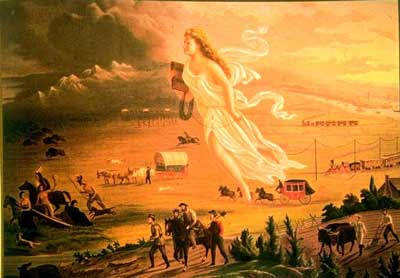
Manife4

Manifest Destiny

Friends of Padre Steve’s World,

Once again I return to the text that I am working on, Mine Eyes Have Seen the Glory: Race, Religion, and Ideology in the Civil War Era because however much we long to escape our history, it is still very much present. Have a great night.

Peace,

Padre Steve+

Manifest Destiny and American Exceptionalism

The foreign policy of the United States nearly always reflects to one degree or another a quasi-religious belief in the continued importance of the United States in spreading democracy around the world.

The United States was an anomaly among western nations in the early 1800s. During that time the percentage of people in Europe who were active churchgoers was shrinking and the number of skeptics rising as the industrial revolution, and advances in science, and the philosophies and theology of classic Liberalism permeated the elites of the continent. But in the United States, the situation was different. The Second Great Awakening helped shape and define the purpose of the nation, and by the “mid-nineteenth century, from North to South, was arguably Christendom’s most churchgoing nation, bristling with exceptionalist faith and millennial conviction.” [1] This was especially true of American Protestantism were “church attendance rose by a factor of ten over the period 1800 to 1860, comfortably outstripping population growth. Twice as many Protestants went to church at the end of this period as the beginning.” [2]

This exceptionalist faith kindled a belief in the nation’s Manifest Destiny in large part was an outgrowth of the Second Great Awakening which was particularly influential among the vast numbers of people moving into the new western territories. As people moved west, Evangelical religion came with them, often in the form of vast revival and camp meetings which would last weeks and which would be attended by tens of thousands. The first of these was at Cane Ridge Kentucky in 1801, organized by a Presbyterian others, including Baptists and Methodists joined in the preaching, and soon the revivals became a fixture of frontier life and particularly aided the growth of the Methodist and Baptists who were willing to “present the message as simply as possible, and to use preachers with little or no education,” [3] and which soon became the largest denominations in the United States. These meetings appealed to common people and emphasized emotion rather than reason. Even so the revivals “not only became the defining mark of American religion but also played a central role in the nation’s developing identity, independence, and democratic principles.” [4]

The West came to be viewed as a place where America might be reborn and “where Americans could start over again and the nation fulfill its destiny as a democratic, Protestant beacon to inspire peoples and nations. By conquering a continent with their people and ideals, Americans would conquer the world.” [5] The westward expansion satiated the need for territorial conquest and the missionary zeal to transform the country and the world in the image of Evangelical Christianity.

The man who coined the term “Manifest Destiny,” New York journalist John O’Sullivan a noted that “Manifest Destiny had ordained America to “establish on the earth the moral dignity and salvation of man,” to disseminate its principles, both religious and secular abroad,” [6] and New York Journalist Horace Greely issued the advice, “Go West, young man” which they did go, by the millions between 1800 and 1860.

But the movement also had a dark side. Americans poured westward first into the heartland of the Deep South and the Old Northwest, then across the Mississippi, fanning westward along the great rivers that formed the tributaries of the new territories. As they did so, the “population of the region west of the Appalachians grew nearly three times as fast as the original thirteen states” and “during that era a new state entered the Union on the average of three years.” [7]

The combination of nationalism fueled by Evangelical religion was combined with the idea from revolutionary times that America was a “model republic” that could redeem the people of the world from tyranny,” [8] as well an ascendant rational nationalism based on the superiority of the White Race. This, along with the belief that Catholicism was a threat to liberty was used as reason to conquer Mexico as well as to drive Native Americans from their ancestral homes. “By 1850 the white man’s diseases and wars had reduced the Indian population north of the Rio Grande to half of the estimated million who had lived there two centuries earlier. In the United States all but a few thousand Indians had been pushed west of the Mississippi.” [9] The radical racism used pseudo-scientific writings to “find biological evidence of white supremacy, “radical nationalism” cast Mexicans as an unassimilable “mixed “race “with considerable Indian and some black blood.” The War with Mexico “would not redeem them, but would hasten the day when they, like American Indians, would fade away.” [10]

Manifest Destiny and American Foreign Policy

Just as the deeply Evangelical Christian religious emphasis of Manifest Destiny helped shape American domestic policy during the movement west, it provided similar motivation and justification for America’s entry onto the world stage as a colonial power and world economic power. It undergirded United States foreign policy as the nation went from being a continental power to being an international power; claiming as Hawaii, and various former Spanish possessions in 1890s, and which would be seen again in the moralizing of Woodrow Wilson in the years leading up to America’s entry into World War One.

The belief in Manifest Destiny can still be seen in the pronouncements of American politicians, pundits, and preachers who believe that that this message is to be spread around the world. Manifest Destiny is an essential element of the idea of American Exceptionalism which often has been the justification for much recent American foreign policy, including the Freedom Agenda of former President George W. Bush. Bush referenced this during his 2003 State of the Union Address, “that freedom is the right of every person and the future of every nation. The liberty we prize is not America’s gift to the world, it is God’s gift to humanity.” [11] Bush frequently used language in his speeches in which biblical allusions were prominent in justifying the morality of his policy, and by doing this “Bush made himself a bridge between politics and religion for a large portion of his electorate, cementing their fidelity.” [12]

Throughout the Bush presidency the idea that God was directing him even meant that his faith undergirded the policy of the United States and led to a mismatch of policy ends and the means to accomplish them. Former Israeli Ambassador to the U.S. and historian Michael Oren wrote:

“Not inadvertently did Bush describe the struggle against Islamic terror as a “crusade to rid the world of evildoers.” Along with this religious zeal, however, the president espoused the secular fervor of the neoconservatives…who preached the Middle East’s redemption through democracy. The merging of the sacred and the civic missions in Bush’s mind placed him firmly in the Wilsonian tradition. But the same faith that deflected Wilson from entering hostilities in the Middle East spurred Bush in favor of war.” [13]

Policy makers and military leaders must realize that if they want to understand how culture and religious ideology drive others to conquer, subjugate and terrorize in the name of God, they first have to understand how our ancestors did the same thing. It is only when they do that that they can understand that this behavior and use of ideology for such ends is much more universal and easier to understand.

One can see the influence of Manifest Destiny abroad in a number of contexts. Many American Christians became missionaries to foreign lands, establishing churches, colleges, schools, and hospitals in their zeal to spread the Gospel. As missionaries spread across the globe, American policy makers ensured their protection through the presence of the United States Navy, and missionaries frequently called upon the United States Government for help and the naval strength of the United States during the period provided added fuel to their zeal. In 1842, Dabney Carr, the new American ambassador to the Ottoman Empire “declared his intention to protect the missionaries “to the full extent of [his] power,” if necessary “by calling on the whole of the American squadron in the Mediterranean to Beyrout.” [14] Such episodes would be repeated in the Middle East, Asia, the Pacific, and Central America over and over again until the 1920s.

The White Man’s Burden, Imperialism, Business, and Faith: Manifest Destiny and the Annexation of the Philippines

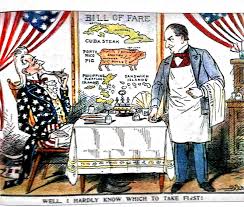
If one wants to see how the use of this compulsion to conquer in the name of God in American by a national leader one needs to go no farther than to examine the process whereby President McKinley, himself a veteran of the Civil War, decided to annex the Philippine in 1898 following the defeat of the Spanish. That war against the Filipinos that the United States had helped liberate from Spanish rule saw some of the most bloodthirsty tactics ever employed by the U.S. Army to fight the Filipino insurgents. The Filipino’s who had aided the United States in the war against Spain were now being subjugated by the American military for merely seeking an independence that they believed was their right. While the insurgency was suppressed in a violent manner and American rule was established, some Americans came to see the suppression of the Filipino’s as a stain on our national honor which of which Mark Twain wrote: “There must be two Americas: one that sets the captive free, and one that takes a once-captive’s new freedom away from him, and picks a quarrel with him with nothing to found it on; then kills him to get his land. . .” [15]

William McKinley was a cautious man, and after the United States had defeated the Spanish naval squadron at Manila Bay and wrestled with what to do with the Philippines. McKinley was a doubtless sincere believer, and according to his words, he sought counsel from God about whether he should make the decision to annex the Philippines or not. For him this was not a mere exercise, but a manifestation of his deep rooted faith which was based on Manifest Destiny. Troubled, he sought guidance, and he told a group of ministers who were vesting the White House:

“Before you go I would like to say a word about the Philippine business…. The truth is I didn’t want the Philippines, and when they came to us as a gift from the gods, I did not know what to do with them…. I sought counsel from all sides – Democrat as well as Republican – but got little help…. I walked the floor of the White House night after night until midnight; and I am not ashamed to tell you, gentlemen, that I went down on my knees and prayed Almighty God for guidance more than one night. And late one night it came to me this way – I don’t know how it was but it came….” [16]

He then went on to discuss what he supposedly heard from God, but reflected more of a calculated decision to annex the archipelago. He discussed what he believed would be an occupation of just a few islands and Manila, ruled out returning them to Spain as that would be “dishonorable,” ruled out turning them over to France or Germany because “that would be bad for business,” or allowing Filipino self-rule, as “they were unfit for self-government.” [17] The last was a reflection of the deep-rooted opinion of many Americans that the dark skinned Filipinos were “niggers.”

Barbara Tuchman described McKinley’s comments to the ministers:

“He went down on his knees, according to his own account, and “prayed to Almighty God for light and guidance.” He was accordingly guided to conclude “that there was nothing left to do for us but to take them all, and to educate the Filipinos. And uplift and civilize and Christianize them, by God’s grace to do the very best we could by them, as our fellowmen for whom Christ died.” [18]

But the result, regardless of whether McKinley heard the voice of God, or took the advice of advisers with imperialist, business, or religious views, he made the choice to annex the Philippines, believing it to be the only rational course of action, and something that he could not avoid. In a sense McKinley, of who Barbara Tuchman wrote “was a man made to be managed,” and who was considered spineless by Speaker of the House Thomas Reed who said “McKinley has no more backbone than a chocolate éclair.” [19] It appears that McKinley was more convinced by the arguments of those who desired to annex the Philippines for military reasons, a business community which saw the islands as a gateway to the markets of Asia, and by Protestant clergy, who saw “a possible enlargement of missionary opportunities.” [20] He rejected a proposal by Carl Schurz who urged McKinley to “turn over the Philippines as a mandate to a small power, such as Belgium or Holland, so the United States could remain “the great neutral power in the world.” [21]The combination of men who desired the United States to become an imperialist and naval power, business, and religion turned out to be more than McKinley could resist, as “the taste of empire was on the lips of politicians and business interests throughout the country. Racism, paternalism, and the talk of money mingled with the talk of destiny.” [22] Though there was much resistance to the annexation in congress and in the electorate, much of which was led by William Jennings Bryant, but which crumbled when Bryant with his eyes on the Presidency embraced imperialism.

The sense of righteousness and destiny was encouraged by magazine publisher S.S. McClure, who published a poem by Rudyard Kipling addressed to Americans debating the issue entitled The White Man’s Burden:

Take up the White Man’s burden–
Send forth the best ye breed–
Go bind your sons to exile
To serve your captives’ need;
To wait in heavy harness,
On fluttered folk and wild–
Your new-caught, sullen peoples,
Half-devil and half-child…

Take up the White Man’s burden–
The savage wars of peace–
Fill full the mouth of Famine
And bid the sickness cease…

Take up the White Man’s burden–
Ye dare not stoop to less–
Nor call too loud on Freedom
To
cloke your weariness;
By all ye cry or whisper,
By all ye leave or do,
The silent, sullen peoples
Shall weigh your gods and you…
[23]

McKinley’s decision and the passage of the peace treaty with Spain to acquire the Philippines sparked an insurrection led by Filipino revolutionary Emilio Aguinaldo who had been leading resistance to Spanish rule on the island of Luzon for several years prior to the American defeat of Spanish naval forces at the Battle of Manila Bay, and the subsequent occupation of Manila. The following war lasted nearly three years and was marked by numerous atrocities committed by American forces against often defenseless civilians and it would help to change the nature of the country. After American troops captured Manila, Walter Hines Page, the editor of the Atlantic Monthly believed that Americans would face greater challenges and difficulties in the coming years than they had known in previous years. He wrote:

“A change in our national policy may change our very character… and we are now playing with the great forces that may shape the future of the world – almost before we know it…. Before we knew the meaning of foreign possessions in a world ever growing more jealous, we have found ourselves the captors of islands in both great oceans; and from our home staying policy of yesterday we are brought face to face with world-wide forces in Asia as well as Europe, which seem to be working, by the opening of the Orient, for one of the greatest challenges in human history…. And to nobody has the change come more unexpectedly than ourselves. Has it come without our knowing the meaning of it?” [24]

Within the span of a few months, America had gone from a nation of shopkeepers to an imperial power, and most people did not realize the consequences of that shift. Manifest destiny and American Exceptionalism had triumphed and with it a new day dawned, where subsequent generations of leaders would invoke America’s mission to spread freedom and democracy around the world, as President George W. Bush said, “that freedom is the right of every person and the future of every nation. The liberty we prize is not America’s gift to the world, it is God’s gift to humanity.”

Notes

[1] Ibid. Phillips American Theocracy: The Peril and Politics of Radical Religion, Oil and Borrowed Money in the 21st Century p.143

[2] McGrath, Alister Christianity’s Dangerous Idea: The Protestant Revolution A History from the Sixteenth Century to the Twenty-First Harper Collins Publishers, New York 2007 p.164

[3] Gonzalez, Justo L. The History of Christianity Volume 2: The Reformation to the Present Day Harper and Row Publishers San Francisco 1985 p.246

[4] Ibid. McGrath Christianity’s Dangerous Idea: The Protestant Revolution A History from the Sixteenth Century to the Twenty-First p.164

[5] Goldfield, David America Aflame: How the Civil War Created a Nation Bloomsbury Press, New York, London New Delhi and Sidney 2011 p.5

[6] Ibid. Oren Power, Faith and Fantasy: America and the Middle East 1776 to the Present p130

[7] McPherson, James. The Battle Cry of Freedom: The Civil War Era Oxford University Press, Oxford and New York 1988 p.42

[8] Varon, Elizabeth R. Disunion! The Coming of the American Civil War 1789-1858 University of North Carolina Press, Chapel Hill NC 2008 p.183

[9] Ibid. McPherson The Battle Cry of Freedom: The Civil War Era p,45

[10] Ibid. Varon. Disunion! The Coming of the American Civil War 1789-1858 p.183

[11] Bush, George W. State of the Union Address Washington D.C. January 28th 2003 retrieved from Presidential Rhetoric.com http://www.presidentialrhetoric.com/speeches/01.28.03.html 10 June 2015

[12] Ibid. Phillips American Theocracy: The Peril and Politics of Radical Religion, Oil and Borrowed Money in the 21st Century p.252

[13] Oren, Michael Power, Faith and Fantasy: America and the Middle East 1776 to the Present W.W. Norton and Company, New York and London 2007 p.584

[14] Ibid. Oren Power, Faith and Fantasy: America and the Middle East 1776 to the Present p130

[15] Twain, Mark To the Person Sitting in Darkness February 1901 Retrieved from The World of 1898: The Spanish American War The Library of Congress http://www.loc.gov/rr/hispanic/1898/twain.html 12 December 2014

[16] Zinn, Howard A People’s History of the United States Harper Perennial, New York 1999 pp.312-313

[17] Ibid. Zinn A People’s History of the United States p.313

[18] Ibid. Tuchman Practicing History p.289

[19] Tuchman, Barbara The Proud Tower: A Portrait of the World Before the War, 1890-1914 Random House Trade Paperbacks Edition, New York 2008 originally published 1966 by McMillan Company. Amazon Kindle edition location 2807 of 10746

[20] Hofstadter, Richard The Paranoid Style in American Politics Vintage Books a Division of Random House, New York 1952 and 2008 p167

[21] Ibid. Tuchman The Proud Tower: A Portrait of the World Before the War, 1890-1914 location 3098 of 10746

[22] Ibid. Zinn A People’s History of the United States p.313

[23] Kipling, Rudyard “The White Man’s Burden: The United States and the Philippine Islands” 1899 retrieved from https://public.wsu.edu/~brians/world_civ/worldcivreader/world_civ_reader_2/kipling.html 6 August 2016

[24] Ibid. Hofstadter The Paranoid Style in American Politics pp.183-184

1 Comment

Filed under Foreign Policy, History, middle east

The Lamps are Going Out: Paris & the End of the Illusion of Peace

Lamplighter

Friends of Padre Steve’s World,

It is barely a day and a half after the massacre committed by Islamic terrorists in Paris, and the shock is still being felt around the world. In watching the images and listening to the words of various leaders I feel that something has changed; that the illusion of peace that we have lived under, has been shattered.

sKLhhPT

In two weeks the self-proclaimed Islamic State has claimed credit for the downing of a Russian airliner over the Sinai Peninsula, an attack in Beirut Lebanon, and, on Friday night the horrific series of attacks in Paris. The combined death toll for the three attacks is close to 400, almost all of who were innocent civilians doing nothing more than going about their daily lives. Hundreds more were wounded in Beirut and Paris. ISIL has promised to conduct more attacks on all nations that oppose them in Syria and Iraq. The attacks have awakened people to the fact that ISIL is not just a threat to the Middle East, but around the world.

Some are now calling this war, and in fact it is, a war that most of us have ignored though it has been going on for over two decades. But in just two weeks, the hybrid terrorist state known as ISIL has changed the course of that war. The war as we know it began in the years after the First Gulf War as young Saudis returning from Afghanistan, led by Osama Bin Laden took up arms against the “infidel” Americans based in Saudi Arabia. In the 1990s the terrorism was confined to Al Qaeda attacks throughout the Middle East, and included attacks on American military personnel, installations, and ships. Then on September 11th 2001 Al Qaeda changed the narrative by attacking the United States, killing nearly 3000 people at the World Trade Center, the Pentagon, and aboard four airliners. The United States responded by going after Al Qaeda and its supporters in Afghanistan.

Had the American response been contained to that action, the war might have taken a different course, and we might not be here today. But within months of 9-11 the Bush Administration began planning to attack Saddam Hussein’s Iraq and propagandizing the American people to support it, with or without allied or United Nations sanction. The operation to topple Saddam opened Pandora’s box, and who knows when we will ever live in peace again. Twelve years after President Bush announced the end operations in Iraq aboard the USS Abraham Lincoln with a banner that boldly proclaimed, “Mission Accomplished” behind him, the war that he unleashed in Iraq has spread in ways that even the most pessimistic critics of Bush did not predict.

With the war now entering an even more troubling and dangerous phase we should remind ourselves of the words of Winston Churchill, “Never, never, never believe any war will be smooth and easy, or that anyone who embarks on the strange voyage can measure the tides and hurricanes he will encounter. The statesman who yields to war fever must realize that once the signal is given, he is no longer the master of policy but the slave of unforeseeable and uncontrollable events…. Always remember, however sure you are that you could easily win, that there would not be a war if the other man did not think he also had a chance.”

As I observe events on I am reminded of Barbara Tuchman’s description of Sir Edward Gray on the eve of the First World War, “Watching with his failing eyes, the lamps being lit in St. James Park, Grey was heard to remark that “the lamps are going out all over Europe; we shall not see them again in our lifetime.”

Sadly, I do believe that the last lamps of peace are going out around the world in the fight against the Islamic State. I have no idea when, how, or even if this conflict will end.

Praying for peace,

Padre Steve+

7 Comments

Filed under Foreign Policy, History, iraq,afghanistan, middle east, News and current events, Political Commentary, terrorism

ISIL, the Caliphate and Manifest Destiny: Two sides of the Same Coin

Friends of Padre Steve’s World

Today another section of my Gettysburg Staff Ride text, taken from the second introductory chapter which deals with how religion and ideology plays a huge role in conflict and how it was used during the American Civil War.  This section discusses how a people’s worldview is strongly linked to culture and religion. It deals with the rather uncomfortable truth that the Islamic concept of the Caliphate differs little from the American idea of Manifest Destiny, a concept which may have created our nation as we know it but in practice was as barbaric and dishonorable as nearly conquering power has ever done, in fact there are many on the political right in this country, especially the Christian Right who are apologists for what occurred in the past and who advocate more of the same now. 

This might be an uncomfortable read for some people, and I hope that is the case. Of course in no way am I condoning anything that the Islamic State is doing in its quest to create a Caliphate, that needs to be condemned and fought wherever possible, preferably by the people most affected by it, the Arabs. 

But the truth is, religiously based imperialism, be it Manifest Destiny or the Islamic State’s dream of a Caliphate are two sides of the same coin of evil. 

So with that I bid you a happy Friday.

Peace

Padre Steve+ 

Manife4

One can never separate war and the means by which it is fought from its political ends. According to Clausewitz, war is an extension or continuation of politics. Of course Clausewitz understood the term politics or policy in the light of the concept of a “World View” or to use the German term Weltanschauung. The term is not limited to doctrine or party politics, but it encompasses the worldview of a people or culture. The world view is oft used by the political, media and religious leadership of countries and can be quite instrumental in the decision by a people to go to war; who they war against, their reasons for going to war, the means by which they fight the war, and the end state that they envision. This concept includes racial, religious, cultural, economic and social dimensions of a worldview.

One of the problems that modern Americans and Western Europeans have is that we tend to look at the world, particularly in terms of politics and policy, be it foreign or domestic, through a prism from which we cannot see the forest for the trees. We look at individual components of issues such as economic factors, military capabilities, existing political systems, diplomatic considerations and the way societies get information in isolation from each other. We dissect them, we analyze them, and we do a very good job in examining and evaluating each individual component; but we often do this without understanding the world view and ideological factors that link how a particular people, nation or party understand these components of policy.

Likewise policy makers tend to take any information they receive and interpret it through their own worldview. This is true even if they have no idea what their world-view is or how they came to it. Most often a worldview is absorbed over years. Barbara Tuchman wrote “When information is relayed to policy-makers, they respond in terms of what is already inside their heads and consequently make policy less to fit the facts than to fit the notions and intentions formed out of the mental baggage that has accumulated in their minds since childhood.” [1]

Policy makers often fail to see just how interconnected the most primal elements of the human experience are to the worldview of others as well as their own.

Because of this, many policy makers, be they military or civilian do not understand how critical the understanding of worldview is to designing effective polices. Likewise, many fail to see how the world view of others influence their application of economic, political, diplomatic and military power as well as the use and dissemination of information in their nation or culture. This is true no matter which religion or sect is involved, even if a people or nation is decidedly secular, or at least outwardly non-religious.

Perhaps this is because we do not want to admit that our Western culture itself is very much a product of primal religious beliefs which informed politics, philosophy, ethics, law, economics, views of race, and even the arts for nearly two millennia. Perhaps it is because we are justifiably appalled and maybe even embarrassed at the excesses and brutality of our ancestors in using religion to incite the faithful to war; to use race and religion justification to subjugate or exterminate peoples that they found to be less than human; or to punish and conquer heretics.

The United States Military made a belated attempt to address ideology, culture and religion in terms of counter-insurgency doctrine when it published the U.S. Army/Marine Counterinsurgency Manual. The discussion of these issues is limited to two pages that specifically deal with various extreme Moslem groups that use that religion as a pillar of their ideology, strategy and operations. But the analysis in the counterinsurgency manual of is limited because its focus is very general and focused at a tactical level.

Likewise the analysis of world view, ideology and religion in the counterinsurgency manual is done in an “us versus them” manner. While the manual encourages leaders to attempt to understand the cultural differences there is little in it to help leaders to understand why this understanding of religion and ideology is important at the strategic and operational levels of war.

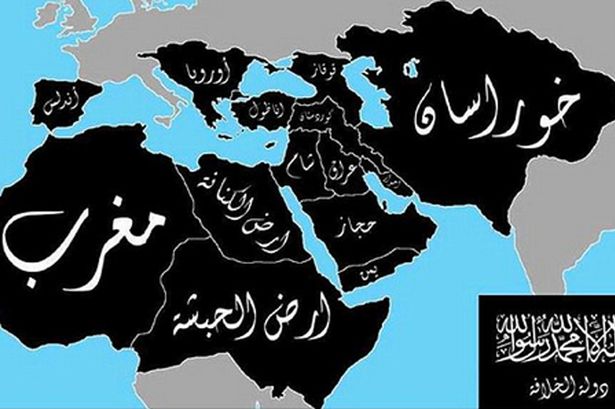
ISIS-MAP

Commendably, the manual discusses how terrorist and insurgent groups use ideology, which is frequently based on religion to create a narrative. The narrative often involves a significant amount of myth presented as history, both Al Qaida and ISIL use the idea of the Caliphate as a religious and political ideal to achieve, because for many Moslems the idea of the Caliphate “produces a positive image of the golden age of Islamic civilization.” [2]

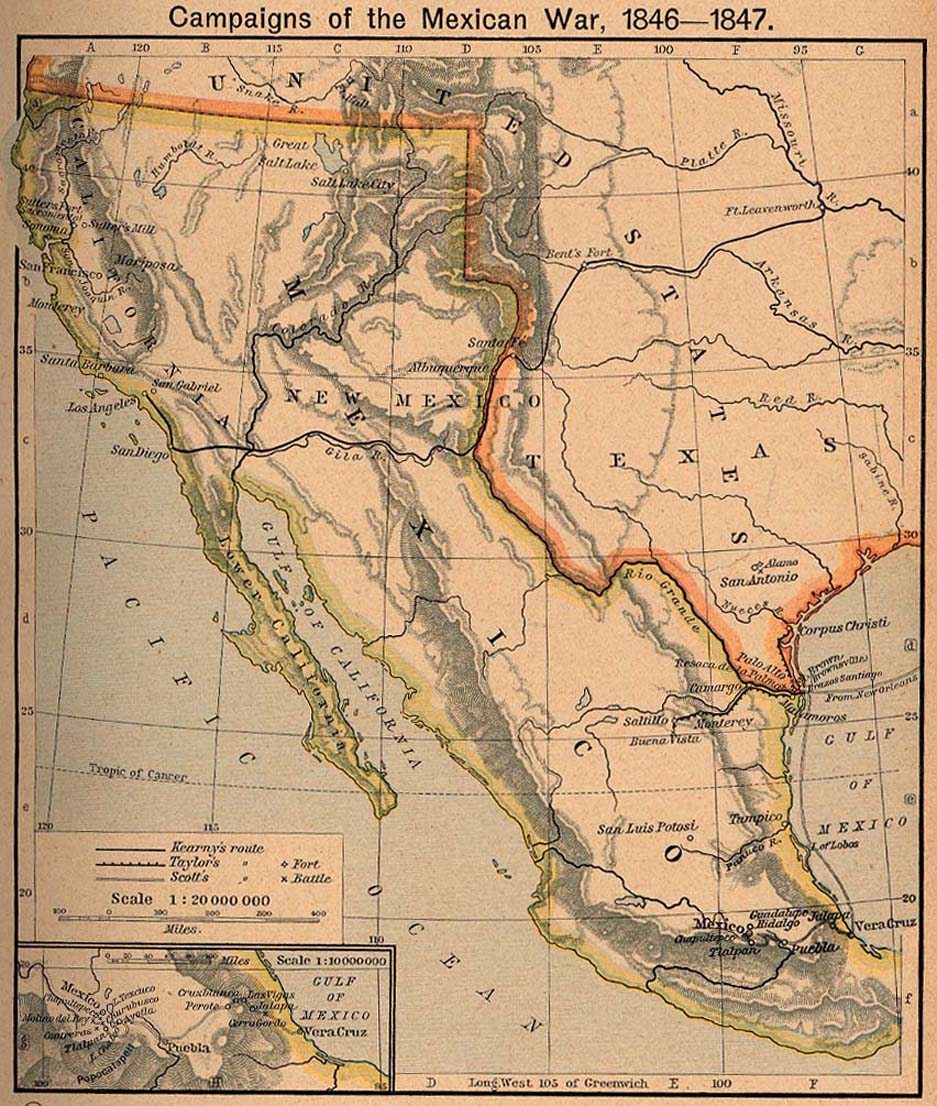
But Islam is not the only religion to do this. Most Americans are blind as to how previous generations Americans have used the Christian religion and race as a theological tool to justify subjugating other peoples and how that impacts us today. Beginning with the “landing of the Mayflower Pilgrims, the notion that the British colonies in the New World had been founded with divine assistance, in order to fulfill a providential mission, was commonly accepted.[3] The idea that it was God’s will for White Protestant settlers to push west, conquer and settle the continent of North America crystalized in the term Manifest Destiny. This concept was what motivated Americans to move into lands claimed by Britain as well as those which belonged to Mexico. The fact that the lands belong to other nations “was a small matter…Because most Americans considered it their “manifest destiny” to absorb these regions into the United States.” [4] There was a hunger in the land for more and Congressman John L. O’Sullivan, the inventor of the phrase proclaimed “Yes, more, more, more!….More…till our national destiny is fulfilled and…the whole boundless continent is ours.” [5]

mex_war_cam_1846_1847

The issue came to a head when American settlers moved into Mexican territory in what is not Texas. The Mexican government allowed the settlers on the provision that they would become Catholic and swear allegiance to Mexico. The settlers did this but had no intention of honoring their word for they believed that their race and the Protestant religion they had denied to settle in Mexico “made them naturally superior to the mestizos – people of mixed Indian and European blood – who governed in the name of Mexico.” [6] This caused serious issues. Especially when the settlers, many of who were Southerners refused to give up their slaves when Mexico abolished slavery in 1829. The American colonists disregarded every agreement they had made with the Mexican government, they flouted the Catholic Church, and they refused to learn Spanish and refused to obey Mexican law. Eventually “their numbers dwarfed the tiny Mexican population of Texas.” [7]

One of the most prominent of the early settlers, Stephen Austin declared “for fifteen years, I have been laboring to Americanize Texas” noting that his enemies were a “population of Indians, Mexican and renegados, all mixed together, and all the natural enemies of white men and civilization.” [8] Eventually General Santa Anna attempted to seal the border between Texas and Louisiana to forestall the movement of any new settlers into the territory, but the move backfired and the Texans revolted and in the ensuing war secured their independence. The agreement pledged that Texas would remain an independent nation and not become part of the United States, but this agreement was broken as well and in 1845 Texas was admitted to the Union as a Slave State, furthering the cries of those advocating Manifest destiny for more. One Congressman asserted that:

“When God crowned American arms with success in the Revolution…he had not “designed the original States should be the only abode of liberty on earth. On the contrary, He only designed them as the great center from which civilization, religion, and liberty should radiate and radiate until the whole continent shall bask in their blessing.” [9]

The year after Texas joined the Union the administration of President James K. Polk provoked a war with Mexico which secured most of the rest of what we now know as the United States. In the process the Americans decided to violate treaties they had made with Native American tribes, and the “manifest destiny that represent hope for white Americans thus spelled doom for red Americans,” [10] and through war and disease the Americans decimated the Indian populations over the next fifty years.

A few voices were raised against the war with Mexico, former President John Quincy Adams said in the House of Representatives that in a war with Mexico “the banners of freedom will be the banners of Mexico; and your banners, I blush to speak the word, will be the banners of slavery.” [11] Abraham Lincoln doomed his reelection prospects in 1848 by condemn the war and criticizing President Polk. Alexander Stephens, a Southern Whig and later Vice President of the Confederacy assailed the President:

“The principle of waging war against a neighboring people to compel them to sale their country, is not only dishonorable, but disgraceful and infamous. What. Shall it be said that American honor aims at nothing higher than land…..never did I expect to live to see the day when the Executive of this country should announce that our honor was such a loathsome, beastly thing, that it could be satisfied with any achievements in arms, however brilliant and glorious, but must feed on the earth – gross, vile, dirt!” [12]

Walt Whitman prophetically noted that “the United States may conquer Mexico, but it will be as the man who swallows arsenic, which brings him down in turn. Mexico will poison us.” [13] Whitman would be proven right as it was the territorial acquisitions gained in the war with Mexico which lit the fuse which ignited the Civil War.

images-4

The deeply Christian and imperialist civil-religious concept of Manifest Destiny of can still be seen in pronouncements of some politicians, pundits and preachers who believe that that this is America’s mission in the world. Manifest Destiny is an essential element of the idea of American Exceptionalism which often has been the justification for much American foreign policy from the time of President McKinley. Former President George W. Bush alluded to this in his 2003 State of the Union Address, “that freedom is the right of every person and the future of every nation. The liberty we prize is not America’s gift to the world, it is God’s gift to humanity.” [14] Throughout the Bush presidency the idea that God undergirded the policy of the United States led to a mismatch of policy ends and the means to accomplish them. Former Israeli Ambassador to the U.S. and historian Michael Oren wrote:

“Not inadvertently did Bush describe the struggle against Islamic terror as a “crusade to rid the world of evildoers.” Along with this religious zeal, however, the president espoused the secular fervor of the neoconservatives…who preached the Middle East’s redemption through democracy. The merging of the sacred and the civic missions in Bush’s mind placed him firmly in the Wilsonian tradition. But the same faith that deflected Wilson from entering hostilities in the Middle East spurred Bush in favor of war.” [15]

Policy makers and military leaders must realize that if they want to understand how culture and religious ideology drive others to conquer, subjugate and terrorize in the name of God, they first have to understand how our ancestors did the same thing. It is only when they do that that they can understand that this behavior and use of ideology for such ends is much more universal and easier to understand.

If one wants to see how the use of this compulsion to conquer in the name of God in American by a national leader one needs to go no farther than to examine the process whereby President McKinley, himself a veteran of the Civil War, decided to annex the Philippine in 1898 following the defeat of the Spanish. That war against the Filipinos that we had helped liberate from Spanish rule saw some of the most bloodthirsty tactics employed in fighting the Filipino insurgents, who merely wanted independence. It was a stain on our national honor which of which Mark Twain wrote: “There must be two Americas: one that sets the captive free, and one that takes a once-captive’s new freedom away from him, and picks a quarrel with him with nothing to found it on; then kills him to get his land. . .” [16]

A doubtlessly sincere McKinley sought counsel from God about whether he should annex the Philippines or not.

“He went down on his knees, according to his own account, and “prayed to Almighty God for light and guidance.” He was accordingly guided to conclude “that there was nothing left to do for us but to take them all, and to educate the Filipinos. And uplift and civilize and Christianize them, by God’s grace to do the very best we could by them, as our fellowmen for whom Christ died.” [17]

On the positive side the counterinsurgency manual does mention how “Ideology provides a prism, including a vocabulary and analytical categories, through which followers perceive their situation.” [18] But again it does so at a micro-level and the lessons of it are not applied at the higher levels of strategic thinking and policy. This is often due to the fact that American and other Western policy makers “as a set of theological issues rather than as a profoundly political influence in public life.” [19] Even after nearly a decade and a half of unremitting war against enemies for whom religion is at the center of their politics policy makers still misread or neglect the importance of religion and religiously based ideology in the political motivations of their opponents. In many cases the religion of a people is stronger part of their identity than that of the state. Nations which were created during the post-colonial era “continue to see religion, clan, ethnicity, and other such factors as the markers of community identity.” [20]

Thus when faced with cultures for which religion provides the adhesive which binds each of these elements, such as the Islamic State or ISIL we attempt to deal with each element separately, as if they have no connection to each other. But that is where we err, for even if the religious cause or belief has little grounding in fact, science or logic, and may be the result of a culture’s attempt to seize upon mythology to build a new reality, it is, in the words of Reggie Jackson the “straw that stirs the drink” and to ignore or minimize it is to doom our efforts to combat its proponents.

Perhaps that is because people do not like to look at themselves and their own history in the mirror. People tend to be uncomfortable when the face that they see in the mirror is face too similar to those they oppose, especially those who are perfectly willing to commit genocide in the name of their God. It really does not matter if one holds a predominantly secularist worldview and lives a secular lifestyle, or if one is religious yet embarrassed by the religiously motivated criminal actions of their forefathers, the result is strikingly and tragically similar; it makes them blind to the religious motivations of others and causes them to misread events in often tragic ways.

Notes

[1] Tuchman, Barbara W. Practicing History Alfred A. Knopf, New Your 1981 p.289

[2] ___________ U.S. Army/ Marine Counterinsurgency Field Manual FM 3-24 MCWP 3-33.5 15 December 2006 with and forward by General David A Petraeus and General James Amos, Konecky and Konecky, Old Saybrook CT 2007 p.26

[3] Gonzalez, Justo L. The History of Christianity Volume 2: The Reformation to the Present Day Harper and Row Publishers San Francisco 1985 p.246

[4] McPherson, James. The Battle Cry of Freedom: The Civil War Era Oxford University Press, Oxford and New York 1988 p.42

[5] Ibid. McPherson The Battle Cry of Freedom p.48

[6] Ibid. Gonzales The History of Christianity Volume 2 p.248

[7] Guelzo Allen C. Fateful Lightening: A New History of the Civil War Era and Reconstruction Oxford University Press, Oxford and New York 2012 p.59

[8] Ibid. Gonzales The History of Christianity Volume 2 p.248

[9] Ibid. McPherson The Battle Cry of Freedom p.48

[10] Ibid. McPherson The Battle Cry of Freedom p.48

[11] Ibid. Gonzales The History of Christianity Volume 2 p.249

[12] Ibid. Guelzo Fateful Lightening: p.63

[13] Ibid. McPherson The Battle Cry of Freedom p.51

[14] Bush, George W. State of the Union Address Washington D.C. January 28th 2003 retrieved from Presidential Rhetoric.com http://www.presidentialrhetoric.com/speeches/01.28.03.html 10 June 2015

[15] Oren, Michael Power, Faith and Fantasy: America and the Middle East 1776 to the Present W.W. Norton and Company, New York and London 2007 p.584

[16] Twain, Mark To the Person Sitting in Darkness February 1901 Retrieved from The World of 1898: The Spanish American War The Library of Congress http://www.loc.gov/rr/hispanic/1898/twain.html 12 December 2014

[17] Ibid. Tuchman Practicing History p.289

[18] Ibid. U.S. Army/ Marine Counterinsurgency Field Manual p.27

[19] Rubin, Barry Religion in International Affairs in Religion: The Missing Dimension of Statecraft Oxford University Press, Oxford and New York 1994 p.20

[20] Ibid. Rubin Religion in International Affairs p.22

2 Comments

Filed under civil war, History, middle east, national security, News and current events, Political Commentary, Religion

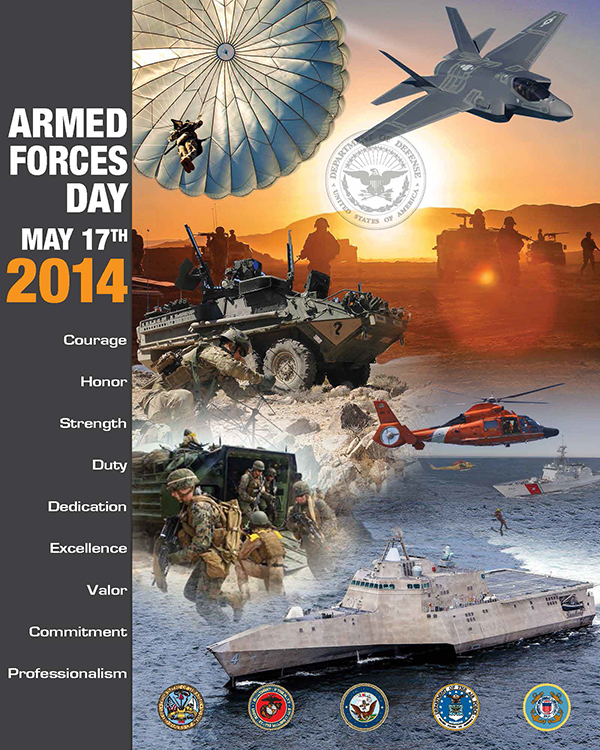
Counting the Cost: Reflections on Armed Forces Day 2014

Event-Armed-Forces-Day-poster-2014

“What is the cost of war? what is the bill?…“This bill renders a horrible accounting. Newly placed gravestones. Mangled bodies. Shattered minds. Broken hearts and homes. Economic instability. Depression and all of its attendant miseries. Back -breaking taxation for generations and generations. For a great many years as a soldier I had a suspicion that war was a racket; not only until I retired to civilian life did I fully realize it….” Major General Smedley Butler USMC

Today is Armed Forces Day and unfortunately most of the country will not notice unless they are attending a Baseball game where it is being observed or some special event on a base, national cemetery, monument or VFW hall.

There are also a fair number of local celebrations to honor members of the Armed Forces across the country but for the most part they are small and not well publicized. As a career officer and son of a Vietnam veteran Navy Chief I appreciate those events and the people that put them together. Being a veteran of Operation Iraqi Freedom and Operation Enduring Freedom, especially those that have taken the time to honor Iraq and Afghanistan veterans.

At any given time less than 1% of Americans are serving in all components of the military. For over 10 years we have been at war in Afghanistan and Iraq as well as other locations that we don’t like to talk about too much. However this has not been the effort of a nation at war, it is the war of a tiny percentage of the population.

As a nation we are disconnected from the military and the wars that the military fights. The fact is that most Americans do not have a personal or vested interest in these wars, they have been insulated by political leaders of both parties from them. There is no draft, and no taxes were raised to fund the wars and the military is now worn out.

We have been at war for nearly 14 years and truthfully there is no end in sight. In that time every single Soldier, Sailor, Marine and Airman volunteered for duty or reenlisted during this time period. Motives may have varied from individual to individual, but unlike the World Wars, Korea and Vietnam every single one volunteered to serve in time of war. I think that this makes the current generation of veterans quite unique, we are no longer a military composed of citizen soldiers we are now, even our reserve components a Warrior caste, set apart from the society that we serve.

There is a tragic disconnection between the military and civilian society in the United States. This is the result of deliberate public policy since the end of the Vietnam War supported by both political parties. For almost 40 years we have relied on an all volunteer force. It is that relatively small and socially isolated military which is sent to fight wars while the bulk of the population is uninvolved and corporations, lobbyists and think tanks get rich.

Andrew Bacevich wrote in his new book Breach of Trust: How Americans failed their Soldiers and their Country:

“Rather than offering an antidote to problems, the military system centered on the all-volunteer force bred and exacerbated them. It underwrote recklessness in the formulation of policy and thereby resulted in needless, costly, and ill-managed wars. At home, the perpetuation of this system violated simple standards of fairness and undermined authentic democratic practice. The way a nation wages war—the role allotted to the people in defending the country and the purposes for which it fights—testifies to the actual character of its political system. Designed to serve as an instrument of global interventionism (or imperial policing), America’s professional army has proven to be astonishingly durable, if also astonishingly expensive. Yet when dispatched to Iraq and Afghanistan, it has proven incapable of winning. With victory beyond reach, the ostensible imperatives of U.S. security have consigned the nation’s warrior elite to something akin to perpetual war.”

Bacevich, a retired Army Colonel and Vietnam veteran who lost a son in Iraq is dead on, as is Rachel Maddow who wrote in her outstanding book Drift: The Unmooring of American Military Power:

“The reason the founders chafed at the idea of an American standing army and vested the power of war making in the cumbersome legislature was not to disadvantage us against future enemies, but to disincline us toward war as a general matter… With citizen-soldiers, with the certainty of a vigorous political debate over the use of a military subject to politicians’ control, the idea was for us to feel it- uncomfortably- every second we were at war. But after a generation or two of shedding the deliberate political encumbrances to war that they left us… war making has become almost an autonomous function of the American state. It never stops.” 

The lobbyists, pundits, politicians and preachers that promote war don’t care about the troops. This is because no matter who is in office or who controls congress these people and corporations will promote policies that keep them employed and their businesses enriched. Marine Major General and Medal of Honor winner Smedley Butler was quite right when he said:

“War is a racket. It always has been. It is possibly the oldest, easily the most, surely the most vicious. It is the only one international in scope. It is the only one in which the profits are reckoned in dollars and the losses in lives. A racket is best described, I believe, as something that is not what it seems to the majority of the people. Only a small ‘inside’ group knows what it is about. It is conducted for the benefit of the very few, at the expense of the very many. Out of war a few people make huge fortunes.”

I think that the reason that our current wars have gone on so long is the that misguided policies have brought about a chronic disconnection in our society between those that serve in the military. But how can there not be when in the weeks after 9-11 people like President Bush and others either directly or in a manner of speaking told people to “go shopping” * as we went to war in Afghanistan? When I returned from Iraq I returned to a nation that was not at war whose leaders used the war to buttress their respective political bases.

The results are terrible. Suicide rates are continuing to rise among veterans who have returned to find that neither the VA nor the civilian mental health care sector is prepared to care for them.

I think that Armed Forces Day should be better celebrated and I am grateful to the people that do things every day to thank and support military personnel. These wonderful people that do this come from across the political spectrum. Some are veterans and others non-veterans. But they care for and appreciate the men and women that serve in and fight the wars that no-one else can be bothered to fight.

481801_10151367001287059_1003164983_n-2

Of course the politicians, pundits, preachers and the defense contractors, banks and lobbyists will find a way to profit. They will do so no matter how many more troops are killed, wounded or injured and how badly it affects military personnel or their families and will push to abandon those who fought as they do after every war. After all, to quote Smedley Butler, “war is a racket.”

Peace

Padre Steve+

President Bush’s actually words were “Now, the American people have got to go about their business. We cannot let the terrorists achieve the objective of frightening our nation to the point where we don’t — where we don’t conduct business, where people don’t shop…” http://georgewbush-whitehouse.archives.gov/news/releases/2001/10/20011011-7.html

2 Comments

Filed under History, iraq,afghanistan, leadership, Military, national security, Political Commentary

Thoughts on the 2014 National Day of Prayer and a Big Reason to be Thankful

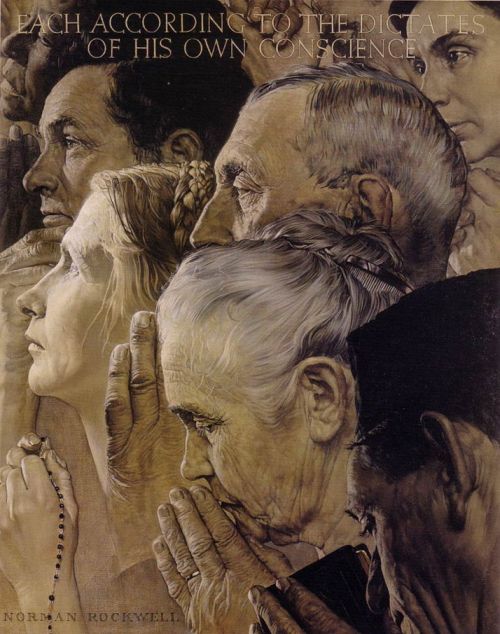
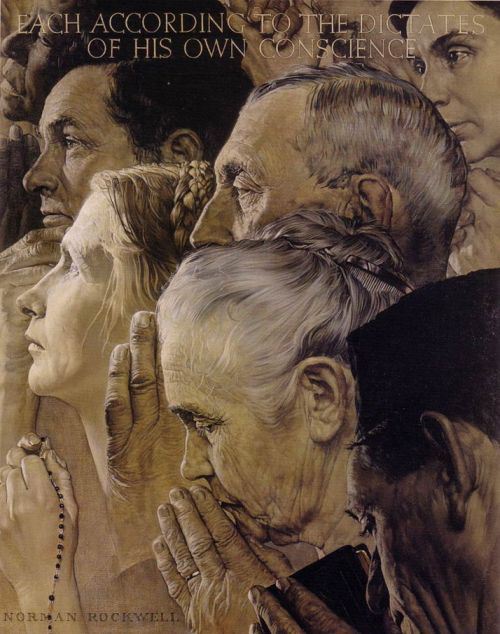
norman-rockwell-freedom-of-worship-2

Friends, I am traveling today and it is indeed the National Day of Prayer and the sinner that I am, I am always in need of prayer. Just to let you know that I do pray contrary to what some may think, I had good reason to pray today. Somehow on the trip I dropped my wallet and when I got to my mid way stop in Baltimore I didn’t have it. Near panic ensued as I looked everywhere I had been in the BWI terminal as well as called back to Norfolk where I departed.I saw my entire life flashing in front of my eyes and wondered if an identity thief was going to take me for everything I have before I could cancel all of my credit cards, not to mention the pain of getting new military ID and drivers license. I felt so incredibly stupid.

Finally after contacting the Staff College it looked like I was going to be heading home and missing the conference that I really needed to attend. A lady sitting near me took pity on me and gave me $20 so I could at least eat. I was grateful. After talking with our travel people I went to the desk agent at the Southwest gate where my Houston flight was to depart from and asked them what to do since I had no identification. They put my name in their computer and found that their gate agents in Norfolk had found the wallet. The young man at the gate worked with everything to not only get me back to Norfolk but, to arrange to get me my wallet and on another flight to get me to Houston late tonight. It was positively amazing. 

But what was really cool was that people who I didn’t know, who I don’t know if they are Christians, or any other religion or in fact if they had any faith at all stepped in to help me. I do not know or care what their political affilation, religion, Alma Mater is, or even if they are Los Angeles Dodgers fans. Someone turned in my wallet in Norfolk rather than making off with it. The airline personnel of Southwest Airlines went  above and beyond the call of duty to help me and to calm me, and yes I did need calming.

Other people, security and TSA at BWI and Norfolk tried to help. Then there was the kind lady who gave me $20. Since I routinely give to panhandlers because I have been poor before her act of kindness was quite touching. What is cool about this experience was that a bunch of good people cared about me. Like I said I don’t know any of them but they were wonderful and I am thankful, not just to God, but to the decent human beings who whatever their motivation were wonderful.

It will be a lot longer travel day than I had planned but my misadventure has shown me that we still have a lot of good and kind people in this country and that is something to celebrate.

Since I needed calming I was able to get me a big beer and now with that in hand waiting for my flight I give you my thoughts on the National Day of Prayer. I actually wrote this article last year, but since most people seem to think that the day is for the right wing political hacks at the “National Day of Prayer Task Force” founded in by Shirley Dobson in 1982, here is the real story. As the late Paul Harvey would have said “the rest of the story.”

“The notion of a Christian commonwealth should be exploded forever…Government should protect every man in thinking and speaking freely, and see that one does not abuse another.  The liberty I contend for is more than toleration.  The very idea of toleration is despicable; it supposes that some have a pre-eminence above the rest to grant indulgence, whereas all should be equally free, Jews, Turks, Pagans and Christians.” John Leland

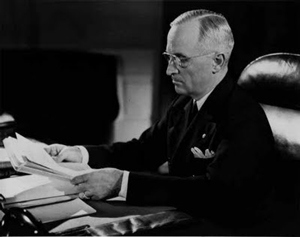
Today was the National Day of Prayer. The event was established by President Harry S Truman in 1952 was designed to mark the common freedom that we have as American citizens.

I am a big fan of religious liberty and critic of those that desire to establish any religion as the official religion of the country and in doing so suppress the rights of others. An attempt was made in the North Carolina State Legislature early this year to establish the right of the state to establish a religion in complete disregard of the Constitution of the United States and the Constitution of the State of North Carolina. Part of the text of that bill, which was killed in committee stated:

“The North Carolina General Assembly does not recognize federal court rulings which prohibit and otherwise regulate the State of North Carolina, its public schools, or any political subdivisions of the State from making laws respecting an establishment of religion.

I do feel that there are those that want to use such occasions as today’s observance of the National Day of Prayer as a means to establish their religion, as the law of the land. However, if we actually look at our history such is not the case and was never the intent of our founders or those that established the National Day of Prayer.
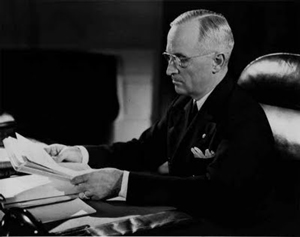
harry-truman1

President Truman’s proclamation stated:

“Now, Therefore, I, Harry S. Truman, President of the United States of America, do hereby proclaim Friday, July 4, 1952, as a National Day of Prayer, on which all of us, in our churches, in our homes, and in our hearts, may beseech God to grant us wisdom to know the course which we should follow, and strength and patience to pursue that course steadfastly. May we also give thanks to Him for His constant watchfulness over us in every hour of national prosperity and national peril.”

Ronald Reagan eloquently stated the purpose and significance of the National Day of Prayer in his 1983 proclamation which in part read:

It took the tragedy of the Civil War to restore a National Day of Prayer. As Abraham Lincoln said, “Intoxicated with unbroken success, we have become too self-sufficient to feel the necessity of redeeming and preserving grace, too proud to pray to the God that made us.”

Revived as an annual observance by Congress in 1952, the National Day of Prayer has become a great unifying force for our citizens who come from all the great religions of the world. Prayer unites people. This common expression of reverence heals and brings us together as a Nation and we pray it may one day bring renewed respect for God to all the peoples of the world.

From General Washington’s struggle at Valley Forge to the present, this Nation has fervently sought and received divine guidance as it pursued the course of history. This occasion provides our Nation with an opportunity to further recognize the source of our blessings, and to seek His help for the challenges we face today and in the future.

Now, Therefore, I, Ronald Reagan, President of the United States of America, do hereby proclaim Thursday, May 5, 1983, National Day of Prayer. I call upon every citizen of this great Nation to gather together on that day in homes and places of worship to pray, each after his or her own manner, for unity of the hearts of all mankind.

President Reagan’s 1983 and subsequent proclamations stood firmly in the American tradition of Civil Religion and was decidedly non-sectarian.  It acknowledged that our citizens “come from all the great religions of the world” and called on Americans to gather on the day “in homes and places of worship to pray, each after his or her own manner, for unity of the hearts of all mankind.”

While the American religious tradition is highly Christian and even more so from the Reformed tradition this has always existed in tension with a decidedly secularist philosophy embodied by many of the Founding Fathers who were very careful to recognize the importance of religion but at the same time both sought to protect religious liberty by NOT enacting laws to establish a particular religion nor to entangle the government in the affairs of religion which could in their view be detrimental to true religious liberty.

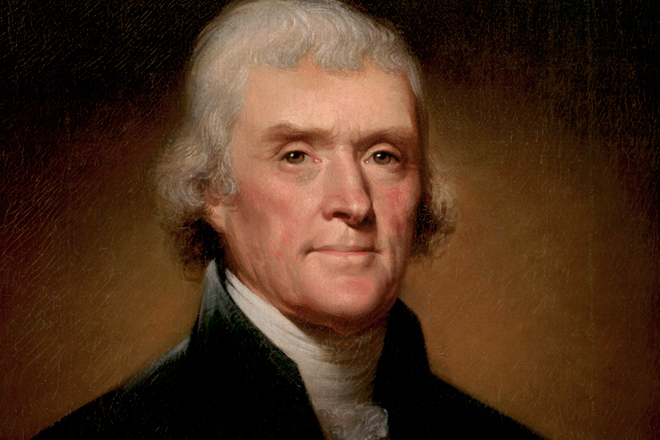
In fact both Thomas Jefferson and James Madison were very careful about proclamations and ensuring that government was not favoring any particular religious body. Jefferson wrote to Reverend Samuel Miller in 1808 that:

Fasting and prayer are religious exercises; the enjoining them an act of discipline. Every religious society has a right to determine for itself the time for these exercises, and the objects proper for them, according to their own particular tenets; and right can never be safer than in their hands, where the Constitution has deposited it. …civil powers alone have been given to the President of the United States and no authority to direct the religious exercises of his constituents.”

Madison who was the author of the Bill of Rights and included religious liberty in the First Amendment in support of Virginia Baptists who were under pressure from those who were determined to make and keep the Episcopal Church as the state religion of the commonwealth. Madison wrote to Edward Livingston in 1822 that:

“There has been another deviation from the strict principle in the Executive Proclamations of fasts & festivals, so far, at least, as they have spoken the language of injunction, or have lost sight of the equality of all religious sects in the eye of the Constitution. Whilst I was honored with the Executive Trust I found it necessary on more than one occasion to follow the example of predecessors. But I was always careful to make the Proclamations absolutely indiscriminate, and merely recommendatory; or rather mere designations of a day, on which all who thought proper might unite in consecrating it to religious purposes, according to their own faith & forms. In this sense, I presume you reserve to the Govt. a right to appoint particular days for religious worship throughout the State, without any penal sanction enforcing the worship.”

President Obama’s 2013 Proclamation for the National Day of Prayer stands in line with the founders as well as that of Presidents Truman and Reagan. It calls Americans to join with him to:

Americans have long turned to prayer both in times of joy and times of sorrow. On their voyage to the New World, the earliest settlers prayed that they would “rejoice together, mourn together, labor, and suffer together, always having before our eyes our commission and community in the work.” From that day forward, Americans have prayed as a means of uniting, guiding, and healing. In times of hardship and tragedy, and in periods of peace and prosperity, prayer has provided reassurance, sustenance, and affirmation of common purpose.

Prayer brings communities together and can be a wellspring of strength and support. In the aftermath of senseless acts of violence, the prayers of countless Americans signal to grieving families and a suffering community that they are not alone. Their pain is a shared pain, and their hope a shared hope. Regardless of religion or creed, Americans reflect on the sacredness of life and express their sympathy for the wounded, offering comfort and holding up a light in an hour of darkness.

All of us have the freedom to pray and exercise our faiths openly. Our laws protect these God-given liberties, and rightly so. Today and every day, prayers will be offered in houses of worship, at community gatherings, in our homes, and in neighborhoods all across our country. Let us give thanks for the freedom to practice our faith as we see fit, whether individually or in fellowship.

On this day, let us remember in our thoughts and prayers all those affected by recent events, such as the Boston Marathon bombings, the Newtown, Connecticut shootings, and the explosion in West, Texas. Let us pray for the police officers, firefighters, and other first responders who put themselves in harm’s way to protect their fellow Americans. Let us also pray for the safety of our brave men and women in uniform and their families who serve and sacrifice for our country. Let us come together to pray for peace and goodwill today and in the days ahead as we work to meet the great challenges of our time.

The Congress, by Public Law 100-307, as amended, has called on the President to issue each year a proclamation designating the first Thursday in May as a “National Day of Prayer.”

NOW, THEREFORE, I, BARACK OBAMA, President of the United States of America, by virtue of the authority vested in me by the Constitution and the laws of the United States, do hereby proclaim May 2, 2013, as a National Day of Prayer. I join the citizens of our Nation in giving thanks, in accordance with our own faiths and consciences, for our many freedoms and blessings, and in asking for God’s continued guidance, mercy, and protection.

However, no matter how similar President Obama’s proclamation is to those of President Reagan or Truman or for that matter any other President with the exception of President George W Bush, he is attacked by people on the extremely partisan political right World Net Daily columnist Bob Unruh and others for supposedly “cleansing the day of prayer of Christianity.”

The fact that Unruh and others like him routinely engage in this behavior makes me tired. The real fact of the matter is that most of the men who helped establish the freedom of religious faith and practice in this country were decidedly not very Christian and determined not to repeat the tragic mistakes of European nations which had both established state religions or churches and had on numerous occasions entered into bloody warfare to ensure that their religion came out on top.

But for them that is par for the course. Unruh and so many others are such strong advocates for a Christian Theocracy, something that it is perfectly obvious to me that they have no understanding of history, our Constitution or the ideals of our founders. It is a common theme that runs through all that they do. I have written about them many times before so I won’t go into gory detail today. I’d like to but I won’t, if you want to find my articles just search under the term “religious liberty” or look on my Civil Rights or Faith and Life pages.
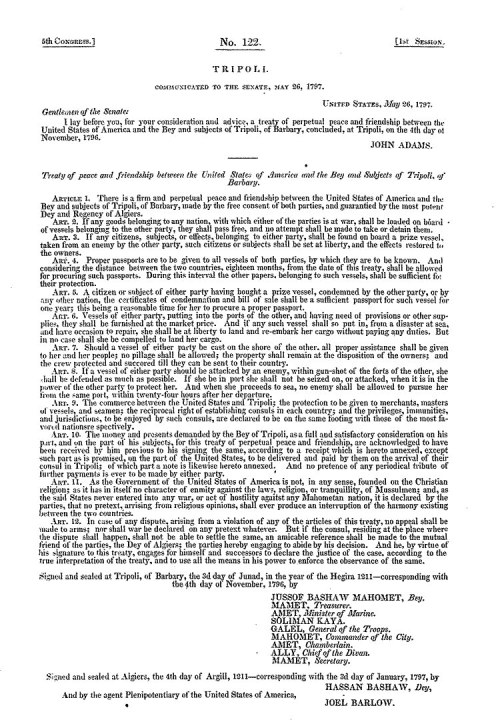
treatyoftripoli1

Our founders were so opposed to the idea of a State Religion that in one of the first treaties entered into with another nation, the Treaty of Tripoli of 1796 drafted by the future President John Adams noted in Article 11:

As the government of the United States of America is not in any sense founded on the Christian Religion, — as it has in itself no character of enmity against the laws, religion or tranquility of Musselmen, — and as the said States never have entered into any war or act of hostility against any Mehomitan nation, it is declared by the parties that no pretext arising from religious opinions shall ever produce an interruption of the harmony existing between the two countries.”
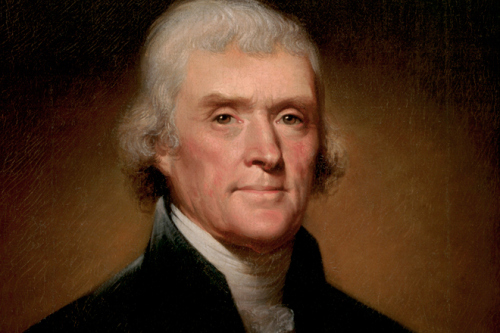
thomas_jefferson_rect1

Jefferson wrote in the Virginia Act for the Establishment of Religious Freedom:

Be it therefore enacted by the General Assembly, That no man shall be compelled to frequent or support any religious worship, place, or ministry whatsoever, nor shall be enforced, restrained, molested, or burdened in his body or goods, nor shall otherwise suffer on account of his religious opinions or belief; but that all men shall be free to profess, and by argument to maintain, their opinions in matters of religion, and that the same shall in nowise diminish, enlarge, or affect their civil capacities. 

Madison wrote:

“Who does not see that the same authority which can establish Christianity, in exclusion of all other religions, may establish with the same ease any particular sect of Christians, in exclusion of all other sects?”

John Leland, leader of the Virginia Baptists who were being persecuted by Episcopalians intent on re-establishing themselves as the official State Religion of Virginia became involved in the fight for religious liberty in the newly independent colonies wrote:

“The notion of a Christian commonwealth should be exploded forever…Government should protect every man in thinking and speaking freely, and see that one does not abuse another.  The liberty I contend for is more than toleration.  The very idea of toleration is despicable; it supposes that some have a pre-eminence above the rest to grant indulgence, whereas all should be equally free, Jews, Turks, Pagans and Christians.”

Leland heavily influenced both Madison and Jefferson in crafting the Virginia statement on religious liberty and the First Amendment. Toward the end of his life Madison wrote:

“The settled opinion here is, that religion is essentially distinct from civil Government, and exempt from its cognizance; that a connection between them is injurious to both; that there are causes in the human breast which ensure the perpetuity of religion without the aid of the law; that rival sects, with equal rights, exercise mutual censorships in favor of good morals; that if new sects arise with absurd opinions or over-heated imaginations, the proper remedies lie in time, forbearance, and example; that a legal establishment of religion without a toleration could not be thought of, and with a toleration, is no security for and animosity; and, finally, that these opinions are supported by experience, which has shewn that every relaxation of the alliance between law and religion, from the partial example of Holland to the consummation in Pennsylvania, Delaware, New Jersey, &c., has been found as safe in practice as it is sound in theory. Prior to the Revolution, the Episcopal Church was established by law in this State. On the Declaration of Independence it was left, with all other sects, to a self-support. And no doubt exists that there is much more of religion among us now than there ever was before the change, and particularly in the sect which enjoyed the legal patronage. This proves rather more than that the law is not necessary to the support of religion” (Letter to Edward Everett, Montpelier, March 18, 1823).

I am all in on religious liberty including the rights of people that are not Christians to practice whatever faith or non-faith that they please. This is the freedom that our founders fought to bring forth in this land.

Today we celebrated the National Day of Prayer and I had the privilege of leading our prayer at our facility. I have included that prayer here:

Loving God, we thank you for the privilege of living in this country where our founders were wise enough to neither establish nor forbid any religious practice. We thank you that as the beneficiaries of the wisdom handed down by these men that we have the liberty to believe and practice our faith in the manner that we see fit and that whether Christian or Jew, Moslem or Wiccan, Buddhist or any other faith represented in our land that we have this freedom. We thank also thank you for the freedoms granted to all, the freedom to believe, practice and even not believe as our conscience dictates and that Congress can enact no law to either establish a state religion nor prevent the free exercise of the beliefs of any citizen. 

For the wisdom and the foresight of these fallible men whose actions redound to us we give you thanks.  We pray this in your Holy Name. Amen. 

So as the time draws near to go to bed and I offer my night prayers for all, I do wish you the peace and freedom that so many Americans have fought and died to maintain.

Peace

Padre Steve+


2 Comments

Filed under christian life, civil rights, faith, laws and legislation, News and current events, Religion

Thoughts on the 2013 National Day of Prayer

norman-rockwell-freedom-of-worship-1

“The notion of a Christian commonwealth should be exploded forever…Government should protect every man in thinking and speaking freely, and see that one does not abuse another.  The liberty I contend for is more than toleration.  The very idea of toleration is despicable; it supposes that some have a pre-eminence above the rest to grant indulgence, whereas all should be equally free, Jews, Turks, Pagans and Christians.” John Leland

Today was the National Day of Prayer. The event was established by President Harry S Truman in 1952 was designed to mark the common freedom that we have as American citizens.

I am a big fan of religious liberty and critic of those that desire to establish any religion as the official religion of the country and in doing so suppress the rights of others. An attempt was made in the North Carolina State Legislature early this year to establish the right of the state to establish a religion in complete disregard of the Constitution of the United States and the Constitution of the State of North Carolina. Part of the text of that bill, which was killed in committee stated:

“The North Carolina General Assembly does not recognize federal court rulings which prohibit and otherwise regulate the State of North Carolina, its public schools, or any political subdivisions of the State from making laws respecting an establishment of religion.

I do feel that there are those that want to use such occasions as today’s observance of the National Day of Prayer as a means to establish their religion, as the law of the land. However, if we actually look at our history such is not the case and was never the intent of our founders or those that established the National Day of Prayer.

harry-truman

President Truman’s proclamation stated:

“Now, Therefore, I, Harry S. Truman, President of the United States of America, do hereby proclaim Friday, July 4, 1952, as a National Day of Prayer, on which all of us, in our churches, in our homes, and in our hearts, may beseech God to grant us wisdom to know the course which we should follow, and strength and patience to pursue that course steadfastly. May we also give thanks to Him for His constant watchfulness over us in every hour of national prosperity and national peril.”

Ronald Reagan eloquently stated the purpose and significance of the National Day of Prayer in his 1983 proclamation which in part read:

It took the tragedy of the Civil War to restore a National Day of Prayer. As Abraham Lincoln said, “Intoxicated with unbroken success, we have become too self-sufficient to feel the necessity of redeeming and preserving grace, too proud to pray to the God that made us.”

Revived as an annual observance by Congress in 1952, the National Day of Prayer has become a great unifying force for our citizens who come from all the great religions of the world. Prayer unites people. This common expression of reverence heals and brings us together as a Nation and we pray it may one day bring renewed respect for God to all the peoples of the world.

From General Washington’s struggle at Valley Forge to the present, this Nation has fervently sought and received divine guidance as it pursued the course of history. This occasion provides our Nation with an opportunity to further recognize the source of our blessings, and to seek His help for the challenges we face today and in the future.

Now, Therefore, I, Ronald Reagan, President of the United States of America, do hereby proclaim Thursday, May 5, 1983, National Day of Prayer. I call upon every citizen of this great Nation to gather together on that day in homes and places of worship to pray, each after his or her own manner, for unity of the hearts of all mankind.

President Reagan’s 1983 and subsequent proclamations stood firmly in the American tradition of Civil Religion and was decidedly non-sectarian.  It acknowledged that our citizens “come from all the great religions of the world” and called on Americans to gather on the day “in homes and places of worship to pray, each after his or her own manner, for unity of the hearts of all mankind.”

While the American religious tradition is highly Christian and even more so from the Reformed tradition this has always existed in tension with a decidedly secularist philosophy embodied by many of the Founding Fathers who were very careful to recognize the importance of religion but at the same time both sought to protect religious liberty by NOT enacting laws to establish a particular religion nor to entangle the government in the affairs of religion which could in their view be detrimental to true religious liberty.

In fact both Thomas Jefferson and James Madison were very careful about proclamations and ensuring that government was not favoring any particular religious body. Jefferson wrote to Reverend Samuel Miller in 1808 that:

Fasting and prayer are religious exercises; the enjoining them an act of discipline. Every religious society has a right to determine for itself the time for these exercises, and the objects proper for them, according to their own particular tenets; and right can never be safer than in their hands, where the Constitution has deposited it. …civil powers alone have been given to the President of the United States and no authority to direct the religious exercises of his constituents.”

james_madison

Madison who was the author of the Bill of Rights and included religious liberty in the First Amendment in support of Virginia Baptists who were under pressure from those who were determined to make and keep the Episcopal Church as the state religion of the commonwealth. Madison wrote to Edward Livingston in 1822 that:

“There has been another deviation from the strict principle in the Executive Proclamations of fasts & festivals, so far, at least, as they have spoken the language of injunction, or have lost sight of the equality of all religious sects in the eye of the Constitution. Whilst I was honored with the Executive Trust I found it necessary on more than one occasion to follow the example of predecessors. But I was always careful to make the Proclamations absolutely indiscriminate, and merely recommendatory; or rather mere designations of a day, on which all who thought proper might unite in consecrating it to religious purposes, according to their own faith & forms. In this sense, I presume you reserve to the Govt. a right to appoint particular days for religious worship throughout the State, without any penal sanction enforcing the worship.”

President Obama’s 2013 Proclamation for the National Day of Prayer stands in line with the founders as well as that of Presidents Truman and Reagan. It calls Americans to join with him to:

Americans have long turned to prayer both in times of joy and times of sorrow. On their voyage to the New World, the earliest settlers prayed that they would “rejoice together, mourn together, labor, and suffer together, always having before our eyes our commission and community in the work.” From that day forward, Americans have prayed as a means of uniting, guiding, and healing. In times of hardship and tragedy, and in periods of peace and prosperity, prayer has provided reassurance, sustenance, and affirmation of common purpose.

Prayer brings communities together and can be a wellspring of strength and support. In the aftermath of senseless acts of violence, the prayers of countless Americans signal to grieving families and a suffering community that they are not alone. Their pain is a shared pain, and their hope a shared hope. Regardless of religion or creed, Americans reflect on the sacredness of life and express their sympathy for the wounded, offering comfort and holding up a light in an hour of darkness.

All of us have the freedom to pray and exercise our faiths openly. Our laws protect these God-given liberties, and rightly so. Today and every day, prayers will be offered in houses of worship, at community gatherings, in our homes, and in neighborhoods all across our country. Let us give thanks for the freedom to practice our faith as we see fit, whether individually or in fellowship.

On this day, let us remember in our thoughts and prayers all those affected by recent events, such as the Boston Marathon bombings, the Newtown, Connecticut shootings, and the explosion in West, Texas. Let us pray for the police officers, firefighters, and other first responders who put themselves in harm’s way to protect their fellow Americans. Let us also pray for the safety of our brave men and women in uniform and their families who serve and sacrifice for our country. Let us come together to pray for peace and goodwill today and in the days ahead as we work to meet the great challenges of our time.

The Congress, by Public Law 100-307, as amended, has called on the President to issue each year a proclamation designating the first Thursday in May as a “National Day of Prayer.”

NOW, THEREFORE, I, BARACK OBAMA, President of the United States of America, by virtue of the authority vested in me by the Constitution and the laws of the United States, do hereby proclaim May 2, 2013, as a National Day of Prayer. I join the citizens of our Nation in giving thanks, in accordance with our own faiths and consciences, for our many freedoms and blessings, and in asking for God’s continued guidance, mercy, and protection.

However, no matter how similar President Obama’s proclamation is to those of President Reagan or Truman or for that matter any other President with the exception of President George W Bush, he is attacked by people on the extremely partisan political right World Net Daily columnist Bob Unruh and others for supposedly “cleansing the day of prayer of Christianity.”

The fact that Unruh and others like him routinely engage in this behavior makes me tired. The real fact of the matter is that most of the men who helped establish the freedom of religious faith and practice in this country were decidedly not very Christian and determined not to repeat the tragic mistakes of European nations which had both established state religions or churches and had on numerous occasions entered into bloody warfare to ensure that their religion came out on top.

TreatyofTripoli

Our founders were so opposed to the idea of a State Religion that in one of the first treaties entered into with another nation, the Treaty of Tripoli of 1796 drafted by the future President John Adams noted in Article 11:

As the government of the United States of America is not in any sense founded on the Christian Religion, — as it has in itself no character of enmity against the laws, religion or tranquility of Musselmen, — and as the said States never have entered into any war or act of hostility against any Mehomitan nation, it is declared by the parties that no pretext arising from religious opinions shall ever produce an interruption of the harmony existing between the two countries.”

thomas_jefferson_rect

Jefferson wrote in the Virginia Act for the Establishment of Religious Freedom:

Be it therefore enacted by the General Assembly, That no man shall be compelled to frequent or support any religious worship, place, or ministry whatsoever, nor shall be enforced, restrained, molested, or burdened in his body or goods, nor shall otherwise suffer on account of his religious opinions or belief; but that all men shall be free to profess, and by argument to maintain, their opinions in matters of religion, and that the same shall in nowise diminish, enlarge, or affect their civil capacities. 

Madison wrote:

“Who does not see that the same authority which can establish Christianity, in exclusion of all other religions, may establish with the same ease any particular sect of Christians, in exclusion of all other sects?”

leland-1-1

John Leland, leader of the Virginia Baptists who were being persecuted by Episcopalians intent on re-establishing themselves as the official State Religion of Virginia became involved in the fight for religious liberty in the newly independent colonies wrote:

“The notion of a Christian commonwealth should be exploded forever…Government should protect every man in thinking and speaking freely, and see that one does not abuse another.  The liberty I contend for is more than toleration.  The very idea of toleration is despicable; it supposes that some have a pre-eminence above the rest to grant indulgence, whereas all should be equally free, Jews, Turks, Pagans and Christians.”

Leland heavily influenced both Madison and Jefferson in crafting the Virginia statement on religious liberty and the First Amendment. Toward the end of his life Madison wrote:

“The settled opinion here is, that religion is essentially distinct from civil Government, and exempt from its cognizance; that a connection between them is injurious to both; that there are causes in the human breast which ensure the perpetuity of religion without the aid of the law; that rival sects, with equal rights, exercise mutual censorships in favor of good morals; that if new sects arise with absurd opinions or over-heated imaginations, the proper remedies lie in time, forbearance, and example; that a legal establishment of religion without a toleration could not be thought of, and with a toleration, is no security for and animosity; and, finally, that these opinions are supported by experience, which has shewn that every relaxation of the alliance between law and religion, from the partial example of Holland to the consummation in Pennsylvania, Delaware, New Jersey, &c., has been found as safe in practice as it is sound in theory. Prior to the Revolution, the Episcopal Church was established by law in this State. On the Declaration of Independence it was left, with all other sects, to a self-support. And no doubt exists that there is much more of religion among us now than there ever was before the change, and particularly in the sect which enjoyed the legal patronage. This proves rather more than that the law is not necessary to the support of religion” (Letter to Edward Everett, Montpellier, March 18, 1823).

I am all in on religious liberty including the rights of people that are not Christians to practice whatever faith or non-faith that they please. This is the freedom that our founders fought to bring forth in this land.

Today we celebrated the National Day of Prayer and I had the privilege of leading our prayer at our facility. I have included that prayer here:

Loving God, we thank you for the privilege of living in this country where our founders were wise enough to neither establish nor forbid any religious practice. We thank you that as the beneficiaries of the wisdom handed down by these men that we have the liberty to believe and practice our faith in the manner that we see fit and that whether Christian or Jew, Moslem or Wiccan, Buddhist or any other faith represented in our land that we have this freedom. We thank also thank you for the freedoms granted to all, the freedom to believe, practice and even not believe as our conscience dictates and that Congress can enact no law to either establish a state religion nor prevent the free exercise of the beliefs of any citizen. 

For the wisdom and the foresight of these fallible men whose actions redound to us we give you thanks.  We pray this in your Holy Name. Amen. 

So as the time draws near to go to bed and I offer my night prayers for all, I do wish you the peace and freedom that so many Americans have fought and died to maintain.

Peace

Padre Steve+
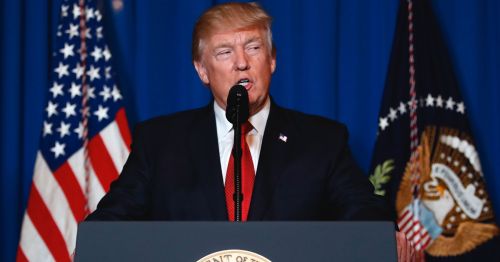
Leave a comment

Filed under faith, History, laws and legislation, Lies of World Net Daily, Religion

Twilight of the Generals: The Deeper Implications of the Petraeus Scandal

“War with impersonal leadership la a brutal soul-destroying; business, provocative only of class animosity and bad workmanship. Our senior officers must get back to sharing danger and sacrifice with their men, however exalted their rank, just as sailors have to do. That used to be the British way, but, unfortunately, there was a grievous lapse from it in the last war.” Colonel C.S.O. Head, A Glance at Gallipoli 

It has been a strange week for the military. I will be writing some more on this over the next few days but in the wake of the scandals wracking the military.

Some of these things have been brewing for some time.  But the revelations of an extramarital affair of retired Army General and now former CIA Director David Petreus, the revelation that Petraeus’ successor in Afghanistan Marine General John Allen sending allegedly flirtatious e-mails with the woman whose complaints of e-mail harassment triggered the investigation that exposed the Petraeus and his mistress-biographer Paula Broadwell.

General William “Kip” Ward, the former commander of US AFRICOM was demoted following an investigation that tied him to “unauthorized expenses” and “lavish travel” to the tune of 129,000 on an 11 day “business trip” that only three days were actual business.

Meanwhile in Fort Bragg North Carolina Army Brigadier General Jeffery Sinclair is going through the military version of a grand-jury investigation for sexual harassment and other such crimes against a number of his female staff officers. One alleges that Sinclair forced her to have oral sex and that he threatened to kill her or her family if she told anyone.

As a career officer myself, having spent the last 31 years in the Army, the Reserve Components of the Army and the Active Duty Navy I am disappointed but not surprised. I spent almost over half my career as a company grade officer or enlisted man and a fan of the late Colonel David Hackworth, who called he senior leaders of the military “perfumed princes.”

I think part of the problem is that many of us in the military have become more supporters of the preservation of the institution of the military than we are of the Constitution or the country. This is not surprising and in a sense I can understand this and probably at more than one point in my career been guilty of this. We are afraid of cuts to the military institution because it impacts us.

The roots of the problem go back to Vietnam but can probably be traced further back. The revolt of liberals and young people against the war, the military and the draft forced an end to the draft and the beginning of the All Volunteer force. This was a two edged sword. On the positive side it allowed the military to reform, reorganize and become the premier fighting force in the world. On the minus side of the equation was the fact that the military became a society within the society. We became insular and in many cases, including mine distrusted liberals and Democrats on any national security issue. Those old enough can trace that back to how either we, or our fathers were treated by liberals, Democrats and the media during the Vietnam war and its aftermath. Others, younger than me simply have bought the lie that liberals and Democrats are inherently anti-military. This has been particularly the case since the end of the Reagan administration and the George H.W. Bush led Gulf War victory over Iraq which cemented a narrative that the military was invincible.

Over the course of the next 20 years, the 8 years of Bill Clinton, the 8 years of George W. Bush and the first 4 years of Barak Obama the esteem for the military by the general population has continued to go up, even as that population is increasingly divorced from the need to serve in the military. The military at any given times in the past 20 years numbered less than 1% of the American population. This statistic is unlikely to go up in the near future with the reduction of the military to its pre-Iraq war strength and the increase in the population.

While the military has been engaged in a protracted war since the attacks of 9-11 and heavily involved in other wars or “operations other than war” since the Gulf War it has continued to shrink in relative terms to the US population. At the same time the military has become a lot more top-heavy in  numbers of General and Flag Officers since before the Second World War. The percentage of Generals and Flag officers added to the military since the beginning of the War on Terror has only increased, especially at the 3 and 4 star level.

There were in 2011 a total of 964 Generals and Admirals in the US military down slightly from 1017 at the end of the Cold War when there were more than 600,000 more personnel in the military. In the Second World War there were about 1.7 Generals or admirals per 10,000 personnel, the line today is about 6.8 per 10,000. See ( http://www.pogo.org/pogo-files/testimony/national-security/ns-wds-20110914.html )

Regardless of the administration in power the senior ranks of the military have increased not only in numbers but in influence in the government. Highly respected by the public and with probably more power than at any time in our history the senior leadership of the Armed Forces has become insular and isolated. The senior ranks of the military have become a culture within a culture within the culture. The ongoing revelations of the Petraeus affair and possible involvement of General Allen regarding two women, most notably Jill Kelley a socialite who has cultivated close relationships with military leaders assigned to CENTCOM in Tampa as well as the culture of the Washington Beltway shows the depth of that disconnect.

At any given time there are well under 10% of flag and general officers commanding troops in combat. The rest are assigned to stateside units and staffs of various combatant commands, staffs and the Pentagon. In my service the Navy in World War II there were about 130 ships for every Admiral, today there are almost as many admirals as ships. While the ranks of the military have shrunk the numbers of Generals and Admirals has risen and the culture surrounding them has become more opaque. Generals and Admirals have become celebrities and power players in society in their own right. In fact I would guess that only the Great German Imperial General Staff of the Kaiser Reich had such influence in society at large or political power.

That respect which these men and women have earned in the nation which is often earned due to the incredible sacrifice of ordinary Soldiers, Sailors, Marines and Airmen. Likewise many General and Flag officer have done time in combat zones as lower ranking commanders and staff officers and have spent many years deployed and away from their families in direct combat or in supporting roles.

In spite of this there is obviously something amiss in the senior ranks of the military. The record numbers of the relief for cause of many senior officers and commanders due to various infractions, many of a personal, ethical or sexual nature is cause for concern. The concern that I hear from young men and women serving in the military and read about almost every day is that there is a separate set of standards for senior ranks than junior ranks. I have been fortunate that commands that I have been a part over the past 15 years have sensitive to this and have worked hard to ensure that standards are enforced regardless of rank but that is not always the case. High profile stories of scandal, privilege on the part of some have tarnished the hard work of many stellar officers and NCOs and the great sacrifice of those killed, maimed or wounded in mind, body and spirit in our current war.

The indiscreet and sometimes criminal actions of General Petraeus, General Ward, General Sinclair and fairly substantial number of other commanders who have been relieved for cause is is something to be concerned about.

Major General J.F.C. Fuller who served in the Royal Tank Corps in the First World War wrote a small but timeless book called “Generalship: Its Diseases and Their Cure: A Study of the Personal Factors of Command” in 1932. Fuller was quite critical of a culture in the higher ranks which had led to unnecessary slaughter and suffering during the First World War. It is a book that is well worth the read in such a time as ours. As the scandal continued to develop this week I remembered it and decided to re-read it.

The problems that we face are not unique to us. Scandals that are rocking the US Military are not new, they have been faced by other militaries before. The issue today is that the modern media and communications age has made it nearly impossible for those involved in salacious behavior to have it covered up. The Petraeus scandal has unfolded in large part due to the electronic media which almost all of us are dependent on, even for routine communications that never would have seen the light of day had they not been recorded in the cyber records of Google, Facebook, Twitter, text messages, e-mail providers or other electronic communication systems. There might have been insinuations, innuendo and accusations but many would have never seen the light of day.

The indiscretions of these men actually opened a door for honest questions and examination of the health of the American civil-military institutions. The military institution and those that swear to support and defend the Constitution of the United States cannot become just another special interest group. Yes it is important to maintain national security and to take care of the troops when they return to civilian society. We cannot allow ourselves to become a state within a state or culture within a culture. The exaggerated numbers of General and Flag Officers compared to the overall numbers of personnel in the military can only be justified by the necessary bureaucratic and institutional power provided by the rank, not by mission or responsibility.

The power of the institution is dangerous when its leaders subtly shift the mission from the defense of the Constitution and the people to the defense and maintenance of the institution itself and their own power.

This is not simply about sex, improper relationships, assault or financial indiscretions of leaders, it points to broader and perhaps more dangerous threats to our system of government, but the unbridled temptation of power and influence that believes that comes with the unquestioned adulation of politicians, pundits and preachers, the Unholy Trinity. So even as the scandals rock the military it is not a bad thing. If we do not address them they will become millstones about our necks that will drag us under and expose the people and Constitution that we are sworn to defend to untold disaster.

Dwight D. Eisenhower reminded us so well about this danger in his farewell address in 1961:

“In the councils of government, we must guard against the acquisition of unwarranted influence, whether sought or unsought, by the military-industrial complex. The potential for the disastrous rise of misplaced power exists and will persist. We must never let the weight of this combination endanger our liberties or democratic processes.”

Peace

Padre Steve+
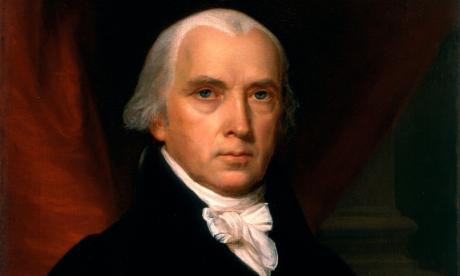
2 Comments

Filed under History, leadership, Military, national security