Tag Archives: taliban

Padre Steve’s Decade in Review: Up Down Tryin’ to Get the Feeling Again

Happy New Year!

Well, we have killed off the first decade of the new millennium and I hate to say it but I miss the 1970s, 1980s and 1990s.  Somehow despite the threat of double secret nuclear annihilation, disco, and bad hair those decades seemed somehow more civil, more hopeful and dare I say just a bit nicer than the current decade has been.  However this decade is what it is, or maybe was what it was.  I think that most of us could say like the Barry Manilow  song that “I’ve been up down tryin’ to get that feeling again” but like Blobdie sang “Dreaming is Free.”

Personally Padre Steve had recently embarked on another phase of military service having left the Army Reserve in February 1999 to enter the Navy. Since that time my career has been pretty good and I’m glad that I made the switch.  I have had the chance to serve with some great folks and see a lot more of the world and do a lot of cool things, including going to war. This time in 1999 I was assigned to the 2nd Marine Division at Camp LeJeune North Carolina.  The big thing going on back then was the world being up in arms about the threat of something called Y2K.  Y2K was supposed to end life as we knew it as anything using computer technology was going to quit working, airplanes would fall from the sky, power plants would shut down and personal computers would stop working in the middle of trying to get a dial-up connection to AOL or Compuserve. We YTK fizzed and those that had made doomsday preparations felt pretty silly as they looked over their shoulders for Black Helicopters and hundreds of thousands of UN troops hiding out in our National Parks building detainment camps for real Americans.

Who the Hell Was this Guy Voting For?

As YTK fizzled the 2000 Presidential campaign got spun up.  Padre Steve missed a lot of it because he spent about 10 weeks in the dessert at 29 Palms with two different Marine battalions during two Combined Arms Exercises, or CAX.  He then left in December for a deployment to the Far East. Just before the election the destroyer USS Cole was attacked and heavily damaged by terrorists in an explosive laden boat while refueling in Yemen.  2000 ended without a decision in the election and the campaign culminated in January 2001 with a razor thin Electoral College victory for George W. Bush full of controversy over disputed ballots in Florida with an Army Corps of lawyers getting involved and taking the whole thing up the Supreme Court.  This process dragged on for what seemed like forever until I was in Okinawa with my battalion.  A new term was coined “the hanging chad.” Once the election nightmare was over things did not get better.  In 2000 lost some notable folks, former Dallas Cowboys Head Coach and Pro-Football Hall of Famer Tom Landry called his last play, Sir Alec Guinness crossed over the River Kwai and Montreal Canadiens Hockey legend Maurice “Rocket” Richard broke away and got his final hat trick.

9-11 Twin Towers Under Attack

As 2001 began it did seem that things were starting to settle down despite lingering hatred on both sides of the political aisle about the election.  But then there were the attacks of September 11th 2001 where terrorists flew hijacked airliners into both of the World Trade Center towers and the Pentagon. This caused a number of congressmen and senators to break forth in song outside the Capital and for a brief time it seemed that the whole country had united in common cause.  Soon US Special Forces, Rangers and Marines were fighting in Afghanistan to overthrow the Taliban and hunt for Osama Bin Laden, the mastermind of the terror attacks and the head of the Al Qaeda terrorist network.  US forces overran Afghanistan quickly with the help of Afghan tribes known as the Northern Alliance and it looked like despite not finding Bin Laden that the US goals were being accomplished even as the President was telling Americans to “go shopping” to many in the military giving the impression that while the military was at war that the nation was not.  In December 2001 Padre Steve was transferred from the Marines to the Guided Missile Cruiser USS Hue City, CG-66. The ship would complete a couple of underway periods and exercises before departing for the Middle East in early February.  This was Padre Steve’s first tour in a war zone and the ship conducted operations off the Horn of Africa, in the Northern Arabian Gulf as part of the UN Oil Embargo on Iraq intercepting smugglers, during which time Padre Steve was with a boarding team that made 75 boarding missions of Iraqi and other smugglers.
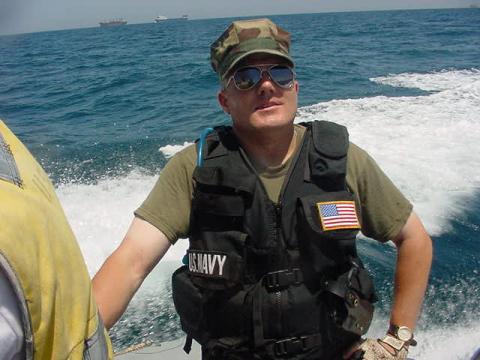
Iconic Picture of Padre Steve on a Boarding Mission

From there Hue City operated with the USS John F Kennedy conducting operations in the Gulf of Oman where our air controllers helped direct strikes against Al Qaida and the Taliban and during which time the ship was detached to keep watch on the Indians and Pakistanis who were on the brink of having a nuclear war.  Acting great and Academy Award winner Jack Lemmon, former Beatle George Harrison and NASCAR great Dale Earnhardt all made their final lap around the planet. In Baseball the Arizona Diamondbacks defeated the New York Yankees to win the World Series in 7 games.

2004 The Red Sox Break the Curse

2002 also saw John Allen Mohammed, the Beltway Sniper bring terror to Washington DC, Northern Virginia and Maryland, the Congress passed a joint resolution to allow President Bush to use US Military Forces as he deemed fit in Iraq and the Iraq War Resolution.  Shortly thereafter the Department of Homeland Security was established.  The San Francisco Giants lost the World Series to the Anaheim Angels after leading in the 7th inning of game six much to the consternation of Padre Steve and the other Giants faithful.  Calls for the public water boarding of Giants Manager and former “Evil Dodger” Dusty Baker to find why he took out Russ Ortiz went unheeded. Dave Thomas the founder of Wendy’s flipped his last burger, country music legend Waylon Jennings sang his last song and Baseball immortal Ted Williams all died in 2002 with Williams and his family trying to make him a real immortal by having his remains cryogenically frozen.

The Challenger Disintigrates

For Padre Steve 2003 was relatively uneventful, the Hue City was in the yards when Operation Iraqi Freedom was launched and was just getting ready for a deployment when he was reassigned to the Marine Security Force Battalion.  In short order he was travelling around the globe and before the end of the year had visited his Marines in Bahrain, Rota Spain and Guantanamo Bay Cuba and he and the Abbess celebrated their 20th wedding anniversary. The Iraq War and overthrow of Saddam Hussein was the big story of 2003 however there was other news. The Space Shuttle Columbia blew up on re-entry killing the 7 astronauts on board, California recalled Governor Gray Davis and replaced him with the Governator Arnold Schwarzenegger and the Florida Marlins defeated the New York Yankees to win the World Series. We lost some legends in 2003 comedian Bob Hope died at the age of 100 and is now doing his Christmas show for the Archangel Michael and the Armies of Heaven; US Senator Strom Thurman filibustered his last bill at the age of 100, Fred Rogers left the neighborhood and Joseph Coors brewed his last batch of really bad beer.
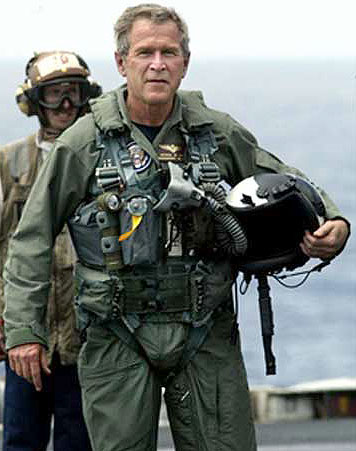
George Bush on the USS Abraham Lincoln

2004 saw yet another nasty Presidential election riddled with controversy as George W. Bush defeated Senator John Kerry to win re-election.  In Iraq Saddam Hussein was finally caught hiding in a hole in the ground by US Special Forces, the war in Iraq went south as the insurgency of former Ba’athists, disaffected Sunnis aided by Al Qaida and other foreign fighters and terrorists took up President Bush on his challenge to “bring it on.”  Facebook was founded in Cambridge Massachusetts, simultaneous suicide bombs devastated trains in Madrid in what became known as Spain’s 9-11, Lance Armstrong won his 6th consecutive Tour de France, Chechen terrorists seized a school in Beslan Russia and over 300 are killed and 700 wounded by the terrorists as the school was stormed by Russian security forces and the Boston Red Sox won the 2004 World Series to break the curse of the Bambino after coming back to defeat the Yankees in the ALCS after being down three games to none.  Death took no holidays in 2004 as Bob Keeshan better known as Captain Kangaroo was piped over the side, Rick James dated his last Super Freaky Girl without taking her home to mother and former President Ronald Reagan died of Alzheimer’s Disease after seeing his successors destroy his coalition and “big tent” and hopeful vision of conservatism.   Padre Steve continued to travel around the world with his Marines going to Japan, France, and Spain, Bahrain and Guantanamo Bay as well as a number of trips within the United States.  In France he taught seminars at the Belleau Wood battlefield site and in Normandy.
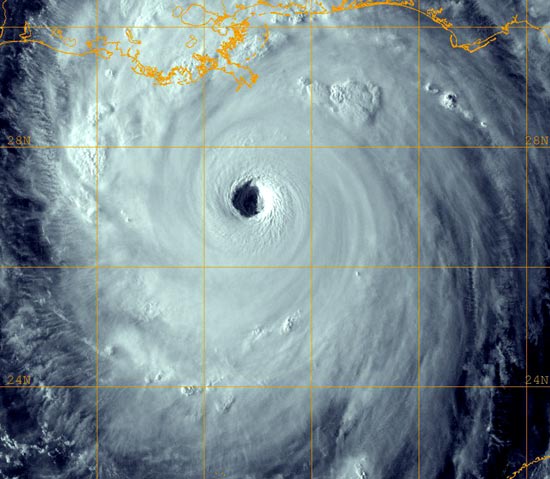
Hurricane Katrina as a Category 5 Storm

The war in Iraq continued to heat up in 2005 with the insurgency spreading throughout the country with the focal point being Sunni stronghold Al Anbar Province.  Hurricane Katrina ravaged Gulf coast devastating New Orleans and southern Mississippi killing over 1800 and forcing millions from their homes. The ineffective and inept government response beginning with the “fly by visit” of President Bush helped the Democrats regain control of the House and Senate in 2006.  Terrorism was alive and well as a terrorist attack on London’s Underground and a bus killed 56 and injured over 700.  As for Padre Steve well he was selected for promotion to Lieutenant Commander, completed the Marine Corps Command and Staff College and continued to travel around the world with his Marines going to Japan, France, Spain, Bahrain and Guantanamo Bay as well as a number of trips within the United States.  The highlight of this was being able to have the Abbess accompany him to Guantanamo Bay for the Marine Corps Birthday Ball. The Chicago White Sox defeated the Houston Astros in the World Series. In Washington DC baseball stars were hauled before a Congressional committee to testify on steroids in baseball or interrogated about their possible use of steroids. This wasted millions of dollars in taxpayer money as loser Congressmen who tolerate all sorts of illegal and immoral actions of their own sought to embarrass and destroy the careers and reputations of ballplayers in a grand act of inquisitional hypocrisy. Death came knocking for comedian Richard Pryor, Johnny Carson gave his last monologue, Pope John Paul II met Saint Peter and James Doohan, Mr. Scott from Star Trek was beamed up for the last time.
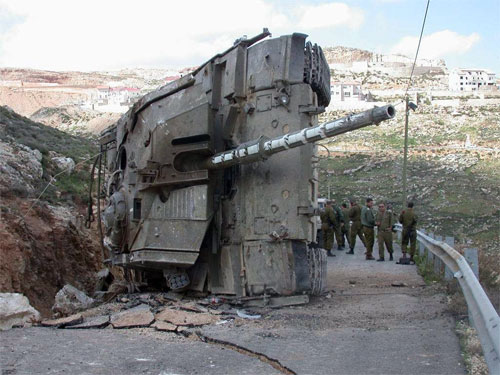
Israeli Merkeva Tank Destroyed by Hezbollah

In 2006 Padre Steve was promoted the Lieutenant Commander and was transferred to EOD Group Two after completing another year of travel with the Marine Security Forces.  Within months there was talk of a deployment to Iraq or Afghanistan for him and his trusty assistant and body guard Nelson Lebron. He also began a Masters Degree program in Military History at American Military University.  In the rest of the world the Republicans lost their majorities in Congress, the war in Iraq continued to grow in intensity and Israel went to war with Hezbollah forces on their northern border.  The attack was ill conceived and was a military failure revealing weaknesses in the Israeli ground forces training and tactical abilities forcing investigations of the military and the resignation of the head of the military.  Pope Benedict XVI the successor to Pope John Paul II published his first encyclical.  In the World Series Tony LaRussa’s St Louis Cardinals defeated the Detroit Tigers and Barry Bonds though tainted by controversy continued his march to the Baseball Home Run title.  Death paid a visit to former Secretary of Defense Caspar Weinberger, sportscaster Curt Gowdy called his last game and Don Knotts, Televisions Barney Fife gave up his bullet for the last time.
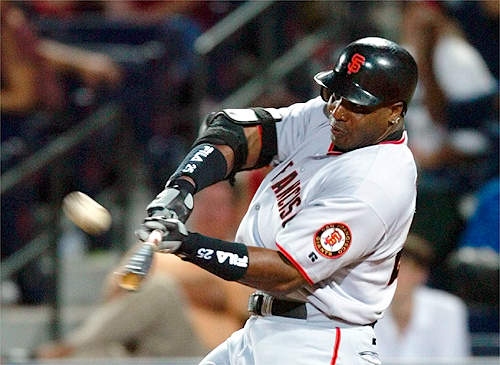
Barry Bonds the All Time Home Run Leader

The war in Iraq reached a climax in 2007 as President Bush heeded the advice of General David Petreus and initiated a “surge” of forces to help wage an actual counterinsurgency campaign.  Combined with the Al Anbar Awakening where the Sunni turned on the insurgents and allied themselves with the Americans the course of the war changed as insurgents lost support and the US and better trained and equipped Iraqi forces launched successful offensives to drive the insurgents out of key areas.  Padre Steve deployed to Iraq and served in Al Anbar Province working with US Marine and Army advisers to the Iraqi Army, Police and Border forces travelling thousands of miles in the province to go where few others went.

Padre Steve in Iraq with Bedouin on Syrian Border

Barry Bonds broke Hank Aaron’s all-time home run record while track star Marion Jones surrendered 5 Olympic Gold Medals after admitting to blood doping and the Boston Red Sox swept the Colorado Rockies to claim their second World Series title of the decade.  Meanwhile death came to Jerry Falwell who preached his last sermon; Tammy Faye (Baker) Messner applied her last coat of Bondo, Ike Tuner played his last guitar riff while Pavarotti exited the stage with Marcel Marceau who went rather silently I am told.
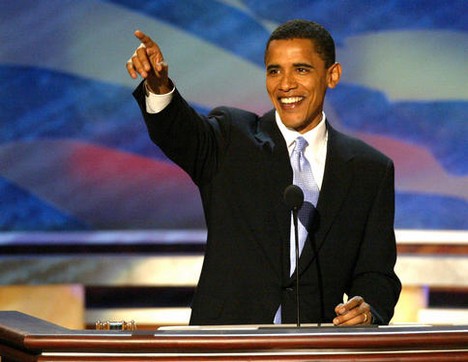
Barak Obama the 44th President

In 2008 Padre Steve returned from Iraq with a pretty good case of PTSD, chronic pain and anxiety coupled with depression and a crisis in faith.  He finished his tour at EOD and was assigned to Portsmouth Naval Medical Center. He and the Abbess celebrated thier 25th wedding anniversary.  The war in Iraq was now moving in a successful direction with the Iraqis taking more control of their security and the various religious, political and ethnic factions beginning to talk and work with one another rather than shoot at each other.  However the war in Afghanistan took a nasty turn as the Taliban came back with a vengeance and the Afghan government was revealed as weak, ineffective and corrupt.  The 2008 Presidential election was waged with bitterness and the Democrats sent Senator Barak Obama, who had defeated Senator Hillary Clinton up against Senator John McCain.  Obama won the election becoming the first African American man to become president while strengthening their majorities in Congress. The world entered a major economic crisis in 2008 and the United States suffered massive losses in financial markets, housing and rising unemployment.  Bank bailouts were the order of the day as President Bush left office and Obama took over.  A massive earthquake in Sichuan China killed over 80,000 people while American swimmer Michael Phelps won 8 gold medals to set an Olympic record.  The Philadelphia Phillies won the World Series defeating the surprising Tampa Bay Rays.  Death as always came along taking actors Heath Ledger and Charlton “Moses” Heston, comedian George Carlin and former Senator Jesse Helms.

Sarah Palin the New Leader of the GOP?

2009 came in with the inauguration of Barak Obama as President something that Padre Steve witnessed with a elderly African American women in her ICU room while holding her hand as she cried not believing that she would see an event of this kind in her lifetime.  The war in Iraq began to wind down as the US began to increase it’s withdraw of ground forces and turn over more security to the Iraqis.  In Afghanistan the war reached a crisis point as the military and political situation deteriorated within the country and support for the war dwindled in the US and Europe. Amid this President Obama agreed to a “surge” for Afghanistan.  The worldwide economic continued but by the end of the year some economic indicators were pointing upward again even as the US unemployment rate continued to rise. A bitter fight was waged over health care reform and economic policies while President Obama’s support and approval ratings crashed as people on both the left and right of the political spectrum criticized his leadership and policies.  Republican Vice-Presidential nominee and former Vice President Dick Cheney took the Republican lead in attacking the President while conservative talk radio delivered a daily barrage of criticism.  Some of Obama’s own actions did not help his cause especially in the manner in which he was viewed to respond to terrorist attacks including an attempted Christmas Eve bombing of a US airliner.  Tensions continued to grow between the West and Iran regarding that nation’s nuclear program even as widespread demonstrations wracked that country after an election which appeared to be rigged by the Iranian government. An outbreak of H1N1 Influence reached pandemic proportions across the globe but did not reach the lethality that it had the potential to do.  The Vatican announced a historic plan to allow conservative and traditionalist Anglicans come into the Catholic Church and retain their Anglican traditions and some measure of autonomy.
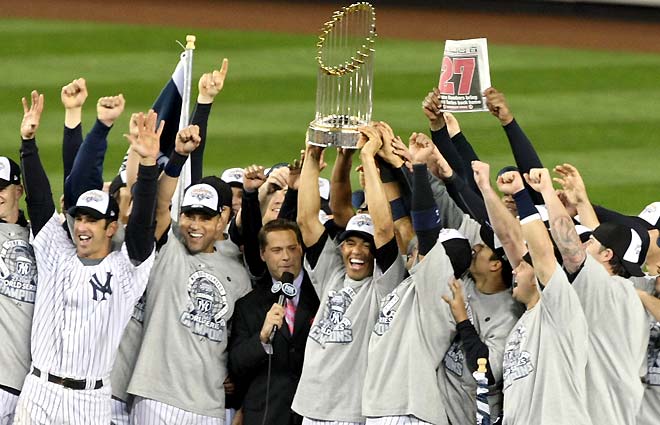
The Yankees Return

In baseball a revitalized New York Yankees team dominated the American league and went on to dominate their playoff and World Series opponents defeating the Phillies in 6 games. In football a good number of teams in both the NFL and NCAA were a parody of the sport and coaching scandals plagued the sport while at the box office Star Trek came back with a vengeance and a twist. Padre Steve continued his hospital work, battled PTSD, depression, his father’s Alzheimer’s disease and his own spiritual crisis but completed the academic requirements for his Masters Degree in Military History and by the end of the year began to experience some measure of healing.  He launched this site in February of 2009 and as of this post will have made 328 posts on the site.  He also bought his first ever season tickets for a baseball team and now claims Section 102, Row B seats 1 & 2 as his pew at the Church of Baseball, Harbor Park Parish.  Death prowled the earth looking for recruits finding legendary news anchorman Walter Cronkite who signed off of the last time, Pop Superstar Michael Jackson who “moon walked” the stairway to heaven or wherever, Senator Edward Kennedy who finalized his last legislation with his maker and Patrick Swayze who reprised his role in “Ghost.”

So it has been quite a decade personally for your friend Padre Steve as well as an eventual decade for the United States and the World.  The decade has been “interesting” and as the ancient Chinese curse says “may you live in interesting times.”  I hope that the next year and decade are a lot less interesting, that wars will cease and that people all over the world will join together like the old 1960’s Coca Cola commercial.

I’d Like to Teach the World to Sing?

Peace and Blessings in the New Year,

Padre Steve+

1 Comment

Filed under History, Loose thoughts and musings

More Lies and Distortions from WorldNet Daily’s Bob Unruh

Note: It has been a good number of months since I have addressed the Lies of WorldNet Daily and it’s leadership Joe Farah and his designated hit man Bob Unruh. I stumbled across an article yesterday evening when my curser hit the Worldnet Daily link on my “favorites.” I seldom go there unless I think that they might be getting crazy, but this was accidental, or if I was a Calvinist possibly God’s will. Unfortunately late last night I saw an attack on a fellow officer by this influential “Conservative Christian” website.  The attack was gratuitous and directed at an officer currently serving in Afghanistan Major Brian Stuckert who as part of a military education course published a monograph which is in the public domain entitled “Strategic Implications of American Millennialism.” As I mentioned the last time that I wrote against something that Unruh and WND published that I would limit myself to military issues as I do in this article.  I try to ignore the folks at WND but feel in this case that that are again in the process of attempting to stir up opinion against an officer who has done nothing wrong but to disagree with their political-religious ideology. While the folks at WND and those like them have every right to their opinions an beliefs, which are defended by those of us in uniform, they are way out of line in this article and owe Major Stuckert an apology. Unfortunately the WND leadership doesn’t do this as is evidenced in their past treatment of the Commanding Officers of Gordon Klingenschmitt. These men have no honor and stoop to the basest means to attack those that disagree with their narrow point of view. Some will not like what I write. That is fair, I do not claim to be infallible not do I practice censoring those that disagree with me. But I will not let a fellow officer who is serving in a combat zone be the subject of an egregious attack by the folks at WND. If it were an attack by a “liberal” website I would feel the same way. The fact that it is a “conservative” website which claims to “support the troops” that attacks Major Stuckert and other military officers who disagree with their point of view only makes me angry.  Now to my response:

Just when you think it is safe to go in the water and just enjoy the Christmas season Joe Farah and the good folks at Worldnet Daily come out with another whopper to attempt to whip people up against those in the military with differing opinions than that of their own.  Written by noted propagandist Bob Unruh who helped spin the lies of former Navy Chaplain, defrocked Evangelical Episcopal Priest Gordon Klingenschmitt into a frenzy that had many Christians believe that the Navy was attempting to muzzle Klingenschmitt’s religious rights, the article takes aim at an monograph written by Army Major Brian Stuckert ( the link to Stuckert’s monograph is here: http://www.wnd.com/files/Millennial.pdf ) for the Advanced Military Studies program. Officers who attend courses such as this are often required to produce a research paper on a subject that deals with political, military and foreign policy topics to include how social, ideological or religious can impact military operations at the strategic and operational levels including effects on foreign policy and diplomacy.  The Worldnet Daily article is linked here:   http://www.wnd.com/index.php?fa=PAGE.view&pageId=119315

Unruh in his usual manner has manipulated the facts to make it appear that Stuckert and the Army is attempting to silence what Unruh calls “Evangelical beliefs.”  In fact the title of the article U.S. Army Major: Lose evangelical Christian beliefs” is a straw man intentional thrown out by Unruh to chum the waters so to speak.  Unruh takes a research paper which he does not agree with and demonizes the writer.  These papers are akin to any research paper done for a graduate level academic program. They reflect the opinion of the author and not the institution.  Like all papers of this type they have to be evidenced based, in other words the author has to have data to show that his hypothesis and conclusions actually are not simply whims but have impact in the world in which the writer serves and for the topic that he or she addresses.  One does not have to agree with them and in fact in the future other officers might actually write articles to refute what Stuckert says.  This is an academic program and as such differing points of view are sought.

Instead of just leaving this be both Unruh and undoubtedly Joe Farah is using this article to again whip up the faithful against any idea that might contradict their political-religious views.  Stuckert has criticized the foundational philosophy of the Worldnet Daily leadership that of Pre-millennial Dispensationalist theology which does have very real foreign policy implications for the United States.   As such Stuckert’s article is important because it draws attention to how Pre-Millennial Dispensationalist effects how many Americans view the world and international relations to include how such beliefs can influence policy making.  Stuckert’s premise is found in his abstract:

“Since the beginning of the Republic, various forms of millennial religious doctrines, of which dispensational pre-millennialism is the most recent, have shaped U.S. national security strategy. As the dominant form of millennialism in the U.S. evolves, it drives changes in U.S. security policy and subsequent commitment of the instruments of national power. Millennial ideas contribute to a common American understanding of international relations that guide our thinking irrespective of individual religious or political affiliation. Millennialism has great explanatory value, significant policy implications, and creates potential vulnerabilities that adversaries may exploit.”

This is a fair characterization of the effect of pre-millennial dispensational theology on American national thought.  Thus it is fair to examine its effect on current policy both foreign and domestic.

Instead of taking Stuckert’s observations and critiques for what they are Unruh and his co-conspirators turn this into a conspiracy of people in the Army and government against true Christians. In the usual manner Unruh quotes someone that he agrees with on the article: Unruh quotes John McTernan a writer on Biblical Prophecy who says that Stuckert’s article is “the most dangerous document to believers that I have ever read in my entire life” and “After reading this document, it is easy to see the next step would be to eliminate our Constitutional rights and herd us into concentration camps.”

I am sorry, this is beyond reason: “eliminate our Constitutional rights and herd us into concentration camps?  That is nothing more than propaganda. In fact it is delusional paranoia designed implicitly to scare people and move them further into WorldNet Daily’s orbit turning good people against honest and decent military officers.  Unruh did this with Klingenschmitt in grand fashion through character assassination of Captain Carr, Klingenschmitt’s Commanding Officer on USS Anzio and Captain Pyle, the Commanding Officer of Naval Station Norfolk.  This got so bad regarding Captain Pyle, a conservative evangelical Christian of the Assemblies of God denomination that he was ostracized by his own church and demonized by the Christians who were the closest to his theological views.  It was shameful; people still believe the lies about Klingenschmitt spewed by the WorldNet Daily crowd.  Now they attack an Army Major who is serving in combat in Afghanistan.  Such conduct is beyond crude and unseemly, it is dishonest, disingenuous and dishonorable.

Unruh, no stranger to such behavior ends his article with a totally unrelated reference to the terrorist who killed 13 and wounded many others at Fort Hood just a month ago.  Major Stuckert’s article was published in 2008 and has nothing to do with the actions of Major Hasan.  The implication is that Stuckert supports the traitorous terrorist Hasan. This is another disingenuous attempt to link someone who disagrees with them with terrorists or other extremists.  Such behavior by alleged “journalists” is simply dishonest and to use a term from American history is “Yellow Journalism.”

The conduct of WorldNet Daily and in particular Bob Unruh is shameful and shows none of the graces associated with true Christian faith. Lying and mischaracterizing what others say and demonizing them in apocalyptic terms is not Christian behavior. It is crass cynical propaganda and WorldNet Daily is one of the worst offenders around.  Unfortunately these people are vicious in their attacks.  The article talks of “losing evangelical beliefs” however many evangelicals either oppose or have out rightly condemned pre-Millennial Dispensationalist as heresy. Yet many pre-millennial dispensationalists, especially the type found at WorldNet Daily effectively write off all evangelicals who do not hold to one of their several Rapture theories: “All people who believe the Bible believe in a Rapture” Mark Hitchcock “What Jesus Says About Earth’s Final Days” (p. 96).  This is just one example of how this camp views other Christians. If you do not believe in the Rapture as they define it you do not believe the Bible. The deduction is that Christians believe the Bible, you disagree with the Rapture, and you don’t believe the Bible and are thus not a Christian.

Even Prominent Evangelicals such as A. W. Pink (1886-1952) have disagreed with the tenants of Dispensationalism:

“Dispensationalism is a device of the enemy, designed to rob the children of no small part of that bread which their heavenly Father has provided for their souls; a device wherein the wily serpent appears as an angel of light, feigning to “make the Bible a new book” by simplifying much in it which perplexes the spiritually unlearned. It is sad to see how widely successful the devil has been by means of this subtle innovation.”

Many conservative Christian churches and individuals do not hold this position; in fact to take the view of Unruh is to assume that Stuckert is attacking Evangelical Christianity.  Stuckert is not doing so, he is simply critiquing one of several competing Christian Eschatological theories and how its influence helps shape US foreign policy and the worldview of many Americans.  He asserts that such beliefs when not recognized by those that propagate them can leave the United States vulnerable to our enemies, nothing more, nothing less. In fact Stuckert is careful to differentiate the various factions in what is considered by some radical secularists to be a monolithic “Evangelical” movement.

“Millennialism, and especially dispensational pre-millennialism, derives in large part from extraordinary literalism of even the most figurative passages of the Bible. In America, literalism in biblical interpretation is most closely associated with fundamentalism. Theologically, it is best to begin a discussion of American millennialism with a brief review of fundamentalism as the term applies to the contemporary American religious tradition. Fundamentalism is a frequently misunderstood term in America. Although it has connections to each, fundamentalism is distinct from evangelicalism, the charismatic movement or conservative Christianity in general. Fundamentalism is also poorly understood when we attempt to define it as a personality style, a form of militancy, or a particular worldview.” (Stuckert pp. 6-7)

Stuckert is fair in this; to not admit that religious, ideological or philosophical views do not serve is “filters” as McTernan and Unruh seem loathe doing is simply wrong. To understand the prism of how religious, ideological and other beliefs can influence worldview and decision making is important. This is what Stuckert does as pre-millennial dispensationalism is one of the major shapers of American thought; not only for Fundamentalist Christians but anyone who follows the popular fictional writings of Tim LaHaye’s Left Behind series.

Stuckert continues his monograph by discussing the importance of how Christian Fundamentalists view the Bible and the influence of pre-millennial eschatology on American political thought and foreign policy.   Since the popularized version of this eschatology influences the way that many Americans view the world it is appropriate that the effects of it be analyzed by those who study foreign and domestic policy. In his summery and conclusions Stuckert makes an erudite observation that is lost on many people:

“Because religion in America directly impacts policy, military leaders and planners must learn to recognize the tenets and implications of American millennial thought. Millennialism has always been a feature of the American culture and has shaped not only the objectives of U.S. government policy, but also the way in which we interpret the words and actions of other actors on the international stage. Millennial ideas contribute to a common American understanding of international relations that guide our thinking regardless of individual religious or political affiliation. Millennialism has great explanatory value, significant policy implications, and creates potential vulnerabilities that adversaries may exploit. By gaining insight into and embracing intellectual honesty where our own prejudices and proclivities are concerned, we can greatly improve the quality and clarity of our decision-making.” (Stuckert pp. 58-59)

Unruh “cherry picks” what he wants from Stuckert’s monograph in order to paint Stuckert as some kind of anti-Christian officer.  The use of McTernan’s claims to buttress his article shows how biased that Unruh as since McTernan’s livelihood is based on writing books and speaking about Bible prophecy from a pre-millennial dispensational point of view.  He claims to be a “student of American history” but has no academic credentials save a BA from Virginia Commonwealth University in an unnamed field. He has no military experience, no education in military or political theory other than what he may have learned on his own “study” and is in no position to be a legitimate critic of Major Stuckert’s work.  McTernan claims that the “last third (of Stuckert’s work) is an interpretation of Bible belief on world events. “This report blames all the world evils on believers! World peace would break out if it were not for Bible believers in America.” In fact it says no such thing.  It is not a “report” as McTernan calls it, but simply the equivalent of a graduate level thesis. This is nothing but a hit piece on a fellow officer who disagrees with McTernan and the crowd at WorldNet Daily.  McTernan talks about an argument that he had with Colonel Stefan Banack of the School for Advanced Military Studies who McTernan attacks:

“The conversation was extremely heated between us, and he hid behind the freedom of speech to produce it. He refused to let me write an article to refute this attack on Bible believers. He refused to tell me what this study was used for and who within the military was sent copies. I believe that it represents an official military view of Bible believers as Col. Banack said there was no study or article refuting this one.”

The fact that these papers are in the public domain and on the center’s website makes no difference to McTernan. He attempts to paint this is a some kind of conspiracy against Evangelical Christians when in fact it is the equivalent of an academic thesis in a Masters Degree program.  The fact that he says that Colonel Banack “hid behind the freedom of speech to produce it” sends a chilling message. Freedom of speech for McTernan goes only for McTernan not for those who disagree with him. Likewise McTernan uses the refusal of Colonel Banack to allow him to “refute this attack on Bible believers” is a red-herring. The School’s academic publications are for students to publish not for people with no standing in the military to use the platform to propagate their beliefs.  Mr. McTernan to my knowledge is not a student at the Advanced Military Studies program and would not be using the forum for actual academic debate but to advance his own cause which he does on his own website without any restriction.

So once again WorldNet Daily drops a whopper on its readers and attacks the character beliefs and academic thought of a military officer. Their conduct in this is much more like the Taliban and the Iranian Ayatollah’s than anyone who claims to value the right to freedom of speech and religion as they do. Like the early Puritans who came to the New World for “religious freedom” the only religious freedom or freedom of speech that Unruh, Farah and other like them value is their own. Those who dissent from their narrow understanding of eschatology stand condemned as do those who ask legitimate questions about the policy implications of their belief system. If they were ever to be in a position to impose their beliefs in this country men like Major Stuckert and probably yours truly would be persecuted.

Although I am but a “pip-squeak” in comparison to the WorldNet Daily behemoth but I cannot let a fellow officer who is serving in harm’s way be the subject of a gratuitous attack by these people. May God keep Major Stuckert and those he serves with in harm’s way safe and may they accomplish the mission that they have been sent to do.  As far as WorldNet Daily goes…I hope that they continue to have the freedom to speak in the manner that they would deny to those who disagree with them, especially those who serve in the uniform of the United States of America in harm’s way.

Peace,

Padre Steve+

10 Comments

Filed under Foreign Policy, Lies of World Net Daily, Military, national security

Unequal Allies: Lessons from The German’s and Their Allies on the Eastern Front for Today

patton with french tankPatton with French Renault F1 Tank in WWI

One of the problems that any coalition of unequal partners as is the case in Afghanistan is the role of the lesser partners, their capabilities and limitations imposed on them by their own governments.  When NATO joined the US led effort in Afghanistan a number of NATO allies contributed troops to the effort.  The same was true of the “coalition of the willing” in Iraq.  While obviously the US appreciated and continues to appreciate the efforts of its allies in both theaters the unique problems associated with coalition warfare are often not appreciated until the strengths and weaknesses of each junior partner in the coalition are shown to include the effect of each nation’s choice of units sent, logistics capability and rules of engagement.  Thus when some Americans are critical of the contribution of some allies, or the limitations imposed by their governments they should remember that in the First World War the United States was dependant on France and Britain for the majority of the Artillery, all of the tanks and aircraft as well as instructors and training facilities for the rapidly recruited American Expeditionary Force.

RickenbackerUS Ace Eddie Rickenbacker with French Supplied Nieuport 28
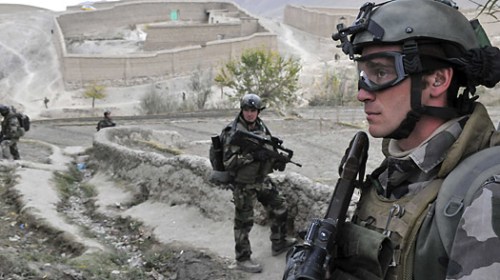
Every nation works within its own national interests and domestic political situation as well as its military capabilities. Unfortunately many people do not look at history to see how a coalition of a major power allied with a number of minor powers each with their own limitations as well as motivations for entering the war execute that war after the initial plan is foiled.  This is something that has happened in Afghanistan after the initial success disappeared with the corrupt and ineffective Afghan government, the resurgent Taliban and the resiliency of Al Qaida in their bases in the remote border areas of Afghanistan and Pakistan.

nato_france_a_0403French Troops in Afghanistan: The French, British and Canadians have the most Robust Rules of Engagement of Non US NATO Forces (Time Magazine Photo)
One of the best places to find such an example is the German relationship with their allies on the Eastern Front.  The question of the German dominated European Axis alliance in the Second World War is one of the more neglected subjects of World War Two II. In most accounts of the war, the relationship of the Germans to their coalition is minimal.  This includes the works of B.H. Liddell-Hart, Williamson Murray, Chester Wilmot and David M Glantz.   Italy usually receives some attention in the context of the campaign in North Africa and Mediterranean.  Hungary, Romania and Finland receive scant attention from anyone except as to how their armies were overrun during the Stalingrad campaign. Popular German memoirs provide little substantive help. Field Marshal Albert Kesselring’s memoirs and Erwin Rommel’s papers give some views of the Italian efforts in North Africa and the Mediterranean and Erich Manstein gives a limited amount of attention to the Italians, Finns, Hungarians and Rumanians in Russia.

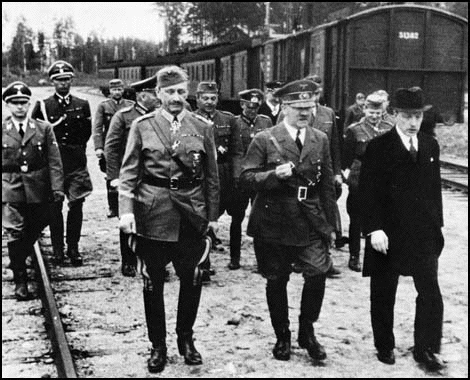
Finland-HitlerConflicting War Aims: Hitler with Finland’s Field Marshal Von Mannerheim
In his essay The Dysfunctional Coalition Robert Di Nardo examines the relationship of Germany to her allies on the Eastern Front where the Germans due to their own limitations were forced into a coalition war with weak allies of uncertain reliability. This is a subject that Di Nardo expanded on in his book Germany and the Axis Powers: from Coalition to Collapse (University of Kansas Press, 2005).  Di Nardo believes that there are important lessons to be learned from the failure of Germany and its coalition. Unfortunately we in the west are more often than not content to judge coalitions by the success of the Allies in the Second World War.  Di Nardo’s work on the subject is something that the United States must learn from as it works with coalitions whose members have significant military weaknesses often magnified by the domestic political climates in their own country. The situation, especially in Afghanistan places he United States in a similar position to Germany in relation to the current wars on terror and campaigns in Iraq and Afghanistan.

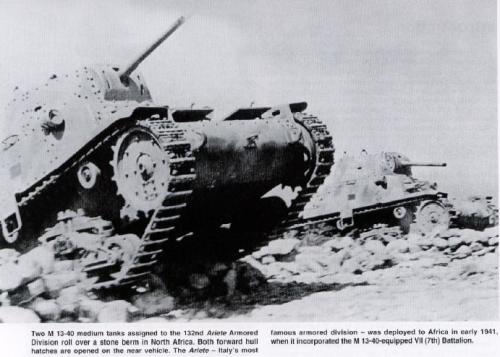
m 13-40 tankItalian M 13-40 tanks were the mainstays of Italian Armored Units, Slow, Undergunned and Poorly Armored they were No Match for Soviet T-34s

Di Nardo asserts “the way in which Germany conducted coalition warfare was reflective of the manner in which Hitler and the German military looked at the world, as well as the war in general.”  Germany often displayed a haughtiness toward its allies and even knowing their weaknesses was both unable and often unwilling to do much to strengthen them for the fight against the Soviet Union.  Di Nardo believes that the German attitudes were “a significant factor that contributed to the ultimate defeat of Nazi Germany.” (p.712)  In the essay Di Nardo notes the few successes of the coalition. In particular he looks at the German work with Rumanian air defense around the Ploesti oil refineries and the German-Finnish Winter Warfare School.  Apart from these instances he characterizes Axis coalition warfare on the eastern front as “poor” with “failures at every level.” (p.713)

italian troops stalino

Di Nardo analyzes the problems with language barriers, the wide differences of modernity of the armies and levels of technology and training of the coalition partners many of which are common to the war in Afghanistan. Germany’s failure to become the “arsenal of Fascism” which the United States became “the Arsenal of Democracy” for its allies hindered the Germans in their relationship to their poorly equipped allies.  Likewise, the lack of understanding of all the partners regarding the “relationship between national objectives, strategy and the morale of soldiers of officers and soldiers alike”(p.713) was a major obstacle.

finnish at gun

Di Nardo provides a good description of the German liaison detachments allotted to the coalition armies.  These teams functioned as advisors to their allies as well as liaisons between the German army and the allies. These teams dealt with language, tactical communications weaknesses and often displayed the generally haughty attitude that the Germans displayed to their partners. There is an excellent illustration of this in dealing with the failure of XLVIII Panzer Corps at Stalingrad when the German Liaison to the Romanian 1st Panzer Division was wounded.  At the operational and strategic levels Di Nardo describes the German policies and attitudes toward their allies as “imperialist.” (p.718)

He examines the wide gap in transportation capabilities of the various armies and the failure of the Germans to better provide for the needs of their partners in contrast to the United States assistance to her allies.   Germany provided obsolete captured Czech and French weapons and vehicles to her allies.  They refused to supply the Romanians and Hungary with the plans to build German tank and aircraft in Romanian and Hungarian industrial concerns capable of their manufacture. (pp.718-719) Di Nardo notes how this lack of modern equipment impacted the allies operations against the Red Army and their defeat at the hands of the Soviets.  Although Di Nardo alludes to how even elite German formations had substandard equipment he does not explain principle reason for this.   This was due to the fact that the Germans did not go to a “total war” footing in regard to industrial production until Albert Speer took over as Armaments Minister in 1943.

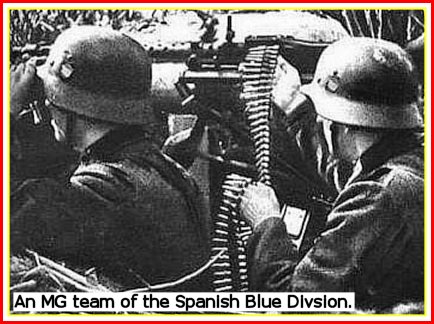
spanish blue divsion

The number of troops contributed by the German Allies was substantial. Hungary began Barbarossa with two corps, including its Mobile Corps and in 1942 supplied their 2nd Army which was composed of 1 Armored and 9 Infantry Divisions. 2nd Army was crushed by the Soviet offensive against Stalingrad. The Italians began with an expeditionary corps of 2 Semi-Motorized and 1 Light Infantry Divisions. In early 1943 they added 4 Infantry and 3 Alpine Divisions and a number of other smaller formations. This force became the 8th Army. It fought well during the advance toward Stalingrad but spread out over a wide front with little armored or air support was decimated by the Soviet offense against the city.  The remnants were no longer battle worthy and were evacuated to Italy.  Most of the Finnish Army was engaged in the war but after September 1939 made no major offensive contribution to the war. In 1944 following a major Soviet offensive which forced them to withdraw from the territory that they had captured in 1941 the Finnish government sued for peace. The Russians occupied a number of border provinces and islands and Finland was obliged to expel German Forces.  This resulted in the “Lapland War” between the Finns and the Germans with the Germans adopting a scorched earth policy as they withdrew from the country. The quality of the Finnish forces was generally higher than that of Germany’s other Allies.

romanian r35Obsolete French Built Romanian R-35 Light Tank
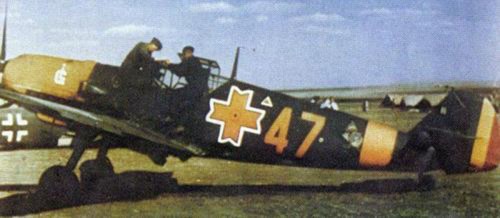
The Romanians contributed 19 divisions organized into 3 Armies to Barbarossa. They were limited by their equipment and logistics. The 3rd and 4th Romanian Armies were shattered at Stalingrad forcing a major reorganization as they continued the war.  In August 1944 with the Soviets pressing their border King Michael led a coup to overthrow the Fascist dictatorship of Antonescu. The Germans elected to fight and the Romanians changed sides and joined the Russian advance to the end of the war with their 1st Army taking part in the Prague offensive. Another contributor of troops was Franco’s Spain although it was a neutral country. Spain provided a division of volunteers which became the famous “Spanish Blue Division” or the 250th Infantry Division. It was outfitted as a German unit and received additional training from the Germans before it went into action. The division fought near Leningrad and was engaged in many tough fights.  A Spanish “Blue” Fighter squadron allotted to and equipped by the Luftwaffe also distinguished itself. In October 1943 Spain under allied pressure withdrew the division from the front although many soldiers volunteered to remain and fight on as smaller units attached to German formations. One volunteer company became part of the 11th SS Panzergrenadier Division Nordland at Berlin.  One thing that probably was a factor in the Spanish effectiveness as well as commitment to to German cause was their genuine loathing of the Soviets following the Spanish Civil War.

The final part of Di Nardo’s essay deals with the strategic goals and conflicts among the Axis coalition which were never worked out.  Examples of this include how the Finns never signed a formal alliance with Germany and how their national strategy did not allow them to deeper into the Soviet Union instead settling on recovering territory lost to the Soviets in 1939 with a few minor gains.  There was also the problem that the Romanians and Hungarians distrusted each other so much that they could not work together over their own territorial disputes.  The Italians joined the campaign late and their 8th Army participated in the German advance toward Stalingrad protecting the German flank.  While the Italians provided their own equipment including armor and aircraft they and their weapons were woefully suited for the war that they faced on the Eastern Front.  Di Nardo finishes his essay noting morale problems in the Hungarian, Italian and Romanian armies, the lack of understanding and general lack of motivation for the campaign.

Romanian_Me109-px800Romanian ME-109 E4, The Romanian Air Force Was One of the Axis Success Stories
This article is well sourced. Di Nardo uses histories, archival sources, operational orders and analysis by the various armies as well as interviews with participants. Of particular note is that he goes to sources of the coalition partners and not just German sources.  This allows him to be far more nuanced and detailed in his discussion as opposed to others who simply ignore the contributions of the Axis partners.  His footnotes provide added detail and provide and lend support to his arguments.

The importance of this essay is twofold.  First it provides a look at the relationship of German to her coalition partners on the Eastern Front.  This is important from a historic standpoint simply because it is such a neglected topic in most histories of the period and gives added depth to the reasons for Germany’s defeat.  One has to ask the “what if questions” in regard to had the Germans better treated, equipped and recognized their allies’ contributions to the war effort.

The second and probably more important for Afghanistan is that it provides lessons to any nation which has to engage in coalition warfare.  In particular it has lessons for the United States which has found itself as the senior and vastly superior partner in a war which has multiple coalition partners in several theaters of operations.  Each coalition partner has certain military strengths and weaknesses in relationship to the United States, national interests, geo-political and economic relationships with competitors to the United States and internal political realities which impact their cooperation in the war.  As such the United States cannot allow itself to be cast in the role of a haughty imperialistic senior partner as did Germany.  The US instead must cultivate an attitude of assistance, respect and trust among its partners to assure their full cooperation and assistance in relation to U.S. goals in the war. This is particularly important now was it appears that the Afghan war is reaching a point where the deteriorating situation on the ground could invite the early withdraw of allies and necessitate either the addition of more US troops or a strategic withdraw which would be for all intents and purposes a defeat for the US and NATO. The consequences would not be good and while the Taliban may be able to be contained they undoubtedly would invite Al Qaida back and provide them with a sanctuary just as Pakistan has stepped up its efforts on the border.

Leave a comment

Filed under History, iraq,afghanistan, world war two in europe

Stalingrad

Note: This post is another of my papers from my MA in History course that I have reworked some for this site.  The focus is on how the Germans and Russians fought the Stalingrad campaign. In  particular in the way the governments and military’s of both nations planned and executed strategy during the course of the campaign adjusted to the situation and how the campaign ended.  I conclude with a potential modern application for the US and NATO in Afghanistan.

Stalingrad: Primary or Secondary Objective

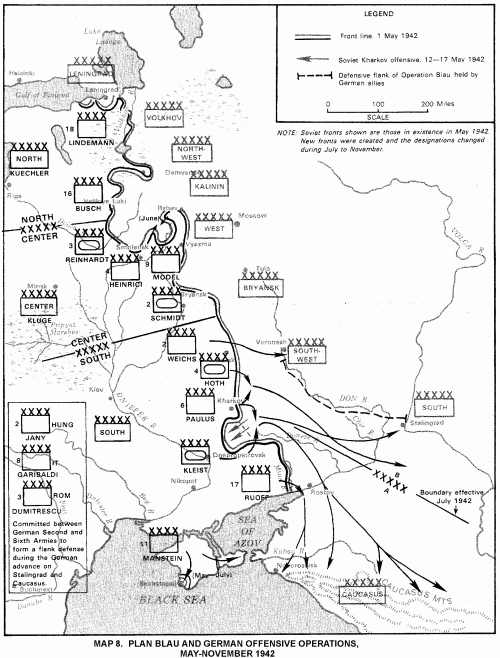
operation blau map

Following the Soviet winter offensive and the near disaster in front of Moscow the German High Command was faced with the strategic decision of what to do in the 1942 campaign.  Several options were considered and it was decided to seize the Caucasus oilfields and capture or neutralize the city of Stalingrad on the Volga.  However, the High Command was divided on the actual objective of the campaign.  OKH under the guidance of General Halder assumed that Stalingrad was the objective and the advance into the Caucasus was a blocking effort.[i] Hitler and OKW planned to capture the Caucasus oil fields and capture or neutralize Stalingrad to secure the left flank.[ii] Both OKH and OKW considered Stalingrad significant but “German commanders initially regarded it as a weigh station en route to the Caucasus oil fields.”[iii] The conflict echoed in the ambiguity of Directive No. 41 which “included the ‘seizure of the oil region of the Caucasus’ in the preamble concerning the general aim of the campaign, yet made no mention of this in the main plan of operations.”[iv] At the planning conference held at Army Group South in early June “Hitler hardly mentioned Stalingrad. As far as his Generals were concerned it was little more than a name on the map. His obsession was with the oil fields of the Caucasus.”[v] Manstein noted that “Hitler’s strategic objectives were governed chiefly by the needs of his war economy….”[vi] Anthony Beevor notes that at this stage of planning “the only interest in Stalingrad was to eliminate the armaments factories there and secure a position on the Volga. The capture of the city was not considered necessary.”[vii] German planners “expected that the Soviets would again accept decisive battle to defend these regions.”[viii]

Bild 169-0894Knocked Out T-34s

In Moscow Stalin and his Generals attempted to guess the direction of the impending German offensive.  “Stalin was convinced that Moscow remained the principle German objective…Most of the Red Army’s strategic reserves…were therefore held in the Moscow region.”[ix] To disrupt the German offensive and to attempt to recover Kharkov three offensives were launched by Red Army forces under the direction of Stavka. The largest of these on Kharkov was defeated between 12-22 May with the loss of most of the armor in southern Russia. This coupled with an equally disastrous defeat of Red Army forces in Crimea by Von Manstein’s 11th Army meant that the Red Army would face the Germans in a severely weakened condition.[x]

Operation Blau: Opening Moves and Divergent Objectives

The German offensive began on 28 June under the command of Field Marshal von Bock. Bock’s command included two separate army groups, Army Group B under General Von Weichs with 2nd Army, 6th Army and 4th Panzer Army operated in the northern part of the operational area. Army Group A was to the south with 17th Army and 1st Panzer Army.[xi] Army Group B provided the main effort and quickly smashed through the defending Soviet armies and by the 20th Hitler believed that “the Russian is finished.”[xii] One reason for the German success in the south was that until July 7th Stalin believed that Moscow was still the primary objective.[xiii] Bock was prevented by Hitler from destroying Soviet formations left behind and was relieved of command by Hitler. He was replaced by Von Weichs which created a difficult command and control problem.  Manstein noted that this created a “grotesque chain of command on the German southern wing” with the result that Army Group A had “no commander of its own whatever” and Army Group B had “no few than seven armies under command including four allied ones.”[xiv]

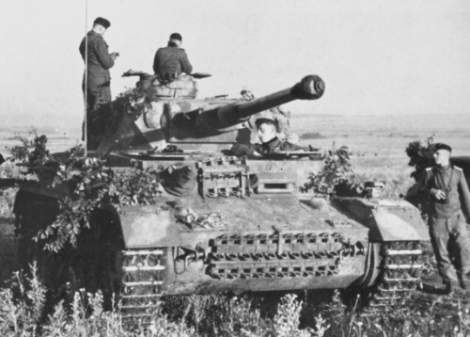
panzer ivfPanzer IV F

This decision proved fateful.  Hitler’s decided to redirect the advance of the 4th Panzer Army to support an early passage of the lower Don, diverting it from its drive on Stalingrad.  Additionally the army groups became independent of each other when Bock was relieved of command.  They were “assigned independent-and diverging-objectives” under the terms of Directive No.45.[xv] This combination of events would have a decisive impact on the campaign.  The decision prevented a quick seizure of Stalingrad by 4th Panzer Army followed by a hand over to 6th Army to establish the “block” as described by Directive No.41.  Kleist noted that he didn’t need 4th Panzer Army’s help to accomplish his objectives and that it could have “taken Stalingrad without a fight at the end of July….”[xvi]

The result was damning. Air support and fuel needed by Army Group A was transferred to 6th Army, denuding Army Group A of the resources that it needed to conclude its conquest of the Caucasus.[xvii] At the same time it denied Army Group B of the Panzer Army that could seize Stalingrad when it was still possible to do so.  Beevor calls Hitler’s decision a disastrous compromise.[xviii] Halder believed the decision underestimated the enemy and was “both ludicrous and dangerous.”[xix]

Focus on Stalingrad

On July 22 as the Wehrmacht ran short on fuel and divisions to commit to the Caucasus, and 6th Army fought for control of Voronezh the Soviets created the Stalingrad Front. Stavka moved an NKVD Division to the city,[xx] and rapidly filled the new front with formations transferred from the Moscow Front.[xxi] Stalin issued Stavka Order 227, better known as “No Step Back” on 28 July. The order mandated that commanders and political officers who retreated would be assigned to Penal battalions[xxii] and armies were to form three to five special units of about 200 men each as a second line “to shoot any man who ran away.”[xxiii] Russian resistance west of the Don slowed the German advance. German commanders were astonished “at the profligacy of Russian commanders with their men’s lives.”[xxiv] Von Kleist compared the stubbornness of Russians in his area to those of the previous year and wrote that they were local troops “who fought more stubbornly because they were fighting to defend their homes.”[xxv] Additionally, Stalin changed commanders frequently in the “vain hope that a ruthless new leader could galvanize resistance and transform the situation.”[xxvi] General Chuikov brought the 64th Army into the Stalingrad Front in mid-July to hold the Germans west of the Don.[xxvii]

Bild 116-168-618German Soldier in Stalingrad

Further weakening the Germans OKW transferred key SS Panzer Divisions and the Grossdeutschland Division to France. Supporting Hungarian, Italian and Romanian allied armies which lacked motorization, modern armor or anti-tank units were unable to fulfill the gaps left by the loss of experienced German divisions and the expectations of Hitler.[xxviii] 6th Army was virtually immobilized for 10 days due to lack of supplies allowing the Russians to establish a defense on the Don Bend.[xxix] To the south the Germans were held up by lack of fuel and increased Soviet resistance including the introduction of a force of 800 bombers.[xxx] Glantz and House note that with the fall of Rostov on July 23rd “Hitler abruptly focused on the industrial and symbolic value of Stalingrad.”[xxxi] Undeterred by warnings from Halder that fresh Russian formations were massing east of the Volga and Quartermaster General, Wagner, who guaranteed that he could supply either the thrust to the Caucasus or Stalingrad but not both.[xxxii] Again frustrated by slow progress Hitler reverted to the original plan for 4th Panzer Army to assist 6th Army at Stalingrad, but the cost in time and fuel were significant to the operation and the question was whether “they could make up for Hitler’s changes in plan.”[xxxiii]

Strategic Implications

soviet infantry attacking

The changes in the German plan had distinct ramifications for both sides.  Von Mellenthin wrote that “the diversion of effort between the Caucasus and Stalingrad ruined our whole campaign.”[xxxiv] The Germans could not secure the Caucasus oil fields which Hitler considered vital to the German war effort.  They advanced deep into the region and captured the Maikop oil fields, though they were almost completely destroyed by the retreating Russians.[xxxv] Army Group A was halted by the Russians along the crests of the Caucasus on August 28th.[xxxvi] This left Hitler deeply “dissatisfied with the situation of Army Group A.”[xxxvii] Kleist and others attributed much of the failure to a lack of fuel[xxxviii] and Blumentritt noted that Mountain divisions that could have made the breakthrough were employed along the Black Sea coast in secondary operations.[xxxix]

Fuel and supply shortages delayed 6th Army’s advance while Hoth’s 4th Panzer Army was needlessly shuttled between Rostov and Stalingrad. By the time it resumed its advance the Russians “had sufficiently recovered to check its advance.”[xl] As 6th Army advanced the “protection of Army Group B’s ever-extending northern flank was taken over by the 3rd Rumanian, the 2nd Hungarian and the newly formed 8th Italian Army.”[xli] The allied armies were neither equipped for the Russian campaign nor well motivated.[xlii] The supply shortage in both army groups was not helped by a logistics bottleneck. All supplies came over a single Dnieper crossing, which Manstein noted, prevented swift movement of troops from one area to another.[xliii]

Von Paulus’ 6th Army now attempted to rush Stalingrad between the 25th and 29th of July, while Hoth milled about on the lower Don.  However, Paulus’s piecemeal commitment of his divisions and failure to concentrate in the face of unexpectedly strong Soviet resistance caused the attacks to fail.  Paulus halted 6th Army on the Don so it could concentrate its forces and build its logistics base,[xliv] and to allow Hoth to come up from the south. This delay allowed the Russians to build up forces west of Stalingrad and reinforce the Stalingrad front and strengthen the defenses of the city,[xlv] and due to the distances involved it was easier for the Russians to reinforce the Stalingrad front.[xlvi] It also allowed the Russians to fill a number of key leadership positions with Generals who would skillfully fight the battle.[xlvii]

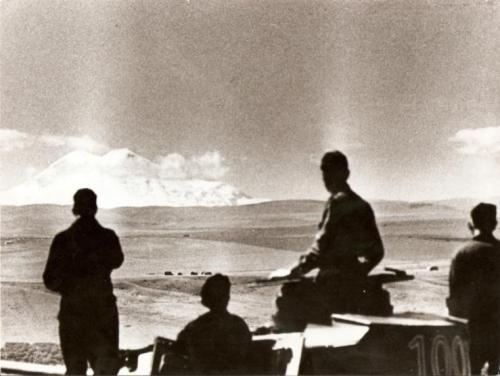
Kelbrus-739x556German Panzer Troops Look Upon the Caucasus Mountains
Hitler now focused on the capture of Stalingrad despite the fact that “as a city Stalingrad was of no strategic importance.”[xlviii] Strategically, its capture would cut Soviet supply lines to the Caucasus,[xlix] but this could be achieved without its capture. The checks in the south “began to give Stalingrad a moral importance-enhanced by its name-which came to outweigh its strategic value.”[l] To Hitler Stalingrad would gain “a mystic significance”[li] and along with Leningrad became “not only military but also psychological objectives.”[lii]

The Germans mounted a frontal assault with 6th Army and elements of 4th Panzer Army despite air reconnaissance that “the Russians are throwing forces from all directions at Stalingrad.[liii] Paulus as the senior General was in charge of the advance, with Hoth subordinated to him, but the attack had to wait until Hoth’s army could fight its way up from the south.[liv] Von Mellenthin comments rightly that “when Stalingrad was not taken on the first rush, it would have been better to mask it….”[lv] It is clear that the German advance had actually reached its culminating point with the failure of the advance into the Caucasus and Paulus’s initial setback on the Don, but it was not yet apparent to many involved.[lvi] The proper course of action would have been to halt and build up the front and create mobile reserve to parry any Russian offensive along northern flank while reinforcing success in the Caucasus. Manstein wrote that “by failing to take appropriate action after his offensive had petered out without achieving anything definite, he [Hitler] paved the way to the tragedy of Stalingrad!”[lvii]

Transfixed by Stalingrad

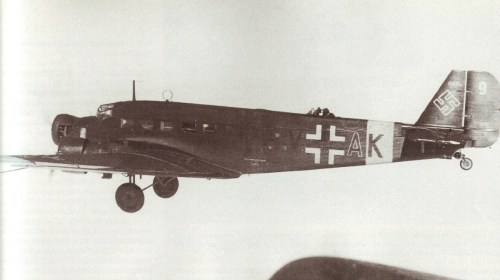
ju-52JU-52: Despite Tremendous Bravery of Luftwaffe Pilots Goering Failed to Keep Stalingrad Supplied
On August 19th Paulus launched a concentric attack against the Russian 62nd and 64th Armies on the Don.  The attack ran into problems, especially in Hoth’s sector.[lviii] Yet, on the 22nd the 14th Panzer Corps “forced a very narrow breach in the Russian perimeter at Vertyachi and fought its way across the northern suburbs of Stalingrad,”[lix] and reached the Volga on the 23rd. That day 4th Air Fleet launched 1600 sorties against the city dropping over 1,000 tons of bombs.[lx] The breakthrough imperiled the Soviet position they had concentrated their strongest forces against Hoth.[lxi] The Germans held air superiority and continued heavy bombing attacks.  During the last days of August 6th Army “moved steadily forward into the suburbs of the city, setting the stage for battle.”[lxii] As the Soviets reacted to Paulus, Hoth achieved a breakthrough in the south which threatened the Russian position.  However 6th Army was unable to disengage its mobile forces to link up with the 4th Panzer Army and another opportunity had been missed.[lxiii]

As 6th Army moved into the city Yeremenko ordered attacks against Hube’s 16th Panzer Division and Soviet resistance increased as more formations arrived the Germans suffered one of their heaviest casualty rates.”[lxiv] Though unsuccessful the counterattacks “managed to deflect Paulus’s reserves at the most critical moment.”[lxv] The Germans remained confident the first week of September as 6th Army and 4th Panzer Army linked up, but Yeremenko saved his forces by withdrawing and avoiding encirclement west of the city, retiring to an improvised line close to the city.[lxvi] On September 12th Chuikov was appointed to command 62nd Army in Stalingrad.  Chuikov understood that there “was only one way to hold on. They had to pay in lives. ‘Time is blood,’ as Chuikov put it later.”[lxvii] Stalin sent Nikita Khrushchev to the front “with orders to inspire the Armies and civilian population to fight to the end.”[lxviii] 13th Guards Rifle Division arrived on the 14th saved the Volga landings but it lost 30% casualties in its first 24 hours of combat.[lxix] An NKVD regiment and other units held the strategically sited Mamaev Kurgan, keeping German guns from controlling the Volga.[lxx] The defenders fought house to house and block by block, Army and NKVD were reinforced by Naval Infantry.  Chuikov conducted the defense with a brutal ferocity, relieving senior commanders who showed a lack of fight and sending many officers to penal units.  Chuikov funneled massed German attacks into “breakwaters” where the panzers and infantry could be separated from each other causing heavy German casualties.[lxxi]

Now the “city became a prestige item, its capture ‘urgently necessary for psychological reasons,’ as Hitler declared on October 2. A week later he declared that Communism must be ‘deprived of its shrine.’”[lxxii] The Germans did continue to gain ground, however slowly and at great cost, especially among their infantry, so much so that companies had to be combined.   Chuikov used his artillery to interdict the Germans from the far side of the Volga and the fight in the city was fought by assault squads with incredible ferocity and the close-quarter combat was dubbed “’Rattenkrieg’ by German soldiers.”[lxxiii] Paulus brought more units into the city and continued to slowly drive the Russians back against the river, by early October Chuikov wondered if he would be able to hold.[lxxiv] By early November Chuikov “was altogether holding only one-tenth of Stalingrad-a few factory buildings and a few miles of river bank.”[lxxv] Paulus expected “to capture the entire city by 10 November,”[lxxvi] despite the fact that many units were fought out. The 6th Army judged that 42% of the battalions of 51st Corps were fought out.[lxxvii] On 9 November Hitler declared “No power on earth will force us out of Stalingrad again!”[lxxviii]

Soviet Counteroffensive: Disaster on the Flanks

On September 24th Hitler relieved Halder for persisting in explaining “what would happen when new Russian reserve armies attacked the over-extended flank that ran out to Stalingrad.”[lxxix] Many in the German side recognized the danger. Blumentritt said “The danger to the long-stretched flank of our advance developed gradually, but it became clear early enough for anyone to perceive it who was not willfully blind.”[lxxx] Warnings were also given by Rumanian Marshall Antonescu and the staff’s of Army Group B and 6th Army[lxxxi] but Hitler was transfixed on Stalingrad.  In doing so the Germans gave up the advantage of uncertainty and once their “aim became obvious…the Russian Command could commit its reserves with assurance.”[lxxxii]

In the midst of Stalin’s concern about Stalingrad Stavka planners never lost sight of their goal to resume large scale offensive operations and destroy at least one German Army Group.[lxxxiii] Unlike Hitler Stalin had begun to trust his Generals and Stavka under the direction of Marshal Vasilevsky produced a concept in September to cut off the “German spearhead at Stalingrad by attacking the weak Rumanian forces on its flanks.”[lxxxiv] At first Stalin “showed little enthusiasm” for the attack, fearing that Stalingrad might be lost, but on 13 September he gave his full backing to the proposal[lxxxv] which Zhukov, Vasilevsky and Vatutin developed into a plan involving two operations, Operation Uranus, to destroy the German and allied forces at Stalingrad, Operation Saturn to destroy all the German forces in the south and a supporting attack to fix German forces in the north, Operation Mars aimed at Army Group Center.[lxxxvi]

T34_Stalingrad-Offensive-px800Soviet Armor on teh Offensive

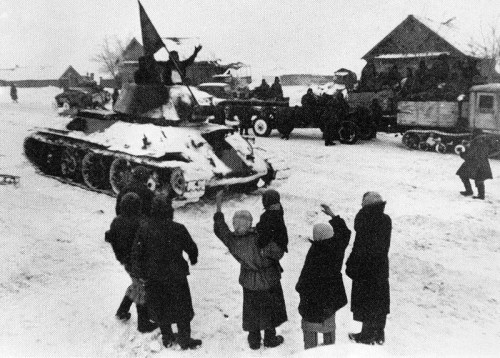
To accomplish the destruction of 6th Army and part of 4th Panzer Army the Red Army employed over 60% of the “whole tank strength of the Red Army.”[lxxxvii] Strict secrecy combined with numerous acts of deception was used by the Red Army to disguise the operation.[lxxxviii] The plan involved an attack against 3rd Rumanian Army on the northern flank by 5th Tank Army and two infantry armies with supporting units.[lxxxix] In the south against 4th Rumanian Army and weak element of 4th Panzer Army another force of over 160,000 men including 430 tanks were deployed.[xc] Despite warnings from his Intelligence Officer, Paulus did not expect a deep offensive into his flanks and rear and made no plans to prepare to face the threat.[xci] Other senior officers believed that the attack would take place against Army Group Center.[xcii] Warlimont notes that there was a “deceptive confidence in German Supreme Headquarters.”[xciii]

The storm broke on 19 November as Soviet forces attacked rapidly crushing Rumanian armies in both sectors[xciv] linking up on the 23rd.[xcv] 48th Panzer Corps supporting the Rumanians was weak and had few operational tanks.[xcvi] It attempted a counterattack but was “cut to pieces” in an encounter with 5th Tank Army.[xcvii] A promising attempt by 29th Motorized division against the flank of the southern Russian pincer was halted by the Army Group and the division was ordered to defensive positions south of Stalingrad.[xcviii] German airpower was neutralized by bad weather.[xcix] Paulus continued to do nothing as since the attacks were outside of his area of responsibility and waited for instructions.[c] As a result the 16th and 24th Panzer Divisions which could have assisted matters to the west remained “bogged down in street-fighting in Stalingrad.”[ci] Without support 6th Army units west of Stalingrad were forced back in horrific conditions.  By the 23rd 6th Army was cut off along with one corps of 4th Panzer Army and assorted Rumanian units, over 330,000 men.  This now entrapped force that would require seven rifle armies and much staff attention to eliminate.[cii]

The Death of 6th Army

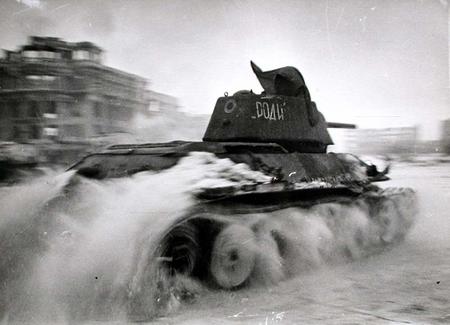
t-34 stalingradT-34 in Stalingrad

Hitler ordered Manstein to form Army Group Don to relieve Stalingrad. Hitler would not countenance a break out and wanted Manstein to break through and relieve 6th Army.[ciii] Hitler refused a request by Paulus on 23 November to move troops to prepare for a possible a break out attempt, assuring him that he would be relieved.[civ] Albert Speer notes that Zeitzler who replaced Halder insisted that the Sixth Army must break out to the west.”[cv] Hitler told Zeitzler that “We should under no circumstances give this up. We won’t get it back once it’s lost.”[cvi] Goering promised the Luftwaffe would be able to meet the re-supply needs of 6th Army by air, even though his Generals knew that it was impossible with the number of transport aircraft available.[cvii] Hitler took Goering at his word and exclaimed “Stalingrad can be held! It is foolish to go on talking any more about a breakout by Sixth Army…”[cviii] and a Führer decree was issued ordering that the front be held at all costs.[cix] Goerlitz states that “Hitler was incapable of conceiving that the 6th Army should do anything but fight where it stood.”[cx] Likewise Manstein had precious few troops with which to counterattack and had to protect the flank of Army Group A deep in the Caucasus. His army group was only corps strength and was spread across a 200 mile front.[cxi] Any relief attempt had to wait for more troops, especially Panzers.  Manstein too believed that the best chance for a breakout had passed and that it was a serious error for Paulus to put the request to withdraw through to Hitler rather than the Army Group or act on his own.[cxii] Many soldiers were optimistic that Hitler would get them out.[cxiii] Other generals like Guderian, Reichenau or Hoeppner might have acted, but Paulus was no rebel.[cxiv]

Madonna of StalingradThe Madonna of Stalingrad

Operation Saturn began on 7 December destroying the Italian 8th Army and forcing the Germans to parry the threat.[cxv] A relief attempt by 57th Panzer Corps under Hoth on 12 December made some headway until a massive Soviet counterattack on 24 December drove it back.[cxvi] This attack was hampered by OKW’s refusal to allocate the 17th Panzer and 16th Motorized divisions to Manstein,[cxvii] and by 6th Army not attacking out to link with the relief force.[cxviii]By 6 January Paulus signaled OKW: Army starving and frozen, have no ammunition and cannot move tanks anymore.”[cxix] On 10 January the Soviets launched Operation Ring to eliminate the pocket and despite all odds German troops fought on. On the 16th Paulus requested that battle worthy units be allowed to break out, but the request was not replied to.[cxx] On the 22nd the last airfield had been overrun and on 31 January Paulus surrendered.[cxxi]

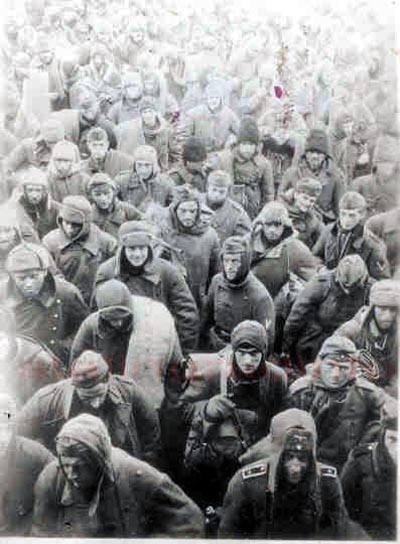
pows stalingradPOWs: Only 5,000 of 90,000 POWs would return
Analysis: What Went Wrong

Stalingrad had strangely drawn the attention of both sides, but the Russians never lost sight of their primary objectives during the campaign. The Germans on the other hand committed numerous unforced errors mostly caused by Hitler or Paulus. After the fall of Stalingrad as the Soviets attempted to follow up their success by attempted to cut off Army Group “A” Manstein was permitted to wage a mobile defense while Von Kleist managed to withdraw with few losses.[cxxii] The superior generalship of Manstein and Von Kleist prevented the wholesale destruction of German forces in southern Russia and Manstein’s counter offensive inflicted a severe defeat on the Soviets. However the German Army had been badly defeated.  The seeds of defeat were laid early, the failure to destroy bypassed Soviet formations in July, the diversion of 4th Panzer Army from Stalingrad, and the divergent objectives of trying to capture the Caucasus and Stalingrad at the same time.  This diluted both offensives ensuring that neither succeeded.  Likewise the failure to recognize the culminating point when it was reached and to adjust operations accordingly was disastrous for the Germans. The failure create a mobile reserve to meet possible Russian counter offensives, and the fixation on Stalingrad took the German focus off of the critical yet weakly held flanks. The hubris of Hitler and OKW to believe that the Russians were incapable of conducting major mobile operations even as Stavka commenced offensive operations on those flanks all contributed to the defeat.  Clark notes these facts but adds that the Germans “were simply attempting too much.”[cxxiii] Soviet numbers allowed them to wear down the Germans even in defeat.[cxxiv] At the same time Stalin gave his commanders a chance to revive the mobile doctrine of deep operations with mechanized and shock armies that he had discredited in the 1930s.[cxxv] All through the campaign Zhukov and other commanders maintained both their nerve even when it appeared that Stalingrad was all but lost. They never lost sight of their goal of destroying major German formations though they failed to entrap Army Group A with 6th Army.

A Modern Application

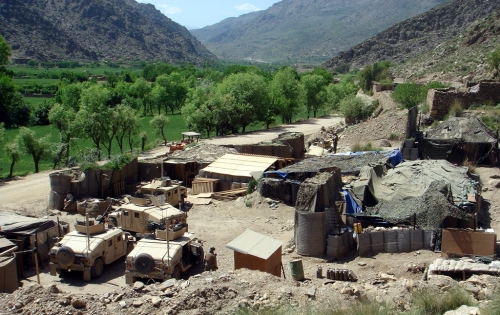
It is well and good to attempt to remain on the offensive.  The U.S. currently has forces spread thinly over two combat theaters with possibilities that other threats in the same region could flare up.  Like the Germans the U.S. is operating in areas, especially Afghanistan where overland supply lines are vulnerable and where weather can and does affect resupply operations by both ground and air.  The fact that the U.S. is operating with just barely enough forces in areas where others have met disaster calls for a circumspect look at what our enemy’s capabilities really are and not allowing ourselves to be surprised when they do things that have worked for them in the past against the Russians.  While it is unlikely that the U.S. and NATO would face a Stalingrad type situation in Afghanistan it is possible that isolated forces could be overrun as the Afghans reprise tactics used so successfully against the Soviets and as they begin to operate in larger units, concentrate them quickly and with more firepower to catch NATO forces when they are most vulnerable.  It is true that they will not mass large numbers of tanks and artillery as the Soviets did against the Germans, but the principle of speed, concentration at the critical point and surprise can inflict defeats that will turn public sentiment in the U.S. and Europe against further commitments and against the war and force the NATO governments as well as the U.S. to give up the effort.


[i] Clark, Alan. Barbarossa: The Russian-German Conflict:1941-45. Perennial Books, An imprint of Harper Collins Publishers, New York, NY 1965. p.191

[ii] Ibid.

[iii] Glantz, David M. and House, Jonathan. When Titan’s Clashed: How the Red Army Stopped Hitler. The University Press of Kansas, Lawrence KS, 1995. p.111

[iv] Ibid. Clark. p.191

[v] Beevor, Anthony. Stalingrad: The Fateful Siege: 1942-1943. Penguin Books, New York NY 1998. p.69

[vi] Manstein, Erich von. Forward by B.H. Liddle Hart, Introduction by Martin Blumenson. Lost victories: The War Memoirs of Hitler’s Most Brilliant General. Zenith Press, St Paul MN 2004. First Published 1955 as Verlorene Siege, English Translation 1958 by Methuen Company. p.291 This opinion is not isolated, Beevor Quotes Paulus “If we don’t take Maikop and Gronzy…then I must put an end to the war.” (Beevor pp. 69-70)  Halder on the other hand believed that Hitler emphasized that the objective was “the River Volga at Stalingrad. (Clark. p.190)

[vii] Ibid. Beevor. p.70.

[viii] Ibid. Glantz and House. p.106

[ix] Ibid. p.105-106

[x] Ibid. Clark. p.203.  The offensive did impose a delay on the German offensive.

[xi] Ibid. Clark. p.191 Each group also contained allied armies.

[xii] Ibid. p.209.

[xiii] Ibid. Glantz and House. p.119

[xiv] Ibid. Manstein. p.292.

[xv] Ibid. Clark. p.209

[xvi] Ibid. Clark.  p.211

[xvii] Ibid. Glantz and House. p.120. There is a good discussion of the impact of this decision here as 6th Army’s advance was given priority for both air support and fuel.

[xviii] Ibid. Beevor. p.74

[xix] Warlimont, Walter. Inside Hitler’s Headquarters 1939-45. Translated by R.H. Berry, Presido Press, Novato CA, 1964. p.249

[xx] Ibid. Beevor. p.75 This was the 10th NKVD Division and it took control of all local militia, NKVD, and river traffic, and established armored trains and armor training schools.

[xxi] Ibid. Clark. p.212

[xxii] Ibid. Glantz and House. p.121

[xxiii] Ibid. Beevor. p.85

[xxiv] Ibid. p.89

[xxv] Liddell-Hart, B.H. The German Generals Talk. Quill Publishers, New York, NY 1979. Originally published by the author in 1948. p.202

[xxvi] Ibid. Beevor. p.88

[xxvii] Ibid. Beevor. p.90

[xxviii] Ibid. Beevor. p.81

[xxix] Ibid. Glantz and House. p.121

[xxx] Ibid. Liddell-Hart. p.202

[xxxi] Ibid. Glantz and House. p.120

[xxxii] Goerlitz, Walter. History of the German General Staff. Westview Press, Frederick A. Praeger Publisher, Boulder, CO. 1985 p.416

[xxxiii] Ibid. Beevor. pp.95-96.

[xxxiv] Von Mellenthin, F.W. Panzer Battles: A Study of the Employment of Armor in the Second World War. Translated H. Betzler, Edited by L.C.F. Turner. Oklahoma University Press 1956, Ballantine Books, New York, NY. 1971. p.193

[xxxv] Shirer, William L. The Rise and Fall of the Third Reich. A Touchstone Book published by Simon and Schuster, 1981, Copyright 1959 and 1960. p.914

[xxxvi] Ibid. Glantz and House. p.122

[xxxvii] Ibid. Warlimont. p.256

[xxxviii] Ibid. Liddell-Hart. p.203

[xxxix] Ibid. p.204

[xl] Ibid. Shirer. p.914

[xli] Ibid. Goerlitz. p.416

[xlii] Ibid. Goerlitz. p.416

[xliii] Ibid. Manstein. p.293

[xliv] Ibid. Clark. p.214

[xlv] Ibid. Beevor. pp.97-99. The mobilization included military, political, civilian and industrial elements.

[xlvi] Liddell-Hart, B.H. Strategy. A Signet Book, the New American Library, New York, NY. 1974, Originally Published by Faber and Faber Ltd., London. 1954 & 1967. p.250

[xlvii] Ibid. Beevor. p.99.  Two key commanders arrived during this time frame, Colonel General Andrei Yeremenko, who would command the Stalingrad Front  and General Chuikov commander of 64th Army who would conduct the defense of the city.

[xlviii] Carell, Paul Hitler Moves East: 1941-1943. Ballantine Books, New York, NY 1971, German Edition published 1963. p.581

[xlix] Ibid. Shirer.  p.909.

[l] Ibid. Liddell-Hart, Strategy. p.250

[li] Wheeler-Bennett, John W. The Nemesis of Power: The German Army in Politics 1918-1945. St. Martin’s Press, New York, NY 1954.  p.531

[lii] Ibid. Wheeler-Bennett. p.531

[liii] Ibid. Beevor. p.96

[liv] Ibid. Clark. p.216.

[lv] Ibid. Von Mellenthin. P.193

[lvi] See Von Mellinthin pp.193-194.  Von Mellinthin quotes Colonel Dinger, the Operations Officer of 3rd Motorized Division at Stalingrad until a few days before its fall. Dingler noted that the Germans on reaching Stalingrad “had reached the end of their power. Their offensive strength was inadequate to complete the victory, nor could they replace the losses they had suffered.” (p.193) He believed that the facts were sufficient “not only to justify a withdrawal, but compel a retreat.” (p.194)

[lvii] Ibid. Manstein. p.294

[lviii] Ibid. Clark. p.216

[lix] Ibid. Clark. p.217

[lx] Ibid. Beevor. p.107

[lxi] Ibid. Beevor. p.107

[lxii] Ibid. Glantz and House. p.122

[lxiii] Ibid. Carell. P.601

[lxiv] Ibid. Beevor. p.118

[lxv] Ibid. Beevor. p.118

[lxvi] Ibid. Carell. p.602

[lxvii] Ibid. Beevor. p.128

[lxviii] Ibid. Carell. p.603

[lxix] Ibid. Beevor. p.134

[lxx] Ibid. Beevor. pp.136-137

[lxxi] Ibid. Beevor. p.149

[lxxii] Fest, Joachim. Hitler. Translated by Richard and Clara Winston, Harcourt, Brace, Jovanovich Publishers, San Diego, New York, London. 1974. p.661

[lxxiii] Ibid. Beevor. pp. 149-150

[lxxiv] Ibid. Beevor. p.164

[lxxv] Ibid. Carell. p.618

[lxxvi] Ibid. Glantz and House. p.123

[lxxvii] Ibid. Beevor. p.218

[lxxviii] Ibid. Carell. p.623

[lxxix] Ibid. Goerlitz. p.418

[lxxx] Ibid. Liddell-Hart. The German Generals Talk. p.207

[lxxxi] Ibid. Manstein. p292

[lxxxii] Ibid. Liddell-Hart. History of the Second World War. p.258

[lxxxiii] Ibid. Glantz and House. p.129

[lxxxiv] Ibid. Glantz and House. p.130

[lxxxv] Ibid. Beevor. pp.221-222 Glantz and House say that Stalin gave his backing in mid-October but this seems less likely due to the amount of planning and movement of troops involved to begin the operation in November.

[lxxxvi] Ibid. Glantz and House. p.130

[lxxxvii] Ibid. Beevor. p.226

[lxxxviii] Ibid. Glantz and House. p.132

[lxxxix] Ibid. Glantz and House. p.130

[xc] Ibid. Beevor. p.227

[xci] Ibid. Beevor. p.228

[xcii] Ibid. Clark. p.235

[xciii] Ibid. Warlimont. p.274

[xciv] Ibid, Carell. p.627 3rd Rumanian Army lost 75,000 men in three days.

[xcv] Ibid. Clark.pp.247-248

[xcvi] The condition of the few German Panzer Divisions in position to support the flanks was very poor, the 22nd had suffered from a lack of fuel and maintenance and this many of its tanks were inoperative. Most of the armor strength of the 48th Panzer Corps was provided by a Rumanian armored division equipped with obsolete Czech 38t tanks provided by the Germans.

[xcvii] Ibid. Clark. pp.251-252. The designation of 2nd Guards Tank Army by Clark has to be wrong and it is the 5th Tank Army as 2nd Guards Tank was not involved in Operation Uranus.  Carell, Beevor and Glantz properly identify the unit.

[xcviii] Ibid. Carell. p.630

[xcix] Ibid. Beevor. p.244

[c] Ibid. Beevor. p.247

[ci] Ibid. Beevor. p.245

[cii] Ibid. Glantz and House. p.134

[ciii] Ibid. Glantz and House. p.134

[civ] Ibid. Clark. p.256

[cv] Speer, Albert. Inside the Third Reich. Collier Books, a Division of MacMillan Publishers, Inc. New York, NY 1970. p.248

[cvi] Heiber, Helmut and Glantz, David M. Editors. Hitler and His Generals: Military Conferences 1942-1945. Enigma Books, New York, NY 2002-2003.  Originally published as Hitlers Lagebsprechungen: Die Protokollfragmente seiner militärischen Konferenzen 1942-1945. Deutsche Verlags-Anstalt GmbH, Stuttgart, 1962. p.27

[cvii] Ibid. Glantz and House. p.135 Glantz and House note that the amount of aircraft estimated to successfully carry out the re-supply operation in the operational conditions was over 1,000.  The amount needed daily was over 600 tons of which the daily reached only 300 tons only one occasion.

[cviii] Ibid. Speer. p.249

[cix] Ibid. Carell. p.636

[cx] Ibid. Goerlitz. p.426

[cxi] Ibid. Clark. p.252

[cxii] Ibid. Manstein. p.303

[cxiii] Ibid. Beevor. p.276

[cxiv] Ibid. Carell. p.640

[cxv] Ibid. Glantz and House. p.140

[cxvi] Ibid. Glantz and House. p.140

[cxvii] Ibid. Clark. p.264

[cxviii] Ibid. Manstein. p.337

[cxix] Ibid. Beevor. p320

[cxx] Ibid. Beevor. p.365

[cxxi] Of the approximately 330,000 in the pocket about 91,000 surrendered, another 45,000 had been evacuated.  22 German divisions were destroyed.

[cxxii] Ibid. Liddell-Hart. The German Generals Talk. p.211

[cxxiii] Ibid. Clark. p.250

[cxxiv] Ibid. Glantz and House. p.124

[cxxiv] Ibid. Beevor. p.221

Bibliography

Beevor, Anthony. Stalingrad: The Fateful Siege: 1942-1943. Penguin Books, New York NY 1998

Carell, Paul Hitler Moves East: 1941-1943. Ballantine Books, New York, NY 1971, German Edition published 1963.

Clark, Alan. Barbarossa: The Russian-German Conflict:1941-45. Perennial Books, An imprint of Harper Collins Publishers, New York, NY 1965.

Fest, Joachim. Hitler. Translated by Richard and Clara Winston, Harcourt, Brace, Jovanovich Publishers, San Diego, New York, London. 1974

Glantz, David M. and House, Jonathan. When Titan’s Clashed: How the Red Army Stopped Hitler. The University Press of Kansas, Lawrence KS, 1995.

Goerlitz, Walter. History of the German General Staff. Westview Press, Frederick A. Praeger Publisher, Boulder, CO. 1985

Heiber, Helmut and Glantz, David M. Editors. Hitler and His Generals: Military Conferences 1942-1945. Enigma Books, New York, NY 2002-2003.  Originally published as Hitlers Lagebsprechungen: Die Protokollfragmente seiner militärischen Konferenzen 1942-1945. Deutsche Verlags-Anstalt GmbH, Stuttgart, 1962.

Liddell-Hart, B.H. The German Generals Talk. Quill Publishers, New York, NY 1979. Originally Published by the author in 1948.

Liddell-Hart, B.H. Strategy. A Signet Book, the New American Library, New York, NY. 1974, Originally Published by Faber and Faber Ltd., London. 1954 & 1967

Manstein, Erich von. Forward by B.H. Liddle Hart, Introduction by Martin Blumenson. Lost victories: The War Memoirs of Hitler’s Most Brilliant General. Zenith Press, St Paul MN 2004. First Published 1955 as Verlorene Siege, English Translation 1958 by Methuen Company

Shirer, William L. The Rise and Fall of the Third Reich. A Touchstone Book published by Simon and Schuster, 1981, Copyright 1959 and 1960

Speer, Albert. Inside the Third Reich. Collier Books, a Division of MacMillan Publishers, Inc. New York, NY 1970.

Von Mellenthin, F.W. Panzer Battles: A Study of the Employment of Armor in the Second World War. Translated H. Betzler, Edited by L.C.F. Turner. Oklahoma University Press 1956, Ballantine Books, New York, NY. 1971.

Warlimont, Walter. Inside Hitler’s Headquarters 1939-45. Translated by R.H. Berry, Presido Press, Novato CA, 1964.

Wheeler-Bennett, John W. The Nemesis of Power: The German Army in Politics 1918-1945. St. Martin’s Press, New York, NY 1954

Leave a comment

Filed under History, world war two in europe

The most dangerous assignment: 4 More Advisers Die In Afghanistan

training team baseIsolated Embedded Training Team Base

Once know and relatively unglamorous group of American military men have suffered multiple casualties in a single engagement.  These men belong to are small units that do not have a lot of organic firepower.  They usually operate in remote areas far from immediate assistance if they get in trouble.  When one of these units suffers casualties, especially where they lose 3-5 men in one engagement they might have lost 20-25% of their unit.

On September 8th a team of these men was ambushed while on foot going to an Afghan with Afghan soldiers to meet tribal leaders with the intent of establishing a government presence in a hostile area.  In the ambush four were killed, three U.S. Marines and one U.S. Navy Hospital Corpsman attached to them.  On Tuesday the 8th Gunnery Sgt. Edwin W. Johnson Jr., 31, of Columbus, Ga., 1st Lt. Michael E. Johnson, 25, of Virginia Beach, Va., Staff Sgt. Aaron M. Kenefick, 30, of Roswell, Ga. and Petty Officer 3rd Class James R. Layton, 22, of Riverbank, Calif., were while working as trainers to Afghan soldiers on a mission to search for weapons and then meet village elders under an agreement to establish government authority there.  They were killed in “a complex attack according to a U.S. Military spokesman.  According to McClatchy news service who had a reporter that accompanied the mission, insurgents had set up positions in the village and in the mountains on both sides and apparently attacked as the men neared the village. 1st LT Johnson was wounded and while being attended Navy Hospital Corpsman Third Class James R. Layton when they both came under attack.  Both were killed.  Another Marine told the McClatchy reporter that they’d found the wrappings of bandages and other medical gear strewn around Layton and Johnson.  Eight Afghan troops and police and the Marine commander’s Afghan interpreter also died in the ambush and the subsequent battle that raged from dawn until 2 p.m. around the remote hamlet of Ganjgal in eastern Kunar province, close to the Pakistan border.

traiining team with afghan armyUSMC Advisers with Afghan Counterparts

The McClatchy reporter said: “We walked into a trap, a killing zone of relentless gunfire and rocket barrages from Afghan insurgents hidden in the mountainsides and in a fortress-like village where women and children were replenishing their ammunition.”  The reporter said that “U.S. commanders, citing new rules to avoid civilian casualties, rejected repeated calls to unleash artillery rounds at attackers dug into the slopes and tree lines — despite being told repeatedly that they weren’t near the village.”

The battle must have been intense.  I have been on foot patrols in areas crowded with Iraqis far away from significant support where if an insurgent group had attacked us we would have easily been overwhelmed. This is part of the world of the U.S. Military in the embedded training teams which work closely with Afghan and Iraqi soldiers.  I spent a lot of time with the advisers to Iraqi Army. Border and Port of Entry troops, Police and Highway Patrol spread across the entirety of Al Anbar Province.  These men and women are seldom thought of or mentioned by the press or even the military. . They come from all branches of the military and serve as advisers, trainers and mentors to these nations’ security forces.  The duty is dangerous.  The advisers, be they to the military, police, or civil administrations often work in the most isolated places in these countries and are stationed in small teams with the Iraqis and Afghans that they advise.  They are often far from the “big battalions” that have lots of firepower available and often operate out of larger and more secure bases with air support close at hand. Earlier in the year there were a number of incidents where advisers were killed by renegade soldiers or police, or by infiltrators posing as security personnel.  Two soldiers were working with an Iraqi unit in doing humanitarian work in a village when attacked and killed by someone who had infiltrated the Iraqi security forces.  . On March 27th Navy LT Florence Choe and LTJG Francis Toner IV were killed by an Afghan insurgent posing as an Afghan Army soldier. All of these events triggered anxiety in me as I remembered how many times I was incredibly exposed to danger conducting similar operations.

This incident was especially chilling as I read the reporter’s account of the ambush.  “Dashing from boulder to boulder, diving into trenches and ducking behind stone walls as the insurgents maneuvered to outflank us, we waited more than an hour for U.S. helicopters to arrive, despite earlier assurances that air cover would be five minutes away.”  According to the reporter Marine Maj. Kevin Williams” the commander of the team said: “We are pinned down. We are running low on ammo. We have no air. We’ve lost today, through his translator to his Afghan counterpart, responding to the latter’s repeated demands for helicopters.”  When I read this my mind flashed back to being in the middle of a massive crowd at the border crossing of Waleed on the Iraqi-Jordanian border.  There were about nine of us, of which only 8 were armed as I am not allowed by the U.S. interpretation of the law of war to carry a weapon.  There were thousands of Iraqis and others around us, very few border troops or port-of-entry police anywhere near us.  The port of entry had been the scene of numerous attempts to smuggle weapons, materials, and other supplies, drugs and to Iraq insurgents and Al Qaida.  Very few US troops were stationed there and many of these were dispatched off of the base at any given time.

The advisers are drawn from all services.  They are all Individual Augments that come from both the Active and Reserve components.  They do not deploy with their own units, which means that they go to war with people that they might have trained alongside getting ready for the mission, but otherwise have not served with.  When they come home they go back to their old assignments or new orders and are separated from the men and women that they served alongside for 7 to 15 months.  In other words they are isolated when they return home and go back to places where the majority of personnel, even those who have been “in country” have no earthly idea or appreciation of the conditions that they served in and dangers that they faced.  This happened to me when I returned and I went through an emotional collapse as the PTSD that I did not know I had kicked my ass.  Sights, smells, noises, crowds, airports and in fact almost everything but baseball diamonds caused me to melt down as they all brought the danger back to me. Don’t get me wrong, my tour in Iraq was the highlight of 27 plus years in the military, the part of which I am the most proud.

I have a special place for these men and women.  I served with them in Iraq’s Al Anbar Province as the first Navy Chaplain, and one of the first chaplains of any service to be assigned to cover these teams since Vietnam.  My assistant, RP2 Nelson Lebron and I deployed together from out unit.  I had prepared well.  I had been on the bubble to deploy for months.  My background in military history and past service with both the Army and Marines helped me. Likewise my military and civilian education helped me.  Shortly before we were notified of the deployment I went to the Jordanian Army Peace Operations Training Center course on Iraqi culture, religion and society.  I had served as a chaplain in the trauma department of one of the largest trauma centers in the country.  RP2 Lebron had deployed multiple times to Iraq, Beirut and Afghanistan where he was awarded the Defense Meritorious Service Medal (no small feat for an E-5).  He is also an incredibly gifted boxer, kick boxer and martial artist who has fought on Team USA and holds more title belts than I can count.  He most recently won the Arnold Schwarzenegger Classic. I had served with him before and he knew that his mission was to keep me safe.  I don’t want to sound arrogant, but the Chief of Staff of the Iraq Assistance Group said that we were “the best ministry team he had seen in 28 years in the Army.”

When we went to Al Anbar we were sent out with the Marines and Soldiers advising the 1st and 7th Iraqi Army Divisions, The Iraqi Police, Highway Patrol, the 2nd Border Forces Brigade and Port of Entry Police.  We operated in a area the size of the state of Oregon.  In some cases it would take us 2 days by air and convoy to reach isolated teams on the Syrian border.  When you travel by air in Iraq you are always at the mercy of the weather and aircraft availability. I had the rare privilege as a Lieutenant Commander to be able to arrange all of my own air transportation.  Most people, including people higher ranking than me had to depend on others to do this for them.  We worked with our advisers to get out to them.  We would be out 5-12 days at a time with anywhere from 4 to 7 days between missions.  In our 7 months we traveled over 4500 air miles and 1500 ground miles.  Almost all of our air travel was rotor wing. We flew in CH-46, CH-47 and MH-53s and the MV-22 Osprey.  Our convoys were usually not larger than 3 American HUMMVs and sometimes a few Iraqi vehicles.  Our biggest guns were .50 cal or M240B machine guns.

Dinner with Geneal SabahDinner with General Sabah in Ramadi

Many places we served were in places that had no large forces in position to help us if we got in trouble.  Even on the bases we were isolated.  Our teams were with the Iraqis in almost all cases.  We often ate in Iraqi chow halls and used Iraqi shower trailers.  Our advisers had us meeting their Iraqi counterparts.  We met and dined with Iraqi Generals, had ch’ai (tea) with small groups of Americans and Iraqis and got out with the Bedouins. We were in a number of particularly sensitive and dangerous situations with our advisers; one which I cannot go into great detail involved a senior advisor having to inform a new Iraqi Brigade Commander that a member of his staff was engaged in illegal activities and who had put out contracts to kill the American officer.  The bad Iraqi officer was confronted and relieved in a tense meeting where both Nelson and I were with that Colonel and two other advisors as they made the confrontation in the Iraq C.O.’s office, a confrontation that got quite heated until the Iraqi C.O. shut him up. At one point the cashiered officer appealed to the American “Imam” that he was a faithful Moslem, to whit the American Colonel and I asked him how a person who was living a good Moslem life could steal from his own countrymen and supply his county’s enemies with what they needed.

Waleed trip 006Team at Waleed on the “secure” side of the Port of Entry
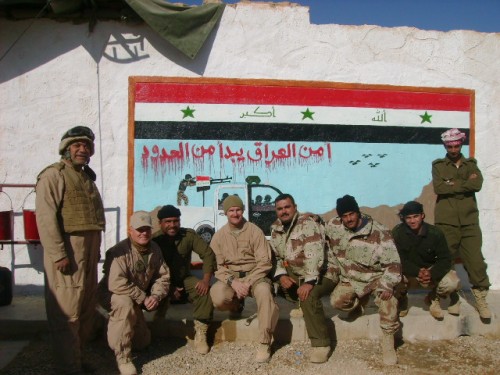
It was an incredible, once in a lifetime tour serving with some of the greatest Americans and Iraqis around. Iraqi soldiers in with our convoys would ask me to bless their trucks with Holy Water like I was doing with the American trucks.  I came to admire many of the professional Iraqi officers that I came to know and pray for the people of Iraq, that God would grant them peace. They are wonderfully hospitable and gracious.  We were often treated to food and tea by Iraqi soldiers, and civilians.  After nearly 30 years of nearly continuous war, dictatorship and terrorism, they deserve peace and security.

Me BTT CO and Iraqi LeadersAdvisers and Iraqi Border Troops near Syria
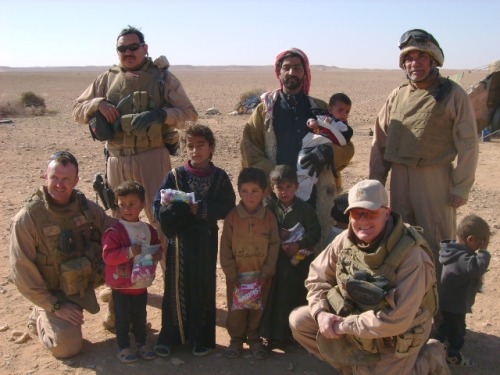
I had one Iraqi operations officer, a Sunni Muslim tell me that he wished that his Army had Christian priests because they would take care of his soldiers and had no political axe to grind. He said that the Army did not trust most Imams or Mullahs because they had compromised themselves during the civil war.  Another officer, a Shia Muslim came to me to thank me for being there to take care of our Marines.  He said that he, an Iraqi Shia Arab, hoped that if they had any problems from the Persians (Iranians), that we would help them.  These is little truth to what is floated that Iraqi and Iranian Shia like each other.  The memories of the past die hard in the Middle East.  When Persia ruled Iraq they treated the Arabs like dirt. Likewise the memories of the Iran-Iraq war are still alive.  Iraqi Arabs, Sunni, Shia and even Christian have little love for the “Persians.”  General Sabah of the 7th Division had us to his quarters for dinner. We had a wonderful and friendly discussion about similarities and differences in Christianity and Islam. We departed friends. The last time I saw him ws in the Ramadi heliport.  He saw me, ran up to me in from of his staff and Americans in the little terminal and gave me a bear hug, telling all that I was his friend. Another Iraqi General told me just before we left to come back as a tourist in 5 years because everything would be better.  I honestly think that he is right.  I hope to go back someday.  It would be a privilege to see my Iraqi friends again.

Me and BTT with Bedouin KidsWith a Bedouin Family

At the same time Afghanistan is a different animal. Iraq was not as easy of place for Al Qaida to work in and the Iraqis have a much more developed national identity which they trace back to the Babylonians and Chaldeans.  They also have adopted a lot of western ways.  Insurgents there once they had lost the confidence of the Iraqis lost traction.  In Afghanistan there is no real collective national identity and the form of Islam is much more severe than almost all Iraqi variants.  The Afghans insurgents have also due to the terrain; climate and inability of invaders to gain the confidence of the population have used the inability of invaders against them as they bring the population back under their control, sometimes quite peacefully.  The Taliban have secure bases on the Pakistani side of the border as did the North Vietnamese and they have the support of much of the population due to the unpopularity and corruption of the Afghan government.  The Taliban have begun to operate in larger better organized units and last year a battalion sized element attempted to overrun a small NATO base.  They did this with the Russians as well.  One troubling comment was reported about something overhead on the Taliban radio: “We will do to you what we did to the Russians,” the insurgent’s leader boasted over the radio, referring to the failure of Soviet troops to capture Ganjgal during the 1979-89 Soviet occupation.”  They also have outlasted or defeated a host of powerful empires.  The war in Afghanistan has much more in common with Vietnam than it does with Iraq. Counter Insurgency techniques learned in Iraq will be helpful but because of the terrain, climate and nature of the opposition will be tougher to execute and in order to have any chance of getting out of Afghanistan having accomplished the mission we will end of taking more casualties, especially in the teams of advisers.  Iraq was different, despite the problems and having to be rebuilt the Iraqi Army has a long history and tradition dating back to the Ottoman Empire, they led the way to westernizing Iraq and helping build an Iraqi identity, this is not the case in Afghanistan.  What happened to this team could easily happen to others and it looks to me like someone set them up to be hit, probably a Taliban sympathizer in the Afghan security forces or government. Afghanistan is much more treacherous than Iraq and in my view will be much more difficult.

What happened at Ganjgal is being investigated and in our area it is front page news as 1st Lt Johnson was from Virginia Beach.  The Taliban want to use events like this to break down the American home front and 8 years after the attacks of 9-11 2001 with that a fading memory they may well do this.  If they do Afghanistan will become Vietnam in the mountains.  We will be forced to withdraw and and the NATO alliance will be severely tested.  A defeat would have wide ranging consequences beginning in Afghanistan as it would fall back into the medieval world of Taliban rule, and would likely spread to Pakistan which which is already under severe strain.  This could threaten the Pakistani nuclear weapons.

Our advisers build bridges between peoples of different history and culture.  They are the unsung heroes of these wars and will likely never get credit for all that they have done.  Operating in isolation they are exposed to more danger that the average unit. They have my highest admiration and I hope that if you know one of these men or women that you will thank them.  I pray that they will all come home safe and be blessed with success.  I would certainly serve with them again at any time and in any place.

Please keep the families of the most recent casualties in your prayers. Peace, Steve+

1 Comment

Filed under iraq,afghanistan, Tour in Iraq

Gordon Klingenschmitt and his Followers- The Klingenfraud and the Klingenban

Gordon rides the bomb copyGordon Klingenschmitt in all his glory: Ride ’em Cowboy!

Note:  Please know that I am not attacking historic, Evangelical Christianity, nor Christians, Evangelical or otherwise who live their faith proclaiming the Gospel in this post.  Nor am I attacking anyone’s right to deeply held political beliefs.  This post focuses on Gordon Klingenschmitt and others like him who make their living by lying about others using character assassination, the promotion of sedition, secession and pray for the deaths of their political opponents.  Peaceful, law abiding protest and dissent are indispensable in our country.  Likewise the New Testament teaching of Jesus to “Love your enemies and pray for those who persecute you” is antithetical to what Klingenschmitt and the Klingenban are now doing. Unfortunately this bright but unstable man promotes himself in the crassest manner. Though he says what he is doing is for Jesus, it is readily apparent that he is not proclaiming Jesus but himself.    His lies and distortions have become legendary, yet he is a media darling of the Uber-Right.  So please, if you are a conservative Christian, Protestant or Catholic who lives a life upholding the Gospel, love your neighbor, living peaceably with others this does not apply to you. It applies to those who have been so consumed by hatred for the political and religious left that rules of good behavior, respectful dialogue and public decency have been abandoned.  They have been defined by and are now more faithful to extreme right wing political ideology than the Christian faith.  For literary purposes I will refer to them by naming them after their most prominent figure:  Former Chaplain disgraced Naval Officer, convicted criminal professional malcontent and protester Gordon J. Klingenschmitt.  His followers are the Klingenban.

“One-Minute Prayer: Let us pray. Almighty God, today we pray imprecatory prayers from Psalm 109 against the enemies of religious liberty, including Barry Lynn and Mikey Weinstein, who issued press releases this week attacking me personally. God, do not remain silent, for wicked men surround us and tell lies about us. We bless them, but they curse us. Therefore find them guilty, not me. Let their days be few, and replace them with Godly people. Plunder their fields, and seize their assets. Cut off their descendants, and remember their sins, in Jesus’ name. Amen.”  The Prayer of Gordon Klingenschmitt

But I say unto you, Love your enemies, bless them that curse you, do good to them that hate you, and pray for them which despitefully use you, and persecute you;” Matthew 5:44  Jesus Christ

Let every person be subject to the governing authorities. For there is no authority except from God, and those that exist have been instituted by God. Therefore he who resists the authorities resists what God has appointed, and those who resist will incur judgment.  Romans 13:1-2

There are two types of religious Fundamentalists who exist in every religion including Atheism and Secularism, which can for some have an almost religious quality.  There are those who while having and proclaiming their beliefs treat their opponents with respect, love and care.  These folks live their faith, treat others as they would want to be treated, understand that others, even if they believe them to be wrong and maybe even “Hell-bound” still have a right to their beliefs and equal treatment under the law.  In fact many of our nation’s most respected figures have been just these kinds of people.  They have helped make the United States a place where anyone can live peacefully and have the chance to better their lives while contributing to the general welfare of the nation.  They do not seek or desire that the Government take the side of any religious group.  In fact the religious liberty provision in the Bill of Rights was the result of Virginia Baptists who were being discriminated against by the Anglican Church which at the time was the State Church in Virginia.  These Baptists went to James Madison and presented their case and Madison included this in the Bill of Rights.  This was an extremely important event in the life of our Nation.  People forget that almost all of the original 13 colonies, save Rhode Island and Pennsylvania had established “State Churches.”  Eventually these all were disestablished, the last being the Congregational Church in Massachusetts in the 1830s. The second type is the radical Fundamentalist.  As I said these exist in every religion, even those religions which acknowledge no God. In recent times the focus has been on Moslem Extremists such as Al Qaida, the Taliban, Hamas, Hezbollah, the Islamic Jihad, radical Iranian Ayatollahs and other radical Moslem groups.  Likewise there are extremes in Judaism, Hinduism and other religions.  Some atheists and secularists too have had their moments of insanity.

Italy Afghanistan Commander KilledMullah Omar: Klingenschmitt’s Kindred Spirit

The common thread that runs through all of these groups is that they want to be in control of the government wherever they are and enforce their interpretation of their beliefs on others.  They are bullies of the faith.  What they cannot convince you to agree with you on they will push the state to do.  If the state is unwilling then be it through democratic process or hostile takeover they attempt to control the state and by doing so inflict their tyranny on others.  Europe had a long history of this. It has occurred elsewhere in the world.  In 1979 it was on full display when the Ayatollah Khomeini and his followers helped topple the Shah of Iran and then forced more secular reformers out of the government imposing their version of Islamic law.  While not to the same degree we have seen similar things happen in the United States both before and after our founding.  The Plymouth Bay Colony, which we are taught was founded on the principle of religious freedom, was just that.  It was founded so that these colonists could be free from the Church of England and be the State Church.  They were so heavy handed with dissenters that Roger Williams escaped, swimming the Narragansett to found the colony of Rhode Island. This became the first colony to guarantee religious freedom.  Secularists in Revolutionary France conducted routine religious purges.  Radical Hindus in India routinely target Christians and Moslems as well as Hindus of lower castes.   All of this was or is done with the active cooperation or tacit approval of the state.  If given the chance to actually influence policy Klingenfraud and his ilk would impose draconian measures on anyone who disagrees with them.

Yet, Klingenschmitt and the Klingenban exemplify this some of the most radical and compromised people who claim the name “Christian.”  Klingenschmitt’s prayer while unusually bold faced is not an uncommon belief among this radical fringe.  Numerous preachers re-interpret Romans 13: 1-7 180 degrees from what Paul and the early Church believed.  They seem to forget that Paul lived his life in the Roman Empire, which for Christians who were called atheists because they refused to call Caesar “Lord” were persecuted and killed.  Paul included.  Yet at no time do we see Paul telling Christians to take up the sword or to rebel against the Empire.  They died not for political power but for their faith which they refused to compromise.  The early church was known for their peaceful response to their tormentors. The Epistle to Diognetus writes of the Christians’ response to the hatred they received stating that Christians: “…love those who hate them.”  Tertullian in the Apology writes of Christian loyalty stating that Christians “…call upon God for the safety of the Emperor…” and that believers should know from Scripture “…that a superfluity of benevolence is enjoined on us, even so far as to pray God for our enemies and to entreat blessings for our persecutors.”  Such responses are far from those of the Klingenban.

In opposition to the early Church the Klingenban seek political power and the negation of those that oppose them.  Thus we see Klingenschmitt’s excoriation and prayer for the death of Michael Weinstein and Barry Lynn.  Additionally we see the calls for Christians to be prepared to use violence to resist the state.  Such attitudes in effect baptize behaviors that are not merely un-Christian but anti-Christian.  Praying for the death of people because they insult or demean you is not a Christian attitude.  It flies in the face of Jesus’ words on the Cross:  “Father forgive them for they know not what they do.”  It is as self seeking as those who came to this continent seeking religious liberty only for themselves and those willing to submit to them.

Klingenschmitt in practice actively question the faith of those who disagreed with him during his Navy career.  I know of a Priest in a conservative Anglican church who while in seminary elected to go to the Norfolk Chapel to discuss the Navy Chaplaincy with a Navy Chaplain.  He met with Klingenschmitt who instead of discussing what it was to be a Chaplain insinuated that the man was “unsaved.”  Accordining to crew members who served with him on the USS Anzio he accosted those who were not his definition of Christian. He harrassed sailors when they returned to the ship from liberty. Instead of looking out for the mulitude of religious needs and protecting the religious liberty of his sailors, Klingenschmitt used his time in the Navy to advance his own agenda.   Chaplains are mandated to protect the First Ammendment rights of men and women who away from home and away from thier religious tradition. They are also called to care for those with no religious beliefs.  In both cases the requirement is to protect the religious rights of our sailors, not to advance our own agenda.  We actually sign a statement when we come in the Navy that we will do this.  His commanding officer gave him every chance and gave him more personal time that most commanding officers would ever give to a Chaplain, hoping to help him.  For his efforts Klingenschmitt ensured that his commanding officer’s name was smeared in the right-wing media machine.  He did the same to the Commanding Officer of the Naval Station Norfolk.  Klingenschmitt spread such demented lies about this man that he was shunned by his church and pastor because they elected to believe the right wing media machine.  It shows that if you repeat a lie often enough that people will believe it.  Klingenschmitt is a bully and he was rightfully court-martialed after he refused non-judicial punishment for failing to obey a legal order not to wear his uniform at a political event, something that no-one in the military is allowed to do.  He made life hell for us who served honorably and rather then submit to authority he avoided combat by bad mouthing his country, the Navy and his corps.  He took your tax dollars and for months avoided providing ministry to any sailor or Marine.  This was solely a result of his actions.  While hundreds of Evangelical Christian Chaplains deployed to Iraq and Afghanistan and served honorably in combat, Klingenschmitt made up story after story to keep himself in the news. He even still refers to mhimself as “Chaplain” because the group which re-ordained him after being defrocked has endoresed him as “Chaplain to America.”  His website shows him in uniform protesting outside of the White House at the end of his hunger strike in 2006.

Klingenschmitt now markets himself as a victim of persecution, when in fact he brought everything on himself.  In his last days as an officer, no longer a chaplain as his own Church had stripped him of both his ordination and endorsement to serve as a chaplain while waiting discharge.  In spite of this one of his political allies in the Republican Party got Klingenschmitt invited to pray in uniform at the 2006 Conservative Political Action Committee (CPAC) Presidential Banquet at which the Vice President was scheduled to speak.  I saw the notice online and promptly complained to the committee the day before the event about this as a Chaplain telling them that it “insulted all who served honorably.” I also let the Norfolk Naval Station Chaplain know what was going on.  A call from the Commanding Officer of the base to the Chief of Naval Operations persuaded this political group not to let him attend the dinner or pray.  Instead Klingenschmitt waited until the banquet was over and facing an nearly empty auditorium in his Service Dress Blue uniform prayed “in Jesus Name.”  His photo at the podium was published in an article the next day on World Net Daily.  The article obfuscated the fact that the conference had ended when he did this and the headline made it look like he had prayed there with CPACs blessing.  Since then he has made his living in the margin of the far right speaking to churches and far right political groups and protesting wherever he can to keep some measure of media attention on him.

homelss jobless cluelessThe Gordon Klingenschmitt Tour 2007

He, his allies and followers are no different than the Taliban except that they wear suits and not robes.  Their agenda is eerily similar and should they ever gain control of this country they would bring in the worst type of persecution.  Thankfully I think there is little chance of this, but they will still do everything they can to incite trouble and even violence.  Klingenschmitt has prayed for the death of those opposing him, a group ran an advertisement in a Pennsylvania newspaper that said they wanted President Obama to meet the fate of Lincoln, Garfield, McKinley and Kennedy.  Klingenschmitt’s allies actively twist and obfuscate the truth in order to advance their cause at the expense of those who oppose them.  Klingenschmitt’s willing accomplice in the media Joseph Farah openly encourages military members to disobey orders because he does not feel that the President is eligible for the office.  Unfortunately he is doing this in war, and if it were not for the tolerance of the Administration would be tried for sedition.  This is something that Abraham Lincoln had no problem doing in the Civil War.  Farah is opening promoting sedition in time of war, this is a crime.  Conservatives were outrages when members of the Left did such things during the Vietnam war and the current war.   Klingenschmitt, Farah and those like them will not only bring harm to others, but they will continue to discredit the Christian faith by everything they do.  If they were not serious it would e funny.  Klingenschmitt and the Klingenban are dangerous to all who believe in liberty and for the principles on which the United States was founded.

Finally, I know that there are many honest people who have been taken in by Klingenschmitt and his media spin machine.  I encourage you to read for yourselves more about this man from sources other than his website and his allies who parrot what he says. Please know that I was a conservative Republican and worked for Gerald Ford’s campaign before I could vote.  I harbor no animus to conservatives who oppose the Democratic Administration and Congress.  The fact is that principled and respectful conservative opposition is needed, just as principled and respectful liberal Democratic opposition was needed when Republicans controlled the Presidency and Congress.  Klingenschmitt and the Klingenban’s actions are neither principled nor respectful.  Unfortunately they will attempt to destroy the country to save it.  God help us all.

Peace, Steve+

5 Comments

Filed under Loose thoughts and musings