Tag Archives: vietnam war

The Anomaly of Operation Desert Storm and Its Consequences Today

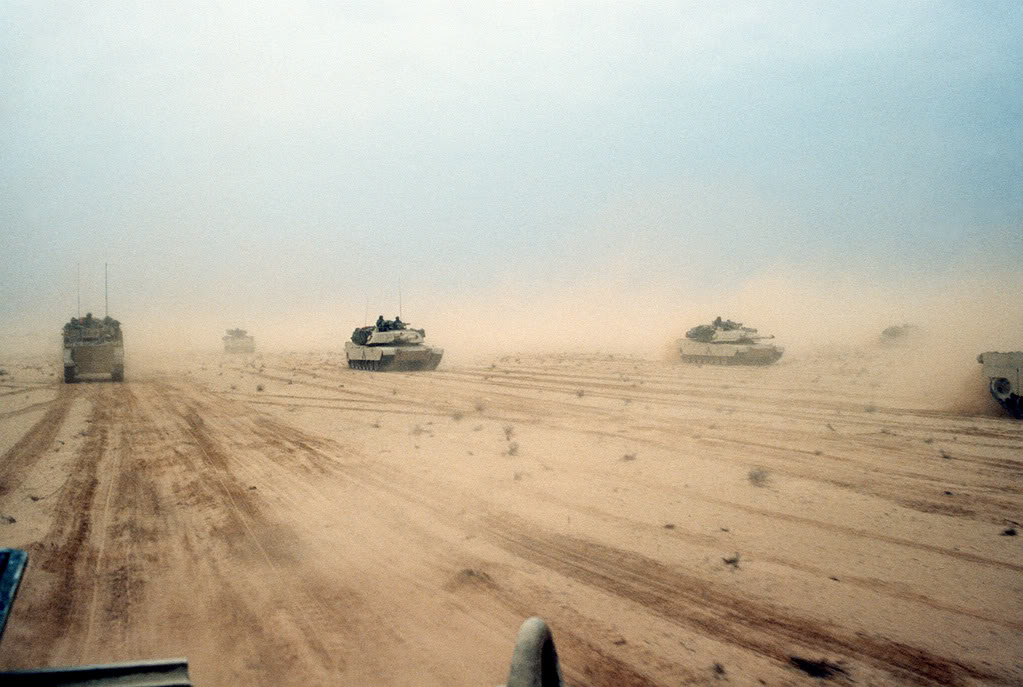
Armor Advancing During Operation Desert Storm

There are few occasions in history where an army is given exactly the scenario to which its organization, training and doctrine coalesce against an opponent that uses the template of organization and training that it has been designed to defeat.  Operation Desert Storm, the liberation of Kuwait by the United States and its coalition from Saddam Hussein’s Iraqi Army and Republican Guard was such a war. The operation was built up in the popular media to the extent that it created a false image of the cost of war and belief that wars can be won “one the cheap” because of superior technology and organization.  That belief was shattered during the Iraq insurgency which began in earnest following the occupation of Iraq following the defeat of Saddam in 2003 by a significantly smaller US force than was used to liberate Kuwait twelve years before.

Architects of Desert Storm

The superior performance of the Army in the Gulf War did not turn out to be the template of how future wars would be fought.  In the following years the US military has become embroiled in conflicts where opponents use inexpensive and often crude off the shelf technology to counter conventional US superiority in firepower and organization.

During the First Gulf War the Army was aided in that the doctrine that it developed to fight a war in Europe against the Warsaw Pact, the Airland Battle was “perhaps best suited to armored warfare in the open desert.”[i] Of course during Desert Storm this was exactly the setting that the Army would be called on to fight.  Unlike Vietnam where the Army attempted to fight an unconventional war with conventional tactics the Army had the chance to fight exactly the battle that it had trained for, against an enemy trained in the tactics and using the equipment of its former Soviet adversary.

The Army enjoyed the advantages of having “reached a high level of training and technological proficiency”[ii] against the Soviet threat. The fact that the Soviet Union and Warsaw Pact had melted down unexpectedly in 1989 and 1990 and removed any conventional threat in Europe which allowed the Army to concentrate massive amount of forces including the VII Corps from Germany to the Middle East was nothing short of incredible.  Additionally the Army had the advantages of superior weaponry and the fortuitous timing of the war before the effects of the post-Cold War drawdown were realized.

For the Army the “1980s were a golden age of military thought and debate,”[iii] and the Airland Battle concept “was greeted with enthusiasm throughout the Army.” Terms such as initiative, agility, synchronization and depth….soon became part of every officer’s vernacular.”[iv] Colonel Harry Summers who had written a critical history of the Vietnam War noted that FM 100-5, the Army’s primary manual of operations, was the “operational blueprint for Operation Desert Storm.”[v] That blueprint had a well trained and disciplined force schooled in the conduct of the Airland Battle concept enunciated in FM-100-5. David Halberstam noted that Operation Desert Storm was fought by a “professional army-a very professional army.”[vi] Seldom in the history of warfare was any army trained and equipped to fight the exact battle for which it found itself.

The Highway of Death

The foundation of doctrine, training, technology and organization laid in the 1980s was solid.  The Army was not only effective in the Gulf War, it was overwhelming.  This is not to say that the Army did not encounter problems.  It did, some which against a better trained and equipped force might have negatively impacts its operations. However the problems encountered did not keep it from dominating the battlefield.

The US rapidly deployed a blocking force of paratroops and Marines following the Iraqi invasion of Kuwait at the end of August.  While few in number they served as a deterrent that Saddam did not test. There was great concern that had Saddam pushed into Saudi Arabia when forces were small and lightly equipped that he might have succeeded in capturing the northeaster Saudi oil fields and production facilities.  The military leadership continually reinforced these forces first to a substantial defensive force and then with the addition of more forces a significant offensive force.  Thus when the decision was made to liberate Kuwait under the United Nations resolution the forces were there and ready.

When the war began advances in Joint warfare and C3 was evident in the effectiveness of the operations.[vii] Particular successes included the movement of VII and XVIII Airborne Corps into the desert to outflank the Iraqis in Kuwait[viii] and every actual engagement between Iraqi and American forces.  Of note was the performance of Major General Barry McCafferey’s 24th Mechanized Division,[ix] and the 2nd Armored Cavalry Regiment at 73 Easting against the Republican Guard’s Talwahkana Division.[x] Likewise the action of 2nd Brigade 1st Armored Division against the Guard’s Adnan Division at Madinah Ridge[xi] displayed the effectiveness and lethality of the Airland Battle and joint warfare concepts developed in the 1980s.

There were weaknesses and these included various aspects of command and control and fratricide[xii] brought about by the fast pace of operations and the fog of war. Likewise conflicts between General Schwartzkopf and some of his Army commanders, notably Generals Franks[xiii] and Yeosock hindered operations.  This occurred most notably in the failure to destroy the Republican Guard prior to the cessation of hostilities. This was partially was due to political considerations and faulty intelligence but was operational decision of Schwartzkopf to halt McCafferty’s  24th Mechanized Division before it could finish off Republican Guard units facing it or letting Franks complete his double encirclement of the Guard or encircle the key southern Iraqi city of  Basrah.[xiv]
The New Face of War Somalia

Iraq

Rwanda Genocide

Deadly Large Shaped Charge IED

Afghanistan: Brits in Action Against Taliban Fighters

Despite the successes of Operation Desert Storm the planners failed to anticipate the end state of what would happen when hostilities had ceased.  The conditions of the cessation of hostilities were the chief contention of many against the end to the ground war at the 100 hour point. Some argue that the early end of hostilities allowed the victory to be less than it could have been.  Some even today argue that the offensive should have gone forward with the goal of overthrowing Saddam, however despite its success the Army was not prepared for an occupation nor would have the coalition supporting the US have survived an invasion and occupation of Iraq.  The actual mistakes were not in the stopping of the war, but rather the faulty conditions of the cease fire which enabled Saddam to recover the internal control of Iraq and put down attempts to revolt especially around Basra in the Shia south.  Rick Atkinson in his book Crusade notes that there were “errors would be made in establishing conditions of the ceasefire…but stopping the war was no mistake.”[xv]

While the debate about Operation Desert Storm still persists nearly 20 years after the fact the more important lesson was not learned.  That lesson was that Operation Desert Storm was not the new face of war, but rather an anomaly.  It was a war that was the swan song of the Cold War where the doctrine, technology, organization and trained to and practiced were inflicted on a less well trained and equipped version of the force that they were designed to defeat, forces which were badly deployed and already isolated by airpower even prior to the ground war. Once the ground war started the Iraqi forces in Kuwait and southern Iraq had little chance against the massive US and coalition force arrayed against it short of preemptively using the chemical and biological weapons of which Iraq had an ample supply.  It did not employ these weapons for a number of reasons, but without them Iraqi forces exposed in the open desert with no air support and cut off from much of their supply by constant air attacks were easily defeated.

In the past 20 years the United States and the west have only once been able to reprise the type of war displayed during Operation Desert Storm.  That was in the initial 2003 invasion of Iraq.  While the forces deployed were successful in defeating the Iraqi military and overthrowing Saddam Hussein they were insufficient to secure the country especially after the decision to disestablish all Iraqi police and military forces which might have assisted US forces in securing the country.  Perhaps planners forgot that German military police, police and civil servants were employed by the western allies in the period immediately after the war even during the period of “de-Nazification.”

Instead of a litany of Desert Storm like scenarios US forces as well as those of NATO and UN allies have had to deal with terrorism, insurgencies, revolutionary wars, tribal wars of genocide and wars waged by religious extremists. Despite more than a decade in dealing with these types of war, many in the military and political establishment as well as the media and public opinion believed that Desert Storm was the model for future wars. As such after the brief period of euphoria which occurred after the initial phase of Operation Iraqi Freedom the grim reality of war has stared Americans and others in the west in the face.  While the military has performed well, it has had to adjust and learn lessons about war that it wanted to avoid during and after Vietnam.  Those were the lessons of counterinsurgency, unglamorous and unexciting they were the lessons buried after Vietnam which were ignored until it was nearly too late in Iraq and possibly now too late in Afghanistan.  Desert Storm was an anomaly and one does not base the future of war on the swan song of the last war.


[i] Atkinson, Rick. Crusade: The Untold Story of the Persian Gulf War, Houghton Mifflin Company, Boston and New York 1993. p.253

[ii] Gordon, Michael R. and Trainor, Bernard E. The Generals’ War, Back Bay Books, Little Brown and Company, Boston and New York 1995. p.467

[iii] Peters, Ralph. Fighting for the Future: Will America Triumph. Stackpole Books, Mechanicsburg , PA p.xi

[iv] Ibid. Atkinson.

[v] Summers Harry G. On Strategy II: A Critical Analysis of the Gulf War, Dell Publishing a Division of Bantam Doubleday Dell Publishing Group, New York NY 1992. p.159

[vi] Halberstam, David. War in a Time of Peace: Bush, Clinton and the Generals, A Touchstone Book published by Simon and Schuster, New York 2001. p.153.  Gordon and Trainor note that the “never in the history of the Republic has a more competent and more professional military been fielded.

[vii] See Summers pp. 243-245.  Summers is very complimentary of the advances in the Joint aspects of command and control that impacted the campaign.  He notes several points at the strategic and operational levels which are complimentary of individuals including comparing General Colin Powell to General George Marshall. Gordon and Trainor writing a few years later are more critical of the “jointness” of the Americans including valid criticism of the air campaign, fire support coordination, and differences in doctrine between Marines and Army and the way the VII Corps and XVIII Corps operated based on the way that they trained and organized. Pp.471-473

[viii] Atkinson pp.309-310.  Atkinson discusses the fact that American commanders involved had seldom maneuvered units of battalion or brigade size prior to this operation.

[ix] The 24th made a great advance to the Euphrates but as Atkinson notes that it had “encountered no enemy resistance at all.” p.406

[x] See Atkinson pp. 441-448

[xi] See Atkinson pp.466-467.  In a 40minute fight the M1A1s destroyed 60 T-72s and dozens of APCs at a cost of one American KIA.  Atkinson notes that this battle like the action at 73 Easting “was waged with tactical acumen and devastating firepower….”

[xii] Ibid Atkinson pp.315-316.  Atkinson notes that there were 28 incidents with 35 killed and 72 wounded.

[xiii] Ibid. pp.405-407.  Schwartzkopf felt that Franks was not aggressive enough and that VII Corps was “sluggish” and “ceding the initiative to the Republican Guard.”  Schwatzkopf even threatened Yeosock that he would fire Franks.

[xiv] Ibid. Atkinson p.476

[xv] Ibid. p.477

Bibliography

Atkinson, Rick. Crusade: The Untold Story of the Persian Gulf War, Houghton Mifflin Company, Boston and New York 1993

Gordon, Michael R. and Trainor, Bernard E. The Generals’ War, Back Bay Books, Little Brown and Company, Boston and New York 1995

Halberstam, David. War in a Time of Peace: Bush, Clinton and the Generals, A Touchstone Book published by Simon and Schuster, New York 2001

Ralph. Fighting for the Future: Will America Triumph. Stackpole Books, Mechanicsburg , PA

Summers Harry G. On Strategy II: A Critical Analysis of the Gulf War, Dell Publishing a Division of Bantam Doubleday Dell Publishing Group, New York NY 1992.
8 Comments

Filed under Foreign Policy, History, iraq,afghanistan, Military, national security

Fort Hood Memorial and Veteran’s Day…The War Comes Home via a Traitor to His Oath

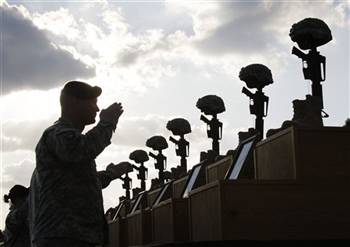
fort hood memorialSoldiers rendering Honors to Fallen Comrades at Fort Hood (MSNBC Photo)

The killings of 13 Americans and wounding of 30 others by Major Nidal Malik Hasan has left a bitter taste in many American’s mouth.  It was an act of treason by a man who apparently became a “self-radicalized home grown terrorist.”  Influenced by his religious beliefs which even some of his Moslem Imam’s thought were troubling and for which they would not approve him to serve as a volunteer lay leader for other Moslem soldiers, Major Hasan attacked his fellow soldiers.  He walked into a processing center for soldiers and opened fire allegedly shouting “Allah Akbar!” as he began his 4 minute rampage firing over 100 rounds from two weapons, one a “cop killer” type of pistol.  It appears that in the year prior to this terrorist act that Major Hasan not only made statements approving of suicide bombing, statements against U.S. Service Members of the Moslem faith fighting other Moslems and vehemently opposing the U.S. involvement in the wars in Afghanistan and Iraq.  Many of these statements were around other Army personnel and evidently Army investigators had been watching him.  As an officer who at one time was a company commander and also helped the administrative oversight of various criminal investigations I wonder how Major Hasan was not fully investigated and called into account for his statements which were in direct contravention to his oath as an Army Officer, his Commission which as a Regular Army Field Grade Officer was actually approved by the Senate, and his Hippocratic Oath as a Physician to “do no harm.”  Major Hasan is not the first soldier, Moslem or otherwise to kill his fellow soldiers.  What makes his case unique is that he is an officer and a physician.  I personally think that is why he was never called to account for his words by others in the Army.  The fact is that no one ever assumes that an officer or a physician could or would actually commit such an act.  This was one of the hardest things for me in comprehending Major Hasan’s crime, simply put “officers do not do such things.” Maybe I’m old fashioned and my sense of honor as an officer borders on archaic but how such a man could swear the oath “to support and defend the Constitution of the United States against all enemies, foreign and domestic “ could kill his fellow soldiers is beyond me.  I read his power point presentation given to his class last year which is posted here:

http://a.abcnews.go.com/images/Blotter/Hasan_2007.pdf

The presentation is troubling because of the more fundamentalist understanding that Major Hasan shows even in relationship to Moslems that he considers “moderate.”  “Muslims may be seen as moderate (compromising) but God is not.”  And “We love death more than you love life!” Having attended the Jordanian Army Peace Operations Training Center and gotten to know senior Iraq officers while serving with our advisors I can say that Major Hasan has a different take on this than many Islamic officers in the armies of Arab nations.  How Hasan was able to present this and have had documented contact with known radicals without being at least questioned shows an incredible lack of forsight by the FBI and Army investigators.

http://abcnews.go.com/Blotter/official-nidal-hasan-unexplained-connections/story?

I pray that he faces justice and of there are any accomplices that they will also be cause and pay for this.  At the same time I pray that the xenophobic ramblings of some who see all Moslems as the enemy are curbed and that they will not incite violence against the innocent in the name of revenge.

Fort Hood conducted a memorial service today for the fallen.  I listened to a lot of it on the radio as I was out.  I was impressed by the remarks of General Cone, General Casey and President Obama.   I think that given the circumstances that the words were fitting and appropriate especially since tomorrow is Veteran’s Day.  The link to the text of the President’s speech is here:

http://www.whitehouse.gov/the-press-office/remarks-president-memorial-service-fort-hood

However I do think that a couple of parts of the speech stand out enough to post here:

This is a time of war.  Yet these Americans did not die on a foreign field of battle.  They were killed here, on American soil, in the heart of this great state and the heart of this great American community.  This is the fact that makes the tragedy even more painful, even more incomprehensible.

For those families who have lost a loved one, no words can fill the void that’s been left.  We knew these men and women as soldiers and caregivers.  You knew them as mothers and fathers; sons and daughters; sisters and brothers.

But here is what you must also know:  Your loved ones endure through the life of our nation.  Their memory will be honored in the places they lived and by the people they touched.  Their life’s work is our security, and the freedom that we all too often take for granted.  Every evening that the sun sets on a tranquil town; every dawn that a flag is unfurled; every moment that an American enjoys life, liberty and the pursuit of happiness — that is their legacy…

These are trying times for our country.  In Afghanistan and Pakistan, the same extremists who killed nearly 3,000 Americans continue to endanger America, our allies, and innocent Afghans and Pakistanis.  In Iraq, we’re working to bring a war to a successful end, as there are still those who would deny the Iraqi people the future that Americans and Iraqis have sacrificed so much for.

As we face these challenges, the stories of those at Fort Hood reaffirm the core values that we are fighting for, and the strength that we must draw upon.  Theirs are the tales of American men and women answering an extraordinary call — the call to serve their comrades, their communities, and their country.  In an age of selfishness, they embody responsibility.  In an era of division, they call upon us to come together.  In a time of cynicism, they remind us of who we are as Americans.

We are a nation that endures because of the courage of those who defend it.  We saw that valor in those who braved bullets here at Fort Hood, just as surely as we see it in those who signed up knowing that they would serve in harm’s way.

We are a nation of laws whose commitment to justice is so enduring that we would treat a gunman and give him due process, just as surely as we will see that he pays for his crimes.

We’re a nation that guarantees the freedom to worship as one chooses.  And instead of claiming God for our side, we remember Lincoln’s words, and always pray to be on the side of God.

We’re a nation that is dedicated to the proposition that all men and women are created equal.  We live that truth within our military, and see it in the varied backgrounds of those we lay to rest today.  We defend that truth at home and abroad, and we know that Americans will always be found on the side of liberty and equality.  That’s who we are as a people.

Tomorrow is Veterans Day.  It’s a chance to pause, and to pay tribute — for students to learn the struggles that preceded them; for families to honor the service of parents and grandparents; for citizens to reflect upon the sacrifices that have been made in pursuit of a more perfect union.

For history is filled with heroes.  You may remember the stories of a grandfather who marched across Europe; an uncle who fought in Vietnam; a sister who served in the Gulf.  But as we honor the many generations who have served, all of us — every single American — must acknowledge that this generation has more than proved itself the equal of those who’ve come before.

We need not look to the past for greatness, because it is before our very eyes.

This generation of soldiers, sailors, airmen, Marines and Coast Guardsmen have volunteered in the time of certain danger. They are part of the finest fighting force that the world has ever known.  They have served tour after tour of duty in distant, different and difficult places.  They have stood watch in blinding deserts and on snowy mountains.  They have extended the opportunity of self-government to peoples that have suffered tyranny and war.  They are man and woman; white, black, and brown; of all faiths and all stations — all Americans, serving together to protect our people, while giving others half a world away the chance to lead a better life.

In today’s wars, there’s not always a simple ceremony that signals our troops’ success — no surrender papers to be signed, or capital to be claimed.  But the measure of the impact of these young men and women is no less great — in a world of threats that no know borders, their legacy will be marked in the safety of our cities and towns, and the security and opportunity that’s extended abroad.  It will serve as testimony to the character of those who served, and the example that all of you in uniform set for America and for the world…

Long after they are laid to rest — when the fighting has finished, and our nation has endured; when today’s servicemen and women are veterans, and their children have grown — it will be said that this generation believed under the most trying of tests; believed in perseverance — not just when it was easy, but when it was hard; that they paid the price and bore the burden to secure this nation, and stood up for the values that live in the hearts of all free peoples.

The speech which I heard on radio moved me.  A president acknowledged what I have believed about our current military.  We serve because we believe in the ideals of this nation and unlike wars past, the “Good Wars” where there were homecoming parades after surrender ceremonies we come home to a nation which mostly has not been at war, a nation that we have protected and served in harm’s way when most Americans were told to be patriotic after 9-11 by President Bush by “going shopping.”  In the midst of all we serve, many of us volunteering for more, not because we like war, but because we believe in our country and in helping others come to know freedom.  I know that amid the political cynicism that is so rampant that such idealism is derided by those who only see America as a force for evil, but such is not the case.  By and large our Soldiers, Marines, Sailors, Airmen and Coastguardsmen serve not for college money or to simply have a job, but because we care about the country and know that by serving now that we will likely end up in a combat zone.

We serve in unpopular wars and our sacrifice is to many people just a news bite in between economic, entertainment and sports stories.  There are those on the left who despise us as much as they did those who served in Vietnam. Likewise there are those on the right who have no compunction about using us in the military until we are spent without sharing a whit in our sacrifice, without ever having put on a uniform much less seeing combat.  Some are politicians seeking a way to increase their power; others are people that I used to listen to on the radio all the time whose answer is to automatically suggest bombing or invading another country.  They say many kind words about us who serve and occasionally sponsor events to “help” military families, but none suggest any real shared sacrifice on the part of the nation.  In fact sometimes they have a negative effect on those who serve because their words are believed as gospel by many and if a combat veteran disagrees with a popular radio talk show host he can be told that that he is “politically correct” “weak” or even a “pansy” by people who shop till they drop under the protection provided by we who serve.  Having had this happen to me recently I know it is the case and the blowhards who drive goad people into such idiocy can go to hell.

So we fight the wars alone while contractors such as Halliburton and the company formerly known as Blackwater get rich lining their pockets with tax dollars doing jobs that at one time were done by the military in an era when much of the nation had a personal interest in the outcome of the war.  We fight the wars and deal with the trauma while others beat the war drums without regard to cost and for the first six years of the war continued to reduce the size of the military.  The previous administration had to be forced by congress into increasing the size of the active Army and Marine Corps and to stop cutting the Navy and the Air Force.

I am glad that unlike Vietnam that the majority of people seem to care about the military and our servicemen and women, even if they disagree with the national policy regarding the present wars.  For that I am grateful and blessed for the outward show of support by many stands in stark contrast what our brothers and sisters who served in Vietnam faced.

This has been and will continue to be a long war.  We have been at war over 8 years since 9-11 as opposed to under 4 years of American involvement in World War II.  The overwhelming burden of the war has been on the backs of an incredibly small segment of the American population.   If you look at the numbers it is well under one percent of the population of the United States that has served in Iraq or Afghanistan.  This is not a shared sacrifice.

Today is Veteran’s Day.  Take the time to recognize the sacrifices of not just those who fought in the big popular wars, but for those who have endured the unpopular and unglamorous wars such as Vietnam, Iraq and Afghanistan.  I have made two combat deployments as well as numerous trips in and out of theater. When the time comes and my boss thinks I’m ready to go again I will go to serve alongside my friends and comrades many of whom are serving in harm’s way now.

I ask readers of this website to remember the fallen in Iraq, Afghanistan and the other fronts in this ongoing war including the home front which felt the effect of the war when Major Hasan attacked his fellow soldiers.  Remember the fallen, care for the wounded and the families of those who have lost their lives, being wounded in mind body or spirit and those who have served in wars past as well as this war.  Our brothers and sisters who fought in World War II, Korea and Vietnam are growing fewer in number daily and “we, we happy few” who continue this fight need all the support that we can get.

I have been in California this week helping with my parents affairs.  My dad is in a nursing facility here with Alzheimer’s disease.  During my last visit he still recognized me and for a few minutes I had him back. Now he no longer knows who I am.  He is a retired Navy Chief and toward the end of his career served at An Loc where he endured that siege in the spring of 1972.  I thank God for my dad’s service and example that helped lead me to chose serving in the military, something for me that has lasted more than 28 years in service with the Army and the Navy.  I pray for God’s peace and mercy on him as he lives what little life that he has left.

God bless all of our veterans, the living and the dead as well as all of those who serve in harm’s way in Iraq and Afghanistan.  Pray for our country and the military.

Peace,

Padre Steve+

1 Comment

Filed under Military, Political Commentary, traumatic national events

The Uncomfortable Legacy of Colonel General Ludwig Beck

“It is a lack of character and insight, when a soldier in high command sees his duty and mission only in the context of his military orders without realizing that the highest responsibility is to the people of his country.” Ludwig Beck

Bundesarchiv_Bild_183-C13564,_Ludwig_BeckLudwig Beck  Bundesarchiv Foto

This is one of those uncomfortable posts to write partially because I know that some people will take it completely wrong or ascribe meaning to it that I do not intend. I by training am a military historian, probably better at that than I am theology.  One thing that fascinates me in the study of military history is the actions of men in the face of evil and the meetings of such people at the intersections of where military and government policy intersect.  It is a timeless theme. The bulk of my study until the past few years was the German Army, particularly that of the Weimar Republic and the Wehrmacht to include policies, leaders, political attitudes and behavior in war and peace. Thus it makes sense for me to look at Colonel General Ludwig Beck who held the post of Chief of the German General Staff during the early part of the Nazi era.

Ludwig Beck is one of those characters in military history that makes professional military officers uncomfortable.  Beck is not the perfect example of righteousness nor was he always correct in things that he supported.  As an artillery regiment commander he defended the rights of soldiers and officers to be Nazi Party members though he himself was not one.  He, like many military officers was a conservative military officer by nature and became Chief of Staff of the Wehrmacht in 1935 two years after Hitler’s ascension to power.  Taking office Beck was troubled by some Nazi policies but not by the need for Germany to expand to areas that it had once controlled, he opposed the plan to attack Czechoslovakia not because of any love for the Czech state which he desired to be eliminated, but rather it being a war that Germany could not win. He resigned from his position a Chief of Staff in 1938 when he could not persuade the rest of the General Staff to resign in protest over Hitler’s plan which he felt would be disastrous for Germany.  Had the western powers led by Neville Chamberlain not caved at Munich it is likely that the Germans would have suffered badly against the Czech army and fortifications and with the entry of France into the war would have suffered a defeat that would have ended the Hitler regime.  In fact German officers who saw the extent of Czech preparations on the frontier following the Munich deal were greatly relieved that they did not have to fight their way into the Czech state.

After his resignation Beck played a key role in the resistance movement. He was involved in the planning for a number of attempts on Hitler’s life. Yet it was his leadership in the July 20th 1944 attempt on the life of Hitler that ensured his place in history.  With Colonel Klaus Von Stauffenberg and others in the General Staff at the Front and in Germany he acted to avert further destruction in Europe and the certain destruction of Germany.  The plot, Operation Valkyrie was marred by poor execution and failed to kill Hitler of seize power but for a few hours. The planners had left too much to chance and once Hitler had restored communications the coup attempted ended swiftly.  Had the attempt succeeded Beck was in line to become either the leader of Germany or the Head of the Army.  Instead while being interrogated after his capture he took his own life depriving Nazi leaders of the ability to put him up for a public trial at which he would have been humiliated and then executed.  The Kasserne in Sonthofen where the Bundeswehr MP School and Staff School as well as NATO and EU military schools are located is named for him.  It is there, ironically a former Adolf Hitler School that his memory and sacrifice is honored by the nation which emerged from the rubble of World War Two.  He is honored in a small museum and with a plaque recognizing his sacrifice.

492Ludwig Beck Kasserne Sonthofen

The reason that General Beck makes many of us in uniform uncomfortable (and I do include myself) is that he recognized that senior officers, especially those in high command who help set and execute policy cannot isolate themselves in the purely military aspects of the operations.  Instead he believed that officers have a higher duty to the constitution and people and not just the military mission that they have been assigned.  When he realized that he could not stop Hitler’s invasion of Czechoslovakia he resigned and worked in the obscurity of a small and often divided resistance movement against Hitler.  The bulk of the German high command, including many officers idolized in the United States did not recognize the higher duty. Many of these men were consummate professionals who did not support the evil of the Nazi regime and who conducted themselves honorably. Yet they effectively abetted its crimes by not opposing actions of their government that were against international law and morality as well as dangerous from purely a pragmatic military standpoint.

The problem is that military officers in any nation, including ours can face situations such as Beck faced.  A military’s character is demonstrated in how leaders deal with such situations.  Beck recognized the situation early, the bulk of his fellow officers did not recognize a problem until Germany was embroiled in a war that it could no longer win.  Even then most could not mount an opposition to Hitler because they did not want to be considered to be mutineers and violate their oath.  The potential to abet evil when military professionals bury their heads by planning and executing purely military aspects of a campaign is great.  If they ignore questionable policy or even policies that they know that have been judged by the international community to be illegal or immoral, such as torture of prisoners or waging wars of aggression against countries that have not attacked their nation they become complicit in their nations crimes.  This was the case with German Officers who may not have committed any personal crime and even tried to mitigate the evils of the Nazi regime were morally complicit in that evil.

In the United States the military shows its fidelity by remembering our oath to the Constitution and being faithful to it and the people that we serve.  As officers we represent all Americans and not just those of our political party, religious faith or social or economic interests, nor any political leader, faction or interest group within the nation. The Constitution, our military regulations, traditions and the Uniform Code of Military Justice are the standard by which we operate and by which we conduct ourselves and tools that protect us when policies or actions taken by the government or people within it violate those codes or international law.  The UCMJ makes it clear those officers who take part in, plan or a complicit in illegal actions in war are committing crimes.

When a nation become involved in wars which are non-traditional, revolutionary wars or insurgencies that barriers to professional conduct can be broken down. The Mai Lai massacre committed by 2LT William Calley’s platoon with the certain knowledge and maybe even approval of individuals in the chain of command is one example as were the uncontrolled chaos of prisoner abuse and torture at Abu Ghraib.

Times are difficult and we do not know what the future brings.  Stress in societies caused by economic conditions, natural disasters, lawlessness on the streets and divided and ineffective governments sometimes remove the moral restraints of the society and even affect the military.  One sees this in Weimar Germany as well as the 4th Republic in France which had to deal with post World War II economic difficulties, exacerbated by recriminations of political opponents for actions the others did during the war while France was occupied by Germany as well as the wars in Indo-China and Algeria which further divided the nation and the military.

It is in stressful and uncertain times that officers have to be men and women of principle who always uphold the highest traditions of their military as well as be the voice of conscience when governments, political parties, special interests or leaders begin to violate international norms in the conduct of war. Beck was not a perfect officer. He supported some of Hitler’s policies until after his resignation but like much of the resistance believed that the Nazi regime could only end up destroying Germany.  It is important to remember that like Ludwig Beck that officers do not need to sacrifice their honor to be faithful to their oath.

Peace, Steve+

16 Comments

Filed under History, leadership, Military, national security, world war two in europe

Star Trek the Next Generation: Captain Jean-Luc Picard Deals with PTSD

Counselor Deanna Troi: Interesting.
Captain Jean-Luc Picard: Counselor…
Counselor Deanna Troi: I just find it interesting. Captain Jean-Luc Picard, the man who couldn’t be pried out of his seat for a vacation for three years!
Captain Jean-Luc Picard: It’s Earth. It’s home. Do I need another reason?
Counselor Deanna Troi: I don’t know, what do you think?
Captain Jean-Luc Picard: Your help has been invaluable during my recovery, but…look, I’m, uh…I’m better! The injuries are healing.
Counselor Deanna Troi: Those you can see in the mirror.
Captain Jean-Luc Picard: The nightmares have ended. All I need now is a little time to myself.
Counselor Deanna Troi: I agree. In fact, I’m delighted you’re going. It’s just that…the choice of where you’re going could stand some scrutiny.
Captain Jean-Luc Picard: If you wish to believe my going home is a direct result of being held captive by the Borg, be my guest.
Counselor Deanna Troi: Is that what you believe?
Captain Jean-Luc Picard: I hate it when you do that.
Counselor Deanna Troi: Captain, you do need time. You cannot achieve complete recovery so quickly. And it’s perfectly normal after what you’ve been through, to spend a great deal of time trying to find yourself again.
Captain Jean-Luc Picard: And what better place to find oneself than on the streets of one’s home village.
Counselor Deanna Troi: Interesting.

I have always found the Star Trek TNG episode Family quite compelling.  The episode (Season 4 Episode 2) deals with Captain Jean Luc Picard’s return home following his capture and assimilation by the race known as the Borg during The Best of Both World’s Part 1 and II (Season 3 Episode 26 and Season 4 episode 1.)

The story is interesting because it deals with some of the issues that people traumatized in combat deal with as they try to find themselves again.  In the story Captain Picard, in a very typical manner of someone traumatized by combat believes that his injuries are healing.  His counselor, Deanna Troi who serves as the Ship’s “Counselor” challenges him on his belief that he has recovered and his choice of where he wants to go to find himself again.

I saw the episode when I was in Seminary not long after completing the Chaplain Officer Basic Course and then saw it again when I was going through my Clinical Pastoral Education Residency.  It was during that process, one in which I was trying to find and define what “home” was, that it really caught me.  I was Captain Picard, the brother who left home to explore and travel while serving in the military.   My brother Jeff was Picard’s brother Robert.  He is the one who stayed home and minded family business.  The parallels then got me and even more so now.  My Residency Supervisor used this to good effect during that time in dealing with the issues of home, but the post combat and PTSD part was yet to come.

Back in the days of my residency I struggled with another of issues related to being a military brat and having begun a career in the Army.  In a sense I was a nomad.  I had lived a lot of places but none were really home, even where I had spent all of junior and senior high school.  Like Picard my eyes were set on far horizons of exploration and adventure of military life.  My brother Jeff on the other hand like Picard’s brother was content at staying at home, being near our parents, getting established in the school district and taking care of his family.   We both chose our own paths and both were right for us.  I still long for adventure and exploration but have begun to settle down.

When it came to the placement of the PTSD in this picture it was after Iraq that I had a crisis in a number of areas in my life and every time I thought that I was doing better and maybe even “getting well” that there was always something that could trigger the memories, bring back the dreams and keep me from sleep.  I can say that a year and a half after my return from Iraq I am doing better in a lot of ways but still having struggles with anxiety insomnia and hyper-vigilance.  I did find out that there is one thing that does not evoke a startle reflex is a foul ball that comes back against the screen in from of me in Section 102 at the Church of Baseball Harbor Park Parish.  Last night while taking pictures right up against the screen I had several balls that hit within a couple of feet of me, one of which hit my camera and knocked it out of my hand.  Anywhere else loud noise, unexpected crashes, things flying past me sends me into a hyper-alert status.

picard familyPicard Meets His Family after Many Years and Wounds Away

When Picard goes home it is not the confident Starship Captain who returns, but a man unsure of himself and where he fits in life.  His encounter with the Borg has changed him and he contrary to assurances to Counselor Troi is still wounded.  When I returned from Iraq I wondered where I fit, I felt like I had abandoned my advisers in Al Anbar when I returned because my relief had to be sent elsewhere do to circumstances beyond my control.  I did not feel a part of my own unit as nothing was the same when I came back.  I felt weak, useless and at the end of my rope after having completed incredible tour in combat of my then 26 years in the military.  Physically I was falling apart; I had several nagging injuries from Iraq that caused chronic pain.  I was flashing back with every moment, fires burning in the Great Dismal Swamp had turned our air the color of an Iraq sand storm while the smell was like that of the ever present burn pits, both military and Iraqi.  Walking out the door one morning with my neighborhood shrouded in smoke I began to melt down.  That day we had a seminar done by a nationally known speaker dealing with trauma and combat with the associated feelings and emotions.  At the end of the day I was a wreck.  My Unit Doctor, Chris Rogan looked at me and said “Chaplain you don’t look good, are you okay?”  I said “no I’m not, I’m losing it and I’m scared.”  That was the place where I finally began to get help.  It has been about 14 months since I started and it is still a process.  We made a trip home that summer and I did not do well.  It was painful and I had great difficulty both in the travel as well as the visit.  When I hear fellow vets talking about the surreal and often painful times that they experience I can understand.  The fact is that you can be with a hundred friends and family members and be totally alone when you return home because it is something that you cannot really share and that they usually don’t understand.  Once again I have been fortunate.  My little brother actually listens to me and lets me vent when I need to.  Of course dealing with our family’s stuff this is a two way street.

not a happy camperVisiting Home and not Doing Well

In the story Picard is offered a chance to leave Starfleet and go to work on a project under the ocean on Earth.  He is sorely tempted to take it but before he can he has an encounter with his brother who challenges his decision.  They exchange words and Captain Picard feeling picked on starts a fight.  During the fight he breaks down about his experiences sobbing in his brother’s arms.  “His brother then said: So – my brother is a human being after all. This is going to be with you a long time, Jean-Luc. A long time. You’ll have to learn to live with it. You have a simple choice now. Live with it below the sea with Louis, or above the clouds with the Enterprise.”

In a sense that is something that all of us who serve after having been traumatized by the experience of wart have to deal with, the physical as well as the psychological and spiritual wounds.  For me it was the realization that I was human after all and the slow realization that this will be with me a long time.  The choice is how I choose to live my life and where I do so.

In the series and subsequent Star Trek: The Next Generation films Picard is forced to deal with his psychological wounds from the encounter with the Borg culminating in the second of those films Star Trek: First Contact. In it Starfleet Command leave Picard and the Enterprise out of the battle leading to this exchange between Picard and his First Officer which deals with the stigma associated with such an injury.

Cmdr. William Riker: Captain, why we are we out here chasing comets?
Captain Jean-Luc Picard: Let’s just say Starfleet has every confidence in the Enterprise and her crew – they’re just not sure about her Captain. They believe that a man who was once captured and assimilated by the Borg should not be put in a situation where he would face them again. To do so would introduce “an unstable element to a critical situation.”
Cmdr. William Riker: That’s ridiculous. Your experience with the Borg makes you the perfect man to lead this fight.
Captain Jean-Luc Picard: Admiral Hayes disagrees.

The stigma associated with psychological injuries is far greater than that of physical injuries.  The unseen injuries are not as well understood and those who suffer them often are broken down by the system as they try to get help and many simply go underground and self medicate.  Last year two Army Generals opened up about their struggles with PTSD. I was fortunate to have people come alongside of me when I went down hard.  People who did not give up on me and kept faith by caring about me when I was and still get down.

See the article at: http://edition.cnn.com/2009/HEALTH/03/06/generals.ptsd/

Despite this and the efforts of many in the Military to help those with PTSD and other “unseen” injuries, to include medical conditions brought on by exposure to toxins in the combat zone, there is still the stigma.  As the young officer suffering from a rare and eventually fatal pulmonary condition acquired in Iraq as well as yet untreated PTSD “I squarely wish I had lost my legs then than the lung function that I have lost!”

Captain Picard’s story of course is fictional, but it demonstrates to some degree what those who experience the psychological and spiritual wounds of war face when they “come home.”  This stuff doesn’t go away.  Here are some of the comments that I have had from readers who deal with their own or a family members PTSD.

Australian Vietnam Veteran who wrote me said:  “As an Australian Vietnam Veteran with PTSD, I find these articles fascinating. I long wondered why the world had to be such a hostile mongrel place. Then 30 years later I was diagnosed with PTSD and I can now relate to why I have the condition but the world has not changed and medication is of limited use. There are many of us who are still very isolated and have to limit our social contacts. I recently started a Vietnam Veterans group, for members of our small unit, on the web and I found men who were relieved to be part of something and someone they could relate to as they had all but withdrawn from society. Sadly a few of them refuse to take any medication for their medical conditions as they see that as prolonging their miserable existence.”

A family member of a WWII veteran said: “thank you. It’s really needed for women to read articles/memoirs like that. It’s easy to say someone has PTSD, but another to live with and love who has it. I come from a family with rich military history and this is an everyday issue. Never goes away, even after 40 – 60 years.”

A USMC Vietnam Vet that I know wrote: “It’s a bitch at times, and the sleep, or lack of will eventually come, although it will never be a fully restful sleep. The Hyper vigilance seems never to go away. Yes it could be good, but eventually it can be bad…. well do I know both.”

An Army Chaplain from Iraq noted: “I too am a chaplain who felt that he and his assistant were the best equipped to handle the horrors of war – just to find out after being home for about a year just how much I had changed. I was sitting with my daughter in my lap one weekend afternoon when she asked, “Daddy, why don’t you play and laugh with us like you use to before you went to Iraq?” It was the key event that brought everything to a point where I could get help. In the months since there have been good days and definitely bad days – however, my faith remains strong….”

I run into people like this every day in the course at work who deal with this and sometimes it spills over into my stuff.  However I am glad to know that I am not alone.  To those who have helped me since I have be back, Chris, Two Feathers, Limey, Greg, Jesse, Jeff, Elmer, my longsuffering wife the Abbess of the Abbey Normal Judy and my brother Jeff, Colonel P and Janet, the folks I work with, the people at Harbor Park, especially Ray, Charlie and the Vietnam Veterans of America who man the beer stand on the concourse behind home plate and all the others who have come alongside I am grateful.  It is my sincere wish and prayer that all veterans will have such fine people there for them when they hit the wall.

Peace, Steve+

Leave a comment

Filed under iraq,afghanistan, PTSD, star trek

Brothers to the End…the Bond between those Who Serve Together in Unpopular Wars

This story shall the good man teach his son;
And Crispin Crispian shall ne’er go by,
From this day to the ending of the world,
But we in it shall be remembered-
We few, we happy few, we band of brothers;
For he to-day that sheds his blood with me
Shall be my brother; be he ne’er so vile,
This day shall gentle his condition;
And gentlemen in England now-a-bed
Shall think themselves accurs’d they were not here,
And hold their manhoods cheap whiles any speaks
That fought with us upon Saint Crispin’s day.

From the Speech of King Henry V at Agincourt in Shakespeare’s “Henry V” 1599

We have a new Greatest Generation whose accomplishments will likely go unheralded by history and unlike the “Greatest Generation” of World War Two not receive the full honors and accolades due them.  The brothers, and for that matter sisters as well who have served in the current War on Terror, Iraq and Afghanistan campaigns have now been serving in a war that is now twice as long as the American involvement in World War Two.  Many, like me have been in this since the beginning and many have made multiple deployments to the combat zones.  And many of us, if not most of us would go again; I know that I would because part of me is still in Iraq; for me this war is still un-won and un-finished.

With MTT near SyriaAdvisers out on the Badlands of Al Anbar
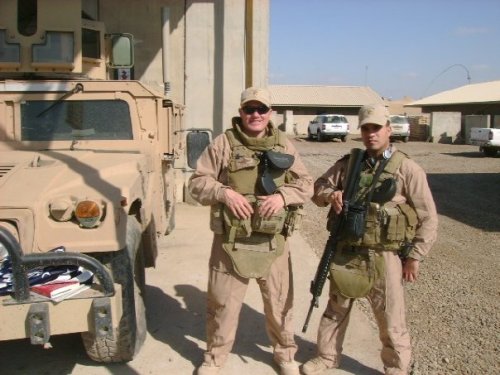
With no disrespect to the Greatest Generation of World War Two, all of the current Soldiers, Sailors, Marines, Airmen and Coast Guardsmen are volunteers, as are the members of the Reserves and National Guard.  Likewise this generation has for the most part fought the war alone as the vast bulk of the country has lived in peace untouched by any inconvenience to daily life such as gas and food rationing, requirements to work in war industries and the draft as were citizens in World War Two.  In the Second World War there was a sharing of the burden which in large part has not occurred in this war.  While many have pitched in to help and volunteered to help veterans and their families the vast majority of people in this country are untouched by the war, not that there is anything wrong with that.  This is simply a comparison of the situation that those who served in World War Two and the present conflicts faced.  So I have to say that our “Greatest Generation” is only a small part of the generation, as the line in Henry V “we few, we happy few who fought together….”

Dynamic DuoBrothers

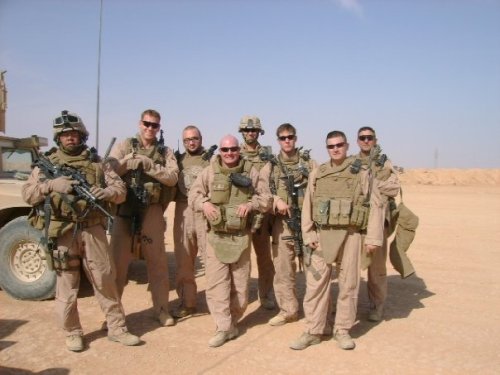
These Soldiers, Sailors, Marines and Airmen from the United States as well as our Allies who serve alongside of us are my brothers and sisters.  I am friends with military personnel from the UK, Canada and Germany who have served in the various combat zones or at sea and met quite a few others from France, the Netherlands and Australia. Of course my Iraqi friends who I served with while with our advisers in Al Anbar province who are not only trying to bring peace and stability back to their country but have to worry about their families being targeted by terrorists.

There are a number of things that unite us in this relatively small brotherhood.  However, I think that this brotherhood could also be extended to our brothers who fought in Vietnam, French, Vietnamese, Australian, South Korean and American, the French who served in Algeria and the Americans and others that served in Korea.  All of these wars were unpopular, had little support on the home front and often left returning veterans found themselves isolated and their sacrifices either ignored or disrespected.  For those Americans who serve in the current wars I can say that at least to this point the public has been much more supportive than they were to our Vietnam brothers, many of who were even disrespected by World War Two vets who had fought in “a real war.”  I cannot count the Gulf War in this list as it was hugely successful and the returning vets were hailed as conquering heroes with ticker tape parades.

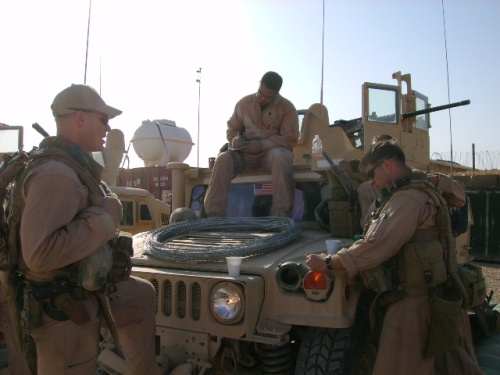
advisers convoy prepGetting Ready for A Mission

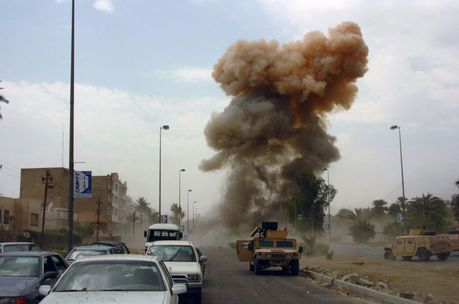
Our shared brotherhood includes our scars, physical, psychological, neurological and spiritual.  Those who served on the ground in Iraq and Afghanistan as well as those who served in Vietnam, French Indo-China and Algeria have the common shared experience of fighting people who don’t necessarily like foreigners no matter how noble our intentions and who have a long history of outlasting people that they believe to be invaders or occupiers.  We have had to fight wars with no front lines, no major units arrayed against us, but rather asymmetrical threats propagated by creatively devious foes who use low tech easily available technology and a willingness to sacrifice themselves and others to force attempt to kill us.  Thus we have cleverly designed and often quite powerful IEDs or Improvised Explosive Devices which can obliterate a HUMMV.

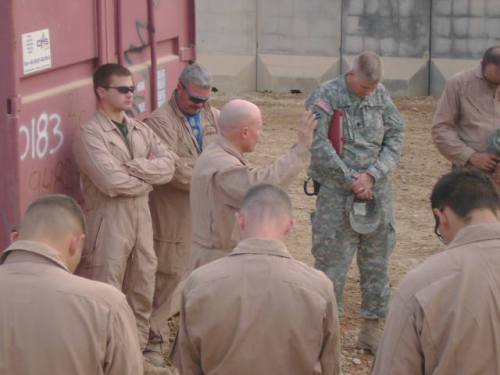
374Prayer Before a Mission

These threats create a situation where there is no front line and thus where every excursion outside of a FOB (Forward Operating Base) or COP (Coalition Outpost) is automatically a trip into a potential danger zone.  Enemies can infiltrate bases posing as local nationals in either military uniform or as workers, rockets and mortars can be lobbed onto even the largest and most secure bases at any time and any vehicle driving by you on the road could be loaded with explosives and just waiting to blow you up while insurgents with automatic weapons and Anti-Tank Rocket Propelled Grenades (RPGs) have taken down helicopters.  When you have taken fire on the road, in the air and had rockets whiz by you this becomes a reality that you never forget.

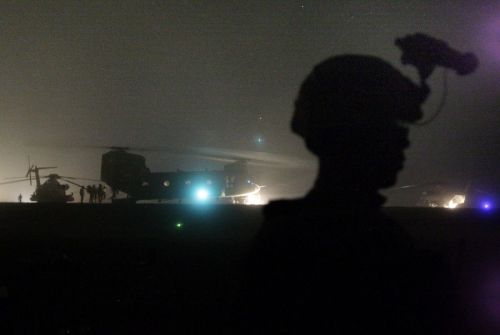
helos at nightA Familiar Sight to Me, Flying at Night AP Photo/David Guttenfelder
As a result we do not only have men and women with physical wounds, but wounds that have damaged the psyche or the soul.  PTSD is very common either from a direct encounter or the continual wear and tear of being in a danger zone wondering if you were to get hit that day every day of a tour.  I have lost count now of people that I know who have mild to severe symptoms of PTSD.  Traumatic Brain injury is another condition men and women attacked by IEDs, mortars and rockets experience. Likewise there are the injuries that shatter the soul.  These are the images of ruined buildings, burned out vehicles, wounded bodies, injured children, refugees and wars desolation that can leave a person’s faith in God, or ideals that he or she believes in weakened or even destroyed.  There are many idealistic and patriotic military personnel who because of what they have seen question God, their National Leadership and even themselves.  I cannot get the image of a refugee camp on the Iraqi Syrian border full of Palestinian refugees who have nowhere to go; they had been invited to Iraq under Sadaam and have been sitting on the border trying to get home for years now.  The Palestinian authority wants nothing to do with them.

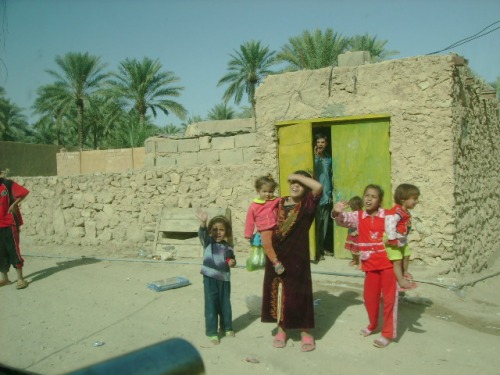
237Iraqi Kids in War Torn Village on the Euphrates

These men and women are my brothers and sisters.   I have seen quite a few of my ICU staff deployed this year with more getting ready to go.  These are my friends and I do get concerned for them and pray earnestly for their safe return.  I wish that I could go with them because I know them and have already walked with them through the dark valley of the shadow of death in our ICU.  We already have a bond that will not be broken.

It is now two years since I was in the process of leaving for Iraq and a year since my PTSD crash.  However, I still would do it again in a heartbeat.  There is something about doing the job that you were both trained to do and called to do that makes it so.  Likewise the bonds of friendship and brotherhood with those who you serve are greater than almost any known in the human experience.  Shared danger, suffering and trauma bind soldiers together, even soldiers of different countries and sometimes with enemies.  I remember the conversation that I had with an Iraqi Merchant Marine Captain on a ship that we had apprehended for smuggling oil violating the United Nations sanctions.  The man was a bit older than me, in his early 60s.  He had been educated in Britain and traveled to the US in the 1960s and 1970s. He had the same concerns as any husband and father for his family and had lost his livelihood after Sadaam invaded Kuwait in 1990.   He was a gentleman who provided for his crew and went out of his way to cooperate with us.  In our last meeting he said to me: “Someday I hope that like the Americans, British and the German soldiers at the end of the Second World War can meet after the war is over, share a meal and a drink in a bar and be friends.”  That is my hope as well.

In the final episode of the series Band of Brothers there is a scene where one of the American soldiers, Joseph Liebgott who came from a German Jewish family interprets the words of a German General to his men in the prisoner compound.  The words sum up what the Americans had felt about themselves and likewise the bond that all soldiers who serve together in war have in common, if you have seen the episode you know how powerful it is, I ended up crying when I heard it the first time and cannot help but do so now that I have been to the badlands of Al Anbar Province.

“Men, it’s been a long war, it’s been a tough war. You’ve fought bravely, proudly for your country. You’re a special group. You’ve found in one another a bond that exists only in combat, among brothers. You’ve shared foxholes, held each other in dire moments. You’ve seen death and suffered together. I’m proud to have served with each and every one of you. You all deserve long and happy lives in peace.”

136A Chance Meeting with our EOD Mobile Uniit 2 Brothers
May God bless all of especially my brothers who served in with me in Iraq or have served or are serving in Afghanistan; as well as my brothers who fought in Vietnam, Indochina and Algeria.  We may never get a victory parade, but we have each other.

Peace, Steve+

5 Comments

Filed under History, iraq,afghanistan, Military, PTSD, vietnam

Memorial Day 2009- Thoughts and Musings

I am again at the Medical Center on duty, but this not a bad thing.   Before I begin my post I want to direct you to the post of the Abbess of the Abbey Normal and her thoughts on this Memorial Day.  Her post is linked here: http://abbeynormalabbess.wordpress.com/2009/05/25/memorial-day-musings/

I Have also posted several links in this article. Peace, Steve+

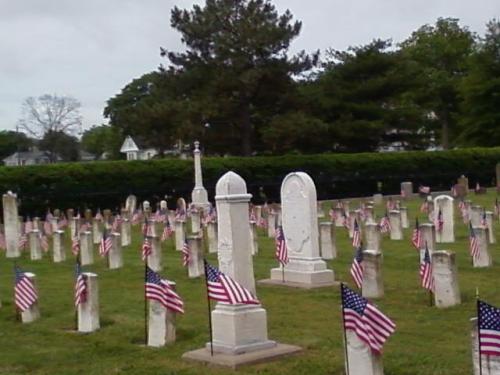
ports hosp cemetary 2Conaway Cemetery Portsmouth Naval Medical Center

I have been thinking a lot about the significance of Memorial Day the past week.  I think about it more now than I used to.  Now I have always thought a lot of it and observed it the best that I could.  Yet having now been “boots on the ground” in Iraq travelling about the battlefield to take care of the spiritual needs of American Marines and Soldiers serving as advisers with the Iraqi Army, Police and Border forces it has more meaning.  I am now a combat veteran.  Last year I joined the VFW.  I came back from the war different, PTSD kind of goons you up sometimes.  I spent most of the past 15 months dealing with this, not sleeping and being in chronic pain.  I’m now doing much better.  In part this is due to the support I have at home and a work and the fact that I am no longer isolated.  Being on staff at our Naval Medical Center has been good for me and I do not resent being the Duty Chaplain on this Memorial Day.  I have far too many wonderful people I work with here to think anything like that.  It is an honor to serve here with such fine people, Physicians, Nurses, Chaplains and other medical and support staff.

ports hospt cemetary 1Another View Conaway Cemetery

Today has been really good no matter how the night goes.  I participated in the annual Memorial Day observance at the historic Naval Cemetery on our grounds.  It is but a mere two acres of land and dates to 1838 when it was established to allow the remains of those who died far from their homes repose. It has Navy Sailors, Marines and their families.  It also holds the remains of Sailors from Great Britain, Russia, Germany, Japan and Brazil who died in the Norfolk area.  Additionally the remains of Sailors of the Confederate States Navy are buried here.  The service was organized by the Local Chapters of the Fleet Reserve Association, supported by the local Boy Scout troops and attended by veterans, active duty members and dignitaries from the City of Portsmouth City Council and a State Senator.   It was a simple yet moving ceremony which involved a wreath-laying as well as Amazing Grace played on the Bagpipes and Taps.  Our Color Guard presented the colors and our Commanding Officer, Rear Admiral Kiser was the guest speaker.  Local news services were on hand to televise it, just as they televised others services throughout the region.  One of these was on the Battleship USS Wisconsin which is the centerpiece of the local maritime museum at Norfolk’s Nauticus venue.

Our hospital is interesting.  It dates to 1826 and is the first Naval and for that matter military hospital in our country.  The motto here is First and Finest. Building One is the original hospital.  It has a glass dome which at one time lighted the operating theater.   It now is our command building with other administrative offices.  The hospital has served in peace and war and was instrumental in the 1850s in caring for the victims of the Yellow Fever epidemic.  It is now a teaching hospital and multi-faceted medical center with a national reputation.

The time at the service was neat as I mixed with our veterans of World War Two, Korea, Vietnam, Desert Storm and the current wars.  Many proudly displayed their medals, ribbons and badges.  When the National Anthem was played these men and women saluted as smartly as when they were on active duty.  Many are involved with local veterans groups and some are volunteers at our hospital taking time to care for the needs of our patients and families.  Among the dignitaries was Councilman Charles Whitehurst who is a member of the small historically black Episcopal Church where I worship.  Mr. Whitehurst enlisted in the Marines in 1955 and rose through the enlisted ranks to Sergeant, was appointed as a Warrant Officer and the Commissioned as an Officer.  He retired as a Major after Vietnam.   Afterward Admiral Kiser was the Grand Marshal of the Portsmouth Memorial Day Parade, which is the oldest and longest running in the nation.   A link to a local station’s coverage of this event is here: http://www.wvec.com/video/index.html?nvid=364992&shu=1

I was able to catch a glimpse of President Obama’s wreath laying at Arlington National Cemetery where in in short and solemn remarks he noted: “Why in an age when so many have acted only in pursuit of narrowest self-interest have the soldiers, sailors, airmen and Marines of this generation volunteered all that they have on behalf of others,” he said. “Why have they been willing to bear the heaviest burden?”

“Whatever it is, they felt some tug. They answered a call. They said ‘I’ll go.’ That is why they are the best of America,” Obama said. “That is what separates them from those who have not served in uniform, their extraordinary willingness to risk their lives for people they never met.”

I think that his remarks were perfect and honored those who serve now and those have gone before us.

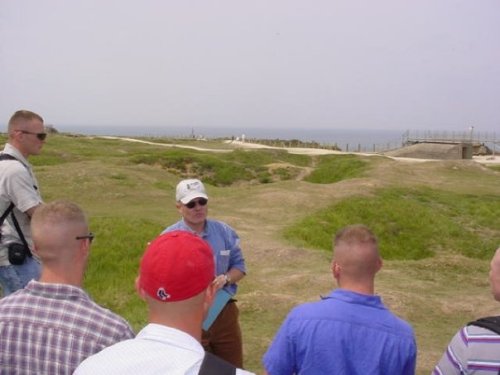
The last service of this type that I attended was at the US Cemetery at Belleau Wood, France. It is the site of the battle in which the Marines in their first battle of World War One turned back the assault of the German Army which was advancing on Paris and launched a counter-attack.  I was with Marines of the Marine Security Forces who were conducting a joint memorial service with French Marines.  The next day I visited Normandy with the Marines and taught classes to them on the battle, looking at it from the German perspective.  The day prior to the service I taught parts of the “staff-ride” of the battlefield discussing various aspects of World War one tactics, weaponry and equipment.

me at normandyWith Marines at Normandy

This is also most likely the last Memorial Day that my father will be alive.  He served as a Navy Chief Petty Officer and retired in 1974.  In 1972 he served “boots on the ground” at the city of An Loc which was surrounded for 80 days by the North Vietnamese Army.  He was my inspiration to serve in the military.  There are many veterans of World War Two, Korea and Vietnam who like him are in the twilight of their lives.  I do pray that all will be remembered this Memorial Day.  I was able to be with him the week before last.  I expect it will be the last time that I see him.

McCains Special BaseballTed Williams as USMC Aviator

One interesting thing that I want to mention before I close was the effort that many professional ball players made back in World Wars One, Two and Korea.  Some of the top players of all time gave up some of their prime playing years to serve.  Christy Matthewson served in the Army in France during World War One. He was gassed and developed Tuberculosis and died at the age of 45 in 1925 never playing again.  Yogi Berra served as a Navy Gunners Mate at D-Day.  Ted Williams served in both WWII and Korea as a Marine Corps fighter pilot.  He lost nearly 5 seasons to his service. One who studies statistics in baseball might want to extrapolate the numbers that Williams might have had if he had played on instead of serving.  Hank Greenberg the first Jewish Major League superstar was drafted in 1940 and released just before Pearl Harbor when Congress voted to send men over 28 home. He then re-enlisted, was commissioned and served in the China-Burma-India Theater.  Joe Dimaggio enlisted in the Army Air Force and served 2 ½ years from 1943-1945. Bob Feller volunteered for the Navy on December 8th 1941 and spent 4 seasons on the USS Alabama as a gun captain. Pee Wee Reese served in the Navy in the Pacific while Jackie Robinson served as an Army Officer and Larry Doby served in the Navy before breaking the color barrier to play Major League baseball.  Whitey Ford, Willie Mays, Eddie Matthews and Ernie Banks were all called up for Korea along with Williams.  Roy Gleason of the Dodgers was the last player to earn the Purple Heart as an Army Sergeant in Vietnam. Of course the world has changed.  We have an all volunteer military no current Major League players, or for that matter NBA, NFL or NHL players serve in the military but many donate time and money to support military members and their families including Giant’s pitcher Barry Zito and Orioles pitcher Jamie Walker.  Working with USAA these men have founded a non-profit group called “Strikeouts for Troops.  A link to that organization is here:  http://video.yahoo.com/watch/3462236/9644105

Pat Tillman a defensive back for the Arizona Cardinals enlisted after 9-11 and was killed during a “friendly fire” incident while serving as an Army Ranger in Afghanistan.  He has been the only NFL, MLB, NHL or NBA player to volunteer for active duty in the current war.

Here are a few links to some baseball and veteran stories:

Link to video of Baseball Hall of Fame Player Monte Irvin talking about his service in World War Two: http://www.youtube.com/watch?v=OKERxyAbg1w and link to Indians and A’s player Lou Brissie’s WWII experience: http://www.youtube.com/watch?v=SFwAXNR9q-k Jerry Coleman on his Marine Corps time as a dive bomber pilot: http://www.youtube.com/watch?v=wUlBgBxaWoY

Bob Feller’s, Buck O’Neal and Phil Rizzuto’s WWII memories:  http://video.search.yahoo.com/video/play?p=bob+feller+american+veterans+&n=21&ei=utf-8&js=1&fr=yfp-t-105&tnr=20&vid=0001463818096 and here: http://www.youtube.com/watch?v=CRyILkx_c2U

Link to Rick Monday’s saving the flag at Dodger Stadium in April 1976:  http://www.youtube.com/watch?v=IrV8QPQAhxo&feature=related

goldstar

Let us remember our veterans, especially those who gave the last full measure to serve our country. Support the Honor and Remember flag campaign as well as the “Blue Star” and “Gold Star” families whose loved ones currently serve or have died on active duty in this time of war.

Peace, Steve+

1 Comment

Filed under Baseball, History, iraq,afghanistan, Military, PTSD, vietnam