Tag Archives: vietnam

The Effects of Counter-Insurgency Operations on U.S. and French Forces in Vietnam and Algeria and Implications for Afghanistan

legion indo-china1st Foreign Legion Parachute Regiment in Indo-China

Introduction

The effects of the wars Indo-China, Algeria and Vietnam on the French and American military organizations internally and in relationship to their nations piqued my interest in 2005. The wars in Iraq and Afghanistan forced me to start asking the question of what short and long term effect that these wars might have on the U.S. military.  As such I wondered what historical precedent that there was for the question. My interest was furthered by my deployment with Marine and Army advisors to Iraqi Army and Security forces in 2007-2008.  My search led to the French experiences in Indo-China and Algeria and the American experience in Vietnam.

The counterinsurgency campaigns conducted by the French and American militaries in Vietnam and Algeria had deep and long lasting effects on them.  The effects included developments in organization and tactics, relationship of the military to the government and people, and sociological changes.  The effects were tumultuous and often corrosive.  The French Army in Algeria revolted against the government. The US Army, scarred by Vietnam went through a crisis of leadership and confidence which eventually resulted in end of the draft and formation the all volunteer military.
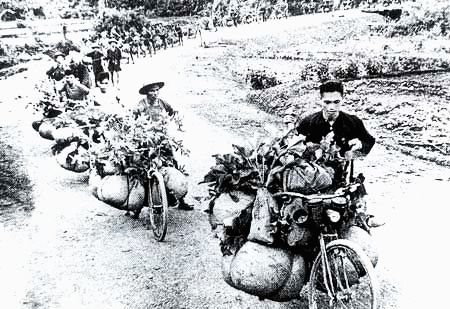
viet minh supplyPrimitive but Effective- Viet Minh Supply Column The French Could Never Stop them

There is a wealth of data regarding these wars. There are several types of materials. The accounts of soldiers, diplomats and reporters who experienced these events contained in memoirs and diaries. The best include David Hackworth’s About Face and Steel My Soldiers Hearts; and General Harold Moore’s We Were Soldiers Once… and Young. French works include Jules Roy’s The Battle of Dien Bein Phu and General Paul Aussaresses’ The Battle of the Casbah. There are innumerable popular accounts written by NCOs and junior officers.  These accounts may contain a wealth of information, but are limited by a number of factors. First, many only saw part of the overall picture and first-hand experience can skew objectivity. Those who have been through the trauma of war interpret war through their own experience.  Physical and psychological wounds can have a major impact on the interpretation of these writers as can their experience and political ideology. Finally few of these writers are trained historians. Despite this they can be a valuable resource for the historian.

Another source is official histories. Often these incorporate unit histories and individual narratives and analyze specific battles and the wider campaigns, but do little in regard to broader conditions that affected operations.  While a good source, many are not as critical of their institutions as they should be. Histories by trained historians and journalists provide another view. The most insightful of the journalist accounts include Bernard Fall’ Street Without Joy and The Siege of Dien Bien Phu: Hell in a Very Small Place. A limitation of all of these is that they are often heavily influenced by the political and societal events. This means that earlier accounts are more likely to be reactive and judgmental versus critical and balanced. Later accounts have the benefit of access to the opposing side and documents not available to earlier writers.  Alistair Horn in A Savage War of Peace provides one of the most informative and balanced accounts of the war in Algeria. Martin Winslow does the same regarding Dien Bien Phu in The Last Valley.
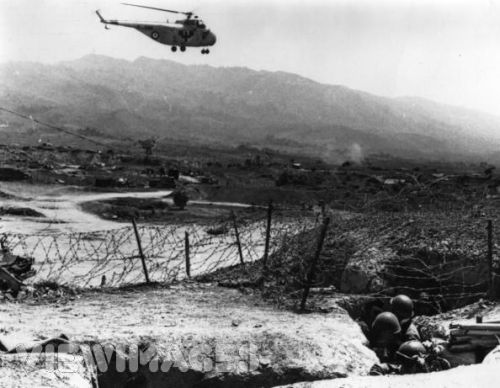
Dien Bien Phu 1Isolated and Besieged Dien Bien Phu

Another source is the writings of participants who critically examine their participation in the wars.  Many of these, French and American provide insights into the minds of leaders who are reflective and critically examine what happened to their military institutions in these wars. The best of these is French Colonel David Galula whose books Pacification in Algeria 1956-1958 and Counterinsurgency Warfare: Theory and Practice provide first-hand accounts of the subject combined with critical reflection. Galula’s works have been important to John Nagl, General David Petreus and others who helped write the U.S. Army and Marine Corps Counterinsurgency manual. Andrew Krepinevich in The Army and Vietnam provides a critical analysis of the U.S. Army in Vietnam.  Other sources, both online and print, such as RAND, provide excellent analysis of selected topics within the scope of this essay, especially COIN.

The ability to dispassionately and critically examine and evaluate these sources over a period of several years was and integrate them with my own experience has been a critical to me.  It has changed the way that I look at sources, and caused me to be much more aware of bias, the limitations of sources and the need to have a multiplicity of sources and points of view.

Effects of Insurgencies on the Armies that Fought Them

The conflicts in French Indo-China, Algeria and Vietnam had major effects on the French and American military institutions. These effects can be classified in a number of ways. First, the manner in which each military waged war, including tactics and weapons systems was changed.  The use of airpower, especially helicopters and use of Riverine forces provided an added dimension of battlefield mobility but did not bring victory. As John Shy and Thomas Collier noted regarding the French in Indo-China: “French mobility and firepower could take them almost anywhere in Vietnam, but they could not stay, and could show only wasted resources and time for their efforts.”[1] The use of intelligence and psychological warfare, including the use of torture became common practice in both the French and American armies.  The wars had an effect on the institutional culture of these armed services; neither completely embraced the idea of counterinsurgency and for the most part fought conventionally. Galula notes how the “legacy of conventional thinking” slowed the implementation of proper counterinsurgency tactics even after most commanders learned that “the population was the objective.”[2] Krepinevich notes that “any changes that might have come about through the service’s experience in Vietnam were effectively short-circuited by Army goals and policies.”[3] Finally the wars had a chilling effect on the relationship between the both militaries and the state, veterans from each nation often felt betrayed or disconnected from their country and people.

legion algeriaForeign Legion in Algeria

The French Army had the misfortune of fighting two major insurgencies back to back.  The French military was handicapped even before it went into these wars. The Army came out of World War II defeated by the Germans, divided by loyalties to Vichy or one of the Free French factions. They were humiliated by the Japanese in Indo-China, while in Algeria France’s crushing defeat was devastating.  “Muslim minds, particularly sensitive to prestige and baraka, the humiliation made a deep impression.”[4] French society was as divided as the Army; the economy in shambles, the government weak and divided.  The Viet-Minh had prepared well making use of time and training to get ready for war.  “Once full-scale hostilities broke out, the French, for budgetary and political reasons could not immediately make the large scale effort to contain the rebellion in the confines of small-scale warfare.”[5]

In both Indo-China and Algeria the French attempted to fight the budding insurgencies in a conventional manner.  This was particularly disastrous in Indo-China when on a number of occasions battalion and regimental combat team sized elements were annihilated by Viet-Minh regulars.  Between October 1st and 17th 1950 every French garrison along the Chinese border was over-run.  The French lost over 6000 troops and enough equipment to outfit “a whole additional Viet-Minh division.” It was their worst colonial defeat since Montcalm at Quebec.[6] In Algeria when the fight began in earnest France’s “ponderous ponderous N.A.T.O forces found themselves at an impossible disadvantage,”[7] unable to have any influence off the main roads.

VIETNAM DIEN BIEN PHUSurrender at Dien Bien Phu

In Vietnam the French did not absorb the lessons of fighting a well established insurgent force. French forces hoped to draw the Viet-Minh main forces into battles of attrition where their superior firepower could be brought to bear. Such was the case at Na San in December 1952 where the French established an “Air ground base” deep in Viet-Minh territory to draw Giap’s forces into open battle.  This worked, but just barely. Giap, short of artillery and not planning on a long battle frittered away his troops in mass charges.  However, the French, because of Na Son assumed they had found the key to victory. In their embrace of the “air ground base concept, French staff officers were following an intellectual tradition that had long been prone to seduction by elegant theories.”[8] The result was the disaster at Dien Bien Phu the following year.  The destruction of the elite Group-mobile 100 near Pleiku in 1954 was the coup de grace. In Indo-China the French made limited use of helicopters, used paratroops widely, and developed Riverine forces. One thing they were critically short of was significant tactical air support.[9]

The most inventive French creation was the GCMA/GMI forces composed of mountain tribesmen led by French NCOs and Junior Officers.  They were designed to provide “permanent guerilla groups rooted in remote areas” to harass and interdict Viet-Minh forces.[10] Trinquier noted that at the time of the Dien Bien Phu defeat that these forces had reached over 20,000 trained and equipped maquis in the Upper Region of Tonkin and Laos. These forces achieved their greatest success retaking Lao Cai and Lai Chau May 1954 as Dien Bien Phu fell.[11] Trinquier stated that “the sudden cessation of hostilities prevented us from exploiting our opportunities in depth.”[12] The GMI units and their French leaders were abandoned fighting on for years after the defeat. One account noted a French NCO two years after the defeat cursing an aircraft patrolling the border “for not dropping them ammunition so they could die like men.”[13] In the end the French left Indo-China and Giap remarked to Jules Roy in 1963 “If you were defeated, you were defeated by yourselves.”[14]

Algeria was different being part of Metropolitan France; there the French had support of European settlers, the pieds-noir. Many French soldiers had come directly from Indo-China. There French made better adaptations to local conditions, and realized that they had to win the population and isolate the insurgents from it and outside support. As Galula said, victory is the destruction of the insurgent’s political and military structures, plus “the permanent isolation from the population, not forced upon the population, but by and with the population.”[15] The lessons learned by the French in both Algerian and Indo-China were lost upon the Americans.

The United States military, especially the Army approached the Vietnam War with a conventional mindset, the “Army concept.” [16] It not only approached the war in this manner, but it trained and organized the South Vietnamese forces, ARVN into the American model. Americans re-organized ARVN into divisions “based upon the U.S. divisional force structure.”[17] ARVN was not structured appropriately for the threat that it faced.”[18] The results were as to be expected. Large numbers of troops poured in, American counterinsurgency was costly.  It was “almost a purely military approach”[19] which ignored political and social realities on the ground. Massive firepower was the means “utilized by the Army to achieve the desired end of the attrition strategy-the body count.”[20] In the end the American defeat was a “failure of understanding and imagination.”[21] The one shining moment was the Marine Corps experimentation with “Combined Action Program” platoons which lived in the villages with militia for long periods of time. This program produced great results “in eliminating local guerillas”[22] but was killed by the Army.

For both the French and Americans these wars tore the heart out of their armies. For the French the defeats inflicted a terrible toll.  In Indo-China many French career soldiers felt that the government’s “lack of interest in the fate of both thousands of missing French prisoners and loyal North Vietnamese…as dishonorable.”[23] Divisions arose between those who served and those who remained in France or Germany and created bitter enmity between soldiers.  France would endure a military coup which involved many who had fought in Vietnam and Algeria. Having militarily won that war, were turned into what Jean Lartenguy called ‘the Centurions” had been turned into liars.”[24] They were forced to abandon those who they had fought for and following the mutiny, tried, imprisoned, exiled or disgraced. Colonial troops who remained loyal to France were left without homes in their “independent” nations.  They saw Dien Bien Phu as the defining moment. “They responded with that terrible cry of pain which pretends to free a man from his sworn duty, and promises such chaos to come: ‘Nous sommes trahis!’-‘We are betrayed.’”[25]
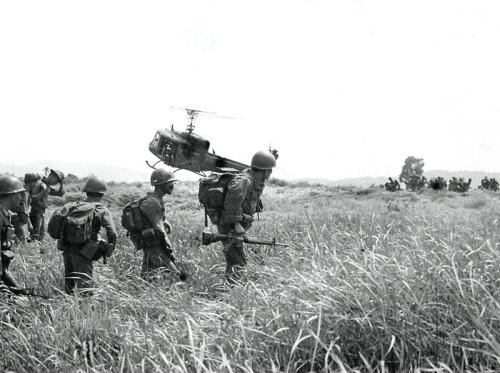
Joint_operation_with_ARVN_112-1Joint US-ARVN Operation

The U.S. Army returned to a country deeply divided and Vietnam veterans remained ostracized until the 1980s.  As Harold Moore recounts “in our time battles were forgotten, our sacrifices were discounted, and both our sanity and suitability for life in polite American society were publically questioned.”[26] The Army endured a massive reorganization that resulted in the formation of the All-Volunteer force, which would redeem itself and emerge from the ashes in the Gulf War. The Americans would not learn the lessons of revolutionary warfare and counterinsurgency until forced to do so in Iraq in 2004-2007.

Conclusions and Possibilities

The effects of these wars on the French and American military establishments were long lasting and often tragic. The acceptance of torture as a means to an end sullied even the hardest French officers. Men like Galula and Marcel Bigeard refused to countenance it, while others like Paul Aussaresses never recanted.  Americans would repeat the tactic at Abu Ghraib rallying the Iraqis against them.

For the Americans, the debacle continued at home. Race riots tore at the force while drug addictions and criminal activities were rampant.  Incompetent leaders kept their jobs and highly successful leaders who became whistle blowers like Hackworth were scorned by the Army institution. It took years before either the French or American veterans again felt a part of their countries.  They ended up going to war, and when it was over; feeling abandoned, their deepest bonds were to their comrades who had fought by their side.

What are the lessons to be learned from these campaigns as well as from the various accounts?  Andrew Krepinevich prophetically noted that the failure to learn the lessons of Vietnam “represents a very dangerous mixture that in the end may see the Army again attempting to fight a conventional war against a very unconventional opponent.”[27] Obviously, there are lessons to be learned, especially in understanding the nature of revolutionary war as well as the culture and history of our opponents. The U.S. has made some improvement in this regard but there is still much to be learned, especially since after the war the Army was “erecting barriers to avoid fighting another Vietnam War.”[28] From these wars we learn that nations and incompetent governments who mismanage wars can alienate themselves from the soldiers that they send to fight, with serious consequences.  As far as historiography we learn that certain historical fallacies are evident when one reads the accounts critically and recognize the bias and limitations of the various sources.

In Iraq the U.S. adapted, albeit belatedly to the nature of the insurgency and took advantage of Al Qaeda Iraq (AQI) over-reach in the manner that they abused the Iraqi people.  The situation turned dramatically in September of 2007 when Al Qaeda killed the most prominent Sunni Sheik outside of Ramadi.  The Sheik had begun to work with Americans on security issues and his death turned much of the Sunni populace in Al Anbar and other provinces against AQI for the first time allying them with the Sh’ia dominated government.  Changing focus the U.S. Forces focused on safeguarding the population and building up the capabilities of Iraqi forces.  Within months because of the increased security and stability in Al Anbar the U.S. Marine trained and Iraqi led forces of the 1st Iraqi Division were able to be moved to Basra where they retook the city from insurgent forces and to Diyala where they helped the government gain the upper hand.  Success in Iraq did not come easy, American forces suffered their greatest losses since the Vietnam War in the cities, villages and countryside of Iraq.  The U.S. is now in the process of drawing down as the Iraqis take over their own security.  The process is not perfect as there still tension between Sunni and Sh’ia factions as well as Kurds and other minority ethnic groups.  However it is still going better than most experts predicted.
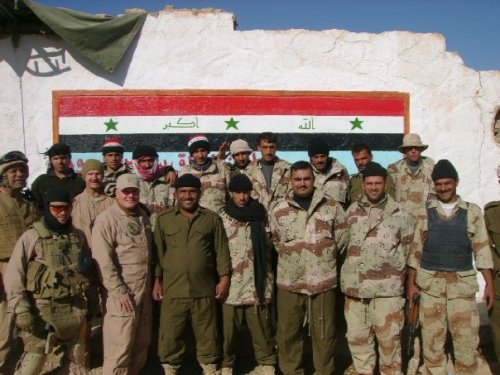
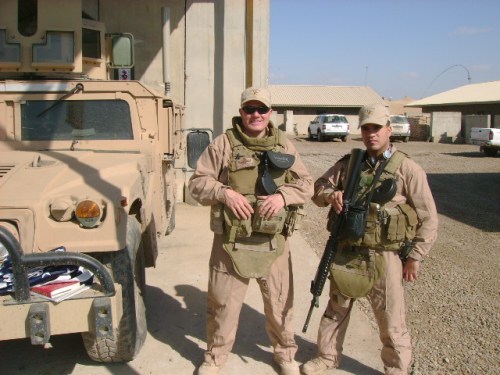
iraqi border troopThe Author and Advisors with Iraqi Border Troops near Syria

Afghanistan is another matter.  After early success in overthrowing the Taliban and isolating Al Qaeda the Americans and NATO pretty ran a status quo operation attempting to legitimize the Karzai government, eliminate the Opium poppy crops and establish government presence and security in outlying areas.  There was a problem in this; both the Taliban and Al Qaeda used border sanctuaries in Pakistan and financial support from worldwide Moslem groups to continue the fight.  As Al Qaeda and the Taliban built themselves up the Afghan government lost support. This loss of support was in large part due to rampant government corruption as well as to the perception of U.S. and NATO forces being occupiers and not liberators.  This perception of the U.S. and NATO forces was in large part because they had ignored the lessons of French Indo-China, Algeria, Vietnam and Iraq.  Isolated from the population the bulk of NATO forces performed in a reactionary manner and often used aircraft and artillery to respond to Taliban forces often killing non-combatants by mistake. Each time this happened, the Al Qaeda and Taliban leaders used the results to further bolster their image and portray the allies as the oppressors.  As the Taliban took back much of the country they also returned to oppressive means to subdue the population by fear and intimidation.
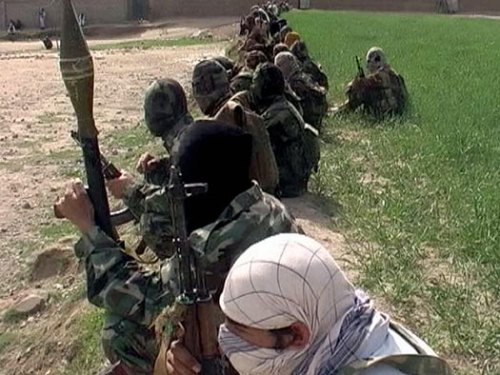
taliban insurgentsTaliban Insurgents

The new American commander, General Stanley McChrystal has asked for more forces in order to run a proper counter-insurgency campaign which focuses on the security of the population to isolate the Taliban and Al Qaeda.  Whether General McChrystal gets his forces and whether they are enough to turn the tide before all political and public support in the U.S. and NATO countries is lost is another matter.  Right now the situation is tenuous at best.  There are means to win this war despite the history of Afghanistan which suggests that this is not possible.  The key is he Afghan population, if they believe that the U.S. and NATO are n their side, that we respect them, their culture, religion and that Al Qaeda and the Taliban are the real oppressors the war can be won.  This requires patience, forethought and deliberate measures to secure the population, build up a government that they can trust and de-legitimatize Al Qaeda and the Taliban.  If that does not happen, the U.S. and NATO run the risk of repeating the story of the French in Indo-China.   Unlike AQI and Iraqi insurgents the Taliban are very capable of running military operations capable of defeating small to medium sized units in isolated locations.  They know the terrain, often have the support of the people, are highly mobile and not dependant on roads and can mass quickly at critical points.  Last year the Taliban launched a large scale assault on an American COP which came close to overrunning it.  They were repelled with heavy casualties but the incident demonstrated a capability that is growing.  What I would be concerned about is the total destruction of an isolated post or a convoy which could be used to demoralize western nations.  While I do not think that the Taliban could pull off the defeat of a major US or NATO base or force as the Viet-Minh did at Dien Bien Phu but the threat should not be minimized.

traiining team with afghan armyUSMC Training Team in Afghanistan

How we learn the lessons of past insurgencies and revolutionary wars is important in Afghanistan.  The stakes are higher than most would want to admit. A withdraw would be seen by militants outside of Afghanistan would be emboldened just as the Algerians were by the loss of the French in Indo-China. It would again provide Al Qaeda with a safe haven and secure base of operations.  The stakes are high.  Who knows what will happen?

Bibliography

Aussaresses, Paul, “The Battle of the Casbah: Counter-Terrorism and Torture,” translated by Robert L Miller.  Enigma Books, New York, 2005. Originally published in French under the title of “SERVICES SPECIAUX Algerie 1955-1957” Perrin 2001

Fall, Bernard B. “The Siege of Dien Bien Phu: Hell in a Very Small Place.” Da Capo Press, New York an unabridged reprint of the 1st Edition reprinted in arrangement with Harper and Row Publishers, New York. 1967

Fall, Bernard B. “Street Without Joy: The French Debacle in Indochina.” Stackpole Books, Mechanicsburg PA, 2005, originally published by Stackpole Publications 1961

Galula, David. “Counterinsurgency Warfare: Theory and Practice.” Praeger Security International, Westport CT 1964 and 2006

Galula, David. “Pacification in Algeria 1956-1958.” RAND Corporation, Santa Monica CA 2006. Originally published by RAND 1963

Hackworth, David H. and Sherman, Julie. “About Face: The Odyssey of an American Warrior,” a Touchstone Book published by Simon and Schuster, New York. 1989

Horn, Alistair. “A Savage War of Peace: Algeria 1954-1962,” a New York Review Book published by the New York Review of Books, New York, 1977, 1987, 1996, and 2006

Karnow, Stanley. “Vietnam, a History: The First Complete Account of Vietnam at War,” The Viking Press, New York, 1983

Krepinevich, Andrew F. “The Army and Vietnam,” The Johns Hopkins University Press, Baltimore and London, 1986

Millett, Allan R. and Maslowski, Peter. “For the Common Defense: A Military History of the United States of America.” The Free Press, a division of Macmillian, Inc. New York, 1984

Moore, Harold G and Galloway, Joseph L. “We were Soldiers Once…and Young: Ia Drang: The Battle that Changed Vietnam,” Harper Collins Publishers, New York NY 1992

Nagl, John A. “Learning to East Soup with a Knife: Counterinsurgency Lessons from Malaya and Vietnam,” University of Chicago Press, Chicago and London, 2005

Nolan, Keith William. “The Battle for Hue: Tet 1968,” Presidio Press, Novato CA, 1983

Pottier, Philippe (2005) Articles: GCMA/GMI: A French Experience in Counterinsurgency during the French Indochina War, Small Wars & Insurgencies,16:2,125 — 146 http://dx.doi.org/10.1080/09592310500079874

Roy, Jules. “The Battle of Dien Bien Phu” Carrol and Graf Publishers, New York 1984. Translated from the French by Robert Baldrick. English translation copyright 1965 by Harper and Row Publishers, New York.

Sheehan, Neil. “A Bright and Shining Lie: John Paul Vann and America in Vietnam,” Vintage Books, a division of Random House, New York, 1989

Shy, John and Collier, Thomas W. “Revolutionary War”in Makers of Modern Strategy from Machiavelli to the Nuclear Age,” Peter Paret editor. Princeton University Press, Princeton N.J. 1986

Simpson, Howard K. “Dien Bien Phu: The Epic Battle America Forgot,” Potomac Books Inc. Washington DC 2005, originally published by Brassey’s Inc. 1994

Spector, Ronald H. “After Tet: The Bloodiest Year in Vietnam,” Vintage Press, a division of Random House, New York, 1993

Trinquier, Roger. “Modern Warfare: A French View of Counterinsurgency,” translated from the French by Daniel Lee with an Introduction by Bernard B. Fall. Praeger Security International, Westport CT and London. 1964 and 2006. Originally published under the title “La Guerre Moderne” by Editions Table Ronde.

West, F.J. “The Village,” Pocket Books, a division of Simon and Schuster, New York. 1972.

Windrow, Martin. “The Last Valley: Dien Bien Phu and the French Defeat in Vietnam,” Da Capo Press, Novato, CA 2006, originally published by Weidenfeld and Nicholson, London 2004


[1] Shy, John and Collier, Thomas W. “Revolutionary War” in Makers of Modern Strategy from Machiavelli to the Nuclear Age,” Peter Paret editor. Princeton University Press, Princeton N.J. 1986  p.849

[2] Galula, David. Counterinsurgency in Algeria: 1956-1958. RAND Corporation, Santa Monica, CA. 2006. First published by RAND in 1963. p.244

[3] Krepinevich, Andrew F. “The Army and Vietnam,” The Johns Hopkins University Press, Baltimore and London, 1986 p.213

[4] Horn, Alistair. “A Savage War of Peace: Algeria 1954-1962,” a New York Review Book published by the New York Review of Books, New York, 1977, 1987, 1996, and 2006 p 41

[5] Fall, Bernard B. “Street Without Joy: The French Debacle in Indochina.” Stackpole Books, Mechanicsburg PA, 2005, originally published by Stackpole Publications 1961 p.27

[6] Ibid. p.33

[7] Horn. p.100.

[8] Windrow, Martin. “The Last Valley: Dien Bien Phu and the French Defeat in Vietnam,” Da Capo Press, Novato, CA 2006, originally published by Weidenfeld and Nicholson, London 2004 p.63

[9] Fall, Bernard B. “The Siege of Dien Bien Phu: Hell in a Very Small Place.” Da Capo Press, New York an unabridged reprint of the 1st Edition reprinted in arrangement with Harper and Row Publishers, New York. 1967 pp. 456-457  Fall discusses in depth the lack of French Air support and the antecedents that led to the shortage following World War II.

[10] Pottier, Philippe(2005)’Articles: GCMA/GMI: A French Experience in Counterinsurgency during the French Indochina War’, Small Wars & Insurgencies,16:2,125 — 146 http://dx.doi.org/10.1080/09592310500079874

[11] Simpson, Howard K. “Dien Bien Phu: The Epic Battle America Forgot,” Potomac Books Inc. Washington DC 2005, originally published by Brassey’s Inc. 1994 pp. 170-171

[12] Trinquier, Roger. “Modern Warfare: A French View of Counterinsurgency,” translated from the French by Daniel Lee with an Introduction by Bernard B. Fall. Praeger Security International, Westport CT and London. 1964 and 2006. Originally published under the title “La Guerre Moderne” by Editions Table Ronde. p.87

[13] Windrow. p.652.

[14] Roy, Jules. “The Battle of Dien Bien Phu” Carrol and Graf Publishers, New York 1984. Translated from the French by Robert Baldrick. English translation copyright 1965 by Harper and Row Publishers, New York. p.xxx

[15] Galula, David. “Counterinsurgency Warfare: Theory and Practice.” Praeger Security International, Westport CT 1964 and 2006 p. 54

[16] Krepinevich. p.213

[17] Ibid. p.24

[18] Nagl, John A. “Learning to East Soup with a Knife: Counterinsurgency Lessons from Malaya and Vietnam,” University of Chicago Press, Chicago and London, 2005 p.138

[19] Shy. p.856

[20] Krepinevich. p.202

[21] Spector, Ronald H. “After Tet: The Bloodiest Year in Vietnam,” Vintage Press, a division of Random House, New York, 1993 p.314

[22] Millett, Allan R. and Maslowski, Peter. “For the Common Defense: A Military History of the United States of America.” The Free Press, a division of Macmillian, Inc. New York, 1984 p.555

[23] Windrow. p.655

[24] Ibid. p.657

[25] Ibid.

[26] Moore, Harold G and Galloway, Joseph L. “We were Soldiers Once…and Young: Ia Drang: The Battle that Changed Vietnam,” Harper Collins Publishers, New York NY 1992  p. xx

[27] Krepinevich. p.275

[28] Ibid. p.274
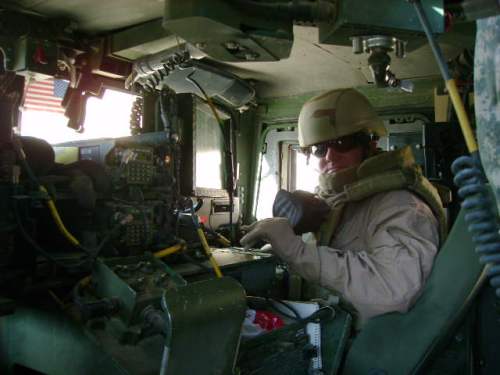
1 Comment

Filed under History, iraq,afghanistan, Military, vietnam

Survival on the Home Front: Dealing with Other People’s Reactions to My PTSD

081

Being in Iraq  was in Many Ways Less Frightening than Being in the USA

I find it interesting and sometimes painful to see how institutions and some people within the institution will label those of us who have gone to war and came back as gooned up with PTSD.  The biggest tension and issue, and I admit it as my own is that we get stereotyped and sometimes viewed as “broken.”  I admit that I have issues, in fact a lot of frickin’ issues and I have a pretty good awareness of them.  I see Elmer the Shrink to help me through the rough spots but there are times when I bump across those that appear to use my condition as a weapon against me.  Whether it is intentional or not, it is not fun to deal with.  I’ve had it happen a few times since I have started getting help last year and every one of the people involved were people who have not been to combat to use a pejorative term from Vietnam they are REMFs .

I know several others who have experienced this mentality.  We all feel really vulnerable because all of us have opened up to people, or to use the Star Trek analogy to “drop our deflector shields.”  Pulling down shields makes you vulnerable, if you do it because you think you are in a safe area.  When you take “friendly fire” is really sucks. It is actually easier in theater.  If I was sent to Iraq or Afghanistan today I would be back in my element and probably suffer little from PTSD symptoms.  Sometimes I wonder if the Navy would be better off to ship me over again.  Admittedly with the health of my parents and a position at my medical center that is important for me to remain in for the time being, there is something that says at some point I need to go back, maybe not now but later.  See out there the PTSD defensive reactions fit.  There are bad guys and good guys, friend and foe and the body and brains’ reaction to real or perceived danger are natural.  I am wary of people until I figure out if they are friend or foe. When I make a mistake in my IFF it usually bodes ill for me.

When you come back out of that environment you find that even though you are “home” that you have changed and nothing is the same as it was before.  Your body and brain have divided the world into two camps, friend and foe or safe or unsafe or maybe even secure versus dangerous.  In my life I notice this with people as well as situations such as being on the road in our nutty Hampton Roads traffic which by the way even if you don’t have PTSD is quite the adventure I have become a very offensively minded defensive driver with faster reflexes and reaction time than I had before I went to Iraq.  I have to say that I am now a very aware person to perceived threats and actually that is not a bad thing of itself.  In Iraq I was probably operating at a 9 or 10 of ten on my perceptions of and reactions to real and perceived danger.  Since I have returned and gotten some therapy I probably operate at a 3.5 to 4 most of the time and depending on the situation move up higher sometimes being very aware of possible danger and hyper-vigilant .  Before I went to Iraq I probably operated at about a 1-2 on the scale of 10, pretty oblivious to danger and not too worried about it either.  Truthfully I am happy at an increased level of the 3.5-4 and maybe on occasion 5.  I don’t like getting up above 7-8 because it really makes a mess of my nerves and general requires that I take my docile pills.  Recently I’ve had a few of those days.  Trust me it is no fun to have a nervous tremor.  When that happens I feel like Gene Wilder’s character in Blazing Saddle’s Jim the Waco Kid response when Sherriff Bart (Cleavon Little) questions him:

Jim: Look at my hand.
[raises hand and holds it level]
Bart: Steady as a rock.
Jim: [raises his other hand, which is violently trembling] Yeah, but I shoot with this one.

Although I can occasionally find some morbid humor in what is going on with me I can’t say that it is any fun.

There is a perception by some, which I think is often systemic in parts of the military that people with PTSD are “broken.” Some in the system as well as others who have been granted the privilege of knowing your vulnerability consciously or unconsciously sometimes use it against you, I personally think it is intentional when this happens but I try to give the benefit of the doubt to the offender.  Like I said before this has happened to my on a number of occasions and in every instance I have felt attacked, devalued and re-traumatized and I don’t like that feeling and it takes me a while to get back through all the crap.  When it happens to me I get angry, defensive and now as opposed to my pre-Iraq life will shoot back.  I’ve stopped rolling over and letting people get away with this behavior and when I see it happen to others I get equally pissed.  Unfortunately I have a number of friends who have had similar experiences and as we share our stories we realize that some people or even the system in general will write you off as damaged goods.  What is the bad thing is that the worst comes from people who have not been in harm’s way.  Likewise, if they went to a combat zone never left one of the big FOBs and never had to deal with the danger of being outside the wire. Nor have they experienced what many medical personnel who remained on the big FOBs experienced in dealing with never ending trauma of dealing with the death, wounding and suffering of young Marines, Sailors, Soldiers and Airmen.  Another group are the men and women who perform the tasks of getting the fallen back home.  One of my Chaplain friends had this job in Kuwait and had to meet every aircraft with the bodies of the dead leaving theater performing memorials and conducting honors all the time caring for those who cared for the bodies of these Americans and came back in pretty bad shape.

What saddens me is that this still attitude of men and women dealing with PTSD being “broken” or as one called me a “shipwreck” happens even though we have been making the conscious effort since Vietnam to treat people traumatized by war.  The end result is that those who are traumatized are again and again re-traumatized by the system as well as individuals in it.  I have seen enough of this to make me throw up. Thankfully the Navy as a whole does better in this than the Army, Marines or Air Force but there is a lot to be done.   When I have a REMF screw with me or my friends it does get to me and I can say that I get angry and the person moves out of my “circle of trust.”

Likewise I get discouraged and when I see my countrymen from both of the major political parties, elected officials and regular party members tearing themselves and the country apart because of the hatred that they have for each other and each other’s positions on the issues that face our nation.   I came home at the beginning of the 2008 primary season and within a short time became quite disheartened by what I saw on both sides of the line.  There is no civility in the land and no peace at home for those of us coming home from war.  We come back and see our brothers and sisters, fellow Americans all saying and doing things doing things that can only in the long run further divide and destroy the nation.  I can understand the anger that the returning German soldiers and sailors of the First World War came home to in 1918-1919.  It seems that the only thing that we lack to be like Weimar Germany is for right and left wing militias begin fighting in the streets, killing each other and trying to take over power by force.  As it is these are fighting at political rallies and raising the invective to frightening levels.  In the case of one protest men brought semi-automatic assault weapons to protest outside of a venue the President was speaking at.  They said it was a Second Amendment rights protest but all that is needed is for one deranged individual to act on a homicidal urge to blow the whole damned place up.  I have seen the results of such folly in both the Middle East and the Balkans and I just don’t get it, it is frightening to me and the extremists on both sides of the political spectrum seem like they are doing their damnedest to destroy the country that I love so much and went to war to serve. Regardless of what extreme they are on I just say a pox on them all.

I have been asked a number of times why I would open myself up and show my vulnerability on this website.  It is certainly not for fun when I deal with this subject because I am really wound up in it.  When I write I often have to live the experience again. While many times this is emotionally draining it is something is something that I know that I have to do.  I know so many vets from the current wars and Vietnam who struggle with some of the very things that I do and often a lot more but do not have the ability to really share their stories.  The Marines who fought at Hue City are a group that I still have contact with as are people from my last base chapel job, the Vietnam Veterans of America men who man the beer stand at the Church of Baseball Harbor Park Parish, Wayne the Army Chaplain and decorated Vietnam infantry scout who dealt with his own PTSD and helped me in my discernment process to become a Chaplain.  Likewise I have this connection with my brothers and sisters who have served in Iraq and or Afghanistan.  In a sense what I want to do in my articles about PTSD as well as those about my tour in Iraq is to help people who have not been or not experienced this to get some understanding of what happened to me and to many others.  I don’t want guys to fall through the crack like in Vietnam and I think that educating the public is the best way of raising the issue and helping people care for us.  So I guess this is my “cause” and maybe even a crusade.  I hope and pray that those who love and care for our combat veterans who read this will take the time to learn, take the time to care and take the time to be with us as we walk through the often dark places that we walk.

Today was not a good day for me it was very painful but at least I was able in this post to use it to help explain what we who deal with our return from war go through.  I guess that the Deity Herself knew what she was doing today.  Pray for all of us who live in the surreal world of PTSD as we pray for you and our nation.  Pray for me a sinner.

not a happy camper

Peace,

Steve+

4 Comments

Filed under iraq,afghanistan, Military, PTSD

Star Trek the Next Generation: Captain Jean-Luc Picard Deals with PTSD

Counselor Deanna Troi: Interesting.
Captain Jean-Luc Picard: Counselor…
Counselor Deanna Troi: I just find it interesting. Captain Jean-Luc Picard, the man who couldn’t be pried out of his seat for a vacation for three years!
Captain Jean-Luc Picard: It’s Earth. It’s home. Do I need another reason?
Counselor Deanna Troi: I don’t know, what do you think?
Captain Jean-Luc Picard: Your help has been invaluable during my recovery, but…look, I’m, uh…I’m better! The injuries are healing.
Counselor Deanna Troi: Those you can see in the mirror.
Captain Jean-Luc Picard: The nightmares have ended. All I need now is a little time to myself.
Counselor Deanna Troi: I agree. In fact, I’m delighted you’re going. It’s just that…the choice of where you’re going could stand some scrutiny.
Captain Jean-Luc Picard: If you wish to believe my going home is a direct result of being held captive by the Borg, be my guest.
Counselor Deanna Troi: Is that what you believe?
Captain Jean-Luc Picard: I hate it when you do that.
Counselor Deanna Troi: Captain, you do need time. You cannot achieve complete recovery so quickly. And it’s perfectly normal after what you’ve been through, to spend a great deal of time trying to find yourself again.
Captain Jean-Luc Picard: And what better place to find oneself than on the streets of one’s home village.
Counselor Deanna Troi: Interesting.

I have always found the Star Trek TNG episode Family quite compelling.  The episode (Season 4 Episode 2) deals with Captain Jean Luc Picard’s return home following his capture and assimilation by the race known as the Borg during The Best of Both World’s Part 1 and II (Season 3 Episode 26 and Season 4 episode 1.)

The story is interesting because it deals with some of the issues that people traumatized in combat deal with as they try to find themselves again.  In the story Captain Picard, in a very typical manner of someone traumatized by combat believes that his injuries are healing.  His counselor, Deanna Troi who serves as the Ship’s “Counselor” challenges him on his belief that he has recovered and his choice of where he wants to go to find himself again.

I saw the episode when I was in Seminary not long after completing the Chaplain Officer Basic Course and then saw it again when I was going through my Clinical Pastoral Education Residency.  It was during that process, one in which I was trying to find and define what “home” was, that it really caught me.  I was Captain Picard, the brother who left home to explore and travel while serving in the military.   My brother Jeff was Picard’s brother Robert.  He is the one who stayed home and minded family business.  The parallels then got me and even more so now.  My Residency Supervisor used this to good effect during that time in dealing with the issues of home, but the post combat and PTSD part was yet to come.

Back in the days of my residency I struggled with another of issues related to being a military brat and having begun a career in the Army.  In a sense I was a nomad.  I had lived a lot of places but none were really home, even where I had spent all of junior and senior high school.  Like Picard my eyes were set on far horizons of exploration and adventure of military life.  My brother Jeff on the other hand like Picard’s brother was content at staying at home, being near our parents, getting established in the school district and taking care of his family.   We both chose our own paths and both were right for us.  I still long for adventure and exploration but have begun to settle down.

When it came to the placement of the PTSD in this picture it was after Iraq that I had a crisis in a number of areas in my life and every time I thought that I was doing better and maybe even “getting well” that there was always something that could trigger the memories, bring back the dreams and keep me from sleep.  I can say that a year and a half after my return from Iraq I am doing better in a lot of ways but still having struggles with anxiety insomnia and hyper-vigilance.  I did find out that there is one thing that does not evoke a startle reflex is a foul ball that comes back against the screen in from of me in Section 102 at the Church of Baseball Harbor Park Parish.  Last night while taking pictures right up against the screen I had several balls that hit within a couple of feet of me, one of which hit my camera and knocked it out of my hand.  Anywhere else loud noise, unexpected crashes, things flying past me sends me into a hyper-alert status.

picard familyPicard Meets His Family after Many Years and Wounds Away

When Picard goes home it is not the confident Starship Captain who returns, but a man unsure of himself and where he fits in life.  His encounter with the Borg has changed him and he contrary to assurances to Counselor Troi is still wounded.  When I returned from Iraq I wondered where I fit, I felt like I had abandoned my advisers in Al Anbar when I returned because my relief had to be sent elsewhere do to circumstances beyond my control.  I did not feel a part of my own unit as nothing was the same when I came back.  I felt weak, useless and at the end of my rope after having completed incredible tour in combat of my then 26 years in the military.  Physically I was falling apart; I had several nagging injuries from Iraq that caused chronic pain.  I was flashing back with every moment, fires burning in the Great Dismal Swamp had turned our air the color of an Iraq sand storm while the smell was like that of the ever present burn pits, both military and Iraqi.  Walking out the door one morning with my neighborhood shrouded in smoke I began to melt down.  That day we had a seminar done by a nationally known speaker dealing with trauma and combat with the associated feelings and emotions.  At the end of the day I was a wreck.  My Unit Doctor, Chris Rogan looked at me and said “Chaplain you don’t look good, are you okay?”  I said “no I’m not, I’m losing it and I’m scared.”  That was the place where I finally began to get help.  It has been about 14 months since I started and it is still a process.  We made a trip home that summer and I did not do well.  It was painful and I had great difficulty both in the travel as well as the visit.  When I hear fellow vets talking about the surreal and often painful times that they experience I can understand.  The fact is that you can be with a hundred friends and family members and be totally alone when you return home because it is something that you cannot really share and that they usually don’t understand.  Once again I have been fortunate.  My little brother actually listens to me and lets me vent when I need to.  Of course dealing with our family’s stuff this is a two way street.

not a happy camperVisiting Home and not Doing Well

In the story Picard is offered a chance to leave Starfleet and go to work on a project under the ocean on Earth.  He is sorely tempted to take it but before he can he has an encounter with his brother who challenges his decision.  They exchange words and Captain Picard feeling picked on starts a fight.  During the fight he breaks down about his experiences sobbing in his brother’s arms.  “His brother then said: So – my brother is a human being after all. This is going to be with you a long time, Jean-Luc. A long time. You’ll have to learn to live with it. You have a simple choice now. Live with it below the sea with Louis, or above the clouds with the Enterprise.”

In a sense that is something that all of us who serve after having been traumatized by the experience of wart have to deal with, the physical as well as the psychological and spiritual wounds.  For me it was the realization that I was human after all and the slow realization that this will be with me a long time.  The choice is how I choose to live my life and where I do so.

In the series and subsequent Star Trek: The Next Generation films Picard is forced to deal with his psychological wounds from the encounter with the Borg culminating in the second of those films Star Trek: First Contact. In it Starfleet Command leave Picard and the Enterprise out of the battle leading to this exchange between Picard and his First Officer which deals with the stigma associated with such an injury.

Cmdr. William Riker: Captain, why we are we out here chasing comets?
Captain Jean-Luc Picard: Let’s just say Starfleet has every confidence in the Enterprise and her crew – they’re just not sure about her Captain. They believe that a man who was once captured and assimilated by the Borg should not be put in a situation where he would face them again. To do so would introduce “an unstable element to a critical situation.”
Cmdr. William Riker: That’s ridiculous. Your experience with the Borg makes you the perfect man to lead this fight.
Captain Jean-Luc Picard: Admiral Hayes disagrees.

The stigma associated with psychological injuries is far greater than that of physical injuries.  The unseen injuries are not as well understood and those who suffer them often are broken down by the system as they try to get help and many simply go underground and self medicate.  Last year two Army Generals opened up about their struggles with PTSD. I was fortunate to have people come alongside of me when I went down hard.  People who did not give up on me and kept faith by caring about me when I was and still get down.

See the article at: http://edition.cnn.com/2009/HEALTH/03/06/generals.ptsd/

Despite this and the efforts of many in the Military to help those with PTSD and other “unseen” injuries, to include medical conditions brought on by exposure to toxins in the combat zone, there is still the stigma.  As the young officer suffering from a rare and eventually fatal pulmonary condition acquired in Iraq as well as yet untreated PTSD “I squarely wish I had lost my legs then than the lung function that I have lost!”

Captain Picard’s story of course is fictional, but it demonstrates to some degree what those who experience the psychological and spiritual wounds of war face when they “come home.”  This stuff doesn’t go away.  Here are some of the comments that I have had from readers who deal with their own or a family members PTSD.

Australian Vietnam Veteran who wrote me said:  “As an Australian Vietnam Veteran with PTSD, I find these articles fascinating. I long wondered why the world had to be such a hostile mongrel place. Then 30 years later I was diagnosed with PTSD and I can now relate to why I have the condition but the world has not changed and medication is of limited use. There are many of us who are still very isolated and have to limit our social contacts. I recently started a Vietnam Veterans group, for members of our small unit, on the web and I found men who were relieved to be part of something and someone they could relate to as they had all but withdrawn from society. Sadly a few of them refuse to take any medication for their medical conditions as they see that as prolonging their miserable existence.”

A family member of a WWII veteran said: “thank you. It’s really needed for women to read articles/memoirs like that. It’s easy to say someone has PTSD, but another to live with and love who has it. I come from a family with rich military history and this is an everyday issue. Never goes away, even after 40 – 60 years.”

A USMC Vietnam Vet that I know wrote: “It’s a bitch at times, and the sleep, or lack of will eventually come, although it will never be a fully restful sleep. The Hyper vigilance seems never to go away. Yes it could be good, but eventually it can be bad…. well do I know both.”

An Army Chaplain from Iraq noted: “I too am a chaplain who felt that he and his assistant were the best equipped to handle the horrors of war – just to find out after being home for about a year just how much I had changed. I was sitting with my daughter in my lap one weekend afternoon when she asked, “Daddy, why don’t you play and laugh with us like you use to before you went to Iraq?” It was the key event that brought everything to a point where I could get help. In the months since there have been good days and definitely bad days – however, my faith remains strong….”

I run into people like this every day in the course at work who deal with this and sometimes it spills over into my stuff.  However I am glad to know that I am not alone.  To those who have helped me since I have be back, Chris, Two Feathers, Limey, Greg, Jesse, Jeff, Elmer, my longsuffering wife the Abbess of the Abbey Normal Judy and my brother Jeff, Colonel P and Janet, the folks I work with, the people at Harbor Park, especially Ray, Charlie and the Vietnam Veterans of America who man the beer stand on the concourse behind home plate and all the others who have come alongside I am grateful.  It is my sincere wish and prayer that all veterans will have such fine people there for them when they hit the wall.

Peace, Steve+

Leave a comment

Filed under iraq,afghanistan, PTSD, star trek

Going to War: A Reflection so Far, Memories, PTSD and hopes and fears Past and Present

964

As I have been writing of my experience in Iraq it is amazing to me the amount of emotions that I have experienced.  It is strange to feel like I am back there as I write.  I know that this is necessary but at times it is unnerving especially as I talk to friends who are going through much the same experience that I had coming home and sometimes worse.  I have been in e-mail contact with a friend from a NATO ally who has done a couple of tours in Afghanistan.  I can really feel for him as he is in a smaller military with a lot few resources that the Americans to deal with PTSD and other maladies from this war which seems to drag on without end.  Another friend on the West Coast has been dealing with the ravages of both PTSD and TBI and another Army Chaplain friend who has 2 Bronze Stars to his credit deals with PTSD as well as a very rare and eventually fatal lung and brachia condition.  Friends from my medical center are being deployed, I’ve been told that I am too valuable and needed where I am to deploy.  I do understand that at the same time deep in my heart I want to be with my friends from my ICU as they go to war.

The emotions took a big turn as I actually started writing about being in Iraq, beginning with the C-17 ride in to Baghdad.  In some sense the mirrored what I was going through two years ago.  It kind of came to a head the other night when I wrote about the rocket that went over my head at Camp Victory while waiting for my ride to head to the Camp Liberty heliport.  Then there was the flight to Fallujah and I can remember that flight.  I have never really liked flying in general and ancient helicopters in particular. Thinking that many of the CH-46s that I flew in while in Iraq had been in service in the Vietnam era was none too comforting.  They were almost as old as me.  Marine Helicopters are notorious for hydraulic fluid leaks.  The old joke goes” “How do you know when a Marine helicopter is low on hydraulic fluid?”  “When it stops leaking” is not entirely in jest.  I guess you can say that most of my career flying rotary wing aircraft in the Army and Navy has been just this side of terrifying.  I manage to survive every time but it takes forever to come back down from the anxiety of the preparation for and actual flights themselves it is no wonder that I still have problems sleeping and going on alert any time I hear a helicopter overhead.

Faith at times is an ongoing struggle. While I believe I question God more, especially when I see little kids suffering or read about young men and women killed in action or maimed by combat.  I find that I am less compassionate toward those who have not deployed who make suicide gestures and screw with their friends and families and then blow off help.  It angers me that their narcissism takes time and resources away from people who have been in the shit who need help and have to wait to get help.  I also find that religious people who have trite answers for everything really annoy me, especially those that are constantly talking about “spiritual warfare” when they have no clue about war, suffering and death. They are what Luther called the “theologians of glory” and they have no real answers, just platitudes that work fine until a real crisis comes.  Despite this I believe somehow in the God who is willing to be with me in the middle of the Valley of the Shadow of Death and at the foot of the Cross.

One of the things that tears at me now is the deep division in the United States as the obviously enlightened zealots of the extreme right and left push their agendas so hard that it seems impossible to find and amicable solution.  I wonder if we have entered “Weimar America.”  I guess I can understand how the moderates of the conservatives and socialists in Germany were ground to dust beneath the anvil of the Communists and hammer of the National Socialists in the later years of the Weimar Republic.  I really understand the military men who found both alternatives distasteful and tried in vain to seek the middle ground and maybe restore some sanity to the country.  That article is yet to be written.  I think I will call it “Weimar America?”  What really gets me is that both the right and left have dropped all pretense of civility and are now engaging in physical altercations at political meetings or “town hall” meetings and some have even be brandishing automatic weapons near venues where the President is speaking.  I have seen the results of this type of no-quarter politics in the Balkans and in Iraq.  I wonder what the hell all these demigods on both sides are thinking and if they in their devotion to their alleged “principles” would attempt “to destroy the country in order to save it.”   I have become ashamed of the leadership of both political parties as well as the special interest groups that drive the agendas of both extremes, especially as in the case of some who use the Christian faith to justify their actions.  When I see these people in action my anxiety level often returns to what it was in Iraq and on my return.  I can honestly say that the people on the extremes make me fear for my country.  I feel that they are pushing us to the abyss and that I can’t do a damned thing to stop it.  I’ve matured enough to know it is not simply the fault of one side or the other; as both are at fault and it seems that the most extreme on both sides have actually been wanting this to happen, at least from my viewpoint as a passionate moderate.

I have come to realize that my true countrymen are those that I have served with to defend this country and protect others abroad, especially as the insanity continues to spread.  Though I struggle and have to deal with emotions as if they were brand new every day just as I think that I am getting better I know that I have to keep going.  I owe it to my brothers and sisters from the current war and wars such as Vietnam.  Sometimes I wonder if all of us PTSD afflicted vets are the only sane people in the country. We are a brotherhood.  “We we happy few, we band of brothers.”

brothers

I’m glad that I have friends, especially vets from Iraq, Afghanistan, the Gulf and Vietnam.  Limey and Barney with the Hue City Vets, Ray and Charlie the Vietnam Veteran of America brothers who man the beer stand on the concourse behind home plate, and so many others like my trusty assistant Nelson Lebron who helped keep me safe and sane in Iraq.

In the middle of all of this I grieve for my Vietnam Vet and retired Navy Chief dad who wastes away in a nursing home with end stage Alzheimer’s which according to his doctor should have killed him months ago.

I’d better stop while I’m ahead.  I need to catch myself, maybe have a beer and focus on some baseball for a while before I get ready for work.  I have duty tomorrow and I expect that I will be busy the next couple of days.  I hope when I get off Wednesday afternoon that I will be able to see the Tides play.  I can use the view of the diamond at Harbor Park that helps calm my soul about now. Maybe between no and then I can get in with my buddy Elmer the Shrink.

pub2

Pray for me a sinner,

Peace, Steve+

7 Comments

Filed under alzheimer's disease, Baseball, iraq,afghanistan, Military, Political Commentary, PTSD, Tour in Iraq, vietnam

“You can observe a lot just by watching” Yogi Berra….How PTSD has made me a lot more Observant

human condition

I love Yogi Berra quotes.  Somehow so much of what he said, even most of the things that he never said really resonate with my warped mind.  Somehow the illogical logic makes sense and I stop and say, damn…why didn’t I think of that?

I quote him here because it is absolutely amazing how much more observant I am in daily life having served in Iraq and come home with a nice case of PTSD, a bit of anxiety, hyper-vigilance and insomnia. I used to fret about the PTSD, anxiety and the rest of the stuff.  It did bother me and I guess it still does, but the insomnia gives me time to write and the hyper-vigilance really helps on the Interstate Highways of the Norfolk, Virginia Beach and greater Hampton Roads metro area.

Now I have been noticing this in the past month more than even at the height of my crash. Back then I had all these things but was way too gooned up to even figure out what they meant. I was talking with my Vietnam Veterans of America buddies Ray and John the Beer Men the other night at Harbor Park.  They man the beer stand behind home plate that sells Gordon Biersch Märzen and Bock, Yuengling Lager, Shock Top, Miller Lite and Micholob Ultra.  I of course will have either the Märzen or the Yuengling depending on my mood, since the Märzen is a premium beer you get less of it for the same price.  Anyway I digress….I was talking to these guys, both of who served in Vietnam about how much more aware of what is going on around me than I was before.  And it seems that although I seem to be doing better most of the time that I am more geared up than I was a few months ago.  I am noticing everything and when I’m driving I can sense the danger of the idiot driver careening across four lanes of traffic not signaling and talking on a cell phone while eating a hamburger even before I see him.  This was the case on my way home several times this week.  I could sense things going on before they happened.  It used to be prior to Iraq that Judy would see or sense these things before I ever would; now the foot is in the other shoe. Ray and John tell me, as does Elmer the Shrink, that this is a normal reaction to perceived danger.  Now I do understand his intellectually, I have read books and gone to seminars about PTSD and Combat Stress at the same time what is going on still makes me think.  I was telling Ray and John, half-jokingly that it was almost like “using the force.” I mentioned to Judy and a friend that it almost seemed that I could drive with a blindfold and still get through safely like the Jedi train the Padwan’s to do.  Of course I am not stupid and will never try this out unless perhaps I buy an x-box or wii with a driving program and do it in the comfort of my living room.

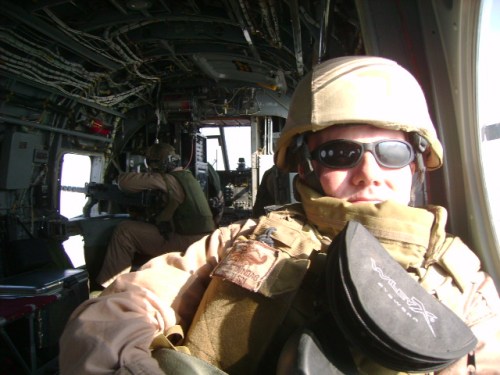
1001In a CH-46 over Al Anbar in a rare day flight
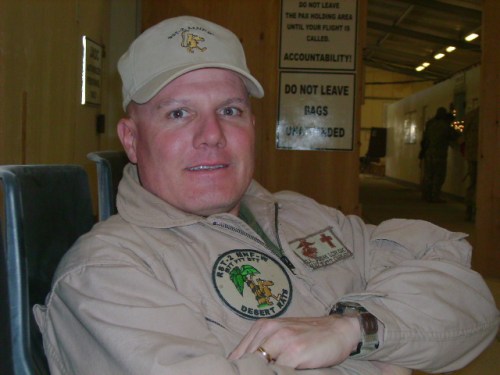
So with the hyper-vigilance I am in the zone so to speak. My mind and body feel more closely connected than ever before.  I notice changes in my body, hear better and am alert to anything.  Now lately I must be even more spun up than before and I don’t rightly know what is causing it.  I will have to go down and discuss this with Elmer the Shrink.   The part that is different now is that my spunuppedness now includes a pretty good startle reflex.  This is new, I had a bit of one probably since I was halfway through my tour, and now it is much worse.  So I’ve been thinking about how my dad came back from Vietnam.  Before he left he was pretty intense but he could relax.  Unless he was really provoked he seldom got angry.

After he returned from his Vietnam tour and then deployed again for 11 months barely five months after his return from Vietnam he was way different.  He was much more angry, drank heavily, and his startle reflex was out of this world.  He would talk about being “nervous as a cat.” He never talked to a pastor or therapist about anything, never re-connected with the people that he served with and did not go to veteran groups for any real socialization.  He seldom talked about his experiences and when he did he shared little.  I think I can understand why now, the thoughts, feelings and sensations are intense and often unnerving.  Sometimes they are downright frightful.  Maybe that is why it is so hard to get to sleep.

mental floss

I have become very aware of surroundings as well as myself and that has made me better at my vocation as a chaplain and Priest.  I notice body language, eye movement, choices of words as well as non verbal cues when talking with a person and I can sense things going on in ways I could not have done before.  So I observe a lot more simply by watching and I hope that I have not contributed to any lack of miscommunication by my readers tonight in writing about this rather surreal subject.

Peace, Steve+

Post Script: The Tides might be getting things back together, they won their third straight and are back to 2 games behind the Wild Card Gwinnett Braves and 3 games behind Division leading Durham.

Leave a comment

Filed under Baseball, iraq,afghanistan, PTSD, vietnam

Revisiting the Demons of PTSD: Returning to Iraq in Virginia a Year and a Half Later

Today I am attending a conference on Caregiver Operational Stress Control.  This brought out my “demons” as I was faced with the stories of others who had been to the same places that I have been in Iraq, and experienced similar things that I experienced on my return.  This is a re-posting of something that I wrote in March at the very beginning of this blog.  At that time I had very few readers.

I am glad to be at this training today.  I needed to take a Xanax when I arrived because I don’t do well with these kind of events anymore.  The intial session and a video of Dr Heidi Kraft talking about her expereinces at Al Taqaduum where I was based out of.  I was scheduled for another meeting but I knew that I needed to be here.  So I asked my Department Head who was going to the meeting if I could stay and he allowed me to do so. God bless him.

I received a note from a new friend in another country’s military, a physician with multiple tours in Afghanistan.  He is dealing with many of the things that I discuss in this essay and had a bad day that took him back to Afghanistan.  I am sure that he is not alone as I deal with many people in my Medical Center who have similar experiences.  Yesterday I was walking down a hallway near our Operating Room and I saw a pretty good sized blood spill on the floor. I was surprised at my reaction as I kept seeing it in my mind the rest of the day and flashbacks to Iraq and the TQ Shock Surgery Trauma platoon where I was pulled into a couple of the last major mass casualty events where 10-15 Marines or soldiers came in at a time. I began to see those wounder Marines on the tables and can visibly see those Marines, their wounds, even tattoos… I hope this helps break the code of silence.  I wrote this on a particularly rough day and will repost some of those early essays as they are still very relevant.  Peace, Steve+

964Trying not to Show my Stress and Exhaustion after 2 weeks out while in between flights at Al Asad

The feeling of abandonment and aloneness, separation and disconnection run deep for those returning from unpopular wars in which the majority of the citizens take no part.  The effects are devastating.  It is estimated that at least 100,000 Vietnam veterans have taken their lives in the years after that war.  Last year the Army had its highest number of active duty suicides ever recorded, January and February of 2009 have been banner months for Army suicides.  Of course as I noted in my previous post these numbers don’t include reservists and Guardsmen who have left active duty or veterans dischaged from the service.  Neither do they include the host of service men and women who died from causes undetermined.

Many veterans attempted to return to “normal life” and family following the war. Many only to have marriages fall apart, continue or leave untreated alcohol and drug addictions acquired in country which often follow them back destroying lives, families and careers.  Most felt cast aside and abandoned by the goverment and society. Many got through and return to life with few visible effects, but the scars live on.  My dad would never talk about his experience in the city of An Loc in 1972 where he as a Navy Chief Petty Officer was among a small group of Americans operating an emergency airstrip in the city which was besieged by the North Vietnamese and Viet Cong for 80 days.  I do know that it affected him, he wasn’t the same when he returned, he was a lot more tense and had some problems initially with alcohol.  He never talked about his time there.

I have seen the effects of this in so many lives,  I remember a Vietnam vet who attempted to kill himself with a shotgun blast to the chin in Dallas during my hospital residency.  He forgot to factor in recoil and blew off his face without hitting his brain or any major arteries.  He survived…talk about having something to be depressed about later.  I have seen the tears as veterans rejected by the country during and after than war begin to seek community with their wartime brothers, men who had experienced the same trauma followed by rejection and abandonment by the people that sent them to Southeast Asia.  One only has to talk to veterans of the Ia Drang, Khe Sahn, Hue City, the Central Highlands and Mekong Delta or read their stories to know what they have gone through.  LTG Hal Moore and Joseph Galloway in We Were Soldiers Once..and Young and We are Soldiers Still have deeply penatrating and soul searching views of Vietnam as does Bing West in The Village. Bernard Fall does the same from a French perspective in Hell in a Very Small Place and Street Without Joy. Alistair Horne’s book A Savage War of Peace discusses and tells the story of many French soldiers in Algeria, who fought a war, won it militarily and had their government abandon them, bringing out a mutiny and coup atempt by French Soldiers who had fought in Indochina, were almost immediately back in action in Algeria with little thanks or notice from thier countrymen.  Abandonment is an ever present reality and “demon” for many of us who have served regardless of our nationality, French, Canadien or American who have fought in wars that have not engaged the bulk of our fellow citizens. Go to the Vietnam Veterans Memorial in Washington DC and tocuh it, trace the outline of a name, look upon the makeshift memorials and tokens of remembrance left by comrades who came home and understand the sorrow and the sacrifice.

Unfortunately we would like to think that this is something out of history that we have learned from and applied the lessons and in doing so no longer have an issue.  Unfortunately this is not the case.  There are many, depending on the study anywhere from8-20 percent of returning Iraq and Afghanistan veterans who suffer from some type of PTSD, Combat Stress reaction or other psychological malady incurred during their tour. Similar numbers are reported by the Israeli Armed Forces in from the 1973 War forward.   The British are seeing the same now as their veterans return from war.  Canadian Forces assigned to the UN command during the Rwanda genocide suffer horribly from PTSD. The mission commander, LTG Romeo Dalliare now a Senator in the Canadian Parliament is a leading spokesman for those who suffer from PTSD. His book Shake Hands with the Devil is a study of how military professionals were exposed to atrocities that they either were forbidden to stop or lacked the combat power to do so even if they wanted to.  These men and women tell their story in a video put out by Canadian Armed Forces.

105Convoy along Route Uranium

I am not going to rehash stories that I have recounted in my other posts dealing with PTSD here, but both I and many men and women that I know are scarred by the unseen wounds of this war.  We gladly recognize, and rightfully so, those who suffer physical wounds.  At the same time those who are dying inside are often ignored by their commands or if they come out are shunted into programs designed to “fix” them.  In other words make them ready for the next deployment.  I am not saying here that there is an intentional neglect of our service men and women who suffer from PTSD and other issues.  I do not think that is the case, but it is a fact of life. The military is shorthanded and stretched to the breaking point. Many Army Soldiers and US Marines have made 3-5 deployments since 2003. The Navy has sent over 50,000 sailors, not including those assigned with the Marines into “Individual Augmentation” billets in support of operations in Iraq, Afghanistan, the Horn of Africa and other fronts in this war.  The Navy personnel, as well as Air Force personnel who perform similar missions often do not have the luxury of going to war and coming home with a particular unit.  We serve often in isolation and incredibly disconnected from our commands, our service is often misunderstood.  Now there are efforts by the services and some commands to do things better to support our sailors, some of these at my own hospital.  However as an institution the military has not fully made the adjustment yet.

Many sailors feel abandoned by the country and sometimes, especially when deployed by the Navy itself.  I have debriefed hundreds of these men and women.  Almost all report anger and use terms such as being abandon, cut off and thrown away by the service and the country.  Those from all services who work in unusual joint billets such as advisers to local military and police forces in Afghanistan and Iraq feel a sense of kinship with each other, often feel a connection to the Iraqis and Afghans but are often not promoted or advanced at the same rate as others who have served in conventional forces in traditional jobs.  There was a film called Go tell the Spartans staring Burt Lancaster about Army advisers in the early stages of Vietnam.  If you see it and have been to Iraq with our advisers you can see some of the same dynamics at work.

At this point we are still engaged in Iraq and Afghanistan.  These wars divided the nation and the veterans, though better treated and appreciated by society than most of thier Vietnam counterparts have no memorial.  Words of thanks uttered by politicans and punits abound, our Vietnam era and other fellow veterans in their latter years come to the airports that we fly in and out of to say thank you, but our numbers are rising, the war rages on both in country and in our minds and lives are being lost long after soldiers have left the battlefield.

not a happy camperNot Doing Well on Leave about 5 months After my Return from Iraq
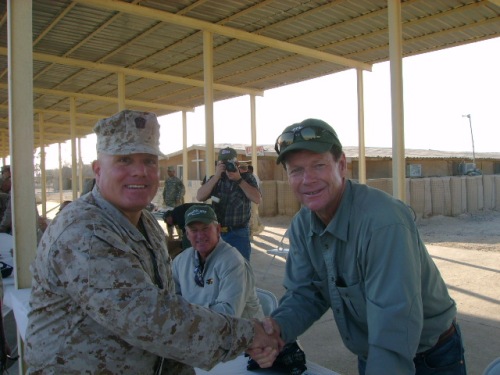
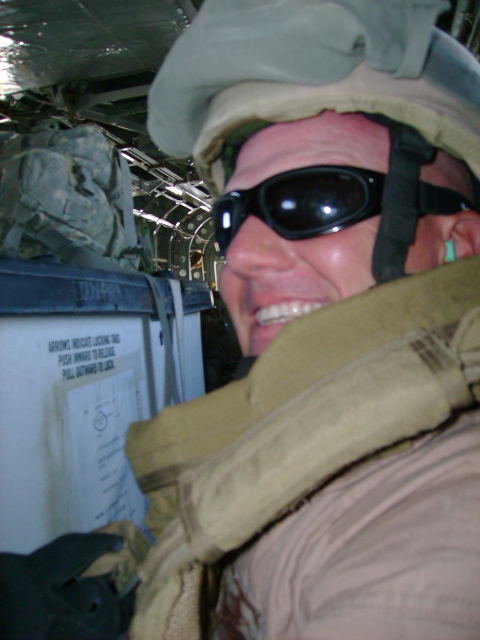
We have to do a better job of ensuring that those who sacrifice so much do not feel that they have been cut off and abandoned while they are in theater and especially when they return. When it is time we need a memorial on the Capitol Mall for those who served in these wars.  I don’t know when that will be, but I do hope to see it in my day.  Sure it’s only symbolic, but symbols can be healing too, just look at the black granite wall rising up from the ground and going back down into it, filled with the names of those who gave their lives and made the supreme sacrifice in Southeast Asia.  Simply known by most as “the Wall” it has become a place of healing and rememberance.  A place to say thank you, goodbye and amen.

Peace and blessings, Steve+

5 Comments

Filed under healthcare, iraq,afghanistan, Military, PTSD, Tour in Iraq, vietnam

Tom Watson: Gentleman, Champion and Supporter of the Troops

Tom Watson and Me

Shaking the Hand of Legendary Golfer and True Champion Tom Watson at Al Taqaddum Iraq 24 Nov 2007

My dad was a golfer.  He began golfing as he was in his last few years in the Navy.  Before he started golfing he was constantly watching it on TV when no baseball was on.  When he retired he began golfing in earnest.  It remained a lifelong passion of his even after he contracted Alzheimer’s disease.  He developed as a golfer and by his early 50’s had developed a decent handicap.  He also would help out as a volunteer at major tournaments at Pebble Beach.   Dad loved golf, but as with everything in his life he took it very seriously.  Sometimes when I visited home on leave dad would take me golfing and let me use his old clubs.  Well, since I would golf once every three to five years I would not do very well.  Before long he would be preaching at me and berating me because he said I had natural talent to hit the ball well and was wasting it.  Those were always interesting outings, as my brother Jeff can testify to himself.

Anyway, back in the 1970s when I was still living at home dad would frequently watch golf on TV.  One of his favorite players was Tom Watson.  Back in those days because of dad I was familiar with almost every major figure in the sport.  However they were not the same to me as like baseball players.  Baseball was more of my sport, though I did and still do appreciate golf and now that my shoulder is getting healed up from the beating it took in Iraq I am going to be getting out on the course on a much more frequent basis once the Minor League Baseball season is over.  The last time I was out in California my brother told me the same thing that my dad did about my ability to hit them ball.  I trust Jeff as he is a very good golfer and had coached golf at the high school level.  I think I am even more attuned to what I’m doing on the golf course because of Iraq and my PTSD.  I am much more in tune with what my body is doing at any given point of time.  I can now feel when a shoulder dips or I pull up on a shot as well as a number of other things that I never noticed before when I would go out on the course.

Because of dad I have retained a latent interest in golf.  So when I heard that Tom Watson was in the lead at the British Open while listening to my local ESPN Sports Radio 1310 on the way home from having the Undead Tooth of Terror extracted my ears perked up.  I had met Tom as well as a number of other golf legends in between missions at Al Taqaddum Air Base which was my home away from home while deployed to Iraq.  Tom and several others came through on a tour.  Now celebrities would make the rounds of Iraq and Afghanistan and I am grateful for them coming to visit, especially when things were not going well and a lot of guys were still getting killed and wounded.  Many times I was out in the far reaches when people would come through so I didn’t see many of them.  My friend Father Jose Bautista-Rojas was an escort for some dignitaries who accompanied the Chairman of the Joint Chiefs of Staff, Admiral Mike Mullen on his tour which included Lance Armstrong and Robin Williams.  Jose got to spend some time with them and got me baseball hat signed by both.  He said that Robin said that “I had better be praying for him.”  I thought that was both funny and kind.  I did meet Chuck Norris when he made his 2007 trip through Al Anbar visiting Marines.  He shook about every person’s hand and had pictures taken with them and he didn’t just go to the big bases, but some of the little remote places that I went. I would have liked to meet Robin. I have heard from a number of folks that he is great to military folks.  One thing that I noticed about the celebrities that came out, no matter who they were or what their politics, they were generally very friendly and seemed to care.  Celebrities take a lot of knocks for many reasons, some justified and others not, but when they come out to a combat zone it is appreciated.  I remember my dad talking about the Bob Hope tour that came to his ship off of Vietnam which included Sammy Davis Junior and Charro.

Anyway, I met Tom at Al Taqaddum in between mission’s right after Thanksgiving on November 24th 2007.  He and his group comprised of him David Feherty, Butch Harmon, Joe Inman, Tom Lehman and Howard Twitty were some of the finest and kindest men I have ever met while deployed.  These men took time with every Marine, Soldier and Sailor who came to see them.  They not only signed items but they gave away more things to our folks than I have seen given anywhere.  I received a hat signed by Tom and the others from the Rider Cup Team, and a picture signed by all, personalized to me.  That was really cool.  While talking with Tom I told him about my dad and his condition as well as my brother.  I asked if it would be possible to get something signed for them.  Tom got with the other guys and had a hat signed for my brother and each of the golfers inscribed a person message to my dad on the pictures.  They all expressed their well wishes to him and prayers for his health.  I was really touched by what gentlemen all of these men were.

I watched the last part of the British Open today pulling for Tom, but unfortunately he lost in the playoff to Stewart Cink after making bogey on 18. The golf miracle story ended with Tom finishing in second place, but even still he was not expected to do what he did even a week ago.  I really felt bad for him as he stood with tears in his eyes.  Despite the fact that he finished second Tom Watson to me is a gentleman, sportsman, a supporter of us who serve in unpopular wars, a man of compassion and a true Champion.  God bless you Tom and thank you for what you did for my dad while I was in Iraq.

Peace, Steve+

1 Comment

Filed under alzheimer's disease, celebrities, golf, iraq,afghanistan

Going to War: A Bus Ride to the Carolina Countryside

This is part four in my “Going to War” series. Previous parts are noted here:

Part One:Going to War: Reflections on My Journey to Iraq and Back- Part One

Past Two: Going to War: Interlude July 4th 2007

Part Three: Going to War: Wills, Living Wills, Immunizations Gone Bad and Christmas in July

Part Four: Going to War: Last Night together and a Kiss Goodbye

Nelson and I staged our gear as we waited for the buses to arrive to take us to Fort Jackson South Carolina where we were to receive our training for the deployment.  As we talked other sailors arrived and gear was stacked in rows of sea bags just off of the sidewalk.  Nelson’s parents, brother and sister were on hand to see him off.  His brother is a First Class Petty Officer and his dad a former Vietnam era Marine Recon NCO who made several deployments “in the shit” as many Vietnam vets call tours in that combat zone.  They were really nice folks.  Over the years I had heard much about them.  They are close to each other and all are supportive of Nelson.

Nelson is a career amateur boxer; kick boxer, martial artist and more recently MMA fighter.  He is active in children’s martial arts instruction and has been on Team USA and fought internationally.  During his Afghanistan deployment before he and I hooked up again he helped coach the fledgling Afghan National Boxing Team.  His last major title was just this year when he won the Arnold Schwarzenegger Classic.  The guy has more titles than you can imagine, his title belt collect could fill a room.  However, he was raised by a boxer, his dad.  His dad taught him and coached him growing up and helped Nelson win multiple New York State Golden Gloves titles.  His dad is a congenial man and who was very friendly, speaking English with a heavy Puerto Rican accent.  Nelson’s mom speaks some English.  Nelson tells a great story of the only time he was knocked out in a fight.  This happened at the Fort Apache Gym in the Bronx after Nelson had gone picking on his little sister when Nellie was about seventeen.  Nelson’s dad found out, told him to put on his gloves and get in the ring.  Nelson proceeded to talk trash to his dad as he got ready to fight and the first round got quite a few hits in on his dad.  In between rounds according to Nelson’s account he told his dad to quit, that he was too old to be in the same ring with him.  Nelson said that his dad simply commented “I was just letting you taste the water.”  The second round began and Nelson was hit by a combination from his dad, which he says “rung his bell” and made him “see stars.”  He remembers trying to get up and not being able to while his dad was talking trash to him.  I cannot do the story justice but meeting Nelson’s family was a joy.

So we waited while the other sailors gathered, some individually and some with family.  Some stood alone as couples while others mingled with each other.  For most this was a new way to see their sailor deploy.  No pier side goodbyes, no banners, no manning the rails by the crew as the ship was nudged away from the pier by tugs.  When you have a “normal” deployment of a ship or something like a Marine battalion it is a big deal.  Media is there, sometimes there are speeches, but most of all there is the understanding that we are all in this together.  The families say goodbye to their Sailors, Marines or Soldiers who are going to war together and leaving some kind of familiar support system for the families.  This is not so when you deploy individually.  We may have been going off to train together, but few would stay together on the deployment.  Normally as a chaplain you are a known quantity to the people that you go to war with.  I was going to war with Nelson but we would not remain with any sailors who were going through this process with us.  I know that was the case for others who would serve in isolated posts, often without any other Navy personnel, mostly working with the Army in support roles, and specialized roles such as the Electronic Warfare Officers detailed to work on defeating IEDs and roadside bombs.  As others said their goodbyes and hugged each other I thought of Judy and knew that she was going to be down for some time but I felt that for once that she had an adequate support network.

I looked at our gear as opposed to the others.  Our gear was in different deployment bags, ours were large and rectangular and more of a coyote or sand color while most everyone else had traditional green sea bags, or what are known in the Army as “duffle bags.”  We had all of our personal protective equipment or the EOD/Special Warfare type while others would receive some variation of Army issue at Fort Jackson.  There are pros and cons to such a arrangement.  The pro is that we had great gear certainly some of the best in theater.  The con was that we had to lug the great gear everywhere we went going to and coming back from war.  This would get old, but the benefits do outweigh the advantages when you are actually in a combat zone.

Finally an officer came out and began calling role and giving us our signed “official” orders.  After we were accounted for we were told to load our gear on the buses that would take us to Fort Jackson. I think there were four or five of these chartered tour buses  which as it turned out would be the first of many tour buses, roll calls and gear loads in the coming months, especially as we entered and exited theater.  Nelson and I got on the same bus which was not full and took seats near the front.  I got a seat alone because I was the senior officer on the bus and a chaplain to boot. This was not because I asked for it or hogged the seat.  It is actually fairly typical in such a setting where young enlisted guys don’t want to sit next to an officer and some are afraid of chaplains because of experiences that they have had in civilian churches.  Some of the young folks have never darkened the door of a church and many of those that have been in church have been burned in relationships with pastors or really over the top religious people.  I have found in my career that until they get to know a Chaplain a lot of them will be very careful in how they approach a chaplain, even those with a vibrant faith.  Some are afraid that the chaplain might try to convert them or disapprove of the manner in which they live their lives. So as a chaplain I need to be cognizant of this fact and be friendly and caring without scaring them away.  Of course I did build relationships with a quite a number of these sailors during the next few weeks but on this bus I was still an unknown quantity to them.  Sitting alone however was good for me since I general despise bus travel regardless of the company I keep.  For some reason my height works against me, I can never get my feet comfortably on the ground on these new tour buses and I have a terrible time getting comfortable.  Since bus travel takes forever to get anywhere the discomfort is palpable.  Now I did a three month tour on buses in 1979 while touring as a spotlight tech for the Continental Singers and Orchestra across the US and in Europe.  Somehow the old Greyhound buses were more comfortable than the new tour buses.  Maybe I’m just nostalgic but they somehow fit people like me better than the fancy new buses.

When you travel by bus with a bunch of sailors, the majority of whom are at least 20 years younger than you, the experience can be entertaining to say the least.   Part of course is a generational thing.  I am from the 60’s 70’s and 80’s.  These guys and gals are from the 90’s and 2000’s.  Music is different, culture is different, and the internet, cell phones, i-phones and Blackberries have revolutionized communications and life.  The trip was a chance for me to observe a lot about these sailors just by watching.  Some had their portable i-pods and MP-3 players going, others spent time talking on cell phones, a few read or talked among themselves, but the sailors near me gravitated to the DVD movie which was 300 the comic book style account of the Spartan’s defense of Thermopylae against the Persians.  As the Spartans made their stand I could see the young sailors who were going to war taking inspiration from King Leonditis of Sparta.   Since we were going into a place where 50-100 Americans a month were being killed and many others wounded and maimed I could understand the need for inspiration along with entertainment.

The bus ride itself was a lot like what I imagine that Minor League teams take in the Carolinas like in the movie Bull Durham, the coaches and older players mixed in with a lot of young guys.  The older guys staying pretty quiet and to themselves and the young guys having fun, playing games and joking around with each other,  We made a couple of stops, one at some little Interstate town with a fair amount of gas stations and a few fast food places.  About half the folks went to the McDonalds where we pulled in while the rest ran down the street to the Burger King and Taco Bell.  Once everyone had their fill the buses pulled back out onto the interstate.  When we finally got near Columbia the buses got of the Interstate highway and onto some small two lane state highway.  We drove down this road about twenty to thirty minutes and pulled into what appeared to be a tiny out of the way base.  I wondered where the hell we were.  Fort Jackson is a fairly large training base where thousands of recruits are trained every year.  Where we were certainly was not the Fort Jackson that I had imagined.

Instead of the main post we were at the South Carolina National Guard training facility called Camp McCready.  It is here that the Naval Expeditionary Combat Command has a training center set up with the Army to train sailors in basic combat tasks.

Our welcome that first night was simple.  We formed up, checked in, got our linens for our standard issue military beds and were marched to dinner at the chow hall or in the Army vernacular the DFAC by our newest and bestest buddies, our Army Drill Sergeants.  In the chow hall or DFAC we were met by a civilian running the line.  I can’t remember his name but this guy was really nice and put the RED in “Redneck.”  He made jokes with everyone that came through the line, asked where people were from and what they did.  When he found out that I was a chaplain he began to ask me for a joke every meal thereafter.  As Nelson and I sat down for chow with a couple of other sailors we looked at each other.  He said: “Boss I don’t think some of these guys know what is coming.”  I said “I think that your right partner, hopefully they adjust and do well.”  The other sailors, both more senior petty officers nodded in agreement.

Going back to the barracks I met some of the other officers enjoying their first night at Camp McCready.  More sailors to fill out the class were due later coming in from San Diego.  I introduced myself to a number of the officers near me and when lights out was called lay down on the same type of bed that I had first encountered some twenty five years before at Camp Roberts California and Fort Lewis Washington.  I swear the sheets, blankets and pillowcases were of the same vintage.  Despite that I fell asleep fairly quickly.

Leave a comment

Filed under iraq,afghanistan, Military, Tour in Iraq

Going to War: Interlude July 4th 2007

This is the second installment of my account of my account of mine and RP2 Nelson Lebron’s deployment to Iraq in 2007.

Our mobilization proceeded the next couple of days as we received our immunizations, were issued DCUs and other clothing needed for the deployment.  Nelson and I of course were already well outfitted by our unit, EOD Group Two.  In spite of this we drew additional uniforms, brown t-shirts, socks and a host of miscellaneous gear.  Thankfully as I have mentioned, EOD had outfitted us well including boots of our choosing, not the standard issue boot being provided to the rest of the sailors.  I had a pair of Blackhawks and a pair of Magnum 5.11’s, both much more comfortable than those issued.  Wills and powers of attorneys were drawn up by JAG officers, our “page 2s” the record of who we wanted notified in the event of our demise were verified and updated, new dog tags ordered and a myriad of forms filled out, sometimes for the second or third time.  In the weeks prior we had completed a fair number of online courses on Navy Knowledge Online to orient us to operations, health and safety issues and for Nelson classes on the M-16A2 and M9 Pistol.  The 4th was a day off, probably more for the staff then for 120 or so of us getting ready to go overseas.

After completing everything we needed on the 3rd I went home and Judy and I took in the Norfolk Tides game against the Syracuse Sky Chiefs at Harbor Park.  Before the game I chatted with Tides General Manager Dave Rosenfield and let him know that I would be missing the rest of the season as I was going to Iraq.  Dave is a good guy and since at the time things were not going well, we were experiencing heavy casualties which were being displayed on every broadcast news outlet available to humanity, I could see the distress in his face as he told me to “please take care of yourself and be safe.”   My usher buddy Skip, a retired Navy Chief and a number of vendors, Kenny the Pretzel guy and others wished me well.  As the National Anthem Played that night I stood at attention, my Tides cap over my heart as the anthem was played.  It was one of the most emotional anthems I have ever experienced.  It was not that it was sung by a star or even played that well, but it was that I was going to Iraq to serve in an unpopular war, ordered by a once post 9-11 popular President whose star had fallen because of how Iraq was turning out.  The war was presented as lost and a disaster and here I was getting ready to go after volunteering to go to Al Anbar Province, the most contested and violent part of Iraq.  The surge was just beginning and the Anbar Awakening was yet to be noticed by anyone. Al Qaida Iraq and other insurgents were taking a severe toll in Al Anbar.  I had been told by Chaplain Maragaret Kibben that the mission was to get out bewyond the wire when no one was getting to take care of the advisers.  I imagined being convoys and my vehiilce being hit, and at the same time still knew that I had to go.  Tears were in my eyes as I mouthed the words to the Star Spangled Banner looking at the flag flying above the scoreboard above right center field.  Judy stood next to me.  It was then that some 26 years of service came down to the real world.  Even though I had been to the Middle East numerous times and even served on a boarding team in the Northern Arabian Gulf, this was different.  I was preparing to go “into the shit” as my Vietnam era brothers would say.  In fact I was going out not with a unit, but as the first Navy Chaplain to serve directly with advisers since that war accompanied by the most prepared assistant in the world.  I was pretty sure that I was the most prepared Chaplain for this assignment, I was as ready as one could be for deployment.  I was physically ready, in some of the best shape of my life, I had graduated done everything that I could thing to do to be ready.   I had even  made sure that I read Chapter 5 of the History of Army Chaplains in Vietnam as part of the massive amount of  reading that I did  for the deployment.  Part of this chapter dealt with those men who served in this capacity then.  We watched the fireworks show that followed the game and

The Tides would go on to win the game 4-3 and I would go home with Judy.  The 4th was spent continuing to get ready even though I was theoretically off for the holiday.  There are always checks and double checks to ensure that everything is just right when you deploy.  This was really hard on Judy as she watched me getting ready.  When you deploy, especially to a combat zone there is a certain amount of emotional detachment that most couples go through.  It is a form of self preservation, you tend not to want to ask or deal with the hard questions of what happens if….

Of course Judy had in the previous months insisted that I take on additional life insurance which I did, just in case I would get schwacked in Iraq. I’m rather superstitious and felt that while this was a good move to protect Judy that it might be inviting trouble for me.  We had of course talked a bit about the deployment; I was much more excited than she could ever be.  The lot of the military wife in wartime is to endure her husband’s choice to serve their country in time of war.  As deployments draw closer the emotional distance widens even as emotions deepen.  It is the inverse of what happens when emotions deepen as people come together.  That last 4th of July was one of being alone together even as we went to of friend Pat and Jim’s house for a cook out.  Following that we went home and spent a quiet evening before going to bed.  My DCUs from EOD hung on my closet door as we turned off the light and spent a fitful night sleep.

Leave a comment

Filed under iraq,afghanistan, Military, Tour in Iraq

The Gifts of PTSD: Insomnia is a Terrible Thing to Waste and the Hidden Value of Hyper-vigilance

068On Board a 53 out near Syria

I’ve been asked by a number of people at work just how I manage to find the time to write the way that I do.  The answer, which I have said to all of them is simple…insomnia, which it turns out is not necessarily a curse, but for me in some ways is a gift.  I find that insomnia really is a terrible thing to waste.  Until I went to Iraq I went to bed at a decent hour every night and seldom did I have problems sleeping.  At the same time my life while busy pursuing work, military and professional education as well as academic degrees was full but not completely fulfilling.  I had always wanted to write on a variety of subjects to include military history, theology, ethics and baseball.  In fact someday I hope to get published.  However back then I was always too distracted to write what I wanted to write.  I could t stay on task for anything other than things that would seemingly directly affect my military career, even my marriage.

081Convoy On Route Michigan

Iraq changed that more than I thought it could.  I got back, fell apart about 90 days after returning home and despite pushing myself harder at work, ministry and academically I was not making it.  Nightmares, dreams, chronic pain and anxiety, stress reactions even in church about crippled me.  About the only place I felt some peace was at the ball park.  Somehow the sight of that great field and the infield diamond settles me. Sleep deprivation became a very real and persistent part of my life.  I guess it was the fact in Iraq that we did most of our travel at night by helicopter, usually CH-46, CH-47 or CH-53’s and had very irregular schedules.  Likewise when we came back to base there was another little issue.  The pad for the Army Medivac Choppers, or “Dustoff” was about 200 yards from my quarters so all night long I was subjected to the constant noise from these aircraft.  If I hear a UH-60 Blackhawk or SH-60 Seahawk at night I still get a startle reaction.  Outgoing artillery fire and occasional fire, explosions and sirens in the adjacent town of Habbinyah were staples of life.  When bored I would stand outside and watch illumination rounds going off the highway just outside our entry control point or wander over near the Shock Surgery Trauma Platoon facility where “Dustoff” was waiting on the pad.  I’m sure that working a number of mass casualty events and seeing our wounded Marines and Soldiers being treated as well as Iraqi civilians including kids had to affect me.  These Americans and Iraqis were out driving the same roads that we would drive on a regular basis and the sight of their shattered bodies went through my mind every time we went on a mission.

As I got deeper into my tour I found that no matter how tired that I was I had great difficulty getting to sleep.   I’m sure this was due to our operational tempo, odd hours, demanding travel, sleeping conditions which varied at every location and occasionally getting shot at.  The most cool of those were when our Army CH-47D talking off from Ramadi , took fire from the ground and proceeded to pop flares, take evasive action while the tail gunner opened fire with his M240 series machine gun.  Since I was sitting two seats from the tail gunner and saw, heard and smelled the gun as it fired I’m pretty sure that it happened.  However, when I called the Army squadron to see what happened they denied that the event happened.  I hear that was not an uncommon occurrence.    So anyway by the mid-point of my tour I was no longer sleeping so I would sit up and play games on my computer, such as chess and Ma-jong.  It is amazing how good you can get at stuff like that through sheer repetition.  It was playing these games that I would wear myself our enough to sleep since I usually did an hour or two of PT during the day or late evening when not on the road.  It is comforting when you are running near the perimeter on a cool Saturday morning and hear explosions and exchanges of automatic weapons fire going off about 2 km to your right.

So now despite my cool concoction of meds I still have difficulty getting to sleep.  In order to sleep I have to wear myself out and when I am done I take my meds and crash.  If I take them before I am exhausted I see little effect and I am not about to start mixing them with the good beer that I enjoy so much.  I do not drink crappy beer thank you.  Maybe it will be time to go back to the doctor when my provider’s relief arrives in August or September.  I probably need to talk to my buddy Elmer the shrink again soon.  Elmer is great but my schedule has not lined up well to see him the past couple of weeks between leave, call schedule and the emergency root canal.  I probably have to go back in on that sooner than my appointment as I still am having some pain and wonder if there is an infection there.

Since I don’t believe in wasting time I have decided to be productive when I can’t sleep.  I started writing as I finished my class requirements for my latest Masters Degree.  I still need to do the comprehensive exams but will wait until September so as not to mess with any home games the Tides have left.  I began writing as a means of both helping me and disciplining myself to write regularly.  I have several book ideas but have never been able to get any off the ground because I could not stay focused.  This website helps me do that and has got me thinking creatively again.  So my answer to how I can find the time to write is simple, if I have 20 or so extra hours in the week late at night that are going to be there no matter what I do, then I shouldn’t waste them.  So my point is that insomnia is a terrible thing to waste.   It could be worse. I know of other vets who can’t sleep either due to war experiences and some have fallen off the deep end with self destructive behaviors at least I am not doing online gambling, porn or other distractions that have helped continue to ravage some of my brothers and sisters who have served in Iraq, Afghanistan and Vietnam.  I have found in a strange way that the chronic insomnia has been a gift which has enabled me to gain insights on life and experience that I had never been able to put down before.  It has forced me to take advantage of time that I would otherwise waste web or channel surfing until I fell asleep.  It is interesting to see what comes out of your computer when you are trying to write while falling asleep.

Here is an example that I found and saved a few weeks ago:  “Manages not only check their the firduk about what they fell than…”

I have no earthly idea what it means or what a “firduk” is or what “manages would “not only check their the firduk” means and I don’t want to find out.  God only knows what it means but it reminds me where a half-asleep Jerry Seinfeld wrote down something that he saw on TV that he thought was funny.  He spent the show trying to see what he wrote and then finally saw what he actually heard.  He discovered that it was not nearly as funny as he thought.

Another gift I have been given with my PTSD is that of hyper-vigilance.  I am much more alert and observant than I ever was.  This is on the road, in crowds or even as I do my job in the hospital.  I have begun to notice the little odd things that are clues to other possibly more significant issues.  This probably has saved my life on the road on several occasions since I returned as I have a much great “feel” for what is going on around me than I have ever had while driving.  There have been at least three times where I “felt” the danger of another vehicle and took evasive action to avoid a collision before I heard or saw it.  Of course the colorful euphemisms which poured out of me on these occasions were quite memorable, I think the best being “You Oedipal Mother F—-r!” when some asshole almost plowed over me in a grocery store parking lot not far from home.

So, despite the inherent problems that PTSD, insomnia and the other maladies I have incurred have caused me, the Deity Herself has also given them to me as a gift.  For which I am strangely grateful. Even a few months back I saw them as a curse, but now they have become a source of blessing.  Like Commander Spock might say to Captain Kirk after observing a human idiosyncrasy “fascinating Captain, fascinating.”

pub1It’s a Gift…Enjoy

I’m back on duty tomorrow for another overnight.  This will be a long week, 3 duty nights out of 5 work days.  Thankfully I will not have duty again for two weeks after Friday.

Peace, Steve+

6 Comments

Filed under Baseball, Loose thoughts and musings, philosophy, PTSD, star trek