Tag Archives: Waffen SS

What if Hitler was assassinated in 1943? An Alternative History of Kursk and the End of World War II in Europe

This is an alternative history of how the Germans might have avoided the disaster at Kursk. It looks at what might have happened if an actual assassination attempt on Hitler had succeeded in March 1943 and how Manstein might have been able to execute the “backhand” strategy that he favored using a mobile defense.  This is predicated by Hitler’s death, based on Hitler’s actions and control of operational decisions Manstein would never have been allowed the freedom to conduct operations in this manner.  In eliminating Hitler I have also included personnel changes and the overall strategy for the German High Command, and the probable response of Stalin to Hitler’s death had it occurred in the spring of 1943. I have tried to be faithful to known historical opinions and actions of the participants and likely reactions to such a situation although one cannot predict precisely what people would have done.  Thus I have documented the article with footnotes as if it were an actual history. It would have been interesting to be able to lengthen this and included sections on tactical actions based on memoirs of German and Russian soldiers. I wrote it as at the behest of one of my Master’s Degree Professors and first published it in August of 2009 on this site under the title of Operation “Dachs” My First Foray into the Genre “Alternative History.” I believe that history is history and this despite what the term “alternative history” implies is fiction.  Though it is based on my belief of how German leaders might have reacted in the spring of 1943 and references actual events that I have altered for the sake of the story it is not history. But one has to wonder what would have happened had the plot to kill Hitler by blowing up his aircraft on its return to Germany from a conference with the commanders of Army Group Center succeeded.


Background: The Strategic Situation Spring 1943

In April 1943 the German High Command faced a decision on which the fate of Nazi Germany would hinge, but for the first time in the war it was not under the thumb of Adolf Hitler. Following Manstein’s counter-stroke following the Stalingrad disaster there was considerable pressure to follow up with that success with a continued offensive. Manstein himself had proposed this but Field Marshal Von Kluge refused to agree to an immediate offensive because he felt his troops needed rest and refitting.
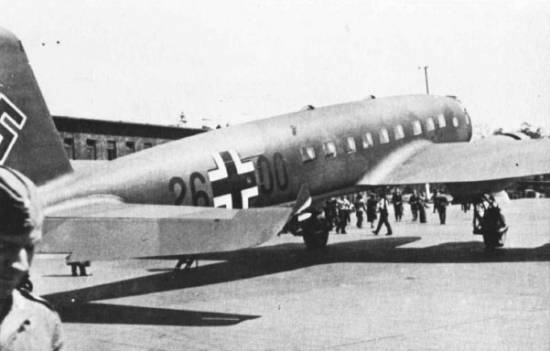
Hitler’s Fw-200 “Condor” before its fatal flight

On March 13th Hitler flew out to meet with Von Kluge at Army Group Center HQ at Smolensk.  On the flight back Hitler’s FW-200 was racked by an explosion crash landing near Minsk, taken down by a bomb planted on the plane by Colonel Henning Von Trescow of Kluge’s staff.[i] While Hitler survived, he remained in critical condition, barely alive at a SS hospital until his death on 20 April 1943, his 54th birthday. The crash landing was reported by the escorting ME-109s of JG-53, and a Alarm Company from a Security Division at Minsk rescued Hitler but were driven off the crash site by a large force of Soviet Partisans who destroyed the aircraft and any evidence to the cause which the escorting fighters attributed to mechanical problems. 

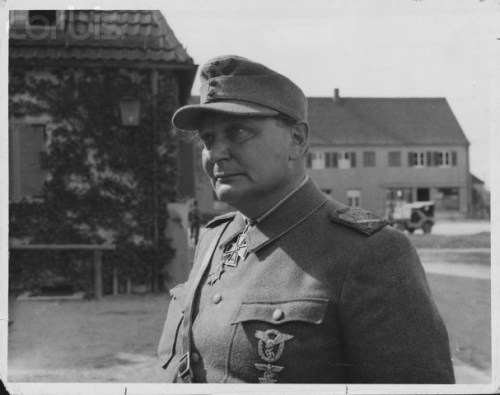
There were no other survivors. Von Kluge, expecting to be implicated the Fuhrer’s death committed suicide after visiting troops on the front line, and was succeeded at Army Group Center by Field Marshal Model the commander of 9th Army. The other conspirators were frozen into inaction when Hitler survived the crash and made no attempt to take over the government, realizing that “our plans for seizing power in Berlin and other large cities were still not adequate to the task.”[ii] In the absence of Hitler Reichsmarschall Goering, Hitler’s designated successor, took action to secure his power and using contacts in the GESTAPO accused Himmler of treason for making contact with Neutral intermediaries in Sweden[iii] and replaced him with SS General Kurt Wolfe, and reappointed Rudolf Diels, the former head of the GESTAPO when it was still under his control[iv], to head it again.  Himmler attempted to flee and was caught near Luneburg when he committed suicide with a cyanide capsule before he could be interrogated. Other potential rivals were eliminated; Martin Bormann, who Goering hated, was arrested on charges of exceeding his authority, embezzlement, and harming the war effort and was executed.[v] Joseph Goebbels swore his loyalty to Goering even before Hitler’s death.  He and Albert Speer were directed to arrange the state funeral for the late Fuhrer. Berlin Radio announced the Fuhrer’s death on the 21 April, Hitler’s body was prepared and lay in state at the Chancellery.   A period of mourning was declared 21 April to 1 May on which the State Funeral took place. On 2 May Goering announced that Field Marshal Von Rundstedt was the new Chief of OKW and would coordinate strategy on all fronts. The next day Goering called together a meeting of the heads of OKH, OKW, the Inspector General of Panzer Troops, and the commanders of the Eastern Front Army Groups, Western Europe and Africa as well as Reichsfuhrer Karl Wolff, Admiral Donitz and Field Marshal Von Richthofen[vi] representing the Luftwaffe to decide on a course of action for the summer. It was the first time that all had been called together to discuss the overall situation since Barbarossa began in 1941, and the first true attempt to formulate a grand strategy during the war.

Options and Decision: The Zossen Conference 3 May 1943[vii]
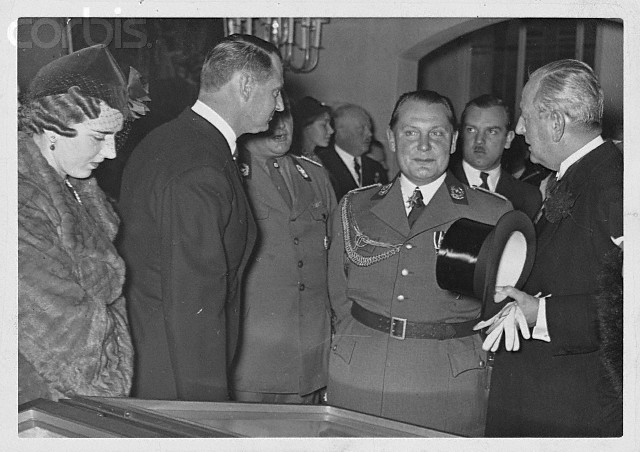
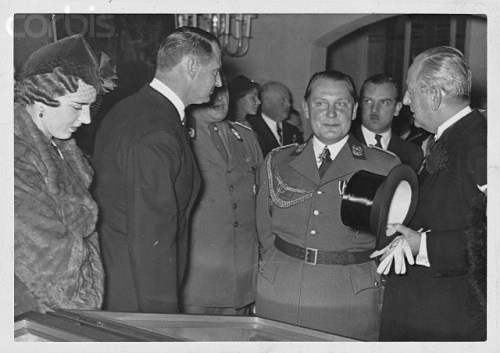
Goering meeting Diplomats following Hitler’s State Funeral

Herman Goering looked up from the maps spread out on the conference table.  He looked surprisingly fit, somehow between the crash of Hitler’s aircraft and his death he had pulled himself together and out of his drug induced malaise.  It was as if he again had a purpose. Field Marshal Von Rundstedt now Chief of OKW following Goering’s relief of Field Marshal Keitel, and General Jodl had just finished briefing the situation in western and southern Europe, following briefings by Colonel General Zeitzler of OKH, the Inspector General of Armored Troops, General Guderian and Field Marshal Von Manstein of Army Group South.  Albert Speer briefed tank and aircraft production numbers while the Chief of the Army personnel office noted the requirement for 800,000 replacements “but even the most ruthless call-up was able to produce only 400,000.”[viii] Looking from the table he spoke: “Gentlemen, the situation is critical and I have to admit that I have thought so for a number of months but have been unable to speak out.   Our political situation is perilous, the Italians are ready to abandon our cause. Our forces in North Africa will soon be unable to hold out as our Italian friends have let us down again.[ix] I expect that if Jodl and Kesselring are right about Allied intentions that we will have our hands full in the west shortly.  Kesselring and Arnim, you need to evacuate as many German soldiers from Africa as possible,[x] use all air and naval forces that you can, I know it will be difficult, especially with the heavy losses we have taken in transport aircraft and the pathetic Italian Navy.”  Goering paused, his gaze passing around the room.  “In the west we need to assume that the Allies will invade and the ‘very real danger that the enemy may turn against Brittany and Normandy,’ Field Marshal Rommel will take command of OB West to build up the Atlantic Wall in these sectors.”[xi] “Zeitzler, Manstein, we need to shore up the eastern front.”

“Herr Reichsmarschall, the Fuhrer had approved the plan called ZITADELLE, to attack the Russians here in the Kursk salient.” responded Zeitzler.[xii] “We should be ready to begin the offensive this month.”  Goering raised his hand stopping Zeitzler.  “I know, but I have considered that plan and I cannot support it. Richthofen briefed me on it prior to the Fuhrer’s death and general, we must have another plan, and an attack on Kursk is so obvious the Russians will be ready to meet it.  I have considered what the General Guderian and Minister Speer said regarding tank production and the state of the Panzer arm.  I cannot approve Zitadelle, but we must find a way to deal the Russians a defeat without squandering our strength attacking such an obvious target. Model too is dubious of the prospects; he believes that the Russians know our intentions and has requested a delay to strengthen his forces.”[xiii] “Reichsmarshall.” chimed in Jodl. “You are correct, the premature commitment of central reserves in such an offensive will not help our cause, in fact only local success is what can be expected from Zitadelle.”[xiv]
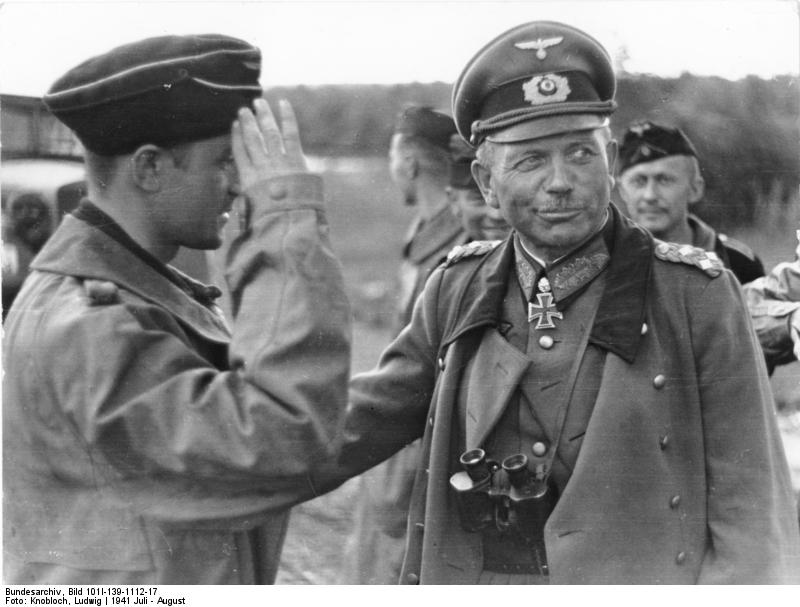
Colonel General Heinz Guderian 

“But Reichsmarshall, we must recapture the initiative in the east, we must take the offensive!” retorted Zeitzler. “Our new units of Panthers and Tigers will give us a decisive technical advantage.”[xv] Guderian now joined in. “But the Panthers still have many technical problems, it would be better to wait until they are worked out before we commit them to a major offensive, and besides, how many people do you think even know where Kursk is?”[xvi]

“Zeitzler, I appreciate your zeal.” Interrupted Goering, “But Jodl and Guderian are correct, even a successful attack at Kursk will not alter the strategic situation. We must work to stave off defeat.  Manstein has a plan that may help, there is some risk, but I see no other way. An offensive at Kursk would require tanks and aircraft that must be used to combat the Allied bombing of the Reich and to safeguard withdraw of our units from Africa, it would force us to commit everything with little gain.” Goering paused and said to Manstein, “Go ahead Manstein.”

“Reichsmarshall, Gentlemen.  Our situation in the east is not hopeless, in March I felt that an immediate offensive would succeed in pinching off the Kursk bulge, but I think now that the moment of opportunity has passed for such an attack.  Instead we should fight a defensive battle of maneuver as called for byTruppenführung that we have developed from the days of the Reichswehr.  We should build up our forces; give ground where we can, and when we have the chance strike the enemy on the backhand, as we did at Kharkov.”[xvii]

Zeitzler jumped in. “But how can we do that? If we don’t strike now while we have the opportunity the Russians will grow stronger, and how can we know where they will strike?”[xviii]

“General Zeitzler, the Russians are already building up heavy armored forces in the area of Kursk, and diverting forces from other sectors of the front to that area.  The south offers them the best opportunity to finish what they started in the winter.  They will come and it will be in the south, they will want Kharkov and they will again attempt to envelop our forces in the south. If they succeed they will follow up and rapidly move into the Balkans, Romania and Hungary will turn on us and it will be a disaster, we cannot afford that.”  Manstein looked up, Jodl nodded and Model said “Once that is done they will push to Kiev and Poland.” Goering interjected “Thank you Model, you are right, Field Marshal Manstein; please go on with your plan.”
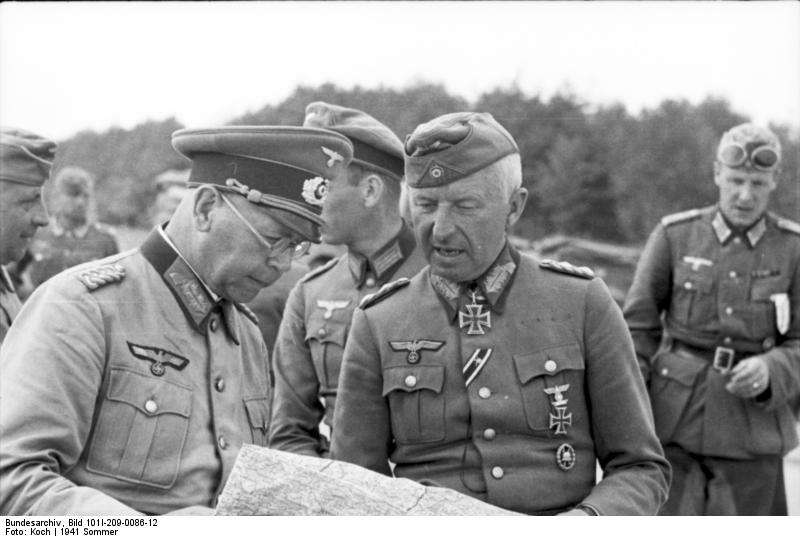
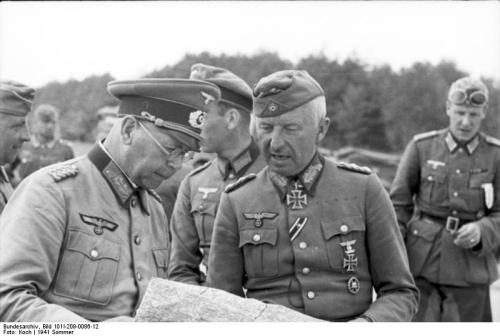
Field Marshal Erich Von Manstein at the Front

Motioning to the map Manstein continued. “We will concentrate the majority of our Panzer forces here, just west of Kharkov and another group here west of Orel.  We will also build fall back positions for our infantry forces here along the Dnieper.  We should be ready to withdraw from the Crimea should the need arise, we cannot afford another encirclement.  When the Russians attack we will give ground, even Kharkov if needed. Our infantry divisions will fight a delaying action supported by Jagdpanzer and Sturmgeschutzen, the Luftwaffe will need to give us good close air support from Stukas and as the Russians outrun their supply depots and their offensive loses momentum we will attack, like a badger defending itself.  Our Panzers will cut off their spearheads west of Kharkov while we bleed them dry in the north; we will then roll them up, stabilize the line and prepare for the winter.”  Manstein sounded confident; those in the room began to sense that his plan could work.  Rundstedt spoke up: “That will give us the chance to transfer forces to other fronts and, maybe, since Hitler is dead there might be a chance for Reichsmarschall to negotiate a settlement,[xix] otherwise gentlemen the Allies will destroy our cities from the air and grind our armies down until we have no recourse but surrender.”

“Right” added Goering, making eye contact with each man in the room. “We must have success in the defense, we must buy time and we must work to end this war before Germany is destroyed. ‘We will have reason to be glad if Germany can keep the boundaries of 1933 after the war.”[xx] He paused and said “General Zeitzler, you are relieved of your duties at OKH, General Guderian, you are now the Chief of OKH.[xxi] Manstein, you will command the East, General Hoth will take your Army Group. You will work with Guderian and Model to flesh out this plan.  We must get the Panther, Tiger and Ferdinand units operational as soon as possible.  I believe that the Russians will attack by June. Richthofen, I need you to look to the Luftwaffe. We have not had a good year and we have to succeed in defending the Reich from Allied bombers and provide support to the ground forces. Of course flak needs to be built up. The Luftwaffe Field Divisions with the exception of the Fallschirmjaeger and Herman Goering Panzer Division need to be transferred to Army control.”  He looked at Speer: “Herr Speer, the Fuhrer entrusted you with our war production program, you must increase production of tanks and aircraft. Speed the production of the ME-262 and cancel all programs that take away from the panzers, fighters and ground support aircraft that we need now.” He put his hands on his hips and took a deep breathe. He looked at Wolfe, Himmler’s successor.  Wolff, the Reich needs the Waffen SS, the Panzer troops are exceptional, but I want all Waffen SS Formations, with including the Panzers turned over to Army control, we cannot keep dividing our resources. With the personnel from the Luftwaffe Field Divisions we should be able to provide the Army with excellent troops to rebuild experienced formations.”  Goering looked around the room; “Are there any questions Gentlemen?” Putting his arm across Manstein’s soldier and said: “I think that Badger is a fitting name for your plan. Our little Dachs will tear them to pieces.”   Later, Goering met with Foreign Ministry officials emphasizing the need to strengthen German Allies and seek peace with the west. He “admitted that he was worried about the future. ‘It’s not quite clear to me how we are going to end this war.’”[xxii] Those present could not believe how Goering had conducted himself, and all left the meeting thinking that it might be possible to stave off defeat.  It was an incredible performance. After Hitler’s crash he had secretly undergone a “systematic withdraw cure which had ended his drug addiction.”[xxiii] The change was marked.

STAVKA Headquarters Moscow: 7 May 1943

Josef Stalin was ecstatic.  His agents reported that Hitler was dead even before the announcement from Berlin.  Partisans had confirmed that it was Hitler’s aircraft that they found and recovered some of Hitler’s personal belongings, including his cap, which they presented to Stalin.  Intelligence reported that Goering had taken power, and Stalin was sure that his position was weak and many believed that Goering, was not up to the task, and that a renewed offensive could bring down the Nazi regime.  Now was the time to bring the Nazi terror to an end and Stalin called his key leaders together.  While Stalin wanted an immediate offensive his generals wanted to wait just in case the Germans attacked Kursk.  “Zhukov, Vasilevsky, and various General Staff officers urged caution and recommended that the Red Army remain on the defensive until the Germans expended their offensive strength.”[xxiv] Stalin supported by commanders, like Vatutin, “argued for a resumption of offensive action in early summer to preempt German action and regain the momentum lost in March 1943.”[xxv] In the end a compromise was reached and despite the temporary defensive stand “Russian strategic planning in the summer of 1943 was inherently offensive in nature.”[xxvi] The new offensive would be launched on 15 June if the Germans had not attacked before.  It would be named Operation Kutuzov[xxvii] and be aimed at the Orel salient and Kharkov.  The northern prong under Rokossovsky’s Central Front would destroy the Germans around Orel and drive west while Vatutin’s Voronezh and Konev’s Steppe Front would take Kharkov and drive toward the Dnieper.[xxviii] The Southwest Front and South Fronts would attack and destroy the German forces along the Mius, the goal: “collapse of the German defenses and an advance to the line of the Dnieper River from Smolensk in the north southward to the Black Sea.”[xxix]

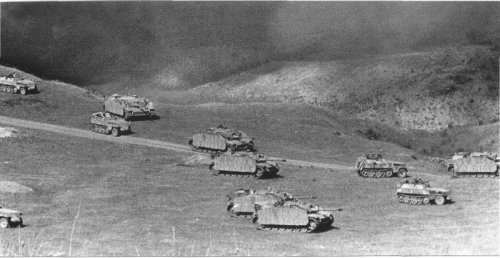
Sturmgeschutzen and SdKfw 251 APCs moving into position

Manstein met with Model, Hoth and Guderian to develop DACHS. They had  to play for time and deceive the Russians as to their true intent so they could build up their forces.  Deception operations were mounted on both sides of the Kursk bulge to give the impression of attack preparations.  1st Panzer Army and Army Detachment Kempf  were to launch a diversion called Operations HABICHT and PANTHER southeast of Kursk  “designed to push the Soviets back from the industrial area of the Donets River.”[xxx] The defensive plan called for the infantry supported by tank destroyers, assault guns the heavy Ferdinands as well as mobile Pioneer units to conduct a withdraw to delay and disrupt the Russian attack.  Bridges were prepared for demolition, defensive positions constructed at choke points which would be defended and then abandoned when no longer defensible, and minefields laid to slow the Russian advance.  This was critical for 9th Army now commanded by General Henrici in the Orel salient north of Kursk.  Henrici, a defensive master constructed a series of defensive belts to allow his army to withdraw from the bulge without being cut off and inflict heavy casualties on the Russians through skillful deployment of anti-tank weapons, especially self propelled guns.[xxxi] In the south 4th Panzer Army, now commanded by SS General Paul Hausser[xxxii] and Army detachment Kempf made preparations to allow the Russians to advance past Kharkov using the same defend and delay tactics and then counterattack. As the armies prepared, Speer and Guderian’s efforts to rebuild the Panzer force were bearing fruit.  By 15 May the first brigade of Panther tanks was activated and began training west of Kharkov.[xxxiii] Two battalions of Ferdinands, one for 9thArmy and one for 4th Panzer Army were activated.[xxxiv] Sturmgeschutzbattalions were assigned to each infantry corps. Panzer divisions built up so that all had an average of 130 tanks, with the SS Divisions and Gross Deutschland receiving more.  Tiger battalions were assigned to each Panzer Corps.

The Summer Campaign

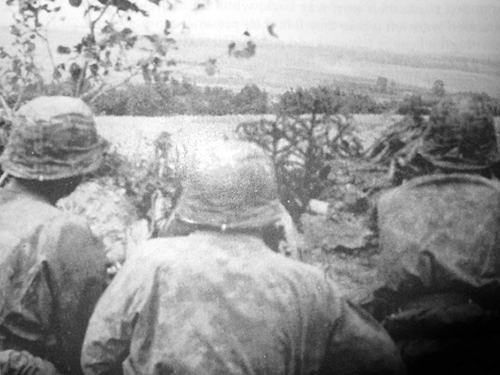
German Infantry

On 1 June Operations PANTHER and HABICHT hit the unfortunate Soviet 6thArmy, which had been victimized by Manstein’s counter-stroke in March.  III Panzer Corps of Army Detachment Kempf supported by Corps Raus (IX Corps) linked up with 1st Panzer Army at Kupiansk on 3 June.  The Russian counterattacked with 8th Guards Army and the 2nd and 23rd Tank Corps. The battle of Kupiansk resulted in the destruction of 6th Army and the 23rd Tank Corps which was surprised by the 503rd Panzer Detachment’s Tigers. 2nd Tank Corps received a similar mauling at the hands of the 6th Panzer Division.  On 9 June the Germans returned to their start positions.
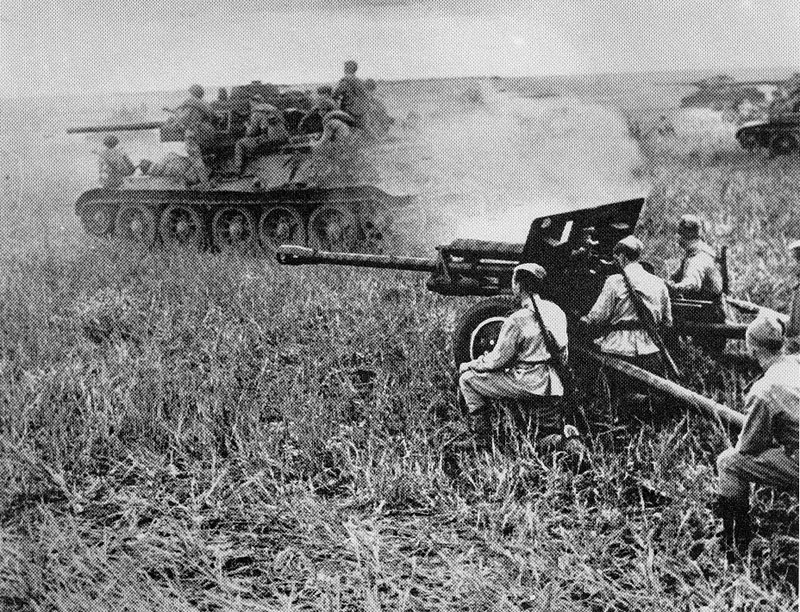
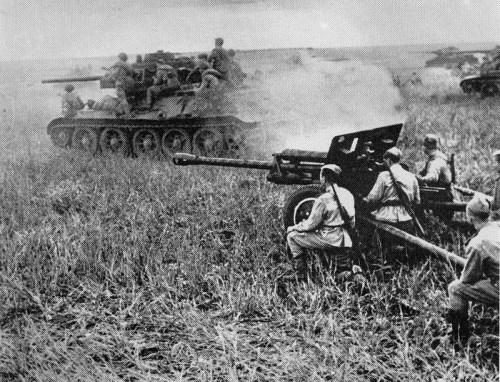
Soviet Tanks and AT Guns at Kupiansk

The attack at Kupiansk surprised STAVKA which had been deceived by the build up of Panzers around the Kursk salient.  Stalin continued to hound his generals to begin Kutuzov on time, but the generals were “chastened” by the defeat at Kupiansk and “earlier experiences”[xxxv] and wanted to delay. Stalin forced them to begin Kutuzov on 22 June, the 2nd Anniversary of Barbarossa.  Manstein and his Eastern Front commanders held their breath.  Teams of Brandenburger commandos operating in the Soviet rear and Luftwaffe reconnaissance aircraft reported Russian units moving to advanced positions to the north and south of Kursk.  Vatutin commanding the Voronezh Front was ambushed and killed by a Brandenburger detachment supporting Ukrainian irregulars[xxxvi] as he returned from visiting 69th Army near Prokhorovka station on 19 June and was replaced by Lieutenant General Katukov of 1st Tank Army.  Katukov “was one of the Red Army’s most accomplished and experienced armor officers.”[xxxvii]

Manstein with Tigers

In the north Rokossovsky’s Central Front and Popov’s Bryansk Front supported by 11th Guards Army[xxxviii] began concentric attacks on the German 9th and 2nd Panzer Armies and ran into Henrici’s labyrinth on 22 June.  They hit the first line they found it empty, the Germans having repaired to secondary positions,[xxxix] German 88’s and self propelled guns took a heavy toll on the tanks of 2nd Tank Army.  The 3rd Tank Army under General Rybalko’s army committed after the initial assault “attempted a fresh penetration instead of exploiting the earlier efforts of the 3rd and 63rd Armies… Rybalko’s force included 698 serviceable tanks…but lacked the artillery and engineers for such a deliberate assault.”[xl] Popov telephoned Stalin at noon on 25 June “to report that Rybalko was practically stalled and suffering heavy losses in tanks.”[xli]The Germans committed the 5th and 8th Panzer divisions[xlii] against 3rd Tank Army. The fresh Panzers inflicted painful losses on Rybalko.  On 27 June Stalin called to complain about the handling of the army, demanding a direct assault.[xliii] The battle turned into a “grinding battle of armored attrition.”[xliv] After “a few bloody days bereft of any success, Rybalko’s tank formations had to be pulled out of the line into reserve.”[xlv] The “battle for the Orel salient ended three weeks later with a German defensive victory, as Army Group Center extricated its two armies from the box prepared for them while inflicting heavy casualties on three Soviet Fronts.”[xlvi] The Soviets lost over 629,000 men and 3,500 tanks.[xlvii] In comparison German losses were light and by falling back they shortened their line freeing units for other operations.  Stalin had Orel but failed to destroy the Germans and lost heavily in the attempt.

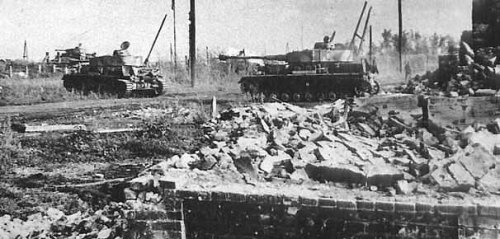
Panzer IV’s engaging Soviet forces

In the south Konev’s Steppe and Katukov’s Voronezh Fronts prepared their assault on Kharkov.  They attempted to deceive the Germans by simulating the massing of a “notional tank and combined-arms army” in the western side of the Kursk bulge.[xlviii] The deception was unsuccessful as reconnaissance by Luftwaffe aircraft and Brandenburgers failed to uncover any troop concentrations and Russian deserters, talked of a strike at Kharkov. The offensive “Rumiantsev” was opened by the 5th and 6th Guards armies supported by 53rd and 69th Armies on 21 June; a day later 7th Guards Army jumped off, two additional armies supported the west flank of the offensive.[xlix] The Russians in the two fronts began the operation with 980,000 men and 2,500 tanks.[l] Opposing them were 4th Panzer Army and Army Detachment Kempf’s 350,000 men and 1,750 tanks and assault guns including 100 Tigers and 192 Panthers.[li]

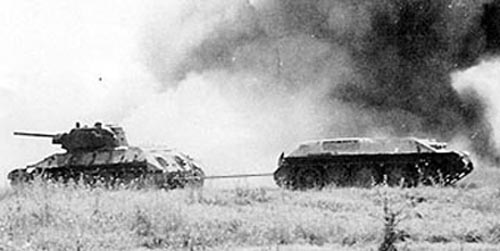
T-34 towing disabled T-34 near Orel

STAVKA “chose to strike the strongest portion of Hoth’s defense head-on, to engage and defeat the German force and avoid the problems of flank threats.”[lii] Unfortunately they complicated the attack by focusing it at “precisely the boundary between the Voronezh and Steppe Fronts, causing increased coordination problems from the start of the operation.”[liii] The Germans used Ferdinands, Jagdpanzers and Sturmgeschutz in a mobile defensive role, as infantry fought delaying actions as they withdrew to successive defensive lines, inflicting brutal losses on the Russians.  Aided by massive artillery preparation the Russians broke through the weakened Army Detachment Kempf near Belgorad[liv] taking the city on 24 June.  Corps Raus’ 167th Infantry Division was taken on its exposed left flank forcing Raus to “fight a delaying action…until the withdraw reached Kharkov.” [lv] The Germans reacted to the threat by committing the “veteran 5th SS Panzer Grenadier Division Wiking” to reinforce Army Detachment Kempf.[lvi] Despite the success “the German defenses proved so tenacious that the leading brigades of the two tank armies had to enter the fray.”[lvii]
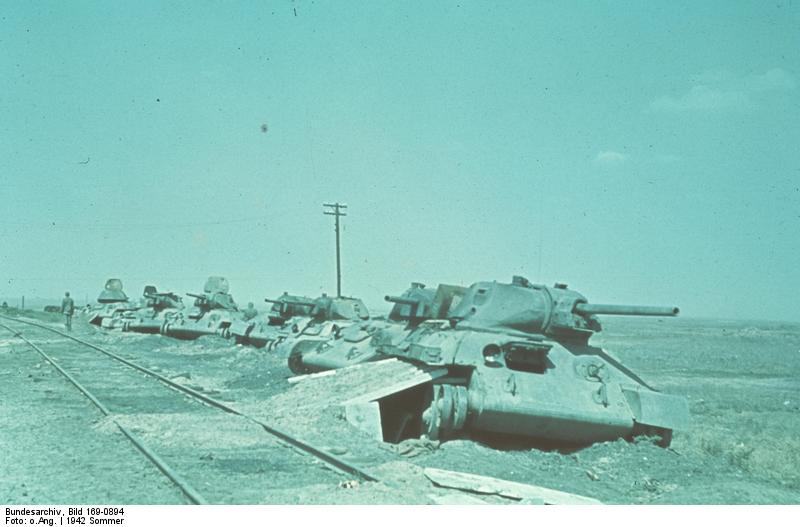
Destroyed column of T-34s

As the Russians advanced the German fell back.  Hoth directed Hausser to wait before counterattacking with XLVIII Panzer Corps and II SS Panzer Corps.  Katukov pushed the 1st and 5th Tank Armies into the hole in the German lines and moved toward Kharkov which was liberated by the 89th and 183rd Guards Divisions[lviii] on 2 July.  The liberation of Kharkov and Belgorad while exhilarating had cost Katukov over 250,000 casualties.  Skillful employment of mobile defense and local counterattacks by mixed Panzer battlegroups, such as one by Grossdeutschland on the flank of 5th Tank Army caused panic and some units withdrew “leaving behind masses of equipment of every description.”[lix]The tank armies had lost upwards of 50 percent of their tanks, infantry divisions were now down to half strength, some down to 3000 men.[lx] Yet the Soviets attempted to drive south to trap the Germans.  They were hit by XLVIII Panzer Corps and II SS Panzer Corps, both of which had seen little action thanks to Hoth’s conservation of strength. XLVIII Panzer Corps hit the 1st Tank Army at the “key road junction of Bogodukhov, 30 kilometers northwest” of Kharkov “severely mauling the leading three brigades”[lxi] forcing 1st Tank Army to withdraw towards Kursk. 5th Tank army moved to support but was taken in the flank by II SS Panzer Corps.  The SS Corps encircled the remainder of 5th Tank Army. Hunted by the SS on the open steppe the survivors slipped through gaps in the encirclement but both armies were ravaged.  By 15 June 1st Tank Army was down to 120 tanks and 5th Tank Army had “50 of its original 503 tanks and self-propelled guns serviceable.”[lxii] XLVII Panzer Corps took Kharkov on 18 July.

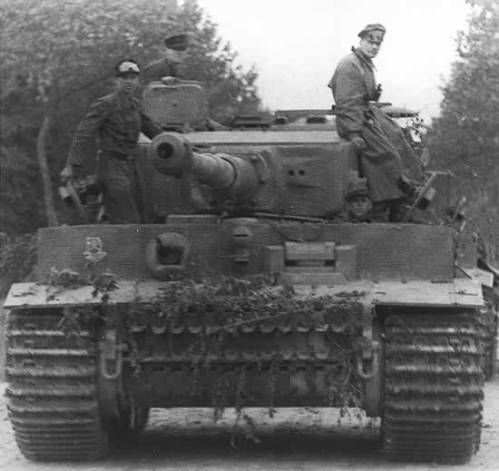
SS Panzer Grenadiers and Panzertrüppen Tigers of 3rd SS Panzer Division prepping for battle

The victory paid dividends for the Germans. The Front held and the Russians had taken nearly a million casualties and lost almost 6000 tanks and self-propelled guns.  Three Tank Armies had been smashed, 5th Tank Army would not be fit for field duty for two months.[lxiii] 3rd Tank Army earned a Guards designation but was withdrawn from combat.[lxiv] 6th Army, victimized by PANTHER was destroyed while the 5th, 6th and 7th Guards Armies were shattered. Additionally, the Germans decimated two independent tank corps.  Stalin reacted by halting operations, cancelling follow on offensives and rebuilding the Red Army’s tank armies and mechanized forces.  He realized that his Generals had been right in not wanting to undertake offensive operations until the Germans had been weakened, but the German insistence on not going on the offensive caused him to ignore their arguments. He decided to wait until winter to launch his next offensive, but that offensive would never be launched as by the time he was ready the war was over.

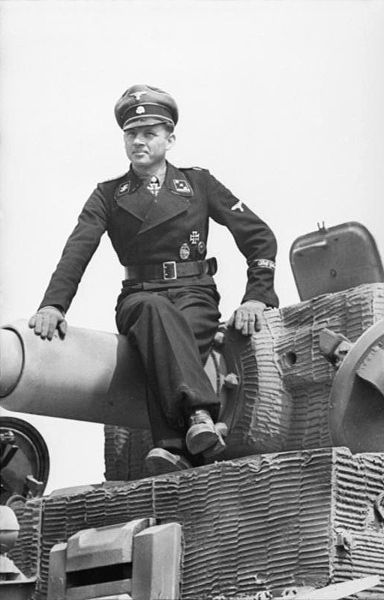
German Tank Commander as Panzers mop up

The elimination of the Russian threat enabled Italy to be reinforced as well as the reinforcement of the Atlantic Wall.  The Salerno landings were a disaster, the Allies driven into the sea by Panzer Divisions released from the Eastern Front.  The disasters at Salerno and the Russian debacle brought overwhelming domestic political pressure on Roosevelt and Churchill to end the war. Clandestine talks began in Switzerland between Avery Dulles and Karl Wolff[lxv] while Walter Schellenberg met with Count Bernadotte.[lxvi] Despite the previous demand for unconditional surrender the Allies decided to negotiate with the new German leadership might end the war in Europe.  Goering surrendered power to General Beck and gave himself and other accused war criminals up to the Allies. Beck took power, withdrew to 1939 borders, dismantled the death camps and disbanded the Nazi Party, and its police apparatus.[lxvii] Peace came to Europe on 9 November 1943, 25 years after Kaiser Wilhelm’s abdicated his throne.

Goering Surrenders to the Allies


[i] Clark, Alan. Barbarossa: The Russian German Conflict, 1941-45. Harper Collins Publishers, New York, NY 1965. Pp.307-311. There was an attempt on Hitler’s life on his return from Kluge’s headquarters.  Only the bomb did not go off, all components had worked but the detonator did not fire.  Clark notes that “the Devil’s hand had protected Hitler.” (p.311)

[ii] Galante, Pierre. Operation Valkyrie: The German Generals’ Plot Against Hitler. Translated by Mark Howson and Cary Ryan. Harper and Row Publishers, New York, NY 1981. Originally published as Hitler est il Mort? Librairie Plon-Paris-Match, France. 1981. p.167

[iii] Padfield, Peter. Himmler. MJF Books, New York. 1990. p.474.  Himmler had a number of contacts and intermediaries who he used to attempt contact with the Allies as early as 1943.

[iv] Höhne, Heinze. The Order of the Death’s Head: The Story of Hitler’s SS. Translated by Richard Barry. Penguin Books, New York and London, 2000. First English edition published by Martin Secker and Warburg Ltd. London 1969. Originally published as Der Orden unter dem Totenkopf, Verlag Der Spiegel, Hamburg 1966.  Diels remained an ally of Goering even marrying his sister in 1943.

[v] Von Lang, Jochen. The Secretary: Martin Bormann: The Man Who Manipulated Hitler. Translated by Christa Armstrong and Peter White. Random House Inc. 1979. Originally published as Der Secretär. Deutsche-Verlags-Anstalt, Stuttgart. 1977 p.9.  At his trial Goering remarked to other defendants. “If Hitler had died sooner, I as his successor would not have had to worry about Bormann. He would have been killed by his own staff even before I could have given the order to bump him off.”

[vi] Irving, David. Göring: A Biography. William Morrow and Company, New York, NY 1989. Richthofen had succeeded Jeschonnek in March when Goering relieved him. Goering believed that Jeschonnek “was too pliable at the Wolf’s Lair.” Goering had actually considered this a number of times but postponed it several times. p.388

[vii] Guderian, Heinz. Panzer Leader. (abridged) Translated from the German by Constantine Fitzgibbon, Ballantine Books, New York 1957. pp.244  Hitler conducted a similar conference involving many of the same people in Munich.

[viii] Carell, Paul. Scorched Earth: The Russian German War 1943-1944. Translated by Ewald Osers, Ballantine Books, New York, NY 1971, published in arrangement with Little-Brown and Company. p. 336

[ix] Ibid. Irving. pp. 377-379.

[x] Ibid. Guderian. p.243

[xi] Ibid. Irving. p.378

[xii] Glantz, David M and House, Jonathan. The Battle of Kursk.  University Press of Kansas, Lawrence, KS. 1999. pp.21-25.  Operations order 5 had been approved by Hitler on and issued by OKH on 13 March. It was followed by Operations Order 6 on 15 April.

[xiii] Ibid. Clark. p.324.

[xiv] Warlimont, Walter. Inside Hitler’s Headquarters 1939-45. Translated by R.H. Berry, Presido Press, Novato CA, 1964. p.334 These objections of Jodl were from June, but indicate the feeling of Jodl for the Zitadelle as planned and when would have likely been his response in such a situation.

[xv]Glantz, David M. and House, Jonathan. When Titans Clashed: How the Red Army Stopped Hitler. University Press of Kansas, Lawrence, KS. 1995. p.157 Zeitzler had been a consistent advocate for Zitadelle since he heard Manstein’s initial proposal in March.

[xvi]Macksey, Kenneth. Guderian: Creator of the Blitzkrieg. Stein and Day Publishing, New York, NY 1975 p.206

[xvii] Ibid. Clark. p.322

[xviii] Ibid. Clark. p.323.  Zeitzler made this argument with Jodl during a briefing in April 1943.

[xix] Shirer, William L. The Rise and Fall of the Third Reich. A Touchstone Book published by Simon and Schuster, 1981, Copyright 1959 and 1960. p.1115.  Hitler had told Keitel and Jodl that “When it comes to negotiating [for peace]…Goering can do much better than I. Goering is much better at those things.”

[xx] Speer, Albert. Inside the Third Reich. Collier Books, a Division of MacMillan Publishers, Inc. New York, NY 1970. p.245.  From a conversation with Speer in late 1942.

[xxi] Ibid. Glantz and House. Clash of Titans. pp. 216-217. Hitler would replace Zeitzler with Guderian in June 1944.

[xxii] Ibid. Irving. p.379 From a conversation with State Secretary Ernst von Weizäcker 11 February 1943.

[xxiii] Ibid. Speer.  p.512. The ending of the addiction took place at Nurnberg and Goering surprised many of his co-defendants with his “remarkable energy.”

[xxiv] Ibid. Glantz and House. Kursk. p.28

[xxv] Ibid. Glantz and House. Kursk. p.28.

[xxvi] Ibid. Glantz and House. Kursk. p.264

[xxvii] Overy, Richard. Russia’s War: A History of the Soviet War Effort: 1941-1945. Penguin Books, New York NY and London, 1997. pp.211

[xxviii] Erickson, John. The Road to Berlin. Cassel Military Paperbacks, London, 2003. First Published by Weidenfeld and Nicholson, 1983. p.76

[xxix] Ibid. Glantz and House. Kursk. p.265

[xxx] Ibid. Glantz and House. Kursk. p.23.

[xxxi] Liddell-Hart, B.H. The German Generals Talk. Quill Publishing, New York, NY. 1979. Copyright 1948 by B.H. Liddell-Hart. p.215  Henrici describes the methods that he used in 1944 as Commander of 1st Panzer Army and as Commander of Army Group Vistula during the defense of Berlin.

[xxxii] Hausser would actually command 7th Army in Normandy in 1944.

[xxxiii] Ibid. Glantz and House Kursk. p.53 This was the 10th Panzer Brigade assigned to XLVIII Panzer Corps.  Additionally Clark notes production figures for Panthers from Speer that indicate that 324 Panthers would be available by 31 May. (Clark. p.325)

[xxxiv] Ibid. Glantz and House. Kursk. p.52.  At Kursk the two Ferdinand detachments were both assigned to 9th Army.

[xxxv] Ibid. Glantz and House. Kursk. p.28.

[xxxvi] Ibid. Carell. p.510.  Vatutin was killed by Ukrainian irregulars in April 1944.

[xxxvii] Ibid. Glantz and House. Kursk. p.62

[xxxviii] Newton, Steven H. Hitler’s Commander: Field Marshal Walter Model, Hitler’s Favorite General. DeCapo Press, Cambridge MA 2005. p. 256

[xxxix] Ibid. Liddell-Hart. p.215.

[xl] Ibid. Glantz and House. Kursk. p.236

[xli] Ibid. Erickson. p.113. At Kursk the call took place on 20 July when Rybalko was in this situation.

[xlii] Ibid. Newton. p.256

[xliii] Ibid. Erickson. p.114

[xliv] Ibid. Glantz and House. Kursk. p.236

[xlv] Ibid. Erickson. p.114

[xlvi] Ibid. Newton. p.256

[xlvii] Ibid. Glantz and House. p.345. The actual losses were 429,000 men and 2,500 tanks against a German force significantly weakened by Zitadelle.  Had the Russians attacked the Germans rather than receiving the German attack first their losses in men and machines would have been far higher.  I have reflected that in the alternative numbers.

[xlviii] Ibid. Glantz and House. When Titans Clashed. p.168  The Soviets did try this in their counter offensive following Zitadelle.

[xlix] Ibid. Glantz and House. When Titans Clashed. p.169

[l] Ibid. Glantz and House. Kursk. p.344. Actual figures for beginning of offensive.

[li] Ibid. Glantz and House. Kursk. p.338.  Figures from beginning of Zitadelle.

[lii] Ibid. Glantz and House. Kursk. p.244 The actual text reads “Manstein’s defense” not Hoth’s.

[liii] Ibid. Glantz and House. Kursk. p.244

[liv] Von Mellenthin, F.W. Panzer Battles: A Study of the Employment of Armor in the Second World War. Translated by H. Betzler, Ballantine Books, New York, NY, 1971. Originally Published University of Oklahoma Press, 1956. p.286

[lv] Raus, Erhard. Panzer Operations: The Eastern Front Memoir of General Raus, 1941-1945. Compiled and Translated by Steven H Newton. Da Capo Press a member of the Perseus Book Group, Cambridge, MA 2003. p.214

[lvi] Ibid. Glantz and House. Kursk. p.247

[lvii] Ibid. Glantz and House. When Titans Clashed. p.169

[lviii] Ibid. Erickson. p.121  These were the actual divisions that liberated Kharkov.

[lix] Ibid.  Von Mellenthin . p.287

[lx] Ibid. Glantz and House. p.252

[lxi] Ibid. Glantz and House. When Titans Clashed. p.170

[lxii] Ibid. Glantz and House. Kursk. p.252

[lxiii] Ibid. Glantz and House. Kursk. p.252

[lxiv] Ibid. Glantz and House. Kursk. p.237

[lxv] Ibid. Hohne. p.572

[lxvi] Ibid.  Hohne. p.570

[lxvii] Ibid. Galante. pp 69 and 207

Bibliography

Carell, Paul. Scorched Earth: The Russian German War 1943-1944. Translated by Ewald Osers, Ballantine Books, New York, NY 1971, published in arrangement with Little-Brown and Company

Clark, Alan. Barbarossa: The Russian German Conflict, 1941-45. Harper Collins Publishers, New York, NY 1965

Erickson, John. The Road to Berlin. Cassel Military Paperbacks, London, 2003. First Published by Weidenfeld and Nicholson, 1983

Galante, Pierre. Operation Valkyrie: The German Generals’ Plot Against Hitler.Translated by Mark Howson and Cary Ryan. Harper and Row Publishers, New York, NY 1981. Originally published as Hitler est il Mort? Librairie Plon-Paris-Match, France. 1981.

Glantz, David M and House, Jonathan. The Battle of Kursk.  University Press of Kansas, Lawrence, KS. 1999.

Glantz, David M. and House, Jonathan. When Titans Clashed: How the Red Army Stopped Hitler. University Press of Kansas, Lawrence, KS. 1995

Guderian, Heinz. Panzer Leader. (abridged) Translated from the German by Constantine Fitzgibbon, Ballantine Books, New York 1957

Höhne, Heinze. The Order of the Death’s Head: The Story of Hitler’s SS. Translated by Richard Barry. Penguin Books, New York and London, 2000. First English edition published by Martin Secker and Warburg Ltd. London 1969. Originally published as Der Orden unter dem Totenkopf, Verlag Der Spiegel, Hamburg 1966.

Irving, David. Göring: A Biography. William Morrow and Company, New York, NY 1989

Liddell-Hart, B.H. The German Generals Talk. Quill Publishing, New York, NY. 1979. Copyright 1948 by B.H. Liddell-Hart

Macksey, Kenneth. Guderian: Creator of the Blitzkrieg. Stein and Day Publishing, New York, NY

Newton, Steven H. Hitler’s Commander: Field Marshal Walter Model, Hitler’s Favorite General. DeCapo Press, Cambridge MA 2005

Overy, Richard. Russia’s War: A History of the Soviet War Effort: 1941-1945.Penguin Books, New York NY and London, 1997

Padfield, Peter. Himmler. MJF Books, New York. 1990

Raus, Erhard. Panzer Operations: The Eastern Front Memoir of General Raus, 1941-1945. Compiled and Translated by Steven H Newton. Da Capo Press a member of the Perseus Book Group, Cambridge, MA 2003

Shirer, William L. The Rise and Fall of the Third Reich. A Touchstone Book published by Simon and Schuster, 1981, Copyright 1959 and 1960.

Speer, Albert. Inside the Third Reich. Collier Books, a Division of MacMillan Publishers, Inc. New York, NY 1970.

Von Lang, Jochen. The Secretary: Martin Bormann: The Man Who Manipulated Hitler. Translated by Christa Armstrong and Peter White. Random House Inc. 1979. Originally published as Der Secretär. Deutsche-Verlags-Anstalt, Stuttgart. 1977

Von Mellenthin, F.W. Panzer Battles: A Study of the Employment of Armor in the Second World War. Translated by H. Betzler, Ballantine Books, New York, NY, 1971. Originally Published University of Oklahoma Press, 1956.

Warlimont, Walter. Inside Hitler’s Headquarters 1939-45. Translated by R.H. Berry, Presido Press, Novato CA, 1964.

15 Comments

Filed under alternative history, Military, world war two in europe

An Introduction to D-Day and the Normandy Campaign

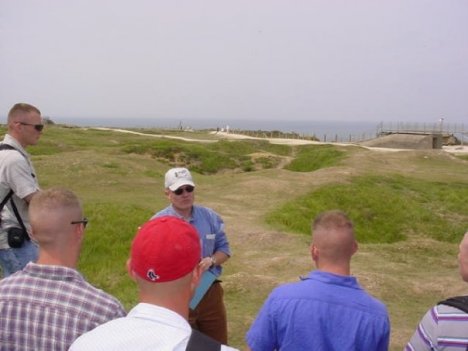
The author with Marines at Point du Hoc, Normandy in 2004

Every year about this time I try to write about D-Day. Last year I posted several articles as I had in 2009 as well.  This year I spent more time on the Battle of Midway writing three articles. Today I have been on the road much of the day and as I drove back to my Island Hermitage I began to think about what I wanted to do this year. When I have decided to do is to re-post a short research paper that I did for one of my Master’s degree courses tonight and follow it with some articles over the week on specific aspects and personalities of the campaign.  What I hope is that people that are not familiar with the campaign as well as those that are can use this as a portal to other resources on the web and in print.

I have visited Normandy once in 2004 on a trip with the Marines of the Marine Security Force Company Europe that took me to Belleau Wood as well as Normandy.  In both places I had the good fortune to be able to explain aspects of both battles, at Normandy discussing the invasion from the German side of the fence.  The Normandy battlefields are well worth visiting.  Hopefully in the next few years I will get a chance to go back and do some serious exploring.

Introduction

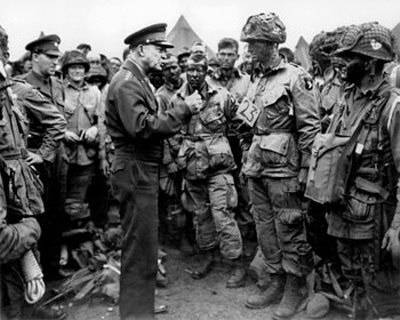
General Dwight D Eisenhower Commander in Chief Allied Forces Europe

The American landings on Omaha Beach were critical to the success of the Allied invasion northwestern Europe in the overall Overlord plan.  Without success at Omaha there would have been a strong chance that the German 7th Army and Panzer Group West could have isolated the remaining beachheads, and even if unsuccessful at throwing the Allies into the sea could have produced a stalemate that would have bled the Allies white.  This quite possibly could have led to a political and military debacle for the western allies which would have certainly changed the course of World War II and maybe the course of history.[i] This is not to say the Germans would have won the war, but merely to state that a defeat on Omaha could have changed the outcomes of the war significantly.   Subsequent to the successful landing there were opportunities both for the Allies and the Germans to change the way that the campaign unfolded, thus the battles leading up to the breakout at Avranches are critical to its development and the subsequent campaign in France.

OVERLORD: The Preparations

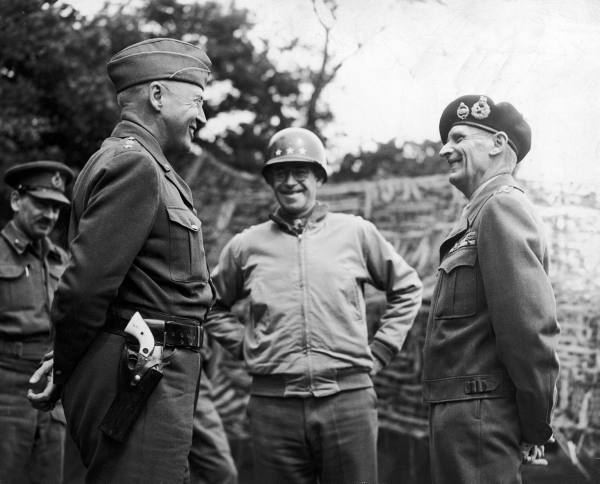
Eisenhower’s Key Lieutenants: Patton, Bradley and Montgomery

The planning for the Normandy invasion began in earnest after the QUADRANT conference in Quebec in August 1943.  The timetable for the operation was established at the Tehran conference where Stalin sided with the Americans on the need for an invasion of France in the spring of 1944.[ii] Prior to this there had been some planning by both the British and Americans for the eventual invasion initially named ROUNDUP.  These preparations and plans included a large scale raid at Dieppe in 1942 which ended in disaster but which provided needed experience in what not to do in an amphibious assault on a heavily defended beach.        The failure at Dieppe also darkened the mood of the Allies, the British in particular to the success of such operations, bringing to mind the failed Gallipoli campaign of 1915 as well as the opposed landings at Salerno and the USMC experience at Tarawa.[iii] Despite this the Americans led by General Marshall pushed for an early invasion of northwest Europe. Churchill and the British due to their weakness in land power pushed for land operations in the Mediterranean, and even in Norway as an option to the assault in France. The conflicted mindset of the Allies left them in the position of planning almost exclusively for the success of the initial landings and build up to the near exclusion of planning for the subsequent campaign once they landed. This especially included what one writer described as “the maze of troubles awaiting behind the French shore.”[iv]

Field Marshal Erwin Rommel, Commander of Army Group B

Despite conflicts between the Americans and British political and military leadership the planning for the Normandy landings detailed in NEPTUNE and OVERLORD moved ahead.  General Dwight Eisenhower was appointed as the commander of SHAEF with his major subordinates for Land, Air and Sea which caused consternation on both sides of the Atlantic.[v] [vi] The planned operation was expanded from the initial 3 division assault on a narrow front to a minimum 5 division assault on a broad front across Normandy[vii]supplemented by a strong airborne force.[viii] Overall the plan as it developed reflected a distinctly “American willingness to confront the enemy head-on in a collision which Britain’s leaders had sought for so long to defer.”[ix] It is ironic in a sense that the British avoidance of the head on attack was based on their known lack of manpower.  Britain had few infantry reserves to sustain the war effort and the Americans only late recognized their own deficiency in both quantity and quality of infantry forces on which their strategy depended.  That the western allies, so rich in material and natural resources would be so deficient in infantry manpower was a key constraint on the subsequent campaign in France and Germany.  The shortage of infantry forces would cause great consternation among the Allies as the campaign in France wore on.

German Beach Obstacles

The Germans too faced manpower shortages due to the immense losses sustained on the Eastern front, those lost in Africa and those tied down in Italy, the Balkans and Norway as well as the drain caused by Luftwaffe Field Divisions and troops diverted into the Waffen-SS.   The German Army resorted to smaller divisions and the created many “static” divisions manned by elderly or invalid Germans to plug the gaps along the Atlantic wall. The Germans were also forced to recruit “Volksdeutsch” and foreign “volunteers” to fill out both Wehrmacht and Waffen-SS formations.

German fortifications at the Pas de Calais

Prior to the final decision to mount an invasion the Allied planners had contended with the location of the assault in northwestern France.  The Pas de Calais provided a direct route was rejected because it was where the Germans would expect the strike to occur and because it was where the German defenses were strongest.  The fiasco at Dieppe had provided ample proof of what could happen when making an assault into a heavily fortified port.  Likewise the mouth of the Seine near Le Harve was rejected because of the few beaches suitable for landing and because the forces would be split on both sides of the river.  Brittany was excluded due to its distance from the campaigns objectives in Germany.[x]This left Normandy which offered access to a sufficient number of ports and offered some protection from the weather. Normandy offered options to advance the campaign toward the “Breton ports or Le Harve as might be convenient.”[xi] Omaha beach, situated on the center right of the strike would be crucial to the success of the assault situated to the left of UTAH and the right of the British beaches.

Rommel inspecting beach obstacles

Once Normandy was selected as the location for the strike by the Allies, the planning sessions remained contentious.  This was especially true when the Allies debated the amount and type of amphibious lift that could be provided for the landings, particularly the larger types of landing ships and craft to support the Normandy invasion and the planned invasion of southern France, Operation ANVIL.  The increase in OVERLORD requirements for landing craft had an impact in the Mediterranean and resulted in ANVIL being postponed until later in the summer.

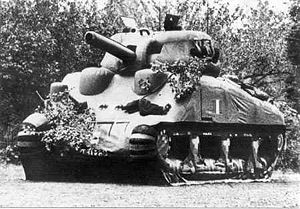
“Dummy” Sherman Tank: The Allies created a fictional Army Group to deceive German planners

As part of their preparations the Allies launched a massive deception campaign, Operation FORTITUDE.  This operation utilized the fictitious First Army Group under the “command” of General George Patton. Patton was still smarting from his relief of command of 7th Army following slapping commanded an “Army Group” which incorporated the use of dummy camp sites, dummy tanks, aircraft and vehicles, falsified orders of battle and communications to deceive German intelligence.[xii] The success of this effort was heightened by the fact that all German intelligence agents in the U.K. had been neutralized or turned by the British secret service.  Additionally the Luftwaffe’s limited air reconnaissance could only confirm the pre-invasion build ups throughout England without determining the target of the invasion.[xiii] The German intelligence chief in the west, Colonel Baron von Roenne “was deceived by FORTITUDE’s fantasy invasion force for the Pas de Calais.”[xiv] Despite this Commander of the 7thArmy recognized by 1943 that Normandy was a likely Allied target and efforts were made to shift 7th Army’s center of gravity from Brittany to Normandy.  The one potential German success in getting wind of when the Allied landings would occur was lost when German intelligence discovered two lines of Verlaine’s “Chason d’ Automme” in June 1944 which were to alert the French Resistance of the invasion.  The security section of 15th Army heard them transmitted on the afternoon of 5 June and notified General Jodl at OKW, but no action was taken to alert forces on the coast.[xv] Allied intelligence was aided by ULTRA intercepts of coded German wireless transmissions. However this was less of a factor than during the African and Italian campaigns as more German communications were sent via secure telephone and telegraph lines vice wireless.[xvi] Allied deception efforts were for the most part successful in identifying German forces deployed in Normandy. However they were uncertain about the location of the 352nd Infantry Division which had been deployed along OMAHA and taken units of the 709th Infantry Division under its command when it moved to the coast.[xvii]


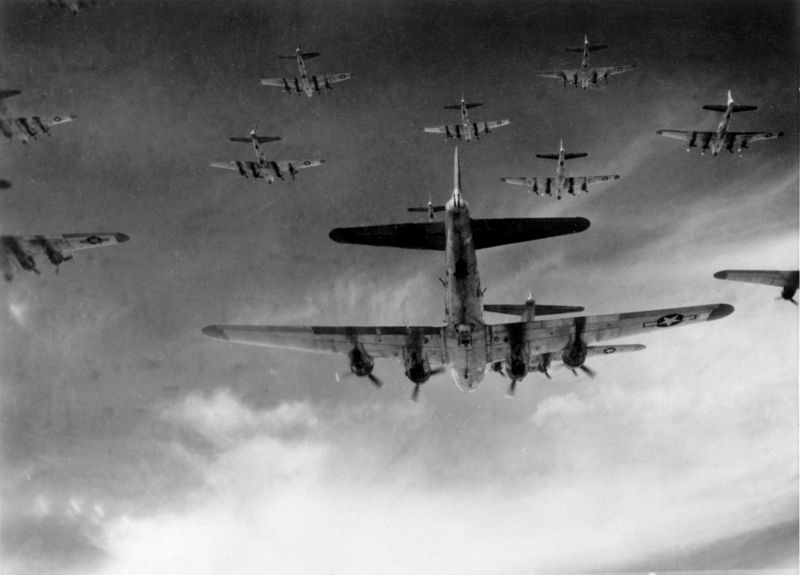
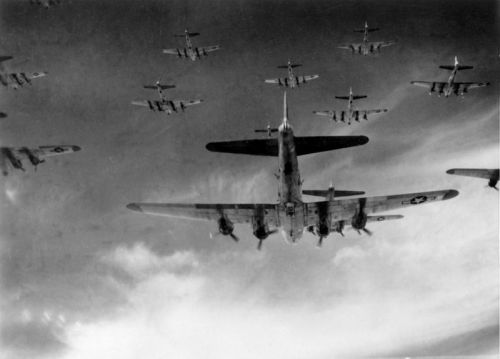
US Army Air Corps B-17s were part of the strategic air campaign to isolate the German beach defenses

The Allied air campaign leading up to the invasion was based on attempting to isolate the invasion site from German reinforcements. Leigh-Mallory the Air Chief developed the “TRANSPORTATION PLAN” which focused efforts on destroying the French railroad infrastructure.[xviii] A more effective effort was led by General Brereton and his Ninth Air Force which was composed of medium bombers and fighters.  Brereton’s aircraft attacked bridges and rapidly achieved success in crippling German efforts to reinforce Normandy.[xix] Max Hastings gives more credit to the American bombing campaign in Germany to crippling the German defense in the west. General Spaatz and the 8th Air Force destroyed German production capacity in oil and petroleum as well as the degraded the German fighter force.  The American daylight raids so seriously degraded the German fighter force that it could not mount effective resistance to the invasion.[xx] Russell Weigley also notes that Albert Speer the Reich Armaments Minister said that “it was the oil raids of 1944 that decided the war.”[xxi]


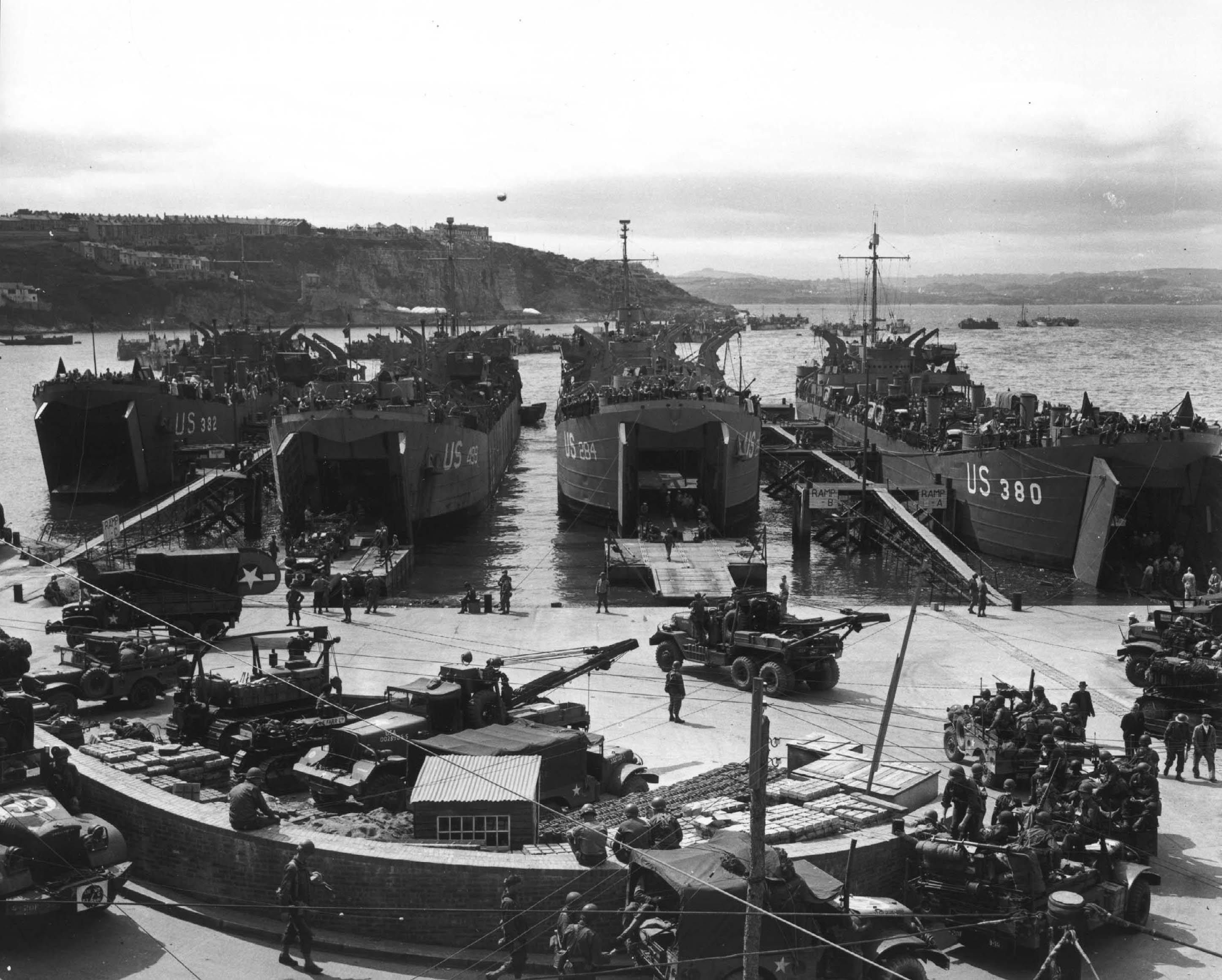
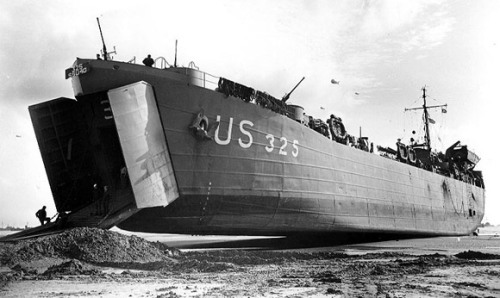
US Navy LST’s being loaded for the invasion

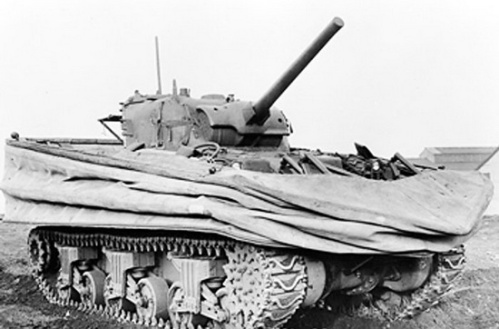
Planning and preparations for OMAHA were based around getting the 1st and 29th Infantry Divisions ashore and them securing a beachhead “twenty-five kilometers wide and eight or nine kilometers deep.”[xxii] American preparations were thorough and ambitious, but the American assault would go through the most heavily defended sector of German defenses in Normandy.  The landing beaches were wide and bordered by dunes which were nearly impassable to vehicles and “scrub covered bluffs thirty to fifty meters high…rough and impassable to vehicles even to tracked vehicles except at a few places.  The exits were unimproved roads running through four or five draws that cut the bluffs.”[xxiii] Dug in along those bluffs was the better part of the 352nd Division. The Americans compounded their selection of a difficult and heavily defended landing zone the Americans failed to take advantage of many of the “gadgets” that were offered by the British which in hindsight could have aided the Americans greatly.  The Americans made use of two battalions of DD (Dual Drive) tanks but turned down the offer of flail tanks, flamethrower tanks, and engineer tanks, the “funnies” developed by General Hobart and the British 79th Armored Division.[xxiv]

Dual Drive amphibious tanks were included as part of the US invasion package

Weigley believes that the American view of “tanks as instruments of mobility rather than of breakthrough power.” Likewise the Americans victories in the First World War were won by infantry with little tank support.[xxv] In this aspect the Americans were less receptive to utilizing all available technology to support their landings, something that when considering the fact that Americans were great lovers of gadgets and technology. The British use of the Armor, including the “Funnies” on the beaches to provide direct fire into German strong points lessened their infantry casualties on D-Day. Due to this lack of armor support on the beach American forces on OMAHA had little opportunity to exercise true combined arms operations during the initial landings.[xxvi]


Rommel with Artillerymen of the 21st Panzer Division in Normandy

German preparations for an Allied landing in Normandy were less advanced than the Pas de Calais.  However they had made great strides since late 1943. Field Marshal Rommel greatly increased defensive preparations along the front, including the Normandy beaches.  One of Rommel’s initiatives was to deploy Panzer Divisions near the coast where they could rapidly respond to an invasion.  However Rommel did not get everything that he wanted.  The OKW only allotted him two Panzer Divisions to be deployed near the Normandy beaches.  Only one of these the 21st Panzer Division was deployed near Caen in the British sector.  One wonders the result had the 12th SS Panzer Division been deployed behind OMAHA. [xxvii]

OMAHA: The Landings

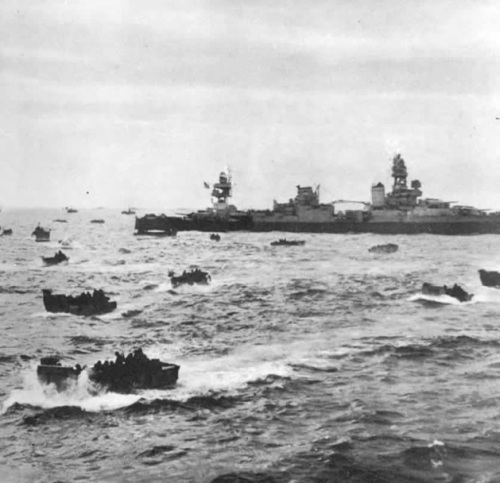
The venerable USS Nevada, resurrected from the mud of Pearl Harbor bombarding German positions at Utah Beach

Like the rest of the Allied invasion forces the 1st and 29th U.S. Infantry Divisions set sail from their embarkation ports with the intent of landing on June 5th.  General Bradley, commanding the First Army until the American XII Army Group would be activated accompanied the invasion force.  The OMAHA landing was under the command of General Gerow and his V Corps while VII Corps led by the 4th Infantry Division landed at Utah supported by airdrops of the 82nd and 101st Airborne Divisions inland.  American command and control during the invasion was exercised from sea as in the Pacific, although General Officers were to go ashore with each of the American divisions.  A severe channel storm disrupted the plan to land on the 5th and Eisenhower delayed the invasion one day catching a break in the weather and electing to go on the 6th.[xxviii] This delay while uncomfortable for the embarked troops caused the Germans to believe that no invasion would take place until the next favorable tide and moon cycle later in the month.[xxix] The assumption that no invasion was possible ensured that a number of key senior German leaders, including Rommel were absent from the invasion front when the Allies landed.[xxx]

US Troops ride a LCVP toward Omaha 

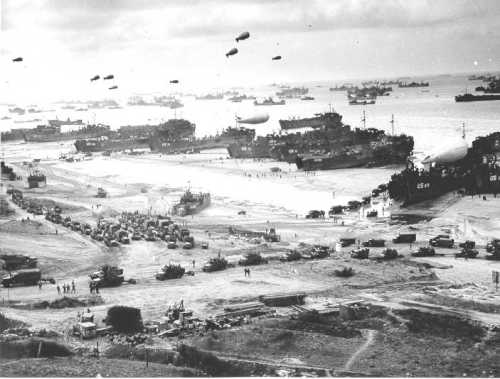
The landing beaches at OMAHA stretched about 6500 meters from Colleville-Sur-Mer to Vierville-Sur-Mere in the west.  The beaches are wide with bluffs overlooking them and a seawall between the beaches and the bluffs.  Additionally several small towns dot the beach. To the west of the town of Vierville, a prominent height overlooked the entire beachhead.  Named Pont du Hoc, it was believed to house a 150mm battery sighted where it could enfilade the OMAHA landing zones.  The Americans assigned to the 2nd Ranger Battalion to make a seaborne assault to land, scale the cliffs and take the battery.  Companies from this battalion made a heroic landing and scaled the cliffs to capture the strongpoint only to discover that the guns had not been emplaced.  The Rangers took heavy casualties and held their isolated beachhead against German counterattacks until relieved by the 29th Division on the morning of June 8th.[xxxi]

Landing craft passing the USS Augusta in heavy seas heading toward Omaha Beach

H-Hour for OMAHA was 0630.  Unfortunately the assault troops were transferred to their LCVP landing craft 16-20 kilometers from the beach.  The result was a long and dangerous ride in the small craft for the infantry.  Most of the infantry were completely soaked in sea spay and seasick before going ashore and they carried loads far above what they normally would carry into battle.[xxxii] The Armor support was one battalion of DD tanks, the 741stArmored Battalion, supporting the 16th Infantry Regiment of 1st Infantry Division. These were also launched too far out and nearly all of the tanks were swamped and lost before firing a shot in anger.[xxxiii] Other American support units needed to provide firepower on the beach were equally unfortunate. Weigley notes that at OMAHA “at least 10 of the LCVPs sank” as did “the craft carrying almost all of the 105mm howitzers that were to be the first artillery ashore after the tanks.”[xxxiv] The losses would cripple the assault on OMAHA and nearly cause its abandonment.

Bloody Omaha

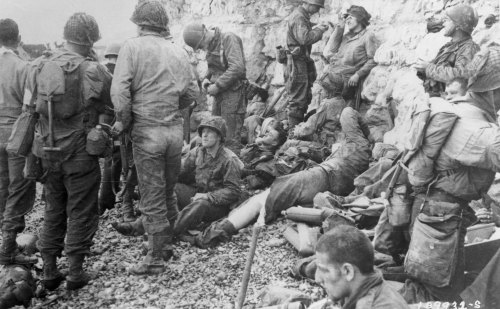
As the soldiers of the American divisions on OMAHA came ashore they faced German defenders of the 352nd, 716th and a regiment of the 709th Infantry Division, the latter under the tactical command of the 352nd.   Without the bulk of their tanks artillery and lacking close air support the Americans struggled across the beaches and were cut down in large numbers before being pinned down behind the sea wall.[xxxv] With the Americans pinned down on the beach unable to advance, the time tables for the reinforcing waves became snarled amid the German beach obstacles which had not been cleared.  This was in large part due to 40% casualties among the Combat Engineers and the loss of all but five bulldozers.[xxxvi] Naval officers were frustrated in their attempts to provide naval gunfire support by the lack of identifiable targets on the beaches.  Yet German strongpoint’s were “knocked out by either by superbly directed vigorous gunfire from destroyers steaming as close as 800 yards offshore, or by determined action from Rangers or infantry.[xxxvii]


US Infantry struggles ashore at Omaha

Soldiers ashore discovered that they were not facing the static 716th Division but the veteran 352nd Division as well.[xxxviii] Only the leadership and actions of Brigadier General Norman Cota the 29th Division’s Deputy Commander and Colonel Charles Canham of the 116th Infantry kept the situation from complete collapse.  They were able to rally their troops. Under their leadership small units from the 116th which had its linage back to the “Stonewall Brigade” as well as elements of the 16th and 18th Infantry Regiments began to move forward.  Surviving junior leaders began to lead survivors through the dunes and up the bluffs to attack German defenders of the roads leading up from the beach from the flank and rear.  A mid-day break in the weather allowed some close tactical air support giving the troops badly needed support.

US 1st Infantry Division Troops at the Omaha sea wall

With the situation desperate General Bradley considered the evacuation of OMAHA.  At sea events were as confused as Bradley and his staff attempted to make sense of what was going on.  Even later in the evening there was discussion of diverting all further reinforcements from OMAHA to the British beaches.[xxxix]At 1330 hours “Gerow signaled Bradley: “Troops formerly pinned down on beaches…advancing up heights behind beaches.”[xl] By the end of the day Bradley’s aid Major Hansen noted Bradley’s comments to Collins: “They are digging in on Omaha beach with their fingernails. I hope they can push in and get some stuff ashore.”  And Montgomery: “Someday I’ll tell Gen[eral] Eisenhower just how close it was for a few hours.”[xli]

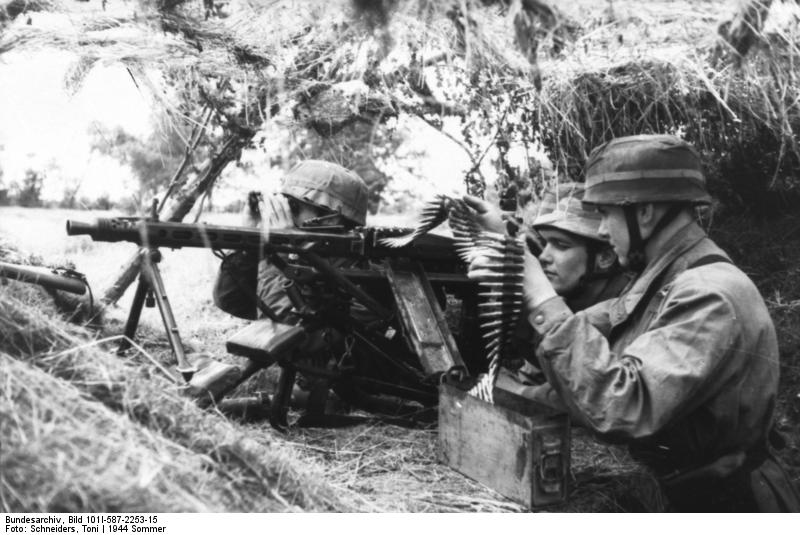
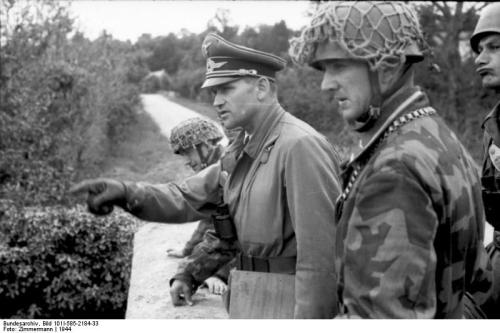
German Fallschirmjaeger Trüppen in Normandy, the German Parachute forces fighting in an infantry role were very effective in the Normandy campaign

The landings at OMAHA succeeded at a cost of over 2000 casualties.  Critical to the success of the landings were the German inability to reinforce their defending troops on the beach.  Likewise the weakness of the units available to mount the standard counterattack that was critical to German defensive plans on D-Day itself kept the Germans from driving the Americans back into the Channel. The 352nd Division fought superbly under the full weight of V Corps and the British XXX Corps on its right suffering heavy casualties as they contested every inch of ground.  The 716th Division composed of second rate troops melted under the onslaught.  Allied air supremacy played a key role as sorties by the 8th and 9th Air Forces helped keep German reinforcements from arriving and interdicted counter attacks inland.  Weigley credits the Allied air superiority with the success of the landings and with limiting casualties.[xlii]Von Rundstedt and other German commanders in France were limited by the delay and refusal of Hitler and OKW to release Panzer reserves when needed most early on June 6th.  By the close of D-Day allied forces had secured the five invasion beaches but not achieved their objectives of taking Caen and Bayuex.  Since the forces on the various beachheads had not linked up the beaches would have been extremely vulnerable had the Germans been able to mount a rapid counterattack by Panzers and strong infantry formations as they had at Salerno.

Major Battles to the Breakout at Avranches

Securing the Beachheads

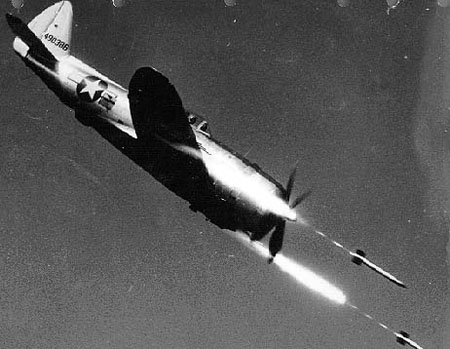
P-47 firing rockets at a ground target. Close air support was vital to Allied forces in Normandy

It took the V and VII Corps nearly a week to secure the beachheads. German forces including the stalwart 352nd Division resisted stubbornly and mounted sharp local counterattacks which kept the Americans off balance.  Elements of the 29th Division and the 90th Division began to push inland and to expand the beachhead toward UTAH. Opposed by the 352nd Division and elements of the 91st Airlanding Division and other non-divisional units the fighting revealed the inexperience of the American infantry formations and the uneven quality of their leadership.  As the Americans tackled the Germans in the labyrinth of the Bocage country the defensive skill of the Germans cost many American lives and delayed the joining of the beachheads. On the 13th the link up was solid enough to enabling the Americans to conduct the follow up operations needed to expand the beachhead, secure Cherbourg and clear the Cotentin.

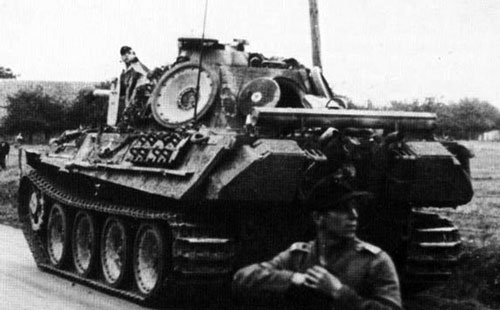
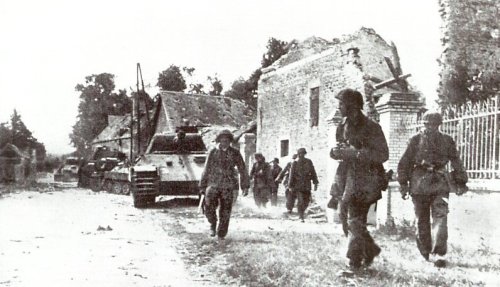
A Panther tank of the Panzer Lehr Division in Normandy

In some American divisions the hard fighting triggered a leadership crisis.  The lack of success of the 90th Division led General “Lightening Joe” Collins of VII Corps relieve the division commander and two regimental commanders of command, a portent of things to come with other American units.[xliii] As the V and VII corps pushed into the “Bocage” they were followed by a massive build up of troops and equipment delivered to the beaches and to the artificial “Mulberry” harbors.  Despite their numeric superiority, air supremacy and massive Naval gunfire support and facing the weakened 352nd, 91st and the 6thParachute Regiment and other less than quality formations, survivors of the static divisions, the Americans made painfully slow progress as they moved off the beachhead and into the Bocage.[xliv]

The Capture of Cherbourg

US Soldiers of the 29th Division surrender to German Fallschirmjaeger in Normandy

Once the beachheads had been consolidated the Americans turned their attention toward Cherbourg. Cherbourg was the major naval port at the far northwest tip of the Cotentin.  D-Day planners counted on its swift capture and rehabilitation to serve as a supply port for the Allied forces. The 9th Division drove south to the coast near Barneville on the 18th of June cutting off the German forces covering the approaches to Cherbourg.[xlv] This put the Germans in a bind as the 7th Army “had to split its forces in the peninsula in order to hold the fortress a little longer and thus to gain time for the establishment of the southern front on the Cotentin peninsula.[xlvi] The German forces arrayed before Cherbourg waged a desperate defense centered around the 243rd Infantry Division and other assorted battle groups of LXXXIV Corps, whose commander General Marcks one of the best German Generals was killed in action on 12 June.[xlvii] The U.S. VII Corps under Collins with the 9th, 4th and 79th Divisions pushed up the peninsula capturing Cherbourg on June 29th.  Bradley pushed hard for the capture of the port as the Mulberries had been ravaged by a severe Channel storm the week prior. The port of Cherbourg was thoroughly demolished by German engineers and would not be fully operational for months. The loss of the Mulberries and delay in Cherbourg’s availability meant that few supplies were landed on the beaches would “hinder the escape from the constricting land of the hedgerows into which the Americans had come in search of a port.[xlviii]

The Battle of Caumont Gap

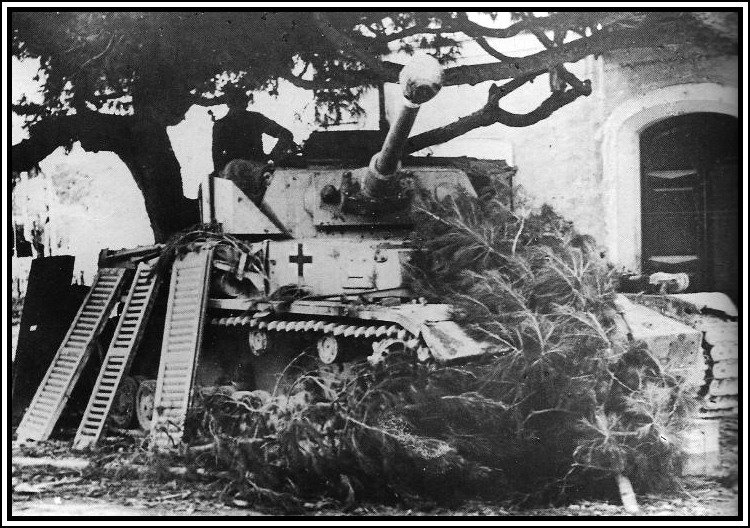
Panzer IV Tank in Normandy

V Corps under Gerow made a cautious advance by phase lines toward Caumont, St Lo and Carentan.  The deliberate advance by the Corps toward a line weakly held by the Reconnaissance battalion of the 17th SS Panzer Grenadier Division was directed by Bradley who did not want to divert attention from the effort against Cherbourg.   After capturing Caumont V Corps halted and continued aggressive patrolling to deceive the Germans while digging in.[xlix] The possibility existed that a strong push against the weak German line could have led to an opportunity to envelope the German line west of Caen. This was a missed opportunity that in part led to the bloody and controversial campaign to capture Caen.[l]

British efforts around Caen

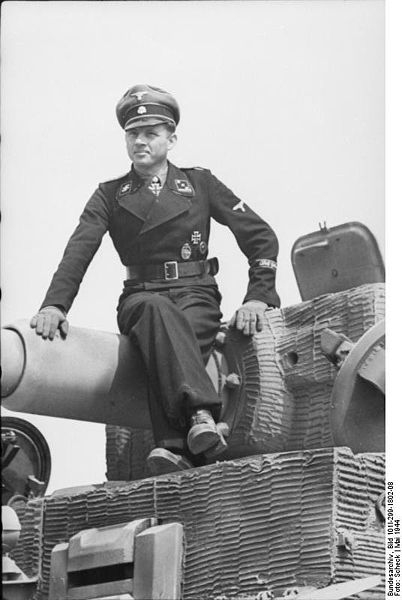
German Panzer Ace Waffen SS Captain Michale Wittman single handedly destroyed a British Battalion at Villers Bocage in his Tiger Tank

Montgomery had ambitious plans to break out of Normandy by capturing Caen on D-Day and driving toward Falaise and Argentan.  The British plans for this were frustrated by the rapid reinforcement of the sector by the Germans and the activities of 21st Panzer, Panzer Lehr, and the 12th SS Panzer Divisions.  A flanking maneuver at Villers-Bocage was frustrated by a few Tiger tanks led by the legendary Waffen SS Panzer commander Captain Michael Wittman whose tanks devastated a British Armored battalion.[li]

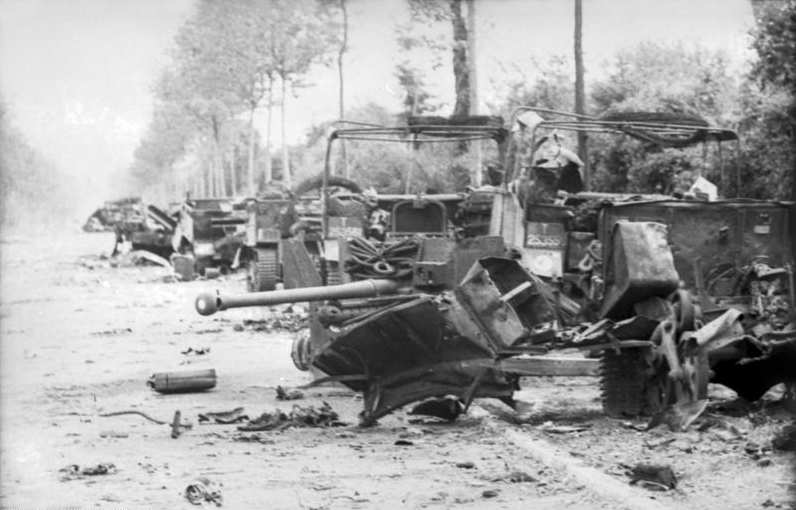
Wreckage of a British Battalion at Villers Bocage

A series of disastrous attacks toward Caen (EPSOM, CHARNWOOD and GOODWOOD) strongly supported by air strikes and Naval gunfire finally succeeded in taking that unfortunate city on July 18th but failed to take the heights beyond the town.[lii]

British operations like Operation Epsom met setback after setback against dug in German forces outside of Caen

Against crack well dug in German forces the British took heavy casualties in tanks and infantry seriously straining their ability to conduct high intensity combat operations in the future.[liii] The one benefit, which Montgomery would claim after the war as his original plan was that German forces were fixed before Caen and ground down so they could not be used against Bradley’s breakout in the west at St Lo.[liv]


Clearing the Bocage: The Battle of the Cotentin Plain

US M-5 Light Tank in Normandy

Other German forces arrived, and reinforced the Caumont gap which no longer “yawned invitingly in front of V Corps.” [lv] Bradley wished to push forward rapidly to achieve a breakthrough in the American sector.[lvi] Facing the most difficult terrain in France amid the Bocage and swamps that limited avenues of approach to the American divisions committed to the offensive.  The Americans now faced their old foe the 352nd division as well various elements of II Parachute Corps, the 17th SS Panzer Grenadier and Panzer Lehr Divisions.  American tanks and infantry made slow progress and incurred high losses as they dueled the Germans at close range.  In the VIII Corps sector alone the attack “consumed twelve days and 10,000 casualties to cross eleven kilometers of the Bocage…the achievements of the VII and XIX Corps were no better than comparable.[lvii]

St. Lo

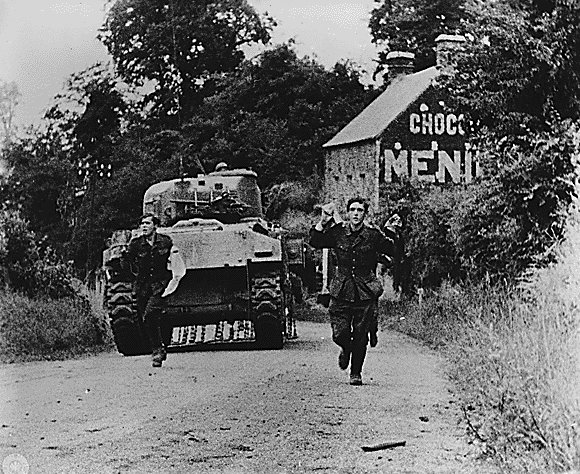
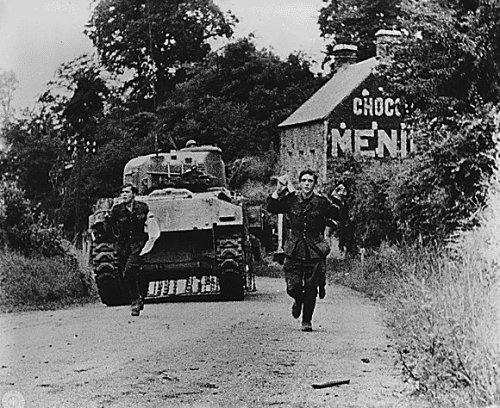
US Tanks advancing with German prisoners moving back to US lines at St Lo

St. Lo was a key to Bradley’s breakout efforts.  His Army had to capture it and the roads leading out of it to launch Operation COBRA along the coast.  The task of capturing St. Lo was assigned to GEROW’S V Corps and Corlett’s XIX Corps.  They faced opposition from the tough paratroops of the German 3rd Parachute Division of II Parachute Corps.  The 2nd, 29th, 30th and 83rd Divisions fought a tough battle advancing eleven kilometers again with high numbers of casualties especially among the infantry to secure St. Lo on 18 July.[lviii] They finally had cleared the hedgerows.  St Lo epitomized the struggle that the American Army had to overcome in the Bocage.  Hard fighting but outnumbered German troops in excellent defensive country exacted a terrible price in American blood despite the Allied control of the skies.[lix]

Operation COBRA

US 155mm Howitzers in Normandy, the Germans had profound respect for American Artillery, a respect that they did not share for American Infantry or Armor forces

With the Bocage behind him Bradley desired to push the Germans hard.  COBRA was his plan to break out of Normandy.  Bradley ably assisted by Collins they realized that the better terrain, road networks favored a breakout.  American preparations included a technical advance that allowed tanks to plow through hedgerows. This was the “Rhino” device fashioned by American troops which was installed on 3 of every 5 First Army Tanks for the operation.[lx] VII Corps was to lead the attack which was to begin on July 24th. American planning was more advanced than in past operations.  Collins and Bradley planned for exploitation operations once the breakthrough had been made. A massive air bombardment would precede the attack along with an artillery barrage by Collins corps artillery which was reinforced by additional battalions.   A mistake by the heavy bombers in the 24th resulted in the American troops being hit with heavy casualties and a postponement of the attack until the 25th.[lxi] The following day the attack commenced.  Another mistake by the bombers led to more American casualties[lxii] but VII Corps units pressed forward against the determined resistance of the survivors of Panzer Lehr and the remnants of units that had fought the Americans since the invasion began.  Although it was a “slow go” on the 25th Bradley and his commanders were already planning for and beginning to execute the breakout before the Germans could move up reinforcements.  The 26th of June brought renewed attacks accompanied by massive air strikes.

St Lo 

While not much progress was made on the 26th, the Americans discovered on the 27th that the German forces were retreating.  The capture of Marigny allowed VIII Corps to begin exploitation down the coastal highway to Coutances.  On the 27th General Patton was authorized to take immediate command of VIII Corps a precursor to the activation of his 3rdArmy.  COBRA ripped a hole in the German line and inflicted such heavy casualties on the German 7th Army that it could do little to stop the American push.[lxiii] As the American forces pushed forward they reinforced their left flank absorbing the local German counterattacks which were hampered by the Allied close air support.

Avranches and Beyond

US Forces advance through the ruins of St Lo

As the breakthrough was exploited the command of the forces leading it shifted to Patton and the newly activated 3rd Army. By the 28th VIII Corps led by the 4th and 6th Armored Divisions had reached Avranches and established bridgeheads over the See River with additional bridges being captured intact on the 30th.[lxiv] The capture of Avranches allowed the Americans to begin exploitation operations into Brittany and east toward the Seine. Weigley notes that for the first time in the campaign that in Patton the Americans finally had a commander who understood strategic maneuver and would use it to great effect.[lxv]

Conclusion

The American campaign in Normandy cost the U.S. Army a great deal. It revealed weaknesses in the infantry, the inferiority of the M4 Sherman tank to most German types, problems in tank-infantry cooperation and also deficiencies in leadership at senior, mid-grade and junior levels. Heavy casualties among infantry formations would lead to problems later in the campaign. Numerous officers were relieved including Division and Regimental commanders.  Nonetheless during the campaign the Americans grew in their ability to coordinate air and ground forces and adapt to the conditions imposed on them by their placement in the Cotentin.  The deficiencies would show up in later battles but the American Army learned its trade even impressing some German commanders on the ground in Normandy.[lxvi]

[i] See the alternative history of by Peter Tsouras Disaster at D-Day: The Germans Defeat the Allies, June 1944, Greenhill Books, London 1994. Tsouras describes the defeat of the Omaha landings and the effect on the course of the campaign leading to the overthrow of Hitler and a negotiated armistice in the west.  While this outcome could be rigorously debated other outcomes could have led to the fall of the Roosevelt and Churchill governments and their replacement by those not committed to unconditional surrender or a continuation of the war that brought about more German missile attacks on the U.K. and the introduction of other advanced German weapons that could have forced such a settlement. Another option could have led to the dropping of the Atomic Bomb on a German city vice Hiroshima.

[ii] Weigley, Russell F. Eisenhower’s Lieutenants: The Campaign of France and Germany, 1944-1945, Indiana University Press, Bloomington IN, 1981 p.33

[iii] Ibid pp. 34-35

[iv] Ibid p.35

[v] General Montgomery 21st Army group and Land Forces, Admiral Sir Bertram Ramsey as Allied Naval Expeditionary Force and Air Marshall Sir Trafford Leigh-Mallory as Commander in Chief Allied Expeditionary Air Force. Weigley p.43

[vi] Max Hastings in Overlord: D-Day and the Battle for Normandy Vintage Books, New York, 1984, comments that many in Britain wondered if Eisenhower with the lack of actual battle experience could be a effective commander and that Eisenhower was disappointed in the appointment of Leigh-Mallory and Ramsey, and had preferred Alexander over Montgomery, pp. 28-29.

[vii] Ibid. Weigley p.40.  Montgomery was the first to object to the 3 division narrow front invasion rightly recognizing that seizing Caen with its road junctions could provide a springboard for the campaign into open country.

[viii] Ibid. p.37

[ix] Hastings, Max. Overlord: D-Day and the Battle for Normandy Vintage Books, New York, 1984 p.29  Hastings finds the irony in the selection of the British officers to execute the plan that reflected the American way of thinking.

[x] The Germans agreed with this in their planning leaving Brittany very lightly defended.  See  Isby, David C. Ed. “The German Army at D-Day: Fighting the Invasion.” p.27 The report of General Blumentritt, Chief of Staff OB West noted that only 3 divisions were assigned to Brittany.

[xi] Ibid. Weigley, pp. 39-40

[xii] Ibid. p.73

[xiii] See Isby p. 69.  General Max Pemsel of 7th Army noted that “During  the spring of 1944, Seventh Army received only tow good photographs of British southern ports, which showed large concentrations of landing craft.”

[xiv] Ibid. Hastings p.63.  Hastings comments also about the success of using the turned Abwehr agents.

[xv] Warlimont, Walter. “Inside Hitler’s Headquarters: 1939-1945.” Translated from theGerman by R.H. Barry. Presidio Press, Novao CA, English Edition Copyright 1964 Wiedenfeld and Nicholson Ltd. Pp.422-423

[xvi] Ibid. Weigley pp. 53-54

[xvii] Ibid. p. 67

[xviii] Ibid. pp.57-64  Weigley spends a great deal of time on the wrangling between Eisenhower, Leigh Mallory and Spaatz on the nature of the plan, the allocation of forces both strategic and tactical assigned to carry it out and its success, or in the light of postwar analysis the lack of effect that it had on German operations.

[xix] Ibid. p.67-68.

[xx] Ibid. Hastings pp. 43-44 In large part due to the long range P-51 Mustang which accompanied the American bombing raids beginning in 1943.  Another comment is that the campaign drew the German fighters home to defend Germany proper and prevented their use in any appreciable numbers over the invasion beaches.

[xxi] Ibid. Weigley p.69

[xxii] Ibid. p.89

[xxiii] Ibid. pp. 88-89

[xxiv] Ibid. p.87

[xxv] Ibid. Weigley also talks about the rejection of General Corlett’s ideas to use Amtracks used by the Marines in the Pacific to land on less desirable, but less defended beaches to lessen casualties on the beaches and the need for additional support equipment even on smooth beaches.  One of Corlett’s criticisms was that too little ammunition was allotted to supporting the landings and not enough supporting equipment was provided. pp. 46-47

[xxvi] Hastings notes that with the strength and firepower of the German forces on OMAHA that many of these vehicles had they been employed would like have ended up destroyed further cluttering the beachhead. “Overlord” p.102

[xxvii] The battle over the deployment of the Panzer Divisions is covered by numerous historians.  The source of the conflict was between Rommel who desired to place the Panzer Divisions on the Coast under his command due to the fear that Allied air superiority would prevent the traditional Panzer counterthrust, General Gyer von Schweppenburg commander of Panzer Group West (Later the 5th Panzer Army) and Field Marshal Von Rundstedt who desired to deploy the divisions order the command of Rundstedt for a counter attack once the invasion had been launched, a strategy which was standard on the Eastern Front, and Hitler who held most of the Panzer reserve including the SS Panzer Divisions under his control at OKW.  Hitler would negotiate a compromise that gave Rommel the satisfaction of having three Panzer Divisions deployed behind coast areas in the Army Group B area of responsibility.  21stPanzer had those duties in Normandy.

[xxviii] Ibid. p.74-75

[xxix] Von Luck, Hans.  “Panzer Commander“ Dell Publishing, New York, 1989 pp. 169-170.  Von Luck a regiment commander in 21st Panzer noted that General Marcks of 84th Corps had predicted a 5 June invasion at a conference May 30th.

[xxx] Almost every D-Day historian talks about the weather factor and its effect on the German high command’s reaction to the invasion.  Rommel was visiting his wife for her birthday and planned to make a call on Hitler. Others including commanders of key divisions such as the 91st Airlanding Division were off to a war game in Rennes and the 21st Panzer Division to Paris.

[xxxi] Ibid. Weigley p. 96

[xxxii] See Cornelius Ryan, “The Longest Day” Popular Library Edition, New York 1959. pp. 189-193 for a vivid description of the challenges faced by soldiers going from ship to landing craft and their ride in to the beaches.

[xxxiii] Ibid. Weigley. p.78 Weigley talks about the order for the tanks to be carried ashore on their LCTs that did not get transmitted to the 741st.

[xxxiv] Ibid.

[xxxv] Ibid. Weigley  p. 87 The weather prevented the aerial bombardment from being effective. Because the bombers could not see their targets they dropped their bomb loads further inland, depriving the infantry of support that they were expecting.  Naval gunfire support had some effect but had to be lifted as the troops hit the beach leaving much of that support to come from Destroyers and specially equipped landing craft which mounted rockets and guns.

[xxxvi] Ibid. Hastings. pp. 90-91.

[xxxvii] Ibid. p.99

[xxxviii] Ibid. Weigley p.80

[xxxix] Ibid. p.101  Also see Weigley p.80

[xl] Ibid. p.99

[xli] Ibid. Weigleyp.95

[xlii] Ibid. p.94

[xliii] Ibid. p.99 Both Weigley and Hastings make note of the failure of both the Americans and British to train their troops to fight in the bocage once they had left the beaches.

[xliv] Ibid. Hastings. pp.152-153

[xlv] Ibid. Weigley p.101

[xlvi] Isby, David C., Ed. “Fighting in Normandy: The German Army from D-Day to Villers-Bocage.” Greenhill Books, London,  2001.  p.143

[xlvii] Ibid. Hastings p.173 Allied fighter bombers exacted a fearful toll among German commanders. The Commanders of the 243rd and 77th Divisions fighting in the Cotentin were also killed by air attacks on the 17th and 18th.   Further east facing the British the commander of the 12th SS Panzer Division, Fritz Witt on the 17th.

[xlviii] Ibid. Weigley. p.108

[xlix] Ibid. p.111-112.

[l] Ibid.

[li] The efforts of the 51st Highland Division and 7th Armored Division were turned aside by the Germans in the area and were dramatized by the destruction of  a British armored battalion by SS Captain Michael Wittman and his platoon of Tiger tanks.  See Hastings pp.131-135.

[lii] The British 8th Corps under General O’Connor lost 270 tanks and 1,500 men on 18 July attempting to crack the German gun line on the ridge beyond Caen. Weigley, pp.145-146.

[liii] Hastings comments about the critical British manpower shortage and the pressures on Montgomery to not take heavy casualties that could not be replaced. Overlord. pp.241-242.

[liv] Ibid. Weigley pp.116-120

[lv] Ibid. p.122

[lvi] Ibid. p121 Bradley told Eisenhower “when we hit the enemy this time we will hit him with such power that we can keep going and cause a major disaster.”

[lvii] Ibid. 134

[lviii] Ibid. Weigley. pp. 138-143.  Weigley notes of 40,000 U.S. casualties in Normandy up to the capture of St. Lo that 90% were concentrated among the infantry.

[lix] Weigley quotes the 329th Regiment, 83rd Division historian “We won the battle of Normandy, [but] considering the high price in American lives we lost. P.143. This is actually a provocative statement that reflects America’s aversion to massive casualties in any war.

[lx] Ibid. p.149

[lxi] Ibid. p. 152

[lxii] Ibid. pp. 152-153.  Among the casualties were the command group of the 9th Division’s 3rd Battalion 47th Infantry and General Leslie McNair who had come to observe the assault.

[lxiii] Ibid. pp.161-169. Weigley notes the advances in U.S. tactical air support, the employment of massive numbers of U.S. divisions against the depleted German LXXXIV Corps, and the advantage that the “Rhino” device gave to American tanks by giving them the ability to maneuver off the roads for the first time.

[lxiv] Ibid. pp.172-173.

[lxv] Ibid. p.172

[lxvi] Ibid. Isby, David C. “Fighting in Normandy,” p.184, an officer of the 352nd Division referred to the American soldier “was to prove himself a in this terrain an agile and superior fighter.”

Bibliography

Carell, Paul. “Invasion: They’re Coming!” Translated from the German by E. Osers, Bantam, New York 1964.

Hastings, Max. Overlord: D-Day and the Battle for Normandy Vintage Books, New York, 1984

Isby, David C. Ed. “The German Army at D-Day: Fighting the Invasion.” Greenhill Books, London 2004

Isby, David C., Ed. “Fighting in Normandy: The German Army from D-Day to Villers-Bocage.” Greenhill Books, London, 2001.

Ryan, Cornelius, “The Longest Day” Popular Library Edition, New York 1959

Tsouras, Peter. “Disaster at D-Day: The Germans Defeat the Allies, June 1944,”Greenhill Books, London 1994.

Von Luck, Hans.  “Panzer Commander“ Dell Publishing, New York, 1989

Warlimont, Walter. “Inside Hitler’s Headquarters: 1939-1945.” Translated from theGerman by R.H. Barry. Presidio Press, Novao CA, English Edition Copyright 1964 Wiedenfeld and Nicholson Ltd. Warlimont, Walter. “Inside Hitler’s Headquarters: 1939-1945.” Translated from theGerman by R.H. Barry. Presidio Press, Novao CA, English Edition Copyright 1964 Wiedenfeld and Nicholson Ltd.

Weigley, Russell F. Eisenhower’s Lieutenants: The Campaign of France and Germany, 1944-1945, Indiana University Press, Bloomington IN, 1981

5 Comments

Filed under History, Military, world war two in europe

The Current American Crisis and Drawing Comparisons from the End of the Imperial Germany

Revolution: Members of the Spartacists Bund in Berlin

Introduction

There are times when great nations face catastrophe. It is something that has befallen every world power at one time or another. Therefore it should not be a surprise if the United States despite the claims of those supporting American Exceptionalism succumbs to some great crisis which fundamentally changes it.  While I do not proclaim the end of the United States it does appear that we are experiencing events which have the potential of reducing our status as a great power and plunge the nation into political and economic chaos.  Some including California Governor Jerry Brown have compared the current state of the country to the division of the country in the American Civil War.

Likewise since there are some leaders of the loud and influential Tea Party movement who openly talk about revolution it is important to know what can happen if there is a political or economic collapse that leads to revolution at home while troops are still in combat. All of this happened in Germany in 1918.  In our current time such a possibility is higher than at any time in American History. Thus I feel we are in a potentially perilous time where long standing institutions are in crisis even while wars rage around the world.

However I do not, for all the vitriol spent believe that our current crisis is comparable to the Civil War except the absolute contempt that the opposing sides hold each other. The Civil War was a war which pitted region against region and our divisions know few geographic boundaries and even the “Red State versus Blue State” divide is deceiving.  It is my belief that what we are experiencing is much more similar to the crisis faced by Imperial Germany at the end of the First World War.  Then Germany was about to concede the loss of the war despite having known enormous battlefield success that lasted until the summer of 1918 when the tide of the war turned irreversibly against them as Allies collapsed and pulled out of the war was coupled with battlefield defeats, economic ruin and massive political and social unrest. The result of the collapse of Imperial Germany was a civil war and the foundation of the ill-fated Weimar Republic which eventually succumbed to the extremism and dictatorship of Adolf Hitler and his National Socialist Party of Germany, the Nazis.

The German Revolution of 1919 and civil war is important for those who study highly developed states when they enter a period of social and political upheaval usually following military defeat that causes the society to question or even overthrow the established order.  The end of Imperial Germany and the establishment of the Weimar Republic on November 9th 1918 is a prime example.   This paper concerns the first years of the Republic, and the dependency of the Majority Socialist leadership to the General Staff and their use of Freikorps to quell revolutionary chaos and avert the establishment of a Soviet State.

Members of the Leftist “People’s Naval Division” occupied the government quarter and terrorized Berlin

This study begins with the establishment of the Republic and concludes with the Kapp Putsch.  This is an era that is seldom referenced by political or military leaders in western states and historians themselves are often divided in their interpretation of the subject.  The study of this period is vital to those who study politically polarized societies which are either war weary or have suffered the shock of military defeat coupled with a government which is blamed for the events.  Thus, it is important to study the relationship of the military to the government and in particular the military’s relationship to politicians who have little connection to or affinity for the military, its traditions and culture and the often adversarial relationship of these politicians to military leadership which often sees them as adversaries.  The period also shows how actions of those who in their antipathy to the military create a climate where the military loathes the civilian leadership and the government.  The results of such conditions can endanger the society as a whole and ultimately usher in periods of great tragedy.  This occurred in Weimar Germany with the result that the military in the later years of the Republic neither the military nor the Majority Socialists could not work together against the Nazi takeover of the state.  However, the first years of the relationship set the tone and foredoomed the Republic.

The Complexity of the Situation

General Wilhelm Groener convinced Kaiser Wilhelm II to abdicate and helped forge an alliance between the Majority Socialists and the Army to head off a Soviet style Revolution

The history of Weimar, particularly that of the military and Freikorps in their relationship to the Republic is complex.  Not only is the relationship between the military and government complex, but the Freikorps themselves, their organization, leadership and political affiliation were not monolithic as is sometimes maintained,[i] nor were the Freikorps the direct ancestors of the Nazi SS/SA organizations despite often similar ideology,[ii] nor can they dismissed by saying that they were composed of “former soldiers and officers ill-disposed to return to civilian life.”[iii] The Freikorps’ association with the Army and Republic is more complex than some historians assert.  Despite the right wing leanings of many of units and fighters and future association of some to the Nazis, the blanket claim that the Freikorps were forerunners of the Nazi movement is not supportable.[iv]

It is true that without Freikorps support in Munich, along with support of the Thule Society, business leaders and others “that the transition of the DAP into the Hitler party could not have taken place.”[v] It is also true that elements of the Freikorps branded too revolutionary and unruly for service in the Army continued as secret societies and affiliated themselves with various right-wing political groups.[vi] Likewise a case can be made that the fierceness of many Freikorps veterans, younger leaders of the Army helped lay the foundation for the brutality of both the Army and Waffen SS as they prosecuted the Second World War.[vii] Yet simply because certain aspects of a subject are true does not make for a broader “truth.”  Heinz Höhne argues the reverse of what some have written in regard to the relationship of the Freikorps and Reichswehr to the Nazis, that in fact the Nazis did not issue from the Freikorps, but rather that many former members of the Freikorps, Imperial Army or the Reichswehr were attracted to the Nazis, particularly to the SS by its “philosophy of “hardness” and its attitude of bellicosity per se, basically unconnected with ideology.”[viii] Others historians state similar views especially those that study the relationship of the Reichswehr leadership to the Freikorps.  Thus the thesis of this paper is that the historiography like the period itself is complex; that the composition, leadership and motivations of the Freikorps were not monolithic, nor were they beloved by the Reichswehr, nor were they the “trailblazers” for the Nazi movement.  The focus of this paper is on the relationship of the Reichswehr and the Freikorps to the Republic to the Kapp Putsch and the dangers of a relationship built on necessity without mutual trust.  Such a relationship is dangerous and can lead to unintended consequences.   This paper will explore the first years of the Weimar Republic and specifically look at several key events that were pivotal in the relationship between the Army and Freikorps and the Majority Socialists.

The Supporting Literature

The literature covering this period includes both well written academic histories and popular works which attempt to present a particular view. Additionally there are biographical works which shed some light on the subject. The Reichswehr and the German Republic 1919-1926 by Harold Gordon Jr. is perhaps the best study of the Freikorps and their relationship to the state and the army.  Gordon’s work is exceptional in documenting the numbers, types, political affiliation, action and ultimate disposition of the Freikorps.  The History of the German General Staff by Walter Goerlitz; The Nemesis of Power: The German Army in Politics 1918-1945 by John Wheeler-Bennett, The Reichswehr and Politics 1918-1933 by F.L. Carsten and The Politics of the Prussian Army: 1640-1945 by Gordon A. Craig are all extremely valuable in exploring the relationship between the military and the Republic.  The best of the general histories of the period, which focus on the National Socialist state are The German Dictatorship by Karl Dietrich Bracher, and Richard Evans’ The Coming of the Third Reich. Richard Watt’s The Kings Depart is one of the best for telling the story of the fall of the Empire and the revolution in Germany.  Watt’s account is well written and documented work and touches on other factors affecting the new republic including Versailles and Allied political actions. The final chapter of Holger Herwig’s The First World War: Germany and Austria-Hungary 1914-1918 gives a good account of the Army’s role in the end of the Empire and beginning of the Republic.  Andreas Dorpalen’s Hindenburg and the Weimar Republic adds an interesting dimension of Hindenburg’s role in the republic’s formation and negotiations between Groener, Noske and Ebert. Steven Ozments’ A Mighty Fortress is superficial in its treatment of the period.  Nigel Jones’ Birth of the Nazis: How the Freikorps Blazed a Trail for Hitler is an interesting and somewhat entertaining but not very well documented tending to “broad brush” in a sensational way the Freikorps having none of the detail or nuance of Gordon, Craig, or Carsten on the Freikorps, nor the depth of Goerlitz or Wheeler-Bennett on the Republic’s relationship with the Army, or the attitude of the Reichswehr leadership to the Freikorps.  William Shirer’s The Rise and Fall of the Third Reich, Gerald Reitlinger’s The SS: Alibi of a Nation 1922-1945 and Heinz Höhne’s The Order of the Death’s Head all add some information which details early Nazi involvement in the period, but are less useful to this early period most of their work focuses on later events.  Of other works, Kenneth Macksey’s Why the Germans Lose at War has an insightful but short chapter dealing with this period and Wolfram Wette’s The Wehrmacht: History, Myth, Reality offers an interesting and at times provocative look at anti-Semitism in the German military in the years following the First World War.  Carlos Caballero Jurado’s The German Freikorps 1918-1923 is a short but very detailed study of those organizations and their actions.  B.H. Liddell-Hart who has a small chapter on General Hans Von Seeckt in The German Generals Talk which though it does not deal with the events in this paper make for interesting commentary on later actions of former Reichswehr officers who served the Nazi state.

A number of biographies touch on actions of German Officers who played key roles in World War Two.[ix] Most auto-biographies gloss over the Weimar period; however Admiral Erich Reader’s memoir Grand Admiral offers the insight of a naval officer with some direct observation of the revolution and the Kapp Putsch.  General Heinz Guderian in Panzer Leader omits his service in the Baltic “Iron Division.”  Field Marshal Albert Kesselring’s memoirs has a brief section covering the period, but one comment is typical attitude toward of many officers throughout its existence:

“My cup of bitterness was full when I saw my devoted work rewarded by a warrant for my arrest for an alleged putsch against the socialist-influenced command of my III Bavarian Army Corps. Notwithstanding the degrading episodes during my imprisonment after 1945, I do not hesitate to describe this as the most humiliating moment of my life.”[x]

One thing that has to be noted about all the memoirs is that each of the writers was writing after the German Defeat and their imprisonment. Many times their words mask other actions and attitudes that are  not mentioned, thus while an important source one also has to have some suspicions when using them even the unintentional errors that come from time as well as the human tendency to have a somewhat selective memory.

Analysis

President Friedrich Ebert and his military commanders including General Hans Von Seeckt (2nd from right)

This paper will first examine the formation of the Freikorps by the Army and the Ebert government in response to uprisings by armed groups of leftists and the effectiveness of the Freikorps in putting down the various uprisings.   We will then address the relationship of the Army with the Majority Socialists and then move on to the crisis engendered by the Kapp Putsch.

The relationship of the Republic to the Army was born in the moment of crisis of the abdication of Kaiser Wilhelm II and the armistice discussions with the Allies.  Beset by revolts in key naval bases and mutinies aboard ships of the High Seas Fleet and unrelenting Allied pressure on the German armies in the west the situation continued to deteriorate as the “red flag was flying in all the principle cities, soldiers behind the front were electing soldiers councils Russian fashion.”[xi] Revolutionary and defeatist propaganda spread by the radical left wing of the Independent Socialists and Spartacus League spread through the country and even affected combat units,[xii] while the “Majority Socialists had found out that the militant factions of the Independents had secretly armed themselves out of funds supplied by the Soviet ambassador and adopted the slogan “all or nothing.””[xiii] The situation had deteriorated so badly that Karl Liebknecht, leader of the Spartacus League “was announcing the establishment of a Soviet regime from the steps of the Imperial Palace.”[xiv]

Under these dire conditions, General Wilhelm Groener who had succeeded General Ludendorff as Quartermaster General called an emergency meeting of fifty “of his most senior army commanders.”[xv] In response to his question of whether the troops would follow the Kaiser and oppose the revolts only one answered in the affirmative, and eight responded that “there was no hope of using regular Army units to quell unrest at home.”[xvi] On November 9th Groener went to the Kaiser on behalf of the Supreme Command and in response to a suggestion that the Kaiser lead the Army back and suppress the revolts boldly stated “The Army will march home in peace and under its leaders and commanding generals, but not under the command of Your Majesty, for it stands no longer behind Your Majesty.”[xvii] The Emperor abdicated fleeing to Holland and Friedrich Ebert leader of the Majority Socialists was named Chancellor on November 9th and upon hearing the news, Philipp Scheidemann, without consulting Ebert announced that Ebert was Chancellor and “Long live the great German Republic!”[xviii] The mobs were not placated by the announcement and far left organizations with the Independents “had no intention of letting the revolution stop there.”[xix] In the streets of Berlin soldiers sold their weapons and vehicles officers were attacked by crowds on the streets and whenever “crowds found an Army officer; they tore off his epaulettes and medals.”[xx] Everywhere mutual recrimination was in the air, soldiers “blamed revolutionaries for the betrayal and stab-in-the back while revolutionaries blamed officers for all the costs and losses of the war.”[xxi]

Groener called Ebert promising the Army’s support of the new government in return for the government’s assistance to the Army in the maintenance of discipline and supply.[xxii] He also drafted a letter signed by Hindenburg pledging the Army’s loyalty and telling him that “the destiny of the German people is in your hands….”[xxiii]One source notes: “Thus, in half a dozen sentences over a telephone line a pact was concluded between a defeated army and a tottering semi-revolutionary regime; a pact destined to save both parties from the extreme elements of revolution but, as a result of which the Weimar Republic was doomed at birth.”[xxiv]

The High Command was able to bring the Army home in good order following the armistice but upon arriving most units “melted away like snow under a summer sun,”[xxv] those which remained were often shells of their former selves beset by soldier’s councils and leftist revolutionaries.  To support the government the High Command issued a directive stating that it “put itself as the disposal of the present government led by Ebert without any reservation.”[xxvi] Yet in December delegates of the National Assembly continued to sow resentment in the military by military discipline be placed in the hands of soldiers’ councils, that all badges of rank be removed with all decorations of insignia and honor.[xxvii] Reaction was heated,[xxviii] but despite this Groener, Colonel Walter Reinhardt, the Prussian Minister of War and the Republic’s Defense Minister, Gustav Noske endeavored to find forces to combat the growing revolution and rebellious military units.  The choice was not hard, the Army was of no use, so called “democratic forces” were in most cases both unreliable and ineffective, while only the Freikorps “provided suitable material for the immediate creation of an efficient, combat-ready army.”[xxix] Thus the Freikorps became the instrument of necessity to ensure that the government was not swept away by a Soviet style revolution.

Gustav Noske and General Von Luttwitz. Luttwitz would lead the Reichswehr and Freikorps units that participated in the Kapp Putsch

Gustav Noske, of the Majority Socialist party “saw himself as a patriot, a man of action…who had no time for theories…and was one of the few Socialists that the Supreme Command trusted.”[xxx] He had already distinguished himself by helping to bring under control the sailors revolts in Kiel by forming a loyal “Naval Brigade”[xxxi] and he  “realized that the government must have a dependable military force behind it if it was to survive and rule Germany” and the “old Officer Corps must be the backbone of any such force.”[xxxii] The Army had melted away and units of the workers and soldiers councils were poorly trained, organized and led “”fought against the government as often as for it” and “were of little practical value to either the government or the rebels.”[xxxiii] In the chaos of a Spartacus, now called the German Communist Party uprising and vacuum of political leadership of January 1st 1919 agreed to become defense minister stating “Someone must be the bloodhound, I won’t shirk the responsibility!”[xxxiv]

Noske reviewing Freikorps Hulsen. Many of the Freikorps were composed of professional soldiers and brought into the Reichswehr

Noske helped by the High Command helped organize volunteer units led by officers and NCOs composed of reliable veterans.  Freikorps varied in size from divisions to companies and were led by Generals down to Sergeants and even a Private First Class.  Their greatest success was in early 1919 when the Republic was beset by “Red” revolutions in many major cities.  Without the use of the Freikorps by the government it is unlikely that the Republic would have survived.[xxxv] On January 4th Ebert and Noske reviewed the troops of General Maercker’s Freiwillege Landesjaegerkorps and Maercker informed them that every volunteer had pledged loyalty to the government, seeing the discipline and order Noske told Ebert “Don’t worry. Everything going to turn out all right now.”[xxxvi] On January 5th 1919 mobs attacked the Chancellery and the officers of the Socialist Vörwarts newspaper and Noske led the Freikorps[xxxvii] to regain control of the city[xxxviii] and crush the revolt during which “Karl Liebknecht and Rosa Luxemburg were lynched by the officers of the Guards Cavalry Rifle Division.”[xxxix] In March after a period of uneasy calm the Freikorps, now reinforced by the 2nd Naval Brigade, or Ehrhardt Brigade[xl] were called upon to put down the revolt of the “People’s Naval Division.”[xli] Making liberal use of heavy weapons including tanks the Freikorps inflicted heavy losses on the leftists with over 1500 dead and 12,000 wounded in the uprising.[xlii] Other revolts were crushed and the Freikorps reached their zenith in Württemberg where Freikorps led by Lieutenant Hahn, a Social Democrat put down leftist revolts[xliii] and in Bavaria where Independents and Communists had taken the city with their “Bavarian Red Army which numbered nearly 25,000 men[xliv] on April 7th. After failed attempts by the Socialist government to retake Munich, they asked for Berlin’s help.  Violence and massacres of citizens by the various leftist groups inflamed the Freikorps, including the Ehrhardt Brigade and the revolt was crushed by May 2nd.[xlv] Dorpalen calls the Freikorps ruthlessness “completely unwarranted in view of the weakness of the opposing forces” and noted though they broke the leftist powers they deepened the nations’ cleavages”[xlvi] while Macksey writes that “where Freikorps’ brutality stained the pages of history there was invariably a forgoing or simultaneous record of excess by their sworn opponents.”[xlvii]

The Erhardt Brigade in Berlin during the Kapp Putsch

The Provisional Reichswehr was established on March 6th 1919 and the High Command began to assemble it from the Freikorps, remaining Army units and Republican defense forces.  Some Freikorps were brought into the new Army in total, but the tumult had not yet ceased.  There was a great distrust between many in the Army, the remaining Freikorps and the Socialists.  The crisis was precipitated by the signing of the Treaty of Versailles, Noske and others threatened resignation over the war guilt clauses, but Groener warned that if the treaty was rejected the Army could not win against the Allies if hostilities were renewed.[xlviii] The treaty imposed harsh limitations on the German Army which many bitterly resented, however, Seeckt, the Chief of Staff of the Army felt that it was “more important to keep the Army in being and preserve the possibility of a military resurrection.”[xlix] Yet the government had lost the support of the Officer Corps and many looked to General Walther von Lüttwitz, the Reichswehr’s senior commander for leadership.[l]

Korvettenkapitan (Lieutenant Commander) Erhardt commander of the 2nd Naval Brigade whose announced demobilization triggered the Kapp Putsch. Erhardt would have to flee after the Nazi takeover. Even revolutionaries become victims as revolutions end

Other right-wing groups and individuals made plans to overthrow the government.  They favored revolt against the government, but “their political aims were hazy.”[li] Seeckt and Reinhardt felt it necessary to demobilize Freikorps who’s ill-discipline and political radicalism was a “danger to the consolidation desired by the army command.”[lii] This movement climaxed with the alliance of Lüttwitz to Wolfgang Kapp and was triggered by the orders disbanding the 2nd and 3rd Naval Brigades in compliance with Versailles and due to their radical views.[liii] In spite of the opposition of his chief of staff Von Lüttwitz began planning a coup to save Germany.[liv] The conspirators showed “little regard for coordination of effort and a quite amazing ability to work at cross purposes.”[lv] On March 12th without consulting Kapp, Lüttwitz and Ehrhardt launched the Putsch and Ehrhardt’s brigade in full battle dress entered Berlin. At this point the Reichswehr command froze; officers refused to condone the putsch but at the same time refused to support Noske and Reinhardt who demanded armed opposition,[lvi] while Navy officers openly supported it.[lvii] Seeckt declared that “Troops do not fire upon troops!” and “When at occurs, then the true catastrophe, which was avoided with so much difficulty on November 9, 1918 will really occur.”[lviii] The coup died amid massive strike by workers and lack of popular support but the damage was done.  Noske resigned, many officers in were discredited[lix] and dismissed including Lüttwitz and Admiral Von Trotha, who openly supported the coup,[lx] though Raeder says that Von Trotha and the Navy staff only” thought of anything of complete loyalty to the government.”[lxi] The relationship which had endured the dire days of the Republic was ended.  The Reichswehr would emerge a lean and highly trained organization and remain a power broker in the Republic but the animosity between the Army and the Socialists that they could not stand together against the Nazis despite a mutual interest in doing so.[lxii]

Conclusion

The end of Weimar and the beginning of a nightmare

The period was a critical and complex and should be studied by anyone living in a state with a powerful military tradition and institutions in crisis.  Unlike popular notions, the Freikorps were diverse and not the seed-bed of the Nazi movement and though many former members would become Nazis.  Several, including Ehrhardt narrowly escaped death at Nazi hands.[lxiii] Freikorps were viewed by Army leadership as an expedient force that could not remain in the service once the Army was functional.

Key lessons include that the military cannot become a “state within a state,” and that both military and civilian leaders must seek to bridge any gulf that separates them in times of crisis.  In Weimar both the military and the Socialists thoroughly distrusted one another with the result that they eventually, despite early success[lxiv] worked against each other in later years.  Actions by both Socialists and the military ultimately subverted the Republic and ensured its demise and Seeckt’s policy of separation from politics “tended toward a renunciation of the soldier’s potential restraining influence on adventurous statesmen.”[lxv] Such is the fateful lesson for today.


[i] Jones, Nigel. The Birth of the Nazis: How the Freikorps Blazed a Trail for Hitler. Constable and Robinson Ltd. London, U.K. 1987 and 2004.  This is Jones assertion and he attempts to make the tie using careers of some individuals who served both in Freikorps and either in the Nazi Party or Military and attitudes common in many Freikorps with similar attitudes found in the Nazi movement.  The 2004 edition of his work includes an introduction by Michael Burleigh echoing his sentiments.

[ii] Evans, Richard J. The Coming of the Third Reich. Penguin Group. London, U.K. and New York, NY. 2003. pp.227-229.  Evans discusses the fact that the Nazis did have a number of Freikorps veterans but at no point makes the connection that the Freikorps are a direct ancestor.

[iii] Ozment, Steven. A Mighty Fortress: A New History of the German People. Harper-Collins Publishers, New York, NY 2004 p.246

[iv] Gordon, Harold J. Jr. The Reichswehr and the German Republic 1919-1926. Princeton University Press, Princeton NJ 1957.  Gordon’s work is perhaps the most detailed study involving the Freikorps and the Reichswehr. He is exceptional in discussing the relationship of both with the various political parties including the Nazis.  He refutes this assertion throughout the book.

[v] Bracher, Karl Dietrich. The German Dictatorship. Translated by Jean Steinberg. Praeger Publications, New York, NY 1970. Originally published as Die Deutsche Diktatur: Enstehung, Struktur, Folgen des Nationalsozialismus. Verlag Kiepenheuer & Witsch, Koln und Berlin. 1969. p.101

[vi] Wheeler-Bennett, John W. The Nemesis of Power: The German Army in Politics 1918-1945. St. Martin’s Press, New York, NY 1954 pp. 91-92

[vii] Shepherd, Ben. War in the Wild East: The German Army and Soviet Partisans. Harvard University Press, Cambridge, MA and London, U.K. 2004. p.28

[viii] Höhne, Heinz. The Order of the Death’s Head: The Story of Hitler’s SS. The Penguin Group, London U.K. and New York, NY 1969. Translated by Richard Barry. Originally Published as Der Ordnung unter dem Totenkopf. Verlag der Spiegel, Hamburg, 1966. p.54.

[ix] These include Macksey’s biographies of Kesselring and Guderian , Richard Giziowski’s The Enigma of General Blaskowitz. Peter Padfield’s Dönitz: the Last Führer, David Fraser’s biography of Field Marshal Rommel Knight’s Cross, Messenger’s work on Von Rundsedt, The Last Prussian, and Höhne’s Canaris: Hitler’s Master Spy all provide brief but interesting views of the actions and attitudes of these officers during the revolution and during the  Weimar period.

[x] Kesselring, Albrecht. The Memoirs of Field Marshal Kesselring with a new introduction by Kenneth Macksey. Greenhill Books, London UK. 1997. Translated from the German by William Kimber Ltd. Originally published as Soldat bis zum letzen Tag. Athenaum, Bonn, Germany 1953 pp.18-19

[xi] Goerlitz, Walter. History of the German General Staff 1657-1945. Translated by Brian Battershaw. Westview Press. Boulder CO and London. 1985 Originally published as Der Deutsche Generalstab, Verlag der Fankfurter Hefte, Frankfurt am Main.  First U.S. publication in 1953 by Preager Publishers. p.200

[xii] Gordon, Harold Jr. The Reichswehr and the German Republic 1919-1926. Princeton University Press, Princeton, NJ 1957 pp.4-5 Gordon recounts the story of an entire replacement train revolting when it reached the front which had to be disarmed by a shock battalion.

[xiii] Watt, Richard M.  The Kings Depart: The Tragedy of Germany: Versailles and the German Revolution. Simon and Schuster, New York, NY 1968. p.186

[xiv] Wheeler-Bennett, John W. The Nemesis of Power: The German Army in Politics 1918-1945. St. Martin’s Press, New York, NY 1954. p.18

[xv] Herwig, Holger H. The First World War: Germany and Austria Hungary 1914-1918. Arnold Press a member of the Hodder-Headline Group, London, UK and New York NY 1997 p.445

[xvi] Ibid. Herwig. p.445

[xvii] Carsten, F.L. The Reichswehr and Politics 1918-1933. Oxford University Press, Oxford, UK 1966 p.6.  It is noted by a number of author’s that Groener did this, to maintain the unity of Germany and prevent its division.

[xviii] Ibid. Watt. p.196  Watt notes Ebert’s reaction as being enraged as the proclamation of the Republic technically “invalidated the existing constitution; Germany was now technically without a government.” (p.197)

[xix] Ibid. Watt. p.197

[xx] Ibid. Watt. p.197

[xxi]Giziowski, Richard. The Enigma of General Blaskowitz Hippocrene Books Inc. New York NY, 1997. p.65

[xxii] Craig, Gordon A. The Politics of the Prussian Army 1640-1945. Oxford University Press, Oxford, UK 1955 pp.347-348.  Craig gives an interesting account noting the Groener’s call to Ebert shows recognition of the legitimacy of the new government and notes that the offer was somewhat conditional.

[xxiii] Dorpalen, Andreas. Hindenburg and the Weimar Republic. Princeton University Press, Princeton, NJ. 1964 p.26

[xxiv] Ibid. Wheeler-Bennett. p.21

[xxv] Ibid. Gordon. p.15

[xxvi] Ibid. Carsten. p.11. This was of critical importance as Carsten later notes that the Army realized that the government could not survive without its support.  Groener was perhaps the officer who most recognized the situation and endeavored to ensure that “the best and the strongest element of the old Prussia, was saved for the new Germany, in spite of the revolution.” (p.12)

[xxvii] Ibid. Carsten. p.18 Carsten produces the bulk of the English translation of these points and notes that the anti-military feeling had become widespread.

[xxviii] Ibid. Giziowski. p.66  Giziowski recounts the speech of Hermann Goering in response to the announcement. This shows how such treatment can breed anger and resentment in a military that feels it has been betrayed after serving its country in a long and difficult war: For four long years we officers did our duty and risked all for the Fatherland. Now we have come home, and how do they treat us? The spit on us and deprive us of what we gloried in wearing. I will tell you that the people are not to blame for such conduct. The people were are comrades…for four long years.  No, the ones who have stirred up the people, who have stabbed this glorious army in the back…. I ask everyone here tonight to cherish a hatred, a deep and abiding hatred, for these swine who have outraged the German people and our traditions.  The day is coming when we will drive them out of our Germany.”

[xxix] Ibid. Gordon. p.15

[xxx] Ibid. Watt. p.168

[xxxi] Ibid. Gordon. pp. 19 and 24.  This was the 1st Marine Brigade, or Brigade Von Roden of which elements would later serve in under the command of other Freikorps such as the Guards Calvary Rifle Division.

[xxxii] Ibid. Gordon. p.14

[xxxiii] Ibid. Gordon. p.18

[xxxiv] Ibid. Watt. p.239

[xxxv] Ibid. Gordon. p.426

[xxxvi] Ibid. Watt. p.247

[xxxvii] Thee forces included the Landesjaegerkorps and Guards Cavalry Rifle division.

[xxxviii] Ibid. Gordon. p.30

[xxxix] Ibid. Wheeler-Bennett. p.36

[xl] This was one of two additional Naval Brigades formed by Noske after the success of Naval Brigade Von Roden.  It was one of the most combat effective but unfortunately violent and radical of the Freikorps, it would as we will see be a key unit in the Kapp Putsch but would not be absorbed into the Reichswehr.

[xli] This unit was not a Navy unit at all but was composed of many who were criminals and other rabble. See Gordon, Carsten and Watt.

[xlii] Jurado, Carlos Caballero. The German Freikorps 1918-23. Illustrated by Ramiro Bujeiro. Osprey Publishing, Oxford, UK 2001 p.12

[xliii] Ibid. Gordon. p.42  His units were known as Security Companies.

[xliv] Ibid. Jurado. p.13

[xlv] Ibid. Gordon. pp.47-49. An estimated 550 people including 200 innocent bystanders were killed in the fighting.

[xlvi] Ibid. Dorpalen. p.29

[xlvii] Macksey, Kenneth. Guderian: Creator of the Blitzkrieg. Stein and Day Publishing, New York, NY 1975 p.45

[xlviii] Ibid. Wheeler-Bennett. pp.57-59

[xlix] Ibid. Goerlitz. p.216

[l] Ibid. Wheeler-Bennett. p.61

[li] Ibid. Carsten. p.74

[lii] Ibid. Carsten. pp.74-75

[liii] Ibid. Carsten. p.76  Another consideration is that Noske, Reinhardt and Seeckt all were seeking to retire Lüttwitz.

[liv] Ibid. Gordon. p.97

[lv] Ibid. Craig. p.376

[lvi] Ibid. Carsten. pp.78-79

[lvii] Höhne, Heinz. Canaris: Hitler’s Master Spy. Cooper Square Press, New York, NY 1979 and 1999. Translated from the German by J. Maxwell Brownjohn, Originally published in Germany by C. Bertelsmann Verlag Gmbh, München. 1976. p. 78.  Canaris also had been suspected of complicity in the murders of Rosa Luxemburg and Karl Liebknecht but was acquitted. (pp.56-71)

[lviii] Ibid. Gordon. pp.114-115

[lix] Among them Maercker who had been such a strong supporter of the Republic in the early days.

[lx] Ibid. Carsten. p.98

[lxi] Raeder, Erich. Grand Admiral. Translated from the German by Henry W. Drexell. United States Naval Institute, Annapolis MD, 1960. Da Capo Press edition published 2001. p.111. This is interesting as almost all histories implicate the Navy High Command of either some complicity or at least agreement with the Putsch participants.

[lxii] The final part in the drama would come when General Kurt Von Schleicher became the last Chancellor before Hitler.  Schleicher had assisted Groener and Noske in the early days of the Republic and often attempted to use the Army’s influence in politics. He was fatally short sighted and was a victim of the SS “night of Long Knives” which was directed against the SA.

[lxiii] Ibid. Jones. p.266  Others such as Gerhard Rossbach had similar experiences.  Korvettenkapitän Löwenfeld of the 3rd Naval Brigade became an Admiral, Wilhelm Canaris , who was implicated in the Kapp Putsch but kept his career would later head the Abwehr and die in a concentration camp.

[lxiv] Ibid. Gordon. p.426  Gordon has a good discussion of this topic in his conclusion.

65 Liddell-Hart, B.H. The German Generals Talk. Published 1948 B.H. Liddell-Hart, Quill Publications, New York, NY. 1979. p.18 Liddell-Hart’s analysis of the results of the Reichswehr’s disconnection from the larger society and political process is remarkable due to current trends in the American military which like the Reichswehr has become somewhat more conservative and disconnected from society, exceptionally technically proficient but not adept in politics or grand-strategy.


Works Cited


Bracher, Karl Dietrich. The German Dictatorship: The Origins, Structure and Effects of National Socialism. Translated from the German by Jean Steinberg with an introduction by Peter Gay.  Praeger Publishers, New York, NY. 1970 Originally published in Germany as Die deutsche Diktator: Entstehung, Struktur, Folgen den Nationalsozialismus by Verlag Kiepenheuer und Witsch. Koln und Berlin.


Carsten, F.L. The Reichswehr and Politics 1918-1933. Oxford University Press, Oxford, UK 1966


Craig, Gordon A. The Politics of the Prussian Army 1640-1945. Oxford University Press, Oxford, UK 1955


Dorpalen, Andreas. Hindenburg and the Weimar Republic. Princeton University Press, Princeton, NJ. 1964


Evans, Richard J. The Coming of the Third Reich. Penguin Books, New York, NY and London, UK. 2003


Giziowski, Richard. The Enigma of General Blaskowitz Hippocrene Books Inc. New York NY, 1997


Goerlitz, Walter. History of the German General Staff 1657-1945. Translated by Brian Battershaw. Westview Press. Boulder CO and London. 1985 Originally published as Der Deutsche Generalstab, Verlag der Fankfurter Hefte, Frankfurt am Main.  First U.S. publication in 1953 by Preager Publishers


Gordon, Harold Jr. The Reichswehr and the German Republic 1919-1926. Princeton University Press, Princeton, NJ 1957


Guderian, Heinz. Panzer Leader. (abridged) Translated from the German by Constantine Fitzgibbon, Ballantine Books, New York 1957


Herwig, Holger H. The First World War: Germany and Austria Hungary 1914-1918. Arnold Press a member of the Hodder-Headline Group, London, UK and New York NY 1997


Höhne, Heinz. Canaris: Hitler’s Master Spy. Cooper Square Press, New York, NY 1979 and 1999. Translated from the German by J. Maxwell Brownjohn, Originally published in Germany by C. Bertelsmann Verlag Gmbh, München. 1976.


Höhne, Heinz. The Order of the Death’s Head: The Story of Hitler’s SS. The Penguin Group, London U.K. and New York, NY 1969. Translated by Richard Barry. Originally Published as Der Ordnung unter dem Totenkopf. Verlag der Spiegel, Hamburg, 1966.


Jones, Nigel. The Birth of the Nazis: How the Freikorps Blazed the Way for Hitler. Constable and Robinson Ltd. London, UK 1987


Jurado, Carlos Caballero. The German Freikorps 1918-23. Illustrated by Ramiro Bujeiro. Osprey Publishing, Oxford, UK 2001


Kesselring, Albrecht. The Memoirs of Field Marshal Kesselring with a new introduction by Kenneth Macksey. Greenhill Books, London UK. 1997. Translated from the German by William Kimber Ltd. Originally published as Soldat bis zum letzen Tag. Athenaum, Bonn, Germany 1953.


Liddell-Hart, B.H. The German Generals Talk. Published 1948 B.H. Liddell-Hart, Quill Publications, New York, NY. 1979


Macksey, Kenneth. Guderian: Creator of the Blitzkrieg. Stein and Day Publishing, New York, NY 1975


Macksey, Kenneth. Kesselring: The German Master Strategist of the Second World War. Greenhill Books, London, UK 2000.


Ozment, Steven. A Mighty Fortress: A New History of the German People. Harper-Collins Publishers, New York, NY 2004


Shepherd, Ben. War in the Wild East: The German Army and Soviet Partisans. Harvard University Press, Cambridge, MA and London, U.K. 2004


Wheeler-Bennett, John W. The Nemesis of Power: The German Army in Politics 1918-1945. St. Martin’s Press, New York, NY 1954


Watt, Richard M.  The Kings Depart: The Tragedy of Germany: Versailles and the German Revolution. Simon and Schuster, New York, NY 1968


Wette, Wolfram. The Wehrmacht: History, Myth, Reality. Harvard University Press, Cambridge, MA and London, UK  2006. Translated from the German by Deborah Lucas Schneider. Originally published as Die Wehrmacht: Feindbilder, Vernichtungskrieg, Legenden. S. Fischer Verlag Gmbh, Frankfurt am Main, Germany 2002


1 Comment

Filed under History, Military, national security, Political Commentary

A Politician Plays at Being a Waffen SS Mann: Learning all the Wrong Lessons from History

Richard Iott (second from right) with fellow re-enactors

Republican Congressional Candidate Richard Iott placed himself on the national political landscape because he likes history. You might say that he is a “history buff” or a person that is not a trained historian who dabbles in “history” as a hobby or that obsesses on the technical details of a period especially in relationship to military history.  History buffs tend to focus on the parts of history that they find interesting and really are not interested in the comprehensive study as a discipline. As such many history buffs, especially re-enactors become ensnared by their interest in a historical period in such a manner that they do not see the obvious dangers in their hobby and become apologists for those that they pretend to be, especially if the groups have a history of supporting evil.  Richard Iott has taken part in various types of historical reenactments for many years. His involvement with the 2/SS Panzer Pioneer Battalion 5 of the SS-Wiking Panzer Division shows that he and his unit have mythologized the role of the Waffen SS in World War II and its history on the Eastern Front.

Iott demonstrates his own lack of awareness in the following quote:

“I’ve always been fascinated by the fact that here was a relatively small country that from a strictly military point of view accomplished incredible things. I mean, they took over most of Europe and Russia, and it really took the combined effort of the free world to defeat them. From a purely historical military point of view, that’s incredible.” Richard Iott to Atlantic reporter Joshua Green

The following quote is from the reenactment unit website: http://www.wiking.org/ (12 October 2010)

“”European Volunteers, Join to Fight Bolshevism!” Germany headed a strong movement in Europe to actively campaign (politically and through warfare) against the ideals of Bolshevist Communism. This culminated in 1941, when the German armed forces were pitted against the very home of Bolshevism, Soviet Russia. Nazi Germany had no problem in recruiting the multitudes of volunteers willing to lay down their lives to ensure a “New and Free Europe”, free of the threat of Communism. National Socialism was seen by many in Holland, Denmark, Norway, Finland, and other eastern European and Balkan countries as the protector of personal freedom and their very way of life, despite the true underlying totalitarian (and quite twisted, in most cases) nature of the movement. Regardless, thousands upon thousands of valiant men died defending their respective countries in the name of a better tomorrow. No matter how unsavory the Nazi government was, the front-line soldiers of the Waffen-SS (in particular the foreign volunteers) gave their lives for their loved ones and a basic desire to be free.”

The quote by Iott shows a myopic view of history, simply from a military history point of view which is always dangerous because other, usually more important issues are missed.  The website description of those from other European countries “defending their countries” against Bolshevism “in the name of a better tomorrow” ignores the fact that Hitler had waged a war of aggression against their own countries and was the aggressor in the Soviet Union. There was nothing defensive about Operation Barbarossa and to state that they were fighting for a “better tomorrow” is to ignore what would have happened had Hitler won the war based on the atrocities that Nazi forces planned and executed in every country that they conquered.  To be sure the SS-Wiking Division had a nearly unblemished record in regard to war crimes on a few members of the division were ever involved in atrocities involving very few victims by Nazi standards.  This was unusual for the SS Foreign Volunteer Units many of which were  complicit in some of the most heinous actions of the war shocking the senses of many of their most hardened  Waffen SS comrades.

To remind my readers, especially conservatives who in their eagerness to drive the Democrats out of Washington are willing to excuse almost any behavior by their candidates as to what this was about I am republishing an essay that I first published in September of 2009 entitled The Ideological War: How Hitler’s Racial Theories Influenced German Operations in Poland and Russia”

Now a disclaimer I am not making an ad hominem attack on conservatives as liberals have often excused the less than stellar behaviors of their candidates on many occasions.  However what Iott espouses in this part of his private/public life causes me to question of his depth of historical thinking and judgment. Republican Minority Whip Congressman Eric Cantor has stated that Iott’s hobby has “rendered him unfit for public office.”  I believe that Cantor is correct.

Military historian Robert Citano said “The entire German war effort in the East was a racial crusade to rid the world of ’subhumans,’ Slavs were going to be enslaved in numbers of tens of millions. And of course the multimillion Jewish population of Eastern Europe was going to be exterminated altogether. That’s what all these folks were doing in the East. It sends a shiver up my spine to think that people want to dress up and play SS on the weekend.” NY Times Blog “The Lede” by Robert Mackey 11 October 2010

I have reposted the article in its entirety below.

The Ideological War: How Hitler’s Racial Theories Influenced German Operations in Poland and Russia”

Einsatzgruppen Massacre sites (www.jewishvirtuallibrary.org)

The German war against the Soviet Union was the first truly race-based ideological war in history with the campaign against Poland its precursor.  Adolf Hitler’s racial theories and beliefs played a dominant role in Germany’s conduct of the war in the East in both the military campaign and occupation.  This has become clearer in recent years as historians have had the opportunity to examine Hitler’s writings, those of senior Nazi officials and military officers and documents which had been unavailable until the end of the Cold War.  Understanding the Nazi ideological basis and the underlying cultural prejudice against the Jews and eastern Europeans in general is foundational to understanding Hitler’s conduct of the war and why the destruction of the Jews figured so highly in his calculations.  One must also understand the military and police cultures and doctrines that enabled them to cooperate so closely in the conduct of the war.

The German war in the east would differ from any previous war.  Its underlying basis was ideological. Economic and geopolitical considerations were given importance in relationship to the understanding of the German “Master Race.”  Race and Lebensraum was the goal of the State that “concentrates all of its strength on marking out a way of life for our people through the allocation of Lebensraum for the next one hundred years…the goal corresponds equally to the highest national and ethnic requirements.[1] Hitler believed that Germany was “entitled to more land…because it was the “mother of life” not just some “little nigger nation or another.”” [2] The Germans planned to “clear” the vast majority of the Slavic population and the “settlement of millions of hectares of eastern Lebensraum with German colonists” complimented by a short term exploitation of the land to “secure the food balance of the GermanGrossraum.”[3] Joachim Fest notes that Hitler called it a “crime” to wage war only for the acquisition of raw materials. Only the issue of living space permitted resort to arms.”[4]

Previous wars emphasized conquest of territory and natural resources be they for empire or self sufficiency. The Thirty Years War had a heavy religious component but was more about increasing the power of emerging nation states led by men not necessarily loyal to their religious brethren.[5] The American and Russian Civil wars had some ideological basis and helped usher in the brutality of total war. Both had major effect in these nations’ development and both were bitterly contested with the winners imposing to various degrees political changes on their vanquished brothers they were civil wars.[6] While Adam Tooze sees the Holocaust as the first step of the “last great land grab in the long and bloody history of European colonialism…”[7] This argument does not take away from the basic premise that the war was at its heart ideological.

Adolf Hitler

The root of this war was in the mind of Adolf Hitler himself. His years in Vienna were foundational as he absorbed the ideas of Pan-German, anti-Semitic groups and newspapers like the Deutsches Volksblatt. [8] In Vienna he made the connection between the Jews and Marxism.[9] Joachim Fest notes that in Vienna Hitler became obsessed by the fear of the Slavs and Jews, hated the House of Hapsburg, the Social Democratic Party, and “envisioned the end of Germanism.”[10] His racial views were amplified after the war in turbulent Weimar Germany where he became a member of the NDSAP, rising rapidly within it, eventually taking over party leadership, reorganizing it so that it “became the instrument of Hitler’s policies.”[11] Following the unsuccessful Beer Hall Putsch of 1923 Hitler wrote Mein Kampf while imprisoned in the Landsberg prison in which he enunciated his views about the Jews, Slavs andLebensraum. Hitler believed that Imperial Germany had been “hopelessly negligent” in regard to the Jews[12] and that the Jews in conjunction with the Catholic Center Party and Socialists worked together for “maximum damage to Germany.”[13] Likewise he saw the Jews as heading the “main ideological scourges of the nineteenth and twentieth century’s.”[14] It was the ideology of Hitler’s “obsessive anti-Semitism”[15] that drove Nazi Germany’s policy in regard to the Jews and against Jewish-Bolshevism.  By the 1920s Hitler had “combined his hatred of the Jews and of the supposedly Jewish dominated Soviet state with existing calls to conquer additional Lebensraum, or living space, in the east.”[16] Hitler wrote: “The fight against Jewish world Bolshevism requires a clear attitude toward Soviet Russia. You cannot drive out the Devil with Beelzebub.”[17] Richard Evans notes that Mein Kampf clearly enunciated that “Hitler considered racial conflict…the essence of history, and the Jews to be the sworn enemy of the German race ….” And that the “Jews were now linked indissolubly in Hitler’s mind with “Bolshevism” and “Marxism.”[18] When Hitler became the dictator of Germany “his ideology and strategy became the ends and means of German foreign policy.”[19] His aims were clear, Hitler remarked to Czech Foreign Minister Chvalkovsky on 21 January 1939: “We are going to destroy the Jews.”[20] It was clear that Hitler understood his own role in this effort noting to General Heinrici that “he was the first man since Charlemagne to hold unlimited power in his own hand. He did not hold this power in vain, he said, but would know how to use it in the struggle for Germany…”[21]

Wilhelm Keitel: “war was a fight for survival….dispense with outdated and traditional ideas about chivalry and the generally accepted rules of warfare…” Bundesarchiv Bild

This study will focus on the German policy of ideological-racial war in Poland and Russia. The German war against the Soviet Union and to a certain extent Poland was waged with an unforgiving ferocity against Hitler’s enemy, the Jewish-Bolshevik state and the Slavic Untermenschen. It was characterized by the rise of “political-ideological strategy”[22] in which “Barbarossa showed the fusion of technocracy and ideology in the context of competitive military planning.”[23] Hitler’s “ideological and grandiose objectives, expressed in racial and semi-mystical terms, made the war absolute.”[24] Field Marshal Keitel noted a speech in March 1941 where Hitler talked about the inevitability of conflict between “diametrically opposed ideologies” and that the “war was a fight for survival and that they dispense with their outdated and traditional ideas about chivalry and the generally accepted rules of warfare.”[25] General Halder, Chief of the OKH in his War Dairy for that meeting noted “Annihilating verdict on Bolshevism…the leaders must demand of themselves the sacrifice of understanding their scruples.”[26] Based on Lebensraum and race, the German approach to war would combine “racism and political ideology” for the purpose of the “conquest of new living space in the east and its ruthless Germanization.”[27] Hitler explained that the “struggle for the hegemony of the world will be decided in favor of Europe by the possession of the Russian space.”[28] Conquered territories would be “Reich protectorates…and that these areas were to be deprived of anything in the nature of a Slav intelligentsia.”[29]This goal was manifest in the “Criminal Order” issued by OKW which stated that the war was “more than mere armed conflict; it is a collision between two different ideologies…The Bolshevist-Jewish intelligentsia must be eliminated….”[30] Other displaced inhabitants of the conquered eastern lands would be killed or allowed to starve.[31] Part of this was due to economic considerations in the Reich, which gave Germans priority in distribution of food, even that from the conquered lands. Starvation was a population control measure that supplemented other forms of annihilation.[32] As Fest notes in Russia Hitler was “seeking nothing but “final solutions.””[33] Despite numerous post-war justifications by various Wehrmacht generals, the “Wehrmacht and army fell into line with Hitler because there was “a substantial measure of agreement of “ideological questions.””[34]

Waffen SS Volksdeutsch Recruiting Poster

Ideology was key to Hitler’s worldview and fundamental to understanding his actions in the war.[35] However twisted Hitler’s ideological formulations were his ideas found acceptance beyond the Nazi faithful to the Army and Police, who would execute the campaigns in Poland and Russia in conjunction with theEinsatzgrüppen and Nazi party organizations.  In these organizations he found allies with pre-existing cultural, political and doctrinal understandings which allowed them to be willing participants in Hitler’s grand scheme of eastern conquest.

Doctrinal and Ideological Foundations

Nazi propaganda poster blaming the Jews for the war

While Hitler’s racial ideology was more extreme than many in the German military and police, these organizations had cultural beliefs and prejudices as well as doctrinal and ideological foundations which helped them become willing accomplices to Hitler.  These factors were often, consciously or unconsciously, excluded from early histories of World War II. The Allies relied on German officers to write these histories at the beginning of the Cold War, developing the “dual myth of German military brilliance and moral correctness.”[36] B.H. Liddell-Hart makes the astounding statement that “one of the surprising features of the Second World War was that German Army in the field on the whole observed the rules of war than it did in 1914-1918-at any rate in fighting its western opponents….”[37] While he might be excused by lack of knowledge of German army atrocities, not just the SS who he blamed the atrocities, it helps present a myth as truth.[38] The myths were helped by the trials of Manstein and Kesselring where “historical truth had to be sacrificed…to the demands of the Cold War.”[39] Kenneth Macksey confronts the myth that only the “Waffen SS committed barbaric and criminal acts” noting: “Not even the Knights of the Teutonic Order and their followers in the Middle Ages sank to the depths of the anti-Bolshevik Wehrmacht of 1941.”[40]

Germany had a long running history of anti-Semitism before Hitler.  German anti-Semitism often exhibited a “paranoid fear of the power of the Jews,”[41]and included a “fashionable or acceptable anti-Semitism”[42] which became more pronounced as the conditions of the Jews became better and Jews who had fled to Eastern Europe returned to Germany.[43] Sometimes this was tied to religious attitudes, but more often focused on the belief that the Jews “controlled certain aspects of life” and presented in “pseudo-scientific garb” along with the “myth of a secret Jewish plot for world domination which was simultaneously part of the internationalism of Freemasonry.”[44] Admiral Wilhelm Canaris provides an example as he “had grown up in the atmosphere of “moderate” anti-Semitism prevailing in the Ruhr middle class and in the Navy believed in the existence of a “Jewish problem”” and would “suggest during 1935-1936 that German Jews should be identified by a Star of David as special category citizens….”[45] Wehrmacht soldiers were “subject to daily doses of propaganda since the 1930s” and that with the “start of the Russian campaign propaganda concerning Jews became more and more aggressive.”[46] Some objected to Nazi actions against Jews. Von Manstein protested the “Aryan paragraph” in the Reichswehr on general principal.”[47] Yet some who planned and executed the most heinous crimes like Adolf Eichmann had “no fanatical anti-Semitism or indoctrination of any kind.”[48]

The military “looked to the regime to reshape society in every respect: political, ideological, economic and military…Propaganda would hammer home absolute nature of the struggle…”[49] Ideological training began in the Hitler Youth andReichsarbeitsdienst and produced a soldier in which “Anti-Semitism, anti-communism, Lebensraum – these central tenants of Nazism were all inextricably linked with the Landser’s conception of duty, with his place and role in the vast machinery of war.”[50] Following the dismissal of General Fritsch in 1938, General Brauchitsch promised that “he would make every effort to bring the Army closer to the State and the State’s ideology.”[51] Alfred Novotny, a Austrian soldier in the Gross Deutschland division noted how training depicted the Russians as Untermenschen and how they were “subjected to official rantings about how the supposedly insidious, endless influence of the Jews in practically every aspect of the enemy’s endeavors…Jews were portrayed as rats, which were overrunning the world….”[52] This added to the already “harsh military discipline” which had a long tradition in Germany conditioning soldiers to violence and brutalization of their enemy. Similar programs existed in the Order Police which would play a large part in the eastern campaign, the “image of “treasonous” leftists and Jews helped shape the personal and political beliefs of many policemen throughout the interwar period.”[53] Even ordinary police training before the war in German speaking Europe was brutalizing.”[54] These troops were recipients of an ideological formation which “aimed at shaping the worldview of the police leading to the internalization of belief along National Socialist lines.”[55] Waffen SS soldiers, especially those of the Totenkopfdivision were subjected to even more systematic political indoctrination on the enemies of National Socialism, the Jews, freemasonry, Bolshevism and the churches.[56]

Along with cultural anti-Semitism and the Nazification of German thought in the 1930s, there were aspects of military doctrine which helped prepare the way for the eastern campaign. The most important were the Army’s anti-partisan and rear area security doctrine.  The history of security anti-partisan operations dated back to the Prussian Army’s Ettapen, which began in 1813 with theLandwehr’s role in security against looters and others.[57] These units supported and supplied offensive operations from the rear to the combat zone with a secondary mission of countering partisans and preventing disruptions in the rear area. The Ettapen would be reformed and regulated in 1872 following the Franco-Prussian War.[58] The German experience fighting guerrillas and partisans, the francs-tireurs in the Franco-Prussian War, “scarred the Army’s institutional mentality.”[59] Von Moltke was “shattered,” writing his brother that “war was now taking on an ever more hate-inspired character.”[60] He was “appalled by improvised armies, irregular elements, and appeals to popular passion, which he described as a “return to barbarism.”[61] He wrote: “Their gruesome work had to be answered by bloody coercion. Because of this our conduct of the war finally achieved a harshness that we deplored, but which we could not avoid.”[62] The brutal German response to the franc-tireurs found legal justification in Franz Lieber’s principles for classification of belligerents and non-belligerents, which determined that guerrillas were outlaws or bandits.[63] In response, the Germans systematically reorganized the Ettapen to include railroad and security troops, special military courts, military police, intelligence and non-military police, including the Landespolizei and the Grenzschutzpolizei.[64]

Pre-Nazi Exterminator: General Lothar Von Trotha led the Genocide against the Herero in Namibia

The doctrinal response to partisans, or as they would become known in German writings as “bandits,” was that bandits should be encircled and destroyed. This was employed in the Southwest Africa German colonies.  The Germans, influenced by the experience in France, “displayed a ferocity surpassing even that of the racially brutalized campaigns of its imperialist peers.”[65] The campaign against the Herero tribes which resisted the occupation of Namibia from 1904-1912 utilized encirclement operations, racial cleansing and what would become known as Bandenkämpfung operations.[66] This was further developed in the First World War, especially in the east where General Fritz Gempp described the security problem as a “ruthless struggle” in which German pacification policy “was in reality the application of terror to galvanize the population into accepting German rule.”[67] Anti-partisan doctrine was codified in the Truppenführung of 1933 which stated that “area defense against partisan warfare is the mission of all units” and that the preferred method of combating partisan bands was that they be surrounded and destroyed.[68] General Erhard Rauss later described active and passive measures used to deal with partisans, focusing on the tactic of encirclement to destroy the enemy.[69]

Anti-partisan doctrine focused on the destruction of the partisans, was coupled a total war philosophy and provided fit well with Hitler’s radical ideology.  The “propensity for brutality in anti-guerrilla warfare was complimented by officers’ growing preoccupation, both during and after World War I, with the mastery and application of violence.”[70] Michael Geyer notes: “ideological mobilization for the creation of a new national and international order increasingly defined the parameters of technocratic planning.”[71] The acceptance of long used brutal tactics to destroy the enemy combined with Hitler’s radical racial animus against the Jews could only be expected to create a maelstrom in which all international legal and moral standards would be breached.

Beginnings in Poland

The Polish campaign was a precursor to the Russian campaign and was not totally race driven. It contained elements of Germany’s perception of the injustice of Versailles which gave Poland the Danzig corridor and Germany’s desire to reconnect East Prussia to the Reich, as well as the perceived necessity to remove a potential enemy from its rear as it faced France, yet it was a campaign steeped in Nazi racial ideology.  Poland resisted German efforts to ally itself with Germany in 1939, thus Hitler determined it “would be crushed first.”[72] Meeting with military leaders on 23 May 1939 Hitler “made it plain that the real issue was not Danzig, but securing of Germany’sLebensraum….[73] On 22 August he enjoined the generals to “Close your hearts to pity! Act brutally! Eighty million people must obtain what is their right.”[74]Even so, most military leaders failed to appreciate what Hitler was calling on them to do; Manstein would note that “what Hitler had to say about an eventual war with Poland, could not, in my opinion, be interpreted as a policy of annihilation.”[75] Others such as Canaris was “utterly horrified” as he read his notes to his closest colleagues “His voice trembled as he read, Canaris was acutely aware that he had witnessed something monstrous.”[76] General Johannes Blaskowitz, commander of 8th Army who would be the military commander in Poland did not leave any notes about the meeting, but his biographer notes that he “may have naively attached a military meaning to these terms since he was busy with military matters and soon to begin operations.”[77]This was the interpretation of Manstein as well.[78] Keitel noted that the speech was “delivered in the finest sense of psychological timing and application,” molding “his words and phrases to suit his audience.”[79] In light of the mixed interpretations by military leaders, it is possible that many misinterpreted Hitler’s intent and did not fully appreciated his ideology as they went into Poland, carefully secluding themselves in the narrow confines of their military world. While such an explanation is plausible for some, it is also true that many others in light of subsequent actions were in full agreement with Hitler. One author notes that “no man who participated in the Führer Conferences….and there were present the highest ranking officers of the three services, could thereafter plead ignorance of the fact that Hitler had laid bare his every depth of infamy before them, and they had raised no voice in protest either then or later.”[80] In July, General Wagner, the Quartermaster General issued orders that “authorized German soldiers to take and execute hostages in the event of attacks by snipers or irregulars.”[81]

Regardless of the meaning ascribed to Hitler’s speech, Hitler had already laid plans to destroy the Jews in Poland and decimate the Polish intelligentsia and leadership.   Hitler gave Himmler the task of forming “Einsatzgrüppen to follow the German troops as they advanced into Poland and liquidate Poland’s upper class wherever it was to be found.”[82] While senior party leaders remained at Hitler’s side following the conference, Himmler worked to coordinate his troops, including the reinforced Totenkopf battalions and Einsatzgrüppen with the Army.[83]

Einsatzgruppen Troops gathering Ukrainian Jews for ExecutionHessisches Hauptstaatsarchiv Wiesbaden

Himmler began planning in early May and the Army decided to “use SS and police units to augment their own forces for security tasks.”[84] Himmler established “five Einsatzgrüppen to accompany each of the numbered German armies at the start of the campaign.”[85] Placed under the aegis of Reinhard Heydrich the groups were broken down into smaller units of 100-150 men and allotted to army corps.  All senior posts were occupied by officers of the Sicherhietsdienst.[86] Two additional groups were formed shortly after the invasion.[87] Additionally 3 regiments of the SS Totenkopfverbande, under the direction of SS General Theodore Eicke were deployed in the rear areas of the advancing armies.[88] The purpose of these units was shielded from the Army in the planning stages,[89] although Heydrich worked with the Army to develop lists of up to 30,000 people to be arrested.[90] To eliminate the Polish elites without disturbing the Army, Himmler and Heydrich gave the Army “only the bare minimum of information.”[91] The deception was initially successful.  Blaskowitz’s 8th Army defined the mission of the Einsatzgrüppen in a traditional manner, noting their mission as “the suppression of all anti-Reich and anti-German elements in the rear of the “fighting troops, in particular, counter espionage arrests of politically unreliable persons, confiscation of weapons, safeguarding of important counter-espionage materials etc…”[92] General Wagner issued orders in July 1939 that “authorized German soldiers to take and execute hostages in the event of attacks by snipers or irregulars.” Despite the deception, there was no way to disguise the murder of Polish intelligentsia and Jews, and had the Army had the political acumen it could have considerably restricted the terror campaign.[93]

Heinrich Himmler: Implementer of Hitler’s Ideas Authorized formation of Einsatzgruppen

The campaign demonstrated Hitler’s intent. Heydrich talked about the “murdering the Polish ruling class” of the aristocracy, Catholic clergy, communists and Jews on 7 September.[94] The Army moved east with theEinsatzgruppen and Totenkopf Verbande, conducting arrests and executions in its wake.  The Army worried about Polish soldiers left behind in rear areas, and a paranoia developed as some generals believed that a “brutal guerilla campaign has broken out everywhere and we are ruthlessly stamping it out.”[95] Yet some actions against the Polish elites and the Jews drew Army reactions. The unit commanded by SS General Woyrsch “behaved with such unparalleled bestiality that it was throw out of the operational area” by General List of 14th Army.[96]Totenkopfverbande Brandenburg came to Army attention when its commander remarked that the “SSVT would not obey Army orders,” and the conclusion of the Army General was that “the SSVT commander was following orders from some non-military authority to terrorize the local Jews.”[97] These atrocities as well as those of other Waffen-SS units were hard to hide and brought reactions out of army commanders who sought to punish the offenders. Blaskowitz and others attempted to put a halt to SS actions against Poles and Jews,[98] but most officers turned a blind eye to the atrocities or outright condoned them.  It is believed that General Walter Model and others “not only knew what was occurring in Poland but actually took part in what Halder himself described in October as “this devilish plan.””[99] It appears that many who objected were not motivated so much by humanitarian, moral or legal considerations, but rather by the effect on good order and discipline.[100] Likewise it is clear that many officers, even if they did not participate in the actions probably approved of them.  Many biographies and histories of this period written by authors influenced by surviving German officers make no or little mention of the Army’s part in these actions. Himmler and Heydrich were sensitive to the perception of the Army and resented the fact that the Army believed them to be responsible for actions that they were carrying out under the direction and order of Hitler and that their troops were “undisciplined gangs of murderers.”[101] After the establishment of the Government General led by Hans Frank there was conflict between the Army under Blaskowitz, the SS, Police and the Nazi administration. Blaskowitz made an “elaborate report on the atrocities of the SS,”[102]expressing concern about his “extreme alarm about illegal executions, his worries about maintaining troop discipline under those circumstances, the failure of discussions with the SD and Gestapo and their assertions that they were only following SS Orders.”[103] While it is unclear if the memorandum made it to Hitler, it is clear that Hitler did know about the protest and Blaskowitz fell into disfavor and was reassigned after a period of continued conflict with the Nazi administration. Hitler’s reaction according to his adjutant was that the Army’s leaders used “Salvation Army” methods, and their ideas “childish.”[104]Likewise General Georg von Külcher was relieved of command for protesting SS and police atrocities.[105] SS Officers convicted by Army courts-martial were given amnesty by Hitler on “4 October 1939 who two weeks later removed SS units from the jurisdiction of military courts.”[106] While the army remained, it was not longer in charge and would assist the SS and Police in combat and further atrocities. One German officer, later a conspirator in the July 20th plot, remarked in November 1939 about the killings that he “was ashamed to be German! The minority are dragging our good through the mud by murdering, looting and torching houses will bring disaster on the whole German people if we do not stop it soon…”[107]

Ordungspolizei in Action: Street Cops Become Executioners

The Army was relieved of responsibility for policing Poland which fell on theOrdungspolizei battalions and Gendarmerie.  These units would wreak their own devastation on Poland in the coming months and years.[108] Poland would also be the first Nazi driven shift in population to exploit the newly won Lebensraumas Poles were driven into the newly formed Government General and ethnic Germans moved into previously Polish occupied territories. By 1941 over 1,200,000 Poles and 300,000 Jews had been expelled and 497,000 ethnic Germans brought into provinces lost in 1919.[109] Prior to the war about 3.3 million Jews lived in Poland. After the war 50-70,000 were found to have survived in Poland, the Polish Army and camps in Germany. A further 180,000 were repatriated from the Soviet Union.[110]

Russia

The Nazi war against Russia was the penultimate test of Hitler’s ideology. Planning began after 21 July, when Hitler made “his intentions plain” and “von Brauchitsch set his planners to work.”[111] Detailed preparations began in the winter of 1940-41 following the Luftwaffe’s failure against Britain and postponement of Operation Sea Lion.  Hitler intended to “crush Soviet Russia in a quick campaign which was to begin no later than March 15, 1941, and before the end of the war with England.”[112] Keitel noted the final decision came in “early December 1940” and from then he had “no doubt whatsoever that only some unforeseen circumstance could possibly alter his decision to attack.”[113]The plan focused on the destruction of “the Red Army rather than on any specific terrain or political objective,”[114] although these objectives would arise in later planning and in the campaign.  Hitler stated: “What matters is that Bolshevism must be exterminated. In case of necessity, we shall renew our advance whenever a new center of resistance is formed. Moscow as the center of doctrine must disappear from the earth’s center….”[115]

Besides preparations aimed at the destruction of the Red Army and overthrow of the Soviet State, the “war against the Soviet Union was more openly ideological from the start.”[116] Hitler set the stage on March 3rd 1941: “the forthcoming campaign is more than a mere armed conflict; it is a collision between two different ideologies…this war will not be ended merely by the defeat of the enemy armed forces” and that “the Jewish-Bolshevist intelligentsia must be eliminated….”[117] Hitler noted that “this is a task so difficult that it cannot be entrusted to the Army.”[118] Reichskommissars would be appointed in the conquered areas, but since normal civilian powers would be insufficient to eliminate the Bolshevists, that it “might be necessary “to establish organs of the Reichsführer SS alongside the army’s Secret Field Police, even in the operational areas….”[119] The “primary task was to liquidate “all Bolshevist leaders or commissars” if possible while still in the operations zones,”[120] yet the orders did not contain “a syllable that in practice every Jew would be handed over to the extermination machine.”[121] This was followed on 13 March by an agreement between the Army represented by General Wagner and the SS, which stated in part that “the Reichsführer SS has been given by the Führer special tasks within the operations zone of the Army…to settle the conflict between two opposing political systems.”[122] Likewise the agreement dictated that Himmler would “act independently and on his own responsibility” while ensuring that “military operations are not affected by measures necessary to carry out his task.”[123] A further instruction of 26 March issued by Wagner gave the Army’s agreement to the use of the Einsatzgrüppen in the operations zone, specifying coordination between them and army authorities in the operational zone and communications zones to the rear.  Cooperation was based on the “principals for co-operation between the State Secret Police and the Field Security organization of the Wehrmacht agreed with the Security branch of the War Ministry on 1 January 1937.”[124]

The most significant act for the Army in this was the Commissar Order, sometimes known as the “Criminal Order” which was used war as evidence at Nurnberg as against Keitel and the High Command of the Wehrmacht.  The order specified the killing of Soviet Political Commissars attached to the Red Army and as “they were not prisoners of war” and another order specified that “in the event that a German soldier committed against civilians or prisoners, disciplinary action was optional….”[125] The order noted regarding political commissars that “in this struggle consideration and respect for international law with regard to these elements is wrong.” [126] The “Guidelines for the Conduct of Troops in Russia” issued on May 19, 1941 called for “ruthless and vigorous measures against Bolshevist inciters, saboteurs [and] Jews.”[127]

Shortly before the order was issued, Hitler previewed it to the generals saying that the war in Russia “cannot be conducted in a knightly fashion” and that it would have to be waged with “unprecedented, unmerciful and unrelenting harshness…”[128] and that they would have to “dispense with all of their outdated and traditional ideas about chivalry and the generally accepted rules of warfare: the Bolsheviks had long since dispensed with them.”[129] He explained that his orders were beyond their comprehension stating “I cannot and will not change my orders and I insist that that they be carried out with unquestioning and unconditional obedience.”[130] Hitler’s speech was protested by some according to Von Brauchitsch,[131] who refused to protest to Hitler but issued an order “threatening dire penalties for excesses against civilians and prisoners of war” which he maintained at Nurnberg “was sufficient to nullify the Commissar Order.”[132] Yet Von Brauchitsch would tell commanders to “proceed with the necessary hardness.”[133] Warlimont noted that Von Bock, who would “later emerge as an opponent of the Commissar Order…makes no special comment on the meeting or the restricted conference that followed.”[134] Keitel said that he “stubbornly contested” the clause “relating to the authority of the SS-Reichsführer… in the rearward operational areas.”[135]Keitel blamed the Army High Command, but the order came out with his signature on behalf of Hitler, which was key evidence against him at Nurnberg. He stated that “there was never any possibility of justifying them in retrospect by circumstances obtaining in the Russian campaign.”[136] Some commanders refused to publish the orders and “insisted that the Wehrmacht never implemented such policies…” blaming them instead on the SS. One writer states “such protests were undoubtedly sincere, but in practice German soldiers were far from innocent. The senior professional officers were often out of touch with their subordinates.”[137] The orders were a “license to kill, although not a great departure from German military traditions….”[138] The effect was terrifying, for in a sense the Einsatzgruppen, “could commit ever crime known to God and man, so long as they were a mile or two away from the firing line.”[139] Security Divisions were “instructed to give material and logistical support to…units of the Einsatzgruppen.”[140] Even worse, army units in rear areas “could be called on to assist Himmler’s SS police leaders.”[141]

Einsatzgruppe troops finishing off Jewish Women

The SS formed four Einsatzgruppen composed of SD, Waffen-SS and Police troops designated A-D with “A” being assigned to Army Group North, B to Army Group Center, C to Army Group South and “D” to 11th Army.  They were not standardized in manpower or equipment, the largest unit being A in the North at 990 personnel [142] and D with only 550.[143] These units had SS, SD or Police commanders. Additionally nine Ordnungspolizei battalions were initially assigned to the invasion forces.[144] The police contingent would grow over time so that by 1943, these units would be grouped under regiments and number about 180,000 men assisted by 301,000 auxiliaries.[145] These units would act in concert with 9 Army Security Divisions which handled rear area security.[146] Himmler initially did not reveal their intent and planned use to Einsatzgruppen commanders, only speaking of a “heavy task…to “secure and pacify” the Russian area using Sicherheitspolizei and SD methods.”[147]Understanding the effect of these operations, Himmler would state that “in many cases it is considerably easier to lead a company in battle than to command a company responsible to…carry out executions, to deport people…to be always consistent, always uncompromising-that is in many cases far, far harder.”[148]

Nazi actions are well documented; the Einsatzgruppen, Police, Army and locally recruited Schutzmannschaft battalions [149] ruthlessly exterminated Jews and others in the operational area. No sooner had an Einsatzgruppe unit entered a city, a “deadly stranglehold” would grip the “Jewish inhabitants claiming thousands and thousands of victims day by day and hour by hour.”[150] Non-Jewish Russians were encouraged to conduct programs which Heydrich noted “had to be encouraged.”[151] Einsatzgruppen D report 153 noted: “During period covered by this report 3,176 Jews, 85 Partisans, 12 looters, 122 Communist functionaries shot. Total 79,276.” [152] By the spring of 1942 Einsatzgruppe A had claimed “more than 270,000 victims, the overwhelming majority of whom were Jewish.”[153] The total killed for all groups then was 518,388 people, mostly Jews.[154] Germany’s Romanian ally acted against Jews in Odessa as well; “on 23 October 1941 19,000 Jews were shot near the harbor… probably 200,000 Jews perished either at Romanian hands or after being turned over by the Romanians to the Germans.”[155]

Many Anti-Jewish Massacres were Labeled “Anti-Partisan” Operations. Einsatzgruppe Officers, a Major in the middle, of the SD (Sicherheitsdienst) during an operation in Poland

Operations against Jews were often called anti-partisan operations.  Himmler referred to Einsatzgruppen as “anti-Partisan formations[156] while WehrmachtSecurity divisions “murdered countless Soviet civilians and burned Russian settlements to the ground under the pretext of subduing partisan resistance.”[157] The attitude in 1941-1942 was that “’all Jews are partisans and all partisans are Jews.” From 1943, all armed resistance was “banditry” and all Jews irrespective of circumstances were treated as “bandits.””[158] The commander of the 221st Security Division endeavored to persuade his “subordinate units that the Jews were carriers of Bolshevik contamination and, therefore, the ultimate source of any sabotage or difficulty the division faced.”[159] The extermination of the Jews and partisan war were closely intertwined with the Reich’s economic policies designed to exploit the natural resources of the Russia. This included the “hunger plan” which German authorities seemed to imagine that “millionfold starvation could be induced by requisitioning off all available grain and “shutting off” the cities.”[160] Hitler told Halder that in 1941 that he “intended to level Moscow and Leningrad, to make them uninhabitable, so there would be no need to feed their populations during the winter.”[161] Economic officials held life and death power over villages. Those that met agricultural quotas were “likely to be spared annihilation and evacuation…the culmination of this process, during 1943, would be the widespread creation of “dead zones.””[162] All told the German killed nearly 1.5 million Russian Jews.[163] By 1942, 2 million Soviet POW’s were killed.  600,000 shot outright, 140,000 by the Einsatzkommandos.[164]All told 3.3 million Soviet POWs died in German captivity through starvation, disease and exposure,[165] are included in a total of over 10 million Red Army Combat deaths.[166] Bracher notes: “The reality and irreality of the National Socialism were given their most terrible expression in the extermination of the Jews.”[167]

The Killer Becomes a Victim: Arthur Nebe’s experience commanding an Einsatzgruppe so traumatized him that he would be reassigned and then become active in the attempt to kill Hitler and lose his life in the process

Himmler and others continued to use euphemistic language to describe their efforts talking in terms of “Jewish resettlement.”[168] Terms such as special actions, special treatment, execution activity, cleansing and resettlement were used in place of the word murder.[169] At the same time these operations led to problems in the ranks, one SS trooper observed: “deterioration in morale among his own men who had to be issued increasing rations of vodka to carry out their killing orders.”[170] Even commanders were affected, Nebe would say “I have looked after so many criminals and now I have become one myself.”[171] A fellow conspirator would describe him as a “shadow of his former self, nerves on edge and depressed.”[172] Erich Bach-Zelewski, who led the SS anti-partisan efforts would suffer a nervous breakdown which included “hallucinations connected to the shootings of Jews” which hospitalized him in 1942.[173]Himmler would state in October 1943 that “to have gone through” the elimination of the Jews had “and remained decent, that has made us tough. This is an unwritten, never to be written, glorious page in our history.”[174]

Conclusion

The German war against Poland and Russia was heavily dependent on the racist ideology of Adolf Hitler.  He was the true spirit behind the atrocities committed by his nation as one noted in Russia: “Here too the Führer is the moving spirit of a radical solution in both word and deed.”[175] He saw the partisan war as “the chance to stamp out everything that stands against us.”[176] Belief in Germany’s right to Lebensraum the superiority of the German Volk and necessity to settle the Jewish problem provided a fertile ground for Hitler’s plans.  German military doctrines, especially those of anti-partisan and total warfare abetted Hitler’s goals.

It is quite clear that many in the Wehrmacht were in agreement with Hitler’s ideology of racial-war. Prepared by cultural prejudice and long traditions of thought, the “Prussian and in later German military must be regarded as a significant part of the ideological background of the Second World War.”[177]General Reichenau’s orders to his troops are revealing: “The most important goal of the campaign against Jewish-Bolshevism is the complete destruction of its grip on power and the elimination of the Asian influence from our European cultural sphere.”[178] Von Rundstedt appeared to agree with Reichenau to “use the partisan threat as excuse for persecuting Jews, so long as the dirty work was largely left to SS Einsatzgruppen.”[179] The Army command…on the whole acquiesced in the extermination of the Jews, or at least closed its eyes to what was happening.”[180] Even if the Generals had been more forceful in their opposition, they would have been opposed by the highly Nazified youth that made up the bulk of their Army, especially junior officers. SS leaders fanatically executed Hitler’s policies aided by the civil administration. Genocide was to bring the Reich “long term economic gains and trading advantages” and was seen as a way of “financing the war debt without burdening the German taxpayer.”[181] Some individuals attempted to resist the most brutal aspects of the Nazi campaign against the Jews. Some like Wilhelm Kube, Reichskommissar for White Russia and a virulent anti-Semite was shocked at the murders of the Jews calling them “unworthy of the German cause and damaging to the German reputation” and would later attempt to spare Jews by employing them in war industries, would be “defeated by Himmler’s zealots.”[182] Army officers who objected like Blaskowitz and Külcher were relieved, or like Von Leeb, told by Hitler to “in so many words told to mind his own business.” Leeb stated: “the only thing to do is to hold oneself at a distance.”[183] Rommel knew of crimes through Blaskowitz but blamed the crimes “on Hitler’s subordinates, not Hitler himself.”[184]

Partial Justice: The Einsatzgruppen Trial

Hitler’s ideology permeated German military campaigns and administration of the areas conquered by his armies. No branch of the German military, police or civil administration in occupied Poland or Russia was exempt guiltless in the crimes committed by the Nazi regime. It is a chilling warning of the consequences awaiting any nation that allows it to become caught up in hate-filled political, racial or even religious ideologies which dehumanizes opponents and of the tragedy that awaits them and the world. In Germany the internal and external checks that govern the moral behavior of the nation and individuals failed. Caught up in the Nazi system, the Germans, especially the police and military abandoned the norms of international law, morality and decency, banally committing crimes which still reverberate today and which are seen in the ethnic cleansing actions in the former Yugoslavia and other nations.

Bibliography

Aly, Gotz and Heim, Susanne. Architects of Annihilation: Auschwitz and the Logic of Destruction Phoenix Paperbacks, London, 2003, originally published as Vordenker der Vernichtung, Hoffman und Campe, Germany 1991, English translation by Allan Blunden.  First published in Great Britain Weidenfeld & Nicholson, London, 2002

Arendt, Hannah, Eichmann in Jerusalem: A Report on the Banality of Evil.Revised and Enlarged Edition. Penguin Books, Harmondsworth, England and New York, NY 1965. Originally published by Viking Press, New York, NY 1963

Blood, Philip. Hitler’s Bandit Hunters: The SS and the Occupation of Europe.Potomoac Books Inc. Washington, DC 2008

Bracher, Karl Dietrich. The German Dictatorship: The Origins, Structure, and Effects of National Socialism. Translated by Jean Steinberg, Holt Rinehart and Winston, New York, NY 1979. Originally Published under the title Die Deutsche Diktatur: Entstehung, Struktur,Folgen des Nationalsocialismus. Verlag Kiepenheuer & Witsch. Koln and Berlin, 1969

Browning, Christopher R. Ordinary Men: Reserve Police Battalion 101 and the Final Solution in Poland. Harper Perennial Books, New York, New York 1993 reissued 1996.

Burleigh, Michael and Wippermann, Wolfgang. The Racial State: Germany 1933-1945 Cambridge University Press, New York NY and Cambridge UK 1991

Condell, Bruce and Zabecki, David T. Editors. On the German Art of War: Truppenführung , Lynn Rienner Publishers, Boulder CO and London 2001

Craig, Gordon A. The Politics of the Prussian Army 1640-1945. Oxford University Press, London and New York, 1955

Davidowicz, Lucy S. The War Against the Jews 1933-1945 Bantam Books, New York, NY 1986.

Di Nardo, Richard L. Germany and the Axis Powers: From Coalition to Collapse. University Press of Kansas, Lawrence, KS. 2005

Erickson, John. The Road to Berlin. Cassel Military Paperbacks, London, 2003. First Published by Weidenfeld and Nicholson, 1983

Evans, Richard J. The Coming of the Third Reich Penguin Books, New York 2004.  First published by Allen Lane 2003

Evans, Richard J. The Third Reich in Power 1933-1939. Penguin Press, New York, NY 2005

Ferguson, Niall. The War of the Worlds: Twentieth Century Conflict and the Descent of the West. The Penguin Press, New York, 2006

Fest, Joachim, Hitler. Translated by Richard and Clara Winston. Harcourt Brace Jovanovich Publishers, San Diego, New York, London, 1974.  German Edition by Verlag Ullstein 1973

Fraser, David. Knight’s Cross: A Life of Field Marshal Erwin Rommel Harper Perennial, New York 1995, first published by Harper Collins in Britain, 1993

Friedlander, Saul Nazi Germany and the Jews 1939-1945: The Years of Extermination. Harper Perennial, New York, NY 2007

Fritz, Stephen G. Frontsoldaten: The German Soldier in World War II.  The University Press of Kentucky, Lexington, KY 1995

Geyer, Michael. German Strategy 1914-1945 in Makers of Modern Strategy from Machiavelli to the Nuclear Age. Peter Paret, editor. Princeton University Press, Princeton NJ. 198

Giziowski, Richard. The Enigma of General Blaskowitz. Hppocrene Books, New York 1997

Glantz, David M. and House, Jonathan. When Titans Clashed: How the Red Army Stopped Hitler. University Press of Kansas, Lawrence, KS. 1995

Goerlitz, Walter. History of the German General Staff.” Translated by Brian Battershaw, Westview Press, Boulder and London, 1985. Originally published asDie Deutsche Generalstab Verlag der Frankfurter Hefte, Frankfurt am Main, 1953

Goerlitz, Walter. The Memiors of Field Marshal Wilhelm Keitel: Chief of the German High Command 1938-1945.  Translated by David Irving. Cooper Square Press 2000,  First English Edition 1966 William Kimber and Company Ltd.  German edition published by Musterschmnidt-Verlad, Gottigen 1961 .

Hitler, Adolf Mein Kampf translated by Ralph Manheim. Mariner Books, Houghton Mifflin Company, New York, NY 1999. Houghton Mifflin Company 1943, copyright renewed 1971. Originally published in Germany by Verlag Frz. Eher Nachf. GmbH 1925

Höhne, Heinze. Canaris: Hitler’s Master Spy. Traslated by J. Maxwell Brownjohn. Cooper Square Press,

New York 1999. Originally published by C. Bertelsmann Verlag Gmbh, Munich 1976, first English edition by Doubleday and Company 1979

Höhne, Heinze. The Order of the Death’s Head: The Story of Hitler’s SS. Translated by Richard Barry. Penguin Books, New York and London, 2000. First English edition published by Martin Secker and Warburg Ltd. London 1969. Originally published as Der Orden unter dem Totenkopf, Verlag Der Spiegel, Hamburg 1966.

Hughes, Daniel J. editor. Moltke on the Art of War: Selected Writings,translated by Harry Bell and Daniel J Hughes. Presidio Press, Novato CA 1993

Liddell-Hart, B.H. The German Generals Talk. Quill Publishing, New York, NY. 1979. Copyright 1948 by B.H. Liddell-Hart

Macksey, Kenneth. Why the Germans Lose at War: The Myth of German Military Superiority. Barnes and Noble Books, New York 2006, originally published by Greenhill Books, 1996

Manstein, Erich von. Forward by B.H. Liddle Hart, Introduction by Martin Blumenson. Lost victories: The War Memoirs of Hitler’s Most Brilliant General.Zenith Press, St Paul MN 2004. First Published 1955 as Verlorene Siege, English Translation 1958 by Methuen Company

Shirer, William L. The Rise and Fall of the Third Reich. A Touchstone Book published by Simon and Schuster, 1981, Copyright 1959 and 1960

Megargee, Geoffrey P. War of Annihilation: Combat and Genocide on the Eastern Front 1941.Bowman and Littlefield Publishers Inc. Lanham, Boulder, New York. 2007

Messinger, Charles, The Last Prussian: A Biography of Field Marshal Gerd Von Rundstedt 1875-1953 Brassey’s (UK) London England 1991

Newton, Steven H. Hitler’s Commander: Field Marshal Walter Model-Hitler’s Favorite General DaCapo Press a division of Perseus Books Group, Cambridge MA 2005

Novatny, Alfred. The Good Soldier. The Aberjona Press, Bedford, PA 2003

Padfield, Peter. Himmler. MJF Books, New York. 1990

Reitlinger, Gerald.  The SS: Alibi of a Nation. The Viking Press, New York, 1957. Republished by Da Capo Press, New York, NY.

Rhodes, Richard. Masters of Death: The SS Einsatzgruppen and the Invention of the Holocaust. Vintage Books a division of Random House, New York, NY 2002

Shepherd, Ben. War in the Wild East: The German Army and Soviet Partisans.Harvard University Press, Cambridge, MA 2004

Sofsky, Wolfgang. The Order of Terror: The Concentration Camp. Translated by William Templer. Princeton University Press. Princeton, NJ 1997. Originally published as Die Ordnung des Terros: Das Konzentrationslager. S. Fischer Verlag, GmbH, Frankfurt am Main, 1993

Speer, Albert. Inside the Third Reich. Collier Books, a Division of MacMillan Publishers, Inc. New York, NY 1970.

Strachan, Hew. European Armies and the Conduct of War. George, Allen and Unwin, London, UK 1983

Stein, George H. The Waffen SS 1939-1945: Hitler’s Elite Guard at War. Cornell University Press, Ithaca and London, 1966

Stern, Fritz. Gold and Iron: Bismarck, Bleichroder and Building of the German Empire. Vintage Books a division of Random House, New York 1979 First published by Alfred a Knopf 1977

Sydnor, Charles W. Soldiers of Destruction: The SS Death’s Head Division, 1933-1945. Princeton University Press, Princeton, NY 1977

Taylor, Fred, Editor and Translator. The Goebbels Diaries 1939-1941, Penguin Books Ltd, Harmondsworth UK and New York NY 1984.

Tooze, Adam. The Wages of Destruction Penguin Books, New York, NY, 2008. First Published by Allen Lane Books, Penguin Group, London UK, 2006

Trevor-Roper, H.R. Hitler’s Table Talk 1941-1944 with an introduction by Gerhard L Weinberg,  Translated by Norman Cameron and R.H. Stevens, Enigma Books, New York, NY 2000. Originally published in Great Britain by Weidenfeld & Nicholoson, London 1953.

Warlimont, Walter. Inside Hitler’s Headquarters 1939-45. Translated by R.H. Berry, Presido Press, Novato CA, 1964.

Weinberg, Gerhard L. Germany Hitler and World War II . Cambridge University Press, New York, NY 1995

Weinberg, Gerhard L. Ed. Hitler’s Second Book: The Unpublished Sequel to Mein Kampf by Adolph Hitler. Translated by Krista Smith, Enigma Books,  New York, NY 2006. Originally published as Hitlers zweites Buch, Gerhard Weinberg editor, 1961.

Weinberg, Gerhard L. Visions of Victory: The Hopes of Eight World War II Leasers. Cambridge University Press, New York, NY 2005

Westermann, Edward B. Hitler’s Police Battalions: Enforcing Racial War in the East. University Press of Kansas, Lawrence, KS. 2005

Wette, Wolfram. The Wehrmacht: History, Myth, Reality. Translated by Deborah Lucas Schneider. Harvard University Press, Cambridge, MA 2006. Originally published as Die Wehrmacht: Feindbilder, Vernichtungskreig, Legenden. S. Fischer Verlag, GmbH, Frankfurt am Main, 2002

Wheeler-Bennett, John. The Nemesis of Power: The German Army in Politics 1918-1945. St. Martin’s Press Inc. New York, NY 1954

1] Weinberg, Gerhard L. Ed. Hitler’s Second Book: The Unpublished Sequel to Mein Kampf by Adolph Hitler. Translated by Krista Smith, Enigma Books, New York, NY 2006. Originally published as Hitlers zweites Buch, Gerhard Weinberg editor, 1961 p. 159

[2] Davidowicz, Lucy S. The War Against the Jews 1933-1945 Bantam Books, New York, NY 1986. p.91

[3] Tooze, Adam. The Wages of Destruction Penguin Books, New York, NY, 2008. First Published by Allen Lane Books, Penguin Group, London UK, 2006. p.463

[4] Fest, Joachim, Hitler. Translated by Richard and Clara Winston. Harcourt Brace Jovanovich Publishers, San Diego, New York, London, 1974.  German Edition by Verlag Ullstein 1973 pp. 607-608

[5] Note the actions of Cardinal Richelieu in France who worked to expand French power at the expense of other Catholic nations and the Vatican itself.

[6] In the United States the Reconstruction policies produced great resentment in the south with decidedly negative results for the newly freed slaves which lasted another 100 years, while in the Soviet Union great numbers of “opponents of Socialism” were killed, imprisoned or driven out of the county.

[7] Ibid. Tooze. The Wages of Destruction p.462

[8] Ibid. Davidowicz, The War Against the Jews pp.8-9

[9] Ibid. Davidowicz. The War Against the Jews p.12

[10] Ibid. Fest  Hitler. p.47

[11] Bracher, Karl Dietrich. The German Dictatorship: The Origins, Structure, and Effects of  National Socialism. Translated by Jean Steinberg, Holt Rinehart and Winston, New York, NY 1979. Originally Published under the title Die Deutsche Diktatur: Entstehung, Struktur,Folgen des Nationalsocialismus.Verlag Kiepenheuer & Witsch. Koln and Berlin, 1969 p.93

[12] Weinberg, Gerhard L. Germany Hitler and World War II . Cambridge University Press, New York, NY 1995 p.61

[13] Ibid. Weinberg, Hitler’s Second Book p.60

[14] Friedlander, Saul Nazi Germany and the Jews 1939-1945: The Years of Extermination. Harper Perennial, New York, NY 2007 p.xviii

[15] Ibid. Friedlander, The Years of Extermination p.xvii  Friedlander called this anti-Semitism “Redemptive anti-Semitism” in which “Hitler perceived his mission as a kind of crusade to redeem the world by eliminating the Jews.

[16] Megargee, Geoffrey P. War of Annihilation: Combat and Genocide on the Eastern Front 1941.Bowman and Littlefield Publishers Inc. Lanham, Boulder, New York. 2007 p.4

[17] Hitler, Adolf Mein Kampf translated by Ralph Manheim. Mariner Books, Houghton Mifflin Company, New York, NY 1999. Houghton Mifflin Company 1943, copyright renewed 1971. Originally published in Germany by Verlag Frz. Eher Nachf. GmbH 1925. p.662.

[18] Evans, Richard J. The Coming of the Third Reich Penguin Books, New York 2004.  First published by Allen Lane 2003 p.197

[19] Ibid. Davidowicz The War Against the Jews pp. 88-89

[20] Rhodes, Richard. Masters of Death: The SS Einsatzgruppen and the Invention of the Holocaust. Vintage Books a division of Random House, New York, NY 2002 p.37

[21] Speer, Albert. Inside the Third Reich. Collier Books, a Division of MacMillan Publishers, Inc. New York, NY 1970 p.166

[22] Geyer, Michael. German Strategy 1914-1945 in Makers of Modern Strategy from Machiavelli to the Nuclear Age. Peter Paret, editor. Princeton University Press, Princeton NJ. 1986. p.582

[23] Ibid. Geyer. German Strategy p.587

[24] Strachan, Hew. European Armies and the Conduct of War. George, Allen and Unwin, London, UK 1983 p.174

[25] Goerlitz, Walter. The Memoirs of Field Marshal Wilhelm Keitel: Chief of the German High Command 1938-1945.  Translated by David Irving. Cooper Square Press 2000,  First English Edition 1966 William Kimber and Company Ltd.  German edition published by Musterschmnidt-Verlad, Gottigen 1961 p. 135

[26] Ibid. Fest, Hitler.  p. 649

[27] Ibid. Megargee, War of Annihilation p.7

[28] Trevor-Roper, H.R. Hitler’s Table Talk 1941-1944 with an introduction by Gerhard L Weinberg,  Translated by Norman Cameron and R.H. Stevens, Enigma Books, New York, NY 2000. Originally published in Great Britain by Weidenfeld & Nicholoson, London 1953 p. 27 Goebbels notes a similar theme in his recollection of Hitler’s reasons for destroying Russia a power .  See Taylor, Fred, Editor and Translator. The Goebbels Diaries 1939-1941, Penguin Books Ltd, Harmondsworth UK and New York NY 1984 pp. 413-415.

[29] Goerlitz, Walter. History of the German General Staff.” Translated by Brian Battershaw, Westview Press, Boulder and London, 1985. Originally published as Die Deutsche Generalstab Verlag der Frankfurter Hefte, Frankfur am Main, 1953 p.390

[30] Warlimont, Walter. Inside Hitler’s Headquarters 1939-45. Translated by R.H. Berry, Presido Press, Novato CA, 1964 p. 150

[31] Weinberg, Gerhard L. Visions of Victory: The Hopes of Eight World War II Leasers. Cambridge University Press, New York, NY 2005. p. 24

[32] Aly, Gotz and Heim, Susanne. Architects of Annihilation :Auschwitz and the Logic of Destruction Phoenix Paperbacks, London, 2003, Originally published as  Vordenker der Vernichtung, Hoffman und Campe, Germany 1991, English translation by Allan Blunden.  First published in Great Britain Weidenfeld & Nicholson, London, 2002 pp. 245-246

[33] Ibid. Fest. Hitler p.649

[34] Wette, Wolfram. The Wehrmacht: History, Myth, Reality. Translated by Deborah Lucas Schneider. Harvard University Press, Cambridge, MA 2006. Originally published as Die Wehrmacht: Feindbilder, Vernichtungskreig, Legenden. S. Fischer Verlag, GmbH, Frankfurt am Main, 2002 p.93

[35] This understanding is different than many historians who as Friedlander notes advocate something like this: “The persecution and extermination of the Jews of Europe was but a secondary consequence of major German policies pursued toward entirely different goals.” Friedlander p.xvi

[36] Ibid. Megargee. War of Annihilation p.xii

[37] Liddell-Hart, B.H. The German Generals Talk. Quill Publishing, New York, NY. 1979. Copyright 1948 by B.H. Liddell-Hart p.22

[38] It has to be noted that Liddle-Hart published this work in 1948 and was limited in the materials available, his primary sources being German officers who he viewed with sympathy because he saw them as exponents of his theory of the indirect approach.

[39] Ibid. Wette. The Wehrmacht p.224

[40] Macksey, Kenneth. Why the Germans Lose at War: The Myth of German Military Superiority. Barnes and Noble Books, New York 2006, originally published by Greenhill Books, 1996. p.139

[41] Stern, Fritz. Gold and Iron: Bismarck, Bleichroder and Building of the German Empire. Vintage Books a division of Random House, New York 1979 First published by Alfred a Knopf 1977.  p.495

[42] Ibid. Stern. Gold and Iron p.494

[43] Ibid. Bracher. The German Dictatorship p.34

[44] Ibid. Bracher The German Dictatorship pp.34-35

[45] Höhne, Heinze. Canaris: Hitler’s Master Spy. Translated by J. Maxwell, Brownjohn. Cooper Square Press,

New York 1999. Originally published by C. Bertelsmann Verlag Gmbh, Munich 1976, first English edition by Doubleday and Company 1979 p. 216.  Canaris would later protest the Kristalnacht to Keitel (p.334) and become convinced of the crime of the Nazis against the Jews.

[46] Ibid. Witte. The Wehrmacht p.98

[47] Ibid Witte The Wehrmacht, p.73

[48] Arendt, Hannah, Eichmann in Jerusalem: A Report on the Banality of Evil.Revised and Enlarged Edition. Penguin Books, Harmondsworth, England and New York, NY 1965. Originally published by Viking Press, New York, NY 1963 p.26

[49] Ibid. Megargee. War of Annihilation p.6

[50] Fritz, Stephen G. Frontsoldaten: The German Soldier in World War II.  The University Press of Kentucky, Lexington, KY 1995 p.195

[51] Craig, Gordon A. The Politics of the Prussian Army 1640-1945. Oxford University Press, London and New York, 1955 p.495

[52] Novatny, Alfred. The Good Soldier. The Aberjona Press, Bedford, PA 2003 p.40

[53] Westermann, Edward B. Hitler’s Police Battalions: Enforcing Racial War in the East. University Press of Kansas, Lawrence, KS. 2005 p.64  Westermann also notes the preponderance of SA men who entered the Order Police in the 1930s, a factor which helped further the politicization of that organization.

[54] Ibid. Rhodes Masters of Death p.23

[55] Ibid. Westermann Hitler’s Police Battalions p.103

[56] Sydnor, Charles W. Soldiers of Destruction: The SS Death’s Head Division, 1933-1945. Princeton University Press, Princeton, NY 1977 p. 28

[57] Shepherd, Ben. War in the Wild East: The German Army and Soviet Partisans. Harvard University Press, Cambridge, MA 2004 p.41

[58] Blood, Philip. Hitler’s Bandit Hunters: The SS and the Occupation of Europe. Potomac Books Inc. Washington, DC 2008 p.11

[59] Ibid. Shepherd. War in the Wild East p.42

[60] Ibid. Goerlitz. History of the German General Staff p.93

[61] Rothenburg, Gunther. Moltke, Schieffen, and the Doctrine of Strategic Envelopment in Makers of Modern Strategy from Machiavelli to the Nuclear Age. Peter Paret, editor. Princeton University Press, Princeton NJ. 1986 p.305

[62] Hughes, Daniel J. editor. Moltke on the Art of War: Selected Writings,translated by Harry Bell and Daniel J Hughes. Presidio Press, Novato CA 1993. p.32

[63] Ibid. Blood Hitler’s Bandit Hunters p.6   Lieber was a Prussian emigrant to the US who taught law at Columbia University.

[64] Ibid. Blood Hitler’s Bandit Hunters pp.12-13

[65] Ibid. Shepherd Wild War in the East p.42

[66] Ibid. Blood. Hitler’s Bandit Hunters pp.16-19

[67] Ibid. Blood. Hitler’s Bandit Hunters p.22

[68] Condell, Bruce and Zabecki, David T. Editors. On the German Art of War: Truppenführung , Lynn Rienner Publishers, Boulder CO and London 2001. p.172

[69] Tsouras, Peter G. Editor, Fighting in Hell: The German Ordeal on the Eastern Front The Ballantine Publishing Group, New York, 1998. First published 1995 by Greenhill Books. Pp. 142-146.  It is interesting to note that Rauss does not describe any actual anti-partisan operation.

[70] Ibid. Shepherd. War in the Wild East p.45

[71] Ibid. Geyer. German Strategy p.584

[72] Ibid. Weinberg. Visions of Victory p.8

[73] Ibid. Goerlitz, History of the German General Staff p.346

[74] Höhne, Heinze. The Order of the Death’s Head: The Story of Hitler’s SS. Translated by Richard Barry. Penguin Books, New York and London, 2000. First English edition published by Martin Secker and Warburg Ltd. London 1969. Originally published as Der Orden unter dem Totenkopf, Verlag Der Spiegel, Hamburg 1966 p.259

[75] Manstein, Erich von. Forward by B.H. Liddle Hart, Introduction by Martin Blumenson. Lost victories: The War Memoirs of Hitler’s Most Brilliant General.Zenith Press, St Paul MN 2004. First Published 1955 as Verlorene Siege, English Translation 1958 by Methuen Company p.29

[76] Ibid. Hohne. Canaris p.347

[77] Giziowski, Richard. The Enigma of General Blaskowitz. Hppocrene Books, New York 1997 p.119

[78] Ibid. Manstein. Lost Victories p.29

[79] Ibid. Goerlitz. The Memoirs of Field Marshal Keitel p.87

[80] Wheeler-Bennett, John. The Nemesis of Power: The German Army in Politics 1918-1945. St. Martin’s Press Inc. New York, NY 1954 p.448

[81] Ibid. Megargee. War of Annihilation p.13

[82] Ibid. Höhne The Order of the Death’s Head p.297

[83] Padfield, Peter. Himmler. MJF Books, New York 1990 p.264

[84] Ibid. Megargee. War of Annihilation p.13

[85] Ibid. Westermann. Hitler’s Police Battalions p.127

[86] Ibid.  Höhne The Order of the Death’s Head p.297

[87] Ibid. Westermann. Hitler’s Police Battalions p.127

[88] Ibid. Sydnor Soldiers of Destruction p.37 These would become the nucleus of the Totenkopf Division

[89] Ibid. Giziowski Blaskowitz p.120

[90] Ibid. Witte. The Wehrmacht p.100

[91] Ibid. Höhne The Order of the Death’s Head pp. 297-298

[92] Ibid. Giziowski Blaskowitz p.120

[93] Ibid. Höhne The Order of the Death’s Head p.298

[94] Ibid. Witte. The Wehrmacht p.100

[95] Newton, Steven H. Hitler’s Commander: Field Marshal Walter Model-Hitler’s Favorite General Da Capo Press a division of Perseus Books Group, Cambridge MA 2005. p.74

[96] Ibid. Giziowski. The Enigma of General Blaskowitz pp.165-166

[97] Ibid. Sydnor, Soldiers of Destruction pp. 42-43 Note SSVT is the common abbreviation for the SS Totenkopf Verbande

[98] Ibid. Goerlitz. History of the German General Staff p.359

[99] Ibid. Newton. Hitler’s Commander p.78

[100] Ibid. Witte The Wehrmacht p.102

[101] Ibid. Höhne The Order of the Death’s Head p.298

[102] Ibid. Goerlitz. History of the German General Staff .p.359

[103] Ibid. Giziowski. The Enigma of General Blaskowitz p.173

[104] Ibid. Giziowski. The Enigma of General Blaskowitz p.173

[105] Ibid. Witte The Wehrmacht p.102

[106] Burleigh, Michael and Wippermann, Wolfgang. The Racial State: Germany 1933-1945 Cambridge University Press, New York NY and Cambridge UK 1991. p.100

[107] Ibid. Witte The Wehrmacht p.102

[108] For a good account of one of the Police Battalions see Ordinary Men: Reserve Police Battalion 101mand the Final Solution in Poland by Christopher Browning Harper Perennial Publishers, San Francisco CA 1992

[109] Reitlinger, Gerald.  The SS: Alibi of a Nation. The Viking Press, New York, 1957. Republished by Da Capo Press, New York, NY p.131

[110] Ibid. Davidowicz The War Against the Jews pp.395-397

[111] Ibid. Megargee. War of Annihilation p.24

[112] Ibid. Wheeler-Bennett The Nemesis of Power p.511

[113] Ibid. Goerlitz. The Memoirs of Field Marshal Wilhelm Keitel. P.132

[114] Glantz, David M. and House, Jonathan. When Titans Clashed: How the Red Army Stopped Hitler. University Press of Kansas, Lawrence, KS. 1995 p.31

[115] Trevor-Roper, H.R. Hitler’s Table Talk 1941-1944 with an introduction by Gerhard L Weinberg,  Translated by Norman Cameron and R.H. Stevens, Enigma Books, New York, NY 2000. Originally published in Great Britain by Weidenfeld & Nicholoson, London 1953 p.6

[116] Ibid. Megargee. War of Annihilation p.10 More openly ideological as compared to Poland.

[117] Ibid. Warlimont. Inside Hitler’s Headquarters p.150

[118] Ibid. Warlimont. Inside Hitler’s Headquarters p.151

[119] Ibid. Reitlinger, The SS p.175

[120] Ibid. Höhne The Order of the Death’s Head p. 354

[121] Ibid. Höhne The Order of the Death’s Head p. 354  Again another deception.

[122] Ibid. Warlimont. Inside Hitler’s Headquarters p.153

[123] Ibid. Warlimont. Inside Hitler’s Headquarters p.153

[124] Ibid. Warlimont. Inside Hitler’s Headquarters pp. 158-159

[125] Ibid. Glantz and House. When Titans Clashed p.56

[126] Ibid. Davidowicz. The War Against the Jews p.123

[127] Ferguson, Niall. The War of the Worlds: Twentieth Century Conflict and the Descent of the West. The Penguin Press, New York, 2006 p.442

[128] Ibid. Wheeler-Bennett. Nemesis of Power p.513

[129] Ibid. Goerlitz. The Memoirs of Field Marshal Keitel p.135

[130] Ibid. Wheeler-Bennett. Nemesis of Power p.513

[131] Ibid. Wheeler-Bennett Nemesis of Power p.513 and footnote. He cites the three Army Group commanders, Leeb, Rundstedt and Bock. However Von Rundstedt’s biographer notes that “no evidence exists as to what Von Rundstedt’s to this was at the time.” Messenger, Charles, The Last Prussian: A Biography of Field Marshal Gerd Von Rundstedt 1875-1953 Brassey’s (UK) London England 1991. p.134

[132] Ibid. Reitlinger, The SS p.176

[133] Ibid. Megargee. War of Annihilation p.33

[134] Ibid. Warlimont. Inside Hitler’s Headquarters p.162

[135] Ibid. Goerlitz. The Memoirs of Field Marshal Keitel p.136

[136] Ibid. Goerlitz. The Memoirs of Field Marshal Keitel pp.136-137

[137] Ibid. Glantz and House. When Titans Clashed p.56

[138] Ibid. Blood. Hitler’s Bandit Hunters p.52

[139] Ibid. Reitlinger The SS p. 177

[140] Ibid. Shepherd. War in the Wild East p.54

[141] Ibid. Reitlinger The SS p. 177

[142] Ibid. Rhodes Masters of Death pp.12-13

[143] Ibid. Westermann. Hitler’s Police Battalions p.167

[144] Ibid. Westermann. Hitler’s Police Battalions p.164

[145] Ibid. Blood Hitler’s Bandit Hunters p.141

[146] Ibid. Shepherd Wild War in the East p.48. Shepherd notes the deficiencies of these units in terms of organization, manpower and equipment which he calls “far short of the yardstick of military excellence with which the Wehrmacht is so widely associated.

[147] Ibid.  Höhne The Order of the Death’s Head p. 356 Only one of the Einsatzgruppen commanding officers was a volunteer, Arthur Nebe who was involved in the conspiracy to kill Hitler. It is believed by many that Nebe volunteered to earn the clasp to the Iron Cross to curry favor with Heydrich and that initially “Nebe certainly did not know that “employment in the east” was synonymous with the greatest mass murder in history.

[148] Ibid. Bracher. The German Dictatorship p.422

[149] Ibid. Blood Hitler’s Bandit Hunters p.55

[150] Ibid. Höhne The Order of the Death’s Head p. 360

[151] Ibid.  Friedlander The Years of Extermination p.207

[152] Ibid. Höhne The Order of the Death’s Head p. 360

[153] Ibid. Tooze The Wages of Destruction p.481

[154] Ibid. Ferguson. The War of the World p.446

[155] Di Nardo, Richard L. Germany and the Axis Powers: From Coalition to Collapse. University Press of Kansas, Lawrence, KS. 2005 p.133 The Hungarians would also engage in ant-Jewish operations. Only the Italian army would not conduct operations against the Jews.

[156] Ibid. Höhne The Order of the Death’s Head p. 369

[157] Ibid. Wette The Wehrmacht p.127

[158] Ibid. Blood. Hitler’s Bandit Hunters p.117

[159] Ibid. Shepherd. War in the Wild East pp.90-91

[160] Ibid. Tooze The Wages of Destruction p.481

[161] Ibid. Magargee. War of Annihilation p.64

[162] Ibid. Shepherd. War in the Wild East pp.127-128

[163] Ibid. Davidowicz The War Against the Jews from the table on page 403. This included 228,000 from the Baltic republics (90%) 245,000 from White Russia (65%) 900,000 from the Ukraine (60%) and 107,000 from Russia proper (11%)

[164] Ibid. Rhodes. Masters of Death p.241

[165] Ibid. Glantz and House When Titans Clashed p.57

[166] Ibid. Glantz and House. When Titans Clashed table on p.292

[167] Ibid. Bracher. The German Dictatorship p.431

[168] Ibid. Bracher. The German Dictatorship p.430

[169] Ibid. Höhne The Order of the Death’s Head p. 367

[170] Ibid. Rhodes. Masters of Death p.225

[171] Ibid. Rhodes Masters of Death p.225

[172] Ibid. Höhne The Order of the Death’s Head p. 363

[173] Ibid. Höhne The Order of the Death’s Head p. 363

[174] Ibid. Bracher. The German Dictatorship p.423

[175] Ibid. Bracher. The German Dictatorship p.430

[176] Ibid. Megargee War of Annihilation p.65

[177] Ibid. Wette. The Wehrmacht p.293

[178] Ibid. Wette. The Wehrmacht p.97

[179] Messenger, Charles. The Last Prussian A Biography of Field Marshal Gerd Von Rundstedt 1875-1953 Brassey’s London, 1991 p148

[180] Ibid. Bracher The German Dictatorship pp.430-431

[181] Ibid. Aly and Heim Architects of Annihilation p.242

[182] Ibid. Padfield Himmler pp.341-342

[183] Ibid. Megargee War of Annihilation p.97

[184] Fraser, David. Knight’s Cross: A Life of Field Marshal Erwin RommelHarper Perennial, New York 1995, first published by Harper Collins in Britain, 1993. p.536

6 Comments

Filed under History, Military, Political Commentary, world war two in europe

D-Day and After: Battling Through the Bocage

US 155mm Howitzer in Normandy. The American artillery was considered the best branch of the American combat arms by the German commanders

It took nearly a week for the American V and VII Corps on Omaha Beach and Utah Beach to link up with each other and secure their beachheads against fierce German resistance.    Elements of the 29th Division and the 90th Division pushed inland from OMAHA to expand the beachhead toward UTAH. Opposed by the 352nd Division, elements of the 91st Airlanding Division and other non-divisional units the American divisions took heavy casualties.  The fighting revealed the inexperience of the American infantry formations and the uneven quality of their leadership as they tackled the Germans in the labyrinth of the Bocage country. However by June13th the link up was solid enabling the Americans to conduct the follow up operations needed to expand the beachhead, secure Cherbourg and clear the Cotentin.

German Falschirmjaeger with 81mm mortar. This simple weapon was one of the most lethal in the German arsenal and accounted for a large number of Allied infantry casualties

The lack of success of the 90th Division, led the VII Corps commander General “Lightening Joe” Collins to relieve the division commander and two of his regimental commanders.   This was a portent of things to come with other American units as they took heavy casualties despite having a vast superiority in firepower over the Germans.[i] As the two corps pushed into the “Bocage” they were followed by a massive build up of troops and equipment delivered to the beaches and to the artificial “Mulberry” harbors.  Despite their numeric superiority, air supremacy and available Naval gunfire support and facing few units of high quality save the 352nd, 91st and the 6th Parachute Regiment, the Americans made painfully slow progress as they expanded the beachhead.[ii]

Poor training and leadership caused many US infantry casualties and many GIs to be captured. Here a Falschirmjaeger accepts a cigarette from a GI of the 29th Infantry Division

Once the beachheads had been consolidated the Americans turned their attention toward Cherbourg. This was the major Naval Port at the far northwest tip of the Cotentin and considered vital to the resupply of the Allied forces as they pushed into the heart of France.  D-Day planners counted on the swift capture of Cherbourg and rehabilitation to serve as a supply port for the Allied forces to lessen the dependency on the artificial Mulberry harbors. The first task was to isolate Cherbourg and to do this the 9th Division drove south from the beaches to the coast near Barneville.  The corps captured Barnville on the 18th of June cutting off the German forces covering the approaches to Cherbourg.[iii] This put the Germans in a bind as the 7th Army “had to split its forces in the peninsula in order to hold the fortress a little longer and thus to gain time for the establishment of the southern front on the Cotentin peninsula.[iv]

General Erich Marcks a one legged veteran of the Eastern Front led a spirited defense until he was killed in action

The German forces arrayed before Cherbourg waged a desperate defense centered on the 243rd Infantry Division and other assorted battle groups of LXXXIV Corps. During the fighting the LXXXIV Corps commander General Marcks was killed in action on 12 June.[v] This was a tough loss for the Germans as Marcks was a resourceful planner and resolute leader and considered one of the best German commanders in Normandy.

Once Cherbourg was cut off from German support Collins and the U.S. VII Corps composed of the 9th, 4th and 79th Divisions pushed up the peninsula capturing Cherbourg on June 29th.  Bradley pushed hard for the capture of the port as the Mulberries had been ravaged by a severe Channel storm greatly diminishing the over the beach logistics support. Cherbourg’s port was thoroughly demolished by German engineers and would not be fully operational for months. The loss of the Mulberries and delay in Cherbourg’s availability meant that few supplies were landed on the beaches.  This would “hinder the escape from the constricting land of the hedgerows into which the Americans had come in search of a port” [vi] and was a setback to allied planning.

US 1st Infantry Division soldiers pause during operations in Normandy

To the east of VII Corps the V Corps under Major General Leonard Gerow made a cautious advance by phase lines toward Caumont, St Lo and Carentan.  The deliberate advance by the Corps toward a line weakly held by the Reconnaissance battalion of the 17th SS Panzer Grenadier Division was directed by Bradley who did not want to divert attention from the effort against Cherbourg.  A more aggressive commander might have tried to push further to expand the beachhead but caution was a hallmark of the American campaign in Normandy up to Operation COBRA.  After capturing Caumont V Corps halted and continued aggressive patrolling to deceive the Germans while digging in.[vii] Bradley’s decision to err on the side of caution had an effect on the broader campaign in Normandy.   Had Bradley directed a strong push against the weak German line it could have led to an opportunity to envelope the German line west of Caen. The opportunity lost through caution helped lead to the bloody and controversial campaign to capture Caen.[viii] Throughout the campaign in the Bocage American units were badly handled by their commanders, especially at lower levels and the experience and initiative shown by German battle groups and small unit leaders constantly stymied to American advance.

German Panzergrenadiers on Hill 112 awaiting a British attack beyond Caen

The Americans were not alone in their struggle against the Germans. Field Marshal Bernard Law Montgomery had ambitious plans to break out of Normandy by capturing Caen on D-Day and driving toward Falaise and Argentan.  The British failed to capture Caen and their plans were frustrated by the rapid reinforcement of the sector by the Germans.   The 21st Panzer, Panzer Lehr, and the 12th SS Panzer Divisions skillfully defended the area taking a fearful toll on the British and Canadians arrayed against Caen.

Captain Michael Wittmann of the 101st SchwererPanzer Battalion (Heavy Tank Battalion) in Normandy

A flanking maneuver at Villers-Bocage was frustrated by a few Tiger tanks of SS Heavy Tank Battalion under the command of Captain Michael Wittmann that destroyed 14 tanks and 15 personnel carriers of the British 7th Armoured Divsion along with 2 anti-tank guns within the space of 15 minutes. [ix]

Vehicles Destroyed by Wittmann’s detachment at Villers-Bocage

Likewise a series of disastrous attacks toward Caen (EPSOM, CHARNWOOD and GOODWOOD) which were strongly supported by air strikes and naval gunfire were mauled by German forces and only finally succeeded in taking the unfortunate city of Caen on July 18th.

British Ammo Carrier goes up in flames after being hit by German fire during Operation Epsom

However the British failed to take the heights beyond the town[x] which led to more attacks against crack well dug in German forces.  In the campaign to take Caen and the hills beyond it the British took heavy casualties in tanks and infantry which seriously strained their ability to conduct high intensity combat operations in the future.[xi] The one benefit, which Montgomery would claim after the war as his original plan was that German forces were fixed before Caen and ground down so they could not be used against Bradley’s breakout in the west at St Lo.[xii]

US M-10 Tank Destroyer firing at German positions in Normandy

The Caumont gap no longer “yawned invitingly in front of V Corps;”[xiii] as the Germans had reinforced the sector while the Americans dug in, yet now Bradley wished to push forward rapidly to achieve a breakthrough in the American sector.[xiv] Facing the most difficult terrain in France amid the Bocage and swamps that limited avenues of approach to the American divisions committed to the offensive.  The Americans now faced their old foe the 352nd division as well various elements of elite II Parachute Corps, the 17th SS Panzer Grenadier and Panzer Lehr Divisions.

German Falschirmjaeger in Normandy

American tanks and infantry made slow progress and incurred high losses as they fought the Germans yard by yard in the Bocage.  The Americans incurred high numbers of casualties and in the VIII Corps sector alone the attack “consumed twelve days and 10,000 casualties to cross eleven kilometers of the Bocage…the achievements of the VII and XIX Corps were no better than comparable.[xv] Such losses incurred so early during the campaign would have far reaching effects when the Americans reached the Alsace-Lorraine and the German border.

M-8 Gun carrier of a reconnaissance battalion advancing in Normandy

In order to break out of the Bocage the town of St Lo had to be captured.  It lay at a vital road juncture and its capture would help open the way into the French interior, thus St. Lo was key to Bradley’s breakout efforts.  His First Army had to capture it and the roads leading of it to launch Operation COBRA along the coast.  The task of capturing St. Lo was assigned to Gerow’s V Corps and Charles “Cowboy Pete” Corlett’s XIX Corps.  They faced opposition from the tough paratroops of the German 3rd Falschirmjaeger (Parachute) Division of II Parachute Corps commanded by General Eugen Meindl a tough veteran paratrooper and resourceful commander who had been shot through the chest at Crete.

General Eugen Meindl of II Falschirmjaeger Corps decorating troops. In contrast to many Allied commanders many senior German officers like Meindl led following the doctrine of “Auftragstaktik” from the front sharing the hardships and dangers of their soldiers

The 2nd, 29th, 30th and 83rd Divisions of XIX Corps fought a tough battle advancing eleven kilometers against the German defenders again taking high numbers of casualties especially among the infantry.  However they were successful and secured St. Lo on 18 July.[xvi]

US Vehicles advancing through the shattered city of St Lo

With St Lo in their possession the Americans had finally cleared the hedgerows of the Bocage and now looked at the open country of the French interior.  St Lo epitomized the struggle that the American Army had to overcome in the Bocage.

B-24’s Bombing St Lo on July 25th an attack that went awry killing many US soldiers near the front

Americans faced hard fighting against heavily outnumbered but superiorly led German troops that occupied excellent defensive country that inflicted heavy casualties on the Americans for every yard of ground given up. The Germans for all of their disadvantages exacted a terrible price in American blood between D-Day and the capture of St Lo despite the Allied control of the skies and the numerical superiority of the American Army.[xvii]

A Panzer IV camouflaged in a Normandy town

With the Bocage behind him Bradley desired to push the Germans hard and moved from a cautious to bold strategy to break the German line.  COBRA was his plan to break out of Normandy.  Bradley ably assisted by Collins realized that the better terrain, road networks past St Lo favored a decisive breakout.  American preparations for the attack included a technical advance that allowed tanks to plow through hedgerows, the “Rhino” device fashioned by American troops which was installed on three of every five First Army Tanks participating in the operation.[xviii] The Rhino device allowed the American Tanks to cut through the thick earthen hedgerows instead of being forced to climb them and expose their unprotected bellies to German anti-tank weapons or limit their movement to the constricted road net.

Sherman Tank equipped with the Rhinoceros device

As the Americans prepared the Germans continued to conduct a spirited active defense but were hampered by a lack of reinforcements.  As it happened they did not receive reinforcements in anywhere close to the numbers needed as the German Replacement Army was hoarding vast numbers of troops in Germany in anticipation of the plot to assassinate Hitler of which several high ranking members of the Replacement Army were leading conspirators. The Germans at the front were being starved of replacement divisions even as the Allies continued to build up their own forces in Normandy.

GI inspecting a knocked out Panzer IV

VII Corps was designated to lead the attack which was to begin on July 24th. American planning, reflecting more experience against the Germans was more advanced than in past operations.  Collins and Bradley planned for exploitation operations once the breakthrough had been made as part of the overall operational plan.  The aircraft of the 8th and 9th Air Forces were designated to conduct a massive air bombardment that would precede the attack. Division, Corps and additional artillery battalions were allotted to pulverize German positions to assist in the breakthrough.   A mistake by the heavy bombers in the 24th resulted in the heavy casualties to forward units which led to a postponement of the attack until the 25th of July.[xix]

German Panzers and Panzer Grenadiers advancing in Normandy

The attack commenced on the 25th and yet another mistake by the bombers led to more American casualties[xx] and the dead included Lieutenant General Leslie McNair.  McNair was the Commander of Army Ground Forces, a position from which he directed the organization and training of American ground forces.

Men of Co D 117th Infantry being dug out after being bomber by “friendly” US Bombers at St Lo

Many of McNair’s decisions were responsible for the lack of adequate training received by American soldiers as individuals and units which had a direct correlation to the less than stellar performance of many American divisions in the European campaign. However the effect of the bombardment on the German forces was profound as men, equipment and fortifications were blasted by a barrage that the Germans had not yet encountered on the western front.  VII Corps units pressed forward against the determined resistance of Panzer Lehr survivors and the remnants of units that had fought the Americans since the invasion began.  Although it was a “slow go” on the 25th Bradley and his commanders were already planning for and beginning to execute the breakout before the Germans could move up reinforcements.  The 26th of June brought renewed attacks accompanied by massive air strikes.

Infantry of the 30th Infantry Division

While not much progress was made on the 26th, the Americans discovered on the 27th that the German forces were retreating.  The capture of Marigny allowed VIII Corps to begin exploitation operations down the coastal highway to Coutances and for the first time since the invasion the campaign entered a phase of maneuver warfare where the mechanization and motorization of US Army forces gave them an advantage that they did not have in the Bocage.

General George S Patton, Omar Bradley and Field Marshal Bernard Law Montgomery in Normandy, in Patton the Allies found a senior officer that understood the importance of strategic maneuver

On the 27th General George S Patton was authorized to take immediate command of VIII Corps a precursor to the activation of his 3rd Army.  COBRA ripped a hole in the German line and inflicted such heavy casualties on the already depleted German 7th Army that it could do little to stop the American push despite heroic performances by many units which were operating at 50% or below of their authorized strength.[xxi] As the American forces pushed forward they reinforced their left flank absorbing the local German counterattacks which were hampered by the Allied close air support.  As the breakthrough was exploited the command of the forces leading it shifted to Patton and the 3rd Army.

German prisoners being escorted to the rear past a Sherman

By the 28th VIII Corps led by the 4th and 6th Armored Divisions had reached Avranches and established bridgeheads over the See River with additional bridges being captured intact on the 30th.[xxii] The capture of Avranches allowed the Americans to begin exploitation operations into Brittany and east toward the Seine. Weigley notes that for the first time in the campaign that in Patton the Americans finally had a commander who understood strategic maneuver and would use it to great effect.[xxiii]

The American campaign in Normandy cost the U.S. Army a great deal. It revealed weaknesses in the infantry, the inferiority of the M4 Sherman tank to most German types, problems in tank-infantry cooperation and also deficiencies in leadership at senior, mid-grade and junior levels.  Numerous officers were relieved including Division and Regimental commanders.  Nonetheless during the campaign the Americans grew in their ability to coordinate air and ground forces and adapt to the conditions imposed on them by their placement in the Cotentin.  The deficiencies in training and leadership would continue to show up in later battles but the American Army learned its trade even impressing some of the German commanders on the ground in Normandy.[xxiv]


[i] Ibid. p.99 Both Weigley and Hastings make note of the failure of both the Americans and British to train their troops to fight in the bocage once they had left the beaches.

[ii] Ibid. Hastings. pp.152-153

[iii] Ibid. Weigley p.101

[iv] Isby, David C., Ed. “Fighting in Normandy: The German Army from D-Day to Villers-Bocage.” Greenhill Books, London,  2001.  p.143

[v] Ibid. Hastings p.173 Allied fighter bombers exacted a fearful toll among German commanders. The Commanders of the 243rd and 77th Divisions fighting in the Cotentin were also killed by air attacks on the 17th and 18th.   Further east facing the British the commander of the 12th SS Panzer Division, Fritz Witt on the 17th.

[vi] Ibid. Weigley. p.108

[vii] Ibid. p.111-112.

[viii] Ibid.

[ix] The efforts of the 51st Highland Division and 7th Armored Division were turned aside by the Germans in the area and were dramatized by the destruction of  a British armored battalion by SS Captain Michael Wittman and his platoon of Tiger tanks.  See Hastings pp.131-135.

[x] The British 8th Corps under General O’Connor lost 270 tanks and 1,500 men on 18 July attempting to crack the German gun line on the ridge beyond Caen. Weigley, pp.145-146.

[xi] Hastings comments about the critical British manpower shortage and the pressures on Montgomery to not take heavy casualties that could not be replaced. Overlord. pp.241-242.

[xii] Ibid. Weigley pp.116-120

[xiii] Ibid. p.122

[xiv] Ibid. p121 Bradley told Eisenhower “when we hit the enemy this time we will hit him with such power that we can keep going and cause a major disaster.”

[xv] Ibid. 134

[xvi] Ibid. Weigley. pp. 138-143.  Weigley notes of 40,000 U.S. casualties in Normandy up to the capture of St. Lo that 90% were concentrated among the infantry.

[xvii] Weigley quotes the 329th Regiment, 83rd Division historian “We won the battle of Normandy, [but] considering the high price in American lives we lost. P.143. This is actually a provocative statement that reflects America’s aversion to massive casualties in any war.

[xviii] Ibid. p.149

[xix] Ibid. p. 152

[xx] Ibid. pp. 152-153.  Among the casualties were the command group of the 9th Division’s 3rd Battalion 47th Infantry and General Leslie McNair who had come to observe the assault.

[xxi] Ibid. pp.161-169. Weigley notes the advances in U.S. tactical air support, the employment of massive numbers of U.S. divisions against the depleted German LXXXIV Corps, and the advantage that the “Rhino” device gave to American tanks by giving them the ability to maneuver off the roads for the first time.

[xxii] Ibid. pp.172-173.

[xxiii] Ibid. p.172

[xxiv] Ibid. Isby, David C. “Fighting in Normandy,” p.184, an officer of the 352nd Division referred to the American soldier “was to prove himself a in this terrain an agile and superior fighter.”

Bibliography

Carell, Paul. “Invasion: They’re Coming!” Translated from the German by E. Osers, Bantam, New York 1964.

Hastings, Max. Overlord: D-Day and the Battle for Normandy Vintage Books, New York, 1984

Isby, David C. Ed. “The German Army at D-Day: Fighting the Invasion.” Greenhill Books, London 2004

Isby, David C., Ed. “Fighting in Normandy: The German Army from D-Day to Villers-Bocage.” Greenhill Books, London, 2001.

Ryan, Cornelius, “The Longest Day” Popular Library Edition, New York 1959

Tsouras, Peter. “Disaster at D-Day: The Germans Defeat the Allies, June 1944,” Greenhill Books, London 1994.

Von Luck, Hans.  “Panzer Commander“ Dell Publishing, New York, 1989

Warlimont, Walter. “Inside Hitler’s Headquarters: 1939-1945.” Translated from theGerman by R.H. Barry. Presidio Press, Novao CA, English Edition Copyright 1964 Wiedenfeld and Nicholson Ltd. Warlimont, Walter. “Inside Hitler’s Headquarters: 1939-1945.” Translated from theGerman by R.H. Barry. Presidio Press, Novao CA, English Edition Copyright 1964 Wiedenfeld and Nicholson Ltd.

Weigley, Russell F. Eisenhower’s Lieutenants: The Campaign of France and Germany, 1944-1945, Indiana University Press, Bloomington IN, 1981

3 Comments

Filed under History, Military, world war two in europe

The American Campaign in Normandy

Note: This is the first of a series of four articles dealing with the campaign in France and Germany in 1944-1945.  The second installment “Mortain to Market-Garden” was posted a couple of months back. The link to that article is here: https://padresteve.wordpress.com/2009/09/17/mortain-to-market-garden-a-study-in-how-armies-improvise-in-rapidly-changing-situations/

The others should be posted in the coming weeks.


Introduction

eienhower and 101stEisenhower and 101st Airborne

The American landings on Omaha Beach were critical to the success of the Allied invasion northwestern Europe in the overall Overlord plan.  Without success at Omaha there would have been a strong chance that the German 7th Army and Panzer Group West could have isolated the remaining beachheads, and even if unsuccessful at throwing the Allies into the sea could have produced a stalemate that would have bled the Allies white.  This quite possibly could have led to a political and military debacle for the western allies which would have certainly changed the course of World War II and maybe the course of history.[i] This is not to say the Germans would have won the war, but merely to state that a defeat on Omaha could have changed the outcomes of the war significantly.   Subsequent to the successful landing there were opportunities both for the Allies and the Germans to change the way that the campaign unfolded, thus the battles leading up to the breakout at Avranches are critical to its development and the subsequent campaign in France.

OVERLORD: The Preparations

The planning for the Normandy invasion began in earnest after the QUADRANT conference in Quebec in August 1943.  The timetable for the operation was established at the Tehran conference where Stalin sided with the Americans on the need for an invasion of France in the spring of 1944.[ii] Prior to this there had been some planning by both the British and Americans for the eventual invasion initially named ROUNDUP.  These preparations and plans included a large scale raid at Dieppe in 1942 which ended in disaster but which provided needed experience in what not to do in an amphibious assault on a heavily defended beach.        The failure at Dieppe also darkened the mood of the Allies, the British in particular to the success of such operations, bringing to mind the failed Gallipoli campaign of 1915 as well as the opposed landings at Salerno and the USMC experience at Tarawa.[iii] Despite this the Americans led by General Marshall pushed for an early invasion of northwest Europe. Churchill and the British due to their weakness in land power pushed for land operations in the Mediterranean, and even in Norway as an option to the assault in France. The conflicted mindset of the Allies left them in the position of planning almost exclusively for the success of the initial landings and build up to the near exclusion of planning for the subsequent campaign once they landed. This especially included what one writer described as “the maze of troubles awaiting behind the French shore.”[iv]

lst-325 at normandyLST-325 at Normandy, Specialized Landing Ships and Craft were in High Demand and Short Supply in June 1944

Despite conflicts between the Americans and British political and military leadership the planning for the Normandy landings detailed in NEPTUNE and OVERLORD moved ahead.  General Dwight Eisenhower was appointed as the commander of SHAEF with his major subordinates for Land, Air and Sea which caused consternation on both sides of the Atlantic.[v] [vi] The planned operation was expanded from the initial 3 division assault on a narrow front to a minimum 5 division assault on a broad front across Normandy[vii] supplemented by a strong airborne force.[viii] Overall the plan as it developed reflected a distinctly “American willingness to confront the enemy head-on in a collision which Britain’s leaders had sought for so long to defer.”[ix] It is ironic in a sense that the British avoidance of the head on attack was based on their known lack of manpower.  Britain had few infantry reserves to sustain the war effort and the Americans only late recognized their own deficiency in both quantity and quality of infantry forces on which their strategy depended.  That the western allies, so rich in material and natural resources would be so deficient in infantry manpower was a key constraint on the subsequent campaign in France and Germany.  The shortage of infantry forces would cause great consternation among the Allies as the campaign in France wore on. The Germans too faced manpower shortages due to the immense losses sustained on the Eastern front, those lost in Africa and those tied down in Italy, the Balkans and Norway as well as the drain caused by Luftwaffe Field Divisions and troops diverted into the Waffen-SS.   The German Army resorted to smaller divisions and the created many “static” divisions manned by elderly or invalid Germans to plug the gaps along the Atlantic wall. The Germans were also forced to recruit “Volksdeutsch” and foreign “volunteers” to fill out both Wehrmacht and Waffen-SS formations.

omaha_beach_low_tideOmaha Beach

Prior to the final decision to mount an invasion the Allied planners had contended with the location of the assault in northwestern France.  The Pas de Calais provided a direct route was rejected because it was where the Germans would expect the strike to occur and because it was where the German defenses were strongest.  The fiasco at Dieppe had provided ample proof of what could happen when making an assault into a heavily fortified port.  Likewise the mouth of the Seine near Le Harve was rejected because of the few beaches suitable for landing and because the forces would be split on both sides of the river.  Brittany was excluded due to its distance from the campaigns objectives in Germany.[x] This left Normandy which offered access to a sufficient number of ports and offered some protection from the weather. Normandy offered options to advance the campaign toward the “Breton ports or Le Harve as might be convenient.”[xi] Omaha beach, situated on the center right of the strike would be crucial to the success of the assault situated to the left of UTAH and the right of the British beaches.

Bild 101I-585-2184-33Outnumbered Paratroops of II Fallschirmjaeger Corps Delayed US Forces Considerably in Normandy

Once Normandy was selected as the location for the strike by the Allies, the planning sessions remained contentious.  This was especially true when the Allies debated the amount and type of amphibious lift that could be provided for the landings, particularly the larger types of landing ships and craft to support the Normandy invasion and the planned invasion of southern France, Operation ANVIL.  The increase in OVERLORD requirements for landing craft had an impact in the Mediterranean and resulted in ANVIL being postponed until later in the summer.

As part of their preparations the Allies launched a massive deception campaign, Operation FORTITUDE.  This operation utilized the fictitious First Army Group under the “command” of General George Patton. Patton was still smarting from his relief of command of 7th Army following slapping commanded an “Army Group” which incorporated the use of dummy camp sites, dummy tanks, aircraft and vehicles, falsified orders of battle and communications to deceive German intelligence.[xii] The success of this effort was heightened by the fact that all German intelligence agents in the U.K. had been neutralized or turned by the British secret service.  Additionally the Luftwaffe’s limited air reconnaissance could only confirm the pre-invasion build ups throughout England without determining the target of the invasion.[xiii] The German intelligence chief in the west, Colonel Baron von Roenne “was deceived by FORTITUDE’s fantasy invasion force for the Pas de Calais.”[xiv] Despite this Commander of the 7th Army recognized by 1943 that Normandy was a likely Allied target and efforts were made to shift 7th Army’s center of gravity from Brittany to Normandy.  The one potential German success in getting wind of when the Allied landings would occur was lost when German intelligence discovered two lines of Verlaine’s “Chason d’ Automme” in June 1944 which were to alert the French Resistance of the invasion.  The security section of 15th Army heard them transmitted on the afternoon of 5 June and notified General Jodl at OKW, but no action was taken to alert forces on the coast.[xv] Allied intelligence was aided by ULTRA intercepts of coded German wireless transmissions. However this was less of a factor than during the African and Italian campaigns as more German communications were sent via secure telephone and telegraph lines vice wireless.[xvi] Allied deception efforts were for the most part successful in identifying German forces deployed in Normandy. However they were uncertain about the location of the 352nd Infantry Division which had been deployed along OMAHA and taken units of the 709th Infantry Division under its command when it moved to the coast.[xvii]

b-17_group_in_formation8th Air Force Bombers Helped Hit German Oil Production Facilities and caused the Luftwaffe to spend its fighter squadrons over Germany than France

The Allied air campaign leading up to the invasion was based on attempting to isolate the invasion site from German reinforcements. Leigh-Mallory the Air Chief developed the “TRANSPORTATION PLAN” which focused efforts on destroying the French railroad infrastructure.[xviii] A more effective effort was led by General Brereton and his Ninth Air Force which was composed of medium bombers and fighters.  Brereton’s aircraft attacked bridges and rapidly achieved success in crippling German efforts to reinforce Normandy.[xix] Max Hastings gives more credit to the American bombing campaign in Germany to crippling the German defense in the west. General Spaatz and the 8th Air Force destroyed German production capacity in oil and petroleum as well as the degraded the German fighter force.  The American daylight raids so seriously degraded the German fighter force that it could not mount effective resistance to the invasion.[xx] Russell Weigley also notes that Albert Speer the Reich Armaments Minister said that “it was the oil raids of 1944 that decided the war.”[xxi]

omaha_beach_uss_augusta1944Landing craft passing USS Augusta

Planning and preparations for OMAHA were based around getting the 1st and 29th Infantry Divisions ashore and them securing a beachhead “twenty-five kilometers wide and eight or nine kilometers deep.”[xxii] American preparations were thorough and ambitious, but the American assault would go through the most heavily defended sector of German defenses in Normandy.  The landing beaches were wide and bordered by dunes which were nearly impassable to vehicles and “scrub covered bluffs thirty to fifty meters high…rough and impassable to vehicles even to tracked vehicles except at a few places.  The exits were unimproved roads running through four or five draws that cut the bluffs.”[xxiii] Dug in along those bluffs was the better part of the 352nd Division. The Americans compounded their selection of a difficult and heavily defended landing zone the Americans failed to take advantage of many of the “gadgets” that were offered by the British which in hindsight could have aided the Americans greatly.  The Americans made use of two battalions of DD (Dual Drive) tanks but turned down the offer of flail tanks, flamethrower tanks, and engineer tanks, the “funnies” developed by General Hobart and the British 79th Armored Division.[xxiv] Weigley believes that the American view of “tanks as instruments of mobility rather than of breakthrough power.” Likewise the Americans victories in the First World War were won by infantry with little tank support.[xxv] In this aspect the Americans were less receptive to utilizing all available technology to support their landings, something that when considering the fact that Americans were great lovers of gadgets and technology. The British use of the Armor, including the “Funnies” on the beaches to provide direct fire into German strong points lessened their infantry casualties on D-Day. Due to this lack of armor support on the beach American forces on OMAHA had little opportunity to exercise true combined arms operations during the initial landings.[xxvi]

dd-tankDual Drive or DD Tanks took heavy Losses at Omaha

German preparations for an Allied landing in Normandy were less advanced than the Pas de Calais.  However they had made great strides since late 1943. Field Marshal Rommel greatly increased defensive preparations along the front, including the Normandy beaches.  One of Rommel’s initiatives was to deploy Panzer Divisions near the coast where they could rapidly respond to an invasion.  However Rommel did not get everything that he wanted.  The OKW only allotted him two Panzer Divisions to be deployed near the Normandy beaches.  Only one of these the 21st Panzer Division was deployed near Caen in the British sector.  One wonders the result had the 12th SS Panzer Division been deployed behind OMAHA. [xxvii]

OMAHA: The Landings

Like the rest of the Allied invasion forces the 1st and 29th U.S. Infantry Divisions set sail from their embarkation ports with the intent of landing on June 5th.  General Bradley, commanding the First Army until the American XII Army Group would be activated accompanied the invasion force.  The OMAHA landing was under the command of General Gerow and his V Corps while VII Corps led by the 4th Infantry Division landed at Utah supported by airdrops of the 82nd and 101st Airborne Divisions inland.  American command and control during the invasion was exercised from sea as in the Pacific, although General Officers were to go ashore with each of the American divisions.  A severe channel storm disrupted the plan to land on the 5th and Eisenhower delayed the invasion one day catching a break in the weather and electing to go on the 6th.[xxviii] This delay while uncomfortable for the embarked troops caused the Germans to believe that no invasion would take place until the next favorable tide and moon cycle later in the month.[xxix] The assumption that no invasion was possible ensured that a number of key senior German leaders, including Rommel were absent from the invasion front when the Allies landed.[xxx]

1st id normandy1st Infantry Divison Troops at the Omaha Beach Sea Wall

The landing beaches at OMAHA stretched about 6500 meters from Colleville-Sur-Mer to Vierville-Sur-Mere in the west.  The beaches are wide with bluffs overlooking them and a seawall between the beaches and the bluffs.  Additionally several small towns dot the beach. To the west of the town of Vierville, a prominent height overlooked the entire beachhead.  Named Pont du Hoc, it was believed to house a 150mm battery sighted where it could enfilade the OMAHA landing zones.  The Americans assigned to the 2nd Ranger Battalion to make a seaborne assault to land, scale the cliffs and take the battery.  Companies from this battalion made a heroic landing and scaled the cliffs to capture the strongpoint only to discover that the guns had not been emplaced.  The Rangers took heavy casualties and held their isolated beachhead against German counterattacks until relieved by the 29th Division on the morning of June 8th.[xxxi]

H-Hour for OMAHA was 0630.  Unfortunately the assault troops were transferred to their LCVP landing craft 16-20 kilometers from the beach.  The result was a long and dangerous ride in the small craft for the infantry.  Most of the infantry were completely soaked in sea spay and seasick before going ashore and they carried loads far above what they normally would carry into battle.[xxxii] The Armor support was one battalion of DD tanks, the 741st Armored Battalion, supporting the 16th Infantry Refiment of 1st Infantry Division. These were also launched too far out and nearly all of the tanks were swamped and lost before firing a shot in anger.[xxxiii] Other American support units needed to provide firepower on the beach were equally unfortunate. Weigley notes that at OMAHA “at least 10 of the LCVPs sank” as did “the craft carrying almost all of the 105mm howitzers that were to be the first artillery ashore after the tanks.”[xxxiv] The losses would cripple the assault on OMAHA and nearly cause its abandonment.

panzer111Panzers and Grenadiers in Normandy

As the soldiers of the American divisions on OMAHA came ashore they faced German defenders of the 352nd, 716th and a regiment of the 709th Infantry Division, the latter under the tactical command of the 352nd.   Without the bulk of their tanks artillery and lacking close air support the Americans struggled across the beaches and were cut down in large numbers before being pinned down behind the sea wall.[xxxv] With the Americans pinned down on the beach unable to advance, the time tables for the reinforcing waves became snarled amid the German beach obstacles which had not been cleared.  This was in large part due to 40% casualties among the Combat Engineers and the loss of all but five bulldozers.[xxxvi] Naval officers were frustrated in their attempts to provide naval gunfire support by the lack of identifiable targets on the beaches.  Yet German strongpoint’s were “knocked out by either by superbly directed vigorous gunfire from destroyers steaming as close as 800 yards offshore, or by determined action from Rangers or infantry.[xxxvii]

Soldiers ashore discovered that they were not facing the static 716th Division but the veteran 352nd Division as well.[xxxviii] Only the leadership and actions of Brigadier General Norman Cota the 29th Division’s Deputy Commander and Colonel Charles Canham of the 116th Infantry kept the situation from complete collapse.  They were able to rally their troops. Under their leadership small units from the 116th which had its linage back to the “Stonewall Brigade” as well as elements of the 16th and 18th Infantry Regiments began to move forward.  Surviving junior leaders began to lead survivors through the dunes and up the bluffs to attack German defenders of the roads leading up from the beach from the flank and rear.  A mid-day break in the weather allowed some close tactical air support giving the troops badly needed support.

With the situation desperate General Bradley considered the evacuation of OMAHA.  At sea events were as confused as Bradley and his staff attempted to make sense of what was going on.  Even later in the evening there was discussion of diverting all further reinforcements from OMAHA to the British beaches.[xxxix]At 1330 hours “Gerow signaled Bradley: “Troops formerly pinned down on beaches…advancing up heights behind beaches.”[xl] By the end of the day Bradley’s aid Major Hansen noted Bradley’s comments to Collins: “They are digging in on Omaha beach with their fingernails. I hope they can push in and get some stuff ashore.”  And Montgomery: “Someday I’ll tell Gen[eral] Eisenhower just how close it was for a few hours.”[xli]

me-at-normandy

The Author Teaching at Point du Hoc in 2004

The landings at OMAHA succeeded at a cost of over 2000 casualties.  Critical to the success of the landings were the German inability to reinforce their defending troops on the beach.  Likewise the weakness of the units available to mount the standard counterattack that was critical to German defensive plans on D-Day itself kept the Germans from driving the Americans back into the Channel. The 352nd Division fought superbly under the full weight of V Corps and the British XXX Corps on its right suffering heavy casualties as they contested every inch of ground.  The 716th Division composed of second rate troops melted under the onslaught.  Allied air supremacy played a key role as sorties by the 8th and 9th Air Forces helped keep German reinforcements from arriving and interdicted counter attacks inland.  Weigley credits the Allied air superiority with the success of the landings and with limiting casualties.[xlii] Von Rundstedt and other German commanders in France were limited by the delay and refusal of Hitler and OKW to release Panzer reserves when needed most early on June 6th.  By the close of D-Day allied forces had secured the five invasion beaches but not achieved their objectives of taking Caen and Bayuex.  Since the forces on the various beachheads had not linked up the beaches would have been extremely vulnerable had the Germans been able to mount a rapid counterattack by Panzers and strong infantry formations as they had at Salerno.

Major Battles to the Breakout at Avranches


Securing the Beachheads:

It took the V and VII Corps nearly a week to secure the beachheads. German forces including the stalwart 352nd Division resisted stubbornly and mounted sharp local counterattacks which kept the Americans off balance.  Elements of the 29th Division and the 90th Division began to push inland and to expand the beachhead toward UTAH. Opposed by the 352nd Division and elements of the 91st Airlanding Division and other non-divisional units the fighting revealed the inexperience of the American infantry formations and the uneven quality of their leadership.  As the Americans tackled the Germans in the labyrinth of the Bocage country the defensive skill of the Germans cost many American lives and delayed the joining of the beachheads. On the 13th the link up was solid enough to enabling the Americans to conduct the follow up operations needed to expand the beachhead, secure Cherbourg and clear the Cotentin.

tiger-tank normandyTiger Tank and Crew in Normandy

In some American divisions the hard fighting triggered a leadership crisis.  The lack of success of the 90th Division led General “Lightening Joe” Collins of VII Corps relieve the division commander and two regimental commanders of command, a portent of things to come with other American units.[xliii] As the V and VII corps pushed into the “Bocage” they were followed by a massive build up of troops and equipment delivered to the beaches and to the artificial “Mulberry” harbors.  Despite their numeric superiority, air supremacy and massive Naval gunfire support and facing the weakened 352nd, 91st and the 6th Parachute Regiment and other less than quality formations, survivors of the static divisions, the Americans made painfully slow progress as they moved off the beachhead and into the Bocage.[xliv]

The Capture of Cherbourg

Once the beachheads had been consolidated the Americans turned their attention toward Cherbourg. Cherbourg was the major naval port at the far northwest tip of the Cotentin.  D-Day planners counted on its swift capture and rehabilitation to serve as a supply port for the Allied forces. The 9th Division drove south to the coast near Barneville on the 18th of June cutting off the German forces covering the approaches to Cherbourg.[xlv] This put the Germans in a bind as the 7th Army “had to split its forces in the peninsula in order to hold the fortress a little longer and thus to gain time for the establishment of the southern front on the Cotentin peninsula.[xlvi] The German forces arrayed before Cherbourg waged a desperate defense centered around the 243rd Infantry Division and other assorted battle groups of LXXXIV Corps, whose commander General Marcks one of the best German Generals was killed in action on 12 June.[xlvii] The U.S. VII Corps under Collins with the 9th, 4th and 79th Divisions pushed up the peninsula capturing Cherbourg on June 29th.  Bradley pushed hard for the capture of the port as the Mulberries had been ravaged by a severe Channel storm the week prior. The port of Cherbourg was thoroughly demolished by German engineers and would not be fully operational for months. The loss of the Mulberries and delay in Cherbourg’s availability meant that few supplies were landed on the beaches would “hinder the escape from the constricting land of the hedgerows into which the Americans had come in search of a port.[xlviii]

The Battle of Caumont Gap

V Corps under Gerow made a cautious advance by phase lines toward Caumont, St Lo and Carentan.  The deliberate advance by the Corps toward a line weakly held by the Reconnaissance battalion of the 17th SS Panzer Grenadier Division was directed by Bradley who did not want to divert attention from the effort against Cherbourg.   After capturing Caumont V Corps halted and continued aggressive patrolling to deceive the Germans while digging in.[xlix] The possibility existed that a strong push against the weak German line could have led to an opportunity to envelope the German line west of Caen. This was a missed opportunity that in part led to the bloody and controversial campaign to capture Caen.[l]

British efforts around Caen

Montgomery had ambitious plans to break out of Normandy by capturing Caen on D-Day and driving toward Falaise and Argentan.  The British plans for this were frustrated by the rapid reinforcement of the sector by the Germans and the activities of 21st Panzer, Panzer Lehr, and the 12th SS Panzer Divisions.  A flanking maneuver at Villers-Bocage was frustrated by a few Tiger tanks led by the legendary Waffen SS Panzer commander Captain Michael Wittman whose tanks devastated a British Armored battalion.[li] A series of disastrous attacks toward Caen (EPSOM, CHARNWOOD and GOODWOOD) strongly supported by air strikes and Naval gunfire finally succeeded in taking that unfortunate city on July 18th but failed to take the heights beyond the town.[lii] Against crack well dug in German forces the British took heavy casualties in tanks and infantry seriously straining their ability to conduct high intensity combat operations in the future.[liii] The one benefit, which Montgomery would claim after the war as his original plan was that German forces were fixed before Caen and ground down so they could not be used against Bradley’s breakout in the west at St Lo.[liv]

Holding the line Michael_Wittmann_auf_Panzer_VI_(Tiger_I)Panzer Ace Captain Michael Wittmann on His Tiger Tank

Clearing the Bocage: The Battle of the Cotentin Plain

Other German forces arrived, and reinforced the Caumont gap which no longer “yawned invitingly in front of V Corps.” [lv] Bradley wished to push forward rapidly to achieve a breakthrough in the American sector.[lvi] Facing the most difficult terrain in France amid the Bocage and swamps that limited avenues of approach to the American divisions committed to the offensive.  The Americans now faced their old foe the 352nd division as well various elements of II Parachute Corps, the 17th SS Panzer Grenadier and Panzer Lehr Divisions.  American tanks and infantry made slow progress and incurred high losses as they dueled the Germans at close range.  In the VIII Corps sector alone the attack “consumed twelve days and 10,000 casualties to cross eleven kilometers of the Bocage…the achievements of the VII and XIX Corps were no better than comparable.[lvii]

St. Lo

St. Lo was a key to Bradley’s breakout efforts.  His Army had to capture it and the roads leading out of it to launch Operation COBRA along the coast.  The task of capturing St. Lo was assigned to GEROW’S V Corps and Corlett’s XIX Corps.  They faced opposition from the tough paratroops of the German 3rd Parachute Division of II Parachute Corps.  The 2nd, 29th, 30th and 83rd Divisions fought a tough battle advancing eleven kilometers again with high numbers of casualties especially among the infantry to secure St. Lo on 18 July.[lviii] They finally had cleared the hedgerows.  St Lo epitomized the struggle that the American Army had to overcome in the Bocage.  Hard fighting but outnumbered German troops in excellent defensive country exacted a terrible price in American blood despite the Allied control of the skies.[lix]

st-loUS Tanks and German Prisoners at St Lo

Operation COBRA

With the Bocage behind him Bradley desired to push the Germans hard.  COBRA was his plan to break out of Normandy.  Bradley ably assisted by Collins they realized that the better terrain, road networks favored a breakout.  American preparations included a technical advance that allowed tanks to plow through hedgerows. This was the “Rhino” device fashioned by American troops which was installed on 3 of every 5 First Army Tanks for the operation.[lx] VII Corps was to lead the attack which was to begin on July 24th. American planning was more advanced than in past operations.  Collins and Bradley planned for exploitation operations once the breakthrough had been made. A massive air bombardment would precede the attack along with an artillery barrage by Collins corps artillery which was reinforced by additional battalions.   A mistake by the heavy bombers in the 24th resulted in the American troops being hit with heavy casualties and a postponement of the attack until the 25th.[lxi] The following day the attack commenced.  Another mistake by the bombers led to more American casualties[lxii] but VII Corps units pressed forward against the determined resistance of the survivors of Panzer Lehr and the remnants of units that had fought the Americans since the invasion began.  Although it was a “slow go” on the 25th Bradley and his commanders were already planning for and beginning to execute the breakout before the Germans could move up reinforcements.  The 26th of June brought renewed attacks accompanied by massive air strikes.  While not much progress was made on the 26th, the Americans discovered on the 27th that the German forces were retreating.  The capture of Marigny allowed VIII Corps to begin exploitation down the coastal highway to Coutances.  On the 27th General Patton was authorized to take immediate command of VIII Corps a precursor to the activation of his 3rd Army.  COBRA ripped a hole in the German line and inflicted such heavy casualties on the German 7th Army that it could do little to stop the American push.[lxiii] As the American forces pushed forward they reinforced their left flank absorbing the local German counterattacks which were hampered by the Allied close air support.

Avranches and Beyond

As the breakthrough was exploited the command of the forces leading it shifted to Patton and the newly activated 3rd Army. By the 28th VIII Corps led by the 4th and 6th Armored Divisions had reached Avranches and established bridgeheads over the See River with additional bridges being captured intact on the 30th.[lxiv] The capture of Avranches allowed the Americans to begin exploitation operations into Brittany and east toward the Seine. Weigley notes that for the first time in the campaign that in Patton the Americans finally had a commander who understood strategic maneuver and would use it to great effect.[lxv]

Conclusion

The American campaign in Normandy cost the U.S. Army a great deal. It revealed weaknesses in the infantry, the inferiority of the M4 Sherman tank to most German types, problems in tank-infantry cooperation and also deficiencies in leadership at senior, mid-grade and junior levels. Heavy casualties among infantry formations would lead to problems later in the campaign. Numerous officers were relieved including Division and Regimental commanders.  Nonetheless during the campaign the Americans grew in their ability to coordinate air and ground forces and adapt to the conditions imposed on them by their placement in the Cotentin.  The deficiencies would show up in later battles but the American Army learned its trade even impressing some German commanders on the ground in Normandy.[lxvi]


[i] See the alternative history of by Peter Tsouras Disaster at D-Day: The Germans Defeat the Allies, June 1944, Greenhill Books, London 1994. Tsouras describes the defeat of the Omaha landings and the effect on the course of the campaign leading to the overthrow of Hitler and a negotiated armistice in the west.  While this outcome could be rigorously debated other outcomes could have led to the fall of the Roosevelt and Churchill governments and their replacement by those not committed to unconditional surrender or a continuation of the war that brought about more German missile attacks on the U.K. and the introduction of other advanced German weapons that could have forced such a settlement. Another option could have led to the dropping of the Atomic Bomb on a German city vice Hiroshima.

[ii] Weigley, Russell F. Eisenhower’s Lieutenants: The Campaign of France and Germany, 1944-1945, Indiana University Press, Bloomington IN, 1981 p.33

[iii] Ibid pp. 34-35

[iv] Ibid p.35

[v] General Montgomery 21st Army group and Land Forces, Admiral Sir Bertram Ramsey as Allied Naval Expeditionary Force and Air Marshall Sir Trafford Leigh-Mallory as Commander in Chief Allied Expeditionary Air Force. Weigley p.43

[vi] Max Hastings in Overlord: D-Day and the Battle for Normandy Vintage Books, New York, 1984, comments that many in Britain wondered if Eisenhower with the lack of actual battle experience could be a effective commander and that Eisenhower was disappointed in the appointment of Leigh-Mallory and Ramsey, and had preferred Alexander over Montgomery, pp. 28-29.

[vii] Ibid. Weigley p.40.  Montgomery was the first to object to the 3 division narrow front invasion rightly recognizing that seizing Caen with its road junctions could provide a springboard for the campaign into open country.

[viii] Ibid. p.37

[ix] Hastings, Max. Overlord: D-Day and the Battle for Normandy Vintage Books, New York, 1984 p.29  Hastings finds the irony in the selection of the British officers to execute the plan that reflected the American way of thinking.

[x] The Germans agreed with this in their planning leaving Brittany very lightly defended.  See  Isby, David C. Ed. “The German Army at D-Day: Fighting the Invasion.” p.27 The report of General Blumentritt, Chief of Staff OB West noted that only 3 divisions were assigned to Brittany.

[xi] Ibid. Weigley, pp. 39-40

[xii] Ibid. p.73

[xiii] See Isby p. 69.  General Max Pemsel of 7th Army noted that “During  the spring of 1944, Seventh Army received only tow good photographs of British southern ports, which showed large concentrations of landing craft.”

[xiv] Ibid. Hastings p.63.  Hastings comments also about the success of using the turned Abwehr agents.

[xv] Warlimont, Walter. “Inside Hitler’s Headquarters: 1939-1945.” Translated from theGerman by R.H. Barry. Presidio Press, Novao CA, English Edition Copyright 1964 Wiedenfeld and Nicholson Ltd. Pp.422-423

[xvi] Ibid. Weigley pp. 53-54

[xvii] Ibid. p. 67

[xviii] Ibid. pp.57-64  Weigley spends a great deal of time on the wrangling between Eisenhower, Leigh Mallory and Spaatz on the nature of the plan, the allocation of forces both strategic and tactical assigned to carry it out and its success, or in the light of postwar analysis the lack of effect that it had on German operations.

[xix] Ibid. p.67-68.

[xx] Ibid. Hastings pp. 43-44 In large part due to the long range P-51 Mustang which accompanied the American bombing raids beginning in 1943.  Another comment is that the campaign drew the German fighters home to defend Germany proper and prevented their use in any appreciable numbers over the invasion beaches.

[xxi] Ibid. Weigley p.69

[xxii] Ibid. p.89

[xxiii] Ibid. pp. 88-89

[xxiv] Ibid. p.87

[xxv] Ibid. Weigley also talks about the rejection of General Corlett’s ideas to use Amtracks used by the Marines in the Pacific to land on less desirable, but less defended beaches to lessen casualties on the beaches and the need for additional support equipment even on smooth beaches.  One of Corlett’s criticisms was that too little ammunition was allotted to supporting the landings and not enough supporting equipment was provided. pp. 46-47

[xxvi] Hastings notes that with the strength and firepower of the German forces on OMAHA that many of these vehicles had they been employed would like have ended up destroyed further cluttering the beachhead. “Overlord” p.102

[xxvii] The battle over the deployment of the Panzer Divisions is covered by numerous historians.  The source of the conflict was between Rommel who desired to place the Panzer Divisions on the Coast under his command due to the fear that Allied air superiority would prevent the traditional Panzer counterthrust, General Gyer von Schweppenburg commander of Panzer Group West (Later the 5th Panzer Army) and Field Marshal Von Rundstedt who desired to deploy the divisions order the command of Rundstedt for a counter attack once the invasion had been launched, a strategy which was standard on the Eastern Front, and Hitler who held most of the Panzer reserve including the SS Panzer Divisions under his control at OKW.  Hitler would negotiate a compromise that gave Rommel the satisfaction of having three Panzer Divisions deployed behind coast areas in the Army Group B area of responsibility.  21st Panzer had those duties in Normandy.

[xxviii] Ibid. p.74-75

[xxix] Von Luck, Hans.  “Panzer Commander“ Dell Publishing, New York, 1989 pp. 169-170.  Von Luck a regiment commander in 21st Panzer noted that General Marcks of 84th Corps had predicted a 5 June invasion at a conference May 30th.

[xxx] Almost every D-Day historian talks about the weather factor and its effect on the German high command’s reaction to the invasion.  Rommel was visiting his wife for her birthday and planned to make a call on Hitler. Others including commanders of key divisions such as the 91st Airlanding Division were off to a war game in Rennes and the 21st Panzer Division to Paris.

[xxxi] Ibid. Weigley p. 96

[xxxii] See Cornelius Ryan, “The Longest Day” Popular Library Edition, New York 1959. pp. 189-193 for a vivid description of the challenges faced by soldiers going from ship to landing craft and their ride in to the beaches.

[xxxiii] Ibid. Weigley. p.78 Weigley talks about the order for the tanks to be carried ashore on their LCTs that did not get transmitted to the 741st.

[xxxiv] Ibid.

[xxxv] Ibid. Weigley  p. 87 The weather prevented the aerial bombardment from being effective. Because the bombers could not see their targets they dropped their bomb loads further inland, depriving the infantry of support that they were expecting.  Naval gunfire support had some effect but had to be lifted as the troops hit the beach leaving much of that support to come from Destroyers and specially equipped landing craft which mounted rockets and guns.

[xxxvi] Ibid. Hastings. pp. 90-91.

[xxxvii] Ibid. p.99

[xxxviii] Ibid. Weigley p.80

[xxxix] Ibid. p.101  Also see Weigley p.80

[xl] Ibid. p.99

[xli] Ibid. Weigley. p.95

[xlii] Ibid. p.94

[xliii] Ibid. p.99 Both Weigley and Hastings make note of the failure of both the Americans and British to train their troops to fight in the bocage once they had left the beaches.

[xliv] Ibid. Hastings. pp.152-153

[xlv] Ibid. Weigley p.101

[xlvi] Isby, David C., Ed. “Fighting in Normandy: The German Army from D-Day to Villers-Bocage.” Greenhill Books, London,  2001.  p.143

[xlvii] Ibid. Hastings p.173 Allied fighter bombers exacted a fearful toll among German commanders. The Commanders of the 243rd and 77th Divisions fighting in the Cotentin were also killed by air attacks on the 17th and 18th.   Further east facing the British the commander of the 12th SS Panzer Division, Fritz Witt on the 17th.

[xlviii] Ibid. Weigley. p.108

[xlix] Ibid. p.111-112.

[l] Ibid.

[li] The efforts of the 51st Highland Division and 7th Armored Division were turned aside by the Germans in the area and were dramatized by the destruction of  a British armored battalion by SS Captain Michael Wittman and his platoon of Tiger tanks.  See Hastings pp.131-135.

[lii] The British 8th Corps under General O’Connor lost 270 tanks and 1,500 men on 18 July attempting to crack the German gun line on the ridge beyond Caen. Weigley, pp.145-146.

[liii] Hastings comments about the critical British manpower shortage and the pressures on Montgomery to not take heavy casualties that could not be replaced. Overlord. pp.241-242.

[liv] Ibid. Weigley pp.116-120

[lv] Ibid. p.122

[lvi] Ibid. p121 Bradley told Eisenhower “when we hit the enemy this time we will hit him with such power that we can keep going and cause a major disaster.”

[lvii] Ibid. 134

[lviii] Ibid. Weigley. pp. 138-143.  Weigley notes of 40,000 U.S. casualties in Normandy up to the capture of St. Lo that 90% were concentrated among the infantry.

[lix] Weigley quotes the 329th Regiment, 83rd Division historian “We won the battle of Normandy, [but] considering the high price in American lives we lost. P.143. This is actually a provocative statement that reflects America’s aversion to massive casualties in any war.

[lx] Ibid. p.149

[lxi] Ibid. p. 152

[lxii] Ibid. pp. 152-153.  Among the casualties were the command group of the 9th Division’s 3rd Battalion 47th Infantry and General Leslie McNair who had come to observe the assault.

[lxiii] Ibid. pp.161-169. Weigley notes the advances in U.S. tactical air support, the employment of massive numbers of U.S. divisions against the depleted German LXXXIV Corps, and the advantage that the “Rhino” device gave to American tanks by giving them the ability to maneuver off the roads for the first time.

[lxiv] Ibid. pp.172-173.

[lxv] Ibid. p.172

[lxvi] Ibid. Isby, David C. “Fighting in Normandy,” p.184, an officer of the 352nd Division referred to the American soldier “was to prove himself a in this terrain an agile and superior fighter.”

Bibliography

Carell, Paul. “Invasion: They’re Coming!” Translated from the German by E. Osers, Bantam, New York 1964.

Hastings, Max. Overlord: D-Day and the Battle for Normandy Vintage Books, New York, 1984

Isby, David C. Ed. “The German Army at D-Day: Fighting the Invasion.” Greenhill Books, London 2004

Isby, David C., Ed. “Fighting in Normandy: The German Army from D-Day to Villers-Bocage.” Greenhill Books, London, 2001.

Ryan, Cornelius, “The Longest Day” Popular Library Edition, New York 1959

Tsouras, Peter. “Disaster at D-Day: The Germans Defeat the Allies, June 1944,” Greenhill Books, London 1994.

Von Luck, Hans.  “Panzer Commander“ Dell Publishing, New York, 1989

Warlimont, Walter. “Inside Hitler’s Headquarters: 1939-1945.” Translated from theGerman by R.H. Barry. Presidio Press, Novao CA, English Edition Copyright 1964 Wiedenfeld and Nicholson Ltd. Warlimont, Walter. “Inside Hitler’s Headquarters: 1939-1945.” Translated from theGerman by R.H. Barry. Presidio Press, Novao CA, English Edition Copyright 1964 Wiedenfeld and Nicholson Ltd.

Weigley, Russell F. Eisenhower’s Lieutenants: The Campaign of France and Germany, 1944-1945, Indiana University Press, Bloomington IN, 1981

5 Comments

Filed under Loose thoughts and musings

The Ideological War: How Hitler’s Racial Theories Influenced German Operations in Poland and Russia

Introduction

einsatzmapEinsatzgruppen Massacre sites (www.jewishvirtuallibrary.org)

The German war against the Soviet Union was the first truly race-based ideological war in history with the campaign against Poland its precursor.  Adolf Hitler’s racial theories and beliefs played a dominant role in Germany’s conduct of the war in the East in both the military campaign and occupation.  This has become clearer in recent years as historians have had the opportunity to examine Hitler’s writings, those of senior Nazi officials and military officers and documents which had been unavailable until the end of the Cold War.  Understanding the Nazi ideological basis and the underlying cultural prejudice against the Jews and eastern Europeans in general is foundational to understanding Hitler’s conduct of the war and why the destruction of the Jews figured so highly in his calculations.  One must also understand the military and police cultures and doctrines that enabled them to cooperate so closely in the conduct of the war.

The German war in the east would differ from any previous war.  Its underlying basis was ideological. Economic and geopolitical considerations were given importance in relationship to the understanding of the German “Master Race.”  Race and Lebensraum was the goal of the State that “concentrates all of its strength on marking out a way of life for our people through the allocation of Lebensraum for the next one hundred years…the goal corresponds equally to the highest national and ethnic requirements.[1] Hitler believed that Germany was “entitled to more land…because it was the “mother of life” not just some “little nigger nation or another.”” [2] The Germans planned to “clear” the vast majority of the Slavic population and the “settlement of millions of hectares of eastern Lebensraum with German colonists” complimented by a short term exploitation of the land to “secure the food balance of the German Grossraum.”[3] Joachim Fest notes that Hitler called it a “crime” to wage war only for the acquisition of raw materials. Only the issue of living space permitted resort to arms.”[4]

Previous wars emphasized conquest of territory and natural resources be they for empire or self sufficiency. The Thirty Years War had a heavy religious component but was more about increasing the power of emerging nation states led by men not necessarily loyal to their religious brethren.[5] The American and Russian Civil wars had some ideological basis and helped usher in the brutality of total war. Both had major effect in these nations’ development and both were bitterly contested with the winners imposing to various degrees political changes on their vanquished brothers they were civil wars.[6] While Adam Tooze sees the Holocaust as the first step of the “last great land grab in the long and bloody history of European colonialism…”[7] this argument does not take away from the basic premise that the war was at its heart ideological.

hitler4Adolf Hitler

The root of this war was in the mind of Adolf Hitler himself. His years in Vienna were foundational as he absorbed the ideas of Pan-German, anti-Semitic groups and newspapers like the Deutsches Volksblatt. [8] In Vienna he made the connection between the Jews and Marxism.[9] Joachim Fest notes that in Vienna Hitler became obsessed by the fear of the Slavs and Jews, hated the House of Hapsburg, the Social Democratic Party, and “envisioned the end of Germanism.”[10] His racial views were amplified after the war in turbulent Weimar Germany where he became a member of the NDSAP, rising rapidly within it, eventually taking over party leadership, reorganizing it so that it “became the instrument of Hitler’s policies.”[11] Following the unsuccessful Beer Hall Putsch of 1923 Hitler wrote Mein Kampf while imprisoned in the Landsberg prison in which he enunciated his views about the Jews, Slavs and Lebensraum. Hitler believed that Imperial Germany had been “hopelessly negligent” in regard to the Jews[12] and that the Jews in conjunction with the Catholic Center Party and Socialists worked together for “maximum damage to Germany.”[13] Likewise he saw the Jews as heading the “main ideological scourges of the nineteenth and twentieth century’s.”[14] It was the ideology of Hitler’s “obsessive anti-Semitism”[15] that drove Nazi Germany’s policy in regard to the Jews and against Jewish-Bolshevism.  By the 1920s Hitler had “combined his hatred of the Jews and of the supposedly Jewish dominated Soviet state with existing calls to conquer additional Lebensraum, or living space, in the east.”[16] Hitler wrote: “The fight against Jewish world Bolshevism requires a clear attitude toward Soviet Russia. You cannot drive out the Devil with Beelzebub.”[17] Richard Evans notes that Mein Kampf clearly enunciated that “Hitler considered racial conflict…the essence of history, and the Jews to be the sworn enemy of the German race ….” And that the “Jews were now linked indissolubly in Hitler’s mind with “Bolshevism” and “Marxism.”[18] When Hitler became the dictator of Germany “his ideology and strategy became the ends and means of German foreign policy.”[19] His aims were clear, Hitler remarked to Czech Foreign Minister Chvalkovsky on 21 January 1939: “We are going to destroy the Jews.”[20] It was clear that Hitler understood his own role in this effort noting to General Heinrici that “he was the first man since Charlemagne to hold unlimited power in his own hand. He did not hold this power in vain, he said, but would know how to use it in the struggle for Germany…”[21]

Bundesarchiv_Bild_183-H30220,_Wilhelm_KeitelWilhelm Keitel: “war was a fight for survival….dispense with outdated and traditional ideas about chivalry and the generally accepted rules of warfare…” Bundesarchiv Bild

This study will focus on the German policy of ideological-racial war in Poland and Russia. The German war against the Soviet Union and to a certain extent Poland was waged with an unforgiving ferocity against Hitler’s enemy, the Jewish-Bolshevik state and the Slavic Untermenschen. It was characterized by the rise of “political-ideological strategy”[22] in which “Barbarossa showed the fusion of technocracy and ideology in the context of competitive military planning.”[23] Hitler’s “ideological and grandiose objectives, expressed in racial and semi-mystical terms, made the war absolute.”[24] Field Marshal Keitel noted a speech in March 1941 where Hitler talked about the inevitability of conflict between “diametrically opposed ideologies” and that the “war was a fight for survival and that they dispense with their outdated and traditional ideas about chivalry and the generally accepted rules of warfare.”[25] General Halder, Chief of the OKH in his War Dairy for that meeting noted “Annihilating verdict on Bolshevism…the leaders must demand of themselves the sacrifice of understanding their scruples.”[26] Based on Lebensraum and race, the German approach to war would combine “racism and political ideology” for the purpose of the “conquest of new living space in the east and its ruthless Germanization.”[27] Hitler explained that the “struggle for the hegemony of the world will be decided in favor of Europe by the possession of the Russian space.”[28] Conquered territories would be “Reich protectorates…and that these areas were to be deprived of anything in the nature of a Slav intelligentsia.”[29] This goal was manifest in the “Criminal Order” issued by OKW which stated that the war was “more than mere armed conflict; it is a collision between two different ideologies…The Bolshevist-Jewish intelligentsia must be eliminated….”[30] Other displaced inhabitants of the conquered eastern lands would be killed or allowed to starve.[31] Part of this was due to economic considerations in the Reich, which gave Germans priority in distribution of food, even that from the conquered lands. Starvation was a population control measure that supplemented other forms of annihilation.[32] As Fest notes in Russia Hitler was “seeking nothing but “final solutions.””[33] Despite numerous post-war justifications by various Wehrmacht generals, the “Wehrmacht and army fell into line with Hitler because there was “a substantial measure of agreement of “ideological questions.””[34]

Waffen-SSposter01Waffen SS Volksdeutsch Recruiting Poster

Ideology was key to Hitler’s worldview and fundamental to understanding his actions in the war.[35] However twisted Hitler’s ideological formulations were his ideas found acceptance beyond the Nazi faithful to the Army and Police, who would execute the campaigns in Poland and Russia in conjunction with the Einsatzgrüppen and Nazi party organizations.  In these organizations he found allies with pre-existing cultural, political and doctrinal understandings which allowed them to be willing participants in Hitler’s grand scheme of eastern conquest.

Doctrinal and Ideological Foundations

While Hitler’s racial ideology was more extreme than many in the German military and police, these organizations had cultural beliefs and prejudices as well as doctrinal and ideological foundations which helped them become willing accomplices to Hitler.  These factors were often, consciously or unconsciously, excluded from early histories of World War II. The Allies relied on German officers to write these histories at the beginning of the Cold War, developing the “dual myth of German military brilliance and moral correctness.”[36] B.H. Liddell-Hart makes the astounding statement that “one of the surprising features of the Second World War was that German Army in the field on the whole observed the rules of war than it did in 1914-1918-at any rate in fighting its western opponents….”[37] While he might be excused by lack of knowledge of German army atrocities, not just the SS who he blamed the atrocities, it helps present a myth as truth.[38] The myths were helped by the trials of Manstein and Kesselring where “historical truth had to be sacrificed…to the demands of the Cold War.”[39] Kenneth Macksey confronts the myth that only the “Waffen SS committed barbaric and criminal acts” noting: “Not even the Knights of the Teutonic Order and their followers in the Middle Ages sank to the depths of the anti-Bolshevik Wehrmacht of 1941.”[40]

Germany had a long running history of anti-Semitism before Hitler.  German anti-Semitism often exhibited a “paranoid fear of the power of the Jews,”[41] and included a “fashionable or acceptable anti-Semitism”[42] which became more pronounced as the conditions of the Jews became better and Jews who had fled to Eastern Europe returned to Germany.[43] Sometimes this was tied to religious attitudes, but more often focused on the belief that the Jews “controlled certain aspects of life” and presented in “pseudo-scientific garb” along with the “myth of a secret Jewish plot for world domination which was simultaneously part of the internationalism of Freemasonry.”[44] Admiral Wilhelm Canaris provides an example as he “had grown up in the atmosphere of “moderate” anti-Semitism prevailing in the Ruhr middle class and in the Navy believed in the existence of a “Jewish problem”” and would “suggest during 1935-1936 that German Jews should be identified by a Star of David as special category citizens….”[45] Wehrmacht soldiers were “subject to daily doses of propaganda since the 1930s” and that with the “start of the Russian campaign propaganda concerning Jews became more and more aggressive.”[46] Some objected to Nazi actions against Jews. Von Manstein protested the “Aryan paragraph” in the Reichswehr on general principal.”[47] Yet some who planned and executed the most heinous crimes like Adolf Eichmann had “no fanatical anti-Semitism or indoctrination of any kind.”[48]

jews to blameAnti-Jewish Poster: He is guilty for the war

The military “looked to the regime to reshape society in every respect: political, ideological, economic and military…Propaganda would hammer home absolute nature of the struggle…”[49] Ideological training began in the Hitler Youth and Reichsarbeitsdienst and produced a soldier in which “Anti-Semitism, anti-communism, Lebensraum – these central tenants of Nazism were all inextricably linked with the Landser’s conception of duty, with his place and role in the vast machinery of war.”[50] Following the dismissal of General Fritsch in 1938, General Brauchitsch promised that “he would make every effort to bring the Army closer to the State and the State’s ideology.”[51] Alfred Novotny, a Austrian soldier in the Gross Deutschland division noted how training depicted the Russians as Untermenschen and how they were “subjected to official rantings about how the supposedly insidious, endless influence of the Jews in practically every aspect of the enemy’s endeavors…Jews were portrayed as rats, which were overrunning the world….”[52] This added to the already “harsh military discipline” which had a long tradition in Germany conditioning soldiers to violence and brutalization of their enemy. Similar programs existed in the Order Police which would play a large part in the eastern campaign, the “image of “treasonous” leftists and Jews helped shape the personal and political beliefs of many policemen throughout the interwar period.”[53] Even ordinary police training before the war in German speaking Europe was brutalizing.”[54] These troops were recipients of an ideological formation which “aimed at shaping the worldview of the police leading to the internalization of belief along National Socialist lines.”[55] Waffen SS soldiers, especially those of the Totenkopf division were subjected to even more systematic political indoctrination on the enemies of National Socialism, the Jews, freemasonry, Bolshevism and the churches.[56]

Along with cultural anti-Semitism and the Nazification of German thought in the 1930s, there were aspects of military doctrine which helped prepare the way for the eastern campaign. The most important were the Army’s anti-partisan and rear area security doctrine.  The history of security anti-partisan operations dated back to the Prussian Army’s Ettapen, which began in 1813 with the Landwehr’s role in security against looters and others.[57] These units supported and supplied offensive operations from the rear to the combat zone with a secondary mission of countering partisans and preventing disruptions in the rear area. The Ettapen would be reformed and regulated in 1872 following the Franco-Prussian War.[58] The German experience fighting guerrillas and partisans, the francs-tireurs in the Franco-Prussian War, “scarred the Army’s institutional mentality.”[59] Von Moltke was “shattered,” writing his brother that “war was now taking on an ever more hate-inspired character.”[60] He was “appalled by improvised armies, irregular elements, and appeals to popular passion, which he described as a “return to barbarism.”[61] He wrote: “Their gruesome work had to be answered by bloody coercion. Because of this our conduct of the war finally achieved a harshness that we deplored, but which we could not avoid.”[62] The brutal German response to the franc-tireurs found legal justification in Franz Lieber’s principles for classification of belligerents and non-belligerents, which determined that guerrillas were outlaws or bandits.[63] In response, the Germans systematically reorganized the Ettapen to include railroad and security troops, special military courts, military police, intelligence and non-military police, including the Landespolizei and the Grenzschutzpolizei.[64]

von trothaPre-Nazi Exterminator: General Lothar Von Trotha led the Genocide against the Herero in Namibia

The doctrinal response to partisans, or as they would become known in German writings as “bandits,” was that bandits should be encircled and destroyed. This was employed in the Southwest Africa German colonies.  The Germans, influenced by the experience in France, “displayed a ferocity surpassing even that of the racially brutalized campaigns of its imperialist peers.”[65] The campaign against the Herero tribes which resisted the occupation of Namibia from 1904-1912 utilized encirclement operations, racial cleansing and what would become known as Bandenkämpfung operations.[66] This was further developed in the First World War, especially in the east where General Fritz Gempp described the security problem as a “ruthless struggle” in which German pacification policy “was in reality the application of terror to galvanize the population into accepting German rule.”[67] Anti-partisan doctrine was codified in the Truppenführung of 1933 which stated that “area defense against partisan warfare is the mission of all units” and that the preferred method of combating partisan bands was that they be surrounded and destroyed.[68] General Erhard Rauss later described active and passive measures used to deal with partisans, focusing on the tactic of encirclement to destroy the enemy.[69]

Anti-partisan doctrine focused on the destruction of the partisans, was coupled a total war philosophy and provided fit well with Hitler’s radical ideology.  The “propensity for brutality in anti-guerrilla warfare was complimented by officers’ growing preoccupation, both during and after World War I, with the mastery and application of violence.”[70] Michael Geyer notes: “ideological mobilization for the creation of a new national and international order increasingly defined the parameters of technocratic planning.”[71] The acceptance of long used brutal tactics to destroy the enemy combined with Hitler’s radical racial animus against the Jews could only be expected to create a maelstrom in which all international legal and moral standards would be breached.

Beginnings in Poland

The Polish campaign was a precursor to the Russian campaign and was not totally race driven. It contained elements of Germany’s perception of the injustice of Versailles which gave Poland the Danzig corridor and Germany’s desire to reconnect East Prussia to the Reich, as well as the perceived necessity to remove a potential enemy from its rear as it faced France, yet it was a campaign steeped in Nazi racial ideology.  Poland resisted German efforts to ally itself with Germany in 1939, thus Hitler determined it “would be crushed first.”[72] Meeting with military leaders on 23 May 1939 Hitler “made it plain that the real issue was not Danzig, but securing of Germany’s Lebensraum….[73] On 22 August he enjoined the generals to “Close your hearts to pity! Act brutally! Eighty million people must obtain what is their right.”[74] Even so, most military leaders failed to appreciate what Hitler was calling on them to do; Manstein would note that “what Hitler had to say about an eventual war with Poland, could not, in my opinion, be interpreted as a policy of annihilation.”[75] Others such as Canaris was “utterly horrified” as he read his notes to his closest colleagues “His voice trembled as he read, Canaris was acutely aware that he had witnessed something monstrous.”[76] General Johannes Blaskowitz, commander of 8th Army who would be the military commander in Poland did not leave any notes about the meeting, but his biographer notes that he “may have naively attached a military meaning to these terms since he was busy with military matters and soon to begin operations.”[77] This was the interpretation of Manstein as well.[78] Keitel noted that the speech was “delivered in the finest sense of psychological timing and application,” molding “his words and phrases to suit his audience.”[79] In light of the mixed interpretations by military leaders, it is possible that many misinterpreted Hitler’s intent and did not fully appreciated his ideology as they went into Poland, carefully secluding themselves in the narrow confines of their military world. While such an explanation is plausible for some, it is also true that many others in light of subsequent actions were in full agreement with Hitler. One author notes that “no man who participated in the Führer Conferences….and there were present the highest ranking officers of the three services, could thereafter plead ignorance of the fact that Hitler had laid bare his every depth of infamy before them, and they had raised no voice in protest either then or later.”[80] In July, General Wagner, the Quartermaster General issued orders that “authorized German soldiers to take and execute hostages in the event of attacks by snipers or irregulars.”[81]

Regardless of the meaning ascribed to Hitler’s speech, Hitler had already laid plans to destroy the Jews in Poland and decimate the Polish intelligentsia and leadership.   Hitler gave Himmler the task of forming “Einsatzgrüppen to follow the German troops as they advanced into Poland and liquidate Poland’s upper class wherever it was to be found.”[82] While senior party leaders remained at Hitler’s side following the conference, Himmler worked to coordinate his troops, including the reinforced Totenkopf battalions and Einsatzgrüppen with the Army.[83]

einsatzgruppen troops with jewsEinsatzgruppen Troops gathering Ukrainian Jews for Execution Hessisches Hauptstaatsarchiv Wiesbaden

Himmler began planning in early May and the Army decided to “use SS and police units to augment their own forces for security tasks.”[84] Himmler established “five Einsatzgrüppen to accompany each of the numbered German armies at the start of the campaign.”[85] Placed under the aegis of Reinhard Heydrich the groups were broken down into smaller units of 100-150 men and allotted to army corps.  All senior posts were occupied by officers of the Sicherhietsdienst.[86] Two additional groups were formed shortly after the invasion.[87] Additionally 3 regiments of the SS Totenkopfverbande, under the direction of SS General Theodore Eicke were deployed in the rear areas of the advancing armies.[88] The purpose of these units was shielded from the Army in the planning stages,[89] although Heydrich worked with the Army to develop lists of up to 30,000 people to be arrested.[90] To eliminate the Polish elites without disturbing the Army, Himmler and Heydrich gave the Army “only the bare minimum of information.”[91] The deception was initially successful.  Blaskowitz’s 8th Army defined the mission of the Einsatzgrüppen in a traditional manner, noting their mission as “the suppression of all anti-Reich and anti-German elements in the rear of the “fighting troops, in particular, counter espionage arrests of politically unreliable persons, confiscation of weapons, safeguarding of important counter-espionage materials etc…”[92] General Wagner issued orders in July 1939 that “authorized German soldiers to take and execute hostages in the event of attacks by snipers or irregulars.” Despite the deception, there was no way to disguise the murder of Polish intelligentsia and Jews, and had the Army had the political acumen it could have considerably restricted the terror campaign.[93] .

himmlerHeinrich Himmler: Implementer of Hitler’s Ideas Authorizes formation of Einsatzgruppen

The campaign demonstrated Hitler’s intent. Heydrich talked about the “murdering the Polish ruling class” of the aristocracy, Catholic clergy, communists and Jews on 7 September.[94] The Army moved east with the Einsatzgruppen and Totenkopf Verbande, conducting arrests and executions in its wake.  The Army worried about Polish soldiers left behind in rear areas, and a paranoia developed as some generals believed that a “brutal guerilla campaign has broken out everywhere and we are ruthlessly stamping it out.”[95] Yet some actions against the Polish elites and the Jews drew Army reactions. The unit commanded by SS General Woyrsch “behaved with such unparalleled bestiality that it was throw out of the operational area” by General List of 14th Army.[96] Totenkopfverbande Brandenburg came to Army attention when its commander remarked that the “SSVT would not obey Army orders,” and the conclusion of the Army General was that “the SSVT commander was following orders from some non-military authority to terrorize the local Jews.”[97] These atrocities as well as those of other Waffen-SS units were hard to hide and brought reactions out of army commanders who sought to punish the offenders. Blaskowitz and others attempted to put a halt to SS actions against Poles and Jews,[98] but most officers turned a blind eye to the atrocities or outright condoned them.  It is believed that General Walter Model and others “not only knew what was occurring in Poland but actually took part in what Halder himself described in October as “this devilish plan.””[99] It appears that many who objected were not motivated so much by humanitarian, moral or legal considerations, but rather by the effect on good order and discipline.[100] Likewise it is clear that many officers, even if they did not participate in the actions probably approved of them.  Many biographies and histories of this period written by authors influenced by surviving German officers make no or little mention of the Army’s part in these actions. Himmler and Heydrich were sensitive to the perception of the Army and resented the fact that the Army believed them to be responsible for actions that they were carrying out under the direction and order of Hitler and that their troops were “undisciplined gangs of murderers.”[101] After the establishment of the Government General led by Hans Frank there was conflict between the Army under Blaskowitz, the SS, Police and the Nazi administration. Blaskowitz made an “elaborate report on the atrocities of the SS,”[102] expressing concern about his “extreme alarm about illegal executions, his worries about maintaining troop discipline under those circumstances, the failure of discussions with the SD and Gestapo and their assertions that they were only following SS Orders.”[103] While it is unclear if the memorandum made it to Hitler, it is clear that Hitler did know about the protest and Blaskowitz fell into disfavor and was reassigned after a period of continued conflict with the Nazi administration. Hitler’s reaction according to his adjutant was that the Army’s leaders used “Salvation Army” methods, and their ideas “childish.”[104] Likewise General Georg von Külcher was relieved of command for protesting SS and police atrocities.[105] SS Officers convicted by Army courts-martial were given amnesty by Hitler on “4 October 1939 who two weeks later removed SS units from the jurisdiction of military courts.”[106] While the army remained, it was not longer in charge and would assist the SS and Police in combat and further atrocities. One German officer, later a conspirator in the July 20th plot, remarked in November 1939 about the killings that he “was ashamed to be German! The minority are dragging our good through the mud by murdering, looting and torching houses will bring disaster on the whole German people if we do not stop it soon…”[107]

police battalionOrdungspolizei in Action: Street Cops Become Executioners

The Army was relieved of responsibility for policing Poland which fell on the Ordungspolizei battalions and Gendarmerie.  These units would wreak their own devastation on Poland in the coming months and years.[108] Poland would also be the first Nazi driven shift in population to exploit the newly won Lebensraum as Poles were driven into the newly formed Government General and ethnic Germans moved into previously Polish occupied territories. By 1941 over 1,200,000 Poles and 300,000 Jews had been expelled and 497,000 ethnic Germans brought into provinces lost in 1919.[109] Prior to the war about 3.3 million Jews lived in Poland. After the war 50-70,000 were found to have survived in Poland, the Polish Army and camps in Germany. A further 180,000 were repatriated from the Soviet Union.[110]

Russia

The Nazi war against Russia was the penultimate test of Hitler’s ideology. Planning began after 21 July, when Hitler made “his intentions plain” and “von Brauchitsch set his planners to work.”[111] Detailed preparations began in the winter of 1940-41 following the Luftwaffe’s failure against Britain and postponement of Operation Sea Lion.  Hitler intended to “crush Soviet Russia in a quick campaign which was to begin no later than March 15, 1941, and before the end of the war with England.”[112] Keitel noted the final decision came in “early December 1940” and from then he had “no doubt whatsoever that only some unforeseen circumstance could possibly alter his decision to attack.”[113] The plan focused on the destruction of “the Red Army rather than on any specific terrain or political objective,”[114] although these objectives would arise in later planning and in the campaign.  Hitler stated: “What matters is that Bolshevism must be exterminated. In case of necessity, we shall renew our advance whenever a new center of resistance is formed. Moscow as the center of doctrine must disappear from the earth’s center….”[115]

Besides preparations aimed at the destruction of the Red Army and overthrow of the Soviet State, the “war against the Soviet Union was more openly ideological from the start.”[116] Hitler set the stage on March 3rd 1941: “the forthcoming campaign is more than a mere armed conflict; it is a collision between two different ideologies…this war will not be ended merely by the defeat of the enemy armed forces” and that “the Jewish-Bolshevist intelligentsia must be eliminated….”[117] Hitler noted that “this is a task so difficult that it cannot be entrusted to the Army.”[118] Reichskommissars would be appointed in the conquered areas, but since normal civilian powers would be insufficient to eliminate the Bolshevists, that it “might be necessary “to establish organs of the Reichsführer SS alongside the army’s Secret Field Police, even in the operational areas….”[119] The “primary task was to liquidate “all Bolshevist leaders or commissars” if possible while still in the operations zones,”[120] yet the orders did not contain “a syllable that in practice every Jew would be handed over to the extermination machine.”[121] This was followed on 13 March by an agreement between the Army represented by General Wagner and the SS, which stated in part that “the Reichsführer SS has been given by the Führer special tasks within the operations zone of the Army…to settle the conflict between two opposing political systems.”[122] Likewise the agreement dictated that Himmler would “act independently and on his own responsibility” while ensuring that “military operations are not affected by measures necessary to carry out his task.”[123] A further instruction of 26 March issued by Wagner gave the Army’s agreement to the use of the Einsatzgrüppen in the operations zone, specifying coordination between them and army authorities in the operational zone and communications zones to the rear.  Cooperation was based on the “principals for co-operation between the State Secret Police and the Field Security organization of the Wehrmacht agreed with the Security branch of the War Ministry on 1 January 1937.”[124]

The most significant act for the Army in this was the Commissar Order, sometimes known as the “Criminal Order” which was used war as evidence at Nurnberg as against Keitel and the High Command of the Wehrmacht.  The order specified the killing of Soviet Political Commissars attached to the Red Army and as “they were not prisoners of war” and another order specified that “in the event that a German soldier committed against civilians or prisoners, disciplinary action was optional….”[125] The order noted regarding political commissars that “in this struggle consideration and respect for international law with regard to these elements is wrong.” [126] The “Guidelines for the Conduct of Troops in Russia” issued on May 19, 1941 called for “ruthless and vigorous measures against Bolshevist inciters, saboteurs [and] Jews.”[127]

Shortly before the order was issued, Hitler previewed it to the generals saying that the war in Russia “cannot be conducted in a knightly fashion” and that it would have to be waged with “unprecedented, unmerciful and unrelenting harshness…”[128] and that they would have to “dispense with all of their outdated and traditional ideas about chivalry and the generally accepted rules of warfare: the Bolsheviks had long since dispensed with them.”[129] He explained that his orders were beyond their comprehension stating “I cannot and will not change my orders and I insist that that they be carried out with unquestioning and unconditional obedience.”[130] Hitler’s speech was protested by some according to Von Brauchitsch,[131] who refused to protest to Hitler but issued an order “threatening dire penalties for excesses against civilians and prisoners of war” which he maintained at Nurnberg “was sufficient to nullify the Commissar Order.”[132] Yet Von Brauchitsch would tell commanders to “proceed with the necessary hardness.”[133] Warlimont noted that Von Bock, who would “later emerge as an opponent of the Commissar Order…makes no special comment on the meeting or the restricted conference that followed.” [134] Keitel said that he “stubbornly contested” the clause “relating to the authority of the SS-Reichsführer… in the rearward operational areas.”[135] Keitel blamed the Army High Command, but the order came out with his signature on behalf of Hitler, which was key evidence against him at Nurnberg. He stated that “there was never any possibility of justifying them in retrospect by circumstances obtaining in the Russian campaign.”[136] Some commanders refused to publish the orders and “insisted that the Wehrmacht never implemented such policies…” blaming them instead on the SS. One writer states “such protests were undoubtedly sincere, but in practice German soldiers were far from innocent. The senior professional officers were often out of touch with their subordinates.”[137] The orders were a “license to kill, although not a great departure from German military traditions….”[138] The effect was terrifying, for in a sense the Einsatzgruppen, “could commit ever crime known to God and man, so long as they were a mile or two away from the firing line.”[139] Security Divisions were “instructed to give material and logistical support to…units of the Einsatzgruppen.”[140] Even worse, army units in rear areas “could be called on to assist Himmler’s SS police leaders.”[141]

WW2 einsatz7Einsatzgruppe troops finishing off Jewish Women

The SS formed four Einsatzgruppen composed of SD, Waffen-SS and Police troops designated A-D with “A” being assigned to Army Group North, B to Army Group Center, C to Army Group South and “D” to 11th Army.  They were not standardized in manpower or equipment, the largest unit being A in the North at 990 personnel[142] and D with only 550.[143] These units had SS, SD or Police commanders. Additionally nine Ordnungspolizei battalions were initially assigned to the invasion forces.[144] The police contingent would grow over time so that by 1943, these units would be grouped under regiments and number about 180,000 men assisted by 301,000 auxiliaries.[145] These units would act in concert with 9 Army Security Divisions which handled rear area security.[146] Himmler initially did not reveal their intent and planned use to Einsatzgruppen commanders, only speaking of a “heavy task…to “secure and pacify” the Russian area using Sicherheitspolizei and SD methods.”[147] Understanding the effect of these operations, Himmler would state that “in many cases it is considerably easier to lead a company in battle than to command a company responsible to…carry out executions, to deport people…to be always consistent, always uncompromising-that is in many cases far, far harder.”[148]

Nazi actions are well documented; the Einsatzgruppen, Police, Army and locally recruited Schutzmannschaft battalions[149] ruthlessly exterminated Jews and others in the operational area. No sooner had an Einsatzgruppe unit entered a city, a “deadly stranglehold” would grip the “Jewish inhabitants claiming thousands and thousands of victims day by day and hour by hour.”[150] Non-Jewish Russians were encouraged to conduct programs which Heydrich noted “had to be encouraged.”[151] Einsatzgruppen D report 153 noted: “During period covered by this report 3,176 Jews, 85 Partisans, 12 looters, 122 Communist functionaries shot. Total 79,276.”[152] By the spring of 1942 Einsatzgruppe A had claimed “more than 270,000 victims, the overwhelming majority of whom were Jewish.”[153] The total killed for all groups then was 518,388 people, mostly Jews.[154] Germany’s Romanian ally acted against Jews in Odessa as well; “on 23 October 1941 19,000 Jews were shot near the harbor… probably 200,000 Jews perished either at Romanian hands or after being turned over by the Romanians to the Germans.”[155]

einsatzgruppen polen 2Many Anti-Jewish Massacres were Labeled “Anti-Partisan” Operations

Operations against Jews were often called anti-partisan operations.  Himmler referred to Einsatzgruppen as “anti-Partisan formations[156] while Wehrmacht Security divisions “murdered countless Soviet civilians and burned Russian settlements to the ground under the pretext of subduing partisan resistance.”[157] The attitude in 1941-1942 was that “’all Jews are partisans and all partisans are Jews.” From 1943, all armed resistance was “banditry” and all Jews irrespective of circumstances were treated as “bandits.””[158] The commander of the 221st Security Division endeavored to persuade his “subordinate units that the Jews were carriers of Bolshevik contamination and, therefore, the ultimate source of any sabotage or difficulty the division faced.”[159] The extermination of the Jews and partisan war were closely intertwined with the Reich’s economic policies designed to exploit the natural resources of the Russia. This included the “hunger plan” which German authorities seemed to imagine that “millionfold starvation could be induced by requisitioning off all available grain and “shutting off” the cities.”[160] Hitler told Halder that in 1941 that he “intended to level Moscow and Leningrad, to make them uninhabitable, so there would be no need to feed their populations during the winter.”[161] Economic officials held life and death power over villages. Those that met agricultural quotas were “likely to be spared annihilation and evacuation…the culmination of this process, during 1943, would be the widespread creation of “dead zones.””[162] All told the German killed nearly 1.5 million Russian Jews.[163] By 1942, 2 million Soviet POW’s were killed.  600,000 shot outright, 140,000 by the Einsatzkommandos.[164] All told 3.3 million Soviet POWs died in German captivity through starvation, disease and exposure,[165] are included in a total of over 10 million Red Army Combat deaths.[166] Bracher notes: “The reality and irreality of the National Socialism were given their most terrible expression in the extermination of the Jews.”[167]

arthur nebeThe Killer Becomes a Victim: Arthur Nebe’s experience commanding an Einsatzgruppe so traumatized him that he would be reassigned and then become active in the attempt to kill Hitler and lose his life

Himmler and others continued to use euphemistic language to describe their efforts talking in terms of “Jewish resettlement.”[168] Terms such as special actions, special treatment, execution activity, cleansing and resettlement were used in place of the word murder.[169] At the same time these operations led to problems in the ranks, one SS trooper observed: “deterioration in morale among his own men who had to be issued increasing rations of vodka to carry out their killing orders.”[170] Even commanders were affected, Nebe would say “I have looked after so many criminals and now I have become one myself.”[171] A fellow conspirator would describe him as a “shadow of his former self, nerves on edge and depressed.”[172] Erich Bach-Zelewski, who led the SS anti-partisan efforts would suffer a nervous breakdown which included “hallucinations connected to the shootings of Jews” which hospitalized him in 1942.[173] Himmler would state in October 1943 that “to have gone through” the elimination of the Jews had “and remained decent, that has made us tough. This is an unwritten, never to be written, glorious page in our history.”[174]

Conclusion

The German war against Poland and Russia was heavily dependent on the racist ideology of Adolf Hitler.  He was the true spirit behind the atrocities committed by his nation as one noted in Russia: “Here too the Führer is the moving spirit of a radical solution in both word and deed.”[175] He saw the partisan war as “the chance to stamp out everything that stands against us.”[176] Belief in Germany’s right to Lebensraum the superiority of the German Volk and necessity to settle the Jewish problem provided a fertile ground for Hitler’s plans.  German military doctrines, especially those of anti-partisan and total warfare abetted Hitler’s goals.

It is quite clear that many in the Wehrmacht were in agreement with Hitler’s ideology of racial-war. Prepared by cultural prejudice and long traditions of thought, the “Prussian and in later German military must be regarded as a significant part of the ideological background of the Second World War.”[177] General Reichenau’s orders to his troops are revealing: “The most important goal of the campaign against Jewish-Bolshevism is the complete destruction of its grip on power and the elimination of the Asian influence from our European cultural sphere.”[178] Von Rundstedt appeared to agree with Reichenau to “use the partisan threat as excuse for persecuting Jews, so long as the dirty work was largely left to SS Einsatzgruppen.”[179] The Army command…on the whole acquiesced in the extermination of the Jews, or at least closed its eyes to what was happening.”[180] Even if the Generals had been more forceful in their opposition, they would have been opposed by the highly Nazified youth that made up the bulk of their Army, especially junior officers. SS leaders fanatically executed Hitler’s policies aided by the civil administration. Genocide was to bring the Reich “long term economic gains and trading advantages” and was seen as a way of “financing the war debt without burdening the German taxpayer.”[181] Some individuals attempted to resist the most brutal aspects of the Nazi campaign against the Jews. Some like Wilhelm Kube, Reichskommissar for White Russia and a virulent anti-Semite was shocked at the murders of the Jews calling them “unworthy of the German cause and damaging to the German reputation” and would later attempt to spare Jews by employing them in war industries, would be “defeated by Himmler’s zealots.”[182] Army officers who objected like Blaskowitz and Külcher were relieved, or like Von Leeb, told by Hitler to “in so many words told to mind his own business.” Leeb stated: “the only thing to do is to hold oneself at a distance.”[183] Rommel knew of crimes through Blaskowitz but blamed the crimes “on Hitler’s subordinates, not Hitler himself.”[184]

einsatzgruppen trialPartial Justice: The Einsatzgruppen Trial

Hitler’s ideology permeated German military campaigns and administration of the areas conquered by his armies. No branch of the German military, police or civil administration in occupied Poland or Russia was exempt guiltless in the crimes committed by the Nazi regime. It is a chilling warning of the consequences awaiting any nation that allows it to become caught up in hate-filled political, racial or even religious ideologies which dehumanizes opponents and of the tragedy that awaits them and the world. In Germany the internal and external checks that govern the moral behavior of the nation and individuals failed. Caught up in the Nazi system, the Germans, especially the police and military abandoned the norms of international law, morality and decency, banally committing crimes which still reverberate today and which are seen in the ethnic cleansing actions in the former Yugoslavia and other nations.

Bibliography

Aly, Gotz and Heim, Susanne. Architects of Annihilation: Auschwitz and the Logic of Destruction Phoenix Paperbacks, London, 2003, originally published as Vordenker der Vernichtung, Hoffman und Campe, Germany 1991, English translation by Allan Blunden.  First published in Great Britain Weidenfeld & Nicholson, London, 2002

Arendt, Hannah, Eichmann in Jerusalem: A Report on the Banality of Evil. Revised and Enlarged Edition. Penguin Books, Harmondsworth, England and New York, NY 1965. Originally published by Viking Press, New York, NY 1963

Blood, Philip. Hitler’s Bandit Hunters: The SS and the Occupation of Europe. Potomoac Books Inc. Washington, DC 2008

Bracher, Karl Dietrich. The German Dictatorship: The Origins, Structure, and Effects of National Socialism. Translated by Jean Steinberg, Holt Rinehart and Winston, New York, NY 1979. Originally Published under the title Die Deutsche Diktatur: Entstehung, Struktur,Folgen des Nationalsocialismus. Verlag Kiepenheuer & Witsch. Koln and Berlin, 1969

Browning, Christopher R. Ordinary Men: Reserve Police Battalion 101 and the Final Solution in Poland. Harper Perennial Books, New York, New York 1993 reissued 1996.

Burleigh, Michael and Wippermann, Wolfgang. The Racial State: Germany 1933-1945 Cambridge University Press, New York NY and Cambridge UK 1991

Condell, Bruce and Zabecki, David T. Editors. On the German Art of War: Truppenführung , Lynn Rienner Publishers, Boulder CO and London 2001

Craig, Gordon A. The Politics of the Prussian Army 1640-1945. Oxford University Press, London and New York, 1955

Davidowicz, Lucy S. The War Against the Jews 1933-1945 Bantam Books, New York, NY 1986.

Di Nardo, Richard L. Germany and the Axis Powers: From Coalition to Collapse. University Press of Kansas, Lawrence, KS. 2005

Erickson, John. The Road to Berlin. Cassel Military Paperbacks, London, 2003. First Published by Weidenfeld and Nicholson, 1983

Evans, Richard J. The Coming of the Third Reich Penguin Books, New York 2004.  First published by Allen Lane 2003

Evans, Richard J. The Third Reich in Power 1933-1939. Penguin Press, New York, NY 2005

Ferguson, Niall. The War of the Worlds: Twentieth Century Conflict and the Descent of the West. The Penguin Press, New York, 2006

Fest, Joachim, Hitler. Translated by Richard and Clara Winston. Harcourt Brace Jovanovich Publishers, San Diego, New York, London, 1974.  German Edition by Verlag Ullstein 1973

Fraser, David. Knight’s Cross: A Life of Field Marshal Erwin Rommel Harper Perennial, New York 1995, first published by Harper Collins in Britain, 1993

Friedlander, Saul Nazi Germany and the Jews 1939-1945: The Years of Extermination. Harper Perennial, New York, NY 2007

Fritz, Stephen G. Frontsoldaten: The German Soldier in World War II.  The University Press of Kentucky, Lexington, KY 1995

Geyer, Michael. German Strategy 1914-1945 in Makers of Modern Strategy from Machiavelli to the Nuclear Age. Peter Paret, editor. Princeton University Press, Princeton NJ. 198

Giziowski, Richard. The Enigma of General Blaskowitz. Hppocrene Books, New York 1997

Glantz, David M. and House, Jonathan. When Titans Clashed: How the Red Army Stopped Hitler. University Press of Kansas, Lawrence, KS. 1995

Goerlitz, Walter. History of the German General Staff.” Translated by Brian Battershaw, Westview Press, Boulder and London, 1985. Originally published as Die Deutsche Generalstab Verlag der Frankfurter Hefte, Frankfurt am Main, 1953

Goerlitz, Walter. The Memiors of Field Marshal Wilhelm Keitel: Chief of the German High Command 1938-1945.  Translated by David Irving. Cooper Square Press 2000,  First English Edition 1966 William Kimber and Company Ltd.  German edition published by Musterschmnidt-Verlad, Gottigen 1961 .

Hitler, Adolf Mein Kampf translated by Ralph Manheim. Mariner Books, Houghton Mifflin Company, New York, NY 1999. Houghton Mifflin Company 1943, copyright renewed 1971. Originally published in Germany by Verlag Frz. Eher Nachf. GmbH 1925

Höhne, Heinze. Canaris: Hitler’s Master Spy. Traslated by J. Maxwell Brownjohn. Cooper Square Press,

New York 1999. Originally published by C. Bertelsmann Verlag Gmbh, Munich 1976, first English edition by Doubleday and Company 1979

Höhne, Heinze. The Order of the Death’s Head: The Story of Hitler’s SS. Translated by Richard Barry. Penguin Books, New York and London, 2000. First English edition published by Martin Secker and Warburg Ltd. London 1969. Originally published as Der Orden unter dem Totenkopf, Verlag Der Spiegel, Hamburg 1966.

Hughes, Daniel J. editor. Moltke on the Art of War: Selected Writings, translated by Harry Bell and Daniel J Hughes. Presidio Press, Novato CA 1993

Liddell-Hart, B.H. The German Generals Talk. Quill Publishing, New York, NY. 1979. Copyright 1948 by B.H. Liddell-Hart

Macksey, Kenneth. Why the Germans Lose at War: The Myth of German Military Superiority. Barnes and Noble Books, New York 2006, originally published by Greenhill Books, 1996

Manstein, Erich von. Forward by B.H. Liddle Hart, Introduction by Martin Blumenson. Lost victories: The War Memoirs of Hitler’s Most Brilliant General. Zenith Press, St Paul MN 2004. First Published 1955 as Verlorene Siege, English Translation 1958 by Methuen Company

Shirer, William L. The Rise and Fall of the Third Reich. A Touchstone Book published by Simon and Schuster, 1981, Copyright 1959 and 1960

Megargee, Geoffrey P. War of Annihilation: Combat and Genocide on the Eastern Front 1941.Bowman and Littlefield Publishers Inc. Lanham, Boulder, New York. 2007

Messinger, Charles, The Last Prussian: A Biography of Field Marshal Gerd Von Rundstedt 1875-1953 Brassey’s (UK) London England 1991

Newton, Steven H. Hitler’s Commander: Field Marshal Walter Model-Hitler’s Favorite General DaCapo Press a division of Perseus Books Group, Cambridge MA 2005

Novatny, Alfred. The Good Soldier. The Aberjona Press, Bedford, PA 2003

Padfield, Peter. Himmler. MJF Books, New York. 1990

Reitlinger, Gerald.  The SS: Alibi of a Nation. The Viking Press, New York, 1957. Republished by Da Capo Press, New York, NY.

Rhodes, Richard. Masters of Death: The SS Einsatzgruppen and the Invention of the Holocaust. Vintage Books a division of Random House, New York, NY 2002

Shepherd, Ben. War in the Wild East: The German Army and Soviet Partisans. Harvard University Press, Cambridge, MA 2004

Sofsky, Wolfgang. The Order of Terror: The Concentration Camp. Translated by William Templer. Princeton University Press. Princeton, NJ 1997. Originally published as Die Ordnung des Terros: Das Konzentrationslager. S. Fischer Verlag, GmbH, Frankfurt am Main, 1993

Speer, Albert. Inside the Third Reich. Collier Books, a Division of MacMillan Publishers, Inc. New York, NY 1970.

Strachan, Hew. European Armies and the Conduct of War. George, Allen and Unwin, London, UK 1983

Stein, George H. The Waffen SS 1939-1945: Hitler’s Elite Guard at War. Cornell University Press, Ithaca and London, 1966

Stern, Fritz. Gold and Iron: Bismarck, Bleichroder and Building of the German Empire. Vintage Books a division of Random House, New York 1979 First published by Alfred a Knopf 1977

Sydnor, Charles W. Soldiers of Destruction: The SS Death’s Head Division, 1933-1945. Princeton University Press, Princeton, NY 1977

Taylor, Fred, Editor and Translator. The Goebbels Diaries 1939-1941, Penguin Books Ltd, Harmondsworth UK and New York NY 1984.

Tooze, Adam. The Wages of Destruction Penguin Books, New York, NY, 2008. First Published by Allen Lane Books, Penguin Group, London UK, 2006

Trevor-Roper, H.R. Hitler’s Table Talk 1941-1944 with an introduction by Gerhard L Weinberg,  Translated by Norman Cameron and R.H. Stevens, Enigma Books, New York, NY 2000. Originally published in Great Britain by Weidenfeld & Nicholoson, London 1953.

Warlimont, Walter. Inside Hitler’s Headquarters 1939-45. Translated by R.H. Berry, Presido Press, Novato CA, 1964.

Weinberg, Gerhard L. Germany Hitler and World War II . Cambridge University Press, New York, NY 1995

Weinberg, Gerhard L. Ed. Hitler’s Second Book: The Unpublished Sequel to Mein Kampf by Adolph Hitler. Translated by Krista Smith, Enigma Books,  New York, NY 2006. Originally published as Hitlers zweites Buch, Gerhard Weinberg editor, 1961.

Weinberg, Gerhard L. Visions of Victory: The Hopes of Eight World War II Leasers. Cambridge University Press, New York, NY 2005

Westermann, Edward B. Hitler’s Police Battalions: Enforcing Racial War in the East. University Press of Kansas, Lawrence, KS. 2005

Wette, Wolfram. The Wehrmacht: History, Myth, Reality. Translated by Deborah Lucas Schneider. Harvard University Press, Cambridge, MA 2006. Originally published as Die Wehrmacht: Feindbilder, Vernichtungskreig, Legenden. S. Fischer Verlag, GmbH, Frankfurt am Main, 2002

Wheeler-Bennett, John. The Nemesis of Power: The German Army in Politics 1918-1945. St. Martin’s Press Inc. New York, NY 1954


[1] Weinberg, Gerhard L. Ed. Hitler’s Second Book: The Unpublished Sequel to Mein Kampf by Adolph Hitler. Translated by Krista Smith, Enigma Books, New York, NY 2006. Originally published as Hitlers zweites Buch, Gerhard Weinberg editor, 1961 p. 159

[2] Davidowicz, Lucy S. The War Against the Jews 1933-1945 Bantam Books, New York, NY 1986. p.91

[3] Tooze, Adam. The Wages of Destruction Penguin Books, New York, NY, 2008. First Published by Allen Lane Books, Penguin Group, London UK, 2006. p.463

[4] Fest, Joachim, Hitler. Translated by Richard and Clara Winston. Harcourt Brace Jovanovich Publishers, San Diego, New York, London, 1974.  German Edition by Verlag Ullstein 1973 pp. 607-608

[5] Note the actions of Cardinal Richelieu in France who worked to expand French power at the expense of other Catholic nations and the Vatican itself.

[6] In the United States the Reconstruction policies produced great resentment in the south with decidedly negative results for the newly freed slaves which lasted another 100 years, while in the Soviet Union great numbers of “opponents of Socialism” were killed, imprisoned or driven out of the county.

[7] Ibid. Tooze. The Wages of Destruction p.462

[8] Ibid. Davidowicz, The War Against the Jews pp.8-9

[9] Ibid. Davidowicz. The War Against the Jews p.12

[10] Ibid. Fest  Hitler. p.47

[11] Bracher, Karl Dietrich. The German Dictatorship: The Origins, Structure, and Effects of  National Socialism. Translated by Jean Steinberg, Holt Rinehart and Winston, New York, NY 1979. Originally Published under the title Die Deutsche Diktatur: Entstehung, Struktur,Folgen des Nationalsocialismus. Verlag Kiepenheuer & Witsch. Koln and Berlin, 1969 p.93

[12] Weinberg, Gerhard L. Germany Hitler and World War II . Cambridge University Press, New York, NY 1995 p.61

[13] Ibid. Weinberg, Hitler’s Second Book p.60

[14] Friedlander, Saul Nazi Germany and the Jews 1939-1945: The Years of Extermination. Harper Perennial, New York, NY 2007 p.xviii

[15] Ibid. Friedlander, The Years of Extermination p.xvii  Friedlander called this anti-Semitism “Redemptive anti-Semitism” in which “Hitler perceived his mission as a kind of crusade to redeem the world by eliminating the Jews.

[16] Megargee, Geoffrey P. War of Annihilation: Combat and Genocide on the Eastern Front 1941.Bowman and Littlefield Publishers Inc. Lanham, Boulder, New York. 2007 p.4

[17] Hitler, Adolf Mein Kampf translated by Ralph Manheim. Mariner Books, Houghton Mifflin Company, New York, NY 1999. Houghton Mifflin Company 1943, copyright renewed 1971. Originally published in Germany by Verlag Frz. Eher Nachf. GmbH 1925. p.662.

[18] Evans, Richard J. The Coming of the Third Reich Penguin Books, New York 2004.  First published by Allen Lane 2003 p.197

[19] Ibid. Davidowicz The War Against the Jews pp. 88-89

[20] Rhodes, Richard. Masters of Death: The SS Einsatzgruppen and the Invention of the Holocaust. Vintage Books a division of Random House, New York, NY 2002 p.37

[21] Speer, Albert. Inside the Third Reich. Collier Books, a Division of MacMillan Publishers, Inc. New York, NY 1970 p.166

[22] Geyer, Michael. German Strategy 1914-1945 in Makers of Modern Strategy from Machiavelli to the Nuclear Age. Peter Paret, editor. Princeton University Press, Princeton NJ. 1986. p.582

[23] Ibid. Geyer. German Strategy p.587

[24] Strachan, Hew. European Armies and the Conduct of War. George, Allen and Unwin, London, UK 1983 p.174

[25] Goerlitz, Walter. The Memoirs of Field Marshal Wilhelm Keitel: Chief of the German High Command 1938-1945.  Translated by David Irving. Cooper Square Press 2000,  First English Edition 1966 William Kimber and Company Ltd.  German edition published by Musterschmnidt-Verlad, Gottigen 1961 p. 135

[26] Ibid. Fest, Hitler.  p. 649

[27] Ibid. Megargee, War of Annihilation p.7

[28] Trevor-Roper, H.R. Hitler’s Table Talk 1941-1944 with an introduction by Gerhard L Weinberg,  Translated by Norman Cameron and R.H. Stevens, Enigma Books, New York, NY 2000. Originally published in Great Britain by Weidenfeld & Nicholoson, London 1953 p. 27 Goebbels notes a similar theme in his recollection of Hitler’s reasons for destroying Russia a power .  See Taylor, Fred, Editor and Translator. The Goebbels Diaries 1939-1941, Penguin Books Ltd, Harmondsworth UK and New York NY 1984 pp. 413-415.

[29] Goerlitz, Walter. History of the German General Staff.” Translated by Brian Battershaw, Westview Press, Boulder and London, 1985. Originally published as Die Deutsche Generalstab Verlag der Frankfurter Hefte, Frankfur am Main, 1953 p.390

[30] Warlimont, Walter. Inside Hitler’s Headquarters 1939-45. Translated by R.H. Berry, Presido Press, Novato CA, 1964 p. 150

[31] Weinberg, Gerhard L. Visions of Victory: The Hopes of Eight World War II Leasers. Cambridge University Press, New York, NY 2005. p. 24

[32] Aly, Gotz and Heim, Susanne. Architects of Annihilation :Auschwitz and the Logic of Destruction Phoenix Paperbacks, London, 2003, Originally published as  Vordenker der Vernichtung, Hoffman und Campe, Germany 1991, English translation by Allan Blunden.  First published in Great Britain Weidenfeld & Nicholson, London, 2002 pp. 245-246

[33] Ibid. Fest. Hitler p.649

[34] Wette, Wolfram. The Wehrmacht: History, Myth, Reality. Translated by Deborah Lucas Schneider. Harvard University Press, Cambridge, MA 2006. Originally published as Die Wehrmacht: Feindbilder, Vernichtungskreig, Legenden. S. Fischer Verlag, GmbH, Frankfurt am Main, 2002 p.93

[35] This understanding is different than many historians who as Friedlander notes advocate something like this: “The persecution and extermination of the Jews of Europe was but a secondary consequence of major German policies pursued toward entirely different goals.” Friedlander p.xvi

[36] Ibid. Megargee. War of Annihilation p.xii

[37] Liddell-Hart, B.H. The German Generals Talk. Quill Publishing, New York, NY. 1979. Copyright 1948 by B.H. Liddell-Hart p.22

[38] It has to be noted that Liddle-Hart published this work in 1948 and was limited in the materials available, his primary sources being German officers who he viewed with sympathy because he saw them as exponents of his theory of the indirect approach.

[39] Ibid. Wette. The Wehrmacht p.224

[40] Macksey, Kenneth. Why the Germans Lose at War: The Myth of German Military Superiority. Barnes and Noble Books, New York 2006, originally published by Greenhill Books, 1996. p.139

[41] Stern, Fritz. Gold and Iron: Bismarck, Bleichroder and Building of the German Empire. Vintage Books a division of Random House, New York 1979 First published by Alfred a Knopf 1977.  p.495

[42] Ibid. Stern. Gold and Iron p.494

[43] Ibid. Bracher. The German Dictatorship p.34

[44] Ibid. Bracher The German Dictatorship pp.34-35

[45] Höhne, Heinze. Canaris: Hitler’s Master Spy. Translated by J. Maxwell, Brownjohn. Cooper Square Press,

New York 1999. Originally published by C. Bertelsmann Verlag Gmbh, Munich 1976, first English edition by Doubleday and Company 1979 p. 216.  Canaris would later protest the Kristalnacht to Keitel (p.334) and become convinced of the crime of the Nazis against the Jews.

[46] Ibid. Witte. The Wehrmacht p.98

[47] Ibid Witte The Wehrmacht, p.73

[48] Arendt, Hannah, Eichmann in Jerusalem: A Report on the Banality of Evil. Revised and Enlarged Edition. Penguin Books, Harmondsworth, England and New York, NY 1965. Originally published by Viking Press, New York, NY 1963 p.26

[49] Ibid. Megargee. War of Annihilation p.6

[50] Fritz, Stephen G. Frontsoldaten: The German Soldier in World War II.  The University Press of Kentucky, Lexington, KY 1995 p.195

[51] Craig, Gordon A. The Politics of the Prussian Army 1640-1945. Oxford University Press, London and New York, 1955 p.495

[52] Novatny, Alfred. The Good Soldier. The Aberjona Press, Bedford, PA 2003 p.40

[53] Westermann, Edward B. Hitler’s Police Battalions: Enforcing Racial War in the East. University Press of Kansas, Lawrence, KS. 2005 p.64  Westermann also notes the preponderance of SA men who entered the Order Police in the 1930s, a factor which helped further the politicization of that organization.

[54] Ibid. Rhodes Masters of Death p.23

[55] Ibid. Westermann Hitler’s Police Battalions p.103

[56] Sydnor, Charles W. Soldiers of Destruction: The SS Death’s Head Division, 1933-1945. Princeton University Press, Princeton, NY 1977 p. 28

[57] Shepherd, Ben. War in the Wild East: The German Army and Soviet Partisans. Harvard University Press, Cambridge, MA 2004 p.41

[58] Blood, Philip. Hitler’s Bandit Hunters: The SS and the Occupation of Europe. Potomac Books Inc. Washington, DC 2008 p.11

[59] Ibid. Shepherd. War in the Wild East p.42

[60] Ibid. Goerlitz. History of the German General Staff p.93

[61] Rothenburg, Gunther. Moltke, Schieffen, and the Doctrine of Strategic Envelopment in Makers of Modern Strategy from Machiavelli to the Nuclear Age. Peter Paret, editor. Princeton University Press, Princeton NJ. 1986 p.305

[62] Hughes, Daniel J. editor. Moltke on the Art of War: Selected Writings, translated by Harry Bell and Daniel J Hughes. Presidio Press, Novato CA 1993. p.32

[63] Ibid. Blood Hitler’s Bandit Hunters p.6   Lieber was a Prussian emigrant to the US who taught law at Columbia University.

[64] Ibid. Blood Hitler’s Bandit Hunters pp.12-13

[65] Ibid. Shepherd Wild War in the East p.42

[66] Ibid. Blood. Hitler’s Bandit Hunters pp.16-19

[67] Ibid. Blood. Hitler’s Bandit Hunters p.22

[68] Condell, Bruce and Zabecki, David T. Editors. On the German Art of War: Truppenführung , Lynn Rienner Publishers, Boulder CO and London 2001. p.172

[69] Tsouras, Peter G. Editor, Fighting in Hell: The German Ordeal on the Eastern Front The Ballantine Publishing Group, New York, 1998. First published 1995 by Greenhill Books. Pp. 142-146.  It is interesting to note that Rauss does not describe any actual anti-partisan operation.

[70] Ibid. Shepherd. War in the Wild East p.45

[71] Ibid. Geyer. German Strategy p.584

[72] Ibid. Weinberg. Visions of Victory p.8

[73] Ibid. Goerlitz, History of the German General Staff p.346

[74] Höhne, Heinze. The Order of the Death’s Head: The Story of Hitler’s SS. Translated by Richard Barry. Penguin Books, New York and London, 2000. First English edition published by Martin Secker and Warburg Ltd. London 1969. Originally published as Der Orden unter dem Totenkopf, Verlag Der Spiegel, Hamburg 1966 p.259

[75] Manstein, Erich von. Forward by B.H. Liddle Hart, Introduction by Martin Blumenson. Lost victories: The War Memoirs of Hitler’s Most Brilliant General. Zenith Press, St Paul MN 2004. First Published 1955 as Verlorene Siege, English Translation 1958 by Methuen Company p.29

[76] Ibid. Hohne. Canaris p.347

[77] Giziowski, Richard. The Enigma of General Blaskowitz. Hppocrene Books, New York 1997 p.119

[78] Ibid. Manstein. Lost Victories p.29

[79] Ibid. Goerlitz. The Memoirs of Field Marshal Keitel p.87

[80] Wheeler-Bennett, John. The Nemesis of Power: The German Army in Politics 1918-1945. St. Martin’s Press Inc. New York, NY 1954 p.448

[81] Ibid. Megargee. War of Annihilation p.13

[82] Ibid. Höhne The Order of the Death’s Head p.297

[83] Padfield, Peter. Himmler. MJF Books, New York 1990 p.264

[84] Ibid. Megargee. War of Annihilation p.13

[85] Ibid. Westermann. Hitler’s Police Battalions p.127

[86] Ibid.  Höhne The Order of the Death’s Head p.297

[87] Ibid. Westermann. Hitler’s Police Battalions p.127

[88] Ibid. Sydnor Soldiers of Destruction p.37 These would become the nucleus of the Totenkopf Division

[89] Ibid. Giziowski Blaskowitz p.120

[90] Ibid. Witte. The Wehrmacht p.100

[91] Ibid. Höhne The Order of the Death’s Head pp. 297-298

[92] Ibid. Giziowski Blaskowitz p.120

[93] Ibid. Höhne The Order of the Death’s Head p.298

[94] Ibid. Witte. The Wehrmacht p.100

[95] Newton, Steven H. Hitler’s Commander: Field Marshal Walter Model-Hitler’s Favorite General Da Capo Press a division of Perseus Books Group, Cambridge MA 2005. p.74

[96] Ibid. Giziowski. The Enigma of General Blaskowitz pp.165-166

[97] Ibid. Sydnor, Soldiers of Destruction pp. 42-43 Note SSVT is the common abbreviation for the SS Totenkopf Verbande

[98] Ibid. Goerlitz. History of the German General Staff p.359

[99] Ibid. Newton. Hitler’s Commander p.78

[100] Ibid. Witte The Wehrmacht p.102

[101] Ibid. Höhne The Order of the Death’s Head p.298

[102] Ibid. Goerlitz. History of the German General Staff .p.359

[103] Ibid. Giziowski. The Enigma of General Blaskowitz p.173

[104] Ibid. Giziowski. The Enigma of General Blaskowitz p.173

[105] Ibid. Witte The Wehrmacht p.102

[106] Burleigh, Michael and Wippermann, Wolfgang. The Racial State: Germany 1933-1945 Cambridge University Press, New York NY and Cambridge UK 1991. p.100

[107] Ibid. Witte The Wehrmacht p.102

[108] For a good account of one of the Police Battalions see Ordinary Men: Reserve Police Battalion 101mand the Final Solution in Poland by Christopher Browning Harper Perennial Publishers, San Francisco CA 1992

[109] Reitlinger, Gerald.  The SS: Alibi of a Nation. The Viking Press, New York, 1957. Republished by Da Capo Press, New York, NY p.131

[110] Ibid. Davidowicz The War Against the Jews pp.395-397

[111] Ibid. Megargee. War of Annihilation p.24

[112] Ibid. Wheeler-Bennett The Nemesis of Power p.511

[113] Ibid. Goerlitz. The Memoirs of Field Marshal Wilhelm Keitel. P.132

[114] Glantz, David M. and House, Jonathan. When Titans Clashed: How the Red Army Stopped Hitler. University Press of Kansas, Lawrence, KS. 1995 p.31

[115] Trevor-Roper, H.R. Hitler’s Table Talk 1941-1944 with an introduction by Gerhard L Weinberg,  Translated by Norman Cameron and R.H. Stevens, Enigma Books, New York, NY 2000. Originally published in Great Britain by Weidenfeld & Nicholoson, London 1953 p.6

[116] Ibid. Megargee. War of Annihilation p.10 More openly ideological as compared to Poland.

[117] Ibid. Warlimont. Inside Hitler’s Headquarters p.150

[118] Ibid. Warlimont. Inside Hitler’s Headquarters p.151

[119] Ibid. Reitlinger, The SS p.175

[120] Ibid. Höhne The Order of the Death’s Head p. 354

[121] Ibid. Höhne The Order of the Death’s Head p. 354  Again another deception.

[122] Ibid. Warlimont. Inside Hitler’s Headquarters p.153

[123] Ibid. Warlimont. Inside Hitler’s Headquarters p.153

[124] Ibid. Warlimont. Inside Hitler’s Headquarters pp. 158-159

[125] Ibid. Glantz and House. When Titans Clashed p.56

[126] Ibid. Davidowicz. The War Against the Jews p.123

[127] Ferguson, Niall. The War of the Worlds: Twentieth Century Conflict and the Descent of the West. The Penguin Press, New York, 2006 p.442

[128] Ibid. Wheeler-Bennett. Nemesis of Power p.513

[129] Ibid. Goerlitz. The Memoirs of Field Marshal Keitel p.135

[130] Ibid. Wheeler-Bennett. Nemesis of Power p.513

[131] Ibid. Wheeler-Bennett Nemesis of Power p.513 and footnote. He cites the three Army Group commanders, Leeb, Rundstedt and Bock. However Von Rundstedt’s biographer notes that “no evidence exists as to what Von Rundstedt’s to this was at the time.” Messenger, Charles, The Last Prussian: A Biography of Field Marshal Gerd Von Rundstedt 1875-1953 Brassey’s (UK) London England 1991. p.134

[132] Ibid. Reitlinger, The SS p.176

[133] Ibid. Megargee. War of Annihilation p.33

[134] Ibid. Warlimont. Inside Hitler’s Headquarters p.162

[135] Ibid. Goerlitz. The Memoirs of Field Marshal Keitel p.136

[136] Ibid. Goerlitz. The Memoirs of Field Marshal Keitel pp.136-137

[137] Ibid. Glantz and House. When Titans Clashed p.56

[138] Ibid. Blood. Hitler’s Bandit Hunters p.52

[139] Ibid. Reitlinger The SS p. 177

[140] Ibid. Shepherd. War in the Wild East p.54

[141] Ibid. Reitlinger The SS p. 177

[142] Ibid. Rhodes Masters of Death pp.12-13

[143] Ibid. Westermann. Hitler’s Police Battalions p.167

[144] Ibid. Westermann. Hitler’s Police Battalions p.164

[145] Ibid. Blood Hitler’s Bandit Hunters p.141

[146] Ibid. Shepherd Wild War in the East p.48. Shepherd notes the deficiencies of these units in terms of organization, manpower and equipment which he calls “far short of the yardstick of military excellence with which the Wehrmacht is so widely associated.

[147] Ibid.  Höhne The Order of the Death’s Head p. 356 Only one of the Einsatzgruppen commanding officers was a volunteer, Arthur Nebe who was involved in the conspiracy to kill Hitler. It is believed by many that Nebe volunteered to earn the clasp to the Iron Cross to curry favor with Heydrich and that initially “Nebe certainly did not know that “employment in the east” was synonymous with the greatest mass murder in history.

[148] Ibid. Bracher. The German Dictatorship p.422

[149] Ibid. Blood Hitler’s Bandit Hunters p.55

[150] Ibid. Höhne The Order of the Death’s Head p. 360

[151] Ibid.  Friedlander The Years of Extermination p.207

[152] Ibid. Höhne The Order of the Death’s Head p. 360

[153] Ibid. Tooze The Wages of Destruction p.481

[154] Ibid. Ferguson. The War of the World p.446

[155] Di Nardo, Richard L. Germany and the Axis Powers: From Coalition to Collapse. University Press of Kansas, Lawrence, KS. 2005 p.133 The Hungarians would also engage in ant-Jewish operations. Only the Italian army would not conduct operations against the Jews.

[156] Ibid. Höhne The Order of the Death’s Head p. 369

[157] Ibid. Wette The Wehrmacht p.127

[158] Ibid. Blood. Hitler’s Bandit Hunters p.117

[159] Ibid. Shepherd. War in the Wild East pp.90-91

[160] Ibid. Tooze The Wages of Destruction p.481

[161] Ibid. Magargee. War of Annihilation p.64

[162] Ibid. Shepherd. War in the Wild East pp.127-128

[163] Ibid. Davidowicz The War Against the Jews from the table on page 403. This included 228,000 from the Baltic republics (90%) 245,000 from White Russia (65%) 900,000 from the Ukraine (60%) and 107,000 from Russia proper (11%)

[164] Ibid. Rhodes. Masters of Death p.241

[165] Ibid. Glantz and House When Titans Clashed p.57

[166] Ibid. Glantz and House. When Titans Clashed table on p.292

[167] Ibid. Bracher. The German Dictatorship p.431

[168] Ibid. Bracher. The German Dictatorship p.430

[169] Ibid. Höhne The Order of the Death’s Head p. 367

[170] Ibid. Rhodes. Masters of Death p.225

[171] Ibid. Rhodes Masters of Death p.225

[172] Ibid. Höhne The Order of the Death’s Head p. 363

[173] Ibid. Höhne The Order of the Death’s Head p. 363

[174] Ibid. Bracher. The German Dictatorship p.423

[175] Ibid. Bracher. The German Dictatorship p.430

[176] Ibid. Megargee War of Annihilation p.65

[177] Ibid. Wette. The Wehrmacht p.293

[178] Ibid. Wette. The Wehrmacht p.97

[179] Messenger, Charles. The Last Prussian A Biography of Field Marshal Gerd Von Rundstedt 1875-1953 Brassey’s London, 1991 p148

[180] Ibid. Bracher The German Dictatorship pp.430-431

[181] Ibid. Aly and Heim Architects of Annihilation p.242

[182] Ibid. Padfield Himmler pp.341-342

[183] Ibid. Megargee War of Annihilation p.97

[184] Fraser, David. Knight’s Cross: A Life of Field Marshal Erwin Rommel Harper Perennial, New York 1995, first published by Harper Collins in Britain, 1993. p.536

10 Comments

Filed under History, Military, world war two in europe

Operation “Dachs” My First Foray into the Genre “Alternative History”

For a change of pace I have pulled up something that one of my professors allowed me to do in my Military History Masters Program.  This was my first foray into historical fiction, or as it is known sometimes as “Alternate History.”  This is actually a growing genre among military writers and others who have vivid imaginations as to what might have happened if….

I hope you enjoy.  Peace, Steve+

This is an alternative history of how the Germans might have avoided the disaster at Kursk. It looks at what might have happened if an actual assassination attempt on Hitler had succeeded in March 1943 and how Manstein might have been able to execute the “backhand” strategy that he favored using a mobile defense.  This is predicated by Hitler’s death, based on Hitler’s actions and control of operational decisions Manstein would never have been allowed the freedom to conduct operations in this manner.  In eliminating Hitler I have also included personnel changes and the overall strategy for the German High Command, and the probable response of Stalin to Hitler’s death had it occurred in the spring of 1943. I have tried to be faithful to known historical opinions and actions of the participants and likely reactions to such a situation although one cannot predict precisely what people would have done.  Thus I have documented the article with footnotes as if it were an actual history. It would have been interesting to be able to lengthen this and included sections on tactical actions based on memoirs of German and Russian soldiers.

hitlers fw-200Hitler’s FW-200 Prior to his Ill-fated vist to Army Group Center

Background: The Strategic Situation Spring 1943

In April 1943 the German High Command faced a decision on which the fate of Nazi Germany would hinge, but for the first time in the war it was not under the thumb of Adolf Hitler. Following Manstein’s counter-stroke following the Stalingrad disaster there was considerable pressure to follow up with that success with a continued offensive. Manstein himself had proposed this but Field Marshal Von Kluge refused to agree to an immediate offensive because he felt his troops needed rest and refitting. On March 13th Hitler flew out to meet with Von Kluge at Army Group Center HQ at Smolensk.  On the flight back Hitler’s FW-200 was racked by an explosion crash landing near Minsk, taken down by a bomb planted on the plane by Colonel Henning Von Trescow of Kluge’s staff.[i] While Hitler survived, he remained in critical condition, barely alive at a SS hospital until his death on 20 April 1943, his 54th birthday. The crash landing was reported by the escorting ME-109s of JG-53, and a Alarm Company from a Security Division at Minsk rescued Hitler but were driven off the crash site by a large force of Soviet Partisans who destroyed the aircraft and any evidence to the cause which the escorting fighters attributed to mechanical problems.  There were no other survivors. Von Kluge, expecting to be implicated the Fuhrer’s death committed suicide after visiting troops on the front line, and was succeeded at Army Group Center by Field Marshal Model the commander of 9th Army. The other conspirators were frozen into inaction when Hitler survived the crash and made no attempt to take over the government, realizing that “our plans for seizing power in Berlin and other large cities were still not adequate to the task.”[ii] In the absence of Hitler Reichsmarschall Goering, Hitler’s designated successor, took action to secure his power and using contacts in the GESTAPO accused Himmler of treason for making contact with Neutral intermediaries in Sweden[iii] and replaced him with SS General Kurt Wolfe, and reappointed Rudolf Diels, the former head of the GESTAPO when it was still under his control[iv], to head it again.  Himmler attempted to flee and was caught near Luneburg when he committed suicide with a cyanide capsule before he could be interrogated. Other potential rivals were eliminated; Martin Bormann, who Goering hated, was arrested on charges of exceeding his authority, embezzlement, and harming the war effort and was executed.[v] Joseph Goebbels swore his loyalty to Goering even before Hitler’s death.  He and Albert Speer were directed to arrange the state funeral for the late Fuhrer. Berlin Radio announced the Fuhrer’s death on the 21 April, Hitler’s body was prepared and lay in state at the Chancellery.   A period of mourning was declared 21 April to 1 May on which the State Funeral took place. On 2 May Goering announced that Field Marshal Von Rundstedt was the new Chief of OKW and would coordinate strategy on all fronts. The next day Goering called together a meeting of the heads of OKH, OKW, the Inspector General of Panzer Troops, and the commanders of the Eastern Front Army Groups, Western Europe and Africa as well as Reichsfuhrer Karl Wolff, Admiral Donitz and Field Marshal Von Richthofen[vi] representing the Luftwaffe to decide on a course of action for the summer. It was the first time that all had been called together to discuss the overall situation since Barbarossa began in 1941, and the first true attempt to formulate a grand strategy during the war.

Options and Decision: The Zossen Conference 3 May 1943[vii]

HU010919Goering meeting Diplomats following Hitler’s State Funeral

Herman Goering looked up from the maps spread out on the conference table.  He looked surprisingly fit, somehow between the crash of Hitler’s aircraft and his death he had pulled himself together and out of his drug induced malaise.  It was as if he again had a purpose. Field Marshal Von Rundstedt now Chief of OKW following Goering’s relief of Field Marshal Keitel, and General Jodl had just finished briefing the situation in western and southern Europe, following briefings by Colonel General Zeitzler of OKH, the Inspector General of Armored Troops, General Guderian and Field Marshal Von Manstein of Army Group South.  Albert Speer briefed tank and aircraft production numbers while the Chief of the Army personnel office noted the requirement for 800,000 replacements “but even the most ruthless call-up was able to produce only 400,000.”[viii] Looking from the table he spoke: “Gentlemen, the situation is critical and I have to admit that I have thought so for a number of months but have been unable to speak out.   Our political situation is perilous, the Italians are ready to abandon our cause. Our forces in North Africa will soon be unable to hold out as our Italian friends have let us down again.[ix] I expect that if Jodl and Kesselring are right about Allied intentions that we will have our hands full in the west shortly.  Kesselring and Arnim, you need to evacuate as many German soldiers from Africa as possible,[x] use all air and naval forces that you can, I know it will be difficult, especially with the heavy losses we have taken in transport aircraft and the pathetic Italian Navy.”  Goering paused, his gaze passing around the room.  “In the west we need to assume that the Allies will invade and the ‘very real danger that the enemy may turn against Brittany and Normandy,’ Field Marshal Rommel will take command of OB West to build up the Atlantic Wall in these sectors.”[xi] “Zeitzler, Manstein, we need to shore up the eastern front.”

“Herr Reichsmarschall, the Fuhrer had approved the plan called ZITADELLE, to attack the Russians here in the Kursk salient.” responded Zeitzler.[xii] “We should be ready to begin the offensive this month.”  Goering raised his hand stopping Zeitzler.  “I know, but I have considered that plan and I cannot support it. Richthofen briefed me on it prior to the Fuhrer’s death and general, we must have another plan, and an attack on Kursk is so obvious the Russians will be ready to meet it.  I have considered what the General Guderian and Minister Speer said regarding tank production and the state of the Panzer arm.  I cannot approve Zitadelle, but we must find a way to deal the Russians a defeat without squandering our strength attacking such an obvious target. Model too is dubious of the prospects; he believes that the Russians know our intentions and has requested a delay to strengthen his forces.”[xiii] “Reichsmarshall.” chimed in Jodl. “You are correct, the premature commitment of central reserves in such an offensive will not help our cause, in fact only local success is what can be expected from Zitadelle.”[xiv]

“But Reichsmarshall, we must recapture the initiative in the east, we must take the offensive!” retorted Zeitzler. “Our new units of Panthers and Tigers will give us a decisive technical advantage.”[xv] Guderian now joined in. “But the Panthers still have many technical problems, it would be better to wait until they are worked out before we commit them to a major offensive, and besides, how many people do you think even know where Kursk is?”[xvi]

“Zeitzler, I appreciate your zeal.” Interrupted Goering, “But Jodl and Guderian are correct, even a successful attack at Kursk will not alter the strategic situation. We must work to stave off defeat.  Manstein has a plan that may help, there is some risk, but I see no other way. An offensive at Kursk would require tanks and aircraft that must be used to combat the Allied bombing of the Reich and to safeguard withdraw of our units from Africa, it would force us to commit everything with little gain.” Goering paused and said to Manstein, “Go ahead Manstein.”

“Reichsmarshall, Gentlemen.  Our situation in the east is not hopeless, in March I felt that an immediate offensive would succeed in pinching off the Kursk bulge, but I think now that the moment of opportunity has passed for such an attack.  Instead we should fight a defensive battle of maneuver as called for by Truppenführung that we have developed from the days of the Reichswehr.  We should build up our forces; give ground where we can, and when we have the chance strike the enemy on the backhand, as we did at Kharkov.”[xvii]

Zeitzler jumped in. “But how can we do that? If we don’t strike now while we have the opportunity the Russians will grow stronger, and how can we know where they will strike?”[xviii]

“General Zeitzler, the Russians are already building up heavy armored forces in the area of Kursk, and diverting forces from other sectors of the front to that area.  The south offers them the best opportunity to finish what they started in the winter.  They will come and it will be in the south, they will want Kharkov and they will again attempt to envelop our forces in the south. If they succeed they will follow up and rapidly move into the Balkans, Romania and Hungary will turn on us and it will be a disaster, we cannot afford that.”  Manstein looked up, Jodl nodded and Model said “Once that is done they will push to Kiev and Poland.” Goering interjected “Thank you Model, you are right, Field Marshal Manstein; please go on with your plan.”

Bild 101I-209-0086-12Erich Von Manstein at the Front

Motioning to the map Manstein continued. “We will concentrate the majority of our Panzer forces here, just west of Kharkov and another group here west of Orel.  We will also build fall back positions for our infantry forces here along the Dnieper.  We should be ready to withdraw from the Crimea should the need arise, we cannot afford another encirclement.  When the Russians attack we will give ground, even Kharkov if needed. Our infantry divisions will fight a delaying action supported by Jagdpanzer and Sturmgeschutzen, the Luftwaffe will need to give us good close air support from Stukas and as the Russians outrun their supply depots and their offensive loses momentum we will attack, like a badger defending itself.  Our Panzers will cut off their spearheads west of Kharkov while we bleed them dry in the north; we will then roll them up, stabilize the line and prepare for the winter.”  Manstein sounded confident; those in the room began to sense that his plan could work.  Rundstedt spoke up: “That will give us the chance to transfer forces to other fronts and, maybe, since Hitler is dead there might be a chance for Reichsmarschall to negotiate a settlement,[xix] otherwise gentlemen the Allies will destroy our cities from the air and grind our armies down until we have no recourse but surrender.”

“Right” added Goering, making eye contact with each man in the room. “We must have success in the defense, we must buy time and we must work to end this war before Germany is destroyed. ‘We will have reason to be glad if Germany can keep the boundaries of 1933 after the war.”[xx] He paused and said “General Zeitzler, you are relieved of your duties at OKH, General Guderian, you are now the Chief of OKH.[xxi] Manstein, you will command the East, General Hoth will take your Army Group. You will work with Guderian and Model to flesh out this plan.  We must get the Panther, Tiger and Ferdinand units operational as soon as possible.  I believe that the Russians will attack by June. Richthofen, I need you to look to the Luftwaffe. We have not had a good year and we have to succeed in defending the Reich from Allied bombers and provide support to the ground forces. Of course flak needs to be built up. The Luftwaffe Field Divisions with the exception of the Fallschirmjaeger and Herman Goering Panzer Division need to be transferred to Army control.”  He looked at Speer: “Herr Speer, the Fuhrer entrusted you with our war production program, you must increase production of tanks and aircraft. Speed the production of the ME-262 and cancel all programs that take away from the panzers, fighters and ground support aircraft that we need now.” He put his hands on his hips and took a deep breathe. He looked at Wolfe, Himmler’s successor.  Wolff, the Reich needs the Waffen SS, the Panzer troops are exceptional, but I want all Waffen SS Formations, with including the Panzers turned over to Army control, we cannot keep dividing our resources. With the personnel from the Luftwaffe Field Divisions we should be able to provide the Army with excellent troops to rebuild experienced formations.”  Goering looked around the room; “Are there any questions Gentlemen?” Putting his arm across Manstein’s soldier and said: “I think that Badger is a fitting name for your plan. Our little Dachs will tear them to pieces.”   Later, Goering met with Foreign Ministry officials emphasizing the need to strengthen German Allies and seek peace with the west. He “admitted that he was worried about the future. ‘It’s not quite clear to me how we are going to end this war.’”[xxii] Those present could not believe how Goering had conducted himself, and all left the meeting thinking that it might be possible to stave off defeat.  It was an incredible performance. After Hitler’s crash he had secretly undergone a “systematic withdraw cure which had ended his drug addiction.”[xxiii] The change was marked.

STAVKA Headquarters Moscow: 7 May 1943

Josef Stalin was ecstatic.  His agents reported that Hitler was dead even before the announcement from Berlin.  Partisans had confirmed that it was Hitler’s aircraft that they found and recovered some of Hitler’s personal belongings, including his cap, which they presented to Stalin.  Intelligence reported that Goering had taken power, and Stalin was sure that his position was weak and many believed that Goering, was not up to the task, and that a renewed offensive could bring down the Nazi regime.  Now was the time to bring the Nazi terror to an end and Stalin called his key leaders together.  While Stalin wanted an immediate offensive his generals wanted to wait just in case the Germans attacked Kursk.  “Zhukov, Vasilevsky, and various General Staff officers urged caution and recommended that the Red Army remain on the defensive until the Germans expended their offensive strength.”[xxiv] Stalin supported by commanders, like Vatutin, “argued for a resumption of offensive action in early summer to preempt German action and regain the momentum lost in March 1943.”[xxv] In the end a compromise was reached and despite the temporary defensive stand “Russian strategic planning in the summer of 1943 was inherently offensive in nature.”[xxvi] The new offensive would be launched on 15 June if the Germans had not attacked before.  It would be named Operation Kutuzov[xxvii] and be aimed at the Orel salient and Kharkov.  The northern prong under Rokossovsky’s Central Front would destroy the Germans around Orel and drive west while Vatutin’s Voronezh and Konev’s Steppe Front would take Kharkov and drive toward the Dnieper.[xxviii] The Southwest Front and South Fronts would attack and destroy the German forces along the Mius, the goal: “collapse of the German defenses and an advance to the line of the Dnieper River from Smolensk in the north southward to the Black Sea.”[xxix]

German Preparations

sturmgeschutzSturmgechuten and SdKfw 251 APCs moving into position

Manstein met with Model, Hoth and Guderian to develop DACHS. They had  to play for time and deceive the Russians as to their true intent so they could build up their forces.  Deception operations were mounted on both sides of the Kursk bulge to give the impression of attack preparations.  1st Panzer Army and Army Detachment Kempf  were to launch a diversion called Operations HABICHT and PANTHER southeast of Kursk  “designed to push the Soviets back from the industrial area of the Donets River.”[xxx] The defensive plan called for the infantry supported by tank destroyers, assault guns the heavy Ferdinands as well as mobile Pioneer units to conduct a withdraw to delay and disrupt the Russian attack.  Bridges were prepared for demolition, defensive positions constructed at choke points which would be defended and then abandoned when no longer defensible, and minefields laid to slow the Russian advance.  This was critical for 9th Army now commanded by General Henrici in the Orel salient north of Kursk.  Henrici, a defensive master constructed a series of defensive belts to allow his army to withdraw from the bulge without being cut off and inflict heavy casualties on the Russians through skillful deployment of anti-tank weapons, especially self propelled guns.[xxxi] In the south 4th Panzer Army, now commanded by SS General Paul Hausser[xxxii] and Army detachment Kempf made preparations to allow the Russians to advance past Kharkov using the same defend and delay tactics and then counterattack. As the armies prepared, Speer and Guderian’s efforts to rebuild the Panzer force were bearing fruit.  By 15 May the first brigade of Panther tanks was activated and began training west of Kharkov.[xxxiii] Two battalions of Ferdinands, one for 9th Army and one for 4th Panzer Army were activated.[xxxiv] Sturmgeschutz battalions were assigned to each infantry corps. Panzer divisions built up so that all had an average of 130 tanks, with the SS Divisions and Gross Deutschland receiving more.  Tiger battalions were assigned to each Panzer Corps.

The Summer Campaign

On 1 June Operations PANTHER and HABICHT hit the unfortunate Soviet 6th Army, which had been victimized by Manstein’s counter-stroke in March.  III Panzer Corps of Army Detachment Kempf supported by Corps Raus (IX Corps) linked up with 1st Panzer Army at Kupiansk on 3 June.  The Russian counterattacked with 8th Guards Army and the 2nd and 23rd Tank Corps. The battle of Kupiansk resulted in the destruction of 6th Army and the 23rd Tank Corps which was surprised by the 503rd Panzer Detachment’s Tigers. 2nd Tank Corps received a similar mauling at the hands of the 6th Panzer Division.  On 9 June the Germans returned to their start positions.

Kursk_T34_and_Fieldgun-px800Soviet Tanks and AT Guns at Kupiansk

The attack at Kupiansk surprised STAVKA which had been deceived by the build up of Panzers around the Kursk salient.  Stalin continued to hound his generals to begin Kutuzov on time, but the generals were “chastened” by the defeat at Kupiansk and “earlier experiences”[xxxv] and wanted to delay. Stalin forced them to begin Kutuzov on 22 June, the 2nd Anniversary of Barbarossa.  Manstein and his Eastern Front commanders held their breath.  Teams of Brandenburger commandos operating in the Soviet rear and Luftwaffe reconnaissance aircraft reported Russian units moving to advanced positions to the north and south of Kursk.  Vatutin commanding the Voronezh Front was ambushed and killed by a Brandenburger detachment supporting Ukrainian irregulars[xxxvi] as he returned from visiting 69th Army near Prokhorovka station on 19 June and was replaced by Lieutenant General Katukov of 1st Tank Army.  Katukov “was one of the Red Army’s most accomplished and experienced armor officers.”[xxxvii]

kursk_tanksMk IV Panzers

In the north Rokossovsky’s Central Front and Popov’s Bryansk Front supported by 11th Guards Army[xxxviii] began concentric attacks on the German 9th and 2nd Panzer Armies and ran into Henrici’s labyrinth on 22 June.  They hit the first line they found it empty, the Germans having repaired to secondary positions,[xxxix] German 88’s and self propelled guns took a heavy toll on the tanks of 2nd Tank Army.  The 3rd Tank Army under General Rybalko’s army committed after the initial assault “attempted a fresh penetration instead of exploiting the earlier efforts of the 3rd and 63rd Armies… Rybalko’s force included 698 serviceable tanks…but lacked the artillery and engineers for such a deliberate assault.”[xl] Popov telephoned Stalin at noon on 25 June “to report that Rybalko was practically stalled and suffering heavy losses in tanks.”[xli] The Germans committed the 5th and 8th Panzer divisions[xlii] against 3rd Tank Army. The fresh Panzers inflicted painful losses on Rybalko.  On 27 June Stalin called to complain about the handling of the army, demanding a direct assault.[xliii] The battle turned into a “grinding battle of armored attrition.”[xliv] After “a few bloody days bereft of any success, Rybalko’s tank formations had to be pulled out of the line into reserve.”[xlv] The “battle for the Orel salient ended three weeks later with a German defensive victory, as Army Group Center extricated its two armies from the box prepared for them while inflicting heavy casualties on three Soviet Fronts.”[xlvi] The Soviets lost over 629,000 men and 3,500 tanks.[xlvii] In comparison German losses were light and by falling back they shortened their line freeing units for other operations.  Stalin had Orel but failed to destroy the Germans and lost heavily in the attempt.

In the south Konev’s Steppe and Katukov’s Voronezh Fronts prepared their assault on Kharkov.  They attempted to deceive the Germans by simulating the massing of a “notional tank and combined-arms army” in the western side of the Kursk bulge.[xlviii] The deception was unsuccessful as reconnaissance by Luftwaffe aircraft and Brandenburgers failed to uncover any troop concentrations and Russian deserters, talked of a strike at Kharkov. The offensive “Rumiantsev” was opened by the 5th and 6th Guards armies supported by 53rd and 69th Armies on 21 June; a day later 7th Guards Army jumped off, two additional armies supported the west flank of the offensive.[xlix] The Russians in the two fronts began the operation with 980,000 men and 2,500 tanks.[l] Opposing them were 4th Panzer Army and Army Detachment Kempf’s 350,000 men and 1,750 tanks and assault guns including 100 Tigers and 192 Panthers.[li]

Sovietic_T34_battle_of_kurskT-34 towing disabled T-34 near Orel

STAVKA “chose to strike the strongest portion of Hoth’s defense head-on, to engage and defeat the German force and avoid the problems of flank threats.”[lii] Unfortunately they complicated the attack by focusing it at “precisely the boundary between the Voronezh and Steppe Fronts, causing increased coordination problems from the start of the operation.”[liii] The Germans used Ferdinands, Jagdpanzers and Sturmgeschutz in a mobile defensive role, as infantry fought delaying actions as they withdrew to successive defensive lines, inflicting brutal losses on the Russians.  Aided by massive artillery preparation the Russians broke through the weakened Army Detachment Kempf near Belgorad[liv] taking the city on 24 June.  Corps Raus’ 167th Infantry Division was taken on its exposed left flank forcing Raus to “fight a delaying action…until the withdraw reached Kharkov.” [lv] The Germans reacted to the threat by committing the “veteran 5th SS Panzer Grenadier Division Wiking” to reinforce Army Detachment Kempf.[lvi] Despite the success “the German defenses proved so tenacious that the leading brigades of the two tank armies had to enter the fray.”[lvii]

As the Russians advanced the German fell back.  Hoth directed Hausser to wait before counterattacking with XLVIII Panzer Corps and II SS Panzer Corps.  Katukov pushed the 1st and 5th Tank Armies into the hole in the German lines and moved toward Kharkov which was liberated by the 89th and 183rd Guards Divisions[lviii] on 2 July.  The liberation of Kharkov and Belgorad while exhilarating had cost Katukov over 250,000 casualties.  Skillful employment of mobile defense and local counterattacks by mixed Panzer battlegroups, such as one by Grossdeutschland on the flank of 5th Tank Army caused panic and some units withdrew “leaving behind masses of equipment of every description.”[lix] The tank armies had lost upwards of 50 percent of their tanks, infantry divisions were now down to half strength, some down to 3000 men.[lx] Yet the Soviets attempted to drive south to trap the Germans.  They were hit by XLVIII Panzer Corps and II SS Panzer Corps, both of which had seen little action thanks to Hoth’s conservation of strength. XLVIII Panzer Corps hit the 1st Tank Army at the “key road junction of Bogodukhov, 30 kilometers northwest” of Kharkov “severely mauling the leading three brigades”[lxi] forcing 1st Tank Army to withdraw towards Kursk. 5th Tank army moved to support but was taken in the flank by II SS Panzer Corps.  The SS Corps encircled the remainder of 5th Tank Army. Hunted by the SS on the open steppe the survivors slipped through gaps in the encirclement but both armies were ravaged.  By 15 June 1st Tank Army was down to 120 tanks and 5th Tank Army had “50 of its original 503 tanks and self-propelled guns serviceable.”[lxii] XLVII Panzer Corps took Kharkov on 18 July.
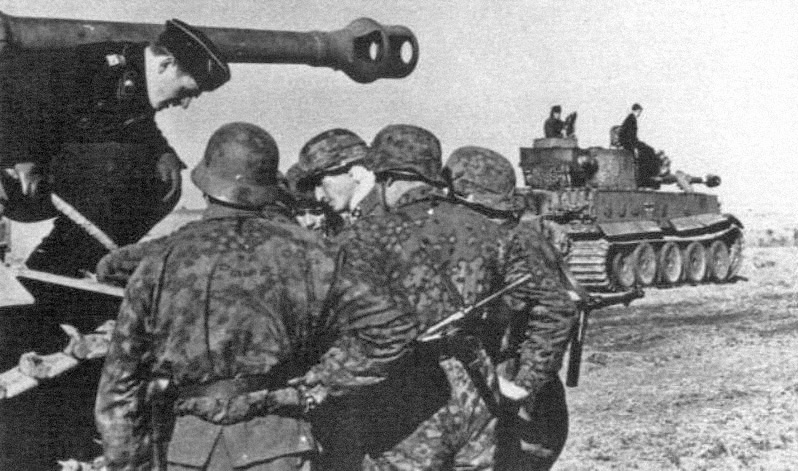
Totenkopf-Kursk-01SS Panzer Troops and Tigers prepping for battle

The victory paid dividends for the Germans. The Front held and the Russians had taken nearly a million casualties and lost almost 6000 tanks and self-propelled guns.  Three Tank Armies had been smashed, 5th Tank Army would not be fit for field duty for two months.[lxiii] 3rd Tank Army earned a Guards designation but was withdrawn from combat.[lxiv] 6th Army, victimized by PANTHER was destroyed while the 5th, 6th and 7th Guards Armies were shattered. Additionally, the Germans decimated two independent tank corps.  Stalin reacted by halting operations, cancelling follow on offensives and rebuilding the Red Army’s tank armies and mechanized forces.  He realized that his Generals had been right in not wanting to undertake offensive operations until the Germans had been weakened, but the German insistence on not going on the offensive caused him to ignore their arguments. He decided to wait until winter to launch his next offensive, but that offensive would never be launched as by the time he was ready the war was over.

Bild 101III-Zschaeckel-206-34German Tank Commader as Panzers mop up

The elimination of the Russian threat enabled Italy to be reinforced as well as the reinforcement of the Atlantic Wall.  The Salerno landings were a disaster, the Allies driven into the sea by Panzer Divisions released from the Eastern Front.  The disasters at Salerno and the Russian debacle brought overwhelming domestic political pressure on Roosevelt and Churchill to end the war. Clandestine talks began in Switzerland between Avery Dulles and Karl Wolff[lxv] while Walter Schellenberg met with Count Bernadotte.[lxvi] Despite the previous demand for unconditional surrender the Allies decided to negotiate with the new German leadership might end the war in Europe.  Goering surrendered power to General Beck and gave himself and other accused war criminals up to the Allies. Beck took power, withdrew to 1939 borders, dismantled the death camps and disbanded the Nazi Party, and its police apparatus.[lxvii] Peace came to Europe on 9 November 1943, 25 years after Kaiser Wilhelm’s abdicated his throne.
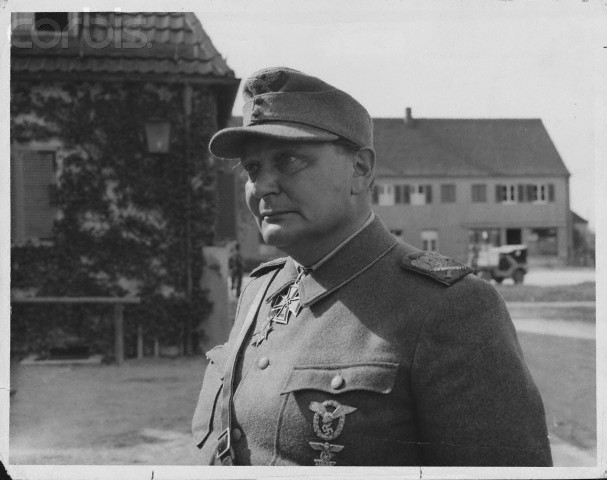
HU048801Goering Surrenders himself


[i] Clark, Alan. Barbarossa: The Russian German Conflict, 1941-45. Harper Collins Publishers, New York, NY 1965. Pp.307-311. There was an attempt on Hitler’s life on his return from Kluge’s headquarters.  Only the bomb did not go off, all components had worked but the detonator did not fire.  Clark notes that “the Devil’s hand had protected Hitler.” (p.311)

[ii] Galante, Pierre. Operation Valkyrie: The German Generals’ Plot Against Hitler. Translated by Mark Howson and Cary Ryan. Harper and Row Publishers, New York, NY 1981. Originally published as Hitler est il Mort? Librairie Plon-Paris-Match, France. 1981. p.167 

[iii] Padfield, Peter. Himmler. MJF Books, New York. 1990. p.474.  Himmler had a number of contacts and intermediaries who he used to attempt contact with the Allies as early as 1943.

[iv] Höhne, Heinze. The Order of the Death’s Head: The Story of Hitler’s SS. Translated by Richard Barry. Penguin Books, New York and London, 2000. First English edition published by Martin Secker and Warburg Ltd. London 1969. Originally published as Der Orden unter dem Totenkopf, Verlag Der Spiegel, Hamburg 1966.  Diels remained an ally of Goering even marrying his sister in 1943.

[v] Von Lang, Jochen. The Secretary: Martin Bormann: The Man Who Manipulated Hitler. Translated by Christa Armstrong and Peter White. Random House Inc. 1979. Originally published as Der Secretär. Deutsche-Verlags-Anstalt, Stuttgart. 1977 p.9.  At his trial Goering remarked to other defendants. “If Hitler had died sooner, I as his successor would not have had to worry about Bormann. He would have been killed by his own staff even before I could have given the order to bump him off.”

[vi] Irving, David. Göring: A Biography. William Morrow and Company, New York, NY 1989. Richthofen had succeeded Jeschonnek in March when Goering relieved him. Goering believed that Jeschonnek “was too pliable at the Wolf’s Lair.” Goering had actually considered this a number of times but postponed it several times. p.388

[vii] Guderian, Heinz. Panzer Leader. (abridged) Translated from the German by Constantine Fitzgibbon, Ballantine Books, New York 1957. pp.244  Hitler conducted a similar conference involving many of the same people in Munich.

[viii] Carell, Paul. Scorched Earth: The Russian German War 1943-1944. Translated by Ewald Osers, Ballantine Books, New York, NY 1971, published in arrangement with Little-Brown and Company. p. 336

[ix] Ibid. Irving. pp. 377-379.

[x] Ibid. Guderian. p.243

[xi] Ibid. Irving. p.378

[xii] Glantz, David M and House, Jonathan. The Battle of Kursk.  University Press of Kansas, Lawrence, KS. 1999. pp.21-25.  Operations order 5 had been approved by Hitler on and issued by OKH on 13 March. It was followed by Operations Order 6 on 15 April.

[xiii] Ibid. Clark. p.324.

[xiv] Warlimont, Walter. Inside Hitler’s Headquarters 1939-45. Translated by R.H. Berry, Presido Press, Novato CA, 1964. p.334 These objections of Jodl were from June, but indicate the feeling of Jodl for the Zitadelle as planned and when would have likely been his response in such a situation.

[xv]Glantz, David M. and House, Jonathan. When Titans Clashed: How the Red Army Stopped Hitler. University Press of Kansas, Lawrence, KS. 1995. p.157 Zeitzler had been a consistent advocate for Zitadelle since he heard Manstein’s initial proposal in March.

[xvi]Macksey, Kenneth. Guderian: Creator of the Blitzkrieg. Stein and Day Publishing, New York, NY 1975 p.206

[xvii] Ibid. Clark. p.322

[xviii] Ibid. Clark. p.323.  Zeitzler made this argument with Jodl during a briefing in April 1943.

[xix] Shirer, William L. The Rise and Fall of the Third Reich. A Touchstone Book published by Simon and Schuster, 1981, Copyright 1959 and 1960. p.1115.  Hitler had told Keitel and Jodl that “When it comes to negotiating [for peace]…Goering can do much better than I. Goering is much better at those things.”

[xx] Speer, Albert. Inside the Third Reich. Collier Books, a Division of MacMillan Publishers, Inc. New York, NY 1970. p.245.  From a conversation with Speer in late 1942.

[xxi] Ibid. Glantz and House. Clash of Titans. pp. 216-217. Hitler would replace Zeitzler with Guderian in June 1944.

[xxii] Ibid. Irving. p.379 From a conversation with State Secretary Ernst von Weizäcker 11 February 1943.

[xxiii] Ibid. Speer.  p.512. The ending of the addiction took place at Nurnberg and Goering surprised many of his co-defendants with his “remarkable energy.”

[xxiv] Ibid. Glantz and House. Kursk. p.28

[xxv] Ibid. Glantz and House. Kursk. p.28.

[xxvi] Ibid. Glantz and House. Kursk. p.264

[xxvii] Overy, Richard. Russia’s War: A History of the Soviet War Effort: 1941-1945. Penguin Books, New York NY and London, 1997. pp.211

[xxviii] Erickson, John. The Road to Berlin. Cassel Military Paperbacks, London, 2003. First Published by Weidenfeld and Nicholson, 1983. p.76

[xxix] Ibid. Glantz and House. Kursk. p.265

[xxx] Ibid. Glantz and House. Kursk. p.23.

[xxxi] Liddell-Hart, B.H. The German Generals Talk. Quill Publishing, New York, NY. 1979. Copyright 1948 by B.H. Liddell-Hart. p.215  Henrici describes the methods that he used in 1944 as Commander of 1st Panzer Army and as Commander of Army Group Vistula during the defense of Berlin.

[xxxii] Hausser would actually command 7th Army in Normandy in 1944.

[xxxiii] Ibid. Glantz and House Kursk. p.53 This was the 10th Panzer Brigade assigned to XLVIII Panzer Corps.  Additionally Clark notes production figures for Panthers from Speer that indicate that 324 Panthers would be available by 31 May. (Clark. p.325)

[xxxiv] Ibid. Glantz and House. Kursk. p.52.  At Kursk the two Ferdinand detachments were both assigned to 9th Army.

[xxxv] Ibid. Glantz and House. Kursk. p.28.

[xxxvi] Ibid. Carell. p.510.  Vatutin was killed by Ukrainian irregulars in April 1944.

[xxxvii] Ibid. Glantz and House. Kursk. p.62

[xxxviii] Newton, Steven H. Hitler’s Commander: Field Marshal Walter Model, Hitler’s Favorite General. DeCapo Press, Cambridge MA 2005. p. 256

[xxxix] Ibid. Liddell-Hart. p.215.

[xl] Ibid. Glantz and House. Kursk. p.236

[xli] Ibid. Erickson. p.113. At Kursk the call took place on 20 July when Rybalko was in this situation.

[xlii] Ibid. Newton. p.256

[xliii] Ibid. Erickson. p.114

[xliv] Ibid. Glantz and House. Kursk. p.236

[xlv] Ibid. Erickson. p.114

[xlvi] Ibid. Newton. p.256

[xlvii] Ibid. Glantz and House. p.345. The actual losses were 429,000 men and 2,500 tanks against a German force significantly weakened by Zitadelle.  Had the Russians attacked the Germans rather than receiving the German attack first their losses in men and machines would have been far higher.  I have reflected that in the alternative numbers.

[xlviii] Ibid. Glantz and House. When Titans Clashed. p.168  The Soviets did try this in their counter offensive following Zitadelle.

[xlix] Ibid. Glantz and House. When Titans Clashed. p.169

[l] Ibid. Glantz and House. Kursk. p.344. Actual figures for beginning of offensive.

[li] Ibid. Glantz and House. Kursk. p.338.  Figures from beginning of Zitadelle.

[lii] Ibid. Glantz and House. Kursk. p.244 The actual text reads “Manstein’s defense” not Hoth’s.

[liii] Ibid. Glantz and House. Kursk. p.244

[liv] Von Mellenthin, F.W. Panzer Battles: A Study of the Employment of Armor in the Second World War. Translated by H. Betzler, Ballantine Books, New York, NY, 1971. Originally Published University of Oklahoma Press, 1956. p.286

[lv] Raus, Erhard. Panzer Operations: The Eastern Front Memoir of General Raus, 1941-1945. Compiled and Translated by Steven H Newton. Da Capo Press a member of the Perseus Book Group, Cambridge, MA 2003. p.214

[lvi] Ibid. Glantz and House. Kursk. p.247

[lvii] Ibid. Glantz and House. When Titans Clashed. p.169

[lviii] Ibid. Erickson. p.121  These were the actual divisions that liberated Kharkov.

[lix] Ibid.  Von Mellenthin . p.287

[lx] Ibid. Glantz and House. p.252

[lxi] Ibid. Glantz and House. When Titans Clashed. p.170

[lxii] Ibid. Glantz and House. Kursk. p.252

[lxiii] Ibid. Glantz and House. Kursk. p.252

[lxiv] Ibid. Glantz and House. Kursk. p.237

[lxv] Ibid. Hohne. p.572

[lxvi] Ibid.  Hohne. p.570

[lxvii] Ibid. Galante. pp 69 and 207

Bibliography

Carell, Paul. Scorched Earth: The Russian German War 1943-1944. Translated by Ewald Osers, Ballantine Books, New York, NY 1971, published in arrangement with Little-Brown and Company

Clark, Alan. Barbarossa: The Russian German Conflict, 1941-45. Harper Collins Publishers, New York, NY 1965

Erickson, John. The Road to Berlin. Cassel Military Paperbacks, London, 2003. First Published by Weidenfeld and Nicholson, 1983

Galante, Pierre. Operation Valkyrie: The German Generals’ Plot Against Hitler. Translated by Mark Howson and Cary Ryan. Harper and Row Publishers, New York, NY 1981. Originally published as Hitler est il Mort? Librairie Plon-Paris-Match, France. 1981.

Glantz, David M and House, Jonathan. The Battle of Kursk.  University Press of Kansas, Lawrence, KS. 1999.

Glantz, David M. and House, Jonathan. When Titans Clashed: How the Red Army Stopped Hitler. University Press of Kansas, Lawrence, KS. 1995

Guderian, Heinz. Panzer Leader. (abridged) Translated from the German by Constantine Fitzgibbon, Ballantine Books, New York 1957

Höhne, Heinze. The Order of the Death’s Head: The Story of Hitler’s SS. Translated by Richard Barry. Penguin Books, New York and London, 2000. First English edition published by Martin Secker and Warburg Ltd. London 1969. Originally published as Der Orden unter dem Totenkopf, Verlag Der Spiegel, Hamburg 1966.

Irving, David. Göring: A Biography. William Morrow and Company, New York, NY 1989

Liddell-Hart, B.H. The German Generals Talk. Quill Publishing, New York, NY. 1979. Copyright 1948 by B.H. Liddell-Hart

Macksey, Kenneth. Guderian: Creator of the Blitzkrieg. Stein and Day Publishing, New York, NY

Newton, Steven H. Hitler’s Commander: Field Marshal Walter Model, Hitler’s Favorite General. DeCapo Press, Cambridge MA 2005

Overy, Richard. Russia’s War: A History of the Soviet War Effort: 1941-1945. Penguin Books, New York NY and London, 1997

Padfield, Peter. Himmler. MJF Books, New York. 1990

Raus, Erhard. Panzer Operations: The Eastern Front Memoir of General Raus, 1941-1945. Compiled and Translated by Steven H Newton. Da Capo Press a member of the Perseus Book Group, Cambridge, MA 2003

Shirer, William L. The Rise and Fall of the Third Reich. A Touchstone Book published by Simon and Schuster, 1981, Copyright 1959 and 1960.

Speer, Albert. Inside the Third Reich. Collier Books, a Division of MacMillan Publishers, Inc. New York, NY 1970.

Von Lang, Jochen. The Secretary: Martin Bormann: The Man Who Manipulated Hitler. Translated by Christa Armstrong and Peter White. Random House Inc. 1979. Originally published as Der Secretär. Deutsche-Verlags-Anstalt, Stuttgart. 1977

Von Mellenthin, F.W. Panzer Battles: A Study of the Employment of Armor in the Second World War. Translated by H. Betzler, Ballantine Books, New York, NY, 1971. Originally Published University of Oklahoma Press, 1956.

Warlimont, Walter. Inside Hitler’s Headquarters 1939-45. Translated by R.H. Berry, Presido Press, Novato CA, 1964.

2 Comments

Filed under alternative history, History, Military, world war two in europe