Tag Archives: world war i

The Dangerous Ignorance of the Wiki-Leakers

The Zimmerman Telegram: Just One Cable with consequences still being felt today

“A prince must imitate the fox and the lion, for the lion cannot protect himself from traps, and the fox cannot defend himself from wolves. One must therefore be a fox to recognize traps, and a lion to frighten wolves. Those that wish to be only lions do not understand this. Therefore, a prudent ruler ought not to keep faith when by so doing it would be against his interest, and when the reasons which made him bind himself no longer exist. If men were all good, this precept would not be a good one; but as they are bad, and would not observe their faith with you, so you are not bound to keep faith with them.” Niccolo Machiavelli

In 1917 the British leaked a telegram from the German Foreign Minister to the President of Mexico. By 1916 the Germans were doing all that they could to keep the United States out of the war while the British looked for ways to assist the Americans into the war. The cat and mouse campaign continued until the Germans being starved by the British blockade realized that they had to resume unrestricted submarine warfare against Britain knowing that such a resumption might well provide the United States a reason to enter the war. The Germans approached the Mexican government with the offer of an alliance and the promise of the restoration of lands lost to the United States.  The Mexican government rejected the offer because as much as they desired the restoration of land that they believed to be rightfully theirs that the Germans could not deliver.  The British knew this but waited and when the moment was right released the decrypted cable to the American Press which much as it had done against the Spanish in 1898 provided the grist for the Congress to declare war in April 1917.  The involvement of the United States in that war made the United States a player on the world stage and was the catalyst for our involvement in  the Second World War and all that has followed.  Just one cable changed history.

Julian Assange, his companions and supporters are some of the most incredibly naïve people in the world.  I do not doubt for one minute that most of them are convinced of the innate righteousness that some ascribe to whistleblowers.  You see there are times that whistleblowers are absolutely necessary.  Unfortunately most self proclaimed “whistleblowers” lack the nuance to know what should be leaked and what shouldn’t, what matters and what doesn’t and the immense dangers inherent in revealing information that potentially could lead to the targeted death of innocents or even inciting whole populations to war.

Diplomacy is a most delicate Machiavellian art.  Diplomats representing the interests of the governments work in a world where there is little that is “black and white” but rather a world of murky grays where truth is mixed with deception, blunt honesty and candor with lies and subterfuge.  It is an art filled with nuance where the slightest misstep could and often has triggered wars of cataclysmic proportions. It is a world where diplomats, military attaches and even dare I say spies work to gain their nations advantages and if they do their job well such advantages are secured without war.

To do this the diplomatic corps of various nations, even nations that are each other’s mortal enemy understand that it is possible to smile, share a drink and converse as colleagues even while seeking an advantage. That advantage might be information regarding trade agreements, military alliances, or countless other subjects.  Diplomacy is a person playing chess game with one hand and a poker game with the other at the same time.  It is a dark world that most people are ignorant of and as Barbara Tuchman said: “Diplomacy means all the wicked devices of the Old World, spheres of influence, balances of power, secret treaties, triple alliances, and, during the interim period, appeasement of Fascism” and Randolph Bourne noted “Diplomacy is a disguised war, in which states seek to gain by barter and intrigue, by the cleverness of arts, the objectives which they would have to gain more clumsily by means of war.”

Diplomacy is truly a Machiavellian enterprise that is not for the faint of heart and good diplomats understand what Machiavelli said “And to be sure, sometimes you need to conceal a fact with words, do it in such a way that it does not become known, or, if it does become known, that you have a ready and quick defense.” Diplomats understand the hard truth that the ally of today may very well be the enemy of tomorrow and that it is unwise to have allies that you are ignorant about. Sun Tzu put it well “One who is not acquainted with the designs of his neighbors should not enter into alliances with them.”

Our Founding Fathers were not fond of alliances and warned against them, unfortunately that horse left the barn years and years ago and like our European ancestors we are now dependant on alliances, even with very unseemly characters nations because for better or worse they suit our security or economic geopolitical needs.  That is the way it is. We are unable to turn back the clock to more genial time.

Thus diplomats and their work matter and what they say and do in public and in secret needs to be guarded because the consequences of “transparency” are often worse than the maintaining of secrets. The latest documents leaked by Assange and Wiki Leaks have nothing to do with revealing anything that is the reason for whistle blowing which by definition is aimed at exposing wrongdoing or illegal activity by an organization or individuals with the hope of stopping it. In some cases Wiki Leaks has done this but the latest round of leaks appear to be more about embarrassing governments and leaders around the world with no real positive gain for society or for that matter world peace. Instead they have endangered many by exposing secrets that might result in brutal civil wars, regional wars or assist terrorist groups to destabilize democracies and kill innocents.  One of the documents listed all sites deemed by the United States vital to its national security as well as those of other nations practically giving terrorists a roadmap to kill and destabilize and even increase the economic crisis engulfing much of the world.  Since many are soft targets terrorists could and likely will use the information in ways that can be unimaginably bad.

When finally confronted by governments around the world Assange threatens to release 100,000 uncensored documents that they refer to as an “insurance policy” against being silenced. The documents are in the hands of thousands of Wiki Leaks supporter who only need the key to unlock them and spill the data with very unpredictable consequences depending on what is in the files. Who knows what if they were leaked to trap Assange and his followers?

Regardless the release of these most recent documents has exposed people in many nations, mostly innocents to grave danger all it seems to feed Assange’s massive ego.  Having had to deal with a decent number of his supporters recently I know that the general attributes of his followers are arrogance, self righteousness and naiveté which when combined together are really dangerous. However they don’t seem to care as I read a post by one of Assange’s followers someone named “sunnydee” who wrote on the “Above Top Secret” website: “Hope you’ll keep us posted. And hope that someone has the guts to open it. It’s best to know the truth, no matter how ugly.” This just shows the naïve and seemingly uncomprehending mentality of many of his supporters. I could be wrong but it doesn’t seem like Assange or his followers care about the lives that could be lost and the devastation that could ensue either due to war, terrorism or greater economic calamity.  Such actions do not promote democracy or open societies they destroy them.

It seems that unless something changes quickly that Assange and his followers could ignite a spark that engulfs whole regions of the world in war and open the door wider for terrorists to destabilize weak governments around the world.  Diplomats are smarter than a lot of people give them credit for and the diplomatic cables needed to be protected and Assange has opened Pandora’s Box.

This is a dangerous gambit that nothing good can come from. God help us.

Peace

Padre Steve+


2 Comments

Filed under Foreign Policy, History, national security

The War to End All Wars….and a Peace to end all Peace

It was the War to end all war

On the 11th hour of the 11th day of the 11th month the guns fell silent across Western Europe and the war which had killed 16 million soldiers, sailors and civilians and wounded another 21 million more came to an end. It had begun as a conflict in the Balkans which rapidly drew in all of Europe’s major powers.  The central focus of the war was the Western Front where the armies of Germany battled those of Britain, France, Belgium and later the United States.  Battles with names such as the Marne, Passchendaele, the Somme, Verdun, Ypres, Chateau Thierry, Belleau Wood, Vimy Ridge, Cambrai, the Aisne, represented the pinnacle of killing as soldiers battled in the mud of massive trench systems and Generals sacrificing thousands of men in a day for the gain of a few hundred yards of territory throwing them against mountains of barbed wire, landmines, well emplaced machine gun nests and mortars. Massed batteries of artillery tore men to shreds leaving many men so pulverized that they would ever be identified.  Poison gas both choking agents and the long lasting mustard gas added to the hell that was the war in the West.

During the war the war Imperial Russia had fallen to a Communist revolt and surrendered, the Austro-Hungarian Empire fell in October of 1918 and even the Allies had faced near calamity on the home front. In 1917 the French Army mutinied after years of futility with only Marshal Petain the hero of Verdun able to quell it.

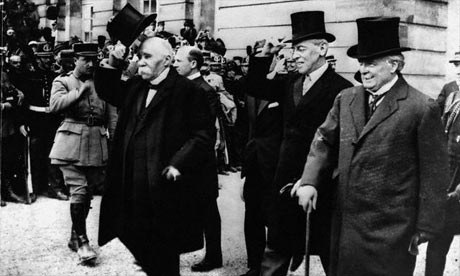
The men who drafted the Peace to end all Peace: Clemenceau, Wilson, Lloyd George

Kaiser Wilhelm II had abdicated his throne on November 9th amid a revolution at home which tore the country apart.  The new German Government accepted an armistice in the belief that the Allies would honor President Woodrow Wilson’s 14 Points.  Instead they were subjected to humiliation and starvation as the Allies refused to end their blockade of Germany until the Peace Treaty was signed. Hundreds of thousands more Germans died as a result of starvation and disease as their cities were wracked by violence as order collapsed.  It was the Socialist government which had inherited the country that had to fight the Communists in the streets allying themselves with the Army High Command to form Freikorps from units and individual soldiers under commanders willing to fight.

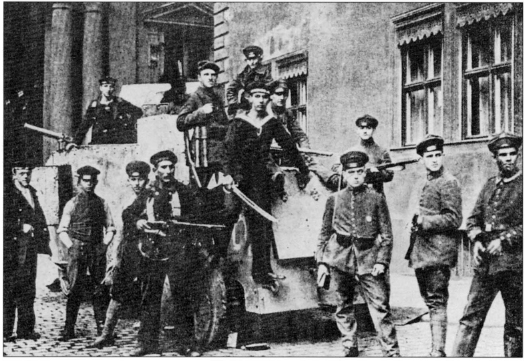
Soviet style revolution in Germany 1918-1919

In France at the Palace of Versailles the Allies led by the British and French brushed aside Wilson’s attempt at a just peace and placed draconian sanctions on the new German Republic which had no choice but to accept the surrender terms dictated by the Treaty of Versailles. The Army was to be reduced to 100,000 men with no heavy weapons, the Navy to a token force of obsolete ships, the air force disbanded.  Massive war reparations were imposed which were impossible for the Germans to fulfill and which were only paid off this year.  The final ignominy was the fact that the Germans were forced to bear the sole responsibility for the war. The German economy collapsed in the aftermath, France occupied key German industrial areas in the Saar and Ruhr and the nation fell into more disorder as the Deutschmark lost all of its value as hyperinflation made the money worthless.

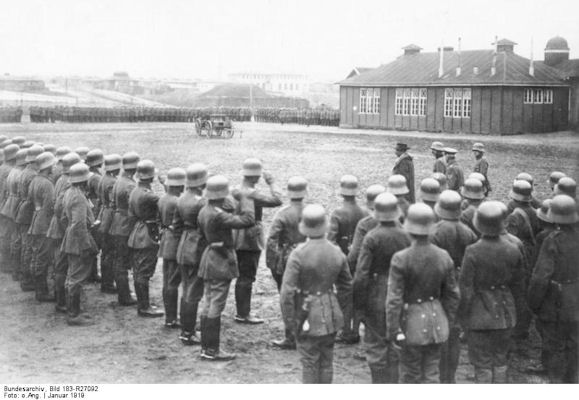
Freikorps helped restore order when the Army dissolved

Eventually order returned to Germany with a brief period of relative prosperity which lasted until the world-wide Great Depression which through Germany back into chaos. Government after government was formed and dissolved and the last Chancellors of the Republic were forced to rule under the emergency conditions of Article 48 of the Weimar Constitution.  Eventually extremists on the left and the right brought further chaos as the eventually leading President Hindenburg to appoint the Leader of the National Socialist German Workers Party (Nationalsozialistische Deutsche Arbeiterpartei) or NSDAP as Chancellor.  We know the rest of the story. A World War that killed far more than the first 22-25 million military and 62-78 million civilians, a war of extermination on the Eastern Front, the Holocaust, and fearful weapons which ushered in the Atomic and Nuclear age.  Europe was shattered, Britain’s wealth drained and empire unsustainable, France divided and impoverished and other nations in political or economic crisis with the Soviets controlling Eastern Europe behind an Iron Curtain.

Cold War

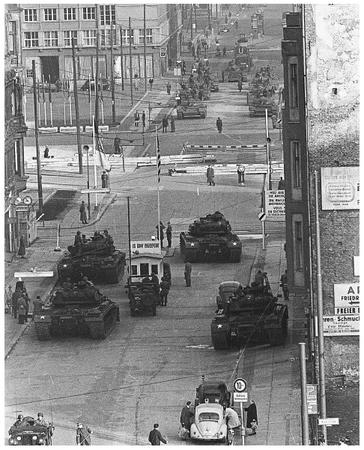
In Europe and Asia a “Cold War” between the Soviet Communists and the West took the place of the previous war.  The United States would fight wars in Korea and Vietnam while the Soviets would rule with an iron fist in Eastern Europe and at the height of the Cold War invaded Afghanistan.  The wars in Vietnam and Afghanistan caused crisis in both the United States and the Soviet Union and Afghanistan helped mark the end of Soviet power and the end of the Soviet Union.

Around the world colonial empires fell through either revolts of colonized people or the abdication of empire by nations exhausted and economically broken by war. The many of the newly free “nations” were artificial and as a result experienced their own civil, tribal and religious conflicts the effects of which are still felt.  The end of the Cold war brought more change and for a time there was a period of American superiority but wars engulfed the Middle East as Iraq attacked its neighbors and was defeated in the Gulf War.  However the effects of that war were felt as Moslem extremists took power in Afghanistan and others including the Yemeni born Saudi Osama Bin Laden began a campaign of terror to drive the United States out of the Middle East that culminated in the attacks of September 11th 2001 and now the war that seems to have no end.

And it was the War to end all war and a peace that ended all hope of peace….God help us as it is unlikely that this war will end anytime soon for us or our allies even if we withdraw from Afghanistan.  Our enemies are too beholden to their ideology to stop their attacks until they win or are destroyed, the war will continue and God only knows how many soldiers and civilians will die in the coming years over 90 years after the War to end all War ended and the Peace to end all Peace began.

Peace

Padre Steve+


1 Comment

Filed under Foreign Policy, History, iraq,afghanistan, Military, national security, Political Commentary, world war two in europe

Veterans Day 2010: Counting the Cost of War

“It is well that war is so terrible, or we should get too fond of it.” General Robert E. Lee

Veterans Day had become a rather somber occasion for me over the past decade and since returning from Iraq in 2008 has taken on added personal significance.  I have noticed that I have become much more reflective about the sacrifices made by our military and the terrible coasts of war on our Soldiers, Marines, Sailors, Airmen and their families in this age of the all volunteer military.  The military which has about 2,225,000 members including the Reserves and National Guard is just 0.7% of the total population, the lowest percentage of military personnel compared to total population during any war in our history.  As a result this force has borne the brunt of a war that no politicians or bureaucrats figured would last half as long as it has.  As a result the “few” have been asked to do more for longer than and military that this nation has ever fielded during a war.

Thus for me Veterans Day has become a rather somber and reflective occasion as I ponder all the sacrifices made by our military and their families. In Afghanistan the U.S. Military has lost 1378 killed and our allies another 825.  In Iraq 4427 U.S. Military personnel have died along with 318 allied soldiers, not including the Iraqi military losses.  For each of the killed there are about 8 more wounded a total of over 38,000 wounded.  Of course the wounded numbers do not include 170,000+ cases of hearing damage; 130,000+ cases of mild traumatic brain injuries; and 200,000+ cases of serious mental health problems, over 30,000 serious disease cases, including a disfiguring, parasitic disease called Leishmaniasis, which results from bites of sand flies; thousands of cases of respiratory disease linked to exposure to toxic burn pit smoke and hundreds of suicides.  Then there are the injuries related to road and aviation accidents not in direct combat.  In my recent assignments in Iraq and Naval Medical facilities I have seen the human cost of the war.  I have friends who suffer as the result of Traumatic Brain Injury, PTSD and Pulmonary diseases as well as those that have been wounded as the result enemy action.  I have a dear friend with a rare and irreversible pulmonary condition from two tours in Iraq. He is 41 his lungs are those of a 70 year old man.  My best friend, a senior Naval Officer is still suffering from the effects of TBI and PTSD incurred while serving with the Marines in Al Anbar Province.

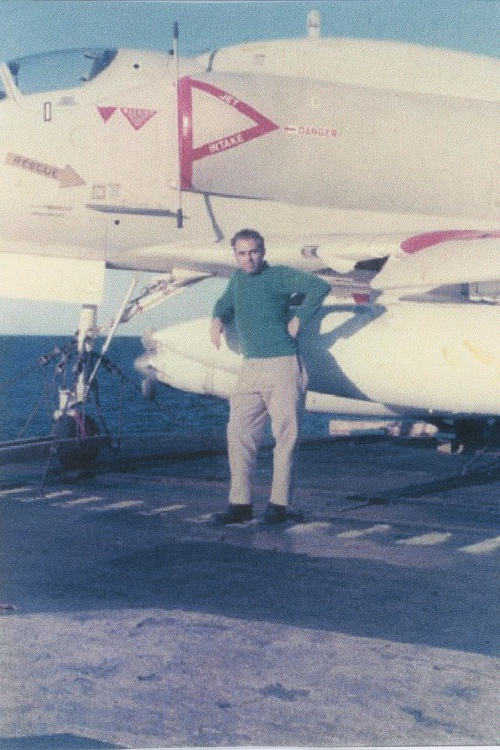
My Dad Aviation Storekeeper Chief Carl Dundas aboard USS Hancock CVA-19 off Vietnam circa 1971-72

A year ago on Veterans Day I was at with my parents in Stockton California to visit my mom and my dad who was then in a nursing facility due to the ravages of Alzheimer’s disease.  It was a terrible visit conflict with my mother due to witches’ brew of my PTSD and grief for my dad and my mother’s struggles with my dad’s condition and her own physical condition.  I visited my dad every day when in two and unfortunately he did not know who I was, Alzheimer’s had robbed him of everything that made him my dad.  He died on June 23rd of this year a day after I found out that I had been selected for promotion to Commander.  My dad was a retired Navy Chief Petty Officer who served in Vietnam on a beach detachment manning an emergency airfield in the besieged city of An Loc in 1972.  He never talked about that tour or what happened there except to tell me that he saw the Communists executing civilians in the city from his observation point.  He came home a changed man.  Thankfully he is now out of his suffering and our family is beginning to find its way back from the abyss of his illness.

I have served for over 29 years in the Army and the Navy and have witnessed many things and been blessed to have my life enriched by many veterans.  Unfortunately many of these brave men have since passed away, some having lived many years and others that have died far too young as a result of service connected injuries.

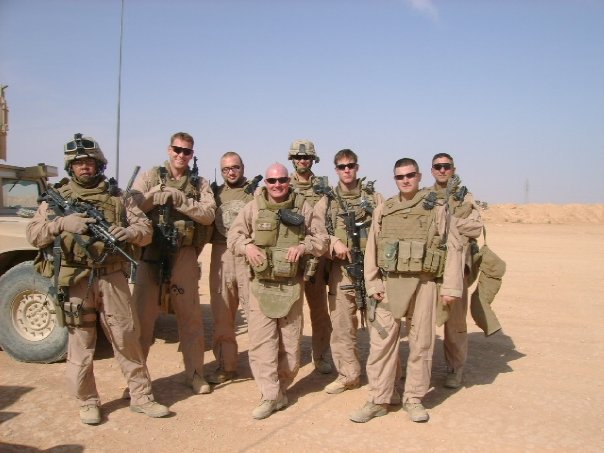
With advisors to the 3rd Bn, 3rd Brigade 7th Iraq Division COP South 2008

In my current work I see many young men that wear the Purple Heart for being wounded in combat. I see those that need assistance to walk, amputees, men with obvious scars from burns and others suffering blindness from their injuries. Our hospital’s Medical Board sees 40-60 Marines and Sailors a day, quite a few of whom that will be medically retired due to their injuries.  There are also those that have died by their own hand suffering from psychological and spiritual injuries too deep to fathom, we had one of our own Corpsman suicide last week.

The cost of war is terrible, as General William Tecumseh Sherman so eloquently put it: “War is Hell.”

Despite this our brave men and women that serve in all branches of the military as well as those that have gone before us in the 235 year history of our military have shouldered the load, for most of that history depending on volunteers who often served in obscurity often derided by their fellow Americans who believed that the military was a place to go if you could not be successful in the civilian world. The pay was low, the duty arduous and benefits few. In the Civil War, the World Wars and up until 1974 the professionals were augmented by draftees who outnumbered the professionals by a huge margin.  Since 1974 the force has been an all volunteer force.

Health and Comfort Board Team USS Hue City, Northern Arabian Gulf May 2002

Regardless of whether our Veterans were draftees or volunteers they have served this country well and on the whole to use the current Navy description are “A Global Force for Good.” The countries liberated from oppressors and helped in humanitarian operations by American Soldiers, Sailors, Marines and Airmen are many and varied.  They have represented the spectrum of our society and represent the best the country has to offer.  Unfortunately they have not always been honored by some of their our countrymen and women and sometimes the children and grandchildren of the peoples that they liberated from Nazi, Fascist or Communist oppressors who often use the wrongdoing of a few military personnel or the decisions or actions of American politicians or businessmen to label American military personnel as criminals.

Unfortunately since the military is such a small part of our population and concentrated in a few large bases it is invisible to most Americans as they live their daily lives. Often in isolated from the bulk of America such as Killeen Texas home of the U.S. III Corps and Jacksonville North Carolina the home of the 2nd Marine Expeditionary Force and Second Marine Division are quintessential military towns but neither are near major population centers and thus the sacrifice of these Soldiers, Marines and Sailors goes unnoticed by most of the nation.  In a sense the human cost of the war falls inordinately upon these military communities where there are few strangers.

In spite of this the current men and women of the American Military train, deploy, fight and return every day as they have since the 9-11-2001 attacks, many if not most have made multiple combat tours.  I have been pleased to see more support of the military in the media, especially sports media and leagues.  Many businesses are taking time to offer things of value to servicemen and women and those businesses should be commended and patronized.  I was touched by many stories that I saw about our veterans on ESPN over the past few days.  http://www.espnmediazone3.com/us/2010/11/espn%E2%80%99s-weeklong-salute-to-veterans-day/

Many of our Reserve component personnel give up civilian employment and chances for promotion to serve in the military, particularly when they are mobilized for service. When they return home most return to towns and cities that have little of the support afforded to active duty members when they return.  I pray that our political leaders in the future will exercise discernment and wisdom before committing us to another war. Otto Von Bismarck said: “Anyone who has ever looked into the glazed eyes of a soldier dying on the battlefield will think hard before starting a war.” Unfortunately the current members of the House, Senate and Executive branch have little connection to the military as very few have served and I wonder if any really comprehend this maxim.  In the 111th Congress 120 members had some form of military service.  The number of veterans in the 111th Congress reflects the trend of a steady decline in the number of Members who have served in the military. For example, there were 298 veterans (240 Representatives, 58 Senators) in the 96th Congress (1979-1981); and 398 veterans (329Representatives, 69 Senators) in the 91st Congress (1969-1971).  Those who have served a full military career are far fewer; the number of congressmen with military careers will remain relatively constant for the 112th Congress. In the Senate there will be one (as compared with two in 2006 and one in 2008) and in the House there will be eight (as compared with four in 2006 and six in 2008).  Some of these Congressional Veterans have been vilified by some broadcasters and pundits of the extreme right wing media most of whom who have never served in the military.  On the positive side nine members of the new Congress will have served in the current wars which hopefully will help promote the sacrifice of our current Veterans and help with programs that will help returning Veterans.

I have seen the cost of war up close and personal in Iraq and back here in the States. I suffer some the afflictions described as a result of my service and see the young men and women many of whom were not yet born when I enlisted in the Army, or when I was commissioned as an Army Officer, when I was a Company Commander or when I was a senior Captain in the Army. These young men and women are heroes.

Please take a moment to thank a Veteran.  If you have time volunteers are always welcome at organizations such as the USO and American Red Cross working with our troops, join or support organizations which promote the causes of Veterans including the Iraq Afghanistan Veteran’s Association www.iava.org the Veterans of Foreign Wars http://www.vfw.org/, American Legion http://www.legion.org/ , Marine Corps League http://www.mcleague.org/, the Fleet Reserve Association http://www.fra.org/, the Association of the U.S. Army http://www.ausa.org and the Disabled American Veterans http://www.dav.org/. There are also many charitable organizations that provide assistance to Veterans and their families’ one of the best being the Fisher House Foundation http://www.fisherhouse.org/ which provides comfortable and free lodging to the families of wounded, injured or sick military personnel on bases adjacent to military hospitals. I found these ten ways that you can help on Yahoo.com:

1. At 11 a.m., observe a moment of silence for those who’ve fought and died while in service to the country

2. Display an American flag

3. Attend a Veterans Day parade

4. Thank a vet for his/her service

5. Send a letter to troops through the U.S. Department of Defense Website

6. Work in a homeless shelter or soup kitchen

7. Visit a veteran’s grave or pick up trash at a veterans cemetery

8. Visit with the family of a veteran who’s serving overseas

9. Visit with a wounded vet at a local VA facility

10. Donate to the USO, the American Legion, Veterans of Foreign Wars USA or other organizations that honor and assist vets

Keep us all in your prayers and please when Veterans Day is past do not forget those of us that serve and our families, especially those men and women serving in harm’s way.  To my friends and comrades I echo the words of the German commander to his troops in captivity at the end of the Band of Brother’s mini-series:

“Men, it’s been a long war, it’s been a tough war. You’ve fought bravely, proudly for your country. You’re a special group. You’ve found in one another a bond that exists only in combat, among brothers. You’ve shared foxholes, held each other in dire moments. You’ve seen death and suffered together. I’m proud to have served with each and every one of you. You all deserve long and happy lives in peace.”

Peace

Padre Steve+

3 Comments

Filed under iraq,afghanistan, Military, PTSD, shipmates and veterans

Happy 235th Birthday Marines!

In 1775 a committee of the Continental Congress met at Philadelphia’s Tun Tavern to draft a resolution calling for two battalions of Marines able to fight for independence at sea and on shore.  The resolution was approved on November 10, 1775, officially forming the Continental Marines. The first order of business was to appoint Samuel Nicholas as the Commandant of the newly formed Marines. Robert Mullan the owner and proprietor of the said Tun Tavern became Nicholson’s first captain and recruiter. They began gathering support and were ready for action by early 1776.  They served throughout the War for Independence and like the Navy they were disbanded in April 1783 and reconstituted as the Marine Corps in 1798. The served on the ships of the Navy in the Quasi-war with France, against the Barbary Pirates where a small group of 8 Marines and 500 Arabs under Lieutenant Presley O’Bannon made a march of 500 miles across the Libyan Desert to lay siege Tripoli but only reached Derna. The action is immortalized in the Marine Hymn as well as the design of the Marine Officer’s “Mameluke” Sword. They served in the War of 1812, the Seminole Wars and in the Mexican-American War where in the storming of the on Chapultepec Palace they continued to build and enduring legacy. In the months leading up to the Civil War they played a key role at home and abroad.  In October 1859 Colonel Robert E. Lee led Marines from the Marine Barracks Washington DC to capture John Brown and his followers who had captured the Federal Armory at Harper’s Ferry.

The Corps would serve through the Civil War and on into the age of American Expansion serving in the Spanish American War in the Philippines, Puerto Rico and Cuba where they seized Guantanamo Bay at the battle of Cuzco Wells.  The would serve in China and be a key component of the international force that defended foreign diplomats during the Boxer Revolt as well as the international force that would relieve the diplomatic compound in Peking (Beijing).  In World War One the Marines stopped the German advance at Chateau Thierry and cemented their reputation as an elite fighting force at Belleau Wood where legend has it that the Germans nicknamed them Teufelhunden or Devil Dogs, a name that they Marines have appropriated with great aplomb.

During the inter-war years the Marines were quite active in the Caribbean and Asia and also developed amphibious tactics and doctrine that would be put to use in the Pacific Campaign.  During the war the Marines served in all theaters but won enduring fame at Wake Island, Guadalcanal, Tarawa, Iwo Jima, Okinawa and numerous other battles in the Pacific war. Marine Aviators flew in some the most desperate actions in the war to support the Navy and amphibious operations ashore.

After the war the Truman Administration sought to eliminate the Marine Corps but the Corps was saved by the efforts of Americans across the country and Marine supporters in Congress.  That was a good thing because the Marines were instrumental in keeping the North Koreans from overrunning the South during the Korean War on the Pusan Perimeter, turned the tide at Inchon and helped decimate Communist Chinese forces at the Chosin Reservoir.  After Korea the Marines would serve around the World in the Caribbean and Lebanon and in Vietnam where at Da Nang Keh Sanh, Hue City, Con Thien fighting the North Vietnamese and their Viet Cong allies.  The Marines took the initiative to implement innovative counter insurgency measures such as the Combined Action Platoons which enjoyed tremendous success until they were shut down by the Army high command.  These lessons would serve the Marines well in the new millennium during the Anbar Awakening in Iraq which changed the course of that insurgency and war.

The Marines would again be involved around the World after Vietnam serving in the Cold War, in Lebanon and the First Gulf War which was followed by actions in Somalia, the Balkans and Haiti. After the attacks of September 11th 2001 the Marines were among the first into Afghanistan helping to drive the Taliban from power. In the Iraq Campaign the Marines had a leading role both in the invasion and in the campaign in Al Anbar Province.  After theirwithdraw from Iraq the Marines became a central player in Afghanistan where today they are engaged around Khandehar and in Helmand Province.

The Marines are elite among world military organizations and continue to “fight our nations battles on the air and land and sea.” The Corps under General John LeJeune institutionalized the celebration of the Marine Corps Birthday and their establishment at Tun Tavern. General LeJeune issued this order which is still read at every Marine Corps Birthday Ball or observance:

MARINE CORPS ORDER No. 47 (Series 1921)
HEADQUARTERS
U.S. MARINE CORPS Washington, November 1, 1921

The following will be read to the command on the 10th of November, 1921, and hereafter on the 10th of November of every year. Should the order not be received by the 10th of November, 1921, it will be read upon receipt.

On November 10, 1775, a Corps of Marines was created by a resolution of Continental Congress. Since that date many thousand men have borne the name “Marine”. In memory of them it is fitting that we who are Marines should commemorate the birthday of our corps by calling to mind the glories of its long and illustrious history.

The record of our corps is one which will bear comparison with that of the most famous military organizations in the world’s history. During 90 of the 146 years of its existence the Marine Corps has been in action against the Nation’s foes. From the Battle of Trenton to the Argonne, Marines have won foremost honors in war, and in the long eras of tranquility at home, generation after generation of Marines have grown gray in war in both hemispheres and in every corner of the seven seas, that our country and its citizens might enjoy peace and security.

In every battle and skirmish since the birth of our corps, Marines have acquitted themselves with the greatest distinction, winning new honors on each occasion until the term “Marine” has come to signify all that is highest in military efficiency and soldierly virtue.

This high name of distinction and soldierly repute we who are Marines today have received from those who preceded us in the corps. With it we have also received from them the eternal spirit which has animated our corps from generation to generation and has been the distinguishing mark of the Marines in every age. So long as that spirit continues to flourish Marines will be found equal to every emergency in the future as they have been in the past, and the men of our Nation will regard us as worthy successors to the long line of illustrious men who have served as “Soldiers of the Sea” since the founding of the Corps.

JOHN A. LEJEUNE,
Major General
Commandant

I have had the privilege of serving with the Marines in peace and war and the most memorable Marine Corps Birthday celebrations for me were in Ramadi with the Marine advisors to the Iraqi 7th Division and with the Marine Security Force Company at Guantanamo Bay Cuba. The highlight of my career was serving with the Marines in Iraq and I wear my Iraq Campaign Medal with pride.  The Marines have helped my professional development as an office through the Amphibious Warfare Course, Command and Staff College and the Fleet Marine Force Officer Qualification. I count my Marines as some of my most enduring friends.

Happy Birthday Marines. Thank you for all you do.

Peace

Padre Steve+


Leave a comment

Filed under History, iraq,afghanistan, Military

Marshall, Eisenhower and Senior Military Leadership

Great military leaders are the products of the militaries in which they serve.  This begins in their early career and includes their education, training, assignments as well as the men that they serve under in their formative years.  They are shaped by the character, doctrine and organization of the military that they serve and are products of the times that they live and serve. Even the difference of a few years can make a major difference in the career path and development of a leader.  Such was the case with two of the great figures of the US Army in World War Two Generals of the Army George Marshall and Dwight David Eisenhower.

George Marshall

The careers of Marshall and Eisenhower prior to the Second World War were somewhat similar but also included major differences that would shape them for their roles in the war.  Marshall was commissioned 13 years prior to Eisenhower in 1902.  As a result he served his early years in a peacetime army marked by slow promotion.  Marshall was promoted to Captain in 1916 after serving 14 years as a Lieutenant despite attendance at the Army Staff College then called the Infantry and Cavalry School.  As an infantry officer he served in the Philippines for 2 years and served in various battalion and regimental level staff positions. Marshall’s career also included as assignments working with the National Guard and State militias.   His skills as a planner brought him to France as Assistant Chief of Staff for the 1st Infantry Division and later the American Expeditionary Force (AEF) under General Pershing.

While serving in these positions he was promoted rapidly to Major, Lieutenant Colonel and Colonel. In France he worked with the training, supply and operations of the American Forces as well as coordination with the French and British. His skills were invaluable and he played a major role in the rapid transition of the AEF from the St Michel salient to the Meuse-Argonne and though he reduced in rank when the war ended he was appointed aide-de-camp to Pershing in 1919.

During the 1920 Marshall served as Executive officer of the 15th Infantry Regiment in China and on his return to the United States he was assigned to the Army War College during which time his first wife died.  Following her death he would become Director of the Academic Department of the Infantry School.  His tenure at the War College was marked by his training numerous officers who would later become generals, including Eisenhower. He played a key role in the Preparation of the book “Infantry in Battle” which became a standard textbook for Army infantry officers.  He then served as senior instructor for the Illinois National Guard from 1933-1936 and was promoted to Brigadier General in 1936. After his promotion he worked to improve the Civilian Conservation Corps.  His organizational talents were recognized by President Franklin D Roosevelt and he was appointed Chief of Staff of the Army in 1939.  Marshall’s career is unique; he never served in command of anything more than a company. His positions above the company level were all in staff or instructor duty. In our current military an infantry officer or other combat arms officer who never commanded a maneuver unit at battalion, regiment or division level would never become a General and certainly never become Chief of Staff of the Army or Commandant of the Marine Corps.  Marshall was a brilliant organizer, leader, judge of men and visionary in understanding the necessity of coalitions and inter-dependence of nations in the modern world.  His organizational leadership skills, ability to pick the right officers for key positions and his political and diplomatic acumen made him one of the foremost military leaders in US Military history.

Dwight D Eisenhower

Eisenhower was commissioned in 1915 less than two years prior to the entry of the US into the First World War. Like Marshall was commissioned as an Infantry officer and his career progressed in normal fashion until the entry of the United States into the war.  Though Eisenhower never served in France, he was assigned to training troops and became one of the early leaders of the Armored Forces until they were disbanded after the war.  In the rapidly expanded wartime army Eisenhower was promoted from 2nd Lieutenant to Lieutenant Colonel in less time than Marshall spent as a 2nd Lieutenant.

During his tenure in the Tank Corps he served with George Patton, commanded a tank battalion and was executive officer of an armored brigade.  Following the disestablishment of the Tank Corps Eisenhower served as an infantry regiment executive officer in Panama.  In this position he was schooled by General Fox Conner in classic military theory.   It was fortunate for Eisenhower in that he was able to serve with and was able to gain seasoning and education under an excellent officer. Eisenhower returned to the United States and commanded an infantry battalion at Fort Benning and following this served on the faculty of the Infantry School under Marshall who would remember him at the beginning of World SWar Two.

His subsequent career was somewhat mundane. He served on the Battle Monument’s Commission under Pershing and then on the staff of the Assistant Secretary of War.  However both of these assignments put him in the eye of other important officers and officials.  Eisenhower was then transferred to the Philippines where he served as Chief of Staff to Douglas MacArthur from 1935-39. He returned to the US to serve concurrently as the regimental Executive Officer and a battalion commander in the 15th Infantry regiment and later Chief of Staff to the Commander of 3rd Army.  Through his excellent work in every assignment he gained the attention of Conner, Pershing and eventually Marshall. While at the Infantry school he helped prepare Pershing’s memoirs.  His experience with MacArthur in Washington and the Philippines helped prepare him for the myriad of difficult personalities with which he would deal with as Supreme Commander of Allied Forces in Europe. In 1941 he came to Washington to serve under Marshall at the WPA.

As far as who was the better officer, opinions vary; there are arguments to be made for both yet Eisenhower himself seemed to subordinate himself to Marshall.  Omar Bradley says of Marshall “if there ever was an indispensable man in time of national crisis, he was that man.” (A Soldier’s Story p.205) However both Marshall and Eisenhower were excellent officers and each played a vital role in the Allied victory.   However their careers were markedly different. In fact one could say that they were “apples and oranges.” Marshall served entirely as a staff officer and instructor after his service as a company officer.  Eisenhower served in numerous command positions as well as staff jobs. Their careers would intersect and had commonalities but each was shaped by their different experiences in the Army.

In World War Two Marshall seems to have fewer critics.  However this seems to more a result of Eisenhower’s exposed position in Europe where he was comparatively junior to many of the officers that that he would command.  He also had to deal with the competing interests of such strong personalities as Marshall, Patton, Roosevelt, Churchill, DeGaulle and Montgomery while fighting the Germans. This has lent him to criticism from both British and American officers as well as various historians.  But these observations are based on wartime experience and not their early careers.   Field Marshall Alan Brooke seems to have had more respect for Marshall and many in the British high command showed little respect toward Eisenhower.

“Better” in the military is in the eye of the beholder and often dependant on assignments as well as the superiors that one works for.  From a traditional point of view Eisenhower had the better career path with command at battalion and executive officer at regiment levels. However Marshall’s career provided him with a wider spectrum in dealing with senior staff, school, reserve component, government civilian agencies and Washington bureaucracy and politics that Eisenhower did not experience until Marshall tapped him in 1941 to work with the WPA. Their personalities were different and they dealt with subordinates in different manners, but both successfully managed their subordinates. Eisenhower was able to manage Patton and Montgomery while working in Churchill’s back yard, while others such as DeGaulle walking through his door.  Both men were uniquely suited to work with each other and in the positions that they found themselves during the war and one has a hard time imagining a better partnership in command.

The interesting thing to me is Marshall’s career.  In the current era he would never rise to the heights that he served.  Since the Second World War no officer who has not served command in major combat arms units at all levels has risen to be Chief of Staff of the Army, Air Force, Commandant of the Marine Corps or Chief of Naval Operations.  Nor has any risen to the Chairmanship of the Joint Chiefs of Staff or major Combatant Command such as EUCOM, CENTCOM or PACOM.  Of we look at Marshall and his impact one has to ask if “punching tickets”in the combat arms  is necessarily optimal  when it comes to managing the organization at the service level.  While it is proven that command is a great asset to senior command in combatant commands it may not be as necessary for the chief of a service.  One can ask if an officer who has served in staff and instructor positions, especially those where they have to deal with politicians, civilian agencies, as well as active and reserve component forces as well as an instructor and writer of doctrine could not serve as successfully in a position such as the Army Chief of Staff or the Commandant of the Marine Corps as an officer who has had the “well rounded career.”

In the light of George Marshall these are valid questions to ask. Might someone who has had the ability to step back and examine the personnel, logistics and training of a force as well as having experience with reserve component and civilian agencies could conceivably serve as effectively as an officer who has served rotating between command and staff positions.  In today’s world the staff oriented officer would also have experience dealing with industry and intelligence.  While I do not advocate such a change I think it would be wise to consider officers such as Marshall for these service level positions.

Following the war Marshall would become Secretary of State and help rebuild Europe while serving under Eisenhower how had become President of the United States.

Peace,

Padre Steve{

3 Comments

Filed under History, leadership, Military, national security, world war two in europe

The Danger of Believing Historical Myths: Hitler, the Stab in the Back and the United States

The are many times in history where leaders of nations and peoples embrace myths about their history even when historical, biographical and archeological evidence points to an entirely different record.  Myths are powerful in the way that they inspire and motivate people. They can provide a cultural continuity as a people celebrates the key events and people that shaped their past, even if they are not entirely true.  At the same time myths can be dangerous when they cause leaders and people to make bad choices and actually become destructive. Such was the case in Germany following the First World War.

After the war the belief that the German Army was not defeated but was betrayed by the German people, especially those of the political left.  Like all myths there was an element of truth in the “stab in the back” myth, there were revolts against the Monarchy of Kaiser Wilhelm II and even mutiny on elements of the German High Seas Fleet and Army units stationed in Germany. However the crisis had been brought about by General Ludendorff who until the last month of the war refused to tell the truth about the gravity of Germany’s position to those in the German government.  So when everything came crashing down in late October and early November 1918 the debacle came as a surprise to most Germans.  The myth arose because the truth had not been told by Ludendorff who was arguably the most powerful figure in Germany from 1916-1918.  In the looming crisis which included Ludendorff’s collapse and relief, General Wilhelm Groener presented the facts to the Kaiser and insisted on his abdication.  The Republic that was proclaimed on the 9th of November was saddled with the defeat and endured revolution, civil war and threats from the extreme left and right.  When it signed the Treaty of Versailles it accepted the sole responsibility of Germany for the war and its damages. Ordered to dismantle its military, cede territory that had not been lost in battle and pay massive reparations the legend of the “stab in the back” gained widespread acceptance in Germany.

Hitler and Many in Germany Doubted the War making Potential of the United States

Hitler always believed that the defeat of Germany in the First World War was due to the efforts of internal enemies of the German Reich on the home front and not due to battlefield losses or the entry of the United States.  This was a fundamental belief for him and was expressed in his writings, speeches and actions.  The internal enemies of Germany for Hitler included the Jews, as well as the Socialists and Communists who he believed were at the heart of the collapse on the home front.  Gerhard Weinberg believes that the effect of this misguided belief on Hitler’s actions has “generally been ignored” by historians. (Germany, Hitler and World War II p. 196)

Hitler believed that those people and groups that perpetrated the “stab in the back” were “beguiled by the by the promises of President Wilson” (World in the Balance p.92) in his 14 Points.  Thus for him Americans were in part responsible for undermining the German home front, something that he would not allow to happen again.  In fact Hitler characterization of Wilson’s effect on the German people in speaking about South Tyrol.  It is representative of his belief about not only the loss of that region but the war: “South Tyrol was lost by those who, from within Germany, caused attrition at the front, and by the contamination of German thinking with the sham declarations of Woodrow Wilson.” (Hitler’s Second Book p.221)

While others will note Hitler’s lack of respect for the potential power of the United States, no other author that I am familiar with links Hitler’s actions and the reaction of the German political, military and diplomatic elites to the entry of the United States into the war to the underlying belief in the “stab in the back.”   Likewise Hitler had little regard for the military abilities or potential of the United States. Albert Speer notes that Hitler believed “the Americans had not played a very prominent role in the war of 1914-1918,” and that “they would certainly not withstand a great trial by fire, for their fighting qualities were low.” (Inside the Third Reich: Memoirs by Albert Speer p.121)

Hitler not only dismissed the capabilities of the Americans but also emphasized the distance that they were from Germany and saw no reason to fear the United States when “he anticipated major victories on the Eastern Front.” (Germany Hitler and World War II p.92)   Hitler’s attitude was reflected by the majority of the military high command and high Nazi officials. Ribbentrop believed that the Americans would be unable to wage war if it broke out “as they would never get their armies across the Atlantic.” (History of the German General Staff, Walter Goerlitz, p.408).  General Walter Warlimont notes the “ecstasy of rejoicing” found at Hitler’s headquarters after Pearl Harbor and the fact that the he and Jodl at OKW caught by surprise by Hitler’s declaration of war. (Inside Hitler’s Headquarters 1939-1945 pp.207-209) Kenneth Macksey notes Warlimont’s comments about Hitler’s beliefs; that Hitler “tended to dismiss American fighting qualities and industrial capability,” and that he “regarded anyone who tried to show him such information [about growing American strength] as defeatist.” (Why the Germans Lose at War, Kenneth Macksey, p.153.)

Others like Field Marshal Erwin Rommel record the disregard of senior Nazis toward American capabilities in weaponry.  Quoting Goering who when Rommel discussed 40mm anti-aircraft guns on aircraft that were devastating his armored forces Goering replied “That’s impossible. The Americans only know how to make razor blades.” (The Rommel Papers edited by B.H. Liddell-Hart p.295) Rommel was one of the few German commanders who recognized the folly of Hitler’s  declaration of war on the United States noting that “By declaring war on America, we had brought the entire American industrial potential into the service of Allied war production. We in Africa knew all about the quality of its achievements.” (The Rommel Papers p.296)

When one also takes into account the general disrespect of the German military for the fighting qualities of American soldiers though often with good reason (see Russell Weigley’s books Eisenhower’s Lieutenants and The American Way of War) one sees how the myth impacted German thought.  This is evidenced by the disparaging comments of the pre-war German military attaché to the United States; General Boeticher, on the American military, national character and capability. (See World in the Balance pp. 61-62)

The overall negative view held by many Germans in regard to the military and industrial power and potential of the United States reinforced other parts of the myth. Such false beliefs served to bolster belief in the stab-in-the back theory as certainly the Americans could not have played any important role in the German defeat save Wilson’s alleged demoralization of the German population.  This was true not only of Hitler, but by most of his retinue and the military, diplomatic and industrial leadership of the Reich. Hitler’s ultimate belief, shaped by the stab-in-the back and reinforced by his racial views which held the United States to be an inferior mongrel people. This led him to disregard the impact that the United States could have in the war and ultimately influenced his decision to declare war on the United States, a decision that would be a key factor in the ultimate defeat of Germany.

Myth can have positive value, but myth which becomes toxic can and often does lead to tragic consequences. All societies have some degree of myth in relationship to their history including the United States.  The myths are not all the same, various subgroups within the society create their own myth surrounding historic events.  It is the duty of historians, philosophers and others in the society to ensure that myth does not override reality to the point that it moves policy both domestic and foreign in a manner that is ultimately detrimental to the nation.  The lesson of history demonstrated by myths surrounding the German defeat and role of the United States in that defeat shows just how myth can drive a nation to irrational, evil and ultimately tragic actions not only for that nation and its people, but for the world.

Peace,

Padre Steve+

7 Comments

Filed under History, Military, philosophy

Unequal Allies: Lessons from The German’s and Their Allies on the Eastern Front for Today

patton with french tankPatton with French Renault F1 Tank in WWI

One of the problems that any coalition of unequal partners as is the case in Afghanistan is the role of the lesser partners, their capabilities and limitations imposed on them by their own governments.  When NATO joined the US led effort in Afghanistan a number of NATO allies contributed troops to the effort.  The same was true of the “coalition of the willing” in Iraq.  While obviously the US appreciated and continues to appreciate the efforts of its allies in both theaters the unique problems associated with coalition warfare are often not appreciated until the strengths and weaknesses of each junior partner in the coalition are shown to include the effect of each nation’s choice of units sent, logistics capability and rules of engagement.  Thus when some Americans are critical of the contribution of some allies, or the limitations imposed by their governments they should remember that in the First World War the United States was dependant on France and Britain for the majority of the Artillery, all of the tanks and aircraft as well as instructors and training facilities for the rapidly recruited American Expeditionary Force.

RickenbackerUS Ace Eddie Rickenbacker with French Supplied Nieuport 28
Every nation works within its own national interests and domestic political situation as well as its military capabilities. Unfortunately many people do not look at history to see how a coalition of a major power allied with a number of minor powers each with their own limitations as well as motivations for entering the war execute that war after the initial plan is foiled.  This is something that has happened in Afghanistan after the initial success disappeared with the corrupt and ineffective Afghan government, the resurgent Taliban and the resiliency of Al Qaida in their bases in the remote border areas of Afghanistan and Pakistan.

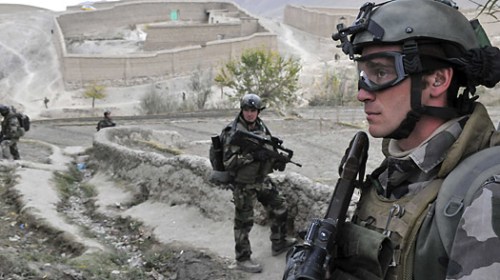
nato_france_a_0403French Troops in Afghanistan: The French, British and Canadians have the most Robust Rules of Engagement of Non US NATO Forces (Time Magazine Photo)
One of the best places to find such an example is the German relationship with their allies on the Eastern Front.  The question of the German dominated European Axis alliance in the Second World War is one of the more neglected subjects of World War Two II. In most accounts of the war, the relationship of the Germans to their coalition is minimal.  This includes the works of B.H. Liddell-Hart, Williamson Murray, Chester Wilmot and David M Glantz.   Italy usually receives some attention in the context of the campaign in North Africa and Mediterranean.  Hungary, Romania and Finland receive scant attention from anyone except as to how their armies were overrun during the Stalingrad campaign. Popular German memoirs provide little substantive help. Field Marshal Albert Kesselring’s memoirs and Erwin Rommel’s papers give some views of the Italian efforts in North Africa and the Mediterranean and Erich Manstein gives a limited amount of attention to the Italians, Finns, Hungarians and Rumanians in Russia.

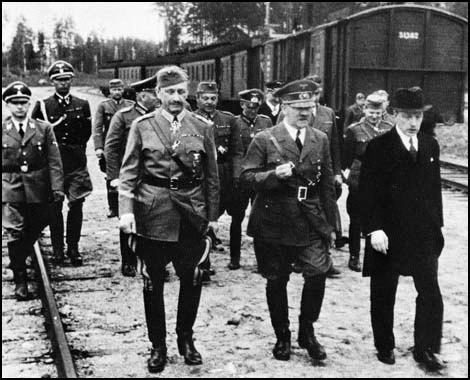
Finland-HitlerConflicting War Aims: Hitler with Finland’s Field Marshal Von Mannerheim
In his essay The Dysfunctional Coalition Robert Di Nardo examines the relationship of Germany to her allies on the Eastern Front where the Germans due to their own limitations were forced into a coalition war with weak allies of uncertain reliability. This is a subject that Di Nardo expanded on in his book Germany and the Axis Powers: from Coalition to Collapse (University of Kansas Press, 2005).  Di Nardo believes that there are important lessons to be learned from the failure of Germany and its coalition. Unfortunately we in the west are more often than not content to judge coalitions by the success of the Allies in the Second World War.  Di Nardo’s work on the subject is something that the United States must learn from as it works with coalitions whose members have significant military weaknesses often magnified by the domestic political climates in their own country. The situation, especially in Afghanistan places he United States in a similar position to Germany in relation to the current wars on terror and campaigns in Iraq and Afghanistan.

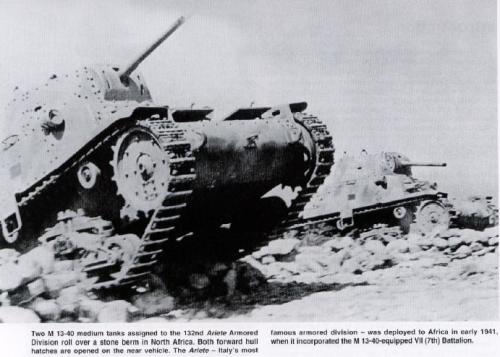
m 13-40 tankItalian M 13-40 tanks were the mainstays of Italian Armored Units, Slow, Undergunned and Poorly Armored they were No Match for Soviet T-34s

Di Nardo asserts “the way in which Germany conducted coalition warfare was reflective of the manner in which Hitler and the German military looked at the world, as well as the war in general.”  Germany often displayed a haughtiness toward its allies and even knowing their weaknesses was both unable and often unwilling to do much to strengthen them for the fight against the Soviet Union.  Di Nardo believes that the German attitudes were “a significant factor that contributed to the ultimate defeat of Nazi Germany.” (p.712)  In the essay Di Nardo notes the few successes of the coalition. In particular he looks at the German work with Rumanian air defense around the Ploesti oil refineries and the German-Finnish Winter Warfare School.  Apart from these instances he characterizes Axis coalition warfare on the eastern front as “poor” with “failures at every level.” (p.713)

italian troops stalino

Di Nardo analyzes the problems with language barriers, the wide differences of modernity of the armies and levels of technology and training of the coalition partners many of which are common to the war in Afghanistan. Germany’s failure to become the “arsenal of Fascism” which the United States became “the Arsenal of Democracy” for its allies hindered the Germans in their relationship to their poorly equipped allies.  Likewise, the lack of understanding of all the partners regarding the “relationship between national objectives, strategy and the morale of soldiers of officers and soldiers alike”(p.713) was a major obstacle.

finnish at gun

Di Nardo provides a good description of the German liaison detachments allotted to the coalition armies.  These teams functioned as advisors to their allies as well as liaisons between the German army and the allies. These teams dealt with language, tactical communications weaknesses and often displayed the generally haughty attitude that the Germans displayed to their partners. There is an excellent illustration of this in dealing with the failure of XLVIII Panzer Corps at Stalingrad when the German Liaison to the Romanian 1st Panzer Division was wounded.  At the operational and strategic levels Di Nardo describes the German policies and attitudes toward their allies as “imperialist.” (p.718)

He examines the wide gap in transportation capabilities of the various armies and the failure of the Germans to better provide for the needs of their partners in contrast to the United States assistance to her allies.   Germany provided obsolete captured Czech and French weapons and vehicles to her allies.  They refused to supply the Romanians and Hungary with the plans to build German tank and aircraft in Romanian and Hungarian industrial concerns capable of their manufacture. (pp.718-719) Di Nardo notes how this lack of modern equipment impacted the allies operations against the Red Army and their defeat at the hands of the Soviets.  Although Di Nardo alludes to how even elite German formations had substandard equipment he does not explain principle reason for this.   This was due to the fact that the Germans did not go to a “total war” footing in regard to industrial production until Albert Speer took over as Armaments Minister in 1943.

spanish blue divsion

The number of troops contributed by the German Allies was substantial. Hungary began Barbarossa with two corps, including its Mobile Corps and in 1942 supplied their 2nd Army which was composed of 1 Armored and 9 Infantry Divisions. 2nd Army was crushed by the Soviet offensive against Stalingrad. The Italians began with an expeditionary corps of 2 Semi-Motorized and 1 Light Infantry Divisions. In early 1943 they added 4 Infantry and 3 Alpine Divisions and a number of other smaller formations. This force became the 8th Army. It fought well during the advance toward Stalingrad but spread out over a wide front with little armored or air support was decimated by the Soviet offense against the city.  The remnants were no longer battle worthy and were evacuated to Italy.  Most of the Finnish Army was engaged in the war but after September 1939 made no major offensive contribution to the war. In 1944 following a major Soviet offensive which forced them to withdraw from the territory that they had captured in 1941 the Finnish government sued for peace. The Russians occupied a number of border provinces and islands and Finland was obliged to expel German Forces.  This resulted in the “Lapland War” between the Finns and the Germans with the Germans adopting a scorched earth policy as they withdrew from the country. The quality of the Finnish forces was generally higher than that of Germany’s other Allies.

romanian r35Obsolete French Built Romanian R-35 Light Tank
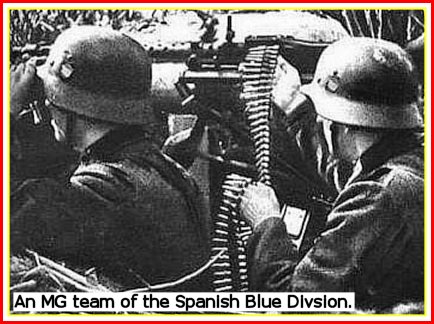
The Romanians contributed 19 divisions organized into 3 Armies to Barbarossa. They were limited by their equipment and logistics. The 3rd and 4th Romanian Armies were shattered at Stalingrad forcing a major reorganization as they continued the war.  In August 1944 with the Soviets pressing their border King Michael led a coup to overthrow the Fascist dictatorship of Antonescu. The Germans elected to fight and the Romanians changed sides and joined the Russian advance to the end of the war with their 1st Army taking part in the Prague offensive. Another contributor of troops was Franco’s Spain although it was a neutral country. Spain provided a division of volunteers which became the famous “Spanish Blue Division” or the 250th Infantry Division. It was outfitted as a German unit and received additional training from the Germans before it went into action. The division fought near Leningrad and was engaged in many tough fights.  A Spanish “Blue” Fighter squadron allotted to and equipped by the Luftwaffe also distinguished itself. In October 1943 Spain under allied pressure withdrew the division from the front although many soldiers volunteered to remain and fight on as smaller units attached to German formations. One volunteer company became part of the 11th SS Panzergrenadier Division Nordland at Berlin.  One thing that probably was a factor in the Spanish effectiveness as well as commitment to to German cause was their genuine loathing of the Soviets following the Spanish Civil War.

The final part of Di Nardo’s essay deals with the strategic goals and conflicts among the Axis coalition which were never worked out.  Examples of this include how the Finns never signed a formal alliance with Germany and how their national strategy did not allow them to deeper into the Soviet Union instead settling on recovering territory lost to the Soviets in 1939 with a few minor gains.  There was also the problem that the Romanians and Hungarians distrusted each other so much that they could not work together over their own territorial disputes.  The Italians joined the campaign late and their 8th Army participated in the German advance toward Stalingrad protecting the German flank.  While the Italians provided their own equipment including armor and aircraft they and their weapons were woefully suited for the war that they faced on the Eastern Front.  Di Nardo finishes his essay noting morale problems in the Hungarian, Italian and Romanian armies, the lack of understanding and general lack of motivation for the campaign.

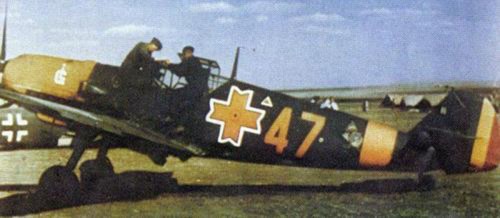
Romanian_Me109-px800Romanian ME-109 E4, The Romanian Air Force Was One of the Axis Success Stories
This article is well sourced. Di Nardo uses histories, archival sources, operational orders and analysis by the various armies as well as interviews with participants. Of particular note is that he goes to sources of the coalition partners and not just German sources.  This allows him to be far more nuanced and detailed in his discussion as opposed to others who simply ignore the contributions of the Axis partners.  His footnotes provide added detail and provide and lend support to his arguments.

The importance of this essay is twofold.  First it provides a look at the relationship of German to her coalition partners on the Eastern Front.  This is important from a historic standpoint simply because it is such a neglected topic in most histories of the period and gives added depth to the reasons for Germany’s defeat.  One has to ask the “what if questions” in regard to had the Germans better treated, equipped and recognized their allies’ contributions to the war effort.

The second and probably more important for Afghanistan is that it provides lessons to any nation which has to engage in coalition warfare.  In particular it has lessons for the United States which has found itself as the senior and vastly superior partner in a war which has multiple coalition partners in several theaters of operations.  Each coalition partner has certain military strengths and weaknesses in relationship to the United States, national interests, geo-political and economic relationships with competitors to the United States and internal political realities which impact their cooperation in the war.  As such the United States cannot allow itself to be cast in the role of a haughty imperialistic senior partner as did Germany.  The US instead must cultivate an attitude of assistance, respect and trust among its partners to assure their full cooperation and assistance in relation to U.S. goals in the war. This is particularly important now was it appears that the Afghan war is reaching a point where the deteriorating situation on the ground could invite the early withdraw of allies and necessitate either the addition of more US troops or a strategic withdraw which would be for all intents and purposes a defeat for the US and NATO. The consequences would not be good and while the Taliban may be able to be contained they undoubtedly would invite Al Qaida back and provide them with a sanctuary just as Pakistan has stepped up its efforts on the border.

Leave a comment

Filed under History, iraq,afghanistan, world war two in europe

Survival on the Home Front: Dealing with Other People’s Reactions to My PTSD

081

Being in Iraq  was in Many Ways Less Frightening than Being in the USA

I find it interesting and sometimes painful to see how institutions and some people within the institution will label those of us who have gone to war and came back as gooned up with PTSD.  The biggest tension and issue, and I admit it as my own is that we get stereotyped and sometimes viewed as “broken.”  I admit that I have issues, in fact a lot of frickin’ issues and I have a pretty good awareness of them.  I see Elmer the Shrink to help me through the rough spots but there are times when I bump across those that appear to use my condition as a weapon against me.  Whether it is intentional or not, it is not fun to deal with.  I’ve had it happen a few times since I have started getting help last year and every one of the people involved were people who have not been to combat to use a pejorative term from Vietnam they are REMFs .

I know several others who have experienced this mentality.  We all feel really vulnerable because all of us have opened up to people, or to use the Star Trek analogy to “drop our deflector shields.”  Pulling down shields makes you vulnerable, if you do it because you think you are in a safe area.  When you take “friendly fire” is really sucks. It is actually easier in theater.  If I was sent to Iraq or Afghanistan today I would be back in my element and probably suffer little from PTSD symptoms.  Sometimes I wonder if the Navy would be better off to ship me over again.  Admittedly with the health of my parents and a position at my medical center that is important for me to remain in for the time being, there is something that says at some point I need to go back, maybe not now but later.  See out there the PTSD defensive reactions fit.  There are bad guys and good guys, friend and foe and the body and brains’ reaction to real or perceived danger are natural.  I am wary of people until I figure out if they are friend or foe. When I make a mistake in my IFF it usually bodes ill for me.

When you come back out of that environment you find that even though you are “home” that you have changed and nothing is the same as it was before.  Your body and brain have divided the world into two camps, friend and foe or safe or unsafe or maybe even secure versus dangerous.  In my life I notice this with people as well as situations such as being on the road in our nutty Hampton Roads traffic which by the way even if you don’t have PTSD is quite the adventure I have become a very offensively minded defensive driver with faster reflexes and reaction time than I had before I went to Iraq.  I have to say that I am now a very aware person to perceived threats and actually that is not a bad thing of itself.  In Iraq I was probably operating at a 9 or 10 of ten on my perceptions of and reactions to real and perceived danger.  Since I have returned and gotten some therapy I probably operate at a 3.5 to 4 most of the time and depending on the situation move up higher sometimes being very aware of possible danger and hyper-vigilant .  Before I went to Iraq I probably operated at about a 1-2 on the scale of 10, pretty oblivious to danger and not too worried about it either.  Truthfully I am happy at an increased level of the 3.5-4 and maybe on occasion 5.  I don’t like getting up above 7-8 because it really makes a mess of my nerves and general requires that I take my docile pills.  Recently I’ve had a few of those days.  Trust me it is no fun to have a nervous tremor.  When that happens I feel like Gene Wilder’s character in Blazing Saddle’s Jim the Waco Kid response when Sherriff Bart (Cleavon Little) questions him:

Jim: Look at my hand.
[raises hand and holds it level]
Bart: Steady as a rock.
Jim: [raises his other hand, which is violently trembling] Yeah, but I shoot with this one.

Although I can occasionally find some morbid humor in what is going on with me I can’t say that it is any fun.

There is a perception by some, which I think is often systemic in parts of the military that people with PTSD are “broken.” Some in the system as well as others who have been granted the privilege of knowing your vulnerability consciously or unconsciously sometimes use it against you, I personally think it is intentional when this happens but I try to give the benefit of the doubt to the offender.  Like I said before this has happened to my on a number of occasions and in every instance I have felt attacked, devalued and re-traumatized and I don’t like that feeling and it takes me a while to get back through all the crap.  When it happens to me I get angry, defensive and now as opposed to my pre-Iraq life will shoot back.  I’ve stopped rolling over and letting people get away with this behavior and when I see it happen to others I get equally pissed.  Unfortunately I have a number of friends who have had similar experiences and as we share our stories we realize that some people or even the system in general will write you off as damaged goods.  What is the bad thing is that the worst comes from people who have not been in harm’s way.  Likewise, if they went to a combat zone never left one of the big FOBs and never had to deal with the danger of being outside the wire. Nor have they experienced what many medical personnel who remained on the big FOBs experienced in dealing with never ending trauma of dealing with the death, wounding and suffering of young Marines, Sailors, Soldiers and Airmen.  Another group are the men and women who perform the tasks of getting the fallen back home.  One of my Chaplain friends had this job in Kuwait and had to meet every aircraft with the bodies of the dead leaving theater performing memorials and conducting honors all the time caring for those who cared for the bodies of these Americans and came back in pretty bad shape.

What saddens me is that this still attitude of men and women dealing with PTSD being “broken” or as one called me a “shipwreck” happens even though we have been making the conscious effort since Vietnam to treat people traumatized by war.  The end result is that those who are traumatized are again and again re-traumatized by the system as well as individuals in it.  I have seen enough of this to make me throw up. Thankfully the Navy as a whole does better in this than the Army, Marines or Air Force but there is a lot to be done.   When I have a REMF screw with me or my friends it does get to me and I can say that I get angry and the person moves out of my “circle of trust.”

Likewise I get discouraged and when I see my countrymen from both of the major political parties, elected officials and regular party members tearing themselves and the country apart because of the hatred that they have for each other and each other’s positions on the issues that face our nation.   I came home at the beginning of the 2008 primary season and within a short time became quite disheartened by what I saw on both sides of the line.  There is no civility in the land and no peace at home for those of us coming home from war.  We come back and see our brothers and sisters, fellow Americans all saying and doing things doing things that can only in the long run further divide and destroy the nation.  I can understand the anger that the returning German soldiers and sailors of the First World War came home to in 1918-1919.  It seems that the only thing that we lack to be like Weimar Germany is for right and left wing militias begin fighting in the streets, killing each other and trying to take over power by force.  As it is these are fighting at political rallies and raising the invective to frightening levels.  In the case of one protest men brought semi-automatic assault weapons to protest outside of a venue the President was speaking at.  They said it was a Second Amendment rights protest but all that is needed is for one deranged individual to act on a homicidal urge to blow the whole damned place up.  I have seen the results of such folly in both the Middle East and the Balkans and I just don’t get it, it is frightening to me and the extremists on both sides of the political spectrum seem like they are doing their damnedest to destroy the country that I love so much and went to war to serve. Regardless of what extreme they are on I just say a pox on them all.

I have been asked a number of times why I would open myself up and show my vulnerability on this website.  It is certainly not for fun when I deal with this subject because I am really wound up in it.  When I write I often have to live the experience again. While many times this is emotionally draining it is something is something that I know that I have to do.  I know so many vets from the current wars and Vietnam who struggle with some of the very things that I do and often a lot more but do not have the ability to really share their stories.  The Marines who fought at Hue City are a group that I still have contact with as are people from my last base chapel job, the Vietnam Veterans of America men who man the beer stand at the Church of Baseball Harbor Park Parish, Wayne the Army Chaplain and decorated Vietnam infantry scout who dealt with his own PTSD and helped me in my discernment process to become a Chaplain.  Likewise I have this connection with my brothers and sisters who have served in Iraq and or Afghanistan.  In a sense what I want to do in my articles about PTSD as well as those about my tour in Iraq is to help people who have not been or not experienced this to get some understanding of what happened to me and to many others.  I don’t want guys to fall through the crack like in Vietnam and I think that educating the public is the best way of raising the issue and helping people care for us.  So I guess this is my “cause” and maybe even a crusade.  I hope and pray that those who love and care for our combat veterans who read this will take the time to learn, take the time to care and take the time to be with us as we walk through the often dark places that we walk.

Today was not a good day for me it was very painful but at least I was able in this post to use it to help explain what we who deal with our return from war go through.  I guess that the Deity Herself knew what she was doing today.  Pray for all of us who live in the surreal world of PTSD as we pray for you and our nation.  Pray for me a sinner.

not a happy camper

Peace,

Steve+

4 Comments

Filed under iraq,afghanistan, Military, PTSD

Japan’s Self Defeating Attempts to Become Economically Self Sufficient in the 1930s

This is the first of a two part series that explores the similarities of the United States in 2009 to Japan of the early 1930s.  It explores the topic of economic self sufficiency or “autarky” and how nations can put the proverbial cart before the horse in terms of seeking ways to become self sufficient.  The Japanese chose the path of military conquest seeming to forget the fact that they were dependent on natural resources and manufactured equipment to wage such a war by the nations that they were attacking.

In the early 1930’s Japan’s desired to emulate the economic self-sufficiency of the United States or to achieve autarky controlling its own economic destiny by securing sufficient natural resources.  Japanese industrial and military leaders felt that such was needed for economic expansion as well as military preparation and expansion.  Key resources such as oil, specialized steels and alloys, iron ore, coking coal, machining tools and even cotton were not readily available in Japan proper.

Japans’ goal was unrealistic based on the differences of the two countries. In the early part of the 20th century the United States was self-sufficient in most critical natural resources and was a key supplier to the world of oil, iron, coal and grain.  Additionally most of the United States’ resources were contained within its borders or provided to it in trade with nations that needed what the United States had to offer in manufactured goods.  Japan did not have this.  As a nation it had few natural resources on the home islands and even suffered food shortages that resulted in famine at times.  It was dependant on other nations for basic natural resources to power its economy and to feed its population. As a result some of its political, economic and military leaders looked to achieve autarky through conquest.

Unfortunately for the Japanese they were surrounded by numerous powers that stood in their way.  To the north was Russia, which they vanquished in the 1905 war, but in doing so ended up nearly bankrupt, though they gained the Korean peninsula. However, the Japanese now faced the Soviet Union with its immense military on the Manchurian border and subterfuge in the politics of China by their support of Mao Tse Tung’s Red Chinese forces.  The Japanese were able to gain some possessions by participating on the Allied side in WWI at the expense of Germany and China, though they did not achieve all they wanted and felt cheated by the Allies at the Versailles peace conference. The first step was to invade Manchuria and seize its natural resources in 1931.  However to gain more than what they could garner in Manchuria the Japanese would have to do so at the expense of China and the Western Colonial powers, France, Britain, the Netherlands and United States. Japan’s quandary was how to achieve autarky without resorting to war with multiple enemies.

The Japanese faced a sort of “chicken or the egg scenario” as to what came first. In order to wage war Japan needed iron ore, coking coal and industrial salt from North China, oil from Borneo and Southeast Asia, cotton from America to make finished products for the American market. Likewise it needed special steels and alloys from the US to supply the war effort. The US was also the primary source of Japan for machine tools and other sophisticated industrial equipment needed for Japanese industry.  To go to war the Japanese required the imports of the very nations who stood in their way.

Yet to go to war entailed great risk, Japan did not have the resources, especially oil and metals with which to sustain their war effort without maintaining foreign trade with the very countries that they would have to engage in war.  All of these factors together made autarky in the style of the United States unreasonable through military means alone. It is likely that the Japanese could have achieved more by using more skillful diplomacy during the 1930s.  Had they built a mutually beneficial alliance with China, did more to exploit the natural resources of Manchuria and negotiated favorable trade deals with the United States they probably would have accomplished more than they did through using military force.  Some Japanese reformers attempted to make some of these reforms but were unsuccessful as the military particularly the Imperial Army, the government and industrial concerns became locked into the military option.

By contrast during its growth period the United States did not have to deal with significant military powers as it moved west across North America, only Native American Tribal groups.  The only power capable of stopping the United States was Great Britain.  While there were tensions between the United States and Great Britain along the Canadian border and Pacific Northwest during the 1850s, the United States never faced a significant external threat.  Thus the United States using very little military power gobbled up the continent and established its status as the Hegemon of the Western Hemisphere.  Japan could not do what it needed to do unless it negotiated with or conquered the powers that had significant military power to confront the Japanese and economic ability to strangle the Japanese economy.

This period should interest to any student of history, foreign policy and economics.  The study of the period of Japanese history needs to be considered by policy makers when considering war to obtain natural resources or critical supplies not indigenous to their country or for which they are dependent on potential hostile suppliers.  Like Japan in the 1930s the United States is not currently self sufficient in many natural resources especially oil and is dependent on other nations, especially China for critical items in its economy.  Having surrendered much of its industrial capacity and having failed to exploit alternatives to fossil based fuels, especially oil the United States faces a conundrum similar to the Japanese in the early 1930s.  The United States is militarily strong yet deeply politically divided and possibly unstable.  The United States is dependent on many nations, some who outwardly hostile to us for the very lifeblood of its economy.  Like the Japanese the military is singularly incapable of securing all of these resources and engaged in multiple wars that are tying up close to half our ground forces when one considers troops in theater and those unavailable because they slated to go or having just returned from combat deployments.  Additionally like the Japanese who were in the midst of the Great Depression the United States is going through what appears to be the worst economic times since that period.  Policy makers need to be careful when dealing with situations where economic factors are diminished and natural resources have to be imported to sustain the economy. Autarky is fine if you can do it but the United States has more in common economically with Japan of the 1930s than the we would like to admit.  Something to think about.

The second concluding section of this will be published in the next few days, the Deity Herself permitting…

Peace,

Steve+

5 Comments

Filed under History, Military

Memorial Day 2009- Thoughts and Musings

I am again at the Medical Center on duty, but this not a bad thing.   Before I begin my post I want to direct you to the post of the Abbess of the Abbey Normal and her thoughts on this Memorial Day.  Her post is linked here: http://abbeynormalabbess.wordpress.com/2009/05/25/memorial-day-musings/

I Have also posted several links in this article. Peace, Steve+

ports hosp cemetary 2Conaway Cemetery Portsmouth Naval Medical Center

I have been thinking a lot about the significance of Memorial Day the past week.  I think about it more now than I used to.  Now I have always thought a lot of it and observed it the best that I could.  Yet having now been “boots on the ground” in Iraq travelling about the battlefield to take care of the spiritual needs of American Marines and Soldiers serving as advisers with the Iraqi Army, Police and Border forces it has more meaning.  I am now a combat veteran.  Last year I joined the VFW.  I came back from the war different, PTSD kind of goons you up sometimes.  I spent most of the past 15 months dealing with this, not sleeping and being in chronic pain.  I’m now doing much better.  In part this is due to the support I have at home and a work and the fact that I am no longer isolated.  Being on staff at our Naval Medical Center has been good for me and I do not resent being the Duty Chaplain on this Memorial Day.  I have far too many wonderful people I work with here to think anything like that.  It is an honor to serve here with such fine people, Physicians, Nurses, Chaplains and other medical and support staff.

ports hospt cemetary 1Another View Conaway Cemetery

Today has been really good no matter how the night goes.  I participated in the annual Memorial Day observance at the historic Naval Cemetery on our grounds.  It is but a mere two acres of land and dates to 1838 when it was established to allow the remains of those who died far from their homes repose. It has Navy Sailors, Marines and their families.  It also holds the remains of Sailors from Great Britain, Russia, Germany, Japan and Brazil who died in the Norfolk area.  Additionally the remains of Sailors of the Confederate States Navy are buried here.  The service was organized by the Local Chapters of the Fleet Reserve Association, supported by the local Boy Scout troops and attended by veterans, active duty members and dignitaries from the City of Portsmouth City Council and a State Senator.   It was a simple yet moving ceremony which involved a wreath-laying as well as Amazing Grace played on the Bagpipes and Taps.  Our Color Guard presented the colors and our Commanding Officer, Rear Admiral Kiser was the guest speaker.  Local news services were on hand to televise it, just as they televised others services throughout the region.  One of these was on the Battleship USS Wisconsin which is the centerpiece of the local maritime museum at Norfolk’s Nauticus venue.

Our hospital is interesting.  It dates to 1826 and is the first Naval and for that matter military hospital in our country.  The motto here is First and Finest. Building One is the original hospital.  It has a glass dome which at one time lighted the operating theater.   It now is our command building with other administrative offices.  The hospital has served in peace and war and was instrumental in the 1850s in caring for the victims of the Yellow Fever epidemic.  It is now a teaching hospital and multi-faceted medical center with a national reputation.

The time at the service was neat as I mixed with our veterans of World War Two, Korea, Vietnam, Desert Storm and the current wars.  Many proudly displayed their medals, ribbons and badges.  When the National Anthem was played these men and women saluted as smartly as when they were on active duty.  Many are involved with local veterans groups and some are volunteers at our hospital taking time to care for the needs of our patients and families.  Among the dignitaries was Councilman Charles Whitehurst who is a member of the small historically black Episcopal Church where I worship.  Mr. Whitehurst enlisted in the Marines in 1955 and rose through the enlisted ranks to Sergeant, was appointed as a Warrant Officer and the Commissioned as an Officer.  He retired as a Major after Vietnam.   Afterward Admiral Kiser was the Grand Marshal of the Portsmouth Memorial Day Parade, which is the oldest and longest running in the nation.   A link to a local station’s coverage of this event is here: http://www.wvec.com/video/index.html?nvid=364992&shu=1

I was able to catch a glimpse of President Obama’s wreath laying at Arlington National Cemetery where in in short and solemn remarks he noted: “Why in an age when so many have acted only in pursuit of narrowest self-interest have the soldiers, sailors, airmen and Marines of this generation volunteered all that they have on behalf of others,” he said. “Why have they been willing to bear the heaviest burden?”

“Whatever it is, they felt some tug. They answered a call. They said ‘I’ll go.’ That is why they are the best of America,” Obama said. “That is what separates them from those who have not served in uniform, their extraordinary willingness to risk their lives for people they never met.”

I think that his remarks were perfect and honored those who serve now and those have gone before us.

The last service of this type that I attended was at the US Cemetery at Belleau Wood, France. It is the site of the battle in which the Marines in their first battle of World War One turned back the assault of the German Army which was advancing on Paris and launched a counter-attack.  I was with Marines of the Marine Security Forces who were conducting a joint memorial service with French Marines.  The next day I visited Normandy with the Marines and taught classes to them on the battle, looking at it from the German perspective.  The day prior to the service I taught parts of the “staff-ride” of the battlefield discussing various aspects of World War one tactics, weaponry and equipment.

me at normandyWith Marines at Normandy

This is also most likely the last Memorial Day that my father will be alive.  He served as a Navy Chief Petty Officer and retired in 1974.  In 1972 he served “boots on the ground” at the city of An Loc which was surrounded for 80 days by the North Vietnamese Army.  He was my inspiration to serve in the military.  There are many veterans of World War Two, Korea and Vietnam who like him are in the twilight of their lives.  I do pray that all will be remembered this Memorial Day.  I was able to be with him the week before last.  I expect it will be the last time that I see him.

McCains Special BaseballTed Williams as USMC Aviator

One interesting thing that I want to mention before I close was the effort that many professional ball players made back in World Wars One, Two and Korea.  Some of the top players of all time gave up some of their prime playing years to serve.  Christy Matthewson served in the Army in France during World War One. He was gassed and developed Tuberculosis and died at the age of 45 in 1925 never playing again.  Yogi Berra served as a Navy Gunners Mate at D-Day.  Ted Williams served in both WWII and Korea as a Marine Corps fighter pilot.  He lost nearly 5 seasons to his service. One who studies statistics in baseball might want to extrapolate the numbers that Williams might have had if he had played on instead of serving.  Hank Greenberg the first Jewish Major League superstar was drafted in 1940 and released just before Pearl Harbor when Congress voted to send men over 28 home. He then re-enlisted, was commissioned and served in the China-Burma-India Theater.  Joe Dimaggio enlisted in the Army Air Force and served 2 ½ years from 1943-1945. Bob Feller volunteered for the Navy on December 8th 1941 and spent 4 seasons on the USS Alabama as a gun captain. Pee Wee Reese served in the Navy in the Pacific while Jackie Robinson served as an Army Officer and Larry Doby served in the Navy before breaking the color barrier to play Major League baseball.  Whitey Ford, Willie Mays, Eddie Matthews and Ernie Banks were all called up for Korea along with Williams.  Roy Gleason of the Dodgers was the last player to earn the Purple Heart as an Army Sergeant in Vietnam. Of course the world has changed.  We have an all volunteer military no current Major League players, or for that matter NBA, NFL or NHL players serve in the military but many donate time and money to support military members and their families including Giant’s pitcher Barry Zito and Orioles pitcher Jamie Walker.  Working with USAA these men have founded a non-profit group called “Strikeouts for Troops.  A link to that organization is here:  http://video.yahoo.com/watch/3462236/9644105

Pat Tillman a defensive back for the Arizona Cardinals enlisted after 9-11 and was killed during a “friendly fire” incident while serving as an Army Ranger in Afghanistan.  He has been the only NFL, MLB, NHL or NBA player to volunteer for active duty in the current war.

Here are a few links to some baseball and veteran stories:

Link to video of Baseball Hall of Fame Player Monte Irvin talking about his service in World War Two: http://www.youtube.com/watch?v=OKERxyAbg1w and link to Indians and A’s player Lou Brissie’s WWII experience: http://www.youtube.com/watch?v=SFwAXNR9q-k Jerry Coleman on his Marine Corps time as a dive bomber pilot: http://www.youtube.com/watch?v=wUlBgBxaWoY

Bob Feller’s, Buck O’Neal and Phil Rizzuto’s WWII memories:  http://video.search.yahoo.com/video/play?p=bob+feller+american+veterans+&n=21&ei=utf-8&js=1&fr=yfp-t-105&tnr=20&vid=0001463818096 and here: http://www.youtube.com/watch?v=CRyILkx_c2U

Link to Rick Monday’s saving the flag at Dodger Stadium in April 1976:  http://www.youtube.com/watch?v=IrV8QPQAhxo&feature=related

goldstar

Let us remember our veterans, especially those who gave the last full measure to serve our country. Support the Honor and Remember flag campaign as well as the “Blue Star” and “Gold Star” families whose loved ones currently serve or have died on active duty in this time of war.

Peace, Steve+

1 Comment

Filed under Baseball, History, iraq,afghanistan, Military, PTSD, vietnam