Monthly Archives: September 2012

Padre Steve Defends Mitt Romney against Extremism Talk

Mitt Romney has had a rough time as of late and I have decided that I will not pile on. Mitt Romney used to be a moderate like me and for that I have a soft spot for him in my heart. As a patriotic American and moderate I know that Governor Romney has a one in two chance of becoming the next Commander-in-Chief and I will not stand for anyone diminishing Mitt’s potential Commander-in-Chiefyness. I want him to be the most Chiefy Commander-in-Chief of all time if he is elected President.

Too many extremists have attacked this fine American over the past few weeks and months. I know that I have criticized Mitt but I won’t take it anymore because I was for Mitt before I was against him and I won’t have anyone call me a flip-flopper because when I wear open toed shoes I wear Birkenstocks.

To start with I won’t be like former Senator and Presidential candidate Rick Santorum who called Governor Romney “the worst Republican in the country to put up against Barack Obama.” I object to Senator Santorum doing this because there are other Republicans who have to be worse than Mitt and Santorum’s criticism is obviously that of a sore loser and Romney is a winner.

General George Smith Patton, bless his holy name, said in the movie Patton:“America loves a winner and will not tolerate a loser.” I’ll tell you what, Mitt Romney is not a loser, except for the time that he lost to Teddy Kennedy when he ran against that Commie for the Massachusetts Senate seat, and when he lost to the man that lost to President Obama for the GOP nomination in 2008, Senator John McCain. But apart from that Mitt has never known defeat.

I am tired of pundits like American Family Association spokesman Bryan Fischer who gloated “If Mitt Romney can be pushed around, intimidated, coerced, co-opted by a conservative radio talk show host in Middle America, then how is he going to stand up to the Chinese? How is he going to stand up to Putin? How is he going to stand up to North Korea if he can be pushed around by a yokel like me? I don’t think Romney is realizing the doubts that this begins to raise about his leadership.”

I think that Fischer’s comments are below the belt. Mitt Romney will not be pushed around by anyone and he has proved that at an early age. When a non-conformist classmate in his obscure elitist prep-school disrespected that school and grew his hair long Mitt took action. He demonstrated the greatness of American organization and toughness by rallying a number of other classmates to help him chase this hooligan down and hold him down while Mitt cut the screaming baby’s hair to the regulation length. That’s how he will stand up to the Chinese. Do you think that Gang-Bang-Wang of China or Kim-Long-Dong of North Korea want Mitt to rally America to hold them down and cut their obviously badly cut and cheaply dyed hair? I know that they don’t.

When some of Mitt’s competitors in the 2012 GOP primaries threatened him, Mitt did not take it lying down. No he carpet bombed their sorry asses, destroyed their candidacies and won the nomination. He Nagaski’d them like he will do Iran. That is the mark of a decisive leader.

I’m tired of those that criticize Mitt’s business ethics and compared him to a vulture like Texas Governor Rick Perry who complained to Sean Hannity in January: “There’s a real difference between venture capitalism and vulture capitalism. Venture capitalism we like. Vulture capitalism, no. And the fact of the matter is that he’s going to have to face up to this at some time or another, and South Carolina is as good a place to draw that line in the sand as any. That’s not what we’re looking for in a president of the United States. We’re looking for someone that knows how to build jobs, create jobs. And that’s what I’ve done in the state of Texas. So there’s no use trying to paper this over. That is a problem for Mitt, and he’s going to have to face it.”

I’m sorry Governor Perry, Mitt has met that challenge. He looks nothing like a vulture. Look at that hair. It is amazing. I wish I had hair like that. Did you ever see a vulture with hair like that? I think not. Check your facts governor because they don’t matter to us anyway.

Then there are those like former Governor of Arkansas and Fox New commentator Mike Huckabee who criticize Mitt’s conservative credentials. Huckabee had the nerve to write in his book saying that Mitt “spent more time on the road to Damascus than a Syrian camel driver. And we thought nobody could fill John Kerry’s flip-flops! … [Romney’s record was] “anything but conservative until he changed all the light bulbs in his chandelier in time to run for President.”

That was not fair and Huckabee should be ashamed. A man who buys his outsourced made in China chandelier from Wal-Mart should not criticize a man who financed the company that manufactured it and who would never stoop to changing a light bulb that his janitor should have done before it got dark. Mitt would fire that janitor and hire someone else to change those bulbs. Shame on you Mike Huckabee.

Rick Santorum joined in that criticism saying that Romney “is the ultimate flip-flopper….” That dear reader is not fair. Governor Romney has had to defend himself against many scurrilous charges. I mean Mitt has had to defend himself because President Obama had the nerve to steal his Massachusetts health care plan and name it after himself. Can you believe that? It is horrendous and a scandal and Governor Romney should deny any responsibility for President Obama’s shameful swiping of his idea.

I cannot imagine Mitt being a “flip-flopper.” There is no proof that Mitt wears outsourced flip-flops made in China or Pakistan. No, it is sure that Romney wears Sperry Top-siders when he is on his luxury yacht because everyone knows that open toed shoes are dangerous to wear about ships. Mitt understands that you need to protect your toes, because a nation without leaders is like a foot without a big toe.

I am also tired of those that have criticized Romney for speaking French like Newt Gingrich did during the GOP primaries. Gingrich was trying to equate Mitt with Senator John  Kerry, who was awarded the Silver Star, Bronze Star and Purple Heart for killing Commies in Vietnam before he was against killing them. Mitt speaks French as does Kerry, but Mitt is different. Unlike Kerry who went to Vietnam and then shamefully protested against the war, Mitt was for the war. He was a patriot and protested for the right of the government to draft others to go fight and kill the Commies like every good American should have done. Romney then sacrificed several years of college hijinks and venture to France to convert the heathen French and eat Fois Gras and Escargot for three years as a missionary while avoiding the wine and beer. That is a sacrifice. When I went to France I only ate in Italian restaurants and only drank wine and beer. Besides, speaking French is like speaking the language of the enemy. When some pinko-socialist French atheist writer mocks America in French, Mitt will understand those words and bomb Paris in retaliation.

And finally in defense of Mitt, I condemn those like former Reagan speech writer and conservative Wall Street Journal Columnist Peggy Noonan and call Mitt’s management of his campaign “incompetent” and “in need of an intervention” or Bill Kristol who called Mitt “stupid and arrogant.”

I am sorry, those comments are below the waistline of Mitt’s magic underwear, which he evidently doesn’t wear to bed according to what he told Kelly Ripa. I won’t stand for it anymore. I refuse to take part in the heresy hunt of these extremists. This is the United States of America and Mitt Romney just might be our next Commander-in-Chief and I don’t want to diminish his Chiefyness.

That’s just my take, I want to stay classy.

Peace

Padre Steve+

2 Comments

Filed under Just for fun, Political Commentary, satire

Missed Opportunities: The Allies in Europe from Mortain to Market Garden

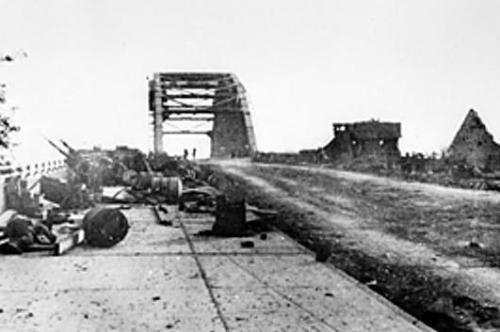
Arnhem Bridge

In 1985 Judy and I visited her cousin and her family in the Netherlands when I was an Army Lieutenant in Germany. Since I was a history major in college and had done a lot of reading and study about Operation Market Garden, which most people associate with the movie A Bridge Too Far I decided that on our way back to Germany that we needed to stop by Arnhem and Oosterbeek to visit the battlefield and the British Airborne Museum. It was one of those places that even today evokes poignant memories. When we walked through the British cemetery across from the museum which is in the former British headquarters, the Hartenstein Hotel I saw a grave marker. It read Capt. J.S. (James Strathern) Dundas, 7th KOSB (7th King’s Own Scottish Borderers) of the British 1st Airborne Division. He was the 2IC, or Executive Officer of Company B of that Regiment. He assumed command of the company on the 19th after its commander was reported missing in action. He commanded the unit until his death on September 25th when commanding the rearguard of the battalion as it and the remnants of the 1st Airborne Division evacuated the bridgehead over the Rhine. It was a sobering reminder of the cost of war. 

Grave marker of Captain J.S. Dundas at the British Cemetery at Oosterbeek

September 17th was the 68th anniversary of the Allied attempt to liberate the Netherlands, secure a crossing across the Rhine and plunge into the heart of German industry and war making capacity the Ruhr basin. The plan is better known as Operation “Market-Garden” and was the first major use of Airborne Divisions in a strategic jump versus a tactical or operational mode.  What made this operation different was the distance that the Airborne would be dropped from the front lines and the number of obstacles that the ground troops would have to cross to get to them.  It was a high risk strategic plan to end the war early.  However this operation did not occur in a vacuum and was the product of operational and strategic decisions that the Allies made from the time of the Normandy breakout.  Each decision was made on the fly as the situation rapidly developed from a static slugfest in the hedgerows to the pursuit of a broken enemy.  As the Allies advanced across France decisions had to be made of how the advance would be made which became a major bone of contention between Eisenhower and his subordinates.  To understand how the Allies got to the point of launching Market-Garden one has to look back at the events leading up to it beginning with the Allied decisions made shortly after the breakout.  The actual campaign does not always correlate to popular myths nor does it allow for a uncritical analysis or generalization of the events which made up this part of the campaign in Western Europe.

It is a campaign that teaches us even today that mundane things such as logistics, weather and the failure to recognize moments of opportunity and times for caution matter in a military campaign. The campaign is a reminder that every military campaign has risks and that even crippled enemy can inflict costly defeats on superior forces and regain lost initiative. 

Introduction 

Patton Bradley and Montgomery, Time Magazine Photo

Lieutenant General Omar Bradley’s 12th Army Group breakout from Normandy opened a realm of possibilities for the Allies to defeat the German Army in detail and end the war.  The manner in which the Allies exploited their success and their failure to destroy the German Army in the west in the late summer of 1944 was a key factor in prolonging the war.  Both the Allies and the Germans faced challenges due to the change in the nature of the campaign. For nearly two months they had waged a nearly static war of attrition in the Norman hedgerows.  The breakout changed the dynamic of the campaign to one of maneuver.  In the post-breakout period the Allies had several opportunities to envelope large portions of the German Army in western France, Belgium and southern Holland.  The campaign became one of maneuver and a “commander’s battle” in which it was “the decisions of the generals that determined the manner in which events unfolded in August, their successes and failures which brought about the position that was achieved by September.”[1] Prior to the breakout success in the hedgerows was determined on “the ability of British, American and Canadian units to seize ground from their German opponents on the next ridge, the next hedge, beyond the next road.” [2]The change would expose the weaknesses in the quality of allied generalship and logistics management.  The Allies failure to recognize the ability of the Germans to recover from disaster conspired with key elements in the campaign to end the war by Christmas.[3]

Grenadiers and Tanks of 12th SS Panzer Division (Hitler Jugend) in Normandy

A key decision reached early in the campaign was for Bradley’s XII Army Group to capture Brest and other Brittany ports.  This decision meant that when 3rdArmy exploited the break out the preponderance of its forces went west, the opposite way that the battle was developing.  This deprived the Americans of forces and logistical assets that could have supported the envelopment of the major part of the German Army still engaged in Normandy. Russell Weigley lays the blame for this decision on Bradley.  The dash into Brittany did little to help the Allied logistical problems and diverted much needed troops away from the focal point of the action in Normandy.[4] Hastings criticizes Bradley’s lack of imagination in the initial stages of the breakout in adhering to the original OVERLORD exploitation plan[5] rather than adapting to the situation on the ground. Patton’s biographer Carlo D’Este seconds this opinion and it makes sense from an operational standpoint.[6] Why send significant forces to an area far away from the critical part of the battle for little practical gain?  In the end German forces held out, in some cases to the end of the war, denying the Americans the use of the ports either by just holding out or by demolishing the port facilities.

Mortain: German Counter Attack and the Short Envelopment

The American exploitation of the breakout, notably by elements of Patton’s 3rdArmy pushing east combined with the continued pressure of the British Army Group toward Falaise. The breakout forced forced the Germans into a strategic decision to attempt to restore the front in Normandy or withdraw to the Seine or further east as there was no “defensive position short of the permanent fortifications of the West Wall on Germany’s frontier offered so many defensive strengths as the Normandy line the Americans had just breached and turned.”[7]

With limited options Hitler determined that German forces again needed to ensnare the allies in the hedgerows.[8] There was disagreement between Hitler and Field Marshal von Kluge regarding the offensive while von Kluge opposed it.  Hitler believed that the American breakout gave the Germans a chance to cut off the American forces in Brittany and possibly more believing that “once the coast had been reached at Avranches a beginning should be made with rolling up the entire Allied position in Normandy!”[9]

The German attack named Operation Lüttich was led by XLVII Panzer Corps assisted by elements of 1st SS Panzer Division.  Despite warnings from ULTRA the panzers achieved tactical surprise on the front of the 30th US Division at Mortain on the night of 6-7 August when the Germans attacked without the customary preparatory artillery bombardment.[10] The Germans made initial progress against the 30th Division which had recently taken over positions at Mortain.  However the 2nd Battalion 120th Infantry “Old Hickory” Regiment held key ground which enabled them to call artillery fire and air strikes on German forces attempting to advance on Avranches.[11] The Americans quickly reinforced 30th Division with elements of 2nd Armored Division, 35th Infantry Division and the veteran 4th Infantry Division to hold the line against the weakened German Panzer divisions.  Bradley and other American commanders viewed Lüttich as “an opportunity, not a threat.”[12] Bradley was “not merely confident of withstanding them, but expected to destroy them.”[13] Bradley attempted to lure more Germans into the potential trap by radio transmissions hoping that the Germans to persist in their attacks around Mortain.[14]

American Armor Advancing in Normandy

The German plan included the use of a significant number of aircraft to support the attack.  However this did not happen and German troops were furious at the failure of the Luftwaffe to shield them from Allied air attacks which devastated the Panzers.  The 300 fighters promised by the commander of Luftwaffe forces were engaged by British and American fighters and savaged so badly that no Luftwaffe units made an appearance over Mortain.[15] Despite some local success the German ground forces were turned back by the Americans who did not even halt their eastward movement further imperiling the German forces in Normandy.

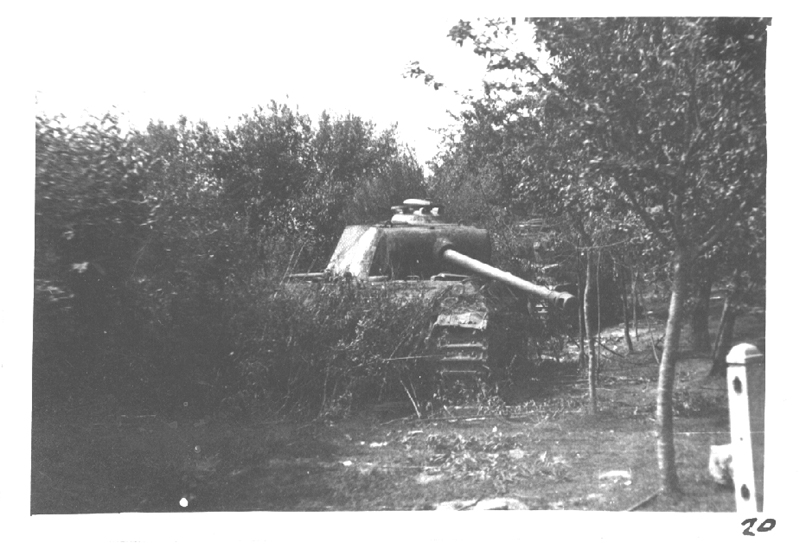
Knocked out Panzer V Panther Tank at Mortain

With the Germans ensnared at Mortain, the 3rd Army driving east and the Canadians advancing on towards Falaise, Bradley suggested a short envelopment in which over 100,000 German troops would be trapped between the Patton’s troops and the Canadians who had opened their TOTALIZE offensive from Caen to Falaise on August 8th.  This modified plans for a deep envelopment by XV Corps of 3rd Army to entrap the Germans against the Seine crossings with an operation that might promise “still surer results.”[16] Speaking to Secretary of the Treasury Henry Mongenthau Bradley said that “he told the Cabinet officer he had “an opportunity that comes to a commander not more than once in a century. We’re about to destroy and entire hostile army.”[17] However the short envelopment was predicated on the Germans continuing their advance, had they as Hastings notes “behaved rationally, recognized the threat of envelopment to their entire front and begun a full-scale retreat east, then Bradley could indeed been accused of losing his armies a great prize.”[18]

The decision to turn the better part of 3rd Army west into Brittany deprived Bradley of forces that could have better accomplished the mission of enveloping the German 7th Army.  General Wood of 4th Armored Division to his dying day “remained embittered over the lost opportunity”[19] lost when his division was turned back into Brittany rather than being allowed to move east toward the Seine.   Weigley points out an even deeper flaw regarding the Brittany decision that was that OVERLORD planners “had not thought anything resembling the Avranches breakout and pursuit without pause to the Seine likely…” Weigley critically stated that it is among the worst forms of generalship that takes counsel of its fears. Yet that was exactly the condition of OVERLORD logistical planning.”[20]

The Falaise Pocket

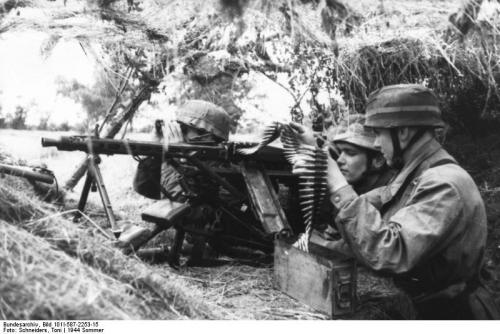
Fallschirmjaeger in France

The Allies did have a chance to destroy the German 7th Army.  LXVII Panzer Corps and II SS Panzer Corps as well as the remnants of II Parachute Corps and other formations battered in Normandy were attempting to move east from Mortain following the failure to break through.  The remnants of I SS Panzer Corps led by 12 SS Panzer Division Hitlerjügend and various battle groups of other decimated divisions and Army units such as 21st Panzer Division offered determined resistance to the Canadians toward Falaise.  In the south only scattered Kampfgruppen of divisions shattered in Normandy opposed Patton’s forces at Avranches.  These German units, outnumbered and without air support were aided by a fortuitous decision of the commander of the 2nd French Armored Division to move a combat command along a road needed by the American 5thArmored Division.  The delay allowed the Germans to send a battalion into the town which could have “fallen easily a few hours before.”[21]

Grenadiers of the 12th SS at Falaise

At this point the Allies were bedeviled by several failures which prevented the short double envelopment from occurring and allowed the remnants of 7th Army to escape to fight again. The Germans suffered grievous losses in men, material, and especially armored fighting vehicles, artillery and motor transport but more often than not their units retained their cohesion and ability to operate.

Carnage in the Falaise Pocket

The first failure belonged to the Canadians who failed to push the Germans out of Falaise despite overwhelming material and air superiority.  The Canadian attack Operation TOTALIZE was planned by the best of the Canadian generals, Simonds.  The operation began on a promising note but bogged down halfway to Falaise due to a quick counterattack by 12th SS Panzer kampfgruppen. The Canadians were not helped when a misguided bombing attack by “friendly” air units hit them rather than the Germans.  Likewise the inexperience of the Canadian 4th and Polish 1st Armored Divisions showed when they paused to eliminate strong points rather than bypassing them and advancing to disrupt the Germans.  As such they gave the Germans the opportunity to reform their lines.[22] The second failure was that of Montgomery who had refused to adjust army group boundaries with Americans which put more pressure on the Canadians to “renew their drive promptly and vigorously.”[23] Rather than pushing on General Crerar of Canadian 1st Army spent five days “doing what really battlewise generalship could do by regrouping and making diversionary attacks.”[24] It took Crerar over 48 hours to launch a determined attack to close the gap despite the weakness of German forces that opposed him despite the fact that even Montgomery personally called him urging him to “Close the gap between First Canadian Army and 3rd U.S. Army.”[25] General Kurt Meyer of 12th SS faulted the Canadian leadership with a failure to use imaginative planning, and noted that “none of the Canadian attacks showed the genius of a great commander.”[26] American units which Patton had cautiously advanced north of Argentan towards Falaise were recalled after Bradley was unable to convince Montgomery to alter the army-group boundary in light of the new circumstances.[27] Patton recounts that he believed that his units could have “easily entered Falaise and closed the gap” and that the “halt was a great mistake.”[28] Weigley blames Bradley as much for the halt order as much he does Montgomery for “discouraging whatever might have been done to rectify the blunder- even discouraging on August 13th a call from the Supreme Commander to Montgomery about the inter-allied boundary.”[29] Thus through a series of Allied mistakes particularly by senior commanders the first opportunity to envelop the Germans passed into history as a great yet incomplete victory.

Opportunities in South France

The invasion of South France Operations ANVIL and DRAGOON[30] had been debated by the Allies as early as April 1943.  The British resisted ANVIL from the beginning with Winston Churchill not yielding “his struggle until five days before the eventual D-Day of August 15th.”[31] American planners saw the need for the operation and had never given up on it despite its postponement due to a shortage of amphibious lift at the time of OVERLORD.  Following the invasion the perilous logistic situation created by the lack of operational major ports in Normandy and Brittany caused American planners to “believe that ANVIL was virtually imperative.”[32] Landings in the south offered significant advantages to the logistical needs of the Allies.  The major seaports and naval bases at Marseilles and Toulon were both closer to Germany than Cherbourg.  Both offered major modern port facilities and the south included rail nets that had not suffered significant damage from Allied air attacks. Likewise the presence of a major navigable river, the Rhone, made it possible to move supplies into the heart of France by water.  From a strategic point of view the move into southern France would “help Eisenhower form a front along the whole German border from the North Sea to Switzerland, to stretch the German army as perilously thin as possible for its defense of the Fatherland.”[33] ANVIL also offered the opportunity to bring more trained American divisions into the fight which could not otherwise come ashore in Normandy due to the port and supply problems.[34]

The Allies initially allotted three American divisions of 7th Army and VI Corps as well as units of the French Army based in the Mediterranean to the invasion.  Commanding VI Corps and its three veteran Divisions, the Regular Army 3rdInfantry Division, the “Rock of the Marne”, the 36th “Texas” Division and 45th“Thunderbird” Division of the National Guard was Lieutenant General Lucian Truscott.  Truscott was of the best American Corps commanders. Early in the war he had created the Rangers and had distinguished himself in Italy commanding 3rd Infantry Division.  He followed this by taking over to rescue the unhappy Anzio campaign from utter fiasco.[35] A hard driving officer and prewar friend of Patton Truscott was the ideal commander for the operation.[36]

Truscott’s forces were opposed by the weak and widely scattered German 19thArmy of General Blaskowitz’s Army Group G.  The landings were highly successful and the Americans made rapid progress inflicting heavy casualties and capturing large numbers of Germans with relatively low American casualties.  However in Blaskowitz the Americans faced a skilled commander who managed to extricate the bulk of his forces and form a continuous front with the remnants of Army Group B by mid September.  Hitler had recognized the necessity of this link up but held Blaskowitz in low regard due to his resistance to Nazi policy while Military Governor of Poland in 1939, said to Field Marshall von Rundstedt of Blaskowitz: “If he contrives to do that (i.e. join up 19th Army rapidly with the main body) then I will make him a solemn apology for everything.”[37]

Truscott made the German army his objective. Truscott pushed his units hard but was hampered by his meager forces and his tendency to outrun his supplies.  German delaying actions hampered the American advance and prevented the Americans from utterly destroying the 19th Army.   Despite this the campaign in the south prevented the Allied logistical situation in France from becoming “insurmountable” in the fall of 1944 and “contributed directly and mightily to bringing the bulk of the American Army to grips with the German army in the West, to defeat and destroy it.”[38] Had Truscott had more forces and adequate supplies he may have achieved even more than he did. One can only imagine the “what if” scenarios that could have developed in the West with the application of more force to this option rather than feed the limited number of American divisions into the cauldron of the hedgerow country.

The Seine and Beyond

With the closing of the Falaise pocket too late to catch most of the German forces the next opportunity for the now postponed “long envelopment” was now staring the Allies in the face.  The Seine beckoned.  Could the Allies prevent the fleeing remnants of the 7th Army and Panzer Group West, soon to be renamed the 5thPanzer Army from escaping across the Seine?   Bradley’s belated decision to restart the drive to the Seine on 14 August was beset with the problem of the logistical sustainment.  The logistics problem was not limited to port facilities.  The Allies had moved well past the eastern edge of the Normandy lodgment area over two weeks before planners anticipated. Fuel to propel the Allied armies forward became a critical consideration. Despite this the Allied high command saw the opportunity to complete the destruction of the German forces fleeing Normandy and Montgomery “anticipated for weeks the possibility of the long envelopment at the Seine.”[39] Adjustments were made on the fly. The plan to pause at the Seine dictated by OVERLORD was discarded in favor of trying to cross it on the run.  XV Corps of 3rd Army had reached Mantes crossing into the British 21st Army Group zone.  Montgomery refused an American offer of trucks to assist the British and Canadians to Mantes to complete the envelopment from the west. However he gave permission for XV Corps to continue its advance into the British zone in the hopes of completing the encirclement of the estimated 75,000 German troops west of the Seine.[40]

American Soldiers Cross the Seine

Yet again the Allied hopes for the encirclement of German forces west of the Seine were dashed.  XIX Corps came up to assist XV Corps in its advance into the German rear on the 24th of August at Elbeuf.  However a scratch Kampfgrüppemade up of elements of eight panzer divisions made a stand that delayed the American forces five days.[41] The British and Canadian forces did not push hard.  The determined resistance of the panzer battle group and the failure of the British and Canadians to push harder enabled Army Group B to evacuate many of its troops, 25,000 vehicles and most of its higher headquarters across the Seine before the Canadians and XIX Corps linked up on 26 August.[42] [43] While the envelopment attempt ran its course the Americans pushed across the Seine. The Americans allowed the French 2nd Armored division to liberate Paris on August 25th and rapidly began to move east in pursuit of the German forces.

Despite horrendous losses in men and material including all but about 100 of the 2300 tanks and assault guns committed to Normandy[44] the German command rapidly organized the survivors into Kampfgrüppen.  These battle groups though hastily organized were well led and usually comprised of hardened veterans skilled in the active defense.  Field Marshall Model “Hitler’s Fireman” took command of Army Group B after Von Kluge committed suicide when returning to Germany after being implicated in the attempt on Hitler’s life.  Hitler gave the western front priority on tank replacements. Likewise reinforcements of newly formed Panzer Brigades flowed into France even as the Americans advanced east fighting not only the Germans but the gasoline shortage.[45] Patton’s army reached the Moselle but by September 2nd its tanks had run dry.  “Third Army received just 25,390 gallons, when its divisions needed at least 450,000 gallons to resume their advance.”[46] Patton continued by scavenging fuel wherever he could get it whether captured German stocks or by various creative means. Patton had his logistics officers divert fuel or send raiding parties into 1st Army’s depots. His agents bartered for fuel at port facilities and depots by offering captured souvenirs to those running those facilities in exchange for gas.[47]

American M-8 Armored Car at the Arch d’Triumph during the Liberation of Paris

The Allied shortage of gasoline, a product of both the lack of ports, damage to the French rail system and the unexpected rate of advance[48] ultimately forced Eisenhower to make the decision to halt Patton’s advance in favor of a push by Montgomery in the north. Now complicating Eisenhower’s situation the Germans Likewise the ability of the Germans to join Army Group B with Army Group G’s 1st and 19th Armies from Army Group G further assisted the German defense.  The German army’s self preservation in late August and early September became known to them as the “Miracle of the West.”[49] A successful envelopment of German forces took place at Mons just south of the Belgium border where 1st Army captured over 25,000 prisoners from units that had escaped from Normandy.[50] Throughout the campaign in France the Allies were beset by logistical problems and sometimes by bad generalship as they attempted to change the campaign plan on the fly.[51]

Antwerp and the Scheldt: Missed Opportunity

While Bradley and Patton’s American units sped across France “advancing faster and further than any Army in history,” Montgomery’s 21st Army Group crossed the Seine and began a drive that rivaled the Americans in speed.  XXX Corps under the recently appointed General Horrocks attacked out of the Seine bridgehead on 29 August.  After overcoming initial stiff resistance from the German Kampfgrüppen defending the area XXX Corps advanced with great speed capturing Brussels and Antwerp by 4 September.  Logistics also tied Montgomery’s hands just as it had Patton in the south.[52] He was forced to immobilize 8th Corps to supply XXX Corps which advanced north as 1st Canadian Army attempted to capture the channel ports.[53]

Canadian Soldiers during the Battle of the Scheldt

The quickness of the advance and erroneous decision making kept the XXX Corps attack from complete success.  This caused serious complications to further operations and which gave the Germans the break that they needed to stabilize the front.  General “Pip” Roberts commander of 11th Armored division which had just liberated Antwerp assumed that the British drive would turn east toward the Ruhr industrial area of Germany. In doing so he failed to capture the crossings over the Albert Canal.[54] Additionally he failed to advance the few miles needed to cut off the German 15th Army on the Scheldt thus missing the opportunity to trap an entire German Army against the sea.  Hastings lays the blame for this not entirely on the Division and Corps Commanders, Roberts and XXX Corps commander Horrocks, but on those responsible for the overall strategy, Eisenhower, Montgomery and Dempsey who should have realized this and especially that Montgomery “might have been expected to see for himself the pivotal importance of the Antwerp approaches.”[55] While the British rested in Antwerp the Germans blew the bridges over the Albert Canal. General Von Zangen of 15th Army took the opportunity to extricate his Army using any vessel available to cross the Scheldt. He occupied the strategic island of Walchern on the Antwerp approaches and placed his troops in position to assist in the defense of Holland and northern Germany.  Due to British inaction and his own creativity Von Zangen evacuated 65,000 troops, 225 guns, 750 vehicles and over 1000 horses across the waterway in 16 days to fight again.[56]

North of the Albert General Kurt Chill in the typical fashion of so many German commanders in a crisis situation took charge and halted the panicked retreat of German forces into Holland. Chill organized personnel from all branches of the German military into something resembling an Army.[57] Likewise Generals Bittrich of II SS Panzer Corps and Harmel of 10th SS Panzer Division salvaged “vehicles abandoned by other groups and weapons from deserted army depots” including 12 brand new howitzers on abandoned train.  The improvisation of the German commanders in these few days would be of decisive importance in the coming days.[58]

While the British paused to regroup in Belgium the Germans took the opportunity to form a new Army, the 1st Parachute Army under the Luftwaffe paratroop expert, General Kurt Student. 1st Parachute Army was hardly an army at all, barely the size of a fully manned allied division.  Made up of battle groups formed around remnants of the elite 6th Parachute regiment, assorted parachute training battalions, Flak units, a hodge-podge of Army Kampfgrüppen, General Chill’s units and divisions evacuated from the Scheldt, Student laid out a defensive line along the Albert Canal.[59] Student expected the British to attack when he was so terribly weak. He could not believe that he was not attacked when his line was most vulnerable to a determined assault that much of the German command believed would cause the front in Belgium to collapse.  The British Guards Armored division slowly advanced from the Albert to the Meuse-Escaut canal but the German defense had assured that any further advance to the north would be on a narrow front with a vulnerable left flank.[60] Von Rundstedt’s new Chief of staff at OB West Siegfried Westphal noted that “the situation was desperate. A major defeat anywhere along the front-which was so full of gaps that it did not deserve that name would lead to catastrophe if the enemy were to fully exploit the opportunities.”[61] Hastings and Weigley both note that the British failure to close the gap were of decisive importance to the coming campaign in Holland.[62]

Arnhem: The Failed Vertical Envelopment

Operation Market Garden, the Largest Airborne Operation in History

The Allies still believed there was the chance to break into Germany in 1944.  Lacking the logistical base to sustain a wide front advance Eisenhower opted to make Montgomery the primary effort. Montgomery planned to utilize the 1stAllied Airborne Army in a bold and “in the context of Anglo-American generalship in France, refreshingly daring”[63] operation.[64] The concept of “vertical envelopment” had been advocated by General Marshall and General H.H. Arnold and throughout the campaign 18 airborne exploitation operations had been planned “each of them cancelled by the rapidity of the advance of the ground forces.”[65] Eisenhower made Montgomery the primary effort on September 10th and Montgomery “immediately detailed planning …for an idea he had already conceived to use the airborne reserve.”[66]

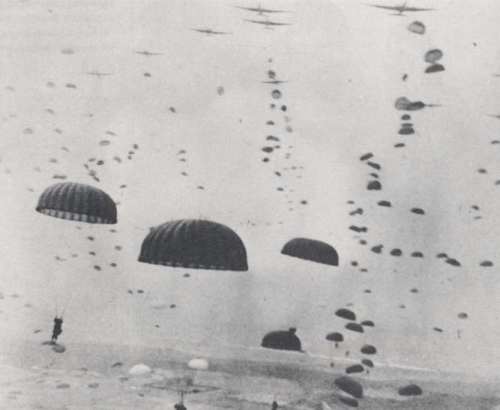
American Paratroops in Holland

The plan was Operation MARKET-GARDEN and to be successful Montgomery’s forces would have to cross 8 water obstacles including 3 major rivers.[67] He had to use one two lane highway bordered by soft Dutch podder, thick woods and drainage ditches that restricted armor and mechanized forces to the road itself.[68] The was for three Allied airborne divisions, the American 82nd and 101st, the British 1st Airborne and the Polish 1st Parachute Brigade to secure the bridges over the waterways between the front and Arnhem 65 miles north of the front.  The goal was to establish a bridgehead over the Rhine for the British Second Army to advance deep into the German heartland.  XXX Corps was to advance up this “corridor of death” and link up with each of the airborne divisions with the goal of breaking the German defense in the west.

British Paras in the ruins of Arnhem

Nearly all the writers agree that had the offensive been launched 7-10 days earlier when the Germans were in complete disarray it might have succeeded in its objective of crossing the Rhine and getting into Germany.  Hastings and Weigley both believe that the axis of the offensive was wrong and that the attack should have been made further south using 21st Army Group and 1st Army to drive to the Rhine.[69] All believe that an attack by Patton’s 3rd Army would not have achieved significant strategic gain as he now faced the bulk of the Wehrmacht’s strength and that there was little of strategic value in the part of Germany he could attack.
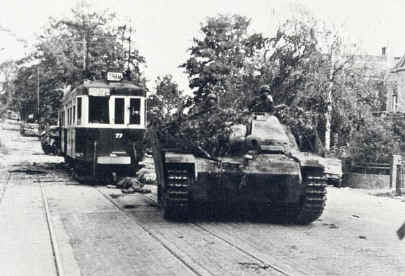
German Sturmgeschutz III in Arnhem 

The attack was made on 17 September.   The shortcomings of the plan became rapidly apparent.[70] German resistance in South Holland was much stronger than expected, the Son bridge was demolished by the Germans which created a major delay as bridging equipment had to be found and brought forward.  Due to the presence of battle groups from the 10th SS Panzer Division and other units dug in the city around the bridge the 82nd could not secure the Nijmegen Bridge until XXX Corps arrived.  The 1st Airborne was landed too far away from Arnhem Bridge to secure it in the face of the 9th and 10th SS Panzer Divisions of II SS Panzer Corps.  Due to a shortage of aircraft and refusal of the air transport command to make two drops on the first day the drops took 3 days to get all the airborne units into the fight.  The single road ensured that the spearhead of the XXX Corps advance was limited to a squadron of tanks and supporting infantry on a front two tanks wide.[71] The flanks were weakly held and German units salvaged from the Scheldt attacked the west and units from the Germany proper attacked the 82nd’s lodgment area.  Communications problems in the 1st Airborne Division prevented it from communicating with its own units as well as higher headquarters leaving everyone wondering what was happening.[72] The advance of XXX Corps was often both before Eindhoven and after Nijmegen lacking in urgency.[73] When all was said and done 1st Airborne Division was all but destroyed and had to be evacuated from its bridgehead and the operation ended in failure.[74] Numerous events contributed to the failure of the operation, many of which occurred before it was planned.  The German ability to make an army out of nothing coupled with planning which was based more on assumptions about what the Germans were incapable of doing rather than what was happening on the ground was a major fact. Likewise the British command discounted intelligence reports of Panzers in or near the drop the drop zones.

SS Panzer Grenadiers in Arnhem

The plan itself left much to chance and was built around the assumption that the Germans lacked the ability to stop them, neglecting the restrictions in which the Allied forces would have to execute the plan. If things could go wrong they did, especially in the 1st Airborne area of operations. Critical equipment failed to arrive, communications broke down, 2 of 3 battalions detailed to seize the Arnhem Bridge were stopped by a mixed bag of German forces including Panzers, an SS training battalion and various Army units and only one battalion reached the bridge. The failure to plan for and establish a landing zone on the south side of the Rhine kept them from being able to take the bridge, which became a key factor in the German ability to move troops from Arnhem to Njimegen. General Urquart was trapped in a house by German units which posted themselves around it and the commander of 1st Airborne Brigade was wounded.  The Germans succeeded in over running the drop zones and without communications British Airborne could not let the air transport know that supplies were not getting to them.

Summary

This phase of the French campaign exhibited the best and the worst of Allied generalship. The reasons; generally inexperienced American leadership at this level of warfare and poor leadership by the more experienced British command.  The key failures were logistics management and the strategic focus following the breakout which changed the nature of the planned campaign. The Allies were running at the limit of their capacity, shortages of fuel and other supplies and heavy casualties incurred in Normandy weakened the Allied advance demonstrating von Clausewitz’s understanding of what happens when a offensive reaches its culminating point. The drive into Brittany, the failure at the Falaise gap, the failure to close the door at the Seine, the failure to trap the 15th Army at the Scheldt and its failure to cross the Albert Canal, as well as the Market-Garden fiasco can all be directly attributed to Allied leadership at high levels.  Likewise the extraordinary ability of German commanders to restore seemingly hopeless situations all demonstrated how Clausewitz’s understood “genius” in war.

The campaign from the Normandy to Arnhem was one of spotty performance by the Allies especially in terms of generalship and logistics planning and the ability to improvise.  The Germans suffered from Hitler’s interference, especially at Mortain where he insisted on counterattack versus withdraw. Likewise they suffered from a critical lack of air support.  However German commanders were masters of improvisation taking advantage of Allied errors and confusion to recover the situation time and time again.

[1] Hastings, Max. Overlord: D-Day and the Battle for Normandy Vintage Books, New York, 1984 p.280

[2] Ibid.

[3] Hastings, Max. Armageddon: The Battle for Germany 1944-1945 Alfred a Knopf, New York, 2004 p.37.  Hastings comments that “British planners threw away it had learned since 1939 about the speed of reaction of Hitler’s army, its brilliance at improvisation, its dogged skill in defense, its readiness always to punish allied mistakes.”

[4] Weigley, Russell F. Eisenhower’s Lieutenants: The Campaign of France and Germany, 1944-1945, Indiana University Press, Bloomington IN, 1981pp.184-186

[5] Ibid. Hastings. Overlord pp.282-283

[6] D’Este,  Carlo. Patton: A Genius for War. Harper Collins Publishers New York, 1995 pp.632-633

[7] Ibid.  p.195

[8] Ibid. Also

[9] Warlimont, Walter. Inside Hitler’s Headquarters 1939-45 Presidio Press, Novato CA 1964 pp.449-450.

[10] Ibid pp.195-196. Weigley notes that Montgomery and most other Allied commanders  had been optimistic in not anticipating the German counter attack despite the ULTRA warnings, while Bradley and Patton were cautious in making troop deployments.

[11] Michael Reynolds in Steel Inferno: The 1st SS Panzer Corps in Normandynotes that the Americans inflicted “astonishing casualties on the northern thrusts of 2nd SS Panzer and remained undefeated when the Germans withdrew 4 days later.”  Reynolds, Michael Steel Inferno: The 1st SS Panzer Corps in NormandyDell Publishing, New York, 1997 p.264

[12] Ibid. Hastings Overlord p.283

[13] Ibid.

[14] Ibid. Weigley p.199.

[15] Carrell, Paul. Invasion! They’re Coming!” Trans. E. Osers, Originally published as Sie Kommen! Gerhard Stalling Verlag 1960, Bantam Books New York, 1964, 5th Printing June 1984. p. 249

[16] Ibid. Weigley p. 199

[17] Ibid. p.200

[18] Ibid. Hastings. Overlord. pp.282-283

[19] Ibid. D’Este. p.631

[20] Ibid. Weigley. p.286  He also points out that the Brittany diversion could have been “worse had it not been for Montgomery’s influence”  p.288

[21] Ibid. p. 202

[22] Ibid. p.204

[23] Ibid.

[24] Ibid.

[25] Reynolds, Michael Steel Inferno: 1st SS Panzer Corps in Normandy Dell Publishing New York, 1997. p.320.

[26] Meyer, Kurt Grenadiers trans. By  Michael Mende and Robert J.  Edwards, J.J. Fedorowicz Publishing, Inc. Winnipeg Manitoba, Canada 2001 p.290.

[27] Ibid. Hastings Overlord pp.288-289.

[28] Patton, George S. War As I Knew It Bantam Books NY  published 1980, originally published by Houghton Mifflin Company 1947. pp.101-102

[29] Ibid. Weigley p.209  Weigley quotes Major Hansen, Bradley’s aide in stating that the Falaise halt orde was “the only decision he has ever questioned.”

[30] DRAGOON was the airborne component of he south France operation.

[31] Ibid. p.218

[32] Ibid.

[33] Ibid.

[34] Ibid.

[35] Ibid. pp.222-224

[36] Patton and Truscott had a clash during the Sicilian campaign over Patton’s push for an amphibious operation accusing him of being “afraid to fight” and threatening to relieve him but then throwing his arm around him and offering him a drink. See D’Este pp.526-528  This incident was made famous in the movie “Patton.”

[37] Giziowski, Richard. The Enigma of General Blaskowitz. Hippocrene Books, New York 1997 p.338

[38] Ibid. Weigley

[39] Ibid. p.241

[40] Ibid.

[41] Ibid. p.243

[42] Ibid. p.246

[43] Hans Von Luck, the commanding a Kampfgrüppe of 21st Panzer Division describes how he and his troops camouflaged his “Schwimmwagen” with bushes to cross the Seine successfully disguising the vehicle to avoid persistant Allied air attacks. VonLuck, Hans Panzer Commander Dell Publishing New York 1989. p.209

[44] Ibid. Weigley. p.255

[45] Weigley, Hastings and D’Este all place a fair amount of blame for the logistical crisis on the commander of the COMMZ, General John C.H. Lee.

[46] Ibid. Hastings, Armageddon p.24

[47] Ibid D’Este pp.647-652

[48] Weigley notes that OVERLORD plans had not envision support American divisions for offensive operations across the Seine until D+120, yet by “D+90, sixteen United States divisions were already 200 kilometers beyond the Seine.” p.268.  Hastings and Weigley also note the waste in the American supply system noting that of “twenty-two million fuel jerrycans shipped to France since D-Day, half had vanished since September.” Hastings. Armageddon p.23.

[49] Ibid. Weigley

[50] Ibid. p.275-276

[51] Both Weigley and Hastings note the logistical problems of the British which not only included the problems that beset the Americans but problems of their own making including poor trucks of numerous makes rather than the standardized American trucks.  Hastings notes that for a time around Antwerp that “Montgomery’s armies were obliged for a time to commandeer thousands of horse-drawn wagons abandoned by the Wehrmacht, to make good its shortage of vehicles for the haulage of supplies.” Hastings. Armageddon p.23

[52] Weigley notes that Montgomery had a fiasco of British logistics in which some “1,400 British three-ton lorries, plus all the replacement engines for this model, had been discovered to have faulty pistons rendering them useless.” p.281.

[53] Ibid. Hastings. Armageddon. p.20

[54] Ryan in A BridgeToo Far quotes the XXX Corps Commander Horrocks who said in his memoirs “My excuse is that my eyes were entirely fixed on the Rhine and everything else seemed of subsidiary importance.” Ryan, Corrnelius. A Bridge Too Far Fawcett Popular Library by Arrangement with Simon and Schuster Publishing, New York, 1974  p.60

[55] Ibid.

[56] Ibid. Hastings p.20.  Weigley on p.293 gives a higher figure of 86,000 troops, 600 artillery pieces, 6,000 vehicles and 6,000 horses.

[57] Ibid. Ryan. p.49

[58] Reynolds, Michael Sons of the Reich Casemate, Havertown PA 2002 p.98

[59] A significant unit that was to plan a key role in the German defense against XXX Corps was Kampfgrüppe Walter formed around the 6th Parachute Regiment and other assorted units.  It is noted in almost every volume devoted to the campaign.

[60] Ibid. Weigley. p.294

[61] Ibid. Ryan. p.52

[62] See Hastings p.22 “The fumbled handling of Antwerp was among the principal causes of Allied failure to break into Germany in 1944.  It was not merely that the port was unavailable for the shipment of supplies; through two months that followed, a large part of Montgomery’s forces had to be employed upon a task that could have been accomplished in days if the necessary energy and “grip” been exercised at the beginning of September, when the enemy was incapable of resistance.”  and Weigley pp.293-294

[63] Ibid. Weigley p.288

[64] Hastings notes that since the Airborne Army had been created that “the apostles of the new art of envelopment from the sky were determined that it should be used.” Armageddon p.35

[65] Ibid. p.289

[66] Ibid.

[67] Ibid. Weigley. p.291

[68] Ibid. p.295

[69] Also see Ryan. p.81 Ryan notes that in the planning General Dempsey because of his doubts about the ability of 2nd Army suggested an attack “seizing the Rhine crossing at Wesel….” as “it would be better, he believed to advance in conjunction with the U.S. First Army northward toward Wesel.”

[70] All the commentators make reference too the misgivings voiced at the final planning conference. Hastings comments on Gavin who believed that “If I get through this one, I will be very lucky.”

[71] Ibid. Weigley. p.295

[72] Hastings comments “It was a scandal-for which in the Russian or German armies some signals officers would have been shot-that the communications of 1stAirborne Division remained almost non-existent from 17 September onwards.Armaggedon p.58

[73] Ibid. p.293

[74] Casualties in 1st Airborne were high, of “the original 10,005 man force only 2,163 troopers, along with 160 Poles and 75 Dorsets, came back across the Rhine. After nine days the division had approximately 1,200 dead and 6,642 missing, wounded or captured.” Ryan p.509.

Bibliography

Carrell, Paul. Invasion! They’re Coming!” Trans. E. Osers, Originally published as Sie Kommen! Gerhard Stalling Verlag 1960, Bantam Books New York, 1964, 5th Printing June 1984

D’Este,  Carlo. Patton: A Genius for War. Harper Collins Publishers New York, 1995

Giziowski, Richard. The Enigma of General Blaskowitz. Hippocrene Books, New York 1997

Hastings, Max. Armageddon: The Battle for Germany 1944-1945 Alfred a Knopf, New York, 2004

Hastings, Max. Overlord: D-Day and the Battle for Normandy Vintage Books, New York, 1984

Meyer, Kurt Grenadiers trans. By  Michael Mende and Robert J.  Edwards, J.J. Fedorowicz Publishing, Inc. Winnipeg Manitoba, Canada 2001

Patton, George S. War As I Knew It Bantam Books NY  published 1980, originally published by Houghton Mifflin Company 1947.

Reynolds, Michael Sons of the Reich Casemate, Havertown PA 2002

Reynolds, Michael Steel Inferno: 1st SS Panzer Corps in Normandy Dell Publishing New York, 1997

Ryan, Corrnelius. A Bridge Too Far Fawcett Popular Library by Arrangement with Simon and Schuster Publishing, New York, 1974

Von Luck, Hans Panzer Commander Dell Publishing New York 1989

Warlimont, Walter. Inside Hitler’s Headquarters 1939-45 Presidio Press, Novato CA 1964

Weigley, Russell F. Eisenhower’s Lieutenants: The Campaign of France and Germany, 1944-1945, Indiana University Press, Bloomington IN, 1981


2 Comments

Filed under History, Military, world war two in europe

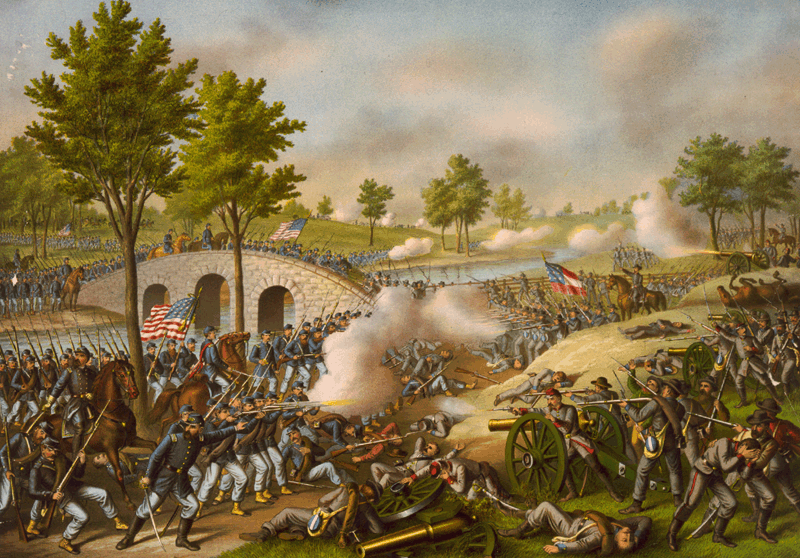
The Bloodiest Day: The Battle of Antietam 17 September 1863

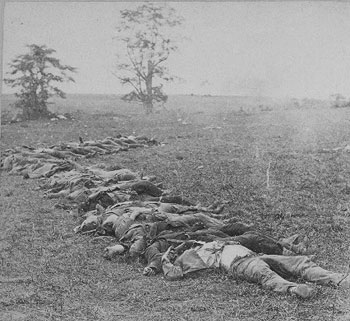
“Of all the days on all the fields where American soldiers have fought, the most terrible by almost any measure was September 17, 1862. The battle waged on that date, close by Antietam Creek at Sharpsburg in western Maryland, took a human toll never exceeded on any other single day in the nation’s history. So intense and sustained was the violence, a man recalled, that for a moment in his mind’s eye the very landscape around him turned red.” Stephen W Sears

“I have heard of ‘the dead lying in heaps’, but never saw it till this battle. Whole ranks fell together.” Captain Emory Upton, 2nd U.S. Artillery, at Antietam

“We were in the very maelstrom of the battle. Men were falling every moment. The horrible noise was incessant and almost deafening. Except that my mind was absorbed in my duties, I do not know how I could have endured the strain.” Lt. Frederick L. Hitchcock, 132nd Pennsylvania, at Bloody Lane, Sept. 17, 1862

To the west of Frederick Maryland a small town named Sharpsburg sits on the west side of a creek. Named Antietam the creek’s headwaters are in Franklin County Pennsylvania and it meanders south where just to the south of Sharpsburg it empties into the Potomac River.

It is a peaceful place, rolling hills and agricultural country with some well preserved stone arch bridges, including one just outside of Sharpsburg. It is hard to believe that 150 years ago the town and the creek were the scene of the bloodiest single day of battle in American history.

On that indian summer day of 1862 the Confederate Army of Northern Virginia, General Robert E Lee, commanding made a stand against the much larger Union Army of the Potomac, Major General George B. McClellan, commanding.

Lee had invaded Maryland following a string of successes in Northern Virginia during that summer of 1862, defeating McClellan outside of Richmond in the Seven Days, and in a campaign of maneuver bested a newly formed Army, the Union Army of Virginia commanded by Major General John Pope defeating it at the Second Battle of Bull Run between 28-30 August 1862. With Northern Virginia’s crops and livestock depleted and his opponents in crisis Lee moved his army north into Maryland. The decision was driven partly by the need to provision his army, but also had the hope of drawing Maryland away from the Union mistakenly believing that public sentiment in that state was pro-Confederate. If the people of Maryland rose up to support Lee it would be disastrous to the Union and endanger the capital itself. A final consideration was the hope that a Confederate victory on Northern soil would bring about the foreign recognition and possibly the intervention of Great Britain on the side of the Confederacy.

The Lost Order

Lee crossed the Potomac on September 3rd and sent his Second Corps west with some elements seizing the Union armory in Harper’s Ferry, others to secure the Baltimore and Ohio Railroad at Martinsburg the rest of the Army was in the area of Frederick. He was pursued by the very cautious McClellan at the head of the Army of the Potomac.

On September 9th Lee issued General Order 191, the infamous “lost order” which a copy of which was found by Union soldiers wrapped around three cigars at a campground recently occupied by Lee’s rear guard element, the division of D.H. Hill on September 13th. The order detailed the disposition of Lee’s army and McClellan seized the opportunity. On the 14th the Army of the Potomac attacked part of Lee’s army at the Battle of South Mountain. The Union won that battle forcing the outnumbered Confederate forces to withdraw, though the delay allowed Lee to concentrate more of his army at Sharpsburg on the 15th.

Although he outnumbered Lee McClellan believed the reports of the Pinkerton Detective Agency which provided intelligence to the army. Those estimates which credited Lee with more than 100,000 troops. He delayed his attack until he had drawn up his full army on the on the 17th.

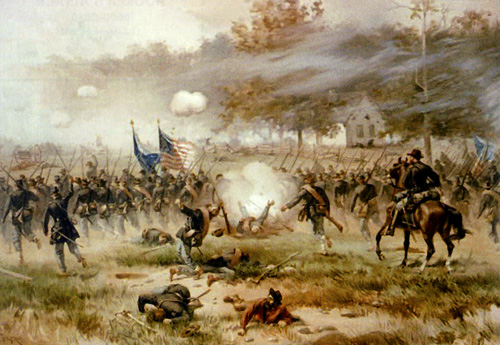
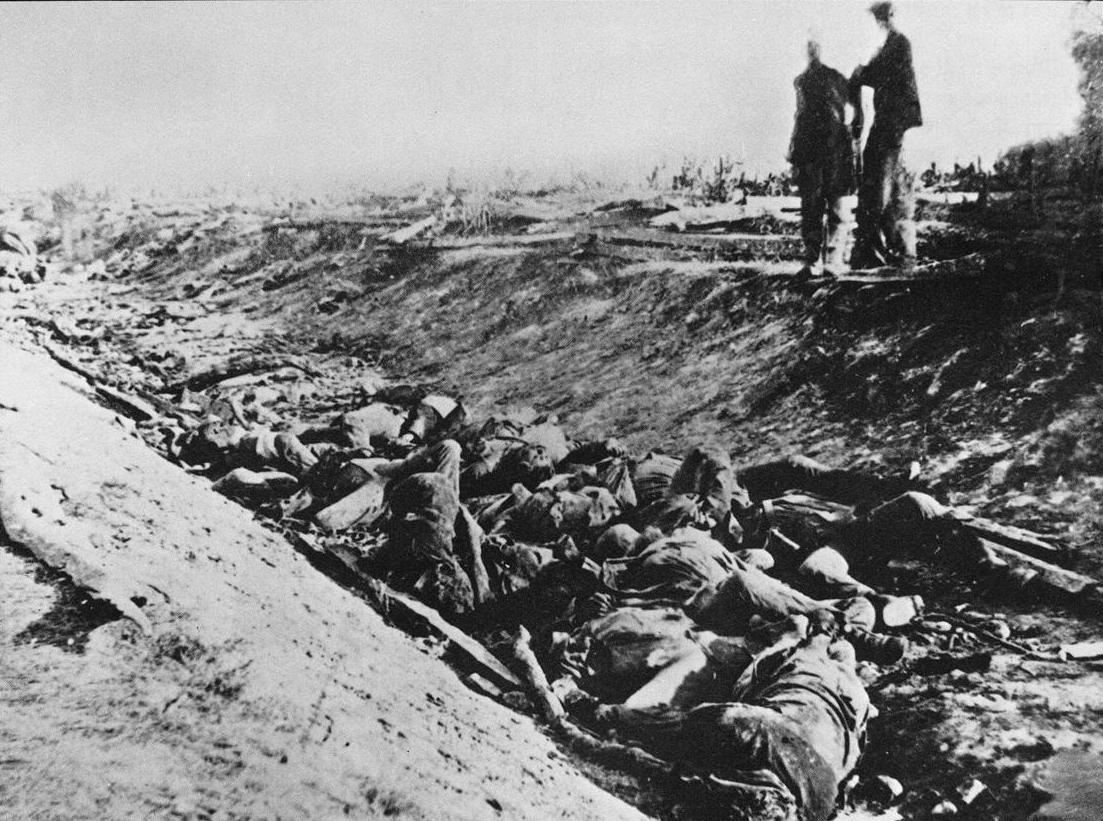
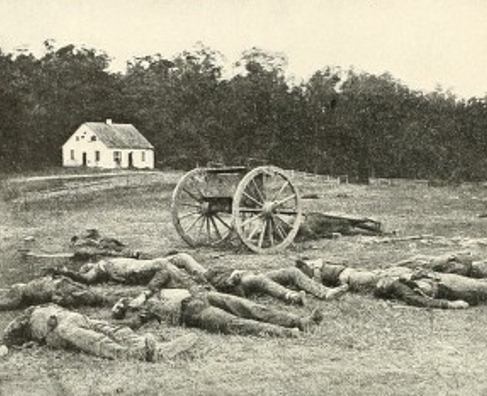
When he did attack on the 17th his attacks were uncoordinated and though he came close to decisive breakthrough Lee’s army desperately clung to its positions. The action began to the north of the town in the morning and both sides showed incredible ferocity at the Cornfield, where in the space of about three hours nearly 8000 soldiers were killed or wounded. The fighting shifted to the center of the line opposite the town by mid-day. Amid the destructive storm of artillery the armies fought around the Dunker Church and a sunken lane now known as “Bloody Lane.” In the confines of that 800 yard stretch of road over 5000 soldiers were killed or wounded in the course of about four hours. The Union forces broke the Confederate line but reinforcements were not sent and when the the division commander, Major General Israel Richardson was mortally wounded the attack lost its verve and the Confederates under Lieutenant General James Longstreet were able to restore the line.

The south remained quiet as McClellan ordered Major General Ambrose Burnside’s IX Corps to hold off on attacking. Burnside did not receive his orders to attack until 1000. He finally attacked across the south bridge, now known as Burnside’s Bridge in the afternoon. It was another tough fight and Burnside, after several attempts move to the south to flank Confederate forces in the late afternoon with the intention of cutting Lee from off his only escape route.  The Confederates were in a desperate condition. It was at this point, about 3 PM when the division of Major General A.P. Hill arrived and immediately counterattacked breaking up Burnside’s attack. Burnside requested reinforcements from McClellan who refused saying that he had none available. This was not the case, McClellan had two full corps of infantry uncommitted to the battle but still believing that he was outnumbered and that Lee was attempting to trap him.

The actioned ended by 530 PM with both sides rested and reorganized for action the next day. Lee prepared to defend but no Union attack was offered on the 18th. An informal truce was observed to allow the evacuation of the wounded and Lee began his withdraw across the Potomac into Virginia that night. Despite being goaded by Lincoln to pursue McClellan did not and the Union lost the opportunity to destroy Lee’s army n Union territory.

Casualty estimates vary but according to Stephen W Sears in his book Landscape Turned Red that the Army of the Potomac lost 2108 dead, 9540 wounded and 753 missing. He states the best estimate of Confederate casualties are 1546 dead, 7752 wounded and 1018 missing. Most of the missing were likely killed and buried in mass graves or discovered and buried by civilians after the battle. In the space of 12 hours 22719 Americans were killed or wounded. It was the bloodiest single day in American military history.

Though the battle was inconclusive in that Lee’s army survived but had to break off its offensive it had more influence than expected. President Lincoln issued the Emancipation Proclamation on September 22nd and though it did not take effect until January 1st 1863 it marked a turning point in the war.

McClellan failed to take up the offensive in the next tow months and Lincoln relieved him of command giving the Army of the Potomac to Burnside who goaded by Lincoln took the army into battle at Fredericksburg where it met with defeat.

I have been to the battlefield a number of times, once as part of a “staff ride” with the Marine battalion that I was assigned in May of 2000. Each time I go I take the time to ponder the great losses endured by both armies and the individual courage of the soldiers involved. Some of the units that I served with in the Army National Guard in Texas and Virginia trace their lineage and honors to regiments that fought at Antietam and I have felt a connection to the battle because of that. It is hard to imagine the amount of death and carnage taking place in such a placid location in such a short amount of time.

It is something to ponder when some Americans openly suggest another civil war if their party does not win the election.

Peace

Padre Steve+

1 Comment
Filed under civil war, History, Military

The Gathering Storm: Shades of 1914 as War Threatens in the Middle East

Israeli Navy Dolphin Class Submarine

“The world tells Israel ‘Wait, there’s still time.’ And I say, ‘Wait for what? Wait until when?’” Benjamin Netanyahu 

The question is not if but when. The tensions between Iran and Israel continue to boil over even as the rest of the Middle East begins to melt down.

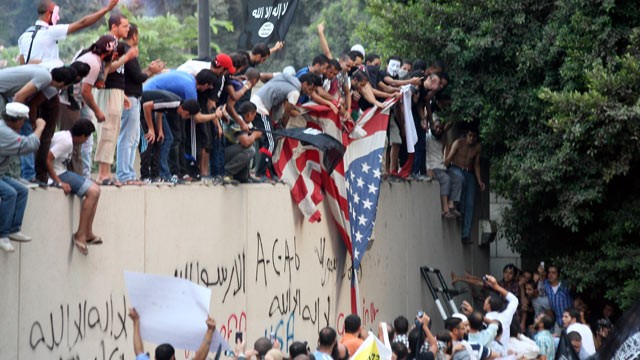
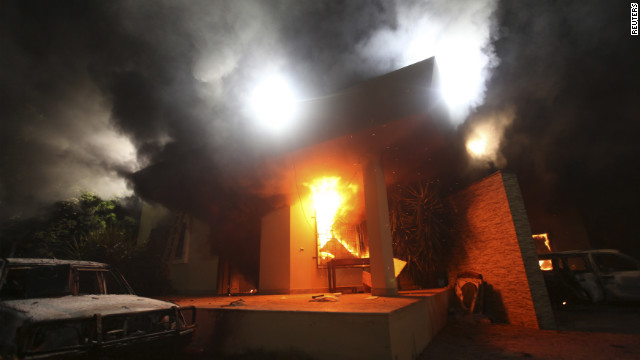
Last week on the 11th anniversary of the September 11th attacks Al Qaeda backed forces attack the US Consulate in Benghazi Libya killing Ambassador Christopher Stevens and three others. Militants in Egypt laid siege to the US Embassy while newly elected Egyptian President and Moslem Brotherhood leader Mohammed Morsi dithered torn between his party ideology and the pragmatic reality of the dependency of Egypt on the United States for military and economic assistance. Throughout the region from Tunisia to Indonesia protests, some marked by violence broke out at United States and other Western nations diplomatic outposts.

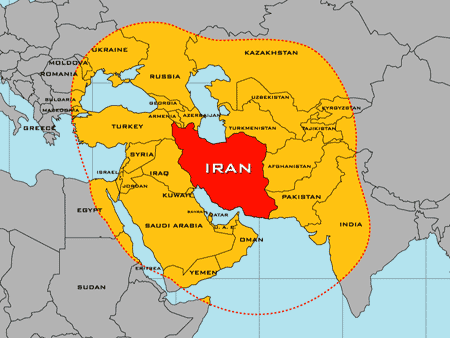
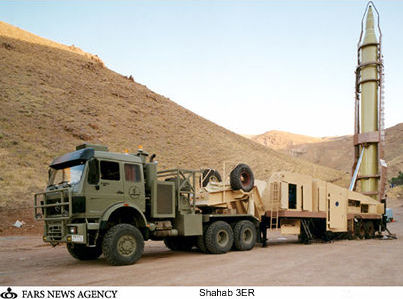
Shahab III Missile Ranges

The Iranians and their Hezbollah allies have repeatedly threatened Israel with destruction and have improved their missile forces significantly ever the past number of years even without nuclear weapons. Prime Minister Benjamin Netanyahu is demanding the United States and the west set “Red Lines” regarding the Iranian nuclear program that would trigger an automatic attack on Iran by the United States.

Like the First World War the tensions, provocations and rhetoric increase even as military forces mobilize and gather in the region. Iran is preparing for massive military exercises involving land, air defense and ballistic missile units from the Iranian military and Revolutionary Guards to begin in October.  Iran admitted this weekend that forces from their Revolutionary Guards are currently operating in Syria placing them in position to directly engage Israeli forces in the event of conflict.

By October the United States will have three Carrier Strike Groups, the USS Enterprise, USS Dwight D. Eisenhower and USS John C Stennis and an Expeditionary Strike Group with an embarked Marine Expeditionary Unit in the region. Additionally warships from more than 25 countries are gathering for exercises designed to counter any blockade of the strategic Straits of Hormuz by Iran. Other ships, including the French Aircraft Carrier Charles DeGaulle battle group and the British HMS Illustrious  “Response Task Forces Group” are in the Eastern Mediterranean and could be in the region within a week. US Navy submarines, both attack and ballistic missile are never far from a threatened area. US Air Force  Fighter Squadrons have been reinforced and it is certain that strategic air force units of B-2, B-52 and B-1 bombers are certainly deployed where they can respond as needed. The build up by all sides is unprecedented.

The countries of the region are on hair trigger alert. Any act, intentional or unintentional by any party could trigger a war that would most certainly bring great destruction to the region but would likely sink the global economy and spread around the world through acts of terror and revolutionary violence.

Numerous reports and Israel government official statements indicate that Israel is ready, to strike Iran, if need be alone to prevent what they believe is an existential threat to Israel. While some believe that any Israeli attack on Iran would be precision strikes aimed at Iran’s nuclear program and ballistic missiles sites. However, most experts believe that an Israeli strike would at best set back the Iranian nuclear weapons program a couple of years and trigger a regional war with very unpredictable outcomes. If the Israeli strike is conventional in nature the Iranians will strike back against Israel, as well as US targets in the region. The US would certainly respond but any war would affect the region and the world economy as oil prices would rise exponentially.

With that in mind it is possible that the Israelis fearing the existential threat of Iranian nukes might use their nuclear forces in a first strike role.

Most experts believe that the Israelis would only use nuclear weapons in a retaliatory “second strike” capacity. The reasoning is that the first use of nuclear weapons by Israel would be against their national interests. That is logical but history is replete with times that nations have acted in ways contrary to logic because the action is deemed “necessary.” It is the same logic that said that the Germans would not violate Belgian neutrality in 1914 knowing that such an action would trigger British intervention on the side of France and Russia. It was believed by most that “the Germans are dangerous but they are not maniacs….” The Germans faced war on more than one front and felt that they had to deliver a swift blow to knock France out of the war in order to defeat Russia. It was a risk that they were willing to take and one which helped lose them the war and set about a series of events that made the 20th Century the bloodiest in human history.

In the current situation many in Israeli leadership may view the use of nuclear weapons to stop an existential threat as a legitimate use of the weapons. Israel does face real threats and those threats are increasing as Iran increases in strength and no longer has traditional rival Iraq to worry about. Likewise the instability of Egypt and the anti-Israeli animus of the Moslem Brotherhood which now leads Egypt has increased the real and perceived threat from that country. An Egypt openly hostile to Israel armed to the teeth with advanced American weapons is a dagger pointed at the heart of Israel. Israel’s leaders may be willing to suffer international condemnation in order eliminate what they consider an existential Iranian threat to ensure their survival and ability to defend against Egypt as well as conventional and unconventional Hizbollah forces operating out of Lebanon and those of Hamas in Gaza.

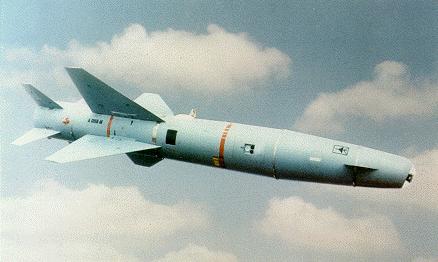
If they were to use nuclear weapons the primary delivery system in such a strike would most likely be Dolphin Class submarines armed with nuclear capable Popeye cruise missiles. These missiles have a 1500 km range and while the missiles could be used in a conventional strike their utility would be limited to precision strikes against unfortified headquarters buildings housing Iranian leadership, or command and control facilities. The numbers of Popeye missiles the Dolphins carry is limited since the majority of Iranian nuclear sites are hardened facilities or deep underground their use against them in a conventional manner would be a waste.

The threat to United States and NATO forces in Afghanistan is great if a broader war erupts. US and NATO forces, already fighting an increasing Taliban insurgency are for all practical purposes surrounded if a war spreads and Pakistan shuts down the southern supply route. Even this week Taliban insurgents scored a victory successfully attacking the strongly fortified joint US Marine and British base Camp Leatherneck-Camp Bastion destroying 6 AV-8B Harrier jets on the ground, damaging more aircraft, valuable hangers and support facilities while killing 2 Marines. A war with Iran would threaten to turn Afghanistan into a trap for nearly 100,000 US and NATO coalition troops.

It could as Barbara Tuchman said of the the Germans of 1914 that the Israelis have “staked everything on decisive battle in the image of Hannibal….” but that the ghost of Hannibal might have reminded the Germans and the Israelis that though Hannibal and “Carthage won at Cannae, Rome won the war.” In mid May and early June of 1914 even before the assassination of Franz Ferdinand Field Marshal Von Molkte and others felt that the scales were tipping against them. He told his Austrian counterpart Field Marshal Conrad Von Hotzendorf that “from now on ‘any adjournment will have the effect of diminishing our chances of success.’” On June 1st Von Molkte said to Baron Eckhardstein,“We are ready, and the sooner the better for us.”

The storm clouds of war are thickening and darkness hovers as the storm gathers. In 1914 the politicians, diplomats and soldiers that realized war would be disastrous were a minority in their respective governments and their warnings went unheeded. In 1914 “war pressed against every frontier. Suddenly dismayed, governments struggled and twisted to fend it off. It was no use….” As the sun set and the lamps of London were lit on August 4th 1914 Sir Edward Grey said to a friend “The lamps are going out all over Europe; we shall not see them lit again in our lifetime.” It is as if we are watching the same drama play out in the Middle East now.

Peace

Padre Steve+


3 Comments

Filed under Foreign Policy, middle east, Military, national security, News and current events

Updating Links on a Lazy Saturday

It is a lazy Saturday up here with Judy and our dogs Molly and Minnie in Hampton Roads. So i took the time instead of doing any serious writing to update the links on this page.

I have added or modified the link categories to help make them easier to navigate. I broke up the News and Weather section into News which links to major US media outlets, World News, Local News and Weather, Political Commentary and Weather. I have added numerous sites to the links including many more news and political commentary sites, much more world news, beefed up weather and sections on history and what I call “just for fun” which has links to a bunch of my favorite comics.

I want to draw special attention to my wife Judy’s blog. Her site, The Abbey Normal Abbess http://abbeynormalabbess.wordpress.com. She has some fascinating insights on life and great art which I hope that she will post more of in the coming weeks.

Have a great weekend!

Peace

Padre Steve+

3 Comments

Filed under Uncategorized

A Break from Hate

It is all too easy in a divided country and a world in crisis to succumb to hate. Hate is easily stirred up by what I call the Unholy Trinity of Pundits, Politicians and Preachers. This Unholy Trinity uses the tools of the 24 hour cable news cycle and internet “news” services that are little more than the mouthpieces for foul ideologues to promote lies and propaganda across the political and religious spectrum. This is not limited to the United States but is now a world wide industry. The cycle of hate seems to be unending.

I wrote last night about those that pour gasoline on an already blazing fire. It was actually my second attempt to write the piece. I had started on Tuesday night was the news of the attacks on the American Embassy and Consulate began to unfold. I became very angry at both the attackers as well as the producers of the film that at least sparked the violence in Egypt. I actually began to feel hate toward the extremists of all kinds that thrive on this, the media that uses it for market share and certain politicians that try to gain a cheap political advantage of an unfolding crisis where American lives are at stake.

I find that those that trigger my anger the most are religious zealots or all types, but mostly those of my own faith that promote hate and fear in the name of Jesus. Religious hatred is perhaps the most evil hatred because those that spew it actually believe that God agrees with them. God is the ultimate trump card for such ideologues.

I am not going to go back into the embassy and consulate story now, but I began to write about it on Tuesday night. As I wrote I became more and more angry. I felt what Darth Vader so well described as “the power of the Dark Side.” My words were becoming venomous and I was becoming livid. Then I stopped writing realizing that something wasn’t right in me, I was being consumed by hatred of those that promote hate and so I just stopped and pondered what was going on with me.

I did a complete re-write of that article last night after I had spent some time getting more information about the attacks and then talking about the issue with someone that I trust. He told me something that I already knew, that unbridled hatred is poisonous and not only toward those that it is directed, but to those consumed by it. Since coming back from Iraq and dealing with PTSD I have had to deal with a lot of anger and many times I have felt hate rise up in me. It is a frightening thing to feel “the power of the Dark Side.”

Hatred is the fruit of fear. Buck O’Neal the legendary Negro League Baseball player and manager said “It makes no sense, Hate. It’s just fear. All it is. Fear something different. Something’s gonna get taken from you, Stolen from you. Find yourself lost.”

So today I have tried to unplug from the news cycle. I got a good workout in. I listened to music rather than talk radio in the car. I went to a local restaurant’s bar for a salad and a couple of beers with the old timer locals that hang out there. I spent time reading, watching baseball and walking the dog to the beach and back rather than surfing news sites or watching cable news pundits.

I needed it and since I will be traveling tomorrow I will get another chance to stay mostly unplugged for another day, and probably most of the weekend as Molly my dog and I go home to see Judy and Minnie our puppy. Maybe if we all took a day off once in a while from the propaganda mills of all forms that masquerade as news outlets we could step away from the abyss that our individual and collective is driving us over.

Peace

Padre Steve+


1 Comment

Filed under christian life, faith, News and current events, Political Commentary, PTSD, Religion

81: First Place Orioles Ensured of First Non-Losing Season Since 1997

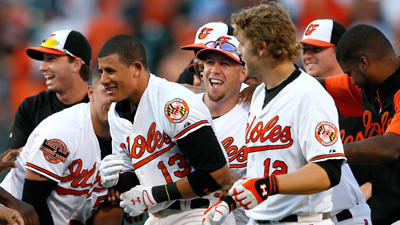
The Baltimore Orioles Celebrate Sweeping the Tampa Bay Rays on rookie Manny Machado’s walk off single in the 14th inning. (Rob Carr, Getty Images / September 13, 2012)

There is something magical and enduring about baseball that makes it such an important part of the American experience. Saul Steinberg said that “Baseball is an allegorical play about America, a poetic, complex, and subtle play of courage, fear, good luck, mistakes, patience about fate, and sober self-esteem.”

Today the Baltimore Orioles reminded us of that fact. The plucky O’s under Manager Buck Showalter using a roster that  has now included 50 players during the season have defied all predictions. They are determined contenders. They have won 13 consecutive extra inning games and are 27-7 in one run games. Their bullpen is stellar. They are 64-0 when leading after the 7th inning. They may not have the raw talent and the certain Hall of Fame players that the Yankees have but they can win the close games.

The Baltimore Orioles are perched atop the American League East duking it out with the New York Yankees. The Orioles completed a sweep of the Tampa Bay Rays today in a 14 inning 3-2 walk off win after splitting a four game series with the Yankees at Camden Yards.

The win ensures that they will not have a losing season for the first time since 1997 when they won 98 games and were the AL East Champions. There is a real possibility that the Orioles will win 90 or more games this year. No one predicted that, although I predicted that they would break .500 this year and be a factor in the American League East at the beginning of the season.

The Orioles will now embark on a six game West Coast road trip where the will play the equally surprising Oakland Athletics and the Seattle Mariners.

The interesting thing about the weekend series between the O’s and the A’s is that it is a pivotal series. It actually matters and could be a series that determines where they and their competitors end up in the post season. It is as if the gods of baseball scheduling looked out over the season and said “no one thinks that the O’s and A’s are any good so let’s screw with the experts.” The A’s are just three games behind the Texas Rangers and lead the AL Wild Card race.

Things like this are what make baseball such a magical game. I guess what makes me love baseball so much is that small market teams like the O’s and the A’s can contend even without the big name players and obscene payrolls of the big market teams.  It is funny because the NFL season is just a week old and games are being sold as “do or die” or “must win.” When I hear that kind of talk I realize that football despite its popularity lacks the real human drama of the 162 game Major League Baseball season. If a team’s season is determined by the second game then it is not all that exciting if you ask me. Yes there is some drama in football and it is a good game, but it is not baseball, it is just a game.

My dream at the end of the season is to hear the phrases American League East Champion Baltimore Orioles and American League West Champion Oakland Athletics. I get chills thinking about the possibility.

Peace

Padre Steve+


1 Comment

Filed under Baseball, Batlimore Orioles, sports and life

Pouring Gasoline on the Fire: The True Believers and Unending War

The Consulate in Benghazi Burns

“Passionate hatred can give meaning and purpose to an empty life. Thus people haunted by the purposelessness of their lives try to find a new content not only by dedicating themselves to a holy cause but also by nursing a fanatical grievance.” Eric Hoffer, The True Believer

September 11th 2012 was a day that initially was marked by somber reflection on the attacks that killed nearly 3000 people 11 years before. However as the night settled over the Continental United States Americans were again attacked. This time two events, one in Egypt and one in Libya brought about the loss of American lives including Ambassador Chris Stevens and ignited a political firestorm.

It is no secret that extremist Moslems, Christians and Jews, each for their own particular theological and political reasons have been trying with all their might to bring about a global conflagration between the the Islamic world and the West, especially the United States and Israel.  Hatred of the other, power and the desire for vengeance against crimes real and imagined motivate all of them. The desire for the ultimate judgement of God being poured out on their enemies is a motivating force because their enemies are by necessity the enemies of their God.

The latest violence appears to have its genus in the release of a a film produced by someone named Sam Bacile who claims to be real estate broker and Israeli citizen. The Israelis say there is no such Israeli and some wonder if the name is actually a pseudonym and the AP reported that the cell phone led to a man named Nakoula Basseley Nakoula a man convicted of financial crimes who admitted a role in the film today.  Nakoula is neither an Israeli or a Jew and has used the the name as a pseudonym.

Koran Burning Pastor Terry Jones

The film, called alternately “The Innocence of Moslems” or “Mohammed: Prophet of Moslems” is being promoted extensively by Egyptian Coptic Christian expatriate and anti-Moslem zealot Morris Sadek and Koran burning “pastor” Terry Jones. In an interview with the Wall Street Journal the man who calls himself Sam Bacile claimed that the film was “a political movie” and that “Islam is a cancer, period.” One of his collaborators an Evangelical Christian named Steve Klein told Fox News that “we went into this knowing that this was probably going to happen.”

Bacile or Nakoula, whoever he happens to be released a 13 minute long trailer for the film on You-Tube in English and it was translated into Egyptian Arabic. It has gone viral in the Islamic world. The Islamic preachers of hate and the cottage industry that thrives on finding reasons to hate Americans used the film to launch demonstrations at the US Embassy in Cairo and the Consulate in Libya.

Egyptian Protestors desecrate the American flag after breaching the Embassy Wall

Warned of upcoming demonstrations the Press Officer of the US Embassy in Cairo published the following statement six hours before the protest. Please note it is not an apology, it is diplomats in danger trying to calm the situation:

“The Embassy of the United States in Cairo condemns the continuing efforts by misguided individuals to hurt the religious feelings of Muslims — as we condemn efforts to offend believers of all religions. Today, the 11th anniversary of the September 11, 2001 terrorist attacks on the United States, Americans are honoring our patriots and those who serve our nation as the fitting response to the enemies of democracy. Respect for religious beliefs is a cornerstone of American democracy. We firmly reject the actions by those who abuse the universal right of free speech to hurt the religious beliefs of others.”

In Egypt the new government headed by Moslem Brotherhood President Mohammed Morsi did little to break up the demonstration yesterday and the crowds entered the compound, pulled down and desecrated the American flag and raised the black Islamic banner. However, they did no more. Today more demonstrations have occurred but Egyptian security forces interposed themselves between the demonstrators but the Egyptian government did nothing to condemn the demonstrators.

However during the initial phases of the crisis Republican Presidential Candidate condemned the Obama administration and the Embassy for “apologizing” for the “right of freedom of speech” in response to the attack on the Cairo embassy. Romney was criticized for the statement by many Republicans for appearing to use the attacks for partisan political gain. After doubling down on the comments this morning many analysts believe that Romney has come out of the day worse off on how he is viewed than before.

Romney’s remarks were contrasted with those of Ronald Reagan and George H.W. Bush in 1980 when the military operation ordered by President Jimmy Carter to free the US hostages during the Iranian hostage crisis. Reagan made this statement: “This is the time for us as a nation and a people to stand united and to pray” while Bush said “I unequivocally support the president of the United States — no ifs, ands or buts — and it certainly is not a time to try to go one-up politically. He made a difficult, courageous decision.” Both Reagan and Bush would campaign using the “weakness” of Jimmy Carter as one of their key points of attack but on the day of the disaster both had the decency not to use it for their political gain.

Ambassador Chris Stevens

In Libya there was a small demonstration at the consulate. However that demonstration appears to have been pushed aside by an armed group of 20-30 men wielding RPGs, machine guns and other automatic weapons. The assault by the group lasted between 4-5 hours and during it Ambassador Stevens and three other Americans including two Marines were killed.

The Libya attack appears to be a planned and premeditated attack, possibly to avenge of Al-Qaeda’s Libyan born second in command Abu Yahya al-Libi on June 4th, which Libyan Al Qaeda allies have promised to retribution. The fact that the attack occurred when a Ambassador Stevens was on a visit to promote the opening of a new cultural center. Stevens was respected by many Libyans for his role during the Libyan revolution and the Libyan government has apologized and Libyans have marched to apologize for his death.

Libyans protest in Sympathy with the US

President Obama has order a Marine Fleet Anti-Terrorism Security Team (FAST) platoon  to Tripoli to bolster the embassy defenses and ordered two Guided Missile Destroyers to Libya. He has promised that “justice” will be served on Ambassador Stevens’ killers. Osama Bin Laden and many other Al Qaeda leaders have faced that justice during Obama’s term and I expect that these brutal killers will not live long. He also made a telling comment about how he and the administration now view the situation in Egypt:

“I don’t think that we would consider them an ally, but we don’t consider them an enemy…I think it’s still a work in progress, but certainly in this situation, what we’re going to expect is that they are responsive to our insistence that our embassy is protected, our personnel is protected.”

The operative words in his remarks about Egypt are that “I don’t think that we would consider them an ally.” It appears that the President fully recognizes that despite hopes that pro-western modernists would gain power after the revolution that the newly elected government of Moslem Brotherhood President Mohammed Morsi is not our friend.

Tonight the demonstrations in Cairo continue, others are breaking out in other countries and many Arab leaders recognize the danger and are trying to defuse the situations.

The problem is that no matter who is President that the instigators of the attacks on the embassy and the consulate as well as those that egg them on and those that intentionally try to provoke them will not stop. They will continue to do all that the can to bring about the war that they think will bring the fulfillment of their apocalyptic visions, be they Islamic, Christian or Jewish.  The fire is burning and these fools are doing all that they can to spread the flames around the world.

I wish I could say that it was going to get better but it looks like we are being pulled even deeper into this war without end.

Pray for peace but know that those that want war do more than pray for it, they are willing to do anything for it, even kill.

Peace

Padre Steve+

1 Comment

Filed under faith, middle east, national security, News and current events

Remember and Pray: Lessons from 9-11-2001 Today

9-11 Memorial Ceremony (US Navy Photo)

Today many of us took the time to remember the events of September 11th 2001. Some were large ceremonies and others small, while many just took the time to remember the lives of those lost, to reflect and pray. Many talked about what they remembered and where they were that fateful day and others remembered the event silently, the pain still too great to express.

The events of 9-11-2001 are now 11 years past yet danger still looms. American military and diplomatic personnel, Federal agents of various police and security agencies, contractors and American Non-Governmental Organizations (NGOs) serve in harms way exposed to violence and terror. The Middle East is ablaze in violence between competing Islamic groups, the Sunni-Shia Moslem divide becomes greater with every day as Syria, Iraq and Lebanon become more violent. The conflict threatens adjoining nations including Israel, Jordan and Turkey. Israel and Iran edge closer to war and extremists do all that they can to incite others to violence by their acts. Today Egyptian Islamic extremists stormed the US Embassy in Cairo and ripped down our flag allegedly in response to a film being produced by an American extremist the Koran burning “pastor” Terry Jones which they believe is blasphemous.

Pundits, politicians and preachers, that Unholy Trinity that seems to find life in the death and misery of others stoke the fires of hate, among the “faithful” of their religions and nationalities. The truth be known I get angry every time these extremists act or do things the are done with the sole intent of bringing harm to others while advancing their dark agendas.  I get tired of those that from places of safety and security provoke violence and urge wars that they know others will have to fight and without any cost to themselves. They make their pronouncements all claiming that God, however they define him is on their side. That is blasphemy, no matter which God you believe in.

The world is a very dangerous place. It is not only a time for vigilance and military preparedness, it is a time for reflection, prayer and peace making.

God of the ages, before your eyes all empires rise and fall yet you are changeless. Be near us in this age of terror and in these moments of remembrance. Uphold those who work and watch and wait and weep and love. By your Spirit give rise in us to broad sympathy for all the peoples of your earth. Strengthen us to comfort those who mourn and work in large ways and small for those things that make for peace. Bless the people and leaders of this nation and all nations so that warfare, like slavery before it, may become only a historic memory. We pray in the strong name of the Prince of Peace. Amen. (From the September 11th Litany published by the National Council of Churches)

Peace

Padre Steve+

1 Comment

Filed under christian life, faith, national security, News and current events

Where Were You on 9-11-2001? Share Your Memories

I was reminded today about how the terrible events of September 11th 2001 are part of our national fabric and how those that remember that day have in some way been affected by it. Most of us I am sure remember where they were when they found out and what they were doing. I have written about my experience at Camp LeJeune but I know that others have just as vivid memories.

I was asking one of my sailors where he was on 9-11. He is young, just a year in the Navy and he replied that he was in 3rd grade. He explained that he remembers his teachers and other adults in states of shock and disbelief. He said that as a kid the significance was not understandable, that the pictures looked like a movie.

One of my friends who I served with in Germany early in my Army career was a hospital administrator at a large medical center on the New Jersey side of the Hudson across from Manhattan when the towers were hit and how he watched from his office as the towers burned and fell.

I have many friends from the USS Hue City which I reported aboard in December 2001 who were at sea and after the attack patrolled the East Coast. Another one of my friends who works with me on our pastoral care staff was in the gym at 29 Palms following a combined arms exercise with the 2nd Marine Regiment when the news showed the second aircraft hitting the South Tower of the WTC. He informed his disbelieving commanding officer of the attack.

My wife Judy was in a doctor’s office waiting room when the news came on the television. She said to a friend who was with her that “it was terrorism” and the friend said “that damned Saddam Hussein.”

I had friends that served as first responders or provided support to first responders at the site. Many were clergy, both Navy Chaplains serving with the US Coast Guard and civilian clergy.

Quite a few of the young Sailors, Marines, Soldiers and Airmen that I have served alongside joined following in the days, months and years after 9-11-2001 because of that terrible event. Others who had done their time on active duty volunteered as Reservists or National Guardsmen to return to active duty .  They are part of the 9-11 Generation, a new Greatest Generation, who have served in the longest and most far flung war in our nation’s history.

I believe that we should never forget that day and the lives of those that were killed or injured during the attack, the families who lost husbands, wives, children or parents and those that laid down their lives going up to save lives even as the buildings came down. Some of us knew people killed in the attacks. One of my Army Officer Basic Course Classmates, Lieutenant Colonel Karen Wagner died in the Pentagon. Other friends and comrades have died in the wars in Afghanistan and Iraq. For their sake we should remember and never forget 9-11-2001.

Many of us have gone to war, deploying more than once to Iraq, Afghanistan or the Arabian Gulf, the Horn of Africa and other less known theaters of the Global War on Terrorism. Over 6,000 of us, twice the number killed on 9-11-2001 have died in those wars, tens of thousands of others wounded and forever changed. The name Operation Enduring Freedom is no misnomer, it has gone on far longer than anyone of us imagined that it would.

However on 9-11-2001and in the days following that day Americans stood as one. Liberals and conservatives, Republicans and Democrats, straight and gay, religious people and non-religious people, secularists and humanists, Christians of all denominations, Jews, Hindus, Sikhs, Buddhists, followers of Wicca and earth based religions and American Moslems who often took the brunt of others anger for the actions of the terrorists all stood together. We were Americans again.

We have lost unity that over the past eleven years and all of us, especially those  probably share some of the blame for the division. I do hope that as we remember the events of 9-11-2001 that we somehow recover a sense that we are all in this together and come together as Americans no matter which political party is in power.

Tomorrow at the Naval Hospital that I serve we will mark the events of 9-11-2001 with a small ceremony at morning Colors and have moment of silence at the time of the first attack. Others around the country, especially at the World Trade Center where the Freedom Tower is rising, the Pentagon and in Somerset County Pennsylvania will have more elaborate ceremonies. Regardless of where we are we will be one in spirit.

I invite anyone reading this to share in the comments your memories of the day, perhaps your experiences of it.

Peace

Padre Steve+


1 Comment

Filed under History, News and current events