Monthly Archives: February 2014

The Orangeburg Massacre and the Uncertain Memory of Justice Clarence Thomas

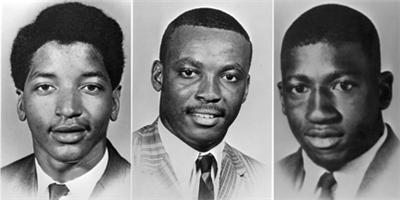
633060317174650000_Smith-Hammond-Middleton-1

Last February, Supreme Court Justice Clarence Thomas lamented the “race consciousness” and “sensitivity” as compared to growing up in Savannah Georgia in the 1960s.

If he were not in a position of nearly unlimited power and influence where he can through a legal opinion overturn established laws regarding voters rights, equal opportunity and discrimination it would be laughable. However, Justice Thomas seems to have missed so much of what was happening to African Americans and others during the Jim Crow Era, the campaigns for resistance in the “segregation forever” movement and the wanton violence used on African Americans who simply wanted the same rights that other Americans enjoyed.

How a man as educated and supposedly aware as Thomas supposedly is can make such an absurd statement is beyond me. In fact it is ludicrous and speaks volumes about how Thomas would willingly cover up the gross injustices that were perpetrated against African-Americans.

ScarredJustice

The brutality of those in power against those who demonstrated and campaigned for civil rights was widespread. If Thomas did not hear about it in his childhood it was more likely that it was because Blacks had no voice in local or state government, no support in the local media and those who spoke out were brutalized, their homes, churches or businesses burned or or bombed, and for their trouble many went to jail. It took extraordinarily courageous men and women to stand up to the tyranny perpetrated by politicians, police, businessmen, and even church leaders at the local and State level, which were often directly connected to the activities of the Ku Klux Klan in many parts of the South.

Thomas said that he was treated worse by the Northeastern Liberal Elites, than he was in his home town. That may be so, racial prejudice was not unique to the South, in fact some of the worst riots against desegregation occurred in Boston, not far from Thomas’ college Alma mater. In fact in some Northern cities racism and discrimination were as bad than in parts of the South.

Likewise there were incidents of violence in Watts California by the Los Angeles Police Department that helped trigger the Watts Riots. That being said, there can be no doubt that in terms of organized systemic discrimination, persecution, and violence, it was in the South where Blacks suffered the gravest injustice. The South was the unparalleled hotbed of resistance to change, and resistance to the simple desire of people to receive equal treatment under the law.

Today, even many whites remember some of those incidents; the burning of the Freedom Riders bus in Anniston Alabama, the baring of James Meredith from the University of Mississippi, the 16th Street Baptist Church Bombing in which four little girls going to Sunday School were murdered, the brutal attacks on protestors in that same city that sent Dr Martin Luther King to jail, the murder of Medgar Evers, the murder of the Mississippi Civil Rights Workers, Bloody Sunday on the Edmund Pettus Bridge in Selma Alabama, and the assassination of Martin Luther King Jr.

We all know about those, well at least some of us do. They all occurred early in my lifetime and certainly if Thomas didn’t know about them as a child, he most certainly knows about them now.But the good Justice willingly chooses to ignore and treat them if they never happened, to Thomas, those were the “good ole days.”

But such an attitude denies history. It is inexcusable for any man or woman, of any race holding such an important position as Thomas to have, that of a Supreme Court Justice to hold such ahistoric and racist views. For man like Thomas, who in his office helps to make and interpret law that affects the civil rights of all Americans it is unconscionable. But then, I do not believe that Thomas has a conscience.

orangespan

But for each of those incidents there were many more, some very bloody which have been forgotten. I was reminded of one of those last year  when a speaker talked about an incident that occurred at his alma mater, South Carolina State University in Orangeburg South Carolina, the Orangeburg Massacre. I think I had read about it once, but I had forgotten about it.

The massacre occurred on February 8th 1968 when students at the college began to protest for equal access to local businesses, especially at the only bowling alley in town, the All Star Lanes. The owner refused to allow Blacks to patronize his establishment. In the days leading up to the massacre students were beaten by police as they engaged in peaceful protests.

6a01053653b3c7970b0148c8716ecb970c-800wi

Protests continued on campus, hundreds of police and state troopers were dispatched as well as armored vehicles from the National Guard. On campus about 200 students milled around a dying bonfire.

020_orangeburg_massacre_wounded_jpg

During a protest the local and state police opened fire on a crowed of students at a bonfire. Contrary to the claims of the police no student was armed, three students were killed, and twenty seven wounded. Many were shot in the back. The dead included a college Army ROTC Cadet named Henry Smith, another, a member of the college football team, Samuel Hammond who died reciting the 23rd Psalm with his mother at his side, and lastly the young Delano Middleton, a local high school student who had joined the protest.

022_ORANGEBURG_NATIONAL_GUARD

J. Edgar Hoover ordered agents to make false statements to Justice Department officials to cover for the State Troopers involved. When nine of the police officers went to trial for excessive use of force all were acquitted. But how could they be? Evidence was suppressed, false statements made and testimony of the victims discounted.

16768434_BG1

For years the subject was covered up, and disinformation spread by elected and police officials, including the governor who blamed the protest on outside “Black Power agitators” and who claimed that the protest took place off campus. Activist Cleveland Sellers was convicted of “inciting a riot” and spent seven months in jail. Twenty five years later he was pardoned. It was not until 2001 that a Governor, then Jim Hodges attended the school’s annual memorial and it was not until 2005 when then Governor Mark Sanford made a formal apology for the massacre.

6a01053653b3c7970b0147e26870b8970b-800wi

The massacre received almost no coverage in the national media and was forgotten. The energy of most Americans was focused on the Vietnam War, the Kent State Shootings and the assassination of Dr Martin Luther King Jr.

10p816

Justice Thomas may have historical amnesia, but history is history, even history that those in power desired to cover up.

5129b1bbb6c38.preview-620

History and justice, even belated justice matter because there are those in our country, not all in the South, who would like to roll back the protections that exist in law to protect African Americans and other minorities from institutional discrimination in matters of voters rights and equality. There are business owners who openly boast of their refusal to serve minorities, and are hailed by some for doing so.

I encourage my readers to explore this subject, the book, The Orangeburg Massacre by Jack Bass and Jack Nelson published by Mercer University Press, a number of websites as well as a video that I have provided a link to here http://www.democracynow.org/2008/4/3/1968_forty_years_later_a_look are good places to start.

Like Montgomery, Birmingham, Anniston, Memphis and Selma, Orangeburg though forgotten by most, still matters. Never forget and do not let it happen again.

Peace

Padre Steve+

2 Comments

Filed under civil rights, History, News and current events

What Do You Say When You’re Not Sure? An Essay on Doubt

doubt1-1

“Doubt can be a bond as powerful and sustaining as certainty. When you are lost, you are not alone.”

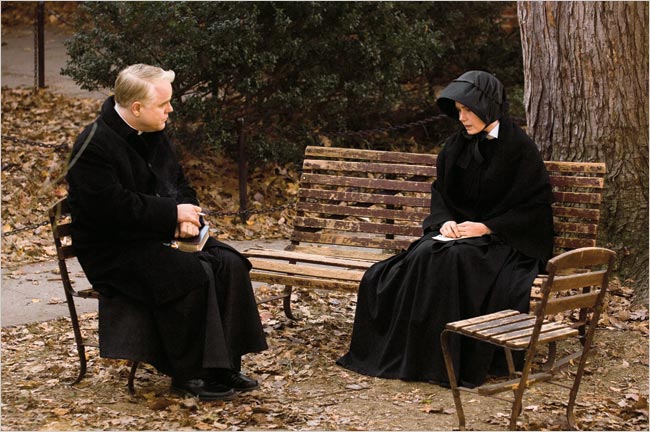
I am watching the movie Doubt tonight. It was a movie that came out when I was deployed to Iraq. I never had seen it before tonight. I purchased it after the death of the lead actor, Phillip Seymour Hoffman, when a friend of mine from my former denomination posted a remembrance about one of the scenes from this film. It was the sermon about gossip. That moved me, so after reading more about the film I purchased it. However, I was not prepared for the opening scene where Hoffman’s character in his homily speaks about doubt.

http://www.youtube.com/watch?v=YOSxGuUuvQY

http://www.youtube.com/watch?v=1OwpGUI-TAI 

“Last year, when President Kennedy was assassinated, who among us did not experience the most profound disorientation? Despair? Which way? What now? What do I say to my kids? What do I tell myself? It was a time of people sitting together, bound together by a common feeling of hopelessness. But think of that! Your bond with your fellow being was your Despair. It was a public experience. It was awful, but we were in it together. How much worse is it then for the lone man, the lone woman, stricken by a private calamity?

‘No one knows I’m sick.’

‘No one knows I’ve lost my last real friend.’

‘No one knows I’ve done something wrong.’

Imagine the isolation. Now you see the world as through a window. On one side of the glass: happy, untroubled people, and on the other side: you.

I want to tell you a story. A cargo ship sank one night. It caught fire and went down. And only this one sailor survived. He found a lifeboat, rigged a sail…and being of a nautical discipline…turned his eyes to the Heavens and read the stars. He set a course for his home, and exhausted, fell asleep. Clouds rolled in. And for the next twenty nights, he could no longer see the stars. He thought he was on course, but there was no way to be certain. And as the days rolled on, and the sailor wasted away, he began to have doubts. Had he set his course right? Was he still going on towards his home? Or was he horribly lost… and doomed to a terrible death? No way to know. The message of the constellations – had he imagined it because of his desperate circumstance? Or had he seen truth once… and now had to hold on to it without further reassurance? There are those of you in church today who know exactly the crisis of faith I describe. And I want to say to you: doubt can be a bond as powerful and sustaining as certainty. When you are lost, you are not alone.

In the name of the Father, the Son, and the Holy Ghost.”

Since Iraq I have experienced much doubt related to my experiences there, PTSD and Moral Injury. For nearly two years I experienced such a crisis of faith that for all practical intent I was an agnostic, praying to a God that I wasn’t sure existed hoping that there was a God.

When I watched that opening scene, as well as many others I found that I was reduced to tears, uncontrollable, they flooded me. The actors in the film, Hoffman, Meryl Streep, Amy Adams and Viola Davis, brought a power to their performances that made it so real, and powerful. It has been a long time since a film affected me like this, perhaps the last two were We Were Soldiers and Taking Chance, both of which related directly to my military experiences.

The writing of the screenplay, adapted to from a play by John Patrick Shanley,in part based on growing up in a small Catholic School run by the Sisters of Charity. I found it fascinating because of the mystery involved in the story, there is so much uncertainty in the story, a Priest who may be doing something wrong, a Nun who has no proof but is determined to drive him out, young Sister who in her innocence wants to believe the best about both the Priest and her superior, and a mother who just wants her son to survive, despite the abuse of his father and the racial prejudice of the community.

For me the film stuck on two levels, one my logical, suspicious and oft judgmental spirit, and my desire to want to believe the best about people, even me. It is a tension that I live with on a daily basis. In a way I could understand all three of the major characters.

21hoffman.large2

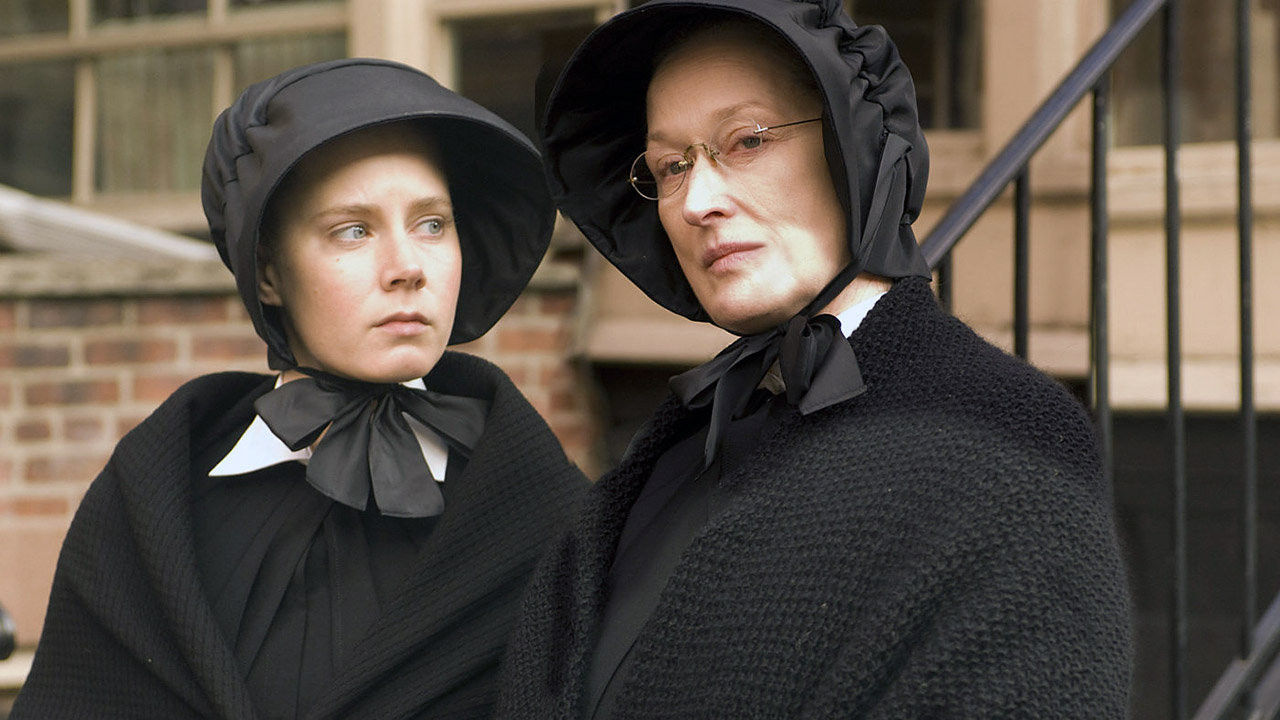
There is a scene where Father Flynn (Hoffman) talks with Sister James (Adams) and he tells her:

“There are people who go after your humanity, Sister, that tell you that the light in your heart is a weakness. Don’t believe it. It’s an old tactic of cruel people to kill kindness in the name of virtue.”

I understand it, because I am both, I am the one who believes the best but is also able to see the same “light” in others as weakness. The juxtaposition was quite stunning, and took me by surprise and perhaps was part of my emotional response to the film.

Another thing that made the film especially pertinent to me were the people, and the parts of the Catholic Church they represented. The Priest played by Hoffman was a man who really believed in the reforms of the Second Vatican Council, like so many Priests who helped me along my way. The Sisters, played by Streep and Adams were from the Sisters of Charity, founded by Saint Elizabeth Ann Seton and headquartered in Emmittsburg Maryland. There was a sister that I met at that location, when I was stationed at Fort Indiantown Gap when I was still an Army Chaplain. Sister Cornelia Colgan, touched my life in a special way and I am sure is still offering prayers for me from heaven. She passed a way an number of years ago, but for about 5 years between 1997 and 2002 we maintained a close correspondence until deployments and war intervened and we lost contact. I still have a couple of mementos that she gave me and I remember her fondly.

doubt-movie

http://www.youtube.com/watch?v=1OwpGUI-TAI 

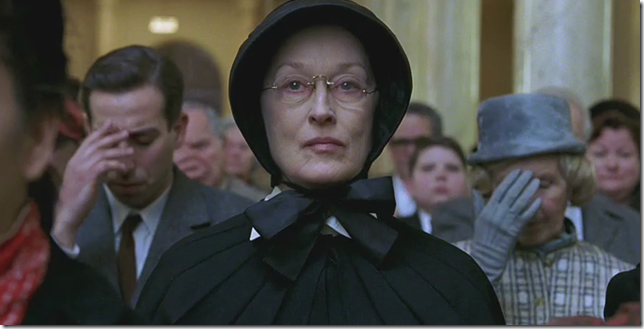
At an emotional level the sermons and words of Father Flynn and the final words of the film spoken by Sister Aloysius (Streep) speak to where I am still at in my faith. I believe, but I have such doubt.

Likewise there is a sense of aloneness, that still sometimes haunts me, despite close friendships and relationships. There are many times that I felt that I was alone when I returned from Iraq in 2008, but I have discovered that there are many like me.  Some of them like Sister Aloysius who despite her certitude also doubts, having not really gotten over her own grief and loss.

Doubt 1

At the end of the film there is a touching scene, Sister Aloysius has succeeded in forcing  Father Flynn out of the Parish and Sister James approaches her in the garden and a conversation ensues. Aloysius is alone, and appears quite vulnerable. Crying she admits to Sister James: “I have doubts. I have such doubts.”

 http://www.youtube.com/watch?v=TAOUtgdcjik 

I think that is reality for anyone who honestly wrestles with faith. I know that it is for me, for doubt reminds me that I am not alone. 

Peace

Padre Steve+

1 Comment

Filed under christian life, faith, film, Religion

The Gettysburg Campaign: Lee Decides to Go on the Offensive

993scr_3a12918e0189d2e

I am preparing to lead a Staff Ride of our students to Gettysburg in early March. As part of my preparation I am doing a lot of study to refresh myself on both the campaign and the battle, not only as an operational study, but at the strategic level. This short essay deals with Lee’s decision to invade the North following his victory at Chancellorsville. I will follow it up with other articles the next talking about the Northern strategy at both the strategic and operational levels.

In early May 1863 General Robert E. Lee, commanding the Army of Northern Virginia realized that the Confederacy was in desperate straits. Despite numerous victories against heavy odds, Lee knew that time was running out. Though he had beaten the Army of the Potomac under General Joseph Hooker at Chancellorsville, he had not destroyed it and that Army, along with a smaller force commanded by General Dix in Hampton Roads still threatened Richmond.

The strategic situation was bad, even if many Confederate politicians realized it or cared in the post Chancellorsville euphoria. In the west the strategic river city of Vicksburg Mississippi was threatened by the Army of Union General Ulysses S Grant, and Naval forces under the command of Admiral David Farragut. If Vicksburg fell the Union would control the entire Mississippi and cut the Confederacy in two. Union forces also maintained a strong presence in the areas of the Virginia Tidewater and the coastal areas of the Carolinas, while in Tennessee a Union Army was stalemated, but still threatening Chattanooga, the gateway to the Deep South. The blockade of the United States Navy had crippled the already tenuous economy of the Confederacy.

Some Confederate leaders realized the danger presented by Grant in the West. Secretary of War James Seddon recognized the danger in the Winter of 1862-1863 both suggested to Lee that he detach significant units to relieve the pressure in the west and blunt Grant’s advance. Lee would have nothing of it, he argued that the war would be won in the East. It was his view that if Virginia was lost, so was the Confederacy, and was concerned that whatever units left behind should he dispatch troops from his Army west, would be unable to defend Richmond.

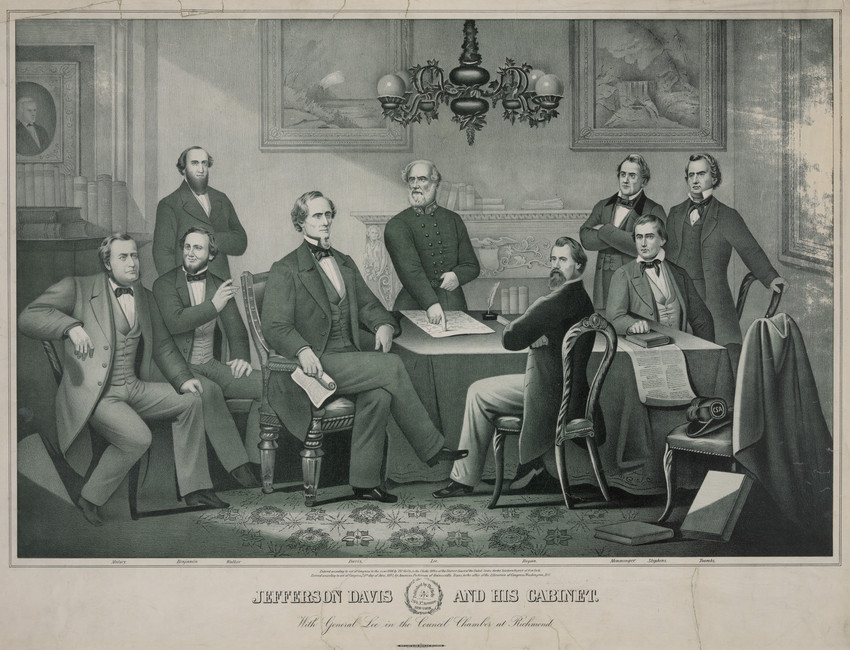
On May 14th Lee travelled by train to Richmond to meet with President Jefferson Davis and War Secretary James Seddon. At the meeting Lee argued for an offensive campaign in the east, to take the war to Pennsylvania. Lee had two goals three major goals, two which were directly related to the immediate military situation and one which went to the broader strategic situation. Unfortunately no notes from that conference are known to survive.

Lee had long believed that an offensive into the North was necessary, even before Chancellorsville. Lee did not believe that reinforcing the Confederate Armies in the West would provide any real relief, instead he believed that his Army, flush with victory needed to be reinforced and allowed to advance into Pennsylvania. Lee’s Chief of Staff Colonel Charles Marshall crafted a series of courses of action designed to present the invasion option as the only feasible alternative. Although both Seddon and Davis had reservations about the plan they agreed to it, unfortunately for all of them they never really settled the important goals of the campaign.

Lee believed that his offensive would relieve Grant’s pressure on Pemberton’s Army at Vicksburg. Likewise Lee believed that if he was successful in battle and defeated the Army of the Potomac in Pennsylvania that it could give the peace party in the North to bring pressure on the Lincoln Administration to end the war.  He also believed that if he could spend a summer campaign season in the North, living off of Union foodstuffs and shipping booty back to the Confederacy that it would give farmers in Northern Virginia a season to harvest crops unimpeded by major military operations.

However, the meeting evidently did not have all the results that Lee desired. Davis refused Lee reinforcements from the coastal Carolinas, and insisted on units being left to cover Richmond in case General Dix advanced on Richmond from Hampton Roads. Much of this was due to political pressure as well as the personal animus that existed between General D. H. Hill in the Carolinas towards Lee.

Likewise Lee’s decision revealed an unresolved issue in Confederate Grand Strategy. Many in the Confederacy realized that the only hope for success was to fight a defensive campaign that made Union victory so expensive that eventually Lincoln’s government would fall or be forced to negotiate.

However, Lee was convinced that ultimate victory could only be achieved by decisively defeating and destroying Federal military might. His letters are full of references to crush, defeat or destroy Union forces opposing him. His strategy of the offensive was demonstrated on numerous occasions in 1862 and early 1863, however it was unfeasible and counterproductive to Southern strategy. His offensive operations cost his Army dearly in the one commodity that the South could not replace, nor keep pace with its Northern adversary, his men.

When Lee fought defensive actions on ground of his choosing, like a Fredericksburg he was not only successful but husbanded his strength. However, when he went on the offensive in almost every case he lost between 15 and 22 percent of his strength, and the percentage of soldiers that he lost was always more than his Federal counterparts, even when his army inflicted greater aggregate casualties on his opponents. Lee recognized this as was evident in his correspondence but it did not deter his strategy of the offensive until after his defeat at Gettysburg.

The course of action was decided upon, but one has to ask if Lee’s decision was wise decision at a strategic point level, not simply the operational or tactical level where many Civil War students are comfortable. General Longstreet’s artillery commander, Colonel Porter Alexander described the appropriate strategy of the South well, he wrote:

“When the South entered upon war with a power so immensely her superior in men & money, & all the wealth of modern resources in machinery and the transportation appliances by land & sea, she could entertain but one single hope of final success. That was, that the desperation of her resistance would finally exact from her adversary such a price in blood & treasure as to exhaust the enthusiasm of its population for the objects of the war. We could not hope to conquer her. Our one chance was to wear her out.”  (Edward Porter Alexander, Fighting for the Confederacy: The Personal Recollections of General Edward Porter Alexander, ed. Gary W. Gallagher, University of North Carolina Press, Chapel Hill NC, 1989 p.415 

What Alexander describes is the same type of strategy successfully employed by Washington and his more able officers during the American Revolution, Wellington’s campaign on the Iberian Peninsula against Napoleon’s armies, and that of General Giap against the French and Americans in Vietnam. It was not a strategy that completely avoided offensive actions, but saved them for the right moment when victory could be obtained.

It is my belief that Lee erred in invading the North for the simple fact that the risks far outweighed the possible benefits. It was a long shot and Lee was a gambler, audacious possibly to a fault. His decision to go North also exhibited a certain amount of hubris as he did not believe that his army could be beaten, even when it was outnumbered.  Likewise he took the offensive in spite of the fact that many of his commanders were untested at the levels of command that they exercised. He had lost his right arm, General Stonewall Jackson, who died following being wounded at Gettysburg.

He knew from his previous battles the heavy casualties that even a victory over the Army of the Potomac would entail deep in Northern territory and the effect that a costly victory would have on his operations, but he still took the risk. That was short sighted and diametrically opposed to the strategy that the South needed to pursue in order to gain its independence. Of course some will disagree, but I am comfortable in my assertion that it was a mistake that greatly affected the Confederacy’s only real means of securing its independence, the breaking of the will of the Union by making victory so costly that it would not be worth the cost.

Peace

Padre Steve+

Leave a comment

Filed under civil war, History, leadership, Military

God With Us? The Misuse of God’s Promise by Political Partisans

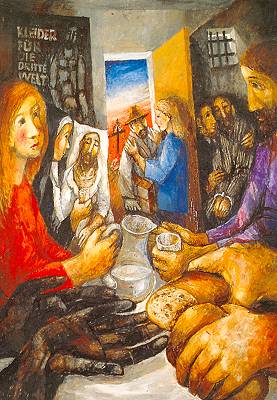
barmherzigkeit

It is one of the most amazing stories of salvation history. The Incarnation of God in Jesus the Christ. Matthew’s Gospel (Ch 1 v.24), referring back to the words of Isaiah delivers the message in words which find their way into our culture every Christmas through Georg Friedrich Handel’s Messiah: “Behold, the virgin shall conceive and bear a son, and they shall call his name Emmanuel, ‘God with us.’”

That message, which lays at the heart of the Christian Gospel is really amazing.  It is a message that points to a Gospel meant for all people and not any particular nation, nor any political, racial, or ethnic group that wishes to appropriate it for themselves alone.

It is the message of the humility and grace of God.  It is the message God humbling himself to become incarnate and not only live among his creation, but to suffer and die for the salvation of it. All of it. As Paul wrote so well in his epistle to the Philippians:

“Let the same mind be in you that was in Christ Jesus, who, though he was in the form of God, did not regard equality with God as something to be exploited, but emptied himself, taking the form of a slave, being born in human likeness. And being found in human form, he humbled himself and became obedient to the point of death– even death on a cross.” (Phil 2:5-7)

Unfortunately that message is all too often appropriated and twisted into something unrecognizable by those who seek to use it to bolster their particular ideology, nationalism or even racism. In practice, human beings are much more likely to claim this message to bolster their own hatred and intolerance or justify their nation’s desire for conquest. It matters not if the a Christian in any sense of the word or not. One sees the same idea floated by zealots of almost every major religion. The appeal to being on the same side of God trumps all other arguments.

As a historian I have studied this often. In the United States it is encompassed in the idea of Manifest Destiny; but can be seen in the life and history of many nations who in their belief that God was on their side have slaughtered hundreds of millions of people. One does not have to look far to see leaders of nations, political factions, ideologues or other fanatics appropriate God as the trump card of their message. However, it is not just a matter for history. It happens every day, and it is not pretty. Many use it to justify the most reprehensible crimes, persecution, ethnic cleansing and even genocide. They do so all in the name of God, preaching that God is with them, and not those who they despise.

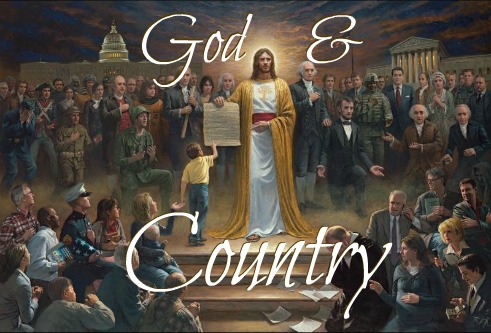
god-government-77-cover-photo

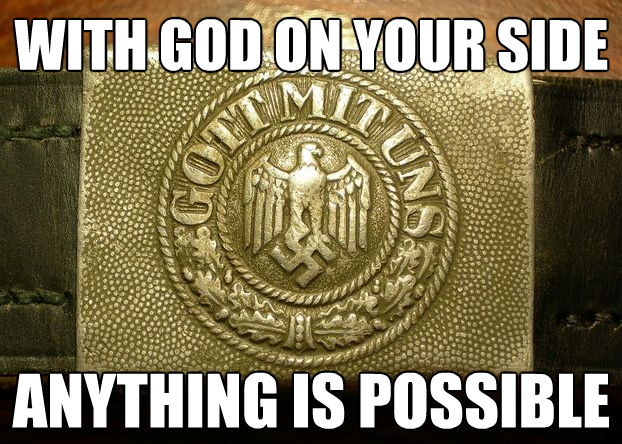
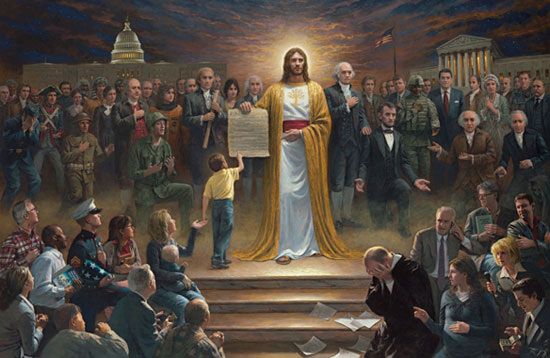
Today I saw a blog on a service that I use to promote my website. The author of the blog promotes an extremely conservative political ideology with most of his posts being directed with some vehemence, often colored by blatant racism at President Obama and others that he does not agree with. Usually his posts are filled with such hyperbole and nonsense that I simply ignore them. However, today he posted something that as a Christian really bothered me. His post was titled Do Not Fear, God is With Us, and it featured the picture shown above. When I saw it, I felt a chill run down my spine. It was as if I was envisioning the virulent hatred of other races, creeds and nations exhibited by those who have claimed that mantle before. I can see it now, a belt-buckle with a Swastika, ringed in the words “Gott Mit Uns.” 

gottMitUns

The sad thing is that the Christians who claim this mantle misuse scripture and twist it to justify their hatred of all that they disagree with, have lost sight of the Gospel. Instead they have allowed their passionate hatred and prejudice to hijack the message of the Gospel to promote political partisanship, hyper nationalism and xenophobia. This can hardly be called Christian. If such ideas were was limited to the fringe of society it would not be so concerning. However, this blogger represents a significant portion of the American electorate; and his comments are echoed by the very powerful, and allegedly Christian leaders of partisan political organizations, as well as pundits, politicians and preachers. If you do not agree with them you are not a real American.

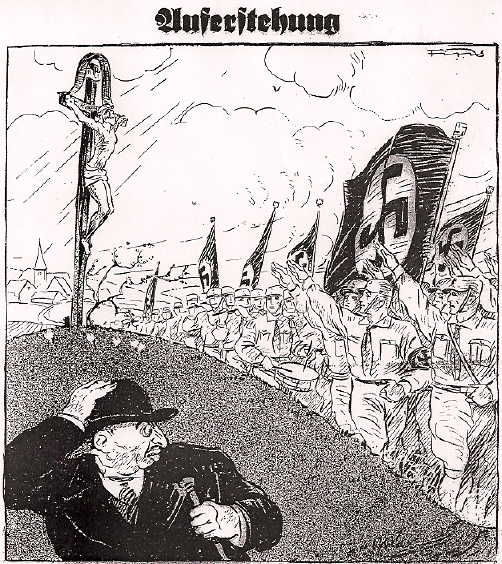
ds13_1929_by_panzergirl69-d5zanbl

Cartoon from the Nazi Der Sturmer linking the Nazi Movement to Christ, with the Jew being the villain 

Instead of seeing the message of God’s grace, love and mercy for all people, we see triumphalist Christians that claim that God is with them. In their zeal they ride roughshod over others, and despise all who disagree with or oppose them. Their opponents are painted as being in league with the Devil, modern Judas Iscariots. In their lives and ideology many Christians follow leaders who espouse brutal doctrines of Social Darwinism and sell their birthright for a pittance. They attempt to use of the police power of government at every level against those that they disapprove, in matters of faith, lifestyle or politics. Likewise they have no compunction about using the military and economic power of the nation to crush weaker nations, all because they believe that they and their country have God on their side.

But do such sentiments have any place in the message of Christians? I think not. As Paul the Apostle notes: if in Christ “there is no longer Jew or Greek, there is no longer slave or free, there is no longer male and female; for all of you are one in Christ Jesus.” (Gal 3:28) Or as Paul writes in 2 Corinthians “in Christ God was reconciling the world to himself, not counting their trespasses against them, and entrusting the message of reconciliation to us.” (2 Cor 5: 19)

The Gospel is not about God being on the side of any nation or political ideology. Such ideas always end in disaster for those that believe them, and who use God to justify their actions.

0725-Morgan-McNaughton-one-nation-550x358

McNoughton’s “One Nation under God”

The picture on the website that triggered this little article is one by a Mormon artist, John McNoughton. McNoughton has frequently blended the image of Jesus with the most banal appeal to American “patriotism” and crude attacks on President Obama. In this picture as well as others the artist has Jesus holding a copy of the Constitution of the United States in his right hand, with his friends on that side, and his foes, including judges, others viewed as liberals and women. In his more crass attacks on the President in other paintings he shows Obama trampling the Constitution while white people are bound in chains. All of these show up with startling frequency on supposedly Christian websites.

1896_cartoon

US Political Cartoon from 1896

The sad truth is that McNoughton is not the first to practice this crude form of xenophobic patriotism, which appeals to God in order to vilify the opponents of their ideology. It has been used in this country before, as well as in Europe to vilify Jews, racial minorities and political opponents.

Yes, I do believe that God is with us, however, that is not confused with appeals to my patriotism, which is real and has led me to serve this nation for over 30 years in the military including two combat tours in the Middle East. Nor does it add or detract from my support of our Constitution, why does not mention God once, despite its guarantee of religious freedom for all, not just Christians. It is an amazing document, one that I will die to defend, but it is not handed down by God, and Jesus never referred to it.

Instead, my belief that God is with us flows from the mystery of the Incarnation, that miracle of salvation history.  I believe in the message wonderfully referred to in the liturgy as the “mystery of faith,” that Christ has died, Christ is risen and Christ will come again. My belief flows from the simple message that for God so loved the world… and not that God so established this or any other nation or political ideology as his own.

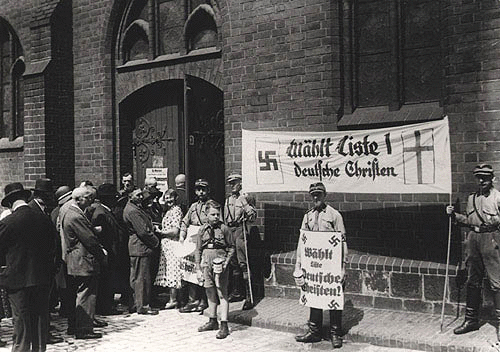
I understand the fear that drives men like the blogger who posted the article I saw, as well as men like McNoughton. Their fear of the other allows them to use these images to promote their hopelessly confused faith and ideology. Dietrich Bonhoeffer who saw the same fear and hatred present among his fellow Germans, especially German Christians wrote:

“The Christian must treat his enemy as a brother, and requite his hostility with love. His behavior must be determined not by the way others treat him, but by the treatment he himself receives from Jesus; it has only one source, and that is the will of Jesus.”

deutschenchristen2

What I see from the present political ideologues has nothing to do with love of God or our neighbor, but their efforts to protect their status in society, their political power and subject all others to their will.

God is with us indeed, in the humility of a borrowed manger, on the gibbet of a Roman cross, and in shame of a borrowed tomb. God is really present with us in the the bread and wine, in the word, and in the lives of his people; especially the least, the lost and the lonely. To attempt to crudely use God to buttress any earthy power is heresy. Those that use it in such a manner, though proclaiming their fealty to Christ, or any other God, willingly trample the message of the God who humbled himself, even to death on a cross.

Peace

Padre Steve+

1 Comment

Filed under christian life, faith, Political Commentary, Religion

The Long and Slow Integration of the Major Leagues: A Reflection on Desegregation and Spring Training

Friends of Padre Steve’s World. Pitchers and catchers are reporting to Spring Training as they always do this time of year, by the end of the week the rest of the players will report. This year American and Canadian players, white, black, hispanic and asian will report, along with men from other nations, men who speak different languages, hail from different cultures and are of races that in 1946 would have not been allowed at Spring Training. It is hard to believe now, but in 1947 when Branch Rickey brought Jackie Robinson to the Dodgers minor league camp. In 1948 when Robinson reported he was being groomed by Rickey to be the first African American to play in the Major Leagues. That was a major step, but it took years before every team in the Major Leagues integrated despite a plethora of talent in the Negro Leagues and coming up in the integrated Minor Leagues. The last team to integrate was the Boston Red Sox, whose first Black player, Shortstop Pumpsie Green did not debut until July of 1959. During those eleven intervening years Jim Crow still ruled the South, Rosa Parks refused to go to the back of the Bus, young Emmett Till was brutally murdered, President Eisenhower sent in Federal Troops to Little rock to intervene and help the nine African American High School students entering the formerly all-white Central High School. Martin Luther King Jr, Charles Steele and Fred Shuttlesworth established the Southern Christian Leadership Conference, which brought organization and an ethic of non-violence in civil disobedience protests against segregation, discrimination and Jim Crow laws. But the tide was turning and the men who integrated the Major Leagues did much to speed the process of destroying Jim Crow, and promoting civil rights, not just for African Americans, but for all Americans. Of course there is still much to do, racism and discrimination still exist. That being said, I am always amazed when I meet the pioneers of the Negro Leagues who dis so much to break the color barrier in Baseball and in society at large. Peace, Padre Steve+

padresteve's avatarThe Inglorius Padre Steve's World

robinson-dodgers

John Jorgensen, Pee Wee Reese, Ed Stanky and Jackie Robinson on opening day 1947

“Thomas Jefferson, when he wrote the Declaration, made proper provision for baseball when he declared that ‘all men are, and of right out to be, free and equal.’ That’s why they are at the ball game, banker and bricklayer, lawyer and common laborer.” – Baseball magazine (1921)

“Baseball should be taken seriously by the colored player — and in this effort of his great ability will open the avenue in the near future wherein he may walk hand in hand with the opposite race in the greatest of all American games — baseball.” Ossie Davis

robinson2-popup

Charles Thomas 

It was in 1903 when Branch Rickey, then a coach for the Ohio Wesleyan University baseball team had to console his star player, Charles Thomas when a hotel in South Bend Indiana refused him a room because he was…

View original post 1,686 more words

Leave a comment

Filed under Loose thoughts and musings

The Continuing Journey: Reflections of 6 Years Dealing with PTSD Faith and Life

tom-clancy-look-2

“You wonder what I am doing? Well, so do I, in truth. Days seem to dawn, suns to shine, evenings to follow, and then I sleep. What I have done, what I am doing, what I am going to do, puzzle and bewilder me. Have you ever been a leaf and fallen from your tree in autumn and been really puzzled about it? That’s the feeling.” T. E. Lawrence, Letter 1935

It has been six full years since I descended into the hell of the abyss that is PTSD. Back in the late spring and early summer of 2008 just a few months after my return from what I still consider my best tour of duty in over 30 years of military service with US advisors and Iraq Army and Security forces in Al Anbar Province in 2007-2008 I was in a state of emotional and spiritual collapse.

I really couldn’t believe then what was happening to me or they way that it would end up shaping my life to the present day. In retrospect my return from Iraq marked a beginning of a personal hell that for a number of years seemed like that it would never end. It was painful, it was isolating and it marked a profound change in the way that I saw God, faith, politics and social justice. It changed me in ways that I never could have imagined when I got on a bus heading for Fort Jackson South Carolina following the July 4th holiday of 2007.

Those brave souls that have followed me on this website as well as those that are still my friends despite occasional disagreements and misunderstandings, those that may not understand me but still are my friends have seen this.

So six years later what is it like?

I still have trouble sleeping, not as much as I used to but enough to impact my life. I don’t take heavy doses of sleep meds anymore, just some Melatonin as well as a mild dosage of an anti-anxiety medication and anti-depressant. A far better combination than medications that made me feel like I was hung over without that benefit of sharing too many drinks with friends at the local watering hole.

As opposed to the years immediately following my time in Iraq I have to say that I am no longer self medicating with alcohol. I remember in 2009 going out for dinner, having a few beers, then going to a ball game and drinking a few more and coming home with Krispy Kreme donuts and drinking more beer on a regular basis and usually taking a couple of shots or Jaegermeister or glasses of Spanish Brandy just to get to sleep so I could go back to facing life and death situations the next day in our ICUs. I don’t need that anymore, even though sleep can be problematic and dreams and nightmares rivaling anything I can watch on my HD TV…

I still love to pony up to the bar and share a couple of pints with friends but I don’t need it to numb myself into feeling no pain. Talking with many other vets who have served in Iraq, Afghanistan or even Vietnam I know that I wasn’t alone in those dark days.

I have become a bit less hyper-vigilant though when I come home to Virginia Beach than I was just three years ago and most certainly five years ago in May of 2008. However, that being said I do notice that I am more on guard on the roads and that little things, sirens, emergency vehicles, loud noises and traffic still set me off more than when I lived in rural North Carolina while stationed at Camp LeJeune from 2010 until August of 2013.

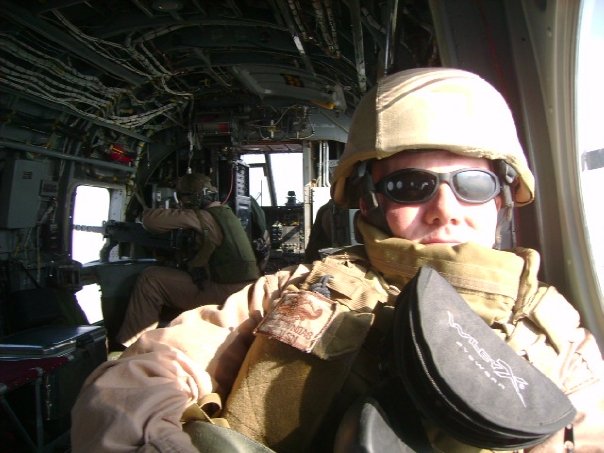
I absolutely hate air travel. I don’t like the crowds, the stress of security or the constant delays, changes and overcrowding. Truthfully I felt more comfortable flying the skies of Iraq on Marine, Army and Air Force fixed and rotor wing aircraft and on occasion being shot at in Iraq’s Al Anbar Province than I do on any airline today in this country.

I have become exceptionally sensitive to tragedy, death and suffering. The loss of friends or major incidents where military personnel are killed in combat, training missions or just doing their job hits me hard. The worst times are when friends, or others that I know die by their own hand. When they are veterans who suffer from PTSD, TBI or Moral Injury it is like a dagger plunging into me.

Physical fitness matters more than it did before, even though I was in very good shape before and during my time in Iraq. But when I came home from that I was not only wounded in mind and spirit, but my body was beaten up. Chronic nagging injuries and chronic pain kept me from doing what I liked doing and what helped me keep my physical-spiritual and emotional balance. Those nagging injuries took a long time to heal, and they took some adjustments on my part which took me several years to adapt to and compensate in my physical regimen.  I can say now that I am in as good or better shape than I was before I left for Iraq in 2007. Maybe I’ll write a best selling book and do an exercise video like Jane Fonda…

Whereas in 2008 through 2010 and even until 2011 I was exceptionally sensitive to criticism to the changes that were occurring in my life including my move to the “left” both theologically and politically I have gotten to the point that I realize that it is more important to be honest and authentic as to who I am and what I believe. I have found that those that really matter to me don’t care so much about those things and that relationships maintained with people who don’t always agree with each other where all remain their personal integrity are far more rewarding than relationships that are first and foremost decided by allegiance to political or religious orthodoxy no matter what side of the spectrum it is from. I hate group think. Thus though I have to now consider me to be on the “liberal” side of the political and theological divide I still have to be considered a moderate simply because I refuse to make people my enemy simply because I disagree with them or they with me.

When I began this site in the spring of 2009 I named it Padre Steve’s World…Musings of a Passionate Moderate. I think I did that because it actually described me then, and now, even though I am pretty passionately liberal about some things and that doesn’t bother me in any way because it comes from my wrestling with God and faith and realizing that integrity matters more than about anything else. I have toyed with changing the title of the site but have decided against that because I am a moderate liberal committed to a Christian faith that speaks for the oppressed and is willing to confront those that would use faith, political or economic power to oppress the weak or those different from us.

Since I returned from Iraq in 2008 I discovered what it was to really question faith and God. To become for a couple of years a man who was for all practical purposes an agnostic praying that God still existed and cared. I discovered that in doing so that faith returned, different but more real than I had ever experienced in a life spent in the Christian faith and ministry.

My agnostic period gave me an immense empathy and appreciation for those who have lost faith, struggle with faith or reject any concept of God. I value reason as much, maybe if not more than faith now, not that reason is infallible or perfect, but it does allow me to evaluate my faith, and appreciate the amazing mysteries of the universe that our science and technology continue to reveal in ever more complex detail.

That brought change because my rediscovered faith brought me into conflict with people in the church denomination and faith community where I had been ordained as a priest. I was asked to leave and found a new home church and denomination that fit my life, faith experience and where I could live and minister in complete integrity. In the church that took me in during the fall of 2010 I can be faithful to the Gospel and care for the lost, the least and the lonely, especially those who have been abused by churches and ministries that have sold their soul to right wing political ideologues whose only concern is their political power and influence and would use churches and Christians to do their evil bidding. I guess that I learned that just because someone wraps the Bible in an American Flag, believes that Jesus brought us the Constitution and says that they “support the troops” it doesn’t necessarily mean that they care a whit about the Bible, the Flag, the Constitution or the Troops. I hope that isn’t too harsh….

Oh well, I feel that I am beginning to ramble so I will say good night and “God Bless,” no matter what God that you profess or for that matter don’t profess.

Peace

Padre Steve+

Leave a comment

Filed under faith, iraq,afghanistan, Military, PTSD

God in the Empty Places, Six Years After Iraq

313_34838767058_2205_n

Leaving Iraq, January 31st 2008

Six years ago I arrived home from Iraq. It was the beginning of a new phase in my life.  I wrote an article shortly after my return for the church that I belonged to at the time and I have republished it around this time of year a number of times.

When I wrote it I really had no idea how much I had changed and what had happened to me. When I wrote it I was well on my way to a complete emotional and spiritual collapse due to PTSD.  Things are better now but it was a very dark time for several years and occasionally I still have my bad days.

These wars in Iraq and Afghanistan have been terribly costly in lives, treasure and they have lost almost all sense of public support. I have been in the military almost all of my adult life, over 32 years. I am also a historian and the son of a Vietnam Veteran. Thus, I feel special kinship with those that have fought in unpopular wars before me. French Indochina, Algeria and Vietnam, even the Soviet troops in Afghanistan before we ever went there. 

533506_10151366982462059_34997654_n

I am honored to have served with or known veterans of Vietnam, particularly the Marines that served at the Battle of Hue City, who are remembering the 44th anniversary of the beginning of that battle.  My dad also served in Vietnam at a place called An Loc. He didn’t talk about it much and I can understand having seen war myself. 

When I look up at the moonlit sky I think about seeing all of those stars and the brilliance of the moon over the western desert of Iraq near Syria. Somehow, when I see that brilliant sight it comforts me instead of frightens me. 

295_26912092058_3949_n

Tonight our Soldiers, Marines, Sailors and Airmen serve in harm’s way nearly 35,000 in Afghanistan alone. We are sort of out of Iraq but Lord knows how things will turn out in the long run, and it appears that another major Battle of Fallujah is shaping up.  

Tonight I am thinking about them, as well as those men who fought in other unpopular wars which their nation’s government’s sent them. 

dien-bien-phu6

When I left Iraq I was traumatized. All that I had read about our Vietnam veterans, the French veterans of Indochina and Algeria and the Soviet veterans of Afghanistan resonated in my heart. The words of T. E. Lawrence, Smedley Butler, Erich Maria Remarque and Guy Sager also penetrated the shields I had put around my heart. 

So I wrote, and I wrote, and I still write. But tonight here is God in the empty Places.

262_29132262058_8844_n-2

God in the Empty Places. 

I have been doing a lot of reflecting on ministry and history over the past few months. While both have been part of my life for many years, they have taken on a new dimension after serving in Iraq. I can’t really explain it; I guess I am trying to integrate my theological and academic disciplines with my military, life and faith experience since my return.

The Chaplain ministry is unlike civilian ministry in many ways. As Chaplains we never lose the calling of being priests, and as priests in uniform, we are also professional officers and go where our nations send us to serve our Soldiers, Sailors, Marines and Airmen. There is always a tension, especially when the wars that we are sent to are unpopular at home and seem to drag on without the benefit of a nice clear victory such as VE or VJ Day in World War II or the homecoming after Desert Shield and Desert Storm.

french-chaplain-and-soldiers-2

It is my belief that when things go well and we have easy victories that it is easy for us to give the credit to the Lord and equally easy for others to give the credit to superior strategy, weaponry or tactics to the point of denying the possibility that God might have been involved. Such is the case in almost every war and Americans since World War Two have loved the technology of war seeing it as a way to easy and “bloodless” victory. In such an environment ministry can take on an almost “cheer-leading” dimension. It is hard to get around it, because it is a heady experience to be on a winning Army in a popular cause. The challenge here is to keep our ministry of reconciliation in focus, by caring for the least, the lost and the lonely, and in our case, to never forget the victims of war, especially the innocent among the vanquished, as well as our own wounded, killed and their families.

377

But there are other wars, many like the current conflict less popular and not easily finished. The task of chaplains in the current war, and similar wars fought by other nations is different. In these wars, sometimes called counter-insurgency operations, guerrilla wars or peace keeping operations, there is no easily discernible victory. These types of wars can drag on and on, sometimes with no end in sight. Since they are fought by volunteers and professionals, much of the population acts as if there is no war since it does often not affect them, while others oppose the war.

Likewise, there are supporters of war who seem more interested in political points of victory for their particular political party than for the welfare of those that are sent to fight the wars. This has been the case in about every war fought by the US since World War II. It is not a new phenomenon. Only the cast members have changed.

legion-algeria1

This is not only the case with the United States. I think that we can find parallels in other militaries. I think particularly of the French professional soldiers, the paratroops and Foreign Legion who bore the brunt of the fighting in Indochina, placed in a difficult situation by their government and alienated from their own people. In particular I think of the Chaplains, all Catholic priests save one Protestant, at the Battle of Dien Bien Phu, the epic defeat of the French forces that sealed the end of their rule in Vietnam. The Chaplains there went in with the Legion and Paras. They endured all that their soldiers went through while ministering the Sacraments and helping to alleviate the suffering of the wounded and dying. Their service is mentioned in nearly every account of the battle. During the campaign which lasted 6 months from November 1953 to May 1954 these men observed most of the major feasts from Advent through the first few weeks of Easter with their soldiers in what one author called “Hell in a Very Small Place.”

frenchforeignlegionairevtnamdod-2

Another author describes Easter 1954: “In all Christendom, in Hanoi Cathedral as in the churches of Europe the first hallelujahs were being sung. At Dienbeinphu, where the men went to confession and communion in little groups, Chaplain Trinquant, who was celebrating Mass in a shelter near the hospital, uttered that cry of liturgical joy with a heart steeped in sadness; it was not victory that was approaching but death.” A battalion commander went to another priest and told him “we are heading toward disaster.” (The Battle of Dienbeinphu, Jules Roy, Carroll and Graf Publishers, New York, 1984 p.239)

Of course one can find examples in American military history such as Bataan, Corregidor, and certain battles of the Korean War to understand that our ministry can bear fruit even in tragic defeat. At Khe Sahn in our Vietnam War we almost experienced a defeat on the order of Dien Bien Phu. It was the tenacity of the Marines and tremendous air-support that kept our forces from being overrun.

You probably wonder where I am going with this. I wonder a little bit too. But here is where I think I am going. It is the most difficult of times; especially when units we are with take casualties and our troops’ sacrifice is not fully appreciated by a nation absorbed with its own issues.

legion-indo-china

For the French the events and sacrifices of their soldiers during Easter 1954 was page five news in a nation that was more focused on the coming summer. This is very similar to our circumstances today because it often seems that own people are more concerned about economic considerations and the latest in entertainment news than what is going on in Iraq or Afghanistan.

french-at-dien-bien-phu

The French soldiers in Indochina were professionals and volunteers, much like our own troops today. Their institutional culture and experience of war was not truly appreciated by their own people, or by their government which sent them into a war against an opponent that would sacrifice anything and take as many years as needed to secure their aim, while their own countrymen were unwilling to make the sacrifice and in fact had already given up their cause as lost. Their sacrifice would be lost on their own people and their experience ignored by the United States when we sent major combat formations to Vietnam in the 1960s.

In a way the French professional soldiers of that era, as well as British colonial troops before them have more in common with our current all volunteer force than the citizen soldier heroes of the “Greatest Generation.” Most of them were citizen soldiers who did their service in an epic war and then went home to build a better country as civilians. We are now a professional military and that makes our service a bit different than those who went before us.

943043_10151694525692059_632653331_n

Yet it is in this very world that we minister, a world of volunteers who serve with the highest ideals. We go where we are sent, even when it is unpopular. It is here that we make our mark; it is here that we serve our Soldiers, Sailors, Marines and Airmen. Our duty is to bring God’s grace, mercy and reconciliation to men and women, and their families who may not see it anywhere else. Likewise we are always to be a prophetic voice within the ranks.

When my dad was serving in Vietnam in 1972 I had a Sunday school teacher tell me that he was a “Baby Killer.” It was a Catholic Priest and Navy Chaplain who showed me and my family the love of God when others didn’t. In the current election year anticipate that people from all parts of the political spectrum will offer criticism or support to our troops. Our duty is to be there as priests, not be discouraged in caring for our men and women and their families because most churches, even those supportive of our people really don’t understand the nature of our service or the culture that we represent. We live in a culture where the military professional is in a distinct minority group upholding values of honor, courage, sacrifice and duty which are foreign to most Americans. We are called to that ministry in victory and if it happens someday, defeat. In such circumstances we must always remain faithful.

For those interested in the French campaign in Indochina it has much to teach us. Good books on the subject include The Last Valley by Martin Windrow, Hell in a Very Small Place by Bernard Fall; The Battle of Dienbeinphu by Jules Roy; and The Battle of Dien Bien Phu- The Battle America Forgot by Howard Simpson. For a history of the whole campaign, read Street Without Joy by Bernard Fall. I always find Fall’s work poignant, he served as a member of the French Resistance in the Second World War and soldier later and then became a journalist covering the Nuremberg Trials and both the French and American wars in Vietnam and was killed by what was then known as a “booby-trap” while covering a platoon of U.S. Marines.

madonna-of-stalingrad-2

There is a picture that has become quite meaningful to me called the Madonna of Stalingrad. It was drawn by a German chaplain-physician named Kurt Reuber at Stalingrad at Christmas 1942 during that siege. He drew it for the wounded in his field aid station, for most of whom it would be their last Christmas. The priest would die in Soviet captivity and the picture was given to one of the last officers to be evacuated from the doomed garrison. It was drawn on the back of a Soviet map and now hangs in the Kaiser Wilhelm Memorial Church in Berlin where it is displayed with the Cross of Nails from Coventry Cathedral as a symbol of reconciliation. I have had it with me since before I went to Iraq. The words around it say: “Christmas in the Cauldron 1942, Fortress Stalingrad, Light, Life, Love.” I am always touched by it, and it is symbolic of God’s care even in the midst of the worst of war’s suffering and tragedy. I have kept a a copy hanging over my desk in my office since late 2008. It still hangs in my new office.

Peace

Padre Steve+

1 Comment

Filed under History, iraq,afghanistan, middle east, ministry, PTSD, Tour in Iraq

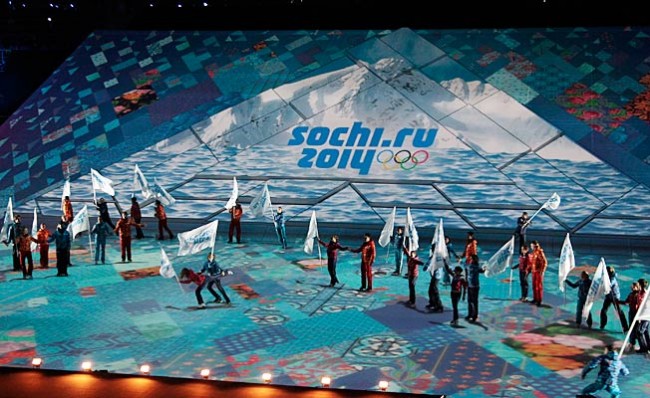
Thoughts and Concerns Regarding the Sochi Winter Olympics

Sochi-2014-Olympics-829732

I find it strange as I am not watching the Winter Olympics tonight. I have always been more of a fan of the Winter Games than the summer. I cannot remember the last time that I purposely didn’t watch the beginning of any Olympic Games, certainly not the Winter Games. The first Winter Olympiad that I remember watching was in 1972 when it was held in Sapporo Japan. It was a time that I was playing hockey and a time that I fell in love with with the Winter Games.

cn30-wide-blast-20131230173520979730-620x349

However I am not watching tonight, and it is not for lack of interest in the sports, athletes and human interest stories. But something doesn’t seem right. I have a sense of foreboding about these games. The security situation troubles me, Chechen and other militant Islamists in the Caucasus have made credible threats. Based on their track record of successfully carrying out major bloody terror attacks throughout Russia, including Moscow, Volgagrad, and Beslan gives credence to the capabilities of these terrorists. I fear for the athletes, their families, the spectators and the citizens of Sochi. I do hope that the Russian Security Services are successful in preventing any attacks. 

There are other things that trouble me. From the reports that I read it does not look like Sochi is really ready for prime time. The isolation of Sochi from the rest of Russia and the world is The reported troubles make it appear that the thin veneer of progress that Putin has tried to apply to a crumbling state is already wearing badly. 

Likewise I do not trust Russian President Putin, it seems to me that he is returning Russia to an authoritarian state which persecutes its minorities, be they ethnic, religious or other supposedly less than desirable groups, specifically in the last case the Russian LGBT community. 

enhanced-buzz-6581-1374515190-38

The sad thing in the latter case is that supposedly American Christians like Scott Lively, and advocacy groups like the National Organization on Marriage, as well as many in the conservative Christian alternate media are encouraging and abetting those that would crush the rights of a minority group, in fact they praise Putin’s authoritarianism. I think that speaks volumes of what they think of civil, political and human liberties and is an indicator of what they would do in this country if they ever gained control of all the mechanisms of government. Thankfully I cannot see that happening, but stranger things have happened when virulent radicals promote fear and intolerance in the name of their religion, or ideology.  

130729164257-sochi-olympics-single-image-cut-650x398

Now I am sure that I will watch many of the events shown of these games. I hope they will be successful and I will also be praying that no terrorist attacks harm anyone involved. That being concerned I am concerned for all in Sochi tonight. 

Peace

Padre Steve+

Leave a comment

Filed under News and current events, sports and life

The Long Strange Trip: Six Years After Returning from Iraq

295_26912117058_5652_n

It is hard to believe because it seems like it was yesterday, but six Years ago tonight I got off a plane, home from Iraq. The final flight on a commercial aircraft going from Philadelphia to Norfolk was crowded, but the people on board were polite to us, both the flight crew and the passengers, but it was like I had returned to a different world. What I entered was the same as it always had been, but I was different.

Guy Sager, an Alsatian who served in the German Army in World War Two wrote at the end of his book The Forgotten Soldier:  

“In the train, rolling through the sunny French countryside, my head knocked against the wooden back of the seat. Other people, who seemed to belong to a different world, were laughing. I couldn’t laugh and couldn’t forget.” 

About a year after my return, actually on February 16th 2009 I began writing on this site. I began it in large part to express my inner angst and as a means to my own healing as well as to help others. The beginnings came out of my initial therapy with Dr Elmer Maggard, who I sometimes refer as “Elmer the Shrink.” Elmer asked me if I was willing to open up and share my story even though I was still very broken and vulnerable, feeling abandoned by God, the church and most clergy.

At the time I was a practical agnostic. My collapse from PTSD and the moral injuries that I had sustained in Iraq were severe, it was if God had abandoned me, and try as I might nothing worked. In the months before I began writing I had hit bottom. That was then.

The last five years of writing my journey home has been illuminating. As I look back at things that I wrote, surveyed my moods, emotions, intellectual and spiritual development since the beginning of Padre Steve’s World I am reminded of the words to the Grateful Dead song Truckin’ because my life, especially since Iraq has been “a long strange trip.” 

That may seem kind of flippant, but it is true. My journey has been strange and I could not have predicted it back when I got my orders to go to Iraq in May of 2007. I was a volunteer for the mission and what I experienced changed me forever.

I don’t know what the future holds. I was shaken when my Captain Tom Sitsch, my former Commodore at EOD Group Two committed suicide a month ago. I know far too many men and women who have died by their own hand due to the after effects of the trauma they sustained in Iraq Afghanistan, or even Vietnam. What I experience is not unique to me, and that comforts me.

I have been busy this week, between storm recovery, home restoration and catch up at work I have had little time to muse about what the years have been like. I still feel a sense of melancholy as I do every time this year. My difficulty sleeping, nightmares and night terrors still plague me, some nights are better than others but the insomnia that has plagued me since my time in country is still all too real. My anxiety and panic attacks, though diminished still remain.

Faith, which had disappeared has returned, but even that has changed. What I knew to be sure in 2007 is often at best doubt plagued in 2014. For me faith is still often a struggle. Thus I have great empathy for those who do not believe, those who have lost their faith or struggle with doubt, and I cannot condemn them. Sometimes this puts me at odds with other Christians who strongly believe, but who have no tolerance for differences of opinion regarding things which cannot be proven without reference to faith in things that we cannot see. I am okay with that. What I believe about God is more open and less doctrinaire than it was before I left for Iraq. I agree with the late Father Andrew Greeley who wrote:

“I don’t think Jesus was an exclusivist. He said, and we believe, that He is the unique representation of God in the world. But that doesn’t mean this is the only way God can work.”

I am thankful that I have had the chance in a number of venues to share my story. That is a gift that has been given to me and I am thankful for those who at various times have reached out to me, encouraged me and shared their stories of service, faith, struggle, doubt and loss.

In the past five years I walked with and have heard the stories of many people, veterans and their families, both in person and comments made on this site who like me still struggle, with PTSD and moral injury, as well as others who suffer from TBI and other physical injuries. They are comrades. Erich Maria Remarque wrote in his book  All Quiet on the Western Front:

“I am no longer a shuddering speck of existence, alone in the darkness;–I belong to them and they to me; we all share the same fear and the same life…I could bury my face in them, in these voices, these words that have saved me and will stand by me.”

In the next week or so I will share some more including my first article, written for my former church while I was still in Iraq around Christmas of 2007.

295_26912012058_78_n

Faith, doubt. War, peace. Madness, sanity. Isolation, community, loss and gain. So much still to learn, explore and experience despite everything that has happened. It has been a long strange trip and I expect that the long strange trip will continue. T. E. Lawrence wrote to a friend years after his war in the desert:

“You wonder what I am doing? Well, so do I, in truth. Days seem to dawn, suns to shine, evenings to follow, and then I sleep. What I have done, what I am doing, what I am going to do, puzzle and bewilder me. Have you ever been a leaf and fallen from your tree in autumn and been really puzzled about it? That’s the feeling.”

That is all for tonight as I have much to ponder as I sit with Judy. Our dogs Molly and Minnie passed out beside us, and I hope that tonight I will sleep.

Peace

Padre Steve+

6 Comments

Filed under christian life, faith, iraq,afghanistan, Military, PTSD

Vice Admiral Samuel Gravely Jr: Pioneer of Integration and Civil Rights in the U.S. Navy

Friends of Padre Steve’s World. It has been a long day getting the house dewatered after the great flood and the afternoon was spent looking at options for the new flooring. Since I am tired and it is Black History Month I am republishing an older article about a great American and pioneer in the integration of the Navy Officer Corps, Vice Admiral Samuel Gravely. He is a great example for all Americans, a man who conquered individual and institutional racism and prejudice and a man who blazed a trail for so many other African Americans in the military, including the new Vice Chief of Naval Operations, Admiral Michele Howard, the first African American and the First Woman to serve in that position. Have a great night. Peace, Padre Steve+

padresteve's avatarThe Inglorius Padre Steve's World

gravely

“I was sure that I could not afford to fail. I thought that would affect other members of my race if I failed anywhere along the line. I was always conscious of that, particularly in midshipman school and any other schools I went to…I tried to set a record of perfect conduct ashore and at sea.” Vice Admiral Samuel Gravely

Things have changed much since 1942 when following the attack on Pearl Harbor a young black college student from Richmond Virginia enlisted in the Navy. Samuel Gravely Jr. was the son of a postal worker and Pullman porter while his mother worked as a domestic servant for white families in Richmond. His mother died unexpectedly when he was 15 in 1937 and he remained to help care for his siblings as his father continued to work. Balancing the care of his family with his education he enrolled in Virginia Union…

View original post 1,255 more words

1 Comment

Filed under Loose thoughts and musings