Monthly Archives: October 2018

The Tale of the Desert Fox: Erwin Rommel, a Cautionary Tale for Men Who Serve Tyrants

rommel

Friends of Padre Steve’s World,

Just over 74 years ago in Ulm Germany a car pulled up to the residence of Field Marshal Erwin Rommel. In the car was the driver and two Generals dispatched by Hitler.  Rommel was recuperating following being severely wounded in an air attack in Normandy on July 17th 1944.

Rommel had been awarded the Pour le Merite, sometimes known as the Blue Max, Imperial Germany’s highest award for valor in the First World War. He was never an official member of the Nazi Party, but like many Germans he believed Hitler’s promises and propaganda. As Hitler rose to power he like many others was carried away by early Nazi successes, the bloodless conquests of the Rhineland, Austria, Czechoslovakia, and the spectacle of the Olympics.

He was also an opportunist. With the rise of the Nazis came the expansion of the German military. Rommel was already well known due to his exploits as a platoon and company commander during the First World War in France, Romania, and Italy. In Italy he captured an entire Italian infantry division during the Battle of Mount Cosna, which was part of the Caporetto in October 1917. His company of 150 troops, exploited terrain and weather to surprise and capture 9,000 soldiers and 81 artillery pieces at the cost of 6 men killed and 30 wounded. Rommel used infiltration tactics, flanking maneuvers, and even disobeyed the orders of his superiors during the battle. Less than two weeks later at Langarone using the same tactics, his company surprised the 1st Italian Infantry which thinking it surrounded by superior forces surrendered to Rommel. For these actions Rommel was awarded the coveted Blue Max. 

Rommel was retained in the 100,000 man Reichswehr, but he had refused to attend the course that would have made him part of the elite General Staff. As such he was not assigned to the critical billets that would normally lead to high command. Instead he served in company command and as an instructor at the Infantry School in Dresden. While assigned to the school he wrote a manual of infantry tactics and training based on his experience. The book, Infantrie Greift an, or Infantry Attacks is still considered a classic book on infantry tactics and leadership, and was highly influential in his rise to high command. He was promoted to Major after serving 14 years as a Captain in 1932. In October 1933 he was assigned to command the 3rd Jaeger Battalion of the 17th Infantry Regiment where he first met Hitler when the latter reviewed his troops on an inspection visit.

Rommel, like many officers was caught in the thrall of Hitler. His wife, Lucy was caught up in the moment and was a Hitler supporter. Rommel was never a Nazi party member, but that did not keep him from supporting the overtly nationalist and militarist actions of the Hitler regime. In 1935 he was assigned to the Military Academy at Potsdam where as a Lieutenant Colonel he published Infantrie Greift an. In 1937 Hitler appointed Rommel as the liaison officer from the War Ministry to the Hitler Youth. Rommel clashed with the head of the Hitler Jugend, Baldur von Schirach and twiced proposed removing the organization from the Party to the War Ministry.

The conflict resulted in Rommel being quietly reposted from that assignment, promoted to Colonel and assigned to command the former Austrian Theresian Military Academy  in Wiener Neustadt. He was then selected by Hitler to command the Führer-Begleit-Battalion (Escort battalion) which served as the force protection unit for Hitler’s headquarters during the Polish campaign.

Following that campaign, Rommel, now a Major General was appointed to command the newly formed 7th Panzer Division which he commanded with great distinction during the Battle of France, 1940. When the campaign ended the division was placed in reserve where it readied to become part of the planned invasion of Britain, Operation Sea Lion. When that operation was postponed due to the defeat of the Luftwaffe during the Battle of Britain, and Mussolini’s Italian army in North Africa was routed by the small British Western Desert Force, Rommel was assigned to command the Deutsches Afrika Korps, composed of the 5th Light Division, which would soon be re-designated as the 21st Panzer Division and the 15th Panzer Division.

Over the next two years in North Africa built a reputation as an energetic and often risk taking commander who fought against long odds in a campaign which his own high command gave little support. The isolation of North Africa and its purely military significance in supporting a weak ally made it a different war from the concurrent, racially driven German invasion of the Soviet Union. Fighting the British and later the Americans, Rommel built a reputation of being a noble and chivalrous opponent. Unlike most of Europe and especially in Russian there was little to no influence of the SS in theater and the Jewish population of Libya, Tunisia, and Algeria suffered little under Nazi occupation, which many North African Jews attributed to Rommel.

During the North African campaign Rommel soared to the heights of international fame due to his exploits. The Nazi Propaganda Minister, Josef Goebbels sent one of his aides, Lieutenant Alfred Berndt to serve on Rommel’s Staff.  Berndt sent reports to the Propaganda Ministry which became the staple of Nazi propaganda to build Rommel into a German hero. Despite serving in a remote theater and commanding a relatively small number of troops, Rommel became the poster child for Goebbels’s propaganda machine. He was revered by the German people, and at the same time despised by many of his Army contemporaries and superiors.

His fame also earned the resentment of many fellow officers who because he was not an officer of the General Staff regarded him with jealous envy and distain. Even so, Rommel was a soldier’s soldier. He believed in sharing in the suffering of his troops. He once said: 

“Be an example to your men in your duty and in private life. Never spare yourself, and let the troops see that you don’t in your endurance of fatigue and privation. Always be tactful and well-mannered, and teach your subordinates to be the same. Avoid excessive sharpness or harshness of voice, which usually indicates the man who has shortcomings of his own to hide.”

Rommel basked in the praise of Hitler but as time wore on in Africa he became disillusioned by the course of the war, and while maintaining faith in Hitler, he openly despised many of the Nazi elite and his own High Command. While in Africa, Rommel was promoted to Field Marshal but denied the troops and supplies that he needed to successfully hold out in Africa. He opposed efforts to send more troops to Africa and recommended withdrawing his German and Italian soldiers before the Allies closed the door on withdraw across the Mediterranean.

As his troops were being chewed to pieces at El Alamein he requested permission to withdraw to the west. The request was refused and Hitler issued and order to stand in place and not withdraw. Rommel’s words are revealing for a man who had previously trusted Hitler and taken every opportunity from the dictator to advance his career.

“The order demanded the impossible. Even the most devoted soldier can be killed by a bomb. In spite of our unvarnished situation reports, it was apparently still not realized at the Fuehrer’s H.Q. how matters really stood in Africa.  Arms, petrol, and aircraft could have helped us, but not orders. We were completely stunned, and for the first time during the Africa campaign I did not know what to do. A kind of apathy took hold of us as we issued orders for the existing positions to be held on instructions from highest authority. I forced myself to this action, as I had always demanded unconditional obedience from others and, consequently, wished to apply the principle to myself. Had I known what was to come I should have acted differently, because from that time on, we had continually to circumvent orders from the Fuehrer or Duce in order to save the army from destruction. But this first instance of interference by higher authority in the tactical conduct of the African war came as a considerable shock.”

Like most other officers Rommel had served the Hitler regime as it spread its dark pall over Europe without protest. Yet, unlike so many other officers when he suffered a crisis in conscience about the Nazi leadership and their policies, he refused to obey orders that he knew were both illegal and immoral, and then risked his life by joining the conspiracy to kill Hitler.bundesarchiv_bild_146-1991-031-25a_nordafrika_vor_tobruk_rommel
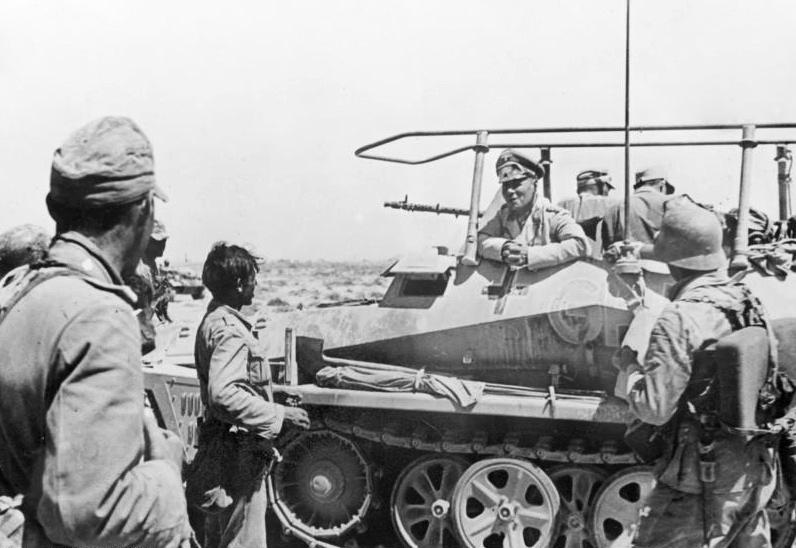
It was at El Alamein that Rommel discovered the emptiness of Hitler’s promises as the troops of the Afrika Corps found themselves subjected to constant privation from lack of supply, air support and reinforcements. As commander of the Afrika Corps and later the Panzer Armee Afrika he and his troops achieved amazing success against an enemy that was always better supplied, equipped and which always had air and sea superiority. Battling the British as well as the political machinations of Mussolini and Germany’s Italian Allies as well as opponents in the German government such as Hermann Goering, Rommel saw his troops crushed under the press of the British as well as the Americans who landed in French North Africa. Eventually, sick and worn out, Rommel was sent back to Germany to recuperate.

rommel-with-soldier

Rommel had a sense of honor and humanity that many other German generals lacked. He refused to allow anti-Jewish measures in areas occupied by German troops in North Africa, ensuring that the approximately 425,000 Jews living in Libya, Tunisia, Algeria, and Morocco were spared the fate of the Holocaust. He refused to execute Jewish POWs, including members of the Jewish Battalion serving with the British 8th Army. Likewise, Rommel refused to follow the notorious “commando order.” In June of 1994 he protested the massacre of the people of the village of Oradour-sur-Glane by units of the 2nd SS Panzer Division directly to Hitler and asked for the authority to punish those responsible, but was refused.

After his return from Africa, Rommel’s honest and open assessments of the chances of the Germans winning the war made him persona non grata in Berlin and Berchtesgaden. He was posted to France in early 1944 according to some accounts he became a part of the plot to end the war and overthrow Hitler. Rommel’s Chief of Staff at OB West, General Hans Speidel, was a key man in the conspiracy and Rommel had contacts with a number of key conspirators. There are arguments about Rommel’s connections and activities in regard to the anti-Hitler plot among respected historians.

When the invasion came Rommel was away from Normandy visiting his wife. On learning of the invasion he sped back to Normandy. When he arrived he fought a desperate battle against the Allied forces. His outnumbered forces were under constant assault from the land, sea and air received paltry reinforcements compared to the Allies. Even so, German troops inflicted many local defeats and exacted a heavy price in allied blood in Normandy but were ground to dust. Even so, many American and British infantry regiments suffered 100% casualties but remained in action because of a continuous stream of replacements. Rommel urged Hitler and the High Command to withdraw German forces from Normandy before the allies broke through his front. By doing so he found that he was now considered a defeatist.

If Rommel had joined the plot to topple Hitler, he did not stop working to defend Germany against the coming Allied invasion. He believed that the war was lost if his forces failed to repel the Allies on the beaches of France, and he worked feverishly to bolster the beach fortifications. He recommended that the Panzer Divisions be deployed near the coast where they could immediately counterattack Allied invasion forces while they were still vulnerable. But his advice was not taken. He was given command of the Army Group but was not given control of most of the Panzer Divisions, which Hitler kept under his direct control. Neither did he approve of an assassination attempt but realizing that his front was about to collapse he was in favor of independent peace negotiations with the Allies on the Western Front.

Many commanders in the west, including Waffen SS commanders were in agreement Rommel was severely wounded in an air attack on his vehicle by a just days before the attempt on Hitler’s life. Hitler survived the attempted assassination and exacted a terrible revenge on anyone connected with the plot. Show trials and public hangings of officers who had served valiantly at the front were common. Thousands were killed and thousands more imprisoned. Many of those arrested, imprisoned, or killed, were those who knew Rommel’s views on ending the war.

Various conspirator’s testimony exposed Rommel as part of the plot. Leading Nazis, including Martin Bormann, and Heinrich Himmler urged Hitler to deal with Rommel. Likewise, some in the High Command, including Heinz Guderian turned upon Rommel. After a secret hearing it was recommended by the “Court of Military Honor” that Rommel be expelled from the military and tried by the “People’s Court” of Judge Roland Freisler. During the purge that followed the attempt on Hitler’s life, many noted German military commanders were hauled before this court and humiliated by Freisler before they were sent to their deaths. Freisler, a fanatic Nazi judge was a participant at the infamous Wannsee Conference which planned the details of the Final Solution was killed when his courtroom was bombed in February 1945.

On 27 September, Martin Bormann submitted to Hitler a memorandum which claimed that “the late General Stülpnagel, Colonel von Hofacker, Kluge’s nephew who has been executed, Lieutenant Colonel Rathgens, and several … living defendants have testified that Field Marshal Rommel was perfectly in the picture about the assassination plan and has promised to be at the disposal of the New Government.”

Rommel’s fate was sealed, but because of his fame and popularity in Germany Hitler decided to offer Rommel a choice of being tried by the People’s Court or committing suicide. Goebbels who had spent so much time building up the Rommel legend The latter with an offer to ensure his family’s safety, which he would not guarantee if Rommel choose to defend himself in open court. Hitler dispatched Generals Wilhelm Burgdorf and Ernst Maisel from Berlin to personally deliver the message.

492px-Erwin_rommel_death

Rommel suspected that he would be identified and killed and told that to his friends and family in the days leading up to the arrival of Generals Wilhelm Burgorf and Ernst Maisel from OKW with the ultimatum. They met with Rommel for a short time before giving him the opportunity to say goodbye to his family. Rommel told them of his choice and left his home for the last time. 15 minutes later the Generals called his wife to say that he had died of a heart attack. Rommel was given a state funeral and the German people were lied to about his cause of his death.

Winston Churchill wrote of Rommel:

“He also deserves our respect because, although a loyal German soldier, he came to hate Hitler and all his works, and took part in the conspiracy to rescue Germany by displacing the maniac and tyrant. For this, he paid the forfeit of his life. In the sombre wars of modern democracy, chivalry finds no place … Still, I do not regret or retract the tribute I paid to Rommel, unfashionable though it was judged.”

Rommel was just 52 years old when he died. I find in the story of Rommel some commonality in my own life. Before Rommel went to Africa he believed that Germany would win the war, during his command there he discovered that what he believed was lies and that Hitler had little regard for him or his troops.

Rommel is a complex character. His attitudes towards Hitler waxed and waned. He was no Nazi. He conducted his battles in an honorable manner and displayed much chivalry towards his opponents. His views on race were not at all Nazi like. In North Africa he faced down a White South African commander who did not want to be imprisoned with his Black troops. Rommel told the officer: “For me, soldiers are all equal. Those black people wore your same uniform, fought on your side, and so you will be in the same jail.”

But from the beginning he willingly served Hitler’s regime and basked in the fame that he enjoyed due to Goebbels’s propaganda machine. At the same time while he was according to the Chief of the German Navy in the West, Admiral Friedrich Ruge, as well as his Rommel’s letters to his wife, indicated that Rommel’s mood fluctuated wildly regarding Hitler: while he showed disgust towards the atrocities and disappointment towards the overall military and strategic situation, he was overjoyed to welcome a visit or praise from Hitler, only to return to depression the next day when faced with reality.

The example of Erwin Rommel is a cautionary tale of what can happen when a brilliant and honorable man comes under the spell of a demagogue. Rommel believed Hitler and blindly followed him until he ran into the hard face of reality in Africa at which point he had the moral courage to do the right thing, but many others didn’t.

Sadly there are otherwise honorable men and women in the current United States military that blindly support a delusional madman who happens to be the President: a man who promises to order soldiers to commit war crimes, who threatens to jail political opponents, who condemns whole races of people and religions, who incites violence against his opponents, a man who has no respect for the courts, the law, or the Constitution to which they are sworn to defend.

But I think that we also have to remember the men like Rommel who though not a true believer in the Nazi cause and polices, not only willingly served the Reich, but basked in the adulation lavished on him by friends and foes alike.

To me this is not about partisan politics but something that is bigger than politics, bigger than temporary political advantage, bigger than any single political issue, for which in our country, at least for the moment, that there are many ways to express dissent which were not available to most Germans of Rommel’s era. It is about the Constitution, the rule of law, and the foundational principles of the Declaration of Independence.

Personally, as a historian I cannot understand the blind obedience in the face of the evidence; but then I blindly followed President George Bush into the ill-advised and criminal invasion of Iraq. It was in the desert of Iraq’s Al Anbar Province that I had my own revelation that the man I supported had led the country into a war that could not be won. Like Rommel at El Alamein, it opened my eyes to things that I had never seen before.

Peace,

Padre Steve+

2 Comments

Filed under ethics, History, leadership, Military, nazi germany, Political Commentary, world war two in europe

“I Have Not Yet Begun to Fight” John Paul Jones at Flamborough Head

Battle off Flamborough Head September 23rd 1779

Friends of Padre Steve’s World,

On October 13th the United States Navy celebrated its 242nd Birthday. At Naval commands, stations, and aboard ships the Navy Birthday is marked by the cutting of a cake. Traditionally, the oldest and youngest sailors present make the first two cuts to the cake. This year, at the age of 58 I was the oldest, the youngest was a lad of just 20. Next year I will be retired.

The Navy Birthday is a time for Sailors to reflect on their heritage by remembering the lives and actions of those who came before them. One of those men, in fact the man who represents the heart and soul of that tradition was Captain John Paul Jones. As the commanding officer of the Sloop of War USS Ranger he received the first salute of the American flag by a foreign power, in this case our first ally, France. There had been an earlier salute to the USS Andrea Doria, a converted merchantman which was one of the first four ships of the new Navy by the Dutch governor of St. Eustasius in the West Indies. That occurred on November 16th, 1776. But the flag she flew was the red and white striped banner of the Continental Congress, not the Stars and Stripes.

That is a story told well by Barbara Tuchman in her book The First Salute: a View of the American Revolution. Tonight’s essay is about John Paul Jones.

Two hundred thirty nine years ago a small naval battle occurred off the coast of Yorkshire England. From a purely military perspective the battle was rather insignificant. A squadron of five American and French ships intercepted a convoy guarded by two British ships. However, the battle was one that had immense psychological significance for the Americans as a ramshackle converted French East India ship with an inferior main battery forced a materially superior British warship to strike her colors.

In fact the battle is so significant to the United States Navy that the body of the victor, Captain John Paul Jones was returned to the United States in 1905 from an abandoned site in northeastern Paris known as the former St. Louis Cemetery for Alien Protestants to be interred in Bancroft Hall at the United States Naval Academy.

Jones had an unusual career as a British merchant skipper accused of murdering a mutinous crewman at Tobago and escaped to Fredericksburg Virginia out of fear that he would be tried in a local versus and Admiralty Court.

John Paul Jones

Jones went to the United States and due to his friendship with Henry “Lighthorse” Lee and other friends in the Continental Congress including a man who became a lifelong friend, Benjamin Franklin obtained a commission in the Continental Navy as a First Lieutenant.  At that time the “First Lieutenant” was the senior officer among the Lieutenants on a ship and often served as the First Officer or Executive Officer.

His first assignment was on the fleet flagship Alfred where he hoisted the first US Ensign aboard an American Naval vessel.  He took part in the raid on Nassau and upon his return assumed command of the Sloop of War Providence where he captured 16 prizes of war and escaped capture by the a British Frigate. He then assumed command of Alfred for a brief time capturing a key supply vessel that had winter clothing for British troops commanded by General Burgoyne in New York.  Following this he took command of the 18 gun Sloop of War Ranger in France received the first ever salute to an American man-of-war by a foreign power 8 days after the French had recognized the American Colonies as an independent nation.

Ranger receives the first salute rendered to an American warship by a foreign power

The nine-gun salute fired from Admiral Piquet’s flagship recognized this and the new Franco-American alliance. Jones wrote of the event: “I accepted his offer all the more for after all it was a recognition of our independence and in the nation.” After this sailed directly in harm’s way making an epic raid on the port of Whithaven, and then defeating and capturing and the British 20 gun Brig HMS Drake in an hour long fight.

Jones’ raid on Whithaven struck fear into the British populace and forced the British to allocate more resources to the defense of British seaports than had previously been the case.  The capture of the Drake was of immense psychological importance and along with Jones’ other victories would ultimately lead to the formation of the United States Navy.

Bonhomme Richard

Jones’ exploits made him a celebrated figure. He gave up command of Ranger to take command of a powerful frigate under construction in Amsterdam, but the British pressured the Dutch into preventing the transfer of the ship. Instead, Jones took command of the Bonhomme Richard a converted 42 gun former French East India ship. He named her after Benjamin Franklin’s book “Poor Richard’s Almanac” and he became commodore of a mixed squadron of American and French ships including the 36 gun American Frigate Alliance, the 32 gun French Frigate Pallas and two 12 gun warships the Vengeance and Le Cerf. 

His orders were to provide a diversion for a combined French and Spanish fleet the squadron menaced Ireland and Scotland before moving into the North Sea. As they came into English waters the Americans intercepted a 50 ship convoy on September 22nd. The convoy was enroute to the Baltic was escorted by the 44 gun two-decker HMS Serapis. Serapis was brand new and more powerful than Bonhomme Richard. A second ship, the 20 gun privateer Countess of Scarborough accompanied Serapis.

Jones directing the battle from the Bonhomme Richard

The battle was joined about 1800 on the 23rd of September. Serapis which was more maneuverable than Jones’ flagship, pounded the Bonhomme Richard holing her below the waterline and seriously damaging her, suffering little damage to herself. Jones’ s problems were compounded when with the first broadside two of Bonhomme Richard’s elderly 18 pounders burst damaging the ship and killing most of the gun crews on the lower deck.

Jones attempted to close the range in order to grapple Serapis and make the battle a close aboard action. Eventually the bow of Bonhomme Richard ran into the stern of Serapis and Jones’s crew succeeded in grappling the British ship. With cannons blazing the two ships were locked in a struggle to the death. Firing at point blank range the ships tore great holes in one another, though the Serapis, built as a warship suffered less than Richard.

As the cannonade raged, the Marines of Bonhomme Richard swept the decks of Serapis killing and wounding many of her crew. A grenade thrown by one of her Marines sailed down an open hatch on the British ship and landed on a pile of powder charges. The explosion set off a chain reaction which disabled many of Serapis’s guns, killing and wounding many of the gunners.

In the confusion and carnage, thinking that Jones was dead, the Chief Gunner of the of Bonhomme Richard cried out for “quarter,” meaning surrender. Hearing this, Jones threw a pistol felling the man. Likewise, Richard’s colors were shot away giving the impression that she make have struck her colors.

The Captain of Serapis Captain Richard Pearson hailed Jones to ask if he had struck his colors (surrendered.) The First Lieutenant of Bonhomme Richard Richard Dale recorded Jones’ response for posterity “I have not yet begun to fight!” Another account recorded Jones as replying  “I have not yet thought of it, but I am determined to make you strike.” 

The battle continued and the Alliance under the command of a Frenchman with an American commission, Pierre Landais, having been absent for most of the action came up and delivered a devastating broadside much of which hit Bonhomme Richard, holing her again below the waterline and causing her to settle rapidly. At the same time she caused additional damage to Serapis. Jones loaded and fired one of the 9 pounders whose crew was killed or wounded, striking the mainmast of Serapis twice and causing it to fall over the side.

Alliance opens fire on Serapis and Bonhomme Richard

Bonhomme Richard had taken a severe beating with most of her guns knocked out, taking water and burning from fires ignited by the British onslaught and Alliance’s devastating broadside. With his ship badly damaged and Alliance threatening Pearson stuck his colors in person at 2230 hours.  Pallas forced the surrender of the Countess of Scarborough, but the convoy escaped.

Jones took possession of Serapis, but the badly damaged Bonhomme Richard sank the on September 25th despite her crew’s best efforts to save her.  Jones made temporary repairs to Serapis and sought refuge in the Netherlands.

The battle was militarily insignificant but again a major psychological victory as Jones had for the second time defeated a British warship in British waters within sight of the local population.  Even though Jones had taken Serapis the British warships completed their mission of protecting the convoy.

Jones’s post war career left him embittered. His opportunity to command the first US Navy Ship of the Line, the 74 gun America disappeared when that ship was given to France after the war. He was made a Chevalier of France by Louis the XVI and awarded a gold medal by Congress, but the U.S. Navy was disbanded. Unable to serve his adopted country, Jones found employment in the Imperial Russian Navy of Catherine the Great. Though he was successful against the Turks, jealous Russian commanders conspired against him and had him removed from command of the Black Sea Fleet.  He retired to France where he lived on his Russian pension. He was appointed to serve as Counsel to the Dey of Algiers to negotiate the freedom of captive American merchant mariners in June 1792. Before he could take up that position he died in his Paris apartment of interstitial nephritis of on July 18th 1792.

Frenchman Pierrot Francois Simmoneau donated over 460 francs to mummify the body. It was preserved in alcohol and interred in a lead coffin “in the event that should the United States decide to claim his remains, they might more easily be identified.” He was buried in the St. Louis Cemetery for Alien Protestants which was owned by the French King. After the French Revolution the cemetery was abandoned and forgotten.

General Horace Porter, the United States Counsel to France spent six years and his own money to locate and identify Jones’s body in 1905. His coffin was transported aboard the USS Brooklyn in 1906 and his body was interred at the United States Naval Academy. President Theodore Roosevelt spoke at the internment. He noted something of profound importance for anyone sworn to defend this nation and its Constitution:

We have met to-day to do honor to the mighty dead. Remember that our words of admiration are but as sounding brass and tinkling cymbals if we do not by steady preparation and by the cultivation of soul and mind and body fit ourselves so that in time of need we shall be prepared to emulate their deeds. Let every midshipman who passes through this institution remember, as he looks upon the tomb of John Paul Jones, that while no courage can atone for the lack of that efficiency which comes only through careful preparation in advance, through careful training of the men, and careful fitting out of the engines of war, yet that none of these things can avail unless in the moment of crisis the heart rises level with the crisis. The navy whose captains will not surrender is sure in the long run to whip the navy whose captains will surrender, unless the inequality of skill or force is prodigious. The courage which never yields can not take the place of the possession of good ships and good weapons and the ability skillfully to use these ships and these weapons.

In the years since that victory the United States Navy went from a militarily insignificant force to the most powerful Navy in the world. Jones and the ships that he captained would not be forgotten. Two Aircraft Carriers were named after Jones’ Sloop of war Ranger, while several destroyers have born his name.

The odds against Jones in his battle with Serapis were heavily weighted against him. Jones’s victory over Serapis was another demonstration that the Americans should not be taken lightly by the great powers of Europe. It helped begin a tradition of valiant service for the Navy that has endured throughout the centuries.  The victory off Flamborough Head reaches into the present as American sailors and their ships ply the world’s oceans keeping the sea lanes open and protecting American interests abroad.

Peace

Padre Steve+

Leave a comment

Filed under leadership, Military, Navy Ships, US Navy

Dog Days: Pierre has Emergency Stomach Surgery

Friends of Padre Steve’s World,

I didn’t post anything last night because we had a bit of a crisis with our little Papillon boy, Pierre.

He had an upset stomach and threw up earlier in the week but still acted pretty normal so we weren’t concerned. He continued and also had diarrhea and started being a bit lethargic so Judy took him to the vet. Then there wasn’t too much cause for alarm, although some liver enzymes were elevated. There were a number of possible causes for the elevated levels, but none were obvious, so he was sent home with medication scheduled for a follow up visit the next day.

He didn’t improve and was in obvious pain so x-rays were taken and they revealed that he had a lot of gas in his stomach. So that night we watched him closely and took him back in Friday morning. This time his discomfort was more pronounced, more x-rays were done and he was taken in for emergency exploratory surgery in case he had ingested any foreign objects or toxins. None were found, but he had a very angry ulcer in his stomach. The veterinarians took care of the bleeding, cleaned out his stomach, took a biopsy of the ulcer, and sent him home with us and a lot of medications.

When we discussed the situation with the vet, who has taken care of our dogs since we moved here in 2003 we came up with the probable cause of what happened. We think that he ingested or inhaled portions of a very large, dried out, purple mushroom that was in a pile of branches that were knocked off our tree in our backyard. It would account for the high liver enzymes and the ulcer which came on so quickly. We went home with the vet’s wife’s cell number in case we had any emergencies during the night.

The good news is that he did well and is recovering very well. We are having to keep him from jumping on the furniture and wanting to do his own thing. At the same time we have had to deal with a less than five pound dog who is not happy about having medications pushed on him. That being said it is funny to have such a little boy growl every time he knows he is getting medication.

and who still didn’t want eat this morning after we took him back to the vet to get his IV catheter out and a post surgery check. That being said, he has been more cooperative with his medications, especially since we put the pills in cream cheese, and he loves cheese. He is also eating now that we mixed cheese his recovery food and convinced him that it was safe by having Izzy eat a bit of it in front of him. If Izzy eats it, it must be good.

A funny thing happened when we brought him home this morning. We set up a pen for him with a Ed, his food and water, and a pee pad. He wasn’t happy at all with the restrictions. He sulked by the gate of the pen looking like a prisoner on strike, so we decided to keep him on our laps and only plan on putting him in the pen when we can’t watch him or both have to be out of the house.

I didn’t sleep well last night because I was hyper vigilant and worried about him. But today he he has spent most of the day on my or Judy’s lap. This afternoon I fell asleep on the recliner with him sleeping on me. Izzy occasionally checks on him, nuzzling him and kissing him. She is very sensitive and I think that she isn’t happy that her play buddy and security force partner is not feeling well.

So anyway, he seems to be doing well, so send your positive thoughts and prayers his way.

Until tomorrow,

Peace,

Padre Steve+

1 Comment

Filed under dogs, life, Loose thoughts and musings

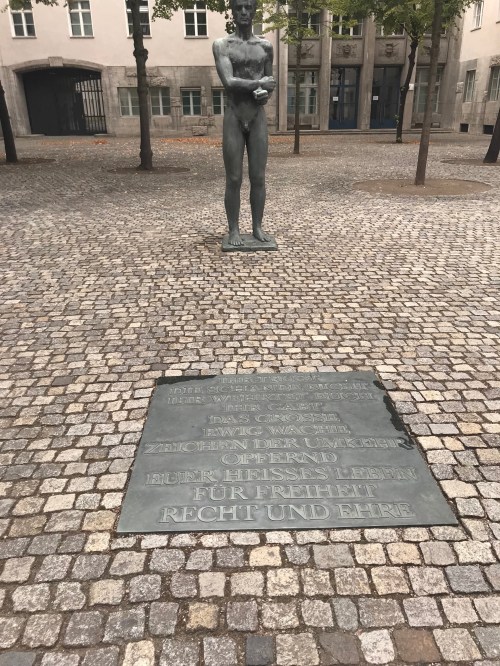
The Encouragement of Violence by the President and the Absence of Empathy in His Supporters

img_8062

Monument to the Men of the German Resistance Executed at the Bendlerstrasse Headquarters of the German Army on the Night of July 20th 1944

Friends of Padre Steve’s World,

I have been writing a lot of late about the ordinary men who helped carry out Hitler’s genocide as well as those who opposed the Hitler regime and very often paid with their lives. Having been to the sites where some were executed and others exterminated the reality of how this happens, how ordinary men and women can become become perpetrators of violence is all too real.

I was reminded of the importance of why I write after I read conservative columnist Michael Gerson’s article in the Washington Post yesterday.

Gerson wrote:

“Fascism may not describe what Trump has done, as opposed to what he says. But what he says matters and can create its own dangerous dynamic. It is possible for a leader to be incompetent and still profoundly corrupt the people who follow him, undermining the virtues — tolerance, civility and compromise — that make democratic self-government work. It is possible for a foolish leader to leave the imprint of fascism on a portion of his followers. And the language used by Trump — particularly a certain racially tinged nostalgia and a tribal resentment for the other — strikes me as at a higher level of prominence and acceptance than at any time I can remember. So maybe, rather than fearing a fascist dictator, we should fear the legitimacy of fascist modes of thought in the Republican Party.

This is a more complex danger than most talk of fascism generally suggests. But it is a danger nonetheless.”

Gustave Gilbert, who served as a psychologist to the major Nazi war criminals at Nuremberg noted that in his observation and discussions with them he had to deal with the nature of evil. He had to find the common thread among them that allowed them to take part in the most horrific crimes against humanity conducted by an allegedly civilians, western and Christian country. He noted that in his dealings with them they had one thing in common, they had no empathy for their victims. He said, “evil is the absence of empathy.” The common psychological term for a person who cannot empathize with other people is a sociopath. That is what are President is. It is a trait that he shares with the vilest criminals of the Twentieth Century. Many of his followers seem to share that attribute. You can see it in their words and in their actions.

At a campaign rally the President praised a Congressman from Montana who assaulted a reporter just before the 2016 elections and the crowd cheered its approval. As they cheered Trump said: “Any guy that can do a body slam … he’s my guy.” Then he acted out a motion of a person violently throwing someone to the ground, and the crowd continued to cheer. Though he has repeatedly attacked and mocked the press, it was the first time that he praised and openly condoned the attack on a reporter, and it came at a time when he has not condemned the brutal murder of the Saudi Arabian journalist and American resident Jamal Khashoggi in the Saudi consulate in Istanbul Turkey last week.

Trump being who he is I expect that, but for the crowd to applaud it showed the deep moral rot in the Republican Party. It is troubling because it reflects something far more dangerous which could actually bring about a Fascist type takeover of the U.S. Government.

Gerson wrote:

And one event in particular could quickly heighten that danger. Consider what American politics would look like if Republicans — against all odds and expectations — were to keep the Senate and House. There might be many explanations for such a result — exceptional economic conditions, bad Democratic strategy, the rallying effect of Justice Brett M. Kavanaugh among Republicans — but we know how the president would interpret it. He would regard such a victory as the complete vindication — the stamp of national approval — on his entire approach to politics.

All the last remaining opposition in the GOP would melt, and many of his supporters would be calling for retribution against enemies and traitors. The whole leadership of the FBI and Justice Department — anyone who ever displeased him — would be at immediate risk of replacement. Trump would take his victory as permission for even more brutal treatment of migrants. More generally, a leader with no commitment to the separation of powers, with no respect for the traditional self-restraints of the presidency, with savage disdain for the free press, with an admiration for authoritarians, with a history of menacing individuals and companies by name, and with a talent for division and dehumanization would feel unbound.

The boor, the bluffer, the bully would be a political colossus. Then the language of fascism might become less theoretical. Then alarmism would be realism.

As I thought of these things last night I was reminded of the words of Hannah Arendt: “When evil is allowed to compete with good, evil has an emotional populist appeal that wins out unless good men and women stand as a vanguard against abuse.”

Now honestly I don’t think that the majority of Trump supporters are themselves evil or even bad people. But that being said I do believe that quite a few of the, perhaps a majority of them have surrendered to taking the path of least resistance and looking out for what they think are their interests first, even if the result of their decisions hurt people who are much like them.

As Arendt said, “The sad truth is that most evil is done by people who never make up their minds to be good or evil.”

That is what we are watching happen before our very eyes. Some might claim ignorance, or claim that they are non-political and are in no position to judge the morality of this President and his administration, but that is the refuge of the coward. Karl Popper noted “Ignorance is not a simple lack of knowledge but an active aversion to knowledge, the refusal to know, issuing from cowardice, pride, or laziness of mind.”

The fact is that today, like in Germany between 1933 and 1945 no one can claim ignorance about the nature and character of our President, but if they don’t know it is simply cause they do not want to know, and for those in positions of authority who turn a blind eye, what Albert Speer, Hitler’s architect and later armaments minister wrote “…being in a position to know and nevertheless shunning knowledge creates direct responsibility for the consequences…”

It is lack of empathy, an active aversion to truth, shunning knowledge, and perhaps worse, a refusal to know when in a position to know which allow people to look the other way in the face of evil and injustice.

Until tomorrow.

Peace,

Padre Steve+


3 Comments

Filed under History, nazi germany, News and current events, Political Commentary

Maintaining the Facade of Legality: Friedrich Kritzinger, and Men Who Try to Walk the Totalitarian Tightrope

Friends of Padre Steve’s World,

Saint Augustine wrote: “Justice being taken away, then, what are kingdoms but great robberies.”

I saw that quote in relation to Friedrich Kritzinger, a lawyer, and Prussian civil servant who served as State Secretary for the Reich Chancellery during the Third Reich and was a participant at the Wannsee conference. The authors of that article noted something that should serve as a reminder to us: “by working as a lawyer for a regime, which he had known from the start to be criminal, he made himself a stooge.” (Stefan Paul-Jacobs and Lore Kleiber in The Participants: the Men of the Wannsee Conference edited by Hans-Christian Jasch and Christoph Kreutzmüller, p.217)

Kritzinger was not what I would call an evil man. He was a traditional German conservative and Nationalist who agreed with many Nazi policies, albeit not to their extremes. But he also had strong moral and religious convictions that caused him to question and at times attempt to mitigate those policies. He was a member of the Confessing Church which condemned the Nazified faith of Reichsbishof Müller and the German Christian movement, but even many of them were receptive to the nationalism and anti-Communist stances of the Nazis. Otto Dibelius, the General Superintendent of the Confessional Lutherans was a hard line conservative and in 1933 at a service for the new Reichstag: “We have learned from Martin Luther that the Church cannot get in the way of State power when it does what it is called to do. Not even when [the state] becomes hard and ruthless…. When the state carries out its office against those who destroy the foundations of state order, above all against those who destroy honor with vituperative and cruel words that scorn faith and vilify death for the Fatherland, then [the state] is ruling in God’s name!” (Richard Seigman-Gall, the Holy Reich: Nazi Conceptions of Christianity 1933-1945 p.68)

Kritzinger himself did not join the Party until 1938 when he was recruited by Hans Lammers to fill a vacancy in the Reich Chancellery for which Party membership was required. Kritzinger was concerned. He only accepted the job and membership in the when assured that he did not have to be politically active and did not have to hire ardent Nazis for jobs in the Chancellery.

At Wannsee he was the only participant who demonstrated any sense of concern about the Final Solution of the Jewish Problem. After the conference he headed the only agency not to sign off on Reinhard Heydrich’s policies against the Jews. According to some he worked inside the system to try to mitigate the worst aspects of Hitler’s policy decisions. He felt shame for what the regime did. That being said “from 1933 on, Kritzinger held positions of responsibility and colluded in disgusting breeches of law and maintaining the illusion that the Nazi dictatorship was a constitutional state.”

The fact is that the Nazi regime believed that it was a functioning constitutional state and attempted to preserve the illusion of legality and the rule of law. Men like Kritzinger helped them to do just that. In his positions, first at the Ministry of Justice and then at the Reich Chancellery, “was held in high esteem… not as an ideological acolyte of the new leader but as an expert on law. Responsible for matters of state law, he was directly complicit in Nazi atrocities.” This included his legal justification for the Night of the Long Knives.

At the Reich Chancellery Kritzinger made sure that the administrative apparatuses the State functioned smoothly. “The facade of legality helped ensure that the Nazi regime and its crimes were accepted even by its detractors, and their participation in the system thereby facilitated.”

After Wannsee, when Kritzinger began to fully grasp what was happening in regard to the Jews he attempted to resign but his resignation was refused. His boss, Hans Lammers refused and rejected his dismissal with the remark that without Kritzinger things would run even worse. In fact, men like Kritzinger were often able to delay or hinder decisions by not passing along memos as they saw fit. Conversely they could speed decisions by ensure that information reached Hitler.

When questioned after the war Kritzinger stated:

My consultations with Hitler were of course tailored to his mentally. It goes without saying that it would have been insane to say that such and such a decision would adversely affect Jews. One had to phrase it differently, and say that it would trigger serious public unrest. Obviously we could not say anything to Hitler he did not want to hear. Especially when it came to those decisions.

I wonder how many people in the American government and in the upper echelons of the Trump administration justify and equivocate their participation in it just as Kritzinger and others like him did his under the Nazis.

Until tomorrow,

Peace

Padre Steve+

Leave a comment

Filed under ethics, History, laws and legislation, leadership, nazi germany, Political Commentary

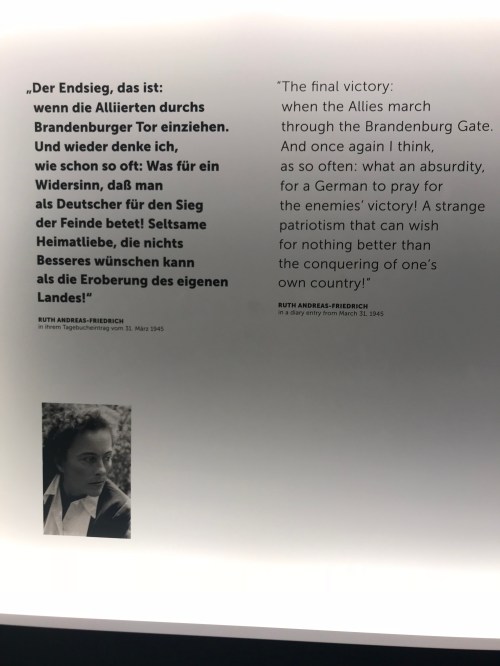
“A Strange Patriotism”

Friends of Padre Steve’s World,

I have been spending less time of social media lately and more time reading and reflecting.

This doesn’t mean that I am not paying attention to what is going on in our country and the world. In fact I am, except that I am not wasting my energy on trolls.

One of my big concerns of late has been the murder of the American based Saudi Arabian journalist Jamal Khashoggi in the Saudi consulate in Istanbul by a team of Saudi agents sent by the Saudi government. Now I have never put such antics beyond the Saudis, but to see an American President and his Secretary of State callously sweep it under the rug was beyond disheartening, it was disgusting and repugnant. To think that the Trump administration would choose to align itself with the House of Saud in the Muslim Sunni-Shi’a conflict that will likely end up in a war that can only harm the United States is mind numbing.

Such a war would end up costing the Middle East hundreds of thousands, if not millions of lives, and that war would most certainly claim thousands of American lives, even if the United States was victorious. But if victory meant the strengthening of the authoritarian Trump regime and the suppression of Constitutional rights and the trampling of the proposition of the Declaration that “all men are created equal…” then I wonder if it were better that the United States suffer a humiliating defeat by allying itself with a regime that was most likely complicit in the 9-11-2001 attacks and that has either aided or looked the other way when radical Sunni terrorist organizations headed by Saudis have attacked the United States and killed thousands of Americans.

Of course American Presidents of both political parties have looked the other way when it comes to the Saudis for decades, but none have been so in the pocket of the Saudis as the Trump administration. The events of the past few days have shown that there is no amount of sandal licking that this President will not do in order to keep Saudi money flowing into his properties, even if that sandal licking harms American interests, national security, and more importantly drags the ideals of the United States through the sewer of the President’s personal need for adulation and profit.

Sadly, I have come to believe that the President’s actions which prostitute the United States to a one of the most repressive and inhuman regimes on the planet are of themselves treasonous.

As I read the words of Frau Andreas-Friedrich at the Museum to the German Resistance in Berlin I was struck by their honesty, and that was before the murder of Jamal Khashoggi and the Trump administration’s inability to be honest with the American people and the world.

If somehow asking those questions means that I am not a loyal American then I wonder just what a loyal American is.

Until tomorrow,

Peace

Padre Steve+

1 Comment

Filed under ethics, History, holocaust, Loose thoughts and musings, middle east, national security, nazi germany, News and current events, Political Commentary

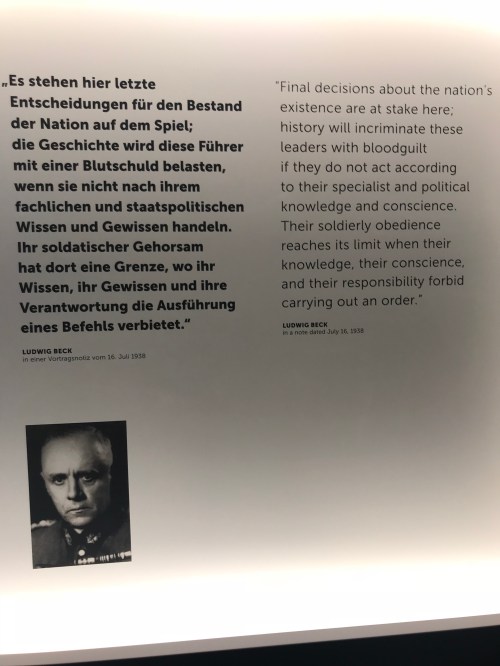
The Limit of Soldierly Obedience: Ludwig Beck and a Lesson for Officials in Authoritarian States

Friends of Padre Steve’s World,

While we were in Berlin I visited the German Resistance Memorial Center. The museum is located in what was the headquarters of the German Army in World War One, the Weimar Republic, and during the Nazi Era. On July 20th 1944, German Army officers attempted to kill Adolf Hitler, overthrow the Nazi regime, and end the war. Sadly, they failed in their attempt and most of those involved were tried and executed for what their criminal government considered treason.

Of course by the law of their times their act was treasonous, but morally it was all that men and women committed to the rule of law and human rights could do. The officers involved had all sworn a personal oath of obedience to Adolf Hitler as the Führer and Reichskanzler of Germany in 1934. At the time most of the men who swore that oath did not anticipate what would come. Many of the older officers had served in the Imperial Army and sworn an oath to the Kaiser and their dynasties of the lands where they entered service. That changed in 1918 when the Weimar Republic came into existence and military officers as well as civil servants swore an oath to the constitution rather than a person.

A year after Hitler came to power as Reichskanzler, President Hindenburg died. Hitler, seized the opportunity used the occasion to swear the military, as well as the civil service to a new oath. This oath was not to the Constitution, or to Office of thePresidency or Chancellor, but to him personally as the Führer and Reichskanzler.

Most officers and civil servants, even those uncomfortable with Hitler’s policies obeyed their oaths and simply stayed in their lanes and did their jobs, even when they had incontrovertible evidence of Nazi atrocities.

Yet there were others who for a number of reasons, in some cases noble, and in others pragmatic, or even base, decided to break the oath they had sworn to Hitler in 1934. Among these men was General Ludwig Beck. Beck noted:

“It is a lack of character and insight, when a soldier in high command sees his duty and mission only in the context of his military orders without realizing that the highest responsibility is to the people of his country.”

With the rise of legally elected authoritarian rulers in Europe and the Americas should concern men and women who have sworn to uphold the constitutions of their countries. These leaders campaigning against democratic institutions, and upon gaining power purge those institutions of opponents and use them to solidify their own power. The veneer of democracy is maintained while the soul of it is crushed. Too often those charged with guarding it are willing participants in its death, soldiers, civil servants, judges, and legislators.

That is what Beck understood. He resigned his office as Chief of Staff of the German Army in 1938 over Hitler’s plan to invade Czechoslovakia, became a member of the anti-Hitler resistance and died in the failed attempt on Hitler’s life on July 20th 1944. He was a career Army officer and a conservative, but he realized that there are limits to obedience in the face of evil.

I fear that there are many men and women in nations whose democratic institutions are being subordinated to authoritarian rulers who will not rise to the occasion and allow those institutions and eventually their nations to perish. Sadly, that also includes those in the United States.

I will leave you with that thought for the evening.

Until tomorrow,

Peace,

Padre Steve+

2 Comments

Filed under ethics, History, Military, nazi germany, News and current events, Political Commentary

“One Learns more from Adversity than from Success” The Battle of Cape Esperance 11-12 October 1942

Friends of Padre Steve’s World,

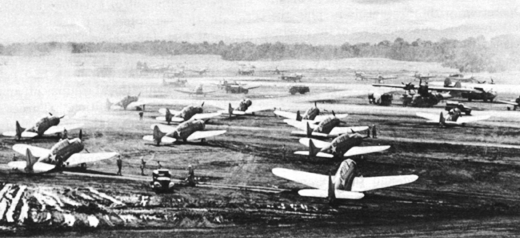
Naval battles between U.S. Navy and Imperial Japanese Navy surface forces around Guadalcanal in 1942 were almost always brief and bloody. The number of ships from both sides sunk in the waters around Guadalcanal, and the islands near it: Tulagi and Savo Island, led to the area being nicknamed “Iron Bottom Sound.” Over fifty ships and craft would be interred in the waters around Guadalcanal by the end of the campaign. These numbers included 2 battleships, 8 cruisers, and 22 destroyers.

The battles around Guadalcanal occurred in a time of technical transition for the United States Navy as its radar became better at detecting ships and fire direction systems advanced in their accuracy and targeting ability. While almost all U.S. warships had radar primarily the SC search radar and FC Fire Control radar, not many U.S. Navy warships had the advanced SG surface search radar. But it was not just a matter of technology, it was a matter of training and experience. Their opponents, the Imperial Japanese Navy had very few ships equipped with radar, but their training for surface actions, especially night fighting where their superior optics, gunnery skills, and torpedoes proved deadly during the first year of the war before U.S. Navy crews mastered their technology edge.

By October 1942 the U.S. Marines battling on Guadalcanal were fighting an enemy growing in numbers on the ground even as they felt the effects of the the predatory Japanese surface raiders that routinely bombarded their positions and endangered U.S. resupply efforts.

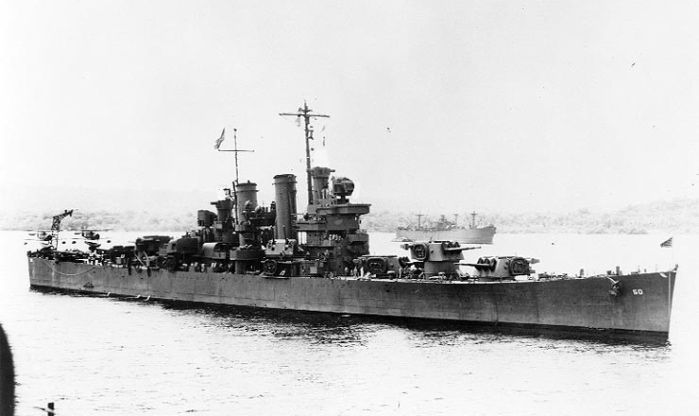
USS Helena

Since the Marine, Navy and Army Air Force Squadrons based on Guadalcanal maintained air superiority in the nearby waters during the day the Japanese were limited to night surface operations against the island. These operations involving the reinforcement and resupply of Japanese Forces on the island as well as offensive naval gunfire operations to aid the land forces in which Japanese warships attempted to destroy or degrade Henderson Field.

Henderson Field

The first major operations mounted by the Japanese was in early August when a Japanese cruiser destroyer force ravaged the U.S. cruiser forces off Savo Island. The Japanese inflicted the worst defeat of an American naval squadron, sinking 3 American and one Australian Heavy cruiser while damaging another. The battle was a disaster for the U.S. forces and led to the early withdraw of transport and supply ships of the invasion force before many could finish unloading the equipment and supplies that were critical to the operation. In that operation radar played no role for U.S. forces, and sets were either turned off or not relied upon by commanders. Admiral Richmond Turner noted:

“The Navy was still obsessed with a strong feeling of technical and mental superiority over the enemy. In spite of ample evidence as to enemy capabilities, most of our officers and men despised the enemy and felt themselves sure victors in all encounters under any circumstances. The net result of all this was a fatal lethargy of mind which induced a confidence without readiness, and a routine acceptance of outworn peacetime standards of conduct. I believe that this psychological factor, as a cause of our defeat, was even more important than the element of surprise”

Despite this admission it would take several more engagements in the waters around Guadalcanal before the U.S. Navy fully appreciated the superiority of Japanese optics, training in night fighting, and their deadly 24″ “Long Lance” torpedoes. It would not be until 1943 that the U.S. Navy began to exploit its advantage in radar and use it to their advantage in night surface actions.

The Tokyo Express Route along the Slot

Japanese resupply and reinforcement operations to Guadalcanal were so frequent that the Japanese forces were nicknamed the Tokyo Express by the Americans. Knowing that the Marines who had been in bitter combat with the Japanese needed reinforcements the U.S. sent a convoy to land the 164th Infantry Regiment of the Americal Division on October 13th.  To protect the convoy the U.S. Navy dispatched a surface task force, TF-64 composed of the Cruisers USS San Francisco, USS Boise, USS Salt Lake City and USS Helena and 5 destroyers under the command of Rear Admiral Norman Scott to protect it from any Japanese surface threats.

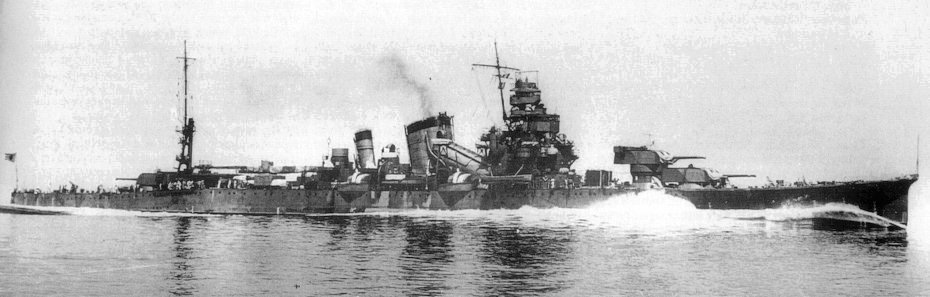
IJN Heavy Cruiser Aoba after the battle

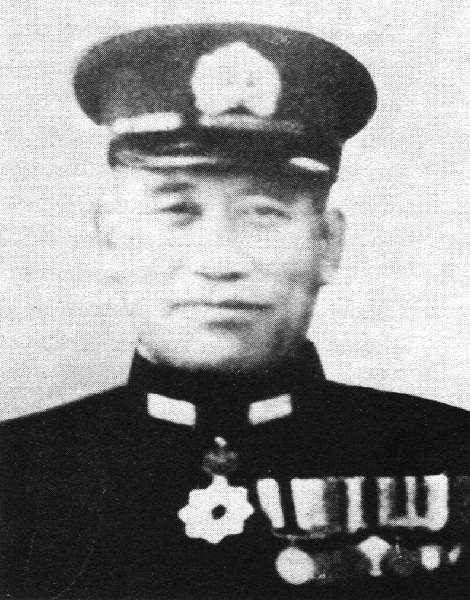
The U.S. move to reinforce Guadalcanal coincided with a Japanese effort to reinforce their forced on the island. They Imperial Navy sent a covering force of three heavy cruisers, the Aoba, Furutuka and Kinugasa and two destroyers under the command of Rear Admiral Arimoto Goto. The Japanese cruisers were to bombard Henderson Field as the Japanese were not expecting any American surface forces to oppose their effort.

Rear Admiral Arimoto Goto

The Japanese were detected by aerial reconnaissance on the afternoon of the 10th when they were still about 200 miles from Guadalcanal. Scott, whose forces lacked experience in night surface combat made a simple plan to “cross the T” of the enemy force in a single line formation with three destroyers in the van, the cruisers in the center and two destroyers in the rear.

Rear Admiral Norman Scott

U.S. floatplanes from the American cruisers detected the Japanese at 2300 hours. At 2322 the radar of the USS Helena picked up the Japanese force at a range of about 27,000 yards. However misunderstandings of Scott’s orders by his flagship broke his formation and put the van destroyers out of position in the poor visibility of the moonless night. The confusion caused Scott to believe that the radar contacts were his own destroyers.

The Japanese still did not realize that an American force was near them and continued on. At 2345 the ships were only about 5,000 yards apart when Helena radioed Scott asking permission to fire. The message was received by Scott who acknowledged his receipt of the message did not grant permission open fire. However, his response of “roger” was mistaken as permission to open fire by Helena. The American cruiser opened fire on the Japanese aided by her SG and FC radars. She was followed by the other cruisers which opened a devastating fire on the Japanese force.

The Japanese task force was completely surprised, they had not expected to encounter American surface ships and failed to be on alert. Goto’s lookouts had sight the Americans at 2343 but assumed that they were friendly Japanese ships. The result was that the Americans inflicted heavy damage to the Japanese flagship, the heavy cruiser Aoba and left Goto mortally wounded.

IJN Heavy Cruiser Furutaka

Scott was taken by surprise by the action of his cruisers and ordered ceasefire at 2347 thinking that he was shooting at his own destroyers. Four minutes later he ordered his ships to resume fire at 2351. At 2349 the heavy cruiser Furutaka was heavily damaged by American fire and at 2358 she was was hit by a torpedo fired by the destroyer Buchanan. The Japanese destroyer Fubuki was mortally wounded about the same time and began to sink. The U.S. destroyers Duncan and Farenholt were both damaged in the crossfire with Duncan so badly damaged that she would be abandoned and sunk.

USS Duncan

Instead of continuing to rely on radar the American cruisers turned on their searchlights which provided the last Japanese cruiser, Kinugasa the opportunity to hit them hard. Kinugasa’s gunners heavily damaged Boise and but for a certain amount of luck would have sunk the American ship. One shell hit the number one turret setting fires in it, while another hit below the waterline and detonated in the forward 6″ magazine threatening to blow the ship to pieces but the onrushing water from the hit doused the flames and saved the ship. Despite that Boise was out of action with over 100 casualties, all of the forward magazine and handling crews were all killed.

As Boise sheared away from the action, Kinugasa and Salt Lake City exchanged fire, each hitting each other before the Japanese cruiser broke off the action.

The commander of the Japanese reinforcement group, his mission completed dispatched his destroyers to assist Goto’s force at it withdrew and rescue survivors. However these ships were caught by U.S. aircraft from Henderson Field as the light of the dawn lit the sky. The destroyers Murakumo and Natsugumo were heavily damaged, abandoned, and scuttled by the Japanese.

On the 13th the American reinforcement convoy arrived, as did Japanese reinforcements later that night. On the night the 13th, the Japanese battleships Kongo and Haruna  conducted an attack which most destroyed Henderson Field. However, the resilient Marines kept the airfield operational as the Marines of the 1st Marine Division and the nearly arrived soldiers of the 164th Regiment held off a major Japanese assault from 23-26 October, known as the Battle of Henderson Field or Bloody Ridge.

Scott’s Task Force 64 lost one destroyer sunk and two cruisers damaged while the Japanese lost one cruiser and three destroyers sunk, with two cruisers damaged in the action.

The Japanese flagship Aoba was severely damaged by nearly 40 6” and 8” shells fired by the American cruisers. Her bridge was shattered and her number three turret destroyed. The damage knocked her out of the war for four months and the number three turret would not be replaced. On the American side the heavily damaged Boise was sent to the East Coast for repairs while Salt Lake City was repaired at Pearl Harbor. The battle had lasted less than 50 minutes from the time Helena picked up the Japanese force on her radar.

http://ww2db.com/

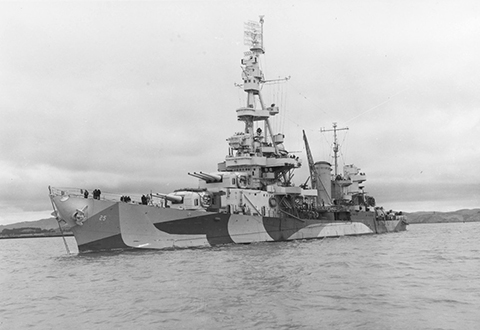
USS Salt Lake City

The battle was a tactical victory for the U.S. Navy. However, the Navy did not learn  but the lessons of the battle about the power of Japanese torpedoes and effectiveness in night combat. While he Scott maintained a cool head and reacted to the situation with great courage he assumed that his deployment of his ships in a line formation coupled with superior American gunnery had won the battle. However, his ignorance on the proper use of the various types of radar used by the U.S. Navy meant that he and other American commanders would continue to misuse it and rely on searchlights and recognition lights during night surface actions. Likewise, he made the false assumption that Japanese torpedoes were no longer a threat.

This caused other U.S. task forces to have to learn the hard way in the subsequent engagements of the Naval Battle of Guadalcanal and the Battle of Tassafaronga. Rear Admiral Scott would not long survive his victory. He was killed in action aboard the USS Atlanta during the Naval Battle of Guadalcanal just a month later. The great American naval historian of the Second World War, Samuel Elliott Morrison wrote:

“So, because we won the Battle of Cape Esperance, serious tactical defects were carried over into subsequent engagements with unfortunate results. One learns more from adversity than from success.” 

While the battle helped inspire American confidence, it was not a strategic victory. Japanese forces nearly destroyed Henderson Field on the night of the 13th, and the the most decisive battles were yet to come.

Peace

Padre Steve+

Leave a comment

Filed under History, leadership, Military, Navy Ships, US Navy, World War II at Sea, world war two in the pacific

I Have a Need for Speed: Driving the German Autobahns

no-limit-sign-autobahn

Friends of Padre Steve’s World,

I have driven a lot of kilometers on German Autobahns. Back in the 1980s my cars wouldn’t get me much above 110 miles an hour. Since then I have tried to do better. Frankly whether people like it or not I do have a need for speed.

On American highways that is difficult to do and nowadays its not because our cars won’t go fast enough, it is because are not engineered well enough to make it safe. Likewise, factor in that many American drivers cannot drive nails much less highly engineered cars that are capable of high speed and people who even on good roads in optimum driving conditions manage to make driving unsafe for everyone else on the road. The fastest that I have ever driven in the United States was 114 miles an hour in a restricted HOV lane on I-64 in Norfolk early on a Sunday morning with no traffic. I dared not go any faster despite the fact my Ford Mustang was barely breaking a sweat because the road condition and engineering would have made it unsafe to go any faster.

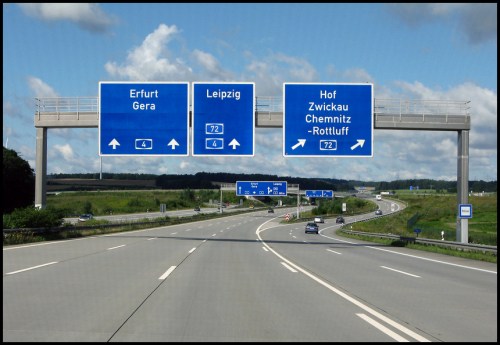
The highest speed I ever got to in the 1980s was 110 in my 1985 Opel Kadett on Autobahn 3 heading north from Wiesbaden to the Netherlands. In the 1997 I got a rented Fiat Brava with a 5 speed manual transmission up to 130 on the same autobahn between Würzburg and Bonn. In 2006 I got up to 142 miles an hour in a rented 2006 VW Golf 6 speed manual transmission diesel on a Sunday morning between Nuremberg and Würzburg. This year I broke my record in a rented 2018 Ford Mondeo (the European name for the Fusion) up to 237 kilometers per hour or 147.2 miles an hour on Autobahn 4 between Weimar and Eisenach. The official specs say that the Mondeo with a 4 cylinder 2.0 liter turbocharged diesel engine with a 6 speed manual transmission tops out at 137 mph. Despite being fully loaded I took my vehicle to 147.2 mph, ten miles an hour higher than the specs. It wouldn’t go any faster. While driving on newer autobahns in what was once East Germany on a Sunday and on a national holiday it was easy to get a chance to squeeze every last ounce of speed from the car. On one stretch of the autobahn I averaged over 120 MPH for over an hour at a time.

a4-a72-kreuz-chemnitz-5e1f2299-a166-4e13-bf68-b891c60f68ea

So, Lord willing when we go back next year I will try to get a faster car, I really do want to break 150 MPH. But then that’s just me. Judy says that I should take one of those driving courses that certify drivers who carry high value passengers. Not a bad idea.

If you drive the autobahns be aware that not all sections have unlimited speed limits. I think that there are more of these sections in the former East where the German government has spent a lot of money building new roads and completely reconstructing older ones. Most of these roads are 6 lane affairs and on a Sunday or holiday when most long distance trucks are not allowed to operate you can get your vehicle up to higher speeds in zones where there are no limits. Where there are speed limits in on the autobahns they usually are in the 100-130 kph range. Likewise, construction zones are usually limited to 60-80 kph.

Anyway, until tomorrow,

Peace

Padre Steve+


1 Comment

Filed under life, Loose thoughts and musings, Travel

Back in the Fight

Friends of Padre Steve’s World,

So, it has been just over 50 hours since I returned from our trip to Germany and I am back in the game and ready to fight.

My travel overseas gave me time to clear my head and take stock of my life right now, personally and professionally. It was what I needed.

I have many challenges where I work. I won’t go into details here but they do not involve my staff. In 10 and 1/2 months I will be retired from the Navy after a combined 38 years of enlisted and officer service, active and reserve in the Army, Army Reserve, Army National Guard, and the Navy.

That being said for the past year I have been depressed about work, so much so that I hated to get up in the morning to go there. The work I did to support the congregations of my chapels despite lack of funding, loss of personnel, and other factors that I cannot go into now made things almost unbearable had it not been for the support of my staff. I can only be thankful for them.

Likewise, I came to realize again that actions mean more than words in many if not most aspects of life. Standing at the graves of Sophie and Hans Scholl, the site where Clause Con Stauffenberg, General Ludwig Beck and others were executed, and were Martin Luther nailed his 95 Thesis’s to the door of the Schlosskirche in Wittenberg gave me new life to fight for what I believe in.

Anyway, I will write more about this tomorrow.

Until then,

Peace,

Padre Steve+
Leave a comment

Filed under christian life, faith, History, holocaust, Military, Political Commentary