Author Archives: padresteve

padresteve's avatar

About padresteve

I'm a Navy Chaplain and Old Catholic Priest

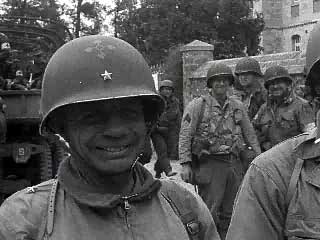
The Son of the Rough Rider: Theodore Roosevelt III at Normandy

Theodore Roosevelt Jr4

Friends of Padre Steve’s World,

The Prussian military theorist Carl von Clausewitz wrote: “Courage, above all things, is the first quality of a warrior.”

By the standards of military service on the front line the man was ancient. He was 56 years old, a year younger than I am now. He had arthritis and a history of heart problems, but he was his father’s son and he put himself in harm’s way in the greatest invasion in history. .

The oldest man to land on the beaches of Normandy was the son of a President. His father was Theodore “Teddy” Roosevelt who had taken leave of his office as Assistant Secretary of the Navy at the outset of the Spanish-American War to go into harm’s way. With the help of his friend Colonel Leonard Wood, Roosevelt formed the legendary First U.S. Volunteer Cavalry Regiment, the “Rough Riders” and led them in the fight at the Battle of San Juan Hill.

The son of the President entered the business world and then served as a Reserve officer. When the United States entered the First World War he was commissioned as a Major.  He volunteered for overseas service and served as a battalion commander and later as commander of the 26th Infantry Regiment of the 1st Infantry Division. Leading from the front he was wounded and gassed at Soissons in 1918. For his service he was awarded the Distinguished Service Cross and the French Chevalier Légion d’honneur.

After the war he helped found the American Legion and entered politics and was elected to the New York State Assembly. However while serving as Assistant Secretary of the Navy in the Harding Administration he was linked to the Teapot Dome Scandal and though he was cleared of any wrongdoing his name was tarnished. He was opposed by his cousin Franklin Delano Roosevelt and his political fortunes in elections plummeted. However, he was appointed as Governor of Puerto Rico and later Governor-General of the Philippines a post that he served at until 1935.  He returned to the United States and went back into business world with American Express.

Between the wars he continued his Army Reserve service. Like most reservists he attended his annual training periods, but he also took it upon himself to attending the Infantry Officer Basic and Officer Advanced Courses as well as the Command and General Staff College. When war broke out in Europe and the United States began to mobilize for war he again volunteered for active service. He attended a refresher course and was promoted to Colonel in the Army Reserve. He was mobilized in April 1940 and was given command of his old 26th Infantry Regiment assigned to the First Infantry Division. He was promoted to Brigadier General in late 1941 and became the the Assistant Division Commander.

Ted_Cane_France

He served well in that role in North Africa and Sicily and earned citations for bravery being constantly on the front lines with his soldiers. However his association with the Division Commander, the unorthodox Terry Allen earned the enmity of George Patton and Omar Bradley. Patton disliked Allen and hated the way both Allen and Roosevelt eschewed “spit and polish” and “dressed down,” often wearing unauthorized uniform items. After Bradley assumed command of 7th Army he relieved both officers, believing that they were guilty of “loving their division too much.” Bradley later admitted was one of the hardest decisions that he made in the war. Roosevelt then served as a liaison officer with the Free French Forces in Italy before returning to England to assume duties as Assistant Division Commander of the 4th Infantry Division. His superior, Terry Allen would go on to command the 104th Infantry Division in an exemplary manner in France and Germany in 1944-45. Bradley praised him and his new division as one of the best in Europe.

TeddyJr5-530x414

Roosevelt constantly trained with the troops and asked his commander, Major General Raymond “Tubby” Barton for permission to land with the first wave in the invasion. After being denied twice Roosevelt put his request to Barton in writing:

“The force and skill with which the first elements hit the beach and proceed may determine the ultimate success of the operation…. With troops engaged for the first time, the behavior pattern of all is apt to be set by those first engagements. [It is] considered that accurate information of the existing situation should be available for each succeeding element as it lands. You should have when you get to shore an overall picture in which you can place confidence. I believe I can contribute materially on all of the above by going in with the assault companies. Furthermore I personally know both officers and men of these advance units and believe that it will steady them to know that I am with them.”

Barton reluctantly approved the request not expecting Roosevelt to survive the landings. Roosevelt was in the first wave of assault troops at Utah Beach. On landing he discovered that the first wave was about a mile off course and in an area where the German defenses were not strong.

Armed with a pistol and supported by a cane Roosevelt led a reconnaissance to find the causeways off the beach. He briefed the battalion commanders and then ordered an attack from where the troops had landed telling his officers “We’ll start the war from right here!” It was a moment immortalized in the film The Longest Day in which Henry Fonda played Roosevelt.

fon2

Henry Fonda Portrays Brigadier General Theodore “Ted” Roosevelt III in “The Longest Day”

His actions were key in the success of the Utah Beach landings and he was recommended for the Distinguished Service Cross by General Barton. Just over a month after the invasion after continuously leading his troops in Normandy Roosevelt died of a heart attack on July 12th 1944, the very day he had been selected for his second star and promotion to Major General with orders to take command of the 90th Infantry Division. His award was upgraded to the Congressional Medal of Honor which was posthumously awarded on September 28th 1944. He was buried in the American Cemetery in Normandy. The remains of his younger brother Quentin who had been killed in the First World War were exhumed and interred next to his in 1955.

The Medal of Honor citation reads:

For gallantry and intrepidity at the risk of his life above and beyond the call of duty on 6 June 1944, in France. After 2 verbal requests to accompany the leading assault elements in the Normandy invasion had been denied, Brig. Gen. Roosevelt’s written request for this mission was approved and he landed with the first wave of the forces assaulting the enemy-held beaches. He repeatedly led groups from the beach, over the seawall and established them inland. His valor, courage, and presence in the very front of the attack and his complete unconcern at being under heavy fire inspired the troops to heights of enthusiasm and self-sacrifice. Although the enemy had the beach under constant direct fire, Brig. Gen. Roosevelt moved from one locality to another, rallying men around him, directed and personally led them against the enemy. Under his seasoned, precise, calm, and unfaltering leadership, assault troops reduced beach strong points and rapidly moved inland with minimum casualties. He thus contributed substantially to the successful establishment of the beachhead in France.

Roosevelt’s story is quite amazing. In the modern wars of the late 20th and early 21st Centuries few commanders as senior as Roosevelt would ever be in the first wave of an invasion or offensive operation. The personal courage and example set by Roosevelt in both World Wars, leading from the front and maintaining relationships with the troops that he commanded in combat is something that is unusual today. We in the military talk about a lot in various military leadership classes but often seems to be smothered by business models promoted by think tanks and others with money to be made.

Likewise, a commander suffering from Roosevelt’s infirmities would not be allowed to command troops in combat today. But in the Second World War when many other American Generals failed miserably and often could not be found near the front and were relieved of command for incompetence and cowardice the old, crippled and infirm Roosevelt led from the front. He made decisions on Utah Beach on D-Day that helped ensure that the landings were a success. Bradley, who had fired Roosevelt after the Sicilian Campaign with Allen said that the most heroic act that he had seen in combat was “Ted Roosevelt on Utah Beach.”

Roosevelt was an exception to Clausewitz’s axiom that “boldness becomes rarer, the higher the rank.” I think that even if a General wanted to lead in the manner of Roosevelt today that he would be punished by the institution for risking himself regardless of his success, it would make others look bad.

Peace

Padre Steve+

Leave a comment

Filed under History, leadership, Military, us army, world war two in europe

The Longest Day and Afterwards: D-Day and the Normandy Campaign, an Introduction

The author with Marines at Point du Hoc, Normandy in 2004

Friends of Padre Steve’s World,

Every year about this time I try to write about D-Day.  This year I spent more time on the Battle of Midway writing or rewriting a total of five articles.

Since we are now about to begin a time of major repairs to our home due to flooding from an plugged air conditioning condensation drains I have decided to do is to re-post a short research paper that I did for one of my Master’s degree courses tonight, actually posting it on Sunday night for publication today, and hope to follow it up with some more articles over the week on specific aspects and personalities of the campaign.  What I hope is that people that are not familiar with the campaign as well as those that are can use this as a portal to other resources on the web and in print.

I have visited Normandy once in 2004 on a trip with the Marines of the Marine Security Force Company Europe that took me to Belleau Wood as well as Normandy.  In both places I had the good fortune to be able to explain aspects of both battles, at Normandy discussing the invasion from the German side of the fence.  The Normandy battlefields are well worth visiting.  Hopefully in the next few years I will get a chance to go back and do some serious exploring.

Introduction

General Dwight D Eisenhower Commander in Chief Allied Forces Europe

The American landings on Omaha Beach were critical to the success of the Allied invasion northwestern Europe in the overall Overlord plan.  Without success at Omaha there would have been a strong chance that the German 7th Army and Panzer Group West could have isolated the remaining beachheads, and even if unsuccessful at throwing the Allies into the sea could have produced a stalemate that would have bled the Allies white.  This quite possibly could have led to a political and military debacle for the western allies which would have certainly changed the course of World War II and maybe the course of history.[i] This is not to say the Germans would have won the war, but merely to state that a defeat on Omaha could have changed the outcomes of the war significantly.   Subsequent to the successful landing there were opportunities both for the Allies and the Germans to change the way that the campaign unfolded, thus the battles leading up to the breakout at Avranches are critical to its development and the subsequent campaign in France.

OVERLORD: The Preparations

Eisenhower’s Key Lieutenants: Patton, Bradley and Montgomery

The planning for the Normandy invasion began in earnest after the QUADRANT conference in Quebec in August 1943.  The timetable for the operation was established at the Tehran conference where Stalin sided with the Americans on the need for an invasion of France in the spring of 1944.[ii] Prior to this there had been some planning by both the British and Americans for the eventual invasion initially named ROUNDUP.  These preparations and plans included a large scale raid at Dieppe in 1942 which ended in disaster but which provided needed experience in what not to do in an amphibious assault on a heavily defended beach.        The failure at Dieppe also darkened the mood of the Allies, the British in particular to the success of such operations, bringing to mind the failed Gallipoli campaign of 1915 as well as the opposed landings at Salerno and the USMC experience at Tarawa.[iii] Despite this the Americans led by General Marshall pushed for an early invasion of northwest Europe. Churchill and the British due to their weakness in land power pushed for land operations in the Mediterranean, and even in Norway as an option to the assault in France. The conflicted mindset of the Allies left them in the position of planning almost exclusively for the success of the initial landings and build up to the near exclusion of planning for the subsequent campaign once they landed. This especially included what one writer described as “the maze of troubles awaiting behind the French shore.”[iv]

Field Marshal Erwin Rommel, Commander of Army Group B

Despite conflicts between the Americans and British political and military leadership the planning for the Normandy landings detailed in NEPTUNE and OVERLORD moved ahead.  General Dwight Eisenhower was appointed as the commander of SHAEF with his major subordinates for Land, Air and Sea which caused consternation on both sides of the Atlantic.[v] [vi] The planned operation was expanded from the initial 3 division assault on a narrow front to a minimum 5 division assault on a broad front across Normandy[vii]supplemented by a strong airborne force.[viii] Overall the plan as it developed reflected a distinctly “American willingness to confront the enemy head-on in a collision which Britain’s leaders had sought for so long to defer.”[ix] It is ironic in a sense that the British avoidance of the head on attack was based on their known lack of manpower.  Britain had few infantry reserves to sustain the war effort and the Americans only late recognized their own deficiency in both quantity and quality of infantry forces on which their strategy depended.  That the western allies, so rich in material and natural resources would be so deficient in infantry manpower was a key constraint on the subsequent campaign in France and Germany.  The shortage of infantry forces would cause great consternation among the Allies as the campaign in France wore on.

German Beach Obstacles

The Germans too faced manpower shortages due to the immense losses sustained on the Eastern front, those lost in Africa and those tied down in Italy, the Balkans and Norway as well as the drain caused by Luftwaffe Field Divisions and troops diverted into the Waffen-SS.   The German Army resorted to smaller divisions and the created many “static” divisions manned by elderly or invalid Germans to plug the gaps along the Atlantic wall. The Germans were also forced to recruit “Volksdeutsch” and foreign “volunteers” to fill out both Wehrmacht and Waffen-SS formations.

German fortifications at the Pas de Calais

Prior to the final decision to mount an invasion the Allied planners had contended with the location of the assault in northwestern France.  The Pas de Calais provided a direct route was rejected because it was where the Germans would expect the strike to occur and because it was where the German defenses were strongest.  The fiasco at Dieppe had provided ample proof of what could happen when making an assault into a heavily fortified port.  Likewise the mouth of the Seine near Le Harve was rejected because of the few beaches suitable for landing and because the forces would be split on both sides of the river.  Brittany was excluded due to its distance from the campaigns objectives in Germany.[x]This left Normandy which offered access to a sufficient number of ports and offered some protection from the weather. Normandy offered options to advance the campaign toward the “Breton ports or Le Harve as might be convenient.”[xi] Omaha beach, situated on the center right of the strike would be crucial to the success of the assault situated to the left of UTAH and the right of the British beaches.

Rommel inspecting beach obstacles

Once Normandy was selected as the location for the strike by the Allies, the planning sessions remained contentious.  This was especially true when the Allies debated the amount and type of amphibious lift that could be provided for the landings, particularly the larger types of landing ships and craft to support the Normandy invasion and the planned invasion of southern France, Operation ANVIL.  The increase in OVERLORD requirements for landing craft had an impact in the Mediterranean and resulted in ANVIL being postponed until later in the summer.

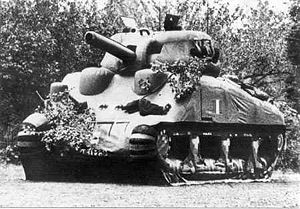
“Dummy” Sherman Tank: The Allies created a fictional Army Group to deceive German planners

As part of their preparations the Allies launched a massive deception campaign, Operation FORTITUDE.  This operation utilized the fictitious First Army Group under the “command” of General George Patton. Patton was still smarting from his relief of command of 7th Army following slapping commanded an “Army Group” which incorporated the use of dummy camp sites, dummy tanks, aircraft and vehicles, falsified orders of battle and communications to deceive German intelligence.[xii] The success of this effort was heightened by the fact that all German intelligence agents in the U.K. had been neutralized or turned by the British secret service.  Additionally the Luftwaffe’s limited air reconnaissance could only confirm the pre-invasion build ups throughout England without determining the target of the invasion.[xiii] The German intelligence chief in the west, Colonel Baron von Roenne “was deceived by FORTITUDE’s fantasy invasion force for the Pas de Calais.”[xiv] Despite this Commander of the 7thArmy recognized by 1943 that Normandy was a likely Allied target and efforts were made to shift 7th Army’s center of gravity from Brittany to Normandy.  The one potential German success in getting wind of when the Allied landings would occur was lost when German intelligence discovered two lines of Verlaine’s “Chason d’ Automme” in June 1944 which were to alert the French Resistance of the invasion.  The security section of 15th Army heard them transmitted on the afternoon of 5 June and notified General Jodl at OKW, but no action was taken to alert forces on the coast.[xv] Allied intelligence was aided by ULTRA intercepts of coded German wireless transmissions. However this was less of a factor than during the African and Italian campaigns as more German communications were sent via secure telephone and telegraph lines vice wireless.[xvi] Allied deception efforts were for the most part successful in identifying German forces deployed in Normandy. However they were uncertain about the location of the 352nd Infantry Division which had been deployed along OMAHA and taken units of the 709th Infantry Division under its command when it moved to the coast.[xvii]

USAAF B-17 Bombers and others helped isolate German forces in Normandy by bombing railroads, bridges, and supply lines

The Allied air campaign leading up to the invasion was based on attempting to isolate the invasion site from German reinforcements. Leigh-Mallory the Air Chief developed the “TRANSPORTATION PLAN” which focused efforts on destroying the French railroad infrastructure.[xviii] A more effective effort was led by General Brereton and his Ninth Air Force which was composed of medium bombers and fighters.  Brereton’s aircraft attacked bridges and rapidly achieved success in crippling German efforts to reinforce Normandy.[xix] Max Hastings gives more credit to the American bombing campaign in Germany to crippling the German defense in the west. General Spaatz and the 8th Air Force destroyed German production capacity in oil and petroleum as well as the degraded the German fighter force.  The American daylight raids so seriously degraded the German fighter force that it could not mount effective resistance to the invasion.[xx] Russell Weigley also notes that Albert Speer the Reich Armaments Minister said that “it was the oil raids of 1944 that decided the war.”[xxi]


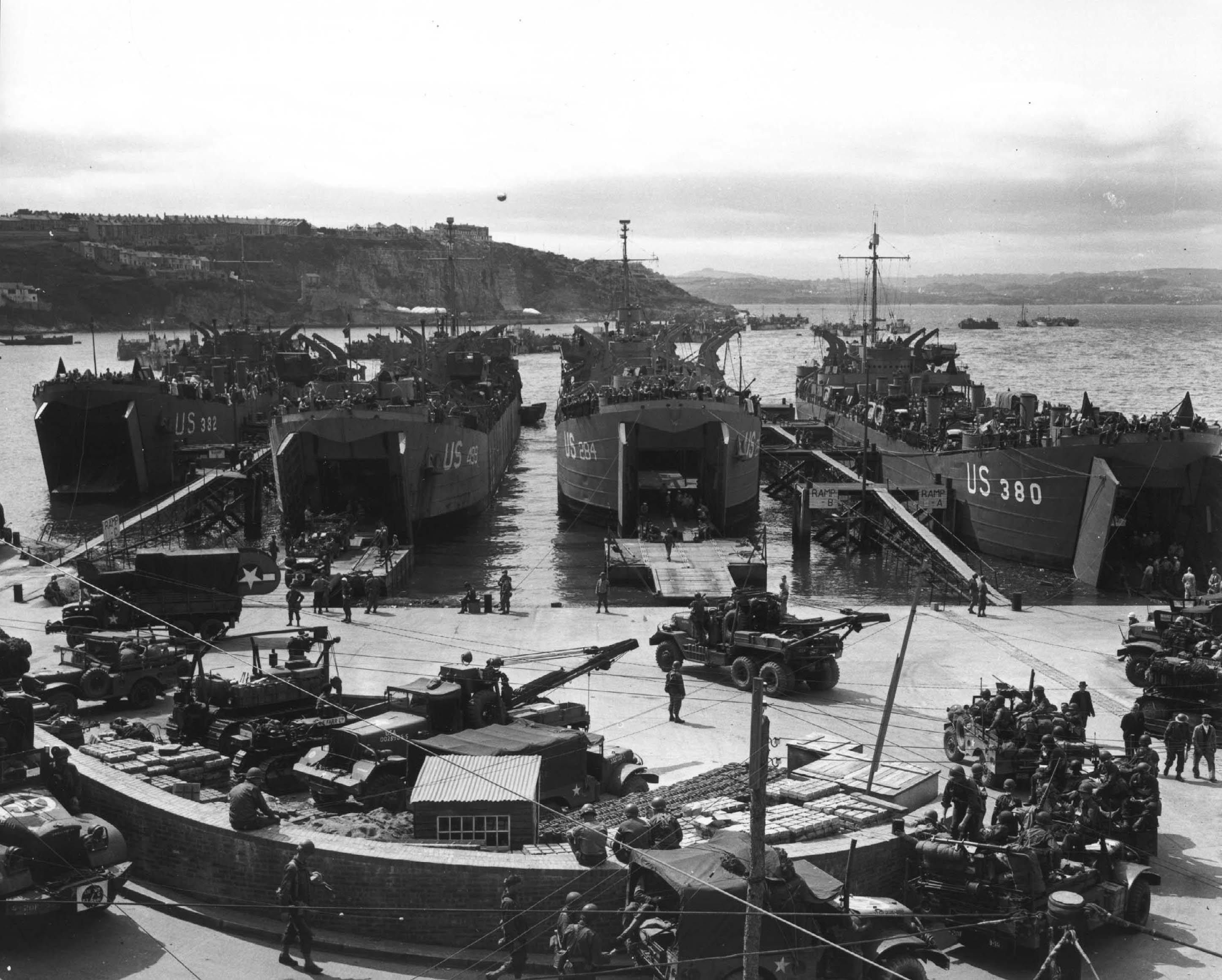
US Navy LST’s being loaded for the invasion

Planning and preparations for OMAHA were based around getting the 1st and 29th Infantry Divisions ashore and them securing a beachhead “twenty-five kilometers wide and eight or nine kilometers deep.”[xxii] American preparations were thorough and ambitious, but the American assault would go through the most heavily defended sector of German defenses in Normandy.  The landing beaches were wide and bordered by dunes which were nearly impassable to vehicles and “scrub covered bluffs thirty to fifty meters high…rough and impassable to vehicles even to tracked vehicles except at a few places.  The exits were unimproved roads running through four or five draws that cut the bluffs.”[xxiii] Dug in along those bluffs was the better part of the 352nd Division. The Americans compounded their selection of a difficult and heavily defended landing zone the Americans failed to take advantage of many of the “gadgets” that were offered by the British which in hindsight could have aided the Americans greatly.  The Americans made use of two battalions of DD (Dual Drive) tanks but turned down the offer of flail tanks, flamethrower tanks, and engineer tanks, the “funnies” developed by General Hobart and the British 79th Armored Division.[xxiv]

Dual Drive amphibious tanks were included as part of the US invasion package

Weigley believes that the American view of “tanks as instruments of mobility rather than of breakthrough power.” Likewise the Americans victories in the First World War were won by infantry with little tank support.[xxv] In this aspect the Americans were less receptive to utilizing all available technology to support their landings, something that when considering the fact that Americans were great lovers of gadgets and technology. The British use of the Armor, including the “Funnies” on the beaches to provide direct fire into German strong points lessened their infantry casualties on D-Day. Due to this lack of armor support on the beach American forces on OMAHA had little opportunity to exercise true combined arms operations during the initial landings.[xxvi]


Rommel with Artillerymen of the 21st Panzer Division in Normandy

German preparations for an Allied landing in Normandy were less advanced than the Pas de Calais.  However they had made great strides since late 1943. Field Marshal Rommel greatly increased defensive preparations along the front, including the Normandy beaches.  One of Rommel’s initiatives was to deploy Panzer Divisions near the coast where they could rapidly respond to an invasion.  However Rommel did not get everything that he wanted.  The OKW only allotted him two Panzer Divisions to be deployed near the Normandy beaches.  Only one of these the 21st Panzer Division was deployed near Caen in the British sector.  One wonders the result had the 12th SS Panzer Division been deployed behind OMAHA. [xxvii]

OMAHA: The Landings

The venerable USS Nevada, resurrected from the mud of Pearl Harbor bombarding German positions at Utah Beach

Like the rest of the Allied invasion forces the 1st and 29th U.S. Infantry Divisions set sail from their embarkation ports with the intent of landing on June 5th.  General Bradley, commanding the First Army until the American XII Army Group would be activated accompanied the invasion force.  The OMAHA landing was under the command of General Gerow and his V Corps while VII Corps led by the 4th Infantry Division landed at Utah supported by airdrops of the 82nd and 101st Airborne Divisions inland.  American command and control during the invasion was exercised from sea as in the Pacific, although General Officers were to go ashore with each of the American divisions.  A severe channel storm disrupted the plan to land on the 5th and Eisenhower delayed the invasion one day catching a break in the weather and electing to go on the 6th.[xxviii] This delay while uncomfortable for the embarked troops caused the Germans to believe that no invasion would take place until the next favorable tide and moon cycle later in the month.[xxix] The assumption that no invasion was possible ensured that a number of key senior German leaders, including Rommel were absent from the invasion front when the Allies landed.[xxx]

US Troops ride a LCVP toward Omaha 

The landing beaches at OMAHA stretched about 6500 meters from Colleville-Sur-Mer to Vierville-Sur-Mere in the west.  The beaches are wide with bluffs overlooking them and a seawall between the beaches and the bluffs.  Additionally several small towns dot the beach. To the west of the town of Vierville, a prominent height overlooked the entire beachhead.  Named Pont du Hoc, it was believed to house a 150mm battery sighted where it could enfilade the OMAHA landing zones.  The Americans assigned to the 2nd Ranger Battalion to make a seaborne assault to land, scale the cliffs and take the battery.  Companies from this battalion made a heroic landing and scaled the cliffs to capture the strongpoint only to discover that the guns had not been emplaced.  The Rangers took heavy casualties and held their isolated beachhead against German counterattacks until relieved by the 29th Division on the morning of June 8th.[xxxi]
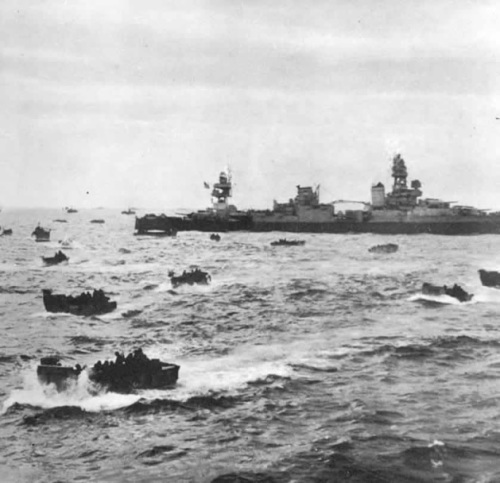
Landing craft passing the USS Augusta in heavy seas heading toward Omaha Beach

H-Hour for OMAHA was 0630.  Unfortunately the assault troops were transferred to their LCVP landing craft 16-20 kilometers from the beach.  The result was a long and dangerous ride in the small craft for the infantry.  Most of the infantry were completely soaked in sea spay and seasick before going ashore and they carried loads far above what they normally would carry into battle.[xxxii] The Armor support was one battalion of DD tanks, the 741stArmored Battalion, supporting the 16th Infantry Regiment of 1st Infantry Division. These were also launched too far out and nearly all of the tanks were swamped and lost before firing a shot in anger.[xxxiii] Other American support units needed to provide firepower on the beach were equally unfortunate. Weigley notes that at OMAHA “at least 10 of the LCVPs sank” as did “the craft carrying almost all of the 105mm howitzers that were to be the first artillery ashore after the tanks.”[xxxiv] The losses would cripple the assault on OMAHA and nearly cause its abandonment.

Bloody Omaha

As the soldiers of the American divisions on OMAHA came ashore they faced German defenders of the 352nd, 716th and a regiment of the 709th Infantry Division, the latter under the tactical command of the 352nd.   Without the bulk of their tanks artillery and lacking close air support the Americans struggled across the beaches and were cut down in large numbers before being pinned down behind the sea wall.[xxxv] With the Americans pinned down on the beach unable to advance, the time tables for the reinforcing waves became snarled amid the German beach obstacles which had not been cleared.  This was in large part due to 40% casualties among the Combat Engineers and the loss of all but five bulldozers.[xxxvi] Naval officers were frustrated in their attempts to provide naval gunfire support by the lack of identifiable targets on the beaches.  Yet German strongpoint’s were “knocked out by either by superbly directed vigorous gunfire from destroyers steaming as close as 800 yards offshore, or by determined action from Rangers or infantry.[xxxvii]


US Infantry struggles ashore at Omaha

Soldiers ashore discovered that they were not facing the static 716th Division but the veteran 352nd Division as well.[xxxviii] Only the leadership and actions of Brigadier General Norman Cota the 29th Division’s Deputy Commander and Colonel Charles Canham of the 116th Infantry kept the situation from complete collapse.  They were able to rally their troops. Under their leadership small units from the 116th which had its linage back to the “Stonewall Brigade” as well as elements of the 16th and 18th Infantry Regiments began to move forward.  Surviving junior leaders began to lead survivors through the dunes and up the bluffs to attack German defenders of the roads leading up from the beach from the flank and rear.  A mid-day break in the weather allowed some close tactical air support giving the troops badly needed support.

US 1st Infantry Division Troops at the Omaha sea wall

With the situation desperate General Bradley considered the evacuation of OMAHA.  At sea events were as confused as Bradley and his staff attempted to make sense of what was going on.  Even later in the evening there was discussion of diverting all further reinforcements from OMAHA to the British beaches.[xxxix]At 1330 hours “Gerow signaled Bradley: “Troops formerly pinned down on beaches…advancing up heights behind beaches.”[xl] By the end of the day Bradley’s aid Major Hansen noted Bradley’s comments to Collins: “They are digging in on Omaha beach with their fingernails. I hope they can push in and get some stuff ashore.”  And Montgomery: “Someday I’ll tell Gen[eral] Eisenhower just how close it was for a few hours.”[xli]

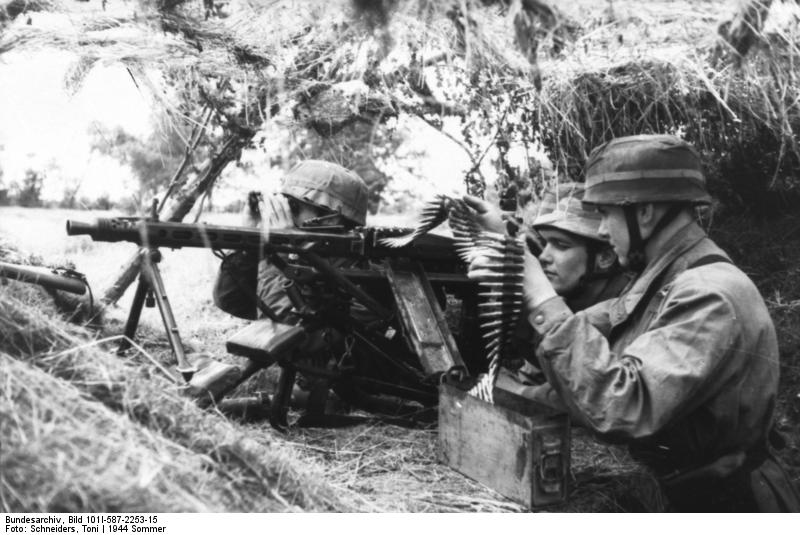
German Fallschirmjaeger Trüppen in Normandy, the German Parachute forces fighting in an infantry role were very effective in the Normandy campaign

The landings at OMAHA succeeded at a cost of over 2000 casualties.  Critical to the success of the landings were the German inability to reinforce their defending troops on the beach.  Likewise the weakness of the units available to mount the standard counterattack that was critical to German defensive plans on D-Day itself kept the Germans from driving the Americans back into the Channel. The 352nd Division fought superbly under the full weight of V Corps and the British XXX Corps on its right suffering heavy casualties as they contested every inch of ground.  The 716th Division composed of second rate troops melted under the onslaught.  Allied air supremacy played a key role as sorties by the 8th and 9th Air Forces helped keep German reinforcements from arriving and interdicted counter attacks inland.  Weigley credits the Allied air superiority with the success of the landings and with limiting casualties.[xlii]Von Rundstedt and other German commanders in France were limited by the delay and refusal of Hitler and OKW to release Panzer reserves when needed most early on June 6th.  By the close of D-Day allied forces had secured the five invasion beaches but not achieved their objectives of taking Caen and Bayuex.  Since the forces on the various beachheads had not linked up the beaches would have been extremely vulnerable had the Germans been able to mount a rapid counterattack by Panzers and strong infantry formations as they had at Salerno.

Major Battles to the Breakout at Avranches

Securing the Beachheads

It took the V and VII Corps nearly a week to secure the beachheads. German forces including the stalwart 352nd Division resisted stubbornly and mounted sharp local counterattacks which kept the Americans off balance.  Elements of the 29th Division and the 90th Division began to push inland and to expand the beachhead toward UTAH. Opposed by the 352nd Division and elements of the 91st Airlanding Division and other non-divisional units the fighting revealed the inexperience of the American infantry formations and the uneven quality of their leadership.  As the Americans tackled the Germans in the labyrinth of the Bocage country the defensive skill of the Germans cost many American lives and delayed the joining of the beachheads. On the 13th the link up was solid enough to enabling the Americans to conduct the follow up operations needed to expand the beachhead, secure Cherbourg and clear the Cotentin.

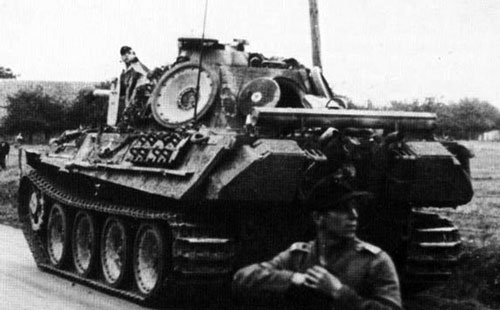
A Panther tank of the Panzer Lehr Division in Normandy

In some American divisions the hard fighting triggered a leadership crisis.  The lack of success of the 90th Division led General “Lightening Joe” Collins of VII Corps relieve the division commander and two regimental commanders of command, a portent of things to come with other American units.[xliii] As the V and VII corps pushed into the “Bocage” they were followed by a massive build up of troops and equipment delivered to the beaches and to the artificial “Mulberry” harbors.  Despite their numeric superiority, air supremacy and massive Naval gunfire support and facing the weakened 352nd, 91st and the 6thParachute Regiment and other less than quality formations, survivors of the static divisions, the Americans made painfully slow progress as they moved off the beachhead and into the Bocage.[xliv]

The Capture of Cherbourg
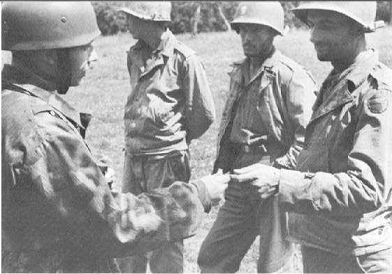
US Soldiers of the 29th Division surrender to German Fallschirmjaeger in Normandy

Once the beachheads had been consolidated the Americans turned their attention toward Cherbourg. Cherbourg was the major naval port at the far northwest tip of the Cotentin.  D-Day planners counted on its swift capture and rehabilitation to serve as a supply port for the Allied forces. The 9th Division drove south to the coast near Barneville on the 18th of June cutting off the German forces covering the approaches to Cherbourg.[xlv] This put the Germans in a bind as the 7th Army “had to split its forces in the peninsula in order to hold the fortress a little longer and thus to gain time for the establishment of the southern front on the Cotentin peninsula.[xlvi] The German forces arrayed before Cherbourg waged a desperate defense centered around the 243rd Infantry Division and other assorted battle groups of LXXXIV Corps, whose commander General Marcks one of the best German Generals was killed in action on 12 June.[xlvii] The U.S. VII Corps under Collins with the 9th, 4th and 79th Divisions pushed up the peninsula capturing Cherbourg on June 29th.  Bradley pushed hard for the capture of the port as the Mulberries had been ravaged by a severe Channel storm the week prior. The port of Cherbourg was thoroughly demolished by German engineers and would not be fully operational for months. The loss of the Mulberries and delay in Cherbourg’s availability meant that few supplies were landed on the beaches would “hinder the escape from the constricting land of the hedgerows into which the Americans had come in search of a port.[xlviii]

The Battle of Caumont Gap

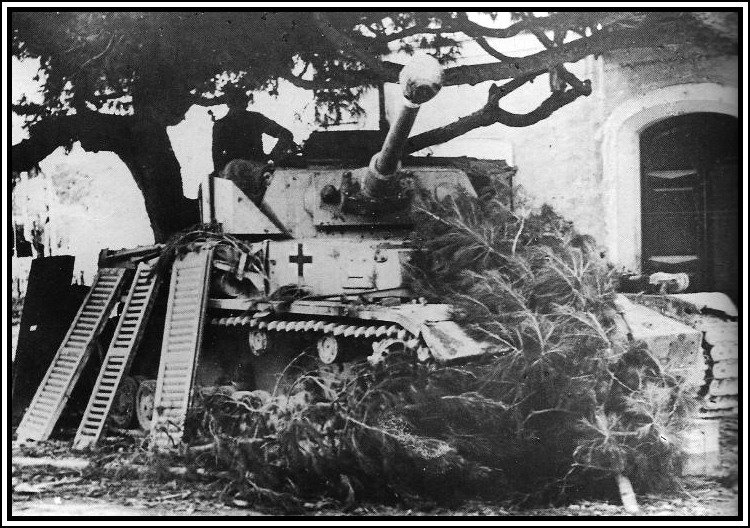
Panzer IV Tank in Normandy

V Corps under Gerow made a cautious advance by phase lines toward Caumont, St Lo and Carentan.  The deliberate advance by the Corps toward a line weakly held by the Reconnaissance battalion of the 17th SS Panzer Grenadier Division was directed by Bradley who did not want to divert attention from the effort against Cherbourg.   After capturing Caumont V Corps halted and continued aggressive patrolling to deceive the Germans while digging in.[xlix] The possibility existed that a strong push against the weak German line could have led to an opportunity to envelope the German line west of Caen. This was a missed opportunity that in part led to the bloody and controversial campaign to capture Caen.[l]

British efforts around Caen
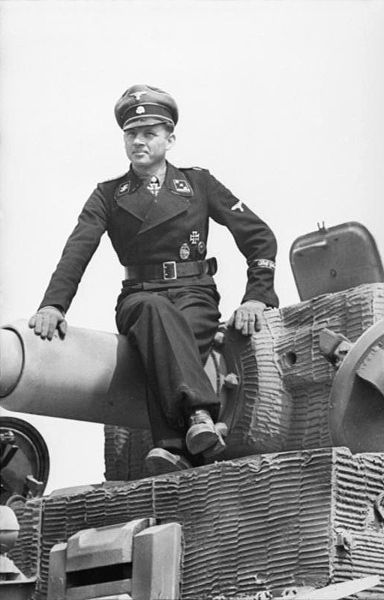
German Panzer Ace Waffen SS Captain Michale Wittman single handedly destroyed a British Battalion at Villers Bocage in his Tiger Tank

Montgomery had ambitious plans to break out of Normandy by capturing Caen on D-Day and driving toward Falaise and Argentan.  The British plans for this were frustrated by the rapid reinforcement of the sector by the Germans and the activities of 21st Panzer, Panzer Lehr, and the 12th SS Panzer Divisions.  A flanking maneuver at Villers-Bocage was frustrated by a few Tiger tanks led by the legendary Waffen SS Panzer commander Captain Michael Wittman whose tanks devastated a British Armored battalion.[li]

Wreckage of a British Battalion at Villers Bocage

A series of disastrous attacks toward Caen (EPSOM, CHARNWOOD and GOODWOOD) strongly supported by air strikes and Naval gunfire finally succeeded in taking that unfortunate city on July 18th but failed to take the heights beyond the town.[lii]

British operations like Operation Epsom met setback after setback against dug in German forces outside of Caen

Against crack well dug in German forces the British took heavy casualties in tanks and infantry seriously straining their ability to conduct high intensity combat operations in the future.[liii] The one benefit, which Montgomery would claim after the war as his original plan was that German forces were fixed before Caen and ground down so they could not be used against Bradley’s breakout in the west at St Lo.[liv]

Clearing the Bocage: The Battle of the Cotentin Plain
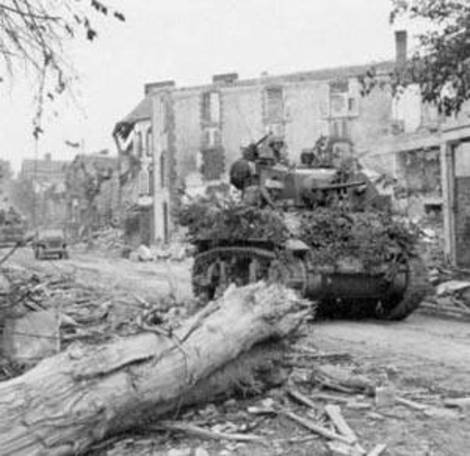
US M-5 Light Tank in Normandy

Other German forces arrived, and reinforced the Caumont gap which no longer “yawned invitingly in front of V Corps.” [lv] Bradley wished to push forward rapidly to achieve a breakthrough in the American sector.[lvi] Facing the most difficult terrain in France amid the Bocage and swamps that limited avenues of approach to the American divisions committed to the offensive.  The Americans now faced their old foe the 352nd division as well various elements of II Parachute Corps, the 17th SS Panzer Grenadier and Panzer Lehr Divisions.  American tanks and infantry made slow progress and incurred high losses as they dueled the Germans at close range.  In the VIII Corps sector alone the attack “consumed twelve days and 10,000 casualties to cross eleven kilometers of the Bocage…the achievements of the VII and XIX Corps were no better than comparable.[lvii]

St. Lo

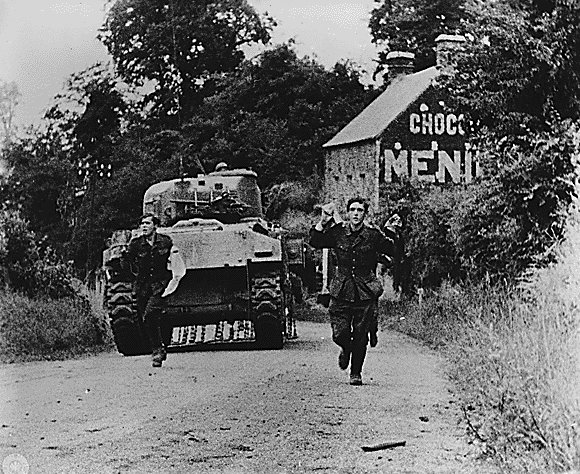
US Tanks advancing with German prisoners moving back to US lines at St Lo

St. Lo was a key to Bradley’s breakout efforts.  His Army had to capture it and the roads leading out of it to launch Operation COBRA along the coast.  The task of capturing St. Lo was assigned to GEROW’S V Corps and Corlett’s XIX Corps.  They faced opposition from the tough paratroops of the German 3rd Parachute Division of II Parachute Corps.  The 2nd, 29th, 30th and 83rd Divisions fought a tough battle advancing eleven kilometers again with high numbers of casualties especially among the infantry to secure St. Lo on 18 July.[lviii] They finally had cleared the hedgerows.  St Lo epitomized the struggle that the American Army had to overcome in the Bocage.  Hard fighting but outnumbered German troops in excellent defensive country exacted a terrible price in American blood despite the Allied control of the skies.[lix]

Operation COBRA

US 155mm Howitzers in Normandy, the Germans had profound respect for American Artillery, a respect that they did not share for American Infantry or Armor forces

With the Bocage behind him Bradley desired to push the Germans hard.  COBRA was his plan to break out of Normandy.  Bradley ably assisted by Collins they realized that the better terrain, road networks favored a breakout.  American preparations included a technical advance that allowed tanks to plow through hedgerows. This was the “Rhino” device fashioned by American troops which was installed on 3 of every 5 First Army Tanks for the operation.[lx] VII Corps was to lead the attack which was to begin on July 24th. American planning was more advanced than in past operations.  Collins and Bradley planned for exploitation operations once the breakthrough had been made. A massive air bombardment would precede the attack along with an artillery barrage by Collins corps artillery which was reinforced by additional battalions.   A mistake by the heavy bombers in the 24th resulted in the American troops being hit with heavy casualties and a postponement of the attack until the 25th.[lxi] The following day the attack commenced.  Another mistake by the bombers led to more American casualties[lxii] but VII Corps units pressed forward against the determined resistance of the survivors of Panzer Lehr and the remnants of units that had fought the Americans since the invasion began.  Although it was a “slow go” on the 25th Bradley and his commanders were already planning for and beginning to execute the breakout before the Germans could move up reinforcements.  The 26th of June brought renewed attacks accompanied by massive air strikes.

The Devastated town of St Lo 

While not much progress was made on the 26th, the Americans discovered on the 27th that the German forces were retreating.  The capture of Marigny allowed VIII Corps to begin exploitation down the coastal highway to Coutances.  On the 27th General Patton was authorized to take immediate command of VIII Corps a precursor to the activation of his 3rdArmy.  COBRA ripped a hole in the German line and inflicted such heavy casualties on the German 7th Army that it could do little to stop the American push.[lxiii] As the American forces pushed forward they reinforced their left flank absorbing the local German counterattacks which were hampered by the Allied close air support.

Avranches and Beyond

US Forces advance through the ruins of St Lo

As the breakthrough was exploited the command of the forces leading it shifted to Patton and the newly activated 3rd Army. By the 28th VIII Corps led by the 4th and 6th Armored Divisions had reached Avranches and established bridgeheads over the See River with additional bridges being captured intact on the 30th.[lxiv] The capture of Avranches allowed the Americans to begin exploitation operations into Brittany and east toward the Seine. Weigley notes that for the first time in the campaign that in Patton the Americans finally had a commander who understood strategic maneuver and would use it to great effect.[lxv]

Conclusion

The American campaign in Normandy cost the U.S. Army a great deal. It revealed weaknesses in the infantry, the inferiority of the M4 Sherman tank to most German types, problems in tank-infantry cooperation and also deficiencies in leadership at senior, mid-grade and junior levels. Heavy casualties among infantry formations would lead to problems later in the campaign. Numerous officers were relieved including Division and Regimental commanders.  Nonetheless during the campaign the Americans grew in their ability to coordinate air and ground forces and adapt to the conditions imposed on them by their placement in the Cotentin.  The deficiencies would show up in later battles but the American Army learned its trade even impressing some German commanders on the ground in Normandy.[lxvi]

[i] See the alternative history of by Peter Tsouras Disaster at D-Day: The Germans Defeat the Allies, June 1944, Greenhill Books, London 1994. Tsouras describes the defeat of the Omaha landings and the effect on the course of the campaign leading to the overthrow of Hitler and a negotiated armistice in the west.  While this outcome could be rigorously debated other outcomes could have led to the fall of the Roosevelt and Churchill governments and their replacement by those not committed to unconditional surrender or a continuation of the war that brought about more German missile attacks on the U.K. and the introduction of other advanced German weapons that could have forced such a settlement. Another option could have led to the dropping of the Atomic Bomb on a German city vice Hiroshima.

Notes 

[ii] Weigley, Russell F. Eisenhower’s Lieutenants: The Campaign of France and Germany, 1944-1945, Indiana University Press, Bloomington IN, 1981 p.33

[iii] Ibid pp. 34-35

[iv] Ibid p.35

[v] General Montgomery 21st Army group and Land Forces, Admiral Sir Bertram Ramsey as Allied Naval Expeditionary Force and Air Marshall Sir Trafford Leigh-Mallory as Commander in Chief Allied Expeditionary Air Force. Weigley p.43

[vi] Max Hastings in Overlord: D-Day and the Battle for Normandy Vintage Books, New York, 1984, comments that many in Britain wondered if Eisenhower with the lack of actual battle experience could be a effective commander and that Eisenhower was disappointed in the appointment of Leigh-Mallory and Ramsey, and had preferred Alexander over Montgomery, pp. 28-29.

[vii] Ibid. Weigley p.40.  Montgomery was the first to object to the 3 division narrow front invasion rightly recognizing that seizing Caen with its road junctions could provide a springboard for the campaign into open country.

[viii] Ibid. p.37

[ix] Hastings, Max. Overlord: D-Day and the Battle for Normandy Vintage Books, New York, 1984 p.29  Hastings finds the irony in the selection of the British officers to execute the plan that reflected the American way of thinking.

[x] The Germans agreed with this in their planning leaving Brittany very lightly defended.  See  Isby, David C. Ed. “The German Army at D-Day: Fighting the Invasion.” p.27 The report of General Blumentritt, Chief of Staff OB West noted that only 3 divisions were assigned to Brittany.

[xi] Ibid. Weigley, pp. 39-40

[xii] Ibid. p.73

[xiii] See Isby p. 69.  General Max Pemsel of 7th Army noted that “During  the spring of 1944, Seventh Army received only tow good photographs of British southern ports, which showed large concentrations of landing craft.”

[xiv] Ibid. Hastings p.63.  Hastings comments also about the success of using the turned Abwehr agents.

[xv] Warlimont, Walter. “Inside Hitler’s Headquarters: 1939-1945.” Translated from theGerman by R.H. Barry. Presidio Press, Novao CA, English Edition Copyright 1964 Wiedenfeld and Nicholson Ltd. Pp.422-423

[xvi] Ibid. Weigley pp. 53-54

[xvii] Ibid. p. 67

[xviii] Ibid. pp.57-64  Weigley spends a great deal of time on the wrangling between Eisenhower, Leigh Mallory and Spaatz on the nature of the plan, the allocation of forces both strategic and tactical assigned to carry it out and its success, or in the light of postwar analysis the lack of effect that it had on German operations.

[xix] Ibid. p.67-68.

[xx] Ibid. Hastings pp. 43-44 In large part due to the long range P-51 Mustang which accompanied the American bombing raids beginning in 1943.  Another comment is that the campaign drew the German fighters home to defend Germany proper and prevented their use in any appreciable numbers over the invasion beaches.

[xxi] Ibid. Weigley p.69

[xxii] Ibid. p.89

[xxiii] Ibid. pp. 88-89

[xxiv] Ibid. p.87

[xxv] Ibid. Weigley also talks about the rejection of General Corlett’s ideas to use Amtracks used by the Marines in the Pacific to land on less desirable, but less defended beaches to lessen casualties on the beaches and the need for additional support equipment even on smooth beaches.  One of Corlett’s criticisms was that too little ammunition was allotted to supporting the landings and not enough supporting equipment was provided. pp. 46-47

[xxvi] Hastings notes that with the strength and firepower of the German forces on OMAHA that many of these vehicles had they been employed would like have ended up destroyed further cluttering the beachhead. “Overlord” p.102

[xxvii] The battle over the deployment of the Panzer Divisions is covered by numerous historians.  The source of the conflict was between Rommel who desired to place the Panzer Divisions on the Coast under his command due to the fear that Allied air superiority would prevent the traditional Panzer counterthrust, General Gyer von Schweppenburg commander of Panzer Group West (Later the 5th Panzer Army) and Field Marshal Von Rundstedt who desired to deploy the divisions order the command of Rundstedt for a counter attack once the invasion had been launched, a strategy which was standard on the Eastern Front, and Hitler who held most of the Panzer reserve including the SS Panzer Divisions under his control at OKW.  Hitler would negotiate a compromise that gave Rommel the satisfaction of having three Panzer Divisions deployed behind coast areas in the Army Group B area of responsibility.  21stPanzer had those duties in Normandy.

[xxviii] Ibid. p.74-75

[xxix] Von Luck, Hans.  “Panzer Commander“ Dell Publishing, New York, 1989 pp. 169-170.  Von Luck a regiment commander in 21st Panzer noted that General Marcks of 84th Corps had predicted a 5 June invasion at a conference May 30th.

[xxx] Almost every D-Day historian talks about the weather factor and its effect on the German high command’s reaction to the invasion.  Rommel was visiting his wife for her birthday and planned to make a call on Hitler. Others including commanders of key divisions such as the 91st Airlanding Division were off to a war game in Rennes and the 21st Panzer Division to Paris.

[xxxi] Ibid. Weigley p. 96

[xxxii] See Cornelius Ryan, “The Longest Day” Popular Library Edition, New York 1959. pp. 189-193 for a vivid description of the challenges faced by soldiers going from ship to landing craft and their ride in to the beaches.

[xxxiii] Ibid. Weigley. p.78 Weigley talks about the order for the tanks to be carried ashore on their LCTs that did not get transmitted to the 741st.

[xxxiv] Ibid.

[xxxv] Ibid. Weigley  p. 87 The weather prevented the aerial bombardment from being effective. Because the bombers could not see their targets they dropped their bomb loads further inland, depriving the infantry of support that they were expecting.  Naval gunfire support had some effect but had to be lifted as the troops hit the beach leaving much of that support to come from Destroyers and specially equipped landing craft which mounted rockets and guns.

[xxxvi] Ibid. Hastings. pp. 90-91.

[xxxvii] Ibid. p.99

[xxxviii] Ibid. Weigley p.80

[xxxix] Ibid. p.101  Also see Weigley p.80

[xl] Ibid. p.99

[xli] Ibid. Weigleyp.95

[xlii] Ibid. p.94

[xliii] Ibid. p.99 Both Weigley and Hastings make note of the failure of both the Americans and British to train their troops to fight in the bocage once they had left the beaches.

[xliv] Ibid. Hastings. pp.152-153

[xlv] Ibid. Weigley p.101

[xlvi] Isby, David C., Ed. “Fighting in Normandy: The German Army from D-Day to Villers-Bocage.” Greenhill Books, London,  2001.  p.143

[xlvii] Ibid. Hastings p.173 Allied fighter bombers exacted a fearful toll among German commanders. The Commanders of the 243rd and 77th Divisions fighting in the Cotentin were also killed by air attacks on the 17th and 18th.   Further east facing the British the commander of the 12th SS Panzer Division, Fritz Witt on the 17th.

[xlviii] Ibid. Weigley. p.108

[xlix] Ibid. p.111-112.

[l] Ibid.

[li] The efforts of the 51st Highland Division and 7th Armored Division were turned aside by the Germans in the area and were dramatized by the destruction of  a British armored battalion by SS Captain Michael Wittman and his platoon of Tiger tanks.  See Hastings pp.131-135.

[lii] The British 8th Corps under General O’Connor lost 270 tanks and 1,500 men on 18 July attempting to crack the German gun line on the ridge beyond Caen. Weigley, pp.145-146.

[liii] Hastings comments about the critical British manpower shortage and the pressures on Montgomery to not take heavy casualties that could not be replaced. Overlord. pp.241-242.

[liv] Ibid. Weigley pp.116-120

[lv] Ibid. p.122

[lvi] Ibid. p121 Bradley told Eisenhower “when we hit the enemy this time we will hit him with such power that we can keep going and cause a major disaster.”

[lvii] Ibid. 134

[lviii] Ibid. Weigley. pp. 138-143.  Weigley notes of 40,000 U.S. casualties in Normandy up to the capture of St. Lo that 90% were concentrated among the infantry.

[lix] Weigley quotes the 329th Regiment, 83rd Division historian “We won the battle of Normandy, [but] considering the high price in American lives we lost. P.143. This is actually a provocative statement that reflects America’s aversion to massive casualties in any war.

[lx] Ibid. p.149

[lxi] Ibid. p. 152

[lxii] Ibid. pp. 152-153.  Among the casualties were the command group of the 9th Division’s 3rd Battalion 47th Infantry and General Leslie McNair who had come to observe the assault.

[lxiii] Ibid. pp.161-169. Weigley notes the advances in U.S. tactical air support, the employment of massive numbers of U.S. divisions against the depleted German LXXXIV Corps, and the advantage that the “Rhino” device gave to American tanks by giving them the ability to maneuver off the roads for the first time.

[lxiv] Ibid. pp.172-173.

[lxv] Ibid. p.172

[lxvi] Ibid. Isby, David C. “Fighting in Normandy,” p.184, an officer of the 352nd Division referred to the American soldier “was to prove himself a in this terrain an agile and superior fighter.”

Bibliography

Carell, Paul. “Invasion: They’re Coming!” Translated from the German by E. Osers, Bantam, New York 1964.

Hastings, Max. Overlord: D-Day and the Battle for Normandy Vintage Books, New York, 1984

Isby, David C. Ed. “The German Army at D-Day: Fighting the Invasion.” Greenhill Books, London 2004

Isby, David C., Ed. “Fighting in Normandy: The German Army from D-Day to Villers-Bocage.” Greenhill Books, London, 2001.

Ryan, Cornelius, “The Longest Day” Popular Library Edition, New York 1959

Tsouras, Peter. “Disaster at D-Day: The Germans Defeat the Allies, June 1944,”Greenhill Books, London 1994.

Von Luck, Hans.  “Panzer Commander“ Dell Publishing, New York, 1989

Warlimont, Walter. “Inside Hitler’s Headquarters: 1939-1945.” Translated from theGerman by R.H. Barry. Presidio Press, Novao CA, English Edition Copyright 1964 Wiedenfeld and Nicholson Ltd. Warlimont, Walter. “Inside Hitler’s Headquarters: 1939-1945.” Translated from theGerman by R.H. Barry. Presidio Press, Novao CA, English Edition Copyright 1964 Wiedenfeld and Nicholson Ltd.

Weigley, Russell F. Eisenhower’s Lieutenants: The Campaign of France and Germany, 1944-1945, Indiana University Press, Bloomington IN, 1981

Leave a comment

Filed under History, leadership, Military, nazi germany, us army, US Army Air Corps, world war two in europe

Devastators Into the Valley of Death: The Sacrifice of the Torpedo Bombers at Midway

tbd-devastator1
Friends of Padre Steve’s World,

Alfred, Lord Tennyson wrote:

Half a league half a league,
Half a league onward,
All in the valley of Death
Rode the six hundred:
‘Forward, the Light Brigade!
Charge for the guns’ he said:
Into the valley of Death
Rode the six hundred.

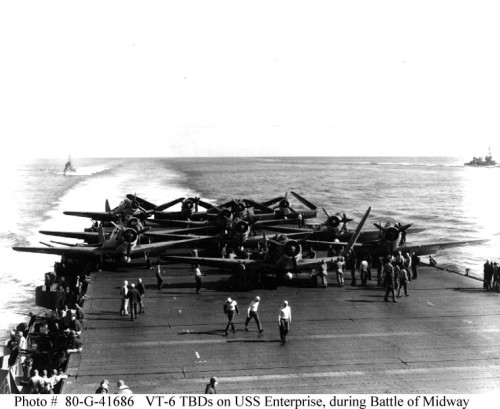
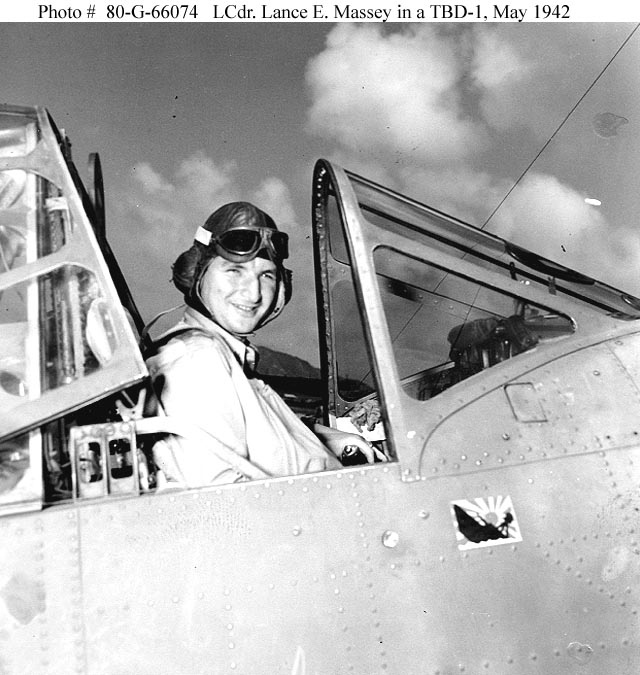
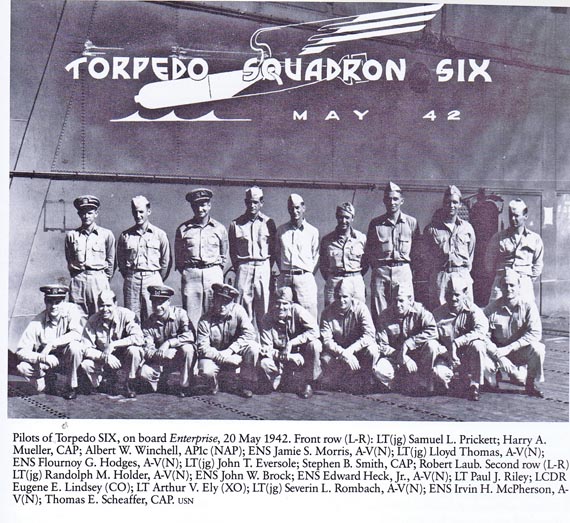
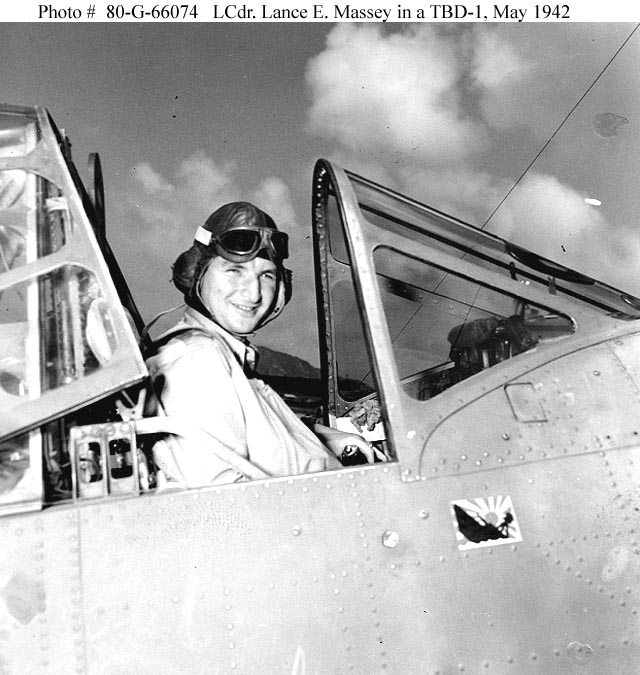
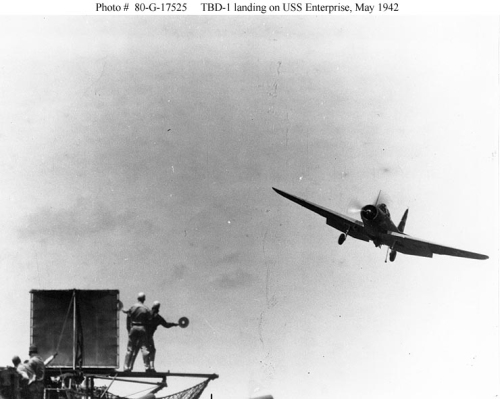
They were not six hundred and they were not mounted on horses but the Naval Aviators of Torpedo Squadrons Three, Six and Eight and their aerial steeds 42 Douglas TBD Devastators and 6 TBF Avengers wrote a chapter of courage and sacrifice seldom equaled in the history of Naval Aviation. Commanded by veteran Naval Aviators, LCDR Lance “Lem” Massey, LCDR Eugene Lindsey and LCDR John Waldron the squadrons embarked aboard the carriers flew the obsolete TBD Devastators and the young pilots of the Midway based Torpedo 8 detachment under the command of LT Langdon Fieberling flew in the new TBF Avengers.eneterprise-vt-6-midway1

When it entered service in 1937 the TBD was the most modern naval aircraft in the world when   It was a revolutionary aircraft. It was the first monoplane widely used on carriers and was first all-metal naval aircraft.  It was the first naval aircraft with a totally enclosed cockpit, the first with hydraulic powered folding wings.  The TBD had crew of three and had a maximum speed of 206 miles an hour and carried a torpedo or up to 1500 pounds of bombs (3 x 500) or a 1000 pound bomb.

g66074

LCDR Lem Massey Commanding Officer of Torpedo 3

A total of 129 Devastators were built and served in all pre-war torpedo bombing squadrons based aboard the Lexington, Saratoga, Ranger, Yorktown, Enterprise and Hornet, while a limited number embarked aboard Wasp.  The Devastator saw extensive service prior to the war which pushed many airframes to the end of their useful service life.  When war began only about 100 remained operational. By then the TBDs were for all purposes obsolete.They were too slow, had poor maneuverability, insufficient armor and defensive armament.

They were still in service in 1942 as their replacement the TBF Avenger was not available for service in large enough numbers to replace them before Midway.  The TBDs of Torpedo Two and Torpedo Five based on the Lexington and Yorktown performed adequately against minor opposition in strikes against the Marshall Islands, and contributed to the sinking of the Japanese Light Carrier Shoho at the Battle of Coral Sea..

However in the Battle of Midway the squadrons embarked on Yorktown, Torpedo Three which had previously been assigned to Saratoga which was undergoing repair, Torpedo Six of Enterprise, and Torpedo Eight of Hornet were annihilated with only 6 of 41 aircraft surviving their uncoordinated attacks against the Japanese Carrier Strike Force.

enterprise-tbd-landing1

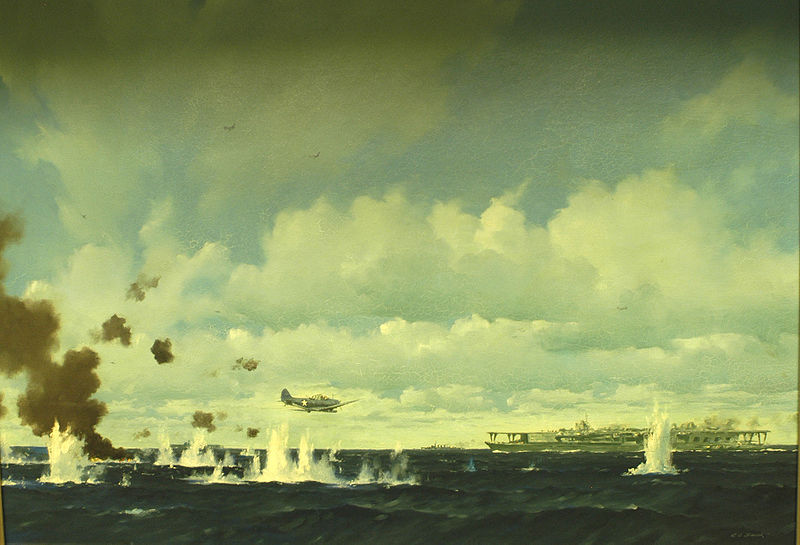
When the Japanese were discovered the American carriers launched a massive strike agains the Japanese carriers. Unfortunately the attacking squadrons became separated from each other and the torpedo bombers arrived before the dive bombers and without fighter escort. Over the course of an hour and ten minutes the three squadrons attacked independently of each other.  Lacking coordination and with inadequate escort, the lumbering aircraft were easy prey for the modern Japanese A6M Zeroes.

The Zeroes of Japanese Combat Air Patrol ripped into the slow, cumbersome and under armed Devastators as they came in low and slow to launch their torpedoes.  Torpedo Eight from Hornet under the command of LCDR John C Waldron pressed the attack hard but all 15 of aircraft were shot down.  Only Ensign George Gay’s aircraft was able to launch its torpedo before being shot down and Gay would be the sole survivor of the squadron. From his observation point hiding under floating wreckage Gay would see the dive bombers get revenge and would be rescued later by a PBY Catalina patrol plane.

Page500_163_6

LCDR John Waldron Commanding Officer of Torpedo Eight

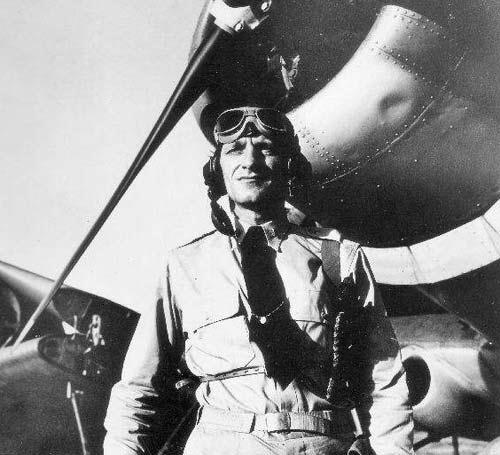
Torpedo Six from the Enterprise under the command of LCDR Eugene Lindsey suffered heavy casualties too. It lost 10 of 14 aircraft with Lindsey being one of the casualties.  The last group of Devastators to attack was Torpedo Three from the Yorktown under the command of LCDR Lem Massey losing 11 of 13 aircraft with Massey a casualty last being seen standing on the wing of his burning aircraft as it went down.

VT-6

These aircraft were also decimated and Massey killed but they had drawn the Japanese Combat Air Patrol down to the deck leaving the task force exposed to the Dive Bombers of the Enterprise and Yorktown.  The six aircraft of the Torpedo Eight detachment from Midway under the command of LT Fieberling lost 5 of their 6 aircraft while pressing their attacks.  Only Ensign Bert Earnest and his aircraft survived the battle landing in a badly damaged state on Midway.  Four U.S. Army B-26 Marauder Medium Bombers were pressed into service as torpedo bombers of which 2 were lost.  No torpedo bomber scored a hit on the Japanese Task force even those torpedoes launched at close range failed to score and it is believe that this was in large part due to the poor performance of the Mark 13 aircraft torpedoes.

yorktown-devastators1


Despite the enormous losses of the torpedo squadrons their sacrifice was not in vain. Their attacks served to confuse the Japanese command and delay the rearmament of aircraft following the Japanese strikes on Midway. They also took the Japanese Combat Air Patrol down to sea level and opened the way for American Dive Bombers to strike the Japanese with impunity fatally damaging the Akagi, Kaga and Soryu in the space of 5 minutes.

After Midway the remaining TBDs were withdrawn from active service and no example survives today. The TBF became the most effective torpedo bomber of the war.

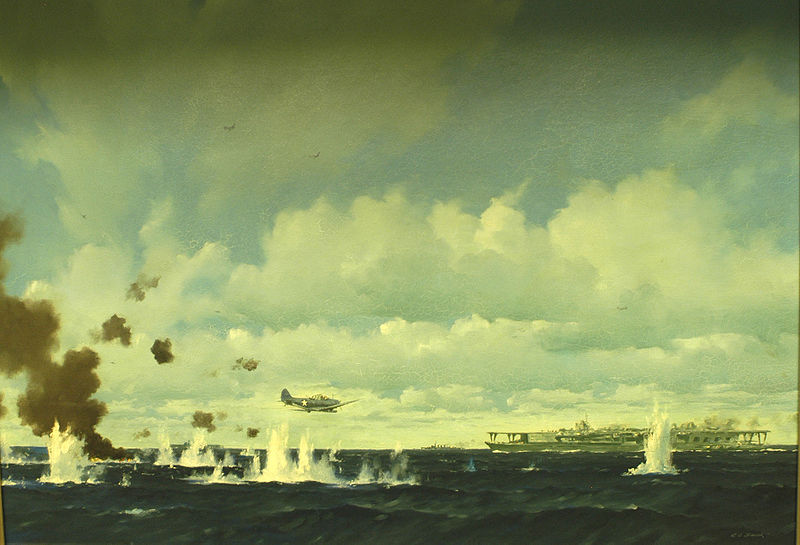
800px-tbd_attacking_at_midway_painting-1

As we remember the brave men that fought at Midway it is imperative that we remember the brave aircrews of the torpedo squadrons that like the Light Brigade rode into the Valley of the Shadow of Death against the First Carrier Strike Force and Midway.

Peace

Padre Steve+

3 Comments

Filed under aircraft, History, leadership, Navy Ships, US Navy, World War II at Sea, world war two in the pacific

Marine Aviators at Guadalcanal: The Sacrifice of VMF-221 and VMSB-241


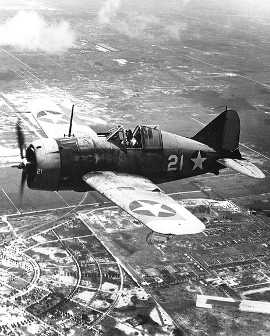
A Brewster Buffalo of VMF-221 

Friends of Padre Steve’s World,

Today on June 5th I am posting several articles on the Battle of Midway which was fought between June 4th and June 6th 1942. It was the turning point of the World War Two in the Pacific.

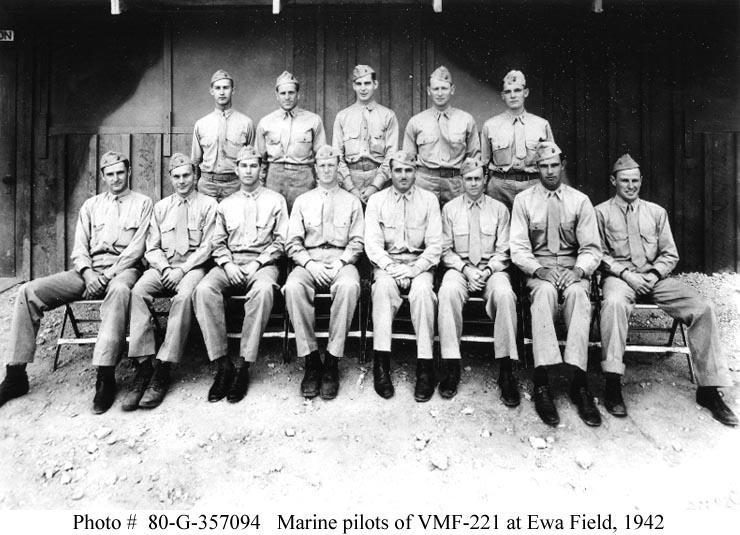
One of the more overlooked aspects of the Battle of Midway are the sacrifices of Marine Fighter Squadron VMF-221 on the morning of June 4th 1942 and Marine Bombing Squadron VMSB-241 that morning and on June 5th.

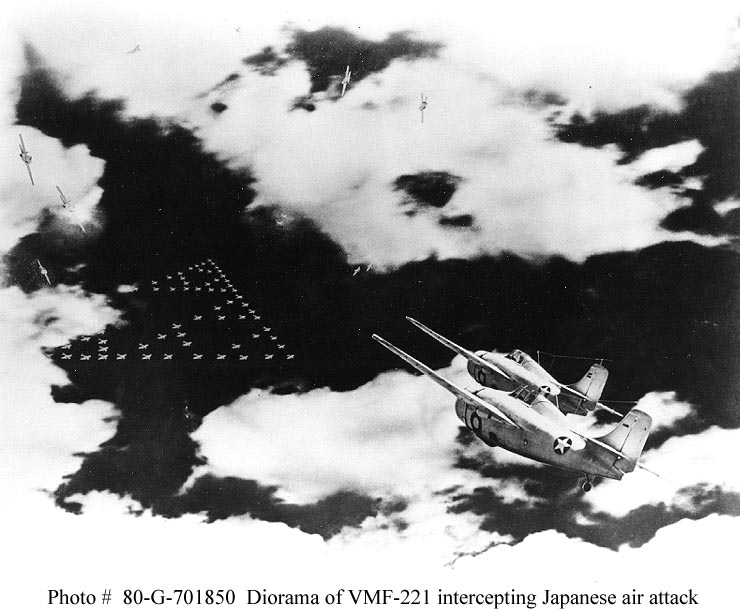
The Marine aviators of VMF-221 flew a mixture of 21 obsolescent Brewster F2A-3 Buffalos and 7 newer Grumman F4F-3 Wildcats. On the morning of June 4th they engaged a vastly superior force of Japanese Navy aircraft as the Japanese squadrons vectored toward Midway and its air station to begin softening it up for the planned invasion.

Led by Major Floyd Parks the squadron had arrived at Midway on Christmas day 1941 being delivered by the USS Saratoga after the aborted attempt to relieve Wake Island.  The squadron along with Marine Scout Bombing Squadron 241 (VMSB 241) formed Marine Air Group 22. The squadron that Parks brought with him was comprised of just 14 aircraft, all F2A-3’s. The squadron was augmented by 7 more F2A-3s and 7 of the more advanced F4F-3 Wildcats before the battle. The fighter pilots of VMF-221 scored their first victory of the war shooting down a Japanese Kawanishi H8K2 “Emily” flying boat.

F2F-3 Brewster Buffalo 

When the Japanese First Carrier Striking Group was spotted in the wee hours of June 4th the Marines and other Navy and Army Air Force aircrews aboard Midway scrambled to meet them.  The 18 SBD-2 Dauntless’ and 12 Vought SB2-U3 Vindicator dive bombers of VMSB-241 along with the 6 new TBF Avengers belonging to Torpedo Squadron Eight, 4 Army Air Corps B-26 Marauders and 15 B-17 Flying Fortresses flew out to attack the Japanese carriers.  Meanwhile the fighters of VMF-221 rose to intercept the 108 Japanese aircraft heading toward Midway. The 72 strike aircraft, 36 Aichi 99 Val Dive Bombers and 36 Nakajima B5N Torpedo/ High Level Bombers were protected by 36 AM6-2 Zeros. The Japanese Zeros thoroughly outclassed their Marine opponents in speed, maneuverability and in the combat experience of their pilots.

The Marines audaciously attacked the far superior Japanese force, throwing themselves against the Japanese phalanx with unmatched courage.  Despite their courage the Marine fighters were decimated by the Japanese Zeros.  The Marines shot down 4 Val dive bombers and at least three Zeros but lost 13 Buffalos and 3 Wildcats during the battle.  Of the surviving aircraft only three Buffalos and three Wildcats were in commission at the end of the day. Among the casualties killed was Major Parks.  Of the surviving pilots of VMF-221, two became “Aces” during the war. Lieutenant Charles M. Kunz would later fly in VMF-224, adding six victories to end the war with 8 victories. Capt. Marion E. Carl would later fly in VMF-223 and was credited with 18.5 Japanese aircraft shot down.  Other pilots like Second Lieutenant Clayton M. Canfield shot down two additional aircraft while flying with VMF-223, while Second Lieutenant Walter W. Swansberger won the Medal of Honor at Guadalcanal.

The last remaining Marine fighter pilot of VMF-221 from the battle of Midway, Williams Brooks died in January 2010 and was buried with full military honors in Bellview , Nebraska.  Brooks in his after action report described his part in the battle:

I was pilot of F2A-3, Bureau number 01523, Our division under Capt. Armistead was on standby duty at he end of the runway on the morning of June 4, 1942, from 0415 until 0615. At about 0600, the alarm sounded and we took off. My division climbed rapidly, and I was having a hard time keeping up. I discovered afterwards that although my wheels indicator and hydraulic pressure indicator both registered “wheels up”, they were in reality about 1/3 of the way down. We sighted the enemy at about 14,000 feet, I would say that there were 40 to 50 planes. At this time Lt. Sandoval was also dropping back. My radio was at this time putting out no volume, so I could not get the message from Zed. At 17,000 feet, Capt. Armistead led the attack followed closely by Capt. Humberd. They went down the left of the Vee , leaving two planes burning. Lt. Sandoval went down the right side of the formation and I followed. One of us got a plane from the right side of the Vee. At this time, I had completely lost sight of my division. As I started to pull up for another run on the bombers, I was attacked by two fighters. Because my wheels being jammed 1/3 way down, I could not out dive these planes, but managed to dodge them and fire a burst or so into them as they went past me and as I headed for the water. As I circled the island, the anti-aircraft fire drove them away. My tabs, instruments and cockpit were shot up to quite an extent at this time and I was intending to come in for a landing. 

It was at this time that I noticed that a important feature in their fighting. I saw two planes dog-fighting over in the east, and decided to go help my friend if at all possible. My plane was working very poorly, and my climb was slow. As I neared the fight both planes turned on me. It was then that I realized I had been tricked in a sham battle put on by two Japs and I failed to recognize this because of the sun in my eyes. Then I say I was out-numbered, I turned and made a fast retreat for the island, collecting a goodly number of bullets on the way. After one of these planes had been shaken, I managed to get a good burst into another as we passed head-on when I turned into him. I don’t believe this ship could have gotten back to his carrier, because he immediately turned away and started north and down. I again decided to land, but as I circled the island I saw two Japs on a Brewster. Three of my guns were jammed, but I cut across the island, firing as I went with one gun. But I could not get there in time to help the American flier and as soon as the Brewster had gone into the water I came in for a landing at approximately 0715 (estimated). 

VMF-221 was composed of the following aircraft and pilots.

FIRST DIVISION (F2A-3)

Plane # Bu.No.  Pilot                                                               Status

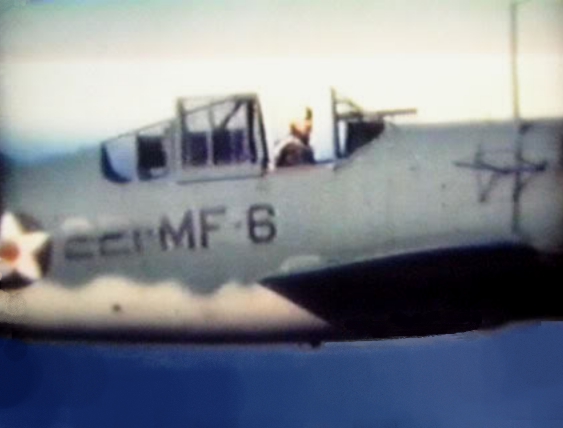
MF-1     01518    Maj. Floyd B. Parks USMC                          MIA

MF-2     01548    2nd Lt. Eugene P. Madole USMCR            MIA

MF-3     01525    Capt. John R. Alvord USMC                        MIA

MF-4     01537    2nd Lt. John M. Butler USMCR                   MIA

MF-5     01569    2nd Lt. David W. Pinkerton Jr. USMCR      MIA

MF-6     01552    2nd Lt. Charles S. Hughes USMCR, Did not engage, turned back due to Engine problems


SECOND DIVISION (F2A-3)

Plane # Bu.No.  Pilot                                                                 Status

MF-7     01552    Capt. Daniel J. Hennessey USMC              MIA

MF-8     01541    2nd Lt. Ellwood Q. Lindsay USMCR                 MIA

MF-9     01524    Capt. Herbert T. Merrill USMC                   Bailed out WIA

MF-10   01528    Capt. Herbert T. Merrill USMC            MIA

MF-11   01568    Capt. Phillip R. White USMC                       Survived

MF-12   01542    2nd Lt. John D. Lucas USMCR                      MIA


THIRD DIVISION (F2A-3)

Plane#  Bu.No.  Pilot                                                               Status

MF-13   01562    Capt. Kirk Armistead USMC                      Survived

MF-14   01563    2nd Lt. William B. Sandoval USMCR         MIA

MF-15   01553    Capt. William C. Humberd USMC            Survived

MF-16   01523    2nd Lt. Williams V. Brooks USMCR           WIA

MF-17   01521    2nd Lt. Charles M .Kunz USMCR               WIA

MF-18   01559    2nd Lt. Martin E. Mahannah USMC           KIA (his body washed up later)

23 (F4F-3) 3989  2nd Lt. Walter W. Swansberger USMCR   Survived


FOURTH DIVISION (F2A-3)

Plane # Bu.No.  Pilot                                                                Status

MF-19   01520    Capt. Robert E. Curtin USMC                     MIA

MF-20   01550    2nd Lt. Darrell D. Irwin USMCR                       Survived


FIFTH DIVISION (F4F-3)


Plane # Bu.No.  Pilot                                                                Status

22           4008       Capt. John F. Carey USMC                          WIA

24           4000       Capt. Marion E. Carl USMC                         Survived

25           3997       2Lt. Clayton M. Canfield USMCR                Survived

26           4006       Capt. Francis P. McCarthy USMC               MIA

27           2532       2nd Lt. Roy A. Corry USMC                              Survived

28           1864       2nd Lt.Hyde Phillips USMCR                            Did not engage, mechanical problems

As for VMF-221 it was re-equipped with the F4F-4 and later with the F4U Corsair during the course of two more deployments overseas.  VMF-221 finished the war with a score of 155 victories, 21 damaged and 16 probable kills, the second highest total of any Marine Corps Squadron during the war.

SB2-U2 Vindicator of VMSB 241 at Midway

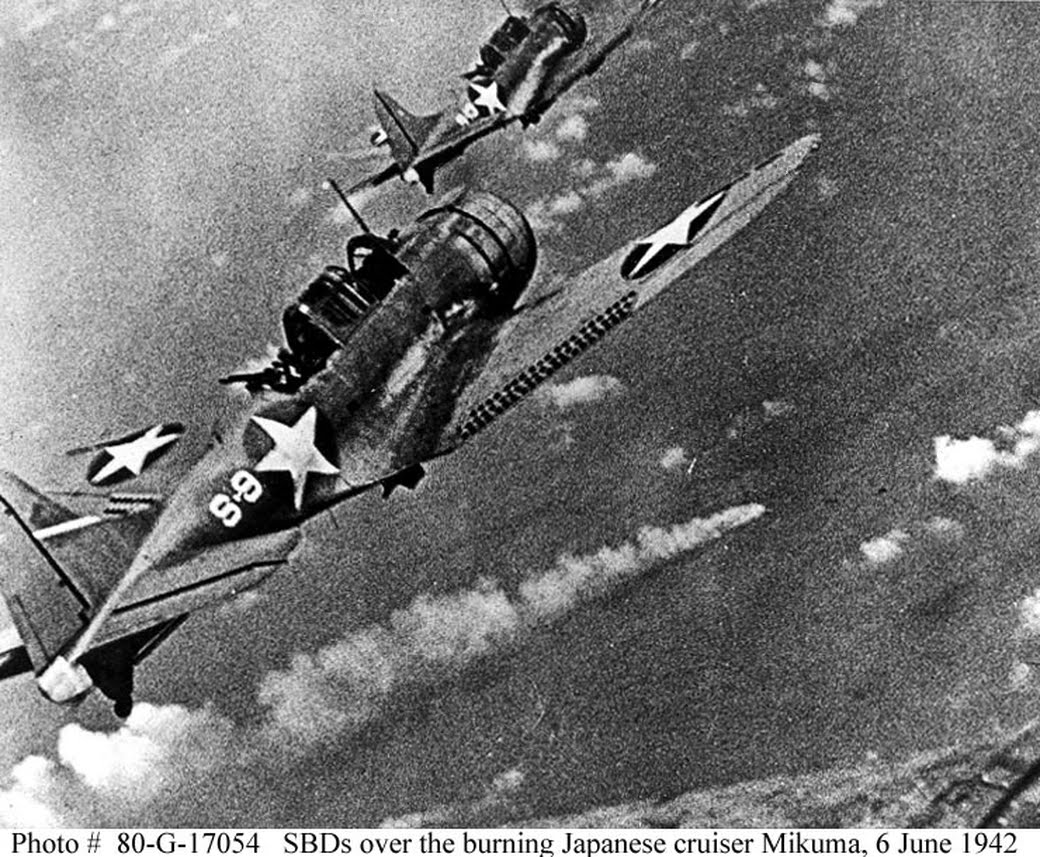
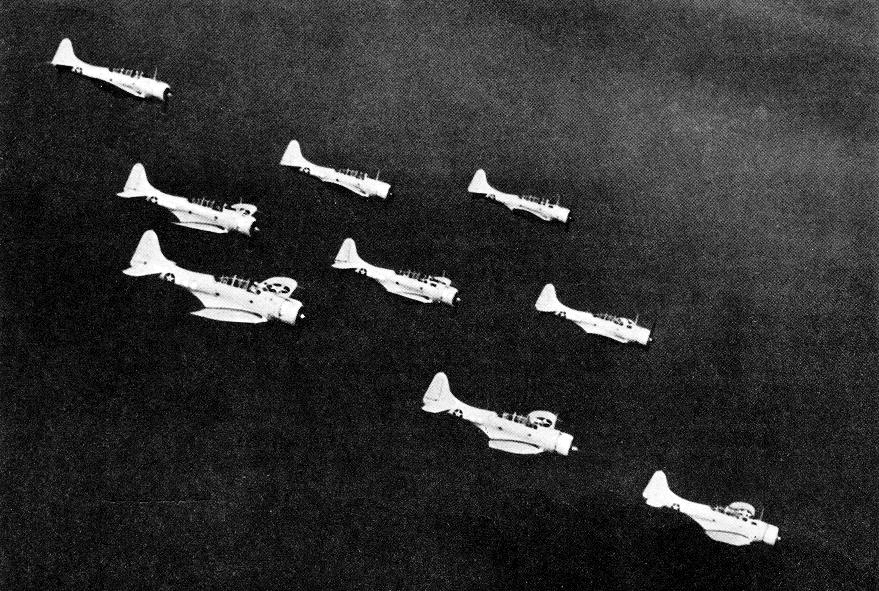
Their bomber counterparts of VMSB 241 attacked the Japanese task force on the morning of June 4th and scored no hits while losing 8 aircraft. The survivors were again in action later in the day as well as the following day where they helped sink the Japanese Heavy Cruiser Mikuma with with Captain Richard Fleming diving his mortally wounded Vindicator into the cruiser’s number four 8” gun turret.

The Mikuma Sinking after being bombed by Marine and Navy Dive Bombers – the wreck of Major Henderson’s Vindicator is atop the number four turret 

While the Marines’ actions are not as well known or as successful as those of their Navy counterparts they were brave.  The inexperienced Marine fighter pilots had to engage some of the most experienced pilots flying superior machines. The bomber crews had little to no experience before being thrown into combat. As we remember the sacrifices made by the men of Midway let us not forget the gallant men of VMF-221 and VSMB-241.

Peace

Padre Steve+

Leave a comment

Filed under History, leadership, US Army Air Corps, US Marine Corps, World War II at Sea, world war two in the pacific

Station Hypo: Joe Rocheford and the Codebreakers of Midway

rochefort

Friends of Padre Steve’s World,

This week many people, especially those in the Navy, will be remembering the Battle of Midway on its 76th anniversary. This is as minor rewrite of a prior post about the unseen heroes whose hard work gave the United States a key advantage that helped pave the way to victory.

The victory at Midway would not have happened without the exceptional intelligence gathering and code breaking by the cryptologists of Combat Intelligence Unit – Station Hypo – at Pearl Harbor under the command of Commander Joseph Rochefort. He and his small yet skillful team cracked the Japanese Naval code in time for Admiral Chester Nimitz to make the correct decision as to where to send his tiny carrier task forces to oppose the massive Japanese Combined Fleet under the Command of Isoroku Yamamoto.

Rochefort’s efforts were opposed by the key officers in the Office of Naval Intelligence who refused to believe that Midway was the target of the Japanese force. In spite of this opposition Nimitz was highly confident of Rochefort’s analysis and when all was said and done the U.S. Navy had defeated the Japanese, sinking four of the carriers that had attacked Pearl Harbor as well as a heavy cruiser, ripping the heart out of Japan’s premier naval striking force.

Historian Walter Lord wrote:

“Against overwhelming odds, with the most meager resources, and often at fearful self-sacrifice, a few determined men reversed the course of the war in the Pacific. Japan would never again take the offensive. Yet the margin was thin—so narrow that almost any man there could say with pride that he personally helped turn the tide at Midway. It was indeed, as General Marshall said in Washington, “the closest squeak and the greatest victory.”

One of those men was Joseph Rochefort. Admiral Nimitz credited Rochefort for breaking the codes and setting the stage for the victory, and recommended him for the Distinguished Service Medal, however, Rochefort’s rivals in Washington D.C. ensured that the award was turned down in order to claim the success for them. Shortly after Midway, Rochefort was reassigned to command a floating dry dock in San Francisco by the Department of the Navy as a way to punish him, and effectively ending his career. Rochefort retired as a Captain after the war, his contribution to the victory at Midway unrecognized by the Navy. Admiral Nimitz again recommended him for the award of the Distinguished Service Medal in 1958 and again it was turned down, but his supports continued to work to right the injustice.

In 1983 Rear Admiral Donald Showers who had worked for Rochefort in 1942 again recommended the award to Secretary of the Navy John Lehman who approved it. Unfortunately Rochefort was no longer alive to receive it, he had died in 1976. Today his service to the Navy and nation is remembered with the annual Captain Joseph Rochefort Information Warfare (IW) Officer Distinguished Leadership Award which is awarded to annually recognize the superior career achievement of one IW officer for leadership, teamwork, operational contributions and adherence to the principle by which he served, “We can accomplish anything provided no one cares who gets the credit.”

Have a great day and please don’t forget men and women who embody the spirit of Joseph Rochefort, it is a rare commodity.

Peace

Padre Steve+

3 Comments

Filed under History, leadership, US Navy, World War II at Sea, world war two in the pacific

“A Magic Blend of Skill, Faith, and Valor” The Battle of Midway

Battle%20of%20Midway%20flat_080817160843

Friends of Padre Steve’s World,

Today we remember the Battle of Midway, the turning point of World War Two in the Pacific. By all empirical means the vastly superior Japanese fleet should have defeated the Americans, but success in war is not based on material alone. There are things unaccounted for, things that happen in the confusion of battle that The Prussian military theorist Carl von Clausewitz wrote.

“War is the province of chance. In no other sphere of human activity must such a margin be left for this intruder. It increases the uncertainty of every circumstance and deranges the course of events.” 

Six months after Pearl Harbor the United States Navy met the Imperial Japanese Navy in battle on the seas and in the airspace around Midway Island. It was a battle between a fleet that had known nothing but victory in the months after Pearl Harbor and one with the exception of a few minor tactical successes was reeling.

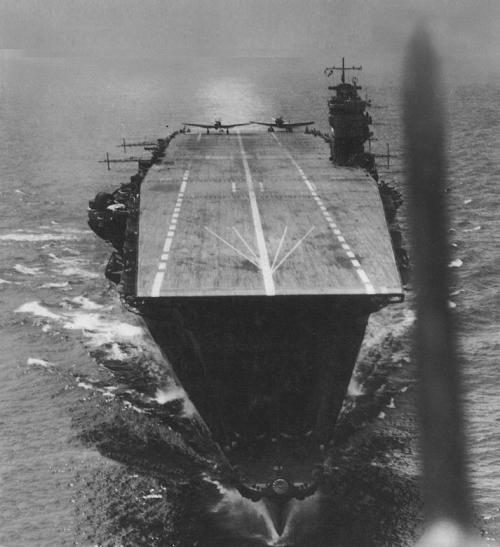
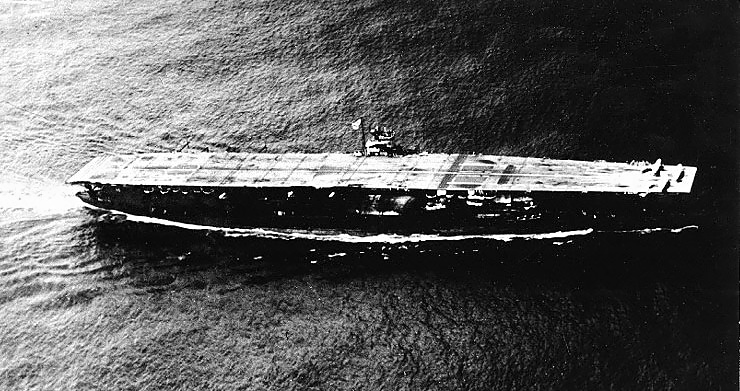
AkagiDeckApril42

Akagi April 1942

The Japanese had swept across the Pacific and the Indian Oceans and decimated every Allied Naval forces that stood in their way. After Pearl Harbor they had sunk the HMS Prince of Wales and HMS Repulse off of Singapore.  Next in a series of engagements destroyed the bulk of the US Asiatic Fleet in the waters around the Philippines and the Dutch East Indies culminating in the Battle of the Java Sea where the bulk of the American, British, Dutch and Australian (ABDA) naval forces engaged were annihilated attempting to fight superior Japanese forces.

Hermes_sinking

HMS Hermes sinking after Japanese Carrier air attack in the Indian Ocean

In the Indian Ocean Admiral Nagumo’s carriers dispatched a force of Royal Navy cruisers and the Aircraft Carrier HMS Hermes. In only one place had a Japanese Naval task force been prevented from achieving its goal. At the Battle of the Coral Sea where Task Force 11 and Task Force 17 centered on the Carriers USS Lexington and USS Yorktown prevented a Japanese invasion force from taking Port Moresby sinking the light carrier Shoho, damaging the modern carrier Shokaku and decimating the air groups of the Japanese task force.

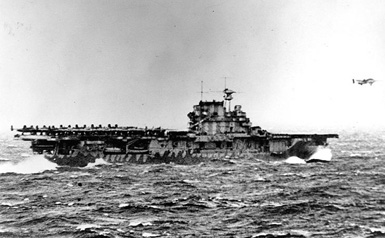
Hornet_launches

USS Hornet launching B-25 Bombers during the Doolittle Raid

In May US Navy code breakers under the direction of Commander Joe Rochefort at Pearl Harbor discovered the next move of the Imperial Navy an attack on Midway Island and the Aleutian islands. Since the occupation of Midway by Japanese forces would give them an operational base less than 1000 miles from Pearl Harbor Admiral Chester Nimitz committed the bulk of his naval power, the carriers USS Enterprise CV-6USS Yorktown CV-5 and USS Hornet CV-8 and their 8 escorting cruisers and 15 destroyers, a total of 26 ships with 233 aircraft embarked to defend Midway. Nimitz also sent a force of 5 cruisers and 4 destroyers to cover the Aleutians.

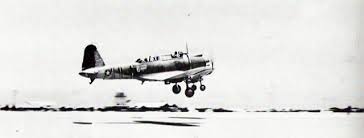
images-42

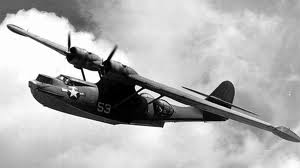
SBU-2 Vindicator Dive Bomber landing on Midway (above) PBY Catalina (below)images-43

Land based air assets on Midway were composed of a mixed Marine, Navy and Army air group of 115 aircraft, many of which were obsolete. Aboard Midway there were 32 US Navy PBY Catalina Flying Boats, 83 fighters, dive bombers, torpedo planes and Army Air Force bombers piloted by a host of inexperienced pilots.

Nimitz’s instructions to his Task Force Commanders was simple “You will be governed by the principle of calculated risk, which you shall interpret to mean the avoidance of exposure of your force to attack by superior enemy forces without good prospect of inflicting … greater damage on the enemy.”

893594c746

Admiral Isoroku Yamamoto commanded the Combined Fleet. The victor of Pearl Harbor and the triumph’s in the first six months of the Pacific War was determined to end the war with a decisive battle at Midway. His plans were opposed by many in the Imperial General Staff, especially those in the Army but when the US raid on Tokyo, the Doolittle Raid, all opposition to the attack was dropped.

10-japanese-carriers-coral-sea-midway

The Japanese sent a force of 7 battleships and 7 carriers against Midway. These included the elite First Carrier Striking Group composed of the Pearl Harbor attackers Akagi, Kaga, Soryu and Hiryu and their highly trained and combat experienced air groups. Among the surface ships was Yamamoto’s flagship, the mighty Battleship Yamato, at 72,000 tons and armed with 9 18” guns, the most powerful and largest battleship ever to see combat.

The strike force included 273 aircraft and was escorted by 14 cruisers and 39 destroyers. They were to take Midway and then destroy the US Navy when it came out to fight. Yamamoto sent a force force of 4 battleships, 12 destroyers assigned screen to the Aleutian invasion force which was accompanied by 2 carriers 6 cruisers and 10 destroyers. The other carriers embarked a further 114 aircraft.

Despite this great preponderance in numbers Yamamoto’s plan was complex and his forces too far apart from each other to offer support should and get into trouble. The powerful Japanese Task forces were scattered over thousands of square miles of the Northern Pacific Ocean where they could not rapidly come to the assistance of any other group.

images-44

With the foreknowledge provided by the code breakers the US forces hurried to an intercept position northeast of Midway eluding the Japanese submarine scout line which the Japanese Commander Admiral Yamamoto presumed would find them when they sailed to respond to the Japanese attack on Midway.  Task Force 16 with the Enterprise and Hornet sailed first under the command of Rear Admiral Raymond A Spruance and Task Force 17 under Rear Admiral Frank “Jack” Fletcher with the Yorktown which had been miraculously brought into fighting condition after suffering heavy damage at Coral Sea. Fletcher assumed overall command by virtue of seniority and Admiral Nimitz instructed his commanders to apply the principle of calculated risk when engaging the Japanese as the loss of the US carriers would place the entire Pacific at the mercy of the Japanese Navy.

On June 3rd a PBY Catalina discovered the Japanese invasion force and US long range bombers launched attacks against it causing no damage. The morning of the 4th the Americans adjusted their search patterns in and the Japanese came into range of Midway and commenced their first strike against the island.

g17056

In response land based aircraft from Midway attacked the Japanese carrier force taking heavy casualties and failing to damage the Japanese task force. The American Carrier task forces launched their strike groups at the Japanese fleet leaving enough aircraft behind of the Combat Air Patrol and Anti-submarine patrol.  As the Americans winged toward the Japanese fleet the Japanese were in a state of confusion. The confusion was caused when a scout plane from the Heavy Cruiser Tone that had been delayed at launch discovered US ships but did not identify a carrier among them until later into the patrol. The carrier  was the Yorktown and TF 17, but for Nagumo who first expected no American naval forces, then received a report of surface ships without a carrier followed by the report of a carrier the reports were unsettling.

a5f7ab19-17c6-4928-90a4-5bb913d156eb

Aichi D3-A “Val” Dive Bomber 

Orders and counter-orders were issued as the Japanese attempted to recover their strike aircraft and prepare for a second strike on the island and then on discovery of the Yorktown task force, orders changed and air crews unloaded ground attack ordnance in favor of aerial torpedoes and armor piercing bombs. The hard working Japanese aircrew did not have time to stow the ordnance removed from the aircraft but by 1020 they had the Japanese strike group ready to launch against the US carriers.

g701850

As the Japanese crews worked the Japanese carriers were engaged in fending off attacks by the US torpedo bomber squadrons, VT-6 from Enterprise, VT-8 from Hornet and VT-3 from Yorktown. The Japanese Combat Air Patrol ripped into the slow, cumbersome and under armed TBD Devastators as they came in low to launch their torpedoes.  Torpedo Eight from Hornet under the command of LCDR John C Waldron pressed the attack hard but all 15 of the Devastators were shot down. Only Ensign George Gay’s aircraft was able to launch its torpedo before being shot down and Gay would be the sole survivor of the squadron.

g66074

LCDR Lance Massey CO of VT-3

Page500_163_6

LCDR John Waldron CO of VT-8

220px-Eugene_Lindsey;h84903

LCDR Eugene Lindsey CO of VT-6

Torpedo 6 from Enterprise under the command of LCDR Eugene Lindsey suffered heavy casualties losing 10 of 14 aircraft with Lindsey being one of the casualties.  The last group of Devastators to attack was Torpedo 3 from Yorktown under the command of LCDR Lem Massey from the Yorktown. These aircraft were also decimated and Massey killed but they had drawn the Japanese Combat Air Patrol down to the deck leaving the task force exposed to the Dive Bombers of the Enterprise and Yorktown.

800px-tbd_attacking_at_midway_painting-1

There had been confusion among the Americans as to the exact location of the Japanese Carriers. Bombing 8 and Scouting 8 from Hornet did not find the carriers and had to return for lack of fuel while losing a number of bombers and their fighter escort having to ditch inn the ocean and wait for rescue. The Enterprise group composed of Bombing-6 and Scouting 6 under CDR Wade McClusky was perilously low on fuel when the wake of a Japanese destroyer was spotted.  McClusky followed it to the Japanese Task Force. The Yorktown’sgroup under LCDR Max Leslie arrived about the same time.

Dauntless_dive_bombers

When the American dive bombers arrived over the Japanese Carrier Strike Force they found the skies empty of Japanese aircraft. Below, aboard the Japanese ships there was a sense of exhilaration as each succeeding group of attackers was brought down and with their own aircraft ready to launch and deal a fatal blow to the American carrier wondered how big their victory would be. The war would soon be decided.

midway4

Akagi dodging bombs at Midway

At 1020 the first Zero of the Japanese attack group began rolling down the flight deck of the flagship Akagi, aboard Kaga aircraft were warming up as they were on the Soryu.  The unsuspecting Japanese were finally alerted when lookouts screamed “helldivers.” Wade McClusky’s aircraft lined up over the Akagi and Kaga pushing into their dives at 1022. There was a bit of confusion when the bulk of Scouting 6 joined the attack of Bombing 6 on the Kaga. That unprepared ship was struck by four 1000 pound bombs which exploded on her flight deck and hangar deck igniting the fully fueled and armed aircraft of her strike group and the ordnance littered about the hangar deck.  Massive fires and explosions wracked the ship and in minutes the proud ship was reduced to an infernal hell with fires burning uncontrollably. She was abandoned and would sink at 1925 taking 800 of her crew with her.

douglas-sbd5-dauntless-dive-bomber-battle-of-midway-01

LT Dick Best of Scouting 6 peeled off from the attack on Kaga and shifted to the Japanese flagship Akagi. On board Akagi were two of Japan’s legendary pilots CDR Mitsuo Fuchida leader of and CDR Minoru Genda the architect of the Pearl Harbor attack and subsequent string of Japanese victories. Both officers were on the sick list and had come up from sick bay to watch as the fleet was attacked. Seeing Kaga burst into flames they stood mesmerized until Akagi’slookouts screamed out the warning “helldivers” at 1026.  Best’s few aircraft hit with deadly precision landing two of their bombs on Akagi’s flight deck creating havoc among the loaded aircraft and starting fires and igniting secondary explosions which turned the ship into a witch’s cauldron.  By 1046 Admiral Nagumo and his staff were forced to transfer the flag to the cruiser Nagara as Akagi’s crew tried to bring the flames under control. They would do so into the night until nothing more could be done and abandoned ship at 2000.  Admiral Yamamoto ordered her scuttled and at 0500 on June 5th the pride of the Japanese carrier force was scuttled.

g701870

VB-3 under LCDR Max Leslie from the Yorktown stuck the Soryu with 17 aircraft, however only 13 of the aircraft had bombs due to an electronic arming device malfunction on 4 of the aircraft, including that of Commander Leslie.  Despite this Leslie led the squadron as it dove on the Soryu at 1025 hitting that ship with 3 and maybe as many as 5 bombs. Soryu like her companions burst into flames as the ready aircraft and ordnance exploded about her deck. She was ordered abandoned at 1055 and would sink at 1915 taking 718 of her crew with her.

h73065

The remaining Japanese flattop the Hiryu attained the same fate later in the day after engaging in an epic duel with the Yorktown which her aircraft heavily damaged. Yorktown would be sunk by the Japanese submarine I-168 while being towed to safety.

71380-004-B4724C34

USS Yorktown under attack from Kate Torpedo Bombers from Hiryu on June 4th 1942

In five pivotal minutes the course of the war in the Pacific was changed. Authors have entitled books about Midway Incredible Victory by Walter Lord and Miracle at Midway by Gordon Prange and those titles reflect the essence of the battle.

At Midway a distinctly smaller force defeated a vastly superior fleet in terms of experience, training and equipment. At the very moment that it appeared to the Japanese that they would advance to victory their vision disappeared. In a span of less than 5 minutes what looked like the certain defeat of the US Navy became one of the most incredible and even miraculous victories in the history of Naval warfare. In those 5 minutes history was changed in a breathtaking way. While the war would drag on and the Japanese still inflict painful losses and defeats on the US Navy in the waters around Guadalcanal the tide had turned and the Japanese lost the initiative in the Pacific never to regain it.

The Japanese government hid the defeat from the Japanese people instead proclaiming a great victory. The American government could not fully publicize the victory for fear of revealing the intelligence that led to the ability of the US Navy to be at the right place at the right time and defeat the Imperial Navy.

uss-enterprise-cv-6-1

USS Enterprise

The American victory at Midway changed the course of the war in the Pacific. The Battle of Midway established the aircraft carrier and the fast carrier task force as the dominant force in naval warfare which some would argue it still remains. Finally those five minutes ushered in an era of US Navy dominance of the high seas which at least as of yet has not ended as the successors to the EnterpriseHornet and Yorktown ply the oceans of the world and the descendants of those valiant carrier air groups ensure air superiority over battlefields around the world.

Walter Lord, whose history of the battle is still the classic presentation of it wrote:

“Even against the greatest of odds, there is something in the human spirit – a magic blend of skill, faith, and valor – that can lift men from certain defeat to incredible victory.” 

Peace

Padre Steve+

1 Comment

Filed under History, leadership, Military, Navy Ships, US Navy, World War II at Sea, world war two in the pacific

“In High Spirits and Full of Confidence” The Eve of Disaster at Midway

Japanese_aircraft_carrier_Akagi_01

The Flagship IJN Akagi

Friends of Padre Steve’s World,

On the night of June 3rd 1942 the Japanese First Carrier Strike Force under the command of Vice Admiral Chuichi Nagumo sailed east toward the tiny Midway Atoll. Midway was the target of an operation designed by Admiral Isoroku Yamamoto to draw out the remnants of the United States Pacific Fleet, destroy them and set the conditions for Japanese victory and the subsequent dominance of the Pacific by the Empire of Japan. It was to be the battle that ended the war. Yamamoto believed that the Japanese had no chance if the war dragged on and that the only chance of victory, it had to be quick and decisive, it had to destroy the aircraft carriers that were the remnant of American seapower in the Pacific, and it had to happen before the industrial might of the United States was fully mobilized. Yet Yamamoto was so confident of victory now that he believed that “the American fleet was a beaten, demoralized outfit that would need to be coaxed to its annihilation.” 

For six months the Japanese Navy and Army had experienced nothing but victory. Nagumo’s carriers had crushed the U.S. Pacific Fleet at Pearl Harbor. Land based Japanese bombers sank the British battleships HMS Prince of Wales and Repulse near Singapore, while another Japanese fleet destroyed a combined American, British, Dutch, and Australia fleet in the Java Sea. Nagumo’s carriers raided British bases and sank British ships in the Indian Ocean, and devastated shipping in the Australian port of Darwin. Other Japanese land, air, and naval forces conquered Hong Kong, Singapore, the Dutch East Indies, Guam, Wake Island, and the Philippines. Yet victory would not be assured until the U.S. Pacific Fleet had been destroyed.

To do that Yamamoto and his staff began to plan a massive operation against the American base on Midway Atoll, just 1100 miles from Pearl Harbor. His plan was to force the remaining American naval forces into a decisive battle in which they would be destroyed by overwhelming Japanese naval and air assets. However his plan was in conflict with plans of the Army and the Naval General Staff. Some wanted to attack westward against India with the goal of linking up with Rommel’s Afrika Korps in the Middle East. Others preferred land offensives against China, or trying to cut maritime supply line from the United States to Australia by striking Samoa and the Fiji Islands.

In the end no agreement was reached and in April 1942 the Japanese were surprised and embarrassed by bombing of Tokyo by Colonel Jimmy Doolittle’s B-25 bombers which had taken off from the USS Hornet. The raid had caused very little damage but Yamamoto was humiliated and pushed for the operation which despite opposition was approved by Japanese leaders.

There were problems in the plan the chief of which was that the Japanese Fleet was divided and deployed in such a way that should there be trouble the main force under Yamamoto could not support the carrier strike force under Nagumo. Evidence and intelligence reports were ignored, the logistics of the operation minimized, recommendations that the carrier force be refitted and new air crews brought fully up to the high standards of December 1941 were disregarded. Further evidence that suggested that aircrews were not tactically proficient based on observed bombing and torpedo exercises similarly ignored. A war game conducted by the Combined Fleet Staff predicted the loss of two carriers but Yamamoto’s Chief of Staff, Admiral Ugaki revered the call of the umpire and  refloated one from the dead carriers by erasing the hits scored by those playing the American side. It was symptomatic of the “victory disease” that would cloud and distort all that the Japanese did between April and June.

Even so the operation continued forward and doubters put aside those doubts mostly due to a profound disrespect of the United States Navy. Admiral Nagumo had seen many of the risks involved in the plan and in the beginning considered it an “impossible and pointless operation.” But that was before the Doolittle Raid on Tokyo, and Nagumo fell in line as Yamamoto successfully lobbied for the operation. Other leaders of the strike on Pearl Harbor including Commander Mitsuo Fuchida could not see the value in attacking Midway.

Chuichi_Nagumo

Vice Admiral Chuichi Nagumo

As the First Carrier strike force closed within 300 miles of Midway on the night of June 3rd 1942 Nagumo and his staff prepared for the battle that they and many others believed would be the decisive battle. Aircraft received their final preparations, bombs were loaded and as night faded into early morning air crew arose, ate their breakfast and went to their aircraft.

The ships had been observing radio silence since they departed their bases and anchorages in Japan the previous week. Honed to a fine edge the crews of the ships and the veteran aircrews anticipated victory.

The crews of the ships of the task force and the air groups embarked on the great aircraft carriers Akagi, Kaga, Soryu and Hiryu as well as their escorts were confident. They had since the war began known nothing but victory. They had devastated the Pacific Fleet at Pearl Harbor and roamed far and wide raiding allied targets and sinking allied shipping across the Pacific and deep into the Indian Ocean. Commander Magotaro Koga of the destroyer Nowaki wrote in his diary “Our hearts burn with the conviction of sure victory.”

However, Nagumo and his sailors had no idea that most of what they knew about their American opponents was wrong, just as Yamamoto had no idea that American code breakers had broken the Japanese Naval codes and determined that the Japanese were going to attack Midway.

893594c746

Admiral Isoroku Yamamoto 

The Japanese were confident that the Americans could field no more than two operational carriers. However, the Yorktown, which the Japanese believed had been sunk at Coral Sea had been repaired, She was fully operational the air group from the damaged USS Saratoga replaced her air group and Yorktown with Task Force 17 rushed to join the EnterpriseHornet and Task Force 16 northeast of Midway.

An operation designed to get aerial surveillance of US Fleet dispositions at Pearl Harbor had been cancelled because the atoll at French Frigate Shoals that the Japanese flying boats would operate from was occupied by a small US force. Likewise the line of Japanese submarines arrived on station a day late, after the US carrier task forces had passed by. Those aboard the First Carrier Strike Force, including Nagumo or his senior commanders and staff had no idea that the Americans not only knew of their approach but were already deployed in anticipation of their strike.

Within a day all of the Japanese carriers would be sunk or sinking. Thousands of Japanese sailors would be dead and the vaunted air groups which had wreaked havoc on the Allies would be decimated, every aircraft lost and the majority of pilots and aircrew dead. It would be a most unexpected and devastating defeat stolen out of the hands of what appeared to be certain victory.

In the next couple of days I will write some articles on Midway and republish older articles on this site. The fact of the matter is that like Yamamoto and the Japanese that many military leaders, including those of the United States make assumptions about campaigns and battles that turn out to be wrong. Wars are often expected to be short, decisive and glorious but many times end up long, indecisive and agonizing. History has shown that to be the case for the United States in every fight it has been engaged since the Second World War, even when we win every pitched battle.

I think that there is a lesson to be learned from the Japanese who sailed into the night on June 3rd 1942 and saw the sunrise of June 4th. There is no battle, campaign or war that goes according to plan. Thousands of Japanese sailors and airmen went to bed on the night of the 3rd expecting that the following night, or within the next few days they would be celebrating a decisive victory. Thousands of them would be dead by the night of the 4th of June and the ambitions of the Empire of Japan to defeat the United States Navy and end the war would be dealt a decisive defeat from which they would never recover.

IJN_Akagi_World_War_II_Aircraft_Carrier_hit_by_Douglas_SBD_Dauntless_Dive_Bomber_at_Midway-1

The Japanese had known nothing but victory and on the night of June 3rd 1942 they expected nothing more than a glorious victory. However the wisdom of the Romans was proved right yet again,“Sic transit Gloria mundi,” (“Thus passes the glory of the world”,) or as it is more commonly paraphrased “all glory is fleeting.”

Peace

Padre Steve+

3 Comments

Filed under History, leadership, Military, World War II at Sea, world war two in the pacific

Anniversaries of Watershed Events: Midway, D-Day, and the Assassination of Robert F Kennedy


D-Day, June 6th 1944

Friends of Padre Steve’s World,

I am posting a small thought to begin the weekend. For those that do not know, the next several days are full of the anniversaries many events

On June 3rd 1940, the British finished the evacuation of the British Expeditionary Force and some French forces from Europe at Dunkirk, though defeated, the British action preserved the British Army and kept Britain in the war.


Midway 

From June 4th through June 6th 1942 a small American fleet defeated a much larger, more experienced and better equipped fleet at the Battle of Midway. The battle did not end the war, but it ensured that Japan never could win the war against the United States in the Pacific. It was a turning point. It has rightly been called an “Incredible Victory” as all the elements that make war what it is, the element of chance, the element of friction, and the  element of surprise all broke the American way. The Japanese leaders, and for that matter many if not the vast majority of their soldiers and sailors were full of hubris, believing themselves invincible they were decisively defeated.

Two Years later on June 6th 1944, Allied forces landed on the Normandy Peninsula of France to begin their long awaited attack on Nazi occupied Europe. The invasion, code named Operation Overlord did not end the war, but coupled with the Soviet offensive against the German Army Group Center which began just two weeks later, Operation Bagration, it was the beginning of the end for Hitler’s Germany.

Twenty-six years earlier U.S. Marines and Army soldiers turned back the Germans at the Battle of Belleau Wood near Chateau-Thierry France. The effort blocked a German drive on Paris, giving the Allies the time to begin a counter-offensive that would end the war.


Senator Robert F. Kennedy lays Mortally Wounded after being shot by Sirhan Sirhan 

But in addition to the battles other important events shook the world, in 1919 the Congress passed the 19th Amendment, which when ratified gave women the right to vote. In 1968, Senator Robert F. Kennedy was gunned down by the assassin Sirhan Sirhan in Los Angeles after winning the Democratic Party primary. He would have been the odds on favorite to defeat Republican Richard Nixon in the general election. On June 8th 1789 James Madison introduced twelve amendments to the U. S. Constitution, of which ten were ratified by the states to become known as the Bill of Rights. On June 8th 1967, the USS Liberty, a surveillance ship, was attacked by Israeli ships and aircraft during the Six Day Warthe attack resulted in the death of 34 American sailors and the wounding of 171 more.

Of course there are numerous other events that took place at different times on these days, some which were very important, and others which are interesting but less important in terms of their historical impact. I’ll be writing about some of these events in the coming days.

Have a great day,

Peace

Padre Steve+

1 Comment

Filed under History, Military, World War II at Sea, world war two in europe, world war two in the pacific

Eichmann, and the Ever Present Reality of Endlösung

Eichmann1

Friends of Padre Steve’s World,

On June 1st 1962 Adolf Eichmann was hanged in Israel for his crimes of mass murder and genocide. His appearance in the court where he portrayed himself as a functionary and bureaucrat who was repulsed by bloodshed and only following orders. So convincing was his act that Hannah Arendt wrote of him:

“The trouble with Eichmann was precisely that so many were like him, and that the many were neither perverted nor sadistic, that they were, and still are, terribly and terrifyingly normal. From the viewpoint of our legal institutions and of our moral standards of judgment, this normality was much more terrifying than all the atrocities put together, for it implied — as had been said at Nuremberg over and over again by the defendants and their counsels — that this new type of criminal, who is in actual fact hostis generis humani, commits his crimes under circumstances that make it well-nigh impossible for him to know or to feel that he is doing wrong.”

Unfortunately there are people such as Arendt described, but Eichmann was not one of them. She wrote her commentary having only attended parts of the trial, but what she saw convinced her that Eichmann was ordinary and normal. She was convinced by his appearance and presentation at the trial that he was not the man who ran roughshod over Jews as well as German officials in order to execute the Final Solution. That phrase, “the banality of evil” has often been used to provide an alibi for men and women who wholeheartedly participated in the extermination of the Jews and others deemed to be less than human regardless of whether they were desk bound bureaucrats in Berlin, managers of the extermination camps, or the members of the Einsatzgruppen, the Ordungspolizei, or the Wehrmacht who systematically exterminated millions of people up close and personal.

Eichamnn was a true believer in the Nazi system and its desire to exterminate the Jews from the earth and he enjoyed what he did. He not only acted on orders but he anticipated them, as he told William Sassen in an interview while living undercover in Argentina in the 1950s:

“If we would have killed 10.3 million Jews, then I would be satisfied and would say, good, we annihilated an enemy. … I wasn’t only issued orders, in this case I’d have been a moron, but I rather anticipated, I was an idealist.”

Eichmann began his career by persecuting the Jews of Vienna but following the Wansee Conference he was entrusted by Reinhard Heydrich with overseeing the mechanics of implementing the Final Solution. He was only an SS Lieutenant Colonel but he wielded his power with such effect that he could ensure that Nazi functionaries senior to him did his bidding in regard to the Jews, He told Sassen:

“They knew me wherever I went. Through the press, the name Eichmann had emerged as a symbol…. In any case, the word Jew … was irreversibly linked with the word Eichmann. Much more power … was attributed to me than I actually had.”

Eichmann summed up the attitude of many when he said regarding his work to deport hundreds of thousands of Hungarian Jews to Auschwitz in in just a few weeks during the fall of 1944, “Whether they were bank directors or mental cases, the people who were loaded on those trains meant nothing to me.” Speaking to Willem Sassen in 1957 Eichmann reveled in that accomplishment, “It was an achievement that was never matched before or since.” Eichmann also enjoyed leading his victims on, pretending that he might listen, and they might change his mind. Eichmann was proud of what he did. He told his staff, “I will leap into my grave laughing because the feeling that I have five million human beings on my conscience is for me a source of extraordinary satisfaction.”

His greatest accomplishment of genocide was in Hungary between March and May of 1944 when he orchestrated the “evacuation” of 437,000 Jews to Auschwitz, of which nearly 400,000 were exterminated in that camps massive gas chambers. His greatest regret was that Himmler and others, realizing that the war was lost were now trying to find ways to deal with the Allies using the Jews as bargaining chips. They put an end to his campaign leaving half of Hungary’s Jews alive, something that he detested to the end of his life for his superiors had taken away his reason for being.

Eichmann twisted language in a perverse manner to both glorify and justify his inhumanity. Bettina Stangneth, wrote in her book Eichmann Before Jerusalem:

“The language becomes entirely perverted where Eichmann turns metaphors on their heads, talking about expulsion and murder using gentle images of life. An institution for forced emigration was his “first child,” where he was able to “be creative in my work.” All the individual acts of robbery and expulsion that took place in Austria were committed to “provide [the country] with injections of Jewish solutions.” Even exterminations and deportations were “born”. This was why he felt so superfluous in Budapest, when he was forced to stop deporting people to Auschwitz: “As far as I know, I couldn’t have done anything fruitful anymore” … In Eichmann’s language, he didn’t send people to the death camps; the camps were “fed with material”.

Adolf Eichmann went to his death unrepentant and there is nothing to be mourned on this anniversary of his death, other than the fact that there are people who are much like him today. That is the terrifying reality. Some may be those faceless bureaucrats, but too many others would easily become killers. As Timothy Snyder noted:

“The European history of the twentieth century shows us that societies can break, democracies can fall, ethics can collapse, and ordinary men can find themselves standing over death pits with guns in their hands. It would serve us well today to understand why.”

Christopher Browning wrote in his book Ordinary Men: Reserve Police Battalion 101 and the Holocaust in Poland:

“I fear that we live in a world in which war and racism are ubiquitous, in which the powers of government mobilization and legitimization are powerful and increasing, in which a sense of personal responsibility is increasingly attenuated by specialization and bureaucratization, and in which the peer group exerts tremendous pressures on behavior and sets moral norms. In such a world, I fear, modern governments that wish to commit mass murder will seldom fail in their efforts for being unable to induce “ordinary men” to become their “willing executioners.”

In such a world it is all too important that we never forget, especially now when we could be watching it begin all over again. Eichmann may be dead but he lives on and we must always remain vigilant, or the specter of the Holocaust will rise again, quite possibly in countries that are considered civilized and freedom loving, like the United States.

Never forget,

Peace

Padre Steve+

1 Comment

Filed under ethics, History, holocaust, News and current events, Political Commentary, war crimes, world war two in europe

Hasta La Vista Racist Roseanne, Don’t Let the Door Hit You on the Way Out

Friends of Padre Steve’s World,

I never liked Roseanne Barr. Even before she grabbed her crotch and made all sorts of other disrespectful movements as she sang the National Anthem at a a San Diego Padre’s game in 1990 I felt that she was crude and not very funny. Mind you I am not a prude when it comes to jocular or edgy humor. I get it, I am a fan of most Norman Lear, Mel Brooks, and Zucker, Abrahms, and Zucker; but it’s just that I always considered her brand of it to be crude and without merit.

At the time of the National Anthem incident I had been in the Army nine years and was my class leader at the Army Chaplain Officer Basic Course. Barely a week later Saddam Hussein would invade Kuwait. I have since read many articles dealing with the incident and Roseanne’s excuses for it as well as the accounts of some of the players who were there who also gave her the benefit of the doubt.

Likewise, having stood in front of microphones and been in front of big audiences and dealt with audio delays I can to some extent give her the benefit of the doubt. I can believe that she panicked after screwing up the start of the anthem and being confused by the audio delay of singing into a microphone and hearing it from the outfield speakers a third of a second later. But when I hear her blame and demonize the fans for that I don’t buy her excuses. In  retrospect all I see is someone who has to blame others for her own lack of judgment. She told the Washington Post in 2015:

“I started too high. I knew about six notes in that I couldn’t hit the big note. So I just tried to get through it, but I couldn’t hear anything with 50,000 drunk a—— booing, screaming ‘you fat [expletive],’ giving me the finger and throwing bottles at me during the song they ‘respect’ so much.”

The attendance that evening was only about 27,000 and as anyone who has ever attended a game in San Diego knows that the crowd there is pretty laid back and certainly not “50,000 drunk assholes,” at the beginning of the game as she told the Post. Having attended a number of games in San Diego I can say that whether there are 1,000 or 50,000 people fans in attendance that they don’t become drunk assholes until at least the 6th inning.

Yes she got booed, and deservedly so, but those fans were not a bunch of drunk assholes, but many if not most were active duty, retired, veteran Navy and Marine Corps personnel or their family members. She also blamed the Padres Catcher Mark Parent for telling her to act like a ballplayer, scratch her crotch and spit on the ground. Parent denied that and said that he explicitly told her not to do that. I believe him. If I was the catcher that day I would have said, lady, just get off the field and apologize to anyone who thought that you were being disrespectful and not do something that would make the incident even worse.

She was given the chance by ABC to restart her old show this year. Before that she had been on the cutting edge of promoting conspiracy theories and making racist comments during the 2016 election and after the election of President Trump. Going back to my already established distain for her I never watched it and it had nothing to do with her support for President Trump, I have despised her for almost 28 years, long before Trump ever voiced his desire to run for President.

Last week Roseanne had her mid-season finale, her ratings were solid, all she had to do was to not be an asshole and make racist comments, but she couldn’t resist. Maybe it’s because President Trump seems to get away with saying worse things about all sorts of people on a daily basis on Twitter, if so she badly miscalculated, and she ruined the lives of a lot of people working on her show. John Goodman and Sarah Gilbert have nothing to be concerned about, but the younger, less established cast members and crew members do need to be concerned because they are no longer employed. Actions do have consequences.

She and her supporters are now making her out to be a martyr to political correctness, but I would say that if you condemned her in 1990 and support her now you have a very inconsistent understanding of political correctness and for that matter basic morality and civil decency. She is no victim, she is, and always has been a perpetrator of gross disrespect for others and then when criticized play the victim.

As I said in 1990, the hell with her. She is just another sociopath who deserves all the condemnation that she gets, and if she doesn’t like it maybe she needs to go to Russia or Hungary where racism and anti-Semitism is celebrated.

So until tomorrow,

Peace,

Padre Steve+


2 Comments

Filed under Baseball, News and current events, Political Commentary