Author Archives: padresteve

padresteve's avatar

About padresteve

I'm a Navy Chaplain and Old Catholic Priest

Freedom Dies When Men Ignore Justice and then No Longer Recognize It

justice-weeps

Friends of Padre Steve’s World,

Just a short thought today. Yesterday was very tiring, we were dealing with a veterinary emergency with our older Papillon Minnie, and also had Judy’s follow-up appointment for the Endometrial Cancer she was operated on for in 2015. It looks like Minnie will be okay, she is spending the night in a fully staffed veterinary hospital where she will be monitored, medicated, and given IV’s after scaring the hell out of us with what our vet diagnosed as Hemorrhagic Gastroenteritis, and the hospital vet things might have been Pancreatitis. She had showed no signs of being sick when we went to bed last night but when we got up she had vomited multiple times and was crapping bright red blood. As soon as I saw it I scooped her up, called the vet and drove her there. We finally got home after transferring her to the overnight emergency vet about nine-thirty last night. She’s doing better and hopefully she will be home tomorrow.  Of course in the middle of everything we learned that Carrie Fisher had died and as much as I want to reflect on her life I cannot now, other than to say that I admired her greatly, especially for her openness in speaking about her own mental health issues. When I suffered my own PTSD crisis and decided to speak out and be transparent about my struggles, she was a role model.

But, anyway, as a follow-up to what I wrote yesterday I wanted to share this thought, from the late Charles Morgan Jr. I wrote about his comments in regard to what he said after the bombing to the 16th Street Baptist Church in Birmingham Alabama some 52 years ago before and think that they are as pertinent in the age of Trump than they were when he wrote them about the Jim Crow South.

Morgan was a well off young Southern gentleman, a lawyer, and a man with a conscience. He was a defender of the civil liberties of many people during his life, most of which were incredibly unpopular when he made his strand.

Morgan made a comment that really stuck in my brain because it is so true. He said,

“It is not by great acts but by small failures that freedom dies. . . . Justice and liberty die quietly, because men first learn to ignore injustice and then no longer recognize it.”

The truth is that it those small failures; first to turn our backs on justice and to ignore it, and then finally, to fail to even recognize it when justice is being trampled. That is how freedom dies. Sadly, those who most often trample freedoms, usually in the name of God or religion are the last to recognize their complicity in that loss of freedom. Judge Learned Hand spoke these words; “If we are to keep our democracy, there must be one commandment: Thou shalt not ration justice.”

Sadly, there are too many who will do just that, all to often in the name of their God, or their religion. If we ration justice so that only a few; the rich, and the well off are able to afford it, then we will succeed in standing idly by as injustice becomes the norm. I fear that in the coming months and years that justice itself will become a scarce commodity.

As always I admit that I hope that I am wrong, but from all I read from Trump’s supporters in the so-called Christian Right, the Neo-Nazis of the self-proclaimed Alt Right, and the most radical talking heads on radio, the internet, and heads of  right wing political action groups, I fear that we are in for very rough times unless the President-Elect himself makes a stand, because the Republican Congress has shown time after time that they will not do so.

Have a good day,

Peace

Padre Steve+

Leave a comment

Filed under civil rights, History, News and current events, Political Commentary

Freedom is Never more than a Generation from Extinction: The Fragility of Democracy in Authoritarian Times

antimedia-trump-supporters

Friends of Padre Steve’s World,

I have had a wonderful Christmas holiday with my wife Judy, our dogs, and friends. I have spent little time on social media and I am being very judicious in what I post, share, or tweet. Social media is a good thing, but over the past year I have found that it can also be a very dangerous and hateful place, full of the fallacies of ignorant ideologues. I have gotten to the point where I do not even look at any news sites after nine or ten at night. Instead I have been doing a lot of reading because I believe that true knowledge has nothing to do with dealing with an informational overload of hundreds of stories of often dubious veracity every day, as well as the propaganda that is knowingly published as if it were either real news or truth.

Sadly the purveyors of such material, including confidants of the President-Elect, and the hacks of the Right Wing like Rush Limbaugh, and rabid conspiracy theorists like Alex Jones are now ceaselessly working to destroy any confidence in reputable and conscientious journalists. They are using a tactic that was at the forefront of Nazi propaganda efforts: destroying the confidence of people in their nation’s institutions, which they wish to either destroy or use for their own purposes, and demonize the free press, which the Nazis called the Lugenpresse or the Lying Press, a term which has been frequently invoked by Trump supporters at his rallies before and after the election. During the campaign the President-Elect himself has all too often invoked the same specter to demonize the press as a whole or individual journalists without using the actual term.

Over the past month and a half I have read Timothy Snyder’s book Bloodlands: Europe Between Hitler and Stalin, Richard Evans’ Third Reich at War, William Shirer’s The Rise and Fall of the Third Reich, and I am currently reading Shirer’s Berlin Diary, and George Orwell’s 1984. Shirer’s Rise and Fall is a book that I read decades ago. All are helpful in understanding how despots and authoritarians come to power and how they destroy the institutions of democracy, including the press and free speech.

As such I am limiting my media intake to media that I trust, and that excludes every American cable news network. Before I post, tweet, or share any article I read it and check it out, and even then I don’t share everything. I am using what I am going to term media triage and just because I happen to agree with something doesn’t mean that I have to share it.

Today I read an interview with Gary Kasparov, the Russian Chess champion and champion of liberal democracy who now lives in the United States, in exile after having fled Vladimir Putin’s Russia where he was jailed for his beliefs several times.  http://www.slate.com/articles/news_and_politics/politics/2016/12/garry_kasparov_on_why_vladimir_putin_hates_chess.html

Kasparov was asked by the interviewer:

As a Russian pro-democracy leader: You live in exile now in the United States, you were thrown in jail more than once. What’s your advice to us, as pro-democracy Americans faced with real threats to civil liberties and democratic rights in this country?

The great chess master replied:

“First of all, people here should understand that nothing is for granted. There were many warnings in the past, you know, but every time, Americans and Europeans—they believe that it’s like bad weather. It comes and goes. But the danger is real. I always want to quote Ronald Reagan, who said, “Freedom is never more than one generation away from extinction.” Now, probably, it’s not even one generation. Things can happen very quickly, because there’s so much power that comes in the hands of people who have very little affection for the values that make up the core of liberal democracy and the free world.” 

We live in a day where the virtues of the Enlightenment are not only taken for granted but despised by authoritarians and ordinary people alike. There are many reasons for this, some quite valid and others spurious, but they have taken their toll around the world, and we fail to understand just how fragile democracy, classic liberal values, and freedom itself for granted. British historian Niall Ferguson wrote:“So much of liberalism in its classical sense is taken for granted in the west today and even disrespected. We take freedom for granted, and because of this we don’t understand how incredibly vulnerable it is.”  

I am still hoping, maybe in vain, that our democratic institutions will survive. Kasparov remains hopeful and noted in the interview: “But I still think that America has a huge potential to recover from this crisis, and let’s not forget that a majority of Americans did not vote for Donald Trump.” I think we do as well, but do fear that events may prove Kasparov and my hope wrong. Majorities often don’t matter to authoritarians, a trait which the President-Elect has reveled in throughout his campaign and in his post-campaign events, but I take what he says and does seriously, as we all should.

That’s all for tonight, as I have plenty more to write on this and related topics, so have a great day.

Peace

Padre Steve+

1 Comment

Filed under History, News and current events, philosophy, Political Commentary

The Battle of North Cape: The Death of the Scharnhorst

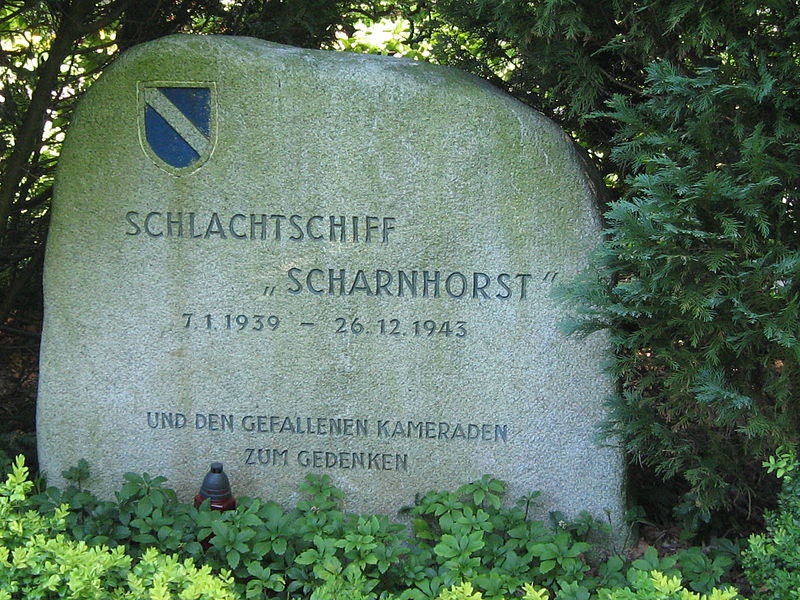
Schlachtschiff "Scharnhorst"

Friends of Padre Steve’s World,

Over the past few days I have posted a number of articles dealing with the tragedy of war during the Christmas season and I am continuing that on this day which is often called the Second Day of Christmas or the Feast of St. Stephen.

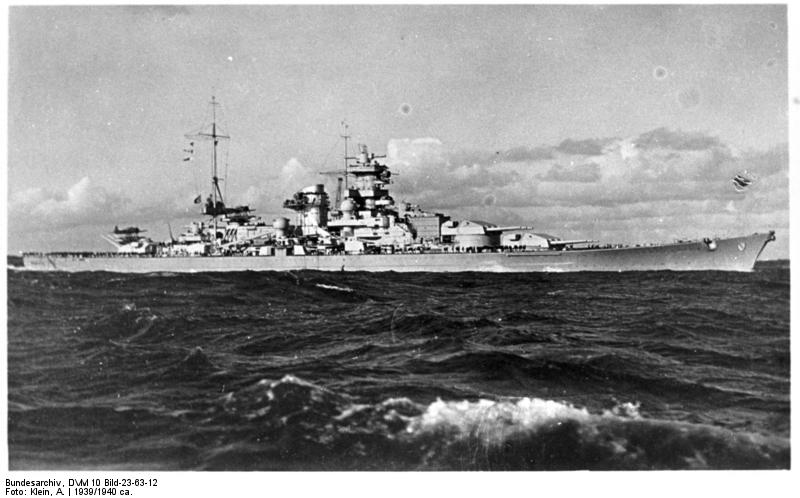
Christmastide is a joyous time for many, but in the course of history there have been times that military men have fought and died in hopeless battles far from their families. Thus it is often a time of sorry, especially for those that die alone. Among those who died alone in the Arctic darkness of December 26th 1943 were the officers and crew of the German battlecruiser Scharnhorst.

Schlachtschiff "Scharnhorst"

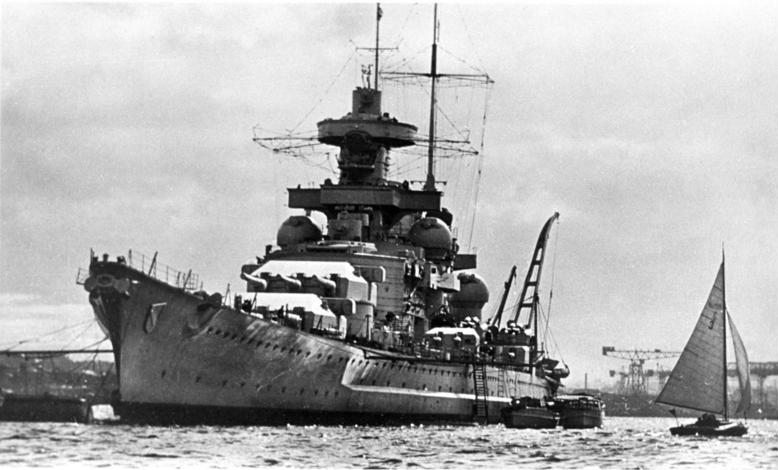
Scharnhorst in port

The Scharnhorst along with her sister ship Gneisenau were the product of the naval architects of Germany who in the early 1930s designed some of the most beautiful as well as deadly warships of the Second World War.  Following Germany’s rejection of the provisions of the Treaty of Versailles the Kreigsmarine enacted a building program to enlarge and modernize the German Navy which then was composed of obsolete pre-Dreadnaught battleships and a few modern light cruisers and destroyers.   The first major units constructed were actually begun by the predecessor to the Kreigsmarine, the Reichsmarineof the Weimar Republic.  These were the Deutschland class Armored Ships, sometimes called “Pocket Battleships” and later reclassified as Heavy Cruisers. These ships were designed to replace the old pre-Dreadnaught battleships and incorporated electric welds to reduce displacement, diesel engines for extended cruise range to enable them to serve as commerce raiders and a battery of six 11” guns.  While an advance over anything in the German inventory they were outclassed by the British battle cruisers Hood, Renown and Repulse.

However, the first truly capital ships built by the Kriegsmarine were the Scharnhorst and Gneisenau Rated as battleships, in reality they were battle cruisers because of their light main battery of 11” guns as opposed to the 14”, 15” or 16” batteries of other nations battleships.  Despite this in displacement and armor protection of the ships was comparable to other battleships of the era and their designed speed of 31.5 knots was superior to almost all other battleships of the era including the British King George V Class and the US Navy’s  North Carolina class.  Only the massive battlecruiser HMS Hood was their superior in speed and firepower.

As built Scharnhorst and Gneisenau displaced 31,000 toms, however at full combat load they both weighed in at nearly 38,000 tons and were 772 feet long.  They had an armor belt that was nearly 14 inches thick.  Armed with a main battery of nine 11” guns and a secondary armament of twelve 5.9 inch guns they also mounted a powerful for the time anti- aircraft battery of fourteen 4.1 inch guns, 16 37mm and 16 20mm anti-aircraft cannons.  Additionally they mounted six 21” torpedo tubes and carried three Arado 196 A3 scout planes.  The main battery was eventually to be replaced by six 15” guns but this never occurred although Gneisenau was taken in hand to mount the new weapons but the conversion was never completed.

scharnhorst2

Scharnhorst firing at HMS Glorious 

Laid down on 15 June 1935 and launched 3 October 1936 Scharnhorst was commissioned 7 January 1939.  Her sister Gneisenau was laid down 6 May 1935, launched 8 December 1936 and commissioned 21 May 1938.  Upon the commencement of the Second World War the two sisters began a reign of destruction on British shipping. In November they sank the Armed Merchant Cruiser HMS Rawalpindi During Operation Weserübung the pair surprised sank the aircraft carrier HMS Glorious and her two escorting destroyers, the only time a Fleet carrier was caught and sunk by battleships during the war.   From January to March 1941 they conducted Operation Berlin against British merchant shipping in the North Atlantic sinking 22 ships before returning to base.

eeb893a0b92de4ae595de56fe0fd90ca

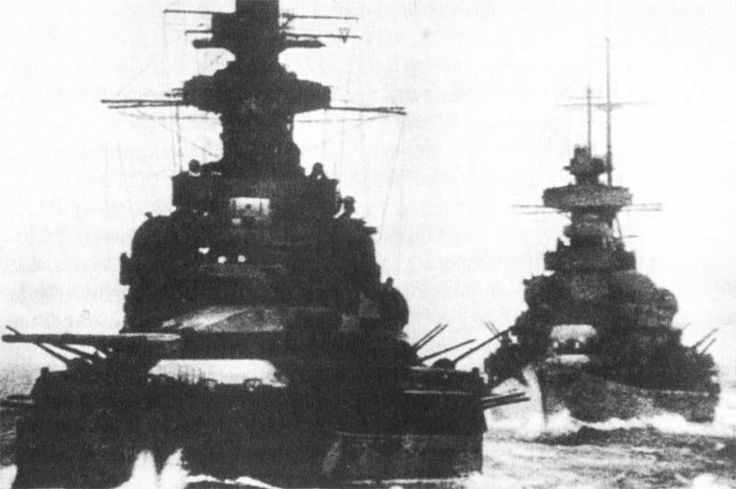
Scharnhorst and Gneisenau during Operation Cerebus

While in the port of Brest Gneisenau was bombed and torpedoed requiring extensive repairs.  Due to the exposed location of the port the German high command decided to return the ships to Germany along with the Heavy Cruiser Prinz Eugen.  The operation was called Operation Cerberus and it took place from 11-13 February 1942. The ships made a dash up the English Channel which was unsuccessfully contested by the British Royal Air Force and Royal Navy. However, both Scharnhorst and Gneisenau were damaged by mines and needed subsequent repairs.  While undergoing repairs in Kiel Gneisenauwas further damaged by the Royal Air Force requiring repairs in or to steam to the port of Gotenhafen for repair and conversion.  Although some work was completed she was decommissioned and sunk as a blockship on 23 March 1945.  Following the war she was raised by the Poles and scrapped.

Scharnhorst was repaired following Operation Cerberes and in March 1943 was transferred to Norway where along with Tirpitz, Admiral Scheer, Lutzow (the former Deutschland), Admiral Hipper and Prinz Eugen she became part of a “fleet in being” poised to strike the Allied convoys bound for Russia.

Admiral_Bruce_Fraser_1943_IWM_A_16489

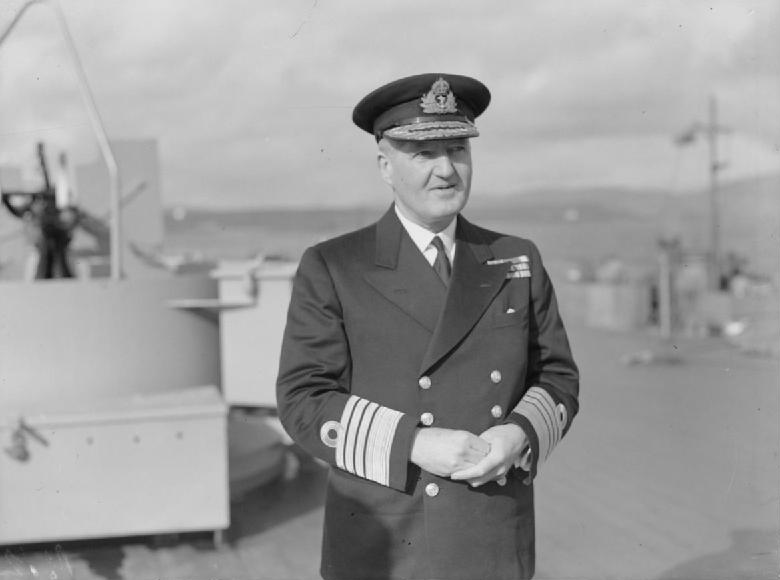
Admiral Bruce Fraser

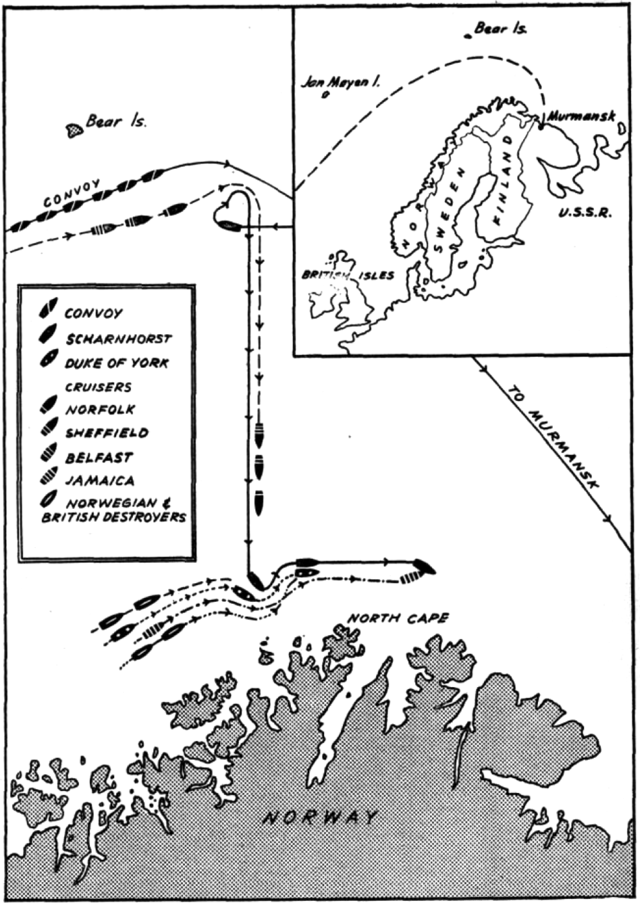
The German surface ships were a potent force that if the circumstances allowed could devastate the Russia bound convoys and the Commander of the British Home Fleet, Admiral Bruce Fraser was determined to entrap and destroy any of these ships that threatened any convoy. As such in December 1943 Fraser formed a task group built around the HMS Duke of York to be ready to pounce on any German raider that threatened the convoys. His intent was to catch any of these ships, especially Scharnhorst and trap them between the convoys and their base, in conduction with a second task group centered around the cruisers HMS Belfast, HMS Norfolk, and HMS Sheffield, Known as Force One, and destroy the German battleship.

The key to British the British operation was Enigma the German code machine and cipher system which they had acquired from captured U-Boats, and which British code-breakers had mastered. The Germans decided to send Scharnhorst and five destroyers to locate and destroy convoy JW-55B which had been spotted by Luftwaffe reconnaissance aircraft. Because of EnigmaFraser knew that Scharnhorst would attempt to intercept the convoy and put his plan in motion.

Battle_of_North_Cape_26_December_1943_map


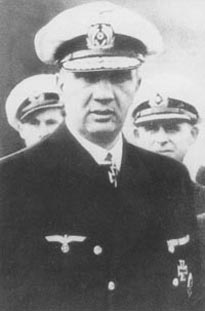
Scharnhorst and her escorts set sail on Christmas Day 1943 under the command of Rear Admiral Erich Bey to conduct Operation Ostfront. Since Fraser knew that the Germans were coming he had the convoy to temporarily reverse course which caused the Germans to miss the convoy. When he did not find the convoy in the expected location Bey detached his destroyers to expand the search area, leaving Scharnhorst alone to face the enemy.

scharnhort_operation_ostfront_5

Rear Admiral Erich Bey

At about 0900 on December 26th 1943 the cruisers of Force One discovered Scharnhorst and the  Battle of North Cape was on. Though little damage was suffered in the first engagement, the radar of Scharnhorst was knocked out, leaving her not only without air support or escort, but blind.

6050465664_e1f42ac7f8_o

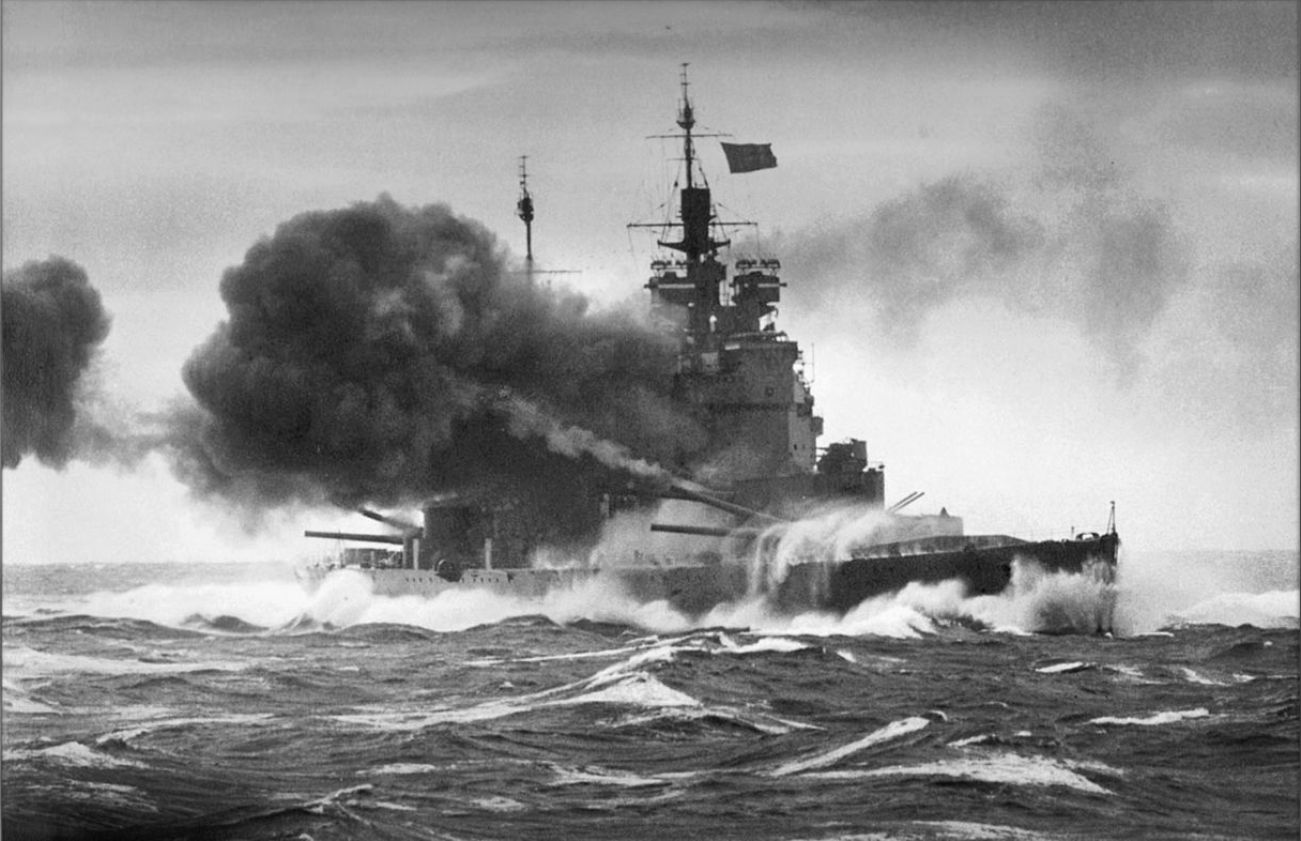
HMS Duke of York firing at Scharnhorst

Scharnhorst attempted to flee but Fraser’s Duke of York  and her four escorting destroyers destroyers intercepted her. Without radar in the blinding snow squalls Scharnhorst was surprised. Duke of York’s first radar direct salvos knocked out her forward main battery but the German ship appeared to be making a getaway when a shell from Duke of York hit her number one boiler room and reduced her speed to barely ten knots. Although the German engineers and damage control teams made some repairs and were able to bring her speed back up to 22 knots, the British ships rapidly made up the distance enabling the British destroyers to launch torpedo attacks.

Knowing the ship was doomed Admiral Bey dispatched a message to the high command of the Kriegsmarine: “We will fight on until the last shell is fired.”

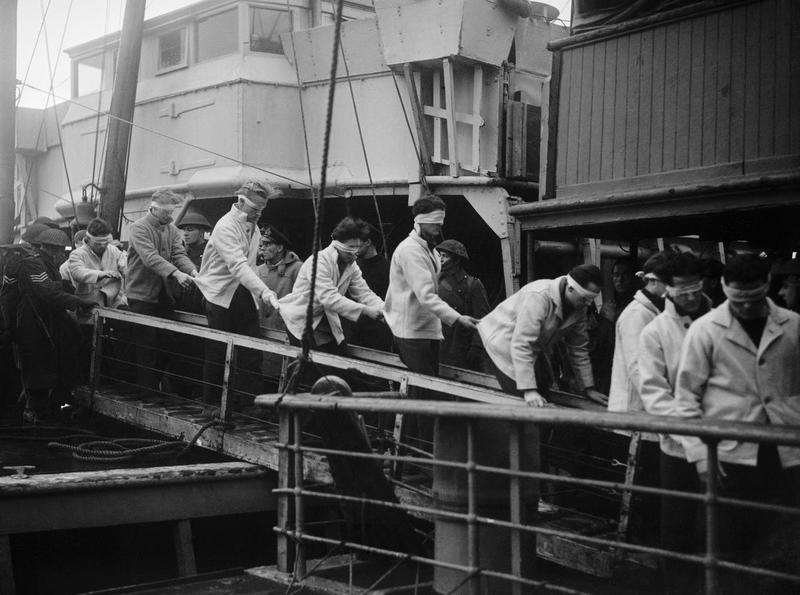
While she still attempted to fight off her attackers and escape she was struck by torpedoes from several destroyers as well as was pummeled by the at at distance of under 10,000 yards by Duke of York’s 14″ shells, as well as the 6″ shells of HMS Belfast and HMS Jamaica. Savaged by hits and incapable of further resistance the German ship capsized and sank at 1945 hours with the loss of all but 36 of her 1968 man crew.  Her wreck was discovered 3 October 2000 some 70 miles north of North Cape Norway.

Scharnhorst_survivors_A_021202

Survivors of Scharnhorst 

Admiral Fraser praised the gallantry of the German ship to his officers later that night saying: “Gentlemen, the battle against Scharnhorst has ended in victory for us. I hope that if any of you are ever called upon to lead a ship into action against an opponent many times superior, you will command your ship as gallantly as Scharnhorst was commanded today”

After the battle Grand Admiral Erich Raeder who had authorized the sortie was relieved as commander in chief of the navy and was replaced by Grand Admiral Karl Donitz who commanded the U-Boat forces. Hitler was furious and ended most surface naval operations.

800px-Scharnhorst-WHV-April-2011

Memorial to Scharnhorst and her crew at Kiel

I have written many times about the tragedy of war, on land and at sea. Having served in combat zones on land and having been shot at by the enemy, as well as having served at sea on a cruiser I have a sense of what these men must have gone through on that final day of their lives. Though I am a realist and know that such tragedies will likely occur again, I do pray for the day that war will be no more and that those who serve in harm’s way will never have to again.

Peace

Padre Steve+

Leave a comment

Filed under History, Military, Navy Ships, World War II at Sea

I Heard the Bells On Christmas Day: The Wrong Shall Fail

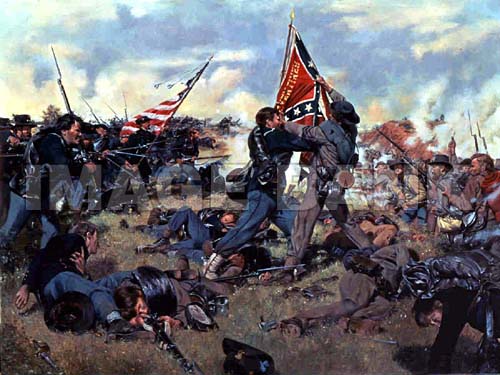
fightforthecolors2la

Friends of Padre Steve’s World,

The great American poet Henry Wadsworth Longfellow penned these words of hope on Christmas Day, 1863, “God is not dead, nor doth He sleep; The wrong shall fail, the right prevail With peace on earth, good will to men.”

Today is Christmas and I felt that his words are as pertinent today as when he first penned them. The thought of what is to come in the next few years, in the United States and in many other liberal democracies bodes ill for our future as authoritarian and often xenophobic leaders rise to power. The world that we grew up is is passing away, and what comes in its place, a dystopian world where hope will be a rare commodity beckons.

His words became the heart of the song I Heard the Bells on Christmas Day.  I have heard it a number of times in the past few days and each time it really touches me.

The song has been recorded in a number of versions by different artists over the years. However, the words of the song go back to the American Civil War. It began as a poem written by Henry Wadsworth Longfellow on Christmas Day 1863 following the serious wounding of his son Charles, a Lieutenant in the Union Army at the Battle of New Hope Church, and the death of his wife in a fire two years before.

The words are haunting. Probably because they demonstrate the profound tension that lies at the heart of the Incarnation, which is the heart of Christmas and the Christian faith. the tension, played out so well in the song is the existence of a message of peace and reconciliation in a world where war and hatred of many kinds tear human beings apart and the tragic inability of Christendom to even come close to the message of Christmas.

I heard the bells on Christmas day

Their old familiar carols play,

And wild and sweet the words repeat

Of peace on earth, good will to men.

I thought how, as the day had come,

The belfries of all Christendom

Had rolled along th’ unbroken song

Of peace on earth, good will to men.

gburg dead2

The reality of this is seen in the third verse. It is a verse that echoes throughout history and seems to be true even today, in fact it seems to be the most real as we deal with war, hatred, terrorism, killing in the name of God, and political fratricide.

And in despair I bowed my head

“There is no peace on earth,” I said,

“For hate is strong and mocks the song

Of peace on earth, good will to men.”

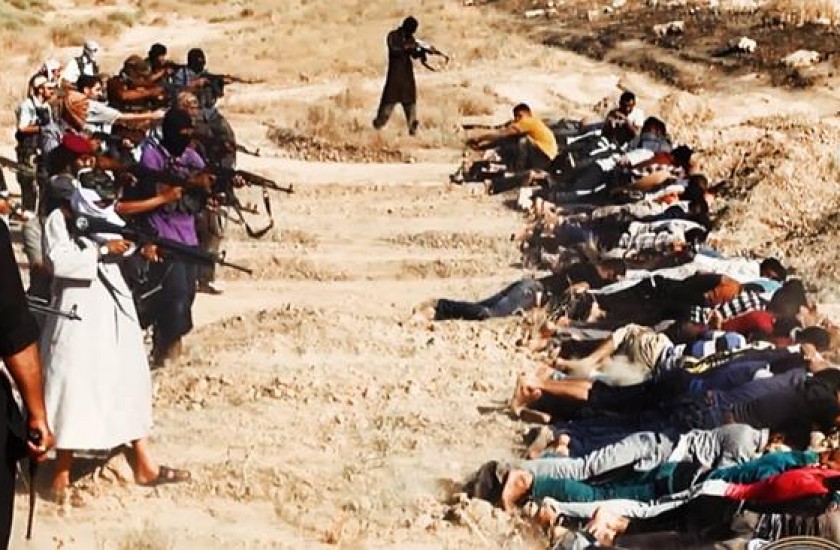
isis3-840x550

The interesting part about the songs as opposed to the poem is that they omit three of Longfellow’s verses that admittedly in a reunited country would not help record sales. Those verses speak to the heart of the Civil War.

Till ringing, singing on its way,
The world revolved from night to day,

A voice, a chime,

A chant sublime

Of peace on earth, good-will to men!

Then from each black, accursed mouth
The cannon thundered in the South,

And with the sound

The carols drowned

Of peace on earth, good-will to men!

It was as if an earthquake rent
The hearth-stones of a continent,

And made forlorn

The households born

Of peace on earth, good-will to men!

But Longfellow hears in the bells something more powerful. It is the message of Christmas and the incarnation. The message that justice and peace will finally embrace.

Then pealed the bells more loud and deep:

“God is not dead, nor doth He sleep;

The wrong shall fail, the right prevail

With peace on earth, good will to men.”

Till ringing, singing on its way

The world revolved from night to day,

A voice, a chime, a chant sublime

Of peace on earth, good will to men.

The song has been recorded many times by many artists. I like the version sung by Frank Sinatra, which the music was composed by Johnny Marks, composer of Rudolph the Red Nosed Reindeer. Another earlier version composed by John Baptiste Calkin has been recorded by Elvis Presley and Johnny Cash among others.

As wars rage in the Middle East, tensions rise in Asia, Africa and even Eastern Europe while the Unholy Trinity of Politicians, Pundits and Preacher rage as we go into another, and even more divided election season, people look for hope. Longfellow, who lost so much in a short time in the midst of a terrible Civil War, reminds us that in such times, “God is not dead, nor doth He sleep; The wrong shall fail, the right prevail With peace on earth, good will to men.”

In a time like this it is important to remember these words.

Peace

Padre Steve+

1 Comment

Filed under christian life, civil war, faith, History

Christmas Eve 2016: I Belong with Those in Pain and Those who have Lost Their Faith

palmer

Friends of Padre Steve’s World,

It is Christmas Eve on this holiest of occasions I am posting an updated version of something that I have posted before because for me it means even more today than it has in the past few years.

As a veteran who served in the badlands of Al Anbar Province during Christmas of 2007 I can relate to Father Palmer, the British priest and chaplain in the film Joyeux Noel (Merry Christmas) when he makes the comment “I belong with those who are in pain, and who have lost their faith, I belong here.” In the post-truth Trump era I feel my services will still be needed when those who believed in him discover just how badly they have been betrayed.

I again watched that film Wednesday. The film is the story of the amazing and exceptional Christmas Truce of 1914. It is a film that each time I see it that I discover something new, more powerful than the last time I viewed it. It reminds me of serving in Iraq, at Christmas from my perspective as a Chaplain, and thereby giving voice to those who serve now, as well as those who served God’s people in hellish places before me. It reminds me of how much I hate war, and how much I often hate the clergy who are all too often, bloodthirsty cheerleaders for war.


As a Chaplain I am drawn to the actions of the British Padre in the film, who during the truce conducts a Mass for all the soldiers, British, French and German in no-man’s land, who goes about caring for the soldiers both the living and the dead. His actions are contrasted with his Bishop who comes to relieve him of his duties and to urge on the replacement soldiers to better kill the Germans.

As the Chaplain begins to provide the last Rites to a dying soldier the Bishop walks in, in full purple cassock frock coat and hat and the chaplain looks up and kisses his ring.

As the chaplain looks at his clerical superior there is a silence and the Bishop looks sternly at the priest and addresses him:

“You’re being sent back to your parish in Scotland. I’ve brought you your marching orders.”

Stunned the Priest replies: “I belong with those who are in pain, and who have lost their faith, I belong here.”

The Bishop then sternly lectures the Priest: “I am very disappointed you know. When you requested permission to accompany the recruits from your parish I personally vouched for you. But then when I heard what happened I prayed for you.”

I have served that type of Bishop before, not anymore, but I have, and I have little tolerance for those of high office in the Church or anywhere else use their office not to serve the Prince of Peace, but the gods of war and greed.

The Priest humbly and respectfully yet with conviction responds to his superior: “I sincerely believe that our Lord Jesus Christ guided me in what was the most important Mass of my life. I tried to be true to his trust and carry his message to all, whoever they may be.”

The Bishop seems a bit taken aback but then blames the Chaplain for what will next happen to the Soldiers that he has served with in the trenches: “Those men who listened to you on Christmas Eve will very soon bitterly regret it; because in a few days time their regiment is to be disbanded by the order of His Majesty the King. Where will those poor boys end up on the front line now? And what will their families think?”

They are interrupted when a soldier walks in to let the Bishop know that the new soldiers are ready for his sermon. After acknowledging the messenger the Bishop continues: “They’re waiting for me to preach a sermon to those who are replacing those who went astray with you.” He gets ready to depart and continues: “May our Lord Jesus Christ guide your steps back to the straight and narrow path.”

The Priest looks at him and asks: “Is that truly the path of our Lord?”

The Bishop looks at the Priest and asks what I think is the most troubling question: “You’re not asking the right question. Think on this: are you really suitable to remain with us in the house of Our Lord?”

With that the Bishop leaves and goes on to preach. The words of the sermon are from a 1915 sermon preached by an Anglican Bishop in Westminster Abbey. They reflect the poisonous aspects of many religious leaders on all sides of the Great War, but also many religious leaders of various faiths even today, sadly I have to say Christian leaders are among the worst when it comes to inciting violence against those that they perceive as enemies of the Church, their nation or in some cases their political faction within a country. In the Trump era the powerful preachers are doing exactly that, and I will not condone their actions or remain silent. This is not about politics it is about the perversion of the Christian faith by those who should know better.


“Christ our Lord said, “Think not that I come to bring peace on earth. I come not to bring peace, but a sword.” The Gospel according to St. Matthew. Well, my brethren, the sword of the Lord is in your hands. You are the very defenders of civilization itself. The forces of good against the forces of evil. For this war is indeed a crusade! A holy war to save the freedom of the world. In truth I tell you: the Germans do not act like us, neither do they think like us, for they are not, like us, children of God. Are those who shell cities populated only by civilians the children of God? Are those who advanced armed hiding behind women and children the children of God? With God’s help, you must kill the Germans, good or bad, young or old. Kill every one of them so that it won’t have to be done again.”

The sermon is chilling and had it not been edited by the director would have contained the remark actually said by the real Bishop that the Germans “crucified babies on Christmas.” Of course that was typical of the propaganda of the time and similar to things that religious leaders of all faiths use to demonize their opponents and stir up violence in the name of their God.

When the Bishop leaves the Priest finishes his ministration to the wounded while listening to the words of the Bishop who is preaching not far away in the trenches. He meditates upon his simple cross, takes it off, kisses it hand hangs it upon a tripod where a container of water hangs.

The scene is chilling for a number of reasons. First is the obvious, the actions of a religious leader to denigrate the efforts of some to bring the Gospel of Peace into the abyss of Hell of earth and then to incite others to violence dehumanizing the enemy forces. The second and possibly even more troubling is to suggest that those who do not support dehumanizing and exterminating the enemy are not suitable to remain in the house of the Lord. Since I have had people, some in person and others on social media say similar things to what the Bishop asks Palmer the scene hits close to home.

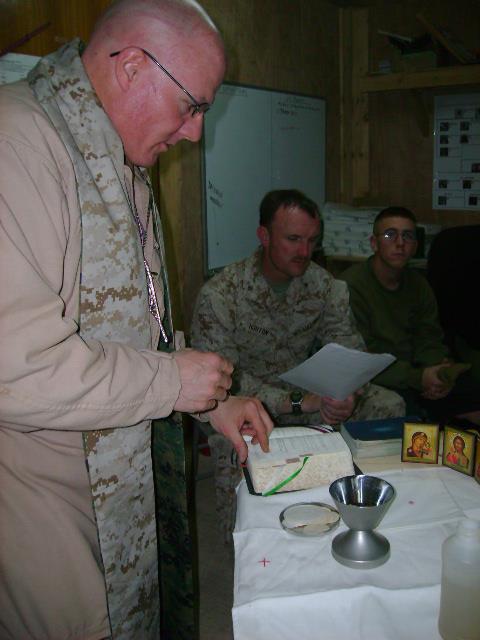
When I left Iraq in February 2008 I felt that I was abandoning those committed to my spiritual care, but my time was up. Because of it I missed going with some of my advisors to Basra with the 1st Iraqi Division to retake that city from insurgents. It was only a bit over a month after I had celebrated what I consider to be my most important Masses of my life at COP South and COP North on December 23rd as well as Christmas Eve and Christmas Day. In fact they were really the last masses that I felt the mystery and awe of the love of God that I used to so much feel.

When I left the new incoming senior Chaplain refused to take my replacement leaving our advisers without dedicated support. He then slandered me behind my back because what I was doing was not how he would do things and because I and my relief were under someone else’s operational control. It is funny how word gets back to you when people talk behind your back. Thankfully he is now retired from the Navy and I feel for any ministers of his denomination under his “spiritual” care. So I cannot forget those days and every time I think about them, especially around Christmas I am somewhat melancholy and why I can relate so much to Father Palmer in the movie.

It has been nine years since those Christmas Masses and they still feel like yesterday. In the intervening years my life has been different. Just a year later I was walking home from church where my wife was to sing in the choir during the Christmas vigil mass. I couldn’t handle the crowds, the noise, and I felt so far away from God. That night I walked home in the dark looking up into the sky asking God if he still was there. If there had been a bar on the way home I would have stopped by and poured myself in.

Since Iraq I have dealt with severe and chronic PTSD, depression, anxiety and insomnia were coupled with a two year period where due to my struggles I lost faith, was for all practical purposes an agnostic. I felt abandoned by God, but even more so and maybe more importantly by my former church and most other Chaplains. It was like being radioactive, there was and is a stigma for Chaplains that admits to PTSD and go through a faith crisis, especially from other Chaplains and Clergy. It was just before Christmas in late 2009 that faith began to return in what I call my Christmas Miracle. But be sure, let no one tell you differently, no Soldier, Sailor, Marine or Airman who has suffered the trauma of war and admitted to PTSD does not feel the stigma that goes with it, and sadly, despite the best efforts of many there is a stigma.

Now that faith is different and I have become much more skeptical of the motivations of religious leaders, especially those that demonize and dehumanize those that do not believe like them or fully support their cause or agenda. Unfortunately there are far too many men and women who will use religion to do that, far too many.

As for me, I thought that I was in a better place a few years ago, but then I had the floor kicked from out from under me in the summer of 2014 and it has been a hard fight and while I have gotten back to a sense of normal, call it a “new normal,” it is a day to day thing. I still suffer the effects of the PTSD, especially the insomnia, nightmares and the nightmares which came back with a vengeance, I had one nightmare so realistic that I flew off the bed into a bookcase and broke my nose a few months back. I also still have the anxiety in crowded places and bad traffic, but working with my new therapist I am coming up with some effective coping mechanisms. As for faith, I do believe again, though at the same time I doubt. I would have to consider myself a Christian Agnostic who echoes the cry of the man who cried out to Jesus, “Lord I believe, help my unbelief!” I believe and I don’t, and yet I still believe.

Like the Priest in Joyeux Noel I know that my place is with those who are “in pain, and who have lost their faith.” For me this may no longer be on the battlefield as I will retire from the Navy in a few years. However, that being said I will strive to be there for those that struggle with faith and believe, especially those who struggle because of what they saw and experienced during war and when they returned home.

533506_10151366982457059_868388211_n


Likewise I expect that I will do my best to speak truth to those in power and those whose faithfulness is more a product of their comfort with the God that they create in their own mind rather than the Crucified God wise death on the Cross s a scandal. For many Christians the scandal of the cross is too easy to avoid by surrounding ourselves with pet theologies that appeal to our pride, prejudice and power, and vote into office men that mock the very faith that they say they believe.  That kind of malevolent power represented by the bishop in Joyeux Noel. Thus I take a measure of comfort in the words of Simone Weil who said “He who has not God in himself cannot feel His absence.” 

Thus, like Paul Tillich I have come to believe that “Sometimes I think it is my mission to bring faith to the faithless, and doubt to the faithful.” In other words to become a complete pain in the ass until the day that I die.

Praying for Peace this Christmas,

Padre Steve+

4 Comments

Filed under christian life, faith, History, Military, Political Commentary

The Madonna of Stalingrad: A Portrait of Hope in Hell

Bundeswehr zeigt "Stalingrad"-Ausstellung

Friends of Padre Steve’s World,

It is almost Christmas and I am reflecting about the true meaning of Christmas in a world where hope seems to be dying before our eyes. In such an environment I reflect on men who lived in a human made hell, a hell made by hate filled ideologues who launched the world into its bloodiest war, and I wonder, could it happen again? A decade ago I would have said it never could again happen, but now I am not so sure. So I must try to find hope wherever I can find it.

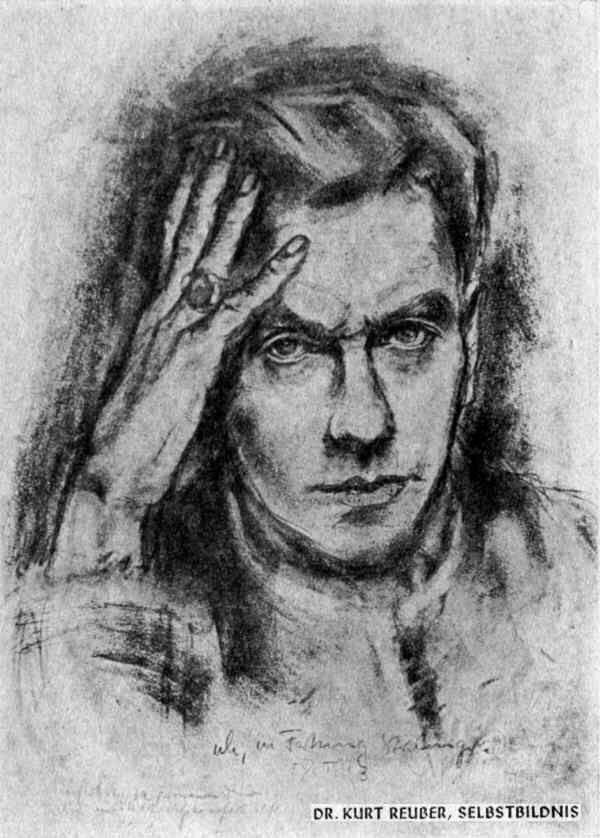
I think most of my readers know that I am a career military officer and have served in peace and war as a chaplain. That service includes a tour in Iraq, a war, which by almost any standard would have been considered unjust and illegal, yet I served there, and came back a changed man. As such the stories of those who served in war, especially those who serve in hopeless battles, and even in evil causes during Christmas have a special place in my heart. One of those men was a German pastor and medical doctor named Kurt Reuber.

k_reuberl

As I said, Reuber was a theologian, pastor and medical doctor, likewise he was an accomplished artist and used that medium to convey his own faith, and doubts. He was a friend of Albert Schweitzer in 1939 he was conscripted to serve as a physician in the Germany Army. By November 1942 he was a seasoned military physician serving with the 16th Panzer Division, part of the German 6th Army, which had been fighting in the hell of Stalingrad. When his division along with most of 6th Army was surrounded by the Soviets, cut off from most supply and without real hope of relief, he like other physicians continued to serve the soldiers committed to his care.

pg-34-stalingrad-2-getty

However, unlike most physicians, the care Reuber offered care included spiritual matters, as he sought to help his soldiers deal with the hopelessness of their situation. As Reuber reflected on the desperation of the German soldiers in the Stalingrad pocket. He wrote to his family.

“I wondered for a long while what I should paint, and in the end I decided on a Madonna, or mother and child. I have turned my hole in the frozen mud into a studio. The space is too small for me to be able to see the picture properly, so I climb on to a stool and look down at it from above, to get the perspective right. Everything is repeatedly knocked over, and my pencils vanish into the mud. There is nothing to lean my big picture of the Madonna against, except a sloping, home-made table past which I can just manage to squeeze. There are no proper materials and I have used a Russian map for paper. But I wish I could tell you how absorbed I have been painting my Madonna, and how much it means to me.”

“The picture looks like this: the mother’s head and the child’s lean toward each other, and a large cloak enfolds them both. It is intended to symbolize ‘security’ and ‘mother love.’ I remembered the words of St. John: light, life, and love. What more can I add? I wanted to suggest these three things in the homely and common vision of a mother with her child and the security that they represent.”

The picture was drawn on the back of a captured Soviet map and when he finished it he displayed it in his bunker, which became something of a shrine. Reuber wrote:

“When according to ancient custom I opened the Christmas door, the slatted door of our bunker, and the comrades went in, they stood as if entranced, devout and too moved to speak in front of the picture on the clay wall…The entire celebration took place under the influence of the picture, and they thoughtfully read the words: light, life, love…Whether commander or simple soldier, the Madonna was always an object of outward and inward contemplation.”

drkrop

As the siege continued men came to the bunker for both medical care and spiritual solace.  On Christmas Eve Reuber found himself treating a number of men wounded by bombs outside the bunker. Another soldier lay dying, just minutes before the soldier had been in the bunker singing the Christmas hymn O Du Froehliche.  Reuber wrote:

“I spent Christmas evening with the other doctors and the sick. The Commanding Officer had presented the letter with his last bottle of Champagne. We raised our mugs and drank to those we love, but before we had had a chance to taste the wine we had to throw ourselves flat on the ground as a stick of bombs fell outside. I seized my doctor’s bag and ran to the scene of the explosions, where there were dead and wounded. My shelter with its lovely Christmas decorations became a dressing station. One of the dying men had been hit in the head and there was nothing more I could do for him. He had been with us at our celebration, and had only that moment left to go on duty, but before he went he had said: ‘I’ll finish the carol with first. O du Frohliche!” A few moments later he was dead. There was plenty of hard and sad work to do in our Christmas shelter. It is late now, but it is Christmas night still. And so much sadness everywhere.”

On January 9th 1943 with all hope of escape or reinforcement gone Reuber gave the picture to the battalion commander as the officer was too ill to carry on and was one of the last soldiers to be evacuated from the pocket. Reuber’s commander carried the Madonna out of the pocket and returned it delivered it to Reuber’s family, preserving it for all.

Reuber was taken prisoner and survived the harrowing winter march to the Yelabuga prison camp. In late 1943 Reuber wrote his Christmas Letter to a German Wife and Mother – Advent 1943. It was a spiritual reflection but also a reflection on the hope for life after the war, when the Nazi regime would be defeated, and Germany given a new birth.

Reuber wrote:

“The concatenation of guilt and fate has opened our eyes wide to the guilt. You know, perhaps we will be grateful at the end of our present difficult path yet once again that we will be granted true salvation and liberation of the individual and the nation by apparent disappointment of our “anticipation of Advent”, by all of the suffering of last year’s as well as this year’s Christmas. According to ancient tradition, the Advent season is simultaneously the season of self-reflection. So at the very end, facing ruin, in death’s grip – what a revaluation of values has taken place in us! We thus want to use this period of waiting as inner preparation for a meaningful new existence and enterprise in our family, in our vocation, in the nation. The Christmas light of joy is already shining in the midst of our Advent path of death as a celebration of the birth of a new age in which – as hard as it may also be – we want to prove ourselves worthy of the newly given life.”  (Erich Wiegand in Kurt Reuber, Pastor, Physician, Painter, Evangelischer Medienverb. Kassel 2004. )

prisoner's madonna

Reuber did not live to see that day. He died of Typhus on January 20th 1944, not long after writing this and just a few weeks after painting another portrait of the Madonna, this one entitled The Prisoner’s Madonna. He was not alone, of the approximately 95,000 German POWs taken at Stalingrad only about 6,000 returned home.

His paintings survived the war and his family gave The Madonna of Stalingrad to the Kaiser Wilhelm Memorial Church in Berlin after it was restored as a symbol of hope and reconciliation. Copies are also displayed in Coventry Cathedral and the Russian Orthodox Cathedral in Volgograd, the former Stalingrad. A copy of The Prisoner’s Madonna is now displayed at the Church of the Resurrection in Kassel.

I have a print of the Madonna of Stalingrad in my office. It has become one of the most meaningful pictures I have since I returned from Iraq in 2008. To me they are symbols of God’s presence when God seems entirely absent.

Praying for an end to war.

Peace

Padre Steve+

Leave a comment

Filed under Loose thoughts and musings

Christmas Goes Pop: A Holiday Music Buffet

Friends of Padre Steve’s Word,

Once again I delve into the vault of Christmas Past and post yet another collection of Christmas music from various Rock, Pop, R&B, and Country artists that I enjoy. I hope that you will as well.

I grew up in the 1960’s 1970’s and went to college in the 1980s. As such my musical taste reflects much of the Rock, Pop, R&B, and Country crossovers of the era. So here are some of those artists performing some of their Christmas music. I have also included some more contemporary artists whose music I enjoy. Some are religious in nature and some not. While some are just fun to listen to there are others that speak to the sadness and melancholy that some people feel this time of year. As I have grown older I have come to appreciate non-religious Christmas or holiday music, especially that which touches the deepest emotions and longings that I feel, just as much as I do the traditional hymns of Advent and Christmas. I find it interesting as I have mentioned before that so many of the performers are people who would not be welcome in any church because of their faith, or lack of, their politics, or their sexual preference. But I digress…

I have posted over sixty songs here and they are no particular order, and I hope that you enjoy them.  My wish is that you enjoy the Christmas or whatever holiday you are celebrating; after all the key is to enjoy life and hopefully love as well this holiday season.

Peace

Padre Steve+


Leave a comment

Filed under faith, music

The First Duty: Speaking Truth in “Post-Truth” Trump Era

IMG_0535

Friends of Padre Steve’s World,

For me the past month has been one of constant amazement. I am not speeaking about politics, but what matters more than any political ideology, the very idea of truth. Because of this I write using history and as best as I can objective and indisputable fact as my guide.

Most of my readers know that in addition to being a Priest and Navy Chaplain that I am a historian and teach both ethics and about Gettysburg as a faculty member at a Staff College. Many of the men and women that I teach will lead our military as commanders, planners and staff officers. I will transfer in the spring but even so, as a chaplain, officer, and educator I cannot be silent.

Thus it is my first duty, whether it is in teaching, writing or in ministry is to the truth, politicans and pundits be damned to hell. I believe the words spoken by Captain Jean Luc Picard, played by Sir Patrick Stewart in Star Trek the Next Generation: “the first duty of every Starfleet officer is to the truth, whether it’s scientific truth, historical truth or personnel truth…”

I am not a Starfleet Officer, but a Navy officer and I have always believed that the truth matters, but sadly, I, like so many of us have turned the other way and not spoken out too many times in my life. That changed during my combat tor in Iraq, and now the older I get the more I realize that I cannot be silent about subjects that at one time I turned a blind eye to because they were uncomfortable, unpopular or might hurt my career either in the church or in the military, so when I see people in power and who are close to power saying that truth and objective fact no longer matters I become fearful, because I know that the path that denying facts and truth leads.

Throughout the campaign Trump and his campaign surrogates not only twisted truth, but lied so many times that fact checkers could hardly keep up with their untruths. After the election, Trump surroget Scottie Nell Hughes told Diane Rehm of NRP: “There’s no such thing, unfortunately, anymore, of facts,” she continued,“Mr. Trump’s tweet, amongst a certain crowd, a large — a large part of the population, are truth. When he says that millions of people illegally voted, he has some — in his — amongst him and his supporters, and people believe they have facts to back that up. Those that do not like Mr. Trump, they say that those are lies, and there’s no facts to back it up.”

Her words, as well as those of former Trump campaign director and CNN talking head, Corey Lewindowski, and Newt Gingrinch have maintained that truth does not matter, only what people believe does. The fact that so many of Trump’s supporters don’t seem to care about facts, bodes ill for our country.

As such I have continued to write about subjects that many people are controversial and as such many people are uncomfortable with those topics. Whether the issue is civil rights, racism, Gay rights and marriage equality, voting rights, religious freedom and religious intolerance, and even xenophobia, or the connection of symbols such as the Confederate Battle Flag to a heritage that goes to a hatred that extends far beyond the battlefields of the Civil War; I am speaking out.

I am fully aware of that many of these subjects are controversial and are now targeted by Trump’s supporters, Congressional Repiublicans, and GOP legislators in every state. I have been asked in comments on this site and on my various social media accounts, particularly Facebook, why I keep bringing up the uncomfortable past. But I have to, I have a duty to the truth, and as Oscar Wilde noted “The truth is rarely pure and never simple.”

The late Howard Zinn, a brilliant historian whose work at one time I discounted, said: “But I suppose the most revolutionary act one can engage in is… to tell the truth.” Who would think that telling the truth could or would be a revolutionary act? However, when one lives in a society where the truth is bent, run over and shredded by politicians, preachers and pundits, what I call the Trinity of Evil; when state school boards whitewash history and force their religious views on children in public schools; where corporations and advertisers use the most crass means to deceive customers; and where established science is not met with denial under the guise of “skepticism;” telling the truth is a revolutionary affair.

In 1943, George Orwell, wrote about the Spanish Civil War how the German and Italian propaganda about it had been accepted without question by most people in westren democracies. His words echo my feelings about the incoming administration:

“This kind of thing is frightening to me, because it often gives me the feeling that the very concept of objective truth is fading out of the world. After all, the chances are that those lies, or at any rate similar lies, will pass into history. How will the history of the Spanish war be written? If Franco remains in power his nominees will write the history books, and (to stick to my chosen point) that Russian army which never existed will become historical fact, and schoolchildren will learn about it generations hence. But suppose Fascism is finally defeated and some kind of democratic government restored in Spain in the fairly near future; even then, how is the history of the war to be written? What kind of records will Franco have left behind him? Suppose even that the records kept on the Government side are recoverable — even so, how is a true history of the war to be written? For, as I have pointed out already, the Government, also dealt extensively in lies. From the anti-Fascist angle one could write a broadly truthful history of the war, but it would be a partisan history, unreliable on every minor point. Yet, after all, some kind of history will be written, and after those who actually remember the war are dead, it will be universally accepted. So for all practical purposes the lie will have become truth. 

In spite of everything going on I will continue to speak the truth, which will likely will be called radical, revolutionary, and unpatriotic. That has happened over the past few years and I expect that it will happen on a more frequent basis, but I do not want the lie to become truth.

The honest truth is that I never expected to be a revolutionary in terms of defending civil rights. Truthfully, believing what authority figures, be they political, or religious say is much easier than asking the hard questions. Barbara Tuchman once wrote: “The reality of a question is inevitably more complicated than we would like to suppose.” I guess that is why so many people would rather be content with obvious lies than to ask the really hard questions; be they about history, religion, and science or for that matter anything. One of the must uncomfortable things to admit is that truth is always evolving as we learn more, it is dynamic, not static and to attempt to force people to live by the “truth” of our ancestors is disingenuous, dishonest and denies the reality of the universe that we live. Thomas Jefferson recognized this and wrote:

“I know also, that laws and institutions must go hand in hand with the progress of the human mind. As that becomes more developed, more enlightened, as new discoveries are made, new truths disclosed, and manners and opinions change with the change of circumstances, institutions must advance also, and keep pace with the times. We might as well require a man to wear still the coat which fitted him when a boy, as civilized society to remain ever under the regimen of their barbarous ancestors.” 

So why I continue to write? I will write so that we never forget or push aside the great evils that human beings are capable of committing: The Holocaust, slavery and Jim Crow, the extermination of Native Americans by the millions in the name of God and Manifest Destiny, the enslavement, exploitation, and sometimes the extermination of whole peoples by colonialism; the witch trials, the religious wars of the Reformation, the Inquisition, the Chinese Cultural Revolution, Stalin’s purges, the Tuskegee experiments, the Japanese barbarity in the Rape of Nanking and other places in Asia, the Srebrenica genocide and the Rwandan genocide, the inhumanity of the so-called Islamic State, just to name a few; and add to that whatever happens in the next few years that will be aided and abbetted by men and women who overthrow democracy by the democratic process, using people’s fear to establish authoritatian or totalitarian states.

All too often the perpetrators of those events and their descendants as all too willing to last the past lie dormant and allow present wrongs to persist and look the other way.

But at what cost do we do so? Do we sacrifice justice on the altar of prosperity and peace; do we sacrifice uncomfortable truth in order to remain undisturbed and comforted by myth? Do we condemn our descendants to live under the myths of our ancestors? Would we sacrifice the truth and justice in order to ensure obedience? Howard Zinn correctly observed, “Historically, the most terrible things – war, genocide, and slavery – have resulted not from disobedience, but from obedience.”

President John F. Kennedy spoke these words at Yale in 1962: “The great enemy of truth is very often not the lie–deliberate, contrived and dishonest–but the myth–persistent, persuasive and unrealistic. Too often we hold fast to the cliches of our forebears. We subject all facts to a prefabricated set of interpretations. We enjoy the comfort of opinion without the discomfort of thought.”

Personally I would rather ask the questions and confront the past so we might have a better future, because though I am a realist, I also believe in my heart that humanity is capable of overcoming hatred, prejudice and ignorance. The problem is that times get difficult those attitudes can overcome our better nature. As Spencer Tracy’s character in the movie Judgment at Nuremberg said:

“But this trial has shown that under a national crisis, ordinary – even able and extraordinary – men can delude themselves into the commission of crimes so vast and heinous that they beggar the imagination. No one who has sat through the trial can ever forget them: men sterilized because of political belief; a mockery made of friendship and faith; the murder of children. How easily it can happen. There are those in our own country too who today speak of the “protection of country” – of ‘survival’. A decision must be made in the life of every nation at the very moment when the grasp of the enemy is at its throat. Then, it seems that the only way to survive is to use the means of the enemy, to rest survival upon what is expedient – to look the other way. Well, the answer to that is ‘survival as what’? A country isn’t a rock. It’s not an extension of one’s self. It’s what it stands for. It’s what it stands for when standing for something is the most difficult! Before the people of the world, let it now be noted that here, in our decision, this is what we stand for: justice, truth, and the value of a single human being.”

That my friends, is why I write: for justice, truth, and the value of a single human life, even if that means being considered unpatriotic.

Peace

1 Comment

Filed under ethics, History, News and current events, philosophy, Political Commentary

Have Yourself a Merry Little Christmas: A Haunting Song of Hope

Friends of Padre Steve’s World

There are some songs at Christmas that despite their relative newness as compared to ancient carols seem to strike a chord that resonates deep in the hearts of people. One of those for me, and probably many others is the song Have Yourself a Merry Little Christmas. The music was written by Ralph Blane and the lyrics by Hugh Martin for the musical Meet Me in St Louis and first performed by Judy Garland in that film. In the movie Garland’s character sings the song to her younger sister after their father announces plans to move from their home of St Louis to New York for a job.

The lyrics for the musical were changed because Garland’s director Vincent Minnelli and co-star Tom Drake felt that Martin’s original lyrics which began with “Have yourself a Merry Little Christmas, it could be your last. Next year we may all be living in the past” were too depressing. The lyrics were changed to “let your heart be light, Next year all our troubles will be out of sight” in response to their request. The words sung in the musical by Judy Garland have a haunting but very real feel for people who face uncertainty at Christmas, as such they were very meaningful to the US military personnel who heard them at the front in the Second World War.

As originally produced they reflect a hope for a better future as opposed to a carefree present. As such they are probably much more appropriate to our current time than in the mid-1950s when Frank Sinatra recorded a modified version of the song for his album A Jolly Christmas.

Sinatra asked Martin to “jolly up” the line “we’ll have to muddle through somehow” and Martin changed it to “Hang a shining star upon the highest bough.”

When Frank Sinatra recorded the song in 1957 it too became a hit and the focus on present happiness rather than a hope for a better future fit the times in which it was recorded. Sinatra’s version also notes that “faithful friends gather near to us once more” instead of “will be near to us once more.”

The song was re-written by Martin a number of times including a “Christian” version which included the words “if the Lord allows” instead of “if the fates allow.” Though I am a Christian I think that change was kind of lame, but then if there are a few dollars to be made off religious people who otherwise won’t listen to a song why not?

The song is one is one of the most recorded Christmas songs ever written and can be heard being sung by artists as diverse as Bing Crosby, Ella Fitzgerald, Rod Steward, the Carpenters, Kelly Clarkson, John Denver with the Muppets, the Pretenders, Olivia Newton John, Kenny Loggins, and even Twisted Sister.

The song as recorded by Judy Garland is actually my favorite, though I also love the Sinatra version. Somehow “muddling through somehow” seems to be more appropriate in my experience.

So enjoy these versions of a song that has touched the hearts of hundreds of millions of people since it was first recorded. May it be an inspiration in these uncertain times of a hope for a better future. Maybe that makes it a better Advent song, but I digress….

For me it is kind of a sad song, but mixed with hope…and I always try to live in hope.

Here’s to muddling through somehow…

Peace

Padre Steve+

2 Comments

Filed under faith, film, movies, music

The Power of Propaganda in the Hearts of True Believers

sturmer-display

Friends of Padre Steve’s World,

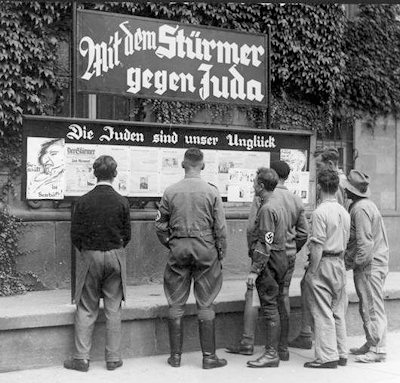
A number of days ago I wrote an article about the dehumanization of people and genocide. Since I am a historian and much of my undergraduate and graduate work focused on German history, particularly that of Imperial Germany after the unification, the Weimar Republic, and the Nazi Reich, I draw a lot of lessons from the period. I also understand how people in this country can fall for the same kind of vitriolic propaganda that the Germans of that era did. I can understand because for years I fell for the lies and propaganda being put out by the politicians, pundits and preachers of the American political right.

One of those lessons is that in times of crisis, that people, no matter what their race, culture, religious belief system, educational, or economic background are still human. Humanity is the one constant in all of history, our prejudices are often ingrained in us during childhood and reinforced by the words of politicians, pundits, and preachers. In times of stress, crisis, and societal change or upheaval even good people, moral people, people of great intellectual, scientific abilities can fall prey to demagogues who preach hate and blame others, usually racial, ethnic, or religious minorities, as well as civil libertarians who champion the rights of those minorities for the problems of the nation.

Shrewd politicians, preachers, and pundits do this well. They demonize the target group or population and then let the hatred of their disaffected followers flow. The leaders need that disaffected and angry base in order to rise to power; such was how Hitler, Stalin, and so many other despots gained power. They took advantage of a climate of fear, and found others to blame. For Hitler it was the Jews; while for Stalin it was various groups like the Ukrainians, or the Poles who were the devil to be feared and destroyed. Timothy Snyder in his book Bloodlands: Europe Between Hitler and Stalin wrote:

“Dead human beings provided retrospective arguments for the rectitude of policy. Hitler and Stalin thus shared a certain politics of tyranny: they brought about catastrophes, blamed the enemy of their choice, and then used the death of millions to make the case that their policies were necessary or desirable. Each of them had a transformative utopia, a group to be blamed when its realization proved impossible, and then a policy of mass murder that could be proclaimed as a kind of ersatz victory.”

But that being said, there are a lot of people who from childhood believe the lies about others without question. In good times such people continue on with life as normal, but in crisis those hatreds and prejudices come to the fore. Rudolf Höss, the notorious sociopath who commanded Auschwitz told American Army psychologist Gustave Gilbert about his reaction when ordered to turn the camp into an extermination center. He said that the order “fitted in with all that had been preached to me for years,” and “at the time I didn’t think of it as propaganda, but as something one just had to believe.”

Eugene Davidson in his book on the Nuremberg Trials wrote:

“Every society has in it at all times negative, criminal, sadistic, asocial forces. What holds them in check more than law and police is the consensus of the society – a general belief that despite everything wrong and stupid and muddleheaded in politics, the state is a going concern that will somehow make its way into the future.” (Davidson, The Trial of the Germans p.581)

But when things do not go well, when people do not feel that things will be okay, that the future will be better, and that they have a purpose they look for answers. However, they tend to find their answers in the rantings of demagogues, race baiters, conspiracy theorists, and others who they would tend to dismiss out of hand in good times. In Germany it was the loss of the First World War, the humiliation of Versailles and the economic chaos and social change of the Weimar period which allowed Hitler to gain an audience, then a following, then political power. The demagogues played to what was already in the hearts and minds of the disaffected masses, without that fertile soil, the rantings of Hitler and his propagandists would have never succeeded. Albert Speer wrote:

“As I see it today, Hitler and Goebbels were in fact molded by the mob itself, guided by its yearnings and its daydreams. Of course, Goebbels and Hitler knew how to penetrate through to the instincts of their audiences; but in the deeper sense they derived their whole existence from these audiences. Certainly the masses roared to the beat set by Hitler’s and Goebbels’ baton; yet they were not the true conductors. The mob determined the theme. To compensate for misery, insecurity, unemployment, and hopelessness, this anonymous assemblage wallowed for hours at a time in obsessions, savagery and license. The personal unhappiness caused by the breakdown of the economy was replaced by a frenzy that demanded victims. By lashing out at their opponents and vilifying the Jews, they gave expression and direction to fierce primal passions.”

In a sense a similar thing has happened in the United States which has experienced a series of wars beginning with Vietnam, the shock of the 9-11-2001 attacks, the economic crash of 2007 and 2008 which devastated the savings, home ownership, and investments of many Americans while at the same time benefiting the banking and brokerage houses whose government assisted policies brought about the crash. Of course there are other issues, many religious conservatives hate the progress made by the Women’s and Gay Rights movements, and their leaders play to their fears in apocalyptic terms. I could go on, but I am sure that my readers can identify other issues which demagogues and others use to spread fear and hate to further their goals. The fact is that without the the fertile soil that lays in the hearts of their most fervent followers they would never have a following.

In Weimar Germany hate mongers like Julius Streicher and propagandist Josef Goebbels stuck a chord with disenchanted people who felt that they had lost their country. They were fearful, angry, and desired a leader who would “make Germany great again.” Hitler and his Nazi media sycophants played to that fear, and took advantage of their anger at the existing order. Davidson wrote such people “exist everywhere and in a sick society they can flourish.”

For decades the way has been prepared for true extremists to take advantage of the fears and doubts of people as modern American versions of Streicher and Goebbels have been at work for years. Rush Limbaugh was a modern pioneer of this in the United States, and he has been joined by so many who are even more extreme in their rantings that it is hard to name them all. Likewise, whole media corporations, websites, and political networks spread such fear every minute of the day, claiming that they, and they alone are real Americans. They actively support politicians who condemn, and sometimes even threaten people who oppose them, and all the while claim that “they will make America great again.”

When I was younger I devoured that propaganda, despite all of my learning I followed the rantings of men who I realize today are propagandists who promote the basest of lies, and hatred, often in the name of God. I was changed when I was at war, and when I returned home from Iraq in 2008 I realized through hard experience that I had been lied to, and that as a result that thousands of my brothers and sisters were dead, and tens of thousands shattered in body, mind, and spirit. Likewise I saw the massive destruction levied on Iraq and realized how terrible war really is. That was my epiphany, that is what it took to see how much I had been lied to, and it called me to question everything else that I had so willingly believed, things which had been fed to me by years of indoctrination in church, through the media, and by politicians who I believed were truly Christian. I can understand now how Martin Niemoller felt after the Nazi seizure of power when he said, “I hated the growing atheistic movement, which was fostered and promoted by the Social Democrats and the Communists. Their hostility toward the Church made me pin my hopes on Hitler for a while. I am paying for that mistake now; and not me alone, but thousands of other persons like me.”

There was a time that I hated people who espouse the views that I hold today, the views that I write about so often here on this site. I can remember how angry I would get as I listened to the propaganda being put out by Limbaugh, Hannity, the Fox News Channel and all of the others that I listened to every time that I had the chance. But when I changed after Iraq, I felt the sting of that hatred in very real ways. I remember the day I was called by my bishop in my former church, who told me that I had to leave because my views on women, gays, and Moslems were to use his words were now “too liberal.” After that, many men who I considered to be the best of friends turned their backs on me, some in the most bitter and vindictive of ways.

But I realize now that what they did was because I had in a sense left the cult, and had to be ostracized. I can understand that now, because when I was under the spell I too turned my back on people who had fallen out of favor, or people who had rejected the tenants of the church or the political movement, and those are things that I can never undo. But at the time it made sense, it fitted in with all I had been taught for decades, as Albert Speer wrote of Hitler, “One seldom recognizes the devil when he is putting his hand on your shoulder.”

Until tomorrow,

Peace

Padre Steve+

Leave a comment

Filed under ethics, faith, History, News and current events, Political Commentary