Author Archives: padresteve

padresteve's avatar

About padresteve

I'm a Navy Chaplain and Old Catholic Priest

Happy Cinco de Mayo!

Batalla_de_Puebla

The Battle of Puebla

Friends of Padre Steve’s World,

I just wanted to wish all my readers a happy Cinco de Mayo. This holiday, which is not a Federal holiday in Mexico, and which many people assume is has something to do with the Mexican Independence Day, or the sinking of shipment of mayonnaise bound for Mexico by a German U-Boat during the First World War actually celebrates something entirely different. It celebrates the defeat of a French Army by Mexican forces at the Battle of Puebla on May 5th 1862.

Mexico had already been independent for nearly forty years when this took place. The French had led an intervention in Mexico, and members of the conservative Mexican aristocracy asked Archduke Maximilian of Austria to be the emperor of a new Imperial Mexico, and he agreed, but I digress…

Before Maximilian took over, the French first had to conquer the Mexican Republic, something that most Mexicans rather liked. At Puebla the French commander underestimated the Mexican will to resist and ordered an attack on the city which was repulsed with heavy casualties. Since people around the world expected the French to have an easy time of it the victory was stunning, and it inspired the Mexican people to fight on. Now the war went on for some time. Eventually the French succeeded in capturing Mexico City on May 17th 1863 and installed Maximilian as Emperor of Mexico arriving in Veracruz on May 21st 1864.

Although they had succeeded the war was not over, President Benito Juarez continued to resist and in 1865, aided by weapons, arms and money from the United States which now that its Civil War was over, was able to supply, issued a series of defeats on French Forces. Emperor Napoleon III of France, who had conjured up this mess now decided that the price of supporting Emperor Maximilian was too high and chose better relations with the United States over the hapless Maximilian and his Mexican forces.

The French withdrew, but Emperor Max chose to fight on and was captured by Republican forces and was tried, and sentenced to death. At his execution he paid the firing squad in gold not to shoot him in the head so his mother could see his face. The remnants of his government surrendered in Mexico City on June 20th 1867, the day after his execution.

Despite Cinco de Mayo not being an official Mexican holiday, we Americans and people in a number of other countries do celebrate it, ostensibly as a day to remember Mexican heritage, but more often as an excuse to party, eat Mexican food, and drink lots of beer, margaritas, and tequila shots.

Since I will be drinking beer and Judy will be drinking margaritas tonight I wish you well. I will be traveling with my latest group of students to Gettysburg tomorrow, so I will be putting up some of my more recent Gettysburg text revisions.

Have a great night.

Peace

Padre Steve+

2 Comments

Filed under History

Trumped: The End of the GOP as We Knew It


Friends of Padre Steve’s World,

Today I have just a few quick thoughts on the end of the GOP’s #NeverTrump campaign. 

It came as I thought with the crushing defeat that the Donald dealt Ted Cruz and John Kasich in Indiana last night. Now I really expected one or both to stay in the campaign to try and deny Trump a first ballot nomination in Cleveland, but the campaign to stop Trump seemed to end today when Ohio Governor John Kasich ended his campaign.

It started last night when “God’s Annointed One” for the Presidency, Ted Cruz ended his campaign to establish a theocratic state based on the theology of Christian Dominionism. Though he tried to cast himself as a successor to Ronald Reagan’s conservative mantle in the #NeverTrump movement, that was nothing more than a charade, Reagan would have never considered Cruz a real conservative, nor would have Barry Goldwater, the true ideological father of the now dead modern conservative movement. In fact Goldwater detested and distrusted the Christian Right. The end of Cruz’s campaign was also the death kneel of the Christian Right which expected that one of its own, Cruz, Huckabee, or Ben Carson, would be the GOP nominee this year. It is funny, back in October or November Teddy of last year was one of the favorites to win the nomination while Trump was considered a long shot outsider at best. 

However, the problem for Cruz and the other candidates of the Christian Right was threefold. First the influence of the Christian Right is declining. It’s leaders are old and increasingly ignored inside and outside the GOP, with the exception of people like Cruz. The polling numbers on this are incontrovertible, and the fact is that the incredibly partisan and hardline policies of leaders of the Christian Right is contributing to the rapid loss of young people in churches and the growth of the demographic known as the Nones, or those with no religious preference.  Second, there were too many of them in the race, and they bled votes from Cruz in the early primaries. The third was brought on by Cruz himself, nobody, even in his party likes him. He is viewed as creepy, Nixon without the charm, and former Speaker of the House, John Boehner summed up what many people feel when he  said that Cruz was “Lucifer in the flesh.” That fact was demonstrated in the Iowa caucuses when Cruz’s campaign used dirty tricks and torpedoed the campaign of Ben Carson, making thousands of phone calls the day of the caucus to tell caucus voters to vote for Cruz since Carson had dropped out. It was a bold faced lie and it enabled him to steal a win there. 

As far as Cruz goes, and everything that he represents, I can only say good riddance, and I hope you lose your next senate race. 

What this signals for the GOP is yet to be determined, but like many others I beleive that it signals the end of the GOP as we have known it. The party leadership may attempt to unify behind him and to control him, but it will be an uncomfortable alliance, and one which Trump holds the winning cards. The GOP is broken, it ignored the advice of those who wrote the post-mortem of the 2012 defeat of Mitt Romney, and now they have been “Trumped” so to speak. Trump’s negatives are such that even if he wins the general election, which based on current polls that pit him against either Clinton or Sanders show him losing hardly, the GOP may well lose the Senate, and many seats in the House. The fact is that Trump does not give a damn what Reince Priebus and GOP leadership think, he will do what he needs to win and if he does win, he will take the credit and do as he pleases. Some influential members the GOP conservative media base are already saying that in spite of the collapse that they will not support Trump. 

At first the GOP dismissed Trump. Then they tried to marginalize him, then when it was too late attempted to stop him. At every turn Trump outmaneuver end them, appealed to the anger and frustration of GOP voters, harnessed that energy, and “Trumped” the GOP leadership at every turn. It was quite fascinating to watch, and if I wasn’t a historian and well aware of the kinds of emotions Trump is playing to I would laugh it off. 

But as I have Sid since November, Trump cannot be underestimated, and if the Democratic nominee and party underestimate him, they too may end up being Trumped. So if there are Democrats or progressive out there feeling a sense of satisfactory schadenfreude in this, don’t celebrate too soon. 

So anyway, enough for today. Have a great evening. 

Peace,

Padre Steve+

Leave a comment

Filed under News and current events, Political Commentary

The End of the Republic?

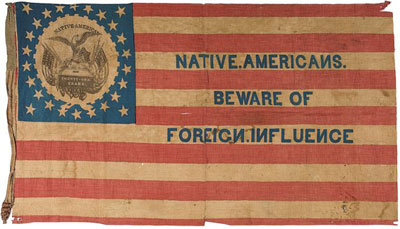
know-nothing_flag

Friends of Padre Steve’s World,

Today Donald Trump will likely bury his Republican competitors in Indiana nearly ensuring that he will win the GOP nomination, and in doing so he will have defied the logic of the GOP leadership by channeling the rage and anger against the status quo that they themselves have fomented over the past four decades. As he does this he will move on, and while some people assume that he will be swept away in November by the Democratic Party nominee, there is no guarantee of that, and those who are wise should not underestimate Trump, or the movement forming around him. The great American philosopher, Eric Hoffer once wrote, “Hatred is the most accessible and comprehensive of all the unifying agents. Mass movements can rise and spread without belief in a god, but never without a belief in a devil.”

Hatred is an amazing emotion. I have been almost overwhelmed by the amount of hatred being posted on social media, blogs, much of it by supposedly Christian preachers, politicians and pundits. Of course if you want find a politician, pundit and preacher all wrapped into one person look no further than Baptist preacher, conservative media pundit, and former Arkansas Governor Mike Huckabee, or the “anointed one” Ted Cruz. But these charlatans of the Christian right pale in comparison to Donald Trump in their ability satiate the desire for a savior of people who are angry and fearful, people that feel cheated, that they have lost their country or their status in it.

This is scary, as it possibly portends the end of our great experiment as a nation. For unlike love, hatred is easy to conjure up. It is kind of like what you need to build a fire; fuel, oxygen and heat. To generate hatred on a massive scale all you need is a disaffected populace, a convenient target, and an agent to ignite the mixture.

Shrewd politicians, preachers, and pundits do this well. Honestly, I think that most effective politician doing this today this is Donald Trump, a man who is lavishly rich, but connects with regular people by speaking their language, and channeling their anger. The situation is much like Germany in 1930 when became a true national party capitalizing on the frustration and anger of Germans at the flailing and failing Weimar Republic. Richard Evans wrote about that in his book “The Coming of the Third Reich.”

“Voters were not really looking for anything very concrete from the Nazi Party in 1930. They were, instead, protesting against the failure of the Weimar Republic. Many of them, too, particularly in rural areas, small towns, small workshops, culturally conservative families, older age groups, or the middle-class nationalist political milieu, may have been registering their alienation from the cultural and political modernity for which the Republic stood, despite the modern image which the Nazis projected in many respects. The vagueness of the Nazi programme, its symbolic mixture of old and new, its eclectic, often inconsistent character, to a large extent allowed people to read into it what they wanted to and edit out anything they might have found disturbing.” 

It does not matter to many of Trump’s followers that his policy propositions in terms of ending alliances, building walls around the border with Mexico paying the bill, massive deportations of people, trade wars to end the deficit, and total bans on travel to this country based on religion, are quite literally impossible. But as Hoffer noted Trump’s followers, like those of any frustrated group and marked by a “facility for make-believe, a readiness to hate, a readiness to imitate [and] credulity, a readiness to attempt the impossible.”

Mass movements, like the one that Trump is building before our very eyes, demonize the target group or population and then let the hatred of their disaffected followers flow. The leaders need that disaffected and angry base in order to rise to power; such was how Hitler, Stalin, and so many other despots gained power. They took advantage of a climate of fear, and found others to blame. For Hitler it was the Jews; while for Stalin it was various groups like the Ukrainians, or the Poles who were the devil to be feared and destroyed. Timothy Snyder in his book Bloodlands: Europe Between Hitler and Stalin wrote:

“Dead human beings provided retrospective arguments for the rectitude of policy. Hitler and Stalin thus shared a certain politics of tyranny: they brought about catastrophes, blamed the enemy of their choice, and then used the death of millions to make the case that their policies were necessary or desirable. Each of them had a transformative utopia, a group to be blamed when its realization proved impossible, and then a policy of mass murder that could be proclaimed as a kind of ersatz victory.”

Snyder is quite correct, demonizing a people and making them some kind of “other”, “they”, or “them”, is a wonderful way to blame a group of people for the ills of society. It is also a good way to deflect the blame for the corporate failures of societies and governments onto a convenient scapegoat; and to blame others for the personal failures and petty jealousies of the people doing the demonizing. It also allows people to abandon ethics and the simple notion of the Golden Rule an engage in genocide.

Mass movements and their leaders love to use this technique; especially when using it against those of other races or religions. The technique is not at all new, it has been used from antiquity but has become much more dangerous in the modern era with the spread of instant communications technology. History shows us all too clearly how it has happened and how easily it can happen again. Witch hunts, slavery and Jim Crow, the extermination of the Native Americans which inspired Hitler in his campaign of genocide and the Holocaust; the Soviet gulags and ethnic cleansing, the Rape of Nanking, the Chinese Communist “Cultural Revolution” the Rwandan genocide, Srebrenica, the Turkish genocide of the Armenians, and the current crimes against humanity of the so called Islamic State. Sadly, the list can go on and on.

All of these events simply required the elements of a disaffected population, a devil or scapegoat to blame, and a leader or leaders to ignite the volatile mixture; fuel, oxygen and heat. Hoffer was quite correct that “Mass movements can rise and spread without belief in a god, but never without a belief in a devil.” The really successful leaders of such movements understand this. For Hitler it was the Jews and other untermenschen; for American Southerners after the Civil it was the Blacks and their white supporters. For the American “Know Nothings” of the 1840s and 1850s it was immigrants, especially Irish and Germans who were Catholic; for Stalin it was non-Russian ethnic minorities. For the leaders of the Islamic State, it is Jews, Shi’ite Moslems, less than “faithful” Sunnis, Christians and well for that matter anyone who does not line up one hundred percent with them on every issue. The examples are so plentiful to support this fact that it is almost overwhelming.

The problem is that when any society, or government begins to label or stigmatize a race, religion, ethnicity, sexual preference, or political ideology, and then in the process demonize those people to the point that they become less than human we have reached a tipping point. Trump has been doing that for his entire campaign. We are very close to the point where we are just one crisis away from all of those crimes against humanity that we believe that we are no longer capable of doing.

But sadly, we human beings are not nearly as evolved as we think and I think that the tipping point in the United States may be far closer than we could ever imagine. In fact, Andrew Sullivan wrote today that “right now, American is a breeding ground for tyranny,” and that “Trump is not just a wacky politician of the far right, or a riveting television spectacle, or a Twitter phenom and bizarre working-class hero. He is not just another candidate to be parsed and analyzed by TV pundits in the same breath as all the others. In terms of our liberal democracy and constitutional order, Trump is an extinction-level event. It’s long past time we started treating him as such.”

I really do not think that we are too far from some tipping point where the politicians, pundits and preachers; especially those of the political right and the media whores who are more concerned about market share than truth, decide that their “devils” must be exterminated and Trump, is the man to make this happen. Of course when he does, his supporters will claim a higher moral, religious, or racial, purpose; or perhaps use the language of Manifest Destiny, the Lost Cause, or the Stab in the Back or some other historical myth that suffices to justify their actions.

As I have said before, Trump’s GOP and potential Democratic opponents would be wise not to underestimate Trump and maybe even form common cause to stop him before it is too late. If they do not the tipping point will have been reached and we will move on into real tyranny.

In the Star Trek the Next Generation episode entitled The Drumhead Captain Picard has to warn his security officer, Lieutenant Worf about the dangers of rampant paranoia. Worf starts: “Sir, the Federation does have enemies. We must seek them out.”
 

Picard pauses and then notes:

“Oh, yes. That’s how it starts. But the road from legitimate suspicion to rampant paranoia is very much shorter than we think. Something is wrong here, Mister Worf. I don’t like what we have become.”

To claim Picard’s words for myself, I have to admit that I don’t like what we have become either.

Peace

Padre Steve+

4 Comments

Filed under leadership, News and current events, Political Commentary

Read or Perish

CW-GettysburgDead

Friends of Padre Steve’s World

Just a short note today as I continue to read, reflect and do some research and writing on my Civil War and Gettysburg Staff Ride text, even as I get ready to lead another staff ride to Gettysburg this weekend.

Those that follow me and read my articles on this site on a regular basis know that I am a voracious reader, especially when it comes to history and biography. Frankly, I am amazed about all that we can learn just from the accounts of those that have already made the same mistakes that we are intent on making, because ultimately, there is nothing new under the sun. The fact that so many supposed strategists, thinkers, and policy makers are too ignorant to remember the past, ensures that the same mistakes will be made over and over again with more and more bodies filling the body bags of hubris.

I have been adding books that I have read over the past few months to my “read” list on my Facebook page, and there were a lot more than I remembered as I worked my way through my stack. If you add things to your Facebook page, movies, books, music or television shows, Facebook will provide lists of suggested titles that you can browse. This of course includes books, and not surprisingly to me, most of the books that were suggested were various forms of fiction or children’s books. There were a few literature classics among the suggestions and a host of Bible books. What I noticed was there were few books on history, philosophy, political science, world affairs or even theology listed.

I was troubled by this; not because I am against people reading fiction or children’s book by any means, but typically those books, with the exception of some of the children’s books are for entertainment, not learning. As entertainment they are fine, but since almost everything else in our culture is geared toward entertainment I wonder where people are being challenged to think critically, and not simply be sponges for the sound bites offered by the politicians, preachers and pundits who dominate so much of our airwaves and the internet.

Barbara Tuchman wrote, “Books are the carriers of civilization. Without books, history is silent, literature dumb, science crippled, thought and speculation at a standstill. Without books, the development of civilization would have been impossible. They are engines of change (as the poet said), windows on the world and lighthouses erected in the sea of time. They are companions, teachers, magicians, bankers of the treasures of the mind. Books are humanity in print.”

Sadly, many people in this country and around the world are sadly deficient in knowing any history at all, and much of what they do know is based on myth. This is dangerous, historian George Santayana wrote, “Those who cannot remember the past are condemned to repeat it.” But I think that Howard Zinn said it the best:

“History can come in handy. If you were born yesterday, with no knowledge of the past, you might easily accept whatever the government tells you. But knowing a bit of history–while it would not absolutely prove the government was lying in a given instance–might make you skeptical, lead you to ask questions, make it more likely that you would find out the truth.”

Have a great night,

Peace

Padre Steve+

2 Comments

Filed under History, leadership, philosophy

The Truth is Rarely Pure & Never Simple

MenBrooklyn

Friends of Padre Steve’s World,

The past few days I have posted short articles about some very personal things dealing with life and relationships. In a sense that continues today as I prepare for another “Staff Ride” with my students to Gettysburg. This trip will be interesting because over half of the students attending the staff ride will be officers from South Korea. Over the past couple of weeks I have been working on major revisions and additions to another chapter of my Gettysburg text and I hope to share that before the coming week is out.

I have a passion for truth, especially in the realm of historical thought, in fact over the past few years this passion has deepened to a level of profoundness that I never dreamed. In fact for me this passion has become a duty, a duty to truth; an un-sanitized, warts and all examination of subjects attempting to strip away the veneer of myth in order to find truth. This is not easy, but it is what my life has become, knowing that in the long run I will not discover all truth, but hopefully point others to examine history, the sciences, philosophy and even theology to find truth. The process can be uncomfortable, especially when confronted by facts, documents, scientific and archeological data which shows what we used to think was truth, as either incomplete, romantic myth, or even complete lies, untruths and fabrication. Oscar Wilde once wrote,“The truth is rarely pure and never simple.”

Barbara Tuchman once wrote: “The reality of a question is inevitably more complicated than we would like to suppose.” That is the nature of truth. It does not matter if it is truth about history, biography, philosophy and religion, science, politics, economics or any part of life. To actively seek truth means that one must open up themselves to the possibility of doubting, as Rene Descartes wrote: “If you would be a real seeker after truth, it is necessary that at least once in your life you doubt, as far as possible, all things.” I admit that this is not comfortable, but it is necessary.

As a historian I have a tremendous passion for truth, and for unsanitized history and for me this means looking at what we know with a critical eye, to compare and examine sources to question what we or others knew before. Far too often what we believe about our own history is often more preserving myth more than by asking hard questions and applying reasoned critical study. To do this is dangerous, because to do so we have to admit that what we know today could be proven wrong at some time in the future when new facts, documents, archeological finds or other historical or scientific are discovered. To those content with half-truth, partial truth or even myth this is disconcerting, and those of us who attempt to unravel myth from fact and present things in a new way are called “revisionists” as if that is somehow a bad thing. The sad thing is we are having to revise in many cases, supposed history that was revised by people who needed to propagate myth, such as with those who promoted the myth of the Lost Cause, the romantic, noble Confederacy which for well over a half century was propagated as historical truth. This myth was sold to the American public in such in film, television and books, fiction and non-fiction alike, to the point that much of white America, even outside the South accepted the myth of the Lost Cause as truth. Films like Birth of a Nation, Gone with the Wind and even Disney’s Song of the South, helped ingrain the myth as truth, and even today when so much more is known, many people hold on to the myth and attack those who differ.

A lot of my readers may wonder why I write so much about the American Civil War as well as the ante-bellum and Reconstruction eras of American history. For me they are very important for a couple of reasons; first they are eras, that for good and bad define us as a nation and people. Second, they still have relevance to what happens today, especially in the understanding of liberty, civil rights and race relations.

I have a passion for this. The American Civil War and the Battle of Gettysburg are intrinsic parts of who we are as Americans today. The events of that war and this battle continue to reverberate in many aspects of our political, social and national life. Thus for me teaching about this event and what happened on the “hallowed ground” of Gettysburg, as Abraham Lincoln called it, and even 150 years later it matters far more than most of us realize.

Civil War hero Joshua Chamberlain is an icon of the Civil War and American history. A professor of Rhetoric and Natural and Revealed Religions at Bowdoin College he volunteered to serve with the 20th Maine Infantry, his military career in the Civil War has been depicted in movies such as Gettysburg and Gods and Generals and written about in biographies and even historical fiction. Chamberlain was one of the heroes of Gettysburg, and his story has a myth like quality, but he too was a complex, contradictory and sometimes flawed character. However, Chamberlain attached a great importance to passing down the stories of people who did noble deeds and who lived exemplary lives. He wrote, “The power of noble deeds is to be preserved and passed on to the future.”

I sincerely believe what Chamberlain said and I am getting ready to lead another Staff Ride for students from our Staff College to Gettysburg this week. I do beleive that the power of noble deeds needs to be preserved and passed on to the future. Even the deeds of less than perfect, often contradictory and sometimes even scandalous individuals. That is part of the task of the historian. I do this in what I teach and what I write, both in the academic setting as well as on this website.

We live in a time of great cynicism, some of which I can understand. We also live in a time where many people and our institutions operate in a “zero defect” culture, those who fail in any way are shunted aside, punished or even chastised or ostracized. However, when I look at the men who fought at Gettysburg, or for that matter almost any individual who has accomplished great things, none are perfect people and many have great flaws in character, or supported causes or ideologies that were evil. That being said, even less than perfect people can rise to do great deeds, deeds that need to be remembered, passed down and told to succeeding generations.

Many great leaders, or other men and women that we consider today to be great, influential or important were or are quite fallible. Even those who did great things often made gross mistakes, had great flaws in their character, and some lived scandalous lives. Such deeds may tarnish their legacy or take some of the luster away from their accomplishments. But I think that these flaws are often as important as their successes for they demonstrate the amazing capacity of imperfect people to accomplish great things, as well as the incredible complexity of who we are as people. No one is perfect. There are degrees of goodness and even evil in all of us. It is part of the human condition. That is the beauty of un-sanitized history, that is the beauty of stripping away myth to discover the humanity of people, and to recognize who they are, who we are, the good, the bad and even the ugly.

When I look at the perfection that imperfect people expect of others I am reminded of something that William Tecumseh Sherman said about his relationship with Ulysses Grant. These were flawed men, but they were in large part responsible for the Union victory in the Civil War. However, to be honest, neither man would never reach the level of command that they rose to in our current military culture, nor would they rise to the top in corporate America. They are too flawed. Sherman said it well, “Grant stood by me when I was crazy, and I stood by him when he was drunk, and now we stand by each other.”

That is a part of my passion about Gettysburg and my appreciation and admiration of the brave men who fought in that battle. As I continue to write about that battle and about those men I hope that my readers will gain a new appreciation of their complex and contradictory natures, as well as think about what that means to us today, as individuals and as a society, for it is only when we strip away the myth and seek the truth. Marcus Aurelius wrote:

“If someone is able to show me that what I think or do is not right, I will happily change, for I seek the truth, by which no one was ever truly harmed. It is the person who continues in his self-deception and ignorance who is harmed.”

Those truths can be scientific, they can be historical or literary, and quite often the truth can also be quite personal.

As John F Kennedy said at Yale in 1962: “The great enemy of truth is very often not the lie–deliberate, contrived and dishonest–but the myth–persistent, persuasive and unrealistic. Too often we hold fast to the cliches of our forebears. We subject all facts to a prefabricated set of interpretations. We enjoy the comfort of opinion without the discomfort of thought.”

So until tomorrow, have a thoughtful night.

Peace

Padre Steve+

Leave a comment

Filed under civil rights, civil war, History, leadership, Military

Why Can’t We Be Friends?

Friends of Padre Steve’s World,

It is a good day. I have spent the last couple of days talking about life kinds of things and continue that trend by sharing a few thoughts about friendship, politics, and religion.

I have read a number of articles recently that addressed the growing political divide in the country and one of the commonly cited factors are that a growing number of Americans now pick their friends based on politics, religion, and ideology. That reminded me of Thomas Jefferson who once noted, “I never considered a difference of opinion in politics, in religion, in philosophy, as cause for withdrawing from a friend.”

Sadly, I have lost friends for these very reasons and every one of them saddened me. In most cases I was not the one that broke off the friendship. Now there have been a couple of times where the relationship had grown so toxic that I had to break it off to in order not end up in the position of hating the person, and to protect myself. But those cases have been few and far between. I think that I can count them on one hand.

I have friends that span the political, ideological, religious, ethnic and racial, and even sexual orientation spectrum. Hell, I even count Los Angeles Dodger’s and New York Yankee’s fans among my friends, and that coming from a diehard San Francisco Giant and Baltimore Orioles fan is truly exceptional.

I guess that most of why I am like this is because I loved the diversity that I experienced at Edison High School in Stockton, California, which I went to because of court-ordered desegregation, and close to thirty-five years of military service. In both cases I got to experience the friendship, in many cases lifelong friendships with people whose experience, culture, and backgrounds were very different from mine. This has enriched me as a human being. 

Today, my closest friends are those that I hang out at my local Gordon Biersch Brewery bar, and the local ballpark. They span the spectrum from the most liberal and progressive Bernie supporters to most devoted supporters of Donald Trump, not to mention mainline liberals and conservatives, Libertarians, Greens, as well as Social Conservatives and members of the Christian Right.

The same is true of my social media, both Facebook and Twitter. I do not have to agree with someone to respect them, care about them, and be a friend. I personally don’t understand how anyone can only hang out with people that are like them, frankly that to me sounds boring. I don’t mind exchanging ideas with friends, but I do get put off by ideologues of all beliefs who care nothing for anything but their agenda. I am not adverse to people having strong beliefs, but to impose them as a condition of friendship is beyond me.

My friends know my beliefs. They know that I am liberal, and a proponent of expanding civil rights, and against any law that is written expressly to deny the rights of others purely for the sake of religion. But that being said I don’t need to impose them as a condition of friendship. I gain so much by the multitude of people that are my friends, their real diversity in all things. I cannot imagine doing anything to intentionally lose any of their friendship this political season.

It’s just my opinion, but I think that we would all be better off to try to do the same this year and build bridges. I think instead of condemning people we don’t know just because they are different that we should take the time to get to know them and become friends that we could actually work together, solve our problems, and heal our wounds. 

But then maybe I am too much of a relic of the 1960’s and 1970’s. Maybe, to use the immortal words of John Lennon “I’m just a dreamer, but I’m not the only one. I hope one day you’ll join us, and the world will live as one.” 

So anyway, have a great weekend.

Peace

Padre Steve+


1 Comment

Filed under News and current events, philosophy, Political Commentary

Past as Prologue 


Friends of Padre Steve’s World,

I am amazed a how good life can be even in the one experiences events that in one’s professional life could be devastating. I mean really, in our culture, even in the supposedly “spiritual” realm of faith, church, and religion; success and prosperity are the golden calf that many people believe is the key to happiness. Hell, massive ministries like that of “Lakewood Joel” Osteen, make massive amounts of money off of the tithes and offerings of well meaning people who buy into their “prosperity gospel” message. In fact that message is little different than greedy pyramid marketing schemes, but I digress…

I cannot believe how good I am doing after not being selected for Captain in the Navy Chaplain Corps. I wrote about that yesterday, but I think that I need to follow that up after doing some reflecting on life; the kind words, memories, and well wishes of friends from around the world, and my experiences with people yesterday, including other friends who were passed over on this promotion board, or in past years. 

Many of those thoughts came from people who I was their chaplain or happened to be there for them, and sometimes they remembered things that I had either forgotten, or that I had no knowledge of the impact that something that I said or did had on their life. That my friends is wonderful, and as I went through all of those kind words, thoughts and expressions of friendship I was both humbled and blessed. Apart from reading the comments of friends I pretty much disconnected myself from most of social media in order to clear my mind. 

As a result I have spent much of the past couple of days recalling the past and the many people who have helped make me what I am today and who in some way contributed to the success I have had, while pondering the still unwritten future. All of that has reminded me of the words of William Shakespeare, who wrote, “What’s past is prologue.” Those words are true, at least for me. All of my past, all of that tapestry of often disconcordent threads, is but prologue to what remains ahead of me. Orson Scott Card wrote, “The future is a hundred thousand threads, but the past is a fabric that can never be removed.”  

Frankly, that excites me, as a human being, as well as a Christian. I guess the fact that I was not selected for promotion has put that yet unwritten and unwoven future into proper perspective. I guess that experience has helped re-energize me and motivate me to move forward into that future. 

So until tomorrow,

Peace,

Padre Steve+

Leave a comment

Filed under christian life, faith, ministry, philosophy

Success & Happiness


Friends of Padre Steve’s World,

W.P. Kinsella, who wrote the novel Shoeless Joe which became the classic film, Field of Dreams wrote, “Success is getting what you want, happiness is wanting what you get.” 

Yesterday was  an interesting day, a day about winning, losing and finding happiness even when the system says that you should be disappointed. I found out today on Facebook of all places that I was not selected for promotion to Captain in the Navy Chaplain Corps. I think about five years ago I would have been disappointed, maybe even crushed; but today I’m not. I’m actually thankful. I was afraid that promotion might mean more separation from Judy, as the last time I was promoted I was yanked out of my assignment and given what were basically no-notice, take them or leave them orders that entailed a family separation. That was difficult on both of us, the tour was good, but career progression wise it did nothing for me as a back-to-back tour in Navy Medicine. Followed by my current tour teaching at the Joint Forces Staff College, I knew that having no operational assignments in the past seven years that I would most likely not make Captain. So I began to re-prioritize my life. Family, friends, and stability matter more than another promotion. 

I have been successful and I am happy. I have served over thirty-five years in the military evenly split between the Army and Navy. I left the Army Reserve as a Major in 1999 and went back on active duty in the Navy, taking a reduction in rank to do so. I have been blessed to serve all over the world, including tours in Europe, the Far East and combat the Middle East. When I retire at the end of my last tour I will have spent nearly thirty-nine years serving this country, and to me, finishing well matters and helping young men and women succeed is more important than getting promoted. 

Judy is relieved, as this means stability for my last years in the Navy, and for that I am happy. Right now I get to teach, research and write. My last assignment will be managing a chapel program and hopefully being able to continue teaching. No matter what I will continue writing and doing research.

I can live with that as the rest of my life is not defined by making Captain. Sadly I have known quite a few people who end up bitter because they didn’t get promoted, some with good reason, and likewise I have known some people that when they reach high rank or high office are consumed by a lust for power and control. When it happens to ministers, as it does all too often, and not just in the military; it is tragic. They often not only destroy themselves, but those around them; their families, their subordinates, and those that depend on them for spiritual care. 

I called to congratulate a good friend who was selected for promotion on this board after being passed over for promotion before. His attitude was much like mine, he knows that the promotion will also bring added burdens, as his wife is very sick, and has been chronically ill for years. I am happy for him as well as some others that I know who were selected. At the same time, as much as it would have been something to be proud of, I am glad that I was not promoted, it was a relief. Judy has gone through too much in supporting my career. 

I received so many wonderful thoughts from friends last night, and that was a blessing. I have no cause for bitterness or to think that I was cheated, the fact it that not everyone gets promoted, and my career has been amazing and I still get to serve for a while longer. Not everybody gets that. As Lou Gerhig said; “today I consider myself the luckiest man on the face of the earth.” 

I was going to write about the results of yesterday’s primararies, but what can I really say that a thousand other pundits haven’t all ready said, except maybe; know when to drop out. 

Have a great day. 

Peace

Padre Steve+

6 Comments

Filed under Military, philosophy, US Navy

Midweek Musings


Friends of Padre Steve’s World,

Dean Koonz wrote, “Never leave a friend behind. Friends are all we have to get us through this life – and they are the only thinks in the world that could hope to see in the next.” 

I was on the road much of the last two days in order to attend a memorial for one of my friends in Emerald Isle North Carolina. I lived there for three years on an unaccompanied assignment at Camp LeJeuene, and a number of really good people there took me in and became my home away from home community. I got to know them at bar the one of the local restaurants, a place called Rucker John’s. It was like my Carolina version of what I have hear in Virginia, a place like Cheers, where everybody knows your name. 

Last year a couple of the guys, Dave, or as we called him “Judge Ito” because he looked just like the real Judge Ito, and Walt, a retired history professor passed away. I wasn’t able to get down for those memorial, both were sudden. However, I was able to get down to be with my friends as we remembered “New York Mike.” Mike was a retiree who had come south for his health and had lived on the island over 20 years. He was one of the people that invited me into their lives, poker games at his condo, get together soon on the beach, times at the bar. 

For me that was a hard tour because I was in some of the hardest and deepest struggles with PTSD. But Mike, Judge Ito, Walt, and others including our other Mike, Eddie, Phyllis, Wild Bill, Santa Claus Niel, Bill, and others helped hold me together. I think that is one of the most important things, having people that care about you. 

So this was a special time, to be back with those friends remembering New York Mike. About 25 people showed up as Mike’s kids who live in New York had his services up there. What we did was to remember aa friend at a place where all of us hung out. We were the 4 O’clock Club, and Mike was one of the founding members over 20 years ago. 

At 5 we all raised a glass and toasted his memory. My friends ask me as “Father Steve” to offer a prayer, and we shared stories about Mike. It was really touching. A place was set for Mike, a glass filled with his favorite Merlot at an empty seat. At the end of that we released a bunch of balloons onto the crystal clear blue skies. It was nice, and I think that it was good for all of us. 

Anyone, a lot going on in politics but I’ll wait until tomorrow to write about those thoughts, as well as getting back to write some more history, as well as a could articles on lighter topics, I’m thinking doing something with some of my favorite story songs from the 70’s and 80’s. 

Have a great day,

Peace,

Padre Steve+

Leave a comment

Filed under remembering friends

What is Freedom ? The 14th Amendment

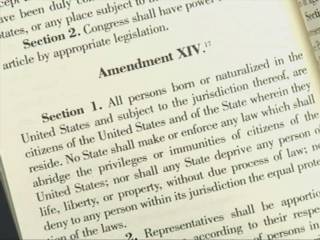
14-amendment

Friends of Padre Steve’s World,

I am going to be traveling today for a get together tonight celebrating the life of one of my friends in North Carolina. The man who passed away, “New York Mike” was one of the people who brought me into their lives in Emerald Isle when I was stationed away from my wife, and still dealing with terrible depression and other symptoms of PTSD. Mike was great, and he will be missed. When one of my other friends let me know, I was stunned. At the same time I am glad that he was a part of my life, and that he will not suffer anymore. It is good to have friends who care, and I am blessed to have many.

So today I am basically re-running an older post about the 14th Amendment from my Civil War text.

Have a great day and please be safe.

Peace

Padre Steve+

The situation for newly emancipated blacks in the South continued to deteriorate as the governors appointed by President Johnson supervised elections, which elected new governors, and all-white legislatures composed chiefly of former Confederate leaders. Freedom may have been achieved, but the question as to what it meant was still to be decided, “What is freedom?” James A. Garfield later asked. “Is it the bare privilege of not being chained?… If this is all, then freedom is a bitter mockery, a cruel delusion.” [1] The attitude of the newly elected legislatures and the new governors toward emancipated blacks was shown by Mississippi’s new governor, Benjamin G. Humphreys, a former Confederate general who was pardoned by Andrew Johnson in order to take office. In his message to the legislature Humphreys declared:

“Under the pressure of federal bayonets, urged on by the misdirected sympathies of the world, the people of Mississippi have abolished the institution of slavery. The Negro is free, whether we like it or not; we must realize that fact now and forever. To be free does not make him a citizen, or entitle him to social or political equality with the white man.”  [2]

Johnson’s continued defiance of Congress alienated him from the Republican majority who passed legislation over Johnson’s veto to give black men the right to vote and hold office, and to overturn the white only elections which had propelled so many ex-Confederates into political power. Over Johnson’s opposition Congress took power over Reconstruction and “Constitutional amendments were passed, the laws for racial equality were passed, and the black man began to vote and to hold office.” [3] Congress passed measures in 1867 that mandated that the new constitutions written in the South provide for “universal suffrage and for the temporary political disqualification of many ex-Confederates.” [4]  As such many of the men elected to office in 1865 were removed from power, including Governor Humphreys who was deposed in 1868.

These measures helped elect bi-racial legislatures in the South, which for the first time enacted a series of progressive reforms including the creation of public schools. “The creation of tax-supported public school systems in every state of the South stood as one of Reconstruction’s most enduring accomplishments.” [5] By 1875 approximately half of all children in the South, white and black were in school. While the public schools were usually segregated and higher education in tradition White colleges was restricted, the thirst for education became a hallmark of free African Americans across the county. In response to discrimination black colleges and universities opened the doors of higher education to many blacks.  Sadly, the White Democrat majorities that came to power in Southern states after Reconstruction rapidly defunded the public primary school systems that were created during Reconstruction.  Within a few years spending for on public education for white as well black children dropped to abysmal levels, especially for African American children, an imbalance made even worse by the Supreme Court’s ruling in Plessy v. Ferguson which codified the separate but equal systems.

They also ratified the Thirteenth and the Fourteenth Amendments, but these governments, composed of Southern Unionists, Northern Republicans and newly freed blacks were “elicited scorn from the former Confederates and from the South’s political class in general.” [6] Seen as an alien presence by most Southerners the Republican governments in the South faced political as well as violent opposition from defiant Southerners.

The Fourteenth Amendment was of particular importance for it overturned the Dred Scott decision, which had denied citizenship to blacks. Johnson opposed the amendment and worked against its passage by campaigning for men who would oppose it in the 1866 elections. His efforts earned him the opposition of former supporters including the influential New York Herald declared that Johnson “forgets that we have passed through a fiery ordeal of a mighty revolution, and the pre-existing order of things is gone and can return no more.” [7]

Johnson signed the Amendment but never recanted his views on the inferiority of non-white races. In his final message to Congress he wrote that even “if a state constitution gave Negroes the right to vote, “it is well-known that a large portion of the electorate in all the States, if not a majority of them, do not believe in or accept the political equality of Indians, Mongolians, or Negroes with the race to which they belong.” [8]

When passed by Congress the amendment was a watershed that would set Constitutional precedent for future laws. These would include giving both women and Native Americans women the right to vote. It would also be used by the Supreme Court in the 1954 Brown v. Board of Education decision that ended the use of “separate but equal” and overturned many other Jim Crow laws. It helped lead to the passage of the Voting Rights Act of 1964 and the Civil Rights Act of 1965, and most recently was the basis of the Supreme Court decision in Obergfell v. Hodges, which give homosexuals the right to marry. Section one of the amendment read:

“All persons born or naturalized in the United States, and subject to the jurisdiction thereof, are citizens of the United States and of the state wherein they reside. No state shall make or enforce any law which shall abridge the privileges or immunities of citizens of the United States; nor shall any state deprive any person of life, liberty, or property, without due process of law; nor deny to any person within its jurisdiction the equal protection of the laws.” [9]

Even so, for most white Southerners “freedom for African Americans was not the same as freedom for whites, as while whites might grant the black man freedom, they had no intention of allowing him the same legal rights as white men.” [10] As soon as planters returned to their lands they “sought to impose on blacks their definition of freedom. In contrast to African Americans’ understanding of freedom as a open ended ideal based on equality and autonomy, white southerners clung to the antebellum view that freedom meant mastery and hierarchy; it was a privilege, not a universal right, a judicial status, not a promise of equality.”  [11] In their systematic efforts to deny true freedom for African Americans these Southerners ensured that blacks would remain a lesser order of citizen, enduring poverty, discrimination, segregation and disenfranchisement for the next century.

Notes

[1] Ibid. Foner A Short History of Reconstruction p.30

[2] Ibid. Lord The Past that Would Not Die pp.11-12

[3] Ibid. Zinn The Other Civil War p.54

[4] Ibid. McPherson The War that Forged a Nation p. 178

[5] Ibid. Foner Forever Free p.162

[6] Perman, Michael Illegitimacy and Insurgency in the Reconstructed South in The Civil War and Reconstruction Documents and Essays Third Edition edited by Michael Perman and Amy Murrell Taylor Wadsworth Cengage Learning Boston MA 2011 p.451

[7] Ibid. Foner Forever Free p.121

[8] Ibid. Langguth After Lincoln p.232

[9] _____________ The 14th Amendment to the U.S. Constitution retrieved from https://www.law.cornell.edu/constitution/amendmentxiv 29 June 2015

[10] Ibid. Carpenter Sword and Olive Branch p.93

[11] Ibid. Foner Forever Free p.92

1 Comment

Filed under civil rights, civil war, History, laws and legislation, Political Commentary