Author Archives: padresteve

padresteve's avatar

About padresteve

I'm a Navy Chaplain and Old Catholic Priest

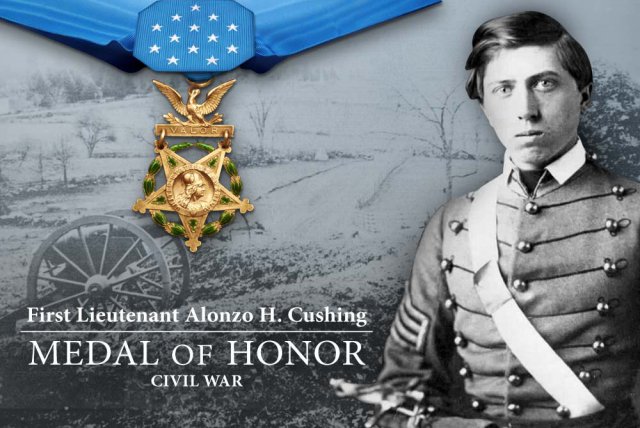
The Last Full Measure: 1LT Alonzo Cushing awarded Medal of Honor

92681186b29b70439321935b2ab79a62

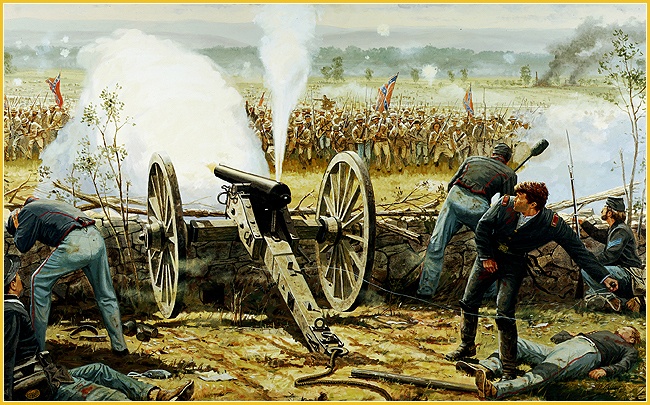
Cushing at the Angle: Dale Gallon

“No. I stay right here and fight it out or die in the attempt.” First Lieutenant Alonzo Cushing

I have a framed print of the picture above by artist Dale Gallon, of Lieutenant Alonzo Cushing in my office. 151 years ago First Lieutenant Alonzo Cushing, United States Army was a 22 year old combat veteran.  Just a few hours after he emplaced his battery, Battery A, 4th US Artillery behind a stone wall at the center of Cemetery Ridge on the night of July 2nd 1863, the name of this obscure Lieutenant would be etched in the history of his country.

Cushing was part of a family of young men from Wisconsin who stood tall and served during the Civil War. His brothers William Cushing, was a Navy Lieutenant, who launched a daring raid to sink a powerful Confederate ironclad, the CSS Albemarle on October 27th 1864 and Howard Cushing who volunteered and was commissioned after Alonzo’s death becoming a distinguished soldier and Indian fighter after the war. Howard was so effective at fighting the Apache that the legendary Apache Chief, Cochise, put a bounty on his head, and Howard was killed in action fighting them in 1871. William died after the war having been promoted to the rank of commander. Several ships were named after him; the USS Cushing Torpedo Boat 1 (TB1) USS Cushing DD 55, USS Cushing DD 376 which sacrificed herself fighting at point blank range against the Japanese Battleship Hiei at the Naval Battle of Guadalcanal, USS Cushing DD 797 a Fletcher Class Destroyer, and USS Cushing DD 985 a Spruance Class destroyer.

a-ALONZO-CUSHING-768x504

Alonzo Cushing graduated from the United States Military Academy in 1861 and without ceremony reported for duty as an artillery officer in the Army of the Potomac. At Gettysburg the young Cushing commanded Battery A, 4th United States Field Artillery, which though part of the Artillery Reserve was attached to the Union II Corps and deployed in the center of the Union line at a place now known as “the Angle.” During the Confederate artillery barrage Cushing was twice wounded, in the groin and shoulder. Cushing, seeing the mass of Confederate infantry advancing on his position refused to go to the rear and told one of his sergeants who attempted to have him leave the field and seek treatment for his wounds “No. I stay right here and fight it out or die in the attempt.” 

Since I lead a staff ride to Gettysburg about once a quarter, and because the site of Cushing sacrifice is at one of the most important stops of the staff ride, I have come to know and appreciate Alonzo Cushing, as well as his famous Navy brother William, and nearly forgotten elder brother Howard, the Indian fighter.

Today, November 6th 2014, 151 years after Cushing’s death fighting off the remnants of Major General George Pickett’s division, Cushing was awarded the Medal of Honor.

The citation reads:

First Lieutenant Alonzo H. Cushing distinguished himself by acts of bravery above and beyond the call of duty while serving as an artillery commander in Battery A, 4th U.S. Artillery, Army of the Potomac at Gettysburg, Pennsylvania on July 3rd, 1863 during the American Civil War.  

That morning, Confederate forces led by General Robert E. Lee began cannonading First Lieutenant Cushing’s position on Cemetery Ridge.  Using field glasses, First Lieutenant Cushing directed fire for his own artillery battery.  He refused to leave the battlefield after being struck in the shoulder by a shell fragment.  As he continued to direct fire, he was struck again — this time suffering grievous damage to his abdomen.

Still refusing to abandon his command, he boldly stood tall in the face of Major General George E. Pickett’s charge and continued to direct devastating fire into oncoming forces.  As the Confederate forces closed in, First Lieutenant Cushing was struck in the mouth by an enemy bullet and fell dead beside his gun.

His gallant stand and fearless leadership inflicted severe casualties upon Confederate forces and opened wide gaps in their lines, directly impacting the Union force’s ability to repel Pickett’s charge.  First Lieutenant Cushing’s extraordinary heroism and selflessness above and beyond the call of duty at the cost of his own life are in keeping with the highest traditions of military service and reflect great credit upon himself, Battery A, 4th U.S. Artillery, Army of the Potomac, and the United States Army.

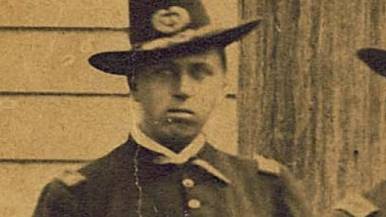
Civil-War-Soldier-Lt.-Alonzo-H.-Cushing

President Obama remarked honored Cushing today and reminded all of us about what such dedication, courage, commitment and sacrifice mean. No matter what one’s political point of view, his comments are sincere and poignant :

“Yet this medal is about more than one soldier or one family.  It reflects our obligations as a country to the men and women in our armed services — obligations that continue long after they return home, after they’ve removed their uniforms, and even — perhaps especially — after they’ve laid down their lives.  And so this medal is a reminder that no matter how long it takes, it is never too late to do the right thing. 

Alonzo, or “Lon,” Cushing was raised by his widowed mother in Fredonia, NY with his siblings, including three brothers who also fought for the Union.  As the congressman who recommended Lon to West Point wrote, “His mother is poor, but highly committed and her son will do honor to the position.”  After graduating from West Point, Lon was assigned to Battery A, 4th United States Artillery.  From Bull Run to Antietam, from Chancellorsville to Fredericksburg, Lon fought bravely and developed a reputation for his cool, his competence, and his courage under fire.

But it was at Gettysburg, what one newspaper later called “emphatically a soldiers’ battle,” where Lon would be immortalized.  It was July 3rd, 1863, the final day of a grueling three-day fight.  Lon commanded his battery along the wall on Cemetery Ridge, fending off punishing fire from General Lee’s Confederate troops in advance of what we now know as Pickett’s Charge.  In the chaos and smoke, Lon and his men could barely see ahead of them.  One colonel later described the “terrible grandeur of that rain of missiles and that chaos of strange and terror-spreading sounds.”

Lon was hit and badly wounded.  His first sergeant — a soldier by the name of Frederick Fuger — urged him to go to the rear.  But Lon refused and said he’d “fight it out, or die in the attempt.”  Bleeding and weak, he moved his remaining guns closer to the front.  Over 10,000 Confederate infantrymen advanced, elbow to elbow, in rows over a mile wide.  Peering through field glasses, Lon ordered his men to continue firing at the advancing columns.  He used his own thumb to stop his gun’s vent, burning his fingers to the bone.  When he was hit the final time, as a poet later wrote, “His gun spoke out for him once more before he fell to the ground.”  And Alonzo Cushing was just 22 years old.

In a letter to Lon’s sister, Fuger wrote that the bravery of their men that day “was entirely due to your brother’s training and example set on numerous battlefields.”  Etched on Lon’s tombstone at West Point is the simple epitaph, “Faithful unto death.” 

Today there are many young men and women who serve this country in the spirit of Alonzo Cushing and his brothers in very uniformed branch of the Armed services. As we approach Veterans’s Day it is right that wee do not forget them. In the ceremony where Alonzo Cushing was presented his nation’s highest award for heroism, may none of us forget that freedom is not free, and that the ideology, motivation and spirit of the leaders of the Confederacy who Cushing gave his life to defeat are still working to destroy what Abraham Lincoln called The New Birth of Freedom and which President Obama so correctly noted:

And here today, we know that Lon and the others who fell that day could not — we know — we know what they could not — that Gettysburg was a turning point in the Civil War.  It’s also proof, if any was needed, that it was thousands of unknown young soldiers, committing unsung acts of heroism, who saved our union, and freed a people, and reaffirmed our nation as “one Nation, under God, indivisible, with Liberty and Justice for all.”  I’m mindful that I might not be standing here today, as President, had it not been for the ultimate sacrifices of those courageous Americans.

Today we honor just one of those men, Lieutenant Alonzo Cushing, who, as Lincoln said, gave their “last full measure of devotion.”  His story is part of our larger American story — one that continues today.  The spirit, the courage, the determination that he demonstrated lives on in our brave men and women in uniform who this very day are serving and making sure that they are defending the freedoms that Alonzo helped to preserve.  And it’s incumbent on all of us as Americans to uphold the values that they fight for, and to continue to honor their service long after they leave the battlefield — for decades, even centuries to come.

Last weekend, I met another Medal of Honor Winner, Colonel Walter Marm, US Army Retired, who at while serving as a 1st Lieutenant and company commander at the Battle of the Ia Drang valley in November 1965, won the Medal of Honor, in a battle now immortalized in the movie We Were Soldiers.

As you go to bed tonight and who do whatever you do this Veterans’ Day, do not forget the sacrifices of those who through their sacrifice and service continue to bring about the new birth of freedom that Abraham Lincoln referred in the Gettysburg Address. 

Peace,

Padre Steve+

Leave a comment

Filed under civil war, History, leadership, Military

What Does it Mean? Will Rogers, Padre Steve & Election 2014

blm141101

“The trouble with practical jokes is that very often they get elected.” Will Rogers

Last night in battle of the witless, funded by the soulless, and empowered by the clueless the American electorate finally finished the 2014 warm up for the 2016 bloodletting known as the 2016 General election. Why they call it that I don’t know, we haven’t had a general as President since Eisenhower, but I digress…

What does it all mean? Actually I don’t know, I have some ideas but there is one thing I know, it means nothing because people do not change, especially the Trinity of Evil, the politicians, pundits and preachers that work overtime to get power and maintain it for power’s sake so they can use the police power of government to enforce their will by restricting the liberties of those who do not share their views.

But this is a far deeper question than we would want to contemplate. The problem in American life and politics is that we lack any kind of historical perspective, not only about the world, but our own history and that extends across the ideological spectrum of the country, that is why over eighty years ago Rogers noted “The short memories of the American voters is what keeps our politicians in office” and why he noted “The problem ain’t what people know. It’s what people know that ain’t so that’s the problem.” Ignorance is bliss and my God there is a lot of bliss out there today…

pb141015

That my friends is why no matter what party they represent we too often elect the worst examples of the human species into office; many times in the case of congressmen, for decades, or until the cows come home. Since cows like to stay out late, play cards, and drink that can be a very long time.

But we as American voters elect them and we collectively are idiots for doing so.

My God, in what civilized country could a man like the disgraced, court-martialed, convicted criminal, serial liar and Talibanesque religious fanatic like Gordon Klingenschmitt win a State Senate office in Colorado with over 70 percent of the vote? But assured that Klingenschmitt, running as a Republican but motivated by the soulless hatred of his Christian Dominionism will be around for a while. He is a megalomanic with delusions of grandeur and feelings of unjust persecution. There is a reason that he was court-martialed and thrown out of the Navy and why anyone should be very afraid that any party, including my former party, the Republicans would ever even allow someone like him to enter a race under their banner.

I guess that is one of the big reasons that I am not a Republican, too many soulless, clueless and heartless religious fanatics just like him are driving that party and the country to the abyss. Like Rogers I can now say “I am not a member of any organized political party — I am a Democrat.” But again I digress…

gordon-rides-the-bomb-copy1

But whenever I hear the name Gordon Klingenschmitt; a man who entered the military with a political-religious agenda, dishonored his uniform, made a mockery of faith, family, slandered countless of his commanding officers and fellow chaplains in the Right Wing media; all in the name of Jesus, I get upset, and wish a pox on any political party, or voter who would elect this man or anyone else like him. Klingenschmitt and many like him are quick to label liberals or progressives as Nazis, but they are the people who have said they would, if they ever had the political power to limit the rights or people that they admittedly hate, be it for political, religious or social issues.  Their targets, Democrats, liberals, blacks, gays and lesbians, Moslems, immigrants, and any other group that they want to demonize to mobilize their base depending on their needs.

You see my friends, that is what this election meant. Yes, one can say it is a rejection of Obama and his policies by voters, but it is also, and much more importantly a return to religious fanaticism as a basis and instrument of policy among elected officials. Klingenschmitt may be an outlier right now, but he and others like him are now the face of the GOP. If you are a moderate in the GOP, get ready, you will be either pushed out or forced to adopt their extremism because theirs is a religious crusade that allows no dissent. If you are a secularist, an economic conservative or a “strong on defense” type in the GOP for whom religion is a minor concern, or something best left at home or in the churches, get ready, you too are on their hit list. The problem is that people will do anything to gain power, even make allies of guys like Klingenschmitt and the other American Taliban that are just like him.

I wonder if people will ever learn, but as Rogers said:

“There are three kinds of men. The one that learns by reading. The few who learn by observation. The rest of them have to pee on the electric fence for themselves.”

I guess there are going to be a lot of people learning by in that manner over the next two years….Let me take a deep breath and then continue…. thank you.

For those that think the election will have the effect that people Klingenschmitt and the religious fanatics like him think  that it will, think again. It has the potential of destroying the Republican party, with consequences as important and perhaps as dire as the collapse of the Whigs in 1854 and the split in the Democrat Party between 1856 and 1861. (For those that don’t know about that split it helped light the fire that became the Civil War, read some of my Civil War articles, I cover it to some degree in them.)

Some Republicans recognize this, they know that the victories last night came mostly in reliably conservative states and districts, or places that depending on the year and the situation can swing between Republican or Democrat control. Neil Newhouse who was Mitt Romney’s pollster noted yesterday that “the image of the Republican Party has actually gotten worse since the end of 2012.”

That my friends is what this election meant. Senator Rand Paul, a man who has his eyes on the white House noted: “The Republican Party brand sucks, and so people don’t want to be a Republican… why?…The problem is the perception … that no one in the Republican Party cares.” The problem is that it is no longer about perception, it is about reality. The fact is that unless one is rich, white, male, or a conservative Christian you don’t matter to those now driving the party. The attitude is “you are either for us or against us.” It is a no-compromise attitude which will be their downfall and may very well split the party if old line Republicans finally grow some balls and say no to it. 

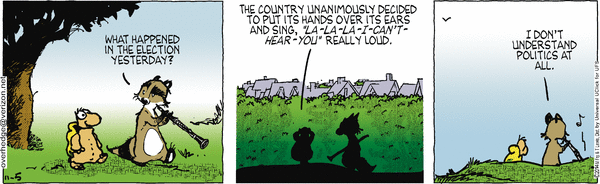
oh141105

As far as hope for what the new Republican controlled Congress will do, only one in four Americans think they will do better than the split Congress that we have had the past four years and a full 40% said in that survey said that nothing would change in Washington DC. This is something that Tea Party party pundits Erick Erickson, who I am not a fan of, noted over at Politico.com two days ago:

“So while we are going to see a Republican Congress in name in January, its small-government rhetoric is certainly not going to fool or win over the party base. In 2014, the American public has shown that it hates Washington, D.C., and the Republican leaders in Washington are demonstrating why. They have assembled a team of strategists, consultants, and other political operatives who eat, breathe, and sleep Washington, D.C. Instead of standing for something, they stand for anything they think might get them back into power.

The message from Washington’s Republican elite is no longer that government is the problem, but that Democrats in charge of government are the problem. That might work in 2014, but it’s not going to carry the day in the next presidential election. Republicans cannot make the case that government is the problem when they covet the power of controlling it to the extent they do.” http://www.politico.com/magazine/story/2014/11/midterms-hollow-victory-gop-112463.html#ixzz3IE1eHexj

Be assured the Democrats are no gem right now, like the GOP they too have some wing nuts in the party. Though I am a Democrat there have been times that I wonder if the Democratic leadership have lost their souls and are more intent on maintaining power than solving problems. Based on the massive number of e-mails I received from Democrat and progressive organizations that I support, almost all dealing with fundraising, which ran about twenty a day during the last two months of the campaign have to wonder. Yes, I know that to fight the Koch brothers funding wars brought about by Citizens United that one has to have a lot of money, but those e-mails did not motivate me, they were annoying and disruptive. 
The GOP won yesterday because it won where it was supposed to win, in states where it had the home field advantage, in states where legislatures limited the opportunities of poor, elderly, students living away from home, military personnel serving out of state as well as minority voters to vote by in effect creating a defacto-Poll Tax. But such a strategy goes back to Paul Weyrich, the co-founder of the Heritage Foundation who said in 1980:

“Now many of our Christians have what I call the ‘goo-goo syndrome.’ Good government. They want everybody to vote. I don’t want everybody to vote. Elections are not won by a majority of people. They never have been from the beginning of our country, and they are not now. As a matter of fact our leverage in the elections quite candidly goes up as the voting populace goes down.”

But in 2016, it will be a different electorate, an electorate radically different from the one that voted yesterday. The 2016 electorate will be much more favorable to Democrats, one that is not enamored with people like Klingenschmitt. They are young people who want to get ahead in life and are not concerned about someone’s religious beliefs, no fueled by racism, accepting of minorities, women, immigrants and the LGBT community. Those voters typically don’t vote in large numbers in mid-term elections, but do in presidential elections and their influence will be decisive particularly if the new GOP Congressional majority does what I expect to do by focusing on a narrow agenda that is being defined by crackpots, conspiracy theorists and religious fanatics, further driving them, as well as anyone of moderation away from the GOP. If the Democrats can get off their ass, they will keep the White House and will have an excellent chance to take back the Senate in 2016.

I am no expert, but I do know history and I know human nature. I could be try wrong about all of this, but no-matter what I am glad this election is over. The only break I got from it was going to German for the Oktoberfest, with good friends who spanned the political spectrum from left to right. It is almost enough to want to move overseas and be an expat if it means that I don’t have to listen to all of the lies and dirty campaign ads that were a staple of both parties this year. But then we can thank the Supremes and their Citizens United decision for that.

blm141105

The campaign wore me out and I look forward to at least a few months of peace, before the next phase of the 2016 campaign begins.

Peace

Padre Steve+


2 Comments

Filed under History, News and current events, Political Commentary

I’m a Disenfranchised Military Voter in DeFacto Red State

votersupresssion

I did not to get to vote in this election. I am active duty military and have lived away from the state where I vote, West Virginia, where my family settled in the 1790s for about eighteen years. It used to be that as long as I let the state knew where I lived my absentee ballot was sent to me without question. But then something changed. I stopped getting ballots. In 2012 I ended up calling my county commissioner’s office to ask why. I was told that I had to now reapply each election year. I was barely allowed to vote. In fact though I sent it in, I don’t even know if it was counted.

West Virginia used to be a Blue State, and the legislature still has a slight majority of Democrats, but at its heart the state as as Fire Engine Red as it gets. Business interests have priority, the environment suffers, the secondary education system is broken and the poor, who gives a damn about them?

The code of my state specifically states that military personnel must reapply every election cycle. This is a fairly recent change. In fact I grew up in a California, and when I first entered activity duty in the early 1980s in that state never failed to get an absentee ballot. Now the rules have changed. Evidently in an attempt to make it harder to vote under the guise of preventing voter fraud the onus is on the person serving their country to make sure that they reapply, mind you that people living in the state don’t need to do that. In fact they can walk up, do early voting or vote the same day. Heck even a person dying on a hospital bed in the state on election day can get an emergency absentee ballot brought to them and in between their dying breaths can have someone mark a ballot for them.

The sad thing is you don’t even get a reminder from the state that you need to reapply, even though they have my address and e-mail info. It’s not like the state or county is a massive metropolis where it would be too difficult to do this. That simple effort on the part of the state to reach their active duty members living away from home wouldn’t be that hard, nor would simply sending out the ballot.

Now I will take my personal responsibility, I knew the rule and should have registered. If I was in my right mind I would have done it. However I was in the midst of terrible year dealing with a move, and a major PTSD meltdown that shattered me for much of the year, I just forgot to reapply, and by the time I remembered it was too late. 

But it shouldn’t have to be that way. We in the military should not have to jump through extra hoops that people at home don’t have to be concerned with when it comes to voting. In fact, though the mechanism is there to vote, it is a way to make it more difficult and to ensure that your vote doesn’t get counted. But, that’s what you get for begin registered in a state when certain groups want to make sure that voting is restricted.

The process is insidious and terribly undemocratic, and it devalues the citizenship and voting rights of the members of less than one percent of the population that serves in the military. But then, if those people only make up one percent of the vote, what do they matter and why should anyone give a damn.

I’ll remember that the next time some politician from West Virginia says the empty words “thank you for your service.”

Screw you West Virginia politicians, pundits and preachers of both parties, my Democrats, and  my former party the GOP, which is about to take over, I won’t be coming back when I retire. You can keep it.

Peace

Padre Steve+

Leave a comment

Filed under civil rights, News and current events, Political Commentary

Councils of War at Gettysburg: Lee & Meade July 2nd 1863

Friends of Padre Steve’s World

As I noted yesterday I returned from Gettysburg and another Staff Ride, and one of the questions that came up during some of our table talk, as well as on the battlefield was about the command decision process by which Robert E. Lee and George Gordon Meade and their subordinates planned, prepared and debated what to do on the night of July 2nd 1863, following the bloody, but unsuccessful attacks by Hood’s and McLaw’s Divisions at Little Round Top, Devil’s Den, the Wheat Field, Peach Orchard and Plum Run.

To provide that overview in one article I have encapsulated a number of chapters from my Gettysburg text into one article. The contrast between Lee’s decision to attack, his refusal to take counsel of dissenting voices and views of his subordinates stand in stark contrast to those of his opponent, George Gordon Meade, his subordinate commanders and staff. Their decisions shaped the outcome of the battle of Gettysburg, and were decisive in Lee’s defeat, and instrumental in the eventual defeat of the Confederacy, just under 21 months later.

I hope you enjoy,

Peace

Padre Steve+
Lee1

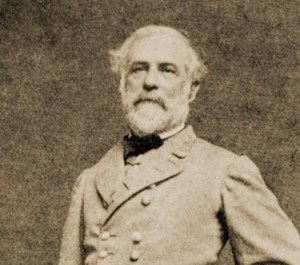
As night fell on July 2nd 1863 General Robert E Lee had already made his decision. Despite the setbacks of the day he was determined to strike the Army of the Potomac yet again. He did not view the events as setback, and though he lacked clarity of how badly many of his units were mauled Lee took no external council to make his decision. With the exception of A.P. Hill who came and submitted a report to him Lee neither required his other two corps commanders, James Longstreet or Richard Ewell to consult with him, nor took any action to visit them.

Lee did “not feel that his troops had been defeated” and he felt that “the failure on the second day had been due to a lack of coordination.”1

In his official report of the battle he wrote:

“The result of this day’s operations induced the belief that, with proper concert of action, and with the increased support that the positions gained on the right would enable the artillery to render to the assaulting columns, that we should succeed, and it was ultimately determined to continue the attack…” 2

While Lee’s charge of a “lack of coordination” of the attacks can certainly be substantiated, the fact of the matter was that if there was anyone to blame for his lack of coordination it was him, and  even Lee’s most devoted biographer Douglas Southall Freeman would write that on July 2d “the Army of Northern Virginia was without a commander.” 3 Lee’s decision to attack on July 3rd, having not taken counsel of his commanders or assessed the battle-worthiness of the units that he was planning to through into his final assault on the Union center was “utterly divorced from reality.” 4 His plan was essentially unchanged from the previous day. Longstreet’s now battered divisions were to renew their assault on the Federal left in coordination with Pickett and two of Hill’s divisions.

In light of Lee’s belief that “a lack of coordination” was responsible for the failures of July 2nd it would have been prudent for him to ensure such coordination happened on the night of July 2nd. “Lee would have done well to have called out his three lieutenants to confer with them and spell out exactly what he wanted. That was not the way he did things however…” 5

Lee knew about the heavy losses among his key leaders but “evidently very little was conveyed to him regarding the condition of the units engaged this day.” 6 This certainly had to be because during the day his only view of the battlefield was from Seminary Ridge through binoculars and because he did not get first hand reports from the commanders involved. Lee was undeterred and according to some who saw Lee that night he seemed confident noting that when Hill reported he shook his and said “It is well, General,…Everything is well.” 7

It was not an opinion that Lee’s subordinates shared. Ewell and his subordinates were told to renew their attack on Cemetery and Culp’s Hill on the night of July 2nd, but “he and his generals believed more than ever that a daylight assault against the ranked guns on Cemetery Hill would be suicidal-Harry Hays said that such an attack would invite “nothing more than slaughter…” 8
LongstreetJ_main

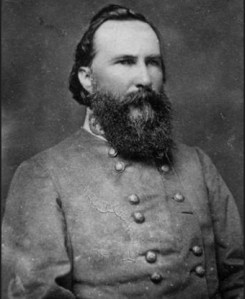
James Longstreet was now more settled in his opposition to another such frontal attack and shortly after dawn when Lee visited him to deliver the order to attack again argued for a flanking movement around the Federal left. Lee’s order was for Longstreet to “attack again the next morning” according to the “general plan of July 2nd.” 9 Longstreet had not wanted to attack the previous day and when Lee came to him Longstreet again attempted to persuade Lee of his desire to turn the Federal flank. “General, I have had my scouts out all night, and I find that you still have an excellent opportunity to move around to the right of Meade’s army and maneuver him into attacking us.” 10

Lee would have nothing of it. He looked at his “Old Warhorse” and as he had done the previous day insisted: “The enemy is there,” he said, pointing northeast as he spoke, “and I am going to strike him.” 11 Longstreet’s gloom deepened and he wrote that he felt “it was my duty to express my convictions.” He bluntly told Lee:

“General, I have been a soldier all of my life. I have been with soldiers engaged in fights by couples, by squads, companies, regiments, divisions and armies, and should know, as well as any one, what soldiers can do. It is my opinion that no fifteen thousand men ever arranged for battle can take that position.” 12

But Lee was determined to force his will on both his subordinates and the battle. Lee was convinced that the plan could succeed while Longstreet “was certain” that the plan “was misguided and doomed to fail.” 13 Longstreet, now realized that further arguments were in vain recalled that Lee “was impatient of listening, and tired of talking, and nothing was left but to proceed.” 14

Even a consultation with Brigadier General William Wofford whose brigade had help crush Sickle’s III Corps at the Peach Orchard and had nearly gotten to the crest of Cemetery Ridge could not alter Lee’s plan. Wofford had to break off his attack on July 2nd when he realized that there were no units to support him. Lee asked if Wofford could “go there again” to which Wofford replied “No, General I think not.” Lee asked “why not” and Wofford explained: “General, the enemy have had all night to intrench and reinforce. I had been pursuing a broken enemy, and now the situation is very different.” 15

The attack would go forward despite Longstreet’s objections and the often unspoken concerns of others who had the ear of Lee, or who would carry out the attack. Walter Taylor of Lee’s staff wrote to his sister a few days after the attack the “position was impregnable to any such force as ours” while Pickett’s brigadier Richard Garnett remarked “this is a desperate thing to attempt” and Lewis Armistead said “the slaughter will be terrible.” 16

Pickett’s fresh division would lead the attack supported by Johnston Pettigrew commanding the wounded Harry Heth’s division of Hill’s Third Corps and Isaac Trimble commanding two brigades of Pender’s division, Trimble having been given command just minutes prior to the artillery bombardment. 17 On the command side few of the commanders had commanded alongside each other before July 3rd. Trimble had just recovered from wounds had never been with his men. Pettigrew had been given command when Pender was wounded was still new and relatively untested, and Pickett’s three brigadiers and their brigades had never fought together. Two of the divisions had never served under Longstreet. From a command perspective where relationships and trust count as much as strength and numbers the situation was nearly as bad is it could be. Although the Confederates massed close to 170 cannon on Seminary Ridge to support the attack ammunition was in short supply and the Lieutenant Colonel Porter Alexander who had been tasked with coordinating fires only controlled the guns of First Corps.

The assaulting troops would attack with their right flank exposed to deadly enfilade fire from Federal artillery and with the left flank unsupported and exposed to such fires from Union artillery on Cemetery Hill. It was a disaster waiting to happen. Longstreet noted “Never was I so depressed as on that day…” 18

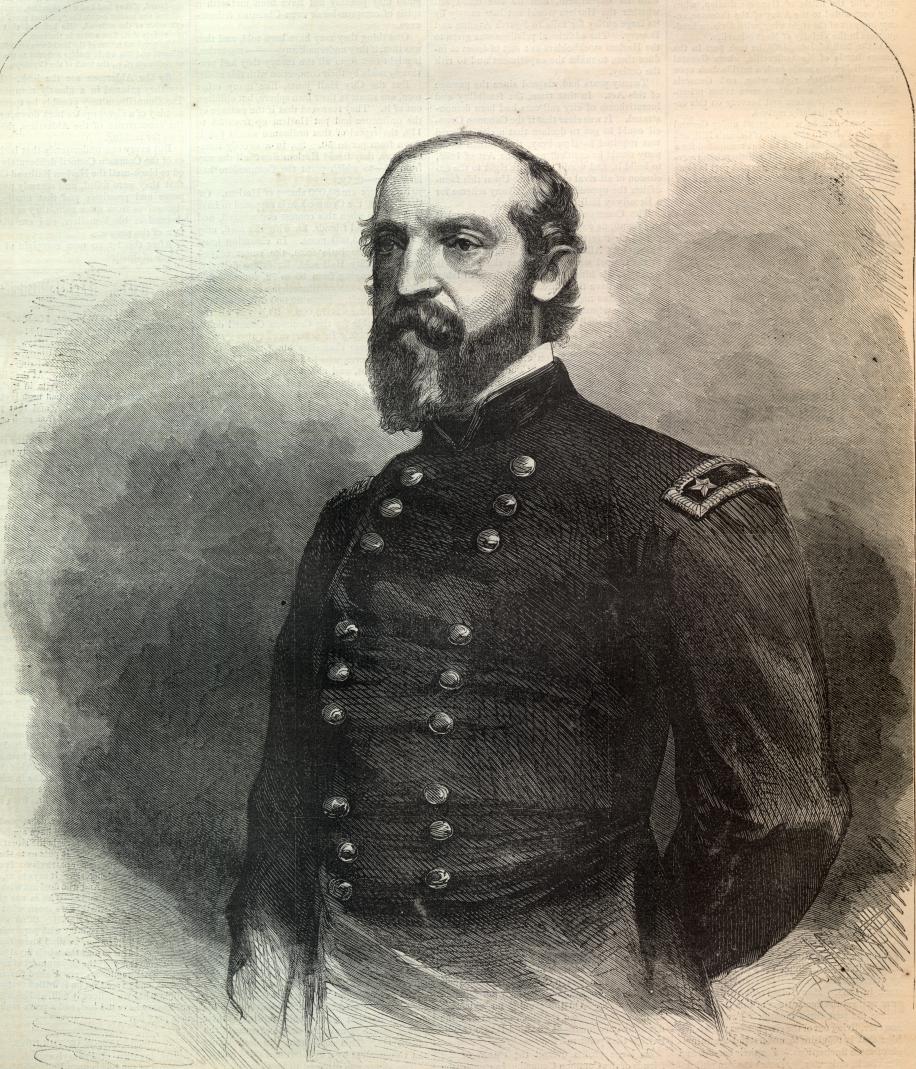
general-george-meade

While Lee took no counsel and determined to attack on the night of July 2nd little more than two miles away Major General George Meade took no chances. After sending a message to Henry Halleck at 8 PM Meade called his generals together. Unlike Lee who had observed the battle from a distance Meade had been everywhere on the battlefield during the day and had a good idea what his army had suffered and the damage that he had inflicted on the Army of Northern Virginia. Likewise during the day he had been with the majority of his commanders as opposed to Lee who after issuing orders that morning had remained unengaged, as was noted by the British observer Lieutenant Colonel Arthur Fremantle who wrote that during the “whole time the firing continued, he sent only one message, and only received one report.” 19

Meade wired Halleck that evening: “The enemy attacked me about 4 P.M. this day…and after one of the severest contests of the war was repulsed at all points.” 20 However Meade, realizing that caution was not a vice still needed to better assess the condition of his army, hear his commanders and hear from his intelligence service, ended his message: “I shall remain in my present position to-morrow, but am not prepared to say until better advised of the condition of the army, whether operations will be of an offensive or a defensive character.” 21

As Meade waited for his commanders his caution was apparent. Before the attack on Sickles’ III Corps at the Peach Orchard Meade had asked his Chief of Staff Brigadier General Dan Butterfield to “draw up a contingency plan for withdraw to Pipe Creek.” After the attack on Sickles Alfred Pleasanton said that Meade ordered him to “gather what cavalry I could, and prepare for the retreat of the army.” 22 Some of his commanders who heard of the contingency plan including John Gibbon and John Sedgwick believed that Meade was “thinking of a retreat.” 23. Despite Meade’s  flat assurances to Halleck  his army’s position had been threatened on both flanks, though both were now solidly held, but some of his subordinates believed, maybe through the transference of their own doubts, that Meade “foresaw disaster, and not without cause.” 24

In assessing Meade’s conduct it has to be concluded that while he had determined to remain, that he was smart enough to plan of the worst and to consult his commanders and staff in making his decision. Meade wrote to his wife that evening “for at one time things looked a little blue,…but I managed to get up reinforcements in time to save the day….The most difficult part of my work is acting without correct information on which to predicate action.” 25
Gettysburg_Council_of_War

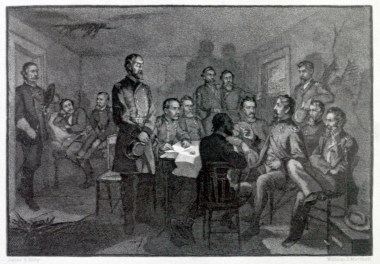
Meade called Colonel George Sharpe from the Bureau of Military Information to meet with him, Hancock and Slocum at the cottage on the Taneytown Road where he made his headquarters. Sharpe and his aide explained the enemy situation. Sharpe noted “nearly 100 Confederate regiments in action Wednesday and Thursday” and that “not one of those regiments belonged to Pickett.” He then reported with confidence that indicated that “Pickett’s division has just come up and is bivouac.” 26

It was the assurance that Meade needed as his commanders came together. When Sharpe concluded his report Hancock exclaimed “General, we have got them nicked.” 27

About 9 P.M. the generals gathered. Present were Meade, and two of his major staff officers Warren just back from Little Round Top, wounded and tired, and Butterfield his Chief of Staff. Hancock action as a Wing Commander was there with Gibbon now commanding II Corps, Slocum of XII Corps with Williams. John Newton a division commander from VI Corps who had just arrived on the battlefield now commanding I Corps was present along with Oliver Howard of XI Corps, John Sedgwick of VI Corps, George Sykes of V Corps and David Birney, now commanding what was left of the wounded Dan Sickles’ III Corps. Pleasanton was off with the cavalry and Hunt attending to the artillery.

The meeting began and John Gibbon noted that it “was at first very informal and in the shape of a conversation….” 28 The condition of the army was discussed and it was believed that now only about 58,000 troops were available to fight. Birney honestly described the condition of III Corps noting that “his corps was badly chewed up, and that he doubted that it was fit for much more.” 29 Newton who had just arrived was quoted by Gibbon as saying that Gettysburg was “a bad position” and that “Cemetery Hill was no place to fight a battle in.” 20 The remarks sparked a serious discussion with Meade asking the assembled generals “whether our army should remain on that field and continue the battle, or whether we should change to some other position.” 31

The reactions to the question showed that the army commanders still had plenty of fight in the. Meade listened as his generals discussed the matter. Hancock said he was “puzzled about the practicability of retiring.” 32 Newton later noted that he made his observations about the battlefield based on his belief that that Lee might turn the Federal left and impose his army between it and its supplies, as Longstreet However Newton and the other commanders agreed that pulling back “would be a highly dangerous maneuver to attempt in the immediate presence of the enemy.” 33

Finally Butterfield, no friend of Meade and one of the McClellan and Hooker political cabal who Meade had retained when he took command posed three questions to the assembled generals:

“Under existing circumstances, is it advisable for this army to remain in its present position, or retire to another nearer its base of supplies?

It being determined to remain in present position, shall the army attack or wait the attack of the enemy?

If we wait attack, how long?” 34

Gibbon as the junior officer present said “Correct the position of the army…but do not retreat.” Williams counseled “stay,” as did Birney and Sykes, and Newton, who after briefly arguing the dangers finally agreed. Oliver Howard not only recommended remaining but “even urged an attack if the Confederates stayed their hand.” Hancock who earlier voiced his opinion to Meade that “we have them nicked” added “with a touch of anger, “Let us have no more retreats. The Army of the Potomac has had too many retreats….Let this be our last retreat.” Sedgwick of VI Corps voted “remain” and finally Slocum uttered just three words “stay and fight.” 35

None of Meade’s assembled commanders counseled an immediate attack; all recommended remaining at least another day. When the discussion concluded Meade told his generals “Well gentlemen…the question is settled. We remain here.” 36

Some present believed that Meade was looking for a way to retreat to a stronger position, that he had been rattled by the events of the day. Slocum believed that “but for the decision of his corps commanders” that Meade and the Army of the Potomac “would have been in full retreat…on the third of July.” 37 Meade would deny such accusations before Congressional committees the following year as Radical Republicans in Congress sought to have him relieved for political reasons.

Much of the criticism of his command decisions during the battle were made by political partisans associated with the military cabal of Hooker, Butterfield and Sickles as well as Radical Republicans who believed that Meade was a Copperhead. Both Butterfield and Birney accused Meade before the committee of wanting to retreat and “put the worst possible interpretation on Meade’s assumed lack of self-confidence without offering any real evidence to substantiate it.” Edwin Coddington notes “that Meade, other than contemplating a slight withdraw to straighten his lines, wanted no retreat from Gettysburg.” 38

Alpheus Williams of XII Corps, wrote to his daughters on July 6th regarding his beliefs about Meade on the night of July 2nd. “I heard no expression from him which led me to think that he was in favor of withdrawing the army from before Gettysburg.” 39 Likewise the message sent by Meade to Halleck indicates Meade’s own confidence in the upcoming battle of July 3rd. If Meade had some reservations during the day, as he mentioned in the letter to his wife they certainly were gone by the time he received the intelligence report from Sharpe and heard Hancock’s bold assertion that the enemy was “nicked.”

As the meeting broke up after shortly after midnight and the generals returned to their commands Meade pulled Gibbon aside. Gibbon with II Corps had the Federal center on Cemetery Ridge. Meade told him “If Lee attacks tomorrow, it will be in your front.” Gibbon queried as to why Meade thought this and Meade continued “Because he has made attacks on both our flanks and failed,…and if he concludes to try it again it will be on our center.” Gibbon wrote years later “I expressed the hope that he would, and told General Meade with confidence, that if he did we would defeat him.” 40

If some of his generals and political opponents believed Meade to be a defeatist,  that defeatism was not present in his private correspondence. He wrote to his wife early in the morning of July 3rd displaying a private confidence that speaks volumes: “Dearest love, All well and going on well in the Army. We had a great fight yesterday, the enemy attacking & we completely repulsing them- both armies shattered….Army in fine spirits & every one determined to do or die.” 41

The contrast between Lee’s and Meade’s decision making process is Meade did what Lee should have done, he had been active on the battlefield, he consulted his intelligence service and he consulted his commanders on the options available to him. Lee remained away from the action on July 2nd he failed to consult his commanders. He failed to gain accurate intelligence on the Federal forces facing him and he failed to fully take into account his losses. Meade better demonstrated the principles of what we now call “mission command.”

Notes

1 Freeman, Douglas Southall, Lee’s Lieutenant’s a Study in Command, One volume abridgement by Stephen W Sears, Scribner, New York 1998 p.558

2 Lee, Robert E, Reports of Robert E Lee, C.S. Army, Commanding Army of Northern Virginia Campaign Report Dated January 20th 1864. Amazon Kindle Edition location 594 of 743

3 Freeman, Douglas S. R.E. Lee volume 3 Charles Scribner’s Sons, New York 1935 p.150

4 Sears, Stephen W Gettysburg Houghton Mifflin Company, New York 2003 p.349

5 Coddinton, Edwin Gettysburg, A Study in Command Simon and Schuster New York 1968 p.455

6 Trudeau, Noah Andre Gettysburg, A Testing of Courage Harper Collins, New York 2002 p.4117 Ibid p.412

8 Ibid. p.347

9 Ibid. p.430

10 Wert, Jeffry General James Longstreet, the Confederacy’s Most Controversial Soldier A Tuchstone Book, Simon and Schuster, New York 1993 p.283

11 Foote, Shelby The Civil War, A Narrative, Fredericksburg to Meridian Random House, New York 1963 p.529 12 Ibid. Wert p.283

13 Ibid. Sears p.349

14 Guelzo, Allen C. Gettysburg: The Last Invasion Vintage Books, a Division of Random House, New York 2013 p.377

15 Ibid. Foote p.531

16 Ibid. Wert p.287

17 Ibid. Freeman p.589

18 Ibid. Wert p.290

19 Fremantle, Arthur Three Months in the Southern States, April- June 1863 William Blackwood and Sons, Edinburgh and London 1863 Amazon Kindle edition p.266

20 Sears, Stephen W Gettysburg Houghton Mifflin Company, New York 2003 pp.341-342

21 Ibid. p.342

22 Guelzo, Allen C. Gettysburg: The Last Invasion Vintage Books, a Division of Random House, New York 2013 p.355

23 Ibid.

24 Foote, Shelby The Civil War, A Narrative, Fredericksburg to Meridian Random House, New York 1963 p.524

25 Trudeau, Noah Andre Gettysburg, A Testing of Courage Harper Collins, New York 2002 p.413

26 Ibid. Sears p.342

27 Ibid. Trudeau p.413

28 Ibid. Sears p.342

29 Ibid. Trudeau p.415

30 Ibid. Guelzo p.556

31 Ibid. Guelzo p.556

32 Ibid. Sears p.343

33 Ibid. Sears p.343

34 Ibid. Trudeau p.415

35 Ibid. Guelzo p.556

36 Ibid. Foote p.525

37 Ibid. Guelzo

38 Coddinton, Edwin Gettysburg, A Study in Command Simon and Schuster New York 1968 pp.451-452

39 Ibid. p.452

40 Ibid. Foote p.525

41 Ibid. Trudeau p.345


1 Comment

Filed under civil war, History, leadership, Military

Return from Gettysburg: Table Talk and Meeting a Hero

IMG_0463.JPG

I am on the way back from Gettysburg following our Staff Ride. As always it was a very interesting trip and as much as I get to expound on what I know, I also get to learn. As the late Hall of Fame Manager of the Baltimore Orioles, Earl Weaver so eloquently put it: “It’s what you learn after you know it all that counts.”

I love going up, not just for the teaching opportunity, but to spend time with the students, and sometimes their family members over lunch, dinner or drinks at the various watering holes. These occasions of table talk are probably some of the most important parts of learning and relationships. They are something that have become an anomaly in our modern higher education process, which driven by the need for profit, or by austerity in public or military educational systems, or fear of legal liability, have all too often sacrificed this all too important manner of learning.

I remember reading Martin Luther’s Table Talk, which is a collection of writings by his student’s gathered around the table as they ate and drank. They show Luther at his best and worst, expounding on some of his less systematized ideas, as well as his ability to expound on subjects outside of the lecture hall or the theological debate, sometimes while certainly under the influence of good German beer.

This type of learning was common at one time, but now is a dying art. One of the things that it does for me is that my student’s questions, comments, experiences and ideas also spur my thinking and cause me to do more research, discover more and learn more. I then attempt to assimilate what I have learned and then develop those thoughts into things that I am either writing or teaching.

For me this is about a commitment to the truth, as I quoted from Star Trek the Next Generation on Friday, that my first duty, is to the truth, and as one of my students mention to me last night can be painful, especially when long cherished myths, are crushed by the weight of facts. For him it was the ugly truth of the Lost Cause and especially in the role of religion in the South to justify slavery, secession and following the war segregation, discrimination and sometimes even lynching. For him, as it was for me, so many years ago at Southwestern Baptist Theological Seminary, this was difficult. But if truth matters at all, we cannot ignore it as so many do and cling to myth, as Captain Picard said ” be it scientific, historic or personal truth.” 

I was fortunate that my professors at Southwestern, especially my professors of Church History, Systematic Theology and Philosophy of religion challenged me and laid waste to the myths that I believed that I am who I am today.

I think I am going to start doing table talk sessions for any interested students during our next term.

I also had a unique honor on this trip. One of my students brought his dad, a retired Army Colonel and Vietnam veteran. He was a very interesting man and was engaged in the lessons of the trip, even since his son had provided him a copy of my text, asking when I would get it published. He didn’t try to draw attention to himself, we had some nice conversation over dinner and drinks with the rest of the students, and at the end of the Staff Ride, which is at the Solder’s Cemetery he walked up and thanked me. He the said “let me give you my coin.”

For us in the military a being presented a commander’s coin or unit coin is an honor. I have a lot of them, including one from former Chairman of the Joint Chiefs of Staff, General Peter Pace, who I met at the Battle of Hue City Memorial weekend when I was the chaplain of the ship that carries the name and legacy of Hue City.

When I looked at the coin it was inscribed “Colonel Walter Marm, Vietnam, 14 November 1965.” In the center a depiction of the Medal of Honor. The front, Congressional Medal of Honor Society, United States of America. Colonel Marm was a platoon leader then, a young lieutenant, in Company A, 1st Battalion, 7th Cavalry at the Battle of the Ia Drang. You might recognize it, the battle was chronicled in the book We Were Soldiers Once…and Young” and film We Were Soldiers

If you want to read about his heroism you can google him or go to this site, which is just one of many where you can read about this American hero.

http://www.medalofhonorspeakout.org/bio/walter-marm

Interestingly enough President Obama will award the Medal of Honor posthumously on November 6th to Lieutenant Alonzo Cushing who died defending the Angle on day three at Gettysburg.

So this indeed was a special trip, a reminder to me of the lost art of table talk in education, as well as the heroes who do not draw attention to themselves. Yes my friends, it is what you learn after you know it all that counts.

Peace

Padre Steve+

1 Comment

Filed under civil war, History, Military, vietnam

All Hallows and All Saints at Gettysburg

 10570298_10152872503382059_5058681841617456899_n

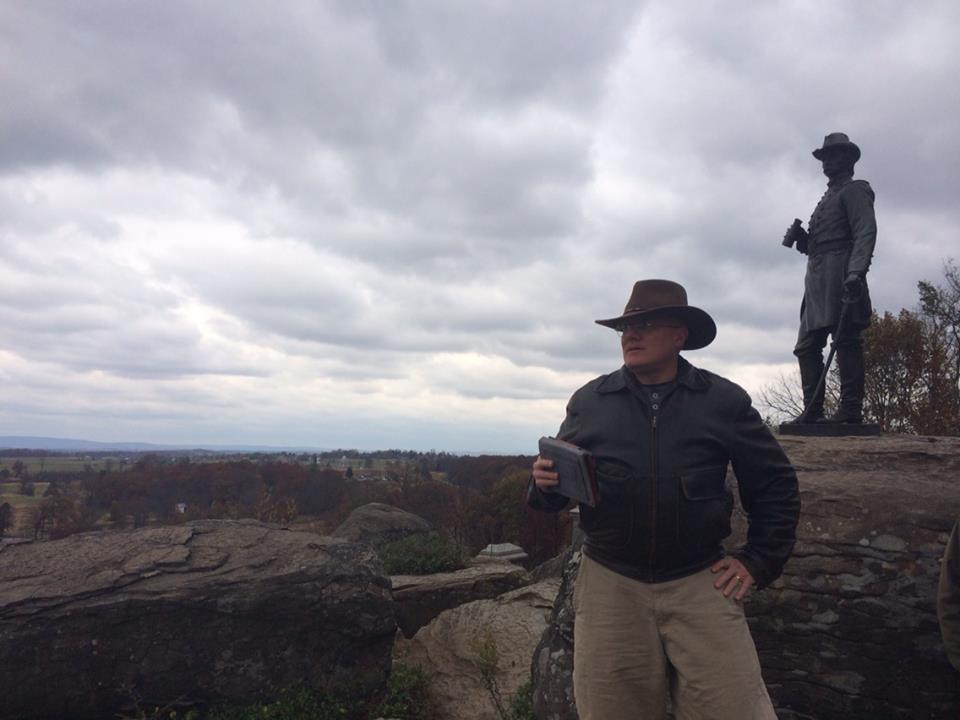
Me on Little Round Top teaching near Gouverneur Warren Monument

Well my friends I have been up in Gettysburg the past two days, actually I drove up with my class for the Staff Ride on Friday. Last night which was Halloween I toured the Jenny Wade House which is according to those that pursue the paranormal is consistently rated one of the haunted spots in the United States, since the house sits not twenty feet from the hotel that I stay each time I come up here, that is fascinating because ever since I was a kid and saw a misty figure in my grandfather’s bedroom where I was sleeping since he was in hospital back in early 1970 I have been fascinated with such things. But I digress…

Anyway, today was a good day out with my students and their families as del walked the battlefield in some very cold and raw weather, yes winter is coming sooner than any one of us want to admit….

Anyway, I always feel a special, almost spiritual connection to those who fought and died at Gettysburg. Walt Whitman wrote in his poem “Ashes of Dead Soldiers”:

Ashes of soldiers South or North, As I muse retrospective murmuring a chant in thought, The war resumes, again to my sense your shapes, And again the advance of the armies. Noiseless as mists and vapors, From their graves in the trenches ascending, From cemeteries all through Virginia and Tennessee, From every point of the compass out of the countless graves, In wafted clouds, in myriads large, or squads of twos or threes or single ones they come, And silently gather round me…”

After dinner with my student’s at the Farnsworth House I took a few minutes and wandered East Cemetery Hill where the Union forces helped hold back the army of Robert E. Lee. I have been to the hill many times, but never after dark. It was surreal.

10408807_10152872503372059_1781792705317577605_n

Monument of Oliver Howard at Night

Anyway, I will as always write more about Gettysburg, the battle, campaign and the people but tonight just a thought that sometimes things remain that we cannot explain, As Joshua Chamberlain wrote:

In great deeds, something abides. On great fields, something stays. Forms change and pass; bodies disappear; but spirits linger, to consecrate ground for the vision-place of souls… generations that know us not and that we know not of, heart-drawn to see where and by whom great things were suffered and done for them, shall come to this deathless field, to ponder and dream; and lo! the shadow of a mighty presence shall wrap them in its bosom, and the power of the vision pass into their souls.”

I am one of those people, a member of a generation who knew them not but one who is heart-drawn to see where and by whom great things were suffered and done for them.  And yes, for me, ever since my first visit to this hallowed ground in the spring of 1997, the shadow of a mighty presence wraps me in its bosom, and the power of their vision passes into my soul.

Today as always I took my class around the battlefield and traced the events of July 1st and 2nd 1863, days when tens of thousands of men were killed, wounded, or captured. This evening I went to dinner with about half of the group, and met for a couple of beers as well as interesting talk with some others after my stroll on the dark Cemetery Hill. Tomorrow I will lead my class to Culp’s Hill, and then back across the battlefield where we will trace the route of Pickett’s division during Pickett’s Charge, before we discuss the High Water Mark of the Confederacy, take a group photo at General George Meade’s headquarters behind Cemetery Ridge and going on to the Soldier’s Cemetery where Abraham Lincoln gave his Gettysburg Address.

I am going to try to get some rest since we “fall back” in a couple of hours. It would be nice to sleep. However, since my sleep so resembles what Gouverneur Warren described in 1867. Warren recounted in a letter to his wife:

“I wish I did not dream so much. They make me sometimes to dread to go to sleep. Scenes from the war, are so constantly recalled, with bitter feelings I wish never to experience again. Lies, vanity, treachery, and carnage.”

Have a nice night and a better tomorrow.

Peace

Padre Steve+

Leave a comment

Filed under civil war, History, Military, philosophy, Religion

Friday Morning Myth Busting before a Trip to Gettysburg

IMG_1915

Dear Friends of Padre Steve’s World,

Today I head up with my class to Gettysburg for our Staff Ride. Of course this comes on the heals of the San Francisco amazing game seven victory in the 2014 World Series, and if you read this site you understand that I was up until the wee hours of the morning because I was much too excited to sleep. This is actually, despite the lack of sleep a blessing because most of the time that I don’t sleep it is because of anxiety, nightmares, flashbacks and night terrors that torment me. As Gouverneur Warren, one of the heroes of Gettysburg wrote after the war:

“I wish I did not dream that much. They make me sometimes dread to go to sleep. Scenes from the war, are so constantly recalled, with bitter feelings I wish to never experience again. Lies, vanity, treachery, and carnage.”

But last night was different, to was hard to get to sleep because of the excitement of one of the best World Series games in history. That being said I am tired. I revised my chapter on the ideological nature of the American Civil War, and I should have another chapter revision on the Confederate decision to allow Robert E. Lee to invade Pennsylvania in the late spring of 1863 done by the time that I leave tomorrow. But those chapters, which are around 80 pages long are now too big to post in one fell swoop here.

However, in my readings I encountered a quote by historian Drew Faust Gilpin, as well as another that was part of a Methodist tract from 1860 that both seem absolutely timely today. I included both in the chapter, but I am going to post it here as well, because in the religious-historical myth that has become the staple that frauds like David Barton, Glenn Beck and their political and media allies flood the the airways and internet with, it is timely. Gilpin wrote:

“Sacred and secular history, like religion and politics, had become all but indistinguishable…The analogy between the Confederacy and the chosen Hebrew nation was invoked so often as to be transformed into a figure of everyday speech. Like the United States before it, the Confederacy became a redeemer nation, the new Israel.”

The Methodist tract noted:

“Confederate independence, explained a Methodist tract quoting Puritan John Winthrop, was intended to enable the South, “like a city set on a hill’ [to] fulfill her God given mission to exalt in civilization and Christianity the nations of the earth.”

Personally I cannot imagine anymore hatful projections of the Christian faith, but then I was reminded by the Fox News Channel resident Shrink, Dr Keith Ablow, that the United States needs to be conducting it’s own Jihad, its own wars of conquest to impose the American way on the rest of the world. Of course the blowhard shrink Ablow who has no skin in the game doesn’t seem to mind putting the sons and daughters of the nation in harm’s way, to die in unjust, unrighteous, illegal, immoral and certainly un-Christian wars to satiate his bloodlust. Ablow revels in diagnosing the pathologies and motivations of people that he has never met, not a very professional way of doing business as a shrink, but just watching Ablow’s rants on television and reading what he puts out on the internet I wonder if he is a sociopath, a man without empathy, a man who does not seam to be motivated by the desire to help people, nor by the upholding the Hippocratic oath, to do no harm.

I find it fascinating to read what General and later President Ulysses S Grant said about such ideas:

“As the United States is the freest of all nations, so, too, its people sympathize with all people struggling for liberty and self-government; but while so sympathizing it is due to our honor that we should abstain from enforcing our views upon unwilling nations and from taking an interested part, without invitation, in the quarrels between different nations or between governments and their subjects. Our course should always be in conformity with strict justice and law, international and local.”

But that my friends is why history matters, and why you should take your time to study it, including the uncomfortable things that destroy the myths perpetuated by the Lost Causers of the modern “Conservative Christian” revisionists and their allies who sell their crap as truth to people who want to believe it because they have been conditioned by thirty years and more of propaganda, that the myth is true.

Clothed in  the garb of faith and patriotism these lies, and the political, military and economic consequences  that they have spawned over the past thirteen years, have cost more American lives and treasure, as well as destroyed our stature in the world than any series of events in our history. heretical These filthy and polluted ideas helped destroy what could have been a renaissance in international relations because their proponents painted everything in terms of black and white and you either are for us or against us. Yes let me say it, President George Bush’s, uninspired,misguided and down right ignorant  religious world views have taken us to the abyss.

This my friends is why history matters. Sometimes it may seem dry and dusty, and no you cannot get rich as a real historian, while the fake ones like Barton, Beck and Bill O’Reilly are able to make a lot of money because they appear to what people want to hear by lying, by so linking their religion with their politics and their distorted view of history that the reality of history is ground to dust under the heals of their designer jackboots.

So, tomorrow, or is it already today now, I head up to Gettysburg where the brave men of the Army of the Potomac, whose veterans, like those of other Union armies engaged in the struggle for freedom helped give our nation a “new birth of freedom.” 

I think that how the Army of Tennessee, a Union army in the West described the war is at the heart of the issue.

“The Society of the Army of the Tennessee described the war as a struggle “that involved the life of the Nation, the preservation of the Union, the triumph of liberty and the death of slavery.” They had fought every battle…from the firing on the Union flag Fort Sumter to the surrender of Lee at Appomattox…in the cause of human liberty,” burying “treason and slavery in the Potter’s Field of nations” and “making all our citizens equal before the law, from the gulf to the lakes, and from ocean to ocean.”

It is amazing what the study of history and going to the places that it was made can do in someone’s heart. For me, the study of the Battle of Gettysburg and the American Civil War, and not just the military aspects of it has motivated me to be more forceful and speak up against the lies of those like Barton, Beck, O’Reilly, Ablow and the hosts of pundits, preachers and politicians who spread their lies as truth.

But then for me, truth matters. In this I am reminded of a quote from Star Trek the Next Generation. It is from an episode called “The First Duty.” In it the seasoned Captain Jean Luc Picard confronts his young protege Wesley Crusher after a disastrous accident that leaves a Star Fleet Academy cadet dead. Picard tells the young Crusher that “the first duty of every Starfleet officer is to the truth, whether it’s scientific truth, historical truth or personnel truth…

To me, as a miscreant priest, and career officer that quote strikes home. I have a duty to the truth, believe it or not it does matter to me, and sometimes that means that I have to be a myth buster and call out the professional liars who posit themselves as historians, political scientists or experts on military strategy, when none of them have either the education or the experience to be experts in anything but being able to lie for fun and profit.

You see when I go to Gettysburg, and I stand where so many men died do make others free I become ever more inspired to confront the liars.

But now I am preaching and I try not to do that. I do need to attempt to get some sleep, so have a nice night.

Peace

Padre Steve+


Leave a comment

Filed under civil rights, civil war, History, Military, News and current events, Political Commentary, star trek

GIANTS WIN SERIES! The Amazing Madison Bumgarner

920x920

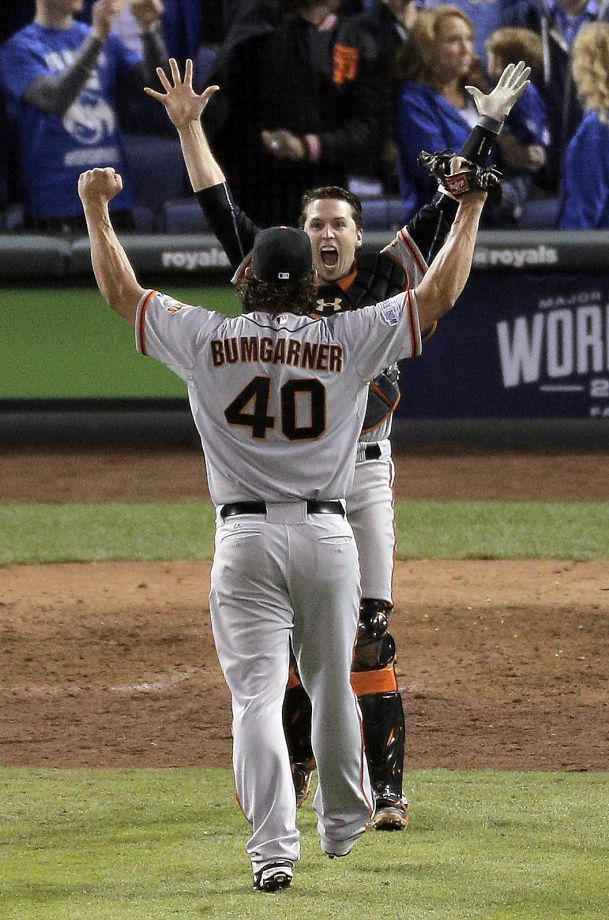
Madison Bumgarner and Buster Posey Raise Their Arms in Victory

Photo: Carlos Avila Gonzalez, The Chronicle

Hall of Fame Baltimore Orioles manager Earl Weaver once said “The key to winning baseball games is pitching, fundamentals, and three run homers.” 

The San Francisco Giants didn’t get many home runs this season, but timely hitting, amazing defense and the pitching of a young man named Madison Bumgarner who did something that no pitcher has done since the dead ball era.

Bumgarner won two games in the this World Series, giving him four career World Series wins, and he earned the save tonight in game seven, pitching five innings of shutout ball. He had a World Series Record 0.43 Earned Run Average over 21 innings pitched in the series. He allowed just one run in his three games, of which he had a win in game one going seven innings, a complete game shutout in game five and coming back on short rest to pitch five innings of scoreless relief in game seven. In an era where pitch counts have ruled, Bumgarner defied the odds. During the regular season  he pitched 219 innings. He then pitched 48 and 2/3rds innings in the playoffs, he won two games in the NLCS against the Cardinals and had a complete game shutout of the Pirates in the Wild Card. His only blemish was a loss to the Nationals in game four of the NLDS. It was one of the most amazing post-season performances, not to mention World Series performances in baseball history.

I grew up with the Giants and I love their orange and black American League counterpart Baltimore Orioles as well. I have loved both teams since I was a child. I was hoping for a total orange and black World Series, but the Kansas City Royals put that wish to rest by sweeping the Orioles in the ALCS.

This World Series has been weird for me. I expected the Giants to win but I also expected the normal amount of “torture ball” from the Giants, who over the past five years have found ways to keep their fans on chewing their fingernails, drinking too much beer and resorting to whatever superstition gets them through. For me it is making sure my trusty Papillon-Dachsund mix Molly, is there with me. When she could still see, she went blind in early 2013, she would sit on “her” bean bag and watch the game with me. Since I was traveling during this post season we didn’t have as much Molly-Daddy baseball time, but tonight during game seven she stayed on the couch with me the entire game. Molly is my good luck charm when watching the Giants torture all of us. But I digress…

I watched game one with friends at Gordon Biersch last Tuesday, saw game two at home before flying to Stockton California for my induction into the Edison High School Hall of Fame meaning that I got no sleep the night before the flight. I watched game three with my brother, missed game four due to the induction ceremony, watch game five on my iPad on my flight home, saw most of game six at Biersch and tonight since we were all tired, stayed home to watch game seven.

Tonight was special. I have had a week of tremendous ups and downs and so my stomach was in a knot the whole game. I was sure that the Giants would win, but after the 10-0 defeat in game six I was a bit nervous, even though I actually felt better with the blowout than had they lost a close game. During the pre-game shows it seemed that many of the commentators were almost cheering for the Royals to win and constantly talking about how the last nine game seven’s have been won by the home team. I knew they were full of crap but nonetheless, it was annoying.

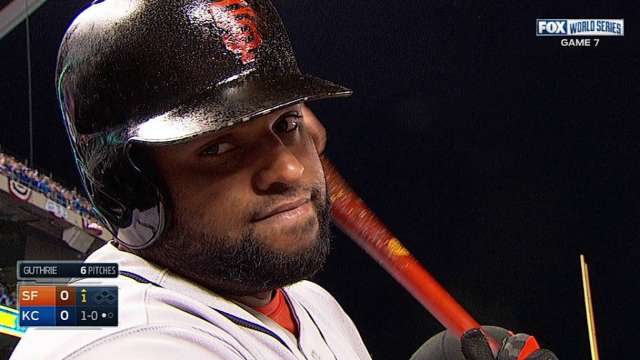
When Pablo Sandoval was in the dugout getting ready to step into the on deck circle in the top of the first, he turned to the camera and winked.

mlbf_36876919_th_43

http://www.sbnation.com/mlb/2014/10/29/7129621/pablo-sandoval-is-not-feeling-the-world-series-game-7-pressure

At that point, any doubts faded, but that being said I was still nervous. I watched the game but also did a few things to take the edge off at times. I looked at other news stories on the internet, republished an article about Gettysburg, drank beer and snuggled next to Molly on the couch.

I think that the Giants are one of the most amazing “teams” in the game, and under manager Bruce Botchy they accomplish amazing things in the most unlikely of ways with a team of regular guys. A rotund third baseman called “the Panda,” a wild-eyed right fielder named Hunter Pence, a rookie second baseman named Panik, a solid bullpen, and apart from Bumgarner a starting pitching staff that struggled much of the season. It seems like every year the Giants find another unusual way to win, especially when they get to the post-season.

Tonight was no different. Their starting pitcher Tim Hudson, the oldest pitcher to ever start in a World Series game, didn’t get out of the second inning. So Bruce Botchy brought in Jeremy Affeldt, a lefty who normally pitches in late inning relief. Affeldt had never come into a major league game in the second inning during his career. The crafty left-hander shut down the Royals for 2.1 innings earning the win while Bumgarner, after initially being credited with the win, earned the save. Affeldt and Bumgarner proved Earl Weaver’s wise saying that “The only thing that matters is what happens on the little hump out in the middle of the field.” Affeldt and Bumgarner dominated the Royals from that hill. 

201410292023733925005

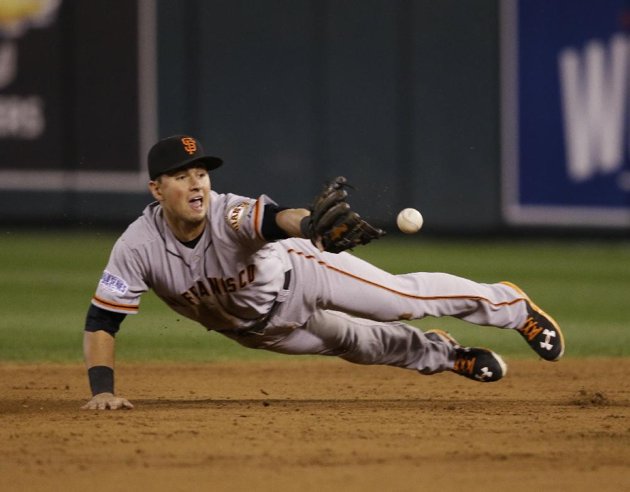
Joe Panik tossing the ball to Brandon Crawford with his glove to begin the 5th inning double play (AP Photo) 

They were backed up by just enough timely hitting and outstanding defense, especially after Bumgarner came into the game and Second Baseman Joe Panik made one of the most amazing double plays I have ever seen. Panik dove and robbed Eric Hosmer of a hit, tossing the ball with his glove to shortstop Brandon Crawford who threw out Hosmer who was diving head first into first base. Initially Hosmer was ruled safe, but the very first manager’s challenge replay reversal of an on field call in the World Series ended a potential threat.

As the game went on into the seventh inning I began to count down the outs with Molly at my side. When Alex Gordon singled and reached third base after a fielding error by Giant’s Center Fielder Gregor Blanco with two outs in the bottom of the ninth, yet another element of torture ball. I was standing, and when Salvador Perez popped up to Pablo Sandoval in foul territory to end the game I was jumping up and down and screaming for joy, thanking Molly for staying on the couch and not moving, ensuring that nothing that she or I did would jinx the Giants. Yes this is superstitious, maybe even idiotic, but it is the way I deal with the World Series when the Giants are playing in it. 

Congratulations to the Giants, and kudos to the Royals who surprised everyone with their playoff run this year. I expect them to be a force to be reckoned with in the American League for years to come, provided of course that free agency does not rob them of their tremendous late inning bullpen staff.

With that I need to attempt to get to sleep, if I can. For once though if I don’t sleep it won’t be because of anything bad, just the post-game excitement that won’t let me sleep.

Peace

Padre Steve+


2 Comments

Filed under Baseball

The Dead and Those Forever Changed: Gettysburg and the Human Cost of War

Friends of Padre Steve’s World
I am preparing to go to Gettysburg with my students this weekend. Things have been busy at home as well, like many people in the Hampton Roads area our neighborhood has been invaded by Roof Rats which according to the local news are recent immigrants having migrated here from Florida. Like our neighbors we got them too, so that will be a pain in the ass.

I am re-posting this article about the dead and those forever changed by war. Being one of those changed by war I am constantly amazed about the accounts of the lives of those considered to be heroes in previous wars. Gettysburg provides a number of such men, heroes who were forever changed by their experience, damaged in body, should and spirit.

I have a chapter revision to my text that should run tomorrow. I will also have my thoughts about being inducted into my high school’s Hall of Fame, an honor that I now share with a good number of amazing people whose accomplishments are such that I wonder how I got in. I also am musing about writing an article about the profound difference between “tolerance” and “acceptance” and how easily tolerance becomes intolerance because at its heart it is not based on grace, love or acceptance. Anyway, I am tired, the World Series Game Seven is coming on and I am going to sign off.
Peace
Padre Steve+

padresteve's avatarThe Inglorius Padre Steve's World

gburg dead2

“Ashes of soldiers South or North, As I muse retrospective murmuring a chant in thought, The war resumes, again to my sense your shapes, And again the advance of the armies. Noiseless as mists and vapors, From their graves in the trenches ascending, From cemeteries all through Virginia and Tennessee, From every point of the compass out of the countless graves, In wafted clouds, in myriads large, or squads of twos or threes or single ones they come, And silently gather round me…”

From Walt Whitman- Ashes of Dead Soldiers

Too often we look at distant battles and campaigns in terms of strategy, operations, tactics, leadership and the weaponry employed. Likewise we might become more analytical and look at the impact of the battle or campaign in the context of the war it was fought, or in the manner in which the tactics or weapons used revolutionized warfare. Sometimes in our…

View original post 5,825 more words

Leave a comment

Filed under Loose thoughts and musings

The Battle of Cape Engano

Friends of Padre Steve’s World
I am still a bit exhausted after my trip and have a lot going on at home so I am re-posting another of my articles about the Battle of Leyte Gulf, this one about Admiral Halsey’s pursuit of the Japanese carrier force under Admiral Ozawa. Over the years of the Pacific war both sides had learned to value the enemy’s carriers and to see them as the focal point of any battle. However, this time the Japanese carriers, stripped of any meaningful air groups were a decoy. This was the Battle of Cape Engano, a battle that nearly gave the Japanese Center Force the chance to raise havoc among the American landing forces off Leyte. I will have to write a new article about the Center force and the Battle off Samar. Have a great night, and Go Giants!
Peace
Padre Steve+

padresteve's avatarThe Inglorius Padre Steve's World

RptsI-P60

“TURKEY TROTS TO WATER GG FROM CINCPAC ACTION COM THIRD FLEET INFO COMINCH CTF SEVENTY-SEVEN X WHERE IS RPT WHERE IS TASK FORCE THIRTY FOUR RR THE WORLD WONDERS.” Admiral Nimitz to Admiral Halsey

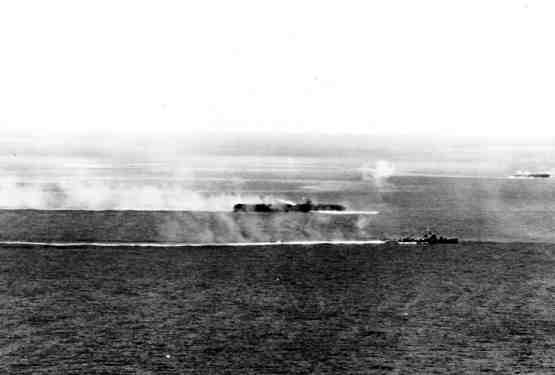
After Admiral William “Bull” Halsey felt that he had heavily damaged the Japanese Center Force during the Battle of the Sibuyan Sea he withdrew the Fast Battleships of Task Force 34 from the San Bernardino Strait in order to use them in a surface engagement against Admiral Jisaburo Ozawa’s Northern Force. Halsey assumed that Ozawa’s carriers were the main threat to the American invasion forces. However he did not know that Ozawa’s carriers had very few aircraft embarked and that the Northern force was in fact a decoy, designed to draw him away from Vice Admiral Takeo Kurita’s Center and the two task forces of the Southern force.

b55

The Zuikaku uder attack at Cape Engano

When…

View original post 759 more words

Leave a comment

Filed under Loose thoughts and musings

Mine Eyes Have Seen the Glory!

The Website of Historian, Author and Priest Steve Dundas

It Is What It Is

Dr. Rex .... Blogging for change.

Questionable Motives

What is the right question?

Square Cop In A Round World

A former cop taking on tough subjects

Discover WordPress

A daily selection of the best content published on WordPress, collected for you by humans who love to read.

Another Spectrum

Personal ramblings and rants of a somewhat twisted mind

Chicago FEEDBACK Film Festival

Toronto, Los Angeles.....and now CHICAGO. LOGAN Cinemas in midtown Chicago.

Mar3sons

A liberal that believes in facts.

Seclusion 101 with AnneMarie

Life After Retirement

WJB's Turn

Devotionals, Opinion, General Musings

John Oliver Mason

Observations about my life and the world around me.

Mrmoteeye's Blog

Just another WordPress.com weblog

NONVIOLENT CHRISTIANS

Living nonviolently in a violent world

Filosofa's Word

Cogito Ergo Sum

Souvenirs de guerre

Souvenons-nous