Author Archives: padresteve

padresteve's avatar

About padresteve

I'm a Navy Chaplain and Old Catholic Priest

Easter and the Outcasts: For Many the Season is Painful

barmherzigkeit

Sieger Köder
“Barmherzigkeit” (Mercy)

“Let us not underestimate how hard it is to be compassionate. Compassion is hard because it requires the inner disposition to go with others to place where they are weak, vulnerable, lonely, and broken. But this is not our spontaneous response to suffering. What we desire most is to do away with suffering by fleeing from it or finding a quick cure for it.” Henri Nouwen

It is now Holy or Maundy Thursday, the beginning of the Easter Triduum. Mid-way through Holy Week and I am doing some thinking about Christians that have suffered a crisis in faith or loss of faith. I meet them all the time and read their stories on blogs, books and social media. Of course I run across more now because I have gone through such a crisis and have written about it and through that had my story publicized. As a result I am contacted by people who have suffered trauma, especially related to PTSD as well as those that care for such people.

For many Christians Holy Week and Easter can be particularly painful. Having known plenty of these people I can say that this phenomenon is one of the more tragic aspects of the season. People who at one time felt the presence of God in their life only sense emptiness and loneliness. For some this loneliness can transition to a feeling of hopelessness where even death appears more comforting than life in the present.

I say this because so many people suffering people often go unnoticed or are ignored in church. Their loss could be that of a spouse or child, the loss of something else significant or another type of trauma that devastates them. Others find that they are rejected by the communities of faith that they had been part of all of their lives because of divorce or because of their sexual preference. However, no matter the cause of the suffering many people discover that they are outcasts in the place where they should be cared about more than anywhere else.

Many pastors and priests are either unaware of them, uncomfortable around them or irritated by them because they don’t respond like “normal” people to the message of Easter. I have found from my own experience returning from Iraq that Easter despite the message of resurrection and hope often triggers a despair of life itself. It is not so bad this year for me but I can remember coming home from Iraq and going through an extended period of time where I felt absolutely alone and no longer sensed the presence of God. I have to say that as a Priest and Chaplain that experience was one of the most frightening of my life.

Years ago I believed that if someone was in the midst of a crisis in faith if they read the Bible more, prayed more and made sure that they were in church that things would work out. I believed then that somehow with a bit of counseling, the right concept of God and involvement in church activities that God would “heal” them.

Call me a heretic but I do not believe that now. That line of thinking is nice for people experiencing a minor bump in their life. However it is absolutely stupid advice to give people who are severely traumatized, clinically depressed, and suicidal or who no longer perceive the presence of God in their lives. This is especially true for those abused by parents or clergy. That kind of wound does damage to the victim’s very concept and understanding of God which can last a lifetime, and in some churches leads to continued re-victimization as the victims are blamed for their plight.

Thus I cannot condemn those who have lost their faith or are wavering in their faith due to trauma, abuse or any other psychological reason. The numbers of people victimized by family, teachers, clergy other authority figures is mind numbing. Likewise we don’t even bother to count the vast numbers of people in our churches who have lost children or other loved ones, experienced some kind of physical trauma related to accidents, had near death experiences or combat deal with the wounds of war. They are all over the place and many go unnoticed in the church.

Sometimes the damage makes it nearly impossible for people to comprehend a God who both cares about them and who is safe to approach. To some God is at best a detached and uncaring being who allowed them to be hurt, and those that serve him in positions of authority are willing accomplices and are no safe.

My experience of coming home from Iraq and the trauma of my return and were absolutely frightening. I was in such bad shape that I left Christmas Eve Mass in 2008 before it started and walked through the dark wondering if God even existed. My isolation from other Christians and the church community and despair that I experienced showed me that such a loss of faith is not to be trifled with by care givers. Nor is it to be papered over with the pretty wallpaper or neat sets of “principles” drawn up by “pastors” who refuse to deal with the reality of the consequences of a fallen world and their impact on real people.

Those that I have talked to and read about who have suffered a crisis or loss of faith almost always express how they feel cut off and even abandoned by God. It is also something that I experienced, thus for me it is not an academic exercise. It is not simply depression that people are dealing with, but despair of life itself. Sometimes it seems that death or just going to sleep is preferable to living. This overwhelming despair impacts almost all of life. It is if they never are able to leave the “God-forsakenness” of Good Friday and cannot climb out of the tomb. For some the pain is so much that suicide becomes an option and the belief that their family, friends and loved ones would be better off without them. I have seen this too many times to count.

It is hard to reach for the person experiencing this pain to reach out but it is also difficult for those who care enough to reach out to them. I can say that I was not easy to deal with and because of my distrust it was hard to believe that anyone cared, even when they did. However the people who chose to remain with me and walk with me through the ordeal in spite of my frequent crashes, depression, anger and even rage helped get me through the worst of this. I’m sure that some who had to deal with me in that condition got burned out as I was not easy to deal with. Some chose not walk with me as I began to go down this road in early 2008 and the sad thing is that many were ministers and fellow chaplains. In some ways I don’t blame them. However it is telling that the first person that asked me about my spiritual life “or how I was with the Big Guy” was my first therapist.

The topic of a loss of faith or the reality of feeling God forsaken is had to deal with but is something that we need to face especially during Holy Week. The Cross necessitates this, Jesus was considered “God-Forsaken” and that is what is so perplexing about Good Friday. He is the battered and abandoned victim on that day, a day when all hope appears to be gone. German theologian Jurgen Moltmann wrote something quite profound:

“When God becomes man in Jesus of Nazareth, he not only enters into the finitude of man, but in his death on the cross also enters into the situation of man’s godforsakenness. In Jesus he does not die the natural death of a finite being, but the violent death of the criminal on the cross, the death of complete abandonment by God. The suffering in the passion of Jesus is abandonment, rejection by God, his Father. God does not become a religion, so that man participates in him by corresponding religious thoughts and feelings. God does not become a law, so that man participates in him through obedience to a law. God does not become an ideal, so that man achieves community with him through constant striving. He humbles himself and takes upon himself the eternal death of the godless and the godforsaken, so that all the godless and the godforsaken can experience communion with him.” 

Scripture plainly teaches that we are to “bear one another’s burdens, and in this way you will fulfill the law of Christ.” But this can be hard to do, we don’t like dealing with suffering. But as Dietrich Bonhoeffer said “We must learn to regard people less in light of what they do or omit to do, and more in the light of what they suffer.” It is our willingness to be with people in their suffering that is one of the true marks of the Christian. Being with someone in triumph is far easier than with walking with and holding on to those who suffer the absence of God. It is presence and love not sermons that people who have lost their faith need as Bonhoeffer so eloquently said “Where God tears great gaps we should not try to fill them with human words.”

I do pray that as we walk with Jesus this Holy Week that we will not forget those who despair of live and feel as if they are “God-forsaken.”

Peace

Padre Steve+
1 Comment

Filed under christian life, faith, Pastoral Care, PTSD, Religion

A Watershed Moment: Jackie Robinson and Civil Rights in America

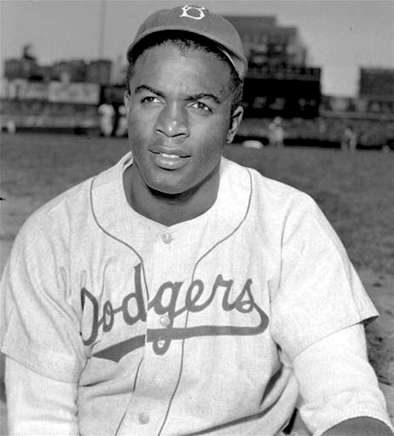
jackierobinsonlg

“He led America by example. He reminded our people of what was right and he reminded them of what was wrong. I think it can be safely said today that Jackie Robinson made the United States a better nation.” – American League President Gene Budig

April 15th 2014 was the 67th anniversary of Jackie Robinson’s first game in the Major Leagues with the Brooklyn Dodgers.  Jim Crow was very alive and well when Jackie stepped onto the field that day and no matter how much we want to distance ourselves from those days there are still some in this country who want to go back to that kind of society. Robinson’s first game with the Dodgers came a full year before President Truman integrated the military, a move which infuriated many in the South.  Likewise it occurred a full seven years before the Supreme Court ruled school segregation unconstitutional in the Brown vs Board of Education decision.  It came a full 17 years before Congress passed the Voters Rights.

When Jackie Robinson stepped onto the field it was a watershed moment in Civil Rights for African Americans and paved the way for a change in American society that has continued since his Major League debut. Blacks had struggled for years against Jim Crow laws, discrimination in voting rights and even simple human decencies like where they could use a rest room, sit on a bus or what hotel they could stay in.

In baseball many white fans were upset that blacks were allowed to see Robinson in stadiums that they would not have been allowed in before.  Players from other teams heckled Robinson, he received hate mail, people sent made death threats, he was spiked and spit on.  But Jackie Robinson kept his pledge to Dodgers owner Branch Rickey not to lash out at his tormentors, as Rickey told him that he needed a man “with enough guts not to strike back.”

Jackie Robinson played the game with passion and even anger.  He took the advice of Hank Greenberg who as a Jew suffered continual racial epithets throughout his career “the best ways to combat slurs from the opposing dugout is to beat them on the field.” He would be honored as Rookie of the Year in 1947. He was a MVP and played in six World Series and six All Star Games.  He had a career .311 batting average, .409 on base percentage and .474 Slugging percentage. He was elected to Baseball’s Hall of Fame in 1962.

Today Jackie Robinson’s feat is history, but it should not be forgotten.  He was a pioneer who made it possible for others to move forward.  He would be followed by players like Roy Campinella, Satchel Paige, Don Larson, Larry Dobie and   Willie Mays.  His breakthrough had an effect not just on baseball but on society.

Jackie Robinson would have an effect on my life.  In 1975 the Stockton Unified School District voted to desegregate.  I was in the 9th grade and preparing for high school.  As the school board wrestled with the decision anger boiled throughout the town, especially in the more affluent areas.  Vicious letters were sent to the school board and to the Stockton Record by parents as well as other opponents of the move.  Threats of violence and predictions failure were commonplace.  In the summer of 1975 those who went out for the football team, both the sophomore and varsity squads began to practice.  Black, White, Mexican and Asian, we bonded as a team, the Edison Vikings.  By the time the first buses pulled up to the bus stops throughout town on the first day of school, the sense of foreboding ended.  Students of all races discovered common interests and goals.  New friends became guests in each others homes, and all of us became “Soul Vikes.”

30 years later the Class of 1978, the first class to be desegregated from start to finish graduated from Edison held a reunion.  Our class always had a special feel about it.  Looking back we too were pioneers, like Jackie Robinson we were far ahead of our time.  When I look at my friends on Facebook from Edison I see the same faces that I played ball, rode the bus and went to class with.   Things have changed.  Even 30 years ago none of us imagined a African American President, we believed in each other and we saw potential, but I don’t think that anyone believed that we would see this in our day.

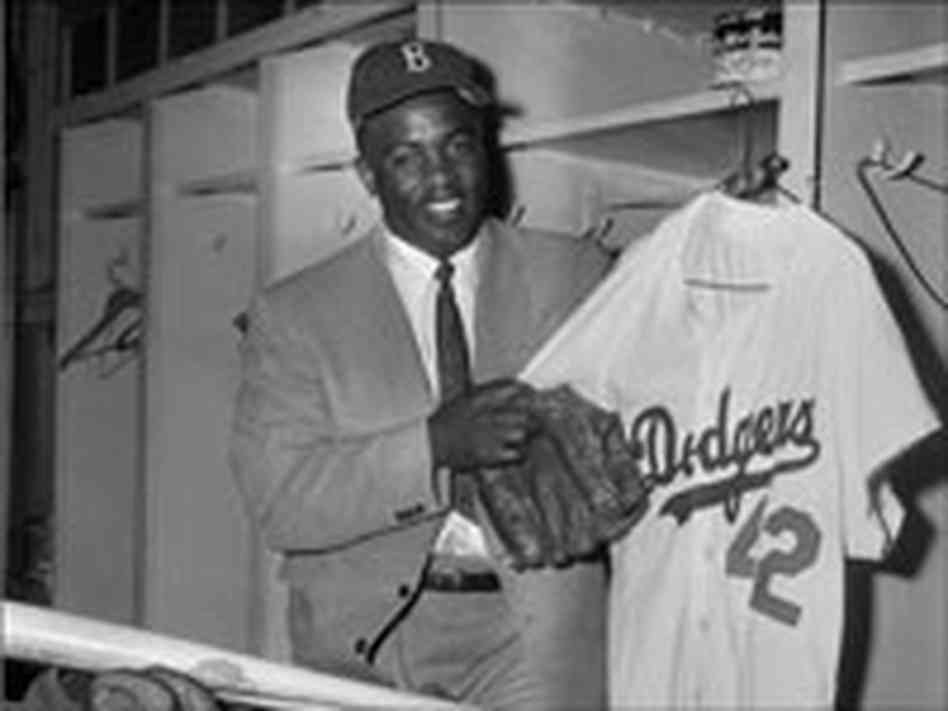
robinson200-ffbfd794408772ed56c5418c8f637c6b552e5c70-s6-c30

I think that Jackie Robinson prepared the way for other pioneers of Civil Rights including Dr. Martin Luther King.  Today, 67 years later Jackie Robinson looms large not only in baseball, but for the impact of his life and actions on America.

His number “42” is now retired from baseball. The last player to wear it was Mariano Rivera of the Yankees. Rivera had been granted an exemption to wear it until he retired. At least the last Major League ball player to honor the number was a class act who will certainly be in the Hall of Fame.

Robinson said something that still resonates with me: “Life is not a spectator sport. If you’re going to spend your whole life in the grandstand just watching what goes on, in my opinion you’re wasting your life.” It is something that I take into account every day of my life.

So here’s to you Jackie Robinson.  Thank you and God bless.

Peace,

Padre Steve+

Leave a comment

Filed under Baseball, civil rights, History

42: Thank God for Jackie Robinson and Branch Rickey

Dear Friends of Padre Steve’s World, It is the anniversary of Jackie Robinson taking the field as a member of the Brooklyn Dodgers in 1947 to break the race barrier in Major League Baseball. Unfortunately racism is still alive and well in the United States. It has been 67 years since Robinson took to the field to the mass hysteria and hatred of race baiters in this country and it is now 149 years since the end of the Civil War but racism is still very much alive and well in this country. Jackie Robinson and the owner of the Dodgers in 1947 Branch Rickey put their lives on the line then and unfortunately despite many advances the same may be required again. The battle that these two men entered into in 1947 is still not over. Thus tonight as I remember their legacy I recommit myself to the equality of all Americans. Thank God for Jackie Robinson and Branch RIckey. Peace, Padre Steve+

padresteve's avatarThe Inglorius Padre Steve's World

WFTCRMImageFetch.aspx

“Your enemy will be out in force. But you cannot meet him on his own low ground.” Branch Rickey (Harrison Ford) in the movie 42

“The right of every American to first-class citizenship is the most important issue of our time.” Jackie Robinson

Tonight I went and saw the movie 42. I have been wanting to see it since before it came out. As anyone who knows me or reads my articles on this website knows I am not only a historian and theologian but maybe more importantly a student of the game of baseball and baseball history. I have written articles on the integration of baseball as well as Jackie Robinson. I have read many books and article about the subject and even still I was unprepared for what I saw tonight. As I watched the movie I found that I was often overcome with tears. That doesn’t happen…

View original post 764 more words

Leave a comment

Filed under Loose thoughts and musings

Looking into the Face of Evil: A Centurion Meets the Terrorist Barrabas

centurioncross_1

This is the third chapter of a prequel to my series on Longinus the Centurion, who according to tradition was the Centurion in charge of the execution of Jesus. Today is how I imagine that the Centurion would deal with receiving orders to prepare for the execution of a condemned terrorist.

The next morning a messenger knocked on the door to Longinus’s quarters in Fortress Antonia. He told Longinus that Pilate wanted to speak to him and to report as soon as possible to Pilate’s headquarters in the fortress.

Longinus, who had been discussing the day with Decius in order to ensure his soldiers were ready for any contingency but also conduct some training was bothered by the request. He had discussed the situation in the city and about Jesus in particular the previous afternoon with Pilate and figured that unless there was some sort of incident that he would meet again later in the day to discuss the latest events.

Instead Longinus, was being ordered to report to Pilate again and it was interfering with his conduct of military business. Longinus hated dealing with politicians and diplomats and though he respected Pilate who he felt to be as decent of man as any politically appointed diplomat as any Pilate was still not a military man. He did not always understand military matters.

Longinus looked at the messenger and asked: “Tell me. what would the Governor need of me at this hour?”

“Centurion,” the messenger replied. I was only told to have you report as soon as possible.”

Bothered by the lack of detail Longinus told the messenger to go and tell Pilate that he would be there shortly. He then looked at Decius, and shook his head. “My friend, I am afraid that I will be delayed. Take care to conduct today’s training and be ready in case any trouble arises.” With that he put on his armored breastplate and cape and left the room.

pontius-pilate1

When he arrived at Pilate’s headquarters the Governor greeted him cheerfully. “Centurion, it is good to see you.”

“Likewise sir…” Pilate stopped him before he could continue.

“I don’t suppose that you know why I called you here do you?” Pilate asked, irritating Longinus who feeling even more irritated by Pilate’s levity kept his feelings to his self and simple replied: “No my Lord, your messenger only told me to report here, he did not give me a reason.”

Pilate smiled. “It was with good reason, had he done so I am sure that you, like any other Centurion in the province would have found some “pressing military duty,” isn’t that what you call it? to avoid coming here.”  He paused for just a moment and before Longinus could respond continued: “Of course I know the answer, you need not say anything and I suppose if I was in your position that I would feel the same way.”

Longinus knew this was the case and had no answer to Pilate who continued.

“Centurion, this week will unfortunately be a week where we must conduct some rather unpleasant business, less than soldierly business but necessary.” Pilate paused again and motioned for Longinus to take a seat at his desk and Longinus did so, looking about the room and noticing Pilate’s civilian staff and several soldiers assigned as his personal bodyguard.

Longinus, decided to hasten the length of the visit and asked: “My Lord, may I ask why I am here? After all I do have pressing military business to attend to.”

Pilate immediately caught the sarcasm in Longinus’s words and smiled. “Centurion, you amuse me, because I know how you military types think. You see I may not have served with a Legion, but I have served with enough officers to know that you would rather be fighting the enemies of the Empire than doing police work, but we are in Palestine, not the Teutonic Forrest.”

Longinus stared back at Pilate and said nothing.

“Centurion, this week we will dispense justice to three Jewish prisoners. Men of your unit will conduct the crucifixions this Friday.”

“Yes my Lord.” Longinus’s muted response spoke more than any protest could.

Pilate continued. “Centurion, I want you to see the prisoners and in doing so know in your heart why this must be done. These men are violent criminals, and one of them is the infamous Bar-Abbas.”  Longinus looked at Pilate, and asked “the insurgent who has attacked and killed our soldiers and officials?”

Pilate nodded and replied “so you know why this is important, in an environment as volatile as Judea we cannot let a man like this remain unpunished, it would only encourage more men to rise up like him.” Pilate smiled and continued. “We cannot forget how the Jews rose up and overthrew the Seleucid rulers underestimated these Jews when that Judas Maccabee fellow led that bloody revolt.”

Longinus replied “No we could not let that happen on our watch.”

Pilate nodded in agreement and continued. “So you understand Centurion, it is an unpleasant duty, but mind you history will thank us for it, as will any God that you believe in.” Pilate finished by telling Longinus to visit the prison for himself and begin to choose his soldiers for the crucifixion detail with care.

Longinus rose and saluted Pilate, turned and left the room without another word. He was not happy but proceeded to the dungeon where he met the Jailer of the Fortress, a rather obese and dirty looking man named Alexander, a Roman citizen of Greek origin hailing from Antioch.

When Longinus reached the dungeon he immediately noticed the stench and again realized why he was a Legionnaire and not a policeman. The prison was dark, and by Palestinian standards dank and moist smelling of human excrement and body odor.

“Well Centurion, welcome to my kingdom” said Alexander, a smile pressing through his grimy face.

“Thank you Alexander, where are the condemned?” asked Longinus icily.

They are in the cells to your left. Bar-Abbas is in the first and the other two, neither as notorious as he are in the next cell.”

“What are their names?”

“Dismas and Gestas, they are violent criminals of their own accord, but they were only out for personal gain. I think that one feels some remorse, but the other seems to be a rather hardened and unrepentant man.” The words came effortlessly to the unkempt jailer

“Thank you warden, I will see them now” said Longinus as he turned to look over these men as quickly as possible so he could return to his unit.

He walked past Bar-Abbas without making eye contact and went to the second cell. The two prisoners could not appear more different. One, seemed to accept his fate while the other looked at Longinus without remorse. After about a minute Longinus asked their names. The remorseful looking one answered, “I am Dismas, I stand condemned for robbery and murder. I accept my fate Centurion.” The other prisoner glared at his mate and with hatred in his voice and eyes said to Longinus “I am Gestas, and I am not sorry for anything that I did you Roman swine.”

barabbas

Longinus stared back saying nothing, his continued lack of respect for such people seemed vindicated. He turned to the other cell and looked at the burly prisoner in it. “So you are Bar-Abbas?”

The prisoner snarled “So what is it to you Roman?”

Longinus began to feel better about his mission. “Well, Bar-Abbas, it seems that you have killed one too many of my comrades and it is I who will get to exact justice on you.”

Bar-Abbas smiled an evil smile and said, “The Roman that can kill me has not been born.” He laughed at Longinus who stood silently for a moment. Then, quietly Longinus replied, “We’ll see about that.” With that Longinus motioned to Alexander the Jailer to let him out. The jailer unlocked the door and Longinus walked up the steps and into the courtyard of the fortress where his unit was practicing battle drills.

Calling Decius to his side, he said. “We have a second mission this week, the mission of executing some dangerous prisoners, including Bar-Abbas the insurgent.”

“Bar-Abbas sir?” replied the junior officer.

“The same, but we have to wait until Friday. It seems that our governor wants to make a show if his generosity to the people here. If it was up to me I would have killed them in the dungeon and been done with it, we could have said that they died of the plague.” Longinus looked at his assistant and then continued “Of course that is not how we Romans do things, they will be executed in public to show these Jews that they cannot engage in such conduct, but it will only build more resentment.”

“Sir, are you saying that our methods are wrong?” asked Decius.

“Young man, look around you. You know the history of these people. They will continue to rise up until they regain their independence or we kill them all.” He paused. “That is their history and they can do no other. After all, if they were occupying our homes, establishing their God in cities and forcing our people to serve them how would we respond?”

Decius nodded his understanding and looked at the Legionnaires practicing close combat tactics that might be necessary in a pitched battle if the city was to erupt in revolt.

Longinus continued “Decius, choose a squad of men as the execution team and another as the escort. The rest of the Century is to be trained to maintain a secure perimeter and ensure that no Jews attempt to interfere with our mission.

“Sir, where is the execution to take place?” asked Decius.

golgotha-36

Longinus motioned to a hill visible just outside the city walls. “Over there, that barren hill. The locals call it Golgotha.” He paused. “Fitting name, the place of the Skull. I perfect place to kill people that don’t want us here wouldn’t you say?” He chuckled and continued, “don’t answer, it is a rhetorical question.”

His assistant nodded and Longinus gave the order “Carry on with training, let me know which men you think should be on the execution team later tonight.”

Longinus turned and walked away wondering what else might happen, after all, the best laid plans of men sometimes don’t work out. He silently cursed under his breath the day that he was assigned to this place, which despite its history and splendor seemed forsaken by the Gods.

Peace

Padre Steve+

Leave a comment

Filed under faith, History, Religion

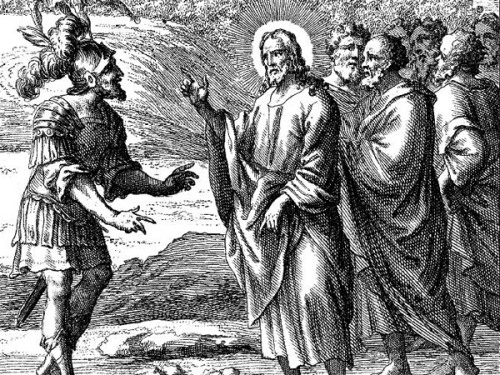
A Meeting of Centurions in Jerusalem

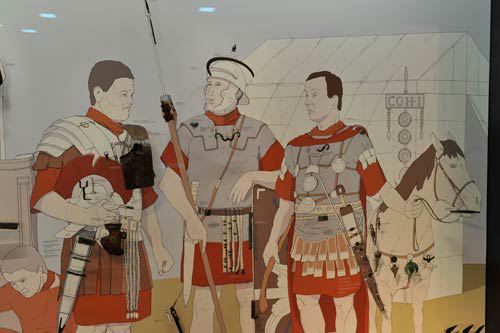
centurions

This is another part in the historical fiction series that I am wrote about the Centurion Longinus, who according to tradition was the Centurion at the Cross who put his lance in the side of Jesus and who would exclaim “Surely this was the Son of God” as Jesus breathed his last. This chapter takes up where after the Triumphant Entry of Jesus into Jerusalem and is about a meeting between Longinus and another Centurion who I call Flavius. This second character is based on the Centurion that Jesus meets in Capernaum recorded in Matthew Chapter eight. I began the first trilogy in 2012 and the second trilogy which is the prequel to the first last year as part of my Holy Week meditations. Hopefully I will to a concluding trilogy at some point imagining what things were like for these men in the years after that momentous week.  

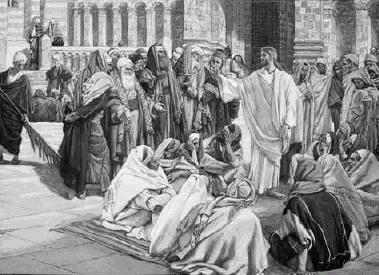
The day after the entry of this Jesus character into Jerusalem was uneventful for Longinus and his fellow Roman officers. Jesus had returned to Bethany after driving out the money changers and other assorted riff-raff out of the Temple but had returned without the tumult of the preceding day, Instead, Jesus with a number of his disciples went to the Temple where he engaged the people and some of the Pharisees in a time of teaching culminating in a series of what Longinus’ Jewish spy said were comments that could be interpreted as threats against the Temple establishment and veiled allusions to Jesus being the Messiah of the Jews.

Jesus left the Temple at the end of the day without incident but Longinus’ spy indicated that the Priests and other religious authorities were discussing ways by which they might rid themselves of this Galilean would be Messiah. Now Longinus and his fellow officers couldn’t care a whit about Jewish religious disputes so long as it did not make their job keeping the peace any more difficult than it already was.

jesus teaching

When his spy reported back Longinus briefed Pilate of the simmering tensions. Pilate was with his wife Bernice when he received the report. Pilate did not like what was going on but had no contact with any of the religious leaders from any faction since his arrival and was troubled. His wife warned him in the presence of Longinus “not to have anything to do with that man” and he told Longinus to continue monitoring the situation, He also dispatched a messenger to the commander of the Legion in Caesarea to send reinforcements to Jerusalem just in case things got out of hand. Until then, Longinus, the Primus Pilus, or senior Centurion of the Legion was to help him maintain a close watch on the situation and hopefully keep the situation from boiling over.

After his meeting with Pilate and Bernice, Longinus sat around the tavern in Fortress Antonia with several others of his officers and Centurions from the Legion currently in Jerusalem. His Optio, or second in command Decius, a Roman from his former unit who had accompanied him to Palestine was there, as were two Decurio officers from the cavalry detachment and his Tesserarius, Quentin, a man who held a position much like a First Sergeant. Late in the evening another Centurion came to the tavern. This Centurion, was accompanied by his young servant was in charge of the Century based in Capernaum in Galilee.

The Centurion, Flavius by name ordered an ale from the barkeeper and walked over to the table where Longinus and the other officers sat. After the exchange of formalities Flavius sat with them. His young servant remained at the bar sitting alone.

Longinus had known Flavius for several years and known him to be an honorable man, though he did not necessarily approve of the very “Greek” arrangement that he had with his Pais,* which was common in the Roman and Greek military units, he respected Flavius’s soldiering abilities, leadership and integrity. Flavius and his Century had arrived in Jerusalem the previous night after Jesus had made his entry into the city. Longinus was glad to see Flavius because he felt that an officer stationed in Galilee might be able to shed more light on this man of mystery who had Jerusalem up in arms and so troubled Pilate.

Flavius asked what Longinus knew about Jesus, and Longinus told him what he had seen the day before as well as the information that he had obtained from his own Jewish spy.

Flavius, nodded and then began to tell Longinus and the other officers of his encounter with Jesus a couple of years before in Capernaum of Galilee.

Flavius began: “Longinus my friend, I met this Jesus in Capernaum and he is no ordinary man.” He paused to take a drink and continued as Longinus nodded for him to continue.

“It was a difficult time my friend. My Pais was very ill, sick to the point of death, He lay in our quarters and I heard that the miracle working Rabbi named Jesus was in town. Now, you know my friends that I care not a thing about what these Jews believe but I was desperate and from what I had heard and seen I believed that the Gods had to be with this man.”

Longinus continued to listen and then asked “Why didn’t you go to our Temple and have our Gods intercede for your Pais?”

“My friend I had already done that but my Pais’ condition had worsened. So I found this Jesus fellow as he was entering the city and sent some Jews that I had befriended to him.” He paused. “Those Jews convinced Jesus that I was a friend of the Jews and had done many good things for their community, and this my friend is true.”

“So the Jews helped you contact this Jesus fellow?” asked Decius. Longinus looked at his subordinate disapprovingly and asked Flavius to continue.

“I tell you my friends, this man is like no one that I have ever met, the Gods are certainly with him, whether our Gods or the Jewish God I know not which but he is not a normal Rabbi.”

The officers looked around the table as Flavius continued.

“Gentlemen, when this Jesus came to me I felt something that I have never felt in my life. Jesus asked what he could do for me and I told him of the sickness of my Pais and he asked if he could come to my quarters. I replied that I didn’t need him to come, because I was not worthy for him to come under my roof but to only say the word and my Pais would be healed.”

centurion1

Longinus looked at his fellow Centurion in disbelief. Flavius sensing this continued. “My friend, I could not believe that I uttered those words but Jesus peered into my eyes and I knew that he knew all about me. Then he replied that “your servant is healed” and then exclaimed to all of the Jews around us that he “had not seen such faith in all of Israel.” Then, he put his hand on my shoulder, blessed me with some Hebrew blessing and walked away with his friends. When I returned to my quarters, my Pais, the young man over at the bar was well.”

Longinus saw the deep emotion that Flavius was expressing and raised his mug. “A toast to this Jesus!, whatever and whoever he he is.”

“Here here” replied those at table as Flavius looked on and several laughed. He had not expected such a reaction and said softly.

“My friends I don’t think you understand.” He paused a second and looked Longinus in the eyes. “I do hope that whatever happens in the next few days that no harm will come to this man. I would hate that my spear could bring harm to him.”

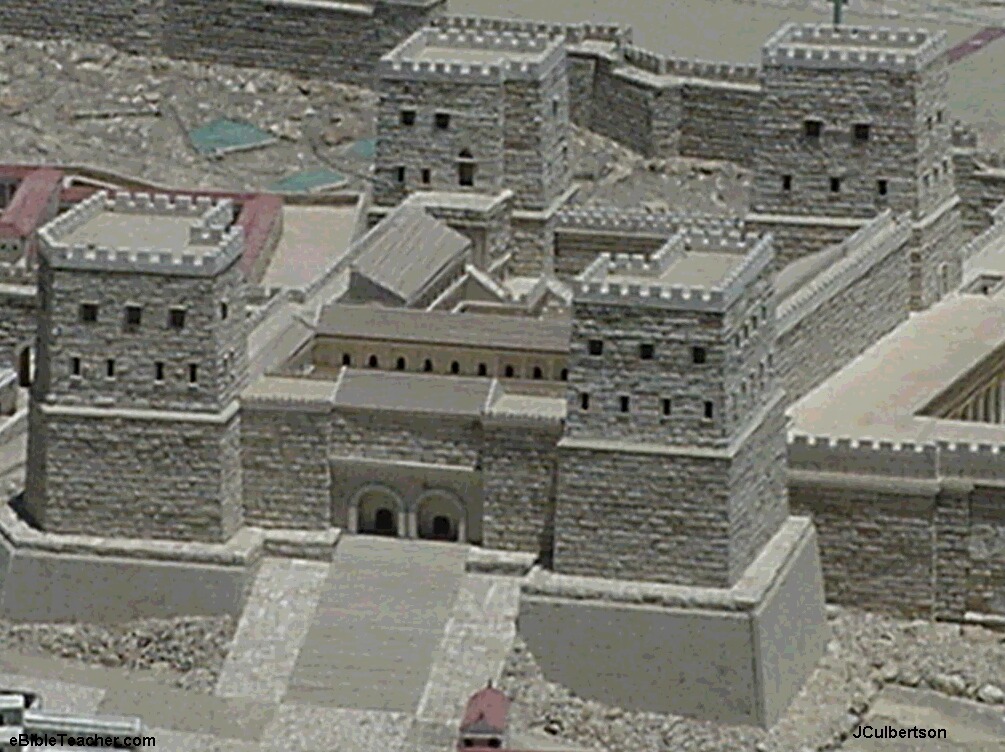
citadel

Longinus responded. “I hope that nothing happens to cause any of us any problems. The city is boiling with emotion and unlike your friend Jesus, most of them hate us and would rather see us dead, and some of their leaders from what I understand wouldn’t mind seeing him dead either.” Longinus paused and emptied his mug, drinking the ale to the last and then continued “My friend, I appreciate what you have to say, but we have to do our duty for the Empire regardless of our personal feelings. We are outnumbered here and this Jesus, as much as we may find him fascinating is the source of much of the current discord.” He looked at Flavius. “You do understand this?”

Flavius looked down at his drink and looked back up at Longinus and then at the officers around the table.

“I do understand my duty my friend, but you have to know what he did for me.”

“We do understand my friend” replied Longinus, “but our honor is loyalty to Caesar, not any other man.”

“I know Longinus, I do know, more than you think, but what if he is more than just a man?”

Longinus and the other officers sat silently pondering Flavius’s words. The silence was deafening and slowly the junior officers individually asked to be excused, begging pressing duties to attend to leaving Flavius and Longinus at the table. The bartender brought each man another ale and the two friends continued to drink in silence.

Note: The Greek word Pais is the word used in many Greek texts to to describe a homosexual relationship. The use by Matthew in his account of the healing of the servant of the Centurion used the word Pais to describe the servant, not the typical Doulos which is used for slave or bond servant as is most common throughout the New Testament. In fact this is the only use of the word Pais in the New Testament. Many Biblical scholars and linguists, though not completely certain do entertain that possibility that the Centurion that I call “Flavius” and his servant were a Gay couple. If so that would add an interesting twist of even more inclusiveness on the part of Jesus to the Gospel narratives.

Peace

Padre Steve+
Leave a comment

Filed under faith, History, Religion

A Centurion’s Remarkable Sunday in Jerusalem: The Story of Longinus

jesustriumphal-entry

This article is the first story in a prequel trilogy to a trilogy that I wrote about Longinus the Centurion who according to tradition commanded the detail in charge of the crucifixion of Jesus. I plan on re-publishing each segment this week as part of Holy Week and I hope that you find them interesting. Story is basically historical fiction and my imagination about what it must have been like to be a Roman officer witnessing the drama of the Passion during what we now call Holy Week.

I find a special affinity to this soldier who while serving his country in a land far from home whose people detested the occupiers of their country by a foreign power that most considered infidels. I don’t think that anyone can really understand the plight of the Roman officers assigned to the occupation of Judea and Samaria in the First Century until they have  done their time in Iraq or Afghanistan. These peoples, though not Jewish have similar divisions,  contradictions and prejudices against foreigners as those that lived in First Century Palestine. Those American, NATO or coalition troops that served in Iraq or Afghanistan, especially those who actually worked alongside or came to know the people in those countries understand the plight of the Roman soldiers assigned to occupation duty throughout the Empire, but especially in the volatile provinces of Judea and Samaria like Longinus.

So enough of the introduction, on to the story…

centurioncross_1

Longinus and his men were tired. Pilate, the Governor had decided that he would travel from his Provincial capital of Caesarea in order to maintain a close watch on the Jews of Jerusalem during the annual celebration of Passover. During such times that city, the largest in the province would see its population expand exponentially as Jews from the diaspora, that is those living around the known world would make pilgrimage to the holy city.

Longinus’s men had helped provide the escort as Pilate travelled the nearly 80 miles moving up from the coastal plain where Caesarea was up to the hill country of Judea. The trip took three days as Pilate wanted to be in the city in plenty of time. The weather was conducive to the march, but though well trained Longinus’ men were not Romans but primarily recruited locally from drafts of Syrian’s and Samaritans.

Longinus never really enjoyed this assignment. He had served in other areas as a young officer and much preferred serving with and commanding Italians, Greeks, Macedonians and others to the men that he now commanded, but his duty was to serve wherever he was sent. He thought at times of his family in Italy near his home in Lanciano in the Abruzzo region near the Adriatic, missing his wife and children.

coin-vespasian-judea-capta-sestertiusThe duty of Longinus and other Romans in the region chiefly consisted of helping police the region and protecting the much despised tax collectors. One of those tax collectors, a Jewish man named Matthew had left the employ of Caesar a few years back and was now a “disciple” of some itinerant Jewish preacher named Jesus. He had heard a story from another Centurion about this preacher that made him chuckle. Evidently some Jews of the sect know as the Pharisees, a particularly strict group tried to trap the Jesus with the question of whether it was lawful to pay taxes to the Romans. They thought that they had trapped him because if he answered in the affirmative he would be rejected by them and discredited among the people, while if he answered that it was not they would have him on record as urging the people to disobey Caesar.

The Centurion who told the story said how with him standing in the background watching and listening that Jesus asked one of the Pharisees to bring him a coin. Looking at the coin he asked the man whose image was on it. The Pharisee, a bit hesitantly replied that it was “Caesar” to which Jesus, who supposedly was an unlearned but charismatic bumpkin from Galilee replied “give to Caesar what is Caesar and to God that which was God’s.” Longinus’ colleague, an outsider looking in at this curious religious dispute was amazed with the acumen of Jesus in dealing with a question that someone less intuitive could have botched with potentially fatal consequences.

romans-35

The march through Samaria was particularly uneventful but as the Legionaries entered Judea, a region seething with hostility toward the Romans he and his men became more guarded, very aware of the hostility that sometimes invited violence.

They arrived about noon on Friday in order not to stir up the Jewish faithful on their sabbath and took up residence in the Fortress Antonia, the symbol of Roman might in this always rebellious city. That evening and the next day were uneventful, but on Sunday, Longinus was told to have his troops stand by in case of violence. The man named Jesus was entering the city and pandemonium was expected. According to rumor this Jesus had raised a many from the dead in Bethany the day before and was being greeted as a potential King and liberator.

The Roman presence was muted, Pilate and senior commanders not wanting to do anything that might provoke an insurrection. The troops remained on alert at the fortress while Longinus and a number of other officers went to observe events at a distance.

Longinus was amazed at what he saw. Thousands of people singing and throwing cloaks and palms along the street as Jesus, mounted on a white donkey accompanied by his disciples as well as numerous people from Bethany where he had been staying paraded down the street.

The procession moved toward the Temple where an understandably nervous delegation of Pharisees and the Priests of the Temple wondered what Jesus might do. If he was the “Messiah” that they preached about it could be a direct threat to their positions of power and provoke a Roman crackdown against them.

Jesus dismounted from the donkey and entered the Temple area, now crowed with thousands of pilgrims coming to offer sacrifice where he began to condemn the moneychangers. The moneychangers were in charge of selling animals for sacrifice to pilgrims, many of whom who could not bring their own animals for sacrifice. They were not according to what Longinus knew from his previous visits to the city at Passover and other Holy days men of good repute. They were believed to make their profit off the poor and widows and even the Romans that knew of the practice considered it less than honorable, and certainly the religious authorities were making money from their efforts.

jesus_templecleanse

As Jesus went into the Temple, Longinus and his fellow officers stayed back. As Gentiles their presence would create a crisis so they remained outside entrusting a Jew who worked with them to make the observation. They could hear commotion in the Temple and as they watched money changers and others came spilling out of the Temple grounds, many surrounded by their animals, lambs, doves and oxen. Longinus wondered what in the name of Jupiter was going on and soon his spy came running out of the Temple to make his report.

Slowing down as he approached Longinus he breathlessly gave his report. Jesus had taken a whip and driven out the moneychangers, condemning their activities and those of the religious leaders. Longinus had never heard of Jesus ever doing anything remotely violent before and this shocked him. He asked what else had happened and the spy reported that the Temple police and authorities did nothing and that Jesus left without further incident.

pontius-pilate1

Longinus knew that the coming days could prove interesting. Going to Pilate that evening he gave his report. Pilate was quite concerned about the situation and considered it volatile. He ordered Longinus and the other officers to maintain an elevated state of readiness in case there was some sort of protest or even civil strife between the followers of Jesus and the Jewish authorities.

Longinus left Pilate and he and his fellow officers discussed the situation, briefed their subordinates and as night fell met in the tavern in the fortress where they quietly drank and wondered what the coming days might bring.

Peace

Padre Steve+

2 Comments

Filed under faith, History, Religion

“The Glory of Fighting” The Anticlimactic Clash of Cavalry at Gettysburg, July 3rd 1863

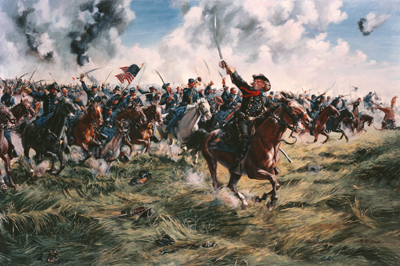
4 RCuster leads his Michigan Brigade  on July 3rd

Robert E. Lee’s prodigal son had finally returned. On the evening of July 2nd 1863 with the attacks of Longstreet now finished and Ewell’s abortive battle for Culp’s Hill reaching its bloody Lieutenant General J.E.B. Stuart finally arrived at Robert E Lee’s headquarters on Seminary Ridge. The meeting was brief and unwitnessed by anyone but the participants.

Apparently the meeting between Lee and his Cavalry division commander was short “abrupt and frosty.” Porter Alexander noted that Lee only said “Well General, you are here at last” and Stuart’s aide Major Henry McClellan reported that Stuart “regarded the incident as painful beyond description.” (1) In his official report of the battle “Lee would allude to Stuart with but a single pejorative sentence: “The movements of the Army preceding the Battle of Gettysburg had been much embarrassed by the absence of the cavalry.” (2) In Stuart’s defense it needs to be re-emphasized that Lee had four brigades of cavalry at his disposal but did not use them effectively.

Stuart left as quickly as he arrived and in his official report he noted that his new orders were to take up a position “on the left wing of the Army of Northern Virginia.” (3) For a man like Stuart whose soldierly skills as a cavalry commander and leader were only matched by his vanity the incident was humiliating, he had failed Robert E Lee.

300px-Gettysburg_East_Cavalry_Field3

Lee’s plan for Stuart the next day was that Stuart Stuart moved four of his brigades the following morning to the north and east. The plan was for his forces to be in position to assist the exploitation of any breakthrough made by Pickett’s attack. Stuart hoped to cover his movement from Federal observation but he was discovered and his movement reported back to Meade. Stuart blamed the discovery on the trail brigades of Hampton and Fitzhugh Lee who had “debouched onto open ground and disclosed his presence.” (4)

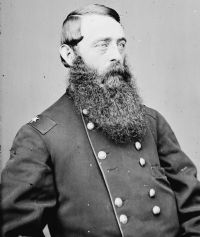
david-greggBrigadier General David Gregg

Brigadier General David Gregg commanding the Second Cavalry Division received word of Stuart’s approach and prepared to intercept him and in the process relieve the Michigan Brigade of the newly minted Brigadier General George Custer so it could rejoin Jusdon Kilpatrick’s division.

300_2631176Brigadier General George Armstrong Custer

Upon his arrival Gregg realized that he would be outnumbered and that Stuart posed “a serious threat to the Federal rear.”(5) Custer indicated that he thought Gregg would soon have a battle and Gregg replied “in that case he would like to have the assistance of his Michigan brigade.” (6) Custer indicated his agreement and without bothering to consult the Cavalry Corps Commander Alfred Pleasanton Gregg ordered Custer to remain with him and “willingly risked his military career and reputation in his anxiety to protect the Federal rear.” (7)

Gregg’s action was yet another of the superior judgements executed by a Federal commander during the battle. It was an outstanding example of how Federal commanders on the whole recognized the overall tactical situation and used their judgement to take action when waiting for a superior could prove fatal to the army. In our modern understanding it would be an example of how Mission Command is to work.

During the battle Stuart displayed little of his normally sharp tactical leadership and took little part in the battle leaving the conduct of it to his subordinates. Though the Federal Horse Artillery was outnumbered Gregg used the two batteries he had far more effectively than Stuart used his. Additionally Gregg had two brigade commanders willing to take the fight to the Confederates.

The main battle took place after Three PM when Pickett’s attack was battling for its life during its assault on Cemetery Hill. There were a number of charges and counter charges and the battle was tactically a draw but a victory for Gregg who had forced Stuart to enter a battle “in which the Confederates gained nothing except the “glory of fighting” (8) and had stopped Stuart from his objective of disrupting the Federal rear and aiding Pickett’s assault.

Stuart’s aid Major Henry McClellan wrote of the battle:

“The result of this battle shows that there is no possibility that Stuart could successfully have carried out his intention of attacking the rear of the Federal right flank, for it was sufficiently protected by Gregg’s command. As soon as General Gregg was aware of Stuart’s presence he wisely assumed the aggressive and forced upon Stuart a battle…while Gregg himself performed the paramount flank of protecting the right flank of the Federal Army.” (9)

McClellan’s analysis is both succinct and accurate. As Stuart’s forces retired and Pickett’s shattered command withdrew the Battle of Gettysburg was effectively over.

1. Sears, Stephen W. Gettysburg A Mariner Book, Houghton Mifflin Company, Boston and New York 2003. pp.257-258

2. Taylor, John M. Duty Faithfully Performed: Robert E Lee and his Critics Brassey’s Dulles VA 1999 p.150

3 Trudeau, Noah Andre. Gettysburg: A Testing of Courage, Harper Collins Books New York 2001 p.316 

4 Coddinton, Edwin B. Gettysburg: A Study in Command. A Touchstone Book, Simon and Schuster, New York 1968 pp.520-521

5. Ibid. p.521

6. Ibid.

7. Ibid. p.522

8. Ibid. p.523

9. McClellan, Henry Brainerd The Life and Campaigns of Major General J.E.B. Stuart Commander of the Cavalry of the Army of Northern Virginia 1885. Digital edition copyright 2011 Strait Gate Publications, Charlotte NC location 6516 of 12283

4 Comments

Filed under civil war, History, leadership, Military

The Forgotten Hero: Brigadier General George Sears Greene at Culp’s Hill: Night of July 2nd and 3rd 1863

220px-George_S._GreeneBrigadier General George Sears Greene

On the night of July 1st 1863 Dick Ewell’s Second Corps of the Army of Northern Virginia and the Army of the Potomac on Cemetery and Culp’s Hill prepared for another day of battle. Despite a significant amount of success Lee’s Army had failed to drive the lead elements of the Army of the Potomac off of Cemetery Hill. As the evening progressed more Federal troops in the form of Henry Slocum’s XII Corps began to take up positions on Cemetery Hill as well as Culp’s Hill which Oliver Howard and Winfield Scott Hancock recognized to be vital to holding the Federal position.

The three brigades of Geary’s division entered the line to the east of Wadsworth’s division of I Corps along the northern and eastern face of Culp’s Hill. Key to the position was the placement of the brigade of Brigadier General George S. Greene one of the oldest, if not the oldest Union officer on the field. Greene’s brigade took a position next to the remnants of the Iron Brigade which had fought so hard along Seminary Ridge earlier in the day.

Greene had been born in 1801 and had graduated from West Point as an artillery officer some six years before Robert E. Lee. He graduated second in his class at West Point in 1823 and after 13 years left the army in 1836 to enter civilian life as an engineer. Greene missed the Mexican War but when the call came for volunteers in 1861 he was appointed to command the 60th New York Volunteer Infantry. Promoted to Brigadier General in 1862 he commanded his brigade and served as an acting division commander at Antietam. He was a descendent of Nathaniel Greene and his son Lieutenant Dana Greene USN was the Executive officer of the USS Monitor at the Battle of Hampton Roads against the CSS Virginia.

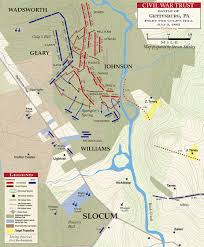
culps hill map

As the Federal units on Culp’s Hill took their positions they began to do something that was not yet commonplace in either army. They began to construct field fortifications and breastworks. Working through the night with the ample materials at hand they dug in and linked their positions with each other as well as Brigadier General Thomas Kane’s brigade to Greene’s right. The line of fortifications took advantage of the natural terrain which on its own made the ground good for the defense, but when fortified made it nearly impregnable to assault.

During the day of July second little happened on Ewell’s front. Though he had persuaded General Lee to leave his troops in place Ewell remained mostly inactive on July second with the exception of some skirmishing and a battle between the Stonewall Brigade and Gregg’s division of Federal Cavalry on Brinkerhoff’s Ridge about two and a half miles east of the town.

It would not be until the evening of the 2nd that Ewell’s troops went into action against the now very well entrenched Federal Forces on Cemetery and Culp’s Hill. The assaults began on Cemetery Hill where Jubal Early’s division attacked forces along the north and east section of the hill to be supported by Robert Rodes’ division on the west.

However as with most of the Confederate offensive actions of the battle this too fell apart as Rodes division gave little support to Early’s attack as due to both Rodes’ and Ewell’s indecisiveness Rodes “did not give himself enough time to get his big division into formation for the attack. By the time he had completed the complicated maneuver of wheeling his brigades forty-five degrees to the left and advancing them half a mile to a good place from which to charge up Cemetery Hill the battle was over.” [1]

Though Early achieved some success his division was repulsed and the threat to the Union gun line on Cemetery Hill was ended. One author noted of Early’s attack: Courage and determination could not offset superior numbers and fresh troops. With no help coming and enemy units swarming around them, all those Rebels who were still under some command and control began to fall back.” [2]

Longstreet’s attack on the Federal left forced George Meade to pull troops from his quiet sector along Culp’s Hill in order to reinforce his forces in the Peach Orchard, the Wheat Field and along the southern extension of Cemetery Ridge. According to most accounts Meade directed Slocum to send “at least one division” to the threatened sector which weakened the forces deployed on Culp’s Hill considerably.

However within XII Corps there was much confusion and in addition to William’s division Geary had pulled two of his brigades out of line leaving only George Greene’s brigade to defend Culp’s Hill “guarding nearly half a mile of Twelfth Corps works.”[3] Neither Slocum nor Williams realized the danger and before the units which had left the hill could return Allegheny Johnson’s division of Ewell’s corps which had sat inactive and impatiently awaiting orders to attack all day jumped off.

culp's hill149th New York Volunteer Infantry on Culp’s Hill

The Confederate attack began around Seven PM and continued through the night. Johnson sent some 4,700 men to attack Greene’s 1,300 dug in veterans. “That kind of manpower edge would have likely been decisive elsewhere on the field that day, but against Pop Greene’s providential and well-constructed breastworks the odds leveled out.” [4]Greene’s men fought hard as Greene directed them and requested reinforcements from I Corps and XI Corps who in turn sent units including the Iron Brigade to help. However, the six regiments that arrived had been reduced to fractions of their former strength by the first day’s battle “increased Greene’s force only by about 755 men.” [5]Additionally, Hancock who heard the battle raging “sent two regiments to the relief of Slocum as well.”[6] Greene’s report of the battle noted:

“we were attacked on the whole of our front by a large force few minutes before 7 p.m. The enemy made four distinct charges between 7 and 9.30 p.m., which were effectually resisted. No more than 1,300 were in our lines at any one time. The loss of the enemy greatly exceeds ours.”[7]

As the night wore on Confederate attacks continued and in the darkness other Federal units arrived, including those from XII Corps which had gone earlier in the day. By mid-morning Johnson’s assault was done. His units had suffered severe casualties and his division had been drained of all attacking power by the time Lee needed it on the morning of July 3rd to support Pickett’s attack. “This division, formed by Stonewall Jackson was never the same again. Its glories were in the past.”[8] In the end the Army of the Potomac still held both Cemetery and Culp’s Hill, in large part due to the actions of the old soldier, George Greene who’s foresight to fortify the hill and superb handling of his troops and those who reinforced him kept Johnson’s division from rolling up the Federal right.

Ewell’s troops would play no further role in the battle. In the end his presence around Cemetery and Culp’s Hill diminished the resources that Lee needed to support his other assaults on the second and third day of battle. In effect it left Lee without one third of his forces. The result was the sacrifice of many troops with nothing to show for it. Ultimately Lee is to blame for not bringing Ewell’s forces back to Seminary Ridge where they and their artillery may have had a greater effect on the battle.

greene monumentMonument to General George S Greene on Culp’s Hill

The real hero of Culp’s Hill was Greene. But Greene in many ways is a forgotten hero, he was not given much credit in Meade’s after action report though Slocum attempted to rectify this and Meade made some minor changes to his report. But it was in later years that Greene was began to receive recognition for his actions. James Longstreet gave Greene credit for saving the Union line on the night of July 2nd and said that “there was no better officer in either army” at the dedication of the 3rd Brigade monument on Culp’s Hill in 1888. Greene died in 1899 having been officially retired from the Army in 1893 as a First Lieutenant, his highest rank in the Regular Army. A monument to Greene stands on Culp’s Hill looking east in the direction of Johnson’s assault.

Until tomorrow,

Peace

Padre Steve+


[1] Coddington, Edwin B. The Gettysburg Campaign: A Study in Command, A Touchstone Book, Simon and Schuster Ne5w York, 1968 pp.429-430

[2] Tredeau, Noah Andre. Gettysburg: A Testing of Courage, Harper Collins Publishers, New York 2002 p.409

[3] Pfanz, Harry W. Gettysburg: Cemetery Hill and Culp’s Hill University of North Carolina Press, Chapel Hill NC 1993 p. 204

[4] Sears, Stephen W. Gettysburg. Houghton Mifflin Co. Boston and New York 2003 p.326

[5] Ibid. Coddington p.431

[6] Jordan, David M. Winfield Scott Hancock: A Soldier’s Life Indian University Press, Bloomington and Indianapolis 1988 p.94

[7] Luvaas, Jay and Nelson Harold W. editors. The U.S. Army War College Guide to the Battle of Gettysburg South Mountain Press, Carlisle PA 1986 pp. 159-160

[8] Dowdy, Clifford. Lee and His Men at Gettysburg: The Death of a Nation Skyhorse Publishing, New York 1986, originally published as Death of a Nation Knopf, New York 1958 p.262

5 Comments

Filed under civil war, History, leadership, Military

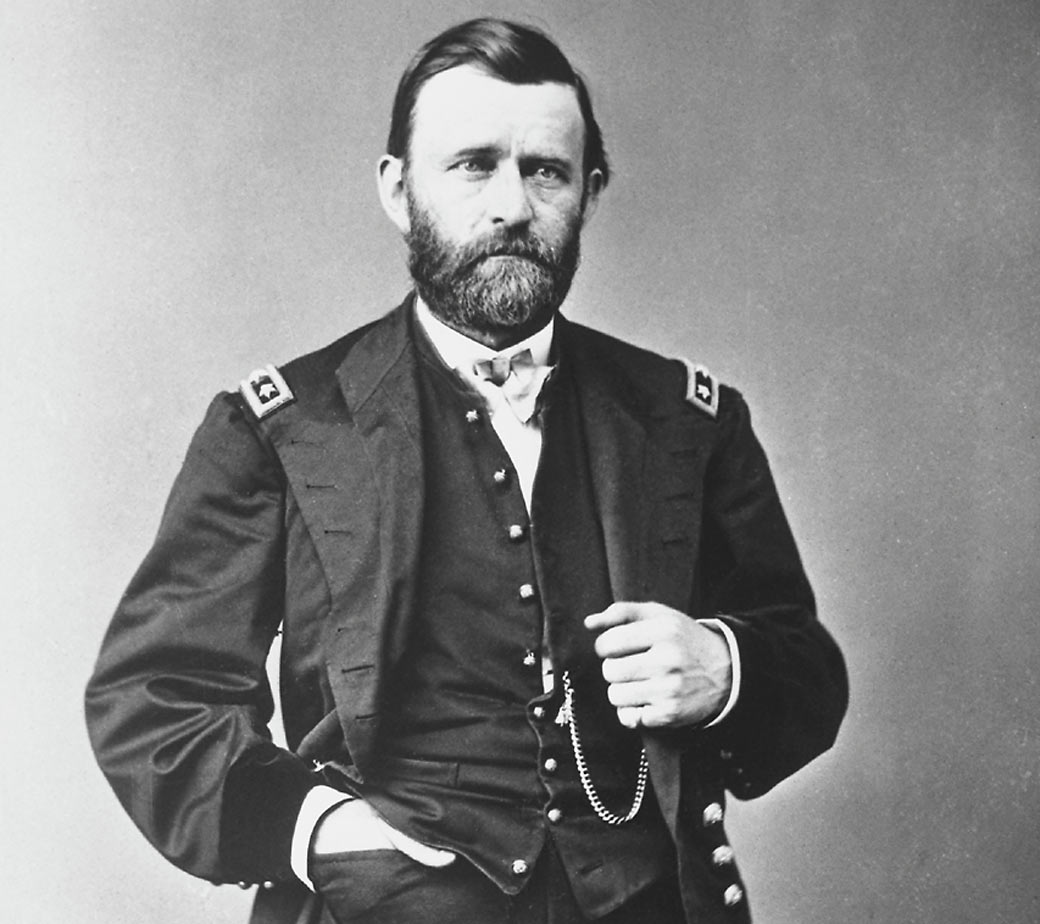
Surrender at Appomattox: Ulysses S. Grant, Robert E. Lee and Joshua Lawrence Chamberlain teach us about Reconciliation

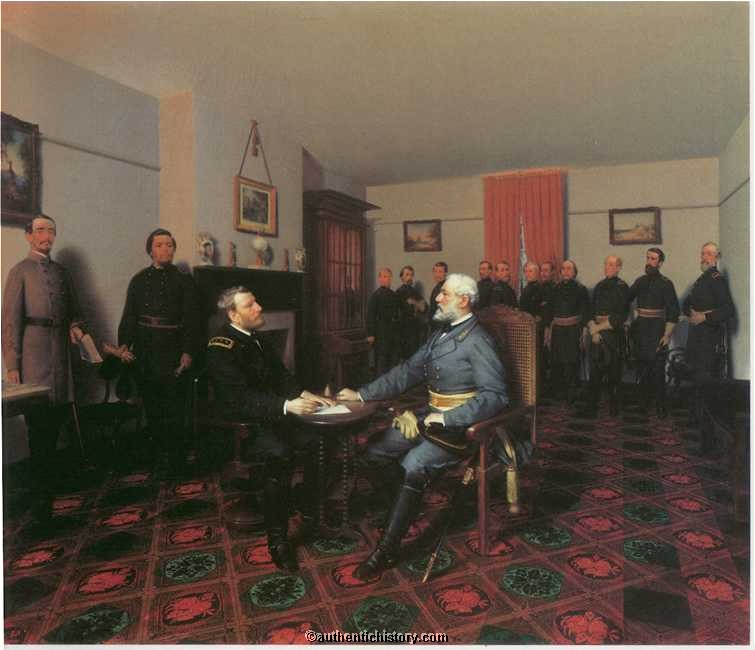
The Authentic History Center

It was the day after General Robert E Lee had requested to Lieutenant General Ulysses S. Grant that his Army of Northern Virginia be allowed to surrender. The once mighty army now a haggard but proud force of about 11,000 soldiers faced hopeless odds against a vastly superior enemy. Since Gettysburg Lee’s army had been on the defensive, Lee’s ill fated offensive into Pennsylvania being one of the two climactic blows that sealed the doom of the Confederacy, the other Grant’s victory at Vicksburg which fell a day after Pickett’s Charge.

On the 9th and 10th of April three men, Ulysses S Grant, Robert E Lee and Joshua Lawrence Chamberlain taught succeeding generations the value of mutual respect and reconciliation after a bitter and bloody war.

ileerob001p1

With each battle following Gettysburg the Army of Northern Virginia became weaker and finally after the nine month long siege of Petersburg ended with a Union victory there was little else to do. When his artillery chief Porter Alexander recommended that the Army be released, “take to the woods and report to their state governors” Lee replied:

“Already [the country] is demoralized by the four years of war. If I took your advice, the men would be without rations and under no control of their officers. They would be compelled to rob and steal in order to live…. We would bring on a state of affairs it would take the country years to recover from… You young fellows might go bushwhacking, but the only dignified course for me would be to go to General Grant and surrender myself and take the consequences of my acts.”

Abraham Lincoln had already set the tone for the surrender in his Second Inaugural Address given just over a month before the surrender of Lee’s army. Lincoln closed that speech with these words of reconciliation:

“With malice toward none, with charity for all, with firmness in the right as God gives us to see the right, let us strive on to finish the work we are in, to bind up the nation’s wounds, to care for him who shall have borne the battle and for his widow and his orphan, to do all which may achieve and cherish a just and lasting peace among ourselves and with all nations.”

poor--ulysses-s-grant-president-1040cs021412

Grant provided his vanquished foe generous surrender terms. Grant met with Lee and offered the following terms of surrender:

“In accordance with the substance of my letter to you of the 8th inst., I propose to receive the surrender of the Army of N. Va. on the following terms, to wit: Rolls of all the officers and men to be made in duplicate. One copy to be given to an officer designated by me, the other to be retained by such officer or officers as you may designate. The officers to give their individual paroles not to take up arms against the Government of the United States until properly exchanged, and each company or regimental commander sign a like parole for the men of their commands. The arms, artillery and public property to be parked and stacked, and turned over to the officer appointed by me to receive them. This will not embrace the side-arms of the officers, nor their private horses or baggage. This done, each officer and man will be allowed to return to their homes, not to be disturbed by United States authority so long as they observe their paroles and the laws in force where they may reside.”

When Lee left the building Federal troops began cheering but Grant ordered them to stop. He later noted: “The Confederates were now our countrymen, and we did not want to exult over their downfall.”

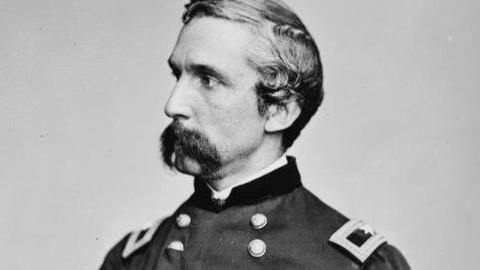
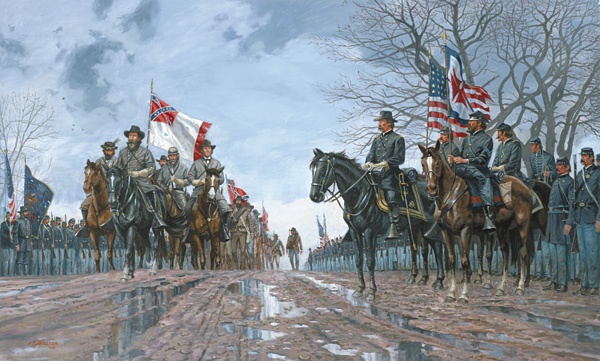
The surrender itself was accomplished with a recognition that soldiers who have given the full measure of devotion can know when confronting a defeated enemy. Major General Joshua Lawrence Chamberlain, the heroic victor of Little Round Top was directed by Grant to receive the surrender of the defeated Confederates. As they passed, moved with emotion he ordered his soldiers to salute the defeated enemy for whose cause he had no sympathy.

PH2010062902996

Chamberlain was not just a soldier, but before the war had been Professor of Natural and Revealed Religions at Bowdoin College, and a student of theology before the war. He could not help to see the significance of the occasion. He understood that he would be criticized by some for offering the salute, however unlike some, the staunch abolitionist and Unionist who had nearly died on more than one occasion fighting the defeated Confederate Army understood that no true peace could transpire unless the enemies became reconciled to one another.

He noted that his chief reason for doing so:

“The momentous meaning of this occasion impressed me deeply. I resolved to mark it by some token of recognition, which could be no other than a salute of arms. Well aware of the responsibility assumed, and of the criticisms that would follow, as the sequel proved, nothing of that kind could move me in the least. The act could be defended, if needful, by the suggestion that such a salute was not to the cause for which the flag of the Confederacy stood, but to its going down before the flag of the Union. My main reason, however, was one for which I sought no authority nor asked forgiveness. Before us in proud humiliation stood the embodiment of manhood: men whom neither toils and sufferings, nor the fact of death, nor disaster, nor hopelessness could bend from their resolve; standing before us now, thin, worn, and famished, but erect, and with eyes looking level into ours, waking memories that bound us together as no other bond;—was not such manhood to be welcomed back into a Union so tested and assured? Instructions had been given; and when the head of each division column comes opposite our group, our bugle sounds the signal and instantly our whole line from right to left, regiment by regiment in succession, gives the soldier’s salutation, from the “order arms” to the old “carry”—the marching salute. Gordon at the head of the column, riding with heavy spirit and downcast face, catches the sound of shifting arms, looks up, and, taking the meaning, wheels superbly, making with himself and his horse one uplifted figure, with profound salutation as he drops the point of his sword to the boot toe; then facing to his own command, gives word for his successive brigades to pass us with the same position of the manual,—honor answering honor. On our part not a sound of trumpet more, nor roll of drum; not a cheer, nor word nor whisper of vain-glorying, nor motion of man standing again at the order, but an awed stillness rather, and breath-holding, as if it were the passing of the dead!”

The next day Robert E Lee address his soldiers for the last time. Lee’s final order to his loyal troops was published the day after the surrender. It was a gracious letter of thanks to men that had served their beloved commander well in the course of the three years since he assumed command of them outside Richmond in 1862.

General Order
No. 9


After four years of arduous service marked by unsurpassed courage and fortitude, the Army of Northern Virginia has been compelled to yield to overwhelming numbers and resources.

need not tell the survivors of so many hard fought battles, who have remained steadfast to the last, that I have consented to the result from no distrust of them.
But feeling that valour and devotion could accomplish nothing that could compensate for the loss that must have attended the continuance of the contest, I have determined to avoid the useless sacrifice of those whose past services have endeared them to their countrymen.

By the terms of the agreement, officers and men can return to their homes and remain until exchanged. You will take with you the satisfaction that proceeds from the consciousness of duty faithfully performed, and I earnestly pray that a merciful God will extend to you his blessing and protection.

With an unceasing admiration of your constancy and devotion to your Country, and a grateful remembrance of your kind and generous conideration for myself, I bid you an affectionate farewell. — R. E. Lee, General

Warriors_Tribute_at_Appomattox

The surrender was the beginning of the end. Other Confederate forces continued to resist for several weeks, but with the surrender of the Army of Northern Virginia led by the man that nearly all Southerners saw as the embodiment of their nation the war was effectively over.

Lee had fought hard and after the war was still under the charge of treason, but he understood the significance of defeat and the necessity of moving forward as one nation. In August 1865 Lee wrote to the trustees of Washington College of which he was now President:

“I think it is the duty of every citizen, in the present condition of the Country, to do all in his power to aid the restoration of peace and harmony… It is particularly incumbent upon those charged with the instruction of the young to set them an example of submission to authority.

It is a lesson that all of us in our terribly divided land need to learn regardless of or political affiliation or ideology. Lee learned that Grant’s Aide-de-Camp was a Seneca and said after the surrender “It is good to have one real American here.” The officer replied, “Sir, we are all Americans.”

It is time again that we learn that lesson.

Peace

Padre Steve+
Leave a comment

Filed under civil war, History, Military, philosophy, Political Commentary

Gettysburg Day Two: The Peach Orchard, Wheat Field and Devil’s Den

barksdales_charge_lg

“Mission command is the conduct of military operations through decentralized execution based upon mission-type orders. Successful mission command demands that subordinate leaders at all echelons exercise disciplined initiative, acting aggressively and independently to accomplish the mission. Essential to mission command is the thorough knowledge and understanding of the commander’s intent at every level of command.” From the Mission Command White Paper and JP 3-31

As on the first day of battle and throughout the Gettysburg campaign issues of command and control would be of paramount importance. On the second day the glaring deficiencies of Robert E Lee and his corps commanders command and control at Gettysburg would again be brought to the fore while the exemplary command of the Army of the Potomac by George Meade, Winfield Scott Hancock, staff artillery officer Henry Hunt and staff engineer Gouverneur Warren exemplified the best aspects of what we now define as Mission Command.

On the morning of July 2nd the Army of the Potomac was mostly assembled on the high ground from Culp’s Hill to Cemetery Hill and along Cemetery Ridge. In the north XII Corps under the command of Major General Henry Slocum held Culp’s Hill. The battered remnants of I and XI Corps under the command of Oliver Howard and Abner Doubleday held Cemetery Hill while Winfield Scott Hancock’s crack II Corps extended the line down Cemetery Ridge. To II Corps right was Dan Sickles’ III Corps with George Sykes V Corps in Reserve. John Sedgwick’s VI Corps was still enroute, marching up the Baltimore Pike.

It was a solid and well laid out position which commanded the battlefield. Major General Gouverneur Warren the Army’s Staff Engineer Officer who had been sent by Meade to assist Hancock the night of the first wrote his wife that morning: “we are now all in line of battle before the enemy in a position where we cannot be beaten but fear being turned.” (1)

sicklesMajor General Dan Sickles

There was one notable problem, Dan Sickles did not like the position assigned to his corps. His corps which joined the left flank of II Corps was to extend down Cemetery Ridge to Devil’s Den and Little Round Top. All morning he had been lobbying Meade, through Meade son and Aide-de-Camp Captain George Meade, the Artillery Reserve Commander Henry Hunt, Warren and even Meade himself to no avail. Sickles was disturbed because John Buford’s Cavalry division which has been deployed on the Federal left had been moved to the rear by Pleasanton the Cavalry Corps commander and not replaced.

Hunt who had accompanied Sickles back to his corps pointed out that the position was too exposed and too expansive for the number of troops Sickles had in his corps. He advised Sickles not to advance and assured Sickles that he would discuss Sickles’ concerns with Meade. (2)

To remedy the situation he sent out four companies of Sharpshooters supported by the 3rd Maine Infantry to make a reconnaissance. Those troops ran into a large force of advancing Confederate Infantry near Seminary Ridge and withdrew, Colonel Brenden of the Sharpshooters informing Sickles of the Confederate advance.

Sickles now felt that the Union line was about to be turned as it had been at Chancellorsville and without consulting Meade or Hancock took it upon himself to save the situation. It was an act of brazen insubordination, but typical of the mercurial, vain and scandal plagued man who “wore notoriety like a cloak” and “whether he was drinking, fighting, wenching or plotting, he was always operating with the throttle wide open.” (3)

About mid-afternoon Sickles advanced III Corps forward in a “mile long line of battle with waving flags and rumbling batteries rolling west into the afternoon sunlight.” (4) The sight confused other commanders such as John Gibbon commanding a division in II Corps who watched in amazement from his vantage point on Cemetery Ridge. Sickles advanced nearly a mile in front of his previous position opening a gap between III Corps and II Corps. He attempted to hold a new line that was longer and more exposed than the number of troops that he had available. He placed Humphrey’s division along the Emmitsburg Road and extended Birney’s division through the Peach Orchard, a wheat field down to Devil’s Den where he ran out of troops.

gettysburg-peach-orchard

Sickles had formed an exposed and vulnerable salient which was too thinly manned for its length. It was open to attack on three sides, had little depth, no reserves and no place to fall back to as an alternate position. (5) It was also about to be hit by the full fury and power of Hood’s and McLaws’ divisions of Longstreet’s First Corps supported by 46 well placed artillery pieces (6) all about to open fire on Sickles badly deployed corps.

About 3 PM Meade broke from a planned commander’s conference to investigate what had happened to Sickles and III Corps, accompanying Meade was Warren. Warren who was most familiar with that part of the battlefield noted that III Corps was “very badly disposed on that part of the field.”7

Confronting Sickles in the Peach Orchard Meade was visibly perturbed. Meade informed Sickles that “General I am afraid that you are too far out” (8) attempting to control his temper. Sickles disagreed and said with support he could hold the position because it was higher ground than what he had previously occupied. Meade then pointed out the obvious stating “General Sickles this is in some respects higher ground than that to the rear, but there is still higher in front of you…” (9) As the conversation progressed Meade told Sickles that “this is neutral ground, our guns command it as well as the enemy’s. The reason you cannot hold it applies to them.”(10)

Sickles offered to withdraw but as he did so the Confederate cannonade began signaling the beginning of Longstreet’s attack. Meade told Sickles “I wish to God you could [withdraw]…but those people will not permit it.” (11) Another account states that Meade told Sickles “You cannot hold this position but the enemy will not let you get away without a fight.”(12)

Since Sedgwick’s powerful VI Corps had just arrived Meade ordered it into reserve. He then ordered Sykes V Corps from its reserve position and one division of II Corps to support the dangerously exposed III Corps around the Peach Orchard and Wheat Field. He then told Sickles “if you need more artillery call on the reserve!” (13) It was an action that very likely saved the day, another example of Meade taking control of a bad situation preventing it from becoming even worse.

For Lee and Longstreet the morning had been spent disagreeing on a plan to crush Meade. Though his army was operating on exterior lines with his corps having no way to effectively coordinate their actions and still lacking Stuart’s Cavalry, Pickett’s Infantry division and Law’s brigade of Hood’s division Lee insisted that Longstreet and First Corps make a frontal attack on the Union left. Longstreet demurred and tried to convince Lee of turning the Union flank to the south of the Round Tops. Longstreet told Hood “The General is a little nervous this morning; he wishes me to attack; I do not wish to do so without Pickett. I never like to go into battle with one boot off.” (14)

Lee did not believe that such a move could succeed without the assistance of Stuart’s cavalry and Longstreet did not believe that with Pickett’s division that his corps had the combat power to successfully complete the mission. Hood objected to the attack pleading with Longstreet that it was “unwise to attack up the Emmitsburg Road, as ordered” and requested that he be allowed to “turn Round Top and attack the enemy flank and rear.”(15)

HD_hoodJB1Major General John Bell Hood

The debate between Longstreet and Hood continued as Hood objected and Longstreet reiterated Lee’s insistence on the planned attack. Hood pleaded for freedom of maneuver believing that an attack up the rocky hills was doomed and later noted “it seemed to me that the enemy occupied a position so strong- I may say impregnable – that independently of their flank fire, they could easily repulse our attack by merely throwing or rolling stones down the mountainside as we approached.”(16) Despite his objections to the plan Longstreet ordered Hood to attack as Lee planned and after a fourth attempt by Hood to persuade Longstreet to change the plan Longstreet told his subordinate “We must obey the orders of General Lee.” (17)

However in addition to his contention with Lee and Hood Longstreet had to deal with Lee jumping the chain of command. With Longstreet in earshot order McLaws to make an attack on the Peach Orchard and ignored McLaws repeated requests to make a further reconnaissance before launching the attack. By the time Hood and McLaws divisions were in place along with Anderson’s division from Hill’s Third Corps it was nearly four o’clock. The senior commanders of the Army of Northern Virginia had functioned poorly throughout the day but when the attack began it was like a violent storm as Confederate troops fell upon the exposed Federal III Corps.

mclawsMajor General Lafayette McLaws

When the attack was launched McLaws division and the left wing of Hood’s division struck the exposed positions of III Corps. Sickles was severely wounded by a bouncing cannon ball which shattered a leg knocking him out of the fight, Hood too was badly wounded early in the action leaving command of his division to Brigadier General Evander Law, whose brigade had just arrived on the battlefield after a long march from New Guilford in the Cumberland Valley. Though now in command Law continued to command his own brigade in the assault and Robertson took the initiative to bring up the rest of the division. (18)

McLaws and Hood’s soldiers hit Sickles Corps hard shattering it. Despite fierce resistance from the Federal forces Sickles’ corps was forced to retreat. The reinforcements ordered to the sector from V Corps, II Corps and the artillery reserve arrived piecemeal and also sustained heavy casualties but eventually helped to stem the Confederate tide. III Corps was wrecked and effectively out of the battle but the actions of Meade, Hancock, Warren, Gibbon, Sykes and Hunt to respond to Sickles folly kept the Confederates from sweeping the field.

fig33

Law, Robertson’s and Benning’s brigades opened Hood’s attack toward Devil’s Den and Little Round Top.
Fierce fighting ensued at Devil’s Den where the Federal line, occupied by Colonel A. Van Horn Ellis’ 124th New York and 4 guns of Smith’s artillery battery put up a stiff resistance. Ellis’s small regiment numbered but 18 officers and 220 men when it entered the fight but it held off several charges of the Texans and even conducted a counter-attack before being overwhelmed by fresh troop’s from Benning’s brigade. During the fight Ellis mounted his horse noting that “The men must see us today.”(19) Ellis died in the action as did many of his brave soldiers. In the valley between Devil’s Den and the Round Tops the 4th Maine and Smith’s 2 remaining guns fought large numbers of Hood’s troops and as the outnumbered Federals fell back the Texan’s of Robertson’s brigade and Law’s Alabamians surged toward the rocky hill.

Col. Van Horne Ellis, 124th N.Y. InfColonel Augustus Van Horn Ellis

Brigadier General William Barksdale’s Mississippi brigade which had distinguished itself at Fredericksburg stormed the Federal positions breaking through the salient and driving forward. He led his brigade forward though it had suffered significant casualties and was losing cohesion. Barksdale insisted on continuing to the advance and not taking time to reform his lines shouting at one of his regimental commanders “No! Crowd them- we have them on the run. Move your regiments.” (20 )

GeneralBarksdale_zps3678f799willardBarksdale and Willard (below)

As the brigade reached the lower portion of Cemetery Ridge a fresh Federal brigade commanded by Colonel George Willard struck the Mississippians. Willard’s brigade was seeking redemption having been one of the units forced to surrender at Harpers Ferry the previous September. His troops fresh and full of fight fell upon the Mississippians who were spent and disorganized having reached their culminating point. Barksdale continued to urge on his men but was mortally wounded and his troops driven back by the New Yorkers. Willard did not live long to savor the redemption as he was hit by a cannon ball and killed instantly.

The First MinnesotaFirst Minnesota attacks Wilcox’s Brigade

To the north of the salient Anderson’s division of Hill’s corps attacked toward Cemetery Ridge meeting heavy resistance. Cadmus Wilcox’s brigade advanced unsupported up to Cemetery Ridge which due to the dispatch of troops to the Peach Orchard was only lightly defended. When Hancock saw the threat he ordered the 1st Minnesota commanded by Colonel William Covill, all of 262 men to charge the advancing Confederates telling Covill: “Colonel, do you see those colors?…Then take them.” 21 Between 170-178 of the Minnesotans fell in the counter-attack but they succeeded in blunting Wilcox’s attack and Wilcox seeing no help or support withdrew from Cemetery Ridge.

By the evening fresh Federal troops directed by Meade, Hancock and Hunt poured into the sector. By the end of the day despite sustaining massive casualties the Federal Army held its ground in large part thanks to the active role played by Meade, Hancock, Warren and Hunt in anticipating danger and bringing the appropriate forces to bear.

The fighting around the Peach Orchard, the Wheat field and Devil’s Den was confusing as units of both sides became mixed up and cohesion was lost. Both sides sustained heavy casualties but Lee’s Army could ill afford to sustain such heavy losses. By the end of the evening both McLaws and Hood’s divisions were spent having lost almost half of their troops as casualties. Hood was severely wounded early in the fight, and many other Confederate commanders were killed or mortally wounded including the irrepressible Barksdale. Combined with the repulse at Little Round Top the Confederate troops consolidated their positions.

In the end though McLaws’ and Hood’s divisions had succeeded in thrashing Sickles’ exposed salient they were unsuccessful at breaking the Federal line. Casualties were heavy on both sides but the attack had failed and it had failed because because of senior leadership of Lee and his corps commanders. One of Lee’s biographer’s wrote “Longstreet was disgruntled, Ewell was inept and Hill was unwell.” (22) To make matters worse Lee did not assert himself and even his most devoted biographer Douglas Southall Freeman would write that on July 2d “the Army of Northern Virginia was without a commander.” (23)

Until the next installment,

Peace

Padre Steve+
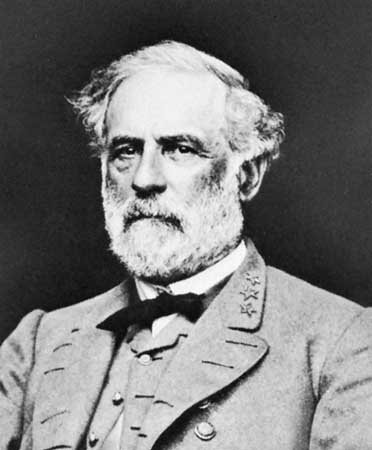
1 Jordan, David M. Happiness is Not My Companion: The Life of G.K. Warren Indiana University Press, Bloomington Indiana 2001 p.89

2 Foote, Shelby The Civil War, A Narrative: Fredericksburg to Meridian. Vintage Books, a Division of Random House, New York 1963 p.495 

3 Catton, Bruce The Army of the Potomac: Glory Road Doubleday and Company, Garden City New York, 1952 pp.150-151

4 Ibid p.288 

5 Ibid. Foote p.496

6 Ibid. p.289

7 Ibid. Jordan p.90 

8 Ibid. Foote p.496

9 Schultz, Duane The Most Glorious Fourth: Vicksburg and Gettysburg July 4th 1863. W.W. Norton and Company New York and London, 2002 p.251

10 Sears, Stephen Gettysburg Houghton Mifflin Company Boston and New York 2004 p.263

11 Ibid. 

12 Ibid. Sears p.263

13 Ibid. Foote p.497

14 Pfanz, Harry W. Gettysburg the Second Day University of North Carolina Press, Charlotte and London, 1987 p.112 

15 Ibid. Foote p.499

16 Ibid. 

17 Ibid.

18 Coddington, Edwin B. The Gettysburg Campaign a Study in Command A Touchstone Book, Simon and Schuster, New York 1968 pp.402-403

19 Ibid. Pfanz p.293

20 Truedeau, Noah Andre Gettysburg a Testing of Courage Perennial Books, Harper Collins Publishers, New York 2002 p.368

21 Ibid. p.393

22 Taylor, John M. Duty Faithfully Performed: Robert E Lee and His Critics Brassey’s, Dulles VA 1999 p.149

23 Freeman, Douglas S. R.E. Lee volume 3 Charles Scribner’s Sons, New York 1935 p.150


1 Comment

Filed under civil war, History, leadership, Military