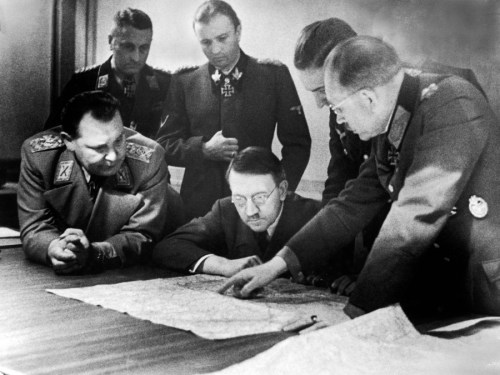
Adolf Hitler gathered with the Chiefs of Oberkommando des Wehrmachton September 16th 1944 at his “Wolf’s Lair” headquarters in East Prussia. The situation was critical; he had recently survived an assassination attempt by Army officers led by Colonel Klaus Von Staufenberg at his Wolf’s Lair headquarters in East Prussia. When the assassination attempt took place the German situation in Normandy was critical. The Americans broke out of the Bocage at St. Lo and spread out across Brittany and the interior of France with Patton’s 3rd Army leading the way. Even as his commanders in the West pleaded for permission to withdraw to the Seine Hitler forbade withdraw and ordered a counter attack at Mortain to try to close the gap in the German line and isolate American forces. When the German offensive failed the German front collapsed. 40,000 troops, hundreds of tanks and thousands of vehicles were eliminated when the Americans and Canadians closed the Falaise pocket. Despite this cadres of decimated divisions including SS Panzer, Army Panzer and elite Paratroops made their way out of Normandy. With the Germans in full retreat the Allies advanced to the border of the Reich itself. On the Eastern Front as well disaster threatened when the Red Army launched an offensive which annihilated Army Group Center and advanced to the border of Poland before outrunning supply lines and stalling on the Vistula.

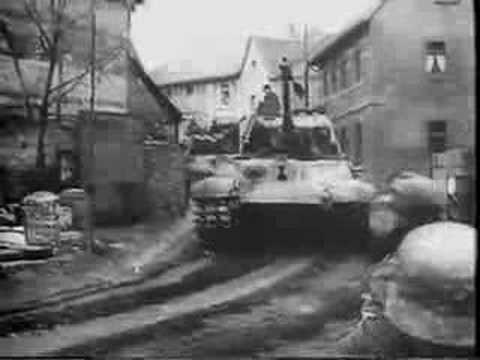
Tiger II
Since Normandy Hitler had wanted to counter attack but had neither the forces nor the opportunity to strike the Allied armies. As the Allied offensive ground to a halt due to combat losses, lack of supplies and stiffening German resistance Hitler maintained a close eye on the situation in the West. He believed that despite their success that the Americans and British alliance was weak and that a decisive blow could cause one or both to drop out of the war. During a briefing an officer noted the events of the day on the Western Front including a minor counterattack by kampfgrüppen of the 2nd SS Panzer and the 2nd Panzer Divisions which had made minor gains in the Ardennes, Hitler rose from his seat ““Stop!” He exclaimed. “I have come to a momentous decision. I shall go over to the counterattack….Out of the Ardennes, with the objective Antwerp.””[i]
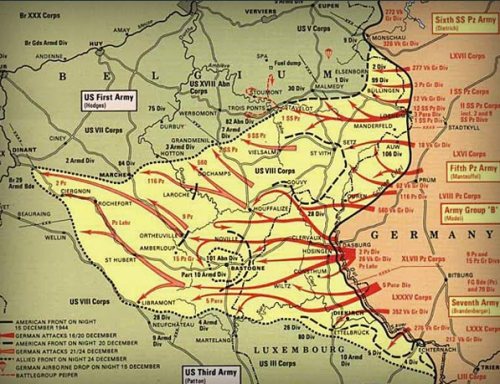
Thus began the planning for the last great German offensive of WWII. Hitler “believed that sufficient damage could be inflicted to fracture the Anglo-American alliance, buy time to strike anew against the Soviets, and allow his swelling arsenal of V-weapons to change the course of the war.”[ii] It was a course of born of desperation, even admitted by Hitler in his briefings to assembled commanders in the week prior to the offensive, one officer noted his remarks: “Gentlemen, if our breakthrough via Liege to Antwerp is not successful, we will be approaching an end to the war which will be extremely bloody. Time is not working for us, but against us. This is really the last opportunity to turn the war in our favor.”[iii]

US 57mm Anti-Tank Gun and Crew
Despite shortages of men and equipment, continuous Allied assaults and over the objections of General Guderian who argued to reinforce the Eastern Front[iv], the OKW staff secretly developed detailed plans. The planning was so secretive that the “Commander in Chief West and the other senior commanders destined to carry out the attack were not informed.”[v] The plans were submitted to Hitler on October 9th [vi] and presented to Field Marshalls Von Rundstedt and Model at the End of October. General Hasso Von Manteuffel, commander of 5th Panzer Army commented that: “The plan for the Ardennes offensive…drawn up completely by O.K.W. and sent to us as a cut and dried “Führer order.”[vii]
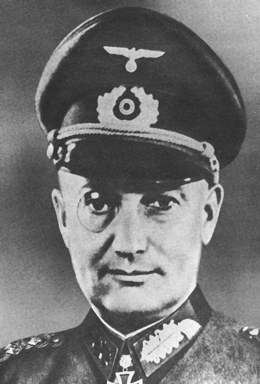
Field Marshal Walter Model Commander Army Group B
Model and Von Rundstedt also objected to the scope of the attack. Von Rundstedt stated: “I was staggered…It was obvious to me that the available forces were way too small for such an extremely ambitious plan. Model took the same view of it as I did….”[viii] Model reportedly said to General Hans Krebs: “This plan hasn’t got a damned leg to stand on.”[ix] And “you can tell your Führer from me, that Model won’t have any part of it.”[x] Sepp Dietrich, the old SS fighter and commander of 6th Panzer Army expressed similar sentiments.[xi] Despite the objections by so many senior commanders Hitler scorned Model’s attempt to float a less ambitious plan to reduce the Allied salient at Aachen. Likewise Von Rundstedt’s desire to remain of the defense and wait for the Allies to attack using the armored forces to launch against any breakthrough was rejected.[xii] Hitler’s mind was set and the preparations moved forward. The plan was complete down to the timing of the artillery bombardment and axes of advance, and “endorsed in the Führer’s own handwriting “not to be altered.””[xiii] Such a plan flew in the face of the well established doctrine of theAuftragstaktik which gave commanders at all levels the freedom of action to develop the battle as the situation allowed and opportunities arose.

SS General Sepp Dietrich, Commander of 6th Panzer Army
The Germans who the Allies presumed to be at the brink of collapse made a miraculous recovery following their ghastly losses in Normandy. Kampfgrüppenand remnants of divisions bled the Americans White at the Huertgen Forrest and blunted the British attempt to leapfrog the Northern Rhine at Arnhem decimating the British First Airborne division and causing heavy casualties among other British and American units. The German 15th Army avoided disaster when the British failed to close their escape route from Walchern island allowing 60,000 troops and much equipment to escape.
 General Hasso von Manteuffel Commander 5th Panzer Army
The Germans also re-formed and reorganized the front. They pulled back many units of the 5th and 6th Panzer Armies for re-fitting and diverted nearly all tank, armored fighting vehicle and artillery production to the West at the expense of the Eastern Front. The Germans called up 17 year olds and transferred young fit personnel from the Navy and Luftwaffe to the Army and Waffen SS. Here they were trained by experienced NCOs and officers and brought into veteran units alongside hardened veterans who showed taught them the lessons of 5 years of war.[xiv] However the rapid influx of new personnel meant that they could not be assimilated as quickly as needed and thus many were not as well trained as they might have been with more time.[xv] Many infantry and Parachute units had received inexperienced officers, taken from garrison duty to fill key positions a problem that would show up during the offensive.[xvi]

Panzer IV Ausf H of an SS Panzer Divsion in the Bulge
The Germans were aided by the caution displayed by the Allies throughout the campaign in France which allowed the Germans to reconstitute formations around veteran headquarters staffs.[xvii] The Germans built up the 5th and 6thPanzer Armies as the Schwerpunkt of the offensive giving them the lion’s share of reinforcements and pulling them out of the line during the fall battles along the Seigfried line and in the Alsace and Lorraine. The plan was for the two Panzer armies and 7th Army to punch through the Ardennes, cross the Meuse, drive across Belgium, capture Antwerp and severe the link between the British and the Americans.
The spearhead of the German assault was 6th Panzer Army Commanded by SS General Sepp Dietrich. It was composed of 1st and 2nd SS Panzer Corps and Army’s LXVII Corps. The 6th SS Panzer Army included some of the best formations available to the German Army at this late stage of the war including the 1st SS Panzer Division, the Leibstandarte Adolf Hitler, the 2nd SS Panzer Division Das Reich, the 9th SS Panzer Division Hohenstaufen and the12th SS Panzer Division Hitler Jügend. It’s ranks were filled out by the 3rd Parachute Division, the 501st SS Heavy Tank Battalion (attached to 1st SS), the 3rd Panzer Grenadier Division and the 12th, 246th, 272nd, 277th and 326th Volksgrenadier or Infantry divisions. The 6th Panzer Army would be the northern thrust of the offensive and its ultimate objective was Antwerp. The 6th Panzer Army would be aided by a hastily organized parachute battalion under Colonel Von Der Heydte[xviii] and the 150thPanzer Brigade under SS Colonel Otto Skorzeny which included teams of American dialect speaking soldiers in American uniforms and equipment that were to spread confusion and panic in American rear areas.[xix]

Bradley, Eisenhower and Patton at Bastogne
To the south was the 5th Panzer Army commanded by General Hasso Von Manteuffel. The 5th Panzer Army was to advance alongside of the 6th Panzer Army with Brussels as its objective. Composed of the XLVII and LVIII Panzer Corps and LXVI Corps the major subordinate commands included the best of the Army Panzer divisions including the 2nd Panzer, Panzer Lehr, 9th and the16thPanzer division. It also had the elite Führer Begleit Brigade composed of troops from Panzer Corps Grossdeutschland and commanded by Otto Remer who had help crush the coup against Hitler in July. The 5th Panzer Army also included the 18th, 26th, 62nd, 560th and later the 167th Volksgrenadier divisions.
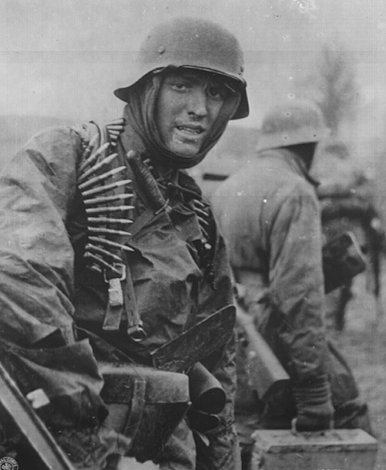
German Panzer Grenadier
The south flank was guarded by 7th Army commanded by General Erich Brandenburger composed of LIII, LXXX and LXXXV Corps. It included theFührer Grenadier Brigade and later the 15th Panzergrenadier division. It was the weakest of the three armies but eventually included 6Volksgrenadier divisions of varying quality and strength[xx] and the veteran 5th Parachute division.[xxi] However with only 4 divisions at the start of the offensive the 7th Army was the equivalent of a reinforced corps.

While this force seemed formidable it had a number of weaknesses beginning with tank strength. The 1st and 12th SS Panzer divisions were only at approximately half their established tank strengths and faced severe shortages in other vehicles.[xxii] 2nd SS and 9th SS of II SS Panzer Corps reported similar shortages.[xxiii]The shortage of other motorized vehicles, even in Panzer divisions was acute. “Even the best equipped divisions had no more than 80 percent of the vehicles called for under their tables of equipment, and one Panzergrenadier division had sixty different types of motor vehicles, a logistician’s nightmare.[xxiv] Panzer Lehr was so short in armored half tracks that only one battalion of its Panzer Grenadiers could be transported in them while others had to use “trucks or bicycles.”[xxv]
Limitations on equipment as well as fuel were not the only challenges that the Germans faced. The US V Corps launched an attack on the Roer River Dams just before the offensive making it necessary for the Germans to divert 6th SS Panzer Army infantry divisions and Jagdpanzer units to be used by 6th SS Panzer Army. One regiment of 3rd Parachute Division and over half of a second division could not take part in the initial 6th Panzer Army attack. Likewise some Jagdpanzer andSturmgeschutzen units did not arrive until three days after the offensive began.[xxvi]
The Allies Before the Battle
While the German commanders sought to implement Hitler’s plan Allied commanders looked only to completing the destruction of Germany not believing the Germans capable of any major operation. The Allied commanders with the exception of Patton did not believe the Germans capable of any more than local counter attacks. Patton’s 3rd Army G-2 Colonel Koch was the only intelligence officer to credit the Germans with the ability to attack.[xxvii] Most allied commanders and intelligence officers discounted the German ability to recover from disastrous losses, something that they should have learned in Holland or learned from the Soviet experiences on the Eastern front. Bradley noted in his memoirs hat “I had greatly underestimated the enemy’s offensive capabilities.”[xxviii] Carlo D’Este noted that “there was another basic reason why the Allies were about to be caught with their pants down: “Everyone at SHAEF was thinking offensively, about what they could do to the enemy, and never about what the enemy might do to them.””[xxix] This mindset was amazing due to the amount of intelligence from Ultra and reports from frontline units that major German forces were no longer in the line.[xxx] Additionally nearly all commentators note that American units in the Ardennes did not conduct aggressive patrols to keep the enemy off balance and obtain intelligence.[xxxi] One describes the efforts of 106th Division as “lackadaisical” and notes that enemy before the offensive was not the Germans but the cold.[xxxii] Max Hastings noted that: “the Allies’ failure to anticipate Hitler’s assault was the most notorious intelligence disaster of the war.”[xxxiii]

Tanks of US 7th Armored Division near St Vith
The Allies also were in the midst of a manpower crisis. Eisenhower did not have enough divisions to establish a clear manpower advantage as “there were not enough Anglo-American divisions, or enough replacements for casualties in the existing divisions.”[xxxiv] No more American Infantry divisions were available as the Army had been capped at 90 divisions and infantry replacements were in short supply. This shortage meant that Eisenhower could not pull divisions out of line to rest and refit. He could only transfer divisions such as the 4th and 28thInfantry divisions to the relative quiet of the Ardennes. He had no ability to “create a strategic reserve unless he abandoned the broad front strategy.”[xxxv]The Germans knew of the allied weakness and believed that they could achieve local superiority even if they did not believe they could reach Antwerp. Model believed that “he was sure that he would reach the Meuse in strength before the Americans could move sufficient reserves to halt his armies or even head them off.”[xxxvi]
American Response: The Breakthrough
The German assault began on December 16th. Some breakthroughs were made especially in the vicinity of the Losheim Gap and the Schnee Eifel by the southern elements of 6th Panzer Army and Manteuffel’s 5th Panzer Army. However the Germans could not break through around Monschau and Elsenborn Ridge held by the inexperienced but well trained 99th Infantry division and elements of the veteran 2nd “Indianhead” Division. In the far south near Diekirch the 4th Infantry Division held stubbornly against the attacks of 7th Army’sVolksgrenadiers. The Germans achieved their greatest success at Losheim where SS Colonel Josef Peiper and his 1st SS Panzer Regiment had driven off the US 14thCavalry Group and penetrated 6 miles into the American front. 5th Panzer Army made several breakthroughs and isolated two regiments of newly arrived 106thInfantry Division in the Schnee Eifel. Manteufel also pressed the 28th Division hard along the Clerf River, Skyline Ridge and Clairvaux. Yet at ‘no point on that first day did the Germans gain all of their objectives.”[xxxvii] The credit goes to US units that stubbornly held on, but also to the poor performance of many German infantry units. German commanders were frustrated by their infantry’s failure even as the panzers broke through the American lines. Manteuffel noted his infantry was “incapable of carrying out the attack with the necessary violence.”[xxxviii]
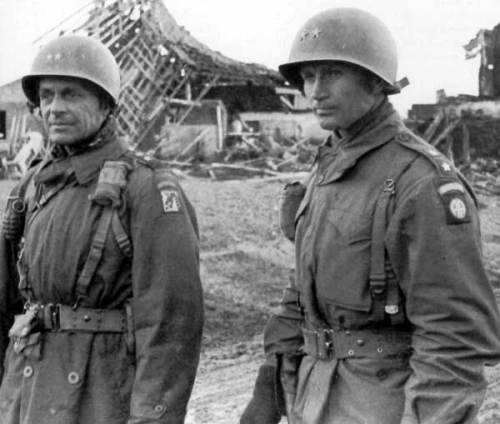
US Airborne Commanders James Gavin (R) and Matthew Ridgeway (L)
The initial Allied command response to the attack by senior commanders varied. Bradley believed it was a spoiling attack “to try and force a shift of Patton’s troops from the Saar offensive back to the Ardennes.”[xxxix] Courtney Hodges of 1st Army agreed with Bradley and refused to allow General Gerow, commander of V Corps to call off 2nd Infantry Division’s attack against the Roer dams on the 16th in order to face the German offensive.[xl] Gerow was one of the first American commanders to recognize the scope of the German attack but Hodges, perhaps the least competent senior American commander in Europe failed to heed Gerow’s advice.

Soldiers of the 106th Infantry Division as POWs
Soon after making this decision Hodges “panicked” and evacuated his headquarters at Spa fearing that it would be overrun by the advancing Germans.[xli] Eisenhower when informed of the news realized that something major was occurring and ordered the 7th Armored Division from the 9th Army and 10th Armored Division from 3rd Army into the Ardennes. On the 17thhe made other dispositions and released the 82nd and 101st Airborne Divisions from SHAEF reserve at Rheims to the Ardennes under the command of XVIII Airborne Corps.[xlii] However during this short amount of time Mantueffel’s panzers had advanced 20 miles.

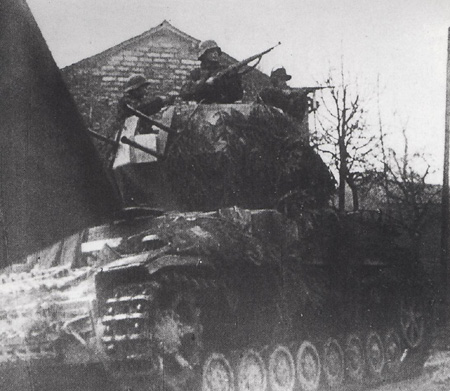
SS Panzer Troops of Kampfgruppe Knittel on the advance. Photo has often been identified for decades in books and other publications as Waffen-SS Colonel Joachim Peiper the commanding officer of the 1st SS Panzer Regiment and Kampfgruppe Peiper. This has been refuted by recent study. Peiper is pictured below.

At the command level Eisenhower made a controversial, but correct decsion to divide the command of the Bulge placing on a temporary basis all forces in the northern sector under Montgomery and leaving those to the south under Bradley. Montgomery according to one commentary initially “had been astonishingly tactful in handing his American subordinates.”[xliii] However he quickly made himself obnoxious to many American commanders.[xliv] Following the battle Montgomery made the situation worse by claiming to have saved the Americans and giving credit to British units which scarcely engaged during the battle.[xlv] Eisenhower also ordered Patton to launch a counter-attack along the southern flank of the German advance. However Patton was already working on such an eventuality and promised to be able to launch a counterattack with three divisions by the 22nd.[xlvi] Bradley praised Patton highly in his memoirs noting: “Patton’s brilliant shift of 3rd Army from its bridgehead in the Saar to the snow-covered Ardennes front became one of the most astonishing feats of generalship of our campaign in the West.”[xlvii]
American Response: the Shoulder’s Hold
 Malmedy Massacre
The 99th Division’s position was precarious, its right flank was subject to being turned and it was suffering severely at the hands of 12 SS Panzer and several Volksgrenadier divisions. Gerow reinforced the 99th with elements of the 2nd Infantry division even before he had the final authorization to end its attack. The two divisions stubbornly held Elsenborn Ridge and the villages of Rockerath, Krinkelt and Büllingen. By the 20th the 9th and 1st Infantry divisions arrived to strengthen the defense and lengthen the line to prevent it from being rolled up by the Germans. The stubborn resistance of the Americans and arrival of reinforcements meant line was proof “against anything Sepp Dietrich might hurl against it”[xlviii] By the 23rd Dietrich and 6th SS Panzer Army conceded defeat at Elsenborn and “turned its offensive attentions to other sectors.”[xlix] German commanders like General Priess the commander of 1st SS Panzer Corps believed that terrain and road network in this sector was unfavorable to the German offensive and had proposed moving the attack further south.[l] The Panzers could not deploy properly and the German infantry was not up to the task of driving the Americans out of their positions before the reinforcements arrived.
In the south the 4th Infantry Division held the line though heavily pressed by Brandenburger’s 7th Army. The division was reinforced by elements of both 9thand 10th Armored divisions on the 17th and generally held its line along the Sauer River around Echternach “largely because the left flank of the enemy assault lacked the power-and particularly the armor-of the thrust farther north.”[li]
Turning Point: The Destruction of Kampfgruppe Peiper
While V Corps fought the 6th Panzer Army to a standstill, to the south 1st SS Panzer Division led by Kampfgrüppe Peiper split the seam between V Corps and VIII Corps. The Kampfgrüppe moved west leaving a brutal path of destruction in its wake, including massacres of American POWs and Belgian civilians.[lii] However its advance was marked with difficulty. On the night of the 17th it failed to take Stavelot. After clearing the American defenders from the town after a hard fight on the 19th it failed to capture a major American fuel dump a few miles beyond the town. When the Germans approached the American commander ordered his troops to pour 124,000 gallons down the road leading to the dump and set it on fire, depriving the Germans of badly needed fuel.[liii] Combat Engineers from the 291st Engineer Battalion blew a key bridge across the Ambleve at Trois Ponts and another bridge across the Lienne Creek which left the Germans bottled up in the Ambleve River valley. This bought time for the 30th Infantry Division to set up positions barring Peiper from the Meuse. The 30th would be joined by Combat Command B of 3rd Armored Division and elements of 82nd Airborne. These units eventually forced Peiper to abandon his equipment and extricate some 800 troops by foot by the 23rd after a hard fight with the Americans who had barred his every effort to break through to the Meuse.
Turning Point: The Crossroads: St Vith & Bastogne
The battle rapidly became focused on key roads and junctions, in particular St. Vith in the north and Bastogne in the south. At St. Vith the 7th Armored Division under General Hasbrouck, who Chester Wilmont calls one of the “great men of the Ardennes”[liv] completed a fifty mile road march from Aachen to St. Vith. On his arrival he deployed his combat commands around the town which was the key to the road network in the north and also to the only rail line running west through the Ardennes.[lv] Hasbrouck gathered in Colonel Hoge’s Combat Command B of 9th Armored Division and the 424th Infantry Regiment of the 106th Division into his defensive scheme as well as the survivors of the 112thInfantry Regiment of the 28th Infantry Division which had escaped the German onslaught after holding as long as possible along the Clerf River and Skyline Drive.[lvi] With these units Hasbrouck conducted “an eight-day stand that was as critical and courageous, as the defense of Bastogne.”[lvii] After holding the Germans at St. Vith the units were withdrawn to another defensive position along the Salm and Ourthe Rivers and the village of Viesalm. This was done at the behest of Montgomery and General Ridgeway of XVII Airborne Corps whose 82nd Airborne had moved into that area on the 19th. The arrival of the 82ndgreatly assisted Hasbrouck’s force holding St. Vith whose defenders had lost an estimated 5000 casualties.[lviii]
The stand at St. Vith confined the “confined the Sixth Panzer Army’s penetration to a chokingly narrow corridor.”[lix] It also posed a problem for German command and control which because it was out of the 6th Panzer Army’s area of operations Dietrich was unable to lend his weight into the fight. “Hitler himself had strictly prohibited deviations from the zonal boundaries”[lx] which left the fight for St. Vith in the hands of 5th Panzer Army who felt the impact of the stand as the Americans “also choked off one of the Fifth Panzer Army’s best routes to Bastogne, almost nullifying the significance of the captured road junction at Houffalize.”[lxi]
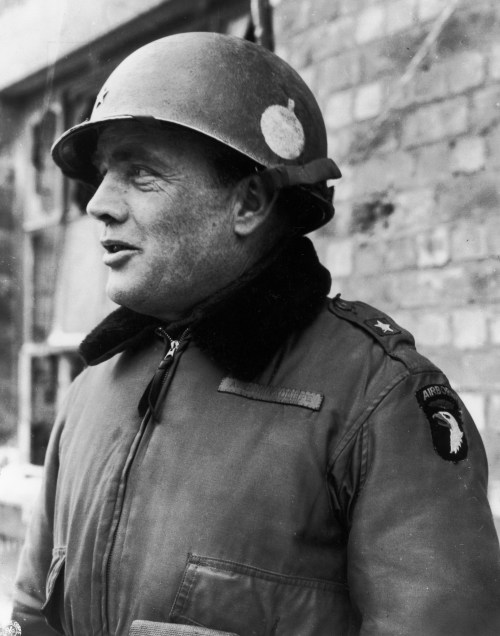
Brigadier General Anthony McAuliffe
To the south of St. Vith lay Bastogne, another key road junction needed by 5thPanzer Army for its advance. On the night of the18th Panzer Lehr division came within two miles of the town before being checked by resistance by units of the 10th Armored division, remnants of 28th Division and misdirection by “friendly” Belgian guides onto a muddy path that helped halt their advance.[lxii] This gave the 101st Airborne just enough time to get to the town and prevent its capture. The siege of Bastogne and its defense by the 101st elements of 9th and 10thArmored Divisions and 28th Division became an epic stand against Manteuffel’s Panzers which had surged around the town. Wilmont comments that “had the Germans won the race for Bastogne, Manteuffel’s armor would have had a clear run to Dinant and Namur on December 19th and 20th” [lxiii] when there were only scattered American units between them and the Meuse. Manteuffel b bypassed Bastonge after the failure to capture it and masked it with 26th VolksgrenadierDivision and a regiment of Panzer Lehr. The remainder of Panzer Lehr and the 2nd Panzer Division moved to the west. [lxiv] The garrison endured numerous attacks and on the 22nd one of the most celebrated incidents of the war took place when Brigadier General Anthony McAuliffe responded to a demand for the surrender of the town with the reply; “Nuts.” The town would continue to hold until relieved by 3rd Army on the afternoon of December 26th.[lxv]
Allied Response: The Counterattack

The Allied counterattack began with 3rd Army in the south on 21 December. Patton’s initially proposed to attack toward the base of the Bulge in order to cut off the largest number of Germans possible. Eisenhower dictated an attack further west with the goal of relieving Bastogne. Eisenhower wanted to delay the attack to concentrate combat power while Patton wanted to attack sooner in order to ensure surprise. Patton got his way but attacked on a wide front. The attack lost its impetus and bogged down into a slugging match with 7thArmy’s infantry and paratroops along the southern flank. [lxvi] Patton’s failure to concentrate his forces for the advance to the north diminished his combat power.[lxvii] While Patton attacked from the south the 1st Army dealt with the advanced spearhead of 2nd Panzer Division which had reached the town of Celles and ran out of gas just four miles from Dinant and the Meuse. The 84th Infantry Division stopped the 116th Panzer division from being able to effect a relief of the 2nd Panzer the US 2nd Armored Division and allied fighter bombers chopped up the virtually immobile 2nd Panzer division completing that task by the 26th.[lxviii]
To the north Montgomery launched a cautious counterattack which slowly and methodically took back lost ground but allowed many Germans to escape. While Montgomery moved south Patton faced heavy German resistance from elements of 5th Panzer Army, reinforced by 1st SS Panzer Corps and 7th Army. The rupture in the American front was not repaired until 17 January when the American forces met at Houffalize.[lxix] Bradley took over for Montgomery and the Americans pushed the Germans slowly back across the Clerf River by the 23rd. The advance was hampered by tough German resistance and terrible weather which forced much of the attack to be made by dismounted troops as the roads had completely frozen over.[lxx]
The Allied counter attack has been criticized for allowing too many Germans to escape what could have been a major encirclement. Patton recognized the incompleteness of the victory in the Ardennes stating: ““We want to catch as many Germans as possible, but he is pulling out.” The “but” clause, the note of regret, the awareness of the imperfection of his victories typified Patton.””[lxxi] Patton in his memoirs notes: “In making the attack we were wholly ignorant of what was ahead of us, but we were determined to strike through to Bastogne.”[lxxii] Max Hastings simply said: “the Allies were content with success.”[lxxiii] Murray and Millett place blame on Bradley and Hodges for choosing “merely to drive the enemy out of the Ardennes rather than destroy him.”[lxxiv]
Analysis: Could Wacht Am Rhein Have Worked?
Could Wacht am Rhein worked? If much was different, yes. If the German had been stronger in tanks and vehicles and had adequate stocks of fuel; if their infantry was better trained, and had the Americans not resisted so stubbornly it might have at least got to the Meuse. Perhaps if the the bad weather held keeping Allied air forces away from the Germans, or had St. Vith and Bastogne been taken by the 18th or 19th, they might have reached the Meuse. Had the Germans executed their plan and coordinated their assault better[lxxv] in the 6thPanzer Army sector and had the 7th Army enough strength to conduct offensive operations in depth and secure the left flank the attack might have succeeded. Because the Americans held the shoulders and road junctions, Manteuffel’s 5thPanzer Army, the only force besides the regimental sized Kampfgrüppe Peiper to actually threaten the Meuse was forced to advance while attempting to take Bastogne and defeat 3rd Army’s counterattack. Whether they could have made Antwerp is another matter. Nearly all German commanders felt the offensive could not take Antwerp but did believe that they could inflict a defeat on the Allies and destroy a significant amount of allied combat power.
The German offense was a desperate gamble. Too few divisions, scant supplies of petrol, formations that had recently been rebuilt and not given enough time to train to the standard needed for offensive operations coupled with Hitler’s insistence on an unalterable plan kept them from success. At the same time the Allies were weak in troops as Eisenhower had no strategic reserve save the two American Airborne Divisions. All reinforcements to the threatened sector had to come from the flanks and by the middle of the battle the 9th Army was drawn down to two divisions. Russell Weigley notes the constraints imposed by the 90 division Army, and of the limited stocks of artillery ammunition.[lxxvi] If the Germans had more forces they might have inflicted a significant defeat on the Allies had they been able to reinforce their success in depth. Despite this they still inflicted punishing losses on the Americans though suffering greatly themselves. Hastings notes that the real beneficiaries of the Ardennes offensive were the Russians.[lxxvii] It is unlikely that the offensive could have ever achieved Hitler’s goals of taking Antwerp and fracturing the British-American alliance.
A Note About other Parts of the Campaign in France
The Riviera and Rhone
 US Soldier Being Greeted as a Liberator
The campaign in south France was strategically wise although opposed by the British to the last minute because they felt it would take away from Overlord.[lxxviii] Though delayed the campaign was well executed by 7th Army, particularly Lt. General Lucian Truscott’s VI Corps of 3 American divisions. Truscott believed “destroying the enemy army was the goal”[lxxix] managed the battle well and skillfully maneuvered his small forces against Blaskowitz’s 19thArmy inflicting heavy losses, though some German commanders noted the caution of American infantry in the attack.[lxxx] Only Blaskowitz’s tactical skills and the weakness of the American force prevented the Germans from disaster. The seizure of Marseilles and Toulon provided the allies with sorely needed ports that were invaluable to sustain the campaign.[lxxxi]
The Lorraine Campaign
Patton attacked in the Lorraine with the goal of crossing the Moselle and attempting to break into Germany. He doing so he ran into some of the strongest German forces on the front and bogged down in the poor terrain and mud of the region.[lxxxii] Patton was delayed in making his assault due to his place “at the far end of the logistics queue.”[lxxxiii] German forces skillfully defended the ancient fortress of city Metz forcing the Americans into a protracted campaign to clear the area with the last strongpoint surrendering on 13 December. Patton is criticized for his failure to concentrate his forces[lxxxiv] but American tactics were less to blame than the weather, German resistance and shortages of infantry.[lxxxv] In some cases American infantry units performed admirably, particularly 80th Division’s assault on the Falkenburg Stellung.[lxxxvi]Liddell Hart criticized the Allies for failing to attack through the then weakly defended Ardennes, commenting: “By taking what appeared to be the easier paths into Germany the Allies met greater difficulties.”[lxxxvii]
The Huertgen Forrest
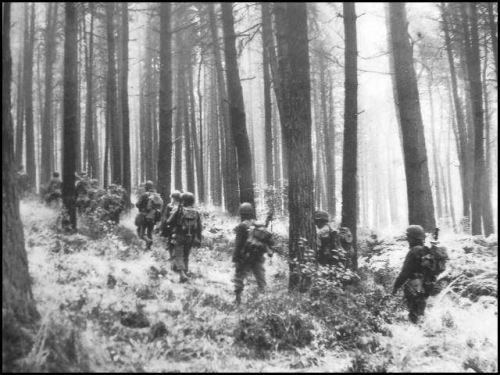
The Huertgen Forrest was the worst managed American fight Western European campaign. [lxxxviii] General Courtney Hodges leadership was poor.[lxxxix] In the Huertgen he fed division after division into a battle that made no strategic sense. American infantry performed poorly and took extremely heavy casualties leaving four divisions shattered.[xc] Poor American tactics demonstrated by attacking into a forest in poor weather without concentration negated all of Hodges’ advantages in tanks, artillery and airpower. The forest contained no significant German forces capable of threatening any American advance[xci] and its gain offered little advantage.[xcii] Hastings noted that the gains the only saving grace was that it made it easier for the northern shoulder of the Bulge to hold[xciii] General Model and his subordinates expertly handled their handful of excellent but weary divisions in this battle using terrain, weather and prepared defensive positions to contest nearly every yard of the Forrest.[xciv]
Conclusions
The lessons of the Bulge and the other campaigns on the German-French border are many and can be gleaned from Allied and German mistakes. On the Allied side the most glaring mistakes were assumptions prior to the German attack that the Germans were incapable of any serious offensive and ignoring the fact that the Germans had attacked through the Ardennes in 1940. Likewise the self limitation of the American Army to 90 divisions for world-wide service meant that there were no more divisions in the pipeline and that worn out divisions would have to be reinforced with inexperienced troops while in the front line which ensured a lack of cohesiveness in many divisions, especially the infantry. Allied intelligence failures as well as their reliance of forces much smaller than they should have had for such a campaign ensured that they would suffer heavy losses in the Bulge while poor planning and execution by Hodges wasted many good troops in a senseless battle. The Germans were hamstrung by Hitler’s fantasy that the Western Allies could be forced out of the war or the Alliance split by a defeat in the Ardennes. Likewise German forces, even those so quickly reconstituted were often short troops, tanks and vehicles. German commanders were forced by Hitler’s rigid insistence on not altering the plan to not be as flexible as they might have been in earlier offensives to adjust according to the situation on the ground.
[i] Dupay, Trevor N. Hitler’s Last Gamble: The Battle of the Bulge December 1944-January 1945Harper Collins Publishers, New York NY 1994 p.2.
[ii] Hastings, Max. Armageddon: The Battle for Germany 1944-1945 Alfred A Knopf, New York NY 2004 p.197.
[iii] Reynolds, Michael. Sons of the Reich: II SS Panzer Corps; Normandy, Arnhem, Ardennes, and on the Eastern Front. Casemate Publishing, Havertown PA 2002 p.186
[iv] Ibid. p.198
[v] Warlimont, Walter. Inside Hitler’s Headquarters 1939-1945 translated by R.H. Barry. Presidio Press, San Francisco, CA 1964. p. 480
[vi] Ibid.
[vii] Liddell Hart, B.H. The German Generals Talk. Originally published 1948, Quill Publishers Edition, New York 1979 p.274.
[viii] Liddell Hart, B.H. The History of the Second World War G.P. Putnam’s Sons, New York NY 1970. p.646.
[ix] MacDonald, Charles B. A Time for Trumpets: The Untold Story of the Battle of the Bulge William Morrow and Company, New York, NY 1985 p.35.
[x] [x] Newton, Steven H. Hitler’s Commander: Field Marshal Walter Model, Hitler’s Favorite General.DeCapo Press, Cambridge MA 2005. p.329
[xi] Ibid. Hastings p.198. Hastings quotes Dietrich: “All Hitler wants me to do is cross a river, capture Brussels, then go on and take Antwerp. And all this at the worst time of year through the Ardennes when the snow is waist-deep and there isn’t enough room to deploy four tanks abreast let alone armored divisions. When it doesn’t get light until eight and it’s dark again by four and with re-formed divisions made up chiefly of kids and sick old men-and at Christmas.”
[xii] Ibid. Liddell-Hart The German Generals Talk p.276
[xiii] Wilmont, Chester. The Struggle for Europe Harper and Brothers Publishers, New York, NY 1952 p.576
[xiv] Ibid. p.557.
[xv] Ibid. Hastings. p.199. Hastings notes that Manteuffel said: “It was not that his soldiers now lacked determination of drive; what they lacked were weapons and equipment of every sort. Von Manteuffel also considered the German infantry ill trained.”
[xvi] Ibid. Dupay.p.47 Dupay notes that in 3rd Parachute Division that most of the regimental commanders had no combat experience.
[xvii] Weigley, Russell F. Eisenhower’s Lieutenants: The Campaign in France and Germany 1944-1945. Indiana University Press, Bloomington IN 1981 p.432. Weigley speaks of Allied caution and predictable strategy, caution in logistical planning which did not allow the Allies to provide the fuel needs for a rapid drive into Germany and caution of operational commanders.
[xviii] Liddell Hart discusses the issue of paratroops at length in discussions with Manteuffel and General Kurt Student. At the time of the operation there were very few jump trained paratroops available for the operation as most of the 6 organized Parachute Divisions were committed to battle as infantry during the 1944 battles in the East, Italy and in the West. German Generals Talk pp.282-285. Although Liddell Hart makes note of the employment of these troops and talked with Model and student about why they were not used to seize bridges and other critical terrain featured ahead of the Panzers instead of the use as a blocking force, I have found no one who questioned why the Germans did not use small glider detachments for the same purpose. The Germans had demonstrated with Skorzeny when they rescued Mussolini from his mountain prison that they still retained this capability. The use of the SS Paratroop battalion which could have been assigned to Skorzeny as a glider borne force could have been decisive in capturing the key bridges and terrain ahead of 6th Panzer Army.
[xix] Skorzeny’s operation was Operation Greif designed to sow confusion in the Allied Ranks. His brigade numbered about 3500 men and had a good number of captured US vehicles including some tanks and tank-destroyers on hand to confuse American units that they came in contact with.
[xx] Ibid. Hastings. p. 199. Hastings quotes the Adjutant of 18th Volksgrenadier Division who “felt confident of his unit’s officers, but not of the men “some were very inexperienced and paid the price.” MacDonald notes that the division had many Navy and Air Force replacements but was at full strength. p.646.
[xxi] See MacDonland pp. 644-655 for a detailed commentary on the German Order of Battle.
[xxii] Reynolds, Michael. Men of Steel: 1st SS Panzer Corps; The Ardennes and Eastern Front 1944-1945 Sarpendon Publishers, Rockville Center NY, 1999. pp.36-37. Reynolds notes that the 1st SS Panzer Regiment only had 36 Panthers and 34 Mark IV Panzers to begin the operation (excluding the attached 501st SS Heavy Tank Battalion). He also notes that many of the tank crew replacements had no more than 6 weeks of military training and some of the tank crews had never been in a tank. Similar problems were found in all the Panzer Divisions. Severe shortages of armored half tracks, reconnaissance vehicles and other vehicles meant that Panzer Grenadier and Motorized battalions lacked the lift needed and some went on foot or on bicycles.
[xxiii] Ibid. Reynolds. Sons of the Reich. P.183
[xxiv] Ibid. MacDonald. p.44.
[xxv] Ibid.
[xxvi] Ibid. Dupay pp. 27-28.
[xxvii] Ibid. MacDonald. p.52. MacDonald notes that Koch warned that the Germans were not finished, that “his withdraw, though continuing has not been a rout or mass collapse.” He calls Koch a “lone voice” in the Allied intelligence world.
[xxviii] Bradley, Omar N. A Soldier’s Story Henry Holt and Company, New York NY 1951. p.459. Weigley makes some poignant calling Bradley’s comments “contradictory” and states that: “his apologia is hardly a model of coherence. (p.461)
[xxix] D’Este, Carlo. Eisenhower: A Soldier’s Life Owl Books, Henry Holt and Company, New York NY 2002. p.638
[xxx] Dupay and others talk about this in detail. See Dupay pp. 35-44.
[xxxi] Ibid. p.38.
[xxxii] Ibid. Hastings. p.201
[xxxiii] Ibid. Hastings. p.199
[xxxiv] Ibid. Weigley. p.464
[xxxv] Ibid.
[xxxvi] Ibid. Wilmont. P.581.
[xxxvii] Ibid. p.583
[xxxviii] Ibid. Hastings. p.223
[xxxix] Ibid. Weigley. P.457
[xl] Ibid. p.471
[xli] Ibid. Hastings. pp.205-206
[xlii] Ibid. Wilmont. pp.583-584
[xliii] Murray, Williamson and Millett, Allan R. A War to Be Won: Fighting the Second World War The Belknap Press of Harvard University Press, Cambridge Massachusetts and London England, 2000 p.470 The authors must base their conclusion on the fact that Montgomery who mentioned to Eisenhower that Hodges might have to be relieved, did not do so and by the next day told Eisenhower that the action was not needed. A few other American commanders in the north were favorable to Montgomery but this appears to be a minority view.
[xliv] Ibid. Weigley. pp.504-506. Weigley and Wilmont both note the comment of a British Staff Officer the Montgomery “strode into Hodges HQ like Christ come to cleanse the temple.” (Wilmont p.592)
[xlv] Ibid. Hastings. pp.230-232. Hastings is especially critical of Montgomery. Weigley, equally critical notes regarding the January 7th press conference, Montgomery’s “inability to be self critical at any point.” p.566.
[xlvi] Ibid. Weigley. p.500.
[xlvii] Ibid. Bradley. p.472 Other commentators differ in their view of Patton’s movement. Wilmont notes that Patton had no “equal in the on the Allied side in the rapid deployment of troops. (p.589) Weigley urges readers that “it should be kept in appropriate perspective; it was not a unique stroke of genius.” And he compares it to Guderians disengagement with Panzer Group 4 and 90 degree change of direction and assault against the Kiev pocket in the 1941 Russian campaign (p.500) Hastings notes that “Patton had shown himself skilled in driving his forces into action and gaining credit for their successes. But he proved less effective in managing a tough, tight battle on the southern flank.” (p.230) Regardless of the perspective and criticism Patton’s movement was unequaled by any Allied commander in the war and had he not moved so quickly the 101stAirborne might not have held Bastogne. Admittedly his attack north was dispersed along a wide front but part of the blame for this must be assigned to Eisenhower who dictated the attack toward the west vice the base of the Bulge where Patton desired to make it. A note I would make is that being a cavalryman Patton thought like one and when faced with the tight battles in close quarters was not at his best. Similar comparisons could be made to J.E.B. Stuart at Chancellorsville when he had to take command of Jackson’s Corps.
[xlviii] Ibid. Weigley. p.475
[xlix] Ibid. p.474
[l] Ibid. Reynolds Men of Steel pp.51-52.
[li] Ibid. Weigley. p.470
[lii] The worst of these took place at the village of Malmedy where Battery B 285th Field Artillery Observation Battalion of 7th Armored Division was captured and about 150 soldiers were rounded up and machined gunned in a field with survivors killed with pistol shots in the head.
[liii] Ibid. Weigley. pp.478-479.
[liv] Ibid. Wilmont. p.584
[lv] Ibid. Weigley. p.487
[lvi] Ibid. Weigley. pp.486-487
[lvii] Ibid. Hastings. p.215. Hastings gives most of the credit to Brigadier General Bruce Clarke of CCB 7th Armored Division for the stand.
[lviii] Ibid. MacDonald. 481-487. MacDonald notes that following the war that the commanders of the units involved “would be grateful to Field Marshal Montgomery for getting them out of what they saw as a deathtrap for their commands. (p.487)
[lix] Ibid. Weigley. p.487
[lx] Ibid.
[lxi] Ibid.
[lxii] Ibid. Hastings. p.217 Also MacDonald. p.289 who talks of the confused situation east of Bastogne both for the Americans and Germans.
[lxiii] Ibid. Wilmont. p.598
[lxiv] Ibid. Liddel Hart. The German Generals Talk. p.288
[lxv] The defense of Bastogne would continue until after the 1st of January as Hitler renewed the attempts to secure the town in order to push on to the Meuse. Other German formations including units of 1st SS Panzer Corps shifted south from their original attack would make determined efforts to dislodge the stubborn American defenders.
[lxvi] Ibid. Weigley. pp.500-501. Bradley gives Patton more credit than later commentators. Wilmont notes that the Germans though “amazed at the speed with which Patton had disengaged from the Saar and wheeled them northward…they received due warning of his movement by monitoring the radio net which controlled American traffic, and they were braced to meet his assault. (p.599).
[lxvii] Ibid. Weigely. Pp.520-521
[lxviii] Ibid. pp.535-537
[lxix] Ibid. pp. 558-561
[lxx] Ibid. pp.563-564
[lxxi] Ibid. p.566.
[lxxii] Patton, George S. War as I Knew It Originally published by Houghton Mifflin Company NY 1947, Bantam Paperback Edition, Bantam Books, New York, NY 1980 p.364
[lxxiii] Ibid. Hastings. p.230
[lxxiv] Ibid. Murray and Millett p.471.
[lxxv] Hastings notes that “Tactically, the Ardennes was one of the worst-conducted German battles of the war, perhaps reflecting that none of the generals giving the orders saw any prospect of success. (p.236)
[lxxvi] Ibid. Weigley. pp.567-572
[lxxvii] Ibid. Hastings. p.236-237. Hastings believes that the employment of the 5th and 6th Panzer Armies in the East “made the task of Zhukov and his colleagues much harder.”
[lxxviii] Ibid. Weigley. p.236. I find it interesting that neither Hastings nor Liddell Hart mention the Riviera and Rhone campaign.
[lxxix] Ibid. Weigley. p.236
[lxxx] Giziowski, Richard. The Enigma of General Blaskowitz Hippocrene Books Inc. New York NY, 1997. p.328
[lxxxi] Ibid. Weigley comments on how much the overall supply situation was aided by the operation and capture of the ports and notes that the pace of the Cobra breakout had created a crisis in supply and “without the southern French ports the crisis would have been insurmountable.” (p.237)
[lxxxii] Ibid. p.397. Weigley notes: “The immobilizing mud and the enemy’s recalcitrant resistance had fragmented the battle into affairs of squads, platoons, companies and battalions….and Patton’s juniors more than he controlled the course of action, to the extent that control was possible.”
[lxxxiii] Ibid. p.384
[lxxxiv] Ibid. p.390 Weigley states: “The American disinclination to concentrate power was rarely more apparent.” comparing the frontages of 1st, 9th and 3rdArmies and notes that Patton attacked along his entire front.”
[lxxxv] Ibid. Weigley. pp.400-401. Weigley spends a fair amount of time on American infantry shortages in 3rd Army.
[lxxxvi] Ibid. Weigly. P.400. Weigley notes a German General Wellm attributed part of that victory to the “prowess of the American infantry.”
[lxxxvii] Ibid. Liddell Hart. The History of the Second World War p.560
[lxxxviii] Hastings and Weigley both note how many American division and regimental commanders were relieved of command for their failures in the Huertgen.
[lxxxix] Ibid. Hastings. p.179. Hastings notes that “instead of recognizing the folly of attacking on terrain that suited the Germans so well, Courtney Hodges reinforced failure.”
[xc] Ibid. Weigley. p.420. Weigley notes the high numbers of ballet and non battle casualties in the 4th, 8th, 9th and 28th Divisions as well as CCR of 5thArmored and 2nd Ranger Battalion.
[xci] Ibid. Hastings. p.275. Hastings notes that defending 275th Division “were poor grade troops who-like the garrison of Aachen posed no plausible threat to the flanks of an American advance to the Roer.”
[xcii] Weigley compares the battle in its effect on the American army to Grants “destruction of the Confederate army in the Wilderness-Spotsylvania-Cold Harbor campaign expended many proud old Union army formations…” (p.438)
[xciii] Ibid. Hastings. p.215
[xciv] Ibid. Newton. p.324























 The Inglorius Padre Steve's World