Author Archives: padresteve

padresteve's avatar

About padresteve

I'm a Navy Chaplain and Old Catholic Priest

Trump’s National Emergency and Blazing Saddles

Friends Of Padre Steve’s World,

Today President Trump declared a National Emergency, though in his own words “he didn’t need to do it, he just wanted to do it faster.”

A couple of days ago I wrote about the great and trailblazing Mel Brooks film, Blazing Saddles. 

It was a film way ahead of its time and two of its characters, Attorney General Headly Lamarr, played by Harvey Kormann, and Governor William  Lepetomaine, played by Brooks himself are a startling premonition of the current President, in their lust for power and incompetence, wrapped in ignorance and racism.

Of course the President’s decision impacts military readiness, infrastructure, and the service men and women who work and live on the bases that will now be deprived of billions of dollars of badly needed infrastructure repairs and improvements just to remain operational. But that doesn’t seem to matter to the President, nor does the Constitutional separation of powers that gives to Congress, and Congress alone the power of the purse. But I digress…

The fact is that the President is doing his damnedest to undermine the rule of law by finding some kind of precedent for something that amounts to an unprecedented federal land grab on the basis of an unprovable national emergency.

Now all the President needs is men to carry it out. Of course, there will be no want of volunteers.

So anyway, as this cracked up Operation gets underway, just remember, Trump won’t be the first nor the last to try find a way around the law and the Constitution to fulfill his agenda, but none will be as funny and to the point as Headly Lamarr and William Lepetomaine. Compared to them, Trump is a pathetically clueless, humorless, and soulless rank amature who believes that he is both witty and smart.

All that being said I cannot beleive that he won’t get away with it. The GOP Senate majority has shown no courage when Trump walks on their Party beliefs and Constitutional responsibilities, and the Courts at this point, God only knows. I hope to be wrong but I don’t expect them to exercise any judicial independence in support of the Constitution and the powers granted to them within it.

Until tomorrow,

Peace,

Padre Steve+

13 Comments

Filed under civil rights, film, History, laws and legislation, leadership, movies, News and current events

Harlem Hell Fighters and Chicago Black Devils: Fighting Racism and Germans in 1918

800px-Harlem_Hell_Fighters

Friends of Padre Steve’s World,

The theme of Black History Month last year was African Americans in Times of War to coincide with the centennial of the end of the First World War. That is not the theme this year, but what the African American men did in France during the Spring and Summer of 1918 still matters.

In 1918 African Americans who in spite of the prejudice, intolerance and persecution they endured at home as a result of Jim Crow, still loved their country. They were men who labored under the most difficult circumstance to show all Americans and the world that they were worthy of being soldiers and citizens of the United States of America. Their stories cannot be allowed to be forgotten, nor can we allow Jim Crow and the intolerance of other movements which demean and persecute those who love this country because of their race, religion, ethnicity, gender, or sexuality.

The African America men who volunteered included raw recruits as well as veteran soldiers who had already served full careers on the Great Plains. They were the Buffalo Soldiers, and when the United States entered the First World War, they were not wanted. Instead, the veterans  were left on the frontier and a new generation of African American draftees and volunteers became the nucleus of two new infantry divisions, the 92nd and 93rd.

lossy-page1-795px-Negro_Troops_in_France._Picture_shows_part_of_the_15th_Regiment_Infantry_New_York_National_Guard_or_._._._-_NARA_-_533488.tif


However in the beginning they too were kept out of action. These men were initially regulated to doing labor service behind the lines and in the United States. But finally, the protests of organizations such as the NAACP and men like W.E.B.DuBois and Phillip Randolph forced the War Department to reconsider the second class status of these men and form them into combat units.

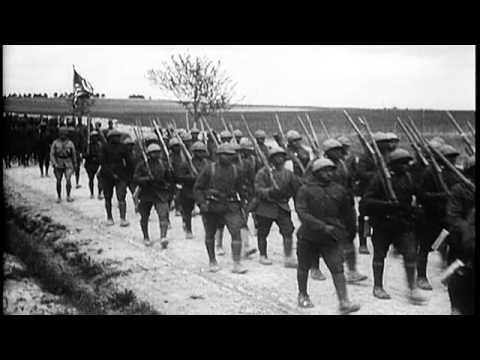
hqdefault1a

Despite this the leadership of the AEF, or the American Expeditionary Force of General John Pershing refused to allow these divisions to serve under American command. Somehow the concept of such men serving alongside White Americans in the “War to end All War” was offensive to the high command.

Instead these divisions were broken up and the regiments sent to serve out of American areas on the Western Front. The regiments of the 93rd Division were attached to French divisions. The 369th “Harlem Hellfighters” were first assigned to the French 16th Division and then to the 161st Division. The Hellfighters stayed in line and under fire for 191 days, longer than any other American regiment, they also suffered the highest casualties of any American regiment, nearly 1,500 during a time when only 900 replacements were received. 170 soldiers of the regiment were awarded the Croix de Guerre for the valor they displayed in combat.

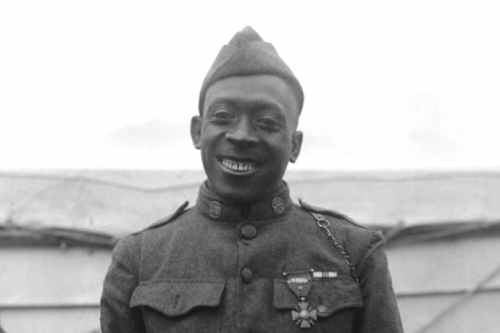
750_harlem_hellfighter_portrait

The first of the Hellfighters so honored was then Private, later Sergeant Henry Johnson who was nicknamed Black Death for his prowess as a fighter. With Private Needham Roberts, Johnson fought off a platoon sized German patrol. They both were wounded and when they ran out of ammunition Roberts fought with the butt of his rifle and Johnson a Bolo knife. When Roberts was knocked unconscious Johnson fought alone and saved his comrade from capture. Some estimate that Johnson killed 4 and wounded up to 30 Germans in the fight. He was posthumously awarded the Medal of Honor by President Barak Obama on June 2nd 2015, because he had no living relatives it was accepted by Command Sergeant Major Louis Wilson.

The 370th “Black Devils” from Chicago were detailed to the French 26th Division and the 371st and 372nd Infantry Regiments were assigned to the French 157th (Colonial) Division, which was also known as the Red Hand Division.

These units performed with distinction. The 371st was awarded the French Croix de Guerre and Légion d’honneur and Corporal Freddie Stowers of the 1st Battalion 371st was the only African American awarded the Congressional Medal of Honor in the First World War. The 372nd was also awarded the Croix de Guerre and Légion d’honneur for its service with the 157th Division.

6ASAF00Z

The 157th (Colonial) Division had suffered badly during the war and been decimated in the unrelenting assaults in the trench warfare of the Western Front. It was reconstituted in 1918 with one French Regiment and two American regiments, the Negro 371st and 372nd Infantry. On July 4th 1918 the commanding General of the French 157th Division, General Mariano Goybet issued the following statement:

“It is striking demonstration of the long standing and blood-cemented friendship which binds together our two great nations. The sons of the soldiers of Lafayette greet the sons of the soldiers of George Washington who have come over to fight as in 1776, in a new and greater way of independence. The same success which followed the glorious fights for the cause of liberty is sure to crown our common effort now and bring about the final victory of right and justice over barbarity and oppression.”

220px-Red_Hand_Division

While many white American soldiers depreciated their French hosts and attempted to sow the seeds of their own racial prejudice against the black soldiers among the French, Southerners in particular warned the French of  the “black rapist beasts.” However the French experience of American blacks was far different than the often scornful treatment that they received from white American soldiers.

“Soldiers from the four regiments that served directly with the French Army attested to the willingness of the French to let men fight and to honor them for their achievements. Social interactions with French civilians- and white southern soldiers’ reactions to them- also highlighted crucial differences between the two societies. Unlike white soldiers, African Americans did not complain about high prices in French stores. Instead they focused on the fact that “they were welcomed” by every shopkeeper that they encountered.”

Official and unofficial efforts by those in the Army command and individual soldiers to stigmatize them and to try to force the French into applying Jim Crow to laws and attitudes backfired. Villages now expressed a preference for black over white American troops. “Take back these soldiers and send us some real Americans, black Americans,” wrote one village mayor after a group of rowdy white Americans disrupted the town.”

Stowers

The citation for Corporal Stowers award of the Medal of Honor reads as follows:

Corporal Stowers, distinguished himself by exceptional heroism on September 28, 1918 while serving as a squad leader in Company C, 371st Infantry Regiment, 93d Division. His company was the lead company during the attack on Hill 188, Champagne Marne Sector, France, during World War I. A few minutes after the attack began, the enemy ceased firing and began climbing up onto the parapets of the trenches, holding up their arms as if wishing to surrender. The enemy’s actions caused the American forces to cease fire and to come out into the open. As the company started forward and when within about 100 meters of the trench line, the enemy jumped back into their trenches and greeted Corporal Stowers’ company with interlocking bands of machine gun fire and mortar fire causing well over fifty percent casualties. Faced with incredible enemy resistance, Corporal Stowers took charge, setting such a courageous example of personal bravery and leadership that he inspired his men to follow him in the attack. With extraordinary heroism and complete disregard of personal danger under devastating fire, he crawled forward leading his squad toward an enemy machine gun nest, which was causing heavy casualties to his company. After fierce fighting, the machine gun position was destroyed and the enemy soldiers were killed. Displaying great courage and intrepidity Corporal Stowers continued to press the attack against a determined enemy. While crawling forward and urging his men to continue the attack on a second trench line, he was gravely wounded by machine gun fire. Although Corporal Stowers was mortally wounded, he pressed forward, urging on the members of his squad, until he died. Inspired by the heroism and display of bravery of Corporal Stowers, his company continued the attack against incredible odds, contributing to the capture of Hill 188 and causing heavy enemy casualties. Corporal Stowers’ conspicuous gallantry, extraordinary heroism, and supreme devotion to his men were well above and beyond the call of duty, follow the finest traditions of military service, and reflect the utmost credit on him and the United States Army.

Corporal Stowers is buried at the Meuse-Argonne American Cemetery. The award of the Medal of Honor was not made until 1991 when President George H. W. Bush presented it to Stowers’ two surviving sisters.

The contrast between the American treatment of its own soldiers and that of the French in the First World War is striking. The fact that it took President Harry S. Truman to integrate the U.S. Military in 1948 is also striking. African Americans had served in the Civil War, on the Great Plains, in Cuba and in both the European and Pacific Theaters of Operation in the Second World War and were treated as less than fully human by many Americans.

770px-369th_15th_New_York

Men of the 371st and 372nd Infantry Regiments of the French 157th Division Awarded the Croix d’Guerre

Even after President Truman desegregated the armed forces in 1948, African Americans, as well as other racial minorities, women and gays have faced very real discrimination. The military continues to make great strides, and while overt racist acts and other types of discrimination are outlawed, racism still remains a part of American life.

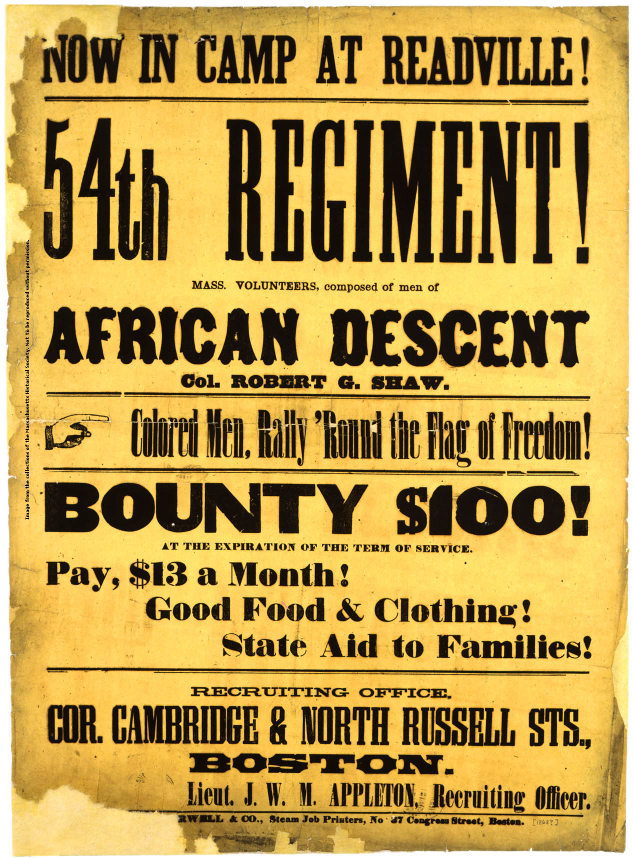
Today things have changed, and that in large part is due to the unselfish sacrifice in the face of hatred and discrimination of the men of the USCT and the State Black Regiments like the 54th Massachusetts and the Louisiana Home Guards who blazed a way to freedom for so many. Those who followed them as Buffalo Soldiers and volunteers during the World Wars continued to be trail blazers in the struggle for equal rights. A white soldier who served with the 49thMassachusetts wrote “all honor to our negro soldiers. They deserve citizenship. They will secure it! There would be much suffering in what he termed “the transition state” but a “nation is not born without pangs.”

Unfortunately racial prejudice is still exists in the United States. In spite of all the advances that we have made racism still casts an ugly cloud over our country. Despite the sacrifices of the Buffalo Soldiers, the leaders of the Civil Rights movement and others there are some people who like the leaders of the AEF in 1917 and 1918 cannot stomach having blacks as equals or God forbid in actual leadership roles in this country.

A good friend of mine who is a retired military officer, a white man, an evangelical Christian raised in Georgia who graduated from an elite military school in the South, who is a proponent of racial equality has told me that the problem that many white people in the South have with President Obama is that “he doesn’t know his place.” Yes racism is still real and rears its ugly head all too often.

Peace

Padre Steve+

Leave a comment

Filed under civil rights, Foreign Policy, History, Military, Political Commentary, us army, world war one

Blazing Saddles at 45: It Couldn’t be Made Today, but it Needs to be Seen by Everyone

Friends of Padre Steve’s World,

Last Thursday, the 7th of February, was the 45th anniversary of an iconic film that even today challenges Americans about the evils of racism and prejudice. Since I was pretty much out of it following my surgery I didn’t write about Blazing Saddles was shocking in its humor which exposed the racism, sexism, and even the anti-gay prejudices that were common in the era. The use of racial invective and slurs by various characters is so shocking now that people who didn’t live during those times cannot understand the real intent of the film.

Mel Brooks used the parody of the classic America  Western Film to confront very real prejudices that ran rampant at the time, and still do, though most people are a bit more careful to disguise their public language and camouflage their prejudices without ever really given them up. In fact the language and terms used by Brooks and his co-writer, the late Richard Pryor are off limits in much of film. I remember showing the DVD to our younger enslisted personnel in Iraq and they were shocked. I had to explain how prevalent open racism was back when the film was released, and what Brooks’s intentions were. He used the humor of the film to bring to the surface the prejudices of many people, including many who later became his fans.

What is really hard for me to believe is that this masterpiece is unknown to many people. The fact that I lied about my age to get a ticket to see the movie when it came out, it was rated R and I had not yet turned 14, and that it remains one of my favorite films of all time, and not just mine, the film was nominated for 3 Academy Awards and is ranked number 6 on the American Film Institute’s 100 Years… 100 Laughs list.

The fact is that Blazing Saddles probably couldn’t be made today because of hyper-politcially correct era. Anyone who knows me knows that I am exceptionally wary of ever using racial stereotypes or slurs and have enough empathy and concern for the sensibilities of people who have suffered through racial, ethnic, or religious persecution and prejudice not to want to see them used for cheap laughs. That being said, in certain times where racial prejudice is being driven from the top down, where the President of the United States can get elected by eliciting racism, sometimes it is appropriate to stick a finger in their eye through the use of comedy. Brook’s used that to drive home to people who otherwise wouldn’t recognize just how deeply racism and racist tropes are past f our society even today.

I think for me one of the most poingent moments in Blazing Saddles is in a scene where Chinese, African American, and Irish Railroad workers come to help the Balck Sheriff Bart, played by Cleavon Little and the self-described White God Fearing Citizens Of Rock Ridge save the town. All that was asked was that they would be able to live there. The late great actor David Huddleston, who played one of the town council members said:

“All right… we’ll give some land to the niggers and the chinks. But we don’t want the Irish!” 

When they all threaten to leave he changes his toon and says:

“Aw, prairie shit… Everybody!” 

The thing is that in those days the Irish were still a despised minority, even though they were white. I am about half Irish by my DNA, and I remember how upset my mom got when she heard that line. It offended her, but I think that such comedic barbs are helpful to all of us if they make us more sensitive to others and aware of our own racial, ethnic, religious, or social prejudices.

Besides the camp fire fart scene my friends, that is the continuing value of Blazing Saddles.

Have a great night,

Peace

Padre Steve+


4 Comments

Filed under culture, film, History, movies, Political Commentary

“We’ll Lick This Someday” But Will Someday Ever Come: Jackie Robinson, Branch Rickey, and Charles Thomas

robinson-dodgers

John Jorgensen, Pee Wee Reese, Ed Stanky and Jackie Robinson on opening day 1947

Friends of Padre Steve’s World.

Pitchers and catchers reported to training camps in Florida and Arizona today and will continue reporting tomorrow. Thursday is a Valentine’s Day and thank God Easter falls late this year so it doesn’t coincide with Ash Wednesday.

For the Baseball purist, the Priest and the inept romantic the combination is quite juxtaposing. For the fact of the matter I don’t do either Lent which Ash Wednesday begins or Valentine’s Day very well, thankfully Lent doesn’t begin for a few more weeks.

That being the case I routinely screw both of the up and as hard as I try I struggle to reach the Mendoza Line in either one. Of course that leaves baseball which for me is a religion, as well as a social commentary on America, our values, and virtues, despite the fact that I also find much truth in Soccer, or as most of the world calls it Football. But I digress, this is about baseball, Civil rights, and America.

I’m not the first to say this an editor in Baseball Magazine wrote in 1921:

“Thomas Jefferson, when he wrote the Declaration, made proper provision for baseball when he declared that ‘all men are, and of right out to be, free and equal.’ That’s why they are at the ball game, banker and bricklayer, lawyer and common laborer.” 

But for African Americans in the first half of the Twentieth Century the game was as segregated as as any town that adhered to Jim Crow in the South or the Sundown Towns in the North and West which excluded them from the political, social privileges enjoyed by Whites. In spite of their relegation to the Negro Leagues a lot of people in baseball knew their talent and ability, one of them was Branch Rickey. Rickey was the first to successfully integrate a team. Baseball Commissioner Kennesaw Mountain Landis opposed early attempts at integration from 1920 until his death in 1944, as a result early attempts to integrate teams failed.

robinson2-popup

Charles Thomas 

It was in 1903 when Rickey, then a coach for the Ohio Wesleyan University baseball team had to console his star player, Charles Thomas when a hotel in South Bend Indiana refused him a room because he was black. Rickey found Thomas sobbing  rubbing his hands and repeating “Black skin. Black skin. If only I could make them white.” Rickey attempted to console his friend saying “Come on, Tommy, snap out of it, buck up! We’ll lick this one day, but we can’t if you feel sorry for yourself.”

Branch-Rickey

Branch Rickey

Thomas, encouraged by Rickey was remembered by one alumnus who saw a game that Thomas played in noted that “the only unpleasant feature of the game was the coarse slurs cast at Mr. Thomas, the catcher.” However, the writer noted something else about Thomas that caught his eye: “But through it all, he showed himself far more the gentleman than his insolent tormentors though their skin is white.” Thomas would go on to be a dentist and remain a friend of Rickey until Rickey’s death in 1965. He moved to New Mexico where he became on of the first African American dentists in that state. Mark Moore, the Executive Director of the New Mexico Dental Association noted:

“This was a time when being a professional was difficult for an African-American. As one of the first black dentists in New Mexico, Dr. Thomas helped desegregate dentistry. He had a significant impact on our national history and the dental profession.”

Baseball like most of America was not a place for the Black man. Rickey, a devout Christian later remarked “I vowed that I would always do whatever I could to see that other Americans did not have to face the bitter humiliation that was heaped upon Charles Thomas.”

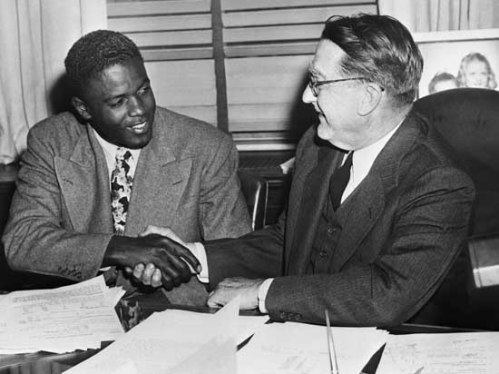
In April 1947 Branch Rickey who was now the owner of the Brooklyn Dodgers invited one African-American ballplayer to the Dodgers’ Spring Training site in Daytona Beach Florida. The South was still a hotbed of racial prejudice, Jim Crow was the law of the land and Blacks had no place in White Man’s baseball, but Rickey decided to challenge that rule and the player was Jackie Robinson.

Jackie Robinson Shaking Branch Rickey's Hand

The Dodgers had been coming to Florida for years. Rickey moved the Dodgers from Jacksonville to Daytona Beach in 1947 after Jacksonville had refused to alter its segregation laws to allow an exhibition game between the Dodgers International League affiliate the Montreal Royals, for whom Robinson starred.

That was the year that Rickey signed Robinson to a minor league contract with the Royals.  When Rickey called up Robinson 6 days prior to the 1947 season Robinson broke the color barrier for both the Dodgers and Major League Baseball. However it would take another 12 years before all Major League teams had a black player on their roster.

It is hard to imagine now that even after Jackie Robinson had broken the color barrier that other teams did not immediately sign black players. However Rickey and Robinson broke the color barrier a year before Harry Truman had integrated the Armed Forces and seven years before the Supreme Court ruled the segregation of public schools illegal. But how could that be a surprise? The country was still rampant with unbridled racism. Outside of a few Blacks in the military and baseball most African Americans had few rights. In the North racism regulated most blacks to ghettos, while in the South, Jim Crow laws and public lynchings of progressive or outspoken Blacks.

Actor, director and civil rights activist Ossie Davis wrote in the book Baseball Nineteen – Oh – Seven” that:

“Baseball should be taken seriously by the colored player — and in this effort of his great ability will open the avenue in the near future wherein he may walk hand in hand with the opposite race in the greatest of all American games — baseball.”


images-24

Larry Doby (above) and Satchel Paige signed by the Indians

pic1

The Cleveland Indians under their legendary owner Bill Veeck were not far behind the Dodgers in integrating their team. Veeck claimed that his effort to purchase the Philadelphia Phillies was rejected by Kennesaw Mountain Landis when he announced that he would desegregate the team. Under Veeck’s direction the Tribe signed Larry Doby on July 5th 1947. Doby would go on to the Hall of Fame and was a key player on the 1948 Indian team which won the 1948 World Series, the last that the storied franchise has won to this date.

Hank THOMPSON - LENNOX PEARSON BOHEMIA ARCHIVE

Hank Thompson and Roy Campanella

roy-campanella-ap2

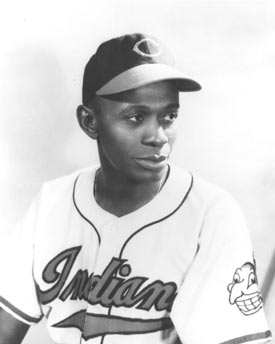
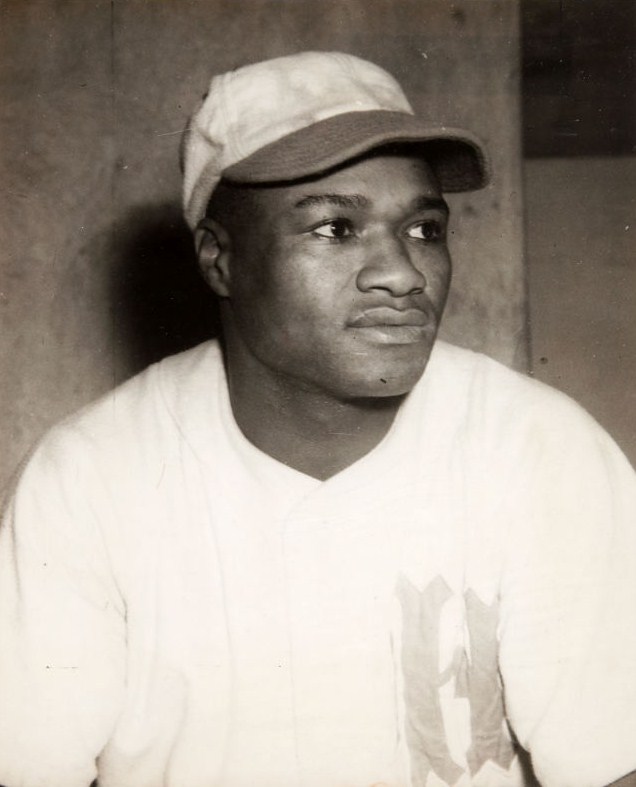
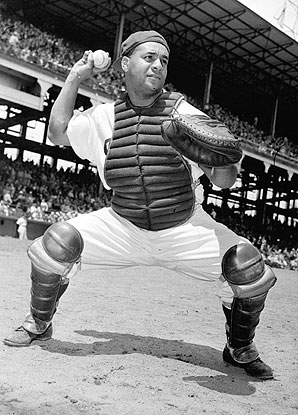
The St. Louis Browns signed Third Baseman Hank Thompson 12 days after the Indians signed Doby. But Thompson, Robinson and Doby would be the only Blacks to play in that inaugural season of integration. They would be joined by others in 1948 including the immortal catcher Roy Campanella who signed with the Dodgers and the venerable Negro League pitcher, Satchel Paige who was signed by the Indians.

monte_irvin

Monte Irvin (Above) and Willie Mays

WillieMays

Willie Mays

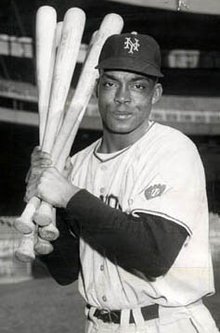
It was not until 1949 when the New York Giants became the next team to integrate. They brought up Monte Irvin and Hank Thompson who they had acquired from the Browns. In 1951 they would be joined by rookie Willie Mays to become the first all African-American outfield in the Major Leagues. Both Mays and Irvin would enter the Hall of Fame and both remained key part of the Giants’ story. Despite their age have continued to be active in with the Giants and Major League Baseball, Mays still is but Irvin died in 2016.

images-25

Samuel Jethroe

The Boston Braves were the next to desegregate calling up Samuel “the Jet” Jethroe to play Center Field. Jethroe was named the National League Rookie of the Year in 1950.

mlb_a_MinnieMinoso_cmg_600

Minnie Minoso

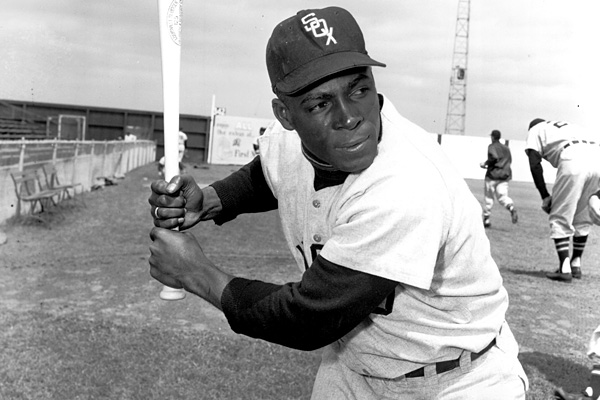
In 1951 the Chicago White Sox signed Cuban born Minnie Minoso who had played for Cleveland in 1949 and 1951 before signing with the White Sox. Minoso would be elected to 9 All-Star teams and win 3 Golden Gloves.

BANKS-ERNIE

Ernie Banks (above) and Bob Trice

Bob_Trice1953

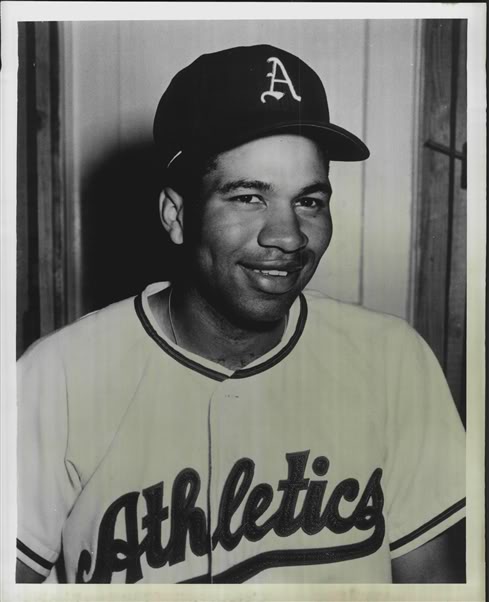
The Chicago Cubs and Philadelphia Athletics integrated at the end of the 1953 season. The Cubs signed Shortstop Ernie Banks who would go on to be a 14 time All-Star, 2 time National League MVP and be elected to the Hall of Fame in 1977 on the first ballot. The Athletics called up pitcher Bob Trice from their Ottawa Farm team where he had won 21 games. Trice only pitched in 27 Major League games over the course of three seasons with the Athletics.

6RI1

Curt Roberts

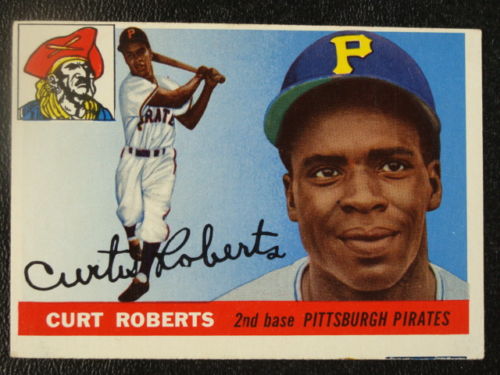
Four teams integrated in 1954. The Pittsburgh Pirates acquired Second Baseman Curt Roberts from Denver of the Western League as part of a minor league deal. He would play 171 games in the Majors.  He was sent to the Columbus Jets of the International League in 1956 and though he played in both the Athletics and Yankees farm systems but never again reached the Majors.

1954_alston_tom

Tom Alston

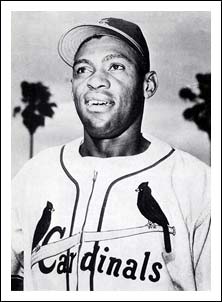
The St. Louis Cardinals, the team that had threatened to not play against the Dodgers and Jackie Robinson in 1947 traded for First Baseman Tom Alston of the Pacific Coast League San Diego Padres. Alston would only play in 91 Major League games with his career hindered by bouts with depression and anxiety.

100005

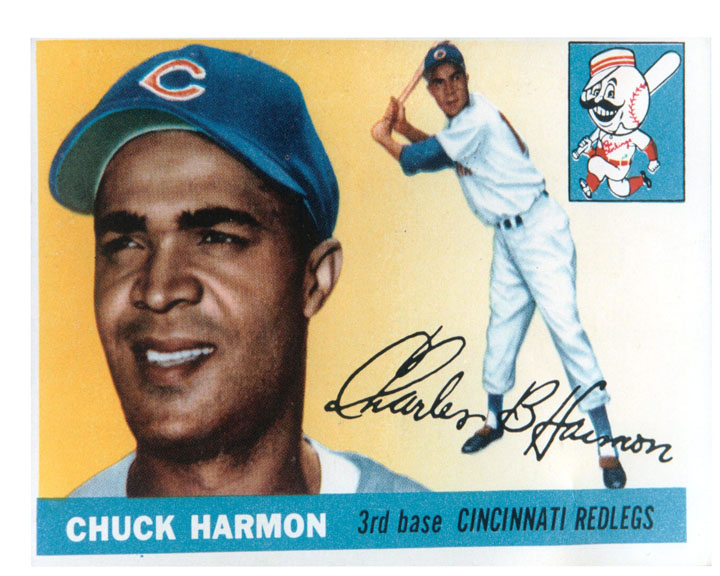
Nino Escalara (above) and Chuck Harmon

Chuck_Harmon

The Cincinnati Reds brought up Puerto Rican born First Baseman Nino Escalera and Third Baseman Chuck Harmon. Harmon had played in the Negro Leagues and had been a Professional Basketball player in the American Basketball League. Harmon who was almost 30 when called up played just 4 years in the Majors. Both he and Escalera would go on to be Major League scouts. Escalera is considered one of the best First Baseman from Puerto Rico and was elected to the Puerto Rican Baseball Hall of Fame. Harmon’s first game was recognized by the Reds in 2004 and a plaque hangs in his honor.

Carlos-Paula

The Washington Senators called up Cuban born Center Fielder Carlos Paula from their Charlotte Hornets’ farm team in September 1954. Paula played through the 1956 season with the Senators and his contract was sold to the Sacramento Salons of the Pacific Coast League. He hit .271 in 157 plate appearances with 9 home runs and 60 RBIs. He died at the age of 55 in Miami.

elston-howard

Elston Howard

In April 1955 the New York Yankees finally integrated 8 years after the Dodgers and 6 years after the Giants. They signed Catcher/Left Fielder Elston Howard from their International League affiliate where he had been the League MVP in 1954. Howard would play 13 years in the Majors with the Yankees and later the Red Sox retiring in 1968. He would be a 12-time All Star and 6-time World Series Champion as a player and later as a coach for the Yankees. He died of heart disease in 1980.  His number #32 was retired by the Yankees in 1984.

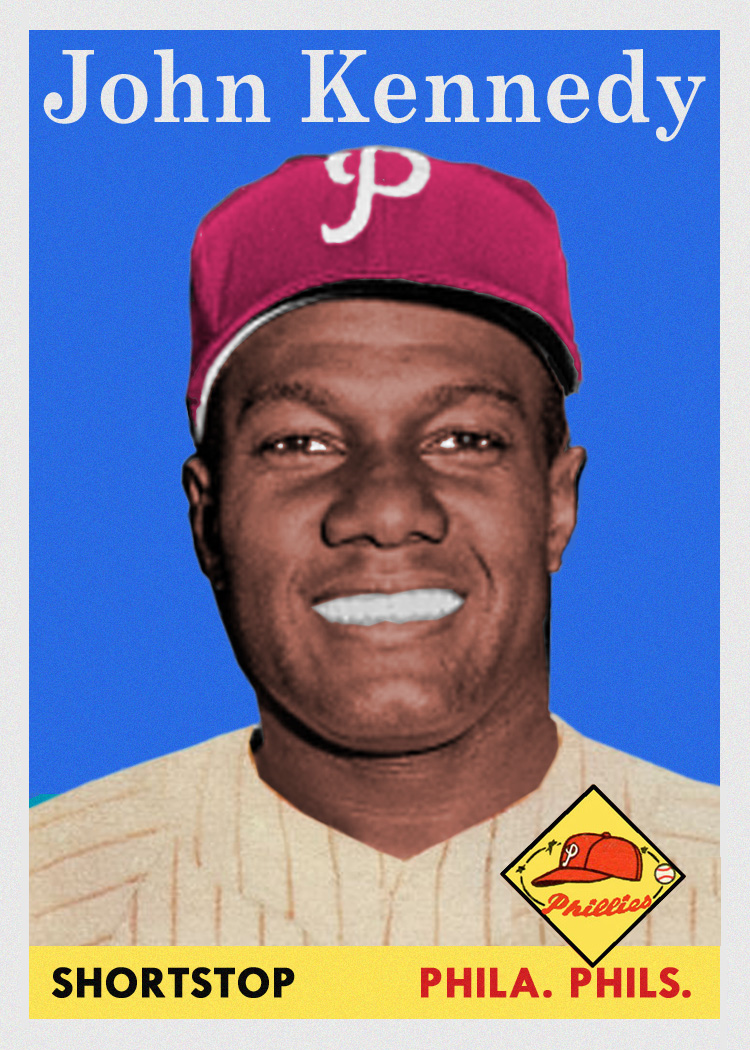
58 kennedy, john f

The Philadelphia Phillies purchased the contract of Shortstop John Kennedy from the Kansas City Monarchs of the Negro League at the end of the 1956 season. Kennedy played in just 5 games in April and May of 1957.

osvaldo4_195

Ozzie Virgil Sr.

In 1958 the Detroit Tigers obtained Dominican born Utility Player Ozzie Virgil Sr. who had played with the Giants in 1955 and 1956. Virgil would play 9 seasons in the Majors with the Giants, Tigers, Athletics and Pirates and retire from the Giants in 1969. He later coached for 19 years in the Majors with the Giants, Expos, Padres and Mariners.

Pumpsie_Green_1962_Topps

Pumpsie Green

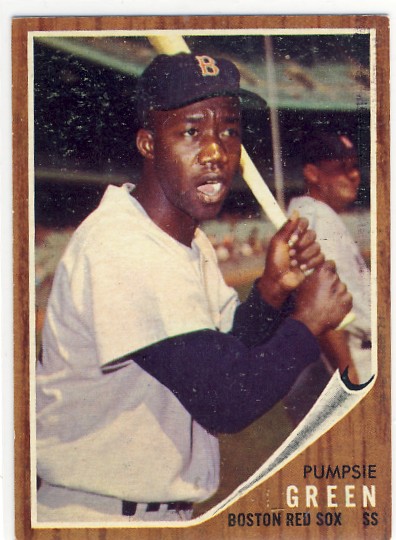
The last team to integrate was the Boston Red Sox who signed Infielder Pumpsie Green. Green made his debut on 21 July 1959 during his three years with the Red Sox was primarily used as a pinch runner. He played his final season with the New York Mets in 1963. He was honored by the Red Sox in 2009 on the 50th anniversary of breaking the Red Sox color barrier.

little-rock-stop-the-race-mixing

voter-registration-mississippi-1960-L-umRewg

luther-king

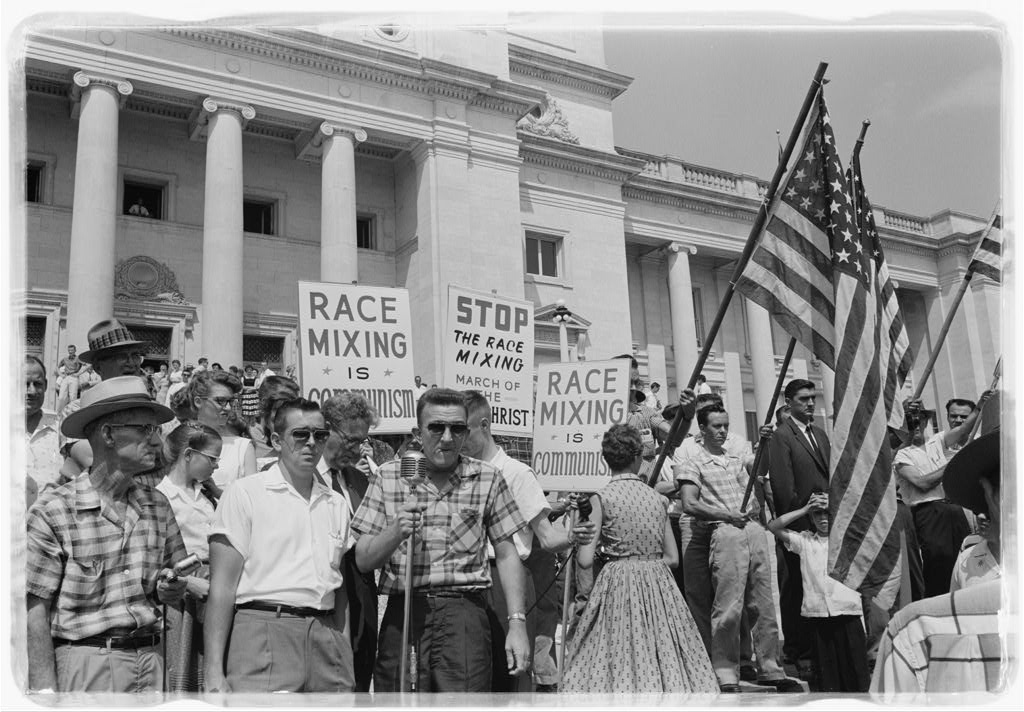
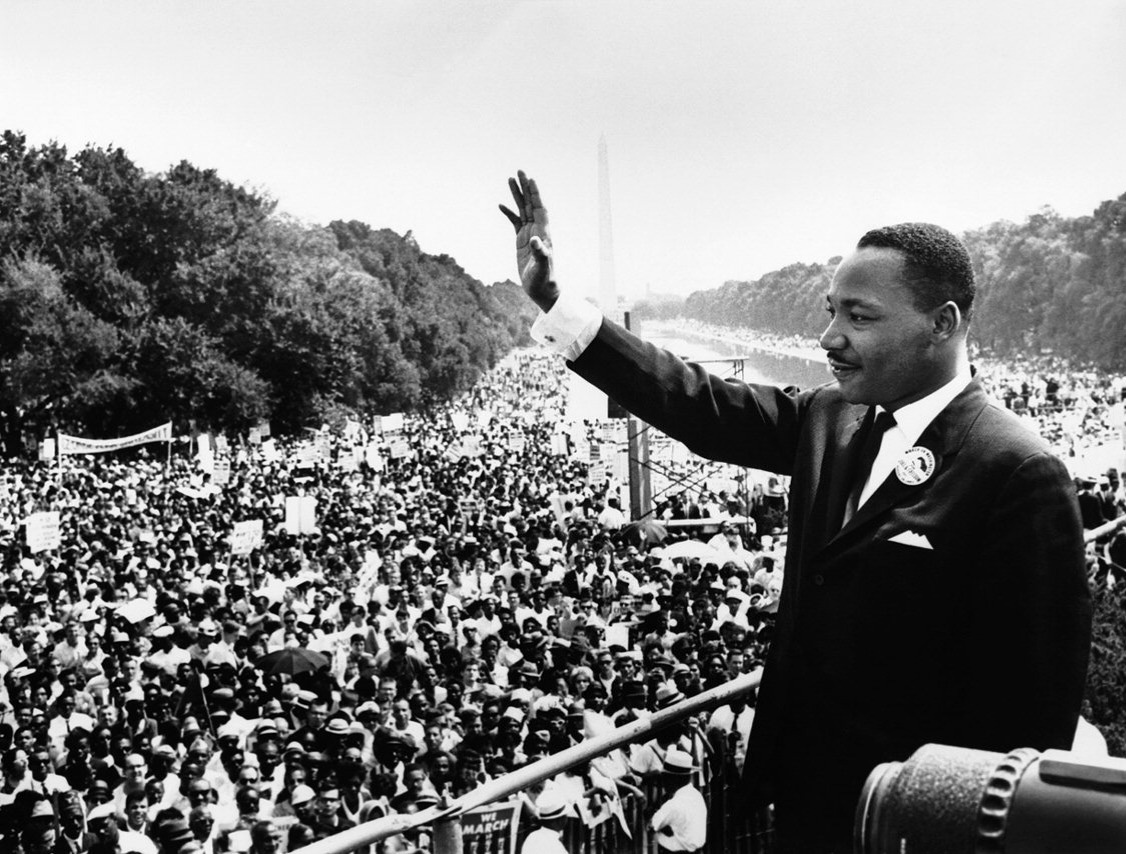
It took 12 years for all the teams of the Major Leagues to integrate, part of the long struggle of African Americans to achieve equality not just in baseball but in all areas of public life.  These men, few in number paved the way for African Americans in baseball and were part of the inspiration of the Civil Rights Movement itself.  They should be remembered by baseball fans, and all Americans everywhere for their sacrifices and sheer determination to overcome the obstacles and hatreds that they faced. It would not be until August of 1963 that Martin Luther King Jr. would give his I Have a Dream speech and 1964 that African Americans received equal voting rights.

Robinson would become a vocal supporter of civil rights, especially after his experience at the 1964 Republican National Convention. Robinson, a Republican and friend of Nelson Rockefeller where he was threatened by a White delegate. He wrote:

“It was a terrible hour for the relatively few black delegates who were present. Distinguished in their communities, identified with the cause of Republicanism, an extremely unpopular cause among blacks, they had been served notice that the party they had fought for considered them just another bunch of “niggers”. They had no real standing in the convention, no clout. They were unimportant and ignored. One bigot from one of the Deep South states actually threw acid on a black delegate’s suit jacket and burned it. Another one, from the Alabama delegation where I was standing at the time of the Rockefeller speech, turned on me menacingly while I was shouting “C’mon Rocky” as the governor stood his ground. He started up in his seat as if to come after me. His wife grabbed his arm and pulled him back.

“Turn him loose, lady, turn him loose,” I shouted.

I was ready for him. I wanted him badly, but luckily for him he obeyed his wife…” (From Jackie Robinson “I Never Had it Made” Chapter XV On Being Black Among the Republicans)

Spring training for the 2018 season begins tomorrow in Florida and Arizona, in what are called the Grapefruit and Cactus Leagues. It is hard to believe that only 70 years ago that there was only one team and one owner dared to break the color barrier that was and still is so much a part of American life.

However despite opposition and lingering prejudice African Americans in baseball led the way in the Civil Rights Movement and are in large part responsible for many of the breakthroughs in race relations and the advancement of not only African Americans, but so many others. We can thank men like  Charles Thomas, Jackie Robinson and Branch Rickey for this and pray that we who remain, Black and White, Asian, Latin American, Middle Eastern; Christian, Jew, Muslim, Hindu; Gay and Straight, as well as all others who make up our great nation will never relinquish the gains that have been won at such a great cost.

In an age were racism has crawled out from under the rock of social distain and has risen to such political prominence that civil rights and voting rights, as well as education, and employment, and healthcare for Blacks, other minorities, and the poor of all races are under attack it is important to remember the words of Branch Rickey to Charles Thomas in 1903: “We’ll lick this one day…” It will certainly be a hard fight, but we have to fight

Peace

Padre Steve+

2 Comments

Filed under Baseball, civil rights, History, News and current events, Political Commentary, sports and life

America’s Original Sin, Part Three: The Fire Eaters

Friends of Padre Steve’s World,

Today the third installment of this series on American slavery. Today I discuss a number of the men who were called “fire eaters,” even by other pro-slavery men. All forms of systematic evil need men who are able to state their support for positions so extreme that they make the mainstream supporters of that position look good by comparison.

We see this every day in our media where outlandish and evil men build up followings and make others who hold their beliefs, without their character flaws look good by comparison. So here is tonight’s installment from one of my books dealing with the history of slavery, emancipation, and the return of Jim Crow and White Supremacy.

I admit that it is not a comfortable read and unfortunately it is also all too contemporary for comfort.

Peace

Padre Steve+

The Importance of people: Edmund Ruffin and the Fire-Eaters

Edmund-Ruffin

Edmund Ruffin 

As important as it is to understand the political, religious and ideological debate around slavery, we cannot adequately do so unless we begin to understand the people involved in the debates and the controversies of the time. As I constantly note, human beings are the one constant in history. Two of these men, there are two that I think stand out from almost all other Southern supporters of slavery. One, Edmund Ruffin, because he can be legitimately called one of the proponents of Confederate nationalism; and the other, Robert Barnwell Rhett, who was so hard line in his beliefs that he could not work within any system that required compromise, even at the end of the war.

Among the people most enraged by Northern opposition to slavery was Edmund Ruffin. Ruffin is one of the more interesting characters who stridently supported slavery, white supremacy, and secession in the ante-bellum south. Ruffin became the face of slaveholding ideology, but he not always pro-slavery, or pro-secession. As a younger man he had been a Jeffersonian Republican who as early as 1816 was concerned about growing federal power, but his writings were considered academic, scholarly, and moderate. However that began to change as the country lurched from one sectional crisis to the next.

As early as 1845 Ruffin was beginning to write about the probability of fighting the North, “We shall have to defend our rights by the strong hand against Northern abolitionists and perhaps the tariffites…” [1] But it was the passage of the Compromise of 1850, a compromise that actually did more to help Southern slaveholders than to harm them, which turned him into an ardent and hardline secessionist.

When he decided on secession he did so with the zeal of a man on consumed by something almost akin to religious conversion:

he promptly threw himself into the new cause, replacing his formerly scholarly approach to issues with a fire-eater’s polemical and emotional style. “I will not pretend,” he now announced, “to restrain my pen, nor attempt to be correct in plan or expression – as is more or less usually the case in my writing.” [2]

Ruffin’s conversion was remarkable because as young man, Ruffin believed that slavery was an evil. But he began to study the works of Thomas Dew he became convinced of the necessity of slavery and its justification. In his tract The Political Economy of Slavery he wrote,

“Slavery… would be frequently… attended with circumstances of great hardship, injustice, and sometimes atrocious cruelty. Still, the consequences and general results were highly beneficial. By this means only–the compulsion of domestic slaves–in the early conditions of society, could labor be made to produce wealth. By this aid only could leisure be afforded to the master class to cultivate mental improvement and refinement of manners; and artificial wants be created and indulged, which would stimulate the desire and produce the effect, to accumulate the products of labor, which alone constitute private and public wealth. To the operation and first results of domestic slavery were due the gradual civilization and general improvement of manners and of arts among all originally barbarous peoples, who, of themselves, or without being conquered and subjugated (or enslaved politically) by a more enlightened people, have subsequently emerged from barbarism and dark ignorance…” [3]

But Ruffin was not a unlearned or unsuccessful man. He was an agricultural reformer who pioneered the use of lime to enhance the effectiveness of other fertilizers. He edited a successful farm paper, and ran a very successful planation outside of Hopewell, Virginia, near Richmond.

Ruffin passionately argued for secession and Southern independence for fifteen years, even before the Compromise Of 1850 hardened him into the most passionate advocate of secession. He “perceived the planter civilization of the South in peril; the source of the peril was “Yankee” and union with “Yankees.” Thus he preached revolution, Ruffin was a rebel with a cause, a secular prophet…” [4] He was the type of man who understood reality far better than some of the more moderate oligarchs that populated the Southern political and social elite. He knew that the only way slavery to survive was for the South to become a nation of its own, and that meant secession. While in the years leading up to the war, these men, including John Calhoun attempted to secure the continued existence and spread of slavery within the Union through the Congress and the courts, Ruffin condemned their efforts.

As early as 1850, Ruffin recognized that in order for slavery to survive the slaveholding South would have to secede from the Union. Ruffin and other radical secessionists believed that there could be no compromise with the north. In 1850 he and James Hammond attempted to use a meeting in Nashville to “secure Cooperative State Secession and wrote to Hammond, against those who sought to use the meeting to preserve the Union, “If the Convention does not open the way to dissolution…I hope it shall never meet.” [5] Ruffin believed that slave holding states had to be independent from the North in order to maintain the institution of slavery.

Ruffin’s views were not unique to him. They formed the basis of how most slave owners and supporters felt about slavery’s economic and social benefits of slavery and the Southern cotton economy. But while many Southerners wrote about the importance and necessity of slavery, Ruffin was one of its most eloquent defenders. He wrote:

“Still, even this worst and least profitable kind of slavery (the subjection of equals and men of the same race with their masters) served as the foundation and the essential first cause of all the civilization and refinement, and improvement of arts and learning, that distinguished the oldest nations. Except where the special Providence and care of God may have interposed to guard a particular family and its descendants, there was nothing but the existence of slavery to prevent any race or society in a state of nature from sinking into the rudest barbarism. And no people could ever have been raised from that low condition without the aid and operation of slavery, either by some individuals of the community being enslaved, by conquest and subjugation, in some form, to a foreign and more enlightened people.” [6]

The most striking thing about Ruffin’s defense of slavery is the distinction that he makes between enslaving people of the same race, which he calls the “worst and least profitable kind of slavery” over the enslavement of inferior races. He did not disapprove of enslaving people of the same race, but he believed that the enslavement of people of the same race was wise, nor profitable. But Ruffin, a true believer in White Supremacy believed that enslavement of inferior races was not only permissible, but in fact the bedrock of civilization. Likewise his understanding that slavery alone was the only thing that prevented “any race or society in a state of nature from sinking into the rudest barbarism,” was common among the Southern planting class.

In 1860 the then 67-year-old Ruffin helped change the world forever when, according to popular legend he pulled the lanyard that fired the first shot at Fort Sumter. While he had joined the Palmetto Guards and was present, he probably did not fire the first shot. Instead, he was probably was given the honor of firing the first shot from his battery; as other guns from other emplacements may have fired first shot.

220px-robert_barnwell_rhett_sr

Robert Barnwell Rhett

But Ruffin was not alone, he was numbered with other Fire-Eaters who beginning in the 1840s began urging secession in order to protect the institution of slavery. The real “father” of Southern secession was Robert Barnwell Rhett of South Carolina. Rhett was a lawyer who was born under the name of Robert Barnwell Smith in Beaufort, South Carolina in 1800, but who adopted the surname of a famous ancestor in order to have a name which would befit him more in aristocratic South Carolina.

In a twist of irony, the man who became the father of the secessionist movement studied law under Thomas Grimke, the brother of the two famous abolitionist sisters, and “a leader of South Carolina’s anti-slavery American Colonization Society.” [8] Rhett was a talented attorney with excellent oratorical skills and he was elected to the South Carolina legislature in 1826 as the controversy over nullification began. Rhett, like other opponents of a Federal Tariff led by Senator John C. Calhoun urged secession as early as 1830 he told a crowd that before submitting to the tyranny of Federal Government, that they must be read to destroy the Union:

“Aye – disunion, rather, into a thousand fragments. And why, gentlemen! would I prefer disunion to such a Government? Because under such a Government I would be a slave – a fearful slave, ruled despotically by those who do not represent me … with every base and destructive passion of man bearing upon my shieldless destiny.” [9]

Later, in the face of President Andrew Jackson’s political strength and much congressional opposition led by Henry Clay, South Carolina dropped nullification. Rhett was angry. He told his colleagues in the legislature that “Your “northern brethren,” aye, “the entire world are in arms against your institutions…. Until this Government is made a limited Government… there is no liberty – no security for the South.” [10] He then described disunion as the only way for the South to survive and to escape what he called “unconstitutional legislation.” He described a “Confederacy of the Southern States… [as] a happy termination – happy beyond expectation, of our long struggle for our rights against oppression.” [11]

Rhett worked against compromise at every opportunity, especially compromise which would preserve the Union. Absolutely convinced of the rightness of his cause he distrusted the politicians who favored compromise and had no faith in political parties. He worked from 1833 until the very end in order to support slavery, disunion, and secession, using every crisis as an opportunity. His dream was for “all Southerners – to unite across party lines and unyieldingly defend slavery and Southern interests as he defined them.” [12] 

During the debate over secession following the Compromise of 1850, Rhett resigned his seat in the U.S. Senate which had been elected to following the death of John C. Calhoun, rather than accept the premise that the state convention’s ruling that secession was not justified.

After leaving office he became the editor, and later the full owner of the Charleston Mercury newspaper where he continued to advocate for secession in often the most outrageous ways,  “The more outrageous the Mercury’s charges, the more they were picked up and reprinted by other papers. Rhett’s propaganda technique was part of a larger secessionist strategy. “Men having both nerve and self-sacrificing patriotism,” he wrote, “must lead the movement and shape its course, controlling and compelling their inferior contemporaries.” He worked to push those without sufficient patriotic nerve – that is, moderate leaders – out of the political arena, believing correctly that without a solid middle ground to stand on, Southern voters would rally increasingly to the fire-eaters’ standard.” [13]

In 1860 Rhett “joined a drive to either rule or ruin the 1860 Democratic convention scheduled for Charleston.” [14] His work was successful, he devised the strategy to destroy the Union by first destroying the Democratic Party, and he wrote in January 1860 that “the destruction of the Union must… begin with the “demolition” of the party. So long as the Democratic Party, as a “National” organization exists in power in the South,… our public men” will “trim their sails.” [15] 

When South Carolina seceded from the Union, it was Rhett who drafted South Carolina’s secession ordinance, which claimed that South Carolina was not “perpetrating a treasonous revolution, but… simply taking back… the same powers it had temporarily surrendered… when South Carolina ratified the federal Constitution.” [16] 

Rhett was elected to the Confederate House Of Representative but However, following secession Rhett’s inability to compromise and his intemperate behavior alienated from him from Jefferson Davis and other Southern leaders. He grew increasingly isolated, and become one of Davis’s most bitter critics. As late as March of 1865, with Sherman’s Union armies having overrun South Carolina and Grant’s at the gates of Richmond, Rhett remained defiant and uncompromising. He opposed any move to compromise on the issue of slavery, even the belated attempt of Jefferson Davis and some in the Confederate Congress to grant limited emancipation to African American slaves who enlisted to fight for survival of the Confederacy.

Rhett moves to Louisiana and left the Mercury to his son, he never reentered politics and died in 1876. Ruffin made a more spectacular exit. Two months after the surrender of Robert E. Lee’s Army Of Northern Virginia, Ruffin exited his earthly life.

When the war ended with the Confederacy defeated and the south in ruins, Ruffin still could not abide the result. In a carefully crafted suicide note he sent to his son the bitter and hate filled old man wrote on June 14th 1865:

“I here declare my unmitigated hatred to Yankee rule- to all political, social and business connections with the Yankees and to the Yankee race. Would that I could impress these sentiments, in their full force, on every living Southerner and bequeath them to every one yet to be born! May such sentiments be held universally in the outraged and down trodden South, though in silence and stillness, until the now far-distant day shall arrive for just retribution for Yankee usurpation, oppression and outrages, and for deliverance and vengeance for the now ruined, subjugated and enslaved Southern States! … And now with my latest writing and utterance, and with what will be near my last breath, I here repeat and would willingly proclaim my unmitigated hatred to Yankee rule — to all political, social and business connections with Yankees, and the perfidious, malignant and vile Yankee race.” [17]

There will be more to come.

Notes

[1] Ibid. Potter The Impending Crisis p.463

[2] Abrahamson, James L. The Men of Secession and Civil War, 1859-1861 Scholarly Resources Books, Wilmington DE 2000 pp.43-44

[3] Ruffin, Edmund The Political Economy of Slavery in McKitrick, Eric L. ed. Slavery Defended: The Views of the Old South. Englewood Cliffs, NJ: Prentice Hall/Spectrum Books, 1963.Retrieved from http://www.pbs.org/wgbh/americanexperience/features/primary-resources/lincolns-political-economy/ 24 March 2014

[4] Ibid. Thomas The Confederate Nation p.1

[5] Ibid. Freehling The Road to Disunion Volume One: Secessionists at Bay p.481

[6] Ibid. Ruffin The Political Economy of Slaveryhttp://www.pbs.org/wgbh/americanexperience/features/primary-resources/lincolns-political-economy/

[7] Catton, Bruce The Coming Fury Phoenix Press, London 1961 pp.314-315

[8] Ibid. Abrahamson The Men of Secession and Civil War, 1859-1861 p.33

[9] Goodheart, Adam The Happiest Man in the South in The New York Times Opinionator December 16th 2010 retrieved from http://opinionator.blogs.nytimes.com/2010/12/16/the-happiest-man-in-the-south/?_r=0 26 July 2016

[10] Ibid. Freehling The Road to Disunion Volume One: Secessionists at Bay p.286

[11] Ibid. Abrahamson The Men of Secession and Civil War, 1859-1861 p.34

[12] Ibid. Abrahamson The Men of Secession and Civil War, 1859-1861 p.34

[13] Ibid. Goodheart The Happiest Man in the Southhttp://opinionator.blogs.nytimes.com/2010/12/16/the-happiest-man-in-the-south/?_r=0

[14] Ibid. Abrahamson The Men of Secession and Civil War, 1859-1861 p.34

[15] Freehling, William. The Road to Disunion Volume II: Secessionists Triumphant 1854-1861 Oxford University Press, Oxford and New York 2007 p.295

[16] Ibid. Guelzo Fateful Lightning p.130

[17] Edmund Ruffin (1794-1865). Diary entry, June 18, 1865. Manuscript Division, Library of Congress Retrieved from http://blogs.loc.gov/civil-war-voices/about/edmund-ruffin/ 24 March 2014

Leave a comment

Filed under civil rights, civil war, economics and financial policy, History, News and current events, Political Commentary

America’s Original Sin and its Continuing Legacy: Part Two, “Liberty for the few – slavery in every form, for the mass”

Friends of Padre Steve’s World,

I am going to be posting a number of articles from my various texts dealing with the American Civil War era dealing with topics that some would want to forget, but are very important if we want to fully appreciate the struggle of African-Americans for equality. This is the second of those posts.

Of course this original sin is the distinctly American version of slavery that arose in the American South, was protected in the Constitution, and supported by not only the Slave holders, and their Southern political protectors, but the businessmen, bankers, and equally complicit political allies in the North.

I honestly wish that we had really advanced beyond where we are now. But we are not. We’re still dealing with what has been called our nation’s original sin. over course slavery was abolished, and African Americans given citizenship and voting rights, but those rights would become a mockery in the Post-Reconstruction Jim Crow South, and in the Sundown Towns of the North and West. Even today, after the gains of the Civil Rights Movement we still deal with the continued effects of it. Our President and his closest advisers are White Nationalists, and White Supremacy is thriving under his tacit blessing. But that’s not enough, men like the Democratic Party Governor of Virginia posed in black face or in a KKK hood in his medical school yearbook. I could go on with a laundry list of other issues related to this but that would turn this introduction into another book, which is ironic because the content of this article was an introductory chapter of a Civil War Text about the Battle of Gettysburg that became part of a book of its own.

American Slavery and Racism is the subject of this and the following articles. More articles will follow in the next couple of weeks.

Have a great day,

Peace,

Padre Steve+

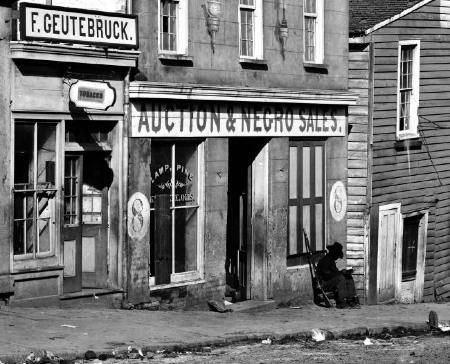
OTCauction

Abolition versus Slave Power

The conflicting ideologies of the Abolitionists who believed that African Americans were created by God and had the same rights as whites, as well as the arguments of Southern political leaders that blacks were inferior and slavery was a positive good, were buttressed by profoundly religious arguments which were related directly to a divergence in values. These diverging values crept into every aspect of life and as such it was this “conflict of values, rather than a conflict of interests or a conflict of cultures, lay at the root of the sectional schism.” [1]   The support of the church in Europe and the Americas was key to the religious and moral belief in the rightness of slavery.

Slavery was the key issue that permeated all aspects of the Civil War to include the cultural, the economic and the ideological. David M. Potter summed up this understanding of the connection between the ideological, cultural and economic aspects of the conflict and just how the issue of slavery connected all three realms in the American Civil War:

“These three explanations – cultural, economic and ideological – have long been the standard formulas for explaining the sectional conflict. Each has been defended as though it were necessarily incompatible with the other two. But culture, economic interest, and values may all reflect the same fundamental forces at work in a society, in which case each will appear as an aspect of the other. Diversity of culture may produce both diversity of interests and diversity of values. Further, the differences between a slaveholding and a nonslaveholding society would be reflected in all three aspects. Slavery represented an inescapable ethical question which precipitated a sharp conflict of values.” [2]

Sadly this is something that those who study the war from a purely military perspective tend to miss, or even willingly gloss over in order make the war more palatable to their own prejudice tend to “blur the reality that slavery was at the heart of the matter, ignore the baser realities of the brutal fighting, romanticize our own home-grown terrorist organization, the Ku Klux Klan, and distort the consequences of the Civil War that still intrude on our national life.” [3] For many people it is far easier not to deal with the harsh reality that slavery and racism was at the heart of the issue and escape to the bloodless romanticism which even ignores the human cost of the war, approximately 750,000 military dead alone. If we extrapolate the percentage of the population that that 750,000 represents and compared it to today’s census that number would be the equivalent of 7.5 million Americans dead. This is a fact that many Civil War buffs tend to ignore.

The political ends of the Civil War grew out of the growing cultural, economic, ideological and religious differences between the North and South that had been widening since the 1830s. However, slavery was the one issue which helped produce this conflict in values and it was “basic to the cultural divergence of the North and South, because it was inextricably fused into the key elements of southern life – the staple crop of the plantation system, the social and political ascendency of the planter class, the authoritarian system of social control.” [4] 

Without slavery and the Southern commitment to an economy based on slave labor, the southern economy would have most likely undergone a similar transformation as what happened in the North; thus the economic divergence between North and South would “been less clear cut, and would have not met in such head-on collision.” [5] But slavery was much more than an economic policy for Southerners; it was a key component of their religious, racial and philosophic worldview. A world without slavery was unimaginable and incomprehensible to them: politics, economics, religion, philosophy, and even the interpretation the Constitution itself depended on one’s view of slavery and white supremacy.

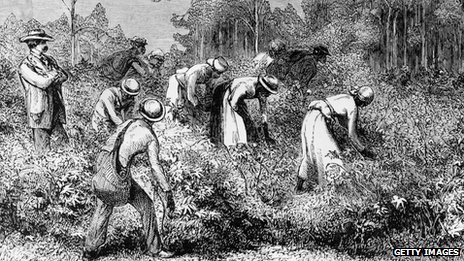
_65344344_cottonpickers1875_getty

The issue of slavery divided the ante-bellum United States on even what the words freedom and liberty meant. The dispute can be seen in the writings of many before the war, with each side emphasizing their particular understanding of these concepts. In the South, freedom was reserved for those who occupied the positions of economic power; slavery was key to that from not only an economic point of view but as a social philosophy. The concept of human equality, which was so much a part of the Declaration of Independence was downplayed to accommodate slavery and white supremacy.

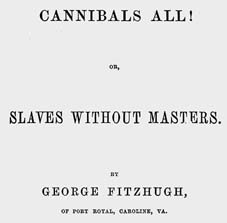
George Fitzhugh, a planter and slave owner in eastern Virginia commented that that concept “is practically impossible, and directly conflicts with all government, all separate property, and all social existence.” [6] Fitzhugh was very critical of the founder’s philosophy of natural liberty and human equality which he found repugnant and error ridden. He wrote:

“We must combat the doctrines of natural liberty and human equality, and the social contract as taught by Locke and the American sages of 1776. Under the spell of Locke and the Enlightenment, Jefferson and other misguided patriots ruined the splendid political edifice they erected by espousing dangerous abstractions – the crazy notions of liberty and equality that they wrote into the Declaration of Independence and the Virginia Bill of Rights. No wonder the abolitionists loved to quote the Declaration of Independence! Its precepts are wholly at war with slavery and equally at war with all government, all subordination, all order. It is full if mendacity and error. Consider its verbose, newborn, false and unmeaning preamble…. There is, finally, no such thing as inalienable rights. Life and liberty are not inalienable…. Jefferson in sum, was the architect of ruin, the inaugurator of anarchy. As his Declaration of Independence Stands, it deserves the appropriate epithets which Major Lee somewhere applies to the thought of Mr. Jefferson, it is “exuberantly false, and absurdly fallacious.”   ” [7]

The political philosophy such as Fitzhugh’s, which was quite common in the South, and was buttressed by a profound religious belief that it was the South’s God ordained mission to maintain and expand slavery. One Methodist preacher in his justification of slavery wrote, “God as he is infinitely wise, just and holy never could authorize the practice of moral evil. But God has authorized the practice of slavery, not only by bare permission of his providence, but by the express permission of his word.” [8] Buttressed by such scriptural arguments Southerners increasingly felt that they were the only people following God. The Northern abolitionists as well as those who advocated for the concept of human equality and free labor were heretics to be damned. As such the “South’s ideological isolation within an increasingly antislavery world was not a stigma or a source of guilt but a badge of righteousness and a foundation for national identity and pride.” [9]

Speaking of the necessity for slavery, as well as limitations on the equality of human beings no matter what their race or sex; Fitzhugh penned words that explained that human relationships were not to be seen in terms of individual liberty, “but in relations of strict domination and subordination. Successful societies were those whose members acknowledged their places within that hierarchy.” [10]

Fitzhugh was quite caustic when he discussed the real implications of his philosophy:

“We conclude that about nineteen out of twenty individuals have “a natural and inalienable right” to be taken care of and protected, to have guardians, trustees, husbands or masters; in other words they have a natural and inalienable right to be slaves. The one in twenty are clearly born or educated in some way fitted for command and liberty.” [11]

Fitzhugh’s chilling conclusion was summarized in the words “Liberty for the few – slavery in every form, for the mass.” [12]

But many Southerners, including many poor whites, especially the Yeoman farmers who were the backbone of the Southern populace did not see or understand the limitations that were placed on their own liberty by the slavery system and instead saw slavery as the guarantee of their economic freedom.

John C. Calhoun said to the Senate in 1848 that “With us, the two great divisions of society are not the rich and poor, but white and black; and all of the former, the poor as well as the rich, belong to the upper class, and are respected and treated as equals.” [13] Calhoun’s racial distinction is important if we are to understand why poor whites would fight and die for a social and economic idea that did not benefit them or their families, then as well as now.

But it was Abraham Lincoln, who cut to the heart of the matter when he noted the difference between his understanding of liberty and that of Calhoun and others in the South who defended slavery and the privileges of the Southern oligarchs:

“We all declare for liberty” but “in using the same word we do not all mean the same thing. With some the word liberty may mean for each man to do as he pleases with himself and the product of his labor; while with others the same word may mean for some men to do as they please with other men and the product of other men’s labor.” [14]

The growing economic disparity between the Slave and Free states became more about the expansion of slavery in federal territories as disunion and war approached; for a number of often competing reasons. These differences, amplified by the issue of slavery led to the substitution of stereotypes of each other and had the “effect of changing men’s attitudes toward the disagreements which are always certain to arise in politics: ordinary, resolvable disputes were converted into questions of principle, involving rigid, unnegotiable dogma.” [15] The Charleston Mercury noted in 1858 “on the subject of slavery…the North and the South…are not only two peoples, but they are rival, hostile peoples.” [16]

This was driven both by the South’s insistence on both maintaining slavery where it was already legal, and expanding it into new territories, even where it was forbidden by Federal laws enacted by Congress. This set it against the vocal abolitionist movement. But Southern exponents of expanding slavery were fighting an even more powerful enemy than the abolitionists, who despite their vocal protests were not yet in a position to influence policy. They were now fighting Northern industrialists who were not as idealistic as the abolitionists who were much more concerned with “economic policy designed to secure Northern domination of Western lands than the initial step in a broad plan to end slavery.” [17]

This competition between the regions not only affected politics, it affected religion and culture. In the South it produced a growing culture of victimhood, which was manifest in the words of Robert Toombs who authored Georgia’s declaration of causes for secession:

“For twenty years past, the Abolitionists and their allies in the Northern states, have been engaged in constant efforts to subvert our institutions, and to excite insurrection and servile war among us…” whose “avowed purpose is to subject our society, subject us, not only to the loss of our property but the destruction of ourselves, our wives and our children, and the dissolution of our homes, our altars, and our firesides.” [18]

As the social, economic, cultural and religious differences between the two regions grew wider and the people of the South became ever more closed off from the North. “More than other Americans, Southerners developed a sectional identity outside the national mainstream. The Southern life style tended to contradict the national norm in ways that life styles of other sections did not.” [19]

The complex relationship of Southern society where “Southern bodies social, economic, intellectual, and political were decidedly commingled” came to embrace the need for slavery and its importance to Southern society. This occurred despite the fact that the system did not benefit poor whites in the South and actually harmed them economically.

Southern society had become dependent on a race based social hierarchy in which dissent was neither welcome or tolerated. This

system of subordination reached out still further to require a certain kind of society, one in which certain questions were not publically discussed. It must give blacks no hope of cultivating dissention among the whites. It must commit non slaveholders to the unquestioning support of racial subordination…. In short, the South became increasingly a closed society, distrustful of isms from outside and unsympathetic to dissenters. Such were the pervasive consequences of giving top priority to the maintenance of a system of racial subordination.” [21]

A number of slave revolts, and planned slave revolts which were caught before they could erupt serve to heighten the fear and paranoia of Southerners living in the “Black belts” where slaves outnumbered whites by great margins. “In thickly enslaved areas, fancied dangers united white classes and sexes. Whites in black belts shared horror images about freed blacks as rioters, rapists, arsonists, and cannibals. The whites characteristically thought that using slavery to control alleged barbarians meant saving civilization.”[22]

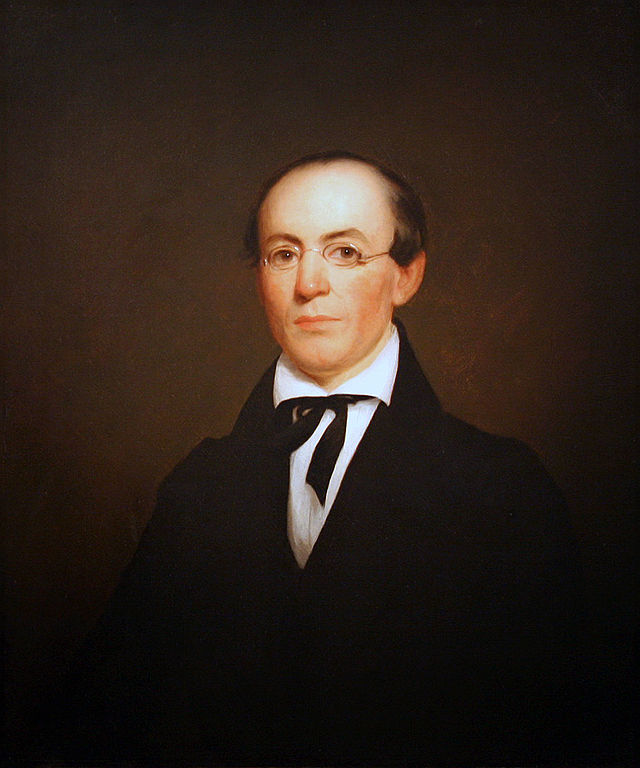
Even before the abolitionist movement took any recognizable form in the North, “with an intensity that escalated through the Civil War, planters declared war on all open criticism of the peculiar institution.” [23] As Northern abolitionists like William Lloyd Garrison and his newspaper The Liberator grew in its distribution and began to appear in the South various elected officials throughout the South “suppressed antislavery books, newspapers, lectures, and sermons and strove generally to deny critics of bondage access to any public forum. [24] Despite this resistance, abolitionists continued to use the U.S. Mail service to send their literature south provoking even more drastic action from Southern legislators.

garrison by jocelyn 1833

William Lloyd Garrison 

But Garrison and the more radical abolitionists did not have a great following even in the North, most Northerners who even leaned toward abolition were supporters of a very gradual emancipation and not supportive of the immediate emancipation demanded by Garrison and his allies. In fact in the North, Garrison and his followers were not popular, they were “a small and often despised group.” [25] This was born out by facts that Garrison understood all too well, which made him even more uncompromising in his message even as support for it dropped. Even in the North Garrison was considered an unlikeable extremist.

In 1840, support for Garrison extremism peaked at around 2 percent of the northern voting population. The other 98 percent of northern citizens considered immediate abolition to be too extreme to be American, too problack to be tolerable, too keen on seizing property to be capitalistic, and too antisouthern to be safe for the Union.” [26] 

Garrison despised his northern opponents and wrote that he found among them “contempt more bitter, opposition more active, detraction more relentless, prejudice more stubborn, and apathy more frozen, than among slave owners themselves.” [27] Opponents broke up his meetings and on one occasion paraded Garrison “through the streets of Boston with a rope around his neck.” [28]

But Southerners, particularly those in the Black Belts where slaves constituted a majority of the population were further outraged by Garrison and his follower’s incendiary words and what they considered to be “almost pornographic diatribes,” which they felt had assaulted their “self-respect and sense of honor.” [29] In response to the proliferation of abolitionist literature in the South which was being sent through the mail, Senator John C. Calhoun proposed that Congress pass a law to prosecute “any postmaster who would “knowingly receive or put into the mail any pamphlet, newspaper, handbill, or any printed, written, or pictorial representation touching the subject of slavery.” [30] The law was a direct assault on the First Amendment, but in the South anything and anyone that took a stand against slavery had no Constitutional rights.

Calhoun was not alone as other members of Congress as well as state legislatures worked to restrict the import of what they considered subversive and dangerous literature. The condescending attitude of the radical abolitionists provoked an “emotional wildfire” [31] in the South, which united slave owners and poor whites in the Black Belt regions and served to increase their fear and loathing of Yankees who they believed wanted to destroy them and their way of life. Had they really understood just how united much of the North was with them they may not have pushed as hard to force Northern allies to accept laws that eventually offended the sensibilities of even non-abolitionists Northerners.

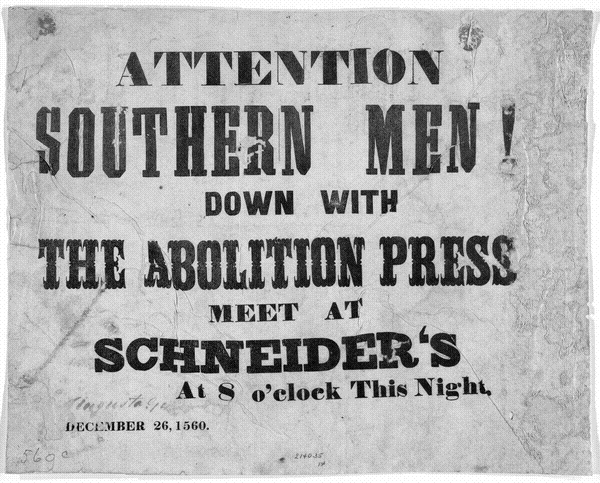
attention-southern-men

But Southern fears of real and imagined slave revolts, and hatred of radicals like Garrison brought about a host of new problem. Southerners now attempted to crush First Amendment protections of free speech in the north and to blot out any mention of slavery in the House of Representatives.

Beginning in 1836 the House of Representatives, led by Southern members of Congress passed a “gag rule” for its members. The “Gag Rule” “banned all petitions, memorials, resolutions, propositions, or papers related in any way or to any extent whatever to the subject of slavery.” [32]Former President John Quincy Adams continually challenged the gag-rule beginning in 1842, as did a number of others. The pressure was such that in 1844 the House finally voted to rescind it.

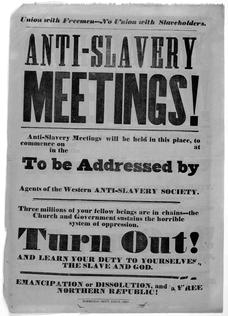
anti-slavery-meetings

However, Southern politicians were unhappy with the recension of the Gag Rule and “began to spout demands that the federal government and the Northern states issue assurances that the abolitionists would never be allowed to tamper with what John Calhoun had described as the South’s “peculiar domestic institution.” [33] As tensions grew between the regions; the issue of slavery more than any other issue, “transformed political action from a process of accommodation to a mode of combat.” [34]

Around the same time as the gag rule was played out in Congress the Supreme Court had ruled that the Federal government alone “had jurisdiction where escaped slaves were concerned”which resulted in several states enacting “personal liberty laws”to “forbid their own elected officials from those pursuing fugitives.” Southern politicians at the federal and state levels reacted strongly to these moves, which they believed to be an assault on their institutions and their rights to their human property. Virginia legislators said these laws were a “disgusting and revolting exhibition of faithless and unconstitutional legislation.” [35]

The issue of slavery shaped political debate and “structured and polarized many random, unoriented points of conflict on which sectional interest diverged.” [36] As the divide grew, leaders and people in both the North and the South began to react to the most distorted images of each other imaginable- “the North to an image of a southern world of lascivious and sadistic slave drivers; the South to the image of a northern world of cunning Yankee traders and radical abolitionists plotting slave insurrections.” [37]

To be continued…

Notes

[1] Potter, David M. The Impending Crisis: America before the Civil War 1848-1861 completed and edited by Don E. Fehrenbacher Harper Collins Publishers, New York 1976 p.41

[2] Ibid. Potter The Impending Crisis p.41

[3] Burns, Ken A Conflict’s Acoustic Shadows in The New York Times Disunion: Modern Historians Revisit and Reconsider the Civil War from Lincoln’s Election to the Emancipation Proclamation Black Dog and Leventhal Publishing, New York 2013 p.102

[4] Ibid. Potter The Impending Crisis p.42

[5] Ibid. Potter The Impending Crisis p.42

[6] Ibid. Levine Half Slave and Half Free: The Roots of the Civil War Revised Edition p.140

[7] Fitzhugh, George. New Haven Lecture 1855, in The Approaching Fury: Voices From the Storm, 1820-1861 Stephen B. Oates, Editor, University of Nebraska Press, Lincoln and London 1997 p.135

[8] Ibid. Daly When Slavery Was Called Freedom: Evangelicalism, Proslavery, and the Causes of the Civil War pp.63-64

[9] Ibid. Faust, Drew The Creation of Confederate Nationalism: Ideology and Identity in the Civil War South p.61

[10] Ibid. Levin Half Slave and Half Free p.140

[11] Ibid. Levin Half Slave and Half Free p.140

[12] Ibid. Levin Half Slave and Half Free p.141

[13] McPherson, James M. Drawn With the Sword: Reflections on the American Civil War Oxford University Press, Oxford and New York 1996 p.50

[14] Ibid. Levin Half Slave and Half Free p.122

[15] Ibid. Potter The Impending Crisis p.43

[16] Ibid. McPherson Drawn With the Sword p.16

[17] Egnal, Marc Clash of Extremes: The Economic Origins of the Civil War Hill and Wang a division of Farrar, Straus and Giroux New York 2009 p.6

[18] Dew, Charles B. Apostles of Disunion: Southern Secession Commissioners and the Causes of the Civil War University Press of Virginia, Charlottesville and London 2001 p.12

[19] Thomas, Emory The Confederate Nation 1861-1865 Harper Perennial, New York and London 1979 p.5

[20] Ibid. Thomas The Confederate Nation p.5

[21] Ibid. Potter The Impending Crisis pp.457-458

[22] Freehling, William W. The South vs. The South: How Anti-Confederate Southerners Shaped the Course of the Civil War Oxford University Press, Oxford and New York 2001 p.20

[23] Ibid. Levine Half Slave and Half Free p.166

[24] Ibid. Levine Half Slave and Half Free p.166

[25] Ibid. Goldfield America Aflame: How the Civil War Created a Nation p.27

[26] Ibid. Freehling The South vs. The South p. 34

[27] Ibid. Varon Disunion! The Coming of the American Civil War 1789-1858 pp.70-71

[28] Ibid. Goldfield America Aflame p.27

[29] Ibid. Freehling The South vs. The South p.22

[30] Ibid. Guelzo Fateful Lightning pp.50-51

[31] Ibid. Freehling The South vs. The South p.22

[32] Ibid. Levine Half Slave and Half Free pp.169-170

[33] Ibid. Guelzo Fateful Lightning pp.51-52

[34] Ibid. Potter The Impending Crisis p.43

[35] Ibid. Levine Half Slave and Half Free pp.169-170

[36] Ibid. Potter The Impending Crisis p.43

[37] Ibid. Potter The Impending Crisis p.43

Leave a comment

Filed under civil rights, civil war, ethics, History, laws and legislation, leadership, News and current events, Political Commentary, Religion

America’s Original Sin and Its Continuing Legacy: Part One

Friends of Padre Steve’s World,

I am going to be posting a number of articles from my various texts dealing with the American Civil War era dealing with topics that some would want to forget, but are very important if we want to fully appreciate the struggle of African-Americans for equality.

Of course this original sin is the distinctly American version of slavery that arose in the American South, was protected in the Constitution, and supported by not only the Slave holders, and their Southern political protectors, but the businessmen, bankers, and equally complicit political allies in the North.

I honestly wish that we had really advanced beyond where we are now. But we are not. We’re still dealing with what has been called our nation’s original sin. over course slavery was abolished, and African Americans given citizenship and voting rights, but those rights would become a mockery in the Post-Reconstruction Jim Crow South, and in the Sundown Towns of the North and West. Even today, after the gains of the Civil Rights Movement we still deal with the continued effects of it. Our President and his closest advisers are White Nationalists, and White Supremacy is thriving under his tacit blessing. But that’s not enough, men like the Democratic Party Governor of Virginia posed in black face or in a KKK hood in his medical school yearbook. I could go on with a laundry list of other issues related to this but that would turn this introduction into another book, which is ironic because the content of this article was an introductory chapter of a Civil War Text about the Battle of Gettysburg that became part of a book of its own.

American Slavery and Racism is the subject of this and the following articles. More articles will follow in the next couple of weeks.

Have a great day,

Peace

Padre Steve+

slavescars

The Slave Economy and the Divide between North and South

“Thy bond-men and thy bond-maids which thou shalt have, shall be of the heathen that are round about you: of them you shall buy bond-men and bond-maids. Moreover, of the children of the strangers that do sojourn among you, of them he shall buy, and of their families that are with you, which they begat in your land. And they shall be your possession. And you shall take them as an inheritance for your children after you, they shall be your bond-men forever.” Leviticus 25:44-46

thewanderer_lastslaveship

Early Slavery in the Americas and the African Slave Trade

If we are to really understand the Civil War we have to understand the ideological clash between Abolitionists in the North, and Southern proponents of slavery. Slavery began very early in the history of the American colonies and though the British and the Dutch were the largest traders of slaves in those early days, the first American slave ship made its first voyage to bring Africans to the new world. Historian Howard Zinn noted:

By 1800, 10 to 15 million blacks had been transported to the Americas, representing perhaps one-third of those originally seized in Africa. It is roughly estimated that Africa lost 50 million human beings to death and slavery in those centuries we call the beginnings of modern Western civilization, at the hands of slave traders and plantation owners in Western Europe and America, the countries deemed the most advanced in the world.” [1]

Slavery in the Americas grew out of the economic need of planters to for laborers on the vast plantations of the new world as “the number of arriving whites, whether free or indentured servants (under four to seven year contract) was not enough to meet the demand of the plantations.” [2] Thus, land owners needed more workers, and unwilling to employ free men who would need to be paid, thus decreasing profit, they resorted to the use of slaves brought from Africa who were then bought.

But the use of slaves in the new American colonies was significantly different than previous forms of slavery in Africa, where slavery was one of a number of forms of labor. In Africa, slaves “worked within the households of their owners and had well-defined rights, such as possessing property and marrying free persons. It was not uncommon for slaves in Africa to acquire their freedom.” [3] In fact the plantation form of slavery practiced in the Americas differed radically from traditional forms of African slavery and was characterized by “the frenzy for limitless profit that comes from capitalistic agriculture; the reduction of the slave to less than human status by the use of race hatred, with that relentless clarity based on color, where white was master, black was slave.” [4]

American slavery took on a new form, that of the plantation. The plantation system allowed owners to amass “large concentrations of laborers under the control of a single owner produced goods – sugar, tobacco, rice, and cotton – for the free market.” [5] Beginning with the Spanish and the Portuguese in the early 1500s, the African slave trade became a major part of the world economy, and “slave labor played an indispensable part in its rapid growth.” [6] 

Not only was this in the world economy, but to the economy of the English colonies in North America and the new American nation it was indispensable. The paradox was rich, especially in a new nation founded upon, and supposed dedicated to liberty and equality. The “Atlantic slave trade, which flourished from 1500 into the nineteenth century was a regularized business in which European merchants, African traders, and American planters engaged in a highly complex and profitable bargaining in human lives.” [7]

It was economic gain that prompted the growth in American slavery, and for which slaves were essential for profit. As such, the “first mass consumer goods in international trade were produced by slaves – sugar, rice, coffee, and tobacco. The profits from slavery stimulated the rise of British ports such as Liverpool and Bristol, and the growth of banking, shipbuilding, and insurance, and helped to finance the early industrial revolution. The centrality of slavery to the British empire encouraged an ever-closer identification of freedom with whites and slavery with blacks.” [8]

full_1361408284slave.market

The Constitution, Slavery and Disunion 

When the United State won its independence the founders of the new nation had to deal with the already existing institution of slavery. It also had to deal with the threat to the Union that the institution and the real possibility of disunion, something that almost all of them feared more than anything. Slavery was an institution that even some powerful politicians who owned slaves were uncomfortable; Patrick Henry noted in 1773 that “to do so was “repugnant to humanity” and “inconsistent with the Bible,” while George Washington wrote in 1786 “There is not a man living…who wishes more sincerely than I do, to see a plan for the gradual abolition of it.” [9]

Slavery was an issue that divided the newly independent states as they gathered for the Constitutional Convention in 1787 and Washington confided to a friend before the convention that “he could “foresee no greater evil than disunion,” and now the “mere discussion of slavery” was poisoning the atmosphere.” [10] James Madison was one of the first to recognize this and noted that “the states differed “primarily from the effects of their having or not having slaves.” [11]

Thus the issue came to a head around how the population of the states would be represented in the new government and how to balance the power between the federal government and the various state governments. To do this the founders divided Congress into two houses, the House of Representatives who were directly elected by the voters of each state with the population of the state determining the number of representative each would have; and in the Senate, whose members were elected by the state legislatures, each state would have two members regardless of the size of its population. The division of the legislature in the Constitution “enabled the individual states to retain a large measure of their jealously guarded autonomy.” [12] Eligible voters in each state elected the President by electing “electors” for the Electoral College, and each state was given an amount of electors equal to its representation in the Senate and the House of Representatives. In a real sense, the Electoral College was designed to support the political power of the Slave States.

The heart of the matter came to the issue of what people would be counted in each state. The Northern states wanted to base the number on each state’s white population. The Southern states wanted to “swell their power by counting both white citizens and black non-citizens.” [13] Doing so would give Southern States more power in the House of Representatives which, when coupled with the equality each state had in the Senate, gave the less populous Southern disproportionate power in the national government. A representative from New Jersey, Gouverneur Morris believed that if slaves “were human enough to boost the representation of the Southern States…they should be treated as persons and not property in the South.” [14]There was debate on this issue and to bridge the sectional divide the Convention passed what is now known as the three-fifths compromise.

This measure had profound results. It stipulated that the size of a state’s congressional delegation and its Electoral College electors; and the state’s tax burden would be determined by their population. The population was determined by counting free-persons as a full person, and then adding the words “three-fifths of all other persons.” Of course the “other persons” were slaves, but the language was carefully crafted to avoid the use of the terms slave or slavery to make the document acceptable to Northern delegations. The compromise was the first of many made by the Northern states to appease the South and maintain national unity. The South got less than it wanted, as its delegates wanted slaves to count as a whole person for population sake without considering them as such.

When all was said and done in 1790 “southern states, possessing around 40% of the nations’ white population, controlled around 47% of the House and Electoral College.” [15] Gouverneur Morris understood that the compromise would exaggerate Southern power and predicted that “the three-fifths clause’s real legacy would be to give slaveholders majority control over electoral politics.” [16] However, Morris’s warning was unheeded for decades by many in the North, though through electoral experience Northern leaders began to realize what the compromise had wrought but could not change the process without amending the Constitution.

Morris was correct. During the election of 1802 in the Electoral College the “three-fifths clause gave the Southerners 14 extra electors, the Republicans’ Thomas Jefferson defeated the Federalists’ John Adams, 73-65. Jefferson swept South’s extra electors 12-2. If no three-fifths clause had existed and House apportionment been based strictly on white numbers, Adams would have likely squeaked by, 63-61.” [17] The compromise had major impacts on the Electoral College. In the first 36 years of the Republic, only one President came from the North, John Adams. The rest, Washington, Jefferson, Madison and Monroe were all Virginian’s, and all were slaveholders.

Apart from John Quincy Adams who served from 1825-1829 every other President until Abraham Lincoln was either a Southern slaveholder, or a Northern supporter of the South’s position on the preservation and or expansion of slavery. In fact the South dominated all branches of the Federal government from 1789-1861, often with the cooperation of Northern political and business interests.

James McPherson wrote:

“A Southern slaveholder had been president of the United States two-thirds of the years between 1789 and 1861, and two-thirds of the Speakers of the House and president pro tem of the Senate had also been Southerners. Twenty of the thirty-five Supreme Court justices during that period had been from slave states, which always had a majority on the court before 1861.” [18] 

Those who believed in the South’s moral, religious, and cultural supremacy over the North often used the Southern domination of American politics as proof of that superiority, despite the fact that the system was rigged to support their status as a minority which depended on the institution of slavery.

Two other compromises were made by the delegates to the convention. The first dealt with ending the African slave trade. This was contentious and in response to the threat of ending the trade the delegates from South Carolina, John Rutledge and Charles Cotesworth Pinckney insisted that “South Carolina could not join the proposed Union if the slave trade was prohibited.” [19] The compromise allowed the African slave trade to remain legal until 1808 unless Congress voted to allow it to continue. However, this was the first of many threats by Southern leaders and states to threaten disunion over the issue of slavery. A final compromise required states to “extradite and deliver any fugitive from service to his or her master and state of origin.” [20] The wording of the law was purposely vague and could include indentured servants, but the real target was escaped slaves.

The early compromises set the stage for future compromises, in large part because Federalist politicians preferred compromise over disunion, and their fear was that “failure to compromise would bring disunion” [21] and with it disaster. Thus the convention approved the compromises and the states, even Northern states which had abolished or were on the way to abolishing slavery ratified it.

<img src="https://padresteve.com/wp-content/uploads/2014/12/o-slavery-facebook.jpg?w=300&h=150" class="aligncenter size-medium wp-image-15916" width="300" height="150" data-attachment-id="15916" data-permalink="https://padresteve.com/2014/12/11/mine-eyes-have-seen-the-glory-religion-ideology-the-civil-war-part-1/o-slavery-facebook/" data-orig-file="https://padresteve.com/wp-content/uploads/2014/12/o-slavery-facebook.jpg" data-orig-size="2000,1000" data-comments-opened="1" data-image-meta="{"aperture":"0","credit":"Getty Images\/Photo Researchers RM","camera":"","caption":"United States Slave Trade","created_timestamp":"0","copyright":"","focal_length":"0","iso":"0","shutter_speed":"0","title":"128619271","orientation":"0"}" data-image-title="o-SLAVERY-facebook" data-image-description="

United States Slave Trade

” data-medium-file=”https://padresteve.com/wp-content/uploads/2014/12/o-slavery-facebook.jpg?w=300&h=150″ data-large-file=”https://padresteve.com/wp-content/uploads/2014/12/o-slavery-facebook.jpg?w=500″ alt=”o-SLAVERY-facebook” srcset=”https://padresteve.com/wp-content/uploads/2014/12/o-slavery-facebook.jpg?w=300&h=150 300w, https://padresteve.com/wp-content/uploads/2014/12/o-slavery-facebook.jpg?w=600&h=300 600w, https://padresteve.com/wp-content/uploads/2014/12/o-slavery-facebook.jpg?w=150&h=75 150w” sizes=”(max-width: 300px) 100vw, 300px” style=”height: auto; max-width: 100%; border: 0px; margin-bottom: 2px”>

Slavery in the Early Years of the United States

Slavery expanded in the American colonies and continued to do so after American independence despite the fact that a number of prominent slaveholders including George Washington voluntarily emancipated their slaves in the 1780s and 1790s. In large part this was due to fact that the United States “purposely built a weak central state, dispersing power to govern from the center to the constituent (some would have said still sovereign) parts.” [22] 

That being said the in the new Constitution the founders ensured that the central government was far stronger than the attempt made in the initial Confederation of States in matters of tariffs, taxes and laws to protect bondholders, slaveowners, and land speculators. In this government the land owners of the Southern states, as well as the merchants of the North held the bulk of the economic, political and social power. Significantly, “most of the makers of the Constitution had some direct interest in establishing a strong federal government: the manufacturers needed protective tariffs; the moneylenders wanted to stop the use of paper money to pay off debts; the land speculators wanted protection as they invaded Indian lands; slaveowners needed federal security against slave revolts and runaways; bondholders wanted a government able to raise money by nationwide taxation, to pay off those bonds.” [23] The Constitution ensured that the Federal Government was strong enough to protect those interests, but not strong enough to encroach on the powers granted to the states, especially the powers of slave states.

The conflict between supporters of slavery and those who opposed it on either humanitarian, religious or political-ideological grounds would become more of a source of even conflict following slavery’s boost by Eli Whitney’s invention of the Cotton Gin.

The machine made the production of cotton and its export an even more profitable enterprise requiring more slaves to meet the expanding demand and it was not something that those who believed that slavery would expire of its own accord expected. Thomas Jefferson wrote in 1805 that in regard to slavery that “interest is really going over to the side of morality. The value of the slave is every day lessening; his burden on his master dayly increasing. Interest is therefore preparing for the disposition to be just.” [24] Of course Jefferson, who owned over 200 slaves and had built much of his political base among Virginia planters was wrong, and despite the misgivings that he expresses in some of his letters and papers, including the first draft of the Declaration of Independence, he never took the lead or a public stand on the abolition of slavery.

The difference made by the cotton gin was starling, it enabled greater production and increased the need for slaves, and with the end of the legal African slave trade in 1808 the price of slaves already in the United States went up considerably, making the interstate trafficking of slaves much more profitable. In 1790 “a thousand tons of cotton were being produced every year in the South. By 1860, it was a million tons. In the same period, 500,000 slaves grew to 4 million.” [25] This enriched Northerners as well, “Northern ships carried cotton to New York and Europe, northern bankers and merchants financed the cotton crop, northern companies insured it, and northern factories turned cotton into textiles. The “free states” had abolished slavery, but they remained intimately linked to the peculiar institution.” [26] Thus the institution of slavery’s tentacles reached out to much of America and with the threat of slave rebellions in the South which could upset the economic status quo the nation “developed a network of controls in the southern states, backed by laws, courts, armed forces, and race prejudice of the nation’s political leaders.” [27]

But during the early nineteenth century slavery was on the decline in the rest of the Americas as the Spanish, Portuguese and French lost most of their American possessions. Likewise, Britain emancipated its slaves and the slaves in its colonies in the 1830s. Russia emancipated its serfs, and most countries, even the United States banned the African slave trade.

These events would lead to increasing calls for the abolition of slavery in the United States. In the Free States Of the North abolitionist societies, newspapers and stepped up efforts to help slaves escape their bonds. With the advent of these small, but vocal abolitionist organizations, there was a movement, particularly in Southern religious circles to justify and defend the peculiar institution.

To be continued…

Notes

[1] Ibid. Zinn A People’s History of the United States p.29

[2] Ibid. Zinn A People’s History of the United States p.32

[3] Foner, Eric Forever Free: The Story of Emancipation and Reconstruction Vintage Books a Division of Random House, New York 2005 p.6

[4] Ibid. Zinn A People’s History of the United States p.28

[5] Ibid. Foner Forever Free p.6

[6] Foner, Eric A Short History of Reconstruction Harper and Row, New York 1990 p.1

[7] Ibid. Foner Forever Free pp.6-7

[8] Ibid. Foner Forever Free p.7

[9] Ibid. Levine Half Slave and Half Free: The Roots of the Civil War Revised Edition p.5

[10] Ibid. Varon Disunion! The Coming of the American Civil War 1789-1858 p.24

[11] Ibid. Varon Disunion! The Coming of the American Civil War 1789-1858 p.22

[12] Ibid. Guelzo Fateful Lightning p.7

[13] Freehling, William W. The Road to Disunion Volume One: Secessionists at Bay Oxford University Press, Oxford and New York 1990 p.146

[14] Ibid. Varon Disunion! The Coming of the American Civil War 1789-1858 p.23

[15] Ibid. Freehling The Road to Disunion Volume One: Secessionists at Bay p.147

[16] Ibid. Varon Disunion! The Coming of the American Civil War 1789-1858 p.23

[17] Ibid. Freehling The Road to Disunion Volume One: Secessionists at Bay p.147

[18] McPherson, James The War that Forged a Nation: Why the Civil War Still Matters Oxford University Press, Oxford and New York 2015 p.7

[19] Ibid. Varon Disunion! The Coming of the American Civil War 1789-1858 p.23

[20] Ibid. Varon Disunion! The Coming of the American Civil War 1789-1858 p.24

[21] Ibid. Varon Disunion! The Coming of the American Civil War 1789-1858 p.24

[22] McCurry, Stephanie Confederate Reckoning: Power and Politics in the Civil War South Harvard University Press, Cambridge and London 2010 p.220

[23] Ibid. Zinn A People’s History of the United States pp.90-91

[24] Ibid. Levine Half Slave and Half Free: The Roots of the Civil War Revised Edition p.8

[25] Ibid. Zinn A People’s History of the United States p.171

[26] Ibid. Foner Forever Free p.13

[27] Ibid. Zinn A People’s History of the United States p.171

2 Comments

Filed under civil war, History, labor, laws and legislation, News and current events, Political Commentary

A Quick Post Surgery Update

Friends of Padre Steve’s World,

I was up very early this morning to go to get my knee surgery. As I mentioned it was arthroscopic and the surgeon repaired the torn meniscus as well as trimmed a fair amount of shredded cartilage. Judy talked with the surgeon while I was in recovery and because of this and since it is so arthritic it looks like I will probably need to have knee replacement surgery. Likewise, since I don’t seem to be responding well to the platelet rich plasma treatment I expect that the right knee will also have to be replaced.

I am going to try to have this done while still on active duty which could delay my retirement until everything is completed. I would prefer this rather than starting new in the VA system. That will obviously be part of my retirement physical which I need to schedule fairly soon.

The Navy surgeon, and anesthesiologist, and the civilian nursing staff at Sentara Obici hospital in Suffolk were great. I have nothing it praise for them. Judy has bee been a great help, it seems that we are doing things in a tag-team manner now, she was the patient, I am now, she will be again in April and I image that I will be next. Who knows, by the end of the year we may have four new knees between us. The three pups have been great, each doing their part to nurse me back to health.

Anyway, I was out of it most of the day as a result of being under general anesthesia rather than Colonel, Captain anesthesia. I am going to take it easy tonight.

It appears that my nearly 38 years of military service have been a bit harder on my body than I had thought. To paraphrase Mickey Mantle: If I knew I would have been in the military this long I would have taken better care of myself.

Pearls Before Swine Comic Strip for September 17, 2013

So anyway, I am going to do some reading, and I will catch up on what is going on the the world tomorrow. I refuse to get spun up about anything that I cannot control tonight.

Until tomorrow,

Peace

Padre Steve+

8 Comments

Filed under healthcare, Loose thoughts and musings

A Last Drink before Surgery in the Morning

Friends of Padre Steve’s World,

As I lift this stein, an hour and a half before I can neither eat and drink before by arthroscopic knee surgery Thursday I wish you all the best. Sadly, in order to get to the hospital where the surgery will be done I will have to be up way before sunrise. As anyone with any sense knows, the darkness of the morning is God’s way of letting you know you should still be in bed.

I had a great day having lunch with a Navy Chaplain who I now call a friend who I threw a coffee cup at in between missions in Al Anbar Province in 2007. Yes I was already dealing with PTSD back then but didn’t know it. He’s a great guy, and my wife Judy loves his wife as a dear friend. Then this evening I dinner and a couple of beers with a fellow progressive Navy Chaplain of my age who suffers from many of my afflictions and others far worse.

Now, I have every bit of confidence in the surgery that will be conducted on my left knee Thursday, which is like a few hours from now, which is kind of like today if I lived in Germany. But by the time you read this dear reader it will be today, unless you ready it tomorrow or sometime after that, but I digress…

That being said, my right knee, which I had a Platelet Rich Plasma treatment on a week ago still hurts like a motherfucker. If that continues I will probably need a knee replacement which could throw my projected retirement date into doubt. Honestly, I don’t give a flying fuck so long as it gets fixed before I leave active duty and have to surrender valuable private sector work in order to wait on the VA to fix it. Call me selfish and entitled, but after nearly 38 years of throwing my body under the bus for the country I deserve getting it taken care of before I retire and am cast off into the abyss of veteran care.

So anyway. Whenever you read this, lift a pint and say a prayer for me, and those far worse off than me. There are a lot of them, and most are too intimidated by the system to throw the bullshit flag like I have been doing for the past decade. I owe much of this to my military and civilian therapists and psychiatrists who encouraged me as a Chaplain and senior officer to tell the truth and speak out. Sadly, quite a few of the senior officers and Chaplains I have known swallowed the pain and taken their lives, and there were times that I would have done the same if it wasn’t for Judy and our dogs, especially Molly who decided she wanted to live with me in North Carolina during the times I most wanted to die. I couldn’t kill myself because she was so devoted to me. Now I have Izzy, Pierre, and Minnie. Judy would love all of them, but Pierre and Izzy are devoted to me. Strange how things like that keep you alive when nothing else does.

Until tomorrow, have a great night.

Peace,

Padre Steve+

4 Comments

Filed under healthcare, Loose thoughts and musings, mental health, ministry, PTSD, suicide

“The Promise Being Made, Must be Kept…” Abolition, Emancipation, and Freedom for All, 166 Years After the Emancipation Proclamation

Friends of Padre Steve’s World,

February is Black History Month, it’s something that no American of any race, color, or creed should forget. African Americans, the decendants of slaves and slaves themselves fought for freedom that was only at best was in the promissory note of the Emancipation Proclamation.

Those men, and women in the case of Harriett Tubman and Sojourner Truth, paved the way for freedom for African Americans and all others who benefited from what they fought for: women, Native Americans, Mexican Americans, and other Hispanics, Asian Americans, and LGBTQ Americans. That promise being made then, must be kept today, to the descendents of  this men, as well as all who benefited through their sacrifice: even the Southern Whites who at the time did not know then, or all too often today, that they too needed emancipation.

This article is a section of one of my yet unpublished Civil War books in which I spend much time dealing with the importance of emancipation and the role of Black soldiers during the American Civil War. I think it is important to remember as we get ready to close out Black History Month just how important these men are to American history and for the civil rights of all Americans.

Emancipation and the U.S. Military

HD_4USCinfantryDetail.preview

Men of the 4th Regiment of U.S. Colored Troops

The war brought about another change to warfare in America. This was a societal and political change that has shaped American military history, culture and life ever since. The Emancipation Proclamation gave African Americans, both Freedmen and recently freed slaves the opportunity to serve in the Union Army. The change of policy instituted by Lincoln was revolutionary as well as controversial and it had strategic implications for the war effort. There were many doubters in the north whose attitudes towards African Americans were not much different than Southerners, especially among the Copperheads.

Prior to the Emancipation some Union commanders in occupied Confederate territory “had unofficially recruited black soldiers in Kansas and in occupied portions of South Carolina and Louisiana in 1862. But the administration had not sanctioned these activities.” [1] The issue for Lincoln in 1861 and 1862 was the necessity of keeping the Border-Slave Sates of Kentucky, Missouri and Maryland, which had not seceded from the Union. Lincoln repudiated the orders of General John Fremont, in Missouri, and his friend General David Hunter, who commanded the Department of the South regarding emancipation, not because he was in complete disagreement, but because he felt that the officers had overstepped their authority.

Lincoln understood that this might hurt him with the abolitionist wing of the Republican Party. While Lincoln was certainly sympathetic to their cause, he insisted that such decisions were not within the prevue of local commanders, but that any such proclamations had to come from him, as Commander-in-Chief. He told Treasure Secretary Salmon Chase, who supported the measures of Hunter and Fremont, “No commanding general shall do such a thing, upon my responsibility, without consulting me.” [2] Lincoln’s decision to reverse and repudiate the decisions of local commanders infuriated some in his cabinet and in the Congress. But Lincoln remained firm in that conviction due to the need to ensure the cooperation of the Border States the continued loyalty of which were absolutely vital to winning the war, without which no meaningful emancipation would be possible.

However, Lincoln did support the efforts of General Benjamin Butler. Butler commanded the Federal forces at Fort Monroe in Hampton Roads. Butler had been a former pro-slavery Democrat who learned that the Confederates were using slaves to construct fortifications and to support their army on the Peninsula. In May 1862 twenty-three slaves escaped to his lines and their owner, a Confederate Colonel, “demanded the return of his property under the Fugitive Slave Law! With as deadpan expression as possible (given his cocked eye), Butler informed him that since Virginia claimed to have left the Union, the Fugitive Slave Law no longer applied.” [3]Butler then declared that since the escaped slaves had worked for the Confederate Army that they were “contraband of war – enemy property subject to seizure.” [4] It was a solid argument, since Southerners themselves referred to African American slaves as property was subject to seizure. Lincoln and Secretary of War Cameron approved of Butler’s action and “eventually, the Congress passed a confiscation law ending the rights of masters over fugitive slaves used to support Confederate troops.” [5]

Salmon Chase and other strong abolitionists opposed Lincoln vehemently for this, but it would not be long until Lincoln made the decision for full emancipation. This was first accomplished by the Emancipation Proclamation, a military order that only applied to the states that had seceded. However, Lincoln would follow this by pushing for a constitutional amendment to end slavery.   The latter occurred when Congress passed the Thirteenth Amendment was passed in January 1865. This amendment abolished slavery in the United States.

Lincoln had already decided upon emancipation in the spring of 1862, however, following the defeat of McClellan on the Peninsula he decided to postpone announcing it, Secretary of State Seward recommended against it until “until you can give it to the country supported by military success.” Otherwise the world might view it as an incitement for slave insurrections, “as the last measure of an exhausted government, a cry for help…our last shriek, on the retreat.” [6] The wisdom of Seward’s advice was profound, and Lincoln put off the announcement until after the Battle of Antietam.

McClellan, true to form opposed any such policy. When Lincoln visited him after his withdraw from the Peninsula, the defeated but still arrogant General handed Lincoln a memorandum on what McClellan viewed as the “proper conduct of the war.” McClellan advised Lincoln that the war “should not be a war looking to the subjugation of any State in any event…but against armed forces and political organizations. Neither confiscation of property, political executions of persons, the territorial organization of States, or the forcible abolition of slavery should be contemplated for a moment.” [7]

Lincoln was not seeking advice from his recalcitrant commander and put the letter in his pocket and simply told McClellan, “All right.” Interestingly enough just a few months earlier Lincoln would have agreed with McClellan’s views on the conduct of the war. However, with the passage of time and the realization that the Confederacy was fully committed to its independence as well as the continuance and even the expansion of slavery had come to the view that fighting a limited war with limited aims was foolish. He told another Unionist Democrat a few days after McClellan offered his advice that the war could not be fought:

“with elder-stalk squirts, charged with rose water….This government cannot much longer play a game in which it stakes all, and its enemies stake nothing. Those enemies must understand that they cannot experiment for ten years trying to destroy this government, and if they fail still come back into the Union unhurt.”[8]

From Slavery to Soldiering

2nd-colored-light-artillery

Gun Crew of 2nd Colored Light Artillery 

But as the war continued on, consuming vast numbers of lives the attitude of Lincoln and his administration began to change. After a year and a half of war, Lincoln and the closest members of his cabinet were beginning to understand that the “North could not win the war without mobilizing all of its resources and striking against Southern resources used to sustain the Confederate war effort.” [9] Slave labor was essential to the Confederate war effort, not only did slaves still work the plantations, they were impressed into service in war industries as well as in the Confederate Army.

Lieutenant Colonel Arthur Freemantle, a British observer who was with Lee’s army at Gettysburg noted, “in the rear of each regiment were from twenty to thirty negro slaves.” [10] The fact is that the slaves who accompanied the army remained slaves, they were not the mythical thousands of black soldiers who rallied to the Confederate cause, nor were they employees. “Tens of thousands of slaves accompanied their owners to army camps as servants or were impressed into service to construct fortifications and do other work for the Confederate army.” [11] This fact attested to by Colonel William Allan, one of Stonewall Jackson’s staff members who wrote “there were no employees in the Confederate army.” [12] slaves served in a number of capacities to free up white soldiers for combat duties, “from driving wagons to unloading trains and other conveyances. In hospitals they could perform work as nurses and laborers to ease the burdens of patients.” [13] An English-born artilleryman in Lee’s army wrote in 1863 that “in our whole army there must be at least thirty thousand colored servants….” [14] When Lee marched to Gettysburg he did so with somewhere between ten and thirty-thousand slaves in support roles and during the advance into Virginia Confederate troops rounded up and re-enslaved as many blacks as they could, including Freedmen.
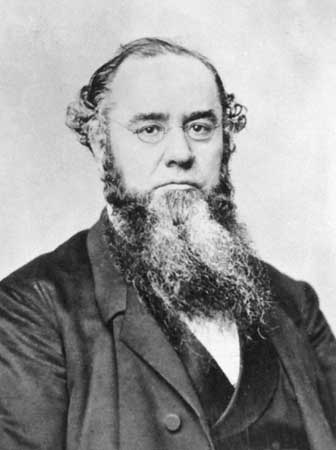
istanto001p1

                                       Secretary of War Edwin Stanton

Lincoln’s Secretary of War, Edwin Stanton; who was a passionate believer in the justice of emancipation, was one of the first to grasp the importance of slave labor to the Confederate armies and how emancipation was of decided military necessity. Stanton, “Instantly grasped the military value of the proclamation. Having spent more time than any of his colleagues contemplating the logistical problems facing the army, he understood the tremendous advantage to be gained if the massive workforce of slaves could be transferred from the Confederacy to the Union.” [15]

Lincoln emphasized the “military necessity” of emancipation and “justified the step as a “fit and necessary war measure for suppressing the rebellion.” [16] The process of emancipation now became not only a moral crusade, but now became a key part of national strategy, not just in a military means, but politically, economically and diplomatically as Lincoln “also calculated that making slavery a target of the war would counteract the rising clamor in Britain for recognition of the Confederacy.”  [17]

Lincoln wrote to his future Vice President, Andrew Johnson, then the military governor of occupied Tennessee that “The colored population is the great available and yet unavailed of, force for restoration of the Union.”[18] The idea of simply mollifying the border states was dropped and policy changed that of “depriving the Confederacy of slave labor. Mobilizing that manpower for the Union – as soldiers as well as laborers – was a natural corollary.” [19] Reflecting President Lincoln’s and Stanton’s argument for the military necessity of emancipation, General Henry Halleck wrote to Ulysses Grant:

“the character of the war has very much changed within the past year. There is now no possibility of reconciliation with the rebels… We must conquer the rebels or be conquered by them….Every slave withdrawn from the enemy is the equivalent of a white man put hors de combat.” [20]

54thmassposter

Ulysses Grant concurred with Lincoln’s decision. Grant wrote to in a letter to Lincoln after the assault on Battery Wagner by the 54th Massachusetts, “by arming the negro we have added a powerful ally. They will make good soldiers and taking them from the enemy weakens him in the same proportion as it strengthens us.” [21] William Tecumseh Sherman was supportive but also noted some facts that some radical abolitionists did not understand. He noted in his correspondence that, “The first step in the liberation of the Negro from bondage will be to get him and his family to a place of safety… then to afford him the means of providing for his family,… then gradually use a proportion – greater and greater each year – as sailors and soldiers.” [22] Lincoln wrote after the Emancipation Proclamation that “the emancipation policy, and the use of colored troops, constitute the heaviest blow yet dealt to the rebellion.” [23] The change was a watershed in both American history as well as for the future of the U.S. Military services.

In conjunction with the Emancipation Proclamation Secretary of War Stanton “authorized General Rufus Saxton to “arm, uniform, equip, and receive into the service of the United States such number of volunteers of African descent as you may deem expedient, not exceeding 5,000, and [you] may detail officers to instruct them in military drill, discipline, and duty, and to command them.”  [24] The initial regiments of African Americans were formed by Union commanders in liberated areas of Louisiana and South Carolina, and most were composed of newly freed slaves. Others like the 54th and 55th Massachusetts Volunteer Infantry regiments were raised from free black men in the north. Stanton’s authorization was followed by the Enrollment Act passed by Congress in March of 1863 which established the draft also allowed blacks to serve. By March Stanton was working with state governors to establish more black regiments. The units became known as United States Colored Troops, or U.S.C.T. and were commanded by white officers and organized into the infantry, cavalry and, artillery regiments organized on the model of white regiments. The U.S.C.T. “grew to include seven regiments of cavalry, more than a dozen of artillery, and well over one hundred of infantry.” [25]

Some Union soldiers and officers initially opposed enlisting blacks at all, and some “charged that making soldiers of blacks would be a threat to white supremacy, and hundreds of Billy Yanks wrote home that they would no serve alongside blacks.” [26]  But most common soldiers accepted emancipation, especially those who had served in the South and seen the misery that many slaves endured, one Illinois soldier, stationed who served in the Western Theater of war wrote, “the necessity of emancipation is forced upon us by the inevitable events of the war… and the only road out of this war is by blows aimed at the heart of the Rebellion…. If slavery should be left undisturbed the war would be protracted until the loss of life and national bankruptcy would make peace desirable on any terms.” [27]

Another soldier’s letters home show his conversion from being against emancipation to being fully for it. Corporal Chauncey B. Welton from Ohio wrote to his father after the Emancipation proclamation:

“Father I want you to write and tell me what you think of Lincoln’s proclamation of setting all the negroes free. I can tell you we don’t think much of it hear in the army for we did not enlist to fight for the negro and I can tell you that we never shall or many of us any how[.] no never.”

Following over two years of combat in which he served with Sherman’s army he became a vocal critic of the anti-abolitionist Copperheads in the North, especially former Ohio Governor Clement Vallandigham, as well as a strong proponent of abolition and opponent of slavery. By February 1865 his tone had changed “dear parents let us trust in Him that never forsakes the faithful, and never cease to pray… that soon we may look upon an undivided Country and that Country free free free yes free from that blighting curs[e] Slavery the cause of four years of Bloody warfare.” [28]

Even so racial prejudice in the Union ranks never went away and sometimes was accompanied by violence. It remained a part and parcel of life in and outside of the army, even though many Union soldiers would come to praise the soldierly accomplishments and bravery of African American Soldiers. An officer who had refused a commission to serve with a U.S.C.T. regiment watched as black troops attacked the defenses of Richmond in September 1864:

“The darkies rushed across the open space fronting the work, under a fire which caused them loss, into the abattis… down into the ditch with ladders, up and over the parapet with flying flags, and down among, and on top of, the astonished enemy, who left in utmost haste…. Then and there I decided that ‘the black man could fight’ for his freedom, and that I had made a mistake in not commanding them.” [29] Likewise, “Once the Lincoln administration broke the color barrier of the army, blacks stepped forward in large numbers. Service in the army offered to blacks the opportunity to strike a decisive blow for freedom….” [30]

HD_NgroWarFL640116p264cz.preview

                                        The Defense of Milliken’s Bend 

Emancipation allowed for the formation of regiments of United States Colored Troops (USCT), which were mustered directly into Federal service. In sheer numbers the U.S.C.T. formations soon dwarfed the few state raised Black Regiments.  However, it was the inspiration provided by those first state raised regiments, the heroic accounts of those units reported in Northern newspapers, as well as the unprovoked violence directed against Blacks in the 1863 New York draft riots that helped to provoke “many northerners into a backlash against the consequences of violent racism.” [31]

Despite the hurdles and prejudices that blacks faced even in the North, many African Americans urged others to enlist, self-help mattered more than self-preservation. Henry Gooding, an black sergeant from Massachusetts wrote the editor of the New Bedford Mercury urging fellow blacks to enlist despite the dangers, “As one of the race, I beseech you not to trust a fancied security, laying in your minds, that our condition will be bettered because slavery must die…[If we] allow that slavery will die without the aid of our race to kill it – language cannot depict the indignity, the scorn, and perhaps the violence that will be heaped upon us.” [32]

The valor of the state regiments, as well as the USCT units that managed to get into action was remarkable, especially in regard to the amount of discrimination levied at them by some northerners, including white Northern soldiers, and the very real threat of death that they faced if captured by Confederates. In response to the Emancipation Proclamation and to the formation of African American regiments the Confederate Congress passed measures that would make Union officers who commanded African American troops as war criminals and return any black soldier captured by Confederate forces return to slavery, if those blacks captured in battle were not summarily tortured by their captors or executed as happened at Fort Wagner, Petersburg, and at Fort Pillow.

In late 1862 Major General Nathaniel Banks was in desperate need of soldiers and received permission to form a number of regiments of free blacks. Known as the First, Second and Third Regiments of the Louisiana Native Guards they were primarily composed of former slaves who had escaped to Union lines, as well as some mulattos who were the children of prominent white citizens of the city. During an inspection, the white Colonel of the Guards told another officer:

“Sir, the best blood of Louisiana is in that regiment! Do you see that tall, slim fellow, third file from the right of the second company? One of the ex-governors of the state is his father. That orderly sergeant in the next company is the son of a man who has been six years in the United States Senate. Just beyond him is the grandson of Judge ______ …; and through all the ranks you will find the same state of facts…. Their fathers are disloyal; [but] these black Ishmaels will more than compensate for their treason by fighting in the field.” [33]

In May of 1863 Banks dared to send the First and Third Regiments of “Louisiana Native Home Guard regiments on a series of attacks on Confederate positions at Port Hudson, Louisiana” [34] where they received their baptism of fire. They suffered heavy losses and “of the 1080 men in the ranks, 271 were hit, or one out of every four.” [35] A white Wisconsin soldier commented that the black soldiers “fought like devils,”while a soldier of the 156th New York wrote, “They charged and re-charged and they didn’t know what retreat meant. They lost in their two regiments some four hundred men as near as I can learn. This settles the question about niggers not fighting well. They on the contrary make splendid soldiers and are as good fighting men as we have.” [36] Banks too was caught up in the moment and said of these troops in his after action report: “They answered every expectation…In many respects their conduct was heroic…The severe test to which they were subjected, and the determined manner in which they encountered the enemy, leave upon my mind no doubt of their ultimate success.” [37]

The_Storming_of_Ft_Wagner-lithograph_by_Kurz_and_Allison_1890a

                                54th Massachusetts at Fort Wagner 

But the most famous African American volunteer regiment was the 54thMassachusetts, commanded by Colonel Robert Gould Shaw, the “North’s showcase black regiment.” [38] Raised in Boston and officered by many men who were the sons of Boston’s blue blood abolitionist elite, the regiment was authorized in March 1863. Since there was still opposition to the formation of units made up of African Americans, Massachusetts Governor John Andrew authorized the formation of the 54th under the command of white officers, a practice that with few exceptions, became standard in the U.S. military until President Truman desegregated the armed forces in 1948. Governor Andrew was determined to ensure that the officers of the 54th were men of “firm antislavery principles…superior to a vulgar contempt for color.”[39]

The 54th Massachusetts first saw action in early June 1863 and at Shaw’s urging were sent into battle against the Confederate positions at Fort Wagner on July 18th 1863. Leading the attack the 54th lost nearly half its men, “including Colonel Shaw with a bullet through his heart. Black soldiers gained Wagner’s parapet and held it for an hour before falling back.” [40]Though they tried to hold on they were pushed back after a stubborn fight to secure a breach in the fort’s defenses. “Sergeant William H Carney staggered back from the fort with wounds in his chest and right arm, but with the regiment’s Stars and Stripes securely in his grasp. “The old flag never touched the ground, boys,” Carney gasped as he collapsed at the first field hospital he could find.” [41] Shaw was buried with his men by the Confederates and when Union commanders asked for the return of his body were told “We have buried him with his niggers,” Shaw’s father quelled a northern effort to recover his son’s body with these words: We hold that a soldier’s most appropriate burial-place is on the field where he has fallen.” [42] As with so many frontal attacks on prepared positions throughout the war, valor alone could not overcome a well dug in enemy. “Negro troops proved that they could stop bullets and shell fragments as good as white men, but that was about all.” [43]

Despite the setback, the regiment went on to further actions where it continued to distinguish itself. The Northern press, particularly abolitionist newspapers brought about a change in the way that many Americans in the North, civilians as well as soldiers, saw blacks. The Atlantic Monthly noted, “Through the cannon smoke of that dark night, the manhood of the colored race shines before many eyes that would not see.”  [44]

55th-mass-at-charleston

                  55th Massachusetts being welcomed in Charleston SC 

In the African American 55th Massachusetts, which was recruited after the 54th, twenty-one year old Sergeant Isaiah Welch wrote a letter which was published in the Philadelphia Christian Recorder from Folly Island South Carolina:

“I will mention a little about the 55th Massachusetts Regiment. They seem to be in good health at the present and are desirous of making a bold dash upon the enemy. I pray God the time will soon come when we, as soldiers of God, and of our race and country, may face the enemy with boldness. For my part I feel willing to suffer all privations incidental to a Christian and a soldier…. In conclusion, let me say, if I fall in the battle anticipated, remember, I fall in defense of my race and country. Some of my friends thought it very wrong of me in setting aside the work of the Lord to take up arms against the enemy…. I am fully able to answer all questions pertaining to rebels. If taking lives will restore the country to what it once was, then God help me to slay them on every hand.” [45]

Like the 54th Massachusetts, the 55th would see much action. After one particularly sharp engagement in July 1864, in which numerous soldiers had demonstrated exceptional valor under fire the regiment’s commander, Colonel Alfred S. Hartwell “recommended that three of the black sergeants of the 55th be promoted to the rank of 2nd Lieutenant.” But Hartwell’s request was turned down, and a member of the regiment complained, “But the U.S. government has refused so far to must them because God did not make them White…. No other objection is, or can be offered.”[46]

Frederick Douglass, who had two sons serving in the 54th Massachusetts, understood the importance of African Americans taking up arms against those that had enslaved them in order to win their freedom:

“Once let a black man get upon his person the brass letters U.S… let him get an eagle on his button, and a musket on his shoulder and bullets in his pockets, and there is no power on earth which can deny he has won the right to citizenship in the United States.” [47]

Douglass urged African American men to enlist to secure their freedom, even while noting the inequities still prevalent in society and in the military, in which they did not receive the same pay as whites, nor could they become officers. Appealing to duty and reality Douglass noted in a speech in Philadelphia urging black men to volunteer. In it he carefully defined the real differences between the purposes of the Confederacy which was to “nothing more than to make the slavery of the African race universal and perpetual on this continent,” which was “based upon the idea that colored men are an inferior race, who may be enslaved and plundered forever.” [48]
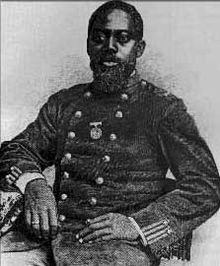
220px-WilliamCarney

         Sergeant William Carney 54th Massachusetts, Medal of Honor

But the premier leader of the African Americans of his day, who had himself suffered as a slave, did not stop with that. Douglass understood that winning the war was more important that to what had been the attitude of the Federal government before the war and before emancipation, “Now, what is the attitude of the Washington government towards the colored race? What reasons have we to desire its triumph in the present contest? Mind, I do not ask what was its attitude towards us before the war…. I do not ask you about the dead past. I bring you to the living present.” He noted the advances that had been made in just a few months and appealed to his listeners. “Do not flatter yourselves, my friends, that you are more important to the Government than the Government to you. You stand but as the plank to the ship. This rebellion can be put down without your help. Slavery can be abolished by white men: but liberty so won for the black man, while it may leave him an object of pity, can never make him an object of respect…. Young men of Philadelphia, you are without excuse. The hour has arrived, and your place is in the Union army. Remember that the musket – the United States musket with its bayonet of steel – is better than all the mere parchment guarantees of liberty. In your hands that musket means liberty…” [49]

Other African American units less famous than the illustrious 54thMassachusetts distinguished themselves in action against Confederate forces. Two regiments of newly recruited blacks were encamped at Milliken’s Bend Louisiana when a Confederate brigade attempting to relieve the Vicksburg garrison attacked them. The troops were untrained and ill-armed but held on against a determined enemy:

“Untrained and armed with old muskets, most of the black troops nevertheless fought desperately. With the aid of two gunboats they finally drove off the enemy. For raw troops, wrote Grant, the freedmen “behaved well.” Assistant Secretary of War Dana, still with Grant’s army, spoke with more enthusiasm. “The bravery of the blacks,” he declared, “completely revolutionized the sentiment in the army with regard to the employment of negro troops. I heard prominent officers who had formerly in private had sneered at the idea of negroes fighting express after that as heartily in favor of it.”[50]

The actions of the black units at Milliken’s bend attracted the attention and commendation of Ulysses Grant, who wrote in his cover letter to the after action report, “In this battle most of the troops engaged were Africans, who had little experience in the use of fire-arms. Their conduct is said, however, to have been most gallant, and I doubt not but with good officers that they will make good troops.” [51] They also garnered the attention of the press. Harper’s published an illustrated account of the battle with a “double-page woodcut of the action place a black color bearer in the foreground, flanked by comrades fighting hand-to-hand with Confederates. A brief article called it a “the sharp fight at Milliken’s bend where a small body of black troops with a few whites were attacked by a large force of rebels.” [52] In the South the result was chilling and shocked whites, one woman wrote “It is hard to believe that Southern soldiers – and Texans at that – have been whipped by a mongrel crew of white and black Yankees…. There must be some mistake.” While another woman in Louisiana confided in her diary, “It is terrible to think of such a battle as this, white men and freemen fighting with their slaves, and to be killed by such a hand, the very soul revolts from it, O, may this be the last.” [53]

flporthudsonedml

                               Louisiana Native Guards at Port Hudson 

By the end of the war over 179,000 African American Soldiers, commanded by 7,000 white officers served in the Union armies. For a number of reasons most of these units were confined to rear area duties or working with logistics and transportation operations. The policies to regulate USCT regiments to supporting tasks in non-combat roles “frustrated many African American soldiers who wanted a chance to prove themselves in battle.” [54] Many of the soldiers and their white officers argued to be let into the fight as they felt that “only by proving themselves in combat could blacks overcome stereotypes of inferiority and prove their “manhood.” [55]Even so in many places in the army the USCT and state regiments made up of blacks were scorned:

“A young officer who left his place in a white regiment to become colonel of a colored regiment was frankly told by a staff officer that “we don’t want any nigger soldiers in the Army of the Potomac,” and his general took him aside to say: “I’m sorry to have you leave my command, and am still more sorry that you are going to serve with Negroes. I think that it is a disgrace to the army to make soldiers of them.” The general added that he felt this way because he was sure that colored soldiers just would not fight.”  [56]

The general of course, was wrong, for “Nothing eradicated the prejudices of white soldiers as effectively as black soldiers performing well under fire. And nothing inspired black soldiers to fight as desperately as the fear that capture meant certain death.” [57]  In the engagements where USCT units were allowed to fight, they did so with varying success most of which was often attributable to the direction of their senior officers and the training that they had received. As with any other unit, well led and well trained regiments performed better than those whose leaders had failed their soldiers. When given the chance they almost always fought well, even when badly commanded. This was true as well when they were thrown into hopeless situations.

One such instance was when Ferrero’s Division, comprised of colored troops were thrown into the Battle of the Crater at Petersburg when “that battle lost beyond all recall.” [58] The troops advanced in good order singing as they went, while their commander, General Ferrero took cover in a dugout and started drinking; but the Confederate defenders had been reinforced and “Unsupported, subjected to a galling fire from batteries on the flanks, and from infantry fire in front and partly on the flank,” a witness write, “they broke up in disorder and fell back into the crater.” [59] Pressed into the carnage of the crater where white troops from the three divisions already savaged by the fighting had taken cover, the “black troops fought with desperation, uncertain of their fate if captured.”[60] In the battle Ferrero’s division lost 1,327 of the approximately 4,000 men who made the attack. [61]

Major General Benjamin Butler railed to his wife in a letter against those who questioned the courage of African American soldiers seeing the gallantry of black troops assaulting the defenses of Petersburg in September 1864: The man who says that the negro will not fight is a coward….His soul is blacker than then dead faces of these dead negroes, upturned to heaven in solemn protest against him and his prejudices.” [62]

In another engagement, the 1864 Battle of Saltville in western Virginia the troops of the 5th USCT Cavalry who had been insulted, taunted, and derided by their fellow white Union soldiers went into action against Confederate troops defending the salt works in that town. The regiment’s commander, Colonel Wade, order his troops to attack. Colonel James Brisbin detailed the attack:

“the Negroes rushed upon the works with a yell and after a desperate struggle carried the line killing and wounding a large number of the enemy and capturing some prisoners…. Out of the four hundred men engaged, one hundred and fourteen men and four officers fell killed or wounded. Of this fight I can only say that men could not have behaved more bravely. I have seen white troops in twenty-seven battles and I never saw any fight better…. On the return of the forces those who had scoffed at the Colored Troops on the march out were silent.” [63]

The response of the Confederate government to Emancipation and African Americans serving as soldiers was immediate and uncompromisingly harsh. “When in the autumn of 1862 General Beauregard referred the question of a captured black soldier to Davis’s latest Secretary of War, James A. Seddon, the later replied “…my decision is that the negro is to be executed as an example.” [64] Davis approved of the summary executions of black prisoners carried out in South Carolina in November 1862, and a month later “on Christmas Eve, Davis issued a general order requiring all former slaves and their officers captured in arms to be delivered up to state officials for trial.” [65] Davis warned that “the army would consider black soldiers as “slaves captured in arms,” and therefore subject to execution.” [66] While the Confederacy never formally carried out the edict, there were numerous occasions where Confederate commanders and soldiers massacred captured African American soldiers.

The Lincoln administration responded to the Confederate threats by sending a note to Davis that threatened reprisals against Confederate troops if black soldiers suffered harm. It “was largely the threat of Union reprisals that thereafter gave African-American soldiers a modicum of humane treatment.” [67] Even so, they and their white officers were often in much more danger than the officers and soldiers of all-white regiments if captured by Confederate forces.

When captured by Confederates, black soldiers and their white officers received no quarter from many Confederate opponents. General Edmund Kirby Smith who held overall command of Confederate forces west of the Mississippi instructed General Richard Taylor to simply execute black soldiers and their white officers: “I hope…that your subordinates who may have been in command of capturing parties may have recognized the propriety of giving no quarter to armed negroes and their officers. In this way we may be relieved from a disagreeable dilemma.” [68] This was not only a local policy, but echoed at the highest levels of the Confederate government. In 1862 the Confederate government issued an order that threatened white officers commanding blacks: “any commissioned officer employed in the drilling, organizing or instructing slaves with their view to armed service in this war…as outlaws” would be “held in close confinement for execution as a felon.” [69] After the assault of the 54th Massachusetts at Fort Wagner a Georgia soldier “reported with satisfaction that the prisoners were “literally shot down while on their knees begging for quarter and mercy.” [70]
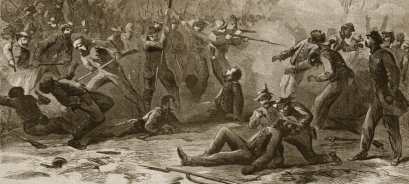
fortpillowmassacred

                                                 Fort Pillow Massacre 

On April 12th 1864 at Fort Pillow, troops under the command of General Nathan Bedford Forrest massacred the bulk of over 231 Union most of them black as they tried to surrender. While it is fairly clear that Forrest did not order the massacre and even may have attempted to stop it, it was clear that he had lost control of his troops, and “the best evidence indicates that the “massacre”…was a genuine massacre.” [71] Forrest’s soldiers fought with the fury of men possessed by hatred of an enemy that they considered ‘a lesser race’ and slaughtered the Union troops as they either tried to surrender or flee; but while Forrest did not order the massacre, he certainly was not displeased with the result. His subordinate, General James Chalmers told an officer from the gunboat Silver Cloud that he and Forrest had neither ordered the massacre and had tried to stop their soldiers but that “the men of General Forrest’s command had such a hatred toward the armed negro that they could not be restrained from killing the negroes,” and he added, “it was nothing better than we could expect so long as we persisted in arming the negro.” [72] It was a portent of what some of the same men would do to defenseless blacks and whites sympathetic to them as members of the Ku Klux Klan, the White Liners, White League, and Red Shirts, during and after Reconstruction in places like Colfax Louisiana.

Ulysses Grant was infuriated and threatened reprisals against any Confederates conducting such activities, he a later wrote:

“These troops fought bravely, but were overpowered I will leave Forrest in his dispatches to tell what he did with them.

“The river was dyed,” he says, “with the blood of the slaughtered for up to 200 years. The approximate loss was upward of five hundred killed; but few of the officers escaped. My loss was about twenty killed. It is hoped that these facts will demonstrate to the Northern people that negro soldiers cannot cope with Southerners.” Subsequently Forrest made a report in which he left out the part that shocks humanity to read.”  [73]

The bulk of the fanatical hatred of Forrest’s troops was directed at the black soldiers of the 6th U.S. Colored Heavy Artillery, which composed over a third of the garrison. “Of the 262 Negro members of the garrison, only 58 – just over 20 percent – were marched away as prisoners; while of the 295 whites, 168 – just under sixty percent were taken.”  [74] A white survivor of the 13th West Tennessee Cavalry, a Union unit at the fort wrote:

We all threw down our arms and gave tokens of surrender, asking for quarter…but no quarter was given….I saw 4 white men and at least 25 negroes shot while begging for mercy….These were all soldiers. There were also 2 negro women and 3 little children standing within 25 steps of me, when a rebel stepped up to them and said, “Yes, God damn you, you thought you were free, did you?” and shot them all. They all fell but one child, when he knocked it in the head with the breech of his gun.” [75]

A Confederate Sergeant who was at Fort Pillow wrote home a week after the massacre: “the poor deluded negroes would run up to our men, fall upon their knees and with uplifted hands scream for mercy, but were ordered to their feet and shot down.” [76] The captain of the Union gunboat Silver Cloud was allowed by the Confederate to bring his ship to the Fort to evacuate wounded, and to bury the dead was appalled at the sight, he wrote:

“All the buildings around the fort and the tents and huts in the fort had been burned by the rebels, and among the embers of the charred remains of numbers of our soldiers who had suffered terrible death in the flames could be seen. All the wounded who had strength enough to speak agreed that after the fort was taken an indiscriminate slaughter of our troops was carried on by the enemy…. Around on every side horrible testimony to the truth of this statement could be seen, Bodies with gaping wounds,… some with skulls beaten through, others with hideous wounds as if their bowels had been ripped open with bowie-knives, plainly told that little quarter was shown…. Strewn from the fort to the river bank, in the ravines and the hollows, behind logs and under the brush where they had crept for protection from the assassins who pursued them, we found bodies bayoneted, beaten, and shot to death, showing how cold-blooded and persistent was the slaughter…. Of course, when a work is carried by assault there will always be more or less bloodshed, even when all resistance has ceased; but here there were unmistakable evidences of a massacre carried on long after any resistance could have been offered, with a cold-blooded barbarity and perseverance which nothing can palliate.” [77]

The rabidly pro-slavery members of the Confederate press lent their propaganda to cheer the massacre of the captured blacks. John R. Eakin of the Washington (Arkansas) Washington Telegraph, who later became a justice on the Arkansas Supreme Court after Reconstruction, wrote,

“The Slave Soldiers. – Amongst there are stupendous wrongs against humanity, shocking to the moral sense of the world, like Herod’s massacre of the Innocents, or the eve of St. Bartholomew, the crime of Lincoln in seducing our slaves into the ranks of his army will occupy a prominent position….

How should we treat our slaves arrayed under the banners of the invader, and marching to desolate our homes and firesides….

Meanwhile, the problem has been met our soldiers in the heat of battle, where there has been no time for discussion. They have cut the Gordian knot with the sword. They did right….

It follows that we cannot treat negroes in arms as prisoners of war without a destruction of the social system for which we contend. We must be firm, uncompromising and unfaltering. We must claim the full control of all negroes who may fall into our hands, to punish with death, or any other penalty, or remand them to their owners. If the enemy retaliate, we must do likewise; and if the black flag follows, the blood be upon their heads.” [78]

However, when African American Troops were victorious, and even after they had seen their brothers murdered by Confederate troops, that they often treated their Confederate with great kindness. Colonel Brisbin wrote that following Battle of Saltville that “Such of the Colored Soldiers who fell into the hands of the Enemy during the battle were murdered. The Negroes did not retaliate but treated the Rebel wounded with great kindness, carrying them water in their canteens and doing all they could to alleviate the sufferings of those whom the fortunes of war had placed in their hands.” [79]

African American soldiers proved themselves during the war and their efforts paved the way for Lincoln and others to begin considering the full equality of blacks as citizens. If they could fight and die for the country, how could they be denied the right to votes, be elected to office, serve on juries or go to public schools? Under political pressure to end the war during the stalemate before Petersburg and Atlanta in the summer of 1864, Lincoln reacted angrily to Copperheads as well as wavering Republicans on the issue of emancipation:

“But no human power can subdue this rebellion without using the Emancipation lever as I have done.” More than 100,000 black soldiers were fighting for the Union and their efforts were crucial to northern victory. They would not continue fighting if they thought the North intended to betray them….If they stake their lives for us they must be prompted by the strongest motive…the promise of freedom. And the promise being made, must be kept…There have been men who proposed to me to return to slavery the black warriors. “I should be damned in time & in eternity for so doing. The world shall know that I will keep my faith to friends & enemies, come what will.”  [80]

The importance of African Americans cannot be minimized, without them the war could have dragged on much longer or even ended in stalemate, which would have been a Confederate victory. Lincoln wrote about the importance of the African American contribution to the war effort in 1864:

“Any different policy in regard to the colored man, deprives us of his help, and this is more than we can bear. We can not spare the hundred and forty or hundred and fifty thousand now serving us as soldiers, seamen, and laborers. This is not a question of sentiment or taste, but one of physical force which may be measured and estimated as horse-power and Steam-power are measured and estimated. Keep it and you save the Union. Throw it away, and the Union goes with it.” [81]

Despite this, even in the North during and after the war, blacks, including former soldiers faced discrimination, sometimes that of the white men that they served alongside, but more often from those who did not support the war effort. Lincoln wisely took note of this fact, and wrote that after the war:

“there will there will be some black men who can remember that, with silent tongue, the clenched teeth, the steady eye, the well poised bayonet, they have helped  mankind on to this great consummation; while, I fear, there will be some white ones, unable to forget that, with malignant heart, and deceitful speech, they have strove to hinder it.” [82]

swails

Lt Stephen Swails, First African American Officer of 54th Massachusetts 

Those rights would be fought for another century and what began in 1863 with the brave service and sacrifice of these African American soldiers began a process of increased civil rights that is still going on today. It would not be until after the war that some blacks were commissioned as officers in the Army. When Governor John Andrew, the man who had raised the 54th Massachusetts attempted to “issue a state commission to Sergeant Stephen Swails of the 54th…the Bureau of Colored Troops obstinately refused to issue Swails a discharge from his sergeant’s rank, and Swails promotion was held up until after the end of the war. “How can we hope for success to our arms or God’s blessing,” raged the white colonel of the 54th, Edward Hallowell, “while we as a people are so blind to justice?” [83]

The families of the free blacks who volunteered also suffered, especially those who still had families enslaved in Confederate occupied areas or Union States which still allowed slavery. One women in Missouri wrote her husband begging him to come home “I have had nothing but trouble since you left….They abuse me because you went & say they will not take care of our children & do nothing but quarrel with me all the time and beat me scandalously the day before yesterday.”  [84]

However, the Emancipation Proclamation transformed the war, and even jaded White Union soldiers who had been against emancipation and who were deeply prejudiced against blacks began to change their outlook as the armies marched into the South and saw the horrors of slavery, Russell Weigley wrote that Union soldiers: “confronting the scarred bodies and crippled souls of African Americans as they marched into the South experienced a strong motivation to become anti-slavery men…Men do not need to play a role long, furthermore, until the role grows to seem natural and customary to them. That of liberators was sufficiently fulfilling to their pride that soldiers found themselves growing more accustomed to it all the more readily.” [85]

A sergeant of the 19th Michigan who had already lost a stepson in the war wrote to his wife from Georgia before being killed in action during the Atlanta campaign; “the more I learn of the cursed institution of Slavery, the more I feel willing to endure, for its final destruction…. After this war is over, this whole country will undergo a change for the better…. Abolishing slavery will dignify labor; that fact will revolutionize everything…. Let Christians use all their influence to have justice done to the black man.” [86]

But even more importantly for the cause of liberty, the sight of regiments of free African Americans, marching “through the slave states wearing the uniform of the U.S. Army and carrying rifles on their shoulders was perhaps the most revolutionary event of a war turned into revolution.” [87]
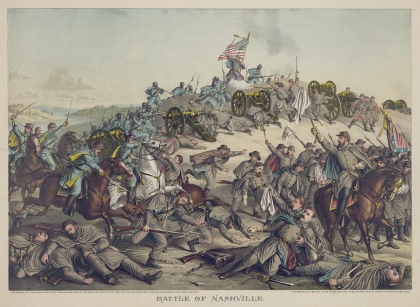
battle_of_nashville_kurz__allison

At peak one in eight Union troops were African American, and Black troops made an immense contribution to the Union victory. “Black troops fought on 41 major battlefields and in 449 minor engagements. Sixteen soldiers and seven sailors received Medals of Honor for valor. 37,000 blacks in army uniform gave their lives and untold sailors did, too.” [88] To fully appreciate the measure as to the importance and significance of the numbers of African American troops serving in the Union ranks has to compare that number with the number of active Confederate troops serving toward the end of the war. The approximately 180,000 African Americans serving in Union ranks at the end of the war outnumbered the “aggregate present” in Confederate ranks on January 1st 1865 by over 20,000 men. Of these troops “134,111 were recruited in states that had stars in the Confederate battle flag, and the latter figure in turn was several thousand greater than the total of 135,994 gray-clad soldiers “present for duty” that same day.” [89]

Of the African American soldiers who faced the Confederates in combat, “deep pride was their compensation. Two black patients in an army hospital began a conversation. One of them looked at the stump of an arm he had once had and remarked: “Oh I should like to have it, but I don’t begrudge it.” His ward mate, minus a leg, replied: “Well, ‘twas [lost] in a glorious cause, and if I’d lost my life I should have been satisfied. I knew what I was fighting for.” [90]

22nd-usct-flags

                                  Flags of the 22nd U.S. Colored Troops 

After the war many of the African American soldiers became leaders in the African American community and no less than 130 of these former soldiers held elected office including in the U.S. Congress and various state legislatures. The liberating aspect of “the black military experience radiated from black soldiers and their families into the larger black community, so it spread into white society as well.” [91]  Many abolitionists who had served as officers, and officers who were assigned to the USCT or volunteered to serve with state raised African American regiments became leaders continued to be voices for expanding civil rights in the years following the war.

Following war’s end, the demobilized African American troops became the target of racial discrimination and violence, but even so, “black veterans continued to play a central role in black communities, North and South. The skills and experience black men gained during the war not only propelled many of them into positions of leaders and sustained the prominence of others, but it also shaped the expectations and aspirations of all black people. The achievements and pride engendered by military service helped to make a new world of freedom.” [92]

Sadly, much of the nation has forgotten the efforts of the Free Black Soldiers and Sailors who fought for freedom, but even so their legacy remains in the “contribution of black soldiers to Union victory remained a point of pride in black communities. “They say,” an Alabama planter reported in 1867, “the Yankees never could have whipped the South without the aid of the Negroes.” Well into the twentieth century, black families throughout the United States would recall with pride that their fathers and grandfathers had fought for freedom.” [93]

Notes 

[1] Ibid. McPherson Tried by War: Abraham Lincoln as Commander in Chief

[2] Ibid. Goodwin Team of Rivals p.435

[3] Ibid. McPherson Tried by War p.58

[4] Ibid. McPherson Tried by War p.58

[5] Ibid. Goodwin Team of Rivals p.369

[6] Ibid. McPherson Tried by War p.109

[7] Ibid. Foote, The Civil War, A Narrative Volume Two p.531

[8] Ibid. McPherson. The Battle Cry of Freedom p.503

[9] Ibid. McPherson Drawn With the Sword: Reflections on the American Civil War p.101

[10] Ibid. Guelzo Gettysburg: The Last Invasion p.160

[11] Foner, Eric Forever Free: The Story of Emancipation and Reconstruction Vintage Books a Division of Random House, New York 2005 p.45

[12] Ibid. Guelzo Gettysburg: The Last Invasion p.160

[13] Ibid. Glatthaar General Lee’s Army from Victory to Collapse p.313

[14] Ibid. Guelzo Gettysburg: The Last Invasion p.160

[15] Ibid. Goodwin Team of Rivals p.465

[16] Egnal, Marc Clash of Extremes: The Economic Origins of the Civil War Hill and Wang a division of Farrar, Straus and Giroux New York 2009 p.318

[17] Ibid. Foner Forever Free p.48

[18] Ibid. McPherson Tried by War p.159

[19] Ibid. McPherson Drawn With the Sword p.159

[20] Ibid. McPherson Abraham Lincoln and the Second American Revolution p.35

[21] Ibid. Guelzo Fateful Lightning p.381

[22] Ibid. Dobak Freedom by the Sword: The U.S. Colored Troops, 1862-1867 p.10

[23] Ibid. McPherson Abraham Lincoln and the Second American Revolution p.35

[24] Ibid. Robertson Soldiers Blue and Gray p.31

[25] Ibid. Dobak Freedom by the Sword: The U.S. Colored Troops, 1862-1867 p.11

[26] Ibid. Robertson Soldiers Blue and Gray p.31

[27] Ibid. Gallagher, Gary W. The Union War Harvard University Press, Cambridge MA and London 2011 p.103

[28] Welton, Chauncey B. A Union Soldier’s Changing Views on Emancipationin The Civil War and Reconstruction: A Documentary Collection edited by William Gienapp, W.W. Norton Company, New York and London 2001 pp.242 and 245

[29] Ibid. Robertson Soldiers Blue and Gray p.34

[30] Glatthaar, Joseph T. Black Glory: The African American Role in Union Victory in Why the Confederacy Lost edited by Gabor S. Boritt Oxford University Press, Oxford and New York 1992

[31] Ibid. McPherson. The Battle Cry of Freedom p.686

[32] Ibid. Goldfield America Aflame p.282

[33] Jones, Terry L. The Free Men of Color Go to War in The new York Times Disunion: 106 Articles from the New York Times Opinionator edited by Ted Widmer with Clay Risen and George Kalogerakis, Black Dog and Leventhal Publishers, New York 2013 p.403

[34] Ibid. Guelzo Fateful Lightening p.379

[35] Ibid. Foote The Civil War, A Narrative Volume Two p.398

[36] Ibid. Trudeau Like Men of War p.44

[37] Ibid. Guelzo Fateful Lightening p.379

[38] Ibid. McPherson. The Battle Cry of Freedom p.686

[39] Ibid. McPherson Drawn With the Sword p.101

[40] Ibid. McPherson. The Battle Cry of Freedom p.686

[41] Ibid. Guelzo Fateful Lightening pp. 380-381

[42] Ibid. McPherson. The Battle Cry of Freedom pp.686-687

[43] Ibid. Foote, The Civil War, A Narrative Volume Two p.697

[44] Ibid. McPherson. The Battle Cry of Freedom p.686

[45] Welch, Isaiah H. Letter in the Christian Recorder 24 October 1863 in The Civil War and Reconstruction: A Documentary Collection edited by William E. Gienapp, W.W. Norton and Company, New York and London 2001 pp.225-226

[46] Trudeau, Noah Andre, Like Men of War: Black Troops in the Civil War 1862-1865 Little, Brown and Company, Boston, New York and London, 1998 p.262

[47] Ibid. Guelzo Fateful Lightening p. 381

[48] Douglass, Frederick Philadelphia Speech of July 6th 1863 recorded in the Liberator in The Civil War and Reconstruction: A Documentary Collection edited by William E. Gienapp, W.W. Norton and Company, New York and London 2001 pp.220-221

[49] Ibid. Douglass Philadelphia Speech of July 6th 1863 p.221

[50] Ibid. McPherson. The Battle Cry of Freedom p.634

[51] Ibid. Trudeau Like Men of War: Black Troops in the Civil War 1862-1865p.58

[52] Ibid. Gallagher The Union War p.97

[53] Ibid. Trudeau Like Men of War: Black Troops in the Civil War 1862-1865 p.59

[54] Ibid. Gallagher The Union War p.92

[55] Ibid. McPherson Drawn With the Sword p.89 p.

[56] Catton, Bruce. A Stillness at Appomattox Doubleday and Company Garden City, New York 1953 p.227

[57] Berlin, Ira, Riedy, Joseph P. and Rowland, Leslie S. editors, Freedom’s Soldiers: The Black Military Experience in the Civil War  Cambridge University Press, Cambridge and New York 1998 pp.133-134

[58] Ibid. Catton A Stillness at Appomattox p.249

[59] Foote, Shelby, The Civil War, A Narrative. Volume Three Red River to Appomattox Random House, New York 1974 p.537

[60] Ibid.Wert The Sword of Lincoln: The Army of the Potomac pp.384-385

[61] Ibid. Foote The Civil War, A Narrative Volume Three p.537

[62] Ibid. Robertson Soldiers Blue and Gray p.34

[63] Ibid. Berlin et al, Freedom’s Soldiers: The Black Military Experience in the Civil War  p.135

[64] Ibid. Weigley A Great Civil War p.189

[65] Ibid. McPherson Battle Cry of Freedom p.566

[66] Ibid. Goldfield America Aflame p. 280

[67] Ibid. Weigley A Great Civil War p.188

[68] Ibid. Guelzo Fateful Lightening p. 377

[69] Ibid. Guelzo Fateful Lightening p. 377

[70] Ibid. Goldfield America Aflame p.281

[71] Ibid. Weigley A Great Civil War p.189

[72] Ibid. Dobak Freedom by the Sword: The U.S. Colored Troops, 1862-1867 p.208

[73] Grant, Ulysses S. Preparing for the Campaigns of ’64 in Battles and Leaders of the Civil War Volume IV, Retreat With Honor Edited by Robert Underwood Johnson and Clarence Clough Buel Castle, Secaucus NJ pp.107-108

[74] Ibid. Foote The Civil War, A Narrative Volume Three p.111

[75] Ibid. Guelzo Fateful Lightning p. 378

[76] Ibid. Foote The Civil War, A Narrative Volume Three p.112

[77] Ibid. Dobak Freedom by the Sword: The U.S. Colored Troops, 1862-1867 p.208

[78] Eakin, John R. The Slave Soldiers, June 8, 1864  in Loewen, James W. and Sebesta, Edward H. editors, The Confederate and Neo-Confederate Reader: The “Great Truth” about “The Lost Cause” University of Mississippi Press, Jackson 2010 pp.210 and 212

[79] Ibid. Berlin et al, Freedom’s Soldiers: The Black Military Experience in the Civil War  p.47

[80] Ibid. McPherson Abraham Lincoln and the Second American Revolution p.89

[81] Ibid. Glatthaar Black Glory: The African American Role in Union Victoryp.138

[82] Ibid. McPherson The War that Forged a Nation p. 113

[83] Ibid. Guelzo Fateful Lightning p. 376

[84] Ibid. Goldfield America Aflame p.282

[85] Ibid. Weigley A Great Civil War p.192

[86] Ibid. McPherson For Cause and Comrades p.130

[87] Ibid. Weigley A Great Civil War p.191

[88] Gallagher, Gary, Engle, Stephen, Krick, Robert K. and Glatthaar editors The American Civil War: The Mighty Scourge of War Osprey Publishing, Oxford UK 2003 p.296

[89] Ibid. Foote The Civil War, A Narrative. Volume Three Red River to Appomattox p.756

[90] Ibid. Robertson Soldiers Blue and Gray p.36

[91] Ibid. Berlin et al, Freedom’s Soldiers: The Black Military Experience in the Civil War  p.47

[92] Ibid. Berlin et al. Freedom’s Soldiers: The Black Military Experience in the Civil War pp.49-50

[93] Ibid. Foner Forever Free p.55

Leave a comment

Filed under civil rights, civil war, ethics, faith, Gettysburg, History, laws and legislation, LGBT issues, Military, Political Commentary, us army, US Navy