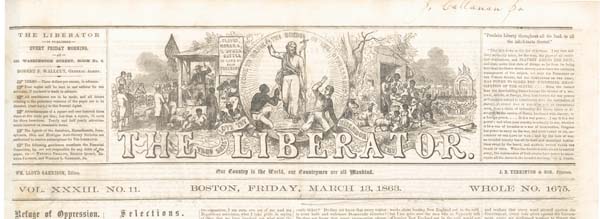
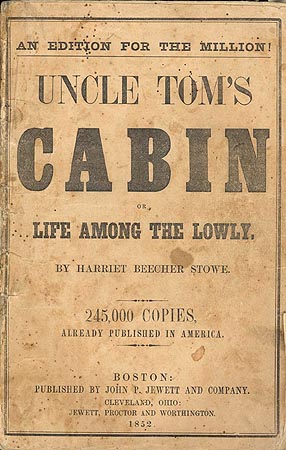
Category Archives: christian life

Faith, Doubt & Sacramental Encounters

IMG_0535

Friends of Padre Steve’s World

The late Father Andrew Greeley wrote in his mystery novel The Archbishop in Andalusia, “Every sacramental encounter is an evangelical occasion. A smile warm and happy is sufficient. If people return to the pews with a smile, it’s been a good day for them. If the priest smiles after the exchanges of grace, it may be the only good experience of the week.” 

I firmly believe that, and this week I had the opportunity to be present at one of thos sacramental encounters.

People who know me well, and people who have read what I have written on this site for the past six or so years know that I struggle with faith, belief, and doubt. I am a priest, and have been so for nearly twenty years, but faith for me is a constant struggle, and as such, I pray that in my seasons of doubt, and occasional unbelief that I won’t screw things up for others.

Over the past two years my academic duties have been more a part of my life than my priestly duties because of the nature of my assignment at the Staff College. I have a chapel, but attendance is always sparse and if I get more than five people in attendance it feels like a mega-church. I also do some counseling as well as care for students or those on our staff and faculty who need pastoral care, but the bulk of my duties are teaching and writing. This has been good as I spent the five previous years in hospital ministry and before that ten of twelve years doing operational duties and the other two in base chapels and congregations.

My current duties are refreshing, and despite my struggles with faith I attempt to be sensitive to what is going on around me, and the people who I come into contact with. This has been one of those kinds of weeks. We had a friend get ploughed over by an inattentive driver who cut across two lanes of traffic to strike my friend on his Harley. My friend was not at fault but is busted up pretty badly. His recovery will take six months to a year. Judy and I were visiting him on Thursday night and when we were going out on the elevator, it stopped and an older lady with two large bags asked if the elevator was going down. I said yes, held the door and had her come in. Since she was taking bags out I asked if she had family there and if she was going to be taking them home.

She looked up and told me that her husband was dying and had just days to live. I asked if I could carry her bags to her car and she told us what was going on. Her husband, a 30-year Navy veteran, who she had been married to for 46 years, was taken ill just a week prior after coming home from work. She took him to the hospital and after exploratory surgery they were informed that he had cancer throughout his body and just days to live, nothing could be done. It came as a shock as he had not missed a day of work for over ten years, and the illness was the first sign that he was sick.

We walked her to her car and I carried her bags and told her that I was a Navy chaplain. I have few words to describe what happened next. When I said that she was moved to tears, but they were not tears of sadness, she said that God must have meant for us to be on the same elevator. I wonder about such encounter, often, if not most of the time, I believe that what happens to us is not directed by God; but rather chance encounters that we are left to do the best we can in; but I was not going to argue. I realized that many military veterans and their families, especially older ones, are often more appreciative of chaplains than civilian clergy; so I offered to do anything that I could. I took a battered business card from my wallet, scribbled by cell phone number on the back and gave it to her, inviting her to call me any time. Judy and I left her as she went home to clean up and await the arrival of her children before she went back to the hospital.

That night she and her husband weighed on my mind and late last night she called me and asked if I could come by the hospital Saturday or Sunday. I told her that I would be there this morning. I again thought of her and her husband and what I would need, and tried to get some fitful hours of sleep. I got up, and went to the office to pick up my prayer book and hospital stole, made sure I had oil to anoint him and then drove the twenty-miles back across town from the base to the hospital, where I arrived at ten a.m. I knocked, and she greeted me, a social worker from the hospital palliative care was there, as was her son. She greeted me with a hug and introduced me and let me know that her husband had passed away not long before. He lay in the bed and she invited me to sit with her by him.

She then told me of his passing, how she saw the room filled with angels and a golden hue, she asked God to wait to allow her son and his brother to arrive. He hung on and shortly after they arrived she could see and feel the angels taking her husband to heaven. She then spoke of their life, and relationship and all the hopes, dreams and joys that they had experienced over the years, and how she had always been jealous that he had kept his youthful looks while she had obviously aged. She asked if I would pray and then I did so, commending his soul to God. I was reminded of Greeley’s words “We are born with two incurable diseases, life, from which we die, and hope, which says maybe death isn’t the end.” The encounter re-impressed those words on me. We all die, but we live in hope that death is not the end.

After a while longer I left and went to visit my friend who is being discharged today, though he will need several more surgeries over the coming weeks an months. We are going to do all that we can for him and his wife to help take up some of the burden, because they, like so many of our friends from the bar at Gordon Biersch are closer to us than any church people that we have known here; and they have been there for us when we needed them.

So now we are about ready to go to a birthday party for another friend. All part of the cycle of life, and perhaps the cycle of God’s grace, love, and presence, even in those times that we do not believe.

Peace

Padre Steve+

Leave a comment

Filed under christian life, faith, ministry

Faith, Power & Politics: The Death of Good Religion

184062576_1_blog_main_horizontal

Friends of Padre Steve’s World,

Today I just want to share a few subversive thoughts on American Christianity and established religion. I am not talking about organized religion, because we Americans have little in the way of organization to our religion except when it comes to wanting to be in charge of the country, as many on the Christian Right advocate today.

Mark Twain wrote in his classic novel, A Connecticut Yankee in King Arthur’s Court:

“Concentration of power in a political machine is bad; and an Established Church is only a political machine; it was invented for that; it is nursed, cradled, preserved for that; it is an enemy to human liberty, and does no good which it could not better do in a split-up and scattered condition.”

On a more individual level, Atticus Finch, the hero of the book and film To Kill a Mockingbird said, “Sometimes the Bible in the hand of one man is worse than a whisky bottle in the hand of (another)… There are just some kind of men who – who’re so busy worrying about the next world they’ve never learned to live in this one, and you can look down the street and see the results.” In fact I’ll bet most of us know someone just like Atticus described; I know that I do, plenty of them.

I, and probably you, like to believe that religion is a benign or positive influence in the world. As much as I want to believe the positive aspects I have to admit based on the historical and sociological evidence that this is not so, especially during unsettled times of great change. We live in such an era and when it comes to identity, God is the ultimate trump card.

It seems to me that most fanatical individuals and groups on earth, of course not all are tied to religions, whether it is the Islamic State and Al Qaeda, Boko Haram, Hezbollah, Orthodox Jews, radical Hindus and Buddhists, as well as militant Christians. Who can forget that the Holocaust, the African Slave Trade, and even the Rwandan Genocide were predominantly the work of Christians, but I digress… Of course all of these groups have different goals, but their thought and philosophy are quite similar.

Robert Heinlein wrote: “Almost any sect, cult, or religion will legislate its creed into law if it acquires the political power to do so.” Heinlein, author of the classic Starship Troopers was absolutely correct. Just look at any place in any time where any religion, sect or cult has gained control of a government. They are not loving, they are not forgiving and they use the police power of the state to persecute any individual or group that is judged to be in error, or even worse has the gall to question their authority.

Since the Christian groups tend to thrive in the West, they only speak in terms of violence, most, with the exception of Russian Orthodox Christians, do not have a government to translate those words into action, which it does against Evangelical Protestants, Roman Catholics, Moslems, Jews, and every religious group’s favorite enemies, Gays and women.

Many American Christians, especially conservative Catholics and some Evangelical and Charismatic Protestants seem for a long for the day when they can assume control of a theocratic government, and a day where they can sit at the side of the rich and oppress the poor, the alien and the outcast. The amount of public support given to Vlad Putin by conservative Christian leaders in this country is amazing, and some publically state that they would want someone like Vlad the topless male magazine model for a leader.

But this is nothing new. Many American Christians have practiced that type of Christianity for close to two hundred years. In fact American Christianity is little changed since the day Frederick Douglass wrote, “The Christianity of America is a Christianity, of whose votaries it may be as truly said, as it was of the ancient scribes and Pharisees, ‘They bind heavy burdens, and grievous to be borne, and lay them on men’s shoulders, but they themselves will not move them with one of their fingers… “The man who wields the blood-clotted cowskin during the week fills the pulpit on Sunday, and claims to be a minister of the meek and lowly Jesus. The man who robs me of my earnings at the end of each week meets me as a class- leader on Sunday morning, to show me the way of life, and the path of salvation. He who sells my sister, for purposes of prostitution, stands forth as the pious advocate of purity. He who proclaims it a religious duty to read the Bible denies me the right of learning to read the name of the God who made me. He who is the religious advocate of marriage robs whole millions of its sacred influence, and leaves them to the ravages of wholesale pollution. The warm defender of the sacredness of the family relation is the same that scatters whole families,— sundering husbands and wives, parents and children, sisters and brothers,—leaving the hut vacant, and the hearth desolate. We see the thief preaching against theft, and the adulterer against adultery. We have men sold to build churches, women sold to support the gospel, and babes sold to purchase Bibles for the poor heathen! all for the glory of God and the good of souls! … The dealer gives his blood-stained gold to support the pulpit, and the pulpit, in return, covers his infernal business with the garb of Christianity. Here we have religion and robbery the allies of each other—devils dressed in angels’ robes, and hell presenting the semblance of paradise.””

The remarks of Douglass are as pertinent today as he first penned them in relationship to American white acceptance and support of slavery, and while much of his writing was directed against slaveholders and others who profited off of that system, he directed much of his writing against Northern Christians who offered support to that system.

Many American Christians are no different than other religious people, Christian, Moslem, Jewish, Hindu, and in some cases Buddhists as well as countless other religions history. Religions which have more often sworn alliance to governments, rulers, military and economic power to increase their power than to embody the essence of their founders’ teachings. Most of the time this is due to the need of people for an identity that is bigger and more powerful than what they believe they are on their own and sadly this often results in a sometimes unconscious but more often very conscious belief that they are part of an elect that in this life and the next should rule over unbelievers and others.

This is very important to understand, and Samuel Huntington wrote about it in his book The Clash of Civilizations:

“People do not live by reason alone. They cannot calculate and act rationally in pursuit of their self-interest until they define their self. Interest politics presupposes identity. In times of rapid social change established identities dissolve, the self must be redefined, and new identities created. For people facing the need to determine Who am I? Where do I belong? Religion provides compelling answers….In this process people rediscover or create new historical identities. Whatever universalist goals they may have, religions give people identity by positing a basic distinction between believers and non-believers, between a superior in-group and a different and inferior out-group.”

Huntington was right, you see the true believers, those who follow their religion without question and believe that it is superior to all others also believe that their religion entitles them to be atop the food chain, others who don’t believe like them be damned, if not in this life, the next. That is the certitude of the true believer, especially the religious one. Secular or atheistic fanatics could care less about the next life, for this life is all that they have. But the religious “true believers” are not only interested in destroying someone in this life, but ensuring that in the next that they suffer for eternity, unless they believe in the annihilation of the soul after death, which really spoils the whole Dante’s Inferno perspective of the damned in the afterlife.

The great American philosopher Eric Hoffer wrote:

“The impression somehow prevails that the true believer, particularly the religious individual, is a humble person. The truth is the surrendering and humbling of the self bred pride and arrogance. The true believer is apt to see himself as one of the chosen, the salt of the earth, the light of the world, a prince disguised in meekness, who is destined to inherit the earth and the kingdom of heaven too. He who is not of his faith is evil; he who will not listen will perish.”

That is why they, the religious true believers of any faith are capable of such great evil, and why such people can murder innocents in the most brutal manner simply because they do not believe correctly.

Please do not get me wrong. I am a Christian, a priest, a historian and a theologian, but I also know just how insidious those who hold their religion over those of others can be. While I hold faith dear, I know that it can be abused for the claim of some to have God as their final authority is a sort of trump card with which they are able to justify the most obscene and evil acts against others.

One of my heroes of religious liberty is John Leland, a Baptist whose passionate defense of religious freedom prevented Virginia from re-establishing a state church after the American Revolution and whose influence was key in the decision of Madison and Jefferson to amend the Constitution with the Bill of Rights, particularly the First Amendment. In fact, late in life, well after his success in working with Madison and Jefferson Leland wrote:

“The liberty I contend for is more than toleration. The very idea of toleration is despicable; it supposes that some have a pre-eminence above the rest to grant indulgence; whereas all should be equally free, Jews, Turks [Muslims], Pagans and Christians. Test oaths and established creeds should be avoided as the worst of evils.”

Like Leland, I contend for more than tolerance and I contend for acceptance. But that acceptance ends when any person or group is willing to use their religion to enslave, murder, or otherwise dominate other people in the name of their God, not just in this life, but in the next. This is especially true of those who use the police power of the state to enforce their beliefs and hatred on others.  I will do whatever I can to expose them for what they are, regardless of the “faith” they supposedly represent.

I guess that is why I am even more frightened of religious true believers than non-religious true believers. While the non-religious true believer may sacrifice everything for the sake of power and control in this life, and may in fact commit the most heinous crimes against humanity, their hatred is bounded in space and time to this earth. The religious true believer is not content with that; his enemies must be damned and punished not only in this life, but for eternity, without hope of salvation.

That is why I believe that such people are so dangerous; for their hatred is unbounded by time, or space, it lasts for eternity; which I think is a very, very, long time.

With that I wish you a good day.

Peace

Padre Steve+

1 Comment

Filed under christian life, faith, History, Political Commentary, Religion

God’s Will?

battleofgettysburg-devils-den

Friends of Padre Steve’s World,

The late Father Andrew Greeley wrote, “We are born with two incurable diseases, life, from which we die, and hope, which says maybe death isn’t the end.”

With Judy recovering from her surgery and things looking much more positive than a few weeks ago I have been doing some reflecting. One thing that really impressed me was how Judy handled this from beginning to end. She was concerned and worried much of the time, of course, when you get diagnosed with Cancer you should be worried, because you never know what course the disease will take, and what might even happen during surgery or subsequent treatments. I know people who thought that they were on the way to recovery who died unexpectedly due to an adverse reaction to chemotherapy.

That being said Judy never asked “why me?” nor did she attribute this to “God’s will” or try to rationalize it by saying that “God was testing her faith” or any of this other quasi-providential but really fatalistic bullshit. Her reaction to this mirrored much of what I believed when I returned from Iraq when there were times that I easily could have been injured, wounded or even killed in incidents that were all too similar to others who were injured, killed or wounded. Of course here I am referring to visible physical wounds, not the Post Traumatic Stress and Traumatic Brain Injury that has so messed with my mind. Like Judy I never asked “why me?’ of attributed what happened to me to being “God’s will” or the “providence of God.”

I tend to agree with Confederate Colonel William Oates whose 15th Alabama fought so bravely and unsuccessfully against Joshua Chamberlain and the 20th Maine at Little Round Top on July 2nd 1863 at Gettysburg. After the war, Oates, who was a Christian, reflected about God’s role in the battle and noted that he believed that God, “endowed men with the power of acting for themselves and with responsibility for their acts. When we went to war it was a matter of business, of difference of opinion among men about their temporal affairs. God had nothing to do with it. He never diverted a bullet from one man, or caused it to hit another, nor directed who should fall or who should escape, nor how the battle should terminate. If I believed in such intervention of Providence I would be a fatalist….”

I apply that to all of life, I do not believe that God intentionally afflicts people with disease, or directs events so they are killed. I don’t believe that it is God’s will for people to suffer from terrible diseases or directs bullets, speeding cars or other things which kill young men and women, children or other innocents.

I know that from the beginning of time that people have attributed things that they cannot endure to God, the Devil, or in some cultures gods and devils, or even to attribute such things as God’s punishment for the “sins” of individuals and even their descendants. I know that helps some people, sometimes I think even some of the writers of scripture to frame suffering; as a whole people need to credit or blame someone for terrible things that happen.

I cringe when I hear people say that they are suffering because it is God’s will, or that God is testing them, or I see something that a terrible natural disaster that kills thousands of people is an “act of God.” To be truthful I cannot believe that God is so cruel and capricious to be in that kind of business, and if indeed God is really that way I would rather be an atheist than go to seek a heaven ruled by such a being. And yes, I know that as a Christian that this puts me in a minority. I simply believe that as Jesus so wisely noted that “the rain falls on the just and the unjust alike,” in other words that it is called life, or the human condition, and all of us have to deal with it. To be somewhat crude I believe that shit happens and we have to deal with it.

I cannot imagine a God who wills, plans, and condones genocide, slavery,Infanticide, wars of aggression waged in his name, and every imaginable form of suffering known to humanity. I cannot image a God who so so earnestly believe inflicts such grievous suffering on his children. If we were to apply the standards of justice that we apply to human fathers who abuse or kill their children to God we would do ourselves good and we would probably lock him away for consecutive life terms, but our human need for explaining this prevents us from asking hard questions to the God that we claim to believe. Mark Twain wrote: “The best minds will tell you that when a man has begotten a child he is morally bound to tenderly care for it, protect it from hurt, shield it from disease, clothe it, feed it, bear with its waywardness, lay no hand upon it save in kindness and for its own good, and never in any case inflict upon it a wanton cruelty. God’s treatment of his earthly children, every day and every night, is the exact opposite of all that, yet those best minds warmly justify these crimes, condone them, excuse them, and indignantly refuse to regard them as crimes at all, when he commits them. Your country and mine is an interesting one, but there is nothing there that is half so interesting as the human mind.”

That being said I do live in hope, which is a part of my faith, a faith which is in things that I cannot understand nor can I prove. In this I do believe that God somehow gives people, even people that religious people call “non-believers” a grace to deal with tragedy, illness, suffering and death. I have to believe that because I have often seen non-Christians endure suffering and tragedy with a grace that many Christians, intent on finding a biblical or theological reason for such events do not display. When I think of this I am reminded of Jesus’s remarks about the Centurion who asked him to heal his servant and when Jesus offers to come tells Jesus that he is not worthy for Jesus to come under his roof, but to only speak the word and his servant should be healed (Matthew 8:5-13). The interesting thing about the passage is that the word used for servant is a Greek word for servant which only occurs once in the New Testament, the word Pais. In ancient Greek literature the term denotes a homosexual relationship, that of a man with his houseboy. In other words, Jesus healed a Roman, gentile, pagan Centurion’s homosexual lover, and had the nerve to say that he had “not seen such faith in Israel.” Since the writer of Matthew used the word Pais instead of the word doulos for servant it had to be deliberate and he had to know what he was doing, but I digress…

While I do not believe that God directs or permits death and suffering, I do believe that God is not absent in suffering that people endure, that God “Emmanuel” is with us, all of us; that God suffers with us, for that is the message of Jesus, the crucified one. I also believe that God who is with us, weeps with us as well as rejoices with us. That may not be a good answer for some who want to prove that God is behind everything, nor for those who do not believe in God at all.

I’m sure that some will consider what I wrote today as blasphemy, but then I have to agree with Mark Twain who wrote, “Blasphemy? No, it is not blasphemy. If God is as vast as that, he is above blasphemy; if He is as little as that, He is beneath it.”

Have a great night,

Peace

Padre Steve+

2 Comments

Filed under christian life, faith, Religion

Christians and Pagans: Glad for You All

dinner-w-bg-sabah

Friends of Padre Steve’s World

I want to say thank you. In the past couple of months Judy and I have undergone a tremendous amount of stress. She was diagnosed with Endometrial Cancer at the beginning of July that was after we found that she had suspicious granular cells the same day in early May when we had to have our oldest dog, Molly put down. That scared the hell out of me, all I could think was “both of them, no!” Since then all I could think was that I had lost the dog who helped say my life after Iraq and the only woman I have ever loved who coincidentally is probably the only person who could have put up with my long-standing love affair with my other mistresses, the United State Army and Navy.

Judy went through a D & C at the end of June, actually the day of our 32nd wedding anniversary that showed the cancer. Her OBGYN immediately made a referral asking that the case be handled promptly. He did not want to take any chance that the cancer would spread. Sadly, the first surgeon we were referred to kicked the can on surgery to the end of August. That caused us after a fair amount of consternation, especially when we found out that the doctor was going to be on vacation for a good part of July and August, something that neither she or her staff told us.

That led to a lot of anxiety, and when we found that we had been lied to we went back to her OBGYN, a very wonderful doctor who referred us to another OB-Oncologist who saw us two working days from the referral and in surgery a week later. Today we got the results from the pathology that they caught things early enough, the cancer had just barely begun to spread to the muscle lining of the uterus and that with the hysterectomy that there is a 95% plus chance of a complete cure with no further treatment, just periodic monitoring to make sure nothing comes back.

During the past couple of months we have had a lot of encouragement from a lot of people, some who are Christians and other people who are not. In fact many of those who are not Christians would be considered bound for hell by many people who claim the name of Jesus. They are mostly friends from our favorite haunt, the bar at the Gordon Biersch Brewery Restaurant in Virginia Beach. Most of them we have known for years. They are friends, some Christians of various denominations, but people who don’t wear their faith on their underwear. There are others who are Wiccans, Jews, Moslems, Atheists and Agnostics, straight people, as well as Gays and Lesbians, and people who still have some kind of faith but are no longer a part of any religious denomination. These are people that some pollsters refer to as the “Nones,” or no religious preference.

Some people might be offended at what I say now, but that is okay. We have been members of many churches over our lives, and yes, we still have friends from those churches who are dear friends who would do anything for anyone, showing the love of God through simple human care to anyone. We love and value those people, they are too numerous to name. At the same time as far as churches that we have been members of, that is another matter, I cannot think of a single church, chapel or congregation that has been more compassionate, caring or wonderful in their care than the people at Gordon Biersch, no church we have belonged to has ever been sop caring. Our general manager Eric was the first visitor. Our friend from the bar, Barb brought a card signed by everyone she could get, along with flowers and a gift basket. Others showed up too, including a Catholic priest who through the machinations of a corrupt bishop is currently unassigned, though his heart is all for carrying the love of Christ to people, no-matter who they are or what their faith.

I contrast this with the supposed care of some people and churches, in fact most demining the pastor of the evangelical church which first ordained me in 1991 who told a parishioner who asked how sick he would have to be to get a pastoral visit in hospital “you don’t want to be that sick.” I kid you not, the pastor joked about it in his Sunday sermon. Sadly, that is par for the course. Many of the people that we have known from churches in the area have simply said that “they would pray” even though Judy just wanted a visitor or someone to hang out with during the anxious weeks before the surgery. I value and appreciate prayer, but if someone lives within a few minute drive and can’t be bothered to stop by or even make a phone call I wonder how sincere the promise of prayer is.

I have also been blessed by my fellow faculty and staff at the Joint Forces Staff College who have helped make my life easier over the past few months, people, who like our friends at Biersch represent a wide spectrum of belief, and all want to find a way to help in some practical way. My students too, in my ethics class and Gettysburg Staff ride have been wonderful, checking on me and letting me know that they are thinking about or praying for Judy. This includes both of the Saudi Arabian officers in my ethics class, both who have checked in on me and let me know that they are praying for Judy.

That being said, our “Nones” show a better witness of Jesus than many who call themselves Christians. Maybe that is why according to so many polls and studies that so many people are fleeing the church, or organized religion in general. Many it is because they are cared for more than those who we have so often denigrated as “Pagans” than those who beat their chests about the rightness of the Christian faith and support supposedly “Christian” politicians who tell us why they should rule others who do not believe like them through the power of the government and the courts; but then when people have forgotten the basics of the love of God, all they have left to rely on is force to maintain their rule over others.

Christians and Pagans. I love them all, especially those who demonstrate the love and care of God to others, even those who they may not agree with theologically, politically or philosophically. But then doesn’t that go to the heart of the Gospel?

Anyway, hopefully Judy comes home tomorrow or no later than Sunday and we can get her back to 100% within the next few weeks.

To my readers here on the page, those who follow me on Twitter or Facebook, I am grateful for your kind words, thoughts and prayers. It really does mean a lot to both of us.

Have a great night and thank you so much,

Peace

Padre Steve+

2 Comments

Filed under christian life, faith

Not to Be Alone: Why Gay Marriage Matters

Friends of Padre Steve’s World

I have been thinking about the profound legal and moral implications of the Supreme Court ruling on marriage equity, the Obergfell v. Hodges case. One of those impacts in in a very simple and human concern, the ability of people to be with their loved ones during medical crisis or when they are dying. I saw the profound implications of not having this right when I was a young chaplain doing my hospital residency at Parkland Hospital in Dallas, Texas 1993 and 1994. This is the story of those two encounters and how they changed me.

Peace

Padre Steve+

marriage equality

For me it is still hard to comprehend, a young chaplain; two relatively young men dying of AIDS, two partners, two families and two radically different experiences of humanity, faith, religion and authentic loving relationships.

I was still a relatively inexperienced minister and chaplain back when I was doing my Pastoral Care residency at Parkland Memorial Hospital in Dallas Texas back in 1993 and 1994. Yes I had graduated from seminary. Yes I had a bit of chaplain experience as an Army National Guard chaplain and as a counselor at a major evangelical Christian ministry, and yes I had experience in dealing with AIDS as a Medical Service Corps officer in the Army.

Despite that, I was so ill prepared to deal with the massively different treatment of people dying from AIDS from their families. Families that in some cases shared the same Christian faith as me. I think that is one of the things that young ministers struggle with when they enter the nether world between life and death, mortality and immortality, faith and unbelief in the real world. When I was in seminary the senior pastor of the mega-church that I attended told a story about being approached by a family member of someone who was very sick and in hospital. The person wanted him to visit them while they were a patient. He had been their pastor for years. When they ask him if he would come, he refused. He recounted that the “parishioner asked just how sick he would have to be to get a hospital visit?” The pastor told us his response. He laughed and said “you don’t want to be that sick.” The congregation laughed and I was devastated.

The pastor was a leader in the New Apostolic Reformation, a friend of John Wimber, Rick Joyner and others who helped to pave the way to the heartless, unfeeling, political “Christianity” and “Dominion theology” that is in vogue with the Tea Party and Religious Right today. When I questioned him about his comments later he told me that thought that pastoral care of those in his congregation, especially in regard to hospital visits was “below his office as an apostle, that others had that responsibility.” The thing that disturbed me the most was that he had ordained me as an Evangelical minister in that church to be a chaplain barely two years before this. I had respected him and now I felt a tremendous sense of emptiness when I left his office.

So when I began my pastoral care residency at Parkland I found that I had a lot to learn about the real world of religious faith, religious hypocrisy and religious hatred and intolerance.

Early in my residency I dealt with a number of AIDS cases. I wrote about one of those cases last night, although that was not really early in my residency, it was closer to the end of it. There were two cases besides that one that made such deep impressions on me that I can never forget them. Both involved young, white, homosexual men dying of the complications from full blown AIDS. Both came from very “Evangelical Christian” families (both were Southern Baptist) and both were being grieved by what we called then, their “significant others” as well as their biological families. But that was where the similarities ended.

The first case was in the second month of my residency, when I was the chaplain for the Medical ICU, before the Pastoral Care Director wisely moved me to the Trauma and Surgery department. A patient came to us, a man, about my age, a successful architect with many friends who was experiencing pneumonia brought about by his immunodeficiency brought about by HIV.

When he arrived he was still able to communicate and he had many of his friends as well as his significant other visiting him. They loved him and he loved them. There was a sense of community and if I dare say real family as they visited. In those first few days I got to know him and these people, most of who were homosexual but not all. There were a number of women there, who I am sure had the patient, who was a remarkably handsome man, been a heterosexual, would have loved to have been his wife.

My encounter with him, before his condition worsened to the point that he had to go on a ventilator and was sedated was transforming. He grew up in the church, knew that he was homosexual, attempted to live with it and finally came out as gay, and was disowned by his family. Despite this he became a highly successful architect, had many friends, was active in charitable works, and still maintained his faith in Jesus. I came to appreciate him, the man who for was for all purposes his spouse and his friends.

However, when his condition deteriorated his estranged family, the people who had disowned him, rushed to his “rescue.” In good Christian form they brought their pastor who though their son was unconscious proceeded to preach at him regarding his need to “repent” and “to come back to Jesus.” The family also took advantage of the law. They were his biological family and next of kin. They banned the man’s partner and friends from his room as he lay dying.

The family’s pastor preached at the dying man and glared at the people closest to him while he was present.  I was appalled by his, and their behavior. While they isolated their son from those closest to him and allowed their pastor to condemn him as he died, I remained with his partner and friends. I prayed with them, I cried with them, I embraced them. When the family left I went with them to be with this young man’s mortal body. We prayed and after the nurses prepared his body and the doctors completed their final notes, I walked with them as we took his body on that long trip from the ninth floor to basement, where the morgue awaited. I still cry when I think of this encounter, of how supposedly Christian people would not only keep their son, who they had rejected and condemned from those who loved him the most as he lay dying.

A couple of months later I was in my element as the Trauma and Surgery Department Chaplain, but I still had on call duty where I was responsible for crisis situations anywhere in the house. One of those wild nights I got a call from the nursing staff of Nine South, the Medical Step Down unit where the lady that I wrote about last night had passed away, but that was still in the future.

This time there was another young white man, another partner, another family. This young man was not in the ICU fighting for his life, he was passing away in the quiet solitude of his room with his mother and father, his partner and his friends at his side. Like the other young man he was a man of faith. He loved Jesus, he loved his family and he loved his partner.

He was from the area west of Dallas, the area between Fort Worth and Abilene. His mom and dad were ranchers, dad was wearing his cowboy hat, a plaid shirt, classic western Levi’s jeans and cowboy boots. His mom was wearing a simple dress. Both were thing, tanned and their faces lined by the sun and weather and from being out on the range with their cattle. The young man who was with them, the dying man’s partner was casually dressed but though he was from the same area was not a rancher.

I spent time with all of them. The contrast between the “Christian” parents and pastor of the first young man could have not been more profound. Like the architect’s parents, they were Christians. In fact they were Southern Baptists who attended a small country church in the town that they lived. By any sense of the word they could be described as “Fundamentalist” Christians, but unlike so many fundamentalists they focused on loving God and loving people, even people that so many Christians reject out of hand.

I arrived as the patient was breathing his last. I remained with him, his parents, partner and friends as he passed away, and when his parents asked I offered a prayer commending his soul to God. As I did this his partner was in a state of near collapse, exclaiming “I have no one now, I am alone!” His grief was overwhelming, he had no legal status, in the eyes of the law he meant nothing, though the man that he loved had just died. My heart was rent, and I held on to him.

As I did, the patient’s father came alongside of us. The father said to the young man “You are not alone, you are our son now, we love you.” When this dear man said this we all were in tears, as I am right now. I stayed with all of these dear people as the nursing staff prepared the young man’s body to go to the morgue. At some point the parents escorted their son’s now widowed partner out of the hospital. Mom and dad walked on either side of him as they left the ward. If there was anyone couple on this either who were true Christians, it was this dear couple. As we parted I could not hold back the tears, and the father of the deceased gave me a hug and thanked me for being with them and honoring his son.

I remained with the nursing staff and the internal medicine resident as they complete their duties and took the young man’s body to the morgue. After that I went back to the emergency room where some of the nursing staff, including a RN who at one time had been an Assemblies of God pastor, but was now an avowed atheist who loved to torment chaplains, except me, comforted me in my grief. It is funny that an atheist would be comforting the chaplain after such an event, but then if I do believe in God, why can’t I believe that anyone cannot share in the grief of others and of comfort and care.

It was a story that I could only share with my pastoral care residency supervisor, in our residency group and with my wife Judy, as I knew if I shared my experience at church that at best I would only be humored, and most probably be ostracized. In fact I had to keep that story pretty much under wraps until 2010 when was told to leave the church which had ordained me a priest, for among other things speaking out for the rights of Gays, Lesbians and the LGBTQ community. By then I had met and served with far too many Gays who were far better Christians than most of the Christians who condemned them not to do so.

But, in a way it was a step to freedom because I realized that what I had been taught for so long was so horribly at odds with the message of Jesus.

Two deaths, two men, two partners, two families, two experiences of God’s grace, two experiences of a common humanity and the experience of one very flawed, but no longer confused chaplain…

Leave a comment

Filed under christian life, civil rights, ethics, faith, healthcare, laws and legislation, LGBT issues, ministry, Pastoral Care

My Faith: A Journey and Mission

IMG_0230

Friends of Padre Steve’s World

Today I am writing because a couple of days ago I celebrated the nineteenth anniversary of my ordination to the Priesthood. Likewise, I have a lot of new readers and subscribers to the site, as well as a lot of Twitter followers who maybe see the title of the page and wonder want I am about. So this is kind of an introduction to me and my faith journey, kind of how I view life. Paul Tillich once said, “Sometimes I think it is my mission to bring faith to the faithless, and doubt to the faithful.” Truthfully I have in large part adopted that as a model for life and faith as a rather miscreant priest, in large part because so many Christians, especially clergy seem too busy prattling on about programs, policies, politics and seem not to understand that most people, just want a listening ear, as Dietrich Bonhoeffer wrote:

“Many people are looking for an ear that will listen. They do not find it among Christians, because these Christians are talking where they should be listening. But he who can no longer listen to his brother will soon be no longer listening to God, either; he will be doing nothing but prattle in the presence of God, too. This is the beginning of the death of the spiritual life, and in the end there will be nothing left but spiritual chatter and clerical condescension arrayed in pious words… never really speaking to others.”

My experience of the Church is profoundly influenced by my life in the nether world of the military culture. My world view is shaped by a blending of various Christian traditions, mutual support and collaboration among believers of often radically different points of view. Because of the love, care and mentoring of people from a blend of different traditions I came to know God and survived a tumultuous childhood with many moves.

As a historian I have been blessed to study church history from the early Church Fathers to the present. As I look to church history I find inspiration in many parts of the Christian tradition. In fact rather being threatened by them I have become appreciative of their distinctiveness. I think that there is a beauty in liturgy and stability in the councils and creeds of the Church. At the same time the prophetic voice of evangelical preaching shapes me, especially the message of freedom and tolerance embodied in the lives and sacrifice of men like John Leland, the American Baptist who helped pioneer the concept of Freedom of Religion established in the Constitution of the United States, of William Wilberforce who labored to end slavery in England and, Martin Luther King Jr. who led the Civil Rights movement.

Likewise that prophetic message of the faith is demonstrated in the ministry, writing and martyrdom of Dietrich Bonhoeffer and his contemporaries Martin Niemoller and Jesuit priest Father Rupert Meyer. All three resisted and preached against the evils of Nazism. In a more contemporary setting I am inspired by Bishop Desmond Tutu who helped topple apartheid in South Africa.

Women like Teresa of Avila and St Catherine show me that women have a legitimate place of ministry and leadership in the Church. I am convinced through my study of Church history, theology and a deep belief in the power of the Holy Spirit that women can and should serve as Priests and Bishops in the church.

My theology has shaped by the writings of Hans Kung, Yves Congar, Jurgen Moltmann, Andrew Greeley, and Henry Nouwen. I’ve been challenged by St Francis of Assissi, John Wesley and Martin Luther. I am especially inspired by Pope John XXIII whose vision brought about the Second Vatican Council and I am inspired by Pope Francis.

I pray that Christians can live in peace with one another and those who do not share our faith. I pray that we can find ways to overcome the often very legitimate hurts, grievances and divisions of our 2000 year history. At the same time I pray that we can repent from our own wrongs and work to heal the many wounds created by Christians who abused power, privilege and even those who oppressed others, waged war and killed in the name of Jesus.

I do not believe that neither triumphalism nor authoritarianism has a place in in a healthy understanding of the church and how we live. I am suspicious of any clergy who seek power in a church or political setting. I profoundly reject any argument that requires the subjection of one Church with its tradition to any other Church. In fact I think that the arrogance and intolerance of Christians to others is a large part of why people are leaving the church in droves and that the fastest growing “religious group” is the “nones” or those with no religious preference. Andrew Greeley said something that we should take to heart:

“People came into the Church in the Roman Empire because the Church was so good — Catholics were so good to one another, and they were so good to pagans, too. High-pressure evangelization strikes me as an attempt to deprive people of their freedom of choice.”

I grew up in and have lived my life in a very open and ecumenical environment. I have lost any trace denominational parochialism and competition that I might have had if I had become a pastor of a civilian parish instead of a chaplain. It is interesting that the pastor that first ordained me in the evangelical tradition and the bishop that ordained me as a priest both did so with the intent that I serve as a chaplain. Whether it was the recognition of a gifting for the work or the fact that they didn’t want me messing up their civilian operations by asking hard questions I will never know.

I believe that my environment and the men and women who have helped shape my life have been a stronger influence in the way I think about ecumenical relations and ministry than my actual theology or ecclesiology. Whether they were Catholics, Anglicans, Lutherans, Methodists, Presbyterians, Evangelicals or even those considered by many to be outside the faith including Jews, Moslems, Buddhists, Mormons and even complete non-believers all have contributed to my life and faith.

I have grown weary of refighting theological debates that have divided the church for a thousand years. Since what we know of theology including our Scriptures and Creeds are based on faith and not science I see no reason to continue to battle.

That doesn’t mean that I think we should put our brains in neutral but rather we must wrestle with how to integrate our faith with science, philosophy and reason, otherwise we will become irrelevant. In that sense I identify with Saint Anselm of Canterbury who wrote about a faith seeking understanding and Erasmus of Rotterdam who very well understood the importance of both faith and reason. In that sense I am very much at home with the Anglican triad of Scripture, Reason and Tradition when it comes to approaching faith.

I struggle with faith and belief. After Iraq I spent two years as a practical agnostic. As Andrew Greeley wrote: “Most priests, if they have any sense or any imagination, wonder if they truly believe all the things they preach. Like Jean-Claude they both believe and not believe at the same time.” Andrew Greeley “The Bishop and the Beggar Girl of St Germain”

I am an Old Catholic and believe that inter-communion does not require from either communion the acceptance of all doctrinal opinion, sacramental devotion, or liturgical practice characteristic of the other, but implies that each believes the other to hold all the essentials of the Christian faith. I like to think that I embody what the early Anglicans referred to as the via media and that somehow my life and ministry has been about building bridges at the intersections of faith with a wide diversity of people.

When I have tried to embrace traditionalism or choose to fight theological battles I have ended up tired, bitter and at enmity with other Christians. In a sense when I tried those paths I found that they didn’t work for me. I discovered that I was not being true to who God had created and guided my life, education and experience. I feel like T. E. Lawrence who wrote:

“The rare man who attains wisdom is, by the very clearness of his sight, a better guide in solving practical problems than those, more commonly the leaders of men, whose eyes are misted and minds warped by ambition for success….”

My favorite theological debates have been with other chaplains over pints of good beer in German Gasthausen or Irish pubs. Those were good times, we argued but we also laughed and always left as friends and brothers. I believe since we are human that none of us will ever fully comprehend all of God or his or her truth. I believe that the Holy Spirit, God’s gracious gift to her people will guide us into all Truth. For me my faith has become more about relationships and reconciliation than in being right.

As far as those who disagree with me that is their right, or your right, if that is the case. I don’t expect agreement and I am okay with differences and even if I disagree with an individual or how another religious denominations polity, theology, beliefs or practices those are their rights. In fact I am sure that those that believe things that I don’t are at least as sincere as me and that those beliefs are important to them. I just ask that people don’t try to use them to force their faith or belief on others, be it in churches or by attempting to use the power of government to coerce others into their belief systems.

Have a great night,

Peace

Padre Steve+

3 Comments

Filed under christian life, ethics, faith, Religion

Strike Down the Sinners: The Politics of the Christian Right

4476555

Friends of Padre Steve’s World

This is a topic that sadly I am again forced to return to in light of the incredibly vocal and strident calls of leaders of the Christian Right in response to the Supreme Court ruling on Marriage Equality. The tragic thing is that these men and women seem not to care about the long term damage they are doing not only to the political system, but the witness of Christians and the continued viability of the Christian church in the United States.

Nineteen years ago today, when I was ordained as a priest I was a part of a church that was heavily invested in the political machinations of the Christian Right so I do understand from experience the mindset of some of these leaders. This is not to say that everyone in leadership of that church were like this, but some were, and they held important positions.

I write this on the anniversary of my ordination because I do care about the witness of Christians and the long term viability of the church. Since I am a historian I do understand what happens when church leaders allow their insistence on maintaining or gaining political power and influence to override the words of Jesus and the mission of the church. I want to point out, that while I certainly fall on the progressive to liberal side of the Christian faith that I know many wonderful conservative Evangelicals who while maintaining the their beliefs, still do all they can to be gracious and loving to all, and in their actions show that love and respect to people that they disagree with on doctrinal, social and political issues. Sadly, the actions of the leaders of the Christian Right are obliterating the efforts of these really good and caring Christians to maintain a witness of love, and that offends me. I was talking to one of these pastors today, an old friend from the Navy Chaplain Corps who is now retired and serving as pastor of a Baptist church here in Virginia, and we commiserated about what the actions of these leaders are doing.

Barry Goldwater, the man who was one of the most responsible for the resurgence of American Conservatism, had a keen sense of the danger faced by the conservative movement if the Christian Right ever took control of the Republican Party. Goldwater whether you liked him or not or disagreed with his political thought was no fool. In 1981 after the Christian Right had risen to power and helped Ronald Reagan win the presidency, Goldwater realized that the Christian Right was not content with being part of a conservative coalition but wanted control of the Republican Party. On the floor of the Senate Goldwater spoke these words:

“Mark my word, if and when these preachers get control of the [Republican] party, and they’re sure trying to do so, it’s going to be a terrible damn problem. Frankly, these people frighten me. Politics and governing demand compromise. But these Christians believe they are acting in the name of God, so they can’t and won’t compromise. I know, I’ve tried to deal with them.”

Goldwater was right and the takeover of the Republican Party by the Christian Right is an accomplished fact. The Republican Party is now the party of the Christian Right and the party of religious conservative culture warriors. It is unbending, uncompromising and many of its leaders, including most of the announced presidential candidates believe that they are acting in the name of God.

It is an incredibly dangerous situation, not just for the nation and our political system, but for the Church itself.

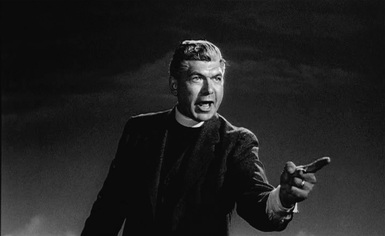
Our current political climate reminds me of the movie Inherit the Wind, the fictional portrayal of the Scopes Monkey Trial. In the movie one of the most stalwart critics of evolution, the former presidential candidate and preacher Matthew Brady played by Frederic March, led the city where the trial is being held into an anti-secular fervor.  At the beginning of the trial he encourages the townspeople to attend a “prayer meeting.” The meeting becomes quite heated as the town’s preacher, Reverend Brown, played by Claude Akins launches into a full assault on all that oppose Brady, and therefore God.

The preacher works himself into a frenzy, condemning the accused and all that would defend him, including his very own daughter:

“Oh, Lord of the tempest and the thunder, strike down this sinner, as thou did thine enemies of old in the days of the Pharaohs! Let him know the terror of thy sword! Let his soul, for all eternity, writhe in anguish and damnation!”

His daughter, who is engaged to the accused cries out: “No! No, Pa! Don’t pray to destroy Bert!”

Then the reverend utters words which remind me so much of what I heard in Iowa this weekend:

“Lord, we call down the same curse on those who ask grace for this sinner—though they be blood of my blood, and flesh of my flesh!”

At this point, Brady, realizing that the situation is getting out of control stops the preacher and says:

“it is possible to be overzealous, to destroy that which you hope to save — so that nothing is left but emptiness.” He then quotes from the book of Proverbs: “Remember the wisdom of Solomon in the book of Proverbs. “He that troubleth his own house shall inherit the wind.”

To me this seems to be analogous to the current dilemma faced by the Republican Party. For decades has helped to create, sustain and institutionalize monster of the Christian Right. Old leaders see the danger but cannot admit their culpability in its rise and takeover of that party. As such they continue to enable it. Goldwater was one of the very few Republicans to see this coming and now, as he feared, the preachers have taken control of the party. Like Reverend Brown they will damn all who do not agree with them, even those of their own party.

The leaders of this political-religious movement have been overzealous, and will continue to be so because like Matthew Brady and Reverend Brown and their supporters, they cannot acknowledge that their zeal may be misdirected and malevolent.

Like Reverend Brown, they are consumed by their hatred for non-believers, that they are even willing to destroy the people closest to them to do so. I know this is true, because when I expressed doubt and did not tow the party line of my former church I was thrown out. Sadly, most of the men that I had previously counted as my closest friends abandoned or even condemned me.

I find the similarities amazing. But even more troubling I find the fear, hatred and paranoia the leaders of the Christian Right display all too reminiscent of church leaders in Germany during the 1920s and early 1930s.  Those leaders, Protestants and Catholics alike supported Hitler, because Hitler promised to fight against the things that they hated; Jews, Socialists, Communists, homosexuals, immigrants, and of course atheists, agnostics and other non-believers.

Martin Niemöller, a man who now is nearly universally lauded for opposition to Hitler initially supported him. Niemöller, later regretted that support and wrote:

“I hated the growing atheistic movement, which was fostered and promoted by the Social Democrats and the Communists. Their hostility toward the Church made me pin my hopes on Hitler for a while. I am paying for that mistake now; and not me alone, but thousands of other persons like me.” 

German Christians, like Niemöller, felt that their values were under attack by Communists, Socialists, and Jews and yes, even homosexuals. In order to maintain their influence and power they willingly allied themselves with the Nazis. After the Nazis took power, the only spoke up against the Nazi abuses it to defend their own ecclesiastical power and place in society, and seldom to speak up for the victims of the Nazis. When the war was over and young people began to question the actions of those that led the Church in Germany it began a process that has led to the de-Christianization of that country.

The current leadership of the Christian Right, especially those with yearnings to be the next President, are doing the same thing as their German brothers did in the 1920s and 1930s. The constant hate filled attacks of Christian leaders on those that are not Christians will come back to bite them. This is not fantasy, it is reality. One only has to look at the history of the Church to see it played out time after time. But then, unless we decide to re-write history like the fraudulent pseudo-historian David Barton does so well, why bother reading it?

The actions of many Christian leaders are dangerous to the faith as a whole, but it seems that they are willing to throw that away in order to gain political power, and as Ron and Rand Paul’s adviser Gary North wrote:

“The long-term goal of Christians in politics should be to gain exclusive control over the franchise. Those who refuse to submit publicly to the eternal sanctions of God by submitting to His Church’s public marks of the covenant–baptism and holy communion–must be denied citizenship, just as they were in ancient Israel.”

The actions of the leaders of the Christian Right are blatantly short sighted and ultimately will hasten the decline and fall of what we know as Christianity in America, but they don’t seem to care. These leaders have subscribed to an Imperial Church model that must take and hold political power in order to maintain their own political, economic and social dominance, even at the expense of the Gospel. Instead of the message of reconciliation they preach pre-packaged, focus group tested selections of “Biblical Values” which they and their political allies know are useful as wedge issues to win political power.

The leaders of the Christian Right rail against things they consider “sinful” such as homosexuality, abortion and birth control. At the same time they willingly turn a blind eye to the treatment of the poor, support efforts to disenfranchise poor and minority voters, even Christians that tend to vote for Democrats. They advocate wars of aggression and bless cultural and economic norms that go entirely against the Christian tradition as they go about with a Bible in one hand and Ayn Rand’s Atlas Shrugged in the other.

The effects of this politicization are more and more apparent and the statistics don’t lie. The United States is not Christian nation and any sense of the definition, and this is not the fault of secularists. It is the fault of Christians especially those political partisan pastors and pundits of the Christian Right that for the past 40 years have sold their souls for political power at the expense of the Gospel.

A recent Barna survey noted that less than one half of one percent of people aged 18-23 hold what would be considered a “Biblical world view.” This is compared to about one of every nine other adults.  Other surveys bear this out.

Think about it: The Barna Group in another survey of people 18-29 years old asked what phrases best described Christians: The top five answers “Anti-homosexual, judgmental, hypocritical and too involved in politics.” This view was held by 91% of non-Christians and a staggering 80% of young churchgoers.

This hypocrisy is demonstrated time and time again. In 2013 these politically corrupted religious leaders turned a blind eye to and even cheered the gutting of the Voting Rights Act of 1964 by the Supreme Court, or cheered that decision despite the fact that many of not most of those adversely affected by that decision are African American Christians. The next day they lambasted the same justices for overturning the Defense of Marriage Act and refusing to hear a challenge to California’s Proposition 8, dealing with the Federal recognition of Gay marriage. Just over a week ago the same leaders were apoplectic when the Supreme Court ruled in favor of Marriage Equality and Gay Marriage, and upheld the Affordable Health Care Law.

The histrionics exhibited by them would be comical if the men and women ranting away were not so vehemently hateful towards their opponents, and some have suggested killing gays and their Christian supporters to root out evil. This isn’t just political theater for them, they really mean it. The real tragedy of their behavior is that even more people will turn away from Jesus. Mahatma Gandhi said it so well “I like your Christ, I do not like your Christians. Your Christians are so unlike your Christ.”

The leaders of the Christian Right continue to wage the culture war, but what cost? Here I am not even dealing with the politics, as one can debate the merits of the Obama administration as well as its decisions and policies, and even Supreme Court decisions. Even many progressives criticize the President and the Supreme Court on a wide number of issues, so that is not the point.

The fact is that young people are leaving the church in unheard of numbers and it is very evident to me why they are doing so. The Church has embraced the culture wars over preaching the Gospel, which if I recall correctly is based on loving people, even ones enemies.  Jesus said it so well: “By this everyone will know that you are my disciples, if you have love for one another.” John 13:35 NRSV.

In 2014 leaders of the Christian Right were able to bring enough culture warriors to the polls hold their majority in the House of Representatives and gain the majority in the Senate. But it was an election where less than 40% of eligible voters voted and most of the contested seats were in areas where they dominate, which magnified their strength. But in the coming 2016 Presidential election the demographics do not favor them and get worse in every year. The leaders of the Christian Right know this and still continue on and wage their culture war with greater zeal further alienating millions of people not just from their political position, but the message of Jesus himself.

Perhaps Christian leaders who have sold their souls for such paltry political gains should be asking these questions: What does it profit a man to gain the whole world but lose his soul and what does it profit the Church to wield political power but lose its soul?

It is a question that Christians need to ask. Dietrich Bonhoeffer once wryly noted “If you board the wrong train, it is no use running along the corridor in the other direction.” Sadly, that train has left the station and the leaders of the Christian Right are not only on it, but they are driving it into oblivion.

Peace

Padre Steve+

2 Comments

Filed under christian life, ethics, faith, film, History, laws and legislation, LGBT issues, News and current events, Political Commentary

The Religious Right Unhinged: The Aftermath of Obergfell v. Hodges

313-1qRzQm.AuSt.55

Friends of Padre Steve’s World

In the past coupled of days since the Supreme Court ruling legalizing Gay marriage and Marriage Equality for all, many conservative Christian leaders, especially those with lofty political aspirations have nearly come unhinged in their responses. Mike Huckabee, the Baptist preacher, seminary dropout and former Governor of Arkansas was perhaps the most ludicrous say that if need be he would call fire down from heaven in his opposition to the ruling. Others like Rick Perry and Rick Santorum have stated that they would work to overturn the decision, Ted Cruz encouraged Texas magistrates, justice of the peace, judges and others who hold government office defy the law if it violates their Christian religion; and Bobby Jindal suggested eliminating the Supreme Court. Funny how that last one works as the Supreme Court is established as one of the three branches of Government in the Constitution and Bobby, Mike, the Ricks and Ted never had a problem with 5-4 decisions that aided conservatives, but I digress…

The sad thing is that none of these men’s arguments come at all from any sense of Christian mission, but rather the raw exercise of hatred directed at a group of people they loath covered in theological gibberish.

Atticus Finch, the hero of the book and film To Kill a Mockingbird said: 

“Sometimes the Bible in the hand of one man is worse than a whisky bottle in the hand of (another)… There are just some kind of men who – who’re so busy worrying about the next world they’ve never learned to live in this one, and you can look down the street and see the results.”

Eric Hoffer wrote, “Hatred is the most accessible and comprehensive of all the unifying agents. Mass movements can rise and spread without belief in a god, but never without a belief in a devil.” We like to believe that religion is a benign or positive influence in the world. As much as I want to believe the positive aspects I have to admit based on the historical and sociological evidence that this is not so, especially during unsettled times of great change. We live in such an era and when it comes to identity and supremacy, God is the ultimate trump card and hatred in the name of God is something that many religious groups and people specialize.

This has been especially true in the lead up to and the aftermath of the Obergfell v. Hodges case that was argued at the Supreme Court regarding Gay marriage. The religious opponents of Gay marriage, in particular conservative Christians have many times resorted to the most unmitigated hatred masked in insipidly shallow theology to condemn the gays and anyone that supports them. Of course the final argument they posit is that God will punish the United States for Gay marriage.

That is fascinating. Ted Cruz called the ruling the “darkest time of American history.” Others proclaimed that God would judge the United States for this and others suggested that Christians flee the country, or that the South should again secede from the United States to form a Christian country.

Really? The darkest time Ted? I guess real oppression committed against American citizens by supposedly Christian citizens doesn’t count.

God will punish the United States for Gay marriage but not for waging unjust, illegal and immoral wars? God will punish the United States for Gay marriage, but not for the way we treat the poor? God will punish the United States for Gay marriage, but not for unabashed materialistic greed that is so condemned throughout the Christian Bible? God will judge the United States for Gay marriage but not the extermination of Native Americans and the enslavement of African Americans? God will punish the United States for Gay marriage, but not the unmitigated quest for material wealth and power that so defines the most popular churches and pastors in the country? God will punish the United States for Gay Marriage but excuse everything else?

I’m sorry these radical supposedly “Christian” politicians, pundits and preachers are the ultimate hypocrites whose hatred is only surpassed by their desire for the temporal power, which if they got it would use against any and all that oppose their theocratic tyranny.

Truthfully I find it stunning that of all the things a supposedly vengeful and just God could punish us for, that Gay marriage is the tipping point. But such is the unhinged message of the preachers, pundits and politicians of the Christian Right who believe in a capricious “God” who coincidently just happens to hate the same people that they hate, which is very convenient. But then as Annie Lamott said: “You can safely assume you’ve created God in your own image when it turns out that God hates all the same people you do.”

Of course they are not alone. In fact the most fanatical individuals and groups on earth are almost all tied to religions, whether it is the Islamic State and Al Qaeda, Boko Haram, Hezbollah, Orthodox Jews, radical Hindus and Buddhists as well as militant Christians. Of course all of these groups have different goals, but their thought and philosophy are quite similar. The fact is that for all of the, God is their trump card, end of argument as one commenter on this blog wrote yesterday “It is finished” a true heretical and blasphemous bastardization of the words of Jesus on the Cross to end his argument that God was against Gay marriage.

Robert Heinlein wrote: “Almost any sect, cult, or religion will legislate its creed into law if it acquires the political power to do so.” Heinlein, the author of the classic Starship Troopers was absolutely correct. Just look at any place in any time where any religion, sect or cult has gained control of a government. They are not loving, they are not forgiving and they use the police power of the state to persecute any individual or group that is judged to be in error, or even worse has the gall to question their authority.

Since the Christian groups tend to thrive in the West, they only speak in terms of violence, most, with the exception of Russian Orthodox Christians in Putin’s Russia do not have a government to translate those words into action. Many, especially conservative Catholics and some Evangelical and Charismatic Protestants seem for a long for the day when they can assume control of a theocratic government.

Samuel Huntington wrote in his book The Clash of Civilizations:

“People do not live by reason alone. They cannot calculate and act rationally in pursuit of their self-interest until they define their self. Interest politics presupposes identity. In times of rapid social change established identities dissolve, the self must be redefined, and new identities created. For people facing the need to determine Who am I? Where do I belong? Religion provides compelling answers….In this process people rediscover or create new historical identities. Whatever universalist goals they may have, religions give people identity by positing a basic distinction between believers and non-believers, between a superior in-group and a different and inferior out-group.”

Huntington was right, you see the true believers, those who follow their religion without question and believe that it is superior to all others also believe that their religion entitles them to be atop the food chain, others who don’t believe like them be damned, if not in this life, the next. That is the certitude of the true believer, especially the religious one. Secular or atheistic fanatics could care less about the next life, for this life is all that they have. But the religious “true believers” are not only interested in destroying someone in this life, but ensuring that in the next that they suffer for eternity, unless they believe in the annihilation of the soul after death, which really spoils the whole Dante’s Inferno perspective of the damned in the afterlife.

Eric Hoffer wrote:

“The impression somehow prevails that the true believer, particularly the religious individual, is a humble person. The truth is the surrendering and humbling of the self breed pride and arrogance. The true believer is apt to see himself as one of the chosen, the salt of the earth, the light of the world, a prince disguised in meekness, who is destined to inherit the earth and the kingdom of heaven too. He who is not of his faith is evil; he who will not listen will perish.”

That is why they, the religious true believers of any faith are capable of such great evil, and why such people can murder innocents in the most brutal manner simply because they do not believe correctly.

Please do not get me wrong. I am a Christian, a priest, a historian and a theologian, but I also know just how insidious those who hold their religion over those of others can be. While I hold faith dear, I know that it can be abused for the claim of some to have God as their final authority is a sort of trump card with which they are able to justify the most obscene and evil acts against others.

One of my heroes of religious liberty is John Leland, a Baptist whose passionate defense of religious freedom prevented Virginia from re-establishing a state church after the American Revolution and whose influence was key in the decision of Madison and Jefferson to amend the Constitution with the Bill of Rights, particularly the First Amendment. In fact, late in life, well after his success in working with Madison and Jefferson Leland wrote:

“The liberty I contend for is more than toleration. The very idea of toleration is despicable; it supposes that some have a pre-eminence above the rest to grant indulgence; whereas all should be equally free, Jews, Turks [Muslims], Pagans and Christians. Test oaths and established creeds should be avoided as the worst of evils.”

Like Leland, I contend for more than tolerance and I contend for acceptance. But that acceptance ends when any person or group is willing to use their religion to enslave, murder, or otherwise dominate other people in the name of their God, not just in this life, but in the next. This is especially true of those who use the police power of the state to enforce their beliefs and hatred on others.  I will do whatever I can to expose them for what they are, regardless of the “faith” they supposedly represent.

I guess that is why I am even more frightened of religious true believers than non-religious true believers. While the non-religious true believer may sacrifice everything for the sake of power and control in this life, and may in fact commit the most heinous crimes against humanity, their hatred is bounded in space and time to this earth. The religious true believer is not content with that; their enemies must be damned and punished in this life, but for eternity, without hope of salvation.

That is why men like Huckabee, Santorum, Jindal, Cruz, Perry and so many others like them are so dangerous for their hatred is unbounded by time, or space, it lasts for eternity, and eternity my friends is a very long time.

With that I wish you a good day, a thoughtful day and try to love someone.

Peace

Padre Steve+

6 Comments

Filed under christian life, civil rights, ethics, faith, History, laws and legislation, leadership, News and current events, Political Commentary, Religion

The Bible on Our Side: Southern Religious Support of Slavery

Friends of Padre Steve’s World,

This week I have been relating religion to civil rights through the lens of the slavery, abolition, and the ante-bellum United States and today I will continue that with another section of my Civil War and Gettysburg Staff Ride text. It comes from the same chapter as my past few posts dealing with the role of religion and ideology in the period and its effect on the antagonists before, during and after the war. 

It is a lens through which we can view other topics that divide us today including the continuing battle against racism, Women’s rights and Gay rights. The fact is that we cannot isolate these issues from the understanding that the defense of liberty for all safeguards liberty for all. Sadly, there are a substantial number of Christians in the United States who do not believe that and through the legislative process seek to limit, role back, or completely deny rights to groups that they despise, especially Gays, but also women, and racial and religious minorities. We cannot get around that fact. It is happening with new instances occurring almost every week, and much of these laws are being passed due to the “sincerely held religious beliefs” of Christians to deny other people’s rights based on their interpretation of Biblical texts.

The words of the current politicians, preachers and pundits who fight to limit the rights of others is strikingly similar to those who defended slavery and attacked those who fought against it.   

This is not new, it has happened many times in our history, but the most notorious and injurious to American society was the defense of the institution of Slavery by American Christians, particularly those in the South. This article discusses that defense of slavery which arose in response to the tiny, but vocal number of Christians who helped lead the abolition movement.

Have a great day,

Peace

Padre Steve+

OTCauction

Southern Religious Support of Slavery

“we must go before the nation with the Bible as the text and ‘Thus saith the Lord’ as the answer….we know that on the Bible argument the abolition party will be driven to reveal their true infidel tendencies. The Bible being bound to stand on our side…” Reverend Robert Lewis Dabney on defending slavery and condemning its critics

In light of the threat posed to slavery by the emerging abolitionist movement, slaveholders were forced to shift their defense of slavery away from it being simply a necessary evil to a positive good. The institution of slavery became “in both secular and religious discourse, the central component of the mission God had designed for the South.” [1] Like in the North where theology was at the heart of many abolitionist arguments, in the South theology was used to enshrine and defend the institution of slavery. British Evangelical-Anglican theologian Alister McGrath notes how “the arguments used by the pro-slavery lobby represent a fascinating illustration and condemnation of how the Bible may be used to support a notion by reading the text within a rigid interpretive framework that forces predetermined conclusions to the text.” [2]

Southern religion was a key component of something bigger than itself and played a role in the development of an ideology much more entrenched in the Southern culture than the abolitionist cause did in the North. This was in large part due to the same Second Great Awakening that brought abolitionism to the fore in the North. “Between 1801 when he Great Revival swept the region and 1831 when the slavery debate began, southern evangelicals achieved cultural dominance in the region. Looking back over the first thirty years of the century, they concluded that God had converted and blessed their region.” [3] The Southern ideology which enshrined slavery as a key component of all areas of life was a complete worldview, a system of values, culture, religion and economics, or to use the more modern German term “Weltanschauung.” The Confederate worldview was the Cause. As Emory Thomas wrote in his book The Confederate Nation:

“it was the result of the secular transubstantiation in which the common elements of Southern life became sanctified in the Southern mind. The South’s ideological cause was more than the sum of its parts, more than the material circumstances and conditions from which it sprang. In the Confederate South the cause was ultimately an affair of the viscera….Questions about the Southern way of life became moral questions, and compromises of Southern life style would become concession of virtue and righteousness.” [4]

Despite the dissent of some, the “dominant position in the South was strongly pro-slavery, and the Bible was used to defend this entrenched position.” [5] This was tied to a strongly Calvinistic theology which saw slavery in context with the spread of the evangelical Protestant faith that had swept through the South as slavery spread. For many, if not most Southern ministers “the very spread of evangelical religion and slave labor in the South was a sign of God’s divine favor. Ministers did not focus on defending slavery in the abstract but rather championed Christian slaveholding as it was practiced in the American South. Though conceding that some forms of slavery might be evil, Southern slavery was not.” [6]

The former Governor of South Carolina, John Henry Hammond, led the religiously based counter argument to the abolitionists. Hammond’s arguments included biblical justification of blacks being biologically inferior to whites and slavery being supported in the Old Testament where the “Hebrews often practiced slavery” and in the New testament where “Christ never denounced servitude.” [7] Hammond warned:

“Without white masters’ paternalistic protection, biologically inferior blacks, loving sleep above all and “sensual excitements of all kinds when awake” would first snooze, then wander, then plunder, then murder, then be exterminated and reenslaved.” [8]

Others in the South, including politicians, pundits and preachers were preaching “that slavery was an institution sanction by God, and that even blacks profited from it, for they had been snatched out of pagan and uncivilized Africa and been given the advantages of the gospel.” [9] The basic understanding was that slavery existed because “God had providential purposes for slavery.” [10]

At the heart of the pro-slavery theological arguments was in the conviction of most Southern preachers of human sinfulness. “Many Southern clergymen found divine sanction for racial subordination in the “truth” that blacks were cursed as “Sons of Ham” and justified bondage by citing Biblical examples.” [11] But simply citing scripture to justify the reality of a system of which they reaped the benefit, is just part of the story. The real issue was far greater than that. The theology that justified slavery also, in the minds of many Christians in the north justified what they considered “the hedonistic aspects of the Southern life style.” [12] This was something that abolitionist preachers continually emphasized, criticizing the greed, sloth and lust inherent in the culture of slavery and plantation life, and was an accusation of which Southern slaveholders, especially evangelicals took umbrage, for in their understanding good men could own slaves. Their defense was rooted in their theology. The hyper-individualistic language of Southern evangelicalism gave “new life to the claim that good men could hold slaves. Slaveholding was a traditional mark of success, and a moral defense of slavery was implicit wherever Americans who considered themselves good Christians held slaves.” [13] The hedonism and fundamentalism that existed in the Southern soul, was the “same conservative faith which inspired John Brown to violence in an attempt to abolish slavery…” [14]

Slave owners frequently expressed hostility to independent black churches and conducted violence against them, and “attacks on clandestine prayer meetings were not arbitrary. They reflected the assumption (as one Mississippi slave put it) “that when colored people were praying [by themselves] it was against them.” [15] But some Southern blacks accepted the basic tenets of slave owner-planter sponsored Christianity. Frederick Douglass later wrote “many good, religious colored people who were under the delusion that God required them to submit to slavery and wear their chains with weakness and humility.” [16]

The political and cultural rift began to affect entire church denominations. The heart of the matter went directly to theology, in this case the interpretation of the Bible in American churches. The American Protestant and Evangelical understanding was rooted in the key theological principle of the Protestant Reformation, that of Sola Scripura, which became an intellectual trap for northerners and southerners of various theological stripes. Southerners believed that they held a “special fidelity to the Bible and relations with God. Southerners thought abolitionists either did not understand the Bible or did not know God’s will, and suspected them of perverting both.” [17]The problem was then, as it is now that:

“Americans favored a commonsense understanding of the Bible that ripped passages out of context and applied them to all people at all times. Sola scriptura both set and limited terms for discussing slavery and gave apologists for the institution great advantages. The patriarchs of the Old Testament had owned slaves, Mosaic Law upheld slavery, Jesus had not condemned slavery, and the apostles had advised slaves to obey their masters – these points summed up and closed the case for many southerners and no small number of northerners.” [18]

In the early decades of the nineteenth century there existed a certain confusion and ambivalence to slavery in most denominations. The Presbyterians exemplified this when in 1818 the “General Assembly of the Presbyterian Church, while opposing slavery against the law of God, also went on record as opposing abolition, and deposed a minister for advocating abolition.” [19] There were arguments by some American Christians including some Catholics, Lutherans, Episcopalians and others to offer alternative ways to “interpreting and applying scripture to the slavery question, but none were convincing or influential enough to force debate” [20] out of the hands of literalists.

However the real schisms between the Northern and Southern branches of the major denominations which began to emerge in the mid to late 1830s continued to grow with the actual breakups of the major denominations coming in the 1840s. The first denomination to split were the Methodists. This occurred in 1844 when “the Methodist General Conference condemned the bishop of Georgia for holding slaves, the church split and the following year saw the birth of the Methodist Episcopal Church.” [21] Not all Methodists in the South agreed with this split and a few Methodist abolitionists in the South “broke away from mainline Methodism to form the Free Methodist Church.” [22]

The Baptists were next, when the Foreign Mission Board “refused to commission a candidate who had been recommended by the Georgia Baptist Convention, on the ground that he owned slaves” [23] resulting in the formation of the Southern Baptist Convention. The Baptist split is interesting because until the early 1800s there existed a fairly strong anti-slavery movement in states such as Kentucky, while in 1790 the General Committee of Virginia “adopted a statement calling slavery “a violent deprivation of the rights of nature, and inconsistent with a republican government; and therefore [we] recommend it to our brethren to make use of every legal measure, to extirpate the horrid evil from the land.” [24]

However, in many parts of the Deep South there existed no such sentiment and in South Carolina, noted Baptist preachers including “Richard Furman, Peter Bainbridge, and Edmund Botsford were among the larger slaveholders.” [25] Furman wrote a defense of slavery in 1822 where he made the argument that “the right of holding slaves is clearly established in the Holy Scriptures by precept and example.” [26] After a number of slave uprisings, including the Nat Turner Revolt in Virginia, pro-slavery voices “tended to silence any remaining antislavery voices in the South.” [27]

These voices grew more ever more strident and in 1835 the Charleston Association “adopted a militant defense of slavery, sternly chastising abolitionists as “mistaken philanthropists, and denuded and mischievous fanatics.” [28] Those who met in Augusta Georgia to found the new Southern Baptist Convention indicated that “the division was “painful” but necessary because” our brethren have pressed upon every inch of our privileges and our sacred rights.” [29] Since the Baptist split was brought about by the refusal of the Triennial Convention to appoint slaveholders as foreign missionaries the new convention emphasized the theological nature of their decision:

“Our objects, then, are the extension of the Messiah’s kingdom, and the glory of God. Not disunion with any of his people; not the upholding of any form of civil rights; but God’s glory, and Messiah’s increasing reign; in the promotion of which, we find no necessity for relinquishing any of our civil rights. We will never interfere with what is Caesar’s. We will not compromit what is God’s.” [30]

Of course, to the Baptists who met at Augusta, “what was Caesar’s” was obviously the institution of slavery.

The last denomination to officially split was the Presbyterians in 1861 who, “reflecting the division of the nation, the Southern presbyteries withdrew from the Presbyterian Church and founded their own denomination.” [31] The split in the Presbyterian Church had been obvious for years despite their outward unity. Some Southern pastors and theologians were at the forefront of battling their northern counterparts for the theological high ground that defined just whose side God was on. James Henley Thornwell presented the conflict between northern evangelical abolitionists and southern evangelical defenders of slavery in Manichean terms. He believed that abolitionists attacked religion itself.

“The “parties in the conflict are not merely abolitionists and slaveholders,…They are atheists, socialists, communists, red republicans, Jacobins, on one side, and friends of order and regulated freedom on the other. In one word, the world is the battle ground – Christianity and Atheism as the combatants; and the progress of humanity at stake.” [32]

Robert Lewis Dabney, a southern Presbyterian pastor who later served as Chief of Staff to Stonewall Jackson in the Valley Campaign and at Seven Pines and who remained a defender of slavery long after the war was over wrote that:

“we must go before the nation with the Bible as the text and ‘Thus saith the Lord’ as the answer….we know that on the Bible argument the abolition party will be driven to reveal their true infidel tendencies. The Bible being bound to stand on our side, they have to come out and array themselves against the Bible. And then the whole body of sincere believers at the North will have to array themselves, though unwillingly, on our side. They will prefer the Bible to abolitionism.” [33]

Southern churches and church leaders were among the most enthusiastic voices for disunion and secession. They labeled their Northern critics, even fellow evangelicals in the abolition movement as “atheists, infidels, communists, free-lovers, Bible-haters, and anti-Christian levelers.” [34] The preachers who had called for separation from their own national denominations years before the war now “summoned their congregations to leave the foul Union and then to cleanse their world.” [35] Thomas R.R. Cobb, a Georgia lawyer, an outspoken advocate of slavery and secession who was killed at the Battle of Fredericksburg, wrote proudly that Secession “has been accomplished mainly by the churches.” [36]

The Reverend William Leacock of Christ Church, New Orleans declared in his Thanksgiving sermon:

“Our enemies…have “defamed” our characters, “lacerated” our feelings, “invaded “our rights, “stolen” our property, and let “murderers…loose upon us, stimulated by weak or designing or infidel preachers. With “the deepest and blackest malice,” they have “proscribed” us “as unworthy members… of the society of men and accursed before God.” Unless we sink to “craven” beginning that they “not disturb us,…nothing is now left us but secession.” [37]

The fact that so many Protestant ministers, intellectuals, and theologians, not only Southerners, but men like “Princeton’s venerable theologian Charles B. Hodge – supported the institution of slavery on biblical grounds, often dismissing abolitionists as liberal progressives who did not take the Bible seriously” leaves a troubling question over those who claim to oppose issues on supposedly Biblical grounds. Such men in the North spoke out for it “in order to protect and promote interests concomitant to slavery, namely biblical traditionalism, and social and theological authority.” [38] The Northern clerical defenders of slavery perceived the spread of abolitionist preaching as a threat, not just to slavery “but also to the very principle of social and ecclesiastical hierarchy.” [39] Alistair McGrath asks a very important question for modern Christians who might be tempted to support a position for the same reasons today, “Might not the same mistakes be made all over again, this time over another issue?” [40]

Notes

[1] Gallagher, Gary W. The Confederate War: How Popular Will, Nationalism and Military Strategy Could not Stave Off Defeat Harvard University Press, Cambridge MA and London 1999 p.67

[2] Ibid. McGrath Christianity’s Dangerous Idea p.324

[3] Ibid. Daly When Slavery Was Called Freedom p.69

[4] Thomas, Emory The Confederate Nation 1861-1865 Harper Perennial, New York and London 1979 p.4

[5] Ibid. McGrath Christianity’s Dangerous Idea p.324

[6] Ibid. Varon Disunion! p.109

[7] Ibid. Freehling The Road to Disunion Volume One p.29

[8] Ibid. Freehling The Road to Disunion Volume One p.29

[9] Gonzalez, Justo L. The History of Christianity Volume 2: The Reformation to the Present Day Harper and Row Publishers San Francisco 1985 p.251

[10] Ibid. Daly When Slavery Was Called Freedom p.54

[11] Ibid. Thomas The Confederate Nation p.22

[12] Ibid. Thomas The Confederate Nation p.22

[13] Ibid. Daly When Slavery Was Called Freedom p.30

[14] Ibid. Thomas The Confederate Nation p.22

[15] Ibid. Levine Half Slave and Half Free p.116

[16] Ibid. Levine Half Slave and Half Free p.116

[17] Ibid. Daly When Slavery Was Called Freedom p.60

[18] Ibid. Rable God’s Almost Chosen Peoples p.14

[19] Ibid. Gonzalez The History of Christianity Volume 2 p.251

[20] Ibid. Rable God’s Almost Chosen Peoples p.14

[21] Ibid. Gonzalez The History of Christianity Volume 2 p.251

[22] Ibid. McGrath Christianity’s Dangerous Idea p.324

[23] Ibid. Gonzalez The History of Christianity Volume 2 p.251

[24] Ibid. McBeth The Baptist Heritage p.383

[25] Ibid. McBeth The Baptist Heritage p.384

[26] Ibid. McBeth The Baptist Heritage p.384

[27] Ibid. McBeth The Baptist Heritage p.384

[28] Ibid. McBeth The Baptist Heritage p.384

[29] Shurden, Walter B Not a Silent People: The Controversies that Have Shaped Southern Baptists Broadman Press, Nashville TN 1972 p.58

[30] Ibid. Shurden Not a Silent People p.58

[31] Ibid. Gonzalez The History of Christianity Volume 2 p.251

[32] Ibid. Rable God’s Almost Chosen Peoples p.13

[33] Ibid. Rable God’s Almost Chosen Peoples p.14

[34] Ibid. Daly When Slavery Was Called Freedom p.97

[35] Freehling, William. The Road to Disunion Volume II: Secessionists Triumphant 1854-1861 Oxford University Press, Oxford and New York 2007 p.460

[36] Ibid. Rable God’s Almost Chosen Peoples p.39

[37] Ibid. Freehling The Road to Disunion Volume II p.462

[38] Ibid. Daly When Slavery Was Called Freedom p.38

[39] Ibid. Varon Disunion! P.108

[40] Ibid. McGrath Christianity’s Dangerous Idea p.324

2 Comments

Filed under christian life, civil rights, civil war, faith, History, LGBT issues, News and current events, Political Commentary

Christian Abolitionists: The Spirit of the Gospel

Friends of Padre Steve’s World

The past few days I have written a number of articles dealing with how Southern Christians used faith to justify slavery. I have also written about how many American Christians since the 1840s have used the concept of Manifest Destiny to justify many actions that have no support in the teachings of Jesus or the early church and to promote the concept of American exceptionalism which basically asserts that the United States occupies a place in history like that of Israel in the Old Testament. Much of this has come out of my Civil War and Gettysburg Staff Ride text. 

AS such I have been critical of Christians. However, today I am posting another section of the same chapter dealing with religion, ideology and the Civil War, this time one that is more positive on the Christian influence and participation in the abolitionist movement. The Christian abolitionists were condemned throughout Southern churches and liberals, communists, jacobins and heretics. They were also condemned by many Northern churchmen who saw them as upsetting the divine order. For decades they fought an uphill battle until Abraham Lincoln was able to pull together the disparate parts of the Republican party, including the abolitionists to give them a voice that eventually would help bring Lincoln to issue the Emancipation Proclamation and push through the 13th Amendment which banned slavery in the United States. 

It is important to remember that such men and women gave voice to those who many of the “Christian” brothers enslaved and exploited. Likewise, it is important to remember Christians and other people of faith who labor for justice, peace and care for the least, the lost and the lonely in our world. 

Peace

Padre Steve+

70787-004-784C0452

Christians and Abolitionism in the North

In the North a strident abolitionist movement took root and with each failed compromise, with each new infringement on the rights of northern free-states by the Congress, Courts and the Executive branch to appease southern slaveholders the movement gained added support. The movement developed during the 1830s in New England as a fringe movement among the more liberal elites. One wing of the movement “arose from evangelical ranks and framed its critique of bound labor in religious terms.” [1] The polarization emerged as Northern states abolished slavery as increasing numbers of influential “former slave owners such as Benjamin Franklin changed their views on the matter.” [2]

Many in the movement were inspired by the preaching of revivalist preacher Charles Finney who “demanded a religious conversion with a political potential more radical than the preacher first intended.” [3] Finney and other preachers were instrumental in the Second Great Awakening “which rekindled religious fervor in much of the nation, saw new pressure for abolition.” [4] In fact the “most important child of the Awakening, however, was the abolitionist movement, which in the 1830s took on new life, placed the slavery issue squarely on the national agenda, and for the next quarter century aroused and mobilized people in the cause of emancipation.” [5]

The evangelical proponents of abolition understood this in the concept of “free will.” They believed and pointed out repeatedly that slavery “denied one group of human beings the freedom of action necessary to free will – and therefore moral responsibility for their behavior. Meanwhile, it assigned to other human beings a degree of temporal power that virtually guaranteed their moral corruption. Both master and slave were thus trapped in a relationship that inevitably led both down the path of sin and depravity” [6]
4.0.4

Finney’s preaching was emboldened and expanded by the American Anti-Slavery Society founded by William Lloyd Garrison “which launched a campaign to change minds, North and South, with three initiatives, public speeches, mass mailings and petitions.” [7] Many of the speakers were seminary students and graduates of Lane Seminary in Cincinnati, who became known as “the Seventy” who received training and then “fanned out across the North campaigning in New England, Pennsylvania, New York, Ohio, Indiana and Michigan[8] where many received hostile receptions, and encountered violence. Garrison used his newspaper, The Liberator to “pledge an all-out attack on U.S. slavery.” [9] Many of the articles in the Liberator, as in many other religiously based abolitionist publications “based their call for the immediate abolition of slavery on their belief that it was a sin.” [10] Likewise other churches such as the Presbyterians founded new educational institutions such as “Oberlin College in Ohio” which “was founded as an abolitionist institution” [11]

Theodore Parker, a Unitarian pastor and leading Transcendentalist thinker enunciated a very important theological-political analogy for many in the religious wing of the abolitionist movement which concentrated less on using chapter and verse but appealing to “the spirit of the Gospel,” [12] in as Parker’s analogy: as Jesus is to the Bible, so is the Declaration to the Constitution:

“By Christianity, I mean that form of religion which consists of piety – the love of God, and morality – the keeping of His laws. That Christianity is not the Christianity of the Christian church, nor of any sect. It is the ideal religion which the human race has been groping for….By Democracy, I mean government over all the people, by all the people and for the sake of all….This is not a democracy of the parties, but it is an ideal government, the reign of righteousness, the kingdom of justice, which all noble hearts long for, and labor to produce, the ideal whereunto mankind slowly draws near.” [13]

The early abolitionists who saw the issue framed in terms of their religious faith declared slavery a sin against God and man that demanded immediate action.” [14] For them the issue was a matter of faith and belief in which compromise of any kind, including the gradual elimination of slavery or any other halfway measures were unacceptable. “William Lloyd Garrison and his fellow abolitionists believed the nation faced a clear choice between damnation and salvation,” [15] a cry that can be heard in much of today’s political debate regarding a number of social issues with religious components including abortion, gay rights and immigration. Harrison wrote that “Our program of immediate emancipation and assimilation, I maintained, was the only panacea, the only Christian solution, to an unbearable program.” [16] The abolitionists identified:

“their cause with the cause of freedom, and with the interests of large and relatively unorganized special groups such as laborers and immigrants, the abolitionists considered themselves to be, and convinced many others that they were, the sole remaining protectors of civil rights.” [17]

The arguments were frequently and eloquently rooted in profoundly religious terms common to evangelical Christianity and the Second Great Awakening. One of the leading historians of the era, Henry Wilson of Massachusetts, a Radical Republican and Abolitionist who served as a United States Senator and Vice President in Ulysses Grant’s second administration provides a good example of this. He wrote in his post war history of the events leading to the war explaining basic understanding of the religiously minded abolitionists during the period:

“God’s Holy Word declares that man was doomed to eat his bread in the sweat of his face. History and tradition teach that the indolent, the crafty, and the strong, unmindful of human rights, have ever sought to evade this Divine decree by filching their bread from the constrained and unpaid toil of others…

American slavery reduced man, created in the Divine image, to property….It made him a beast of burden in the field of toil, an outcast in social life, a cipher in courts of law, and a pariah in the house of God. To claim for himself, or to use himself for his own benefit or benefit of wife and child, was deemed a crime. His master could dispose of his person at will, and of everything acquired by his enforced and unrequited toil.

This complete subversion of the natural rights of millions…constituted a system antagonistic to the doctrines of reason and the monitions of conscience, and developed and gratified the most intense spirit of personal pride, a love of class distinctions, and the lust of dominion. Hence a commanding power, ever sensitive, jealous, proscriptive, dominating, and aggressive, which was recognized and fitly characterized as the Slave Power…” [18]

The religious abolitionists took aim at the Southern churches and church leaders who they believed only buttressed slavery but “had become pawns of wealthy slaveholders and southern theologians apologists for oppression.” [19] As the abolitionist movement spread through Northern churches, especially those with ties to the evangelicalism of the Great Awakenings, and for “Evangelical northerners, the belief in individual spiritual and personal rights and personal religious activism made such involvement necessary.” [20]

For Baptists the issue created a deep polarization with northern Baptists mobilizing around abolitionist principles which came out of their association with English Baptists who had been at the forefront of the abolitionist movement in England where the Reverend William Knibb, who also led the fight to end slavery in Jamaica “became an impassioned defender of the human rights of blacks….his flamboyant speeches aroused the people against slavery.” [21] The Baptist Union in England sent a lengthy letter to the Baptist Triennial Convention in the United States on December 31st 1833 in which they condemned “the slave system…as a sin to be abandoned, and not an evil to be mitigated,” and in which they urged all American Baptists to do all in their power to “effect its speedy overthrow.” [22]

In 1835 two English Baptists, Francis Cox and James Hoby, who were active in that nation’s abolitionist movement with William Wilberforce came to the United States “to urge Baptists to abandon slavery. This visit and subsequent correspondence tended to polarize Baptists.” [23] In the north their visit encouraged faith based activism in abolitionist groups. In 1849 the American Baptist Anti-Slavery Convention was formed in New York and launched a polemic attack on the institution of slavery and called southern Baptists to repent in the strongest terms. They urged that the mission agencies be cleansed from “any taint of slavery…and condemned slavery in militant terms.” They called on Southern Baptists to “confess before heaven and earth the sinfulness of holding slaves; admit it to be not only a misfortune, but a crime…” and it warned that “if Baptists in the South ignored such warnings and persisted in the practice of slavery, “we cannot and dare not recognize you as consistent brethren in Christ.” [24] Such divisions we not limited to Baptists and as the decade moved on rose to crisis proportions in every evangelical denomination, provoking Kentucky Senator Henry Clay to wonder: “If our religious men cannot live together in peace, what can be expected of us politicians, very few of whom profess to be governed by the great principles of love?” [25]

The abolition movement aimed to not only stop the spread of slavery but to abolish it. The concept of totally abolishing slavery was something that even many northerners who exposed its expansion were either indifferent or opposed to. For such people the abolitions of slavery only became an issue for many after the passage of the Fugitive Slave Act of 1850. So long as slavery was regulated to the South, most northerners showed little concern. In fact many northerners profited by slavery, or otherwise reaped its benefits. However, their involvement with slavery was indirect. While they may have worn clothes made of cotton harvested by slaves, while the profits of corporations that benefited from all aspects of the Southern slave economy paid the wages of northern workers and shareholders, few thought of the moral issues until they were forced to participate or saw the laws of their states overthrown by Congress.

Uncle Tom’s Cabin and the Popularization of Abolitionism in the North
cover22

It was only after this act that the abolitionist movement began to gain traction among people in the North. Angelina Grimke Weld confronted the indifference of people in the North in regard to slavery in her book American Slavery as it Is in 1838. The book was a harsh criticism of Northern hypocrisy and indifference and sought to confront its readers that to “deny man’s capacity to for cruelty is to betray a shameful ignorance of human history and, in particular, of America’s past.” [26] Noting the Salem Witch Trials, the persecution of Quakers and Baptists, the transatlantic salve trade and even violent attacks on Northern abolitionists in northern cities the book sold over 100,000 copies.

The abolitionist movement was given a large boost by the huge popularity of Harriet Beecher Stowe’s 1852 novel Uncle Tom’s Cabin, “a vivid, highly imaginative, best-selling, and altogether damning indictment of slavery” [27]

Stowe was a well-educated writer, the daughter of the President of Lane Seminary, Lyman Beecher and wife of Calvin Ellis Stowe, a professor at the seminary. She and her family were deeply involved in the abolitionist movement and supported the Underground Railroad, even taking fugitive slaves into her home. These activities and her association with escaped slaves made a profound impact on her. She received a letter from her sister who was distraught over the passage of the Fugitive Slave Law. He sister challenged Stowe to write: “How, Hattie, if I could use a pen as you can, I would write something that would make this whole nation feel what an accursed thing slavery is.” [28]

One communion Sunday she:

“sat at the communion table of Brunswick’s First Parish Church, a vision began playing before my eyes that left me in tears. I saw an old slave clad in rags, a gentle, Christian man like the slave I had read about in American Slavery as It Is. A cruel white man, a man with a hardened fist, was flogging the old slave. Now a cruel master ordered two other slaves two other slaves to finish the task. As they laid on the whips, the old black man prayed for God to forgive them.

After church I rushed home in a trance and wrote down what I had seen. Since Calvin was away, I read the sketch to my ten- and twelve-year-old sons. They wept too, and one cried, “Oh! Mamma, slavery is the most cursed thing in the world!” I named the old slave Uncle Tom and his evil tormenter Simon Legree. Having recorded the climax of my story, I then commenced at the beginning….” [29]

Many of Stowe’s characters were fiction versions of people that she actually knew or had heard about and the power of her writing made the work a major success in the United States and in Britain. The abolitionist movement gained steam and power through it and the play that issued from it. The publication of the book and its success “raised a counter indignation among Southerners because they thought Mrs. Stowe’s portrait untrue and because the North was so willing to believe it.” [30]

But despite the furor of many southerners, the book gained in popularity and influenced a generation of northerners, creating a stereotype of Southern slaveholders, causing people “to think more deeply and more personally about the implications of slavery for family, society and Christianity.” [31] The book drew many people previously ambivalent to the writings of the abolitionists and who did not normally read the accounts of escaped slaves. The vivid images in Stowe’s book “were irredeemably hostile: from now on the Southern stereotype was something akin to Simon Legree.” [32] But those images transformed the issue in the minds of many in the north as they “touched on all these chords of feeling, faith, and experience….The genius of Uncle Tom’s Cabin was that it made the personal universal, and it made the personal political as well. For millions of readers, blacks became people.” [33] One northern reader said, “what truth could not accomplish, fiction did” [34] as it “put a face on slavery, and a soul on black people.” [35]

The book had a transatlantic impact, over a half million women in Great Britain “signed a massive petition advocating emancipation in the United States; this, in turn, encouraged American women to step up their petitioning.” [36] The book ended up touching the conscience of many Americans and it caused many to “think more deeply and more personally about implications of slavery for family, society, and Christianity.” [37]

George Fitzhugh, a defender of benevolent paternalistic slavery noted Stowe’s book “was “right” concerning the “bitter treatment of slaves….Law, Religion, and Public Opinion should be invoked to punish and correct those abuses….” [38] However, such thoughts could not be spoken too openly for fear of other slaveholders who “could not calmly debate internal correction…while outside agitators advertised their supposed monstrosities.” [39] The inability to debate the issue internally made the visceral response in the South to Uncle Tom’s Cabin look petty and impotent. Despite the fact that Stowe steered clear of the more radical abolitionist groups and shied away from the nascent women’s rights movement Stowe was denounced by Southerners as a threat to the established order, they saw “her as the embodiment of radicalism, as an emissary of both abolitionism and women’s rights.” [40]

Notes 

[1] Ibid. Levine Half Slave and Half Free p.93

[2] McGrath, Alister Christianity’s Dangerous Idea: The Protestant Revolution A History from the Sixteenth Century to the Twenty-First Harper Collins Publishers, New York 2007 p.324

[3] Ibid. Freehling The Road to Disunion Volume One p.289

[4] Ibid. McGrath Christianity’s Dangerous Idea p.324

[5] Huntington, Samuel P. Who Are We? America’s Great Debate The Free Press, Simon and Schuster Europe, London 2004 p.77

[6] Ibid. Levine Half Slave and Half Free p.93

[7] Ibid. Egnal Clash of Extremes:pp.125-126

[8] Ibid. Egnal Clash of Extremes p.125

[9] Ibid. Freehling The Road to Disunion Volume One p.12

[10] Ibid. Deyle The Domestic Slave Trade p.57

[11] Ibid. McGrath Christianity’s Dangerous Idea p.324

[12] Ibid. Rable God’s Almost Chosen Peoples p.14

[13] Wills, Garry Lincoln at Gettysburg: The Words that Remade America Simon and Schuster Paperbacks, New York 1992

[14] Ibid. Rable God’s Almost Chosen Peoples p.13

[15] Ibid. Rable God’s Almost Chosen Peoples p.13

[16] Oates, Stephen B. Editor The Approaching Fury: Voices of the Storm, 1820-1861 University of Nebraska Press, Lincoln and London 1997 p.36

[17] Stampp, Kenneth M. editor The Causes of the Civil War 3rd Revised Edition A Touchstone Book published by Simon and Schuster, New York and London 1991 p.23

[18] Ibid. Stampp The Causes of the Civil War p.29

[19] Ibid. Rable God’s Almost Chosen Peoples p.13

[20] Ibid. Goldfield America Aflame p.35

[21] McBeth, H. Leon The Baptist Heritage Broadman Press, Nashville TN 1987 p.301

[22] Ibid. McBeth The Baptist Heritage p.301

[23] Ibid. McBeth The Baptist Heritage p.384

[24] Ibid. McBeth The Baptist Heritage pp.384-385

[25] Ibid. Goldfield America Aflame p.35

[26] Varon, Elizabeth R. Disunion! The Coming of the American Civil War 1789-1858 University of North Carolina Press, Chapel Hill NC 2008 p.140

[27] Ibid. Catton Two Roads to Sumter p.94

[28] Ibid. Goldfield America Aflame p.75

[29] Ibid. Oates The Approaching Fury p.120

[30] Ibid. Catton Two Roads to Sumter p.94

[31] Ibid. Goldfield America Aflame p.83

[32] Ibid. Catton Two Roads to Sumter p.94

[33] Ibid. Goldfield America Aflame p.79

[34] Ibid. Goldfield America Aflame p.79

[35] Ibid. Goldfield America Aflame p.83

[36] Ibid. Varon Disunion! p.245

[37] Ibid. Goldfield America Aflame p.83

[38] Ibid. Freehling The Road to Disunion Volume One p.48

[39] Ibid. Freehling The Road to Disunion Volume One p.49

[40] Ibid. Varon Disunion! p.245

2 Comments

Filed under christian life, civil rights, civil war, faith, History, Political Commentary