Category Archives: civil war

“An Institution Sanctioned by God” Southern Religious Support of Slavery

Friends of Padre Steve’s World,

Here is another excerpt from one of my Civil War texts dealing with the role of the Christian faith in justifying Southern Slavery. Once again it is not an easy subject to deal with for many people. Most American Christians of any denomination, Northern or Southern, would prefer that our often less than stellar practice of our faith didn’t exist, or be relegated to the deepest part of the dustbin of history. If they would stay that wouldn’t be a bad thing, but those attitudes, prejudices, and actions seem to always find a way back into current practice, if not in this case against African Americans, with the group du jour. Most of the time now it seems to involve immigrants, both legal and illegal, Muslims, and LGBTQ people. As the evangelical Anglican theologian Alistair McGrath writes: “the arguments used by the pro-slavery lobby represent a fascinating illustration and condemnation of how the Bible may be used to support a notion by reading the text within a rigid interpretive framework that forces predetermined conclusions to the text.”

So have a great day

Peace

Padre Steve+

furman

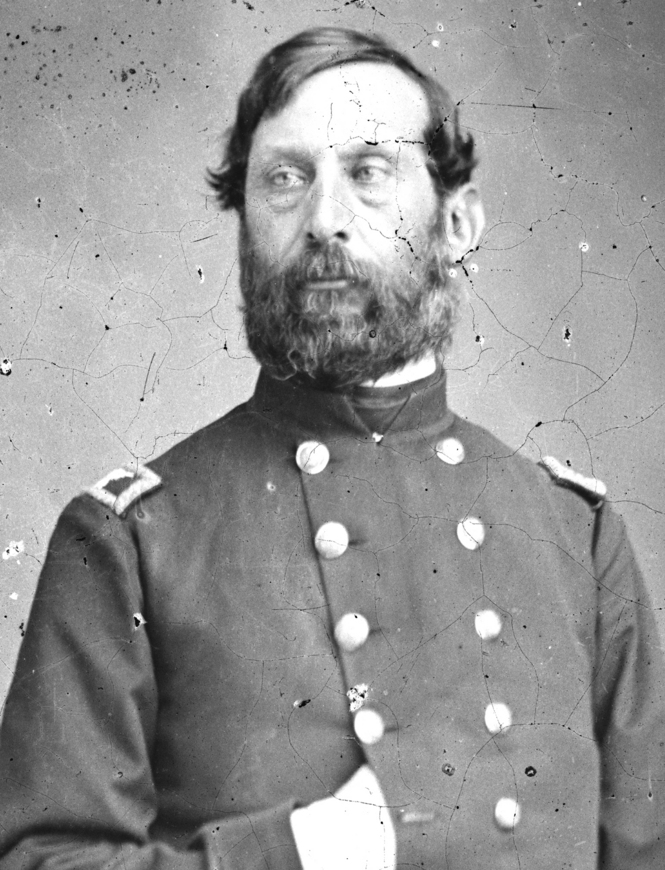
The noted South Carolina Baptist minister, the Reverend Richard Furman wrote: “The right of holding slaves is clearly established by the Holy Scriptures, both by precept and example.”  [1]

Like other people who supported the institution of slavery in the Americas before them, Southerners turned to the Christian faith to buttress their cause. Catholic and Protestant churches of England, France, the Netherlands, Spain and Portugal all provided their theological and ecclesiastical blessing to slavery and the slave trade. When a Catholic priest wrote his superiors asking if the slave trade and all of its components were legal according to Canon Law he received this answer:

“Your Reverence writes me that you would like to know whether the Negroes who are sent to your parts have been legally captured. To this I reply that I think your Reverence should have no scruples on this point, because this is a matter which has been questioned by the Board of Conscience in Lisbon, and all its members are learned and conscientious men. Nor did the bishops who were in Sao Thome, Cape Verde, and here in Loando – all learned and virtuous men – find fault with it. We have been here ourselves for forty years and there have been among us very learned Fathers…never did they consider the trade as illicit. Therefore we and the Fathers of Brazil buy these slaves for our service without any scruple….” [2]

In the American colonies, the Church of England accommodated itself to the plantation system by adapting itself to the ways of the plantation owners and slave traders. This began in 1619 when planters in Virginia and Maryland began to bring in slaves due to their “growing success by growing and exporting tobacco.” [3] To escape the ancient Christian prohibition on believers owning other believers most plantation owners refused to all their slaves to be baptized. However, to allow for some slaves to be baptized a law was passed in 1667 “declaring that baptism did not change a slave’s condition – another indication of the degree to which established religion was willing to bend to the interests of the powerful.”  [4] It is interesting to note that this uniquely American Anglican idea that baptism did not change the nature of a person, was also used by the Nazis in regard to Jews who had converted to Christianity.

In light of the threat posed to slavery by the emerging abolitionist movement, slaveholders were forced to shift their defense of slavery away from it being simply a necessary evil to a positive good. The institution of slavery became “in both secular and religious discourse, the central component of the mission God had designed for the South.” [5] Like in the North where theology was at the heart of many abolitionist arguments, in the South theology was used to enshrine and defend the institution of slavery. British Evangelical-Anglican theologian Alister McGrath notes how “the arguments used by the pro-slavery lobby represent a fascinating illustration and condemnation of how the Bible may be used to support a notion by reading the text within a rigid interpretive framework that forces predetermined conclusions to the text.” [6]

Southern religion was a key component of something bigger than itself and played a role in the development of an ideology much more entrenched in the Southern culture than the abolitionist cause did in the North.  This was in large part due to the same Second Great Awakening that brought abolitionism to the fore in the North. “Between 1801 when he Great Revival swept the region and 1831 when the slavery debate began, southern evangelicals achieved cultural dominance in the region. Looking back over the first thirty years of the century, they concluded that God had converted and blessed their region.” [7] The Southern political and religious ideology enshrined slavery as a key component of all areas of life. It was a complete worldview, a system of values, culture, religion and economics, or to use the more modern German term “Weltanschauung.” The Confederate worldview was the Cause. As Emory Thomas wrote in his book The Confederate Nation:

“it was the result of the secular transubstantiation in which the common elements of Southern life became sanctified in the Southern mind. The South’s ideological cause was more than the sum of its parts, more than the material circumstances and conditions from which it sprang. In the Confederate South the cause was ultimately an affair of the viscera….Questions about the Southern way of life became moral questions, and compromises of Southern life style would become concession of virtue and righteousness.” [8]

Despite the dissent of some, the “dominant position in the South was strongly pro-slavery, and the Bible was used to defend this entrenched position.” [9] This was tied to a strongly Calvinistic theology which saw slavery in context with the spread of the evangelical Protestant faith that had swept through the South as slavery spread. For many, if not most Southern ministers “the very spread of evangelical religion and slave labor in the South was a sign of God’s divine favor. Ministers did not focus on defending slavery in the abstract but rather championed Christian slaveholding as it was practiced in the American South. Though conceding that some forms of slavery might be evil, Southern slavery was not.” [10]

The former Governor of South Carolina, John Henry Hammond, led the religiously based counter argument to the abolitionists. Hammond’s arguments included biblical justification of blacks being biologically inferior to whites and slavery being supported in the Old Testament where the “Hebrews often practiced slavery” and in the New Testament where “Christ never denounced servitude.”  [11] Hammond warned:

“Without white masters’ paternalistic protection, biologically inferior blacks, loving sleep above all and “sensual excitements of all kinds when awake” would first snooze, then wander, then plunder, then murder, then be exterminated and reenslaved.” [12]

Others in the South, including politicians, pundits and preachers were preaching “that slavery was an institution sanctioned by God, and that even blacks profited from it, for they had been snatched out of pagan and uncivilized Africa and been given the advantages of the gospel.” [13] The basic understanding was that slavery existed because “God had providential purposes for slavery.” [14]

At the heart of the pro-slavery theological arguments was in the conviction of most Southern preachers of human sinfulness. “Many Southern clergymen found divine sanction for racial subordination in the “truth” that blacks were cursed as “Sons of Ham” and justified bondage by citing Biblical examples.” [15] But simply citing scripture to justify the reality of a system of which they reaped the benefit, is just part of the story. The real issue was far greater than that. The theology that justified slavery also, in the minds of many Christians in the north justified what they considered “the hedonistic aspects of the Southern life style.” [16] This was something that abolitionist preachers continually emphasized, criticizing the greed, sloth and lust inherent in the culture of slavery and plantation life, and was an accusation of which Southern slaveholders, especially evangelicals took umbrage, for in their understanding good men could own slaves. Their defense was rooted in their theology. The hyper-individualistic language of Southern evangelicalism gave “new life to the claim that good men could hold slaves. Slaveholding was a traditional mark of success, and a moral defense of slavery was implicit wherever Americans who considered themselves good Christians held slaves.” [17] The hedonism and fundamentalism that existed in the Southern soul, was the “same conservative faith which inspired John Brown to violence in an attempt to abolish slavery…” [18]

Slave owners frequently expressed hostility to independent black churches and conducted violence against them, and “attacks on clandestine prayer meetings were not arbitrary. They reflected the assumption (as one Mississippi slave put it) “that when colored people were praying [by themselves] it was against them.” [19] But some Southern blacks accepted the basic tenets of slave owner-planter sponsored Christianity. Frederick Douglass later wrote “many good, religious colored people who were under the delusion that God required them to submit to slavery and wear their chains with weakness and humility.” [20]

The political and cultural rift began to affect entire church denominations. The heart of the matter went directly to theology, in this case the interpretation of the Bible in American churches.  The American Protestant and Evangelical understanding was rooted in the key theological principle of the Protestant Reformation, that of Sola Scripura, which became an intellectual trap for northerners and southerners of various theological stripes. Southerners believed that they held a “special fidelity to the Bible and relations with God. Southerners thought abolitionists either did not understand the Bible or did not know God’s will, and suspected them of perverting both.”  [21]The problem was then, as it is now that:

 “Americans favored a commonsense understanding of the Bible that ripped passages out of context and applied them to all people at all times. Sola scriptura both set and limited terms for discussing slavery and gave apologists for the institution great advantages. The patriarchs of the Old Testament had owned slaves, Mosaic Law upheld slavery, Jesus had not condemned slavery, and the apostles had advised slaves to obey their masters – these points summed up and closed the case for many southerners and no small number of northerners.” [22]

In the early decades of the nineteenth century there existed a certain confusion and ambivalence to slavery in most denominations. The Presbyterians exemplified this when in 1818 the “General Assembly of the Presbyterian Church, while opposing slavery against the law of God, also went on record as opposing abolition, and deposed a minister for advocating abolition.” [23] There were arguments by some American Christians including some Catholics, Lutherans, Episcopalians and others to offer alternative ways to “interpreting and applying scripture to the slavery question,  but none were convincing or influential enough to force debate”  [24] out of the hands of literalists.

However the real schisms between the Northern and Southern branches of the major denominations which began to emerge in the mid to late 1830s continued to grow with the actual breakups of the major denominations coming in the 1840s. The first denomination to split was the Methodist church. This occurred in 1844 when “the Methodist General Conference condemned the bishop of Georgia for holding slaves, the church split and the following year saw the birth of the Methodist Episcopal Church.” [25] Not all Methodists in the South agreed with this split and a few Methodist abolitionists in the South “broke away from mainline Methodism to form the Free Methodist Church.” [26]
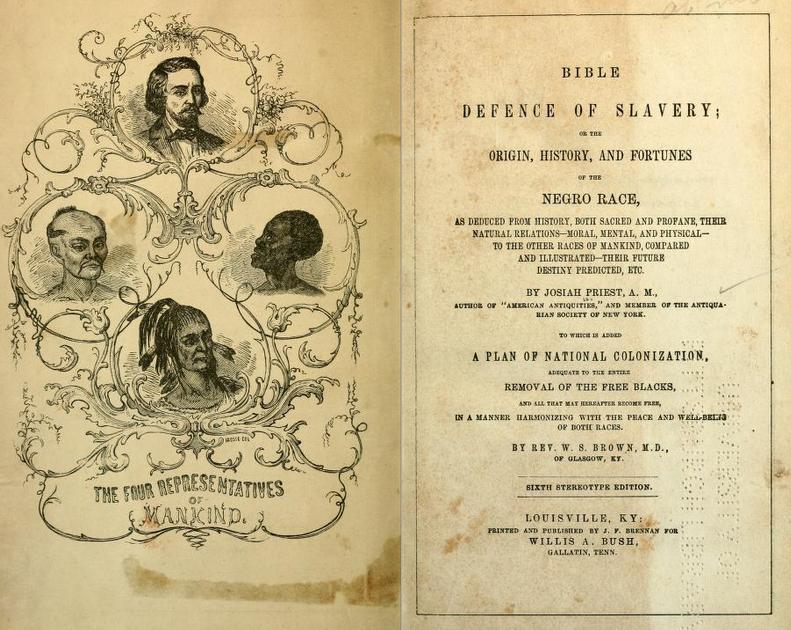
defense-of-slavery

The Baptists were next, when the Foreign Mission Board “refused to commission a candidate who had been recommended by the Georgia Baptist Convention, on the ground that he owned slaves” [27] resulting in the formation of the Southern Baptist Convention. The Baptist split is interesting because until the early 1800s there existed a fairly strong anti-slavery movement in states such as Kentucky, while in 1790 the General Committee of Virginia “adopted a statement calling slavery “a violent deprivation of the rights of nature, and inconsistent with a republican government; and therefore [we] recommend it to our brethren to make use of every legal measure, to extirpate the horrid evil from the land.”  [28]

However, in many parts of the Deep South there existed no such sentiment and in South Carolina, noted Baptist preachers including “Richard Furman, Peter Bainbridge, and Edmund Botsford were among the larger slaveholders.” [29] Furman wrote a defense of slavery in 1822 where he made the argument that “the right of holding slaves is clearly established in the Holy Scriptures by precept and example.” [30]  After a number of slave uprisings, including the Nat Turner Revolt in Virginia, pro-slavery voices “tended to silence any remaining antislavery voices in the South.” [31]

These voices grew more ever more strident and in 1835 the Charleston Association “adopted a militant defense of slavery, sternly chastising abolitionists as “mistaken philanthropists, and denuded and mischievous fanatics.”  [32] Those who met in Augusta Georgia to found the new Southern Baptist Convention indicated that “the division was “painful” but necessary because” our brethren have pressed upon every inch of our privileges and our sacred rights.”  [33] Since the Baptist split was brought about by the refusal of the Triennial Convention to appoint slaveholders as foreign missionaries the new convention emphasized the theological nature of their decision:

“Our objects, then, are the extension of the Messiah’s kingdom, and the glory of God. Not disunion with any of his people; not the upholding of any form of civil rights; but God’s glory, and Messiah’s increasing reign; in the promotion of which, we find no necessity for relinquishing any of our civil rights. We will never interfere with what is Caesar’s. We will not compromit what is God’s.” [34]

Of course, to the Baptists who met at Augusta, “what was Caesar’s” was obviously the institution of slavery.

The last denomination to officially split was the Presbyterians in 1861 who, “reflecting the division of the nation, the Southern presbyteries withdrew from the Presbyterian Church and founded their own denomination.” [35] The split in the Presbyterian Church had been obvious for years despite their outward unity. Princeton’s eminent Charles Hodge tried to be a peacemaker in the denomination warning of the dangers of disunion. He wrote, “If we are to be plunged into the horrors of civil war and servile insurrections, no tongue can tell how the cause of the Redeemer must suffer throughout our whole land.” [36] But like many conservatives of his time Hodge was misguided in thinking that moderates could prevail and that a sentimental attachment to the Union would prevent secession and war.

Some Southern pastors and theologians were at the forefront of battling their northern counterparts for the theological high ground that defined just whose side God was on. James Henley Thornwell presented the conflict between northern evangelical abolitionists and southern evangelical defenders of slavery in Manichean terms, a battle between Christianity and Atheism, and he believed that abolitionists attacked religion itself.

Robert Lewis Dabney, a southern Presbyterian pastor who later served as Chief of Staff to Stonewall Jackson in the Valley Campaign and at Seven Pines and who remained a defender of slavery long after the war was over wrote that:

“we must go before the nation with the Bible as the text and ‘Thus saith the Lord’ as the answer….we know that on the Bible argument the abolition party will be driven to reveal their true infidel tendencies. The Bible being bound to stand on our side, they have to come out and array themselves against the Bible. And then the whole body of sincere believers at the North will have to array themselves, though unwillingly, on our side. They will prefer the Bible to abolitionism.” [37]

Southern churches and church leaders were among the most enthusiastic voices for disunion and secession. They labeled their Northern critics, even fellow evangelicals in the abolition movement as “atheists, infidels, communists, free-lovers, Bible-haters, and anti-Christian levelers.”  [38] The preachers who had called for separation from their own national denominations years before the war now “summoned their congregations to leave the foul Union and then to cleanse their world.” [39] Thomas R.R. Cobb, a Georgia lawyer, an outspoken advocate of slavery and secession who was killed at the Battle of Fredericksburg, wrote proudly that Secession “has been accomplished mainly by the churches.” [40]

The Reverend William Leacock of Christ Church, New Orleans declared in his Thanksgiving sermon of 1860: “Our enemies…have “defamed” our characters, “lacerated” our feelings, “invaded “our rights, “stolen” our property, and let “murderers…loose upon us, stimulated by weak or designing or infidel preachers. With “the deepest and blackest malice,” they have “proscribed” us “as unworthy members… of the society of men and accursed before God.”  Unless we sink to “craven” beginning that they “not disturb us,…nothing is now left us but secession.” [41]

The fact that so many Protestant ministers, intellectuals, and theologians, not only Southerners, but men like “Princeton’s venerable theologian Charles B. Hodge – supported the institution of slavery on biblical grounds, often dismissing abolitionists as liberal progressives who did not take the Bible seriously” leaves a troubling question over those who claim to oppose issues on supposedly Biblical grounds. There were many such men in the North who spoke out for it and against Christian Abolitionists “in order to protect and promote interests concomitant to slavery, namely biblical traditionalism, and social and theological authority.” [42] The Northern clerical defenders of slavery perceived the spread of abolitionist preaching as a threat, not just to slavery “but also to the very principle of social and ecclesiastical hierarchy.” [43] Alistair McGrath asks a very important question for modern Christians who might be tempted to support a position for the same reasons today, “Might not the same mistakes be made all over again, this time over another issue?” [44]

Notes

[1] Furman, Richard Exposition of the Views of Baptists, Relative to the Coloured Population in the United States May 28th 1823, In Communication the Governor of South Carolina, Second Edition A.E. Miller, Charleston SC 1838 retrieved from http://faceweb.furman.edu/~benson/docs/rcd-fmn1.htm 15 July 2016

[2] Ibid. Zinn A People’s History of the United States pp.29-30

[3] Ibid. Gonzalez The History of Christianity Volume 2: The Reformation to the Present Day Harper p.219

[4] Ibid. Gonzalez The History of Christianity Volume 2: pp.219-220

[5] Gallagher, Gary W. The Confederate War: How Popular Will, Nationalism and Military Strategy Could not Stave Off Defeat Harvard University Press, Cambridge MA and London 1999 p.67

[6] Ibid. McGrath Christianity’s Dangerous Idea p.324

[7] Ibid. Daly When Slavery Was Called Freedom p.69

[8] Ibid. Thomas The Confederate Nation 1861-1865 p.4

[9] Ibid. McGrath Christianity’s Dangerous Idea p.324

[10] Ibid. Varon Disunion! p.109

[11] Ibid. Freehling The Road to Disunion Volume One p.29

[12] Ibid. Freehling The Road to Disunion Volume One p.29

[13] Ibid. Gonzalez The History of Christianity Volume 2: p.251

[14] Ibid. Daly When Slavery Was Called Freedom p.54

[15] Ibid. Thomas The Confederate Nation p.22

[16] Ibid. Thomas The Confederate Nation p.22

[17] Ibid. Daly When Slavery Was Called Freedom p.30

[18] Ibid. Thomas The Confederate Nation p.22

[19] Ibid. Levine Half Slave and Half Free p.116

[20] Ibid. Levine Half Slave and Half Free p.116

[21] Ibid. Daly When Slavery Was Called Freedom p.60

[22] Ibid. Rable God’s Almost Chosen Peoples  p.14

[23] Ibid. Gonzalez The History of Christianity Volume 2 p.251

[24] Ibid. Rable God’s Almost Chosen Peoples  p.14

[25] Ibid. Gonzalez The History of Christianity Volume 2 p.251

[26] Ibid. McGrath Christianity’s Dangerous Idea p.324

[27] Ibid. Gonzalez The History of Christianity Volume 2 p.251

[28] Ibid. McBeth The Baptist Heritage p.383

[29] Ibid. McBeth The Baptist Heritage p.384

[30] Ibid. McBeth The Baptist Heritage p.384

[31] Ibid. McBeth The Baptist Heritage p.384

[32] Ibid. McBeth The Baptist Heritage p.384

[33] Shurden, Walter B Not a Silent People: The Controversies that Have Shaped Southern Baptists Broadman Press, Nashville TN 1972 p.58

[34] Ibid. Shurden Not a Silent People p.58

[35] Ibid. Gonzalez The History of Christianity Volume 2 p.251

[36] Ibid. Rable God’s Almost Chosen Peoples p.13

[37] Ibid. Rable God’s Almost Chosen Peoples  p.14

[38] Ibid. Daly When Slavery Was Called Freedom  p.97

[39] Freehling, William. The Road to Disunion Volume II: Secessionists Triumphant 1854-1861 Oxford University Press, Oxford and New York 2007 p.460

[40] Ibid. Rable God’s Almost Chosen Peoples  p.39

[41] Ibid. Freehling  The Road to Disunion Volume II p.462

[42] Ibid. Daly When Slavery Was Called Freedom  p.38

[43] Ibid. Varon Disunion! P.108

[44] Ibid. McGrath Christianity’s Dangerous Idea p.324

1 Comment

Filed under civil rights, civil war, ethics, faith, History, Political Commentary, Religion

Slavery and National Expansion: the Compromise of 1850 or “The Privilege of Belonging to the Superior Race…” Part 3

thomas-sims-marched-into-slavery-nypl

Enforcing the Fugitive Slave Law in Boston 

Friends of Padre Steve’s World

Today the third installment of a three part series  of my work dealing with American Slavery in the ante-bellum period. These next articles deal with the subject of what happens when laws are made that further restrict the liberty of already despised, or enslaved people. In this case the subject is the Compromise of 1850 and its associated laws such as the Fugitive Slave Act of 1850.

This is an uncomfortable period of history for Americans with either a sense of conscience, or those who believe the racist myths surrounding the “Noble South” and “The Lost Cause.”  I hope that you find them interesting, especially in light of current events in the United States.

Peace,

Padre Steve+

The Fugitive Slave Act of 1850

Robert Toombs of Georgia was an advocate for the expansion of slavery into the lands conquered during the war. Toombs warned his colleagues in Congress “in the presence of the living God, that if you by your legislation you seek to drive us from the territories of California and New Mexico, purchased by the common blood and treasure of the whole people…thereby attempting to fix a national degradation upon half the states of this Confederacy, I am for disunion.”  [1]

The tensions in the aftermath of the war with Mexico escalated over the issue of slavery in the newly conquered territories brought heated calls by some southerners for secession and disunion. To preserve the Union, Henry Clay and Daniel Webster, supported by the new President Millard Fillmore were able to pass the compromise of 1850 solved a number of issues related to the admission of California to the Union and boundary disputes involving Texas and the new territories.  But among the bills that were contained in it was the Fugitive Slave Law, or The Fugitive Slave Act of 1850. The act was the device of Henry Clay which was meant to sweeten the deal for southerners. The law would “give slaveholders broader powers to stop the flow of runaway slaves northward to the free states, and offered a final resolution denying that Congress had any authority to regulate the interstate slave trade.” [2]

fugitive-slave-law

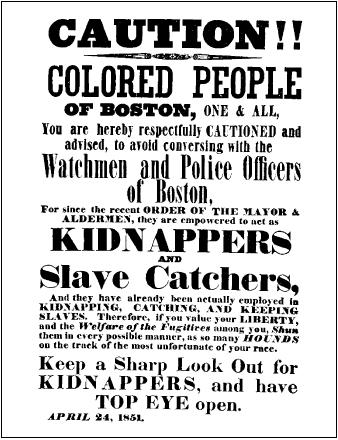
A Warning to Blacks in Boston regarding the Fugitive Slave Law

For all practical purposes the Compromise of 1850 and its associated legislation nationalized the institution of slavery, even in Free States. It did this by forcing all citizens to assist law enforcement in apprehending fugitive slaves. It also voided state laws in Massachusetts, Vermont, Ohio, Connecticut, Pennsylvania and Rhode Island, which barred state officials from aiding in the capture, arrest or imprisonment of fugitive slaves. “Congress’s law had nationalized slavery. No black person was safe on American soil. The old division of free state/slave state had vanished….” [3] If there was any question as to whose “States Rights” the leaders of the South were advocating, it was certainly not those of the states whose laws were voided by the act.

That law required all Federal law enforcement officials, even in non-slave states to arrest fugitive slaves and anyone who assisted them, and threatened law enforcement officials with punishment if they failed to enforce the law. The law stipulated that should “any marshal or deputy marshal refuse to receive such warrant, or other process, when tendered, or to use all proper means diligently to execute the same, he shall, on conviction thereof, be fined in the sum of one thousand dollars.” [4] In effect the law nullified state laws and forced individual citizens and local officials to help escaped slaves regardless of their own convictions, religious views, and state and local laws to the contrary.

Likewise the act compelled citizens in Free states to “aid and assist in the prompt and efficient execution of this law, whenever their services may be required….” [5] Penalties were harsh and financial incentives for compliance attractive.

“Anyone caught providing food and shelter to an escaped slave, assuming northern whites could discern who was a runaway, would be subject to a fine of one thousand dollars and six months in prison. The law also suspended habeas corpus and the right to trial by jury for captured blacks. Judges received a hundred dollars for every slave returned to his or her owner, providing a monetary incentive for jurists to rule in favor of slave catchers.” [6]

The law gave no protection for even black freedmen, who simply because of their race were often seized and returned to slavery. The legislation created a new extra-judicial bureaucratic office to decide the fate of blacks. This was the office of Federal Commissioner and it was purposely designed to favorably adjudicate the claims of slaveholders and their agents, and to avoid the normal Federal Court system. There was good reason for the slave power faction to place this in the law, many Federal courts located in Free States often denied the claims of slave holders, and that could not be permitted if slavery was to not only remain, but to grow with the westward expansion of the nation.

When slave owners or their agents went before these new appointed commissioners, they needed little in the way of proof to take a black back into captivity. The only proof or evidence other than the sworn statement by of the owner with an “affidavit from a slave-state court or by the testimony of white witnesses” [7] that a black was or had been his property was required to return any black to slavery. The affidavit was the only evidence required, even if it was false.

runaway

Since blacks could not testify on their own behalf and were denied legal representation before these commissioners, the act created an onerous extrajudicial process that defied imagination. Likewise, the commissioners had a strong a financial incentive to send blacks back to slavery, unlike normal courts the commissioners received a direct financial reward for returning blacks to slave owners. “If the commissioner decided against the claimant he would receive a fee of five dollars; if in favor ten. This provision, supposedly justified by the paper work needed to remand a fugitive to the South, became notorious among abolitionists as a bribe to commissioners.” [8] It was a system rigged to ensure that African Americans had no chance, and it imposed on the citizens of Free states the legal obligation to participate in a system that many wanted nothing to do with.

Douglass.JPG

Frederick Douglass 

Frederick Douglass wrote about the new law in the most forceful terms:

“By an act of the American Congress…slavery has been nationalized in its most horrible and revolting form. By that act, Mason & Dixon’s line has been obliterated;…and the power to hold, hunt, and sell men, women, and children remains no longer a mere state institution, but is now an institution of the whole United States.” [9]

Douglass was correct as was demonstrated during an incident in Boston in 1854 where an escaped slave named Anthony Burns, who had purchased his freedom, was arrested under the Fugitive Slave Act. The arrest prompted a protest in which, “an urban mob – variously composed of free Negro laborers, radical Unitarian ministers, and others – gathered to free him. They stormed the Federal courthouse, which was surrounded by police and wrapped in protective chains….Amid the melee, one protestor shot and killed a police deputy.” [10] The heated opposition to Burns’ arrest provoked the passions of thousands of Bostonians who protested for his release that caused the Massachusetts governor to deploy two batteries of artillery outside the courthouse to deter any more attacks. When the Federal Fugitive Slave Law commissioner consigned Burns to his Southern owner, the prisoner placed in shackles and was marched down State Street. Tensions were now running extremely high and a “brigade of Massachusetts militia and local police were required to run Burns through a gauntlet and deposit him on the ship that would remand him to Virginia.” [11] Bostonians began to see their city as it was in the early days of the American Revolution, as a place that resisted tyranny. Neither did they did not forget Burns but raised the money to purchase his freedom. William Lloyd Garrison wrote, “the “deed of infamy… demonstrated as nothing else that “only “the military power of the United States” could sustain slavery.” [12] Nevertheless, Boston’s “mercantile elite had vindicated law and order” [13] but in the process they helped move so abolitionists who had been advocates of pacifism and non-violence to physical resistance to the bounty hunting Southerners. “Across the North, prisons were broken into, posses were disrupted, and juries refused to convict.” [14]

Violence between slave hunters and their protectors did break out in September 1851 when “a Maryland slave owner named Edward Gorsuch crossed into Pennsylvania in pursuit of four runaways.” [15] Gorsuch and his armed posse found them in the Quaker town of Christiana, where they were being sheltered by a free black named William Parker and along with about two dozen other black men armed with a collection of farm implements and a few muskets who vowed to resist capture. Several unarmed Quakers intervened and recommended that Gorsuch and his posse leave for their own sake, but Gorsuch told them “I will have my property, or go to hell.” [16] A fight then broke out in which Gorsuch was killed and his son seriously wounded, and the fugitives escaped through the Underground Railroad to Canada.

The Christiana Riot as it is called now became a national story. In the North it was celebrated as an act of resistance while it was decried with threats of secession in the South. President Millard Fillmore sent in troops and arrested a number of Quakers as well as more than thirty black men. “The trial turned into a test between two cultures: Southern versus Northern, slave versus free.”  [17] The men were charged with treason but the trial became a farce as the government’s case came apart. After a deliberation of just fifteen minutes, “the jury acquitted the first defendant, one of the Quakers, the government dropped the remaining indictments and decided not to press other charges.” [18] Southerners were outraged, and one young man whose name is forever linked with infamy never forgot. A teenager named John Wilkes Booth was a childhood friend of Gorsuch’s son Tommy. “The death of Tommy Gorsuch’s father touched the young Booth personally. While he would move on with his life, he would not forget what happened in Christiana.” [19]

The authors of the compromise had not expected such resistance to the laws. On his deathbed Henry Clay, who had worked his entire career to pass compromises in order to preserve the Union, praised the act, of which he wrote “The new fugitive slave law, I believe, kept the South in the Union in ‘fifty and ‘fifty-one. Not only does it deny fugitives trial by jury and the right to testify; it also imposes a fine and imprisonment upon any citizen found guilty of preventing a fugitive’s arrest…” Likewise Clay depreciated the Northern opposition and condemned the attempt to free Anthony Burns, noting “Yes, since the passage of the compromise, the abolitionists and free coloreds of the North have howled in protest and viciously assailed me, and twice in Boston there has been a failure to execute the law, which shocks and astounds me…. But such people belong to the lunatic fringe. The vast majority of Americans, North and South, support our handiwork, the great compromise that pulled the nation back from the brink.” [20] 

While the compromise had “averted a showdown over who would control the new western territories,” [21] it only delayed disunion. In arguing against the compromise South Carolina Senator John C. Calhoun realized that for Southerners it did not do enough to support the peculiar institution and that it would inspire Northern abolitionists to redouble their efforts to abolish slavery. Thus, Calhoun argued not just for the measures secured in the compromise legislation, but for the permanent protection of slavery:

“He understood that slavery stood at the heart of southern society, and that without a mechanism to protect it for all time, the Union’s days were numbered.” Almost prophetically he said “I fix its probable [breakup] within twelve years or three presidential terms…. The probability is it will explode in a presidential election.”  [22]

Of course it was Calhoun and not the authors of the compromise who proved correct. The leap into the abyss of disunion and civil war had only been temporarily avoided. However, none of the supporters anticipated what would occur in just six years when a “train of unexpected consequences would throw an entirely new light on the popular sovereignty doctrine, and both it and the Compromise of 1850 would be wreaked with the stroke of a single judicial pen.” [23]

To be continued…

Notes

[1] Ibid. Guelzo Fateful Lightning pp.62-63

[2] Ibid. Guelzo Fateful Lightning p.68

[3] Ibid. Goldfield  America Aflame p.71

[4] ______________Fugitive Slave Act of 1850 retrieved from the Avalon Project, Yale School of Law http://avalon.law.yale.edu/19th_century/fugitive.asp 11 December 2014

[5] Ibid. Fugitive Slave Act of 1850

[6] Ibid. Goldfield America Aflame p.71

[7] Ibid. McPherson The Battle Cry of Freedom  p.80

[8] Ibid. McPherson The Battle Cry of Freedom p.80

[9] Ibid. Goldfield America Aflame p.72

[10] Goodheart, Adam 1861: The Civil War Awakening Vintage Books a division of Random House, New York 2011 p.42

[11] Ibid. Varon Disunion! The Coming of the American Civil War 1789-1858 p.241

[12] Mayer, Henry All on Fire: William Lloyd Garrison and the Abolition of Slavery W.W. Norton and Company, New York and London 1998 p.442

[13] Ibid. McPherson The Battle Cry of Freedom p.84

[14] Ibid. Guelzo Fateful Lightning p.73

[15] Ibid. Guelzo Fateful Lightning p.73

[16] Ibid. McPherson The Battle Cry of Freedom p.84

[17] Steers, Edward Jr. Blood on the Moon: The Assassination of Abraham Lincoln The University of Kentucky Press, Lexington 2001 p.33

[18] Ibid. McPherson The Battle Cry of Freedom p.85

[19] Ibid. Steers  Blood on the Moon: The Assassination of Abraham Lincoln p.33

[20] Oates, Stephen B. Editor The Approaching Fury: Voices of the Storm, 1820-1861 University of Nebraska Press, Lincoln and London 1997 p.94

[21] Ibid. Guelzo Fateful Lightning p.71

[22] Ibid. Goldfield America Aflame p.64

[23] Ibid. Guelzo Fateful Lightning p.71

4 Comments

Filed under civil rights, civil war, History, Political Commentary

Slavery and National Expansion: the Compromise of 1850 or “The Privilege of Belonging to the Superior Race…” Part 2

slave-sale

Friends of Padre Steve’s World

Today the second of a three installment bit of my work dealing with American Slavery in the ante-bellum period. These next articles deal with the subject of what happens when laws are made that further restrict the liberty of already despised, or enslaved people. In this case the subject is the Compromise of 1850 and its associated laws such as the Fugitive Slave Act of 1850.

This is an uncomfortable period of history for Americans with either a sense of conscience, or those who believe the racist myths surrounding the “Noble South” and “The Lost Cause.”  I hope that you find them interesting, especially in light of current events in the United States.

Peace,

Padre Steve+

Economic Effects of the Compromise of 1850

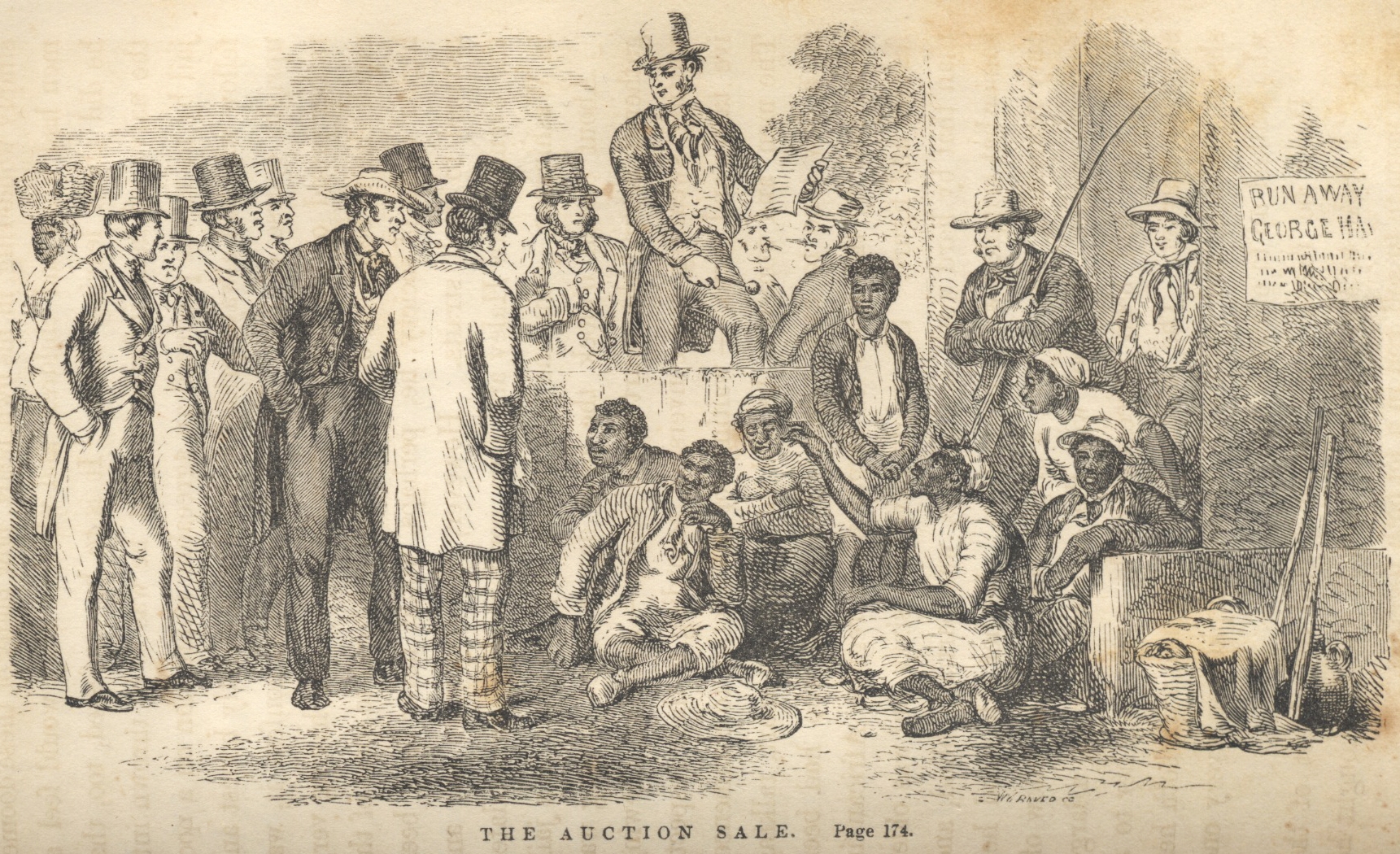
The interregional slave trade guaranteed slave owners of a source of slaves even if they were cut off from the international trade and it was an immense part of not just the Southern economy but the American economy. Slave owners “hitched their future to slavery; a single cash crop and fresh land,” [1] and refused to take an interest in manufacturing or diversifying their agricultural production outside of King Cotton. Slave prices tripled between 1800 and 1860 making human property one of the most lucrative markets for investment. The price of a “prime male field hand in New Orleans began at around $500 in 1800 and rose as high as $1,800 by the time of the Civil War.” [2] The result was that slave owners and those who benefited from the interregional slave trade had a vested interest in not only seeing slavery preserved, but expanded.

This resulted in two significant trends in the South, first was that slave owners grew significantly richer as the value of the slave population increased. Using even a conservative number of $750 dollars as the value of a single slave in 1860 the amount of value in this human property was significantly more than almost any other investment in the nation.  It was enormous. Steven Deyle notes that:

“It was roughly three times greater than the total amount of all capital invested in manufacturing in the North and in the South combined, three times the amount invested in railroads, and seven times the amount invested in banks. It was about equal to about seven times the value of all currency in circulation in the country three times the value of the entire livestock population, twelve times the value of the entire U.S. cotton crop, and forty-eight times the expenditures of the federal government that year. ….”by 1860, in fact in the slaveowning states alone, slave property had surpassed the assessed value of real estate.” [3]

The rise in slave values and the increasing wealth of slave owners had a depreciating effect on poor southern whites by ensuring that there was no middle class, which “blocked any hope of social advancement for the mass of poor whites, for it was all but impossible for a non-slaveholder to rise in the southern aristocracy.” [4] The impoverishment of southern whites created some worry for those astute enough to take an interest in such matters. “In 1850, about 40 percent of the South’s white farmers owned real estate at all. There was thus, worried the Southern Cultivator in 1856, “a large number at the South who have no legal right or interest in the soil [and] no homes of their own.” The editor of a South Carolina newspaper that year framed the matter in less sympathetic terms: “There is in this State,” he wrote, “as impoverished and ignorant as white population as can be found in any other in the Union.” [5]

Some Southerners recognized the growing issue that the south was falling behind the north in terms of real economic advancement and that slavery was the culprit. Hinton Helper, a non-slave owning North Carolinian who had made his fortune in the California Gold Rush of 1849 and returned home to become disillusioned with what he saw wrote a book that had a major impact in the North among Republican politicians, but which was either banned or restricted in much of the South. That book “The Impending Crisis of the South: How to Meet It (1857) was “a book on the debilitating impact of slavery on the South in general and on southern whites in particular.” [6] Helper’s attack on the slavery system was as devastating as that of any abolitionist, and since he was a southerner the effects of his words helped further anti-slavery sentiment in the North and would be used by the Republican party in an abridged form as a campaign tool that they printed and distributed during the build up to the election n of 1860. Helper wrote that:

“Slavery lies at the root of all the shame, poverty, tyranny and imbecility of the South.” Echoing the free-soil argument Helper maintained that slavery degraded all labor to the level of bond labor. Planters looked down their noses at nonslaveholders and refused to tax themselves to provide a decent school system. “Slavery is hostile to general education…Its very life, is in the ignorance and stolidity of the masses.”  [7]

Many southern leaders saw Helper’s book as a danger and worried that should Helper and others like him speak freely long enough “that they will have an Abolition party in the South, of Southern men.” When that happened, “the contest for slavery will no longer be one between the North and the South. It will be in the South between the people of the South.” [8] That was something that the landed gentry of the slave owning oligarchy could never tolerate for if the non-slave holding whites rejected slavery, the institution would die. Thus, Helper, who was no fan of black people and held many violently racist attitudes, was denounced “as a traitor, a renegade, an apostate, a “dishonest, degraded and disgraced man.” [9]

Men like Helper were an anomaly in the South, other leaders were much more like Jefferson Davis who urged the creation of a “Southern “system,” internal improvements, building factories, even reforming education to eliminate all textbooks at odds with his notion of the blessings of slavery.” [10]

In the years the before the war, the North embraced the Industrial Revolution leading to advances which gave it a marked economic advantage over the South in which through  its “commitment to the use of slave labor inhibited economic diversification and industrialization and strengthened the tyranny of King Cotton.” [11] The population of the North also expanded at a clip that far outpaced the South as European immigrants swelled the population.

The divide was not helped by the various compromises worked out between northern and southern legislators. After the Missouri Compromise Thomas Jefferson wrote these words of warning:

“but this momentous question, like a fire bell in the night, awakened and filled me with terror. I considered it at once as the knell of the Union. It is hushed indeed for the moment, but this is a reprieve only, not a final sentence. A geographical line, coinciding with a marked principle, moral and political, once conceived and held up to the angry passions of men, will never be obliterated; and every new irritation will mark it deeper and deeper.” [12]

The trigger for the increase in tensions that eventually ignited the powder keg was the war with Mexico in which the United States annexed nearly half of Mexico. The new territories were viewed by those who advocated the expansion of slavery as fresh and fertile ground for its spread. Ulysses S Grant, who served in the war, noted the effects of the war with Mexico in his memoirs:

“In taking military possession of Texas after annexation, the army of occupation, under General [Zachary] Taylor, was directed to occupy the disputed territory.  The army did not stop at the Nueces and offer to negotiate for a settlement of the boundary question, but went beyond, apparently in order to force Mexico to initiate war….To us it was an empire and of incalculable value; but it might have been obtained by other means.  The Southern rebellion was largely the outgrowth of the Mexican war.” [13]

To be continued…

Notes 

[1] Ibid. Egnal  Clash of Extremes p.10

[2] Ibid. Deyle The Domestic Slave Trade p.53 Deyle’s numbers come from the 1860 census.

[3] Ibid. Egnal  Clash of Extremes p.54

[4] Ibid. Foner Free Soil, Free Labor, Free Men p.48

[5] Ibid. Levine Half Slave and Half Free p.37

[6] Ibid. Goldfield  America Aflame  p.177

[7] Ibid. McPherson The Battle Cry of Freedom p.199

[8] Ibid. Levine Half Slave and Half Free p.235

[9] Ibid. Potter The Impending Crisis p.397

[10] Davis, William C. Jefferson Davis: The Man and His Hour Harper Collins Publishers New York 1991 p.258

[11] Ibid. Potter The Impending Crisis p.42

[12] Jefferson, Thomas Letter to John Holmes dated April 22nd 1824 retrieved from www.loc.gov/exhibits/jefferson/159.html  24 March 2014

[13] Grant, Ulysses S. Personal Memoirs of U.S. Grant New York 1885 pp.243-245

3 Comments

Filed under civil rights, civil war, History, Political Commentary

Slavery and National Expansion: the Compromise of 1850 or “The Privilege of Belonging to the Superior Race…” Part 1

negroes_and_negro_-slavery

Friends of Padre Steve’s World

Today a continuation of my work dealing with American Slavery in the ante-bellum period. These next articles deal with the subject of what happens when laws are made that further restrict the liberty of already despised, or enslaved people. In this case the subject is the Compromise of 1850 and its associated laws such as the Fugitive Slave Act of 1850.

This is an uncomfortable period of history for Americans with either a sense of conscience, or those who believe the racist myths surrounding the “Noble South” and “The Lost Cause.”  I hope that you find them interesting, especially in light of current events in the United States.

Peace,

Padre Steve+

The Background 

The ante-bellum South was an agrarian society that depended on the free labor provided by slaves. In a socio-political sense the South was an oligarchy that offered no freedom to slaves, openly discriminated against free blacks and provided little hope of social or economic advancement for poor and middle class whites.  However, despite this, even poor whites supported it.  Many Southern Yeoman farmers were willing to tolerate their second class status because they: “feared the fall from independent producer to dependent proletarian, a status he equated with enslavement” [1] more than remaining subservient to planters and plantation owners. In fact, for them slavery was the one institution that kept them above the despised black.

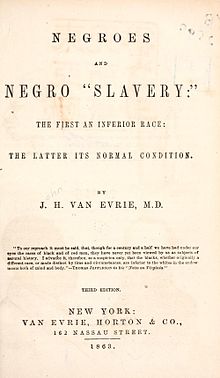
In 1861, Dr. J.H. Van Evrie, promoted the scientific racist of ichthyologist Louis Agassiz in a pamphlet entitled “Negroes and Negro Slavery;” The First an Inferior Race – The Latter, Its Normal Condition” expressed how most Southerners felt about African Americans be they slave or free, and Jefferson Davis hoped that Van Evrie’s arguments would persuade people to adopt the view that racial equality was a fallacy which could not be tolerated, Van Evrie wrote:

“He is not a black white man, or merely a man with a black skin, but a DIFFERENT AND INFERIOR SPECIES OF MAN; – that this difference is radical and total… that so called slavery is neither a “wrong” nor an “evil, but a natural relation based upon the “higher law,” in harmony with the order, progress, and general well-being of the superior one, and absolutely in keeping with the existence of the inferior race.”  [2]

While all Northern states had abolished slavery, or were in the process of gradual abolition in the after independence and the Civil War and had moved to an economic concept of free labor, the South had tied its economy and society to the institution of slavery. The contrast was well said by the members of an Alabama agricultural society, which noted in 1846:

“Our condition is quite different from that of the non-slaveholding section of the United States. With them their only property consists of lands, cattle and planting implements. Their laborers are merely hirelings, while with us our laborers are our property.” [3]

Van Evrie was not the only person making such distinction between the races. Dr. Samuel Cartwright wove the pseudo-science of the day into the narrative of the Bible, noting:

“I have thus hastily and imperfectly noticed some of the more striking anatomical and physiological peculiarities of the Negro race. The question may be asked, Does he belong to the same race as the white man? Is he a son of Adam? Does his particular physical confirmation stand in opposition to the Bible, or does it prove its truth?… Anatomy and physiology have been interrogated, and the response is, that the Ethiopian, or Canaanite, is unfitted for the duties of a free man….” [4]

He also noted:

“The Declaration of Independence, which was drawn up at a time when negroes were scarcely regarded as human beings, “That all men are by nature free and equal,” was only intended to apply to white men…” [5]

Northerners on the other hand, even in states where the last vestiges of slavery held on, nearly universally ascribed to the understanding that there was a dignity to labor and that free labor was essential if people were to have a better life. It undergirded their understanding of human dignity and that “labor was the source of all value.” [6]

That understanding of the intrinsic value of free labor continued to gain ground in the North in the decades preceding the Civil War and found much of its support in the Calvinist theology that predominated in most Protestant Northern denominations. Labor was intrinsic to one’s calling as a Christian and a human being, slave labor, at least in the eyes of many Northerners undercut that idea. Success in one’s calling glorified God and provided earthly evidence that a person was among the elect. For many Northern Christians, “the pursuit of wealth thus became a way of serving God on earth, and labor, which had been imposed on fallen man as a curse, was transmuted into a religious value, a Christian calling.” [7]  Such ideas found their way into Republican political thought even when not directly related to religion.  William Evarts said in 1856 “Labor gentlemen, we of the free States acknowledge to be the source of all of our wealth, of all our progress, of all our dignity and value.” [8] Abraham Lincoln noted that “the free labor system…opens the way for all, and energy and progress, and improvement in condition for all,” [9] and Lincoln also noted something inherent in the economic theory of Adam Smith that Labor is prior to, and independent of capital…in fact, capital is the fruit of labor.” [10]

However, the South by the 1830s had completely wedded itself to slavery and southern advocates of slavery deplored the free-labor movement as wage slavery and extolled the virtue of slavery. James H. Hammond condemned the free-labor movement in his King Cotton speech to the Senate in 1858:

“In all social systems there must be a class to do the menial duties, to perform the drudgery of life…. It constitutes the very mudsill of society….Such a class you must have, or you would not have that other that leads to progress, civilization and refinement….Your whole hireling class of manual laborers and ‘operatives,’ as you call them, are essentially slaves. The difference between us is, that our slaves are hired for life and well compensated…yours are hired by the day, not cared for, and scantily compensated.” [11]

Even so, the fact that the slave barons “were forced at every election to solicit the votes of “ignorant, slovenly, white trash in the country” with “frequent treats that disgrace our elections,” [12] rankled and humiliated many members of the Southern aristocracy. It was a marriage of two disparate parties linked by their membership in a superior race, something that only the continued existence of slavery ensured.

Lincoln extolled the virtues of free-labor, noting his own experiences after his election: “I am not ashamed to confess that twenty five years ago I was a hired laborer, mauling rails, at work on a flat boat – just what might happen to any poor man’s son.”  [13] Other Northerners lauded free-labor as the basis of upward mobility, and the New York Times noted that “Our paupers to-day, thanks to free labor, are our yeomen and merchants of tomorrow.” [14]

slave-coffle2

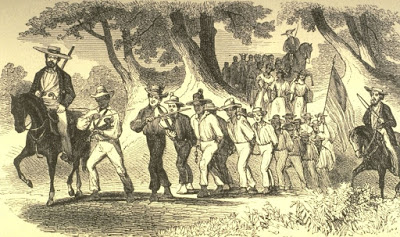
Slave Coffle

But whites in the South held labor in contempt due to the system of slavery, and the divergent views of each side were noted by Thomas Ewing who noted that labor “is held honorable by all on one side of the line because it is the vocation of freedmen – degrading in the eyes of some on the other side because it is the task of slaves.” [15] Of course with labor being the task of African slaves for southerners, the issue was entwined with race, and “Even if slavery was wrong, its wrongs were cancelled out for nonslaveholders by the more monstrous specter of racial equity.”  [16]

Georgia Governor Joseph E. Brown emphasized the threat to whites in that blacks would be their social equals and competitors. The racial component assured poor southern whites that they were superior to blacks and an Alabama lawyer wrote “The privilege of belonging to the superior race and being free was a bond that tied all Southern whites together… and it seemed from a Southern stand-point, to have for its purpose the leveling of all distinctions between the white man and the slave hard by.” [17] But poor white workers who remained in the South “repeatedly complained about having to compete with slaves as well as poorly paid free blacks” [18] leading many to seek a new livelihood in either Free States or the new territories.

For Southern politicians and slaveholders, the expansion of slavery was essential to its continued maintenance in the states where it was already legal. “Because of the need to maintain a balance in the Senate, check unruly slaves, and cultivate fertile soils, many planters and small plantation owners- particularly those living in the southern districts of the cotton states- asserted that their survival depended on new territory.” [19] In those decades “a huge involuntary migration took place. Between 800,000 and 1 million slaves were moved westward….” [20]

The need for slaves caused prices to soar, largely due to the ban on the import of slaves from Africa. This made the interregional trade much more important and linked the upper and lower south as well as the new slave-holding territories into “a regionwide slave market that tied together all of the various slaveowning interests into a common economic concern.” [21] In some older states like Virginia where fewer slaves were required, the exportation of slaves became a major industry:

“male slaves were marched in coffles of forty or fifty, handcuffed to each other in pairs, with a long chain through the handcuffs passing down the column to keep it together, closely guarded by mounted slave traders followed by an equal number of female slaves and their children. Most of them were taken to Wheeling, Virginia, the “busiest slave port” in the United States, and from there they were transported by steamboat to New Orleans, Natchez, and Memphis.” [22]

To be continued…

Notes

[1] Ibid. McPherson Drawn With Sword p.50

[2] Van Evrie, J.H. “Negroes and Negro Slavery;” The First an Inferior Race – The Latter, Its Normal Condition 1861 in The Confederate and Neo-Confederate Reader: The Great Truth about the Lost Cause, Loewen, James W. And Sebesta, Edward H. Editors, University Press of Mississippi, Jackson, 2010 p.75

[3] Ibid. Levine Half Slave and Half Free p.19

[4] Cartwright, Samuel A. Diseases and Peculiarities of the negro Race, 1851 in Loewen, James W and Sebesta, Edward H. The Confederate and Neo-Confederate reader: The Great Truth about the Lost Cause University of Mississippi Press, Jackson 2010 p.66

[5] Ibid. Cartwright Diseases and Peculiarities of the negro Race, 1851 p.70

[6] Foner, Eric Free Soil, Free Labor, Free Men: The Ideology of the Republican Party Before the Civil War Oxford University Press, Oxford and New York 1970 and 1995 p.7

[7] Ibid. Foner Free Soil, Free Labor, Free Men pp.12-13

[8] Ibid. Foner Free Soil, Free Labor, Free Men p.12

[9] Ibid. McPherson The Battle Cry of Freedom: The Civil War Era p.28

[10] Ibid. Foner Free Soil, Free Labor, Free Men p.12

[11] Ibid. McPherson The Battle Cry of Freedom p.196

[12] Ibid. Guelzo Fateful Lightening p.38

[13] Ibid. McPherson The Battle Cry of Freedom p.28

[14] Ibid. Foner Free Soil, Free Labor, Free Men p.16

[15] Ibid. Foner Free Soil, Free Labor, Free Men p.16

[16] Ibid. Guelzo Fateful Lightening p.38

[17] Ibid. Guelzo Fateful Lightening p.39

[18] Ibid. Levine Half Slave and Half Free p.44

[19] Ibid. Egnal  Clash of Extremes pp.125-126

[20] Korda, Michael. Clouds of Glory: The Life and Legend of Robert E. Lee Harper Collins Publishers, New York 2014 p.203

[21] Deyle, Steven The Domestic Slave Trade in Major Problems in the Civil War and Reconstruction Documents and Essays Third Edition edited by Michael Perman and Amy Murrell Taylor Wadsworth Cengage Learning Boston MA 2011 p.53

[22] Ibid. Korda Clouds of Glory: The Life and Legend of Robert E. Lee  p.203

3 Comments

Filed under civil rights, civil war, History, Political Commentary

Human Beings as Property Part 3: American Slavery

Friends of Padre Steve’s World,

Today the third installment of this series on American slavery. Today I discuss a number of the men who were called “fire eaters,” even by other pro-slavery men. All forms of systematic evil need men who are able to state their support for positions so extreme that they make the mainstream supporters of that position look good by comparison. We see this every day in our media. So here is

Peace

Padre Steve+

Understanding the Issue, The Importance of people: Edmund Ruffin and the Fire-Eaters

Edmund-Ruffin

Edmund Ruffin

As important as it is to understand the political, religious and ideological debate, we cannot adequately do so unless we begin to understand the people involved in the debates and the controversies of the time. Two of these men stand out. One, Edmund Ruffin, because he can be legitimately called a proponent of Confederate nationalism, and the other, Robert Barnwell Rhett because of his inability to work within any system that required compromise.

Among the people most enraged by Northern opposition to slavery was Edmund Ruffin. Ruffin is one of the more interesting characters who stridently supported slavery, white supremacy and secession in the ante-bellum south. Ruffin became the face of slaveholding ideology, but he not always pro-slavery, or pro-secession. As a younger man he had been a Jeffersonian Republican who as early as 1816 was concerned about growing federal power, but his writings were considered academic, scholarly, and moderate. However that began to change as the country lurched from one sectional crisis to the next.

As early as 1845 Ruffin was beginning to write about the probability of fighting the North, “We shall have to defend our rights by the strong hand against Northern abolitionists and perhaps the tariffites…” [1] But it was the passage of the Compromise of 1850 turned him into an ardent and hardline secessionist. When he did so, “he promptly threw himself into the new cause, replacing his formerly scholarly approach to issues with a fire-eater’s polemical and emotional style. “I will not pretend,” he now announced, “to restrain my pen, nor attempt to be correct in plan or expression – as is more or less usually the case in my writing.” [2]

Likewise, as a young man, Ruffin believed that slavery was an evil. But he began to study the works of Thomas Dew he became convinced of the necessity of slavery and its justification. In his tract The Political Economy of Slavery he wrote,

“Slavery… would be frequently… attended with circumstances of great hardship, injustice, and sometimes atrocious cruelty. Still, the consequences and general results were highly beneficial. By this means only–the compulsion of domestic slaves–in the early conditions of society, could labor be made to produce wealth. By this aid only could leisure be afforded to the master class to cultivate mental improvement and refinement of manners; and artificial wants be created and indulged, which would stimulate the desire and produce the effect, to accumulate the products of labor, which alone constitute private and public wealth. To the operation and first results of domestic slavery were due the gradual civilization and general improvement of manners and of arts among all originally barbarous peoples, who, of themselves, or without being conquered and subjugated (or enslaved politically) by a more enlightened people, have subsequently emerged from barbarism and dark ignorance…” [3]

Ruffin was an agricultural reformer who pioneered the use of lime to enhance the effectiveness of other fertilizers. He edited a successful farm paper and ran a very successful planation outside of Hopewell, Virginia, near Richmond.

Ruffin passionately argued for secession and Southern independence for fifteen years. He “perceived the planter civilization of the South in peril; the source of the peril was “Yankee” and union with “Yankees.” Thus he preached revolution, Ruffin was a rebel with a cause, a secular prophet…” [4] He was a type of man who understood reality far better than some of the more moderate oligarchs that populated the Southern political and social elite. While in the years leading up to the war, these men, including John Calhoun attempted to secure the continued existence and spread of slavery within the Union through the Congress and the courts, Ruffin condemned their efforts.

As early as 1850, Ruffin recognized that in order for slavery to survive the slaveholding South would have to secede from the Union. Ruffin and other radical secessionists believed that there could be no compromise with the north. In 1850 he and James Hammond attempted to use a meeting in Nashville to “secure Cooperative State Secession and wrote to Hammond, against those who sought to use the meeting to preserve the Union, “If the Convention does not open the way to dissolution…I hope it shall never meet.” [5] Ruffin believed that slave holding states had to be independent from the North in order to maintain the institution of slavery.

Ruffin’s views were not unique to him. They formed the basis of how most slave owners and supporters felt about slavery’s economic and social benefits of slavery and the Southern cotton economy. But while many Southerners wrote about the importance and necessity of slavery, Ruffin was one of its most eloquent defenders. He wrote:

“Still, even this worst and least profitable kind of slavery (the subjection of equals and men of the same race with their masters) served as the foundation and the essential first cause of all the civilization and refinement, and improvement of arts and learning, that distinguished the oldest nations. Except where the special Providence and care of God may have interposed to guard a particular family and its descendants, there was nothing but the existence of slavery to prevent any race or society in a state of nature from sinking into the rudest barbarism. And no people could ever have been raised from that low condition without the aid and operation of slavery, either by some individuals of the community being enslaved, by conquest and subjugation, in some form, to a foreign and more enlightened people.” [6]

The most striking thing about Ruffin’s defense of slavery is the distinction that he makes between enslaving people of the same race, which he calls the “worst and least profitable kind of slavery” over the enslavement of inferior races. He did not believe that the enslavement of people of the same race was wise, nor profitable, but he did believe that enslavement of inferior races was not only permissible, but in fact the bedrock of civilization. Likewise his understanding that slavery alone was the only thing that prevented “any race or society in a state of nature from sinking into the rudest barbarism,” was common among the Southern planting class.

In 1860 the then 67-year-old Ruffin helped change the world forever when, according to popular legend he pulled the lanyard that fired the first shot at Fort Sumter. While he had joined the Palmetto Guards and was present, he probably did not fire the first shot. Instead, he was probably was given the honor of firing the first shot from his battery; as other guns from other emplacements may have fired first. [7]

220px-robert_barnwell_rhett_sr

Robert Barnwell Rhett

But Ruffin was not alone, he was numbered with other Fire-Eaters who beginning in the 1840s began urging secession in order to protect the institution of slavery. The real “father” of Southern secession was Robert Barnwell Rhett of South Carolina. Rhett was a lawyer who was born under the name of Robert Barnwell Smith in Beaufort, South Carolina in 1800, but who adopted the surname of a famous ancestor in order to have a name which would befit him more in aristocratic South Carolina.

In a twist of irony, the man who became the father of the secessionist movement studied law under Thomas Grimke, the brother of the two famous abolitionist sisters, and “a leader of South Carolina’s anti-slavery American Colonization Society.” [8] He was a talented attorney with excellent oratorical skills and he was elected to the South Carolina legislature in 1826 as the controversy over nullification began. Rhett, like other opponents of a Federal Tariff led by Senator John C. Calhoun urged secession as early as 1830 he told a crowd that before submitting to the tyranny of Federal Government, that they must be read to destroy the Union:

“Aye – disunion, rather, into a thousand fragments. And why, gentlemen! would I prefer disunion to such a Government? Because under such a Government I would be a slave – a fearful slave, ruled despotically by those who do not represent me … with every base and destructive passion of man bearing upon my shieldless destiny.” [9]

Later, in the face of President Andrew Jackson’s political strength and much congressional opposition led by Henry Clay, South Carolina dropped nullification, Rhett was angry. He told his colleagues in the legislature that “Your “northern brethren,” aye, “the entire world are in arms against your institutions…. Until this Government is made a limited Government… there is no liberty – no security for the South.” [10] He then described disunion as the only way for the South to survive and to escape what he called “unconstitutional legislation.” He described a “Confederacy of the Southern States… [as] a happy termination – happy beyond expectation, of our long struggle for our rights against oppression.” [11]

Rhett worked against compromise at every opportunity, especially compromise which would preserve the Union. Absolutely convinced of the rightness of his cause he distrusted the politicians who favored compromise and had no faith in political parties. He worked from 1833 until the very end in order to support slavery, disunion, and secession, using every crisis as an opportunity. His dream was for “all Southerners – to unite across party lines and unyieldingly defend slavery and Southern interests as he defined them.” [12] During the debate over secession following the Compromise of 1850, Rhett would resign his seat in the U.S. Senate which had been elected to following the death of John C. Calhoun, rather than accept a state convention’s ruling that secession was not justified. After leaving office he became the editor, and later the full owner of the Charleston Mercury newspaper where he continued to advocate for secession in often the most outrageous ways, but The more outrageous the Mercury’s charges, the more they were picked up and reprinted by other papers. Rhett’s propaganda technique was part of a larger secessionist strategy. “Men having both nerve and self-sacrificing patriotism,” he wrote, “must lead the movement and shape its course, controlling and compelling their inferior contemporaries.” He worked to push those without sufficient patriotic nerve – that is, moderate leaders – out of the political arena, believing correctly that without a solid middle ground to stand on, Southern voters would rally increasingly to the fire-eaters’ standard.” [13]

In 1860 Rhett “joined a drive to either rule or ruin the 1860 Democratic convention scheduled for Charleston.” [14] His work was successful, he devised the strategy to destroy the Union by first destroying the Democratic Party, and he wrote in January 1860 that “the destruction of the Union must… begin with the “demolition” of the party. So long as the Democratic Party, as a “National” organization exists in power in the South,… our public men” will “trim their sails.” [15] When South Carolina seceded from the Union, it was Rhett who drafted South Carolina’s secession ordinance, which claimed that South Carolina was not “perpetrating a treasonous revolution, but… simply taking back… the same powers it had temporarily surrendered… when South Carolina ratified the federal Constitution.” [16] However, his inability to compromise and his intemperate behavior alienated from him from Jefferson Davis and other Southern leaders, and he grew increasingly isolated, becoming one of Davis’s most bitter critics. As late as March of 1865 Rhett with Union armies having overrun South Carolina and at the gates of Richmond, Rhett was opposing any move to compromise on the issue of slavery, even the attempt of Jefferson Davis and some in the Confederate Congress to grant limited emancipation to African American slaves who enlisted to fight for the Confederacy.

Notes

[1] Ibid. Potter The Impending Crisis p.463

[2] Abrahamson, James L. The Men of Secession and Civil War, 1859-1861 Scholarly Resources Books, Wilmington DE 2000 pp.43-44

[3] Ruffin, Edmund The Political Economy of Slavery in McKitrick, Eric L. ed. Slavery Defended: The Views of the Old South. Englewood Cliffs, NJ: Prentice Hall/Spectrum Books, 1963.Retrieved from http://www.pbs.org/wgbh/americanexperience/features/primary-resources/lincolns-political-economy/ 24 March 2014

[4] Ibid. Thomas The Confederate Nation p.1

[5] Ibid. Freehling The Road to Disunion Volume One: Secessionists at Bay p.481

[6] Ibid. Ruffin The Political Economy of Slavery http://www.pbs.org/wgbh/americanexperience/features/primary-resources/lincolns-political-economy/

[7] Catton, Bruce The Coming Fury Phoenix Press, London 1961 pp.314-315

[8] Ibid. Abrahamson The Men of Secession and Civil War, 1859-1861 p.33

[9] Goodheart, Adam The Happiest Man in the South in The New York Times Opinionator December 16th 2010 retrieved from http://opinionator.blogs.nytimes.com/2010/12/16/the-happiest-man-in-the-south/?_r=0 26 July 2016

[10] Ibid. Freehling The Road to Disunion Volume One: Secessionists at Bay p.286

[11] Ibid. Abrahamson The Men of Secession and Civil War, 1859-1861 p.34

[12] Ibid. Abrahamson The Men of Secession and Civil War, 1859-1861 p.34

[13] Ibid. Goodheart The Happiest Man in the South http://opinionator.blogs.nytimes.com/2010/12/16/the-happiest-man-in-the-south/?_r=0

[14] Ibid. Abrahamson The Men of Secession and Civil War, 1859-1861 p.34

[15] Freehling, William. The Road to Disunion Volume II: Secessionists Triumphant 1854-1861 Oxford University Press, Oxford and New York 2007 p.295

[16] Ibid. Guelzo Fateful Lightning p.130

4 Comments

Filed under civil rights, civil war, History, Political Commentary

Human Beings as Property Part 2: American Slavery

Friends of Padre Steve’s World,

This is the second post from some of my Civil War era writings dealing with the uncomfortable subject of American slavery. Though it is uncomfortable to some it must be understood if we are to appreciate the struggle of African-Americans for equality, and why the struggle is not over, even today. Another section of this will come out tomorrow.

Peace,

Padre Steve+

OTCauction

Abolition versus Slave Power

The conflicting ideologies of the Abolitionists who believed that African Americans were created by God and had the same rights as whites, as well as the arguments of Southern political leaders that blacks were inferior and slavery was a positive good, were buttressed by profoundly religious arguments which were related directly to a divergence in values. These diverging values crept into every aspect of life and as such it was this “conflict of values, rather than a conflict of interests or a conflict of cultures, lay at the root of the sectional schism.” [1]   The support of the church in Europe and the Americas was key to the religious and moral belief in the rightness of slavery.

Slavery was the key issue that permeated all aspects of the Civil War to include the cultural, the economic and the ideological. David M. Potter summed up this understanding of the connection between the ideological, cultural and economic aspects of the conflict and just how the issue of slavery connected all three realms in the American Civil War:

“These three explanations – cultural, economic and ideological – have long been the standard formulas for explaining the sectional conflict. Each has been defended as though it were necessarily incompatible with the other two. But culture, economic interest, and values may all reflect the same fundamental forces at work in a society, in which case each will appear as an aspect of the other. Diversity of culture may produce both diversity of interests and diversity of values. Further, the differences between a slaveholding and a nonslaveholding society would be reflected in all three aspects. Slavery represented an inescapable ethical question which precipitated a sharp conflict of values.” [2]

Sadly this is something that those who study the war from a purely military perspective tend to miss, or even willingly gloss over in order make the war more palatable to their own prejudice tend to “blur the reality that slavery was at the heart of the matter, ignore the baser realities of the brutal fighting, romanticize our own home-grown terrorist organization, the Ku Klux Klan, and distort the consequences of the Civil War that still intrude on our national life.” [3] For many people it is far easier not to deal with the harsh reality that slavery and racism was at the heart of the issue and escape to the bloodless romanticism which even ignores the human cost of the war, approximately 750,000 military dead alone. If we extrapolate the percentage of the population that that 750,000 represents and compared it to today’s census that number would be the equivalent of 7.5 million Americans dead. This is a fact that many Civil War buffs tend to ignore.

The political ends of the Civil War grew out of the growing cultural, economic, ideological and religious differences between the North and South that had been widening since the 1830s. However, slavery was the one issue which helped produce this conflict in values and it was “basic to the cultural divergence of the North and South, because it was inextricably fused into the key elements of southern life – the staple crop of the plantation system, the social and political ascendency of the planter class, the authoritarian system of social control.” [4] Without slavery and the Southern commitment to an economy based on slave labor, the southern economy would have most likely undergone a similar transformation as what happened in the North; thus the economic divergence between North and South would “been less clear cut, and would have not met in such head-on collision.” [5] But slavery was much more than an economic policy for Southerners; it was a key component of their religious, racial and philosophic worldview.

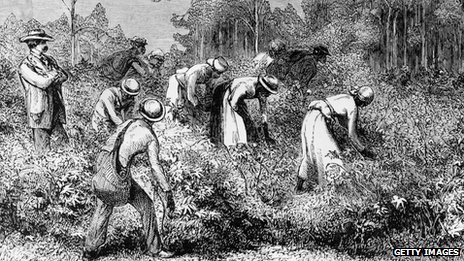
_65344344_cottonpickers1875_getty

The issue of slavery even divided the ante-bellum United States on what the words freedom and liberty meant. The dispute can be seen in the writings of many before the war, with each side emphasizing their particular understanding of these concepts. In the South, freedom was reserved for those who occupied the positions of economic power; slavery was key to that from not only an economic point of view but as a social philosophy. The concept of human equality, which was so much a part of the Declaration of Independence was downplayed George Fitzhugh, a planter and slave owner in eastern Virginia commented that that concept “is practically impossible, and directly conflicts with all government, all separate property, and all social existence.” [6] Fitzhugh was very critical of the founder’s philosophy of natural liberty and human equality which he found repugnant and error ridden. He wrote:

“We must combat the doctrines of natural liberty and human equality, and the social contract as taught by Locke and the American sages of 1776. Under the spell of Locke and the Enlightenment, Jefferson and other misguided patriots ruined the splendid political edifice they erected by espousing dangerous abstractions – the crazy notions of liberty and equality that they wrote into the Declaration of Independence and the Virginia Bill of Rights. No wonder the abolitionists loved to quote the Declaration of Independence! Its precepts are wholly at war with slavery and equally at war with all government, all subordination, all order. It is full if mendacity and error. Consider its verbose, newborn, false and unmeaning preamble…. There is, finally, no such thing as inalienable rights. Life and liberty are not inalienable…. Jefferson in sum, was the architect of ruin, the inaugurator of anarchy. As his Declaration of Independence Stands, it deserves the appropriate epithets which Major Lee somewhere applies to the thought of Mr. Jefferson, it is “exuberantly false, and absurdly fallacious.”   ” [7]

The political philosophy such as Fitzhugh’s, which was quite common in the South, and was buttressed by a profound religious belief that it was the South’s God ordained mission to maintain and expand slavery. One Methodist preacher in his justification of slavery wrote, “God as he is infinitely wise, just and holy never could authorize the practice of moral evil. But God has authorized the practice of slavery, not only by bare permission of his providence, but by the express permission of his word.” [8] Buttressed by such scriptural arguments Southerners increasingly felt that they were the only people following God. The Northern abolitionists as well as those who advocated for the concept of human equality and free labor were heretics to be damned. As such the “South’s ideological isolation within an increasingly antislavery world was not a stigma or a source of guilt but a badge of righteousness and a foundation for national identity and pride.” [9]

Speaking of the necessity for slavery, as well as limitations on the equality of human beings no matter what their race or sex; Fitzhugh penned words that explained that human relationships were not to be seen in terms of individual liberty, “but in relations of strict domination and subordination. Successful societies were those whose members acknowledged their places within that hierarchy.” [10]

Fitzhugh was quite caustic when he discussed the real implications of his philosophy:

“We conclude that about nineteen out of twenty individuals have “a natural and inalienable right” to be taken care of and protected, to have guardians, trustees, husbands or masters; in other words they have a natural and inalienable right to be slaves. The one in twenty are clearly born or educated in some way fitted for command and liberty.” [11]

Fitzhugh’s chilling conclusion was summarized in the words “Liberty for the few – slavery in every form, for the mass.” [12]

But many Southerners, including many poor whites, especially the Yeoman farmers who were the backbone of the Southern populace did not see or understand the limitations that were placed on their own liberty by the slavery system and instead saw slavery as the guarantee of their economic freedom. John C. Calhoun said to the Senate in 1848 that “With us, the two great divisions of society are not the rich and poor, but white and black; and all of the former, the poor as well as the rich, belong to the upper class, and are respected and treated as equals.” [13] Calhoun’s racial distinction is important if we are to understand why poor whites would fight and die for a social and economic idea that did not benefit them or their families.

But it was Abraham Lincoln, who cut to the heart of the matter when he noted the difference between his understanding of liberty and that of Calhoun and others in the South who defended slavery and the privileges of the Southern oligarchs:

“We all declare for liberty” but “in using the same word we do not all mean the same thing. With some the word liberty may mean for each man to do as he pleases with himself and the product of his labor; while with others the same word may mean for some men to do as they please with other men and the product of other men’s labor.” [14]

The growing economic disparity between the Slave and Free states became more about the expansion of slavery in federal territories as disunion and war approached; for a number of often competing reasons. These differences, amplified by the issue of slavery led to the substitution of stereotypes of each other and had the “effect of changing men’s attitudes toward the disagreements which are always certain to arise in politics: ordinary, resolvable disputes were converted into questions of principle, involving rigid, unnegotiable dogma.” [15] The Charleston Mercury noted in 1858 “on the subject of slavery…the North and the South…are not only two peoples, but they are rival, hostile peoples.” [16]

This was driven both by the South’s insistence on both maintaining slavery where it was already legal and expanding it into new territories which was set against the vocal abolitionist movement. But Southern exponents of expanding slavery were fighting an even more powerful enemy than the abolitionists, who despite their vocal protests were not yet in a position to influence policy. They were now fighting Northern industrialists who were not as idealistic as the abolitionists who were much more concerned with “economic policy designed to secure Northern domination of Western lands than the initial step in a broad plan to end slavery.” [17]

This competition between the regions not only affected politics, it affected religion and culture. In the South it produced a growing culture of victimhood, which was manifest in the words of Robert Toombs who authored Georgia’s declaration of causes for secession:

“For twenty years past, the Abolitionists and their allies in the Northern states, have been engaged in constant efforts to subvert our institutions, and to excite insurrection and servile war among us…” whose “avowed purpose is to subject our society, subject us, not only to the loss of our property but the destruction of ourselves, our wives and our children, and the dissolution of our homes, our altars, and our firesides.” [18]

As the social, economic, cultural and religious differences between the two regions grew wider and the people of the South became ever more closed off from the North. “More than other Americans, Southerners developed a sectional identity outside the national mainstream. The Southern life style tended to contradict the national norm in ways that life styles of other sections did not.” [19]

The complex relationship of Southern society where “Southern bodies social, economic, intellectual, and political were decidedly commingled” [20] came to embrace the need for slavery and its importance to Southern society. This occurred despite the fact that the system did not benefit poor whites in the South and actually harmed them economically. The Southern: “system of subordination reached out still further to require a certain kind of society, one in which certain questions were not publically discussed. It must give blacks no hope of cultivating dissention among the whites. It must commit non slaveholders to the unquestioning support of racial subordination…. In short, the South became increasingly a closed society, distrustful of isms from outside and unsympathetic to dissenters. Such were the pervasive consequences of giving top priority to the maintenance of a system of racial subordination.” [21]

A number of slave revolts, and planned slave revolts which were caught before they could erupt serve to heighten the fear and paranoia of Southerners living in the “Black belts” where slaves outnumbered whites by great margins. “In thickly enslaved areas, fancied dangers united white classes and sexes. Whites in black belts shared horror images about freed blacks as rioters, rapists, arsonists, and cannibals. The whites characteristically thought that using slavery to control alleged barbarians meant saving civilization.” [22]

Even before the abolitionist movement took any recognizable form in the North, “with an intensity that escalated through the Civil War, planters declared war on all open criticism of the peculiar institution.” [23] As Northern abolitionists like William Lloyd Garrison and his newspaper The Liberator grew in its distribution and began to appear in the South various elected officials throughout the South “suppressed antislavery books, newspapers, lectures, and sermons and strove generally to deny critics of bondage access to any public forum.[24] Despite this resistance, abolitionists continued to use the U.S. Mail service to send their literature south provoking even more drastic action from Southern legislators.

garrison by jocelyn 1833

William Lloyd Garrison 

But Garrison and the more radical abolitionists did not have a great following even in the North, most Northerners who even leaned toward abolition were supporters of a very gradual emancipation and not supportive of the immediate emancipation demanded by Garrison and his allies. In fact in the North, Garrison and his followers were not popular, they were “a small and often despised group.” [25] This was born out by facts that Garrison understood all too well, which made him even more uncompromising in his message. “In 1840, support for Garrison extremism peaked at around 2 percent of the northern voting population. The other 98 percent of northern citizens considered immediate abolition to be too extreme to be American, too problack to be tolerable, too keen on seizing property to be capitalistic, and too antisouthern to be safe for the Union.” [26] Garrison despised his northern opponents and wrote that he found among them “contempt more bitter, opposition more active, detraction more relentless, prejudice more stubborn, and apathy more frozen, than among slave owners themselves.” [27] Opponents broke up his meetings and on one occasion paraded Garrison “through the streets of Boston with a rope around his neck.” [28]

But Southerners, particularly those in the black belts were too outraged by Garrison and his follower’s incendiary words and “almost pornographic diatribes,” which they felt had assaulted their “self-respect and sense of honor.” [29] In response to the proliferation of abolitionist literature in the South which was being sent through the mail, Senator John C. Calhoun proposed that Congress pass a law to prosecute “any postmaster who would “knowingly receive or put into the mail any pamphlet, newspaper, handbill, or any printed, written, or pictorial representation touching the subject of slavery.” [30] Calhoun was not alone as other members of Congress as well as state legislatures worked to restrict the import of what they considered subversive and dangerous literature. The condescending attitude of the radical abolitionists provoked an “emotional wildfire” [31] in the South, which united slave owners and poor whites in the heavily black slave majority regions and served to increase their fear and loathing of Yankees who they believed wanted to destroy them and their way of life. Had they really understood just how united much of the North was with them they may not have pushed as hard to force Northern allies to accept laws that eventually offended the sensibilities of even non-abolitionists Northerners.

attention-southern-men

But Southern fears of real and imagined slave revolts, and hatred of radicals like Garrison brought about a host of new problems as Southerners attempted to crush the rights of free speech in the north and to blot out any mention of slavery in the House of Representatives. Beginning in 1836 the House of Representatives, led by Southern members of Congress passed a “gag rule” for its members. The “Gag Rule” “banned all petitions, memorials, resolutions, propositions, or papers related in any way or to any extent whatever to the subject of slavery.” [32] Former President John Quincy Adams continually challenged the gag-rule beginning in 1842, as did a number of others. The pressure was such that finally in 1844 the House voted to rescind it.

anti-slavery-meetings

However, Southern politicians were unhappy with the recension of the Gag Rule and “began to spout demands that the federal government and the Northern states issue assurances that the abolitionists would never be allowed to tamper with what John Calhoun had described as the South’s “peculiar domestic institution.” [33] As tensions grew between the regions; the issue of slavery more than any other issue, “transformed political action from a process of accommodation to a mode of combat.” [34]

Around the same time as the gag rule was played out in Congress the Supreme Court had ruled that the Federal government alone “had jurisdiction where escaped slaves were concerned” which resulted in several states enacting “personal liberty laws” to “forbid their own elected officials from those pursuing fugitives.” Southern politicians at the federal and state levels reacted strongly to these moves, which they believed to be an assault on their institutions and their rights to their human property. Virginia legislators said these laws were a “disgusting and revolting exhibition of faithless and unconstitutional legislation.” [35]

The issue of slavery shaped political debate and “structured and polarized many random, unoriented points of conflict on which sectional interest diverged.” [36] As the divide grew leaders and people in both the North and the South began to react to the most distorted images of each other imaginable- “the North to an image of a southern world of lascivious and sadistic slave drivers; the South to the image of a northern world of cunning Yankee traders and radical abolitionists plotting slave insurrections.” [37]

To be continued…

Notes

[1] Potter, David M. The Impending Crisis: America before the Civil War 1848-1861 completed and edited by Don E. Fehrenbacher Harper Collins Publishers, New York 1976 p.41

[2] Ibid. Potter The Impending Crisis p.41

[3] Burns, Ken A Conflict’s Acoustic Shadows in The New York Times Disunion: Modern Historians Revisit and Reconsider the Civil War from Lincoln’s Election to the Emancipation Proclamation Black Dog and Leventhal Publishing, New York 2013 p.102

[4] Ibid. Potter The Impending Crisis p.42

[5] Ibid. Potter The Impending Crisis p.42

[6] Ibid. Levine Half Slave and Half Free: The Roots of the Civil War Revised Edition p.140

[7] Fitzhugh, George. New Haven Lecture 1855, in The Approaching Fury: Voices From the Storm, 1820-1861 Stephen B. Oates, Editor, University of Nebraska Press, Lincoln and London 1997 p.135

[8] Ibid. Daly When Slavery Was Called Freedom: Evangelicalism, Proslavery, and the Causes of the Civil War pp.63-64

[9] Ibid. Faust, Drew The Creation of Confederate Nationalism: Ideology and Identity in the Civil War South p.61

[10] Ibid. Levin Half Slave and Half Free p.140

[11] Ibid. Levin Half Slave and Half Free p.140

[12] Ibid. Levin Half Slave and Half Free p.141

[13] McPherson, James M. Drawn With the Sword: Reflections on the American Civil War Oxford University Press, Oxford and New York 1996 p.50

[14] Ibid. Levin Half Slave and Half Free p.122

[15] Ibid. Potter The Impending Crisis p.43

[16] Ibid. McPherson Drawn With the Sword p.16

[17] Egnal, Marc Clash of Extremes: The Economic Origins of the Civil War Hill and Wang a division of Farrar, Straus and Giroux New York 2009 p.6

[18] Dew, Charles B. Apostles of Disunion: Southern Secession Commissioners and the Causes of the Civil War University Press of Virginia, Charlottesville and London 2001 p.12

[19] Thomas, Emory The Confederate Nation 1861-1865 Harper Perennial, New York and London 1979 p.5

[20] Ibid. Thomas The Confederate Nation p.5

[21] Ibid. Potter The Impending Crisis pp.457-458

[22] Freehling, William W. The South vs. The South: How Anti-Confederate Southerners Shaped the Course of the Civil War Oxford University Press, Oxford and New York 2001 p.20

[23] Ibid. Levine Half Slave and Half Free p.166

[24] Ibid. Levine Half Slave and Half Free p.166

[25] Ibid. Goldfield America Aflame: How the Civil War Created a Nation p.27

[26] Ibid. Freehling The South vs. The South p. 34

[27] Ibid. Varon Disunion! The Coming of the American Civil War 1789-1858 pp.70-71

[28] Ibid. Goldfield America Aflame p.27

[29] Ibid. Freehling The South vs. The South p.22

[30] Ibid. Guelzo Fateful Lightning pp.50-51

[31] Ibid. Freehling The South vs. The South p.22

[32] Ibid. Levine Half Slave and Half Free pp.169-170

[33] Ibid. Guelzo Fateful Lightning pp.51-52

[34] Ibid. Potter The Impending Crisis p.43

[35] Ibid. Levine Half Slave and Half Free pp.169-170

[36] Ibid. Potter The Impending Crisis p.43

[37] Ibid. Potter The Impending Crisis p.43

3 Comments

Filed under civil rights, civil war, History, Political Commentary

Human Beings as Property Part 1: American Slavery

Friends of Padre Steve’s World,

I am going to be posting a number of articles from my various texts dealing with the American Civil War era dealing with topics that some would want to forget, but are very important if we want to fully appreciate the struggle of African-Americans for equality. One of these is the distinctly American version of slavery that arose in the American South. That is the subject of today and tomorrow’s articles. More articles will follow in the next couple of weeks.

Have a great day,

Peace

Padre Steve+

slavescars

The Slave Economy and the Divide between North and South

“Thy bond-men and thy bond-maids which thou shalt have, shall be of the heathen that are round about you: of them you shall buy bond-men and bond-maids. Moreover, of the children of the strangers that do sojourn among you, of them he shall buy, and of their families that are with you, which they begat in your land. And they shall be your possession. And you shall take them as an inheritance for your children after you, they shall be your bond-men forever.” Leviticus 25:44-46

thewanderer_lastslaveship

Early Slavery in the Americas and the African Lave Trade

If we are to really understand the Civil War we have to understand the ideological clash between Abolitionists in the North, and Southern proponents of slavery. Slavery began very early in the history of the American colonies and though the British and the Dutch were the largest traders of slaves in those early days, the first American slave ship made its first voyage to bring Africans to the new world. Historian Howard Zinn noted, “By 1800, 10 to 15 million blacks had been transported to the Americas, representing perhaps one-third of those originally seized in Africa. It is roughly estimated that Africa lost 50 million human beings to death and slavery in those centuries we call the beginnings of modern Western civilization, at the hands of slave traders and plantation owners in Western Europe and America, the countries deemed the most advanced in the world.” [1]

Slavery in the Americas grew out of the economic need of planters to for laborers on the vast plantations of the new world as “the number of arriving whites, whether free or indentured servants (under four to seven year contract) was not enough to meet the demand of the plantations.” [2] This need and use of slaves was significantly different than previous forms of slavery in Africa, where slavery was one of a number of forms of labor, and where slaves “worked within the households of their owners and had well-defined rights, such as possessing property and marrying free persons. It was not uncommon for slaves in Africa to acquire their freedom.” [3] In fact the plantation form of slavery practiced in the Americas differed radically from traditional forms of African slavery and was characterized by “the frenzy for limitless profit that comes from capitalistic agriculture; the reduction of the slave to less than human status by the use of race hatred, with that relentless clarity based on color, where white was master, black was slave.” [4]

However in the Americas slavery took on a new form, that of the plantation. The plantation system allowed owners to amass “large concentrations of laborers under the control of a single owner produced goods – sugar, tobacco, rice, and cotton – for the free market.” [5] Beginning with the Spanish and the Portuguese in the early 1500s, the African slave trade became a major part of the world economy, and “slave labor played an indispensable part in its rapid growth” [6] not only in world economy, but in the economy of the English colonies in North America and the new American nation which paradoxically was founded and supposed dedicated to liberty and equality. The “Atlantic slave trade, which flourished from 1500 into the nineteenth century was a regularized business in which European merchants, African traders, and American planters engaged in a highly complex and profitable bargaining in human lives.” [7]

It was economic gain that prompted the growth in slavery, and for which slaves were essential for profit. As such, the “first mass consumer goods in international trade were produced by slaves – sugar, rice, coffee, and tobacco. The profits from slavery stimulated the rise of British ports such as Liverpool and Bristol, and the growth of banking, shipbuilding, and insurance, and helped to finance the early industrial revolution. The centrality of slavery to the British empire encouraged an ever-closer identification of freedom with whites and slavery with blacks.” [8]

full_1361408284slave.market

The Constitution, Slavery and Disunion

When the United State won its independence the founders of the new nation had to deal with the already existing institution of slavery. It also had to deal with the threat to the Union that the institution and the real possibility of disunion, something that almost all of them feared more than anything. Slavery was an institution that even some powerful politicians who owned slaves were uncomfortable; Patrick Henry noted in 1773 that “to do so was “repugnant to humanity” and “inconsistent with the Bible,” while George Washington wrote in 1786 “There is not a man living…who wishes more sincerely than I do, to see a plan for the gradual abolition of it.” [9]

Slavery was an issue that divided the newly independent states as they gathered for the Constitutional Convention in 1787 and Washington confided to a friend before the convention that “he could “foresee no greater evil than disunion,” and now the “mere discussion of slavery” was poisoning the atmosphere.” [10] James Madison was one of the first to recognize this and noted that “the states differed “primarily from the effects of their having or not having slaves.” [11] The issue came to a head around how the population of the states would be represented in the new government and how to balance the power between the federal government and the various state governments. To do this the founders divided Congress into two houses, the House of Representatives who were directly elected by the voters of each state with the population of the state determining the number of representative each would have; and in the Senate, whose members were elected by the state legislatures, each state would have two members regardless of the size of its population. The division of the legislature in the Constitution “enabled the individual states to retain a large measure of their jealously guarded autonomy.” [12] Eligible voters in each state elected the President by electing “electors” for the Electoral College, and each state was given an amount of electors equal to its representation in the Senate and the House of Representatives.

The heart of the matter came to the issue of what people would be counted in each state. The Northern states wanted to base the number on each state’s white population. The Southern states wanted to “swell their power by counting both white citizens and black non-citizens.” [13] Doing so would give Southern States more power in the House of Representatives which, when coupled with the equality each state had in the Senate, gave the less populous Southern disproportionate power in the national government. A representative from New Jersey, Gouverneur Morris believed that if slaves “were human enough to boost the representation of the Southern States…they should be treated as persons and not property in the South.” [14] There was debate on this issue and to bridge the sectional divide the Convention passed what is now known as the three-fifths compromise.

This measure had profound results. It stipulated that the size of a state’s congressional delegation and its Electoral College electors; and the state’s tax burden would be determined by their population. The population was determined by counting free-persons as a full person, and then adding the words “three-fifths of all other persons.” Of course the “other persons” were slaves, but the language was carefully crafted to avoid the use of the terms slave or slavery to make the document acceptable to Northern delegations. The compromise was the first of many made by the Northern states to appease the South and maintain national unity. The South got less than it wanted, as its delegates wanted slaves to count as a whole person for population sake without considering them as such. When all was said and done in 1790 “southern states, possessing around 40% of the nations’ white population, controlled around 47% of the House and Electoral College.” [15] Gouverneur Morris understood that the compromise would exaggerate Southern power and predicted that “the three-fifths clause’s real legacy would be to give slaveholders majority control over electoral politics.” [16] However, Morris’s warning was unheeded for decades by many in the North, though through electoral experience Northern leaders began to realize what the compromise had wrought but could not change the process without amending the Constitution.

Morris was correct. During the election of 1802 in the Electoral College the “three-fifths clause gave the Southerners 14 extra electors, the Republicans’ Thomas Jefferson defeated the Federalists’ John Adams, 73-65. Jefferson swept South’s extra electors 12-2. If no three-fifths clause had existed and House apportionment been based strictly on white numbers, Adams would have likely squeaked by, 63-61.” [17] The compromise had major impacts on the Electoral College. In the first 36 years of the Republic, only one President came from the North, John Adams. The rest, Washington, Jefferson, Madison and Monroe were all Virginian’s, and all were slaveholders.

Apart from John Quincy Adams who served from 1825-1829 every other President until Abraham Lincoln was either a Southern slaveholder, or a Northern supporter of the South’s position on the preservation and or expansion of slavery. In fact the South dominated all branches of the Federal government from 1789-1861, often with the cooperation of Northern political and business interests. James McPherson wrote, “A Southern slaveholder had been president of the United States two-thirds of the years between 1789 and 1861, and two-thirds of the Speakers of the House and president pro tem of the Senate had also been Southerners. Twenty of the thirty-five Supreme Court justices during that period had been from slave states, which always had a majority on the court before 1861.” [18] Those who believed in the South’s moral, religious, and cultural supremacy over the North often used the Southern domination of American politics as proof of that superiority.

Two other compromises were made by the delegates to the convention. The first dealt with ending the African slave trade. This was contentious and in response to the threat of ending the trade the delegates from South Carolina, John Rutledge and Charles Cotesworth Pinckney insisted that “South Carolina could not join the proposed Union if the slave trade was prohibited.” [19] The compromise allowed the African slave trade to remain legal until 1808 unless Congress voted to allow it to continue. However, this was the first of many threats by Southern leaders and states to threaten disunion over the issue of slavery. A final compromise required states to “extradite and deliver any fugitive from service to his or her master and state of origin.” [20] The wording of the law was purposely vague and could include indentured servants, but the real target was escaped slaves.

The early compromises set the stage for future compromises, in large part because Federalist politicians preferred compromise over disunion, and their fear was that “failure to compromise would bring disunion” [21] and with it disaster. Thus the convention approved the compromises and the states, even Northern states which had abolished or were on the way to abolishing slavery ratified it.

o-SLAVERY-facebook

Slavery in the Early Years of the United States

Slavery expanded in the American colonies and continued to do so after American independence despite the fact that a number of prominent slaveholders including George Washington voluntarily emancipated their slaves in the 1780s and 1790s. In large part this was due to fact that the United States “purposely built a weak central state, dispersing power to govern from the center to the constituent (some would have said still sovereign) parts.” [22] That being said the in the new Constitution the founders ensured that the central government was far stronger than the attempt made in the initial Confederation of States in matters of tariffs, taxes and laws to protect bondholders, slaveowners, and land speculators. In this government the land owners of the Southern states, as well as the merchants of the North held the bulk of the economic, political and social power. Significantly, “most of the makers of the Constitution had some direct interest in establishing a strong federal government: the manufacturers needed protective tariffs; the moneylenders wanted to stop the use of paper money to pay off debts; the land speculators wanted protection as they invaded Indian lands; slaveowners needed federal security against slave revolts and runaways; bondholders wanted a government able to raise money by nationwide taxation, to pay off those bonds.” [23] The Constitution ensured that the Federal Government was strong enough to protect those interests, but not strong enough to encroach on the powers granted to the states, especially the powers of slave states.

The conflict between supporters of slavery and those who opposed it on either humanitarian, religious or political-ideological grounds would become more of a source of even conflict when slavery was give a boost by Eli Whitney’s invention of the Cotton Gin. This machine made the production of cotton and its export an even more profitable enterprise requiring more slaves to meet the expanding demand and it was not something that those who believed that slavery would expire of its own accord expected. Thomas Jefferson wrote in 1805 that in regard to slavery that “interest is really going over to the side of morality. The value of the slave is every day lessening; his burden on his master dayly increasing. Interest is therefore preparing for the disposition to be just.” [24] Of course Jefferson, who owned over 200 slaves and had built much of his political base among Virginia planters was wrong, and despite the misgivings that he expresses in some of his letters and papers, including the first draft of the Declaration of Independence, he never took the lead or a public stand on the abolition of slavery.

The difference made by the cotton gin was starling, it enabled greater production and increased the need for slaves, and with the end of the legal African slave trade in 1808 the price of slaves already in the United States went up considerably, making the interstate trafficking of slaves much more profitable. In 1790 “a thousand tons of cotton were being produced every year in the South. By 1860, it was a million tons. In the same period, 500,000 slaves grew to 4 million.” [25] This enriched Northerners as well, “Northern ships carried cotton to New York and Europe, northern bankers and merchants financed the cotton crop, northern companies insured it, and northern factories turned cotton into textiles. The “free states” had abolished slavery, but they remained intimately linked to the peculiar institution.” [26] Thus the institution of slavery’s tentacles reached out to much of America and with the threat of slave rebellions in the South which could upset the economic status quo the nation “developed a network of controls in the southern states, backed by laws, courts, armed forces, and race prejudice of the nation’s political leaders.” [27]

But during the early nineteenth century slavery was on the decline in the rest of the Americas as the Spanish, Portuguese and French lost most of their American possessions, many which became independent and abolished slavery, in each case for the newly liberated countries in Latin America and South America, as well as the ending of serfdom in Europe. Likewise Britain emancipated its slaves in the 1830s and the slaves in its colonies and most countries, even the United States banned the African slave trade. This would lead to increasing calls for the abolition of slavery in the United States and the formation of abolitionist societies, newspapers and stepped up efforts to help slaves escape their bonds and with the advent of a small but vocal abolitionist movement there was a movement, particularly in religious circles to justify and defend the peculiar institution.

To be continued…

Notes

[1] Ibid. Zinn A People’s History of the United States p.29

[2] Ibid. Zinn A People’s History of the United States p.32

[3] Foner, Eric Forever Free: The Story of Emancipation and Reconstruction Vintage Books a Division of Random House, New York 2005 p.6

[4] Ibid. Zinn A People’s History of the United States p.28

[5] Ibid. Foner Forever Free p.6

[6] Foner, Eric A Short History of Reconstruction Harper and Row, New York 1990 p.1

[7] Ibid. Foner Forever Free pp.6-7

[8] Ibid. Foner Forever Free p.7

[9] Ibid. Levine Half Slave and Half Free: The Roots of the Civil War Revised Edition p.5

[10] Ibid. Varon Disunion! The Coming of the American Civil War 1789-1858 p.24

[11] Ibid. Varon Disunion! The Coming of the American Civil War 1789-1858 p.22

[12] Ibid. Guelzo Fateful Lightning p.7

[13] Freehling, William W. The Road to Disunion Volume One: Secessionists at Bay Oxford University Press, Oxford and New York 1990 p.146

[14] Ibid. Varon Disunion! The Coming of the American Civil War 1789-1858 p.23

[15] Ibid. Freehling The Road to Disunion Volume One: Secessionists at Bay p.147

[16] Ibid. Varon Disunion! The Coming of the American Civil War 1789-1858 p.23

[17] Ibid. Freehling The Road to Disunion Volume One: Secessionists at Bay p.147

[18] McPherson, James The War that Forged a Nation: Why the Civil War Still Matters Oxford University Press, Oxford and New York 2015 p.7

[19] Ibid. Varon Disunion! The Coming of the American Civil War 1789-1858 p.23

[20] Ibid. Varon Disunion! The Coming of the American Civil War 1789-1858 p.24

[21] Ibid. Varon Disunion! The Coming of the American Civil War 1789-1858 p.24

[22] McCurry, Stephanie Confederate Reckoning: Power and Politics in the Civil War South Harvard University Press, Cambridge and London 2010 p.220

[23] Ibid. Zinn A People’s History of the United States pp.90-91

[24] Ibid. Levine Half Slave and Half Free: The Roots of the Civil War Revised Edition p.8

[25] Ibid. Zinn A People’s History of the United States p.171

[26] Ibid. Foner Forever Free p.13

[27] Ibid. Zinn A People’s History of the United States p.171

4 Comments

Filed under civil war, History, Political Commentary

Confederate Artillery Organization 1861-1865

confederate-artillery

Friends of Padre Steve’s World,

Yes, indeed, another of my articles dealing with Civil War artillery. Geeks, wonks, and buffs rejoice.

Until tomorrow,

Peace

Padre Steve+

At the beginning of the war the Confederacy hastily formed an artillery service. As in the Union army the basic unit was the battery, and these batteries were initially assigned to infantry brigades. As such, the Confederate organization had the same problems as their Union counterparts. Infantry commanders with little or no understanding in the use and deployment of their artillery frequently interfered with their artillerymen. Since the Confederates had very little field artillery to begin the war and most was concentrated in the east, Confederate tactical and organizational developments began with the Army of Northern Virginia and were later introduced to other commands.

The artillery was assigned to brigades, but Confederate divisions did have an artillery chief, however, these officers had “difficulty supervising the batteries. The brigade commanders resented the artillery chief’s intervention, and the entire system created divided authority and responsibility.” [1] Like the Army of the Potomac, the Confederates formed an artillery reserve under Brigadier General William Pendleton a graduate of West Point where he graduated a year behind Robert E. Lee and classmate of Joseph Johnston. Pendleton organized and commanded a battery at First Manassas. Joseph Johnston recognized his administrative ability, thus a personal relationship as well as “circumstance and a certain aptitude for organization give him an advancement to the post chief of artillery.” [2] When Lee took command of the army outside of Richmond Pendleton found himself busy. “With Lee’s encouragement…Pendleton, culled the unattached artillery around Richmond, with a view of transferring guns to field batteries.” [3] Lee retained Pendleton as artillery chief after the Seven Days even though his “performance in the campaign had revealed his serious shortcoming as an artillery commander,” [4] as well as in the organization of the Army’s artillery.

In June 1862 Lee had Pendleton revise the regulations governing the artillery. These regulations “centralized all batteries under a chief of artillery for each division.” [5] This was a step forward but effectiveness was undercut by the brigade commanders who had operational control once they were attached. Likewise, while the organization gave great flexibility to the artillery, the “parochialism of the division itself now became the problem. There was no mechanism to mass guns from more than one division except by drawing on the reserve.” [6]

Pendleton’s lack of ability was demonstrated at both Antietam and Chancellorsville and as artillery chief he was slow to introduce organizational changes to improve the effectiveness of the artillery. Lee treated Pendleton with deference and although he recognized Pendleton “could not compare with Alexander or a handful of other officers in the artillery in ability and execution. Lee understood that and slowly pushed Pendleton into roles of decreasing importance and responsibility.” [7] After the Seven Days, Porter Alexander wrote: “Our artillery, too, was even in worse need of reorganization. A battery was attached, or supposed to be, to every brigade of infantry. Besides these, a few batteries were held in reserve under old General Pendleton. Naturally our guns & ammunition were far inferior to the enemy’s, & this scattering of the commands made it impossible ever to mass our guns in effective numbers. For artillery fire loses effect if scattered.” [8]

WNPendelton

Brigadier General William Pendleton, CSA

One are that the Confederates advanced more rapidly than the Union was in the appointment of field grade officers in the artillery. The first Confederate Secretary of War Judah P. Benjamin, successfully urged the Confederate Provisional Congress to authorize the appointment of “officers of artillery above the rank of captain, without reference to the number of batteries under the actual command of the officers so appointed, not to exceed in number, however, one brigadier general for every eighty guns, and one major for every sixteen guns.” Additional officers of the rank of captain and first lieutenant (not to exceed eighty) were authorized in April 1862.” [9] This gave the Confederates a good sized corps of field grade artillery officers from which they would need to eventually staff artillery battalions in 1863. Among these officers were Porter Alexander, Thomas Rosser, Stapleton Crutchfield, and John Pelham.

alexander

Brigadier General Edward Porter Alexander 

During the winter of 1862-1863 Pendleton belatedly complained to Lee about the organizational weaknesses and limitations of the artillery arm of the Confederate Army of Northern Virginia. That process had begun during the summer of 1862 and Pendleton “delegated reorganization to Alexander and Col. Stapleton Crutchfield, Jackson’s chief.” [10] Alexander and Crutchfield developed “the first modern battalion system in artillery organization.” [11] Pendleton, Crutchfield, and Alexander “recommended consolidating every four batteries into a battalion, with one battery assigned to each division.” [12] The commander of the artillery battalion supporting each division became the chief of the divisional artillery. Each corps had its own senior artillery staff officer, usually a Colonel or Lieutenant Colonel, however as Alexander noted, at first the chief “was little more than the title given to the ranking battalion commander. But in battle he occupied himself principally with his own battalion.” [13] In addition to the battalions attached to each division, “each corps had two battalions, which it could employ in conjunctions with divisions for heavy, concentrated fire.” [14]

Lee approved the changes on February 16th 1863, in time for the coming spring and summer campaigns, and “completed the reorganization during the winter when he assigned a field grade officer to each battalion and reduced the artillery reserve to six batteries.” [15]

After Chancellorsville all of the batteries that had been Lee’s artillery reserve were reassigned to the various corps. Pendleton’s duties were now restricted to advising Lee on artillery matters while remaining Lee’s spiritual adviser, and unofficial enforcer of morality in the Army of Northern Virginia. While this was a great step forward to give Lee’s Corps commanders control of their artillery gave took, the reorganization took away any flexibility that Lee might need to send artillery where it was needed in the Gettysburg campaign of 1863, and Pendleton, although having no command authority interfered with the Confederate artillery preparations for Pickett’s Charge by redeploying artillery batteries that Alexander had designated for the mission and removing the artillery train to the rear without Alexander’s knowledge, thus ensuring that Alexander could not resupply his caissons or guns during that fateful attack.

The Confederate artillery organization remained the same throughout the remainder of the war, its battalion structure was very similar to the later Union organization of the artillery brigades which were assigned to divisions, despite the difference in nomenclature. The pioneering work in organizing artillery battalions and brigades that were for practical purposes assigned to the same division would be the basis of modern artillery organization and would be adopted by the European armies of Britain, France, Austria, and Prussia in the years following the war.

Notes

[1] Ibid. McKenny The Organizational History of Field Artillery 1775-2003 p.59

[2] Freeman, Douglas Southall, Lee’s Lieutenant’s a Study in Command, One volume abridgement by Stephen W Sears, Scribner, New York 1998 p.35

[3] Glatthaar, Joseph T. General Lee’s Army from Victory to Collapse The Free Press, Simon and Schuster, New York and London 2008 p.131

[4] Wert, Jeffry D. A Glorious Army: Robert E. Lee’s Triumph 1862-1863 Simon and Schuster, New York and London 2011 p.64

[5] Ibid. Hagerman The American Civil War and the Origins of Modern Warfare p.131

[6] Ibid. Hagerman The American Civil War and the Origins of Modern Warfare p.132

[7] Ibid. Glatthaar General Lee’s Army from Victory to Collapse 2008 p.340

[8] Ibid. Alexander Fighting for the Confederacy: The Personal Recollections of General Edward Porter Alexander p.104

[9] Ibid. McKenny The Organizational History of Field Artillery 1775-2003 p.61

[10] Golay, Michael. To Gettysburg and Beyond: The Parallel Lives of Joshua Lawrence Chamberlain and Edward Porter Alexander, Crown Publishers, New York 1994 p.135

[11] Ibid. Hagerman The American Civil War and the Origins of Modern Warfare p.132

[12] Ibid. Glatthaar General Lee’s Army from Victory to Collapse 2008 p.249

[13] Ibid. Alexander Fighting for the Confederacy: The Personal Recollections of General Edward Porter Alexander p.168

[14] Ibid. Golay To Gettysburg and Beyond: The Parallel Lives of Joshua Lawrence Chamberlain and Edward Porter Alexander p.249

[15] Ibid. Hagerman The American Civil War and the Origins of Modern Warfare p.132


1 Comment

Filed under civil war, History, Military

American Artillery in the Civil War: The Wilderness Campaign and Reorganization

wilderness

Friends of Padre Steve’s World,

Another in my series of rather geek-like articles on Civil War artillery.

Have a great day.

Peace

Padre Steve+

The American Civil War was a transitional time for artillery technology, organization and tactics. The organization of the artillery service of the Army of the Potomac remained as it was up until the Overland or Wilderness Campaign, although “Corps brigades were increased to eight or nine batteries.” However, “having created a sound artillery organization and proven it at Gettysburg, the Union would have little immediate use for it” [1] as the changing conditions of war in the Wilderness changed how Grant and Meade organized the artillery.

The Artillery Reserve, a throwback to Napoleonic times, which had along with the rest of the Union artillery at Gettysburg performed so brilliantly in a defensive stand with wide open fields of interlocking fire would never again have such an opportunity to wreak destruction on advancing Confederate infantry in the open. Instead it was forced into the offensive in terrain that was seldom conducive to employing massed numbers of guns. During the campaign the Artillery Reserve consisted of “two field artillery brigades of twelve batteries each, one heavy brigade, which was largely employed as a guard and construction unit, and two brigades of horse artillery, which were on duty with Major Phil Sheridan’s cavalry corps.” [2] By the time of the Wilderness Campaign the size of the Army of the Potomac’s artillery numbered 274 cannon. [3] In terms of artillery types Hunt had 154 rifled guns and 120 Napoleons in the organic components of his army, of the rifled guns the majority were the 3” Ordnance rifles as Hunt had sent most of his Parrot batteries away due to their tendency to burst and their unpopularity with their gun crews. [4] The artillery was bolster with a battery of eight 24 pound brass Coehorn mortars. These were light weapons which weighed only 164 pounds and could be carried by two men. They “were fired at an angle of 45 degrees which permitted them to hurl a shell in a very high arch to a distance of 1,200 yards at full charge.” [5]

The campaigns of 1864 forced Union army commanders to change how they employed their artillery. This came first during the Wilderness campaign where the heavily wooded terrain, poor visibility, and an enemy dug in behind earthen walls and abattis limited the artillery’s effectiveness. The fighting between enemies that could barely see what they were shooting at resulted in close range firefights between infantry with few artillery pieces in direct support. When engaged, the artillery of both sides dealt death at close range in support of infantry, on the defensive the guns were dug in to protect them and their crews from the close range fire of enemy artillery and infantry. The heavy brush limited the ability of the artillery to move off the main roads as one artilleryman noted that they could do nothing “because no horses could have pulled a gun through the brush in which the infantry were fighting.” [6] One officer described the conditions of the Wilderness as “a wrestle as blind as midnight, a gloom that made manoeuvers impractical, a jungle where regiments stumbled on each other and the enemy by turns, firing sometimes into their own ranks, and guided only by the crackling of bushes or the cheers and cries that rose from the depths around.” [7]

With his guns finding little employment “Grant order that the Artillery Reserve be returned to Washington.” [8] To achieve the reduction in the number of guns without undoing his organization, Hunt recommended that the batteries be reduced from six guns to four. This was done but Hunt lost his Artillery Reserve as Meade had those reduced batteries reassigned to each of the infantry corps and the Reserve’s commander, Colonel Henry Burton, “appointed Inspector of Artillery.” [9] However, “most of the pieces ordered away were returned for the siege of Petersburg.” [10] Grant wrote:

“The Wilderness and Spotsylvania battles convinced me that we had more artillery than could ever be brought to action at any one time. It occupied much of the road marching, and taxed the trains in bringing up forage. Artillery is very useful when it can be brought into action, but it is a burdensome where it cannot be used. Before leaving Spotsylvania, therefore, I sent back to the defenses of Washington over one hundred pieces of artillery, with horses and caissons… and still left us with more artillery than could be advantageously used.” [11]

wilderness10

During the Wilderness Campaign the Confederate artillery suffered under similar conditions to Grant’s armies. Porter Alexander noted that when his artillery arrived that Lee, “directed me to send back all the artillery with our column to Parker’s Store, as there was no possibility of using it in the woods where we would be fighting, & it would be in the way.” [12] Where they were employed on the defensive the Confederate guns gave good account of themselves. Where they were not deployed attacking Union forces found their task easier, as when Winfield Scott Hancock’s massed attack at Spotsylvania succeeded, However, when the Confederates were able to deploy their artillery Union losses could be dreadful. This was the case at Cold Harbor where Grant ordered a frontal assault on well prepared Confederate defenders who had their artillery in positions where it had advancing Union forces in a crossfire.

The siege of Petersburg changed the way artillery was employed in the east yet again. “After Petersburg, field tactics were scarcely relevant, although concentrations of fire remained essential.” [13]

Many commentators after the war decried the effectiveness of the artillery by claiming that less than ten percent of casualties were caused by it. As J.B.A. Bailey notes, “This figure seems highly improbable, since the wound inflicted by a canister ball, which was the artillery’s most lethal projectile, would have been impossible to distinguish from that inflicted by a musket ball.” [14] However, even more important than the number of casualties inflicted on the enemy, but it was the shock power and deterrent effect that artillery had on the enemy, especially on the defensive. Colonel Jennings Wise, who chronicled the history of Lee’s artillery wrote:

“We often hear the sneering criticism that at such and such a battle but 1 or 2 per cent of the enemy’s loss was due to fire of the artillery. Any such test entirely erroneous. Not only do the guns exert a tremendous moral effect in support of their infantry, and adverse to the enemy, but they do far more. They often preclude heavy damage from the enemy by preventing him from essaying an assault against the positions the guns occupy. Then, again, by forcing them to seek cover, they eliminate their antagonisms to that extent… Let us hear no more of artillery efficiency as measured by the number of its victims.” [15]

Descriptions of the effect of the Union artillery on Pickett’s charge at Gettysburg bear this out. “The Confederate losses mounted at an alarming rate. The psychological impact of artillery casualties was great, for the big guns not only killed but mangled bodies, tore them apart, or disintegrated them.” [16] A survivor wrote his wife days later: “If the crash of worlds and all things combustible had been coming in collision with each other, it could not have surpassed it seemingly. To me it was like the “Magazine of Vengeance” blown up.” [17] A soldier of Kemper’s brigade recalled that “The atmosphere was rent and broken by the rust and crash of projectiles…The sun, but a few minutes before so brilliant, was now darkened. Through this smoky darkness came the missiles of death…the scene beggars description…Many a fellow thought his time had come…Great big, stout hearted men prayed, loudly too….” [18] Colonel Joseph Mayo of the 3rd Virginia regiment was heavily hit. One of its survivors wrote: “when the line rose up to charge…it appeared that as many were left dead and wounded as got up.” [19]

Notes 

[1] Ibid, Bailey Field Artillery and Firepower p.203

[2] Ibid. Nesmith Stagnation and Change in Military Thought: The Evolution of American Field Artillery Doctrine, 1861-1905 – An Example p.35

[3] Ibid. McKenny The Organizational History of Field Artillery 1775-2003 p.68

[4] Ibid. Longacre The Man Behind the Guns: A Military Biography of General Henry J. Hunt, Chief of Artillery, Army of the Potomac pp.190-191

[5] Ibid. Nesmith Stagnation and Change in Military Thought: The Evolution of American Field Artillery Doctrine, 1861-1905 – An Example p.36

[6] Ibid. Longacre The Man Behind the Guns: A Military Biography of General Henry J. Hunt, Chief of Artillery, Army of the Potomac p.194

[7] Ibid. Fuller Grant and Lee: A Study in Personality and Generalship  p.214

[8] Ibid. Nesmith Stagnation and Change in Military Thought: The Evolution of American Field Artillery Doctrine, 1861-1905 – An Example p.36

[9] Lyman, Theodore, Meade’s Army: The Private Notebooks of Lt. Col. Theodore Lyman, edited by David W. Lowe, The Kent State University Press, Kent, Oho 2007 p.162

[10] Ibid. McKenny The Organizational History of Field Artillery 1775-2003 p.67

[11] Grant, Ulysses S. Personal Memoirs of U.S. Grant Volume 2 Charles L. Webster and Company, New York 1886 p.241

[12] Ibid. Alexander Fighting for the Confederacy: The Personal Recollections of General Edward Porter Alexander p.359

[13] Ibid, Bailey Field Artillery and Firepower p.204

[14] Ibid, Bailey Field Artillery and Firepower pp.196-197

[15] Ibid. Griffith, Battle Tactics of the Civil War p.167

[16]Hess, Earl J. Picketts Charge: The Last Attack at Gettysburg University of North Carolina Press, Chapel Hill and London 2001 p.153

[17] Wert, Jeffery D. Gettysburg Day Three A Touchstone Book, New York 2001 p.181

[18] Dowdy, Clifford. Lee and His Men at Gettysburg: The Death of a Nation Skyhorse Publishing, New York 1986, originally published as Death of a Nation Knopf, New York 1958 p.294

[19] Ibid. Wert Gettysburg Day Three p.179

Leave a comment

Filed under civil war, History, Military

American Artillery, Doctrine, and Tactics from the Mexican War to the Wilderness

Friends of Padre Steve’s World,

I continue to work on my Civil War books. Today an excerpt dealing with American artillery during the Civil War. This is the follow-on article to the one that I posted last week,

Have a great day,

Peace

Padre Steve+

fig20

American artillery doctrine subordinated the artillery to the infantry. Doctrine dictated that on the offensive “was for about one-third of the guns to occupy the enemy’s artillery and two-thirds to fire on the infantry and cavalry. Jomini liked the concentrated offensive cannonade where a breach of the line was to be attempted.” [1] But being such a small service, it was difficult for Americans to actually implement Napoleonic practices, or organization as the organization itself “was rooted in pre-Napoleonic practice, operating as uncoordinated batteries.” [2]

American artillerymen of the Mexican War could not match the massive firepower and concentration of Napoleon’s army. Instead it utilized mobile tactics, which gave it “the opportunity to maneuver in open country to support the infantry.” [3] During the war the actions of the highly mobile light batteries proved decisive, as did the spirit of their officers and soldiers. The Americans may not have had the organization of Napoleon, but “the audacious spirit was there.[4] In a number of engagements American batteries employed the artillery rush, even gaining the admiration of Mahan, a noted exponent of the defensive. Among the leaders of the artillery at the Battle of Buena Vista were Captain Braxton Bragg, and Lieutenants John Reynolds and George Thomas, all of who would go on to fame in the Civil War. During a moment when Mexican forces threatened to overwhelm the American line, Bragg’s battery arrived:

“Without support, Bragg whirled his guns into battery only a few rods from the enemy…. The Mississippi Rifles and Lane’s Hoosiers also double-quicked from the rear of the plateau. From then on it was a storybook finish for the Americans, and artillery made the difference. Seventeen guns swept the Mexicans with grape and canister…. Reynolds, Thomas, and the others stood to the work with their captains until 5 o’clock. Santa Ana was through…” [5]

At Casa Mata outside of Mexico City, Americans found their flank threatened by Mexican cavalry. Captain James Hunter and Lieutenant Henry Hunt observed the situation and “Without awaiting orders they rushed their guns to the threatened sector…  With Duncan directing them, all stood their posts long enough to spray the front ranks of mounted Mexicans with canister, the shotgun effect of which shredded the half-formed attack columns, dissolving all alignment and sending the lancers scrambling rearward in chaos…” [6] As a result these and other similar instances the artillery came out of the war with a sterling reputation and recognition of their gallant spirit. John Gibbon reflected such a spirit when he wrote: “Batteries derive all their value from the courage and skill of the gunners; from their constancy and devotion on difficult marches; from the quickness and capacity of the officers; and especially from the good condition and vigor of the teams, without which nothing can be undertaken.” [7]

At the beginning of the war U.S. Army doctrine recommended placing batteries equally across the line and concentrating them as needed. The last manual on artillery tactics Instruction for Field Artillery, published in 1859 retained much of its pre-Mexican War content and the doctrine in it provided that artillery was to “be organized at the regiment and brigade level with no reserve.” [8] Nonetheless some artillery officers discussed the possibilities of concentration, Grand Batteries, and the artillery reserve, no changes in organization occurred before the war. However, these discussions were all theoretical, as practical experience of these officers was limited to the small number of weapons employed in the Mexican War, and the “immediate problem was the organization of an unaccustomed mass of artillery.” [9] The Artillerist’s Manual, a highly technical treatise on gunnery was written by Captain John Gibbon in 1859 while he was serving at West Point and used by artillerymen of both sides during the war.  In  Gibbon described the principle object of the artillery was to, “sustain the troops in the attack and defense, to facilitate their movements and to oppose the enemy’s; to destroy his forces as well as the obstacles that protect them; and to keep up the combat until the opportunity for a decisive blow.”  [10]

Since the United States Army traditionally drawn their doctrine from the French this meant going back to the Napoleonic model the foundational unit of which was the battery. The field artillery batteries were classed as either foot artillery or horse artillery. The horse artillery accompanied the cavalry and all gun crews went into battle mounted as cavalrymen. The soldiers of the foot artillery either rode with the guns or walked. The battery was the basic unit for American artillery and at the “start of the war the artillery of both sides was split into self-contained batteries, and each battery allocated to a particular brigade, regiment or even battalion of infantry.” [11]

At the battery level Union artillery was organized by type into six-gun batteries. Confederate artillery units were organized into four or six-gun batteries in which the guns were often of mixed type. This often led to supply problems for Confederate gunners and inconsistent rates of fire and or range. Confederate gunners also had to deal with poor quality power and explosive shells, a condition that only worsened as the war continued. The well-trained Union gunners had better quality ammunition and gunpowder as well as what seemed to the Confederates to have limitless ammunition.

Each gun was manned by a seven-man crew and transported by a team of horses that towed a limber, which transported the cannon and a caisson, which transported the ammunition. The caissons would normally be stocked with four chests of ammunition. For a Napoleon “a standard chest consisted of twelve shot, twelve spherical case, four shells, and four canister rounds for a total of 112 rounds of long range ammunition.” [12] In addition to the ammunition carried in the caissons of each gun, more ammunition was carried in the corps and division supply trains.

As the war progressed the both the Union and Confederate armies reorganized their field artillery. In the North this was a particular problem due to the lack of flexibility and politics in the Army which were prejudiced against large artillery formations, despite the great numbers of batteries and artillerymen now in the army. However the Federal army had good artillerymen. The Regular Army batteries were the foundation of the artillery service. Unlike the infantry units which were overwhelmingly composed of volunteer soldiers, the artillerymen were regulars, many who had served for years in the ante-bellum army.

Since there were few billets for senior artillerymen many artillery officers volunteered or were selected to serve in the infantry to get promoted or to take advantage of their experience and seniority. One of those chose was John Reynolds who promote to Lieutenant Colonel and given orders to form an infantry regiment. Before he could get started in that work he was made a Brigadier General of Volunteers. He wrote: “I would, of course, have preferred the Artillery arm of service, but could not refuse the promotion offered me under any circumstance, much less at this time, when the Government has a right to my services in any capacity.” [13] Other artillerymen who rose to prominence outside of the branch during the war included William Tecumseh Sherman, George Meade, John Gibbon, George Thomas, Ambrose Burnside, and Abner Doubleday, and Confederates Stonewall Jackson, Braxton Bragg, Jubal Early, and A.P. Hill.

However, General Winfield Scott took action to keep a core of experienced artillery officers with the artillery. At Scott’s behest, “the War Department limited the resignations of artillerymen to accept higher rank in infantry regiments, resulting in a core of capable and experienced officers.” [14]  This allowed George McClellan to select two exceptional artillery veterans, William Barry and Harry Hunt to “organize the branch and to oversee training.” [15] McClellan appointed Barry, who had been commissioned in 1836 as the head of his artillery. After the defeat at Bull Run, Barry “prepared as set of guidelines or principles for the artillery service. He prescribed a uniform caliber of guns in each battery, four to six cannon in each battery, and that four batteries – one Regular Army and three volunteer – be attached to each division.” [16]  In this organization, McClellan and Barry “called for the Regular Army battery commander to take charge of those batteries assigned to the division. This was in addition to his responsibilities to his own battery.” The practical effect of this was that “with the exception of the Artillery Reserve, the highest artillery command remained that of a Captain.” [17]

Hunt was responsible for the organization of the Artillery Reserve and the siege train. The Artillery Reserve was given eighteen batteries, about 100 guns or about one-third of the army’s artillery. It would be a source from which to replace and reinforce batteries on the line, but Hunt also understood its tactical employment. He explained:

‘In marches near the enemy it is often desirable to occupy positions with guns for special purposes: the command fords, to cover the throwing and taking up bridges, and for other purposes for which it would be inconvenient and unadvisable to withdraw their batteries from the troops. Hence the necessary reserve of artillery.” [18]

Hunt’s Artillery Reserve would be of great value in the early battles of maneuver. “The primary advantage of the army artillery reserve was the flexibility it gave the commander, making it unnecessary to go through the division or corps commanders. The reserve batteries could be used whenever or wherever needed.” [19] But this would not be in the offense role that Napoleon used his artillery to smash his opponents, for technology and terrain would seldom allow it; but rather in the defense; especially at the battles of Malvern Hill and Gettysburg. However, “Gettysburg was the last battle of the Civil War in which field artillery fire was paramount…” but “By the end of 1863, the tide of war had changed in the eastern theater, with both sides making more use of field fortifications to cover themselves from the murderous fire of the infantry rifle.” [20]

Even so, lack of promotion opportunity for artillerymen was a problem for both sides during the war, and artillerymen who showed great promise were sometimes promoted and sent to other branches of service. A prime example of such a policy was Captain Stephen Weed “who fought his guns brilliantly in the first two years of the war, and a Chancellorsville even commanded the artillery of a whole army corps.” Henry Hunt “singled him out as having a particular flair for handling large masses of cannon, and wanted to see him promoted.” [21] He was promoted to Brigadier General but in the infantry where he would lead a brigade and die helping to defend Little Round Top. In all “twenty-one field-grade artillery officers in the Regular Army became generals in the Volunteers, but only two remained with the artillery branch.” [22]

Both Barry and Hunt sought to rectify this issue. Barry insisted that a “battery of artillery was the equivalent of a battalion of infantry” [23] and pressed for a higher grade structure for the artillery. Colonel Charles Wainwright wrote of their efforts: “Many officers of the regular artillery have long been trying to get a recognition of their arm of the service, doing away with the regiments and making a corps of it, the same as the engineers and ordnance. McClellan and Hunt drew up a plan soon after Antietam, which by Stanton and Halleck, but nothing more has been hear of it.” [24]

However, Barry and Hunt were opposed by War Department insiders. General Lorenzo Thomas, the Adjutant General used law and regulation to prevent promotions in the artillery beyond Captain and as to General Officers as well. Thomas insisted that the battery was equivalent of an infantry company or cavalry troop. He noted “that laws long in force stipulated that only one general officer could be appointed per each for each forty infantry companies or cavalry troops.” [25] He applied this logic to the artillery as well, which meant in the case of the Army of the Potomac which had over sixty batteries that only one general could be appointed. The result could be seen in the organization of the Army of the Potomac at Gettysburg, the artillery component, “which included approximately 8,000 men with 372 pieces – almost the manpower (and certainly the firepower) of a complete army corps. It included only two general officers… then there were three colonels and no other high ranks at all. One army corps had its guns commanded by a lieutenant.” [26] Over time the situation would improve and the artillery given some autonomy within the Army, at Gettysburg Meade gave Hunt command authority to employ the artillery as he deemed necessary, even over the objections of the corps commanders.

General Henry Hunt was probably the most instrumental officer when it came to reorganizing Union artillery organizations in the Army of the Potomac. Following the Battle of Chancellorsville, Hunt prevailed upon the army commander, Joseph Hooker to create “artillery brigades assigned to each corps. This overcame a problem at Chancellorsville, where the batteries of uncommitted divisions had gone unused. The reorganization also made a practical adjustment to the situation where the attrition of divisions was making the corps the basic tactical unit.” [27] In the reorganization the infantry brigades retained their assigned batteries for direct support, but the guns of the divisions were organized into brigades at the corps level. The artillery brigades of the infantry corps had “from four to eight batteries, depending on the size of the corps.” [28] Despite being reflagged as brigades the command structure was not increased. This was often due to the fact “that for much of the war commanding officers persisted in regarding artillery as merely a subsidiary technical branch, an auxiliary which might add a little extra vitality to a firing line if conditions were favourable – but more typically would not.” [29] Dr. Vardell Nesmith noted:

“Resistance within the Army to formalizing tactical organizations for field artillery above the level of the battery was a complex phenomenon. Certainly there was some hesitance on the part of the Army establishment to create new organizations that would come between infantry and cavalry commanders and their fire support assets. Also one cannot discount the institutionalized tendency to keep everyone in their proper place – in other words, to keep a new power group from organizing.” [30]

Organized into brigades the Artillery Reserve became the instrument of the Army commander and served as what we would now call “general support” artillery where they were invaluable to Union army commanders to be available to augment other batteries and to replace batteries which had suffered casualties while on line. The organization of the artillery into brigades, even if they were field expedient organizations did much to increase the effectiveness of the arm. They supplanted “the battery in tactics and to considerable degree in administration. Supply and maintenance were improved, and more efficient employment and promptness and facility of movement resulted. In addition, the concentration of batteries was favorable for instruction, discipline, and firepower. Fewer guns were needed, and in 1864, the number of recommended field pieces per 1,000 men was reduced from 3 to 2.5.” [31]

henryhunt

General Henry Hunt

Hunt lobbied the War Department to provide a staff for each brigade, but since the new units were improvised formations no staffs were created and no promotions authorized for their commanders. Colonel Wainwright proposed a congressional bill to organizer volunteer artillery units into a corps of artillery, but lamented:

“Both Barry and General Hunt while commanding the artillery of this army have frequently complained in their reports of the great want of field officers. Were the light batteries of each state organized as a corps, and provided with field officers in the proportion proposed in the bill referred to above, this want would be provided for. The officers of light batteries also have a claim demanding some such change. No class of officers in our volunteer service stand as high as high as those of our light batteries. I say without hesitation that they are very far superior as a class in all respects to the officers of the infantry or cavalry. Yet for them there is not a chance at this time any chance of promotion above a simple captaincy, except in the few light regiments spoken of. I can point to several cases of captains of light batteries who, from this want of field officers, have for the past year exercised all the authority and borne all the responsibility of a brigadier-general.” [32]

But change did come, however slowly and with great resistance from the War Department bureaucracy, and the artillery service “did succeed in winning some measure of recognition for its independent status and tactics. After Gettysburg the army’s artillery commander was accept as having overriding authority in gunnery matters, with the infantry relegated to a merely consulting role, although in practice the change brought little improvement.” [33] The beginning of this came in August 1863 when George Meade promulgated an order that “defined Hunt’s authority in matters of control of the artillery in the Army of the Potomac. The order “definitely stated that Hunt was empowered to supervise and inspect every battery in the army, and in battle to employ them “under the supervision of the major-general commanding.” [34] The order was important but still did not go far enough to remedy the problem of a lack of field officers in the artillery, a problem that was not completely remedied during the war although Ulysses Grant did allow a limited number of promotions to provide more field grade officers in the artillery service of the Army of the Potomac and other armies under his command in the Eastern Theater. Likewise some additional billets were created in the brigades as brigade commanders “were authorized a staff consisting of an adjutant, quartermaster, commissary officer, ordnance officer (an artillery officer on ordnance duty), medical officer, and artillery inspector, with each staff officer having one or more assistants…” However the staff officers had to be detailed from the batteries, thereby reducing the number of officers present with those units” [35] However, in most cases the brigade commanders remained Captains or First Lieutenants.

In the Western theater there was a trend toward the centralization of the artillery in the various armies depending on the commander and the terrain and the size of the operation. As the war progressed in the west commanders began to group their artillery under brigades, divisions, and finally under the various army corps. At Shiloh Grant concentrated about 50 guns “in the notorious “Hornet’s Nest,” perhaps saving him from defeat.” [36] Artillery tactics shifted away from the offense to the defense and even during offensive operations western commanders were quick to entrench both their infantry and artillery. During the Atlanta campaign and march to the sea William Tecumseh Sherman successfully reduced his artillery complement first to 2 guns per 1,000 men then to 1 per 1,000. [37] This was in large part because he was conducting a campaign of maneuver and was far from his logistics base. Since supplies had to be carried with the army itself with a heavy reliance on forage, Sherman recognized that his army had to be trimmed down. Likewise, “the terrain and concept of operations must have been very important in his decision.” His “rapid, almost unopposed raid through Georgia gave no opportunities for the massing of large batteries in grand manner.” [38] During the campaign Sherman marched without a siege train and reinforced his cavalry division with light artillery batteries.

Notes 

[1] Ibid. Hagerman The American Civil War and the Origins of Modern Warfare p.21

[2] Ibid, Bailey Field Artillery and Firepower p.195

[3] Ibid, Bailey Field Artillery and Firepower p.194

[4] Ibid. Nesmith Stagnation and Change in Military Thought: The Evolution of American Field Artillery Doctrine, 1861-1905 – An Example p.6

[5] Nichols, Edward J. Toward Gettysburg: A Biography of General John Reynolds, The Pennsylvania State University Press 1958, reprinted by Old Soldier Book Gaithersburg MD 1987 p.43

[6] Ibid. Longacre The Man Behind the Guns: A Military Biography of General Henry J. Hunt, Chief of Artillery, Army of the Potomac pp.53-54.

[7] Gibbon, John. Artillerist’s Manual: Compiled from Various Sources and Adapted to the Service of the United States. 1859 retrieved from http://www.artilleryreserve.org/Artillerists%20Mannual.pdf 19 January 2017 pp.345-346

[8] Ibid. Hagerman The American Civil War and the Origins of Modern Warfare p.22

[9] Ibid. Nesmith Stagnation and Change in Military Thought: The Evolution of American Field Artillery Doctrine, 1861-1905 – An Example p.19

[10] Ibid. Gibbon  Artillerist’s Manual: Compiled from Various Sources and Adapted to the Service of the United States. p.343

[11] Ibid. Griffith, Battle Tactics of the Civil War p.165

[12] Gottfried, Bradley The Artillery of Gettysburg Cumberland House Publishing, Nashville TN 2008 p.15

[13] Ibid. Nichols Toward Gettysburg: A Biography of General John Reynolds p.75

[14] Wert, Jeffry D. The Sword of Lincoln: The Army of the Potomac Simon and Schuster, New York and London 2005 p.39

[15] Ibid. Wert The Sword of Lincoln: The Army of the Potomac p.39

[16] Ibid. Wert The Sword of Lincoln: The Army of the Potomac p.40

[17] Ibid. Nesmith Stagnation and Change in Military Thought: The Evolution of American Field Artillery Doctrine, 1861-1905 – An Example pp.21-22

[18] Ibid. Longacre The Man Behind the Guns: A Military Biography of General Henry J. Hunt, Chief of Artillery, Army of the Potomac p.98

[19] Ibid. McKenny The Organizational History of Field Artillery 1775-2003 p.65

[20] Ibid. McKenny The Organizational History of Field Artillery 1775-2003 p.74

[21] Ibid. Griffith, Battle Tactics of the Civil War p.166

[22] Ibid. McKenny The Organizational History of Field Artillery 1775-2003 p.60

[23] Ibid. Nesmith Stagnation and Change in Military Thought: The Evolution of American Field Artillery Doctrine, 1861-1905 – An Example p.22

[24] Wainwright, Charles S. A Diary of Battle: The Personal Journal of Colonel Charles S. Wainwright 1861-1865 edited by Allan Nevins, Da Capo Press, New York 1998 p.336

[25] Ibid. Longacre The Man Behind the Guns: A Military Biography of General Henry J. Hunt, Chief of Artillery, Army of the Potomac p.100

[26] Ibid. Griffith, Battle Tactics of the Civil War p.166

[27] Ibid. Hagerman The American Civil War and the Origins of Modern Warfare p.94

[28] Ibid. Hagerman The American Civil War and the Origins of Modern Warfare p.94

[29] Ibid. Griffith, Battle Tactics of the Civil War p.166

[30] Ibid. Nesmith Stagnation and Change in Military Thought: The Evolution of American Field Artillery Doctrine, 1861-1905 – An Example pp.22-23

[31] Ibid. McKenny The Organizational History of Field Artillery 1775-2003 p.62

[32] Ibid. Wainwright. A Diary of Battle: The Personal Journal of Colonel Charles S. Wainwright 1861-1865 p.337

[33] Ibid. Griffith, Battle Tactics of the Civil War p.166

[34] Ibid. Longacre The Man Behind the Guns: A Military Biography of General Henry J. Hunt, Chief of Artillery, Army of the Potomac p.181

[35] Ibid. McKenny The Organizational History of Field Artillery 1775-2003 p.61

[36] Ibid, Bailey Field Artillery and Firepower p.198

[37] Ibid. Hagerman The American Civil War and the Origins of Modern Warfare p.284

[38] Ibid. Griffith, Battle Tactics of the Civil War p.178


2 Comments

Filed under civil war, History, Military