Category Archives: ethics

Money, Power, and Authoritarian Leaders: 1933 and Today

Friends of Padre Steve’s World,

Lord Acton noted:

“Power tends to corrupt and absolute power corrupts absolutely. Great men are almost always bad men, even when they exercise influence and not authority; still more when you superadd the tendency of the certainty of corruption by authority.”

Less than a month after his appointment as Chancellor by President Hindenburg and before the Reichstag Fire, Adolf Hitler met with German industrialists at Hermann Goering’s Estate on February 20th 1933. The purpose of the meeting was to secure financial support for the Nazi Party in the upcoming Reichstag election, an election that would be the last in Hitler’s Germany.

The invitees were a “who’s who” of German industrialists and by the end of the day they had pledged over Two Million Reichsmarks to the Nazi cause.

It wasn’t hard for Hitler to win them over. They feared a Communist counter revolution against the Nazis and were still unsure of the economic plans of the Nazis. Hitler played to their fears as William Shier recorded in his book The Rise and Fall of the Third Reich:

Hitler began a long speech with a sop to the industrialists. “Private enterprise,” he said, “cannot be maintained in the age of democracy; it is conceivable only if the people have a sound idea of authority and personality… All the worldly goods we possess we owe to the struggle of the chosen… We must not forget that all the benefits of culture must be introduced more or less with an iron fist.” He promised the businessmen that he would “eliminate” the Marxists and restore the Wehrmacht (the latter was of special interest to such industries as Krupp, United Steel and I. G. Farben, which stood to gain the most from rearmament). “Now we stand before the last election,” Hitler concluded, and he promised his listeners that “regardless of the outcome, there will be no retreat.” If he did not win, he would stay in power “by other means… with other weapons.” Goering, talking more to the immediate point, stressed the necessity of “financial sacrifices” which “surely would be much easier for industry to bear if it realized that the election of March fifth will surely be the last one for the next ten years, probably even for the next hundred years.”

Money and power, the sacrifice of hard earned freedoms, the selling out of political openness, workers, and Jews were irrelevant in the end. What mattered was profit and the protection of it and their status by an authoritarian state in perpetuity. As such the German industrialists, championed by Hjalmar Schacht sold their souls and their nation to Hitler. They included the head of Krupp Industries, Gustav Krupp, the head of Opel, Fritz von Opel, and leaders of Siemens, IG Farben, Allianz, and numerous others. Hitler’s desire was to raise enough money to ensure a two-thirds majority in the Reichstag in order to pass his Enabling Act which would enable Hitler to rule by decree, in order to establish a dictatorship, by parliamentary means.

Between the meeting and the election the Reichstag had burned and the Reichstag Fire Decree been enacted. In the elections that followed the Nazis still not achieve a majority in the Reichstag, much less a two-thirds majority. Even so, with the surrender and acquiescence of every remaining party but the Socialists, the Nazis passed the Enabling Act. The leaders of the German economic and banking establishment, Nazi or not were pleased. In the coming months all opposition parties were liquidated or outlawed, independent labor unions as well, ironically the day after Hitler declared May 1st as a National Holiday to honor German Workers. But Hitler’s economic supporters included corporate and banking leaders from other countries, including Henry Ford of the United States.

The curious thing is that in many countries, including the United States, leaders of great corporations, the banking industry, builders, manufacturers are little different than their predecessors in Nazi Germany and so many other democracies that succumbed to dictatorship. Money needs power, and those that desire power need money.

Let’s take that as a warning for every politician who seeks the money of corporate lobbyists, and corporate leaders who seek political power, regardless of what ideology or party they represent, especially the religious, “patriotic,” or nationalist ones.

This is a lesson we all need to learn today. In 2016, some 6.5 Billion dollars was spent on Presidential and Congressional elections by all parties. I have not seen the estimates, but I would bet that over 10 billion dollars will be spent in the 2020 general elections. Regardless of the outcome, that cannot be a good thing.

Think about it, let it sink in.

Peace

Padre Steve+

2 Comments

Filed under economics and financial policy, ethics, History, laws and legislation, leadership, nazi germany, News and current events, Political Commentary

“Somebody, After all, Had to Make a Start…” Sophie Scholl and Resistance

Friends of Padre Steve’s World,

I have written about Sophie Scholl and the White Rose resistance against Hitler before, in fact I again wrote about her last night, and as I watch what is going on in the United States I cannot get her off my mind. The 22 year old German university student who dared to speak out, to tell the truth, despite having no power of her own, just a belief in freedom and that one had to resist the Hitler regime.

I spent time in September on my last visit to Munich to visit a number of the places where Sophie Scholl, her brother Hans, and other members of the resistance worked to write and distribute six pamphlets exposing the crimes of the Nazi regime. I also visited her grave.

While distributing the sixth pamphlet, Sophie and Hans were caught when a maintenance man at Munich University spotted them and reported them to the Gestapo.

I find that the the German language film Sophie Scholl: The Final Days is a powerful portrayal of her last days. Whenever I watch the film Imfind that it is an intensely emotional experience. It was shot on location in places that I have walked, so it resonates in real time as I watch the freedoms that the United States was founded on being attacked in real time right now. I wonder how long it will be until the Constitution is turned upon its head and the law and the courts are turned into accomplices of terror.

I think the scenes in the film that were the most powerful to me were those that depicted the interrogation of Sophie by the Gestapo investigator Robert Mohr. He is a Nazi, but he is also a professional police office and investigator, devoted to the law, a law which though the words had not been changed since before Hitler’s assumption of power, had been commandeered by the Nazis to prescribe loyalty to the Hitler regime above all. The real Robert Mohr survived the war and lived until 1977

By the end of the film I was in tears, especially in the scene just before her execution her parents are allowed to visit her, and her father tells her that he is proud of her. Try as I might I couldn’t see my mother doing that for me, my late father yes, but my mother no. When in 2009 I visited them shortly after my father had been placed in a nursing home and I was in a state of emotional and spiteful collapse after my return from Iraq, I objected to her agreement with the Fox News pundits our their portrayal of the war and she called me a coward. I had spent seven months in Al Anbar Province with American advisors and our Iraqi allies, being exposed to constant danger and being shot at on several occasions. She would have been a perfect and obedient servant of the Third Reich. As a career officer returned broken from War I would have probably shared the fate of men like Claus Schenk von Stauffenberg and the other anti-Hitler plotters of the July 20th bomb plot. That night I left her house for a hotel, and though I have visited her and been to the house since then, I have always stayed in a hotel when visiting home. I haven’t been back since October 2014 and that is probably a good thing.

In their trial Hans Scholl, though berated by the President of the People’s Court, Judge Roland Freisler told him: I have served on the Eastern Front, as have many others here, but you haven’t. That is my feeling toward those who combat veterans who object to nationalist propaganda being disguised and patriotism by people who have never spent a day in uniform much less who have never put on a uniform, or even fewer who have served in harms way.

Honestly, in our current day I fear for freedom in this land, and I must always do my best to speak the truth. That might mean making waves or enemies, Lord knows how many supposed friends have condemned my political and religious beliefs because they do not reflect the the ideology of the supposedly Evangelical Christian America First followers of our current President, not to mention those who decide that they cannot speak up simply because they do not want to make waves in order to survive though they know in their hearts that their actions betray their faith and life.

Sophie wrote:

“The real damage is done by those millions who want to ‘survive.’ The honest men who just want to be left in peace. Those who don’t want their little lives disturbed by anything bigger than themselves. Those with no sides and no causes. Those who won’t take measure of their own strength, for fear of antagonizing their own weakness. Those who don’t like to make waves—or enemies. Those for whom freedom, honour, truth, and principles are only literature. Those who live small, mate small, die small. It’s the reductionist approach to life: if you keep it small, you’ll keep it under control. If you don’t make any noise, the bogeyman won’t find you. But it’s all an illusion, because they die too, those people who roll up their spirits into tiny little balls so as to be safe. Safe?! From what? Life is always on the edge of death; narrow streets lead to the same place as wide avenues, and a little candle burns itself out just like a flaming torch does. I choose my own way to burn.”

Though Sophie, Hans, and a number of their friends were executed and others imprisoned, their message got out. Smuggled out of Germany the sixth pamphlet was reprinted in the millions and dropped by the Royal Air Force and American Army Air Force over Germany. That leaflet said:

For us there is but one slogan: fight against the party! Get out of the party organisation, which are used to keep our mouths sealed and hold us in political bondage! Get out of the lecture rooms of the SS corporals and sergeants and the party bootlickers! We want genuine learning and real freedom of opinion. No threat can terrorise us, not even the shutting down of the institutions of higher learning. This is the struggle of each and every one of us for our future, our freedom, and our honour under a regime conscious of its moral responsibility…

Fellow Fighters in the Resistance!

Shaken and broken, our people behold the loss of the men of Stalingrad. Three hundred and thirty thousand German men have been senselessly and irresponsibly driven to death and destruction by the inspired strategy of our World War I Private First Class. Fuhrer, we thank you!

The German people are in ferment. Will we continue to entrust the fate of our armies to a dilettante? Do we want to sacrifice the rest of German youth to the base ambitions of a Party clique? No, never! The day of reckoning has come – the reckoning of German youth with the most abominable tyrant our people have ever been forced to endure. In the name of German youth we demand restitution by Adolf Hitler’s state of our personal freedom, the most precious treasure we have, out of which he has swindled us in the most miserable way.

We grew up in a state in which all free expression of opinion is unscrupulously suppressed. The Hitler Youth, the SA, the SS have tried to drug us, to revolutionise us, to regiment us in the most promising young years of our lives. “Philosophical training” is the name given to the despicable method by which our budding intellectual development is muffled in a fog of empty phrases. A system of selection of leaders at once unimaginably devilish and narrow-minded trains up its future party bigwigs in the “Castles of the Knightly Order” to become Godless, impudent, and conscienceless exploiters and executioners – blind, stupid hangers-on of the Fuhrer. We “Intellectual Workers” are the ones who should put obstacles in the path of this caste of overlords. Soldiers at the front are regimented like schoolboys by student leaders and trainees for the post of Gauleiter, and the lewd jokes of the Gauleiters insult the honour of the women students. German women students at the university in Munich have given a dignified reply to the besmirching of their honour, and German students have defended the women in the universities and have stood firm…. That is a beginning of the struggle for our free self-determination – without which intellectual and spiritual values cannot be created. We thank the brave comrades, both men and women, who have set us brilliant examples.

For us there is but one slogan: fight against the party! Get out of the party organisation, which are used to keep our mouths sealed and hold us in political bondage! Get out of the lecture rooms of the SS corporals and sergeants and the party bootlickers! We want genuine learning and real freedom of opinion. No threat can terrorise us, not even the shutting down of the institutions of higher learning. This is the struggle of each and every one of us for our future, our freedom, and our honour under a regime conscious of its moral responsibility.

Freedom and honour! For ten long years Hitler and his coadjutor have manhandled, squeezed, twisted, and debased these two splendid German words to the point of nausea, as only dilettantes can, casting the highest values of a nation before swine. They have sufficiently demonstrated in the ten years of destruction of all material and intellectual freedom, of all moral substance among the German people, what they understand by freedom and honour. The frightful bloodbath has opened the eyes of even the stupidest German – it is a slaughter which they arranged in the name of “freedom and honour of the German nation” throughout Europe, and which they daily start anew. The name of Germany is dishonoured for all time if German youth does not finally rise, take revenge, and atone, smash its tormentors, and set up a new Europe of the spirit. Students! The German people look to us. As in 1813 the people expected us to shake off the Napoleonic yoke, so in 1943 they look to us to break the National Socialist terror through the power of the spirit. Beresina and Stalingrad are burning in the East. The dead of Stalingrad implore us to take action. “Up, up, my people, let smoke and flame be our sign!”

Our people stand ready to rebel against the Nationals Socialist enslavement of Europe in a fervent new breakthrough of freedom and honour.

Honestly, I do not know how many Americans today regardless of their political party who would if faced with the possibly imprisonment and death of speaking out against the anti-American, illegal, and unconstitutional actions of the Trump Administration, or for that matter any administration. Sophie said “Somebody, after all, had to make a start. What we wrote and said is also believed by many others. They just don’t dare express themselves as we did.”

Freedom matters, as does truth. There is no excuse for the Christian to stay silent in the face of evil. As Dietrich Bonhoeffer noted, “Silence in the face of evil is itself evil: God will not hold us guiltless. Not to speak is to speak.”

Never forget that resistance is never futile.

So until tomorrow,

Peace,

Padre Steve+

Leave a comment

Filed under crime, ethics, faith, History, nazi germany, News and current events, Political Commentary, world war two in europe

the Four Freedoms, a Universal Message Which Needs to Be Heard Again

Friends of Padre Steve’s World,

On January 6th 1941 President Franklin Delano Roosevelt delivered his State of the Union Message to Congress and the nation. I spent the time to both both read it and listen to it the other day. It is a profoundly moving speech, not without controversy of course, but one which we need to hear again. It is a speech that like the Declaration of Independence, Lincoln’s  Gettysburg Address, and Dr. Martin Luther King Jr.’s I have a Dream speech calls us to higher ideals, ideals that we often come up short in living up to, but ideals worth living for and to endeavor to attain in our lifetime.

When Roosevelt spoke the nation was in the midst of crisis. The United States was still recovering from the Great Depression. War threatened as Hitler’s Nazi German legions had overrun all of Western Europe and much much of North Africa. German U-Boats and surface ships were prowling the North Atlantic. Britain stood alone between Germany’s complete domination of Europe. Even the Soviet Union, a mortal enemy of Fascism had concluded a concordat with Hitler to divide Eastern Europe. Though no one yet knew it, Hitler was already planning to break his accord with Stalin and invade the Soviet Union.

In it Roosevelt made a comment that we should remember in light of the knowledge that Russia interfered in our election, and has been working tirelessly to split us from our allies and directly working against our efforts to fight ISIS, and the efforts of our soldiers in Afghanistan. He noted:

“I suppose that every realist knows that the democratic way of life is at this moment being directly assailed in every part of the world — assailed either by arms or by secret spreading of poisonous propaganda by those who seek to destroy unity and promote discord in nations that are still at peace.”

Roosevelt’s speech, which largely focused on the threat of Nazi Germany, also supported Britain and the exiled governments of nations conquered by Hitler.  As he outlined preparations to defend the United States, Roosevelt also called on Congress to pass Lend Lease to help those fighting the dictators, as well as increased opportunity at home. In response to the emerging threats and the unwillingness of some, including a strong pro-Germany lobby headed by prominent senators, American aviation hero Charles Lindberg, and and big business, Roosevelt challenged Americans to face up to them. He noted:

“As a nation we may take pride in the fact that we are soft-hearted; but we cannot afford to be soft-headed.  We must always be wary of those who with sounding brass and a tinkling cymbal preach the “ism” of appeasement.  We must especially beware of that small group of selfish men who would clip the wings of the American eagle in order to feather their own nests.”

On the domestic front Roosevelt reiterated the message of the New Deal, for even with war looming he did not want to see Americans lost in the exchange and he linked freedom abroad to the same at home. He noted:

“As men do not live by bread alone, they do not fight by armaments alone. Those who man our defenses and those behind them who build our defenses must have the stamina and the courage which come from unshakable belief in the manner of life which they are defending. The mighty action that we are calling for cannot be based on a disregard of all the things worth fighting for.”

He continued:

“Certainly this is no time for any of us to stop thinking about the social and economic problems which are the root cause of the social revolution which is today a supreme factor in the world. For there is nothing mysterious about the foundations of a healthy and strong democracy.

The basic things expected by our people of their political and economic systems are simple. They are:

Equality of opportunity for youth and for others.

Jobs for those who can work.

Security for those who need it.

The ending of special privilege for the few.

The preservation of civil liberties for all.

The enjoyment — The enjoyment of the fruits of scientific progress in a wider and constantly rising standard of living.

These are the simple, the basic things that must never be lost sight of in the turmoil and unbelievable complexity of our modern world. The inner and abiding strength of our economic and political systems is dependent upon the degree to which they fulfill these expectations.”

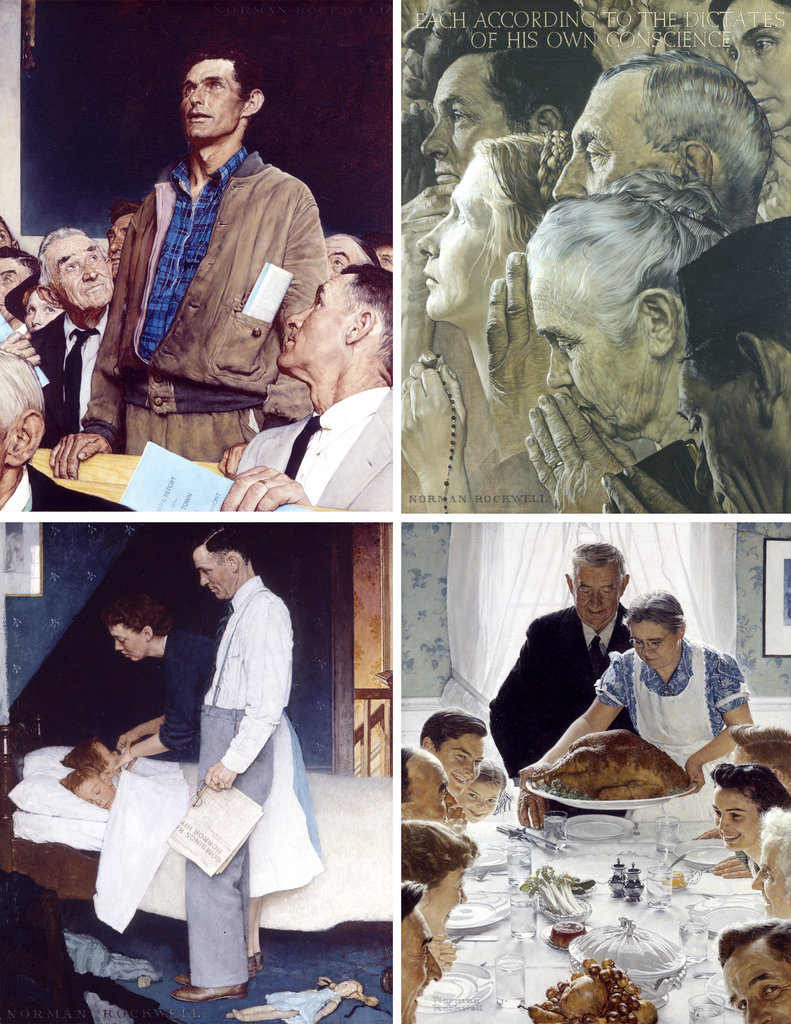
But the real heart of the message, applicable to all people everywhere Roosevelt enunciated a number of principles that are a beacon to all people. Firmly grounded in words of the Declaration of Independence and the Gettysburg Address they are called the Four Freedoms. Those freedoms are an ideal, in fact they certainly were not practiced well then by Americans, nor now, but they are worth working to: Roosevelt said:

“In the future days, which we seek to make secure, we look forward to a world founded upon four essential human freedoms.

The first is freedom of speech and expression—everywhere in the world.

The second is freedom of every person to worship God in his own way—everywhere in the world.

The third is freedom from want—which, translated into world terms, means economic understandings which will secure to every nation a healthy peacetime life for its inhabitants—everywhere in the world.

The fourth is freedom from fear—which, translated into world terms, means a world-wide reduction of armaments to such a point and in such a thorough fashion that no nation will be in a position to commit an act of physical aggression against any neighbor—anywhere in the world.

That is no vision of a distant millennium. It is a definite basis for a kind of world attainable in our own time and generation. That kind of world is the very antithesis of the so-called new order of tyranny which the dictators seek to create with the crash of a bomb.”

The speech was important, and now as it did then it calls Americans to higher purposes, to higher ideals, and it recognizes that we have never fully measured up to our own words. At the time it was spoken, Jim Crow was still the law of the land, Mexican Americans were often treated as poorly as blacks, Native Americans had few rights; and barely a year later Japanese Americans would be taken from the homes, lose their business and be sent to detention camps for the duration of the war after Pearl Harbor, simply because they were of Japanese descent. But those abiding principles are things that we should never lose sight of, and always strive to realize.

The great American artist Norman Rockwell did a series of portraits, the first of which was published 76 years ago today.

Today the four freedoms that Roosevelt enunciated are under threat around the world and in the United States too. We live in an age of uncertainty, turbulence, division, inequity, as well as deeply ingrained cynicism. Unscrupulous authoritarian politicians are using that uncertainty and fear to roll back the very liberties that democratic institutions are founded on.

As a result, as a man who promised during his campaign to roll back the rights of many people it is important not to forget this speech. The same is true as state and local politicians set out to not only roll back the rights of some, but to enable religious people to discriminate against other citizens.

It is also important because the government of Russia led efforts to attack the country by influencing the election, and for years has been committing aggression against American allies and working against American and allied efforts around the world. Yet the the incoming administration is not only welcoming it, but attacking and trying to discredit the American intelligence officials who say that it happened, and condemning senators and congressmen of its own party who want to further investigate those attacks by Russia and impose sanctions.  

So I think that it is important to reflect on these events, and then turn to speeches like Roosevelt’s in order for us to strive for a higher purpose, not to lose hope, and give in to fear that would enable our freedoms and the freedoms of any citizen to be curtailed.

The fact is that every bit of this speech is something that President Donald Trump stands against. He stands for the rights of the wealthiest and despises all others; he pretends to be for the rights of Conservative Christians despite mocking their faith and denigrating the faith or lack of faith of all other Americans who haven’t prostrated their religion to him; the freedom of free expression that he attacks every day; and finally fear, which he attempts to instill with every speech, or Tweet that he makes.

The contrast cannot be any greater.

Honestly, if any man or woman seeking the nomination of the Democratic Party would fully embrace the truths of this speech, in thought, word, and deed, they would walk into the White House in a landslide, popular vote and even in the electoral college.

If you can please that the time to listen to it or read it at the following link: http://www.americanrhetoric.com/speeches/fdrthefourfreedoms.htm

Peace,

Padre Steve+

2 Comments

Filed under civil rights, ethics, faith, History, laws and legislation, News and current events, Political Commentary

America’s Original Sin and its Continuing Legacy: Part Two, “Liberty for the few – slavery in every form, for the mass”

Friends of Padre Steve’s World,

I am going to be posting a number of articles from my various texts dealing with the American Civil War era dealing with topics that some would want to forget, but are very important if we want to fully appreciate the struggle of African-Americans for equality. This is the second of those posts.

Of course this original sin is the distinctly American version of slavery that arose in the American South, was protected in the Constitution, and supported by not only the Slave holders, and their Southern political protectors, but the businessmen, bankers, and equally complicit political allies in the North.

I honestly wish that we had really advanced beyond where we are now. But we are not. We’re still dealing with what has been called our nation’s original sin. over course slavery was abolished, and African Americans given citizenship and voting rights, but those rights would become a mockery in the Post-Reconstruction Jim Crow South, and in the Sundown Towns of the North and West. Even today, after the gains of the Civil Rights Movement we still deal with the continued effects of it. Our President and his closest advisers are White Nationalists, and White Supremacy is thriving under his tacit blessing. But that’s not enough, men like the Democratic Party Governor of Virginia posed in black face or in a KKK hood in his medical school yearbook. I could go on with a laundry list of other issues related to this but that would turn this introduction into another book, which is ironic because the content of this article was an introductory chapter of a Civil War Text about the Battle of Gettysburg that became part of a book of its own.

American Slavery and Racism is the subject of this and the following articles. More articles will follow in the next couple of weeks.

Have a great day,

Peace,

Padre Steve+

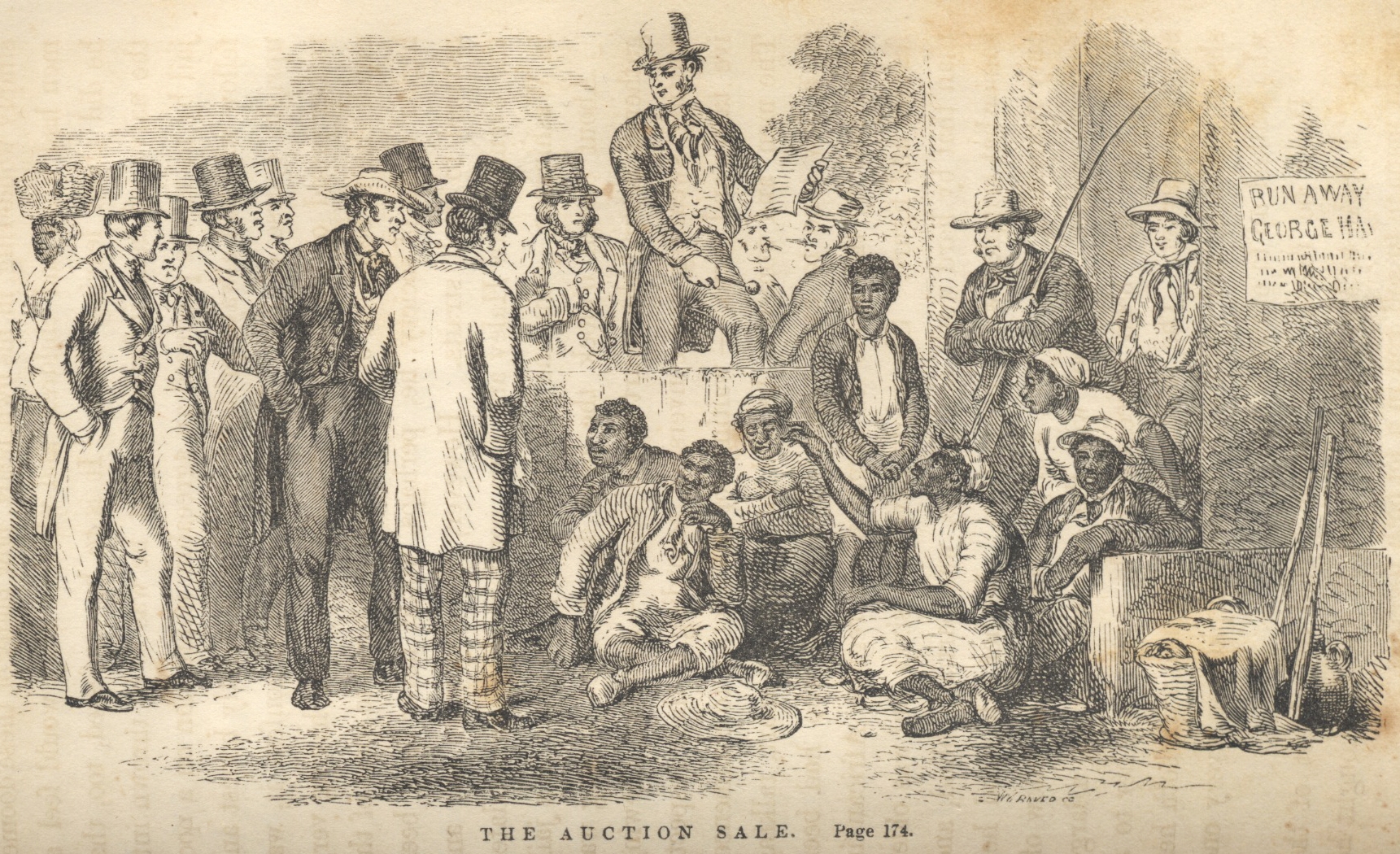
OTCauction

Abolition versus Slave Power

The conflicting ideologies of the Abolitionists who believed that African Americans were created by God and had the same rights as whites, as well as the arguments of Southern political leaders that blacks were inferior and slavery was a positive good, were buttressed by profoundly religious arguments which were related directly to a divergence in values. These diverging values crept into every aspect of life and as such it was this “conflict of values, rather than a conflict of interests or a conflict of cultures, lay at the root of the sectional schism.” [1]   The support of the church in Europe and the Americas was key to the religious and moral belief in the rightness of slavery.

Slavery was the key issue that permeated all aspects of the Civil War to include the cultural, the economic and the ideological. David M. Potter summed up this understanding of the connection between the ideological, cultural and economic aspects of the conflict and just how the issue of slavery connected all three realms in the American Civil War:

“These three explanations – cultural, economic and ideological – have long been the standard formulas for explaining the sectional conflict. Each has been defended as though it were necessarily incompatible with the other two. But culture, economic interest, and values may all reflect the same fundamental forces at work in a society, in which case each will appear as an aspect of the other. Diversity of culture may produce both diversity of interests and diversity of values. Further, the differences between a slaveholding and a nonslaveholding society would be reflected in all three aspects. Slavery represented an inescapable ethical question which precipitated a sharp conflict of values.” [2]

Sadly this is something that those who study the war from a purely military perspective tend to miss, or even willingly gloss over in order make the war more palatable to their own prejudice tend to “blur the reality that slavery was at the heart of the matter, ignore the baser realities of the brutal fighting, romanticize our own home-grown terrorist organization, the Ku Klux Klan, and distort the consequences of the Civil War that still intrude on our national life.” [3] For many people it is far easier not to deal with the harsh reality that slavery and racism was at the heart of the issue and escape to the bloodless romanticism which even ignores the human cost of the war, approximately 750,000 military dead alone. If we extrapolate the percentage of the population that that 750,000 represents and compared it to today’s census that number would be the equivalent of 7.5 million Americans dead. This is a fact that many Civil War buffs tend to ignore.

The political ends of the Civil War grew out of the growing cultural, economic, ideological and religious differences between the North and South that had been widening since the 1830s. However, slavery was the one issue which helped produce this conflict in values and it was “basic to the cultural divergence of the North and South, because it was inextricably fused into the key elements of southern life – the staple crop of the plantation system, the social and political ascendency of the planter class, the authoritarian system of social control.” [4] 

Without slavery and the Southern commitment to an economy based on slave labor, the southern economy would have most likely undergone a similar transformation as what happened in the North; thus the economic divergence between North and South would “been less clear cut, and would have not met in such head-on collision.” [5] But slavery was much more than an economic policy for Southerners; it was a key component of their religious, racial and philosophic worldview. A world without slavery was unimaginable and incomprehensible to them: politics, economics, religion, philosophy, and even the interpretation the Constitution itself depended on one’s view of slavery and white supremacy.

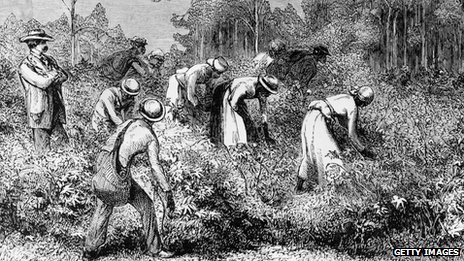
_65344344_cottonpickers1875_getty

The issue of slavery divided the ante-bellum United States on even what the words freedom and liberty meant. The dispute can be seen in the writings of many before the war, with each side emphasizing their particular understanding of these concepts. In the South, freedom was reserved for those who occupied the positions of economic power; slavery was key to that from not only an economic point of view but as a social philosophy. The concept of human equality, which was so much a part of the Declaration of Independence was downplayed to accommodate slavery and white supremacy.

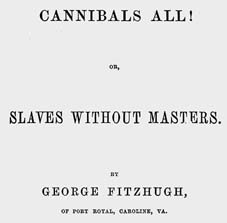
George Fitzhugh, a planter and slave owner in eastern Virginia commented that that concept “is practically impossible, and directly conflicts with all government, all separate property, and all social existence.” [6] Fitzhugh was very critical of the founder’s philosophy of natural liberty and human equality which he found repugnant and error ridden. He wrote:

“We must combat the doctrines of natural liberty and human equality, and the social contract as taught by Locke and the American sages of 1776. Under the spell of Locke and the Enlightenment, Jefferson and other misguided patriots ruined the splendid political edifice they erected by espousing dangerous abstractions – the crazy notions of liberty and equality that they wrote into the Declaration of Independence and the Virginia Bill of Rights. No wonder the abolitionists loved to quote the Declaration of Independence! Its precepts are wholly at war with slavery and equally at war with all government, all subordination, all order. It is full if mendacity and error. Consider its verbose, newborn, false and unmeaning preamble…. There is, finally, no such thing as inalienable rights. Life and liberty are not inalienable…. Jefferson in sum, was the architect of ruin, the inaugurator of anarchy. As his Declaration of Independence Stands, it deserves the appropriate epithets which Major Lee somewhere applies to the thought of Mr. Jefferson, it is “exuberantly false, and absurdly fallacious.”   ” [7]

The political philosophy such as Fitzhugh’s, which was quite common in the South, and was buttressed by a profound religious belief that it was the South’s God ordained mission to maintain and expand slavery. One Methodist preacher in his justification of slavery wrote, “God as he is infinitely wise, just and holy never could authorize the practice of moral evil. But God has authorized the practice of slavery, not only by bare permission of his providence, but by the express permission of his word.” [8] Buttressed by such scriptural arguments Southerners increasingly felt that they were the only people following God. The Northern abolitionists as well as those who advocated for the concept of human equality and free labor were heretics to be damned. As such the “South’s ideological isolation within an increasingly antislavery world was not a stigma or a source of guilt but a badge of righteousness and a foundation for national identity and pride.” [9]

Speaking of the necessity for slavery, as well as limitations on the equality of human beings no matter what their race or sex; Fitzhugh penned words that explained that human relationships were not to be seen in terms of individual liberty, “but in relations of strict domination and subordination. Successful societies were those whose members acknowledged their places within that hierarchy.” [10]

Fitzhugh was quite caustic when he discussed the real implications of his philosophy:

“We conclude that about nineteen out of twenty individuals have “a natural and inalienable right” to be taken care of and protected, to have guardians, trustees, husbands or masters; in other words they have a natural and inalienable right to be slaves. The one in twenty are clearly born or educated in some way fitted for command and liberty.” [11]

Fitzhugh’s chilling conclusion was summarized in the words “Liberty for the few – slavery in every form, for the mass.” [12]

But many Southerners, including many poor whites, especially the Yeoman farmers who were the backbone of the Southern populace did not see or understand the limitations that were placed on their own liberty by the slavery system and instead saw slavery as the guarantee of their economic freedom.

John C. Calhoun said to the Senate in 1848 that “With us, the two great divisions of society are not the rich and poor, but white and black; and all of the former, the poor as well as the rich, belong to the upper class, and are respected and treated as equals.” [13] Calhoun’s racial distinction is important if we are to understand why poor whites would fight and die for a social and economic idea that did not benefit them or their families, then as well as now.

But it was Abraham Lincoln, who cut to the heart of the matter when he noted the difference between his understanding of liberty and that of Calhoun and others in the South who defended slavery and the privileges of the Southern oligarchs:

“We all declare for liberty” but “in using the same word we do not all mean the same thing. With some the word liberty may mean for each man to do as he pleases with himself and the product of his labor; while with others the same word may mean for some men to do as they please with other men and the product of other men’s labor.” [14]

The growing economic disparity between the Slave and Free states became more about the expansion of slavery in federal territories as disunion and war approached; for a number of often competing reasons. These differences, amplified by the issue of slavery led to the substitution of stereotypes of each other and had the “effect of changing men’s attitudes toward the disagreements which are always certain to arise in politics: ordinary, resolvable disputes were converted into questions of principle, involving rigid, unnegotiable dogma.” [15] The Charleston Mercury noted in 1858 “on the subject of slavery…the North and the South…are not only two peoples, but they are rival, hostile peoples.” [16]

This was driven both by the South’s insistence on both maintaining slavery where it was already legal, and expanding it into new territories, even where it was forbidden by Federal laws enacted by Congress. This set it against the vocal abolitionist movement. But Southern exponents of expanding slavery were fighting an even more powerful enemy than the abolitionists, who despite their vocal protests were not yet in a position to influence policy. They were now fighting Northern industrialists who were not as idealistic as the abolitionists who were much more concerned with “economic policy designed to secure Northern domination of Western lands than the initial step in a broad plan to end slavery.” [17]

This competition between the regions not only affected politics, it affected religion and culture. In the South it produced a growing culture of victimhood, which was manifest in the words of Robert Toombs who authored Georgia’s declaration of causes for secession:

“For twenty years past, the Abolitionists and their allies in the Northern states, have been engaged in constant efforts to subvert our institutions, and to excite insurrection and servile war among us…” whose “avowed purpose is to subject our society, subject us, not only to the loss of our property but the destruction of ourselves, our wives and our children, and the dissolution of our homes, our altars, and our firesides.” [18]

As the social, economic, cultural and religious differences between the two regions grew wider and the people of the South became ever more closed off from the North. “More than other Americans, Southerners developed a sectional identity outside the national mainstream. The Southern life style tended to contradict the national norm in ways that life styles of other sections did not.” [19]

The complex relationship of Southern society where “Southern bodies social, economic, intellectual, and political were decidedly commingled” came to embrace the need for slavery and its importance to Southern society. This occurred despite the fact that the system did not benefit poor whites in the South and actually harmed them economically.

Southern society had become dependent on a race based social hierarchy in which dissent was neither welcome or tolerated. This

system of subordination reached out still further to require a certain kind of society, one in which certain questions were not publically discussed. It must give blacks no hope of cultivating dissention among the whites. It must commit non slaveholders to the unquestioning support of racial subordination…. In short, the South became increasingly a closed society, distrustful of isms from outside and unsympathetic to dissenters. Such were the pervasive consequences of giving top priority to the maintenance of a system of racial subordination.” [21]

A number of slave revolts, and planned slave revolts which were caught before they could erupt serve to heighten the fear and paranoia of Southerners living in the “Black belts” where slaves outnumbered whites by great margins. “In thickly enslaved areas, fancied dangers united white classes and sexes. Whites in black belts shared horror images about freed blacks as rioters, rapists, arsonists, and cannibals. The whites characteristically thought that using slavery to control alleged barbarians meant saving civilization.”[22]

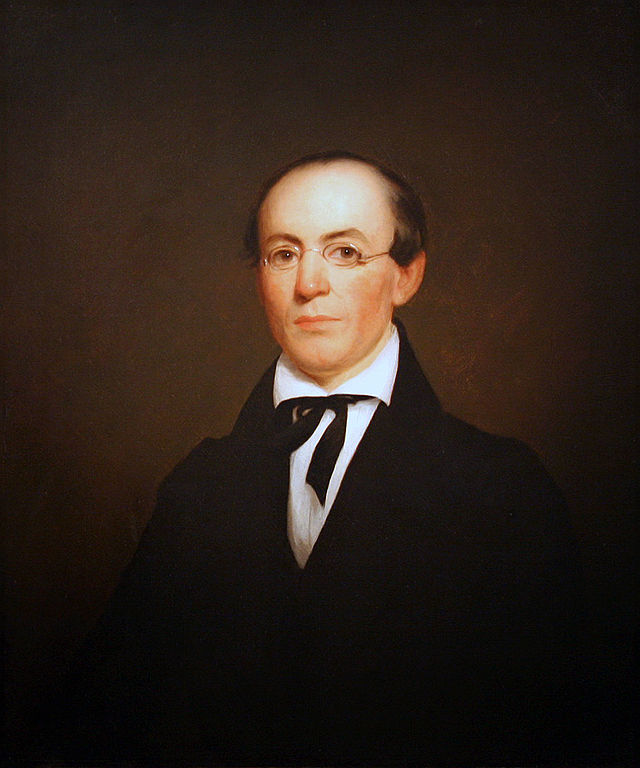
Even before the abolitionist movement took any recognizable form in the North, “with an intensity that escalated through the Civil War, planters declared war on all open criticism of the peculiar institution.” [23] As Northern abolitionists like William Lloyd Garrison and his newspaper The Liberator grew in its distribution and began to appear in the South various elected officials throughout the South “suppressed antislavery books, newspapers, lectures, and sermons and strove generally to deny critics of bondage access to any public forum. [24] Despite this resistance, abolitionists continued to use the U.S. Mail service to send their literature south provoking even more drastic action from Southern legislators.

garrison by jocelyn 1833

William Lloyd Garrison 

But Garrison and the more radical abolitionists did not have a great following even in the North, most Northerners who even leaned toward abolition were supporters of a very gradual emancipation and not supportive of the immediate emancipation demanded by Garrison and his allies. In fact in the North, Garrison and his followers were not popular, they were “a small and often despised group.” [25] This was born out by facts that Garrison understood all too well, which made him even more uncompromising in his message even as support for it dropped. Even in the North Garrison was considered an unlikeable extremist.

In 1840, support for Garrison extremism peaked at around 2 percent of the northern voting population. The other 98 percent of northern citizens considered immediate abolition to be too extreme to be American, too problack to be tolerable, too keen on seizing property to be capitalistic, and too antisouthern to be safe for the Union.” [26] 

Garrison despised his northern opponents and wrote that he found among them “contempt more bitter, opposition more active, detraction more relentless, prejudice more stubborn, and apathy more frozen, than among slave owners themselves.” [27] Opponents broke up his meetings and on one occasion paraded Garrison “through the streets of Boston with a rope around his neck.” [28]

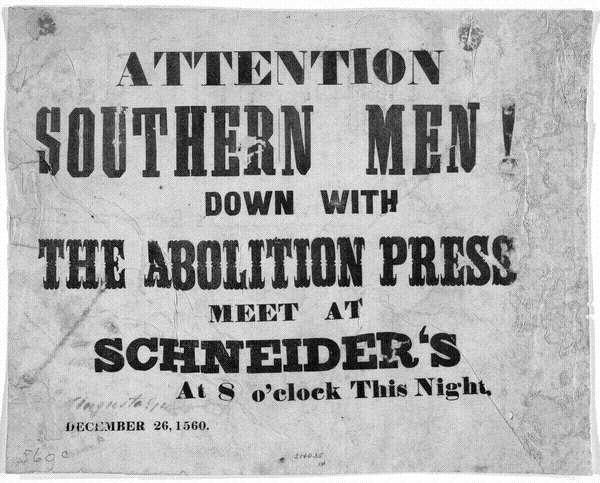
But Southerners, particularly those in the Black Belts where slaves constituted a majority of the population were further outraged by Garrison and his follower’s incendiary words and what they considered to be “almost pornographic diatribes,” which they felt had assaulted their “self-respect and sense of honor.” [29] In response to the proliferation of abolitionist literature in the South which was being sent through the mail, Senator John C. Calhoun proposed that Congress pass a law to prosecute “any postmaster who would “knowingly receive or put into the mail any pamphlet, newspaper, handbill, or any printed, written, or pictorial representation touching the subject of slavery.” [30] The law was a direct assault on the First Amendment, but in the South anything and anyone that took a stand against slavery had no Constitutional rights.

Calhoun was not alone as other members of Congress as well as state legislatures worked to restrict the import of what they considered subversive and dangerous literature. The condescending attitude of the radical abolitionists provoked an “emotional wildfire” [31] in the South, which united slave owners and poor whites in the Black Belt regions and served to increase their fear and loathing of Yankees who they believed wanted to destroy them and their way of life. Had they really understood just how united much of the North was with them they may not have pushed as hard to force Northern allies to accept laws that eventually offended the sensibilities of even non-abolitionists Northerners.

attention-southern-men

But Southern fears of real and imagined slave revolts, and hatred of radicals like Garrison brought about a host of new problem. Southerners now attempted to crush First Amendment protections of free speech in the north and to blot out any mention of slavery in the House of Representatives.

Beginning in 1836 the House of Representatives, led by Southern members of Congress passed a “gag rule” for its members. The “Gag Rule” “banned all petitions, memorials, resolutions, propositions, or papers related in any way or to any extent whatever to the subject of slavery.” [32]Former President John Quincy Adams continually challenged the gag-rule beginning in 1842, as did a number of others. The pressure was such that in 1844 the House finally voted to rescind it.

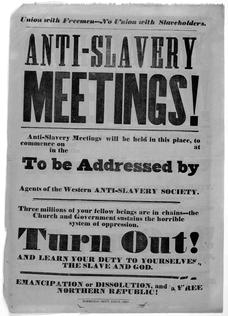
anti-slavery-meetings

However, Southern politicians were unhappy with the recension of the Gag Rule and “began to spout demands that the federal government and the Northern states issue assurances that the abolitionists would never be allowed to tamper with what John Calhoun had described as the South’s “peculiar domestic institution.” [33] As tensions grew between the regions; the issue of slavery more than any other issue, “transformed political action from a process of accommodation to a mode of combat.” [34]

Around the same time as the gag rule was played out in Congress the Supreme Court had ruled that the Federal government alone “had jurisdiction where escaped slaves were concerned”which resulted in several states enacting “personal liberty laws”to “forbid their own elected officials from those pursuing fugitives.” Southern politicians at the federal and state levels reacted strongly to these moves, which they believed to be an assault on their institutions and their rights to their human property. Virginia legislators said these laws were a “disgusting and revolting exhibition of faithless and unconstitutional legislation.” [35]

The issue of slavery shaped political debate and “structured and polarized many random, unoriented points of conflict on which sectional interest diverged.” [36] As the divide grew, leaders and people in both the North and the South began to react to the most distorted images of each other imaginable- “the North to an image of a southern world of lascivious and sadistic slave drivers; the South to the image of a northern world of cunning Yankee traders and radical abolitionists plotting slave insurrections.” [37]

To be continued…

Notes

[1] Potter, David M. The Impending Crisis: America before the Civil War 1848-1861 completed and edited by Don E. Fehrenbacher Harper Collins Publishers, New York 1976 p.41

[2] Ibid. Potter The Impending Crisis p.41

[3] Burns, Ken A Conflict’s Acoustic Shadows in The New York Times Disunion: Modern Historians Revisit and Reconsider the Civil War from Lincoln’s Election to the Emancipation Proclamation Black Dog and Leventhal Publishing, New York 2013 p.102

[4] Ibid. Potter The Impending Crisis p.42

[5] Ibid. Potter The Impending Crisis p.42

[6] Ibid. Levine Half Slave and Half Free: The Roots of the Civil War Revised Edition p.140

[7] Fitzhugh, George. New Haven Lecture 1855, in The Approaching Fury: Voices From the Storm, 1820-1861 Stephen B. Oates, Editor, University of Nebraska Press, Lincoln and London 1997 p.135

[8] Ibid. Daly When Slavery Was Called Freedom: Evangelicalism, Proslavery, and the Causes of the Civil War pp.63-64

[9] Ibid. Faust, Drew The Creation of Confederate Nationalism: Ideology and Identity in the Civil War South p.61

[10] Ibid. Levin Half Slave and Half Free p.140

[11] Ibid. Levin Half Slave and Half Free p.140

[12] Ibid. Levin Half Slave and Half Free p.141

[13] McPherson, James M. Drawn With the Sword: Reflections on the American Civil War Oxford University Press, Oxford and New York 1996 p.50

[14] Ibid. Levin Half Slave and Half Free p.122

[15] Ibid. Potter The Impending Crisis p.43

[16] Ibid. McPherson Drawn With the Sword p.16

[17] Egnal, Marc Clash of Extremes: The Economic Origins of the Civil War Hill and Wang a division of Farrar, Straus and Giroux New York 2009 p.6

[18] Dew, Charles B. Apostles of Disunion: Southern Secession Commissioners and the Causes of the Civil War University Press of Virginia, Charlottesville and London 2001 p.12

[19] Thomas, Emory The Confederate Nation 1861-1865 Harper Perennial, New York and London 1979 p.5

[20] Ibid. Thomas The Confederate Nation p.5

[21] Ibid. Potter The Impending Crisis pp.457-458

[22] Freehling, William W. The South vs. The South: How Anti-Confederate Southerners Shaped the Course of the Civil War Oxford University Press, Oxford and New York 2001 p.20

[23] Ibid. Levine Half Slave and Half Free p.166

[24] Ibid. Levine Half Slave and Half Free p.166

[25] Ibid. Goldfield America Aflame: How the Civil War Created a Nation p.27

[26] Ibid. Freehling The South vs. The South p. 34

[27] Ibid. Varon Disunion! The Coming of the American Civil War 1789-1858 pp.70-71

[28] Ibid. Goldfield America Aflame p.27

[29] Ibid. Freehling The South vs. The South p.22

[30] Ibid. Guelzo Fateful Lightning pp.50-51

[31] Ibid. Freehling The South vs. The South p.22

[32] Ibid. Levine Half Slave and Half Free pp.169-170

[33] Ibid. Guelzo Fateful Lightning pp.51-52

[34] Ibid. Potter The Impending Crisis p.43

[35] Ibid. Levine Half Slave and Half Free pp.169-170

[36] Ibid. Potter The Impending Crisis p.43

[37] Ibid. Potter The Impending Crisis p.43

Leave a comment

Filed under civil rights, civil war, ethics, History, laws and legislation, leadership, News and current events, Political Commentary, Religion

“The Promise Being Made, Must be Kept…” Abolition, Emancipation, and Freedom for All, 166 Years After the Emancipation Proclamation

Friends of Padre Steve’s World,

February is Black History Month, it’s something that no American of any race, color, or creed should forget. African Americans, the decendants of slaves and slaves themselves fought for freedom that was only at best was in the promissory note of the Emancipation Proclamation.

Those men, and women in the case of Harriett Tubman and Sojourner Truth, paved the way for freedom for African Americans and all others who benefited from what they fought for: women, Native Americans, Mexican Americans, and other Hispanics, Asian Americans, and LGBTQ Americans. That promise being made then, must be kept today, to the descendents of  this men, as well as all who benefited through their sacrifice: even the Southern Whites who at the time did not know then, or all too often today, that they too needed emancipation.

This article is a section of one of my yet unpublished Civil War books in which I spend much time dealing with the importance of emancipation and the role of Black soldiers during the American Civil War. I think it is important to remember as we get ready to close out Black History Month just how important these men are to American history and for the civil rights of all Americans.

Emancipation and the U.S. Military

HD_4USCinfantryDetail.preview

Men of the 4th Regiment of U.S. Colored Troops

The war brought about another change to warfare in America. This was a societal and political change that has shaped American military history, culture and life ever since. The Emancipation Proclamation gave African Americans, both Freedmen and recently freed slaves the opportunity to serve in the Union Army. The change of policy instituted by Lincoln was revolutionary as well as controversial and it had strategic implications for the war effort. There were many doubters in the north whose attitudes towards African Americans were not much different than Southerners, especially among the Copperheads.

Prior to the Emancipation some Union commanders in occupied Confederate territory “had unofficially recruited black soldiers in Kansas and in occupied portions of South Carolina and Louisiana in 1862. But the administration had not sanctioned these activities.” [1] The issue for Lincoln in 1861 and 1862 was the necessity of keeping the Border-Slave Sates of Kentucky, Missouri and Maryland, which had not seceded from the Union. Lincoln repudiated the orders of General John Fremont, in Missouri, and his friend General David Hunter, who commanded the Department of the South regarding emancipation, not because he was in complete disagreement, but because he felt that the officers had overstepped their authority.

Lincoln understood that this might hurt him with the abolitionist wing of the Republican Party. While Lincoln was certainly sympathetic to their cause, he insisted that such decisions were not within the prevue of local commanders, but that any such proclamations had to come from him, as Commander-in-Chief. He told Treasure Secretary Salmon Chase, who supported the measures of Hunter and Fremont, “No commanding general shall do such a thing, upon my responsibility, without consulting me.” [2] Lincoln’s decision to reverse and repudiate the decisions of local commanders infuriated some in his cabinet and in the Congress. But Lincoln remained firm in that conviction due to the need to ensure the cooperation of the Border States the continued loyalty of which were absolutely vital to winning the war, without which no meaningful emancipation would be possible.

However, Lincoln did support the efforts of General Benjamin Butler. Butler commanded the Federal forces at Fort Monroe in Hampton Roads. Butler had been a former pro-slavery Democrat who learned that the Confederates were using slaves to construct fortifications and to support their army on the Peninsula. In May 1862 twenty-three slaves escaped to his lines and their owner, a Confederate Colonel, “demanded the return of his property under the Fugitive Slave Law! With as deadpan expression as possible (given his cocked eye), Butler informed him that since Virginia claimed to have left the Union, the Fugitive Slave Law no longer applied.” [3]Butler then declared that since the escaped slaves had worked for the Confederate Army that they were “contraband of war – enemy property subject to seizure.” [4] It was a solid argument, since Southerners themselves referred to African American slaves as property was subject to seizure. Lincoln and Secretary of War Cameron approved of Butler’s action and “eventually, the Congress passed a confiscation law ending the rights of masters over fugitive slaves used to support Confederate troops.” [5]

Salmon Chase and other strong abolitionists opposed Lincoln vehemently for this, but it would not be long until Lincoln made the decision for full emancipation. This was first accomplished by the Emancipation Proclamation, a military order that only applied to the states that had seceded. However, Lincoln would follow this by pushing for a constitutional amendment to end slavery.   The latter occurred when Congress passed the Thirteenth Amendment was passed in January 1865. This amendment abolished slavery in the United States.

Lincoln had already decided upon emancipation in the spring of 1862, however, following the defeat of McClellan on the Peninsula he decided to postpone announcing it, Secretary of State Seward recommended against it until “until you can give it to the country supported by military success.” Otherwise the world might view it as an incitement for slave insurrections, “as the last measure of an exhausted government, a cry for help…our last shriek, on the retreat.” [6] The wisdom of Seward’s advice was profound, and Lincoln put off the announcement until after the Battle of Antietam.

McClellan, true to form opposed any such policy. When Lincoln visited him after his withdraw from the Peninsula, the defeated but still arrogant General handed Lincoln a memorandum on what McClellan viewed as the “proper conduct of the war.” McClellan advised Lincoln that the war “should not be a war looking to the subjugation of any State in any event…but against armed forces and political organizations. Neither confiscation of property, political executions of persons, the territorial organization of States, or the forcible abolition of slavery should be contemplated for a moment.” [7]

Lincoln was not seeking advice from his recalcitrant commander and put the letter in his pocket and simply told McClellan, “All right.” Interestingly enough just a few months earlier Lincoln would have agreed with McClellan’s views on the conduct of the war. However, with the passage of time and the realization that the Confederacy was fully committed to its independence as well as the continuance and even the expansion of slavery had come to the view that fighting a limited war with limited aims was foolish. He told another Unionist Democrat a few days after McClellan offered his advice that the war could not be fought:

“with elder-stalk squirts, charged with rose water….This government cannot much longer play a game in which it stakes all, and its enemies stake nothing. Those enemies must understand that they cannot experiment for ten years trying to destroy this government, and if they fail still come back into the Union unhurt.”[8]

From Slavery to Soldiering

2nd-colored-light-artillery

Gun Crew of 2nd Colored Light Artillery 

But as the war continued on, consuming vast numbers of lives the attitude of Lincoln and his administration began to change. After a year and a half of war, Lincoln and the closest members of his cabinet were beginning to understand that the “North could not win the war without mobilizing all of its resources and striking against Southern resources used to sustain the Confederate war effort.” [9] Slave labor was essential to the Confederate war effort, not only did slaves still work the plantations, they were impressed into service in war industries as well as in the Confederate Army.

Lieutenant Colonel Arthur Freemantle, a British observer who was with Lee’s army at Gettysburg noted, “in the rear of each regiment were from twenty to thirty negro slaves.” [10] The fact is that the slaves who accompanied the army remained slaves, they were not the mythical thousands of black soldiers who rallied to the Confederate cause, nor were they employees. “Tens of thousands of slaves accompanied their owners to army camps as servants or were impressed into service to construct fortifications and do other work for the Confederate army.” [11] This fact attested to by Colonel William Allan, one of Stonewall Jackson’s staff members who wrote “there were no employees in the Confederate army.” [12] slaves served in a number of capacities to free up white soldiers for combat duties, “from driving wagons to unloading trains and other conveyances. In hospitals they could perform work as nurses and laborers to ease the burdens of patients.” [13] An English-born artilleryman in Lee’s army wrote in 1863 that “in our whole army there must be at least thirty thousand colored servants….” [14] When Lee marched to Gettysburg he did so with somewhere between ten and thirty-thousand slaves in support roles and during the advance into Virginia Confederate troops rounded up and re-enslaved as many blacks as they could, including Freedmen.
istanto001p1

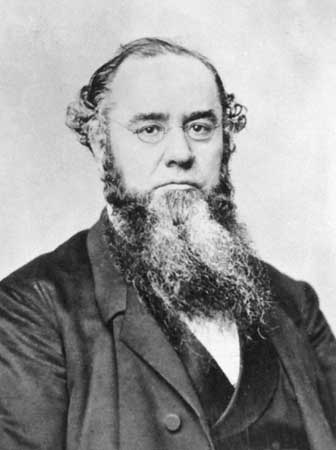
                                       Secretary of War Edwin Stanton

Lincoln’s Secretary of War, Edwin Stanton; who was a passionate believer in the justice of emancipation, was one of the first to grasp the importance of slave labor to the Confederate armies and how emancipation was of decided military necessity. Stanton, “Instantly grasped the military value of the proclamation. Having spent more time than any of his colleagues contemplating the logistical problems facing the army, he understood the tremendous advantage to be gained if the massive workforce of slaves could be transferred from the Confederacy to the Union.” [15]

Lincoln emphasized the “military necessity” of emancipation and “justified the step as a “fit and necessary war measure for suppressing the rebellion.” [16] The process of emancipation now became not only a moral crusade, but now became a key part of national strategy, not just in a military means, but politically, economically and diplomatically as Lincoln “also calculated that making slavery a target of the war would counteract the rising clamor in Britain for recognition of the Confederacy.”  [17]

Lincoln wrote to his future Vice President, Andrew Johnson, then the military governor of occupied Tennessee that “The colored population is the great available and yet unavailed of, force for restoration of the Union.”[18] The idea of simply mollifying the border states was dropped and policy changed that of “depriving the Confederacy of slave labor. Mobilizing that manpower for the Union – as soldiers as well as laborers – was a natural corollary.” [19] Reflecting President Lincoln’s and Stanton’s argument for the military necessity of emancipation, General Henry Halleck wrote to Ulysses Grant:

“the character of the war has very much changed within the past year. There is now no possibility of reconciliation with the rebels… We must conquer the rebels or be conquered by them….Every slave withdrawn from the enemy is the equivalent of a white man put hors de combat.” [20]

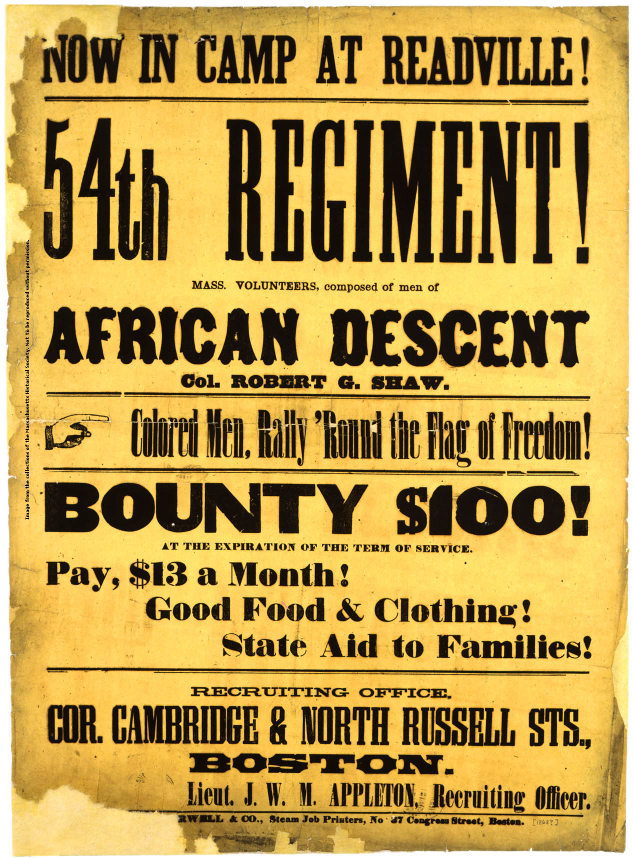
54thmassposter

Ulysses Grant concurred with Lincoln’s decision. Grant wrote to in a letter to Lincoln after the assault on Battery Wagner by the 54th Massachusetts, “by arming the negro we have added a powerful ally. They will make good soldiers and taking them from the enemy weakens him in the same proportion as it strengthens us.” [21] William Tecumseh Sherman was supportive but also noted some facts that some radical abolitionists did not understand. He noted in his correspondence that, “The first step in the liberation of the Negro from bondage will be to get him and his family to a place of safety… then to afford him the means of providing for his family,… then gradually use a proportion – greater and greater each year – as sailors and soldiers.” [22] Lincoln wrote after the Emancipation Proclamation that “the emancipation policy, and the use of colored troops, constitute the heaviest blow yet dealt to the rebellion.” [23] The change was a watershed in both American history as well as for the future of the U.S. Military services.

In conjunction with the Emancipation Proclamation Secretary of War Stanton “authorized General Rufus Saxton to “arm, uniform, equip, and receive into the service of the United States such number of volunteers of African descent as you may deem expedient, not exceeding 5,000, and [you] may detail officers to instruct them in military drill, discipline, and duty, and to command them.”  [24] The initial regiments of African Americans were formed by Union commanders in liberated areas of Louisiana and South Carolina, and most were composed of newly freed slaves. Others like the 54th and 55th Massachusetts Volunteer Infantry regiments were raised from free black men in the north. Stanton’s authorization was followed by the Enrollment Act passed by Congress in March of 1863 which established the draft also allowed blacks to serve. By March Stanton was working with state governors to establish more black regiments. The units became known as United States Colored Troops, or U.S.C.T. and were commanded by white officers and organized into the infantry, cavalry and, artillery regiments organized on the model of white regiments. The U.S.C.T. “grew to include seven regiments of cavalry, more than a dozen of artillery, and well over one hundred of infantry.” [25]

Some Union soldiers and officers initially opposed enlisting blacks at all, and some “charged that making soldiers of blacks would be a threat to white supremacy, and hundreds of Billy Yanks wrote home that they would no serve alongside blacks.” [26]  But most common soldiers accepted emancipation, especially those who had served in the South and seen the misery that many slaves endured, one Illinois soldier, stationed who served in the Western Theater of war wrote, “the necessity of emancipation is forced upon us by the inevitable events of the war… and the only road out of this war is by blows aimed at the heart of the Rebellion…. If slavery should be left undisturbed the war would be protracted until the loss of life and national bankruptcy would make peace desirable on any terms.” [27]

Another soldier’s letters home show his conversion from being against emancipation to being fully for it. Corporal Chauncey B. Welton from Ohio wrote to his father after the Emancipation proclamation:

“Father I want you to write and tell me what you think of Lincoln’s proclamation of setting all the negroes free. I can tell you we don’t think much of it hear in the army for we did not enlist to fight for the negro and I can tell you that we never shall or many of us any how[.] no never.”

Following over two years of combat in which he served with Sherman’s army he became a vocal critic of the anti-abolitionist Copperheads in the North, especially former Ohio Governor Clement Vallandigham, as well as a strong proponent of abolition and opponent of slavery. By February 1865 his tone had changed “dear parents let us trust in Him that never forsakes the faithful, and never cease to pray… that soon we may look upon an undivided Country and that Country free free free yes free from that blighting curs[e] Slavery the cause of four years of Bloody warfare.” [28]

Even so racial prejudice in the Union ranks never went away and sometimes was accompanied by violence. It remained a part and parcel of life in and outside of the army, even though many Union soldiers would come to praise the soldierly accomplishments and bravery of African American Soldiers. An officer who had refused a commission to serve with a U.S.C.T. regiment watched as black troops attacked the defenses of Richmond in September 1864:

“The darkies rushed across the open space fronting the work, under a fire which caused them loss, into the abattis… down into the ditch with ladders, up and over the parapet with flying flags, and down among, and on top of, the astonished enemy, who left in utmost haste…. Then and there I decided that ‘the black man could fight’ for his freedom, and that I had made a mistake in not commanding them.” [29] Likewise, “Once the Lincoln administration broke the color barrier of the army, blacks stepped forward in large numbers. Service in the army offered to blacks the opportunity to strike a decisive blow for freedom….” [30]

HD_NgroWarFL640116p264cz.preview

                                        The Defense of Milliken’s Bend 

Emancipation allowed for the formation of regiments of United States Colored Troops (USCT), which were mustered directly into Federal service. In sheer numbers the U.S.C.T. formations soon dwarfed the few state raised Black Regiments.  However, it was the inspiration provided by those first state raised regiments, the heroic accounts of those units reported in Northern newspapers, as well as the unprovoked violence directed against Blacks in the 1863 New York draft riots that helped to provoke “many northerners into a backlash against the consequences of violent racism.” [31]

Despite the hurdles and prejudices that blacks faced even in the North, many African Americans urged others to enlist, self-help mattered more than self-preservation. Henry Gooding, an black sergeant from Massachusetts wrote the editor of the New Bedford Mercury urging fellow blacks to enlist despite the dangers, “As one of the race, I beseech you not to trust a fancied security, laying in your minds, that our condition will be bettered because slavery must die…[If we] allow that slavery will die without the aid of our race to kill it – language cannot depict the indignity, the scorn, and perhaps the violence that will be heaped upon us.” [32]

The valor of the state regiments, as well as the USCT units that managed to get into action was remarkable, especially in regard to the amount of discrimination levied at them by some northerners, including white Northern soldiers, and the very real threat of death that they faced if captured by Confederates. In response to the Emancipation Proclamation and to the formation of African American regiments the Confederate Congress passed measures that would make Union officers who commanded African American troops as war criminals and return any black soldier captured by Confederate forces return to slavery, if those blacks captured in battle were not summarily tortured by their captors or executed as happened at Fort Wagner, Petersburg, and at Fort Pillow.

In late 1862 Major General Nathaniel Banks was in desperate need of soldiers and received permission to form a number of regiments of free blacks. Known as the First, Second and Third Regiments of the Louisiana Native Guards they were primarily composed of former slaves who had escaped to Union lines, as well as some mulattos who were the children of prominent white citizens of the city. During an inspection, the white Colonel of the Guards told another officer:

“Sir, the best blood of Louisiana is in that regiment! Do you see that tall, slim fellow, third file from the right of the second company? One of the ex-governors of the state is his father. That orderly sergeant in the next company is the son of a man who has been six years in the United States Senate. Just beyond him is the grandson of Judge ______ …; and through all the ranks you will find the same state of facts…. Their fathers are disloyal; [but] these black Ishmaels will more than compensate for their treason by fighting in the field.” [33]

In May of 1863 Banks dared to send the First and Third Regiments of “Louisiana Native Home Guard regiments on a series of attacks on Confederate positions at Port Hudson, Louisiana” [34] where they received their baptism of fire. They suffered heavy losses and “of the 1080 men in the ranks, 271 were hit, or one out of every four.” [35] A white Wisconsin soldier commented that the black soldiers “fought like devils,”while a soldier of the 156th New York wrote, “They charged and re-charged and they didn’t know what retreat meant. They lost in their two regiments some four hundred men as near as I can learn. This settles the question about niggers not fighting well. They on the contrary make splendid soldiers and are as good fighting men as we have.” [36] Banks too was caught up in the moment and said of these troops in his after action report: “They answered every expectation…In many respects their conduct was heroic…The severe test to which they were subjected, and the determined manner in which they encountered the enemy, leave upon my mind no doubt of their ultimate success.” [37]

The_Storming_of_Ft_Wagner-lithograph_by_Kurz_and_Allison_1890a

                                54th Massachusetts at Fort Wagner 

But the most famous African American volunteer regiment was the 54thMassachusetts, commanded by Colonel Robert Gould Shaw, the “North’s showcase black regiment.” [38] Raised in Boston and officered by many men who were the sons of Boston’s blue blood abolitionist elite, the regiment was authorized in March 1863. Since there was still opposition to the formation of units made up of African Americans, Massachusetts Governor John Andrew authorized the formation of the 54th under the command of white officers, a practice that with few exceptions, became standard in the U.S. military until President Truman desegregated the armed forces in 1948. Governor Andrew was determined to ensure that the officers of the 54th were men of “firm antislavery principles…superior to a vulgar contempt for color.”[39]

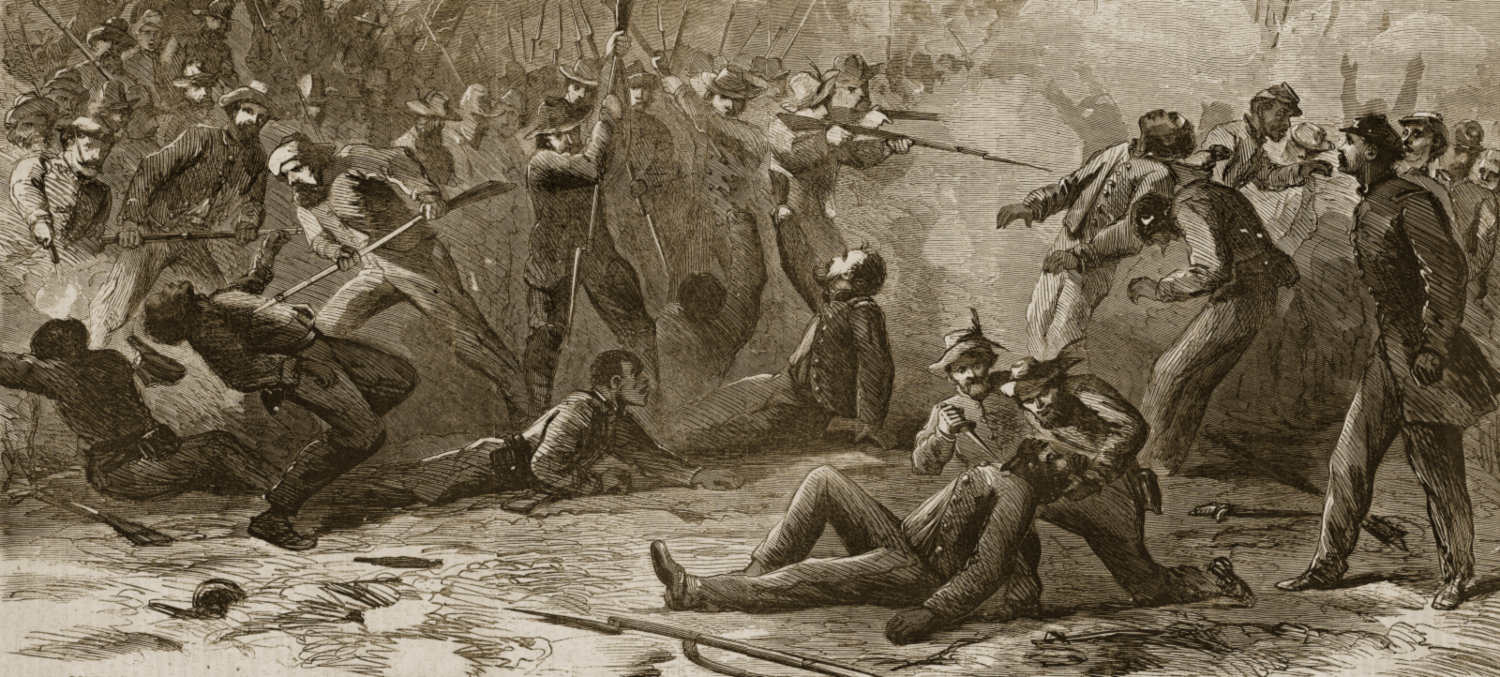
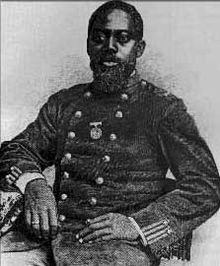
The 54th Massachusetts first saw action in early June 1863 and at Shaw’s urging were sent into battle against the Confederate positions at Fort Wagner on July 18th 1863. Leading the attack the 54th lost nearly half its men, “including Colonel Shaw with a bullet through his heart. Black soldiers gained Wagner’s parapet and held it for an hour before falling back.” [40]Though they tried to hold on they were pushed back after a stubborn fight to secure a breach in the fort’s defenses. “Sergeant William H Carney staggered back from the fort with wounds in his chest and right arm, but with the regiment’s Stars and Stripes securely in his grasp. “The old flag never touched the ground, boys,” Carney gasped as he collapsed at the first field hospital he could find.” [41] Shaw was buried with his men by the Confederates and when Union commanders asked for the return of his body were told “We have buried him with his niggers,” Shaw’s father quelled a northern effort to recover his son’s body with these words: We hold that a soldier’s most appropriate burial-place is on the field where he has fallen.” [42] As with so many frontal attacks on prepared positions throughout the war, valor alone could not overcome a well dug in enemy. “Negro troops proved that they could stop bullets and shell fragments as good as white men, but that was about all.” [43]

Despite the setback, the regiment went on to further actions where it continued to distinguish itself. The Northern press, particularly abolitionist newspapers brought about a change in the way that many Americans in the North, civilians as well as soldiers, saw blacks. The Atlantic Monthly noted, “Through the cannon smoke of that dark night, the manhood of the colored race shines before many eyes that would not see.”  [44]

55th-mass-at-charleston

                  55th Massachusetts being welcomed in Charleston SC 

In the African American 55th Massachusetts, which was recruited after the 54th, twenty-one year old Sergeant Isaiah Welch wrote a letter which was published in the Philadelphia Christian Recorder from Folly Island South Carolina:

“I will mention a little about the 55th Massachusetts Regiment. They seem to be in good health at the present and are desirous of making a bold dash upon the enemy. I pray God the time will soon come when we, as soldiers of God, and of our race and country, may face the enemy with boldness. For my part I feel willing to suffer all privations incidental to a Christian and a soldier…. In conclusion, let me say, if I fall in the battle anticipated, remember, I fall in defense of my race and country. Some of my friends thought it very wrong of me in setting aside the work of the Lord to take up arms against the enemy…. I am fully able to answer all questions pertaining to rebels. If taking lives will restore the country to what it once was, then God help me to slay them on every hand.” [45]

Like the 54th Massachusetts, the 55th would see much action. After one particularly sharp engagement in July 1864, in which numerous soldiers had demonstrated exceptional valor under fire the regiment’s commander, Colonel Alfred S. Hartwell “recommended that three of the black sergeants of the 55th be promoted to the rank of 2nd Lieutenant.” But Hartwell’s request was turned down, and a member of the regiment complained, “But the U.S. government has refused so far to must them because God did not make them White…. No other objection is, or can be offered.”[46]

Frederick Douglass, who had two sons serving in the 54th Massachusetts, understood the importance of African Americans taking up arms against those that had enslaved them in order to win their freedom:

“Once let a black man get upon his person the brass letters U.S… let him get an eagle on his button, and a musket on his shoulder and bullets in his pockets, and there is no power on earth which can deny he has won the right to citizenship in the United States.” [47]

Douglass urged African American men to enlist to secure their freedom, even while noting the inequities still prevalent in society and in the military, in which they did not receive the same pay as whites, nor could they become officers. Appealing to duty and reality Douglass noted in a speech in Philadelphia urging black men to volunteer. In it he carefully defined the real differences between the purposes of the Confederacy which was to “nothing more than to make the slavery of the African race universal and perpetual on this continent,” which was “based upon the idea that colored men are an inferior race, who may be enslaved and plundered forever.” [48]
220px-WilliamCarney

         Sergeant William Carney 54th Massachusetts, Medal of Honor

But the premier leader of the African Americans of his day, who had himself suffered as a slave, did not stop with that. Douglass understood that winning the war was more important that to what had been the attitude of the Federal government before the war and before emancipation, “Now, what is the attitude of the Washington government towards the colored race? What reasons have we to desire its triumph in the present contest? Mind, I do not ask what was its attitude towards us before the war…. I do not ask you about the dead past. I bring you to the living present.” He noted the advances that had been made in just a few months and appealed to his listeners. “Do not flatter yourselves, my friends, that you are more important to the Government than the Government to you. You stand but as the plank to the ship. This rebellion can be put down without your help. Slavery can be abolished by white men: but liberty so won for the black man, while it may leave him an object of pity, can never make him an object of respect…. Young men of Philadelphia, you are without excuse. The hour has arrived, and your place is in the Union army. Remember that the musket – the United States musket with its bayonet of steel – is better than all the mere parchment guarantees of liberty. In your hands that musket means liberty…” [49]

Other African American units less famous than the illustrious 54thMassachusetts distinguished themselves in action against Confederate forces. Two regiments of newly recruited blacks were encamped at Milliken’s Bend Louisiana when a Confederate brigade attempting to relieve the Vicksburg garrison attacked them. The troops were untrained and ill-armed but held on against a determined enemy:

“Untrained and armed with old muskets, most of the black troops nevertheless fought desperately. With the aid of two gunboats they finally drove off the enemy. For raw troops, wrote Grant, the freedmen “behaved well.” Assistant Secretary of War Dana, still with Grant’s army, spoke with more enthusiasm. “The bravery of the blacks,” he declared, “completely revolutionized the sentiment in the army with regard to the employment of negro troops. I heard prominent officers who had formerly in private had sneered at the idea of negroes fighting express after that as heartily in favor of it.”[50]

The actions of the black units at Milliken’s bend attracted the attention and commendation of Ulysses Grant, who wrote in his cover letter to the after action report, “In this battle most of the troops engaged were Africans, who had little experience in the use of fire-arms. Their conduct is said, however, to have been most gallant, and I doubt not but with good officers that they will make good troops.” [51] They also garnered the attention of the press. Harper’s published an illustrated account of the battle with a “double-page woodcut of the action place a black color bearer in the foreground, flanked by comrades fighting hand-to-hand with Confederates. A brief article called it a “the sharp fight at Milliken’s bend where a small body of black troops with a few whites were attacked by a large force of rebels.” [52] In the South the result was chilling and shocked whites, one woman wrote “It is hard to believe that Southern soldiers – and Texans at that – have been whipped by a mongrel crew of white and black Yankees…. There must be some mistake.” While another woman in Louisiana confided in her diary, “It is terrible to think of such a battle as this, white men and freemen fighting with their slaves, and to be killed by such a hand, the very soul revolts from it, O, may this be the last.” [53]

flporthudsonedml

                               Louisiana Native Guards at Port Hudson 

By the end of the war over 179,000 African American Soldiers, commanded by 7,000 white officers served in the Union armies. For a number of reasons most of these units were confined to rear area duties or working with logistics and transportation operations. The policies to regulate USCT regiments to supporting tasks in non-combat roles “frustrated many African American soldiers who wanted a chance to prove themselves in battle.” [54] Many of the soldiers and their white officers argued to be let into the fight as they felt that “only by proving themselves in combat could blacks overcome stereotypes of inferiority and prove their “manhood.” [55]Even so in many places in the army the USCT and state regiments made up of blacks were scorned:

“A young officer who left his place in a white regiment to become colonel of a colored regiment was frankly told by a staff officer that “we don’t want any nigger soldiers in the Army of the Potomac,” and his general took him aside to say: “I’m sorry to have you leave my command, and am still more sorry that you are going to serve with Negroes. I think that it is a disgrace to the army to make soldiers of them.” The general added that he felt this way because he was sure that colored soldiers just would not fight.”  [56]

The general of course, was wrong, for “Nothing eradicated the prejudices of white soldiers as effectively as black soldiers performing well under fire. And nothing inspired black soldiers to fight as desperately as the fear that capture meant certain death.” [57]  In the engagements where USCT units were allowed to fight, they did so with varying success most of which was often attributable to the direction of their senior officers and the training that they had received. As with any other unit, well led and well trained regiments performed better than those whose leaders had failed their soldiers. When given the chance they almost always fought well, even when badly commanded. This was true as well when they were thrown into hopeless situations.

One such instance was when Ferrero’s Division, comprised of colored troops were thrown into the Battle of the Crater at Petersburg when “that battle lost beyond all recall.” [58] The troops advanced in good order singing as they went, while their commander, General Ferrero took cover in a dugout and started drinking; but the Confederate defenders had been reinforced and “Unsupported, subjected to a galling fire from batteries on the flanks, and from infantry fire in front and partly on the flank,” a witness write, “they broke up in disorder and fell back into the crater.” [59] Pressed into the carnage of the crater where white troops from the three divisions already savaged by the fighting had taken cover, the “black troops fought with desperation, uncertain of their fate if captured.”[60] In the battle Ferrero’s division lost 1,327 of the approximately 4,000 men who made the attack. [61]

Major General Benjamin Butler railed to his wife in a letter against those who questioned the courage of African American soldiers seeing the gallantry of black troops assaulting the defenses of Petersburg in September 1864: The man who says that the negro will not fight is a coward….His soul is blacker than then dead faces of these dead negroes, upturned to heaven in solemn protest against him and his prejudices.” [62]

In another engagement, the 1864 Battle of Saltville in western Virginia the troops of the 5th USCT Cavalry who had been insulted, taunted, and derided by their fellow white Union soldiers went into action against Confederate troops defending the salt works in that town. The regiment’s commander, Colonel Wade, order his troops to attack. Colonel James Brisbin detailed the attack:

“the Negroes rushed upon the works with a yell and after a desperate struggle carried the line killing and wounding a large number of the enemy and capturing some prisoners…. Out of the four hundred men engaged, one hundred and fourteen men and four officers fell killed or wounded. Of this fight I can only say that men could not have behaved more bravely. I have seen white troops in twenty-seven battles and I never saw any fight better…. On the return of the forces those who had scoffed at the Colored Troops on the march out were silent.” [63]

The response of the Confederate government to Emancipation and African Americans serving as soldiers was immediate and uncompromisingly harsh. “When in the autumn of 1862 General Beauregard referred the question of a captured black soldier to Davis’s latest Secretary of War, James A. Seddon, the later replied “…my decision is that the negro is to be executed as an example.” [64] Davis approved of the summary executions of black prisoners carried out in South Carolina in November 1862, and a month later “on Christmas Eve, Davis issued a general order requiring all former slaves and their officers captured in arms to be delivered up to state officials for trial.” [65] Davis warned that “the army would consider black soldiers as “slaves captured in arms,” and therefore subject to execution.” [66] While the Confederacy never formally carried out the edict, there were numerous occasions where Confederate commanders and soldiers massacred captured African American soldiers.

The Lincoln administration responded to the Confederate threats by sending a note to Davis that threatened reprisals against Confederate troops if black soldiers suffered harm. It “was largely the threat of Union reprisals that thereafter gave African-American soldiers a modicum of humane treatment.” [67] Even so, they and their white officers were often in much more danger than the officers and soldiers of all-white regiments if captured by Confederate forces.

When captured by Confederates, black soldiers and their white officers received no quarter from many Confederate opponents. General Edmund Kirby Smith who held overall command of Confederate forces west of the Mississippi instructed General Richard Taylor to simply execute black soldiers and their white officers: “I hope…that your subordinates who may have been in command of capturing parties may have recognized the propriety of giving no quarter to armed negroes and their officers. In this way we may be relieved from a disagreeable dilemma.” [68] This was not only a local policy, but echoed at the highest levels of the Confederate government. In 1862 the Confederate government issued an order that threatened white officers commanding blacks: “any commissioned officer employed in the drilling, organizing or instructing slaves with their view to armed service in this war…as outlaws” would be “held in close confinement for execution as a felon.” [69] After the assault of the 54th Massachusetts at Fort Wagner a Georgia soldier “reported with satisfaction that the prisoners were “literally shot down while on their knees begging for quarter and mercy.” [70]
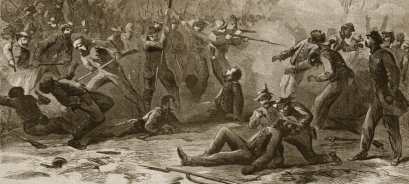
fortpillowmassacred

                                                 Fort Pillow Massacre 

On April 12th 1864 at Fort Pillow, troops under the command of General Nathan Bedford Forrest massacred the bulk of over 231 Union most of them black as they tried to surrender. While it is fairly clear that Forrest did not order the massacre and even may have attempted to stop it, it was clear that he had lost control of his troops, and “the best evidence indicates that the “massacre”…was a genuine massacre.” [71] Forrest’s soldiers fought with the fury of men possessed by hatred of an enemy that they considered ‘a lesser race’ and slaughtered the Union troops as they either tried to surrender or flee; but while Forrest did not order the massacre, he certainly was not displeased with the result. His subordinate, General James Chalmers told an officer from the gunboat Silver Cloud that he and Forrest had neither ordered the massacre and had tried to stop their soldiers but that “the men of General Forrest’s command had such a hatred toward the armed negro that they could not be restrained from killing the negroes,” and he added, “it was nothing better than we could expect so long as we persisted in arming the negro.” [72] It was a portent of what some of the same men would do to defenseless blacks and whites sympathetic to them as members of the Ku Klux Klan, the White Liners, White League, and Red Shirts, during and after Reconstruction in places like Colfax Louisiana.

Ulysses Grant was infuriated and threatened reprisals against any Confederates conducting such activities, he a later wrote:

“These troops fought bravely, but were overpowered I will leave Forrest in his dispatches to tell what he did with them.

“The river was dyed,” he says, “with the blood of the slaughtered for up to 200 years. The approximate loss was upward of five hundred killed; but few of the officers escaped. My loss was about twenty killed. It is hoped that these facts will demonstrate to the Northern people that negro soldiers cannot cope with Southerners.” Subsequently Forrest made a report in which he left out the part that shocks humanity to read.”  [73]

The bulk of the fanatical hatred of Forrest’s troops was directed at the black soldiers of the 6th U.S. Colored Heavy Artillery, which composed over a third of the garrison. “Of the 262 Negro members of the garrison, only 58 – just over 20 percent – were marched away as prisoners; while of the 295 whites, 168 – just under sixty percent were taken.”  [74] A white survivor of the 13th West Tennessee Cavalry, a Union unit at the fort wrote:

We all threw down our arms and gave tokens of surrender, asking for quarter…but no quarter was given….I saw 4 white men and at least 25 negroes shot while begging for mercy….These were all soldiers. There were also 2 negro women and 3 little children standing within 25 steps of me, when a rebel stepped up to them and said, “Yes, God damn you, you thought you were free, did you?” and shot them all. They all fell but one child, when he knocked it in the head with the breech of his gun.” [75]

A Confederate Sergeant who was at Fort Pillow wrote home a week after the massacre: “the poor deluded negroes would run up to our men, fall upon their knees and with uplifted hands scream for mercy, but were ordered to their feet and shot down.” [76] The captain of the Union gunboat Silver Cloud was allowed by the Confederate to bring his ship to the Fort to evacuate wounded, and to bury the dead was appalled at the sight, he wrote:

“All the buildings around the fort and the tents and huts in the fort had been burned by the rebels, and among the embers of the charred remains of numbers of our soldiers who had suffered terrible death in the flames could be seen. All the wounded who had strength enough to speak agreed that after the fort was taken an indiscriminate slaughter of our troops was carried on by the enemy…. Around on every side horrible testimony to the truth of this statement could be seen, Bodies with gaping wounds,… some with skulls beaten through, others with hideous wounds as if their bowels had been ripped open with bowie-knives, plainly told that little quarter was shown…. Strewn from the fort to the river bank, in the ravines and the hollows, behind logs and under the brush where they had crept for protection from the assassins who pursued them, we found bodies bayoneted, beaten, and shot to death, showing how cold-blooded and persistent was the slaughter…. Of course, when a work is carried by assault there will always be more or less bloodshed, even when all resistance has ceased; but here there were unmistakable evidences of a massacre carried on long after any resistance could have been offered, with a cold-blooded barbarity and perseverance which nothing can palliate.” [77]

The rabidly pro-slavery members of the Confederate press lent their propaganda to cheer the massacre of the captured blacks. John R. Eakin of the Washington (Arkansas) Washington Telegraph, who later became a justice on the Arkansas Supreme Court after Reconstruction, wrote,

“The Slave Soldiers. – Amongst there are stupendous wrongs against humanity, shocking to the moral sense of the world, like Herod’s massacre of the Innocents, or the eve of St. Bartholomew, the crime of Lincoln in seducing our slaves into the ranks of his army will occupy a prominent position….

How should we treat our slaves arrayed under the banners of the invader, and marching to desolate our homes and firesides….

Meanwhile, the problem has been met our soldiers in the heat of battle, where there has been no time for discussion. They have cut the Gordian knot with the sword. They did right….

It follows that we cannot treat negroes in arms as prisoners of war without a destruction of the social system for which we contend. We must be firm, uncompromising and unfaltering. We must claim the full control of all negroes who may fall into our hands, to punish with death, or any other penalty, or remand them to their owners. If the enemy retaliate, we must do likewise; and if the black flag follows, the blood be upon their heads.” [78]

However, when African American Troops were victorious, and even after they had seen their brothers murdered by Confederate troops, that they often treated their Confederate with great kindness. Colonel Brisbin wrote that following Battle of Saltville that “Such of the Colored Soldiers who fell into the hands of the Enemy during the battle were murdered. The Negroes did not retaliate but treated the Rebel wounded with great kindness, carrying them water in their canteens and doing all they could to alleviate the sufferings of those whom the fortunes of war had placed in their hands.” [79]

African American soldiers proved themselves during the war and their efforts paved the way for Lincoln and others to begin considering the full equality of blacks as citizens. If they could fight and die for the country, how could they be denied the right to votes, be elected to office, serve on juries or go to public schools? Under political pressure to end the war during the stalemate before Petersburg and Atlanta in the summer of 1864, Lincoln reacted angrily to Copperheads as well as wavering Republicans on the issue of emancipation:

“But no human power can subdue this rebellion without using the Emancipation lever as I have done.” More than 100,000 black soldiers were fighting for the Union and their efforts were crucial to northern victory. They would not continue fighting if they thought the North intended to betray them….If they stake their lives for us they must be prompted by the strongest motive…the promise of freedom. And the promise being made, must be kept…There have been men who proposed to me to return to slavery the black warriors. “I should be damned in time & in eternity for so doing. The world shall know that I will keep my faith to friends & enemies, come what will.”  [80]

The importance of African Americans cannot be minimized, without them the war could have dragged on much longer or even ended in stalemate, which would have been a Confederate victory. Lincoln wrote about the importance of the African American contribution to the war effort in 1864:

“Any different policy in regard to the colored man, deprives us of his help, and this is more than we can bear. We can not spare the hundred and forty or hundred and fifty thousand now serving us as soldiers, seamen, and laborers. This is not a question of sentiment or taste, but one of physical force which may be measured and estimated as horse-power and Steam-power are measured and estimated. Keep it and you save the Union. Throw it away, and the Union goes with it.” [81]

Despite this, even in the North during and after the war, blacks, including former soldiers faced discrimination, sometimes that of the white men that they served alongside, but more often from those who did not support the war effort. Lincoln wisely took note of this fact, and wrote that after the war:

“there will there will be some black men who can remember that, with silent tongue, the clenched teeth, the steady eye, the well poised bayonet, they have helped  mankind on to this great consummation; while, I fear, there will be some white ones, unable to forget that, with malignant heart, and deceitful speech, they have strove to hinder it.” [82]

swails

Lt Stephen Swails, First African American Officer of 54th Massachusetts 

Those rights would be fought for another century and what began in 1863 with the brave service and sacrifice of these African American soldiers began a process of increased civil rights that is still going on today. It would not be until after the war that some blacks were commissioned as officers in the Army. When Governor John Andrew, the man who had raised the 54th Massachusetts attempted to “issue a state commission to Sergeant Stephen Swails of the 54th…the Bureau of Colored Troops obstinately refused to issue Swails a discharge from his sergeant’s rank, and Swails promotion was held up until after the end of the war. “How can we hope for success to our arms or God’s blessing,” raged the white colonel of the 54th, Edward Hallowell, “while we as a people are so blind to justice?” [83]

The families of the free blacks who volunteered also suffered, especially those who still had families enslaved in Confederate occupied areas or Union States which still allowed slavery. One women in Missouri wrote her husband begging him to come home “I have had nothing but trouble since you left….They abuse me because you went & say they will not take care of our children & do nothing but quarrel with me all the time and beat me scandalously the day before yesterday.”  [84]

However, the Emancipation Proclamation transformed the war, and even jaded White Union soldiers who had been against emancipation and who were deeply prejudiced against blacks began to change their outlook as the armies marched into the South and saw the horrors of slavery, Russell Weigley wrote that Union soldiers: “confronting the scarred bodies and crippled souls of African Americans as they marched into the South experienced a strong motivation to become anti-slavery men…Men do not need to play a role long, furthermore, until the role grows to seem natural and customary to them. That of liberators was sufficiently fulfilling to their pride that soldiers found themselves growing more accustomed to it all the more readily.” [85]

A sergeant of the 19th Michigan who had already lost a stepson in the war wrote to his wife from Georgia before being killed in action during the Atlanta campaign; “the more I learn of the cursed institution of Slavery, the more I feel willing to endure, for its final destruction…. After this war is over, this whole country will undergo a change for the better…. Abolishing slavery will dignify labor; that fact will revolutionize everything…. Let Christians use all their influence to have justice done to the black man.” [86]

But even more importantly for the cause of liberty, the sight of regiments of free African Americans, marching “through the slave states wearing the uniform of the U.S. Army and carrying rifles on their shoulders was perhaps the most revolutionary event of a war turned into revolution.” [87]
battle_of_nashville_kurz__allison

At peak one in eight Union troops were African American, and Black troops made an immense contribution to the Union victory. “Black troops fought on 41 major battlefields and in 449 minor engagements. Sixteen soldiers and seven sailors received Medals of Honor for valor. 37,000 blacks in army uniform gave their lives and untold sailors did, too.” [88] To fully appreciate the measure as to the importance and significance of the numbers of African American troops serving in the Union ranks has to compare that number with the number of active Confederate troops serving toward the end of the war. The approximately 180,000 African Americans serving in Union ranks at the end of the war outnumbered the “aggregate present” in Confederate ranks on January 1st 1865 by over 20,000 men. Of these troops “134,111 were recruited in states that had stars in the Confederate battle flag, and the latter figure in turn was several thousand greater than the total of 135,994 gray-clad soldiers “present for duty” that same day.” [89]

Of the African American soldiers who faced the Confederates in combat, “deep pride was their compensation. Two black patients in an army hospital began a conversation. One of them looked at the stump of an arm he had once had and remarked: “Oh I should like to have it, but I don’t begrudge it.” His ward mate, minus a leg, replied: “Well, ‘twas [lost] in a glorious cause, and if I’d lost my life I should have been satisfied. I knew what I was fighting for.” [90]

22nd-usct-flags

                                  Flags of the 22nd U.S. Colored Troops 

After the war many of the African American soldiers became leaders in the African American community and no less than 130 of these former soldiers held elected office including in the U.S. Congress and various state legislatures. The liberating aspect of “the black military experience radiated from black soldiers and their families into the larger black community, so it spread into white society as well.” [91]  Many abolitionists who had served as officers, and officers who were assigned to the USCT or volunteered to serve with state raised African American regiments became leaders continued to be voices for expanding civil rights in the years following the war.

Following war’s end, the demobilized African American troops became the target of racial discrimination and violence, but even so, “black veterans continued to play a central role in black communities, North and South. The skills and experience black men gained during the war not only propelled many of them into positions of leaders and sustained the prominence of others, but it also shaped the expectations and aspirations of all black people. The achievements and pride engendered by military service helped to make a new world of freedom.” [92]

Sadly, much of the nation has forgotten the efforts of the Free Black Soldiers and Sailors who fought for freedom, but even so their legacy remains in the “contribution of black soldiers to Union victory remained a point of pride in black communities. “They say,” an Alabama planter reported in 1867, “the Yankees never could have whipped the South without the aid of the Negroes.” Well into the twentieth century, black families throughout the United States would recall with pride that their fathers and grandfathers had fought for freedom.” [93]

Notes 

[1] Ibid. McPherson Tried by War: Abraham Lincoln as Commander in Chief

[2] Ibid. Goodwin Team of Rivals p.435

[3] Ibid. McPherson Tried by War p.58

[4] Ibid. McPherson Tried by War p.58

[5] Ibid. Goodwin Team of Rivals p.369

[6] Ibid. McPherson Tried by War p.109

[7] Ibid. Foote, The Civil War, A Narrative Volume Two p.531

[8] Ibid. McPherson. The Battle Cry of Freedom p.503

[9] Ibid. McPherson Drawn With the Sword: Reflections on the American Civil War p.101

[10] Ibid. Guelzo Gettysburg: The Last Invasion p.160

[11] Foner, Eric Forever Free: The Story of Emancipation and Reconstruction Vintage Books a Division of Random House, New York 2005 p.45

[12] Ibid. Guelzo Gettysburg: The Last Invasion p.160

[13] Ibid. Glatthaar General Lee’s Army from Victory to Collapse p.313

[14] Ibid. Guelzo Gettysburg: The Last Invasion p.160

[15] Ibid. Goodwin Team of Rivals p.465

[16] Egnal, Marc Clash of Extremes: The Economic Origins of the Civil War Hill and Wang a division of Farrar, Straus and Giroux New York 2009 p.318

[17] Ibid. Foner Forever Free p.48

[18] Ibid. McPherson Tried by War p.159

[19] Ibid. McPherson Drawn With the Sword p.159

[20] Ibid. McPherson Abraham Lincoln and the Second American Revolution p.35

[21] Ibid. Guelzo Fateful Lightning p.381

[22] Ibid. Dobak Freedom by the Sword: The U.S. Colored Troops, 1862-1867 p.10

[23] Ibid. McPherson Abraham Lincoln and the Second American Revolution p.35

[24] Ibid. Robertson Soldiers Blue and Gray p.31

[25] Ibid. Dobak Freedom by the Sword: The U.S. Colored Troops, 1862-1867 p.11

[26] Ibid. Robertson Soldiers Blue and Gray p.31

[27] Ibid. Gallagher, Gary W. The Union War Harvard University Press, Cambridge MA and London 2011 p.103

[28] Welton, Chauncey B. A Union Soldier’s Changing Views on Emancipationin The Civil War and Reconstruction: A Documentary Collection edited by William Gienapp, W.W. Norton Company, New York and London 2001 pp.242 and 245

[29] Ibid. Robertson Soldiers Blue and Gray p.34

[30] Glatthaar, Joseph T. Black Glory: The African American Role in Union Victory in Why the Confederacy Lost edited by Gabor S. Boritt Oxford University Press, Oxford and New York 1992

[31] Ibid. McPherson. The Battle Cry of Freedom p.686

[32] Ibid. Goldfield America Aflame p.282

[33] Jones, Terry L. The Free Men of Color Go to War in The new York Times Disunion: 106 Articles from the New York Times Opinionator edited by Ted Widmer with Clay Risen and George Kalogerakis, Black Dog and Leventhal Publishers, New York 2013 p.403

[34] Ibid. Guelzo Fateful Lightening p.379

[35] Ibid. Foote The Civil War, A Narrative Volume Two p.398

[36] Ibid. Trudeau Like Men of War p.44

[37] Ibid. Guelzo Fateful Lightening p.379

[38] Ibid. McPherson. The Battle Cry of Freedom p.686

[39] Ibid. McPherson Drawn With the Sword p.101

[40] Ibid. McPherson. The Battle Cry of Freedom p.686

[41] Ibid. Guelzo Fateful Lightening pp. 380-381

[42] Ibid. McPherson. The Battle Cry of Freedom pp.686-687

[43] Ibid. Foote, The Civil War, A Narrative Volume Two p.697

[44] Ibid. McPherson. The Battle Cry of Freedom p.686

[45] Welch, Isaiah H. Letter in the Christian Recorder 24 October 1863 in The Civil War and Reconstruction: A Documentary Collection edited by William E. Gienapp, W.W. Norton and Company, New York and London 2001 pp.225-226

[46] Trudeau, Noah Andre, Like Men of War: Black Troops in the Civil War 1862-1865 Little, Brown and Company, Boston, New York and London, 1998 p.262

[47] Ibid. Guelzo Fateful Lightening p. 381

[48] Douglass, Frederick Philadelphia Speech of July 6th 1863 recorded in the Liberator in The Civil War and Reconstruction: A Documentary Collection edited by William E. Gienapp, W.W. Norton and Company, New York and London 2001 pp.220-221

[49] Ibid. Douglass Philadelphia Speech of July 6th 1863 p.221

[50] Ibid. McPherson. The Battle Cry of Freedom p.634

[51] Ibid. Trudeau Like Men of War: Black Troops in the Civil War 1862-1865p.58

[52] Ibid. Gallagher The Union War p.97

[53] Ibid. Trudeau Like Men of War: Black Troops in the Civil War 1862-1865 p.59

[54] Ibid. Gallagher The Union War p.92

[55] Ibid. McPherson Drawn With the Sword p.89 p.

[56] Catton, Bruce. A Stillness at Appomattox Doubleday and Company Garden City, New York 1953 p.227

[57] Berlin, Ira, Riedy, Joseph P. and Rowland, Leslie S. editors, Freedom’s Soldiers: The Black Military Experience in the Civil War  Cambridge University Press, Cambridge and New York 1998 pp.133-134

[58] Ibid. Catton A Stillness at Appomattox p.249

[59] Foote, Shelby, The Civil War, A Narrative. Volume Three Red River to Appomattox Random House, New York 1974 p.537

[60] Ibid.Wert The Sword of Lincoln: The Army of the Potomac pp.384-385

[61] Ibid. Foote The Civil War, A Narrative Volume Three p.537

[62] Ibid. Robertson Soldiers Blue and Gray p.34

[63] Ibid. Berlin et al, Freedom’s Soldiers: The Black Military Experience in the Civil War  p.135

[64] Ibid. Weigley A Great Civil War p.189

[65] Ibid. McPherson Battle Cry of Freedom p.566

[66] Ibid. Goldfield America Aflame p. 280

[67] Ibid. Weigley A Great Civil War p.188

[68] Ibid. Guelzo Fateful Lightening p. 377

[69] Ibid. Guelzo Fateful Lightening p. 377

[70] Ibid. Goldfield America Aflame p.281

[71] Ibid. Weigley A Great Civil War p.189

[72] Ibid. Dobak Freedom by the Sword: The U.S. Colored Troops, 1862-1867 p.208

[73] Grant, Ulysses S. Preparing for the Campaigns of ’64 in Battles and Leaders of the Civil War Volume IV, Retreat With Honor Edited by Robert Underwood Johnson and Clarence Clough Buel Castle, Secaucus NJ pp.107-108

[74] Ibid. Foote The Civil War, A Narrative Volume Three p.111

[75] Ibid. Guelzo Fateful Lightning p. 378

[76] Ibid. Foote The Civil War, A Narrative Volume Three p.112

[77] Ibid. Dobak Freedom by the Sword: The U.S. Colored Troops, 1862-1867 p.208

[78] Eakin, John R. The Slave Soldiers, June 8, 1864  in Loewen, James W. and Sebesta, Edward H. editors, The Confederate and Neo-Confederate Reader: The “Great Truth” about “The Lost Cause” University of Mississippi Press, Jackson 2010 pp.210 and 212

[79] Ibid. Berlin et al, Freedom’s Soldiers: The Black Military Experience in the Civil War  p.47

[80] Ibid. McPherson Abraham Lincoln and the Second American Revolution p.89

[81] Ibid. Glatthaar Black Glory: The African American Role in Union Victoryp.138

[82] Ibid. McPherson The War that Forged a Nation p. 113

[83] Ibid. Guelzo Fateful Lightning p. 376

[84] Ibid. Goldfield America Aflame p.282

[85] Ibid. Weigley A Great Civil War p.192

[86] Ibid. McPherson For Cause and Comrades p.130

[87] Ibid. Weigley A Great Civil War p.191

[88] Gallagher, Gary, Engle, Stephen, Krick, Robert K. and Glatthaar editors The American Civil War: The Mighty Scourge of War Osprey Publishing, Oxford UK 2003 p.296

[89] Ibid. Foote The Civil War, A Narrative. Volume Three Red River to Appomattox p.756

[90] Ibid. Robertson Soldiers Blue and Gray p.36

[91] Ibid. Berlin et al, Freedom’s Soldiers: The Black Military Experience in the Civil War  p.47

[92] Ibid. Berlin et al. Freedom’s Soldiers: The Black Military Experience in the Civil War pp.49-50

[93] Ibid. Foner Forever Free p.55

Leave a comment

Filed under civil rights, civil war, ethics, faith, Gettysburg, History, laws and legislation, LGBT issues, Military, Political Commentary, us army, US Navy

Remembering the Four Chaplains Of the Dorchester

four chaplains

The Four Chaplains

Friends of Padre Steve’s World,

Today I am writing a brief remembrance of four men who I never met but whose lives helped guide me into my vocation as a Priest and Chaplain. I think I first read about them in junior high school and at that time I had never thought about becoming a minister, priest, or chaplain. To be sure, ever since I was in early grade school I wanted to be in the military but it would not be until my senior year of high school that I felt a call to become a Navy Chaplain. I’ll come back to that in a moment, but first a brief op-ed on religion in the United states.

In this day and age where fanatical religious extremists of many faiths seek to divide society, launch wars of religion, discriminate against non-believers or even people who believe differently than them, or hold different philosophical or political beliefs, it is important as Americans to find something that holds us together. The fact that our founders were profoundly against establishing or favoring any particular faith or denomination, there are those today who militantly fight to establish an Evangelical Christian theocracy that has no basis for existence based on the testimony of the Founders, and the earliest proponents of religious liberty in the United States including Virginia Baptist John Leland who helped influence James Madison in crafting the First Amendment of the Constitution wrote:

“The notion of a Christian commonwealth should be exploded forever. … Government should protect every man in thinking and speaking freely, and see that one does not abuse another. The liberty I contend for is more than toleration. The very idea of toleration is despicable; it supposes that some have a pre-eminence above the rest to grant indulgence, whereas all should be equally free, Jews, Turks, Pagans and Christians.”

Sadly, men like Franklin Graham, Pat Robertson, Jerry Falwell Jr., Robert Jeffress, and a host of others use their theocratic political judgments to condemn people of good faith in this life and the next. Aided by men like President Trump they stand in opposition to Leland and the others like him who understood that the American experiment in religious liberty could not be tied to fixed dogma or a particular religion or denomination.

But I digress, you can read previous articles on this site in which I quoted Leland and other defenders of real religious freedom. For me it’s a matter of my Christian faith. So back to the story of the four Chaplains of the U.S. Army Transport Dorchester.

The four men that I never met were Army Chaplains. These are their stories.

George Lansing Fox was a 42 year old Methodist minister from Lewiston, Pennsylvania who had served as a medic in the First World War in which he was awarded the Silver Star, the Purple Heart, and the French Croix De Guerre. Thirty-one year old Reformed Rabbi Alexander Goode of Brooklyn, New York was the son of a Rabbi who before the war had applied but not been accepted as a Navy Chaplain. After Pearl Harbor he volunteered and was commissioned as an Army Chaplain. Clark V. Poling was a Baptist minister serving as pastor of a Reformed Church when the war broke out. His father had served as a Chaplain in the First World War and Poling, the married father of one child became an Army Chaplain in 1941. Father John Patrick Washington of Newark New Jersey was a Roman Catholic Priest who entered active duty in May 1942. The four men attended the Army Chaplain’s School, then at Harvard and were united for the journey across the Atlantic aboard the transport ship SS Dorchester.

U.S. Army Transport Dorchester

On the night of February 3rd 1943 the Dorchester was torpedoed by the German submarine U-223. She went down in 20 minutes, of the 904 men aboard the ship only 230 survived. Despite the fact that the ship’s captain had ordered a high state of readiness and that all hands wear life jackets at all time, “Many soldiers sleeping deep in the ship’s hold disregarded the order because of the engine’s heat. Others ignored it because the life jackets were uncomfortable.”

When the ship was hit by a torpedo power went out and the four chaplains worked amid the chaos to calm the situation and assisted the soldiers, sailors, and merchant mariners aboard the ship as they tried to abandon ship. The four chaplains handed out life jackets until the supply ran out and then gave their own life jackets to soldiers that had none.

In doing so they signed their own death sentence, the water temperature was just 34 degrees, the air temperature was 36 degrees, many who survived the sinking died of exposure within minutes of the sinking, rescue ships found hundreds of bodies floating in the water. As the ship went down they died together, praying with arms linked after giving away their life jackets as the troop transport that they were on sank beneath the waves into the icy depths of the North Atlantic. A survivor wrote:

“As I swam away from the ship, I looked back. The flares had lighted everything. The bow came up high and she slid under. The last thing I saw, the Four Chaplains were up there praying for the safety of the men. They had done everything they could. I did not see them again. They themselves did not have a chance without their life jackets.”

Other survivors reported hearing the prayers of the chaplains in English, Latin, and Hebrew as the ship went down. Their bodies were never recovered. They have been remembered as heroes. In 1960 Congress named February 3rd as Four Chaplains Day. The U.S. Post Office commissioned a stamp in their honor in 1948. The Chapel of the Four Chaplains was dedicated in the basement of Grace Baptist Church in Philadelphia in 1951. President Harry Truman spoke at its dedication noting:

“This interfaith shrine… will stand through long generations to teach Americans that as men can die heroically as brothers so should they live together in mutual faith and goodwill.”

The chapel was moved to Temple University in 1953 and to the former Philadelphia Naval Shipyard in 2001.


ph-ph-ag-four-chaplains-preview-jpg-20140205

Father John Patrick Washington (Top Left), Reverend Clark V. Poling (Top Right), Rabbi Alexander Goode (Bottom Left), and Reverend George Lansing Fox

Of course my journey in finding that call and answering it had a number of detours in which I first rejecting following the call. Instead, when I was in college I simply enlisted in the Army National Guard, entered ROTC and then was commissioned as an Army officer. After a number of incidents on active duty which renewed that sense of call I left active duty to go to seminary, went back into the National Guard and in September of 1992 became an Army National Guard and civilian hospital chaplain.  On February 9th 1999 I resigned my commission as a Major in the Army Chaplain Corps to become a Navy Chaplain, and in the process accepting a reduction in rank.

In the nearly 37 years that I have served in the military of which almost 26 have been spent as a chaplain I have had the privilege of serving with many fine ministers of many denominations, priests, rabbis, and even an imam.  Of course I have served alongside some chaplains who regardless of their faith or denomination were simply assholes, but that being said I truly do appreciate those men and women from so many faiths and denominations who have cared for me. I do think that any of them could have linked arms with me and prayed after doing the last best things that we could do for the soldiers, sailors, marines, and airmen who entrust themselves to our care.

Despite what some senior chaplains in both the Army and Navy had done to me at different points; when I think of those men and women who regardless of their beliefs or the beliefs of the religious organizations that endorse them for the chaplaincy, I realize just how blessed that I am.

In the day that we live I can still stand with Harry Truman when he praised these chaplains. Now I am sure that there are quite few people who would say that either Goode, Fox, Poling, or Washington are already in Hell; but I don’t believe that. I understand from Scripture and the teachings of Jesus that God looks on the heart, and that the most important commandments are to love God and love our neighbors. I think that Jesus said that in doing those things that people fulfill the entire law.

Thus I thank God for the Chaplains of various denominations, Mainline Protestants, Evangelicals, Catholics, Orthodox Christians, Anglicans, Mormons, Jews, Buddhists, and Muslims who I would be blessed to link arms with to care for those in our care.

So today, I ask my readers to share this message with others.

Until tomorrow,

Peace

Padre Steve+

Leave a comment

Filed under ethics, faith, History, leadership, Military, ministry, Religion, us army, World War II at Sea

The Code Of Honor: Time for Governor Northam to Resign or Admit that He is a Fraud

Friends of Padre Steve’s World,

I pride myself in holding to a code of honor that I learned as an Army ROTC Cadet at UCLA back in 1981 to 1983. It was the West Point honor code: “A cadet will not lie cheat or steal, or tolerate those who do.”

While attending the Virginia Military Institute about the same time that I was at beginning my military career as an ROTC cadet at UCLA, and enlisted member of the California Army National Guard, Governor Ralph Northam was graduating from the ROTC program at VMI where he headed the honor court of the Corps of Cadets.

Today, after the revelations of his personal page in the Eastern Virginia Medical School Yearbook became public knowledge which included pictures of him in either blackface, or dressed as a Klansman, the governor offered a bizarre explanation and refused to resign his office despite the condemnation of the Virginia Democratic Party, Senators Tim Kaine, Mark Warner, Former Governor Terry MacCauliffe, Representative Bobby Scott, Speaker of the House Nancy Pelosi, and far to many more Democratic Party leaders than I can list here.

Now I personally believe that he has probably grown into a better person than he was in 1984, but even so his political judgement is flawed and his arrogance in thinking that he can escape this is mind boggling.

I am a Democrat, and if I am going to criticize members of the GOP, including President Trump for racist rants, behaviors, and affiliations I cannot be silent when a man who I admire and respect cannot own responsibility for his actions as a younger man. If he had any conscience or sense of political sense he would have admitted that these pictures existed before he ever ran for office in the House Of Delegates, not to mention Lieutenant Governor and later Governor.

Honestly, I don’t believe that those pictures represent who he is today, but his incredibly inept explanations and disregard of his party and it’s leaders in an era where everything that he supposedly stands for today is under attack by President Trump and the Trumpified GOP is completely irresponsible and harmful to his party and the country.

For me it all comes down to honor. I have written about this before, and I must be honest. Governor Northam must resign to save himself and the agenda that he was elected to advance. Everyone has skeletons in their closet, but not everyone is elected to serve in public office. Election to such office, demands a higher sense of responsibility than being a private citizen. Had he not entered politics and been elected Governor of Virginia, such an oversight wouldn’t matter a bit, except to his closest family and friends; but he is the Governor and as such this matters far more than it would had he remained a private citizen.

Likewise, if he was only a politician, but not a former Army Officer, not the former head of the VMI honor court, and not a physician who swore an oath to do no harm. Likewise, knowing these photos existed he deceived the African Americans who worked with and for him during his campaigns by not admitting to their existence before they became the issue that they are.

The problem is, that many white Virginians, as well as white citizens of other states see nothing wrong with the pictures. But for Virginians this is part of our dark and racially charged past. My family were all Virginians, and both sides of my family fought for the Confederacy, in the same regiment, the 8th Virginia Cavalry. Both sides of the family owned slaves, and fought to to keep them. The only rights that they fought for was the right to enslave others and to,support laws that forced Free States to comply with slavery. That was what the compromise of 1850 and the Fugitive Slave Law Of 1850 were all about.

Today, Governor Northam in his policies and politics stands against what the Confederacy stood for, but privately he cannot take responsibility for his incredibly stupid, insensitive, and racist acts documented in a Medical School yearbook that he supplied the photos for his page.

Those actions took place 35 years ago, but this weekend he brought them into the present. Despite his stated desire to take Virginia to a new future, he took us all back to a past that sadly it has never fully abandoned.

It is time for him to resign and hand over the Governor’s office to Lieutenant Governor Justin Fairfax, a descendant of Virginia slaves. Lieutenant Governor Fairfax will be much more effective than the politically, and morally crippled Ralph Northam. Every minute Northam remains in office supplies Trump and his allies with the free advantage of an unforced error. It is the “own goal” that keeps on giving.

From a point of honor, from a point of simple decency, and from the simple pragmatism of real life politics Governor Northam has no choice but to resign. Of he doesn’t he’s a fool. He needs to be honest. There is nothing else that he can do unless he hasn’t changed over the last 35 years. Of that’s who he really is he should simply become a Republican and join the ranks of every major White Supremacist in the county.

That’s just my opinion, but I still believe in a code of honor that Governor Northam at one time supposedly upheld.

So, call me an old fashioned Pharisee, but I still hold to the Cadet Code, and the Motto Of West Point: Duty, Honor, Country.

Until tomorrow,

Peace,

Padre Steve+

Leave a comment

Filed under ethics, leadership, News and current events, Political Commentary

Dr. King’s Letter From a Birmingham Jail

primary-source-mlk-birmingham-jail-497fe198

Friends of Padre Steve’s World,

Not long ago I posted an article about Dr. Martin Luther King Jr.’s Letter from a Birmingham Jail. 

I included the link to the letter in my article, but I realize that most people, unlike me we not follow a link to get to the original source of the information supplied.

For those that don’t understand, my position as a Priest, if I am actually to be faithful to my vows requires that I be faithful to the Gospel. Sometimes that vow requires stating things that some in denial of their own faith would condemn as partisan politics. But this is not partisan, it echoes both the Christian and American propositions that all men are created equal.

With that in mind here is the full text of King’s letter. It is worthy of your full consideration and contemplation, and for that reason I make no editorial comments, although I did find Vice President Mike Pence’s comparison of President Trump to Dr. King abhorrent, insulting, and damnable.

On this day where we as a nation remember Dr. King it is fitting to read his unedited words from a Birmingham jail. Sadly, they are as applicable today as when he penned them.

Peace,

Padre Steve+

16 April 1963

My Dear Fellow Clergymen:

While confined here in the Birmingham city jail, I came across your recent statement calling my present activities “unwise and untimely.” Seldom do I pause to answer criticism of my work and ideas. If I sought to answer all the criticisms that cross my desk, my secretaries would have little time for anything other than such correspondence in the course of the day, and I would have no time for constructive work. But since I feel that you are men of genuine good will and that your criticisms are sincerely set forth, I want to try to answer your statement in what I hope will be patient and reasonable terms.

I think I should indicate why I am here in Birmingham, since you have been influenced by the view which argues against “outsiders coming in.” I have the honor of serving as president of the Southern Christian Leadership Conference, an organization operating in every southern state, with headquarters in Atlanta, Georgia. We have some eighty five affiliated organizations across the South, and one of them is the Alabama Christian Movement for Human Rights. Frequently we share staff, educational and financial resources with our affiliates. Several months ago the affiliate here in Birmingham asked us to be on call to engage in a nonviolent direct action program if such were deemed necessary. We readily consented, and when the hour came we lived up to our promise. So I, along with several members of my staff, am here because I was invited here. I am here because I have organizational ties here.

But more basically, I am in Birmingham because injustice is here. Just as the prophets of the eighth century B.C. left their villages and carried their “thus saith the Lord” far beyond the boundaries of their home towns, and just as the Apostle Paul left his village of Tarsus and carried the gospel of Jesus Christ to the far corners of the Greco Roman world, so am I compelled to carry the gospel of freedom beyond my own home town. Like Paul, I must constantly respond to the Macedonian call for aid.

Moreover, I am cognizant of the interrelatedness of all communities and states. I cannot sit idly by in Atlanta and not be concerned about what happens in Birmingham. Injustice anywhere is a threat to justice everywhere. We are caught in an inescapable network of mutuality, tied in a single garment of destiny. Whatever affects one directly, affects all indirectly. Never again can we afford to live with the narrow, provincial “outside agitator” idea. Anyone who lives inside the United States can never be considered an outsider anywhere within its bounds.

You deplore the demonstrations taking place in Birmingham. But your statement, I am sorry to say, fails to express a similar concern for the conditions that brought about the demonstrations. I am sure that none of you would want to rest content with the superficial kind of social analysis that deals merely with effects and does not grapple with underlying causes. It is unfortunate that demonstrations are taking place in Birmingham, but it is even more unfortunate that the city’s white power structure left the Negro community with no alternative.

In any nonviolent campaign there are four basic steps: collection of the facts to determine whether injustices exist; negotiation; self purification; and direct action. We have gone through all these steps in Birmingham. There can be no gainsaying the fact that racial injustice engulfs this community. Birmingham is probably the most thoroughly segregated city in the United States. Its ugly record of brutality is widely known. Negroes have experienced grossly unjust treatment in the courts. There have been more unsolved bombings of Negro homes and churches in Birmingham than in any other city in the nation. These are the hard, brutal facts of the case. On the basis of these conditions, Negro leaders sought to negotiate with the city fathers. But the latter consistently refused to engage in good faith negotiation.

Then, last September, came the opportunity to talk with leaders of Birmingham’s economic community. In the course of the negotiations, certain promises were made by the merchants–for example, to remove the stores’ humiliating racial signs. On the basis of these promises, the Reverend Fred Shuttlesworth and the leaders of the Alabama Christian Movement for Human Rights agreed to a moratorium on all demonstrations. As the weeks and months went by, we realized that we were the victims of a broken promise. A few signs, briefly removed, returned; the others remained. As in so many past experiences, our hopes had been blasted, and the shadow of deep disappointment settled upon us. We had no alternative except to prepare for direct action, whereby we would present our very bodies as a means of laying our case before the conscience of the local and the national community. Mindful of the difficulties involved, we decided to undertake a process of self purification. We began a series of workshops on nonviolence, and we repeatedly asked ourselves: “Are you able to accept blows without retaliating?” “Are you able to endure the ordeal of jail?” We decided to schedule our direct action program for the Easter season, realizing that except for Christmas, this is the main shopping period of the year. Knowing that a strong economic-withdrawal program would be the by product of direct action, we felt that this would be the best time to bring pressure to bear on the merchants for the needed change.

Then it occurred to us that Birmingham’s mayoral election was coming up in March, and we speedily decided to postpone action until after election day. When we discovered that the Commissioner of Public Safety, Eugene “Bull” Connor, had piled up enough votes to be in the run off, we decided again to postpone action until the day after the run off so that the demonstrations could not be used to cloud the issues. Like many others, we waited to see Mr. Connor defeated, and to this end we endured postponement after postponement. Having aided in this community need, we felt that our direct action program could be delayed no longer.

You may well ask: “Why direct action? Why sit ins, marches and so forth? Isn’t negotiation a better path?” You are quite right in calling for negotiation. Indeed, this is the very purpose of direct action. Nonviolent direct action seeks to create such a crisis and foster such a tension that a community which has constantly refused to negotiate is forced to confront the issue. It seeks so to dramatize the issue that it can no longer be ignored. My citing the creation of tension as part of the work of the nonviolent resister may sound rather shocking. But I must confess that I am not afraid of the word “tension.” I have earnestly opposed violent tension, but there is a type of constructive, nonviolent tension which is necessary for growth. Just as Socrates felt that it was necessary to create a tension in the mind so that individuals could rise from the bondage of myths and half truths to the unfettered realm of creative analysis and objective appraisal, so must we see the need for nonviolent gadflies to create the kind of tension in society that will help men rise from the dark depths of prejudice and racism to the majestic heights of understanding and brotherhood. The purpose of our direct action program is to create a situation so crisis packed that it will inevitably open the door to negotiation. I therefore concur with you in your call for negotiation. Too long has our beloved Southland been bogged down in a tragic effort to live in monologue rather than dialogue.

One of the basic points in your statement is that the action that I and my associates have taken in Birmingham is untimely. Some have asked: “Why didn’t you give the new city administration time to act?” The only answer that I can give to this query is that the new Birmingham administration must be prodded about as much as the outgoing one, before it will act. We are sadly mistaken if we feel that the election of Albert Boutwell as mayor will bring the millennium to Birmingham. While Mr. Boutwell is a much more gentle person than Mr. Connor, they are both segregationists, dedicated to maintenance of the status quo. I have hope that Mr. Boutwell will be reasonable enough to see the futility of massive resistance to desegregation. But he will not see this without pressure from devotees of civil rights. My friends, I must say to you that we have not made a single gain in civil rights without determined legal and nonviolent pressure. Lamentably, it is an historical fact that privileged groups seldom give up their privileges voluntarily. Individuals may see the moral light and voluntarily give up their unjust posture; but, as Reinhold Niebuhr has reminded us, groups tend to be more immoral than individuals.

We know through painful experience that freedom is never voluntarily given by the oppressor; it must be demanded by the oppressed. Frankly, I have yet to engage in a direct action campaign that was “well timed” in the view of those who have not suffered unduly from the disease of segregation. For years now I have heard the word “Wait!” It rings in the ear of every Negro with piercing familiarity. This “Wait” has almost always meant “Never.” We must come to see, with one of our distinguished jurists, that “justice too long delayed is justice denied.”

We have waited for more than 340 years for our constitutional and God given rights. The nations of Asia and Africa are moving with jetlike speed toward gaining political independence, but we still creep at horse and buggy pace toward gaining a cup of coffee at a lunch counter. Perhaps it is easy for those who have never felt the stinging darts of segregation to say, “Wait.” But when you have seen vicious mobs lynch your mothers and fathers at will and drown your sisters and brothers at whim; when you have seen hate filled policemen curse, kick and even kill your black brothers and sisters; when you see the vast majority of your twenty million Negro brothers smothering in an airtight cage of poverty in the midst of an affluent society; when you suddenly find your tongue twisted and your speech stammering as you seek to explain to your six year old daughter why she can’t go to the public amusement park that has just been advertised on television, and see tears welling up in her eyes when she is told that Funtown is closed to colored children, and see ominous clouds of inferiority beginning to form in her little mental sky, and see her beginning to distort her personality by developing an unconscious bitterness toward white people; when you have to concoct an answer for a five year old son who is asking: “Daddy, why do white people treat colored people so mean?”; when you take a cross county drive and find it necessary to sleep night after night in the uncomfortable corners of your automobile because no motel will accept you; when you are humiliated day in and day out by nagging signs reading “white” and “colored”; when your first name becomes “nigger,” your middle name becomes “boy” (however old you are) and your last name becomes “John,” and your wife and mother are never given the respected title “Mrs.”; when you are harried by day and haunted by night by the fact that you are a Negro, living constantly at tiptoe stance, never quite knowing what to expect next, and are plagued with inner fears and outer resentments; when you are forever fighting a degenerating sense of “nobodiness”–then you will understand why we find it difficult to wait. There comes a time when the cup of endurance runs over, and men are no longer willing to be plunged into the abyss of despair. I hope, sirs, you can understand our legitimate and unavoidable impatience. You express a great deal of anxiety over our willingness to break laws. This is certainly a legitimate concern. Since we so diligently urge people to obey the Supreme Court’s decision of 1954 outlawing segregation in the public schools, at first glance it may seem rather paradoxical for us consciously to break laws. One may well ask: “How can you advocate breaking some laws and obeying others?” The answer lies in the fact that there are two types of laws: just and unjust. I would be the first to advocate obeying just laws. One has not only a legal but a moral responsibility to obey just laws. Conversely, one has a moral responsibility to disobey unjust laws. I would agree with St. Augustine that “an unjust law is no law at all.”

Now, what is the difference between the two? How does one determine whether a law is just or unjust? A just law is a man made code that squares with the moral law or the law of God. An unjust law is a code that is out of harmony with the moral law. To put it in the terms of St. Thomas Aquinas: An unjust law is a human law that is not rooted in eternal law and natural law. Any law that uplifts human personality is just. Any law that degrades human personality is unjust. All segregation statutes are unjust because segregation distorts the soul and damages the personality. It gives the segregator a false sense of superiority and the segregated a false sense of inferiority. Segregation, to use the terminology of the Jewish philosopher Martin Buber, substitutes an “I it” relationship for an “I thou” relationship and ends up relegating persons to the status of things. Hence segregation is not only politically, economically and sociologically unsound, it is morally wrong and sinful. Paul Tillich has said that sin is separation. Is not segregation an existential expression of man’s tragic separation, his awful estrangement, his terrible sinfulness? Thus it is that I can urge men to obey the 1954 decision of the Supreme Court, for it is morally right; and I can urge them to disobey segregation ordinances, for they are morally wrong.

Let us consider a more concrete example of just and unjust laws. An unjust law is a code that a numerical or power majority group compels a minority group to obey but does not make binding on itself. This is difference made legal. By the same token, a just law is a code that a majority compels a minority to follow and that it is willing to follow itself. This is sameness made legal. Let me give another explanation. A law is unjust if it is inflicted on a minority that, as a result of being denied the right to vote, had no part in enacting or devising the law. Who can say that the legislature of Alabama which set up that state’s segregation laws was democratically elected? Throughout Alabama all sorts of devious methods are used to prevent Negroes from becoming registered voters, and there are some counties in which, even though Negroes constitute a majority of the population, not a single Negro is registered. Can any law enacted under such circumstances be considered democratically structured?

Sometimes a law is just on its face and unjust in its application. For instance, I have been arrested on a charge of parading without a permit. Now, there is nothing wrong in having an ordinance which requires a permit for a parade. But such an ordinance becomes unjust when it is used to maintain segregation and to deny citizens the First-Amendment privilege of peaceful assembly and protest.

I hope you are able to see the distinction I am trying to point out. In no sense do I advocate evading or defying the law, as would the rabid segregationist. That would lead to anarchy. One who breaks an unjust law must do so openly, lovingly, and with a willingness to accept the penalty. I submit that an individual who breaks a law that conscience tells him is unjust, and who willingly accepts the penalty of imprisonment in order to arouse the conscience of the community over its injustice, is in reality expressing the highest respect for law.

Of course, there is nothing new about this kind of civil disobedience. It was evidenced sublimely in the refusal of Shadrach, Meshach and Abednego to obey the laws of Nebuchadnezzar, on the ground that a higher moral law was at stake. It was practiced superbly by the early Christians, who were willing to face hungry lions and the excruciating pain of chopping blocks rather than submit to certain unjust laws of the Roman Empire. To a degree, academic freedom is a reality today because Socrates practiced civil disobedience. In our own nation, the Boston Tea Party represented a massive act of civil disobedience.

We should never forget that everything Adolf Hitler did in Germany was “legal” and everything the Hungarian freedom fighters did in Hungary was “illegal.” It was “illegal” to aid and comfort a Jew in Hitler’s Germany. Even so, I am sure that, had I lived in Germany at the time, I would have aided and comforted my Jewish brothers. If today I lived in a Communist country where certain principles dear to the Christian faith are suppressed, I would openly advocate disobeying that country’s antireligious laws.

I must make two honest confessions to you, my Christian and Jewish brothers. First, I must confess that over the past few years I have been gravely disappointed with the white moderate. I have almost reached the regrettable conclusion that the Negro’s great stumbling block in his stride toward freedom is not the White Citizen’s Counciler or the Ku Klux Klanner, but the white moderate, who is more devoted to “order” than to justice; who prefers a negative peace which is the absence of tension to a positive peace which is the presence of justice; who constantly says: “I agree with you in the goal you seek, but I cannot agree with your methods of direct action”; who paternalistically believes he can set the timetable for another man’s freedom; who lives by a mythical concept of time and who constantly advises the Negro to wait for a “more convenient season.” Shallow understanding from people of good will is more frustrating than absolute misunderstanding from people of ill will. Lukewarm acceptance is much more bewildering than outright rejection.

I had hoped that the white moderate would understand that law and order exist for the purpose of establishing justice and that when they fail in this purpose they become the dangerously structured dams that block the flow of social progress. I had hoped that the white moderate would understand that the present tension in the South is a necessary phase of the transition from an obnoxious negative peace, in which the Negro passively accepted his unjust plight, to a substantive and positive peace, in which all men will respect the dignity and worth of human personality. Actually, we who engage in nonviolent direct action are not the creators of tension. We merely bring to the surface the hidden tension that is already alive. We bring it out in the open, where it can be seen and dealt with. Like a boil that can never be cured so long as it is covered up but must be opened with all its ugliness to the natural medicines of air and light, injustice must be exposed, with all the tension its exposure creates, to the light of human conscience and the air of national opinion before it can be cured.

In your statement you assert that our actions, even though peaceful, must be condemned because they precipitate violence. But is this a logical assertion? Isn’t this like condemning a robbed man because his possession of money precipitated the evil act of robbery? Isn’t this like condemning Socrates because his unswerving commitment to truth and his philosophical inquiries precipitated the act by the misguided populace in which they made him drink hemlock? Isn’t this like condemning Jesus because his unique God consciousness and never ceasing devotion to God’s will precipitated the evil act of crucifixion? We must come to see that, as the federal courts have consistently affirmed, it is wrong to urge an individual to cease his efforts to gain his basic constitutional rights because the quest may precipitate violence. Society must protect the robbed and punish the robber. I had also hoped that the white moderate would reject the myth concerning time in relation to the struggle for freedom. I have just received a letter from a white brother in Texas. He writes: “All Christians know that the colored people will receive equal rights eventually, but it is possible that you are in too great a religious hurry. It has taken Christianity almost two thousand years to accomplish what it has. The teachings of Christ take time to come to earth.” Such an attitude stems from a tragic misconception of time, from the strangely irrational notion that there is something in the very flow of time that will inevitably cure all ills. Actually, time itself is neutral; it can be used either destructively or constructively. More and more I feel that the people of ill will have used time much more effectively than have the people of good will. We will have to repent in this generation not merely for the hateful words and actions of the bad people but for the appalling silence of the good people. Human progress never rolls in on wheels of inevitability; it comes through the tireless efforts of men willing to be co workers with God, and without this hard work, time itself becomes an ally of the forces of social stagnation. We must use time creatively, in the knowledge that the time is always ripe to do right. Now is the time to make real the promise of democracy and transform our pending national elegy into a creative psalm of brotherhood. Now is the time to lift our national policy from the quicksand of racial injustice to the solid rock of human dignity.

You speak of our activity in Birmingham as extreme. At first I was rather disappointed that fellow clergymen would see my nonviolent efforts as those of an extremist. I began thinking about the fact that I stand in the middle of two opposing forces in the Negro community. One is a force of complacency, made up in part of Negroes who, as a result of long years of oppression, are so drained of self respect and a sense of “somebodiness” that they have adjusted to segregation; and in part of a few middle-class Negroes who, because of a degree of academic and economic security and because in some ways they profit by segregation, have become insensitive to the problems of the masses. The other force is one of bitterness and hatred, and it comes perilously close to advocating violence. It is expressed in the various black nationalist groups that are springing up across the nation, the largest and best known being Elijah Muhammad’s Muslim movement. Nourished by the Negro’s frustration over the continued existence of racial discrimination, this movement is made up of people who have lost faith in America, who have absolutely repudiated Christianity, and who have concluded that the white man is an incorrigible “devil.”

I have tried to stand between these two forces, saying that we need emulate neither the “do nothingism” of the complacent nor the hatred and despair of the black nationalist. For there is the more excellent way of love and nonviolent protest. I am grateful to God that, through the influence of the Negro church, the way of nonviolence became an integral part of our struggle. If this philosophy had not emerged, by now many streets of the South would, I am convinced, be flowing with blood. And I am further convinced that if our white brothers dismiss as “rabble rousers” and “outside agitators” those of us who employ nonviolent direct action, and if they refuse to support our nonviolent efforts, millions of Negroes will, out of frustration and despair, seek solace and security in black nationalist ideologies–a development that would inevitably lead to a frightening racial nightmare.

Oppressed people cannot remain oppressed forever. The yearning for freedom eventually manifests itself, and that is what has happened to the American Negro. Something within has reminded him of his birthright of freedom, and something without has reminded him that it can be gained. Consciously or unconsciously, he has been caught up by the Zeitgeist, and with his black brothers of Africa and his brown and yellow brothers of Asia, South America and the Caribbean, the United States Negro is moving with a sense of great urgency toward the promised land of racial justice. If one recognizes this vital urge that has engulfed the Negro community, one should readily understand why public demonstrations are taking place. The Negro has many pent up resentments and latent frustrations, and he must release them. So let him march; let him make prayer pilgrimages to the city hall; let him go on freedom rides -and try to understand why he must do so. If his repressed emotions are not released in nonviolent ways, they will seek expression through violence; this is not a threat but a fact of history. So I have not said to my people: “Get rid of your discontent.” Rather, I have tried to say that this normal and healthy discontent can be channeled into the creative outlet of nonviolent direct action. And now this approach is being termed extremist. But though I was initially disappointed at being categorized as an extremist, as I continued to think about the matter I gradually gained a measure of satisfaction from the label. Was not Jesus an extremist for love: “Love your enemies, bless them that curse you, do good to them that hate you, and pray for them which despitefully use you, and persecute you.” Was not Amos an extremist for justice: “Let justice roll down like waters and righteousness like an ever flowing stream.” Was not Paul an extremist for the Christian gospel: “I bear in my body the marks of the Lord Jesus.” Was not Martin Luther an extremist: “Here I stand; I cannot do otherwise, so help me God.” And John Bunyan: “I will stay in jail to the end of my days before I make a butchery of my conscience.” And Abraham Lincoln: “This nation cannot survive half slave and half free.” And Thomas Jefferson: “We hold these truths to be self evident, that all men are created equal . . .” So the question is not whether we will be extremists, but what kind of extremists we will be. Will we be extremists for hate or for love? Will we be extremists for the preservation of injustice or for the extension of justice? In that dramatic scene on Calvary’s hill three men were crucified. We must never forget that all three were crucified for the same crime–the crime of extremism. Two were extremists for immorality, and thus fell below their environment. The other, Jesus Christ, was an extremist for love, truth and goodness, and thereby rose above his environment. Perhaps the South, the nation and the world are in dire need of creative extremists.

I had hoped that the white moderate would see this need. Perhaps I was too optimistic; perhaps I expected too much. I suppose I should have realized that few members of the oppressor race can understand the deep groans and passionate yearnings of the oppressed race, and still fewer have the vision to see that injustice must be rooted out by strong, persistent and determined action. I am thankful, however, that some of our white brothers in the South have grasped the meaning of this social revolution and committed themselves to it. They are still all too few in quantity, but they are big in quality. Some -such as Ralph McGill, Lillian Smith, Harry Golden, James McBride Dabbs, Ann Braden and Sarah Patton Boyle–have written about our struggle in eloquent and prophetic terms. Others have marched with us down nameless streets of the South. They have languished in filthy, roach infested jails, suffering the abuse and brutality of policemen who view them as “dirty nigger-lovers.” Unlike so many of their moderate brothers and sisters, they have recognized the urgency of the moment and sensed the need for powerful “action” antidotes to combat the disease of segregation. Let me take note of my other major disappointment. I have been so greatly disappointed with the white church and its leadership. Of course, there are some notable exceptions. I am not unmindful of the fact that each of you has taken some significant stands on this issue. I commend you, Reverend Stallings, for your Christian stand on this past Sunday, in welcoming Negroes to your worship service on a nonsegregated basis. I commend the Catholic leaders of this state for integrating Spring Hill College several years ago.

But despite these notable exceptions, I must honestly reiterate that I have been disappointed with the church. I do not say this as one of those negative critics who can always find something wrong with the church. I say this as a minister of the gospel, who loves the church; who was nurtured in its bosom; who has been sustained by its spiritual blessings and who will remain true to it as long as the cord of life shall lengthen.

When I was suddenly catapulted into the leadership of the bus protest in Montgomery, Alabama, a few years ago, I felt we would be supported by the white church. I felt that the white ministers, priests and rabbis of the South would be among our strongest allies. Instead, some have been outright opponents, refusing to understand the freedom movement and misrepresenting its leaders; all too many others have been more cautious than courageous and have remained silent behind the anesthetizing security of stained glass windows.

In spite of my shattered dreams, I came to Birmingham with the hope that the white religious leadership of this community would see the justice of our cause and, with deep moral concern, would serve as the channel through which our just grievances could reach the power structure. I had hoped that each of you would understand. But again I have been disappointed.

I have heard numerous southern religious leaders admonish their worshipers to comply with a desegregation decision because it is the law, but I have longed to hear white ministers declare: “Follow this decree because integration is morally right and because the Negro is your brother.” In the midst of blatant injustices inflicted upon the Negro, I have watched white churchmen stand on the sideline and mouth pious irrelevancies and sanctimonious trivialities. In the midst of a mighty struggle to rid our nation of racial and economic injustice, I have heard many ministers say: “Those are social issues, with which the gospel has no real concern.” And I have watched many churches commit themselves to a completely other worldly religion which makes a strange, un-Biblical distinction between body and soul, between the sacred and the secular.

I have traveled the length and breadth of Alabama, Mississippi and all the other southern states. On sweltering summer days and crisp autumn mornings I have looked at the South’s beautiful churches with their lofty spires pointing heavenward. I have beheld the impressive outlines of her massive religious education buildings. Over and over I have found myself asking: “What kind of people worship here? Who is their God? Where were their voices when the lips of Governor Barnett dripped with words of interposition and nullification? Where were they when Governor Wallace gave a clarion call for defiance and hatred? Where were their voices of support when bruised and weary Negro men and women decided to rise from the dark dungeons of complacency to the bright hills of creative protest?”

Yes, these questions are still in my mind. In deep disappointment I have wept over the laxity of the church. But be assured that my tears have been tears of love. There can be no deep disappointment where there is not deep love. Yes, I love the church. How could I do otherwise? I am in the rather unique position of being the son, the grandson and the great grandson of preachers. Yes, I see the church as the body of Christ. But, oh! How we have blemished and scarred that body through social neglect and through fear of being nonconformists.

There was a time when the church was very powerful–in the time when the early Christians rejoiced at being deemed worthy to suffer for what they believed. In those days the church was not merely a thermometer that recorded the ideas and principles of popular opinion; it was a thermostat that transformed the mores of society. Whenever the early Christians entered a town, the people in power became disturbed and immediately sought to convict the Christians for being “disturbers of the peace” and “outside agitators.”‘ But the Christians pressed on, in the conviction that they were “a colony of heaven,” called to obey God rather than man. Small in number, they were big in commitment. They were too God-intoxicated to be “astronomically intimidated.” By their effort and example they brought an end to such ancient evils as infanticide and gladiatorial contests. Things are different now. So often the contemporary church is a weak, ineffectual voice with an uncertain sound. So often it is an archdefender of the status quo. Far from being disturbed by the presence of the church, the power structure of the average community is consoled by the church’s silent–and often even vocal–sanction of things as they are.

But the judgment of God is upon the church as never before. If today’s church does not recapture the sacrificial spirit of the early church, it will lose its authenticity, forfeit the loyalty of millions, and be dismissed as an irrelevant social club with no meaning for the twentieth century. Every day I meet young people whose disappointment with the church has turned into outright disgust.

Perhaps I have once again been too optimistic. Is organized religion too inextricably bound to the status quo to save our nation and the world? Perhaps I must turn my faith to the inner spiritual church, the church within the church, as the true ekklesia and the hope of the world. But again I am thankful to God that some noble souls from the ranks of organized religion have broken loose from the paralyzing chains of conformity and joined us as active partners in the struggle for freedom. They have left their secure congregations and walked the streets of Albany, Georgia, with us. They have gone down the highways of the South on tortuous rides for freedom. Yes, they have gone to jail with us. Some have been dismissed from their churches, have lost the support of their bishops and fellow ministers. But they have acted in the faith that right defeated is stronger than evil triumphant. Their witness has been the spiritual salt that has preserved the true meaning of the gospel in these troubled times. They have carved a tunnel of hope through the dark mountain of disappointment. I hope the church as a whole will meet the challenge of this decisive hour. But even if the church does not come to the aid of justice, I have no despair about the future. I have no fear about the outcome of our struggle in Birmingham, even if our motives are at present misunderstood. We will reach the goal of freedom in Birmingham and all over the nation, because the goal of America is freedom. Abused and scorned though we may be, our destiny is tied up with America’s destiny. Before the pilgrims landed at Plymouth, we were here. Before the pen of Jefferson etched the majestic words of the Declaration of Independence across the pages of history, we were here. For more than two centuries our forebears labored in this country without wages; they made cotton king; they built the homes of their masters while suffering gross injustice and shameful humiliation -and yet out of a bottomless vitality they continued to thrive and develop. If the inexpressible cruelties of slavery could not stop us, the opposition we now face will surely fail. We will win our freedom because the sacred heritage of our nation and the eternal will of God are embodied in our echoing demands. Before closing I feel impelled to mention one other point in your statement that has troubled me profoundly. You warmly commended the Birmingham police force for keeping “order” and “preventing violence.” I doubt that you would have so warmly commended the police force if you had seen its dogs sinking their teeth into unarmed, nonviolent Negroes. I doubt that you would so quickly commend the policemen if you were to observe their ugly and inhumane treatment of Negroes here in the city jail; if you were to watch them push and curse old Negro women and young Negro girls; if you were to see them slap and kick old Negro men and young boys; if you were to observe them, as they did on two occasions, refuse to give us food because we wanted to sing our grace together. I cannot join you in your praise of the Birmingham police department.

It is true that the police have exercised a degree of discipline in handling the demonstrators. In this sense they have conducted themselves rather “nonviolently” in public. But for what purpose? To preserve the evil system of segregation. Over the past few years I have consistently preached that nonviolence demands that the means we use must be as pure as the ends we seek. I have tried to make clear that it is wrong to use immoral means to attain moral ends. But now I must affirm that it is just as wrong, or perhaps even more so, to use moral means to preserve immoral ends. Perhaps Mr. Connor and his policemen have been rather nonviolent in public, as was Chief Pritchett in Albany, Georgia, but they have used the moral means of nonviolence to maintain the immoral end of racial injustice. As T. S. Eliot has said: “The last temptation is the greatest treason: To do the right deed for the wrong reason.”

I wish you had commended the Negro sit inners and demonstrators of Birmingham for their sublime courage, their willingness to suffer and their amazing discipline in the midst of great provocation. One day the South will recognize its real heroes. They will be the James Merediths, with the noble sense of purpose that enables them to face jeering and hostile mobs, and with the agonizing loneliness that characterizes the life of the pioneer. They will be old, oppressed, battered Negro women, symbolized in a seventy two year old woman in Montgomery, Alabama, who rose up with a sense of dignity and with her people decided not to ride segregated buses, and who responded with ungrammatical profundity to one who inquired about her weariness: “My feets is tired, but my soul is at rest.” They will be the young high school and college students, the young ministers of the gospel and a host of their elders, courageously and nonviolently sitting in at lunch counters and willingly going to jail for conscience’ sake. One day the South will know that when these disinherited children of God sat down at lunch counters, they were in reality standing up for what is best in the American dream and for the most sacred values in our Judaeo Christian heritage, thereby bringing our nation back to those great wells of democracy which were dug deep by the founding fathers in their formulation of the Constitution and the Declaration of Independence.

Never before have I written so long a letter. I’m afraid it is much too long to take your precious time. I can assure you that it would have been much shorter if I had been writing from a comfortable desk, but what else can one do when he is alone in a narrow jail cell, other than write long letters, think long thoughts and pray long prayers?

If I have said anything in this letter that overstates the truth and indicates an unreasonable impatience, I beg you to forgive me. If I have said anything that understates the truth and indicates my having a patience that allows me to settle for anything less than brotherhood, I beg God to forgive me.

I hope this letter finds you strong in the faith. I also hope that circumstances will soon make it possible for me to meet each of you, not as an integrationist or a civil-rights leader but as a fellow clergyman and a Christian brother. Let us all hope that the dark clouds of racial prejudice will soon pass away and the deep fog of misunderstanding will be lifted from our fear drenched communities, and in some not too distant tomorrow the radiant stars of love and brotherhood will shine over our great nation with all their scintillating beauty.

Yours for the cause of Peace and Brotherhood, 

Martin Luther King, Jr.

3 Comments

Filed under civil rights, ethics, faith, History, Loose thoughts and musings, News and current events

So Far Yet to Go, Overt Racism on Display Yet Again: Catholic Youth Accost Native American at the Lincoln Memorial

Friends of Padre Steve’s World,

Tomorrow is the official observance of the birthday of Dr. Martin Luther King Jr. In the past I have been content to post variations on the theme of Dr. King’s I Have a Dream speech. In some of those I have also mentioned Dr. King’s Letter from a Birmingham Jail. I will address his I have a dream speech in a future post, probably near the anniversary of his assassination.

Today I decided to read the Letter from a Birmingham Jail again  and contemplate Dr. King’s words in the light of the overt racism that has become fashionable in Donald Trump’s America. Today I saw videos of a gang of white male Catholic High School students from Covington Kentucky accosting Native America Vietnam Veteran Nathan Phillips at the Lincoln Memorial. The students were in Washington DC for the annual March for life, but clad in Trump’s Make America Great Again hats and shirts they had surrounded and were shouting at the man and a few other Native Americans gathered there. One young man stood directly in front of Mr. Phillips giving him a mocking and menacing look. It was like watching Hitler Youth mock Jews in the 1930s, and they call themselves Christians, and I knew that I would not take much to turn these young men into killers. Historian Timothy Snyder wrote:

“The European history of the twentieth century shows us that societies can break, democracies can fall, ethics can collapse, and ordinary men can find themselves standing over death pits with guns in their hands. It would serve us well today to understand why.”

The actions of such people are so far out of the prophetic tradition of the Christian church and its ancestors the great Jewish prophets of the Old Testament that it makes my mind spin. I could see them in time standing over death pits with guns in their hands.

I wonder what they are learning from their parents and the school that they attend. While I was already planning on writing about Dr. King I realized just how far we have to go to see his dream come true.

The fact is that as much as anyone would like to deny it, the American President not only is a paranoid and narcissistic sociopath, but also a racist as well. He is all too much like the men and their supposedly Christian supporters who did all that they could to stop the civil rights movement and to fight against every evil cause that Dr. King stood to oppose. The sad thing is that as banal and abhorrent as the racism of President Trump is, that of his defenders is far worse, for they, at least his Christian supporters should know better.

The fact is that instead of speaking a few well meaning yet conscience salving platitudes about Dr. King we really have to remember who he really was and what his message spoke to, and no it was not his acknowledgement of American Exceptionalism. That being said he embodied all that was good about the ideal of the United States of America and the message of Jesus and the prophets; and he was killed for it. Dr. King understood the implications of following Jesus, the depths of Christian theology and the its prophetic past. When I hear and read Dr. King’s words I am reminded of the Sermon on the Mount as well as the messages of Jeremiah and the other great Old Testament prophets.

A year after I returned from Iraq I struggled with what I was becoming. Before Iraq I had always considered myself to be a conservative, but though I was already on the path to becoming a liberal and progressive I could not identify myself as such, so I called myself a “passionate moderate” and the site “Musings of a Passionate Moderate.” A few years ago I owned the fact that I am a liberal and progressive, but also a realist. I came to realize that while moderation is an important part of civic life, it is not redemptive if it stands in silent opposition to justice in the name of order. As my journey continued I began to understand the words of Dietrich Bonhoeffer who wrote:

“Christianity stands or falls with its revolutionary protest against violence, arbitrariness and pride of power and with its plea for the weak. Christians are doing too little to make these points clear rather than too much. Christendom adjusts itself far too easily to the worship of power. Christians should give more offense, shock the world far more, than they are doing now. Christian should take a stronger stand in favor of the weak rather than considering first the possible right of the strong.”

Dr. King wrote in his Letter from a Birmingham Jail: 

“I must make two honest confessions to you, my Christian and Jewish brothers. First, I must confess that over the past few years I have been gravely disappointed with the white moderate. I have almost reached the regrettable conclusion that the Negro’s great stumbling block in his stride toward freedom is not the White Citizen’s Counciler or the Ku Klux Klanner, but the white moderate, who is more devoted to “order” than to justice; who prefers a negative peace which is the absence of tension to a positive peace which is the presence of justice; who constantly says: “I agree with you in the goal you seek, but I cannot agree with your methods of direct action”; who paternalistically believes he can set the timetable for another man’s freedom; who lives by a mythical concept of time and who constantly advises the Negro to wait for a “more convenient season.” Shallow understanding from people of good will is more frustrating than absolute misunderstanding from people of ill will. Lukewarm acceptance is much more bewildering than outright rejection.” 

Dr. King’s words in that letter are timeless and their implications should be contemplated by anyone who truly believes in that proposition in the Declaration of Independence that “all men are created equal.” That is something that Dr. King certainly believed, but like those who sat on the fence in his day so many today choose to believe, but not to act upon. That is why that I continue to make my stand in the name of Jesus the Christ, the Gospel, and yes, the proposition of the Declaration that all men are created equal. If the President and his Christian supporters don’t get that then there is no hope for them as long as they continue down that path, but as I wrote yesterday, I still believe that people can have epiphanies.

I encourage all of my readers to read Dr. King’s letter. You can read it here:

https://www.africa.upenn.edu/Articles_Gen/Letter_Birmingham.html

So until tomorrow,

Peace

Padre Steve+

4 Comments

Filed under christian life, civil rights, ethics, History, Loose thoughts and musings, nazi germany, News and current events, Political Commentary

The “Banner Of Critical Independence” and Modern Anti-Intellectualism

Richard Hofstadter

Friends of Padre Steve’s World,

In July of 2017 the Pew Research Center published a detailed study of the current views of Americans regarding various institutions. One of those was higher education. The results showed that since 2015, Republicans, particularly Conservative Republicans place much less value on higher education and even that higher education has a negative effect on the country.

This should not be too surprising to anyone who studies American History. Our history is filled with anti-intellectual movements which are quite often tied in with conspiratorial world views, isolationism, and anti-immigrant or foreigner movements such as the Know Nothings, the Ku Klux Klan, and the original “America First” crowd. This has been a consistent drumbeat in American History, and yhe late historian Richard Hofstadter wrote:

“As a consequence, the heartland of America, filled with people who are often fundamentalist in religion, nativist in prejudice, isolationist in foreign policy, and conservative in economics, has constantly rumbled with an underground revolt against all these tormenting manifestations of our modern predicament.” 

But simple native prejudice and religious fundamentalism are only part of the problem. Throughout much of our history Americans have as Susan Jacoby has noted “only in terms of its practical results.”  He notes that this phenomenon has:

 “reasserted itself strongly in the “no frills” decisions of many local and state school boards. That the eliminated frills had once provided children with some exposure to a higher culture than pop was a matter of little concern to the public.”

The prevailing opinion, especially among conservatives is that education is only valuable if it produces jobs. In other words it’s training, not education and if you don’t know the difference between the two you are probably not really educated. In a number of states, important liberal arts colleges are slashing their core liberal arts programs in favor of STEM, business, or sports programs. Major universities whose programs are funded and legislated by now conservative State legislatures are doing the same thing.

Yet the fact is that educators, especially those who teach formal higher education should pursue truth more while students are in school, and encourage their students to study and seek truth, long after their formal schooling ends. I can thank my teachers and professors at every level for inspiring me to do that.

Yet, today we see, politicians, legislatures, university boards of governors, hacking away at the programs and courses of study most likely to lead their students to the truth. Sadly, more many, if not most Americans have been deluded to share the view that education at any level is simply a way to punch a ticket to get a job, but I digress…

In 2015 Pew noted that 54% of Republicans held a positive view of higher education, while 37% viewed universities, colleges and higher education negatively. That shifted in 2016 to a plurality of 45% positive and 45% negative. Their 2017 survey showed a much more pronounced shift, 58% negative and only 39% positive. Of the Republicans those who considered themselves “conservative” views were even more pronounced with 65% saying that higher education had a negative impact.

A change of such magnitude regarding what Americans have almost always universally valued as a societal good does not happen in a vacuum, the ground has to be prepared for it. Since a large portion of the GOP conservatives are Evangelical Christians one has to look at what has been going on in Evangelical Church and its politics for the past 50 years. whole denominations like the Southern Baptist Convention experienced splits as moderates were drive from the denomination and its educational institutions during the Fundamentalist takeover of it and its institutions.

The growth of Evangelical power centers that any type of education that comes from secular institutions have created their own educational centers to propagate their fundamentalist and radically right wing political views. Institutions like the American Family Association, the Eagle Institute, and others mimic traditional think tanks but are nothing more than propaganda outlets covered with an academic veneer in order to fool people into thinking thaxacceptance of fake history by faux “historians” like David Barton has led to a devastating decline in the willingness of Evangelicals, and hence Republicans to care about the truth and to rail at institutions which they despise out of the fundamentalist lworldview.

Non-intellectual virtues such as patriotism, loyalty, faith, prosperity, and power have supplanted the intellectual quest for truth. Expertise of any kind is disregarded but particularly that of academics. Even on college and university campuses academics and the pursuit of academic and intellectual questions is being subsumed by bloated bureaucracies which treat instructors and professors as chattel while seeking profits which usually come at drdfrfld cost of academics, but again I digress…

The fact is that American society as a whole is hostile towards intellectuals and academics. As Hofstadter wrote:

“All this is the more maddening, as Edward Shils has pointed out, in a populistic culture which has always set a pretty on government by the common man and through the common judgement and which believes deeply in the sacred character of publicity. Here the politician expresses what a large part of the public feels. The citizen cannot cease to need or to be at the mercy of experts, but he can achieve a kind of revenge by ridiculing the wild-eyed professor, the irresponsible brain truster, or the mad scientist, and by applauding the politicians as the pursue the subversive teacher, the suspect scientist, or the allegedly treacherous foreign-policy adviser. There has always been in our national experience a type of mind which elevates hatred to a kind of creed; for this mind, group hatreds take a place in politics similar to the class struggle in some other modern societies. Filled with obscure and ill-directed grievances and frustrations, with elaborate hallucinations about secrets and conspiracies, groups of malcontents have found scapegoats at various times in Masons or abolitionists, Catholics, Mormons, or Jews, Negroes, or immigrants, the liquor interests or the international bankers. In the succession of scapegoats chosen by the followers of this tradition of Know-Nothingism, the intelligentsia have at last in our time found a place.” 

The American President has shown that he is exactly that kind of leader, and he is supported by followers who lap up everything that he says. Fed by the lies of pundits and radio talk show hosts who a re college dropouts that despise anything that might be considered intellectual the President has added his voice to the cacophony of anti-intellectual thought that characterizes current what proportion to be called American conservatism, in which men like William F. Buckley and Barry Goldwater would be hard pressed to find a home. For that matter there are quite a few American conservatives who not only oppose President Trump, but who have left the Republican Party because of its blind obedience to him?

To his loyal supporters, the policies don’t matter, so long as the right people are punished or suffer. That has been the case during the current government shutdown, which is hurting many people, including what may be a disproportionate number of Trump supporters. Those people include one that I mentioned a couple of days ago who said that he “wasn’t hurting the right people.”

There is a cost to such beliefs and attitudes. The United States is not unique and such cultural trends do have consequences that many people do not think could happen here. But the non-intellectualism of our time, espe cially that of the militant and often fundamentalist Christian Right that predominates American conservatism is dangerous. Milton Mayer wrote of his experience with or dinary Germans in the years after the Second World War in his book They Thought They Were Free: 

“As the Nazi emphasis on no nintellectual virtues (patriotism, loyalty, duty, purity, labor, simplicity, “blood,” “folk-ishness”) seeped through Germany, elevating the self-esteem of the “little man,” the academic profession was pushed from the very center to the very periphery of society. Germany was preparing to cut its own hea d off. By 1933 at least five of my ten friends (and I think six or seven) looked upon “intellectuals” as unreliable and, among these unreliables, upon the acade mics as the most insidiously situated.”

The Nazis loved educated men who were able to subordinate themselves to the Party and the State to get the job done. There were quite a few academics, particularly lawyers and doctors who were willing to put their education to use in service of the regime. Real intellectuals, men who thought and fought for truth and freedom were removed from academia or their positions in government. They were replaced with men willing to sacrifice their integrity and honor to further their own interests or to serve Nazi ideology and the Party.

It is my view that regardless of what happens with the Trump Presidency that the assault on intellectuals, knowledge, education, and ultimately truth will continue unabated. Irving Howe wrote in his essay The Age of Conformity: 

“The most glorious vision of the intellectual life is still that which is loosely called humanist: the idea of a mind committed yet dispassionate, ready to stand alone, curious, eager, skeptical. The banner of critical independence, ragged and torn though it may be, is still the best we have.” 

Until tomorrow,

Peace

Padre Steve+

10 Comments

Filed under ethics, History, News and current events, Political Commentary