Category Archives: ethics

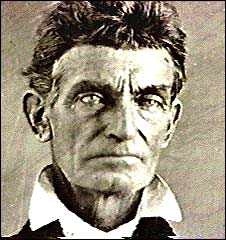
John Brown: The Fanatical Idealist

John_brown.JPG

John Brown

Friends of Padre Steve’s World,

December 2nd was the anniversary of the execution of John Brown, a man who had a righteous cause, but surrendered the moral high ground because of his fanaticism. Justice Robert Jackson wrote:“[I]n our country are evangelists and zealots of many different political, economic and religious persuasions whose fanatical conviction is that all thought is divinely classified into two kinds — that which is their own and that which is false and dangerous.” John Brown was a fanatic who in his desire to achieve his goal was not above committing murder as he did in Kansas, and insurrection as he did at Harper’s Ferry. There are many people in this country who harbor similar beliefs. John Brown serves as a warning to all of us.

This piece is part of my draft book Mine Eyes have Seen the Glory: Race, Religion, Ideology and Politics in the Civil War Era. 

Peace

Padre Steve+

In the North there too existed an element of religious fanaticism. While “the restraining hand of churches, political parties and familial concerns bounded other antislavery warriors,” [1] and while most abolitionists tried to remain in the mainstream and work through legislation and moral persuasion to halt the expansion of slavery with the ultimate goal of emancipation; there were fanatical abolitionists that were willing to attempt to ignite the spark which would cause the powder keg of raw hatred and emotion to explode.

Most prominent among these men was John Brown. Brown was a “Connecticut-born abolitionist…a man with the selfless benevolence of the evangelicals wrought into a fiery determination to crush slavery.” [2] His father was an early abolitionist who helped later found Oberlin College. In his early years Brown “formulated a certitude about divine intervention against sinners, starring himself as God’s warrior against slaveholders.” [3] As early as 1834 John Brown was “an ardent sympathizer the Negroes,” desiring to raise a black child in his own home and to “offering guidance to a colony of Negroes on the farm of the wealthy abolitionist Gerrit Smith at North Elba New York.” [4] Brown regarded moderate free Staters with distain and though he was a fanatical Christian he never joined any church, and “obeyed only his conception of God’s unbounded command.” [5]

Brown “ridiculed Republican’s mainstream tactics. He disparaged even Yankee extremists for deploying too non-violent a strategy.” [6] After a series of failed business ventures the militant Brown went to Kansas and set about to change the equation through the use of terror. After the sack of Lawrence, Brown and a company of his marauders set upon and slaughtered the family of a pro-slavery settler at Pottawatomie Creek. [7] Brown and his son’s entered the house of one family, “dragged three men outside, shot the father through the head, and hacked and mutilated his two sons with broadswords.” [8] Two years later Brown went to Missouri where he “murdered a slaveholder, seized eleven slaves, and led the new freedmen 1100 miles to Canadian sanctuary.” [9]

The example of John Brown provides us with a good example to understand religious extremism, especially when it becomes violent. The counterinsurgency field manual notes in words that are certainly as applicable to Brown as they are to current religiously motivated terrorists, that “Religious extremist insurgents….frequently hold an all-encompassing worldview; they are ideologically rigid and uncompromising….  believing themselves to be ideologically pure, violent religious extremists brand those they consider insufficiently orthodox as enemies.”[10] 

Brown was certainly “a religious zealot…but was nevertheless every much the product of his time and place….” [11] Brown was a veteran of the violent battles in Kansas where he had earned the reputation as “the apostle of the sword of Gideon” as he and his men battled pro-slavery settlers. Brown was possessed by a zealous belief that God had appointed him as God’s warrior against slaveholders. He despised the peaceful abolitionists and demanded action. “Brave, unshaken by doubt, willing to shed blood unflinchingly and to die for his cause if necessary, Brown was the perfect man to light the tinder of civil war in America, which was what he intended to do.” [12]

Brown attempted to gain financing from wealthy abolitionists for a new expedition to seize the Federal arsenal at Harper’s Ferry Virginia, and most would have nothing to do with his scheme. When they “touted their pacific antislavery societies, Brown responded that “your methods are perfectly futile; you would not release five slaves in a century; peaceful emancipation is impossible.” [13] After hearing William Lloyd Garrison and other abolitionist leaders after pleas for peaceful abolition he remarked: “We’ve reached a point,” I said, “where nothing but war can get rid of slavery in this guilty nation. It’s better that a whole generation of men, women, and children should pass away by a violent death than that slavery should continue to exist.” I meant that literally, every word of it.” [14]

Following that meeting, as well as a meeting with Frederick Douglass who rejected Brown’s planned violent action, Brown went about collecting recruits for his cause and set out to seize 10,000 muskets at the Federal armory in Harper’s Ferry, Virginia in order to ignite a slave revolt. Brown and twenty-one followers, sixteen whites and five blacks moved on the arsenal. As they went, Brown:

“believed that we would probably fail at the Ferry, would probably die. But I believed that all we had to do was make the attempt, and Jehovah would do the rest: the Heavens would turn black, the thunder would rend the sky, and a mighty storm would uproot this guilty land, washing its sins away with blood. With God’s help, I, John Brown, would effect a mighty conquest even though it was like the last victory of Samson.” [15] 

After initial success in capturing the armory, Brown’s plan was frustrated and Brown captured by a force of U.S. Marines, led by Colonel Robert E. Lee and Lieutenant J.E.B. Stuart. Brown was tried and hanged, but his raid “effectively severed the country into two opposing parts, making it clear to moderates there who were searching for compromise, that northerner’s tolerance for slavery was wearing thin.” [16]

It now did not matter that Brown was captured, tried, convicted and executed for his raid on Harper’s Ferry. Brown to be sure was “a half-pathetic, half-mad failure, his raid a crazy, senseless exploit to which only his quiet eloquence during trial and execution lent dignity” [17] but his act was the watershed from which the two sides would not be able to recover; the population on both sides having gone too far down the road to disunion to turn back.

Brown had tremendous support among the New England elites, the “names of Howe, Parker, Emerson and Thoreau among his supporters.” [18] To abolitionists he had become a martyr “but to Frederick Douglass and the negroes of Chatham, Ontario, nearly every one of whom had learned something from personal experience on how to gain freedom, Brown was a man of words trying to be a man of deeds, and they would not follow him. They understood him, as Thoreau and Emerson and Parker never did.” [19]

But to Southerners Brown was the symbol of an existential threat to their way of life. In the North there was a nearly religious wave of sympathy for Brown, and the “spectacle of devout Yankee women actually praying for John Brown, not as a sinner but as saint, of respectable thinkers like Thoreau and Emerson and Longfellow glorifying his martyrdom in Biblical language” [20] horrified Southerners, and drove pro-Union Southern moderates into the secession camp. The Richmond Enquirer wrote in its editorial, “The Harper’s Ferry invasion has advanced the cause of Disunion, more than any other event that has happened since the foundation of the Government; it has rallied to that standard men who formerly looked on it with horror; it has revived, with ten fold strength the desire of a Southern Confederacy…” [21]

The day that Brown went to his hanging he wrote his final missive. This was written once more in apocalyptic language, but also in which he portrayed himself as a Christ figure going to his cross on the behalf of a guilty people, but a people whom his blood would not atone:

“It’s now December second – the day of my hanging, the day the gallows become my cross. I’m approaching those gallows while sitting on my coffin in the bed of a military wagon. O dear God, my eyes see the glory in every step of the divine journey that brought me here, to stand on that platform, in that field, before all those soldiers of Virginia. Thank you, Father, for allowing an old man like me such might and soul satisfying rewards. I am ready to join thee now in Paradise…

They can put the halter around my neck, pull the hood over my head. Hanging me won’t save them from God’s wrath! I warned the entire country: I, John Brown, am now quite certain that the crimes of this guilty land will never be purged away, but with blood.” [22]

Brown’s composure and dignity during trial impressed Governor Henry Wise of Virginia who signed Brown’s death warrant as well as that of fire-eater Edmund Ruffin. In his diary Ruffin “praised Brown’s “animal courage” and “complete fearlessness & insensibility to danger and death.” [23]

Brown’s death was marked with signs of mourning throughout the North, for Brown was now a martyr. Henry David Thoreau “pronounced Brown “a crucified hero,” [24] while through the North, Brown’s death was treated as a martyr’s death. Even abolitionists like William Lloyd Garrison who had condemned violence in the quest of emancipation praised Brown’s actions, while throughout the North:

“Church bells tolled, black bunting was hung out, minute guns were fired, prayer meetings assembled, and memorial resolutions adopted. In the weeks following, the emotional outpouring continued: lithographs of Brown circulated in vast numbers, subscriptions were organized for the support of his family, immense memorial meetings took place in New York, Boston and Philadelphia…” [25]

Future Confederate General Lafayette McLaws spoke for many Southerners in the army when he wrote: His diary entry for February 27th 1860 noted:

“Debates in congress show no mitigation of sec. feeling…. I think it would be better not to be so fanatical on any subject, the extreme pro-slavery man is as bad as that type as that type of anti-slavery, John Brown. I do not consider slavery an evil by any means, but I certainly do not think it the greatest blessing.” [26]

But in the South there was a different understanding of Brown’s assault on Harper’s Ferry. Despite official denunciations of Brown by Abraham Lincoln and other Republican leaders, the message proclaimed by Southern newspapermen, ministers and politicians was that the North could not be trusted.  Brown’s raid, and the reaction of Northerners to it “was seized upon as argument-clinching proof that the North was only awaiting its opportunity to destroy the South by force….” [27]

Notes 

[1] Ibid. Freehling The Road to Disunion Volume II p.207

[2] Ibid. Guelzo Fateful Lightning p.81

[3] Ibid. Freehling The Road to Disunion Volume II p.207

[4] Ibid. Potter The Impending Crisis p.211

[5] Ibid. Freehling The Road to Disunion Volume II p.207

[6] Ibid. Freehling The Road to Disunion Volume II p.206

[7] Ibid. Potter The Impending Crisis pp.211-212

[8] Ibid. Goldfield America Aflame p.118

[9] Ibid. Freehling The Road to Disunion Volume II p.208

[10] Ibid. U.S. Army/ Marine Counterinsurgency Field Manual p.27

[11] Ibid. Levine Half Slave and Half Free p.197

[12] Ibid. Korda, Clouds of Glory p.xviii

[13] Ibid. Freehling The Road to Disunion Volume II p.208

[14] Ibid. Oates The Approaching Fury p.203

[15] Ibid. Oates The Approaching Fury p.284

[16] Ibid. Korda Clouds of Glory p.xxxix

[17] Ibid. Catton Two Roads to Sumter p.187

[18] Ibid. Potter The Impending Crisis p.381

[19] Ibid. Potter The Impending Crisis p.375

[20] Ibid. Catton Two Roads to Sumter p.187

[21] ___________ The Harper’s Ferry Invasion as Party Capital The Richmond Enquirer, 23 October 1859 in The Civil War and Reconstruction: A Documentary Collection edited by William E. Gienapp, W.W. Norton and Company, New York and London 2001 p.54

[22] Ibid. Oates The Approaching Fury p.290

[23] Ibid. Thomas The Confederate Nation p.3

[24] Ibid. McPherson The Battle Cry of Freedom p.210

[25] Ibid. Potter The Impending Crisis p.378

[26] Oefinger, John C. Editor A Soldier’s General: The Civil War Letters of Major General Lafayette McLaws University of North Carolina Press, Charlotte and London 2002 p.18

[27] Ibid. Guelzo Fateful Lightning p.119

2 Comments

Filed under civil war, ethics, faith, History, Political Commentary

A Reflection on HIV/AIDS for World AIDS Day

Print

Friends of Padre Steve’s World,

Thursday was World AIDS Day, and so today I am going to reminisce about the events in my life that helped bring me to not just care about the treatment of people infected with HIV or suffering from AIDS but for becoming an advocate for the Gay Community. This is kind of an emotional post as I have friends from high school, college, and the military who have died of AIDS, I have known far too many others who have been cut off from their families, and faith communities once they were discovered to be infected with HIV or came out and admitted that they were homosexual.

The role of right wing political Christians in condemning these men and women has been one of the most disgraceful aspects of my experience, and I am a straight, married, white Christian minister. Sadly, many of the people that I will mention in this article continue to condemn LGBTQ people, those infected with HIV, and those suffering with AIDS. Likewise, they have been involved with demonizing men and women infected with Ebola a couple of years ago. They are without compassion, and without empathy. Gustave Gilbert, a psychologist who worked with the Nazi War Criminals at Nuremberg. Gilbert noted: “In my work with the defendants (at the Nuremberg Trails 1945-1949) I was searching for the nature of evil and I now think I have come close to defining it. A lack of empathy. It’s the one characteristic that connects all the
defendants, a genuine incapacity to feel with their fellow men.
Evil, I think, is the absence of empathy.”
It is the same lack of empathy demonstrated by supposedly Christian leaders that bothers me today, including Vice President Elect Pence, and several of Donald Trump’s cabinet nominees, and many of his advisors. 

In 1986 the late Dr. C. Everett Koop, then the Surgeon General courageously went against the feelings of many people, especially his fellow Evangelical Christians by saying:

“At the beginning of the AIDS epidemic many Americans had little sympathy for people with AIDS…The feeling was that somehow people from certain groups ‘deserved’ their illness. Let us put those feelings behind us. We are fighting a disease, not a people.”

Dr. Koop reminded us all of the basic humanity of those suffering with AIDS and would go on to be a committed advocate for caring for the men and women infected, often going against the bulwarks of the Religious Right including James Dobson and Phyllis Schafly. As a young man he became an inspiration to me.

I met someone with AIDS for the first time, at least knowingly for the first time in the summer of 1987 while serving as a Medical Service Corps personnel officer at the Academy of Health Sciences, Fort Sam Houston Texas. I was the Adjutant for the Academy Brigade, which is the unit that all medical training courses fell under for administrative and command and control issues. My job normally was consisted of basic personnel administration, working with commanders and legal officers when court-martial proceedings were needed, appointing investigating officers for different purposes, reviewing line of duty investigations and running duty rosters. It was nothing to write home about.

But that summer, after years of ignoring the issue the Reagan administration, which had made light of the disease and refused to do anything about it following the initial clinical diagnosis of it in 1981, belatedly, directed the Defense Department to start testing servicemen and women for the disease and to develop personnel policies for infected personnel.

Since it was considered by most in the mainstream to be a “gay” disease the Reagan administration treated it with distain, during some of the White House press conferences, Press Secretary Larry Speakes mocked and laughed about it to reporters who asked questions about it.

On October 15th 1982 this exchange took place: in the White House Briefing Room.

Q: Larry, does the President have any reaction to the announcement—the Centers for Disease Control in Atlanta, that AIDS is now an epidemic and have over 600 cases?

  1. SPEAKES: What’s AIDS?

Q: Over a third of them have died. It’s known as “gay plague.” (Laughter.) No, it is. I mean it’s a pretty serious thing that one in every three people that get this have died. And I wondered if the President is aware of it?

  1. SPEAKES: I don’t have it. Do you? (Laughter.)

Q: No, I don’t. MR. SPEAKES: You didn’t answer my question.

Q: Well, I just wondered, does the President—

  1. SPEAKES: How do you know? (Laughter.)

Q: In other words, the White House looks on this as a great joke? MR. SPEAKES: No, I don’t know anything about it, Lester.

Q: Does the President, does anybody in the White House know about this epidemic, Larry?

  1. SPEAKES: I don’t think so. I don’t think there’s been any—

Q: Nobody knows? MR. SPEAKES: There has been no personal experience here, Lester. Q: No, I mean, I thought you were keeping—

  1. SPEAKES: I checked thoroughly with Dr. Ruge this morning and he’s had no—(laughter)—no patients suffering from AIDS or whatever it is.

Q: The President doesn’t have gay plague, is that what you’re saying or what?

  1. SPEAKES: No, I didn’t say that.

Q: Didn’t say that?

  1. SPEAKES: I thought I heard you on the State Department over there. Why didn’t you stay there? (Laughter.)

Q: Because I love you, Larry, that’s why. (Laughter.)

  1. SPEAKES: Oh, I see. Just don’t put it in those terms, Lester. (Laughter.)

Q: Oh, I retract that.

  1. SPEAKES: I hope so.

Q: It’s too late.

Read more: http://www.alan.com/2014/10/18/that-time-the-reagan-white-house-press-briefing-erupted-with-laughter-over-aids-13-times/#ixzz3GcMPItu7

The late Congressman from San Francisco, Phil Burton told those seeking government help in diagnosing and treating the new disease that:

“I’ll introduce a bill. But if all the angels came dancing down to earth like the Rockettes, even they couldn’t get a dime out of this administration for anything with the name “gay” on it.”

I seriously doubt had Reagan’s friend, Rock Hudson, a closeted homosexual who was a cinematic idol in his day had not died of AIDS in October of 1985 if the administration would have even acted then. Their intentional disregard and negligence was criminal. But they finally did act, and the military acted to begin testing for the disease and to develop personnel policies for infected service members.

Back then no one wanted to deal with AIDS or the people infected by it. This was especially true in much of the military. Since I was the junior Medical Service personnel officer at the Academy of Health Sciences I was told that I would coordinate all services to those infected and work with those appointed by the Army Surgeon General’s office to develop appropriate personnel policies. People in the office joked that I was “CINC AIDS.” That was not a compliment.

When a soldier was diagnosed then they were given a form by their physician stating that they would let any partners know that they were HIV positive and that if they had sex they would only have protected sex. These were a host of other restrictions given in that medical “counseling” and all of these were reinforced as each soldier was then given an order by their commander to the same effect. The difference was that what the doctor gave was “counseling” and what the commander gave was an order, which if disobeyed could result in punishment under the Uniform Code of Military Justice.

Following this they were sent to me to discuss assignment limitations and career options. When people saw a soldier sitting outside my door, they pretty much knew what the person was there to see me for, as my job became more and more about dealing with those infected with HIV. As I took the job I read everything that I could and discussed the matter with physicians dealing with the disease.

Despite that in the beginning it was a scary experience. I attended a local mega-church and much of what I heard, read and listened to on Christian radio was full of paranoia, conspiracy theories and an attitude that could only be explained as an almost joyful gloating that the “homosexuals” were being judged by God. Not only that since HIV was determined to come from Africa, there was a tremendous amount of “old South” racism interspersed with their theological pronouncements.

Dr. James Dobson and Dr. D. James Kennedy, early leaders of the political religious right were particularly vindictive. These unscrupulous leaders helped spread much disinformation about HIV from the a book published by a charlatan named Gene Antonio who wrote what was then a popular book called “The AIDS Cover Up,” They claimed that AIDS could be spread by kissing, mosquito bites or even by touching surfaces that had been touched by those infected. These men were bolstered by their allies in the Reagan White House, Secretary of education Bill Bennett and his assistant Gary Bauer who were the official administration spokesmen regarding AIDS.

These political preachers and activists marginalized Surgeon General Koop who noted in the early days of the epidemic how he was “completely cut off from AIDS” by Bennett and others in the Reagan Administration. They were so wrong that Koop, who was by no means a liberal took them to task on their hateful, dishonest and un-Christian proclamations. Koop told a journalist:

“the Christian activity in reference to AIDS of both D. James Kennedy and Jim Dobson is reprehensible. The first time that Kennedy ever made a statement about AIDS, I saw it on television. It was so terrible, so homophobic, so pure Antonio that I wrote him a letter.”

Koop said of Dobson, who he had worked with earlier on HIV/AIDS: “I don’t know what happened to him. He changed his mind, and last August in his paper he attacked me for two pages as leading people down the garden path. But again his arguments were full of holes. I just cannot believe the poor scholarship of so many Christians.”

But that was the world that part of me lived in. The other world was one of logic and reason, informed by human compassion, so unlike what I was being fed by church leaders and the “Christian” media that I immersed myself.

The sad truth of the matter is then, as today, that far too many Christians, especially influential leaders intentionally and malevolently spread lies to bolster their position. For them it is far easier to profit from demonizing people than it is to work with people they hate, to find solutions that help everyone. In my view many of these supposedly “Christian” leaders, apart from their fashionable clothes, are no different than the Nazis who blamed the Jews, Socialists and homosexuals for every ill in society; or the Japanese leaders who organized the Kamikaze Corps to send true believers to their deaths in a hopeless cause simply to maintain their power.

There is no love, there is no care and there is no empathy in any of them. As Army psychologist Captain Gustave Gilbert noted at Nuremberg “evil is the absence of empathy.”

When you do not know or have never have met someone being demonized by religious people it is easy to surround yourself in comfortable theology. However, when a family member, friend or colleague becomes one of those being demonized it tends to blow up your comfortable theology unless you are a sociopath.

I never will forget the day in the late summer of 1987 when an officer came to my office. He was the first person who I had ever met who was HIV positive. He was a medical professional, an Army Captain who had been selected for promotion to Major. He was married, had children and was a “born-again Christian.” He had contracted HIV when dealing with a combative drunk patient, who was HIV positive. The patient smashed glass, cutting himself severely and started bleeding. The shattered glass cut this officer as he tried to intervene and subdue the man. The officer was infected by the man’s infected blood, which entered him through his own wounds. Though he attempted to disinfect himself by normal protocols he became infected. I was looking at a man, just a few years older than me. A man who loved God, loved his family, who had did all the right things but had become HIV positive.

Even now I can see and hear this man, his face is etched deep into my memory, struggling to fit what happened to him into the message of God’s judgment that his fellow Christians and church members said was the cause of his disease. As I talked to him I realized that what I was being told by men who I was listening to every day on the way to work, as well as what I was reading by “Christian” authors and what I was hearing in church was a lie.

My worldview was forever changed that day. I realized that this man had done nothing wrong, in fact he was trying to do his job as a medical professional to keep a patient from further harm. I was able to help him get into a Master’s degree program in Healthcare Administration since he was no longer allowed to serve in a clinical environment. I have no idea what happened to him after I left the active duty Army to attend seminary in late 1988, but I presume since the mortality rate for HIV/AIDS was so high back then that he probably died years ago. I would hope that by some miracle that this man was fortunate and like NBA great Ervin “Magic” Johnson has not only survived but continues to do well. But I know that the odds were not in his favor.

When he left my office we shook hands, something that my fellow Christians said that I needed to avoid. Not only did I shake his hand, but I gave him a hug and I did not wash my hands or disinfect myself. I figured that God wanted me to get HIV from caring for and accepting someone infected with it than it didn’t matter.

Since that time I have worked with, cared for and ministered to more victims of HIV/AIDS, their families and their friends than I can count. Many of them have made significant impressions on me, my life, and my faith. Without them my life would not be as rich as it has been. I continued to deal with case after case and it is interesting to read the citation from my end of tour award for my time as the Adjutant of the Academy Brigade. It is almost all about AIDS.

So we fast forward to 2016. I’m still in the military, only now I am not a Medical Service Corps Officer in the Army but a Navy Chaplain and I am now teaching Ethics. During my career I spent about eight years in the critical care environment of major medical center ERs, trauma departments and ICUs. I have a rather unique perspective having experience with AIDS and other highly infectious diseases, as well as the ethics of treatment.

Since I was previously qualified as a Nuclear, Chemical and Biological Defense officer when I served in the Army in the 1980s, I understand the importance of, as well as the limitations of personal protective equipment and decontamination procedures. Of course because I know a good number of physicians who specialize in critical care, infectious diseases and pandemics and try to remain current in regard to such diseases, their causes, and the vectors by which they spread.

Thus I realize when I see and hear the Trinity of Evil; the politicians, pundits and preachers who make their living promoting fear, panic and hatred to keep their jobs and obscene profits coming in are at work in demonizing President Obama, the CDC and NIH and poor Africans in Liberia, Ghana and other countries. Like the HIV/AIDS crisis of the 1980s, the same cast of disingenuous, unscrupulous and dishonest preachers, pundits and politicians are at work today as we wrestle with the Ebola crisis, which is neither an epidemic nor a judgment from God.

Sadly, these people are not limited to their own religious networks to spread their lies, propaganda and hate. They have the full buy in from a major cable news network and countless political “news” services, “think tanks” and Political Action Committees; who are their fellow travelers in their quest to demonize those that they hate and dominate society.

The Ebola crisis of 2013-2014 provided these same people, this Trinity of Evil, and their followers; with the avenue to create havoc without taking any personal or corporate responsibility to demonize people, to hinder rational and reasonable solutions to meet the crisis and to ensure the political destruction of the Black man in the White House who they hate with a hatred beyond comprehension, and beginning in January these same people will have massive influence in the White House and Congress to do their worst in harming people by denying medical care, funding, and research into not just HIV/AIDS and Ebola, but any other disease that they choose to label as God’s punishment on people that they despise.

Their words and actions, often clothed in the language of faith may seem to some as a demonstration of righteousness; only now they are even more closely linked to political and economic entities that simply want more power and profit and use them to achieve their malevolent purposes.

The sad thing is that while the leaders of the “Religious Right” benefit from this deal, their followers do not. In fact should Ebola ever reach epidemic or pandemic status in the United States because of their actions which have helped to hinder the government’s response to it; they don’t have to worry, they have good healthcare coverage which is paid for by their followers; and little threat of exposure. On the other hand their followers will have to fend for themselves, paying exceptionally high insurance rates if they can even afford it all the while the people that they support fight to ensure that they do not have affordable, or reliable access to health care.

The sad thing is that Ebola, as bad is it is; is a hard disease to catch, unless you happen to get blasted by a load of the massively infected vomit or bodily fluids of someone in the final stages of it. In fact Ebola is a lot harder to catch many forms of the Bird or Swine Flu, which are airborne viruses and highly contagious. History has shown that both are far more deadly in terms of numbers killed than either Ebola or AIDS have ever been.

Sadly, the same people who fought against treating HIV/AIDS and Ebola are the same people who mock public health experts and agencies when they warn of potential Influenza epidemics or pandemics, and fight against reasonable vaccination and prevention programs and education.

The actions of these religious and political leaders and their media supporters are unethical, irresponsible and at odds with measure of human compassion. It is like they have a death wish for the planet. But truthfully I have to say that it does not look to me that they seem to care so long as they reap a political and economic benefit from it.

Dr. Koop was condemned by fanatical extremists like the late Phyllis Schlafly who said that Koop’s recommendations in his report about preventing AIDS looked “like it was edited by the Gay Task Force” and Schlafly, ever the loving, honest and ethical Christian that she is accused Koop of advocating that third-graders learn the rules of “safe sodomy.”

Koop replied in a very courageous manner to Schafly, who in my view was one of the most loathsome people to ever unite religion and politics: “I’m not surgeon general to make Phyllis Schafly happy. I’m surgeon general to save lives.”

In 1988 Dr. Koop said something that most people in positions of any public responsibility, be they public health officials, medical professionals, politicians or even loathsome preacher should abide:

“I separate ideology, religion and other things from my sworn duty as a health officer in this country.”

But then as it did in the 1980s, the band continues to play on… and those that unite religion and their hatred of others continue to do everything that they can to ensure that people die as they lie. As for me, I am glad that finally saw the truth about these people and I thank people like that HIV positive Army officer who walked into my office in 1987 who humanized that terrible virus, and for helping me see the light.

But our fight is not over, we have to continue to bear witness and speak the truth.

Peace

Padre Steve+

Leave a comment

Filed under ethics, faith, healthcare, LGBT issues, Political Commentary

Dan Sickles the Incredible Scoundrel and Patriot Part One

Friends of Padre Steve’s World,

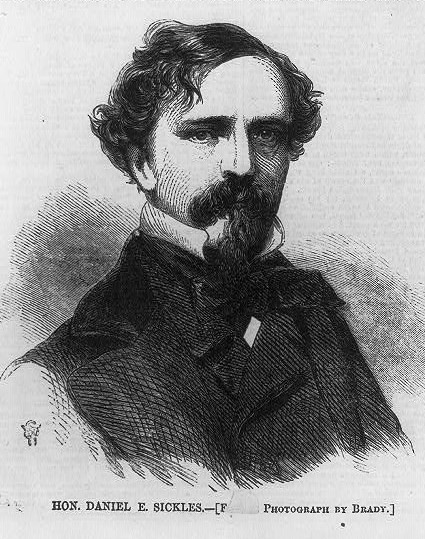
I am taking a break over this Thanksgiving weekend and am re-posting some articles from my Gettysburg text dealing with a man that I consider one of the most fascinating , salacious, scandalous, heroic, and incredible figures ever to grace and disgrace American history, Congressman, and Civil War General Daniel E. Sickles.

I hope that you enjoy,

Peace

Padre Steve+

6517740_orig


George Meade had made his dispositions on July 2nd 1863 with care, but there was one notable problem, the commander of III Corps, Major General Dan Sickles did not like the position assigned to his corps on the south end of Cemetery Ridge. But before discussing that it is worth chasing the rabbit so to speak and spend some time on the life of a man referred to by one by one biographer as an American Scoundrel and another as Sickles the Incredible. The interesting thing is that lie most complex characters in history that Dan Sickles was both and, “he might have had more faults than virtues, but everything about him was perfectly genuine.” [1] That is one of the reason that he is so fascinating.

Sickles was certainly a scoundrel and at the same time incredible, charming yet terribly vain and often insincere. “He was quick-witted, willful, brash, and ambitious, with pliable moral principles.” [2] But he was also incredibly brilliant, far sighted, patriotic, and civic minded. He was a political general, “flamboyant, impulsive, and brave, some would wonder about his discipline and military judgement.” [3] His notoriety and unpopularity among the West Point trained professional officers in the Army of the Potomac, as well as his tactical decision to move his corps on the afternoon of July 2nd 1863, and his subsequent political machinations ensured that he would be the only corps commander of that army not commemorated with a monument at Gettysburg.

Dan Sickles was one of the most colorful, controversial, and perhaps the most scandalous officer ever to command a corps in the history of the United States Army. While he lacked professional training he had done a fair amount of study of the military arts in his spare time, and he “made up for his lack of military training by acting on the battlefield with reckless courage, and was much admired for it by his men.” [4]

After having served as a brigade and division commander Sickles was promoted to corps command. “Sickles owed his elevation to corps command to the patronage of his friend Joseph Hooker…. And while man of the West Point officer….regarded Sickles military acumen with the greatest skepticism, many in the volunteer ranks were of a different mind. “Sickles is a great favorite in this corps,” asserted Private John Haley of the 17th Maine. “The men worship him. He is every inch a soldier and looking like a game cock. No one questions his bravery or patriotism.” [5] General Alpheus Williams who commanded a division in the Union Twelfth Corps despised Sickles, and after Chancellorsville Williams wrote “A Sickles’ would beat Napoleon in winning glory not earned,,, He is a hero without a heroic deed! Literally made by scribblers.” [6] Likewise, Sickles, the political general was no favorite of George Gordon Meade.

On July 2nd 1863 Sickles would be responsible for an act that threw George Meade’s defensive plan into chaos, and according to most historians and analysts nearly lost the battle, however, there are some who defend his actions and give him credit for upsetting Lee’s plan of attack. However, the truth lays somewhat in the middle as both observations are correct. Sickles’ decision created a massive controversy in the months following the battle as public hearings in Congress, where Sickles, a former congressman from New York had many friends, as well as enemies, sought a political advantage from a near military disaster.

Sickles was a mercurial, vain and scandal plagued man who “wore notoriety like a cloak” and “whether he was drinking, fighting, wenching or plotting, he was always operating with the throttle wide open.” [7]Sickles was born in New York to George and Susan Marsh Sickles in late 1819, though a number of sources, including Sickles himself cite dates ranging from 1819 through 1825. “There is little reliable information about Sickles’ early days,” [8] and he did not talk much about them, especially after the war, when Gettysburg and the Civil War became his main subjects of conversation. His father, a sixth generation American whose family were early Dutch settlers in Manhattan became wealthy through real estate speculation, “and he passed on to his son a pride in being a congenital Knickerbocker,” charming, witty, and clever, in whom “hardheadedness and impulsiveness were combined.” [9]

The young Sickles was an impetuous child and his father’s wealth ensured that Dan Sickles had “the finest of tutors…. And an unceasing bankroll of funding for lascivious escapades.” [10] To get their son special tutoring to prepare him for college, his parents “arranged for him to live in the scholarly house of the Da Pont family…. It was a household like few others in that hardheaded, mercantile city, at a time when New York had little of the Italian character it would later take on.” [11]The home was a place of learning, culture, and unusual relationships. The head of the house was Lorenzo L. Da Pont, a Professor at Columbia, as well as a practicing attorney. Also living in the home was Da Pont’s father, the ninety-year-old Professor Lorenzo Da Pont, who “had been the librettist for three of Mozart’s operas” [12] and “held the chair of Italian and Columbia University” [13] Additionally, the elder Da Pont’s “adopted daughter Maria and her husband, Antonio Bagioli, a successful composer and music teacher” [14] lived under the same roof.

Maria was only about twenty-years-old when Sickles moved in. By this time she and Bagioli already had a child of their own, a three year old daughter named Teresa, which Sickles would eventually marry. While the elder Da Pont claimed Maria as an adopted daughter, it was “widely believed that she was his “natural child” … from an American liaison conducted when he was near the age of seventy.” [15] This spawned rumors, even at the time of Gettysburg that the young Sickles “and his future mother-in-law had a sexual affair.” [16]

Whether the liaison with Maria Bagioli occurred is a matter of innuendo and conjecture, but it would not be out of character for Sickles, who, to put it mildly, had a wild proclivity for the opposite sex. As a young man he frequented brothels, and as his social and political status increased, he moved from the brothels frequented by the middle class to those which catered to the more socially well to do. One of his affairs was with the a prostitute named Fanny White, a woman who was smart, pretty, and upwardly mobile who ran her own bordello. His affair with Fanny was well publicized, but did not prevent him from being elected to the state legislature in 1847. She and Sickles would continue their relationship for years with her asking nothing more than expensive gifts, and there are inklings that Fanny help to fund Sickles’ early political campaigns. There is also speculation that in 1854 following his marriage, that Fanny spent time with him in London while he was working with James Buchanan and that that he “may have brought Fanny to one of the Queens’s receptions and introducing the prostitute to Her Majesty.” [17] But Fanny eventually moved on to a man older and richer than Sickles. Eventually she retired from her business and married another New York lawyer but died of complications of tuberculosis and possibly syphilis in 1860. Her property at the time of her death was conservatively “estimated at $50,000 to $100,000”[18] a considerable fortune for a woman of her day and age.

While he lived with the Da Pont family, Sickles gained an appreciation for foreign languages, as well as theater and opera. The elder Professor Da Pont was a major part of his academic life and quite possibly in the development of Sickles liberal education and his rather libertine morality. Lorenzo had been a Catholic Priest and theologian in Italy, but like his young American admirer had quite the attraction for women, and was a connoisseur of erotic literature and poetry. His activities resulted in him being expelled from his teaching position in the seminary, after which he became fast friends with a man whose name is synonymous with smooth talking, suave, amorous men, Giacomo Casanova, and in Europe “his affairs with women had been almost as notorious as those of his good friend.” [19] Certainly the elder Lorenzo’s tales “of Casanova, the fabled prince of Priapus, did nothing to quell Dan’s adolescent sexual appetite.” [20]

Noted Civil War and Gettysburg historian Allen Guelzo describes the Sickles in even less flattering terms, “Sickles was from the beginning, a spoiled brat, and he matured from there into a suave, charming, pathological liar, not unlike certain characters in Mozart operas.”[21]

Following the deaths of both the elder and younger Professor Da Pont, Sickles was stricken with grief. At the funeral of the younger Professor Da Pont Sickles “raved and tore up and down the graveyard shrieking,” [22] forcing other mourners to take him away by force. Soon after, Sickles left New York University and began to work in the law office of the very formidable New York lawyer and former U.S. Attorney General, Benjamin F. Butler.

While he was studying for the bar under Butler, he was joined by his father who would also become an attorney. It was under the influence of his father, who was now a wealthy Wall Street investor, and the Democrats of Tammany Hall that the incredibly talented Sickles was groomed for political leadership. Tammany was a rough and tumble world of hardnosed politics, backroom deals, corruption and graft.

He passed the bar in 1843 and soon was making a name for himself in the legal world, and in politics, despite his well-known questionable ethics and morality. His political career began in 1844 when “he wrote a campaign paper for James Polk and became involved in the Tammany Hall political machine.” [23] The ever ambitious Sickles “clambered up the city’s Democratic party ladder, on the way collecting allies and enemies with utter disregard for the consequences, attending the typically unruly Tammany meetings armed with bowie knife and pistol.” [24]

Like many of his fellow New York Democrats he was a proponent of “Manifest Destiny, and the right of the United States to acquire and hold Texas, New Mexico, California, perhaps the isthmus of Central American, and certainly Cuba.” [25] He was also a political ally of many states rights Southern Democrats and “largely opposed anti-slavery legislation.” [26] This was in large part due to the commercial interests of New York, which between banking and commercial shipping interests profited from the South’s slave economy.

He was elected to the New York State legislature in 1847 and his political star continued to rise even as his personal reputation sank among many of his peers. An attorney who knew him described Sickles as “one of the bigger bubbles in the scum of the profession, swollen, and windy, and puffed out with fetid gas.” [27] Sickles rivals any American politician, before or since in his ability to rise even as the slime ran down his body, the term “Teflon” applied to politicians like Presidents Ronald Reagan and Bill Clinton comes to mind when one studies Sickles’ career. New York lawyer and diarist George Templeton Strong wrote, “One might as well try to spoil a rotten egg as to damage Dan’s career.” [28]

But there was no denying that Sickles was a brilliant lawyer, politician, and debater. One observed that Sickles was “a lawyer by intuition – careful in reaching his conclusions, but quick and bold in pushing them.” [29]New York Governor “William Marcy grudgingly said that as a debater Sickles excelled any man of his years, and the astute Henry Raymond declared that as a parliamentary leader he was unsurpassed.” [30] Soon Sickles was a delegate to the 1848 Democratic Convention where he helped nominate Franklin Pierce for his unsuccessful run at the democratic nomination. The convention enabled Sickles to enter the world of national politics making friends with many influential politicians and financiers, including Pierce, the Van Burens, and James Buchanan. On his return to New York he received an appointed as a Major in the New York Militia.

Even as Sickles rose in the tumultuous world of American law and politics, and chased Fanny White he became enamored with the now teenage daughter of Antonio and Maria Bagioli, Miss Teresa Bagioli who though only fifteen was beautiful, wise beyond her years, fluent in French and Italian, devoted to the arts, and entirely besotted by Dan Sickles. Both the parents of Sickles and Teresa opposed the relationship, but both were madly in love, and Teresa was as headstrong as Dan regarding the relationship. Though such a relationship would be considered completely scandalous today, such marriages were not uncommon then, though they were certainly less common in the upper society of New York. Sickles “was enchanted by her” and “courted her with the sensibility of being a friend of her parents and he must have suspected that he loved her with a fated and exclusive love.” [31] When she was just sixteen Teresa quit school and married the thirty-three year-old assemblyman in a civil ceremony officiated by New York Mayor Ambrose Kingsland on September 27th1852. Six months later, the two were married in the Catholic Church by Archbishop John Hughes, in a “gala and largely attended affair.” [32] Just three months after the church wedding their daughter, Laura, was born. Though there can be no doubt that Sickles loved Teresa, and she him, it did not stop him from other extramarital affairs, nor did it take much away from his political machinations at Tammany Hall.

Following the 1852 Democratic convention where he again supported Franklin Pierce, Sickles hard fighting and influence at in the Wigwam of was rewarded with political plum prize of being appointed “corporation counsel of New York City, a post that paid a flattering salary with extra emoluments and also left room for profitable legal work on the side.” [33] His political and social acumen were again demonstrated as he convinced the state legislature, through personal force of will, to enable the New York City Corporation “to go ahead with creating a great central park,”[34] a park that we now know today as Central Park. He also helped push forward a proposal to create New York’s first mass transportation system, that of horse drawn omnibuses.

Later in the year Sickles was appointed as secretary of the American legation to the Court of St. James n London, headed by former Secretary of State James Buchanan. The position paid a pittance of what Sickles was earning in New York, but he realized that the serving overseas in such a position could not but help him on the national political stage. Though Buchanan and Pierce wanted Sickles, the new Secretary of State, the former New York Governor William Marcy refused to sign Sickles’ commission for the post. Eventually, Pierce prevailed and Sickles got the job.

As their baby, Laura, was still very young and sea travel still quite hazardous, Teresa remained at home, and joined her husband in London the following year. However, when she arrived in London, the teenage wife of Dan Sickles charmed Americans and Britons alike. Aided by her multilingual gifts, which “were rare among American diplomats’ wives,” [35] she became a great success and the unmarried Buchanan appointed her as hostess for the legation. She rapidly became a celebrity due to her stunning beauty and charm, and like he had Fanny, Sickles had Teresa introduced to the Queen. Her celebrity status evoked different responses from those that observed her. “One contemporary described Teresa as an Italian beauty, warm, openhearted, and unselfish. Another described her as being “… without shame or brain and [having] a lust for men.” [36] That “lust for men” coupled with the neglect of her husband may well have been the catalyst for the scandal which overwhelmed them in Dan’s congressional career.

It was during his service in London with Buchanan that Sickles became embroiled in one of the most embarrassing diplomatic incidents in American history. The proponents of Manifest Destiny and American expansion had long desired to take Cuba from Spain through diplomacy, or if needed force. Following a failed attempt by American “Filibusters” to seize the island in 1852 which ended in the execution of fifty Americans, including the son of U.S. Attorney General John Crittenden by Spanish authorities, and in 1854 President Franklin Pierce authorized Buchanan to attempt to negotiate the acquisition of Cuba.

Pierce authorized Buchanan to meet with James Mason, the United States Ambassador to France and Pierre Soule, the United States Ambassador to Spain secretly in order to draft “a statement on the future of Cuba and the proposed role of the United States.” [37] Soule dominated the meeting and the statement, which was in large part drafted by Dan Sickles, was highly inflammatory. Despite this the statement was released to the press in defiance of the order to maintain the strictest secrecy and it resulted in a diplomatic disaster for the Pierce Administration.

The document was prepared by Soule and Sickles and endorsed by Buchanan and Mason was known as the Ostend Manifesto, and it “was one of the most truly American, and at the same time most undiplomatic, documents every devised.” [38] The manifesto prepared by Soule and Sickles proclaimed that “Cuba is as necessary to the North American Republic as any of its present members, and that it belongs naturally to the great family of states of which the Union is the Providential Nursery.” [39] The authors of the manifesto also threatened Spain should the Spanish fail to accede to American demands. The authors declared that if the United States “decided its sovereignty depended on acquiring Cuba, and if Spain would not pass on sovereignty in the island to the United States by peaceful means, including sale, then, “by every law, human and Divine, we shall be justified in wresting it from Spain.” [40]

The Ostend Manifesto “sent shivers through the chancelleries of Europe, provoked hurried conversations between the heads of the French and British admiralties.” [41] European diplomats and leaders reacted harshly to the statement and Secretary of State William Marcy who had previously supported the ideas in the document immediately distance himself and official American policy from it and the authors. Marcy then “forced Soule’s resignation by repudiating the whole thing, but the damage was done.” For months the Pierce administration was on the defensive, and was condemned “as the advocate of a policy of “shame and dishonor,” the supporter of a “buccaneering document,” a “highwayman’s plea.” American diplomacy, said the London Times, was given to “the habitual pursuit of dishonorable object by clandestine means.”[42] The incident ended official and unofficial attempts by Americans to obtain Cuba by legal or extralegal means until the Spanish American War in 1898.

To be continued…

Notes

[1] Catton, Bruce The Army of the Potomac: Glory Road Doubleday and Company, Garden City New York, 1952 p.151

[2] Wert, Jeffry D. The Sword of Lincoln: The Army of the Potomac Simon and Schuster, New York and London 2005 p.222

[3] Ibid. Coddington The Gettysburg Campaign a Study in Command p.45

[4] Sears, Stephen W. Chancellorsville Houghton Mifflin Co. Boston and New York 1996 p.65

[5] Ibid. Trudeau Gettysburg a Testing of Courage p.110

[6] Ibid. Sears Gettysburg p.35

[7] Ibid. Catton The Army of the Potomac: Glory Road pp.150-151

[8] Hessler, James A. Sickles at Gettysburg Savas Beatie New York and El Dorado Hills CA, 2009, 2010 p.1

[9] Keneally, Thomas American Scoundrel: The Life of the Notorious Civil War General Dan Sickles Anchor Books, a Division of Random House, New York 2003 p.7

[10] Ibid. Guelzo, Gettysburg The Last Invasion p.243

[11] Ibid. Keneally American Scoundrel p.3

[12] Ibid. Hessler Sickles at Gettysburg p.2

[13] Ibid. Keneally American Scoundrel p.3

[14] Ibid. Hessler Sickles at Gettysburg p.3

[15] Ibid. Keneally American Scoundrel p.4

[16] Ibid. Hessler Sickles at Gettysburg p.3

[17] Ibid. Hessler Sickles at Gettysburg p.6

[18] Ibid. Keneally American Scoundrel p.215

[19] Swanberg, W.A. Sickles the Incredible copyright by the author 1958 and 1984 Stan Clark Military Books, Gettysburg PA 1991 p.79

[20] Ibid. Swanberg Sickles the Incredible p.80

[21] Ibid. Guelzo, Gettysburg The Last Invasion p.243

[22] Ibid. Swanberg Sickles the Incredible p.81

[23] Ibid. Hessler Sickles at Gettysburg p.4

[24] Sears, Stephen W. Controversies and Commanders Mariner Books, Houghton-Mifflin Company, Boston and New York 1999 p.198

[25] Ibid. Keneally American Scoundrel p.12

[26] Ibid. Swanberg Sickles the Incredible p.82

[27] Ibid. Wert The Sword of Lincoln p.222

[28] Ibid. Hessler Sickles at Gettysburg p.4

[29] Ibid. Swanberg Sickles the Incredible p.84

[30] Ibid. Swanberg Sickles the Incredible p.84

[31] Ibid. Keneally American Scoundrel p.21

[32] Wilson Robert and Clair, Carl They Also Served: Wives of Civil War Generals Xlibris Corporation 2006 p.98

[33] Ibid. Swanberg Sickles the Incredible p.88

[34] Ibid. Keneally American Scoundrel p.21

[35] Ibid. Keneally American Scoundrel p.39

[36] Ibid. Wilson and Clair They Also Served p.98

[37] Ibid. Keneally American Scoundrel p.44

[38] Pinchon, Edgcumb Dan Sickles: Hero of Gettysburg and “Yankee King of Spain” Doubleday, Doran and Company Inc. Garden City NY 1945 p.48

[39] Ibid. Potter The Impending Crisis p.190

[40] Ibid. Keneally American Scoundrel p.45

[41] Ibid. Pinchon Dan Sickles p.48

[42] Potter, David M. The Impending Crisis: America before the Civil War 1848-1861 completed and edited by Don E. Fehrenbacher Harper Collins Publishers, New York 1976 p.193

Leave a comment

Filed under civil war, ethics, History, leadership

Fighting for the Proposition that “All Men are Created Equal” Reflections on the Gettysburg Address

lincolngettysburg

Friends of Padre Steve’s World,

One hundred and sixty three years ago Abraham Lincoln delivered a few short words at the dedication of the Soldier’s Cemetery in Gettysburg, Pennsylvania.

Those words, along with the Preamble of the Declaration of Independence are the American equivalent of secular scripture. Even more than the Constitution they define the ideal of what the United States can and should be.

Lincoln understood that ideal even during the midst of a war which devastated the nation and claimed the lives of nearly three quarters of a million American soldiers and sailors, from the North and the South. At Gettysburg, where just three and a half months earlier over 150,000 soldiers battled for three days, leaving about 50,000 dead, wounded, and missing on the battlefield. When Lincoln gave his remarks the cemetery, which now contains the remains of 3,577 Union soldiers, half unknown, was not yet half-full. Men were still engaged in the gruesome task of recovering the decaying remains from hasty graves all around the battlefield, as well as recovering and attempting to identify those who fell and remained where they died.

Lincoln understood that the sacrifice had to have a greater meaning, and he went back to that sacred proposition in the Preamble of the Declaration, the proposition that “all men are created equal.” It was a proposition that many in Europe mocked as impossible, and which many Americans believed only applied to white, male, property owners. But Lincoln saw beyond that and in his speech he began to universalize the proposition, and spoke of bringing forth “a new birth of freedom” and that Americans, both those gathered around him, and those who read the speech would “highly resolve that these dead shall not have died in vain — that this nation, under God, shall have a new birth of freedom — and that government of the people, by the people, for the people, shall not perish from the earth.” 

I am ever the optimist that we will see that new birth of freedom, but I do expect in the coming years that we will again see many of those freedoms rolled back or curtailed as they were in the years following the re-establishment of white rule in the South, and the extension of Jim Crow to many places outside of the former Confederate States. Sadly, even the symbols of the Confederacy are on the rise, the Confederate Battle Flag is showing up in places that it never flew during the American Civil War.

I do believe that the ideals of Lincoln’s words are immortal, and are worth fighting for even when they are not popular, and even when the majority decides to crush the rights of the minorities that they despise, be they racial, religious, political, ideological, or even gender related. I do believe that we are at a crossroads, a crossroads where we will have to choose to fight for the rights of the weak in our legislatures and courts, and by our actions.

The Compromise of 1850 included the Fugitive Slave Act, a law designed to help slave owners recover their “property” anywhere in the country. It was a law that benefited slave states and overthrew the laws of Free States which were ordered to assist agents of the slave owners recover their human property. Many Northerners, even non-abolitionists were horrified by the new law and worked to protect African Americans in their communities. Southerners were infuriated and claimed to be the victims of Northern aggression and militant “Godless” abolitionists.

I expect that in the coming months that laws will be passed to discriminate against minorities of all kinds and that many of these laws will contradict individual state laws and protections. We are seeing White Nationalists like Stephen Bannon and Jefferson Beauregard Sessions as chief White House Counselor and Attorney General nominee. Neither have had any regard for the rights of racial minorities and may be setting civil rights policy. If those policies discriminate or roll back the rights of people they will have to be opposed.

Like the abolitionists we will have to make a choice, a moral choice and do what we can to mitigate those laws and protect those that they harm until the time comes when the people who passed them lose political power.

img_2708

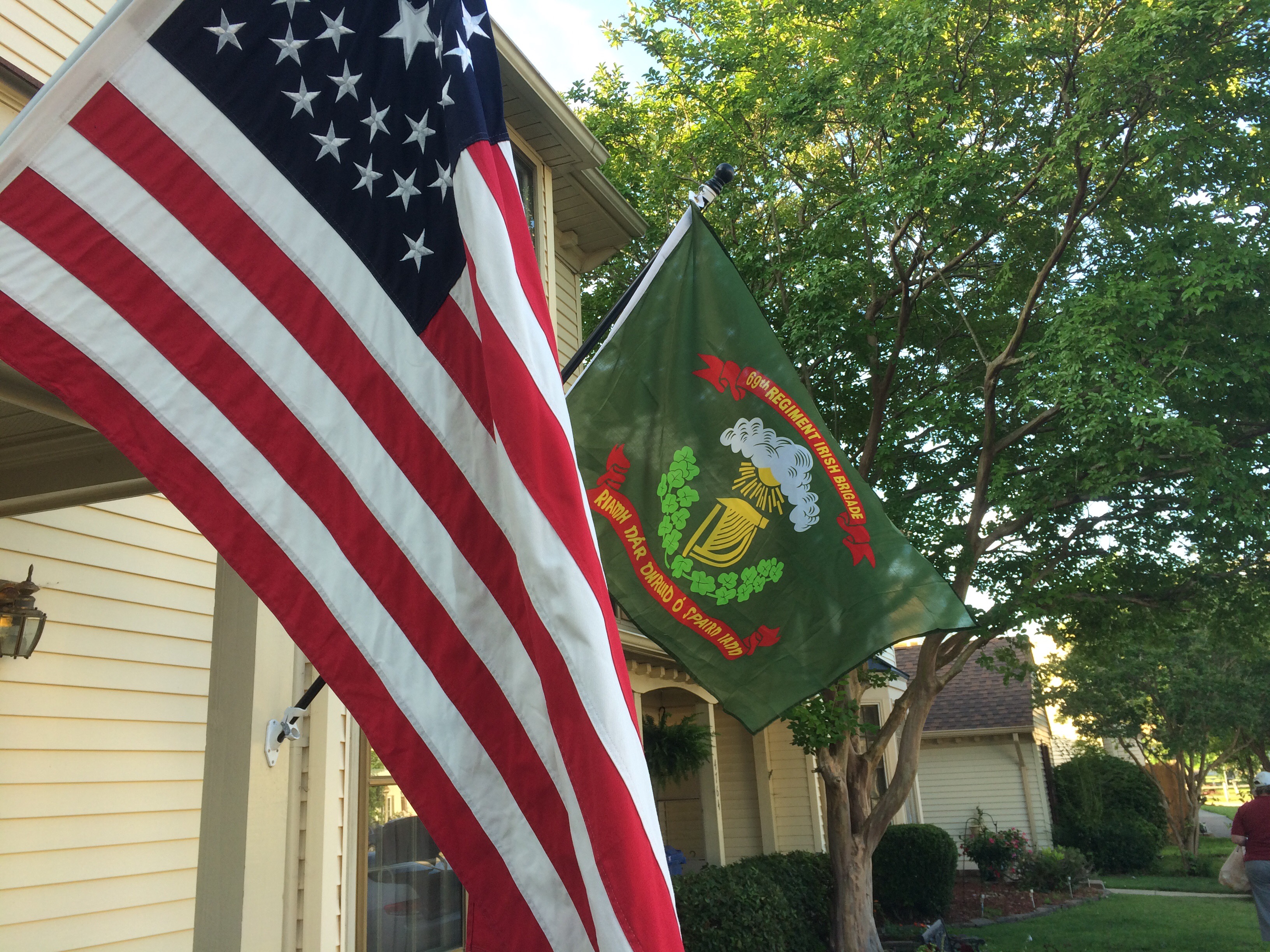
Outside of my house I fly the 34 “Circle Star” Flag of the Union as well as the flag of the 69th New York Volunteer Infantry of the immortal Irish Brigade. They are symbols of my opposition to the neo-Confederate racism and xenophobia that is arising in the country. I will remain true to the Constitution, and I will never stop believing in or fighting for the proposition that all men are created equal, and that we shall indeed have a new birth of freedom — and that government of the people, by the people, for the people, shall not perish from the earth.

Peace

Padre Steve+

Leave a comment

Filed under civil rights, civil war, ethics, History, News and current events, Political Commentary

What Matters is Justice… A Divine Spark or a Killer Angel?

normanrockwellsouthernjustice-2

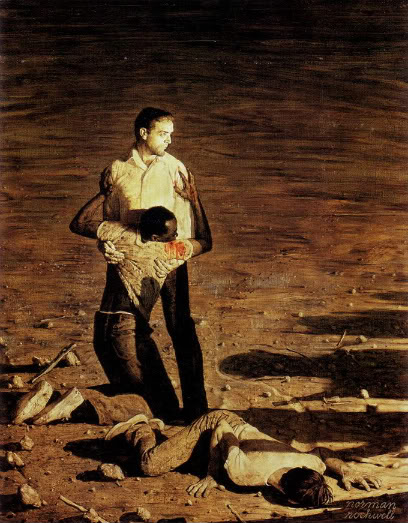
Southern Justice by Norman Rockwell 

Friend of Padre Steve’s World,

Over the past week and a half since the election I have seen many reports of attacks, violence, and harassment of people by persons that claim that the election of Donald Trump allows them to do so. Gays, Mexicans, Muslims, Women, Blacks, and people identified as being “liberal” have all been targeted, sometimes in person, sometimes by the posting of racist flyers on houses and cars, vandalism of churches, and online harassment and trolling. Sadly, these actions do not seem to be abating.

But then I think I know why. For decades those perpetrating these acts have desired to get even and take revenge on people and organizations that they fell are trampling their way of life, or in some destroying the racial and religious purity of the country, and over the years, goaded by preachers, pundits, and politicians their anger has become hatred of all who stand on the other side. Eric Hoffer wrote that “Passionate hatred can give meaning and purpose to an empty life.”

As such, civil rights advocates, institutions that support equality, and the minorities in question become the target of long pent up frustration, and seething hatred that has built up for years just waiting for someone to release the valves and let it flow. To the people committing these acts that person is Donald Trump. It began in the primaries where supporters demonized and destroyed any principled GOP opposition to him, and now it has been let loose, and I see no end of it despite President Elect Trump’s call to “knock it off.”

We would like to such behavior is abnormal, but it is a deeply ingrained part of our humanity. I recall the words of Colonel Joshua Chamberlain, one of my heroes, in the movie Gettysburg when he quotes Hamlet to the curmudgeonly Irish soldier Buster Kilrain, “What a piece of work is man, in form and movement how express and admirable. In action how like an angel.”  Kilrain, who had to flee Ireland responded “Well, if he’s an angel, all right then. But he damn well must be a killer angel. Colonel, darling, you’re a lovely man. I see a vast great difference between us, yet I admire you, lad. You’re an idealist, praise be. The truth is, Colonel… There is no “divine spark”. There’s many a man alive no more of value than a dead dog. Believe me. When you’ve seen them hang each other the way I have back in the Old Country…. There’s many a man worse than me, and some better… But I don’t think race or country matters a damn. What matters, Colonel, is justice…”

I constantly wrestle with the tension of my idealism and my inner realist, the inner realist being much more like Kilrain. So when I see the way people are venting their anger at their enemies, seemingly bent on revenge for grievances real and imagined I tremble. I know history and human nature too well, and the one constant in history is humanity which seems to be forever at war between its amazing and almost angelic qualities of goodness and compassion and its blind hatreds of things it fears.

In the past election campaign we saw people on every side of the spectrum demonizing and dehumanizing their opponents, and despite my best efforts not to give in to that, I too was guilty of at times doing just that and I am not proud, it is one thing to passionately advocate and defend, but it is not okay to dehumanize your opponents. As I wrote last night I have had to come to grips with that, and begin to try to help heal the wounds in our country by reaching out to specific people who I came into conflict with and with whom I must attempt to ask forgiveness for my actions, will at the same time attempting to forgive those who also wounded me. As I wrote yesterday, the latter will be much more difficult.

However, those feelings are still high on both sides of the political chasm and will not go away for some time, but one side now is taking control of all the levers of government, for good, or for bad, what happens next we do not know, we can only speculate and we have to ponder the question; in such an environment where long seated hatred and revenge seems to be such a big factor, can justice survive?

Donald Trump has done something that no single American politician has ever accomplished; he has single-handedly created a mass movement of people whose loyalty is to him and not the political party that he used to gain the Presidency. Some are comparing him to President Andrew Jackson but I don’t know if that is a good comparison, but I digress as I am thinking not so much about President Elect Trump as I am thinking about the mass movement that he has created, and what I have seen, read, and experienced at the hands of some of those people.

American philosopher Eric Hoffer wrote of people who become subsumed in mass movements:

“There is also this: when we renounce the self and become part of a compact whole, we not only renounce personal advantage but are also rid of personal responsibility. There is no telling to what extremes of cruelty and ruthlessness a man will go when he is freed from the fears, hesitations, doubts and the vague stirrings of decency that go with individual judgment. When we lose our individual independence in the corporateness of a mass movement, we find a new freedom—freedom to hate, bully, lie, torture, murder and betray without shame and remorse.

I believe that we are beginning to see how that will play out. I could be wrong, President Elect Trump may take a hard line against those who commit violence, but his pick of Senator Jeff Sessions as Attorney General bodes ill for civil rights and based on his record and statements regarding them. He has called civil rights proponents “un-American” and in the 1980s he was rejected for the Federal Judiciary based on numerous racist statements and positions. Now he will be in charge of the Department of Justice and the Federal judiciary. So I think one can legitimately be concerned about justice and civil rights. Will Sessions enforce the law, or will he turn his back by not prosecuting those who use intimidation and violence to crush the civil and human rights of people who they despise? Will Steve Bannon, a man who just this summer claimed that his media corporation was a platform for the “Alt-Right,” exercise his influence as chief counselor and strategist to the President to push for even more radical steps against political opponents?

One hopes that our better angels prevail, or will we as a people demonstrate that there is no divine spark?

So with those questions asked I will leave you for the day,

Peace

Padre Steve+

Leave a comment

Filed under civil rights, ethics, faith, News and current events, Political Commentary

The Venomous Vulgarian: the Lasting Toxic Legacy of Donald Trump

Friends of Padre Steve’s World,

As I watched and listened to Donald Trump before and after the third and thankfully final debate of the 2016 Presidential election, I was struck with just how viscous, vulgar, and venomous this man is. I cannot remember anyone in American politics at the national level, Republican or Democrat, or for that matter even Whig, who ever managed to immerse himself so deeply into the amoral, unethical, and undemocratic sewer that Trump has bathed himself, the Republican Party and this nation. 

Trump’s toxicity is unparalleled in American politics. Everything and everyone who has ever had anything to do with him is poisoned by his touch. Wives, business partners, contractors, employees, political advisors, and supporters have all been stained by the Mustard Gas that Trump emits on a minute to minute basis. Maybe the most stained are the Evangelical Christian church leaders who have not only endorsed and defended Trump, but  who positively described his character as Christian and said nothing about Trump’s words and actions, which if an opponent had uttered, or had been accused, they would have excoriated with a particularly “Christian” self-righteousness.  Their actions have stained the witness of the church for at least the next generation and it is no wonder that young people are fleeing the church. I specifically use the imagery of Mustard Gas, not just because of its toxicity, but because of its persistence. The battlefields of World War One France and Belgium are still contaminated by it, and the toxic residue still injures people today. 

That my friends is the poisonous and corrosive effect of Donald Trump on this country.  He is a toxic and persistent threat to everyone, even his most devout followers. Race baiting, misogynistic, narcissistic, vulgar, and ignorant, Trump spews his vile venom of conspiracy theories wrapped in fiction, and coated in lies, and buttressed with near pornograpic misogyny in every direction. He has given his supporters in the heavily armed Alt-Right, the neo-Nazis, Klansmen, and White Supremacists the boldness to come out of hiding because he has normalized their hate, something that no Western statesman or politician has done since before the verdicts at Nuremberg. 

I have long felt that Trump reminded me of Nazi leaders, but frankly most of them, while every bit as toxic as Trump were both more intelligent and were better able to cover the darkness of their amoral souls with a modicum of respectability, with the exception of one; the publisher of the infamous newspaper Der Sturmer, and Gauleiter of Nuremberg, Julius Streicher. 

Robert Jackson, the Associate Justice of the Supreme Court who served as the Chief American Prosecutor at Nuremberg referred to Streicher in his summation: 

“Streicher, the venomous vulgarian, manufactured and distributed obscene racial libels which incited the populace to accept and assist the progressively savage operations of “race purification.” 

Is that not exactly what Trump has done during his seventeen month campaign to stir up race hatred against Mexicans and Arabs, not to mention Asians and Blacks? Of course it is, which is exactly why the leaders of the Alt-Right claim him as their candidate, the man who in their perverted minds has made them respectable again and ready to assume their place in Trump’s new order. Anti-Semitism and racism runs rampant in the words of his closest collaborators such as the Breitbart News chief Steve Bannon, as well as Alt-Right Neo-Nazi and KKK leaders like David Duke, Richard Spencer, Jared Taylor, and Peter Brimalow. 

My friends, what you see in Trump is what you get. Unlike Hitler and Goering, but much like Streicher, Trump has no capability of maintaining any sort of respectability. He has been stoking the fires of violence by claiming that the election is rigged and pumping up his followers for violence if he loses. 

Donald Trump is dangerous and will remain an enemy of the American experiment long after he is defeated on November 8th. 

Until tomorrow,

Peace

Padre Steve+ 

3 Comments

Filed under ethics, History, holocaust, leadership, News and current events, Political Commentary

The Cautionary Tale of the Desert Fox: The Murder of Field Marshal Erwin Rommel

rommel

Friends of Padre Steve’s World,

It was 72 years ago in Ulm Germany that a car pulled up to the residence of Field Marshal Erwin Rommel. In the car was the driver and two Generals dispatched by Hitler.  Rommel was recuperating following being severely wounded in an air attack in Normandy on July 17th 1944.

Rommel had been awarded the Pour le Merite, Imperial Germany’s highest award for valor in the First World War. He was never an official member of the Nazi Party, but like many Germans he believed Hitler’s promises and propaganda. As Hitler rose to power he like many others was carried away by early Nazi successes, the bloodless conquests of the Rhineland, Austria, Czechoslovakia, and the spectacle of the Olympics.

Like most other officers he would serve the regime as it spread its dark pall over Europe, and unlike so many others when he suffered a crisis in conscience about the Nazi leadership and their policies he refused to obey orders that he knew were illegal and immoral and then risked his life by joining the conspiracy to kill Hitler.

After years of stalled promotion, Hitler’s expansion of the military allowed Rommel to be promoted, and when Germany went to war he was commander of the unit which guarded Hitler’s headquarters train when he went into Poland. Rommel received command of the 7th Panzer Division after Poland and as a division commander in France he led his troops on some of the most epic advances of the French campaign.

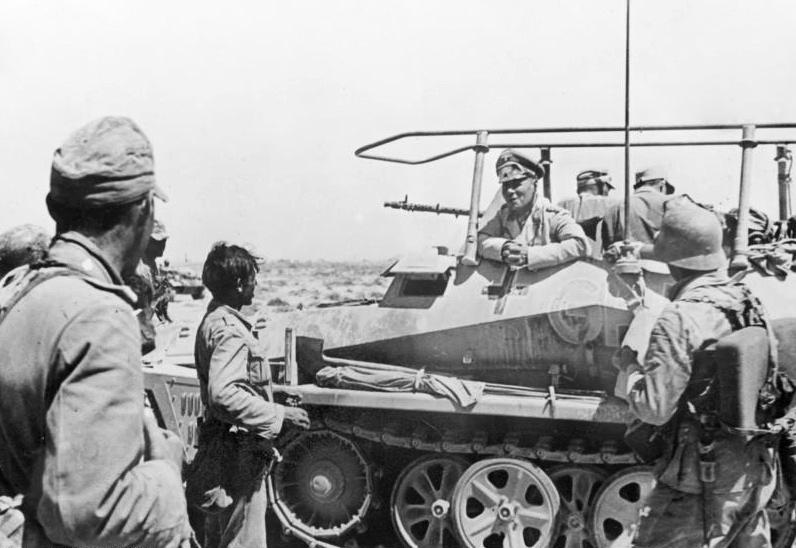
He was then given command of the troops sent to bail out Mussolini’s failed African adventure. His small force and always ill-supplied force, which became known as the Afrika Korps scored impressive victories against British forces. In Africa, Rommel gained fame and earned rapid promotion. Though Africa was a sideshow in the Nazi war effort, Rommel became a poster-child for Joseph Goebbels’ propaganda machine. His fame also earned the resentment of many fellow officers who because he was not an officer of the General Staff regarded him with jealous envy and distain. Even so, Rommel was a soldier’s soldier. He believed in sharing in the suffering of his troops. He once said:Be an example to your men in your duty and in private life. Never spare yourself, and let the troops see that you don’t in your endurance of fatigue and privation. Always be tactful and well-mannered, and teach your subordinates to be the same. Avoid excessive sharpness or harshness of voice, which usually indicates the man who has shortcomings of his own to hide.”

bundesarchiv_bild_146-1991-031-25a_nordafrika_vor_tobruk_rommel

That was until he discovered the reality of Hitler’s promises as the troops of the Afrika Corps found themselves subjected to constant privation from lack of supply, air support and reinforcements. As commander of the Afrika Corps and later the Panzer Armee Arfika he and his troops achieved amazing success against an enemy that was always better supplied and equipped and which had air and sea superiority. Battling the British as well as the political machinations of Mussolini and Germany’s Italian Allies as well as opponents in the German government such as Hermann Goering, Rommel saw his troops crushed under the press of the British as well as the Americans who landed in French North Africa. Eventually, sick and worn out, Rommel was sent back to Germany to recuperate.

rommel-with-soldier

Rommel had a sense of honor and humanity that many other German generals lacked. He refused to allow anti-Jewish measures in areas occupied by German troops in North Africa, ensuring that the approximately 425,000 Jews living in Libya, Tunisia, Algeria, and Morocco were spared the fate of the Holocaust. He refused to execute Jewish POWs, and refused to follow the notorious “commando order.” In June of 1994 he protested the massacre of the people of the village of Oradour-sur-Glane by units of the 2nd SS Panzer Division directly to Hitler and asked for the authority to punish those responsible, but was refused.

His honest assessments of the chances of the Germans winning the war which he spoke candidly to Hitler and the High Command made him persona non grata in Berlin and Berchtesgaden. In the time before he was posted to France in late 1943 he became a part of the plot to end the war and overthrow Hitler. Rommel’s Chief of Staff at OB West, General Hans Speidel, was a key man in the conspiracy and Rommel had contacts with a number of key conspirators. He believed that the war was lost unless his forces could repel the coming Allied invasion on the beaches and worked feverishly to bolster the beach fortifications. He recommended that the Panzer Divisions be deployed near the coast where they could immediately counterattack Allied invasion forces while they were still vulnerable. But his advice was not taken. He was given command of the Army Group but was not given control of most of the Panzer Divisions, which Hitler kept under his direct control.

When the invasion came Rommel was away from Normandy visiting his wife. On learning of the invasion he sped back to Normandy. When he arrived he fought a desperate battle against the Allied forces. His outnumbered forces were under constant assault from the land, sea and air received paltry reinforcements compared to the Allies. Even so, German troops inflicted many local defeats and exacted a heavy price in allied blood in Normandy but were ground to dust. Even so, many American and British infantry regiments suffered 100% casualties but remained in action because of a continuous stream of replacements. Rommel urged Hitler and the High Command to withdraw German forces from Normandy before the allies broke through his front. By doing so he found that he was now considered a defeatist.

Rommel was severely wounded in an air attack on his vehicle by a just days before the attempt on Hitler’s life. Hitler survived the attempted assassination and exacted a terrible revenge on anyone connected with the plot. Show trials and public hangings of officers who had served valiantly at the front were common. Thousands were killed and thousands more imprisoned.

Eventually, other conspirator’s testimony exposed that Rommel was part of the plot. He was recommended by the “Court of Military Honor” to be expelled from the military and tried by the “People’s Court” of Judge Roland Freisler. During the purge that followed the attempt on Hitler’s life, many noted German military commanders were hauled before this court and humiliated by Freisler before they were sent to their deaths. Freisler, a fanatic Nazi judge has been part of the infamous Wansee Conference which planned the details of the Final Solution was killed when his courtroom was bombed in February 1945.

Because of his fame and popularity in Germany Hitler was decided to offer Rommel a choice of being tried by the People’s Court or committing suicide and ensuring his family’s safety. Hitler dispatched two generals from Berlin to personally deliver the message.

492px-Erwin_rommel_death

Rommel suspected that he would be identified and killed and told that to his friends and family in the days leading up to the arrival of Generals Wilhelm Burgorf and Ernst Maisel from OKW with the ultimatum. They met with Rommel for a short time before giving him the opportunity to say goodbye to his family. Rommel told them of his choice and left his home for the last time. 15 minutes later the Generals called his wife to say that he had died of a heart attack. Rommel was given a state funeral and the German people were lied to about his cause of his death.

Winston Churchill wrote of Rommel:

“He also deserves our respect because, although a loyal German soldier, he came to hate Hitler and all his works, and took part in the conspiracy to rescue Germany by displacing the maniac and tyrant. For this, he paid the forfeit of his life. In the sombre wars of modern democracy, chivalry finds no place … Still, I do not regret or retract the tribute I paid to Rommel, unfashionable though it was judged.”

Rommel was just 52 years old when he died. I find in the story of Rommel some commonality in my own life. Before Rommel went to Africa he believed that Germany would win the war, during his command there he discovered that what he believed was lies and that Hitler had little regard for him or his troops. Before I went to Iraq in 2007 I believed much of the political propaganda promoted by the Bush administration and right wing news media and pundits about that war.

The example of Erwin Rommel is a cautionary tale of what can happen when a brilliant and honorable man comes under the spell of a demagogue. Rommel believed Hitler and blindly followed him until he ran into the hard face of reality in Africa at which point he had the moral courage to do the right thing, but many didn’t. Sadly there are otherwise honorable men and women in the current United States military who are blindly supporting a delusional madman for President, a man who promises to order soldiers to commit war crimes, who threatens to jail political opponents, who condemns whole races of people and religions, a man who has no respect for the courts, the law, or the Constitution.  Personally as a historian I cannot understand that. Thankfully I am glad that I am not one of them for I know if Donald Trump ever became President that I would become a target.

Peace,

Padre Steve+

Leave a comment

Filed under ethics, History, leadership, Military, world war two in europe

Make American Great Again? A Lesson from History

The past two days I have been writing about Hurricane Matthew and the appalling lack of empathy of some people, especially self-proclaimed conservative Christians who support Donald Trump for President in order to supposedly Make America Great Again.

I began to think about what makes people accept the hateful rhetoric of such people, including that of Trump, and even support it. Then I began to think of the classic film, Judgment at Nuremberg. The question of how many Germans, who should have known better abandoned all sense and supported Hitler is quite similar to what is going on with many Trump supporters. They are afraid of the futures, they are frustrated, and their fear of the past, present, and future is such that they are willing to cast aside logic and blindly support a man who can only be called a madman.

In the movie, Burt Lancaster plays a prominent German legal scholar and jurist named Ernst Janning. As the trial dragged on he was content to allow his defense attorney to use whatever means necessary, even re-victimizing the people who were in fact the victims of his own judgments in support of his government’s policy. When he went to the witness stand his conscience finally got the best of him and he explained his guilt and how he and so many people like him abandoned all sense and morality in supporting Hitler.

“There was a fever over the land. A fever of disgrace, of indignity, of hunger. We had a democracy, yes, but it was torn by elements within. Above all, there was fear. Fear of today, fear of tomorrow, fear of our neighbors, and fear of ourselves. Only when you understand that – can you understand what Hitler meant to us. Because he said to us: ‘Lift your heads! Be proud to be German! There are devils among us. Communists, Liberals, Jews, Gypsies! Once these devils will be destroyed, your misery will be destroyed.’ It was the old, old story of the sacrificial lamb. What about those of us who knew better? We who knew the words were lies and worse than lies? Why did we sit silent? Why did we take part? Because we loved our country! What difference does it make if a few political extremists lose their rights? What difference does it make if a few racial minorities lose their rights? It is only a passing phase. It is only a stage we are going through. It will be discarded sooner or later. Hitler himself will be discarded… sooner or later. The country is in danger. We will march out of the shadows. We will go forward. Forward is the great password. And history tells how well we succeeded, your honor. We succeeded beyond our wildest dreams. The very elements of hate and power about Hitler that mesmerized Germany, mesmerized the world! We found ourselves with sudden powerful allies. Things that had been denied to us as a democracy were open to us now. The world said ‘go ahead, take it, take it! Take Sudetenland, take the Rhineland – remilitarize it – take all of Austria, take it! And then one day we looked around and found that we were in an even more terrible danger. The ritual began in this courtroom swept over the land like a raging, roaring disease. What was going to be a passing phase had become the way of life. Your honor, I was content to sit silent during this trial. I was content to tend my roses. I was even content to let counsel try to save my name, until I realized that in order to save it, he would have to raise the specter again. You have seen him do it – he has done it here in this courtroom. He has suggested that the Third Reich worked for the benefit of people. He has suggested that we sterilized men for the welfare of the country. He has suggested that perhaps the old Jew did sleep with the sixteen year old girl, after all. Once more it is being done for love of country. It is not easy to tell the truth; but if there is to be any salvation for Germany, we who know our guilt must admit it… whatever the pain and humiliation.”

I’ll just leave you with that for now. I think that is enough for the day.

Peace

Padre Steve+

3 Comments

Filed under ethics, faith, film, History, News and current events, Political Commentary

Judgmental Christians, Hurricane Matthew, and the Absence of Empathy

Friends of Padre Steve’s World,

Yesterday I wrote about the reactions of some supposedly Christian preachers and pundits who claimed that Hurricane Matthew was a “God’s judgment” on the nation for extending basic rights to Gays rather than killing them and against Hillary Clinton supporters.

Personally I cannot fathom such hate coming from supposed Christians who are claiming to speak for God. It makes no sense to me. It’s like the preachers including the late Jerry Falwell who said that the attacks of September 11th 2001 where “God’s judgment” on the United States. I just don’t get it. How people can have such hate for their neighbors that they can rejoice in disasters that affect so many people makes no sense to me, it is perverse.

But then I realize that such people have no empathy for their fellow human beings, even those who share their faith. I am reminded of the words of the Army Psychologist at the Nuremberg War Crimes Trials, Gustave Gilbert when he said:

“In my work with the defendants (at the Nuremberg Trails 1945-1949) I was searching for the nature of evil and I now think I have come close to defining it. A lack of empathy. It’s the one characteristic that connects all the defendants, a genuine incapacity to feel with their fellow men. Evil, I think, is the absence of empathy.”

I have to agree with that. A basic lack of empathy, it is the one thing that connects anyone who can rejoice when disasters strike and claim that it is God doing the work. Such people are sociopaths. Sadly, if by some chance Donald Trump takes power we will have a certifiable sociopath for a President.

Until tomorrow,

Peace

Padre Steve+

1 Comment

Filed under ethics, faith, History, News and current events, Religion

Vast and Heinous Crimes: Babi Yar at 75

babi yar

Friends of Padre Steve’s World,

While I am in Germany I am pre-posting articles that I think are important about issues that I think that we should not forget. This especiall6y true during this presidential campaign where one candidate has stated that he would order U.S. troops to commit acts that can only be described as war crimes, and to deport or expel over 11 million people from the country. To put that number in perspective it is great than the numbers of Jews that Hitler’s forces “evacuated” during World War II.

So anyway, have a great day,

Peace

Padre Steve+

As part of my academic work at the Staff College I teach military ethics as related to the Just War Theory. In the class on jus post bellum or justice after war I deal with the implication of participating in war crimes. It is a serious subject and in the class I attempt to make my students, all relatively senior officers from the United States and allied nations as uncomfortable as possible. I use a number of examples from the major war crimes trials at Nuremberg as well as the Generals Trial. I had an exceptionally good class over the past several weeks and that caused me to go back and do some revisions to a number articles that I have written in the past. I have published a version of this before but I have made some additions and expect that like my work on Gettysburg that this work too will be an ongoing project.

As I went through previous notes and research I felt a tenseness and revulsion for the actions of those that ordered, committed or condoned these crimes, men who were like me professional officers. I realize how easily it is for normal, rational, and even basically decent people to succumb to either participating in or turning a blind eye to crimes against others, even on a massive scale, in fact the bigger they are they seem easier to dismiss, because the victims cease be human, and simply a statistic. Sadly, Josef Stalin probably got human nature right when he said “The death of one man is a tragedy. The death of millions is a statistic.” That comment causes great revulsion in my soul, but I have to admit it seems to be the way that many people deal with such great crimes.

September 29th 2016 will be the 74th anniversary of the Babi Yar massacre. It was committed by members of the SS Einsatzgruppen C near Kiev shortly after the German Army captured that city. 33,771 Jews were exterminated by the members of Sonderkommando 4b of Einsatzgruppen C as well as Police battalions. About 10,000 others, mainly Communist Officials and Gypsies were rounded up and killed in the same operation. The victims were stripped of all of their belongings taken to a ravine and shot. It was the second largest killing action by the various Einsatzgruppen in the war. It was committed by men who either believed that the people that they were killing were sub-human, or did not have the courage to stand up and say no.

These issues are still with us. Hannah Arendt made the comment that “The sad truth is that most evil is done by people who never make up their minds to be good or evil.”

These are uncomfortable subjects. We like to say that the Nazis were different than us or others. To some extent this is true, but the real truth is that most of the Christian Western European countries, and I include the United States have also committed gross crimes against humanity against peoples that we believed were less than human and not afforded human rights or protections. In the movie Judgement at Nuremberg Spencer Tracy makes a comment that should send chills through any of us. He spoke concerning one of the judges on trial, “Janning, to be sure, is a tragic figure. We believe he loathed the evil he did. But compassion for the present torture of his soul must not beget forgetfulness of the torture and the death of millions by the Government of which he was a part. Janning’s record and his fate illuminate the most shattering truth that has emerged from this trial: If he and all of the other defendants had been degraded perverts, if all of the leaders of the Third Reich had been sadistic monsters and maniacs, then these events would have no more moral significance than an earthquake, or any other natural catastrophe. But this trial has shown that under a national crisis, ordinary – even able and extraordinary – men can delude themselves into the commission of crimes so vast and heinous that they beggar the imagination….”

Babi Yar is just one example of how civilized people can get can commit great atrocities in the name of ideology and race, and it does not stand alone. The tragic fact is that it really doesn’t take much to condition people to go commit such crimes; just teach people from childhood that people of certain races or religions are less than human. Then subjugate them to incessant propaganda and then turn them loose using the pretext that they are killing terrorists or insurgents. In the coming days I am posting in small sections an article that I wrote that deals with the ideological as well as military reasons that brought about Babi Yar and so many other atrocities committed by the Nazis during the campaigns in Poland and the Soviet Union.

What happened at Babi Yar is just one example of how civilized people can get can commit great atrocities in the name of ideology and race, and it does not stand alone. The tragic fact is that it really doesn’t take much to condition people to go commit such crimes; just teach people from childhood that people of certain races or religions are less than human. Then subjugate them to incessant propaganda and then turn them loose using the pretext that they are killing terrorists or insurgents.

The article deals with the ideological as well as military reasons that brought about Babi Yar and so many other atrocities committed by the Nazis during the campaigns in Poland and the Soviet Union.

To be continued….

Peace

Padre Steve+

Leave a comment

Filed under ethics, History, holocaust, nazi germany, world war two in europe