Category Archives: faith

“But what is the good of a man being honest in his worship of dishonesty?” Spirituality and Faith in the Trump Era


Father Brown

Friends of Padre Steve’s World,

Just a short thought tonight at the close of Ash Wednesday, or actually deep into the night after Ash Wednesday. Yesterday was a wonderful day, in which I began to really experience a certain joy in faith, of course as always tempered by reason, and the ministry of caring for a diverse workforce. It was probably the busiest and most meaningful Ash Wednesday I have ever experienced in close to 28 years of Chaplain ministry, which include two years where I was for all intents and purposes an agnostic hoping that God still existed after my return from Iraq, followed by another decade of of doubt, depression, and despondency regarding life, and ministry.

However, since November of last year when I was assigned to my final active duty post, that faith has began to return, as well as a renewal of my calling as a Priest and Chaplain. Likewise, Ash Wednesday became a joyous rather than an onerous observance. I was busy all day with walking about caring for people, conducting the first Ash Wednesday service in over a decade at the shipyard and being out and about responding to people who for whatever reason could not attend the service by still wanted to receive the sign of the cross marked in ash upon their foreheads. It was a day of wonderful surprises as instead of saddling people with strict dietary regulations and fretting over what they were going to have to give up I asked them to really experience God’s love by simply accepting the proposition that God loved them, accepted them, and wanted them to do the same to others.

Of course I followed the liturgy for the day, and read the designated scriptures. I did not hammer the points from the Biblical readings home as hard as I once might have been tempted to do. Nor did I try to use my position to convince people to see things my way, as I admitted, I don’t pretend to give God religious instruction, and instead decided to let the Scriptures do the preaching themselves, instead of me since they were so contrary to our materialistic American culture, and the last time I did so a parishioner attempted to have me charged and tried by Court Martial, I didn’t need to hammer home points but let the Holy Spirit of God do his or her job; with the exception of Jesus I do not ascribe gender to the Trinity. My purpose was to invite people to renewing their faith in Jesus through the confession of their sins without condemning them, and in addition make sure than whenever they come to me in whatever capacity, that I greet them and care for them with love and personal care.  I am reminded of the words of Bishop Blackie in The Archbishop Goes to Andalusia, the miscreant Auxiliary Bishop to the Cardinal Archbishop of Chicago goes to Seville Spain.

In the novel Bishop Blackie makes a comment after celebrating Mass in the cathedral at Seville. He said “Every sacramental encounter is an evangelical occasion. A smile warm and happy is sufficient. If people return to the pews with a smile, it’s been a good day for them. If the priest smiles after the exchanges of grace, it may be the only good experience of the week.”  (The Archbishop in Andalusia p.77) Honestly, I think that should be the place of the Priest  in every encounter, even those that are not sacramental. It should be an everyday part of our lives. That being said there are times that a Priest, Minister, Rabbi, Imam, or other clergy person can be beaten down by life, and even by the leaders of the institutions that they serve. I such cases it is often hard to smile or be compassionate to others because we, at that point are empty vessels, at best hoping and praying that we will again find meaning and joy in our vocations, or succumbing to the pain of rejection and evil committed by clerical leaders in the name of God.

Instead of preaching for people to obey rules, I asked them to consider showing love and care to the poor, the lost, the weak, and the lonely, and not be an ass about it by acting arrogant and brag publicly about their allegedly superior spiritual position. I noted, with quite a bit of honesty that when it came to being a Priest, Chaplain, and Husband I have barely stayed at the Mendoza Line, which is basically hitting for a batting average of about .200. This might keep me in the game due to certain skills, but it will not get me to the hall of fame.

In light of that I hardly have the right to preach to people about how they should live their lives, and follow rules that I struggle with; but instead encourage them to seek God’s love, to be honest about their lives, their strengths, and weaknesses; their successes, and failures, and then allow God to work in and through them as instruments of God’s grace and love.

When I was going through my most difficult times of doubt after Iraq it was Father Andrew Greeley’s Bishop Blackie Ryan mysteries that kept a spark of hope and faith alive in my life. In his novel The Bishop and the Beggar Girl of St. Germain, Bishop Blackie noted “Most priests, if they have any sense or any imagination, wonder if they truly believe all the things they preach. Like Jean-Claude they both believe and not believe at the same time.” I can say truthfully that I know what that is like.

More recently we have discovered the latest BBC series based on G.K. Chesterton’s “Father Brown” mysteries. Now that I have seen the series and am watching it a second time, with the addition of previously unaired episodes on Netflix, I am becoming interested in reading Chesterton’s novels, but I digress.

Today was another exceptionally busy day of ministry beginning with an employee who decided to decided to trust me with his marital and spiritual issues based on my Klingon Valentine’s Day article, which I sent out through our Public Affairs Officer to all hands note in a truncated form. He appreciated my openness, and willingness to share my failings as a husband, Priest, and human being in a way that most ministers won’t. It was a long session and I believe that we have built a relationship that will either help save his marriage, or set the stage for a divorce with a soft landing. Sometimes, and sadly, because of how embittered relationship can become, that is the most Christian thing that will happen. I hope we can work to bring reconciliation to this couple. However, I cannot predict what will happen, but promised that I would walk with them through this terrible time.

But just before the appointment I was called because one of our civilian administrative assistants died unexpectedly before work this morning. She was beloved, and what some people don’t realize, that in places like the Naval Shipyard, our civilian employees are like family to each other. They work with each other for decades, it’s not like the active duty military where we transfer every few years. In the case of the shipyard, which is the oldest in the Western Hemisphere, many employees have family connections going back generations to it. So I spent about half of my day with those employees doing grief counseling, and since I hung around to get to know people I ended up answering other people’s questions about faith, religion, and church history. It was wonderful. I didn’t push anything on them, and explained the differences in what different Christian denominations believe without condemning any of them. Of course that is a significant part of my spiritual “Long Strange Trip.” Because of that I am willing to appreciate the differences of different denominations, even as I am able to explain how they differ with other Christian denominations, without condemning them.

So it was a wonderful day, but it was exhausting, as at my heart I am an introvert who chooses to push my boundaries and at work function as an extrovert. Of course that means that when I come home I often withdraw into my emotional bucket in order to regenerated so I can do the next day. By the way that is a Star Trek Deep Space Nice reference. Google it if you must, but for practical purposes I am an emotional changeling, like DS 9’s Chief of Security, Odo, after so long I have to revert to my emotional introvert gelatinous state in order to regenerate at function in the military and the church. That is an odd comparison, but it is the best I can do.

But, where was I?

Oh that’s right, Ash Wednesday ministry; ministry the day following, Father Brown, and Bishop Blackie Ryan, are my inspiration. It is true that they are fictional characters, but the men who wrote their stories were not, they were very real, and their fictional characters have helped me continue to believe, Even when the Bible didn’t,  and likewise brought  a reality and joy to ministry that I didn’t know; even when I knew it all. But, as the late MLB Hall of Fame Baltimore Orioles manager, Earl Weaver noted “it’s what you learn after you know it all that counts.” That is quite true of my spiritual life.

Likewise, there are people who use the Bible as a weapon, in order to justify their misdeeds and hatred for others. It can be a terrible thing. In one of the Father Brown mysteries, Chesterton, writing as his character Father Brown, wrote:

“Sir Arthur St. Clare, as I have already said, was a man who read his Bible. That was what was the matter with him…. Of course, he read the Old Testament rather than the New. Of course, he found in the Old Testament anything that he wanted—lust, tyranny, treason. Oh, I dare say he was honest, as you call it. But what is the good of a man being honest in his worship of dishonesty?”

The problem is, that people of every faith tend to use select parts of their Holy Scriptures as weapons against people who they deem unworthy of the love of God. They are honest people, but as Father Brown noted: But what is the good of a man being honest in his worship of dishonesty?” Sadly, that is all too true of too much of the Christian Church, as well as the clergy of other religions.

Until tomorrow, Peace

Peace,

Padre Steve+


Leave a comment

Filed under books and literature, christian life, faith, life, marriage and relationships, ministry, Religion, spirituality

The “Fire Eaters” those that Make Ordinary Extremists Look Acceptable: the Ante-Bellum South, Reconstruction, the Southern Strategy and Today


Friends of Padre Steve’s World,

Well, here I go again tilting at the very real windmills of that part of American history that we have embellished in the myths of the Noble South and the Lost Cause that still thrive today, only now they have expanded far beyond the bounds of the Old South and the former Confederacy. Like I mentioned yesterday, my study of the Battle of Gettysburg forced me to go beyond the battle, beyond the movements of troops, and decisions of commanders on the battlefield. The dirty little secret, or shall we say, the great outlandish lie was that enslaved Blacks for nearly 250 years, cost the lives of nearly 750,000 military men on both sides, and another 100 after that years of struggle, and bloodshed committed by White Nationalists, including the KKK, before Blacks achieved the basics of Civil and Voting rights.

But within days of the Voting Rights Act of 1964, and the Civil Rights Act of 1965, the backlash began. The Dixiecrats, led by Senator Strom Thurmond and others who could not abide racial equality began to leave the Democratic Party, and by President Ronald Reagan’s second term, the formerly Democrat controlled Solid South, was now Republican, thanks to Richard Nixon’s racist Southern Strategy. But even worse, in the years following the Civil War, White Nationalist Extremists established themselves in the North, where many have formed so called militias, and paramilitary groups ready to fight for White Supremacy to the end. They, and their political, and media supporters, have become the modern day version of what were called the Fire Eaters in the Ante-Bellum South. 

So tonight I will recall the lives of a number of the men who were called “fire eaters,” even by other pro-slavery men. While they took extreme positions, there was little difference between their ideology and the more respectable members of the Southern aristocracy.  You see, all forms of systematic evil, need men who are able to state their support for positions so extreme that they make the mainstream supporters of that position look good by comparison. 

We see this every day in our media where outlandish and evil men build up followings and make others who hold their beliefs, without their character flaws look good by comparison. So here is tonight’s installment from one of my books dealing with the history of slavery, emancipation, and the return of Jim Crow and White Supremacy. I won’t name names, but if one has the slightest bit of imagination, one can probably name at least a dozen political, media, and, religious leaders that embody White Supremacy, oligarchy, and the subjugation of all people who are deemed less than human.

Oh, like I said last night, both sides of my family were slave owning families, and fought for the Confederacy. At one time, when I was under the influence of the twin myths of the Noble South and the Lost Cause that I honored them. I

I admit that it is not a comfortable read and unfortunately it is also all too contemporary for comfort, you see, of all the factors in human history, humanity is is the one constant in history.

Until tomorrow,

Peace

Padre Steve+

The Importance of people: Edmund Ruffin and the Fire-Eaters

Edmund-Ruffin

Edmund Ruffin 

As important as it is to understand the political, religious and ideological debate around slavery, we cannot adequately do so unless we begin to understand the people involved in the debates and the controversies of the time. As I constantly note, human beings are the one constant in history. Two of these men, there are two that I think stand out from almost all other Southern supporters of slavery. One, Edmund Ruffin, because he can be legitimately called one of the proponents of Confederate nationalism; and the other, Robert Barnwell Rhett, who was so hard line in his beliefs that he could not work within any system that required compromise, even at the end of the war.

Among the people most enraged by Northern opposition to slavery was Edmund Ruffin. Ruffin is one of the more interesting characters who stridently supported slavery, white supremacy, and secession in the ante-bellum south. Ruffin became the face of slaveholding ideology, but he not always pro-slavery, or pro-secession. As a younger man he had been a Jeffersonian Republican who as early as 1816 was concerned about growing federal power, but his writings were considered academic, scholarly, and moderate. However that began to change as the country lurched from one sectional crisis to the next.

As early as 1845 Ruffin was beginning to write about the probability of fighting the North, “We shall have to defend our rights by the strong hand against Northern abolitionists and perhaps the tariffites…” [1] But it was the passage of the Compromise of 1850, a compromise that actually did more to help Southern slaveholders than to harm them, which turned him into an ardent and hardline secessionist.

When he decided on secession he did so with the zeal of a man on consumed by something almost akin to religious conversion:

he promptly threw himself into the new cause, replacing his formerly scholarly approach to issues with a fire-eater’s polemical and emotional style. “I will not pretend,” he now announced, “to restrain my pen, nor attempt to be correct in plan or expression – as is more or less usually the case in my writing.” [2]

Ruffin’s conversion was remarkable because as young man, Ruffin believed that slavery was an evil. But he began to study the works of Thomas Dew he became convinced of the necessity of slavery and its justification. In his tract The Political Economy of Slavery he wrote,

“Slavery… would be frequently… attended with circumstances of great hardship, injustice, and sometimes atrocious cruelty. Still, the consequences and general results were highly beneficial. By this means only–the compulsion of domestic slaves–in the early conditions of society, could labor be made to produce wealth. By this aid only could leisure be afforded to the master class to cultivate mental improvement and refinement of manners; and artificial wants be created and indulged, which would stimulate the desire and produce the effect, to accumulate the products of labor, which alone constitute private and public wealth. To the operation and first results of domestic slavery were due the gradual civilization and general improvement of manners and of arts among all originally barbarous peoples, who, of themselves, or without being conquered and subjugated (or enslaved politically) by a more enlightened people, have subsequently emerged from barbarism and dark ignorance…” [3]

But Ruffin was not a unlearned or unsuccessful man. He was an agricultural reformer who pioneered the use of lime to enhance the effectiveness of other fertilizers. He edited a successful farm paper, and ran a very successful planation outside of Hopewell, Virginia, near Richmond.

Ruffin passionately argued for secession and Southern independence for fifteen years, even before the Compromise Of 1850 hardened him into the most passionate advocate of secession. He “perceived the planter civilization of the South in peril; the source of the peril was “Yankee” and union with “Yankees.” Thus he preached revolution, Ruffin was a rebel with a cause, a secular prophet…” [4] He was the type of man who understood reality far better than some of the more moderate oligarchs that populated the Southern political and social elite. He knew that the only way slavery to survive was for the South to become a nation of its own, and that meant secession. While in the years leading up to the war, these men, including John Calhoun attempted to secure the continued existence and spread of slavery within the Union through the Congress and the courts, Ruffin condemned their efforts.

As early as 1850, Ruffin recognized that in order for slavery to survive the slaveholding South would have to secede from the Union. Ruffin and other radical secessionists believed that there could be no compromise with the north. In 1850 he and James Hammond attempted to use a meeting in Nashville to “secure Cooperative State Secession and wrote to Hammond, against those who sought to use the meeting to preserve the Union, “If the Convention does not open the way to dissolution…I hope it shall never meet.” [5] Ruffin believed that slave holding states had to be independent from the North in order to maintain the institution of slavery.

Ruffin’s views were not unique to him. They formed the basis of how most slave owners and supporters felt about slavery’s economic and social benefits of slavery and the Southern cotton economy. But while many Southerners wrote about the importance and necessity of slavery, Ruffin was one of its most eloquent defenders. He wrote:

“Still, even this worst and least profitable kind of slavery (the subjection of equals and men of the same race with their masters) served as the foundation and the essential first cause of all the civilization and refinement, and improvement of arts and learning, that distinguished the oldest nations. Except where the special Providence and care of God may have interposed to guard a particular family and its descendants, there was nothing but the existence of slavery to prevent any race or society in a state of nature from sinking into the rudest barbarism. And no people could ever have been raised from that low condition without the aid and operation of slavery, either by some individuals of the community being enslaved, by conquest and subjugation, in some form, to a foreign and more enlightened people.” [6]

The most striking thing about Ruffin’s defense of slavery is the distinction that he makes between enslaving people of the same race, which he calls the “worst and least profitable kind of slavery” over the enslavement of inferior races. He did not disapprove of enslaving people of the same race, but he believed that the enslavement of people of the same race was wise, nor profitable. But Ruffin, a true believer in White Supremacy believed that enslavement of inferior races was not only permissible, but in fact the bedrock of civilization. Likewise his understanding that slavery alone was the only thing that prevented “any race or society in a state of nature from sinking into the rudest barbarism,” was common among the Southern planting class.

In 1860 the then 67-year-old Ruffin helped change the world forever when, according to popular legend he pulled the lanyard that fired the first shot at Fort Sumter. While he had joined the Palmetto Guards and was present, he probably did not fire the first shot. Instead, he was probably was given the honor of firing the first shot from his battery; as other guns from other emplacements may have fired first shot.


Robert Barnwell Rhett

But Ruffin was not alone, he was numbered with other Fire-Eaters who beginning in the 1840s began urging secession in order to protect the institution of slavery. The real “father” of Southern secession was Robert Barnwell Rhett of South Carolina. Rhett was a lawyer who was born under the name of Robert Barnwell Smith in Beaufort, South Carolina in 1800, but who adopted the surname of a famous ancestor in order to have a name which would befit him more in aristocratic South Carolina.

In a twist of irony, the man who became the father of the secessionist movement studied law under Thomas Grimke, the brother of the two famous abolitionist sisters, and “a leader of South Carolina’s anti-slavery American Colonization Society.” [8] Rhett was a talented attorney with excellent oratorical skills and he was elected to the South Carolina legislature in 1826 as the controversy over nullification began. Rhett, like other opponents of a Federal Tariff led by Senator John C. Calhoun urged secession as early as 1830 he told a crowd that before submitting to the tyranny of Federal Government, that they must be read to destroy the Union:

“Aye – disunion, rather, into a thousand fragments. And why, gentlemen! would I prefer disunion to such a Government? Because under such a Government I would be a slave – a fearful slave, ruled despotically by those who do not represent me … with every base and destructive passion of man bearing upon my shieldless destiny.” [9]

Later, in the face of President Andrew Jackson’s political strength and much congressional opposition led by Henry Clay, South Carolina dropped nullification. Rhett was angry. He told his colleagues in the legislature that “Your “northern brethren,” aye, “the entire world are in arms against your institutions…. Until this Government is made a limited Government… there is no liberty – no security for the South.” [10] He then described disunion as the only way for the South to survive and to escape what he called “unconstitutional legislation.” He described a “Confederacy of the Southern States… [as] a happy termination – happy beyond expectation, of our long struggle for our rights against oppression.” [11]

Rhett worked against compromise at every opportunity, especially compromise which would preserve the Union. Absolutely convinced of the rightness of his cause he distrusted the politicians who favored compromise and had no faith in political parties. He worked from 1833 until the very end in order to support slavery, disunion, and secession, using every crisis as an opportunity. His dream was for “all Southerners – to unite across party lines and unyieldingly defend slavery and Southern interests as he defined them.” [12] 

During the debate over secession following the Compromise of 1850, Rhett resigned his seat in the U.S. Senate which had been elected to following the death of John C. Calhoun, rather than accept the premise that the state convention’s ruling that secession was not justified.

After leaving office he became the editor, and later the full owner of the Charleston Mercury newspaper where he continued to advocate for secession in often the most outrageous ways,  “The more outrageous the Mercury’s charges, the more they were picked up and reprinted by other papers. Rhett’s propaganda technique was part of a larger secessionist strategy. “Men having both nerve and self-sacrificing patriotism,” he wrote, “must lead the movement and shape its course, controlling and compelling their inferior contemporaries.” He worked to push those without sufficient patriotic nerve – that is, moderate leaders – out of the political arena, believing correctly that without a solid middle ground to stand on, Southern voters would rally increasingly to the fire-eaters’ standard.” [13]

In 1860 Rhett “joined a drive to either rule or ruin the 1860 Democratic convention scheduled for Charleston.” [14] His work was successful, he devised the strategy to destroy the Union by first destroying the Democratic Party, and he wrote in January 1860 that “the destruction of the Union must… begin with the “demolition” of the party. So long as the Democratic Party, as a “National” organization exists in power in the South,… our public men” will “trim their sails.” [15] 

When South Carolina seceded from the Union, it was Rhett who drafted South Carolina’s secession ordinance, which claimed that South Carolina was not “perpetrating a treasonous revolution, but… simply taking back… the same powers it had temporarily surrendered… when South Carolina ratified the federal Constitution.” [16] 

Rhett was elected to the Confederate House Of Representative but However, following secession Rhett’s inability to compromise and his intemperate behavior alienated from him from Jefferson Davis and other Southern leaders. He grew increasingly isolated, and become one of Davis’s most bitter critics. As late as March of 1865, with Sherman’s Union armies having overrun South Carolina and Grant’s at the gates of Richmond, Rhett remained defiant and uncompromising. He opposed any move to compromise on the issue of slavery, even the belated attempt of Jefferson Davis and some in the Confederate Congress to grant limited emancipation to African American slaves who enlisted to fight for survival of the Confederacy.

Rhett moved to Louisiana and left the Mercury to his son, he never reentered politics and died in 1876. Ruffin made a more spectacular exit. Two months after the surrender of Robert E. Lee’s Army Of Northern Virginia, Ruffin exited his earthly life.

When the war ended with the Confederacy defeated and the south in ruins, Ruffin still could not abide the result. In a carefully crafted suicide note he sent to his son the bitter and hate filled old man wrote on June 14th 1865:

“I here declare my unmitigated hatred to Yankee rule- to all political, social and business connections with the Yankees and to the Yankee race. Would that I could impress these sentiments, in their full force, on every living Southerner and bequeath them to every one yet to be born! May such sentiments be held universally in the outraged and down trodden South, though in silence and stillness, until the now far-distant day shall arrive for just retribution for Yankee usurpation, oppression and outrages, and for deliverance and vengeance for the now ruined, subjugated and enslaved Southern States! … And now with my latest writing and utterance, and with what will be near my last breath, I here repeat and would willingly proclaim my unmitigated hatred to Yankee rule — to all political, social and business connections with Yankees, and the perfidious, malignant and vile Yankee race.” [17]

There will be more to come.

Notes

[1] Ibid. Potter The Impending Crisis p.463

[2] Abrahamson, James L. The Men of Secession and Civil War, 1859-1861 Scholarly Resources Books, Wilmington DE 2000 pp.43-44

[3] Ruffin, Edmund The Political Economy of Slavery in McKitrick, Eric L. ed. Slavery Defended: The Views of the Old South. Englewood Cliffs, NJ: Prentice Hall/Spectrum Books, 1963.Retrieved from http://www.pbs.org/wgbh/americanexperience/features/primary-resources/lincolns-political-economy/ 24 March 2014

[4] Ibid. Thomas The Confederate Nation p.1

[5] Ibid. Freehling The Road to Disunion Volume One: Secessionists at Bay p.481

[6] Ibid. Ruffin The Political Economy of Slaveryhttp://www.pbs.org/wgbh/americanexperience/features/primary-resources/lincolns-political-economy/

[7] Catton, Bruce The Coming Fury Phoenix Press, London 1961 pp.314-315

[8] Ibid. Abrahamson The Men of Secession and Civil War, 1859-1861 p.33

[9] Goodheart, Adam The Happiest Man in the South in The New York Times Opinionator December 16th 2010 retrieved from http://opinionator.blogs.nytimes.com/2010/12/16/the-happiest-man-in-the-south/?_r=0 26 July 2016

[10] Ibid. Freehling The Road to Disunion Volume One: Secessionists at Bay p.286

[11] Ibid. Abrahamson The Men of Secession and Civil War, 1859-1861 p.34

[12] Ibid. Abrahamson The Men of Secession and Civil War, 1859-1861 p.34

[13] Ibid. Goodheart The Happiest Man in the Southhttp://opinionator.blogs.nytimes.com/2010/12/16/the-happiest-man-in-the-south/?_r=0

[14] Ibid. Abrahamson The Men of Secession and Civil War, 1859-1861 p.34

[15] Freehling, William. The Road to Disunion Volume II: Secessionists Triumphant 1854-1861 Oxford University Press, Oxford and New York 2007 p.295

[16] Ibid. Guelzo Fateful Lightning p.130

[17] Edmund Ruffin (1794-1865). Diary entry, June 18, 1865. Manuscript Division, Library of Congress Retrieved from http://blogs.loc.gov/civil-war-voices/about/edmund-ruffin/ 24 March 2014

2 Comments

Filed under civil rights, civil war, faith, History, laws and legislation, leadership, News and current events, Political Commentary, racism

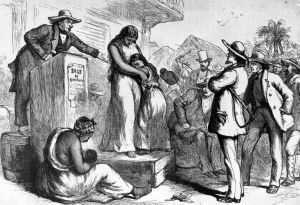
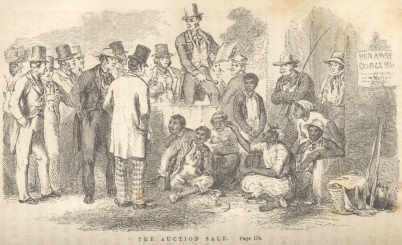
“Liberty for the Few – Slavery in Every Form for the Mass” Slavery, America’s Original Sin is Always a Heartbeat Away

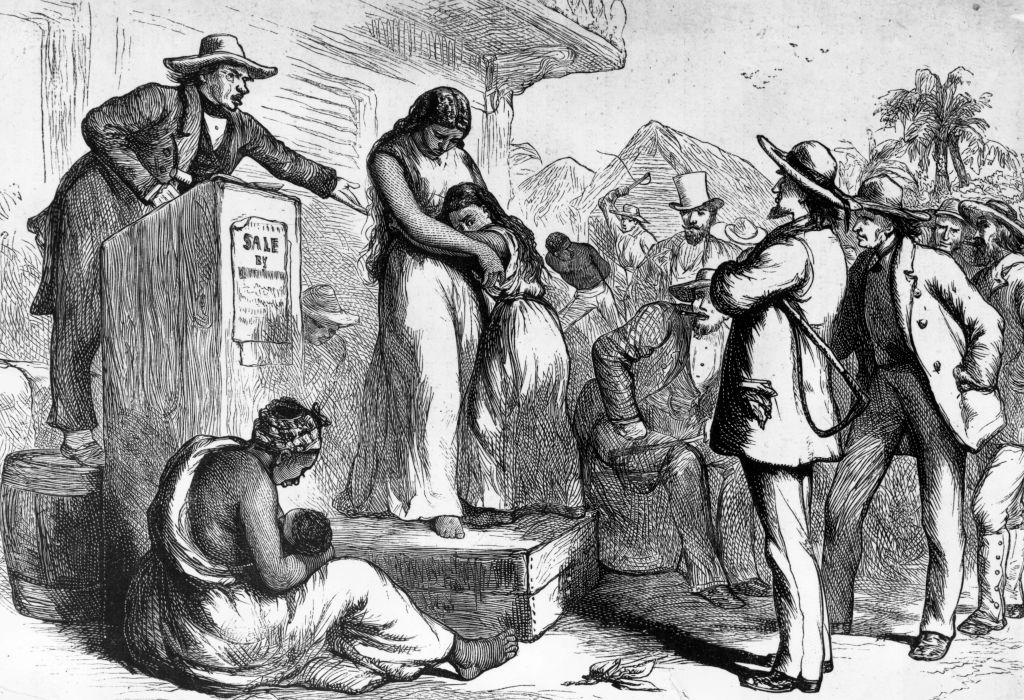
circa 1830: A slave auction in America. (Photo by Rischgitz/Getty Images)


Friends of Padre Steve’s World,

After the article I posted that I edited, and may some commentary late last night I am going to be posting a number of articles from my various texts dealing with the American Civil War era dealing with topics that some would want to forget, but are very important if we want to fully appreciate the struggle of African-Americans, and others for equality. This is the second of those posts.

Of course this original sin is the distinctly American version of slavery that arose in the American South, was protected in the Constitution, Under the 3/5ths compromise where slaves were counted as 3/5the of a person in slave states to bolster their representation in Congress and the Electoral College, but still were not citizens and did not have the right to vote, thus giving the slave states an important advantage. This and supported by not only the Slave holders, and their Southern political protectors, but the businessmen, bankers, and their equally complicit political allies in the North, especially the ones who built the slave ships and financed their transport to the Americas. 

I honestly wish that we had really advanced beyond that by now we would have made much more progress, But we have not, we are in fact regressing as the rights secured by the suffering of American Blacks, and the men who fought and died to free them.

We’re still dealing with what has been called our nation’s original sin. over course slavery was abolished, and African Americans given citizenship and voting rights, but those rights would become a mockery in the Post-Reconstruction Jim Crow South, and in the Sundown Towns of the North and West. Even today, after the gains of the Civil Rights Movement we still deal with the continued effects of it. Our President and his closest advisers often side with White Nationalists, and White Supremacy is thriving under his tacit blessing. I could go on with a laundry list of other issues related to this but that would turn this introduction into another book, which is ironic because the content of this article was an originally part introductory chapter of a Civil War Text about the Battle of Gettysburg that became a chapter of another book.

When I started writing that tome I had to assume the motivations of people, their causes, and their feet of clay were as important, or even more important, as movements of troops on the battlefields, and the decisions of their commanders, for they lead to truth. Even uncomfortable truths that shatter the myths of history, like sledgehammer shatters a finely crafted, but counterfeit, porcelain statue. 

American Slavery and Racism is the subject of this and the following articles. More articles will follow in the next couple of weeks. By the way, let me offer to those who think I am prejudiced against the South, my ancestors , on both sides owned slaves and fought as officers for the Confederacy, the 8th Virginia Cavalry to be specific. To make matters worse, the family patriarch on my paternal side, refused to take the loyalty oath back to United States after the Confederate defeat, and ended up losing all the family properties, except the homestead, the Baptist Church, and the family cemetery. When I was younger, I believed those myths, but the evidence shows that the South was neither Noble, nor was their “Lost Cause” worth the blood spilt, destruction, and over one hundred and fifty more years of injustice, segregation, lynchings, race hatred and division that those myths have spawned, not just in the South, but throughout the United States, and as inspiration for Adolf Hitler. That may sound harsh, but truth can be an awful thing when it shatters deeply held myths.

We may not have legal slavery today, but our economic system and its division into the oligarchs of the 1%, those getting by, and those, especially poor whites, blacks, and other ethnic or racial minorities who will never see the American Dream, is too much like Ante-Bellum Southern Society, not to take seriously and study, so the truth can triumph. 

Have a great day,

Peace,

Padre Steve+
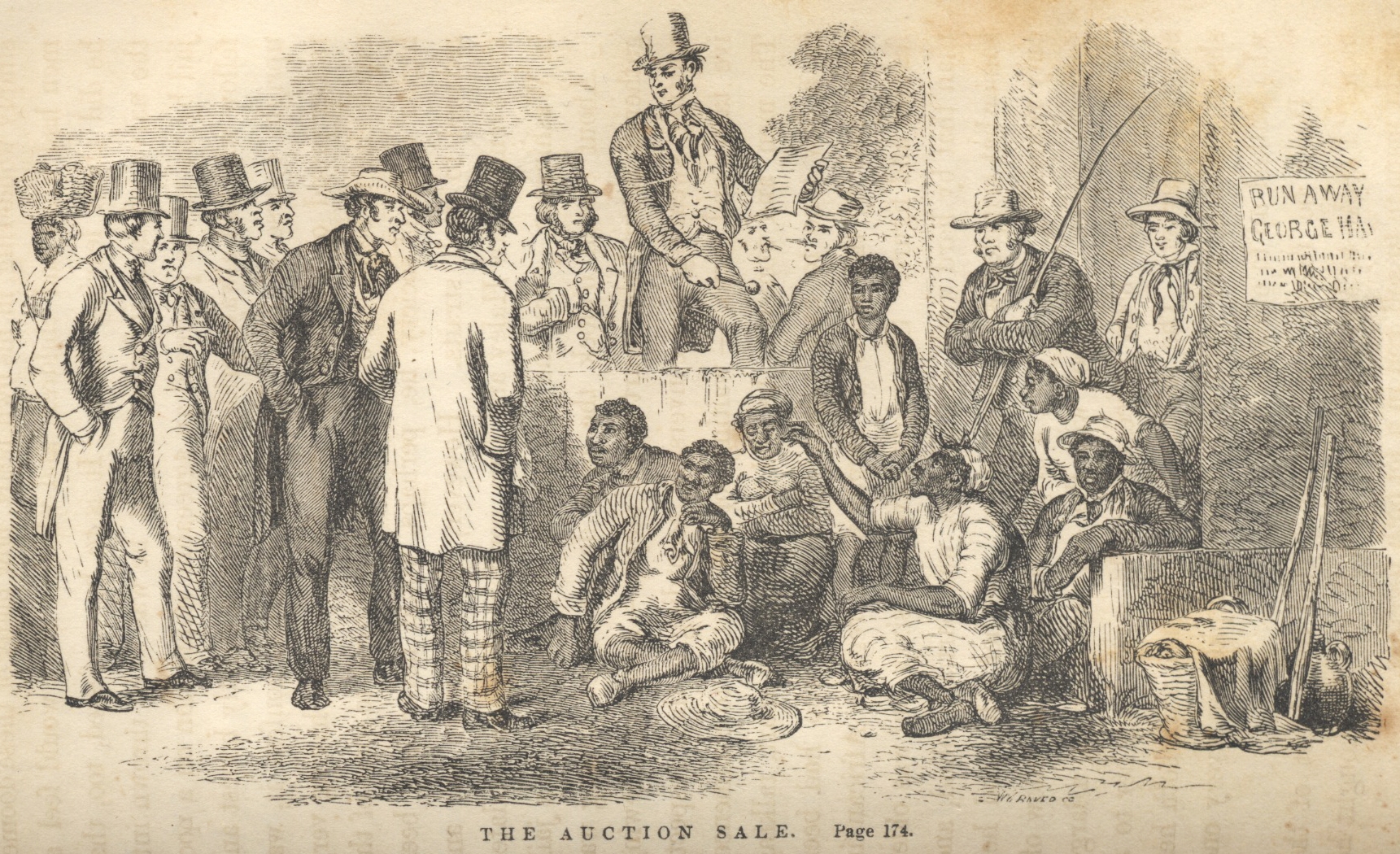
OTCauction

Abolition versus Slave Power

The conflicting ideologies of the Abolitionists who believed that African Americans were created by God and had the same rights as whites, as well as the arguments of Southern political leaders that blacks were inferior and slavery was a positive good, were buttressed by profoundly religious arguments which were related directly to a divergence in values. These diverging values crept into every aspect of life and as such it was this “conflict of values, rather than a conflict of interests or a conflict of cultures, lay at the root of the sectional schism.” [1]   The support of the church in Europe and the Americas was key to the religious and moral belief in the rightness of slavery.

Slavery was the key issue that permeated all aspects of the Civil War to include the cultural, the economic and the ideological. David M. Potter summed up this understanding of the connection between the ideological, cultural and economic aspects of the conflict and just how the issue of slavery connected all three realms in the American Civil War:

“These three explanations – cultural, economic and ideological – have long been the standard formulas for explaining the sectional conflict. Each has been defended as though it were necessarily incompatible with the other two. But culture, economic interest, and values may all reflect the same fundamental forces at work in a society, in which case each will appear as an aspect of the other. Diversity of culture may produce both diversity of interests and diversity of values. Further, the differences between a slaveholding and a nonslaveholding society would be reflected in all three aspects. Slavery represented an inescapable ethical question which precipitated a sharp conflict of values.” [2]

Sadly this is something that those who study the war from a purely military perspective tend to miss, or even willingly gloss over in order make the war more palatable to their own prejudice tend to “blur the reality that slavery was at the heart of the matter, ignore the baser realities of the brutal fighting, romanticize our own home-grown terrorist organization, the Ku Klux Klan, and distort the consequences of the Civil War that still intrude on our national life.” [3] For many people it is far easier not to deal with the harsh reality that slavery and racism was at the heart of the issue and escape to the bloodless romanticism which even ignores the human cost of the war, approximately 750,000 military dead alone. If we extrapolate the percentage of the population that that 750,000 represents and compared it to today’s census that number would be the equivalent of 7.5 million Americans dead. This is a fact that many Civil War buffs tend to ignore.

The political ends of the Civil War grew out of the growing cultural, economic, ideological and religious differences between the North and South that had been widening since the 1830s. However, slavery was the one issue which helped produce this conflict in values and it was “basic to the cultural divergence of the North and South, because it was inextricably fused into the key elements of southern life – the staple crop of the plantation system, the social and political ascendency of the planter class, the authoritarian system of social control.” [4] 

Without slavery and the Southern commitment to an economy based on slave labor, the southern economy would have most likely undergone a similar transformation as what happened in the North; thus the economic divergence between North and South would “been less clear cut, and would have not met in such head-on collision.” [5] But slavery was much more than an economic policy for Southerners; it was a key component of their religious, racial and philosophic worldview. A world without slavery was unimaginable and incomprehensible to them: politics, economics, religion, philosophy, and even the interpretation the Constitution itself depended on one’s view of slavery and white supremacy.
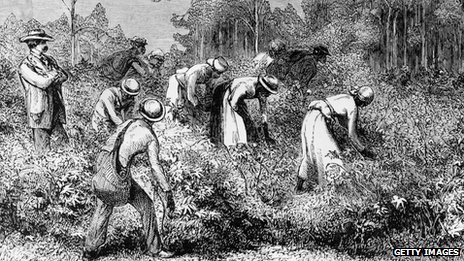
_65344344_cottonpickers1875_getty

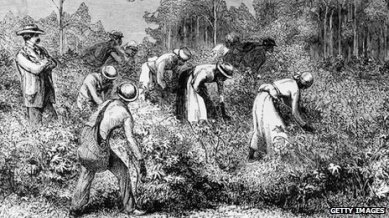
The issue of slavery divided the ante-bellum United States on even what the words freedom and liberty meant. The dispute can be seen in the writings of many before the war, with each side emphasizing their particular understanding of these concepts. In the South, freedom was reserved for those who occupied the positions of economic power; slavery was key to that from not only an economic point of view but as a social philosophy. The concept of human equality, which was so much a part of the Declaration of Independence was downplayed to accommodate slavery and white supremacy.
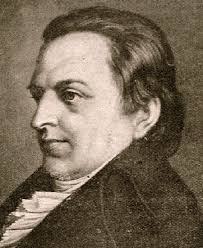
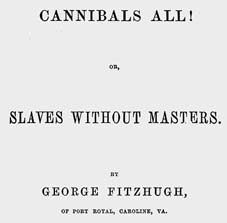
George Fitzhugh, a planter and slave owner in eastern Virginia commented that that concept “is practically impossible, and directly conflicts with all government, all separate property, and all social existence.” [6] Fitzhugh was very critical of the founder’s philosophy of natural liberty and human equality which he found repugnant and error ridden. He wrote:

“We must combat the doctrines of natural liberty and human equality, and the social contract as taught by Locke and the American sages of 1776. Under the spell of Locke and the Enlightenment, Jefferson and other misguided patriots ruined the splendid political edifice they erected by espousing dangerous abstractions – the crazy notions of liberty and equality that they wrote into the Declaration of Independence and the Virginia Bill of Rights. No wonder the abolitionists loved to quote the Declaration of Independence! Its precepts are wholly at war with slavery and equally at war with all government, all subordination, all order. It is full if mendacity and error. Consider its verbose, newborn, false and unmeaning preamble…. There is, finally, no such thing as inalienable rights. Life and liberty are not inalienable…. Jefferson in sum, was the architect of ruin, the inaugurator of anarchy. As his Declaration of Independence Stands, it deserves the appropriate epithets which Major Lee somewhere applies to the thought of Mr. Jefferson, it is “exuberantly false, and absurdly fallacious.”   ” [7]

The political philosophy such as Fitzhugh’s, which was quite common in the South, and was buttressed by a profound religious belief that it was the South’s God ordained mission to maintain and expand slavery. One Methodist preacher in his justification of slavery wrote, “God as he is infinitely wise, just and holy never could authorize the practice of moral evil. But God has authorized the practice of slavery, not only by bare permission of his providence, but by the express permission of his word.” [8] Buttressed by such scriptural arguments Southerners increasingly felt that they were the only people following God. The Northern abolitionists as well as those who advocated for the concept of human equality and free labor were heretics to be damned. As such the “South’s ideological isolation within an increasingly antislavery world was not a stigma or a source of guilt but a badge of righteousness and a foundation for national identity and pride.” [9]

Speaking of the necessity for slavery, as well as limitations on the equality of human beings no matter what their race or sex; Fitzhugh penned words that explained that human relationships were not to be seen in terms of individual liberty, “but in relations of strict domination and subordination. Successful societies were those whose members acknowledged their places within that hierarchy.” [10]

Fitzhugh was quite caustic when he discussed the real implications of his philosophy:

“We conclude that about nineteen out of twenty individuals have “a natural and inalienable right” to be taken care of and protected, to have guardians, trustees, husbands or masters; in other words they have a natural and inalienable right to be slaves. The one in twenty are clearly born or educated in some way fitted for command and liberty.” [11]

Fitzhugh’s chilling conclusion was summarized in the words “Liberty for the few – slavery in every form, for the mass.” [12]

But many Southerners, including many poor whites, especially the Yeoman farmers who were the backbone of the Southern populace did not see or understand the limitations that were placed on their own liberty by the slavery system and instead saw slavery as the guarantee of their economic freedom.

John C. Calhoun said to the Senate in 1848 that “With us, the two great divisions of society are not the rich and poor, but white and black; and all of the former, the poor as well as the rich, belong to the upper class, and are respected and treated as equals.” [13] Calhoun’s racial distinction is important if we are to understand why poor whites would fight and die for a social and economic idea that did not benefit them or their families, then as well as now.

But it was Abraham Lincoln, who cut to the heart of the matter when he noted the difference between his understanding of liberty and that of Calhoun and others in the South who defended slavery and the privileges of the Southern oligarchs:

“We all declare for liberty” but “in using the same word we do not all mean the same thing. With some the word liberty may mean for each man to do as he pleases with himself and the product of his labor; while with others the same word may mean for some men to do as they please with other men and the product of other men’s labor.” [14]

The growing economic disparity between the Slave and Free states became more about the expansion of slavery in federal territories as disunion and war approached; for a number of often competing reasons. These differences, amplified by the issue of slavery led to the substitution of stereotypes of each other and had the “effect of changing men’s attitudes toward the disagreements which are always certain to arise in politics: ordinary, resolvable disputes were converted into questions of principle, involving rigid, unnegotiable dogma.” [15] The Charleston Mercury noted in 1858 “on the subject of slavery…the North and the South…are not only two peoples, but they are rival, hostile peoples.” [16]

This was driven both by the South’s insistence on both maintaining slavery where it was already legal, and expanding it into new territories, even where it was forbidden by Federal laws enacted by Congress. This set it against the vocal abolitionist movement. But Southern exponents of expanding slavery were fighting an even more powerful enemy than the abolitionists, who despite their vocal protests were not yet in a position to influence policy. They were now fighting Northern industrialists who were not as idealistic as the abolitionists who were much more concerned with “economic policy designed to secure Northern domination of Western lands than the initial step in a broad plan to end slavery.” [17]

This competition between the regions not only affected politics, it affected religion and culture. In the South it produced a growing culture of victimhood, which was manifest in the words of Robert Toombs who authored Georgia’s declaration of causes for secession:

“For twenty years past, the Abolitionists and their allies in the Northern states, have been engaged in constant efforts to subvert our institutions, and to excite insurrection and servile war among us…” whose “avowed purpose is to subject our society, subject us, not only to the loss of our property but the destruction of ourselves, our wives and our children, and the dissolution of our homes, our altars, and our firesides.” [18]

As the social, economic, cultural and religious differences between the two regions grew wider and the people of the South became ever more closed off from the North. “More than other Americans, Southerners developed a sectional identity outside the national mainstream. The Southern life style tended to contradict the national norm in ways that life styles of other sections did not.” [19]

The complex relationship of Southern society where “Southern bodies social, economic, intellectual, and political were decidedly commingled” came to embrace the need for slavery and its importance to Southern society. This occurred despite the fact that the system did not benefit poor whites in the South and actually harmed them economically.

Southern society had become dependent on a race based social hierarchy in which dissent was neither welcome or tolerated. This

system of subordination reached out still further to require a certain kind of society, one in which certain questions were not publically discussed. It must give blacks no hope of cultivating dissention among the whites. It must commit non slaveholders to the unquestioning support of racial subordination…. In short, the South became increasingly a closed society, distrustful of isms from outside and unsympathetic to dissenters. Such were the pervasive consequences of giving top priority to the maintenance of a system of racial subordination.” [21]

A number of slave revolts, and planned slave revolts which were caught before they could erupt serve to heighten the fear and paranoia of Southerners living in the “Black belts” where slaves outnumbered whites by great margins. “In thickly enslaved areas, fancied dangers united white classes and sexes. Whites in black belts shared horror images about freed blacks as rioters, rapists, arsonists, and cannibals. The whites characteristically thought that using slavery to control alleged barbarians meant saving civilization.”[22]

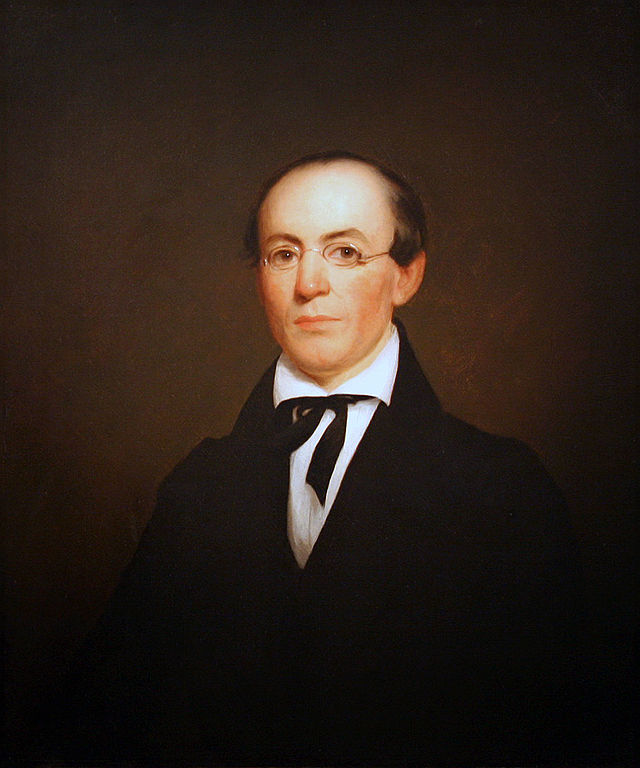
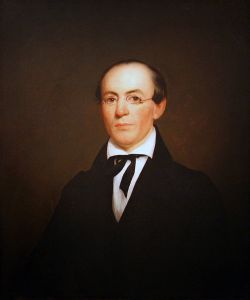
Even before the abolitionist movement took any recognizable form in the North, “with an intensity that escalated through the Civil War, planters declared war on all open criticism of the peculiar institution.” [23] As Northern abolitionists like William Lloyd Garrison and his newspaper The Liberator grew in its distribution and began to appear in the South various elected officials throughout the South “suppressed antislavery books, newspapers, lectures, and sermons and strove generally to deny critics of bondage access to any public forum. [24] Despite this resistance, abolitionists continued to use the U.S. Mail service to send their literature south provoking even more drastic action from Southern legislators.
garrison by jocelyn 1833

William Lloyd Garrison 

But Garrison and the more radical abolitionists did not have a great following even in the North, most Northerners who even leaned toward abolition were supporters of a very gradual emancipation and not supportive of the immediate emancipation demanded by Garrison and his allies. In fact in the North, Garrison and his followers were not popular, they were “a small and often despised group.” [25] This was born out by facts that Garrison understood all too well, which made him even more uncompromising in his message even as support for it dropped. Even in the North Garrison was considered an unlikeable extremist.

In 1840, support for Garrison extremism peaked at around 2 percent of the northern voting population. The other 98 percent of northern citizens considered immediate abolition to be too extreme to be American, too problack to be tolerable, too keen on seizing property to be capitalistic, and too antisouthern to be safe for the Union.” [26] 

Garrison despised his northern opponents and wrote that he found among them “contempt more bitter, opposition more active, detraction more relentless, prejudice more stubborn, and apathy more frozen, than among slave owners themselves.” [27] Opponents broke up his meetings and on one occasion paraded Garrison “through the streets of Boston with a rope around his neck.” [28]

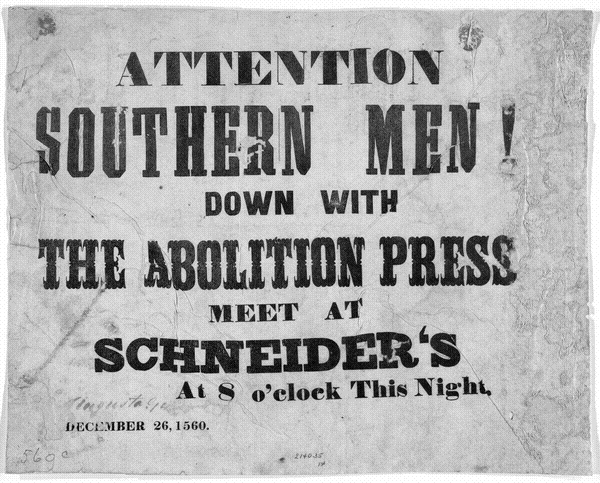
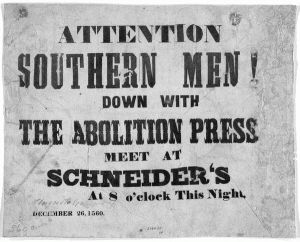
But Southerners, particularly those in the Black Belts where slaves constituted a majority of the population were further outraged by Garrison and his follower’s incendiary words and what they considered to be “almost pornographic diatribes,” which they felt had assaulted their “self-respect and sense of honor.” [29] In response to the proliferation of abolitionist literature in the South which was being sent through the mail, Senator John C. Calhoun proposed that Congress pass a law to prosecute “any postmaster who would “knowingly receive or put into the mail any pamphlet, newspaper, handbill, or any printed, written, or pictorial representation touching the subject of slavery.” [30] The law was a direct assault on the First Amendment, but in the South anything and anyone that took a stand against slavery had no Constitutional rights.

Calhoun was not alone as other members of Congress as well as state legislatures worked to restrict the import of what they considered subversive and dangerous literature. The condescending attitude of the radical abolitionists provoked an “emotional wildfire” [31] in the South, which united slave owners and poor whites in the Black Belt regions and served to increase their fear and loathing of Yankees who they believed wanted to destroy them and their way of life. Had they really understood just how united much of the North was with them they may not have pushed as hard to force Northern allies to accept laws that eventually offended the sensibilities of even non-abolitionists Northerners.
attention-southern-men

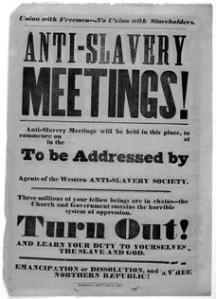
But Southern fears of real and imagined slave revolts, and hatred of radicals like Garrison brought about a host of new problem. Southerners now attempted to crush First Amendment protections of free speech in the north and to blot out any mention of slavery in the House of Representatives.

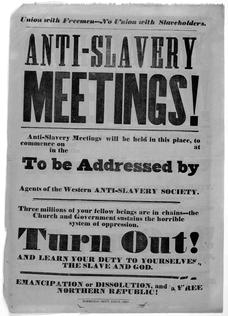
Beginning in 1836 the House of Representatives, led by Southern members of Congress passed a “gag rule” for its members. The “Gag Rule” “banned all petitions, memorials, resolutions, propositions, or papers related in any way or to any extent whatever to the subject of slavery.” [32]Former President John Quincy Adams continually challenged the gag-rule beginning in 1842, as did a number of others. The pressure was such that in 1844 the House finally voted to rescind it.
anti-slavery-meetings

However, Southern politicians were unhappy with the recension of the Gag Rule and “began to spout demands that the federal government and the Northern states issue assurances that the abolitionists would never be allowed to tamper with what John Calhoun had described as the South’s “peculiar domestic institution.” [33] As tensions grew between the regions; the issue of slavery more than any other issue, “transformed political action from a process of accommodation to a mode of combat.” [34]

Around the same time as the gag rule was played out in Congress the Supreme Court had ruled that the Federal government alone “had jurisdiction where escaped slaves were concerned”which resulted in several states enacting “personal liberty laws”to “forbid their own elected officials from those pursuing fugitives.” Southern politicians at the federal and state levels reacted strongly to these moves, which they believed to be an assault on their institutions and their rights to their human property. Virginia legislators said these laws were a “disgusting and revolting exhibition of faithless and unconstitutional legislation.” [35]

The issue of slavery shaped political debate and “structured and polarized many random, unoriented points of conflict on which sectional interest diverged.” [36] As the divide grew, leaders and people in both the North and the South began to react to the most distorted images of each other imaginable- “the North to an image of a southern world of lascivious and sadistic slave drivers; the South to the image of a northern world of cunning Yankee traders and radical abolitionists plotting slave insurrections.” [37]

To be continued…

Notes

[1] Potter, David M. The Impending Crisis: America before the Civil War 1848-1861 completed and edited by Don E. Fehrenbacher Harper Collins Publishers, New York 1976 p.41

[2] Ibid. Potter The Impending Crisis p.41

[3] Burns, Ken A Conflict’s Acoustic Shadows in The New York Times Disunion: Modern Historians Revisit and Reconsider the Civil War from Lincoln’s Election to the Emancipation Proclamation Black Dog and Leventhal Publishing, New York 2013 p.102

[4] Ibid. Potter The Impending Crisis p.42

[5] Ibid. Potter The Impending Crisis p.42

[6] Ibid. Levine Half Slave and Half Free: The Roots of the Civil War Revised Edition p.140

[7] Fitzhugh, George. New Haven Lecture 1855, in The Approaching Fury: Voices From the Storm, 1820-1861 Stephen B. Oates, Editor, University of Nebraska Press, Lincoln and London 1997 p.135

[8] Ibid. Daly When Slavery Was Called Freedom: Evangelicalism, Proslavery, and the Causes of the Civil War pp.63-64

[9] Ibid. Faust, Drew The Creation of Confederate Nationalism: Ideology and Identity in the Civil War South p.61

[10] Ibid. Levin Half Slave and Half Free p.140

[11] Ibid. Levin Half Slave and Half Free p.140

[12] Ibid. Levin Half Slave and Half Free p.141

[13] McPherson, James M. Drawn With the Sword: Reflections on the American Civil War Oxford University Press, Oxford and New York 1996 p.50

[14] Ibid. Levin Half Slave and Half Free p.122

[15] Ibid. Potter The Impending Crisis p.43

[16] Ibid. McPherson Drawn With the Sword p.16

[17] Egnal, Marc Clash of Extremes: The Economic Origins of the Civil War Hill and Wang a division of Farrar, Straus and Giroux New York 2009 p.6

[18] Dew, Charles B. Apostles of Disunion: Southern Secession Commissioners and the Causes of the Civil War University Press of Virginia, Charlottesville and London 2001 p.12

[19] Thomas, Emory The Confederate Nation 1861-1865 Harper Perennial, New York and London 1979 p.5

[20] Ibid. Thomas The Confederate Nation p.5

[21] Ibid. Potter The Impending Crisis pp.457-458

[22] Freehling, William W. The South vs. The South: How Anti-Confederate Southerners Shaped the Course of the Civil War Oxford University Press, Oxford and New York 2001 p.20

[23] Ibid. Levine Half Slave and Half Free p.166

[24] Ibid. Levine Half Slave and Half Free p.166

[25] Ibid. Goldfield America Aflame: How the Civil War Created a Nation p.27

[26] Ibid. Freehling The South vs. The South p. 34

[27] Ibid. Varon Disunion! The Coming of the American Civil War 1789-1858 pp.70-71

[28] Ibid. Goldfield America Aflame p.27

[29] Ibid. Freehling The South vs. The South p.22

[30] Ibid. Guelzo Fateful Lightning pp.50-51

[31] Ibid. Freehling The South vs. The South p.22

[32] Ibid. Levine Half Slave and Half Free pp.169-170

[33] Ibid. Guelzo Fateful Lightning pp.51-52

[34] Ibid. Potter The Impending Crisis p.43

[35] Ibid. Levine Half Slave and Half Free pp.169-170

[36] Ibid. Potter The Impending Crisis p.43

[37] Ibid. Potter The Impending Crisis p.43

1 Comment

Filed under civil rights, civil war, ethics, faith, Gettysburg, History, laws and legislation, News and current events, Political Commentary

Authoritarians and How Youth Like Sophie Scholl Will Save Us from Ourselves

Friends of Padre Steve’s World,

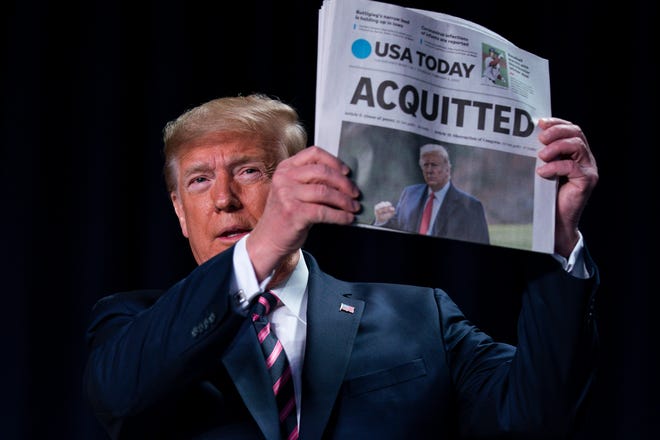
As President Trump continues to take revenge on his opponents and threaten others following his acquittal, making threats toward others, including at the Justice Department, State Department, and the Department of Defense, we cannot dismiss these actions as politics as usual. This has never happened in America, at least not until now.

In fact, no American President, has behaved in such a manner. One, Andrew Jackson successfully defied the Supreme Court, in order to remove the Cherokee Nation and put them on the Trail of Tears, James K. Polk who launched an illegal and immoral war against Mexico, an act that the future President Ulysses Grant, then a young Army Lieutenant decried:  “I was bitterly opposed to the measure, and to this day regard the war, which resulted, as one of the most unjust ever waged by a stronger against a weaker nation.”

Then there was James Buchanan who unsuccessfully attempted to overturn the law and Constitution during the Lecompton Constitution crisis, only to be stopped by the actions of Senator Stephen A. Douglas, John Tyler, at that point a former President joined the Confederacy, Andrew Johnson who pardoned hundreds of Confederate traitors, including war criminals, and worked against the the 14th Amendment, defied Congress, was impeached and acquitted by one bought vote. Likewise, Woodrow Wilson who led the great racist purge of the military and civil service in 1915, Richard Nixon whose crimes are too many too mention, and such that even a majority of his party led by Barry Goldwater told him to resign or be convicted in his impeachment trial, approached the authoritarianism, of Trump, and the treats of violence he and his supports make to opponents.  I could mention more, but you get the idea. We live in dangerous times and need to heed the words of British Historian and military theorist B. H. Liddell-Hart wrote about in his book Why Don’t we Learn From History: 

They soon begin to rid themselves of their chief helpers, “discovering” that those who brought about the new order have suddenly become traitors to it.

They suppress criticism on one pretext or another and punish anyone who mentions facts which, however true, are unfavourable to their policy.

They enlist religion on their side, if possible, or, if its leaders are not compliant, foster a new kind of religion subservient to their ends.

They spend public money lavishly on material works of a striking kind, in compensation for the freedom of spirit and thought of which they have robbed the public.

They manipulate the currency to make the economic position of the state appear better than it is in reality.

They ultimately make war on some other state as a means of diverting attention from internal conditions and allowing discontent to explode outward.

They use the rallying cry of patriotism as a means of riveting the chains of their personal authority more firmly on the people.

They expand the superstructure of the state while undermining its foundations by breeding sycophants at the expense of self-respecting collaborators, by appealing to the popular taste for the grandiose and sensational instead of true values, and by fostering a romantic instead of a realistic view, thus ensuring the ultimate collapse, under their successors if not themselves, of what they have created.

This political confidence trick, itself a familiar string of tricks, has been repeated all down the ages. Yet it rarely fails to take in a fresh generation.

But I digress, that was simply an introduction.

Seventy-seven years ago a young German woman was under the interrogation of the Munich Gestapo, before being tried and convicted of treason for distributing a series of anti-Nazi leaflets by the Nazi Volksgericht or “People’s Court” under the direction of the notorious Judge Roland Freisler who gained further infamy in his show trials of those suspected of participating in or supporting the July 20th Bomb Plot against Hitler.

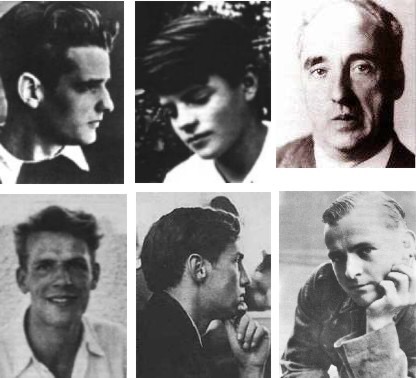
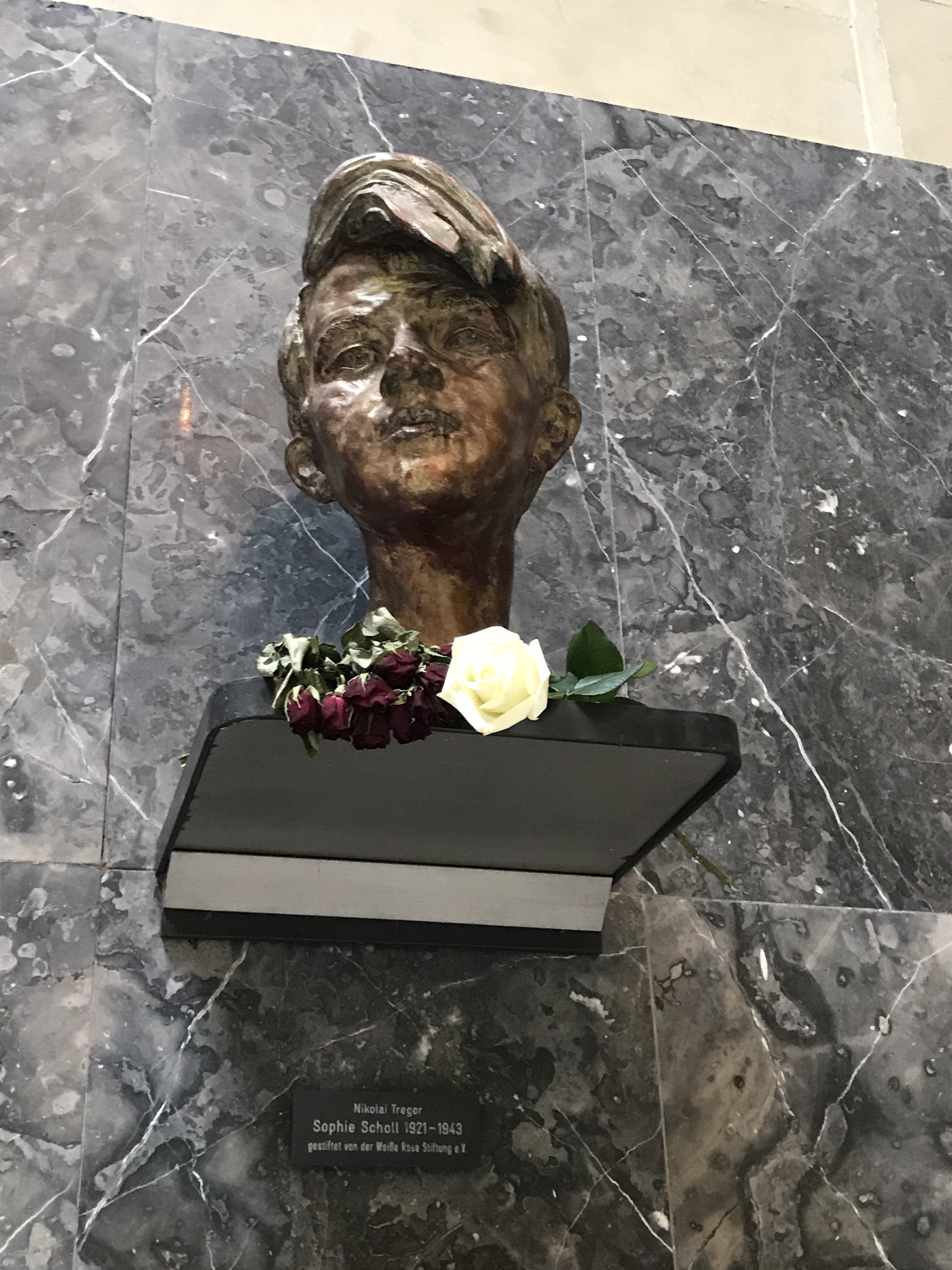
The woman was Sophie Scholl, a student at the University of Munich she was just 22 years old. Her story and the story of the resistance group that she was at the center of is remarkable for the moral clarity that she and her friends displayed in an era where most people were willing to look the other way, if not unreservedly served Hitler’s Third Reich.

She and those who like her resisited Hitler’s Third Reich at the height of its power are worthwhile examples for those who resisit President Trump here. Russia’s Putin, and so many other authoritarian leaders in Europe, Latin America, the Middle East, Africa and Asia. The precious truth is that Freedom must be defended from those who use patriotism as a prop, and racism as the raison d’etre of their political, social, and foreign policy of their regimes.


The story of Sophie and the White Rose is a remarkable story because stories like this are often buried by the propaganda machines of totalitarian regimes; but the shock of what these young people did was so great that the Nazi propaganda machine had to publicly confront it with the goal of instilling such fear that no one else’s would dare repeat it. What politicians, generals, and others could not do to shake the Nazi regime a handful of university students accomplished.

There are a number of monuments scattered around Munich to the White Rose movement, but the most remarkable is the monument in front of the university where they studied and where they distributed their leaflets.  Facsimiles of their publications and letters are part of the pavement, looking as if they have been dropped on the ground for someone to pick up.

Scholl, as well as her friends were students, some who in the course of their time of study who had been drafted into the Wehrmacht as medics, serving on the Russian front before returning to the University. There were five of them, Sophie, Willi Graf, Alexander Schmorrel, Hans Scholl, and Christoph Probst, plus one of their professors, Professor Dr. Kurt Huber who began a resistance cell that focused on telling the truth about the crimes of the Nazi regime, and the lies of Hitler.

Telling the truth in a dictatorship is dangerous and although Sophie and her companions could have remained silent they had consciences that were guided by reason and human rights, as well as by their Christian faith, a faith which remained despite their aversion to the institutional church for its complicity with the Nazis. As she stood before Freisler and the Volksgericht she was recorded as saying:

“Somebody, after all, had to make a start. What we wrote and said is also believed by many others. They just don’t dare express themselves as we did.”

Too many people lacked the courage to speak as Sophie did in her day as all too many do today. It is far easier to take the path of least resistance. Laurence Rees in his history of Auschwitz wrote:

“…human behavior is fragile and unpredictable and often at the mercy of the situation. Every individual still, of course, has a choice as to how to behave, it’s just that for many people the situation is the key determinate in that choice.”

Sophie and her circle of friends in the White Rose chose how courageous people behave in such abominable conditions. They published a series of six leaflets which they printed themselves and distributed around the university, the city, and to like minded people in a number of other cities. They asked those who got them to make as many copies as they could and distribute them. They were in the process of drafting a seventh when Scholl was spotted distributing them at the university by a maintenance man who was a member of the Nazi Party. She and her friends were arrested on February 21st 1943 by the notorious Nazi People’s Court under the direction of Roland Freisler on the 22nd, and executed by beheading at Munich’s Stadelheim Prison on the 23rd.


The members of the White Rose were bold and defiant in the face of evil, of course those that have that kind of courage usually have short life expectancies in a totalitarian state, but they did not back down. Their pamphlets and graffiti criticizing Hitler garnered the attention of the Gestapo and when they were caught they were brutally tortured, but none backed down.

Their criticisms of Hitler and his Third Reich were hard hitting. Since all of the students had spent much of their childhood teenage years in Nazi organizations which were designed to make loyal little Nazis, their resistance came as a shock to many. All were children who could have easily due to their family background taken the easy road, but chose the more honorable and dangerous road.


Their pamphlets are striking, and each focused on a different part or aspect of the Nazi regime. In their first leaflet they wrote:

“Nothing is so unworthy of a civilized nation as allowing itself to be governed without opposition by an irresponsible clique that has yielded to base instinct.” They urged their readers “Therefore every individual, conscious of his responsibility as a member of Christian and Western civilization, must defend himself as best he can at this late hour, he must work against the scourges of mankind, against fascism and any similar system of totalitarianism.” And to “Offer passive resistance – resistance – wherever you may be, forestall the spread of this atheistic war machine before it is too late, before the last cities, like Cologne, have been reduced to rubble, and before the nation’s last young man has given his blood on some battlefield for the hubris of a sub-human. Do not forget that every people deserves the regime it is willing to endure!”

Such was their beginning, but they went on to attack the Nazi, leaders, the Nazi system, and especially the silence of their countrymen over the extermination of the Jews and Polish intellectuals. They asked in the second leaflet:

“Why do German people behave so apathetically in the face of all these abominable crimes, crimes so unworthy of the human race? Hardly anyone thinks about that. It is accepted as fact and put out of mind. The German people slumber on in their dull, stupid sleep and encourage these fascist criminals; they give them the opportunity to carry on their depredations; and of course they do so…. For through his apathetic behavior he gives these evil men the opportunity to act as they do; he tolerates this “government” which has taken upon itself such an infinitely great burden of guilt; indeed, he himself is to blame for the fact that it came about at all! Each man wants to be exonerated of a guilt of this kind, each one continues on his way with the most placid, the calmest conscience. But he cannot be exonerated; he is guilty, guilty, guilty!”

In each of the letters they asked their readers to offer some form of resistance to Hitler and the Nazi State but urged passive resistance, but in the third missive they went into more detail, including something that anyone who thinks that they are loyal to their country need to appreciate:

“The meaning and the goal of passive resistance is to topple National Socialism, and in this struggle we must not recoil from any course, any action, whatever its nature. At all points we must oppose National Socialism, wherever it is open to attack. We must soon bring this monster of a state to an end. A victory of fascist Germany in this war would have immeasurable, frightful consequences. The military victory over Bolshevism dare not become the primary concern of the Germans. The defeat of the Nazis must unconditionally be the first order of business… And now every convinced opponent of National Socialism must ask himself how he can fight against the present “state” in the most effective way, how he can strike it the most telling blows. Through passive resistance, without a doubt…”

Eventually their tracts became more biting, and in fourth the metaphysical linking Hitler to Satan and Anti-Christ.


They wrote:

“Every word that comes from Hitler’s mouth is a lie. When he says peace, he means war, and when he blasphemously uses the name of the Almighty, he means the power of evil, the fallen angel, Satan. His mouth is the foul-smelling maw of Hell, and his might is at bottom accursed…. I ask you, you as a Christian wrestling for the preservation of your greatest treasure, whether you hesitate, whether you incline toward intrigue, calculation, or procrastination in the hope that someone else will raise his arm in your defence? Has God not given you the strength, the will to fight? We must attack evil where it is strongest, and it is strongest in the power of Hitler.”

In the fifth leaflet they spoke of where the Nazi war effort would end and the responsibility of not only Hitler but the German people for it:

“It has become a mathematical certainty that Hitler is leading the German people into the abyss. Hitler cannot win the war; he can only prolong it. The guilt of Hitler and his minions goes beyond all measure. Retribution comes closer and closer. But what are the German people doing? They will not see and will not listen. Blindly they follow their seducers into ruin. Victory at any price! is inscribed on their banner. “I will fight to the last man,” says Hitler-but in the meantime the war has already been lost…. Do not believe that Germany’s welfare is linked to the victory of national Socialism for good or ill. A criminal regime cannot achieve a German victory. Separate yourselves in time from everything connected with National Socialism. In the aftermath a terrible but just judgment will be meted out to those who stayed in hiding, who were cowardly and hesitant.”

In the aftermath of the disaster at Stalingrad they published their sixth and last issue before being caught. In it they urged Germans to fight against the Nazi Party and regime, and confronted the way that since its inception Hitler and the Party corrupted the meaning of honor and freedom:

“Freedom and honor! For ten long years Hitler and his coadjutor have manhandled, squeezed, twisted, and debased these two splendid German words to the point of nausea, as only dilettantes can, casting the highest values of a nation before swine. They have sufficiently demonstrated in the ten years of destruction of all material and intellectual freedom, of all moral substance among the German people, what they understand by freedom and honor. The frightful bloodbath has opened the eyes of even the stupidest German – it is a slaughter which they arranged in the name of “freedom and honor of the German nation” throughout Europe, and which they daily start anew.”

Just over two weeks later they were caught and in Freisler’s People’s Court convicted and executed. During their trial, if it can be called that, Freisler and others expressed their shock that young Germans could commit treason. Sophie had no problem confronting her accusers:

Her last words before going to the guillotine were unapologetic: “How can we expect righteousness to prevail when there is hardly anyone willing to give himself up individually to a righteous cause? Such a fine, sunny day, and I have to go, but what does my death matter, if through us, thousands of people are awakened and stirred to action?” On the back of the order condemning her to death she wrote the word Freedom.


There are leaders in many nations today intent on destroying freedom and in many places the people and the country’d institutions fall in behind them, usually by painting pictures of threats so imminent that people willingly trade real freedom for a false security. It is a dangerous world and all of us must be alert to changes in society and question what comes out of the mouths of leaders, and even more so their true believer followers.

Sophie Scholl and her companions understood the risk, but they got their message heard at the highest level of government, and most were killed. But their example of courage and belief in freedom and human rights is still stronger that they mightiest despot, and unlike their mighty yet evil rulers, they are the ones that Germany remembers.

Last year I visited her grave in Munich’s Friedhof at Perlacher Forst, it is humble but gravesite, but it is obviously a place of remembrance and pilgrimage. When I go o Munich this year I will again make my pilgrimage to places where she and the White Rose used non-violent protest to speak truth about the Hitler regime when most of the population, knowing the truth did nothing to resist.

I think that there is a lesson for us as well, and I think that it is a lesson that many of our young people will understand that better than their elders, especially in the age of President Trump.  That my friends gives me hope for the future, young people like Sophie Scholl might be all that stands in the way of the destruction of our Republic.

Until tomorrow,

Peace,

Padre Steve+

4 Comments

Filed under authoritarian government, civil rights, crime, ethics, faith, film, History, laws and legislation, leadership, movies, nazi germany, News and current events, Political Commentary, racism, US Presidents, war crimes, White nationalism

Otherwise Good People Who Serve Evil Regimes: The Case of Friedrich Kritzinger and Trump’s Defense Team

Friends of Padre Steve’s World,

In the post impeachment era of President Trump I find myself asking hard questions about those in the Justice Department, the White House Counsel’s Office, lawyers hired to defend the President, as well as Senators and Congressmen trained in law who did all they could, successfully, I might add to ensure that the President was acquitted in his impeachment trial. Since I was a loyal Republican from 1976 to 2008, I grew up admiring or agreeing with these men much of my adult life, but that was before, I had my epiphany about where the GOP was going, and they sold their souls to Trump and became full-fledged members of the Trump Cult.

I still wonder how they got to this point, often arguing against the arguments they used in the impeachment trial of former President Bill Clinton, and the arguments used by Republicans to convince Richard Nixon that he should resign his office because they could not support him in an impeachment trial. Mind you, back in 1998 I wanted to see Bill Clinton impeached, convicted, and removed from office, but honestly that was more out of Party loyalty, and a personal conviction that lying under oath was a criminal offense, even if it involved, a reprehensible, but rather common action of powerful men. But, it did not involve collaboration with an enemy power to rig an election and compromise the electoral system of the United States and the integrity of the Presidential Office itself.

Since the GOP Senate acquitted the President, he has began a campaign of revenge to punish those who stood by their oaths and testified to the truth, or like GOP Senator Mitt Romney, the only Republican Senator who knowing the facts, voted to convict the President. The witness of men who at one time purported to be virtuous defenders of the law and Constitution in defending a lawbreaking President, defaming those who stood by their oath, and launching a campaign to punish those who testified against the President, including combat wounded military officers, while attempting to lighten the sentence of, or pardon convicted lawbreakers like Roger Stone, and convicted war criminals. One has to wonder what passes for justice for the President and his supporters.

Saint Augustine wrote: “Justice being taken away, then, what are kingdoms but great robberies.”

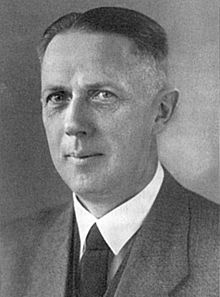
I saw that quote in relation both the servants of the Trump administration and Cult, as well as to Friedrich Kritzinger, a lawyer, and Prussian civil servant who served as State Secretary for the Reich Chancellery during the Third Reich and was a participant at the Wannsee conference. The authors of that article noted something that should serve as a reminder to us: “by working as a lawyer for a regime, which he had known from the start to be criminal, he made himself a stooge.” (Stefan Paul-Jacobs and Lore Kleiber in The Participants: the Men of the Wannsee Conference edited by Hans-Christian Jasch and Christoph Kreutzmüller, p.217)

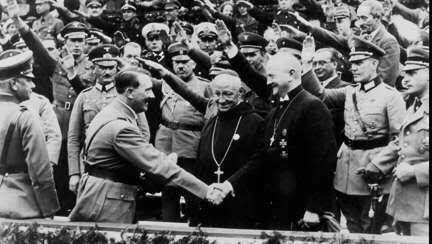
Kritzinger was not what I would call an evil man. He was a traditional German conservative and Nationalist who agreed with many Nazi policies, albeit not to their extremes. But he also had strong moral and religious convictions that caused him to question and at times attempt to mitigate those policies. He was a member of the Confessing Church which condemned the Nazified faith of Reichsbishof Müller and the German Christian movement, but even many of them were receptive to the nationalism and anti-Communist stances of the Nazis. Otto Dibelius, the General Superintendent of the Confessional Lutherans was a hard line conservative and in 1933 at a service for the new Reichstag: “We have learned from Martin Luther that the Church cannot get in the way of State power when it does what it is called to do. Not even when [the state] becomes hard and ruthless…. When the state carries out its office against those who destroy the foundations of state order, above all against those who destroy honor with vituperative and cruel words that scorn faith and vilify death for the Fatherland, then [the state] is ruling in God’s name!” (Richard Seigman-Gall, the Holy Reich: Nazi Conceptions of Christianity 1933-1945 p.68)

Kritzinger himself did not join the Party until 1938 when he was recruited by Hans Lammers to fill a vacancy in the Reich Chancellery for which Party membership was required. Kritzinger was concerned. He only accepted the job and membership in the when assured that he did not have to be politically active and did not have to hire ardent Nazis for jobs in the Chancellery.

At Wannsee he was the only participant who demonstrated any sense of concern about the Final Solution of the Jewish Problem. After the conference he headed the only agency not to sign off on Reinhard Heydrich’s policies against the Jews. According to some he worked inside the system to try to mitigate the worst aspects of Hitler’s policy decisions. He felt shame for what the regime did. That being said “from 1933 on, Kritzinger held positions of responsibility and colluded in disgusting breeches of law and maintaining the illusion that the Nazi dictatorship was a constitutional state.”

The fact is that the Nazi regime believed that it was a functioning constitutional state and attempted to preserve the illusion of legality and the rule of law. Men like Kritzinger helped them to do just that. In his positions, first at the Ministry of Justice and then at the Reich Chancellery, “was held in high esteem… not as an ideological acolyte of the new leader but as an expert on law. Responsible for matters of state law, he was directly complicit in Nazi atrocities.” This included his legal justification for the Night of the Long Knives.

At the Reich Chancellery Kritzinger made sure that the administrative apparatuses the State functioned smoothly. “The facade of legality helped ensure that the Nazi regime and its crimes were accepted even by its detractors, and their participation in the system thereby facilitated.”

After Wannsee, when Kritzinger began to fully grasp what was happening in regard to the Jews he attempted to resign but his resignation was refused. His boss, Hans Lammers refused and rejected his dismissal with the remark that without Kritzinger things would run even worse. In fact, men like Kritzinger were often able to delay or hinder decisions by not passing along memos as they saw fit. Conversely they could speed decisions by ensure that information reached Hitler.

When questioned after the war Kritzinger stated:

My consultations with Hitler were of course tailored to his mentally. It goes without saying that it would have been insane to say that such and such a decision would adversely affect Jews. One had to phrase it differently, and say that it would trigger serious public unrest. Obviously we could not say anything to Hitler he did not want to hear. Especially when it came to those decisions.

I wonder how many people in the American government and in the upper echelons of the Trump administration justify and equivocate their participation in it just as Kritzinger and others like him did his under the Nazis.

Until tomorrow,

Peace,

Padre Steve+

Leave a comment

Filed under crime, ethics, faith, History, holocaust, laws and legislation, leadership, nazi germany, News and current events, Political Commentary

Somebody Had to Make a Start: Sophie Scholl, the White Rose, and Modern Resistance

Friends of Padre Steve’s World,

I have written about Sophie Scholl and the White Rose resistance against Hitler before, in fact I will continue to do so because the United States is heading down the same personality cult driven authoritarianism as the Third Reich. In 1942 through her execution at the hands of Roland Freisler’s Volksgericht (People’s Court) on February 22nd 1943, the 22 year old German university student dared to speak out, and. tell the truth, despite having no political or military power of her own. All she and her friends had was a belief in freedom, and that in order to have that freedom one had to resist the Hitler regime.

Last night I re-watched the German film Sophie Scholl, the Final Days. The film is important. It details the final days of the White Rose resistance. The film details how Sophie and her brother Hans were caught while attempting to distribute their Sixth Leaflet by a Gestapo informant at the University of Munich in February 1943, the interrogations of Sophie by Gestapo Investigator Robert Mohr and her eventual trial and and execution with her brother Hans and friend Christoph Probst on February 22nd 1943.

Over the past few years I have gone to Munich, and in doing so visited a number of the places where Sophie Scholl, her brother Hans, and other members of the resistance worked to write and distribute six pamphlets exposing the crimes of the Nazi regime. Many of which are shown in the film. I also visited her grave on one occasion in September 2018.

On several occasions I visited the Sophie Scholl-White Rose Museum at the University Of Munich, where she and her friends were students. While distributing the sixth pamphlet, Sophie and Hans were caught when a maintenance man at Munich University spotted them and reported them to the Gestapo. To stand in the place where she threw the last copies of that letter into the atrium of the University entrance was humbling. I wonder if I could have done it. Write such materials, certainly, distribute them, for sure, but to take the chance that someone might see me as I did it, I don’t know.

I find that the the German language film Sophie Scholl: The Final Days is a powerful portrayal of her last days. Whenever I watch the film I find that it is an intensely emotional experience. It was shot on location in places that I have walked, so it resonates in real time as I watch the freedoms that the United States was founded on being attacked in real time right now. I wonder how long it will be until the Constitution is turned upon its head and the law and the courts are turned into accomplices of terror.

Now that the Senate has failed in its constitutional duties in the impeachment trial of President Trump, he and his allies have began their campaign of revenge. The GOP Senate has effectively given Trump a license to do as he pleases regardless of the Constitution or the law, and he and his allies have already began their campaign to silence, intimidate, and punish opponents in ways never seen in the United States. In the Third Riech, Stalin’s Soviet Union, and many other authoritarian states yes, but never here, but I digress…

I think the scenes in the film that were the most powerful to me were those that depicted the interrogation of Sophie by the Gestapo investigator Robert Mohr. He was a Nazi, but he is was also a professional police officer and investigator, devoted to the law, a law which though the words had not been changed since before Hitler’s assumption of power, had been commandeered by the Nazis to prescribe loyalty to the Hitler regime above all. The real Robert Mohr survived the war and lived until 1977. Was Mohr Evil? I doubt it. He was simply doing his job as the law dictated without asking questions. Believe me, there are many Americans in law enforcement and the military who would do no differently. I know, because there was a time that I would have done no differently than Mohr.

By the end of the film, like always, I was in tears, especially in the scene just before her execution her parents are allowed to visit her, and her father tells her that he is proud of her. Try as I might I couldn’t see my mother doing that for me, my late father yes, but my mother no, not at least until recently.

When in 2009 I visited them shortly after my father had been placed in a nursing home and I was in a state of emotional and spiteful collapse after my return from Iraq, I objected to her agreement with the Fox News pundits our their portrayal of the war and she called me a coward. I had spent seven months in Al Anbar Province with American advisors and our Iraqi allies, being exposed to constant danger and being shot at on several occasions. At that time she would have been a perfect and obedient servant of the Third Reich, I cannot say that now.

But if things continue as they are with the Trump Administration, as a career officer returned broken from way, who public ally wrote and spoke his opinions,  I would have probably shared the fate of men like Colonel Claus Schenk von Stauffenberg, Major General Henning von Tresckow, Lieutenant Colonel Mertz Von Quirnheim, and the other anti-Hitler plotters of the July 20th bomb plot. My writings alone will condemn me, even though I cannot imagine being a part of a plot to assassinate anyone.

In their trial Hans Scholl, though berated by the President of the People’s Court, Judge Roland Freisler told him: I have served on the Eastern Front, as have many others here, but you haven’t. That is my feeling toward those who combat veterans who object to nationalist propaganda being disguised and patriotism by people who have never spent a day in uniform much less who have never put on a uniform, or even fewer who have served in harms way.

Honestly, in our current day I fear for freedom in this land, and I must always do my best to speak the truth. That might mean making waves or enemies, Lord knows how many supposed friends have condemned my political and religious beliefs because they do not reflect the the ideology of the supposedly Evangelical Christian America First followers of our current President, not to mention those who decide that they cannot speak up simply because they do not want to make waves in order to survive though they know in their hearts that their actions betray their faith and life.

Sophie wrote:

“The real damage is done by those millions who want to ‘survive.’ The honest men who just want to be left in peace. Those who don’t want their little lives disturbed by anything bigger than themselves. Those with no sides and no causes. Those who won’t take measure of their own strength, for fear of antagonizing their own weakness. Those who don’t like to make waves—or enemies. Those for whom freedom, honour, truth, and principles are only literature. Those who live small, mate small, die small. It’s the reductionist approach to life: if you keep it small, you’ll keep it under control. If you don’t make any noise, the bogeyman won’t find you. But it’s all an illusion, because they die too, those people who roll up their spirits into tiny little balls so as to be safe. Safe?! From what? Life is always on the edge of death; narrow streets lead to the same place as wide avenues, and a little candle burns itself out just like a flaming torch does. I choose my own way to burn.”

Though Sophie, Hans, and a number of their friends were executed and others imprisoned, their message got out. Smuggled out of Germany the sixth pamphlet was reprinted in the millions and dropped by the Royal Air Force and American Army Air Force over Germany. That leaflet said:

For us there is but one slogan: fight against the party! Get out of the party organisation, which are used to keep our mouths sealed and hold us in political bondage! Get out of the lecture rooms of the SS corporals and sergeants and the party bootlickers! We want genuine learning and real freedom of opinion. No threat can terrorise us, not even the shutting down of the institutions of higher learning. This is the struggle of each and every one of us for our future, our freedom, and our honour under a regime conscious of its moral responsibility…

Fellow Fighters in the Resistance!

Shaken and broken, our people behold the loss of the men of Stalingrad. Three hundred and thirty thousand German men have been senselessly and irresponsibly driven to death and destruction by the inspired strategy of our World War I Private First Class. Fuhrer, we thank you!

The German people are in ferment. Will we continue to entrust the fate of our armies to a dilettante? Do we want to sacrifice the rest of German youth to the base ambitions of a Party clique? No, never! The day of reckoning has come – the reckoning of German youth with the most abominable tyrant our people have ever been forced to endure. In the name of German youth we demand restitution by Adolf Hitler’s state of our personal freedom, the most precious treasure we have, out of which he has swindled us in the most miserable way.

We grew up in a state in which all free expression of opinion is unscrupulously suppressed. The Hitler Youth, the SA, the SS have tried to drug us, to revolutionise us, to regiment us in the most promising young years of our lives. “Philosophical training” is the name given to the despicable method by which our budding intellectual development is muffled in a fog of empty phrases. A system of selection of leaders at once unimaginably devilish and narrow-minded trains up its future party bigwigs in the “Castles of the Knightly Order” to become Godless, impudent, and conscienceless exploiters and executioners – blind, stupid hangers-on of the Fuhrer. We “Intellectual Workers” are the ones who should put obstacles in the path of this caste of overlords. Soldiers at the front are regimented like schoolboys by student leaders and trainees for the post of Gauleiter, and the lewd jokes of the Gauleiters insult the honour of the women students. German women students at the university in Munich have given a dignified reply to the besmirching of their honour, and German students have defended the women in the universities and have stood firm…. That is a beginning of the struggle for our free self-determination – without which intellectual and spiritual values cannot be created. We thank the brave comrades, both men and women, who have set us brilliant examples.

For us there is but one slogan: fight against the party! Get out of the party organisation, which are used to keep our mouths sealed and hold us in political bondage! Get out of the lecture rooms of the SS corporals and sergeants and the party bootlickers! We want genuine learning and real freedom of opinion. No threat can terrorise us, not even the shutting down of the institutions of higher learning. This is the struggle of each and every one of us for our future, our freedom, and our honour under a regime conscious of its moral responsibility.

Freedom and honour! For ten long years Hitler and his coadjutor have manhandled, squeezed, twisted, and debased these two splendid German words to the point of nausea, as only dilettantes can, casting the highest values of a nation before swine. They have sufficiently demonstrated in the ten years of destruction of all material and intellectual freedom, of all moral substance among the German people, what they understand by freedom and honour. The frightful bloodbath has opened the eyes of even the stupidest German – it is a slaughter which they arranged in the name of “freedom and honour of the German nation” throughout Europe, and which they daily start anew. The name of Germany is dishonoured for all time if German youth does not finally rise, take revenge, and atone, smash its tormentors, and set up a new Europe of the spirit. Students! The German people look to us. As in 1813 the people expected us to shake off the Napoleonic yoke, so in 1943 they look to us to break the National Socialist terror through the power of the spirit. Beresina and Stalingrad are burning in the East. The dead of Stalingrad implore us to take action. “Up, up, my people, let smoke and flame be our sign!”

Our people stand ready to rebel against the Nationals Socialist enslavement of Europe in a fervent new breakthrough of freedom and honour.

Honestly, I do not know how many Americans today regardless of their political party who would if faced with the possibly imprisonment and death of speaking out against the anti-American, illegal, and unconstitutional actions of the Trump Administration, or for that matter any administration. Sophie said “Somebody, after all, had to make a start. What we wrote and said is also believed by many others. They just don’t dare express themselves as we did.”

Freedom matters, as does truth. There is no excuse for the Christian to stay silent in the face of evil. As Dietrich Bonhoeffer noted, “Silence in the face of evil is itself evil: God will not hold us guiltless. Not to speak is to speak.”

Never forget that resistance is never futile. If anyone thinks this is simply a political screed against President Trump, it is not. It goes to the heart of my faith as a Christian, something that I believe speaking about is still protected under the First Amendment.

So until tomorrow,

Peace,

Padre Steve+

2 Comments

Filed under christian life, civil rights, ethics, faith, film, History, nazi germany, News and current events, Political Commentary

Trump’s National Prayer Breakfast: Compromised Church and Echoes of the Third Reich

Friends of Padre Steve’s World,

A few months back I began to write about the Nuremberg Trials and the opening statement of the American Chief Prosecutor, Supreme Court Justice Robert Jackson. The first section was comprised his general remarks. The second dealt with the Nazi war against free organized labor. The third section presented here was the shortest part of his opening statement. It deals with the Nazi battle against the Churches.

I am coming back to that today because of the way President Trump hyper-personalized, politicized, an already often polarizing event to attack his opponents, mock their faith, and let the nation know, that you are not a true believer unless you blindly follow him. It included thinly veiled attacks on the faith of House Speaker Nancy Pelosi and Senator Mitt Romney, and his Press Secretary alluded that Trump would announce that people would “pay” for their disloyalty to Trump. The The President followed the prayer breakfast with a rambling speech in which he did that, and on Friday he fired men who had testified before the House Impeachment Committee. Ambassador to the European Union Gordon Sondland and LTC Alexander Vindeman of the National Security Council. Vindman, an active duty Army Officer accused of no crimes or wrongdoing was escorted out of the White House  like a criminal. It was a scene designed to humiliate him professionally, and threaten others, military members, or civil servants that anything that smacked of personal disloyalty would be punished. Trump’s Christian Conservative base was overjoyed. That is the price of betraying the leader.

The fascinating thing is that religious people and religious institutions are often the most unwavering in support of authoritarian regimes that often turn on them, because the Authoritarian can only allow one savior or God, and that would be him. Adolf Hitler was such a man; as were Saddam Hussein, Josef Stalin, the Salvadorian dictators, the Caesars, or any number of other men and women who wielded absolute power.

Though Trump has not completely crossed the line into a full blown authoritarian and dictator, he is acting more and more like one on a daily basis, and his strongest supporters are conservative Christians, especially evangelicals, regardless of what he does against the law, Constitution, and simple Christian beliefs. If he does retain power will turn on them the second any offer criticism of him. His acquittal by the Senate has only served to embolden him. Many Christian conservatives who supported Hitler found that they too would be on the receiving end of his revenge the second they stepped out of line. among them was Martin Niemoller who later wrote:

First they came for the socialists, and I did not speak out—because I was not a socialist.

Then they came for the trade unionists, and I did not speak out— because I was not a trade unionist.

Then they came for the Jews, and I did not speak out—because I was not a Jew.

Then they came for me—and there was no one left to speak for me.

At Nuremberg Justice Robert Jackson laid out his argument to show how Hitler’s initially favorable treatment of the churches was directed with the aim of suppressing or corrupting all competing institutions of power in the state that could potentially become centers of resistance. Likewise, Jackson built up his argument this to show how Hitler’s action were an attempt to remove any moderating influence that could stand against its plans for aggressive warfare and genocide.

The division of the German State Church into the Evangelical Church (Lutheran and Reformed) and Roman Catholicism was a Problem for the Nazis. They desired a coordination of religion under their rule. The Protestant and Catholic state churches of Germany were potential rivals for the soul of the citizenry of the Third Reich. They ran schools, universities, hospitals, benevolent organizations, published influential newspapers, and had their own political parties and labor organizations.

German Protestantism since the day of Martin Luther was linked to German nationalism and seen by the Nazis as the ideal vehicle to build upon. The Catholic Church which was predominant in Bavaria and was strong in the other states of southern and western Germany. It was not very strong in the north, especially Prussia where in the 1800s Otto Von Bismarck persecuted the Catholic Church through the Külturkampf. Like Bismarck, Hitler, though Catholic himself viewed the Church as less than fully committed to the Reich because of its allegiance to Rome, which Hitler and many other Nazis considered to be a foreign power.

Likewise, other Nazi leaders of Catholic background realized the power of the Church and its institutions, and even stood in awe of them. Heinrich Himmler would pattern his SS indoctrination upon the Jesuits. The former Catholics included Joseph Goebbels, Heinrich Himmler, and Himmler’s number two man, Reinhard Heydrich. Richard Evans wrote in his book The Third Reich in Power:

Himmler’s deputy, Reinhard Heydrich, reacted against a strict Catholic upbringing with a hatred of the Church that can only be called fanatical. In 1936, Heydrich classified the Jews and the Catholic Church, acting above all through political institutions such the Centre Party, as the two principal enemies of Nazism. As an international body, he argued, the Catholic Church was necessarily subversive of the racial and spiritual integrity of the German people. Moreover, the Catholics, unlike the Protestants, had been largely represented by a single political party, the Centre, whose voters, again unlike those of most other parties, had mostly remained loyal and resisted the appeal of Nazism during the elections of the early 1930s. Much of the blame for this could be laid in the Nazis’ view at the feet of the clergy, who had preached vehemently against the Nazi Party, in many cases ruled that Catholics could not join it, and strongly urged their congregations to continue voting for the Centre or its Bavarian equivalent, the Bavarian People’s Party. For many if not most leading Nazis, therefore, it was vitally important to reduce the Catholic Church in Germany as quickly as possible to total subservience to the regime. (Third Reich In Power pp. 234-235)

The average church member was not the physical target of their attacks, instead the Nazis worked at, and quite often were very successful at weaning away many of the faithful from anything more that perfunctory and traditional displays of religion. Even there the Nazis did their best to supplant holidays such as Christmas and Easter with Nazi themes and ideology.

The battle for the Party was to deprive the Churches of their social and political power, and for the most part they were successful in their campaign. They suppressed church political parties and newspapers, labor unions, youth organizations. The latter were dissolved and replaced by the Reich Labor Front, and the Hitler Youth. Church schools were eventually closed by 1939 and religious education in public vocational schools was reduced to very small amounts of time with the teaching becoming more in line with Nazi racial ideology and anti-semitism.

The Protestant Church mostly fell in line with a minority in opposition known as the Confessing Church. Even so the Protestant opposition for the most part limited its opposition to the Nazis to the infringements against the church, not the nationalism or Nazi war aims. Richard Evans wrote:

The co-ordination of the Protestant Church was driven forward, among other factors, by the appointment of the lawyer August Jäger as State Commissioner for the Evangelical Churches in Prussia. Jäger declared that Hitler was completing what Luther had begun. They were ‘working together for the salvation of the German race’. Jesus represented ‘a flaring-up of the Nordic species in the midst of a world tortured by symptoms of degeneracy’. In conformity with the ‘leadership principle’, Jäger dissolved all elected bodies in the Prussian Church and replaced many existing officials with German Christians. Meanwhile, Reich Bishop Ludwig Müller had taken over the administrative headquarters of the Evangelical Church with the aid of a band of stormtroopers. By September, pressure was growing within the Reich Church to dismiss all Jews from Church employment. Much of the pressure came from ordinary pastors. Prominent here were young pastors from lower-middle-class backgrounds or non-academic families, men for whom war service had often been a life-defining experience, and racially conscious pastors from areas near Germany’s eastern borders for whom Protestantism represented German culture against the Catholicism of the Poles or the Orthodox faith of the Russians. Such men desired a Church militant based on the aggressive propagation of the Gospel, a crusading Church whose members were soldiers for Jesus and the Fatherland, tough, hard and uncompromising. Muscular Christianity of this kind appealed particularly to young men who despised the feminization of religion through its involvement in charity, welfare and acts of compassion. The traditional Pietist emphasis on sin and repentance, which dwelt on images of Christ’s suffering and transfiguration, was anathema to such men. They demanded instead an image of Christ that would set a heroic example for German men in the world of the here and now. For them, Hitler took on the mantle of a national redeemer who would bring about the rechristianization of society along with its national reawakening. (Third Reich in Power pp. 224-225)

The Nazified and nationalistic German Protestants, led by these clergy paint a striking image very similar to conservative American Evangelical Christians who echo many of the same theological themes, and who have in many cases elevated President Donald Trump into a redeemer and nearly messianic figure.

Jackson continued his opening statement at Nuremberg dealing with this toward the middle of the day on November 21st 1945. These are his words:

The Nazi Party was always predominantly anti-Christian by ideology. But we who believe in freedom of conscience and of religion base no charge of criminality on anybody’s ideology. It is not because the Nazis themselves were irreligious or pagan, but because they persecuted others of the Christian faith that they became guilty of crime, and it is because the persecution was a step in the preparation for aggressive warfare that the offence becomes one of international consequence. To remove every moderating influence among the German people and to put its population on a total war footing, the conspirators devised and carried out a systematic and relentless repression of all Christian sects and churches.

We will ask you to convict the Nazis on their own evidence, Martin Bormann in June 1941 issued a secret decree on the relation of Christianity and National Socialism. The decree provided:

“For the first time in German history the Fuehrer consciously and completely has the leadership of the people in his own hand. With the Party, its components, and attached units, the Fuehrer has created for himself, and thereby for the German Reich leadership, an instrument which makes him independent of the church. All influences which might impair or damage the leadership of the people exercised by the Fuehrer with the help of the N.S.D.A.P. must be eliminated. More and more the people must be separated from the churches and their organs, the pastors. Of course, the churches must and will, seen from their viewpoint, defend themselves against this loss of power. But never again must an influence on leadership of the people be yielded to the churches. This influence must be broken completely and finally. Only the Reich government, and by its direction the Party, its components, and attached units, have a right to leadership of the people. Just as the deleterious influence of astrologers, seers, and other fakers are eliminated and suppressed by the State, so must the possibility of church influence also be totally removed. Not until this has happened does the State leadership have influence on the individual citizens. Not until then are the people and Reich secure in their existence for all the future” (D-75).

And how the Party had been securing the Reich from Christian influence will be proved by such items as this teletype from the Gestapo, Berlin, to the Gestapo Nuremburg, on 24th July, 1938. Let us hear from their own account of events in Rottenburg:

“The Party, on 23rd July, 1939, from 2100 carried out the third demonstration against Bishop Sproll. Participants, about 2,500-3,000, were brought in from outside by bus, etc. The Rottenburg populace again did not participate in the demonstration. This town took rather a hostile attitude to the demonstrations. The action got completely out of hand of the Party Member responsible for it. The demonstrators stormed the palace, beat in the gates and doors. About 150 to 200 people forced their way into the palace, searched the rooms, threw files out of the windows, and rummaged through the beds in the rooms of the palace. One bed was ignited. Before the fire got to the other objects or equipment in the rooms and the palace, the flaming bed was throw from the window and the fire extinguished. The Bishop was with Archbishop Groeber of Freiburg, and the ladies and gentlemen of his menage in the chapel at prayer. About 25 to 30 pressed into this chapel and molested those present. Bishop Groeber was taken for Bishop Sproll. He was grabbed by the robe and dragged back and forth, Finally the intruders realised that Bishop Groeber was not the one they were seeking. They could then be persuaded to leave the building. After the evacuation of the palace by the demonstrators I had an interview with Archbishop Groeber, who left Rottenburg in the night. Groeber wants to turn to the Fuehrer and Reich Minister of the Interior Dr. Frick anew. On the course of the action, the damage done, as well as the homage of the Rottenburg populace beginning today for the Bishop, I shall immediately hand in a full report, after I begin suppressing counter mass meetings. In case the Fuehrer has instructions to give in this matter, I request that these be transmitted most quickly.” (848-PS).

Alfred Rosenberg Nazi Ideologist and Reich Minister for Occupied Territories

Later, defendant Rosenberg wrote to Bormann reviewing the proposal of Herrl as Church minister to place the Protestant Church under State tutelage and proclaim Hitler its supreme head. Rosenberg was opposed, hinting that Naziism was to suppress the Christian Church completely after the war.

The persecution of all pacifist and dissenting sects, such as Jehovah’s Witnesses and the Pentecostal Association, was peculiarly relentless and cruel. The policy toward the Evangelical Churches, however, was to use their influence for the Nazi’s own purposes. In September, 1933, Muller was appointed the Fuehrer’s representative with power to deal with the “affairs of the Evangelical Church” in its relations to the State. Eventually, steps were taken to create a Reich Bishop vested with power to control this Church. A long conflict followed, Pastor Niemoller was sent to a concentration camp, and extended interference with the internal discipline and administration of the Churches occurred.

A most intense drive was directed against the Roman Catholic Church. After a strategic Concordat with the Holy See, signed in July, 1933, in Rome, which never was observed by the Nazi Party, a long and persistent persecution of the Catholic Church, its priesthood and its members, was carried out. Church Schools and educational institutions were suppressed or subjected to requirements of Nazi teaching inconsistent with the Christian faith. The property of the Church was confiscated and inspired vandalism directed against the Church property was left unpunished. Religious instruction was impeded and the exercise of religion made difficult. Priests and bishops were laid upon, riots were stimulated to harass them, and many were sent to concentration camps.

After occupation of foreign soil, these persecutions went on with greater vigour than ever. We will present to you from the files of the Vatican the earnest protests made by the Vatican to Ribbentrop summarising the persecutions to which the priesthood and the Church had been subjected in this Twentieth Century under the Nazi regime. Ribbentrop never answered them. He could not deny. He dared not justify.

I now come to “Crimes against the Jews.”

THE PRESIDENT: We shall now take our noon recess. (A recess was taken until 1400 hours.)

THE PRESIDENT: The Tribunal will adjourn for fifteen minutes at half past three and then continue until half past four.

MR. JUSTICE JACKSON: I was about to take up the “Crimes Committed Against the Jews.

This is a most dangerous time, after SOTU Vice President Pence said on Fox News that Speaker Pelosi: “ “I just have a strong feeling that she’s going to be the last Speaker of the House to sit in that chair for a long time.”

To me that sounds like the dissolution of the House, and maybe a lot more.

Until tomorrow,

Peace,

Padre Steve+

16 Comments

Filed under civil rights, ethics, faith, History, laws and legislation, leadership, Military, national security, nazi germany, News and current events, Political Commentary, Religion

One Republican Senator of Moral Courage and Clarity: Mitt Romney and Impeachment

Friends of Padre Steve’s World,

The foreordained impeachment trial of President Trump is over. Fifty-Two GOP Senators prostrated themselves on the altar of Trump, primarily because they were afraid of him and his followers. Of course since some of the highest ranking of the GOP Senators publicly admitted that they would not be an “unbiased jury” even before taking the oath that required them to do that during the impeachment trial.

Only one, Senator Mitt Romney had the courage to vote for impeachment. I was getting seen by a doctor and waiting for prescriptions to be filled to see any of it. However, I did read Senator Romney’s speech announcing his vote and it was a monumental speech for a Senator to go against a sitting President of his own Party. The only action I can compare it to is the passionate leadership and opposition by Senator Stephen A. Douglas to the attempt of the Buchanan Administration and the Southern Democratic Senators trying to bypass the law to have Kansas admitted as a Slave State in 1858. (see my 2015 article https://padresteve.com/2015/10/09/17673/.) Such an event seldom happens unless there is such a great divide and animosity between the parties, or divisive sectionalism.

But Romney, though he has voted with Trump and the Republicans 80% of the time, cast party loyalty to the wind and placed Country and Constitution over it, proclaimed in the Well of the Senate:

The Constitution is at the foundation of our Republic’s success, and we each strive not to lose sight of our promise to defend it. The Constitution established the vehicle of impeachment that has occupied both houses of Congress for these many days. We have labored to faithfully execute our responsibilities to it. We have arrived at different judgments, but I hope we respect each other’s good faith.

The House managers presented evidence supporting their case; the White House counsel disputed that case. In addition, the president’s team presented three defenses: first, that there can be no impeachment without a statutory crime; second, that the Bidens’ conduct justified the president’s actions; and third that the judgment of the president’s actions should be left to the voters. Let me first address each of those defenses.

The historic meaning of the words “high crimes and misdemeanors,” the writings of the Founders and my own reasoned judgment convince me that a president can indeed commit acts against the public trust that are so egregious that while they are not statutory crimes, they would demand removal from office. To maintain that the lack of a codified and comprehensive list of all the outrageous acts that a president might conceivably commit renders Congress powerless to remove a president defies reason.

With regards to Hunter Biden, taking excessive advantage of his father’s name is unsavory but also not a crime. Given that in neither the case of the father nor the son was any evidence presented by the president’s counsel that a crime had been committed, the president’s insistence that they be investigated by the Ukrainians is hard to explain other than as a political pursuit. There is no question in my mind that were their names not Biden, the president would never have done what he did.

The defense argues that the Senate should leave the impeachment decision to the voters. While that logic is appealing to our democratic instincts, it is inconsistent with the Constitution’s requirement that the Senate, not the voters, try the president. Hamilton explained that the Founders’ decision to invest senators with this obligation rather than leave it to voters was intended to minimize—to the extent possible—the partisan sentiments of the public.

Yes, he did.

The president asked a foreign government to investigate his political rival.

The president withheld vital military funds from that government to press it to do so.

The president delayed funds for an American ally at war with Russian invaders.

The president’s purpose was personal and political.

Accordingly, the president is guilty of an appalling abuse of the public trust.

What he did was not “perfect.” No, it was a flagrant assault on our electoral rights, our national security interests, and our fundamental values. Corrupting an election to keep oneself in office is perhaps the most abusive and destructive violation of one’s oath of office that I can imagine.

I am aware that there are people in my party and in my state who will strenuously disapprove of my decision, and in some quarters, I will be vehemently denounced. I am sure to hear abuse from the president and his supporters.Does anyone seriously believe I would consent to these consequences other than from an inescapable conviction that my oath before God demanded it of me?

I sought to hear testimony from John Bolton not only because I believed he could add context to the charges, but also because I hoped that what he said might raise reasonable doubt and thus remove from me the awful obligation to vote for impeachment.

I acknowledge that my verdict will not remove the president from office. The results of this Senate court will in fact be appealed to a higher court: the judgment of the American people. Voters will make the final decision, just as the president’s lawyers have implored. My vote will likely be in the minority in the Senate. But irrespective of these things, with my vote, I will tell my children and their children that I did my duty to the best of my ability, believing that my country expected it of me. I will only be one name among many, no more or less, to future generations of Americans who look at the record of this trial. They will note merely that I was among the senators who determined that what the president did was wrong, grievously wrong.

We’re all footnotes at best in the annals of history. But in the most powerful nation on earth, the nation conceived in liberty and justice, that is distinction enough for any citizen.

I wish I had seen him speak it live. Within hours he was accused of what amounts to be treason on Twitter by the President, as well as the President’s son Donny Junior, who called for Romney, whose personal and family credentials as Republicans far outweigh the Trump family claims as Republicans to be the purveyors of Republican fidelity. However, as illogical as that sounds, the Trumps do represent  what the GOP has become, a cesspool of creatures indebted to propagandists like Rush Limbaugh and Sean Hannity, the Christian preachers who sold out every last vestige of their faith to publicly lie for the President, and even anti-government right wing militias, mostly made up of White Supremacists.

I would not be surprised if anyone who has publicly opposed Trump, or tried to obey their oath of office will become targets of violence as a now unencumbered President takes revenge on them. I would hope to be wrong about that, but everything points to the United States becoming an authoritarian nation cloaked in a facade of supposedly free elections, just like Russia, Turkey, and so many others. Be assured that the Evangelical leaders of Trump’s will certainly condemn him for being a Mormon and therefore in no way a Christian. Of course the punishment for heresy is often death, or ostracization from the community, and in this case it is not the Church, but Trump’s Republican Party.

I am going to leave it there for the night. I want nothing but the best for our country and its citizens, but I fear that we are on the brink of the abyss. The President will speak today about his impeachment and acquittal. What he says, and what his confederates in the Congress, Administration, media, and pulpit say and do will determine that.

I will not talk about the General Election, but it is clear that as in 2016 Trump and his minions will do all they can, even break the law and work with enemy powers to win.

Until tomorrow,

Peace,

Padre Steve+

6 Comments

Filed under civil rights, civil war, ethics, faith, History, laws and legislation, leadership, News and current events, Political Commentary, Religion

Intellectual, Political, and Theological Integrity in the Time of the Iowa Caucuses, the State of the Union, and Ideological Conformity

Friends of Padre Steve’s World,

Just a quick note for today as it will be an eventful week; the Iowa Caucuses on Monday, the State of the Union Address on Tuesday, and the acquittal without an actual trial with witnesses or new evidence on Wednesday, or Thursday at the lastest.

Since the first will be disputed because of irregularities, hacking, and political manipulation in the caucuses which will sow discord in the Democratic Party; the second, the State of the Union which will be President Trump’s preludes to his acquittal by the Senate; and the last a charade which will destroy the checks and balances intended by our Founders, and solidify an authoritarian government, led by the Executive Branch regardless of who is President or which party they represent. The guardrails that secured our republic and its Constitution have been damaged beyond repair. Humanity, the one constant in recorded history will see to that.

So what I am going to to do, at least until I retire from the military is post articles that the discerning reader will understand are due to prudence over propaganda, and enlightening people by sometimes indirect means that to bludgeon my way through issues. This is because while I am a liberal, progressive, or whatever label you want to put on me I am a historian and a realist.

I will be bold when I need to be, but it may be through the lives and words of others, people who living or dead I support and admire. Sometimes it will be my own words, but sadly, my words and wisdom often pale to those who have often paid with their lives for their opposition to the status quo. Truthfully, being a former conservative who now is a bit further to the left than the center left., but certainly not an extremist in any way. My pragmatism and study of history prevents that, as does my Oath of Office to the Constitution which rises beyond political party or religious denomination’s beliefs.

That might confuse true believers and ideologues regardless of their place on the political and ideological chasm. Thus my posts will reflect my position on the political and theological left, without    compromise, but while doing my best to maintain intellectual, theological, political, and historical integrity. So you can expect more articles from history, with appropriate political or theological commentary thrown in as needed. Likewise, though I am a Democrat I will try to refrain from intra-Party fratricide because of the broader issues at hand. The political fight among Democrats must not become a Democratic version of the Trump Cult where one candidate is not to be criticized or their lives, records, and actions submitted to scrutiny. I refuse to exchange one version of tyranny for another.

I will now quote from one of my favorite episodes of Star Trek the Next Generation called The Drumhead uttered by Jean Luc Picard:

“We think we’ve come so far. Torture of heretics, burning of witches it’s all ancient history. Then – before you can blink an eye – suddenly it threatens to start all over again.”

So until tomorrow,

Peace,

Padre Steve+


Leave a comment

Filed under civil rights, ethics, faith, Foreign Policy, History, laws and legislation, leadership, LGBT issues, nazi germany, News and current events, Political Commentary, Religion, spirituality

“The Day of Reckoning Has Come” Stalingrad and the White Rose: The Sixth Pamphlet

Friends of Padre Steve’s World,

Shortly after the disaster at Stalingrad, the White Rose Resistance issued what would be their last pamphlet. In disturbing it, Sophie Scholl and her brother Hans would be arrested after being spotted by by a Gestapo informer af the University of Munich. They and their co-conspirators would be tried by the extra judicial Volksgericht headed by the notorious Nazi Judge Roland Freisler.

The pamphlet read:

Fellow Fighters in the Resistance!
*
Shaken and broken, our people behold the loss of the men of Stalingrad. Three hundred and thirty thousand German men have been senselessly and irresponsibly driven to death and destruction by the inspired strategy of our World War I Private First Class. Fuhrer, we thank you!
*
The German people are in ferment. Will we continue to entrust the fate of our armies to a dilettante? Do we want to sacrifice the rest of German youth to the base ambitions of a Party clique? No, never! The day of reckoning has come – the reckoning of German youth with the most abominable tyrant our people have ever been forced to endure. In the name of German youth we demand restitution by Adolf Hitler’s state of our personal freedom, the most precious treasure we have, out of which he has swindled us in the most miserable way.
*
We grew up in a state in which all free expression of opinion is unscrupulously suppressed. The Hitler Youth, the SA, the SS have tried to drug us, to revolutionize us, to regiment us in the most promising young years of our lives. “Philosophical training” is the name given to the despicable method by which our budding intellectual development is muffled in a fog of empty phrases. A system of selection of leaders at once unimaginably devilish and narrow-minded trains up its future party bigwigs in the “Castles of the Knightly Order” to become Godless, impudent, and conscienceless exploiters and executioners – blind, stupid hangers-on of the Fuhrer. We “Intellectual Workers” are the ones who should put obstacles in the path of this caste of overlords.

Soldiers at the front are regimented like schoolboys by student leaders and trainees for the post of Gauleiter, and the lewd jokes of the Gauleiters insult the honor of the women students. German women students at the university in Munich have given a dignified reply to the besmirching of their honor, and German students have defended the women in the universities and have stood firm….  That is a beginning of the struggle for our free self-determination – without which intellectual and spiritual values cannot be created. We thank the brave comrades, both men and women, who have set us brilliant examples. 
*
For us there is but one slogan: fight against the party! Get out of the party organization, which are used to keep our mouths sealed and hold us in political bondage! Get out of the lecture rooms of the SS corporals and sergeants and the party bootlickers! We want genuine learning and real freedom of opinion. No threat can terrorize us, not even the shutting down of the institutions of higher learning. This is the struggle of each and every one of us for our future, our freedom, and our honor under a regime conscious of its moral responsibility. 
*
Freedom and honor! For ten long years Hitler and his coadjutor have manhandled, squeezed, twisted, and debased these two splendid German words to the point of nausea, as only dilettantes can, casting the highest values of a nation before swine. They have sufficiently demonstrated in the ten years of destruction of all material and intellectual freedom, of all moral substance among the German people, what they understand by freedom and honor. The frightful bloodbath has opened the eyes of even the stupidest German – it is a slaughter which they arranged in the name of “freedom and honor of the German nation” throughout Europe, and which they daily start anew.

The name of Germany is dishonored for all time if German youth does not finally rise, take revenge, and atone, smash its tormentors, and set up a new Europe of the spirit. Students! The German people look to us. As in 1813 the people expected us to shake off the Napoleonic yoke, so in 1943 they look to us to break the National Socialist terror through the power of the spirit. Beresina and Stalingrad are burning in the East. The dead of Stalingrad implore us to take action.  “Up, up, my people, let smoke and flame be our sign!”
*
Our people stand ready to rebel against the Nationals Socialist enslavement of Europe in a fervent new breakthrough of freedom and honor.”

The necessity for the citizens of evil regimes not to turn a blind eye to their acts matters. Sometimes “My Country, Right or Wrong” is not an appropriate response to the actions of the government. However, I am not sure if anyone ever learns from history, especially when their country is the guilty party. The great British Military Historian and Theorist B. H. Liddell-Hart wrote:

“What is of value in “England” and “America” and worth defending is its tradition of freedom, the guarantee of its vitality. Our civilization, like the Greek, has, for all its blundering way, taught the value of freedom, of criticism of authority, and of harmonising this with order. Anyone who urges a different system, for efficiency’s sake, is betraying the vital tradition.”

Sophie Scholl and the White Rose were exceptions to the general attitude that a government cannot be criticized in times of crisis, national emergency, or war. They had been resisting long before Stalingrad, and this pamphlet coming on the heels of the calls of Nazi leaders to redouble war efforts is remarkable. They had no power but the pen, and though they were caught and many executed, their message was heard.

Until tomorrow,

Peace,

Padre Steve+

Leave a comment

Filed under civil rights, ethics, faith, germany, History, leadership, nazi germany, Political Commentary, world war two in europe