Category Archives: Gettysburg

Gettysburg and the Meaning of Democracy: Can the Republic Survive?

Gettysburg Address

Friends of Padre Steve’s World,

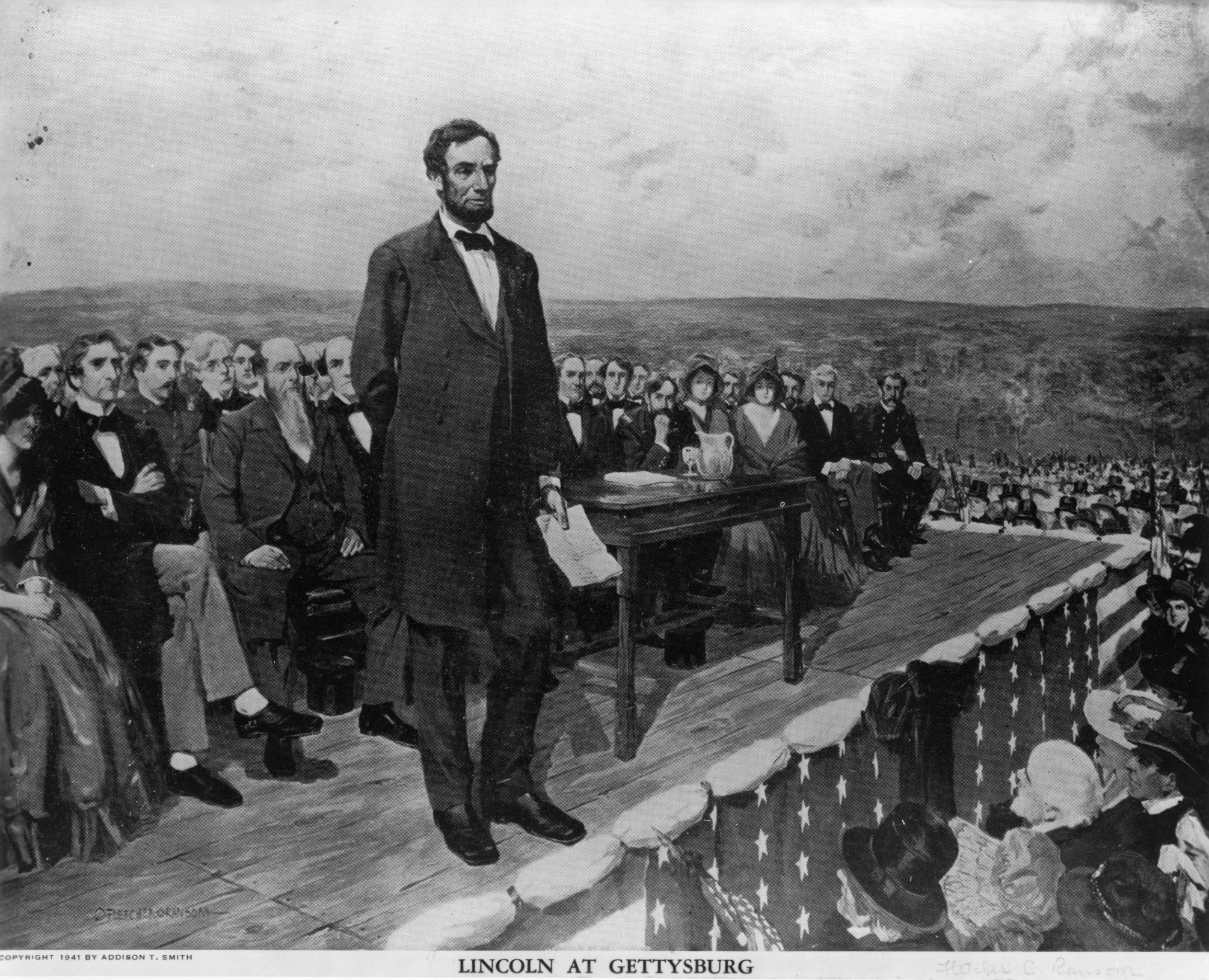
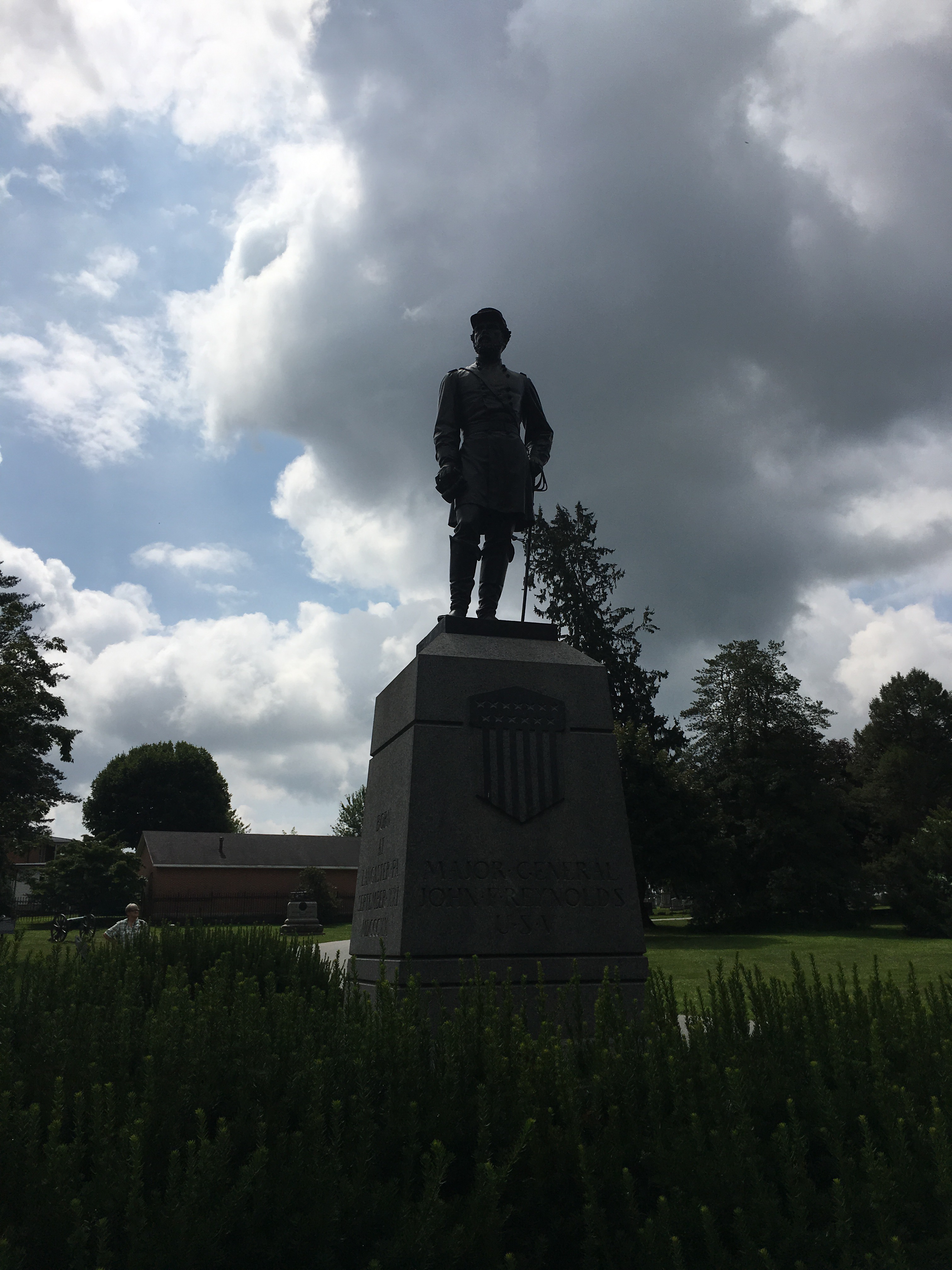
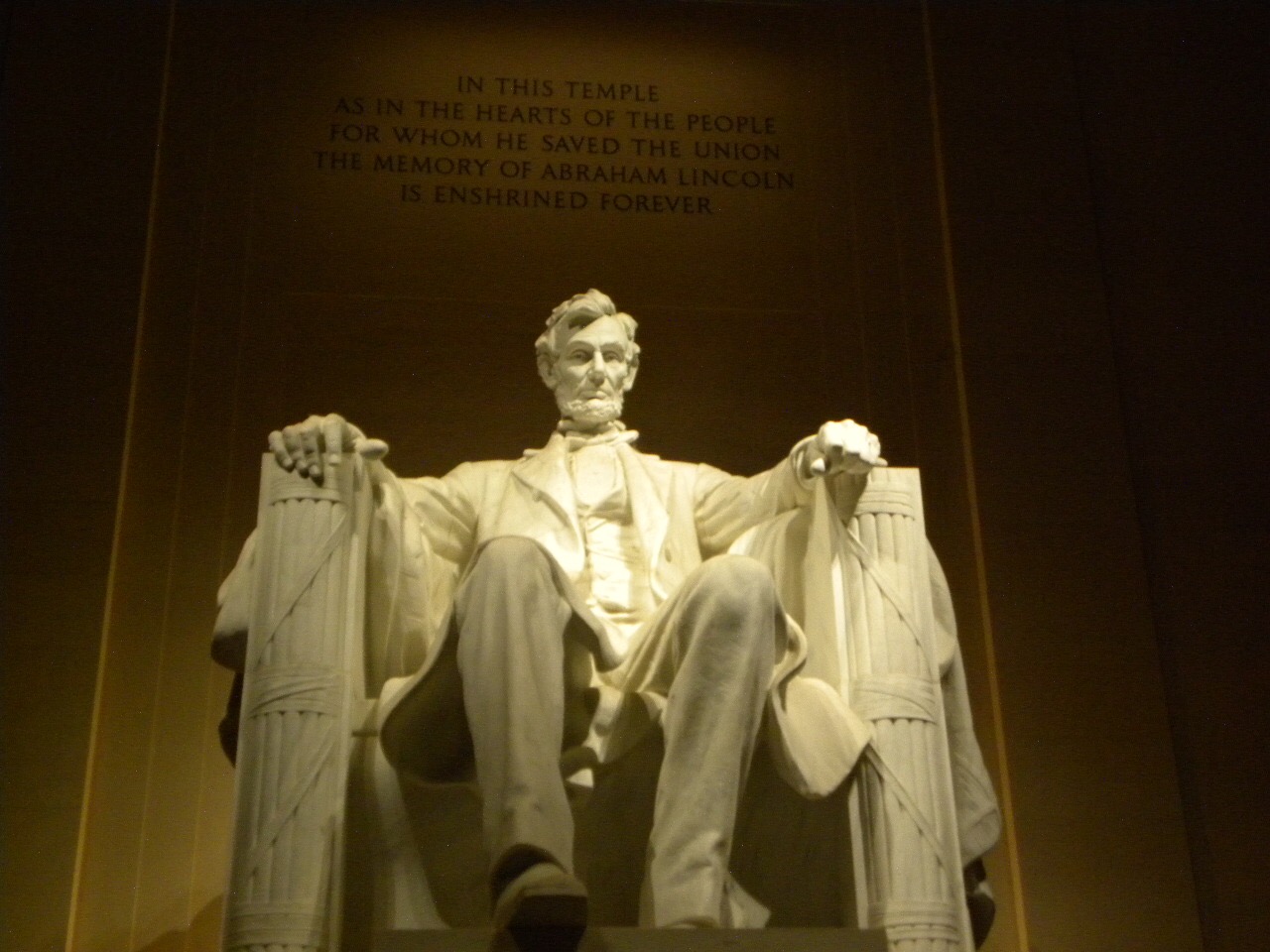
I am at Gettysburg with my students this weekend and today we finish our Staff Ride concluding at the Soldier’s Cemetery where Abraham Lincoln gave the Gettysburg Address. I usual close the staff ride by reading his address. I always get a bit choked up because I realize just how important what he said was then, and still is today. 

I expect with our democracy under assault from Donald Trump and his supporters that I will choke up, for I know not what I will wake up to on November 9th. If Trump wins, and his supporters on the Alt-Right have their way, our system of government will be destroyed, the civil liberties that the men who died here to establish will be curtailed or even rolled back. I fear that possibility and honestly if Trump were to win I cannot imagine what this country will devolve into.

In November of 1863 Abraham Lincoln was sick when when he traveled by train from Washington DC to Gettysburg. When Lincoln delivered the address having what was mostly likely a mild form of Smallpox. Thus the tenor, simplicity and philosophical depth of the address are even more remarkable. It is a speech given in the manner of Winston Churchill’s “Blood sweat toil and tears” address to Parliament upon being appoint Prime Minister in 1940. Likewise it echoes the Transcendentalist understanding of the Declaration of Independence as a “test for all other things.”

Many in the United States and Europe did not agree and argued that no nation found on such principles could long survive. The more reactionary European subscribers of Romanticism ridiculed the “idea that a nation could be founded on a proposition….and they were not reluctant to point to the Civil War as proof that attempting to build a government around something as bloodless and logical as a proposition was futile.” [1]

But Lincoln disagreed. He believed that the “sacrifices of Gettysburg, Shiloh, Murfreesboro, Chancellorsville, and a hundred other places demonstrated otherwise, that men would die rather than to lose hold of that proposition. Reflecting on that dedication, the living should themselves experience a new birth of freedom, a determination- and he drove his point home with a deliberate evocation of the great Whig orator Daniel Webster- “that government of the people, by the people, for the people, shall not perish from the earth.” [2]

The Unitarian pastor and leading Transcendentalist Theodore Parker wrote:

“Our national ideal out-travels our experience, and all experience. We began our national career by setting all history at defiance – for that said, “A republic on a large scale cannot exist.” Our progress since that has shown that we were right in refusing to be limited by the past. The practical ideas of the nation are transcendent, not empirical. Human history could not justify the Declaration of Independence and its large statements of the new idea: the nation went beyond human history and appealed to human nature.” [3]

Likewise Lincoln’s address echoes the thought of George Bancroft who wrote of the Declaration:

“The bill of rights which it promulgates is of rights that are older than human institutions, and spring from the eternal justice…. The heart of Jefferson in writing the Declaration, and of Congress in adopting it, beat for all humanity; the assertion of right was made for the entire world of mankind and all coming generations, without any exceptions whatsoever.” [4]

Theodore Parker’s words also prefigured an idea that Lincoln used in his address, that being: “the American Revolution, with American history since, is an attempt to prove by experience this transcendental proposition, to organize the transcendental idea of politics. The ideal demands for its organization a democracy- a government of all, for all, and by all…” [5]

Lincoln delivered these immortal words on that November afternoon:

Four score and seven years ago our fathers brought forth on this continent, a new nation, conceived in Liberty, and dedicated to the proposition that all men are created equal.

Now we are engaged in a great civil war, testing whether that nation, or any nation so conceived and so dedicated, can long endure. We are met on a great battle-field of that war. We have come to dedicate a portion of that field, as a final resting place for those who here gave their lives that that nation might live. It is altogether fitting and proper that we should do this.

But, in a larger sense, we cannot dedicate — we can not consecrate — we can not hallow — this ground. The brave men, living and dead, who struggled here, have consecrated it, far above our poor power to add or detract. The world will little note, nor long remember what we say here, but it can never forget what they did here. It is for us the living, rather, to be dedicated here to the unfinished work which they who fought here have thus far so nobly advanced. It is rather for us to be here dedicated to the great task remaining before us — that from these honored dead we take increased devotion to that cause for which they gave the last full measure of devotion — that we here highly resolve that these dead shall not have died in vain — that this nation, under God, shall have a new birth of freedom — and that government of the people, by the people, for the people, shall not perish from the earth.[6]

In a time where many are wearied by the foibles and follies of our politicians, especially a man as singularity ill-equipped and ill-tempered as Donald Trump and his supporters, many of whom are White Nationalists and authoritarian types unseen since secession could possibly take power; one has to wonder if our very form of government can survive, or if  Lincoln’s words still matter. 

But they do. Dr. Allen Guelzo, Professor of Civil War Studies at Gettysburg College wrote in the New York Times:

“The genius of the address thus lay not in its language or in its brevity (virtues though these were), but in the new birth it gave to those who had become discouraged and wearied by democracy’s follies, and in the reminder that democracy’s survival rested ultimately in the hands of citizens who saw something in democracy worth dying for. We could use that reminder again today.” [7]

Dr. Guelzo is quite correct. Many people in this country and around the world are having grave doubts about our democracy. I wonder myself, but I am an optimist. I do believe that we will eventually recover because for the life of me I see no nation anywhere else with our resiliency and ability to overcome the stupidity of politicians, pundits and preachers and the hate filled message of Donald Trump and his White Supremacist supporters, especially supposedly “conservative ” Christians. 

The amazing thing during the Civil War was that in spite of everything the Union survived. Lincoln was a big part of that but it was the men who left lives of comfort and security like Joshua Chamberlain and so many others who brought about that victory. Throughout the war, even to the end Southern political leaders failed to understand that Union men would fight and die for an ideal, something greater than themselves, the preservation of the Union and the freedom of an enslaved race. For those men that volunteered to serve, the war was not about personal gain, loot or land, it was about something greater. It was about freedom, and when we realize this fact “then we can contemplate the real meaning of “that cause for which they gave the last full measure of devotion.” [8]

Now I for one do not think that we are currently living up to the ideals enunciated by Lincoln that day at Gettysburg. I can understand the cynicism disillusionment of Americans as well as those around the world who have for over 200 years looked to us and our system as a “city set on a hill.” That being said, when I read these words and walk that hallowed ground I am again a believer. I believe that we can realize the ideal, even in our lifetime should we desire. That being said I cannot imagine what will happen to our country if Donald Trump is elected to the presidency. 

Have a great day and please stop to think about how important Lincoln’s words remain as we wait to see who will be our next President. 

Peace

Padre Steve+

Notes

[1] Ibid. Guelzo. Fateful Lightening p.409

[2] Ibid. Guelzo. Fateful Lightening p.408

[3] Ibid. Wills. Lincoln at Gettysburg p.110

[4] Ibid. Wills. Lincoln at Gettysburg p.105

[5] Ibid. Wills. Lincoln at Gettysburg p.105

[6] Lincoln, Abraham The Gettysburg Address the Bliss Copy retrieved from http://www.abrahamlincolnonline.org/lincoln/speeches/gettysburg.htm

[7] Guelzo, Allen C. Lincoln’s Sound Bite: Have Faith in Democracy New York Time Opinionator, November 17th 2013 retrieved from http://opinionator.blogs.nytimes.com/2013/11/17/lincolns-sound-bite-have-faith-in-democracy/?_php=true&_type=blogs&_r=0 July 18th 2014

[8] Ibid. McPherson This Hallowed Ground p.138

6 Comments

Filed under civil war, Gettysburg, History, Political Commentary

The Ghosts of Gettysburg Gather Around Me

img_0578

Friends of Padre Steve’s World,

I am at Gettysburg this weekend so I am just posting just a short meditation and some words written by Walt Whitman. 

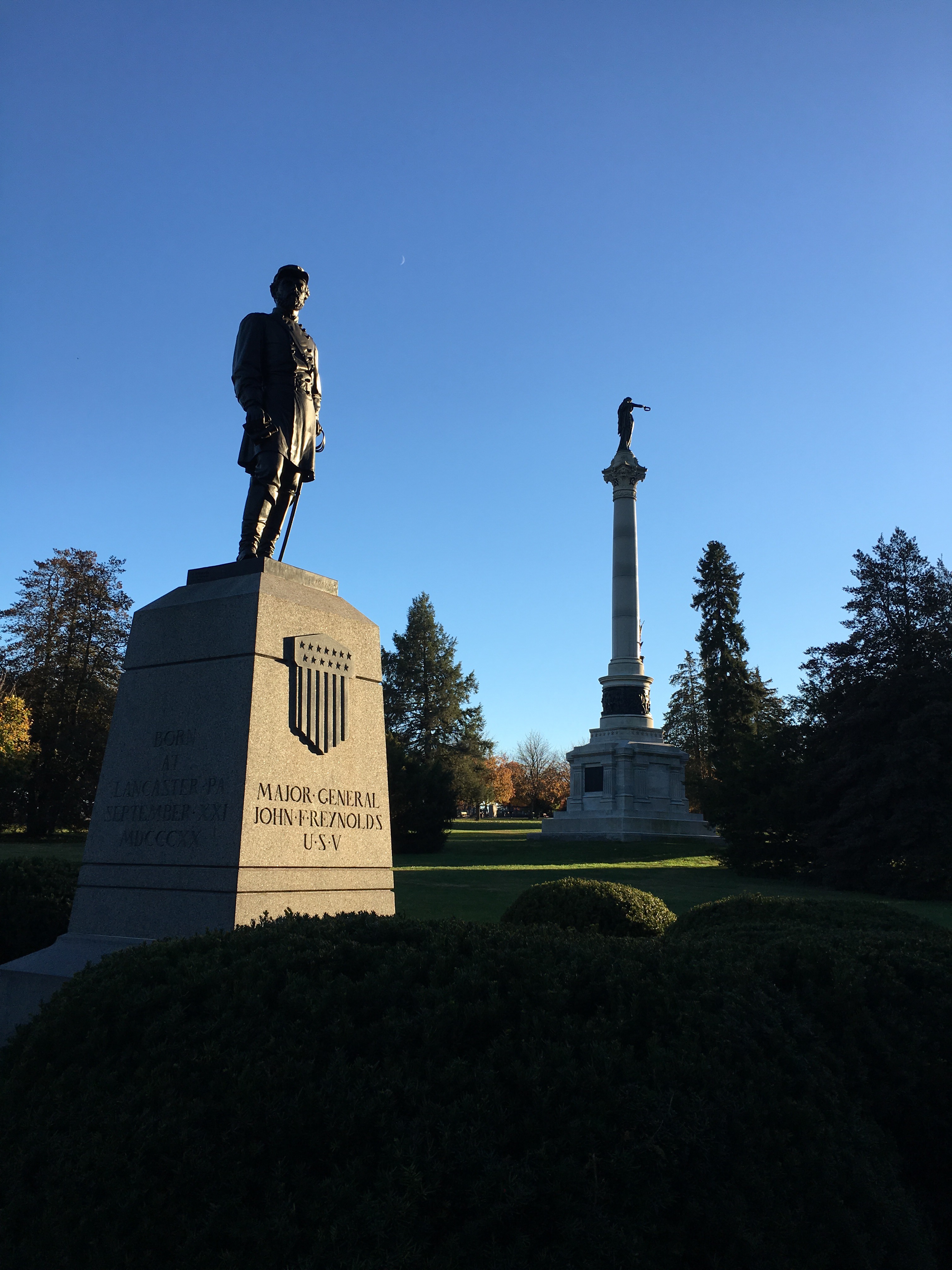
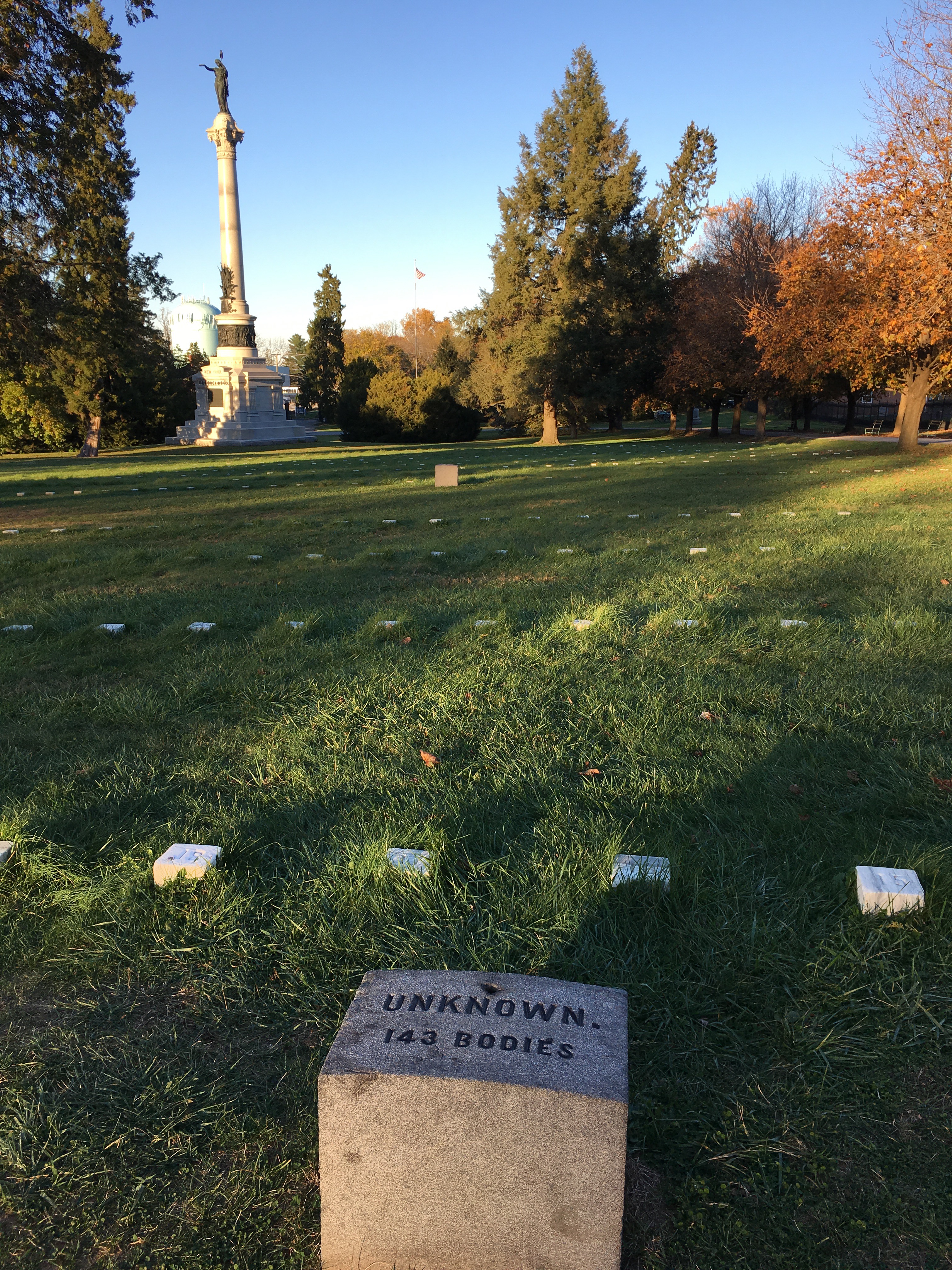
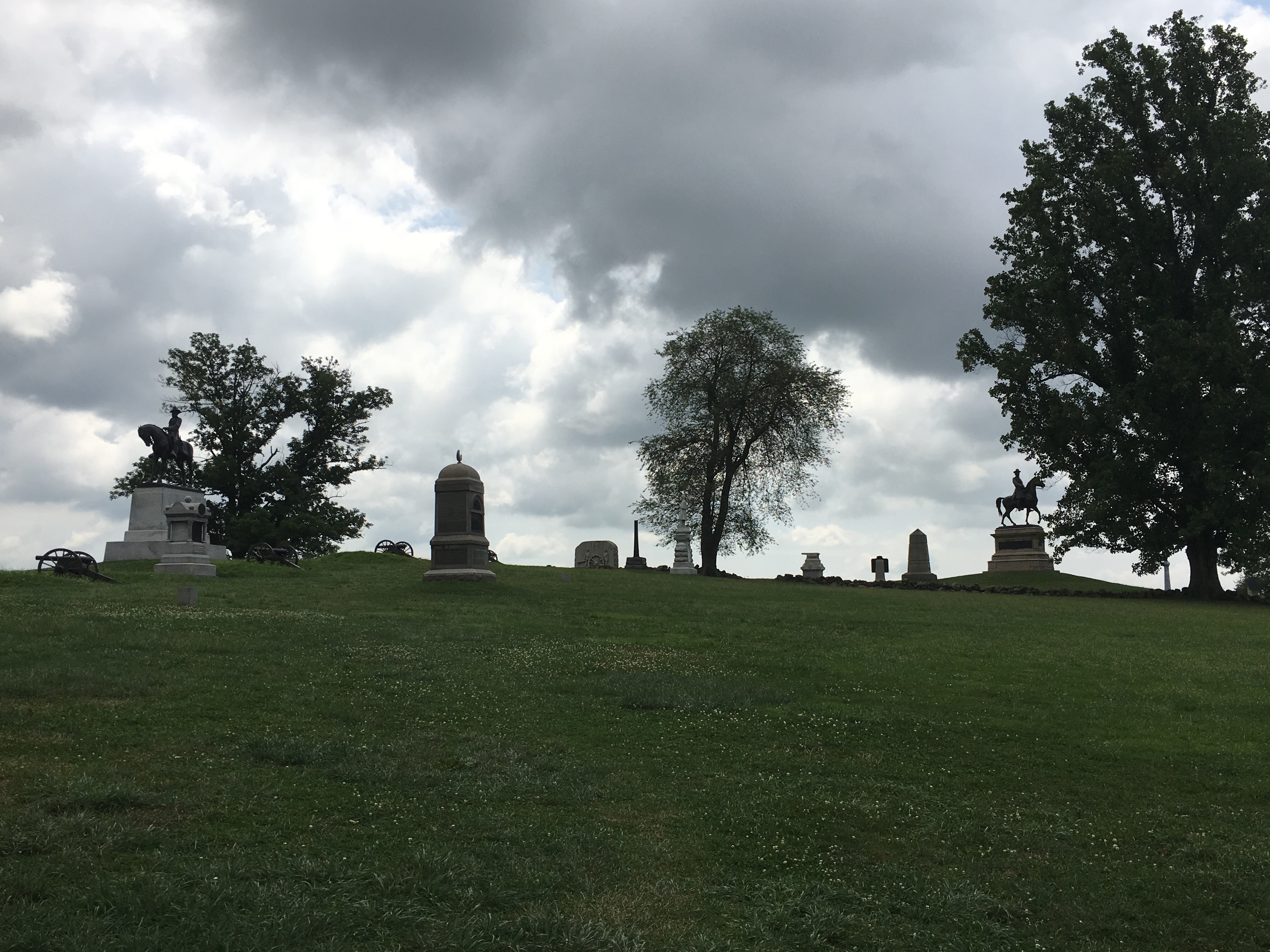
Yesterday afternoon I wandered around the Soldier’s Cemetery as well as East Cemetery Hill. It was a beautiful evening with the fall foliage in full display under a a blue sky with the sun setting in the west. As I walked about the graves of the 3577 Union Soldiers buried here, over half who are unknowns, I felt such powerful presence and was reminded of the importance of what they did here. There are sections where of the cemetery where unknown soldiers are buried, rank upon rank, with only a small marble marker with a number to identify them.

Each was a son, maybe a husband, father, or brother, or a friend, and most certainly, a comrade in arms. Each has a name, even if we don’t know it; and all of them, and many more gave the last full measure of devotion to duty to preserve this country against an enemy. But unlike other enemies, the soldiers that these men battled were from of an enemy that has raised itself up from within the country; men, no matter how good they might have been, took up arms against the United States. These included men who took up arms and fought against friends who they had served alongside in peace and war.

While men of my family fought for the Confederacy I cannot succumb to the lie that their cause was just. Thus when I stand among the ranks of these fallen Union men I honor their memory in ways I cannot fully do for their opponents in Confederate gray. Do not get me wrong, I weep for those who fought and died on both sides of the American Civil War, and each soldier needs to be remembered, even those who fought for a cause that was evil, the cause of slavery. As a military man myself I cannot walk these battlefields and not have a sense of compassion and even empathy for the Southerners who died here, even while rightly condemning the government and the cause that sent them to their deaths.

Walt Whitman wrote the poem Ashes of Dead Soldeirs after the war was over. Whitman knew the terrible cost borne by soldiers as he volunteered to help the wounded in Federal hospitals during the war. His words speak to me. 

When I come here I can sense their presence, the great and the small, John Reynolds, Lewis Armistead, Paddy O’Rorke, Dick Garnett, Alonzo Cushing, and Stong Vincent. The men of the Iron Brigade and the Irish Brigade, Dan Sickles’s Excelsior Brigade, Augustus Van Horne Ellis’s 124th New York “Orange Blossoms,”the men of George Pickett’s doomed division, the 1st Minnesota, the 20th Maine, and so many more. 

Whitman penned these words:

 “Ashes of soldiers South or North,
As I muse retrospective murmuring a chant in thought,
The war resumes, again to my sense your shapes,
And again the advance of the armies.
Noiseless as mists and vapors,
From their graves in the trenches ascending,
From cemeteries all through Virginia and Tennessee,
From every point of the compass out of the countless graves,
In wafted clouds, in myriads large, or squads of twos or threes or
single ones they come,
And silently gather round me…”

From Walt Whitman- Ashes of Dead Soldiers

Peace,

Padre Steve+ 

Leave a comment

Filed under civil war, Gettysburg, History

Tragic Heroes: Gouverneur Warren Part Three

Friends of Padre Steve’s World

On Monday and Tuesday I posted part one of a several part series about the Union Army general, Gouverneur Warren. have been writing about leadership the past couple of days and despite all that is going on in the news I think that I will continue to do so using some parts of my Gettysburg text. I think it is incredibly important to get to know the men and women behind iconic pictures, statues, and biographies that are often not much more than hagiography. In my studies I have encountered people who I find fascinating and not just because of their achievements but also due to their suffering. One of my seminary professors said that you could never come to grips with Jesus until you came to understand suffering.

That is important especially when we deal with men and women who have been traumatized on the battlefield, who when they return from war they come home changed. Many are great leaders and outstanding people whose courage was proven but their lives after the war can only be considered tragic. One of these is Gouverneur Warren, one of the heroes of the Union in the Civil War, and who was instrumental in stopping the Confederate forces at Gettysburg 0n July 2nd 1863. I have written about him before, but I think now is an appropriate time to revisit his life as well as some other men who fought alongside him at Gettysburg. Thia is part three of my series about him.

Have a great day,

Peace

Padre Steve+

gkwarren_roundtop

Chief Engineer of the Army of the Potomac and Savior of Little Round Top

In January 1863 Warren was pulled from his brigade duties by Hooker who employed him with good effect to assist his engineering staff, first with mapping and then building the fortifications that stopped the ferocious Confederate storm on the second day of battle. [1] In less than 48 hours Warren’s troops threw up five miles of the most formidable entrenchments yet constructed under battlefield conditions. [2] Edward Alexander, Longstreet’s artillery officer noted that when the Confederates came upon the fortifications after Hooker’s withdraw that “they were amazed at the strength and completeness of the enemys fortifications. [3] Following the battle Warren was appointed as Chief Engineer of the Army of the Potomac on May 12th 1863 by Hooker.  When Hooker was relieved of command and was replaced by Meade on June 28th 1863, he was kept in that position by his fellow engineer George Gordon Meade.

Warren and Major General Winfield Scott Hancock arrived at Cemetery Hill on the night of July 1st 1863. He surveyed the ground with Hancock and they concurred that “it would be the best place for the army to fight on if the army was attacked.” [4] As George Gordon Meade organized the defenses of his army at Gettysburg, he not only depended on Warren’s advice about the ground, but consulted him constantly at headquarters or sent him off on matters of highest importance. [5] Meade respected Warren and had offered Warren the chance to serve as his Chief of Staff, a position that Warren, like Seth Williams, the Adjutant General declined that offer indicating that he had too much work in their departments to take on the burdens of a new job. [6]

Meade’s opponent, Robert E. Lee, who knew Warren before the war appreciated Warren’s calm, absorbed, and earnest manner, his professional skill and sound judgment. [7] These qualities would serve both men and the army well on July 2nd 1863.

When Sickles moved III Corps forward during the afternoon without permission of Meade, the result was that his Corps was deployed in a vulnerable salient at the Peach Orchard. This left the southern flank of the army in the air and the Round Tops undefended. Meade was aghast and set about to attempt to rectify the situation. Warren was with Meade and based on the reconnaissance that he conducted the previous day and that morning knew the position better than anyone.  He recognized that something was badly awry on Sickles Third Corps front matters there were not all straight.  [8] He had sent an officer to discover to investigate Sickles’ front and that officer reported that the section of Cemetery Ridge assigned to III Corps was not occupied. [9]

Meade and Warren discussed the situation and realized that III Corps “could hardly be said to be in position” [10] and knowing VI Corps was now close at hand order V Corps, at the time his only reserve into the position vacated by Sickles. They went forward and seeing the empty spaces Warren told Meade “here is where our line should be” to which Meade replied: “It’s too late now.” [11] Warren, whose familiarity with the whole of the battlefield gave him concern about Sickles’ corps dispositions suggest that Meade send him to the Federal left, “to examine the condition of affairs.” [12]

Meade concurred with his Warren and in dispatching him he also gave Warren the authority to take charge as needed saying “I wish you would ride over there and if anything serious is going on, attend to it.” [13] Again Meade’s choice of Warren for the task demonstrated the trust that is essential in command.  The two officers worked together seamlessly and as Coddington described their relationship that day: “Meade chose him to act as his alter ego in crucial moments of the battle, and Warren rendered services for which Meade and the country were to be eternally grateful.” [14] Warren would not see Meade again that day “until the attack had spent its force.” [15]

Hunt noted that “The duty could not have been in better hands.” [16] When Warren arrived on Little Round Top he found it unoccupied save for a few signal corps soldiers. Warren immediately recognized the tactical value of Little Round Top and noted that it was “the key of the whole position.”  [17] Warren saw that the Confederates were massing not more than a mile away and that there were no troops on the hill to stop them. He believed that an area “of woods on the near side of the Emmitsburg Road as “an excellent place for the enemy to form out of sight” [18]  which was exactly what Major General John Bell Hood’s division was doing, as Henry Hunt noted “The enemy at the time lay concealed, awaiting signal for the assault…” [19] To test his suspicions Warren sent a messenger to Captain James Smith’s 4th New York artillery battery on Devil’s Den to fire a single shot into the woods. Warren described the situation:

“As the shot went whistling through the air the sound of it reached the enemy’s troops and caused every one to look in the direction of it. This motion revealed to me the glistening gun-barrels and bayonets of the enemy’s line of battle, already formed and far outflanking the position of any of our troops; so that the line of his advance from the right to Little Round Top was unopposed. I have been particular in telling this, as the discovery was intensely thrilling to my feelings, and almost appalling.” [20]

Upon confirming his fears Warren resorted to ruse and action. He order the “signalmen to keep up their wigwag activity, simply as a pretense of alertness, whether they had any real signals to transmit or not…” [21] He also sent messengers to Meade, Sickles and Sykes, the commander of V Corps asking Meade to “Send at least a division to me” [22] instructing the messenger, Lieutenant Randall Mackenzie to tell Meade “that we would at once have to occupy that place very strongly.” [23] Sickles refused on account of how badly stretched his lines were, however George Sykes of V Corps responded sending Captain William Jay to find Barnes commander of his 1st Division. As he waited Warren stood atop a “flat rock on the summit of Little Round Top, eyes fixed to his field glasses…he spent several nervous minutes wondering if his urgent appeals for help would be answered or ignored.” [24]

The messenger could not find Barnes, but instead came across the commander of the division’s 3rd Brigade, Colonel Strong Vincent. Vincent knew that Barnes was self-medicating his “pre-battle anxieties out of a black commissary quart bottle” and was already “hollow from skull to boots” and demanded “What are your orders? Give me your orders.” [25] Upon learning that Sykes wanted a brigade to proceed to Little Round Top Vincent responded immediately to take the initiative and ordered his four regiments up Little Round Top without waiting for permission. Vincent told Sykes messenger “I will take the responsibility myself of taking my brigade there.” [26]

The Attack of Law’s Brigade on Little Round Top July 2nd

Meade’s choice of Warren for the task was confirmed by how Warren continued to act with alacrity and decisiveness throughout the afternoon. “As the Union line began to crumble on Little Round Top, Warren, vested with the authority of Meade’s chief representative, emerged as the right man at the right place at the right time.” [27] Warren did not stop with sending messengers, but seeing the danger building he noted that the northwest face of the hill was still unoccupied and open to attack. Warren forgot “all about a general’s dignity” he “sprinted down the east slope of the hill like a rabbit.” [28]

There Warren found Brigadier General Stephen Weed’s brigade which he had previously commanded. The troops of the brigade, “seeing their former commander, started cheering, but Warren had no time or accolades.” [29] Warren did not see Weed, but instead he found Colonel Patrick O’Rorke of the 140th New York, who had been one of his students at West Point, and ordered him to follow him up the hill, saying “Paddy…give me a regiment.” [30]

When O’Rorke told Warren that Weed expected him to be following him Warren took the responsibility telling O’Rorke “Bring them up on the double quick, and don’t stop for aligning. I’ll take responsibility.” [31] O’Rorke followed with his gallant regiment with the rest of the brigade under Weed following them. The 140th New York entered the battle to the right of the Vincent’s 16th Michigan which was being swarmed by the 4th and 5th Texas and 4th Alabama, who thought that victory was at hand, slamming the Texans and Alabamians and “at once the Confederate assault began to dissolve” [32]

Warren’s actions were fortuitous as the 140th New York and Lieutenant Charles Hazlett’s battery of the 5th Artillery arrived at the crest just in time to repulse the advancing Confederates, as the battery struggled to get into position Warren “took hold of one of the guns and labored with the gun crew to get the piece over the rocks and up the steep wooded hillside.” [33] The battery went into action immediately and soon drew concentrated enemy fire and “Warren narrowly escaped serious injury when a bullet nicked his throat.” [34]

In the ensuing fight the brigade would take fearful casualties. By the end of the day Weed, O’Rorke and Hazlett would all be dead, but together with Vincent’s brigade they held on and saved the Union line.[35]

Warren continued to urge on the Federal troops despite being wounded,  in the words of a reporter who observed him in “a most gallant and heroic manner, riding with utmost confidence over fields swept by the enemy’s fire, seemingly everywhere present, directing, aiding, and cheering the troops.” [36] Once he was assured that Little Round Top was secure he proceeded to rejoin Meade “near the center of the battlefield where another crisis was at hand.” [37]

After Gettysburg Warren was proud of his accomplishments but did not boast of them. He wrote to his in his journal: “There was no merit in my actions except to secure for our army a position if I could, which would prevent our lines from being flanked and this when attacked was given an opportunity for a fair fight to front, and there our opponents did not win.” [38] However his comments belied his accomplishments on Little Round Top that day “for he alone was responsible for recognizing the crisis there, for Vincent’s brigade being sent up the hill, and for commandeering the 140th New York and the rest of Weed’s brigade as reinforcements.” [39]

Notes

[1] Sears, Stephen W. Chancellorsville Houghton Mifflin Co. Boston and New York 1996 p.372

[2] Hagerman, Edward. The American Civil War and the Origins of Modern Warfare. Midland Book Editions, Indiana University Press. Bloomington IN. 1992 p.91

[3] Alexander, Edward Porter Military Memoirs of a Confederate: A Critical Narrative 1907 republished 2013 by Pickle Partners Publishing, Amazon Kindle Edition location 7007

[4] Sears, Stephen W. Gettysburg. Houghton Mifflin Co. Boston and New York 2003 p.224

[5] Coddington, Edwin B. The Gettysburg Campaign: A Study in Command, A Touchstone Book, Simon and Schuster New York, 1968 p.332

[6] Ibid. Sears Gettysburg  pp.129-130

[7] Ibid. Coddington, The Gettysburg Campaign: A Study in Command, p.332

[8] Ibid. Sears Gettysburg p.262

[9] Trudeau, Noah Andre. Gettysburg: A Testing of Courage, Harper Collins Publishers, New York 2002 p.319

[10] Ibid. Trudeau. Gettysburg: A Testing of Courage,  p.319

[11] Ibid. Trudeau. Gettysburg: A Testing of Courage,  p.320

[12] Ibid. Jordan Happiness is Not My Companion: The Life of G.K. Warren p.90

[13] Ibid. Trudeau. Gettysburg: A Testing of Courage,  p.320

[14] Ibid. Coddington, The Gettysburg Campaign: A Study in Command, p.388

[15] Guelzo, Allen C. Gettysburg: The Last Invasion Vintage Books a Division of Random House, New York 2013 p.260

[16] Hunt, Henry. The Second Day at Gettysburg in Battles and Leaders of the Civil War Volume III, The Tide Shifts. Edited by Robert Underwood Johnson and Clarence Clough Buel Castle, Secaucus NJ p. 307

[17] Ibid. Jordan Happiness is Not My Companion: The Life of G.K. Warren p.92

[18] Ibid. Jordan Happiness is Not My Companion: The Life of G.K. Warren p.92

[19] Ibid. Hunt The Second Day at Gettysburg in Battles and Leaders of the Civil War Volume III, The Tide Shifts. p. 307

[20] Pfanz, Harry F. Gettysburg: The Second Day. University of North Carolina Press, Chapel Hill 1987 p.206

[21] Foote, Shelby, The Civil War, A Narrative. Volume Two Fredericksburg to Meridian Random House, New York 1963 p.503

[22] Ibid. Jordan Happiness is Not My Companion: The Life of G.K. Warren p.92

[23] Ibid. Guelzo  Gettysburg: The Last Invasion Vintage p.261

[24] Ibid. LaFantasie Twilight at Little Round Top p.88

[25] Ibid. Guelzo  Gettysburg: The Last Invasion Vintage p.262

[26] Longacre, Edward Joshua Chamberlain: The Soldier and the Man Combined Publishing Conshohocken PA 1999 p.127

[27] Ibid. Coddington, The Gettysburg Campaign: A Study in Command, p.395

[28] Swanberg, W.A. Sickles the Incredible Stan Clark Military Books, Gettysburg PA 1957 p.214

[29] Ibid. Jordan Happiness is Not My Companion: The Life of G.K. Warren p.93

[30] Ibid. Jordan Happiness is Not My Companion: The Life of G.K. Warren p.93

[31] Ibid. Foote The Civil War, A Narrative. Volume Two Fredericksburg to Meridian p.504

[32] Ibid. LaFantasie, Twilight at Little Round Top p.153

[33] Ibid. LaFantasie, Twilight at Little Round Top p.132

[34] Ibid. Sears Gettysburg  p.281

[35] Ibid. Jordan Happiness is Not My Companion: The Life of G.K. Warren pp. 93-94

[36] Ibid. Coddington, The Gettysburg Campaign: A Study in Command, p.388

[37] Ibid. Coddington, The Gettysburg Campaign: A Study in Command, p.396

[38] Ibid. Jordan Happiness is Not My Companion: The Life of G.K. Warren p.95

[39] Ibid. Sears Gettysburg  p.281

Leave a comment

Filed under civil war, Gettysburg, History, leadership, Military

Tragic Heroes: Gouverneur Warren Part Two

Friends of Padre Steve’s World

Yesterday I posted part one of a several part series about the Union Army general, Gouverneur Warren. have been writing about leadership the past couple of days and despite all that is going on in the news I think that I will continue to do so using some parts of my Gettysburg text. I think it is incredibly important to get to know the men and women behind iconic pictures, statues, and biographies that are often not much more than hagiography. In my studies I have encountered people who I find fascinating and not just because of their achievements but also due to their suffering. One of my seminary professors said that you could never come to grips with Jesus until you came to understand suffering.

That is important especially when we deal with men and women who have been traumatized on the battlefield, who when they return from war they come home changed. Many are great leaders and outstanding people whose courage was proven but their lives after the war can only be considered tragic. One of these is Gouverneur Warren, one of the heroes of the Union in the Civil War, and who was instrumental in stopping the Confederate forces at Gettysburg 0n July 2nd 1863. I have written about him before, but I think now is an appropriate time to revisit his life as well as some other men who fought alongside him at Gettysburg. Thia is part two of my series about him.

Have a great day,

Peace

Padre Steve+

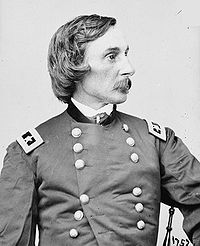
200px-GKWarren


Gouverneur Warren: A Complex Character

It is in this context that we examine Brigadier General Gouverneur Warren’s actions on Little Round Top on the afternoon and evening of July 2nd 1863, the controversy that embroiled his career and left him embittered and disillusioned at the end of the war; and even the possible explanations for what occurs to Warren during and after the war provided by modern medicine and psychological knowledge. We must do this because Warren is one of the most important people who step into history that day and because he is such a contradictory figure, to try to understand him and in doing so attempt to understand ourselves more fully.

At the time of the Battle of Gettysburg, Brigadier General Gouverneur Warren was serving as the Chief Topographical Engineer of the Army of the Potomac, a position that he had been appointed to by Joseph Hooker prior to Chancellorsville. At Chancellorsville Warren took command of the Pioneer brigade and “was responsible for the spectacular display of improvised field fortification during Hooker’s withdraw from Chancellorsville.” [1]

Unlike some of the other characters on Little Round Top that day, particularly Joshua Chamberlain, Warren does not engender myth; in fact some historians almost go out of their way to besmirch him, Joseph Whelan described Warren as “a fussy man who liked limericks, decidedly lacked gravitas.” [2] The description Warren being a “fussy man” who “lacked gravitas” is decidedly unfair for it immediately paints Warren in the mind of the reader as a man lacking in courage or fortitude and it distorts history. As I mentioned earlier when examining the evidence we have to carefully sift through it and not assume that any one characterization of a person is correct.

Whelan’s description of Warren is decidedly prejudicial. Warren was actually a complex and often contradictory figure as many military leaders throughout history have been. Though heroic, he did not look like a hero, and though an intensely proud man did not seek to bolster his image in the media, during or after the war.  Warren’s most recent biographer, David Jordan wrote that Warren was “prone to long sieges of depression, and he himself agreed that others found him to be morose and unsmiling. A complex and enigmatic man, Gouverneur Kemble Warren is not one to be easily categorized.” [3] His peers seemed to either admire or loathe him for he could be openly critical of others and had arrogance about him, which put some people off. Likewise Warren was often openly disdainful of those that he regarded as his inferiors, which at times included some of his superior officers, a trait that worked against him in the “hierarchical realm of military life.” [4]

Though Warren was considered the “savior of Little Round Top” in the years immediately following the war; his story faded. In part this was due to being relieved of command of Fifth Corps by Philip Sheridan at Five Forks, something that Chamberlain and many other officers and men of V Corps “considered an unjust act made cruel by his [Sheridan’s] refusal to reconsider it.”  [5] His story also faded because he resigned his commission as a Major General of Volunteers soon after the war, and returned to relative obscurity working as an Engineer officer along the Mississippi River.

After Warren’s untimely death at the age of fifty-three in 1882, three months before he exonerated by the Board of Inquiry, he was forgotten by many.  Likewise, the book he had prepared from his carefully arranged letters and reports was not published until 1932, forty years after his death.

Conversely, the story and myth of his friend and defender Joshua Chamberlain story grew throughout the late 1890s and early 1900s.  By then, Chamberlain, a superb writer and orator, alone of the men who made the stand at Little Round Top was still alive to tell his story, and this considerably shaped the history that we know.  The rise of the Chamberlain account is one reason why Warren is so often overlooked by many casual students and observers of the Battle of Gettysburg.

But to look at Warren’s actions is by no means to minimize the actions of others such as Colonel Strong Vincent, Colonel Joshua Lawrence Chamberlain, Brigadier General Stephen Weed, Colonel James Rice, or Colonel Patrick “Paddy” O’Rorke. All of these men played an instrumental part in the battle for Little Round Top, but only Warren, Chamberlain and Rice survived the battle, and Rice was killed in action at the Battle of Spotsylvania on May 10th 1864.

Ante-Bellum Staff Officers, Military Culture and an Expanding Army

For the purposes of this study it is important to note that Warren was not acting as a commander during the Battle of Gettysburg. Warren was, like most senior officers today, serving as a staff officer. Many times students of military history and theory are inclined to dismiss the contributions of staff officers because they do not have the overall responsibility of a battle, or the glamour of the limelight of the commanders that they serve under. However, for military professionals, especially those serving on senior staffs who prepare campaign plans, contingency plans and crisis plans the study of officers like Warren is essential.

The Federal Army at Gettysburg, like its Confederate opponent had a wide variety of officers serving in its ranks. Many of its senior officers were graduates of West Point. Many had served together in Mexico and in the various campaigns against Native American tribes. Those who stayed in the Army during the long “peace” between the Mexican War and the outbreak of the Civil War endured the monotony, boredom and often miserable conditions of isolated army posts, long family separations, as well as low pay, slow promotion and often low social status.[6] In light of such conditions, many resigned their commissions to undertake various professional, business or academic pursuits; in fact Samuel Huntington noted that in the years before the Civil War that “West Point produced more railroad presidents than generals.” [7] However, on the outbreak of the war, many of these graduates returned to service whether in the service of the Union, or the Confederate States.

When the war began the Army underwent a massive expansion, which it met through the call of up militia and by raising new volunteer units from the various states. In the expansion many officers were appointed who had no prior military service, or if they did it was performed years or even decades before the war. Some of these men were simply patriots who rallied to the flag, others due to a sense of righteousness about their cause, while others were political opportunists or appointees. In the north this was a particular problem as “professional officers were pushed aside and passed over in the Union, the higher commissions going, in the first stages of the war at least to officers called back into service or directly appointed from civilian life, many of them “political” appointees.” [8] At times the lack of experience, training and sometimes the poor character of some of the volunteers and political appointees was tragic.  However, many of these men in both Union and Confederate service performed as well or better than some of their regular army counterparts at various levels of command. Gettysburg would provide opportunity for the best and worst of all of these types of officers to succeed or fail. In this chapter we will look at how Warren succeeded remarkably at Little Round Top.


Explorer, Engineer and Instructor: The Preparation of a Staff Officer

As the Union mobilized a good number of Regular Army officers were allowed to assist the states in the formation and training of the new volunteer units. One of these officers was First Lieutenant Gouverneur Warren.

Warren was typical of the many professional officers of the old army. An 1850 graduate of West Point Warren was a bright student who had absorbed the teachings of his professor, Dennis Hart Mahan as the core of his own military thought, both in his senior year in college and through reinforcement as a faculty member. [9] Warren was commissioned as a Brevet Second Lieutenant and because of his high standing in his class was assigned to Corps of Topographical Engineers. He spent his first seven years in a number of assignments which took him throughout much of the country. Warren did not look the part of a hero. Short and willowy, he appeared no more substantial in body than a young boy, or as some remarked, a young woman; his uniforms tended to hang off him as if they were several sizes too big. [10]

Warren’s work involved exploring and mapping for various enterprises including the project to help tame the Mississippi River, and the exploration of the Great Plains and Black Hills where he developed a sympathy for the various Sioux tribes he encountered noting on completion of his mission in 1858, writing that He had never heard a Sioux chief express an opinion in regard to what was due them in which I do not concur and that many of them view the extinction of their race as an inevitable result of the operation of present causes, and do so with all the feelings of despair with which we should contemplate the extinction of our nationality. [11] Following his years in the west he returned as faculty to West Point where he as an Assistant Professor, shared mathematics instructional duties with Oliver O. Howard and resumed his relationship with his former professor Mahan. [12]

Commander of the Red Devils: The Peninsula, Gaines Mill and Second Manassas

On the outbreak of war Warren was granted leave from his duties at West Point to serve as Lieutenant Colonel of Volunteers in the 5th New York Infantry Regiment, also known as the Duryee Zouaves. When Abraham Duryee was appointed as a Brigadier General, Warren became the Colonel of the regiment.

He commanded the regiment during the Peninsula campaign where he was eventually given command of a provisional infantry brigade. At Gaines Mill, Warren’s regiment and brigade distinguished itself. Along George Sykes front no troops fought better than the small brigade of two volunteer regiments, the 5th and 10th New York, under Warren’s command. On the afternoon of the battle Warren led the 5th New York in a riveting counter attack.The Red Devils smashed into the 1st South Carolina Rifles and drive them back. The Zouaves were, declared a Regular, the peers of any troops on the hard fought field. Captain John W. Ames of the 11th United States told his parents that the counterattack of the New Yorkers haunted his sleep. Every night, he wrote home a week later, he saw a Zouave, with his arms around a comrade, who was fairly a dead man, walking with his friends support. Ames admitted, the horrors of sudden, accidental, bloody death are here so much augmented and multiplied. [13]

Warren described the action to his wife Nothing you ever saw in the pictures of battles excelled it. The artillery which had been firing stopped on both sides, and the whole armies were now spectators. In less than five minutes 140 of my men were killed or wounded and the other regiment completely destroyed. [14] Warren and his men received many accolades that day. George McClellan credited them with saving the Union left and said that Warren was everywhere conspicuous on the field, and not only directed the movement of his own brigade, which he handled with consummate skill, and placed in the most advantageous of positions, where they could produce the most effect on the enemy, but directed the movement of other regiments. [15] and during the action Warren suffered a slight wound from a spent bullet and had his horse shot out from under him.

Warren’s tiny provisional brigade composed of his 5th New York and the 10th New York was at Second Manassas where they had the bad fortune to be on the exposed Federal flank when Longstreet’s massive attack rolled over them. Warren and his brigade were left to protect the Fifth Corps artillery and trains when that corps was ordered by John Pope to attack Jackson’s corps, and John Reynolds’ division was ordered to withdraw leaving the Fifth Corps’ flank uncovered. On his own initiative Warren moved his brigade to protect the flank when Longstreet’s massive blow hit. Alone the two regiments, numbering about 1100 soldiers were overwhelmed in what one soldier called the very vortex of hell. [16] Robert E. Lee had drawn Pope into a trap and was poised to destroy his army. Longstreet’s corps led by Hood’s Texas brigade struck Warren’s troops and the 10th New York fell back as Warren and the 5th New York hung on long enough for artillery to limber up and withdraw, but they too were forced back with heavy losses. The 10th New York lost 133 killed and wounded, the 5th New York over 300 more. Warren wrote Braver men than those who fought and fell that daycould not be found. It was impossible to do more.  A member of Fifth Corps wrote that Warrens regiment and brigade, commanded by him, sustained heavier losses than any command on that disastrous field. [17] However, Warren’s gallantry was rewarded with promotion to Brigadier General effective September 26th 1862.

Though present at Antietam and Fredericksburg Warren’s brigade was not committed to either fight. However, Warren was in a position to see the disastrous attacks of Union troops against enemy troops in strong defensive positions. As an engineer Warren recognized the advantages that now were afforded to the defense with the advent of the rifled musket, something that would influence many of his decisions as well as his questioning of Meade, Grant and Sheridan for tactical decisions to attack in situations where he viewed such actions to be either unwise or suicidal. Warren was affected by what he had seen, both in the human cost of the war as well as the politics that had engulfed the army. He wrote his wife Emily on Christmas Day:

I today feel very desponding about our government and the management of affairs.I left my home without ambition to save a noble cause. I have seen that cause almost betrayed- I know of bleeding hearts, desolate homes, and unnumbered nameless graves of noble men who have vainly perished. There must be a just God[.] Why does he permit these things…”  [18]

Notes

[1] Hagerman, Edward. The American Civil War and the Origins of Modern Warfare, Midland Book Editions, Indiana University Press, Bloomington IN. 1992 p.96

[2] Whelan, Joseph Bloody Spring: Forty Days that Sealed the Confederacy’s Fate Da Capo Press, Boston 2014 p.65

[3] Jordan, David M. Happiness is Not My Companion: The Life of G.K. Warren Indiana University Press, Bloomington Indiana 2001 p.x

[4] Happiness is Not My Companion The Life of G.K. Warren p. x

[5] Wallace, Willard M. The Soul of the Lion: A Biography of Joshua L. Chamberlain Stan Clark Military Books, Gettysburg PA 1991 p.173

[6] Taylor, John M. Duty Faithfully Performed: Robert E Lee and His Critics Brassey’s, Dulles VA 1999 pp.37-38.

[7] Huntington, Samuel P. The Soldier and the State: The Theory and Politics of Civil-Military Relations The Belknap Press of Harvard University Press, Cambridge MA and London 1957 p.199

[8] Ibid. Huntington. The Soldier and the State: The Theory and Politics of Civil-Military Relations p.213

[9] Ibid. Jordan Happiness is Not My Companion The Life of G.K. Warren p.6

[10] LaFantasie, Glenn W. Twilight at Little Round Top: July 2, 1863 The Tide Turns at Gettysburg Vintage Books, a Division of Random House, New York 2005 p.73

[11] Ibid. Jordan Happiness is Not My Companion: The Life of G.K. Warren p.30

[12] Ibid. Jordan Happiness is Not My Companion: The Life of G.K. Warren p.33

[13] Wert, Jeffry D. The Sword of Lincoln: The Army of the Potomac Simon and Schuster New York 2005 p.104-105

[14] Ibid. Jordan Happiness is Not My Companion: The Life of G.K. Warren p.46

[15] Ibid. Jordan Happiness is Not My Companion: The Life of G.K. Warren p.46

[16] Ibid. Jordan Happiness Is Not My Companion: The Life of G.K. Warren p.56

[17] Ibid. Jordan Happiness is Not My Companion: The Life of G.K. Warren p.56

[18] Ibid. Jordan Happiness is Not My Companion: The Life of G.K. Warren p.64

Leave a comment

Filed under civil war, Gettysburg, History, leadership, Military

Tragic Heroes: Gouverneur Warren, Part One

Friends of Padre Steve’s World

I have been writing about leadership the past couple of days and despite all that is going on in the news I think that I will continue to do so using some parts of my Gettysburg text. I think it is incredibly important to get to know the men and women behind iconic pictures, statues, and biographies that are often not much more than hagiography. In my studies I have encountered people who I find fascinating and not just because of their achievements but also due to their suffering. One of my seminary professors said that you could never come to grips with Jesus until you came to understand suffering.

That is important especially when we deal with men and women who have been traumatized on the battlefield, who when they return from war they come home changed. Many are great leaders and outstanding people whose courage was proven but their lives after the war can only be considered tragic. One of these is Gouverneur Warren, one of the heroes of the Union in the Civil War, and who was instrumental in stopping the Confederate forces at Gettysburg 0n July 2nd 1863. I have written about him before, but I think now is an appropriate time to revisit his life as well as some other men who fought alongside him at Gettysburg.

Have a great day,

Peace

Padre Steve+

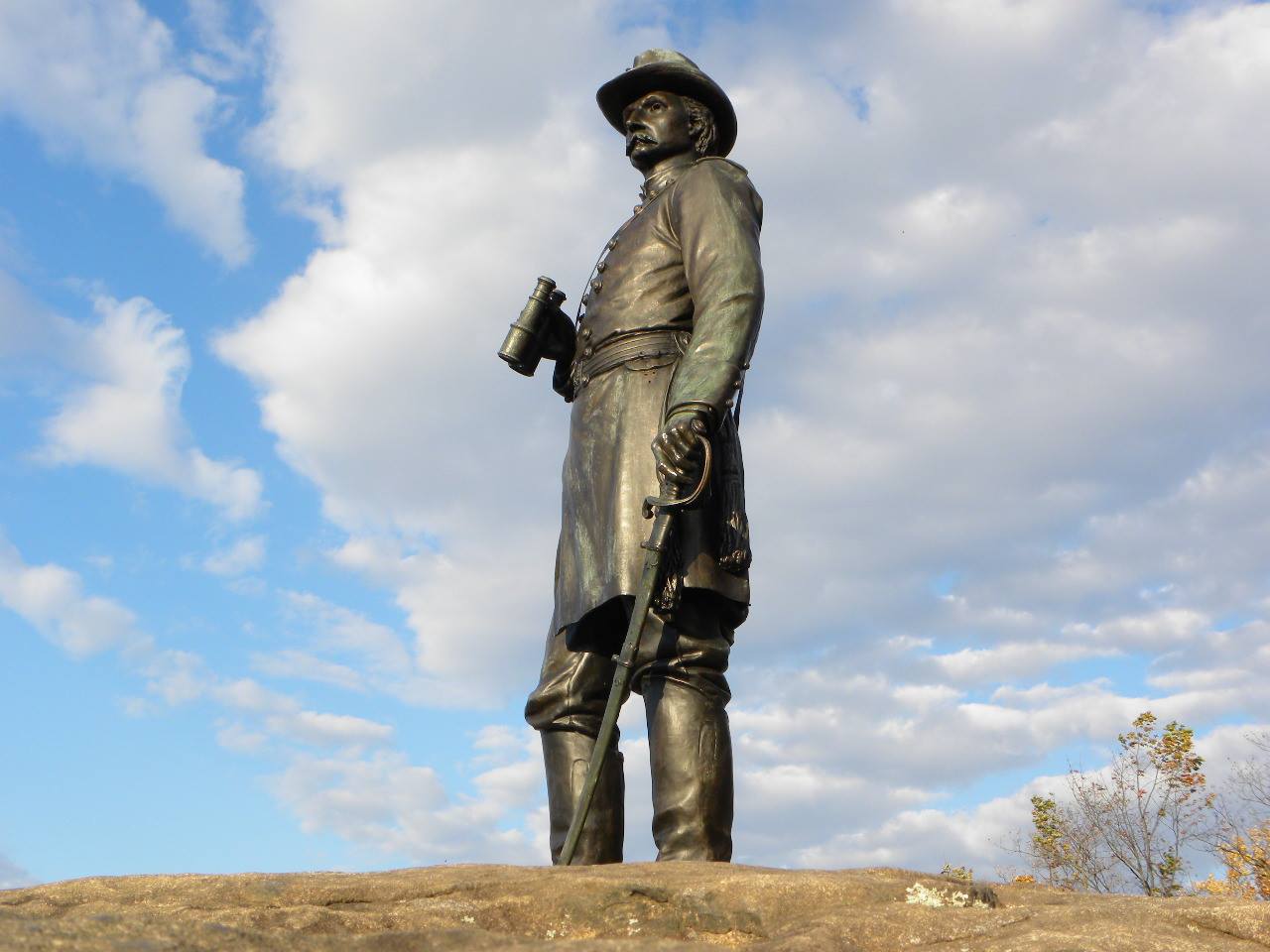
Warren

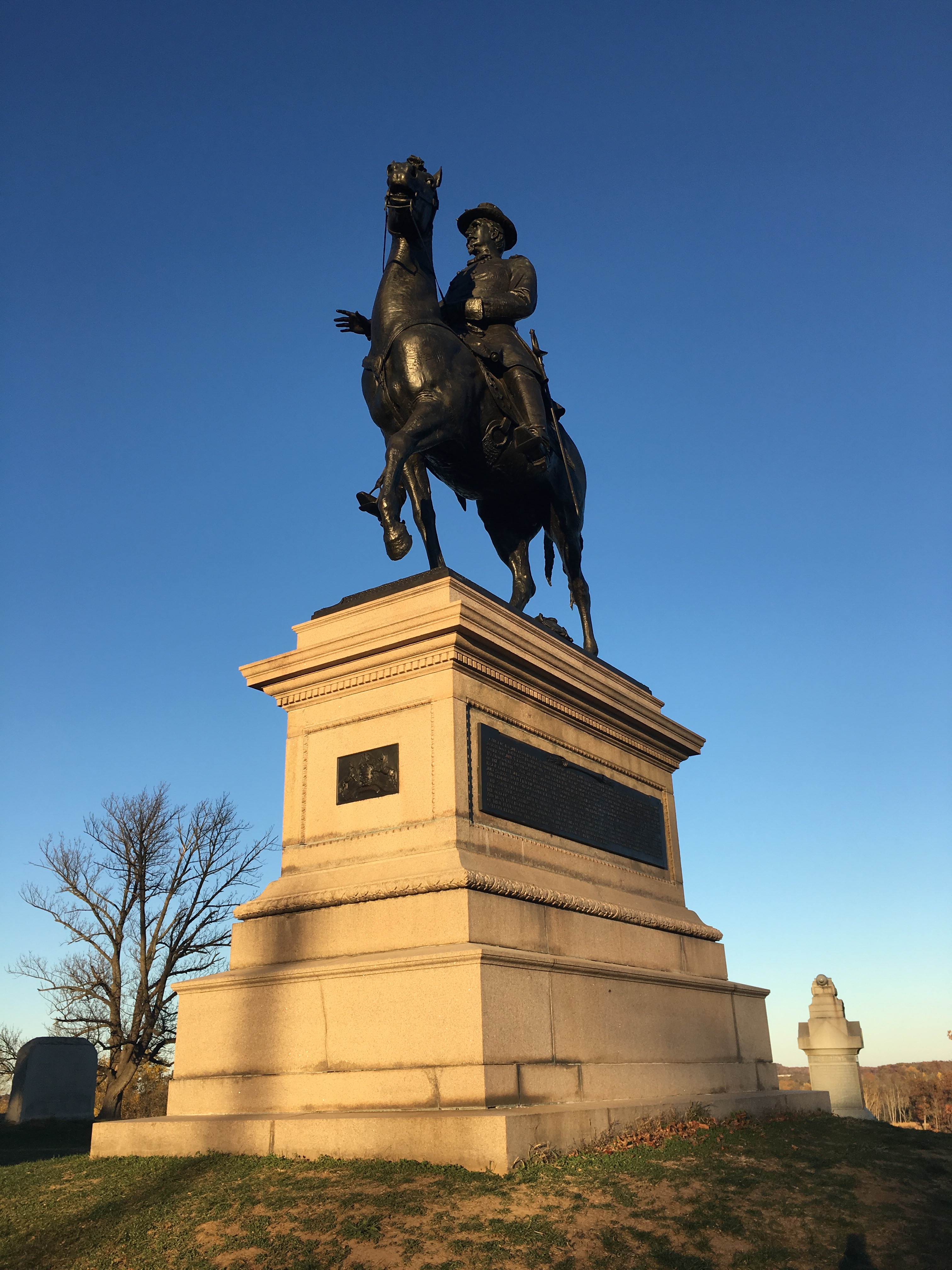
The Statue of Gouverneur Warren on Little Round Top


History, Memory and Myth at Little Round Top 

The battle of Gettysburg is an iconic part of American history. The accounts of Buford’s delaying action and John Reynolds death on July 1st, the savage battle at the Wheat Field, the Peach Orchard and Plum Run on July 2nd and the great charge known as Pickett’s Charge on July 3rd 1863 all draw us to the battlefield. The stories of individual courage and the sacrifice of soldiers from the North and the South that are enshrined on the monuments that now populate the battlefield have a nearly religious quality that draws Americans to Gettysburg by the hundreds of thousands every year.

But there are some places on the battlefield that seem to be the most iconic, the most spiritual, and the most inspirational for various reasons. Two of these places in particular have a nearly magnetic attraction, the “High Water Mark” of the Confederacy on Cemetery Ridge where Pickett’s Charge met its end, and the rocky hill known as Little Round Top. A large part of the reason that these two places hold such an attraction is not just the way that the battle was fought.  Rather, it is often because of the way the stories of those actions and the stories of the men who fought at them have been passed down to us in the accounts of survivors, in history and even in the fictional accounts of the battle. In each of these stories there are elements of courage, devotion, sacrifice, and tragedy that touch us in deeply personal ways and connect us to them and what we see when we experience history tells us as much about us as it does them.

The story of the Battle for Little Round Top has been passed along to us in the many accounts and histories of the battle, but perhaps more importantly in literature and cinema through Michael Shaara’s Pulitzer Prize winning novel, The Killer Angels and that book’s film adaptation, Gettysburg.  Many people who have never read an actual history of the battle know about the Battle for Little Round Top from Jeff Daniels’ inspirational portrayal of Joshua Lawrence Chamberlain in the movie.

The mythic status that we accord Gettysburg is important to Americans as a people. It is a defining moment in our American story and that is why so many of us come to the battlefield. It is a part of who and what we are as a people. Chamberlain said this well a quarter century after the battle at the dedication of the Maine Monuments in 1888:

“In great deeds, something abides. On great fields, something stays. Forms change and pass; bodies disappear; but spirits linger, to consecrate ground for the vision-place of souls… generations that know us not and that we know not of, heart-drawn to see where and by whom great things were suffered and done for them, shall come to this deathless field, to ponder and dream; and lo! the shadow of a mighty presence shall wrap them in its bosom, and the power of the vision pass into their souls.” [1]

While the accounts in the novel and the film are certainly inspiring and allow us to experience the emotion and near spiritual sense of what Chamberlain writes about the battle, there is much more to learn. When we go beyond the mythic portrayal of the battle we find that despite the vast amount of information available that there are a large number of approximations and ambiguities in the accounts of the battle.  So as we endeavor to look at the actions of these leaders on that fateful day it is important to recognize that it is impossible for us to totally separate the actions of the men that helped decide the battle from the mythos that surrounds the story. [2] Likewise, it is important for us to acknowledge, that we cannot completely separate the character of these men and how they lived their lives from their actions on this particular battlefield and afterwards.

That understanding is important if we want to be able to interpret these men and their actions; actions that are recorded in their journals, after action reports, unit histories, individual diaries and letters, as well as the accounts of their contemporaries who served alongside them; accounts which for many reasons are not completely reliable.

As important as these accounts are for us in attempting to sort out the truth of the matter we must apply a hermeneutic of suspicion to them and we must interpret them. [3]  We have to do this because all historical accounts are influenced by the writer’s motivations, ideology or perspective. There are some authors who omit damning or damaging information, especially about their own actions, or the actions of those leaders that they wish to protect, and the writers that “spin” the event in order to build up or destroy the reputations of those present. Even those writers of the contemporary accounts of the battle who wrote their accounts with the best motivations and intentions to record the events as best as they could describe them were often prone to mistakes, even in details such as the time an event took place. The location of people during the event was limited by their physical position on the battlefield and what they could see amid the bullets and bombshells that created carnage around their point of observation. Those not present at the battle, the men who recorded their accounts based on the recollections of those present are similarly limited.

There is also another factor to consider in dealing with these accounts, especially when untrained observers make observations of the actions and behavior of others which seem strange or erratic to them. This is especially true of men who are writing about men who have experienced the horrors of war and combat which might have resulted in some sort of combat stress injury such as PTSD, brain injuries such as TBI or a concussive syndrome or experience which is now called Moral Injury. Thus when we examine the behavior of such leaders and see a marked change in the way that they deal with others after their experience of war, those conditions, unknown to their contemporaries must be considered as a possibility when evaluating their actions.

The problem for the historian or for that matter the writer of military doctrine is how to interpret the information that they have available to them to make it relevant and useful in the art that they practice.  This can be a daunting task with many associated pitfalls that is neither an inductive, nor a deductive process. David Hackett Fischer writes:

“The logic of historical thought is not a formal logic of deductive inference. It is not a symmetrical structure of Aristotelian syllogisms, or Ramean dialectics, or Boolean equations….Instead it is a process of adductive reasoning in the simple sense of adducing answers to specific questions, so that a specific “fit” is obtained. The answers may be general or particular, as circumstances may require. History is, in a sense a problem-solving discipline. A historian is someone (anyone) who asks an open ended question about past events and answers it with selected facts which are arranged in the form of an explanatory paradigm.” [4]

All this is important because it reminds us, that when we study these accounts and attempt to use them as a basis for leadership theories, operation art and strategy, or for any other reason, that all that we know to be “true” is a combination of fact, myth and spin. Our task is to do the best we can with that in mind while admitting that we all have our own prejudices, agendas and ideas that color the glasses by which we interpret the event and the actions of the people involved.

In a sense when we look at the records of the people present or their contemporaries we must entertain a fair amount of suspicion and be able to ask questions as if the writers were talking or writing to us presently. We must ask three questions to do this: Why are they telling this fact or story? Why are they telling it to me? Why are they telling it now? Or more succinctly put “Why this? Why me? Why now?”

Notes

[1] Chamberlain, Joshua Lawrence. Chamberlain’s Address at the dedication of the Maine Monuments at Gettysburg, October 3rd 1888 retrieved from http://www.joshualawrencechamberlain.com/maineatgettysburg.php 4 June 2014

[2] Note: My use of the terms myth, mythology or mythos should not be considered negative, and the use of the terms does not mean that there is not some degree of fact or truth in them. The definitions of the term mythos are important to understanding my use of the term here, first it denotes a traditional or recurrent narrative theme or plot structure of a story, and secondly a set of beliefs or assumptions about something. (See the Oxford American Dictionary.)

[3] I mention the term a hermeneutic of suspicion. Hermeneutics is the theory of understanding and interpreting language and non-linguistic expression. The Stanford Encyclopedia of Philosophy defines it this way: “The term hermeneutics covers both the first order art and the second order theory of understanding and interpretation of linguistic and non-linguistic expressions. As a theory of interpretation, the hermeneutic tradition stretches all the way back to ancient Greek philosophy. In the course of the Middle Ages and the Renaissance, hermeneutics emerges as a crucial branch of Biblical studies. Later on, it comes to include the study of ancient and classic cultures.” 

[4] Fischer, David Hackett Historians’ Fallacies: Toward a Logic of Historical Thought Harper and Row, New York 1970 p.xv  

Leave a comment

Filed under civil war, Gettysburg, History, leadership, mental health, Military, PTSD

A Cyclorama, a Cornerstone, and a Proposition


Friends of Padre Steve’s World

I have been at Gettysburg this weekend and yesterday was spent doing the Staff Ride on the battlefield. Normally we get all of the first two days of the battle done and conclude at Culp’s Hill and East Cemetery Hill before retiring to dinner. Yesterday, the weather got in the way. Thunderstorms came through and while we were able to finish the final assault of the Confederates on Cemetery Ridge, the storms became worse, so I altered the plan. Instead of pushing on and ensuring that my students would be too wet and miserable to learn anything I changed the plan on the fly and took them to the Visitors Center, where we normally begin our Sunday.


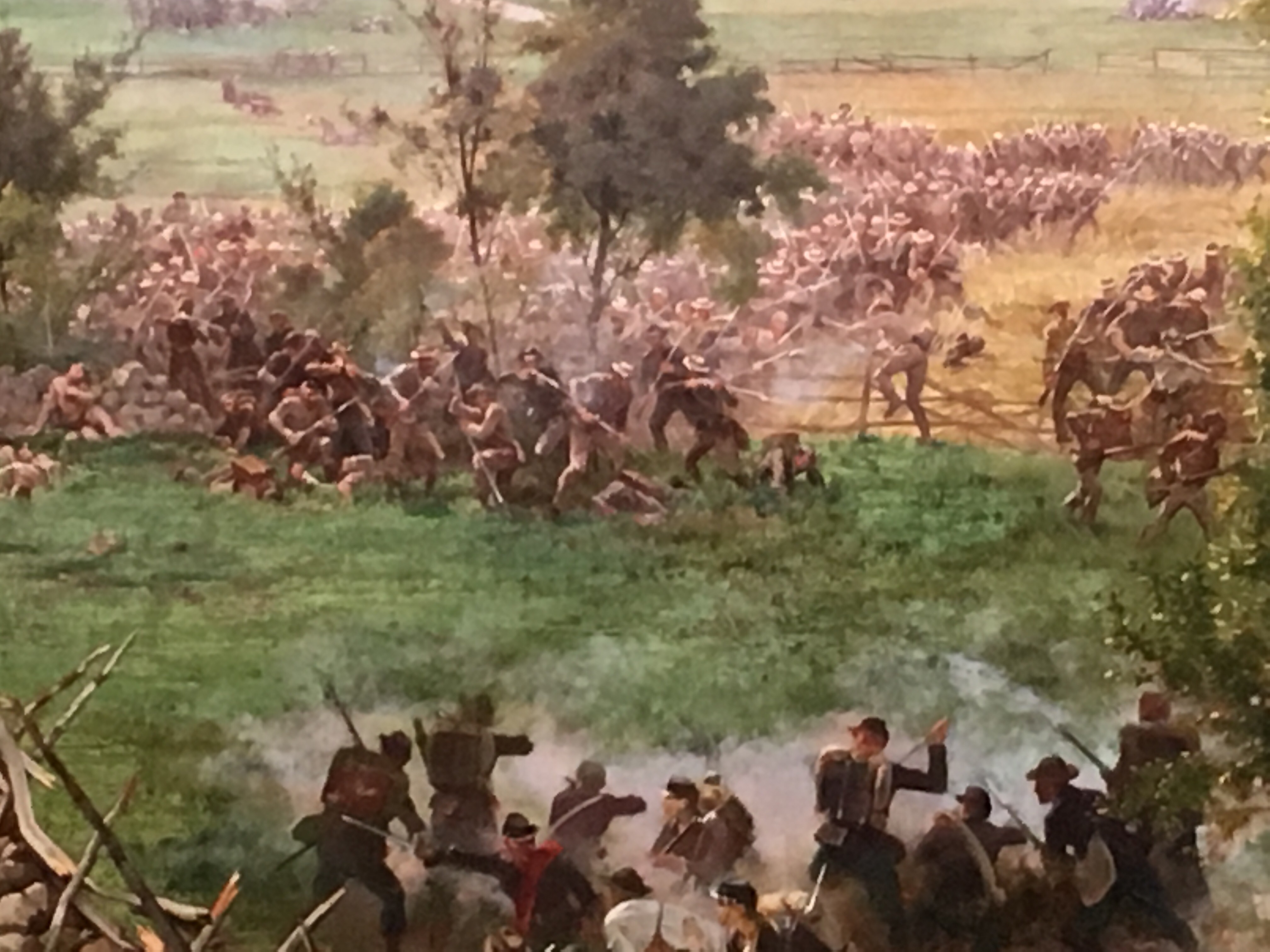
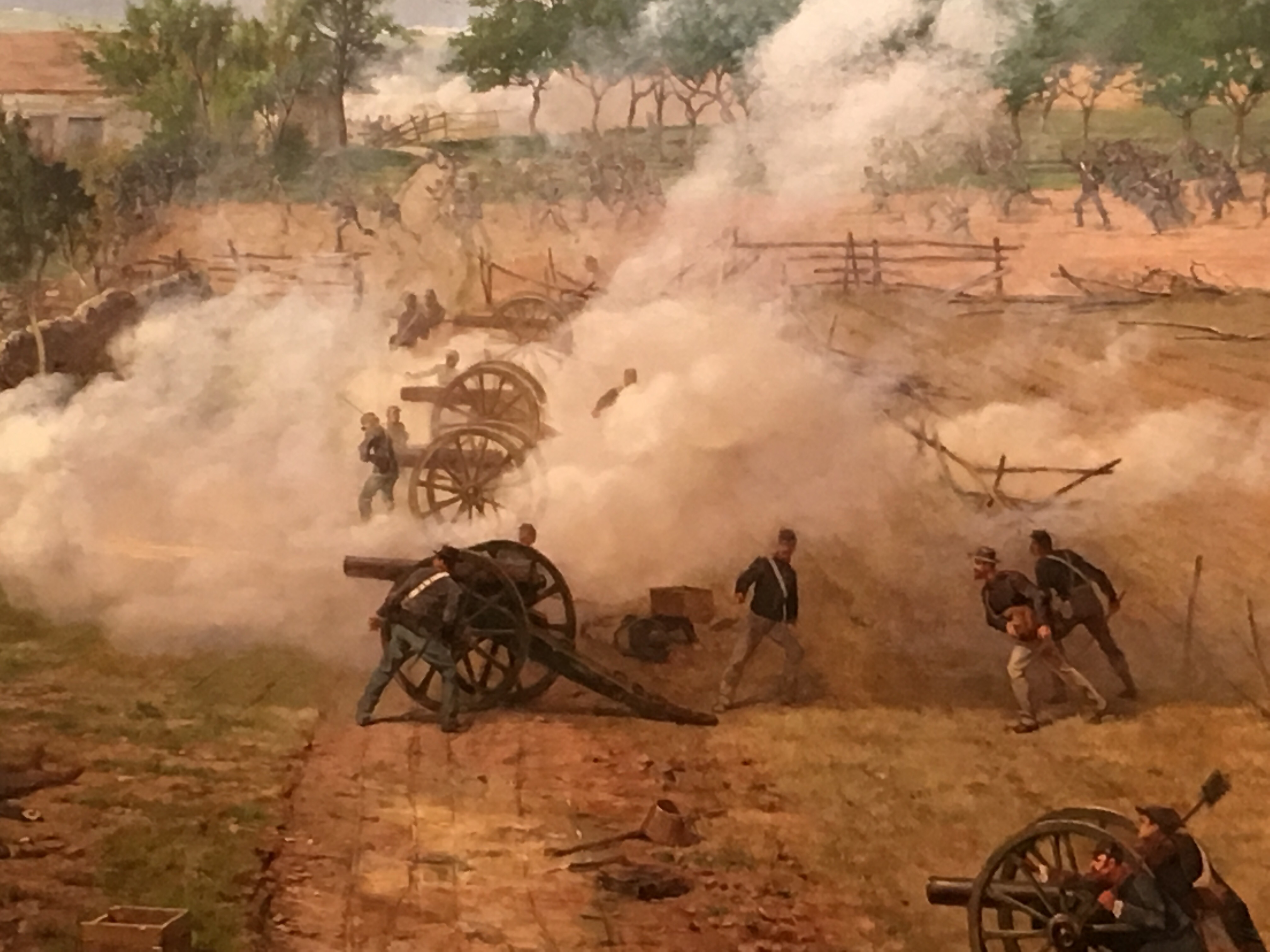
This was a good choice because it also got them more time there than if we had done it today. While there I went the the Cyclorama of Pickett’s Charge, which I had not visited since 1997. The cyclorama is the largest oil and canvas painting in the United States. It give a 360 degree view of the battle. Painted in 1883 by Paul Phillipotaux it is 42 feet high and 377 feet in circumference. It was restored between 2005 and 2008 when it was placed in the new Visitors Center. In all of my trips since then I had not re-visited it. Yesterday I did and it was spectacular, far better than it used to be. 

I also spent time in the museum. One of the displays was a video display of Northern and Southern leaders comments about slavery and abolition in the years leading up to the war and shortly after secession. I stopped and watched and listened, as the words of speeches that I had only read were spoken. One of the statements was that of Confederate Vice President Alexander Stephens in his “Cornerstone Speech” of March 1861. In it Stephens laid out the what he called the “cornerstone” of the Confederacy, that it was a nation conceived on the superiority of the white race, the subordination of the black race, and the error of the founders of the United States in the proposition that “all men are created equal.” 

This was an assertion that Stephens to believed was in error, and he noted that the new Confederacy was “founded on exactly the opposite idea; its foundations are laid, its cornerstone rests, upon the great truth that the negro is not equal to the white man; that slavery, subornation to the superior race, is his natural and normal condition…” 

Now I have read that speech many times and it always sends a tremor of revulsion through me. But yesterday was different. I heard an actor speaking those words, and not only did that tremor of revulsion go through me, but I had an emotional reaction, terms filled my eyes in sadness and anger such as I had not experienced when simply reading the words. To hear a voice utter them was to make them real, because I hear all too similar expressions of the racial superiority of the white race from many supporters of Donald Trump, to included prominent White Supremacists, like David Duke and Pat Buchanan as well as many others including the KKK and bro-Nazis. 

 Likewise, it struck me because many people I know who call themselves conservative Evangelical or Catholic Christians use similar terminology not just to describe their racial superiority, but their religious superiority over others. Hearing those words spoken, reminded me of the fact that those who proclaim them are in fact attacking the very foundation, the very e proposition that the founders stated, and which Abraham Lincoln reiterated and universalized, “the proposition that all men are created equal.” 

That proposition is at the heart of the Bill of Rights and if we say that this is wrong, and we attempt to marginalize, disenfranchise, and otherwise discriminate against people based on their race, nationality, skim color, religion, gender, or sexual orientation, then we have forgotten the most important part of who we are as Americans. Thankfully, a number of rooms later I entered a room which dealt with the Gettysburg Address. In it there was a display of that text, with the voice of an actor portraying Abraham Lincoln speaking it. I paused, listened and reflected on the difference of Lincoln’s words and those of Stephens. Truthfully, hearing the words of Stephens and Lincoln being spoke felt like how I reacted the differences between the Trump convention, and the Democratic National Convention. 

The fact is that the United States was founded on that simple proposition that all men are created equal. While we haven’t always practiced it, in this country or abroad, it does not take away the power that simple truth to set people free. In this country it has been an at times grueling task to bring freedom to slaves, to women, to other immigrants, and to the LGBTQ community. It has been 240 years and there are still people trying to roll back the rights of those they think are inferior, or who they believe that their religion condemns. That my friends is not an American concept, it a throwback to the old world, a world which only exists in the Cloud-Cukoo land of ideologues.


So today we finished up the Staff Ride going to Culp’s Hill and East Cemetery Hill prior to retracing the route take by Pickett’s troops as they made their ill-fated charge into the center of the Federal line. The last past is particularly powerful as I quote from the words of the soldiers who observed the attack and the human carnage inflicted by the Federal guns and infantry. As much as I despised the cause of those brave soldiers, I cannot help but to admire their courage in making that attack, call it the common humanity and compassion that I feel towards soldiers who are ordered to do the impossible. When we got to the Angle where Lieutenant William Cushing was killed firing his last rounds of canister at the advancing Confederates, and where the Irishmen of the 69th Pennsylvania joined with others to drive the Confedates back, I am equally amazed by the courage of those Union men.


As always we finished up at the Soldier’s Cemetery where we talked about the human cost of war, and the moves on to talk about the importance of the Gettysburg Address, in particular its relationship to the Declaration of Indpendence and that proposition that is the heart and soul of what makes America different than any other country. The proposition that all men are created equal, and that we are not a nation founded on race, ethnicity, or religion, but on a proposition that most of the world envies, and which we ourselves so often neglect out of fear, of others, much to our detriment. 

So I will write more later to post tomorrow. But for now I am yours.

Peace,

Padre Steve+ 

Leave a comment

Filed under civil rights, civil war, Gettysburg, History, News and current events, Political Commentary

Gettysburg and Ghosts


Friends of Padre Steve’s World,

I am back up at Gettysburg with another class. After a night of eating, teaching, and drinking some fine craft beer, I am back in my room at the 1863 Inn of Gettysburg. 

The hotel sits at the base of East Cemetery Hill where the right wing of Harry Hay’s brigade, the Louisiana Tigers, made their attack on the night of July 2nd 1863. The attack ended in failure and the Federal Troops held their ground and drove the Louisiana troops back. 

Since the hotel opened in the 1960s there have been many reports of paranormal activity. Usually the people are awakened by what appear to be Confederate soldiers near their beds.

So when I booked the rooms for the class I asked the manager to put me in one of the rooms where such activity has been reported. Now, after my night out with our students I am ensconced in my room and hoping that tonight or tomorrow that I might encounter one of these reported spirits. If I only had the gear of the various ghost hunters it would be really cool, but I don’t, so oh well. I guess if I do see one I will be okay, so long as I don’t go throwing myself out of bed and break another bone in my face.

Until tomorrow,

Peace

Padre Steve+

Leave a comment

Filed under Gettysburg, Loose thoughts and musings

“We Are All Americans”: Tim Kaine Embraces America’s Greatness

Clinton-locks-up-Democratic-ticket-by-picking-Virginia-senator-Kaine-for-VP

Time Kaine

Friends of Padre Steve’s World,

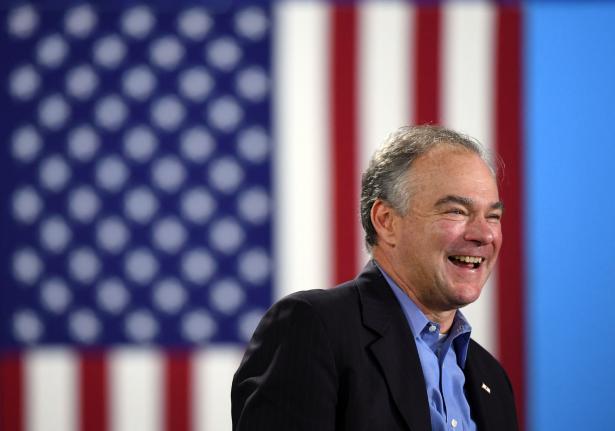
Yesterday was refreshing, after a week of the unrelenting apocalyptic fearmongering of the Donald Trump Party National Convention, Virginia Senator Time Kaine emphasized what is really true about our great country. Instead of the specter of fear presented by Trump, a humble yet comfortable Kaine made the point that this country was not built on fear, but on hope and opportunity. We do not deny problems or challenges, but by facing them with courage, imagination, and determination to succeed and prevail. In the darkest days of the Great Depression, President Franklin Roosevelt reminded a fearful nation that “we have nothing to fear but fear itself.” We do not solve problems by demonizing other citizens, wallowing in cynicism, or by building walls, but by standing together as Americans.

The message that we are all Americans is something that we have nearly all forgotten, but it is a message that and I am so happy that he set that tone, it was something that after a week of unrelenting fear-mongering, ethno-nationalism coming from Donald Trump and his minions at the Republican National Convention that we needed to hear, whether we are the descendants of the colonists who first came here, a citizen, or an immigrant who embraces the proposition of the Declaration of Independence and the Gettysburg Address, that “we hold these truths to be self evident, that all men are created equal…” 

In 1858 Lincoln spoke in Chicago, and in that speech he linked the common connection of all Americans share, even recent immigrants, through the Declaration. It was an era of intense anti-immigrant passions, the American Party, which sprang from the Know Nothing movement which founded upon extreme hatred of immigrants, and Roman Catholics, and violence against them, had run former President Millard Fillmore for election as at heir candidate in 1856 following the collapse of the Whig Party.

In opposition to this party and movement Lincoln proclaimed that immigrants, “cannot carry themselves back into that glorious epoch and make themselves feel a part of us, but when they look through that old Declaration of Independence, they find those old men say that “we hold these truths to be self evident, that all men are created equal,… That is the father of all moral principle to them, and they have a right to claim it as if they were blood of the blood, and flesh of the flesh of the men who wrote the Declaration, and so they are. That is the electric cord in the Declaration that links the hearts of patriotic and Liberty-loving men together, that will link those patriotic hearts as long as the love of freedom exists in the minds of men throughout the world.”

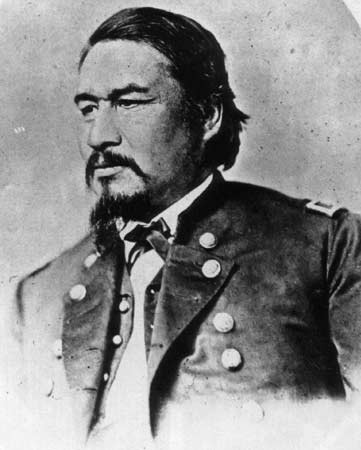
Interestingly enough another Virginian was reminded what it is to be an American on April 9th 1865. After Robert E. Lee surrendered the Confederate Army of Northern Virginia to Ulysses S. Grant at Appomattox, Lee learned that Grant’s Aide-de-Camp, Colonel Ely Parker, was a full-blooded Seneca Indian. Lee stared at Parker’s dark features and said: “It is good to have one real American here.” Parker, a man whose people had known the brutality of the white man, a man who was not considered a citizen, and who in his lifetime would never gain the right to vote, replied, “Sir, we are all Americans.” That afternoon Parker would receive a commission as a Brevet Brigadier General of Volunteers, making him the first Native American to hold that rank in the United States Army. He would later be made a Brigadier General in the Regular Army, without ever being granted the right to vote.

eparker05-966-g

Ely Parker

Today and everyday we need to remember what both Kaine and Ely Parker said, we are all Americans. We don’t need to “make America great again,” but it is our responsibility to embrace these words as Americans, and embrace the vision that made American great. As we do so we need to labor incessantly to achieve what Lincoln talked about at Gettysburg in November 1863, as he spoke of the men who fought and died at Gettysburg:

“It is rather for us to be here dedicated to the great task remaining before us–that from these honored dead we take increased devotion to that cause for which they gave the last full measure of devotion–that we here highly resolve that these dead shall not have died in vain, that this nation under God shall have a new birth of freedom, and that government of the people, by the people, for the people shall not perish from the earth.”


Until tomorrow,

Peace

Padre Steve+

2 Comments

Filed under civil war, Gettysburg, History, leadership, News and current events, Political Commentary

Becoming What We Should Be


Friends of Padre Steve’s World,
Having completed, with the exception of editing and circulating some hard copies of the first volume of my Civil War text A Great War in a Revolutionary Age of Change, I have gone back to work on the second volume of my Civil War text “Mine Eyes Have Seen the Glory” Religious Ideology, Race, and Politics in the Civil War Era. Beginning yesterday I began to go through the approximately 160 pages of text, which had been the second chapter of my Gettysburg Staff Ride text, but like A Great War really needed to be split off and turned into its own separate book. 

Yesterday I went back to figure the natural chapter breaks and to begin some minor editing and creating a bibliography and working table of contents as I prepare to really dig in on it. The good thing is that I have continued to research this section even as I concentrated on work on A Great War and major chapter revisions to the book dealing with the campaign of 1863 and the Battle of Gettysburg. 

As I have done this I become more and more convinced that what I am writing about needs to be told. As I look at responses to the Black Lives Matter movement I am appalled by the willing historical ignorance of much of the country, including white America, which has erased from its collective memory the terrible injustices of slavery, the black codes, Jim Crow, segregation, and violence directed at African Americans over nearly three hundred year period before the Supreme Court stuck down the Jim Crow era segregation laws, and the Congress passed the 1964 Civil Rights Act, and 1965 Voting Rights Act, and less than three years later Dr. Martin Luther King Jr., the champion of peace protest and civil rights was gunned down and assassinated. 

But it is easy for some people to condemn the Black Rights Movement, it is called racist by some, and it is blamed for a host of issues that it is simply exposing and demanding action to solve. Some people respond to criticism of police with the saying that Blue Lives Matter, and I agree that they do, police officers do dangerous work, and with the proliferation of high powered weaponry in the hands of irresponsible and angry people, their lives are always in danger. But that is no reason not to say that Black Lives Matter is wrong in its intent. Some say that All Lives Matter, and I agree with that in principle, but I would challenge the people that flippantly say that in order to dismiss the validity of Black Lives Matter, while doing nothing to work for the rights of people different than themselves, that they need to put their money where their mouth is. 

In the 1850s and 1860s Abraham Lincoln struggled with this in a country that was becoming increasingly diverse due to massive immigration from Ireland and Germany, and in which Congress and the Courts were making decisions which would allow for the expansion of slavery and the definition of African Americans as a subordinate race without any citizenship rights. Lincoln was worried that America was becoming like a plow horse with blinders fastened to the sides of its eyes, capable of seeing only in one direction: ahead of it. He saw Americans as people increasingly interested only with their present and their future, the things still before them, but disinterested with their own historical past, the things already behind them. A condition that is not much different that what we see today. Maybe because I am a historian I am more sensitive to this, but it is concerning. 

Lincoln realized that people had forgotten the heart and soul of America, the secular scripture found in the preamble of the Declaration of Independence. “We hold these truths to be self-evident, that all men are created equal, that they are endowed by their Creator with certain unalienable Rights, that among these are Life, Liberty and the pursuit of Happiness,—That to secure these rights, Governments are instituted among Men…” He realized that for most people of his era the proposition that all men are created equal was in the process of dying. He knew that freedom without equality was no freedom at all, and beginning with the Emancipation Proclamation he began the first step to universalize that proposition. Les than a year later he gave a short speech of under three hundred words at Gettysburg in which he went back to the Declaration noting “Four score and seven years ago our fathers brought forth on this continent, a new nation, conceived in Liberty, and dedicated to the proposition that all men are created equal,” and he called on Americans to renew themselves to that proposition: “It is for us the living, rather, to be dedicated here to the unfinished work which they who fought here have thus far so nobly advanced. It is rather for us to be here dedicated to the great task remaining before us—that from these honored dead we take increased devotion to that cause for which they gave the last full measure of devotion—that we here highly resolve that these dead shall not have died in vain—that this nation, under God, shall have a new birth of freedom—and that government of the people, by the people, for the people, shall not perish from the earth.”

In a book that I just finished on the Gettysburg Address the author noted something that I find quite true. He said: “We should read the Preamble to the Declaration of Independence, and then, the Gettysburg Address. They are, together, our American scriptures. And we should read them aloud, the way they were meant to be. They are words which are most powerful when they are spoken. Their words remain fresh and alive, no matter how many times they are read. All we need to know about what American democracy should be, is found there, among the words of these two ancient manuscripts.”

Now I do not arrogantly claim that we as Americans exemplify those words, or that we even live up to them, but they are something that we need to keep in the forefront of our minds, and strive to achieve if we are to become a better nation. 

I was talking with one of our international officers at the staff college today who has been studying at the Naval War College for the past year before he came to us, and as we talke we agreed that what makes America great is not our military might, nor our economic power, but that proposition of Liberty, the proposition that is so radical that few countries include it in any of their political documents, that proposition, that all men are created equal. It was something that a number of my Korean officers noted at Gettysburg back in May. They all understood something that so many Americans have forgotten. 

So I will continue to read, research, and write, and I am excited about it, especially during this critical time in our nation’s history. I’m sure that in the coming month or two that you will see some of that work appear on this site as I work on Mine Eyes Have Seen the Glory. 

Until tomorrow I wish you peace,

Padre Steve+

Leave a comment

Filed under civil rights, civil war, Gettysburg, History, News and current events, Political Commentary

The Tragedy of Friends fighting Friends: Winfield Hancock and Lewis Armistead atCemetery Ridge

armistead

Friends of Padre Steve’s World,

I have been rating but continuing to work on my Civil War and Gettysburg texts this weekend, and because of that I am retiring to an older post about the relationships of close friends in war. In this case, friends who had served together for many years who ended up fighting each other at Gettysburg. The story is tragic, because none of them hated each other, or held any animosity towards each other, but instead had followed what they believed to be their duty, some in the continued service of the Union, and others to that of their home states. Even so the bonds of friendship were never severed. Of course, unless you have served with people in war and in the military it it hard to comprehend such a fate. Even now, I know men that I consider friends, men who now hold very different political and social beliefs than me, and if God forbid there was ever another civil war, we would be on opposite sides, but they would still be friends, and I would grieve the fact that we would be fighting. 

I do plan on reworking this section of my Gettysburg text again, adding to it and further exploring the dynamics of the relationships at play in this story. But for now, since I have been working on other things, this will have to do.

Have a great day,

Peace

Padre Steve+

The bonds of friendship forged by soldiers are some of deepest and long lasting that are formed anywhere.  For American military professionals those bonds are formed in the small rather closed society that is the regular United States military. They are formed in war and peace, and are marked by years of deployments, isolated duty and combat. They are part of a culture that is often quite different than that of civilian society. That is the case now as it was in 1860.

When the Southern States seceded from the Union men who had spent much of their adult lives serving together discovered had to say goodbye and prepare to fight each other. Most did so with a heavy heart even though many had strong convictions about the rightness of their region’s cause. Those who left the army to serve the Confederate states were often torn by doubt and questions of where their loyalty lay. Robert E. Lee was a good example of the conflict that many Southern officers faced. “The Southern professional officer in 1861 was confronted with a cruel choice symbolized by Lee’s anguished pacing at Arlington. On one hand, the Southern officer’s political allegiances drew him to the Confederacy; on the other his professional responsibility drew him to the Union.” [1] They wrestled with their oath of office and the costs of perhaps having to face their dearest friends on future battlefields. Lee’s letter to his sister Ann Marshall, who remained a supporter of the Union, after he resigned from the army he had served for 32 years reflects that anguish, torn between his loyalties Lee wrote “With all my devotion to the Union, and the dear feeling of loyalty and duty of an American citizen, I have not been able to make up my mind to raise my hand against my relatives, my children, my home.” [2] He added: “I know you will blame me…but you must think as kindly of me as you can, and believe that I have endeavored to do what I think right.” [3]

They were different from the mass levies of civilian volunteers who rallied to the flags of the Union and Confederacy in 1861. The volunteers, most of whom did not have the deep and abiding friendships of the professionals were often motivated by ideological, sectional or religious hatred of the other and went to war with great aplomb. However, the professionals for the most part went to war against former comrades with heavy heart, “old army colleagues found themselves wrenched from the normal course of their lives when their states joined the Confederacy.” [4]

The American Civil War has many such tales. Porter Alexander wrote of his final words with his superior James B. McPherson, who later went on to be a highly successful corps commander under Grant and Sherman before being killed outside Atlanta in 1864. McPherson desired that Alexander remain in California as an Engineering officer and warned him about the nature of the coming war and gave him his counsel as a friend:

“Now this is not going to be any 90 day or six months affair as some of the politicians are predicting. Both sides are in deadly earnest & it is long & desperate & fought to the bitter end. ..God only knows what may happen to you individually, but for your cause there can be but one possible result. It must be lost….” [5]

Alexander wrote: “Nothing could exceed the kindness & real affection with which McPherson urged these views on me…. His earnest talk impressed me deeply & made me realize that a crisis in my life was at hand. But I felt helpless to avert it or even to debate the question what I should do. I could not controvert one of McPhersons’ statements or arguments; I could only answer this: “Mac, My people are going to war, & and for their liberty. If I don’t come & bear my part they will believe me a coward…” [6]

One of the most remembered is that of Union General Winfield Scott Hancock and Confederate General Lewis Armistead. It was key story line in Michael Shaara’s Pulitzer Prize winning novel The Killer Angels was immortalized in the movie Gettysburg which is based on Shaara’s novel.
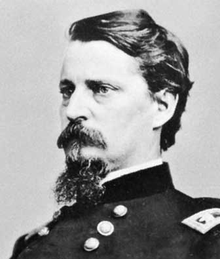
hancock

Major General Winfield Scott Hancock USA

Hancock was from Pennsylvania. He was a career soldier and Infantry officer, a graduate of West Point Class of 1844. He served in Mexico and held numerous positions. In 1861 he was stationed in California as a Quartermaster under the command of Colonel (Brevet Brigadier General) Albert Sidney Johnston with the Sixth Infantry Regiment. One of his fellow officers was Captain Lewis Armistead, a twice widowed Virginian who also served as a commander of the New San Diego Garrison under Johnston’s command, and Richard Garnett commanding a company at Fort Yuma. Hancock and his wife Almira became fast friends with the widowed Virginian.

Armistead was a nephew of the officer who defended Fort McHenry from the British in the War of 1812. Armistead had academic and personal difficulties at West Point and “was bounced out, not once but twice.” [7] His troubles included an altercation with Jubal Early in which he broke a plate over Early’s head.  Between his academic difficulties and the fight with Early he resigned from the Academy. However, his father helped him obtain a commission as an Infantry officer in 1839. Armistead’s career from that point on was similar to many other officers of his day. He served with distinction in Mexico, the Great Plains, Kansas, Utah and California.

As the war clouds built and various southern states seceded from the Union numerous officers from the South were torn between their oath, their friendships and their deep loyalty to their home states and families. In the end most Southern officers resigned their commissions, many with mixed feelings and quite often sadness. A large minority, some “40 to 50 per cent of Southern West Point graduates on active duty in 1860 held on to their posts and remained faithful to the Union.” [8] The most prominent of these men were General Winfield Scott and Major General George Thomas, the “Rock of Chickamauga.” Likewise Union Brigadier General John Buford’s family in Kentucky supported the Confederacy.

For those southern officers who remained loyal to the Union to was often at a great personal cost. Thomas’s action cost him his relationship with his immediate family who deemed him to be a traitor. He and others were pilloried and demonized in the basest ways by many in the South. Some Southerners who served the Union were executed when they were captured. George Pickett, who called for his fellow Virginian Thomas’ death ordered 22 North Carolinians who he captured fighting for the Union in Kinston North Carolina to be executed. Pickett was not alone in such sentiments.
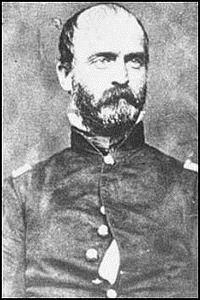
armistead2

Brigadier General Lewis Armistead CSA

However, for most it was different. As talk of secession and war heated up officers stationed on the frontier debated the issues and asked each other what they would do if war came. In California Armistead and other officers asked Hancock, who was a Democrat and not openly hostile to the South, advice on what he would do if war came. Hancock’s reply was simple. I shall not fight upon the principle of state-rights, but for the Union, whole and undivided” [9]

The parting came in 1861. When it was apparent that many officers would be resigning and heading home to join their state’s forces the Hancock’s hosted a going away party for their friends. Almira Hancock wrote of the party that “Hearts were filled with sadness over the surrendering of life-long ties.” [10]

Colonel Albert Sidney Johnston’s wife Eliza went to a piano and sang sentimental songs such as Mary of Argyle and the popular Irish song Kathleen Mavourneen. [11] Almira Hancock wrote “Those songs…will ever be remembered by survivors of that mournful gathering.” [12]

“Mavourneen, Mavourneen, my sad tears are falling, 

to think that from Erin and thee I must part!

It may be for years, and it may be forever, 

Then why art thou silent, thou voice of my heart?

The parting was especially emotional for Armistead who had been a friend of the Hancock’s for 17 years. They had helped in following the death of both of his wives and children. He was tearful. He put his arm on his friend’s shoulder as he said: “Hancock, good-by; you can never know what this has cost me, and I hope God will strike me dead if I am ever induced to leave my native soil, should worse come to worse.” [13] As he departed Armistead gave a wrapped Bible and Prayer book to Almira Hancock, in case of his death, inscribed were the words “Trust in God and fear nothing.” [14]

Armistead led his brigade during the Peninsula campaign and battles around Richmond and his brigade was decimated in Lee’s failed assault on prepared Federal positions at Malvern Hill. Armistead did not endear himself to many of the volunteer officers who served in the Confederate ranks. One of his Colonels resigned over Armistead’s supposedly harsh treatment to which Armistead replied: “I have felt obliged to speak to him as one military man would to another and as I have passed nearly all my life in camps my manner may not be understood or appreciated by one who has been all his life a civilian.” [15] Armistead’s words can easily be understood by military professionals whose lives have been shaped in a different manner than their civilian counterparts.

At Gettysburg Armistead spoke his fears about the charge to his comrades. One was Brigadier General Dick Garnett, another of Armistead and Hancock’s comrades from the California days on the night of July 2nd. Garnett’s career had paralleled that Armistead, the same age Garnett struggled at West Point in his third year “he failed and withdrew. Taking the same courses again during the next term, he finished fourteenth among his new classmates, then graduated in 1841 standing 29th of fifty-two graduates.” [16]

Armistead and Garnett served together in the Sixth Infantry for most of their careers. They were promoted at similar times, a pattern of promotion that continued into their Confederate service. The next afternoon, the two friends who had served together so long and whose careers were so similar led their brigades of Pickett’s Division across the valley between Seminary Ridge and Cemetery Ridge against their friend and comrade Winfield Scott Hancock’s II Corps which was defending Cemetery Ridge.

Garnett had to lead his brigade on foot, having been injured during the army’s march to Gettysburg. During the engagement Garnett was killed just before reaching the Union lines and Hancock gravely wounded. Armistead, lead the remnants of his decimated brigade to the Stone Wall, near the Copse of Trees. He rallied his troops fearing that some were faltering calling out: “Come on boys, give them the cold steel! Who will follow me?” [17]

His troops breached the Union line and his black hat atop his sword led his troops forward. He reached the now unmanned artillery of Cushing’s battery and called to his remaining men “The day is ours men, come and turn this artillery on them.” [18] It was then that he met more Federal troops who unleashed a volley of musket fire that cut down many of the survivors. Armistead was wounded in the right arm and shoulder and fell near one of the Union artillery pieces, a point now known as “The High Water Mark” of the Confederacy.
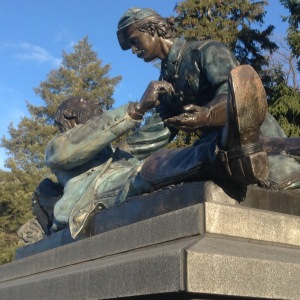
img_0602-1

As Armistead lay wounded he was approached by Major Bingham of Hancock’s staff. Bingham, a Mason noticed that Armistead was making a Masonic sign of distress. When Bingham told Armistead of Hancock’s injury Armistead was grieved and told Bingham to “Say to General Hancock for me that I have done him, and you all, an injury, which I shall always regret.” [19]

The meaning of those words is debated, especially by Southerners who cherish the myth of the Lost Cause. However, based on Armistead’s conduct and behavior in the time before he left California, it is not unreasonable to assume that as he lay dying he truly regretted what he had done. Armistead died from infections caused by his wounds which were initially not thought to be life threatening. A Union surgeon described him as: “seriously wounded, completely exhausted, and seemingly broken-spirited.” [20]

Garnett’s body was never found and was probably buried in a mass grave with other Confederate soldiers and was likely taken after the war to his native Virginia “together with thousands of unidentified bodies from Gettysburg, for burial in Richmond’s Hollywood Cemetery.[21] Armistead was buried by a member of the 107th Ohio near the XI Corps field hospital. About a month later a physician from Philadelphia tracked down the soldier and “dug up the “Rough box” containing the body and embalmed poor Armistead’s remains for sale to grieving family members.” [22] Armistead’s family buried the remains in Old Saint Paul’s Cemetery in Baltimore.

Robert Krick wrote: “Death on adjacent bits of blood soaked ground in Adams County, Pennsylvania, yielded a final common thread, that of indignity: Lewis Armistead’s corpse wound up a hostage to petty human greed, while Dick Garnett’s entirely disappeared.” [23]

Hancock’s injuries were severe, but he recovered. He would go on to continued fame and be one of the most admired and respected leaders of the Army during and after the war. He was gracious as a victor and spoke out against reprisals committed against Southerners after the war.

In 1880 Hancock was the Democratic nominee for President. He lost a close election to James Garfield, losing the popular vote by fewer than 40,000 votes. It was an era of great political corruption and Hancock was one of the few major public figures viewed favorably for his integrity. Even his political opponents respected him for his integrity and honesty. Former President Rutherford B Hayes said:

“if when we make up our estimate of a public man, conspicuous both as a soldier and in civil life, we are to think first and chiefly of his manhood, his integrity, his purity, his singleness of purpose, and his unselfish devotion to duty, we can truthfully say of Hancock that he was through and through pure gold.” [24]

A few years after his death Republican General Francis A Walker, lamenting the great corruption of the time said:

“Although I did not vote for General Hancock, I am strongly disposed to believe that one of the best things the nation has lost in recent years has been the example and the influence of that chivalric, stately, and splendid gentleman in the White House. Perhaps much which both parties now recognize as having been unfortunate and mischievous during the past thirteen years would have been avoided had General Hancock been elected.” [25]

The story of Hancock, Armistead and Garnett is one that reminds us of the depth of friendships that many military professionals develop and cherish. It is also a story that reminds us of how hardened ideologues can divide a nation to the point of civil war. It is a story that should give pause to any political or spiritual leader that incites people to war against their neighbor and uses their ideology to slander, demean or even enslave and brutalize their political opponents.

The blood of the approximately 50,000 soldiers that were killed or wounded during the three days of the Battle of Gettysburg is ample reminder of the tragedy of war, especially war that forces the dearest of friends to fight and even kill one another.

Notes 

[1] Huntington, Samuel P. The Soldier and the State: The Theory and Politics of Civil-Military Relations, The Belknap Press of Harvard University Press, Cambridge MA and London 1957 p.212

[2] Thomas, Emory Robert E. Lee W.W. Norton and Company, New York and London 1995 p.188

[3] Korda, Michael. Clouds of Glory: The Life and Legend of Robert E. Lee Harper Collins Publishers, New York 2014 pp.230-231

[4] Jordan, David M. Winfield Scott Hancock: A Soldier’s Life Indiana University Press, Bloomington and Indianapolis 1988 p.33

[5] Alexander, Edward Porter. Fighting for the Confederacy: The Personal Recollections of General Edward Porter Alexander edited by Gary Gallagher University of North Carolina Press, Chapel Hill 1989 p.24

[6] Ibid. Alexander. Fighting for the Confederacy p.25

[7] Guelzo, Allen C. Gettysburg: The Last Invasion Vintage Books a Division of Random House, New York 2013 p.379

[8] Ibid. Huntington The Soldier and the State p.213

[9] Ibid. Jordan Winfield Scott Hancock p.33

[10] Ibid. Jordan Winfield Scott Hancock p.34

[11] Ibid. Jordan Winfield Scott Hancock p.34

[12] Ibid. Jordan Winfield Scott Hancock p.34

[13] Ibid. Jordan Winfield Scott Hancock p.34

[14] Krick, Robert K. The Parallel Lives of Two Virginia Soldiers Armistead and Garnett in The Third Day at Gettysburg and Beyond edited by Gary Gallagher, University of North Carolina Press, Chapel Hill and London 1994 p.112

[15] Tagg, Larry The Generals of Gettysburg: The Leaders of America’s Greatest Battle Da Capo Press Cambridge MA 1998 Amazon Kindle Edition p.244


[16] Ibid. Krick Armistead and Garnett p.101

[17] Stewart, George R. Pickett’s Charge: A Micro-History of the Final Attack at Gettysburg, July 3rd 1863 Houghton Mifflin Company Boston 1959 pp.216-217

[18] Hess, Earl J. Pickett’s Charge: The Last Attack at Gettysburg University of North Carolina Press, Chapel Hill and London 2001 p.262

[19] Ibid. Stewart Pickett’s Charge pp.254-255

[20] Ibid. Stewart Pickett’s Charge pp.254

[21] Ibid. Krick Armistead and Garnett p.123

[22] Ibid. Krick Armistead and Garnett p.123

[23] Ibid. Krick Armistead and Garnett p.123

[24] Ibid. Jordan Winfield Scott Hancock p.319

[25] Stone, Irving They Also Ran Doubleday, New York 1943 and 1981 pg. 188

2 Comments

Filed under civil war, Gettysburg, History, Military