Category Archives: History

Resisting Authortarianism: Part One


Friends of Padre Steve’s World,

Tonight, like last night I am posting another thought from B.H. Liddell-Hart’s book Why don’t We Learn from History? 

The book is worth the read for anyone, even though it is written by a military historian and theorist. Liddell-Hart had a keen understanding of the limitations of Democracy, but recognized the inherent evil of the totalitarian or authoritarian state, and such leaders. Thus, when we see a democratically elected leader rapidly move toward authoritarianism, attempting to silence political and press critics, accused the acting head of the Department of Justice of “betrayal,” and attacking the institutions of justice that oppose him, while praising foreign despots, we should be concerned for our liberty. 

Liddell-Hart wrote something very profound that we should all think about: 

What is of value in “England” and “America” and worth defending is its tradition of freedom, the guarantee of its vitality. Our civilization, like the Greek, has, for all its blundering way, taught the value of freedom, of criticism of authority, and of harmonising this with order. Anyone who urges a different system, for efficiency’s sake, is betraying the vital tradition.

He noted:

It is man’s power of thought which has generated the current of human progress through the ages. Thus the thinking man must be against authoritarianism in any form, because it shows its fear of thoughts which do not suit momentary authority.

The power of thought, the unending quest for truth, the questioning of authorities who claim absolute power, are all essential to maintaining human freedom. However, freedom cannot be defended if its defenders have either forgotten how to think critically, or never learned to at all. The latter should be concerning as for years the emphasis of education has been to train people for a job with specific but narrow skills, while critical thinking, based in reason, science, history, philosophy, literature, and the arts has taken a back seat. Giles Lauren who wrote the preface to the latest edition of Why don’t We Learn from History? wrote:

Education, no longer liberal, has largely become a question of training in a skill for gain rather than teaching us how to think so as to find our own way. ‘It is strange how people assume that no training is needed in the pursuit of truth.’ We must learn to test and judge the information that comes before us. After all: ‘Whoever habitually suppresses the truth … will produce a deformity from the womb of his thought.’

This my friends is not comfortable, and neither should it be. But the truth is that most people actually fear truth because it is uncomfortable. Liddell-Hart wrote:

We learn from history that in every age and every clime the majority of people have resented what seems in retrospect to have been purely matter-of-fact comment on their institutions. We learn too that nothing has aided the persistence of falsehood, and the evils resulting from it, more than the unwillingness of good people to admit the truth when it was disturbing to their comfortable assurance. Always the tendency continues to be shocked by natural comment and to hold certain things too “sacred” to think about.

I am watching people, many of them good people, decent people, even brilliant people either openly support the move toward authoritarianism, or remain silent, even when they recognize the truth. In such times it is important to seek the truth, and proclaim the truth, even if it unpopular, and unpleasant. This means that we also have to look inside ourselves, and be honest because we all have the capacity to believe the lie and not to recognize the distinction between fact and fiction. Hannah Arendt wrote in her book The Origins of Totalitarianism:

The ideal subject of totalitarian rule is not the convinced Nazi or the convinced Communist, but people for whom the distinction between fact and fiction ( i.e., the reality of experience) and the distinction between true and false ( i.e ., the standards of thought) no longer exist.

I will continue this tomorrow. Have a great night and sleep well.

Peace

Padre Steve+ 

Leave a comment

Filed under History, News and current events, Political Commentary

Groundhog Day and Nazi Comparisons

groundhog-day-driving

Friends of Padre Steve’s World,

Today was Groundhog day and Punxsutawney Phil has promised us another six weeks of winter. Since is was sixty degrees today with partly cloudy skies and light winds, I say let it continue. But that’s not really really what I’m writing about today, though historically it seems that we are in an era that seems like the movie Groundhog Day, except we aren’t repeating yesterday every day, but we are seeing history unfold in a similar way to an era that we would rather consign to to musty history books about the Third Reich.

Today, two friends shared an article of a blogger condemning those who are comparing the actions of President Trump to Adolf Hitler and the Nazis. He started his article “I’m no expert but…” and then went on to minimize what people are saying about Trump, comparing them to others on the right and left who have made comparisons of their political opponents with Hitler. I agree that there are people, plenty of them on the right and left who have compared their political opponents to Hitler, and if Donald Trump was a normal president I would say that such comparisons would be unfounded, but in my humble opinion, they are not.

I am a historian, as one of my colleagues told me yesterday, a “historian masquerading as a chaplain, and that’s not a bad thing.” My chief area of study in my undergraduate days was in German history, particularly the period of the end of Imperial Germany, the German civil war, the Weimar Republic, and the Nazi era. The same was true with my second master’s degree in Military History, and much of my church history studies in seminary. I have written on a number of aspects of the subject, it is included in the Military Ethics class that I teach, and I would dare say that I am an expert in the subject and that I do not make comparisons to the Nazi era, or its leaders, to American political leaders lightly.

In fact, until the rise of Donald Trump, I have never had cause to compare the words, methods, or actions of any American President or serious presidential candidate to the Nazis. Any such comparisons, even to Richard Nixon, would be to unfounded hyperbole and ludicrous. I do know that there are people on the political left and right who have compared their political opponents to the Nazis or even Adolf Hitler himself, and as a serious historian I find their accusations to demean the historical importance of the period, especially in view of the great evil of the Nazis, especially in regard to the Holocaust.

Likewise when I see someone write a lengthy blog about these comparisons and begin it with “I’m not an expert but…” I am offended because it demeans the work of serious people, real experts, and equates them with ignorance. The man cited many of the differences between Germany of 1933 and the United States of 2016. There are differences, significant differences, but they do not disqualify comparisons between the periods, or between Herr Hitler and Mr. Trump. Those comparisons are in matters of substance, psychology, language, sociological, and political trends.

In 2001 the United States, which had just gone a divisive election which was decided in the Supreme Court was attacked. The shock to the country was immense, the attack was followed by prolonged wars and a massive economic crisis followed by the election of a President who was African American, an event which brought out some of the worst and most open racism I have ever seen in my life. In 1918, Germany lost a war, had its system of government fall, and was enveloped in a civil war punctuated with being saddled with the full blame for the war that they lost, and were ruled not by the Kaiser, not by conservatives, or nationalists, but by Socialists, something that many could not abide. As such, the Socialists were saddled with the blame for a war started by nationalists, and the myth of the Stab in the Back was used to explain the defeat of the German armies.

stab in the back

The Stab in the Back

In both situations, the politics of the countries became exceptionally divisive, and over time the political center began to dissolve. In both instances, populist movements of the right and left stamped out the center, compromise was off the table. In both 1933 and 2016, the politician who took power represented a minority of the electorate, and neither had ever held any elected office. They were both demagogues who found convenient internal racial and religious scapegoats, and foreign powers to blame for the woes of the country. Neither Trump, nor Hitler was ever given a chance of gaining power, until they achieved it.

Both took advantage of the struggles of people who had not done well during the economic downturns, played on longstanding prejudices, exploited the weakness of the major political parties, coopted the fears of religious people who felt that they were not being considered. They were also supported by people of means, who were quite well off and willing to take their chances with a leader who could deliver people who would otherwise reject them. The similarities, while not exact go on and on.

But even more, when it comes down to the person of President Trump, honestly he cannot be compared to Adolf Hitler himself. Hitler was much more subtle and much more clever, although both were narcissists, both had no real friends and treated people as commodities, both demonstrated a need to be loved, and fear of rejection, as well as a compulsive need to demean, degrade, and bully any opponents, but Trump is but a cheap copy of Hitler.

It is interesting that the President’s first wife, who by the way supported his run for president, said that Trump kept copies of Mein Kampf and Hitler’s speeches by his bedside. During his campaign he frequently praised dictators and even quoted Mussolini in a tweet. His repeated use of the term “America First” is a throwback to an American movement that supported Hitler and his aggression in Europe up until Pearl Harbor and Hitler’s declaration of war on the United States a few days later. If you look at the structure of his speeches during the campaign, they are laden with phrases used by the German dictator, and their structure is similar, albeit without Hitler’s mesmerizing prose. I have seen him speak in person, and watched the anger that he incites in his followers. I watched his inauguration speech several times, and read it again and again and I was struck by the similarity in tenor to many of Hitler’s speeches. If I was not so well acquainted with Hitler’s speeches, and his books, I would never dare to make the comparisons, it would not only be unwise, but also terribly wrong to make such a comparison based on a personal or ideological dislike, based on raw emotion and ignorance of the subject.

women-cheering-hitler

1-rtx211ir

He has surrounded himself with advisors who openly support fascist methods, and use propaganda techniques which mimic Hitler and his propaganda chief, Joseph Goebbels. Like Hitler, once in power President Trump has used his office to demonize his opponents and rule by executive decree, effectively marginalizing the legislature and to defy and eviscerate the courts. In one important difference since Trump took power of a superpower, he did not have to wait years like Hitler in order to build up a military to threaten his neighbors and defy international institutions.

I could go on and on, but if there was any other historical comparison that I could use instead of the Nazi comparison, I would. But let me qualify that statement. Trump is not Hitler and he has not at least yet, acted on his most radical statements concerning deportations of millions of people, discrimination based on race or religion, banning all opposition, and curtailing freedom of speech, although he and his advisors constantly threaten the press and anyone who voices the slightest opposition to them, including simply pointing out their repeated lies. Nor has he embarked on any new wars, though his words and the words of Steve Bannon, his closest advisor, threaten war with China, Iran, Mexico, and are destroying the bonds that we have with our longest and closest allies.  On the National Security Council the President has sidelined his military chiefs and replaced them with the ideologue Bannon. The sad thing about the last part was this was exactly how Hitler treated his military chiefs. They were called in to carry out orders, not to give sane advice, and he undercut them whenever he needed. In both cases many of their followers tolerated no criticism of their leader, often resorting to threats of violence or actual physical violence to suppress their opponents. In both cases their leaders not only tolerated such behavior, but encouraged it.

Hitler is dead, his Reich defeated, but his ideas are still around and can be seen in the current right-wing nationalist movements masquerading as populists in Europe and the United States. What happened in Germany in the 1930s  can happen again. Thus it is better to sound an early warning using facts and reason to hopefully ensure that it doesn’t happen. Such warnings should not be taken for granted, too many people and political leaders, not only in Germany, but around the world, took Hitler for granted believing that he could be controlled and that his radical ideas were hyperbole and would never be acted on. They were wrong. As a result the world, and Germany itself paid a massive price in human life for ignoring the danger until it was too late.

Again I don’t make such comparisons lightly, and in a relatively short article like this I cannot go into the detail with all the citations, though I have the material at hand to do so, I haven’t the time to write a book about it, though I’m sure that I could. I have three books that I am currently working on, all dealing with the American Civil War, one of which is getting to the point that I am trying hard to complete it and get it to a publisher in the next month or two, so I really don’t want to start another book. But I think that this weekend I will provide my readers a list of references on the Third Reich as well as totalitarianism, that if read critically, and thoughtfully, would be of great help to understanding our own time.

If you want you can look at some of my articles on this site dealing with mass movements, and totalitarianism, especially those that are based on the writings of Eric Hoffer or Hannah Arendt. They are helpful to understanding the political, ideological, and emotional aspects of how people like Hitler and Trump gain power, and why people are willing to through out reason, logic, ethics, and even faith, to support them.

So anyway, until the weekend, have a great day.

Peace

Padre Steve+

P.S. I did watch the movie Groundhog Day last night. It is one of my traditions.


2 Comments

Filed under ethics, History, leadership, News and current events, Political Commentary

The Psychology of Dictatorship: A Historical Retrospective

by Howard Coster, half-plate film negative, 1939

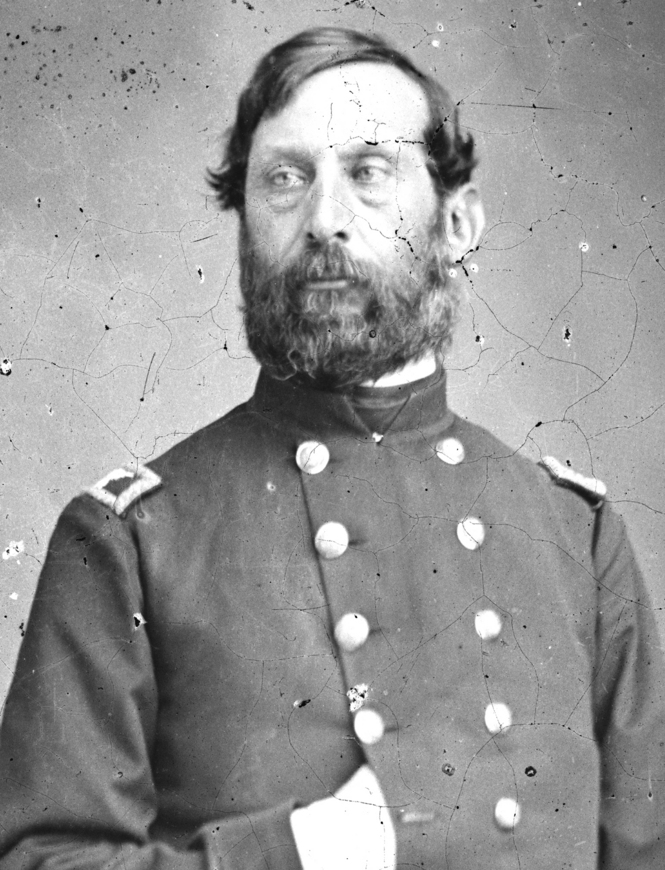
                  Sir B.H. Liddell-Hart

Friends of Padre Steve’s World,

Last year I read the short but poignant little but by the British military historian B.H. Liddell-Hart entitled Why Don’t We Learn from History. The book was written in not long before his death in 1970 and it is good quite good. It deals with a number of issues, including the conflict between history and propaganda, or when faith, especially religious faith as treated as historic or scientific fact; especially when propaganda or faith is preached as if it were history, if it were truth. But he also contrasted democracy and totalitarianism.

Liddell-Hart was a realist, especially about democracy and totalitarianism. While he admitted the inefficiencies of democracy, he realized that it was far less dangerous than the “stupidity” of totalitarianism. In fact it was important for him to note just how this inefficient system was for freedom. He wrote:

“What is of value in “England” and “America” and worth defending is its tradition of freedom, the guarantee of its vitality. Our civilization, like the Greek, has, for all its blundering way, taught the value of freedom, of criticism of authority, and of harmonising this with order. Anyone who urges a different system, for efficiency’s sake, is betraying the vital tradition.”

There is much to ponder in his book and I will probably write some more of my thoughts on it, but when I read it I was struck by just how much Liddell-Hart in his description of a despot described President Donald Trump through the his campaign and after his election and inauguration.

“We learn from history that self-made despotic rulers follow a standard pattern. In gaining power: They exploit, consciously or unconsciously, a state of popular dissatisfaction with the existing regime or of hostility between different sections of the people. They attack the existing regime violently and combine their appeal to discontent with unlimited promises (which, if successful, they fulfil only to a limited extent). They claim that they want absolute power for only a short time (but “find” subsequently that the time to relinquish it never comes). They excite popular sympathy by presenting the picture of a conspiracy against them and use this as a lever to gain a firmer hold at some crucial stage.” 

Once authoritarian, despotic, or dictatorial leaders gain power through the democratic process they seldom deviate from how they behave when seeking power. Liddell-Hart wrote:

“We learn from history that time does little to alter the psychology of dictatorship. The effect of power on the mind of the man who possesses it, especially when he has gained it by successful aggression, tends to be remarkably similar in every age and in every country.”

So please, take a breathe for a second and think about this in terms of President Trump and his actions during his first two weeks in office. Liddell-Hart noted that once a despot achieves power that their reign is marked by the following types of events:

“On gaining power:  They soon begin to rid themselves of their chief helpers, “discovering” that those who brought about the new order have suddenly become traitors to it. 

They suppress criticism on one pretext or another and punish anyone who mentions facts which, however true, are unfavourable to their policy. They enlist religion on their side, if possible, or, if its leaders are not compliant, foster a new kind of religion subservient to their ends. 

They spend public money lavishly on material works of a striking kind, in compensation for the freedom of spirit and thought of which they have robbed the public. 

They manipulate the currency to make the economic position of the state appear better than it is in reality. 

They ultimately make war on some other state as a means of diverting attention from internal conditions and allowing discontent to explode outward. 

They use the rallying cry of patriotism as a means of riveting the chains of their personal authority more firmly on the people. 

They expand the superstructure of the state while undermining its foundations by breeding sycophants at the expense of self-respecting collaborators, by appealing to the popular taste for the grandiose and sensational instead of true values, and by fostering a romantic instead of a realistic view, thus ensuring the ultimate collapse, under their successors if not themselves, of what they have created. 

This political confidence trick, itself a familiar string of tricks, has been repeated all down the ages. Yet it rarely fails to take in a fresh generation.”

Now pause for a moment. Donald Trump has been in office barely two weeks. Look at how he is behaving. Read his words, examine his actions, and not just during the past two weeks but throughout his business career and his campaign for the presidency. Then, take the time to let Liddell-Hart’s words sink in, hours, days, weeks, or even months. Contemplation and reflection are far better than visceral and emotional reactions.

This is something to think about.

Peace

Padre Steve+

Leave a comment

Filed under History, News and current events, philosophy, Political Commentary

Confederate Artillery Organization 1861-1865

confederate-artillery

Friends of Padre Steve’s World,

Yes, indeed, another of my articles dealing with Civil War artillery. Geeks, wonks, and buffs rejoice.

Until tomorrow,

Peace

Padre Steve+

At the beginning of the war the Confederacy hastily formed an artillery service. As in the Union army the basic unit was the battery, and these batteries were initially assigned to infantry brigades. As such, the Confederate organization had the same problems as their Union counterparts. Infantry commanders with little or no understanding in the use and deployment of their artillery frequently interfered with their artillerymen. Since the Confederates had very little field artillery to begin the war and most was concentrated in the east, Confederate tactical and organizational developments began with the Army of Northern Virginia and were later introduced to other commands.

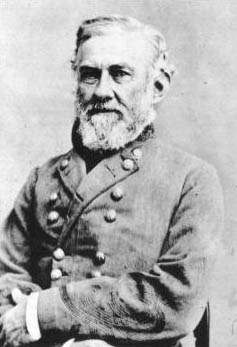
The artillery was assigned to brigades, but Confederate divisions did have an artillery chief, however, these officers had “difficulty supervising the batteries. The brigade commanders resented the artillery chief’s intervention, and the entire system created divided authority and responsibility.” [1] Like the Army of the Potomac, the Confederates formed an artillery reserve under Brigadier General William Pendleton a graduate of West Point where he graduated a year behind Robert E. Lee and classmate of Joseph Johnston. Pendleton organized and commanded a battery at First Manassas. Joseph Johnston recognized his administrative ability, thus a personal relationship as well as “circumstance and a certain aptitude for organization give him an advancement to the post chief of artillery.” [2] When Lee took command of the army outside of Richmond Pendleton found himself busy. “With Lee’s encouragement…Pendleton, culled the unattached artillery around Richmond, with a view of transferring guns to field batteries.” [3] Lee retained Pendleton as artillery chief after the Seven Days even though his “performance in the campaign had revealed his serious shortcoming as an artillery commander,” [4] as well as in the organization of the Army’s artillery.

In June 1862 Lee had Pendleton revise the regulations governing the artillery. These regulations “centralized all batteries under a chief of artillery for each division.” [5] This was a step forward but effectiveness was undercut by the brigade commanders who had operational control once they were attached. Likewise, while the organization gave great flexibility to the artillery, the “parochialism of the division itself now became the problem. There was no mechanism to mass guns from more than one division except by drawing on the reserve.” [6]

Pendleton’s lack of ability was demonstrated at both Antietam and Chancellorsville and as artillery chief he was slow to introduce organizational changes to improve the effectiveness of the artillery. Lee treated Pendleton with deference and although he recognized Pendleton “could not compare with Alexander or a handful of other officers in the artillery in ability and execution. Lee understood that and slowly pushed Pendleton into roles of decreasing importance and responsibility.” [7] After the Seven Days, Porter Alexander wrote: “Our artillery, too, was even in worse need of reorganization. A battery was attached, or supposed to be, to every brigade of infantry. Besides these, a few batteries were held in reserve under old General Pendleton. Naturally our guns & ammunition were far inferior to the enemy’s, & this scattering of the commands made it impossible ever to mass our guns in effective numbers. For artillery fire loses effect if scattered.” [8]

WNPendelton

Brigadier General William Pendleton, CSA

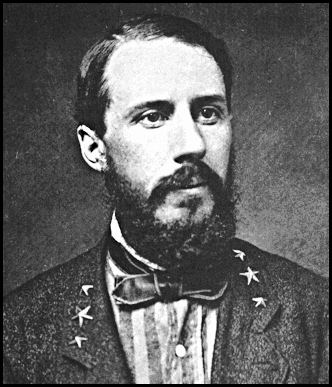
One are that the Confederates advanced more rapidly than the Union was in the appointment of field grade officers in the artillery. The first Confederate Secretary of War Judah P. Benjamin, successfully urged the Confederate Provisional Congress to authorize the appointment of “officers of artillery above the rank of captain, without reference to the number of batteries under the actual command of the officers so appointed, not to exceed in number, however, one brigadier general for every eighty guns, and one major for every sixteen guns.” Additional officers of the rank of captain and first lieutenant (not to exceed eighty) were authorized in April 1862.” [9] This gave the Confederates a good sized corps of field grade artillery officers from which they would need to eventually staff artillery battalions in 1863. Among these officers were Porter Alexander, Thomas Rosser, Stapleton Crutchfield, and John Pelham.

alexander

Brigadier General Edward Porter Alexander 

During the winter of 1862-1863 Pendleton belatedly complained to Lee about the organizational weaknesses and limitations of the artillery arm of the Confederate Army of Northern Virginia. That process had begun during the summer of 1862 and Pendleton “delegated reorganization to Alexander and Col. Stapleton Crutchfield, Jackson’s chief.” [10] Alexander and Crutchfield developed “the first modern battalion system in artillery organization.” [11] Pendleton, Crutchfield, and Alexander “recommended consolidating every four batteries into a battalion, with one battery assigned to each division.” [12] The commander of the artillery battalion supporting each division became the chief of the divisional artillery. Each corps had its own senior artillery staff officer, usually a Colonel or Lieutenant Colonel, however as Alexander noted, at first the chief “was little more than the title given to the ranking battalion commander. But in battle he occupied himself principally with his own battalion.” [13] In addition to the battalions attached to each division, “each corps had two battalions, which it could employ in conjunctions with divisions for heavy, concentrated fire.” [14]

Lee approved the changes on February 16th 1863, in time for the coming spring and summer campaigns, and “completed the reorganization during the winter when he assigned a field grade officer to each battalion and reduced the artillery reserve to six batteries.” [15]

After Chancellorsville all of the batteries that had been Lee’s artillery reserve were reassigned to the various corps. Pendleton’s duties were now restricted to advising Lee on artillery matters while remaining Lee’s spiritual adviser, and unofficial enforcer of morality in the Army of Northern Virginia. While this was a great step forward to give Lee’s Corps commanders control of their artillery gave took, the reorganization took away any flexibility that Lee might need to send artillery where it was needed in the Gettysburg campaign of 1863, and Pendleton, although having no command authority interfered with the Confederate artillery preparations for Pickett’s Charge by redeploying artillery batteries that Alexander had designated for the mission and removing the artillery train to the rear without Alexander’s knowledge, thus ensuring that Alexander could not resupply his caissons or guns during that fateful attack.

The Confederate artillery organization remained the same throughout the remainder of the war, its battalion structure was very similar to the later Union organization of the artillery brigades which were assigned to divisions, despite the difference in nomenclature. The pioneering work in organizing artillery battalions and brigades that were for practical purposes assigned to the same division would be the basis of modern artillery organization and would be adopted by the European armies of Britain, France, Austria, and Prussia in the years following the war.

Notes

[1] Ibid. McKenny The Organizational History of Field Artillery 1775-2003 p.59

[2] Freeman, Douglas Southall, Lee’s Lieutenant’s a Study in Command, One volume abridgement by Stephen W Sears, Scribner, New York 1998 p.35

[3] Glatthaar, Joseph T. General Lee’s Army from Victory to Collapse The Free Press, Simon and Schuster, New York and London 2008 p.131

[4] Wert, Jeffry D. A Glorious Army: Robert E. Lee’s Triumph 1862-1863 Simon and Schuster, New York and London 2011 p.64

[5] Ibid. Hagerman The American Civil War and the Origins of Modern Warfare p.131

[6] Ibid. Hagerman The American Civil War and the Origins of Modern Warfare p.132

[7] Ibid. Glatthaar General Lee’s Army from Victory to Collapse 2008 p.340

[8] Ibid. Alexander Fighting for the Confederacy: The Personal Recollections of General Edward Porter Alexander p.104

[9] Ibid. McKenny The Organizational History of Field Artillery 1775-2003 p.61

[10] Golay, Michael. To Gettysburg and Beyond: The Parallel Lives of Joshua Lawrence Chamberlain and Edward Porter Alexander, Crown Publishers, New York 1994 p.135

[11] Ibid. Hagerman The American Civil War and the Origins of Modern Warfare p.132

[12] Ibid. Glatthaar General Lee’s Army from Victory to Collapse 2008 p.249

[13] Ibid. Alexander Fighting for the Confederacy: The Personal Recollections of General Edward Porter Alexander p.168

[14] Ibid. Golay To Gettysburg and Beyond: The Parallel Lives of Joshua Lawrence Chamberlain and Edward Porter Alexander p.249

[15] Ibid. Hagerman The American Civil War and the Origins of Modern Warfare p.132


1 Comment

Filed under civil war, History, Military

American Artillery in the Civil War: The Wilderness Campaign and Reorganization

wilderness

Friends of Padre Steve’s World,

Another in my series of rather geek-like articles on Civil War artillery.

Have a great day.

Peace

Padre Steve+

The American Civil War was a transitional time for artillery technology, organization and tactics. The organization of the artillery service of the Army of the Potomac remained as it was up until the Overland or Wilderness Campaign, although “Corps brigades were increased to eight or nine batteries.” However, “having created a sound artillery organization and proven it at Gettysburg, the Union would have little immediate use for it” [1] as the changing conditions of war in the Wilderness changed how Grant and Meade organized the artillery.

The Artillery Reserve, a throwback to Napoleonic times, which had along with the rest of the Union artillery at Gettysburg performed so brilliantly in a defensive stand with wide open fields of interlocking fire would never again have such an opportunity to wreak destruction on advancing Confederate infantry in the open. Instead it was forced into the offensive in terrain that was seldom conducive to employing massed numbers of guns. During the campaign the Artillery Reserve consisted of “two field artillery brigades of twelve batteries each, one heavy brigade, which was largely employed as a guard and construction unit, and two brigades of horse artillery, which were on duty with Major Phil Sheridan’s cavalry corps.” [2] By the time of the Wilderness Campaign the size of the Army of the Potomac’s artillery numbered 274 cannon. [3] In terms of artillery types Hunt had 154 rifled guns and 120 Napoleons in the organic components of his army, of the rifled guns the majority were the 3” Ordnance rifles as Hunt had sent most of his Parrot batteries away due to their tendency to burst and their unpopularity with their gun crews. [4] The artillery was bolster with a battery of eight 24 pound brass Coehorn mortars. These were light weapons which weighed only 164 pounds and could be carried by two men. They “were fired at an angle of 45 degrees which permitted them to hurl a shell in a very high arch to a distance of 1,200 yards at full charge.” [5]

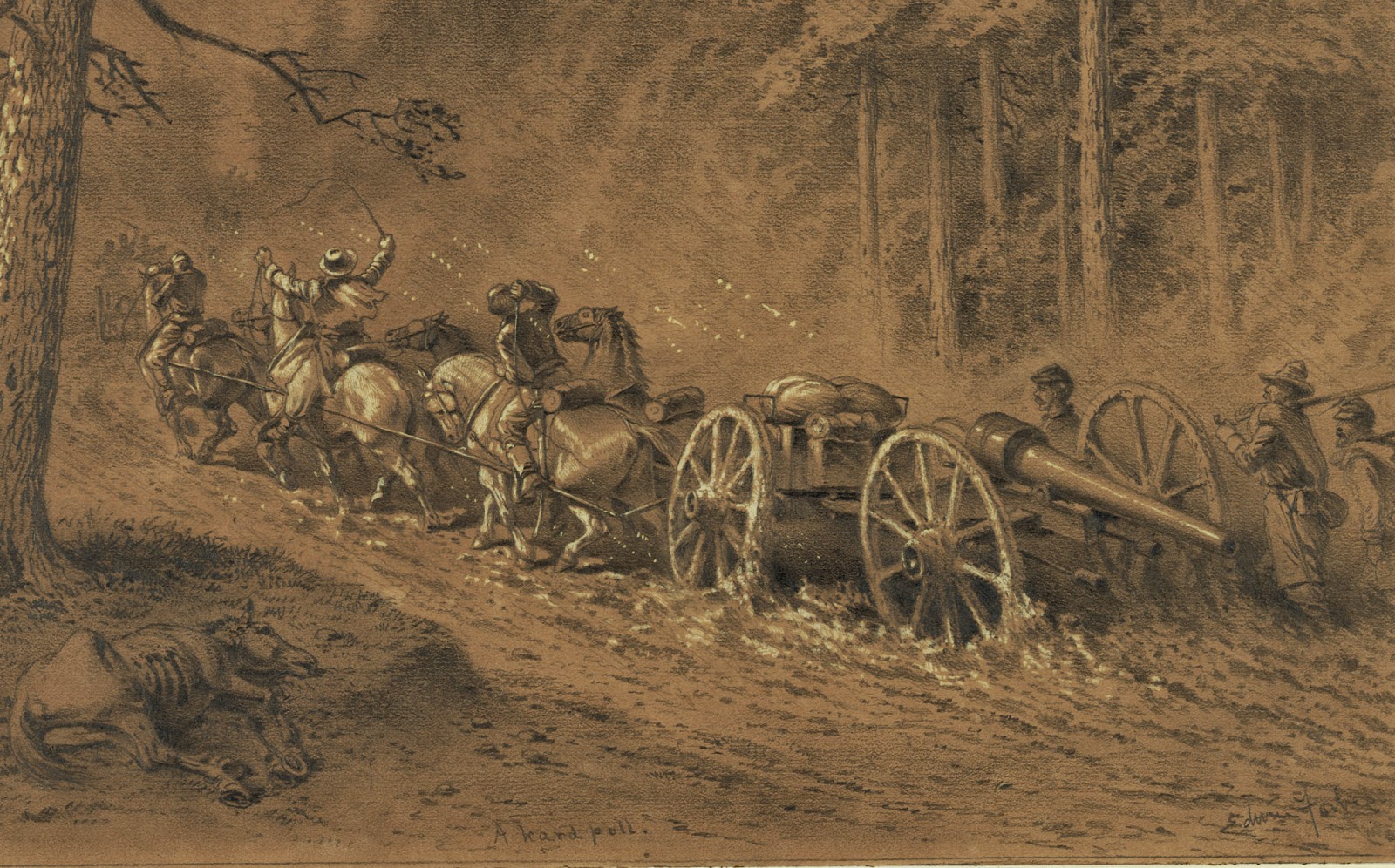
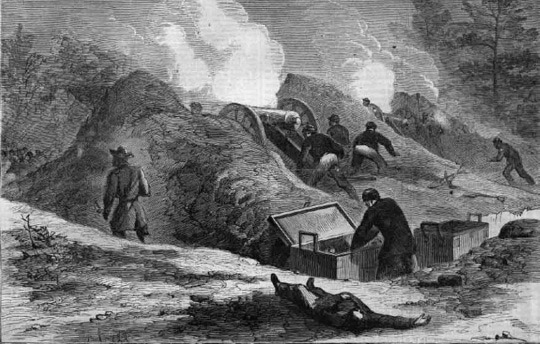
The campaigns of 1864 forced Union army commanders to change how they employed their artillery. This came first during the Wilderness campaign where the heavily wooded terrain, poor visibility, and an enemy dug in behind earthen walls and abattis limited the artillery’s effectiveness. The fighting between enemies that could barely see what they were shooting at resulted in close range firefights between infantry with few artillery pieces in direct support. When engaged, the artillery of both sides dealt death at close range in support of infantry, on the defensive the guns were dug in to protect them and their crews from the close range fire of enemy artillery and infantry. The heavy brush limited the ability of the artillery to move off the main roads as one artilleryman noted that they could do nothing “because no horses could have pulled a gun through the brush in which the infantry were fighting.” [6] One officer described the conditions of the Wilderness as “a wrestle as blind as midnight, a gloom that made manoeuvers impractical, a jungle where regiments stumbled on each other and the enemy by turns, firing sometimes into their own ranks, and guided only by the crackling of bushes or the cheers and cries that rose from the depths around.” [7]

With his guns finding little employment “Grant order that the Artillery Reserve be returned to Washington.” [8] To achieve the reduction in the number of guns without undoing his organization, Hunt recommended that the batteries be reduced from six guns to four. This was done but Hunt lost his Artillery Reserve as Meade had those reduced batteries reassigned to each of the infantry corps and the Reserve’s commander, Colonel Henry Burton, “appointed Inspector of Artillery.” [9] However, “most of the pieces ordered away were returned for the siege of Petersburg.” [10] Grant wrote:

“The Wilderness and Spotsylvania battles convinced me that we had more artillery than could ever be brought to action at any one time. It occupied much of the road marching, and taxed the trains in bringing up forage. Artillery is very useful when it can be brought into action, but it is a burdensome where it cannot be used. Before leaving Spotsylvania, therefore, I sent back to the defenses of Washington over one hundred pieces of artillery, with horses and caissons… and still left us with more artillery than could be advantageously used.” [11]

wilderness10

During the Wilderness Campaign the Confederate artillery suffered under similar conditions to Grant’s armies. Porter Alexander noted that when his artillery arrived that Lee, “directed me to send back all the artillery with our column to Parker’s Store, as there was no possibility of using it in the woods where we would be fighting, & it would be in the way.” [12] Where they were employed on the defensive the Confederate guns gave good account of themselves. Where they were not deployed attacking Union forces found their task easier, as when Winfield Scott Hancock’s massed attack at Spotsylvania succeeded, However, when the Confederates were able to deploy their artillery Union losses could be dreadful. This was the case at Cold Harbor where Grant ordered a frontal assault on well prepared Confederate defenders who had their artillery in positions where it had advancing Union forces in a crossfire.

The siege of Petersburg changed the way artillery was employed in the east yet again. “After Petersburg, field tactics were scarcely relevant, although concentrations of fire remained essential.” [13]

Many commentators after the war decried the effectiveness of the artillery by claiming that less than ten percent of casualties were caused by it. As J.B.A. Bailey notes, “This figure seems highly improbable, since the wound inflicted by a canister ball, which was the artillery’s most lethal projectile, would have been impossible to distinguish from that inflicted by a musket ball.” [14] However, even more important than the number of casualties inflicted on the enemy, but it was the shock power and deterrent effect that artillery had on the enemy, especially on the defensive. Colonel Jennings Wise, who chronicled the history of Lee’s artillery wrote:

“We often hear the sneering criticism that at such and such a battle but 1 or 2 per cent of the enemy’s loss was due to fire of the artillery. Any such test entirely erroneous. Not only do the guns exert a tremendous moral effect in support of their infantry, and adverse to the enemy, but they do far more. They often preclude heavy damage from the enemy by preventing him from essaying an assault against the positions the guns occupy. Then, again, by forcing them to seek cover, they eliminate their antagonisms to that extent… Let us hear no more of artillery efficiency as measured by the number of its victims.” [15]

Descriptions of the effect of the Union artillery on Pickett’s charge at Gettysburg bear this out. “The Confederate losses mounted at an alarming rate. The psychological impact of artillery casualties was great, for the big guns not only killed but mangled bodies, tore them apart, or disintegrated them.” [16] A survivor wrote his wife days later: “If the crash of worlds and all things combustible had been coming in collision with each other, it could not have surpassed it seemingly. To me it was like the “Magazine of Vengeance” blown up.” [17] A soldier of Kemper’s brigade recalled that “The atmosphere was rent and broken by the rust and crash of projectiles…The sun, but a few minutes before so brilliant, was now darkened. Through this smoky darkness came the missiles of death…the scene beggars description…Many a fellow thought his time had come…Great big, stout hearted men prayed, loudly too….” [18] Colonel Joseph Mayo of the 3rd Virginia regiment was heavily hit. One of its survivors wrote: “when the line rose up to charge…it appeared that as many were left dead and wounded as got up.” [19]

Notes 

[1] Ibid, Bailey Field Artillery and Firepower p.203

[2] Ibid. Nesmith Stagnation and Change in Military Thought: The Evolution of American Field Artillery Doctrine, 1861-1905 – An Example p.35

[3] Ibid. McKenny The Organizational History of Field Artillery 1775-2003 p.68

[4] Ibid. Longacre The Man Behind the Guns: A Military Biography of General Henry J. Hunt, Chief of Artillery, Army of the Potomac pp.190-191

[5] Ibid. Nesmith Stagnation and Change in Military Thought: The Evolution of American Field Artillery Doctrine, 1861-1905 – An Example p.36

[6] Ibid. Longacre The Man Behind the Guns: A Military Biography of General Henry J. Hunt, Chief of Artillery, Army of the Potomac p.194

[7] Ibid. Fuller Grant and Lee: A Study in Personality and Generalship  p.214

[8] Ibid. Nesmith Stagnation and Change in Military Thought: The Evolution of American Field Artillery Doctrine, 1861-1905 – An Example p.36

[9] Lyman, Theodore, Meade’s Army: The Private Notebooks of Lt. Col. Theodore Lyman, edited by David W. Lowe, The Kent State University Press, Kent, Oho 2007 p.162

[10] Ibid. McKenny The Organizational History of Field Artillery 1775-2003 p.67

[11] Grant, Ulysses S. Personal Memoirs of U.S. Grant Volume 2 Charles L. Webster and Company, New York 1886 p.241

[12] Ibid. Alexander Fighting for the Confederacy: The Personal Recollections of General Edward Porter Alexander p.359

[13] Ibid, Bailey Field Artillery and Firepower p.204

[14] Ibid, Bailey Field Artillery and Firepower pp.196-197

[15] Ibid. Griffith, Battle Tactics of the Civil War p.167

[16]Hess, Earl J. Picketts Charge: The Last Attack at Gettysburg University of North Carolina Press, Chapel Hill and London 2001 p.153

[17] Wert, Jeffery D. Gettysburg Day Three A Touchstone Book, New York 2001 p.181

[18] Dowdy, Clifford. Lee and His Men at Gettysburg: The Death of a Nation Skyhorse Publishing, New York 1986, originally published as Death of a Nation Knopf, New York 1958 p.294

[19] Ibid. Wert Gettysburg Day Three p.179

Leave a comment

Filed under civil war, History, Military

American Artillery, Doctrine, and Tactics from the Mexican War to the Wilderness

Friends of Padre Steve’s World,

I continue to work on my Civil War books. Today an excerpt dealing with American artillery during the Civil War. This is the follow-on article to the one that I posted last week,

Have a great day,

Peace

Padre Steve+
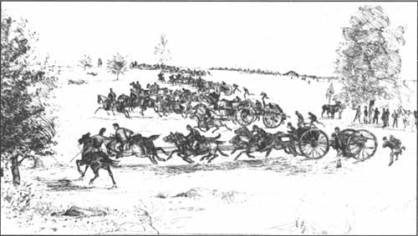
fig20

American artillery doctrine subordinated the artillery to the infantry. Doctrine dictated that on the offensive “was for about one-third of the guns to occupy the enemy’s artillery and two-thirds to fire on the infantry and cavalry. Jomini liked the concentrated offensive cannonade where a breach of the line was to be attempted.” [1] But being such a small service, it was difficult for Americans to actually implement Napoleonic practices, or organization as the organization itself “was rooted in pre-Napoleonic practice, operating as uncoordinated batteries.” [2]

American artillerymen of the Mexican War could not match the massive firepower and concentration of Napoleon’s army. Instead it utilized mobile tactics, which gave it “the opportunity to maneuver in open country to support the infantry.” [3] During the war the actions of the highly mobile light batteries proved decisive, as did the spirit of their officers and soldiers. The Americans may not have had the organization of Napoleon, but “the audacious spirit was there.[4] In a number of engagements American batteries employed the artillery rush, even gaining the admiration of Mahan, a noted exponent of the defensive. Among the leaders of the artillery at the Battle of Buena Vista were Captain Braxton Bragg, and Lieutenants John Reynolds and George Thomas, all of who would go on to fame in the Civil War. During a moment when Mexican forces threatened to overwhelm the American line, Bragg’s battery arrived:

“Without support, Bragg whirled his guns into battery only a few rods from the enemy…. The Mississippi Rifles and Lane’s Hoosiers also double-quicked from the rear of the plateau. From then on it was a storybook finish for the Americans, and artillery made the difference. Seventeen guns swept the Mexicans with grape and canister…. Reynolds, Thomas, and the others stood to the work with their captains until 5 o’clock. Santa Ana was through…” [5]

At Casa Mata outside of Mexico City, Americans found their flank threatened by Mexican cavalry. Captain James Hunter and Lieutenant Henry Hunt observed the situation and “Without awaiting orders they rushed their guns to the threatened sector…  With Duncan directing them, all stood their posts long enough to spray the front ranks of mounted Mexicans with canister, the shotgun effect of which shredded the half-formed attack columns, dissolving all alignment and sending the lancers scrambling rearward in chaos…” [6] As a result these and other similar instances the artillery came out of the war with a sterling reputation and recognition of their gallant spirit. John Gibbon reflected such a spirit when he wrote: “Batteries derive all their value from the courage and skill of the gunners; from their constancy and devotion on difficult marches; from the quickness and capacity of the officers; and especially from the good condition and vigor of the teams, without which nothing can be undertaken.” [7]

At the beginning of the war U.S. Army doctrine recommended placing batteries equally across the line and concentrating them as needed. The last manual on artillery tactics Instruction for Field Artillery, published in 1859 retained much of its pre-Mexican War content and the doctrine in it provided that artillery was to “be organized at the regiment and brigade level with no reserve.” [8] Nonetheless some artillery officers discussed the possibilities of concentration, Grand Batteries, and the artillery reserve, no changes in organization occurred before the war. However, these discussions were all theoretical, as practical experience of these officers was limited to the small number of weapons employed in the Mexican War, and the “immediate problem was the organization of an unaccustomed mass of artillery.” [9] The Artillerist’s Manual, a highly technical treatise on gunnery was written by Captain John Gibbon in 1859 while he was serving at West Point and used by artillerymen of both sides during the war.  In  Gibbon described the principle object of the artillery was to, “sustain the troops in the attack and defense, to facilitate their movements and to oppose the enemy’s; to destroy his forces as well as the obstacles that protect them; and to keep up the combat until the opportunity for a decisive blow.”  [10]

Since the United States Army traditionally drawn their doctrine from the French this meant going back to the Napoleonic model the foundational unit of which was the battery. The field artillery batteries were classed as either foot artillery or horse artillery. The horse artillery accompanied the cavalry and all gun crews went into battle mounted as cavalrymen. The soldiers of the foot artillery either rode with the guns or walked. The battery was the basic unit for American artillery and at the “start of the war the artillery of both sides was split into self-contained batteries, and each battery allocated to a particular brigade, regiment or even battalion of infantry.” [11]

At the battery level Union artillery was organized by type into six-gun batteries. Confederate artillery units were organized into four or six-gun batteries in which the guns were often of mixed type. This often led to supply problems for Confederate gunners and inconsistent rates of fire and or range. Confederate gunners also had to deal with poor quality power and explosive shells, a condition that only worsened as the war continued. The well-trained Union gunners had better quality ammunition and gunpowder as well as what seemed to the Confederates to have limitless ammunition.

Each gun was manned by a seven-man crew and transported by a team of horses that towed a limber, which transported the cannon and a caisson, which transported the ammunition. The caissons would normally be stocked with four chests of ammunition. For a Napoleon “a standard chest consisted of twelve shot, twelve spherical case, four shells, and four canister rounds for a total of 112 rounds of long range ammunition.” [12] In addition to the ammunition carried in the caissons of each gun, more ammunition was carried in the corps and division supply trains.

As the war progressed the both the Union and Confederate armies reorganized their field artillery. In the North this was a particular problem due to the lack of flexibility and politics in the Army which were prejudiced against large artillery formations, despite the great numbers of batteries and artillerymen now in the army. However the Federal army had good artillerymen. The Regular Army batteries were the foundation of the artillery service. Unlike the infantry units which were overwhelmingly composed of volunteer soldiers, the artillerymen were regulars, many who had served for years in the ante-bellum army.

Since there were few billets for senior artillerymen many artillery officers volunteered or were selected to serve in the infantry to get promoted or to take advantage of their experience and seniority. One of those chose was John Reynolds who promote to Lieutenant Colonel and given orders to form an infantry regiment. Before he could get started in that work he was made a Brigadier General of Volunteers. He wrote: “I would, of course, have preferred the Artillery arm of service, but could not refuse the promotion offered me under any circumstance, much less at this time, when the Government has a right to my services in any capacity.” [13] Other artillerymen who rose to prominence outside of the branch during the war included William Tecumseh Sherman, George Meade, John Gibbon, George Thomas, Ambrose Burnside, and Abner Doubleday, and Confederates Stonewall Jackson, Braxton Bragg, Jubal Early, and A.P. Hill.

However, General Winfield Scott took action to keep a core of experienced artillery officers with the artillery. At Scott’s behest, “the War Department limited the resignations of artillerymen to accept higher rank in infantry regiments, resulting in a core of capable and experienced officers.” [14]  This allowed George McClellan to select two exceptional artillery veterans, William Barry and Harry Hunt to “organize the branch and to oversee training.” [15] McClellan appointed Barry, who had been commissioned in 1836 as the head of his artillery. After the defeat at Bull Run, Barry “prepared as set of guidelines or principles for the artillery service. He prescribed a uniform caliber of guns in each battery, four to six cannon in each battery, and that four batteries – one Regular Army and three volunteer – be attached to each division.” [16]  In this organization, McClellan and Barry “called for the Regular Army battery commander to take charge of those batteries assigned to the division. This was in addition to his responsibilities to his own battery.” The practical effect of this was that “with the exception of the Artillery Reserve, the highest artillery command remained that of a Captain.” [17]

Hunt was responsible for the organization of the Artillery Reserve and the siege train. The Artillery Reserve was given eighteen batteries, about 100 guns or about one-third of the army’s artillery. It would be a source from which to replace and reinforce batteries on the line, but Hunt also understood its tactical employment. He explained:

‘In marches near the enemy it is often desirable to occupy positions with guns for special purposes: the command fords, to cover the throwing and taking up bridges, and for other purposes for which it would be inconvenient and unadvisable to withdraw their batteries from the troops. Hence the necessary reserve of artillery.” [18]

Hunt’s Artillery Reserve would be of great value in the early battles of maneuver. “The primary advantage of the army artillery reserve was the flexibility it gave the commander, making it unnecessary to go through the division or corps commanders. The reserve batteries could be used whenever or wherever needed.” [19] But this would not be in the offense role that Napoleon used his artillery to smash his opponents, for technology and terrain would seldom allow it; but rather in the defense; especially at the battles of Malvern Hill and Gettysburg. However, “Gettysburg was the last battle of the Civil War in which field artillery fire was paramount…” but “By the end of 1863, the tide of war had changed in the eastern theater, with both sides making more use of field fortifications to cover themselves from the murderous fire of the infantry rifle.” [20]

Even so, lack of promotion opportunity for artillerymen was a problem for both sides during the war, and artillerymen who showed great promise were sometimes promoted and sent to other branches of service. A prime example of such a policy was Captain Stephen Weed “who fought his guns brilliantly in the first two years of the war, and a Chancellorsville even commanded the artillery of a whole army corps.” Henry Hunt “singled him out as having a particular flair for handling large masses of cannon, and wanted to see him promoted.” [21] He was promoted to Brigadier General but in the infantry where he would lead a brigade and die helping to defend Little Round Top. In all “twenty-one field-grade artillery officers in the Regular Army became generals in the Volunteers, but only two remained with the artillery branch.” [22]

Both Barry and Hunt sought to rectify this issue. Barry insisted that a “battery of artillery was the equivalent of a battalion of infantry” [23] and pressed for a higher grade structure for the artillery. Colonel Charles Wainwright wrote of their efforts: “Many officers of the regular artillery have long been trying to get a recognition of their arm of the service, doing away with the regiments and making a corps of it, the same as the engineers and ordnance. McClellan and Hunt drew up a plan soon after Antietam, which by Stanton and Halleck, but nothing more has been hear of it.” [24]

However, Barry and Hunt were opposed by War Department insiders. General Lorenzo Thomas, the Adjutant General used law and regulation to prevent promotions in the artillery beyond Captain and as to General Officers as well. Thomas insisted that the battery was equivalent of an infantry company or cavalry troop. He noted “that laws long in force stipulated that only one general officer could be appointed per each for each forty infantry companies or cavalry troops.” [25] He applied this logic to the artillery as well, which meant in the case of the Army of the Potomac which had over sixty batteries that only one general could be appointed. The result could be seen in the organization of the Army of the Potomac at Gettysburg, the artillery component, “which included approximately 8,000 men with 372 pieces – almost the manpower (and certainly the firepower) of a complete army corps. It included only two general officers… then there were three colonels and no other high ranks at all. One army corps had its guns commanded by a lieutenant.” [26] Over time the situation would improve and the artillery given some autonomy within the Army, at Gettysburg Meade gave Hunt command authority to employ the artillery as he deemed necessary, even over the objections of the corps commanders.

General Henry Hunt was probably the most instrumental officer when it came to reorganizing Union artillery organizations in the Army of the Potomac. Following the Battle of Chancellorsville, Hunt prevailed upon the army commander, Joseph Hooker to create “artillery brigades assigned to each corps. This overcame a problem at Chancellorsville, where the batteries of uncommitted divisions had gone unused. The reorganization also made a practical adjustment to the situation where the attrition of divisions was making the corps the basic tactical unit.” [27] In the reorganization the infantry brigades retained their assigned batteries for direct support, but the guns of the divisions were organized into brigades at the corps level. The artillery brigades of the infantry corps had “from four to eight batteries, depending on the size of the corps.” [28] Despite being reflagged as brigades the command structure was not increased. This was often due to the fact “that for much of the war commanding officers persisted in regarding artillery as merely a subsidiary technical branch, an auxiliary which might add a little extra vitality to a firing line if conditions were favourable – but more typically would not.” [29] Dr. Vardell Nesmith noted:

“Resistance within the Army to formalizing tactical organizations for field artillery above the level of the battery was a complex phenomenon. Certainly there was some hesitance on the part of the Army establishment to create new organizations that would come between infantry and cavalry commanders and their fire support assets. Also one cannot discount the institutionalized tendency to keep everyone in their proper place – in other words, to keep a new power group from organizing.” [30]

Organized into brigades the Artillery Reserve became the instrument of the Army commander and served as what we would now call “general support” artillery where they were invaluable to Union army commanders to be available to augment other batteries and to replace batteries which had suffered casualties while on line. The organization of the artillery into brigades, even if they were field expedient organizations did much to increase the effectiveness of the arm. They supplanted “the battery in tactics and to considerable degree in administration. Supply and maintenance were improved, and more efficient employment and promptness and facility of movement resulted. In addition, the concentration of batteries was favorable for instruction, discipline, and firepower. Fewer guns were needed, and in 1864, the number of recommended field pieces per 1,000 men was reduced from 3 to 2.5.” [31]
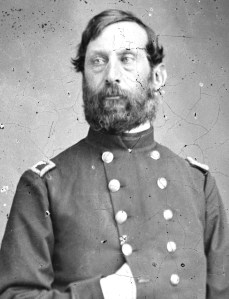
henryhunt

General Henry Hunt

Hunt lobbied the War Department to provide a staff for each brigade, but since the new units were improvised formations no staffs were created and no promotions authorized for their commanders. Colonel Wainwright proposed a congressional bill to organizer volunteer artillery units into a corps of artillery, but lamented:

“Both Barry and General Hunt while commanding the artillery of this army have frequently complained in their reports of the great want of field officers. Were the light batteries of each state organized as a corps, and provided with field officers in the proportion proposed in the bill referred to above, this want would be provided for. The officers of light batteries also have a claim demanding some such change. No class of officers in our volunteer service stand as high as high as those of our light batteries. I say without hesitation that they are very far superior as a class in all respects to the officers of the infantry or cavalry. Yet for them there is not a chance at this time any chance of promotion above a simple captaincy, except in the few light regiments spoken of. I can point to several cases of captains of light batteries who, from this want of field officers, have for the past year exercised all the authority and borne all the responsibility of a brigadier-general.” [32]

But change did come, however slowly and with great resistance from the War Department bureaucracy, and the artillery service “did succeed in winning some measure of recognition for its independent status and tactics. After Gettysburg the army’s artillery commander was accept as having overriding authority in gunnery matters, with the infantry relegated to a merely consulting role, although in practice the change brought little improvement.” [33] The beginning of this came in August 1863 when George Meade promulgated an order that “defined Hunt’s authority in matters of control of the artillery in the Army of the Potomac. The order “definitely stated that Hunt was empowered to supervise and inspect every battery in the army, and in battle to employ them “under the supervision of the major-general commanding.” [34] The order was important but still did not go far enough to remedy the problem of a lack of field officers in the artillery, a problem that was not completely remedied during the war although Ulysses Grant did allow a limited number of promotions to provide more field grade officers in the artillery service of the Army of the Potomac and other armies under his command in the Eastern Theater. Likewise some additional billets were created in the brigades as brigade commanders “were authorized a staff consisting of an adjutant, quartermaster, commissary officer, ordnance officer (an artillery officer on ordnance duty), medical officer, and artillery inspector, with each staff officer having one or more assistants…” However the staff officers had to be detailed from the batteries, thereby reducing the number of officers present with those units” [35] However, in most cases the brigade commanders remained Captains or First Lieutenants.

In the Western theater there was a trend toward the centralization of the artillery in the various armies depending on the commander and the terrain and the size of the operation. As the war progressed in the west commanders began to group their artillery under brigades, divisions, and finally under the various army corps. At Shiloh Grant concentrated about 50 guns “in the notorious “Hornet’s Nest,” perhaps saving him from defeat.” [36] Artillery tactics shifted away from the offense to the defense and even during offensive operations western commanders were quick to entrench both their infantry and artillery. During the Atlanta campaign and march to the sea William Tecumseh Sherman successfully reduced his artillery complement first to 2 guns per 1,000 men then to 1 per 1,000. [37] This was in large part because he was conducting a campaign of maneuver and was far from his logistics base. Since supplies had to be carried with the army itself with a heavy reliance on forage, Sherman recognized that his army had to be trimmed down. Likewise, “the terrain and concept of operations must have been very important in his decision.” His “rapid, almost unopposed raid through Georgia gave no opportunities for the massing of large batteries in grand manner.” [38] During the campaign Sherman marched without a siege train and reinforced his cavalry division with light artillery batteries.

Notes 

[1] Ibid. Hagerman The American Civil War and the Origins of Modern Warfare p.21

[2] Ibid, Bailey Field Artillery and Firepower p.195

[3] Ibid, Bailey Field Artillery and Firepower p.194

[4] Ibid. Nesmith Stagnation and Change in Military Thought: The Evolution of American Field Artillery Doctrine, 1861-1905 – An Example p.6

[5] Nichols, Edward J. Toward Gettysburg: A Biography of General John Reynolds, The Pennsylvania State University Press 1958, reprinted by Old Soldier Book Gaithersburg MD 1987 p.43

[6] Ibid. Longacre The Man Behind the Guns: A Military Biography of General Henry J. Hunt, Chief of Artillery, Army of the Potomac pp.53-54.

[7] Gibbon, John. Artillerist’s Manual: Compiled from Various Sources and Adapted to the Service of the United States. 1859 retrieved from http://www.artilleryreserve.org/Artillerists%20Mannual.pdf 19 January 2017 pp.345-346

[8] Ibid. Hagerman The American Civil War and the Origins of Modern Warfare p.22

[9] Ibid. Nesmith Stagnation and Change in Military Thought: The Evolution of American Field Artillery Doctrine, 1861-1905 – An Example p.19

[10] Ibid. Gibbon  Artillerist’s Manual: Compiled from Various Sources and Adapted to the Service of the United States. p.343

[11] Ibid. Griffith, Battle Tactics of the Civil War p.165

[12] Gottfried, Bradley The Artillery of Gettysburg Cumberland House Publishing, Nashville TN 2008 p.15

[13] Ibid. Nichols Toward Gettysburg: A Biography of General John Reynolds p.75

[14] Wert, Jeffry D. The Sword of Lincoln: The Army of the Potomac Simon and Schuster, New York and London 2005 p.39

[15] Ibid. Wert The Sword of Lincoln: The Army of the Potomac p.39

[16] Ibid. Wert The Sword of Lincoln: The Army of the Potomac p.40

[17] Ibid. Nesmith Stagnation and Change in Military Thought: The Evolution of American Field Artillery Doctrine, 1861-1905 – An Example pp.21-22

[18] Ibid. Longacre The Man Behind the Guns: A Military Biography of General Henry J. Hunt, Chief of Artillery, Army of the Potomac p.98

[19] Ibid. McKenny The Organizational History of Field Artillery 1775-2003 p.65

[20] Ibid. McKenny The Organizational History of Field Artillery 1775-2003 p.74

[21] Ibid. Griffith, Battle Tactics of the Civil War p.166

[22] Ibid. McKenny The Organizational History of Field Artillery 1775-2003 p.60

[23] Ibid. Nesmith Stagnation and Change in Military Thought: The Evolution of American Field Artillery Doctrine, 1861-1905 – An Example p.22

[24] Wainwright, Charles S. A Diary of Battle: The Personal Journal of Colonel Charles S. Wainwright 1861-1865 edited by Allan Nevins, Da Capo Press, New York 1998 p.336

[25] Ibid. Longacre The Man Behind the Guns: A Military Biography of General Henry J. Hunt, Chief of Artillery, Army of the Potomac p.100

[26] Ibid. Griffith, Battle Tactics of the Civil War p.166

[27] Ibid. Hagerman The American Civil War and the Origins of Modern Warfare p.94

[28] Ibid. Hagerman The American Civil War and the Origins of Modern Warfare p.94

[29] Ibid. Griffith, Battle Tactics of the Civil War p.166

[30] Ibid. Nesmith Stagnation and Change in Military Thought: The Evolution of American Field Artillery Doctrine, 1861-1905 – An Example pp.22-23

[31] Ibid. McKenny The Organizational History of Field Artillery 1775-2003 p.62

[32] Ibid. Wainwright. A Diary of Battle: The Personal Journal of Colonel Charles S. Wainwright 1861-1865 p.337

[33] Ibid. Griffith, Battle Tactics of the Civil War p.166

[34] Ibid. Longacre The Man Behind the Guns: A Military Biography of General Henry J. Hunt, Chief of Artillery, Army of the Potomac p.181

[35] Ibid. McKenny The Organizational History of Field Artillery 1775-2003 p.61

[36] Ibid, Bailey Field Artillery and Firepower p.198

[37] Ibid. Hagerman The American Civil War and the Origins of Modern Warfare p.284

[38] Ibid. Griffith, Battle Tactics of the Civil War p.178


2 Comments

Filed under civil war, History, Military

Survival as What?

justice-weeps

Friends of Padre Steve’s World

The events, including the executive orders and actions of President Trump on a number of subject over the past few days have given me cause for much concern. Likewise, seeing the comments of people that I know personally doing backflips to justify actions that had they been done by any other President leave me dumbfounded. I have Muslim friends, including friends who are Naval officers with distinguished careers of service to this country whose families now live in fear because of what has been unleashed. People I know are being threatened by people who don’t just want political power to enact tax cuts, repeal the ACA, or reduce regulations, but who want to crush and destroy their opposition. Some of the memes that I have seen on Facebook and Twitter are to be kind, little better than Julius Streicher and Joseph Goebbel’s Nazi murder inducing racist pornography of the Third Reich. If you have never been physically threatened by such people you have no idea, I have been threatened more times than I can count going back to 2010, well before the advent of President Trump.

In the television series Star Trek the Next Generation there is an episode called The Drumhead. In it there is a dialogue between Captain Picard and his Chief of Security, Lieutenant Worf. It sums up what I am feeling regarding the events of the last week.

Lieutenant Worf: “Sir, the Federation does have enemies. We must seek them out.”


Captain Jean-Luc Picard: “Oh, yes. That’s how it starts. But the road from legitimate suspicion to rampant paranoia is very much shorter than we think. Something is wrong here, Mister Worf. I don’t like what we have become.”

I do not like what we have become.

For me this is not about political party, though I did have a number of people suggest this. My political beliefs, while liberal and progressive are founded on the premise in the proposition of the preamble of the Declaration of Independence, which was reiterated by Abraham Lincoln in the Gettysburg Address, that “all men are created equal.”

Those who have read my writings for any length of time have heard me talk about that time after time, whether it be in the words of Jefferson, Madison, Virginia Baptist leader John Leland, and of course Lincoln himself. What the Trump administration is doing today is destroying that proposition before our eyes in the name of the false god of security, flamed by fear, suspicion, hatred, and ignorance. He promises a utopia where he will “make America great again,” but to quote Spencer Tracy’s character in the film Inherit the Wind: As long as the prerequisite for that shining paradise is ignorance, bigotry and hate, I say the hell with it.”

If followed to their logical end, it will be then end of the proposition that is the spiritual heart of the United States of America. It is the one proposition that set us apart, even when imperfectly done, that set us apart from every nation on earth. It is the one thing that most Americans ancestors came to this country to enjoy; the proposition that “we hold these truth to be self evident, that all men are created equal and endowed by their creator with the rights to life, liberty and the pursuit of happiness…”  

Charles Morgan Jr. who I have written about before, wrote these haunting words after the bombing the the 16th Street Baptist Church in Birmingham by members of the Ku Klux Klan in 1964:

“It is not by great acts but by small failures that freedom dies. . . . Justice and liberty die quietly, because men first learn to ignore injustice and then no longer recognize it.”

That my friends is happening today before our very eyes. Judge Learned Hand, perhaps the best qualified man ever to not serve on the Supreme Court wrote,

“Liberty lies in the hearts of men and women; when it dies there, no constitution, no law, no court can even do much to help it. The spirit of Liberty is the spirit which is not too sure that it is right; the spirit of Liberty is the spirit which seeks to understand the minds of other men and women; the spirit of Liberty is that which weighs their interests alongside its own without bias.” 

During the climax of The Drumhead, Captain Picard tells his inquisitor, “With the first link, the chain is forged. The first speech censured, the first thought forbidden, the first freedom denied, chains us all irrevocably.”

The question is: Will we sell the very proposition that sets us apart from all other nations for the false god of security? of survival? If so, we have to answer the question: “survival as what?”

That is the question my friends that I leave you with to start this week. Survival as what?

Peace

Padre Steve+


2 Comments

Filed under civil rights, ethics, History, holocaust, national security, News and current events, Political Commentary

The World’s Guilt: The Flaw in Character that Allows us to Look the Other Way

Friends of Padre Steve’s World,

rolfe

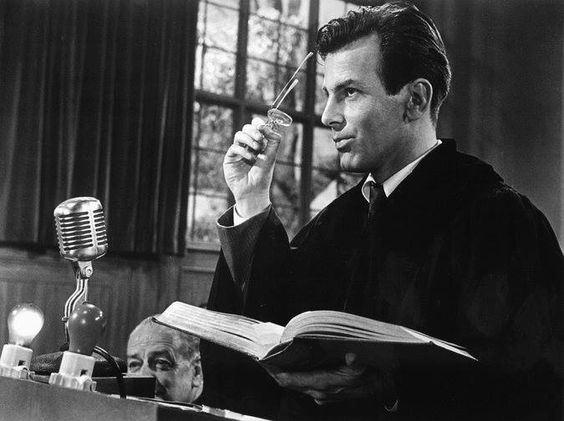
Today just a short follow up to my last few posts about the Holocaust and the other crimes of the Nazi state. A couple of those dealt with the film Judgment at Nuremberg. The film is profoundly disturbing when one looks at the time that we live. This is one of the more disturbing sections because in it, Maximillian Schell who played Hans Rolfe, the defense counsel for Burt Lancaster.

His summation of the defense following his client’s admission of guilt is damning. It is something that when we, and by we I mean people around the world, look at the atrocities of genocide, war crimes, ethnic cleansing, the willful starvation of millions by criminal regimes; and then stand by saying little or nothing and doing nothing, sometimes even supporting the regimes that commit these actions.

Please, no matter what your political point of view, take the time to watch the film, and read the transcript of Schell’s speech below:

“Your Honor, it is my duty to defend Ernst Janning, and yet Ernst Janning has said he is guilty. There’s no doubt, he feels his guilt. He made a great error in going along with the Nazi movement, hoping it would be good for his country. But, if he is to be found guilty, there are others who also went along, who also must be found guilty. Ernst Janning said, “We succeeded beyond our wildest dreams.” Why did we succeed, Your Honor? What about the rest of the world? Did it not know the intentions of the Third Reich? Did it not hear the words of Hitler’s broadcast all over the world? Did it not read his intentions in Mein Kampf, published in every corner of the world? Where’s the responsibility of the Soviet Union, who signed in 1939 the pact with Hitler, enabled him to make war? Are we not to find Russia guilty? Where’s the responsibility of the Vatican, who signed in 1933 the Concordat with Hitler, giving him his first tremendous prestige? Are we not to find the Vatican guilty? Where’s the responsibility of the world leader, Winston Churchill, who said in an open letter to the London Times in 1938 – 1938! Your Honor – “were England to suffer national disaster should pray to God to send a man of the strength of mind and will of an Adolf Hitler!” Are we not to find Winston Churchill guilty? Where is the responsibility of those American industrialists, who helped Hitler to rebuild his armaments and profited by that rebuilding? Are we not to find the American industrialists guilty? No, Your Honor. No! Germany alone is not guilty: The whole world is as responsible for Hitler’s Germany. It is an easy thing to condemn one man in the dock. It is easy to condemn the German people to speak of the basic flaw in the German character that allowed Hitler to rise to power and at the same time positively ignore the basic flaw of character that made the Russians sign pacts with him, Winston Churchill praise him, American industrialists profit by him! Ernst Janning said he is guilty. If he is, Ernst Janning’s guilt is the world’s guilt – no more and no less.”

Sadly, little has changed in the character of humanity. If we do or say nothing, if we support those who do such things, if we close our eyes and pretend that it is not our problem, then we are the guilty party.  As Hannah Arendt wrote: “The sad truth is that most evil is done by people who never make up their minds to be good or evil.”

Peace

Padre Steve+

1 Comment

Filed under ethics, film, Foreign Policy, History, holocaust, nazi germany, News and current events, Political Commentary

Holocaust Remembrance 2017: “Most evil is done by People who never make up their minds to be Good or Evil”

1483285_10152114931522059_1612934841_n

Friends of Padre Steve’s World,

I normally don’t post twice in a day but this I thought was important, for I believe that we are at a point in world history where the not so distant specter of a horrifying past is is rising before our eyes and all too many people cannot see it.

Friday, January 27th 2017 was Holocaust Remembrance Day. On that day seventy-two years ago the Soviet Red Army liberated the Auschwitz Concentration Camp, the centerpiece of the Nazi Death Camp machine. To be sure, in his panic to save his neck, in late 1944 Heinrich Himmler had begun to switch from his tactic of extermination to using the Jews as bargaining chips., but by then most of the Jews under Nazi control were dead. Those that remained, emaciated and dying by the thousands to starvation, and unchecked disease, as they were marched in ghastly conditions to camps deeper inside Nazi controlled areas.

On Friday two things happened in the United States that caused me to shake my head and wonder if we are becoming a place that will turn its eyes away from current atrocities, genocide, ethnic and religious cleansing, and walk away. President Trump issued a proclamation to observe Holocaust Remembrance Day, a statement that did not mention the Jews. How one remembers the Holocaust without mentioning the Jews is beyond me, but some of the President’s closest advisers, including Steve Bannon, are closely connected to the self-proclaimed Alt-Right, a movement of white supremacists and neo-Nazis looking for respectability. The second thing the President did was to issue an Executive Order halting the immigration of refugees from certain Muslim majority countries, and to cap the number entering. I’m not going to go into details about that but it is not the first time that the United States stopped refugees from entering the country on national security grounds, as in the 1930s and 1940s one of the reasons used to keep German Jewish refugees out of the country was exactly that, they might be Nazi spies and saboteurs, but I digress…

However, this is a day that we should never forget. The horrors perpetrated by the Nazi regime, all in the name of “race purity” and the extermination of the Jews and others deemed by the Nazis to be “sub-human” or untermenschen is something that is hard for most to imagine. Last year about this time I finished reading Bettina Stangneth’s book, Eichmann Before Jerusalem: The Unexamined Life of a Mass Murderer. While I am very well informed and educated on the lives, writings, actions, and statements of many of the Nazi war criminals, this new book on Eichmann is the most troubling that I have ever read. In particular it is the accounts of his writings and interviews with other pro-Nazi, or former Nazis in Argentina, particularly the Sassen Interviews, which span hundreds of hours of tape and thousands of pages of transcripts.

I am a Christian, a gentile, and a historian, as well as a thirty-five year military who served alongside our advisors and the Iraqis who fought alongside of us. I have lived in Germany, read, speak and write German and have many friends in that country, including members of the German military, retired and active duty.  My study and association with Holocaust survivors goes back to my college days at California State University Northridge when as an undergraduate history major I spent much of my time studying Germany from the first unification and the Kaiser Reich, the First World War, Versailles, Weimar and the Hitler Regime. My professor, Dr. Helmut Heussler, whose family left Germany in the late 1920s, served in the U.S. Army in World War II and was an interrogator at Nuremberg. I took a number of classes from Dr. Heussler, including Hitler’s Germany and the Holocaust. In the latter I had the chance to meet Holocaust survivor Mel Mermelstein, who was later played by Leonard Nimoy in the TV movie Never Forget. 

Since my college days I have continued to read and study, and to get a second Masters Degree in History in which much of my work dealt with the Nazi regime. I have visited the sites of former concentration camps including Dachau and Bergen-Belsen. I have been to the sites of the Nazi Party rallies in Nuremberg, as well as to the courtroom where the Nuremberg Trails were conducted. One day, God willing I will get to Auschwitz.

The Nazis had begun their persecution of the Jews shortly after Hitler took power in 1933. Later in the year the Enabling Act gave Hitler and his henchmen the legal means to begin their persecution of the Jews and others. These were followed by the Nuremberg Laws and other laws that targeted the Jews. Persecution increased throughout the 1930s, and sadly most countries refused to accommodate increased Jewish immigration. Then came Kristallnacht, or the Night of Broken Glass, when on 9-10 November 1938, a series of orchestrated attacks on Jewish businesses, Synagogues, institutions and individuals. On that night close to 200 synagogues, 7000 Jewish businesses and 29 major department stores were destroyed or damaged. Over 30,000 Jews, mostly men, were arrested and sent to concentration camps, 91 people were killed outright, and several thousand died in the aftermath.

mass killing einsatzgruppen

When the Nazis invaded Poland, its Jews were rounded up and placed into ghettos where many died of starvation and abuse even before the ghettos were liquidated and the people who lived in them were deported to the extermination camps. In 1941 as the German military seemed to be assured of victory in the Soviet Union the Nazis decided to exterminate the Jews of Europe. In the Soviet Union four Einsatzgruppen followed each of the German Army Groups and systematically began to massacre the Jews of every city and village which German soldiers captured. Over a million and a half Soviet Jews were killed by the Einsatzgruppen, Ordungspolizei battalions, Army Security Divisions and locally recruited units.

At the Wansee Conference of January 20th 1942 the specifics of the “Final Solution” were mapped out by Himmler’s number two man, SS General Reinhard Heydrich. What followed is beyond the comprehension of most people, but the perpetrators were for the most part men and women who were terrifyingly normal.

The truly terrifying thing about the Nazi perpetrators of the Holocaust to me is that most of the men at Wansee, men that commanded the Concentration camps and the Einsatzgruppen were very ordinary men who simply believed that they were doing their jobs. Very few could be described as psychopathic killers by nature. They were lawyers, doctors, career police officials, businessmen, and bureaucrats who carried out an extermination campaign that killed by their own numbers between 5.5 and 6 million Jews, not to mention others deemed to be subhuman including the handicapped, the mentally ill, homosexuals, and other non-Jewish minorities like the Gypsies not to mention the wide variety of those considered political enemies. But it was the Jews that bore the most tragic fate.

When you read their writings, listen to them when they were interviewed, or watch footage of them during or after the war, you find that they had absolutely no empathy for their victims. When confronted about the evil that they engineered they invariably blamed their victims, just as many like them do today.

Most of the men who coordinated the massive effort to exterminate the Jews of Europe following the Wansee Conference of January 20th 1942 approached their jobs dispassionately. This was a common attitude among the civil service, military and police officials that oversaw the Holocaust. They simply did their jobs and followed the law, and for most of them, their victims meant nothing.

ChildrenBirkenau

Hungarian Jews being sent to Extermination Camps

Adolf Eichmann summed up the attitude of many when he said regarding his work to deport hundreds of thousands of Hungarian Jews to Auschwitz in in just a few weeks during the fall of 1944, “Whether they were bank directors or mental cases, the people who were loaded on those trains meant nothing to me.” Speaking to Willem Sassen in 1957 Eichmann reveled in that accomplishment, “It was an achievement that was never matched before or since.” Eichmann also enjoyed leading his victims on, pretending that he might listen, and they might change his mind. Eichmann was proud of what he did. He told his staff, “I will leap into my grave laughing because the feeling that I have five million human beings on my conscience is for me a source of extraordinary satisfaction.”

Hannah Arendt wrote of Eichmann:

“The trouble with Eichmann was precisely that so many were like him, and that the many were neither perverted nor sadistic, that they were, and still are, terribly and terrifyingly normal. From the viewpoint of our legal institutions and of our moral standards of judgment, this normality was much more terrifying than all the atrocities put together.”

This was what made the Holocaust committed against the Jews of Europe by Nazi Germany a phenomenon different than other genocides. Many of the perpetrators were not driven by centuries old hate as in the Balkans, tribal blood lust as occurred in Rwanda, or the products of Soviet Communism or Communist Chines Maoist regimes.

dachaumorgue1945

It was the racial ideology of the Nazis which deemed the Jews and other non-Aryans to be sub-human. That ideology undergirded the German treatment of the Jews, and the conduct of the war, especially in the East. But the execution of the plan required the bureaucratic, administrative, technical and legal skills brought to the table by ordinary men. Men who sought promotion, advancement and economic security for their families. Individually many would have never killed, but in their positions they ran the rail network, the factories, the banking and finance industries and supported the war effort, most not thinking much about the evil that they abetted or if they did finding a way, be it social, scientific, religious, patriotic, legal or simply in the name of efficiency.

Survivors of Auschwitz

That is what makes the evil committed by them so terrifying. It is the product of “normal” people in an advanced Western nation. Make no bones about it, their actions were evil. They aided and abetted the genocide of the Jews, the disabled, other “sub-human” races, particularly Slavs, as well as those that they deemed less than suitable.

I think that the most chilling thing about the Holocaust was that the greatest atrocities were committed by ordinary men, sometimes well educated, decent family men. These were men who simply executed orders and often went home at night. Arendt wrote that “The sad truth is that most evil is done by people who never make up their minds to be good or evil.” She was right, there was an ordinariness to the evil perpetrated by the Nazis, at the same time there are those who consciously decide to participate in evil.

It is important that we do not forget the Holocaust. It is also important to recognize that the instruments of that horror were on the whole “ordinary” men who as they saw it were simply doing their job. It is something that everyone needs to remember. Bettina Stangneth wrote “Systematic mass murder is not just the sum of isolated instances of sadism but the result of a political thinking that is perverted from the ground up.”

So many of the perpetrators saw nothing wrong in what they were doing, in fact at his trial in Jerusalem Eichmann said, “To sum it all up, I must say that I regret nothing.”

They believed that their victims were less than human and like so many people even today, they had no empathy. Gustave Gilbert, an American Army Psychologist at the major War Criminal Trials at Nuremberg said it so well: “Evil is the absence of empathy.”

It is important that we never forget, especially now when we could be watching it begin all over again.

Peace

Padre Steve+

3 Comments

Filed under civil rights, ethics, Foreign Policy, History, holocaust, iraq,afghanistan, laws and legislation, national security, nazi germany, News and current events, Political Commentary

Truth, Justice, and the Value of a Single Human Life: What Americans Should Stand For

img_0333-1

Friends of Padre Steve’s World,

Yesterday I wrote about a segment of the classic film Judgment at Nuremberg. Today I am following that up with another, albeit, short post regarding one of the most riveting monologues in film from the same film. Since yesterday was also Holocaust Remembrance Day it is appropriate to take the time, and never forget, for while we may not want to admit it, as human beings we are capable of the same inhumanity.

The segment, in which Spencer Tracy plays the role of Chief Judge Dan Heywood gives his verdict is one of the most telling sequences in cinema regarding what it is to be an American. I always show it in the first session of my military ethics class at the Staff College and since the majority of my students have never seen the film, it usually leaves them in silence. So I am just going to leave it with you to watch, read, and contemplate. Who are we, and what do we stand for?

This is especially true when the President, politicians of the majority party in the legislature, pundits, and politically minded preachers make no bones that they have every intent of persecuting those who are of certain races, religions, or political beliefs that they abhor, often using the most scurrilous charges, and outright lies in order to demonize them, dehumanize them, and  open the door for normal, decent, and even brilliant people to justify government sponsored cruelty and injustice that defies the ideals of the Declaration of Independence, the Gettysburg Address, and the Constitution itself.

Please, watch the video and read the text. Ponder it in your heart, because it speaks to something that is not a historical aberration, not just a dramatic film, but something that affects the human condition and is present right here and right now in our own country.

“The trial conducted before this Tribunal began over eight months ago. The record of evidence is more than ten thousand pages long, and final arguments of counsel have been concluded.

Simple murders and atrocities do not constitute the gravamen of the charges in this indictment. Rather, the charge is that of conscious participation in a nationwide, government organized system of cruelty and injustice in violation of every moral and legal principle known to all civilized nations. The Tribunal has carefully studied the record and found therein abundant evidence to support beyond a reasonable doubt the charges against these defendants.

Heir Rolfe, in his very skillful defense, has asserted that there are others who must share the ultimate responsibility for what happened here in Germany. There is truth in this. The real complaining party at the bar in this courtroom is civilization. But the Tribunal does say that the men in the dock are responsible for their actions, men who sat in black robes in judgment on other men, men who took part in the enactment of laws and decrees, the purpose of which was the extermination of humans beings, men who in executive positions actively participated in the enforcement of these laws — illegal even under German law. The principle of criminal law in every civilized society has this in common: Any person who sways another to commit murder, any person who furnishes the lethal weapon for the purpose of the crime, any person who is an accessory to the crime — is guilty.

Heir Rolfe further asserts that the defendant, Janning, was an extraordinary jurist and acted in what he thought was the best interest of this country. There is truth in this also. Janning, to be sure, is a tragic figure. We believe he loathed the evil he did. But compassion for the present torture of his soul must not beget forgetfulness of the torture and the death of millions by the Government of which he was a part. Janning’s record and his fate illuminate the most shattering truth that has emerged from this trial: If he and all of the other defendants had been degraded perverts, if all of the leaders of the Third Reich had been sadistic monsters and maniacs, then these events would have no more moral significance than an earthquake, or any other natural catastrophe. But this trial has shown that under a national crisis, ordinary — even able and extraordinary — men can delude themselves into the commission of crimes so vast and heinous that they beggar the imagination. No one who has sat at through trial can ever forget them: men sterilized because of political belief; a mockery made of friendship and faith; the murder of children. How easily it can happen.

There are those in our own country too who today speak of the “protection of country” — of “survival.” A decision must be made in the life of every nation at the very moment when the grasp of the enemy is at its throat. Then, it seems that the only way to survive is to use the means of the enemy, to rest survival upon what is expedient — to look the other way.

Well, the answer to that is “survival as what?” A country isn’t a rock. It’s not an extension of one’s self. It’s what it stands for. It’s what it stands for when standing for something is the most difficult!

Before the people of the world, let it now be noted that here, in our decision, this is what we stand for: justice, truth, and the value of a single human being.”

Think about it…

Have a great weekend.

Peace

Padre Steve+

Leave a comment

Filed under film, History, laws and legislation, nazi germany, Political Commentary