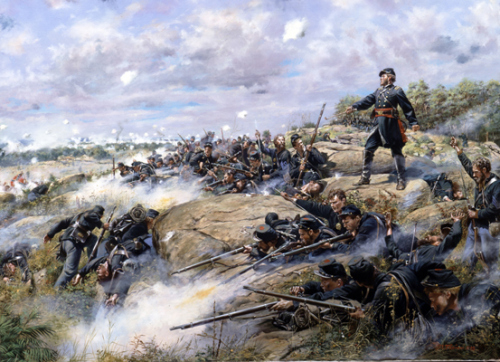
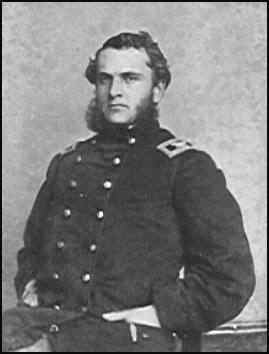
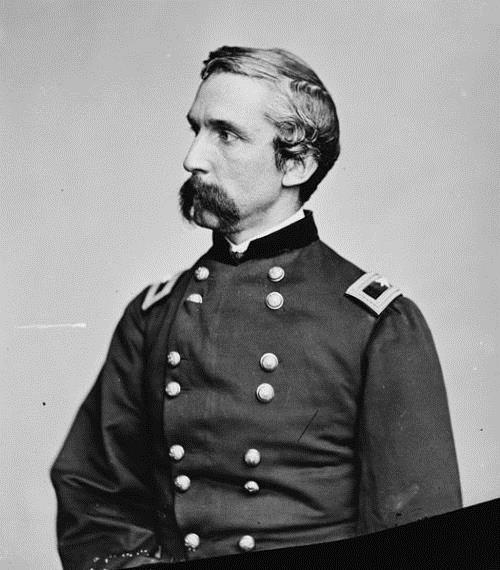
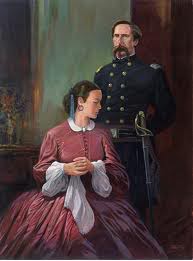
Category Archives: History

The Price of Immortality – Pickett’s Charge

Friends of Padre Steve’s World

Here is the latest chapter revision of my Gettysburg text. It is long but again a complex subject that does with more than just the battle. It deals with the complexity of people, relationships and motivations that transform history into myth and turn myth into history. I do hope that you enjoy, as I said it is a bit long but I think well worth the read.

Peace,

Padre Steve+

picketts charge

Danger is part of the friction of war. Without an accurate conception of danger we cannot understand war. That is why I have dealt with it here.Carl Von Clausewitz [1]

When commanders send their troops into battle to execute the plans of their staff, they cannot forget that as Clausewitz noted that War is the province of danger and that:

In the dreadful presence of suffering and danger, emotion can easily overwhelm intellectual conviction, and in the psychological fog it is so hard to form clear and complete insights that changes in view become more understandable and excusable.No degree of calm can provide enough protection: new impressions are too powerful, too vivid, and always assault the emotions as well as the intellect.[2]

To re-engage our understanding of this issue is important, especially in the application of Mission Command where as General Martin Dempsey noted that Understanding equips decision makers at all levels with the insight and foresight to make effective decisions, to manage the associated risks, and to consider second and subsequent order effects. [3] The current and recent wars fought by the United States and its NATO and coalition allies have shielded many military professionals from this aspect of war, but it is still present and we should not ignore it. As noted in the 2006 edition of the Armed Forces Officer:

The same technology that yields unparalleled success on the battlefield can also detach the warrior from the traditional ethos of the profession by insulating him or her from many of the human realities of war. [4]

The nature of the warrior leader is driven by the requirements of combat [5]and courage, both courage in the face of the danger, and the courage to accept responsibility [6] are of paramount importance. In an era where the numbers of soldiers that actually experience combat or served in true combat conditions where the element of danger is ever present is shrinking, we can at least gain part of that understanding through the study of history, campaigns and battles and by actually walking the battlefields, and considering the effects of terrain, weather, exhaustion and the imagining danger faced in confronting an enemy on the field of battle. As such the Battle of Gettysburg and the climactic event of Picketts Charge on July 3rd is a good place to reimagine the element of danger from the point of view of the soldiers, but also the commanders involved in the action.

It is also a place that we can look to find the end of dreams, the shattering of legacies, the emergence of myth as history, and the terrible effects ill-conceived of plans gone awry.

Major General George Pickett and his division waited in Spangler’s Woods and in the swale behind Seminary Ridge and looked across the valley the separated them from the Federal positions on Cemetery Ridge. The troops for the most part were eager to fight and had not seen difficult action for about a year while their comrades in the Army of Northern Virginia had marched to glory. The division had been held in reserve and not seen action at Fredericksburg and they had missed the great victory at Chancellorsville entirely having been detached with Longstreet’s corps on the Suffolk excursion. Now these troops waited anxiously for their orders in the sultry summer heat which caused them to perspire and to drink from the canteens that they filled that morning.

The men varied in what they thought of the battle that they knew that was approaching. Some in Richard Garnett’s brigade were in splendid spirits and confident of sweeping everything before them;never was there anything like the same enthusiasm entering battle. [7] Others were not so confident. In Armistead’s brigade Lieutenant James F. Crocker of the 9th Virginia who had been wounded at Malvern Hill surveyed the ridge before them and told a number of officers that the attack was going to be another Malvern Hill, another costly day to Virginia and Virginians, [8] while a Colonel in Pickett’s division noted that when the men were told of the attack that they went being unusually merry and hilarious that they on a sudden had become as still and thoughtful as Quakers at a love feast. [9] Their commander, George Pickett received the plan of attack from James Longstreet who later noted that Pickett seemed to appreciate the severity of the contest he was about to enterbut was quite hopeful of success. [10]

A member of Pickett’s staff noted years later that It is said, that the condemned, in going to execution, the moments fly.To the good soldier, about to go into action, I am sure the moments linger. Let us not dare say, that with him, either individually, or collectively, is that mythical love of fighting, poetical but fabulous; but rather, that it is the nervous anxiety to solve the great issue as speedily as possible, without stopping to count the cost. [11]

Porter Alexander’s artillery began its bombardment at 1:07 p.m. As it did the Union artillery commenced a deliberate counter-fire, in which the Confederate infantry behind Seminary Ridge began to take a beating. Unlike the Confederate barrage which had mainly sailed over the Union troops on Cemetery Ridge causing few causalities, a large proportion” of the Union long shots landed squarely in the ranks of the gray soldiers drawn up to await the order to advance. [12] Estimates vary but the waiting Confederates lost between 300-500 killed and wounded, the most affected was Kemper’s brigade of Pickett’s division which lost about 250 men, or 15% of its strength. [13] Other units lost significant numbers, with those inflicted on Pettigrew’s brigades further depleting their already sparse numbers.

The Union counter fire had an effect on many of the Confederates including Pickett. Alexander found Pickett in a very positive and excited frame of mind. [14] There are conflicting opinions of Pickett’s state of mind, supporters tending to believe the best about him and his conduct on the battlefield, while detractors, both his contemporaries and current historians allege that he was afraid and quite possibly minimizing his exposer to enemy fire due to his obsession with Sallie. Edwin Longacre wrote: While not himself under fire, Pickett appears not to have taken the barrage too calmly. Aware that Longstreet had asked Alexander recommend the most opportune time for our attack based on the enemys response to his cannonade, Pickett at least twice sent couriers to as the colonel if they should go in. [15]

Like in any historical account the truth probably lies in the middle of the extreme viewpoints and while we think that we know much about the greatest charge in the history of the United States, we are hindered by the lack of written accounts by most of the senior Confederate officers who took part in Pickett’s Charge. This complicates the task of attempting to separate the true from the false and the truth from a judgment or verdict rendered by a less than impartial judge. Lee, Hill and Longstreet treated the charge as just one episode in long campaign reports, and modern readers, like some of the participants, can wonder how much of any of the three generals really saw once the firing started. [16]

Since no reports of the Confederate division commanders are available, Pickett’s was suppressed because of how critical it was toward other commanders. Pettigrew and Pender were dead, Trimble was wounded and in a Federal prison and Harry Heth, Pickett’s cousin limited his report to the action of July 1st 1863. Likewise only two of the nine brigade commanders filed reports and none of them were from Pickett’s division, so it is hard to get a complete and accurate view from official sources. Longstreet discussed Pickett’s report and said that it was not so strong against the attack as mine before the attack was made but his was made in writing and of official record. [17] Pickett was reportedly furious at being force to destroy his report and refused to submit an edited report. So what we are left with on the Confederate side are the reports of two corps commanders and an army commander who were far away from the scene of the action, after action reports of regiments, many of which had lost their commander’s and most of their senior officers, and the recollections from men with axes to grind and or reputations to defend; some Longstreet, some Pickett, some Pettigrew.

The assault force was composed of Pickett’s fresh division from First Corps, Harry Heth’s battered division now under Johnston Pettigrew which had already taken close to 40% casualties and two brigades of Pender’s division now commanded by Isaac Trimble. These two brigades, Lane’s which was fresh but Scales brigade, now under command of Colonel William Lowrence had suffered greatly on July 1st; its “casualty rate was 63% and it had lost its commander and no fewer than fifty-five field and company grade officers. [18] And now, these battered the units began to take casualties from well directed Federal fire. George Stewart wrote: In most armies, such a battered unit would have been sent to the rear for reorganization, but here it was being selected for a climactic attack! [19]

The Confederate losses mounted at an alarming rate. The psychological impact of artillery casualties was great, for the big guns not only killed but mangled bodies, tore them apart, or disintegrated them. [20] A survivor wrote his wife days later: If the crash of worlds and all things combustible had been coming in collision with each other, it could not have surpassed it seemingly. To me it was like the Magazine of Vengeanceblown up. [21] A soldier of Kemper’s brigade recalled that The atmosphere was rent and broken by the rust and crash of projectilesThe sun, but a few minutes before so brilliant, was now darkened. Through this smoky darkness came the missiles of deaththe scene beggars descriptionMany a fellow thought his time had comeGreat big, stout hearted men prayed, loudly too. [22] Colonel Joseph Mayo of the 3rd Virginia regiment was heavily hit, one of its survivors wrote when the line rose up to chargeit appeared that as many were left dead and wounded as got up. [23]

On the opposite ridge Union forces were experiencing the same kind of intense artillery fire. But these effects were minimized due to the prevalent overshooting of the Confederate artillery as well as the poor quality of ammunition. This resulted in few infantry casualties with the worst damage being taken by a few batteries of artillery at the angle. Soldiers behind the lines took the worst beating, but the routing of these non-combatants was of no military significance, [24] This did create some problems for the Federals as Meade was forced to abandon their headquarters and the Artillery Reserve was forced to relocate a little over a half mile to the rear.[25] The effects of this on operations were minimal as Brigadier General Robert Tyler commanding the Artillery Reserve posted couriers at the abandoned position, should Hunt want to get in touch with him. [26]

Despite the fusillade Meade maintained his humor and as some members of his staff tried to find cover on the far side of the little farmhouse quipped:

Gentlemen, are you trying to find a safe place?…You remind me of the man who drove the oxen team which took ammunition for the heavy guns to the field at Palo Alto. Finding himself in range, he tipped up his cart and hid behind it. Just then General Taylor came along and shouted You damned fool, dont you know you are no safer there than anywhere else?The driver responded, I dont suppose I am general, but it kind of feels so. [27]

A bombardment of this magnitude had never been seen on the American continent, but despite its apparent awesome power, the Confederate artillery barrage had little actual effect on the charge. The Prussian observer traveling with Lee’s headquarters dismissed the barrage as a Pulververschwindung,”…a waste of powder. [28] The Federal infantry remained in place behind the stone wall on Cemetery Ridge ready to meet the assault. Henry Hunt replaced his damaged artillery batteries on Cemetery Ridge. But even more importantly Lieutenant Colonel Freeman McGilvery’s massive battery was lying undetected where it could deliver devastating enfilade fire as the Confederate infantry neared their objective. Likewise, Rittenhouse’s batteries on Little Round Top and Osborne’s on Cemetery Hill were unaffected by the Confederate bombardment were poised to wreak destruction on the men of the three Confederate divisions.

Unlike the Federal Army which had its large pool of artillery battalions in the Artillery Reserve with which to replace batteries that had taken casualties or were running low on ammunition, Porter Alexander had no fresh batteries or ammunition: soon the drivers of the caissons found that the heavy fire had exhausted their supply of shot and shell, and the had to go even farther to get it from the reserve train. As a result some of the guns remained mute and their gunners stood helpless during the cannonade and charge, for Alexander had no batteries in reserve to replace them. [29]

There were two reasons for this. First was that Lee had reorganized the artillery before Chancellorsville. He eliminated the artillery reserve and assigned all artillery battalions and batteries directly to the three infantry corps. This meant that Alexander could only draw upon the battalions assigned to First Corps and had no operational control over the batteries of Ewell’s Second Corps or Hill’s Third Corps.

The second was due to the meddling of Brigadier General William Pendleton, Lee’s senior artilleryman who as a staff officer had no command authority over any of the guns in the army. Pendleton relocated the artillery trains of First Corps further to the rear without informing Alexander or Longstreet. Likewise, Pendleton also ordered the eight guns of the Richardson’s artillery away without notifying anyone. These were guns that Alexander was counting on to provide direct support to the attack by advancing them to provide close support to the infantry.

At about 2:20 p.m. Alexander, knowing that he was running short of ammunition sent a note to Picket and Pettigrew advising them:

General: If you are to advance at all, you must come at once or we will not be able to support you as we ought. But the enemys fire has not slackened and there are still 18 guns firing from the cemetery.[30]

About twenty minutes later Alexander saw some of the Federal guns along Cemetery Ridge begin to limber up and depart. He also noticed a considerable drop off in Federal fire. He interpreted this to mean that his guns had broken the Federal resistance, and at 2:40 Alexander sent word to Pickett For Gods sake come quick or my ammunition will not let me support you. [31]

However, what Alexander did not realize was that what was happening on Cemetery Ridge had little to do with his bombardment but instead was directed by Henry Hunt. Hunt ordered batteries low on ammunition or that had sustained damage to withdraw and was replacing them with fresh batteries that Alexander could not see, although he assumed that such might be the case, he noted that the withdraw of batteries was new, for the Federals had never done anything of that sort before, & I did not believe that they were doing it now. [32] He had also decided to conserve ammunition by ordering an immediate cessation and preparation for the assault to follow. [33]

Alexander’s message reached Pickett and Pickett immediately rode off to confer with Longstreet. Pickett gave the message to Longstreet who read it “and said nothing. Pickett said, “General, shall I advance!Longstreet, knowing it had to be, but unwilling to give the word, turned his face away. Pickett saluted and said I am going to move forward, sirgalloped off to his division and immediately put it in motion. [34] Sadly Pickett had no inkling that his corps commander was immovably opposed to the charge [35] and Pickett, caught up in the moment with the excitement of leading his Division into battle did not notice his friend’s mood.

A few minutes later Longstreet rode to find Alexander. Meeting him at 2:45 and Alexander informed him of the shortage of ammunition. The news was surprising to Longstreet as neither he nor Lee had checked on the supply of ammunition during the morning. [36] the news took him aback enough that he seemed momentarily stunned [37] by it. Longstreet told Alexander: Stop Pickett immediately and replenish your ammunition. [38] But Alexander now had to give Longstreet even worse news telling him I explained that it would take too long, and the enemy would recover from the effect of our fire was then having, and too that we had, moreover, very little to replenish it with. [39] Longstreet continued to ride with Alexander and again eyed the Federal positions on Cemetery Ridge with his binoculars. As he looked at the Federal position he slowly spoke and said I dont want to make this attack,pausing between sentences as if thinking aloud. I believe it will fail- I do not know how it can succeed- I would not make it even now, but Gen. Lee has ordered it and expects it. [40] Alexander, who as a battalion commander now in charge of First Corps artillery was very uncomfortable, he later wrote:

I had the feeling that he was on the verge of stopping the charge, & that with even slight encouragement he would do it. But that very feeling kept me from saying a word, or either assent I would not willingly take any responsibility in so grave a matter & I had almost a morbid fear of causing any loss of time. So I stood by, & looked on, in silence almost embarrassing. [41]

While Longstreet was still speaking Pickett’s division swept out of the woods to begin the assault, Alexander knew that the battle was lost if we stopped. Ammunition was too low to try anything else, for we had been fighting for three days. There was a chance, and it was not my part to interfere.[42]

Despite this Pickett and many of his soldiers were confident of success, and: “no officer reflected the mens confidence better than George Pickett. There was no fatalism in him. Believing that his hour of destiny had come and expecting to take fortune at its flood, he rode down the slope like a knight in a tournament. [43] Pickett was an unforgettable man at first sight [44] Pickett wore a dark mustache drooping and curled at the ends, a thin goatee, and hair worn long and curled in ringlets. His hair was brown, and in the morning sunlight it reflected auburn hints. George Pickett stood slender and graceful at the middle height, and carried himself with an air. Dandified in dress, he was the most romantic looking of all Confederates, the physical image of that gallantry implicit in the Souths self concept. [45]

George Pickett was born to wealth and privilege in a Neo-feudal society [46] and came from an old and distinguished Virginia family with a long military heritage dating to the Revolution and the War of 1812. He attended the Richmond Academy until he was sixteen and had to withdraw due to the financial losses his parents had suffered during the panic of 1837.

 Pickett

Major General George Pickett C.S.A.

This led to the young Pickett being sent to live with and study law under his mother’s older brother, the future President, Andrew Johnston in Quincy Illinois. The family’s continued financial distress led them to get George to consider the free education provided by West Point. His mother asked Johnston to assist and Johnston set about obtaining an appointment for his nephew. As befit an up-and-coming politician, his quest was short and successful. His Springfield acquaintances included a United States Congressman who happened to be a fellow Southerner and brother Whig, Kentucky native John T. Stuart. [47] There is a long running myth that connects Pickett’s appointment to West Point to Abraham Lincoln, but it is fiction, fabricated by Pickett’s widow Sallie long after her husband and Lincoln’s death. [48]

Pickett entered West Point in 1842 where he was described by a fellow cadet thought a jolly good fellow with fine natural gifts sadly neglected [49] through his tendency to demonstrate in word and deed that henhouse neither to authority nor submit to what’re considered the Academys narrow, arbitrary, unrealistic, harshly punitive, and inconsistently applied code of conduct [50] became a loyal patron of Benny Havens tavern where he was stealing away regularly now to life his glass in good fellowship…” [51]

Pickett’s academic performance, as well as his record of disciplinary infractions at West Point was exceptionally undistinguished. He racked up vast amounts of demerits for everything from being late to class, chapel and drill, uniform violations and pranks on the drill field where he mocked those who observed proper drill and ceremonies. Pickett graduated last in the class of 1846, something that his vast amount of demerits contributed.

His widow Sallie wrote after his death that he accumulated them so long as he could afford the black marks and punishments they entailed. He curbed his harmful behavior, however, when he found himself approaching the magic number of 200 demerits per year that constituted grounds for dismissal. [52] Pickett finally graduated only five behavioral demerits short of expulsion. [53] The graduating class included George McClellan, A.P. Hill, Thomas, later “Stonewall” Jackson as well as a number of other cadets, most of whom who went on to distinguished military and other careers. At West Point Pickett was considered to be the class clown by many of his classmates was the most popular and prominent young man in the class. [54] Among the many friends that he made was an upperclassman named Ulysses S. Grant and their friendship would span decades and would survive the fire of a war that placed them at swords point. [55]

articulocanvas_clip_image085

Lieutenant Pickett at Chapultepec

Pickett was commissioned into the infantry and served alongside James Longstreet in the Mexican War where fought valiantly in a number of battles, including Contreras, Churubusco, El Molino Del Rey [56] during the Mexican War. Pickett distinguished himself at Chapultepec where he had been the first American to scale the ramparts of Chapultepec, where he planted the flag before the admiring gaze of his friend Longstreet. [57] During that assault Longstreet was wounded and Pickett had snatched the colors and planted them on the castle heights for all to see and cheer. [58] For his actions he received a brevet promotion to First Lieutenant.

Following the war Pickett married but was widowed less than two years later when his wife Sally Minge Pickett died during childbirth along with their infant son in 1852 The loss was devastating to the young officer, he went into a deep depression caused by grief and considered leaving the army. He was persuaded by friends, peers and understanding commanding officers to remain.

While on leave following Sally’s death he was at Fort Monroe, laying under an umbrella at Point Comfort when a child approached him and took pity on him. The child was the nine year old La Salle “Sallie” Corbell and she broke through his emotional defenses by persistently, as only a child can do asking what the source of his grief was. Pickett told the child that his heart had been broken by a sorrow almost too great to bear. When the child asked how ones heart could break, he replied that God broke it when he took from him his loved ones and left him so lonely. [59] While Pickett may not had thought much of the meeting, he did give the little girl a ring and a golden hear bearing his wife’s name. He likely expected never to see her again but though she was a child she was a willful and determined one. She knew her own mind and heart, both told her that one day she would marry George Pickett. [60]

Pickett returned to Texas to serve with the 8th Infantry and was promoted to Captain and ordered to take command of the newly raised Company “D” 9th Infantry at Fort Monroe. Transferred to the Pacific Northwest he married Widowed after that war he served in the Pacific Northwest where he took a Native American wife who bore him a son, however she did not survive childbirth and when she died in early 1858 Pickett was again widowed. In 1859 Captain Pickett faced down British troops from the Hudson Bay Company in an incident now known at the Pig War which at its heart was a dispute about whether the British or the Americans own San Juan Island. The dispute, which brought the two nations to the brink of war, was settled without bloodshed, save for the unfortunate pig, and Pickett became a minor celebrity in the United States and anathema to the British.

When Virginia seceded from the Union, Pickett like many other southern officers was conflicted in his feelings and loyalties and hoped to the last that he would have to take up arms against neither state nor country. [61] Pickett resigned his commission on June 25th 1861. He wrote to Sallie with who he now maintained a frequent correspondence about his decision and decidedly mixed feelings as he:

Always strenuously opposed disunion…” But While I love my neighbor, i.e., my country, I love my household, i.e., my state, more, and I could not be an infidel and lift my sword against my own kith and kin, even though I do believethat the measure of American greatness can be achieved only under one flag. [62]

Pickett returned to Virginia by a circuitous route where he was commissioned as a Captain in the new Confederate army on September 14th and two weeks later was promoted to Colonel and assigned to command forces along the Rappahannock. Though he had as yet seen no combat serving in the Confederate army Pickett was promoted to a brigadier General and assigned to command a Virginia brigade belonging to Longstreet’s division.

Pickett led his brigade well on the peninsula and at Williamsburg was instrumental in routing an advancing Federal force, and at Seven Pines had helped repel a dire threat to the Confederate position. At Gaines Mill Pickett was wounded in the shoulder during the assault put out of action and placed on convalescent leave to recover from his wounds. During his convalescence he fell in love with an old acquaintance; La Salle Corbell, who as a young girl had cheered him after the loss of his wife now a beautiful young woman nursed him back to health and started a chain reaction that would nearly engulf the Confederate officer. [63]

Pickett was promoted to Major General in October 1862 and was assigned command of the division formerly commanded by David R. Jones, which was assigned to Longstreet’s First Corps. The division was sent to peripheral areas and took no part in the battles of late 1862 or Chancellorsville serving instead in the Tidewater with Longstreet’s corps. The corps took part in a series of operations against Union forces in the Hampton Roads area and Pickett’s division bested a Federal force at Suffolk on April 24th 1863, though it was hardly a true test of his ability to command the division in combat. During this time Pickett spent much time visiting La Salle, much to the concern of some of his officers and Longstreet’s staff, and by the time the corps left the area the two were engaged to be married.

When the Division returned to the Army of Northern Virginia after Chancellorsville it was among the forces considered by Jefferson Davis to be sent west for the relief of Vicksburg. Since that operation never materialized the division was assigned to accompany First Corps with the army during the upcoming Pennsylvania campaign. However, much to the consternation of Lee, Longstreet and Pickett two of its brigades were detached by the order of Jefferson Davis to protect Richmond from any Federal incursion.

During the advance into Pennsylvania the division, now composed of the brigades of James Kemper, Lewis Armistead and Richard Garnett was the trail division in Longstreet’s corps and often, in the absence of cavalry assigned to guard the corps and army trains. Due to its late release from these duties at Chambersburg, Pickett’s Division did not arrive at Gettysburg until late afternoon on July 2nd. Lee decided that they would not be needed that day and Longstreet placed that the division in bivouac at Marsh Creek for the night, sending word by messenger to tell Pickett I will have work for him tomorrow. [64]

Pickett spent the night with his soldiers and woke them about 3 a.m. After a quick breakfast Pickett moved the division to Seminary Ridge marshaling his troops in Spangler’s Woods where there was a modicum of protection from Federal fires and observation. However, despite these advantages it placed his division about 1000 yards from the extreme right of Pettigrew’s division with which he would have to coordinate his attack that fateful day.

Pickett scribbled a final note to Sallie as his troops prepared to attack. Oh, may God in his mercy help me as He never has helped me beforeremember always that I love you with all my heart and soul That now and forever I am yours. [65]

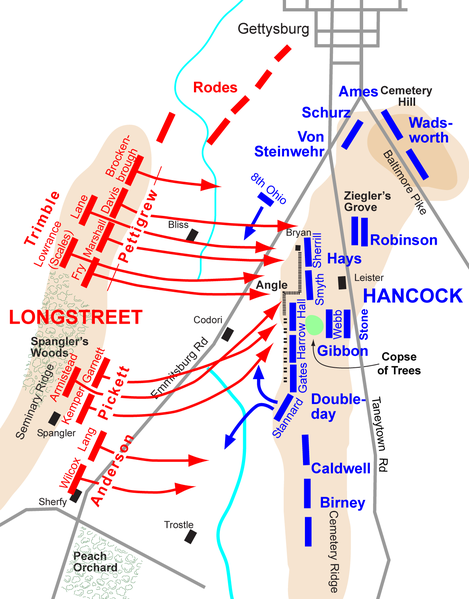
When Pickett’s division as well as those of Pettigrew and Trimble swept out of the wood to begin the attack the last chance to stop the attack ended. As Pickett’s brigades moved out, Pickett galloped up, as debonair as if he had been riding through the streets of the Richmond under the eye of his affianced [66] and every soldier within hearing was stirred by Picketts appeal [67] as he shouted Remember Old Virginia! or to Garnett’s men Up, men, and to your posts! Dont forget today that you are from Old Virginia! [68] But when Garnett asked if there were any final instructions Pickett was told I advise you to make the best kind of time in crossing the valley; its a hell of an ugly looking place over yonder. [69]

Armistead called out to his soldiers, Men, remember who you are fighting for! Your homes, your firesides, and your sweethearts! Follow Me! [70]Armistead’s example had a major impact on his brigade, men were inspired, as one later wrote They saw his determination, and they were resolved to follow their heroic leader until the enemys bullets stopped them. [71] about 500 yards to Pickett’s left Pettigrew exhorted his men for the honor of the good old North State, forward.[72]

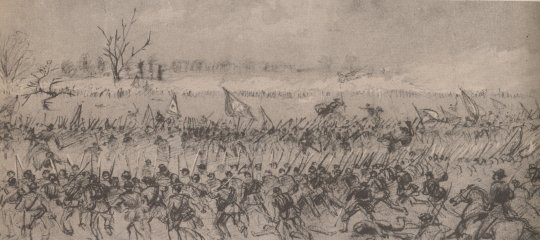
Pickett’s division showed the full length of its long gray ranks and shining bayonets, as grand as a sight as ever a man looked on.[73] The sight was impressive on both sides of the line, a Confederate Captain recalling the glittering forest of bayonetsthe two half mile wide formations bearing down in superb alignment. [74] The sight of the amassed Confederates moving forward even impressed the Federals. Colonel Philippe Regis de Trobriand, a veteran of many battles in Europe and the United States recalled it was a splendid sight, [75] and another recalled that the Confederate line gave their line an appearance of being irresistible. [76]

469px-Picketts-Charge

But the Federals were confident. Having withstood the Confederates for two days and having survived the artillery bombardment the Union men eagerly awaited the advancing Confederates. Directly facing the Confederate advance in the center of the Union line was the division of Pickett’s West Point Classmate and North Carolina native who remained with the Union, John Gibbon. The cry went out Here they come! Here they come! Here comes the infantry! [77] To the left of Gibbon Alexander Hays called to his men Now boys look outnow you will see some fun! [78]

The Confederates faced difficulties as they advanced, and not just from the Union artillery which now was already taking a terrible toll on the advancing Confederates. Stuck by the massed enfilade fire coming from Cemetery Hill and Little Round Top continued their steady grim advance. Carl Schurz from his vantage point on Cemetery Hill recalled:

Through our field-glasses we could distinctly see the gaps torn in their ranks, the grass dotted with dark spots- their dead and wounded.But the brave rebels promptly filled the gaps from behind or by closing up on their colors, and unasked and unhesitatingly they continued with their onward march.[79]

Pettigrew’s division was met by fire which enveloped them obliquely from Osborne’s thirty-nine guns emplaced on Cemetery Hill. On their left flank a small Federal regiment, the 8th Ohio lay in wait unnoticed by the advancing Confederates. Seeing an opportunity the regiment’s commander Lieutenant Colonel Franklin Sawyer deployed his 160 men in a single line, took aim at Brockenbrough’s Virginia brigade some two hundred yards ahead of the Emmitsburg Road, and opened a devastating fire. Above the boiling clouds the Union men could see a ghastly debris of guns, knapsacks, blanket rolls, severed human heads, and arms and legs and parts of bodies tossed into the air by the impact of the shot. [80] So sudden and unexpected was this that the Confederates panicked and fled in confusion… to the rear where they created more chaos in Trimble’s advancing lines as one observed they Came tearing through our ranks, which caused many men to break. [81] The effect on Confederate morale was very important, for the Army of Northern Virginia was not used to seeing a brigade, even a small one, go streaming off to the rear, with all its flags.Even Picketts men sensed that something disastrous had happened on the left. [82]

In one fell swoop Pettigrew was minus four regiments. Brockenbrough was singularly ineffective in leading his men, he was a nonentity who did not know how to control his recalcitrant rank and file; nor did he have the presence to impress his subordinate officers and encourage them to do his bidding. [83] The disaster that had overtaken Brockenbrough’s brigade now threatened another important component of Lee’s plan- protecting the left flank of the assaulting force. As Brockenbrough’s brigade collapse the vital protection of the left flank collapsed with it.

Pettigrew’s division continued its advance after Brockenbrough’s brigade collapsed, but the Confederate left was already beginning to crumble. Sawyer changed front, putting his men behind a fence, and the regiment began firing into the Confederate flank. [84]with Davis’s brigade now taking the brunt of the storm of artillery shells from Osborne’s guns. This brigade had suffered terribly at the railroad cut on July 1st, especially in terms of field and company grade officers was virtually leaderless, and the inexperienced Joe Davis was helpless to control them. [85] To escape the devastating fire Davis ordered his brigade to advance at the double quick which brought them across the Emmitsburg Road ahead of the rest of the division, where they were confronted by enfilade canister fire from Woodruff’s battery to its left, as well as several regiments of Federal infantry and from the 12th New Jersey directly in their front. A New Jersey soldier recalled We opened on them and they fell like grain before the reaper, which nearly annihilated them. [86] Davis noted that the enemy’s fire commanded our front and left with fatal effect. [87] Davis saw that further continuing was hopeless and ordered his decimated brigade to retire to the position originally held. [88]

Pettigrew’s remain two brigades continued grimly on to the Emmitsburg Road, now completely devoid of support on their left flank. Under converging fire from Hay’s Federal troops the remaining troops of Pettigrew’s command were slaughtered. Hay’s recalled As soon as the enemy got within range we poured into them and the cannon opened with grape and canister [, and] we mowed them down in heaps.[89] The combination of shot, shell, canister and massed musket fire simply erased the North Carolinians ranks. [90]Pettigrew was wounded, Colonel Charles Marshall was killed fifty yards from the stone wall and only remnants of companies and regiments remained unscathed. Soon the assault of Pettigrew’s division was broken:

Suddenly Pettigrews men passed the limit of human endurance and the lines broke apart and the hillside covered with men running for cover, and the Federal gunners burned the ground with shell and canister. On the field, among the dead and wounded, prostrate men could be seen holding up handkerchiefs in sign of surrender. [91]

Trimble’s two brigades fared no better. Scales brigade, now under the command of Colonel W. Lee Lowrence never crossed the Emmitsburg Road but instead took position along it to fire at the enemy on the hill. The soldiers from North Carolina who two days before had marched without flinching into the maw of Wainwrights cannon on Seminary Ridge could not repeat the performance. [92] Trimble was severely wounded in the leg and sent a message to Lane to take command of the division. The order written in the third person added a compliment to his troops: He also directs me to say that if the troops he had the honor to command today for the first time couldnt take that position, all hell cant take it. [93] Lane attempted to rally the troops for one last charge when one of his regimental commanders exploded telling him My God, General, do you intend rushing your men into such a place unsupported, when the troops on the right are falling back? [94] Lane looked at the broken remains of Pettigrew’s division retiring from the field and ordered a retreat. Seeing the broken remnants of the command retreating, an aide asked Trimble if the troops should be rallied. Trimble nearly faint from loss of blood replied: No Charley the best these brave fellows can do is to get out of this,so let them get out of this, its all over. [95] The great charge was now over on the Confederate left.

The concentrated Federal fire was just as effective and deadly on the Confederate right. Kemper’s brigade, on the right of Pickett’s advance was mauled by the artillery of Rittenhouse on Little Round Top, which tracked their victims with cruel precision of marksmen in a monstrous shooting galleryand the overs landed their shots on Garnetts ranks with fearful effect.[96]

As the Confederates advanced Pickett was forced to attempt to shift his division to the left to cover the gap between his and Pettigrew’s division. The move involved a forty-five degree oblique and the fences, which had been discounted by Lee as an obstacle which along the Emmitsburg Road virtually stopped all forward movement as men climbed over them or crowed through the few openings. [97] Pickett’s division’s oblique movements to join with Pettigrew’s had presented the flank of his division to McGilvery’s massed battery. The movement itself had been masterful, the execution of it under heavy fire impressive; however it meant the slaughter of his men who were without support on their right flank.

Pickett himself was doing his best to direct the movements of his Division. Placing himself just behind his Division he “kept his staff busy carrying messages to various generals and performing other duties on the field. At different times he sent his aides back to Confederate lines to inform Longstreet of his need for reinforcements, or to direct Wilcox when to advance his troops, or to ask Major James Dearing for artillery support.” [98] While some of Pickett’s detractors attempt to accuse him of cowardice, including inventing fables about him drinking behind the lines, the facts do not substantiate the accusations. Likewise, Pickett’s position about one hundred yards behind his advancing troops was optimal for command and control purposes.

Though he did not have operational control of Pettigrew’s division, “when he saw it beginning to falter, he ordered Captains E.R. Baird and W. Stuart Symington to help rally them. Then Pickett himself galloped to the left in an effort to steady the men.” [99]

As Pickett’s division advanced into the Plum Run Valley they were met by the artillery of Freeman McGilvery, who wrote that the execution of the fire must have been terrible, as it was over a level plain, and the effect was plain to be seen. In a few minutes, instead of a well-ordered line of battle, there were broken and confused masses, and fugitives fleeing in every direction. [100]

Kemper’s brigade which had the furthest to go and the most complicated maneuvering to do under the massed artillery fire suffered more damage. The swale created by Plum Run was a “natural bowling alley for the projectiles fired by Rittenhouse and McGilvery” [101] was now flanked by Federal infantry as it passed the Condori farm. The Federal troops were those of the Vermont brigade commanded by Brigadier General George Stannard. These troops were nine month volunteers recruited in the fall of 1862 and due to muster our in a few days. They were new to combat, but one of the largest brigades in the army and 13th Vermont had performed with veteran like precision the day before [102] leading Hancock to use them to assault the Confederate right. The Vermonters were positioned to pour fire into the Confederate flank, adding to the carnage created by the artillery, and the 13th and 16th Vermont pivoted ninety degrees to the right and fired a succession of volleys at pistol range on the right of Picketts flank. [103]

Kemper had not expected this, assuming that the Brigades of Wilcox and Perry would be providing support on the flank. As he asked a wounded officer of Garnett’s brigade if his wound was serious, the officer replied that he soon expected to be a prisoner and asked Kemper Dont you see those flanking columns the enemy are throwing on our right to sweep the field? [104] Kemper was stunned but ordered his troops to rush federal guns, but they were torn to pieces first by the artillery and then by the successive musketry of three and a half brigades of Yankee infantry. [105] Kemper was fearfully wounded in the groin and no longer capable of command. His brigade was decimated and parts of two regiments had to refuse their line to protect the flank, and those that continued to advance had hardly any strength left with which to succeed, the Confederate left was no for all intents and purposes out of the fight.

Now that fight was left in the hands of Armistead and Garnett’s brigades, and at this moment in the battle, the survivors of those units approached the stone wall and the angle where they outnumbered the Federal defenders, one regiment of which, the 71st Pennsylvania had bolted to the rear.

This left the decimated remains of Lieutenant Alonzo Cushing’s battery of artillery alone to face the advancing Confederates. Cushing who had already received multiple wounds in his should and groin and was desperately wounded. A number of his guns had been disabled and his battery had taken significant numbers of casualties during the Confederate bombardment. Cushing was another of the young West Point graduates who directed batteries at key points during the battle who was not only a skilled artilleryman, but a gifted leader and a warrior who won the respect of his men. One corporal said that Cushing was the best fighting man I ever saw while another recollected He was so cool and calm as I ever saw him, talking to the boys between shots with the glass constantly to his eyes, watching the effect of our shots. [106]

He received permission from the commander of the Philadelphia Brigade, Alexander Webb, among whose regiments his battery was sited to advance his guns to the wall. Though he was already desperately wounded in the shoulder and the groin, Cushing remained with his gunners. When a subordinate suggested that he go to the rear he replied I will stay right here and fight it out or die in the attempt. [107]

When Webb came to his battery and told Cushing that he believed that the Confederate infantry was about to assault their position Cushing replied I had better run my guns right up to the stone fence and bring all my canister alongside each piece. [108] From the stone fence the young officer directed the fire of his remaining guns. His gunners rammed in more loads of double canister when the Confederates were less than seventy yards away. [109] When the Garnett and Armistead’s survivors were just a hundred yards away from the wall, Cushing ordered triple canister. He was hit a third time, this time in his mouth killing him instantly.[110] The surviving gunners, now commanded by a sergeant fought hand to hand against the Confederates as they were overrun.

The survivors of Garnett’s brigade, led by their courageous but injured commander, who rode fully exposed to Federal fire on his horse, crossed the Emmitsburg Road and pushed forward overwhelming the few Federals remaining at the wall. They reached the outer area of the angle which had been abandoned by the 71st Pennsylvaniaand some of his men stood on the stones yelling triumphantly at their foes. [111] Armistead, sword raised with his hat still on it, climbed over the wall shouting to his men Come on boys! Give them the cold steel”…and holding his saber high, still with the black hat balanced on its tip for a guidon, he stepped over the wall yelling as he did so: Follow me! [112]

Armistead and his remaining soldiers, about one hundred in total, waded into the wreckage of Cushing’s battery and some began to attempt to turn the guns on the Federals. For a few moments there was a sense of supreme exultation as the rebels swarmed over the fence, forced back two Federal companies, and swallowed up a third. Armistead was the first to reach Cushings two guns, placing a hand on one of them and yelling, The day is ours men, come turn this artillery upon them. [113]

However, the triumph of Armistead and his band was short lived; the 72nd Pennsylvania was rushed into the gap by the brigade commander Brigadier General Alexander Webb. The climax of the battle was now at hand and the next few minutes would tell the story, and what that story would be would all depend on whether these blue-coated soldiers really meant it. Right here there were more Confederates than Federals, and every man was firing in a wild, feverish haste, with smoke settling down thicker and thicker. [114] The 69th Pennsylvania, an Irish regiment under Colonel Dennis O’Kane stood fast and their fire slaughtered many Confederates. Other Federal regiments poured into the fight, famous veteran regiments the 19th and 20th Massachusetts, the 7th Michigan and the remnants of the 1st Minnesota who had helped stop the final Confederate assault on July 2nd at such fearful cost.

Dick Garnett, still leading his troops muffled in his dark overcoat, cheered his troops, waving a black hat with a silver cord [115] when he was shot down, his frightened horse running alone off the battlefield, a symbol of the disaster which had befallen Pickett’s division. Armistead reached Cushing’s guns where he was hit by several bullets and collapsed mortally wounded. Armistead had been the driving force behind the last effort, there was no one else on hand to take the initiative. Almost as quickly as it had come crashing in, the Rebel tide inside the outer angle ebbed back to the wall. [116]

For a time the Confederate survivors engaged Webb’s men in a battle at the wall itself in a stubborn contest. A Federal regimental commander wrote The opposing lines were standing as if rooted, dealing death into each other. [117] The Federals launched a local counterattack and many Confederates elected to surrender rather than face the prospect of retiring across the battlefield that was still swept by Federal fire.

Webb had performed brilliantly in repulsing the final Confederate charge andgained for himself an undying reputation. Faced with defeat, he accepted the challenge and held his men together through great personal exertion and a willingness to risk his life. [118] For his efforts he was belatedly awarded the Medal of Honor.

Webb, like John Buford on July 1st, Strong Vincent, Freeman McGilvery and George Sears Greene on July 2nd, was instrumental in the Union victory. Hancock said of Webb In every battle and on every important field there is one spot to which every army [officer] would wish to be assigned- the spot upon which centers the fortunes of the field. There was but one such spot at Gettysburg and it fell to the lot of Genl Webb to have it and to hold it and for holding it he must receive the credit due him. [119]

The survivors of Pickett, Pettigrew and Trimble’s shattered divisions began to retreat, Lee did not yet understand that his great assault had been defeated, but Longstreet, who was in a position to observe the horror was. He was approached by Lieutenant Colonel Arthur Fremantle, a British observer from the Coldstream Guards. Fremantle did not realize that the attack had been repulsed, having just seen one of Longstreet’s regiments advancing through the woods in good orderand unwisely bubbled I would not have missed this for anything.[120] Longstreet replied with a sarcastic laugh The devil you wouldntbarked Longstreet. I would have liked to have missed this very much; weve attacked and been repulsed. Look there. [121]

Fremantle looked out and for the first time I then had a view of the open space between the two positions, and saw it covered with Confederates slowly and sulkily returning towards us in small broken parties, under a heavy fire of artillery. [122] Henry Owen of the 18th Virginia wrote that the retreating men without distinction of rank, officers and privates side by side, pushed, poured and rushed in a continuous stream, throwing away guns, blankets, and haversacks as they hurried on in confusion to the rear. [123]

It was a vision of utter defeat. The Pickett, who had seen his division destroyed and had been unable to get it additional support was distraught. An aide noted that Pickett was greatly affected and to some extent unnerved [124] by the defeat. He found Longstreet and poured out his heart in terrible agony: General, I am ruined; my division is gone- it is destroyed. [125] Lee had come up by now and attempted to comfort Pickett grasping his hand and telling him: General, your men have done all that they could do, the fault is entirely my own and instructed him that he should place his division in the rear of this hill, and be ready to repel the advance of the enemy should they follow up their advantage. [126] The anguished Pickett replied, General Lee, I have no division now. Armistead is down, Garnett is down and Kemper is mortally wounded. [127] Lee missed the point of Picketts anguish completely and attempted to console Pickett again and told the distraught General, General Pickettyou and your men have covered themselves in glory. [128]

Pickett, the romantic true believer in the cause refused to be consoled and told Lee not all the glory in the world, General Lee, can atone for the widows and orphans this day has made. [129] While Longstreet and Lee maintained their composure, Pickett felt an overpowering sense of helplessness as he observed the high tide from Emmitsburg Road and the subsequent retreat of his shattered division. It was too much for the mercurial romantic to absorb. [130] But Pickett was not alone, Cadmus Wilcox told Lee as he returned from the assault that he came into Pennsylvania with one of the finest brigades in the Army of Northern Virginia and now all my people are gone. [131]

When others attempted to stop the flight of his men Pickett countermanded them and ordered his survivors to return to the site where they had bivouacked the previous night. A soldier from the 18th Virginia who saw the retreat noted that at Willoughby Run:

The fugitives, without distinction of rank, officers and privates side by side pushed, poured and rushed in a continuous stream, throwing away guns, blankets, and haversacks as they hurried in confusion toward the rear. Before long there was another attempt to restore order, but again Pickett intervened. Don’t stop any of my men! he cried. Tell them to come to the camp we occupied last night. As he said this he was weeping bitterly, and then he rode on alone toward the rear. [132]

When the survivors finally assembled the next morning they numbered less than 1000 out of the approximately 5000 troops who Pickett led into the attack remained. Four out of every five of Picketts men had been either killed, wounded, or captured. Two of his three brigadiers were gone, probably dead, the third perhaps mortally wounded. Every one of his regimental commanders had been killed, wounded or captured. [133]

During the retreat Pickett and his remaining soldiers would be assigned to the task of being the Provost Guard for the army, escorting Federal prisoners back during the long retreat back to Virginia. For them, it was a humiliating experience.

Pickett was never the same after the charge of July 3rd 1863. Pickett’s after action report which complained about the lack of support his division received was suppressed and destroyed by Lee who wrote Pickett You and your men have crowned yourselves in glory But we have an enemy to fight, and must carefully, at this critical moment, guard against dissections which the reflections in your report will create. [134]

general-george-pickett-and-lasalle-corbell-picketss-circa-1865-img542

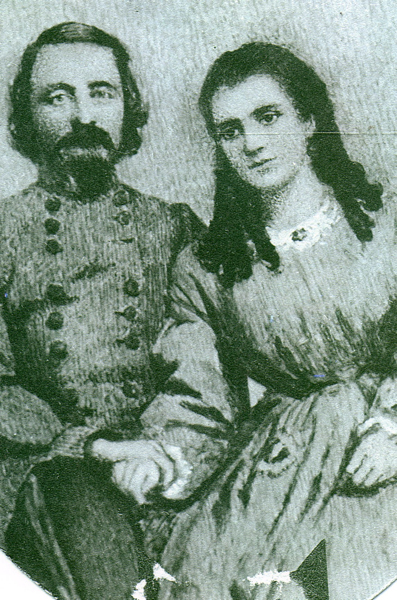
George and La Salle “Sallie” Pickett circa 1865

Pickett married La Salle “Sallie” Corbell in September of 1863, and the marriage would last until his death in 1875. Sallie, impoverished by the death of “her soldier” took up writing as well as speaking tours in both the South and the North. Sallie was a stalwart defender of her husband, who she said had the keenest sense of justice, most sensitive consciousness of right, and the highest moral courage but also opposing hatred, sectionalism and strife. [135] Though much of her work was panned by historians and shunned by established magazines and periodicals; her writing were published by newer popular magazines. Her book The Heart of a Soldier, as Revealed in the Intimate Letters of General George Pickett, C.S.A. was for the most part fabrications authored by her, but she found a niche in newer popular magazines and journals, including Cosmopolitan for which she authored a ten part serial of the Pickett family story on the fiftieth anniversary of the battle. Sallie Pickett’s:

idealized portrait of her husband made him a Confederate hero. He never reached the status of Robert E. Lee or Stonewall Jackson, but his association with the famed but futile charge at Gettysburg helped. Virginia veterans and newspapers began romanticizing Picketts all-Virginia divisions role soon after the battle; it was almost by association that George too would share in this idolization…” [136]

Pickett retained command of his division which was reconstituted after Gettysburg and shipped off to North Carolina where he and it performed adequately but without marked distinction. It performed well in the defensive battles around Richmond and Petersburg. The end came at the battle at Five Forks where Pickett’s grossly under strength division was deployed on the far right of the Confederate line was overwhelmed by a massive assault by Sheridan’s cavalry and the Fifth Corps which destroyed it as a fighting formation. Pickett, who had successfully repulsed an attack by Sheridan the previous day did not expect an attack and was away from his division at a Shad bake with Rooney Lee when the attack came. No cowardice was involved; Pickett simply misjudged the situation by assuming that no attack was imminent, yet it left a bad taste in everyones mouth. [137] Two days later Pickett and two other generals, including Richard Anderson were relieved of their duties and dismissed by Lee. However Pickett remained with his division until the end and at Appomattox Lee was heard to remark in what some believed was a disparaging manner Is that man still with this army? [138]

George Pickett attempted to rebuild his life after the war and the task was not easy for though he applied for amnesty his case was complicated by an incident where he had ordered the execution of about twenty-two former North Carolina militiamen who had defected to the Union and been captured by the Confederates. Federal authorities thought about charging him with war crimes which resulted in Pickett fleeing to Canada. It took the intervention of Pickett’s faithful friend Ulysses S. Grant to have the charges dismissed and for Pickett to be granted amnesty by President Johnson in 1868. Grant admitted that the punishment was harsh, but wrote in his friend’s defense:

But it was in time of war and when the enemy no doubt it necessary to retain, by some power, the services of every man within their reach. Gen. Pickett I know personally to be an honorable man but in this case his judgement [sic] prompted him to do what can not well be sustained though I do not see how good, either to the friends of the deceased or by fixing an example for the future, can be secured by his trial now. [139]

Even so his life was difficult, health difficulties plagued him and employment was scarce, even for a man of Pickett’s stature in Virginia. He refused employment which would take him away from Sallie and his children and finally took a job as an insurance agent in Richmond. It was a job which he felt demeaning, which required that he attempt to sell insurance policies to destitute and out of work Confederate veterans and their families. Sallie wrote that he could not come to terms with a profession that made its profits through what one colleague called gall, gall, old man, gall and grub. [140] Distinctly unhappy the dejected old soldier told her Id sooner face a canon,than to take out a policy with me. [141]

In 1870 he was convinced by John Singleton Mosby to visit Lee when the latter was visiting Richmond as Lee was making a final tour of battlefields and other sites. For Pickett the visit only reinforced his resentment that he felt for Lee, who he felt blamed him for the defeat at Five Forks and had ostracized him. The meeting occurred in Lees room at the Ballard Hotel was icy and lasted only two or three minutes. [142]

Mosby realized quickly that the meeting was not going well and Sensing the unpleasantness of the meeting, Mosby got up in a few moments and Pickett followed him. Once outside the room, Pickett broke out bitterly against that old man who, he said, had my division massacred at Gettysburg. [143] Mosby attempted to assuage his friend’s feelings but Pickett was not mollified by Mosbys rejoinder that it made you immortal. [144]

George Pickett was a romantic as well as a true believer in the cause of the Confederacy. Pickett was vain, and at times self-serving, he certainly as Porter Alexander noted was a better brigade commander than division commander, a position that he desired but never excelled. His temperament at times got the better of him and he was not the equal of many of his fellow division commanders in the Army of Northern Virginia.

That being said it would be hard to prove the charges of cowardice or incompetence that some leveled at him for allegedly not being forward enough during the great charge. The fact that he retained command after the battle indicates that Lee did not believe that he had acted with cowardice, or that Lee questioned the manner in which he led the assault.

Likewise, it is unlikely that such any such action on Pickett’s part to charge further into the maelstrom would have done little more than add yet another name to the list of Confederate general officers killed or wounded at Gettysburg. The question of how Pickett survived without a scratch, when his three brigadiers and all of his field officers but one went down. This could be done by the brief explanation that his escape was miraculous. [145] Edwin Coddington wrote that it would have been better for his reputation if had been called to give his life or if the attack had been known for what it was, Longstreets Second Assault. [146]

Bitter and discouraged at the end of his life he uttered his last words to Sallie’s uncle who had also served in the Army of Northern Virginia Well, Colonel, the enemy is too strong for me againmy ammunition is all out He closed his eyes, and settled back as if at peace for the first time in his life. Sallie never left his side; two hours after his death they gently pried her hands from his. [147]

Pickett’s charge was over, except for the blame, the stories and the legends, especially in the South. The failure of this disastrous tactical assault that bears Pickett’s name placed the final nail in Lee’s operational plan to take the war to the North and defeat the Federal army on its own territory. Lees plan was almost Burnside-like in its simplicity, and it produced a Fredericksburg with the roles reversed. [148] James McPherson made the very succinct observation that Picketts charge represented the Confederate war effort in microcosm: matchless valor, apparent initial success, and ultimate disaster. [149]

That tactical and operational failure had strategic implications for the Confederacy; it ensured the loss of Vicksburg and forced Lee to assume the defensive in the east. Lee and his men would go on to further laurels. But they never again possessed the power and reputation that they carried into Pennsylvania those palmy midsummer days of 1863. [150] The repulse ended the campaign that Lee had hoped would secure the independence of the Confederacy. The Battle of Gettysburg was and it was much more than a military defeat, but a political one as well, for with it went the slightest hope remaining of foreign intervention. As J.F.C. Fuller wrote It began as a political move and it had ended in a political fiasco.[151]

Notes

[1] Clausewitz, Carl von. On War Indexed edition, edited and translated by Michael Howard and Peter Paret, Princeton University Press, Princeton NJ 1976 p.114

[2] Ibid. Clausewitz On War p.108

[3] Dempsey, Martin Mission Command White Paper 3 April 2012 p.5 retrieved ( July 2014 from http://www.dtic.mil/doctrine/concepts/white_papers/cjcs_wp_missioncommand.pdf

[4] ___________. The Armed forces Officer U.S. Department of Defense Publication, Washington DC. January 2006 p.18

[5] Ibid. The Armed Forces Officer p.18

[6] Ibid. Clausewitz On War p.101

[7] Stewart, George R. Pickett’s Charge: A Micro-History of the Final Attack at Gettysburg, July 3rd 1863 Houghton Mifflin Company Boston 1959 p.94

[8] Hess, Earl J. Pickett’s Charge: The Last Attack at Gettysburg University of North Carolina Press, Chapel Hill and London 2001 p. 55

[9] Ibid. Stewart Pickett’s Charge: A Micro-History p.94

[10] Wert, Jeffery D. Gettysburg Day Three A Touchstone Book, New York 2001 p.110

[11] Foote, Shelby, The Civil War, A Narrative. Volume Two Fredericksburg to Meridian Random House, New York 1963 p.548

[12] Ibid. Foote The Civil War, A Narrative. Volume Two p.548

[13] Gottfried, Bradley The Artillery of Gettysburg Cumberland House Publishing, Nashville TN 2008 p.206

[14] Ibid. Gottfried The Artillery of Gettysburg p.193

[15] Longacre, Edward G. Pickett: Leader of the Charge White Mane Publishing Company, Shippensburg PA 1995 p.121

[16] Reardon, Carol The Convergence of History and Myth in the Southern Past: Pickett’s Charge in The Third Day at Gettysburg and Beyond edited by Gallagher, Gary W. University of North Carolina Press, Chapel Hill and London 1994 p.83

[17] Ibid. Wert Gettysburg Day Three p.297

[18] Sears, Stephen W. Gettysburg. Houghton Mifflin Co. Boston and New York 2003 p.387

[19] Ibid. Stewart Picketts Charge: A Micro-History p.39

[20] Ibid. Hess Picketts Charge p.153

[21] Ibid. Wert Gettysburg Day Three p.181

[22] Dowdy, Clifford. Lee and His Men at Gettysburg: The Death of a Nation Skyhorse Publishing, New York 1986, originally published as Death of a Nation Knopf, New York 1958 p.294

[23] Ibid. Wert Gettysburg Day Three p.179

[24] Ibid. Stewart Picketts Charge p.132

[25] Coddington, Edwin B. The Gettysburg Campaign: A Study in Command, A Touchstone Book, Simon and Schuster New York, 1968 p.496

[26] Ibid. Coddington The Gettysburg Campaign p.496

[27] Huntington, Tom Searching for George Gordon Meade: The Forgotten Victor of Gettysburg Stackpole Books, Mechanicsburg PA 2013 p.171

[28] Ibid. Hess Picketts Charge p.163

[29] Ibid. Coddington The Gettysburg Campaign p.499

[30] Trudeau, Noah Andre. Gettysburg: A Testing of Courage, Harper Collins Publishers, New York 2002 p.459

[31] Ibid. Coddington The Gettysburg Campaign p.500

[32] Alexander, Edward Porter Fighting for the Confederacy: The Personal Recollections of General Edward Porter Alexander edited by Gallagher, Gary The University of North Carolina Press, Chapel Hill and London 1989 p.258

[33] Hunt, Henry The Third Day at Gettysburg in Battles and Leaders of the Civil War edited by Bradford, Neil Meridian Press, New York 1989 p.374

[34] Alexander, Edwin Porter. The Great Charge and the Artillery Fighting at Gettysburg, in Battles and Leaders of the Civil War edited by Bradford, Neil Meridian Press, New York 1989 p.364

[35] Ibid. Dowdy Lee and His Men at Gettysburg p.297

[36] Wert, Jeffry D. General James Longstreet: The Confederacy’s Most Controversial Soldier A Touchstone Book, Simon and Schuster, New York and London 1993 p.291

[37] Ibid. Coddington The Gettysburg Campaign p.501

[38] Ibid. Alexander The Great Charge and the Artillery Fighting at Gettysburg p.365

[39] Ibid. Alexander The Great Charge and the Artillery Fighting at Gettysburg p.365

[40] Ibid. Trudeau. Gettysburg: A Testing of Courage pp.474-475

[41] Ibid. Alexander The Great Charge and the Artillery Fighting at Gettysburg p.365

[42] Ibid. Alexander Fighting for the Confederacy p.261

[43] Ibid. Dowdy Lee and His Men at Gettysburg p.313

[44] Ibid. Wert Gettysburg Day Three p.109

[45] Ibid. Dowdy, Lee and His Men at Gettysburg p.264

[46] Ibid. Longacre Pickett p.4

[47] Ibid. Longacre Pickett p.6

[48] See Longacre Pickett pp.6-7. The myth was quite successful and it endures in some accounts of Pickett’s life and in a number of military histories including Larry Tagg’s The Generals of Gettysburg

[49] Waugh, John C. The Class of 1846 from West Point to Appomattox: Stonewall Jackson, George McClellan and their Brothers A Ballantine Book, New York 1994 pp.38-39

[50] Ibid. Longacre Pickett p.7

[51] Ibid. Waugh The Class of 1846 from West Point to Appomattox p.39

[52] Ibid. Longacre Pickett p.12

[53] Guelzo, Allen C. Gettysburg: The Last Invasion Vintage Books a Division of Random House, New York 2013 p.378

[54] Ibid. Guelzo Gettysburg: The Last Invasion p.378

[55] Ibid. Longacre Pickett p.20

[56] Ibid. Hess Picketts Charge p.37

[57] Ibid. Dowdy Lee and His Men at Gettysburg p.264

[58] Ibid. Waugh The Class of 1846 p.457

[59] Ibid. Longacre Pickett p.32

[60] Ibid. Longacre Pickett p.33

[61] Ibid. Longacre Pickett pp.50-51

[62] Ibid. Longacre Pickett p.51

[63] Ibid. Hess Pickett’s Charge p.38

[64] Ibid. Hess Pickett’s Charge p.47

[65] Ibid. Dowdy Lee and his Men at Gettysburg p.296

[66] Freeman, Douglas Southall, Lee an abridgment by Richard Harwell, Touchstone Books, New York 1997 p.338

[67] Freeman, Douglas Southall Lee’s Lieutenants: A Study in Command abridged in one volume by Stephen Sears, Scribner Books, Simon and Schuster, New York 1998 p.594

[68] Ibid. Guelzo, Gettysburg: The Last Invasion p.408

[69] Ibid. Hess Picketts Charge p.166

[70] Ibid. Hess Picketts Charge p.167

[71] Ibid. Hess Picketts Charge p.167

[72] Ibid. Trudeau. Gettysburg: A Testing of Courage p.483

[73] Ibid. Alexander The Great Charge and the Artillery Fighting at Gettysburg p.365

[74] Ibid. Foote The Civil War, A Narrative. Volume Two p.553

[75] Ibid. Guelzo Gettysburg: The Last Invasion p.407

[76] Ibid. Hess Picketts Charge p.193

[77] Ibid. Hess Picketts Charge p.193

[78] Ibid. Guelzo Gettysburg: The Last Invasion p.411

[79] Ibid. Sears Gettysburg p.422

[80] Catton, Bruce The Army of the Potomac: Glory Road Doubleday and Company, Garden City New York, 1952 p.318

[81] Ibid. Sears Gettysburg p.423

[82] Ibid. Stewart Pickett’s Charge: A Micro-History of the Final Attack at Gettysburg pp.193-194

[83] Ibid. Hess Pickett’s Charge p.187

[84] Ibid. Stewart Pickett’s Charge: A Micro-History of the Final Attack at Gettysburg p.193

[85] Ibid. Dowdy Lee and His Men at Gettysburg p.311

[86] Ibid. Trudeau. Gettysburg: A Testing of Courage p.494

[87] Ibid. Sears Gettysburg p.425

[88] Ibid. Trudeau. Gettysburg: A Testing of Courage p.494

[89] Ibid. Trudeau. Gettysburg: A Testing of Courage p.502

[90] Ibid. Wert Gettysburg Day Three p.216

[91] Ibid. Catton The Army of the Potomac: Glory Road p.318

[92] Ibid. Trudeau. Gettysburg: A Testing of Courage p.504

[93] Ibid. Stewart Pickett’s Charge: A Micro-History of the Final Attack at Gettysburg pp.238-239

[94] Ibid. Trudeau. Gettysburg: A Testing of Courage p.504

[95] Ibid. Guelzo Gettysburg: The Last Invasion p.425

[96] Ibid. Foote The Civil War, A Narrative. Volume Two p.555

[97] Ibid. Coddington The Gettysburg Campaign p.503

[98] Ibid. Coddington The Gettysburg Campaign p.505

[99] Ibid. Coddington The Gettysburg Campaign p.505

[100] Ibid. Gottfried The Artillery of Gettysburg p.217

[101] Ibid. Hess Pickett’s Charge p.220

[102] Ibid. Coddington The Gettysburg Campaign p.515

[103] Ibid. Coddington The Gettysburg Campaign p.515

[104] Ibid. Trudeau. Gettysburg: A Testing of Courage p.502

[105] Ibid. Sears Gettysburg p.448

[106] Ibid. Gottfried The Artillery of Gettysburg p.200

[107] Ibid. Gottfried The Artillery of Gettysburg p.221

[108] Ibid. Gottfried The Artillery of Gettysburg p.208

[109] Ibid. Wert Gettysburg Day Three p.211

[110] Ibid. Gottfried The Artillery of Gettysburg p.221

[111] Ibid. Trudeau. Gettysburg: A Testing of Courage p.505

[112] Ibid. Foote The Civil War, A Narrative. Volume Two p.562

[113] Ibid. Hess Pickett’s Charge p.262

[114] Ibid. Catton The Army of the Potomac: Glory Road p.319

[115] Ibid. Dowdy Lee and His Men at Gettysburg p.317

[116] Ibid. Trudeau Gettysburg p.508

[117] Ibid. Sears Gettysburg p.451

[118] Ibid. Coddington The Gettysburg Campaign p.528

[119] Ibid. Coddington The Gettysburg Campaign p.528

[120] Fremantle, Arthur Three Months in the Southern States, April- June 1863 William Blackwood and Sons, Edinburgh and London 1863 Amazon Kindle edition p.285

[121] Ibid. Wert General James Longstreet The Confederacy’s Most Controversial Soldier p.292

[122] Ibid. Fremantle Three Months in the Southern States p.287

[123] Ibid. Sears Gettysburg p.456

[124] Ibid. Hess Pickett’s Charge p.326

[125] Ibid. Guelzo Gettysburg: The Last Invasion p.428

[126] Ibid. Guelzo Gettysburg: The Last Invasion p.428

[127] Ibid. Hess Pickett’s Charge p.326

[128] Ibid Guelzo Gettysburg: The Last Invasion p.428

[129] ibid. Guelzo Gettysburg: The Last Invasion pp.428-429

[130] Ibid. Hess Pickett’s Charge p.325

[131] Ibid. Guelzo Gettysburg: The Last Invasion p.429

[132] Ibid. Sears Gettysburg p.456

[133] Ibid. Waugh The Class of 1846 p.489

[134] Ibid. Hess Pickett’s Charge p.354

[135] Ibid. Reardon The Convergence of History and Myth in the Southern Past: Pickett’s Charge p.76

[136] Gordon, Lesley J. “Let the People See the Old Life as it Was” La Salle Corbell Pickett and the Myth of the Lost Cause in The Myth of the Lost Cause and Civil War History edited by Gallagher, Gary W. and Nolan, Alan T. Indiana University Press, Bloomington and Indianapolis 2000 p.170

[137] Ibid. Hess Pickett’s Charge p.375

[138] Ibid. Hess Pickett’s Charge p.375

[139] Ibid. Longacre Pickett p.175

[140] Ibid. Longacre Pickett p.178

[141] Ibid. Longacre Pickett p.178

[142] Ibid. Hess Pickett’s Charge p.377

[143] Ibid. Freeman Lee p.569

[144] Ibid. Waugh The Class of 1846 p.529

[145] Ibid. Stewart Pickett’s Charge: A Micro-History p.287

[146] Ibid. Coddington The Gettysburg Campaign p.528

[147] Ibid. Longacre Pickett p.180

[148] Millet, Allan R. and Maslowski, Peter, For the Common Defense: A Military History of the United States The Free Press a Division of Macmillan Inc. New York, 1984 p.206

[149] McPherson, James The Battle Cry of Freedom: The Civil War Era Oxford University Press, Oxford and New York 1988 p.662

[150] Ibid. McPherson The Battle Cry of Freedom p.665

[151] Fuller, J.F.C. Grant and Lee: A Study in Personality and Generalship, Indiana University Press, Bloomington IN 1957 pp.200-201

Leave a comment

Filed under civil war, History, leadership, Military

The Troubled Hero of Little Round Top: G.K. Warren and Combat Trauma

Friends of Padre Steve’s World,

Here is the newest revision to my Gettysburg text which focuses on General Gouvernor K Warren. It is rather lengthy, but in addition to dealing with the battle it deals with issues that are still very real to those who have served in combat. PTSD, combat stress disorders, Moral Injury and the effect of trauma and war on the character of people, as well as the injustice that some receive at the hands of leaders of the institutions that they serve. War leaves no one unchanged. I do hope that you enjoy.

Peace

Padre Steve+

warren2

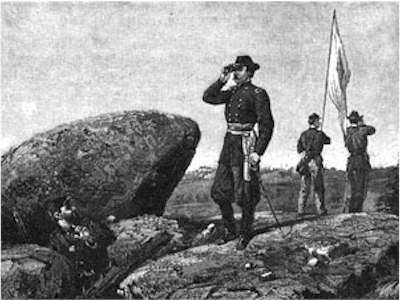
Brigadier General Gouverneur K. Warren

History, Memory and Myth at Little Round Top

The battle of Gettysburg is an iconic part of American history. The accounts of Buford’s delaying action and John Reynolds death on July 1st, the savage battle at the Wheat Field, the Peach Orchard and Plum Run on July 2nd and the great charge known as Pickett’s Charge on July 3rd 1863 all draw us to the battlefield. The stories of individual courage and the sacrifice of soldiers from the North and the South that are enshrined on the monuments that now populate the battlefield have a nearly religious quality that draws Americans to Gettysburg by the hundreds of thousands every year.

But there are some places on the battlefield that seem to be the most iconic, the most spiritual, and the most inspirational for various reasons. Two of these places in particular have a nearly magnetic attraction, the “High Water Mark” of the Confederacy on Cemetery Ridge where Pickett’s Charge met its end, and the rocky hill known as Little Round Top. A large part of the reason that these two places hold such an attraction is not just the way that the battle was fought. Rather, it is often because of the way the stories of those actions and the stories of the men who fought at them have been passed down to us in the accounts of survivors, in history and even in the fictional accounts of the battle. In each of these stories there are elements of courage, devotion, sacrifice, and tragedy that touch us in deeply personal ways and connect us to them and what we see when we experience history tells us as much about us as it does them.

The story of the Battle for Little Round Top has been passed along to us in the many accounts and histories of the battle, but perhaps more importantly in literature and cinema through Michael Shaara’s Pulitzer Prize winning novel, The Killer Angels and that book’s film adaptation, Gettysburg. Many people who have never read an actual history of the battle know about the Battle for Little Round Top from Jeff Daniels’ inspirational portrayal of Joshua Lawrence Chamberlain in the movie.

The mythic status that we accord Gettysburg is important to Americans as a people. It is a defining moment in our American story and that is why so many of us come to the battlefield. It is a part of who and what we are as a people. Chamberlain said this well a quarter century after the battle at the dedication of the Maine Monuments in 1888:

“In great deeds, something abides. On great fields, something stays. Forms change and pass; bodies disappear; but spirits linger, to consecrate ground for the vision-place of souls… generations that know us not and that we know not of, heart-drawn to see where and by whom great things were suffered and done for them, shall come to this deathless field, to ponder and dream; and lo! the shadow of a mighty presence shall wrap them in its bosom, and the power of the vision pass into their souls.” [1]

While the accounts in the novel and the film are certainly inspiring and allow us to experience the emotion and near spiritual sense of what Chamberlain writes about the battle, there is much more to learn. When we go beyond the mythic portrayal of the battle we find that despite the vast amount of information available that there are a large number of approximations and ambiguities in the accounts of the battle. So as we endeavor to look at the actions of these leaders on that fateful day it is important to recognize that it is impossible for us to totally separate the actions of the men that helped decide the battle from the mythos that surrounds the story. [2] Likewise, it isimportant for us to acknowledge, that we cannot completely separate the character of these men and how they lived their lives from their actions on this particular battlefield and afterwards.

That understanding is important if we want to be able to interpret these men and their actions; actions that are recorded in their journals, after action reports, unit histories, individual diaries and letters, as well as the accounts of their contemporaries who served alongside them; accounts which for many reasons are not completely reliable.

As important as these accounts are for us in attempting to sort out the truth of the matter we must apply a hermeneutic of suspicion to them and we must interpret them. [3] We have to do this because all historical accounts are influenced by the writer’s motivations, ideology or perspective. There are some authors who omit damning or damaging information, especially about their own actions, or the actions of those leaders that they wish to protect, and the writers that “spin” the event in order to build up or destroy the reputations of those present. Even those writers of the contemporary accounts of the battle who wrote their accounts with the best motivations and intentions to record the events as best as they could describe them were often prone to mistakes, even in details such as the time an event took place. The location of people during the event was limited by their physical position on the battlefield and what they could see amid the bullets and bombshells that created carnage around their point of observation. Those not present at the battle, the men who recorded their accounts based on the recollections of those present are similarly limited.

There is also another factor to consider in dealing with these accounts, especially when untrained observers make observations of the actions and behavior of others which seem strange or erratic to them. This is especially true of men who are writing about men who have experienced the horrors of war and combat which might have resulted in some sort of combat stress injury such as PTSD, brain injuries such as TBI or a concussive syndrome or experience which is now called Moral Injury. Thus when we examine the behavior of such leaders and see a marked change in the way that they deal with others after their experience of war, those conditions, unknown to their contemporaries must be considered as a possibility when evaluating their actions.

The problem for the historian or for that matter the writer of military doctrine is how to interpret the information that they have available to them to make it relevant and useful in the art that they practice. This can be a daunting task with many associated pitfalls that is neither an inductive, nor a deductive process. David Hackett Fischer writes:

“The logic of historical thought is not a formal logic of deductive inference. It is not a symmetrical structure of Aristotelian syllogisms, or Ramean dialectics, or Boolean equations….Instead it is a process of adductive reasoning in the simple sense of adducing answers to specific questions, so that a specific “fit” is obtained. The answers may be general or particular, as circumstances may require. History is, in a sense a problem-solving discipline. A historian is someone (anyone) who asks an open ended question about past events and answers it with selected facts which are arranged in the form of an explanatory paradigm.” [4]

All this is important because it reminds us, that when we study these accounts and attempt to use them as a basis for leadership theories, operation art and strategy, or for any other reason, that all that we know to be “true” is a combination of fact, myth and spin. Our task is to do the best we can with that in mind while admitting that we all have our own prejudices, agendas and ideas that color the glasses by which we interpret the event and the actions of the people involved.

In a sense when we look at the records of the people present or their contemporaries we must entertain a fair amount of suspicion and be able to ask questions as if the writers were talking or writing to us presently. We must ask three questions to do this: Why are they telling this fact or story? Why are they telling it to me? Why are they telling it now? Or more succinctly put “Why this? Why me? Why now?”

Gouverneur Warren: A Complex Character

It is in this context that we examine Brigadier General Gouverneur Warren’s actions on Little Round Top on the afternoon and evening of July 2nd 1863, the controversy that embroiled his career and left him embittered and disillusioned at the end of the war; and even the possible explanations for what occurs to Warren during and after the war provided by modern medicine and psychological knowledge. We must do this because Warren is one of the most important people who step into history that day and because he is such a contradictory figure, to try to understand him and in doing so attempt to understand ourselves more fully.

At the time of the Battle of Gettysburg, Brigadier General Gouverneur Warren was serving as the Chief Topographical Engineer of the Army of the Potomac, a position that he had been appointed to by Joseph Hooker prior to Chancellorsville. At Chancellorsville Warren took command of the Pioneer brigade and “was responsible for the spectacular display of improvised field fortification during Hooker’s withdraw from Chancellorsville.” [5]

Unlike some of the other characters on Little Round Top that day, particularly Joshua Chamberlain, Warren does not engender myth; in fact some historians almost go out of their way to besmirch him, Joseph Whelan described Warren as “a fussy man who liked limericks, decidedly lacked gravitas.” [6] The description Warren being a “fussy man” who “lacked gravitas” is decidedly unfair for it immediately paints Warren in the mind of the reader as a man lacking in courage or fortitude and it distorts history. As I mentioned earlier when examining the evidence we have to carefully sift through it and not assume that any one characterization of a person is correct.

Whelan’s description of Warren is decidedly prejudicial. Warren was actually a complex and often contradictory figure as many military leaders throughout history have been. Though heroic, he did not look like a hero, and though an intensely proud man did not seek to bolster his image in the media, during or after the war. Warren’s most recent biographer, David Jordan wrote that Warren was “prone to long sieges of depression, and he himself agreed that others found him to be morose and unsmiling. A complex and enigmatic man, Gouverneur Kemble Warren is not one to be easily categorized.” [7] His peers seemed to either admire or loathe him for he could be openly critical of others and had arrogance about him, which put some people off. Likewise Warren was often openly disdainful of those that he regarded as his inferiors, which at times included some of his superior officers, a trait that worked against him in the “hierarchical realm of military life.” [8]

Though Warren was considered the “savior of Little Round Top” in the years immediately following the war; his story faded. In part this was due to being relieved of command of Fifth Corps by Philip Sheridan at Five Forks, something that Chamberlain and many other officers and men of V Corps “considered an unjust act made cruel by his [Sheridan’s] refusal to reconsider it.” [9] His story also faded because he resigned his commission as a Major General of Volunteers soon after the war, and returned to relative obscurity working as an Engineer officer along the Mississippi River.

After Warren’s untimely death at the age of fifty-three in 1882, three months before he exonerated by the Board of Inquiry, he was forgotten by many. Likewise, the book he had prepared from his carefully arranged letters and reports was not published until 1932, forty years after his death.

Conversely, the story and myth of his friend and defender Joshua Chamberlain story grew throughout the late 1890s and early 1900s. By then, Chamberlain, a superb writer and orator, alone of the men who made the stand at Little Round Top was still alive to tell his story, and this considerably shaped the history that we know. The rise of the Chamberlain account is one reason why Warren is so often overlooked by many casual students and observers of the Battle of Gettysburg.

But to look at Warren’s actions is by no means to minimize the actions of others such as Colonel Strong Vincent, Colonel Joshua Lawrence Chamberlain, Brigadier General Stephen Weed, Colonel James Rice, or Colonel Patrick “Paddy” O’Rorke. All of these men played an instrumental part in the battle for Little Round Top, but only Warren, Chamberlain and Rice survived the battle, and Rice was killed in action at the Battle of Spotsylvania on May 10th 1864.

Ante-Bellum Staff Officers, Military Culture and an Expanding Army

For the purposes of this study it is important to note that Warren was not acting as a commander during the Battle of Gettysburg. Warren was, like most senior officers today, serving as a staff officer. Many times students of military history and theory are inclined to dismiss the contributions of staff officers because they do not have the overall responsibility of a battle, or the glamour of the limelight of the commanders that they serve under. However, for military professionals, especially those serving on senior staffs who prepare campaign plans, contingency plans and crisis plans the study of officers like Warren is essential.

The Federal Army at Gettysburg, like its Confederate opponent had a wide variety of officers serving in its ranks. Many of its senior officers were graduates of West Point. Many had served together in Mexico and in the various campaigns against Native American tribes. Those who stayed in the Army during the long “peace” between the Mexican War and the outbreak of the Civil War endured the monotony, boredom and often miserable conditions of isolated army posts, long family separations, as well as low pay, slow promotion and often low social status.[10] In light of such conditions, many resigned their commissions to undertake various professional, business or academic pursuits; in fact Samuel Huntington noted that in the years before the Civil War that “West Point produced more railroad presidents than generals.” [11] However, on the outbreak of the war, many of these graduates returned to service whether in the service of the Union, or the Confederate States.

When the war began the Army underwent a massive expansion, which it met through the call of up militia and by raising new volunteer units from the various states. In the expansion many officers were appointed who had no prior military service, or if they did it was performed years or even decades before the war. Some of these men were simply patriots who rallied to the flag, others due to a sense of righteousness about their cause, while others were political opportunists or appointees. In the north this was a particular problem as “professional officers were pushed aside and passed over in the Union, the higher commissions going, in the first stages of the war at least to officers called back into service or directly appointed from civilian life, many of them “political” appointees.” [12] At times the lack of experience, training and sometimes the poor character of some of the volunteers and political appointees was tragic. However, many of these men in both Union and Confederate service performed as well or better than some of their regular army counterparts at various levels of command. Gettysburg would provide opportunity for the best and worst of all of these types of officers to succeed or fail. In this chapter we will look at how Warren succeeded remarkably at Little Round Top.

Explorer, Engineer and Instructor: The Preparation of a Staff Officer

As the Union mobilized a good number of Regular Army officers were allowed to assist the states in the formation and training of the new volunteer units. One of these officers was First Lieutenant Gouverneur Warren.

Warren was typical of the many professional officers of the old army. An 1850 graduate of West Point Warren was a bright student who had absorbed the teachings of his professor, Dennis Hart Mahan as the core of his own military thought, both in his senior year in college and through reinforcement as a faculty member. [13] Warren was commissioned as a Brevet Second Lieutenant and because of his high standing in his class was assigned to Corps of Topographical Engineers. He spent his first seven years in a number of assignments which took him throughout much of the country. Warren did not look the part of a hero. Short and willowy, he appeared no more substantial in body than a young boy, or as some remarked, a young woman; his uniforms tended to hang off him as if they were several sizes too big. [14]

Warren’s work involved exploring and mapping for various enterprises including the project to help tame the Mississippi River, and the exploration of the Great Plains and Black Hills where he developed a sympathy for the various Sioux tribes he encountered noting on completion of his mission in 1858, writing that He had never heard a Sioux chief express an opinion in regard to what was due them in which I do not concur and that many of them view the extinction of their race as an inevitable result of the operation of present causes, and do so with all the feelings of despair with which we should contemplate the extinction of our nationality. [15] Following his years in the west he returned as faculty to West Point where he as an Assistant Professor, shared mathematics instructional duties with Oliver O. Howard and resumed his relationship with his former professor Mahan. [16]

red_devils_lg

Commander of the Red Devils: The Peninsula, Gaines Mill and Second Manassas

On the outbreak of war Warren was granted leave from his duties at West Point to serve as Lieutenant Colonel of Volunteers in the 5th New York Infantry Regiment, also known as the Duryee Zouaves. When Abraham Duryee was appointed as a Brigadier General, Warren became the Colonel of the regiment.

He commanded the regiment during the Peninsula campaign where he was eventually given command of a provisional infantry brigade. At Gaines Mill, Warren’s regiment and brigade distinguished itself. Along George Sykes front no troops fought better than the small brigade of two volunteer regiments, the 5th and 10th New York, under Warren’s command. On the afternoon of the battle Warren led the 5th New York in a riveting counter attack.The Red Devils smashed into the 1st South Carolina Rifles and drive them back. The Zouaves were, declared a Regular, the peers of any troops on the hard fought field. Captain John W. Ames of the 11th United States told his parents that the counterattack of the New Yorkers haunted his sleep. Every night, he wrote home a week later, he saw a Zouave, with his arms around a comrade, who was fairly a dead man, walking with his friends support. Ames admitted, the horrors of sudden, accidental, bloody death are here so much augmented and multiplied. [17]

Warren described the action to his wife Nothing you ever saw in the pictures of battles excelled it. The artillery which had been firing stopped on both sides, and the whole armies were now spectators. In less than five minutes 140 of my men were killed or wounded and the other regiment completely destroyed. [18] Warren and his men received many accolades that day. George McClellan credited them with saving the Union left and said that Warren was everywhere conspicuous on the field, and not only directed the movement of his own brigade, which he handled with consummate skill, and placed in the most advantageous of positions, where they could produce the most effect on the enemy, but directed the movement of other regiments. [19] and during the action Warren suffered a slight wound from a spent bullet and had his horse shot out from under him.

Warren’s tiny provisional brigade composed of his 5th New York and the 10th New York was at Second Manassas where they had the bad fortune to be on the exposed Federal flank when Longstreet’s massive attack rolled over them. Warren and his brigade were left to protect the Fifth Corps artillery and trains when that corps was ordered by John Pope to attack Jackson’s corps, and John Reynolds’ division was ordered to withdraw leaving the Fifth Corps’ flank uncovered. On his own initiative Warren moved his brigade to protect the flank when Longstreet’s massive blow hit. Alone the two regiments, numbering about 1100 soldiers were overwhelmed in what one soldier called the very vortex of hell. [20] Robert E. Lee had drawn Pope into a trap and was poised to destroy his army. Longstreet’s corps led by Hood’s Texas brigade struck Warren’s troops and the 10th New York fell back as Warren and the 5th New York hung on long enough for artillery to limber up and withdraw, but they too were forced back with heavy losses. The 10th New York lost 133 killed and wounded, the 5th New York over 300 more. Warren wrote Braver men than those who fought and fell that daycould not be found. It was impossible to do more. A member of Fifth Corps wrote that Warrens regiment and brigade, commanded by him, sustained heavier losses than any command on that disastrous field. [21] However, Warren’s gallantry was rewarded with promotion to Brigadier General effective September 26th 1862.

Though present at Antietam and Fredericksburg Warren’s brigade was not committed to either fight. However, Warren was in a position to see the disastrous attacks of Union troops against enemy troops in strong defensive positions. As an engineer Warren recognized the advantages that now were afforded to the defense with the advent of the rifled musket, something that would influence many of his decisions as well as his questioning of Meade, Grant and Sheridan for tactical decisions to attack in situations where he viewed such actions to be either unwise or suicidal. Warren was affected by what he had seen, both in the human cost of the war as well as the politics that had engulfed the army. He wrote his wife Emily on Christmas Day:

I today feel very desponding about our government and the management of affairs.I left my home without ambition to save a noble cause. I have seen that cause almost betrayed- I know of bleeding hearts, desolate homes, and unnumbered nameless graves of noble men who have vainly perished. There must be a just God[.] Why does he permit these things…” [22]

Chief Engineer of the Army of the Potomac and Savior of Little Round Top

In January 1863 Warren was pulled from his brigade duties by Hooker who employed him with good effect to assist his engineering staff, first with mapping and then building the fortifications that stopped the ferocious Confederate storm on the second day of battle. [23] In less than 48 hours Warren’s troops threw up five miles of the most formidable entrenchments yet constructed under battlefield conditions. [24] Edward Alexander, Longstreet’s artillery officer noted that when the Confederates came upon the fortifications after Hooker’s withdraw that “they were amazed at the strength and completeness of the enemys fortifications. [25] Following the battle Warren was appointed as Chief Engineer of the Army of the Potomac on May 12th 1863 by Hooker. When Hooker was relieved of command and was replaced by Meade on June 28th 1863, he was kept in that position by his fellow engineer George Gordon Meade.

Warren and Major General Winfield Scott Hancock arrived at Cemetery Hill on the night of July 1st 1863. He surveyed the ground with Hancock and they concurred that “it would be the best place for the army to fight on if the army was attacked.” [26] As George Gordon Meade organized the defenses of his army at Gettysburg, he not only depended on Warren’s advice about the ground, but consulted him constantly at headquarters or sent him off on matters of highest importance. [27] Meade respected Warren and had offered Warren the chance to serve as his Chief of Staff, a position that Warren, like Seth Williams, the Adjutant General declined that offer indicating that he had too much work in their departments to take on the burdens of a new job. [28]

Meade’s opponent, Robert E. Lee, who knew Warren before the war appreciated Warren’s calm, absorbed, and earnest manner, his professional skill and sound judgment. [29] These qualities would serve both men and the army well on July 2nd 1863.

When Sickles moved III Corps forward during the afternoon without permission of Meade, the result was that his Corps was deployed in a vulnerable salient at the Peach Orchard. This left the southern flank of the army in the air and the Round Tops undefended. Meade was aghast and set about to attempt to rectify the situation. Warren was with Meade and based on the reconnaissance that he conducted the previous day and that morning knew the position better than anyone. He recognized that something was badly awry on Sickles Third Corps front matters there were not all straight. [30] He had sent an officer to discover to investigate Sickles’ front and that officer reported that the section of Cemetery Ridge assigned to III Corps was not occupied. [31]

Meade and Warren discussed the situation and realized that III Corps “could hardly be said to be in position” [32] and knowing VI Corps was now close at hand order V Corps, at the time his only reserve into the position vacated by Sickles. They went forward and seeing the empty spaces Warren told Meade “here is where our line should be” to which Meade replied: “It’s too late now.” [33] Warren, whose familiarity with the whole of the battlefield gave him concern about Sickles’ corps dispositions suggest that Meade send him to the Federal left, “to examine the condition of affairs.” [34]

Meade concurred with his Warren and in dispatching him he also gave Warren the authority to take charge as needed saying “I wish you would ride over there and if anything serious is going on, attend to it.” [35] Again Meade’s choice of Warren for the task demonstrated the trust that is essential in command. The two officers worked together seamlessly and as Coddington described their relationship that day: “Meade chose him to act as his alter ego in crucial moments of the battle, and Warren rendered services for which Meade and the country were to be eternally grateful.” [36] Warren would not see Meade again that day “until the attack had spent its force.” [37]

warren lrt

Warren and the Signal Station on Little Round Top

Hunt noted that “The duty could not have been in better hands.” [38] When Warren arrived on Little Round Top he found it unoccupied save for a few signal corps soldiers. Warren immediately recognized the tactical value of Little Round Top and noted that it was “the key of the whole position.” [39] Warren saw that the Confederates were massing not more than a mile away and that there were no troops on the hill to stop them. He believed that an area “of woods on the near side of the Emmitsburg Road as “an excellent place for the enemy to form out of sight” [40] which was exactly what Major General John Bell Hood’s division was doing, as Henry Hunt noted “The enemy at the time lay concealed, awaiting signal for the assault…” [41] To test his suspicions Warren sent a messenger to Captain James Smith’s 4th New York artillery battery on Devil’s Den to fire a single shot into the woods. Warren described the situation:

“As the shot went whistling through the air the sound of it reached the enemy’s troops and caused every one to look in the direction of it. This motion revealed to me the glistening gun-barrels and bayonets of the enemy’s line of battle, already formed and far outflanking the position of any of our troops; so that the line of his advance from the right to Little Round Top was unopposed. I have been particular in telling this, as the discovery was intensely thrilling to my feelings, and almost appalling.” [42]

Upon confirming his fears Warren resorted to ruse and action. He order the “signalmen to keep up their wigwag activity, simply as a pretense of alertness, whether they had any real signals to transmit or not…” [43] He also sent messengers to Meade, Sickles and Sykes, the commander of V Corps asking Meade to “Send at least a division to me” [44] instructing the messenger, Lieutenant Randall Mackenzie to tell Meade “that we would at once have to occupy that place very strongly.” [45] Sickles refused on account of how badly stretched his lines were, however George Sykes of V Corps responded sending Captain William Jay to find Barnes commander of his 1st Division. As he waited Warren stood atop a “flat rock on the summit of Little Round Top, eyes fixed to his field glasses…he spent several nervous minutes wondering if his urgent appeals for help would be answered or ignored.” [46]

The messenger could not find Barnes, but instead came across the commander of the division’s 3rd Brigade, Colonel Strong Vincent. Vincent knew that Barnes was self-medicating his “pre-battle anxieties out of a black commissary quart bottle” and was already “hollow from skull to boots” and demanded “What are your orders? Give me your orders.” [47] Upon learning that Sykes wanted a brigade to proceed to Little Round Top Vincent responded immediately to take the initiative and ordered his four regiments up Little Round Top without waiting for permission. Vincent told Sykes messenger “I will take the responsibility myself of taking my brigade there.” [48]

Meade’s choice of Warren for the task was confirmed by how Warren continued to act with alacrity and decisiveness throughout the afternoon. “As the Union line began to crumble on Little Round Top, Warren, vested with the authority of Meade’s chief representative, emerged as the right man at the right place at the right time.” [49] Warren did not stop with sending messengers, but seeing the danger building he noted that the northwest face of the hill was still unoccupied and open to attack. Warren forgot “all about a general’s dignity” he “sprinted down the east slope of the hill like a rabbit.” [50]


little round top map

Battle for Little Round Top

There Warren found Brigadier General Stephen Weed’s brigade which he had previously commanded. The troops of the brigade, “seeing their former commander, started cheering, but Warren had no time or accolades.” [51] Warren did not see Weed, but instead he found Colonel Patrick O’Rorke of the 140th New York, who had been one of his students at West Point, and ordered him to follow him up the hill, saying “Paddy…give me a regiment.” [52]

When O’Rorke told Warren that Weed expected him to be following him Warren took the responsibility telling O’Rorke “Bring them up on the double quick, and don’t stop for aligning. I’ll take responsibility.” [53] O’Rorke followed with his gallant regiment with the rest of the brigade under Weed following them. The 140th New York entered the battle to the right of the Vincent’s 16th Michigan which was being swarmed by the 4th and 5th Texas and 4th Alabama, who thought that victory was at hand, slamming the Texans and Alabamians and “at once the Confederate assault began to dissolve” [54]

Warren’s actions were fortuitous as the 140th New York and Lieutenant Charles Hazlett’s battery of the 5th Artillery arrived at the crest just in time to repulse the advancing Confederates, as the battery struggled to get into position Warren “took hold of one of the guns and labored with the gun crew to get the piece over the rocks and up the steep wooded hillside.” [55] The battery went into action immediately and soon drew concentrated enemy fire and “Warren narrowly escaped serious injury when a bullet nicked his throat.” [56]

In the ensuing fight the brigade would take fearful casualties. By the end of the day Weed, O’Rorke and Hazlett would all be dead, but together with Vincent’s brigade they held on and saved the Union line.[57]

Warren continued to urge on the Federal troops despite being wounded, in the words of a reporter who observed him in “a most gallant and heroic manner, riding with utmost confidence over fields swept by the enemy’s fire, seemingly everywhere present, directing, aiding, and cheering the troops.” [58] Once he was assured that Little Round Top was secure he proceeded to rejoin Meade “near the center of the battlefield where another crisis was at hand.” [59]

After Gettysburg Warren was proud of his accomplishments but did not boast of them. He wrote to his in his journal: “There was no merit in my actions except to secure for our army a position if I could, which would prevent our lines from being flanked and this when attacked was given an opportunity for a fair fight to front, and there our opponents did not win.” [60] However his comments belied his accomplishments on Little Round Top that day “for he alone was responsible for recognizing the crisis there, for Vincent’s brigade being sent up the hill, and for commandeering the 140th New York and the rest of Weed’s brigade as reinforcements.” [61]

Corps Command in Virginia and the Evidence of Combat Stress

Warren was promoted to be the acting commander of II Corps after Gettysburg as Hancock had been wounded and then was appointed to command V Corps. He served well as a Corps commander, although his often “quick and sulphurous temper which he displayed in the Virginia campaign of 1864 worked against Warren by making him unnecessary enemies and dismaying his friends.” [62] Warren was so short tempered during the campaign, probably, due to the result of the strain of it that Colonel Charles Wainwright complained that Warren “had a screw loose and is not quite accountable for all his freaks.” [63] In high command Warren’s “fellow officers respected his ability as an engineer, but disliked his arrogance and insolence. Warren’s temper was legendary, and when his anger boiled over he sputtered out profanities that, said one colleague, “made my hair stand on end.” [64] To be fair to Warren that last outburst followed the disaster inflicted by Grant on the army at Cold Harbor, when Grant threw it up against strongly entrenched Confederate troops with great loss. Warren who could not abide meaningless slaughter found it reprehensible.

The interesting thing about all the accounts of Warren’s temper being so violent is that they do not begin until after he is in Corps command, and he gives no hint of such anger and rage in his letters until after his experiences on the Peninsula, Second Manassas, Antietam, Fredericksburg and finally Gettysburg. During the Army of the Potomac’s inaction during the fall of 1863 it became clear that the war was taking a toll on Warren. Alcohol became a problem, so much that once after drinking a whisky punch with his staff he was “falling down drunk” and had to be told of his actions the following night by one of his staff members. [65]

His letters to Emily display a sense of depression and sometimes even despair. He wrote Emily:

“I repine a great deal. I begin to feel myself giving out in spirit. I need so to rest where I could be contented. So long now my life has been one continued worry or excitement that I am losing my elasticity and I am getting almost afraid for I am apprehensive that I cannot uphold my position…. Every day shows me more and more how this war is severing my old affiliations and making me lonely…here I sit all alone in this great camp (for so I feel) and the memory of my dear friends comes over me and I am morbidly depressed. Indeed I feel I am a very small man that I can endure no more, for I am well and not a prisoner…and have been honored more than I deserve. I have not the heart of a good soldier.” [66]

Since so many people that knew Warren after Gettysburg describe the fearsome and nearly volcanic nature of his temper we can accept that as a fact. Likewise his arrogant, insolent and even haughty attitude towards those that he believed himself to be intellectually superior is evident even during his early career as are his recurrent struggles with depression which only grew worse throughout the war and in following years.

Dr. Judith Herman, an associate Professor of Psychiatry at Harvard Medical School wrote:

“Traumatic events call into question basic human relationships. They breach the basic attachments of family, friendship, love and community. They shatter the construction of the self that is formed and sustained in relation to others. They undermine the belief systems that give meaning to human experience. They violate the victim’s faith in a natural or divine order and cast the victim into a state of existential crisis.” [67]

But it is only after the continued trauma that Warren experienced at Malvern Hill, Second Manassas, Antietam and Fredericksburg that we see the evidence of Warren’s anger, bitterness and rage becoming a major factor in his life and relationships. If we are to take into account the findings of modern science, medicine and psychiatry in relationship to the descriptions provided by Warren and those that knew him, we have to at least give serious consideration to the real possibility that Warren’s issues were caused by his experience of war and some type of resultant combat stress injury. This could include PTSD, Moral Injury, or possibly even changes brought about by a traumatic brain or concussive injury.

Jonathan Shay, a psychologist with many years of experience in dealing with veterans afflicted with PTSD wrote that “The social conditions that cause complex PTSD – persistent betrayal and rupture of community in mortal stakes situations of captivity – destroy thumos, destroy normal narcissism and undo character.” [68]

Dave Grossman writes about how such events can become what we now call “Character disorders”:

Character disorders include obsessional traits in which the soldier becomes fixated on certain actions or things; paranoid trends accompanied by irascibility, depression, anxiety, often taking on the tone of threats to his safety; schizoid trends leading to hypersensitivity and isolation; epileptoid character reactions accompanied by periodic rages…..What has happened to the soldier is an altering of his fundamental personality.” [69]

Shay writes about what happens to character when it is damaged by war, and the spectrum of clinical manifestations of an injury to character seen in many combat veterans. Among the manifestation that Shay describes, a good number which are present in what we know about Warren. These include: Demoralization, self-loathing, a sense of worthlessness, pervasive “raw” vulnerability and feeling conspicuous, social withdraw irritability, rage at small slights, disappointments and lapses, coercive attempts to establish power dominance. [70]

Warren’s repeated writings about his isolation; depression and despair to Emily are powerful. He writes Emily in words that he shares with no one else. In those letters he conveys the depth of his injury, an injury that has shaken his faith in himself, his leaders and brought about an existential crisis. It is an injury that with a man like Ulysses S. Grant in command that he could not voice to anyone in the army for fear of what we would now call the stigma of PTSD that is experienced by so many combat veterans. Instead it comes out in a drive to ensure that his soldiers are not sacrificed in senseless battles, a sense of his own unworthiness, and a sense that he has been shunted aside, even betrayed by those commanding the army, including his former friend Meade as well as Grant. His letter to Emily that he wrote in 1866 describes the effects of PTSD and Moral Injury almost perfectly:

“I wish I did not dream that much. They make me sometimes dread to go to sleep. Scenes from the war, are so constantly recalled, with bitter feelings I wish to never experience again. Lies, vanity, treachery, and carnage.” [71]

A Martyr to no Cause at All: Disgrace and Restoration

Among the people that Warren made enemies with during the campaign was his mentor and friend George Gordon Meade. The issue with Meade was particularly serious as Meade seriously considered relieving Warren due to his insubordinate attitude. Meade wrote a letter which he never sent to Grant’s chief of staff Colonel John Rawlins where he acknowledged Warren’s fine traits but also his problems. Meade wrote:

“No officer in the army exceeds Genl Warren in personal gallantry, in activity, in zeal and in sleepless nights, or in devotion to his duties,” Meade wrote- he suffered from a serious “defect” in which he often questioned orders rather than obey them. Such a serious defect Meade wrote, “strikes at the root of all Military subordination, and is entirely out of question that I can command this Army, if each Corps Commander is to exercise a similar independence of action.” [72]

Another enemy made by Warren was Phillip Sheridan, the new commander of the army’s cavalry. The two men were seemingly destined to clash; they had already clashed at Spotsylvania where Warren complained about Sheridan’s performance. Sheridan never forgave or ever forgot Warren’s justified criticism of him during that battle, and

But the issue really came down to personality and leadership style. Joshua Chamberlain who testified at his board of inquiry testified at it that “Warren gave the impression of a slow, quiet contemplative sort who could not be rushed into decision making. Whether on the march or in battle, he moved at a deliberate pace, refusing to commit himself or his troops until he had time to analyze the situation.” [73]

Chamberlain observed that to someone who did not know Warren, as Sheridan did not that “General Warren’s temperament is such that he, instead of showing excitement, generally shows an intense concentration in what I call important movements…and those who do not know him might take it for apathy when it is deep, concentrated thought and purpose” [74] much of which was rooted in Warren’s strong desire not to sacrifice his men needlessly taking care “to ensure that they were not thrown in to suicidal situations” and he “looked out for their welfare.” [75]

Warren and Sheridan were different types of people and commanders. Warren was an exceptionally intelligent man, one of the brightest in the army and highly regarded in many ways. He was excellent leader of men and he was beloved by his troops, but that being said the traits that were his strengths hindered him in command. He did command from the front, but “his real interest was in the science of command. Warren believed that leading a corps gave him discretion and leeway in carrying out his duties – which often he performed with the smugness of the righteous. It developed that not everyone would be tolerant of either his manner or his philosophy of command – particularly not U.S. Grant.” [76] Nsor did Warren have the kind of single minded vision and killer instinct that made Grant, Sherman and Sheridan such brutally effective battlefield commanders. He was “handicapped by the breadth of his vision,” [77] the trait that made him such an effective staff officer which at Little Round Top served the army so well.

After the war Grant praised Warren’s intelligence, earnestness and perceptiveness, but he found in Warren, what he called a “defect which was beyond his control, that which was very prejudicial to his usefulness…” What was the defect? Grant wrote: “could see every danger at a glance before he encountered it. He would not only make preparations to meet the danger which might occur, but he would inform his commanding officer what others should do while he was executing his move.” [78]

Grant had been apprised of the battlefield by a false report of Warren and his troop’s actual location, news that was hours old “told Sheridan to relieve Warren if he judged the Fifth Corps would “do better” under another commander.” Staff officers of Fifth Corps were shocked, and one wrote “General Grant knew that General Sheridan was not a person to be intrusted with such a weapon and not use it.” [79]

5forks

Fifth Corps at Five Forks

Sheridan did use the power Grant had given. Sheridan was still smarting from a setback incurred the previous day where one of Warren’s infantry divisions had to “extricate Little Phil from difficulties with George Pickett’s Confederates at Dinwiddie Court House on March 31” [80] relieved Warren while the latter was in the midst of actual combat. However, neither Sheridan nor Grant wanted to admit was that “Warren did about as well as anyone could have that night getting three divisions of the Fifth Corps to Sheridan’s position.” [81]

Sheridan relieved Warren of command of V Corps following the Battle of Five Forks where Sheridan believed that Warren’s Corps had moved too slowly in the attack. Sheridan’s actions to relieve Warren at the moment of a great victory “would reverberate for the better part of two decades.” [82] Sheridan’s staff had given Warren wrong information about the positions of the Confederate troops and Warren’s own orders to his division commanders were conflicting. Warren had been working to get Crawford’s division into the fight as it had strayed too far north before turning westward and hit the wrong Confederate units and Warren went to rectify the situation and to get Crawford’s troops into the fight.

Since Sheridan did not see Warren at the front he ordered him relieved of command, even though Warren had personally taken over the direction of one of the brigades, led it into action “and under the setting sun, he snatched up his corps flag, shouted to his men – “Now, boys, follow me, this will be the last fight of the war!” – and rode straight toward the rebel line. His horse was shot and killed, and Colonel Hollon Richardson of the Seventh Wisconsin was wounded as he tried to shield his corps commander when he toppled to the ground….” [83] Not long after this “official orders relieved Warren of his command.” [84] Sadly, had Warren died that day he might have been eulogized as a hero; instead he suffered terribly at the hands of the leaders of the army that he had served so well.

The relief was brutal, Sheridan wrote that “General Warren did not exert himself to get up his corps as rapidly as he might have done, and his manner gave me the impression that he wished the sun to go down before dispositions for the attack could be completed.” [85] This ruined Warren’s career and even hinted at a possible lack of courage on the part of Warren. This Sheridan refused to reconsider, something that “Chamberlain and the officers and men of the Fifth Corps ever forgave him for what they considered an unjust act made cruel by his refusal to reconsider it.” [86] Many, including men who had little love for Warren and who were often critical of him were appalled at the relief. Colonel Charles Wainwright, the commander of Warren’s corps artillery who once wrote to his wife that Warren was “a very loathsome, profane ungentlemanly & disgusting puppy in power” [87] felt that Warren’s “removal at this time, and after the victory had been won, appears to be wrong and cruel.” [88] Porter Alexander wrote after the war of Warren that “no Federal corps commander had a higher personal reputation for courage, enterprise and good judgment.” [89]

Warren was a professional soldier, but he was not perfect. He “possessed all the attributes of a capable, if not excellent corps commander- intelligence, executive ability, training, and personal bravery. But he was a difficult subordinate, whose arrogance and bouts with depression fueled his temper.” [90] Warren took the relief hard. Unfortunately as a topographic engineer he was an outsider to many in the army and not fully appreciated by Grant or Sheridan, who in their haste at Five Forks not only destroyed his career but did nothing to rectify their decision even after others protested. Despite the problems in their relationship Meade “on two occasions suggested to Grant that he reinstate Warren as commander of the V Corps, Grant did not respond.” [91]

William Henry Powell wrote in his history of Fifth Corps:

“With the flush of victory on his brow, with the end of the struggle so near, with the faint Rays of the dawn of peace already gleaming in the sanguinary sky, this noble warrior was brushed aside like a fly from a map and sent into what was an undeniable, if not apparently dishonorable, seclusion.” [92]

After the war Warren resigned his commission as a Major General of Volunteers and returned to his permanent rank as a Major of Engineers. He served another 17 years doing engineering duty and was promoted to Lieutenant Colonel in 1879, but his past always haunted him, even his sleep. The previously noted letter to his wife Emily where Warren stated that “I wish I did not dream so much…” and described symptoms that we might now attribute to some sort of combat stress injury was written during that assignment.

Warren sought a Court of Inquiry to exonerate himself but this was refused until President Grant left office. The Court eventually exonerated him but Warren died three months before the results were published. He reportedly told his wife Emily as he lay dying “Convey me to my grave without pageant or show…I die a disgraced soldier.” [93] His last words reportedly were “The Flag! The Flag!” [94] Embittered by the treatment he had received by the army that he had served so well, Warren was buried “as he directed in his will, in civilian clothes and without military ceremony.” [95] In 1888, veterans of the 5th New York, Duryee Zouaves; Warren’s first command placed a bronze statue of Warren standing on the boulder on Little Round Top, where Warren reportedly stood during the battle.

Warren’s funeral was attended by his friends Winfield Scott Hancock and Samuel Crawford, his oldest army friend and mentor Andrew Humphreys was called away before the service due to the sudden illness of his son. [96] The Washington Post noted that Warren “had gone “where neither the malevolence nor the justice of this world can reach him. He had enough of the former; and denial of the latter not only embittered his closing months of his life, but undoubtedly hastened his end.” [97]

Despite the later events which ended up in his relief by Sheridan, Warren’s actions on that hot and muggy July 2nd 1863 exemplified the leadership qualities that we as an institution strive to achieve. From a leadership perspective Warren’s actions at Little Round Top demonstrate how the Chairman’s Desired Leader Attributes and the principles of Mission Command: “the ability to operate on intent through trust, empowerment and understanding” should work in a relationship between seniors and subordinates.

However with that being said, during the 1864 campaign in Virginia, Warren was often disconnected from his senior commanders. During the campaign acted in a manner that did not always contribute to successful mission command, even when events proved him to be correct. During the campaign there were times that his temper, angry outbursts and depression severely hampered his ability to operate on intent, through trust, empowerment and understanding.

In a way the harsh actions of Grant and Sheridan at Five Forks to send a message to the senior leaders of the Army of the Potomac was correct. Unfortunately they directed that action at the wrong man at the wrong time. What Grant and Sheridan did to Warren was without doubt as grave injustice as ever done to any American commander during the prosecution of any war. However, though they were wrong in what they did to Warren “had the same fate been visited upon one or two of the Army of the Potomac’s less-than-stellar corps commanders back in 1862 or 1863, to serve as an indelible lesson to that army’s high command…” [98] much good might have been accomplished and the war in the East brought to an end sooner. But through their unjust actions General Gouverneur K. Warren “became a martyr to no cause at all.” [99]

Warren’s life also serves to remind us of the ethics of our profession, that it is possible for good officers, even excellent officers and leaders to do things that hinder or even hurt the ability to maintain the sense of trust required by their command or staff position. The conflicting personalities of Warren and Sheridan demonstrate this lack of trust which culminated in Warren’s relief.

Warren was a tragic hero, brilliant, courageous and caring. He was also was likely suffering from psychological wounds of war. It was probably these unseen wounds that caused him to be misunderstood in the moment of perceived crisis by men that neither knew him nor appreciated him. Loomis Langdon, who served as the official recorder for the board of inquiry which exonerated Warren after his death wrote:

“I had never met General Warren till he came before his Court of Inquiry…I learned to value his good opinion – and while I admired him for his great patience, his wonderful energy, habit of concentration, his vast learning and untiring application, I loved him for his tenderness, gentleness and charity, even to those whom he believed had combined to do him a cruel wrong; and I admired him for his nobleness of character and his courage and unselfish patriotism.” [100]

It is easy for military professionals to become totally focused in our profession, especially the details of planning and process to forget the humanity of those that we serve alongside. Warren is one of those complex figures who are not easy to categorize. His biographer Jordan wrote that:

“Warren was a man with fine intellect, widely read, and of keen sensibilities. He was also an excellent engineer, mapmaker, and scientist. He was a soldier who cared much for the safety and welfare of the men under him, and he was sickened by the appalling carnage of the war in which he took such a prominent part. He was arrogant and proud, and he hesitated hardly at all in putting down those of his colleagues he regarded as inferiors. His mind’s eye took in much beyond what was his immediate concern, but this gift worked against him in the hierarchical realm of military life. Warren was prone to long sieges of depression, and he himself agreed that others found him morose and unsmiling…” [101]

In reading military history is far too easy to isolate and analyze a commander’s actions in battle and ignore the rest of their lives. In the case of Warren where there is so much controversy, this is particularly important. We have to honestly evaluate his strengths and weaknesses and not fall into the trap that many do by isolating a particular event or personality trait, be it good or bad, and using and then using it to turn the person into an icon, or to destroy the subject of our work.

Those that commit this error render a great disservice to the men themselves. In time of war nearly everyone who serves in combat, gives up something of themselves and sometimes the effects last long after the war is over. Sadly there are times when the lives and reputations of heroes like Gouverneur Warren can be destroyed, not only by their personality failings or weaknesses; by the affliction of Combat Stress injuries as well as the actions of people in the institutions that they serve.

This is the challenge for current military leaders, for within the ranks of our military, including those of the officer corps there are men and women who are very much like the troubled hero of Little Round Top, Brigadier General Gouverneur Kemble Warren.


[1] Chamberlain, Joshua Lawrence. Chamberlain’s Address at the dedication of the Maine Monuments at Gettysburg, October 3rd 1888 retrieved from http://www.joshualawrencechamberlain.com/maineatgettysburg.php 4 June 2014

[2] Note: My use of the terms myth, mythology or mythos should not be considered negative, and the use of the terms does not mean that there is not some degree of fact or truth in them. The definitions of the term mythos are important to understanding my use of the term here, first it denotes a traditional or recurrent narrative theme or plot structure of a story, and secondly a set of beliefs or assumptions about something. (See the Oxford American Dictionary.)

[3] I mention the term a hermeneutic of suspicion. Hermeneutics is the theory of understanding and interpreting language and non-linguistic expression. The Stanford Encyclopedia of Philosophy defines it this way: “The term hermeneutics covers both the first order art and the second order theory of understanding and interpretation of linguistic and non-linguistic expressions. As a theory of interpretation, the hermeneutic tradition stretches all the way back to ancient Greek philosophy. In the course of the Middle Ages and the Renaissance, hermeneutics emerges as a crucial branch of Biblical studies. Later on, it comes to include the study of ancient and classic cultures.”

[4] Fischer, David Hackett Historians’ Fallacies: Toward a Logic of Historical Thought Harper and Row, New York 1970 p.xv

[5] Hagerman, Edward. The American Civil War and the Origins of Modern Warfare, Midland Book Editions, Indiana University Press, Bloomington IN. 1992 p.96

[6] Whelan, Joseph Bloody Spring: Forty Days that Sealed the Confederacy’s Fate Da Capo Press, Boston 2014 p.65

[7] Jordan, David M. Happiness is Not My Companion: The Life of G.K. Warren Indiana University Press, Bloomington Indiana 2001 p.x
[8] Happiness is Not My Companion The Life of G.K. Warren p. x

[9] Wallace, Willard M. The Soul of the Lion: A Biography of Joshua L. Chamberlain Stan Clark Military Books, Gettysburg PA 1991 p.173

[10] Taylor, John M. Duty Faithfully Performed: Robert E Lee and His Critics Brassey’s, Dulles VA 1999 pp.37-38.

[11] Huntington, Samuel P. The Soldier and the State: The Theory and Politics of Civil-Military Relations The Belknap Press of Harvard University Press, Cambridge MA and London 1957 p.199

[12] Ibid. Huntington. The Soldier and the State: The Theory and Politics of Civil-Military Relations p.213

[13] Ibid. Jordan Happiness is Not My Companion The Life of G.K. Warren p.6

[14] LaFantasie, Glenn W. Twilight at Little Round Top: July 2, 1863 The Tide Turns at Gettysburg Vintage Books, a Division of Random House, New York 2005 p.73

[15] Ibid. Jordan Happiness is Not My Companion: The Life of G.K. Warren p.30

[16] Ibid. Jordan Happiness is Not My Companion: The Life of G.K. Warren p.33

[17] Wert, Jeffry D. The Sword of Lincoln: The Army of the Potomac Simon and Schuster New York 2005 p.104-105

[18] Ibid. Jordan Happiness is Not My Companion: The Life of G.K. Warren p.46

[19] Ibid. Jordan Happiness is Not My Companion: The Life of G.K. Warren p.46

[20] Ibid. Jordan Happiness Is Not My Companion: The Life of G.K. Warren p.56

[21] Ibid. Jordan Happiness is Not My Companion: The Life of G.K. Warren p.56

[22] Ibid. Jordan Happiness is Not My Companion: The Life of G.K. Warren p.64

[23] Sears, Stephen W. Chancellorsville Houghton Mifflin Co. Boston and New York 1996 p.372

[24] Hagerman, Edward. The American Civil War and the Origins of Modern Warfare. Midland Book Editions, Indiana University Press. Bloomington IN. 1992 p.91

[25] Alexander, Edward Porter Military Memoirs of a Confederate: A Critical Narrative 1907 republished 2013 by Pickle Partners Publishing, Amazon Kindle Edition location 7007

[26] Sears, Stephen W. Gettysburg. Houghton Mifflin Co. Boston and New York 2003 p.224

[27] Coddington, Edwin B. The Gettysburg Campaign: A Study in Command, A Touchstone Book, Simon and Schuster New York, 1968 p.332

[28] Ibid. Sears Gettysburg pp.129-130

[29] Ibid. Coddington, The Gettysburg Campaign: A Study in Command, p.332

[30] Ibid. Sears Gettysburg p.262

[31] Trudeau, Noah Andre. Gettysburg: A Testing of Courage, Harper Collins Publishers, New York 2002 p.319

[32] Ibid. Trudeau. Gettysburg: A Testing of Courage, p.319

[33] Ibid. Trudeau. Gettysburg: A Testing of Courage, p.320

[34] Ibid. Jordan Happiness is Not My Companion: The Life of G.K. Warren p.90

[35] Ibid. Trudeau. Gettysburg: A Testing of Courage, p.320

[36] Ibid. Coddington, The Gettysburg Campaign: A Study in Command, p.388

[37] Guelzo, Allen C. Gettysburg: The Last Invasion Vintage Books a Division of Random House, New York 2013 p.260

[38] Hunt, Henry. The Second Day at Gettysburg in Battles and Leaders of the Civil War Volume III, The Tide Shifts. Edited by Robert Underwood Johnson and Clarence Clough Buel Castle, Secaucus NJ p. 307

[39] Ibid. Jordan Happiness is Not My Companion: The Life of G.K. Warren p.92

[40] Ibid. Jordan Happiness is Not My Companion: The Life of G.K. Warren p.92

[41] Ibid. Hunt The Second Day at Gettysburg in Battles and Leaders of the Civil War Volume III, The Tide Shifts. p. 307

[42] Pfanz, Harry F. Gettysburg: The Second Day. University of North Carolina Press, Chapel Hill 1987 p.206

[43] Foote, Shelby, The Civil War, A Narrative. Volume Two Fredericksburg to Meridian Random House, New York 1963 p.503

[44] Ibid. Jordan Happiness is Not My Companion: The Life of G.K. Warren p.92

[45] Ibid. Guelzo Gettysburg: The Last Invasion Vintage p.261

[46] Ibid. LaFantasie Twilight at Little Round Top p.88

[47] Ibid. Guelzo Gettysburg: The Last Invasion Vintage p.262

[48] Longacre, Edward Joshua Chamberlain: The Soldier and the Man Combined Publishing Conshohocken PA 1999 p.127

[49] Ibid. Coddington, The Gettysburg Campaign: A Study in Command, p.395

[50] Swanberg, W.A. Sickles the Incredible Stan Clark Military Books, Gettysburg PA 1957 p.214

[51] Ibid. Jordan Happiness is Not My Companion: The Life of G.K. Warren p.93

[52] Ibid. Jordan Happiness is Not My Companion: The Life of G.K. Warren p.93

[53] Ibid. Foote The Civil War, A Narrative. Volume Two Fredericksburg to Meridian p.504

[54] Ibid. LaFantasie, Twilight at Little Round Top p.153

[55] Ibid. LaFantasie, Twilight at Little Round Top p.132

[56] Ibid. Sears Gettysburg p.281

[57] Ibid. Jordan Happiness is Not My Companion: The Life of G.K. Warren pp. 93-94

[58] Ibid. Coddington, The Gettysburg Campaign: A Study in Command, p.388

[59] Ibid. Coddington, The Gettysburg Campaign: A Study in Command, p.396

[60] Ibid. Jordan Happiness is Not My Companion: The Life of G.K. Warren p.95

[61] Ibid. Sears Gettysburg p.281

[62] Ibid. Jordan Happiness is Not My Companion: The Life of G.K. Warren p.315

[63] Huntington, Tom Searching for George Gordon Meade: the Forgotten Victor of Gettysburg Stackpole Books Mechanicsburg PA 2013 p.305

[64] Ibid. LaFantasie Twilight at Little Round Top p.73

[65] Ibid. Jordan Happiness is Not My Companion: The Life of G.K. Warren p.104

[66] Ibid. Jordan Happiness is Not My Companion: The Life of G.K. Warren p.106

[67] Herman, Judith Trauma and Recovery: The Aftermath of Violence – From Domestic Abuse to Political Terror Basic Books, a member of Perseus Books Group. New York 1992 and 1997 p.51

[68] Shay, Jonathan Odysseus in America: Combat Trauma and the Trials of Homecoming Scribner, New York and London 2002 p.160

[69] Grossman, Dave On Killing Back Bay Books Little, Brown and Company New York, Boston and London 1995 and 1996 p.48 An epileptoid personality pattern is one that includes irritability, selfishness, aggressiveness and being uncooperative. All of these are demonstrated in the changes that Warren exhibits between 1862 and 1865

[70] Ibid. Shay Odysseus in America pp.160-161

[71] Ibid. Jordan Happiness is Not My Companion: the Life of G.K Warren p.249

[72] ibid. Huntington Searching for George Gordon Meade p.305

[73] Ibid. Longacre Joshua Chamberlain: The Soldier and the Man p176

[74] Sears, Stephen W. Controversies and Commanders Mariner Books, Houghton Mifflin Company, Boston and New York 1999 pp.278

[75] Ibid. Jordan Happiness is Not My Companion: The Life of G.K. Warren p.316

[76] Ibid. Sears Controversies and Commanders p.257

[77] Ibid. Jordan Happiness is Not My Companion: The Life of G.K. Warren p.317

[78] Ibid. Sears Controversies and Commanders p.262

[79] Ibid. Sears Controversies and Commanders pp.275-276

[80] Inid. Huntington Searching for George Gordon Meade p.328

[81] Ibid. Sears Controversies and Commanders p.272

[82] Ibid. Sears Controversies and Commanders p.255

[83] Ibid. Jordan Happiness is Not My Companion: The Life of G.K. Warren p.232

[84] Nesbitt, Mark Through Blood and Fire: Selected Civil War Paper of Major General Joshua Chamberlain Stackpole Books, Mechanicsburg PA 1996 Amazon Kindle edition location 2113 of 2800

[85] Ibid. Sears Controversies and Commanders p.278

[86] Ibid. Wallace The Soul of the Lion p.175

[87] Wert, Jeffry D. The Sword of Lincoln: The Army of the Potomac Simon and Schuster, New York 2005 p.374

[88] Ibid. Jordan Happiness is Not My Companion: The Life of G.K. Warren p.236

[89] Alexander, Edward Porter. Fighting for the Confederacy: The Personal Recollections of General Edward Porter Alexander edited by Gary Gallagher University of North Carolina Press, Chapel Hill 1989 p.514

[90] Ibid. Wert The Sword of Lincoln p.402

[91] Ibid. Huntington Searching for George Gordon Meade p.330

[92] Ibid. Huntington Searching for George Gordon Meade p.330

[93] Ibid. Jordan Happiness is Not My Companion: The Life of G.K. Warren p.307

[94] Ibid. LaFantasie Twilight at Little Round Top p.244

[95] Foote Shelby The Civil War, a Narrative, Volume Three: Red River to Appomattox Random House, New York 1974 p.874

[96] Ibid. Jordan Happiness is Not My Companion: The Life of G.K. Warren p.309

[97] Ibid. Jordan Happiness is Not My Companion: The Life of G.K. Warren p.308

[98] Ibid. Sears Controversies and Commanders p.284

[99] Ibid. Sears Controversies and Commanders p.284

[100] Ibid. Jordan Happiness is Not My Companion: The Life of G.K. Warren p.309

[101] Ibid. Jordan Happiness is Not My Companion: The Life of G.K. Warren preface pp.x-xi

2 Comments

Filed under civil war, History, leadership, Military

UPDATE: It Depends on What Your Definition of “Christian” Is…

10570298_10152872503382059_5058681841617456899_n

This article was updated Sunday 23 November to clear up some grammar issues, and in doing so I have provided some updates to let you know what is currently happening, and to better enhance my arguments.

My friends, last week I had something occur that was so troublesome that I had to report it to certain Federal law enforcement authorities as well as a nationally known advocate for religious liberty issues.

Since the Feds are still doing their investigation I have to wait to post the article. I spoke with and I am in contact with the head of that group. Like me he is waiting to see what the investigators report. As things stand right now I expect that it may be sometime in December before I can publish in any detail what happened.

Conceivably this could end up getting some media attention because it involves a military member, civilian or contractor working for a military command that deals with IT issues. It is an organization which has been accused of hacking people and organizations across the political spectrum. Stupidly the individual did not think that I could look up his IP address and in this case track it down to the exact base, command and building where it originated.

The individual used the government network to post demeaning and harassing posts about my religious beliefs on this site under a pseudonym. What they said,their pseudonym and e-mail moniker left no doubt that they are some kind of politically minded and motivated right wing Christian intent on shouting down their opposition.

I cannot go into any more detail but it is troubling. If the comments had come from a civilian network I would blow it off as the work of a crackpot. The person may be a crackpot, but I figure that based on where this message originated it was someone working for the military who has a Top Secret security clearance. Why such a person would be attacking me, a senior Navy Chaplain and combat vet about my religious beliefs from a military network is beyond me.

But then maybe It all depends on what your definition of being a “Christian” is, and based on the religious-political hyperbole of the Christian Right, I don’t think I am a Christian anymore. But then being a “Christian” really does depend on what your definition of being a Christian “is” to use the words of former President Bill Clinton.

I am not a Christian if it means…

Elevating your interpretation of the Bible over Jesus…

Using your interpretation of scripture to damn other people to Hell or anywhere else, including Mississippi, even if there are equally valid interpretations from other Christian sources…

Elevating partisan political issues above the commands of Jesus…

Being more concerned with maintaining your political power than caring about people…

Demonizing anyone that disagrees with whatever pet doctrine that you hold dear, even if that doctrine was condemned by other Christians throughout history to be heretical…

Accuse others of the most horrible, unbelievable and false conspiracies and then claim that God told you to do it…

Claim a right or privilege for yourself based on your Christian Faith, and the use the police power of the state to enforce it, all the while denying the same rights to others…

When you are criticized by the very people that you condemn to Hell, or use economic boycotts against, or use the power of the state to condemn claim that you are now the victim of persecution…

The funny thing this is not new.

Such behavior by Christians goes back over a millennium.

In 1054 the Roman Catholics and Eastern Orthodox split over one word in the Nicene Creed that described the precedence of the Holy Spirit.

The Protestant Reformers elevated their interpretation of scripture over the Roman Catholic instance on scripture being interpreted through Church Tradition and the theology of Thomas Aquinas.

The Radical Reformers insisted on believer’s  or adult baptism over infant baptism…

Early Pentecostals, as well as some today, insisted that unless one had been baptized in the Holy Spirit with the evidence of “speaking in tongues” that you were not a Christian…

Sadly, the trend continues as every new Christian sect insists on its own version of “the truth” being absolute truth. History shows that nearly every time such religious absolutists gain control of a civil government that they either by legislation or fiat make their religious law the law of the land.

Among these various denominations and sects these doctrinal issues are still officially in place, even if many church members don’t understand. The only difference is now that many of these people, who I would say are sincere in their beliefs have come together under a political banner, condemning secularists, atheists, and other non-believers to ensure that the Christian franchise remains on top.

This was the whole intention of the Manhattan Declaration of a few years back. Throw aside centuries or actual theological and doctrinal differences in order to keep political power, yes that is the Christian way.

After the Emperor Constantine made Christianity the state religion of the empire a theological dispute between Trinitarian and Arian Christians became political. Whenever an Arian Emperor was in charge Trinitarians were persecuted, and when Trinitarian emperors were in power the payback was hell.

The Cathars in France were exterminated in military crusades by the Roman Catholics.

The early reformation led by John Huss in Czecheslovkia was not only condemned theologically but led to a series of wars as the Catholic Church and the Holy Roman Empire sought to suppress it.

Martin Luther united with the “anti-Christ” Roman Catholic Church to exterminate the “enthusiasts” and Anabaptists during the Peasant’s Revolt.

Ulrich Zwingli executed his former students who had become Anabaptist and been re-baptized to demonstrate their new faith by “re-baptizing” them until they drowned in the Rhine River.

John Calvin ran a religious theocracy in Geneva where any dissent was punishable as heresy. and his government routinely executed “heretics” who did not hold his truth.

The Roman Catholic Church ran the Inquisition in conjunction with with the Spanish crown, as well as other Catholic monarchies, condemning anyone who strayed from the Catholic faith to persecution, imprisonment and often death.

Of course there was the Thirty Years War in which nations with state religions, Protest or Catholic launched wars of brutal extermination against each other, wars which devastated Germany and which the ruins of castles along the Rhine testify to even today.

The Anglican Church in conjunction with the British crown made Catholicism an act punishable by death, and persecuted other dissenters from the state church including early English Baptists, and the Calvinist dissenters who eventually came to the new colonies as the Pilgrims and Puritans….

The Puritans in the Massachusetts Bay Colony had the exclusive rights to the franchise, and persecuted early Baptists and Quakers often executing them, and in the case of female dissenters accusing them of witchcraft…

Sadly many in the Christian Right under the sway of a Neo-Calvinist political theology called “Seven Mountains” or Christian Dominionism are working at the local, state and federal level in this country to institute a theocracy in this country, with them, like their Puritan and Genevan ancestors having the franchise….

I could go on as there are plenty of other examples that I will not cite here. However, forgetting doctrine and even forgetting Jesus to keep power is nothing new for Christians.

Be assured that if all the groups that the now supposedly politically unified Christians now oppose were wiped out and no longer existed, that these same people would start fighting each other again to gain the exclusive franchise of a state religion. That is the unalterable nature of humanity. That is the unalterable nature of religion, that is the unalterable nature of life.

If you are a “true believer” in any of these Christian traditions you may disagree with me. But in your heart you know that I am right because you know that you are right, and if you are right then no one else is. Thus your power and status must be maintained regardless of the cost. That my friends is the nature of the political Christianity which is more grounded in politics and power than it is in Jesus. Eric Hoffer wrote about people that he called the “True Believers”:

“A doctrine insulates the devout not only against the realities around them but also against their own selves. The fanatical believer is not conscious of his envy, malice, pettiness and dishonesty. There is a wall of words between his consciousness and his real self.”

Disagree with with me if you want, but since I paid a lot more attention to church history, systematic theology and philosophy in seminary than most people do I can whip this stuff out without even looking at my notes.

The fact is that once an external enemy is defeated, those within the politically motivated Christian churches turn on themselves. Christians of different denominations or are different must also be defeated, humiliated and destroyed.

That my friends is the truth of history. That is the ever present witness of supposed Christians who value their political power, their economic position, and their place and status above all others. Alliances between various Christian sects are almost always temporary, never once have Christian sects who have united to face down what they think is an existential threat to themselves  have maintained their unity after the threat is eliminated.

And so it is… For such people it is not about a truth, nor is it about really about faith, nor is it about love. Those are ruses used to justify the naked brutal power and domination that they strive to achieve. Power and domination that is only satisfied when the ones seeking it have eliminated all opposition, even that of former allies.

That is why I say that it is all about “what your definition of Christian is.” 

So if my belief and trust in Jesus is not enough for the true believers… I am okay with that.

If the fact that I am baptized, confirmed and even ordained is not enough for the true believers… I am okay with that.

If the fact that I have had a “born again” experience where faith in Christ became real is not enough… I am okay with that.

If my belief which is grounded in scripture, tradition and reason is not enough for the true believers is not enough… I am okay with that.

If I do not use the name of Jesus to bludgeon non-believers and  if I do not ally myself to the Christian true believers who seek their political power and are willing to make temporary alliances with  those that they despise in the process…. I am okay with that.

If all of that means that I am not a Christian…

Then I am not… and I am okay with that.

I guess that if valuing the rights of Christians above all others and forcing others to follow whatever version of the Christianity is allowed by the state means to some to be a Christian then I am not a Christian… and I am okay with that.

If being a hateful, self righteous person who despise all that do not believe like them,mor do not meet their slitmus test of what it is to be a Christian then I am not a Christian… and I am okay with that too.

If those are the things that are now what are the marks of being a Christian, then I do not want to be one… I am okay with that.  I would rather follow Jesus than be labeled that kind of Christian.

After all, in the end it is about what God thinks, and not what your definition , or my definition of what being a Christian is.

I guess that Bill Clinton was really on target when he said that it all “depends on what your definition of is is” especially for politically minded Christians. People who have sold their souls to maintain political power but who don’t give a wit Jesus. Who don’t care about what their churches actually teach until they eliminate external opposition; and who then can concentrate on eliminating  the “heretical” Christians who were at one time their allies.

That is the ugly truth of “Christian” history.

Condemn me if you want. But before you do please take a look at history, especially the history of other Christians who once they eliminated external threats persecuted other Christians that did not believe just like them.

As far as me, I am now no longer on the defensive. I am taking the offensive against people who value their privilege, power and place in society more than they do the simple command of Jesus. That command of Jesus, to love God with all your heart and love your neighbor as yourself matters more than political power.

As far as me, I will fight and protect the rights of the same people that condemn me to Hell. I do this  because as an American who believes deeply in the ethos of our Declaration of Independence says that “all men are created equal” and because of my office and oath to the Constitution that am demands that I defend them.

I am obligated to give them the protections and freedom that they refuse to give others. That being said, when they decide to mock me, attack me or threaten me using government equipment on taxpayer time, I will not play the victim. I will use every legal and moral option available to me to expose those that do for what they are.

So I cannot say anymore about what is happening regarding what I mentioned up front, but I will update you when I can.

You cannot believe how much that I want to expose those that attack me using the freedom that I by my service and oath strive to protect. But at some point I will.

Peace

Padre Steve+


6 Comments

Filed under christian life, faith, History, philosophy, Political Commentary, Religion

If they Destroy Our History…Why Defeating ISIL Matters

ISIS_mosques-blown-up

The Islamic State Destroys the Tomb of the Patriarch Jonah, holy to Moslems, Christians and Jews earlier this year

My friends, I know that I said that I was tired and was just going to re-post an old article about the moral and ethical issues of fighting the Islamic State.I did that, but tonight as I watched my Blu-ray disc of the movie The Monuments Men I was struck by something that was very profound, the necessity of preserving our culture and history, and not just American, European or Christian history, culture, art and literature.

Robert Edsel, the man that wrote the story of the men who worked under enemy fire to save the works of the great artists who so  represent who we are as a civilized people wrote:

“To save the culture of your allies is a small thing. To cherish the culture of your enemy, to risk your life and the life of other men to save it, to give it all back to them as soon as the battle was won… it was unheard of, but that is exactly what Walker Hancock and the other Monuments Men intended to do.”

Wherever ISIL has taken power they have made public displays of destroying the monuments, works of art and religious shrines of those that they oppose. The leaders and spokesmen of the Islamic State have made it clear that theirs is not only a religious war, but a cultural war. A war that they claim to be backed by their religion even as they defy the very basic tenants of it.

For ISIL it does not matter if the works that they destroy are Islamic, Christian, Jewish works, or works that came before any of our current major religions, or even of the people that they murder are fellow Moslems, the fact is that they believe that all that do not believe as them must submit or be destroyed.

For a log time I have wondered just why this was the case. But in the film Monuments Men there was a quote which I think speaks volumes about the real intent of the Islamic State. George Clooney, who plays the American professor Frank Stokes remark to his team members:

“You can wipe out an entire generation, you can burn their homes to the ground and somehow they’ll still find their way back. But if you destroy their history, you destroy their achievements and it’s as if they never existed. That’s what Hitler wants and that’s exactly what we are fighting for…”

The Islamic State in Iraq and Syria, as well as the Taliban in Afghanistan are attempting not just to kill and destroy a generation, but to wipe out any sense of their history, culture and tradition. They do not care if what they destroy predates their own religion, because for them all culture, except  what they can use to propagate their faith is profane, heretical or worthy of destruction.

In Afghanistan the Taliban destroyed irreplaceable works, including an irreplaceable,  massive and ancient Buddhist shrine. In Iraq and Syria the Islamic State have destroyed and are destroying the works that people of faith, be they Moslems, Jews or Christians cherish. Tombs of the ancient patriarchs and prophets of our shared faiths, shrines, Mosques, Churches, or Synagogues are not sacred to such people.

The leaders of the Islamic State are perhaps even worse than the Nazis. Many Nazi leaders sought to preserve great works of art, even if it was only for their benefit or profit. However, the leaders of the Islamic State have an allegedly “higher motive” than the Nazis, their motive is to destroy anything that offends their image of God.

If we believe that there is any sense of historical, cultural or religious meaning and value. If we believe that there is any sense of the holy. If we believe that there is any sense that we must preserve the works that countless generations of Christians, Jews and Moslems have sought to preserve for our shared culture, then we must resolve to see that the Islamic State is destroyed.

There are things that are worth fighting and dying for if we are not to lose who were are as people, who we are as humanitarians, who we are as people of faith, just who as people respect and care for the people, cultures, faith and thought of those who came before us and who have contributed to who we are.

Some might say that works of art, history and culture are not wore fighting and dying for, but they are wrong. For if we have any sense of who we are as Christians, Moslems, Jews or any other people of faith or culture, including nonbelievers who see value in such works; we cannot allow the Islamic State to win. There are some things, in our common humanity that must be fought for if we are to survive as human beings who seek to preserve our history, faiths and culture.

Monuments-Men4

The fight against the Islamic State is not just about religion. It is not just about oil,  It is in fact a fight to preserve who we are as human beings and our shared cultural heritage against people who have no regard for culture, religion, faith or humanity.

Sadly, unlike the small team of art experts who worked to save the works of art and culture that the Hitler was bent on destroying at the end of the World War Two, there are no teams working to save the great works of antiquity that the Islamic State is intent on destroying. It is just too dangerous.  The tomb of Jonah who is important to Jews, Moslems and Christians was destroyed earlier this year, as well as  many churches, mosques and synagogues, burial grounds, shrines, icons and works of art which the leaders of the Islamic State have determined to be degenerate, heretical or disrespectful to the Prophet, works that generations of Moslem, Christian and Jewish scholars, leaders and common people in the Middle East fought to preserve for posteretity. Works that even if they differed in their religious beliefs, that all believed were worth preserving.

But to paraphrase the words of what the character that George Clooney played in The Monuments Men in said about the Nazis to the Islamic State:

“They can wipe out an entire generation, they can burn their homes to the ground, somehow people will still find their way back. But if they destroy our collective history, if they destroy our collective achievements, it will be as if we never existed. That’s what the Islamic State wants and that’s exactly what we are fighting against…”

Peace

Padre Steve+


Leave a comment

Filed under History, middle east

Hell is Where they will Reside: The Expanding War Against ISIL

image.adapt.960.high

“This war differs from other wars, in this particular: We are not fighting armies but a hostile people, and must make old and young, rich and poor, feel the hard hand of war.” William Tecumseh Sherman

Note: Please know, I have been to war, I have seen its devastation and heartache and I came back changed from the experience. I hate it. I served in Iraq with the Iraqis in support of our advisors to them. For me the war is personal, I left a huge part of my soul in that unfortunate nation. 


That being said, despite being a progressive who hates war, I am also a realist. I am not one that finds any romance or glory in war, but I know that sometimes it becomes unavoidable. In the past few months I have written about the nature of war, the kind of war we are now engaged in with ISIL and some of the ethical and moral compromises that could easily be made in such a war.

Likewise I realize that we as Americans must take responsibility for the mess that the Bush administrated created in Iraq. We cannot hope to have any peace with justice, nor succeed in the current war against the Islamic State, unless we are honest about the lies that were told to get us into Iraq, and the horrible policy decisions after we succeeded in toppling Saddam Hussein that brought about the collapse of order, the insurgency and the Iraqi Civil War that brought Al Qaeda into Iraq, a country that they had not previously been welcome. 

Thus what I write here is a continuation of those thoughts and I encourage you to look at those articles which can be found at the following links on this page: 

Iraq, ISIS and Al Qaeda: Sowing the Wind…

Iraq 2014: A Disaster Long in the Making

9-11-2014 War Without End…

The Islamic State and the New, Old Nature of War

War is Cruelty, and You Cannot Refine it… The War Against ISIL

Prepare for a Long and Brutal Ideological War Against the Islamic State

Can you Live With It? The Moral Costs of the War Against the Islamic State

Iraq and the Middle East 2013: Lessons from T. E. Lawrence

ISIL: A Generational Problem in Which the Enemy Gets a Vote

Inshallah Iraq (إن شاء الله) Maybe Someday things will be Better

isis3-840x550

The American war against the Islamic State is entering a more sustained mode. Air strikes are occurring daily, thousands of advisors have arrived, backed by Army aviation assets to protect American interests at Baghdad International Airport and the U.S. Embassy complex, and the Chairman of the Joint Chiefs of Staff has again alluded to the possibly of American ground troops engaging ISIL at the side of Iraqi troops.

Whether most of want to admit it or not, and the latter is more descriptive of the vast bulk of Americans, we are at war.  It is a war which we have been fighting  for over thirteen years now. President Obama had hoped that our involvement in Iraq was at and end that that the Iraqis could handle their own affairs. But the hope was misplaced, and now this war has been extended indefinitely by the actions of the Islamic State and the announced intentions of President Obama to fight it. It will become much worse than people want to believe that it will, regardless of whether it is a long or a short war, and even a “short” war will likely extend into the next Presidential administration.

us-fa-18-meask

Americans have grown up for the past twenty years with hi-tech wars that with a few exceptions of terrorism inflicted on American civilians have been waged by a comparatively small professional military; a military that at any given time over the last 20 years has comprised less than one percent of the American population. As such war is a spectator sport for most Americans, we watch it on television, or on You Tube videos on the internet, but it is a distant thing, happening to others that doesn’t touch us too deeply because most of us think that we have no skin in the game. In fact people that bet on baseball have more skin in the game than most Americans do in the current war, but that will probably change.

ISIS-MAP

Since I have written much about that military at its sacrifices in the war that began on September 11th 2001 I am not going to belabor that today. Instead I am going to go back to the nature of war, even wars that may be fought in self-defense and with just cause. It was General William Tecumseh Sherman who wrote:

“You cannot qualify war in harsher terms than I will. War is cruelty, and you cannot refine it; and those who brought war into our country deserve all the curses and maledictions a people can pour out…”

Chris Hedges wrote: “Violence is a disease, a disease that corrupts all who use it regardless of the cause,” and as Clausewitz noted of war’s nature, that it is: “a paradoxical trinity-composed of primordial violence, hatred and enmity…”

We try to use language to soften war; to make it more palatable, but to do so is an Orwellian charade that is deceptive and destructive to the soul. Dave Grossman, the army infantry officer who has spent his post military life writing about the psychology of war and killing wrote:

“Even the language of men at war is the full denial of the enormity of what they have done. Most solders do not “kill,” instead the enemy was knocked over, wasted, greased, taken out, and mopped up. The enemy is hosed, zapped, probed, and fired on. The enemy’s humanity is denied, and he becomes a strange beast called a Jap, Reb, Yank, dink, slant, or slope. Even the weapons of war receive benign names- Puff the Magic Dragon, Walleye, TOW, Fat Boy, Thin Man- and the killing weapon of the individual soldier becomes a piece or a hog, and a bullet becomes a round.”

Likewise Thucydides wrote:

“Words had to change their ordinary meaning and to take that which was now given them. Reckless audacity came to be considered the courage of a loyal supporter; prudent hesitation, specious cowardice; moderation was held to be a cloak for unmanliness; ability to see all sides of a question incapacity to act on any….”

Such language gives those who have never been to war but cannot live without it to bring it on, but as Sherman noted: “It is only those who have neither fired a shot nor heard the shrieks and groans of the wounded who cry aloud for blood, more vengeance, more desolation. War is hell.”

President Obama in his address to the nation, and the world on the eve of September 11th talked of a war against the Islamic State, using far more diplomatic, restrained and less warlike language than did Vice President Biden who said:

“As a nation we are united and when people harm Americans we don’t retreat, we don’t forget. We take care of those who are grieving and when that’s finished, they should know we will follow them to the gates of hell until they are brought to justice because hell is where they will reside. Hell is where they will reside.”

I commend the President for his humanity and desire to fight the Islamic State with a matter of restraint, and though our efforts have been limited to air strikes and reengaging with the Iraqi military to retrain it for the fight, it does appear that at least in Iraq the policy is showing signs of working. ISIL troops are having a hard time moving about the battlefield and their more conventional units are taking a beating from the air, while Iraqi and Kurdish forces are slowly beginning to have more success, the Iraqi military having just relieved the beleaguered garrison of the massive Baiji oil refinery complex.

Iraqarmybaiji

This in a sense is part of ISIL’s conundrum, they desire to conquer territory and subjugate people. To do that they need to be able to use conventional military tactics and equipment, not simply using terrorist strikes and the element of surprise to overwhelm unsuspecting or demoralized Iraqi security forces. It is possible that they are now overextend and have reached what Clausewitz termed their “culminating point.” We will have to see if that is the case, and only time will tell.

air strike footage

U.S. Air Strike on ISIL Position 

However, American restraint, particularly with a hawkish, newly elected Republican Congress, of whom many new members are highly militant Christians who will have no compunction in killing Moslems, be they good Moslems or terrorist thugs like ISIL or Al Qaeda; will last as long as the Islamic State is unable or unwilling to strike at American civilians in the American homeland, American interests in a country that is not in the war zone, or an American ship or military installation at home or abroad.

But once that happens, and it will eventually happen, the recent attacks in Canada serving as a foretaste of what will happen here, the pretense of restraint will drop, and what Vice Biden President said will become our goal, even if we do not officially say it. But once those restraints are passed, the war will get really messy. Ethicist and philosopher Michael Walzer wrote in his book Just and Unjust Wars:

“We don’t call war hell because it is fought without restraint. It is more nearly right to say that, when certain restraints are passed, the hellishness of war drives us to break with every remaining restraint in order to win. Here is the ultimate tyranny: those who resist aggression are forced to imitate, and perhaps even to exceed, the brutality of the aggressor.”

The problem with this war is that it has lasted so long already, if we consider American involvement in Iraq as going back to 2003. Long wars such as these are detrimental to the nations and peoples that fight them, as Sun Tzu wrote: “There is no instance of a nation benefitting from prolonged warfare.”

As such the longer we drag this war against the Islamic State and other similar groups out, the longer the war continues, the crueler it will become, the more damage it will do to our civil liberties, our economy, and even more importantly to the spirit of our nation. One can only look at the Patriot Act and related measures undertaken in the name of national security after 9-11-2001 and recall the words of President John F. Kennedy who said in respect to the epidemic of loyalty oaths and restrictions on civil liberties enacted in the 1950s:

“We have also seen a sharpening and refinement of abusive power. The legislative investigation, designed and often exercised for the achievement of high ends, has too frequently been used by the Nation and the States as a means for effecting the disgrace and degradation of private persons. Unscrupulous demagogues have used the power to investigate as tyrants of an earlier day used the bill of attainder.

The architects of fear have converted a wholesome law against conspiracy into an instrument for making association a crime. Pretending to fear government they have asked government to outlaw private protest. They glorify “togetherness” when it is theirs, and call it conspiracy when it is that of others.”

Thus the place that we now find ourselves is not good. On one hand by using restraint the war goes on and on, war without end, but if we embrace Sherman’s realism and admit that “War is cruelty. There’s no use trying to reform it. The crueler it is, the sooner it will be over” is that we will imitate or exceed the brutality of the Islamic State. Either way, we lose something of ourselves. But as Abraham Lincoln said “There’s no honorable way to kill, no gentle way to destroy. There is nothing good in war. Except its ending.”

The young Union hero of Little Round Top at the Battle of Gettysburg, Colonel Strong Vincent wrote his wife about how he believed the Union had to defeat the Confederacy. His words were much like Sherman’s and in dealing with ISIL I would hope that the American, Iraqi and coalition forces will take them to heart in combating ISIL: Vincent wrote:

“We must fight them more vindictively, or we shall be foiled at every step.  We must desolate the country as we pass through it, and not leave a trace of a doubtful friend or foe behind us; make them believe that we are in earnest, terribly in earnest…” 

d41be44594

Lawrence with Bedouin after capturing Aqaba 

That is an uncomfortable thought and philosophy, it goes against the grain, it seems terribly brutal; but it is the only philosophy of war that the leaders and jihadists of the Islamic State understand. We may not yet understand it, but I think that in time we and the Iraqis will. However, the lead cannot be taken by us or even if we are “successful” in defeating ISIL, another group will be back and doing the same things; just as ISIL filled the vacuum left by the collapse of Al Qaeda Iraq in 2008.

IRAQ_-_1115_-_Stato_islamico

Iraqi Soldiers after retaking Baiji

That is a danger that T.E. Lawrence advised his fellow British officers serving with the Bedouin during the Arab Revolt in 1917 and 1918. It is advice that we need to remember as we assist the Iraqis and Kurds in their fight. That is why this must be an Iraqi and Kurdish fight. When and if the Iraqis and Kurds embrace this philosophy of total war against ISIL, if they are willing to fight ISIL vindictively and desolate every ISIL stronghold, will they bring peace to their country. We can aid them in thee fight, but we cannot win this for them. Lawrence wrote:

“Do not try to do too much with your own hands. Better the Arabs do it tolerably than that you do it perfectly. It is their war, and you are to help them, not to win it for them. Actually, also, under the very odd conditions of Arabia, your practical work will not be as good as, perhaps, you think it is.”

bettertimes

The Author with Bedouin on Syrian Border December 2007

My hope is that somehow, when this is war is done that there will be peace and reconciliation. I would like to see this in my lifetime, but it may take another generation or two that we will finally be able to establish peace by making those who are our enemies our friends. I hope for such a day, because I know that Chris Hedges is all too correct about the corrupting and devastating effect of violence on all that rely on it to achieve their goals and Sun Tzu’s wisdom in noting that prolonged warfare benefits anyone. As Major General Smedley Butler wrote:

“What is the cost of war? what is the bill? This bill renders a horrible accounting. Newly placed gravestones. Mangled bodies. Shattered minds. Broken hearts and homes. Economic instability. Depression and all of its attendant miseries. Back -breaking taxation for generations and generations.”

If you ask me I do not think that we or the people of Iraq can keep adding to that bill.

Peace

Padre Steve+

1 Comment

Filed under ethics, History, iraq,afghanistan, Military, News and current events

War and Its Cost: Tragic Heroes, Strong Vincent, Joshua Chamberlain & Paddy O’Rorke

dont give an inch

July 2nd 1863 was to be a pivotal day in the history of the United States, a day of valor, courage and carnage; a day where nearly 20,000 Americans were killed, wounded or missing fighting fellow Americans. It was a day where the fate of the Union and the Confederacy were in the balance. On the afternoon of that day, three volunteers rose to the challenge.

However, when we tell the story of Gettysburg or for that matter any other battle we often neglect the human costs endured by the soldiers as well as their families off the battlefield. In fact what we know of the heroes of these battles is of their battlefield heroism as well other military or governmental service. The pictures we have of them are often the polished versions of their heroics, sometimes bordering on hagiography, criticism if any is leveled at all, is confined to battlefield decisions or campaign plans. We mythologize them, we turn them into idols, icons and somehow, even as important and inspiring as the myths may be we ignore their basic humanity. In doing so we miss the more important things about their lives, things that make them much more real, much more human, much more like us.

Sadly, the unvarnished accounts of then lives of heroes often only show up in biographies, and are seldom mentioned in the more popular accounts of battles. But the pain and suffering that these men and their families endured during and after war is sadly neglected much to the detriment of those who idolize them.

Yes, there were many more heroes on Little Round Top that day; far too many to be covered in depth in any one work. However, these three Colonels, Strong Vincent, Joshua Lawrence Chamberlain and Patrick “Paddy” O’Rorke along with Brigadier General Gouverneur Warren were instrumental in securing the Union victory. They were all unlikely heroes. Of the three only O’Rorke was a professional soldier, albeit a very young one, but all took to soldiering and leading soldiers as if it were second nature. They were men who along with others “who stepped out of themselves for a moment and turned a corner at some inexpressibly right instant.” [1]

vincent

Colonel Strong Vincent

Colonel Strong Vincent was a 26 year old Harvard graduate and lawyer from Erie Pennsylvania. He was born in Waterford and attended school in Erie. Growing up he worked in his father’s iron foundry, where the work helped make him a man of great physical strength. He studied at Trinity College in Hartford Connecticut and transferred to Harvard. There are various explanations for why he left Trinity, but the most interesting and probably the most credible is that during his sophomore year which was recorded by Trinity alumnus Charles F. Johnson who wrote that:

“He went calling on Miss Elizabeth Carter, a teacher at Miss Porter’s school in Farmington, ten miles west of Hartford. At some point a guard or watchman voiced a comment that impinged the lady’s virtue, and, as Johnson so aptly phrases it, Vincent “responded to the affront with the same gallantry and vigor that he was to display in the Civil War.” McCook’s account indicated that the man was repeatedly pummeled, which effectively rendered him unconscious.” [2]

Long after the war Dr. Edward Gallaudet, the president of Trinity responded to en enquiry of the circumstances leading to Vincent’s early departure from Trinity. Gallaudet responded to the request in a terse manner:

“Replying to yours of yesterday, I must say that I do not think it would be wise to make public the story I told of Strong Vincent’s escapade at Farmington & its consequences. Certainly not in the lifetime of Mrs. Vincent.” [3]

Evidently the incident resulted in Vincent leaving Trinity and the next year he entered Harvard. Vincent graduated from Harvard in 1859, ranking 51st in a class of 92.. However, he was not an outstanding student and “earned admonishments on his record for missing chapel and smoking in Harvard Yard.” [4]

Returning home he studied law with a prominent lawyer and within two years had passed the bar, and he was well respected in the community. When war came and the call went out for volunteers, Vincent enlisted in a 30 Day regiment, the Wayne Guards as a private and then was appointed as a 1st Lieutenant and Adjutant of the regiment because of his academic and administrative acumen.

He married, Elizabeth the same woman whose virtue he had defended at Trinity that day. Vincent like many young northerners believed in the cause of the Union undivided, and he wrote his wife shortly after the regiment went to war on the Peninsula:

“Surely the right will prevail. If I live we will rejoice in our country’s success. If I fall, remember you have given your husband to the most righteous cause that ever widowed a woman.” [5]

When the Wayne Guards were disbanded at the end of their enlistment, Vincent helped to raise the 83rd Pennsylvania and was commissioned as a Lieutenant Colonel in it on September 14th 1861. The young officer learned his trade well and was considered a “strict disciplinarian and master of drill.” [6] That being said one enlisted man remarked that “no officer in the army was more thoughtful and considerate of the health and comfort of his men.” [7] Vincent assumed command of the regiment when the commander was killed during the Seven Days in June of 1862 where he learned lessons that he would help impart to his fellow officers as well as subordinates, including Chamberlain. At Fredericksburg any doubters about the young officer’s courage and leadership ability were converted where they observed his poise “with sword in hand” he “stood erect in full view of the enemy’s artillery, and though the shot fell fast on all sides, he never wavered or once changed his position.” [8]

By the time of the Battle of Gettysburg, the 26 year old Vincent was the youngest brigade commander in the army. He was noted for his intelligence, leadership, military acumen and maturity. One friend wrote “As a general thing his companions were older than himself;….Among his associates were men of the highest rank. He could adapt himself to all,- could talk with the politician on questions of history, with a general officer on military evolutions, or with a sporting man on the relative merits of horses,-and all respected his opinion.” [9]

His promotion was well earned, following a bout with a combination of Malaria and Typhoid, the “Chickahominy Fever” which almost killed him; Vincent took command of the regiment after its commander was killed at Gaines Mill. He commanded the regiment at Fredericksburg and was promoted to command the 3rd Brigade after the Battle of Chancellorsville following the resignation of its commander, Colonel T.W.B. Stockton on May 18th 1863.

Vincent was offered the chance to serve as the Judge Advocate General of the Army of the Potomac by Joseph Hooker in the spring of 1863 after spending three months on court-martial duty. But Vincent refused the offer in so that he might remain in the fight commanding troops. [10] He told his friends “I enlisted to fight.” [11]

Vincent, like Chamberlain who admired him greatly had “become a kind of model of the citizen soldier.” [12] As a result of his experience in battle and the tenacity of the Confederate army he became an advocate of the tactics that William Tecumseh Sherman would later employ during his march to the sea in 1864. He wrote his wife before Chancellorsville:

“We must fight them more vindictively, or we shall be foiled at every step.  We must desolate the country as we pass through it, and not leave a trace of a doubtful friend or foe behind us; make them believe that we are in earnest, terribly in earnest; that to break this band in twain is monstrous and impossible; that the life of every man, yea, of every weak woman or child in the entire South, is of no value whatever compared with the integrity of the Union.” [13]

Unlike most other brigade commanders, Vincent was still a Colonel, and he, like many others would in his place hoping for a General’s star. He remarked that his move to save Sickles’ command “will either bring me my stars, or finish my career as a soldier.” [14] On July first, Vincent, a native Pennsylvanian came to Hanover and learning that battle had been joined, ordered “the pipes and drums of the 83rd Pennsylvania to play his brigade through the town and ordered the regiments to uncover their flags again….” [15] As the brigade marched through the town Vincent “reverently bared his head” and announced to his adjutant, “What death more glorious can any man desire than to die on the soil of old Pennsylvania fighting for that flag?” [16]

Vincent was known for his personal courage and a soldier of the 83rd Pennsylvania observed “Vincent had a particular penchant for being in the lead….Whenever or wherever his brigade might be in a position to get ahead…, he was sure to be ahead.” [17] That courage and acumen to be in the right place at the right time was in evidence when he led his brigade into battle on July second.

On July 2nd Barnes’ division of V Corps, which Vincent’s brigade was a part was being deployed to meet the threat posed by the Confederate attack of McLaws’ division on the Peach Orchard and the Wheat Field to reinforce Sickles’ III Corps. While that division marched toward the Peach Orchard, Vincent’s 3rd Brigade was the trail unit. When Gouverneur Warren’s aide, Lieutenant Randall Mackenzie [18] came toward the unit in search of Barnes he came across Vincent and his brigade near the George Weikert house on Cemetery Ridge awaiting further orders. [19]

Vincent intercepted him and demanded what his orders were. Upon being told that Sykes’ orders to Barnes were to “send one of his brigades to occupy that hill yonder,” [20] Vincent defied normal protocol assuming that Barnes had hit the bottle and was drunk [21] and told Mackenzie “I will take responsibility of taking my brigade there.” [22] Vincent immediately went into action and ordered Colonel James Rice, his friend and the commander of the 44th New York “to bring the brigade to the hill as quickly as possible,” and then turned on his horse and galloped off toward Little Round Top.” [23]

It was a fortunate thing for the Union that he did. His quick action to get his brigade, issue clear orders to his subordinate commanders and his skilled analysis of the ground were  decisive factors in the success of the Union forces holding Little Round Top. After Vincent ordered Colonel Rice to lead the brigade up to the hill, he and his orderly went forward to scout positions accompanied by the brigade standards. Rice brought the brigade forward at the double quick “across the field to the road leading up the north shoulder of the hill” with Chamberlain’s 20th Maine in the lead. [24]

Vincent and his orderly made a reconnaissance of the south and east slope of the hill which adjoined a small valley and a rocky outcrop called Devil’s Den, which was occupied by the 124th New York and which was the end of Sickles’ line. Near the summit of the southern aspect of the hill, they came under Confederate artillery fire and Vincert told his orderly “They are firing at the flag, go behind the rocks with it.” [25]

Vincent dismounted, leaving is sword secured on his horse, carrying only his riding crop. He continued and “with the skill and precision of a professional had reconnoitered and decided how to best place his slim brigade of 1350 muskets.” [26] He chose a position along a spur of the hill, which now bears his name, running from the northwest to the southeast to place his regiments where they could intercept the Confederate troops of Hood’s division which he could see advancing toward the hill.

What Vincent saw when he arrived was a scene of disaster. Confederate troops had overwhelmed the 124th New York and were moving on Little Round Top, “Devil’s Den was a smoking crater,” and the ravine which separated Devil’s Den from Little Round Top “was a whirling maelstrom.” [27] Seeing the threat Vincent began to deploy his brigade but also sent at messenger back to Barnes telling him “Go tell General Barnes to send reinforcements at once, the enemy are coming against us with an overwhelming force” [28]

The 16th Michigan, the smallest regiment in his brigade  with barely 150 soldiers in line [29] was placed on the right flank of the brigade. As it moved forward, its adjutant, Rufus W. Jacklin’s horse was hit by a cannon ball which decapitated that unfortunate animal and left it “a mass of quivering flesh.” [30] A fierce Confederate artillery barrage fell among the advancing Union troops and splintered trees, causing some concern among the soldiers. The 20th Maine’s Chaplain, Luther French, saw the “beheading of Jacklin’s horse and ran to Captain Atherton W. Clark, commanding the 20th’s Company E, babbling about what he had seen. Clark interrupted French abruptly and shouted: “For Christ sake Chaplain, if you have any business attend to it.” [31]

That section of the line was located on massive boulders that placed it high above the valley below, making it nearly impregnable to frontal attack. On the summit Vincent deployed the 83rd Pennsylvania and 44th New York to their left at the request of Rice who told him “In every battle that we have engaged the Eighty-third and Forty-fourth have fought side by side. I wish that it might be so today.” [32] The story is probably apocryphal but the regiments remained side by side with the 16th Michigan on the right and the 20th Maine on the left. The two regiments were deployed below the crest among the large number of boulders; the 83rd was about two-thirds of the way down the way down the slope where it joined the right of the 44th, whose line angled back up the slope to the southeast. A historian of the 83rd Pennsylvania noted that “Each rock”… “was a fortress behind which the soldier[s] instantly took shelter.” [33] The soldiers were determined to do their duty as they now were fighting on home ground.

Vincent deployed the 20th Maine on his extreme left of his line, and in fact the extreme end of the Union line. Vincent knew that if this flank was turned and Chamberlain overrun that it would imperil the entire Union position. Vincent came up to Chamberlain who remembered that Vincent said “in an awed, faraway voice. “I place you here….This is the left of the Union line. You understand. You are to hold this ground at all costs.” [34] Chamberlain acknowledged his understanding of the order and since the regiment lacked field grade officers, Chamberlain “assigned Captain Atherton Clark of company E to command the right wing, and acting Major Ellis Spear the left.” [35]

chamberlain

Colonel Joshua Chamberlain

While Colonel Joshua Chamberlain’s story is much better known than his brigade commander, Strong Vincent, Chamberlain was another one of the citizen soldiers whose performance and leadership on Little Round Top saved the Union line that hot July evening. Chamberlain was a graduate of Bowdoin College and Bangor Theological Seminary. Fluent in nine languages other than English he remained at Bowdoin as Professor of Rhetoric, and was deeply unhappy at missing the war even as his students left and were commissioned as officers in newly raised regiments.

In June of 1862 Chamberlain wrote to Governor Israel Washburn requesting an appointment in a newly raised Maine Regiment without consulting either the college or his wife Fannie, who was “shocked, hurt, and alarmed by the decision he had made without consulting her…She remonstrated, she raised her voice, and quite possibly wept over the injustice he had done to both by this unilateral act that threatened to send their world careening in all directions.” [36]

As far as Bowdoin went, Chamberlain actually deceived the college by requesting a “scholarly sabbatical when in fact he had applied to the governor of Maine in the new 20th Maine Infantry in the late summer of 1862.” [37] When the faculty of Bowdoin found out of Chamberlain’s action many of them “were livid over what they considered his duplicity, and some shunned him during the brief period that he remained in Brunswick before reporting to training camp. [38]

The letter that Chamberlain wrote to Governor Israel Washburn details Chamberlain’s desire to serve and in some ways shows his considerable political skill in presenting his case to join the army:

“For seven years past I have been Professor in Bowdoin College. I have always been interested in military matters, and what I do not know in that line I know how to learn.

Having been lately elected to a new department here, I am expecting to have leave, at the approaching Commencement, to spend a year or more in Europe, in the service of the College. I am entirely unwilling, however, to accept this offer, if my Country needs my service or example here.

Your Excellency presides over the Educational as well as the military affairs of our State, and, I am well aware, appreciates the importance of sustaining our Institutions of Learning. You will therefore be able to decide where my influence is most needed.

But, I fear, this war, so costly of blood and treasure, will not cease until the men of the North are willing to leave good positions, and sacrifice the dearest personal interests, to rescue our Country from Desolation, and defend the National Existence against treachery at home and jeopardy abroad. This war must be ended, with a swift and strong hand; and every man ought to come forward and ask to be placed at his proper post.

Nearly a hundred of those who have been my pupils, are now officers in our army; but there are many more all over our State, who, I believe, would respond with enthusiasm, if summoned by me, and who would bring forward men enough to fill up a Regiment at once. I can not free myself from my obligations here until the first week in August, but I do not want to be the last in the field, if it can possibly be helped.” [39]

Chamberlain’s pre-war experiences gave no indication that he would emerge as a military hero. His father, a veteran of the War of 1812 had named him after Captain James Lawrence, the commanding officer of the frigate USS Chesapeake in the War of 1812 who uttered the famous words “Don’t give up the ship” as he lay mortally wounded when that ship was defeated by the HMS Shannon off Boston Harbor in 1813. However, Chamberlain’s mother added the name Joshua as his first name in the town’s books. While his father hoped that the young Chamberlain would pursue a military career, his mother earnestly desired that he would pursue a ministerial career. Chamberlain did become a licensed minister but had no desire to become a pastor, and was never ordained. This was reinforced by Fannie who though the daughter of a minister was “too much a free thinker” and “did not share the devotion her father and Chamberlain held for organized religion.” [40]

Chamberlain debated attending West Point after graduation, a path that his classmate Oliver O. Howard took. Instead he attended Bangor Theological Seminary and following graduation took up his academic career at Bowdoin. It was during this time that he met, fell in love with, pursued, courted and finally married Frances Caroline Adams, who played the organ at the local Congregational Church that he attended. Known by most as “Fannie,” she was the adopted daughter of the eminent Congregationalist minister, Dr. George Adams who served as pastor. Fannie had a strong independent streak and was as an accomplished musician and artist.

The couple was an interesting match. Chamberlain was impressed by Fannie’s “artistic gifts. Fannie had talent not only in music but in poetry and, especially; art…” [41] but he ignored potential areas of conflict that would create difficulties throughout their marriage. However, Fannie was beset by numerous fears, as well as a desire not to be dominated by any man. Chamberlain pursued her with abandon but for a time she resisted, until her widowed father married a woman not much older than herself. She desired to pursue the study of music and went away to New York to do so, but in 1852 she decided that she was in love with him. “Yet she harbored doubts about her ability to return his feelings for her measure for measure.” [42]

Fannie suffered from depression and a constant worry about her eyesight which began failing her and an early age. It was a malady that eventually left her completely blind by then turn of the century. Compounding her struggles was the fact that her new husband struggled with his own doubts and depression, a depression that only seamed to lift during the war years.

“During most of his life, Chamberlain struggled with bouts of deep depression and melancholy. But not during the war years. It was as if the war and soldiering had made a new man out of him.” [43]

Chamberlain was offered command of the 20th Maine but asked Governor Washburn that he was appointed as a Lieutenant Colonel, which he was in August 1862. He fought with the regiment at Fredericksburg and was named commander of it when Colonel Adelbert Ames, his commander was transferred to perform staff duties prior to obtaining a brigade command in Oliver Howard’s XI Corps following the debacle at Chancellorsville.

Chamberlain was through his association with abolitionists and others prior to the war was a staunch Unionist. Before going into the army he wrote:

“We have this war upon is & we want to stop it. It has cost us already too much precious blood. It has carried stagnation, starvation & grief in to too many villages of our fair land – brought death to too many noble hearts that we could ill afford to lose. But the only way to stop this war, is first to show that we are strongest…I feel that we are fighting for our country – for our flag- not as so many Stars and Stripes, but as the emblem of a good & powerful nation – fighting to settle the question whether we are a nation or a basket of chips. Whether we shall leave our children the country we have inherited – or leave them without a country – without a name – without a citizenship among the great nations of the earth – take the chief city of the rebels. They will have no respect for us unless we whip them & and I say it in all earnestness….” [44]

Like Vincent, Chamberlain was also a quick student or military science and rapidly adapted to being a soldier, officer and commander of troops in combat. He spent as much time studying the art of war under the supervision of Colonel Ames including Henri Jomini’s Art of War which he wrote to Fannie “The Col. & I are going to read it. He to instruct me, as he is kindly doing everything now.” [45] He excelled at his studies under Ames, but since most of the manuals that he studied were based on Napoleonic tactics and had not incorporated the changes brought about by the rifled musket, Chamberlain like so many others would have to learn the lesson of war the hard way.

Chamberlain was with the regiment at Antietam, but it saw no action. He was in the thick of the fighting at Fredericksburg and Burnside’s subsequent “Mud March” which were both disastrous for the army.

He took command of the regiment in late April after Ames left on detached duty before assuming a brigade command. As the new commander of the regiment, Chamberlain and the 20th Maine missed the Battle of Chancellorsville as the regiment had been quarantined due to an epidemic of smallpox, which they had probably received from “poorly prepared serum with which the regiment was vaccinated” [46] in April.

From the regiment’s quarantined location Chamberlain and his men could hear the sound of battle. One of his soldiers wrote “We could hear the firing plain but there we lay in glorious idleness without being able to lift a finger or fire a gun.” [47] In frustration Chamberlain rode to Major General Joseph Hooker’s headquarters and asked Hooker’s Chief of Staff Dan Butterfield for the chance to enter the fight. Refused the chance Chamberlain told Butterfield “If we couldn’t do anything else we would give the rebels the smallpox!” [48] The regiment spent the battle guarding a telegraph line must to Chamberlain and his soldier’s disgust.

On the march up to Gettysburg Chamberlain was ordered to take a number of veterans of the 2nd Maine, who had signed three year, rather than two year enlistment contracts and were angry at remaining in the army when the regiment was mustered out. The men were angry and Chamberlain was given permission by Meade to fire on them “if they refused to do duty. The new colonel realized he had a crisis on his hands.” [49] The soldiers were bitter but Chamberlain treated them graciously and “almost all of them agreed to take up their muskets again the service of the 20th Maine.” [50] Chamberlain later remarked of how these men “we’re afterward among my best men, worthy of the proud fame of the 2nd, and the hard earned laurels of the 20th.” [51]

On receiving his orders from Vincent, Chamberlain deployed his small regiment halfway down the southern slope facing the small valley between Little Round Top and Big Round Top. By the time he arrived at Gettysburg had become “a great infantry officer, and among his valuable qualities was [understanding] where an attack would come….” [52]

Since Chamberlain’s account is so important I will forgo a discussion of his tactics and instead quote the sections of his after action report that explains his actions. Chamberlain wrote:

“On reaching the field at about 4 p.m. July 2d, Col. Vincent commanding the Brigade, placing me on the left of the Brigade and consequently on the extreme left of our entire line of battle, instructed me that the enemy were expected shortly to make a desperate attempt to turn our left flank, and that the position assigned to me must be held at every hazard.

I established my line on the crest of a small spur of a rocky and wooded hill, and sent out at once a company of skirmishers on my left to guard against surprise on that unprotected flank.

These dispositions were scarcely made when the attack commenced, and the right of the Regt. found itself at once hotly engaged. Almost at the same moment, from a high rock which gave me a full view of the enemy, I perceived a heavy force in rear of their principal line, moving rapidly but stealthily toward our left, with the intention, as I judged, of gaining our rear unperceived. Without betraying our peril to any but one or two officers, I had the right wing move by the left flank, taking intervals of a pace or two, according to the shelter afforded by rocks or trees, extending so as to cover the whole front then engaged; and at the same time moved the left wing to the left and rear, making a large angle at the color, which was now brought to the front where our left had first rested.

This hazardous maneuvre was so admirably executed by my men that our fire was not materially slackened in front, and the enemy gained no advantage there, while the left wing in the meantime had formed a solid and steady line in a direction to meet the expected assault. We were not a moment too soon; for the enemy having gained their desired point of attack came to a front, and rushed forward with an impetuosity which showed their sanguine expectations.

Their astonishment however was evident, when emerging from their cover, they met instead of an unsuspecting flank, a firm and ready front. A strong fire opened at once from both sides, and with great effect, the enemy still advancing until they came within ten paces of our line, where our steady and telling volleys brought them to a stand. From that moment began a struggle fierce and bloody beyond any that I have witnessed, and which lasted in all its fury, a full hour. The two lines met, and broke and mingled in the shock. At times I saw around me more of the enemy than of my own men. The edge of conflict swayed to and fro -now one and now the other party holding the contested ground. Three times our line was forced back, but only to rally and repulse the enemy. As often as the enemy’s line was broken and routed, a new line was unmasked, which advanced with fresh vigor. Our “sixty rounds” were rapidly reduced; I sent several messengers to the rear for ammunition, and also for reinforcements. In the mean time we seized the opportunity of a momentary lull to gather ammunition and more serviceable arms, from the dead and dying on the field. With these we met the enemy’s last and fiercest assault. Their own rifles and their own bullets were turned against them. In the midst of this struggle, our ammunition utterly failed. The enemy were close upon us with a fresh line, pouring on us a terrible fire. Half the left wing already lay on the field. Although I had brought two companies from the right to its support, it was now scarcely more than a skirmish line. The heroic energy of my officers could avail no more. Our gallant line withered and shrunk before the fire it could not repel. It was too evident that we could maintain the defensive no longer. As a last desperate resort, I ordered a charge. The word “fix bayonets” flew from man to man. The click of the steel seemed to give new zeal to all. The men dashed forward with a shout. The two wings came into one line again, and extending to the left, and at the same time wheeling to the right, the whole Regiment described nearly a half circle, the left passing over the space of half a mile, while the right kept within the support of the 83d Penna. thus leaving no chance of escape to the enemy except to climb the steep side of the mountain or to pass by the whole front of the 83d Penna. The enemy’s first line scarcely tried to run-they stood amazed, threw down their loaded arms and surrendered in whole companies. Those in their rear had more time and gave us more trouble. My skirmishing company threw itself upon the enemy’s flank behind a stone wall, and their effective fire added to the enemy’s confusion. In this charge we captured three hundred and sixty eight prisoners, many of them officers, and took three hundred stand of arms. The prisoners were from four different regiments, and admitted that they had attacked with a Brigade.” [53]

Colonel William Oates of the 15th Alabama gave Chamberlain and his regiment the credit for stopping his attack. Oates wrote: “There have never been harder fighters than the Twentieth Maine and their gallant Colonel. His skill and persistency and the great bravery of his men saved Little Round Top and the Army of the Potomac from defeat.” [54]

As with any firsthand account, aspects of Chamberlain’s accounts are contested by others at the scene. But in another way Chamberlain’s accounts of battle have to be carefully examined, because they often reflect his romanticism, he was not always a realist. Unlike Major Ellis Spear who played such an important role on the hill that day, who was a realist who “saw things plainly and remembered them clearly, in stark, unadorned hues. Joshua Chamberlain was a romanticist; even when describing the horrors of bloodbath his prose could be colorful, lyrical, even poetic.” [55]

Oates wrote that he ordered the retreat and that there were not as many prisoners taken, one of Chamberlain’s company commanders disputes the account of the order of the bayonet charge however the fact is that Chamberlain who was outnumbered nearly two to one by the, 4th 15th and 47th Alabama regiments “offset this superiority with strength of position, iron determination and better tactics.” [56]Also a factor was the fatigue of the Confederates, these regiments and their parent unit, Law’s brigade of Hood’s division had conducted a grueling 28 mile march to get to the battlefield and were exhausted and dehydrated by the time that they arrived, something that their commander, Colonel Oates believed “contributed largely to our failure at Little Round Top.” [57]

Vincent was mortally wounded while leading the defense of the hill. As the men of Robertson’s Texas brigade rushed the hill and threatened to crack “the stout 16th Michigan defense….” [58] Vincent rushed to bolster the defenders. He was standing on a large boulder with a riding crop as the men of the 16th Michigan were beginning to waiver. Fully exposed to enemy fire he attempted to drive the retreating men back into the fight. Brandishing the riding which he cried out “Don’t yield an inch now men or all is lost,” [59] and moments later was struck by a “minié ball which passed through his left groin and lodged in his left thigh. He fell to the ground and as he was being carried from the field, “This is the fourth or fifth time they have shot at me…and they have hit me at last.” [60]

o'rorke

Colonel Patrick “Paddy” O’Rorke

To Vincent’s right another hero emerged, Colonel Patrick “Paddy” O’Rorke; the young 27 year old Colonel of the 140th New York. O’Rorke was born in County Cavan, Ireland in 1836. His family immigrated to the United States, settling in Rochester, New York during the great wave of Irish immigration between 1838 and 1844. There the young O’Rorke worked hard to overcome the societal prejudices against Irish Catholics. After he completed his secondary education he worked as a marble cutter, before obtaining a much coveted and seldom given to an Irish immigrant,  appointment to West Point in 1857. He was the only foreign born member of his class at the academy from which he graduated first in his class in 1861. “Aggressive and bold, there was also something that implied gentility and tenderness…Beneath the mettle of a young professional soldier was a romantic heart that could croon a ballad before wielding the sword.” [61] O’Rorke married his childhood, schoolmate, fellow parishioner and childhood sweetheart, Clarissa Wadsworth Bishop, in the summer of 1862 and shortly thereafter accepted a commission as colonel of the 140th New York Infantry.

At Gettysburg O’Rorke was with Weed’s brigade when Gouverneur Warren found him as he attempted to get any available troops to the summit of Little Round Top. When Warren found O’Rorke, who had been one of his students at West Point, he ordered him to follow him up the hill, saying “Paddy…give me a regiment.” [62] When O’Rorke said that Weed expected him to be following him Warren took the responsibility telling O’Rorke “Bring them up on the double quick, and don’t stop for aligning. I’ll take responsibility.” [63] O’Rorke followed with his gallant regiment with the rest of the brigade under Weed following behind them.

The 140th New York’s entrance onto the summit of Little Round Top must have been dramatic. Dressed in new Zouave uniforms that they had been issued in early June “the men were “jaunty but tattered” in baggy blue trousers, red jackets, and fezzes.” [64] O’Rorke’s New Yorkers entered the battle to the right of the Vincent’s 16th Michigan which was being swarmed by the 4th and 5th Texas and 4th Alabama, who thought that victory was at hand. O’Rorke did not even take time to form his men for battle but drew his sword and yelled “Down this way boys!” [65] His troops responded magnificently slamming into the surprised Texans and Alabamians and “at once the Confederate assault began to dissolve” [66]

O’Rorke’s troops smashed into the surging Rebel ranks, stopping the Confederate assault in its tracks and taking over two-hundred prisoners. As O’Rorke “valiantly led his men into battle, surging down the hill toward the shelf of rock so recently vacated by the right wing of the 16th Michigan, he paused for a moment to cheer his men on and wave them forward. When he did, he was struck in the neck by an enemy bullet….O’Rorke, killed instantly slumped to the ground.” [67] But his regiment “had the initiative now. More and more men piled into a sloppy line, firing as fast as they could reload. Their dramatic appearance breathed renewed life into the other Union regiments on the hill, which now picked up their firing rates.” [68] The gallant young Irish colonel was dead, but he and his regiment had saved Vincent’s right flank. The regiment had suffered fearfully, “with 183 men killed or wounded, but they had managed to throw back the Texans. The adjutant of the 140th estimated that they came within sixty seconds of losing the top of the hill.” [69] O’Rorke’s soldiers were enraged by the death of their beloved colonel and picked out the Confederate who had killed him. One of the soldiers wrote “that was Johnny’s last shot, for a number of Companies A and G fired instantly.” It was said that this particular Johnny was hit, by actual count, seventeen times.” [70] Now led by company commanders the 140th stayed in the fight and solidified and extended the Federal line in conjunction with the rest of Weed’s brigade to their right.

The actions of Chamberlain’s, Vincent’s, and O’Rorke’s soldiers shattered Hood’s division. “Casualties among the Alabamians, Texans, and Georgians approached or exceeded 2,000. In the Texas Brigade commander Robertson had been wounded, three regimental commanders had fallen killed or wounded, and nearly all of the field officers lay on the ground.” [71]

The badly Strong Vincent was taken to a field hospital at the Weikert farm where he lingered for five days before succumbing to his wounds. In the yard lay the body of Paddy O’Rorke whose regiment had saved his brigade’s right flank. Vincent knew that he was dying and he requested that a message be sent to Elizabeth for her to come to Gettysburg. It did not reach her in time. Though he suffered severe pain he bravely tried not to show it. Eventually he became so weak that he could no longer speak. “On July 7, a telegram from President Lincoln, commissioning Vincent a brigadier general, was read to him, but he could not acknowledge whether he understood that the president had promoted him for bravery in the line of duty.” [72] He died later that day and his body was transported home to Erie for burial. Ten weeks after his death his wife gave birth to a baby girl. The baby would not live a year and was buried next to him.

Colonel Rice who led the 44th New York up the hill and took command of the brigade on Vincent’s death memorialized his fallen commander in his general order to the brigade on July 12th:

“The colonel commanding hereby announces to the brigade the death of Brig. Gen. Strong Vincent. He died near Gettysburg, Pa., July 7, 1863, from the effects of a wound received on the 2d instant, and within sight of that field which his bravery had so greatly assisted to win. A day hallowed with all the glory of success is thus sombered by the sorrow of our loss. Wreaths of victory give way to chaplets of mourning, hearts exultant to feelings of grief. A soldier, a scholar, a friend, has fallen. For his country, struggling for its life, he willingly gave his own. Grateful for his services, the State which proudly claims him as her own will give him an honored grave and a costly monument, but he ever will remain buried in our hearts, and our love for his memory will outlast the stone which shall bear the inscription of his bravery, his virtues, and his patriotism.

While we deplore his death, and remember with sorrow our loss, let us emulate the example of his fidelity and patriotism, feeling that he lives but in vain who lives not for his God and his country. [73]

Vincent’s wife Elizabeth never married again and was taken in by the Vincent family. Vincent’s younger brother became an Episcopal Priest and Bishop and later provided a home for her. She became a tireless worker in the church working with charitable work for young women and children. This led to an interest in sacred art and she wrote two books Mary, the Mother of Jesus and The Madonna in Legend and in Art as well as translating “Delitzch’s Behold the Man and A Day in Capernaum” from the German. [74] Elizabeth Vincent passed away in April 1914 and was buried beside her husband and daughter.

After the battle, as the army looked to replace the casualties in the ranks of senior leadership and “when Colonel Rice, in charge of 3rd Brigade after Vincent fell, was promoted to brigadier general and given another command” the new division commander Major General Charles Griffin, “insisted on having Chamberlain, for the 3rd Brigade.” [75]

Chamberlain survived the war to great acclaim being wounded three times, once during the siege of Petersburg the wound was so severe that his survival was in doubt and General Ulysses S. Grant promoted him on the spot. It was the only promotion that Grant gave on the field of battle. Grant wrote:

“He had been several times recommended for a brigadier-generalcy for gallant and meritorious conduct. On this occasion, however, I promoted him on the spot, and forwarded a copy of my order to the War Department, asking that my act might be confirmed without any delay. This was done, and at last a gallant and meritorious officer received partial justice at the hands of his government, which he had served so faithfully and so well.” [76]

He recovered from the wound, and was promoted to Major General commanding a division and awarded the Medal of Honor. He received the surrender of John Gordon’s division of the Army of Northern Virginia at Appomattox on April 9th 1865. When he did he ordered his men to present arms in honor of their defeated foe as those haggard soldiers passed his division. It was an act that helped spur a spirit of reconciliation in many of his former Confederate opponents.

Chamberlain’s accolades were certainly earned but others on that hill have been all too often overlooked by most people. This list includes Gouverneur Warren who was humiliated by Phillip Sheridan at Five Forks, Strong Vincent who died on of wounds suffered on Little Round Top and Paddy O’Rorke, the commander of the 140th New York of Weed’s Brigade on Vincent’s right who was mortally wounded that day.

After the war like most citizen soldiers, Chamberlain returned to civilian life, and a marriage that was in crisis in which neither Joshua nor Fannie seemed able to communicate well enough to mend. The troubled couple “celebrated their tenth wedding anniversary on December 7, 1865. He gave her a double banded gold-and-diamond bracelet from Tiffany’s, an extravagant gift that only temporarily relieved the stresses at work just below the surface of their bland marriage. Wartime separation had perhaps damaged it more than Chamberlain knew.” [77]

fannie chamberlain

Fannie Chamberlain

When he came home Chamberlain was unsettled. Fannie quite obviously hoped that his return would reunite them and bring about “peaceful hours and the sweet communion of uninterrupted days with the husband that had miraculously survived the slaughter” [78] and who had returned home, but it was not to be. Army life had given him a sense of purpose and meaning that he struggled to find in the civilian world. He was haunted by a prediction made by one of his professors. A prediction that “he would return from war “shattered” & “good for nothing,” [79] Chamberlain began to search for something to give his life meaning. He began to write a history of V Corps and give speeches around the northeast, and “these engagements buoyed his spirit, helping him submerge his tribulations and uncertainties in a warm sea of shared experience. [80] in his travels he remained apart from Fannie, who remained with the children, seldom including her in those efforts. She expressed her heart in a letter in early 1866:

“I have no idea when you will go back to Philadelphia, why dont you let me know about things dear?….I think I will be going towards home soon, but I want to hear from you. What are you doing dear? are you writing for your book? and how was it with your lecture in Brunswick- was it the one at Gettysburg? I look at your picture when ever I am in my room, and I am lonely for you. After all, every thing that is beautiful must be enjoyed with one you love, or it is nothing to you. Dear, dear Lawrence write me one of the old letters…hoping to hear from you soon…I am as in the old times gone bye Your Fannie.” [81]

In those events he poured out his heart in ways that seemed impossible for him to do with Fannie. He accounted those wives, parents, sons and daughters at home who had lost those that they loved, not only to death:

“…the worn and wasted and wounded may recover a measure of their strength, or blessed by your cherishing care live neither useless nor unhappy….A lost limb is not like a brother, an empty sleeve is not like an empty home, a scarred breast is not like a broken heart. No, the world may smile again and repair its losses, but who shall give you back again a father? What husband can replace the chosen of your youth? Who shall restore a son? Where will you find a lover like the high hearted boy you shall see no more?” [82]

Chamberlain set his sights on politics, goal that he saw as important in championing the rights of soldiers and their well treatment by a society, but a life that again interrupted his marriage to Fannie and brought frequent separation. Instead of the one term that Fannie expected, Chamberlain ended up serving four consecutive one year terms as Governor of Maine, and was considered for other political offices. Fannie’s “protracted absence from the capital bespoke her attitude toward his political ambitions.” [83]absence from the capital Eventually he returned home and. “For twelve years following his last term as governor, he served as president of Bowdoin College, his alma mater. [84]

He became a champion of national reconciliation admired by friend and former foe alike, but he returned with bitterness towards some in the Union who he did not believe cared for his comrades or their families, especially those who had lost loved ones in the war. While saluting those who had served in the Christian and Sanitary Commissions during the war, praising veterans, soldiers and their families he noted that they were different than:

Those who can see no good in the soldier of the Union who took upon his breast the blow struck at the Nation’s and only look to our antagonists for examples of heroism- those over magnanimous Christians, who are so anxious to love their enemies that they are willing to hate their friends….I have no patience with the prejudice or the perversity that will not accord justice to the men who have fought and fallen on behalf of us all, but must go round by the way of Fort Pillow, Andersonville and Belle Isle to find a chivalry worthy of praise.” [85]

Chamberlain’s post-war life, save for the times that he was able to revisit the scenes of glory, and be with his former comrades, was marred by deep personal and professional struggles and much suffering. He struggled with the adjustment to civilian life, which for him was profoundly difficult. He “returned to Bowdoin and the college life which he had sworn he would not again endure. Three years of hard campaigning however, had made a career of college teaching seem less undesirable, while his physical condition made a permanent army career impossible.” [86] The adjustment was more than even he could anticipate, and the return to the sleepy college town and monotony of teaching left much to be desired.

These are not uncommon situations for combat veterans to experience, and Joshua Chamberlain, the hero of Little Round Top who was well acquainted with the carnage of war suffered immensely. His wounds never fully healed and he was forced to wear what would be considered an early form of a catheter and bag. In 1868 he was awarded a pension of thirty dollars a month for his Petersburg wound which was described as “Bladder very painful and irritable; whole lower part of abdomen tender and sensitive; large urinal fistula at base of penis; suffers constant pain in both hips.” [87] Chamberlain struggled to climb out of “an emotional abyss” in the years after the war. Part was caused by his wounds which included wounds to his sexual organs, shattering his sexuality and caused his marriage to deteriorate.

He wrote to Fannie in 1867 about the “widening gulf between them, one created at least in part by his physical limitations: “There is not much left in me to love. I feel that all too well.” [88] Chamberlain’s inability to readjust to civilian life following the war, and Fanny’s inability to understand what he had gone through during it; caused great troubles in their marriage. Chamberlain “felt like hell a lot of the time, morose in mood and racked with pain.” [89] His wounds would require more surgeries, and in “April 1883 he was forced to have extensive surgery on his war wounds, and through the rest of the decade and well into the next he was severely ill on several occasions and close to death once.” [90]

By 1868 the issues were so deep that Fannie threatened him with divorce and was accusing Joshua of domestic abuse, not in court, but among her friends and in town; a charge which he contested. It is unknown if the abuse actually occurred and given Chamberlain’s poor physical condition it is unlikely that he could have done what she claimed, it is actually much more likely, based on her correspondence as well as Fannie’s:

“chronic depression, her sense of being neglected of not abandoned, and her status as an unappreciated appendage to her husband’s celebrated public career caused her to retaliate in a manner calculated to get her husband’s attention while visiting on him some of the misery she had long endured.” [91]

The bitterness in their relationship at the time was shown in his offer to her of a divorce; a condition very similar to what many combat veterans and their families experience today. After he received news of the allegations that Fannie was spreading among their friends around town, Chamberlain wrote to her:

“If it is true (as Mr. Johnson seems to think there is a chance of its being) that you are preparing for an action against me, you need not give yourself all this trouble. I should think we had skill enough to adjust the terms of a separation without the wretchedness to all our family which these low people to whom it would seem that you confide your grievances & plans will certainly bring about.

You never take my advice, I am aware.

But if you do not stop this at once it will end in hell.” [92]

His words certainly seem harsh, especially in our time where divorce, be it contested or uncontested does not have the same social stigma it did then. Willard Wallace writes that the letter “reflects bewilderment, anger, even reproof, but not recrimination; and implicit throughout is an acute concern for Fanny, who did not seem to realize the implications of legal action. The lot of a divorcee in that era in a conservative part of the country was not likely to be a happy one.” [93] This could well be the case, but we do not know for sure his intent. We can say that it speaks to the mutual distress, anger and pain that both Joshua and Fannie were suffering at the time.

fannychamberlain1

Joshua and Fannie Chamberlain (Dale Gallon)

The marriage endured a separation which lasted until 1871 when his final term of office expired they reconciled, and the marriage did survive, for nearly forty more years. “Whatever differences may have once occasionally existed between Chamberlain and Fanny, the two had been very close for many years.” [94] The reconciliation could have been for any number of reasons, from simple political expedience, in that he had been rejected by his party to be appointed as Senator, and the realization that “that politics, unlike war, could never stir his soul.” [95] Perhaps he finally recognized just how badly he had hurt her over all the years of his neglect of her needs. But it is just as likely that deep in his heart he really did love her despite his chronic inability for so many years to demonstrate it in a way she could feel. Fannie died in 1905 and Chamberlain, who despite all of their conflicts loved her and grieved her, a grief “tinged with remorse and perhaps also with guilt.” [96] The anguished widower wrote after her death:

“You in my soul I see, faithful watcher, by my cot-side long days and nights together, through the delirium of mortal anguish – steadfast, calm, and sweet as eternal love. We pass now quickly from each other’s sight, but I know full well that where beyond these passing scenes you shall be, there will be heaven!”

Chamberlain made a final trip to Gettysburg in May of 1913. He felt well enough to give a tour to a delegation of federal judges. “One evening, an hour or so before sunset, he trudged, alone, up the overgrown slope of Little Round Top and sat down among the crags. Now in his Gothic imagination, the ghosts of the Little Round Top dead rose up around him….he lingered up the hillside, an old man lost in the sepia world of memory.” [97] He was alone.

Chamberlain died on a bitterly cold day, February 24th 1914 of complications from complications of the ghastly wound that he received at Petersburg in 1864. The Confederate minié ball that had struck him at the Rives’ Salient finally claimed his life just four months shy of 50 years since the Confederate marksman found his target.

Sadly, the marriage of Joshua and Fannie Chamberlain is all too typical of many military marriages and relationships where a spouse returns home changed by their experience of war. This is something that we need to remember when we encounter those changed by war and the struggles of both them and their families; for if we have learned nothing from our recent wars it is that the wounds of war extend far beyond the battlefield, often scarring veterans and their families for decades after the last shot of the war has been fired.

The Battle for Little Round Top which is so legendary in our collective history and myth was in the end something more than a decisive engagement in a decisive battle. It was something greater and larger than that, it is the terribly heart wrenching story of ordinary, yet heroic men like Vincent, Chamberlain and O’Rorke and their families who on that day were changed forever. As Chamberlain, ever the romantic spoke about that day when dedicating the Maine Monument in 1888; about the men who fought that day and what they accomplished:

“In great deeds, something abides. On great fields, something stays. Forms change and pass; bodies disappear; but spirits linger, to consecrate ground for the vision-place of souls… generations that know us not and that we know not of, heart-drawn to see where and by whom great things were suffered and done for them, shall come to this deathless field, to ponder and dream; and lo! the shadow of a mighty presence shall wrap them in its bosom, and the power of the vision pass into their souls.” [98]


[1] Guelzo, Allen C. Gettysburg: The Last Invasion Vintage Books a Division of Random House, New York 2013 p.462

[2] Nevins, James H. And Styple What Death More Glorious: A Biography of General Strong Vincent Belle Grove Publishing Co, Kearny N.J. 1997 p.16

[3] Ibid. Nevins What Death More Glorious p.17

[4] Ibid. LaFantasie, Glenn W. Twilight at Little Round Top: p.105

[5] ________. Erie County Historical Society http://www.eriecountyhistory.org/wp-content/uploads/2008/10/strongvincent.pdf retrieved 9 June 2014

[6] Golay, Michael. To Gettysburg and Beyond: The Parallel Lives of Joshua Lawrence Chamberlain and Edward Porter Alexander Crown Publishers Inc. New York 1994 p.129

[7] Nevins, James H. and Styple, William B. What Death More Glorious: A Biography of General Strong Vincent Belle Grove Publishing Company, Kearney NJ 1997 p.29

[8] Ibid Guelzo, Gettysburg: The Last Invasion p.262

[9] Ibid.Nevins, What Death More Glorious p.54

[10] Leonardi, Ron Strong Vincent at Gettysburg in the Barringer-Erie Times News retrieved June 9th 2014 from http://history.goerie.com/2013/06/30/strong-vincent-at-gettysburg/

[11] Ibid. Nevins What Death More Glorious p.55

[12] Wallace, Willard. The Soul of the Lion: A Biography of Joshua L. Chamberlain Stan Clark Military Books, Gettysburg PA 1960 p.91

[13] Ibid. Nevins What Death More Glorious p.57

[14] Ibid. Guelzo, Gettysburg: The Last Invasion p.264

[15] Pfanz, Harry F. Gettysburg: The Second Day. University of North Carolina Press, Chapel Hill 1987 p.51

[16] Ibid. Guelzo Gettysburg: The Last Invasion Vintage p.159

[17] Trudeau, Noah Andre. Gettysburg: A Testing of Courage, Harper Collins Publishers, New York 2002 p.305

[18] Some such as Guelzo believe this may have been Captain William Jay of Sykes staff

[19] Ibid. Trudeau, Gettysburg: A Testing of Courage p.327

[20] Ibid. Guelzo Gettysburg: The Last Invasion Vintage p.262

[21] Ibid. Guelzo Gettysburg: The Last Invasion Vintage p.262

[22] Ibid. Trudeau, Gettysburg: A Testing of Courage p.327

[23] Ibid. LaFantasie Twilight at Little Round Top p.108

[24] Coddington, Edwin B. The Gettysburg Campaign: A Study in Command, A Touchstone Book, Simon and Schuster New York, 1968 p.389

[25] Ibid. LaFantasie Twilight at Little Round Top p.109

[26] Ibid. Coddington The Gettysburg Campaign p.390

[27] Ibid. Guelzo Gettysburg: The Last Invasion Vintage p.270

[28] Ibid. Nevins What Death More Glorious p.75

[29] Sears, Stephen W. Gettysburg. Houghton Mifflin Co. Boston and New York 2003 p.292

[30] Ibid. LaFantasie Twilight at Little Round Top p.109

[31] Ibid. LaFantasie Twilight at Little Round Top p.109

[32] Ibid. Pfanz, Gettysburg: The Second Day. p.213

[33] Ibid. LaFantasie Twilight at Little Round Top p.111

[34] Ibid. Golay, To Gettysburg and Beyond p.157

[35] Ibid. LaFantasie Twilight at Little Round Top p.111

[36] Ibid. Longacre Joshua Chamberlain p.52

[37] Ibid. LaFantasie Twilight at Little Round Top pp.44-45

[38] ibid. Longacre Joshua Chamberlain p.52

[39] Chamberlain, Joshua Lawrence Letter From Joshua L. Chamberlain to Governor [Israel] Washburn, Brunswick, July 14, 1862 retrieved from Bowdoin College, Joshua Lawrence Chamberlain Documents http://learn.bowdoin.edu/joshua-lawrence-chamberlain/documents/1862-07-14.html 8 November 2014

[40] Longacre, Edward Joshua Chamberlain: The Soldier and the Man Combined Publishing Conshohocken PA 1999 p.39

[41] Ibid. Longacre, Edward Joshua Chamberlain: The Soldier and the Man p.28

[42] Ibid. Longacre Joshua Chamberlain: The Soldier and the Man p.30

[43] Ibid. LaFantasie Twilight at Little Round Top p.45

[44] Smith, Diane Monroe Fanny and Joshua: The Enigmatic Lives of France’s Caroline Adams and Joshua Lawrence Chamberlain Thomas Publications, Gettysburg PA 1999 p.120

[45] Ibid. Longacre Joshua Chamberlain p.80

[46] Ibid. Wallace The Soul of the Lion p.66

[47] Ibid. Golay, To Gettysburg and Beyond p.132

[48] Ibid. Wallace The Soul of the Lion p.66

[49] Ibid. Longacre Joshua Chamberlain p.116

[50] Ibid. LaFantasie Twilight at Little Round Top p.45

[51] Ibid. Longacre Joshua Chamberlain p.117

[52] Ibid. Wallace The Soul of the Lion p.94

[53] Chamberlain, Joshua Lawrence. Official Narrative of Joshua Chamberlain of July 6th 1863, Maine Military Historical Society, Inc., Augusta, Maine, copyright 1989 U.S. Army Combat Studies Institute Reprint, retrieved from http://usacac.army.mil/cac2/cgsc/carl/download/csipubs/chamberlain.pdf June 15th 2014

[54] Oates, William C. and Haskell, Frank A. Gettysburg Bantam Books edition, New York 1992, originally published in 1905 p.98

[55] Ibid. Longacre Joshua Chamberlain p.94

[56] Ibid. Coddington The Gettysburg Campaign: A Study in Command p.393

[57] Ibid. Oates and Haskell Gettysburg p.87

[58] Ibid. Wallace The Soul of the Lion p.95

[59] Ibid. Guelzo Gettysburg: The Last Invasion Vintage p.272

[60] Ibid. Trudeau, Gettysburg: A Testing of Courage p.361

[61] LaFantasie, Glenn W. Twilight at Little Round Top: July 2, 1863 The Tide Turns at Gettysburg Vintage Books, a Division of Random House, New York 2005 pp.61-62

[62] Ibid. Jordan Happiness is Not My Companion: The Life of G.K. Warren p.93

[63] Ibid. Foote The Civil War, A Narrative. Volume Two Fredericksburg to Meridian p.504

[64] Ibid. Pfanz Gettysburg: The Second Day p.228

[65] Ibid. Pfanz Gettysburg: The Second Day p.228

[66] Ibid. LaFantasie Twilight at Little Round Top p.153

[67] Ibid. LaFantasie Twilight at Little Round Top p.154

[68] Ibid. Trudeau, Gettysburg: A Testing of Courage p.327

[69] Ibid. Jordan Happiness is Not My Companion: The Life of G.K. Warren p.93

[70] Ibid. Sears Gettysburg p.294

[71] Wert, Jeffry D. A Glorious Army: Robert E. Lee’s Triumph 1862-1863 Simon and Schuster, New York and London 2011 p.260

[72] Ibid. LaFantasie Twilight at Little Round Top p.207

[73] Ibid. Nevins What Death More Glorious p.86

[74] Ibid. Nevins What Death More Glorious pp.87-88

[75] Ibid. Wallace The Soul of the Lion p.115

[76] Ibid. Wallace The Soul of the Lion pp.134-135

[77] Ibid. Golay, To Gettysburg and Beyond p.282

[78] Ibid. Smith Fanny and Joshua p.182

[79] Ibid. Smith, Fanny and Joshua p.180

[80] Ibid. Longacre Joshua Chamberlain p.260

[81] Ibid. Smith, Fanny and Joshua pp.178-179

[82] Ibid. Smith, Fanny and Joshua p.181

[83] Ibid. Longacre Joshua Chamberlain p.

[84] Ibid. LaFantasie Twilight at Little Round Top p.245

[85] Ibid. Smith, Fanny and Joshua p.180 It is interesting to note that Chamberlain’s commentary is directed at Northerners who were even just a few years after the war were glorifying Confederate leader’s exploits. Chamberlain instead directs the attention of his audience, and those covering the speech to the atrocities committed at the Fort Pillow massacre of 1864 and to the hellish conditions at the Andersonville and Belle Isle prisoner of war camps run by the Confederacy.

[86] Ibid. Wallace The Soul of the Lion p.203

[87] Ibid. Golay, To Gettysburg and Beyond p.289

[88] Ibid. Longacre Joshua Chamberlain: The Soldier and the Man p.259

[89] Ibid. Golay, To Gettysburg and Beyond p.288

[90] Ibid. Longacre Joshua Chamberlain: The Soldier and the Man p.285

[91] Ibid. Longacre Joshua Chamberlain: The Soldier and the Man p.268

[92] Chamberlain, Joshua L. Letter Joshua L. Chamberlain to “Dear Fanny” [Fanny Chamberlain], Augusta, November 20, 1868 retrieved from Bowdoin College, Joshua Lawrence Chamberlain Documents http://learn.bowdoin.edu/joshua-lawrence-chamberlain/documents/1868-11-20.html 8 November 2014

[93] Ibid. Wallace The Soul of the Lion p.227

[94] Ibid. Wallace The Soul of the Lion p.297

[95] Ibid. Golay To Gettysburg and Beyond p.290

[96] Ibid. Longacre Joshua Chamberlain: The Soldier and the Man p.290

[97] Ibid. Golay To Gettysburg and Beyond PPP.342-343

[98] Chamberlain, Joshua Lawrence. Chamberlain’s Address at the dedication of the Maine Monuments at Gettysburg, October 3rd 1888 retrieved from http://www.joshualawrencechamberlain.com/maineatgettysburg.php 4 June 2014

1 Comment

Filed under civil war, History, leadership, Loose thoughts and musings, marriage and relationships, Military

The First Duty is to Truth: Midweek Musings

IMG_1915
“The truth is rarely pure and never simple.” Oscar Wilde 

Friends of Padre Steve’s World, I have been busily working this past week oThe n a major revision to a chapter of my Gettysburg text about Colonel Strong Vincent and Joshua Lawrence Chamberlain. Part of that appeared here last week. However, as I continued to do more research I realized that what I wrote was not nearly enough, not in terms of words, but in terms of truth. There is much more to the story, especially concerning the relationship of Joshua Chamberlain and his wife Fannie.

There are times when one seeks truth that the timeless truths of the subject matter have to be taken to heart. Truth does matter to me, even when it is uncomfortable, not just for others but for me as well. As I have written before, that in this I am reminded of a quote from Star Trek the Next Generation. It is from an episode called “The First Duty.” In it the seasoned Captain Jean Luc Picard confronts his young protege Wesley Crusher after a disastrous accident that leaves a Star Fleet Academy cadet dead. Picard tells the young Crusher that “the first duty of every Starfleet officer is to the truth, whether it’s scientific truth, historical truth or personnel truth…

Truth is difficult, especially when one builds their belief on myths, be they of their own or others making. For me the study of the Battle of Gettysburg for my work has become a quest for truth. Not so much about the truth of specific incidents on the battlefield but of the great truths that go beyond the battlefield, the enduring truths about human nature, about relationships and about war and peace. In a sense the story of the battle of Gettysburg and those men who fought on it, has become a palette from which I am drawing truths about the human condition as well as my own terribly flawed condition, and in the process busting myths, my own included.

Barbara Tuchman once wrote: “The reality of a question is inevitably more complicated than we would like to suppose.” That is truth, it is truth with battles, politics, and in fact all of life, but many would rather rest content in myth. Thus as Rene Descartes wrote: “If you would be a real seeker after truth, it is necessary that at least once in your life you doubt, as far as possible, all things.”

I doubt a lot. I question a lot more and sometimes that leads to facing things that are uncomfortable. Thus, I will be putting up the redone version of that last article in the next day or two, as well as others where my study is leading me to deeper truths.

My big task now is editing and reorganizing the nearly 450 pages of text that I have written into the past year into a form that I can market to a publisher. I do have a couple of final chapters to write from scratch but hopefully by early spring I will ready to have it complete enough to submit for publication.

In the mean time I will continue to write about other subjects, including some military, some political, some social and some about current events, music, and life in general. There are couple of articles I want to write about some naval battles that have fascinated me for decades as well as more on the inhumanity of the Holocaust, the past and current struggles for civil rights in America and many other subjects.

That being said, you as my readers will get my new insights on Gettysburg, both new and revised articles which reflect that search for truth. I do hope that you find them as something more than simply accounts of the battle, but on the deeper truths of the nature and character of humanity, the nature and character of the conflict that we call war, with all its attendant maladies, but more importantly as a mirror for ourselves. My study of Joshua Chamberlain has resulted in having to face uncomfortable but strangely liberating truths about me and the way I live my life.

This is part of my journey, a journey into truth that goes beyond the mere reporting of facts, facts which often are as subject to interpretation, disputation and change as more “facts” are discovered. The truth is that we have to be able to accept new discoveries once they are determined to be true, or at least at the point that they can be posited as reasonable and worthy of acceptance, no matter how badly they challenge our deep held beliefs, even those about ourselves.  Sadly the lies we believe and persist in telling, and the myths that we believe without question, are much more dangerous than  any new truth that offends us.

I have to agree with Marcus Aurelius who wrote:

“If someone is able to show me that what I think or do is not right, I will happily change, for I seek the truth, by which no one was ever truly harmed. It is the person who continues in his self-deception and ignorance who is harmed.”

Those truths can be scientific, they can be historical or literary, and quite often the truth can also be quite personal.

As John F Kennedy said at Yale in 1962: “The great enemy of truth is very often not the lie–deliberate, contrived and dishonest–but the myth–persistent, persuasive and unrealistic. Too often we hold fast to the cliches of our forebears. We subject all facts to a prefabricated set of interpretations. We enjoy the comfort of opinion without the discomfort of thought.” 

So until tomorrow,

Peace

Padre Steve+


Leave a comment

Filed under faith, History, Loose thoughts and musings, philosophy

They Thanked us Kindly and Made Their Peace: Veteran’s Day 2014

481801_10151367001287059_1003164983_n

“We were fond together because of the sweep of open places, the taste of wide winds, the sunlight, and the hopes in which we worked. The morning freshness of the world-to-be intoxicated us. We were wrought up with ideas inexpressible and vaporous, but to be fought for. We lived many lives in those whirling campaigns, never sparing ourselves: yet when we achieved and the new world dawned, the old men came out again and took our victory to remake in the likeness of the former world they knew. Youth could win, but had not learned to keep, and was pitiably weak against age. We stammered that we had worked for a new heaven and a new earth, and they thanked us kindly and made their peace.”

T.E. Lawrence

In November 1914 millions of soldiers were fighting in horrible conditions throughout Europe. From the English Channel to Serbia, Poland and Galicia; French, British, German, Austro-Hungarian, Serbian and Russian troops engaged each other in bloody and often pointless battles. Often commanded by old men who did not understand how the character of war had changed, millions were killed, wounded, maimed or died of disease.

After four years, with the Empires that were at the heart of the war’s outbreak collapsing one after the other there was an armistice. On the eleventh  hour, of the eleventh day, of the eleventh month the shooting stopped and the front lines quieted. By then over 20 million people, soldiers and civilians alike had died. Millions more had been wounded, captured, seen their homes and lands devastated or been driven from there ancestral homelands, never to return.

The human cost of that war was horrific. Over 65 million soldiers were called up on all sides of the conflict, of which nearly 37.5 million became casualties, some 57.5% of all soldiers involved. Some countries saw the flower of their manhood, a generation decimated. Russia sustained over 9 million casualties of the 12 million men they committed to the war, a casualty rate of over 76%. The other Allied powers suffered as well.  France lost 6.4 million of 8.5 million, or 73%, Great Britain 3.1 million of nearly 9 million, 35%; Italy 2.2 million of 5.6 million, 39%. Their opponents, Germany, Austria-Hungary and the Ottoman Empire suffered greatly. Germany sustained 7.1 million casualties of 11 million men called up, or nearly 65%, Austria 7 million of 7.8 million, 90% and the Ottoman Empire 975,000 of 2.8 million or 34% of the soldiers that they sent to war.

It was supposed to be the War to end all War…but it wasn’t, it was the mother of countless wars.

pic_giant_021814_SM_Lessons-of-World-War-1

It has been a century since that bleak November of 1914, and ninety-six years since the time where for a brief moment, people around the world, but especially in Europe dared to hope for a lasting and just peace. But that would not be the case…

The victors imposed humiliating peace terms on the vanquished, be it the Germans on the Russians, or the Allies on Germany and her partners. The victors divided up nations, drew up borders without regard to historic, ethnic, tribal or religious sensibilities. But then, it was about the victors imposing themselves and their quest for domination, expanding colonial empires and controlling natural resources rather than seeking a just and lasting peace. The current war against the Islamic State is one of the wars spawned by the Sykes-Picot agreement which divided the Middle East between the French and the British at the end of the war. It was a war that keeps on giving.

Of course we have known the disastrous results of their hubris, a hubris still carried on by those who love and profit by war…war without end which continues seemingly with no end in sight.

I am a veteran of Iraq and Operation Enduring Freedom, as well as the Bosnia mission and the Cold War. My dad was a Vietnam veteran who enlisted during the Korean War. I serve because it is the right thing to do, not because I find war romantic or desirable. It is as General William Tecumseh Sherman said “Hell.” If called to go back to Iraq, where I left so much of my soul, I would in a heartbeat.

canadian-soldiers-going-over-trench

Today we pay our day of homage to our honor veterans, especially in the United States, Great Britain, Canada and France. But sometimes it seems so hollow, for in all of our countries those that serve are a tiny minority of those eligible to serve, who are much of the time ignored or even scorned by those that feel that providing for them after they have served is too much of a burden on the wealthy who make their profits on the backs of these soldiers, sailors, marines and airmen.

I have walked about since returning from Iraq often in a fog, trying to comprehend how a country can be at war for so long, and there is such a gap between the few who serve and the vast majority for whom war is an abstract concept happening to someone else, in places far away, and whose experience of war is its glorification in video games. Personally I find that obscene, and feel that I live in a foreign world. Erich Maria Remarque wrote in All Quiet on the Western Front: 

“I imagined leave would be different from this. Indeed, it was different a year ago. It is I of course that have changed in the interval. There lies a gulf between that time and today. At that time I still knew nothing about the war, we had been only in quiet sectors. But now I see that I have been crushed without knowing it. I find I do not belong here any more, it is a foreign world.”

Similarly Guy Sager wrote in his classic The Forgotten Soldier: 

“In the train, rolling through the sunny French countryside, my head knocked against the wooden back of the seat. Other people, who seemed to belong to a different world, were laughing. I couldn’t laugh and couldn’t forget.”

Major General Gouverneur Warren wrote to his wife two years after the American Civil War:

“I wish I did not dream that much. They make me sometimes dread to go to sleep. Scenes from the war, are so constantly recalled, with bitter feelings I wish to never experience again. Lies, vanity, treachery, and carnage.”

Sometimes I find it obscene that retailers and other corporations have turned this solemnity into another opportunity to profit. But then why should I expect different? Such profiteers have been around from the beginning of time, but then maybe I still am foolish enough to hope for something different. Please don’t get me wrong, I do appreciate the fact that some businesses attempt in at least some small way to thank veterans. I also know there are many businesses and business owners who do more than offer up tokens once a year, by putting their money where their mouth is to support returning veterans with decent jobs and career opportunities; but for too many others the day is just another day to increase profits while appearing to “support the troops.”

As Marine Corps legend and two time Medal of Honor winner Major General Smedley Butler Wrote:

“What is the cost of war? what is the bill? “This bill renders a horrible accounting. Newly placed gravestones. Mangled bodies. Shattered minds. Broken hearts and homes. Economic instability. Depression and all of its attendant miseries. Back -breaking taxation for generations and generations. For a great many years as a soldier I had a suspicion that war was a racket; not only until I retired to civilian life did I fully realize it….”

But the marketers of war do not mind, almost Orwellian language is used to lessen its barbarity. Dave Grossman wrote in his book On Killing:

“Even the language of men at war is the full denial of the enormity of what they have done. Most solders do not “kill,” instead the enemy was knocked over, wasted, greased, taken out, and mopped up. The enemy is hosed, zapped, probed, and fired on. The enemy’s humanity is denied, and he becomes a strange beast called a Jap, Reb, Yank, dink, slant, or slope. Even the weapons of war receive benign names- Puff the Magic Dragon, Walleye, TOW, Fat Boy, Thin Man- and the killing weapon of the individual soldier becomes a piece or a hog, and a bullet becomes a round.”

There is even a cottage industry of war buffs, some of who are veterans seeking some kind of camaraderie after their service, but most of whom have little or know skin in the real game, and at no inconvenience to themselves. As far as the veterans I understand, but as for the others I can fully understand the words of Guy Sager, who wrote:

“Too many people learn about war with no inconvenience to themselves. They read about Verdun or Stalingrad without comprehension, sitting in a comfortable armchair, with their feet beside the fire, preparing to go about their business the next day, as usual…One should read about war standing up, late at night, when one is tired, as I am writing about it now, at dawn, while my asthma attack wears off. And even now, in my sleepless exhaustion, how gentle and easy peace seems!”

dscn0064

It was to be the War to end all war” but I would venture that it was the war that birthed countless wars, worse tyrannies and genocides; That war, which we mark the end of today, is in a very real and tragic sense, the mother of the wars that have followed. War without end…Amen.

As so to my friends, my comrades and all that served I honor you, especially those that I served alongside. We are a band of brothers, no matter what the war profiteers do, no matter how minuscule our number as compared to those who do not know what we do, and those who never will.  We share a timeless bond and no-one can take that away.

n671902058_1153829_4642-2

I close with the words of a German General from the television mini-series Band of Brothers which kind of sums up how I feel today. The American troops who have fought so long and hard are watching the general address his troops after their surrender. An American soldier of German-Jewish descent translates for his comrades the words spoken by the German commander, and it as if the German is speaking for each of them as well.

Men, it’s been a long war, it’s been a tough war. You’ve fought bravely, proudly for your country. You’re a special group. You’ve found in one another a bond that exists only in combat, among brothers. You’ve shared foxholes, held each other in dire moments. You’ve seen death and suffered together. I’m proud to have served with each and every one of you. You all deserve long and happy lives in peace.

In hopes of peace,

Padre Steve+

Leave a comment

Filed under History, Military, News and current events, philosophy, Political Commentary, shipmates and veterans, world war one

Happy 239th Birthday U.S. Marine Corps

usmcflags

Today is one of these days where I just want to wish people well. Those men and women are those of the United States Marine Corps, with whom I have have spent almost ten years of my thirty-three year military career assigned to or in support of as a chaplain. Today is the 239th anniversary of the establishment of the Marine Corps and its founding at Tun Tavern, in Philadelphia. Tonight I wish all those who have served past, present and future, especially those who I have served alongside a happy birthday.

On November 10th 1775 the Continental congress passed a resolution that stated:

Resolved, that two Battalions of Marines be raised consisting of one Colonel, two Lieutenant Colonels, two Majors & Officers as usual in other regiments, that they consist of an equal number of privates with other battalions; that particular care be taken that no persons be appointed to office or enlisted into said Battalions, but such as are good seamen, or so acquainted with maritime affairs as to be able to serve to advantage by sea, when required. That they be enlisted and commissioned for and during the present war with Great Britain and the colonies, unless dismissed by Congress. That they be distinguished by the names of the first & second battalions of American Marines, and that they be considered a part of the number, which the continental Army before Boston is ordered to consist of.

Today is the 239th birthday of the United States Marine Corps. The history of the Marine Corps is one of the most fascinating of any armed service in the world. Starting out as a tiny force attached to Navy ships and shipyards the Corps has gained prominence as one of the premier fighting forces ever assembled. Flexible and deployable anywhere in the world on short notice the Marine Corps has seen action in “every place and clime” and continues to serve around the world.

In 1775 a committee of the Continental Congress met at Philadelphia’s Tun Tavern to draft a resolution calling for two battalions of Marines able to fight for independence at sea and on shore.  The resolution was approved on November 10, 1775, officially forming the Continental Marines. The first order of business was to appoint Samuel Nicholas as the Commandant of the newly formed Marines.

Robert Mullan the owner and proprietor of the said Tun Tavern became Nicholson’s first captain and recruiter. They began gathering support and were ready for action by early 1776.  They served throughout the War for Independence and like the Navy they were disbanded in April 1783 and reconstituted as the Marine Corps in 1798.

The Marines served on the ships of the Navy in the Quasi-war with France, against the Barbary Pirates where a small group of 8 Marines and 500 Arabs under Lieutenant Presley O’Bannon made a march of 500 miles across the Libyan Desert to lay siege Tripoli but only reached Derna. The action is immortalized in the Marine Hymn as well as the design of the Marine Officer’s “Mameluke” Sword. They served in the War of 1812, the Seminole Wars and in the Mexican-American War where in the storming of the on Chapultepec Palace they continued to build and enduring legacy. In the months leading up to the Civil War they played a key role at home and abroad.  In October 1859 Colonel Robert E. Lee led Marines from the Marine Barracks Washington DC to capture John Brown and his followers who had captured the Federal Armory at Harper’s Ferry.

The Corps would serve through the Civil War and on into the age of American Expansion serving in the Spanish American War in the Philippines, Puerto Rico and Cuba where they seized Guantanamo Bay at the battle of Cuzco Wells.  The would serve in China and be a key component of the international force that defended foreign diplomats during the Boxer Revolt as well as the international force that would relieve the diplomatic compound in Peking (Beijing).  In World War One the Marines stopped the German advance at Chateau Thierry and cemented their reputation as an elite fighting force at Belleau Wood where legend has it that the Germans nicknamed them Teufelhunden or Devil Dogs, a name that they Marines have appropriated with great aplomb.

During the inter-war years the Marines were quite active in the Caribbean and Asia and also developed amphibious tactics and doctrine that would be put to use in the Pacific Campaign.  During the war the Marines served in all theaters but won enduring fame at Wake Island, Guadalcanal, Tarawa, Iwo Jima, Okinawa and numerous other battles in the Pacific war. Marine Aviators flew in some the most desperate actions in the war to support the Navy and amphibious operations ashore.

After the war the Truman Administration sought to eliminate the Marine Corps but the Corps was saved by the efforts of Americans across the country and Marine supporters in Congress.  That was a good thing because the Marines were instrumental in keeping the North Koreans from overrunning the South during the Korean War on the Pusan Perimeter, turned the tide at Inchon and helped decimate Communist Chinese forces at the Chosin Reservoir.  After Korea the Marines would serve around the World in the Caribbean and Lebanon and in Vietnam where at Da Nang Keh Sanh, Hue City, Con Thien fighting the North Vietnamese and their Viet Cong allies.  The Marines took the initiative to implement innovative counter insurgency measures such as the Combined Action Platoons which enjoyed tremendous success until they were shut down by the Army high command.  These lessons would serve the Marines well in the new millennium during the Anbar Awakening in Iraq which changed the course of that insurgency and war.

The Marines would again be involved around the World after Vietnam serving in the Cold War, in Lebanon and the First Gulf War which was followed by actions in Somalia, the Balkans and Haiti. After the attacks of September 11th 2001 the Marines were among the first into Afghanistan helping to drive the Taliban from power. In the Iraq Campaign the Marines had a leading role both in the invasion and in the campaign in Al Anbar Province.  After their withdraw from Iraq the Marines became a central player in Afghanistan where until last month they were engaged around Khandahar and in Helmand Province.

The Marines are elite among world military organizations and continue to “fight our nations battles on the air and land and sea.” The Corps under General John LeJeune institutionalized the celebration of the Marine Corps Birthday and their establishment at Tun Tavern. General LeJeune issued this order which is still read at every Marine Corps Birthday Ball or observance:

MARINE CORPS ORDER No. 47 (Series 1921)
HEADQUARTERS
U.S. MARINE CORPS Washington, November 1, 1921

The following will be read to the command on the 10th of November, 1921, and hereafter on the 10th of November of every year. Should the order not be received by the 10th of November, 1921, it will be read upon receipt.

On November 10, 1775, a Corps of Marines was created by a resolution of Continental Congress. Since that date many thousand men have borne the name “Marine”. In memory of them it is fitting that we who are Marines should commemorate the birthday of our corps by calling to mind the glories of its long and illustrious history.

The record of our corps is one which will bear comparison with that of the most famous military organizations in the world’s history. During 90 of the 146 years of its existence the Marine Corps has been in action against the Nation’s foes. From the Battle of Trenton to the Argonne, Marines have won foremost honors in war, and in the long eras of tranquility at home, generation after generation of Marines have grown gray in war in both hemispheres and in every corner of the seven seas, that our country and its citizens might enjoy peace and security.

In every battle and skirmish since the birth of our corps, Marines have acquitted themselves with the greatest distinction, winning new honors on each occasion until the term “Marine” has come to signify all that is highest in military efficiency and soldierly virtue.

This high name of distinction and soldierly repute we who are Marines today have received from those who preceded us in the corps. With it we have also received from them the eternal spirit which has animated our corps from generation to generation and has been the distinguishing mark of the Marines in every age. So long as that spirit continues to flourish Marines will be found equal to every emergency in the future as they have been in the past, and the men of our Nation will regard us as worthy successors to the long line of illustrious men who have served as “Soldiers of the Sea” since the founding of the Corps.

JOHN A. LEJEUNE,
Major General
Commandant


1 Comment

Filed under History, Military

Der Schicksaltag: An Execution, an Abdication, a Beer Hall Putsch, Kristallnacht, and the Fall of the Wall

Hitler-Putsch, M¸nchen, Marienplatz

Schicksaltag: The Fateful Day and the Beer Hall Putsch November 9th 1923

There are some days in history that are crammed full world changing events, and sometimes those events occur, for good or bad and sometimes good and bad in different countries. In the United States July 4th is not only Independence Day, but eighty-seven years later marked the surrender of Vicksburg and the retreat of Robert E. Lee’s army from Gettysburg. Likewise it was the day that the Louisiana Purchase was announced in 1803 and that in 1826 the Thomas Jefferson and John Adams died. In Russia however it was on July 4th 1918 that Czar Nicholas and his family were killed by the Bolsheviks.

Since 1918 November 9th has been a day in German history that has impacted both Germany and the world in many ways. In a sense it is almost hard to believe that so much occurred on that day. It is known by many as Der Schicksaltag (the fateful day).

robert-blum-03


Robert Blum

In 1848 a member of the Frankfurt Parliament, Robert Blum was arrested and executed executed for traveling to Vienna to support the 1848 democracy uprising there. A liberal, humanist and democrat Blum advocated German unification without Prussian dominance, protested Prussian oppression of Poles, stood against anti-Semitism and for the rights of Catholics in heavily Protestant German kingdoms. Blum’s dream remained unfulfilled for over a century after his death.

Wilhelm II. (4.v.l.) geht am Tag der Unterzeichnung seiner Abdankung über die Grenze in das holländische Exil


Kaiser Wilhelm II Cross the Dutch Border Following his Abdication

It was a gloomy day at the military headquarters of Kaiser Wilhelm II on November 9th 1918 when General Wilhelm Groener looked his sovereign in the eye and told Kaiser Wilhelm that the war was lost, and that he no longer had the support of the Army. The Kaiser, reeling from battlefield defeats and the mutiny of the High Seas Fleet was stunned, and Field Marshal Paul von Hindenburg, who had for all practical intents directed the war effort meekly nodded his concurrence with Groener. The Kaiser abdicated the throne and departed in his private train to the Netherlands the next day.

ausrufung-der-republik-in-berlin-preview-image_900x510


Phillip Scheidemann Proclaims the Republic 

In Berlin Majority Socialist parliament member Philip Scheidemann proclaimed the Republic, in part to prevent a Soviet takeover, which became known as the Weimar Republic. However, the promise of democracy was soured by a continued allied blockade, a humiliating peace treaty, loss of territory, and occupation of the industrial areas of the Ruhr and Saar by France and Belgium, heavy reparations, and war guilt; compounded by civil war between various right and left wing factions and major economic problems including massive hyper-inflation doomed the young republic.

Beer Hall Putsch


Beer Hall Putsch

Five years later an Austrian in Munich who had fought and been wounded fighting for Germany in the First World War gathered with his political sympathizes and para-military street thugs and attempted a putsch. The man was Adolf Hitler, the head of the small and radical National Socialist Deutches Arbeiter Partei, or National Socialist German Workers Party, which he hoped that his putsch would result in a popular uprising against the German government in Berlin. The putsch was a failure and ended in bloodshed at the Feldherrnhalle on Munich’s Odeonsplatz.

Hitler was wounded, convicted of treason and jailed for nine months at the Landesberg prison where he wrote his book Mein Kampf and continued to recruit others to his cause. Under ten years later Hitler was appointed Chancellor by President Hindenburg. He quickly banned political opposition and began his persecution of Jews and others that he believed to be sub human and on Hindenburg’s death in 1934 merged the office of Chancellor and President become the leader of Nazi Germany.

In November 1938 Hitler’s and his henchmen were looking for a reason to openly begin persecuting the Jews, something that they had already been doing since the seizure of power. One of the chief reasons for this was to seize the property and financial resources of German Jews, which coincided with the expulsion of Polish Jews from Germany. A reason was furnished when a young Polish man, Herschel Grynszpan, whose parents were expelled from Germany on November 3rd went to the German embassy in Paris and shot and mortally wounded Ernst von Rath, a young diplomat, who reportedly had some anti-Nazi sentiments.

kristallnacht1


The murder was what Josef Goebbels needed and on the night of November 9th Nazi storm troopers ransacked Jewish businesses, homes and synagogues causing hundreds of millions of Reichsmarks in damage, destroying over 200 synagogues and 7000 businesses. About 100 Jews were killed during the rampage, which went unchecked by police. Another 2000-3000 subsequently died either by suicide or in concentration camps. About 30,000 Jewish men were incarcerated. To add to the insult to injury Jews were charged for the damage done to their property and insurance payments that should have gone to them were collected by the state. The night became known as Kristallnacht, the night of broken glass and marked a major turn in the open Nazi persecution of Jews in Germany, which would extend throughout Europe and end in the Final Solution and the systematic murder of nearly six million Jews. World War Two ended with the total defeat of Germany and the Nazi regime.

berlin_wall_02


Occupied by the allied powers Germany was split in two, the East under the domination of the Soviet Union which became the German Democratic Republic, and the West which supported by the United States and Britain became the Federal Republic of Germany. The divided country became the focal point of what became the Cold War, the fortified border became infamous as the Iron Curtain. The divided Berlin was blockaded by the Soviets in 1948 and the subsequent airlift kept West Berlin Free. However in August 1961 as the Cold War escalated the leaders of East Germany erected a fence which became the Berlin Wall, a wall which was effectively a means to imprison the population. It seemed to be a fixture that would never come down.

berlin-wall_1412605c

But in the 1980s the Cold War began to thaw, the economically strapped Soviet Union was bogged down in a costly war in Afghanistan, and a struggle against a Polish democratic movement; Premier Gorbachev sought to relieve the situation with a policy of openness. It backfired, throughout Eastern Europe, pro-democracy and pro-freedom groups began to protest the status quo, and as borders were opened hundreds of thousands of Eastern Europeans including thousands of East Germans went west through Hungary and Czechoslovakia. East Germans began to gather at the wall and on November 9th 1989 a tottering East German government decided to open border crossing points, but on hearing the news hundreds of thousands of people gathered at the six crossings demanding to be let through, finally, ignoring orders, Stasi Lieutenant Colonel Harald Jäger who commanded the Bornholmer Strasse crossing opened the gates. The wall had fallen and 339 days later East Germany was dissolved and Germany reunited.

The new Germany is the economic heart of the European Union and has become a champion of human rights and social progress. It has now been twenty five years since the Wall fell, seventy-six years since Kristallnacht, eighty-nine years since the Beer Hall Putsch and ninety-six years since the abdication of Kaiser Wilhelm II. These are all important events, and our challenge as citizens of the world is never to forget just how important and fateful each was, and why November 9th is indeed the “fateful day.”

Peace,

Padre Steve+

2 Comments

Filed under History