Category Archives: History

20 Years: The Fall of the Berlin Wall and the End of the Cold War

Berlin Wall 4Berlin  Wall Being Built 1961

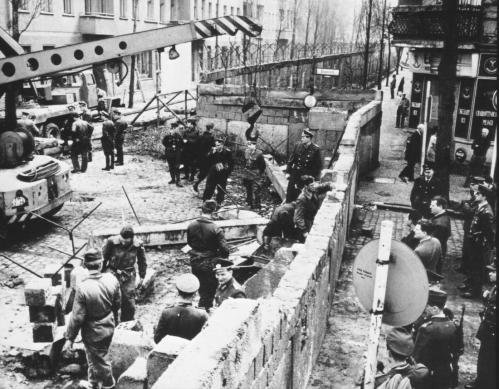
For those that did not get to experience the “other” side of the Iron Curtain and only know the Berlin Wall from history the 9th of November may not mean a lot.  However as someone who spent three years commanding troops preparing for the day that the Soviet Union would strike across the Fulda Gap and across the North German Plain the fall of the Berlin Wall was an amazing event.  The wall had been built in 1961 and in the succeeding years increased in complexity and many East Berliners lost their lives trying to escape at the hands of the East German Grenzschützen and Stasi agents.

Berlin-Wall 5Berlin Wall Death Zone

For those of us who grew up during the Cold War under the threat of “Mutual Assured Destruction” proxy wars in the Middle East, Asia and Africa and tense confrontations between U.S., NATO and Soviet forces at sea, in the air and at various flash points the Wall seemed like it would be there for the rest of our lives.

The initial cracks in the Soviet domination of Eastern Europe began in Poland as an obscure shipyard worker named Lech Walesa along with others who had been active in strike movements in the 1970s which were legalized in 1980 as Solidarity.  This movement would help encourage those in other Eastern European, or Warsaw Pact nations to begin their own resistance movements.  This in every case was a risky undertaking.  Anti-Soviet movements in Hungary and Czechoslovakia and been crushed by Soviet and other Warsaw Pact nations in 1956 and 1968.  Encouraged by support from U.S. President Ronald Reagan and Pope John Paul II these movements in Poland and elsewhere continued to grow.

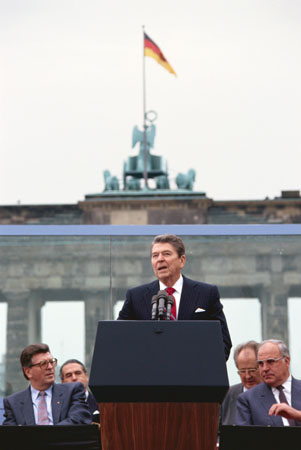
RonaldReagan at wallPresident Reagan at the Wall 1987

When Reagan gave his “Mr. Gorbachev, tear down this wall” speech on June 27th 1987 it was greeted with derision by many but in less than three years would become a reality as the Soviet system suddenly and unexpectedly came apart in September and October of 1989.  That speech contained these immortal words:

“We welcome change and openness; for we believe that freedom and security go together, that the advance of human liberty can only strengthen the cause of world peace. There is one sign the Soviets can make that would be unmistakable, that would advance dramatically the cause of freedom and peace. General Secretary Gorbachev, if you seek peace, if you seek prosperity for the Soviet Union and Eastern Europe, if you seek liberalization, come here to this gate. Mr. Gorbachev, open this gate. Mr. Gorbachev, tear down this wall.”

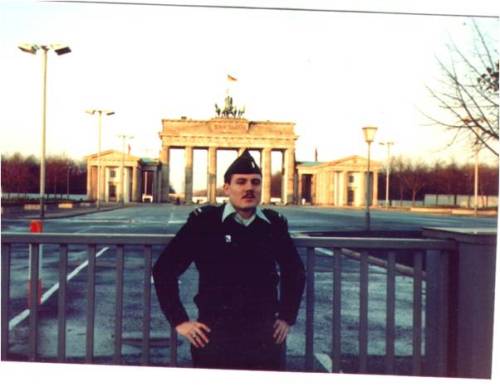
berlin wallPadre Steve at Berlin Wall in November 1986

At the time President Reagan made that speech I was an Army Captain at Fort Sam Houston Texas in San Antonio.  The Abbess and I had just returned from a three year assignment in Germany.  My unit, the 557th Medical Company (Ambulance)  where I served as a platoon leader, executive officer and later company commander was part of the 68th Medical Group. Our mission in the event of a war with the Soviet Union was to provide casualty evacuation in V Corps area of operations and assist in the reconstitution of the 11th Armored Cavalry Regiment which was expected if war occurred to have a 90% casualty rate.  Our preparations went on every day, site visits to locations we would occupy, REFORGER exercises and several alerts a month where we were expected to be ready to move to our GDP (General Deployment Positions) locations in 4 hours or less.  This meant ready to go to war.  Additionally there was the very real threat of terrorist directed at U.S. and German soldiers, officials and public locations such as the Frankfurt International Airport and the U.S. PX at Frankfurt which were both bombed by the Red Brigades.  In fact the Abbess and I were on the road to the Frankfurt PX when she told me to turn around because she was not feeling well.  Had we continued on there is a good chance that we would have been at or near where the blast occurred.

We visited Berlin in November of 1986 driving my 1985 bright red Opel Kadett through the Helmstedt-Berlin corridor to Berlin.  That was an interesting trip.  Paperwork had to be completed well in advance and approved before the trip.  Because the trip involved going through East Germany it was required that we first stop at the NATO border checkpoint followed by the Soviet Checkpoint.  The trip was 110 miles to Berlin and we had to repeat the process first with the Soviets then at NATO.  There was to be no deviation from the route and the trip had to be made in a certain amount of time.  Too fast, you got a ticket, too slow, you got investigated.  Since we did not recognize the authority of the East German government all dealings were to be with the Soviets.

The trip was interesting, Soviet and East German troop convoys on the road with us, East German Polizei monitoring our progress and the dreariness of the East German towns and cities that we passed.  It was like driving through a time warp back to the 1950s.  It was a radical difference from what we knew in West Germany.

Cars were different; they were Soviet built Ladas, actually Fiats made under license in the Soviet Union, East German Traubis, and Czech build Skoda automobiles.  All were antiquated by western standards and at best were products of 1950s and 1960s technology.  My Opel was an economy car in the west but as the European Car of the Year in 1985 was a masterpiece of technology in comparison to anything built in the Eastern bloc.

We remained in West Berlin our first night and in the morning made the trip into the East.  Going through Checkpoint Charlie was a surreal experience as we watched East German Border Police take our photos from their control point.   We eventually found some parking in the Alexanderplatz, did some shopping, sightseeing, had a small bite to eat and a beer, the beer being quite bad, obviously the product of the Communist system, you could not believe that it had been brewed in Germany it was so bad.  It was so bad it made any cheap American beer taste good by comparison.  We went to the East Side of the Brandenburg Gate, visited a number of other sites, including the East German War memorial where as I lined up a photo was nearly kicked in the balls by an East German soldier as he goose stepped during the changing of the guard ceremony.  So members of a Scottish Regiment of the British Army got a “kick” out of this and I had no idea how close to disaster I had come until Judy told me later.  That would have been worth the price of admission for all who saw it had the boot landed.  When we finished in the east we went over to the Reichstag and the western side of the wall.   When we returned to our hotel I discovered that I had no film in the camera and so the next morning we made the trek to East Berlin once again.  This time I was able to get photos.

berlin wall 3The Wall Falls November

The Soviet System began to come apart in the summer of 1989.  Strikes, riots and refugee crisis enveloped much of the Warsaw Pact.  Hungary opened its border with Austria in August allowing thousands of East Germans into the west followed by Czechoslovakia.  Gorbachev had decided as early as 1986 that he would not use force to quell trouble in the Warsaw pact nations.  As the turmoil built throughout the Warsaw Pact the situation in East Germany became critical as thousands of East Germans gathered at border crossing points on the night of November 9th.  Later in the evening the wall would be breached.  It was the beginning of the end for the Soviet domination of Eastern Europe.  In country after county Communist governments fell, most peacefully but in cases like Romania in a violent manner.  On December 31st 1990 the Hammer and Sickle was taken down from Red Square in Moscow signaling the end of the Soviet Union as on Republic after another declared their independence ushering in a period of uncertainty, change and confusion in the former Soviet Union.

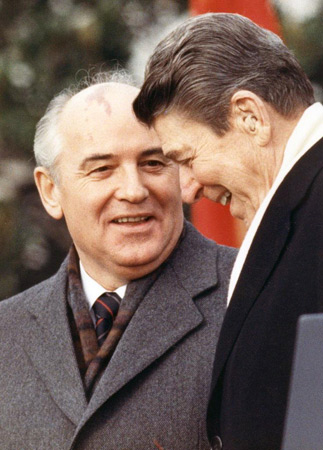
gorbachev and reaganMikhail Gorbachev and Ronald Reagan in 1987, in 1986 Gorbachev Decided that He would Not Use Force to put down Revolts in Eastern Europe

Gorbachev’s foreign affairs adviser, Anatoly Chernyaev, recorded the moment of the collapse of the Berlin Wall in his diary.

“The Berlin Wall has collapsed. This entire era in the history of the socialist system is over,” he wrote. “Today we received messages about the retirement of [China’s] Deng Xiaopeng and [Bulgaria’s] Todor Zhivkov. Only our ‘best friends’ Castro, [Romania’s Nicolae] Ceausescu, and [North Korea’s] Kim Il Sung are still around — people who hate our guts.”

Looking back 20 years it is still hard to believe that the event occurred. As a former Cold Warrior I pray that the West and the Russian Republic will not return to a Cold War mentality and begin to cooperate in ways that are beneficial to peace, security and economic stability.  In the current world situation we have more shared concerns, especially in relationship to radical Islam and terrorism which affect both the West and the Russians in a similar manner.  Economic, military and diplomatic cooperation between the West and the Russians is more important than ever.

The rest is history and the future is yet to be written.

Peace,

Padre Steve+

7 Comments

Filed under History

Okinawa: Göttdammerung in the Pacific

Plans and Preparation
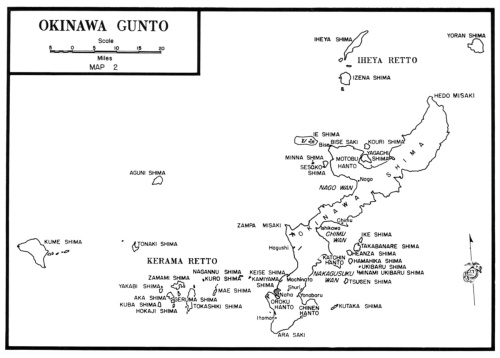
USMC-M-Okinawa-2

The United States decided to invade Okinawa in the fall of 1944 following the seizure of Peleliu and the Philippine landings.  The planned invasion of Formosa was cancelled after General Simon Bolivar Buckner objected.[i] Buckner argued that the Japanese army on it was “much too strong to be attacked by the forces by American Forces then available in the Pacific.”[ii] The strategic rationale behind the decision to invade Okinawa included Okinawa’s proximity to Japan as a staging base for a future invasion of the Japanese mainland.  Likewise taking the island would severe Japan’s lines of communication and commerce with Southeast Asia and to serve as base for strategic bombers.[iii] Planning began in October 1944 and the detailed plan for OPERATION ICEBERG was issued 9 February 1945.[iv] The campaign was not planned in isolation but “was bound up strategically with the operations against Luzon and Iwo Jima; they were all calculated to maintain unremitting pressure against Japan and to effect the attrition of its military forces.”[v]
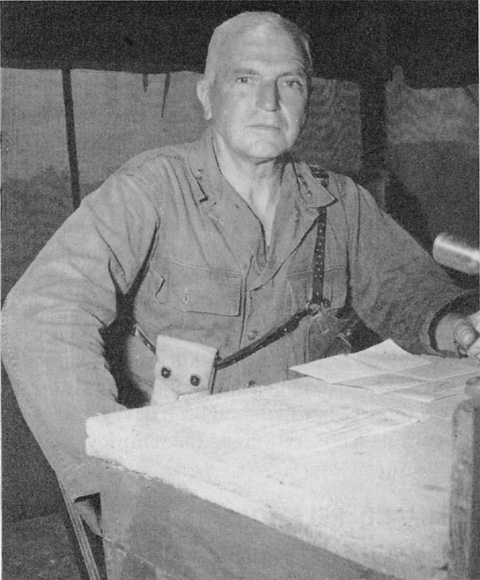
LIEUTENANT_GENERAL_SIMON_B._BUCKNER_in_OkinawaLt General Simon Bolivar Buckner Commander of US 10th Army

The War Department insisted that Lieutenant General Simon Bolivar Buckner command the newly formed 10th US Army.[vi] .  Buckner was chosen to command based on his taking of the Aleutians, displacing the veteran Marine Holland M. Smith. One critical history noted that “compared to his subordinates, Buckner was hardly fit to command a corps, let alone a field army.”[vii]

The 10th Army consisted of the 3rd Amphibious Corps (1st, 2nd and 6th Marine Divisions) under Major General Roy Geiger and the XXIV Army Corps (7th, 27th, 77th and 96th Divisions) under Major General John Hodge.[viii] 2nd Marine Division was designated as a diversionary force, and the 77th Division was assigned to take the nearby island of Kerama Retto prior to the landings to provide the Navy a safe anchorage and as an artillery platform to shell Okinawa. The 27th Division was in corps reserve.  All were veteran units and had it was believed they would be “more than enough to overwhelm the estimated 70,000 Japanese on Okinawa.”[ix] However, much of XXIV Corps had only been engaged in hard combat on Leyte and was not relieved of their duties on Leyte on 1 March 1945.  This provided these units with no time to rest and refit.[x] More importantly badly needed troop replacements had been diverted to Europe due to the crisis in infantry strength there during the battle of the Bulge.[xi] The operation was very large and “mounted on a scale that matched the previous year’s Allied landing in Normandy.”[xii]

The Japanese Preparations
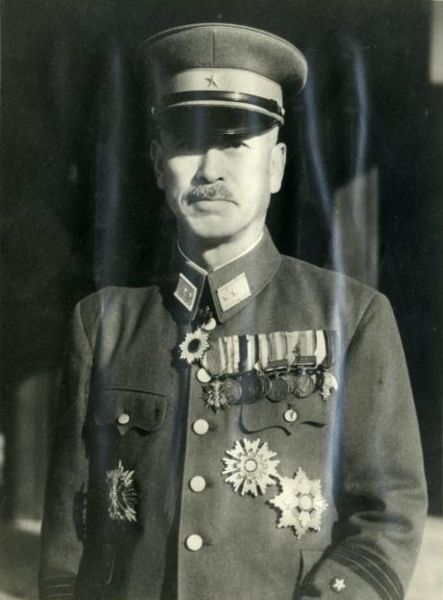
Mitsuru_UshijimaJapanese Commander Lt General Ushijima

American intelligence underestimated the number of Japanese on the island, with an estimate of 55,000 with the expectation of 66,000 by 1 April.[xiii] However by the time of the invasion the Japanese defenders numbered over 100,000.[xiv] The defense of Okinawa was entrusted to the 32nd Army was activated in 1 April 1944 commanded by Lieutenant General Ushijima.  In addition to Okinawa the 32nd Army was responsible for the entire Ryukyu chain.[xv] General Ushijima had commanded an infantry group in Burma and was commander of the military academy when appointed to command 32nd Army and ordered to Okinawa.  His Chief of Staff, General Cho was a firebrand.  Cho had served in China and had participated in a number of attempted military coups in the 1930s as a member of the “Cherry Group.”[xvi] Another key officer though relatively junior was Colonel Yahara the Operations Officer. He had served as an exchange officer in the United States and was intellectual and a modern soldier. He viewed war as a science, won by “superior tactics adjusted to terrain, weapons and troops…not Banzai charges.”[xvii] He was “widely recognized as an expert in his field,”[xviii] and devised the Japanese defensive plan for Okinawa.
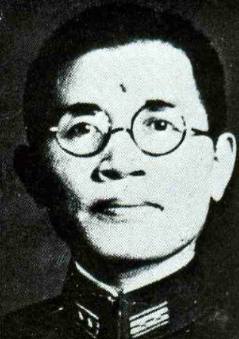
Yahara_HiromichiColonel Yahara Architect of the Japanese Defensive Plan

Until 32nd Army was activated Okinawa was garrisoned by a mere 600 troops,[xix] and until major units arrived these soldiers concentrated on airfield construction.[xx] Eventually the 9th, 24th and 62nd Infantry Divisions, the 44th Mixed Brigade along with a light tank regiment and significant artillery came to Okinawa. Additional forces were alloted to outlying islands.  The 24th Division was a triangular division of 3 infantry regiments of 3 battalions each and supporting arms. The 62nd Division was a “brigaded” division activated in 1943 was formed from the veteran 63rd and 64th brigades each with 4 infantry battalions and supporting arms. It had no organic artillery.  Both of the brigades of this division received an additional infantry battalion in January 1945 giving the division ten maneuver battalions.[xxi] Okinawa’s defenses were significantly weakened when 9th Division was transferred to Formosa by the 10th Area Army in late 1944. To compensate General Ushijima converted Naval and service troops on the island into front line troops. Additionally he called the Okinawan Boeitai volunteers and conscripts into service.[xxii] The Boeitai numbered 20,000 and burned “with ardor to serve their emperor.”[xxiii] Seven sea raiding units were converted into infantry battalions.[xxiv] The major units, with the exception of 24th Division which had been transferred from Manchuria had combat experience.[xxv]
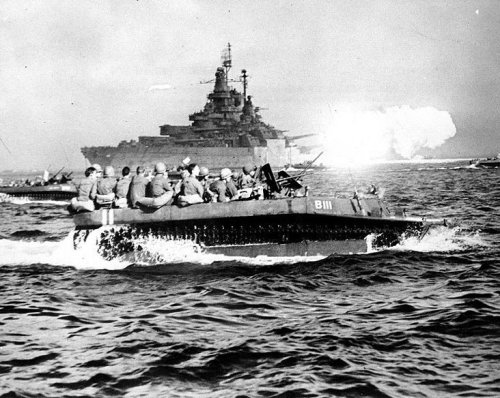
BB-43-LVT-okinawaUSS Tennessee Provides Naval Gunfire Support while LVTs Advance toward the Beaches

Ushijima’s plans to concentrate his forces in the south were delayed by Tokyo.[xxvi] Likewise the number and disposition of troops in the Ryukyu’s were decided by Imperial Headquarters.[xxvii] Colonel Yahara wrote that had Imperial Headquarters “been able to give us an overall plan with specific unit names and arrival dates, we would have been able to follow a consistent policy, disposing units in an efficient manner rather than moving them left and right.”[xxviii] He noted how the 44th Mixed Brigade had to change location and thus its defensive preparations “seven times during the ten months before the actual battle….”[xxix]
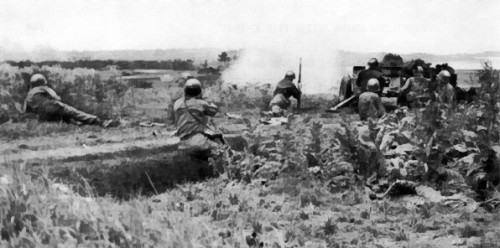
XXIV_Corps_turns_southXXIV Corps Advancing South

The loss of the 9th Division and its 25,000 soldiers forced Ushijima to change his initial plan to defend the beaches and then launch a major counterattack to drive the Americans into the sea.[xxx] Ushijima decided to defend the south end of the island. This was the most defensible area, with a network of fortifications and underground caves centered on the ancient citadel of Shuri Castle. “Troop disposition would conform to local terrain; troop strength would be concentrated; and an extensive system of subterranean fortifications constructed.”[xxxi] The defenses were “anchored in natural and artificial caves which dotted the mountainous regions around Shuri.”[xxxii] “Terrain features were incorporated into the defense and weapons were well sited with excellent fields of fire.”[xxxiii] General Ushijima left Colonel Udo’s 2nd Infantry Unit to fight a delaying action in the north,[xxxiv] having decided that the area was of “little military value.”[xxxv] Likewise Ushijima decided not to contest the landings or to defend the airfields at Kadena and Yontan.[xxxvi] He planned to use Boeitai units to demolish the airfields when the Americans approached.[xxxvii]
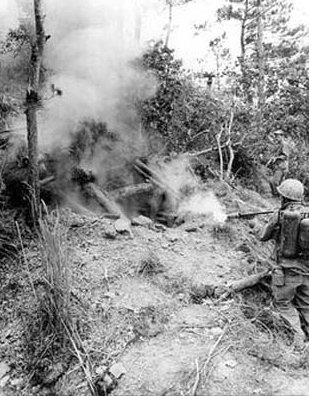
Okinawa_flamethrowerFlamethrowers were Widely Employed their Operators were Targeted by the Japanese

Ushijima’s defensive scheme laid out by Yahara involved concentric defensive lines, tunnels and bunker systems and even the Chinese tombs which dotted the island were converted to pillboxes over the objections of Okinawan elders.[xxxviii] Yahara and Ushijima planned a battle of attrition with all artillery in the army concentrated on the southern end of Okinawa.  Yahara believed the battle would be a “bitter yard-by-yard” defense of the island,[xxxix] with a focus on defense in depth with preparations for anti-tank warfare. There were to be no Banzai charges.[xl] Ushijima turned Bushido “inside out” and urged his soldiers to “Devise combat method [sic] based on mathematical precision, then think about displaying your spiritual power.”[xli] The defenders would be assisted by suicide boat squadrons based on Okinawa and Kerama Retto and over 4000 aircraft, conventional and Kamikaze and a naval force built around the super battleship Yamato.[xlii]

The Landings
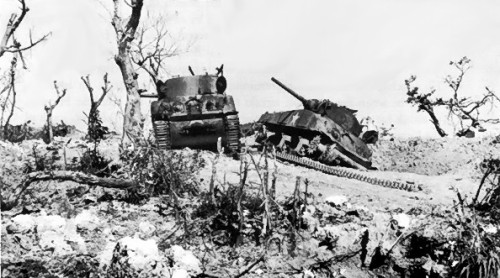
Attack_on_bloody_ridgeWrecked Tanks on Skyline Ridge

The assault on Okinawa began with landings by 77th Division on Kerama Retto on 26 March.   The landings were met with little opposition as most of the combat troops on the islands had been moved to Okinawa leaving only base and service troops and members of a Sea Raiding Unit and Korean laborers to defend the small island.[xliii] By the 29th of March the islands were taken, along with numerous prisoners.  Over 350 of the fast “Suicide Boats” that were to attack US transports and landing craft were destroyed at Kerama Retto and long range artillery was emplaced were it could support the Okinawa landings.[xliv] More importantly Kerama Retto provided the Navy a safe anchorage, and Service Squadron 10 arrived on 27 March to support naval forces around the island.[xlv] The naval bombardment was led by Admiral Deyo’s battleships and Admiral Blandy’s escort carriers[xlvi] and culminated on 1 April when 10th Army went ashore. By the time of the landing 10 battleships and 11 cruisers would join the attack.[xlvii] Over 13,000 large caliber shells were fired and a total of 5,162 tons of ammunition were expended on ground targets and 3,095 air sorties were flown by L Day.[xlviii] Fortunately for the Japanese Ushijima had listened to Colonel Yahara and elected not to defend the beach, and thus most of the shells fell on empty positions and terrain.[xlix]

The Americans landed on the Hagushi beaches adjacent to Kadena and Yontan air bases.  No organized resistance was encountered and in the first hour 16,000 troops landed.[l] There was little disorganization and all units landed on time on the planned beaches.[li] The beaches were bisected by the Bishi River which served as the Corps boundary.  The 1st and 6th Marine Divisions landed north of it and the 7th and 96th to the south.  The Marines chopped up the “Bimbo Butai” in their area many of whom melted back into the civilian population.[lii] The Americans moved rapidly inland and by nightfall over 60,000 Marines and Soldiers were ashore.[liii] As the landings were made the 2nd Marine Division conducted a demonstration off Minatoga on the east side of the Okinawa actually launching several waves of landing craft.[liv] On 2 April the operation was repeated which helped divert some Japanese attention off of the actual landings. Ushijima reported that the attempt “was complete foiled, with heavy losses to the enemy.”[lv] Some Marine veterans of Peleliu were jubilant at not having to land and some wondered what the Japanese were up to.[lvi]
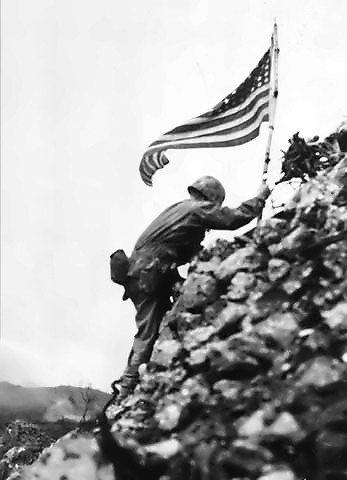
US_Flag_raised_over_Shuri_castle_on_OkinawaMarine Battalion Commander Raising Flag over Shuri Castle

In the following days the two Marine divisions would race north and east while Army troops advanced cautiously to the south first encountering light opposition.[lvii] The 1st Marine Division cut the island in two on April 3rd and was allowed to clear the Katchin Peninsula which it took without opposition.[lviii] The 6th Marine Division moved north and by the 7th it had had taken Nago.  Colonel Udo’s troops of the 2nd infantry Unit defended the Motubu with great skill[lix] but the Marines took the center of resistance on April 18th.[lx] They then cleared the remainder of the peninsula and the rest of the northern end of the island by the 20th.[lxi] The Marines had advanced 84 miles and killed 2,500 Japanese at the cost of 261 killed and 1,061 wounded. The Japanese survivors according to the plan of Colonel Udo afterward retreated into the hills and engaged in guerilla warfare.[lxii]

The Ordeal Begins
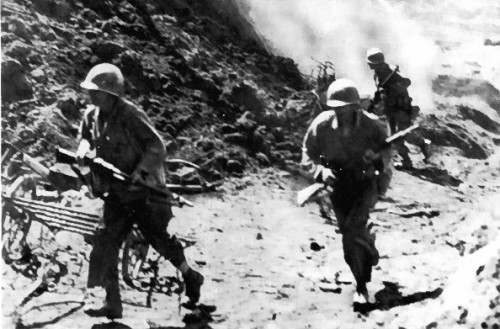
Corkscrew-demolition_teamDemolition Team Advancing

As the Soldiers of the 7th and 96th Infantry Divisions felt their way south, they began to encounter resistance from Japanese outposts.  On 4 April 96th Division’s advanced elements including the 96th Recon Troop and 763rd Tank Battalion encountered the first Japanese anti-tank defenses, losing 3 tanks to well concealed 47mm anti-tank guns.[lxiii] The following day both the 7th and 96th divisions encountered more resistance and were held to minimal gains as they drove the Japanese out of their outpost positions. On the 6th and 7th they captured “the Pinnacle” and “Cactus ridge” from elements of 3 independent infantry battalions which put up stiff resistance.[lxiv] By the end of 8 April against strong opposition XXIV Corps had suffered 1,510 battle casualties and was virtually halted.[lxv] Savage hand to hand fighting took place as the defenders worked to separate the American tanks from their infantry. They held the Americans outside the Shuri zone for 8 days.[lxvi]
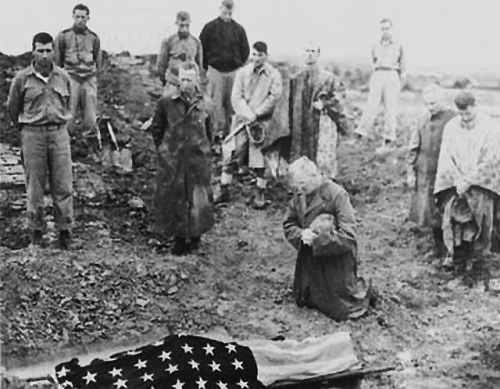
USMC-C-Okinawa burialThe Human Cost of War: Marine Colonel Fenton prays for his Fallen Son

The 96th Division attacked the heavily defended Kakazu Ridge and Tombstone Ridge and was repulsed.  The 7th Division was halted at Hill 178.  The Japanese fought at close quarters and desperate hand to hand fighting “would characterize the Okinawa land battle.” While the Japanese infantry contested every yard “carefully concealed anti-tank guns seemed anchored into the terrain.”[lxvii] The deployment and concealment of the anti-tank guns helped nullify the American advantages in armor. The Japanese also employed 320mm spigot mortars[lxviii] and well sited machine guns and artillery sited on reverse slopes took a heavy toll of the attacking Americans. Of one company of 89 men which attacked Kakazu on 9 April “only three returned unwounded.”[lxix] Assisted by monsoon rains, “the Japanese turned every hill, every ridge into a bloody deathtrap.[lxx] On the 10th two regiments of 96th Division attempted a power drive with battalions advancing on line and were thrown back.[lxxi] The two divisions suffered 2.890 casualties in their abortive attacks while the Japanese lost close to 4,000, mainly to artillery fire.[lxxii] Ushijima’s defense planned by Yahara was “chillingly professional and efficient. Within a week the Japanese had stopped two very good Army divisions in their tracks.”[lxxiii] General Buckner paused sent for the 1st and 6th Marine Divisions and brought the 27th and 77th Divisions ashore to strengthen XXIV Corps.[lxxiv]

Counterattack
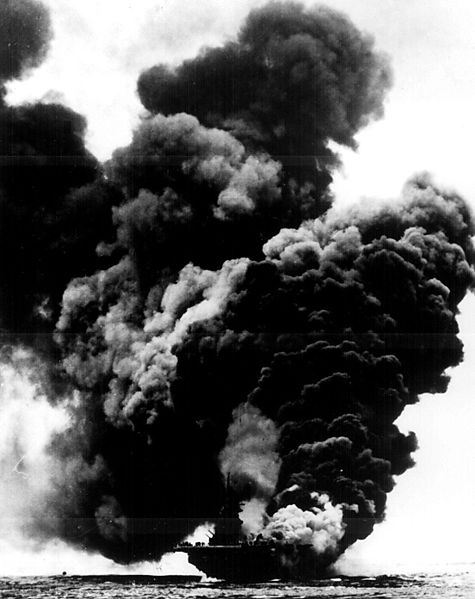
475px-USS_Bunker_Hill_burningThe War at Sea: Kamikaze Attack on USS Bunker Hill

It was at this point when “Yahara’s war of attrition was working well” that a division arose in the 32nd Army Staff, when General Cho; Ushijima’s Chief of Staff had “his first outburst of samurai offensive fever.”[lxxv] Cho noted the failure of the American attacks and believed reports that the American Navy had been heavily damaged by Japanese air power and by the reported success of Operation Ten-Go, the sortie of the Yamato and her escorts on their suicide mission.  He based his optimism on a telegraph from Imperial Navy headquarters “claiming that Ten-go had been “very successful”[lxxvi] when in fact the Yamato and her escorts had been dispatched in hours by carrier aircraft with few American losses.  Cho also assumed a reduction in the number of ships in the Hagushi anchorage and in the number of air sorties as signs of American weakness.[lxxvii] Cho persuaded Ushijima to launch a counterattack over the protestations of Yahara who argued that “it would waste men.”[lxxviii] The attack by four battalions of the 62nd and 24th Divisions began the night of 12-13 April. Based on infiltration tactics and supported by artillery the attack was badly planned and coordinated. One attack almost overran American positions on the draw on Kakazu Ridge, but the Japanese return to “bamboo spear tactics” exposing them to the “overwhelmingly superior America artillery fire….”[lxxix] The attack was a “total failure.”[lxxx]The Japanese lost nearly 1,600 men, half their force in an “operation ill conceived, understrength, misdirected, haphazard and uncoordinated.”[lxxxi]

Cracking the Outer Line

Reinforced by the 27th Division XXIV Corps prepared for another attack against the outlying Shuri defenses. In the interval between the Japanese attack and the new offensive the 77th Division landed on Ie Shima on 16 April and secured it on the 24th amid very heavy fighting killing over 4,700 Japanese, many armed civilians against the loss of 172 killed and 902 wounded Americans.[lxxxii] Among the American dead was legendary reporter Ernie Pyle.

The Americans aimed to penetrate the defenses and “seize the low valley linking Yonabaru on the east coast with the capital of Naha on the west.”[lxxxiii] The attack was supported by 27 battalions of artillery[lxxxiv] including 9 Marine artillery battalions.[lxxxv] Additional Naval gunfire support in the form of 6 battleships, 6 cruisers and 9 destroyers added to the rain of steel unleashed on the Japanese.[lxxxvi] Morison notes that Army historians stated that “Naval gunfire…was employed in greater quantities in the battle for Okinawa than in any other in history.”[lxxxvii] The 7th Division was to take Hill 178 and drive south to the Naha Yonabaru road. 96th Division minus the 383rd Infantry was to “drive straight through the heart of the Shuri defenses seizing the town of Shuri and the highway beyond.”  27th Division attacking 50 minutes later to take advantage of artillery was to take Kakazu ridge and the coast plain north of Naha.[lxxxviii]

The attack began on April 19th and was preceded by a 19,000 shell bombardment.[lxxxix] Ushijima wisely ordered his men to remain in their caves.  The Corps Artillery commander “doubted as many as 190 Japanese…had been killed in the bombardment.”[xc] The attack was immediately halted all along the line, gains, where there were any were measured in yards. Over 750 casualties were inflicted by the Japanese on the corps and 27th Division’s tank battalion lost 22 of 30 tanks to well positioned 47mm anti-tank guns.[xci] Buckner rejected the requests of the Corps commander Hodge and the Marine divisional commanders,[xcii] to launch a flanking amphibious operation at Minatoga with the 2nd Marine Division, and continued the frontal attacks.  John Toland writing of the rejection of the amphibious operation noted that Ushijima “feared such a maneuver (“It would bring a prompt end to the fighting”) and had already been forced to move his “rear guard division north to beef up the Shuri line.”[xciii] Thus the three divisions continued to press their attacks, suffering heavy casualties.  Eventually the Americans forced the Japanese off Skyline ridge[xciv] though the Japanese still held Kakazu.[xcv] When the 27th Division attacked again it found Kakazu abandoned by the Japanese.[xcvi] By the 24th Ushijima’s line was “pierced in so many places that it was in danger of collapsing….So General Ushijima withdrew to his next chain of defenses.”[xcvii] On April 30th the 1st Marine Division relieved the battered 27th Division which had suffered 2,661 casualties in less than two weeks.”[xcviii] The 1st Marine Regiment launched an attack on 1 May and was driven back with heavy causalities.[xcix]

General Cho’s Final Offensive

General Cho supported by 62nd Division’s commander, General Fujioka persuaded Ushijima over the strenuous objections of Yahara to launch a counter-offensive with the intention of isolating and annihilating the 1st Marine Division and “rolling up” XXIV Corps.[c] The attack was to occur along the entire line and include an amphibious landing behind American lines.[ci] The 62nd Division would take the lead as it had been less heavily engaged than 24th Division.[cii] Yahara argued his case strongly and warned the Ushijima that to attack “is reckless and will lead to an early defeat.”[ciii] The attack began on the night of 3 May and the forces making the amphibious landing were annihilated by the Marines.[civ] The Japanese made little headway during the main attack; one battalion achieved a small penetration of American lines at Tanabaru but was eliminated the next day.[cv] The Japanese 27th Tank Regiment lost most of its tanks and those remaining were used as “stationary artillery and pillboxes.”[cvi] The Japanese lost about 5,000 troops in the offensive.[cvii] Ushijima halted it and told Yahara “as you predicted this offensive has been a total failure.  Your judgment was correct….”  He ordered Yahara “to do whatever you feel is necessary.”[cviii] Cho saw “no hope at all”[cix] and asked Yahara jokingly “when will it be okay for me to commit hari-kari?” [cx]

Göttdammerung

The American offensive resumed on 11 May and amid stubborn Japanese defense and heavy rains which hindered movement. The 1st and 6th Marine Divisions[cxi] and the 77th and the 96th infantry divisions attacked along the line but the primary objective was Shuri.[cxii] The Americans continued to apply pressure and make small gains against strong Japanese resistance put up by the 44th Mixed Brigade.  The defense was particularly strong on Sugar Loaf Hill[cxiii] which cost 6th Marine Division nearly 4,000 total casualties before it was cleared out on 21 May.[cxiv] The 96th Division turned the Japanese east flank at Conical Hill on the 13th  [cxv] while the First Marine Division cracked through the Japanese lines at Dakeshi Ridge.  It fought through Wana Ridge[cxvi] and engaged the Japanese in a costly battle in the Wana Draw. The 2nd Battalion 5th Marines supported by 30 tanks blasted their way through the draw, again against brutal Japanese resistance.[cxvii] On the 22nd Yahara persuaded Ushijima to withdraw from Shuri to the Kiyan Peninsula.[cxviii] The 1st Battalion 5th Marines crossed the divisional boundary of 77th Division to capture Shuri Castle on 24 May.[cxix] The Company commander, from South Carolina who took it did not have an American flag so he “substituted the flag of the Confederacy, a banner that he…carried in his helmet.” [cxx] Two days later the American flag was raised along with the standard of the 1st Marine Division in full view of the Japanese.[cxxi]

Following the Japanese withdraw from Shuri the battle continued with heavy rains hampering both sides, especially the more vehicle dependant Americans.[cxxii] The 6th Marine Division cleared the Oruku Peninsula south of Naha the first two weeks of June[cxxiii] killing 5,000 of the Japanese Navy defenders at a cost of 1,608 Marines. The Japanese resistance crumbled when Admiral Ota committed suicide and many defenders fled while others surrendered.[cxxiv] 7th Division pushed onto the Chinen Peninsula and 1st Marine and both 77th and 96th Infantry Divisions pushed steadily south against Japanese rear-guards.[cxxv] The 8th Marines from 2nd Marine Division were brought to the island to reinforce the depleted 3rd Amphibious Corps[cxxvi] A hard fight was fought along the Kunishi-Yuza-Yaeju escarpment where the Japanese conducted their last organized defense.[cxxvii] By the 17th the “32nd Army was dazed and shattered. Discipline had evaporated.”[cxxviii] The 32nd Army’s discipline and morale collapsed, and it “degenerated into a mob.”[cxxix] Yahara noted that “naturally, morale is low at the end of a battle, but we had never experienced anything like this.”[cxxx]
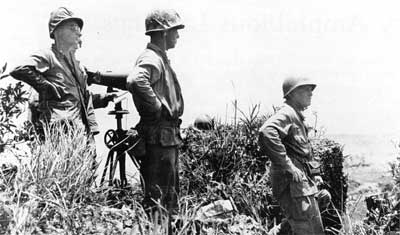
Last_picture_of_LtGen._Buckner_at_OkinawaLt General Buckner (Right) Observing 8th Marines Assault minutes before Being Killed

General Buckner was killed while observing 8th Marines attack Kunishi on the 18th and was succeeded by General Geiger of the Marine amphibious corps.[cxxxi] A final message from Tokyo congratulated 32nd Army on its achievements on the 20th.[cxxxii] General Ushijima and General Cho committed Hari-Kari early on the 23rd after ordering Yahara not to do so. Cho told Yahara “to bear witness as to how I died.”[cxxxiii]

American battle casualties totaled 49,151 including 12,520 dead.[cxxxiv] The Japanese lost over 110,000 killed and 7,400 taken prisoner by the Americans.[cxxxv] About 75,000 Okinawan civilians were killed.[cxxxvi] Small numbers of Japanese renegades and Okinawan rebels conducted low-level guerilla operations until 1947.[cxxxvii]

Analysis

The key Japanese mistake occurred at the strategic level when 9th Division was transferred off the island[cxxxviii] and no further reinforcements were sent.  With these forces Ushijima might have been able to hold out until the end of hostilities. Yahara criticized Imperial Headquarters which panicked when the landings occurred and ordered a counterattack which “left our army in utter confusion.”[cxxxix] General Ushijima’s major mistakes during the battle were the two costly offensives urged by General Cho against the protest of Colonel Yahara. These attacks sacrificed of some of his best troops for no effect and significantly weakened the 32nd Army’s defensive posture.  Yahara objected to both of these offensives. According to the American intelligence debriefing Yahara considered the May 4th offensive “as the decisive action of the campaign.”[cxl] Gordon Rottman simply called that attack a “blunder.”[cxli]

On the American side Buckner fought an unimaginative and uninspired battle, much like Mark Clark’s Italian campaign or Courtney Hodges at the Huertgen Forrest.  Murray and Millett, note that Buckner’s “flawed generalship contributed to the slaughter.”[cxlii] Buckner’s decision not to land the 2nd Marine Division or the 77th Division at Minatoga surrendered his one opportunity to maneuver against the Japanese to force them out of their prepared positions.[cxliii] Ronald Spector notes that “in retrospect Buckner ought to have given more consideration to an amphibious attack[cxliv] while Murray and Millett state that Buckner “did not have the experience to make such a critical decision.”[cxlv] Nimitz wondered if “the Army was using slow, methodical tactics to save the lives of soldiers at the expense of the Navy”[cxlvi] which was exposed to Kamikaze attacks as they had to continue to provide the close in support to 10th Army. Buckner’s rejection of this opportunity left him with the straight ahead attack.   Another option which was available to Buckner was to seal off the Japanese and let them wither on the vine. Such an action in effect would have bypasses the Japanese defenders and force them to make Banzai attacks against dug in Americans.[cxlvii] The Americans had the airfields on day one and most of the key facilities needed for future operations and there was little to gain by continuing offensive operations in the south.  Sealing off the Japanese would have certainly caused the Americans fewer casualties than the strategy which Buckner employed.[cxlviii]

Buckner’s leadership was poor his strategy and tactics both unimaginative and foolish bordering on incompetent.  In a time when American infantry replacements were tapped out and no new Infantry divisions were available for action he decimated good formations by throwing them into frontal attacks against well prepared fortified positions manned by experienced troops.  Had Ushijima not followed General Cho’s advice squandering is own troops the battle would have cost even more American lives with the invasion of Japan looming.  The War Department in its attempt to wrest control of an operation that should have remained under the control of the Navy and Marine Corps put the wrong man in the job when other more competent corps commanders such as General “Lighting Joe” Collins who had finished off the Japanese at Guadalcanal were available with European hostilities winding down.  Why Buckner was chosen despite his incredibly limited command experience serving in the relatively inactive Aleutians and not even commanding a company in World War One had to be due to Army politics and in the end it cost nearly 50,000 American casualties on the land alone, not counting Navy casualties which totaled almost 10,000 including over 4,900 dead. The capture of Okinawa provided the Americans with valuable anchorages and airfields close to Japan had there been an invasion of the home islands, but they were obtained at great cost.


[i] Appleman, Roy, E., Burns, James M., Gugeler, Russell A., and Stevens, John. The United States Army in World War II, The War In the Pacific. Okinawa: The Last Battle, Center of Military History, United States Army. Washington DC. 1948.  p.4

[ii] Leckie, Robert. Okinawa: the Last Battle in the Pacific Penguin Books, New York NY 1996. p.2.  Although not mentioned by Leckie this shortage of forces was due to the American decision to limit the Army to 90 Divisions with dire consequences in Europe and Asia especially in the number of infantry available.  For a good account of the impact of this see Russell Weigley’s Eisenhower’s Lieutenants.

[iii] Willmont, H.P. The Second World War in the Far East. John Keegan General Editor. Cassell Books, London, 1999. p.186.

[iv] Morison, Samuel Eliot. The Two Ocean War: A Short History of the United States Navy in the Second World War. An Atlantic Monthly Press Book, Boston MA 1963. p.525

[v] Ibid. Appleman. p.4

[vi] Costello, John. The Pacific War: 1941-1945 Quill Publishers, New York, NY 1981. p.554.

[vii] Murray, Williamson and Millett, Allan R. A War to Be Won: Fighting the Second World War.  The Belknap Press of Harvard University, Cambridge, MA. 2000. p.515

[viii] Ibid. Leckie. pp. 53-54.  Note Costello misidentifies both of these corps calling them 3rd Marine Corps and XIV Army Corps.   He also does not count the 77th Division in his figures.

[ix] Ibid. Costello. pp. 554-555.  Costello’s figures are slightly above the official estimates listed below.

[x] Ibid. Leckie. p.56

[xi] Ibid. Leckie. p.57 An important point to note is that the Army had reached a critical point in its ability to conduct the war.  The steady drain on infantry strength that began in Normandy was heightened in the Huertgen Forrest and the Bulge.

[xii] Ibid. Costello. p.556

[xiii] Ibid. Appleman. p.15

[xiv] Ibid. Costello. p.555

[xv] Yahara, Hiromichi. The Battle for Okinawa. Introduction and Forward by Frank Gibney. Translated by Frank Pineau and Masatoshi Uehara. John Wiley and Sons, New York, NY. 1995. p.3

[xvi] Rottman, Gordon R. Okinawa 1945: The Last Battle. Osprey Publishing, Oxford, United Kingdom, 2002. p.35

[xvii] Ibid. Leckie. pp.31-32

[xviii] Ibid. Rottman. p.37

[xix] Toland, John. The Rising Sun: The Decline and Fall of the Japanese Empire 1936-1945. Random House, New York, NY 1970. p.683.

[xx] Ibid. Yahara. p.7

[xxi] Ibid. Rottman. Pp.47-48

[xxii] Ibid. Toland. pp.683-684.  Yahara also notes the arrival of the 15th Mixed Brigade and the fact that the Japanese considered the 44th Mixed Brigade “one of our Army’s prized units.” (p.12)

[xxiii] Ibid. Toland. p.683.  Leckie comments on the low opinion of many Japanese soldiers about the Boeitai calling them Bimbo Butai (Poor Detachment), as the most of the Japanese had come to loathe Okinawa and all things Okinawan. A comment from my own service in Okinawa in 2000-2001 is that this loathing of Okinawa by Japanese is still common, Japanese tend to look down on Okinawans and the Okinawans now tend to resent the Japanese.

[xxiv] Ibid. Appleman. p.87

[xxv] Ibid. Yahara. p.31 All sources note that the 24th was a “well trained” division.

[xxvi] Ibid. Costello. p.555

[xxvii] Ibid. Yahara. p.15

[xxviii] Ibid. Yahara. pp. 14-15

[xxix] Ibid. Yahara. p.15

[xxx] Ibid. Yahara. pp. 20-22 and 32.  Yahara details the initial plan and the changes necessitated by the departure of 9th Division.  Rottman gives 9th Division a strength of 17,000. (Rottman p.46)

[xxxi] Ibid. Yahara. p.20

[xxxii] Spector, Ronald H. Eagle Against the Sun: The American War With Japan. The Free Press and Division of MacMillan, Inc. New York, NY 1985. p.533

[xxxiii] Ibid. Rottman. p.25

[xxxiv] Ibid. Leckie p.32 and Costello. p.555. The unit was between 3000 and 3500 strong. Leckie simply identifies the force as the 2nd Infantry Unit while Costello identifies them as a Special Naval Landing Force. Appleman identifies Colonel Udo and the approximate number of troops but does not identify the unit. There appears to be confusion about the Japanese units, Appleman says that the 2nd Infantry Unit was constituted from survivors of 44th Mixed Brigade (which had lost most of its troops when their ship was sunk by an American submarine) and 15th Independent Mixed Regiment which was brought in to bolster it, but Yahara consistently places the reconstituted 44th in the south as part of the main defense. (see Appleman p.87) I will relay on Yahara as he was the 32nd Army Operations Officer and in a position to have first hand knowledge.

[xxxv] Ibid. Yahara. pp.22-23

[xxxvi] Ibid. Leckie. p.32

[xxxvii] Ibid. Leckie. pp.32-33

[xxxviii] Ibid. Toland. p.684

[xxxix] Ibid. Yahara. p.32

[xl] Ibid. Yahara. p.25

[xli] Ibid. Leckie. p.35

[xlii] Ibid. Leckie. p.19

[xliii] Ibid. Appleman. pp.52-58

[xliv] Ibid. Appleman. p.60

[xlv] Potter, E.B. Nimitz. Naval Institute Press. Annapolis, MD. 1976. p.369

[xlvi] Ibid. Costello. p. 556 and Morison p.530.

[xlvii] Ibid. Appleman. p.64. Leckie (pp. 67-68) names only 9 battleships: Arkansas, New York, Texas, Nevada, Idaho, New Mexico, Colorado, Tennessee and West Virginia. Of these ships all were built before the war and four were in commission before the US entered the First World War.  Three had been at Pearl Harbor and with the exception of their engines the Tennessee and West Virginia had been completely rebuilt and modernized to the standards of the fast new battleships of the South Dakota class.

[xlviii] Ibid. Appleman. p.64

[xlix] Ibid. Leckie. p.69.

[l] Ibid. Leckie. p.72

[li] Ibid. Appleman. p.74

[lii] Ibid. Leckie. p.73

[liii] Ibid. Appleman. p.75

[liv] Ibid. Appleman. p.74

[lv] Ibid. Leckie. p.72  A point to note is that the “Demonstration” is still one of the Amphibious Operations in the USMC Amphibious doctrine.

[lvi] Sledge, E.B. With the Old Breed at Peleliu and Okinawa. Presidio Press. Novato, CA. 1981. Oxford University Press Paperback, New York, NY 1990. pp. 187-188  William Manchester in Goodbye Darkness talks about the first few days as his 6th Marine Division moved up North.  He talks of the minimal resistance and the beauty of the island. Manchester, William, Goodbye Darkness: A Memoir of the Pacific War Little Brown and Company, New York NY, 1979.pp.356-357

[lvii] Ibid. Potter. pp.370-371

[lviii] Ibid. Leckie. p.78

[lix] Ibid. Manchester. p.357.  Manchester notes that the fight in the north was like “French and Indian Warfare.”

[lx] Ibid. Appleman. p.148

[lxi] Ibid. Leckie. p.83

[lxii] Ibid. Appleman. p.148

[lxiii] Ibid. Appleman. p.104

[lxiv] Ibid. Appleman. pp.107-110

[lxv] Ibid. Appleman. pp.112-113.

[lxvi] Ibid. Appleman. p.112.

[lxvii] Ibid Yahara. p.35

[lxviii] Ibid. Leckie. p.104

[lxix] Ibid. Spector. p.534

[lxx] Ibid. Murray and Millet. p.514

[lxxi] Ibid. Appleman. pp. 126-127

[lxxii] Ibid. Leckie. pp.104-105

[lxxiii] Ibid. Murray and Millett. p.514

[lxxiv] Ibid. Murray and Millett. p.514

[lxxv] Ibid. Yahara. p.36

[lxxvi] Ibid. Leckie. p.108

[lxxvii] Ibid. Leckie. p.108

[lxxviii] Ibid. Yahara. p.36  The battle for a counter-offensive began on 6 April but was rejected. (Appleman. p.130)  Yahara actually went to the commanders of the 24th and 62nd divisions and persuaded them not to use 3 battalions each but only two. (Leckie. pp.107-108)

[lxxix] Ibid. Leckie. p.113

[lxxx] Ibid. Appleman. p.137

[lxxxi] Ibid. Leckie. p.113.

[lxxxii] Ibid. Appleman. p.182. Leckie gives the total of 258 killed and 879 wounded. (Leckie. p.125) and estimates that most might have been uniformed civilians.  Appleman citing Army figures estimates about 1,500 civilians.  Even adding the American MIA totals the differences between Appleman and Leckie’s count of US casualties is puzzling.

[lxxxiii] Ibid. Leckie. p.126

[lxxxiv] Ibid. Leckie. p.127

[lxxxv] Ibid. Appleman. p.185

[lxxxvi] Ibid. Leckie. p.127

[lxxxvii] Ibid. Morison. p.553

[lxxxviii] Ibid. Appleman. pp.184-185

[lxxxix] Ibid. Leckie. p.128

[xc] Ibid. Leckie. p.128

[xci] Ibid. Leckie. p.131 It is interesting to note the vulnerability of the Sherman tanks to the obsolescent 47mm anti-tank guns used by the Japanese.  By this stage of the war comparable German and Russian tanks would not be stopped by such weapons, baring a luck shot.

[xcii] Ibid. Murray and Millett. p.515

[xciii] Ibid. Toland. p.706

[xciv] Ibid. Toland. pp.708-709

[xcv] Ibid. Leckie. p.138

[xcvi] Ibid. Appleman. pp. 243 and 247

[xcvii] Ibid. Leckie. p.139

[xcviii] Ibid. Toland. p.709

[xcix] McMillan, George. The Old Breed: A History of the First Marine Division in World War Two. The Infantry Journal Inc., Washington DC. 1949. p.375

[c] Ibid. Leckie. pp.148-149

[ci] Ibid. McMillan. p.377

[cii] Ibid. Yahara. p.37

[ciii] Ibid. Toland. p.710

[civ] Ibid. Toland. p.710

[cv] Ibid. Appleman. p.299

[cvi] Ibid. Appleman. p.302

[cvii] Ibid. Appleman. p.302.  Rottman states 7,000 and Leckie 6,000.

[cviii] Ibid. Yahara. p.41

[cix] Ibid. Toland. p.712

[cx] Ibid. Yahara. p.42

[cxi] Ibid. Manchester. pp. 358-359. Manchester notes the distain that the Marines felt toward 27th Division which both they and 1st Marine Division had relieved in the south.  Manchester comments that they felt that “the dogfaces lacked our spirit.”

[cxii] Ibid. Rottman. p.80

[cxiii] See Manchester pp.363-378 for a chilling description of the battle for Sugar Loaf.

[cxiv] Ibid. Leckie. pp.172-173

[cxv] Ibid. Appleman. pp.355-356

[cxvi] Ibid. McMillan. pp.385-395. 7th Marine Regiment suffered 1,249 casualties in this fight.

[cxvii] Ibid. Sledge. p.243

[cxviii] Ibid. Yahara. pp.67-73.  Yahara has an interesting account both listing the military options available and the interaction between him and the other officers leading tom the withdraw.  Among those he had to persuade were the divisional commanders of 24th and 62nd Divisions.

[cxix] Ibid. McMillan. p.401

[cxx] Ibid. McMillan. p.401

[cxxi] Ibid. Leckie. p.186

[cxxii] Ibid. Rottman. p.81

[cxxiii] Ibid. Rottman. p. 82  This included an amphibious landing by two regiments to flank the position which was the last opposed amphibious landing in the war.

[cxxiv] Ibid. Leckie. pp.199-200

[cxxv] Ibid. Rottman. p.83

[cxxvi] Ibid. Leckie. p.197  Leckie notes that the 2nd Marine Division had been transported back to Saipan rather than remain at sea as a target for Kamikazes.  As a result the Marines had no reserve on the island.

[cxxvii] Ibid. Sledge. p.301

[cxxviii] Ibid. Toland p.721

[cxxix] Ibid. Appleman. p.456

[cxxx] Ibid. Yahara. p.133

[cxxxi] Ibid. Rottman. p.83

[cxxxii] Ibid. Yahara. p.144

[cxxxiii] Ibid. Yahara. pp.154-156.  Yahara would hide among refugees hoping that he might escape to Japan but was discovered by an interrogation panel and identified on 26 July. (Yahara pp.189-191)

[cxxxiv] Ibid. Appleman. p. 473 This includes Navy losses of 4,907 killed and 4,824 wounded, mostly to Kamikaze strikes on ships supporting the operation. 10th Army lost 7,613 killed and 31,800 wounded. (Morison. p.556)

[cxxxv] Ibid. Appleman. pp473-474.  Other sources report Japanese losses at 65,000 to 70,000.  This may be from listing military civilians like those in the Naval Force and Okinawan militia as civilian casualties and only counting actually Japanese Army and Navy troops in this tally.  Costello gives a count of 10,755 prisoners; this could again be a tally including these civilians and auxiliaries. (Costello. p.578)  Rottman spends some time analyzing the discrepancies in the Japanese casualty numbers and comes to the same conclusion. (Rottman pp.84-85)

[cxxxvi] Ibid. Toland. p.726

[cxxxvii] Ibid. Rottman. p.85

[cxxxviii] Ibid. Yahara. p.31

[cxxxix] Ibid. Yahara. p.196.

[cxl] Ibid. Yahara. p.214

[cxli] Ibid. Rottman. p.73

[cxlii] Ibid. Murray and Millett. p.514

[cxliii] Ibid. Leckie. p.162

[cxliv] Ibid. Spector. p.535

[cxlv] Ibid. Murray and Millett. p.515

[cxlvi] Ibid. Potter. p.373

[cxlvii] Ibid. Leckie. p.162  Leckie does not know if this was considered by Buckner though the tactic was used throughout the “island hopping” campaign where Japanese strong points were bypassed and isolated to whither on the vine.

[cxlviii] Ibid. Leckie. p.162


Bibliography


Appleman, Roy, E., Burns, James M., Gugeler, Russell A., and Stevens, John. The United States Army in World War II, The War In the Pacific. Okinawa: The Last Battle, Center of Military History, United States Army. Washington DC. 1948

Costello, John. The Pacific War: 1941-1945 Quill Publishers, New York, NY 1981

Leckie, Robert. Okinawa: the Last Battle in the Pacific Penguin Books, New York NY 1996.

McMillan, George. The Old Breed: A History of the First Marine Division in World War Two. The Infantry Journal Inc., Washington DC. 1949.

Manchester, William, Goodbye Darkness: A Memoir of the Pacific War Little Brown and Company, New York NY, 1979

Morison, Samuel Eliot. The Two Ocean War: A Short History of the United States Navy in the Second World War. An Atlantic Monthly Press Book, Boston MA 1963

Murray, Williamson and Millett, Allan R. A War to Be Won: Fighting the Second World War.  The Belknap Press of Harvard University, Cambridge, MA. 2000.

Potter, E.B. Nimitz. Naval Institute Press. Annapolis, MD. 1976.

Rottman, Gordon R. Okinawa 1945: The Last Battle. Osprey Publishing, Oxford, United Kingdom, 2002.

Sledge, E.B. With the Old Breed at Peleliu and Okinawa. Presidio Press. Novato, CA. 1981. Oxford University Press Paperback, New York, NY 1990.

Spector, Ronald H. Eagle Against the Sun: The American War With Japan. The Free Press and Division of MacMillan, Inc. New York, NY 1985.

Toland, John. The Rising Sun: The Decline and Fall of the Japanese Empire 1936-1945. Random House, New York, NY 1970.

Willmont, H.P. The Second World War in the Far East. John Keegan General Editor. Cassell Books, London, 1999.

Yahara, Hiromichi. The Battle for Okinawa. Introduction and Forward by Frank Gibney. Translated by Frank Pineau and Masatoshi Uehara. John Wiley and Sons, New York, NY. 1995.

 

3 Comments

Filed under History, Military, world war two in the pacific

Reformation Day: How Martin Luther and Hans Kung Brought Me to an Anglo-Catholic Perspective, a Book and Bible Burning Reaches Ludicrous Speed and Yankees take Game Three 8-5

Today is Reformation Day that is right sports fans, Reformation Day.  Now most people, unless they are Lutheran or a really “reformed” Presbyterian or Reformed Church kind of Christian have no clue about this. However when a young Priest and Theology Professor at the University of Wittenberg named Martin Luther posted the 95 Theses on the door of the Schlosskirche in Wittenberg it changed the course of Western as well as Church history.

martin-lutherMartin Luther

Luther posted his “theses” which was basically points of theological debate on the door of the Schlosskirche it broke the hold of the Roman Catholic Church of Europe, brought about what would become an increasingly fractured and diverse church in the west and established the primacy of the State over the Church in Western nations.  Luther intended nothing more than reforming and curtailing abuses in the Catholic Church and how the Church saw grace, faith and scripture.  His act and subsequent actions when put under the “ban” by the Pope drew to him the support of German nobility who desired to be free of the Holy Roman Empire and rapidly engulfed Europe in religious, political and military conflict.

The theology that Luther developed based upon the Three Solas; Sola fides by faith alone, Sola Gratia by grace alone and Sola Scriptura by scripture alone became the hallmarks of the Reformation and without getting into the weeds to dissect all the ramifications for the Church and the world impact the way that many Christians practice and express their faith to the current day.

For me Martin Luther was along with Fr Hans Kung, Jurgen Moltmann, and Alistair McGrath a key figure in the development of my faith.  At some point I will probably get deeper into this on this blog, but right now it suffices to say that it was Martin Luther who confirmed to my the essential nature of the Eucharist to the Christian faith and which helping bring me to a catholic understanding of the faith versus a truly reformed Protestant understanding of it.  I do not agree with all of Luther’s points or ideas but his Theology of the Cross brought me to a much more incarnational understanding of the Christian faith especially in regards to understanding that it is only through the Cross that we come to know God in a truly Christian sense of understanding.  For Luther the Cross was central to understanding the humanity’s relationship to the Trinity, not as Calvin would enunciate God’s will and predestination from before time began.  Kung from the Catholic side is a big Luther supporter (see On Being a Christian) and Moltmann has brought Luther’s thought to the 21st Century in Theology of Hope and The Crucified God as has Anglican Theologian and Luther scholar Alistair McGrath (The Mystery of the Cross.) All of these men helped me in my transition following seminary to a moderate Anglo-Catholic expression of faith that places a high place to Scripture, Apostolic Tradition and Reason in interpreting and living out the faith.

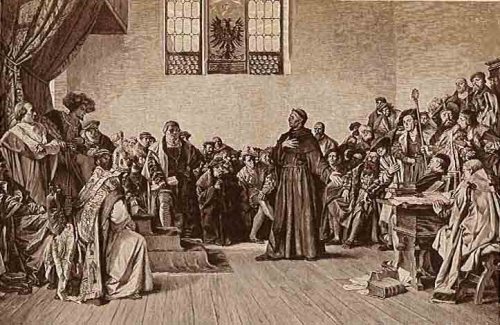
luther_at_wormsLuther at the Diet of Worms

I did a lot of study on the Lutheran Reformation in and after seminary and in 1996 while stationed in Germany as a mobilized Army Reserve Chaplain had the privilege of organizing a series of Reformation tours to Wittenberg on Reformation day where we attended the Reformationstag service at the Schlosskirche and I led a walking tour of the town.  One of the parishioners from the chapel asked me if I had been to Wittenberg before because I seemed like I knew every place in the town.  I had to tell her that I had not been there in person but because of my study felt like I had from the time we stepped off of our tour bus.  I also directed a tour to Worms where Luther on trial before Charles V was told to recant his writings and made his timeless statement:

“Unless I am convicted by scripture and plain reason – I do not accept the authority of the popes and councils, for they have contradicted each other – my conscience is captive to the Word of God. I cannot and I will not recant anything for to go against conscience is neither right nor safe. God help me. Amen.” It is legend that Luther said the words “Here I stand. I cannot do otherwise. God help me, Amen!” These words were probably only added later by someone else to make the story more interesting as they do not appear in the council notes.  Not that Luther would have objected.  The film version is linked here:

http://www.youtube.com/watch?v=U0tk_EvWXQQ&feature=player_embedded

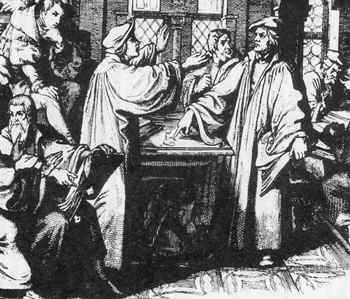
marburgZwingli and Luther at Marburg

Likewise his debate with Swiss Reformer Ulrich Zwingli at the Marburg colloquy regarding points of doctrine was significant for me. It was held that they might unify their movements. They agreed on all points except the Eucharist where Luther enunciated a very catholic understanding of the “Real Presence” and Zwingli held to be a symbolic memorial though might have some spiritual component.   Luther would not budge and to each of Zwingli’s arguments pulled back the tablecloth to reveal the words “This is my body, this is my blood” which he had carved on the table.  They departed without achieving unity, something that has plagued Protestants to this day and when Zwingli was killed in battle when leading the militia from Zurich to fight the approaching Catholic Army.  When Luther heard about the Zwingli’s death he commented Zwingli drew his sword. Therefore he has received the reward that Christ spoke of, ‘All who take the sword will perish by the sword’ [Matt. 26:52]. If God has saved him, he has done so above and beyond the rule.” (Table Talk #1451)

I have always had a special place in my heart for Luther even with all of his flaws which were many; he was earthy, spoke his mind, and had no problem with having fun or good beer.  Additionally he had a bit of an anger problem, suffered from clinical depression and had issues with his father.  Luther could be an ass, but then I can be an ass too.

Well the “unhappy few” at the Amazing Grace Baptist Church in Canton North Carolina are moving right along in their book and Bible burning crusade led by their Grand Master Pastor Marc Grizzard. In the past few days he has gotten into a pissing contest with a very conservative and should I even say “Fundamentalist” theologian named James White.  Evidently Mr. White is on the opposite end of the Fundamental spectrum according to Grand Master Pastor Marc along with “the agnostics, liberals, New Evangelicals, and Bible doubters.”  I did find it fascinating to see how Grand Master Pastor Marc’s little brain works in the text of their terrible translation tiff which is linked here: http://amazinggracebaptistchurchkjv.com/subpage570.html

I especially enjoyed this comment from his most recent webpage update where he castigates Mr. White:

“I had rather be uneducated and irrational and know that I have God’s preserved, inspired, infallible, inerrant Word of God, than to be a scholar who doesn’t know where God’s Word is. One person said, “I’d rather be an fool on fire, than a scholar on ice.” Don’t get me wrong, I am not saying a person should not better themselves or study. They should! But if study and education is going to rob you of your unwavering faith in the KJB, than leave the education to the Bible doubters. I will never be open to anything but the KJV, call me what you want. I don’t care!” Pastor Marc Grizzard

MARC KNEELING2Profiles in Stupidity Pastor Marc Grizzard
Since he has invited people to call him anything they want I think idiot works well. Have no fear he is already talking about next year’s event:

God has showed me why this years event went around the world. Check back in a couple of weeks as we begin to “Turn this world upside down.” Acts 17:6 “…These that have turned the world upside down” “Coming to a town near you!!!!” Please not my town.

Make arrangements now, if it gets popular you might have to book through Ticketmaster or the Amazing Grace Baptist Church Box Office.  By the way the start time is 7PM and Marc has said if you are not a member or have an invitation from him you are not welcome, and that includes law enforcement who promise to be there, kind of reminds me of the concert in the Blues Brothers. Of course he will have to compete with the folks at the fictional Landover Baptist Church to have the world’s greatest book and Bible burning. http://www.landoverbaptist.org/news1002/bookburning.html

Of course I wonder about a group of separatist Baptists staking their faith not on Jesus but the King James Version. It seems absurd for a group that descends from people who valued religious liberty to be burning book or Bibles of any kind.  The fact that they have set an Anglican translation, authorized by a flaming homosexual who hated, persecuted and killed the early English Baptists and which is actually a later version than the 1611 that has multiple versions, the Oxford and the Cambridge and is based on a text that was not the most common text used by the early or “ante-Nicene” church is beyond me.  The fact that King James onlyism is only about 100 years old and comes from a unusual 7th Day Adventist preacher and was advanced by the founder of the Pensacola Bible Institute who experimented with Zen Buddhism, thought about becoming a Jesuit and believed in a bunch of stuff including UFO;s that most Fundamentalists would deride only adds to my mystification.  But then to quote Forrest Gump “stupid is as stupid does.”  Congratulations Pastor Marc you win the Gump award for 2009. Congratulations, your 1973 orange Ford Pinto is waiting in the A-1 Auto Salvage in Fayetteville.

Tonight the Abbess and I will go to a Halloween party at our favorite restaurant the Gordon Biersch Brewery Restaurant in Virginia Beach.  I went as a baseball player from a scary team, the Orioles and the Abbess is going as a Hippy Chick.  It was fun, nice people, good music and 70’s and 80’s music videos and great beer.

Mariners Yankees BaseballAlex Rodriguez Broke out of His Slump

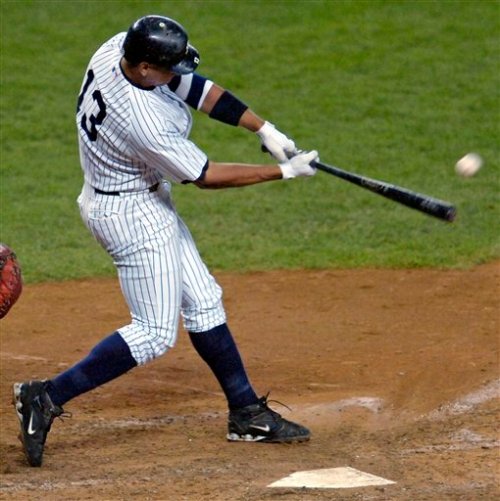
Now I sit watching game three of the World Series. For once replay was used to overturn a bad call, Alex Rodriguez getting his first hit, a 2 run home run that hit the lens of the right field television camera that was initially ruled a double.  Cole Hammels was hit hard as I predicted giving up five runs before he was pulled in the 5th, one of the runs coning off the bat of Andy Pettitte who drove in Nick Swisher and then later scored.  The Yankees bats began to come alive, Nick Swisher who had had a miserable post season hit a home run and a double, and Alex Rodriguez broke out of his slump with his 2 run homer. Hideki Matsui hit his second home run of the series with 2 outs in the 8th as a pinch hitter against Brett Myers.  For the Phillies the hot hitting Ryan Howard has continued to slump striking out 3 more times tonight to make him 2 for 13 with 9 strike outs in the first three games.  On the other hand Jayson Wirth continues to hammer the ball hitting two solo shots tonight.

Tomorrow should be nice, Church in the morning after an extra hour sleep, followed by some study for my exams and game four of the series tomorrow with C.C. Sabathia coming back against Joel Blanton.  Advantage has to go to the Yankees with Sabathia on the hill and thier bats starting to come to life. Should be another great game.

Peace,

Padre Steve+

3 Comments

Filed under Baseball, History, Religion

One Square Mile of Hell: The Invasion of Tarawa

On November 20th 2009 the Marine Corps and especially the 2nd Marine Division will mark the 66th anniversary of the amphibious assault on the Tarawa Atoll and the island of Betio.  It was fought at a great cost but would yield lessons that would be invaluable in future amphibious operations. The veterans of the landing are fewer every day. Please take time to remember their sacrifice that they made and Marines continue to make in Afghanistan and Iraq. I have served with the 1st and 3rd Battalions, 8th Marine Regiment the 2nd Combat Engineer Battalion and HQ Battalion 2nd Marine Division.  I have had the honor to meet some of the surviving Tarawa Veterans so this is not only history for me, but a way to pay tribute to the Marines who served at Tarawa and all Marines since. Especially those Marines that I served with at 2nd Marine Division, Marine Security Forces and the Marine Advisers to the Iraqi 7th and 1st Divisions, 2nd Border Brigade, Port of Entry Police, Police and Highway Patrol in Al Anbar Province. Semper Fidelis, Padre Steve+

The Decision: Operation Galvanic

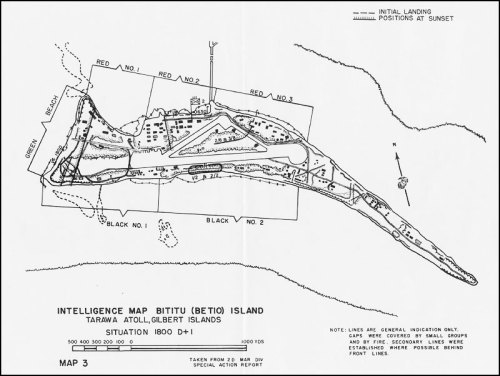
USMC-M-Tarawa-3The Target: Betio Island at Tarawa Atoll
Following Guadalcanal and the shift of significant naval forces from the Solomons the focus of the US shifted to the thrust across the Central Pacific.  Unlike the Solomons which were initially a Navy and Marine Corps Operation and shifted to the Army under MacArthur as the campaign shifted to Borneo, the operations here would be an almost total Navy and Marine Corps operation. Operation Galvanic, the first offensive operation in the Central Pacific, came about as a result of the Joint U.S. Strategic Committee decision in April 1943 to favor an advance in the Central Pacific while maintaining the offensive in the South Pacific.[i] The driving force behind this strategy was Admiral King who fought for the plan and “insisted that any campaign should focus on the destruction of Japan’s overseas resources, which meant an offensive directed only toward the Western Pacific sea lanes.”[ii] The Joint Chiefs believed that a simultaneous attack by Nimitz in the Central Pacific and MacArthur in the South Pacific would “keep the Japanese guessing.”[iii] The decision was presented to the British at the TRIDENT meetings in May 1943 and though the British resisted the American plans a compromise was reached allowing the Americans to “simultaneously…maintain and extend unremitting pressure against Japan….”[iv]

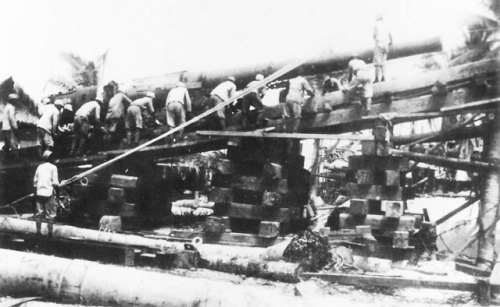
japanese emplacing gunJapanese Emplacing 8″ Vickers Gun

The decision to begin operations in the Central Pacific meant that MacArthur’s priority in logistics and personnel would be reduced in order to launch the Central Pacific operation.  MacArthur protested, to no avail and the Joint Chief’s stood firm in their decision that the Central Pacific operation “would make it easier to isolate Japan from her domain in the south.”[v] MacArthur was allowed to continue OPERATION CARTWHEEL while Nimitz seized the Marshall and Caroline islands.[vi] Nimitz’s staff began preparations and decided on a conservative course to capture the Gilberts first before taking the more heavily defended Marshalls.[vii] This was in part due to the “need to minimize the risks to his untried amphibious forces against such heavily fortified enemy bases out of reach of air cover.”[viii]

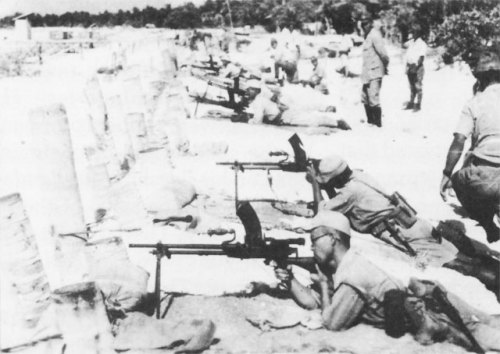
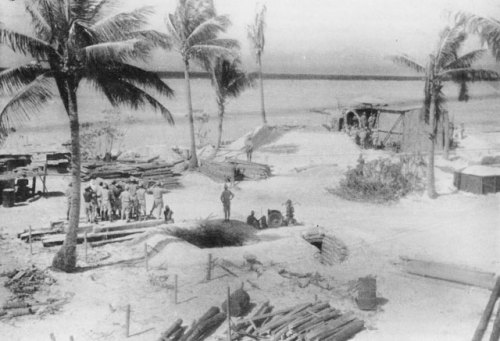
japanese conducting firing exerciseJapanese conducting Live Fire Range prior to the Assault
Several factors were considered by Nimitz and his planners considerations in this choice.  Nimitz did not have enough troops to capture all of the vital heavily defended locations in the Marshalls without dividing his forces.[ix] Additionally the Gilbert operation could be supported by land based bombers.[x] A final consideration was the Joint Chief’s decision to allow MacArthur to retain control of 1st Marine Division which Nimitz had hoped would be available for operations in the Central Pacific.[xi] CINCPAC did a thorough photo reconnaissance of the Gilbert’s convinced the Joint Chiefs that Tarawa and Makin needed to be taken to provide air bases for the assault on the Marshalls.  Finally the order for Galvanic was issued on 20 July 1943 with its execution planned for November 1943.[xii]

Japanese Preparations

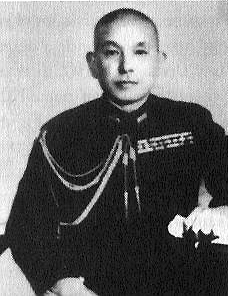
shibasakiAdmiral Shibasaki boasted that it would take a million men a thousand years to take Betio
The Japanese did little to prepare against potential American offensive operations against the Gilbert’s until Makin Island was raided by elements of 2nd Raider Battalion in August 1942.  The Makin raid shook the Japanese and at which time they reinforced Makin and occupied Betio.[xiii] The Japanese occupied Betio with the Yokosuka 6th Special Landing Force, essentially Naval Infantry or Marines[xiv] and the 111th Construction Battalion on 15 September 1942, over nine months after they attacked Pearl Harbor.[xv] These forces were commanded by Admiral Tomanari, who at once began to fortify Betio. Recognizing his need for more troops  Tomanari asked Tokyo for reinforcements.  The reinforcements came in the form of Commander Sugai’s 7th Sasebo Special Naval Landing Force, which landed on 14 March.[xvi] Commander Sugai’s troops were the Rikusentai, the best of the Japanese Navy’s land forces.

USMC-M-Tarawa-p6Japanese Conducting Gunnery Exercises

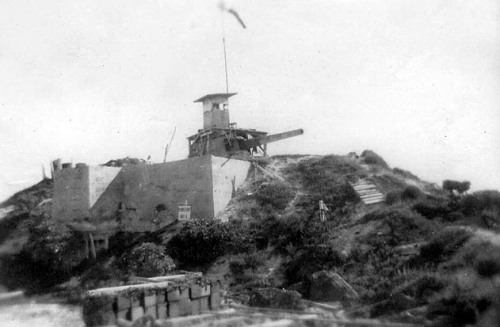
The fortification of Betio proceeded slowly until the arrival of Rear Admiral Shibasaki, who relieved Tomanari who returned to Japan.[xvii] Shibasaki, a tough veteran of service at sea and ashore including 19 months as a Rikusentai[xviii] officer in China was chosen by Admiral Koga to instill a better fighting spirit on the island.  The Imperial General Headquarters “New Operations Plan” ordered the outer defensive islands, such as Tarawa, to “hold up any American advance while an inner line of fortresses was constructed….”[xix] Shibasaki drove the garrison hard, inspiring them to “extraordinary heights of labor that resulted in Betio’s superb defenses.”[xx] Betio mounted four 8” Naval guns[xxi], four 14 cm guns, four dual mount 5.5” dual purpose guns[xxii] six 80 mm anti-boat guns, eight 75 mm dual purpose guns, ten 75 mm mountain guns, six 70 mm guns and nine 37 mm anti-tank guns, numerous machine guns and light AA guns and 14 light tanks.[xxiii] These weapons were mounted in well camouflaged armored or reinforced pillboxes.[xxiv] In accordance with the directives of the high command Shibasaki ordered his troops “to defend to the last man all vital areas and destroy the enemy at the waters’ edge.”[xxv] The Japanese records note that Shibasaki “immediately began to strengthen morale and carried out advanced training, and as a result…the garrison remarkably enhanced its fighting capability and they were full of confidence.”[xxvi] Even the service troops were thoroughly trained to fight from their superb defensive positions.[xxvii] Shibasaki reportedly told his men that it would take a million men a thousand years to take Betio.

American Preparations

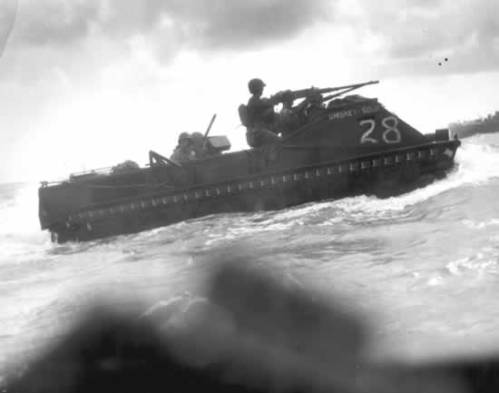
lvtLVT

Nimitz organized his forces into three major commands, the 5th Fleet, commanded by Admiral Raymond Spruance, the 5th Amphibious Force under Admiral Richmond “Kelly” Turner and the V Amphibious Corps under Major General Holland “Howlin’ Mad” Smith, USMC.[xxviii] The 2nd Marine Division which would make the assault at Tarawa was commanded by Major General Julian Smith. The force that sustained in this operation and subsequent amphibious operations was the Service Force Pacific Fleet.[xxix] This was a collection of ships whose mission it was to sustain the fleet in mobile operations,[xxx] which greatly “increased the range and power of the Navy in amphibious operations.”[xxxi] The planned assault called for the Army’s 27th Division take Makin and the veteran 2nd Marine Division which had been blooded at Guadalcanal to take Tarawa supported by the carriers and battleships of 5th Fleet.

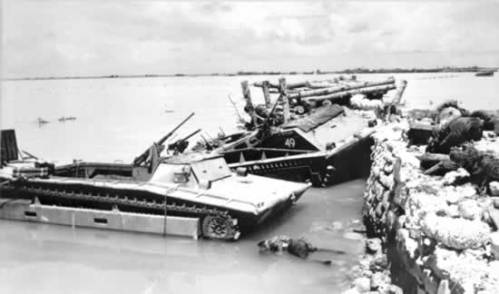
This was the first application of new amphibious tactics developed for the Pacific war.[xxxii] Air and sea bombardment would precede the actual assault. The Marines would be transported ashore in a new vehicle called an LVT (Landing Vehicle Tracked) and other amphibious ships and craft including the LSD (Landing Ship Dock), LCM (Landing Craft Mechanized) and LCVP (Landing Craft Vehicle Personnel).  The LVTs were absolutely vital, nicknamed “Amtracks” or “Amphtracks” they were essentially a tracked amphibious personnel carrier. They were developed from a commercial vehicle used by U.S. Forrest Service Rangers in the Florida Everglades and were capable of crossing coral reefs that would cause other craft to go aground.  The early LVTs had retrofitted armor and mounted a .50 cal. machine gun.  At Tarawa the Marines deployed 75 LVT-1s[xxxiii] and 50 LVT-2s. 93 LVTs would be part of the first wave of the Marine assault.[xxxiv] The LVTs were transported to Tarawa aboard LSTs (Landing Ship Tanks.)  Other innovations included the assignment of Naval Gunfire Support teams to the Marine Regiments and some battalions,[xxxv] and the first use of the M4 Sherman tank by the Marines.[xxxvi] Tarawa was a proving ground for the tactics and equipment which would be improved on and used in every subsequent amphibious operation in the Pacific.  Tarawa would also mark the last major use of rubber landing craft by the Marine Corps in an opposed landing.[xxxvii]

There were limitations to American preparations. First the size of the force meant that it could not be assembled in one place for rehearsals or to train as a team.[xxxviii] A second problem for the Americans was the assumption that high and low tides would be sufficient to get their landing craft across the reef in spite of warnings to the contrary.[xxxix] Likewise the Americans failed to completely anticipate the scope to which the Japanese had fortified the island. This was despite good intelligence that they had done so. In particular aerial photos taken by the air force and ULTRA intercepts provided good information on the Japanese units on the island and the layout of the defenses.[xl] Additionally some equipment shortages were not remedied. The Marine Bazooka’s did not arrive, and neither the 6th or 8th Marines had made an actual amphibious assault.  At Guadalcanal they made an administrative landing and few field-grade officers remained from the 2nd Marine Regiment who had landed at Tulagi.[xli] They were far from “amphibious experts” that they would become.[xlii] However, they made up for their lack of experience by their cohesiveness, high morale and esprit, being well armed and equipped, in top physical condition and knowing the basic tools of their trade: “weapons proficiency and field firing, close combat techniques, fire and maneuver, tactical leadership, fire discipline.”[xliii]

tarawa 8 inch gun8 Inch Gun Emplacement

The most critical aspect of the operation was to get across the reef onto the island.  There were few good landing sites and it was decided to make the landings from inside the atoll’s lagoon onto the Betio’s north shore.  This decision meant that transports embarking the Marines would unload outside of the lagoon and that the landing craft would have to make a 10 mile trip.[xliv] There was only one entrance into the lagoon and it was not deep enough for heavy ships to enter.[xlv]This meant that heavy ships such as battleships and cruisers would not be able to have direct fire on the Japanese positions best situated to disrupt the Marines.

The execution of the plan involved land based bomber strikes beginning on D minus 7. Carrier aircraft would begin their operations on D minus 2.  Cruisers and destroyers joined the cacophony of destruction on D minus 1 and the battleships on D Day itself.[xlvi] On D-Day itself Navy planned to bombard the island with 3,000 tons of shells in 2 ½ hours.[xlvii] The Navy was confident in the bombardment plans. Rear Admiral Kingman commanding the fire support group declared “We will not neutralize; we will not destroy; we will obliterate the defenses on Betio!”[xlviii] Four battalions of Marines would land in the first wave, the three battalions of the 2nd Marines and 2nd Battalion 8th Marines all commanded by Colonel David Shoup. Colonel Shoup who would win the Medal of Honor on Betio and later became the Commandant of the Marine Corps assumed command of 2nd Marines when its Regimental commander fell ill on the journey to Efate.[xlix] The division reserve was the remaining 8th Marine Regiment battalions. The 6th Marine Regiment served as the corps reserve.[l] The assault units would be reinforced by tanks and the 1st and 2nd Battalions 18th Marine Regiment, the division’s combat engineers.

Invasion: Day One

landing craft going to beachGoing Ashore

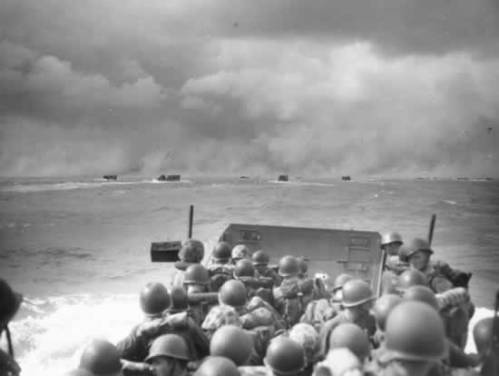
The naval gunfire bombardment commenced at 0542 on 20 November, and the assault waves began their trek to the beaches.  The transports were out of range of Japanese guns but ththat ensured boats would have to make a 10 mile trip.[li] At this point things began to go wrong.

lcm sinking at tarawaNavy LCT Sinking after Being Hit By Japanese Fire
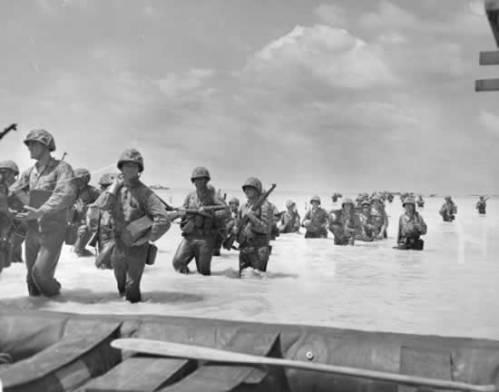
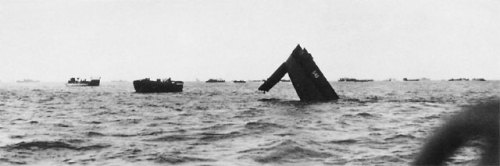
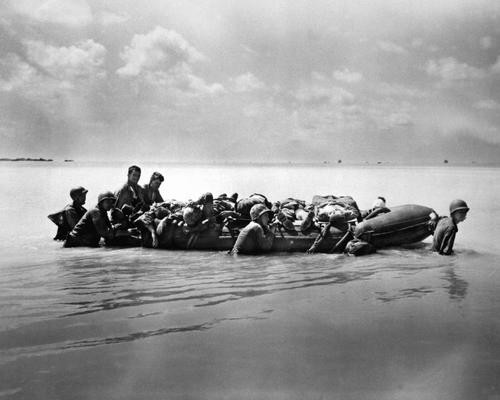
The Navy had “badly miscalculated the amount of softening-up that could be done in two and a half daylight hours bombardment.” Although major coast defense guns were silenced not enough damage was done to the Japanese defenses.[lii] The Japanese helped the Marines by firing their larger guns at warships, identifying their positions to Navy gunners.[liii] The bombardment lifted to allow an attack by carrier based aircraft. However the aircraft were late to arrive and the ships did not resume fire, allowing the Japanese to emerge and re-train their weapons.[liv] Likewise the destroyers Ringgold and Dashiell inside the lagoon had to cease fire, knowing the Japanese gunners along the shore were still active.[lv] Some believe that an extra half hour of direct fire from the destroyers would have saved many lives.[lvi] The LVTs in the first three waves were delayed by heavy chop and did not make landfall until 0913 throwing off the landing schedule.[lvii] The expect and planned for rise in tides did not materialize and they remained unpredictably low for the first 48 hours. No landing boats could cross the reef and the Marines were forced to wade ashore from 600 to 1000 yards.[lviii]

marines wade ashore at tarawaMarines Wading Ashore

Shoup’s Marines landed on three beaches.  Red one and two lay to the west of a 500 yard long pier and Red three lay to the east.  3/2 landed on Red-1, 2/2 on Red-2, 2/8 on Red-3, elements of 1/18 and the scout snipers on the pier, with 1/2 in reserve to land behind the battalion making the best progress.[lix] As soon as the Amtracks hit the reef the Japanese began firing.  Every “working weapon along the north and west shorelines….blazed forth in fierce, interlocking fields of fire.”[lx] As they watched the Amtracks craw over the reef that Japanese knew they were in for a tough fight, one of Warrant Officer Ota’s men exclaimed “Heavens! The God of Death has come!”[lxi] The Marines of 3/2 on Red-1 received enfilade fire from Japanese guns emplaced in a U around the beach.  Before the Marines landed they began to take causalities, Amtracks were hit in the lagoon and most that were not sunk or destroyed were unfit for further use.[lxii] The 2000 Marines who landed in the first hour were badly disorganized, the commanding officer’s of 2/2 and the Amtracks were killed, 3/2’s commander was isolated on the reef and only 2/8’s commander was with his troops. 2/8 was the only battalion being to reach the shore relatively intact.[lxiii] 3/2 was down to 65% of its strength and K/3/2 had taken over 50% casualties.[lxiv] The Marines in the fourth to sixth waves were struggling to wade ashore from the reef. Landing craft “ran aground or milled about helplessly outside the reef, which was swept by crossfire from behind the beaches and from a grounded hulk northwest of the pier.”[lxv] Most of the tanks were put out of action either through accurate fire by Japanese guns or by sinking in deep areas of the lagoon, the Tank battalion commander was blown out of his Amtrack, wounded and survived 24 hours by clinging to a pile of dead bodies to keep from drowning.[lxvi]

Col_Shoup_on_TarawaColonel Shoup Directing Operations on Tarawa
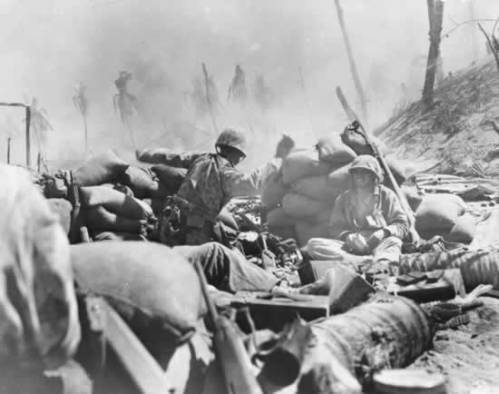
Shoup himself landed at Red-2 and began directing operations on the beach.  He knew that he had to get more troops ashore to exploit the minimal gains his Marines had made.  The news from Red-1 and Two was bad; he decided to bring 1/2 in at Red-2 thought that 3/8 should go in at Red-3.[lxvii] At 1018 General Julian Smith ordered the 8th Marines to dispatch 3/8 to Red-3.[lxviii] 3/8 had to make their way across 700 yards through the water to get to the beach.  It was a slaughter, only 30 percent of the first wave got ashore, in the second less and the third “were practically wiped out.”[lxix]

taraw close combatClose Combat on Betio

As his Marines struggled ashore those who had gotten ashore engaged the Japanese at point blank range.  Lt. Hawkins of the 2nd Marine Scout and Sniper platoon and 5 of his men engaged the Japanese on the pier in vicious hand to hand fighting,[lxx] Sergeant Bordelon of the Engineers on Red-2 though grievously wounded knocked out four gun positions, some by lobbing dynamite charges into them and galvanizing survivors into action, finally being killed while taking on a Japanese position alone.  He would be awarded the Medal of Honor.[lxxi]

HD-SN-99-02572Wounded Marines Being Evacuated by Rubber Raft
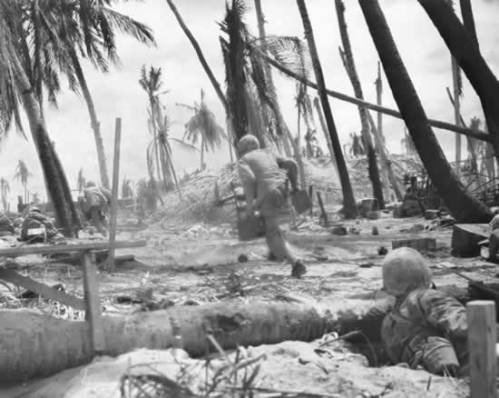
By afternoon Julian Smith realized that he needed more troops, his last battalion, 1/8 waited to go ashore.[lxxii] Smith asked for the 6th Marines and had Admiral Hill send a message to Admiral Turner stating “Issue in doubt. I concur.” This sent a chill through the listening Naval Staff.[lxxiii] Ashore Shoup brought howitzers from 1st Battalion 10th Marines on surviving Amtracks to the eastern edge of Red-2 near the pier,[lxxiv] which landed in the early evening.[lxxv] He sent Lieutenant Colonel Carlson to make a personal report to General Smith that he would hold his beachhead no matter what happened. Shoup ordered his Catholic Chaplain to lay out a cemetery and begin burying the dead who were already decomposing in the tropical heat.[lxxvi] As this transpired 2/8 got two 37mm anti-tank guns into position to drive off Japanese tanks approaching the beachhead.[lxxvii] The Division Band assisted corpsmen in bringing back wounded Marines.[lxxviii] The rest of the day the Marines continued to eke out a beachhead; Shoup’s Marines on Red-2 and Red-3 managed to advance about halfway across the island, 3/2 and elements 1/2 and 2/2 was isolated and Major Ryan of Lima Company pulled them back to meet an expected Japanese counter-attack.[lxxix] The Marines had taken over 1500 casualties of 5000 men landed the first day.[lxxx] There is no evidence that Shoup considered withdraw that night.[lxxxi] No counterattack occurred due to Japanese command and control problems, Admiral Shibasaki and his staff were killed while shifting headquarters during the afternoon,[lxxxii] and their communications were in shambles. A counterattack would have been disastrous in their condition,[lxxxiii] yet they assembled over 1000 men to oppose the Marines on day two.[lxxxiv] Had Shibasaki lived and communications survived a counterattack might have had ramifications far beyond Tarawa.[lxxxv]

Day Two: D+1

marines advancingMarines Advancing

The second day began with 1/8 landing on Red-2 and the 6th Marines began to land on Green Beach at the far western tip of Betio.  1/8’s landing turned into a bloodbath, the tide fell even lower than the previous day and as they hit the reef and waded ashore drifted into some of the heaviest Japanese defenses. Japanese guns, including the dual 5.5” guns took direct aim at the boats, and Marines ashore watched helplessly, and correspondent Robert Sherrod noted: “This is worse, far worse than it was yesterday.”[lxxxvi] Only half of 1/8 reached the beach with none of their heavy weapons or equipment.  Shoup ordered the remnants of the battalion into line on his western flank in preparation for an advance inland.[lxxxvii] During five hours of landings on day two, the “Marine casualties reached a higher rate than that sustained on the first morning.”[lxxxviii]

Meanwhile, Shoup ordered Ryan’s “orphans” to make an attack down the right flank of the Japanese positions on Green beach and the “ultimate American victory at Betio evolved from the attack during one intense hour the second morning.”[lxxxix] Taking every available Marine, two surviving Shermans and some mortars, Ryan gathered his force and coordinated Naval Gunfire support.  The area contained a number of heavy guns including two of the 8” mounts.  A destroyer blanked the Japanese positions with 5” shells and fire from her light AA guns.[xc] Attacking behind the beach, Ryan’s Marines isolated and destroyed everyone and everything that looked hostile.[xci] Against minimal opposition Ryan’s Marines quickly seized the gun positions and the western end of the airfield.  Within an hour his Marines occupied the entire western side of Betio up to a 200 yard depth by 1200 and he radioed to let Shoup know the good news and that he intended to advance east against the airfield.[xcii] The attack allowed the Marines to be able to land intact battalions with supporting arms for the first time battle.[xciii]

To the east behind Red-2 and Red-3 The 8th Marines and survivors of 1/2 and 2/2 attacked against fierce Japanese opposition near Shibasaki’s former command bunker and two other large bunkers which were mutually supporting.  The attack by the 2nd Marine survivors eventually succeeded in getting completely across the south side of the island.[xciv] During the attack Lt. Hawkins of the Scout Snipers was mortally wounded.  He too would win the Medal of Honor.  The attack cut the island in two but the Japanese launched a counterattack on the Marine positions which was beaten back.[xcv] The 8th Marines faced a more difficult task going against what was now the heart of the Japanese defense, as its defenders had been reinforced by Lt. Minami and his third company of the 7th Special Naval Landing Force.  Vicious fighting ensued and by nightfall “the Marines had little to show for their heavy losses,[xcvi] but they did make significant inroads against the Japanese to warrant optimism for D+2.[xcvii] By evening the Marines on Red-1 and Red-2 had consolidated their beachhead so that reinforcements were landing, including jeeps, artillery and heavy equipment, and other Marines noted that Japanese defenders were beginning to commit suicide and they began to feel that Japanese morale had broken.  By late afternoon Shoup transmitted the message: “Casualties many. Percentage of dead unknown. Combat efficiency-We are winning.”[xcviii] By late afternoon Major Jones’ 1/6 landed on Green beach in their rubber boats, reinforcing Ryan’s orphans, it was the first of the 7 battalions landed to get ashore intact and the two officers coordinated their units for a night defense and an early attack the next morning.[xcix] 2/6 cleared the nearby island of Bairiki allowing 2/10 to land its howitzers on the island.  This in effect cut off any line of retreat for the defenders of Betio.[c] Colonel Edson came ashore during the evening to relieve Shoup[ci], who remained ashore to help coordinate the next day’s attack.  Again there were no coordinated Japanese counterattacks, the only senior officer, Sugai was isolated in the pocket between the Red and Green beaches and no senior officer could coordinate any attacks.[cii]

Day Three and Four: D+2 and D+3

tarawa wreckageWrecked LVY’s and Bodies on the Beach: The Marines Released Photos to Get the Public to Understand the Cost of the Battle
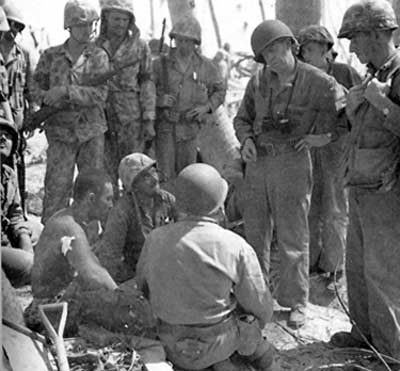
Day three began with attacks against Japanese strong points and the arrival of more reinforcements including 3/6 which landed on Green beach and three light tank platoons which landed on Red-2.[ciii] The Marines attacked off of Green beach sweeping east to join the 2nd Marines who had cut the island in two the day before.  The 8th Marines continued to attack the heavily fortified bunker complex eventually taking these heavily fortified and defended positions.  During the assault Lt Sandy Bonnyman of 1/18 won the Medal of Honor for leading the assault on these positions.[civ] Fighting remained fierce throughout the day and General Smith arrived to take command on shore.  The Marines attacked supported by tanks, artillery and naval gunfire.  By the evening they were established at the east end of the airfield.  The Japanese launched a series of Banzai charges which beginning about 1930 hours and ending about 0400 when the Marines annihilated the last attack with the assistance of artillery.[cv] The attack, which could have succeeded the first or early the second day, now aided the Marines by sacrificing strength that might have been used to exact a higher price for the tail of the island.[cvi] The next morning the Marines pushed forward and eliminated the last Japanese defenders and by 1200 Betio was secured.  Of about 5000 defenders only 17 Japanese and some Korean laborers were taken prisoner.[cvii] The Marines lost over 1000 killed and 2300 wounded.[cviii]

Tarawa prisonerOne of the 17 Japanese Who Survived the Battle being Interrogated by Marines, only one Chief Warrant Officer Ota was an Officer
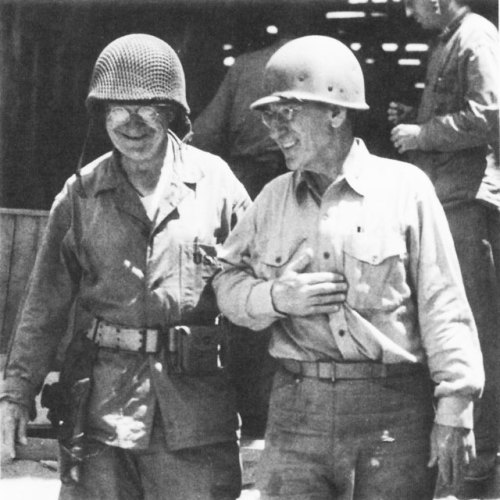
Epilogue

The Marines paid a heavy price for Betio, but it was not to be a useless sacrifice, though it was a source of great controversy especially among politicians.[cix] Spector wonders if waiting for better tides or a full moon would have saved lives.[cx] Holland Smith later argued that Tarawa should have been bypassed, but Nimitz’s biographer Potter notes “if the lessons of the amphibious assault had not been learned at Tarawa, they would have to be learned elsewhere, probably at greater cost.”[cxi]The lessons learned alone aided all future amphibious operations in the Central Pacific and elsewhere.  Timing and coordination of naval gunfire support, air strikes and combat loading of transports were all refined in future operations. Large numbers of armored and up-gunned Amtracks would be part of every future operation.[cxii] Intelligence was emphasized and replicas of the Japanese fortifications were built and tested to determine the best way of destroying them.[cxiii] The Marines shocked the public by releasing photos and films of the carnage on Tarawa to awaken them to the challenges ahead.[cxiv]

Today the battle is remembered annually by the 2nd Marine Division at Camp LeJeune, an ever shrinking number of veterans of the battle attend the ceremonies.  Samuel Eliot Morison put it best: “All honor, then, to the fighting heart of the United States Marine. Let the battle for that small stretch of coral sand called Betio of Tarawa be remembered as terrible indeed, but glorious, and the seedbed for victory in 1945.”[cxv]

Appendix: Leaders on Tarawa

smith and smith at tarawaLieutenant General Holland Smith and Major General Julian Smith on Betio
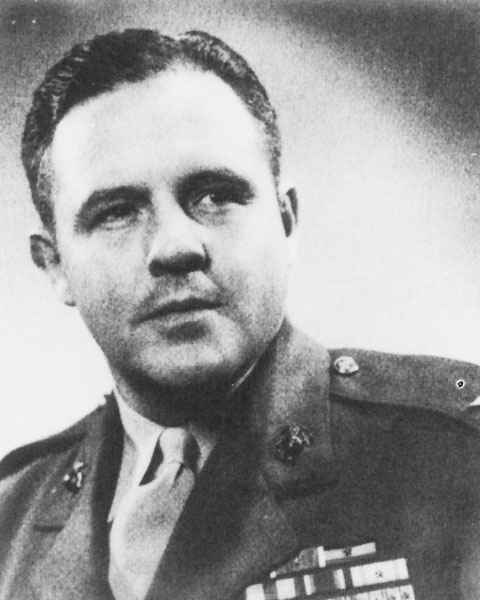
General Holland M. “Howling Mad” Smith USMC: (1882-1967) Lieutenant General Holland M. Smith command V Amphibious Corps during the Gilberts operation.  Prior to the war he had worked extensively on amphibious warfare doctrine for both the Marine Corps and Navy. Unlike many senior officers Smith was not a Academy graduate having matriculated from the Alabama Polytechnic Institute (now Auburn University) in 1903 and law school in 1903.  Smith served as Adjutant of the 4th Marine Brigade in the First World War and served in Panama and the Dominican Republic in addition to other Marine tours afloat and ashore.  He served well and had many key assignments between the wars culminating in as the Assistant Commandant of the Marine Corps.  Subsequent to the Gilbert campaign he served as Commanding General of the Fleet Marine Force, Pacific and later commanded the Marines at Iwo Jima.  He retired in 1946.

Major General Julian Smith USMC: (1885-1975) Major General Julian Smith served as Commanding General 2nd Marine Division at Tarawa.  He graduated from the University of Delaware and was commissioned as a Second Lieutenant in 1909.  He served in Haiti, Santo Domingo and the Vera Cruz expedition. During the First World War he served as an instructor in the Marine Officer training camps at Quantico. After the war he served in Cuba, Nicaragua and various command and staff posts including the Army Command and General Staff College.  He commanded 5th Marines in 1938 and in 1942 was promoted the Major General serving as director of Fleet Marine Force Schools, New River, NC.  He took command of 2nd Marine Division in May 1943 and served there until April 1944 when he became Commanding General, Expeditionary Troops, Third Fleet and in December 1944 took command of the Military Department of the Pacific.  He retired in 1946.

shoupColonel Shoup After the Battle

Colonel David Shoup USMC: (1904-1983) Colonel David Shoup commanded the 2nd Marines at Tarawa, being appointed as commander when its commander fell ill.  Shoup won the Congressional Medal of Honor for his actions on Tarawa.  A 1926 graduate of DePauw University, Shoup was commissioned a Second Lieutenant through the ROTC program that year.  He served in various assignments to include service in China, at sea on the battleship Maryland and Marine Barracks Puget Sound Navy Yard. He joined the staff of 6th Marines in October 1940 and assumed command of 2/6 in February 1942.  He was assigned as the Assistant Operations Officer for 2nd Marine Division in July 1942 and promoted the Lieutenant Colonel.   He went with the Division to New Zealand where he became the G-3 and from which he was fleeted up to command 2nd Marines at Tarawa.  After Tarawa he served as the Division Chief of Staff at Saipan and Tinian.  After the war Shoup continued to be assigned in key billets at the Pentagon and as commanding General, 1st Marine Division and then the Third Marine Division.  He became Chief of Staff, HQMC in 1958 and was appointed as the 22nd Commandant of the Marine Corps by President Eisenhower, a post that he retained until his retirement in 1963.

Admiral Tomanari Sachiro IJN: (1887-?) Commander of Tarawa garrison until relieved by Rear Admiral Shibasaki.   Graduate Naval Academy 1910, initially a communications officer he held various commands including Heavy Cruiser Haguro and Battleship Kirishima and two smaller ships.  Assigned to Tarawa in February 1943 he helped design and supervised the initial construction of Tarawa Defenses until relieved by Admiral Shibasaki on 20 July1943.  He returned to Japan and served the remainder of the war on Navy Division of Imperial General Headquarters.  Tomonari survived the war though nothing is mentioned as to his postwar fate.

Rear Admiral Shibasaki Keiji IJN: (1894-1943) Commanded Tarawa Garrison until his death during the battle.  He graduated from the Naval Academy in 1915 and he was a skilled navigator and instructor.  Prior to the war he had served afloat and ashore and ashore and had commanded a ship and naval station and served as a naval attaché to a member of the Imperial Family.  Among his assignments was 19 month combat tour with the special Naval Landing Forces in China, where he served as Chief of Staff of Shanghai Special Naval Landing Force.  Shibasaki’s leadership helped the garrison improve their defensive capabilities and combat skills as he inspired them to great heights and executed an intense training program. He was killed in the battle.

A Personal Note

I have not been to Tarawa but feel that I know it well.  I served in Second Marine Division from April 1999 through December 2001.  Due to my prior service experience I was used to fill gaps where chaplains were needed and ended up serving in four different battalions.  I served in 2nd Combat Engineer Battalion, the descendant of 1/18, the combat engineers.  We had a WWII Bulldozer outside our command post named after Sergeant Bordelon, the Medal of Honor Citations for Bordelon and Boonyman were prominently displayed.  I also served in 1/8 and 3/8.  I knew the accounts of the slaughter of these Marines as they attempted to land but as I re-read the accounts I was moved by their courage under fire.  The CPs of these battalions are also adorned with citations of their heroes lost at Tarawa.  Veterans would visit our units during Tarawa Days at Camp LeJeune, worn by the battle and the years they always made an impression. There is almost a mystical connection between the Second Marine Division and the Marines of Tarawa; it was a crucible that defined the division, whose motto is the same as the Army Infantry School. “Follow Me!”

Semper Fidelis,

Padre Steve


[i] Spector, Ronald H. Eagle Against the Sun: The American War with Japan.  The Free Press, New York, NY 1985. p.253


[ii] Murray, Williamson and Millett, Allan R. A War to Be Won: Fighting the Second World War, The Belknap Press of Harvard University Press, Cambridge, MA 2000. p.338

[iii] Ibid. Spector. p.253

[iv] Ibid. p.255 The conference also set a date for the invasion of France.

[v] Toland, John. The Rising Sun: The Decline and Fall of the Japanese Empire, 1936-1945. Random House, Inc. New York, NY 1970. p.468

[vi] Ibid. Spector. p.255

[vii] Costello, John. The Pacific War 1941-1945. Quill Publishing, New York, NY 1982. p.430

[viii] Ibid.

[ix] Potter, E.B. Nimitz. Naval Institute Press, Annapolis, MD, 1976, Third Printing with Revisions 1979. p.243. Nimitz’s forces would have had to seize 5 major Japanese bases and his staff was not sure that the Pacific carrier force would be strong or experienced enough to provide the necessary air cover for the operation.

[x] Ibid.

[xi] Ibid. pp.243-245

[xii] Morison, Samuel Elliott. The Two Ocean War: A Short History of the United States Navy in the Second World War. Little Brown and Company, Boston and Toronto, 1963. p.296.

[xiii] Hammell, Eric and Lane, John E. Bloody Tarawa: The 2nd Marine Division, November 20-23, 1943. The Zenith Press, St. Paul MN 2006.  Text copyright 1998 Eric Hammell and John E. Lane. p.4

[xiv] See Alexander, Joseph H. Utmost Savagery: The Three Days of Tarawa. Ivy Books, published by Ballantine Books, New York, NY. 1995. pp. 39-40.  This unit became the Third Special Base Unit on its deployment and was joined by the 111th Construction Battalion.

[xv] Ibid. Hammell. p.4

[xvi] See Alexander pp.39-40. This unit was basically a reinforced infantry battalion with 3 rifle companies, a weapons battery, anti-aircraft battery, a light tank company and support units numbering about1600 men.

[xvii] Ibid. Alexander. p.43

[xviii] Alexander p.27 The Rikusentai was the Japanese equivalent of Marines, who numbered about 50,000 men.  The officers attended Army schools and qualified enlisted men attended additional Army specialist training.

[xix] Ibid. Costello. p.431

[xx] Ibid. Hammell. p.22

[xxi] See Alexander p.77. While most writers say that these guns were brought from Singapore, Alexander notes that British writer William H Bartsch submitted proof (serial numbers) that the guns were sold by Vickers to Japan in 1905 as a legitimate business transaction.

[xxii] These are the same guns (127mm) mounted as the secondary armament of Nachi and Takao Class Heavy Cruisers and later mounted on light cruisers to replace the main battery with a more effective anti-aircraft armament.

[xxiii] Ibid. Hammell. p.22

[xxiv] Hammell notes that many of these bunkers and pillboxes were so well concealed that they could not be seen.

[xxv] Ibid. Toland. p.469.

[xxvi] Ibid. Alexander. p.43.

[xxvii] Ibid. Hammell. p.28

[xxviii] Ibid. Morison. p.297

[xxix] Ibid. Costello. p.429

[xxx] At this point the force could provide everything except major permanent repairs to warships.

[xxxi] Liddell-Hart, B.H.  History of the Second World War. G.P. Putnam’s Sons, New York, NY 1970. p.511

[xxxii] Ibid. Costello. p.431

[xxxiii] The older LVT-1s had boiler plate armor added as a field modification and were given a heavy machine gun. Prior to this they were unarmored and had two light machine guns.

[xxxiv] Ibid. Morison. p.303

[xxxv] Hammell includes a by name list of these officers in Appendix B.  Of note for today, each MEUSOC (Marine Expeditionary Unit, Special Operations Capable) has an assigned Naval Gunfire Support Team.

[xxxvi] Ibid. Alexander. pp. 61-62.  The Shermans had to be transported aboard pre-loaded LCM-3s carried in the well decks of the LSDs.

[xxxvii] Ibid. Alexander. pp.58-59

[xxxviii] Ibid. Morison. p.297.  As a sidebar discussion it should be noted that Galvanic helped provide the model for the organization of all further Marine Corps amphibious doctrine now known by the acronym PERMA; Planning, Embarkation, Rehearsal, Movement and Assault, which describes the 5 phases of a amphibious assault.

[xxxix] Ibid. Hammell details the intricacies of the particular tides seen at Tarawa and the knowledge that the Marines had from the former Resident Commissioner of the Island, Major Frank Holland who warned the division staff that he knew that there would not be enough water over the reef to get landing craft across it. (pp.18-20)

[xl] Ibid. Alexander. pp.75-77

[xli] Ibid. Alexander. pp.67-68.

[xlii] Ibid. p.70

[xliii] Ibid. p.71

[xliv] Ibid. Morison. p.302

[xlv] Ibid. Hammell. p.16

[xlvi] Johnston, Richard W. Follow Me! The Story of the Second Marine Division in world War II.  Copyright 1948 by the Second Marine Division History Board and published by Random House Publishers, New York, NY 1948. p.106

[xlvii] Ibid. Liddell-Hart. p.511  Johnson says 2,700 tons. (p.106)

[xlviii] Ibid. Johnston. p.106

[xlix] Ibid. Hammell. p.17

[l] Ibid.

[li] Ibid.. Hammell. 46-47

[lii] Ibid. Morison. p.303

[liii] Ibid. Alexander. p.113.  Alexander notes that the Japanese would have been better served by using these guns on the stalled out landing craft.

[liv] Ibid. Hammell. p.47.

[lv] Ibid. Hammell. p.58

[lvi] Ibid.

[lvii] Ibid. Morison. p.303

[lviii] Ibid. Alexander. p.79

[lix] Ibid. Hammell. p.17

[lx] Ibid. Alexander. p.121

[lxi] Wukovits, John. One Square Mile of Hell: The Battle for Tarawa. NAL Caliber, published by New American Library, a division of Penguin Group USA, New York NY, 2006. p.112

[lxii] Ibid. Johnston. p.116

[lxiii] Ibid.

[lxiv] Ibid. Wukovits. P.119  Other companies suffered as grievously, K/3/2 was not alone in its suffering.

[lxv] Ibid. Spector. pp.263-264

[lxvi] Ibid. Alexander. pp.136-138

[lxvii] Ibid. Hammell. p.90

[lxviii] Ibid. p.95

[lxix] Ibid. Spector. p.264

[lxx] Ibid. Wukovits. p.114

[lxxi] Ibid. Alexander. pp.139-140

[lxxii] 1/8 did not arrive on the beach due to botched communications until D plus 1.

[lxxiii] Ibid. p.150  The last time this signal had been sent it was by Major Devereaux at Wake Isalnd

[lxxiv] Ibid. p.151

[lxxv] Ibid. Johnston. p.132

[lxxvi] Ibid. Hammell. p.112

[lxxvii] Ibid. p.130

[lxxviii] Ibid. Johnston. p.122

[lxxix] Ibid. Johnston. p.122

[lxxx] Ibid. Costello. p.436

[lxxxi] Ibid. Alexander. p.163

[lxxxii] Ibid. Alexander. pp.157-158  Hammell notes that Shibasaski was most likely killed by fire from Ringgold or Dashiell.

[lxxxiii] Ibid. Hammell.pp.139-140

[lxxxiv] Ibid. Alexander. p.162

[lxxxv] Ibid.  Wukovits. p.176. Wukovits notes how this could have affected the planning for the Normandy invasion.

[lxxxvi] Ibid. Alexander. p.173

[lxxxvii] Ibid. Hammell. p.160

[lxxxviii] Ibid. Costello. p.437

[lxxxix] Ibid. Alexander. p.170

[xc] Ibid. Hammell. p.163

[xci] Ibid. Hammell. p.166

[xcii] Ibid. Wukovits. p.178

[xciii] Ibid. Alexander. p.170 Ryan would be awarded the Navy Cross for his efforts.

[xciv] Ibid. Hammell. p.172

[xcv] Ibid. Alexander. p.179

[xcvi] Ibid. Alexander. p.181

[xcvii] Ibid. Hammell. p.178

[xcviii] Ibid.. Wukovits. p.194

[xcix] Ibid. Hammell. p.202

[c] Ibid. Hammell. p.212

[ci] Shoup would be awarded the Medal of Honor and eventually go on to be the Commandant of the Marine Corps.

[cii] Ibid. Alexander. pp.191-192

[ciii] Ibid. Johnston. p.134  2 platoons landed on Red-2 and one on Green Beach.

[civ] Ibid. Alexander. pp.202-205

[cv] Ibid. Johnston. pp.145-146

[cvi] Ibid. Johnston. p.147

[cvii] Ibid. Toland. p.470

[cviii] Ibid. Murray and Millett. p.345

[cix] Ibid. Liddell-Hart. p.511

[cx] Ibid. Spector. p.266

[cxi] Ibid. Potter. P.264

[cxii] Ibid. Murray and Millett. p.347  The Amtrack in improved forms has been part of the Marines ever since. The current model serves in a traditional amphibious role as well as a Armored Personnel Carrier for Marines involved in ground combat operations ashore.

[cxiii] Ibid. Costello. p.439. The method found to work best was long range plunging fire by heavy guns found on battleships and heavy cruisers.

[cxiv] Ibid. Murray and Millett. p.346

[cxv] Ibid. Morison. p.306

Bibilography

Alexander, Joseph H. Utmost Savagery: The Three Days of Tarawa. Ivy Books, published by Ballantine Books, New York, NY. 1995.

Costello, John. The Pacific War 1941-1945. Quill Publishing, New York, NY 1982

Morison, Samuel Elliott. The Two Ocean War: A Short History of the United States Navy in the Second World War. Little Brown and Company, Boston and Toronto, 1963

Hammell, Eric and Lane, John E. Bloody Tarawa: The 2nd Marine Division, November 20-23, 1943. The Zenith Press, St. Paul MN 2006.

Johnston, Richard W. Follow Me! The Story of the Second Marine Division in world War II.  Copyright 1948 by the Second Marine Division History Board and published by Random House Publishers, New York, NY 1948

Murray, Williamson and Millett, Allan R. A War to Be Won: Fighting the Second World War, The Belknap Press of Harvard University Press, Cambridge, MA 2000

Potter, E.B. Nimitz. Naval Institute Press, Annapolis, MD, 1976, Third Printing with Revisions 1979

Spector, Ronald H. Eagle Against the Sun: The American War with Japan.  The Free Press, New York, NY 1985 Toland, John. The Rising Sun: The Decline and Fall of the Japanese Empire, 1936-1945. Random House, Inc. New York, NY 1970

6 Comments

Filed under History, Military, world war two in the pacific

Lessons for the Afghan War: The Effects of Counterinsurgency Warfare on the French Army in Indo-China and Algeria and the United States Military in Vietnam

Note: This is an article that I wrote for a class a year ago which has been updated in order to show the lessons of history that can be useful in the current wars in Iraq and Afghanistan.

legion indo-china

French Foreign Legionnaires in Indo-China

The effects of the wars Indo-China, Algeria and Vietnam on the French and American military organizations internally and in relationship to their nations piqued my interest in 2005. The wars in Iraq and Afghanistan forced me to start asking the question of what short and long term effect that these wars might have on the U.S. military.  As such I wondered what historical precedent that there was for the question. My interest was furthered by my deployment with Marine and Army advisors to Iraqi Army and Security forces in 2007-2008.  My search led to the French experiences in Indo-China and Algeria and the American experience in Vietnam.  Recently with the Iraq war winding down and ongoing war in Afghanistan which has gone from apparent victory to mounting concern that the effort could fail as the Taliban and Al Qaida have regained momentum amid widespread corruption by the Afghan government and weakness of NATO forces.

Thesis

The counterinsurgency campaigns conducted by the French and American militaries in Vietnam and Algeria had deep and long lasting effects on them.  The effects included developments in organization and tactics, relationship of the military to the government and people, and sociological changes.  The effects were tumultuous and often corrosive.  The French Army in Algeria revolted against the government. The US Army, scarred by Vietnam went through a crisis of leadership and confidence which eventually resulted in end of the draft and formation the all volunteer military.  The effects of the Iraq and Afghanistan wars are yet unknown but could result in similar situations to the militaries and governments involved,

Historiography

legion algeriaForeign Legion in Algeria

There is a wealth of data regarding these wars. There are several types of materials. The accounts of soldiers, diplomats and reporters who experienced these events contained in memoirs and diaries. The best include David Hackworth’s About Face and Steel My Soldiers Hearts; and General Harold Moore’s We Were Soldiers Once… and Young. French works include Jules Roy’s The Battle of Dien Bien Phu and General Paul Aussaresses’ The Battle of the Casbah. There are innumerable popular accounts written by NCOs and junior officers.  These accounts may contain a wealth of information, but are limited by a number of factors. First, the authors, veterans of the wars, only saw part of the overall picture and first-hand experience in war can skew a writer’s objectivity. Those who have been through the trauma of war interpret war through their own experience.  Physical and psychological wounds can have a major impact on the interpretation of these writers as can their experience and political ideology. Finally few of these writers are trained historians. Despite this they can be a valuable resource for the historian.

Another source is found in the official histories written by the military forces involved in the wars. Often these incorporate unit histories and individual narratives and analyze specific battles and the wider campaigns, but do little in regard to broader conditions that affected operations.  While a good source, many are not as critical of their institutions as they should be.

Histories by trained historians and journalists provide another view. The most insightful of the journalist accounts include Bernard Fall’ Street Without Joy and The Siege of Dien Bien Phu: Hell in a Very Small Place. A limitation of all of these is that they are often heavily influenced by the political and societal events. This means that earlier accounts are more likely to be reactive and judgmental versus critical and balanced. Later accounts have the benefit of access to the opposing side and documents not available to earlier writers.  Alistair Horn in A Savage War of Peace provides one of the most informative and balanced accounts of the war in Algeria. Martin Winslow does the same regarding Dien Bien Phu in The Last Valley.

Another source is the writings of participants who critically examine their participation in the wars.  Many of these, French and American provide insights into the minds of leaders who are reflective and critically examine what happened to their military institutions in these wars. The best of these is French Colonel David Galula whose books Pacification in Algeria 1956-1958 and Counterinsurgency Warfare: Theory and Practice provide first-hand accounts of the subject combined with critical reflection. Galula’s works have been important to John Nagl, General David Petreus and others who helped write the U.S. Army and Marine Corps Counterinsurgency manual. Andrew Krepinevich in The Army and Vietnam provides a critical analysis of the U.S. Army in Vietnam.  Other sources, both online and print, such as RAND, provide excellent analysis of selected topics within the scope of this essay, especially COIN.

Dien Bien Phu 1French at Dien Bien Phu

The ability to dispassionately and critically examine and evaluate these sources over a period of several years was and integrate them with my own experience has been a critical to me.  It has changed the way that I look at sources, and caused me to be much more aware of bias, the limitations of sources and the need to have a multiplicity of sources and points of view and to be suspicious of contemporary reports and accounts of the war in Afghanistan regardless of the source.

Analysis of the Issue

viet minh supplyViet Minh Supply Columns were Never Stopped by French Air power or Artillery

The conflicts in French Indo-China, Algeria and Vietnam had major effects on the French and American military institutions. These effects can be classified in a number of ways. First, the manner in which each military waged war, including tactics employed and use and development of weapons systems was changed.  The use of airpower, especially helicopters and use of riverine forces provided an added dimension of battlefield mobility but did not bring victory. As John Shy and Thomas Collier noted regarding the French in Indo-China: “French mobility and firepower could take them almost anywhere in Vietnam, but they could not stay, and could show only wasted resources and time for their efforts.”[1]

Joint_operation_with_ARVN_112-1Joint US and ARVN Operation

The use of intelligence and psychological warfare, including the use of torture became common practice in both the French and American armies.  The wars had an effect on the institutional culture of these armed services; neither completely embraced the idea of counterinsurgency and for the most part fought conventionally. Galula notes how the “legacy of conventional thinking” slowed the implementation of proper counterinsurgency tactics even after most commanders learned that “the population was the objective.”[2] Krepinevich notes that “any changes that might have come about through the service’s experience in Vietnam were effectively short-circuited by Army goals and policies.”[3] Finally the wars had a chilling effect on the relationship between the both militaries and the state, veterans from each nation often felt betrayed or disconnected from their country and people.  Unfortunately instances of all of these have occurred or can be seen in the current wars in Iraq and Afghanistan.

VIETNAM DIEN BIEN PHUFrench Prisoners after Dien Bien Phu: Many Survivors Would be Fighting in Algeria within Two Years
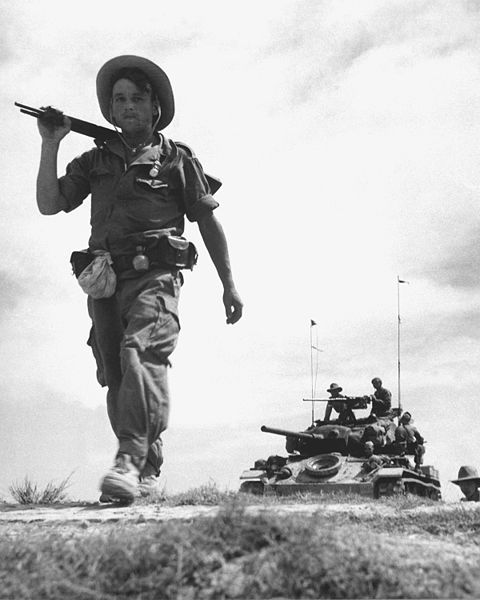
The French Army had the misfortune of fighting two major insurgencies back to back.  The French military was handicapped even before it went into these wars. The Army came out of World War II defeated by the Germans, divided by loyalties to Vichy or one of the Free French factions. They were humiliated by the Japanese in Indo-China, while in Algeria France’s crushing defeat was devastating.  “Muslim minds, particularly sensitive to prestige and baraka, the humiliation made a deep impression.”[4] French society was as divided as the Army; the economy in shambles, the government weak and divided.  The Viet-Minh had prepared well making use of time and training to get ready for war.  “Once full-scale hostilities broke out, the French, for budgetary and political reasons could not immediately make the large scale effort to contain the rebellion in the confines of small-scale warfare.”[5]

In both Indo-China and Algeria the French attempted to fight the budding insurgencies in a conventional manner.  This was particularly disastrous in Indo-China when on a number of occasions battalion and regimental combat team sized elements were annihilated by Viet-Minh regulars.  Between October 1st and 17th 1950 every French garrison along the Chinese border was over-run.  The French lost over 6000 troops and enough equipment to outfit “a whole additional Viet-Minh division.” It was their worst colonial defeat since Montcalm at Quebec.[6] In Algeria when the fight began in earnest France’s “ponderous ponderous N.A.T.O forces found themselves at an impossible disadvantage,”[7] unable to have any influence off the main roads.

french troops indochinaFrench Troops and Tanks in Indo-China: Road Bound Forces were often Defeated by Viet- Minh Forces

In Vietnam the French did not absorb the lessons of fighting a well established insurgent force. French forces hoped to draw the Viet-Minh main forces into battles of attrition where their superior firepower could be brought to bear. Such was the case at Na San in December 1952 where the French established an “Air ground base” deep in Viet-Minh territory to draw Giap’s forces into open battle.  This worked, but just barely. General Giap, short of artillery and not planning on a long battle frittered away his troops in mass charges.  However, the French, because of Na Son assumed they had found the key to victory. In their embrace of the “air ground base concept, French staff officers were following an intellectual tradition that had long been prone to seduction by elegant theories.”[8] The result was the disaster at Dien Bien Phu the following year.  The destruction of the elite Group-mobile 100 near Pleiku in 1954 was the coup de grace. In Indo-China the French made limited use of helicopters, used paratroops widely, and developed riverine forces. One thing they were critically short of was significant tactical air support.[9]

The most inventive French creation in Indochina was the GCMA/GMI forces composed of mountain tribesmen led by French NCOs and Junior Officers.  They were designed to provide “permanent guerilla groups rooted in remote areas” to harass and interdict Viet-Minh forces.[10] Trinquier noted that at the time of the Dien Bien Phu defeat that these forces had reached over 20,000 trained and equipped maquis in the Upper Region of Tonkin and Laos. These forces achieved their greatest success retaking Lao Cai and Lai Chau May 1954 as Dien Bien Phu fell.[11] Trinquier stated that “the sudden cessation of hostilities prevented us from exploiting our opportunities in depth.”[12] The GMI units and their French leaders were abandoned fighting on for years after the defeat. One account noted a French NCO two years after the defeat cursing an aircraft patrolling the border “for not dropping them ammunition so they could die like men.”[13] In the end the French left Indo-China and Giap remarked to Jules Roy in 1963 “If you were defeated, you were defeated by yourselves.”[14]

Algeria was different being part of Metropolitan France; there the French had support of European settlers, the pieds-noir. Many French soldiers had come directly from Indo-China. There French made better adaptations to local conditions, and realized that they had to win the population and isolate the insurgents from it and outside support. As Galula said, victory is the destruction of the insurgent’s political and military structures, plus “the permanent isolation from the population, not forced upon the population, but by and with the population.”[15] The lessons learned by the French in both Algerian and Indo-China were lost upon the Americans.

4CavVnM48US Heavy Forces including Armor had Little Utility in Many Parts of Vietnam
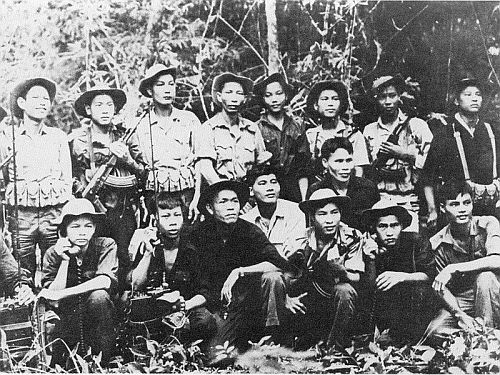
The United States military, especially the Army approached the Vietnam War with a conventional mindset, referred to as the “Army concept.” [16] It not only approached the war in this manner, but it trained and organized the South Vietnamese forces, ARVN into the American model. Americans re-organized ARVN into divisions “based upon the U.S. divisional force structure.”[17] Due to the imposition of an American template and organizational structure upon it, ARVN was not structured appropriately for the threat that it faced.”[18] The results were as to be expected. Large numbers of American troops poured in taking the lead against the North Vietnamese and Viet Cong . The American method of counterinsurgency was costly.  It was “almost a purely military approach”[19] which ignored political and social realities on the ground. Instead of focusing on protecting the Vietnamese people and denying the Communists a safe haven the Army in particular believed that massive firepower was the best means to be“utilized by the Army to achieve the desired end of the attrition strategy-the body count.”[20] In the end the American defeat was a “failure of understanding and imagination.”[21] The one shining success was the Marine Corps experimentation with “Combined Action Program” platoons which lived in the villages with militia for long periods of time. This program produced great results “in eliminating local guerillas”[22] but was killed by the Army.

NlfmainforceNVA Main Forces

These wars tore the heart out French and American armies. For the French the defeats inflicted a terrible toll.  In Indo-China many French career soldiers felt that the government’s “lack of interest in the fate of both thousands of missing French prisoners and loyal North Vietnamese…as dishonorable.”[23] Divisions arose between those who served and those who remained in France or Germany and created bitter enmity between soldiers.  France would endure a military coup which involved many who had fought in Vietnam and Algeria. Having militarily won that war, were turned into what Jean Lartenguy called The Centurions had been turned into liars.”[24] They were forced to abandon those who they had fought for and following the mutiny, tried, imprisoned, exiled or disgraced. Colonial troops who remained loyal to France were left without homes in their “independent” nations.  They saw Dien Bien Phu as the defining moment. “They responded with that terrible cry of pain which pretends to free a man from his sworn duty, and promises such chaos to come: ‘Nous sommes trahis!’-‘We are betrayed.’”[25]

war protestUS Veterans of Vietnam Would Return to a Deeply Divided Country that turned its Back on Them for Years

The U.S. Army left Vietnam and returned to a country deeply divided by the war.  Vietnam veterans remained ostracized by the society until the 1980s.  As Harold Moore recounts “in our time battles were forgotten, our sacrifices were discounted, and both our sanity and suitability for life in polite American society were publically questioned.”[26] The Army endured a massive reorganization that resulted in the formation of the All-Volunteer force, which would redeem itself and emerge from the ashes in the Gulf War. The Americans would not learn the lessons of revolutionary warfare and counterinsurgency until forced to do so in Iraq in 2004-2007. These lessons however were not applied to Afghanistan and the Taliban which seemed to have been defeated have regained the initiative, policy is being debated amid discord in the west and there are reports of American and NATO forces becoming discouraged by the course of the war and concern that their efforts will be in vain. This is a dangerous situation to be in and if we learn from anything from our own history as well as that of foreign military forces in Afghanistan we need to be very careful in implementing strategy to get whatever we do right.

training team baseTraining Team Base in Afghanistan: Some of these Bases Have proven Vulnerable to Well Planned and Coordinated Taliban Attacks

Conclusion

The effects of these wars on the French and American military establishments were long lasting and often tragic. The acceptance of torture as a means to an end sullied even the hardest French officers. Men like Galula and Marcel Bigeard refused to countenance it, while others like Paul Aussaresses never recanted.  Americans would repeat the tactic at Abu Ghraib rallying the Iraqis against them and nearly losing the war because of it.

For the Americans, the effects of Vietnam continued at home. Race riots tore at the force while drug addictions and criminal activities were rampant.  Many incompetent leaders who had “ticket punched” their careers kept their jobs and highly successful leaders who became whistle blowers like Hackworth were scorned by the Army institution.  The years following Vietnam were a severe test of the US Military and took years for the military to recover.  Likewise It took years before either the French or American veterans again felt a part of their countries.  They ended up going to war, and when it was over; feeling abandoned, their deepest bonds were to their comrades who had fought by their side.

What are the lessons to be learned from these campaigns as well as from the various accounts?  Andrew Krepinevich prophetically noted that the failure to learn the lessons of Vietnam “represents a very dangerous mixture that in the end may see the Army again attempting to fight a conventional war against a very unconventional opponent.”[27] Obviously, there are lessons to be learned, especially in understanding the nature of revolutionary war as well as the culture and history of our opponents. The U.S. has made some improvement in this regard but there is still much to be learned, especially since after the war the Army was “erecting barriers to avoid fighting another Vietnam War.”[28] From these wars we learn that nations and incompetent governments who mismanage wars can alienate themselves from the soldiers that they send to fight, with serious consequences.  As far as historiography we learn that certain historical fallacies are evident when one reads the accounts critically and recognize the bias and limitations of the various sources.


[1] Shy, John and Collier, Thomas W. “Revolutionary War” in Makers of Modern Strategy from Machiavelli to the Nuclear Age,” Peter Paret editor. Princeton University Press, Princeton N.J. 1986  p.849

[2] Galula, David. Counterinsurgency in Algeria: 1956-1958. RAND Corporation, Santa Monica, CA. 2006. First published by RAND in 1963. p.244

[3] Krepinevich, Andrew F. “The Army and Vietnam,” The Johns Hopkins University Press, Baltimore and London, 1986 p.213

[4] Horn, Alistair. “A Savage War of Peace: Algeria 1954-1962,” a New York Review Book published by the New York Review of Books, New York, 1977, 1987, 1996, and 2006 p 41

[5] Fall, Bernard B. “Street Without Joy: The French Debacle in Indochina.” Stackpole Books, Mechanicsburg PA, 2005, originally published by Stackpole Publications 1961 p.27

[6] Ibid. p.33

[7] Horn. p.100.

[8] Windrow, Martin. “The Last Valley: Dien Bien Phu and the French Defeat in Vietnam,” Da Capo Press, Novato, CA 2006, originally published by Weidenfeld and Nicholson, London 2004 p.63

[9] Fall, Bernard B. “The Siege of Dien Bien Phu: Hell in a Very Small Place.” Da Capo Press, New York an unabridged reprint of the 1st Edition reprinted in arrangement with Harper and Row Publishers, New York. 1967 pp. 456-457  Fall discusses in depth the lack of French Air support and the antecedents that led to the shortage following World War II.

[10] Pottier, Philippe(2005)’Articles: GCMA/GMI: A French Experience in Counterinsurgency during the French Indochina War’, Small Wars & Insurgencies,16:2,125 — 146 http://dx.doi.org/10.1080/09592310500079874

[11] Simpson, Howard K. “Dien Bien Phu: The Epic Battle America Forgot,” Potomac Books Inc. Washington DC 2005, originally published by Brassey’s Inc. 1994 pp. 170-171

[12] Trinquier, Roger. “Modern Warfare: A French View of Counterinsurgency,” translated from the French by Daniel Lee with an Introduction by Bernard B. Fall. Praeger Security International, Westport CT and London. 1964 and 2006. Originally published under the title “La Guerre Moderne” by Editions Table Ronde. p.87

[13] Windrow. p.652.

[14] Roy, Jules. “The Battle of Dien Bien Phu” Carrol and Graf Publishers, New York 1984. Translated from the French by Robert Baldrick. English translation copyright 1965 by Harper and Row Publishers, New York. p.xxx

[15] Galula, David. “Counterinsurgency Warfare: Theory and Practice.” Praeger Security International, Westport CT 1964 and 2006 p. 54

[16] Krepinevich. p.213

[17] Ibid. p.24

[18] Nagl, John A. “Learning to East Soup with a Knife: Counterinsurgency Lessons from Malaya and Vietnam,” University of Chicago Press, Chicago and London, 2005 p.138

[19] Shy. p.856

[20] Krepinevich. p.202

[21] Spector, Ronald H. “After Tet: The Bloodiest Year in Vietnam,” Vintage Press, a division of Random House, New York, 1993 p.314

[22] Millett, Allan R. and Maslowski, Peter. “For the Common Defense: A Military History of the United States of America.” The Free Press, a division of Macmillian, Inc. New York, 1984 p.555

[23] Windrow. p.655

[24] Ibid. p.657

[25] Ibid.

[26] Moore, Harold G and Galloway, Joseph L. “We were Soldiers Once…and Young: Ia Drang: The Battle that Changed Vietnam,” Harper Collins Publishers, New York NY 1992  p. xx


[27] Krepinevich. p.275

[28] Ibid. p.274

1 Comment

Filed under History, iraq,afghanistan, Military, vietnam

The Uneasy Alliance: The Army and Government during the German Revolution and Civil War 1919-1922

Introduction

bundesarchiv_bild_146-1970-051-65_kapp-putsch_berlinThe Kapp Putsch

The German Revolution of 1919 and civil war is important for those who study highly developed states when they enter a period of social and political upheaval. Often such upheavals occur following military defeats or economic crisis that cause the society to question or even overthrow the established order.  The end of Imperial Germany and the establishment of the Weimar Republic on November 9th 1918 is a prime example.  Following the declaration of the Republic the Majority Socialists who had assumed power had no military force of any caliber to support it. The Army had melted away following the end of the war and the units which remained were unreliable and heavily infiltrated by Soviet style “workers and soldiers councils.”

Chaos ruled the streets, Communists and Independent Socialists of The situation being chaotic the Majority Socialists under the leadership of Friedrich Ebert joined forces with German General Staff to create a military force capable of bringing order the Germany.  To do this they allowed for the formation of Freikorps to quell revolutionary chaos and avert the establishment of a Soviet State.

The study begins with the establishment of the Republic and concludes with the Kapp Putsch.  This is an era that is seldom referenced by political or military leaders in western states and historians themselves are often divided in their interpretation of the subject.  The study of this period is vital to those who study politically polarized societies which are either war weary or have suffered the shock of military defeat coupled with a government which is blamed for the events.  Thus, it is important to study the relationship of the military to the government and in particular the military’s relationship to politicians who have little connection to or affinity for the military, its traditions and culture and the often adversarial relationship of these politicians to military leadership which often sees them as adversaries.  The period also shows how actions of those who in their antipathy to the military create a climate where the military loathes the civilian leadership and the government.  The results of such conditions can endanger the society as a whole and ultimately usher in periods of great tragedy.  This occurred in Weimar Germany with the result that the military in the later years of the Republic neither the military nor the Majority Socialists could not work together against the Nazi takeover of the state.  However, the first years of the relationship set the tone and foredoomed the Republic.

spartacistsSpartacists Attempt to Overthrow the Republic

Thesis


The history of Weimar, particularly that of the military and Freikorps in their relationship to the Republic is complex.  Not only is the relationship between the military and government complex, but the Freikorps themselves, their organization, leadership and political affiliation were not monolithic as is sometimes maintained,[i] nor were the Freikorps the direct ancestors of the Nazi SS/SA organizations despite often similar ideology,[ii] nor can they dismissed by saying that they were composed of “former soldiers and officers ill-disposed to return to civilian life.”[iii] The Freikorps’ association with the Army and Republic is more complex than some historians assert.  Despite the right wing leanings of many of units and fighters and future association of some to the Nazis, the blanket claim that the Freikorps were forerunners of the Nazi movement is not supportable.[iv] It is true that without Freikorps support in Munich, along with support of the Thule Society, business leaders and others “that the transition of the DAP into the Hitler party could not have taken place.”[v] It is also true that elements of the Freikorps branded too revolutionary and unruly for service in the Army continued as secret societies and affiliated themselves with various right-wing political groups.[vi] Likewise a case can be made that the fierceness of many Freikorps veterans, younger leaders of the Army helped lay the foundation for the brutality of both the Army and Waffen SS as they prosecuted the Second World War.[vii] Yet simply because certain aspects of a subject are true does not make for a broader “truth.”  Heinz Höhne argues the reverse of what some have written in regard to the relationship of the Freikorps and Reichswehr to the Nazis, that in fact the Nazis did not issue from the Freikorps, but rather that many former members of the Freikorps, Imperial Army or the Reichswehr were attracted to the Nazis, particularly to the SS by its “philosophy of “hardness” and its attitude of bellicosity per se, basically unconnected with ideology.”[viii] Others historians state similar views especially those that study the relationship of the Reichswehr leadership to the Freikorps.  Thus the thesis of this paper is that the historiography like the period itself is complex; that the composition, leadership and motivations of the Freikorps were not monolithic, nor were they beloved by the Reichswehr, nor were they the “trailblazers” for the Nazi movement.  The focus of this article is on the relationship of the Reichswehr and the Freikorps to the Republic to the Kapp Putsch and the dangers of a relationship built on necessity without mutual trust.  Such a relationship is dangerous and can lead to unintended consequences.   This paper will explore the first years of the Weimar Republic and specifically look at several key events that were pivotal in the relationship between the Army and Freikorps and the Majority Socialists.

The Literature

The literature covering this period ranges from well written and researched academic histories and poorly researched and badly done works which attempt to present particular views of the Freikorps which often border on myth. Additionally there are biographical works which shed some light on the subject. The Reichswehr and the German Republic 1919-1926 by Harold Gordon Jr. is perhaps the best study of the Freikorps and their relationship to the state and the army.  Gordon’s work is exceptional in documenting the numbers, types, political affiliation, action and ultimate disposition of the Freikorps.  Other works which provide exceptional treatment of the relationship between the military and the Republic include The History of the German General Staff by Walter Goerlitz; The Nemesis of Power: The German Army in Politics 1918-1945 by John Wheeler-Bennett, The Reichswehr and Politics 1918-1933 by F.L. Carsten and The Politics of the Prussian Army: 1640-1945 by Gordon A. Craig.

The best of the general histories of the period, which focus on the National Socialist state are The German Dictatorship by Karl Dietrich Bracher, and Richard Evans’ The Coming of the Third Reich. Richard Watt’s The Kings Depart is one of the best for telling the story of the fall of the Empire and the revolution in Germany.  Watt’s account is well written and documented work and touches on other factors affecting the new republic including Versailles and Allied political actions. The final chapter of Holger Herwig’s The First World War: Germany and Austria-Hungary 1914-1918 gives a good account of the Army’s role in the end of the Empire and beginning of the Republic.  Andreas Dorpalen’s Hindenburg and the Weimar Republic adds an interesting dimension of Hindenburg’s role in the republic’s formation and negotiations between Groener, Noske and Ebert while Steven Ozments’ history of Germany A Mighty Fortress is superficial in its treatment of the period.  Nigel Jones’ Birth of the Nazis: How the Freikorps Blazed a Trail for Hitler is an interesting and somewhat entertaining but poorly documented work. Jones tends to “broad brush” the Freikorps in sometime as “sensationalist” manner. His book has none of the detail or nuance of Gordon, Craig, or Carsten on the Freikorps. Nor does Jones have the depth of Goerlitz or Wheeler-Bennett on the Republic’s relationship with the Army, or the attitude of the Reichswehr leadership to the Freikorps.  William Shirer’s The Rise and Fall of the Third Reich, Gerald Reitlinger’s The SS: Alibi of a Nation 1922-1945 and Heinz Höhne’s The Order of the Death’s Head all add some information which details Nazi involvement in the early part of the Weimar Republic but are limited in their coverage of the subject.  Of other works, Kenneth Macksey’s Why the Germans Lose at War has an insightful but short chapter dealing with this period and Wolfram Wette’s The Wehrmacht: History, Myth, Reality offers an interesting and at times provocative look at anti-Semitism in the German military in the years following the First World War.  Carlos Caballero Jurado’s The German Freikorps 1918-1923 is a short but very detailed study of Freikorps organizations and actions.  B.H. Liddell-Hart has a small chapter on General Von Seeckt in The German Generals Talk which hasinteresting commentary on later actions of former Reichswehr officers who served the Nazi state.

A number of biographies touch on actions of German Officers who played key roles in World War Two.[ix] Most auto-biographies gloss over the Weimar period; however Admiral Reader’s memoir Grand Admiral offers the insight of a naval officer with some direct observation of the revolution and the Kapp Putsch.  Guderian in Panzer Leader omits his service in the Baltic “Iron Division.”

The Uneasy Alliance: The Majority Socialists, Freikorps and Reichswehr

volksmarine divisionThreats to the Republic: The People’s Naval Division Terrorized Berlin

The relationship of the Republic to the Army was born in the moment of crisis of the abdication of Kaiser Wilhelm II and the armistice discussions with the Allies.  Beset by revolts in key naval bases and mutinies aboard ships of the High Seas Fleet and unrelenting Allied pressure on the German armies in the west the situation continued to deteriorate as the “red flag was flying in all the principle cities, soldiers behind the front were electing soldiers councils Russian fashion.”[x] Revolutionary and defeatist propaganda spread by the radical left wing of the Independent Socialists and Spartacus League spread through the country and even affected combat units,[xi] while the “Majority Socialists had found out that the militant factions of the Independents had secretly armed themselves out of funds supplied by the Soviet ambassador and adopted the slogan “all or nothing.””[xii] The situation had deteriorated so badly that Karl Liebknecht, leader of the Spartacus League “was announcing the establishment of a Soviet regime from the steps of the Imperial Palace.”[xiii]

441px-Bundesarchiv_Bild_183-R10386,_Wilhelm_Groener_mit_FrauGeneral Wilhelm Groener Who Worked with Socialist Leaders Friedrich Ebert and Gustav Noske to Save the Republic against a Soviet Style Revolution

Under these dire conditions, General Wilhelm Groener who had succeeded General Ludendorff as Quartermaster General called an emergency meeting of fifty “of his most senior army commanders.”[xiv] In response to his question of whether the troops would follow the Kaiser and oppose the revolts only one answered in the affirmative, and eight responded that “there was no hope of using regular Army units to quell unrest at home.”[xv] On November 9th Groener went to the Kaiser on behalf of the Supreme Command and in response to a suggestion that the Kaiser lead the Army back and suppress the revolts boldly stated “The Army will march home in peace and under its leaders and commanding generals, but not under the command of Your Majesty, for it stands no longer behind Your Majesty.”[xvi] The Emperor abdicated fleeing to Holland and Friedrich Ebert leader of the Majority Socialists was named Chancellor on November 9th and upon hearing the news, Philipp Scheidemann, without consulting Ebert announced that Ebert was Chancellor and “Long live the great German Republic!”[xvii] The mobs were not placated by the announcement and far left organizations with the Independents “had no intention of letting the revolution stop there.”[xviii] In the streets of Berlin soldiers sold their weapons and vehicles officers were attacked by crowds on the streets and whenever “crowds found an Army officer, they tore off his epaulettes and medals.”[xix] Everywhere mutual recrimination was in the air, soldiers “blamed revolutionaries for the betrayal and stab-in-the back while revolutionaries blamed officers for all the costs and losses of the war.”[xx]

hans von seecktGeneral Hans Von Seeckt Creator of the Reichswehr Believer that it Needed to be Apolitical
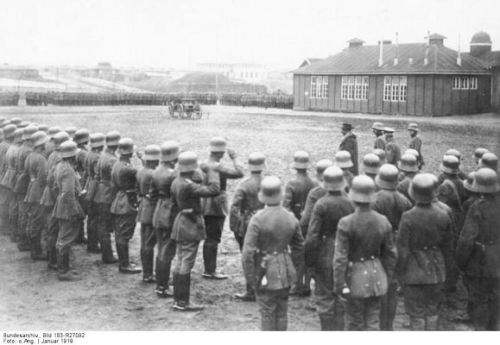
Groener called Ebert promising the Army’s support of the new government in return for the government’s assistance to the Army in the maintenance of discipline and supply.[xxi] He also drafted a letter signed by Hindenburg pledging the Army’s loyalty and telling him that “the destiny of the German people is in your hands….”[xxii]One source notes: “Thus, in half a dozen sentences over a telephone line a pact was concluded between a defeated army and a tottering semi-revolutionary regime; a pact destined to save both parties from the extreme elements of revolution but, as a result of which the Weimar Republic was doomed at birth.”[xxiii]

The High Command was able to bring the Army home in good order following the armistice but upon arriving most units “melted away like snow under a summer sun,”[xxiv] those which remained were often shells of their former selves beset by soldier’s councils and leftist revolutionaries.  To support the government the High Command issued a directive stating that it “put itself as the disposal of the present government led by Ebert without any reservation.”[xxv] Yet in December delegates of the National Assembly continued to sow resentment in the military by military discipline be placed in the hands of soldiers’ councils, that all badges of rank be removed with all decorations of insignia and honor.[xxvi] Reaction was heated,[xxvii] but despite this Groener, Colonel Walter Reinhardt, the Prussian Minister of War and the Republic’s Defense Minister, Gustav Noske endeavored to find forces to combat the growing revolution and rebellious military units.  The choice was not hard, the Army was of no use, so called “democratic forces” were in most cases both unreliable and ineffective, while only the Freikorps “provided suitable material for the immediate creation of an efficient, combat-ready army.”[xxviii] Thus the Freikorps became the instrument of necessity to ensure that the government was not swept away by a Soviet style revolution.

freikorps-hulsen-noskeGustav Noske Reviewing Freikorps Hulsen Which was Formed out of Existing Army Units by General von Hulsen
Gustav Noske, of the Majority Socialist party “saw himself as a patriot, a man of action…who had no time for theories…and was one of the few Socialists that the Supreme Command trusted.”[xxix] He had already distinguished himself by helping to bring under control the sailors revolts in Kiel by forming a loyal “Naval Brigade”[xxx] and he  “realized that the government must have a dependable military force behind it if it was to survive and rule Germany” and the “old Officer Corps must be the backbone of any such force.”[xxxi] The Army had melted away and units of the workers and soldiers councils were poorly trained, organized and led “”fought against the government as often as for it” and “were of little practical value to either the government or the rebels.”[xxxii] In the chaos of a Spartacus, now called the German Communist Party uprising and vacuum of political leadership of January 1st 1919 agreed to become defense minister stating “Someone must be the bloodhound, I won’t shirk the responsibility!”[xxxiii]

Bild 183-1989-0718-501Noske with General Von Luttwitz

Noske helped by the High Command helped organize volunteer units led by officers and NCOs composed of reliable veterans.  Freikorps varied in size from divisions to companies and were led by Generals down to Sergeants and even a Private First Class.  Their greatest success was in early 1919 when the Republic was beset by “Red” revolutions in many major cities.  Without the use of the Freikorps by the government it is unlikely that the Republic would have survived.[xxxiv] On January 4th Ebert and Noske reviewed the troops of General Maercker’s Freiwillege Landesjaegerkorps and Maercker informed them that every volunteer had pledged loyalty to the government, seeing the discipline and order Noske told Ebert “Don’t worry. Everything going to turn out all right now.”[xxxv] On January 5th 1919 mobs attacked the Chancellery and the officers of the Socialist Vörwarts newspaper and Noske led the Freikorps[xxxvi] to regain control of the city[xxxvii] and crush the revolt during which “Karl Liebknecht and Rosa Luxemburg were lynched by the officers of the Guards Cavalry Rifle Division.”[xxxviii] In March after a period of uneasy calm the Freikorps, now reinforced by the 2nd Naval Brigade, or Ehrhardt Brigade[xxxix] were called upon to put down the revolt of the “People’s Naval Division.”[xl] Making liberal use of heavy weapons including tanks the Freikorps inflicted heavy losses on the leftists with over 1500 dead and 12,000 wounded in the uprising.[xli] Other revolts were crushed and the Freikorps reached their zenith in Württemberg where Freikorps led by Lieutenant Hahn, a Social Democrat put down leftist revolts[xlii] and in Bavaria where Independents and Communists had taken the city with their “Bavarian Red Army which numbered nearly 25,000 men[xliii] on April 7th. After failed attempts by the Socialist government to retake Munich, they asked for Berlin’s help.  Violence and massacres of citizens by the various leftist groups inflamed the Freikorps, including the Ehrhardt Brigade and the revolt was crushed by May 2nd.[xliv] Dorpalen calls the Freikorps ruthlessness “completely unwarranted in view of the weakness of the opposing forces” and noted though they broke the leftist powers they deepened the nations’ cleavages”[xlv] while Macksey writes that “where Freikorps’ brutality stained the pages of history there was invariably a forgoing or simultaneous record of excess by their sworn opponents.”[xlvi]

Bild 146-1971-037-42Lieutenant Commander Ehrhardt Commander of the 2nd Naval Brigade during the Kapp Putsch, although a Hard Line Conservative Ehrhardt would Suffer under the Nazis
There was a tension between many in the Reichswehr and those on the German left and this came out in many ways as officers were caught in between various political camps while attempting to conduct their duties. Field Marshal Albert Kesselring recounted with great bitterness his experience:

“My cup of bitterness was full when I saw my devoted work rewarded by a warrant for my arrest for an alleged putsch against the socialist-influenced command of my III Bavarian Army Corps. Notwithstanding the degrading episodes during my imprisonment after 1945, I do not hesitate to describe this as the most humiliating moment of my life.”[xlvii]

Bild 102-00206President Friedrich Ebert with Von Seeckt and other Military Leaders

The end of the Freikorps era began when the Provisional Reichswehr was established on March 6th 1919. The High Command assembled from Freikorps, remaining Army units and Republican defense forces. There was a great distrust between many in the Army, the remaining Freikorps and the Socialists. When the German delegation to Treaty of Versailles signed the treaty under threat of invasion it provoked a crisis. Noske and others threatened resignation over the war guilt clauses, but Groener warned that if the treaty was rejected the Army could not win against the Allies if hostilities were renewed.[xlviii] The treaty imposed harsh limitations on the German Army which many bitterly resented, however, Seeckt, the Chief of Staff of the Army felt that it was “more important to keep the Army in being and preserve the possibility of a military resurrection.”[xlix] Yet by signing the treaty the government lost the support of many officers who looked to General Walther von Lüttwitz, the Reichswehr’s senior commander, and commander of troops in the Berlin area for leadership.[l]

Bild 119-2815-20Freikorps Rossbach During the Kapp Putsch. One of the Most Extreme Freikorps it was Demobilized and Broken up a number of its Leaders including Rossbach Found Their Way to the Nazis

Lüttwitz, leaders of certain Freikorps, right-wing groups and individuals made plans to overthrow the government.  They favored revolt against the government, but “their political aims were hazy.”[li] Army leadership recognized the threat posed by disaffected Freikorps and their leaders. Seeckt and Reinhardt felt it necessary to demobilize Freikorps who’s ill-discipline and political radicalism was a “danger to the consolidation desired by the army command.”[lii] The plotters sensed a threat to their plans for a putsch and Lüttwitz found a willing co-conspirator in Wolfgang Kapp, a failed politician.  Lüttwitz took action when the High Command ordered the 2nd and 3rd Naval Brigades be demobilized in compliance with Versailles treaty limitations and their radical views.[liii] Over the opposition of his chief of staff Von Lüttwitz began planning a coup, in his mind, to save Germany.[liv] The key unit in Lüttwitz plan was the 2nd Naval Brigade Commander by Korvettenkapitän (Lieutenant Commander) Ehrhardt.

Bild 183-H25109The Ehrhardt Brigade During the Kapp Putsch
Lüttwitz and his fellow conspirators showed “little regard for coordination of effort” and demonstrated “a quite amazing ability to work at cross purposes.”[lv] On March 12th without consulting Kapp, Lüttwitz and Ehrhardt launched the Putsch and Ehrhardt’s brigade in full battle dress entered Berlin. At this point the Reichswehr command froze; officers refused to condone the putsch but at the same time refused to support Noske and Reinhardt who demanded armed opposition to the coup,[lvi] while most Navy officers openly supported it.[lvii] Seeckt who did not want to see the army set against itself refused to deploy troops to counter Ehrhardt’s men.  He declared that “Troops do not fire upon troops!” and “When at occurs, then the true catastrophe, which was avoided with so much difficulty on November 9, 1918 will really occur.”[lviii] Despite the lack of support by the army the coup died amid massive strikes by workers and lack of popular support. However the damage done to the Reichswehr’s relationship to the government, especially the more moderate Majority Socialist was severe.

von trothaAdmiral Von Trotha head of the Navy was Sacked for Supporting the Putsch

In the wake of the putsch Noske resigned, many officers in were discredited[lix] and dismissed including Lüttwitz and Admiral Von Trotha, head of the Navy, who openly supported the coup.[lx] Admiral Raeder in his memoirs says that Von Trotha and the Navy staff only” thought of anything of complete loyalty to the government”[lxi] however the actions of the Navy leadership showed otherwise. The uncomfortable but relationship which had endured the dire days of the Republic was ended.  The Reichswehr would emerge a lean and highly trained organization and remain a power broker in the Republic but the animosity between the Army and the Socialists that they could not stand together against the Nazis despite a mutual interest in doing so.[lxii]

Conclusion

The period was a critical and complex and should be studied by anyone living in a state with a powerful military tradition and institutions in crisis.  Unlike popular notions, the Freikorps were diverse and not the seed-bed of the Nazi movement and though many former members would become Nazis.  Several, including Ehrhardt narrowly escaped death at Nazi hands.[lxiii] Freikorps were viewed by Army leadership as an expedient force that could not remain in the service once the Army was functional.

Key lessons include that the military cannot become a “state within a state,” and that both military and civilian leaders must seek to bridge any gulf that separates them in times of crisis.  In Weimar both the military and the Socialists thoroughly distrusted one another with the result that they eventually, despite early success[lxiv] worked against each other in later years.  Actions by both Socialists and the military ultimately subverted the Republic and ensured its demise and Seeckt’s policy of separation from politics “tended toward a renunciation of the soldier’s potential restraining influence on adventurous statesmen.”[lxv] Such is the fateful lesson for today for those who suggest a military coup to overturn a government that they oppose in much the same manner as those who supported Lüttwitz, Kapp and Ehrhardt.  Such actions only undermine democratic institutions, especially if they are weak and the nation is in crisis.  Often such actions bring about regimes far more dangerous than what they seek to overthrow and compromise the integrity of the military.


[i] Jones, Nigel. The Birth of the Nazis: How the Freikorps Blazed a Trail for Hitler. Constable and Robinson Ltd. London, U.K. 1987 and 2004.  This is Jones assertion and he attempts to make the tie using careers of some individuals who served both in Freikorps and either in the Nazi Party or Military and attitudes common in many Freikorps with similar attitudes found in the Nazi movement.  The 2004 edition of his work includes an introduction by Michael Burleigh echoing his sentiments.

[ii] Evans, Richard J. The Coming of the Third Reich. Penguin Group. London, U.K. and New York, NY. 2003. pp.227-229.  Evans discusses the fact that the Nazis did have a number of Freikorps veterans but at no point makes the connection that the Freikorps are a direct ancestor.

[iii] Ozment, Steven. A Mighty Fortress: A New History of the German People. Harper-Collins Publishers, New York, NY 2004 p.246

[iv] Gordon, Harold J. Jr. The Reichswehr and the German Republic 1919-1926. Princeton University Press, Princeton NJ 1957.  Gordon’s work is perhaps the most detailed study involving the Freikorps and the Reichswehr. He is exceptional in discussing the relationship of both with the various political parties including the Nazis.  He refutes this assertion throughout the book.

[v] Bracher, Karl Dietrich. The German Dictatorship. Translated by Jean Steinberg. Praeger Publications, New York, NY 1970. Originally published as Die Deutsche Diktatur: Enstehung, Struktur, Folgen des Nationalsozialismus. Verlag Kiepenheuer & Witsch, Koln und Berlin. 1969. p.101

[vi] Wheeler-Bennett, John W. The Nemesis of Power: The German Army in Politics 1918-1945. St. Martin’s Press, New York, NY 1954 pp. 91-92

[vii] Shepherd, Ben. War in the Wild East: The German Army and Soviet Partisans. Harvard University Press, Cambridge, MA and London, U.K. 2004. p.28

[viii] Höhne, Heinz. The Order of the Death’s Head: The Story of Hitler’s SS. The Penguin Group, London U.K. and New York, NY 1969. Translated by Richard Barry. Originally Published as Der Ordnung unter dem Totenkopf. Verlag der Spiegel, Hamburg, 1966. p.54.

[ix] These include Macksey’s biographies of Kesselring and Guderian , Richard Giziowski’s The Enigma of General Blaskowitz. Peter Padfield’s Dönitz: the Last Führer, David Fraser’s biography of Field Marshal Rommel Knight’s Cross, Messenger’s work on Von Rundsedt, The Last Prussian, and Höhne’s Canaris: Hitler’s Master Spy all provide brief but interesting views of the actions and attitudes of these officers during the revolution and during the  Weimar period.

[x] Goerlitz, Walter. History of the German General Staff 1657-1945. Translated by Brian Battershaw. Westview Press. Boulder CO and London. 1985 Originally published as Der Deutsche Generalstab, Verlag der Fankfurter Hefte, Frankfurt am Main.  First U.S. publication in 1953 by Preager Publishers. p.200

[xi] Gordon, Harold Jr. The Reichswehr and the German Republic 1919-1926. Princeton University Press, Princeton, NJ 1957 pp.4-5 Gordon recounts the story of an entire replacement train revolting when it reached the front which had to be disarmed by a shock battalion.

[xii] Watt, Richard M.  The Kings Depart: The Tragedy of Germany: Versailles and the German Revolution. Simon and Schuster, New York, NY 1968. p.186

[xiii] Wheeler-Bennett, John W. The Nemesis of Power: The German Army in Politics 1918-1945. St. Martin’s Press, New York, NY 1954. p.18

[xiv] Herwig, Holger H. The First World War: Germany and Austria Hungary 1914-1918. Arnold Press a member of the Hodder-Headline Group, London, UK and New York NY 1997 p.445

[xv] Ibid. Herwig. p.445

[xvi] Carsten, F.L. The Reichswehr and Politics 1918-1933. Oxford University Press, Oxford, UK 1966 p.6.  It is noted by a number of author’s that Groener did this, to maintain the unity of Germany and prevent its division.

[xvii] Ibid. Watt. p.196  Watt notes Ebert’s reaction as being enraged as the proclamation of the Republic technically “invalidated the existing constitution; Germany was now technically without a government.” (p.197)

[xviii] Ibid. Watt. p.197

[xix] Ibid. Watt. p.197

[xx]Giziowski, Richard. The Enigma of General Blaskowitz Hippocrene Books Inc. New York NY, 1997. p.65

[xxi] Craig, Gordon A. The Politics of the Prussian Army 1640-1945. Oxford University Press, Oxford, UK 1955 pp.347-348.  Craig gives an interesting account noting the Groener’s call to Ebert shows recognition of the legitimacy of the new government and notes that the offer was somewhat conditional.

[xxii] Dorpalen, Andreas. Hindenburg and the Weimar Republic. Princeton University Press, Princeton, NJ. 1964 p.26

[xxiii] Ibid. Wheeler-Bennett. p.21

[xxiv] Ibid. Gordon. p.15

[xxv] Ibid. Carsten. p.11. This was of critical importance as Carsten later notes that the Army realized that the government could not survive without its support.  Groener was perhaps the officer who most recognized the situation and endeavored to ensure that “the best and the strongest element of the old Prussia, was saved for the new Germany, in spite of the revolution.” (p.12)

[xxvi] Ibid. Carsten. p.18 Carsten produces the bulk of the English translation of these points and notes that the anti-military feeling had become widespread.

[xxvii] Ibid. Giziowski. p.66  Giziowski recounts the speech of Hermann Goering in response to the announcement. This shows how such treatment can breed anger and resentment in a military that feels it has been betrayed after serving its country in a long and difficult war: For four long years we officers did our duty and risked all for the Fatherland. Now we have come home, and how do they treat us? The spit on us and deprive us of what we gloried in wearing. I will tell you that the people are not to blame for such conduct. The people were are comrades…for four long years.  No, the ones who have stirred up the people, who have stabbed this glorious army in the back…. I ask everyone here tonight to cherish a hatred, a deep and abiding hatred, for these swine who have outraged the German people and our traditions.  The day is coming when we will drive them out of our Germany.”

[xxviii] Ibid. Gordon. p.15

[xxix] Ibid. Watt. p.168

[xxx] Ibid. Gordon. pp. 19 and 24.  This was the 1st Marine Brigade, or Brigade Von Roden of which elements would later serve in under the command of other Freikorps such as the Guards Calvary Rifle Division.

[xxxi] Ibid. Gordon. p.14

[xxxii] Ibid. Gordon. p.18

[xxxiii] Ibid. Watt. p.239

[xxxiv] Ibid. Gordon. p.426

[xxxv] Ibid. Watt. p.247

[xxxvi] Thee forces included the Landesjaegerkorps and Guards Cavalry Rifle division.

[xxxvii] Ibid. Gordon. p.30

[xxxviii] Ibid. Wheeler-Bennett. p.36

[xxxix] This was one of two additional Naval Brigades formed by Noske after the success of Naval Brigade Von Roden.  It was one of the most combat effective but unfortunately violent and radical of the Freikorps, it would as we will see be a key unit in the Kapp Putsch but would not be absorbed into the Reichswehr.

[xl] This unit was not a Navy unit at all but was composed of many who were criminals and other rabble. See Gordon, Carsten and Watt.

[xli] Jurado, Carlos Caballero. The German Freikorps 1918-23. Illustrated by Ramiro Bujeiro. Osprey Publishing, Oxford, UK 2001 p.12

[xlii] Ibid. Gordon. p.42  His units were known as Security Companies.

[xliii] Ibid. Jurado. p.13

[xliv] Ibid. Gordon. pp.47-49. An estimated 550 people including 200 innocent bystanders were killed in the fighting.

[xlv] Ibid. Dorpalen. p.29

[xlvi] Macksey, Kenneth. Guderian: Creator of the Blitzkrieg. Stein and Day Publishing, New York, NY 1975 p.45

[xlvii] Kesselring, Albrecht. The Memoirs of Field Marshal Kesselring with a new introduction by Kenneth Macksey. Greenhill Books, London UK. 1997. Translated from the German by William Kimber Ltd. Originally published as Soldat bis zum letzen Tag. Athenaum, Bonn, Germany 1953 pp.18-19

[xlviii] Ibid. Wheeler-Bennett. pp.57-59

[xlix] Ibid. Goerlitz. p.216

[l] Ibid. Wheeler-Bennett. p.61

[li] Ibid. Carsten. p.74

[lii] Ibid. Carsten. pp.74-75

[liii] Ibid. Carsten. p.76  Another consideration is that Noske, Reinhardt and Seeckt all were seeking to retire Lüttwitz.

[liv] Ibid. Gordon. p.97

[lv] Ibid. Craig. p.376

[lvi] Ibid. Carsten. pp.78-79

[lvii] Höhne, Heinz. Canaris: Hitler’s Master Spy. Cooper Square Press, New York, NY 1979 and 1999. Translated from the German by J. Maxwell Brownjohn, Originally published in Germany by C. Bertelsmann Verlag Gmbh, München. 1976. p. 78.  Canaris also had been suspected of complicity in the murders of Rosa Luxemburg and Karl Liebknecht but was acquitted. (pp.56-71)

[lviii] Ibid. Gordon. pp.114-115

[lix] Among them Maercker who had been such a strong supporter of the Republic in the early days.

[lx] Ibid. Carsten. p.98

[lxi] Raeder, Erich. Grand Admiral. Translated from the German by Henry W. Drexell. United States Naval Institute, Annapolis MD, 1960. Da Capo Press edition published 2001. p.111. This is interesting as almost all histories implicate the Navy High Command of either some complicity or at least agreement with the Putsch participants.

[lxii] The final part in the drama would come when General Kurt Von Schleicher became the last Chancellor before Hitler.  Schleicher had assisted Groener and Noske in the early days of the Republic and often attempted to use the Army’s influence in politics. He was fatally short sighted and was a victim of the SS “night of Long Knives” which was directed against the SA.

[lxiii] Ibid. Jones. p.266  Others such as Gerhard Rossbach had similar experiences.  Korvettenkapitän Löwenfeld of the 3rd Naval Brigade became an Admiral, Wilhelm Canaris , who was implicated in the Kapp Putsch but kept his career would later head the Abwehr and die in a concentration camp.

[lxiv] Ibid. Gordon. p.426  Gordon has a good discussion of this topic in his conclusion.

65 Liddell-Hart, B.H. The German Generals Talk. Published 1948 B.H. Liddell-Hart, Quill Publications, New York, NY. 1979. p.18 Liddell-Hart’s analysis of the results of the Reichswehr’s disconnection from the larger society and political process is remarkable due to current trends in the American military which like the Reichswehr has become somewhat more conservative and disconnected from society, exceptionally technically proficient but not adept in politics or grand-strategy.

Works Cited

Bracher, Karl Dietrich. The German Dictatorship: The Origins, Structure and Effects of National Socialism. Translated from the German by Jean Steinberg with an introduction by Peter Gay.  Praeger Publishers, New York, NY. 1970 Originally published in Germany as Die deutsche Diktator: Entstehung, Struktur, Folgen den Nationalsozialismus by Verlag Kiepenheuer und Witsch. Koln und Berlin.

Carsten, F.L. The Reichswehr and Politics 1918-1933. Oxford University Press, Oxford, UK 1966

Craig, Gordon A. The Politics of the Prussian Army 1640-1945. Oxford University Press, Oxford, UK 1955

Dorpalen, Andreas. Hindenburg and the Weimar Republic. Princeton University Press, Princeton, NJ. 1964

Evans, Richard J. The Coming of the Third Reich. Penguin Books, New York, NY and London, UK. 2003

Giziowski, Richard. The Enigma of General Blaskowitz Hippocrene Books Inc. New York NY, 1997

Goerlitz, Walter. History of the German General Staff 1657-1945. Translated by Brian Battershaw. Westview Press. Boulder CO and London. 1985 Originally published as Der Deutsche Generalstab, Verlag der Fankfurter Hefte, Frankfurt am Main.  First U.S. publication in 1953 by Preager Publishers

Gordon, Harold Jr. The Reichswehr and the German Republic 1919-1926. Princeton University Press, Princeton, NJ 1957

Guderian, Heinz. Panzer Leader. (abridged) Translated from the German by Constantine Fitzgibbon, Ballantine Books, New York 1957

Herwig, Holger H. The First World War: Germany and Austria Hungary 1914-1918. Arnold Press a member of the Hodder-Headline Group, London, UK and New York NY 1997

Höhne, Heinz. Canaris: Hitler’s Master Spy. Cooper Square Press, New York, NY 1979 and 1999. Translated from the German by J. Maxwell Brownjohn, Originally published in Germany by C. Bertelsmann Verlag Gmbh, München. 1976.

Höhne, Heinz. The Order of the Death’s Head: The Story of Hitler’s SS. The Penguin Group, London U.K. and New York, NY 1969. Translated by Richard Barry. Originally Published as Der Ordnung unter dem Totenkopf. Verlag der Spiegel, Hamburg, 1966.

Jones, Nigel. The Birth of the Nazis: How the Freikorps Blazed the Way for Hitler. Constable and Robinson Ltd. London, UK 1987

Jurado, Carlos Caballero. The German Freikorps 1918-23. Illustrated by Ramiro Bujeiro. Osprey Publishing, Oxford, UK 2001

Kesselring, Albrecht. The Memoirs of Field Marshal Kesselring with a new introduction by Kenneth Macksey. Greenhill Books, London UK. 1997. Translated from the German by William Kimber Ltd. Originally published as Soldat bis zum letzen Tag. Athenaum, Bonn, Germany 1953.

Liddell-Hart, B.H. The German Generals Talk. Published 1948 B.H. Liddell-Hart, Quill Publications, New York, NY. 1979

Macksey, Kenneth. Guderian: Creator of the Blitzkrieg. Stein and Day Publishing, New York, NY 1975

Macksey, Kenneth. Kesselring: The German Master Strategist of the Second World War. Greenhill Books, London, UK 2000.

Ozment, Steven. A Mighty Fortress: A New History of the German People. Harper-Collins Publishers, New York, NY 2004

Shepherd, Ben. War in the Wild East: The German Army and Soviet Partisans. Harvard University Press, Cambridge, MA and London, U.K. 2004

Wheeler-Bennett, John W. The Nemesis of Power: The German Army in Politics 1918-1945. St. Martin’s Press, New York, NY 1954

Watt, Richard M.  The Kings Depart: The Tragedy of Germany: Versailles and the German Revolution. Simon and Schuster, New York, NY 1968

Wette, Wolfram. The Wehrmacht: History, Myth, Reality. Harvard University Press, Cambridge, MA and London, UK  2006. Translated from the German by Deborah Lucas Schneider. Originally published as Die Wehrmacht: Feindbilder, Vernichtungskrieg, Legenden. S. Fischer Verlag Gmbh, Frankfurt am Main, Germany 2002

2 Comments

Filed under History, Military, Political Commentary

Unequal Allies: Lessons from The German’s and Their Allies on the Eastern Front for Today

patton with french tankPatton with French Renault F1 Tank in WWI

One of the problems that any coalition of unequal partners as is the case in Afghanistan is the role of the lesser partners, their capabilities and limitations imposed on them by their own governments.  When NATO joined the US led effort in Afghanistan a number of NATO allies contributed troops to the effort.  The same was true of the “coalition of the willing” in Iraq.  While obviously the US appreciated and continues to appreciate the efforts of its allies in both theaters the unique problems associated with coalition warfare are often not appreciated until the strengths and weaknesses of each junior partner in the coalition are shown to include the effect of each nation’s choice of units sent, logistics capability and rules of engagement.  Thus when some Americans are critical of the contribution of some allies, or the limitations imposed by their governments they should remember that in the First World War the United States was dependant on France and Britain for the majority of the Artillery, all of the tanks and aircraft as well as instructors and training facilities for the rapidly recruited American Expeditionary Force.

RickenbackerUS Ace Eddie Rickenbacker with French Supplied Nieuport 28
Every nation works within its own national interests and domestic political situation as well as its military capabilities. Unfortunately many people do not look at history to see how a coalition of a major power allied with a number of minor powers each with their own limitations as well as motivations for entering the war execute that war after the initial plan is foiled.  This is something that has happened in Afghanistan after the initial success disappeared with the corrupt and ineffective Afghan government, the resurgent Taliban and the resiliency of Al Qaida in their bases in the remote border areas of Afghanistan and Pakistan.

nato_france_a_0403French Troops in Afghanistan: The French, British and Canadians have the most Robust Rules of Engagement of Non US NATO Forces (Time Magazine Photo)
One of the best places to find such an example is the German relationship with their allies on the Eastern Front.  The question of the German dominated European Axis alliance in the Second World War is one of the more neglected subjects of World War Two II. In most accounts of the war, the relationship of the Germans to their coalition is minimal.  This includes the works of B.H. Liddell-Hart, Williamson Murray, Chester Wilmot and David M Glantz.   Italy usually receives some attention in the context of the campaign in North Africa and Mediterranean.  Hungary, Romania and Finland receive scant attention from anyone except as to how their armies were overrun during the Stalingrad campaign. Popular German memoirs provide little substantive help. Field Marshal Albert Kesselring’s memoirs and Erwin Rommel’s papers give some views of the Italian efforts in North Africa and the Mediterranean and Erich Manstein gives a limited amount of attention to the Italians, Finns, Hungarians and Rumanians in Russia.

Finland-HitlerConflicting War Aims: Hitler with Finland’s Field Marshal Von Mannerheim
In his essay The Dysfunctional Coalition Robert Di Nardo examines the relationship of Germany to her allies on the Eastern Front where the Germans due to their own limitations were forced into a coalition war with weak allies of uncertain reliability. This is a subject that Di Nardo expanded on in his book Germany and the Axis Powers: from Coalition to Collapse (University of Kansas Press, 2005).  Di Nardo believes that there are important lessons to be learned from the failure of Germany and its coalition. Unfortunately we in the west are more often than not content to judge coalitions by the success of the Allies in the Second World War.  Di Nardo’s work on the subject is something that the United States must learn from as it works with coalitions whose members have significant military weaknesses often magnified by the domestic political climates in their own country. The situation, especially in Afghanistan places he United States in a similar position to Germany in relation to the current wars on terror and campaigns in Iraq and Afghanistan.

m 13-40 tankItalian M 13-40 tanks were the mainstays of Italian Armored Units, Slow, Undergunned and Poorly Armored they were No Match for Soviet T-34s

Di Nardo asserts “the way in which Germany conducted coalition warfare was reflective of the manner in which Hitler and the German military looked at the world, as well as the war in general.”  Germany often displayed a haughtiness toward its allies and even knowing their weaknesses was both unable and often unwilling to do much to strengthen them for the fight against the Soviet Union.  Di Nardo believes that the German attitudes were “a significant factor that contributed to the ultimate defeat of Nazi Germany.” (p.712)  In the essay Di Nardo notes the few successes of the coalition. In particular he looks at the German work with Rumanian air defense around the Ploesti oil refineries and the German-Finnish Winter Warfare School.  Apart from these instances he characterizes Axis coalition warfare on the eastern front as “poor” with “failures at every level.” (p.713)

italian troops stalino

Di Nardo analyzes the problems with language barriers, the wide differences of modernity of the armies and levels of technology and training of the coalition partners many of which are common to the war in Afghanistan. Germany’s failure to become the “arsenal of Fascism” which the United States became “the Arsenal of Democracy” for its allies hindered the Germans in their relationship to their poorly equipped allies.  Likewise, the lack of understanding of all the partners regarding the “relationship between national objectives, strategy and the morale of soldiers of officers and soldiers alike”(p.713) was a major obstacle.

finnish at gun

Di Nardo provides a good description of the German liaison detachments allotted to the coalition armies.  These teams functioned as advisors to their allies as well as liaisons between the German army and the allies. These teams dealt with language, tactical communications weaknesses and often displayed the generally haughty attitude that the Germans displayed to their partners. There is an excellent illustration of this in dealing with the failure of XLVIII Panzer Corps at Stalingrad when the German Liaison to the Romanian 1st Panzer Division was wounded.  At the operational and strategic levels Di Nardo describes the German policies and attitudes toward their allies as “imperialist.” (p.718)

He examines the wide gap in transportation capabilities of the various armies and the failure of the Germans to better provide for the needs of their partners in contrast to the United States assistance to her allies.   Germany provided obsolete captured Czech and French weapons and vehicles to her allies.  They refused to supply the Romanians and Hungary with the plans to build German tank and aircraft in Romanian and Hungarian industrial concerns capable of their manufacture. (pp.718-719) Di Nardo notes how this lack of modern equipment impacted the allies operations against the Red Army and their defeat at the hands of the Soviets.  Although Di Nardo alludes to how even elite German formations had substandard equipment he does not explain principle reason for this.   This was due to the fact that the Germans did not go to a “total war” footing in regard to industrial production until Albert Speer took over as Armaments Minister in 1943.

spanish blue divsion

The number of troops contributed by the German Allies was substantial. Hungary began Barbarossa with two corps, including its Mobile Corps and in 1942 supplied their 2nd Army which was composed of 1 Armored and 9 Infantry Divisions. 2nd Army was crushed by the Soviet offensive against Stalingrad. The Italians began with an expeditionary corps of 2 Semi-Motorized and 1 Light Infantry Divisions. In early 1943 they added 4 Infantry and 3 Alpine Divisions and a number of other smaller formations. This force became the 8th Army. It fought well during the advance toward Stalingrad but spread out over a wide front with little armored or air support was decimated by the Soviet offense against the city.  The remnants were no longer battle worthy and were evacuated to Italy.  Most of the Finnish Army was engaged in the war but after September 1939 made no major offensive contribution to the war. In 1944 following a major Soviet offensive which forced them to withdraw from the territory that they had captured in 1941 the Finnish government sued for peace. The Russians occupied a number of border provinces and islands and Finland was obliged to expel German Forces.  This resulted in the “Lapland War” between the Finns and the Germans with the Germans adopting a scorched earth policy as they withdrew from the country. The quality of the Finnish forces was generally higher than that of Germany’s other Allies.

romanian r35Obsolete French Built Romanian R-35 Light Tank
The Romanians contributed 19 divisions organized into 3 Armies to Barbarossa. They were limited by their equipment and logistics. The 3rd and 4th Romanian Armies were shattered at Stalingrad forcing a major reorganization as they continued the war.  In August 1944 with the Soviets pressing their border King Michael led a coup to overthrow the Fascist dictatorship of Antonescu. The Germans elected to fight and the Romanians changed sides and joined the Russian advance to the end of the war with their 1st Army taking part in the Prague offensive. Another contributor of troops was Franco’s Spain although it was a neutral country. Spain provided a division of volunteers which became the famous “Spanish Blue Division” or the 250th Infantry Division. It was outfitted as a German unit and received additional training from the Germans before it went into action. The division fought near Leningrad and was engaged in many tough fights.  A Spanish “Blue” Fighter squadron allotted to and equipped by the Luftwaffe also distinguished itself. In October 1943 Spain under allied pressure withdrew the division from the front although many soldiers volunteered to remain and fight on as smaller units attached to German formations. One volunteer company became part of the 11th SS Panzergrenadier Division Nordland at Berlin.  One thing that probably was a factor in the Spanish effectiveness as well as commitment to to German cause was their genuine loathing of the Soviets following the Spanish Civil War.

The final part of Di Nardo’s essay deals with the strategic goals and conflicts among the Axis coalition which were never worked out.  Examples of this include how the Finns never signed a formal alliance with Germany and how their national strategy did not allow them to deeper into the Soviet Union instead settling on recovering territory lost to the Soviets in 1939 with a few minor gains.  There was also the problem that the Romanians and Hungarians distrusted each other so much that they could not work together over their own territorial disputes.  The Italians joined the campaign late and their 8th Army participated in the German advance toward Stalingrad protecting the German flank.  While the Italians provided their own equipment including armor and aircraft they and their weapons were woefully suited for the war that they faced on the Eastern Front.  Di Nardo finishes his essay noting morale problems in the Hungarian, Italian and Romanian armies, the lack of understanding and general lack of motivation for the campaign.

Romanian_Me109-px800Romanian ME-109 E4, The Romanian Air Force Was One of the Axis Success Stories
This article is well sourced. Di Nardo uses histories, archival sources, operational orders and analysis by the various armies as well as interviews with participants. Of particular note is that he goes to sources of the coalition partners and not just German sources.  This allows him to be far more nuanced and detailed in his discussion as opposed to others who simply ignore the contributions of the Axis partners.  His footnotes provide added detail and provide and lend support to his arguments.

The importance of this essay is twofold.  First it provides a look at the relationship of German to her coalition partners on the Eastern Front.  This is important from a historic standpoint simply because it is such a neglected topic in most histories of the period and gives added depth to the reasons for Germany’s defeat.  One has to ask the “what if questions” in regard to had the Germans better treated, equipped and recognized their allies’ contributions to the war effort.

The second and probably more important for Afghanistan is that it provides lessons to any nation which has to engage in coalition warfare.  In particular it has lessons for the United States which has found itself as the senior and vastly superior partner in a war which has multiple coalition partners in several theaters of operations.  Each coalition partner has certain military strengths and weaknesses in relationship to the United States, national interests, geo-political and economic relationships with competitors to the United States and internal political realities which impact their cooperation in the war.  As such the United States cannot allow itself to be cast in the role of a haughty imperialistic senior partner as did Germany.  The US instead must cultivate an attitude of assistance, respect and trust among its partners to assure their full cooperation and assistance in relation to U.S. goals in the war. This is particularly important now was it appears that the Afghan war is reaching a point where the deteriorating situation on the ground could invite the early withdraw of allies and necessitate either the addition of more US troops or a strategic withdraw which would be for all intents and purposes a defeat for the US and NATO. The consequences would not be good and while the Taliban may be able to be contained they undoubtedly would invite Al Qaida back and provide them with a sanctuary just as Pakistan has stepped up its efforts on the border.

Leave a comment

Filed under History, iraq,afghanistan, world war two in europe

The First Aircraft Carriers Part One: The First American Flattops- Langley, Lexington and Saratoga

saratoga aircraft approach for landingAircraft over Saratoga

Note: This is the first in a series on the early aircraft carriers.  Two others will follow on the British and Japanese carriers.  My dad was a Chief Petty Officer in Naval Aviation.  As such I grew up around Naval Air Stations, Squadrons and of course Aircraft Carriers.  My dad retired off of the USS Hancock CVA-19 in 1974.  I spent two weeks underway on USS Coral Sea CV-43 as a NJROTC Cadet in the summer of 1976.  It was an experience that I will never forget.  While on the Cruiser USS Hue City CG-66 we deployed with the USS John F Kennedy CV-67 for Operation Enduring Freedom.  There is something about the power and majesty of the modern carriers at the same time there is a sense of timelessness in the first aircraft carriers.  Three of the first four American ships were converted from other platforms.  As a kid, a young adult and even now I am fascinated by all things Navy, especially ships that made history.  Here is my look at the first American Aircraft Carriers.

The United States did not invent the aircraft carrier although Eugene Ely flew an aircraft onto and off of the Armored Cruiser USS Pennsylvania on January 18th 1911.  It was the British Royal Navy which first built and operated aircraft carriers beginning with the HMS Furious which had been converted from a light Battle Cruiser.  The Royal Navy would covert the sister ships of the Furious, the Glorious and Courageous as well as the auxiliary ship the Argus before building their first carrier that was designed from the keel up, the HMS Hermes.     With the British building carriers and the Japanese following suit the United States began a program of aircraft carrier production and operation unmatched in history.

uss langleyUSS Langley CV-1 The “Covered Wagon”

The first US carrier was the USS Langley, CV-1.  Langley was converted from the collier USS Jupiter beginning in July 1919.  She was commissioned as USS Langley CV-1 on 21 April 1920.  Displacing 15,150 tons fully loaded Langley embarked 34 aircraft and had a maximum speed of 15.5 knots.  Langley was primitive but groundbreaking.  She was the first carrier equipped with catapults and on 18 November 1922 achieved the first catapult takeoff by an aircraft.  She served as an invaluable training platform for Naval Aviators and helped provide the fleet with highly skilled flight crews that would operate from the USS Lexington and USS Saratoga.

langley as av-3Langley after conversion to AV-3

Nicknamed the “Covered Wagon” she served initially in the Atlantic until November of 1924 when she was transferred to the Pacific Battle Force.  She served as a carrier in the Pacific until 1936 when she was converted into a Seaplane Tender AV-3 and assigned to the Pacific in September 1939 based in Manila.  She was in the Philippines when the Japanese attacked and was sent south to Australia.  She was assigned to the ABDA forces defending the Netherlands East Indies and was sunk by her escorts after being bombed and disabled by Japanese aircraft while delivering fighter aircraft to Java with the loss of 16 sailors.

uss lexingtonUSS Lexington CV-2

The second two American Aircraft Carriers were also conversions.  Unlike Langley the Lexington and Saratoga were converted from a new class of large and powerful battle cruisers whose construction had been canceled by the restrictions of the Washington Naval Treaty.  Commissioned on December 14th 1927 Lexington was 880 feet long and displaced 38,746 tons.  Saratoga was commissioned on November 16th of the same year and of similar dimensions and displacement.  Both of these ships could steam at 33.25+ knots and had a complement of 90 aircraft.  They were armed with eight 8” guns mounted in 4 turrets at the behest of more traditionally minded officers who felt that the armament might be needed for surface actions.

Saratoga underwayUSS Saratoga CV-3

They were the largest American carriers built until the Midway class appeared inin late 1945 and early 1946.  Of other nations pre-war carriers only the Japanese Navy’s Akagi and Kaga, converted from a battle cruiser and battle ship for the same reason as a the Lexington’s were comparable in size, air group capacity, protection and speed. Saratoga’s 8”battery would be replaced by twin 5” 38 caliber mounts in 1942.

lexington sinkingLexington Burning and Sinking

Both ships were used to help develop carrier doctrine and the concept of the carrier task force. Future leaders of Naval Aviation including Marc A. Mitscher trained aboard or flew from these ships.  Of particular note was that during Fleet Problem XIX in 1938 Saratoga launched a surprise air attack on Pearl Harbor from a point 100 miles off Oahu, setting a pattern that the Japanese copied in December 1941.

saratoga 1945Saratoga 1945

During World War II both helped hold the line after Pearl Harbor along with Enterprise, Yorktown and Hornet. Lexington was the flagship of TF-11 during as series of raids on Japanese outposts in the Solomons.  TF-11 joined Admiral Frank “Jack” Fletcher’s TF-17 at the Battle of Coral Sea, the first Naval Battle fought outside of eyesight of the respective forces. Lexington’s aircraft helped sink the Japanese light carrier Shoho on May 7th 1942 and heavily damage the fleet carrier Shokaku the following day. However aircraft from Shokaku and Zuikaku hit Lexington with two torpedoes and 3 bomb hits which her damage control parties seemed to have under control when vapors from ruptured aviation fuel lines were ignited resulting in a series of explosions which ignited uncontrollable fires. Her crew was evacuated by escorts and she was torpedoed by the destroyer USS Phelps.

Saratoga served throughout the war. She engaged in patrols after Pearl Harbor and while enroute to joining Enterprise was hit by a torpedo from the Japanese submarine I-16. After repairs she was rushed to Hawaii to join the American Task Forces at Midway but arrived in Hawaii the day after the battle.  Following this Saratoga operated in the Central Pacific in the first offensive at Guadalcanal.  She participated in the landings as the flagship of Admiral Fletcher and then at the Battle of Eastern Solomons sank the Japanese light carrier Ryujo and damaged the seaplane carrier Chitose.  Following this battle she was hit by a torpedo from the I-26. After repairs she again went to the Solomons joined by the light carrier USS Princeton.  On November 5th the two carriers conducted a brilliant strike on Japanese ships and aircraft facilities at Rabaul which were threatening the landings at Bougainville.

saratoga 1944Saratoga September 1943

Following these operations Saratoga operated in the Gilberts and then with the British in the Indian Ocean.  She then was used as a training carrier for new pilots and aircrews at Pearl Harbor before being brought to Iwo Jima to operate night fighters against Kamikaze raids.  While conducting these operations she was attacked by Japanese aircraft in which 6 Japanese aircraft score 5 hits on her in 3 minutes.  Her forward flight deck was wrecked and she suffered great damage below decks and she lost 123 sailors.

saratoga kamikaze 2Saratoga burning after Kamikaze hits in 1945
Following repairs she resumed training duties and after the defeat of Japan was involved in Operation Magic Carpet to bring Servicemen back from overseas.  Surplus to Navy needs at the end of the war Saratoga was sunk in Operation Crossroads at Bikini Atoll by an underwater atomic blast in the “Baker” bomb test a mere 500 yards from her position. She sank 7 hours later.

saratoga sinkingThe End of an Era- Saratoga goes down at Bikini

5 Comments

Filed under History, Navy Ships

Surviving Birthdays, My Closet of Anxieties, Rumors of Revolution and Coups and a Losing Streak Ended

anniverary 2009I didn’t mess up the Abbess’s Birthday this Year…Cheers!
I am terrible at doing birthdays…mine included.  Unfortunately this can be detrimental in my primary and many other relationships.  In particular I have made my fair share of messes when it comes to birthdays, especially those of Judy.  This began shortly after marriage and there have been a number of times that I regret, especially in choice of gifts.  A large part of this was due to selective hearing on my part in what she wanted and to what she would refer to as the “damage to the brain caused by the male hormone.”  The biggest of the goofs was when in seminary I got her the Bible that I wanted…not smart. I will not add to the fire of my self-immolation here by describing the others.  I can say that like a pitcher has hung one too many curveballs in the center of the plate to good hitters and seeing it go over the fence, the memories flash through my mind beginning in the middle of September until the birthday is successfully negotiated.  It is like making sure that I get the last out before I can rest.

This year went well.  In fact it has been like an extended celebration for her milestone birthday. We brought her college roommate here for 6 days, we had lunch with her friend Diane and dinner at Gordon Biersch together and breakfast today with her friend Pat and her father today.  Saturday evening we will make the close to the week by having a number of people over for dinner and cake.  Even the gifts that I chose were things that she wanted or actually liked.  The key to me successfully negotiating a birthday is to actually listen to what she wants.

We have had a couple of good days of leave and enjoyed our time together.  The cool thing is though she has reached this milestone, she neither looks nor acts her age.  Since I neither look nor act my age most of the time, though I am feeling it more, I think that we are a good match.

closet of anxietiesOpen for Business

At the same time the week has seen my “Closet of Anxieties” open up again.   Part is obviously  PTSD induced and part life induced.  My mom as always has managed to add stress to my life.  My dad continues to slowly circle getting worse in the nursing home.  My German friend wants me to come to Germany in early December but I am nervous about making the flight.   I was able to handle flying much better before Iraq.

left wingers

Finally I am concerned about things going on in the country as some people on the political right are advocating a military coup or violent revolution to overthrow President Obama.  The scary thing as these are not people on the nutty fringe but people more in the mainstream of current conservative thought. What is even more alarming is that a lot of these folks are also prominent Evangelical Christians.  One should never forget that many German “conservative Christian values voters” supported Hitler because they so hated the left. Hitler, like many right wing politicians in this country played to their fear and hatred of the left for their political support.  I’m afraid of the same thing happening here.

A good article about this is found at blogger Polycarp’s site which is linked here: http://thechurchofjesuschrist.us/2009/09/phyllis-schlafly-endorses-bloody-revolution-columnist-plans-for-armed-coup/

bundesarchiv_bild_146-1970-051-65_kapp-putsch_berlinThe Kapp Putsch

To me the political situation is looking more like the Weimar Republic every day and unlike the folks cited in the article I don’t see President Obama as a Nazi or Marxist.  I think that people are playing with fire in suggesting bloody revolutions or military coups.  If either happens there is no going back. They will have to coin a phrase “destroyed the Constitution in order to save it.”  What is scary for me to see a national columnist like John Perry writing in the mainstream conservative news online publication Newsmax.com , suggest a military coup when the military is engaged in two wars.  The military is perhaps the most trusted institution in the country and to look to it in time of war to overthrow the government in a partisan action is madness and even borders on treason.  Even if this Wolfgang Kapp wannabee was able to get some misdirected military leader to pull a Lüttwitz[i] and attempt to seize power.  Such an attempt would be futile and doomed to failure.  Such an attempt could never gain the support of the entire military and would be dependent on many younger soldiers, sailors, airmen and Marines who do not necessarily support the or are as radical as those pushing this on the political right.  The military is not a reactionary or monolithic institution despite the wishes of some on the right.  When one sees this kind of talk combined with street brawls at political town meetings and people carrying semi-automatic weapons at rallies where the President is speaking one sees a recipe for disaster that could destroy the country. If this continues  and at best poison the political and social atmosphere for decades to come.  I felt the same way when people on the left suggested a military coup against President Bush a couple of years ago.  We have a political process that has worked relatively well for 200 plus years.  Yes we are divided and having problems but nothing is insurmountable if we decide to work and play well with each other.  We have survived as a nation so long precisely because we have had the wisdom to step back from the brink, with the exception of the Civil War and we all know how well that turned out for everyone concerned.

044Jeff Fiorentino in Norfolk

However tonight a final source of anxiety was lifted when the Orioles broke their 13 game losing streak against the Tampa Bay Rays tonight.  O’s lefty Chris Waters, who I have met a number of times in Norfolk got the win and Jeff Fiorentino came up big with a 2 out RBI single that provided what would be the winning run.  It was good news for both players, Waters needed the win just to regain confidence and hopefully get another look by the O’s and other teams.  Fiorentino is now being talked about as having a place on the 2010 Orioles.  He certainly has earned it.  With the win the Orioles go home to the confines of Camden Yards to finish the season against the Blue Jays.

Peace, Padre Steve+

Note: The last time I posted something about faith and politics I had a couple of really nasty and personal comments by those on the right all but calling me a non-Christian and Marxist traitor.  This should be fun.


[i] Wolfgang Kapp was a German politician who worked with disaffected radical elements of the Army to attempt to overthrow the Weimar Republic in 1922.  He gained the support of General von Lüttwitz who commanded the military district around Berlin and used a radicalized Freikorps, the Erhardt Brigade which was slated by the Army for demobilization to attempt to seize control of the government.  The attempt floundered but hindered future cooperation between the Army and the Majority Socialists where the Nazis began their rise to power.

Leave a comment

Filed under alzheimer's disease, Baseball, History, Loose thoughts and musings, Military, Political Commentary, PTSD, things I don't get

The Battle that Wasn’t Necessary: Kursk 1943

The Battle of Kursk was the climactic battle on the Eastern Front from which the Germans never recovered. It was a battle that should not have been fought, at least at the time that it was fought. It was high risk operation with minimal payoff should it succeed. A while back I posted an “alternative history” of this entitled “Operation DACHS.” I have also posted articles on events leading up to Kursk, one on Stalingrad and the other on Manstein’s counter-stroke.  In a sense this is a trilogy with an alternative scenario included.


The German Situation and Dilemma in April 1943

Battle_of_Kursk_(map)

The Germans faced a dilemma in April 1943.  Manstein’s brilliant counter-stroke had turned what could have been disaster into an opportunity to salvage prospects for the Eastern Front. The German action had “repaired its front, shattered the hopes of the Allies, and nipped the Russian spearhead.”[i] Unfortunately for the Germans the spring thaw meant that Manstein could not continue immediately and eliminate the Kursk bulge which had been formed by Rokossovky’s offensive and Manstein’s own counter-stroke.  With the Germans stalled by the weather Stavka cancelled “other significant planned offensives to dispatch reinforcements to the Kursk region.”[ii] Despite the weather Manstein pushed Kluge for an immediate attack on both sides of the bulge but was rebuffed by Kluge who “insisted that his troops needed to rest and refit.”[iii] This rebuff combined with the onset of the Russian mud meant that in “March 1943 the war on the ground came to an end….The front was immobilized.”[iv]

manstein with tanksManstein with Tiger I Tanks

Manstein’s offensive had “enabled the Germans to consolidate a firm position in the East, and build up strength afresh- not to its former level, but sufficient to provide a good prospect of holding the Russians at bay.”[v] As a result German armies in the south “held again nearly the same positions from which the Blau offensive had begun the previous spring.”[vi] Now the Kursk bulge some 250 Kilometers wide and 160 Kilometers deep[vii] protruded menacingly into the German lines and drew the attention of both sides, to the Germans it appeared to be designed for an encirclement battle.[viii] Thus it appeared that the Kursk bulge was the obvious place for the Germans to resume the offensive and maintain the initiative on the Eastern Front.

But was the Kursk necessary?  Was Operation ZITADELLE as obvious as it seemed to be to Hitler, Zeitzler and others?  The battle is the subject of many books and articles which often focus on tactical and operational details of the German offensive, particularly the battle on the southern side of the bulge and the clash of armor at Prokhorovka.  This essay will focus less on the battle and more on the strategic situation faced by the Germans in the spring of 1943. Key to this are the arguments for and against the operation, the operations timing and the option that the Germans had to conduct a mobile defense.   It is the strategic situation that must be looked at to determine whether Operation ZITADELLE was necessary at all. Manstein believed that had the offensive been launched early enough that it might have succeeded provided it “we launched it early enough we could hope to catch them in a state of unpreparedness.”[ix] Williamson Murray and Allan Millett agree with Manstein’s assessment but note that an early offensive was “riskier…but greater the prospect for a major success.”[x] Guderian on the other hand saw that nothing good could come of ZITADELLE and opposed it from the beginning.[xi] Glantz and House in their detailed study argue that “there is absolutely no basis for assuming that Citadel would have succeeded had it been launched in spring 1943.”[xii]

battle_kursk t 34The Soviets Reinforced and Fortified the Kursk Salient
The Germans faced a number of major problems in early 1943.  First, among them was manpower.  The armed forces had been mauled on the Eastern Front, “after continuous operations from June 1942 to March 1943, most German units were worn out.”[xiii] Many infantry divisions “were reduced to two thirds of their original strength, with declining mobility and anti-tank defenses.”[xiv] Had the Germans only faced the Russians this might have been overcome, however they not only faced a rejuvenated Red Army, but challenges brought about by multi-theater operations and their weak, ineffective and reluctant allies.  The Allied air offensive which though it “did not decisively effect German arms production it nevertheless prevented a great deal of work from being carried on and had profound moral effects which communicated themselves to all the fronts.”[xv] Likewise the U-Boat campaign had been effectively defeated by May 1943 allowing for increasing numbers of American troops and supplies to reach Europe, including significant Lend-Lease aide for the Soviet Union.  Manpower became a major issue for the the German Army and industry.  Both the military and industryhad difficulty in getting the required number of personnel to meet their personnel needs, in January 1943 the German High Command “demanded 800,000 men-but even the most ruthless call-up was able to produce only 400,000” who were lost to the civilian war economy.[xvi] Even the “belated industrial mobilization of Germany, fueled by slave labor and directed by the organizational genius of men like Speer and Guderian, could do little beyond patching together existing units.”[xvii]

Bild 101I-139-1112-17General Heinz Guderian, Inspector of Panzer Troops was one of Few Senior German Officers to Oppose ZITADELLE from the Beginning

There were other challenges. The German and Italian armies in North Africa had surrendered, and about 330,000 Axis soldiers entered captivity.[xviii] Added to the heavy losses on the Eastern Front, the disasters in North Africa and Stalingrad had “effectively destroyed the Axis military alliance, such as it was.”[xix] Italy, Hungary and Romania all began to pull their forces out of the Eastern front after having them shattered by the Soviet Winter offensive.[xx] Italy, shaken by its losses in North Africa and the Russian front was wavering in its support for Germany; Mussolini’s government itself was on the verge of falling.  Likewise the Hungarian government sought contact with the Allies;[xxi] as did the Romanians.[xxii] Finland too was looking for a way out and limiting its participation in German offensive operations.[xxiii] As her allies looked for a way out, the British and Americans were about to open a new front in Southern Europe, while another had effectively been opened by partisans in Yugoslavia and Greece.[xxiv] The crisis in the south was great enough that OKW under General Jodl began to look at ways of shoring up those fronts in case Italy withdrew from the war including the use of units that would have to be withdrawn from the Eastern Front.[xxv] The Balkans drained German reserves such that the number of German divisions deployed there increased from 5 to 15 between July 1942 and July 1943.[xxvi] Additionally many units had to be created by the Replacement Army to build up the Western Front knowing that an Allied strike there would eventually take place, further depriving the Eastern Front of badly needed infantry replacements and divisions.

Benito_Mussolini_and_Adolf_HitlerHitler Felt Regaining the Initiative in the East was Critical to Keeping his Allies in the War
The German Options and Decision

The question for the Germans now was whether they “had any strategic options that would allow them to avoid defeat.”[xxvii] It is from this perspective that the necessity of Kursk must be examined. Most in the German High Command now realized that strategy in the east could no longer be “based on the illusion of conquering the vast Soviet Union.”[xxviii] As such the discussion turned to what direction the new strategy should take.  Political considerations came into play: Since the German allies were looking for ways to exit the war it was felt that “it was politically impossible for Germany to surrender the initiative on the Eastern Front.”[xxix] Realistically there were two options available: Wait and counterattack or launch a limited attack on the Kursk salient. The general impression among many German commanders in the East was that they had ended the last campaign “with a relative advantage over the Reds, an advantage that should be exploited as soon as the rasputitsa ended in April or early May.”[xxx] But the only strategy that looked feasible balancing the political and military goal of maintaining the initiative was what Manstein originally had in mind after Kharkov, to continue on, pinch out the Kursk bulge with the cooperation of Kluge’s Army Group Center.  As noted the opportunity to do so was lost with Kluge’s refusal and the onset of the spring thaw.  Yet this idea captured Zeitzler at OKH and Kluge at Army Group Center, though by April and May Manstein was more inclined toward “the ‘backhand’ stroke, which involved giving up the whole Donetz basin and staging a major Panzer offensive southeast from Kharkov.”[xxxi] However, this was too bold for Hitler who was “unwilling to give up the Donetz Basin with its industrial and mineral resources.”[xxxii]

battle_kursk_tiger advancingThe New Tiger Tanks Were to Play a Critical Role in the Attack
Manstein felt that the “moment of opportunity had passed, but his counterpart at Army Group Center…Kluge, was enthusiastic about the proposal.”[xxxiii] Zeitzler believed that an “attack at Kursk would be less risky”[xxxiv] than Manstein’s “backhand” and pushed the plan to Hitler.  There were advantages to this strategy if it could be carried out successfully. The Germans would encircle and destroy Russian forces in the salient and “shorten their own defensive lines after such an encirclement.”[xxxv] Yet the plan was opposed by others. Jodl at OKW argued against ZITADELLE “because he believed that it was dangerous to empty the strategic reserve when so many new crises threatened to develop in the Mediterranean.”[xxxvi] Zeitzler countered that because of German weakness in the east that they could not “wait to be hit.”[xxxvii] Guderian did not believe that either Army Group could be ready to mount the offensive that Zeitzler envisioned and “declared that the attack was pointless…if we attacked according to the plan of the Chief of the General Staff, we were certain to suffer heavy tank casualties, which we would not be in position to replace in 1943.”[xxxviii] Guderian asked Hitler at a separate conference “why he wanted to attack at all in the East in 1943.” When Keitel expressed that the reasons were political, Guderian asked Hitler “How many people do you think even know where Kursk is? It’s a matter of profound indifference to the world whether we hold Kursk or not…”[xxxix] Guderian and Speer both pointed out technical problems in producing the Tigers and Panthers but were overruled.[xl] Hitler himself reportedly had misgivings about the attack at one point reportedly stating that “the thought of the Zitadelle operation ‘made [his] stomach turn over’”[xli] In spite of Jodl and Guderian’s warnings, his own misgivings and those of Manstein and Model in April and May, Hitler “allowed himself to be tempted once more into taking the offensive. The Kursk salient…lured him into mounting his great pincer operation known as Citadel.”[xlii] Glantz and House maintain that he could “see no alternative politically and agreed to the plan.”[xliii]

The Facts on the Ground

Kursk_T34_and_Fieldgun-px800Soviet Forces Expected the Attack and Were well Prepared to Meet it
Once the decision to attack was made the question that remained was the timing of the attack. Manstein had preferred an early attack in May, but the operation was postponed to mid-June and then to July due to the request of Model who believed that his forces were too weak and needed reinforcements.[xliv] The attack was to be one of several “limited offensives designed to consolidate the German defenses while inflicting sufficient damage on the Red Army to delay any Soviet offensive.”[xlv] But the delays insisted on by Model and agreed to by Hitler were a fatal error.  The Germans failed to “factor into their decision was the unpalatable reality that Soviet strength in the Kursk salient was growing much faster than the Wehrmacht could muster forces to attack it.”[xlvi] Not only were the Soviet forces growing they knew about the German plans and could deploy their forces to counter them and for their own offensive.[xlvii] Stalin’s generals were able to convince him not to launch an attack and instead wait on the Germans so they could attack as the Germans exhausted their strength.[xlviii] They knew of it since April and reinforced the flanks of the salient with guns and armor at a faster pace than the Germans opposite them.[xlix] At Kursk “improved intelligence collection and analysis permitted the Red Army to predict almost exactly the strategic focal point of a major German offensive.”[l] Into the bulge “Vatutin and Rokossovsky crammed seven armies.”[li] The Russians deployed in depth in heavy fortified zones and minefields along the very sectors of the bulge that the Germans intended to attack, successfully masking their preparations from the Germans. It was “a measure of Soviet self-confidence that the senior commanders were looking beyond the German attack, beyond its failure, to the first major Soviet summer offensive.”[lii] Had the Germans succeeded in pinching off the salient “they would have faced several additional defensive belts constructed to the east of the salient.”[liii]

Typically when one launches an offensive it is desirable to have numeric advantage over the defender, 3:1 is normally assumed to be sufficient. At Kursk the Germans were outnumbered by the Russians 2.3:1 in men and 1.6:1 in tanks[liv] yet somehow the offensive had now morphed from a spoiling attack into a strategic offensive, albeit with more limited objectives attacking one of the strongest points in the Russian line.  General Raus, commanding a corps in Army Detachment Kempf noted: “Considering Russian dispositions, defenses and terrain, German strength could be considered only minimally sufficient for the assigned mission.”[lv] The Chief of Staff of XLVIII Panzer Corps called Kursk “the strongest fortress in the world.”[lvi]

Danger Signs: Requests for Cancellation

keitel-jodl-hitlerGeneral Alfred Jodl at OKW Protested the Offensive Verbally and in Writing
As more delays occurred Manstein “came out in the open and protested that the operation was no longer feasible and must be abandoned, but it was too late.  The united stand of orthodox General Staff opinion, Keitel, Zeitzler, Kluge, had persuaded the Führer, whose mind, once made up, was never altered.”[lvii] Manstein felt that the idea had been to “attack the enemy before the enemy had replenished his forces and got over the reverses of the winter.”[lviii] He felt there was great danger to the Mius line and to the northern Orel bulge with each delay; and the felt the threat of an attack by the Allies in Western Europe.[lix] On 18 June Jodl and the OKW Operations Staff “recommended to Hitler that he abandon Operation Citadel in order to free strategic reserves for defense in both East and West.”[lx] Warlimont writes that Jodl “raised empathic objection to the premature commitment of the central reserves to the East; he pointed out both verbally and in writing that a local success was all that could be hoped from Operation Citadel and that it could have no strategic significance for the overall situation.”[lxi] Hitler again refused the request.  “The doubts of certain Chiefs of Staff of the attacking armies were disregarded, and in the case of Colonel von Schleinitz, answered with dismissal.”[lxii]

The Battle

battle_kursk tigersTigers Advancing

The attacking forces for ZITADELLE involved units of Army Group Center and Army Group South.  Spearheading the assault for Army Group Center was Model’s 9th Army.  2nd Army from the same Army Group took a defensive role in the center of the bulge while Army Group South’s 4th Panzer Army under Hoth and Army Detachment Kempf composed the Southern attack force.  Von Mellenthin noted that to muster the necessary divisions for the attacking armies “neighboring fronts were to be thinned out beyond the limits of prudence” and from a strategic point of view likened Citadel “to be a veritable ‘death ride.’”[lxiii] Manstein worried about stripping the Mius-Donetz salient which “had to hand over all their available forces.”[lxiv] The Germans sent 17 panzer divisions against Kursk including the elite 2nd Panzer, Grossdeutschland, Leibstandarte, Das Reich and Totenkopf. Hoth’s army was the “strongest force ever put under a single commander in the German Army.”[lxv] While the Germans assembled the Russians waited, and beginning on 1 July the “Red Army defenders were on constant alert, waiting in their bunkers for the first sign of attack.”[lxvi]

battle_kursk_0020Panzers on the Advance

ZITADELLE began on 4 July with a reconnaissance in force, the main blow scheduled for 0300 5 July. The Russians learned of the timing from a prisoner and quickly launched an artillery counter-preparation an hour prior to the German attack, disrupting it while air strikes were ordered against Luftwaffe airfields.[lxvii] Model’s 9th Army on the northern flank attacked the Russian “13th and 70th Armies on a frontage of 50 kilometers”[lxviii] with the focus being a 16 kilometer front where he concentrated 6 infantry divisions, a panzer division and all his Tiger and Ferdinand units.[lxix] He intended to break the Soviet defensive system “by constantly feeding in new units to grind down the defenses.”[lxx] The attack stalled by the 9July making minimal progress of “8 to 12 kilometers into the massive Soviet defenses.”[lxxi] A good deal of his problem was due to limited infantry strength which was  “far below established strength….moreover, the Ninth Army’s infantry- even the veterans- lacked experience in conducting set-piece attacks against prepared positions.”[lxxii] The Russians defined the battleground and forced Model into a battle determined by superior firepower on a constricted battlefield, “a game that the Wehrmacht could not win.”[lxxiii] This nullified any advantage the Germans might have had in mobility for their panzer divisions.  In savage battles to take the high ground at Ponyri station and Ol’khovatka Model’s assaults faltered.  9th Army sacrificed about 50,000 men and 400 tanks to the god of war.”[lxxiv] Model continued to attack until 12 July when the Russians launched their offensive against the Orel bulge forcing him to redeploy to counter the Russian advance.  The battle in the north became “a savage defensive battle in which considerable parts of the offensive wing of Ninth Army were involved.”[lxxv] Model’s defeat made Hoth’s task “much more challenging.”[lxxvi]

battle_kursk_t-34s and infantryT-34’s and Infantry

The Fourth Panzer Army and Army Detachment Kempf made better progress, nearly breaking through the Russian defenses after hard fighting. They penetrated “into the third Soviet defensive belt, a depth of 35 kilometers, but were stopped by Katukov’s 1st Tank Army.”[lxxvii] The critical point was reached on 11 and 12 July at Prokhorovka station when 5th Tank Army collided with 4th Panzer Army. “Over 1200 tanks from both sides were engaged in this struggle.”[lxxviii] It was the largest tank engagement of the war, over 700 tanks were destroyed and “German losses were too great to allow a decisive breakthrough.”[lxxix] Both sides took heavy casualties but the Germans could not replace theirs while the Russians still had formidable uncommitted reserves.  On 13 July the battle in the south drifted into a stalemate as XLVIII Panzer Corps and Hausser’s II SS Panzer Corps failed to break the Soviet line[lxxx] as the Russians “kept on throwing in fresh troops, and their reserves seemed inexhaustible.”[lxxxi] Manstein desired to continue the offensive as he believed that for his Army Group “the battle was now at its culminating point, that to break it off at this moment would be tantamount to throwing victory away.”[lxxxii] Although Manstein and Hoth felt that they could continue on and break the Russian line, they were now not in a position to do so. Model’s forces were in no shape to assist in the north and Manstein and Kluge were called to the Wolfsschanze by Hitler who, now preoccupied with the Allied invasion of Sicily necessitating withdraws of strong panzer forces from the east to face the threat in the west.[lxxxiii] Hitler rejected Manstein’s counsel to continue and ordered him to withdraw II SS Panzer Corps,[lxxxiv] effectively ending the ZITADELLE as the Russians launched their offensive on 17 July.

battle_kursk_destroyed panzersDestroyed Panzers

Analysis of the Decision: Zitadelle Was Not Obvious, Necessary nor Well Executed

To Hitler and the supporters of ZITADELLE the operation seemed obvious.  In the two previous years the Germans had dealt punishing blows against the Red Army and the belief of Zeitzler and others was that the Wehrmacht was still qualitatively superior to the Soviets and that even a limited offensive would succeed in its objectives.  But the conditions on the ground had changed and the Germans failed to take the change into account.  The German Army did not have the resources for an offensive of the scope of Barbarossa or Blau. However this lack of resources did not lessen the optimism of some for ZITADELLE; particularly Zeitzler and Kluge. From their perspective the offensive to pinch out the Kursk salient seemed likely to succeed.  Yet as Clark notes the offensive was defined by a “lack of imagination and adaptability….Where the old Blitzkrieg formula….was fed into the computer, with little regard for the changed conditions….” [lxxxv] Von Mellenthin comments that by attacking Kursk, the “German Army threw away all their advantages in mobile tactics, and met the Russians on ground of their own choosing.”[lxxxvi] Glantz and House attribute this to the fact that the Germans “clung to outmoded assumptions about their own superiority over their opponents” due to their previous success. They point out that the Red Army had systematically reviewed its performance after every failure,” so that “Soviet doctrine, organization, and expectations were closer to battlefield reality than were those of the senior German leadership.”[lxxxvii] The German intelligence services failed them[lxxxviii] as they failed to detect the large strategic sized force that the Soviets had concentrated in the spring of 1943.  This was a force that Glantz and House believe would have caused ZITADELLE to fail even had it occurred in May, particularly in regard to the comparatively weak German forces fielded by Manstein.[lxxxix]

An offensive with what appeared to be reasonable objectives that were believed to be within the capabilities of the Wehrmacht failed.  Hitler according to Carell “gambled away not only victory but all hope of a draw.”[xc] Manstein categorized the offensive as a “fiasco.”[xci] Guderian called it “a decisive defeat” that made it “problematical” whether the armored formations could be “rehabilitated in time to defend the Eastern Front.”[xcii] Warlimont who served at OKW commented: “Operation Citadel was more than a battle lost; it handed the Russians the initiative and we never recovered it again right up to the end of the war.”[xciii] Guderian’s biographer Kenneth Macksey wrote that “the failure at Kursk was due to the employment of a faulty plan which lacked the element of strategic as well as tactical surprise.”[xciv] Raus lists several factors for this.  However, his argument is summarized: “once we learned in May and June that this was the area in which the Russians were prepared to offer their stiffest resistance, we should have modified our plans.  Either we should have refrained from attacking at all, or the operation should have been carried out to strike the enemy not at his strongest, but at his weakest point.”[xcv]

Hitler felt that a decisive victory was needed for political and propaganda reasons, yet even a significant victory was unlikely to keep Italy in the war, even if it swayed the lesser allies to stay the course.  ZITADELLE was conducted too late to save the Italians, success in May might have given German supporters in Italy some leverage but the invasion of Sicily and the failure at Kursk emboldened Mussolini’s opponents. The Fascist Grand Council “voted to have Mussolini removed as prime minister” and King Vittorio Emmanuaele “dismissed Mussolini” who was then placed under arrest.[xcvi] Finland refused to take offensive action that might have cut the Murmansk railway[xcvii] and engaged the Americans in a round of “abortive negotiation”[xcviii] while the Hungarians and Romanians provided little assistance to the Germans, partially due to the German reluctance to assist in modernizing and rebuilding their armies.[xcix]

Of the German Generals involved it was only Guderian as Inspector of Armored Troops and Jodl at OKW who consistently opposed ZITADELLE, citing realistic assessments of strengths, risks and dangers in other theaters.  Manstein opposed it when he felt the opportunity had passed, though it was unlikely to succeed had it been launched in May as he desired.  Guderian and Jodl’s arguments proved correct in every respect. ZITADELLE engaged German the preponderance of German forces in a battle that had at best chances of local success. The offensive itself weakened and endangered the German position on all fronts.  In the end, despite the belief and decision of Hitler, Zeitzler Kluge and others in the High Command, Operation ZITADELLE was neither obvious nor necessary and played out with the disastrous results expected by those who opposed it.


[i] Clark, Allan. Barbarossa:  The Russian-German Conflict 1941-45. Perennial, an Imprint of Harper Collins Books, New York, NY 2002. Originally published by William Morrow, New York, NY 1965. p. 306

[ii] Glantz, David M and House, Jonathan. The Battle of Kursk.  University Press of Kansas, Lawrence, KS. 1999. p.14

[iii] Ibid. Glantz and House, Jonathan. The Battle of Kursk.  p.14

[iv] Carell, Paul. Scorched Earth: The Russian German War 1943-1944. Translated by Ewald Osers, Ballantine Books, New York, NY 1971, published in arrangement with Little-Brown and Company. p. 335

[v] Liddell-Hart, B.H. The German Generals Talk. Quill Publishing, New York, NY. 1979. Copyright 1948 by B.H. Liddell-Hart. p.212

[vi] Wray, Timothy A. Standing Fast: German Defensive Doctrine on the Russian Front in World War II, Prewar to March 1943. U.S. Army Command and General Staff College, Fort Leavenworth, KS. 1986. p.163

[vii] Glantz, David M. and House, Jonathan. When Titans Clashed: How the Red Army Stopped Hitler. University Press of Kansas, Lawrence, KS. 1995. p.157

[viii] Ibid. Glantz and House. When Titans Clashed. p.157

[ix] Manstein, Erich von. Lost Victories. Translated by Anthony G. Powell, Zenith Press, an imprint of MBI Publishing Company, St Paul, MN. 2004. First Published as Verlorene Siege Athenaum-Verlag, Bonn, GE 1955, English edition Methuen & Company Ltd. 1958  p.447

[x] Murray, Williamson and Millett, Allan R. A War to Be Won: Fighting the Second World War.  The Belknap Press of Harvard University, Cambridge, MA. 2000. p.295

[xi] Macksey, Kenneth. Guderian: Creator of the Blitzkrieg. Stein and Day Publishing, New York, NY 1975 p.206

[xii] Ibid. Glantz and House. The Battle of Kursk. p.261

[xiii] Ibid. Glantz and House. The Battle of Kursk. p.14

[xiv] Ibid. Glantz and House. Clash of Titans. p.174

[xv] Goerlitz, Walter. History of the German General Staff 1657-1945. Translated by Brian Battershaw. Westview Press. Boulder CO and London. 1985 Originally published as Der Deutsche Generalstab, Verlag der Fankfurter Hefte, Frankfurt am Main.  First U.S. publication in 1953 by Preager Publishers. p.441

[xvi] Ibid. Carell. p.336

[xvii] Ibid. Glantz and House. Clash of Titans. p.174

[xviii] Warlimont, Walter. Inside Hitler’s Headquarters 1939-45. Translated by R.H. Berry, Presido Press, Novato CA, 1964. p.312

[xix] DiNardo, Richard L. Germany and the Axis Powers: From Coalition to Collapse. University Press of Kansas, Lawrence, KS. 2005. p.174

[xx] Ibid. DiNardo. p.174. By the summer all Italians units had been withdrawn, all but two Hungarian divisions which were used in anti-partisan operations and nine Romanian divisions.

[xxi] Ibid. Goerlitz. p.441

[xxii] Ibid. Glantz and House. Kursk. p.21

[xxiii] Ibid. DiNardo. p.180

[xxiv] Ibid. Goerlitz. p.441

[xxv] Ibid. Warlimont. pp.317-318

[xxvi] Dunn, Walter S. Jr. Heroes or Traitors: The German Replacement Arm, the July Plot, and Adolf Hitler. Praeger Publishers, Westport CT and London, 2003. p.53

[xxvii] Ibid. Murray and Millett. p.294

[xxviii] Ibid. Carell. p.339

[xxix] Ibid. Glantz and House. Kursk. p.21

[xxx] Ibid. Glantz and House. Kursk. p.21

[xxxi] Ibid. Clark. p.322

[xxxii] Liddell-Hart, B.H. Strategy. A Signet Book, the New American Library, New York, NY. 1974, Originally Published by Faber and Faber Ltd., London. 1954 & 1967. p.280

[xxxiii] Ibid. Glantz and House. When Titans Clashed. p.157

[xxxiv] Ibid. Clark. p.322

[xxxv] Ibid. Glantz and House. p.157

[xxxvi] Ibid. Clark. p.323

[xxxvii] Ibid. Clark. p.323

[xxxviii] Guderian, Heinz. Panzer Leader. (abridged) Translated from the German by Constantine Fitzgibbon, Ballantine Books, New York 1957. pp.245-246

[xxxix] Ibid. Clark. p.325.

[xl] Ibid. Glantz and House. When Titans Clashed. p.157.

[xli] Ibid. Clark. p.325

[xlii] Ibid. Carell. p.341

[xliii] Ibid. Glantz and House. When Titans Clashed. p.158

[xliv]Newton, Steven H. Hitler’s Commander: Field Marshal Walter Model, Hitler’s Favorite General. DeCapo Press, Cambridge MA 2005. pp.218-219

[xlv] Ibid. Glantz and House. When Titans Clashed. p.21

[xlvi] Ibid. Newton. p.219

[xlvii] Ibid. Murray and Millett. p.295

[xlviii] Ibid. Glantz and House. When Titans Clashed. p.158

[xlix] Ibid. Clark. p.326

[l] Ibid. Glantz and House. Kursk. p.63

[li] Overy, Richard. Russia’s War: A History of the Soviet War Effort: 1941-1945. Penguin Books, New York NY and London, 1997. pp.200-201

[lii] Ibid. Glantz and House. When Titans Clashed. p.159

[liii] Ibid. Glantz and House. Kursk. p.64

[liv] Ibid. Glantz and House. Kursk. p.65 This reference contains a listing of each sector and the force ratios of men, tanks and guns in each sector.

[lv] Raus, Erhard. Panzer Operation: The Eastern Front Memoir of General Raus, 1941-1945. Compiled and Translated by Steven H Newton. Da Capo Press a member of the Perseus Book Group, Cambridge, MA 2003. p.197

[lvi] Weingartner, James. J. Leibstandarte SS Adolf Hitler: A Military History, 1933-45. Battery Press, Nashville, TN.(no publication date listed)  p.81

[lvii] Ibid. Clark. p.327

[lviii] Ibid. Manstein. p.447

[lix] Ibid. Manstein. pp.447-448

[lx] Ibid. Glantz and House. Kursk. p.55

[lxi] Ibid. Warlimont. p.334

[lxii] Ibid. Goerlitz. p.445

[lxiii] Von Mellenthin, F.W. Panzer Battles: A Study of the Employment of Armor in the Second World War. Translated by H. Betzler, Ballantine Books, New York, NY, 1971. Originally Published University of Oklahoma Press, 1956. p.262

[lxiv] Ibid. Manstein. p.448

[lxv] Ibid. Clark. p.328

[lxvi] Ibid. Glantz and House. Kursk. p.78

[lxvii] Ibid. Glantz and House. Kursk. pp.81-84

[lxviii] Ibid. Glantz and House. When Titans Clashed. p.166

[lxix] Ibid. Erickson. P.99

[lxx] Erickson, John. The Road to Berlin. Cassel Military Paperbacks, London, 2003. First Published by Weidenfeld and Nicholson, 1983. p.99

[lxxi] Ibid. Glantz and House. When Titans Clashed. p.166

[lxxii] Ibid. Newton. p.222

[lxxiii] Ibid. Newton. 234

[lxxiv] Ibid. Glantz and House. Kursk. p.121

[lxxv] Ibid. Carell. p.342

[lxxvi] Ibid. Glantz and House. Kursk. p.121

[lxxvii] Ibid. Glantz and House. When Titans Clashed. p.166

[lxxviii] Ibid. Glantz and House. When Titans Clashed. p.166

[lxxix] Ibid. Overy. p.209

[lxxx] Ibid. Glantz and House. Kursk. pp.215-217

[lxxxi] Ibid. Von Mellenthin. p.274

[lxxxii] Ibid. Manstein. p.449

[lxxxiii] Ibid. Glantz and House. Kursk. pp.217-218.

[lxxxiv] Ibid. Glantz and House. When Titans Clashed. p.167

[lxxxv] Ibid. Clark. pp.329-330

[lxxxvi] Ibid. Von Mellenthin. p.264

[lxxxvii] Ibid. Glantz and House. Kursk. p.269

[lxxxviii] Macksey, Kenneth. Why the Germans Lose at War. Greenhill Books 1996, Barnes and Noble, New York,  2006. p.227

[lxxxix] Ibid. Glantz and House. Kursk. p. 261

[xc] Ibid. Carell. p.342

[xci] Ibid. Manstein. p.449

[xcii] Ibid. Guderian. p.251

[xciii] Ibid. Warlimont. p.334

[xciv] Ibid. Macksey. Guderian p.206

[xcv] Ibid. Raus. p.211

[xcvi] Ibid. DiNardo. p.178

[xcvii] Ibid. DiNardo. p.181

[xcviii] Ibid. Erickson. p.91

[xcix] Ibid. DiNardo. pp.182-188

Bibliography

Carell, Paul. Scorched Earth: The Russian German War 1943-1944. Translated by Ewald Osers, Ballantine Books, New York, NY 1971, published in arrangement with Little-Brown and Company

Clark, Allan. Barbarossa:  The Russian-German Conflict 1941-45. Perennial, an Imprint of Harper Collins Books, New York, NY 2002. Originally published by William Morrow, New York, NY 1965

DiNardo, Richard L. Germany and the Axis Powers: From Coalition to Collapse. University Press of Kansas, Lawrence, KS. 2005

Dunn, Walter S. Jr. Heroes or Traitors: The German Replacement Arm, the July Plot, and Adolf Hitler. Praeger Publishers, Westport CT and London, 2003

Erickson, John. The Road to Berlin. Cassel Military Paperbacks, London, 2003. First Published by Weidenfeld and Nicholson, 1983

Glantz, David M and House, Jonathan. The Battle of Kursk.  University Press of Kansas, Lawrence, KS. 1999.

Glantz, David M. and House, Jonathan. When Titans Clashed: How the Red Army Stopped Hitler. University Press of Kansas, Lawrence, KS. 1995

Goerlitz, Walter. History of the German General Staff 1657-1945. Translated by Brian Battershaw. Westview Press. Boulder CO and London. 1985 Originally published as Der Deutsche Generalstab, Verlag der Fankfurter Hefte, Frankfurt am Main.  First U.S. publication in 1953 by Preager Publishers

Guderian, Heinz. Panzer Leader. (abridged) Translated from the German by Constantine Fitzgibbon, Ballantine Books, New York 1957

Liddell-Hart, B.H. Strategy. A Signet Book, the New American Library, New York, NY. 1974, Originally Published by Faber and Faber Ltd., London. 1954 & 1967

Liddell-Hart, B.H. The German Generals Talk. Quill Publishing, New York, NY. 1979. Copyright 1948 by B.H. Liddell-Hart.

Macksey, Kenneth. Guderian: Creator of the Blitzkrieg. Stein and Day Publishing, New York, NY 1975

Macksey, Kenneth. Why the Germans Lose at War. Greenhill Books 1996, Barnes and Noble, New York, 2006

Manstein, Erich von. Lost Victories. Translated by Anthony G. Powell, Zenith Press, an imprint of MBI Publishing Company, St Paul, MN. 2004. First Published as Verlorene Siege Athenaum-Verlag, Bonn, GE 1955, English edition Methuen & Company Ltd. 1958

Murray, Williamson and Millett, Allan R. A War to Be Won: Fighting the Second World War.  The Belknap Press of Harvard University, Cambridge, MA. 2000

Newton, Steven H. Hitler’s Commander: Field Marshal Walter Model, Hitler’s Favorite General. DeCapo Press, Cambridge MA 2005

Overy, Richard. Russia’s War: A History of the Soviet War Effort: 1941-1945. Penguin Books, New York NY and London, 1997

Raus, Erhard. Panzer Operation: The Eastern Front Memoir of General Raus, 1941-1945. Compiled and Translated by Steven H Newton. Da Capo Press a member of the Perseus Book Group, Cambridge, MA 2003

Von Mellenthin, F.W. Panzer Battles: A Study of the Employment of Armor in the Second World War. Translated by H. Betzler, Ballantine Books, New York, NY, 1971. Originally Published University of Oklahoma Press, 1956.

Warlimont, Walter. Inside Hitler’s Headquarters 1939-45. Translated by R.H. Berry, Presido Press, Novato CA, 1964

Weingartner, James. J. Leibstandarte SS Adolf Hitler: A Military History, 1933-45. Battery Press, Nashville, TN.(no publication date listed)

Wray, Timothy A. Standing Fast: German Defensive Doctrine on the Russian Front in World War II, Prewar to March 1943. U.S. Army Command and General Staff College, Fort Leavenworth, KS. 1986.

10 Comments

Filed under History, Military, world war two in europe