Category Archives: History

The Offering We Bring: the Observance of Memorial Day


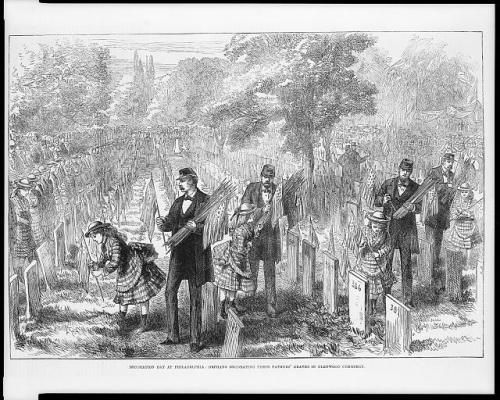
decoration-day1

Friends of Padre Steve’s World,

This is Memorial Day weekend and for the vast majority of Americans, even those who loudly claim to “support the troops” the weekend is little more than an opportunity to start the summer. There will be ball games and picnics, parties and concerts, as well as road trips, and some will even honor the military personnel that are currently serving; however, that is not why we observe Memorial Day.

Memorial Day is observed to honor the lives and sacrifice of those men and women who died in the service of the country. Its roots go back to May 1865 when newly freed Blacks in Charleston South Carolina took the time to honor the fallen Union soldiers by dedicating a cemetery to them. I’ll go back to that in a bit.

Frederick Douglass discussed the meaning of Memorial Day in 1884:

“Dark and sad will be the hour to this nation when it forgets to pay grateful homage to its greatest benefactors. The offering we bring to-day is due alike to the patriot soldiers dead and their noble comrades who still live; for, whether living or dead, whether in time or eternity, the loyal soldiers who imperiled all for country and freedom are one and inseparable.”

Memorial Day, at one time known as Decoration Day is one of our most sacred civil holidays that we observe in the United States, or at least it should be. It was a holiday born out of the shedding of the blood of about 750,000 American soldiers, from the North and the South in the Civil War, a singular event that still echoes in our history and in some sense defines who we are and it is important that we come to understand its meaning and history.

racecourse_t600

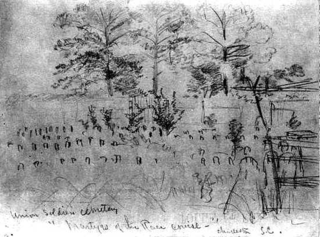
The Racecourse Cemetery

The first observance of what we now know as Memorial Day is fascinating and it needs to be remembered. Frederick Douglass was absolutely right when he spoke the words that I began this article, and we need to remember the humble beginnings of this day which was first marked by recently freed slaves in Charleston South Carolina on May 1st 1865. They did so barely two weeks after Abraham Lincoln was assassinated and three weeks after Robert E. Lee surrendered the Army of Northern Virginia at Appomattox Court House.

The acrid smell of smoke of the last battles of the American Civil War was still lingering over many towns and cities in the South on May 1st 1865. Charleston, the hotbed of secession was particularly hard hit during the war. In 1861 Cadets of the Citadel and South Carolina militia forces began the war with the bombardment of Fort Sumter. Union Forces laid siege to the city in late 1863, a siege which ended with the city’s surrender to Union forces under the command of William Tecumseh Sherman on 18 February 1865. The day of the surrender was somewhat ironic. Charleston, the city most associated with the opening of the conflict surrendered to Union forces on the fourth anniversary of the inauguration of Jefferson Davis as President of the Confederacy. By the time of its surrender much of the city had been destroyed by Union siege artillery and naval forces.

As a Confederate stronghold Charleston had also been the home of three of the Prisoner of War Camps. One was located in the Charleston City Jail and the other at Castle Pinckney which had been one of the ante-bellum U.S. Army installations in the city. A third camp was erected on the site of the Washington Race Course and Jockey Club in 1864. This was an open air camp and Yale Historian David Blight wrote that “Union soldiers were kept in horrible conditions in the interior of the track; at least 257 died of exposure and disease and were hastily buried in a mass grave behind the grandstand.”

By the end of the war most of the white population of the city had left and most of those remaining were recently freed slaves. After their liberation and the city’s occupation by Federal forces, which included the famous 54th Massachusetts as well as the 20th, 35th and 104th US Colored Troops Regiments; about 28 recently liberated Black men went to work and properly reinterred the 257 Union dead on the raceway and built a high fence around it. They inscribed “Martyrs of the Race Course” on an arch above the cemetery entrance.

6a01b8d0781960970c01b7c7901048970b-320wi

On May 1st over 10,000 Black Charlestonians gathered at the site to honor the fallen. Psalms, Scriptures and prayers were said, hymns were sung and many brought flowers. A parade of 2800 children covered the burial ground with flowers. They were followed by members of the Patriotic Association of Colored Men and the Mutual Aid Society. This society’s members provided relief supplies to Freedmen and provided aid to bury those Blacks who were too poor to afford burial. More citizens followed many laying flower bouquets on the graves. Children then led the singing of The Star Spangled Banner, America and Rally around the Flag. The Brigade composed of the 54th Massachusetts and the 35th and 104th Colored Regiments marched in honor of their fallen comrades. Following the formalities many remained behind for a picnic.

Other communities established their own Memorial Day observances in the years following the war, but the event in Charleston was the first. The first “Official” commemoration was on 30 May 1868 when Union General John Logan who headed the veteran’s organization called The Grand Army of the Republic appealed to communities to honor the dead by holding ceremonies and decorating the graves of the fallen.

In the South three different days served a similar purpose. In Virginia people commemorated the day on June 3rd, the birthday of Confederate President Jefferson Davis, the Carolinas marked the day on 10 May, the birthday of General Thomas “Stonewall” Jackson. In much of the Deep South the event was conducted April 26th, the anniversary of the surrender of General Joseph Johnson’s Army to General William Tecumseh Sherman. For many in the South, still attempting to come to grips with their defeat the day would become about “The Lost Cause” or “the defense of Liberty” or “States Rights” and the war was often referred to as the “War of Northern Aggression.”

The “Martyrs of the Racecourse” cemetery is no longer there. The site is now a park honoring the fascinatingly complex Confederate General and post-Reconstruction Governor of South Carolina Wade Hampton. An oval track remains in the park and is used to run or walk by the local population and cadets from the Citadel. Thankfully, at long last in 2010, one hundred and forty-five years after the dedication of that cemetery a marker was placed in that park commemorating the cemetery and the event that we now recognize as the first Memorial Day.

First-Memorial-Day-honoring-257-Union-soldier-martyrs-10000-freedmen-march-led-by-3000-children-05011865

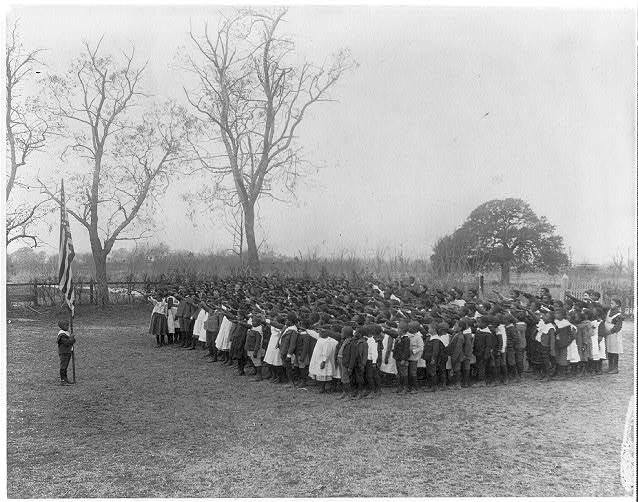
African American Children saluting the Union Dead years later

The Union dead who had been so beautifully honored by the Black population were moved to the National Cemetery at Beaufort South Carolina by the 1880s. Some state that the reason for this was that the cemetery had fallen into neglect, and this may be the case, but the event and their memory conveniently erased from memory of Charlestonians.

I do not think that this would have happened had the people who had the bodies moved simply restored and maintained the cemetery. Had not historian David Blight found the documentation we probably still would not know of this touching act by former slaves who honored those that fought the battles, and gave their lives to win their freedom. Blight wrote in 2011 in the 1870s Charleston “had no place for the former slaves’ march on their masters’ racecourse.”

The African American population of Charleston understood the bonds of slavery and oppression. They understood the tyranny of prejudice in which they only counted as 3/5ths of a person. They understood and saw the suffering of those that were taken prisoner while attempting to liberate them from the tyranny of slavery. They stand as an example for us today.

But their suffering was not over. Within little more than a decade Blacks in the South would be subject to Jim Crow and again treated by many whites as something less than human. The struggle of they and their descendants against the tyranny of racial prejudice, discrimination and violence over the next 100 years would finally bear fruit in the Civil Rights movement, some of whose leaders, like the Reverend Doctor Martin Luther King Jr. would also become martyrs. Unfortunately that struggle is not over.

Frederick Douglass spoke to Union Veterans on Memorial Day 1878. His words, particularly in light of the war and the struggles of African Americans since and the understanding of what those who were enslaved understood liberation to be are most significant to our time. It was not merely a war based on sectionalism or even “States rights,” it was a war of ideas, a war of diametrically opposed ideologies. He said:

“But the sectional character of this war was merely accidental and its least significant feature. It was a war of ideas, a battle of principles and ideas which united one section and divided the other; a war between the old and new, slavery and freedom, barbarism and civilization; between a government based upon the broadest and grandest declaration of human rights the world ever heard or read, and another pretended government, based upon an open, bold and shocking denial of all rights, except the right of the strongest.”

Douglass’s words were powerful then and they resonate today as many of the same ideas that were the cause of the Civil War and were continued during Jim Crow are still alive. Unfortunately there are those in our society who labor daily to establish the “rights” of the strongest over the weak, the poor, the powerless and minorities of all kinds. Of course such actions, often wrapped in the flag, patriotism and buttressed with cherry picked quotes (many of which are fake, changed or taken out of context) from some of our founders are designed to re-establish the oligarchy of the power of the few, much like the men who owned the lives of the slaves and poor whites in the ante-bellum American South. Such actions do nothing but demean and trample the sacrifice of those who fought for freedom and the only remedy is to fight them with the full knowledge of truth.

american-flag

I do hope that today we will observe Memorial Day in a fitting manner. Let us honor those Americans who died that others might be free. Let us look back at what freedom actually means and not forget the sacrifices of those that gave, and still give their lives in the “last full measure of devotion to duty” that others might live. This is especially true in an era where the racial and religious hatred and prejudice of Southern Slave Power, and Northern Know Nothings, that enslaved African Americans, exterminated Native American, invaded and Mexico, and treated Irish, German, Asian, and other immigrants, Roman Catholics, and Jews as enemies is raising its head as White Supremacists take their cue from the President that such behavior is acceptable.

Take a moment on Monday at noon to pause what you are doing and go silent for at least one minute, and remember.

Peace

Padre Steve+

Leave a comment

Filed under civil rights, civil war, History, Military, News and current events, Political Commentary

The Death of the Pride of the Royal Navy: The Sinking of HMS Hood

hms-hood-sinking11Artist rendition of the Loss of the HMS Hood

Friends of Padre Steve’s World,

Seventy-seven years ago today the “Mighty Hood” was sunk by the German Battleship Bismarck. The news was broken to most of the world by American journalist Edward R. Murrow who in his radio broadcast reported:

“This is London, Ed Murrow reporting. This island, which is no stranger to bad tiding, received news today that HMS Hood largest warship in the British fleet and pride of the British navy, has been sunk by the German battleship Bismarck. From the Hood’s compliment of 1500 men, there were three survivors.”

The news of the sinking of the great ship stunned the world, and it is a tragic anniversary that I always mark. I first read about this battle in C.S Forrester’s little book Hunting the Bismarck when I was in 4th grade. That book was used as the screenplay for the 1960 film Sink the Bismarck.

This essay is in honor of the gallant HMS Hood and her crew.  It is fitting although the HMS Hood and her killer, the German battleship Bismarck were not American. Both were great ships manned by gallant crews and the loss of both ships was tragic, especially from the aspect of the great loss of human life. I do hope and pray that we never forget the sacrifice of these men and all others who have gone down to the sea in great ships.

hood-malta1HMS Hood at Malta

There are some warships and naval engagements which assume legendary proportions.  The Battle of the Denmark Strait on 24 May 1941 between the two largest battleships in commission at the time, the pride of the British Royal Navy the HMS Hood and the German behemoth Bismarck is legendary as are those two mighty ships.  The battle came at a critical time as the Britain stood alone against the seemingly invincible German Blitzkrieg.

hood-at-san-francisco1Hood in San Francisco on 1920s goodwill tour

Britain had been driven from Western Europe and was being bombed regularly by Herman Goering’s Luftwaffe while a British expeditionary force that had been sent to Greece had been defeated and the Germans were assaulting Crete with airborne forces.  In the Western Desert the Afrika Korps under Field Marshall Erwin Rommel had driven off a British counter-offensive on the Libyan-Egyptian frontier and were laying siege to Tobruk and in the Atlantic German U-Boats sank 66 Allied Merchant Ships of over 375,000 tons and the Royal Navy would lose 25 warships not including the Hood.

hms_hood_march_17_19241

The Hood was the pride of the Royal Navy and was world famous due to her inter-war international presence and goodwill visits.  Displacing 47,430 tons full load she was armed with eight 15” guns in four twin turrets.  Designed as a battle cruiser she was less heavily armored than contemporary battleships and had very weak vertical protection from plunging shellfire.  This was a fault which was known but never rectified between the wars and when the war came the Royal Navy could ill-afford to take her out of service for the necessary improvements to her protection system.  She was fast with a designed speed of 31 knots which been reduced to 28 knots by 1939 as a result of modifications which increased her displacement.   This was further reduced by the wear and tear on her propulsion plant to 26.5 knots by 1940.

Hood was designed before the battle of Jutland (May 1916) where the weaknesses in the armor protection of British Battlecruisers was exposed as three, the HMS Invincible, HMS Queen Mary and HMS Indefatigable were destroyed by plunging fire which exploded their magazines.  Though her design was modified during construction she still was vulnerable to plunging fire. She was scheduled for a major refit which would have included significant improvement in armor protection in 1941, but the war prevented Hood from receiving anything more than improvements to her anti-aircraft batteries.

Combat1lgHood (nearly hidden by falling shells) in action at Mers-El-Kebir

During the war Hood was engaged in patrol and search operations against German raiders in the North Atlantic and in June 1940 joined Force “H” in the Mediterranean.  As Flagship of Force “H” she took part in the sinking of French Fleet Units including the Battleship Bretagne at Mers-El-Kebir on 3 July 1940 following the French surrender to the Germans and remained in operation searching for the German Pocket Battleship Admiral Scheer and the Heavy Cruiser Admiral Hipper until she was withdrawn for a brief refit in January 1941.

Following another brief refit in mid-March, Hood was underway from mid-March searching for the German raiders Scharnhorst and Gneisenau and also false report of Bismarck breaking out into the Atlantic in April 1941. She returned to Scapa Flow on 6 May 1941.

bismarck1Bismarck

When the British discovered that Bismarck had entered the Atlantic, Hood the flagship of Vice Admiral Lancelot Holland, was dispatched to find and sink her with the newly commissioned battleship HMS Prince of Wales.  The battleships were to join the Heavy Cruisers HMS Suffolk and HMS Norfolk at the entrance to the Denmark Strait.  When the cruisers discovered Bismarck along with her consort the Heavy Cruiser Prinz Eugen the two British battleships steamed into naval history.

flagshippg213

Bismarck was slightly larger than Hood and mounted the same main armament but that was about all the two ships had in common. If the battle was a battle between heavyweight prize fighters Hood was the valiant but crippled champion and Bismarck the young and overpowering challenger.  Bismarck was slightly faster than the limping Hood and was one of the most well protected ships ever built.  Her gunnery officers and the men that manned her deadly 15” guns were like previous generations of German sailors, gunnery experts, working with some of the finest naval guns ever made.

Schlachtschiff Bismarck, Seegefecht

Bismarck firing on Hood

gallbismdenmarkstrait11

The German ships were shadowed at a distance by the Norfolk and Suffolk. The German task force under the command of Admiral Gunther Lütjens emerged from the strait and were sighted by the British at 0537.  Knowing his ships weakness in regard to plunging fire Admiral Holland desired to steer a direct course at the German ships in order to close the range quickly in order to narrow the range and prevent being hit by the same kind of plunging fire that doomed the British battle cruisers at Jutland.

However, events dictated otherwise and the British were forced to close the range much more slowly than Admiral Holland desired, and exposed both Hood and Prince of Wales to German plunging fire for a longer period of time.  As such Holland then turned and tried to close the German ships faster. The result was that his gunnery was degraded by wind and spray coming over the bows of his ships compounded by his inability to bring his after turrets to bear on the German ships.

hood0231Hood, photographed from Prince of Wales moments before being hit and sunk by Bismarck

At 0553 Holland ordered his ships to open fire. Unfortunately, he dis so without the benefit of Suffolk and Norfolk being in position to engage the Prinz Eugen.  Due to the similar appearance of the German ships Hood initially concentrated her fire on Prinz Eugen assuming her to be the Bismarck while Prince of Wales engaged Bismarck.

During the initial exchange of fire Prince of Wales drew first blood by hitting Bismarck three times with her 14″ guns. One hit damaged Bismarck’s seaplane catapult. A second did minor damage to machinery spaces, and a third which passed throughBismarck’s bow near the waterline and severed the fuel lines from her forward fuel tanks to her engines. The third hit would prove the might German Leviathan’s undoing.

prinzeugen-21Prinz Eugen

Both German ships opened fire at 0555 and concentred their fires on the Hood.  Prinz Eugen immediately hit Hood with at least one 8” shell which set a large fire among the ready to use 4”ammunition stored in lockers near the mainmast. The hit started a large fire which Hood’s damage control teams raced to contain.  At 0600, Admiral Holland ordered his ships to turn to port in order to bring the rear turrets of his battleships into the fight.

As the squadron executed the turn Hood was straddled by a salvo from Bismarck and observers on Prince of Wales observed an explosion between “X” turret and the mainmast of Hood. The hit set off the 4″ magazine and the resultant explosion consumed the Hood causing her bow to jut sharply out of the water before sinking beneath the waves in under 3 minutes time. Witnesses on both sides of the engagement were stunned by the sudden and violent end of the Hood.

With Hood now destroyed the Germans rapidly shifted their fire to the Prince of Wales, crippling the battleship and knocking her out of the action.  Bismarck was now in a perfect position to finish off Prince of Wales but she did not do so. Against the advice of Bismarck’s Captain Ernst Lindemann, Admiral Lütjens refused to follow up his advantage to sink the crippled British battleship and instead broke off the action.

hood_explosion_sketch1Hood blows up. Drawing by the Captain of HMS Prince of Wales J.C. Leach

Only three crewmen for Hood, Petty Officer Ted Briggs, Seaman Bob Tilburn and Midshipman Bill Dundas survived the cataclysm out of a total of 1415 souls embarked. They were rescued 4 hours later nearly dead of hypothermia. They stayed awake by singing  “Roll out the Barrel” until they were rescued by the destroyer HMS Electra.

hood_blowup1

Briggs who died in 2008 recounted the sinking:

“Then she started listing to starboard. She righted herself, and started going over to port. When she had gone over by about 40 degrees we realised she was not coming back…” Briggs was sucked under the water “I had heard it was nice to drown. I stopped trying to swim upwards. The water was a peaceful cradle – I was ready to meet my God. My blissful acceptance of death ended in a sudden surge beneath me, which shot me to the surface like a decanted cork in a champagne bottle. I turned, and 50 yards away I could see the bows of the Hood vertical in the sea. It was the most frightening aspect of my ordeal, and a vision which was to recur terrifyingly in nightmares for the next 40 years.” (The Daily Telegraph 5 October 2008)

briggs1Ted Briggs

tilburn4111Bob Tilburn

The Admiralty reported the loss of the Hood later in the day saying Hood received an unlucky hit in a magazine and blew up.”  The official report of the sinking released later in the year said:

That the sinking of Hood was due to a hit from Bismarck’s 15-inch shell in or adjacent to Hood’s 4-inch or 15-inch magazines, causing them all to explode and wreck the after part of the ship. The probability is that the 4-inch magazines exploded first.”

The commission’s findings have been challenged by a number of naval historians and there are several theories of how the magazines might have exploded. However, all theories point to a massive magazine explosion which may not have be caused by a plunging round but from a hit which detonated the unprotected 4” magazines or a hit from Bismarck that struck below Hood’s waterline and exploded in a magazine.

For forty years the Hood’s wreckage lay undiscovered. Her wreck was located in 2001 lying across two debris fields. The post mortem examination revealed that Hood’s after magazines had exploded.  Hood’s resting place is designated as a War Grave by Britain and protected site under the Protection of Military Remains Act of 1986.

bismarck-sinking1Bismarck sinking

Bismarck and her crew did not long survive her victory.  When close to refuge in the French port of Brest on May 26th the great ship was crippled by a lucky aerial torpedo hit from a Fairley Swordfish bomber flying from the HMS Ark Royal. 

The hit damaged Bismarck’s rudders and forced her to steer a course towards the approaching British fleet. Throughout the night Bismarck fought off attacks by British and Polish destroyers on the morning of May 27th 1941, after absorbing massive damage from the HMS King George V, HMS Rodney and several cruisers including HMS Dorsetshire, he plucky and persistent Norfolk and several destroyers, Bismarck was scuttled by her crew. When she went down she took with her all but 115 souls of her crew of over 2200 which included the Fleet Staff of Admiral Lütjens.

hms-prince-of-wales1HMS Prince of Wales

A few months later, Prince of Wales would take Winston Churchill to Argentia Bay Newfoundland to meet with Franklin Roosevelt. At the conference that took place in August 1941, the Atlantic Charter was drafted. With the increased threat of Japanese expansion Prince of Wales reported to the Far East where she was sunk along with the Battlecruiser HMS Repulse on 9 December 1941 by a force of land based Japanese aircraft.  The Prinz Eugen was the only heavy ship of the German Navy to survive the war and was taken as a prize by the US Navy when the war ended. She was used as a target during the Able and Baker nuclear tests at Bikini Atoll, but did not sink. She was too radioactive to be repaired and her hulk was towed to Kwajalein Atoll where she capsized and sank on 22 December 1946. Her wreck is still visible.

The loss of the Hood traumatized the people of Britain and the Royal Navy; she had been the symbol of British Naval power for over 20 years and people around the world were likewise stunned at her demise. The sinking of the Hood and the loss of her crew was a tragedy which all sailors assigned to large and prestigious ships and the nations that they sail for need to keep in mind.

No matter how mighty any ship may be, every ship has an Achilles heel and no ship is unsinkable, and human beings bear the brunt of such tragedies.  Of the over 3600 officers and crew of the Hood and the Bismarck only 118 survived.

dundasw1

I will continue to remember the gallant Hood, her brave crew, especially my very distant relative Midshipman Bill Dundas who I never met.  He left the Royal Navy with the rank of Lieutenant Commander in about 1960, and was killed in a car wreck in 1965. According to the Hood Association website he was troubled by the sinking for the rest of his life.  I think that I could understand as I am still troubled by my far less traumatic experience of war in Iraq.

Until tomorrow,

Peace

Padre Steve+

2 Comments

Filed under History, Military, Navy Ships, nazi germany, World War II at Sea

Leak: Why Mark Felt Became Deep Throat

Friends of Padre Steve’s World,

Back in 2012 I was asked to do a review of Max Holland’s book about Watergate Leak: Why Mark Felt Became Deep Throat. It think that the book is very pertinent today and well worth the read for anyone immersed in the daily revelations of numerous members of the Trump campaign and administration. The sheer number of these allegations, not to mention the number of convictions and plea deals already racked up by the Muller investigation demonstrates the seriousness of the allegations while the web of connections to the fact of Russian meddling in the 2016 demands answers. That being said we need to look back at the history of the Nixon administration to help us understand what is going on today.

So I am posting my review that I published for TLC Book Reviews on June 12th 2012. The review is exactly how I wrote it with no editing for today. I recommend the book to my readers. 

Until tomorrow,

Peace

Padre Steve+

Motives do matter and actions often have unintended consequences. That is the lesson of Max Holland’s book about Mark Felt. Felt was the man whose leaks helped end the Presidency of Richard Nixon and skyrocket the young and obscure Bob Woodward and Carl Bernstein to fame. For more than three decades Mark Felt’s identity remained hidden a mystery man to the public, a man popularized by the dark moniker “Deep Throat.” His role as the leaker was suspected by some, including President Nixon and some of his staff but known only for sure by Woodward, Bernstein and Washington Post Editor Ben Bradlee.

In this truly scholarly book Max Holland pieces together the dark underside of the Watergate tapestry that Woodward and Bernstein helped to break in 1972 and would go on to write about in All the President’s Men and The Final Days. It is a book that is important because it is the first account to seriously explore the motivation of Mark Felt when he began to leak and the background story of the monumental post J. Edgar Hoover FBI power struggle.  That story which in normal times would have been a major story was missed in an era where the country was in turmoil and there were so many other “big” stories to cover.

Taking advantage of more recent revelations, disclosures and evidence Holland paints a picture that not only broadens one’s understanding of Watergate but helps the reader understand how important it is to understand the motivations of those that were involved, Nixon and his staff, Felt and other FBI officials and the media.

The picture painted by Holland of Felt makes his role in the story more understandable. Felt was not the altruistic leaker of myth who sought to destroy the Nixon Presidency, something that was the picture painted by Woodward and Bernstein. His motivations were much more down to earth. He wanted to use his knowledge to ensure that he became Hoover’s successor as the Director of the FBI. He used it to destroy L. Patrick Gray who served as the interim Director and his chief rival in the Bureau William C. “Bill” Sullivan in the eyes of the White House, Congress, the Bureau and the media. Felt’s leaks helped blow the lid off of the White House cover up of the Watergate break-in and which led to the resignation of President Nixon and the conviction of a number of his closest advisors. Felt’s duplicity which included deceiving the Administration, Congress, his superiors and the media with falsehoods even as he revealed key truths is amazing to behold.

The picture that Holland paints of the White House is not pretty. The moral depravity and ruthlessness of Nixon and his advisors is shown without dehumanizing them.  In fact they become more human in Holland’s account.  Likewise Holland’s portrayal of other key figures in Felt’s story at the FBI, L. Patrick Gray, William Ruckelshaus and William Sullivan is compelling. The naive and compliant Gray, Felt’s bitter rival Sullivan and the “sweeper” (to use the term given to Harvey Keitel’s character Winston “the Wolf” Wolfe in Pulp Fiction) Ruckelshaus who helps to “sweep” Felt out of the FBI.

But the most interesting part of the book for me is Holland’s portrayal of Woodward and Bernstein. They are young and idealistic and Woodward believes whatever Felt tells him, including deliberate misinformation. What jumped out at me was their willingness to take at face value what Felt told them and not to explore his motivations which could have led to even more revelations that could have shaken the FBI to its core.  Likewise was Woodward’s willingness to press the limits with information provided by Felt going beyond what Felt demanded for secrecy but which Felt, even though upset by the reporter continued to provide information cumulating in his long and rambling confession to Woodward following his retirement under pressure on May 16th 1973.

They, particularly Woodward did not ask themselves the three key questions that anyone should ask when someone comes to them with this kind of information: Why this? Why this information. Why Me?  Why am I being chosen to receive the information. Why Now? Why is the source telling me this information now. Those three questions could have blown the case open even more had they explored them. Of course they were caught up in the chase for “scoops” with rivals at the New York Times, The Washington Sun and Time Magazine and chose to believe what Felt told them, something that occasionally left them hanging when the information was wrong.

Conversely Felt’s distain and lack of respect for the media and the belief that he could use Woodward, Bernstein and others in the media to further his goals with impunity proved false. He became careless and caused the Nixon Administration to suspect him and work to force him out of the FBI without drawing more attention to themselves.

Holland also covers the “cover-up” of “Deep Throat’s identity which was maintained by Felt, Woodward and Bernstein until Felt was in the beginning stages of dementia and his family was ready to reveal his role.  The dual myths of Deep Throat’s motives and the role of the press as the “men in the  white hats” against the evil bad guys in the White House are exposed by Holland who points out how much of the investigation broken by Woodward and Bernstein was being accomplished by FBI agents and appointed to investigate the break-in and staff members at the Committee to Re-Elect the President who were appalled by the illegality of what they saw being done by their superiors.

The book is excellently sourced and researched. It is a compelling narrative that sheds light on a dark period of our nation’s history which also serves as a reminder to those who investigate “leaks” from well placed sources that there is always another layer of motivation and intent that cannot be discounted and must be factored into the investigation.

This is relevant today as the media, Congress and the the Justice Department investigate leaks from inside the Obama White House regarding national security information. Why This? Why Me? Why Now? Those are the questions. Thanks to Max Holland we now know much of what transpired behind the scenes as Woodward and Bernstein investigated and published their accounts of the Watergate break-in and cover up with the information provided by Mark Felt.

The book Leak: How Mark Felt Became Deep Throat is published by the University of Kansas Press and is available at http://www.amazon.com/Leak-Mark-Felt-Became-Throat/dp/0700618295/ref=sr_1_1?ie=UTF8&qid=1339544616&sr=8-1&keywords=leak

Leave a comment

Filed under books, crime, ethics, History, News and current events, Political Commentary

How Republics Die: Vichy and Trump

img_0327

Friends  of Padre Steve’s World,

President Trump has long established his love and admiration for despots. First it was Vladimir Putin of Russia, then Recip Erdogan the soon to be dictator of Turkey, then Rodrigo Duterte, the murderous President of the Philippines, and even praise for Kim Jong Un of North Korea. Let us not go into the list of draconian despots, dictators from history that the President has expressed his fondness. His favorite President is Andrew Jackson who defied a Supreme Court ruling and executed the Trail of Tears.

Honestly, if the President’s admiration, praise, and fondness for authoritarian and anti-democratic rulers remained just his opinion with no consequences it wouldn’t be such a big deal. However, it is much bigger than his personal opinions, but the nature his office of President, his words, his tweets, his opinions, become the policy of the United States, and end up staining the honor of the nation.

These actions have consequences. The first is the loss of moral authority of the nations who encourage and help dictators. Second, the loss of that moral authority makes it difficult when the chips are down to gain domestic or international support once a nation’s leaders determine that aggressive dictatorships must be stopped, finally it is the death of the Republic, its Constitution, and its founding principles. Just in the past few days the President has bowed to the wishes of the Chinese Communists on trade and the North Koreans on our alliance with South Korea. As he did these things he made more and ever more threatening attacks on the Department of Justice and the FBI in order to discredit them and end the investigation of his family and presidential campaign ties to Russia and other foreign enemies.

What the President and his administration since they took power is amoral and it is dragging the reputation of the United States into the sewer. Sadly, it will have real world consequences, as well as dangerous ramifications for our own system of Constitutional government and representative democracy.

This is not new, during the 1930s many leaders of struggling democracies caught up in the Great Depression, including the United States offered up praise for the accomplishments of Mussolini, Stalin, and Hitler. By their encouragement, accommodation, and appeasement these leaders were complicit in some of the greatest crimes against humanity ever seen in the world. Some of these leaders, especially in France actively worked against their own democratic form of government in the hopes of overthrowing it and setting up a Fascist state. Once France was defeated by Germany the anti-democratic leaders of that country voted out the Republic and established a dictatorship at Vichy headed by Marshal Petain, the hero of the First World War.

Petain with Hitler

The Premier of France under Vichy, Pierre Laval, led the successful move to abolish the constitution of the Third Republic. He said: “Parliament must be dissolved. The Constitution must be reformed. It must align itself with the totalitarian states…” He told the Assembly: “We are going to destroy the totality of what was. We’re going to create something entirely different…. Henceforth there will be only one party, that of all the French.” He concluded “We are paying today for the fetish which chained us to democracy and led us to the worst excesses of capitalism, which all around us Europe was forging, without us, a new world.”

Another, Charles Spinasse, a Socialist who had come to believe in Fascism told the Assembly: “We must break from the past. It was full of illusions…. We believed in individual freedom, in the independence of man. It was but anticipation of the future which was beyond our grasp. We must have a new faith based on new values…. France abandoned itself. It must begin anew.”

One opponent rushed to Vichy to oppose the measures, Pierre-Etienne Flandin, told his colleagues: “Change the Constitution? But why? What need is there to change our institutions? The reproach is that we did not respect them.” However, Flandin too had no problem with giving the reigns of power to an authoritarian, Fascist regime that would cooperate with the Nazis, turn on its allies, and murder its own citizens. His words were absolutely correct, but he betrayed himself at the end.

Pierre Laval

In the end Laval won the day. He told the assembly: “Parliamentary democracy lost the war. It must give way to a new regime: audacious, authoritarian, social, and national.” In the end the vast majority of the delegates from across the political spectrum voted to end the Republic. Opponents who wished to continue to fight against Germany were condemned, jailed, and even killed. Leon Blum, a former Socialist leader who Laval despised wrote of Laval’s manner as the Republic was dissolved: “An unbelievable arrogance puffed up his small person. In a dry voice and with an irritated glance he flung out verdicts and orders… “I do… I say… I refuse… that’s the way it is…” President Trump has much the same attitude as he issues executive orders with abandon, even as others are struck down by the Courts.

Likewise when questioned about allowing opposition newspapers to publish, Laval told Blum in words that one can almost hear President Trump say if he were granted the right to restrict the freedom of the press:

“When I decide, no newspaper will appear if it shows the slightest reticence about my policies. The press must follow me absolutely, without reserve—and I will not let myself be duped.”

But just as troubling on the domestic front is the President’s stated desire to crush the parts of our Constitutional system that inconvenience him, and with his malleable GOP majorities in the House and Senate he may eventually succeed in doing if not opposed by courageous Senators and Representatives, and the Courts. He has on a number of occasions threatened the independence of the judiciary, he has expressed a desire to amend the Constitution to limit freedom of the press, freedom of association, and freedom of speech. He has also urged Congress to end the Filibuster which is the last resort by which a minority party can prevent bare majority of Senators or Representatives of one party to impose its will on the entire nation, even if the majority of people in the nation voted against their party. As of now GOP Senate leaders have announced their opposition to such legislation realizing that they could once again be in the minority. However, for Trump that does not matter as he has no loyalty to the Republican Party; sadly, most Republicans do not seem to understand that fact, and I wonder how firm they will stand when push comes to shove. History shows us that all too often, even the opponents of authoritarianism can easily turn from defending their Constitutional liberties to supporting nationalist, racist, and authoritarian leaders.

That my friends should frighten any American who has not lost their belief in our system of government which for all of its inefficiencies guarantees more liberty than any other system in the world.  History shows that once those liberties are gone you do not get them back without the despot who has taken them away being defeated, often by military conquest.

The fact is that as Timothy Snyder wrote: “The European history of the twentieth century shows us that societies can break, democracies can fall, ethics can collapse, and ordinary men can find themselves standing over death pits with guns in their hands. It would serve us well today to understand why.”

Will our epitaph be like the words of French Senator Bovin-Champeaux who said: “Is it not without sadness that we shall bid adieu to the Constitution of 1875. It made France a free country…. It died less from its imperfections than from the fault of men charged with guarding it and making it work.”

Unlike Laval’s Vichy Government the United States has not been overrun and invaded by an enemy Army. We don’t have Russian Tanks rolling down Pennsylvania Avenue, or Vladimir Putin doing a jig at the Washington Monument, but the President’s surrender to Putin, and other despots and his attacks on our Constitution and legal systems will destroy us and all of our rights; and that means even the rights of those people who for whatever reason support him. If this continues, they too will become victims of an American version of the Night of the Long Knives. 

Take my warning for what it is. Trump’s opponents are already damned and doomed if he succeeds, but his supporters will have signed their own death sentences and they are too stupid to know it. But then, such is bliss of ignorance.

Until tomorrow,

Peace

Padre Steve+

1 Comment

Filed under ethics, History, News and current events, Political Commentary, world war two in europe

To Say that there is to be No Criticism of the President is Unpatriotic and Treasonable

Friends of Padre Steve’s World,

I find it both interesting and troubling to listen to many supporters of President Trump castigate anyone for any criticism offered about the President, sometimes going as far to say that critics are being “unfair,” “disrespectful,”or most disturbing, “disloyal” or “treasonous.” Even the President tweets out those kind of accusations on a whim.

Admittedly some forms of criticism cross boundaries and are personally insulting and disrespectful of the President. In my writings I try, even when being very critical of his policies, words, or actions, to refrain from personal insults that could be considered disrespectful to the President because I am still on active duty.  As my readers know I am a historian as well as an theologian/ethicist and when I do write about the actions of the President and his administration I do so based on careful study and comparison with historical, ethical, or legal precedents. My views are likewise informed by my education and and belief in the principles of the Enlightenment, my belief in human rights as set out in the Preamble of the Declaration of Independence, the U.S. Constitution, and the French Rights of Man and the Citizen, as well as my understanding of the Anglican Christian tradition of “Scripture, Tradition, and Reason” being the foundations of faith.

But it is not disloyal or treasonous to offer criticism of policies, legislative proposals, executive orders, or actions and words of the President or his advisers that could endanger the security of the United States, its citizens, and its alliances, or potentially be unlawful.

Even so I am occasionally criticized for offering historical examples that compare the President and his most ardent supporters in an unfair way, some even calling those disrespectful. I find their double standards and lack of appreciation of irony quite fascinating as most of these people have spent the last eight years or more disparaging and disrespecting President Obama with some of the most racist, vile, contemptible, and false accusations ever made against a sitting President, while at the same time condemning others for simply repeating what the President himself has said.

I found out last year when I had a couple of students criticize some of my teaching at Gettysburg when comparing the anti-immigrant Know Nothings of the 1830s-1850s to current anti-immigrant Trump supporters, and stated that some Trump Administration Civil Rights proposals to be a throwback to Jim Crow. My words then were not insulting nor disrespectful, but simply valid historical criticism; but some Trump supporters are so thin-skinned that they cannot abide any criticism of the President, despite dishing out incredibly racist and disgusting personal comments about President Obama, which were mostly devoid of any non-racially based political or ideological principles.

Unlike President Obama the current President is ensnared in numerous legal, criminal, and Constitutionally backed investigations which range from simply enriching himself as a public official (the emoluments clause) and his family, or more seriously collusion with not only Russian, but Saudi, and other nations to influence his election. The Senate committee investigating the Russian connection said that this actually happened and backed up the evidence submitted by U.S. law enforcement, military, and intelligence agencies concerning this. The Saudi and other Sunni Arab connections were just brought to public light last week. Lord knows how many other governments were involved with Donald Trump Jr., and others to seek to influence the 2016 elections and U.S. foreign policy since then.

Theodore Roosevelt had to defend himself in 1918 from such criticism from the supporters of President Woodrow Wilson. Roosevelt was criticizing the Wilson administration because of how badly he thought they were pursuing the war effort against Germany. For this people were castigating him. People said that newspapers should not print what Roosevelt had to say as well as “He should stand by the President” and “He should be stood before a stone wall and shot.” Roosevelt ended up writing an op-ed in the Kansas City Star in which he noted:

“The President is merely the most important among a large number of public servants. He should be supported or opposed exactly to the degree which is warranted by his good conduct or bad conduct, his efficiency or inefficiency in rendering loyal, able, and disinterested service to the Nation as a whole. Therefore it is absolutely necessary that there should be full liberty to tell the truth about his acts, and this means that it is exactly necessary to blame him when he does wrong as to praise him when he does right. Any other attitude in an American citizen is both base and servile. To announce that there must be no criticism of the President, or that we are to stand by the President, right or wrong, is not only unpatriotic and servile, but is morally treasonable to the American public. Nothing but the truth should be spoken about him or any one else. But it is even more important to tell the truth, pleasant or unpleasant, about him than about any one else.”

This is exactly how I base any criticism I offer of the President, his policies, words, and actions. I heartily agree with the words of Senator Stephen A. Douglas when he battled President James Buchanan over the pro-slavery attempt to have Kansas admitted to the Union as a Slave State in 1858. Douglas said of his encounter with Buchanan:

“God forbid,” I said “that I ever surrender my right to differ from a President of the United States for my own choice. I am not a tool of any President!”

Sadly, there are very few GOP Senators who would have the moral courage to do what Stephen Douglas did in 1858. He did so even though it doomed his chances to be President.

I admire Stephan Douglas but there is a difference. Now there is a difference, I am not a Senator or elected Representative, I am an officer and must carry out the orders of the President. However, if I ever come to believe that I cannot in good conscience carry them out, or if I believe that they are un-Constitutional I will retire from the military in order to allow myself the freedom to speak out more openly. To ‘this point in time I have not to have been forced to Carr out any illegal or unconstitutional orders, and as a Chaplain I have been able to speak my thoughts openly, though I am careful in how I say them at least in order to maintain my respect for the office of the President.

One of my examples is the German General Ludwig Beck, who resigned as head of the German Army in 1938 over Hitler’s aggression and his plan to attack Czechoslovakia. He wrote something that I hold particularly important in my service at this point in history:

“It is a lack of character and insight, when a soldier in high command sees his duty and mission only in the context of his military orders without realizing that the highest responsibility is to the people of his country.” 

Unlike the current President who sought numerous deferments from entering the military in a time of war: Stephen Douglas put his political career on the line to follow the Constitution, Theodore Roosevelt resigned from his office as Assistant Secretary of the Navy Since to go to war and place himself in harms way, Ludwig Beck would die in the failed attempt to kill Hitler in July 1944. All three men were far more honorable than President Trump, and their words should be heeded by Americans regardless of their political affiliation.

I am still dealing with the effects of the water damage in our house I will wish you a good night.

Until tomorrow,

Peace,

Padre Steve+

1 Comment

Filed under ethics, History, leadership, Military, national security, News and current events, Political Commentary

Not People but Animals…

Friends of Padre Steve’s World

Yesterday President Trump revealed something about himself that I have long suspected, the President believes that some human beings are not that, but in his words, “not people, but animals”. His first wife, Ivana said what back in 1990 that her husband kept a book of Adolf Hitler’s speeches at his bedside, and if you careful read his tweets, comments to the press, interviews, and immigration policies you can see a certain amount of genuine contempt for humanity in them, especially for those who are of a darker pigmentation.

Yesterday, in his remarks at an immigration roundtable the President said these words after an exchange with the Sheriff of Fresno County California in which she touched upon a number of subjects including members of the MS-13 criminal gang.

“We have people coming into the country, or trying to come in — and we’re stopping a lot of them — but we’re taking people out of the country. You wouldn’t believe how bad these people are. These aren’t people. These are animals. And we’re taking them out of the country at a level and at a rate that’s never happened before. And because of the weak laws, they come in fast, we get them, we release them, we get them again, we bring them out. It’s crazy.

The dumbest laws, as I said before, the dumbest laws on immigration in the world. So we’re going to take care of it, Margaret. We’ll get it done.”

Today the President tried to clarify his statement that he was talking about MS-13. However, in the broader context of the President’s years long history of broad brushing Mexicans and other immigrants as criminals. In announcing his candidacy in 2015 the President said:

“When Mexico sends its people, they’re not sending their best. They’re not sending you. They’re not sending you. They’re sending people that have lots of problems, and they’re bringing those problems with us. They’re bringing drugs. They’re bringing crime. They’re rapists. And some, I assume, are good people.”

Sadly this is par for the course at Trump National. One cannot forget his “shithole country” comments, or his description of the White Supremacist violence in Charlottesville, and too many other examples to list here.

Please don’t get me wrong but members of MS-13 tend to be violent criminals, but they are still human beings, just as are criminals and murderers of other gangs and home grown White American groups. But if we want to go into other brutal and deadly crime syndicates we cannot leave out Russian and Eastern European syndicates. The Russians for God’s sakes are little different from MS-13 and often have ties to the Russian government and corporations.

But there is a big difference. The Russians are White, and the President has many Russian ties. Yet many of these Russian and Eastern European gangsters many are just as illegal in their immigration status as those of darker complexion who the President calls “animals.”

Back during the 2016 elections I lost quite a few friends because I openly called candidate Trump a “racist.” That is not because I disliked the man, but it was based on his words and policy proposals about ethnic minorities and immigrants, legal or not. He has now been in office for almost a year and a half and his race and religiously based policies of deporting or keeping from American soil have been out there for all to see. Yesterday was little different, except that the President himself, and not one of his appointees or media sycophants said the words.

His words were little different from Hitler and the Nazis who called the Jews, Slavs, and many other non-Nordic ethnic groups “Untermenschen” or sub-human. The Jews in particular were referred to as rats, vermin, and parasites. As such after years of propaganda many Germans became willing participants in the genocide of the Jews and mass extermination of what they called subhuman races.

The President has given his tacit approval to the basest and most vile aspects of American racial and religious prejudice by his constant dehumanization of Mexicans, other Latin Americans, Blacks, Arabs, Muslims, as well as members of the LGBTQ community, and his political opponents that it is having its intended effects. Incidents of race hatred, religious discrimination, and even politically motivated violence are on the rise.

I’m sorry but this is not making America great again, it is dragging the United States into the company the worst examples of humanity. As a Christian as well as a humanist I think back to the words of Dietrich Bonhoeffer concerning the direction of our country:

“We have been silent witnesses of evil deeds; we have been drenched by many storms; we have learnt the arts of equivocation and pretence; experience has made us suspicious of others and kept us from being truthful and open; intolerable conflicts have worn us down and even made us cynical. Are we still of any use? What we shall need is not geniuses, or cynics, or misanthropes, or clever tacticians, but plain, honest, and straightforward men. Will our inward power of resistance be strong enough, and our honesty with ourselves remorseless enough, for us to find our way back to simplicity and straightforwardness?”

I’m tired of those who try to excuse the President’s behavior, especially Christians and based on history I can only imagine where this ends if he remains in power.

Until tomorrow,

Peace,

Padre Steve+

1 Comment

Filed under ethics, History, News and current events, Political Commentary

The U-9 and the Advent of Submarine Warfare

Friends of Padre Steve’s World,

In September 1914 most naval experts held the submarine was not much of a threat. The submarines of the day were limited in range, diving depth, speed, armament and endurance. The U-9 was powered by kerosine engines on the surface which charged batteries which were used when the boats were submerged. Later submarines would be powered by diesel engines.

U-9 was small, displacing only 543 tons on surface and 674 submerged. She was just 188 feet long and had a beam of just 19.7 feet. As such, the living conditions for her crew of 4 officers and 25 enlisted men were less than spartan. She was armed with four 20 inch torpedo tubes, two forward and two aft and carried six torpedoes, four in the tubes and two reloads for the forward torpedo tubes.

The boat was commissioned in April 1910 and on the outbreak of the First World War she was commanded by Kapitänleutnant Otto Weddigen.  On September 22nd 1914 with enormous battles raging on the Western Front and the High Seas Fleet in port the soon to be famous submarine was patrolling in the North Sea. The U-9 was about 18 miles off the Dutch Coast near the Hook of Holland when she encountered three ships of the Royal Navy’s 7th Cruiser Squadron.

U-9

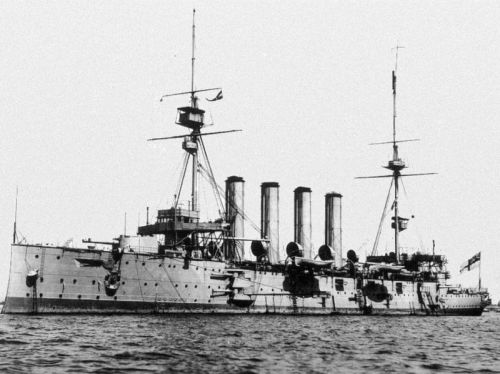
The squadron was composed of four obsolete Cressy Class Armored Cruisers, the HMS CressyHMS, Aboukir, HMS Hogue, and HMS Euryalus. each displacing 12,000 tons and mounting two 9.2” and 12 6” guns. Manned primarily by recently called up reservists the ships were derisively known as the “Live Bait Squadron” and on that September morning they would unfortunately live up to that title. However, Euryalus had been detached from the squadron on September 20th to return to Harwich to coal. The squadron commander, Rear Admiral Christian aboard Euryalus was prevented from transferring his flag due to high seas and command passed to Captain John Drummond of Aboukir.  Adding to the approaching tragedy was the fact that First Lord of the Admiralty Winston Churchill had sent a commander to the First Sea Lord, Sir Louis Battenberg that the ships should be removed from that duty because of “the risks to such ships is not justified by the services they render.” Battenberg initially agreed but was persuaded by his Chief of Staff, Admiral Charles Sturdee to keep them on station because they were better than nothing. Churchill assumed that his order had been obeyed and never followed up and the rest was history.

800px-HMS_Cressy

HMS Cressy

The ships were steaming in a line ahead formation when Weddigen on the U-9 spotted them about 0600. They were not zig-zagging to lessen the chance of submarine attack and thought they had posted lookouts had no idea that U-9 was stalking them.

Otto Weddigen 

Weddigen on worked the boat into what he felt was a better firing position and launched his first torpedo at the center cruiser, the Aboukir at 0620 from a distance of just 550 yards. The torpedo struck her midships and broke her back. She began to sink and within 25 minutes capsize taking 527 of her crew of 760 down with her. Weddigen described the scene:

“There was a fountain of water, a burst of smoke, a flash of fire, and part of the cruiser rose in the air. Then I heard a roar and felt reverberations sent through the water by the detonation.”

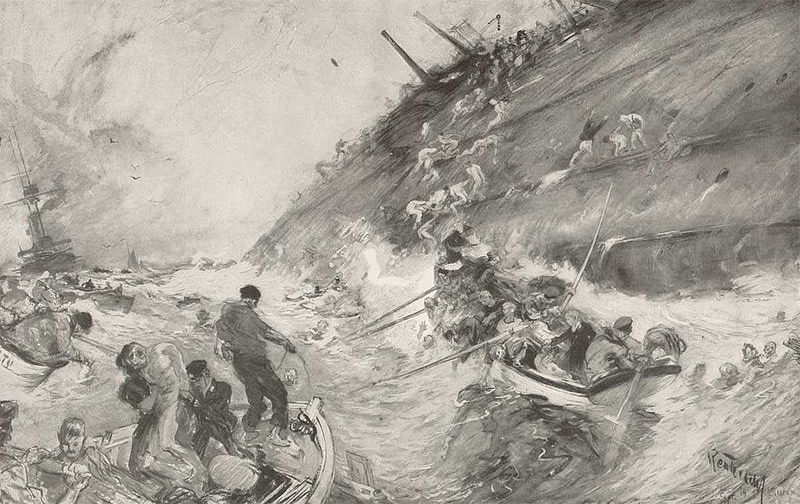
Thinking that Aboukir had struck a mine the Cressy and Hogue moved in to rescue survivors. Weddigen had surfaced to observe the British and then fired two torpedoes into Hogue from a range of just 300 yards and then dived as Hogue opened fire. The torpedoes struck the ancient armored cruiser causing massive damage, which was compounded by the fact that her watertight doors were still open. Thus, within 15 minutes of being hit  Hogue capsized and sank.

Sketch of HMS Cressy Sinking 

The British now knew that a submarine was responsible for the attack and the last ship and after reloading his forward tubes attacked Cressy at 0720 firing two torpedoes from her stern tubes. Weddigen then surfaced in order to bring his bow tubes, now reloaded, into action and fired another shot.  As he did so the British cruiser opened fire and attempted to ram the surfaced U-9. But Cressy was unable to avoid the fate of her sisters, struck by two torpedoes she capsized and then sank at 0755.

In little more than an hour and a half U-9 had sunk three cruisers with a loss of 1459 British sailors. Only 837 crew members from all three ships survived.

Drawing of HMS Aboukir Sinking with HMS Hogue in Background

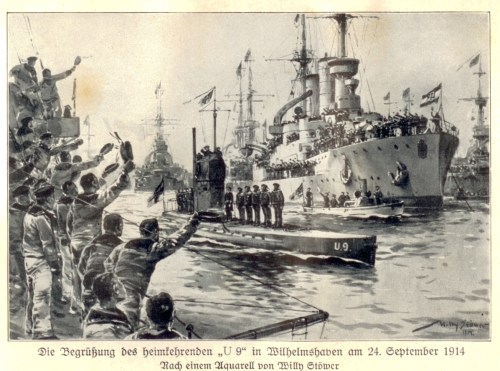
Weddigen then moved off as he knew that the British would be looking for the U-9. When the boat returned to port Weddigen  and his crew were hailed as heroes. Weddigen was awarded the Iron Cross First Class and the boat was one of only two ships of the Imperial Navy awarded the Iron Cross, the other being the Light Cruiser Emden.

The plucky U-9 would survive the war, sinking another cruiser, the HMS Hawke on October 15th 1914, less than a month after sinking Aboukir, Hogue, and Cressy. She would also sink 13 other merchant ships or fishing boats for a total of over 50,000 tons. She was withdrawn from front line service in 1916 and assigned to training duties. Weddigen was killed on March 18th 1915 when his new command the U-29 was sunk.

U9_Heimkehr

The U-9 Returns to Wilhelmshaven on September 24th 1914

Future First Sea Lord Dudley Pound then serving on the Battleship St. Vincent wrote: “Much as one regrets the loss of life one cannot help thinking that it is a useful warning to us — we had almost begun to consider the German submarines as no good and our awakening which had to come sooner or later and it might have been accompanied by the loss of some of our Battle Fleet”.

Submarines would go on to be one of the most feared and effective weapons developed for naval warfare. German U-Boats nearly brought Britain to its knees in both World Wars and the submarines of the US Navy’s Pacific Fleet decimated the Japanese merchant fleet and inflicted great losses on the Imperial Japanese Navy. While the US Navy replaced its losses in early 1942 it was the submarine force that according to Admiral Chester Nimitz “held the lines against the enemy.”

Today the most deadly submarines ever built prowl underneath the surface of the world’s oceans. Nuclear powered and advanced diesel electric boats armed with torpedoes and cruise missiles, and giant nuclear powered ballistic missile submarines armed with long range nuclear intercontinental ballistic missiles provide an invisible deterrent.

Unlike 1914 today all navies take the submarine threat seriously. Should any significant naval war be fought in the Persian Gulf or the Pacific submarines will certainly have an impact not only at sea but in strategic strikes on enemy installations and land based units.

In 1914 no one would have thought that the success of the tiny U-9 would eventually lead to such a dominating weapon.

Peace

Padre Steve+

3 Comments

Filed under History, Navy Ships, world war one

Trump and Kelly: Leaders of the New Know Nothings

1john_kelly_donald_trump_Vanit

Friends of Padre Steve’s World,

I was not surprised when I read the words of President Trump’s Chief of Staff, John Kelly in an interview with NPR this week. Instead, I was reminded that the retired Marine Corps General has often expressed the views of the people that opposed the immigration and citizenship desires of his Irish and Italian ancestors. His Irish ancestors fled famine and British political persecution, while his Italian ancestors fled poverty and political instability.

For that matter we can say the same about his boss the President, whose German ancestors were discriminated against and persecuted from the time that the first major wave hit following the 1848 Revolution in Germany. The President’s Great Grandfather immigrated to the United States in 1885 fleeing poverty and obligatory military service to the Kingdom of Bavaria. He went to work as a barber in New York for a number of years and moved to Seattle when he opened a restaurant which also served as a hotel and base for prostitutes, something that he repeated during the Yukon Gold Rush. He became a U.S. citizen in 1892. He attempted to return to Bavaria in 1904 but was returned to the United States because the Bavarian government considered that he had immigrated to avoid military service.  When the First World War came along he claimed to be Swedish and not German simply because of the stigma associated with being from a country that we were at war.

The fact is that the current policies and attitudes of the President, his Chief of Staff, and many of his followers in the Republican Party including White Supremacists, Klansmen, Neo-Nazis advocate for are not new and can be traced to the Know Nothing movement that began in the 1830s and reached its peak in the 1850s. While I do not believe that most of Trump’s Republicans are Neo-Nazis or White Supremacists, it does seem that almost all of the Neo-Nazis or White Supremacists are Trump supporters or Republicans, including the former head of the Illinois Nazis who is the GOP nominee for a House seat in Illinois, and the leading GOP candidate for Senate in California publicly proclaims his adoration of Adolf Hitler and support for a “Jew Free” United States. At least he was not endorsed by the California GOP who had the decency to expel him from their convention while he dragged the flag of Israel on the ground and spit on it. There are plenty of others, either current or past candidates or those who support identical policies to them without claiming their mantle, but I won’t for now. There are too many.

Conservative columnist and Trump opponent George Will discussed current and past immigration policies in the Washington Post. That article is well worth the read. Will quoted Peter H. Schuck, professor emeritus at Yale Law School who discussed how Congress in 1939 voted down a bill “to rescue 20,000 children from Nazi Germany despite American families’ eagerness to sponsor them — on the ground that the children would exceed Germany’s quota!”

The ancestors of both men fled poverty, famine, political persecution, and war to come to the United States. They made a life for themselves, and Kelly’s Italian ancestors did not speak English for decades after they arrived in the country.  Italian immigrants of the late 19th and early 20th centuries were considered racially inferior by many Americans and were treated with distain and revulsion by many American “Anglo-Saxon” Protestant Christians. You would think that appreciating what their ancestors went through that the President and chief of Staff might have a little bit of sympathy for current immigrants, those who came here legally and those who did not for the same reasons that motivated their ancestors: freedom, safety, and opportunity. But they don’t.

When I see what they are doing to make immigration more white and to return people who came here legally, or were brought here as children and raised as Americans to countries that they either do not know or would be in danger if they returned I am reminded of, and echo of words of Abraham Lincoln who said:

“I am not a Know-Nothing. That is certain. How could I be? How can any one who abhors the oppression of negroes, be in favor or degrading classes of white people? Our progress in degeneracy appears to me to be pretty rapid. As a nation, we began by declaring that “all men are created equal.” We now practically read it “all men are created equal, except negroes” When the Know-Nothings get control, it will read “all men are created equal, except negroes, and foreigners, and Catholics.” When it comes to this I should prefer emigrating to some country where they make no pretense of loving liberty — to Russia, for instance, where despotism can be taken pure, and without the base alloy of hypocracy [sic].”

Until tomorrow,

Peace

Padre Steve+

Leave a comment

Filed under civil rights, culture, ethics, History, holocaust, laws and legislation, News and current events, Political Commentary

Ordinary Men and Genocide

Friends of Padre Steve’s World,

This is another part of my article on the actions of Hitler’s Einsatzgruppen and their campaign of mass murder in Eastern Europe. This section is about the campaign in Russia. It is even more troubling than the previous sections, because in Russia, all pretense of civilization was dropped and even the German Army was heavily engaged in committing some of the grossest and most evil atrocities ever committed by a supposedly civilized and allegedly Christian people.  Likewise, it is important to remember that much of what happened occurred before the decision to implement the Final Solution and the operations of the massive extermination camps such as Auschwitz.

The tragedy is that in so ways that Americans, British, French and the Belgians, as well as the Spanish, not to mention the Russians, Turks, Japanese and so many other have committed genocide. The actions, if they were simply limited to just the Germans of that period could be explained away as a exception, but it is not. That is what makes these heinous crimes so troubling, as the people who committed them were not that different than us, or our own ancestors.

Peace

Padre Steve+
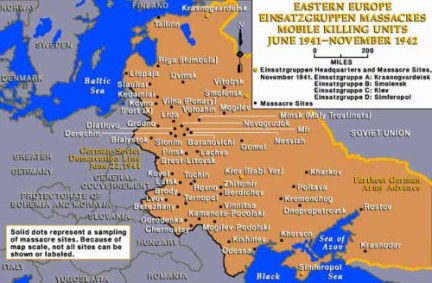
einsattzgruppen map

The Nazi war against Russia was the ultimate test of Hitler’s ideological race war. Planning for the war with the Soviet Union began after the fall of France and during the beginning stages of the Battle of Britain. On 21 July 1940 Hitler made“his intentions plain” to the Army leadership and “von Brauchitsch set his planners to work.” 119 The staff at OKH began preparations for the offensive in the winter of 1940-41 following the Luftwaffe’s failure against Britain and postponement of Operation Sea Lion, the proposed invasion of Great Britain.

Despite the fact that Britain was still in the war and had opened a new front in the Middle East against Italy which required German troops, Hitler decided to open another front and announced his intention to “crush Soviet Russia in a quick campaign which was to begin no later than March 15, 1941, and before the end of the war with England.” 120 Field Marshal Keitel noted the final decision came in “early December 1940” and from then he had “no doubt whatsoever that only some unforeseen circumstance could possibly alter his decision to attack.” 121

The military plan initially focused on the destruction of “the Red Army rather than on any specific terrain or political objective,” 122although the political and geographic objectives would arise in later planning and in the campaign. Hitler stated: “What matters is that Bolshevism must be exterminated. In case of necessity, we shall renew our advance whenever a new center of resistance is formed. Moscow as the center of doctrine must disappear from the earth’s center….” 123

Besides preparations aimed at the destruction of the Red Army and overthrow of the Soviet State, the “war against the Soviet Union was more openly ideological from the start.” 124 Hitler set the stage on March 3rd 1941 by announcing, “the forthcoming campaign is more than a mere armed conflict; it is a collision between two different ideologies…this war will not be ended merely by the defeat of the enemy armed forces” and that “the Jewish-Bolshevist intelligentsia must be eliminated….” 125

ordungspolizie officers

Ordungspolizie Officers

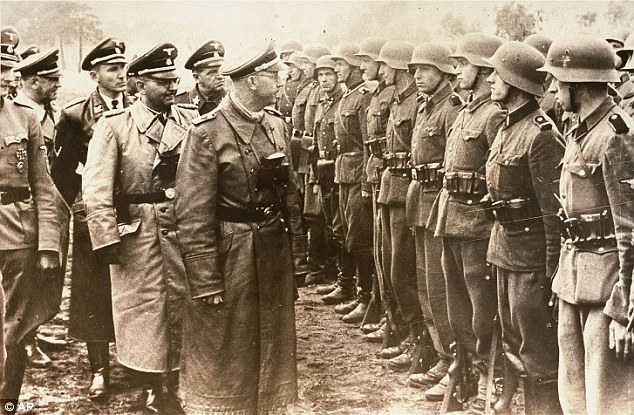
Hitler realized that the task of eliminating the Jews was one that had to be done by his SS men. He noted, that “this is a task so difficult that it cannot be entrusted to the Army.” 126 Reichskommissars, civilian overlords from the Nazi Party would be appointed to administer conquered areas, but since normal civilian powers would be insufficient to eliminate the Bolshevists, Hitler noted that it “might be necessary “to establish organs of the Reichsführer SS alongside the army’s Secret Field Police, even in the operational areas….” 127 The “primary task” of the SS Einsatzgruppen and Police battalions was to liquidate “all Bolshevist leaders or commissars” if possible while still in the operations zones,” 128 yet the orders were vague enough not to offend the sensibilities of Army leaders and did not contain “a syllable that in practice every Jew would be handed over to the extermination machine.” 129

As with almost all German operations which involved cooperation between the Army and the SS, the parties ensured that existing agreements between the agencies, German laws, and army doctrine were followed. On 13 March an agreement was reached between the Army represented by General Wagner and the SS, which stated in part, that “the Reichsführer SS has been given by the Führer special tasks within the operations zone of the Army…to settle the conflict between two opposing political systems.” 130Likewise the agreement dictated that Himmler’s SS units would “act independently and on his own responsibility” while ensuring that “military operations are not affected by measures necessary to carry out his task.” 131
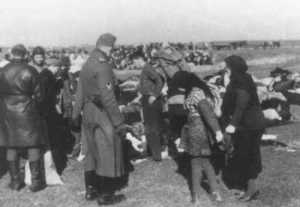
einsatzgruppe troops and victims

Rounding up Jews in Russia

A further instruction was issued by Wagner on 26 March which gave the Army’s agreement for the use of the Einsatzgrüppen in the operations zone. The agreement spelled out the coordinating instructions between the Einsatzgruppen and army authorities in the operational zone and communications zones to the rear. Cooperation between the Army and the SS was based on already existing agreements between the SS and the Army, notably the “principals for co-operation between the State Secret Police and the Field Security organization of the Wehrmacht agreed with the Security branch of the War Ministry on 1 January 1937.” 132

The most significant agreement that the Army reached with the SS was the Commissar Order. This order, sometimes known as the “Criminal Order” was used war as evidence at Nuremberg as against Keitel, Jodl and High Command of the Wehrmacht during the later Generals Trial. The order specified that the Army would cooperated with the SS and kill Soviet Political Commissars attached to the Red Army who were taken prisoner, as “they were not prisoners of war.” Another order specified that “in the event that a German soldier committed against civilians or prisoners, disciplinary action was optional….” 133 The order noted regarding political commissars that “in this struggle consideration and respect for international law with regard to these elements is wrong.” 134 The Army’s “Guidelines for the Conduct of Troops in Russia” issed on May 19, 1941 called for “ruthless and vigorous measures against Bolshevist inciters, saboteurs [and] Jews.” 135
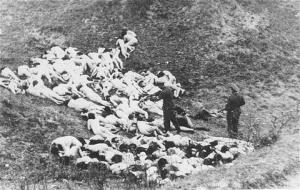
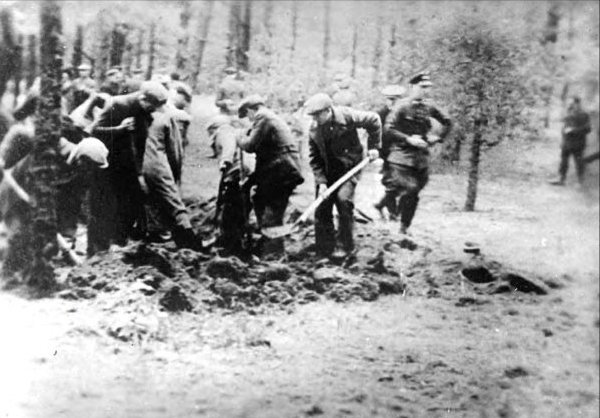
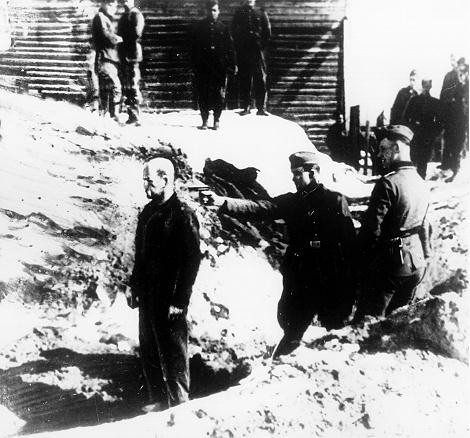
einsatzgruppen executions

Shortly before the Commissar Order was issued, Hitler previewed it to the generals saying that the war in Russia “cannot be conducted in a knightly fashion” and that the war against the Soviet Union would have to be waged with “unprecedented, unmerciful and unrelenting harshness…” 136Hitler told the generals that they would have to “dispense with all of their outdated and traditional ideas about chivalry and the generally accepted rules of warfare: the Bolsheviks had long since dispensed with them.” 137 He explained that he understood that his orders were beyond their comprehension but insisted, “I cannot and will not change my orders and I insist that that they be carried out with unquestioning and unconditional obedience.” 138

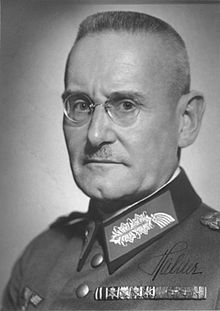
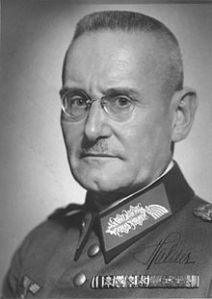
General Franz Halder, Chief of the OKH, or the Army High Command took notes on Hitler’s speech. They are chilling to read as none present could have understood them in any other way than Hitler meant:

“Clash of two ideologies. Crushing denunciation of Bolshevism, identified with asocial criminality….We must forget the comradeship between soldiers. A Communist is no comrade before nor after the battle. This is a war of extermination….We do not wage war to preserve the enemy….War against Russia: Extermination of the Bolshevist Commissars and of the Communist intelligentsia….this is no job for military courts. The individual troop commanders must know the issues at stake. They must be leaders in the fight….This war will be very different from war in the West. In the East harshness today means leniency in the future. Commanders must make the sacrifice of overcoming their personal scruples.”139
220px-Bundesarchiv_Bild_146-1970-052-08,_Franz_Halder

Franz Halder

Hitler’s speech was protested by some of the generals according to Von Brauchitsch. 140 Von Brauchitsch refused to protest the order to Hitler but issued an order on his own authority “threatening dire penalties for excesses against civilians and prisoners of war” which he maintained at Nuremberg “was sufficient to nullify the Commissar Order.” 141 Yet during the campaign against the Soviet Union, von Brauchitsch told his commanders to “proceed with the necessary hardness.” 142 Walter Warlimont noted that Field Marshal Fedor von Bock, who would “later emerge as an opponent of the Commissar Order…makes no special comment on the meeting or the restricted conference that followed.”143

At Nuremberg Keitel said that he “stubbornly contested” the clause “relating to the authority of the SS-Reichsführer… in the rearward operational areas.” 144Keitel blamed the Army High Command OKH under Halder, but the order came out with his signature on behalf of Hitler, which was key evidence against him at Nuremberg. Keitel stated that “there was never any possibility of justifying them in retrospect by circumstances obtaining in the Russian campaign.” 145

Some commanders refused to publish the orders and “insisted that the Wehrmacht never implemented such policies…” blaming them instead on the SS. One writer states “such protests were undoubtedly sincere, but in practice German soldiers were far from innocent. The senior professional officers were often out of touch with their subordinates.” 146 The orders were a “license to kill, although not a great departure from German military traditions….” 147 The effect was terrifying, for in a sense the Einsatzgruppen, “could commit ever crime known to God and man, so long as they were a mile or two away from the firing line.” 148 Security Divisions of the Army were “instructed to give material and logistical support to…units of the Einsatzgruppen.” 149 Even worse, other army units in rear areas “could be called on to assist Himmler’s SS police leaders” as the situation dictated, and few commanders refused. 150

For the campaign against the Soviet Union the SS formed four Einsatzgruppen composed of SD, Waffen-SS and Police troops designated A-D. Einsatzgruppe A was assigned to Army Group North, Einsatzgruppe B to Army Group Center, Einsatzgruppe C to Army Group South and Einsatzgruppe D to the 11th Army. The Einsatzgruppen were not standardized in manpower or equipment. In size they were battalion equivalents the largest Einsatzgruppe being Einsatzgruppe A in the North with 990 assigned personnel 151while Einsatzgruppe was the smallest and had only 550 troops assigned. 152 These units had SS, SD or Police commanders. Though these units were not large, they also had the support of nine Ordnungspolizeibattalions, which were initially assigned to the invasion forces to supplement the operations of the Einsatzgruppen153

The police contingent would grow to be a massive force. By 1943, these Ordnungspolizei battalions would be grouped into regiments and number about 180,000 men assisted by 301,000 local non-German auxiliaries. 154 These units acted in concert with nine Army Security Divisions which handled rear area security. 155
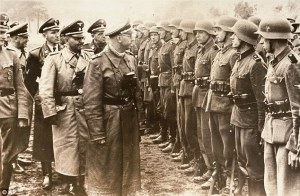
197BF44C00000578-3114663-image-a-59_1433720058260

Himmler was so secretive that he initially did not reveal the intent and planned use of their units to the Einsatzgruppen commanders. Instead he spoke to them of a “heavy task…to “secure and pacify” the Russian area using Sicherheitspolizei and SD methods.” 156 Understanding the effect of these operations, Himmler would state that “in many cases it is considerably easier to lead a company in battle than to command a company responsible to…carry out executions, to deport people…to be always consistent, always uncompromising-that is in many cases far, far harder.” 157

The actions of these units are well documented; the Einsatzgruppen, Police, Army and locally recruited Schutzmannschaft battalions 158 ruthlessly exterminated Jews and others in the operational area. No sooner had an Einsatzgruppe unit entered a city, a “deadly stranglehold” would grip the “Jewish inhabitants claiming thousands and thousands of victims day by day and hour by hour.” 159 Non-Jewish Russians were encouraged to conduct programs which Heydrich noted “had to be encouraged.” 160 Einsatzgruppen D report number 153 noted: “During period covered by this report 3,176 Jews, 85 Partisans, 12 looters, 122 Communist functionaries shot. Total 79,276.” 161   By the spring of 1942 Einsatzgruppe A had claimed “more than 270,000 victims, the overwhelming majority of whom were Jewish.” 162 The total killed for all groups by early 1942 was 518,388 people, mostly Jews. 163 Germany’s Romanian ally acted against Jews in their operational areas as well. In Odessa, “on 23 October 1941 19,000 Jews were shot near the harbor… probably 200,000 Jews perished either at Romanian hands or after being turned over by the Romanians to the Germans.” 164

To further cloud the ethics and morality, the operations against Jews were often called anti-partisan operations. Himmler referred to Einsatzgruppen as “anti-Partisan formations” 165 while Wehrmacht Security divisions cooperating with the SS “murdered countless Soviet civilians and burned Russian settlements to the ground under the pretext of subduing partisan resistance.” 166 The attitude by 1941-1942 was that “all Jews are partisans and all partisans are Jews.” From 1943, all armed resistance was “banditry” and all Jews irrespective of circumstances were treated as “bandits.”” 167

Walter_von_Reichenau

Walter von Reichenau

General Von Reichenau issued an order in which he stated: “The soldier in the Eastern territories is not merely a fighter according to the art of war but also a bearer of a ruthless national ideology and the avenger of the bestialities which had been inflicted upon German and racially related nations. Therefore the soldier must have full understanding for the necessity of a severe but just revenge on subhuman Jewry.” 168

Likewise the distinguished Panzer commander General Herman Hoth issued his own order of 17 November 1941 urging his troops to exact revenge on the Jews and Communists:

“Every trace of active or passive resistance or of any kind of machinations by the Bolshevik – Jewish agitators are [sic] to be immediately and pitilessly rooted out. The necessity of severe measures against elements foreign to people and kind must be understood precisely by the soldiers. These circles are the spiritual pillars of Bolshevism, the tablebearers [priests] of its murder organization, the helpers of the partisans. It consists of the same Jewish class of people which have done so much to harm our Fatherland and by its hostile activity…and anti-culture, which promotes anti-German currents in the whole world and which wants to be the bearer of revenge. Their annihilation is a law of self-preservation. Any soldier criticizing these measures has no memory of the former traitorous activity lasting for years carried on among our own people by Jewish-Marxist elements.” 169

 Piaśnica_digging_of_the_graves

Jews digging their own graves

The commander of the 221st Security Division endeavored to persuade his “subordinate units that the Jews were carriers of Bolshevik contamination and, therefore, the ultimate source of any sabotage or difficulty the division faced.” 170 The extermination of the Jews and partisan war were closely intertwined with the Reich’s economic policies designed to exploit the natural resources of the Russia. This included the “hunger plan” which German authorities seemed to imagine that “millionfold starvation could be induced by requisitioning off all available grain and “shutting off” the cities.” 171
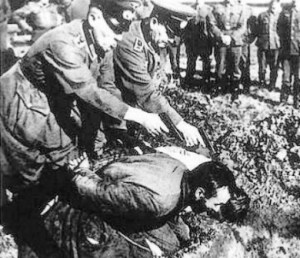
einsatzgruppen-brutal-germans-nazi-death-squads1

Einsatzgruppe men and Ordungspolizei above and below in action

“The European history of the twentieth century shows us that societies can break, democracies can fall, ethics can collapse, and ordinary men can find themselves standing over death pits with guns in their hands. It would serve us well today to understand why.” Timothy Snyder

Einsatzgruppe_A

The Wehrmacht’s complicity in these measures is demonstrated in the order drafted by Warlimont and signed by Keitel on 13 May 1941. That order, the “Decree on Exercising Military Jurisdiction in the Area of Barbarossa and Special Measures by the Troops” made it clear that international conventions regarding the treatment of civilians would not be observed in the Soviet Union. The order, relying on the historic precedent of German military law in regard to partisan activity stated

I “Treatment of crimes committed by enemy civilians”

“1. Until further order the military courts and the courts martial will not be competent for crimes committed by enemy civilians.”

2. Francs-tireurs will be liquidated ruthlessly by the troops in combat or while fleeing. “

3. Also all other attacks by enemy civilians against the armed forces, its members, andauxiliaries will be suppressed on the spot by the troops with the most rigorous methods until the assailants are finished (niederkaempfen)”

4. Where such measures were not taken or at least were not possible, persons suspected of the act will be brought before an officer at once. This officer will decide whether they are to be shot. Against localities from which troops have been attacked in or treacherous manner, collective coercive measures be applied immediately upon the order of an officer of the rank of at least battalion etc., commander, if the circumstances do not permit a quick identification of individual perpetrators.”

II. “Treatment of crimes committed against inhabitants by members of the Wehrmacht and its auxiliaries”

1. With regard to offenses committed against enemy civilians by members of the Wehrmacht or by its auxiliaries prosecution is not obligatory, even where the deed is at the same time a military crime or misdemeanor….” 172

Hitler was quite clear in his intent when he told General Halder that in 1941 that he “intended to level Moscow and Leningrad, to make them uninhabitable, so there would be no need to feed their populations during the winter.” 173Economic officials held life and death power over villages. Those that met agricultural quotas were “likely to be spared annihilation and evacuation…the culmination of this process, during 1943, would be the widespread creation of “dead zones.””174All told during the campaign against the Soviet Union the Germans killed nearly 1.5 million Russian Jews. 175
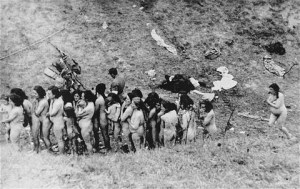
ww2 mizocz1

By 1942, over two million Soviet POW’s had been killed. 600,000 shot outright, 140,000 by the Einsatzkommandos. 176Eventually about 3.3 million Soviet POWs died in German captivity through starvation, disease and exposure, 177are included in a total of over 10 million Red Army Combat deaths. 178 The distinguished German historian Karl Dietrich Bracher wrote, “The reality and irreality of the National Socialism were given their most terrible expression in the extermination of the Jews.” 179
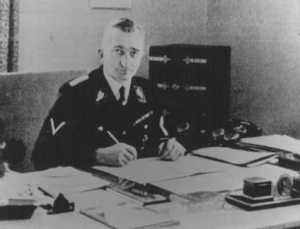
arthur nebe

Arthur Nebe, from Jew killer to anti-Hitler plotter

Himmler and others continued to use euphemistic language to describe their efforts talking in terms of “Jewish resettlement.” 180 Terms such as special actions, special treatment, execution activity, cleansing and resettlement were used in place of the word murder. 181At the same time these operations led to problems in the ranks, one SS trooper observed: “deterioration in morale among his own men who had to be issued increasing rations of vodka to carry out their killing orders.” 182

Even commanders of the Einsatzgruppe were affected. Arthur Nebe would say “I have looked after so many criminals and now I have become one myself.” Nebe became an active participant in the July 20th plot against Hitler 183and a fellow conspirator would describe him as a “shadow of his former self, nerves on edge and depressed.” 184 Erich Bach-Zelewski, who led the SS anti- partisan operations, would suffer a nervous breakdown which included “hallucinations connected to the shootings of Jews” which hospitalized him in 1942. 185 Himmler would state in his Posen speech given in October 1943 that “to have gone through” the elimination of the Jews had “and remained decent, that has made us tough. This is an unwritten, never to be written, glorious page in our history.” 186

To be continued…

Notes

119 Ibid. Megargee. War of Annihilation p.24

120 Ibid. Wheeler-Bennett The Nemesis of Power p.511

121 Ibid. Goerlitz. The Memoirs of Field Marshal Wilhelm Keitel. P.132

122 Glantz, David M. and House, Jonathan. When Titans Clashed: How the Red Army Stopped Hitler. University Press of Kansas, Lawrence, KS. 1995 p.31

123 Trevor-Roper, H.R. Hitler’s Table Talk 1941-1944 with an introduction by Gerhard L Weinberg, Translated byNorman Cameron and R.H. Stevens, Enigma Books, New York, NY 2000. Originally published in Great Britain by Weidenfeld & Nicholoson, London 1953 p.6

124 Ibid. Megargee. War of Annihilation p.10 The campaign against the Soviet Union was to be much more openlyideological as compared to the campaign in Poland.

125 Ibid. Warlimont. Inside Hitler’s Headquarters p.150 126 Ibid. Warlimont. Inside Hitler’s Headquarters p.151

125 Ibid. Warlimont. Inside Hitler’s Headquarters p.150 126 Ibid. Warlimont. Inside Hitler’s Headquarters p.151

127 Ibid. Reitlinger, The SS p.175

128 Ibid. Höhne The Order of the Death’s Head p. 354

129 Ibid. Höhne The Order of the Death’s Head p. 354 Again another deception.

130 Ibid. Warlimont. Inside Hitler’s Headquarters p.153

131 Ibid. Warlimont. Inside Hitler’s Headquarters p.153

132 Ibid. Warlimont. Inside Hitler’s Headquarters pp. 158-159

133 Ibid. Glantz and House. When Titans Clashed p.56

134 Ibid. Davidowicz. The War Against the Jews p.123

135 Ferguson, Niall. The War of the Worlds: Twentieth Century Conflict and the Descent of the West. The Penguin Press, New York, 2006 p.442

136 Ibid. Wheeler-Bennett. Nemesis of Power p.513

137 Ibid. Goerlitz. The Memoirs of Field Marshal Wilhelm Keitel. P.135

138 Ibid. Wheeler-Bennett. Nemesis of Power p.513

139 Hebert, Valerie Genevieve, Hitler’s Generals on Trial: The Last War Crimes Tribunal at Nuremberg University of Kansas Press, Lawrence Kansas 2010 pp.77-78

140 Ibid. Wheeler-Bennett Nemesis of Power p.513 and footnote. He cites the three Army Group commanders, Leeb, Rundstedt and Bock. However Von Rundstedt’s biographer notes that “no evidence exists as to what VonRundstedt’s to this was at the time.” Messenger, Charles, The Last Prussian: A Biography of Field Marshal Gerd Von Rundstedt 1875-1953 Brassey’s (UK) London England 1991. p.134

141 Ibid. Reitlinger, The SS p.176

142 Ibid. Megargee. War of Annihilation p.33

143 Ibid. Warlimont. Inside Hitler’s Headquarters p.162

144 Ibid. Goerlitz. The Memoirs of Field Marshal Keitel p.136

145 Ibid. Goerlitz. The Memoirs of Field Marshal Keitel pp.136-137

146 Ibid. Glantz and House. When Titans Clashed p.56

147 Ibid. Blood. Hitler’s Bandit Hunters p.52

148 Ibid. Reitlinger The SS p. 177

149 Ibid. Shepherd. War in the Wild East p.54

150 Ibid. Reitlinger The SS p. 177

151 Ibid. Rhodes Masters of Death pp.12-13

152 Ibid. Westermann. Hitler’s Police Battalions p.167 153 Ibid. Westermann. Hitler’s Police Battalions p.164 154 Ibid. Blood Hitler’s Bandit Hunters p.141

155 Ibid. Shepherd Wild War in the East p.48. Shepherd notes the deficiencies of these units in terms of organization, manpower and equipment which he calls “far short of the yardstick of military excellence with which the Wehrmacht is so widely associated

156 Ibid. Höhne The Order of the Death’s Head p. 356 Only one of the Einsatzgruppen commanding officers was a

volunteer, Arthur Nebe who was involved in the conspiracy to kill Hitler. It is believed by many that Nebe volunteered to earn the clasp to the Iron Cross to curry favor with Heydrich and that initially “Nebe certainly did not know that “employment in the east” was synonymous with the greatest mass murder in history.

157 Ibid. Bracher. The German Dictatorship p.422

158 Ibid. Blood Hitler’s Bandit Hunters p.55

159 Ibid. Höhne The Order of the Death’s Head p. 360 160 Ibid. Friedlander TheYears of Extermination p.207 161 Ibid. Höhne The Order of the Death’s Head p. 360 162 Ibid. Tooze The Wages of Destruction p.481

163 Ibid. Ferguson. The War of the World p.446

164 Di Nardo, Richard L. Germany and the Axis Powers: From Coalition to Collapse. University Press of Kansas,Lawrence, KS. 2005 p.133 The Hungarians would also engage in ant-Jewish operations. Only the Italian army would not conduct operations against the Jews.

165 Ibid. Höhne The Order of the Death’s Head p. 369

166 Ibid. Wette The Wehrmacht p.127

167 Ibid. Blood. Hitler’s Bandit Hunters p.117

168 Ibid. Hebert p.94

169 Ibid. Hebert pp.94-95

170 Ibid. Shepherd. War in the Wild East pp.90-91

171 Ibid. Tooze The Wages of Destruction p.481

172 Ibid, Hebert p.86

173 Ibid. Magargee. War of Annihilation p.64

174 Ibid. Shepherd. War in the Wild East pp.127-128

175 Ibid. Davidowicz The War Against the Jews from the table on page 403. This included 228,000 from the Baltic republics (90%) 245,000 from White Russia (65%) 900,000 from the Ukraine (60%) and 107,000 from Russia proper

(11%)

176 Ibid. Rhodes. Masters of Death p.241

177 Ibid. Glantz and House When Titans Clashed p.57

178 Ibid. Glantz and House. When Titans Clashed table on p.292

179 Ibid. Bracher. The German Dictatorship p.431

180 Ibid. Bracher. The German Dictatorship p.430

181 Ibid. Höhne The Order of the Death’s Head p. 367

182 Ibid. Rhodes. Masters of Death p.225

183 Ibid. Rhodes Masters of Death p.225

184 Ibid. Höhne The Order of the Death’s Head p. 363 185 Ibid. Höhne The Order of the Death’s Head p. 363 186 Ibid. Bracher. The German Dictatorshipp.423

5 Comments

Filed under ethics, History, holocaust, Military, nazi germany, Political Commentary, war crimes, world war two in europe

Genocide Up Close and Personal: The Einsatzgrüppen in Poland

einsatz1

Friends  of Padre Steve’s World

Another section of the article dealing with the campaign of mass murder and genocide conducted by Hitler’s legions in Eastern Europe. This section deals with the actions of the Einsatzgruppen in Poland in 1939 and 1940. In it you will see that the while most of the killing was done by the SS that the German military high command was not guiltless. Some commanders attempted to stop SS actions, but they were the minority.  Most simply turned a blind eye to what was going on and a few would lend their assistance to the Einsatzgruppen. 

Please note, that all of this took place before the first extermination camps began operations. This killing was done up close and personal by  the men of the Einsatzgruppen and the Police battalions. In all just a few thousand troops massacred hundreds of thousands of Polish Jews as well as the Polish gentile elites.

It is terribly uncomfortable, for as I always say, these men were little different than most of us, they were terribly ordinary.

Peace

Padre Steve+

himmler1

Heinrich Himmler

The Polish campaign was a precursor to the Russian campaign and was not totally race driven. It contained elements of Germany’s perception of the injustice of Versailles which gave Poland the Danzig corridor and Germany’s desire to reconnect East Prussia to the Reich, as well as the perceived necessity to remove a potential enemy from its rear as it faced France, yet it was a campaign steeped in Nazi racial ideology. Poland resisted German efforts to ally itself with Germany in 1939, thus Hitler determined it “would be crushed first.” 80

Meeting with military leaders on 23 May 1939 Hitler “made it plain that the real issue was not Danzig, but securing of Germany’s Lebensraum….” 81 On 22 August Hitler enjoined the generals to “Close your hearts to pity! Act brutally! Eighty million people must obtain what is their right.” 82

Even so, most military leaders failed to appreciate what Hitler was calling on them to do; Erich von Manstein would later note that “what Hitler had to say about an eventual war with Poland, could not, in my opinion, be interpreted as a policy of annihilation.” 83
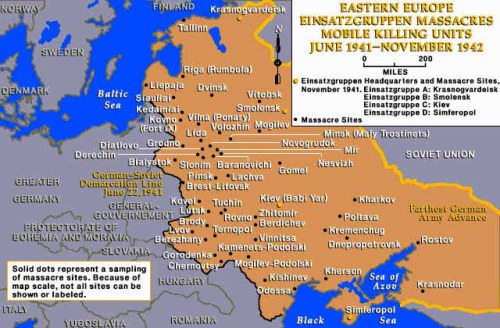
generaloberst johannes blaskowitz

General Johannes Blaskowitz

Others such as Abwehr director Wilhelm Canaris was “utterly horrified.” As he read his notes to his closest colleagues “His voice trembled as he read, Canaris was acutely aware that he had witnessed something monstrous.” 84 General Johannes Blaskowitz, the controversial commander of the German 8th Army who would become the military commander in Poland did not leave any notes about the meeting. However, his biographer noted that Blaskowitz “may have naively attached a military meaning to these terms since he was busy with military matters and soon to begin operations.” 85 As was noted before this was also the interpretation of Erich Manstein gave Hitler’s words, but one has to wonder as to the veracity of his statements. 86 Field Marshal Keitel noted that the speech was “delivered in the finest sense of psychological timing and application,” with Hitler molding “his words and phrases to suit his audience.” 87

In light of the mixed interpretations by military leaders, it is possible that many misinterpreted Hitler’s intent and did not fully appreciated his ideology as they went into Poland, carefully secluding themselves in the narrow confines of their military world. While such an explanation is plausible for some, it is also true that many others in light of subsequent actions were in full agreement with Hitler. One author notes that “no man who participated in the FührerConferences….and there were present the highest ranking officers of the three services, could thereafter plead ignorance of the fact that Hitler had laid bare his every depth of infamy before them, and they had raised no voice in protest either then or later.” 88 In July, General Wagner, the Quartermaster General issued orders that “authorized German soldiers to take and execute hostages in the event of attacks by snipers or irregulars.” 89

Regardless of the meaning ascribed to Hitler’s speech by his generals, Hitler had already laid plans to destroy the Jews in Poland and decimate the Polish intelligentsia and leadership.   Hitler gave Himmler the task of forming Einsatzgrüppen to follow the German troops as they advanced into Poland and liquidate Poland’s upper class wherever it was to be found.” 90 While senior party leaders remained at Hitler’s side following the conference, Himmler worked to coordinate his troops, including the reinforced Totenkopf battalions and Einsatzgrüppen with the Army. 91

Himmler began planning in early May and the Army, working in close collaboration with the SS decided to “use SS and police units to augment their own forces for security tasks.” 92 Himmler established “five Einsatzgrüppen to accompany each of the numbered German armies at the start of the campaign.” 93 Placed under the aegis of Reinhard Heydrich the groups were broken down into smaller units of 100-150 men and allotted to army corps. All senior posts were occupied by officers of the SD, the Sicherhietsdienst. 94

Two additional Einsatzgrüppen were formed shortly after the invasion. 95Additionally three regiments of the SS Totenkopfverbandeunder the direction of SS General Theodore Eicke were deployed in the rear areas of the advancing armies. These regiments were formed from the Concentration Camp guard units and eventually became the nucleus of the 3rd SS Panzer Division Totenkopf. 96 The SS carefully shielded the real purpose of these units from the Army in the planning stages, while the Army might countenance anti-guerrilla operations and cooperate in arresting people who might lead resistance in Poland, the SS was not yet sure that the Army would support or countenance mass murder. 97 That being said, Heydrich worked with the Army to develop lists of up to 30,000 Poles to be arrested following the invasion including intellectuals, political leaders and clergy. 98

To eliminate the Polish elites without disturbing the Army, Himmler and Heydrich gave the Army “only the bare minimum of information” as to their ultimate intent99 The deception was initially successful and many Wehrmacht commanders welcomed the assistance of the SS units for rear area security missions. Blaskowitz’s 8th Army defined the mission of the Einsatzgrüppen in the traditional doctrinal terms of the Ettapen, noting their mission as “the suppression of all anti-Reich and anti- German elements in the rear of the “fighting troops, in particular, counter espionage arrests of  politically unreliable persons, confiscation of weapons, safeguarding of important counter- espionage materials etc…” 100 General Wagner, the Quartermaster General issued orders in July 1939 that “authorized German soldiers to take and execute hostages in the event of attacks by snipers or irregulars.” Despite the deception, there was no way to disguise the murder of Polish intelligentsia and Jews once it began, and had the Army had the political acumen and moral courage it could have considerably restricted or even halted the terror campaign. 101

The ensuing campaign in Poland demonstrated Hitler’s true intent. Heydrich openly discussed “murdering the Polish ruling class” of the aristocracy, Catholic clergy, communists and Jews at a meeting on September 7th, barely a week after the beginning of the invasion. 102 As the German armies advanced into Poland slicing through the badly deployed and inadequately equipped Polish Army the Einsatzgruppen and the Totenkopf Verbande followed in their wake, conducting mass arrests and executions of those Poles deemed to be a threat.

Many army leaders were worried about Polish soldiers left behind in rear areas as the armies advanced. In some cases that concern became a paranoid mindset and some generals believed that a “brutal guerrilla campaign has broken out everywhere and we are ruthlessly stamping it out.” 103

ordungspolizei

Ordungspolizei Battalion preparing for Mass Murder

Yet some of the actions by Einsatzgruppen and Totenkopf Verbandeagainst the Polish elites and the Jews drew Army reactions. The unit commanded by SS General Woyrsch “behaved with such unparalleled bestiality that it was thrown out of the operational area” by General List of 14th Army.” 104 Another unit, the Totenkopfverbande Brandenburg came to Army attention when its commander remarked that the “SSVT would not obey Army orders.” The conclusion drawn by the Army General was that “the SSVT commander was following orders from some non-military authority to terrorize the local Jews.” 105

These atrocities as well as those of other Waffen-SS units were hard to hide and brought reactions out of army commanders who sought to punish the offenders. Blaskowitz and a few other commanders attempted to put a halt to SS actions against Poles and Jews, 106 but most officers turned a blind eye to the atrocities or outright condoned them. It is believed that General Walter Model and many other senior officers “not only knew what was occurring in Poland but actually took part in what Colonel General Franz Halder himself described in October as “this devilish plan.”” 107

It appears that many of the officers who objected were not motivated so much by humanitarian, moral or legal considerations, but rather by the effect on good order and discipline of their soldiers. 108 Likewise it is clear that many officers, even if they did not participate in the actions probably approved of them. Many of the early biographies and histories of this period were written by authors who were influenced by surviving German officers. Many of these men were being rehabilitated and helping the Americans and British meet the threat of the Soviet Union, made no or little mention of the Army’s part in these actions.

Both Himmler and Heydrich were sensitive to the perception of the Army and resented the fact that the Army believed them to be responsible for actions that they were carrying out under the direction and orders of Hitler himself, They also resented that their troops were characterized as “undisciplined gangs of murderers” by many Army officers. 109

After crushing the Polish armies and dividing Poland with the help of the Red Army, the Germans established what became known as the Government General, which was headed by Hans Frank. The new civilian administration came into conflict with the military governor, General Blaskowitz. Appalled by the actions of the SS, Police and the Nazi administration. Blaskowitz made an “elaborate report on the atrocities of the SS,” 110 expressing concern about his “extreme alarm about illegal executions, his worries about maintaining troop discipline under those circumstances, the failure of discussions with the SD and Gestapo and their assertions that they were only following SS Orders.” 111

While it is unclear if the memorandum made it to Hitler, it is clear that Hitler did know about the protest and Blaskowitz fell into disfavor and was reassigned after a period of continued conflict with the Nazi administration. Hitler was not impressed by the less than ruthless attitudes of Blaskowitz and other commanders. His reaction to Army objections regarding the methods of the SS and police units was characteristically acidic. Hitler’s military adjutant recalled that Hitler accused the Army’s leaders of using “Salvation Army” methods, and called their ideas regarding the occupation as “childish.” 112

Following the reassignment of Blaskowitz, other officers that objected were also relieved of their commands or reassigned. General Georg von Külcher was relieved of command for protesting SS and police atrocities. 113

07102014-461733515

At the beginning of the campaign the SS units and their commanders fell under military justice, and a number of SS officers and their troops were convicted by Army courts-martial for their actions. But soon, SS Officers convicted by Army courts-martial were given amnesty by Hitler and Hitler “removed SS units from the jurisdiction of military courts,” on October 4th 1939. 114 While the army remained, it was no longer in charge and would actively assist the SS and Police in combat and further atrocities against civilians. In November 1939, One German officer, who later was a conspirator in the July 20th plot, remarked, “was ashamed to be German! The minority are dragging our good through the mud by murdering, looting and torching houses will bring disaster on the whole German people if we do not stop it soon…” 115

poland murders

The Army was soon relieved of responsibility for policing Poland which fell on the Ordungspolizei battalions and Gendarmerie. Many officers were pleased as they could now turn their backs on the situation there and begin to prepare for the campaign in the West.

The Ordungspolizei battalions and the Gendarmerie units were composed of mobilized city police and rural constabulary police. These men would soon wreak their own devastation on Poland in the coming months and years. 116Poland was also be the first use of mass evacuations of civilian populations to make room for German settlers, in the newly acquired Lebensraum. Poles were driven into the newly formed Government General and ethnic Germans moved into previously Polish occupied territories. By 1941 over 1,200,000 Poles and 300,000 Jews had been expelled and 497,000 ethnic Germans brought into provinces German had lost in 1919. 117

Prior to the war about 3.3 million Jews lived in Poland. The actions of the Einsatzgruppen and the Police brought a reign of terror to Poland’s Jews. The Jews were rounded up and sent to Ghettos from which they would be dispatched to the death camps following the decision to implement the “Final Solution.”After the war only some 50-70,000 Jews were found to have survived in Poland, the Polish Army and camps in Germany. A further 180,000 were repatriated from the Soviet Union. 118

To be continued….

Notes

80 Ibid. Weinberg. Visions of Victory p.8
81 Ibid. Goerlitz, History of the German General Staff p.346
82 Höhne, Heinze. The Order of the Death’s Head: The Story of Hitler’s SS. Translated by Richard Barry. PenguinBooks, New York and London, 2000. First English edition published by Martin Secker and Warburg Ltd. London 1969. Originally published as Der Orden unter dem Totenkopf, Verlag Der Spiegel, Hamburg 1966 p.259

83 Manstein, Erich von. Forward by B.H. Liddle Hart, Introduction by Martin Blumenson. Lost victories: The War Memoirs of Hitler’s Most Brilliant General. Zenith Press, St Paul MN 2004. First Published 1955 as Verlorene Siege, English Translation 1958 by Methuen Company p.29

84 Ibid. Hohne. Canaris p.347

85 Giziowski, Richard. The Enigma of General Blaskowitz. Hppocrene Books, New York 1997 p.119

86 Ibid. Manstein. Lost Victories p.29

87 Ibid. Goerlitz. The Memoirs of Field Marshal Keitel p.87

88 Wheeler-Bennett, John. The Nemesis of Power: The German Army in Politics 1918-1945. St. Martin’s Press Inc. New York, NY 1954 p.448

89 Ibid. Megargee. War of Annihilation p.13

90 Ibid. Höhne The Order of the Death’s Head p.297

91 Padfield, Peter. Himmler. MJF Books, New York 1990 p.264

92 Ibid. Megargee. War of Annihilation p.13

93 Ibid. Westermann. Hitler’s Police Battalions p.127

94 Ibid. Höhne The Order of the Death’s Head p.297 95 Ibid. Westermann. Hitler’s Police Battalions p.127 96 Ibid. Sydnor Soldiers of Destruction p.37

97 Ibid. Giziowski Blaskowitz p.120

98 Ibid. Witte. The Wehrmacht p.100

99 Ibid. Höhne The Order of the Death’s Head pp. 297-298

100 Ibid. Giziowski Blaskowitz p.120

101 Ibid. Höhne The Order of the Death’s Head p.298

102 Ibid. Witte. The Wehrmacht p.100

103 Newton, Steven H. Hitler’s Commander: Field Marshal Walter Model-Hitler’s Favorite General Da Capo Press a division of Perseus Books Group, Cambridge MA 2005. p.74

104 Ibid. Giziowski. The Enigma of General Blaskowitz pp.165-166

105 Ibid. Sydnor, Soldiers of Destruction pp. 42-43 Note SSVT is the common abbreviation for Verfügungstruppe which was the early designation of the SS Totenkopf Verbande and some other Waffen SS Units.

106 Ibid. Goerlitz. History of the German General Staff p.359

107 Ibid. Newton. Hitler’s Commander p.78

108 Ibid. Witte The Wehrmacht p.102

109 Ibid. Höhne The Order of the Death’s Head p.298

110 Ibid. Goerlitz. History of the German General Staff .p.359 111 Ibid. Giziowski. The Enigma of General Blaskowitz p.173 112 Ibid. Giziowski. TheEnigma of General Blaskowitz p.173

113 Ibid. Witte The Wehrmacht p.102

114 Burleigh, Michael and Wippermann, Wolfgang. The Racial State: Germany 1933-1945 Cambridge University Press, New York NY and Cambridge UK 1991. p.100

115 Ibid. Witte The Wehrmacht p.102

116 For a good account of one of the Police Battalions see Ordinary Men: Reserve Police Battalion 101 and the Final Solution in Poland by Christopher Browning Harper Perennial Publishers, San Francisco CA 1992

117 Reitlinger, Gerald. The SS: Alibi of a Nation. The Viking Press, New York, 1957. Republished by Da Capo Press, New York, NY p.131

118 Ibid. Davidowicz The War Against the Jews pp.395-397

Leave a comment

Filed under History, holocaust, nazi germany, Political Commentary, world war two in europe