Category Archives: iraq,afghanistan

“A Foreign World”: The High Cost of Coming Home from War

295_26912117058_5652_n

For me it began in February 2008 when on the way back from Iraq the military charter aircraft bringing us home stopped in Ramstein Germany. After a few hour layover we re-boarded the aircraft but we were no longer alone, the rest of the aircraft had been filled with the families of soldiers and airmen stationed in Germany. Just days before most of us had been in Iraq or Afghanistan. The cries of children and the intrusion of these people, not bad people by any means on our return flight was shocking, it was like returning to a world that I no longer knew.

I think that coming home from war, especially for those damaged in some way, in mind, body or spirit is harder than being at war. In that thought I am not alone. Erich Maria Remarque in his classic novel All Quiet on the Western Front wrote:

“I imagined leave would be different from this. Indeed, it was different a year ago. It is I of course that have changed in the interval. There lies a gulf between that time and today. At that time I still knew nothing about the war, we had been only in quiet sectors. But now I see that I have been crushed without knowing it. I find I do not belong here any more, it is a foreign world.” Erich Maria Remarque in All Quiet on the Western Front

Likewise, Guy Sager a French-German from the Alsace and veteran of the Grossdeutschland Division on the Eastern Front in World War II noted at the end of his book The Forgotten Soldier: 

“In the train, rolling through the sunny French countryside, my head knocked against the wooden back of the seat. Other people, who seemed to belong to a different world, were laughing. I couldn’t laugh and couldn’t forget.” Guy Sager in The Forgotten Soldier

I have been reminded of this several times in the past week. It began walking through a crowded Navy commissary on Saturday, in the few minutes in the store my anxiety level went up significantly. On Tuesday I learned of the death of Captain Tom Sitsch my last Commodore at EOD Group Two, who died by his own hand. His life had come apart. After a number of deployments to Iraq as the Commander EOD Mobile Unit 3 and of Task Force Troy he was afflicted with PTSD. Between June of 2008 and the end of 2009 he went from commanding an EOD Group to being forced to retire.  Today I had a long talk with a fairly young friend agonizing over continued medical treatments for terminal conditions he contracted in two tours in Iraq where he was awarded the Bronze Star twice.

I have a terrible insomnia, nightmares and night terrors due to PTSD. My memories of Iraq are still strong, and this week these conditions have been much worse. Sager wrote:

“Only happy people have nightmares, from overeating. For those who live a nightmare reality, sleep is a black hole, lost in time, like death.”

Nearly 20 years after returning from war, a survivor of the 1st Battalion 308th Infantry, the “Lost Battalion” of World War One, summed up the experience of so many men who come back from war:

“We just do not have the control we should have. I went through without a visible wound, but have spent many months in hospitals and dollars for medical treatment as a result of those terrible experiences.”
Bradley-12-2

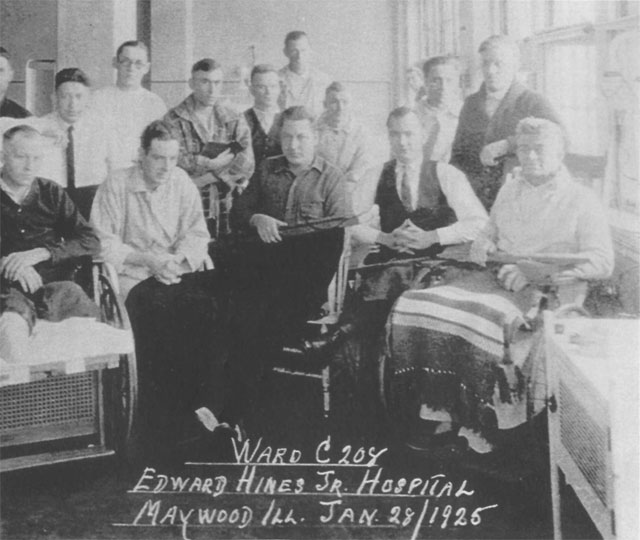
Two time Medal of Honor winner Major General Smedley Butler toured Veterans hospitals following his retirement from the Marine Corps. He observed the soldiers who had been locked away. In his book War is a Racket:

“But the soldier pays the biggest part of this bill. If you don’t believe this, visit the American cemeteries on the battlefields abroad. Or visit  any of the veterans’ hospitals in the United States….I have visited eighteen government hospitals for veterans. In them are about 50,000 destroyed men- men who were the pick of the nation eighteen years ago. The very able chief surgeon at the government hospital in Milwaukee, where there are 3,800 of the living dead, told me that mortality among veterans is three times as great as among those who stayed home.”

Similarly Remarque wrote in All Quiet on the Western Front:

“A man cannot realize that above such shattered bodies there are still human faces in which life goes its daily round. And this is only one hospital, a single station; there are hundreds of thousands in Germany, hundreds of thousands in France, hundreds of thousands in Russia. How senseless is everything that can ever be written, done, or thought, when such things are possible. It must be all lies and of no account when the culture of a thousand years could not prevent this stream of blood being poured out, these torture chambers in their hundreds of thousands. A hospital alone shows what war is.”
Lt.ColonelCharlesWhiteWhittlesey

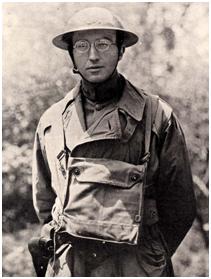
Sometimes even those who have been awarded our Nation’s highest award for valor succumb to the demons of war that they cannot shake, and never completely adjust to life at “home” which is no longer home. For them it is a different, a foreign world to use the words of Sager and Remarque. Lieutenant Colonel Charles Whittlesey won the Congressional Medal Medal of Honor as Commander of 1st Battalion 308th Infantry, the “Lost Battalion” in France. After the war he was different. He gave up his civilian law practice and served as head of the Red Cross in New York. In that role, and as the Colonel for his reserve unit, he spent his time visiting the wounded who were still suffering in hospitals. He also made the effort to attend the funerals of veterans who had died. The continued reminders of the war that he could not come home from left him a different man. He committed suicide on November 21st 1921not long after serving as a pallbearer for the Unknown Soldier when that man was interred at Arlington National Cemetery.

In the eulogy Judge Charles L. Hibbard noted:

“He is sitting on the piazza of a cottage by the sea on a glorious late September day but a few weeks ago. . . He is looking straight out to sea, with naught but sea between him and that land where lie so many of his boys. The beating surf is but an echo, the warm, bright sunshine, the blue sky, the dancing waves, all combine to charm. But a single look at his face and one knows he is unconscious of this glory of Nature. Somewhere far down in the depths of his being or in imagination far off across the waters he lives again the days that are past. That unconscious look has all the marks of deep sorrow, brooding tragedy, unbearable memories. Weeks pass. The mainspring of life is wound tighter and tighter and then comes the burial of the Unknown Soldier. This draws the last measure of reserve and with it the realization that life had little now to offer. This quiet, reserved personality drew away as it were from its habitation of flesh, thought out the future, measured the coming years and came to a mature decision. You say, ‘He had so much to live for – family, friends, and all that makes life sweet.’ No, my friends, life’s span for him was measured those days in that distant forest. He had plumbed the depth of tragic suffering; he had heard the world’s applause; he had seen and touched the great realities of life; and what remained was of little consequence. He craved rest, peace and sweet forgetfulness. He thought it out quietly, serenely, confidently, minutely. He came to a decision not lightly or unadvisedly, and in the end did what he thought was best, and in the comfort of that thought we too must rest. ‘Wounded in action,’ aye, sorely wounded in heart and soul and now most truly ‘missing in action.’”

Psychologist and professor Dr Ari Solomon analyzed the case of Colonel Whittlesey and noted:

“If I could interview Whittlesey as a psychologist today, I’d especially have in mind … the sharp discrepancy between the public role he was playing and his hidden agony, his constant re-exposure to reminders of the battle, his possible lack of intimate relations, and his felt need to hide his pain even from family and dearest friends.”

I wish I had the answer. I have some ideas that date back to antiquity in the ways that tribes, clans and city states brought their warriors home. The warriors were recognized, there were public rituals, sometimes religious but other times not. But the difference is that the warriors were welcomed home by a community and re-integrated into it. They were allowed to share their stories, many of which were preserved through oral traditions so long that they eventually were written down, even in a mythologized state.

But we do not do that. Our society is disconnected, distant and often cold. Likewise it is polarized in ways that it has not been since the years before our terrible Civil War. Our warriors return from war, often alone, coming home to families, friends and communities that they no longer know. They are misunderstood because their experience is not shared by the population at large. The picture painted of them in the media, even when it is sympathetic is often a caricature.  Their camaraderie with the friends that they served alongside is broken by distance and the frenetic pace of our society. Remarque wrote “We were all at once terribly alone; and alone we must see it through.”

If we wonder about the suicide epidemic among veterans we have to ask hard questions. Questions like why do so many combat veterans have substance abuse problems and why is it that approximately one in ten prisoners serving time are veterans? It cannot be simply that they are all bad eggs. Many were and are smart, talented, compassionate and brave, tested and tried in ways that our civilian society has no understanding for or clue about. In fact to get in the military most had to be a cut above their peers. We have to ask if we are bringing our veterans home from war in a way that works. Maybe even more importantly we have to ask ourselves if as a culture if we have forgotten how to care about each other. How do we care for the men and women who bear the burden of war, even while the vast majority of the population basks in the freedom and security provided by the soldier without the ability to empathize because they have never shared that experience.

For every Tom Sitsch, Charles Whittlesey or people like my friend, there are countless others suffering in silence as a result of war. We really have to ask hard questions and then decide to do something as individuals, communities and government to do something about it. If we don’t a generation will suffer in silence.

Peace

Padre Steve+
2 Comments

Filed under History, iraq,afghanistan, Military, PTSD

Ending the Stigma: PTSD, TBI and Moral Injury in Senior Leaders

295_26911892058_4301_n

Yesterday I wrote about the death of my former Commodore at EOD Group Two, Captain Thomas Sitsch who committed suicide on Monday outside a New Hampshire Hospital. Captain Sitsch was another casualty of the longest wars this nation has engaged.

Many senior leaders in the military, officers and senior enlisted of every service have frequently deployed to Iraq, Afghanistan as well as other locations in the war on terror. Since the war has been going over 12 years many have spent over half of their careers preparing for, engaging in, or recovering from wartime deployments. Many have suffered physical injuries as well as the unseen injuries of war, PTSD, Traumatic Brain Injury and Moral Injury. Unfortunately they are often the last people to seek help.

In the past few years I have personally known or know of a number of senior officers and senior enlisted personnel who have committed or attempted suicide or had their careers destroyed because of their actions. Some like Captain Sitsch were diagnosed with PTSD, others displayed some or all of the indicators but either refused help or put getting help aside in order to “stay in the fight.”

In the past couple of years the Commanding Officer of a deployed SEAL Team committed suicide in Afghanistan, two Marine Expeditionary Unit commanding officers were relieved after incidents that probably have their genus in PTSD, or Moral Injury. I would almost bet that some of the issues that some of our senior leaders have been relieved of their duties for are also the result of untreated PTSD, TBI, Combat Stress Injury or Moral Injury.

dallaire-rwanda

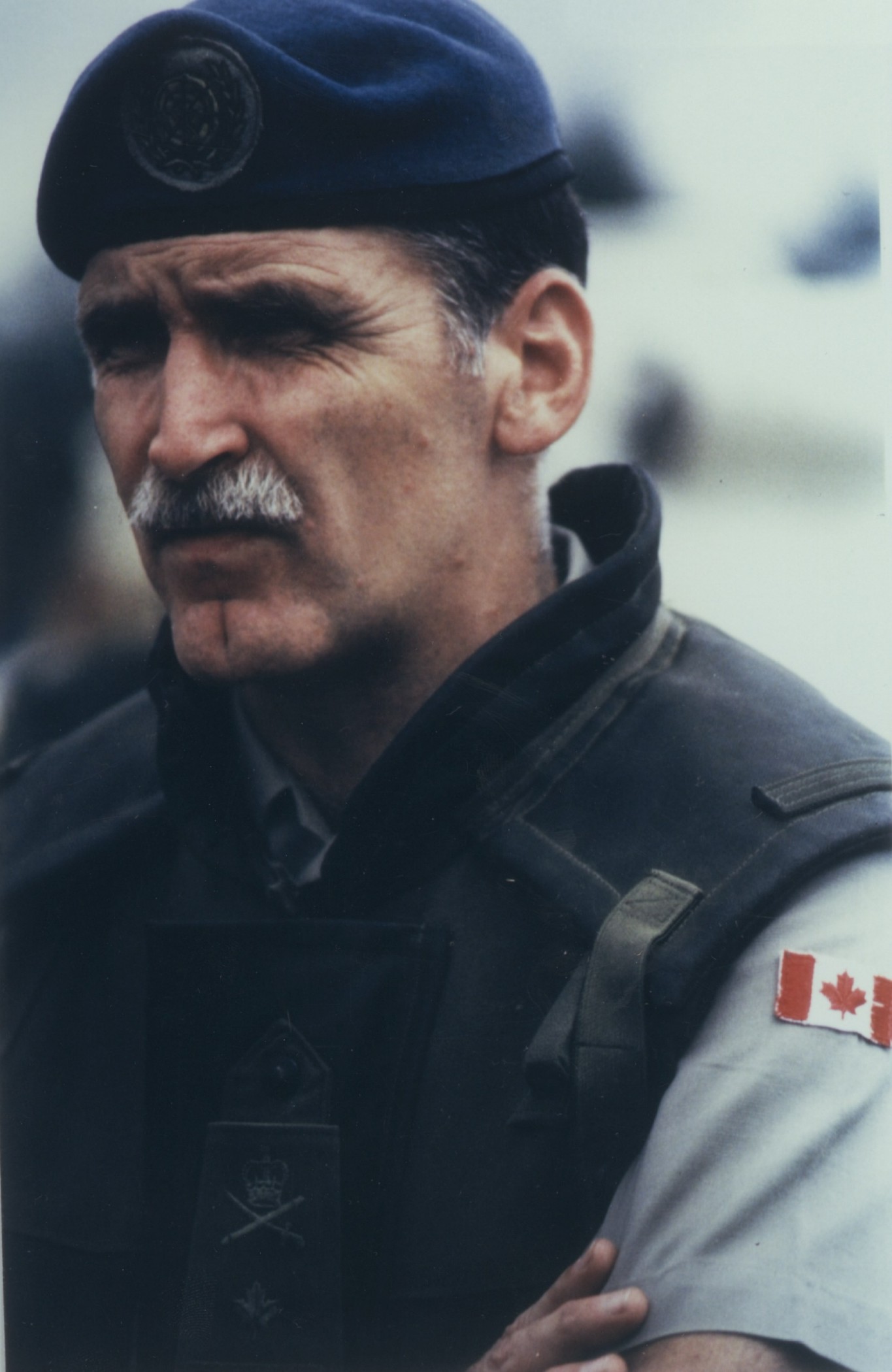
Retired Canadian General Romeo Dallaire still suffers from PTSD following his command of the UN Rwanda force in the middle of that country’s genocide. He attempted suicide in 2000 and still suffers. Last month he was involved in a car accident on his way to work in the Canadian Senate when he fell asleep at the wheel of his car. He had not slept the previous night due to reliving the horrors of that experience. As someone who still suffers chronic insomnia related to my PTSD I understand how this can happen.

The PTSD of T. E. Lawrence’s experience of war in the Middle East in the First World War shows in the pages of his classic Seven Pillars of Wisdom and various letters. Lawrence, who could have risen to high rank in the military or the foreign service basically went underground under an assumed name to serve in the ranks of the Royal Air Force in the 1920s. He wrote to Eric Kennington in 1935 not long before his death in a motorcycle accident:

“You wonder what I am doing? Well, so do I, in truth. Days seem to dawn, suns to shine, evenings to follow, and then I sleep. What I have done, what I am doing, what I am going to do, puzzle and bewilder me. Have you ever been a leaf and fallen from your tree in autumn and been really puzzled about it? That’s the feeling.”  

That is a part of our military culture. Leaders are under a great deal of pressure to accomplish often impossible missions and to take care of their troops. Many have been exposed to repeated combat trauma and had to bury more than one of their troops, often after the person commits suicide. Many anguish over the deaths, blame themselves and heap guilt on top of grief on top of traumatic or moral injury.

As I said many do not seek help due to an overwhelming cultural stigma against getting help, or “going to the wizard.” Likewise they know that that the reality is that if they seek help them may never command or be assigned to sensitive career enhancing billets again. As one senior leader told me “its hard when they say if you have issues and they are known that you can still have a successful career, but you will never be promoted or selected to a critical position, again.” 

1517080376

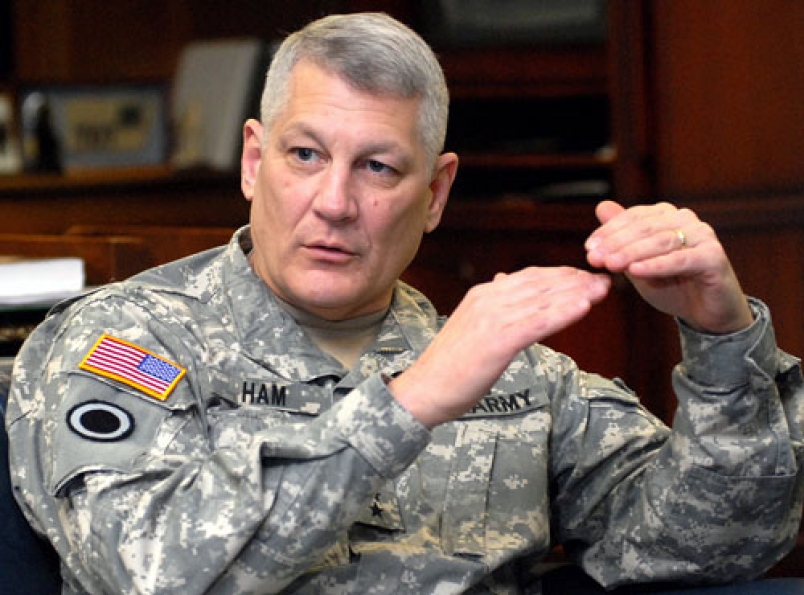
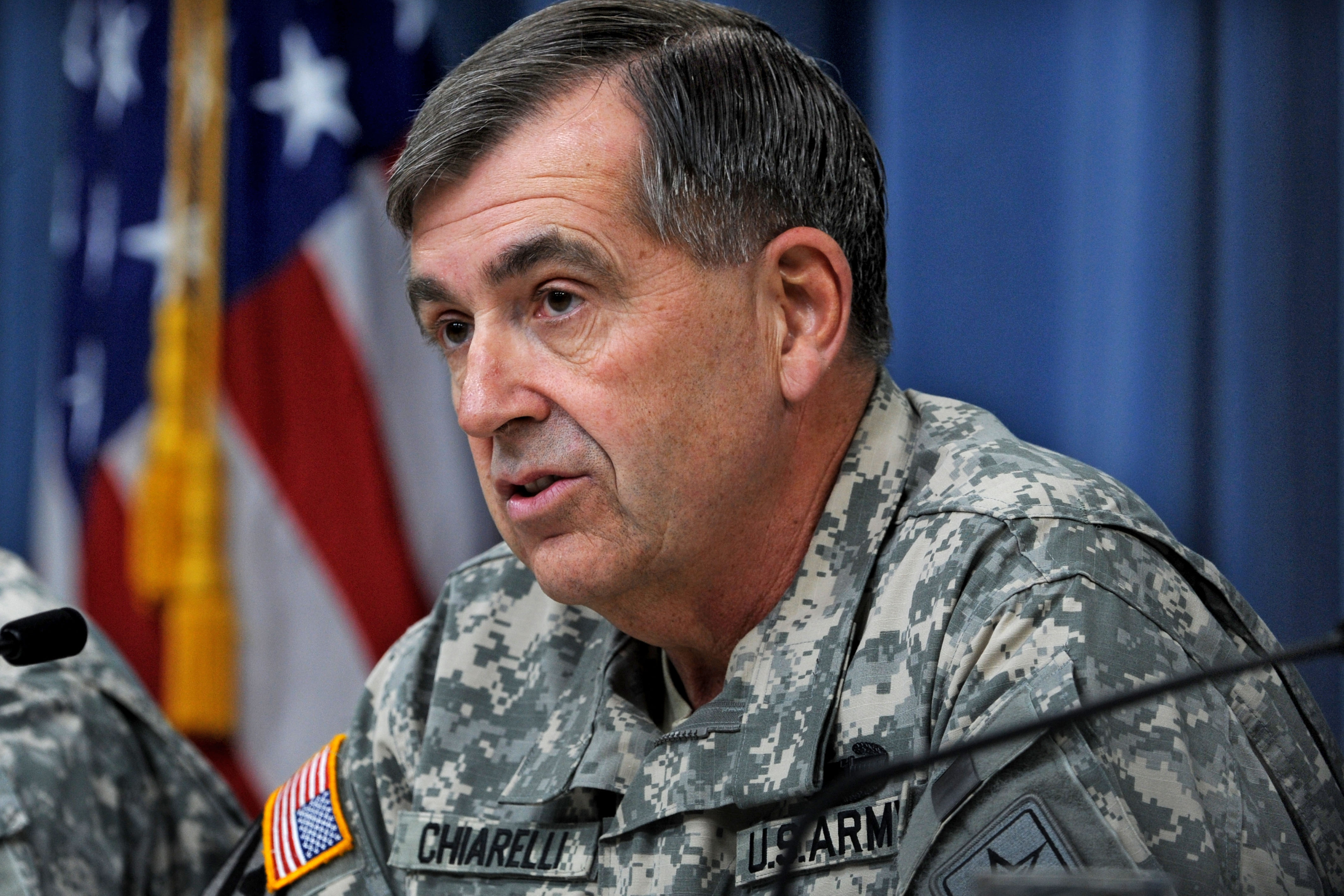
A few senior leaders have admitted to suffering from the symptoms of Combat Stress Injury and sought treatment. The most senior was General Carter Ham who began to suffer symptoms following his deployment to Mosul Iraq in 2004. Major General Gary Patton has also sought help for PTSD. Lieutenant General Peter Chiarelli, now retired has taken up the cause to reduce the stigma seeking to have PTSD renamed Post Traumatic Stress Injury instead of “disorder” because it is an injury.

110119-D-9880W-005.JPG

I wish I had an answer. For me it took a complete crash to get help as well as the assistance of two fine EOD officers, Admiral Frank Morneau and Captain Sitsch. Even with that initial assistance I still feel a certain stigma. My experience is that senior leaders who admit to this and seek treatment often become radioactive. I feel this most often around other chaplains. I am sure that senior leaders probably feel the same way when they are around others who either do not have the experience or who are trying to bury theirs.

One thing that I do think would be helpful is that instead of promoting stigma would be to stand alongside each other. Relationships are key to this and while professional help is good the only thing that can take away the stigma is to get back to standing beside each other in crisis rather than abandoning those who struggle. We are the willing participants in a zero defect culture which sees struggle as weakness and a mark of failure. The sad thing is that under our current system many of the greatest military leaders in history would not be promoted. It is no wonder the leaders who we have invested so much in developing and have sacrificed so much of themselves do not seek help.

grant-and-sherman-122304

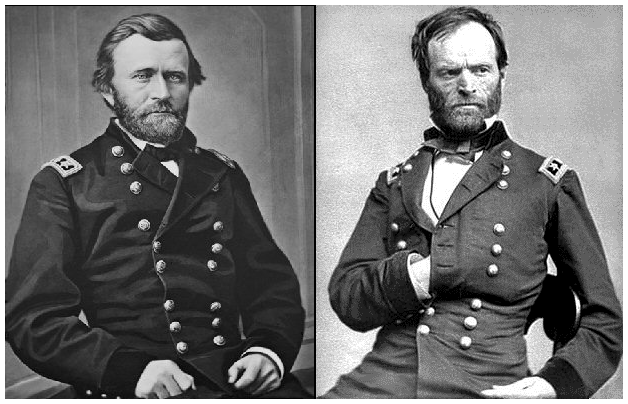
I like the example of Ulysses Grant and William Tecumseh Sherman. Both had significant problems after they left the Army after the Mexican War and in the early days of the Civil War. Grant struggled with drinking and Sherman suffered terrible depression. Sherman said of their relationship: “Grant stood by me when I was crazy, and I stood by him when he was drunk, and now we stand by each other.”

The reality is that in today’s more corporate military culture that neither of these men would have ever been promoted to high command. They would have been shunted aside.

Something has to change if we are to end this terrible scourge. I hope that General Ham and General Chiarelli are working with mental health professionals are able to help change the culture, but then by themselves they cannot. That has to start as we say in the Navy “at the deck plates.” It is up to us to change our culture, to be warriors who look after our fellow warriors in their time of need and who by our actions take away the stigma that keeps our brothers and sisters from getting help.

Peace

Padre Steve+
2 Comments

Filed under iraq,afghanistan, Military, News and current events, PTSD

My Heart Remains in Al Anbar

262_29132382058_5961_n-2

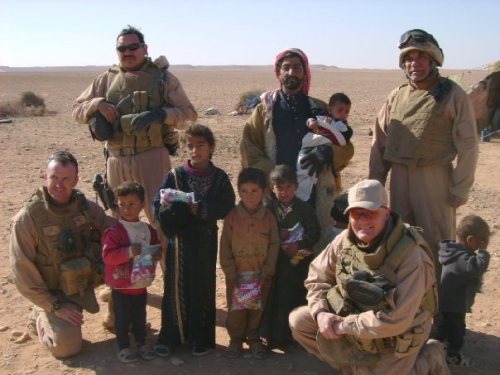
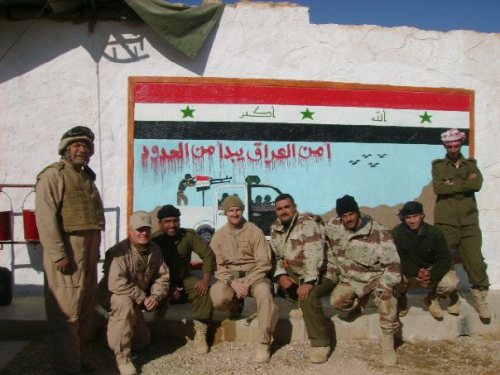
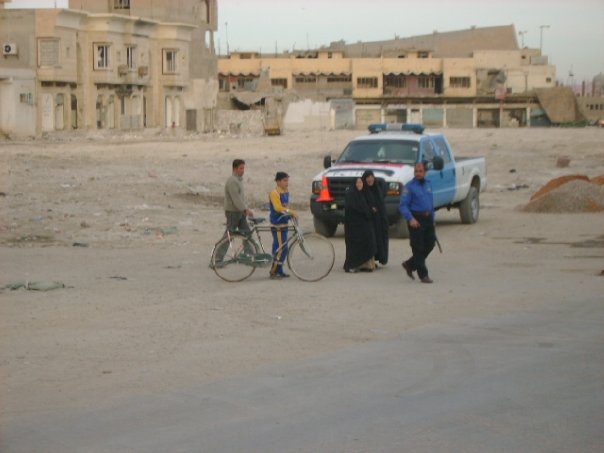
I keep a close watch at what happens in Iraq, especially Al Anbar Province.  I was there in 2007-2008 in the midst of the Anbar Awakening.  I had the honor of working with our advisors and the Iraqis of the 1st and 7th Divisions, 2nd Border Brigade and local police and Iraqi Highway Patrol. In my time there, traveling the entirety of the province, getting to work with and know Iraqi military officers and tribal leaders I gained a great appreciation for them as people and sympathy for the people there who in the course of over 30 years of war have suffered so much.

295_26912097058_4309_n-3

To do so I have to use the English language services of various Arab and Iraqi news sources as well as some German and French services to get decent information. American media tends to ignore Iraq until it cannot be ignored because to be truthful most Americans don’t give a damn about Iraq or its long suffering people. Come to think of it, as I look at the voting records and actions of those that they elect to Congress of both parties, they don’t seem to give a damn about the Americans who served in Iraq or Afghanistan either. But then it is easy to buy a “I support the Troops” bumper sticker and then elect Congressmen who instead of cutting unnecessary and wasteful defense spending in their districts, cut the benefits to the troops.

n671902058_1153829_4642-2

The situation in Al Anbar now with Al Qaida ISIL militants gaining strength and attempting to seize both Fallujah and Ramadi has brought back many memories. It has also given me great concern for the Iraqi people who I served among and Iraqi military personnel who not only risk their lives in combat but whose families are often targeted by terrorists. They are true patriots because deciding to serve not only endangers them but their families.

185615_1857288397412_3950321_n

When I came home from Iraq I was a changed man. My life, faith, politics and values were  challenged by what I experienced. I came home afflicted with chronic and serve PTSD, something that while I do better in managing the symptoms now still affects me in many ways.

295_26912117058_5652_n

Nearly six years after I left Iraq it is amazing to me how much it still permeates my soul, my thoughts and life. I can close my eyes and I can be back there, on the Syrian border, in Ramadi, and in dozens of different camps and settlements. The kindness and hospitality of the Iraqis I met is something that I shall not forget.

399202_10151366970802059_725286976_n

I do pray that the Tribal leaders in Al Anbar can take the fight to the militants and defeat them with the help of the Iraqi Army, perhaps the most trusted institution in the country. I hope and pray that the Shia leaders of the Maliki government stop the heavy handed and undemocratic tactics they have been using against the Sunni in Al Anbar. It looks that after his last meeting with President Obama that Maliki might be getting the hint.

295_26912057058_2651_n-2

Too many people, Iraqis as well as Americans have shed their blood in a war of choice launched by the Bush Administration where Bush appointees squandered any good will after the invasion through sheer hubris and incompetence. Iraq will take years to recover even if a full fledged civil war does not erupt.

533506_10151366982462059_34997654_n

The costs have been so great and I do pray that the Iraqis will find a way to unite and defeat both Sunni and Shia extremists so that they may one day again live in peace with themselves and their neighbors.

481801_10151367001287059_1003164983_n-2

I would go back again, because I did leave a big part of me in Iraq. I left my heart in Al Anbar. I can echo the words of T. E. Lawrence in his opening sentences of Seven Pillars of Wisdom: 

“I loved you, so I drew these tides of men into my hands
and wrote my will across the sky in stars
To earn you Freedom” 

Peace

Padre Ste

2 Comments

Filed under History, iraq,afghanistan, Tour in Iraq

Christmas at the Front 2013: A Look at Christmas Now and in Military History

German Bundeswehr army soldiers decorate a fir tree imported from Germany for Christmas eve in the army camp in Kunduz

German Bundeswehr Soldiers decorating for Christmas in Afghanistan 

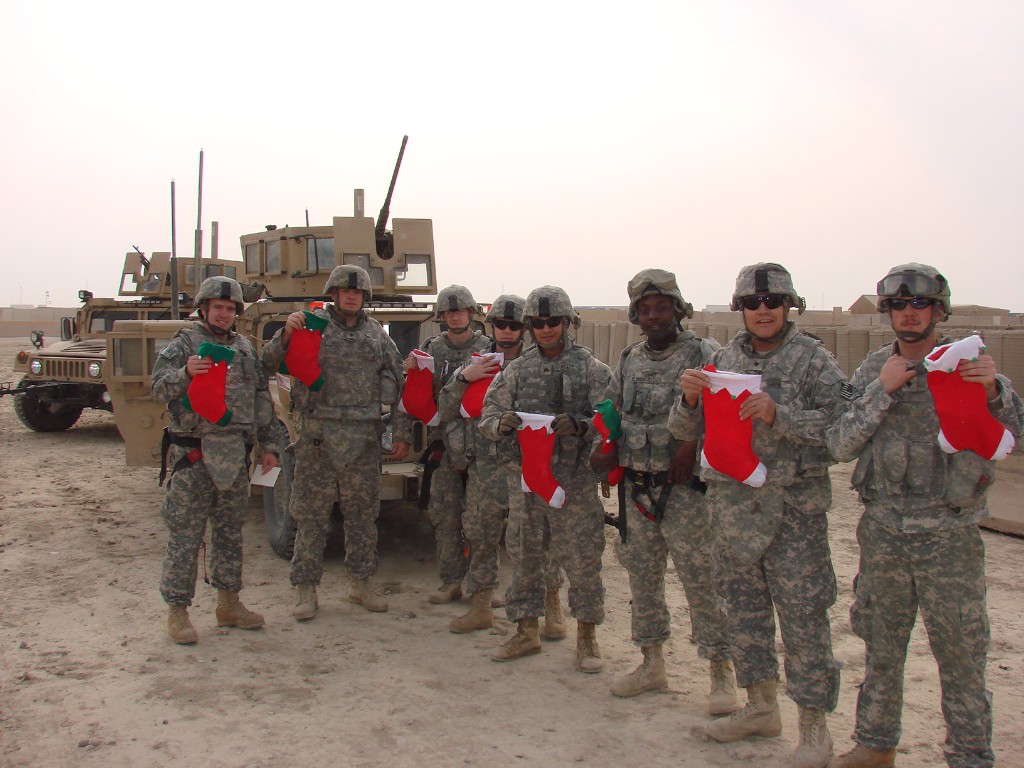
Today as on so many Christmas Days in days gone by military personnel serve on the front lines in wars far away from home. Today American and NATO troops engage a resourceful and determined enemy in Afghanistan. American Marines are working to safeguard the lives of Americans in South Sudan while French troops are intervening in Mali and the Central African Republic to attempt to prevent genocide. In many corners of the globe others stand watch on land, at sea and in the air. Unfortunately on this Christmas wars continue and most likely will until the end of time as we know it.

adopt_a_platoon

It is easy to understand the verse penned by Henry Wadsworth Longfellow in his song I Heard the Bells on Christmas Day after the death of his wife and wounding of his son in the US Civil War:

And in despair I bowed my head

“There is no peace on earth,” I said,

“For hate is strong and mocks the song

Of peace on earth, good will to men.

I have done my time in Iraq at Christmas on the Syrian-Iraqi Border in 2007 with our Marine advisors and their Iraqis.  That was the most memorable Christmas and the most important Christmas Masses that I ever celebrated. Since returning home have thought often of those that remain in harm’s way as well as those soldiers, sailors, Marines and airmen, American and from other nations that have spent Christmas on the front lines. Some of these events are absolutely serious while others display some of the “light” moments that occur even in the most terrible of manmade tragedies.

streets-trenton

Christmas 1776 at Trenton

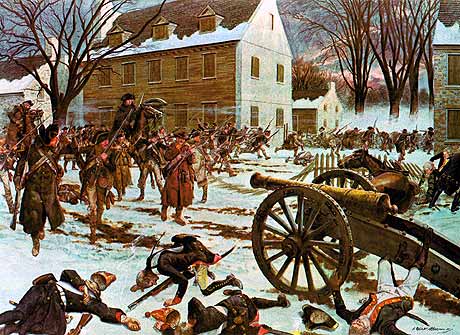
In American history we can look back to 1776, of course we could go back further but 1776 just sounds better. On Christmas of 1776 George Washington took his Continental Army across the Delaware to attack the British garrison at Trenton. Actually it was a bunch of hung over Hessians who after Christmas dinner on the 24th failed to post a guard which enabled them to be surprised,  but it was an American victory.

washington2

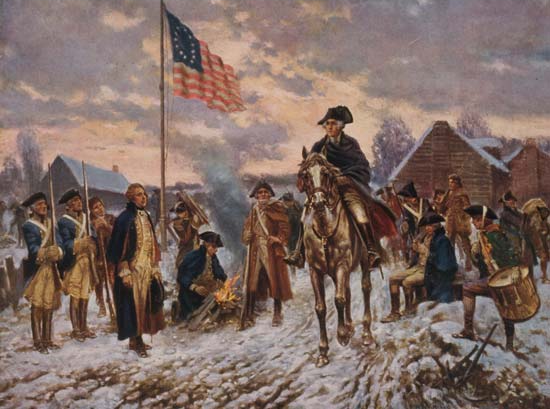
In 1777 Washington and his Army had a rather miserable Christmas at Valley Forge where they spent the winter freezing their asses off and getting drilled into a proper military force by Baron Von Steuben.

The-Eggnog-Riot

The Eggnog Riot

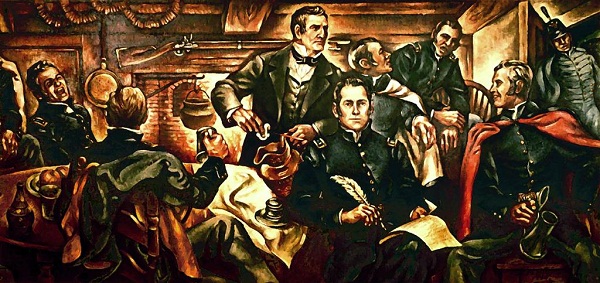
While not a battle in the true sense of the word the Cadets at West Point wrote their own Christmas legend in the Eggnog Riot of 1826 when the Cadets in a bit of holiday revelry had a bit too much Eggnog and a fair amount of Whiskey and behaved in a manner frowned upon by the Academy administration. Needless to say that many of the Cadets spent the Christmas chapel services in a hung over state with a fair number eventually being tossed from the Academy for their trouble.

battlezz

The Battle of Lake Okeechobee

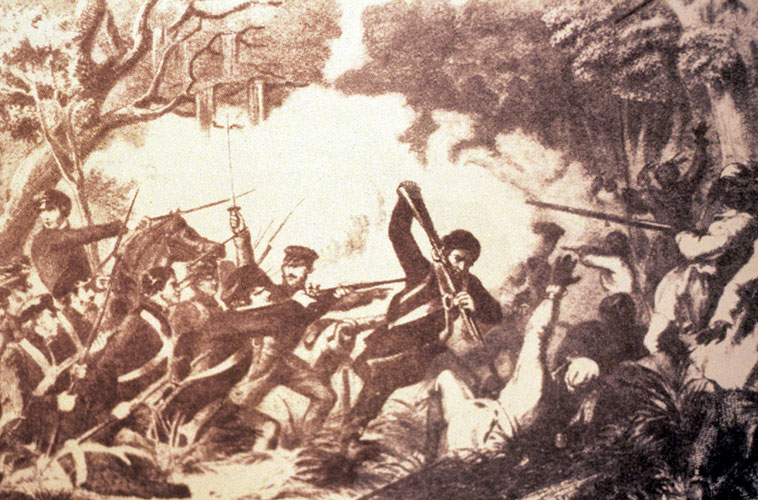
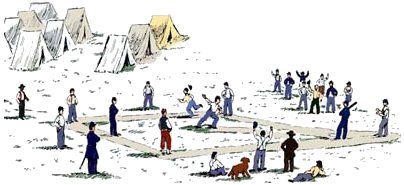
In 1837 the U.S. Army was defeated at the Battle of Lake Okeechobee by the Seminole Nation, not a Merry Christmas at all.  In 1862 the Army of the Potomac and Army of Northern Virginia faced each other across the Rappahannock River after the Battle of Fredericksburg while to the south in Hilton Head South Carolina 40,000 people watched Union troops play baseball some uttering the cry of many later baseball fans “Damn Yankees.”

civil_war_baseball

Blue and Grey Christmas Baseball

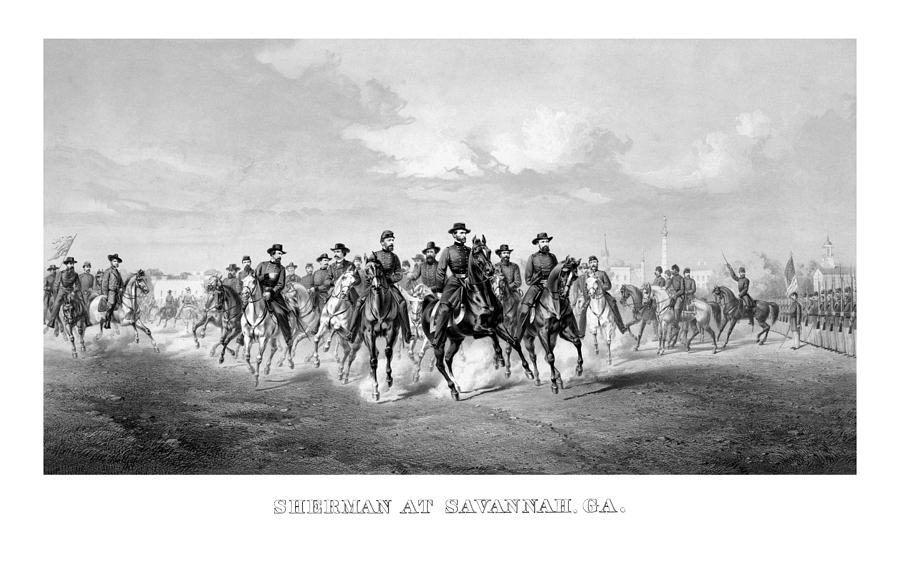
In 1864 the Army of the Potomac and Army of Northern Virginia faced each other again in the miserable trenches of Petersburg while General William Tecumseh Sherman enjoyed Christmas in Savannah Georgia after cutting a swath of destruction from Atlanta to the sea. He presented the city to Lincoln who simply said “nice, but I really wanted Richmond.”

general-sherman-at-savannah-war-is-hell-store

Napoleon had something to celebrate on December 25th 1801 after surviving an assassination attempt on Christmas Eve and 1809 he was celebrating his divorce from Empress Josephine which had occurred on the 21st of December.

football-truce

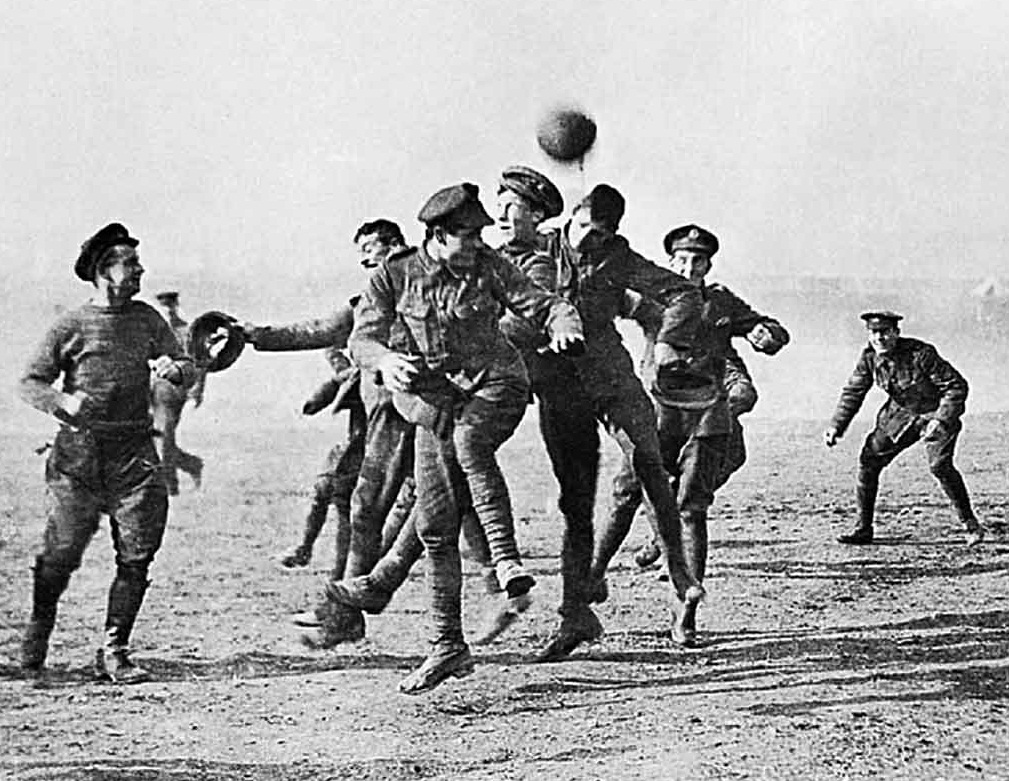
The Christmas Truce 

In 1914 “Christmas Truce” began between British and German troops and threatened to undo all the hard work of those that made the First World War possible.  Thereafter the High Commands of both sides ensured that such frivolity never happened again. The movie Joyeux Noel (Merry Christmas) does a wonderful job in bringing home the miraculous truce.

article-2106230-0003FB2000000258-130_634x578

General and Montgomery and his Staff, winter 1942

World War II brought much suffering. In 1941 after Pearl Harbor the Japanese forced the surrender of Hong Kong and its British garrison while two days later the Soviets launched their counterattack at Moscow against Hitler’s Wehrmacht. In Libya the British were retaking Benghazi from the Afrika Corps after a brutal series of tank battles in Operation Crusader.  A year later the Americans were clearing Guadalcanal of the Japanese. General Montgomery’s 8th Army was pursuing Rommel’s Afrika Korps into Tunisia as American and British forces under General Dwight D. Eisenhower were slogging their way into Tunisia against tough German resistant.  In Russia the Red Army was engaged in a climactic battle against the encircled German 6th Army at Stalingrad. At Stalingrad a German Physician named Kurt Reuber painted the famed Madonna of Stalingrad.

Bundeswehr zeigt "Stalingrad"-Ausstellung

Kurt Reuber’s Madona of Stalingrad

The drawing which was taken out of Stalingrad by one of the last German officers to be evacuated now hangs in the Kaiser Wilhelm Memorial Church in Berlin. Reuber drew another in 1943 while in a Soviet POW campbefore his death from Typhus in early 1944. Reuber wrote to his wife of painting in Stalingrad:

“I wondered for a long while what I should paint, and in the end I decided on a Madonna, or mother and child. I have turned my hole in the frozen mud into a studio. The space is too small for me to be able to see the picture properly, so I climb on to a stool and look down at it from above, to get the perspective right. Everything is repeatedly knocked over, and my pencils vanish into the mud. There is nothing to lean my big picture of the Madonna against, except a sloping, home-made table past which I can just manage to squeeze. There are no proper materials and I have used a Russian map for paper. But I wish I could tell you how absorbed I have been painting my Madonna, and how much it means to me.”

“The picture looks like this: the mother’s head and the child’s lean toward each other, and a large cloak enfolds them both. It is intended to symbolize ‘security’ and ‘mother love.’ I remembered the words of St.John: light, life, and love. What more can I add? I wanted to suggest these three things in the homely and common vision of a mother with her child and the security that they represent.”

34_116111820

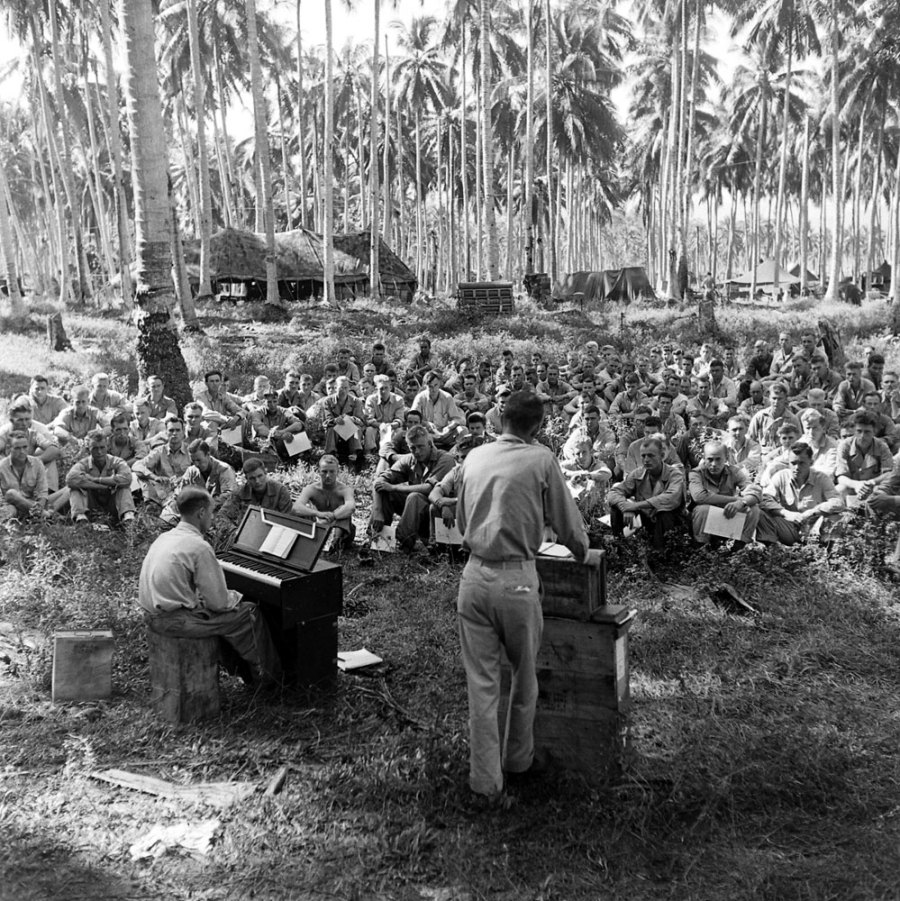
Christmas Concert at Guadalcanal 

In 1943 the Marines were battling the Japanese at New Britain while the Red Army was involved in another major winter offensive against the Wehrmacht. In 1944 Christmas found the Russians advancing in Hungary.

christmas-celebration-before-battle-of-the-bulge


Bastogne Christmas 

In December 1944 the Americans were engaged in a desperate battle with the Germans in the Ardennes now known as The Battle of the Bulge. On Christmas day the leading German unit, the 2nd Panzer Division ran out of gas 4 miles from the Meuse River and was destroyed by the American 2nd Armored Division.

0001photo

As that was occurring the embattled 101st Airborne Division at Bastogne was relieved by General George Patton’s 3rd Army. Patton had his Chaplain pen this Christmas prayer:

“Almighty and most merciful Father, we humbly beseech Thee, of Thy great goodness, to restrain these immoderate rains with which we have had to contend. Grant us fair weather for Battle. Graciously hearken to us as soldiers who call upon Thee that, armed with Thy power, we may advance from victory to victory, and crush the oppression and wickedness of our enemies and establish Thy justice among men and nations.”

In the Philippines Douglas MacArthur’s forces were fighting hard to liberate Leyte, Samar and Luzon from the Japanese. At sea US and Allied naval forces fought off determined attacks by Kamikazes.

USO2

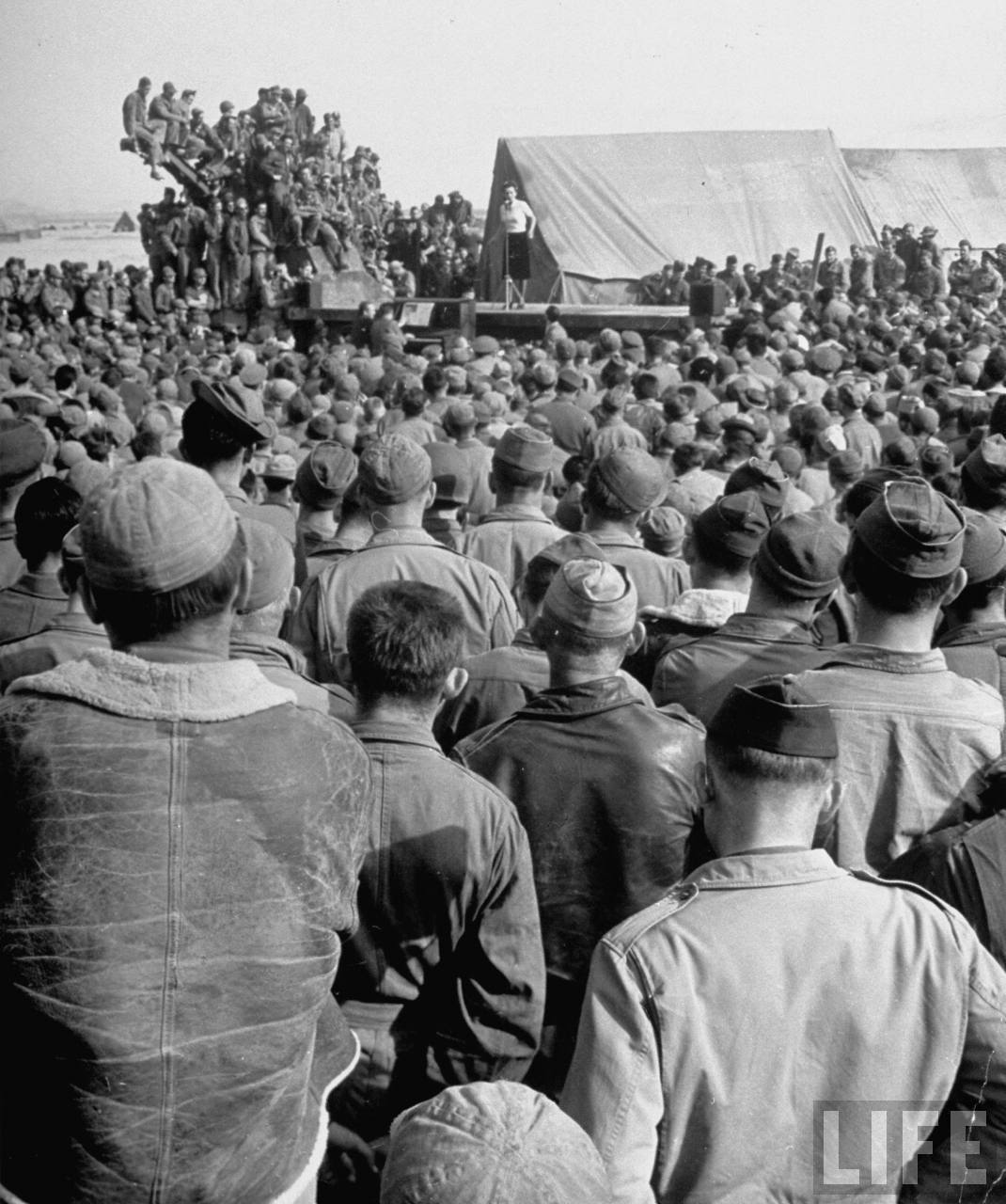
USO Christmas Show in WWII

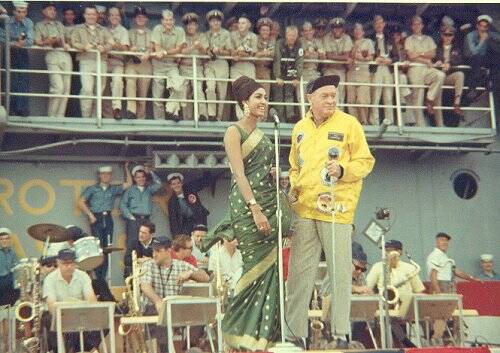
During the war the USO sponsored many entertainers who went to combat zones to perform Christmas shows, among them was Bob Hope.

onship

Bob Hope Christmas Show on USS Ticonderoga CVA-14 off Vietnam 

In the years following the Second World War Christmas was celebrated while armies continued to engage in combat to the death. Christmas of 1950 was celebrated in Korea as the last American forces were withdrawn from the North following the Chinese intervention which the 1st Marine Division chewed up numerous Red Chinese divisions while fighting its way out of the Chosin Reservoir.

size0-army.mil-28691-2009-02-09-110252

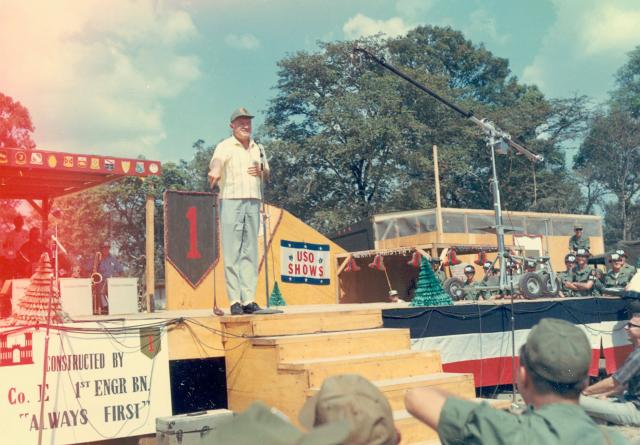
Bob Hope with 1st Infantry Division in Vietnam

In 1953 the French garrison of Dien Bien Phu celebrated Christmas in primitive fashion unaware that Vietnamese General Giap was already marshaling his forces to cut them off and then destroy them shortly after Easter of 1954.   In 1964 the U.S. committed itself to the war in Vietnam and for the next 9 years American Soldiers, Marines, Sailors and Airmen battled the North Vietnamese and Viet Cong with Marines fighting the North at Khe Sanh during Christmas of 1967. A hallmark of that war would be Bob Hope whose televised Christmas specials from that country helped bring the emotion of Christmas at the front back to those at home.

DSChristmasmenu

In the years after Vietnam American troops would spend Christmas in the Desert of Saudi Arabia preparing for Operation Desert Storm in 1990, in Somalia the following year and in the Balkans. After September 11th 2001 U.S. Forces spent their first of at least 12 Christmas’s in Afghanistan. From 2003 thru 2011 US and coalition partner troops spent 8 years in Iraq, that was my war.

295_26912097058_4309_n-2

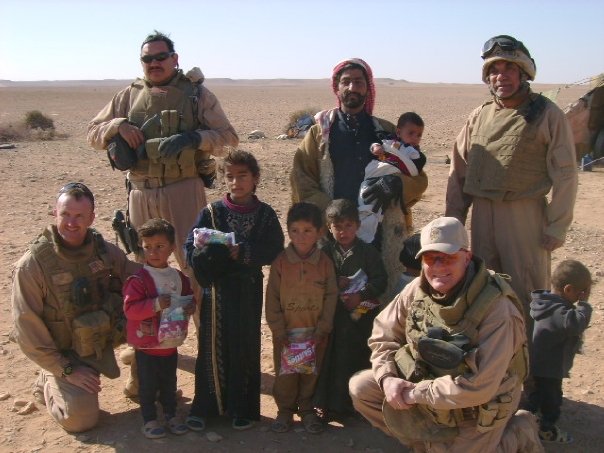
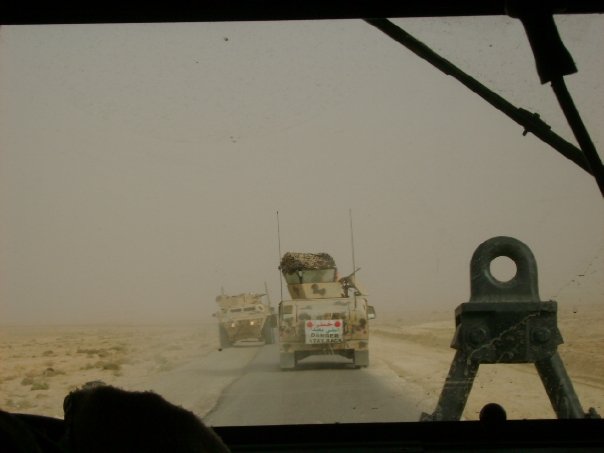
Christmas with Bedouin on Christmas Eve (above) and Christmas games at COP North Al Anbar Province Iraq 2007 (Below)

483430_10151366974467059_2085986953_n

533506_10151366982452059_1397805608_n

Christmas Services at COP South Al Anbar Province, Iraq 2007

Today Americans and our Allies serve around the world far away from home fighting the war against Al Qaeda and its confederates and some may die on this most Holy of Days while for others it will be their last Christmas.

Please keep them and all who serve now as well as those that served in the past, those that remain and those that have died in your prayers.

Peace

Padre Steve+
3 Comments

Filed under civil war, faith, History, iraq,afghanistan, Loose thoughts and musings, Military, Religion, world war two in europe, world war two in the pacific

Thoughts on the Iranian “Deal”

Iran nuclear talks

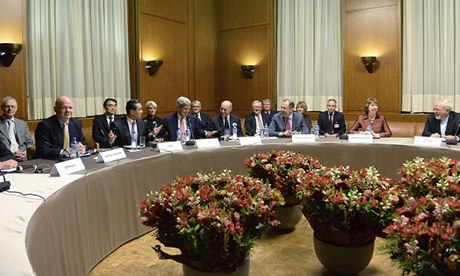
Yesterday negotiators from the United States, Britain, France, Germany, Russia and China finished hammering out a tentative deal with Iran regarding that nation’s nuclear program.

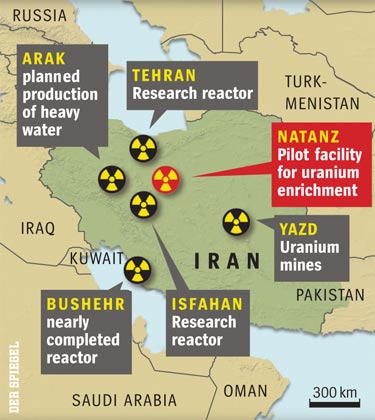
There are a lot of opinions about the deal, some positive, some definitely negative and quite a few like mine a wait and see attitude. Now I am hopeful that the deal is a positive first step in assuring that Iran does not build a nuclear weapon. In fact I pray that it does.

iran-nuclear-facilities

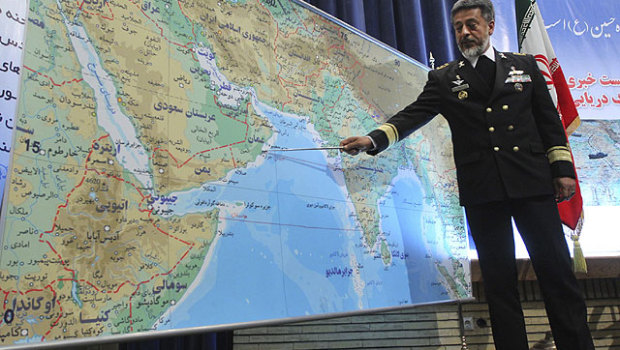
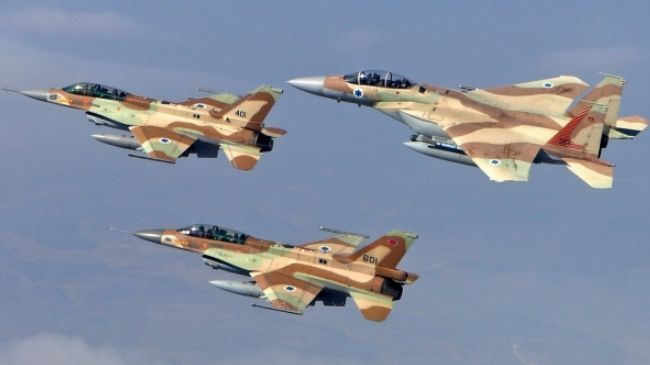
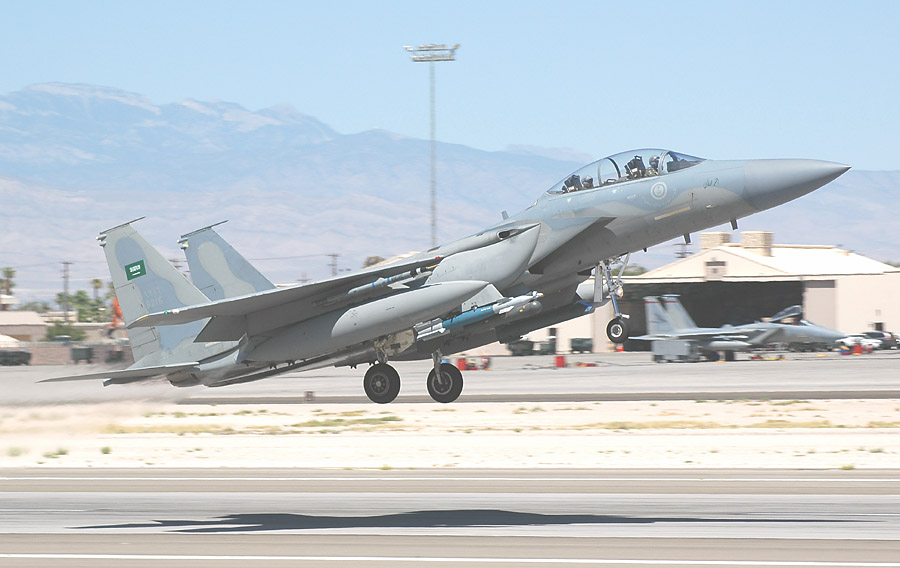
The fact is that we have to try, even if some allies for their own reasons disagree. The Israelis are understandably concerned, especially since the last President of Iran, most of the Mullahs that actually run that country and the Revolutionary Guard have expressed their belief that Israel should not exist. Thus for the Israelis this can be seen as an existential matter. If Iran were to get operational nuclear weapons and use them against Israel that state would suffer greatly. Likewise the Saudis are distrustful of the Iranians, but for different reasons. For the Saudis this is the great conflict between Sunni Islam and Shia Islam, a conflict that appears to be gaining steam in Syria, Iraq, Bahrain and Lebanon. It is  conflict that has the potential to be the Islamic equivalent of the Thirty Years war, that great bloodletting between Catholic and Protestant Europe. Iran and the Saudis are the leaders of the respective factions of Islam, they are mortal enemies.

iran_AP111222017357_620x350

We have to be cognizant of both the Israeli and Saudi concerns. They are legitimate and because they are allies we must take them into account. That being said the most important security needs to be addressed by the United States are those of the United States. Sometimes those are not always the same of allies, even allies like Israel and Saudi Arabia. That is something that has to be weighed in this case.

iran-nuclear-program

The cold fact of the matter is that for many years we in the United States have become accustomed to resorting to military force first and neglecting the other aspects of national and international power that could be brought to bear to in achieving our national security and foreign policy goals. Those other aspects include economic power, information and diplomacy which unfortunately have been neglected. Presidents and our Congress have, even in spite of the misgivings of military leaders pursued the military option first.

After the attacks of September 11th 2001 the Bush Administration with the authorization of Congress pursued an almost single minded military solution to those attacks. That response was not only against the Al Qaeda terrorists but against their Afghan Taliban hosts and Saddam Hussein’s Iraq.

07rdv-saddam-statue-iraq-anniversary-tmagArticle

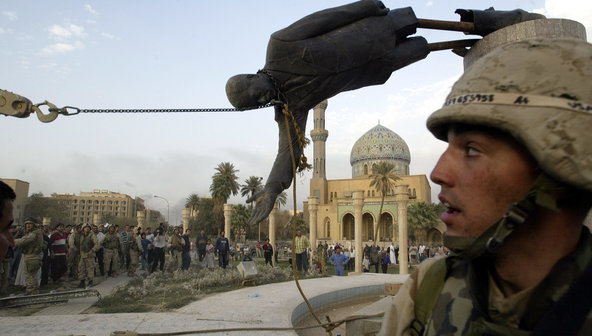
Those campaigns have worn our military down. The resources spent in those countries, the lives lost, the money spent and the wear and tear on equipment have harmed our national security. But even above that in terms of strategy we eliminated the one natural enemy of Iran which helped hold them in check. We invaded Iraq and left it in a condition that it could no longer be the western bulwark against Iran. We turned down Iranian offers of help after September 11th and in doing so lost opportunities which might have led us and Iran down a different path. Instead President Bush declared Iran and Iraq both parts of an “Axis of Evil.”

IRAN-DEFENCE-MISSILES

It was a declaration that the Iranians rightly understood as a declaration of war. Legally it may not have been, but the stated strategy enunciated by men like John Bolton and those we call the “Neocons” inside the Bush Administration and in associated think tanks could only be understood by the Iranians in that light. That end state envisioned by Bolton then and even now was regime change in not only Iraq, but also Iran. We have to ask ourselves this question: If another nation did this to us, how would we respond? I dare say that we, like the Iranians would dig in our heels and seek to develop military capacities that could defeat them, or if not defeat them make their “success” so costly that our enemies would not press us.

pirhayati20130312213337917

Now because of those choices we are faced with a situation where Iran is estimated to be reasonably close to developing a nuclear weapon capacity. It is something that if it happens will result in a nuclear arms race in the Middle East. The Israelis already have that capability and the Saudis are reportedly pursuing that capability. Thus it cannot be allowed to happen.

f15s-9216-92sqd-rsaf

That being said there are ways to ensure that does not happen. One advocated by those opposed to the deal is a hard line approach including pre-emptive military strikes against Iran, which not only would bring about a regional war but at best delay Iran a few years in procuring nuclear weapons.

The other is the course that has been pursued by the Obama Administration over the course of the past few years. That is the use of economic sanctions and diplomacy. As I said at the beginning this has not been our default policy over the past 12 years. But it is necessary. We are not in a good position to add yet another war, a war with world wide security and economic implications to our plate.

The fact is that due to the wars of the past 12 years as well as budget cuts including the sequestration cuts we are not in a good position to wage another war. We are stretched thin. Readiness thanks to sequestration is declining. The Chief of Staff of the Army stated that only two combat brigades are immediately deployable for combat operations. Could we launch another military campaign? Yes we could. But war, if we believe Clausewitz war is an extension of politics and policy. But we have to ask if would it achieve our overall policy goals? That I am not sure.  Clausewitz wrote: “No one starts a war–or rather, no one in his sense ought to do so–without first being clear in his mind what he intends to achieve by the war and how he intends to conduct it.”

In fact even if we delivered punishing strikes to Iran the costs could be great, and not just the economic costs.  Our campaign would have to be an air campaign to destroy hardened targets many of which we do not know the exact locations. Our record in such air campaigns is mixed. We spent over 70 days pounding Serbia with little to show for it in actual damage to their military. Likewise Iran is not Iraq, our targets will not be exposed in the open desert. Additionally Iranian A2/D2 (Anti-Access/Area Denial) capabilities pose great risks for US and Allied Warships as well as bases in the Arabian Gulf. If an Iranian Kilo Class submarine were to sink an American Aircraft Carrier it would not be a tactical setback, it would be a major loss of American strategic capability not just in the Middle East but world wide.

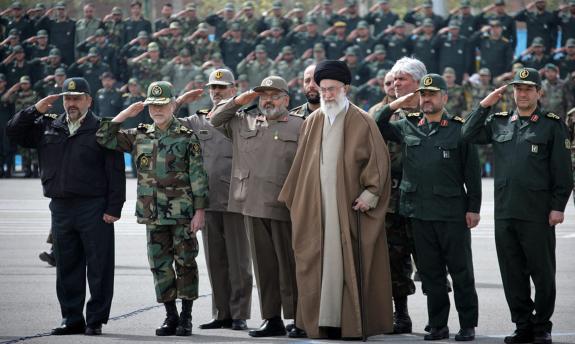
revolutionary-guards-and-khamenei

Likewise as I mentioned before we took out the one natural opponent of Iran when we overthrew Saddam Hussein. In doing so we destroyed every bit of infrastructure, military power and civil government structures that any new Iraqi government would need to maintain any sense of a balance of power in the Arabian Gulf.

All that being said do I trust the Iranians? I cannot say that I do. I am a realist. I enlisted in 1981 in large part because of the Iranian takeover of the American Embassy and the hostage crisis. They remain a dictatorial regime which persecutes religious minorities including Christians. They restrict their people from open access to the internet and persecute political opponents. The Revolutionary Guards Corps, the most powerful organization in Iran has actively worked to destabilize other countries in the region. Their influence is great especially in regards to Lebanon’s Hezbollah which has launched missile campaigns against Israel and been active on the side of Syria dictator Bashir Assad in that country’s brutal civil war.

However the path of diplomacy must be given a reasonable chance to succeed. In the early 1970s President Nixon started a process of detente with the Soviet Union and Communist China. It was not embraced by hawks. President Ford, Carter and Reagan continued those policies to one degree or another with the final result being the fall of the Berlin Wall, collapse of the Warsaw Pact and overthrow of Communism.

This deal is a start. It is not perfect at all. I see issues in it. but it is based on the politics and art of the possible. It has the potential to be a game changer in a region wracked by war and revolution, a region led for the most part by despots in which terrorists often operate freely. I don’t know if it will work, but I hope it does.

Peace

Padre Steve+
Leave a comment

Filed under Foreign Policy, History, iraq,afghanistan, middle east, Military, News and current events

The Inconvenient Truth About Iraq and Benghazi

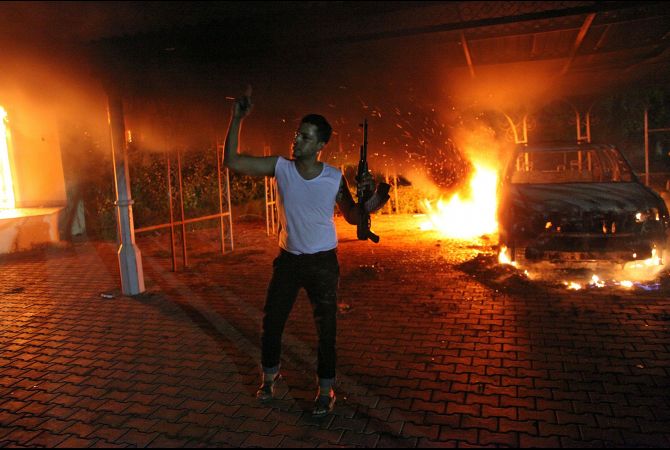
benghazi_attack_us_politics_2012_09_12

“The first duty of every Starfleet officer is to the truth, whether it’s scientific truth or historical truth or personal truth! It is the guiding principle on which Starfleet is based. And if you can’t find it within yourself to stand up and tell the truth about what happened, you don’t deserve to wear that uniform!” Captain Jean Luc Picard to Wesley Crusher Star Trek the Next Generation “The First Duty” 

I was talking with a conservative friend the other day and he ended up bring up the subject of Benghazi and the tragic loss of Ambassador Chris Stevens and 3 other State Department personnel at the consulate last September 11th. He was talking about the scandal of this and the political impact that he hoped it would have on Hillary Clinton in 2016.

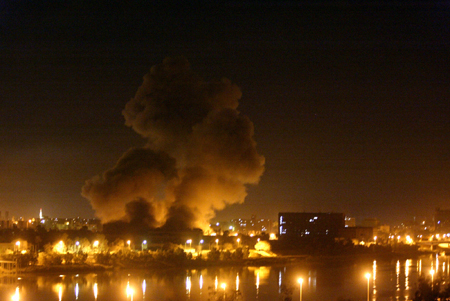
450_shock_and_awe

I was actually shocked that he said this so for once I decided to actually say something and mention the 4486 official US military deaths in Iraq. My friend who I really do like and respect commented that they were “the result of what happened in war.”

It stunned me when he said that because he is a military brat, but then I realized that he had bought the lie about Iraq and was so solidly partisan that he could not see the moral, ethical and even legal discrepancy in what he was saying. For me the question was far less about whatever impact it might have on Hillary’s campaign should she decide to run but about the truth.

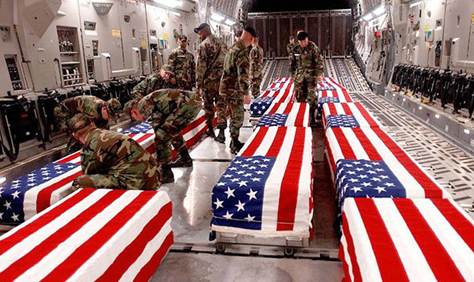
g-cvr-090217-dover-coffins-3a.grid-6x2

When I confronted him about it I was stunned by how easily he dismissed all of the dead and wounded and other casualties of Iraq but was so insistent on some kind of conspiracy to cover up Benghazi. But this is how so many people think today thanks to the constant bombardment of ignorance on Fox News and other partisan outlets. It is not about the truth, it is about the nastiest kind of politics.

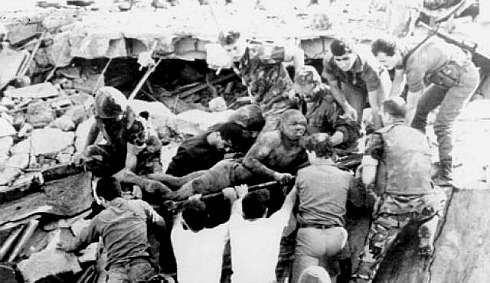
Barracks_bombing_2

I too am upset about Benghazi, but likewise I am upset about the 241 Marines, Sailors and Soldiers killed at Beirut in October 1983 when the Reagan Administration ignored warnings about putting US troops into Lebanon while taking sizes in that county’s civil war. I am upset about the nearly 3000 killed on 9-11-2001. I am upset about dozens of other terrorist attacks that occurred under both Republican and Democratic administrations in which DOD, the State Department and other agencies made mistakes that cost lives.

Some attacks could have been prevented and others probably not. However they were terrorist attacks committed by our enemies, not an illegal undeclared war of preemptive choice conducted by a United States administration against the will and recommendations of many of our closest allies. That is the inconvenient truth.

What has happened over the past decade is that many on the political right cannot admit that they were wrong about Iraq. This despite the fact that President Bush, Karl Rove and almost every senior member of the the Bush administration have admitted that the reasons that they took us into war with Iraq were wrong. There were no weapons of mass destruction, the nuclear program was a shambles and Iraq was not working with Al Qaida, which like most secular military dictatorships in the Middle East loathed. That is the inconvenient truth.

The fact that so many people on the political right go into a nearly toxic lather about four people lost in Benghazi while shucking off the deaths of nearly 5000 Americans who died in a war that was not only a mistake but violated the very laws that we helped establish at Nuremberg infuriates me. This is no longer about national security to them, it is about politics. This is not about ethics for those that led us into Iraq have none. It is not about justice for if there was justice those who made the decision to attack Iraq would be tried for war crimes.

295_26912097058_4309_n

I served in Iraq and was fortunate that I served with our advisors and the Iraqis in Al Anbar during the time of the Anbar Awakening. I saw a different war than many people observed and for that I am glad because it busted my illusions about what we did in Iraq forever. I needed that. I may have come back thoroughly goofed up with PTSD and at times I am sure certifiably crazy, but I needed it to see the truth.

The fact is that unlike Benghazi the war in Iraq has crippled this country. Nearly 5000 dead, 30,000 wounded and trillions of dollars of national treasure dumped into the abyss. Hundreds of thousands of Iraqis were killed, wounded or driven into exile, many who greeted us as liberators.  Of course that was before the Bush Administration put the kleptocrats of the Chalabi group rape and pillage the country.

Likewise it was after the Coalition Provisional Authority under Paul Bremer, a man who had never in his career served in the Middle East threw out ever carefully orchestrated plan of DOD and CENTCOM for a peaceful transition in the country thus bringing misery to Iraq and triggering the anti US-Coalition insurgency and Iraqi Civil War. The great military theorist Carl Von Clausewitz said: “No one starts a war–or rather, no one in his senses ought to do so–without first being clear in his mind what he intends to achieve by that war and how he intends to conduct it.” The fact is that the Bush Administration was not only not clear, but they were inept and lawless in invading Iraq.

Additionally the invasion cost the United States the goodwill and trust of many allies and friends. No one will ever see us in the same light again. Instead of being a liberating power and “light to the nations” we are seen in much of the world as a rogue, lawless and imperialist state. Otto Von Bismarck put it so well when he said “preventive war is like committing suicide out of fear of death.”

I don’t know about you but I am sure that is not the vision of our founders. I was told on my first day in the Army back in 1981 that “there are attaboys and aww shits and it takes 2000 attaboys to make up for one aww shit.” The Bush Administration’s lawless invasion of Iraq and incredibly inept occupation was a disaster for the United States, Iraq and most of the region, except maybe for Al Qaida and Iran. By the way let us not forget the crippling effects of the Iraq invasion on the campaign in Afghanistan which allowed both the Taliban and Al Qaida time to regroup, consolidate and regain the advantage in that God forsaken land.To the 4486 we can add a couple of thousand more deaths in Afghanistan thanks to the decision to invade Iraq. That is the inconvenient truth.

For people to ignore a war that defies American and International Law as well as common sense which cost us and the world so much while making cheap political points by exploiting the deaths of four men is a disgrace. Had the men who started the invasion of Iraq been tried for by Justice Robert Jackson at Nuremberg they would have been convicted as war criminals and sent to the gallows. That is the inconvenient truth.

Justice Jackson said at those trials:

“If certain acts of violation of treaties are crimes, they are crimes whether the United States does them or whether Germany does them, and we are not prepared to lay down a rule of criminal conduct against others which we would not be willing to have invoked against us.” Justice Robert Jackson International Conference on Military Trials, London, 1945, Dept. of State Pub.No. 3080 (1949), p.330.

My closing thought is that those that want to make political hay out of Benghazi need to take a serious look at Iraq. What’s fair is fair. 4486 dead and over 30,000 wounded not counting another 100,000 or so with PTSD or TBI versus 4 dead and no wounded. I don’t make light of any of the deaths of Americans serving this country at any time or in any place.  I would not dishonor their memory by playing politics with their deaths. But the truth is indeed terribly inconvenient and those who do this must be called out regardless of their political orientation.

If there were mistakes or cover ups by Obama administration officials regarding Benghazi, so be it let them be investigated fairly an impartially not with an eye to political advantage and those that partake of this cup must be willing to drink of the cup of crimes committed by the Bush Administration in Iraq. The same is true when Democrats do the same to Republicans.

Truth matters too much to be sacrificed on the altar of politics even while those doing it ignore far greater crimes of far more epic dimensions committed by members of their political party.

Truth is terribly inconvenient and even when painful should never be sacrificed on the altar of political advantage by partisans of any party.

Peace

Padre Steve+

3 Comments

Filed under ethics, History, iraq,afghanistan, middle east, Military, national security

When Will We Ever Learn? Looking at 12 Years of Unending War

peloponnesian-war

War is the province of chance. in no other sphere of human activity must such a margin be left for this intruder. it increases the uncertainty of every circumstance and deranges the course of events.- Karl von Clausewitz

We are coming up on the beginning of the 13th year of our current wars. Wars that when they began were believed to be easy and uncomplicated and since they were being waged against enemies that were “backward” and not hi-tech. Thus we were promised that they would be short in duration, low in cost and casualties. We elected the war option as the quick and easy way to win, neglecting the words of the venerable Chinese strategist Sun Tzu who said “To fight and conquer in all your battles is not supreme excellence; supreme excellence consists in breaking the enemy’s resistance without fighting.”

images-54

In 2001 and early 2002 the Bush Administration pursued the Al Qaeda terrorists to Afghanistan, toppling the unpopular Taliban regime but failing to kill or capture Bin Laden. But by 2002 those in that Administration sought to widen the scope of the war. An “Axis of Evil” comprised of Iraq, Iran and North Korea was identified, even though none of those nations had links to Al Qaeda, and two of which, Iran and Iraq were hostile to Al Qaeda, each for their own reasons, Saddam Hussein because he only embraced Islam when it suited his strategic purposes and Iran because the Shia there were and are mortal enemies with the ultra-Fundamentalist Sunni Wahhabi Islam of Al Qaeda.

al-qaeda

The undeclared war against Al Qaeda became the Global War on Terrorism. It was an amorphous term that allowed the government to play fast and loose with facts even as it by fully “legal” means restricted the rights and invaded the privacy of American citizens through the Patriot Act and expansion of the FISA laws and a massive expansion of electronic surveillance against our enemies, against our allies, even long tern NATO allies and our own citizens.

All of these ideas seemed like good ideas at the time. The United States had been hit by the most well planned, executed and devastating terrorist attack ever conducted and it had been done by those who many believed incapable of doing it. We forgot however the words of Clausewitz that war is the provence of chance.

But then our leaders, regardless of political party over the past 50 years since our entry into Vietnam have been pretty inept at understanding history and understanding the consequences of their actions. The Greek historian Thucydides understood this, he saw what happened to Athens when it allowed itself to become enmeshed in the Peloponnesian War, a war that it entered as the premier economic and military power of its time and ended in disaster. He wrote:

“Think, too, of the great part that is played by the unpredictable in war: think of it now, before you are actually committed to war. The longer a war lasts, the more things tend to depend on accidents. Neither you nor we can see into them: we have to abide their outcome in the dark. And when people are entering upon a war they do things the wrong way round. Action comes first, and it is only when they have already suffered that they begin to think.” 

It seems strange now after so long of war that our openness, freedoms and liberties were not destroyed by the actions of Al Qaeda but by our own government in the Patriot Act a title so Orwellian that it defies logic. The sad fact is that the Patriot Act was only the beginning and the actions and legislative accomplishments those that seek to broaden the war and broaden the powers of the government to restrict freedom, speech and privacy of otherwise law abiding citizens has only increased.

As I listen to the words of some legislators, or both parties I might add I am frightened because for many it seems that the only answer they have to national security issues is the hammer of military force, force that over the years of this war has been eroded and which due to their legislative negligence in the Sequester will only further erode. They seem to forget, or maybe they never learned what is taught to military officers at Command and Staff College that national power is based on the DIME, the diplomatic, intelligence, military and economic power of a nation and not on military power alone.

Our legislators, the talking heads of the media and their political allies of various “think tanks” act as though their decisions have no consequences. Thucydides noted the same in his time:

“Some legislators only wish to vengeance against a particular enemy. Others only look out for themselves. They devote very little time on the consideration of any public issue. They think that no harm will come from their neglect. They act as if it is always the business of somebody else to look after this or that. When this selfish notion is entertained by all, the commonwealth slowly begins to decay.”

Those who think this way frequently praise those that they send to fight their wars. They pound their chests in praise of “the brave soldiers” but as far as the soldier is concerned they care not, thus when through their own political negligence hard budgetary choices need to be made neither the troops or the actual security of the nation matters, only the profits of their financial contributors, those who profit from war and suffering matter.

Two time Medal of Honor winner and Marine Corps Major General Smedley Butler wrote in 1932: “What is the cost of war? what is the bill? This bill renders a horrible accounting. Newly placed gravestones. Mangled bodies. Shattered minds. Broken hearts and homes. Economic instability. Depression and all of its attendant miseries. Back -breaking taxation for generations and generations. For a great many years as a soldier I had a suspicion that war was a racket; not only until I retired to civilian life did I fully realize it….”

Unfortunately despite the hopes of some in the Obama administration and in the country this undeclared “war on terrorism” will not end. It has taken on a life of its own and neither political party will end it. It like Athen’s misadventure in the Peloponnesian War, and so many other nations that ventured into “unending” wars that span generations will be our undoing if we are not take action now to figure out a way to extricate ourselves from it while still keeping our people safe. Somehow I think that our former freedoms, our liberties, transparency and openness are not weaknesses but strengths which at one time were embraced by us and many around the world who loved them and hoped to bring them to fruition in their own countries.

afghanistan_war

I think bout it now. Many of the 18 year old men and women enlisting in the Army, Marine Corps, Air Force and Navy today knowing that they could end up at war were only 5-7 years old on September 11th 2001. That a war should last this long is not only unwise and destructive to liberty but criminal in the fact that we should have known better. Thomas Jefferson wrote to President James Monroe advising him to stay clear of European conflicts saying: “They are nations of eternal war. All their energies are expended in the destruction of the labor, property, and lives of their people.” James Madison wrote to Jefferson in 1798 “The loss of liberty at home is to be charged to the provisions against danger, real or imagined, from abroad.” 

These are dangerous times, the fact is that more war is beckoning and there are those anxious for their own reasons, power, profit or even religion seek to continue and expand the. They care not a whit about those that fight them, those that die in them nor the ultimate costs in blood, treasure and freedom and home. The ends justify their means. Hannah Arendt said: “Although tyranny…may successfully rule over foreign peoples, it can stay in power only if it destroys first of all the national institutions of its own people.”

Peace

Padre Steve+

Leave a comment

Filed under History, iraq,afghanistan, national security, News and current events

To Iraq and Back: A Bus Ride to Carolina

Coach_USA_ShortLine_50889

This is another installment of my To Iraq and Back series.

My CRV with Judy in it pulled away and Nelson and I went about our business. We staged our gear as we waited for the buses to arrive to take us to Fort Jackson South Carolina where we were to receive our training for the deployment.  As we talked other sailors arrived and soon the gear of over 100 sailors was stacked in rows of sea bags just off of the sidewalk.

Nelson’s parents, brother and sister had come to see him off.  His brother is a Navy First Class Petty Officer. His dad a former Vietnam era Marine Recon NCO who made several deployments “in the shit” as many Vietnam vets call tours in that combat zone.  They were really nice folks. Over the years I had heard much about them. They are close to each other and all are supportive of Nelson.

Nelson is a career amateur boxer; kick boxer, martial artist and more recently MMA fighter. He is active in children’s martial arts instruction and has been on Team USA and fought internationally.  During his previous deployment to Afghanistan he helped coach the fledgling Afghan National Boxing Team. A couple of months before this deployment he won the Arnold Schwarzenegger Classic.

So we waited while the other sailors gathered, some individually and some with family.  Some stood alone as couples while others mingled with each other.  For most this was a new way to see their sailor deploy.  No pier side goodbyes, no banners, no manning the rails by the crew as the ship was nudged away from the pier by tugs.

When you have a “normal” deployment of a ship or something like a Marine battalion it is a big deal. Many times media is there, sometimes there are speeches, but most of all there is the understanding that we are all in this together. We are going in as a unit.

In such times families say goodbye to their Sailors, Marines or Soldiers who are going to war together.  When you deploy as a unit there is familiar support system for the families we leave behind. This is not so when you deploy individually.  Those leaving on this day were very much strangers. We would train together, but few would stay together on the deployment.

If you are a ship or unit chaplain and deploy with your people there is a relationship. Generally you know each other, in this case we were strangers.  I was going to war with Nelson but we would not remain with any sailors we were with today when we got to Iraq. This was also the case for others who would serve in isolated posts, mostly working with the Army in support roles. Some would serve in specialized roles such as the Electronic Warfare Officers detailed to work on defeating IEDs and roadside bombs.

As others said their goodbyes and hugged each other I thought of Judy and knew that she was going to be down for some time but I felt that for once that she had an adequate support network. I was right about her being down for a while but this deployment would be harder on her than others and the support network proved woefully inadequate. So much for assumptions.

I looked at our gear as opposed to the others. Our gear was in large and rectangular bags of coyote or sand color. Most everyone else had traditional green sea bags, or what are known in the Army as “duffle bags.”  We already had our personal protective equipment of the EOD/Special Warfare type while others would receive Army issue at Fort Jackson. There are pros and cons to such a arrangement.  The pro is that we had great gear certainly some of the best in theater. The con was that we had to lug the great gear everywhere we went going to and coming back from war.  This would get old, but the benefits do outweigh the advantages when you are actually in a combat zone.

Finally an officer came out and began calling role and giving us our signed “official” orders.  After this we loaded our gear on the buses that would take us to Fort Jackson. These were the first of many buses we would ride and the first of many roll calls and gear load outs in the coming months.

Nelson and I got on the same bus which was not full and took seats near the front.  I got a seat alone because I was the senior officer on the bus and a chaplain to boot. This was not because I asked for it or hogged the seat.  It is actually fairly typical in such a setting where young enlisted guys don’t want to sit next to an officer they don’t know and some are afraid of chaplains because of experiences that they have had in civilian churches.

Many of the sailors had ever darkened the door of a church and many of those that have been in church have been burned in relationships with pastors or religious people.  I have found that many times, even those with a vibrant faith are hesitant to approach a chaplain that they do not know. Some are afraid that the chaplain might try to convert them be judgmental about of the manner in which they live their lives. So as a chaplain I try to be cognizant of this and be friendly and caring without scaring them away.  Of course I did build relationships with a quite a number of these sailors during the next few weeks but on this bus ride I was still an unknown quantity to them.

Sitting alone however was good for me since I general despise bus travel regardless of the company I keep.  For some reason my height works against me, I can never get my feet comfortably on the ground on these new tour buses and I have a terrible time getting comfortable.  Since bus travel takes forever to get anywhere the discomfort is palpable. Now I did a three month tour on buses in 1979 while touring as a spotlight tech for the Continental Singers and Orchestra across the US and in Europe.  Somehow the old Greyhound buses were more comfortable than the new tour buses.  Maybe I’m just nostalgic but they somehow fit people like me better than the fancy new buses.

When you travel by bus with a bunch of sailors, the majority of whom are at least 20 years younger than you, the experience can be entertaining. Part of course is a generational thing. I grew up and came of age the 60’s 70’s and 80’s. The majority of these sailors from the 90’s and 2000’s.

The trip was a chance for me to observe a lot about these sailors just by watching.  Some had their portable i-pods and MP-3 players going, others spent time talking on cell phones, a few read or talked among themselves, but the sailors near me gravitated to the DVD movie which was 300 the comic book style account of the Spartan’s defense of Thermopylae against the Persians.  As the Spartans made their stand I could see the young sailors who were going to war take inspiration from King Leonditis of Sparta.   Since we were going into a place where 50-100 Americans a month were being killed and hundreds more wounded I could understand the need for inspiration along with entertainment.

The bus ride itself was a lot like what I imagine that Minor League teams take in the Carolina League. Our journey reminded me of the bus rides in the movie Bull Durham.  The older guys staying pretty quiet and to themselves and the young guys having fun, playing games and joking around with each other,  We made a couple of stops, one at some little Interstate town with a fair amount of gas stations and a few fast food places.  About half the sailors went to the McDonalds while the rest ran down the street to the Burger King and Taco Bell. Once everyone had their fill the buses pulled back out onto the interstate.

When we finally got near Columbia the buses got of the Interstate highway and onto some small two lane state highway.  We drove down this road about twenty to thirty minutes and pulled into what appeared to be a tiny out of the way base. I wondered where the hell we were. Fort Jackson is a fairly large training base where thousands of recruits are trained every year.  Where we were certainly was not the Fort Jackson that I had imagined.

Instead of the main post we were at the South Carolina National Guard training facility called Camp McCready.  It is here that the Naval Expeditionary Combat Command has a training center set up with the Army to train sailors in basic combat tasks.

Our welcome that first night was simple.  We formed up, checked in, got our linens for our standard issue military beds and were marched to dinner at the chow hall or in the Army vernacular the DFAC by our newest and bestest buddies, our Army Drill Sergeants.  We were met at the DFAC by a civilian.  I can’t remember his name but this guy was most congenial and he put the RED in “Redneck.” He joked with everyone that came through the line, asked where people were from and what they did.  When he found out that I was a chaplain he began to ask me for a joke every meal thereafter. As such nearly every meal would be entertaining.

As Nelson and I sat down for chow with a couple of other sailors we looked at each other.  He said: “Boss I don’t think some of these guys know what is coming.”  I said “I think that your right partner, hopefully they adjust and do well.”  The other sailors, both more senior petty officers nodded in agreement.

Going back to the barracks I met some of the other officers enjoying their first night at Camp McCready.  More sailors from NMPS San Diego were due in later. I introduced myself to a number of the officers near me and engaged in some rather surface pleasantries. When lights out was called lay down on the same type of Army bunk bed that I had first encountered some twenty five years before at Camp Roberts California and Fort Lewis Washington.  I swear the sheets, blankets and pillowcases were of the same vintage.

Much was still on my mind when I laid down and my mind was still thinking about the trip to base with Judy and the final kiss goodbye. I was troubled by it and how I had handed things. Despite that I fell asleep fairly quickly. It had been a long day and coupled with the lack of sleep and stress of the previous couple of days I was tired.

Peace

Padre Steve+
Leave a comment

Filed under iraq,afghanistan, Military, ministry, Pastoral Care, to iraq and back, Tour in Iraq, US Navy

To Iraq and Back: A Last Night Together and a Kiss Goodbye

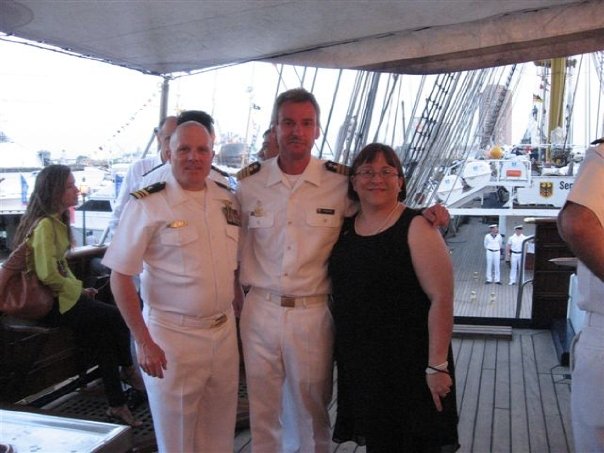
295_27076787058_8676_nJudy and I on the German Sail Training Ship Gorch Fock at the Norfolk Harbor Fest a couple of weeks before deployment

This is another of my “To Iraq and Back” articles about my deployment to Iraq in 2007 and 2008 with RP1 Nelson Lebron. 

Now the time has come to leave you
One more time Let me kiss you
And close your eyes and I’ll be on my way
Dream about the days to come, When I won’t have to leave alone
About the times, That I won’t have to say

Oh, kiss me and smile for me
Tell me that you’ll wait for me
Hold me like you’ll never let me go
Cause Im leavin’ on a jet plane
Don’t know when I’ll be back again
Oh babe, I hate to go

From “I’m Leaving on a Jet Plane” by John Denver

http://www.youtube.com/watch?v=vLBKOcUbHR0

The night before leaving on deployment and the actual day of departure are some of the hardest that any military couples or families experience. In time of war it is even more difficult. Judy and I have done this too many times in peace and war.

As I went through all of my preparations to go to Iraq in some was it was a replay of past pre-deployment situations. However, this time I was not merely deploying on a peacetime assignment or supporting a peace making operation, or even deploying on a ship and being part of a boarding team after the 9-11-2001 attacks. In that last instance  Judy did not know that I was part of the boarding team until about halfway through the deployment.

But this time going boots on ground into the most bitterly of Iraq’s contested provinces, Al Anbar. That lent at certain dark pallor to the occasion.

Our last night together was rather somber to put it mildly. Judy and I went out to dinner on Friday night. Since I knew that I would not be having a good beer for quite some time we went to the Gordon Biersch Brewery Restaurant in Virginia Beach. For us Gordon Biersch is generally a good time kind of place, it has become over the years our version of Cheers a place where everyone knows our name.

That last Friday before the deployment to Iraq it was not a festive occasion, it was almost a wake. Judy and I were both quite subdued. In between the silence Judy talked about her fears about the deployment while I tried to reassure her that everything would be fine. I am a man who is somewhat Vulcan in my use of logic. I figured that even though things were bad in Iraq that my chances of returning were quite high, even of something happened to me. I tried to be calm and reassuring and no matter what I tried it didn’t work, human emotions are quite intense at times.

I also reasoned that since I had taken out the extra life insurance that I would be okay.  For me such logic makes sense. I kind of believe that if I don’t get it I will need it and if I do get it I won’t. It’s kind of like Yogi Berra’s logic when he said “You should always go to other people’s funerals; otherwise, they won’t come to yours.”

After dinner and several half liter glasses of Gordon Biersch Märzen amber lager we went back home. Judy watched quietly while I finalized my packing. I ensured that all my field gear, uniforms and clothing were packed and rechecked my EOD issue protective gear.

I then packed my Mass kit, Bible, Prayer Book and my Marine Pattern camouflage reversible desert/woodland stole. The stole was special as Judy had made me a few years back from woodland and desert pattern shirts which were way too big for me. They are one of a kind items. I have seen similar, but what Judy made were far better than any others that I have seen. I still use that stole even when I am not deployed. It is simple but quite exquisite, adorned with an embroidered Maltese Cross in tan on the desert side and black on the woodland side it is unique and I treasure it.

The last items I packed were my books on counterinsurgency, a few DVD movies, music CDs and my hygiene items. It is funny to think that now all of this would be stored on my iPad which if I ever make such a deployment again will significantly simplify my life.

I wrestled the big bags down the stairs and put them in the back of my Honda CR-V so I wouldn’t have to fight them in the morning. That accomplished Judy and I just sat together, she was feeling pretty low, the look one of despair.

On the other hand I was a mix of conflicting emotions. I was excited by knowing that I was going to get to do what I had trained all of my life to do. However I was very cognizant of the reality that it would be tough on Judy and that it was a dangerous deployment.

My last couple of deployments had been very tough on her. When I deployed to support the Bosnia mission as a mobilized Army Reservist and newly ordained Priest three of my relatives in Huntington West Virginia where we were living died. One was my maternal grandmother “Ma Maw” who Judy had become very close to over the past couple of years. They had become buddies and Ma Maw had taken Judy in not as my wife, but as “her” granddaughter.

Ma Maw’s death hit Judy very hard and my mom and uncle in the midst of their grief over the loss of their mom they did not understood the depth of the relationship between Judy and Ma Maw. As a result, I was absent and there was much tension, misunderstanding and hurt feelings between them. In the week before Ma Maw’s death Judy tried repeatedly to get her to go to the doctor only to be ignored. The morning Ma Maw died Judy called me in Germany. She was frantic that I call Ma Maw and insist that she go to the doctor. I made the call and insisted that she go to the Emergency Room but she refused and said she would call her doctor. That night she died. I had lost my grandmother and could not go back to help and Judy had lost a woman who had become closer to her than her own grandmothers ever had been.

In 2001 during my deployment with 3rd Battalion 8th Marines to Okinawa, Japan and Korea we lost our 16 ½ year old Wire Haired Dachshund Frieda. Judy did her nest to keep Frieda alive for me, but there was nothing that could be done and finally with Judy being worn down to nothing herself, she was persuaded to have Frieda put down. The interesting thing is that after Frieda died she visited me in Okinawa and Judy about the same time in dreams. Frieda was always a weird animal and even in death has continued to find ways to remind us of her presence.

My 2002 deployment on USS HUE CITY to the Middle East and Horn of Africa came less than six months after my return from my deployment with 3/8. That deployment, coming on the heels of the 9-11-2001 attacks was also very difficult on her. In the space of 6 years we had been apart almost 4 1/2 years. Much of the time following that last deployment was spent on the road as I travelled to visit Marine Security Force and Navy EOD Mobile Units in the Middle East, Europe, the Far East and the Continental United States. In a four year period I averaged 1-3 weeks a month away from home.

With all of this in the background we spent our last night together. That night neither of us slept very well. When we got up I had a light breakfast and then accompanied by a friend from Judy’s Church choir we drove to the base.

Saturday morning traffic is generally not too bad so our trip was uneventful, but tense.  You could cut the tension between us by now with a knife.  It was about the time that we were nearing the base Judy said something about our relationship that I took really wrong. I sarcastically snapped back “Well I’ll just get blown up by an IED then.”

That sarcastic comment really hit her hard and I knew immediately that I had blown myself up with it. The words were harsh and devastating. I should have known better and should have kept my moth shut. After all I’d deployed a lot and taught pre-deployment classes talking about the emotional cycle of deployments. I was supposed to be an expert at this sort of thing, but instead my comment was very cruel.

To be sure the stress on both of us the preceding weeks had taken its toll and both of us were on edge.  For two months we had each in our own way imagined the deployment, me as a great adventure and her as a threat to our mutual existence. I wondered just what I would face when I got to Iraq and those were unanswerable questions. Judy’s great fear that something might happen to me and that she would be alone, not just for the time of the deployment but for the rest of her life.

That is one of the tensions in a military marriage that many people who have not lived it fail to understand. It is not just the wartime deployments it is the cumulative effects of multiple short and long term separations on the health of a relationship.

We got to the base pretty quick, maybe 15-20 minutes but the tension made me feel that the trip was three times as long. As we pulled up in a parking spot near the baggage drop off area we sat there for a few minutes. I got out of the car as did Judy.  I asked if she wanted to wait a while with me and with tears in her eyes said that she couldn’t handle the wait.

I unloaded my gear with the help of Nelson. He looked at Judy and said, “Don’t you worry ma’am we’ll do good and I’ll keep him safe.” Judy gave a soft “thanks” and gave him a hug.

With my gear unloaded I went back to Judy.  We looked at each other, embraced and kissed each other, each of us wondering if it was possibly the last time. We parted our embrace, and she the turned and walked back to the car, handed her friend the keys and they drove off.  It was a moment that I will not forget as long as I live. As she left I said a prayer under my breath and asked God to keep her safe while I was gone.  Then I turned to Nelson and said, “Okay partner, let’s get this done.”

Peace

Padre Steve+

2 Comments

Filed under iraq,afghanistan, marriage and relationships, Military, to iraq and back, Tour in Iraq

Muddling Through PTSD Recovery: A Chaplain’s Story of Return from War

400236_10151328400862059_541742014_n

“Captain, you do need time. You cannot achieve complete recovery so quickly. And it’s perfectly normal after what you’ve been through, to spend a great deal of time trying to find yourself again” Counselor Troi to Captain Picard in Star Trek the Next Generation after his encounter with the Borg.

Coming home from war can be harder than going. At least it was for me. I have always been a hard charger. When I was at war in Iraq I was at the top of my game but when I came back I was broken. I experienced things there that changed me forever and it has taken a long time to find myself again.

I came home with chronic, severe PTSD, anxiety and depression. I suffer severe Tinnitus and pathetic speech comprehension. The ringing in my ears is non-stop and in any kind of group setting or conference I struggle to understand what is going on even though my hearing loss measured in decibels is minimal. The loss is neurological and when tested I measured in the third percentile of people, meaning that 97% of people understand speech better than me.

I still suffer from chronic insomnia, vivid nightmares and night terrors. I still struggle with agoraphobia, hyper-vigilance and occasional road rage. Thankfully none of them are as bad as they used to be but they are ever present. I have had my ups and downs with prescription medications that were used by my doctors to manage my PTSD symptoms and sleep disorders.  For a while drank too much just to help me make it through the nights. I am told that this is common for many who return from war.

When I came home I felt abandoned, especially by church leaders and many chaplains, many who I had thought were my friends. That is understandable as I was radioactive.  My faith had collapsed and for two years I was an agnostic desperately hoping to find God. As such I have a certain bond with those that struggle with God or even those that do not believe. This makes a lot of religious people uncomfortable, especially ministers. I think the reason for this is that is scares the hell out of people to think that they too might have a crisis of faith because they too have doubts. 

The first person who asked me about how I was doing spiritually was not anyone from my church or a chaplain, but rather my first shrink, Elmer Maggard. When faith returned around Christmas 2009 it was different and so was I. I tried to express it and began to write about it. For my openness I got in trouble with my old denomination and asked to leave because I was “too liberal.” Thankfully a bishop from the Episcopal Church who knew me recommend that I seek out Bishop Diana Dale of the Apostolic Catholic Orthodox Church. Thanks to that I have a loving new denomination and since we do not have a local parish of the ACOC I have found  St James Episcopal Church in Portsmouth Virginia as a place of refuge. It is the historically African American parish in the area and I love the people there. They helped me when I was in my deepest times of struggle. 

6095_128718107058_2713239_n-1

My struggle was really hard on my wife Judy. Before I deployed I was the strong one. Afterward my contribution to our marriage was minimal and I was often a complete ass. I was in survival mode and and barely making it. I couldn’t reach out to her, I was collapsing on myself and she felt it as rejection. Our marriage suffered terribly and both of us thought that it might not survive. But over the past 18 months or so it has been getting better. I can share with her again and she has become a source of added strength. We enjoy being together again and we recently celebrated our 30th anniversary with many of the friends who helped us make it through the hard times. 

In time I gathered a support network. There are some Chaplains that I can be absolutely honest with, as well as my Command Master Chief, Ed Moreno. Likewise I have friends outside the military, including people I have known for years who still, despite all my flaws care for me. I have found other places of refuge where I have relationships with people, one is Harbor Park, home of the Norfolk Tides Baseball team, another was Grainger Stadium, former home of the Kinston Indians. I have a couple of places as well that are like my real life version of the TV show Cheers

Baseball brings me a great deal of peace, especially when I can go to the ballpark. When I was in dire straits the management of the Tides allowed me to go wander Harbor Park during the off season, just to take it in.  Running on the beach is something that I have come to cherish here in North Carolina, I will miss the easy access that I have here when I return home to Virginia in two weeks. 

Writing on my blog has been good therapy. As an introvert I process information by taking things in. Being constantly around people wears me out. I am good at what I do but it takes a great deal of effort to do it. 

941704_10151661130572059_1706100059_n

My unflappable little dog Molly has been a life saver, she insisted on coming to stay with me about halfway through my tour. She helped me recover my humanity and her presence gave me something outside of me to care for and because of that I ended up seeking out people again instead of holing up in my apartment.

My spiritual life still has its ups and downs and I discovered that I am far from perfect, and I hate that sometimes. However, that being said I do feel more connected with God, people and at peace despite my ongoing struggles.

images-53

Picard breaking down

It has not been an easy road, but it has been worth it. I find it interesting that the Star Trek the Next Generation, Deep Space Nine and Voyager series help me process many of my feelings, thoughts and emotions. I quoted part of a Next Generation episode at the beginning of this article, one where Captain Picard is recovering from the trauma of being abducted by the Borg. I find the episode compelling on many levels. Part of that episode deals with Picard trying to figure out his life again. After a tumultuous visit with his family he and his older brother engage in a fight, during which he breaks down. Picard’s brother realizing the importance of what was happening said to him “So – my brother is a human being after all. This is going to be with you a long time, Jean-Luc. A long time. You have to learn to live with it…”

Peace

Padre Steve+
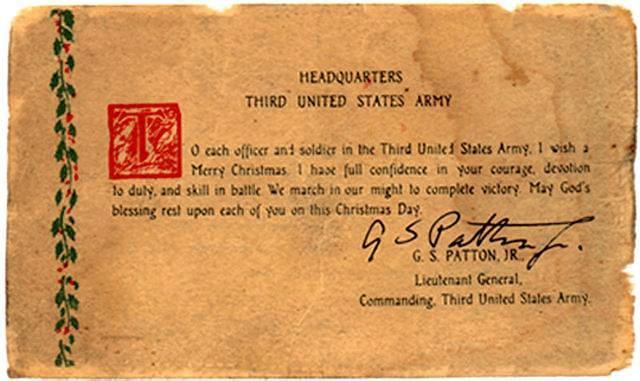
3 Comments

Filed under faith, iraq,afghanistan, Military, PTSD, Tour in Iraq