Category Archives: leadership

“Where is Task Force 34? The World Wonders: The Battle of Leyte Gulf Part Five

RptsI-P60

Friends of Padre Steve’s World,

I am finishing up a series of posts about the Battle of Leyte Gulf. This one is about the Battle of Cape Engano in which a force of Japanese carriers with very few aircraft were used to lure the main part of the American Third Fleet under Admiral William “Bull” Halsey away from the vulnerable troop transports and supply ships supporting the invasion. Eventually I will write something about the epic Battle off Samar to conclude the series properly but that will have to wait.

Have a great day,

Peace

Padre Steve+


“TURKEY TROTS TO WATER GG FROM CINCPAC ACTION COM THIRD FLEET INFO COMINCH CTF SEVENTY-SEVEN X WHERE IS RPT WHERE IS TASK FORCE THIRTY FOUR RR THE WORLD WONDERS.” Admiral Nimitz to Admiral Halsey

After Admiral William “Bull” Halsey felt that he had heavily damaged the Japanese Center Force during the Battle of the Sibuyan Sea he withdrew the Fast Battleships of Task Force 34 from the San Bernardino Strait in order to use them in a surface engagement against Admiral Jisaburo Ozawa’s Northern Force. Halsey assumed that Ozawa’s carriers were the main threat to the American invasion forces. However he did not know that Ozawa’s carriers had very few aircraft embarked and that the Northern force was in fact a decoy, designed to draw him away from Vice Admiral Takeo Kurita’s Center and the two task forces of the Southern force.

b55

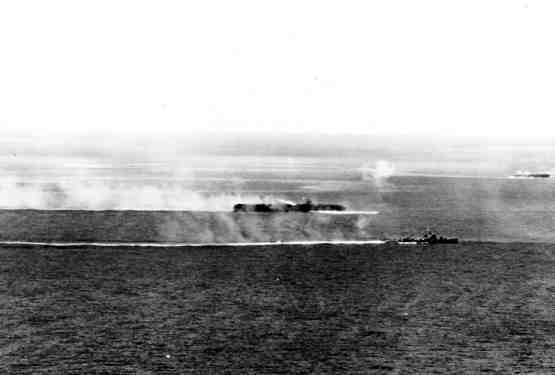
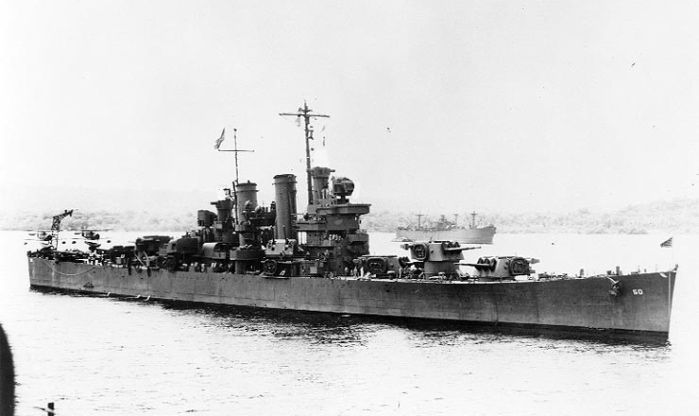
The Zuikaku under attack at Cape Engano

When Halsey’s aircraft reported the Center force withdrawing he believed that the threat had been removed. He wrote in his memoirs “I believed that the Center Force had been so heavily damaged in the Sibuyan Sea that it could no longer be considered a serious menace to Seventh Fleet.”Thus he moved with haste to intercept, engage and destroy the Northern force and its carriers and battleships.  Halsey believed that his engagement against the Northern force would culminate when his fast battleships destroyed whatever Japanese surface forces remained.

It was not a bad assumption. Ever since the early days of the Pacific war the truly decisive engagements had been decided by carriers. Unfortunately for the American sailors of Taffy-3, the group of Escort Carriers, destroyers and destroyer escorts which encountered Kurita’s Center force which had doubled back overnight and passed through the San Bernardino Strait surprising Rear Admiral Thomas Kinkaid’s task group of “Jeep” Carriers.

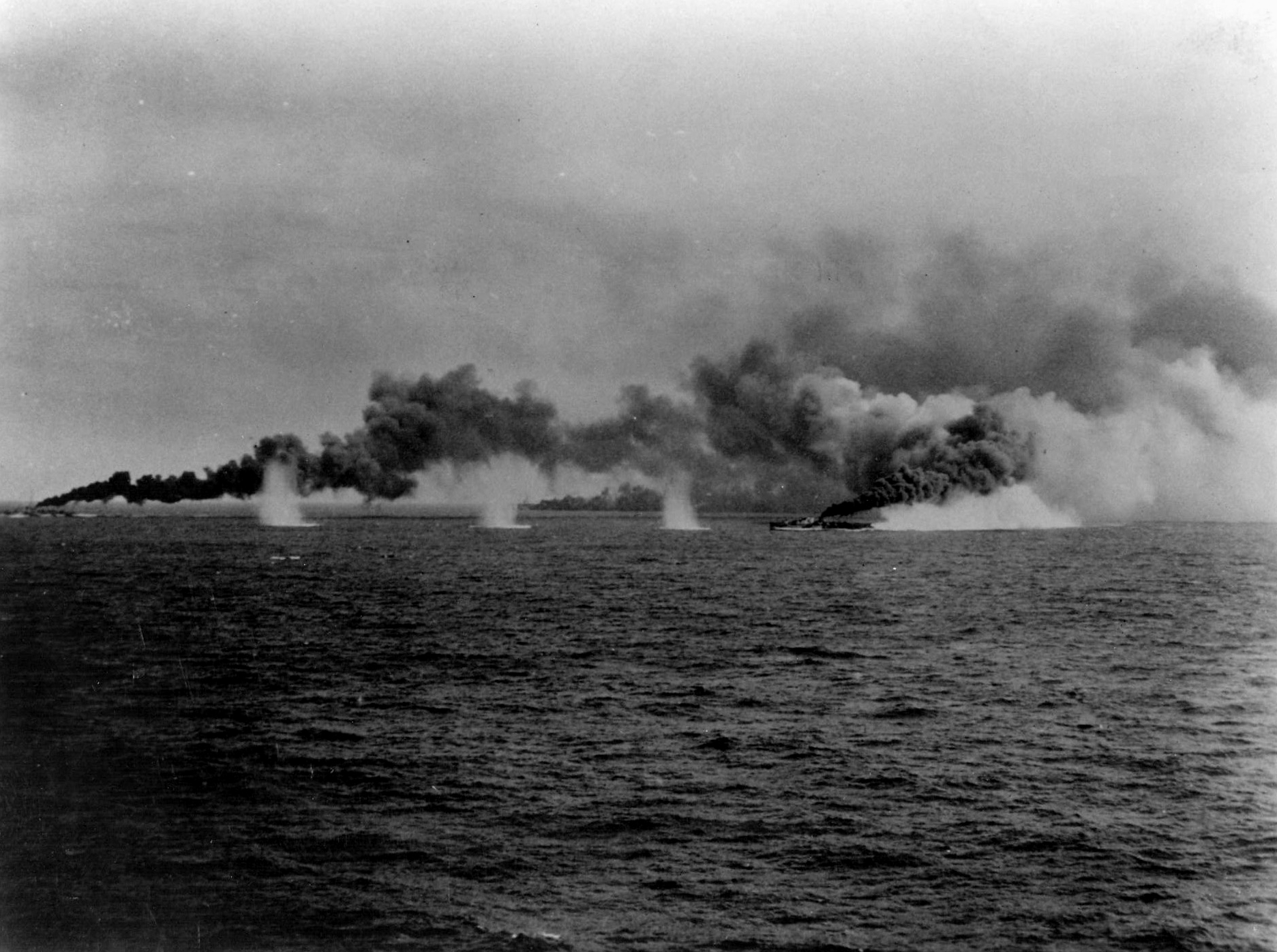
Destroyers_laying_smoke_screen_during_Battle_of_Samar_1944

The Battle off Samar

The unequal battle that ensued off Samar was a near run thing for the Americans. Had Kurita not been confused about what forces he was facing and pressed his attacks he may have inflicted painful damage on the actual invasion forces. However after a morning of battle, in which Taffy-3’s destroyers, destroyer escorts, aircraft and even the Jeep carriers themselves inflicted heavy damage on the Japanese force Kurita withdrew.

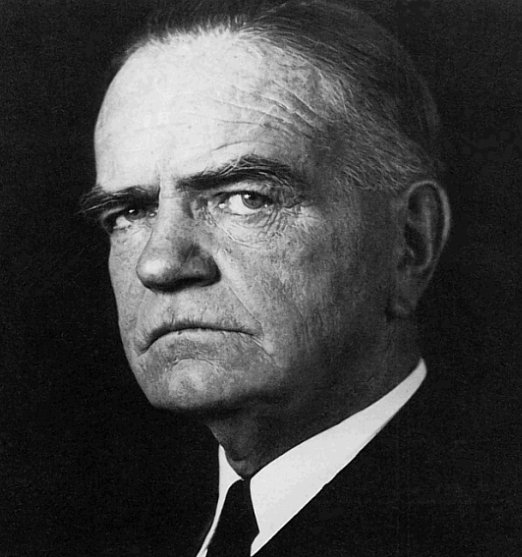
Halsey

Admiral William “Bull” Halsey

However as Taffy-3 battled for its life against Kurita’s battleships, cruisers and destroyers Halsey’s carrier air groups were pounding Ozawa’s hapless carriers and their escorts. About 0800 on the 25th Kinkaid’s desperate messages began to reach Nimitz and Halsey. However since Halsey did not believe just how serious the situation was he continued to pursue Ozawa’s force. When he received Nimitz’s message he was incensed. The message “TURKEY TROTS TO WATER GG FROM CINCPAC ACTION COM THIRD FLEET INFO COMINCH CTF SEVENTY-SEVEN X WHERE IS RPT WHERE IS TASK FORCE THIRTY FOUR RR THE WORLD WONDERS was composed of three parts. The preface “Turkey trots to water” was padding, as was the last part “the world wonders.”

ship_zuiho2

Light Carrier Zuiho under attack

However the communications officer on Halsey’s flagship only removed the first section leaving “Where is Third Fleet, the world wonders.” Halsey was flabbergasted and though the battleships of Task Force 34 were almost in range of the Japanese force he sent them south to relieve Kinkaid’s beleaguered force. However by the time Vice Admiral Willis Lee’s battle line arrived Kurita had withdrawn, losing 3 heavy cruisers sunk, three heavy cruisers and one destroyer heavily damaged.

gsxN4rT

Zuikaku being abandoned

All the Japanese carriers were sunk along with a light cruiser and a number of destroyers, but Kurita’s heavy forces escaped. Among the Japanese losses was the carrier Zuikaku the last surviving carrier of the Pearl Harbor attack. Naval historian Samuel Elliott Morrison wrote:

“If TF 34 had been detached a few hours earlier, after Kinkaid’s first urgent request for help, and had left the destroyers behind, since their fueling caused a delay of over two and a half hours, a powerful battle line of six modern battleships under the command of Admiral Lee, the most experienced battle squadron commander in the Navy, would have arrived off the San Bernardino Strait in time to have clashed with Kurita’s Center Force… Apart from the accidents common in naval warfare, there is every reason to suppose that Lee would have “crossed the T” and completed the destruction of Center Force.” 

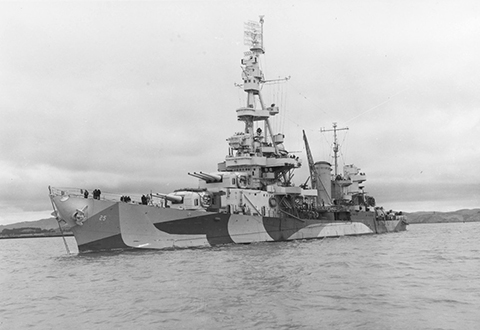
USS Mobile 10

The Battle of Cape Engano closed the epic extended battle of Leyte Gulf. The victory of the US Navy was decisive even without the final destruction of Kurita’s forces. The remnants of the Japanese forces would never mount a serious offensive threat again. The survivors would be hunted down over the next 9 months, some sunk by submarines, other in surface engagements, still more to air attacks at Okinawa and in Japanese ports.

Halsey received much criticism for his decision to withdraw TF 34 from San Bernardino Strait. However in his defense the action exposed one of the key problems in any kind of warfare, the problem of seams. Kinkaid’s escort carriers belonged to 7th Fleet which came under the operational control of Douglas MacArthur’s Southwest Pacific Region while Halsey commanded 3rd Fleet fell under Admiral Nimitz’s Central Pacific region. This created a situation where two fleets belonging to two regions under two separate commanders were attempting to fight a single battle. The principle of unity of command and unity of effort was violated with nearly disastrous results.

5 Comments

Filed under History, leadership, Military, Navy Ships, US Navy, World War II at Sea, world war two in the pacific

The Tale of the Desert Fox: Erwin Rommel, a Cautionary Tale for Men Who Serve Tyrants

rommel

Friends of Padre Steve’s World,

Just over 74 years ago in Ulm Germany a car pulled up to the residence of Field Marshal Erwin Rommel. In the car was the driver and two Generals dispatched by Hitler.  Rommel was recuperating following being severely wounded in an air attack in Normandy on July 17th 1944.

Rommel had been awarded the Pour le Merite, sometimes known as the Blue Max, Imperial Germany’s highest award for valor in the First World War. He was never an official member of the Nazi Party, but like many Germans he believed Hitler’s promises and propaganda. As Hitler rose to power he like many others was carried away by early Nazi successes, the bloodless conquests of the Rhineland, Austria, Czechoslovakia, and the spectacle of the Olympics.

He was also an opportunist. With the rise of the Nazis came the expansion of the German military. Rommel was already well known due to his exploits as a platoon and company commander during the First World War in France, Romania, and Italy. In Italy he captured an entire Italian infantry division during the Battle of Mount Cosna, which was part of the Caporetto in October 1917. His company of 150 troops, exploited terrain and weather to surprise and capture 9,000 soldiers and 81 artillery pieces at the cost of 6 men killed and 30 wounded. Rommel used infiltration tactics, flanking maneuvers, and even disobeyed the orders of his superiors during the battle. Less than two weeks later at Langarone using the same tactics, his company surprised the 1st Italian Infantry which thinking it surrounded by superior forces surrendered to Rommel. For these actions Rommel was awarded the coveted Blue Max. 

Rommel was retained in the 100,000 man Reichswehr, but he had refused to attend the course that would have made him part of the elite General Staff. As such he was not assigned to the critical billets that would normally lead to high command. Instead he served in company command and as an instructor at the Infantry School in Dresden. While assigned to the school he wrote a manual of infantry tactics and training based on his experience. The book, Infantrie Greift an, or Infantry Attacks is still considered a classic book on infantry tactics and leadership, and was highly influential in his rise to high command. He was promoted to Major after serving 14 years as a Captain in 1932. In October 1933 he was assigned to command the 3rd Jaeger Battalion of the 17th Infantry Regiment where he first met Hitler when the latter reviewed his troops on an inspection visit.

Rommel, like many officers was caught in the thrall of Hitler. His wife, Lucy was caught up in the moment and was a Hitler supporter. Rommel was never a Nazi party member, but that did not keep him from supporting the overtly nationalist and militarist actions of the Hitler regime. In 1935 he was assigned to the Military Academy at Potsdam where as a Lieutenant Colonel he published Infantrie Greift an. In 1937 Hitler appointed Rommel as the liaison officer from the War Ministry to the Hitler Youth. Rommel clashed with the head of the Hitler Jugend, Baldur von Schirach and twiced proposed removing the organization from the Party to the War Ministry.

The conflict resulted in Rommel being quietly reposted from that assignment, promoted to Colonel and assigned to command the former Austrian Theresian Military Academy  in Wiener Neustadt. He was then selected by Hitler to command the Führer-Begleit-Battalion (Escort battalion) which served as the force protection unit for Hitler’s headquarters during the Polish campaign.

Following that campaign, Rommel, now a Major General was appointed to command the newly formed 7th Panzer Division which he commanded with great distinction during the Battle of France, 1940. When the campaign ended the division was placed in reserve where it readied to become part of the planned invasion of Britain, Operation Sea Lion. When that operation was postponed due to the defeat of the Luftwaffe during the Battle of Britain, and Mussolini’s Italian army in North Africa was routed by the small British Western Desert Force, Rommel was assigned to command the Deutsches Afrika Korps, composed of the 5th Light Division, which would soon be re-designated as the 21st Panzer Division and the 15th Panzer Division.

Over the next two years in North Africa built a reputation as an energetic and often risk taking commander who fought against long odds in a campaign which his own high command gave little support. The isolation of North Africa and its purely military significance in supporting a weak ally made it a different war from the concurrent, racially driven German invasion of the Soviet Union. Fighting the British and later the Americans, Rommel built a reputation of being a noble and chivalrous opponent. Unlike most of Europe and especially in Russian there was little to no influence of the SS in theater and the Jewish population of Libya, Tunisia, and Algeria suffered little under Nazi occupation, which many North African Jews attributed to Rommel.

During the North African campaign Rommel soared to the heights of international fame due to his exploits. The Nazi Propaganda Minister, Josef Goebbels sent one of his aides, Lieutenant Alfred Berndt to serve on Rommel’s Staff.  Berndt sent reports to the Propaganda Ministry which became the staple of Nazi propaganda to build Rommel into a German hero. Despite serving in a remote theater and commanding a relatively small number of troops, Rommel became the poster child for Goebbels’s propaganda machine. He was revered by the German people, and at the same time despised by many of his Army contemporaries and superiors.

His fame also earned the resentment of many fellow officers who because he was not an officer of the General Staff regarded him with jealous envy and distain. Even so, Rommel was a soldier’s soldier. He believed in sharing in the suffering of his troops. He once said: 

“Be an example to your men in your duty and in private life. Never spare yourself, and let the troops see that you don’t in your endurance of fatigue and privation. Always be tactful and well-mannered, and teach your subordinates to be the same. Avoid excessive sharpness or harshness of voice, which usually indicates the man who has shortcomings of his own to hide.”

Rommel basked in the praise of Hitler but as time wore on in Africa he became disillusioned by the course of the war, and while maintaining faith in Hitler, he openly despised many of the Nazi elite and his own High Command. While in Africa, Rommel was promoted to Field Marshal but denied the troops and supplies that he needed to successfully hold out in Africa. He opposed efforts to send more troops to Africa and recommended withdrawing his German and Italian soldiers before the Allies closed the door on withdraw across the Mediterranean.

As his troops were being chewed to pieces at El Alamein he requested permission to withdraw to the west. The request was refused and Hitler issued and order to stand in place and not withdraw. Rommel’s words are revealing for a man who had previously trusted Hitler and taken every opportunity from the dictator to advance his career.

“The order demanded the impossible. Even the most devoted soldier can be killed by a bomb. In spite of our unvarnished situation reports, it was apparently still not realized at the Fuehrer’s H.Q. how matters really stood in Africa.  Arms, petrol, and aircraft could have helped us, but not orders. We were completely stunned, and for the first time during the Africa campaign I did not know what to do. A kind of apathy took hold of us as we issued orders for the existing positions to be held on instructions from highest authority. I forced myself to this action, as I had always demanded unconditional obedience from others and, consequently, wished to apply the principle to myself. Had I known what was to come I should have acted differently, because from that time on, we had continually to circumvent orders from the Fuehrer or Duce in order to save the army from destruction. But this first instance of interference by higher authority in the tactical conduct of the African war came as a considerable shock.”

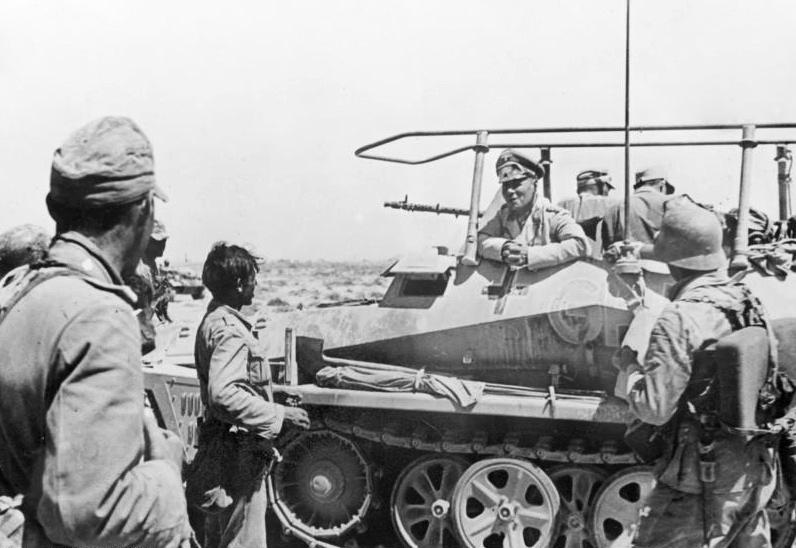
Like most other officers Rommel had served the Hitler regime as it spread its dark pall over Europe without protest. Yet, unlike so many other officers when he suffered a crisis in conscience about the Nazi leadership and their policies, he refused to obey orders that he knew were both illegal and immoral, and then risked his life by joining the conspiracy to kill Hitler.bundesarchiv_bild_146-1991-031-25a_nordafrika_vor_tobruk_rommel

It was at El Alamein that Rommel discovered the emptiness of Hitler’s promises as the troops of the Afrika Corps found themselves subjected to constant privation from lack of supply, air support and reinforcements. As commander of the Afrika Corps and later the Panzer Armee Afrika he and his troops achieved amazing success against an enemy that was always better supplied, equipped and which always had air and sea superiority. Battling the British as well as the political machinations of Mussolini and Germany’s Italian Allies as well as opponents in the German government such as Hermann Goering, Rommel saw his troops crushed under the press of the British as well as the Americans who landed in French North Africa. Eventually, sick and worn out, Rommel was sent back to Germany to recuperate.

rommel-with-soldier

Rommel had a sense of honor and humanity that many other German generals lacked. He refused to allow anti-Jewish measures in areas occupied by German troops in North Africa, ensuring that the approximately 425,000 Jews living in Libya, Tunisia, Algeria, and Morocco were spared the fate of the Holocaust. He refused to execute Jewish POWs, including members of the Jewish Battalion serving with the British 8th Army. Likewise, Rommel refused to follow the notorious “commando order.” In June of 1994 he protested the massacre of the people of the village of Oradour-sur-Glane by units of the 2nd SS Panzer Division directly to Hitler and asked for the authority to punish those responsible, but was refused.

After his return from Africa, Rommel’s honest and open assessments of the chances of the Germans winning the war made him persona non grata in Berlin and Berchtesgaden. He was posted to France in early 1944 according to some accounts he became a part of the plot to end the war and overthrow Hitler. Rommel’s Chief of Staff at OB West, General Hans Speidel, was a key man in the conspiracy and Rommel had contacts with a number of key conspirators. There are arguments about Rommel’s connections and activities in regard to the anti-Hitler plot among respected historians.

When the invasion came Rommel was away from Normandy visiting his wife. On learning of the invasion he sped back to Normandy. When he arrived he fought a desperate battle against the Allied forces. His outnumbered forces were under constant assault from the land, sea and air received paltry reinforcements compared to the Allies. Even so, German troops inflicted many local defeats and exacted a heavy price in allied blood in Normandy but were ground to dust. Even so, many American and British infantry regiments suffered 100% casualties but remained in action because of a continuous stream of replacements. Rommel urged Hitler and the High Command to withdraw German forces from Normandy before the allies broke through his front. By doing so he found that he was now considered a defeatist.

If Rommel had joined the plot to topple Hitler, he did not stop working to defend Germany against the coming Allied invasion. He believed that the war was lost if his forces failed to repel the Allies on the beaches of France, and he worked feverishly to bolster the beach fortifications. He recommended that the Panzer Divisions be deployed near the coast where they could immediately counterattack Allied invasion forces while they were still vulnerable. But his advice was not taken. He was given command of the Army Group but was not given control of most of the Panzer Divisions, which Hitler kept under his direct control. Neither did he approve of an assassination attempt but realizing that his front was about to collapse he was in favor of independent peace negotiations with the Allies on the Western Front.

Many commanders in the west, including Waffen SS commanders were in agreement Rommel was severely wounded in an air attack on his vehicle by a just days before the attempt on Hitler’s life. Hitler survived the attempted assassination and exacted a terrible revenge on anyone connected with the plot. Show trials and public hangings of officers who had served valiantly at the front were common. Thousands were killed and thousands more imprisoned. Many of those arrested, imprisoned, or killed, were those who knew Rommel’s views on ending the war.

Various conspirator’s testimony exposed Rommel as part of the plot. Leading Nazis, including Martin Bormann, and Heinrich Himmler urged Hitler to deal with Rommel. Likewise, some in the High Command, including Heinz Guderian turned upon Rommel. After a secret hearing it was recommended by the “Court of Military Honor” that Rommel be expelled from the military and tried by the “People’s Court” of Judge Roland Freisler. During the purge that followed the attempt on Hitler’s life, many noted German military commanders were hauled before this court and humiliated by Freisler before they were sent to their deaths. Freisler, a fanatic Nazi judge was a participant at the infamous Wannsee Conference which planned the details of the Final Solution was killed when his courtroom was bombed in February 1945.

On 27 September, Martin Bormann submitted to Hitler a memorandum which claimed that “the late General Stülpnagel, Colonel von Hofacker, Kluge’s nephew who has been executed, Lieutenant Colonel Rathgens, and several … living defendants have testified that Field Marshal Rommel was perfectly in the picture about the assassination plan and has promised to be at the disposal of the New Government.”

Rommel’s fate was sealed, but because of his fame and popularity in Germany Hitler decided to offer Rommel a choice of being tried by the People’s Court or committing suicide. Goebbels who had spent so much time building up the Rommel legend The latter with an offer to ensure his family’s safety, which he would not guarantee if Rommel choose to defend himself in open court. Hitler dispatched Generals Wilhelm Burgdorf and Ernst Maisel from Berlin to personally deliver the message.

492px-Erwin_rommel_death

Rommel suspected that he would be identified and killed and told that to his friends and family in the days leading up to the arrival of Generals Wilhelm Burgorf and Ernst Maisel from OKW with the ultimatum. They met with Rommel for a short time before giving him the opportunity to say goodbye to his family. Rommel told them of his choice and left his home for the last time. 15 minutes later the Generals called his wife to say that he had died of a heart attack. Rommel was given a state funeral and the German people were lied to about his cause of his death.

Winston Churchill wrote of Rommel:

“He also deserves our respect because, although a loyal German soldier, he came to hate Hitler and all his works, and took part in the conspiracy to rescue Germany by displacing the maniac and tyrant. For this, he paid the forfeit of his life. In the sombre wars of modern democracy, chivalry finds no place … Still, I do not regret or retract the tribute I paid to Rommel, unfashionable though it was judged.”

Rommel was just 52 years old when he died. I find in the story of Rommel some commonality in my own life. Before Rommel went to Africa he believed that Germany would win the war, during his command there he discovered that what he believed was lies and that Hitler had little regard for him or his troops.

Rommel is a complex character. His attitudes towards Hitler waxed and waned. He was no Nazi. He conducted his battles in an honorable manner and displayed much chivalry towards his opponents. His views on race were not at all Nazi like. In North Africa he faced down a White South African commander who did not want to be imprisoned with his Black troops. Rommel told the officer: “For me, soldiers are all equal. Those black people wore your same uniform, fought on your side, and so you will be in the same jail.”

But from the beginning he willingly served Hitler’s regime and basked in the fame that he enjoyed due to Goebbels’s propaganda machine. At the same time while he was according to the Chief of the German Navy in the West, Admiral Friedrich Ruge, as well as his Rommel’s letters to his wife, indicated that Rommel’s mood fluctuated wildly regarding Hitler: while he showed disgust towards the atrocities and disappointment towards the overall military and strategic situation, he was overjoyed to welcome a visit or praise from Hitler, only to return to depression the next day when faced with reality.

The example of Erwin Rommel is a cautionary tale of what can happen when a brilliant and honorable man comes under the spell of a demagogue. Rommel believed Hitler and blindly followed him until he ran into the hard face of reality in Africa at which point he had the moral courage to do the right thing, but many others didn’t.

Sadly there are otherwise honorable men and women in the current United States military that blindly support a delusional madman who happens to be the President: a man who promises to order soldiers to commit war crimes, who threatens to jail political opponents, who condemns whole races of people and religions, who incites violence against his opponents, a man who has no respect for the courts, the law, or the Constitution to which they are sworn to defend.

But I think that we also have to remember the men like Rommel who though not a true believer in the Nazi cause and polices, not only willingly served the Reich, but basked in the adulation lavished on him by friends and foes alike.

To me this is not about partisan politics but something that is bigger than politics, bigger than temporary political advantage, bigger than any single political issue, for which in our country, at least for the moment, that there are many ways to express dissent which were not available to most Germans of Rommel’s era. It is about the Constitution, the rule of law, and the foundational principles of the Declaration of Independence.

Personally, as a historian I cannot understand the blind obedience in the face of the evidence; but then I blindly followed President George Bush into the ill-advised and criminal invasion of Iraq. It was in the desert of Iraq’s Al Anbar Province that I had my own revelation that the man I supported had led the country into a war that could not be won. Like Rommel at El Alamein, it opened my eyes to things that I had never seen before.

Peace,

Padre Steve+

2 Comments

Filed under ethics, History, leadership, Military, nazi germany, Political Commentary, world war two in europe

“I Have Not Yet Begun to Fight” John Paul Jones at Flamborough Head

Battle off Flamborough Head September 23rd 1779

Friends of Padre Steve’s World,

On October 13th the United States Navy celebrated its 242nd Birthday. At Naval commands, stations, and aboard ships the Navy Birthday is marked by the cutting of a cake. Traditionally, the oldest and youngest sailors present make the first two cuts to the cake. This year, at the age of 58 I was the oldest, the youngest was a lad of just 20. Next year I will be retired.

The Navy Birthday is a time for Sailors to reflect on their heritage by remembering the lives and actions of those who came before them. One of those men, in fact the man who represents the heart and soul of that tradition was Captain John Paul Jones. As the commanding officer of the Sloop of War USS Ranger he received the first salute of the American flag by a foreign power, in this case our first ally, France. There had been an earlier salute to the USS Andrea Doria, a converted merchantman which was one of the first four ships of the new Navy by the Dutch governor of St. Eustasius in the West Indies. That occurred on November 16th, 1776. But the flag she flew was the red and white striped banner of the Continental Congress, not the Stars and Stripes.

That is a story told well by Barbara Tuchman in her book The First Salute: a View of the American Revolution. Tonight’s essay is about John Paul Jones.

Two hundred thirty nine years ago a small naval battle occurred off the coast of Yorkshire England. From a purely military perspective the battle was rather insignificant. A squadron of five American and French ships intercepted a convoy guarded by two British ships. However, the battle was one that had immense psychological significance for the Americans as a ramshackle converted French East India ship with an inferior main battery forced a materially superior British warship to strike her colors.

In fact the battle is so significant to the United States Navy that the body of the victor, Captain John Paul Jones was returned to the United States in 1905 from an abandoned site in northeastern Paris known as the former St. Louis Cemetery for Alien Protestants to be interred in Bancroft Hall at the United States Naval Academy.

Jones had an unusual career as a British merchant skipper accused of murdering a mutinous crewman at Tobago and escaped to Fredericksburg Virginia out of fear that he would be tried in a local versus and Admiralty Court.

John Paul Jones

Jones went to the United States and due to his friendship with Henry “Lighthorse” Lee and other friends in the Continental Congress including a man who became a lifelong friend, Benjamin Franklin obtained a commission in the Continental Navy as a First Lieutenant.  At that time the “First Lieutenant” was the senior officer among the Lieutenants on a ship and often served as the First Officer or Executive Officer.

His first assignment was on the fleet flagship Alfred where he hoisted the first US Ensign aboard an American Naval vessel.  He took part in the raid on Nassau and upon his return assumed command of the Sloop of War Providence where he captured 16 prizes of war and escaped capture by the a British Frigate. He then assumed command of Alfred for a brief time capturing a key supply vessel that had winter clothing for British troops commanded by General Burgoyne in New York.  Following this he took command of the 18 gun Sloop of War Ranger in France received the first ever salute to an American man-of-war by a foreign power 8 days after the French had recognized the American Colonies as an independent nation.

Ranger receives the first salute rendered to an American warship by a foreign power

The nine-gun salute fired from Admiral Piquet’s flagship recognized this and the new Franco-American alliance. Jones wrote of the event: “I accepted his offer all the more for after all it was a recognition of our independence and in the nation.” After this sailed directly in harm’s way making an epic raid on the port of Whithaven, and then defeating and capturing and the British 20 gun Brig HMS Drake in an hour long fight.

Jones’ raid on Whithaven struck fear into the British populace and forced the British to allocate more resources to the defense of British seaports than had previously been the case.  The capture of the Drake was of immense psychological importance and along with Jones’ other victories would ultimately lead to the formation of the United States Navy.

Bonhomme Richard

Jones’ exploits made him a celebrated figure. He gave up command of Ranger to take command of a powerful frigate under construction in Amsterdam, but the British pressured the Dutch into preventing the transfer of the ship. Instead, Jones took command of the Bonhomme Richard a converted 42 gun former French East India ship. He named her after Benjamin Franklin’s book “Poor Richard’s Almanac” and he became commodore of a mixed squadron of American and French ships including the 36 gun American Frigate Alliance, the 32 gun French Frigate Pallas and two 12 gun warships the Vengeance and Le Cerf. 

His orders were to provide a diversion for a combined French and Spanish fleet the squadron menaced Ireland and Scotland before moving into the North Sea. As they came into English waters the Americans intercepted a 50 ship convoy on September 22nd. The convoy was enroute to the Baltic was escorted by the 44 gun two-decker HMS Serapis. Serapis was brand new and more powerful than Bonhomme Richard. A second ship, the 20 gun privateer Countess of Scarborough accompanied Serapis.

Jones directing the battle from the Bonhomme Richard

The battle was joined about 1800 on the 23rd of September. Serapis which was more maneuverable than Jones’ flagship, pounded the Bonhomme Richard holing her below the waterline and seriously damaging her, suffering little damage to herself. Jones’ s problems were compounded when with the first broadside two of Bonhomme Richard’s elderly 18 pounders burst damaging the ship and killing most of the gun crews on the lower deck.

Jones attempted to close the range in order to grapple Serapis and make the battle a close aboard action. Eventually the bow of Bonhomme Richard ran into the stern of Serapis and Jones’s crew succeeded in grappling the British ship. With cannons blazing the two ships were locked in a struggle to the death. Firing at point blank range the ships tore great holes in one another, though the Serapis, built as a warship suffered less than Richard.

As the cannonade raged, the Marines of Bonhomme Richard swept the decks of Serapis killing and wounding many of her crew. A grenade thrown by one of her Marines sailed down an open hatch on the British ship and landed on a pile of powder charges. The explosion set off a chain reaction which disabled many of Serapis’s guns, killing and wounding many of the gunners.

In the confusion and carnage, thinking that Jones was dead, the Chief Gunner of the of Bonhomme Richard cried out for “quarter,” meaning surrender. Hearing this, Jones threw a pistol felling the man. Likewise, Richard’s colors were shot away giving the impression that she make have struck her colors.

The Captain of Serapis Captain Richard Pearson hailed Jones to ask if he had struck his colors (surrendered.) The First Lieutenant of Bonhomme Richard Richard Dale recorded Jones’ response for posterity “I have not yet begun to fight!” Another account recorded Jones as replying  “I have not yet thought of it, but I am determined to make you strike.” 

The battle continued and the Alliance under the command of a Frenchman with an American commission, Pierre Landais, having been absent for most of the action came up and delivered a devastating broadside much of which hit Bonhomme Richard, holing her again below the waterline and causing her to settle rapidly. At the same time she caused additional damage to Serapis. Jones loaded and fired one of the 9 pounders whose crew was killed or wounded, striking the mainmast of Serapis twice and causing it to fall over the side.

Alliance opens fire on Serapis and Bonhomme Richard

Bonhomme Richard had taken a severe beating with most of her guns knocked out, taking water and burning from fires ignited by the British onslaught and Alliance’s devastating broadside. With his ship badly damaged and Alliance threatening Pearson stuck his colors in person at 2230 hours.  Pallas forced the surrender of the Countess of Scarborough, but the convoy escaped.

Jones took possession of Serapis, but the badly damaged Bonhomme Richard sank the on September 25th despite her crew’s best efforts to save her.  Jones made temporary repairs to Serapis and sought refuge in the Netherlands.

The battle was militarily insignificant but again a major psychological victory as Jones had for the second time defeated a British warship in British waters within sight of the local population.  Even though Jones had taken Serapis the British warships completed their mission of protecting the convoy.

Jones’s post war career left him embittered. His opportunity to command the first US Navy Ship of the Line, the 74 gun America disappeared when that ship was given to France after the war. He was made a Chevalier of France by Louis the XVI and awarded a gold medal by Congress, but the U.S. Navy was disbanded. Unable to serve his adopted country, Jones found employment in the Imperial Russian Navy of Catherine the Great. Though he was successful against the Turks, jealous Russian commanders conspired against him and had him removed from command of the Black Sea Fleet.  He retired to France where he lived on his Russian pension. He was appointed to serve as Counsel to the Dey of Algiers to negotiate the freedom of captive American merchant mariners in June 1792. Before he could take up that position he died in his Paris apartment of interstitial nephritis of on July 18th 1792.

Frenchman Pierrot Francois Simmoneau donated over 460 francs to mummify the body. It was preserved in alcohol and interred in a lead coffin “in the event that should the United States decide to claim his remains, they might more easily be identified.” He was buried in the St. Louis Cemetery for Alien Protestants which was owned by the French King. After the French Revolution the cemetery was abandoned and forgotten.

General Horace Porter, the United States Counsel to France spent six years and his own money to locate and identify Jones’s body in 1905. His coffin was transported aboard the USS Brooklyn in 1906 and his body was interred at the United States Naval Academy. President Theodore Roosevelt spoke at the internment. He noted something of profound importance for anyone sworn to defend this nation and its Constitution:

We have met to-day to do honor to the mighty dead. Remember that our words of admiration are but as sounding brass and tinkling cymbals if we do not by steady preparation and by the cultivation of soul and mind and body fit ourselves so that in time of need we shall be prepared to emulate their deeds. Let every midshipman who passes through this institution remember, as he looks upon the tomb of John Paul Jones, that while no courage can atone for the lack of that efficiency which comes only through careful preparation in advance, through careful training of the men, and careful fitting out of the engines of war, yet that none of these things can avail unless in the moment of crisis the heart rises level with the crisis. The navy whose captains will not surrender is sure in the long run to whip the navy whose captains will surrender, unless the inequality of skill or force is prodigious. The courage which never yields can not take the place of the possession of good ships and good weapons and the ability skillfully to use these ships and these weapons.

In the years since that victory the United States Navy went from a militarily insignificant force to the most powerful Navy in the world. Jones and the ships that he captained would not be forgotten. Two Aircraft Carriers were named after Jones’ Sloop of war Ranger, while several destroyers have born his name.

The odds against Jones in his battle with Serapis were heavily weighted against him. Jones’s victory over Serapis was another demonstration that the Americans should not be taken lightly by the great powers of Europe. It helped begin a tradition of valiant service for the Navy that has endured throughout the centuries.  The victory off Flamborough Head reaches into the present as American sailors and their ships ply the world’s oceans keeping the sea lanes open and protecting American interests abroad.

Peace

Padre Steve+

Leave a comment

Filed under leadership, Military, Navy Ships, US Navy

Maintaining the Facade of Legality: Friedrich Kritzinger, and Men Who Try to Walk the Totalitarian Tightrope

Friends of Padre Steve’s World,

Saint Augustine wrote: “Justice being taken away, then, what are kingdoms but great robberies.”

I saw that quote in relation to Friedrich Kritzinger, a lawyer, and Prussian civil servant who served as State Secretary for the Reich Chancellery during the Third Reich and was a participant at the Wannsee conference. The authors of that article noted something that should serve as a reminder to us: “by working as a lawyer for a regime, which he had known from the start to be criminal, he made himself a stooge.” (Stefan Paul-Jacobs and Lore Kleiber in The Participants: the Men of the Wannsee Conference edited by Hans-Christian Jasch and Christoph Kreutzmüller, p.217)

Kritzinger was not what I would call an evil man. He was a traditional German conservative and Nationalist who agreed with many Nazi policies, albeit not to their extremes. But he also had strong moral and religious convictions that caused him to question and at times attempt to mitigate those policies. He was a member of the Confessing Church which condemned the Nazified faith of Reichsbishof Müller and the German Christian movement, but even many of them were receptive to the nationalism and anti-Communist stances of the Nazis. Otto Dibelius, the General Superintendent of the Confessional Lutherans was a hard line conservative and in 1933 at a service for the new Reichstag: “We have learned from Martin Luther that the Church cannot get in the way of State power when it does what it is called to do. Not even when [the state] becomes hard and ruthless…. When the state carries out its office against those who destroy the foundations of state order, above all against those who destroy honor with vituperative and cruel words that scorn faith and vilify death for the Fatherland, then [the state] is ruling in God’s name!” (Richard Seigman-Gall, the Holy Reich: Nazi Conceptions of Christianity 1933-1945 p.68)

Kritzinger himself did not join the Party until 1938 when he was recruited by Hans Lammers to fill a vacancy in the Reich Chancellery for which Party membership was required. Kritzinger was concerned. He only accepted the job and membership in the when assured that he did not have to be politically active and did not have to hire ardent Nazis for jobs in the Chancellery.

At Wannsee he was the only participant who demonstrated any sense of concern about the Final Solution of the Jewish Problem. After the conference he headed the only agency not to sign off on Reinhard Heydrich’s policies against the Jews. According to some he worked inside the system to try to mitigate the worst aspects of Hitler’s policy decisions. He felt shame for what the regime did. That being said “from 1933 on, Kritzinger held positions of responsibility and colluded in disgusting breeches of law and maintaining the illusion that the Nazi dictatorship was a constitutional state.”

The fact is that the Nazi regime believed that it was a functioning constitutional state and attempted to preserve the illusion of legality and the rule of law. Men like Kritzinger helped them to do just that. In his positions, first at the Ministry of Justice and then at the Reich Chancellery, “was held in high esteem… not as an ideological acolyte of the new leader but as an expert on law. Responsible for matters of state law, he was directly complicit in Nazi atrocities.” This included his legal justification for the Night of the Long Knives.

At the Reich Chancellery Kritzinger made sure that the administrative apparatuses the State functioned smoothly. “The facade of legality helped ensure that the Nazi regime and its crimes were accepted even by its detractors, and their participation in the system thereby facilitated.”

After Wannsee, when Kritzinger began to fully grasp what was happening in regard to the Jews he attempted to resign but his resignation was refused. His boss, Hans Lammers refused and rejected his dismissal with the remark that without Kritzinger things would run even worse. In fact, men like Kritzinger were often able to delay or hinder decisions by not passing along memos as they saw fit. Conversely they could speed decisions by ensure that information reached Hitler.

When questioned after the war Kritzinger stated:

My consultations with Hitler were of course tailored to his mentally. It goes without saying that it would have been insane to say that such and such a decision would adversely affect Jews. One had to phrase it differently, and say that it would trigger serious public unrest. Obviously we could not say anything to Hitler he did not want to hear. Especially when it came to those decisions.

I wonder how many people in the American government and in the upper echelons of the Trump administration justify and equivocate their participation in it just as Kritzinger and others like him did his under the Nazis.

Until tomorrow,

Peace

Padre Steve+

Leave a comment

Filed under ethics, History, laws and legislation, leadership, nazi germany, Political Commentary

“One Learns more from Adversity than from Success” The Battle of Cape Esperance 11-12 October 1942

Friends of Padre Steve’s World,

Naval battles between U.S. Navy and Imperial Japanese Navy surface forces around Guadalcanal in 1942 were almost always brief and bloody. The number of ships from both sides sunk in the waters around Guadalcanal, and the islands near it: Tulagi and Savo Island, led to the area being nicknamed “Iron Bottom Sound.” Over fifty ships and craft would be interred in the waters around Guadalcanal by the end of the campaign. These numbers included 2 battleships, 8 cruisers, and 22 destroyers.

The battles around Guadalcanal occurred in a time of technical transition for the United States Navy as its radar became better at detecting ships and fire direction systems advanced in their accuracy and targeting ability. While almost all U.S. warships had radar primarily the SC search radar and FC Fire Control radar, not many U.S. Navy warships had the advanced SG surface search radar. But it was not just a matter of technology, it was a matter of training and experience. Their opponents, the Imperial Japanese Navy had very few ships equipped with radar, but their training for surface actions, especially night fighting where their superior optics, gunnery skills, and torpedoes proved deadly during the first year of the war before U.S. Navy crews mastered their technology edge.

By October 1942 the U.S. Marines battling on Guadalcanal were fighting an enemy growing in numbers on the ground even as they felt the effects of the the predatory Japanese surface raiders that routinely bombarded their positions and endangered U.S. resupply efforts.

USS Helena

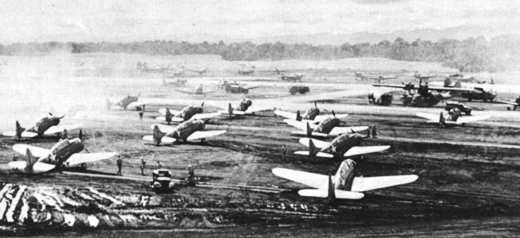
Since the Marine, Navy and Army Air Force Squadrons based on Guadalcanal maintained air superiority in the nearby waters during the day the Japanese were limited to night surface operations against the island. These operations involving the reinforcement and resupply of Japanese Forces on the island as well as offensive naval gunfire operations to aid the land forces in which Japanese warships attempted to destroy or degrade Henderson Field.

Henderson Field

The first major operations mounted by the Japanese was in early August when a Japanese cruiser destroyer force ravaged the U.S. cruiser forces off Savo Island. The Japanese inflicted the worst defeat of an American naval squadron, sinking 3 American and one Australian Heavy cruiser while damaging another. The battle was a disaster for the U.S. forces and led to the early withdraw of transport and supply ships of the invasion force before many could finish unloading the equipment and supplies that were critical to the operation. In that operation radar played no role for U.S. forces, and sets were either turned off or not relied upon by commanders. Admiral Richmond Turner noted:

“The Navy was still obsessed with a strong feeling of technical and mental superiority over the enemy. In spite of ample evidence as to enemy capabilities, most of our officers and men despised the enemy and felt themselves sure victors in all encounters under any circumstances. The net result of all this was a fatal lethargy of mind which induced a confidence without readiness, and a routine acceptance of outworn peacetime standards of conduct. I believe that this psychological factor, as a cause of our defeat, was even more important than the element of surprise”

Despite this admission it would take several more engagements in the waters around Guadalcanal before the U.S. Navy fully appreciated the superiority of Japanese optics, training in night fighting, and their deadly 24″ “Long Lance” torpedoes. It would not be until 1943 that the U.S. Navy began to exploit its advantage in radar and use it to their advantage in night surface actions.

The Tokyo Express Route along the Slot

Japanese resupply and reinforcement operations to Guadalcanal were so frequent that the Japanese forces were nicknamed the Tokyo Express by the Americans. Knowing that the Marines who had been in bitter combat with the Japanese needed reinforcements the U.S. sent a convoy to land the 164th Infantry Regiment of the Americal Division on October 13th.  To protect the convoy the U.S. Navy dispatched a surface task force, TF-64 composed of the Cruisers USS San Francisco, USS Boise, USS Salt Lake City and USS Helena and 5 destroyers under the command of Rear Admiral Norman Scott to protect it from any Japanese surface threats.

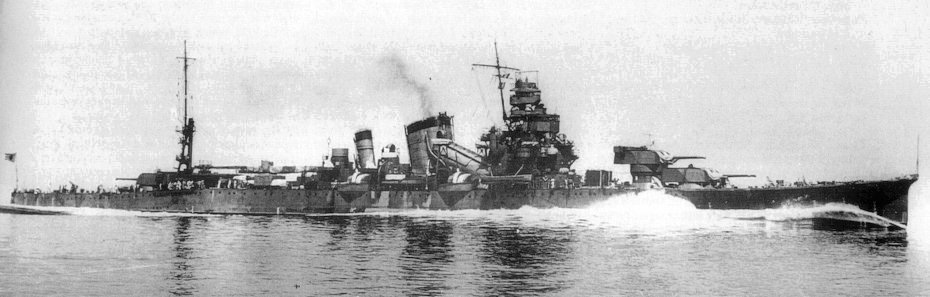
IJN Heavy Cruiser Aoba after the battle

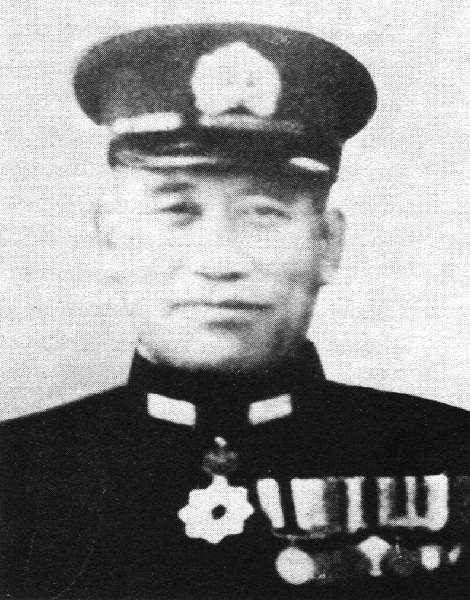
The U.S. move to reinforce Guadalcanal coincided with a Japanese effort to reinforce their forced on the island. They Imperial Navy sent a covering force of three heavy cruisers, the Aoba, Furutuka and Kinugasa and two destroyers under the command of Rear Admiral Arimoto Goto. The Japanese cruisers were to bombard Henderson Field as the Japanese were not expecting any American surface forces to oppose their effort.

Rear Admiral Arimoto Goto

The Japanese were detected by aerial reconnaissance on the afternoon of the 10th when they were still about 200 miles from Guadalcanal. Scott, whose forces lacked experience in night surface combat made a simple plan to “cross the T” of the enemy force in a single line formation with three destroyers in the van, the cruisers in the center and two destroyers in the rear.

Rear Admiral Norman Scott

U.S. floatplanes from the American cruisers detected the Japanese at 2300 hours. At 2322 the radar of the USS Helena picked up the Japanese force at a range of about 27,000 yards. However misunderstandings of Scott’s orders by his flagship broke his formation and put the van destroyers out of position in the poor visibility of the moonless night. The confusion caused Scott to believe that the radar contacts were his own destroyers.

The Japanese still did not realize that an American force was near them and continued on. At 2345 the ships were only about 5,000 yards apart when Helena radioed Scott asking permission to fire. The message was received by Scott who acknowledged his receipt of the message did not grant permission open fire. However, his response of “roger” was mistaken as permission to open fire by Helena. The American cruiser opened fire on the Japanese aided by her SG and FC radars. She was followed by the other cruisers which opened a devastating fire on the Japanese force.

The Japanese task force was completely surprised, they had not expected to encounter American surface ships and failed to be on alert. Goto’s lookouts had sight the Americans at 2343 but assumed that they were friendly Japanese ships. The result was that the Americans inflicted heavy damage to the Japanese flagship, the heavy cruiser Aoba and left Goto mortally wounded.

IJN Heavy Cruiser Furutaka

Scott was taken by surprise by the action of his cruisers and ordered ceasefire at 2347 thinking that he was shooting at his own destroyers. Four minutes later he ordered his ships to resume fire at 2351. At 2349 the heavy cruiser Furutaka was heavily damaged by American fire and at 2358 she was was hit by a torpedo fired by the destroyer Buchanan. The Japanese destroyer Fubuki was mortally wounded about the same time and began to sink. The U.S. destroyers Duncan and Farenholt were both damaged in the crossfire with Duncan so badly damaged that she would be abandoned and sunk.

USS Duncan

Instead of continuing to rely on radar the American cruisers turned on their searchlights which provided the last Japanese cruiser, Kinugasa the opportunity to hit them hard. Kinugasa’s gunners heavily damaged Boise and but for a certain amount of luck would have sunk the American ship. One shell hit the number one turret setting fires in it, while another hit below the waterline and detonated in the forward 6″ magazine threatening to blow the ship to pieces but the onrushing water from the hit doused the flames and saved the ship. Despite that Boise was out of action with over 100 casualties, all of the forward magazine and handling crews were all killed.

As Boise sheared away from the action, Kinugasa and Salt Lake City exchanged fire, each hitting each other before the Japanese cruiser broke off the action.

The commander of the Japanese reinforcement group, his mission completed dispatched his destroyers to assist Goto’s force at it withdrew and rescue survivors. However these ships were caught by U.S. aircraft from Henderson Field as the light of the dawn lit the sky. The destroyers Murakumo and Natsugumo were heavily damaged, abandoned, and scuttled by the Japanese.

On the 13th the American reinforcement convoy arrived, as did Japanese reinforcements later that night. On the night the 13th, the Japanese battleships Kongo and Haruna  conducted an attack which most destroyed Henderson Field. However, the resilient Marines kept the airfield operational as the Marines of the 1st Marine Division and the nearly arrived soldiers of the 164th Regiment held off a major Japanese assault from 23-26 October, known as the Battle of Henderson Field or Bloody Ridge.

Scott’s Task Force 64 lost one destroyer sunk and two cruisers damaged while the Japanese lost one cruiser and three destroyers sunk, with two cruisers damaged in the action.

The Japanese flagship Aoba was severely damaged by nearly 40 6” and 8” shells fired by the American cruisers. Her bridge was shattered and her number three turret destroyed. The damage knocked her out of the war for four months and the number three turret would not be replaced. On the American side the heavily damaged Boise was sent to the East Coast for repairs while Salt Lake City was repaired at Pearl Harbor. The battle had lasted less than 50 minutes from the time Helena picked up the Japanese force on her radar.

http://ww2db.com/

USS Salt Lake City

The battle was a tactical victory for the U.S. Navy. However, the Navy did not learn  but the lessons of the battle about the power of Japanese torpedoes and effectiveness in night combat. While he Scott maintained a cool head and reacted to the situation with great courage he assumed that his deployment of his ships in a line formation coupled with superior American gunnery had won the battle. However, his ignorance on the proper use of the various types of radar used by the U.S. Navy meant that he and other American commanders would continue to misuse it and rely on searchlights and recognition lights during night surface actions. Likewise, he made the false assumption that Japanese torpedoes were no longer a threat.

This caused other U.S. task forces to have to learn the hard way in the subsequent engagements of the Naval Battle of Guadalcanal and the Battle of Tassafaronga. Rear Admiral Scott would not long survive his victory. He was killed in action aboard the USS Atlanta during the Naval Battle of Guadalcanal just a month later. The great American naval historian of the Second World War, Samuel Elliott Morrison wrote:

“So, because we won the Battle of Cape Esperance, serious tactical defects were carried over into subsequent engagements with unfortunate results. One learns more from adversity than from success.” 

While the battle helped inspire American confidence, it was not a strategic victory. Japanese forces nearly destroyed Henderson Field on the night of the 13th, and the the most decisive battles were yet to come.

Peace

Padre Steve+

Leave a comment

Filed under History, leadership, Military, Navy Ships, US Navy, World War II at Sea, world war two in the pacific

“The Most Appalling Site Imaginable” George Patton’s Experience at the Ohrdorf Subcamp of Buchenwald

Friends of Padre Steve’s World,

In our day there are fewer and fewer people who lived through or personal saw or documented the evils of the Nazi Concentration Camps. Likewise, there are a host of Holocaust deniers who produce a plethora of pseudo-scholarly articles claiming to be legitimate historians. Even more frighteningly the rise of apologists for the Nazi regime including those who are active members of allegedly conservative parties in the United States and the European Union is beginning to influence politics. The abject racism, rejection of anyone considered racially inferior, and quite often their unhidden anti-Semitism show that what lies in the dark heart of Naziism is not dead and in fact is rising.

In the United States its rise is being fueled and legitimized by the Presidency of Donald Trump who has referred to American Nazis and White Supremacists as “very good people” after one of their protests where an anti-Nazi demonstrator was murdered and others brutally attacked. In the same time frame a good number of Republican candidates have exposed themselves as White Supremacists and actual Nazis while running for office. A host of new-Nazi and White supremacist organizations openly meet and flood the internet with their race hatred.

The fact is that anyone who denies the Holocaust, attempts to minimize it, or advocates the same policies of race hatred and violence against political, religious, or other opponents is no better than the perpetrators of the Holocaust. Likewise, those who stand by and say nothing are worse. As Yehuda Bauer wrote:

“The horror of the Holocaust is not that it deviated from human norms; the horror is that it didn’t. What happened may happen again, to others not necessarily Jews, perpetrated by others, not necessarily Germans. We are all possible victims, possible perpetrators, possible bystanders.”

The good thing is that there were people who took the time to record what they saw in the Nazi Concentration Camps and exposed those deeds to the world in such a way that only perverted and evil people could brazenly deny those facts.

One of the most detailed descriptions of a liberated Concentration Camp was written by General George Patton in his memoirs entitled War as I Knew It.

… we drove to Ohrdruf and visited the first horror camp any of us had ever seen. It was the most appalling sight imaginable.

A man who said he was one of the former inmates acted as impresario and showed us first the gallows, where men were hanged for attempting to escape. The drop board was about two feet from the ground, and the cord used was piano wire which had an adjustment so that when the man dropped, his toes would just reach the ground and it would take about fifteen minutes for him to choke to death, since the fall was not sufficient to break his neck. The next two men to die had to kick the board out from under him. It was stated by some of the Germans present that the generals who were executed after the Hitler bomb incident were hanged in this manner.

Our guide then took us to the whipping table, which was about the height of the average man’s crotch. The feet were placed in stocks on the ground and the man was pulled over the table, which was slightly hollowed, and held by two guards, while he was beaten across the back and loins. The stick which they said had been used, and which had some blood on it, was bigger than the handle of a pick.

Our guide claimed that he himself had received twenty-five blows with this tool. It later developed that he was not a prisoner at all, but one of the executioners. General Eisenhower must have suspected it, because he asked the man very pointedly how he could be so fat. He was found dead next morning, killed by some of the inmates.

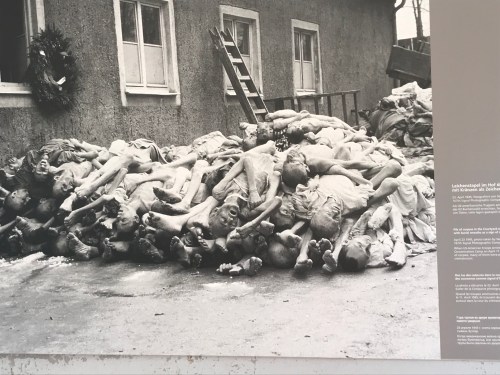
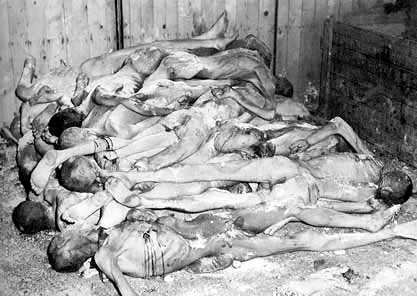
Just beyond the whipping table there was a pile of forty bodies, more or less naked. All of these had been shot in the back of the head at short range, and the blood was still cooling on the ground.

In a shed near-by was a pile of forty completely naked bodies in the last stages of emaciation. These bodies were lightly sprinkled with lime – not, apparently, for the purpose of destroying them, but to reduce the smell. As a reducer of smell, lime is a very inefficient medium.

The total capacity of the shed looked to me to be about two hundred bodies. It was stated that bodies were left until the shed was full and then they were taken out and buried. The inmates said some three thousand people had been buried from this shed since January 1, 1945.

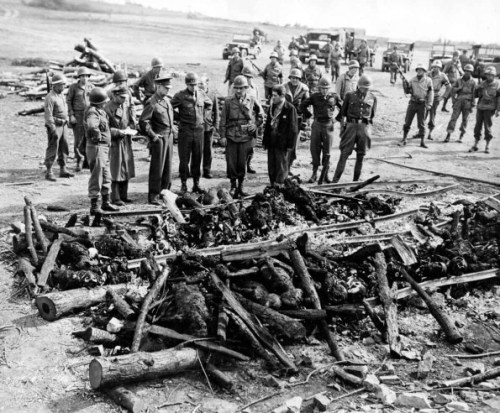
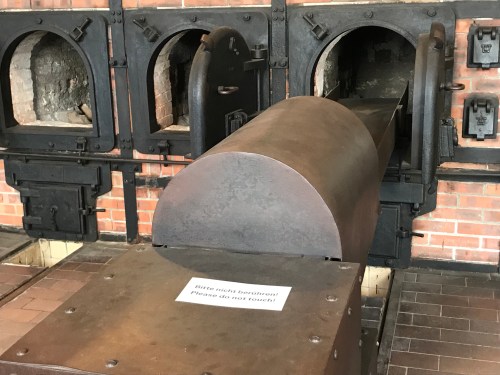
When our troops began to draw near, the Germans thought it expedient to remove the evidence of their crimes. They therefore used the inmates to exhume the recently buried bodies and to build a sort of mammoth griddle of 60 cm. railway tracks laid on a brick foundation. The bodies were piled on this and they attempted to burn them. The attempt was a bad failure. Actually, one could not help but think of some gigantic cannibalistic barbecue. In the pit itself were arms and legs and portions of bodies sticking out of the green water which partially filled it.

General Walker and General Middleton had wisely decided to have as many soldiers as possible visit the scene. This gave me the idea of having the inhabitants themselves visit the camp. I suggested this to Walker, and found that he had already had the mayor and his wife take a look at it. On going home those two committed suicide. We later used the same system in having the inhabitants of Weimar go through the even larger slave camp (Buchenwald) north of that town. (Excerpted for G. Patton War as I Knew It)

Dwight D. Eisenhower wrote after seeing the camp:

The same day [April 12, 1945] I saw my first horror camp. It was near the town of Gotha. I have never felt able to describe my emotional reactions when I first came face to face with indisputable evidence of Nazi brutality and ruthless disregard of every shred of decency. Up to that time I had known about it only generally or through secondary sources. I am certain, however that I have never at any other time experienced an equal sense of shock.

Eisenhower was so moved that he ordered that the best reporters and newsmen come and record what he had seen. He did not want the horrors to be denied by history. He wrote:

I visited every nook and cranny of the camp because I felt it my duty to be in a position from then on to testify at first hand about these things in case there ever grew up at home the belief or assumption that `the stories of Nazi brutality were just propaganda.’ Some members of the visiting party were unable to through the ordeal. I not only did so but as soon as I returned to Patton’s headquarters that evening I sent communications to both Washington and London, urging the two governments to send instantly to Germany a random group of newspaper editors and representative groups from the national legislatures. I felt that the evidence should be immediately placed before the American and British publics in a fashion that would leave no room for cynical doubt.

The fact is that as much as we want to pretend that what happened a Buchenwald, Flossenbürg, Dachau, Bergen-Belsen, Auschwitz, Soribor, Belzec, and Treblinka are images from history that cannot happen again, however, they are an ever present reality and they cannot be ignored. Sadly, I cannot help but to imagine that this can and will happen again in my lifetime.

I go to a quote from one of my favorite episodes of Star Trek the Next Generation called The Drumhead uttered by Jean Luc Picard:

We think we’ve come so far. Torture of heretics, burning of witches it’s all ancient history. Then – before you can blink an eye – suddenly it threatens to start all over again.

That is our reality. There are people, even neighbors and those that we think are friends who would be perpetrators or bystanders when those that transgress the way of Trump are take us from our homes and families because of our beliefs. I would love to be wrong about this, but I am a historian and a theologian and I know the human condition far too well to sit back and remain silent, no matter what the cost.

I had a Facebook exchange with a friend who is a retired Navy Chaplain. He is very much a Trump supporter and apologist. He is very happy about Justice Kavanaugh being in the Supreme Court. The stories of the victims and their claims did not matter to him. Despite that I do not believe that he is a bad man or an evil person. I simply believe that like Martin Niemöller that he has made a bad choice in the man and party that he currently supports and that he will eventually regret it. I could be wrong, he might not turn out to be a Niemöller, but a Reichsbishof Müller. Sincerely hope that he does not become the latter.

I keep quoting historian Timothy Snyder, but he was all too correct when he wrote these words less than two years ago:

The European history of the twentieth century shows us that societies can break, democracies can fall, ethics can collapse, and ordinary men can find themselves standing over death pits with guns in their hands. It would serve us well today to understand why.

If you don’t believe me read the words of the President, his closest supporters, the prominent political preachers of the Christian Right, and any number of Trump leaning columnists, pundits, and politicians. There are some who are so far gone that they will accuse any opponent of being disloyal, not the the Constitution or the law but to President Trump. One of those people tried to get my commanding officer to have me tried by Court Martial for a sermon in which he lied about what I said. I had to spend my money to hire a lawyer to defend me from the false charges and have them dismissed during the preliminary investigation.

Trust me, I know what resistance will mean if this President and his cult like followers are not stopped. Our fate will be worse than that of Nazi Germany because we should have known better. We should have learned from Dwight Eisenhower and George Patton. We should have learned fro Dietrich Bonhoeffer and Martin Niemöller, we should have learned from the Nuremberg trials, but we have not.

For the next four months, and maybe more should the Democrats fail to gain a majority in the House or Senate, President Trump will have all the branches of the Federal government in his power. With the laws already enacted in the Patriot Act and numerous executive orders there is little to stop a President who has no respect for the law or the Constitution from declaring full emergency powers should any war, terrorist act, or natural disaster be declared.

So with all of that happy commentary I will leave you until tomorrow when, God willing, I will be back in the United States.

Until then have a good night, and please, never forget.

Peace

Padre Steve+

3 Comments

Filed under civil rights, ethics, faith, History, holocaust, leadership, News and current events, Political Commentary

Mobilizing the Armies of the Civil War: Regulars, Volunteers, and Conscripts

Friends of Padre Steve’s World

I am pre-posting this article because we will be traveling to Germany today. If I get a chance I will post one of a number of articles I have been working on or thinking about over the past few days.

This is another part of my Civil War and Gettysburg text on the formation of the armies that fought the Civil War. 

When one thinks of our all-volunteer force today it is hard to imagine forming armies of this size and scope around such small regular forces. The story of how North and South raised their armies, and the stories of the volunteers of the first part of the war is amazing. I hope that you enjoy.

Peace

Padre Steve+

MenBrooklyn


The Secession Crisis, Mobilization, and Volunteer Armies

The American Civil War was the first American war fought by massed armies of mobilized citizens. All previous wars had been fought by small numbers of Regular Army troops supported by various numbers of mobilized State Militia formations or volunteer formations raised for the particular war; “The fighting force of the 1860s was a conglomerate of diverse units, each with its own degree of importance, pride, proficiency, and jealousy. Whether of North or South, an army began as little more than a loosely organized mob actuated by more enthusiasm than by experience. Its composition ran the full gauntlet of humankind.” [1]

In 1860 the Regular Army numbered 16,000 troops at the beginning of the war. These included some 1105 officers, and were organized into “ten regiments of infantry, four of artillery, and five of cavalry (including dragoons and mounted riflemen)” [2] These regiments were broken up into small units and they and their soldiers were scattered about in far flung isolated posts around the country and in the new western territories. The units primarily fought Indians and performed what best could be described as constabulary duties. Others, mostly from artillery units manned the coastal defense fortifications that protected American’s key ports and entrances to key waterways along the eastern seaboard. Even so, after the War with Mexico “three quarters army’s artillery had been scrapped” and most of the army’s artillerymen and their units were “made to serve as infantry or cavalry, thus destroying almost completely their efficacy as artillery.” [3]

The secession crisis and the outbreak of the war fractured the army, particularly the officer corps. The officer corps was heavily Southern and many Northern officers had some sympathy with their Southern brothers in arms. It has to be said that of the men holding positions of high command from 1849 to 1861 that many were Southerners:

“all of the secretaries of war were Southerners, as were the general in chief, two of the three brigadier generals, all but one of the army’s geographical departments on the eve of the Civil War, the authors of the two manuals on infantry tactics, and the artillery manual used at West Point, and the professor who taught tactics and strategy at the military academy.” [4]

Most of the Army remained loyal to the Union, “except for 313 officers who resigned their commissions.” [5] Those who remained loyal to the Union included the General in Chief, Winfield Scott, as well as the professor who had taught so many of those now leaving to serve the Confederacy, Dennis Hart Mahan. However, of the others brigadier generals William Harney, David Twiggs and Joseph E. Johnston, Brevet Brigadier General Albert Sidney Johnston, and the army’s Adjutant General, Colonel Samuel Cooper, and the newly promoted Colonel Robert E. Lee all went south. “Even so, 40 to 50 per cent of the Southern West Point graduates on active duty in 1860 held to their posts and remained loyal to the Union.” [6]

A Political Backlash against West Point and the Officer Corps

The exodus of these officers created a backlash against West Point and the professional officers who remained in service of the Union, especially those who were Democrats and to radical Republicans were soft on slavery. Some Republican members of Congress including Senator Ben Wade of Ohio, “figured that political apostasy had been taught at West Point as well, and he didn’t know which sin was worse – it or treason.” [7]The fact that the leaders of the Union forces defeated at Bull run were West Point graduates added incompetence to the list of the crimes, real and imagined committed by the officers of the Regular Army. When Congress reconvened in 1861 Wade said:

I cannot help thinking…that there is something wrong with this whole institution. I do not believe that in the history of the world you can find so many men who have proved themselves utterly faithless to their oaths, ungrateful to the Government that supported them, guilty of treason and a deliberate intention to overthrow that Government which educated them and given them support, as have emanated from this institution…I believe from the idleness of these military educated gentlemen this great treason was hatched.” [8]

Wade did not mention in his blanket his condemnation of the “traitors” that many “West Pointers from the Southern States – 162 of them – had withstood the pull of birth and kin to remain with the Union.” [9]

Wade’s fellow radical Senator Zachariah Chandler of Michigan urged Congress to dissolve the Military Academy. The academy, he said “has produced more traitors within the last fifty years than all the institutions of learning and education that have existed since Judas Iscariot’s time.” [10] Despite the words and accusations of the radical fire-eaters like Wade and Chandler and other like them, more level headed men prevailed and reminded the nation that there had been many other traitors. Senator James Nesmith of Oregon said: “Treason was hatched and incubated at these very decks around me.” [11]

Politicians and Professionals: Building Volunteer Armies

20110930-poster.png_

Many of the officers who left the army to serve the Confederacy were among the Army’s best and brightest, and many of them later rose to prominence and fame in their service to the Confederacy. In contrast to the officers who remained loyal to the Union, those that many in Congress despised and “pushed aside and passed over” in favor of “officers called back into service or directly appointed from civil life, the “South welcomed its professionals and capitalized on their talents. Sixty-four per cent of the Regular Army officers who went South became generals; less than 30 per cent of those who stayed with the Union achieved that rank.” [12]

The Union had a small Regular Army, which did undergo a significant expansion during the war, and the Confederacy did not even have that. During the war the “Confederacy established a regular army that attained an authorized strength of 15,000” [13] but few men ever enlisted in it. This was in large part due to the same distrust of the central government in Richmond that had been exhibited to Washington before the war.

Thus both sides fell back on the British tradition of calling up volunteers. The British had “invented volunteer system during the Napoleonic Wars, also to save themselves from the expense of permanent expansions of their army, and the United States had taken over the example in the Mexican War…” [14] The volunteer system was different from the militias which were completely under the control of their State and only given to the service of the national government for very limited amounts of time. The volunteers were makeshift organizations operating in a place somewhere between the Regular Army and the State militias and like the British system they saved “Congress the expense of permanently commissioning officers and mustering men into a dramatically expanded Federal service.”[15] As such the volunteer regiments that were raised by the States “were recruited by the states, marched under state-appointed officers carrying their state flag as well as the Stars and Stripes.” [16]

President Lincoln’s call for volunteers appealed “to all loyal citizens to favor, facilitate and aid this effort to maintain the honor, the integrity, and the existence of our Northern Union, and the perpetuity of the popular government; and to redress the wrongs already long enough endured.” [17] The Boston Herald proclaimed “In order to preserve this glorious heritage, vouchsafed to us by the fathers of the Republic, it is essential that every man perform his whole duty in a crisis like the present.” [18] The legislature of the State of Mississippi sated its arguments a bit differently and asserted, “Our position is thoroughly identified with the institution of slavery – the greatest material interest in the world.” Texas explained that it had joined the Union “as a commonwealth holding, maintaining and protecting the institution known as negro slavery – the servitude of the African to the white race within her limits.” [19] A newspaper correspondent wrote:

“All, all of every name and every age to arms! To arms! My father go, my son go, my brother go, your country calls you.” He called out to Southern women as well, “mothers, wives and daughters buckle on the armor of loved ones, the correspondent urged, “bid them with Roman fairness, advance and never return until victory perches on their banner.” [20]

Those who went off to war left their homes and families. Young Rhode Island volunteer Robert Hunt Rhodes wrote that is mother told him “in the spirit worth of a Spartan mother of old said: “My son, other mothers must make sacrifices and why should not I?” [21] The bulk of the soldiers that enlisted on both sides in 1861 were single their median age “was twenty-four. Only one in seven enlistees that first year was eighteen or younger, and fewer than a third were twenty-one or younger.” [22]

Illustrious regiments such as the 1st Minnesota Volunteers, the 20th Maine Volunteers, the 69th New York Volunteer Infantry, and the African American 54thMassachusetts Volunteer Infantry were just a few of the many regiments mustered into Union service under this system. As the war went on and the initial regiments were decimated by losses in combat and to disease, Northern governors “preferred to organize new regiments rather than to replenish old ones whittled down by battle and sickness. Fresh units swelled a state’s contributions, and the provided governors an opportunity to win more political favors by appointing more regimental officers.” [23] This practice produced “an army of shadow units” as “it was up to the regimental commanding officer to keep up a supply of new enlistments from back home for his own regiment, but most commanders could ill afford to detail their precious supply of junior officers for recruiting duty behind the lines.” [24]

Even before secession many Southern states began to prepare for war by building up their militias, both in numbers as well as by sending agents to arms suppliers in the North, as was done by Georgia Governor Joseph E. Brown who “sent an official north to purchase arms, ammunition and accouterments.” [25] After the bombardment of Fort Sumter both sides raced to build up their militaries. Jefferson Davis, the new President of the Confederacy who was a West Point graduate and former Secretary of War called for volunteers. On March 6th 1861 the new Provisional Confederate Congress in Montgomery authorized Davis to “call out the militia for six months and to accept 100,000 twelve-month volunteers.” [26] Within weeks they had passed additional legislation allowing for the calling up of volunteers for six months, twelve months and long-term volunteers up to any length of time. “Virginia’s troops were mustered en masse on July 1, 1861, by which time the state had 41,885 volunteers on its payroll.” [27]

poster

With the legislation in hand Davis rapidly called up over 60,000 troops to the Confederate Cause, and this was before Virginia and North Carolina seceded from the Union. A mixture of former Regular Army officers commanded these men, most of whom occupied the senior leadership positions in the army, volunteer officers, made up the bulk of the Confederate officer corps. “Well over 700 former students at Virginia Military Institute served as officers in the war, most in the Virginia Theater….” [28]Among these men was Robert Rodes who became one of Robert E. Lee’s finest division commanders.

In the North Abraham Lincoln was in a quandary. Congress was out of session, so relying on the Militia Act of 1795 called out 75,000 three-month militiamen to support the Union cause. The legislatures of the Northern States so well that the over-recruited and in this first call up the government “accepted 9,816 men, but governors clamored for the War Department to take still more troops.” [29] Dan Sickles, a rather infamous Democrat politician was one of these men. Sickles had been a Democratic Congressman representing the district of New York City that was in the control of Tammany Hall. In 1859 Sickles stood trial for the murder of Barton Key, the District Attorney for Washington D.C. and the nephew of Francis Scott Key. Key had been conducting an affair with Sickles’ young wife Maria and in a fit of anger Sickles confronted Key, who had been spotted attempting a liaison with Maria and shot him dead near Lafayette Square and the White House. Sickles was acquitted on the basis of temporary insanity becoming the first man in the United States to have that distinction.

The ambitious Sickles, “almost overnight, using flag-waving oratory, organizational skills, and promissory notes, had his regiment, the 70th New York Volunteers, well in hand.” [30] Not content with a regiment and knowing that a brigade would bring him his star as a brigadier general, he quickly the Excelsior Brigade in New York.

Daniel_Edgar_Sickles

Major General Dan Sickles

Within weeks Sickles had raised over 3000 men, a full forty companies and the New York Newspapers praised Sickles’ efforts. But partisan politics was at play. To Governor Edward Morgan, the fact that a Tammany Hall Democrat “was getting too far out ahead in the state’s race to supply manpower to the endangered Union” [31] was embarrassing and the Governor ordered Sickles to “disband all but eight of his forty companies.” [32] The incredulous, yet ambitious Sickles, knowing that Lincoln needed Democratic support to prosecute the war, traveled to Washington where after seeking an audience with the President. Lincoln was hesitant to infringe on any governor’s control of state units, but he was loath to lose the services of any soldiers. Lincoln discussed the matter with Secretary of War Simon Cameron and they ordered that Sickles “keep his men together until they could be inducted by United States officers.” [33] That process took two moths but in July Sickles was able to have the brigade sworn into service as a brigade of United States Volunteers.

For Sickles and most officers, volunteer and regular alike a regiment was a large military formation Likewise, a brigade massive and for most of these men divisions and corps on the scale of those found in Europe were almost unthinkable, but war was changing and this would be the scope of the coming war.

More troops were needed and with Congress out of session, President Lincoln acted “without legal authority…and increased the Regular Army by 22,714 men and the Navy by 18,000 and called for 42,034 three-year volunteers.” [34] On July 4th 1861 Lincoln “asked sanction for his extralegal action and for authority to raise at least another 400,000 three-year volunteers.” [35] Congress approved both of the President’s requests, retroactively, and in fact, “greatly expanded the numbers of volunteer recruitments, up to a million men – nothing more than the 1795 statute authorized either of these follow-up calls, and Lincoln would later have to justify his actions on the admittedly rather vague basis of the “war powers of the government.” [36]

In the North “the war department was staggered by the task of finding competent officers for an already numbering nearly half a million.” [37] There were so few professional officers available to either side that vast numbers of volunteer officers of often dubious character and ability were appointed to command the large number of volunteer regiments and brigades which were being rapidly mustered into service. Within months of the secession crisis the Regular Army of the United States, minus the officers who resigned to serve the Confederacy, “was swamped by a Union war army that reached about 500,000 within four months of the firing on Fort Sumter.” [38]

The Regular Army officers who remained loyal to the Union as well as those who left the army and joined the newly formed Confederacy were joined by a host of volunteer officers. Some of these officers, men like Ulysses Grant, William Tecumseh Sherman, George McClellan, Braxton Bragg, Thomas “Stonewall” Jackson, Jubal Early, and many others had left the army for any number of reasons only to return to the colors of the Union or the Confederacy during the secession crisis or at the outbreak of the war. Some of these men like George Sears Greene and Isaac Trimble Many were West Point graduates who had left the army decades before the war and almost to a man “nearly all of them displayed an old regular’s distrust of any general who had risen by political means.” [39] The hold of West Point and the teachings of Dennis Hart Mahan regarding professionalism had left a lasting imprint on these men.

2nd michigan

Another issue faced by all of the officers now commanding large formations in the Civil War was their inexperience in dealing with such large numbers of troops. When the war began, the officers educated at West Point, as well as others who had been directly appointed had previously only commanded small units. Even regimental commanders such as Joseph Johnston, Albert Sidney Johnston, and Robert E. Lee seldom had more than a few companies of their regiments with them at any given time for any given operation. Likewise, the men who had campaigned and fought in Mexico who had some experience in handling larger formations had for the most part left the service. The senior officers who had served in Mexico and that remained on active duty were handicapped because the Mexican war was still very much a limited Napoleonic War fought with Napoleonic era weapons against a more numerous but poorly equipped and trained enemy.

Other volunteer officers had little or no military experience or training and owed their appointments as officers to their political connections, business acumen or their ability to raise troops. It was not atypical for a volunteer officer to gain his rank and appointment based on the number of that he brought into the army, “if he recruited a regiment he became a colonel, while if he brought in a brigade he was rewarded with the shining star of a brigadier general.” [40] This led to a type of general “appointed for their political influence or – at least in the North with its more heterogeneous population – their leadership of ethnic groups.” [41] Despite the dangers of their inexperience, both Abraham Lincoln and Jefferson Davis had to appoint such men in order to maintain political support for the war.

Some of these men proved disastrous as commanders and their ineptness cost many lives. Henry Wager Halleck, wrote “It seems but little better than murder to give important commands to such men as Banks, Butler, McClernand, Sigel, and Lew Wallace…yet it seems impossible to prevent it.” [42] That being said some of the volunteer politically appointed generals proved to be exceptional learners of the art of war and impressive commanders in the own right.

Among the officers appointed for political considerations by Abraham Lincoln were the prominent Democratic politicians “Benjamin F. Butler, Daniel E. Sickles, John A. McClernand, John A. Logan.” [43] Among those commissioned to enlist immigrant support were Major General Carl Schurz and Brigadier General Alexander Schimmelpfennig who helped mobilize German immigrants to the Union cause. Both men were refugees from the failed revolution of 1848. Likewise, Brigadier General Thomas Francis Meagher, a survivor of the 1848 revolt in Ireland, who had escaped imprisonment in Australia helped to recruit and then commanded the famous Irish Brigade, whose regiments of Irish immigrants marched under the colors of the United States and the Green flag with the Harp of Erin.

corby

The Irish and the German soldiers volunteered in large part because they saw the Union as the hope of their people that had given them refuge from tyranny in Europe. The Irish, under the religious, political and economic thumb of Britain fled to the United States, many the victims of famine. The Irish were not sympathetic as a whole to the plight of slave and many sympathized with the South, their desire to save the Union was greater and they volunteered in overwhelming numbers. One Irish Sergeant wrote his family in Ireland who did not understand why he fought for the Union:

“Destroy this republic and her hopes are blasted If Irland is ever ever [sic] free the means to accomplish it must come from the shore of America…When we are fighting for America we are fighting for the intrest of Irland striking a double blow cutting with a two edged sword For while we strike in defense of the rights of Irishmen here we are striking a blow at Irlands enemy and oppressor England hates this country because of its growing power and greatness She hates it for its republican liberty and she hates it because Irishmen have a home and government here and a voice in the counsels of the nation that is growing stronger every day which bodes no good for her.” [44]

Thus for many Irishmen fighting for the Union had a twofold purpose, seeing the war as Americans as well as Irishmen, they were fighting for Ireland as much as they were fighting for the Union. Some too believed that the war would be a training ground for Irishmen who would someday return home to drive the English from their homeland. Thomas Meagher the commander of the Irish Brigade explained,

“It is a moral certainty that many of our countrymen who enlist in this struggle for the maintenance of the Union will fall in the contest. But, even so; I hold that if only one in ten of us come back when this war is over, the military experience gained by that one will be of more service in the fight for Ireland’s freedom than would that of the entire ten as they are now.” [45]

Many Germans and others were driven from their homeland in the wake of the failed revolutions of 1848. Having been long under autocratic and oligarchic rule in the old country many of the German, Polish and other volunteers who fled after the failed revolutions of 1848 “felt that not only was the safety of the great Republic, the home of their exiled race, at stake, but also the great principle of democracy were at issue with the aristocratic doctrines of monarchism. Should the latter prevail, there was no longer any hope for the struggling nationalities of the Old World.”[46] These immigrant soldiers saw the preservation of the Union in a profoundly universal way, as the last hope of the oppressed everywhere. Eventually the Germans became “the most numerous foreign nationality in the Union armies. Some 200,000 of them wore the blue. The 9th Wisconsin was an all-German regiment. The 46th New York was one of ten Empire State units almost totally German in makeup.” [47]

In the North a parallel system “composed of three kinds of military organizations” developed as calls for “militia, volunteers and an expanded regular army” went out. [48] A number of regular army officers were allowed to command State regiments or brigades formed of State units, but this was the exception rather than the rule. One of these men was John Gibbon who commanded the legendary Iron Brigade at the beginning of its existence through its first year of combat.

In the South too men without little or no military training and experience raised companies and regiments for the Confederate cause. Like Lincoln Jefferson Davis had to satisfy political faction as well as some prominent politicians aspirations for military glory. Thus Davis “named such men as Robert A. Toombs of Georgia and John B. Floyd and Henry A. Wise of Virginia as generals.” [49] These men were not alone; many more politicians would receive appointments from Davis and the Confederate Congress.

Some of these men were gifted in recruiting but were sadly deficient as commanders. Men like John Brockenbrough and Edward O’Neal were capable of raising troops but in combat proved to be so inept that they got their men slaughtered and were removed from the army of Northern Virginia by Robert E. Lee. But others including South Carolina’s Wade Hampton, Georgia’s John Gordon and Virginia’s William “Little Billy” Mahone, none of who had any appreciable military experience proved to be among the best division commanders in Lee’s army. By 1864 Gordon was serving as an acting Corps commander and Hampton had succeeded the legendary J.E.B. Stuart as commander of the Cavalry Corps of the Army of Northern Virginia.

Lower ranking officers in the regiments formed by the states on both sides of the Mason-Dixon Line, were most often elected by their units. During the war, some of these lower ranking officers rapidly progressed up the ranks and rose to command regiments and brigades, mostly due to their natural leadership abilities. That being said the volunteer system in which units elected their officers often to be fraught with problems. “Officers who might be popular as good fellows but who knew neither how to give orders and to get them obeyed nor even what kind of orders to give….At his worst, the volunteer officer could be as fully ignorant and irresponsible as the men he was supposed to command.” [50] Such officers proved to be a source of repeated concern for the professional officers who served alongside them.

John Reynolds, fresh from his assignment as Commandant of Cadets at West Point noted of the Pennsylvania volunteers that he commanded, “They do not any of them, officers or men, seem to have the least idea of the solemn duty they have imposed on themselves in becoming soldiers. Soldiers they are not in any sense of the word.” [51] In time both the Federal and Confederate armies instituted systems of qualifying exams for commissioned officers in order to weed out the worst of the incompetent officers.

Given the limitations of the volunteer officers who made up the bulk of the men commanding companies, battalions and regiments, “for the average soldier was that drill became his training for the realities of actual battlefield fighting.” This was helpful in getting “large and unwieldy bodies of men to the battlefield itself, but it generally turned out to be useless one the shooting started, especially as units lost cohesion and started to take casualties.” [52] This was much in evidence on the first day of the Battle of Gettysburg when Brigadier General Joseph Davis’s untested brigade got caught in the Railroad Cut and was decimated by Union troops.

These men, the regulars and the volunteers, were now faced with the task of organizing, training and employing large armies made up primarily of militia units and volunteers. Most had little experience commanding such units and their experience with militia and volunteer formations during the Mexican War did not increase the appreciation of Regulars for them or for their leaders. J.F.C Fuller noted that at the beginning of the war “the Federal soldier was semiregular and the Confederate semiguerilla. The one strove after discipline, the other unleashed initiative. In battle the Confederate fought like a berserker, but out of battle he ceased to be a soldier.”[53] Both required certain kinds of leadership and Regular officers serving in both the Union and Confederate armies “embedded with the volunteers to give them some professional stiffening privately regarded them as uncontrollable adolescents who kicked off every back-home restraint the moment they were on campaign.” [54] Over the course of time this did change as the units of both armies learned to be professional soldiers.

At the beginning of the war General George McClellan successful fought the break-up of the Regular United States Army, “which some argued should be split up to train volunteer brigades” [55] as had his predecessor General Winfield Scott. He and Scott helped keep it separate from the militia units organized by the States, “keeping it intact as the nucleus of an expandable army.” [56] This preserved a professional core in a time where the new volunteer units were learning their craft, but McClellan did approve of a measure to have regular officers command some of the new volunteer brigades.

Regular Army units were formed for the duration of the war and were exclusively under the control of the Federal government. While comparatively few in number, they often held the line and kept the Army of the Potomac intact during some early battles where volunteer units collapsed. Volunteer regiments, often officered by regulars or former regulars “remained state-based, and they signed up for two- or three- year periods, after which they returned to civilian life and their evaporated without any further fiscal obligations.” [57] Some of the volunteer regiments were formed from various state militia units, but since few states had effective militia systems, militia units “were usually employed only on emergency rear-echelon duties, to free up the volunteers and regulars.” [58]

railroad_cut

The Confederacy faced a similar situation to the Union, but it did not have a Regular Army and all of its units were raised by the various states. “In early 1861 the Confederate Congress authorized the creation of a provisional army of 100,000 men. To get these troops [the first Confederate Secretary of War Leroy Pope] Walker asked state governors to raise regiments and transfer them to the national army. The War Office provided generals and staff officers and, in theory at least, could employ the troops and their officers in any way it pleased once they mustered the provisional army.” [59] Some states were quite cooperative but others were not and the tension between the central government in Richmond in regard to military policy and some states would continue throughout the war. The quality of these units varied widely, mostly based on the leadership provided by their officers. That being said, many of the regiments mustered into service early in the war proved tough and resilient serving with distinction throughout the war.

Like the Federal forces, Southern units were officered by a collection of professionals from the ante-bellum Army, militia officers, political appointees or anyone with enough money to raise a unit. However command of divisional sized units and above was nearly always reserved to former professional soldiers from the old Army, most being graduates of West Point. At Gettysburg only one officer commanding a division or above in the Army of Northern Virginia was a non-academy graduate. This was the young and dashing Robert Rodes, who was a graduate of VMI. The quality of these officers varied greatly, as some of the old regulars failed miserably in combat and some of the volunteers such as John Gordon were remarkably successful as leaders of troops in combat.

As in the North, Southern militia and home guard units remained to free up the volunteer regiments and brigades fighting with the field armies. However, due to the South was always wrestling with the intense independence of every state government, each of which often held back units from service with the field armies in order to ensure their own states’ defense.

The withholding of troops and manpower by the states hindered Confederate war efforts, even though “the draft had been “eminently successful” in Virginia, North Carolina and South Carolina, but less so in Georgia, Mississippi, Alabama and Florida.” [60] In the latter states, especially Georgia some Confederate Governors used militia appointments to protect men from the draft, classifying them as key civil servants in defiance of the needs of Richmond and the field armies for troops to fight the war.

The Changing Character of the Armies and SocietyFrom All-Volunteer to Conscription: The Beginning of the Draft

Gettysburg was the last battle where the original volunteer armies predominated as the nature of both armies was changed by the war. Initially both sides sought to fight the war with volunteers but the increasingly costly battles which consumed vast numbers of men necessitated conscription and the creation of draft laws and bureaus.

The in April 1862 Confederate Congress passed the Conscription Act of 1862 which stated that “all persons residing in the Confederate States, between the ages of 18 and 35 years, and rightfully subject to military duty, shall be held to be in the military service of the Confederate States, and that a plain and simple method be adopted for their prompt enrollment and organization.” [61] The act was highly controversial, often resisted and the Confederate Congress issued a large number of class exemptions. Despite the exemptions “many Southerners resisted the draft or assisted evasion by others” [62] The main purpose of the conscription act was “to stimulate volunteering rather than by its actual use” [63] and while it did help increase the number of soldiers in Confederate service by the end of 1862 it was decidedly unpopular among soldiers, chafing at an exemption for “owners or overseers of twenty or more slaves” [64] who referred to the war as a “rich man’s war but a poor man’s fight.” [65]

Some governors who espoused state’s rights viewpoints “utilized their state forces to challenge Richmond’s centralized authority, hindering efficient manpower mobilization.” [66] Some, most notably Georgia’s governor Joseph Brown “denounced the draft as “a most dangerous usurpation by Congress of the rights of the States…at war with all principles for which Georgia entered the revolution.” [67] Governor Brown and a number of other governors, including Zebulon Vance of North Carolina fought the law in the courts but when overruled resisted it through the many exemption loopholes, especially that which they could grant to civil servants.

In Georgia, Governor Brown “insisted that militia officers were included in this category, and proceeded to appoint hundreds of new officers.” [68] Due to the problems with the Conscription Act of 1862 and the abuses by the governors, Jefferson Davis lobbied Congress to pass the Conscription Act of 1864. This act was designed to correct problems related to exemptions and “severely limited the number of draft exemption categories and expanded military age limits from eighteen to forty-five and seventeen to fifty. The most significant feature of the new act, however, was the vast prerogatives it gave to the President and War Department to control the South’s labor pool.” [69] Despite these problems the Confederacy eventually “mobilized 75 to 80 percent of its available draft age military population.” [70]

The Congress of the United States authorized conscription in 1863 as the Union Army had reached an impasse as in terms of the vast number of men motivated to serve “for patriotic reasons or peer group pressure were already in the army” while “War weariness and the grim realities of army life discouraged further volunteering” and “the booming war economy had shrunk the number of unemployed men to the vanishing point.”[71] Like the Confederate legislation it was also tremendously unpopular and ridden with exemptions and abuses. The Federal draft was conducted by lottery in each congressional district with each district being assigned a quota to meet by the War Department. Under one third of the men drafted actually were inducted into the army, “more than one-fifth (161,000 of 776,000) “failed to report” and about 300,000 “were exempted for physical or mental disability or because they convinced the inducting officer that they were the sole means of support for a widow, an orphan sibling, a motherless child, or an indigent parent.” [72]

There was also a provision in the Federal draft law that allowed well off men to purchase a substitute who they would pay other men to take their place. Some 26,000 men paid for this privilege, including future President Grover Cleveland. Another “50,000 Northerners escaped service by another provision in the Enrollment Act known as “commutation,” which allowed draftees to bay $300 as an exemption fee to escape the draft.” [73]Many people found the notion that the rich could buy their way out of war found the provision repulsive to the point that violence ensued in a number of large cities.

The Union draft law provoked great resentment, not because people were unwilling to serve, but from the way that it was administered, for it “brought the naked power of military government into play on the home front and went much against the national grain.” [74] Open clashes and violence erupted in several cities and President Lincoln was forced to use Union Soldiers, recently victorious at Gettysburg to end the rioting and violence taking place in New York where protestors involved in a three day riot, many of whom were Irish immigrants urged on by Democratic Tammany Hall politicians, “soon degenerated into violence for its own sake” [75] wrecking the draft office, seizing the Second Avenue armory, attacking police and soldiers on the streets. Soon “the mob had undisputed control of the city.” [76]These rioters also took out their anger on blacks, and during their rampage the rioters “had lynched black people and burned the Colored Orphan Asylum.” [77] The newly arrived veteran Union troops quickly and violently put down the insurrection and “poured volleys into the ranks of protestors with the same deadly effect they had produced against the rebels at Gettysburg two weeks earlier.” [78] Republican newspapers which supported abolition and emancipation were quick to point out the moral of the riots; “that black men who fought for the Union deserved more respect than white men who fought against it.” [79]

Notes

[1] Ibid. Robertson Soldiers Blue and Gray p.19

[2] Ibid. Guelzo Fateful Lighteningp.141

[3] Ibid. Guelzo Fateful Lightening p.141

[4] McPherson, James M. Drawn With the Sword: Reflections on the American Civil War Oxford University Press, Oxford and New York 1996 pp.17-18

[5] Ibid. Weigley, American Strategy from Its Beginnings through the First World War in Makers of Modern Strategy, from Machiavelli to the Nuclear Agep.419

[6] Ibid. Huntington The Soldier and the State p.213

[7] Ibid Waugh The Class of 1846, p. 513

[8] Ibid Waugh The Class of 1846, pp. 512-513

[9] Ibid Waugh The Class of 1846, p. 513

[10] Ibid Waugh The Class of 1846, p. 513

[11] Ibid Waugh The Class of 1846, p. 513

[12] Ibid. Huntington The Soldier and the State p.213

[13] Millet, Allan R. and Maslowski, Peter For the Common Defense: A Military History of the United States of America, revised and expanded edition The Free Press, New York 1994 p.175

[14] Ibid. Guelzo Fateful Lightening p.143

[15] Ibid. Guelzo Fateful Lightening p.143

[16] Ibid. Guelzo Fateful Lightening p.142

[17] Moe, Richard The Last Full Measure: The Life and Death of the 1stMinnesota Volunteers Minnesota Historical Society Press, St Paul MN 1993 p.13

[18] Ibid. Robertson Soldiers Blue and Gray p.6

[19] Glatthaar, Joseph T. General Lee’s Army from Victory to Collapse The Free Press, Simon and Schuster, New York and London 2008 p.15

[20] McCurry, Stephanie Confederate Reckoning: Power and Politics in the Civil War South Harvard University Press, Cambridge and London 2010 pp. 82-83

[21] Rhodes, Robert Hunt ed. All for the Union: The Civil War Diaries and Letters of Elisha Hunt Rhodes, Vintage Civil War Library, Vintage Books a Division of Random House, New York 1985 p.4

[22] Ibid. Glatthaar General Lee’s Army from Victory to Collapse p.18

[23] Ibid. Robertson Soldiers Blue and Gray p.24

[24] Ibid. Guelzo Fateful Lightening p.263

[25] Ibid. Glatthaar General Lee’s Army from Victory to Collapse p.15

[26] Ibid. Millet and Maslowski For the Common Defensep.165

[27] Sheehan-Dean, Aaron Confederate Enlistment in Civil War Virginia in Major Problems in the Civil War and Reconstruction, Third Edition edited by Michael Perman and Amy Murrell Taylor Wadsworth Cengage Learning Boston MA 2011 p.189

[28] Ibid. Glatthaar General Lee’s Army from Victory to Collapse p.26

[29] Ibid. Millet and Maslowski For the Common Defensep.165

[30] Sears, Stephen W. Controversies and Commanders Mariner Books, Houghton-Mifflin Company, Boston and New York 1999 p.201

[31] Ibid. Sears Controversies and Commanders p.201

[32] Swanberg, W.A. Sickles the Incredible copyright by the author 1958 and 1984 Stan Clark Military Books, Gettysburg PA 1991 p.117

[33] Keneally, Thomas American Scoundrel: The Life of the Notorious Civil War General Dan Sickles Anchor Books a Division of Random House 2003 p.222

[34] Ibid. Millet and Maslowski For the Common Defensep.165

[35] Ibid. Millet and Maslowski For the Common Defensep.165

[36] Ibid. Guelzo Fateful Lightening p.142

[37] Nichols, Edward J. Toward Gettysburg: A Biography of John Fulton Reynolds Pennsylvania State University Press, Philadelphia 1958. Reprinted by Old Soldier Books, Gaithersburg MD 1987 p.78

[38] Ibid. Weigley, American Strategy from Its Beginnings through the First World War in Makers of Modern Strategy, from Machiavelli to the Nuclear Agep.419

[39] Ibid. Sears Controversies and Commanders p.202

[40] Ibid. Swanberg, Sickles the Incredible p.117

[41] Ibid. Millet and Maslowski For the Common Defensep.172

[42] Ibid. McPherson The Battle Cry of Freedom p.328

[43] Ibid. McPherson The Battle Cry of Freedom p.328

[44] Bruce, Susannah Ural The Harp and the Flag: Irish American Volunteers and the Union Army, 1861-1865 New York University Press, New York and London 2006 pp.54-55

[45] Ibid. Bruce The Harp and the Flag p55

[46] Gallagher, Gary W. The Union War Harvard University Press, Cambridge MA and London 2011

[47] Ibid. Robertson Soldiers Blue and Gray p.28

[48] Ibid. Guelzo Fateful Lighteningp.143

[49] Ibid. McPherson The Battle Cry of Freedom p.328

[50] Ibid. Guelzo Fateful Lightening p.245

[51] Ibid. Nichols Toward Gettysburg p.79

[52] Ibid. Guelzo Fateful Lightening p.246

[53] Fuller, J.F.C. Decisive Battles of the U.S.A. 1776-1918 University of Nebraska Press, Lincoln 2007 copyright 1942 The Royal Society for the Prevention of Cruelty to Animals p.182

[54] Guelzo, Allen C. Gettysburg: The Last Invasion Vintage Books a Division of Random House, New York 2013 p.12

[55] Ibid. Hagerman The American Civil War and the Origins of Modern Warfare p.37

[56] Ibid. Hagerman The American Civil War and the Origins of Modern Warfare p.38

[57] Ibid. Guelzo Fateful Lightening p.143

[58] Ibid. Guelzo Fateful Lightening p.143

[59] Thomas, Emory The Confederate Nation 1861-1865 Harper Perennial, New York and London 1979 p.74

[60] Gallagher, Gary W. The Confederate War: How Popular Will, Nationalism and Military Strategy Could not Stave Off Defeat Harvard University Press, Cambridge MA and London 1999 p.34

[61] Ibid. Thomas, The Confederate Nation p.152

[62] Ibid. Thomas, The Confederate Nation p.152

[63] Ibid. McPherson. The Battle Cry of Freedom p. 432

[64] Ibid. Thomas, The Confederate Nation p.154

[65] Ibid. McPherson. The Battle Cry of Freedom p.431

[66] Millet, Allan R. and Maslowski, Peter, For the Common Defense: A Military History of the United States The Free Press a Division of Macmillan Inc. New York, 1984 p.166

[67] Ibid. McPherson. The Battle Cry of Freedom p.433

[68] Ibid. McPherson. The Battle Cry of Freedom p.431

[69] Ibid. Thomas, The Confederate Nation p.261

[70] Ibid. Gallagher The Confederate War p.28

[71] Ibid. McPherson. The Battle Cry of Freedom p.600

[72] Ibid. McPherson. The Battle Cry of Freedom p.601

[73] Ibid. Guelzo Fateful Lightening p.460

[74] Ibid. Foote. The Civil War, A Narrative Volume Two p.635

[75] Ibid. Foote. The Civil War, A Narrative. Volume Two p.636

[76] Ibid. Foote. The Civil War, A Narrative. Volume Two p.637

[77] Ibid. McPherson. The Battle Cry of Freedom p.687

[78] Ibid. McPherson. The Battle Cry of Freedom p.610

[79] Ibid. McPherson. The Battle Cry of Freedom p.687

Leave a comment

Filed under civil war, History, leadership, Military, us army

“I imagined leave would be different from this” September 11th 2001 at Seventeen Years

flight_175_photo

Friends of Padre Steve’s World,

September 11th is a day that always makes me more introspective. It brings back so many memories, some that I wish I could forget; but I cannot get the images of that day out of my mind. The burning towers, the people jumping to their deaths to escape the flames, and the scenes of devastation. I knew one of the victims in the attack on the Pentagon, an Army Lieutenant Colonel, Karen Wagner who commanded a Medical training company at Fort Sam Houston where I was serving as the Brigade Adjutant in 1987 and 1988. She was a very nice person, very gracious and decent, admired by everyone who knew her; I was shocked to see her name on the casualty list after the attack.

The emotions that I feel on the anniversary of these terrorist attacks which claimed the lives of so many innocent people, and which devastated so many families, still haunts me, and my subsequent service, especially in Iraq has changed me. Years after he returned from his time in the Middle East, T.E. Lawrence; the immortal Lawrence of Arabia wrote to a friend, “You wonder what I am doing? Well, so do I, in truth. Days seem to dawn, suns to shine, evenings to follow, and then I sleep. What I have done, what I am doing, what I am going to do, puzzle and bewilder me. Have you ever been a leaf and fallen from your tree in autumn and been really puzzled about it? That’s the feeling.” I often feel that way.

Seventeen years ago I was getting ready to go to the French Creek Gym at Camp Le Jeune North Carolina where I was serving as the Chaplain of Headquarters Battalion 2nd Marine Division. I had returned from a deployment to Okinawa, Mainland Japan and Korea just two months before and was preparing to transfer to the USS Hue City, a guided missile cruiser stationed in Mayport, Florida.

At the time of the attack I had already been in the military for over 20 years and I had actually taken a reduction in rank to transfer from the Army, where I was a Major in the reserves, to the Navy to serve on active duty. In those previous 20 years I had served overseas during the Cold War along the Fulda Gap. I had been mobilized to support the Bosnia mission in 1996, and I had just missed being mobilized for Operation Desert Storm as my unit was awaiting its mobilization orders when the war ended. I had done other missions as well as the deployment to the Far East that returned from in July 2001; but nothing prepared me for that day. Like other career military officers I expected that we would be at war again and thought it might be back in the Middle East, and probably a result of some fool’s miscalculations; but like the American officers who were serving at the time of the Pearl Harbor attack, I never expected what happened that morning.

Tuesday, September 11th 2001 had started like so many days in my career. Routine office work, a couple of counseling cases and what I thought would be a good PT session. I was about to close out my computer browser when I saw a little headline on Yahoo News that a plane had crashed into the World Trade Center. I paid little attention and figured that a private plane, something like a Cessna piloted by an incompetent had inadvertently flown into the building.

9-11 jumpers

That delusion lasted about two minutes. I got in my car and the radio, tuned to an AM talk station had a host calling the play by play. He started screaming “oh my God another airliner flew into the other tower.” Seeking to see what was happening I went to the gym where there were many televisions. I got there and saw the towers burning, with stunned Marines and Sailors watching silently, some in tears. I went back out, drove to my office and got into uniform. After checking in with my colonel a made a quick trip to my house for my sea bags and some extra underwear, and personal hygiene items. When I got back the headquarters we went into a meeting, and the base went on lock down mode. The gates were closed and additional checkpoints, and roadblocks established on base. Marines in full battle-rattle patrolled the perimeter and along the waterfront. I did not leave the base until the night of the 15th when things began to settle down and we all went into contingency planning mode for any military response to the attacks.

My wife, who as waiting for a doctor’s appointment with a friend saw the attacks on live television and knew when the first plane struck she told her friend that it was terrorism. Her friend responded “that damned Saddam Hussein.” Like so many of us who initially thought this, my wife’s friend was wrong.

LutjensHonors

Those were tumultuous days, so much fear; so much paranoia; and so much bad information as to who committed the attacks and what was going to happen next.

hue city boarding party


A few months later I deployed aboard Hue City to the Middle East where we supported the air operations in Afghanistan, anti-terrorist operations off the Horn of Africa and in Operation Southern Watch and the U.N. Oil Embargo against Iraq. I then did three years with Marine Security Forces, traveling around the world to support Marine Fleet Anti-Terrorism Security Team companies. For three years I was on the road one to three weeks a month traveling to the Middle East, Europe, the Pacific and many parts of the United States. Then I was promoted and transferred to Explosive Ordnance Disposal Group Two, from which I was deployed with my assistant to Iraq, where we served as members of the Iraq Assistance Group in all Al Anbar Province supporting small teams of Marine Corps, Army and Joint Force adviser teams to the Iraqi Army, Border troops, Port of Entry police, police and highway patrol.

with-mtt-3-7-ronin


When I returned from Iraq I was a changed man and while I am proud of my service I am haunted by my experiences. One cannot go to war, see its devastation, see the wounded and dead, as well as the innocents traumatized by it. One cannot get shot at, or be in enclosed rooms, meeting with people that might be friends, or might be enemies, and while everyone else is armed, you are not.

War changed me, and my homecoming was more difficult than I could have imagined. I never felt so cut off from my country, my society, my church, or even other chaplains. My experience is not uncommon among those who have served in Iraq or Afghanistan, or for that matter those who have served in almost any modern war. Erich Maria Remarque in his classic All Quite on the Western Front wrote:

“I imagined leave would be different from this. Indeed, it was different a year ago. It is I of course that have changed in the interval. There lies a gulf between that time and today. At that time I still knew nothing about the war, we had been only in quiet sectors. But now I see that I have been crushed without knowing it. I find I do not belong here any more, it is a foreign world.”

That being said I would not trade my experience for anything. The experience of PTSD and other war related afflictions has been a blessing as well as a curse. They have changed my world view and made me much more emphatic to the suffering and afflictions of others, as well when they are abused, mistreated, terrorized and discriminated against. These experiences along with my training as a historian, theologian, and hospital chaplain clinician before and after my tour have given me a lot bigger perspective than I had before.

But I have to live with all of the memories. Guy Sajer wrote in his book The Forgotten Soldier“Only happy people have nightmares, from overeating. For those who live a nightmare reality, sleep is a black hole, lost in time, like death.” General Gouverneur Warren, a hero of many Civil War battles including Gettysburg wrote to his wife after the war “I wish I did not dream so much. They make me sometimes to dread to go to sleep. Scenes from the war, are so constantly recalled, with bitter feelings I wish never to experience again. Lies, vanity, treachery, and carnage.”

As hard as this has been these are good things, and as I go on I wonder what will happen next. I do not think that the wars and conflicts which have followed in the wake of the 9-11 attacks will be over for years, maybe even decades. I pray for peace, but too many people, some even in this country seem to live for the bloodlust of war. One can only hope and as my Iraqi friends say, Inshallah, (إن شاء الله) God willing…

I wonder too, if the words of T.E. Lawrence reflecting on his service in the Arab Revolt are not as applicable to me and others who came back from Iraq, “We had been hopelessly labouring to plough waste lands; to make nationality grow in a place full of the certainty of God… Among the tribes our creed could be only like the desert grass – a beautiful swift seeming of spring; which, after a day’s heat, fell dusty.” I have lost too many friends in these wars, including men who could not readjust to home, many like me. I have seen the men and women, broken in body, mind and spirit and I wonder if any of it was worth it, and if in some of our response, especially the invasion of Iraq has not made a bad situation even worse, and turned the war into a generational conflict.

As for me, I am now an old guy by military standards. I recently celebrated 37 years of service and will, God willing, retire next year. Sadly, I know all too well that those who I have worked with, and those who are yet to enlist will be continuing to fight a war which seems to be without end long after I retire.

Yesterday and today there were and will be many ceremonies and services to remember the victims of the attacks. I think that is fitting. As I mentioned last night I did not take place in this year’s commemoration of the event at my base because I had been asked by name to do a funeral for a retired Navy Chief at a local veterans cemetery followed by more planning and preparing for the arrival of Hurricane Florence.

So please, have a good day and whatever you do do not forget those whose lives were forever changed by those dastardly attacks and all that has transpired in the years since. Honestly I did not think that we would still be at war today. It is hard for me to believe that we still are at war and that there is no end in sight.

As Erich Maria Remarque wrote “I imagined that it would be different…”

At the same time I do hope that things will get better and that some semblance of peace will return to the world.

Inshallah, (إن شاء الله) God willing…

Peace

Padre Steve+

2 Comments

Filed under afghanistan, ethics, History, iraq, iraq,afghanistan, leadership, Military, Political Commentary, terrorism

“On History’s Clock it was Sunset” a Reflection on the Funeral of Senator John McCain

Friends of Padre Steve’s World,

Senator John McCain’s memorial service in the Capitol, his funeral at rites at Washington’s National Cathedral, and his burial at the United States Naval Academy in Annapolis marked the end of an age that he symbolized. McCain had an outsized influence around the world for a United States Senator. As Senators go it is hard to find one with his moral, and political influence around the world. I think that maybe we would have to go back to Senator Henry “Scoop” Jackson to find one with his influence abroad.

Likewise, one has to go back far longer to find a Senator who could oppose a malignant President of his own political party as did McCain oppose Donald Trump. Barry Goldwater facing off with Richard Nixon in 1974 is one, but I think the most similar comparison with with Senator Stephen Douglas who stood up to James Buchanan in 1857 and 1858.

Though McCain was a flawed man, something that he readily acknowledged, he was an honorable man. Like Abraham Lincoln, McCain believed that the soul of America, its found in the principles of the Declaration of Independence. This was a document that both men based their lives in understanding the full meaning: those principles were not just limited to white male property owners as was the case in 1776, but extended beyond that, to every American, and for that matter every human being.

We hold these truths to be self evident, that all men are created equal, that they are endowed by their Creator with certain unalienable Rights, that among these are Life, Liberty and the pursuit of Happiness.–That to secure these rights, Governments are instituted among Men, deriving their just powers from the consent of the governed…

McCain understood that in terms of human rights, the environment, civil rights, and a respect for the underlying philosophical, religious, and legal principles that are the foundation of free societies everywhere. But now, in the United States and around the world those foundational principles are under attack from power hungry autocrats. Sadly they are led by the man whose name was unmentioned at his funeral but whose malignant presence was felt overwhelming by many who were there or who watched it, President Donald Trump.

Some attendees and others recorded that they momentarily felt that perhaps what has been lost will be recovered. But within hours most realized that this was not just a funeral for John McCain, it was a funeral for what America was and will likely never be again regardless of how the Trump presidency ends. The malevolent forces that he has unleashed were already there in the United States and in many other countries, but they were held in check until a leader unbound by the principles of the Declaration, without respect for law, without appreciation for the unwritten codes of morality, political, and civil behavior that are essential for the maintenance of a republic like ours became President.

In a sense the election of Donald Trump opened wide the gates of Hell, to the worst aspects of human behavior. If Donald Trump was to choke on a chicken wing while raving at a cable news host while tweeting and die, the damage would not only be done, but it would continue until those who would “support him even if he killed someone on 5th Avenue” are defeated at the polls, driven from power, and shamed into a sense of normalcy as were the Germans after Hitler’s Thousand Year Reich was overthrown. America will survive, we may even return to our founding principles, but it will not be without much pain, much sacrifice, and the loss of many things that we currently hold dear.

Thus when I read a column today that mentioned that McCain’s funeral was also a funeral for what we have lost I began to think about the opening chapter of Barbara Tuchman’s classic work The Guns of August. In that chapter Tuchman recounted the funeral of Britain’s King Edward VII in 1910, four years before the beginning of the First World War. She wrote:

SO GORGEOUS WAS THE SPECTACLE on the May morning of 1910 when nine kings rode in the funeral of Edward VII of England that the crowd waiting in hushed and black-clad awe, could not keep back gasps of admiration. In scarlet and blue and green and purple, three by three the sovereigns rode through the palace gates, with plumed helmets, gold braid, crimson sashes, and jeweled orders flashing in the sun. After them came five heirs apparent, forty more imperial or royal highnesses, seven queens—four dowager and three regnant—and a scattering of special ambassadors from uncrowned countries. Together they represented seventy nations in the greatest assemblage of royalty and rank ever gathered in one place and of its kind the last. The muffled tongue of Big Ben tolled nine by the clock as the cortege left the palace, but on history’s clock it was sunset, and the sun of the old world was setting.

At the end of the chapter Tuchman wrote:

Along Whitehall, the Mall, Piccadilly, and the Park to Paddington Station, where the body was to go by train to Windsor for burial, the long procession moved. The Royal Horse Guards’ band played the “Dead March” from Saul. People felt a finality in the slow tread of the marchers and in the solemn music. Lord Esher wrote in his diary after the funeral: “There never was such a break-up. All the old buoys which have marked the channel of our lives seem to have been swept away.”

Until tomorrow,

Peace,

Padre Steve+

1 Comment

Filed under culture, ethics, faith, History, leadership, News and current events, Political Commentary

What Did He Know, When Did He Know It? The Question that Now Haunts the Papacy of Pope Francis

CL_ArchbishopCarloMariaVigano_PopeFrancis_642x428

Friends of Padre Steve’s World,

Please do not get me wrong, this is a difficult post to write. Those who know me will understand that this is not an ad hominem attack on the Roman Catholic Church. Though I am not Roman Catholic I have always loved it as our Mother Church and I have been an admirer of Pope Francis since he ascended to the Papacy when Pope Benedict resigned. Likewise I am not a particular admirer of Archbishop Carlo Maria Viganò nor his faction of the Church, his charges that Pope Francis was of the crimes of Cardinal McCarrack shortly after he was elected Pope seems within the realm of the possible.

Whether it is true or not I do not know, but the Vatican and especially Pope Francis himself must deal with these accusations before they destroy the Church, and left alone to fester without being refuted and disproved that will happen and the results are unimaginable, unless you are a historian. The last two times the Church split, in 1054 and 1517 the results were dreadful, nit just from a religious point of view but from a human perspective.

But the question of what Pope Francis knew and when he knew is is not only a good question, but a necessary question; what did this Pope know and when did he know it?

If I can ask that of a political leader that I despise, I can ask it of a religious leader I respect and admire because I value truth more than sentiment. While I acknowledge that Archbishop Carlo Maria Viganò, the Vatican’s former top diplomat to the United States, and a conservative reactionary who often seems to be attempting to justify himself against criticism from across the spectrum of the Roman Catholic Church could have less than honorable intentions when he released an 11 page accusatory diatribe against Francis, I cannot simply dismiss his accusations. They are well within the realm of the possible, no matter what his motive.

The fact is every Pope in recent memory has been covering up scandal after scandal to protect their allies, the Roman Catholic Church, like all churches or religious organizations is a political beast and has been since Constantine. However, unlike what was said by Archbishop Viganò, this is not the fault of homosexuals. It is the fault of a secretive culture, absolute monarchy, and rules about celibacy which are not normal. Celibacy has to be a special grace, it is not the normal order. For a man or woman to maintain it is difficult. I know this for a fact because between 1996 and 2013 I spent 10 of 17 years away from my wife due to military deployments, schools and assignments. It was voluntary celibacy to remain true to my marriage vows when it would have been very easy to violate them and keep my reputation clean in the process. I cannot imagine trying to do that for life. Likewise, while it is probably true that some, and maybe even a sizable number of Catholic Catholic clergy are homosexuals, as were some of the offenders listed in the Pennsylvania Grand Jury report, but the problem is bigger than them as was shown in that report.

I knew a Navy Catholic Chaplain who was removed from the service for multiple affairs with married women who were members his Navy Chapel parishes. Most were officer’s wives. He was turned in by a jilted woman who had was shacking up with until he told her to leave his home. She had the good on him and contacted close to 30 other women who corroborated her allegations which she sent to his Bishop as well as the Marine General commanding his unit, who by the way was Catholic.

peters0210c

He was a sexual predator masquerading as a priest. He, as most predators was sent to a retreat center for such clergy. Unlike others, this man was such a sociopath that the retreat center, run by a world renowned Catholic pastoral care and psychologist sent him back uncured. He was not in the slightest bit repentant. He told me that when his bishop saw the accusations that all he said was “at least it wasn’t little boys” and before he was kicked out of the Navy tried his wiles on one of my neighbors.

The Navy had the courage to throw him out and remove him from service with an Other Than Honorable discharge, an administrative separation that is the equivalent of a Dishonorable Discharge without a trial by Court Martial. However the Church was slow to respond, after he was discharged from the Navy he retained his clerical faculties for many years. He is finally listed as having his faculties suspended and being forbidden to represent himself as a Catholic Priest as of the dates of the initial accusations, but that did not occur for years, during which time he took on a Ph.D. and spoke at many Catholic conferences.

Sadly the culture of the Catholic Priesthood, as well as many other religious vocations across the faith spectrum is attractive to men who want power. They do so in an institution that normalizes such power and for which the protection of offenders is the default setting of Church leaders regardless of whether they are liberal or conservative. In fact they don’t even have to be Roman Catholic. The Bishop who ordained me in a conservative Anglo-Catholic denomination in 1996 was hit with multiple accusations which took down him and the religious community that he had founded. I knew some of the accusers, the Bishop and that community were attempting to be more like the Roman Catholics of a century ago than the current Roman Catholic Church. If you want to know more details sent me an email and I will put you on the trail to discover that this is not just a Roman Catholic problem.

Likewise, this is not simply an American problem, it can be found around the world in the Roman Catholic Church and is bolstered when the Church is also the State religion or the religion of the colonial regimes whose native descendants rule in autocratic fashion. Of course other religious and other Christian denominations have similar issues, but they are not the Roman Catholic Church which for good or bad is so often the face of Christianity at large than it is not.

Regardless of this, there are many faithful priests and bishops who are not criminals and regardless of their sexual orientation have never harmed anyone. I personally know many of them who are disgusted by the power hungry prelates that scorn justice and defend the indefensible. They are men who I have served with in the military and in the civilian world, men who helped Judy and I in our spiritual development. Likewise there are the Nuns who helped and cared for both of us along the course of our life and faith.

That being said, I want the Church to face its demons, and reform. If it does not I am all for the State exercising it’s legal duty to protect citizens by investigating the Church, uncovering the truth, and bringing the guilty wherever possible to justice even if it brings shame to the Church. The same goes for any other church or religious body which allows such crimes to continue and attempts to cover them up.

I read a columnist today who noted two pathways to reform in the Church, that of Saint Francis of Assisi, and that of Martin Luther. As a historian, theologian, and student of both Saint Francis and Martin Luther I think that is a bit simplistic. There are reforms that take place within the Church, like Francis, and those that thrown out and branded as heretics for their dissent like Luther. But even with the Church there are “reforms” that are either progressive or reactionary, defensive or redemptive. There are many examples of all of these movements in Church history, and not just in the Roman Church.

As far as the costs of being a reformer who started in the Church and got thrown out like Martin Luther, I understand that. I got thrown of my former church about this time of year in 2010 for publicly stating my views about favorable views about women’s ordination, homosexuality, and Muslims. Thankfully, I had others who were willing to take me in to continue to serve as a priest, and that my former church was not the state religion. The ironic thing was that the Bishop who threw me out was later thrown out and stripped of his episcopate for attempting to go behind the backs of his fellow bishops to remove the nearly 25 active duty military chaplains to a different denomination. He extremely duplicitous and got his comeuppance.  If you want call it Karma.

But this is reality. If the Catholic Church does not face it the results will be more catastrophic for it than the Protestant Reformation. Wise leaders, and I really do pray that Pope Francis is one of them recognize the trends of history and the necessity to stand for justice and mercy even if it is costly. Truth and integrity matter. If religious leaders and institutions cannot stand for truth and integrity, if they cannot cry out for justice, and if they instead try to protect themselves and project an aura of infallibility, wrapped in historic myth they will only destroy themselves.

1470237_10152110186432059_1784204366_n

As Luther said to the Emperor, princes, and prelates of the Holy Roman Empire at Worms:

“Hier stehe Ich, Ich kann nicht anders.”
(“Here I stand, I can do no other”)”

If that pisses off Catholics or Protestants, or for that matter members or leaders of any other religion or cult, even the Trump Cult, I am not sorry. Truth is truth, justice demands justice and as much as I admire Pope Francis, the truth must be told. It may not be pretty, and it may for a time seem like a disaster, but it will be the salvation of the Church. The same is true for the leaders of other Christian denominations and non-Christian religious.

Until tomorrow,

Peace

Padre Steve+


5 Comments

Filed under christian life, faith, History, leadership, ministry, News and current events, Pastoral Care, Political Commentary, Religion