Category Archives: leadership

The Battle of Brandy Station

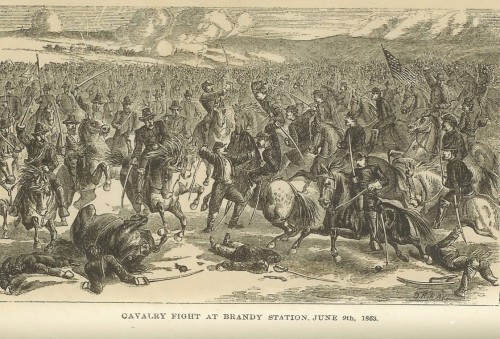
Cav Fight at Brandy Station

Friends of Padre Steve’s World,

Today I take a look back at the battle of Brandy Station, the largest cavalry battle every fought on the North American continent. This is a section of my draft Gettysburg campaign text.

Have a great day,

Peace

Padre Steve+

Movement to attain operational reach and maneuver are two critical factors in joint operations. In the time since the American Civil War the distances that forces move to engage the enemy, or maneuver to employ fires to destroy his forces have greatly increased. Movement may be part of an existing Campaign Plan or Contingency Plan developed at Phase 0; it also may be part of a crisis action plan developed in the midst of a campaign. Lee’s movement to get to Gettysburg serves as an example of the former, however, since his forces were already in contact with the Army of the Potomac along the Rappahannock and he was reacting to what he felt was a strategic situation that could not be changed but by going on the offensive that it has the feel of a Crisis Action Plan. Within either context other factors come into play: clarity of communications and orders, security, intelligence, logistics and even more importantly the connection between operational movement and maneuver; the Center of Gravity of the enemy, and national strategy. Since we have already discussed how Lee and the national command authority of the Confederacy got to this point we will now discuss the how that decision played in the operational and tactical decisions of Lee and his commanders as the Army of Northern Virginia began the summer campaign and the corresponding actions of Joseph Hooker and the his superiors in Washington.

“One of the fine arts of the military craft is disengaging one’s army from a guarding army without striking sparks and igniting battle.” [1] On June 3rd 1863 Robert E. Lee began to move his units west, away from Fredericksburg to begin his campaign to take the war to the North. He began his exfiltration moving Second Corps under Richard Ewell and First Corps under James Longstreet west “up the south bank of the Rappahannock to Culpepper, near which Hood and Pickett had been halted on their return from Suffolk.” [2] Rodes’ division of Second Corps followed on June 4th with Anderson and Early on June 5th. Lee left the three divisions of A.P. Hill’s Third Corps at Fredericksburg to guard against any sudden advance by Hooker’s Army of the Potomac toward Richmond. Lee instructed Hill to “do everything possible “to deceive the enemy, and keep him in ignorance of any change in the disposition of the army.” [3]

The army was tremendously confident as it marched away from the war ravaged, dreary and desolate battlefields along the Rappahannock “A Captain in the 1st Virginia averred, “Never before has the army been in such a fine condition, so well disciplined and under such complete control.” [4] Porter Alexander wrote that he felt “pride and confidence…in my splendid battalion, as it filed out of the field into the road, with every chest & and ammunition wagon filled, & and every horse in fair order, & every detail fit for a campaign.” [5] Another officer wrote to his father, “I believe there is a general feeling of gratification in the army at the prospect of active operations.” [6]

Lee’s plan was to “shift two-thirds of his army to the northwest and past Hooker’s flank, while A.P. Hill’s Third Corps remained entrenched at Fredericksburg to observe Hooker and perhaps fix him in place long enough for the army to gain several marches on the Federals.” [7] In an organizational and operational sense that Lee’s army after as major of battle as Chancellorsville “was able to embark on such an ambitious flanking march to the west and north around the right of the army of the Potomac….” [8]

However, Lee’s movement did not go unnoticed; Hooker’s aerial observers in their hot air balloons “were up and apparently spotted the movement.” [9] But Hooker was unsure what it meant. He initially suspected that “Lee intended to turn the right flank of the Union army as he had done in the Second Bull Run Campaign, either by interposing his army between Washington and the Federals or by crossing the Potomac River.” [10] Lee halted at Culpepper from which he “could either march westward over the Blue Ridge or, if Hooker moved, recontract at the Rappahannock River.” [11]

Hooker telegraphed Lincoln and Halleck on June 5th and requested permission to advance cross the river and told Lincoln that “I am of opinion that it is my duty to pitch into his rear” [12] possibly threatening Richmond. Lincoln ordered Hooker to put the matter to Halleck, with whom Hooker was on the worst possible terms. Hooker “pressed Halleck to allow him to cross the Rappahannock in force, overwhelming whatever rebel force had been left at Fredericksburg, and then lunging down the line of the Virginia Central toward an almost undefended Richmond.” [13] On the morning of June 6th Hooker ordered pontoon bridges thrown across the river and sent a division of Sedgwick’s VI Corps to conduct a reconnaissance in force against Hill.

Lincoln and Halleck immediately rejected Hooker’s request. Lincoln “saw the flaw in Hooker’s plan at once” [14] and replied in a very blunt manner: “In one word,” he wrote “I would not take any risk of being entangled upon the river, like an ox jumped half over a fence and liable to be torn by dogs front and rear, without a fair chance to gore one way or kick another.” [15] Halleck replied to Hooker shortly after Lincoln that it would “seem perilous to permit Lee’s main force to move upon the Potomac [River] while your army is attacking an intrenched position on the other side of the Rappahannock.” [16] Lincoln, demonstrating a keen regard for the actual center of gravity of the campaign, told Hooker plainly that “I think Lee’s army and not Richmond, is your objective point.” [17]

The fears of Lincoln and Halleck were well founded. In stopping at Culpepper Lee retained the option of continuing his march to the Shenandoah and the Potomac, or he could rapidly “recall his advanced columns, hammer at Hooker’s right flank, and very possibly administer another defeat even more demoralizing than the one he suffered at Chancellorsville.” [18] Hooker heeded the order and while Hooker maintained his bridgehead over the Rappahannock he made no further move against Hill’s well dug in divisions.

Meanwhile, J.E.B. Stuart and his Cavalry Corps had been at Brandy Station near Culpepper for two weeks. Culpepper in June was a paradise for the cavalry, and with nearly 10,000 troopers gathered Stuart ordered a celebration, many dignitaries were invited and on June 4th Stuart hosted a grand ball in the county courthouse. On the 5th Stuart staged a grand review of five of his brigades. Bands played as each regiment passed in review and one soldier wrote that it was “One grand magnificent pageant, inspiring enough to make even an old woman feel fightish.” [19] The review ended with a mock charge by the cavalry against the guns of the horse artillery which were firing blank rounds. According to witnesses it was a spectacular event, so realistic and grand that during the final charge that “several ladies fainted, or pretended to faint, in the grandstand which Jeb Stuart had had set up for them along one side of the field.” [20] That was followed by an outdoor ball “lit by soft moonlight and bright bonfires.” [21] Stuart gave an encore performance when Lee arrived on June 8th, minus the grand finale and afterward Lee wrote to his wife that “Stuart was in all his glory.” [22]

Hooker received word from the always vigilant John Buford, of the First Cavalry Division on the night of June 6th that “Lee’s “movable column” was located near Culpepper Court House and that it consisted of Stuart’s three brigades heavily reinforced by Robertson’s, “Grumble” Jones’s, and Jenkins’ brigades.” [23] Hooker digested the information and believed that Stuart’s intent was to raid his own rear areas to disrupt the Army of the Potomac’s logistics and communications. The next day Hooker ordered his newly appointed Cavalry Corps Commander, Major General Alfred Pleasanton to attack Stuart.

After Chancellorsville, Hooker had reorganized the Union cavalry under Pleasanton into three divisions and under three aggressive division commanders, all West Pointers, Brigadier General John Buford, Brigadier General David Gregg and Brigadier General Judson Kilpatrick. While Stuart conducted his second grand review for Lee Pleasanton quietly massed his cavalry “opposite Beverly Ford and Kelly’s Ford so as to cross the river in the early morning hours of June 9th and carry out Hooker’s crisp orders “to disperse and destroy” the rebel cavalry reported to be “assembled in the vicinity of Culpepper….” [24] Pleasanton’s cavalry was joined by two mixed brigades of infantry “who had the reputation of being among the best marchers and fighters in the army.” [25] One brigade, commanded by Brigadier General Adelbert Ames consisted of five regiments drawn from XI Corps, XII Corps, and III Corps was attached to Buford’s division. The other brigade, under the command of Brigadier General David Russell was composed of seven regiments drawn from I Corps, II Corps and VI Corps. [26]

Stuart’s orders for June 9th were to “lead his cavalry division across the Rappahannock to screen the northward march of the infantry.” [27] The last thing that Stuart expected was to be surprised by the Federal cavalry which he had grown to treat with distain. Stuart who was at his headquarters “woke to the sound of fighting” [28] as Pleasanton’s divisions crossed the river and moved against the unsuspecting Confederate cavalry brigades.

The resultant action was the largest cavalry engagement of the war. Over 20,000 troopers engaged in an inconclusive see-saw battle that lasted most of the day. Though a draw “the rebels might have been swept from the field had Colonel Alfred N. Duffie, at the head of the Second Division acted aggressively and moved to the sounds of battle.” [29] The “Yankees came with a newfound grit and gave as good as they took.” [30] Porter Alexander wrote that Pleasanton’s troopers “but for bad luck in the killing of Col. Davis, leading the advance, would have probably surprised and captured most of Stuart’s artillery.” [31] Stuart had lost “over 500 men, including two colonels dead,” [32] and a brigade commander, Fitzhugh “Rooney” Lee, General Lee’s son, badly wounded. While recuperating at his wife’s home a few weeks later Lee “was captured by the enemy.” [33] Stuart claimed victory as he lost fewer troops and had taken close to 500 prisoners and maintained control of the battlefield.

But even Confederate officers were critical. Lafayette McLaws of First Corps wrote “our cavalry were surprised yesterday by the enemy and had to do some desperate fighting to retrieve the day… As you will perceive from General Lee’s dispatch that the enemy were driven across the river again. All this is not true because the enemy retired at their leisure, having accomplished what I suppose what they intended.” [34] Captain Charles Blackford of Longtreet’s staff wrote: “The fight at Brandy Station can hardly be called a victory. Stuart was certainly surprised, but for the supreme gallantry of his subordinate officers and men… it would have been a day of disaster and disgrace….” The Chief of the Bureau of War in Richmond, Robert H.G. Kean wrote “Stuart is so conceited that he got careless- his officers were having a frolic…” [35] Brigadier General Wade Hampton had the never to criticize his chief in his after action report and after the war recalled “Stuart managed badly that day, but I would not say so publicly.” [36]

The Confederate press was even more damning in its criticism of Stuart papers called it “a disastrous fight,” a “needless slaughter,” [37]and the Richmond Examiner scolded Stuart in words that cut deeply into Stuart’s pride and vanity:

The more the circumstances of the late affair at Brandy Station are considered, the less pleasant do they appear. If this was an isolated case, it might be excused under the convenient head of accident or chance. But the puffed up cavalry of the Army of Northern Virginia has twice, if not three times, surprised since the battles of December, and such repeated accidents can be regarded as nothing but the necessary consequences of negligence and bad management. If the war was a tournament, invented and supported for the pleasure of a few vain and weak-headed officers, these disasters might be dismissed with compassion, But the country pays dearly for the blunders which encourage the enemy to overrun and devastate the land, with a cavalry which is daily learning to despise the mounted troops of the Confederacy…” [38]

But the battle was more significant than the number of casualties inflicted or who controlled the battlefield at the end of the day. Stuart had been surprised by an aggressively led Union Cavalry force. The Union troopers fought a stubborn and fierce battle and retired in good order. Stuart did not appreciate it but the battle was a watershed, it ended the previous dominance of the Confederate Cavalry arm. It was something that in less than a years’ time would cost him his life.

Notes

[1] Sears, Stephen W. Gettysburg, Mariner Books, Houghton Mifflin Company, Boston and New York, 2003 p.59

[2] Foote, Shelby, The Civil War, A Narrative. Volume Two Fredericksburg to Meridian Random House, New York 1963 p.436

[3] Trudeau, Noah Andre. Gettysburg: A Testing of Courage, Harper Collins Publishers, New York 2002 p.25

[4] Wert, Jeffry D. A Glorious Army: Robert E. Lee’s Triumph 1862-1863 Simon and Schuster, New York and London 2011 p.218

[5] Alexander, Edward Porter. Fighting for the Confederacy: The Personal Recollections of General Edward Porter Alexander edited by Gary Gallagher University of North Carolina Press, Chapel Hill 1989 p.221

[6] Ibid. Wert A Glorious Army p.219

[7] Ibid. Sears Gettysburg p.60

[8] Korda, Michael. Clouds of Glory: The Life and Legend of Robert E. Lee Harper Collins Publishers, New York 2014 p.530

[9] Ibid. Foote The Civil War, A Narrative. Volume Two p.436

[10] Wert, Jeffry D. The Sword of Lincoln: The Army of the Potomac Simon and Schuster, New York and London 2005 p.260

[11] Dowdy, Clifford. Lee and His Men at Gettysburg: The Death of a Nation Skyhorse Publishing, New York 1986, originally published as Death of a Nation Knopf, New York 1958 p.37

[12] Ibid. Sears Gettysburg p.61

[13] Guelzo, Allen C. Gettysburg: The Last Invasion Vintage Books a Division of Random House, New York 2013 p.50

[14] Ibid. Wert The Sword of Lincoln p.260

[15] Fuller, J.F.C. Decisive Battles of the U.S.A. 1776-1918 University of Nebraska Press, Lincoln 2007 copyright 1942 The Royal Society for the Prevention of Cruelty to Animals p.223

[16] Ibid Trudeau Gettysburg a Testing of Courage p.26

[17] Ibid. Guelzo Gettysburg: The Last Invasion p.50

[18] Coddington, Edwin B. The Gettysburg Campaign: A Study in Command, A Touchstone Book, Simon and Schuster New York, 1968 p.53

[19] Davis, Burke J.E.B. Stuart: The Last Cavalier Random House, New York 1957 p.304

[20] Ibid. Foote The Civil War, A Narrative. Volume Two p.437

[21] Ibid. Sears Gettysburg p.63

[22] Ibid. Wert A Glorious Army p.221

[23] Ibid. Coddington The Gettysburg Campaign p.54

[24] Ibid. Sears Gettysburg p.64

[25] Ibid. Coddington The Gettysburg Campaign p.54

[26] Petruzzi, J. David and Stanley, Steven The Gettysburg Campaign in Numbers and Losses: Synopses, Orders of Battle, Strengths, Casualties and Maps, June 9 – July 1, 1863 Savas Beatie LLC, El Dorado Hills CA 2012 p.7

[27] Ibid. Sears Gettysburg p.64

[28] Ibid. Davis JEB Stuart p.306

[29] Ibid. Wert The Sword of Lincoln p.261

[30] Wert, Jeffry D. General James Longstreet The Confederacy’s Most Controversial Soldier, A Touchstone Book, Simon and Schuster, New York and London 1993 p. 251

[31] Ibid. Alexander Fighting for the Confederacy p.223

[32] Ibid. Davis JEB Stuart p.310

[33] Ibid. Wert A Glorious Army p.221

[34] Ibid. Coddington The Gettysburg Campaign p.59

[35] Ibid. Davis JEB Stuart p.310

[36] Ibid. Coddington The Gettysburg Campaign p.60

[37] Ibid. Guelzo Gettysburg: The Last Invasion p.57

[38] Ibid. Davis JEB Stuart p.311-312
Leave a comment

Filed under civil war, Gettysburg, History, leadership, Military

Tweeting His Way to Oblivion: Trump’s Tweets and Terrorism

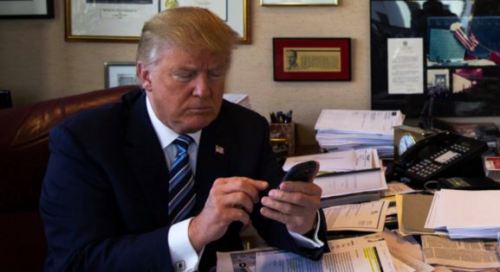
trump-tweeting

Friends of Padre Steve’s World,

So far this has been a very troubling couple of weeks. First there was the murder of a newly commissioned African American United States Army lieutenant by a White Supremacist in Maryland. Then in Portland Oregon, the murder of two men and wounding of another who stepped between a crazed White Supremacist and his intended Muslim victims. Across the “Pond” in Britain there was the horrific suicide bombing of the Ariana Grande concert in Manchester and the crazed attack on the London Bridge and a nearby restaurant district. To keep on point let’s not even go into domestic American politics, the growing controversy regarding the Trump-Russia intrigue, and the continued North Korean threat, and the emerging crisis among the Gulf States, and Trump’s withdraw from the Paris Climate accords, although all of them are important and worthy of our attention.

These were all terrorist attacks done by people with racial or religious motives and in the case of the Oregon attacker maybe a combination of both. But the response by the President was markedly different. The White supremacist attacks received almost no attention from the official White House sources and none from the President, even on his incredibly active personal Twitter account which he used repeatedly to voice his opinions about the Manchester and London attacks. Sadly, his tweets about London were most embarrassing focusing on his domestic agenda, his attacks on the courts, and personal attacks and criticism of London’s mayor. As someone who had been a life-long Republican until my return from Iraq in 2008 I could not imagine Ronald Reagan, George H.W. Bush, George W. Bush, or Gerald Ford doing anything similar, nor could I have imagined Dwight Eisenhower, Barry Goldwater, Bob Dole, Mitt Romney, or even Richard Nixon diminishing the office as badly as President Trump has done.

Long before Trump was elected I knew that we were in trouble should he become President, I wrote about that last week. After he was elected I said I would pray for him and hope that his Presidency would benefit Americans and the world with the caveat that I prayed that he wouldn’t do anything to screw things up too badly. Sadly, he is well on the way to doing just that both at home and abroad and I cannot see him changing course, he seems to relish destroying the heritage of the country, grinding our ideals into the mud, destroying our alliances, and making us a pariah nation. Now I can only hope that either through impeachment or the use of the 25th Amendment that he will be removed from power. But if that happens I expect him to call his most ardent supporters to arms and violent opposition.

So anyway, we’ll see what happens next.

Peace

Padre Steve+

1 Comment

Filed under leadership, News and current events, Political Commentary

A Bridge Too Far: History, Dissent, and North Korea

51dQcS0yiEL._SX355_

Friends of Padre Steve’s World,

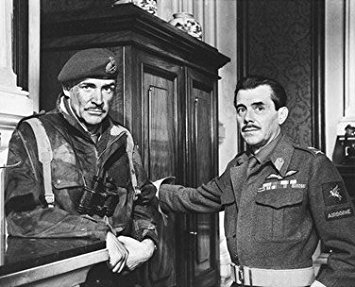
Major General Urquhart: I took 10,000 of our finest troops to Arnhem; I’ve come back with less than 2,000. I don’t feel much like sleeping.

Lt. General Frederick “Boy” Browning: I’ve just been on to Monty. He’s very proud, and pleased.

Major General Urquhart: [incredulous] PLEASED!

Lt. General Frederick “Boy” Browning: According to himself, technically, Market Garden was 90% successful.

Major General Urquhart: But what do YOU think?

Lt. General Frederick “Boy” Browning: Well, as you know, I always felt we tried to go a bridge too far…

Yesterday was our first full day back after our Memorial Day outing to Bethany Beach, a day of work as well as catching up. After our day of taking care of business we went and spent time with our friends at Gordon Biersch and then adoring our Papillon pups, I put on the classic film A Bridge too Far as a belated Memorial Day remembrance. For me as a veteran of Iraq the film conjures up images of heroic sacrifices of men and women who died or became victims of a plan gone wrong.

The film if you haven’t seen it depicts the failed Allied attempt of September 1994 to liberate the Netherlands, cross the Rhine and end World War Two by Christmas. It was a plan that depended much on luck, and ignored the capabilities of the Germans, who the Allies for the most part already believed had been beaten following the campaign in Normandy and the dash across France.

Despite the weakness of the Germans he Allied plan came close to succeeding yet failed and in doing so prolonged the war and inflicted much more suffering on the people of the Netherlands who were not liberated until the end of the war. The failure was one of a failed operational plan that had strategic consequences.

In the past few days I have been become even more concerned about the situation on the Korean Peninsula and the risks of a war that could have worldwide implications, and none of them good. Secretary of Defense Mattis warned of a potential catastrophe, even as the USS Nimitz departed the West Coast to join the USS Carl Vinson and USS Ronald Reagan in the operational area while the North Koreans launched more missiles. The concentration of three carrier battle groups, even for a short time provides the President a massive amount of military power in the region should he decide to launch a preemptive strike as he has more than once spoken about. The fact is that if war breaks out that the casualties will be in the hundreds of thousands if not millions, and that is if the war stays contained to the Korean Peninsula.

I am also concerned that a war with North Korea could be the pretext for the Trump administration to sharply curtail civil liberties at home including the freedom of speech and of political opposition. Be assured that if war breaks out on the Korean Peninsula that these rights will be suppressed and that anyone who opposes the government in  any way whatsoever will be labeled as a defeatist, traitor, or worse. We have seen the same pathology after the 9/11 attacks when those who were not opposed to actions agains Al Qaida were condemned because they opposed the expansion of the war into Iraq. I know this because I was one of those people who condemned these people; and sadly in retrospect in their condemnation of the invasion of Iraq they they were more patriotic than me because I supported it, knowing the dangers.

As far as the Allies were concerned Operation Market Garden was a delay in their plans to invade Germany proper, but for the Germans it was a pyrrhic victory which doomed more of their soldiers, civilians, and their victims to death. The Allied efforts were considered a part of a more righteous cause, while for the most part the German people remained under the spell of Hitler until the end, and even then those who opposed or even were thought to be “defeatists” in Germany were considered to be as bad or worse than the enemies of the Third Reich.

Milton Mayer who wrote the book They Thought They Were Free: The Germans 1933-1945 described the thoughts of a German academic colleague in 1955. Mayer’s friend said:

“Once the war began,” my colleague continued, “resistance, protest, criticism, complaint, all carried with them a multiplied likelihood of the greatest punishment. Mere lack of enthusiasm, or failure to show it in public, was ‘defeatism.’ You assumed that there were lists of those who would be ‘dealt with’ later, after the victory. Goebbels was very clever here, too. He continually promised a ‘victory orgy’ to ‘take care of’ those who thought that their ‘treasonable attitude’ had escaped notice. And he meant it; that was not just propaganda. And that was enough to put an end to all uncertainty.

“Once the war began, the government could do anything ‘necessary’ to win it; so it was with the ‘final solution of the Jewish problem,’ which the Nazis always talked about but never dared undertake, not even the Nazis, until war and its ‘necessities’ gave them the knowledge that they could get away with it. The people abroad who thought that war against Hitler would help the Jews were wrong. And the people in Germany who, once the war had begun, still thought of complaining, protesting, resisting, were betting on Germany’s losing the war. It was a long bet. Not many made it.”

That is something I worry about every day here as the Trump administration, facing failure on so many fronts, and under investigation of things that if any of the rest of us had even been accused of them would be considered treasonous, may embark on a war to save itself and at the same time use the extraordinary nature of such a conflict to consolidate power and crush dissent. That may sound far fetched, but all of his actions and words, as a candidate for President, as the President-Elect, and as President point in that direction and his most faithful followers show that they will even commitment treasonous acts and in some cases even resort to violence and murder to support him.

Trust me I want to be wrong about this more than anyone can imagine, but I cannot get rid of the feeling I have in my gut nor the terrible nightmares I have about this several times a week. I wonder if the Trump administration will gamble on an easy victory to end a very real North Korean threat to the region. If they do there will be no good outcome and we may lose freedoms that we never dreamt possible to lose.

If such an action does not succeed will the President then as he always does that his failure was a success? Will he pronounce like Field Marshal Montgomery that the failed attack was 90% successful or even more? And what of his military advisors? I dare not even attempt to answer that question anymore.

So until tomorrow I must ponder the words of General John Buford played by Sam Elliott in the film Gettysburg: 

“Devin, I’ve led a soldier’s life, and I’ve never seen anything as brutally clear as this. It’s as if I can actually see the blue troops in one long, bloody moment, goin’ up the long slope to the stony top. As if it were already done… already a memory. An odd… set… stony quality to it. As if tomorrow has already happened and there’s nothin’ you can do about it. The way you sometimes feel before an ill-considered attack, knowin’ it’ll fail, but you cannot stop it. You must even take part, and help it fail.”

Like I said, I want more than anything to be wrong about all of this but I fear that I am not and I cannot shake that feeling. So until tomorrow,

Peace

Padre Steve+

1 Comment

Filed under film, History, leadership, Military, nazi germany, News and current events, Political Commentary, world war two in europe

A Man’s Got to Know His Limitations: Reflections on the Ignorance and Incompetence of the President and his Enablers

Friends of Padre Steve’s World,

Our President is a businessman, a man who claims all sorts of achievements but never owns up to his repeated failures, whether they be business, moral, personal, or now his often demonstrated gross incompetence as President.

We have long known that the President both narcissistic and paranoid character traits. Anyone who has observed his antics over the years has seen them displayed time and time again; but he has covered those character flaws with his self-promotion of his business acumen and superior leadership that make him the ultimate deal-maker, and he did such a great job of marketing that myth that many people actually believed it to be true. This certainly was a factor in his election.

As a businessman at the helm of his family owned empire it was easy for him to promote the myth, but now he is attempting to run the government of the most powerful nation on earth as if it were that business, rules seemingly do not apply to him, he behaves as if he is above the law, and many of his followers treat him as if he is the law. Trump and his followers are acting out the Fuhrer Prinzip or leader principle of Adolf Hitler before our eyes and people who should know better are allowing it to happen.

Rudolf Hess said of Hitler something I have heard repeated by Trump propagandists and Evangelical preachers who support Trump: “Hitler is Germany and Germany is Hitler. Whatever he does is necessary. Whatever he does is successful. Clearly the Führer has divine blessing.” I have lost count of the number of times I have seen and heard people say similar things about the President. Even members of Republican Congressional leaders seem willing to surrender their branch to the whim of the Trump’s executive, as House Majority Leader Kevin McCarthy said just a week ago that Congress “serves at the pleasure of the President.”  I’m sorry but the Congress is not the Reichstag of 1933 but rather a co-equal branch of government as founders in their wisdom made it in the Constitution. But many other Republicans in Congress, in statehouses, in the right wing propaganda machine and on the street seem willing to concede Hess’s understanding of Hitler’s rule to Trump. What Trump does is necessary, it is right, and for many of his Evangelical Christian followers it has the blessing of God.

And Trump himself approves of this adulation, and he believes it; in fact he revels in it with every tweet and every interview that he gives. There is nothing that he does in his mind that is not the best, the greatest, or whatever superlative he decides to attach to his action of the moment. He had no capacity of reflection, no tolerance for dissent, and no ability to even receive constructive criticism from his advisers. He demonstrates that he is incompetent when it comes to governance, that he is ignorant of the Constitution, of history, and of policy; and he is too arrogant and ignorant to recognize this fact. The latest exposure of classified information to the Russians, intelligence which reportedly came from Israel regarding the Islamic State, shows how reckless and incompetent that he is. It may not have been illegal, but it certainly wasn’t smart, and the act probably violated his Oath of Office. I honestly don’t think that he set out to do that but he has no impulse control, he needs to show that he is important, and he needs to show off that importance by bragging about what he knows, and now that he has done it and has been exposed he rushes to justify the action and send out his aides to defend it because he cannot be wrong, the Fuhrer must always be right. Those who do his bidding will one day find out like members of the German military, civil service, police, and even the SS that ultimately that their loyalty to the Fuhrer cannot and will not be repaid, and that their reputation and honor will forever be soiled.

Back in August 50 Republican National Security experts wrote this public letter to express their concern about the President.

In our experience, a President must be willing to listen to his advisers and department heads; must encourage consideration of conflicting views; and must acknowledge errors and learn from them. A President must be disciplined, control emotions, and act only after reflection and careful deliberation. A President must maintain cordial relationships with leaders of countries of different backgrounds and must have their respect and trust. In our judgment, Mr. Trump has none of these critical qualities. He is unable or unwilling to separate truth from falsehood. He does not encourage conflicting views. He lacks self-control and acts impetuously. He cannot tolerate personal criticism. He has alarmed our closest allies with his erratic behavior. All of these are dangerous qualities in an individual who aspires to be President and Commander in-Chief, with command of the U.S. nuclear arsenal.

The President has so deceived himself over the course of his life that he honestly believes that he understands everything better than anyone while failing to recognize his own limitations. As “Dirty Harry Callahan” once said, “a man’s got to know his limitations.” Our President neither knows his nor cares, and will continue to do so until his incompetence destroys him or possibly our nation as well.

So until tomorrow,

Peace

Padre Steve+

3 Comments

Filed under History, leadership, nazi germany, News and current events, Political Commentary

The Blatant Power Grab of Trump the Authoritarian

Donald_Trump_official_portrait-e1485268487326-500x412

Friends of Padre Steve’s World,

The meaning of President Trump’s firing of FBI Director James Comey is rapidly becoming apparent to all but the most ideologically blinded Trump partisan. In response to a growing investigation by the FBI that he could not control, the President opted to go nuclear in a sense by removing Comey who coincidently had just days before requested more money in order to expand the investigation of Russian interference in the American elections and by necessity investigate all the members of Trump’s inner circle with Moscow connections. The idea that Comey’s investigation was closing in on Trump and his inner circle ands that Comey, despite undermining the campaign of Hillary Clinton had no personal loyalty to Trump sent shivers through the spine of Trump and his aides and caused Trump to rage against Comey in the days leading up to the firing.

Trump’s ham-fisted attempt to play this off as his response to reports from the Justice Department have already been proven to be lies. But Trump does not seem to really care. He knows that he never had a mandate from a majority of the American people and that his popularity is the lowest of any president at this point in their administration. Instead of trying to do the things that would help him gain a mandate and the approval of the voters he is moving into the realm of the authoritarian who must seize the instruments of state power, especially national policing agencies like the Justice Department, the FBI, and the Department Homeland Security by removing potential adversaries in them and filling them with loyalists. But Rump does not care how bad this looks, because he does not care. Russian chess master and dissident Gary Kasparov noted yesterday:

As if to emphasize how little he cares about optics, Trump followed up the Comey firing by meeting with the Russian foreign minister and ambassador at the White House the very next day. American media was blocked from attending, but Russian photographers were there to capture the three men’s beaming smiles. Trump looked in his element, no doubt boasting about flexing his power the way Putin might.

I’m sure they have much else to talk about. Trump would love to turn the FBI into a personal security and intelligence force to use against his enemies, the way Putin uses the FSB in Russia and abroad.

The good thing is that Trump has the attention span of a gnat and the intellectual curiously of a sloth when it comes to understanding and working within the Constitutional system of the United States. This has meant that he has left many presidentially appointed positions throughout the Federal Government unfilled. Call it laziness or incompetence, it does not help him and hopefully will undermine his efforts to wrest even more power in order to protect and enrich himself and his allies.

Even so, for an authoritarian the most important agencies to control are those which control law enforcement, not even the military, for the military is of little use in domestic politics, but police agencies are of great value. This is why Hitler focused his efforts on controlling the state security apparatus of the Interior Ministry, the Prussian Interior Ministry, and the Police, especially the Secret Police when he took power. It is the same reason that Stalin relied of the predecessor of the KGB, the NKVD as the instrument of his Communist Party and military purges, his campaigns of starvation in the Ukraine and Belarus, and ethnic cleansing throughout the various Soviets.

For a paranoid authoritarian leader who views any opposition as a potential threat and any opponent an enemy, the instruments of state security are the most important. To do this he, like all authoritarians must cultivate chaos and present themselves as the only solution to maintain order emphasizing the supposedly exceptional nature of the times. This is seen in the President’s flood of executive orders in which he tells Federal agencies exactly what laws he wants enforced and those that he does not.

We have not seen the end of President Trump’s attempts to gain more power though extraordinary means and to eliminate opposition to his policies within the government. As he feels more threatened expect this trend to accelerate. If he cannot get what he wants expect him to leave a path of destruction in his wake, that is the way of the authoritarian. Our watchword must be vigilance, and those who occupy positions within the bureaucracy must uphold their duties to the Constitution and the country over their political affiliation, and this is doubly true for the Republican members of Congress who will either roll over and surrender their constitutional obligations to allow Trump more power, or must stand on principle for the Constitution if the Republic is to survive. Many people are afraid and adopting the cynicism and attitude of inevitability necessary for Trump the authoritarian to succeed. Timothy Snyder righty noted:

For us, the lesson is that our natural fear and grief must not enable the destruction of our institutions. Courage does not mean not fearing, or not grieving. It does mean recognizing and resisting terror management right away, from the moment of the attack, precisely when it seems most difficult to do so.”

Those serving in the military during times like these also need to remember and heed the words of General Ludwig Beck who resigned his office rather than to lead an attack on Czechoslovakia, and who would die in the attempt to overthrow Hitler in 1944:

“It is a lack of character and insight, when a soldier in high command sees his duty and mission only in the context of his military orders without realizing that the highest responsibility is to the people of his country.” 

Likewise Congress and law enforcement must investigate because it is their duty under the Constitution. Kasparov noted: 

If the rule of law and the separation of powers are to mean anything in the U.S., an independent investigation into Trump’s Russia ties and his finances is more critical now than ever. It won’t be easy, but it’s only going to get harder. Trump will keep finding new ways to accrue power — and he won’t care at all how bad it looks:

So until tomorrow,

Peace

Padre Steve+


2 Comments

Filed under History, leadership, News and current events, Political Commentary

Understanding the Actions Ordinary Men: Perpetrators of Genocide

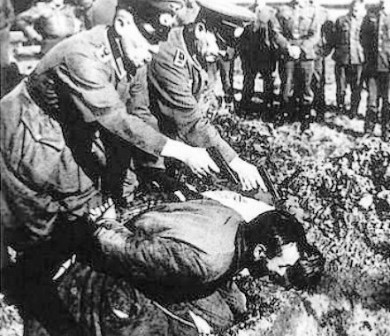
Ordungspolizei Executing Jews in Poland

Friends of Padre Steve’s World,

The great American theologian and philosopher Reinhold Niebuhr wrote: “Ultimately evil is done not so much by evil people, but by good people who do not know themselves and who do not probe deeply.”

I just finished re-reading Christopher Browning’s classic book on an often overlooked part of the Holocaust in Poland, Ordinary Men: Reserve Police Battalion 101 and the Final Solution  in Poland. As I read it I was reminded of Niebuhr’s words. The book details the actions of the men of a police unit that one would have expected to be the most unlikely perpetrators of violence and mass killing. Most of the unit’s men were not ardent Nazis or even party members, many were too old to have been drafted into the military, and most came of age long before the Nazis took control of the education system.  They were mostly from Hamburg, one of the least Nazified of all major German cities, and included was a contingent from Luxembourg, a country that was not part of Germany.

In their actions in Poland an estimated ten to twenty percent refused to take part in the mass killings of Jews. Unlike the people who manned the factory like death camps such as Treblinka and Auschwitz, these men killed their victims in an exceedingly personal manner. They stood at close range and fired pistol or rifle shots into the back of the skulls of their victims, who mostly were kneeling over pits or prostrate on the ground. The members of the unit killed a minimum of 38,000 Jews in this manner, and were instrumental in the deportations of about 45,000 more to the death camps. Very few were prosecuted for their crimes. Most went home, and some resumed successful careers in the police.

These men were very ordinary, and that is what makes what they did so troubling. One of the problems with human nature is that people in any time or place can participate in the very kinds of evil that the men of Reserve Police Battalion 101 and other units like it did. We have to understand what allows normal people to take part in evil. As Timothy Snyder wrote in his book Bloodlands: Europe Between Hitler and Stalin:

“It is easy to sanctify policies or identities by the deaths of victims. It is less appealing, but morally more urgent, to understand the actions of the perpetrators. The moral danger, after all, is never that one might become a victim but that one might be a perpetrator or a bystander.”

It is never easy to examine and understand the actions of the perpetrators. To understand them is not to justify them, but to ensure that we do not become like them, as Yehuda Bauer wrote:

“The horror of the Holocaust is not that it deviated from human norms; the horror is that it didn’t. What happened may happen again, to others not necessarily Jews, perpetrated by others, not necessarily Germans. We are all possible victims, possible perpetrators, possible bystanders.”

Until tomorrow,

Peace

Padre Steve+

2 Comments

Filed under History, holocaust, leadership, Political Commentary

Infallibility, Narcissism, and Paranoia

Friends of Padre Steve’s World,

Once again  just a short thought to ponder. Hannah Arendt wrote: “The chief qualification of a mass leader has become unending infallibility; he can never admit an error.”

This statement is undeniably true. Hitler, Stalin, Mao, Castro, the Ayatollahs, and Pol Pot are just some examples. More troubling is that such personalities are not absent today, Vladimir Putin, Marianne LePen, and our own President display this tendency, and their most devoted followers embrace it as well.

In the case of President Trump, presidential power means never having to say your sorry, or made a mistake. Failures are blamed on others, Congressional leaders, former President’s Obama and Bush, journalists, and even advisors who have outlasted their usefulness, case in point, Michael Flynn.

The inability to admit error is dangerous, but it also points to other potentially severe psychological issues. It is one of the characteristics of a paranoid personality, as well as a narcissistic personality. Richard Hofstadter wrote:

“The idea of the paranoid style as a force in politics would have little contemporary relevance or historical value if it were applied only to men with profoundly disturbed minds. It is the use of paranoid modes of expression by more or less normal people that makes the phenomenon significant.”

Likewise, even if those characteristics do not reach the point of becoming an actual psychological disorder, they can be severe enough to impair sound judgment as a leader, and lead to potentially terrible decisions. History shows us this all too often. These kinds of leaders see the world as a threatening place, full of enemies, real and imagined. The destruction of their enemies is of the first importance to such leaders, even when it is detrimental to the nations that they lead.

So until tomorrow,

Peace

Padre Steve+


2 Comments

Filed under History, leadership, Political Commentary

Truth Deniers: The Fundamentalist Idolatry of Preachers

Friends of Padre Steve’s World,

As I mentioned yesterday things have been quite busy and unsettled around here so I won’t be writing a lot today. That being said, I want to mention a comment that a fundamentalist Christian come to my Facebook page and send me a direct message excoriating me for a very considered article that I wrote about the death of the Reverend David Wilkerson a number of years ago after he drove his car into an oncoming truck.

It was a difficult article to write. As someone who admired David Wilkerson yet did not idolize him I took the time to read his blog posts, and then obtain the State Police accident reports, accident photos, and autopsy results. My conclusion based on the evidence, and my experience doing accident investigation when I was in the Army was that Wilkerson had to have intentionally driven into the oncoming truck. The police reports, the photos, and his own words all pointed to it. Honesty, I would have preferred to have discovered that the car had a mechanical issue, or that he had a medical event that caused him to veer into the oncoming truck, but the evidence did not show that. Instead, it showed that on a clear day, on a strait road, that he drove directly into an oncoming tractor-trailer rig, ending his life and fatally injuring his terminally ill wife.

Over the years I have had quite a few Evangelical Christians come to this site as well as my Facebook page to attack me, condemn me to Hell, and do everything but to dispassionately examine the evidence and come to a conclusion. The problem is that I took down the idol that they made of a good man, a man who did many good things, but who also had feet of clay, who like his wife was suffering from serious medical issues, and who had recently suffered the betrayal of the people that he had helped to promote to senior leadership at Times Square Church, people who would have not reached their positions without his help and assistance.

The problem is that David was a fundamentalist, and he had written a small polemic book about suicide being an unforgivable sin. I have the book, I read it before I wrote the article. Personally I don’t think that God will condemn to Hell a suffering person who makes a tragic choice such as suicide. There were many things that I admired David for and others that I disagreed with him, suicide was one of them.

Yesterday I got a personal message from another of his idolators who blasted me every which way but loose. Instead of responding like I have done in the past I realized that no words of mine would change this person’s opinion, so I simply deleted it without comment. To me it is no longer worth debating people who refuse to even entertain  possibilities that are at odds with their beliefs about the men they turn into idols.

That is a problem for many Evangelical and Fundamentalist Christians. I have seen too many deny and defends the real crimes of preachers who they have turned into idols. I saw it when I worked for a very well known Fundamentalist televangelist when I was in seminary in the late 1980s and early 1990s and throughout my ministry since then. It doesn’t matter what they do: defraud their followers, be caught in horrendous marital infidelity, abuse of children, and even murder, their followers will defend them to their dying day and then condemn anyone who dares point out inconvenient truths. Pardon me, but that is not Christian, it is idolatry.

To his credit, David Wilkerson did not defraud his flock, he did not cheat on his wife, he did not abuse children, or murder anyone. He appears to have been caught in the terrible throws of depression, hopelessness, and succumbed to the impulse to end his life. There are many people who have also contacted me over the years to share the good things about David and ministry, as well as how he touched their lives who also empathized with the suffering that led him to take his life. I think that demonstrates an appropriate response to the tragic death of someone who did many good things.

Anyway. That’s more than I intended to write and I had no idea how much something that happened almost seven years ago still inspires people to hate and condemn those who however reluctantly destroy their idolatrous image of good but flawed and suffering people. However, I continue to learn that as Lord Dumbledore said: “The truth.” Dumbledore sighed. “It is a beautiful and terrible thing, and should therefore be treated with great caution.”

It is, and some people cannot handle it.

Have a great Saturday.

Peace

Padre Steve+

10 Comments

Filed under faith, leadership, ministry, Pastoral Care, suicide

Transfer into the Twilight

Friends of Padre Steve’s World,

The past couple of days have been pretty hectic as I transfer from the Staff College to be the base chaplain at another base in the local area. I’ll still remain as an adjunct at the Staff College to do the Gettysburg Staff Ride which is a good thing. Now truthfully, I did everything I could think of to get a different assignment. I wanted to do something in the Joint world or at least semi-operationally. My qualifications are many, so being assigned to a base chapel makes me feel like I’m being bumped back to the minor leagues, not because caring for people is not important, but because for promotion it’s not highly valued. Of course since I was passed over for promotion last year it is what I get. In today’s military once you are passed over you’re pretty much done, so I’m still lucky to get to do what I have loved doing for decades. Not many people get that chance, so I am lucky, Like Kevin Costner’s character in Bull Durham, I still get to keep going to the ballpark and getting paid for it.

I spent the last couple of days signing out of all the places that I need to, getting my medical records transferred, taking and passing my latest body composition assessment and physical readiness test, and taking care of last minute things needed to transfer. Then yesterday morning I donned my Service Dress Blues to officially sign in at the new command.

It is interesting because unless something unusual and unexpected happens this will be my last ride and the three or four years I spend in the job will take me to retirement with somewhere between 39 and 40 years of cumulative service in the Army and the Navy. I’ll have a good staff and my goal at this point in my career is to take care of them, and help them to succeed while caring for those committed to our care. I’m an old guy now, there aren’t that many people in the military who have served as long as I have, and most of them are admirals or generals.

I’m kind of reminded of the scene in Bull Durham where Kevin Costner’s character, Crash Davis gets sent from AAA down to single A Durham to help mentor a young pitcher. In frustration he tells the manager:  I’m too old for this shit. Why the hell am I back in A ball?

Joe Reardon: ‘Cause of Ebby Calvin LaLoosh. Big club’s got a hundred grand in him.

Larry: He’s got a million dollar arm, and a five cent head.

Joe Reardon: Had a gun on him tonight. The last five pitched he threw were faster that the first five, He has the best young arm I’ve seen in 30 years. You’ve been around. You’re smart, professional. We want you to mature the kid. We want you to room with him on the road, stay on his case all year. He could go all the way.

Crash Davis: Where can I go?

Joe Reardon: You can keep going to the ballpark, and keep getting paid to do it. Beats the hell out of working at Sears.

Larry: Sears sucks, Crash. Boy, I worked there once. Sold Lady Kenmores. Nasty, whoa, nasty.

So anyway, there are a lot worse alternatives. Until tomorrow,

Peace

Padre Steve+

5 Comments

Filed under Baseball, faith, leadership, Loose thoughts and musings, Military

First Pitches and Last Pitches: The Importance of President Trump’s Failure to Show on Opening Day

Friends of Padre Steve’s World,

Saul Steinberg wrote: “Baseball is an allegorical play about America, a poetic, complex, and subtle play of courage, fear, good luck, mistakes, patience about fate, and sober self-esteem.” This is something about the American character that President Donald Trump does not seem to understand, these are not qualities that he shares. In a rare move for a new President, Trump refused an invitation to throw out the ceremonial first pitch at the Washington National’s Opening Day celebration.

To some people that may seem like a trivial thing, but to me it is yet another indicator of the President’s lack of respect for his office, the institutions of our country, and our greatest traditions. Baseball has always provided a healing balm for our country during various crises and emergencies. During World War Two Franklin Roosevelt said to critics who thought baseball should be shut down for the duration of the war, “I honestly feel that it would be best for the country to keep baseball going.” 

Baseball is important and a good number of our Presidents understood this whether you agreed with their politics or not. President George W. Bush made a couple of observations that President Trump obviously has no understanding about. First there were the personal virtues of the baseball legends, virtues that should inform and inspire anyone, especially a President of the United States. Bush noted:

“Baseball isn’t just the stats. As much as anything else, baseball is the style of Willie Mays, or the determination of Hank Aaron, or the endurance of a Mickey Mantle, the discipline of Carl Yastrzemski, the drive of Eddie Mathews, the reliability of a (Al) Kaline or a (Joe) Morgan, the grace of a (Joe) DiMaggio, the kindness of a Harmon Killebrew, and the class of Stan Musial, the courage of a Jackie Robinson, or the heroism of Lou Gehrig. My hope for the game is that these qualities will never be lost.”

But then there are the practical leadership, management, and political aspects of managing a baseball team that relate directly to anyone in a leadership position. Bush noted: “The most important qualities for a (baseball) manager are to plan for the season and foster a team spirit that encourages hard work and the desire to win. A good president must set clear goals, recruit the best, build a spirit of teamwork, and be willing to share credit and take the blame.”

After the 9-11 attacks President Bush went to Yankee Stadium to throw out the first pitch during Game Three of the 2001 World Series between the New York Yankees and the Arizona Diamondbacks just a few miles from Ground Zero. Despite the fears and warnings of the Secret Service, Bush refused to put on a bulletproof vest, and when he got to the mound he recalled:

“The gravity of the moment never really hit me until the first step coming out of that dugout,” Bush said. “I remembering the noise and it was deafening. I remember looking around the stadium, this giant crowd. Standing on the mound at Yankee Stadium was by far the most nervous moment of my presidency.

Bush understood that this was much more than a game, it was a national symbol, it was something that had to be done where it was done. Billy Crystal recalled “This is a moment. Your politics go away. Here’s the president of the United States, handed this awful baton to run with and he stood up and basically said f— you.” For those watching all over the country and the world it was an electric moment. One can criticize President Bush for many things but not this, that pitch helped the country begin to heal more than any military strike, more than any speech, because it reached back to the virtues of the game that are so enmeshed with the character and the ideals of America.

But since President Trump can’t even show up for the first pitch on opening day, I doubt if he has the capacity to ever inspire anyone in this country to higher ideals and higher. He seems to me more like more like a unscrupulous baseball owner more interested in parting out the team and destroying the franchise to make a short term profit all the while building a garish new stadium to satisfy his need with other people’s money, kind of like the late Margaret Whitton who played the owner of the Cleveland Indians in Major League.

Sadly, the President is not only is his missing and dissing the greatest of American institutions, he his missing out the one game that can actually teach him about politics, as Richard Nixon well understood. You see, Trump’s basic inattention and laziness, his inability to stay focused will destroy his presidency. Nixon said that Trump should heed: “I never leave a game before the last pitch, because in baseball, as in life and especially politics, you never know what will happen.”

So until tomorrow,

Peace

Padre Steve+

4 Comments

Filed under Baseball, History, leadership, News and current events, Political Commentary