

This is another in the historical fiction series that I am writing with the Centurion Longinus, who according to tradition was the Centurion at the Cross who put his lance in the side of Jesus and who would exclaim “Surely this was the Son of God” as Jesus breathed his last.
This chapter takes up where after the Triumphant Entry of Jesus into Jerusalem and it asked an important question regarding a passage of scripture, that of the use of a Greek word for servant which only occurs once in the New Testament, the word Pais. In accent Greek literature the term denotes a homosexual relationship, that of a man with his houseboy. It is used to describe the servant of a Centurion in Matthew 8:6 instead of the usual word for servant Doulos. Certainly the writer of this Gospel would understand that as would his readers. However, most commentators gloss over the passage.
The day after the entry of this Jesus character into Jerusalem was uneventful for Longinus and his fellow Roman officers. Jesus had returned to Bethany after driving out the money changers and other assorted riff-raff out of the Temple but had returned without the tumult of the preceding day, Instead, Jesus with a number of his disciples went to the Temple where he engaged the people and some of the Pharisees in a time of teaching culminating in a series of what Longinus’ Jewish spy said were comments that could be interpreted as threats against the Temple establishment and veiled allusions to Jesus being the Messiah of the Jews.
Jesus left the Temple at the end of the day without incident but Longinus’ spy indicated that the Priests and other religious authorities were discussing ways by which they might rid themselves of this Galilean would be Messiah. Now Longinus and his fellow officers couldn’t care a whit about Jewish religious disputes so long as it did not make their job keeping the peace any more difficult than it already was.
When his spy reported back Longinus briefed Pilate of the simmering tensions. Pilate was with his wife Bernice when he received the report. Pilate did not like what was going on but had no contact with any of the religious leaders from any faction since his arrival and was troubled. His wife warned him in the presence of Longinus “not to have anything to do with that man” and he told Longinus to continue monitoring the situation, He also dispatched a messenger to the commander of the Legion in Caesarea to send reinforcements to Jerusalem just in case things got out of hand. Until then, Longinus, the Primus Pilus, or senior Centurion of the Legion was to help him maintain a close watch on the situation and hopefully keep the situation from boiling over.
After his meeting with Pilate and Bernice, Longinus sat around the tavern in Fortress Antonia with several others of his officers and Centurions from the Legion currently in Jerusalem. His Optio, or second in command Decius, a Roman from his former unit who had accompanied him to Palestine was there, as were two Decurio officers from the cavalry detachment and his Tesserarius, Quentin, a man who held a position much like a First Sergeant. Late in the evening another Centurion came to the tavern. This Centurion, was accompanied by his young servant was in charge of the Century based in Capernaum in Galilee.
The Centurion, Flavius by name ordered an ale from the barkeeper and walked over to the table where Longinus and the other officers sat. After the exchange of formalities Flavius sat with them. His young servant remained at the bar sitting alone.
Longinus had known Flavius for several years and known him to be an honorable man, though he did not necessarily approve of the very “Greek” arrangement that he had with his Pais,* which was common in the Roman and Greek military units, he respected Flavius’s soldiering abilities, leadership and integrity. Flavius and his Century had arrived in Jerusalem the previous night after Jesus had made his entry into the city. Longinus was glad to see Flavius because he felt that an officer stationed in Galilee might be able to shed more light on this man of mystery who had Jerusalem up in arms and so troubled Pilate.
Flavius asked what Longinus knew about Jesus, and Longinus told him what he had seen the day before as well as the information that he had obtained from his own Jewish spy.
Flavius, nodded and then began to tell Longinus and the other officers of his encounter with Jesus a couple of years before in Capernaum of Galilee.
Flavius began: “Longinus my friend, I met this Jesus in Capernaum and he is no ordinary man.” He paused to take a drink and continued as Longinus nodded for him to continue.
“It was a difficult time my friend. My Pais was very ill, sick to the point of death, He lay in our quarters and I heard that the miracle working Rabbi named Jesus was in town. Now, you know my friends that I care not a thing about what these Jews believe but I was desperate and from what I had heard and seen I believed that the Gods had to be with this man.”
Longinus continued to listen and then asked “Why didn’t you go to our Temple and have our Gods intercede for your Pais?”
“My friend I had already done that but my Pais’ condition had worsened. So I found this Jesus fellow as he was entering the city and sent some Jews that I had befriended to him.” He paused. “Those Jews convinced Jesus that I was a friend of the Jews and had done many good things for their community, and this my friend is true.”
“So the Jews helped you contact this Jesus fellow?” asked Decius. Longinus looked at his subordinate disapprovingly and asked Flavius to continue.
“I tell you my friends, this man is like no one that I have ever met, the Gods are certainly with him, whether our Gods or the Jewish God I know not which but he is not a normal Rabbi.”
The officers looked around the table as Flavius continued.
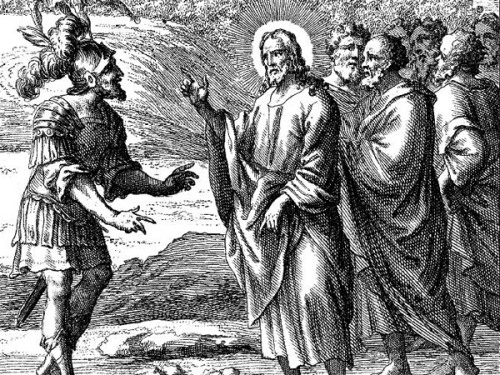
“Gentlemen, when this Jesus came to me I felt something that I have never felt in my life. Jesus asked what he could do for me and I told him of the sickness of my Pais and he asked if he could come to my quarters. I replied that I didn’t need him to come, because I was not worthy for him to come under my roof but to only say the word and my Pais would be healed.”
Longinus looked at his fellow Centurion in disbelief. Flavius sensing this continued. “My friend, I could not believe that I uttered those words but Jesus peered into my eyes and I knew that he knew all about me. Then he replied that “your servant is healed” and then exclaimed to all of the Jews around us that he “had not seen such faith in all of Israel.” Then, he put his hand on my shoulder, blessed me with some Hebrew blessing and walked away with his friends. When I returned to my quarters, my Pais, the young man over at the bar was well.”
Longinus saw the deep emotion that Flavius was expressing and raised his mug. “A toast to this Jesus!, whatever and whoever he he is.”
“Here here” replied those at table as Flavius looked on and several laughed. He had not expected such a reaction and said softly.
“My friends I don’t think you understand.” He paused a second and looked Longinus in the eyes. “I do hope that whatever happens in the next few days that no harm will come to this man. I would hate that my spear could bring harm to him.”
Longinus responded. “I hope that nothing happens to cause any of us any problems. The city is boiling with emotion and unlike your friend Jesus, most of them hate us and would rather see us dead, and some of their leaders from what I understand wouldn’t mind seeing him dead either.” Longinus paused and emptied his mug, drinking the ale to the last and then continued “My friend, I appreciate what you have to say, but we have to do our duty for the Empire regardless of our personal feelings. We are outnumbered here and this Jesus, as much as we may find him fascinating is the source of much of the current discord.” He looked at Flavius. “You do understand this?”
Flavius looked down at his drink and looked back up at Longinus and then at the officers around the table.
“I do understand my duty my friend, but you have to know what he did for me.”
“We do understand my friend” replied Longinus, “but our honor is loyalty to Caesar, not any other man.”
“I know Longinus, I do know, more than you think, but what if he is more than just a man?”
Longinus and the other officers sat silently pondering Flavius’s words. The silence was deafening and slowly the junior officers individually asked to be excused, begging pressing duties to attend to leaving Flavius and Longinus at the table. The bartender brought each man another ale and they continued to drink silently.
To be continued…
Peace
Padre Steve+
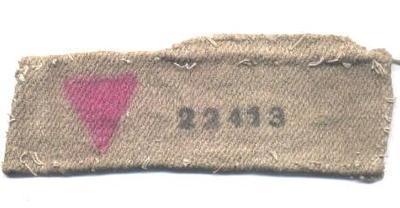
The Greek word Pais is the word used in many Greek texts to to describe a homosexual relationship. The use by Matthew (Mt 8:6) in his account of the healing of the servant of the Centurion used the word Pais to describe the servant, not the typical Doulos which is used for slave or bond servant as is most common throughout the New Testament. In fact this is the only use of the word in the New Testament. Many Biblical scholars and linguists, though not completely certain do entertain that possibility that the Centurion that I call “Flavius” and his servant were a Gay couple.








 The Inglorius Padre Steve's World
Another Year on the Margins of the Church
I have been living on the margins of American Christianity for a bit over seven years now. The watershed moment was when I returned from Iraq in February 2008 my faith shattered and my soul wounded suffering from severe PTSD. I was not in good shape then and two years later after faith returned, albeit in a different form I realized that I no longer fit in the mainstream of conservative American Christianity.
The process of return took me to the margins of the faith that I knew and grew up in. For a while I felt like a victim, but over the course of the years I have discovered a tremendous freedom in living on the margins of the church. Jamake Highwater wrote something that really struck me as true:
“What outsiders discover in their adventures on the other side of the looking glass is the courage to repudiate self-contempt and recognise their “alienation” as a precious gift of freedom from arbitrary norms that they did not make and did not sanction. At the moment a person questions the validity of the rules, the victim is no longer a victim.”
When I began to express some of those changes, which mainly had to do in the manner of how I viewed others I got in trouble. At the time I was part of a pretty conservative Episcopal-Catholic denomination with very strong Evangelical and Charismatic leanings. I wrote that I thought that homosexuals could be Christians and not automatically damned to hell. I wrote that not all Moslems were bad. I expressed a great deal of empathy for non-believers, particularly Atheists and Agnostics having recently come out of a period where for all intents I was an Agnostic praying that God really did exist and care. I also asserted that I saw no reason why women could not or should not be ordained to the Priesthood and the Episcopacy and I expressed other views that while not connected with anything to do in the Christian faith was not politically correct in conservative circles.
During that time period I found that I was getting slammed and “unfriended” on Facebook by people I had previously considered friends whenever I had the nerve to disagree with them, or innocently post something that they disagreed with on my Facebook page. I think that was the hardest part for me, I was shocked that people who I had thought were friends, who knew what I was going through were so devoted to their ideology that they condemned me and threw me away. I found that I agreed with Mahatma Gandhi who observed: “I like your Christ; I do not like your Christians. Your Christians are so unlike your Christ.” Of course I say that with a fair amount of humility because most of the time I am not a very good Christian, if that means actually trying to emulate Jesus.
Of course that is not uncommon in the annals of Christianity. Ulrich Zwingli, the Reformer of Zurich was so upset when his students and closest associates became Anabaptist that he had them drowned in the Rhine River. In fact any time Church leaders have had significant powers over people through the levers of the State they have quite often used that power to crush anyone that did not believe like them or questioned their authority.
In a sense for two millennia various groups of Christians have been creating God in their own image and inflicting their beliefs on others. Christians punishing other Christians for having views that they do not agree is so common. Last week a Chaplain of a Nazarene college was fired for questioning Christian support for war in the wake of the movie American Sniper. Sadly most of the time that Christians are condemned by other Christians it is not even for any of major doctrinal beliefs found in the Creeds, the great Ecumenical Councils of the Church, or even of the various Confessions or Statements of Faith of any denomination. Instead they usually have to with unpopular stands on political or social issues. Anne Lamott has a pithy little thought that I love which I think describes this type of Christian persecution: “You can safely assume you’ve created God in your own image when it turns out that God hates all the same people you do.”
In September of 2010 I was asked to leave that church, even though my actual theological orthodoxy, as to what I believed about God and Christ was unchanged. Thankfully another church, the Apostolic Catholic Orthodox Church, a denomination of the Old Catholic tradition took me in. It is a tiny denomination, much like the Old Catholic Church of the Netherlands, but very affirming and I fit well in it.
As far as my old church, it was going through a difficult time and the Bishop who threw me out was a big part of the problem. He was removed a few months later when it was revealed that he was plotting to take all of the military chaplains out of the denomination to another without consulting the other bishops. One friend who is still in that church speculated that I was asked to leave by the bishop because he thought I might reveal his plans, even though he had not told me directly about them.
What was odd about that church was that in 2004 I was censured by the then second ranking archbishop in that church, forbidden from publishing and even having or having any personal contact with his clergy where I was living because I was “too Catholic.” The irony was that this bishop was a big cause of the trouble that the church went through including the massive splits that occurred in 2005-2010. He left that church, became the editor of a conservative Catholic website and now is a Priest in the Anglican Ordinate and effectively a Roman Catholic Priest. I love irony.
Thankfully I still have a number friends in my old church, and thankfully there are good people there doing their best to live the Gospel. I can’t say that I would fit in there anymore, but I have no residual animosity to the current leadership of that denomination and pray that they continue to recover from the tumult and division that marked their struggle from 2005-2011. I admit that it was a painful time and for a while I was quite bitter about how I had been treated, but it has been easier to live by forgiving. C. S. Lewis noted: “To be a Christian means to forgive the inexcusable because God has forgiven the inexcusable in you.” Since I have been forgiven for so much how can I not at least try to live in a forgiving manner?
I have written a lot about my frustrations with American Christianity in particular the conservative Christian subculture. Looking at what I wrote I can see that I definitely exist on the margins of that world. But that is not a bad thing, there is a certain amount of freedom as well as intellectual honesty and integrity that I have now that I could not have being for all intents closeted in my former denomination.
Living on the margins allows me to echo Galileo who wrote: “I do not feel obliged to believe that the same God who has endowed us with sense, reason, and intellect has intended us to forgo their use.” It allows me to be at the intersection of faith and unbelief and allows me entry into both worlds, both of which I believe to be sacred and both need to be heard, as well as protected.
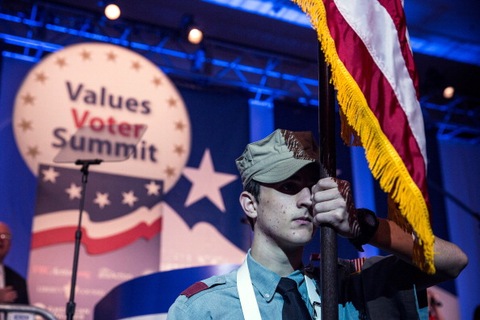
Thus when I champion religious liberty, it is not the liberty to use religion to bludgeon others or to use the police power of the State to enforce their religious views on others. Unfortunately that is what I see going on in this country as conservative American Christians especially Evangelicals, Charismatics and conservative Roman Catholics wage a Kulturkampf against modernism and secularism. It as if many of the leaders of that movement desire to set up a Christian theocracy. Gary North, a longtime adviser to Ron Paul and many in the Tea Party movement wrote:
“We must use the doctrine of religious liberty to gain independence for Christian schools until we train up a generation of people who know that there is no religious neutrality, no neutral law, no neutral education, and no neutral civil government. Then they will get busy in constructing a Bible-based social, political and religious order which finally denies the religious liberty of the enemies of God.”
Personally, and with no invective intended I have to imagine that if a Moslem leader in this country said something similar that the Religious Right would be screaming bloody murder and that Bill O’Reilly and Fox News would be leading the charge.
Thus we see a reprise of the Scopes Monkey Trial in efforts to diminish the teaching of real science in schools and replace it with various religious theories of origins such as Young Earth Creationism. It doesn’t seem to matter what the issue is: equality for women, minorities, gays, teaching science, caring for the poor, the sick and the weak, acknowledging the value of other cultural traditions and religions it seems that many politically charged conservative Christians have no tolerance for anyone outside their often quite narrow belief system. North wrote:
“The long-term goal of Christians in politics should be to gain exclusive control over the franchise. Those who refuse to submit publicly to the eternal sanctions of God by submitting to His Church’s public marks of the covenant–baptism and holy communion–must be denied citizenship, just as they were in ancient Israel.”
I’m sorry but again this sounds not too dissimilar to the Taliban in Afghanistan and Pakistan, without the sheep and the comfortable clothes, or the Moslem Brotherhood types, Hezbollah or the Iranian Imams. The religion of North might be different from the Taliban but the goals are eerily similar, and only a fool would not see that. But then we Christians are quite good at ignoring the hate being preached by those that claim to be defending us from those “evil” Moslems.
This is no empty threat, throughout the country Christian Conservatives and their political front men are ramming through laws that have but one intent, the establishment of a Christian theocracy and the persecution of those who do not agree. Allegedly all of these laws are designed to “protect religious liberty” but in fact are nothing more than a legislative attempt to disenfranchise non-believers or others that the majority does not approve. Unfortunately the people pushing these laws do not understand that once the become law they can be used against them if another group comes into power. They set precedent and under such precedent even Sharia Law could be enacted in Moslem dominated areas of the country, such as Dearborn Michigan, or polygamy in separatist Mormon communities in Utah and Idaho.
I am sorry but that is antithetical to the thoughts of our founders and the real defenders of religious liberty in the early days of our republic. John Leland, head of the Virginia Baptists and a key player in the drafting of the First Amendment and religious liberty protections in Virginia wrote:
“The notion of a Christian commonwealth should be exploded forever…Government should protect every man in thinking and speaking freely, and see that one does not abuse another. The liberty I contend for is more than toleration. The very idea of toleration is despicable; it supposes that some have a pre-eminence above the rest to grant indulgence, whereas all should be equally free, Jews, Turks, Pagans and Christians.”
Leland understood what he was talking about, because in Virginia Baptists and others were being persecuted by Anglicans who before the Revolution had been the State Church of Virginia and wanted to be again in the new republic. James Madison wrote of the danger: “Who does not see that the same authority which can establish Christianity, in exclusion of all other religions, may establish with the same ease any particular sect of Christians, in exclusion of all other sects?”
I will defend the right of religious conservative to believe what they want, including the right to teach it in their churches, church schools and homes and to express those views in the public square as part of real dialogue. I may not agree with them, but if I want my views to be protected I should grant others what I would want. What I cannot support is the attempt of some politically active Christian conservatives to force those views on others through the power of the State, the public schools or any other place where the citizens of our very diverse and pluralistic society have to co-exist.
Likewise, I have become much more outspoken in defending those who are the targets of real Christian hate, in particular the LGBT community, unbelievers, especially atheists and agnostics and Moslems. That may seem odd, but really, if we as Christians do not show God’s love to them, just how do we expect that they will embrace what we believe?
I love the movie Inherit the Wind. I especially love the scene where Spencer Tracy playing the fictionalized version of Clarence Darrow gives a logical yet passionate defense of religious, civil and intellectual liberty.
“Can’t you understand? That if you take a law like evolution and you make it a crime to teach it in the public schools, tomorrow you can make it a crime to teach it in the private schools? And tomorrow you may make it a crime to read about it. And soon you may ban books and newspapers. And then you may turn Catholic against Protestant, and Protestant against Protestant, and try to foist your own religion upon the mind of man. If you can do one, you can do the other. Because fanaticism and ignorance is forever busy, and needs feeding. And soon, your Honor, with banners flying and with drums beating we’ll be marching backward, BACKWARD, through the glorious ages of that Sixteenth Century when bigots burned the man who dared bring enlightenment and intelligence to the human mind!”
Since I don’t want to go back to the 16th Century I will be content to live in the freedom that I have on the margins of contemporary American Christianity. Personally I would rather be there than in the 16th century.
Back in 2010 when I was getting kicked out of my old church and suffering the rejection of friends it wasn’t something that I enjoyed. However, I am grateful to be where I am now and to have the freedom that I enjoy. I certainly didn’t plan it this way, but I am definitely okay with the way things have turned out. Living on the margins of American Christianity beats the hell out of living within the hateful, greedy and oppressive structures that permeate our American Christian landscape.
Peace
Padre Steve+
Share this:
1 Comment
Filed under christian life, civil rights, ethics, faith, LGBT issues, ministry, philosophy, political commentary, Religion
Tagged as ana, anne lamott, bill o'reilly, c s lewis, christian theocracy, clarence darrow, conservative christians, evolution, facebook, facebook friends, fox news channel, galileo, gary north, inherit the wind, james madison, john leland, kulturkampf, mahatma gandhi, PTSD, religious conservatives, religious liberty, science, scopes monkey trial, tea party, ulrich zwingli, unfriended, young earth creationsim