Category Archives: Military

Happy 241st Birthday U.S. Navy: Still a Global Force for Good

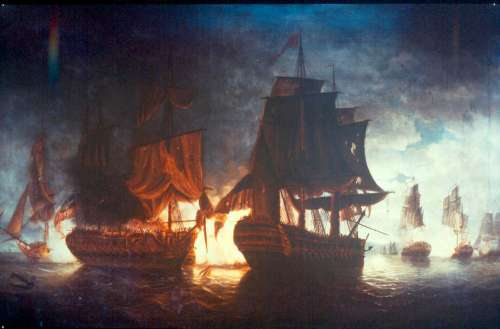
flamborough-head

Friends of Padre Steve’s World,

President Theodore Roosevelt once said “A good Navy is not a provocation to war. It is the surest guaranty of peace.” It is a comment with which I fully concur.

For me anything to do with the United States Navy is historical as well as decidedly personal. Today is the 239th anniversary of the founding of the United States Navy, actually the founding of the Continental Navy but let’s not get too technical.

The fact is that back in 1775 most people and political leaders in the revolting colonies felt that founding a Navy was quite foolish. After all, who in their right mind would ever dare to challenge the might and power of the British Royal Navy?

In fact had General George Washington not sent a letter to the Continental Congress say that he had taken some vessels in hand to disrupt the supplies of the the British Army a Navy might not have ever been established. Timing is everything and in this case it was pretty good timing.

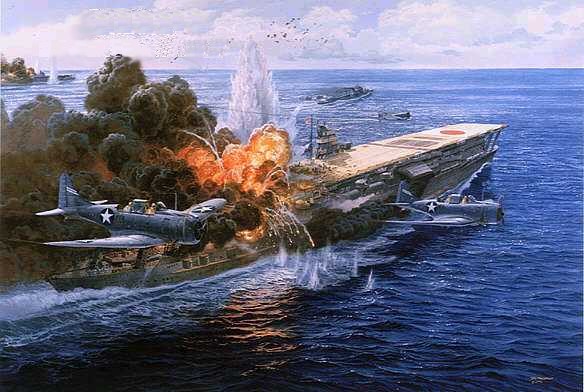
SBDstoastjapcarrier

Since that fortuitous day in 1775 the United States Navy went from being an annoyance to the Royal Navy to the premier naval power in the world. Men like John Paul Jones, Edward Preble Stephen Decatur, Thomas Truxtun, William Bainbridge, Oliver Hazard Perry, David Farragut, David Dixon Porter, George Dewey and many more blazed a path of glory which others, great and small would continue to build on the legacy of the iron men who sailed wooden ships into harm’s way. Men like Arleigh Burke, Howard Gilmore, John C. Waldron, Maxwell Leslie, Bull Halsey, Richard O’Kane, Daniel Callahan, Raymond Spruance, Ernest Evans built upon that legacy in the Second World War. Others would do so in the Cold War, Vietnam and the Global War on Terrorism.

Mobile%20Bay

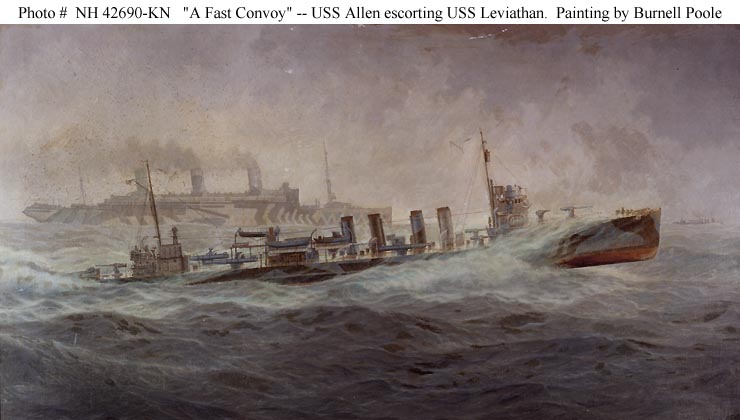
Great ships like the USS Constitution, USS Monitor, USS Kerasarge, USS Olympia, USS Enterprise, USS Hornet, USS Yorktown, USS Growler, USS Tang, USS Hoel, USS Johnston, USS Samuel B Roberts, USS Laffey, USS San Francisco, USS Houston and USS Arizona, USS Nevada, USS West Virginia and USS California helped build a legacy of valiant sacrifice and service often at great cost in the defense of freedom.

h42690k

But over those 241 years it all it came down to the men and now the men and women who served in every clime and place, many times outnumbered and facing certain defeat who through their courage, honor and commitment helped secure the liberty of their countrymen and others around the world. Most of these men and women served in obscurity in war and peace but all had the distinction of serving in the United States Navy.

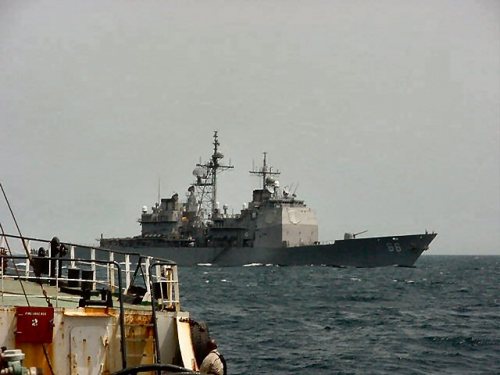
hue-passing-us-on-tanker

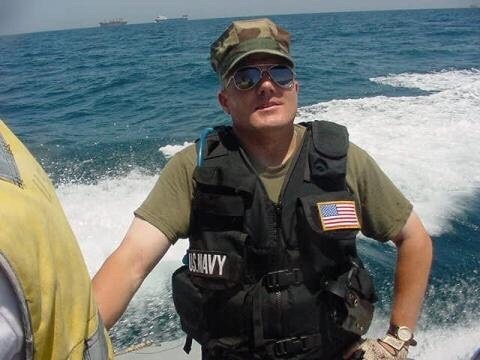
Today the men and women of the United States Navy stand in the forefront of our Nation’s defense and in helping others around the world. Fighting against the Islamic State, Al Qaida and other terrorist organizations, attempting to bring stability to Afghanistan and working with allies and partners around the world to secure the freedom of the seas against pirates and others who attempt to disrupt the commerce on which ours and the world’s economy depends; while being on the front line in another kind of war; providing humanitarian relief in many nations, including battling the spread of Ebola in West Africa. As I write this a Navy task force is providing humanitarian relief to people in Haiti even as other U.S. Navy ships keep the vital maritime choke point of the Bab El Mendeb off the coast of Yemen open to international shipping.

As President John F Kennedy said: “I can imagine no more rewarding a career. And any man who may be asked in this century what he did to make his life worthwhile, I think can respond with a good deal of pride and satisfaction: ‘I served in the United States Navy.’”

img_0218

Like my father before me I can say that I am proud to have served and continue to serve in the United States Navy for the past seventeen years and nine months after having served seventeen and a half years in the U.S. Army. No matter what some may say or think, in this world of uncertainty and turbulence the U.S. Navy remains a global force for good. For that I am proud.

Peace

Padre Steve+

Leave a comment

Filed under History, Military, Navy Ships, US Navy

When Your Vote Will Not Count

provisional-ballot-notice

Friends of Padre Steve’s World,

I wasn’t planning on publishing another article today but this worked me up.

I returned from Germany on Saturday and got my mail today. Among the things I got was my absentee ballot from West Virginia. I opened it and marked it and then found this note. Evidently someone there knowing that I am military and a registered Democrat has challenged my right to vote. Chances are that the person who did this does not know me but rather is a GOP hack who is trying to suppress my vote.

In the last six years West Virginia has made it progressively harder for active duty military personnel to vote. In 2012 i almost was not allowed to vote because I didn’t know that the legislature had changed the law and now require those requesting absentee ballots to request one in every election, if you forget to request one, you don’t vote.

Today I will contact the County Clerk’s office, the Secretary of State office, my State Representative, the Governor, the Democratic Party of West Virginia as well as a number of military and veteran voters organizations. I may even have to get a lawyer. This is voter suppression. An unknown person or entity can challenge your vote and you cannot know who it is or even if your vote counted until after the election.

It’s a foretaste of our totalitarian future of the present bunch of Republicans led by Trump gets power.

I thought that you should know just what power hungry Republicans are willing to do to suppress the vote, even the vote of career active military people who are combat vets simply because they are Democrats. If you are an active duty military person who is a Democrat you had better make sure that your state count’s your vote.

This is war and I won’t go down and let my vote be tossed aside without being heard.

Padre Steve+

7 Comments

Filed under laws and legislation, Military, Political Commentary

Tragic Heroes: Gouverneur Warren Part Five

Friends of Padre Steve’s World

The last installment of my work on Gouverneur Warren.

Peace

Padre Steve+
warren5-5

A Martyr to no Cause at All: Disgrace and Restoration

Among the people that Warren made enemies with during the campaign was his mentor and friend George Gordon Meade. The issue with Meade was particularly serious as Meade seriously considered relieving Warren due to his insubordinate attitude. Meade wrote a letter which he never sent to Grant’s chief of staff Colonel John Rawlins where he acknowledged Warren’s fine traits but also his problems. Meade wrote:

“No officer in the army exceeds Genl Warren in personal gallantry, in activity, in zeal and in sleepless nights, or in devotion to his duties,” Meade wrote- he suffered from a serious “defect” in which he often questioned orders rather than obey them. Such a serious defect Meade wrote, “strikes at the root of all Military subordination, and is entirely out of question that I can command this Army, if each Corps Commander is to exercise a similar independence of action.” [1]

Another enemy made by Warren was Phillip Sheridan, the new commander of the army’s cavalry. The two men were seemingly destined to clash; they had already clashed at Spotsylvania where Warren complained about Sheridan’s performance.  Sheridan never forgave or ever forgot Warren’s justified criticism of him during that battle, and

But the issue really came down to personality and leadership style. Joshua Chamberlain who testified at his board of inquiry testified at it that “Warren gave the impression of a slow, quiet contemplative sort who could not be rushed into decision making. Whether on the march or in battle, he moved at a deliberate pace, refusing to commit himself or his troops until he had time to analyze the situation.” [2]

Chamberlain observed that to someone who did not know Warren, as Sheridan did not that “General Warren’s temperament is such that he, instead of showing excitement, generally shows an intense concentration in what I call important movements…and those who do not know him might take it for apathy when it is deep, concentrated thought and purpose” [3] much of which was rooted in Warren’s strong desire not to sacrifice his men needlessly taking care “to ensure that they were not thrown in to suicidal situations” and he “looked out for their welfare.” [4]

Warren and Sheridan were different types of people and commanders. Warren was an exceptionally intelligent man, one of the brightest in the army and highly regarded in many ways. He was excellent leader of men and he was beloved by his troops, but that being said the traits that were his strengths hindered him in command. He did command from the front, but “his real interest was in the science of command. Warren believed that leading a corps gave him discretion and leeway in carrying out his duties – which often he performed with the smugness of the righteous. It developed that not everyone would be tolerant of either his manner or his philosophy of command – particularly not U.S. Grant.” [5] Nor did Warren have the kind of single minded vision and killer instinct that made Grant, Sherman and Sheridan such brutally effective battlefield commanders. He was “handicapped by the breadth of his vision,” [6] the trait that made him such an effective staff officer which at Little Round Top served the army so well.

After the war Grant praised Warren’s intelligence, earnestness and perceptiveness, but he found in Warren, what he called a “defect which was beyond his control, that which was very prejudicial to his usefulness…” What was the defect? Grant wrote: “could see every danger at a glance before he encountered it. He would not only make preparations to meet the danger which might occur, but he would inform his commanding officer what others should do while he was executing his move.” [7]

Grant had been apprised of the battlefield by a false report of Warren and his troop’s actual location, news that was hours old “told Sheridan to relieve Warren if he judged the Fifth Corps would “do better” under another commander.” Staff officers of Fifth Corps were shocked, and one wrote “General Grant knew that General Sheridan was not a person to be intrusted with such a weapon and not use it.” [8]

sheridan

Major General Phillip Sheridan

Sheridan did use the power Grant had given. Sheridan was still smarting from a setback incurred the previous day where one of Warren’s infantry divisions had to “extricate Little Phil from difficulties with George Pickett’s Confederates at Dinwiddie Court House on March 31”  [9]  relieved Warren while the latter was in the midst of actual combat. However, neither Sheridan nor Grant wanted to admit was that “Warren did about as well as anyone could have that night getting three divisions of the Fifth Corps to Sheridan’s position.” [10]

Sheridan relieved Warren of command of V Corps following the Battle of Five Forks where Sheridan believed that Warren’s Corps had moved too slowly in the attack. Sheridan’s actions to relieve Warren at the moment of a great victory “would reverberate for the better part of two decades.” [11] Sheridan’s staff had given Warren wrong information about the positions of the Confederate troops and Warren’s own orders to his division commanders were conflicting. Warren had been working to get Crawford’s division into the fight as it had strayed too far north before turning westward and hit the wrong Confederate units and Warren went to rectify the situation and to get Crawford’s troops into the fight.

Since Sheridan did not see Warren at the front he ordered him relieved of command, even though Warren had personally taken over the direction of one of the brigades, led it into action “and under the setting sun, he snatched up his corps flag, shouted to his men – “Now, boys, follow me, this will be the last fight of the war!” – and rode straight toward the rebel line. His horse was shot and killed, and Colonel Hollon Richardson of the Seventh Wisconsin was wounded as he tried to shield his corps commander when he toppled to the ground….”  [12] Not long after this “official orders relieved Warren of his command.” [13] Sadly, had Warren died that day he might have been eulogized as a hero; instead he suffered terribly at the hands of the leaders of the army that he had served so well.

The relief was brutal, Sheridan wrote that “General Warren did not exert himself to get up his corps as rapidly as he might have done, and his manner gave me the impression that he wished the sun to go down before dispositions for the attack could be completed.” [14] This ruined Warren’s career and even hinted at a possible lack of courage on the part of Warren. This Sheridan refused to reconsider, something that “Chamberlain and the officers and men of the Fifth Corps ever forgave him for what they considered an unjust act made cruel by his refusal to reconsider it.” [15] Many, including men who had little love for Warren and who were often critical of him were appalled at the relief. Colonel Charles Wainwright, the commander of Warren’s corps artillery who once wrote to his wife that Warren was “a very loathsome, profane ungentlemanly & disgusting puppy in power” [16] felt that Warren’s “removal at this time, and after the victory had been won, appears to be wrong and cruel.” [17] Porter Alexander wrote after the war of Warren that “no Federal corps commander had a higher personal reputation for courage, enterprise and good judgment.” [18]

Warren was a professional soldier, but he was not perfect. He “possessed all the attributes of a capable, if not excellent corps commander- intelligence, executive ability, training, and personal bravery. But he was a difficult subordinate, whose arrogance and bouts with depression fueled his temper.” [19] Warren took the relief hard. Unfortunately as a topographic engineer he was an outsider to many in the army and not fully appreciated by Grant or Sheridan, who in their haste at Five Forks not only destroyed his career but did nothing to rectify their decision even after others protested. Despite the problems in their relationship Meade “on two occasions suggested to Grant that he reinstate Warren as commander of the V Corps, Grant did not respond.” [20]

William Henry Powell wrote in his history of Fifth Corps:

“With the flush of victory on his brow, with the end of the struggle so near, with the faint Rays of the dawn of peace already gleaming in the sanguinary sky, this noble warrior was brushed aside like a fly from a map and sent into what was an undeniable, if not apparently dishonorable, seclusion.” [21]

After the war Warren resigned his commission as a Major General of Volunteers and returned to his permanent rank as a Major of Engineers. He served another 17 years doing engineering duty and was promoted to Lieutenant Colonel in 1879, but his past always haunted him, even his sleep. The previously noted letter to his wife Emily where Warren stated that “I wish I did not dream so much…” and described symptoms that we might now attribute to some sort of combat stress injury was written during that assignment.

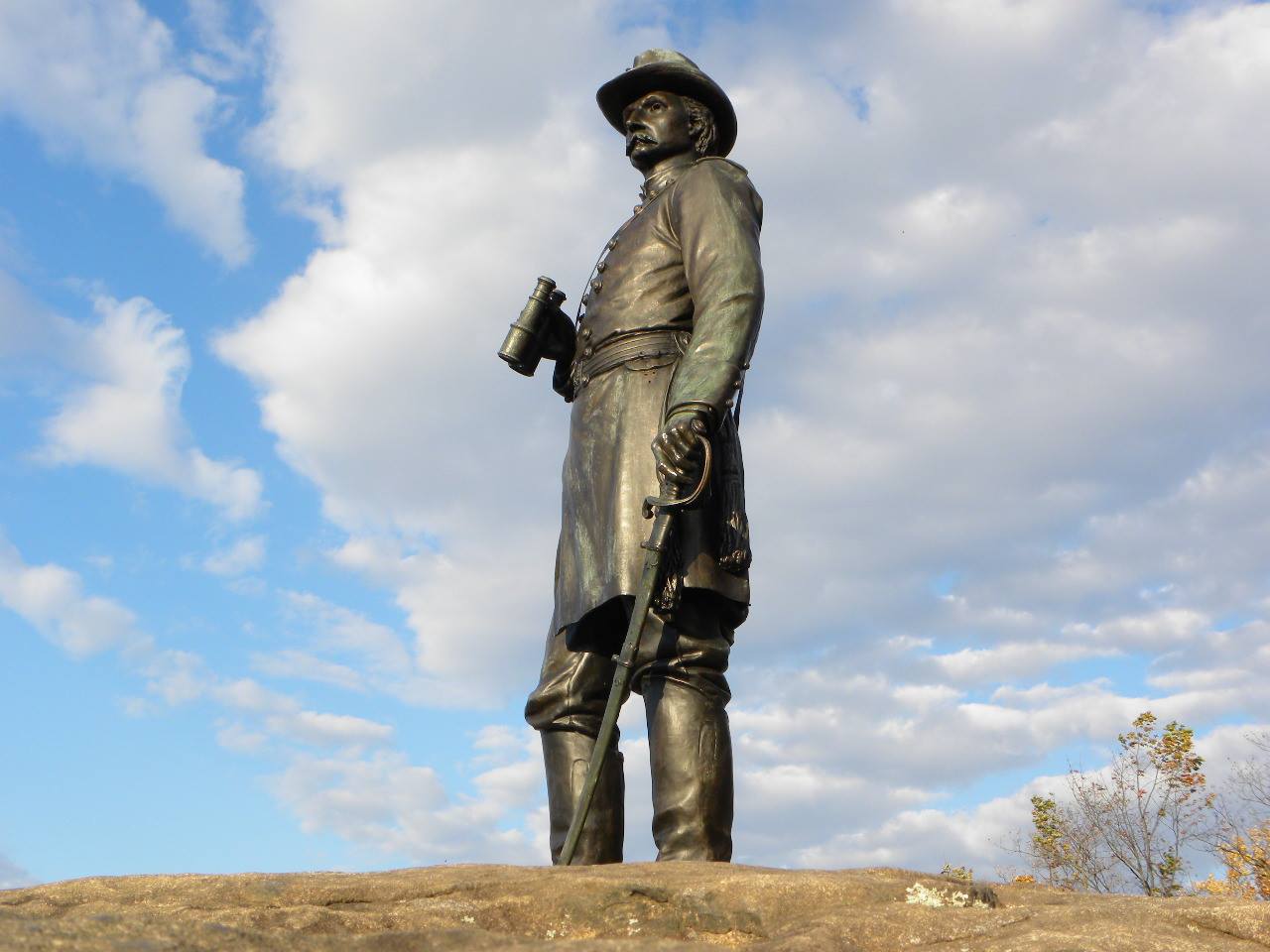
Warren sought a Court of Inquiry to exonerate himself but this was refused until President Grant left office. The Court eventually exonerated him but Warren died three months before the results were published. He reportedly told his wife Emily as he lay dying “Convey me to my grave without pageant or show…I die a disgraced soldier.” [22] His last words reportedly were “The Flag! The Flag!” [23] Embittered by the treatment he had received by the army that he had served so well, Warren was buried “as he directed in his will, in civilian clothes and without military ceremony.” [24] In 1888, veterans of the 5th New York, Duryee Zouaves; Warren’s first command placed a bronze statue of Warren standing on the boulder on Little Round Top, where Warren reportedly stood during the battle.

Warren’s funeral was attended by his friends Winfield Scott Hancock and Samuel Crawford, his oldest army friend and mentor Andrew Humphreys was called away before the service due to the sudden illness of his son. [25] The Washington Post noted that Warren “had gone “where neither the malevolence nor the justice of this world can reach him. He had enough of the former; and denial of the latter not only embittered his closing months of his life, but undoubtedly hastened his end.”  [26]

Despite the later events which ended up in his relief by Sheridan, Warren’s actions on that hot and muggy July 2nd 1863 exemplified the leadership qualities that we as an institution strive to achieve. From a leadership perspective Warren’s actions at Little Round Top demonstrate how the Chairman’s Desired Leader Attributes and the principles of Mission Command: “the ability to operate on intent through trust, empowerment and understanding” should work in a relationship between seniors and subordinates.

However with that being said, during the 1864 campaign in Virginia, Warren was often disconnected from his senior commanders.  During the campaign acted in a manner that did not always contribute to successful mission command, even when events proved him to be correct. During the campaign there were times that his temper, angry outbursts and depression severely hampered his ability to operate on intent, through trust, empowerment and understanding.

In a way the harsh actions of Grant and Sheridan at Five Forks to send a message to the senior leaders of the Army of the Potomac was correct. Unfortunately they directed that action at the wrong man at the wrong time. What Grant and Sheridan did to Warren was without doubt as grave injustice as ever done to any American commander during the prosecution of any war. However, though they were wrong in what they did to Warren “had the same fate been visited upon one or two of the Army of the Potomac’s less-than-stellar corps commanders back in 1862 or 1863, to serve as an indelible lesson to that army’s high command…” [27] much good might have been accomplished and the war in the East brought to an end sooner.  But through their unjust actions General Gouverneur K. Warren “became a martyr to no cause at all.” [28]

Warren’s life also serves to remind us of the ethics of our profession, that it is possible for good officers, even excellent officers and leaders to do things that hinder or even hurt the ability to maintain the sense of trust required by their command or staff position. The conflicting personalities of Warren and Sheridan demonstrate this lack of trust which culminated in Warren’s relief.

Warren was a tragic hero, brilliant, courageous and caring. He was also was likely suffering from psychological wounds of war. It was probably these unseen wounds that caused him to be misunderstood in the moment of perceived crisis by men that neither knew him nor appreciated him. Loomis Langdon, who served as the official recorder for the board of inquiry which exonerated Warren after his death wrote:

“I had never met General Warren till he came before his Court of Inquiry…I learned to value his good opinion – and while I admired him for his great patience, his wonderful energy, habit of concentration, his vast learning and untiring application, I loved him for his tenderness, gentleness and charity, even to those whom he believed had combined to do him a cruel wrong; and I admired him for his nobleness of character and his courage and unselfish patriotism.” [29]

It is easy for military professionals to become totally focused in our profession, especially the details of planning and process to forget the humanity of those that we serve alongside. Warren is one of those complex figures who are not easy to categorize.  His biographer Jordan wrote that:

“Warren was a man with fine intellect, widely read, and of keen sensibilities. He was also an excellent engineer, mapmaker, and scientist. He was a soldier who cared much for the safety and welfare of the men under him, and he was sickened by the appalling carnage of the war in which he took such a prominent part. He was arrogant and proud, and he hesitated hardly at all in putting down those of his colleagues he regarded as inferiors. His mind’s eye took in much beyond what was his immediate concern, but this gift worked against him in the hierarchical realm of military life. Warren was prone to long sieges of depression, and he himself agreed that others found him morose and unsmiling…” [30]

In reading military history is far too easy to isolate and analyze a commander’s actions in battle and ignore the rest of their lives. In the case of Warren where there is so much controversy, this is particularly important. We have to honestly evaluate his strengths and weaknesses and not fall into the trap that many do by isolating a particular event or personality trait, be it good or bad, and using and then using it to turn the person into an icon, or to destroy the subject of our work.

Those that commit this error render a great disservice to the men themselves. In time of war nearly everyone who serves in combat, gives up something of themselves and sometimes the effects last long after the war is over. Sadly there are times when the lives and reputations of heroes like Gouverneur Warren can be destroyed, not only by their personality failings or weaknesses; by the affliction of Combat Stress injuries as well as the actions of people in the institutions that they serve.

This is the challenge for current military leaders, for within the ranks of our military, including those of the officer corps there are men and women who are very much like the troubled hero of Little Round Top, Brigadier General Gouverneur Kemble Warren.

Notes

[1] ibid. Huntington Searching for George Gordon Meade p.305

[2] Ibid. Longacre Joshua Chamberlain: The Soldier and the Man p176

[3] Sears, Stephen W. Controversies and Commanders Mariner Books, Houghton Mifflin Company, Boston and New York 1999 pp.278

[4] Ibid. Jordan Happiness is Not My Companion: The Life of G.K. Warren p.316

[5] Ibid. Sears Controversies and Commanders p.257

[6] Ibid. Jordan Happiness is Not My Companion: The Life of G.K. Warren p.317

[7] Ibid. Sears Controversies and Commanders p.262

[8] Ibid. Sears Controversies and Commanders pp.275-276

[9] Inid. Huntington Searching for George Gordon Meade p.328

[10] Ibid. Sears Controversies and Commanders p.272

[11] Ibid. Sears Controversies and Commanders p.255

[12] Ibid. Jordan Happiness is Not My Companion: The Life of G.K. Warren p.232

[13] Nesbitt, Mark Through Blood and Fire: Selected Civil War Paper of Major General Joshua Chamberlain Stackpole Books, Mechanicsburg PA 1996 Amazon Kindle edition location 2113 of 2800

[14] Ibid. Sears Controversies and Commanders p.278

[15] Ibid. Wallace The Soul of the Lion p.175

[16] Wert, Jeffry D. The Sword of Lincoln: The Army of the Potomac Simon and Schuster, New York 2005 p.374

[17] Ibid. Jordan Happiness is Not My Companion: The Life of G.K. Warren p.236

[18] Alexander, Edward Porter. Fighting for the Confederacy: The Personal Recollections of General Edward Porter Alexander edited by Gary Gallagher University of North Carolina Press, Chapel Hill 1989 p.514

[19] Ibid. Wert The Sword of Lincoln p.402

[20] Ibid. Huntington Searching for George Gordon Meade p.330

[21] Ibid. Huntington Searching for George Gordon Meade p.330

[22] Ibid. Jordan Happiness is Not My Companion: The Life of G.K. Warren p.307

[23] Ibid. LaFantasie Twilight at Little Round Top p.244

[24] Foote Shelby The Civil War, a Narrative, Volume Three: Red River to Appomattox Random House, New York 1974 p.874  

[25] Ibid. Jordan Happiness is Not My Companion: The Life of G.K. Warren p.309

[26] Ibid. Jordan Happiness is Not My Companion: The Life of G.K. Warren p.308

[27] Ibid. Sears Controversies and Commanders p.284

[28] Ibid. Sears Controversies and Commanders p.284

[29] Ibid. Jordan Happiness is Not My Companion: The Life of G.K. Warren p.309

[30] Ibid. Jordan Happiness is Not My Companion: The Life of G.K. Warren preface pp.x-xi

7 Comments

Filed under civil war, ethics, History, leadership, Military

Tragic Heroes: Gouverneur Warren Part Four

Friends of Padre Steve’s World,

Going back to the leadership series and the fourth installment of my work dealing with Union Major General Gouverneur Warren.

Peace,

Padre Steve+

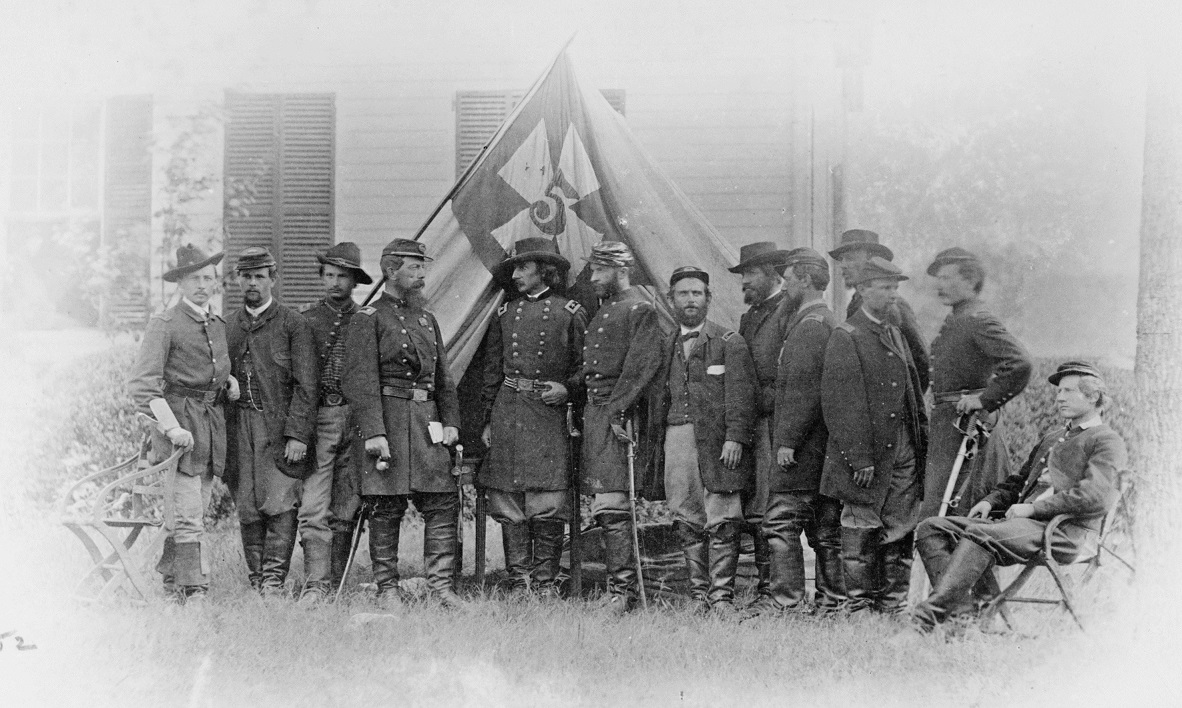
warren-and-staff

Warren With his Staff

Corps Command in Virginia and the Evidence of Combat Stress

Warren was promoted to be the acting commander of II Corps after Gettysburg as Hancock had been wounded and then was appointed to command V Corps.  He served well as a Corps commander, although his often “quick and sulphurous temper which he displayed in the Virginia campaign of 1864 worked against Warren by making him unnecessary enemies and dismaying his friends.” [1] Warren was so short tempered during the campaign, probably, due to the result of the strain of it that Colonel Charles Wainwright complained that Warren “had a screw loose and is not quite accountable for all his freaks.”  [2] In high command Warren’s “fellow officers respected his ability as an engineer, but disliked his arrogance and insolence. Warren’s temper was legendary, and when his anger boiled over he sputtered out profanities that, said one colleague, “made my hair stand on end.” [3] To be fair to Warren that last outburst followed the disaster inflicted by Grant on the army at Cold Harbor, when Grant threw it up against strongly entrenched Confederate troops with great loss. Warren who could not abide meaningless slaughter found it reprehensible.

The interesting thing about all the accounts of Warren’s temper being so violent is that they do not begin until after he is in Corps command, and he gives no hint of such anger and rage in his letters until after his experiences on the Peninsula, Second Manassas, Antietam, Fredericksburg and finally Gettysburg. During the Army of the Potomac’s inaction during the fall of 1863 it became clear that the war was taking a toll on Warren. Alcohol became a problem, so much that once after drinking a whisky punch with his staff he was “falling down drunk” and had to be told of his actions the following night by one of his staff members. [4]

His letters to Emily display a sense of depression and sometimes even despair. He wrote Emily:

“I repine a great deal. I begin to feel myself giving out in spirit. I need so to rest where I could be contented. So long now my life has been one continued worry or excitement that I am losing my elasticity and I am getting almost afraid for I am apprehensive that I cannot uphold my position…. Every day shows me more and more how this war is severing my old affiliations and making me lonely…here I sit all alone in this great camp (for so I feel) and the memory of my dear friends comes over me and I am morbidly depressed. Indeed I feel I am a very small man that I can endure no more, for I am well and not a prisoner…and have been honored more than I deserve. I have not the heart of a good soldier.” [5]

Since so many people that knew Warren after Gettysburg describe the fearsome and nearly volcanic nature of his temper we can accept that as a fact. Likewise his arrogant, insolent and even haughty attitude towards those that he believed himself to be intellectually superior is evident even during his early career as are his recurrent struggles with depression which only grew worse throughout the war and in following years.

Dr. Judith Herman, an associate Professor of Psychiatry at Harvard Medical School wrote:

“Traumatic events call into question basic human relationships. They breach the basic attachments of family, friendship, love and community. They shatter the construction of the self that is formed and sustained in relation to others. They undermine the belief systems that give meaning to human experience. They violate the victim’s faith in a natural or divine order and cast the victim into a state of existential crisis.” [6]

But it is only after the continued trauma that Warren experienced at Malvern Hill, Second Manassas, Antietam and Fredericksburg that we see the evidence of Warren’s anger, bitterness and rage becoming a major factor in his life and relationships. If we are to take into account the findings of modern science, medicine and psychiatry in relationship to the descriptions provided by Warren and those that knew him, we have to at least give serious consideration to the real possibility that Warren’s issues were caused by his experience of war and some type of resultant combat stress injury. This could include PTSD, Moral Injury, or possibly even changes brought about by a traumatic brain or concussive injury.

Jonathan Shay, a psychologist with many years of experience in dealing with veterans afflicted with PTSD wrote that “The social conditions that cause complex PTSD – persistent betrayal and rupture of community in mortal stakes situations of captivity – destroy thumos, destroy normal narcissism and undo character.” [7]

Dave Grossman writes about how such events can become what we now call “Character disorders”:

Character disorders include obsessional traits in which the soldier becomes fixated on certain actions or things; paranoid trends accompanied by irascibility, depression, anxiety, often taking on the tone of threats to his safety; schizoid trends leading to hypersensitivity and isolation; epileptoid character reactions accompanied by periodic rages…..What has happened to the soldier is an altering of his fundamental personality.” [8]

Shay writes about what happens to character when it is damaged by war, and the spectrum of clinical manifestations of an injury to character seen in many combat veterans. Among the manifestation that Shay describes, a good number which are present in what we know about Warren. These include: Demoralization, self-loathing, a sense of worthlessness, pervasive “raw” vulnerability and feeling conspicuous, social withdraw irritability, rage at small slights, disappointments and lapses, coercive attempts to establish power dominance. [9]

Warren’s repeated writings about his isolation; depression and despair to Emily are powerful. He writes Emily in words that he shares with no one else. In those letters he conveys the depth of his injury, an injury that has shaken his faith in himself, his leaders and brought about an existential crisis. It is an injury that with a man like Ulysses S. Grant in command that he could not voice to anyone in the army for fear of what we would now call the stigma of PTSD that is experienced by so many combat veterans. Instead it comes out in a drive to ensure that his soldiers are not sacrificed in senseless battles, a sense of his own unworthiness, and a sense that he has been shunted aside, even betrayed by those commanding the army, including his former friend Meade as well as Grant. His letter to Emily that he wrote in 1866 describes the effects of PTSD and Moral Injury almost perfectly:

“I wish I did not dream that much. They make me sometimes dread to go to sleep. Scenes from the war, are so constantly recalled, with bitter feelings I wish to never experience again. Lies, vanity, treachery, and carnage.” [10]

Notes

[1] Ibid. Jordan Happiness is Not My Companion: The Life of G.K. Warren p.315

[2] Huntington, Tom Searching for George Gordon Meade: the Forgotten Victor of Gettysburg Stackpole Books Mechanicsburg PA 2013 p.305

[3] Ibid. LaFantasie Twilight at Little Round Top p.73

[4] Ibid. Jordan Happiness is Not My Companion: The Life of G.K. Warren p.104

[5] Ibid. Jordan Happiness is Not My Companion: The Life of G.K. Warren p.106

[6] Herman, Judith Trauma and Recovery: The Aftermath of Violence – From Domestic Abuse to Political Terror Basic Books, a member of Perseus Books Group. New York 1992 and 1997 p.51

[7] Shay, Jonathan Odysseus in America: Combat Trauma and the Trials of Homecoming Scribner, New York and London 2002 p.160

[8] Grossman, Dave On Killing Back Bay Books Little, Brown and Company New York, Boston and London 1995 and 1996 p.48 An epileptoid personality pattern is one that includes irritability, selfishness, aggressiveness and being uncooperative. All of these are demonstrated in the changes that Warren exhibits between 1862 and 1865

[9] Ibid. Shay Odysseus in America pp.160-161

[10] Ibid. Jordan Happiness is Not My Companion: the Life of G.K Warren p.249

Leave a comment

Filed under civil war, History, leadership, mental health, Military, PTSD

Rainy Days, Floods, and National Security 


Friends of Padre Steve’s World,

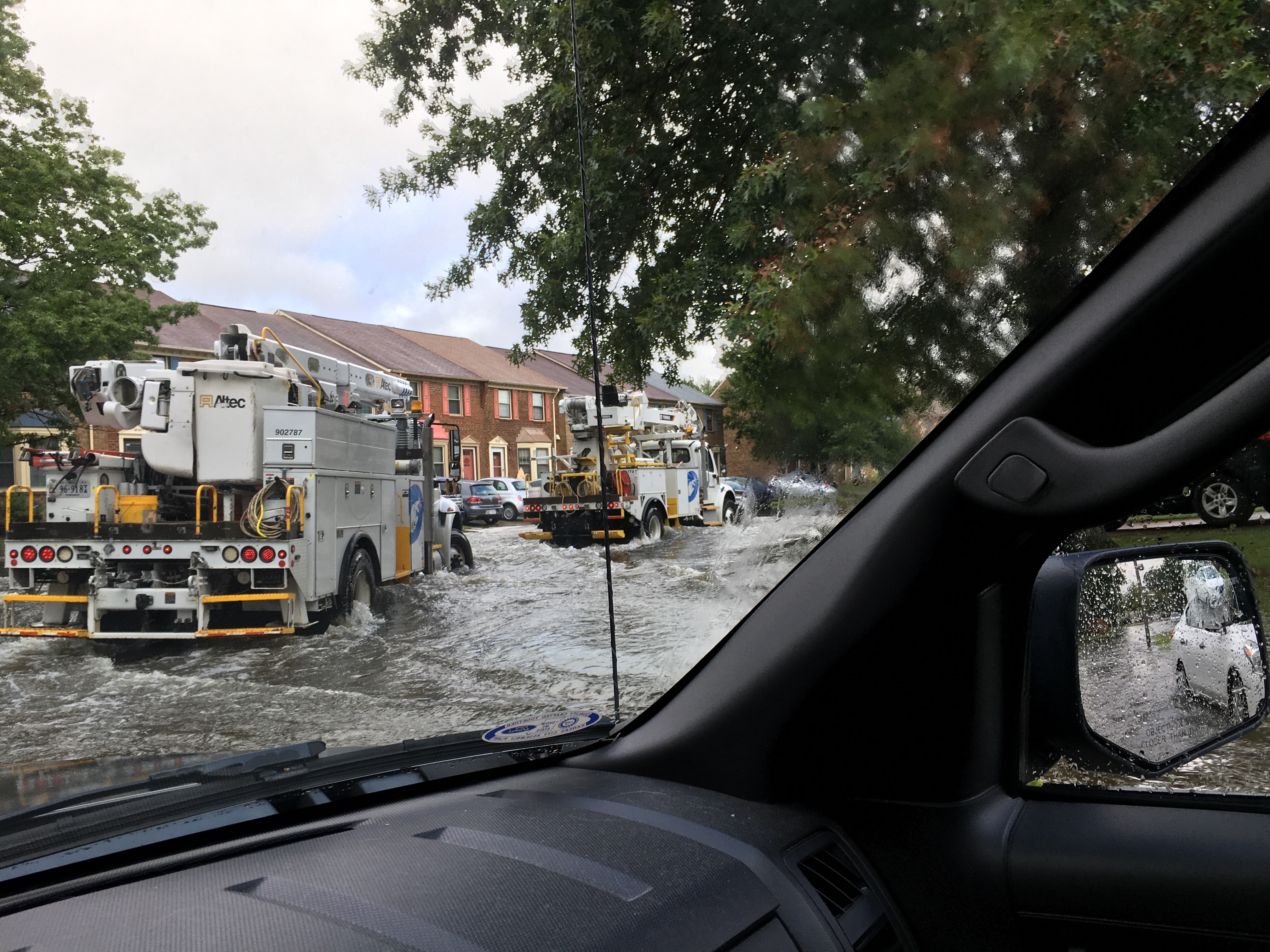
We have had a lot of rain here in Hampton Roads since Monday. As of about 3:00 PM yesterday our neighborhood in Virginia Beach has received almost 14 inches of rain since Monday when the remnants of former Tropical Storm Julia arrived. The rain was still falling when I went to bed and I imagined that we are well over 15 inches of rain. To give you an idea just how much rain we had, our yearly rainfall average is 46.5 inches of rain, in the summer we average just under 15 inches, in other words we got a third of our yearly average rainfall in three days. 

Today we have about 50% chance of more rain and schools including the Staff College are operating under a delay even while schools in North Carolina just a few miles from us will be closed due to flooding.

That slow moving system came into contact with a weak cold front and pretty much stalled over the area. Hampton Roads is a low lying coastal area with lost of rivers and streams, in fact before civilization arrived it was pretty much a swamp. Since the early settlers arrived the area has been called the Virginia Tidewater, and may I say that Tidewater is a quaint and somewhat romantic synonym for swamp. As such we frequently have flood conditions any time there is a tropical storm or a Nor’easter. That is simply the way it is.


In our swamp, I live in a town home that was built in the 1980s which the builders as they do so often in these parts built in such a way that water sometimes comes over the foundation and into the house. So I spent yesterday morning de-watering our living room, and again about 11:00 PM when another round of really heavy rain came through. Thankfully little damage was done, mainly because I have tile floors and our furniture is high enough not to sustain damage, but this is the third time in less than six months that we have had to do this.


That is what we live in, a swamp, very prone to flooding, in some places if someone flushes their toilet too long. But that is what you get when you build cities in areas that are prone to flooding that is what you get. Sadly, most of us on the coastlines of this and other nations have done just that, even in good times we flood. But just wait, as sea levels rise due to global warming, something that the United States Navy recognizes even if Congress will not, things will only get worse. As sea levels rise the effects of storms like this, and the run of the mill tropical storms and hurricanes that come through will be greater. The Navy requested funding to begin work to deal with the potential loss of its biggest naval base complex as sea levels rise, but this year Congressional Repulicans blocked the request in the DOD budget. The same is true of our other big base in San Diego, although that fair city does not have to deal with the habitual flood conditions that we endure here. The decision of Congress was  a terribly short sighted move based on the denial of science and empirical evidence and a decision that if continued will harm national security. But then when a majority of the GOP representatives are or represent Fundamentalist Christians who believe that we don’t have to plan for the future because Jesus is coming soon it really doesn’t matter. But I digress…

Naval Station Norfolk, rising seas will submerge the Navy’s largest base if measures are not taken to mitigate the effects of Climate Change

The is a huge economic concern as well. The area is home to one of the largest port and shipbuilding complexes in the nation. 

But our area is not alone. These trends will effect most of the costal area of the United States and the world. This is not simply an environmental issue, it is economic, social, and military issue. Over 70% of the earth’s population lives in what we in the Navy call the littorals. Climate change and the rise in sea levels will cause massive social, economic, and security problems and what we in the Tidewater experienced today will be incredibly mild as whole societies are disrupted.


For the United States the answer is to prepare, and thankfully if we use them we have the resources to alleviate the worst effects of global warming and sea rise. But many nations will not, and the turbulence that this change causes will not leave the United States or Europe uneffected.

What happens this week in Hampton Roads was probably not the result of global warming, but in the effects of it will grow in the coming years. Hampton Roads has always suffered from flooding, but even today with much better storm drain systems we still see the same kind of flooding that affected the region 80-100 years ago.  It is time to actually take this seriously. I do, but sadly too many people turn it into a joke.

Have a great day and stay dry.

Peace

Padre Steve

2 Comments

Filed under Climate change,, Military, national security, News and current events, weather

Tragic Heroes: Gouverneur Warren Part Three

Friends of Padre Steve’s World

On Monday and Tuesday I posted part one of a several part series about the Union Army general, Gouverneur Warren. have been writing about leadership the past couple of days and despite all that is going on in the news I think that I will continue to do so using some parts of my Gettysburg text. I think it is incredibly important to get to know the men and women behind iconic pictures, statues, and biographies that are often not much more than hagiography. In my studies I have encountered people who I find fascinating and not just because of their achievements but also due to their suffering. One of my seminary professors said that you could never come to grips with Jesus until you came to understand suffering.

That is important especially when we deal with men and women who have been traumatized on the battlefield, who when they return from war they come home changed. Many are great leaders and outstanding people whose courage was proven but their lives after the war can only be considered tragic. One of these is Gouverneur Warren, one of the heroes of the Union in the Civil War, and who was instrumental in stopping the Confederate forces at Gettysburg 0n July 2nd 1863. I have written about him before, but I think now is an appropriate time to revisit his life as well as some other men who fought alongside him at Gettysburg. Thia is part three of my series about him.

Have a great day,

Peace

Padre Steve+

gkwarren_roundtop

Chief Engineer of the Army of the Potomac and Savior of Little Round Top

In January 1863 Warren was pulled from his brigade duties by Hooker who employed him with good effect to assist his engineering staff, first with mapping and then building the fortifications that stopped the ferocious Confederate storm on the second day of battle. [1] In less than 48 hours Warren’s troops threw up five miles of the most formidable entrenchments yet constructed under battlefield conditions. [2] Edward Alexander, Longstreet’s artillery officer noted that when the Confederates came upon the fortifications after Hooker’s withdraw that “they were amazed at the strength and completeness of the enemys fortifications. [3] Following the battle Warren was appointed as Chief Engineer of the Army of the Potomac on May 12th 1863 by Hooker.  When Hooker was relieved of command and was replaced by Meade on June 28th 1863, he was kept in that position by his fellow engineer George Gordon Meade.

Warren and Major General Winfield Scott Hancock arrived at Cemetery Hill on the night of July 1st 1863. He surveyed the ground with Hancock and they concurred that “it would be the best place for the army to fight on if the army was attacked.” [4] As George Gordon Meade organized the defenses of his army at Gettysburg, he not only depended on Warren’s advice about the ground, but consulted him constantly at headquarters or sent him off on matters of highest importance. [5] Meade respected Warren and had offered Warren the chance to serve as his Chief of Staff, a position that Warren, like Seth Williams, the Adjutant General declined that offer indicating that he had too much work in their departments to take on the burdens of a new job. [6]

Meade’s opponent, Robert E. Lee, who knew Warren before the war appreciated Warren’s calm, absorbed, and earnest manner, his professional skill and sound judgment. [7] These qualities would serve both men and the army well on July 2nd 1863.

When Sickles moved III Corps forward during the afternoon without permission of Meade, the result was that his Corps was deployed in a vulnerable salient at the Peach Orchard. This left the southern flank of the army in the air and the Round Tops undefended. Meade was aghast and set about to attempt to rectify the situation. Warren was with Meade and based on the reconnaissance that he conducted the previous day and that morning knew the position better than anyone.  He recognized that something was badly awry on Sickles Third Corps front matters there were not all straight.  [8] He had sent an officer to discover to investigate Sickles’ front and that officer reported that the section of Cemetery Ridge assigned to III Corps was not occupied. [9]

Meade and Warren discussed the situation and realized that III Corps “could hardly be said to be in position” [10] and knowing VI Corps was now close at hand order V Corps, at the time his only reserve into the position vacated by Sickles. They went forward and seeing the empty spaces Warren told Meade “here is where our line should be” to which Meade replied: “It’s too late now.” [11] Warren, whose familiarity with the whole of the battlefield gave him concern about Sickles’ corps dispositions suggest that Meade send him to the Federal left, “to examine the condition of affairs.” [12]

Meade concurred with his Warren and in dispatching him he also gave Warren the authority to take charge as needed saying “I wish you would ride over there and if anything serious is going on, attend to it.” [13] Again Meade’s choice of Warren for the task demonstrated the trust that is essential in command.  The two officers worked together seamlessly and as Coddington described their relationship that day: “Meade chose him to act as his alter ego in crucial moments of the battle, and Warren rendered services for which Meade and the country were to be eternally grateful.” [14] Warren would not see Meade again that day “until the attack had spent its force.” [15]

Hunt noted that “The duty could not have been in better hands.” [16] When Warren arrived on Little Round Top he found it unoccupied save for a few signal corps soldiers. Warren immediately recognized the tactical value of Little Round Top and noted that it was “the key of the whole position.”  [17] Warren saw that the Confederates were massing not more than a mile away and that there were no troops on the hill to stop them. He believed that an area “of woods on the near side of the Emmitsburg Road as “an excellent place for the enemy to form out of sight” [18]  which was exactly what Major General John Bell Hood’s division was doing, as Henry Hunt noted “The enemy at the time lay concealed, awaiting signal for the assault…” [19] To test his suspicions Warren sent a messenger to Captain James Smith’s 4th New York artillery battery on Devil’s Den to fire a single shot into the woods. Warren described the situation:

“As the shot went whistling through the air the sound of it reached the enemy’s troops and caused every one to look in the direction of it. This motion revealed to me the glistening gun-barrels and bayonets of the enemy’s line of battle, already formed and far outflanking the position of any of our troops; so that the line of his advance from the right to Little Round Top was unopposed. I have been particular in telling this, as the discovery was intensely thrilling to my feelings, and almost appalling.” [20]

Upon confirming his fears Warren resorted to ruse and action. He order the “signalmen to keep up their wigwag activity, simply as a pretense of alertness, whether they had any real signals to transmit or not…” [21] He also sent messengers to Meade, Sickles and Sykes, the commander of V Corps asking Meade to “Send at least a division to me” [22] instructing the messenger, Lieutenant Randall Mackenzie to tell Meade “that we would at once have to occupy that place very strongly.” [23] Sickles refused on account of how badly stretched his lines were, however George Sykes of V Corps responded sending Captain William Jay to find Barnes commander of his 1st Division. As he waited Warren stood atop a “flat rock on the summit of Little Round Top, eyes fixed to his field glasses…he spent several nervous minutes wondering if his urgent appeals for help would be answered or ignored.” [24]

The messenger could not find Barnes, but instead came across the commander of the division’s 3rd Brigade, Colonel Strong Vincent. Vincent knew that Barnes was self-medicating his “pre-battle anxieties out of a black commissary quart bottle” and was already “hollow from skull to boots” and demanded “What are your orders? Give me your orders.” [25] Upon learning that Sykes wanted a brigade to proceed to Little Round Top Vincent responded immediately to take the initiative and ordered his four regiments up Little Round Top without waiting for permission. Vincent told Sykes messenger “I will take the responsibility myself of taking my brigade there.” [26]

The Attack of Law’s Brigade on Little Round Top July 2nd

Meade’s choice of Warren for the task was confirmed by how Warren continued to act with alacrity and decisiveness throughout the afternoon. “As the Union line began to crumble on Little Round Top, Warren, vested with the authority of Meade’s chief representative, emerged as the right man at the right place at the right time.” [27] Warren did not stop with sending messengers, but seeing the danger building he noted that the northwest face of the hill was still unoccupied and open to attack. Warren forgot “all about a general’s dignity” he “sprinted down the east slope of the hill like a rabbit.” [28]

There Warren found Brigadier General Stephen Weed’s brigade which he had previously commanded. The troops of the brigade, “seeing their former commander, started cheering, but Warren had no time or accolades.” [29] Warren did not see Weed, but instead he found Colonel Patrick O’Rorke of the 140th New York, who had been one of his students at West Point, and ordered him to follow him up the hill, saying “Paddy…give me a regiment.” [30]

When O’Rorke told Warren that Weed expected him to be following him Warren took the responsibility telling O’Rorke “Bring them up on the double quick, and don’t stop for aligning. I’ll take responsibility.” [31] O’Rorke followed with his gallant regiment with the rest of the brigade under Weed following them. The 140th New York entered the battle to the right of the Vincent’s 16th Michigan which was being swarmed by the 4th and 5th Texas and 4th Alabama, who thought that victory was at hand, slamming the Texans and Alabamians and “at once the Confederate assault began to dissolve” [32]

Warren’s actions were fortuitous as the 140th New York and Lieutenant Charles Hazlett’s battery of the 5th Artillery arrived at the crest just in time to repulse the advancing Confederates, as the battery struggled to get into position Warren “took hold of one of the guns and labored with the gun crew to get the piece over the rocks and up the steep wooded hillside.” [33] The battery went into action immediately and soon drew concentrated enemy fire and “Warren narrowly escaped serious injury when a bullet nicked his throat.” [34]

In the ensuing fight the brigade would take fearful casualties. By the end of the day Weed, O’Rorke and Hazlett would all be dead, but together with Vincent’s brigade they held on and saved the Union line.[35]

Warren continued to urge on the Federal troops despite being wounded,  in the words of a reporter who observed him in “a most gallant and heroic manner, riding with utmost confidence over fields swept by the enemy’s fire, seemingly everywhere present, directing, aiding, and cheering the troops.” [36] Once he was assured that Little Round Top was secure he proceeded to rejoin Meade “near the center of the battlefield where another crisis was at hand.” [37]

After Gettysburg Warren was proud of his accomplishments but did not boast of them. He wrote to his in his journal: “There was no merit in my actions except to secure for our army a position if I could, which would prevent our lines from being flanked and this when attacked was given an opportunity for a fair fight to front, and there our opponents did not win.” [38] However his comments belied his accomplishments on Little Round Top that day “for he alone was responsible for recognizing the crisis there, for Vincent’s brigade being sent up the hill, and for commandeering the 140th New York and the rest of Weed’s brigade as reinforcements.” [39]

Notes

[1] Sears, Stephen W. Chancellorsville Houghton Mifflin Co. Boston and New York 1996 p.372

[2] Hagerman, Edward. The American Civil War and the Origins of Modern Warfare. Midland Book Editions, Indiana University Press. Bloomington IN. 1992 p.91

[3] Alexander, Edward Porter Military Memoirs of a Confederate: A Critical Narrative 1907 republished 2013 by Pickle Partners Publishing, Amazon Kindle Edition location 7007

[4] Sears, Stephen W. Gettysburg. Houghton Mifflin Co. Boston and New York 2003 p.224

[5] Coddington, Edwin B. The Gettysburg Campaign: A Study in Command, A Touchstone Book, Simon and Schuster New York, 1968 p.332

[6] Ibid. Sears Gettysburg  pp.129-130

[7] Ibid. Coddington, The Gettysburg Campaign: A Study in Command, p.332

[8] Ibid. Sears Gettysburg p.262

[9] Trudeau, Noah Andre. Gettysburg: A Testing of Courage, Harper Collins Publishers, New York 2002 p.319

[10] Ibid. Trudeau. Gettysburg: A Testing of Courage,  p.319

[11] Ibid. Trudeau. Gettysburg: A Testing of Courage,  p.320

[12] Ibid. Jordan Happiness is Not My Companion: The Life of G.K. Warren p.90

[13] Ibid. Trudeau. Gettysburg: A Testing of Courage,  p.320

[14] Ibid. Coddington, The Gettysburg Campaign: A Study in Command, p.388

[15] Guelzo, Allen C. Gettysburg: The Last Invasion Vintage Books a Division of Random House, New York 2013 p.260

[16] Hunt, Henry. The Second Day at Gettysburg in Battles and Leaders of the Civil War Volume III, The Tide Shifts. Edited by Robert Underwood Johnson and Clarence Clough Buel Castle, Secaucus NJ p. 307

[17] Ibid. Jordan Happiness is Not My Companion: The Life of G.K. Warren p.92

[18] Ibid. Jordan Happiness is Not My Companion: The Life of G.K. Warren p.92

[19] Ibid. Hunt The Second Day at Gettysburg in Battles and Leaders of the Civil War Volume III, The Tide Shifts. p. 307

[20] Pfanz, Harry F. Gettysburg: The Second Day. University of North Carolina Press, Chapel Hill 1987 p.206

[21] Foote, Shelby, The Civil War, A Narrative. Volume Two Fredericksburg to Meridian Random House, New York 1963 p.503

[22] Ibid. Jordan Happiness is Not My Companion: The Life of G.K. Warren p.92

[23] Ibid. Guelzo  Gettysburg: The Last Invasion Vintage p.261

[24] Ibid. LaFantasie Twilight at Little Round Top p.88

[25] Ibid. Guelzo  Gettysburg: The Last Invasion Vintage p.262

[26] Longacre, Edward Joshua Chamberlain: The Soldier and the Man Combined Publishing Conshohocken PA 1999 p.127

[27] Ibid. Coddington, The Gettysburg Campaign: A Study in Command, p.395

[28] Swanberg, W.A. Sickles the Incredible Stan Clark Military Books, Gettysburg PA 1957 p.214

[29] Ibid. Jordan Happiness is Not My Companion: The Life of G.K. Warren p.93

[30] Ibid. Jordan Happiness is Not My Companion: The Life of G.K. Warren p.93

[31] Ibid. Foote The Civil War, A Narrative. Volume Two Fredericksburg to Meridian p.504

[32] Ibid. LaFantasie, Twilight at Little Round Top p.153

[33] Ibid. LaFantasie, Twilight at Little Round Top p.132

[34] Ibid. Sears Gettysburg  p.281

[35] Ibid. Jordan Happiness is Not My Companion: The Life of G.K. Warren pp. 93-94

[36] Ibid. Coddington, The Gettysburg Campaign: A Study in Command, p.388

[37] Ibid. Coddington, The Gettysburg Campaign: A Study in Command, p.396

[38] Ibid. Jordan Happiness is Not My Companion: The Life of G.K. Warren p.95

[39] Ibid. Sears Gettysburg  p.281

Leave a comment

Filed under civil war, Gettysburg, History, leadership, Military

Tragic Heroes: Gouverneur Warren Part Two

Friends of Padre Steve’s World

Yesterday I posted part one of a several part series about the Union Army general, Gouverneur Warren. have been writing about leadership the past couple of days and despite all that is going on in the news I think that I will continue to do so using some parts of my Gettysburg text. I think it is incredibly important to get to know the men and women behind iconic pictures, statues, and biographies that are often not much more than hagiography. In my studies I have encountered people who I find fascinating and not just because of their achievements but also due to their suffering. One of my seminary professors said that you could never come to grips with Jesus until you came to understand suffering.

That is important especially when we deal with men and women who have been traumatized on the battlefield, who when they return from war they come home changed. Many are great leaders and outstanding people whose courage was proven but their lives after the war can only be considered tragic. One of these is Gouverneur Warren, one of the heroes of the Union in the Civil War, and who was instrumental in stopping the Confederate forces at Gettysburg 0n July 2nd 1863. I have written about him before, but I think now is an appropriate time to revisit his life as well as some other men who fought alongside him at Gettysburg. Thia is part two of my series about him.

Have a great day,

Peace

Padre Steve+

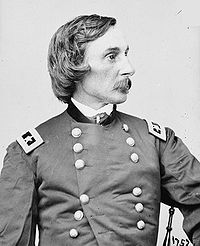
200px-GKWarren


Gouverneur Warren: A Complex Character

It is in this context that we examine Brigadier General Gouverneur Warren’s actions on Little Round Top on the afternoon and evening of July 2nd 1863, the controversy that embroiled his career and left him embittered and disillusioned at the end of the war; and even the possible explanations for what occurs to Warren during and after the war provided by modern medicine and psychological knowledge. We must do this because Warren is one of the most important people who step into history that day and because he is such a contradictory figure, to try to understand him and in doing so attempt to understand ourselves more fully.

At the time of the Battle of Gettysburg, Brigadier General Gouverneur Warren was serving as the Chief Topographical Engineer of the Army of the Potomac, a position that he had been appointed to by Joseph Hooker prior to Chancellorsville. At Chancellorsville Warren took command of the Pioneer brigade and “was responsible for the spectacular display of improvised field fortification during Hooker’s withdraw from Chancellorsville.” [1]

Unlike some of the other characters on Little Round Top that day, particularly Joshua Chamberlain, Warren does not engender myth; in fact some historians almost go out of their way to besmirch him, Joseph Whelan described Warren as “a fussy man who liked limericks, decidedly lacked gravitas.” [2] The description Warren being a “fussy man” who “lacked gravitas” is decidedly unfair for it immediately paints Warren in the mind of the reader as a man lacking in courage or fortitude and it distorts history. As I mentioned earlier when examining the evidence we have to carefully sift through it and not assume that any one characterization of a person is correct.

Whelan’s description of Warren is decidedly prejudicial. Warren was actually a complex and often contradictory figure as many military leaders throughout history have been. Though heroic, he did not look like a hero, and though an intensely proud man did not seek to bolster his image in the media, during or after the war.  Warren’s most recent biographer, David Jordan wrote that Warren was “prone to long sieges of depression, and he himself agreed that others found him to be morose and unsmiling. A complex and enigmatic man, Gouverneur Kemble Warren is not one to be easily categorized.” [3] His peers seemed to either admire or loathe him for he could be openly critical of others and had arrogance about him, which put some people off. Likewise Warren was often openly disdainful of those that he regarded as his inferiors, which at times included some of his superior officers, a trait that worked against him in the “hierarchical realm of military life.” [4]

Though Warren was considered the “savior of Little Round Top” in the years immediately following the war; his story faded. In part this was due to being relieved of command of Fifth Corps by Philip Sheridan at Five Forks, something that Chamberlain and many other officers and men of V Corps “considered an unjust act made cruel by his [Sheridan’s] refusal to reconsider it.”  [5] His story also faded because he resigned his commission as a Major General of Volunteers soon after the war, and returned to relative obscurity working as an Engineer officer along the Mississippi River.

After Warren’s untimely death at the age of fifty-three in 1882, three months before he exonerated by the Board of Inquiry, he was forgotten by many.  Likewise, the book he had prepared from his carefully arranged letters and reports was not published until 1932, forty years after his death.

Conversely, the story and myth of his friend and defender Joshua Chamberlain story grew throughout the late 1890s and early 1900s.  By then, Chamberlain, a superb writer and orator, alone of the men who made the stand at Little Round Top was still alive to tell his story, and this considerably shaped the history that we know.  The rise of the Chamberlain account is one reason why Warren is so often overlooked by many casual students and observers of the Battle of Gettysburg.

But to look at Warren’s actions is by no means to minimize the actions of others such as Colonel Strong Vincent, Colonel Joshua Lawrence Chamberlain, Brigadier General Stephen Weed, Colonel James Rice, or Colonel Patrick “Paddy” O’Rorke. All of these men played an instrumental part in the battle for Little Round Top, but only Warren, Chamberlain and Rice survived the battle, and Rice was killed in action at the Battle of Spotsylvania on May 10th 1864.

Ante-Bellum Staff Officers, Military Culture and an Expanding Army

For the purposes of this study it is important to note that Warren was not acting as a commander during the Battle of Gettysburg. Warren was, like most senior officers today, serving as a staff officer. Many times students of military history and theory are inclined to dismiss the contributions of staff officers because they do not have the overall responsibility of a battle, or the glamour of the limelight of the commanders that they serve under. However, for military professionals, especially those serving on senior staffs who prepare campaign plans, contingency plans and crisis plans the study of officers like Warren is essential.

The Federal Army at Gettysburg, like its Confederate opponent had a wide variety of officers serving in its ranks. Many of its senior officers were graduates of West Point. Many had served together in Mexico and in the various campaigns against Native American tribes. Those who stayed in the Army during the long “peace” between the Mexican War and the outbreak of the Civil War endured the monotony, boredom and often miserable conditions of isolated army posts, long family separations, as well as low pay, slow promotion and often low social status.[6] In light of such conditions, many resigned their commissions to undertake various professional, business or academic pursuits; in fact Samuel Huntington noted that in the years before the Civil War that “West Point produced more railroad presidents than generals.” [7] However, on the outbreak of the war, many of these graduates returned to service whether in the service of the Union, or the Confederate States.

When the war began the Army underwent a massive expansion, which it met through the call of up militia and by raising new volunteer units from the various states. In the expansion many officers were appointed who had no prior military service, or if they did it was performed years or even decades before the war. Some of these men were simply patriots who rallied to the flag, others due to a sense of righteousness about their cause, while others were political opportunists or appointees. In the north this was a particular problem as “professional officers were pushed aside and passed over in the Union, the higher commissions going, in the first stages of the war at least to officers called back into service or directly appointed from civilian life, many of them “political” appointees.” [8] At times the lack of experience, training and sometimes the poor character of some of the volunteers and political appointees was tragic.  However, many of these men in both Union and Confederate service performed as well or better than some of their regular army counterparts at various levels of command. Gettysburg would provide opportunity for the best and worst of all of these types of officers to succeed or fail. In this chapter we will look at how Warren succeeded remarkably at Little Round Top.


Explorer, Engineer and Instructor: The Preparation of a Staff Officer

As the Union mobilized a good number of Regular Army officers were allowed to assist the states in the formation and training of the new volunteer units. One of these officers was First Lieutenant Gouverneur Warren.

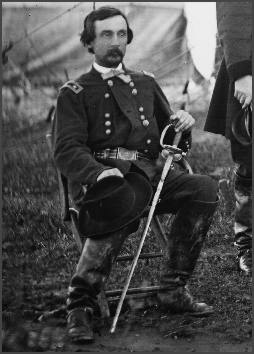
Warren was typical of the many professional officers of the old army. An 1850 graduate of West Point Warren was a bright student who had absorbed the teachings of his professor, Dennis Hart Mahan as the core of his own military thought, both in his senior year in college and through reinforcement as a faculty member. [9] Warren was commissioned as a Brevet Second Lieutenant and because of his high standing in his class was assigned to Corps of Topographical Engineers. He spent his first seven years in a number of assignments which took him throughout much of the country. Warren did not look the part of a hero. Short and willowy, he appeared no more substantial in body than a young boy, or as some remarked, a young woman; his uniforms tended to hang off him as if they were several sizes too big. [10]

Warren’s work involved exploring and mapping for various enterprises including the project to help tame the Mississippi River, and the exploration of the Great Plains and Black Hills where he developed a sympathy for the various Sioux tribes he encountered noting on completion of his mission in 1858, writing that He had never heard a Sioux chief express an opinion in regard to what was due them in which I do not concur and that many of them view the extinction of their race as an inevitable result of the operation of present causes, and do so with all the feelings of despair with which we should contemplate the extinction of our nationality. [11] Following his years in the west he returned as faculty to West Point where he as an Assistant Professor, shared mathematics instructional duties with Oliver O. Howard and resumed his relationship with his former professor Mahan. [12]

Commander of the Red Devils: The Peninsula, Gaines Mill and Second Manassas

On the outbreak of war Warren was granted leave from his duties at West Point to serve as Lieutenant Colonel of Volunteers in the 5th New York Infantry Regiment, also known as the Duryee Zouaves. When Abraham Duryee was appointed as a Brigadier General, Warren became the Colonel of the regiment.

He commanded the regiment during the Peninsula campaign where he was eventually given command of a provisional infantry brigade. At Gaines Mill, Warren’s regiment and brigade distinguished itself. Along George Sykes front no troops fought better than the small brigade of two volunteer regiments, the 5th and 10th New York, under Warren’s command. On the afternoon of the battle Warren led the 5th New York in a riveting counter attack.The Red Devils smashed into the 1st South Carolina Rifles and drive them back. The Zouaves were, declared a Regular, the peers of any troops on the hard fought field. Captain John W. Ames of the 11th United States told his parents that the counterattack of the New Yorkers haunted his sleep. Every night, he wrote home a week later, he saw a Zouave, with his arms around a comrade, who was fairly a dead man, walking with his friends support. Ames admitted, the horrors of sudden, accidental, bloody death are here so much augmented and multiplied. [13]

Warren described the action to his wife Nothing you ever saw in the pictures of battles excelled it. The artillery which had been firing stopped on both sides, and the whole armies were now spectators. In less than five minutes 140 of my men were killed or wounded and the other regiment completely destroyed. [14] Warren and his men received many accolades that day. George McClellan credited them with saving the Union left and said that Warren was everywhere conspicuous on the field, and not only directed the movement of his own brigade, which he handled with consummate skill, and placed in the most advantageous of positions, where they could produce the most effect on the enemy, but directed the movement of other regiments. [15] and during the action Warren suffered a slight wound from a spent bullet and had his horse shot out from under him.

Warren’s tiny provisional brigade composed of his 5th New York and the 10th New York was at Second Manassas where they had the bad fortune to be on the exposed Federal flank when Longstreet’s massive attack rolled over them. Warren and his brigade were left to protect the Fifth Corps artillery and trains when that corps was ordered by John Pope to attack Jackson’s corps, and John Reynolds’ division was ordered to withdraw leaving the Fifth Corps’ flank uncovered. On his own initiative Warren moved his brigade to protect the flank when Longstreet’s massive blow hit. Alone the two regiments, numbering about 1100 soldiers were overwhelmed in what one soldier called the very vortex of hell. [16] Robert E. Lee had drawn Pope into a trap and was poised to destroy his army. Longstreet’s corps led by Hood’s Texas brigade struck Warren’s troops and the 10th New York fell back as Warren and the 5th New York hung on long enough for artillery to limber up and withdraw, but they too were forced back with heavy losses. The 10th New York lost 133 killed and wounded, the 5th New York over 300 more. Warren wrote Braver men than those who fought and fell that daycould not be found. It was impossible to do more.  A member of Fifth Corps wrote that Warrens regiment and brigade, commanded by him, sustained heavier losses than any command on that disastrous field. [17] However, Warren’s gallantry was rewarded with promotion to Brigadier General effective September 26th 1862.

Though present at Antietam and Fredericksburg Warren’s brigade was not committed to either fight. However, Warren was in a position to see the disastrous attacks of Union troops against enemy troops in strong defensive positions. As an engineer Warren recognized the advantages that now were afforded to the defense with the advent of the rifled musket, something that would influence many of his decisions as well as his questioning of Meade, Grant and Sheridan for tactical decisions to attack in situations where he viewed such actions to be either unwise or suicidal. Warren was affected by what he had seen, both in the human cost of the war as well as the politics that had engulfed the army. He wrote his wife Emily on Christmas Day:

I today feel very desponding about our government and the management of affairs.I left my home without ambition to save a noble cause. I have seen that cause almost betrayed- I know of bleeding hearts, desolate homes, and unnumbered nameless graves of noble men who have vainly perished. There must be a just God[.] Why does he permit these things…”  [18]

Notes

[1] Hagerman, Edward. The American Civil War and the Origins of Modern Warfare, Midland Book Editions, Indiana University Press, Bloomington IN. 1992 p.96

[2] Whelan, Joseph Bloody Spring: Forty Days that Sealed the Confederacy’s Fate Da Capo Press, Boston 2014 p.65

[3] Jordan, David M. Happiness is Not My Companion: The Life of G.K. Warren Indiana University Press, Bloomington Indiana 2001 p.x

[4] Happiness is Not My Companion The Life of G.K. Warren p. x

[5] Wallace, Willard M. The Soul of the Lion: A Biography of Joshua L. Chamberlain Stan Clark Military Books, Gettysburg PA 1991 p.173

[6] Taylor, John M. Duty Faithfully Performed: Robert E Lee and His Critics Brassey’s, Dulles VA 1999 pp.37-38.

[7] Huntington, Samuel P. The Soldier and the State: The Theory and Politics of Civil-Military Relations The Belknap Press of Harvard University Press, Cambridge MA and London 1957 p.199

[8] Ibid. Huntington. The Soldier and the State: The Theory and Politics of Civil-Military Relations p.213

[9] Ibid. Jordan Happiness is Not My Companion The Life of G.K. Warren p.6

[10] LaFantasie, Glenn W. Twilight at Little Round Top: July 2, 1863 The Tide Turns at Gettysburg Vintage Books, a Division of Random House, New York 2005 p.73

[11] Ibid. Jordan Happiness is Not My Companion: The Life of G.K. Warren p.30

[12] Ibid. Jordan Happiness is Not My Companion: The Life of G.K. Warren p.33

[13] Wert, Jeffry D. The Sword of Lincoln: The Army of the Potomac Simon and Schuster New York 2005 p.104-105

[14] Ibid. Jordan Happiness is Not My Companion: The Life of G.K. Warren p.46

[15] Ibid. Jordan Happiness is Not My Companion: The Life of G.K. Warren p.46

[16] Ibid. Jordan Happiness Is Not My Companion: The Life of G.K. Warren p.56

[17] Ibid. Jordan Happiness is Not My Companion: The Life of G.K. Warren p.56

[18] Ibid. Jordan Happiness is Not My Companion: The Life of G.K. Warren p.64

Leave a comment

Filed under civil war, Gettysburg, History, leadership, Military

Tragic Heroes: Gouverneur Warren, Part One

Friends of Padre Steve’s World

I have been writing about leadership the past couple of days and despite all that is going on in the news I think that I will continue to do so using some parts of my Gettysburg text. I think it is incredibly important to get to know the men and women behind iconic pictures, statues, and biographies that are often not much more than hagiography. In my studies I have encountered people who I find fascinating and not just because of their achievements but also due to their suffering. One of my seminary professors said that you could never come to grips with Jesus until you came to understand suffering.

That is important especially when we deal with men and women who have been traumatized on the battlefield, who when they return from war they come home changed. Many are great leaders and outstanding people whose courage was proven but their lives after the war can only be considered tragic. One of these is Gouverneur Warren, one of the heroes of the Union in the Civil War, and who was instrumental in stopping the Confederate forces at Gettysburg 0n July 2nd 1863. I have written about him before, but I think now is an appropriate time to revisit his life as well as some other men who fought alongside him at Gettysburg.

Have a great day,

Peace

Padre Steve+

Warren

The Statue of Gouverneur Warren on Little Round Top


History, Memory and Myth at Little Round Top 

The battle of Gettysburg is an iconic part of American history. The accounts of Buford’s delaying action and John Reynolds death on July 1st, the savage battle at the Wheat Field, the Peach Orchard and Plum Run on July 2nd and the great charge known as Pickett’s Charge on July 3rd 1863 all draw us to the battlefield. The stories of individual courage and the sacrifice of soldiers from the North and the South that are enshrined on the monuments that now populate the battlefield have a nearly religious quality that draws Americans to Gettysburg by the hundreds of thousands every year.

But there are some places on the battlefield that seem to be the most iconic, the most spiritual, and the most inspirational for various reasons. Two of these places in particular have a nearly magnetic attraction, the “High Water Mark” of the Confederacy on Cemetery Ridge where Pickett’s Charge met its end, and the rocky hill known as Little Round Top. A large part of the reason that these two places hold such an attraction is not just the way that the battle was fought.  Rather, it is often because of the way the stories of those actions and the stories of the men who fought at them have been passed down to us in the accounts of survivors, in history and even in the fictional accounts of the battle. In each of these stories there are elements of courage, devotion, sacrifice, and tragedy that touch us in deeply personal ways and connect us to them and what we see when we experience history tells us as much about us as it does them.

The story of the Battle for Little Round Top has been passed along to us in the many accounts and histories of the battle, but perhaps more importantly in literature and cinema through Michael Shaara’s Pulitzer Prize winning novel, The Killer Angels and that book’s film adaptation, Gettysburg.  Many people who have never read an actual history of the battle know about the Battle for Little Round Top from Jeff Daniels’ inspirational portrayal of Joshua Lawrence Chamberlain in the movie.

The mythic status that we accord Gettysburg is important to Americans as a people. It is a defining moment in our American story and that is why so many of us come to the battlefield. It is a part of who and what we are as a people. Chamberlain said this well a quarter century after the battle at the dedication of the Maine Monuments in 1888:

“In great deeds, something abides. On great fields, something stays. Forms change and pass; bodies disappear; but spirits linger, to consecrate ground for the vision-place of souls… generations that know us not and that we know not of, heart-drawn to see where and by whom great things were suffered and done for them, shall come to this deathless field, to ponder and dream; and lo! the shadow of a mighty presence shall wrap them in its bosom, and the power of the vision pass into their souls.” [1]

While the accounts in the novel and the film are certainly inspiring and allow us to experience the emotion and near spiritual sense of what Chamberlain writes about the battle, there is much more to learn. When we go beyond the mythic portrayal of the battle we find that despite the vast amount of information available that there are a large number of approximations and ambiguities in the accounts of the battle.  So as we endeavor to look at the actions of these leaders on that fateful day it is important to recognize that it is impossible for us to totally separate the actions of the men that helped decide the battle from the mythos that surrounds the story. [2] Likewise, it is important for us to acknowledge, that we cannot completely separate the character of these men and how they lived their lives from their actions on this particular battlefield and afterwards.

That understanding is important if we want to be able to interpret these men and their actions; actions that are recorded in their journals, after action reports, unit histories, individual diaries and letters, as well as the accounts of their contemporaries who served alongside them; accounts which for many reasons are not completely reliable.

As important as these accounts are for us in attempting to sort out the truth of the matter we must apply a hermeneutic of suspicion to them and we must interpret them. [3]  We have to do this because all historical accounts are influenced by the writer’s motivations, ideology or perspective. There are some authors who omit damning or damaging information, especially about their own actions, or the actions of those leaders that they wish to protect, and the writers that “spin” the event in order to build up or destroy the reputations of those present. Even those writers of the contemporary accounts of the battle who wrote their accounts with the best motivations and intentions to record the events as best as they could describe them were often prone to mistakes, even in details such as the time an event took place. The location of people during the event was limited by their physical position on the battlefield and what they could see amid the bullets and bombshells that created carnage around their point of observation. Those not present at the battle, the men who recorded their accounts based on the recollections of those present are similarly limited.

There is also another factor to consider in dealing with these accounts, especially when untrained observers make observations of the actions and behavior of others which seem strange or erratic to them. This is especially true of men who are writing about men who have experienced the horrors of war and combat which might have resulted in some sort of combat stress injury such as PTSD, brain injuries such as TBI or a concussive syndrome or experience which is now called Moral Injury. Thus when we examine the behavior of such leaders and see a marked change in the way that they deal with others after their experience of war, those conditions, unknown to their contemporaries must be considered as a possibility when evaluating their actions.

The problem for the historian or for that matter the writer of military doctrine is how to interpret the information that they have available to them to make it relevant and useful in the art that they practice.  This can be a daunting task with many associated pitfalls that is neither an inductive, nor a deductive process. David Hackett Fischer writes:

“The logic of historical thought is not a formal logic of deductive inference. It is not a symmetrical structure of Aristotelian syllogisms, or Ramean dialectics, or Boolean equations….Instead it is a process of adductive reasoning in the simple sense of adducing answers to specific questions, so that a specific “fit” is obtained. The answers may be general or particular, as circumstances may require. History is, in a sense a problem-solving discipline. A historian is someone (anyone) who asks an open ended question about past events and answers it with selected facts which are arranged in the form of an explanatory paradigm.” [4]

All this is important because it reminds us, that when we study these accounts and attempt to use them as a basis for leadership theories, operation art and strategy, or for any other reason, that all that we know to be “true” is a combination of fact, myth and spin. Our task is to do the best we can with that in mind while admitting that we all have our own prejudices, agendas and ideas that color the glasses by which we interpret the event and the actions of the people involved.

In a sense when we look at the records of the people present or their contemporaries we must entertain a fair amount of suspicion and be able to ask questions as if the writers were talking or writing to us presently. We must ask three questions to do this: Why are they telling this fact or story? Why are they telling it to me? Why are they telling it now? Or more succinctly put “Why this? Why me? Why now?”

Notes

[1] Chamberlain, Joshua Lawrence. Chamberlain’s Address at the dedication of the Maine Monuments at Gettysburg, October 3rd 1888 retrieved from http://www.joshualawrencechamberlain.com/maineatgettysburg.php 4 June 2014

[2] Note: My use of the terms myth, mythology or mythos should not be considered negative, and the use of the terms does not mean that there is not some degree of fact or truth in them. The definitions of the term mythos are important to understanding my use of the term here, first it denotes a traditional or recurrent narrative theme or plot structure of a story, and secondly a set of beliefs or assumptions about something. (See the Oxford American Dictionary.)

[3] I mention the term a hermeneutic of suspicion. Hermeneutics is the theory of understanding and interpreting language and non-linguistic expression. The Stanford Encyclopedia of Philosophy defines it this way: “The term hermeneutics covers both the first order art and the second order theory of understanding and interpretation of linguistic and non-linguistic expressions. As a theory of interpretation, the hermeneutic tradition stretches all the way back to ancient Greek philosophy. In the course of the Middle Ages and the Renaissance, hermeneutics emerges as a crucial branch of Biblical studies. Later on, it comes to include the study of ancient and classic cultures.” 

[4] Fischer, David Hackett Historians’ Fallacies: Toward a Logic of Historical Thought Harper and Row, New York 1970 p.xv  

Leave a comment

Filed under civil war, Gettysburg, History, leadership, mental health, Military, PTSD

Honesty and Leadership: The Example of Field Marshal William Slim

Field Marshal William Joseph Slim, 1st Viscount Slim, KG, GCB, GCMG, GCVO, GBE, DSO, MC (6 August 1891 - 14 December 1970).   Photo possibly taken in Burma where in March 1942 he was given command of 1st Burma Corps (or BurCorps) which was being attacked by the Japanese.  He was a British military commander and the 13th Governor-General of Australia. He fought in both World War I and World War II and was wounded in action three times during his career.  ©TopFoto

Field Marshal William Slim

“Leadership is of the spirit, compounded of personality and vision.”

Friends of Padre Steve’s World,

I have been thinking about leadership and moral courage lately and came to remember a British general from the Second World War whose example of both is all to often forgotten even in military circles. I hope you enjoy.

Peace

Padre Steve+

Field Marshal William Slim was one of the most brilliant commanders of the Second World War. He gets little press and there are not a lot of books written about him. Slim was one of those unique officers who served on the periphery of the British Empire as an office in the British Indian Army. He was a clerk in a factory who attended the University of Birmingham and commissioned as a reserve officer through its reserve officer training course; he did not attend Sandhurst, the British equivalent of the U.S. Military Academy.

Slim was commissioned in 1914 and assigned to the Indian Army. He served at Gallipoli and Mesopotamia in the First World War and was wounded three times. At Gallipoli Slim saw the immense waste of human life which led him in his future commands never to sacrifice his men in senseless operations. Between the wars he served in India with the Gurkhas and also spent a significant time as a student and an instructor. His career between the was was marked by slow promotion, but eventually he was promoted to Lieutenant Colonel and given command of a battalion at the age of 46. One of his students remembered:

“We had a most able and later highly distinguished batch of instructors and we were all of the opinion that Slim was one of the best. He tackled every subject in a down-to-earth manner and presented it in a simple, straightforward language. He also had the knack of making any lecture interesting by introducing enough of the personal side and by including a sufficient degree of humour. In the Mess he was always natural, affable and tremendously interesting on all kinds of subjects other than military. I don’t think I have ever learned more from anybody.”

However, during the war a man who many would have considered an outlier rose from battalion to brigade and then Division command and became a general through wartime promotions all the while remaining a Colonel on the regular list as he served in the British campaign against the Italians in the Sudan and the invasion of Iraq.

When Britain’s fortunes were at war were at their lowest point, and British forces were collapsing against the relentless Japanese advance in Burma Slim was called upon to stem the tide. He was assigned to command the Burma Corps which eventually became the British 14th Army. The army was sometimes better known as the “Forgotten Army.” He took command and had to conduct a 900 mile withdraw under desperate conditions. His Army was emaciated, poorly equipped and beaten, but his leadership during that retreat saved his army and kept their spirit alive.

But it was his indomitable leadership that turned the Army around, stopped the Japanese advance and then conducted an amazing campaign to drive the Japanese out of Burma. But unlike many commanders, Slim was honest about his own mistakes and shortcomings. In recounting one battle he noted:

“Like so many generals whose plans have gone wrong I could find plenty of excuses but only one reason–myself….”

Slim has some of the most brilliant insights into leadership and I am just going to throw out one here.

“Morale is a state of mind. It is that intangible force which will move a whole group of men to give their last ounce to achieve something, without counting the cost to themselves; that makes them feel they are part of something greater than themselves. If they are to feel that, their morale must, if it is to endure–and the essence of morale is that it should endure–have certain foundations. These foundations are spiritual, intellectual, and material, and that is the order of their importance. Spiritual first, because only spiritual foundations can stand real strain. Next intellectual, because men are swayed by reason as well as feeling. Material last–important, but last–because the very highest kinds of morale are often met when material conditions are lowest.”

This is something that is really important and something that I think that we have lost all sense of in the West and why we struggle against insurgents who are inferior to us in every military aspect. We focus on the material first, technology has become our God, and it is our answer to everything. Likewise we often fail to emphasize the intellectual aspects of the military profession, the need to keep an open mind, to carefully examine doctrine and if it is not working to change it. Sadly, we all to often emphasize formulas, templates or abstract principles that that are hard to apply in the real world.

Likewise we often adhere to doctrines that do not apply to the wars that we are currently engaged, or which might break out. Instead policy makers and strategists often try make the reality fit our templates rather than taking the time to really learn, and much of what we have to learn is not related to tactics or technology. With all our technological marvels we have also lost much of the sense of personal leadership where senior leaders actually know their soldiers.

Slim understood the reality of these leadership principles because he took the time to know his soldiers. Because of the, his troops, in spite of the incredible hardships that they faced, knew that Slim understood them and would not sacrifice them needlessly. Slim trained his men hard in the tactics that would be needed to drive the Japanese from Burma and his leadership would pay off. His ability to hold leaders accountable for the welfare of their soldiers and his ability to relate to all kinds of soldiers made him one of the most unique and successful commanders of the war.

After the war Slim retired from active duty, but in 1948 Slim was called out of retirement by Prime Minister Clement Atlee to replace Field Marshal Bernard Montgomery as the Chief of the Imperial General Staff. He was the first officer from the Indian Army to hold that position, and indeed a rare feat for a man who began his career as a factory clerk.

Peace

Padre Steve+

1 Comment

Filed under History, leadership, Military, world war one, world war two in the pacific

Character, Insight, and Honor: The Uncomfortable Legacy of General Ludwig Beck

Friends of Padre Steve’s World,

I am dipping into the archives today because the article is exceptionally relevant, at least to me with the rise of Donald Trump and the real possibility that he could become President of the United States. That is something that based on his lack of character, his bellicose threats against civil liberties, his disregard for the Constitution, and his exceptional narcissism and what I believe is psychological instability, frighten the hell out of me.

Most of my undergraduate and non-theological graduate studies focused on the conundrum faced by German military officers during the rise of Hitler. Did those not immediately cashiered or murdered after Hitler’s assumption of power resign, retire, or continue to serve, either supporting the new regime, or attempting to mitigate he evil. Sadly, most ended up giving their support to the Nazi regime as Hitler, but some did attempt to mitigate the evil of the Hitler regime. One was General Ludwig Beck, and his legacy is an uncomfortable one for anyone who has sworn an oath as an officer.  Beck said: 

“It is a lack of character and insight, when a soldier in high command sees his duty and mission only in the context of his military orders without realizing that the highest responsibility is to the people of his country.” 

It is with that in mind that I repost this article.

Peace

Padre Steve+

Bundesarchiv_Bild_183-C13564,_Ludwig_Beck

General Ludwig Beck

This is one of those uncomfortable posts to write partially because I know that some people will take it completely wrong or ascribe meaning to it that I do not intend. I by training am a military historian, probably better at that than I am theology. One thing that fascinates me in the study of military history is the actions of men in the face of evil and the meetings of such people at the intersections of where military and government policy intersect. It is a timeless theme. The bulk of my study until the past few years was the German Army, particularly that of the Weimar Republic and the Wehrmacht to include policies, leaders, political attitudes and behavior in war and peace. Thus it makes sense for me to look at Colonel General Ludwig Beck who held the post of Chief of the German General Staff during the early part of the Nazi era.

Ludwig Beck is one of those characters in military history that makes professional military officers uncomfortable. Beck is not the perfect example of righteousness nor was he always correct in things that he supported. As an artillery regiment commander he defended the rights of soldiers and officers to be Nazi Party members though he himself was not one. He, like many military officers was a conservative military officer by nature and became Chief of Staff of the Wehrmacht in 1935 two years after Hitler’s ascension to power. Taking office Beck was troubled by some Nazi policies but not by the need for Germany to expand to areas that it had once controlled, he opposed the plan to attack Czechoslovakia not because of any love for the Czech state which he desired to be eliminated, but rather it being a war that Germany could not win. He resigned from his position a Chief of Staff in 1938 when he could not persuade the rest of the General Staff to resign in protest over Hitler’s plan which he felt would be disastrous for Germany. Had the western powers led by Neville Chamberlain not caved at Munich it is likely that the Germans would have suffered badly against the Czech army and fortifications and with the entry of France into the war would have suffered a defeat that would have ended the Hitler regime. In fact German officers who saw the extent of Czech preparations on the frontier following the Munich deal were greatly relieved that they did not have to fight their way into the Czech state.

After his resignation Beck played a key role in the resistance movement. He was involved in the planning for a number of attempts on Hitler’s life. Yet it was his leadership in the July 20th 1944 attempt on the life of Hitler that ensured his place in history. With Colonel Klaus Von Stauffenberg and others in the General Staff at the Front and in Germany he acted to avert further destruction in Europe and the certain destruction of Germany. The plot, Operation Valkyrie was marred by poor execution and failed to kill Hitler of seize power but for a few hours. The planners had left too much to chance and once Hitler had restored communications the coup attempted ended swiftly. Had the attempt succeeded Beck was in line to become either the leader of Germany or the Head of the Army. Instead while being interrogated after his capture he took his own life depriving Nazi leaders of the ability to put him up for a public trial at which he would have been humiliated and then executed. The Kasserne in Sonthofen where the Bundeswehr MP School and Staff School as well as NATO and EU military schools are located is named for him. It is there, ironically a former Adolf Hitler School that his memory and sacrifice is honored by the nation which emerged from the rubble of World War Two. He is honored in a small museum and with a plaque recognizing his sacrifice.

492

The reason that General Beck makes many of us in uniform uncomfortable (and I do include myself) is that he recognized that senior officers, especially those in high command who help set and execute policy cannot isolate themselves in the purely military aspects of the operations. Instead he believed that officers have a higher duty to the constitution and people and not just the military mission that they have been assigned. When he realized that he could not stop Hitler’s invasion of Czechoslovakia he resigned and worked in the obscurity of a small and often divided resistance movement against Hitler. The bulk of the German high command, including many officers idolized in the United States did not recognize the higher duty. Many of these men were consummate professionals who did not support the evil of the Nazi regime and who conducted themselves honorably. Yet they effectively abetted its crimes by not opposing actions of their government that were against international law and morality as well as dangerous from purely a pragmatic military standpoint.

The problem is that military officers in any nation, including ours can face situations such as Beck faced. A military’s character is demonstrated in how leaders deal with such situations. Beck recognized the situation early, the bulk of his fellow officers did not recognize a problem until Germany was embroiled in a war that it could no longer win. Even then most could not mount an opposition to Hitler because they did not want to be considered to be mutineers and violate their oath. The potential to abet evil when military professionals bury their heads by planning and executing purely military aspects of a campaign is great. If they ignore questionable policy or even policies that they know that have been judged by the international community to be illegal or immoral, such as torture of prisoners or waging wars of aggression against countries that have not attacked their nation they become complicit in their nations crimes. This was the case with German Officers who may not have committed any personal crime and even tried to mitigate the evils of the Nazi regime were morally complicit in that evil.

In the United States the military shows its fidelity by remembering our oath to the Constitution and being faithful to it and the people that we serve. As officers we represent all Americans and not just those of our political party, religious faith or social or economic interests, nor any political leader, faction or interest group within the nation. The Constitution, our military regulations, traditions and the Uniform Code of Military Justice are the standard by which we operate and by which we conduct ourselves and tools that protect us when policies or actions taken by the government or people within it violate those codes or international law. The UCMJ makes it clear those officers who take part in, plan or a complicit in illegal actions in war are committing crimes.

When a nation become involved in wars which are non-traditional, revolutionary wars or insurgencies that barriers to professional conduct can be broken down. The Mai Lai massacre committed by 2LT William Calley’s platoon with the certain knowledge and maybe even approval of individuals in the chain of command is one example as were the uncontrolled chaos of prisoner abuse and torture at Abu Ghraib.

Times are difficult and we do not know what the future brings. Stress in societies caused by economic conditions, natural disasters, lawlessness on the streets and divided and ineffective governments sometimes remove the moral restraints of the society and even affect the military. One sees this in Weimar Germany as well as the 4th Republic in France which had to deal with post World War II economic difficulties, exacerbated by recriminations of political opponents for actions the others did during the war while France was occupied by Germany as well as the wars in Indo-China and Algeria which further divided the nation and the military.

It is in stressful and uncertain times that officers have to be men and women of principle who always uphold the highest traditions of their military as well as be the voice of conscience when governments, political parties, special interests or leaders begin to violate international norms in the conduct of war. Beck was not a perfect officer. He supported some of Hitler’s policies until after his resignation but like much of the resistance believed that the Nazi regime could only end up destroying Germany. It is important to remember that like Ludwig Beck that officers do not need to sacrifice their honor to be faithful to their oath.


Leave a comment

Filed under ethics, History, leadership, Military, Political Commentary