Category Archives: national security

And Then there Were None: The Doolittle Raid 77 Years Later

Lieutenant Colonel Dick Cole

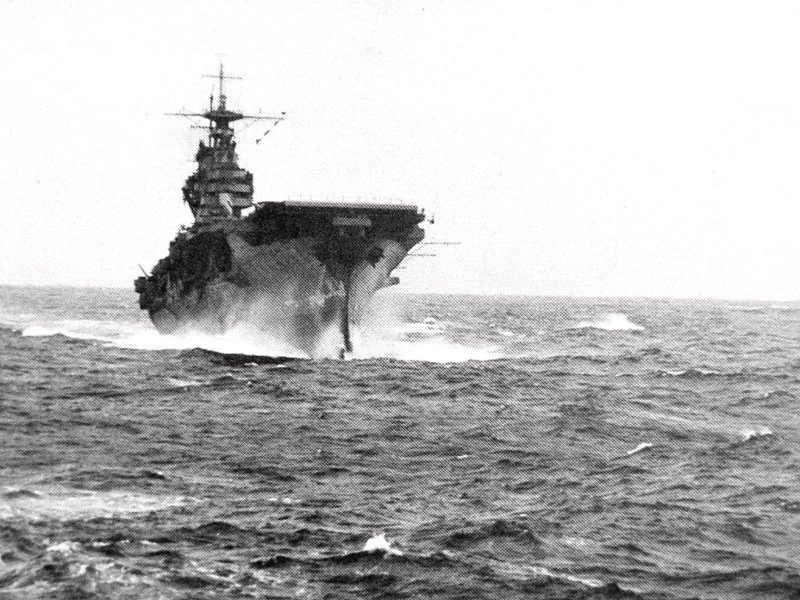
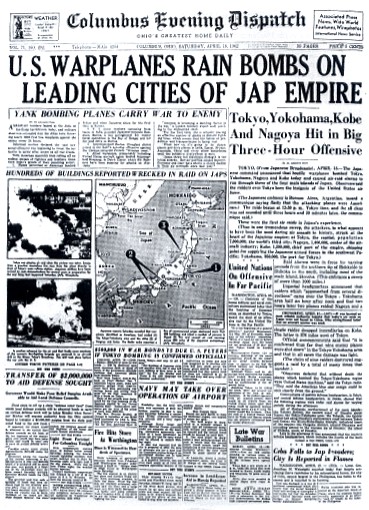
Today marks the 77th anniversary of the Doolittle Raid on Tokyo. 80 US Army Air Corps flyers manning 16 B-25 Mitchell bombers conducted a mission from the deck of the USS Hornet CV-8 which though it caused little damage changed the course of World War Two in the Pacific.

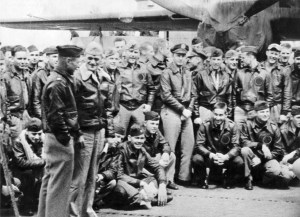
<img src=”https://padresteve.com/wp-content/uploads/2015/04/marc_a-_mitscher_and_james_doolittle.jpg?w=300&h=217″ class=”aligncenter size-medium wp-image-16779″ width=”300″ height=”217″ data-attachment-id=”16779″ data-permalink=”https://padresteve.com/2015/04/21/greetings-from-shangri-la-the-doolittle-raid/marc_a-_mitscher_and_james_doolittle/” data-orig-file=”https://padresteve.com/wp-content/uploads/2015/04/marc_a-_mitscher_and_james_doolittle.jpg” data-orig-size=”2785,2018″ data-comments-opened=”1″ data-image-meta=”{” data-image-title=”Marc_A._Mitscher_and_James_Doolittle” data-image-description=”

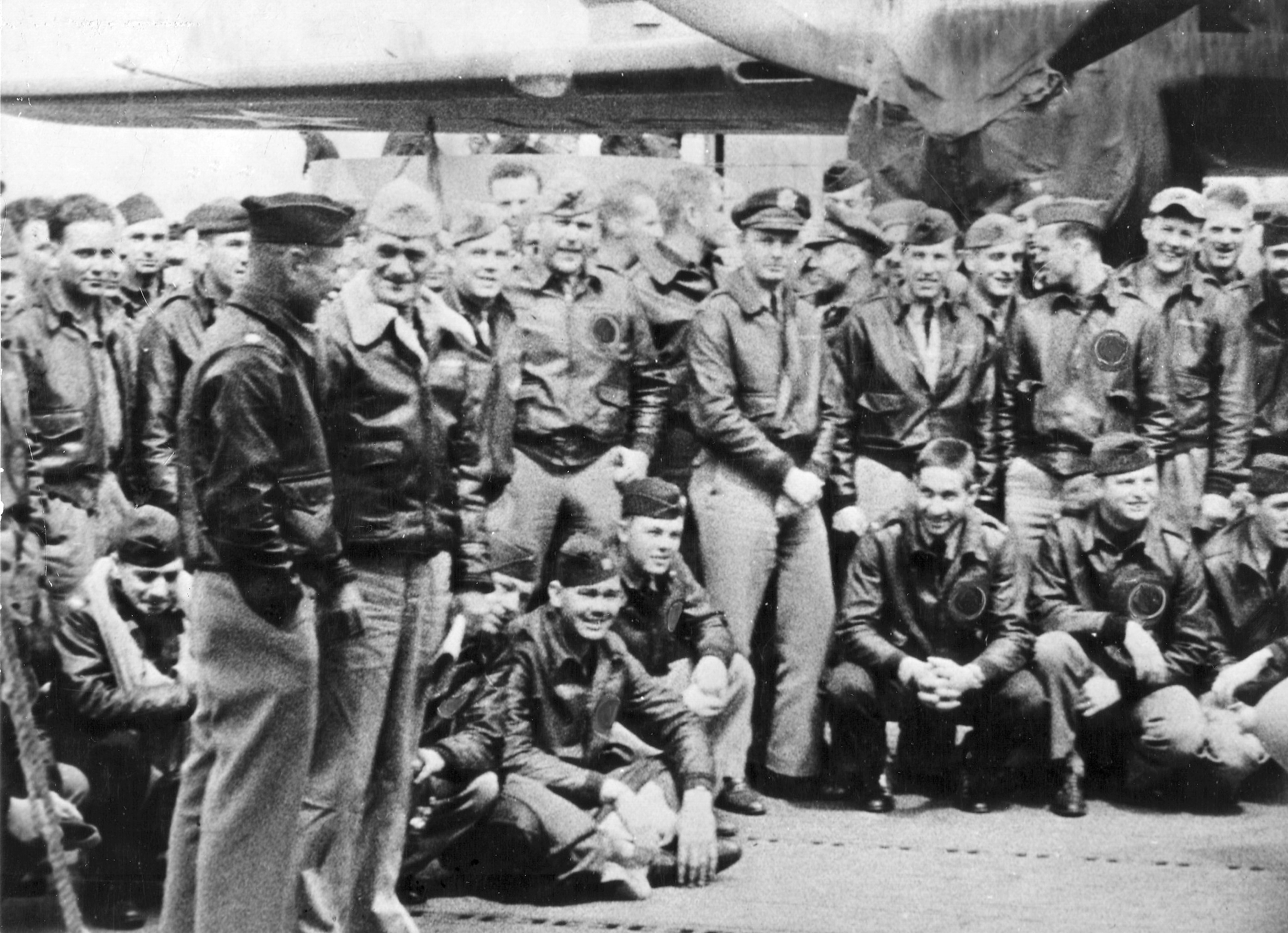
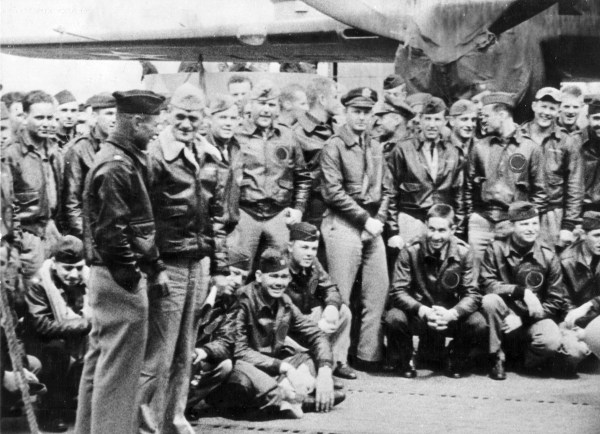
Orders in hand, Capt. Marc A. Mitscher, U.S.N., skipper of the U.S.S. Hornet (CU-8) chats with Maj. Gen. James Doolittle, U.S. Army. Some of the 80 Army fliers who took part in the historic Japanese raid are pictured with the two fliers.

” data-medium-file=”https://padresteve.com/wp-content/uploads/2015/04/marc_a-_mitscher_and_james_doolittle.jpg?w=300&h=217&#8243; data-large-file=”https://padresteve.com/wp-content/uploads/2015/04/marc_a-_mitscher_and_james_doolittle.jpg?w=500&#8243; srcset=”https://padresteve.com/wp-content/uploads/2015/04/marc_a-_mitscher_and_james_doolittle.jpg?w=300&h=217 300w, https://padresteve.com/wp-content/uploads/2015/04/marc_a-_mitscher_and_james_doolittle.jpg?w=600&h=434 600w, https://padresteve.com/wp-content/uploads/2015/04/marc_a-_mitscher_and_james_doolittle.jpg?w=150&h=109 150w” sizes=”(max-width: 300px) 100vw, 300px” style=”height: auto; max-width: 100%; border: 0px; margin-bottom: 2px”>

Doolittle and his Airmen with Hornet’s C.O. Captain Marc Mitscher 

The genus of the strike came from the desire of President Franklin Roosevelt to bomb Japan as soon as possible during a meeting just prior to Christmas 1941. Various aircraft types were considered and in the end the military chose the B-25 because it had the requisite range and had the best characteristics. Aircraft and their crews from the 17th Bomb Group which had the most experience with the aircraft were modified to meet the mission requirements. Lieutenant Colonel Jimmy Doolittle was selected to lead the mission.

Once the aircraft were ready they and their crews reported to Eglin Field for an intensive three week period of training. Supervised by a Navy pilot the crews practiced simulated carrier take offs, low level flying and bombing, night flying and over water navigation. When the training was complete the aircraft and crews and support personnel flew to McClellan Field for final modifications and then to NAS Alameda California where they were embarked on the Hornet Hornet’s air group had to be stowed on the ships hanger deck since the 16 B-25s had to remain of the flight deck. Each bomber was loaded with 4 specially modified 500 lb. bombs, three high explosive and one incendiary.

Departing Alameda on April 2nd the Hornet and her escorts, Hornet’s Task Force 18 rendezvoused with the Admiral William “Bull” Halsey’s Task Force 16 built around the USS Enterprise CV-6. task Force 16 provided escort and air cover during the mission. The carriers, escorted by 4 cruisers, 8 destroyers and accompanied by two oilers hoped to get close enough to the Japanese home islands so that the raiders could reach bases in allied China.

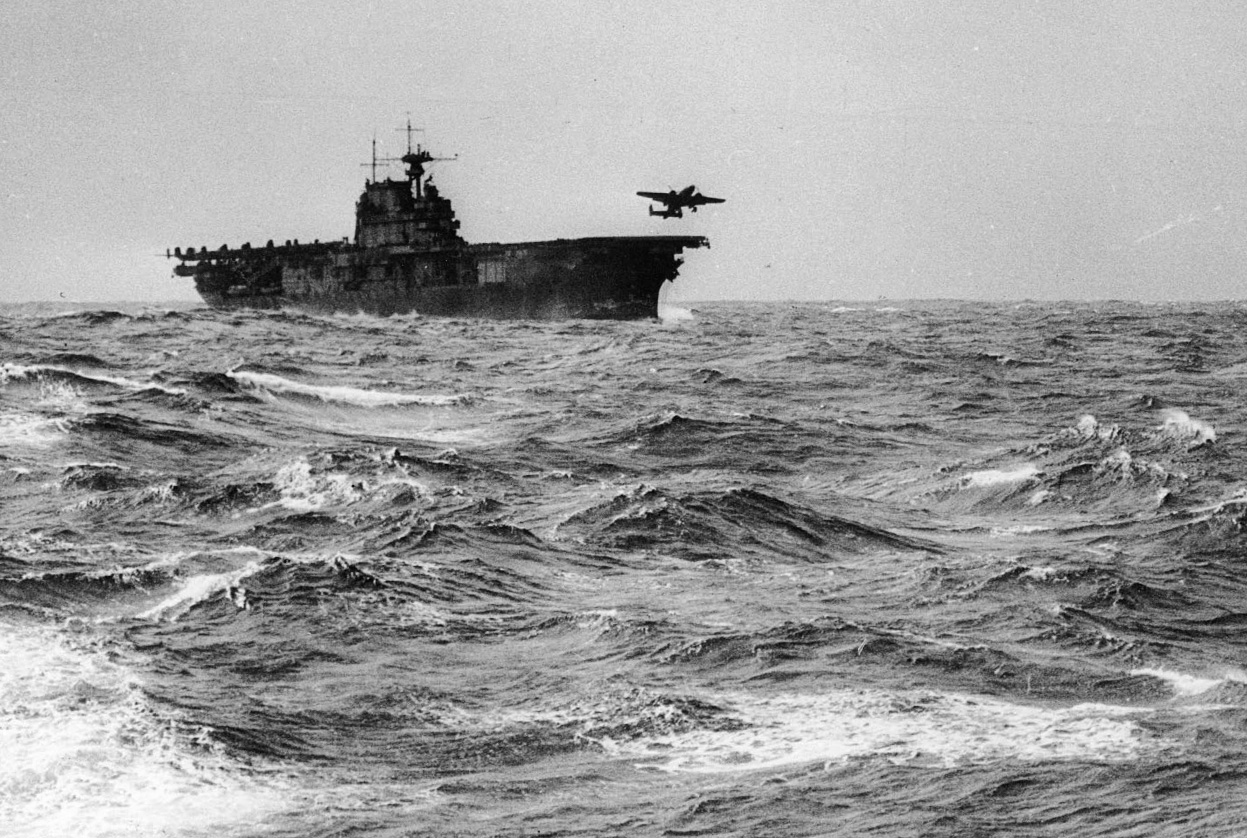
Hornet in Heavy Seas while launching the Raiders

The destroyers and slow oilers broke off on the evening of the 17th after refueling the carriers and cruisers. The two carriers and the cruisers then commenced a high speed run to get into range. However early in the morning of April 18th the ships were sighted by a Japanese patrol boat, the #23 Nitto Maru which was quickly sunk by the USS Nashville but not before it got off a radio message alerting the Japanese command. However the Japanese knowing that carrier aircraft had a relatively short range did not expect an attack. However, realizing the danger that the sighting brought, Mitscher elected to launch immediately, even though it meant that bombers would have to ditch their aircraft or attempt to land well short of the friendly Chinese airfields. The launch was 10 hours earlier and about 170 miles farther out from the Chinese bases than planned.

B-25 Launching from Hornet

Flying in groups of two to four aircraft the raiders struck the Japanese cities of Tokyo, Yokohama, Yokosuka, Nagoya, Kobe and Osaka. Minimal damage was done and only one aircraft was damaged. However they needed to fly nearly 1500 more miles to get to areas of China unoccupied by Japanese forces. Miraculously most of the aircraft and crews managed to find refuge in China. 69 of the 80 pilots and crew members avoided death or capture. Two flyers drowned, one died when parachuting from his aircraft. Eight men were captured. Of those captured by the Japanese three, Lieutenants William Farrow, Dean Hallmark and Corporal Harold Spatz were tried and executed for “war crimes” on October 15th 1942.

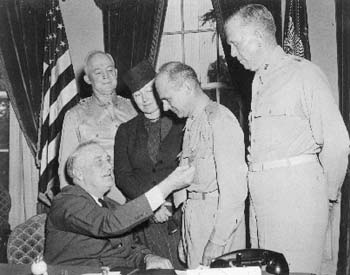
Many of the surviving flyers continued to serve in China while others continued to serve in North Africa and Europe, another 11 died in action following the raid. Doolittle felt that with the loss of all aircraft and no appreciable damage that he would be tried by courts-martial. Instead since the raid had so bolstered American morale he was awarded the Medal of Honor, promoted to Brigadier General and would go on to command the 12th Air Force, the 15th Air Force and finally the 8th Air Force.

The raid shook the Japanese, especially the leadership of the Imperial Navy who had allowed American aircraft to strike the Japanese homeland. The attack helped convince Admiral Isoroku Yamamoto that an attack on Midway was needed in order to destroy the American Carriers and the threat to the home islands.

When asked by a reporter about where the attack was launched from, President Roosevelt quipped “Shangri-La” the fictional location of perpetual youth in the Himalayas’ made famous in the popular book and movie Lost Horizon.

The raid in terms of actual damage and losses to the attacking forces was a failure, but in terms of its impact a major victory of the United States. The attack was psychologically devastating to Japanese leaders, including Prime Minister Hideki Tojo, whose personal aircraft was nearly hit by one of the raiders and Admiral Isoroku Yamamoto, who felt personally humiliated and dishonored by the fact that bombers launched from American carriers.

Likewise the raid gave the people of the United States a huge morale boost at a time when very little was going right. It forced the Japanese Navy to launch the attack on Midway that turned out to be a disaster, decimating the best of the Japanese Naval Air Forces and the loss of four aircraft carriers and enabled the US Navy to take the offensive two months later at Guadalcanal.

Franklin Roosevelt Awards Medal of Honor to Jimmy Doolittle 

In the years after the war the survivors would meet to toast each other and to reminisce about their experiences. Those meetings stopped several years ago and in 2017 LTC Dick Cole was the last of Doolittle’s raiders still alive. He passed away just over a week ago on April 9th in San Antonio. A memorial service will be held for him there on Thursday the 18th Of April. He will be buried in Arlington National Cemetery.

Now that he and the rest of the Doolittle Raiders have passed away it is up to us to never forget the heroism, sacrifice and service in a mission the likes of which had never before been attempted, and which would in its own way help change the course of the Second World War.

Since most of us have never had to make that choice, and our President dodged the draft under the unusual circumstances often given to the children of the wealthy, we should ask what we would do if we were in Dick Cole’s shoes, or for that matter any of the men involved in the Doolittle Raid.

Since I have been serving as a volunteer since 1981 with multiple combat deployments to my name, and I. All of which I put my life on the line unarmed, and I still serve, so I know what I would do. However, that being said I really do have to wonder about most Americans, including those of my own generation who claim to support the troops without ever serving a day in uniform or even volunteering in the Peace Corps, Americorps, or even with the Red Cross.

The devotion of these men is seldom seen today. Our President routinely mocks those killed, wounded, or taken prisoner in war as “losers” and on the Howard Stern Radio program described avoiding sexually transmitted diseases in the 1980s as his “personal Vietnam.”

But I digress… the Greatest Generation is passing away. They fought fascism, the Nazis, and the Japanese Empire, and then many continued to serve during the Cold War, and in Korea, and some up to Vietnam. It is up to us the living to not disgrace their memory by forgetting them, or even worse, pretending that avoiding STDs is the equivalent of serving in harms way.

I think of the words of the character played by Jose Ferrer in the novel and movie written by Herman Wouk, The Caine Mutiny:

So until tomorrow, either put up, or shut up, especially if you wear the Red MAGA hat. Being a true American Patriot is not based on political ideology, Party, race, or religion. It is all about upholding the foundational principle of the Declaration: “We believe that all men are created equal, and are endowed by their creator with certain unalienable rights, among them being life, liberty, and the pursuit of happiness.”

After all, that is the foundational principal of the United States. It is true for all of us, or none of us, for once those rights are denied to anyone, the precedent can be used against any of us. To fall back on a quote from Captain Jean Luc Picard in the Star Trek the Next Generation episode The Drumhead:

“You know, there are some words I’ve known since I was a schoolboy: “With the first link, the chain is forged. The first speech censured, the first thought forbidden, the first freedom denied, chains us all irrevocably.” Those words were uttered by Judge Aaron Satie, as wisdom and warning. The first time any man’s freedom is trodden on, we’re all damaged. I fear that today…”

Until tomorrow,

Peace

Padre Steve+

2 Comments

Filed under aircraft, History, Military, national security, News and current events, Political Commentary, US Army Air Corps, US Navy, World War II at Sea

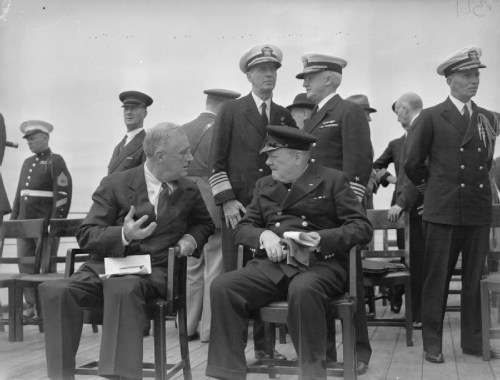
We Could Use a Man (or Woman) Like Franklin Roosevelt Again

Friends of Padre Steve’s World,

If I had to place myself on the political spectrum it would be in the area occupied by Franklin Delano Roosevelt. I am definitely a liberal, I can no longer claim to be a conservative by any means of the imagination, but as a historian I am very careful in embracing the extremes of left, or right wing populism, the very things which are driving much of the political division in our country. In 1932 Franklin Roosevelt was wise enough to state:

“Say that civilization is a tree which, as it grows, continually produces rot and dead wood. The radical says: “Cut it down.” The conservative says: “Don’t touch it.” The liberal compromises: “Let’s prune, so that we lose neither the old trunk nor the new branches.” This campaign is waged to teach the country to march upon its appointed course, the way of change, in an orderly march, avoiding alike the revolution of radicalism and the revolution of conservatism.”

Of course there were quite a few conservatives and progressives of his time who loathes and attempted to obstruct, hamper, or defeat Roosevelt’s New Deal. But what many didn’t understand was that Roosevelt was willing to risk failure so long as he learned from it and succeeded in the end.

As Historian John Meacham wrote:

“Disappointed liberals lobbied the president to move more quickly on social and economic issues. “You’ll never be a good politician,” FDR once told Eleanor, who frequently presented such pleas to her husband. “You are too impatient.” At a White House meeting, Roosevelt parried a questioner with a lesson in practical politics. Lincoln, Roosevelt said, “was a sad man because he couldn’t get it all at once. And nobody can. Maybe you would make a much better President than I have. Maybe you will, someday. If you ever sit here, you will learn that you cannot, just by shouting from the housetops, get what you want all the time.” He sometimes turned to sports to make his point. “I have no expectation of making a hit every time I come to bat,” Roosevelt remarked. “What I seek is the highest possible batting average.”

Likewise, Meacham noted:

“He argued that leadership, even his own, was imperfect. A wise public, Roosevelt believed, would give a well-meaning, forward-leaning president the benefit of the doubt. “The country needs and, unless I mistake its temper, the country demands bold, persistent experimentation,” Roosevelt said in 1932. “It is common sense to take a method and try it: If it fails, admit it frankly and try another. But above all, try something…. We need enthusiasm, imagination and the ability to face facts, even unpleasant ones, bravely.”

The situation confronting Roosevelt is little different than we face today. There are political forces on the extreme left and right that have little regard for what has been accomplished in the American experiment, and who as Roosevelt noted either want to cut it down completely, or change nothing, as if two and a half-centuries have not passed. As Thomas Jefferson wrote:

“I am not an advocate for frequent changes in laws and Constitutions. But laws and institutions must go hand in hand with the progress of the human mind. As that becomes more developed, more enlightened, as new discoveries are made, new truths discovered and manners and opinions change, with the change of circumstances, institutions must advance also to keep pace with the times. We might as well require a man to wear still the coat which fitted him when a boy as civilized society to remain ever under the regimen of their barbarous ancestors.”

Meacham noted of Roosevelt:

Sustained by this view of progress, Roosevelt urged the nation onward. “We shall strive for perfection,” Roosevelt said. “We shall not achieve it immediately—but we still shall strive. We may make mistakes—but they must never be mistakes which result from faintness of heart or abandonment of moral principle…. Our Constitution of 1787 was not a perfect instrument; it is not perfect yet. But it provided a firm base upon which all manner of men, of all races and colors and creeds, could build our solid structure of democracy.”

Abraham Lincoln understood this when in the Gettysburg Address he noted:

“Fourscore and seven years ago our fathers brought forth, on this continent, a new nation, conceived in liberty, and dedicated to the proposition that all men are created equal. Now we are engaged in a great civil war, testing whether that nation, or any nation so conceived, and so dedicated, can long endure. We are met on a great battle-field of that war. We have come to dedicate a portion of that field, as a final resting-place for those who here gave their lives, that that nation might live. It is altogether fitting and proper that we should do this. But, in a larger sense, we cannot dedicate, we cannot consecrate—we cannot hallow—this ground. The brave men, living and dead, who struggled here, have consecrated it far above our poor power to add or detract. The world will little note, nor long remember what we say here, but it can never forget what they did here. It is for us the living, rather, to be dedicated here to the unfinished work which they who fought here have thus far so nobly advanced. It is rather for us to be here dedicated to the great task remaining before us—that from these honored dead we take increased devotion to that cause for which they here gave the last full measure of devotion—that we here highly resolve that these dead shall not have died in vain—that this nation, under God, shall have a new birth of freedom, and that government of the people, by the people, for the people, shall not perish from the earth.”

Roosevelt understood, just as Lincoln did that our system, form, and institutions were under attack from many sides, thus we all must take increased devotion… that this nation, under, God, shall have a new birth of freedom, and that government of the people, by the people, and for the people, shall not perish from thee earth.”

I am going to stop for now. I am about two-thirds of the way through Meacham’s book and about 1/3 of the way through Doris Kearns Goodwin’s Leadership in Turbulent Times, which looks at the lives, failures, and ultimate successes of the leadership styles of Abraham Lincoln, Theodore Roosevelt, Franklin Roosevelt, and Lyndon Baines Johnson.

It seams that now regardless of what party or ideology we espouse, we want absolute doctrinal purity. Certainly that was not what our founders thought, nor men like Franklin Roosevelt. Our Republic can be destroyed by the radicalism of the Right and Left, but also the complacency of the Center, which by ignoring the the crisis engulfing the country only make the crisis worse. Hannah Arendt noted:

“The ideal subject of totalitarian rule is not the convinced Nazi or the convinced Communist, but people for whom the distinction between fact and fiction (i.e., the reality of experience) and the distinction between true and false (i.e., the standards of thought) no longer exist.”

I am a liberal, a progressive, and a Democrat, but I am as much as of a realist as Franklin Roosevelt. Our Union is imperfect, but just because it is so it should not be cut down and destroyed, nor ignored and uncultivated by progress. The grafting of new branches onto the old stock is not a travesty, or a threat. It is the ideal that motivated the Founders was not that they were achieving perfection in the moment, but that they were planting ideals that would ultimately be universal. “We hold these truths to be self-evident, that all men are created equal and are endowed by their creator with certain unalienable rights, among them being life, liberty, and the pursuit of happiness.”

Such thoughts are now part of the Constitutions of other countries and the United Nations. If we want to look into the imaginary future they are included as part of the Constitution of the United Federation of Planets.

We live in a nation whose past is far from perfect, a nation that has deviated from its foundational principles all too many times, that being said, Franklin Roosevelt, understood this as fact. He did not try to mythologize our past. He sought the best from that ancient trunk and grafted on, as Abraham Lincoln, and Theodore Roosevelt before him, as well as Harry Truman, Dwight Eisenhower, John Kennedy, and Lyndon Johnson did after him, ideas that expanded liberty for all, without which the radicals of the right or left fail to appreciate.

Roosevelt spoke during his nomination speech at the 1932 Democratic Party Convention:

“Wild radicalism has made few converts, and the greatest tribute that I can pay to my countrymen is that in these days of crushing want there persists an orderly and hopeful spirit on the part of the millions of our people who have suffered so much,” Roosevelt said. “To fail to offer them a new chance is not only to betray their hopes but to misunderstand their patience.

The forces of progress, Roosevelt believed, were not to cower or to lash out, but to engage. “To meet by reaction that danger of radicalism is to invite disaster,” he said. “Reaction is no barrier to the radical. It is a challenge, a provocation. The way to meet that danger is to offer a workable program of reconstruction, and the party to offer it is the party with clean hands.

He then introduced a crucial phrase: “I pledge you, I pledge myself,” FDR said, “to a New Deal for the American people.” The crisis was existential. “His impulse,” Winston Churchill wrote of FDR in the mid-1930s, “is one which makes toward the fuller life of the masses of the people in every land, and which, as it glows the brighter, may well eclipse both the lurid flames of German Nordic self-assertion and the baleful unnatural lights which are diffused from Soviet Russia.”

That is how I view the situation today. As far as it goes, those who consider themselves to be Democratic Socialists are little more than Franklin Roosevelt, Harry Truman, John F Kennedy, or Lyndon Baines Johnson Democrats. They believe in the New Deal, Civil Rights, and the Great Society. They also believe in the realities of science and Climate Change and seek answers that work with our economic and scientific realities, like their predecessors they believe in the instruments of the future. In the past it was fossile fuels and nuclear power; now it is wind power, and solar energy, combined with the cleanest and most efficient forms of past energy. None of those ideas are radical, they are progressive, economically sound, job producing, and environmentally friendly policies that could help reverse the scourge of global warming, sea rise, and climate change.

Likewise, Franklin Roosevelt realized the dangers of Stalinist Communism and Hitlerian Fascism, which he saw as a threat to the United States in the 1930s, but in the short term he realized that the Nazi threat was the greatest threat, and allied with Britain, the Soviet Union, Free France, and China to defeat Germany first, Japan next, and then deal with the Soviet Union using the full power of the nation; Diplomatic, Informational, Military, and Economic to achieve the overthrow of the Soviet Union. That did not happen until 1990, but when it did a plethora of Soviet dominated regimes fell in Eastern Europe. Since that time the Bush, Clinton, Bush, Obama, and Trump administrations have surrendered many of those gains and allowed a New expansionist, Soviet Union, albeit without the Soviet Name to be reestablished in Russia under Vladimir Putin.

I won’t go into the other overseas threats, but he would recognize the danger of President Trump’s “America First” policy which is little different from the America Firsters of his era. He looked forward, they looked back. He looked at a world that might overwhelm the United States, the threats of Naziism, Fascism, and Stalinist Communism, and in spite of resistance from his own party and the Republican isolationists who adopted the America First ideology of men like Charles Lindberg which would have surrendered all of Europe, including Great Britain to the Nazis because it was nothing more than an intra-racial struggle and not one against inferior races. Even after Hitler overran Poland and Western Europe Lindberg argued:

“for leaving the Old World to its own devices. “Now that war has broken out again, we in America have a decision to make on which the destiny of our nation depends,” Lindbergh said, adding: “In making our decision, this point should be clear: these wars in Europe are not wars in which our civilization is defending itself against some Asiatic intruder. There is no Genghis Khan or Xerxes marching against our Western nations. This is not a question of banding together to defend the White race against foreign invasion. This is simply one more of those age-old quarrels within our own family of nations.”

Roosevelt knew that was nonsense. He worked patiently with congress on both sides of the aisle, building his case in spite of resistance until Hitler attacked Poland, and overran most of Western Europe, Roosevelt’s policy ideas were ratified into policy. When Japan attacked at Pearl Harbor and Hitler declared war on the United States he was able to act.

Roosevelt brought the country together. He helped to maintain at disparate alliance between Britain, the United States, and the Soviet Union. It was courageous, as Meacham noted:

” A man of courage, Churchill appreciated it when he detected courage in others, and he had seen it, intimately, in Franklin Roosevelt. “It was a marvel that he bore up against it through all the many years of tumult and storm,” Churchill said of FDR’s paralysis. “Not one man in ten millions, stricken and crippled as he was, would have attempted to plunge into a life of physical and mental exertion and of hard, ceaseless political controversy. Not one in ten millions would have tried, not one in a generation would have succeeded, not only in entering this sphere, not only in acting vehemently in it, but in becoming indisputable master of the scene.”

We need a leader like Franklin Roosevelt now. Personally, I am not sure if any of the challengers to Donald Trump has the gravitas, courage, or determination to go where Roosevelt went. He was willing to risk failure, admit it and try again. I don’t know if our political culture, at least the political culture of the Democratic Party would allow it. The Republicans don’t seem to care as is obvious by their continued support of Donald Trump, and his policies which are nothing short of Lindberg’s America First campaign, Hitler’s racial politics, and American Jim Crow laws.

Roosevelt began the domestic and international policies that Donald Trump fights against on a daily basis. I don’t know what Democratic candidate that will be, but it has to someone has to fully embrace the Roosevelt legacy and push it to the future. As Roosevelt showed this has to me more than about sound bites; it has to be about truth, integrity, and the willingness to engage with and even at times compromise with domestic political rivals in order to preserve the Republic against all enemies, foreign and domestic. But none of the Democratic Party candidates have yet to show me that they have the moral, or physical courage of Roosevelt who battled polio which deprived him of much of his mobility and physical abilities when he was 39 years old. Maybe if Senator Tammy Duckworth would enter the race I might see a candidate with that kind of courage. If she would enter the race, win the nomination, and the presidency, she would be the first female, combat vet and wounded warrior to serve as president.

I would like that very much.

But, until tomorrow we have what we have.

Peace,

Padre Steve+

4 Comments

Filed under History, national security, nazi germany, News and current events, Political Commentary, world war two in europe

The Struggle for Women’s Rights: Nurses, Spies, and Soldiers in the Civil War

Clayton-Francis-L

Friends of Padre Steve’s World,

It’s been a couple of days since International Women’s Day and I am really surprised of how many men Insee attacking and denigrating women military members and combat veterans. I actually wonder how many of these Twitter Trolls have actually served in the military or combat, and how many simply live their lives through myth and video games, but obviously they have never served in combat with the women who serve not only in the United States military, but so many others.

Nor domthey study history, even going back to Biblical Times; Deborah the Judge and Military leader or Judith, the Spy and assassin. Likewise the forget Joan Of Arc, Molly Pitcher, and what this article deals with, the women who served in the American Civil War. In fact, some of these women were what we would now call Transgender. 

There will be more articles in this series. So until tomorrow, 

Peace

Padre Steve+

women-civil-war-sarah-edmonds-frank-thompson-631

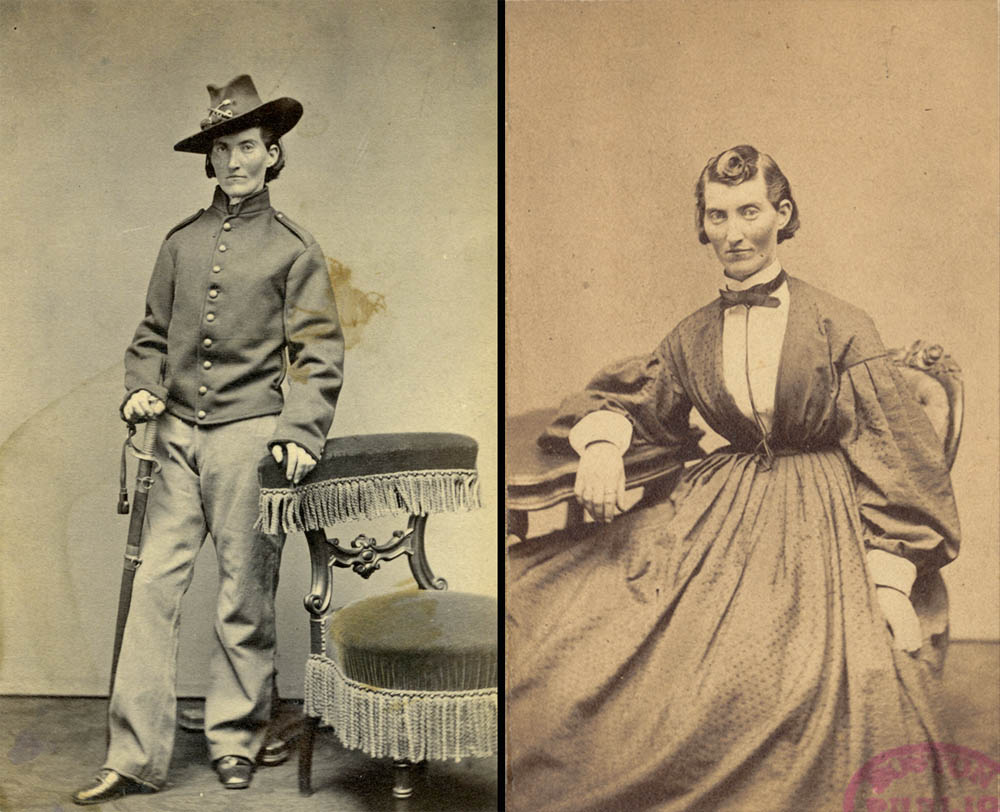
Of course when war broke out the logical end of this train of thought led to the question of whether women should women be allowed to serve in the military. Legally and socially it was not possible for women to serve in the military in 1861, but this did not stop women from doing so. Even so, “women were not expected to defend their country, and when they did nevertheless and were found out, they learned that they were not necessarily a welcome addition to the military. Women who returned home after the Civil War as veterans reaped few of the societal rewards for having rendered such service.” [1] Quite a few women on both sides of the conflict chaffed about not being allowed to fight for their countries, their families and their causes, and despite official prohibitions that kept women from serving in any capacity but nursing, a good number of women found their way to go to war. While men in the North and South “were expected to enlist, any woman actively participating in the Civil War was an oddity if not a renegade.” [2] In some cases this involved hundreds of women taking male identities in order to fulfill their desires to serve their countries.

The motives of these women varied. In some cases women wanted gain the economic privileges of full citizenship, and for others the glory reserved to only to men. In our modern parlance those that took male identities would be considered transvestites or possibly transgender, but for them “transvestitism was a private rebellion against public conventions. By taking a male social identity, they secured for themselves male power and independence, as well as full status as citizens of their nation. In essence the Civil War was an opportunity for hundreds of women to escape the confines of their sex.” [3]

During the war hundreds of women went to war, dreaming of being a second Joan of Arc, taking on the identity of men, however, their idealistic vision of wanting to serve the cause of their country, was not viewed favorably by many, men and women alike, as “they were usually viewed by contemporaries as mentally unbalanced or immoral.” [4] Their morality was question, their motivation was questioned, and their character was questioned, all because they broke long held social, and religious barriers in order to fight for what they believed.

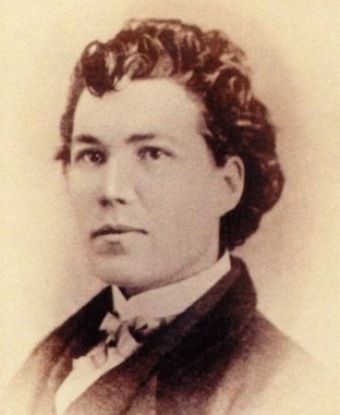
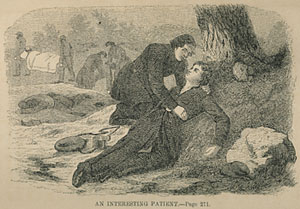
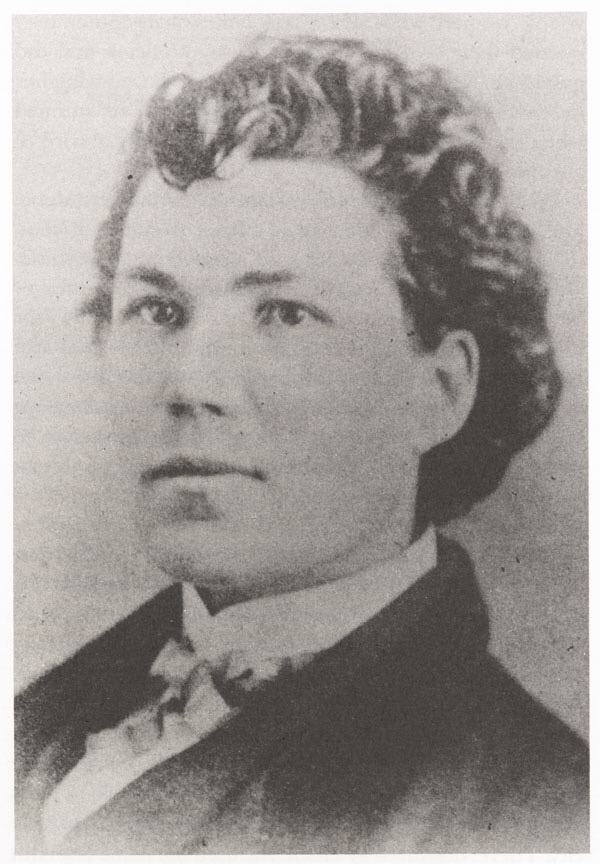
These brave and socially progressive women enlisted under male names and pretended to be men. Unless they were discovered to be women, or unless they confessed to their wartime service either during or after the war, most of their records were lost. In 1861 Private Franklin Thompson “enlisted in Company F of the 2ndMichigan Infantry…unknown to comrades, Thompson actually was Sarah Emma Edmonds.” [5] Edmonds served in the illustrious Iron Brigade until the disaster at Fredericksburg. Well known for her courage as Franklin Thompson, Edmonds participated in some of the bloodiest combats of the war. At Antietam she was caring for the wounded when she came upon a soldier who had been wounded in the neck. That soldier informed Edmonds that she was dying and after a surgeon came by and confirmed what the soldier said the dying soldier told Edmonds:

“I am not what I seem, but I am female. I enlisted from the purest motives, and I have remained undiscovered and unsuspected. I have neither father, mother nor sister. My only brother was killed today. I closed his eyes about an hour before I was wounded….I am Christian, and have maintained the Christian character ever since I entered the army. I have performed the duties of a soldier faithfully, and am willing to die for the cause of truth and freedom….I wish you to bury me with your own hands, that none may know after my death that I am other than my appearance indicates.” [6]

That unknown woman was not alone, at least nine women, eight Union and one Confederate, fought at Antietam and of those five were casualties. Five women, two Federal and three Confederate took part at Gettysburg. All three Confederate women at Gettysburg were either killed or wounded, or captured, including two women who took part in Pickett’s Charge. [7]

Edmonds_inline

Sarah Edmonds

Sarah Edmonds published a book Nurse and Spy in the Union Army while recovering from malaria in 1863. The book, which was published the following year, sold 175,000 copies, the proceeds that she donated to care for sick and wounded Union veterans. After the war, Edmonds attended Oberlin College, married, had three of her own children and adopted two more. She “became a member of the Grand Army of the Potomac, the organization for Union veterans of the Civil War. She applied for, and received, a military pension, and upon her death in 1898 was buried with full military honors.” [8] She was the only women admitted to the Grand Army of the Republic.

Another of the women to serve was Frances Louisa Clayton. Fighting for the Union as a member of the Minnesota State Militia Cavalry and 2nd Minnesota Battery, serving under the command of Ulysses S. Grant she was wounded at Fort Donelson. Like many other women soldiers, Clayton mastered the art of behaving as a man. She “became “a capital swordsman,” but also commanded attention with her “masculine stride in walking” and “her erect and soldierly carriage.” [9]

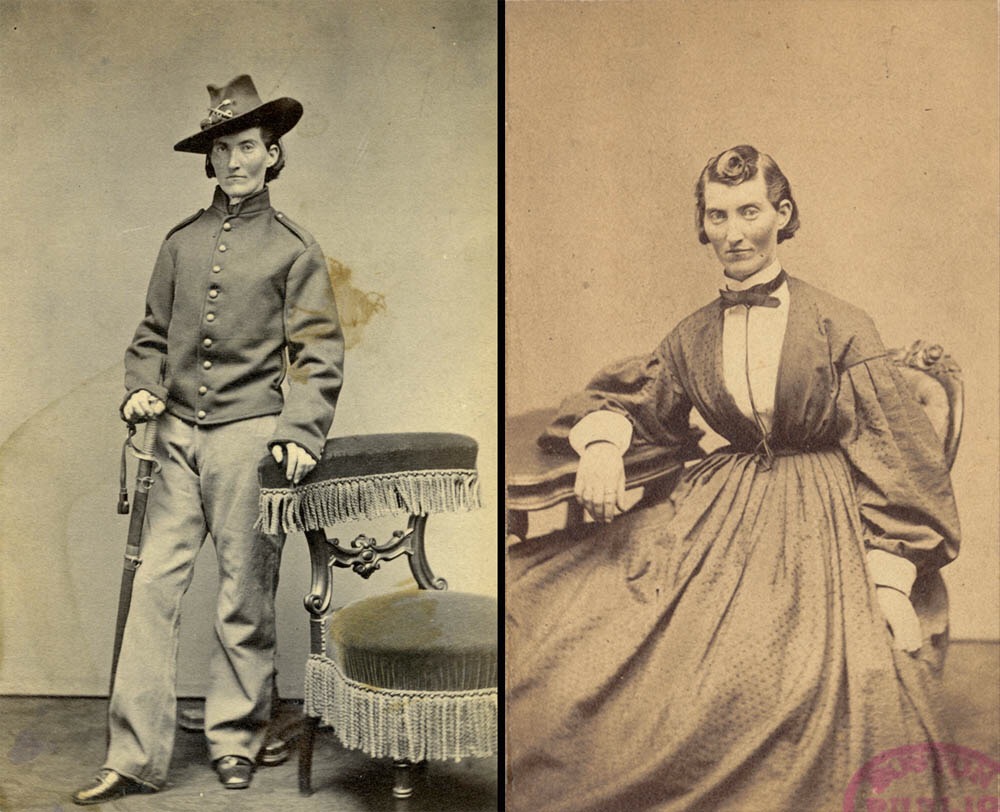
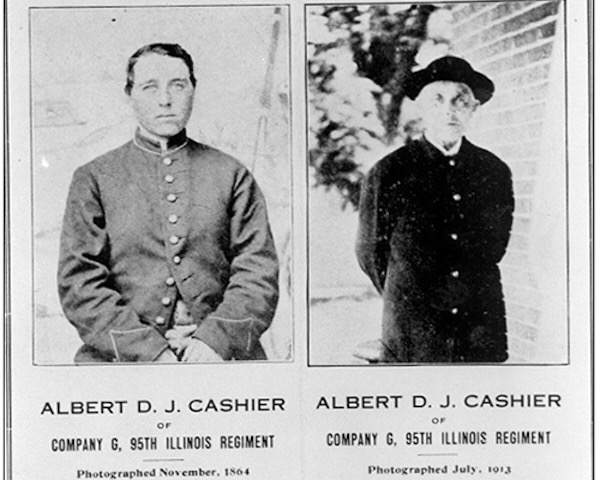
Albert-Cashier

However, most women were more discreet during and after the war regarding their true sexuality. Private Albert Cashier hid his sexuality identity for his entire term of service. He enlisted in August 1862 as a member of the 95th Illinois. Cashier was born in Ireland as a woman, Jennie Hodgers. He fought in forty battles and was discharged with the regiment in August 1865. At Vicksburg he was briefly captured by the Confederates while conducting a reconnaissance “but managed to escape by seizing a gun from one of her guards, knocking him down, and outrunning others. Comrades recalled Private Cashier climbing to the top of their fieldworks to taut the enemy into showing themselves.” [10]

After the war “Albert” returned home and lived as a “farmer and handyman and served as a caretaker in his church. He never married.” In 1890 he applied for and received a military pension and in 1911 the now elderly “man” was struck by a car and suffered a broken leg. The doctor treating him discovered that Albert was not a man, but a woman. But the doctor kept his confidentiality and without revealing “Albert’s” secret had the Union veteran admitted to the local Soldier’s and Sailors’ Home at Quincy, Illinois.” [11] A few years later the elderly “man” began to exhibit erratic behavior and was “committed to a public mental hospital and the word was out.” [12] With her story now sensational front page news and “old comrades in arms came to her defense.” [13] Her comrades had never known that “Albert” was a man during or after the war, while the news was a surprise to them they came to her defense. To combat some of the sensationalism in the media Albert’s fellow soldiers testified “to Albert’s bravery in combat and public good works in later life. Albert/Jennie died at Watertown State Hospital in 1915 at age seventy-one. The local post of the Grand Army of the Republic arranged for her burial. Her headstone reads: “Albert D.J. Cashier, Company G, 95th Illinois Infantry.” [14]

There are similar accounts of women who served as soldiers in the Confederate army including Mrs. Amy Clarke who enlisted with her husband and continued to serve until after his death at the Battle of Shiloh. Her gender remained secret until she was wounded and captured by Union forces. As “soon as she had recovered they gave her a dress and sent her back into Confederate lines; but a short time later she was seen in Mississippi making plans to re-enlist.” [15]

Wartime records are sketchy but as a minimum it is believed that “between 250 and 400 women disguised as men found their way into either the Federal or Confederate armies.”  [16] A more recent estimate is that in the Confederate army alone there were some 250 women who served as soldiers during the war. [17] Casualties were high for the women that are known to have served as soldiers, they had a “combined casualty rate of 44 percent” including the fact that fully “eleven percent of women soldiers died in the military.” [18] Some of those women are now well known but many others are lost to history. Most women tried to keep their sexual identities secret, even to the point of their death on the battlefield. Most of the women who served in the armies returned home to resume relatively normal lives after the war.

Other women would serve as spies for both sides, often rendering valuable assistance to their countries. The women who served as spies often took their lives into their hands; however, they often provided vital information to the Union or Confederate officers that they served. Pauline Cushman “parlayed her acting talents into a series of elaborate ruses that allowed her to pry information out of admiring and complaisant Confederate officers; Belle Boyd used an equal measure of talent in as a northern Virginia coquette to elide the same kind of information out of Federal officers.[19]

0065747

Elizabeth Van Lew

Even those women who were successful often suffered for their service during and after the war as they learned “that few people completely trusted or respected a spy, not even a “friend.” [20] Many, especially Southern women who spied for the Union were ostracized and persecuted in their communities after the war, and found little support from Northern politicians. Rebecca Wright, a young Quaker schoolteacher in Winchester, Virginia provided information that “enabled him to defeat General Early’s forces” in the Valley of 1864. She lost her job, and her former friends and neighbors boycotted her family’s businesses. Rejected for a pension, Sheridan helped Wright obtain “an appointment in a government office, remaining there for the rest of her days.” [21] Elizabeth Van Lew was a lifelong resident of Richmond and daughter of a wealthy businessman.  She helped Union prisoners escape from Richmond’s notorious Libby prison and when Grant besieged Petersburg, Miss Van Lew “supplied him with a steady stream of information” [22]

To be continued….

Notes

[1] Ibid. Blanton and Cook They Fought Like Demons p.209

[2] Silvey, Anita I’ll Pass for Your Comrade Clarion Books, New York 2008 p.9

[3] Ibid. Blanton and Cook They Fought Like Demons p.5

[4] Ibid. Massey Women in the Civil War p.79

[5] Ibid. Lowry The Stories the Soldiers Wouldn’t Tell  p.119

[6] Ibid. Silvey I’ll Pass for Your Comrade p.68

[7] Ibid. Blanton and Cook They Fought Like Demons pp. 15-16

[8] Ibid. Silvey I’ll Pass for Your Comrade p.90

[9] Ibid. Blanton and Cook They Fought Like Demons p.58

[10] Ibid. Blanton and Cook They Fought Like Demons pp. 16-17

[11] Ibid. Lowry The Stories the Soldiers Wouldn’t Tell p.121

[12] Ibid. Lowry The Stories the Soldiers Wouldn’t Tell p.121

[13] Ibid. Silvey I’ll Pass for Your Comrade p.90

[14] Ibid. Lowry The Stories the Soldiers Wouldn’t Tell p.121

[15] Ibid. Massey Women in the Civil War p.81

[16] Ibid. Guelzo Fateful Lightning p.394

[17] Ibid. McCurry Confederate Reckoning  p.87

[18] Ibid. Blanton and Cook They Fought Like Demons pp.206-207

[19] ibid. Guelzo Fateful Lightning p.395

[20] Ibid. Massey Women in the Civil War p.87

[21] Ibid. Massey Women in the Civil War pp. 103-104

[22] Ibid. Massey Women in the Civil War p.102

Leave a comment

Filed under civil rights, civil war, History, Military, national security, News and current events, Political Commentary

The Reichstag Fire Decree and Trump’s Potential Actions

partridge if you can't be a dictator

Friends of Padre Steve’s World,

Yesterday I wrote about the Reichstag Fire and the resultant Order of the President of the Reich for the Protection of People and State or as it is more often known as the Reichstag Fire DecreeI wrote about how perilously close that I really believe that we are to a Reichstag Fire moment in our country today.

That has not changed. In fact the President declared a National Emergency over an imaginary crisis at the U.S. – Mexican border, an act that he said that he did not have to proclaim as he made the declaration.

On February 27th 1933 Adolf Hitler and his Nazi Party which was still a minority party in a coalition government of partners that wouldn’t have minded his failure, became recipients of of a political gift that allowed them to seize power under the very provisions of the Republic and Constitution that they despised. A Dutch Communist The very next day Hitler with the backing of President Paul von Hindenburg issued a decree under Article 48 of the Weimar Constitution which though directed at the German Communist Party, which was banned along with its publications, applied to every political party in Germany.

Barely three weeks later the Reichstag, now emptied of Communists deputies gave its approval to the Enabling Act which gave the central government. Their abdication Of their Constitutional role allowed Hitler to enact laws without the approval of the Reichstag, effectively ending any sort of parliamentary democracy and eviscerating the constitution. 

These acts gave the central government in Berlin to usurp State governments in States where non-Nazi parties held democratic majorities and to outlaw political opposition. The only party to oppose the Nazi moves toward dictatorship were the Social Democrats who voted against both laws. Their party was banned shortly after the Enabling Act was passed. Their leader in the Reichstag, Otto Weis proclaimed the last free words uttered in the Reichstag:

“No Enabling Law can give you the power to destroy ideas which are eternal and indestructible … You can take our lives and our freedom, but you cannot take our honour. We are defenseless but not honourless.” 

The other political parties in Germany, including the conservative parties and center parties who had allied themselves with Hitler voted to dissolve themselves by the end of July 1933. None of the conservative opposition wanted to face the wrath of Hitler or his newly established extrajudicial Concentration Camps which were not run by the Ministry of Justice, but the Nazi Party.

In Germany it was the burning of the Reichstag but in any crisis the same could happen here. I think this is very possible with President Trump and a compliant Republican Party which has surrendered any sense of responsibility, including the defense of things that it fought against for years in order to maintain power by supporting a man that just two years ago most mocked and opposed; so much like the non-Nazi German conservatives and Hitler. That was demonstrated today as Michael Cohen, the President’s former lawyer and “fixer” testified before Congress. His testimony was compelling, credible, and backed up by documentary evidence, including documents signed by the President signed after he took office. All the Republicans could do was attack the messenger, they never challenged a single fact.

Now let’s think about today and lets let our minds wander into possibilities that are much more likely than they would have been a few years ago. So let’s take a journey to a future where most of us would not want to go. I mean really, I don’t want these things to happen, if not for any other reasons than things than effect me.  I want to attend my 40th high school reunion on September 1st and a trip to Germany to the Oktoberfest and to visit our German friends later that month.  So some things are about me, I mean if were going to lose all of our freedoms I want to get a few bucket list items in, but I digress, let’s go back to the unimaginable.

Rather than standing up for truth, the Republicans, like the non-Nazi German Conservatives in 1933 are more concerned with holding power to fulfill their agenda than with the character of the man they are backing. Today Cohen warned them when they attacked him:

As Mr. Cohen told Republican lawmakers, “I did the same thing that you’re doing now. For 10 years. I protected Mr. Trump for 10 years.”

He then issued this warning to them: “The more people that follow Mr. Trump — as I did blindly — are going to suffer the same consequences that I’m suffering.” Mr. Cohen later explained the ethos of Trumpworld: “Everybody’s job at the Trump Organization is to protect Mr. Trump. Every day most of us knew we were coming and we were going to lie for him about something. That became the norm.”

This has now become the norm of the Republican Party, which if I need to remind you I served and believed from the time that I volunteered for Gerald Ford’s campaign before I could vote in 1976 until I left the party following my return from Iraq in 2008. I stopped defending the indefensible eleven years ago.

I would say close your eyes but then you wouldn’t be able to read unless you have some sort of software that turns my written words into spoken words, or unless you want me to start a podcast. If you want the latter make it worth it by doing something to get me a few extra bucks for more beer before everything goes to hell.

Let us imagine that following increased tensions in Venezuela that a real or alleged terrorist group claiming to support the Venezuelan dictator Maduro attacks the NY Subway and the Washington Metro subway systems with Sarin and phosgene nerve gas. Another alleged Venezuelan terrorist shoots down an American Airlines Airbus 330 with a SAM 7 as it attempted to land In Philadelphia. In the attacks, thousands of people die. In another attack a heavily armed terrorist group attacks the Mall of American with assault rifles, RPGs, and grenades. Between Miami and the Bahamas an explosion rocks a Disney Cruise Ship, killing many passengers and crew and leaving it disabled and requiring Coast Guard and U.S. Navy assistance to save the ship and bring her back to port.

While Federal, State and local law enforcement investigate at the points of attack, the FBI, CIA and NSA attempted to ascertain if and what foreign power or terrorist groups were behind the attacks. Venezuela was at the top of the list, but Iran, Hezbollah, North Korea, and even Russia were suspects, but it took time to find the culprits.

In the mean time the country went into a panic. Retribution was the watchword. Thousands of people were killed and injured in the attacks. Following them the subways, airports and maritime ports shut down. The economy went into shock. Prices soared and Wall Street crashed, dumping some 30% of its value in three days. Prices for imported goods skyrocketed, and all commercial air traffic was grounded leaving millions of people stranded. It didn’t matter that the President’s Fixer Michael Cohen had implicated the President in high crimes and misdemeanors, just a week before, emotion, hatred and the desire for revenge ruled the day. Trump understood that better than most.

In response the President invoked measures from National Security Presidential Directive NSPD 51/Homeland Security Presidential Directive HSPD-20 of 4 May 2007, while Congress by a wide margin grants him the authority to pursue the attackers both at home and abroad. Neither the President’s opponents in the GOP or most Democrats object, after all it was about national security and the nation had been attacked; people had died, and the economy was in a major crisis.

The President, whose poll numbers were cratering and was coming closer to being implicated in by the Muller investigation uses these new powers to shut down opposition to him, including the Muller investigation in the name of national security, the siren song of all tyrants.

Democrats in Congress finally realized that they have been outmaneuvered in the crisis but it was now too late. Their protests about the illegalities and questions needing to be answered go nowhere and they are labeled enemies of the state, as are responsible journalists who seek to uncover the truth. Those protesting the violations of the Constitution are jailed indefinitely without being charged in Federal and State facilities as well as for profit prisons.

But the Venezuelan connection to the terrorist attacks was disproven and even though the CIA and FBI put Russia at the center of the attacks, aided by North Korean agents the reports were initially disregarded by the administration.

As the investigation lead to the North Koreans, the President, who had spent two years trying to say that the North Koreans were not a threat and holding summits to North Korean dictator Kim Jun Un, rapidly turned on his heal and ordered attacks on North Korea, leading to a nuclear exchange and major land war on the Korean Peninsula.

While North Korea was obliterated, South Korea and Japan also took massive hits, as did the American bases on Okinawa, Guam, and Pearl Harbor, all of which are hit by North Korean nuclear missiles. Trump then declared Martial law is and ordered 2020 elections postponed indefinitely with the promise that once the crisis is over that they will be restored. Despite the disasters the President’s approval rating shot up from under 40% to nearly 65%. A Supreme Court Justice who went along with the emergency degrees would later say:

“There was a fever over the land. A fever of disgrace, of indignity, of hunger. We had a democracy, yes, but it was torn by elements within, and successfully attacked by enemies abroad. Above all, there was fear. Fear of today, fear of tomorrow, fear of our neighbors, and fear of ourselves. Only when you understand that – can you understand what Trump meant to us. Because he said to us: ‘Lift your heads! Make America Great Again! Be proud to be American! There are devils among us. Liberals, Jews, Muslims, Immigrants, Gays! Once these devils will be destroyed, your misery will be destroyed.” (*adapted from the speech of Ernst Janning in Judgment at Nuremberg) 

Thankfully none of this has not happened, but if Americans fail to appreciate the danger that lays ahead then all bets are off. Those who cooperate in moves to damage and undermine the American experiment in democracy and a constitutional republic with its safeguards and checks and balances will be show by their inaction and lack of resistance the truth of historian Dr. Timothy Snyder’s words: “The sad truth is that most evil is done by people who never make up their minds to be good or evil.”

However, during the Cohen hearings today most Congressional Republicans in showed that if push came to shove that they would toss aside the Constitution in order to defend a man they have sold their souls to.

Those that might doubt my concerns need only to look at the life and actions of President Trump, the cunning of Russia, North Korea, and the hyper-partisan nature and gullibility of much of the American electorate, and the response of the United States government and populace during past crises and threats to our national existence.

That cannot be allowed to happen. If it does, it will harm every American, no-matter what their political beliefs or affiliation is.

Until tomorrow,

Peace

Padre Steve+

Leave a comment

Filed under ethics, History, laws and legislation, leadership, national security, nazi germany, News and current events

Non-Emergency National Emergencies: The Reichstag Fire and Trump’s Decree

riechstag fire
Friends of Padre Steve’s World,

There are times that is terrifying to be a historian who has specialized in the study of tyrannical regimes especially on the anniversaries of significant events that changed the course of nations. A couple of weeks ago President Donald Trump made good on his threat to declare a National Emergency because Congress would not approve funding for his wall along the Border with Mexico. The Declaration, which I expected would happen came after a government shutdown that lasted over a month followed by almost three weeks of Congressional negotiations to re-open the government. When the House and Senate passed a compromise bill that did not give Trump what he wanted he declared a State Of Emergency while at the same time commenting that he “didn’t have to do it.” 

Of course he didn’t have to do it. He did it in a juvenile fit of rage, even more than Hitler did after the Reichstag Fire. 

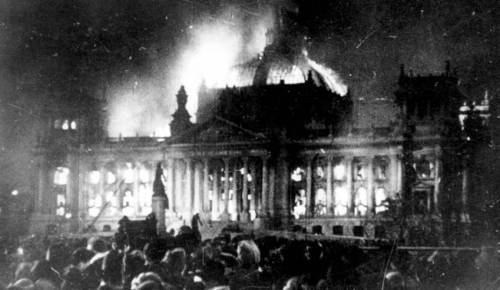
The Reichstag Fire,  the 86th anniversary of which is tomorrow, February 27th is a precedent setting state of emergency that brought with it very dire results.

The fire was set by Marinus (Rinus) van der Lubbea Dutch Communist who was acting alone. There was no proof that he had any German support, nor that any German political party was involved. However, Hitler, backed by the aging and doddering President Paul Von Hindenburg was given power to suspend constitutional rights indefinitely by acting under Article 48 of the Weimar Constitution through the Order of the President of the Reich for the Protection of People and State. I will discuss that tomorrow.

Ever since my undergraduate study working under Dr. Helmut Haeussler  at California State University Northridge I have studied the transition of German society from democracy to dictatorship. While my studies then and ever since focused on the rise of National Socialism in Germany, the fact is that what happened in Germany was not unique, it is a part of the human condition and the people of any country can find themselves under the foot of a dictatorship if the conditions are right. I believe that conditions in the United States have never been more ripe for the establishment of an authoritarian regime, possibly even a dictatorship, than they are today.

When I read through the text of President Trump’s speech at CPAC and the response of the NRA to the massacre in Parkland Florida shuddered last February, I shuddered. They were the words that an autocrat would use, and the vehemence of the CPAC crowd, which just a few years ago prided itself as being the intellectual bastion of conservatism. Speakers and panel members who dared to question the movement were heckled, jeered, and threatened. Mona Charen, a long time conservative who had worked for both William Buckley and Ronald Reagan, had to be escorted out by security officers concerned for her safety.

I realize that despite chaos that is engulfing the House of Trump; despite more and more of his advisors being indicted by the Muller investigation of the Trump campaign and family connections to Russia, the more I become more concerned that the unthinkable will happen and something will occur that will allow the President to seize power under the pretext of national security; most likely a war, or a major terrorist attack, using existing National Security Executive Orders dealing with the continuity of government functions as a result of catastrophic emergency. 

But the President chose to declare an emergency for which no evidence exists. Even today, the Commanding General Of U.S. Northcom reported that there was no military threat at the border in direct contravention to the words of the President and his actions, sending thousands of troops to the border with Mexico.

There are a lot of  laws in existence for a President to declare a state of emergency, the latest of which is National Security and Homeland Security Presidential Directive (National Security Presidential Directive NSPD 51/Homeland Security Presidential Directive HSPD-20) of 4 May 2007 which defines a catastrophic emergency as “any incident, regardless of location, that results in extraordinary levels of mass casualties, damage, or disruption severely affecting the U.S. population, infrastructure, environment, economy, or government functions.”

But this doesn’t fit the bill. Nor does the National Emergency Act of 1976 do the trick, though the Administration seems to be banking on it with the courts.

Trump has now made his declaration. But I am sure if his attempt is rebuffed by Congress or the Courts, his regime will act to suspend civil rights and liberties and maybe even suspend Congress and the courts in the name of security and under existing provisions. Sadly, I think that in such a case that very few people would resist such a takeover. Of course the 35% or so of people that would support him as he said, even if he shot someone on 5th Avenue would be at the forefront probably even using extrajudicial means to apprehend, persecute, or kill anyone suspected of disloyalty. But I also believe that many other people would follow all because they are afraid and desire security more than freedom.

Now the psychological preparation for such an event is not all Trump’s doing; for the last three decades many of those that now support him, especially the leaders of the Religious Right, Fox News, and radio and internet demagogues have prepared the ground for his rise.

Dr. Timothy Snyder, the historian from Yale has warned us in his book On Tyranny. He noted:

“Be calm when the unthinkable arrives. Modern tyranny is terror management. When the terrorist attack comes, remember that authoritarians exploit such events in order to consolidate power. The sudden disaster that requires the end of checks and balances, the dissolution of political parties, the suspension of freedom of expression, the right to a fair trial, and so on, is the oldest trick in the Hitlerian book. DO NOT FALL FOR IT.”

Human beings are the one constant in history, and human nature is very consistent when it comes to how we respond when under attack. One only has to think of the fear that followed the 9-11 attacks and the willingness of people to give the government vast new powers. Those included The Patriot Act and an authorization for the use of military force against Al Qaida which has not been updated or supplemented since 2001, and which has been used for operations around the world which are completely unconnected to the initial authorization.

I believe that the chances of such an event occurring have gone up exponentially.  Part of this is because the President and the Executive branch have not filled many critical ambassadorships, as well as thousands of key billets in the State Department, the Department of Defense, the Department of Justice, and the Department of Homeland Security. Even more concerning is the fact that the President is relying on non-Senate confirmed “Acting” cabinet members to serve in order to circumvent the Constitution.

This is a very dangerous time and every day I wake up wondering if this will be the day that our Republic as we knew it dies. I do not know if this will be the result of a war a major terror attack, or even an unexpected financial crisis, but as things spiral out of control I cannot shake the feeling that we are going to have our Reichstag Fire moment, and that we will not rise to the challenge. Instead I think that most Americans will give up freedom in the name of security simply because that is human nature and has been demonstrated throughout history on every continent. The President’s Declaration Of National Emergency qualifies as such an event.

James Madison noted:

“The means of defence against foreign danger have been always the instruments of tyranny at home. Among the Romans it was a standing maxim to excite a war, whenever a revolt was apprehended. Throughout all Europe, the armies kept up under the pretext of defending, have enslaved the people.”

Now is a time that we must all be awake and aware of what is going on in our country and the world. The storm clouds are building and we most be cognizant of the times or be engulfed and overwhelmed when the unthinkable arrives. That may not be pleasant to contemplate, but it is necessary.

I would like to believe that I will be proven wrong and honestly I want to be proven wrong because I do not want our nation to have to endure war, terrorism, or the rule of a tyrannical despot backed by fanatical and heavily armed followers, many of who are already discussing a new civil war and the extermination of their opponents by violent means. Sadly, some of these men and women are serving in the military and in various Federal, State, and local law enforcement agencies. If I am right, they will be the nucleus of quasi-government death squads, no different than in any dictatorship, and any resistor, regardless of Party, politics, ideology, religion, or even military service will be a potential target.

God I hope that I am wrong.

So, until tomorrow I wish you a good day, the conclusion of the article will appear tomorrow.

Peace,

Padre Steve+

1 Comment

Filed under civil rights, ethics, History, holocaust, laws and legislation, Military, national security, nazi germany, Political Commentary

The Crossing Of an American Rubicon: The Trumped Up National Emergency

Friends of Padre Steve’s World,

It has finally happened. President Trump finally declared his National Emergency because Congress did not give in to him, and because when he had solid House and Senate majorities he couldn’t garner a deal that would pass because of his own intransigence and stupidity ensured the inability to make a deal.

So here we are with a National Emergency that is based on his lies, and his inability to compromise the slightest to get a deal. After failing time and time again he shut down the Government for over a month, endangering the economy and national security in the process, even as the Mueller investigation indicted more of his close associates who appear to have quite extensive dealings with Russian agents, collaborators, and government officials. So in my view he is getting desperate, and more dangerous bit the minute.

I honestly expected that the President would use the cover of a major terrorist attack or war as cover to make his power grab. Right now al, he has done is offer a befuddled series of lies and excuses wrapped in a worthless, and plainly unconstitutional piece of paper as has ever been signed by an American President. Winston Churchill said of Russian intentions:  “It is a riddle wrapped in a mystery inside an enigma; but perhaps there is a key. That key is Russian national interest.” For Trump one can say that his intentions are clear, selfish, and washed with an enema. The key is Trump’s personal interest.” The irony is that his interests are all backed by the Russians.

It is sickening to watch as the Acting Secretary Of Defense is attempting to find the money and manpower needed for Trump’s Wall from military construction, MILCON accounts which includes everything from training facilities to tarmacs, runways to railheads, shipyards to firing ranges, drydocks to aircraft hangers, and everything that make the bases which support the troops in the field operating. Military family housing, medical facilities, schools operated by DOD which service military kids, and base security designed to protect bases from of all things, actual terrorists. Then he’s going after the DOD part of our nation’s drug interdiction programs, which is ludicrous in light of his rational that the Trump Wall is to keep out illegal drugs.

I will not compare Trump to Hitler because that would be an insult to the genocidal criminal dictator that Hitler was, not because Hitler was a good human being or worthy of any praise, but because he was a far better politician than Trump could ever hope to be. Hitler took advance of his opponents missteps, be they the political opponents, those in his own party, and European governments. But unlike Hitler, Trump delivers unforced error after error and claims to be a brilliant leader even while he is being rolled by men like Kim Jun Un, Vlad Putin, and so many others.

His only salvation is that some 35% of the American electorate, including the vast bulk of Republican legislators, are what he calls the most loyal followers, who in his words would vote for him even if he shot someone in the middle of 5th Avenue. I guarantee that if he called on them to kill that thousands would heed the call to kill his opponents, just like his Stormtroopers would before his accession to power; and how his SS, acting in concert with the Army and Police would decapitate the leadership of the SA Stormtroopers, including some of his earliest friends and allies during the Night of the Long Knives. Like Hitler, Trump’s only loyalty is to himself, all others are fungible, even his family if need be.

Now is a dangerous time. Declarations of National Emergency give the President great powers above what Article II of the Constitution normally permit. Unlike any other point in our history we now have a President is prepared to use those powers for his political survival and personal gain, sadly his GOP majority in the Senate has all but surrendered their Article I powers to the imperial President.

I do not know what will happen next. The State Of California has already sued to block the effort, the Democrats in the House Of Representatives are planning legislative and possible legal moves against it. Likewise, Trump’s move has divided Republicans. So obviously this will not be enough to cement his power, it is a ploy to distract as the Mueller Eagle circles its prey.

An animal that acts purely on instinct is most dangerous when cornered. It has become apparent that Trump does not act or live within the confines of reason or legality. His business and personal life has always shown that he is a predator speaking his own engorgment, even at the expense of wives, business partners, contractors, customers, or employees. It is the world that he lives in. It is the world that he imbibed from his father Fred Trump.

So my friends, do not let your guard down. We are in completely untested waters for Americans. What will happen tomorrow we don’t know, and we would be fools to prognosticate about. Thus we have to look at history and how other human beings have behaved in similar situations.

Milton Mayer wrote in his book They Thought They Were Free about a German colleague during the 1950s that had lived through the Hitler years as an academic. The man tried to explain how changes were so gradual that people like him who should have known better did not take action, if they did at all until it was too late. The man asked Mayer:

“How is this to be avoided, among ordinary men, even highly educated ordinary men? Frankly, I do not know. I do not see, even now. Many, many times since it all happened I have pondered that pair of great maxims, Principiis obsta and Finem respice—‘Resist the beginnings’ and ‘Consider the end.’ But one must foresee the end in order to resist, or even see, the beginnings. One must foresee the end clearly and certainly and how is this to be done, by ordinary men or even by extraordinary men? Things might have. And everyone counts on that might.”

To forsee the end of the Trump gambit is not hard. We have the benefit of seeing tyrants of history, including Hitler, with today’s authoritarian leaders. Trump has already deployed Federal troops to the U.S. Mexican Border in what most people, including many Republicans viewed as a political stunt. In the aftermath of his declaration he again went to Twitter and attacked the media as enemy of the people” and demanded retribution against his opponents. How long will it be until one of his militarized and propaganda filled believers goes on the attack. One did last week in El Paso, but thankful they were not armed. What is to keep Right Wing Trump supporters who have concealed carry permits to walk into any place and kill someone they believe to be an enemy of the people? 

The fact is there is that there is nothing that will keep this from happening. This makes me glad that I served in Iraq and on Naval boarding teams in the Persian Gulf completely unarmed, and also in a certain way for the PTSD that I suffer, because one of the afflictions if it can be called that is being very hyper vigilant. I won’t be caught by surprise if I can help it, and even unarmed I know enough how to disrupt and confuse an attacker to at least equalize a situation. After having credible threats to my life in 2009 and 2010 from a neo-Nazi long before I became outspoken in my beliefs I always remain alert, sadly, even on base, because I do take notice of the rather violent political messages on the bumper stickers and window decals of many fellow sailors, marines, and soldiers, active and retired.

I don’t want to be considered a pessimist, but I do forsee the end, unless a sea change that I don’t think will happen occurs. I fully expect something else to happen that allows Trump to expand his powers, an event that even many opponents would find hard to oppose. A Reichstag Fire moment, maybe, but possibly worse.

So with all those happy thoughts in mind, have a good night.

Until tomorrow,

Peace,

Padre Steve+


3 Comments

Filed under civil rights, History, laws and legislation, leadership, Military, national security, nazi germany, News and current events, Political Commentary

An Unnecessary Condition Of Affairs: A Temporary end to the #TRUMPDOWN

Friends of Padre Steve’s World,

I pondered writing this post late last night but was too tired to write it. It’s not long at all and it it is something that I wrote about previous shutdowns. Back in 2011 I wrote the following words regarding the shutdown provoked by Mitch McConnell and Paul Ryan and their Right Wing supporters at Fox News and Right Wing pundits, which ended up with the disastrous policy of sequestration.

“The attitudes that we have formed and angry words which we now use so ubiquitously are reflective of a deep hatred that now is becoming what defines us as a people.  In fact the deep and abiding hatred which now permeates our society is now threatening the international standing and I would say the national security of the United States.  We have only ourselves to blame because through our actions and inactions of the past decade we have made our choice to be what we have become and there is no one group especially in our political, media and business elites that have served us well.  In fact we have as voters chosen this toxic mix of elected officials often more influenced by hate spewing pundits and our own self interests rather than that of the nation and future generations much as we would like to claim that we are looking out for the future.”

Interestingly enough these same people, hitched their wagons to President Trump’s disastrous decision to shut down the government to build his monstrous monument to his morbid #MAGA manhood; that big beautiful wall. Of course anyone with a knowledge of history knows that such walls are expensive and ultimately self defeating.

For now the current Shutdown is over. Increasingly isolated Trump had no other exit for the trap that he laid for himself. Standing alone in the Rose Garden he capitulated to reality.

So for at least three weeks, the shutdown is over. Of course it really isn’t over as long as Trump thinks he can succeed, and there remains the ever present threat of him declaring a National Emergency. I think the latter is more likely, especially if the crisis in Venezuela results in bloodshed at the American Embassy. But for that we have to wait and see. My hope is that a legislative fix is found that actually increases border security without wasting money on that wall. One does not return to provenly ineffectual past remedies to solve present problems, but I digress…

To quote from the testimony of the former Confederate General Robert E. Lee before a Congressional Committee after the disaster of the American Civil War, or as it should still be called the War of the Southern Rebellion.

Before the committee, Lee, who had resigned his commission less than a month of been promoted to full Colonel and rejecting President Lincoln’s offer to command the Armies of the Union accepted commissions by Virginia and the Confederacy said:

“I may have said and I may have believed that the position of the two sections which they held to each other was brought about by the politicians of the country; that if the great mass of the people, if they had understood the real questions would have avoided it. I did believe at the time that it (the war) was an unnecessary condition of affairs, and might have been avoided if forbearance and wisdom had been practiced on both sides.”

But Lee was engaged in the same sort of moral equivalence that many politicians and pundits use today. In his testimony, Lee blamed both sides and conveniently left out his role in the conflict. Before the war Lee inherited the slaves of his father in law who had expressly said that they were to be emancipated. He delayed and did not do it. When he resigned his U.S. Army commission he said that he would only raise his sword in defense of Virginia, but he personally led two invasions of the North, invasions that his Army used to capture free blacks and return them to slavery. Despite the urging of some Confederate Generals, Lee steadfastly opposed the emancipation of slaves to serve in the Confederate Army until February of 1865. When the war was for all purposes lost, Lee redoubled his efforts and had hundreds of deserting Confederate Soldiers sentenced to death at Drumhead Court Martial. The vast majority of those troops were from Georgia and the Carolinas and their states, families, and homes were being ravaged by William Tecumseh Sherman’s Army’s March to the Sea.

Yes the American Civil War was an unnecessary condition of affairs, as was the Trump-McConnell Shutdown. In each case the blame is not shared across the board. These disasters can be laid at the feet of the men who provoked them and demanded them. In the case of the Civil War, those were the leaders of the South, who having the assurance of Lincoln that slavery was safe in the Slave states decided to secede, and who through the Fugitive Slave Law Of 1850 had an instrument to enforce slavery in the Free States.

In the current situation it all comes down to race once again. President Trump and many Republican leaders have blamed immigrants and racial minorities for all the problems of the country. They offer support to White Nationalist, Neo-Confederate, and Neo-Nazi groups, while demonizing anyone with darker skin. Trump’s Wall, like his Red MAGA hats are symbolic of that race hatred, and fear mongering. The Trump Shutdown can only be blamed on that. Trump bragged about the Shutdown and took responsibility for it. He owns it, maybe we should start calling it the #TRUMPDOWN ? It does have a nice ring.

So until tomorrow when I return to other subjects,

Peace,

Padre Steve+

Leave a comment

Filed under civil war, History, laws and legislation, Loose thoughts and musings, national security, News and current events, Political Commentary

From Limited to Total War: The American Civil War as a Watershed

Friends of Padre Steve’s World,

As always I continue to revise my Gettysburg and Civil War texts. I am posting the second half of a majorly revised section dealing the the nature of the war, and how it changed from a limited war to a total war. This subject may be uncomfortable to many readers, and I admit that. Truthfully I abhor war but I am a realist when it comes to human nature, politics, economics, ideology, religion, and even racism and race hatred play in the world.

Truthfully, if the North had continued the war with limited force, and goals, the Confederacy would have either become independent, or it would have been re-admitted to the Union with slavery intact, and the Thirteenth, Fourteenth, and Fifteenth Ammendments would have never been passed, and any concept of civil rights destroyed. You can be sure that with Southern States re-admitted without change that other things would not have occurred; Women’s sufferage, Native American citizenship, citizenship and civil rights for Asian immigrants, and most recently, LGBTQ people are directly tied to the constitutional amendments that the Union victory made possible.  Sometimes, as distasteful and repugnant as that may sound, a hard war is necessary to prevent an unjust peace. 

From a point of realpolitik,  the fact is that leaders in the South and the North, like so many other leaders in history and even today, failed to understand what the war that they helped unleash would bring about. War is not to be entered into lightly without connecting the dots between the act of policy that guides the war, as well as having the policy’s ends supported by the ways and means necessary to fulfill it, and not all of those are military. Diplomacy, economic power, and  information all play a part. 

Abraham Lincoln and his advisors came to understand this, maybe better than any presidential administration in United States history. Sadly, Lincoln was assassinated before he could guide the country through reunion, and Andrew Johnson was not up to the task. By the time Ulysses Grant became President, the opportune moment for reunion had passed. Though the South succeeded in rolling back civil rights for another century, they never were able to repeal those three critical amendments. That is why the hard war pursued by the Lincoln administration still matters for everyone with a stake in civil rights. Today, under the Trump Administration, the GOP Senate, and the GOP State majorities those civil rights stand endangered. The fight is not over.

Think about that, and have a great weekend,

Peace

Padre Steve+
gburg dead1

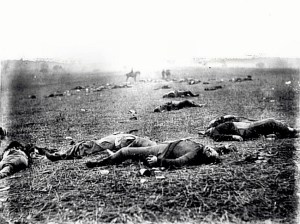
While the nature of war remained unchanged, the American Civil war changed the character of war, as it had been known for centuries, since the Peace of Westphalia, and the end of the Thirty Years War changed dramatically. In the American Civil War the character of war changed from the emphasis of the limited wars of the 18th Century and the Napoleonic era where opposing armies dueled each other into a war that encompassed the entire population. It also challenged a generation of military officers who had grown up with Henri Jomini’s principles of war and his emphasis on limited war.

The leading catalyst that convinced Lincoln and other Northern leaders of the need to abandon the strategy of limited war was the fact that the Confederates had:

 “blurred the distinction between combatants and noncombatants in the parts of the Confederacy and border states occupied by Union forces. The crops and livestock of Southern civilians were feeding and clothing Confederate armies. Their slaves were the principle labor force in the Confederate War economy. Thousands of Southern civilians became guerillas who roamed behind Union lines destroying supplies and ambushing unarmed as well as armed Unionists.” [1]

The Union reaction to the Confederate actions would portend a change in the war. And soon, the war bordered on Clausewitz’s definition of absolute or total war, especially in Sherman’s march through the South, and in the actions of Confederate irregulars who used terror against Unionist civilians and free Blacks. The actions of irregular Confederate forces to attack his troops and supply lines caused William Tecumseh Sherman, who earlier in the war had taken a conciliatory attitude to Southern civilians, to change his views.
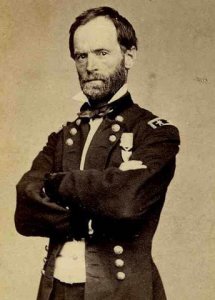
To Sherman, the Confederates had blurred the lines between combatants and non-combatants, he noted that the Union army must act

 “on the proper rule that all in the South are enemies of all in the North….. The whole country is full of guerilla bands…. The entire South, man woman, and child, is against us, armed and determined.” [2]

In response Henry Halleck, now backed with the legal authority of General Order 100, also known as The Lieber Code, which for the first time in American history defined the differences between partisans acting in the capacity as soldiers of the enemy army, and those who were not a part of a military unit, but rather men who blended back into the population after conducting armed attacks, [3] wrote to Sherman,

“I am fully of opinion that the nature of your position, the character of the war, the conduct of the enemy (and especially of non-combatants and women of the territory we have heretofore conquered and occupied), will justify you in gathering up all the forage and provisions which your army will require, both for a siege of Atlanta and for your supply in your march farther into the enemy’s country. Let the disloyal families of the country, thus stripped, go to their husbands, fathers, and natural protectors, in the rebel ranks; we have tried three years of conciliation and kindness without any reciprocation; on the contrary, those thus treated have acted as spies and guerillas in our rear and within our lines…. We have fed this class of people long enough. Let them go with their husbands and fathers in the rebel ranks; and if they won’t go, we must send them to their friends and protectors. I would destroy every mill and factory within reach which I did not want for my own use…..” [4]

The strategy of Sherman was to ensure that the Confederate heartland of the Deep South could no longer help to sustain Confederate armies in the field, it was military, economic, political, and diplomatic. He explained:

“I propose to act in such a manner against the material resources of the South as utterly to negate Davis’ boasted …promises of protection. If we can march a well-appointed army right through hiss territory, it is a demonstration to the world, foreign and domestic, that we have a power which Davis cannot resist.” [5]

in addition, Sherman was a pioneer of psychological warfare, he was convinced that the crushing will of White Confederate citizens was paramount to victory. He was

 “convinced that not only economic resources but also the will of Southern civilians sustained the Confederate War effort…. Sherman was well aware of the fear that his soldiers inspired among Southern whites. This terror “was a power,” he wrote, “and I intend to utilize it… to humble their pride, to follow them to their innermost recesses, and to make them dread and fear us…” [6]

When Confederate General John Bell Hood elected to fortify Atlanta, the largest and most important industrial city in the Confederacy against a Union attack, thereby making the population of the city a target, Sherman wrote to the Mayor of Atlanta to warn him of the consequences of allowing this:

“The use of Atlanta for warlike purposes is inconsistent with its character as a home for families. There will be no manufactures, commerce, or agriculture here, for the maintenance of families, and sooner or later want will compel the inhabitants to go…. You cannot qualify war in any harsher terms than I will. War is cruelty, and you cannot refine it; and those who brought war into our country deserve all the curses and maledictions a people can pour out…. You might as well appeal against the thunder-storm as against these terrible hardships of war. They are inevitable…” [7]

Sherman’s strategy worked, “it deprived Confederate armies of desperately needed supplies; it also crippled morale both at home front and in the army,” [8] His armies did more than destroy factories and farms in its path, wherever they went “they broke the power of the secessionist government, the slaveholder’s social order, and most of whatever fighting spirit remained among Confederate partisans.” [9]

Jefferson Davis understood the effect that Sherman’s army was having, he wrote, “Sherman’s campaign has produced a bad effect on our people, success against his future operations is needed to restore public confidence.” [10] Mary Boykin Chesnut saw the clouds of doom approaching and confided in her diary, “Since Atlanta I have felt as if all were dead in me, forever,” she wrote. “we are going to be wiped off the map.” [11]

The effects of Sherman’s march through Georgia and the Carolinas were felt in the Confederate armies at the front as just as he had predicted. Lee’s artillery chief, Brigadier General Porter Alexander wrote:

“The condition of the country at large was one of almost as great deprivation & suffering as that of the army itself; & in many localities even of much greater. North Carolina, South Carolina, & Georgia had been over-run by Sherman’s army carrying off many of the Negroes & most of the stock & destroying all accumulation of provisions which they could not use, & often burning barns & dwellings & all implements of agriculture…. Naturally, the wives & mothers left at home wrote longingly for the return of the husbands & sons who were in the ranks in Virginia. And, naturally, many of them could not resist these appeals, & deserted in order to return & care for their families.” [12]

A member of the 20th Maine noted the effect on Lee’s troops opposing them at Petersburg wrote, “Since Sherman’s victories… we see the affect it is having on Lee’s Army.” They were deserting in groups, “not only privates, but many officers with them.” [13] Lee was so frustrated and angry with the desertion problem that he resorted to summary executions of the men, occasionally without hearing their appeals.

The war was revolutionary in other ways, and brought about a host of social, philosophical, economic, and political changes which continue to impact the lives of people in the United States and around the world even today. Some of these, especially those regarding the abolition of slavery and emancipation, as well as the beginnings of the Women’s Rights movement have had a ripple effect in matters of political and social equality for other previously disenfranchised groups of citizens. One writer noted in regard to the social impacts that “The Civil War uprooted institutions, transformed our politics, influenced social relationships of half a continent, and wrought changes that echo down the generations.” 

 Mark Twain wrote in 1873 that the war “uprooted institutions that were centuries old, changed the politics of a people …and wrought so profoundly upon the national character that cannot be measured short of two or three generations.” [15]

In a sense, when Abraham Lincoln proclaimed  “a new birth of freedom” in his Gettysburg address it served as a watershed moment in American history because it brought to the forefront the understanding of Jefferson and the other signers of the Declaration of Independence that all men are created equal.

That statement, flowing from the Declaration was key to Lincoln’s understanding of human rights and dignity, and from it came the Emancipation Proclamation and the Thirteenth Amendment, which abolished slavery. Those would be followed by the Republican Congresses’ passage of the Fourteenth Amendment, which overturned the Dred Scott Decision, which denied all citizenship to blacks across the country, and by Ulysses S. Grant’s Fifteenth Amendment, which gave African American men to right to vote. These were all revolutionary ideas, and there was a counterrevolutionary backlash after the war “overthrew the fledgling experiment in racial equality” but “did not fully restore the old order. Slavery was not reinstated. The Fourteenth and Fifteenth Amendments were not repealed.” [16]  That is the human and political context by which we have to understand the American Civil War.

Thus it is important to study the Gettysburg campaign in the context of the Civil War because the campaign of 1863 in the east cannot be divorced from what was happening in the west at Vicksburg, nor the Union blockade, nor the diplomatic, economic and informational aspects of the war.  Likewise the Gettysburg campaign cannot be separated from its relationship to the broader understanding of the nature and character of war. To do this one must examine the connection between them and policies made by political leaders; to include the relationship of political to military leaders, diplomats, the leaders of business and industry and not to be forgotten, the press and the people. Likewise we must understand the various contexts of war, to include the social, political, ideological and even the religious components of war, how they impacted Civil War leaders and why civilian policy makers and military leaders must understand them today.

While the essential nature of war remains constant, wars and the manner in which they are fought have changed in their character throughout history, and this distinction matters not only for military professionals, but also policy makers.

The changing character of war was something that military leaders as well as policy makers struggled with during the American Civil War much as today’s military leaders and policy makers seek to understand the character of warfare today. British military theorist Colin Gray wrote:

 “Since the character of every war is unique in the details of its contexts (political, social-cultural, economic, technological, military strategic, geographical, and historical), the policymaker most probably will struggle of the warfare that is unleashed.” [17]

That was not just an issue for Abraham Lincoln and Jefferson Davis, both of whom struggled with the nature of the war which had been unleashed, but it is an issue for our present and future political leaders, who as civilian politicians are “likely to be challenged by a deficient grasp of both the nature of war as well as its contemporary context-specific character.” [18] 

This is actually very important in our present context as since “the end of the Cold War, the tendency among civilians – with President Bush as a prime example – has been to confuse strategy with ideology. The president’s freedom agenda, which supposedly provided a blueprint for how to prosecute the global war on terror, expressed grandiose aspirations without serious effort to assess the means required to achieve them.” [19] Likewise, it is something that President Obama did not fully understand, and President Trump, is flailing and failing at, not because he has a strategy or a coherent ideology, but because everything revolves around him.

Strategy is hard and mostly ignored until there is a crisis, “soldiers focus on their professional military duties, while politicians exercise their skill in policymaking. The strategy bridge between the two worlds, the two cultures, generally is left poorly guarded, if it is guarded at all.” [20] In the American Civil War, Abraham Lincoln and his administration as well as military advisers came to develop a realistic strategy to match his political goals, Lincoln understood the contexts of the war far better than his Confederate counterpart Jefferson Davis, whose administration and military leadership was never able to devise a coherent strategy because they did not fully grasp the contexts of the war, never seriously considered the ends, ways, and means to victory.

In addition to being the first modern war, or maybe I should say, the first war of the Industrial Age, the Civil War prefigured the idea of total war written about by Clausewitz that occurred in the World Wars of the Twentieth Century. The war combined a massive number of technological advances, which both preceded and occurred during it, in which the philosophical nature of the Industrial Revolution came to the fore.

Likewise, the enmity of the two sides for one another had been fostered by a half century of relentless and violent propaganda that ushered from the mouths of politicians, the press and even from the pulpit brought the element of hatred to the fore of the conflict; as Clausewitz correctly observed, “Even the most civilized of peoples, in short, can be filled with passionate hatred for each other.”  [21]

As the war went on the feelings of animosity and hatred often boiled over and were reflected in the words and sometimes the actions of the soldiers. A Confederate Captain wrote his wife to teach his children to have

 “a bitter and unrelenting hatred of the Yankee race” that had “invaded our country and devastated it… [and] murdered our best citizens…. If any luckless Yank should unfortunately come my way he need not petition for mercy. If he does I will give him lead.” 

A soldier from a Wisconsin regiment wrote to his fiancée after the assault on Resaca, Georgia that his unit had captured twenty-three Confederates and

 “our boys asked if they remembered Fort Pillow and killed them all. Where there is no officer with us, we take no prisoners…. We want revenge for our brother soldiers and will have it…. Some of the [rebels] say they will fight as long as there is one of them left. We tell them that is what we want. We want to kill them all off and cleanse the country.” [22]

While this was hatred was not universal and many times the combatants behaved with great chivalry on the battlefield, and Northern and Southern veterans led efforts at reconciliation after the war; such hatred was something that had not been a part of the American military experience.  The deep rooted enmity, especially in the South, would remain a constant over the next one hundred years. “White southerners who retained Confederate loyalties against Federal soldiers and northerners in general…. Confederates defiantly refused to forgive enemies who had inflicted such pain on their society.” [23]Likewise, many Union veterans felt that in their sacrifices to defeat the Confederacy and end slavery would be forgotten as time slipped by and the memory of the war subsided.

This very real hatred meant that there were many times when the American Civil War came close to Clausewitz’s understanding of absolute war in its in character, and it prefigured the great ideological wars of the twentieth century. J.F.C. Fuller noted “for the first time in modern history the aim of war became not only the destruction of the enemy’s armed forces, but also of their foundations- his entire political, social and economic order.” [24] It was the first war where at least some of the commanders, especially Ulysses S. Grant and William Tecumseh Sherman were men of the Industrial Age, in their thought and in the way that they waged war, in strategy, tactics even more importantly, psychologically. Fuller wrote:

“Spiritually and morally they belonged to the age of the Industrial Revolution. Their guiding principle was that of the machine which was fashioning them, namely, efficiency. And as efficiency is governed by a single end- that every means is justified- no moral or spiritual conceptions of traditional behavior must stand in its way.” [25]

President Lincoln, as well as Grant and Sherman realized in early 1864 that “the South was indeed a nation in arms and that the common European practice of having standing armies engaged each other in set-piece battles to determine the outcome of a war was not enough to win this struggle.” [26] Though none was a student of Clausewitz, their method of waging war was in agreement with the Prussian who wrote that

 “the fighting forces must be destroyed; that is, they must be put in such a position that they can no longer carry on the fight” but also that “the animosity and the reciprocal effects of hostile elements, cannot be considered to have ended so long as the enemy’s will has not been broken.”  [27]

Sherman told the mayor of Atlanta after ordering the civilian population expelled that “we are not only fighting hostile armies, but a hostile people, and must make the old and young, the rich and poor, feel the hard hand of war.” [28]Sherman was one of the first American military leaders to understand that a civil war could not be waged according to the limited war doctrines most American officers had been taught. He not only “carried on war against the enemy’s resources more extensively and systematically than anyone else had done, but he developed also a deliberate strategy of terror directed against the enemy’s minds.” [29] While some might find this troubling, the fact remains that it was Sherman’s Southern sweep of all that lay before him that broke the back of the Confederacy.

But Sherman and Grant were not alone in understanding the problem of fighting a limited war against the Confederacy. In the fall of 1862 a twenty-five year volunteer officer, Colonel Strong Vincent serving with McClellan’s army in Virginia understood what had to happen if the Union were to overcome the rebellion of the Confederacy. Vincent who would be instrumental in throwing back Hood’s assault on Little Round Top, and die leading the defense of that edifice, wrote to his wife about the need for harder measures.

“We must fight them more vindictively, or we shall be foiled at every step.  We must desolate the country as we pass through it, and not leave a trace of a doubtful friend or foe behind us; make them believe that we are in earnest, terribly in earnest; that to break this band in twain is monstrous and impossible; that the life of every man, yea, of every weak woman or child in the entire South, is of no value whatever compared with the integrity of the Union.” [30]

Abraham Lincoln came to embrace the eternal nature of war as well as the change in the character of the war over time. Lincoln had gone to war for the preservation of the Union, something that for him was almost spiritual in nature, as is evidenced by the language he used in both of his inaugural addresses and the Gettysburg Address.

Instead of a war to re-unite the Union with the Emancipation Proclamation the war became a war for the liberation of enslaved African Americans, After January 1st 1863 when the Emancipation Proclamation went into effect, Lincoln “told an official of the Interior Department, “the character of the war will be changed. It will be one of subjugation…The [old] South is to be destroyed and replaced by new propositions and ideas.” [31] That too was a modern understanding of war.

Of course, the revolution in military affairs that characterized the Civil War took time, but it was the political and military leaders of the North who better adapted themselves and their nation to the kind of war that was being fought. “Lincoln’s remarkable abilities gave him a wide edge over Davis as a war leader, while in Grant and Sherman the North acquired commanders with a concept of total war and the determination to make it succeed.” [32]

At the beginning of the war the leaders and populace of both sides still held a romantic idea of war. The belief that the war would be over in a few months and that would be settled by a few decisive battles was held by most, including many military officers on both sides. There were some naysayers like the venerable and rather corpulent General Winfield Scott, but politicians and the press mocked Scott and those who even suggested that the war would be long, hard, and bloody. Of course those who predicted a short, easy, and relatively bloodless war who were proven wrong, and the war became the bloodiest war ever waged by Americans, and it was against other Americans. In many ways it has yet to have ended.

Notes 

[1] Ibid. McPherson The War that Forged a Nation: Why the Civil War Still Matters p.35

[2] Ibid. McPherson Drawn With the Sword: Reflections on the American Civil War p.81

[3] Lieber noted in Article 82 of the code that “Men, or squads of men, who commit hostilities, whether by fighting, or inroads for destruction or plunder, or by raids of any kind, without commission, without being part and portion of the organized hostile army, and without sharing continuously in the war, but who do so with intermitting returns to their homes and avocations, or with the occasional assumption of the semblance of peaceful pursuits, divesting themselves of the character or appearance of soldiers – such men, or squads of men, are not public enemies, and, therefore, if captured, are not entitled to the privileges of prisoners of war, but shall be treated summarily as highway robbers or pirates.” And in Article 85 that, “War-rebels are persons within an occupied territory who rise in arms against the occupying or conquering army, or against the authorities established by the same. If captured, they may suffer death, whether they rise singly, in small or large bands, and whether called upon to do so by their own, but expelled, government or not. They are not prisoners of war; nor are they if discovered and secured before their conspiracy has matured to an actual rising or armed violence.” Lieber, Francis, General Orders No. 100 : The Lieber Code INSTRUCTIONS FOR THE GOVERNMENT OF ARMIES OF THE UNITED STATES IN THE FIELD 24 April 1863 Retrieved from The Yale Law School, Lillian Goldman Law Library, The Avalon Project Documents in Law, History and Diplomacy http://avalon.law.yale.edu/19th_century/lieber.asp#sec4 1 June 2016

[4] Ibid. Weigley The American Way of War: A History of United States Military History and Policy p.148

[5] Guelzo Allen C. Fateful Lightening: A New History of the Civil War Era and Reconstruction Oxford University Press, Oxford and New York 2012 p.445

[6] Ibid. McPherson Drawn With the Sword: Reflections on the American Civil War p.82

[7] Sherman, William Tecumseh, Letter to James M. Calhoun, Mayor of Atlanta September 12, 1864 in Perman, Michael and Murrell Taylor, Amy editors The Civil War and Reconstruction Documents and Essays Third Edition Wadsworth Cengage Learning Boston MA 2011 pp.147-148

[8] Ibid. McPherson Drawn With the Sword: Reflections on the American Civil War p.83

[9] Levine, Bruce The Fall of the House of Dixie: The Civil War and the Social Revolution that Transformed the South Random House, New York 2013 p.233

[10] Goldfield, David. America Aflame: How the Civil War Created a Nation Bloomsbury Press, New York 2011 p.348

[11] McPherson, James. The Battle Cry of Freedom: The Civil War Era Oxford University Press, Oxford and New York 1988 p.775

[12] Alexander, Edward Porter. Fighting for the Confederacy: The Personal Recollections of General Edward Porter Alexander edited by Gary Gallagher University of North Carolina Press, Chapel Hill 1989 pp.508-509

[13] Ibid. Guelzo Fateful Lightening p.469

[14] Lowry, Thomas P. The Stories the Soldiers Wouldn’t Tell: Sex in the Civil War Stackpole Books, Mechanicsburg PA 1994 p.176

[15] Ibid. McPherson The War that Forged a Nation: Why the Civil War Still Matters p.48

[16] McPherson, James. The Second American Revolution in Perman, Michael and Murrell Taylor, Amy editors The Civil War and Reconstruction Documents and Essays Third Edition Wadsworth Cengage Learning Boston MA 2011 p.14

[17] Gray, Colin S. Fighting Talk: Forty Maxims on War, Peace, and Strategy Potomac Book, Dulles VA 2009 p.36

[18] Ibid. Gray Fighting Talk p.36

[19] Bacevich, Andrew J. The Limits of Power: The End of American Exceptionalism (The American Empire Project) Metropolitan Books, Henry Holt and Company, New York 2008 Amazon Kindle Edition, Location 2375 of 3875

[20] Ibid. Gray Fighting Talk p.49

[21] Ibid. Clausewitz On War p.76

[22] Ibid. McPherson The War that Forged a Nation pp.49-50

[23] Gallagher, Gary W. The Confederate War: How Popular Will, Nationalism and Military Strategy Could not Stave Off Defeat Harvard University Press, Cambridge MA and London 1999 p.34

[24] Fuller, J.F.C. A Military History of the Modern World, Volume Three: From the Seven Days Battle, 1862,  to the Battle of Leyte Gulf, 1944  Minerva Press 1956 p.88

[25] Ibid. Fuller  A Military History of the Modern World, Volume Three p.88

[26] Flood, Charles Bracelen, Grant and Sherman: The Friendship that Won the War, Harper Perennial, New York 2005 p.238

[27] Ibid. Clausewitz p.90

[28] Ibid. McPherson The Battle Cry of Freedom: The Civil War Era  p.809

[29] Ibid. Weigley  The American Way of War: A History of United States Military History and Policy  p.149

[30]Nevins, James H. and Styple, William B. What death More Glorious: A Biography of General Strong Vincent Belle Grove Publishing Company, Kearney NJ 1997 p.57

[31] Ibid. McPherson The Battle Cry of Freedom p.558

[32] Ibid. McPherson The Battle Cry of Freedom p.857

2 Comments

Filed under civil rights, civil war, Gettysburg, History, Military, national security, Political Commentary

The Civil War’s Transgender Soldiers


Friends of Padre Steve’s World

Today in the Supreme Court President Trump and his theocratic supporters of the Christian Right won a victory on one of their fronts to suppress the civil rights of Court overturned stays issued by lower courts and appeals courts to Trump’s order of 2017 to remove transgender military personnel from the service and prevent others from serving. This in an era when the services are failing to meet recruiting and retention goals because the vast majority of young Americans cannot meet the physical, psychological, or legal requirements to serve in the military. So what does the administration do to satisfy its theocratic supporters, it moves to throw out an estimated 14,000 honorable soldiers, sailors, marines, and airmen; highly trained, experienced, personnel, and many combat veterans.

So, today I am posting an article about the women soldiers of the Civil War, many of who based on their personal narratives would be considered transgender today. It is a section in one of my yet to be published books on the Civil War. I hope that you enjoy.

Peace

Padre Steve+

Of course when the Civil War broke out the logical end of this train of though was that should women be allowed to serve in the military. Legally and socially it was not possible for women to serve in the military in 1861, but this did not stop women in the Union or the Confederacy from doing so. Quite a few women on both sides of the conflict chaffed about not being allowed to fight for their countries, their families and their causes, and despite official prohibitions that kept women from serving in any capacity but nursing, a good number of women found their way to go to war. While men in the North and South “were expected to enlist, any woman actively participating in the Civil War was an oddity if not a renegade.” In some cases this involved hundreds of women taking male identities in order to fulfill their desires to serve their countries.

The motives of these women varied. In some cases women wanted gain the economic privileges of full citizenship, and for others the glory reserved to only to men. In our modern parlance those that took male identities would be considered transvestites or possibly transgender, but for them “transvestitism was a private rebellion against public conventions. By taking a male social identity, they secured for themselves male power and independence, as well as full status as citizens of their nation. In essence the Civil War was an opportunity for hundreds of women to escape the confines of their sex.” 

During the war hundreds of women went to war, taking on the identity of men. They enlisted under male names and pretended to be men. Unless they were discovered to be women, or unless they confessed to their wartime service either during or after the war, most women managed to serve without being caught. Sadly, most of their service records were lost. In 1861 Private Franklin Thompson “enlisted in Company F of the 2nd Michigan Infantry…unknown to comrades, Thompson actually was Sarah Emma Edmonds.” Edmonds served in the illustrious Iron Brigade until the disaster at Fredericksburg. Well known for her courage as Franklin Thompson, Edmonds participated in some of the bloodiest combats of the war. At Antietam she was caring for the wounded when she came upon a soldier who had been wounded in the neck. That soldier informed Edmonds that she was dying and after a surgeon came by and confirmed what the soldier said the dying soldier told Edmonds:

“I am not what I seem, but I am female. I enlisted from the purest motives, and I have remained undiscovered and unsuspected. I have neither father, mother nor sister. My only brother was killed today. I closed his eyes about an hour before I was wounded….I am Christian, and have maintained the Christian character ever since I entered the army. I have performed the duties of a soldier faithfully, and am willing to die for the cause of truth and freedom….I wish you to bury me with your own hands, that none may know after my death that I am other than my appearance indicates.”

That unknown woman was not alone, at least nine women, eight Union and one Confederate, fought at Antietam and of those five were casualties. Five women, two Federal and three Confederate took part at Gettysburg. All three Confederate women at Gettysburg were either killed or wounded, or captured, including two women who took part in Pickett’s Charge.


Sarah Edmonds published a book Nurse and Spy in the Union Army while recovering from malaria in 1863. The book, which was published the following year, sold 175,000 copies, the proceeds that she donated to care for sick and wounded Union veterans. After the war, Edmonds attended Oberlin College, married, had three of her own children and adopted two more. She “became a member of the Grand Army of the Potomac, the organization for Union veterans of the Civil War. She applied for, and received, a military pension, and upon her death in 1898 was buried with full military honors.” She was the only women admitted to the Grand Army of the Republic.


Another of the women to serve was Frances Louisa Clayton. Fighting for the Union as a member of the Minnesota State Militia Cavalry and 2nd Minnesota Battery, serving under the command of Ulysses S. Grant she was wounded at Fort Donelson. Like many other women soldiers, Clayton mastered the art of behaving as a man. She “became “a capital swordsman,” but also commanded attention with her “masculine stride in walking” and “her erect and soldierly carriage.” After the war she promoted her service in a book.


However, most women were more discreet during and after the war regarding their true sexuality. Private Albert Cashier hid his sexuality identity for his entire term of service. He enlisted in August 1862 as a member of the 95th Illinois. Cashier was born in Ireland as a woman, Jennie Hodgers. He fought in forty battles and was discharged with the regiment in August 1865. At Vicksburg he was briefly captured by the Confederates while conducting a reconnaissance “but managed to escape by seizing a gun from one of her guards, knocking him down, and outrunning others. Comrades recalled Private Cashier climbing to the top of their fieldworks to taut the enemy into showing themselves.”

After the war “Albert” returned home and lived as a “farmer and handyman and served as a caretaker in his church. He never married.” In 1890 he applied for and received a military pension and in 1911 the now elderly “man” was struck by a car and suffered a broken leg. The doctor threating him discovered that Albert was not a man, but a woman. But the doctor kept his confidentiality and without revealing “Albert’s” secret had the Union veteran admitted to the local Soldier’s and Sailors’ Home at Quincy, Illinois.” A few years later the elderly “man” began to exhibit erratic behavior and was “committed to a public mental hospital and the word was out.” With her story now sensational front page news and “old comrades in arms came to her defense.” Her comrades had never known that “Albert” was a man during or after the war, while the news was a surprise to them they came to her defense. To combat some of the sensationalism in the media Albert’s fellow soldiers testified “to Albert’s bravery in combat and public good works in later life. Albert/Jennie died at Watertown State Hospital in 1915 at age seventy-one. The local post of the Grand Army of the Republic arranged for her burial. Her headstone reads: “Albert D.J. Cashier, Company G, 95th Illinois Infantry.”

Wartime records are sketchy but as a minimum it is believed that “between 250 and 400 women disguised as men found their way into either the Federal or Confederate armies.” Women known to have served had a “combined casualty rate of 44 percent” including the fact that “eleven percent of women soldiers died in the military.”  Some of those women are now well known but many others are lost to history. Most women tried to keep their sexual identities secret, even to the point of their death on the battlefield. Most of the women who served in the armies returned home to resume relatively normal lives after the war.

Of the women that served in the ranks, some were discovered, and many remained protected by their fellow soldiers. Quite a few received promotions and even served as NCOs or junior officers. With women now serving in combat or combat support roles in the U.S. Military since Operation Desert Storm in 1991, the stigma and scandal that these cross-dressing women soldiers of the Civil War has faded and as scholars and the public both “continue probing cultural notions of gender and identity, the reemerging evidence that women historically and successfully engaged in combat has met with less intellectual resistance and has taken on new cultural significance.” As the United States military services examine the issues surrounding further moves to integrate the combat arms we also should attempt to more closely examine the service of the brave and often forgotten women who served on both sides of the Civil War

4 Comments

Filed under civil rights, civil war, History, LGBT issues, Loose thoughts and musings, Military, national security, News and current events, Political Commentary, us army, US Marine Corps, US Navy

Dwight D. Eisenhower’s Farewell Speech: The Speech Of the Anti-Trump

Friends of Padre Steve’s World,

Fifty-eight years ago today President Dwight D. Eisenhower, a man far different than President Trump gave his farewell address to the nation. While most people only quote his warning about the military industrial complex, certainly well worth noting, most Americans have never read or watched the speech in its entirety.

Now Eisenhower was no saint. He did not always make the right choices, and he made mistakes. At the same time he retained a decided sense of humanity, goodness, and humility that make him a far better President than some would credit him.

Eisenhower served his country for half a century in peace and war, he combined a military career of over forty years with eight years as President during an immense time of change and crisis. He was born before the first flight of the Wright Brothers, and by the time he left office would see super-sonic jets, inter-continental ballistic missiles, and hydrogen bombs.

When he was born the United States was not yet a world power and had only just emerged from the Civil War, failed Reconstruction, and a soon to be an officially racist, and White Supremacist separate but equal law of the land. By the time he left office he had sent Federal troops to ensure that African American Children could attend formerly segregated public schools, the Supreme Court had decided that separate but equal was unconstitutional, and the Civil Rights movement was beginning to make inroads into the heartland of the United States.

Eisenhower knew the tragedy, heartache, and bloodshed that went along with isolationism and political philosophies that declared America First. He represented a different America than the crude Social Darwinism of Trump and his most willing enablers, Evangelical Christians. Eisenhower was neither.

I ask my readers to take the time to either watch or read Eisenhower’s speech. The text is posted below in its entirety.

My fellow Americans:

Three days from now, after half a century in the service of our country, I shall lay down the responsibilities of office as, in traditional and solemn ceremony, the authority of the Presidency is vested in my successor.

This evening I come to you with a message of leave-taking and farewell, and to share a few final thoughts with you, my countrymen.

Like every other citizen, I wish the new President, and all who will labor with him, Godspeed. I pray that the coming years will be blessed with peace and prosperity for all.

Our people expect their President and the Congress to find essential agreement on issues of great moment, the wise resolution of which will better shape the future of the Nation.

My own relations with the Congress, which began on a remote and tenuous basis when, long ago, a member of the Senate appointed me to West Point, have since ranged to the intimate during the war and immediate post-war period, and, finally, to the mutually interdependent during these past eight years.

In this final relationship, the Congress and the Administration have, on most vital issues, cooperated well, to serve the national good rather than mere partisanship, and so have assured that the business of the Nation should go forward. So, my official relationship with the Congress ends in a feeling, on my part, of gratitude that we have been able to do so much together.

II

We now stand ten years past the midpoint of a century that has witnessed four major wars among great nations. Three of these involved our own country. Despite these holocausts America is today the strongest, the most influential and most productive nation in the world. Understandably proud of this pre-eminence, we yet realize that America’s leadership and prestige depend, not merely upon our unmatched material progress, riches and military strength, but on how we use our power in the interests of world peace and human betterment.

III

Throughout America’s adventure in free government, our basic purposes have been to keep the peace; to foster progress in human achievement, and to enhance liberty, dignity and integrity among people and among nations. To strive for less would be unworthy of a free and religious people. Any failure traceable to arrogance, or our lack of comprehension or readiness to sacrifice would inflict upon us grievous hurt both at home and abroad.

Progress toward these noble goals is persistently threatened by the conflict now engulfing the world. It commands our whole attention, absorbs our very beings. We face a hostile ideology-global in scope, atheistic in character, ruthless in purpose, and insidious in method. Unhappily the danger it poses promises to be of indefinite duration. To meet it successfully, there is called for, not so much the emotional and transitory sacrifices of crisis, but rather those which enable us to carry forward steadily, surely, and without complaint the burdens of a prolonged and complex struggle-with liberty at stake. Only thus shall we remain, despite every provocation, on our charted course toward permanent peace and human betterment.

Crises there will continue to be. In meeting them, whether foreign or domestic, great or small,there is a recurring temptation to feel that some spectacular and costly action could become the miraculous solution to all current difficulties. A huge increase in newer elements of our defense; development of unrealistic programs to cure every ill in agriculture; a dramatic expansion in basic and applied research-these and many other possibilities, each possibly promising in itself, may be suggested as the only way to the road we which to travel.

But each proposal must be weighed in the light of a broader consideration: the need to maintain balance in and among national programs-balance between the private and the public economy, balance between cost and hoped for advantage-balance between the clearly necessary and the comfortably desirable; balance between our essential requirements as a nation and the duties imposed by the nation upon the individual; balance between action of the moment and the national welfare of the future. Good judgment seeks balance and progress; lack of it eventually finds imbalance and frustration.

The record of many decades stands as proof that our people and their government have, in the main, understood these truths and have responded to them well, in the face of stress and threat. But threats, new in kind or degree, constantly arise. I mention two only.

IV

A vital element in keeping the peace is our military establishment. Our arms must be mighty, ready for instant action, so that no potential aggressor may be tempted to risk his own destruction.

Our military organization today bears little relation to that known by any of my predecessors in peace time, or indeed by the fighting men of World War II or Korea.

Until the latest of our world conflicts, the United States had no armaments industry. American makers of plowshares could, with time and as required, make swords as well. But now we can no longer risk emergency improvisation of national defense; we have been compelled to create a permanent armaments industry of vast proportions. Added to this, three and a half million men and women are directly engaged in the defense establishment. We annually spend on military security more than the net income of all United State corporations.

This conjunction of an immense military establishment and a large arms industry is new in the American experience. The total influence-economic, political, even spiritual-is felt in every city, every state house, every office of the Federal government. We recognize the imperative need for this development. Yet we must not fail to comprehend its grave implications. Our toil, resources and livelihood are all involved; so is the very structure of our society.

In the councils of government, we must guard against the acquisition of unwarranted influence, whether sought or unsought, by the military-industrial complex. The potential for the disastrous rise of misplaced power exists and will persist.

We must never let the weight of this combination endanger our liberties or democratic processes. We should take nothing for granted only an alert and knowledgeable citizenry can compel the proper meshing of huge industrial and military machinery of defense with our peaceful methods and goals, so that security and liberty may prosper together.

Akin to, and largely responsible for the sweeping changes in our industrial-military posture, has been the technological revolution during recent decades.

In this revolution, research has become central; it also becomes more formalized, complex, and costly. A steadily increasing share is conducted for, by, or at the direction of, the Federal government.

Today, the solitary inventor, tinkering in his shop, has been over shadowed by task forces of scientists in laboratories and testing fields. In the same fashion, the free university, historically the fountainhead of free ideas and scientific discovery, has experienced a revolution in the conduct of research. Partly because of the huge costs involved, a government contract becomes virtually a substitute for intellectual curiosity. For every old blackboard there are now hundreds of new electronic computers.

The prospect of domination of the nation’s scholars by Federal employment, project allocations, and the power of money is ever present and is gravely to be regarded.

Yet, in holding scientific research and discovery in respect, as we should, we must also be alert to the equal and opposite danger that public policy could itself become the captive of a scientific-technological elite.

It is the task of statesmanship to mold, to balance, and to integrate these and other forces, new and old, within the principles of our democratic system-ever aiming toward the supreme goals of our free society.

V

Another factor in maintaining balance involves the element of time. As we peer into society’s future, we-you and I, and our government-must avoid the impulse to live only for today, plundering, for our own ease and convenience, the precious resources of tomorrow. We cannot mortgage the material assets of our grandchildren without risking the loss also of their political and spiritual heritage. We want democracy to survive for all generations to come, not to become the insolvent phantom of tomorrow.

VI

Down the long lane of the history yet to be written America knows that this world of ours, ever growing smaller, must avoid becoming a community of dreadful fear and hate, and be, instead, a proud confederation of mutual trust and respect.

Such a confederation must be one of equals. The weakest must come to the conference table with the same confidence as do we, protected as we are by our moral, economic, and military strength. That table, though scarred by many past frustrations, cannot be abandoned for the certain agony of the battlefield.

Disarmament, with mutual honor and confidence, is a continuing imperative. Together we must learn how to compose difference, not with arms, but with intellect and decent purpose. Because this need is so sharp and apparent I confess that I lay down my official responsibilities in this field with a definite sense of disappointment. As one who has witnessed the horror and the lingering sadness of war-as one who knows that another war could utterly destroy this civilization which has been so slowly and painfully built over thousands of years-I wish I could say tonight that a lasting peace is in sight.

Happily, I can say that war has been avoided. Steady progress toward our ultimate goal has been made. But, so much remains to be done. As a private citizen, I shall never cease to do what little I can to help the world advance along that road.

VII

So-in this my last good night to you as your President-I thank you for the many opportunities you have given me for public service in war and peace. I trust that in that service you find somethings worthy; as for the rest of it, I know you will find ways to improve performance in the future.

You and I-my fellow citizens-need to be strong in our faith that all nations, under God, will reach the goal of peace with justice. May we be ever unswerving in devotion to principle, confident but humble with power, diligent in pursuit of the Nation’s great goals.

To all the peoples of the world, I once more give expression to America’s prayerful and continuing inspiration:

We pray that peoples of all faiths, all races, all nations, may have their great human needs satisfied; that those now denied opportunity shall come to enjoy it to the full; that all who yearn for freedom may experience its spiritual blessings; that those who have freedom will understand, also, its heavy responsibilities; that all who are insensitive to the needs of others will learn charity; that the scourges of poverty, disease and ignorance will be made to disappear from the earth, and that, in the goodness of time, all peoples will come to live together in a peace guaranteed by the binding force of mutual respect and love.

It is a speech that calls to mind the best ideals of the American tradition; ideals that now lay trampled in the gutter by Trump and his Cult.

Until tomorrow,

Peace,

Padre Steve+

2 Comments

Filed under civil rights, History, leadership, national security, News and current events, Political Commentary