Category Archives: national security

Gettysburg: The Connection between Policy, Strategy, and Operational Art

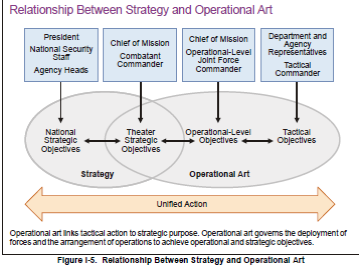
fig-1-5-jp-03a

Friends of Padre Steve’s World

As I have been working to revise my materials form my next Gettysburg Staff Ride I did some revisions to my text that I use with my students. The footnotes did not show up so Monday I will repost the text of this article with them. The article is important even for non-military types who care about the country and are involved in politics or policy, because it shows the linkage between the advantages that a nation with a strong strong and effective central government has over one which adopts what we would call today a Libertarian form of government. In fact I would call the effort of the Confederacy in the Civil War “The Failed Libertarian War.” But that is possibly a subject for an article or maybe even a book, but I digress…

So anyway here is the latest,

Peace

Padre Steve+

Today we look at the Gettysburg Campaign in terms of how we understand the connection between strategy and operational art. In doing so we have to place it in the context that Lee’s campaign has in relationship to the Confederate command relationships and where it fits in the continuum of unified action as we understand it today.

To do so we have to make the connection between national strategic objectives, theater objectives, operational objective and tactical objectives. We have to explore command and control structures, staff organization and the understand the effect of the Diplomatic, Informational, Economic and Military elements of national power that impact a nation’s ability to wage war.

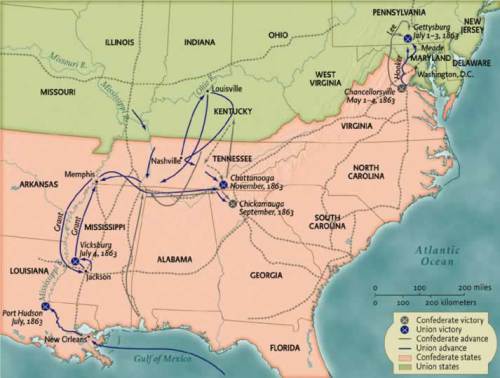
The summer campaign of 1863 in the Civil War gives us the opportunity to do this as we explore the Gettysburg campaign in relation to Vicksburg and the overall strategic situation that both sides faced. This includes the elements that we now associate with the DIME.

While Confederate army units and their commanders generally excelled on the tactical level, and their soldiers endured hardship well, this would not be enough to secure victory. They displayed amazing individual initiative on the battlefield and they won many victories against superior forces, especially in the early part of the war. Even during the final year of the war, Lee’s forces fought skillfully and helped prolong the war. But neither the Confederate government nor the various army commanders were able to translate battlefield success to operational, theater specific or national strategic objectives.

The Confederacy had a twofold problem in its organization for war and how it conducted the war. First it had no organization at the strategic level to direct the war, and it never developed one to coordinate its military, military, diplomatic or economic policies. While Southern strategists understood that they needed to “wear down the ability of the North to wage war” they were consistently hobbled by its own internal political divisions which served to undermine efforts to coordinate the effort to defend the Confederacy. These divisions focused on the opposition of the states’ rights proponents to the central government in Richmond.

The overarching national strategic objective of the Confederacy was to attain independence. The Confederates could not hope to conquer the Union and because of that their “strategic problem was to resist conquest” and to do so they would have to “tire the Federals out, and force them to abandon the war.” Jefferson Davis seems to have understood this early in the war, but political considerations and the temperament of most Southerners and their political leaders frustrated his attempts. Generals like Lee and Joseph E. Johnston “were of the opinion that the more remote frontiers should be abandoned, and that the scattered forces of the Confederacy be concentrated, political reasons overruled their judgment.”

Southern politicians, especially the governors and congressmen demanded that troops “defend every portion of the Confederacy from penetration by “Lincoln’s abolition hordes.” Likewise, most Southerners believed that they “could whip any number of Yankees” and as early as 1861 the Confederate press was advocating an offensive strategy as the Richmond Examiner declared “The idea of waiting for blows rather than inflicting them, is altogether unsuited to the genius of our people….The aggressive policy is the truly defensive one. A column pushed forward into Ohio or Pennsylvania is worth more to us, as a defensive measure, than a whole tier of seacoast batteries from Norfolk to the Rio Grande.”

This combination of wanting to defend everything, which defied Frederick the Great’s classic dictum that “he who defends everything defends nothing” and the persistent employment of the offensive even when it “drained the Confederacy’s manpower and weakened its long term prospects for independence” were key strategic factors in its defeat.

The South did get an earlier start to in mobilizing for war then the Union. Even before the “Confederate Congress authorized an army of 100,000 volunteers for twelve months” on March 6th 1861 the governors of the eleven Confederate States raised units to fight any Federal armies which dared to force them back into the Union. This involved dusting off the old militias which had been allowed to decay in the period between the Mexican War and 1860. Most of these units in the South as well as the North were volunteer companies in which the discipline, equipment and training varied to a significant degree. Most had little in the way of real military training and “many of them spent more time drinking than drilling.” The early Confederate mobilization outstripped the availability of arms and equipment forcing many volunteers to be sent home.

Other than the stated desire for independence and their common hatred of the “Yankee,” there was little in the way of unity within the Confederate States, “the incurable jealousy of the States, especially those not immediately affected by the war, established a dry rot within the Confederacy.” Within the Confederacy, each state viewed itself as an independent nation only loosely bound to the other states and some legislatures enacted laws which actively opposed the central government in Richmond.

The various Confederate states controlled the use of their units and often resisted any effort at centralization of effort. Some kept their best units at home, while others dispatched units to Confederate armies such as Lee’s Army of Northern Virginia. Initially most states limited enlistment periods to one year despite the opposition of Robert E. Lee who helped Jefferson Davis pass the Conscription Act of 1862, a measure that was “heavily watered down by those politicians whose first concern was states’ rights and by those who felt that it would undermine patriotism.” That measure, even in its watered down form was distinctly unpopular, especially with the following declaration of martial law in parts of the Confederacy.

Both measures were brought by realists who understood that for the Confederacy to survive the war effort had to become a total war, with “the whole population and the whole production…put on a war footing.” Such measures provoke more attacks and opposition by their opponents who advocated states’ rights even if it worked against the overall interests of the Confederacy. By the time of Gettysburg if not sooner, “Confederate society began to unravel. The yeomanry and poor white people resented conscription, the tax-in-kind impressment, and other governmental measures than the wealthy. Planters sought to safeguard their property and status to the detriment of national goals.”

This included how state governments responded to the military needs of the Confederacy. Some governors hoarded weapons seized from Federal armories, “retaining these weapons to arm regiments that they kept at home… defend state boarders and guard against potential slave uprisings.” When in response to threats within the Confederacy Jefferson Davis suspended the writ of habeas corpus it resulted in a firestorm of opposition from the states. “Mississippi and Georgia passed flaming resolutions against the act; Louisiana presently did so, too, and North Carolina soon had a law on its books nullifying the action of the central government.” Alexander Stephens, the Confederate Vice President noted that there was “no such thing as a citizen of the United States, but the citizen of a State, and that “the object of quitting the Union, was not to destroy, but to save the principles of the Constitution.”

Likewise as economic conditions worsened and inflation soared in late 1861 the Confederate Congress “in its allotments to the War Department refused to face up to the costs of running the war…it forced the department to scramble in an atmosphere of uncertainty for allotments on a short-run basis.” There was much distrust of any attempt to organize a true central government with any actual authority or power in Richmond. Jefferson Davis may have been President but his country was hamstrung by its own internal divisions, including the often vocal opposition of Stephens for whom states’ rights remained a paramount issue. Stephens, in a statement that defied the understanding that military victory had to be achieved for independence to be won said during the habeas corpus debate “Away with the idea of getting independence first, and looking to liberty afterward.” This, like so many other aspects of the Confederate war effort showed the radical disconnection between legislators, policy makers and the Army and defied any understanding of the importance of government and the unity of effort in pursuing war aims. .

The Confederacy lacked a clear defined command structure to coordinate its war efforts. At the beginning of the war this was true of the Union as well, however, by the Union was much more adept at responding to the needs of the war, this included its military operations, diplomatic efforts and economy. Out of necessity it established a War Department as well as a Department of the Navy in February 1861 and Jefferson Davis, the new President who had served in Mexico and as Secretary of War prior to secession “helped speed southern mobilization in 1861.” However helpful this was initially Davis, who micromanaged Confederate war efforts “eventually led to conflict with some army officers.”
american14_5a

Jefferson Davis was an able man to be sure, but he “totally misunderstood the nature of the war.” Davis was a man given to suspicion and had major personality conflicts with all of his senior commanders save Robert E. Lee. These included Joseph Johnston who he loathed and P.T.G. Beauregard, both of whom he quarreled with on matters of strategy. These conflicts did impact operations, just as did the refusal of various states to support operations or campaigns apart from ones that impacted their state directly.

While Jefferson Davis and his Secretary of War theoretically exercised direction of the war no formal mechanism existed to coordinate the needs of the various military departments or armies. In 1863 Davis, Lee and the Secretary of War, James Seddon were acting as an “informal board which had a say in all major questions of Confederate strategy. Seddon, who had definite ideas of his own about military affairs, was usually but not always a party to Davis’ discussions with Lee…but Davis usually dominated them…. In contrast to the Northern command organization, the South had no general in chief. If anyone fulfilled his functions, it was the President.” It was not until February of 1865 that Lee was named as General in Chief of all armies, and by then the war had been lost.

While Jefferson Davis and his Secretary of War theoretically exercised direction of the war no formal mechanism existed to coordinate the needs of the various military departments or armies. In 1863 Davis, Lee and the Secretary of War, James Seddon were acting as an “informal board which had a say in all major questions of Confederate strategy. Seddon, who had definite ideas of his own about military affairs, was usually but not always a party to Davis’ discussions with Lee…but Davis usually dominated them…. In contrast to the Northern command organization, the South had no general in chief. If anyone fulfilled his functions, it was the President.” It was not until February of 1865 that Lee was named as General in Chief of all armies, and by then the war had been lost.

In effect each Confederate army and military department operated independently, often competing with each other for the troops, supplies and materials needed to fight. They also had to contend with recalcitrant state governments, each loathe to sacrifice anything that might compromise their own independence. Attempts by the authorities in Richmond to centralize some measure of authority were met with resistance by the states. Thus states’ rights were “not only the cause of the war, but also the cause of the Confederate downfall.”

In a country as vast as the Confederacy that lacked the industry, transportation infrastructure, population and economic power of the North this was a hindrance that could not be overcome by the soldierly abilities of its armies alone. An example of the Confederate problem was that “neither the army nor the government exercised any control of the railroads.” The Confederate Subsistence Department, which in theory was responsible for ensuring the supply of food, stores and the logistical needs necessary to maintain armies in the field could not plan with confidence. “Tied to the railroads, unable to build up a reserve; frequently uncertain whether or not their troops were going to be fed from one day to the next, field commanders understandably experienced a general loss of confidence in the Subsistence Department….” Even though the subsistence and even the survival of the army was dependent on the use of railroads, the railroad owners “responded by an assertion of their individual rights. They failed to cooperate….and Government shipments were accorded low priority. In May of 1863 the Confederate Congress finally granted the government broad authority over the railroads, but “Davis hesitated to wield the power. “ It would not be until early 1865 that the Confederacy would “finally take control of the railroads.”

All of these factors had a direct effect on the campaign of 1863. In the west, Confederate commanders were very much left to fend for themselves and to add to their misery failed even to coordinate their activities to meet the threat of Grant and his naval commander, Admiral David Dixon Porter. In the East, Lee having established a close relationship with Jefferson Davis as his military advisor during the first year of the war exercised a disproportionate influence on the overall strategy of the Confederacy because of his relationship with Davis. However, Lee was hesitant to use his influence to supply his army, even when it was suffering. Even though he willingly shared in the plight of his solders, Lee refused “to exert his authority to obtain supplies….” As the army prepared to invade Pennsylvania, “the paltry rationing imposed by Richmond was made worse by a tenuous supply line….”

Lee in theory was simply one of a number of army or department commanders, yet he was responsible for the decision to invade the Union in June of 1863. This decision impacted the entire war effort. The Confederate cabinet “could reject Lee’s proposal as readily as that of any other department commander, Bragg, or Pemberton or Beauregard, for example, each of whom was zealous to protect the interests of the region for which he was responsible…” But this was Lee, “the first soldier of the Confederacy- the first soldier of the world…” Lee’s plan was approved by the cabinet by a vote of five to one. The lone dissenter was Postmaster General John H. Reagan who “believed a fatal mistake had been made…”

Lee in theory was simply one of a number of army or department commanders, yet he was responsible for the decision to invade the Union in June of 1863. This decision impacted the entire war effort. The Confederate cabinet “could reject Lee’s proposal as readily as that of any other department commander, Bragg, or Pemberton or Beauregard, for example, each of whom was zealous to protect the interests of the region for which he was responsible…” But this was Lee, “the first soldier of the Confederacy- the first soldier of the world…” Lee’s plan was approved by the cabinet by a vote of five to one. The lone dissenter was Postmaster General John H. Reagan who “believed a fatal mistake had been made…”

Seddon desired to turn the tide at Vicksburg and proposed sending Longstreet’s Corps to reinforce Johnston to relieve the embattled city and maintain the front on the Mississippi. However, Lee believed that any attempt “to turn the Tide at Vicksburg…put Lee’s army in Virginia at unacceptable risk.”

The lack of any sense of unity in the Confederate hierarchy and lack of a grand strategy was disastrous. The lack of agreement on a grand strategy and the inability of the Confederate States Government and the various state governments to cooperate at any level culminated in the summer of 1863 with the loss of Vicksburg and the failure of Lee’s invasion of Pennsylvania. The Confederate failure in this demonstrates the absolute need for unity of effort and even more a whole of government and whole of nation approach to war.

This can be contrasted with the Union, which though it was slow to understand the nature of the war did have people who, through trial and error developed a cohesive strategy that led to success at the operational level and the tactical level. The genus in Union strategy came from Lieutenant General Winfield Scott who “appreciated the relationship between economic factors and attack.” Scott’s strategic plan was to establish a blockade and form two major armies, “one to move down the Mississippi and cut off the western half of the Confederacy from its eastern half, while the other threatened Richmond and pinned down the main Confederate forces in Virginia.” It was a plan for total war called Anaconda which was mocked in both the Northern and Southern press and it would become the blueprint of Federal success at the war progressed. Scott was the first to recognize that the war would not be short and his plan was the first to “recognize the North’s tremendous advantage in numbers and material, and it was the first to emphasize the importance of the Mississippi Valley in an over-all view of the war.”

Abraham Lincoln had little in the way of military acumen and frequently, until Grant took control of the armies interfered with his senior commanders, often with good reason. However, Lincoln was committed to winning the war and willing to take whatever steps necessary to do so. Fuller describes him as “none other than a dictator” by bypassing Congress and on his own authority declaring a blockade of Southern ports, calling for 75,000 volunteers and suspending habeas corpus.

Likewise Lincoln as well as Congress understood the value and necessity of the railroads and in January 1862 “Congress authorized to take possession of any railroads and place them under military control when the public safety warranted it.” Lincoln formed the Department of Military Railroads the following month and appointed Daniel C McCallum as its director. In May President Lincoln formally took possession of all railroads, but “saw to it that cooperative lines received government aid.”

George McClellan, who Lincoln appointed as commander of the Army of the Potomac in 1862, whatever his many faults as a field commander “possessed a strategic design for winning the war,” understood the necessity of unity of command and successfully built an effective army. Now his design was different than that of Scott, for he desired to “crush the rebels in one campaign” by an overland march to Richmond. While this was unrealistic because of McClellan’s constant overestimation of his enemy and inability to risk a fight when on the Peninsula and at the gates of Richmond, the Union might have at least had a chance should he have defeated the major Confederate forces deployed to defend that city. While that would have been unlikely to win the war in a single stroke it would have been a significant reversal for the Confederacy in 1862.

Logistics was one of the deciding factors of e war, both the Confederate weakness and Union ability to adapt society and government needs to wartime conditions. As a general principle Union leaders, government and business alike understood the changing nature of modern war. This stood in stark contrast to the inefficient and graft ridden Confederate agencies where even those who wanted more effective means to wage war were hindered by politicians, land owners and businessmen who insisted on their rights over the needs of the nation. The Union developed an efficient and well managed War Department where the importance of logistics inter-bureau cooperation became a paramount concern.

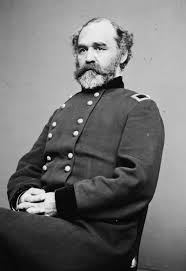
Union industry “geared up up for war production on a scale that would make the Union army the best fed, most lavishly supplied army that have ever existed.” The Quartermaster’s Department under the direction of Quartermaster General Montgomery Meigs was particularly efficient in supplying the needs of a military fighting on exterior lines in multiple theaters of operation. Unlike the Confederate Subsistence Bureau the Federal Quartermaster Bureau supplied almost everything the army could need: “uniforms, overcoats shoes, knapsacks, haversacks, canteens, mess gear, blankets, tents, camp equipage, barracks, horses, mules, forage, harnesses, horseshoes, and portable blacksmith shops, supply wagons, ships when the army could be supplied by water, coal and wood to fuel them, and supply depots for storage and distribution.” The ill-equipped Confederates could only look on with awe, in fact during his absence from Lee J.E.B. Stuart was ecstatic over the capture of “one hundred and twenty five of the best United States model wagons and splendid teams….” likewise one of the reasons that A.P. Hill allowed Harry Heth to send his division the Gettysburg was to find shoes that the Confederate Subsistence Department could not provide for them. Thus one of the reasons for the Battle of Gettysburg is directly linked to the failed logistics system of the Confederacy.

Early in the war the Union logistics effort was beset by some of the same problems that plagued the Confederacy throughout the war. Graft and corruption ran rife until 1862 when “Congress established investigative committees to uncover fraud and passed laws regulating the letting of contracts.” Meigs overhauled the bureau. At the beginning of the war it had only one department, for clothing. He modernized this and added eight new departments, which dealt with “specialized logistical functions such as forage and fuel, barracks and hospitals and wagon transportation.” During the war Meigs managed nearly half the direct costs of the Union war effort,” over 1.5 billion dollars in spending. He has been called by James McPherson as “the unsung hero of northern victory.”
meigs1

The Unsung Union Hero: General Montgomery Meigs 

This had a profound effect on operations. When the Union forces by necessity had to operate in enemy territory they were well supplied whereas whenever Confederate Forces conducted operations in the North or even in supposedly friendly Border States they were forced to subsist off the land. This meant that Confederate operations in the north were no more than what we would call raids, even the large invasions launched by Lee in 1862 and 1863, both which ended in defeat and near disaster.

Because of their poor logistic capabilities Confederate forces had no staying power to keep and hold any ground that they took in enemy territory. This can be contrasted with the Union which when it sent its forces south meant them to stay.

Lee could not fathom this and because he believed that no Federal Army could stand a summer in the Deep South and that Grant would be forced to withdraw. The use of railroads to supply its far flung forces operating in the south as well as its use of maritime transportation along the coast and on inland waterways ensured that Northern armies could always be supplied or if threatened could be withdrawn by ship.

Some senior Union officers also understood the importance of logistics. Henry Halleck was the first true American military theorist. He published the first American work on strategy, Elements of Military Art and Science in 1846. While his is often given short shrift because he was not an effective field commander and had an acerbic personality which rubbed people the wrong way, Halleck was one of the most important individuals in organizing the eventual Union victory. This included matters of strategy, picking effective subordinate commanders and understanding the logistical foundations of strategy.

Weigley wrote of Halleck:

“He sponsored and encouraged the operations of Brigadier General Ulysses. S. Grant and Flag Officer Andrew H. Foote that captured Forts Henry and Donaldson in February 1862 and thereby opened up the Tennessee and Cumberland Rivers for Union penetration deep into the state of Tennessee and toward the strategically important Memphis and Charleston Railroad. Halleck’s insights into the logistical foundations of strategy proved consistently accurate. Throughout the war, he maintained a shrewd eye for logistically viable lines of operation for the Union forces, and he increasingly recognized that one of the most effective weapons of offensive strategy, in an age when battle meant exposure to rifled firepower, was not to aim directly at the enemy armies but at their logistical base.”

Halleck was also instrumental in helping to oust Hooker just before Gettysburg and raise Meade to command the Army of the Potomac. When Lincoln brought Grant east to become General in Chief Halleck took on the new position of Chief of Staff. This was a task that he fulfilled admirably, allowing Grant to remain in the field and ensuring clear communication between Lincoln and Grant as well as relieving “Grant of the burden of personally corresponding with his department commanders.”

By establishing what we now understand as the beginning of a modern command and staff organizational structure the Union was far more able to link its national, theater and operational level objectives with its tactical objectives, even when some of its commanders were not as good as Confederates and blundered into defeats. Above the army, at the administration level Stanton, the Federal Secretary of war organized a War Board and “composed of department heads and chaired by Major General Ethan Allen Hitchcock…as an embryonic American-style general staff.”

In the end during the summer of 1863 it was the Union which was better able to link the ends, ways and means of the strategic direction of the war. This is something that Davis and Lee were unable to do as they struggled with political division, a lack of cooperation from the states, and the lack of any true grand strategy.

Lee’s strategy of the offensive was wrong and compounded the problems faced by the Confederacy. The losses that his army suffered were irreplaceable, not just in terms of overall numbers of soldiers but in terms of his mid-level leaders, his battalion, regiment and brigade commanders who suffered grievous losses and were even more critical to the leadership of his army.

Lee recognized the terrible effects of his officer casualties in a letter to General John Bell Hood on May 21st: “There never were such men in an Army before. But there is the difficulty- proper commanders- where can they be obtained?” His actions at Gettysburg only added to his crisis in keeping his army supplied with competent commanders, as so many were left dead, wounded or captured during the campaign.

Even had Lee won the battle of Gettysburg his casualties in Union territory would have been prohibitive. He would have spent most of his ammunition, incurred serious losses in personnel and horses, and been burdened by not having to care for his wounded and still been deep in Union territory away from his nearest logistics hub. Had Lee won at Gettysburg “his ammunition would have been nearly exhausted in victory, while Federal logistics would have improved as the Army of the Potomac fell back toward the eastern cities.” This would have forced him to withdraw from Pennsylvania even had he been victorious.

It is true that a victory on northern soil might have emboldened the peace party in the North, but even then that could not have an effect on the desired effect on the Lincoln Administration until the election of 1864, still 16 months away. Likewise, in July 1863 such a victory would probably not have triggered foreign recognition or assistance on the part of France or England. “Skilful northern diplomacy prevented an internal conflict from becoming an international war.” Jefferson Davis held on to his fantasy until August 1863, when even he was forced to deal with reality was a vain hope indeed and ended his diplomatic efforts to bring England into the war.

England would not intervene for many reasons and the Confederate government did not fully appreciate the situation of the countries that they hoped would intervene on their behalf:

“its dependence on northern foodstuffs, access to new cotton supplies, turmoil in Europe, fear of what might happen to Canada and to British commerce in a war with the Union, and an unwillingness to side with slavery. The British government also wanted to establish precedents by respecting the blockade, a weapon that it often used.”

Confederate politicians were hindered by a very narrow, parochial view of the world, had little understanding of modern industry, economics and the type of diplomacy employed by Europeans both to strengthen their nations, but also to maintain a balance of power.

As we look at the Gettysburg and Vicksburg campaigns in the summer of 1863 these are important things to consider. The relationship between national strategic objectives, theater objectives, operational objectives and tactical success cannot be minimized. Success on the battlefield alone is almost always insufficient to win a war unless those wins serve a higher operational and strategic purpose, and the costs of battles and campaigns have to be weighed in relation to the strategic benefits that derive from them.

In the end the total failure of the two campaigns destroyed any real hope of Confederate military victory. At Vicksburg the Confederacy lost all of Pemberton’s army, 33,000 men and Lee suffered over 28,000 casualties from an army which had begun the campaign with about 80,000 troops. The losses were irreplaceable.

This essay is certainly not an exhaustive look at the subject, but if we do not consider these factors we cannot really understand the bigger picture of the situation that the two sides faced and how they dealt with them. While the weapons and tactics employed by the sides are obsolete the thought processes and strategic considerations are timeless.
Leave a comment

Filed under civil war, History, leadership, Military, national security

The Importance of Citizen Soldiers: Strong Vincent and Joshua Chamberlain at Little Round Top and American Military Sociology

dont give an inch

“As soldier and citizen, today’s armed forces officer is a champion of both the nation’s defense and the principles upon which the nation was founded. Taking an oath to support and defend the Constitution means swearing to uphold the core values that define the essence of American citizenship; the armed forces officer is first and foremost a citizen who has embraced the ideals of the nation—only then can he or she defend those principles with true conviction.” [1]

While the professional Gouverneur Warren through himself into the battle to save Little Round Top, as did many others the story of the battle dictates that we must discuss the actions of two “citizen soldiers” without whom the battle may have been lost, Colonel Strong Vincent and Colonel Joshua Chamberlain. Both are depicted and immortalized in the film Gettysburg which is based on Michael Shaara’s Pulitzer Prize winning novel The Killer Angels. As such their actions are known more than many others that are covered in this account of the Battle of Gettysburg.

Within the U.S. Army the example of Chamberlain at the Battle of Little Round Top has occupied a prominent place in Army leadership manuals including FM 22-100 and its successor FM 6-22, however, that being said even those that learn about Chamberlain from this seldom delve deeper into his character, development as a leader and significance, at Little Round Top, Appomattox and after the war, likewise the examples of both Warren and Vincent which are key to Chamberlain and his regiment even being on the hill are ignored in that publication.

It is important to discuss Vincent and Chamberlain for more than their direct contributions to the battle. Those are widely known and in a sense have become part of the myth that is our understanding of Gettysburg. While discussing those actions it is also necessary to put them into context with the character of both men, the cause that they fought. Likewise it is important to address in this age of the professional all volunteer force the importance of Citizen Soldiers in any kind of democracy or representative republic, a sociological question that military professionals as well as our elected officials and citizenry would do well to revisit.

This is particularly important now as various elected leaders, think tanks, defense contractors and lobbyists are all questioning the economic “liabilities” of the All-Volunteer force as well as the disconnect between the broader military and society at large. This means that there will be efforts to determine how the military will be manned, trained and employed, and if military leaders are ignorant of our history, the vital connection between the military and the citizenry and the contributions of Citizen Soldiers then we will be caught flat footed and unprepared in the coming debates. If that happens those decisions could be made by “bean counters” with little appreciation for what military professionalism and readiness entails, as well as think tanks and lobbyists for the defense industry who have their own motivations for what they do, often more related to their profits, power and influence than national security.

The armies that fought the Civil War for the most part were composed of volunteers who of a myriad of reasons went off to fight that war. Gouverneur Warren is a character whose life and career before and after the Civil War was much more like currently serving regular officers and to some extent the much more professional and hardened by war officer corps of the Reserve Components of each of our Armed Services, in particular the much active and deployed Army National Guard and Army Reserve. The reserve components still do reflect much of the Citizen Soldier tradition but that being said between deployments, other activations and required schooling, those assets are much more on par with their active counterparts than they ever have been in our history.

“American defense policy has traditionally been built upon pluralistic military institutions, most notably a mix force of professionals and citizen soldiers.” [2] Warren represented what until the beginning of the Cold War was the smaller pillar of that pluralistic institution that of the long term professional while Vincent and Chamberlain represented the volunteer citizen soldier who enlisted to meet the crisis.

Until World War II and the advent of the Cold War these dual pillars existed side by side. Following the Second World War along with the small-wars that went along as part of it the world changed, and the wars that occurred, such as Korea and Vietnam “occurred on a scale too small to elicit a sustained, full-fledged national commitment, yet too large for a prewar-style regular army to handle.” [3] Because of this “military requirements thus became a fundamental ingredient of foreign policy, and military men and institutions acquired authority and influence far surpassing that ever previously possessed by military professionals on the American scene.” [4] General Tony Zinni noted that the foreign policy results of this transformation have resulted in the United States becoming “an empire” [5] something that no American living in 1863 could have ever contemplated.

This was part of a revolution in military affairs far more important than the application of technology which brought it about, the Atomic Bomb; it was a revolution in national strategy which fundamentally changed American thinking regarding the use of the military instrument in relationship to diplomacy, and the relationship of the military to society at large. Russell Weigley noted: “To shift the American definition of strategy from the use of combats for the object of wars to the use of military force for the deterrence of war, albeit while still serving the national interests in an active manner, amounted to a revolution in the history of American military policy….” [6]

The policy worked reasonably well until Vietnam and the inequities of the system showed its liabilities and brought about a change from politicians. Lieutenant General Hal Moore wrote of the Vietnam era: “The class of 1965 came out of the old America, a nation that disappeared forever in the smoke that billowed off the jungle battlegrounds where we fought and bled. The country that sent us off to war was not there to welcome us home. It no longer existed.” [7]

The debacle of Vietnam and the societal tidal wave that followed brought about the end of the selective service system, by which the large army needed to fight wars was connected to the society at large and the creation of the All-Volunteer force by President Nixon in 1974. The ethos that every citizen was a soldier was destroyed by Vietnam and even men like General William Westmoreland who warned that “absent “the continuous movement of citizens in and out of the service,…the army could “become a danger to our society-a danger that our forefathers so carefully tried to preclude.” [8]

This cultural shift is something that none of the professional officers of the small ante-bellum army like Warren would have ever imagined much less men like Vincent or Chamberlain who were true citizen-soldiers. Thus for currently serving officers it is important to recognize this key change as it applies to American military strategy as well as the place the military occupies in our society. This makes it important to our study as we examine the actions of Vincent and Chamberlain outside of myth and legend and see the implications that they can have not only on the battlefield but in our relationship to the American citizenry and society. It is to put in in classic terms a return to understanding the relationship between the military and the people so powerfully enunciate in Clausewitz’s Trinity.

While Warren represents the Strong Vincent and Joshua Chamberlain represented that important part of our military tradition that really, except in the case of young men and women that volunteer to serve and leave the military after their obligated service really no longer exists. We no longer have a system that allows, nor do we actively encourage men like Vincent and Chamberlain to leave lucrative civilian employment or academia to serve alongside the professionals in positions of responsibility leading regiments or brigades or serving as senior staff officers unless they are already part of the military in our reserve components.

vincent

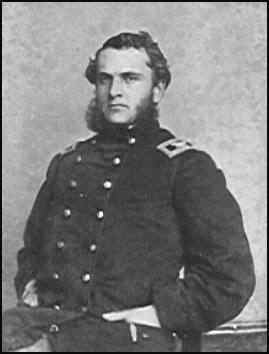
Colonel Strong Vincent was a 26 year old Harvard graduate and lawyer from Erie Pennsylvania. Vincent enlisted and then was appointed as a 1st Lieutenant and Adjutant of the Erie Regiment because of his academic and administrative acumen. He married his wife Elizabeth the same day. Vincent like many young northerners believed in the cause of the Union undivided, and he wrote his wife shortly after after the regiment went to war on the Peninsula:

“Surely the right will prevail. If I live we will rejoice in our country’s success. If I fall, remember you have given your husband to the most righteous cause that ever widowed a woman.”[9]
Vincent was commissioned as a Lieutenant Colonel in the 83rd Pennsylvania September 14th 1861. The young officer learned his trade well and was considered a “strict disciplinarian and master of drill.” [10] That being said one enlisted man remarked that “no officer in the army was more thoughtful and considerate of  the health and comfort of his men.” He assumed command of the regiment when the commander was killed during the Seven Days in June of 1862 where he learned lessons that he would help impart to his fellow officers as well as subordinates, including Chamberlain. Following a bout with a combination of Malaria and Typhoid that almost killed him, he took command of the regiment. He commanded the regiment at Fredericksburg and was promoted to command the 3rd Brigade when its commander was killed at Chancellorsville in May 1863. Vincent was offered the chance to serve as the Judge Advocate General of the Army of the Potomac in the spring of 1863 after spending three months on court-martial duty. But refused the offer in order to remain in the fight commanding troops. [11]

Unlike most other brigade commanders, Vincent was still a Colonel, and he, like many others would in his place hoped that going into action to save Sickles’ command “will either bring me my stars, or finish my career as a soldier.” [12] On July first, Vincent, a native Pennsylvanian came to Hanover and learning that battle had been joined, ordered “the pipes and drums of the 83rd Pennsylvania to play his brigade through the town and ordered the regiments to uncover their flags again….” [13] As the brigade marched through the town Vincent “reverently bared his head” and announced to his adjutant, “What death more glorious can any man desire than to die on the soil of old Pennsylvania fighting for that flag?” [14]

Vincent was known for his personal courage and a soldier of the 83rd Pennsylvania observed “Vincent had a particular penchant for being in the lead….Whenever or wherever his brigade might be in a position to get ahead…, he was sure to be ahead.” [15] That courage and acumen to be in the right place at the right time was in evidence when he led his brigade into battle on July second.

On July 2nd Barnes’ division of V Corps, which Vincent’s brigade was a part was being deployed to the threat posed by the Confederate attack of McLaws’ division on the Peach Orchard and the Wheat Field to reinforce Sickles’ III Corps. While that division marched toward the Peach Orchard, Vincent’s 3rd Brigade was the trail unit. When Gouverneur Warren’s aide, Lieutenant Randall Mackenzie [16] came toward the unit in search of Barnes he came across Vincent and his brigade near the George Weikert house on Cemetery Ridge awaiting further orders. [17] Vincent intercepted him and demanded what his orders were. Upon being told that Sykes’ orders to Barnes were to “send one of his brigades to occupy that hill yonder,” [18] Vincent, defied normal protocol assuming that Barnes was drunk [19] told Mackenzie “I will take responsibility of taking my brigade there.” [20]

It was a fortunate thing for the Union that he did. His quick action to get his brigade, clear orders to his subordinate commanders and skilled analysis of the ground were a decisive factor in the Union forces holding Little Round Top. He ordered Colonel James C. Rice of the 44th New York to lead the brigade up to the hill while he and his aide went forward to scout positions as the brigade moved forward at the double quick “across the field to the road leading up the north shoulder of the hill” with Chamberlain’s 20th Maine in the lead. [21] Looking at the ground which had the valley and Devil’s Den, occupied by the end of Sickles’ line, he chose a position along a spur of the hill running from the northwest to the southeast to place his regiments where they could intercept the Confederate troops of Hood’s division which he could see advancing toward the hill.

The 16th Michigan, his smallest regiment was placed on the right of the brigade. That section of the line was located on massive boulders that placed it high above the valley below, making it nearly impregnable to frontal attack. He deployed the 83rd Pennsylvania and 44th New York, known as Butterfield’s Twins to their left at the request of Rice who told him “In every battle that we have engaged the Eighty-third and Forty-fourth have fought side by side. I wish that it might be so today.” [22] Those units were deployed below the crest among the large number of boulders; the 83rd was about two-thirds of the way down the way down the slope where it joined the right of the 44th, whose line angled back up the slope to the southeast.

Vincent deployed the 20th Maine on his extreme left of his line, and in fact the extreme end of the Union line. Vincent knew that if this flank was turned and Chamberlain overrun that it would imperil the entire Union position. Vincent came up to Chamberlain who remembered that Vincent said “in an awed, faraway voice. “I place you here….This is the left of the Union line. You understand. You are to hold this ground at all costs.” [23]

chamberlain

Colonel Joshua Chamberlain was another one of the citizen soldiers whose performance and leadership on Little Round Top saved the Union line that hot July evening. A graduate of Bowdoin College and Bangor Theological Seminary, Chamberlain was fluent in nine languages other than English. He was Professor of Rhetoric at Bowdoin before seeking an appointment in a Maine Regiment without consulting either the college or his family. He was offered command of the 20th Maine but asked to be appointed as a Lieutenant Colonel which he was in August 1862. He fought at Fredericksburg and was named commander of the regiment when Colonel Adelbert Ames, his commander was promoted following Chancellorsville.

Like Vincent, Chamberlain was also a quick student and rapidly adapted to being a soldier, officer and commander of troops in combat. On receiving his orders Chamberlain deployed his small regiment halfway down the southern slope facing the small valley between Little and Big Round Top. As a result of his experience in battle and the tenacity of the Confederate army he became an advocate of the tactics that William Tecumseh Sherman would later employ during his march to the sea in 1864. He wrote his wife before Chancellorsville:

“We must fight them more vindictively, or we shall be foiled at every step.  We must desolate the country as we pass through it, and not leave a trace of a doubtful friend or foe behind us; make them believe that we are in earnest, terribly in earnest; that to break this band in twain is monstrous and impossible; that the life of every man, yea, of every weak woman or child in the entire South, is of no value whatever compared with the integrity of the Union.”

Since Chamberlain’s account is so important I will forgo a discussion of his tactics and instead quote the sections of his after action report that explains his actions. Chamberlain wrote:

“On reaching the field at about 4 p.m. July 2d, Col. Vincent commanding the Brigade, placing me on the left of the Brigade and consequently on the extreme left of our entire line of battle, instructed me that the enemy were expected shortly to make a desperate attempt to turn our left flank, and that the position assigned to me must be held at every hazard.

I established my line on the crest of a small spur of a rocky and wooded hill, and sent out at once a company of skirmishers on my left to guard against surprise on that unprotected flank.

These dispositions were scarcely made when the attack commenced, and the right of the Regt. found itself at once hotly engaged. Almost at the same moment, from a high rock which gave me a full view of the enemy, I perceived a heavy force in rear of their principal line, moving rapidly but stealthily toward our left, with the intention, as I judged, of gaining our rear unperceived. Without betraying our peril to any but one or two officers, I had the right wing move by the left flank, taking intervals of a pace or two, according to the shelter afforded by rocks or trees, extending so as to cover the whole front then engaged; and at the same time moved the left wing to the left and rear, making a large angle at the color, which was now brought to the front where our left had first rested.

This hazardous maneuvre was so admirably executed by my men that our fire was not materially slackened in front, and the enemy gained no advantage there, while the left wing in the meantime had formed a solid and steady line in a direction to meet the expected assault. We were not a moment too soon; for the enemy having gained their desired point of attack came to a front, and rushed forward with an impetuosity which showed their sanguine expectations.

Their astonishment however was evident, when emerging from their cover, they met instead of an unsuspecting flank, a firm and ready front. A strong fire opened at once from both sides, and with great effect, the enemy still advancing until they came within ten paces of our line, where our steady and telling volleys brought them to a stand. From that moment began a struggle fierce and bloody beyond any that I have witnessed, and which lasted in all its fury, a full hour. The two lines met, and broke and mingled in the shock. At times I saw around me more of the enemy than of my own men. The edge of conflict swayed to and fro -now one and now the other party holding the contested ground. Three times our line was forced back, but only to rally and repulse the enemy. As often as the enemy’s line was broken and routed, a new line was unmasked, which advanced with fresh vigor. Our “sixty rounds” were rapidly reduced; I sent several messengers to the rear for ammunition, and also for reinforcements. In the mean time we seized the opportunity of a momentary lull to gather ammunition and more serviceable arms, from the dead and dying on the field. With these we met the enemy’s last and fiercest assault. Their own rifles and their own bullets were turned against them. In the midst of this struggle, our ammunition utterly failed. The enemy were close upon us with a fresh line, pouring on us a terrible fire. Half the left wing already lay on the field. Although I had brought two companies from the right to its support, it was now scarcely more than a skirmish line. The heroic energy of my officers could avail no more. Our gallant line withered and shrunk before the fire it could not repel. It was too evident that we could maintain the defensive no longer. As a last desperate resort, I ordered a charge. The word “fix bayonets” flew from man to man. The click of the steel seemed to give new zeal to all. The men dashed forward with a shout. The two wings came into one line again, and extending to the left, and at the same time wheeling to the right, the whole Regiment described nearly a half circle, the left passing over the space of half a mile, while the right kept within the support of the 83d Penna. thus leaving no chance of escape to the enemy except to climb the steep side of the mountain or to pass by the whole front of the 83d Penna. The enemy’s first line scarcely tried to run-they stood amazed, threw down their loaded arms and surrendered in whole companies. Those in their rear had more time and gave us more trouble. My skirmishing company threw itself upon the enemy’s flank behind a stone wall, and their effective fire added to the enemy’s confusion. In this charge we captured three hundred and sixty eight prisoners, many of them officers, and took three hundred stand of arms. The prisoners were from four different regiments, and admitted that they had attacked with a Brigade.” [24]

Colonel William Oates of the 15th Alabama would give Chamberlain and his regiment the credit for stopping his attack. Oates wrote: “There have never been harder fighters than the Twentieth Maine and their gallant Colonel. His skill and persistency and the great bravery of his men saved Little Round Top and the Army of the Potomac from defeat.” [25]

chamberlain lrt

As with any firsthand account, aspects of Chamberlain’s accounts are contested by others at the scene. Oates notes that he ordered the retreat and that there were not as many prisoners taken, one of Chamberlain’s company commanders disputes the account of the order of the bayonet charge however the fact is that Chamberlain who was outnumbered nearly two to one by the 15th and 47th Alabama regiments “offset this superiority with strength of position, iron determination and better tactics.” [26] Also a factor was the fatigue of the Confederates, these regiments and their parent unit, Law’s brigade of Hood’s division had conducted a grueling 28 mile march to get to the battlefield and were exhausted by the time that they arrived.

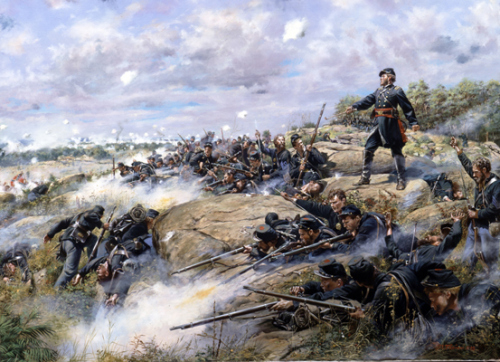
Vincent was mortally wounded while leading the defense of the hill. While he was standing on a large boulder with a riding crop ordering the men of the 16th Michigan who were beginning to waiver he cried out “Don’t yield an inch now men or all is lost,[27]he was struck by a bullet which hit him in the groin. As he was being carried from the field to the hospital where he died on July 7th, “This is the fourth or fifth time they have shot at me…and they have hit me at last.” [28]

As Vincent lay dying he was visited by many comrades, visited by Sykes and Barnes he told them “I presume… I have dune my last fighting.” Meade recommended Vincent for posthumous promotion to Brigadier General, but the request was lost.

Two months after his death his wife gave birth to a baby girl. The baby would not live a year and was buried next to him. One wonders what heights of leadership the young colonel might have achieved had he not died at Gettysburg. He was a man who understood the nature of total war, an excellent leader and skilled tactician.

Chamberlain survived the war to great acclaim being wounded three times and receiving the surrender of the Army of Northern Virginia at Appomattox on April 9th 1865.

The examples of these two citizen soldiers demonstrate the importance of this legacy, which is still to some extent carried on by the reserve components of the United States military service. That being said, in the coming years military professionals will have to engage lawmakers and the bureaucracy of the Pentagon as the shape of the future military, especially the land components is debated and decided upon by politicians. Thus, it is of the utmost importance of revisiting the tradition of the citizen soldier and how it can be renewed in the coming years.

Chamberlain’s words about the men that he served alongside like his commanding officer, Strong Vincent are a fitting way to close.

“It is something great and greatening to cherish an ideal; to act in the light of truth that is far-away and far above; to set aside the near advantage, the momentary pleasure; the snatching of seeming good to self; and to act for remoter ends, for higher good, and for interests other than our own.” [29]

Notes

[1] _______. The Armed forces Officer U.S. Department of Defense Publication, Washington DC. January 2006 p.2

[2] Millet, Allan R. and Maslowski, Peter, For the Common Defense: A Military History of the United States The Free Press a Division of Macmillan Inc. New York, 1984 p.xii

[3] Bacevich, Andrew J. Breach of Trust: How Americans Failed their Soldiers and Their Country Metropolitan Books, Henry Holt and Company, New York 2013 Kindle Edition Amazon Edition p.50

[4] Huntington, Samuel P. The Soldier and the State: The Theory and Politics of Civil-Military Relations, The Belknap Press of Harvard University Press, Cambridge MA and London 1957 p.345

[5] Zinni, Tony. The Battle for Peace: A Frontline Vision of America’s Power and Purpose Palgrave McMillian, New York 2006 p.4

[6] Weigley, Russell F. The American Way of War: A History of United States Military History and Policy University of Indiana Press, Bloomington IN, 1973 pp.367-368

[7] Moore, Harold G. and Galloway Joseph L We Were Soldiers Once…And Young Harper Perennial Books, 1992 pp. xix-xx

[8] Ibid. Bacevich Breach of Trust p.58

[9] ________. Erie County Historical Society http://www.eriecountyhistory.org/wp-content/uploads/2008/10/strongvincent.pdfretrieved 9 June 2014

[10] Golay, Michael. To Gettysburg and Beyond: The Parallel Lives of Joshua Lawrence Chamberlain and Edward Porter Alexander Crown Publishers Inc. New York 1994 p.129

[11] Leonardi, Ron Strong Vincent at Gettysburg Barringer-Erie Times News retrieved June 9th 2014 from http://history.goerie.com/2013/06/30/strong-vincent-at-gettysburg/

[12] Guelzo, Allen C. Gettysburg: The Last Invasion Vintage Books a Division of Random House, New York 2013 p.264

[13] Pfanz, Harry F. Gettysburg: The Second Day. University of North Carolina Press, Chapel Hill 1987 p.51

[14] Ibid. Guelzo Gettysburg: The Last Invasion Vintage p.159

[15] Tredeau, Noah Andre. Gettysburg: A Testing of Courage, Harper Collins Publishers, New York 2002 p.305

[16] Some such as Guelzo believe this may have been Captain William Jay of Sykes staff.

[17] Ibid. Tredeau, Gettysburg: A Testing of Courage p.327

[18] Ibid. Guelzo Gettysburg: The Last Invasion Vintage p.262

[19] Ibid. Guelzo Gettysburg: The Last Invasion Vintage p.262

[20] Ibid. Tredeau, Gettysburg: A Testing of Courage p.327

[21] Coddington, Edwin B. The Gettysburg Campaign: A Study in Command, A Touchstone Book, Simon and Schuster New York, 1968 p.389

[22] Ibid. Pfanz, Gettysburg: The Second Day. p.213

[23] Ibid. Golay To Gettysburg and Beyond p.157

[24] Chamberlain, Joshua Lawrence. Official Narrative of Joshua Chamberlain of July 6th 1863, Maine Military Historical Society, Inc., Augusta, Maine, copyright 1989 U.S. Army Combat Studies Institute Reprint, retrieved from http://usacac.army.mil/cac2/cgsc/carl/download/csipubs/chamberlain.pdf June 15th 2014

[25] Oates, Willam C. and Haskell, Frank A. Gettysburg Bantam Books edition, New York 1992, originally published in 1905 p.98

[26] Ibid.Coddington The Gettysburg Campaign: A Study in Command p.393

[27] Ibid. Guelzo Gettysburg: The Last Invasion Vintage p.272

[28] Ibid. Tredeau, Gettysburg: A Testing of Courage p.361

[29] Chamberlain, Joshua Lawrence. Chamberlain’s Address at the dedication of the Maine Monuments at Gettysburg, October 3rd 1888 retrieved from http://www.joshualawrencechamberlain.com/maineatgettysburg.php 4 June 2014

Leave a comment

Filed under civil war, History, leadership, Military, national security

D-Day, Midway and a Nation at War: Thoughts on History as the Greatest Generation Passes Away

d-day-orderDwight Eisenhower speaking with men of the 101st Airborne Division before they jumped into Normandy

“At the end of the twentieth century the contributions of this generation would be in bold print in any review of this turbulent and earth-altering time. It may be historically premature to judge the greatness of a whole generation, but indisputably, there are common traits that cannot be denied. It is a generation that, by and large, made no demands of homage from those who followed and prospered economically, politically, and culturally because of its sacrifices. It is a generation of towering achievement and modest demeanor, a legacy of their formative years when they were participants in and witness to sacrifices of the highest order. They know how many of the best of their generation didn’t make it to their early twenties, how many brilliant scientists, teachers, spiritual and business leaders, politicians and artists were lost in the ravages of the greatest war the world has seen.” Tom Brokaw, The Greatest Generation

I was born in 1960 and thankfully for whatever reason I developed a love of history and heritage. I began reading history books as early as second and third grade. The American Heritage Publishing Company had a Junior Library series that I could not get enough of awhile another publisher (it may have also been American Heritage) had a series of biographies which drew me into the lives of many famous people. From 3rd grade on I spent every spare moment at school in the library, even frequently cutting geometry class in 10th grade to explore the history reference books that I could not check out and take home.

tumblr_lahyzakLSB1qbjz0go1_500Marine Colonel Francis I. Fenton, kneeling prays at the foot of his son’s grave on Okinawa 1945

I think that anyone that knew me then could probably associate me with a big stack of books that I lugged to and from class and back and forth from home to school. The ironic thing is that as I pack for work or to come home every day at the Staff College my back pack from my tour in Iraq is filled with the books that I am reading or using for research. Maybe it is not ironic, maybe it is the fact that some things never change. For me the quest for knowledge and historical, philosophical, or scientific truth is something that I cannot get enough of, nor be content to think that I know everything on any given subject.

This little introduction takes me into today’s subject. For those that don’t know we are coming up on the anniversaries of two of the most amazing historical events of the past 100 years next week. They are the battles of Midway, June 4th through June 6th 1942 and the the invasion of France, or D-Day, June 6th 1944.

ts8The pilots of Torpedo 8, only one survived Midway

I have always been amazed by the men who faced the Japanese at Midway, a battle that by any reasonable means should have resulted in a Japanese victory as well as them men that stormed the beaches at Normandy just two years later. When I first started reading about these battles many of the veterans were still alive, many not much older than I am today. However today not many are left, and the few that remain generally served as junior officers or enlisted personnel, none in high command.

Both battles are remarkable because an American or Allied loss could have changed the course of history. Had the United States Navy been defeated at Midway it could have brought about a Japanese victory, or more likely made the ultimate American victory much more costly and drawn out. Had the Allies been repulsed at Normandy it could have split the allied coalition or given the Germans the chance to renew their fight against the Soviet Union and possibly change history.

Thus when I look at these two events, battles that for most are now ancient history I am in awe of the men who fought them. They are not academic exercises for me, but as someone who has served at sea and on land in war I feel a certain camaraderie with these men.

I remember reading Cornelius Ryan’s classic book “The Longest Day” and seeing the movie of the same name in grade school, and reading Walter Lord’s classic on Midway “Incredible Victory” when I was in 7th grade. Both are excellent books which have stood the test of time and though I have read and done much more research and writing on both battles I still keep a copy of each book and probably re-read each every few years and consult them for any new projects. Likewise have been fortunate enough to meet some of the men who served in both of these battles, and even in my time as an Army chaplain be with them in their declining years. Men like Frank Smoker and Henry Boyd, both Normandy vets who have since passed away mean much to me.

442ndRCTThe 442nd Regimental Combat Team

Today when I see a World War Two veteran, no matter where I encounter them, I make sure that I thank them for their service. They are part of an amazing generation of Americans who bequeathed those of us who live today so much, both during the war and after the war. Many millions served in the military, while many more served in war industries. All contributed to war bond drives, victory gardens and yes even increased taxes and decreased civil liberties to win the war.

The fact that Japanese Americans served in the most highly decorated Army units of the war despite their families being incarcerated in American versions of concentration camps is a testimony to sacrifice.

1329663819

Likewise the efforts of African Americans who went to war despite being second class citizens and discriminated against under the Jim Crow Laws, which even Nazis like Hermann Goering recognized were only different from the the Nazi anti-Semitic laws and persecution in manner of degree.

That was an amazing an unique generation of Citizen Soldiers. With few exceptions they were not the professional career soldiers, sailors, marines and airmen who serve today. Most would not have considered themselves “warriors.” They were there to do a job, win a war and go home. It was part of who they were as Americans.

tumblr_mkp1mvf4gC1qbjz0go1_500

How many today would do any of those things? Today we have well under one percent of the population who have served in the wars of the past 13 years, fewer who have served in combat or in a combat zone. Likewise the population in general and in particular the bankers, businesses, lobbyists and defense contractors are not asked to sacrifice anything, instead when the country was attacked the President and others decried the fact that war might prevent people from doing business, shopping or living a normal life. For God’s sake, were at war and that attitude would have been incomprehensible to those of the Greatest Generation who for the most part either went to war, or supported the war effort with their work and other contributions. For them patriotism was not a bumper sticker.

Rachel Maddow said it well in her book Drift The Unmooring of American Military Power:

“When civilians are not asked to pay any price, it’s easy to be at war – not just to intervene in a foreign land in the first place, but to keep on fighting there. The justifications for staying at war don’t have to be particularly rational or cogently argued when so few Americans are making the sacrifice that it takes to stay.”

scan002411-483x600Jimmy Stewart and his Bomber Crew

Because of the sacrifice of people of the Greatest Generation I am grateful for them. I believe that we can learn so much from them. Even A-List Hollywood stars and professional sport heroes left their careers to serve their country. Clarke Gable, Audie Murphy, Glenn Miller, Jimmy Stewart, Bob Feller, Ted Williams and Joe DiMaggio just to name a few sacrificed major portions of their careers to serve. With the exception of Pat Tillman who died in a friendly fire incident in Afghanistan which was covered up by the Army and Bush administration, how many of the 1%, the A-List or professional athletes can you name that have left sacrificed their fortunes to serve in the front lines? I can’t name any others, but in the Second World War even the 1% had skin in the game so to speak, the Kennedy’s, Roosevelt’s and the Bush’s to name just a few.

2339073617_3b27cdf95c

I think that is why I am in awe of those of the Greatest Generation and why as the anniversaries of Midway and D-Day approach I am extra thoughtful, quite reflective and very thankful for those who through their sacrifice made so much of what we have today possible. What bothers me today is how few, especially of those who either advocate for war, lobby for it or profit from it no matter what their political, economic or religious persuasion is, offers to serve or pay for the cost of war.

Today those costs are borne by a tiny minority of Americans, military professionals of the all-volunteer military, both active duty and reserve who have endured deployment after deployment as the bulk of the nation stood by, mostly cheering them on. Of course as one who had his father serve in Vietnam and entered the military not long after had to endure the jeers of Americans, cheers are nice. They are much better than being called a “Nazi” for wearing your uniform to class. However, sometimes I think that many that cheer us on are able to due so because vicarious patriotism is easy. Vicarious patriotism anything, someone else serves, and someone else dies while they “support the troops” without actually doing anything.
crops_0201

Now please don’t get me wrong. There are a lot of good people who have never served in the military and who do care. Men and women who take action to support the troops, both those serving and the veterans, including those disabled in some way by war. For them I am grateful, they donate time, money and personal effort to care, and I do not care if the are conservatives or liberals, Republicans, Democrats or Independents, religious or atheist. They are Americans who are doing something. Likewise I do not disparage those who take the time to learn the issues that the nation faces and the domestic policies that impact the country and in a healthy body politic it doesn’t mean that we have to completely agree with each other to be patriots. Such an understanding would have been unthinkable to our founders much less most of the Greatest Generation. Veterans issues are important but national security also involves so much more, everything from the infrastructure that the Greatest Generation had the vision and wherewithal to build to the environment.
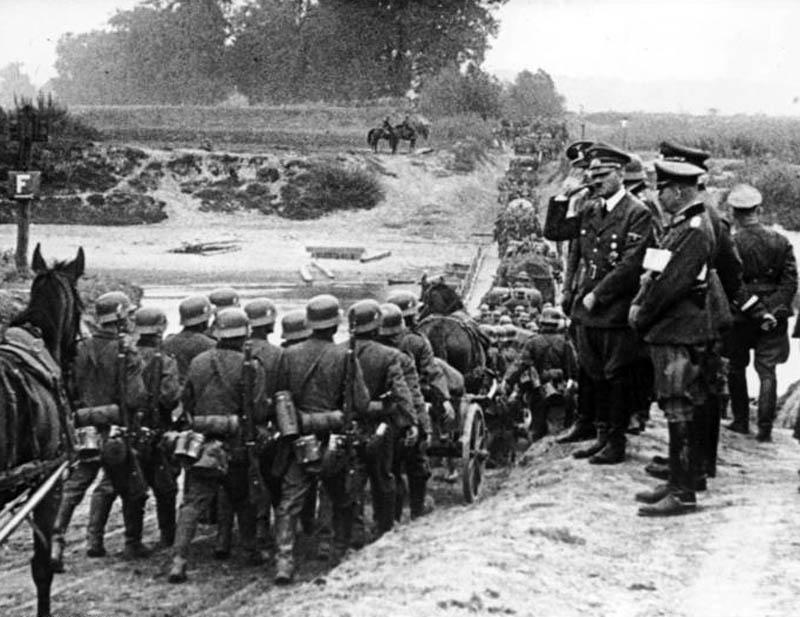
I have been to Normandy as well as other World War II battlefields in Europe and the Pacific. I can only agree with Tom Brokaw who wrote: “there on the beaches of Normandy I began to reflect on the wonders of these ordinary people whose lives were laced with the markings of greatness.”

So, when you read anything I write or re-publish during the next couple of weeks, be it about D-Day, Midway or even Gettysburg, please read what I write though those lenses. It is not that I am bitter. I have chosen my life in the military, but I wonder why so few of us bear the burden. It is a question that every citizen must ask themselves and their political representatives.

Rabbi Roland Gittlesohn, a Navy Chaplain serving with the Marines gave a eulogy at the dedication of a cemetery on Iwo Jima that puts it all in perspective.

“Here lie men who loved America because their ancestors generations ago helped in her founding, and other men who loved her with equal passion because they themselves or their own fathers escaped from oppression to her blessed shores.

Here lie officers and men, Negroes and whites, rich men and poor . . .together. Here are Protestants, Catholics and Jews together. Here no man prefers another because of his faith or despises him because of his color. Here there are no quotas of how many men of each group are admitted or allowed. Among these men there is no discrimination. No prejudices. No hatred. Theirs is the highest and purest democracy.

Whosoever of us lifts his hand in hate against a brother, or who thinks himself superior to those who happen to be in the minority, makes of this ceremony and the bloody sacrifice it commemorates, an empty, hollow mockery. To this, then, as our solemn duty, sacred duty do we the living now dedicate ourselves: to the right of Protestants, Catholics and Jews, of white men and Negroes alike, to enjoy the democracy for which all of them have here paid the price. .

We here solemnly swear that this shall not be in vain. Out of this and from the suffering and sorrow of those who mourn this will come, we promise, the birth of a new freedom for the sons of men everywhere.”

Since the last members of the Greatest Generation are passing away at an ever increasing rate and few will remain among us; I will ask you to ask yourself the question posed by the World War II veteran and hero John F Kennedy: “Ask not what your country can do for you; ask what you can do for your country.”

Peace

Padre Steve+

2 Comments

Filed under History, Military, national security, Political Commentary

Counting the Cost: Reflections on Armed Forces Day 2014

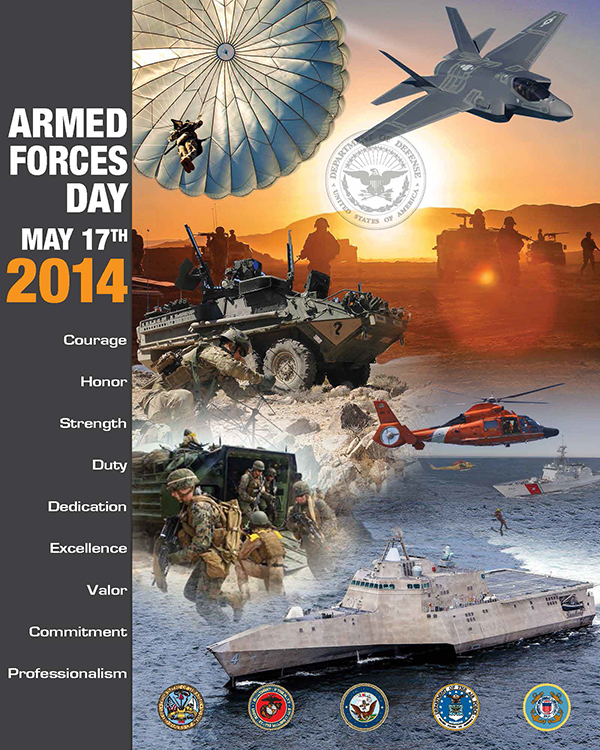
Event-Armed-Forces-Day-poster-2014

“What is the cost of war? what is the bill?…“This bill renders a horrible accounting. Newly placed gravestones. Mangled bodies. Shattered minds. Broken hearts and homes. Economic instability. Depression and all of its attendant miseries. Back -breaking taxation for generations and generations. For a great many years as a soldier I had a suspicion that war was a racket; not only until I retired to civilian life did I fully realize it….” Major General Smedley Butler USMC

Today is Armed Forces Day and unfortunately most of the country will not notice unless they are attending a Baseball game where it is being observed or some special event on a base, national cemetery, monument or VFW hall.

There are also a fair number of local celebrations to honor members of the Armed Forces across the country but for the most part they are small and not well publicized. As a career officer and son of a Vietnam veteran Navy Chief I appreciate those events and the people that put them together. Being a veteran of Operation Iraqi Freedom and Operation Enduring Freedom, especially those that have taken the time to honor Iraq and Afghanistan veterans.

At any given time less than 1% of Americans are serving in all components of the military. For over 10 years we have been at war in Afghanistan and Iraq as well as other locations that we don’t like to talk about too much. However this has not been the effort of a nation at war, it is the war of a tiny percentage of the population.

As a nation we are disconnected from the military and the wars that the military fights. The fact is that most Americans do not have a personal or vested interest in these wars, they have been insulated by political leaders of both parties from them. There is no draft, and no taxes were raised to fund the wars and the military is now worn out.

We have been at war for nearly 14 years and truthfully there is no end in sight. In that time every single Soldier, Sailor, Marine and Airman volunteered for duty or reenlisted during this time period. Motives may have varied from individual to individual, but unlike the World Wars, Korea and Vietnam every single one volunteered to serve in time of war. I think that this makes the current generation of veterans quite unique, we are no longer a military composed of citizen soldiers we are now, even our reserve components a Warrior caste, set apart from the society that we serve.

There is a tragic disconnection between the military and civilian society in the United States. This is the result of deliberate public policy since the end of the Vietnam War supported by both political parties. For almost 40 years we have relied on an all volunteer force. It is that relatively small and socially isolated military which is sent to fight wars while the bulk of the population is uninvolved and corporations, lobbyists and think tanks get rich.

Andrew Bacevich wrote in his new book Breach of Trust: How Americans failed their Soldiers and their Country:

“Rather than offering an antidote to problems, the military system centered on the all-volunteer force bred and exacerbated them. It underwrote recklessness in the formulation of policy and thereby resulted in needless, costly, and ill-managed wars. At home, the perpetuation of this system violated simple standards of fairness and undermined authentic democratic practice. The way a nation wages war—the role allotted to the people in defending the country and the purposes for which it fights—testifies to the actual character of its political system. Designed to serve as an instrument of global interventionism (or imperial policing), America’s professional army has proven to be astonishingly durable, if also astonishingly expensive. Yet when dispatched to Iraq and Afghanistan, it has proven incapable of winning. With victory beyond reach, the ostensible imperatives of U.S. security have consigned the nation’s warrior elite to something akin to perpetual war.”

Bacevich, a retired Army Colonel and Vietnam veteran who lost a son in Iraq is dead on, as is Rachel Maddow who wrote in her outstanding book Drift: The Unmooring of American Military Power:

“The reason the founders chafed at the idea of an American standing army and vested the power of war making in the cumbersome legislature was not to disadvantage us against future enemies, but to disincline us toward war as a general matter… With citizen-soldiers, with the certainty of a vigorous political debate over the use of a military subject to politicians’ control, the idea was for us to feel it- uncomfortably- every second we were at war. But after a generation or two of shedding the deliberate political encumbrances to war that they left us… war making has become almost an autonomous function of the American state. It never stops.” 

The lobbyists, pundits, politicians and preachers that promote war don’t care about the troops. This is because no matter who is in office or who controls congress these people and corporations will promote policies that keep them employed and their businesses enriched. Marine Major General and Medal of Honor winner Smedley Butler was quite right when he said:

“War is a racket. It always has been. It is possibly the oldest, easily the most, surely the most vicious. It is the only one international in scope. It is the only one in which the profits are reckoned in dollars and the losses in lives. A racket is best described, I believe, as something that is not what it seems to the majority of the people. Only a small ‘inside’ group knows what it is about. It is conducted for the benefit of the very few, at the expense of the very many. Out of war a few people make huge fortunes.”

I think that the reason that our current wars have gone on so long is the that misguided policies have brought about a chronic disconnection in our society between those that serve in the military. But how can there not be when in the weeks after 9-11 people like President Bush and others either directly or in a manner of speaking told people to “go shopping” * as we went to war in Afghanistan? When I returned from Iraq I returned to a nation that was not at war whose leaders used the war to buttress their respective political bases.

The results are terrible. Suicide rates are continuing to rise among veterans who have returned to find that neither the VA nor the civilian mental health care sector is prepared to care for them.

I think that Armed Forces Day should be better celebrated and I am grateful to the people that do things every day to thank and support military personnel. These wonderful people that do this come from across the political spectrum. Some are veterans and others non-veterans. But they care for and appreciate the men and women that serve in and fight the wars that no-one else can be bothered to fight.

481801_10151367001287059_1003164983_n-2

Of course the politicians, pundits, preachers and the defense contractors, banks and lobbyists will find a way to profit. They will do so no matter how many more troops are killed, wounded or injured and how badly it affects military personnel or their families and will push to abandon those who fought as they do after every war. After all, to quote Smedley Butler, “war is a racket.”

Peace

Padre Steve+

President Bush’s actually words were “Now, the American people have got to go about their business. We cannot let the terrorists achieve the objective of frightening our nation to the point where we don’t — where we don’t conduct business, where people don’t shop…” http://georgewbush-whitehouse.archives.gov/news/releases/2001/10/20011011-7.html

2 Comments

Filed under History, iraq,afghanistan, leadership, Military, national security, Political Commentary

War Crimes are Us: I Want No Part of Sarah Palin’s Torture Loving Christianity

-nrarallypalin

Well, Sarah Palin is at it again and I do have to say something. The former Alaska Governor, losing V.P. Candidate and failed reality television celebrity who can’t even hold a down a steady job with Fox News committed an act so brazenly anti-Christian and anti-American that as a Christian I have to condemn it. I wrote about this subject before in my article Baptism and Water Boarding: When Professed Christians Defile Their Own Faith to Make Cheap Political Points which I wrote almost a year ago in response to people making the same comment.

Palin said at the National Rifle Association convention Sunday April 27th that “waterboarding is how we baptize terrorists” and the crowd, many certainly God fearing Christians went wild. You see Palin and many like her believe with all their hearts that waterboarding and other techniques of “enhanced interrogation” should not only be used, but be national policy when it comes to dealing with enemies of the state. Their view is not that torture is inherently evil but might be justified in a supreme emergency to save lives, but that it should be institutionalized as a matter of judicial and military policy and publicized. Torture is considered by all civilized nations to be a war crime and crime against humanity. We set the standard for that in what we did at Nuremberg.

Justice Robert Jackson, the chief prosecutor of the Nuremberg Trials wrote:

“If certain acts of violation of treaties are crimes, they are crimes whether the United States does them or whether Germany does them, and we are not prepared to lay down a rule of criminal conduct against others which we would not be willing to have invoked against us.”

First I object to Palin’s use of the “baptism” to bless torture, to bless actions that our country sentenced the soldiers of Germany and Japan to death for doing after World War II. Yes, at Nuremberg, Tokyo and Manila American justices sentenced leaders both civilian and military to death for institutionalized policies of torture. People like Palin who advocate the routine use of torture as an act of national policy put our military, intelligence and diplomatic personnel as well as other citizens at greater risk should they be held captive by a state or non-state actor.

Some are speculating that she is doing this to slam John McCain, the only serving member of the Senate or Congress to have been a Prisoner of War and subjected to waterboarding as a means of torture. If so it shows that she has no grace or ability to be thankful, for without John McCain she would not be on the national political stage and the vast majority of us would have been blessed never to know who she is.

Of course for people like Palin and her cheering media supporters who have no skin in this game it doesn’t matter. They don’t serve in the military, nor intelligence or diplomatic corps, nor do they don’t volunteer in humanitarian relieve operations. In fact to them those who lose their lives because of such stupid statements, actions and policies are simply part of the cost of war.

Baptism is a sacrament of the Christian church, or in some cases considered an “ordinance.” There is a difference. Christians who view baptism as a sacrament see it as something that is the entrance into new life, it is a vehicle of God’s grace where the Holy Spirit acts in a special way to cleanse the person being baptized from sin, incorporate them into the family of faith and a chance for the Christian community to join with the Baptized in recommitting ourselves to the faith and pledging to help the new Christian in theirs. In churches where it is an ordinance; or something we do because it was commanded by Jesus it is still important. It is an outward demonstration and witness of faith that has already been received. Christians have been persecuted and even gone to their death as martyrs for what they believed about baptism in all of its forms. Thus what Sarah Palin did is not only cheap and tawdry political speech by a narcissistic self-aggrandizing diva of extremely limited intellect and zero spiritual acumen, but sacrilege that every Christian who values their faith and baptism should condemn in the strongest terms.

The sad thing is that many Christians will not condemn her nor call her into account simply because they have bought into the evil of systematized torture as an instrument of public policy. Likewise many want Palin to run again for either the Presidency or for the Senate because she embodies what they believe.

But here is the real rub. Once you make torture a part of your public policy where does it stop? Every society that has practiced it has used it not only on their military foes, but on their own people.

What Palin supports and endorses is nothing more than the evil perpetuated by every totalitarian regime that has ever existed.

For those that support her, be warned; like the non-Nazi German conservatives who initially supported Hitler but later had second thoughts you too could considered a terrorist using the methods that Palin advocates against others today. You get what you vote for…

As Martin Niemoller said after the fall of the Third Reich:

First they came for the communists, and I did not speak out—because I was not a communist;
Then they came for the socialists, and I did not speak out—because I was not a socialist;
Then they came for the trade unionists, and I did not speak out—because I was not a trade unionist;
Then they came for the Jews, and I did not speak out—because I was not a Jew;
Then they came for me—and there was no one left to speak out for me.

Peace

Padre Steve+

4 Comments

Filed under christian life, faith, History, laws and legislation, national security, News and current events, Political Commentary

Putin’s Crimean “Anschluss”

BN-BY109_Ukrain_H_20140315145119

Vladimir Putin has successfully annexed the Crimea and reincorporated it into Mother Russia. It was masterfully done but it was not the first time that something like it has been accomplished. The last time was in March 1938 when Hitler with the assistance of Austrian Nazis and Pan-Germanists brought Austria into the Third Reich over the objections of its democratically elected leaders.

The pretext was the same. Ethnic Germans in Austria who wanted to be part of Germany ere being persecuted, just as was claimed about ethnic Russians in Crimea and the eastern Ukraine. The larger power, backed by military force moved to support the their allegedly persecuted brothers and sisters.

Like in the Crimea, the Nazi conquest of Austria was aided by Austrians. Austrians who with the assistance of the SS ensured that Jews, Socialists and others had their votes suppressed. According to official Russian news sources over 95% of Crimeans voted to become part of Russia. That number is lower than the 99.7% of Austrians who “voted” for incorporation in the German Reich, but numbers such as this are suspect.

The elections in both places were aided by the presence of a large military contingent from each major power. The Germans of course were more overt, their forces openly crossed the border with Hitler accompanying them. The German SS supported the moves of their Austrian counterparts as well as the Austrian SA in bludgeoning all opposition.

russiantankscrimea

The Russians acting under the same pretext in 2014 denied that their troops had entered the Crimea, despite massive evidence to the contrary. In less than two weeks an “election” was held backed by Russian military forces and local police forces and political groups. Ethnic Ukrainians and Tartars who make up close to 40% of the population of Crimea were kept from the polls.

_73620201_73620200

The parallels are startling. I expect that by tomorrow the Russian Duma will recognize the results of the Crimean election, and that with days Russian forces will move to annex other potions of the eastern Ukraine. These areas are gripped by Russian nationalist forces that are agitating against the Ukrainian government. The situation is so bad that many ethnic Russians in the region are objecting to the methods and propaganda.

But that will not stop Putin. For whatever reason he has decided that now is the time to begin to restore Russian dominance in the areas nearest to Mother Russia. It is a dangerous move.

Putin is moving more military forces into Crimea. There are credible reports that Russian military units, including the elite Spetsnaz commandos have entered the Ukraine and are attempting to create “false flag” incidents in order to justify Russian military intervention in the Ukraine.

anschluss

This is dangerous. The Ukraine is not Austria of 1938, nor is it Czechoslovakia of the same year where a similar drama was playing out in the Sudetenland where Hitler again taking advantage of the supposed oppression of ethnic Germans was used as pretext to threaten war. Then it forced the west to back down, and a Munich the leaders of Britain, France and Italy forced the Czechs to surrender that territory. But now, with the exception of Russia, the world is condemning the Russian aggression in Crimea and the Ukraine.  The UN Security Council voted 13-1 with one abstention to condemn the Russian adventure in Crimea.

Bi27Zb4CAAMDuP0

The next week promises to be eventful. A military “truce” has been agreed to by the Ukraine and Russia. That truce is set to expire Friday the 21st of March. Meanwhile the rhetoric in Ukraine and Russia is becoming more elevated even as military forces of Russia, the Ukraine and NATO move into positions around the region. The military situation could easily escalate beyond the best efforts of diplomats and a real disaster could ensue.

Bi33bFnCAAA-a0N

It is a dangerous and potentially volatile situation. Much blame can be laid at leaders of various Ukrainian political factions, the European Union, Russia and the United States for allowing the situation to get to this point. However, that being said the overwhelming responsibility for the increasing rise in tensions and potential for violence has to be laid at the feet of Russian President Putin. It is Putin who has not taken the path of conciliation and negotiation regarding what is happening in Ukraine. He has instead opted for confrontation. That course is is dangerous and is not in the interest of anyone, especially the citizens of the Ukraine.

Let it be clear that I am not a fan of some of the Ukrainian nationalists involved, who are neo-Nazis and fascists. That being said if cooler heads prevail, that negotiations taken in good faith followed by elections that are free, fair and not held under the threat of military intervention take place that the situation might resolve itself. However, if that does not happen I hate to see what happens.

I would hope that some kind of solution, maybe of the order of of a non-aligned Ukraine such as Cold War Finland would be negotiated. Such a course has been recommended by no less than Henry Kissinger. Unfortunately I do not think that will happen. The politicians, pundits and preachers, the Trinity of Evil in Russia, the Ukraine and the West are stoking the fires of passion with results that at best will make the world a less stable and more dangerous place, and at worst could lead to a disastrous war.

Peace

Padre Steve+

Leave a comment

Filed under Foreign Policy, History, national security, News and current events

My Malaysian Airlines Flight MH-370 Conspiracy Theory

Huawei-MH370

There are a lot of theories of what happened to Malaysian Airlines Flight 370. Since no one really knows anything of substance about actually happened to the flight we are left to speculate. Today the Malaysian government went on record to announce that they believe that terrorism or highjacking by an expert is a likely scenario.

The only problem is that we don’t know who did it, how they did it, why they did it nor to we know where the aircraft went after last contact.

I have believed from the beginning that foul play was involved. However, until the latest release of information about the aircraft’s movements and the apparently deliberate shutdown of the aircraft’s ACARS system did I begin to imagine what might have occurred.

Color MH370 location map.jpg.CROP.promo-mediumlarge

I suspect that one of the pilots, possibly both, but more than likely one acted to seize the aircraft. My guess is that the whichever pilot did this was acting as part of a broader plot involving a Central Asian separatist group, possibly the Moslem Uighur’s of China. Since approximately two thirds of the passengers were Chinese this makes some sense. Various Uighur groups have committed violent terrorist attacks in China so they should be suspected.

article-0-1BF0F61F00000578-262_634x379Uighur Terrorists killed 29 people in a mass knife attack at a Chinese train station

If not the Uighur’s there are numerous other separatist groups and terrorist organizations in Central Asia with motivation and ability to conduct such an operation. The pilot, involved could have become radicalized in his Moslem beliefs, or have some other basis for cooperating with such a group.

zyklonb

My theory is that a pilot smuggled a small amount of a form of hydrogen cyanide, which the Germans used in the Second World War in the gas chambers of Auschwitz under the name Zyklon-B. That formula is still produced in the Czech Republic under the trade name Uragan D2, which is used in many countries to eradicate insects and small animals. In a confined space such as an airliner a small canister of these crystals could kill everyone on board in under 10 minutes. Once the hijacker reaches his destination the aircraft can be ventilated and safely used again.

035_03

The scenario goes like this. The pilot with the canister kills or incapacitates his fellow pilot after the aircraft reaches cruising altitude. He then dons a protective mask (gas mask) and gloves opens the door to the cabin and releases the toxin. He then rapidly closes and locks the door to the flight deck while the poison does its job. Within three minutes all passengers and crew are incapacitated and with 10 minutes all are dead. The pilot remains in the cockpit disables the ACARS system and flies the aircraft to a remote airfield in Central Asia, or other remote location where the aircraft is hidden. The terrorists the ventilate the aircraft and remove the bodies. The aircraft is then, with the help of the pilot readied for future use.

42a8cbfb93f7c9d226f8a37b90e7d809

In such a case no terrorist group would claim credit for the seizure of the aircraft. It would be their hope that authorities would finally assume that the aircraft crashed in the Indian Ocean. The aircraft could then be outfitted for whatever use the terrorists desire, including as suicide aircraft.

MH370

This is a very dark and macabre scenario, but it does answer the who, why and how questions that plague us now. As more facts come out, information about both pilots, other passengers on the aircraft as well as the flight path we will find out more.

Again, this is just my conspiracy theory. I have no proof of anything. But do believe that this is a possible scenario that can be supported by the technology involved as well as the situation surrounding the flight. It explains while cell phones continued to operate but no contact was made. It provides some motive particularly if it is a Uighur group with anti-Chinese views.

Of course I would like to be wrong on every count. Maybe I have read too many Tom Clancy novels and watched too many crime shows. The thought of anyone doing such a thing is too frightening to contemplate, but those who can do such evil are incapable of empathy for their victims.

Peace

Padre Steve+

10 Comments

Filed under national security, News and current events

Nothing is as Clear and Certain as it Appears to Be: The Ukraine Crisis

_73179624_021282371-1

“in the midst of war and crisis nothing is as clear or as certain as it appears in hindsight” Barbara Tuchman The Guns of August

There is nothing more uncertain than how leaders and people will react in crisis. We would like to think that we can be certain in our predilections, but we cannot because the reality is that human nature is always at play, and human beings have a penchant for doing things that are not expected.

030114_Breaking_ObamaPutin_640

It did not take long after the showcase of the Sochi Olympic Games for Vladimir Putin to move against the Ukraine and for all practical purposes annex the Crimea. But now after a few weeks it seems that the West is beginning to galvanize in its opposition to the Russian action. Germany is leading the charge from the side of the European Union, with Chancellor Merkel taking the lead. President Obama and Secretary of State John Kerry have been taking a hard diplomatic line while military forces gather.

It appears that targeted economic sanctions are in the offing while the European Union prepares to help supply the Ukraine’s energy needs.

140307064907-02-ukraine-0307-horizontal-gallery

The Russians have blockaded the small Ukrainian Navy in its Crimean ports, it has an estimated 30,000 soldiers in the Crimea and other forces are conducting “exercises” near the Ukrainian border. The Provisional Government of the Ukraine has called up its reserve forces, the United States is deploying naval and air force units to the Black Sea, the Eastern Mediterranean as well as Poland and the Baltic States.

But at the same time this is not the Cold War where two ideological blocks wrestled for domination. Instead the motivations, geopolitical and economic factors that connect the West and Russia make this much more complicated. Money is a big factor and it is of interest to note that a good amount of the resupply of US and NATO forces in Afghanistan is conducted over what is called the Northern Route, which goes through Russia and the Ukraine.

Ethnolingusitic_map_of_ukraine

The situation in the Crimea and the Ukraine is potentially volatile. Any situation that costs the lives of Ukrainians of either Ukrainian or Russian background could spiral out of control. Passions on both sides are running high. We in the West also need to remember that many Russians and men like Putin still feel the humiliation of the end of the Cold War, the collapse of the Warsaw Pact and end of the Soviet Union. Many Russians who even now are not fans of the Soviet system long for the days of empire and Russian hegemony in Eastern Europe.

In 1914 France was motivated by the humiliation that she suffered in 1871 at the hands of Prussia and the loss of Alsace Lorraine. The Russians have a similar attachment to areas where sizable ethnic Russian populations live, including the Eastern Ukraine and the Baltic. One has to remember the words of Otto Von Bismarck who said: “A generation that has taken a beating is always followed by a generation that deals one.”

2014-03-08T151114Z_01_TPE13_RTRIDSP_3_UKRAINE-CRISIS-CONVOY-08-03-2014-17-03-33-245

When looking at why this is happening we have to remember history.  Likewise we have to also remember the historic Russian paranoia when it comes to the influence of Europe and the West on areas that they believe are still part of Greater Russia. Their memory is long and past wounds are still fresh. Thus the blundering of the EU during the Fall of 2013 in its dealings with Ukraine, dealings which looked to the Russians like an attempt to draw Ukraine further away from them helped cause this situation. Likewise the Eastward expansion of NATO in the 1990s and early 2000s following the collapse of the Soviet Union and Warsaw Pact is considered both an insult and threat. The same is true of the presence of the American Anti-Ballistic Missile system in Poland, which is considered by many Russians to be directed at them, not Iran.

The situation is complex and influenced by many factors, and unlike some American politicians and pundits say, it has nothing to do with Benghazi or even what they claim is the “weakness” of President Obama. The roots of this crisis are long standing and diverse and have almost everything to do Russia’s relationship with Europe and very little to do with the United States. Thus for American politicians and pundits to demonstrate their woeful ignorance of history by blaming this all on President Obama is so self serving and transparent that it is embarrassing. But then American politics is almost always a demonstration of ignorance and arrogance.

The problem for the United States is that we have little credibility when it comes criticizing nations like Russia when they do the same as we do. Our actions to invade Iraq in 2003, actions which under the criteria that we laid down at Nuremberg violated international law make it hard for any American leader to criticize another power. This is true even when Putin’s actions, also illegal under international law are no worse and certainly by the historic ties of Crimea to Russia are more justifiable than what we did in Iraq.

Thus the outright hypocrisy of the architects of that invasion like Dick Cheney and Donald Rumsfeld shamelessly attack President Obama for his “weak” response to Putin’s actions are in large part to blame for them. They squandered our international standing and credibility, broke the military and bankrupted the country. They then lay the blame on Obama. By the decisions that they made and the subsequent consequences they tied Obama’s hands.

2014-03-10T173616Z_1863090881_GM1EA3B04DT01_RTRMADP_3_UKRAINE-CRISIS-CRIMEA.r

Sometimes these crisis blow over. Sometimes they stabilize but cause problems that continue for some time after the initial crisis. But there are some times that they take on a life of their own and that the people who think they are directing events end up being caught up in them, often with tragic results. While I do not think this will end in war, the possibility of such cannot be dismissed.

Tuchman in her book The March of Folly: From Troy to Vietnam wrote:

“A phenomenon noticeable throughout history regardless of place or period is the pursuit by governments of policies contrary to their own interests. Mankind, it seems, makes a poorer performance of government than of almost any other human activity. In this sphere, wisdom, which may be defined as the exercise of judgment acting on experience, common sense and available information, is less operative and more frustrated than it should be. Why do holders of high office so often act contrary to the way reason points and enlightened self-interest suggests? Why does intelligent mental process seem so often not to function?”

Peace

Padre Steve+

3 Comments

Filed under Foreign Policy, History, national security, News and current events

Policies Contrary to Their Own Interests: Putin’s New Cold War

140303080112-01-ukraine-0303-horizontal-gallery

“A phenomenon noticeable throughout history regardless of place or period is the pursuit by government of policies contrary to their own interests.” Barbara Tuchman

Today Russian forces continued their occupation of Crimea in spite of international outrage. Not only did they continue to build up their forces in Ukraine to the point that they operationally control the peninsula, they upped the ante demanding that Ukrainian army and navy units to surrender by Wednesday or face a “military storm.”

praguePrague 1968

It is something that Europe has not seen since the Cold War when the Soviet Union used military force and violence to put down revolts in Hungary and Czechoslovakia.

Polen, Parade vor Adolf HitlerCzechoslovakia 1939

However, I think in political terms it is much closer to Hitler’s invasion of Czechoslovakia in 1939 after Britain France and Italy stripped that country of its power by forcing the Czechs to surrender the Sudetenland to Hitler in October of 1938. Up to that moment the European powers bet on the appeasement of the Hitler regime. In a sense over the past decade the West has given Putin free reign to exercise his power over former territories, coercing them and occasionally using economic and even military power to bring them into line.

But now it is Ukraine. a complex region where Asiatic Russia meets Europe. The Ukraine is not Georgia or Chechnya. It is a region that has been a battlefield between Russia, the indigenous peoples as well as Germany, Poland, the Austro-Hungarian Empire and Turkey. It is the dividing line between western Catholicism and Russian Orthodoxy. In the 1850s even England and France found themselves intervening in the Crimea.

474933475-russias-president-vladimir-putin-attends-a-meeting-in.jpg.CROP.promo-mediumlarge

I believe that Putin under the flimsiest of pretensions has elected to use military force to attempt to coerce the Ukraine back under the thumb of a Russian Hegemon and to frighten the West into not intervening. It is a mistake. Just as in 1938 when Hitler believed that he could continue to steamroll the through Europe without war. In betting on the weakness of the West, Putin is playing the same game. Contrary to the speculation that Putin is doing this as a show of strength it is actually a display of Putin’s domestic insecurity.

Russia is not nearly as economically or militarily strong as Putin acts. There are serious ethnic and social divisions in the country and despite its assertions the Russian economy is much more dependent on the good graces of other nations as it is not. Already following Putin’s move into the Crimea the Russian currency and stock markets are tanking. I suspect that the West will soon impose sanctions that hit Russian economic and banking oligarchs where it hurts which will undercut support for Putin where he needs it most. Likewise I expect that Russia will be expelled from the G-8 and possibly cut off from other international banking and economic organizations.Likewise both the U.S. and the United Kingdom are bound by treaty to protect the territorial integrity of the Ukraine.

140302073009-03-ukraine-0203-horizontal-galleryPutin has had a run of success until now. However his crackdown against dissidents, campaigns against homosexuals and the state supported Russian Orthodox Church assault against other Christian denominations have already undermined his credibility as a world leader.

The invasion of the Ukraine will solidify opposition to Russia abroad, and increase anti-Putin sentiment in Russia. Should the Russian military attempt to invade other parts of Ukraine as they are threatening, Putin will find that he has bit off more than he can chew. His forces are certainly more than a match for the Ukrainian military, but he will not be able to hold or occupy the vast areas of the Ukraine in the face of opposition that will rapidly move toward a protracted insurgency. This insurgency will be supported by nations such as Chechnya which will take the war to the heart of Russia. It will turn out worse for Russia than the invasion of Afghanistan for the Soviet Union.

A new Cold War has already begun, Putin has made sure of that. The world that existed just three weeks ago when athletes from around the world gathered in Sochi for the Winter Olympics no longer exists. The only thing that we can hope is that the new Cold War does not become a hot war.

I am reminded of Barbara Tuchman’s words in The Guns of August: “The muffled tongue of Big Ben tolled nine by the clock as the cortege left the palace, but on history’s clock it was sunset, and the sun of the old world was setting in a dying blaze of splendor never to be seen again.” 

The world that we knew is now changed.

Let us pray for peace.

Padre Steve+


1 Comment

Filed under Foreign Policy, History, national security, News and current events

Putin’s Mistake: Creating an Afghanistan in the Ukraine

474933475-russias-president-vladimir-putin-attends-a-meeting-in.jpg.CROP.promo-mediumlarge

It appears that  it is 1980 all over again. From  all accounts Vladimir Putin will succeed in chopping off the heavily Russian region of Crimea from the Ukraine. His troops accomplished the task in short order. The weak and isolated Ukrainian border guard and military units stood no chance against an invasion which had obviously been planned for month. This was not a knee-jerk response by Putin. Though events moved rapidly,  the alacrity with which the Russian troops moved in, aided by ethnic Russians, and the rubber stamp action of the upper house of the Russian legislature to approve it demonstrates that it was not simply a move to “protect Russian citizens.”

The response of the new provisional government in Ukraine is that the invasion, and it is an invasion no-matter what Putin and his allies claim, is an act of war. The Ukrainian President has mobilized all reserves, however conventional Ukrainian military force is insignificant compared to what Russia can deploy against it. That being said if Putin elects to continue his aggressive and short sighted overreach by moving troops into other parts of the Ukraine it will trigger a massive insurgency against his forces and it may cause other now independent regions of the old Soviet empire to offer support to Ukraine. The President of Chechnya has already made the offer and its hardy and brutal soldiers are quite good at conducting insurgency and terrorist campaigns.

AP_Crimea_140228_DG_16x9_992

The West’s response is limited by geography. Any U.N. response against it will be vetoed in the Security Council by Russia. The United States, the European Union and NATO will protest. They will probably enact sanctions on Russia’s financial oligarchs on which Putin’s power rests and will possibly move troops to the western areas of the Ukraine and maybe limited naval forces into the Black Sea.

For those like Representative Mike Rogers of the House Intelligence Committee and others who said the Obama “missed the opportunity to deploy military forces to Ukraine,” I have to ask what forces and for what purpose?  U.S. military options are quite limited after 13 years of fighting costly wars, including the preemptive invasion of Iraq. Those wars, fought on borrowed money because the Bush administration refused to raise any taxes of any kind to support them harmed the country. Our forces, both the troops and equipment are worn out by war. The ability of the nation to rebuild and sustain them has been compromised by the economic costs of the 2008 banking and real estate crisis.  Likewise the Republican actions to force sequestration and other cuts on the military in order to get President Obama to cave to their domestic agenda has been detrimental to our overall national security.

russia-ukraine-protestPolice in Moscow arrest anti-Invasion Protesters

Those efforts themselves will not immediately accomplish much. However, when combined with an insurgency that has the ability to strike Moscow and St. Petersburg, the costs of maintain an occupying army in hostile territory are factored in they become more important. Likewise the ambivalence of the Russian people, who despite the imperialistic Russian media blitz has not risen to support war will eventually bring Putin problems at home.

The invasion of Crimea is not good for anyone. Ukraine needs time to sort out what it will become and a war is not in the interests of anyone.

The situation is intense and fraught with danger. Passions in many parts of the Ukraine are riding high and Putin’s move is more risky than he may realize. This is not the Republic of Georgia which Putin successfully invaded in 2008, abetted by the incompetence of that country’s leaders. If Putin continues down this course he will open the door to a real life Pandora’s Box, one that may take him and his government down just as Afghanistan helped end the Soviet empire.

Of course it is too early to say what will happen. The geopolitics, and economic realities, the internal politics of Russia, the Ukraine and the West will all influence what happens. In the past Putin has conducted a skillful game of realpolitik, however this time he may have overplayed what was a strong diplomatic, economic and political hand by launching this invasion. Those that think that simply because the EU depends on Russia for much of its natural gas and oil forget that Russia cannot cut off the supply without financial repercussions that directly affect Putin’s allies in the Russian financial oligarchy.

So now we watch as all the actors make their moves. It is a dangerous game that Putin has embarked upon.

We can only pray that it does not turn into disaster for all concerned.

Peace

Padre Steve+

Leave a comment

Filed under Foreign Policy, national security, News and current events, Political Commentary