Category Archives: Navy Ships

“Therefore Never Send to Know for Whom the bell Tolls, it Tolls for Thee” The Victims, Costs, and Threat of COVID-19


Friends of Padre Steve’s World,

On December 31st the Chinese Government reported the first death from nouveau Coronavirus 19, or COVID 19. By the end of January there were over 12,000 cases and 259 deaths. The first infected American arrived from China in the middle of January. At first, the American Government led by the Trump Administration paid little attention to it or downplayed its significance. It did that until the bottom began falling out of the stock markets, bond markets, and the oil market, the latter was not due to Coronavirus but the productions and price oil war between Saudi Arabia and Russia.

The Trump Administration finally labeled the situation a health emergency at the end of January, but did nothing to prepare.  Belatedly, it began to organize a response led by Vice President Pence at the end of February, but even still the President in his speeches and tweets continued to downplay the situation as members of his political, religious, and media cult amplified his message, until a week ago.

The day I wrote my first article about Coronavirus, March 8th there had been almost 110,000 cases and nearly 3800 deaths. That was an increase of 98,000 cases and over 3500 deaths in just 38 days.

Around midnight last night, there were nearly 198,500 cases and just shy of 8,000 deaths, 7,987 to be exact. So in ten days there were around 100,000 new cases, and close to 4200 new deaths. As of this evening there are a total of 218,721 cases, of which 125,392 are currently active. 93,329 are closed, meaning either recovery or death. Of the closed cases, 8,983 or 10% have died. This means there were over 20,000 new cases and almost 1,000 deaths since last night. Italy was hit hardest in the past day, over 4,200 new cases and 475 deaths.  In other European countries the numbers are spiking, and are about a week or two behind Italy in the progression of the disease.

Since last night the United States, in which testing capabilities are being expanded, there are now a total of 9,301 cases, with 2,890 of them being reported in the last day, and a total of 152 deaths, 43 since yesterday. Our numbers are about two or three weeks behind Italy, and despite the measures to quarantine, shut down, or shelter-in-place enacted by state and local governments there is no uniformity to those actions in light of the limited guidance or funding provided by Federal agencies.

In the United States, we were not prepared despite the warnings of experts that such a deadly pandemic would happen. The country was underprepared and unready for such a condition of affairs. Despite the recent flurry of action by Trump and his administration dithered and denied any real emergency or crisis for over two months, not taking precautions, not ramping up production of test kits, N-95 masks, surgical masks, other personal protective gear for first responders, hospital personnel, or nursing home workers, nor did it anticipate the need for anti-viral disinfectants, cleaners, or urge Americans to begin wearing surgical masks in order to mitigate the possible transmission of the virus.  Nor did it take of whole of government approach to the developing crisis until last week. Even with that move there is much confusion and bureaucratic infighting.
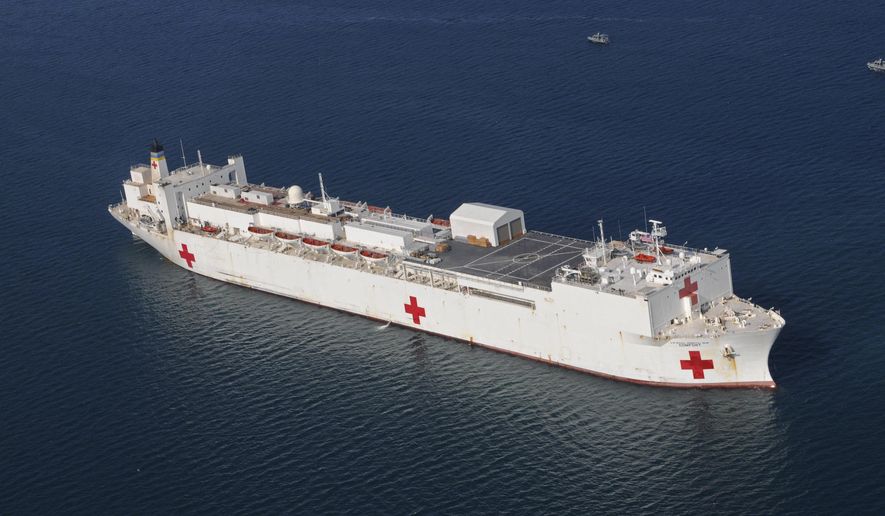
Frankly, most departments are still trying to make sense of what they need to do. Today the Navy was ordered to prepare the Hospital Ships USNS Comfort and USNS Mercy for deployment. Both are converted supertankers built in 1974 and 1975 before being purchased and converted and equipped as 1000 bed hospital ships in 1987. They are approaching 50 years old. They are equipped with operating rooms ICU beds, and medical and surgical wards, Radiology suites, and a full range of labs, but it takes a lot to staff them and make them ready to deploy. In addition to normal pre-deployment activities everyone deploying on them will need to be test for Coronavirus before they set foot on the ship to ensure that they do not become “plague ships.”  Comfort will deploy to New York, and Mercy to a yet to be determined West Coast metropolis. It will take at least a week, and probably more to make them ready to deploy. The crews of the ships are Merchant Marine Officers, deck, and engineering personnel, but the physicians, nurses, other providers, and technicians will leave their duty stations in Naval Hospitals and Clinics which are already at critical manning levels. They have to be augmented by activated Naval Reserve Medical personnel, Uniformed Public Health Service Officers, civilians employees of Navy Medicine and medical personnel from Humanitarian Service Organizations. There also has to be a Navy Security detachment, communications section, and an aviation detachment with its helicopters, as well as Chaplains and Mental Health Providers. These ships seldom deploy at the same time so the demands on Navy Medicine will be quite severe in Navy Medical Centers, Hospitals, and clinics.

Likewise, the administration ordered the activation of a number of mobile field hospitals. There are a number of types and sizes of such self-contained units which can be deployed by air sea, or ground. But like the Navy’s Hospital ships they draw almost all of their medical personnel from active duty hospitals, and mobilized reservists. Likewise,  the reserve and National Guard field hospitals depend on the very civilian health professions working in hospitals and private practices already dealing with the pandemic.

While China has flattened its infection and death curves due to its draconian police power to enforce the will of the government over the past few weeks, COVID-19 has spread across the globe. This includes all  50 U.S. States, Washington D.C., and Puerto Rico. The numbers are expanding exponentially in Europe and the United States, and today, two members of the House of Representatives announced that they had tested positive for the virus. With every passing day that curve will spike in the United States and Europe, and evidence in other countries suggest that a second wave of the virus is spreading in countries that did pretty well in the first wave.

On Friday, the President attempted to contain the damage with a press conference where he again minimized the threat, denied personal responsibility for anything, and then spoke to supporting financial markets, which briefly caused a rally on Wall Street, which collapsed as he and the administration began to acknowledge the truth of the matter and he turned the answering of medical, logistic, and disaster response to experts, such as Dr. Anthony Fauci, and even Vice President Pence seemed to eclipse Trump as more presidential. Over the weekend the President looked like a man who knew that he was in way over his head, even when he blustered and tweeted. Despite the actions being planned to mitigate the economic, public health, and personal costs of the virus, the damage was done. On Monday the stock markets took their heaviest losses ever, gained a little bit back Tuesday, and crashed again today.

Scrambling to find a way out of the situation the Administration and Congress, thanks largely to Speaker of the House Nancy Pelosi have been attempting to work out a stimulus bill which hopefully, would directly benefit all Americans, not just the banks, oil companies, and financial industries. Congress passed a measure to provide paid sick leave for all, and the Treasury Department is arguing for direct monetary payments to Americans who are now being hit with the full reality of an uncontrolled pandemic, massive business closures, job losses, and quarantine in some cities and states. The details of that are still to be worked out, but even that may not be enough to save some people from financial disaster.

Today the President used his authority to use the 70yearold Defense Production Act to force companies to make more respiratory ventilators, testing kits, and personal protective gear for medical personnel. But none of these measures can make up for the lack of ICU beds, General Medical beds, that are a feature of our mostly for profit medical industry. Hospitals have lost their ability to surge because maintaining an unused surge capacity is too expensive, until you really need it. Now, thirty years after the end of the Cold War, even the military medical system too has little surge capacity because like its civilian counterparts it has adopted the business models of civilian medical corporations.  Fewer staff, fewer beds, and less surge capacity.

The economy is taking massive hits, large numbers of the people who can least afford it are being laid off with little chance of going back to work anytime soon.

This is especially true of the airline, cruise, hotel, entertainment, hotel, and restaurant industries. In the restaurant industry nearly 15 million jobs are at stake, by the time it abates, there could be 50 million job losses in the hotel, restaurant, and entertainment sectors as local, state and the Federal government begin shutdowns of these businesses. Sadly most of the workers are living paycheck to paycheck, work for minimum wage and tips. Many are single parents, students, and people who chose the jobs because they liked dealing with people, or who were working to support themselves to get a better paying and more stable career. We know a lot of them. Good people, hard working people who constantly get screwed regardless of whether they work for large or middle sized companies who do not value them as people, or local restaurants which do not have large financial reserves, but it will expand as commercial food suppliers lose their corporate restaurant, entertainment, hotel and resort customers who will have no need of their supplies until the situation gets better.

Hopefully the measures being worked out will not only include direct payments to Americans, support for the restaurant, hotel, entertainment, and travel industries which employ far more people than the oil companies, and financial industries, as well as a provision for paid sick leave which is standard in most countries of the world.

But my friends, every one of these victims of Coronavirus and government incompetence is a real person. Many will recover from the virus but will suffer long term effects. Many will die, leaving behind friends, families, and holes in the community. Others, not infected by the virus will lose their jobs, businesses, or people that they love and care about. These people are not just numbers no matter what country or industry they live or work in. They are real live, men and women, sons and daughters, fathers and mothers, friends, co-workers, and acquaintances.

Behind every number there is a name, and a life connected to others. John Donne put it so well in his No Man is an Island:

“No man is an island, entire of itself; every man is a piece of the continent, a part of the main. If a clod be washed away by the sea, Europe is the less, as well as if a promontory were, as well as if a manor of thy friend’s or of thine own were: any man’s death diminishes me, because I am involved in mankind, and therefore never send to know for whom the bells tolls; it tolls for thee.”

For me and Judy, these are not numbers or statistics, they are friends, neighbors, and even family.

I am old enough to have worked as a hospital chaplain during two pandemics, and seen people die. I helped write the Army personnel policies for HIV infected personnel and worked with many so they could remain in the service back in 1987 and 1988. I worked in a homeless shelter for abysmal wages caring for those with less working for a board of 30 very well off members who didn’t value me as a person. I have been a company commander in the Army at the young age of 25 with just two years of active duty service before I took command. I have also done two combat tours, seen things most Americans have never seen, been shot at by rockets, machine guns, and small arms, all while unarmed. During this current pandemic I am essential personnel. A chaplain cannot telework. Ministry involves real contact with real people, in the flesh. This involves risks, I am almost 60, but I will take them but attempt to mitigate them in order to care for those who be they military.

The sad thing is that I will have friends and family members who will despite the overwhelming evidence downplay the situation, ignore it, or claim it to be “fake news.” Unfortunately, many will become victims of it or be the typhoid Mary’s of our day, spreading the virus without even knowing they have it.

Ignorance and negligence carry a heavy human price. As stupid and senseless as it may be to some, I have to speak out. As Sophie Scholl, who died as a peaceful resistance leader at the hands of the Nazis when she was just twenty-two years old wrote:

“The real damage is done by those millions who want to ‘survive.’ The honest men who just want to be left in peace. Those who don’t want their little lives disturbed by anything bigger than themselves. Those with no sides and no causes. Those who won’t take measure of their own strength, for fear of antagonizing their own weakness. Those who don’t like to make waves—or enemies. Those for whom freedom, honour, truth, and principles are only literature. Those who live small, mate small, die small. It’s the reductionist approach to life: if you keep it small, you’ll keep it under control. If you don’t make any noise, the bogeyman won’t find you. But it’s all an illusion, because they die too, those people who roll up their spirits into tiny little balls so as to be safe. Safe?! From what? Life is always on the edge of death; narrow streets lead to the same place as wide avenues, and a little candle burns itself out just like a flaming torch does. I choose my own way to burn.”

Nothing is safe now. The fantasy world that we lived in since the fall of the Berlin Wall is over. Pandemics and economic crashes are real, as is the potential for military conflict over areas of vast natural resources, and regions where ancient racial and religious scores are still aching to be settled.

Those are unpleasant facts, and until a vaccine is available that can treat the disease, we have to flatten the rate of infection, and the best way to do that is to  practice appropriate levels of  social distancing. The includes attempting to maintain a six foot separation, no hand shaking, and not going to work if you are sick. Actions taken by various, state, county, and local governments, include closing schools and universities and moving to online education, canceling large festivals, shows, and sporting events, and the voluntary shutting down of professional sports leagues, and prestigious tournaments. In response to these measures many restaurants, hotels, and entertainment centers have had to shut down, or limit services.

We were in a locally owned restaurant with a bar tonight when police entered the establishment to make sure that it was observing the state set number of no more than ten patrons inside. The manager on duty was warned and the three or four excess patrons, most who had been there a long time paid up and left. Once the people left the restaurant, the manager locked the door to ensure that no excess people would enter without a corresponding number leaving. The penalty after the warning would have been a $5,000 fine. The place will either set strict limits and hire security to enforce it, or shift to take out.

As we drove around our Town Center, all the major restaurants were closed. They cannot remain open except for take outs or delivery. Many other restaurants that depend on the volume of customers to make a profit are closed. In our area alone thousands of restaurant employees have been laid off. Likewise, movie theaters, museums, zoos, and concert venues shut down. Outside of our area both GM and Ford have shut down their American assembly plants, laying off thousands of workers, airlines have cut back the number of flights and at least one has shut down all of its overseas services. On Sunday I drove by a local mega church which had empty parking lots because they were being responsible and cancelled their services. That was a strange sight.

With people losing their jobs at such a rapid rate there is a likelihood that the rising real estate market could also suffer price devaluation, and while HUD has banned evictions or foreclosures until the end of April, the market could crash as it did in 2008.

As the disease begins to impact the military, infect service members, their families, and our Civilian Workers, it will degrade readiness. Important exercise with allies have already been cancelled, and soon deployments could be impacted, even if military action is required. Transfers are all now on hold, temporarily duty for schools, command visits, inspections, and other operations are now suspended unless they have a direct impact on combat operations. The movement of trainees to their new duty stations or technical schools is now suspended. New recruits cannot go into training and within weeks the effects will be felt throughout the military.

The President called this a wartime situation. If it really is he should declare a Stop Loss to keep as many military personnel ready in case of conflict. Worldwide economic crises often trigger insanely violent nationalistic movements, and subsequent wars. The possibility of that becomes greater as countries become unstable, and local conflicts could quickly become regional conflicts involving open, and undeclared enemies of the United States attacking our friends, allies, and vital interests in the world, which include natural resources not available in the United States, and yes, those include materials used in products that we all depend on.

I started this last night but was too tired to finish it. Hopefully this will help my readers better understand the very real impact that this virus will have on our society. It knows no class, profession, religion, ethnic, political, or racial division. A lot of people will be infected, and many will die. By the time it passes it will probably impact every one of us, if not directly, but because of it sickening and killing relatives and friends, or impacting our personal lives in terms of employment, earnings, and maybe even how we live.

I do a lot of listening, and I hear a lot of conspiracy theories spouted by people who know nothing of this virus, nothing of the powers of local, state and the Federal government in time of national emergency that it is useless to try to convince them that they are wrong.  Most of the time I I listen but don’t comment because I realize that it won’t do any good.

But I am done for tonight. I could write a lot more, and probably will do weekly updates on this crisis.

So until tomorrow, be careful out there.

Peace,

Padre Steve+


6 Comments

Filed under Diseases Epidemics and Pandemics, ethics, Foreign Policy, History, laws and legislation, leadership, Military, national security, natural disasters, Navy Ships, Political Commentary, state government agencies, us army, US Navy

Predators and Workhorses: The U-Boat Type VIIc

U-96

Friends of Padre Steve’s World,

When it comes to World War II and the ships of the German Kriegsmarine many Naval history buffs focus on the mighty battleships Bismarck and Tirptiz, sometimes the other major surface warships, or the massive battleships that never left the drawing board. However, for me it is the U-Boats, the German submarine fleet, which came very close to winning the war for Germany.  So for the next few nights I am going to be posting about some of the types of German submarines, or Unterseebooten, U-Boats. 

The signature warship of the German Kreigsmarine of the Second World War has to be the U-Boat Type VIIC, the most numerous type of submarine ever produced by any Navy.  568 of these U-Boats would be commissioned between 1940 and 1945 as well as 91 of the Type VIIC/41.  The Type VIIC was developed from the prewar Type I and Type VIIA and VIIB classes.

Compared to contemporary American submarines of the Gato class they were smaller, mounted fewer torpedo tubes and had a shorter range. However the American boats were designed for the vast expanse of the Pacific while the German boats for the most part were operated in the smaller confines of the Atlantic and Mediterranean.

U-1023

They displaced a mere 769 tons on the surface and 871 tons submerged and were 67.1 meters (220.14 feet) long. The boats had a single pressure hull and the VIIC could dive to a maximum depth of 230 meters (754 feet) and had a crush depth of 250-295 meters (820-967 feet).  The VIIC/41 could dive to 250 meters or 820 feet and a crush depth of 275-325 meters (902-1066 feet).  This was deeper than any allied submarines of the period and a testament to their sound construction.

Admiral Dönitz greeting U-94 in 1941

The Type VIICs were armed with a C35 88 mm/L45 gun with 220 rounds for surface actions and various types and numbers of anti-aircraft guns. The standard configuration for torpedo tubes was 4 bow mounted tubes and 1 stern mounted tube although a small number only carried 2 forward and none aft. They carried a maximum of 14 torpedoes and could carry 26 TMA Mines which would be laid at approaches to various ports.

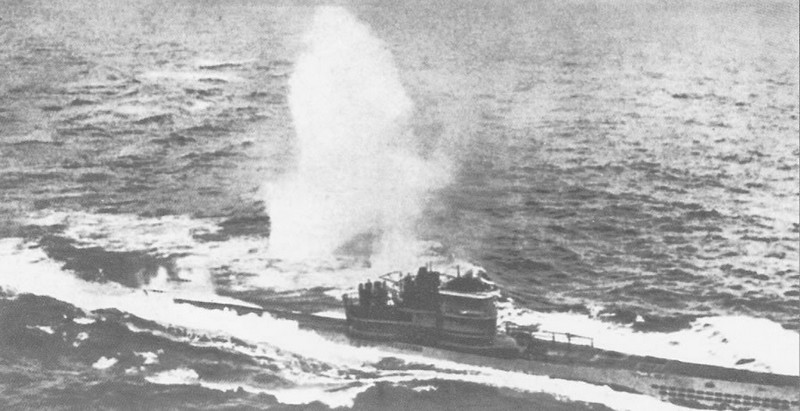
U-966 under air attack

The Type VIIC was powered by two supercharged Germaniawerft, 6 cylinder, 4-stroke M6V 40/46 diesel engines on the surface producing between 2,800 to 3,200 horsepower which gave the boats a 17.7 knot maximum speed on surface. For submerged operations the boats were powered by one of a number of different electric motors whose batteries were charged by the diesels. The electric motors produced 750 horsepower (560 kW) and could drive the boats a maximum of 7.6 knots. In 1944 many of the surviving boats were equipped with the schnorkel apparatus which allowed them to use their diesel engines underwater at shallow depths.  The had a range of 8190 miles at 10 knots surfaced which gave them a decent amount of operational flexibility for their Atlantic operations.

The last Type VII- U-995 (Type VIIC/41) German U-Boat Memorial Laboe Germany

During the war the German U-Boat force suffered grievous losses many of which were Type VIICs. The VIICs performed excellently in combat and many survived engagements that would have sunk less tough boats. The most famous of the Type VIICs of all variants is probably the U-96 which was featured in the epic submarine film Das Boot. A number had post war careers in several navies and the last active VIIC the U-573 which served in the Spanish Navy as the G-7 was decommissioned in 1970 and sold for scrap over the objections of those that wanted to purchase her as a memorial.  The only surviving Type VIIC is the U-995at Laboe Germany where she is a memorial to all the U-Boat Sailors of the Second World War.  Two full sized mock ups one for exterior scenes and one for interior scenes were constructed for Das Boot and the exterior mock up was also used in Raiders of the Lost Ark.

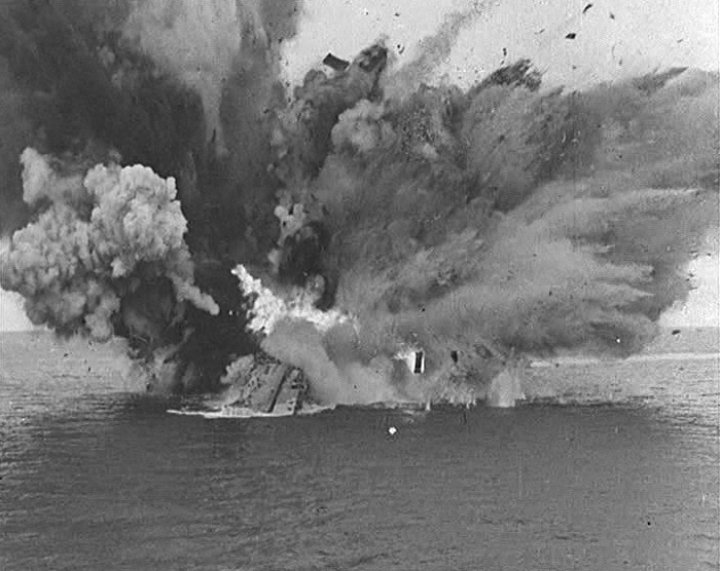
                                                 The Death of HMS Barham  
During the war U-Boats of all types sank nearly 3000 Allied ships including 175 warships among which were the carriers HMS Glorious, HMS Ark Royal and HMS Eagle and the Battleships HMS Barham and HMS Royal Oak. The Germans lost nearly 800 U-Boats of all types and over 28,000 U-Boat Sailors, about 75% of the force.

The films Das Boot and The Enemy Below are excellent reminders of the courage of the men that operated these submarines during the war. Though the Nazi Regime was evil the men of the U-Boat Service often displayed courage and ingenuity in the face of overwhelming odds and they nearly won the war for the Germans.

Peace,

Padre Steve+

1 Comment

Filed under germany, History, Military, Navy Ships, nazi germany, World War II at Sea

The Clash of the Ironclads: The Battle of Hampton Roads at 158 Years

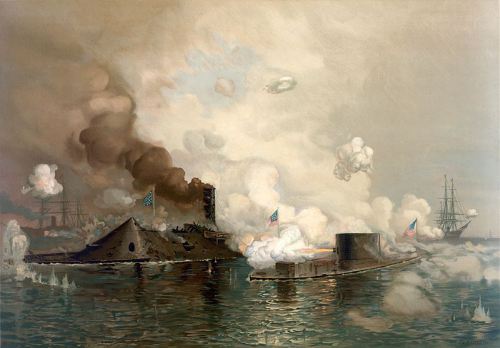
800px-the_monitor_and_merrimac1

Friends of Padre Steve’s World

Yesterday and today mark the 157th  anniversary of an event which changed naval warfare forever, the Battle of Hampton Roads. It was a watershed event which ended the reign of the great wooden ships which plied the oceans of the world under massive fields of canvas sails. 

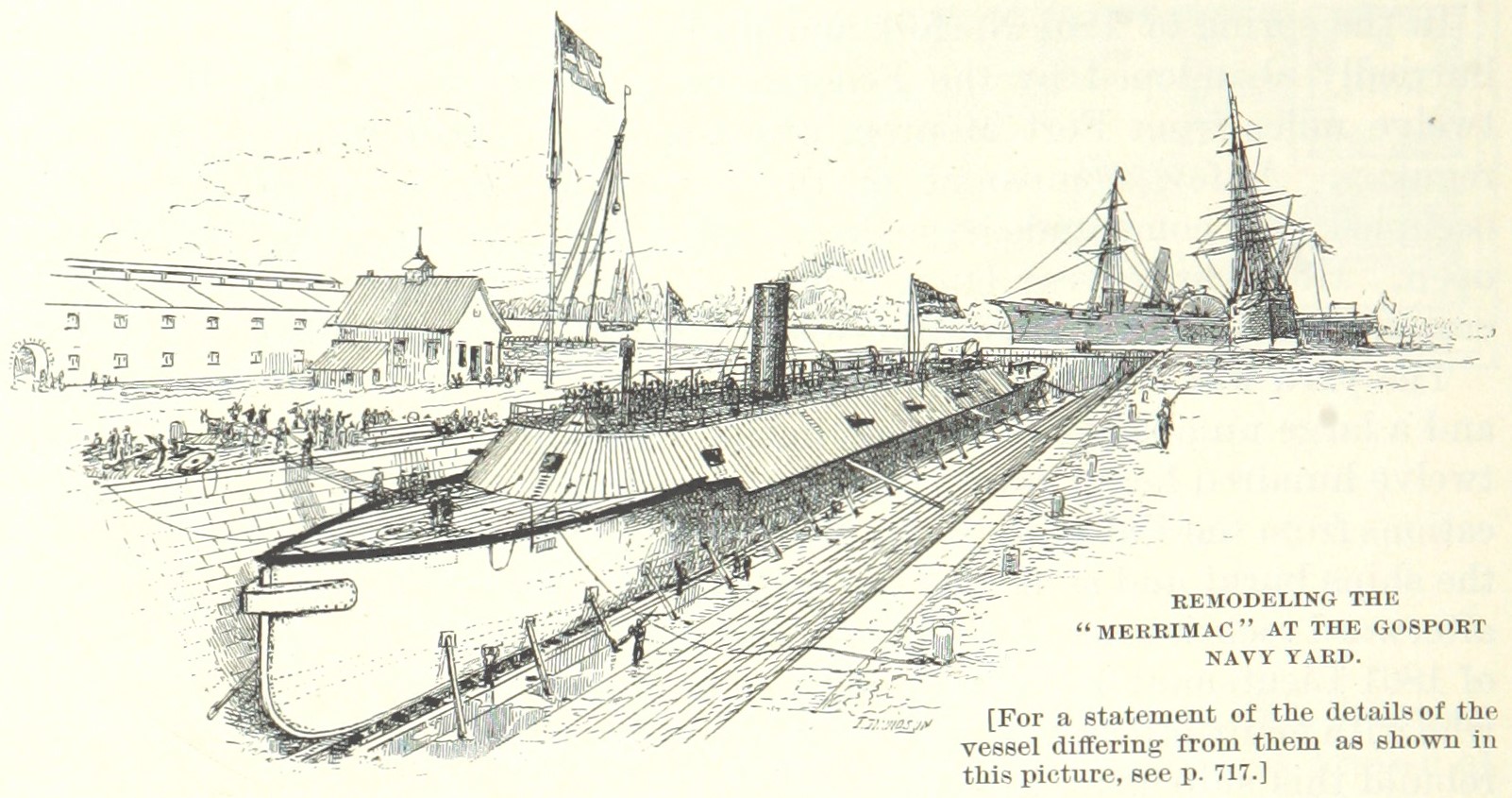
It took place about 10 miles from my current office, which is just a few hundred yards from Drydock Number One, at Naval Station Norfolk, in Portsmouth, Virginia, then called Gosport. It was here that the Confederate Navy, salvaged the wreck of the Steam Frigate USS Merrimac, razed her to the waterline, and constructed an ironclad casemate over her and recommissioned as the CSS Virginia. 

On March 9th 1862, two very strange looking ships joined in battle. This is the story of the Battle of Hanpton Roads and the USS Monitor and CSS Virginia. This is their story, and the story of the men who designed and commanded them. 

Peace

Padre Steve+ 

On the morning of March 8th 1862 the CSS Virginia steamed slowly from her base at at the former US Navy Shipyard, Gosport, in Portsmouth, Virginia into Hampton Roads at the mouth of the Chesapeake Bay. Her mission, break the Union blockade.

Awaiting her was a US Navy squadron of wooden warships including the steam Frigate USS Minnesota, the Sloop of War USS Cumberland and Frigate USS Congress and a number of smaller vessels. Together these ships mounted over 100 heavy guns, and were backed up by the shore batteries at Fort Monroe, on the Hampton side of Hampton Roads.

The Ships, Their Captains, and Designers 

The CSS Virginia was an armored ram built from the salvaged remains of the large steam frigate USS Merrimack, which had been burned at Gosport (Now Norfolk) Naval Shipyard when the Navy abandoned the shipyard to keep her from being captured by the Confederates after Virginia had seceded from the Union on April 20th 1861.  She was raised in May and the wreck was placed in what is now called Drydock Number One, at Norfolk Naval Shipyard, which is the oldest Drydock in the Western Hemisphere, a historic landmark, and still in use on May 30th 1861. Upon inspection it was determined that her hull below the waterline was intact and her engines serviceable. Since Merrimac was the largest ship, wrecked or intact, with serviceable steam engines and boilers; Confederate Secretary of the Navy Stephen Mallory decided that she would be converted into an ironclad.

Her design was that of Lieutenant John Mercer Brooke, a former U.S. Navy officer, and Naval Constructor John L. Porter, who had been a civilian employee of the Navy at Gosport. The design was an ironclad ram, with a massive casemate armored with four inches of Iron and 24 inches of Oak and Pine, which protected her battery of six 9” Dahlgren smoothbores, which were at the Naval Yard, and four 7” Brooke Rifled Guns, designed by LT Brooke and modeled on the design of the Parrot Rifled Gun, used by both sides during the American Civil War.

Her stem and stern nearly underwater, a V Shaped breakwater was mounted forward of the casemate, and an iron ram mounted below the waterline, a throwback in Naval design which had been abandoned since the Middle Ages when cannons became the weapon of choice. This was because the Confederates discover that the guns mounted on her might not be effective against Union ironclads which were being designed. Her design would be the prototype for almost all future Confederate Ironclads.

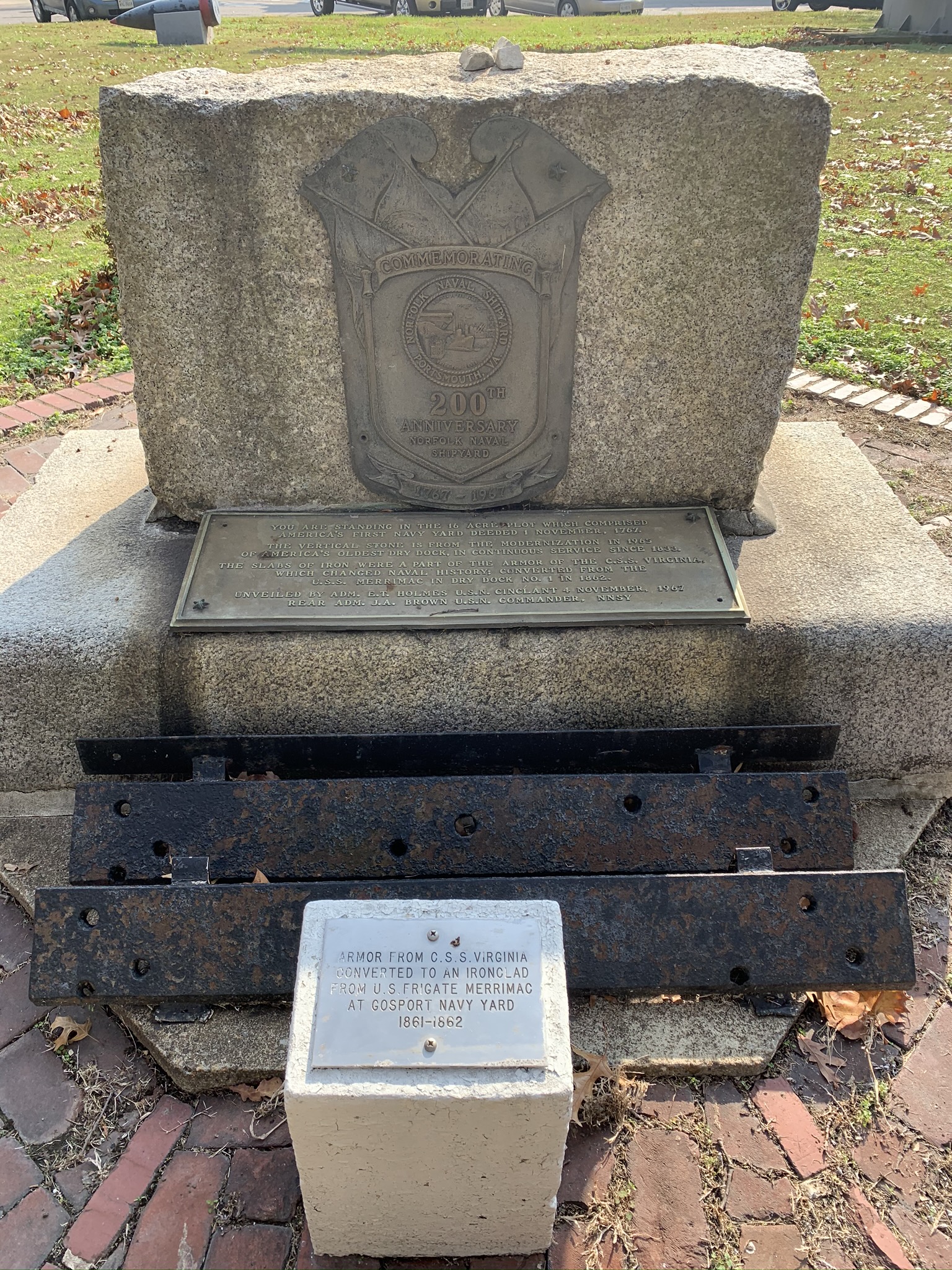
         Iron Plates from CSS Virginia at the Norfolk Naval Shipyard

However, she was plagued with unreliable engines which had been condemned by the US Navy, even before she was burn and sunk, were scheduled to be replaced during her refit at Gosport. As such, her design limited her to a coastal defense role, and her engines limited her to a speed of 5 to 6 knots. Her turning radius was over a mile and it took her 45 minutes to make a complete circle. Though lethal to wooden ships in enclosed waters, she was hardly a threat to Union maritime supremacy. In heavy seas she would have been a death trap to her crew.

Her Captain, Flag Officer Franklin Buchanan was a former U.S. Navy Captain originally from Maryland. In expectation that Maryland would secede from the Union, he resigned his commission on April 22nd 1861. When Maryland did not secede he attempted to withdraw his resignation but was rebuffed by Abraham Lincoln’s Secretary of the Navy, Gideon Welles. Thus  he left the Navy in May 1861 and joined the Confederate Navy in September 1861. He was appointed commander of the James River Squadron in February 1862 and selected CSS Virginia as his flagship. His Executive Officer was Lieutenant Catsby ap Jones. 

The USS Monitor

However, Virginia’s plans had been leaked to the US Navy by a Union sympathizer at Gosport, and taken to Washington, DC, by a freed slave named Mary Louvestre in February 1862. She met with Welles and sped the efforts of the Navy to complete and commission a number of ironclad ships of different types, but most importantly Welles pushed the Navy and builders to speed up the completion of the USS Monitor. 

Monitor was the brainchild of the Swedish Engineer John Ericsson, who had a troubled history with the US Navy. He invented the Screw Propeller for steamships, an idea rejected by the British Royal Navy, but then recruited by the ambitious American, Captain Robert F. Stockton to come to the United States. His propellers were first used on USS Princeton, for which he also designed a 12” breech loaded, rotating gun named Oregon. The gun which he designed was built in England and used hoop construction, also known as built up construction to pre-tension the breech. This method involved placing red-hot iron hoops around the breech-end of the weapon thereby allowing the gun to take a higher powder charge than previous cast iron weapons, which relied on using thicker iron to take an increased charge, making the weapon larger and heavier without increasing its strength.

However, Stockton moved to ensure that Ericsson was not acknowledged as the primary designer. Likewise, he decided that “his” ship should have two 12” guns, Ericsson’s and his own, which used the older technology and heavier iron, but without the tensile strength of Ericsson’s gun. Its huge size made it the more impressive looking weapon, but with the tendency common to such weapons, to burst.

However, Stockton’s gun was hastily built and had only a few test firings before demonstrating it before President John Tyler, his future wife Julia, former First Lady Dolly Madison and an assortment of cabinet officers, congressmen, and their families, numbering close to 400 on February 27th 1844. While coming back up the Potomac River, Stockton personally fired a shot in honor of George Washington at Mount Vernon. Stockton pulled the lanyard and the left side of the breech blew out, sending large fragments of cast iron, killing Secretary of the Navy Thomas Gilmer, Secretary of State Abel Upshur, Chief of the Navy Board of Construction and Repair, Captain Beverley Kennon. Senator Thomas Hart Benton, Captain Stockton, and another 14-18 crew members and visitors were wounded.

Stockton, who had a benefactor in President Tyler, blamed Ericsson who went on to many other accomplishments, but who refused any dealings with the Navy until Secretary of the Navy Gideon Welles convinced him to design an ironclad in 1861. Ericsson responded with yet another revolutionary design which was at first ridiculed by naval experts. Ericsson based the hull of the ship on that of shallow draft Swedish lumber barges, but constructed completely of iron and not equipped with sails. He armed the ship with a heavily armored turret mounting two powerful 11” Dahlgren guns, which rotated a full 360 degrees. The turret was designed to mount two 15” Dahlgren guns, but they were not yet available. Had those guns been ready, Monitor might have sunk the Virginia.

Monitor was completed in under 100 days as Ericsson had promised. She was laid down on October 25th 1861, launched on January 30th, and commissioned on February 25th 1862. Her Captain was Lieutenant John Worden. Worden had served in the Navy since 1834, and he would go on to many great accomplishments, finishing his career as a Rear Admiral, having commanded another monitor, USS Montauk, Superintendent of the Naval Academy, Commander of the Mediterranean Squadron, and President of the Naval Institute.

However, in February 1862 the relatively old lieutenant took Monitor to sea two days later, but the deployment was cut short by a steering failure, which resulted in the ship returning to New York for repairs. She sailed for Hampton Roads again on March 6th and she would arrive on the evening of March 8th, not long after Virginia had wreaked havoc on the Union ships at Hampton Roads. His Executive Officer was Lieutenant Samuel Dana Greene, son of the future Union General and hero of Culp’s Hill at the Battle of Gettysburg, George Sears Greene. 

The Battle


CSSVirginia1862.2.ws

During the ensuing fight of March 8th Virginia rammed and sank Cumberland which though fatally wounded disabled two of Virginia’s 9” in guns. Virginia destroyed Congress by gunfire which burned and blew up and appeared to be in position to destroy Minnesota the following day as that ship had run hard aground. The losses aboard Cumberland and Congress were severe and included the Captain of the Congress and Chaplain John L. Lenhart of Cumberland, the first US Navy Chaplain to die in battle. During the battle Virginia had several men wounded including her Captain, Franklin Buchanan who during the action went atop the casemate to fire a carbine at Union shore batteries. He was wounded by a bullet in the leg and though he survived he missed the next day’s action.

Cumberland_rammed_by_Merrimac

Due to the coming of darkness and a falling tide the acting commander of Virginia, Lieutenant Catsby Ap Roger Jones her executive officer took her in for the night. During the night Monitor, under the command of Lieutenant John Worden arrived and took up station to defend Minnesota.

603px-Battle_of_Hampton_Roads_Map

The next morning Virginia again ventured out and was intercepted by the Monitor. The ships fought for over three hours, with Monitor using her superior speed and maneuverability to great effect. During the battle Monitor suffered a hit on her small pilothouse near her bow blinding her Captain Worden.  Monitor’s executive officer, Lieutenant Dana Greene, took command. Neither side suffered much damage but the smokestack of Virginia was pierced in several places affecting her already poor engine performance.  Jones broke off the action and returned to Gosport for repairs while Monitor remained on station, still ready for battle.

Gideon Welles wrote after the battle: “the performance, power, and capabilities of the Monitor, must effect a radical change in naval warfare.”

USSMonitor1862.3.ws

It did. The battle showed the world the vulnerability of wooden warships against the new ironclads. Monitor in particular revolutionized naval warfare and warship construction. From that time on the truly modern ships were fully iron and later steel, with revolving turrets, and within twenty years without sails, even as a back up to their steam engines.

Her defining mark was the use of the armored gun turret which over the succeeding decades became the standard manner for large ships guns to be mounted. Turrets like the warships they were mounted upon grew in size and power reaching their apex during the Second World War, only to be superseded by the next revolution in Naval warfare, the Aircraft Carrier.

arizon-main-battery2

Both Virginia and Monitor reached less than glorious ends. Virginia had to be destroyed by her crew to prevent her capture just over two months after the battle on May 11th 1862. Monitor survived until January 31st 1862 when she sank during a heavy storm off Cape Hatteras North Carolina with the loss of 16 of her 62 man crew. The remains of two of those men, recovered during the salvage of Monitor’s engines, turret, guns and anchor were interred at Arlington National Cemetery on March 8th 2012. The relics from Monitor and some from Virginia are displayed at the Mariners Museum in Newport News (http://www.marinersmuseum.org )while one of Virginia’s anchors resides on the lawn of the Museum of the Confederacy in Richmond. Two of her iron plates are on display at Norfolk Naval Shipyard.

Those early ironclads and the brave men who served aboard them revolutionized naval warfare and their work should never be forgotten.

Peace

Padre Steve+

1 Comment

Filed under civil war, History, Military, Navy Ships, US Navy

“I Was Sure That I Could Not Afford to Fail” Admiral Samuel Gravely and the Desegregation of the Navy

gravely

Friends of Padre Steve’s World,

Today I remember the service of Vice Admiral Samuel Gravely, a pioneer in the desegregation of the Navy and one of the first Black Naval Officers, not to mention the first to achieve Flag Rank. He was a man who, like Jackie Robinson in Baseball, knew how much was riding on his shoulders. For him failure did not reflect just on him, but on every Black man, and later woman who desired to become a Naval Officer.

Free Blacks had served in the Navy since the American Revolution and were not segregated as they later were in the Army. While none could become officers, they served in nearly every enlisted rating, alongside whites, until President Woodrow Wilson, ordered the Navy to only employ Blacks as mess stewards in 1915. Wilson, the first American President to come from a Southern State since the Civil war also greatly restricted opportunities for Blacks in the Civil Service and hosted a screening of D.W. Griffith’s monumental film commemorating White Supremacy, the Lost Cause, and the Noble South, Birth of a Nation. With the rollbacks in opportunities for Blacks in the Navy, their numbers in service dwindled, and then the Second World War broke out, and the debate regarding the integration of the military began anew, but nowhere was the resistance to Blacks serving, was in the Navy, despite the heroism of men like Dorie Miller who manned a machine gun on the USS West Virginia and attempted to save the life of his mortally wounded Captain, actions for which he was awarded the Navy Cross, which was after long delay upgraded to the Medal of Honor

Gravely wrote later:

“I was sure that I could not afford to fail. I thought that would affect other members of my race if I failed anywhere along the line. I was always conscious of that, particularly in midshipman school and any other schools I went to…I tried to set a record of perfect conduct ashore and at sea.” 

Things have changed much since 1942 when following the attack on Pearl Harbor a young black college student from Richmond Virginia enlisted in the Navy. Samuel Gravely Jr. was the son of a postal worker and Pullman porter while his mother worked as a domestic servant for white families in Richmond. His mother died unexpectedly when he was 15 in 1937 and he remained to help care for his siblings as his father continued to work. Balancing the care of his family with his education he enrolled in Virginia Union College, a Baptist school in Richmond.

gravely_young

Fireman Apprentice Samuel Gravely Jr

It is hard to imagine for most of us now to comprehend the world that the young Gravely grew up in. Segregation was the norm. Blacks in the south and many other locations faced personal as well as intrenched institutional racism. Violence against blacks was quite common and the Ku Klux Klan was strong.

The military was still segregated and a great gulf existed between white military personnel and blacks. Though the selective service law of 1940 called for the conscription of people regardless of race, creed or color the services enjoyed much latitude in determining how minorities could serve. The Secretary of the Navy at the time, Frank Knox resisted integration. Knox determined that African Americans would remain segregated and serve only as Mess Stewards to “prevent undermining and disruptive conditions in the Navy.” Knox told President Roosevelt in the presence of black leaders that “because men live in such intimacy aboard ship that we simply can’t enlist Negroes above the rank of messman.”

That sentiment to maintain the status quo of segregation was especially strong in both the Navy and the Marine Corps. The leaders of both services resisted attempts to broaden the ability for African Americans to serve and urged that blacks serve in the Army, not the Naval Service.  Marine Corps Commandant Major General Thomas Holcomb agreed with this stance. He commented:

“If we are defeated we must not close our eyes to the fact that once in they [Negroes] will be strengthened in their effort to force themselves into every activity we have. If they are not satisfied to be messmen, they will not be satisfied to go into the constriction or labor battalions. Don’t forget the colleges are turning out a large number of well educated Negroes. I don’t know how long we will be able to keep them out of the V-7 class. I think not very long.”

But President Franklin Roosevelt was not deterred and by April 1942 changes were announced to allow African Americans to serve in other capacities. Even so, the African Americans selected for ratings other than messman were to be segregated and commanded by White Officers and Petty Officers.

USS_PC-1264_officers_and_crew

images-18

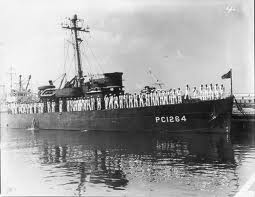
The USS PC-1264 and its crew, Gravely is the lone black officer

Gravely enlisted in the Navy under these conditions. Serving as a Fireman Apprentice after receiving training as a Motor Machinist in San Diego, he worked in menial jobs. In 1943 Gravely was one of only three sailors in his unit to be selected for the V-12 officer training program. He was the only black to make the cut. He was commissioned as an Ensign on December 14th 1944 and assigned to train black recruits at Great Lakes despite the fact that the vast majority of his class went to sea. This was mainly due to the policy set forth by the General Board in 1942 that prescribed:

“(a) the white man will not accept the negro in a position of authority over him; (b) the white man considers that he is of a superior race and will not admit the negro as an equal; and (c) the white man refuses to admit the negro to intimate family relationships leading to marriage. These concepts may not be truly democratic, but it is doubtful if the most ardent lovers of democracy will dispute them, particularly in regard to inter-marriage.”

Despite this by 1945 the Navy was beginning to change. Gravely was chosen to serve on one of two ships assigned to the “experiment” of seeing how blacks in general ratings could serve at sea. The USS Mason (DE 539) and the USS PC-1264 were assigned black crews with majority white officers, except that Gravely was assigned to PC-1264. Though his commander was pleased with his service Gravely, who had been denied admittance to Officer Clubs and many other “white only” facilities resigned from the Navy in 1946. He believed that the inherent discrimination of the Navy left him no place for advancement. He returned to complete his bachelors degree at Virginia Union.

In 1949, following President Truman’s integration of the military Gravely was asked by the Navy to return to active duty. But the end of the old order was foreshadowed by a Navy pamphlet published in 1944 entitled The Guide to the Command of Negro Personnel. That publication included the statement that ”The Navy accepts no theories of racial differences in inborn ability, but expects that every man wearing its uniform be trained and used in accordance with his maximum individual capacity determined on the basis of individual performance.”

images-17

300px-USS_Taussig_(DD-746)_port_side_1965

cg29

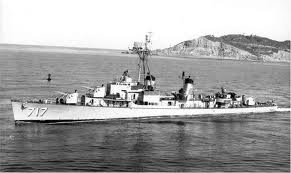
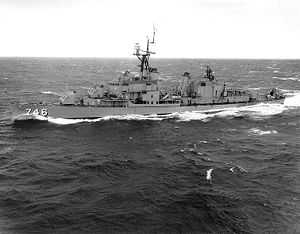
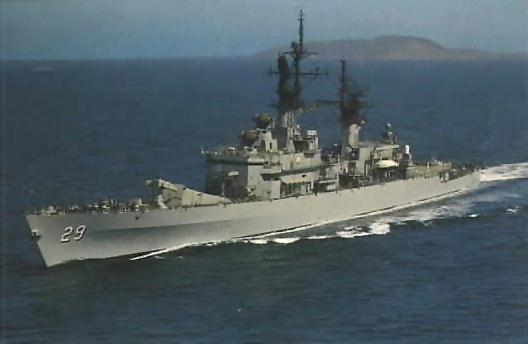
Gravely’s commands (top to bottom) USS Theodore E Chandler, USS Taussig and USS Jouett

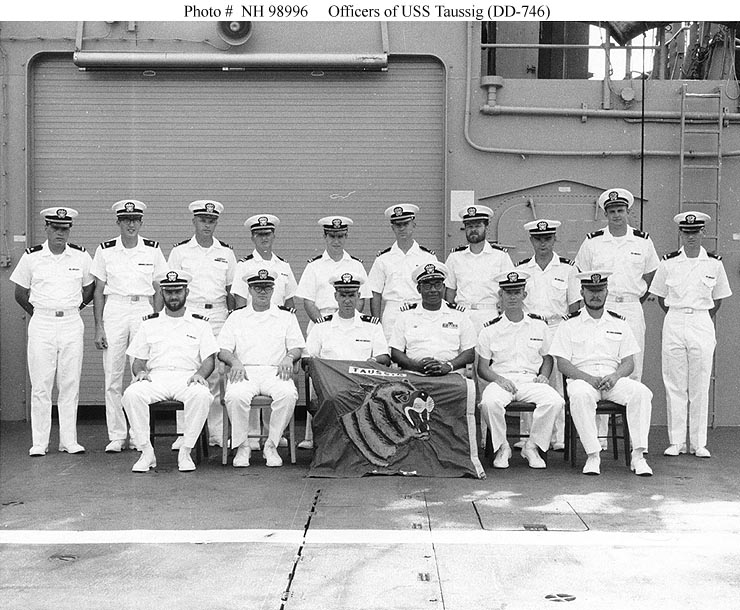
Gravely accepted the offer to return to active duty and never looked back. He worked hard for respect and used his natural talents, personality and size to command respect. He was a man who would blaze the way for other African Americans, and later women and most recently gays to go on to greater things. Gravely would go on to command three ships. He was the first African American Naval Officer to command a Navy warship, the USS Theodore E Chandler (DD 717), the first to command a Navy ship in combat, the USS Taussig (DD 746) and the first to command a major warship, the USS Jouett (CG 29). Promoted to flag rank he eventually became the first Black to command a Fleet when he took command of 3rd Fleet. He retired in 1980 and passed away in 2004.

h98996

Commander Gravely and his officers on USS Taussig

Gravely gave his parents and conditions of his upbringing much credit for his success. He believed that those conditions which forced him to “capitalize on his strong points, build his weak areas and sustain the positive self-esteem and self-worth that his parents instilled in him as a young child.”

He was a great leader. LCDR Desiree Linson who interviewed him for her Air Command and Staff College project noted that Gravely like many other great military leaders before him learned to manage the image that he presented, be a caretaker for his people, what we would now call a mentor. He said “[If I was CNO] my responsibility would be to make sure enlisted men and families were taken care of. I would do everything in my power to make sure.”

His pursuit of excellence, self confidence and mastery of professional skills empowered him in an institution where he was still an anomaly and where racism still existed. He believed in effective communication, especially verbal communication and in building teams and in being a good follower, listening, learning and proactively anticipating the needs of his superiors. Gravely was also a believer in personal morality and self discipline and preparedness. He said:

“I did everything I could think of to prepare myself. If the opportunity came, I would be prepared for it. [The question would not be] “Why didn’t you prepare for this opportunity.” I would be prepared for whatever opportunity that came. If it came, fine. If it did not, fine, but I would be prepared if it did come.”

USS_Gravely

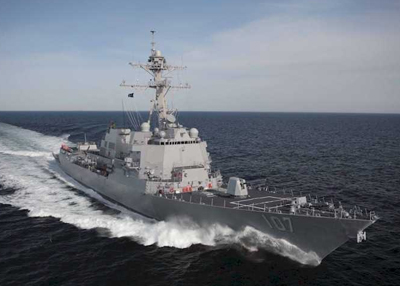
The USS Gravely

Vice Admiral Gravely blazed a trail for those that followed him and set an example for all Naval Officers to follow. He did it under conditions that most of us could not imagine. I am proud to serve in the Navy that he helped to make.  His vision, service and memory are carried on in this navy and in the ship that bears his name, the USS Gravely DDG-107.

Until tomorrow,

Peace,

Padre Steve+

4 Comments

Filed under civil rights, History, laws and legislation, leadership, Military, Navy Ships, Political Commentary, racism, US Marine Corps, US Navy

The Pinnacle of Naval Superiority or Obsolescence: The Battle Cruisers of 1920 and the Aircraft Carriers of 2020

artist

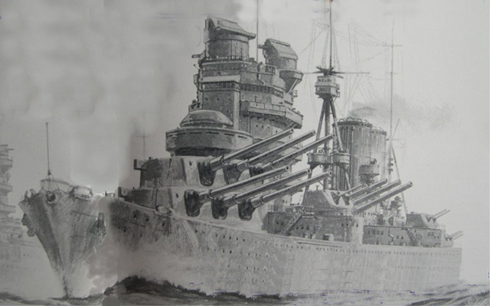
Artists Depiction of G3 Battlecruiser 

Friends of Padre Steve’s World,

The next few days I will be reflecting on the old year and the coming new year, but tonight I decided to tweak and republish an article from about four years ago dealing with the battle cruisers being built by Great Britain, Japan, and the United States after the First World War. They represented the pinnacle of naval design for their era and would have been far superior to their adversaries had technology and war remained static. As Admiral Ernest King noted:

“Nothing remains static in war or military weapons, and it is consequently often dangerous to rely on courses suggested by apparent similarities in the past.”

As the First World War ended a new Naval Race was heating up. The United States had announced its intention during the war to build a navy second to none while Imperial Japan was making plans for a fleet that would give it superiority in the Western Pacific. The British, though still be far the largest naval power in the world were burdened by the massive costs of war and empire, but also seeking to maintain their naval dominance and to that end they were in the process of building a class of massive super-Dreadnought battleships, and Battle Cruisers.

Much of each powers actions in the coming years would be based on internal politics, foreign policy, and the simple economics of how much each power could afford to spend on their militaries after such a costly war. The result was the Washington Naval Treaty of 1922 which limited the signatories to specific numbers, tonnage, and armaments each Navy would be allowed. Do to those reasons the massive Battle Cruisers planned by Britain, the United States and Japan were canceled. The Japanese and Americans would choose to convert two of their incomplete ships to aircraft carriers, while the British would convert the already completed ships of the Courageous Class battlecruisers (Courageous, Glorious, and Furious) into aircraft carriers as though none of the G3 ships had been laid down.

The ships known as the G3 battle cruisers were first designed by the British Royal Navy as a compliment to the all big gun Dreadnought battleships. The Battle Cruiser concept was for a ship of roughly the same size and firepower as a Battleship, but sacrificed armor protection for greater speed, endurance and range.  The United States and Japan joined in the Battle Cruiser race before and during the war. However, Britain the United States had concentrated on building battleships during the war but following the war began to design and build its own classes of massive battle cruisers.

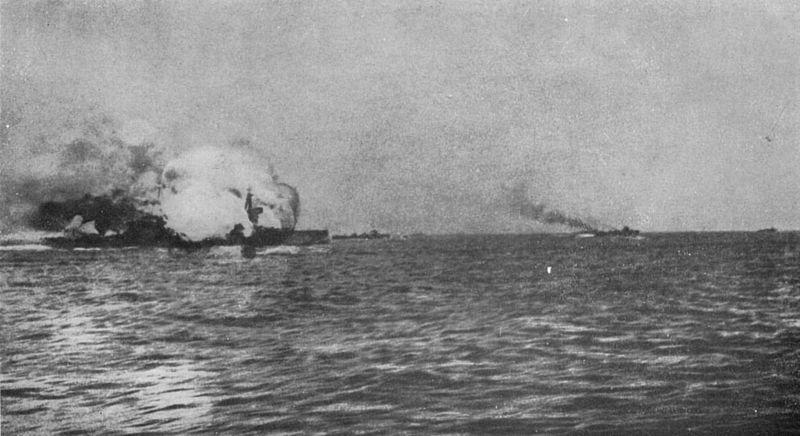
800px-InvincibleBlowingUpJutland1916

HMS Invincible Blowing Up at Jutland 

During the war the weaknesses of the battlecruisers as a type were exposed during the Battle of Jutland where three British Battle Cruisers, the HMS InvincibleHMS Indefatigable and HMS Queen Mary blew up with the loss of most of their crews; of the 3311 officers and sailors on the ships only 26 survived. The HMS Lion was almost lost in a similar manner but the heroic actions of her crew saved her from her sisters fate. The British ships had glaring deficiencies in armor protection and the arrangement of their ammunition magazines and hoists which certainly contributed to their loss. Their German counterparts on the other hand proved much tougher and though all sustained heavy damage while engaging British Battleships and Battle Cruisers, only one the Lützow was lost. She absorbed over 30 hits from large caliber shells and only lost 128 crew members. However, though a battle cruiser Lützow, and other German battle cruisers wer designed for relatively short range operations which meant they neither sacrificed armor protection, speed, or firepower as did the British ships which were designed for missions far and wide, needing more displacement for fuel and crew supplies, often sacrificing armor protection in order to maintain their high speed capabilities.

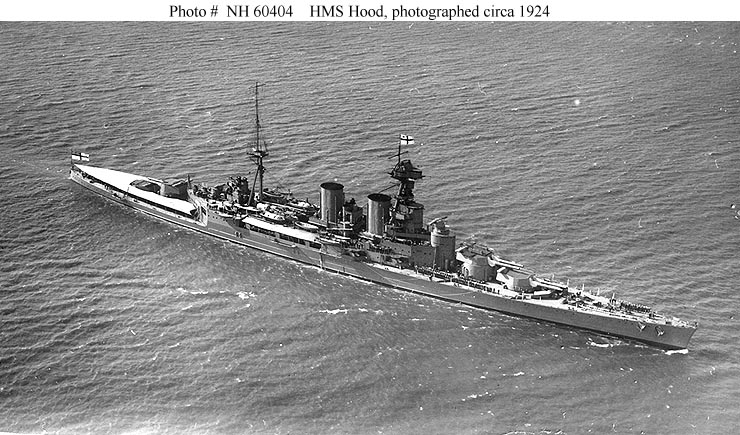
h60404

HMS Hood

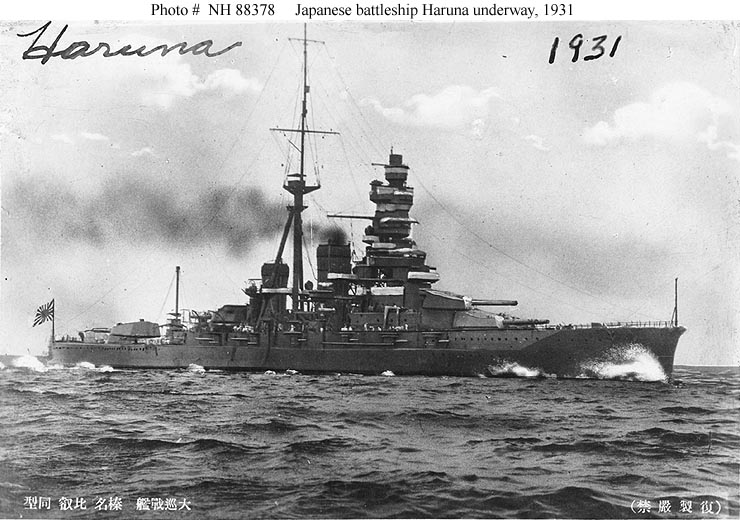
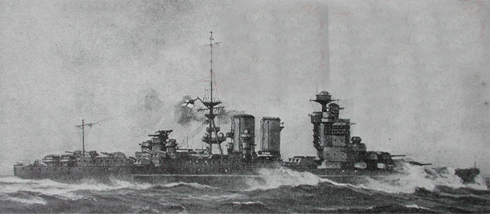
As the war progressed other Battle Cruisers were built, the British launched the HMS Repulse and HMS Renown and completed the HMS Hood shortly after the war was over. The Japanese built the four ship Kongo class from a British design, the first of which, the Kongo was completed in a British yard, the others Haruna, Hiei, and Kirishima were built in Japanese yards. The Kongo Class would prove to be the workhorses of the Battle Force of the Imperial Japanese Navy, all seeing significant combat action.

As the powers embarked on the next Naval Race planners and naval architects designed ships of massive firepower, better protection and higher range and speed. All would have been better classed as Fast Battleships, a better description of the Kongo Class or the Hood than previous ships.

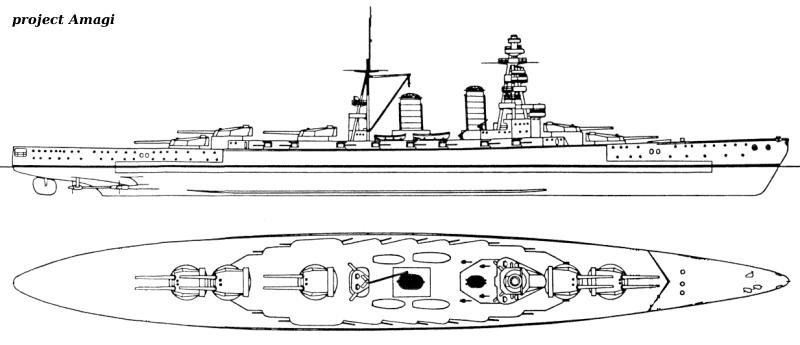
The British designed and funded the G3 class in 1921, while the Japanese began work on the Amagi Class, and the United States the Lexington Class. However the construction and completion of these ships as Battle Cruisers was prevented by the Washington Naval Treaty.

invincible 490

The treaty, which was ratified in 1922 limited the United States and Great Britain to a maximum of 525,000 tons in their battle ship fleets and 125,000 tons in aircraft carriers.  The Japanese agreed to a limit of 315,000 tons and the French and Italians 175,000 tons each. Tonnage for battleships was limited to a maximum of 35,000 tons with a limitation on guns size to 16 inches.  Since the bulk of the ships planned or being built by the US and Japan exceeded those limits they would be effected more than the British whose post war shipbuilding program had not begun in earnest, in fact the G3 Class had just been approved for construction and there is no proof that construction had begun on any of the ships.

The G3 class would have comprised four ships and been similar to the N3 Class Battleships. They were very well balanced ships and would have mounted nine 16” guns in three turrets on a displacement of 49,200 tons and deep load of 54,774 tons. They had an all or nothing protection plan meaning that the armored belt was concentrated in vital areas around the armored citadel, conning tower, turrets and magazines and engineering spaces. Their armor belt would have ranged from 12-14 inches, deck armor from 3-8 inches, conning tower 8 inches, barbettes 11-14 inches, turrets 13-17 inches and bulkheads 10-12 inches. Their propulsion system of 20 small tube boilers powering 4 geared steam turbines connected to 4 propeller shafts would have produced 160,000 shp with a designed speed of 32 knots.

The four ships, none of which were named were ordered between October and November of 1921. Their construction was suspended on November 18th 1921 and they and the N3 Battleships were cancelled in February 1922 due to the limitations of the Washington Naval Treaty. Many concepts of their design were incorporated in the Nelson Class battleships which were a compromise design built to stay within the limits of the treaty.

rys-amagi

Amagi Class as Designed, Akagi as Completed (below) 

JapaneseAircraftCarrierAkagi3Deck_cropped

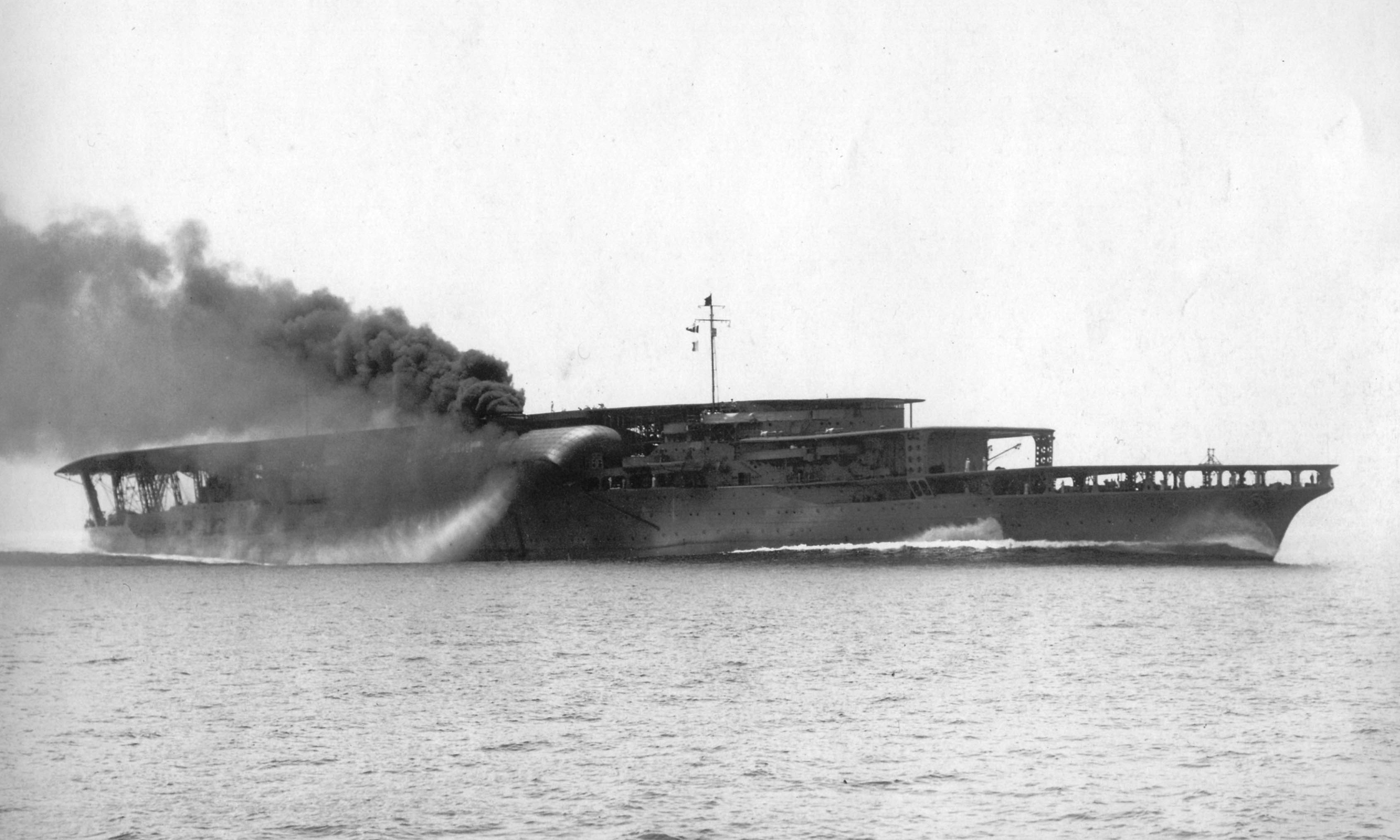
The four planned Japanese Amagi Class ships would have mounted ten 16” guns on a displacement of 47,000 tons at full load. Their propulsion system 19 Kampon boilers powering four Gihon turbines would have given them a maximum speed of 30 knots, They would have had less protection than the G3 ships being more of a traditional Battle Cruiser design. As a result of the Washington Naval Treaty the Japanese elected to convert two of the ships, the Amagi and Akagi to aircraft carriers. Amagi was destroyed on the ways during the great Tokyo earthquake and Akagi was completed as a carrier. The other two vessels were scrapped on the ways. To replace Amagi the Imperial Navy selected the incomplete Tosa Class battleship Kaga. 

Lexington_battlecruiser_conversion_models

lexington-class-battle-cruisern11978

Lex4259BrassDraw

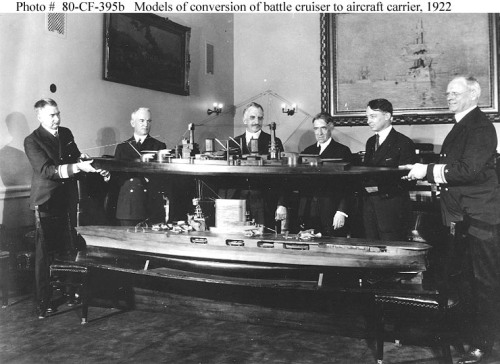
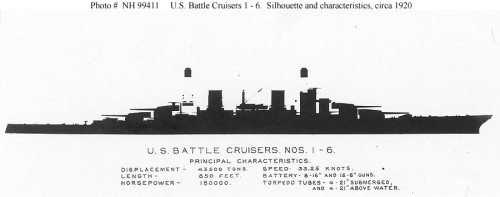
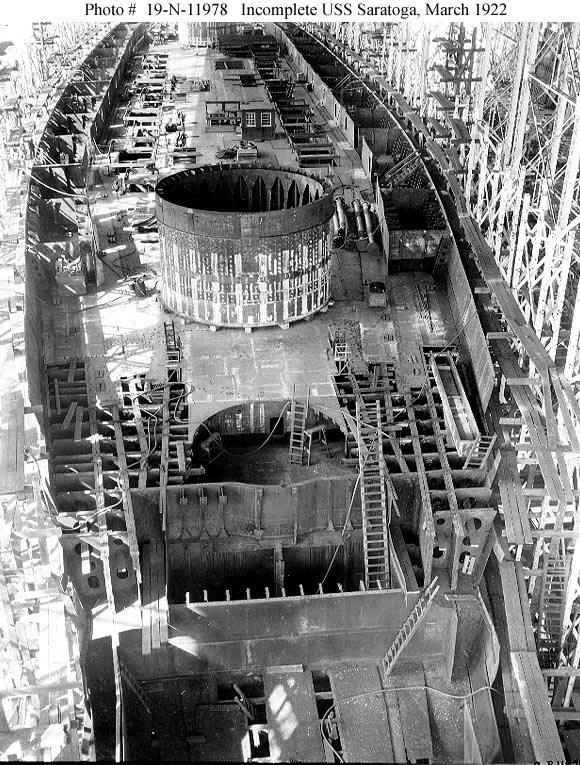
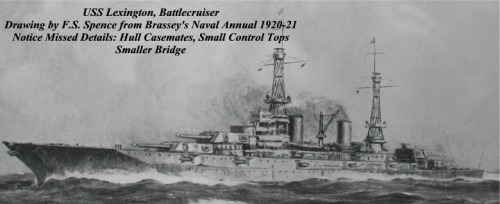
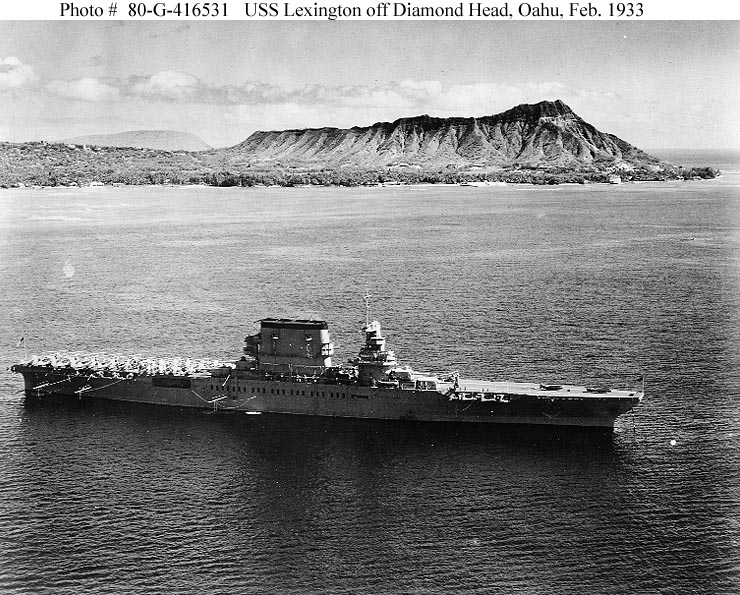
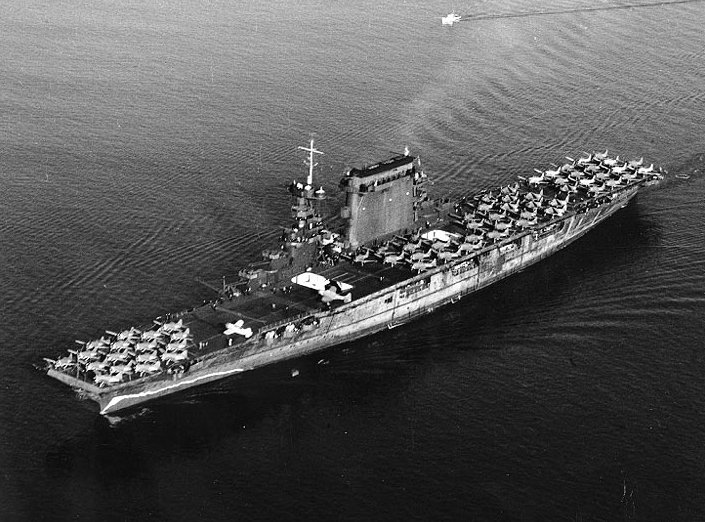
The United States Navy planned the six ship Lexington Class. These ships would have mounted eight 16” guns on a ship measuring 874 feet long and 105 feet in beam, displacing 43,254 tons at full load, or nearly the size of the Iowa Class battleships. They would have had a maximum speed of 33 knots being powered by 16 boilers which drove 4 GE electric turbines producing 180,000 shaft horse power. Theirs was a massive engineering plant and while the class did not have as heavy armor protection as either the G3 or Amagi classes, they were superior to them in speed as well as endurance. Upon ratification of the Washington Naval Treaty four of the six ships were cancelled and the remaining two, the Lexington and Saratoga competed as aircraft carriers.  Had any of the ships been completed as Battle Cruisers it is likely due to their speed that they would have operated primarily with the the carriers that the US Navy built during the 1930s.

g416531

One can only speculate what the navies of World War II would have looked like had the Washington and the subsequent London Naval Treaties not been ratified. One can also only imagine how the war at sea would have been different had the ships completed as carriers been completed as Battle Cruisers. It is certain had the Royal Navy, the Imperial Japanese Navy, and the United States Navy Not Converter These ships, that Naval Aviation would have take years, or maybe more than decades to reach its potential.

However that was not to be, of the planned 14 ships of these three classes only three were completed, all as aircraft carriers, ships that helped to forge the future of naval operations and warfare for nearly a century. Thus the uncompleted ships are an interesting footnote in naval history yet have their own mystique.

                 HMS Queen Elizabeth 

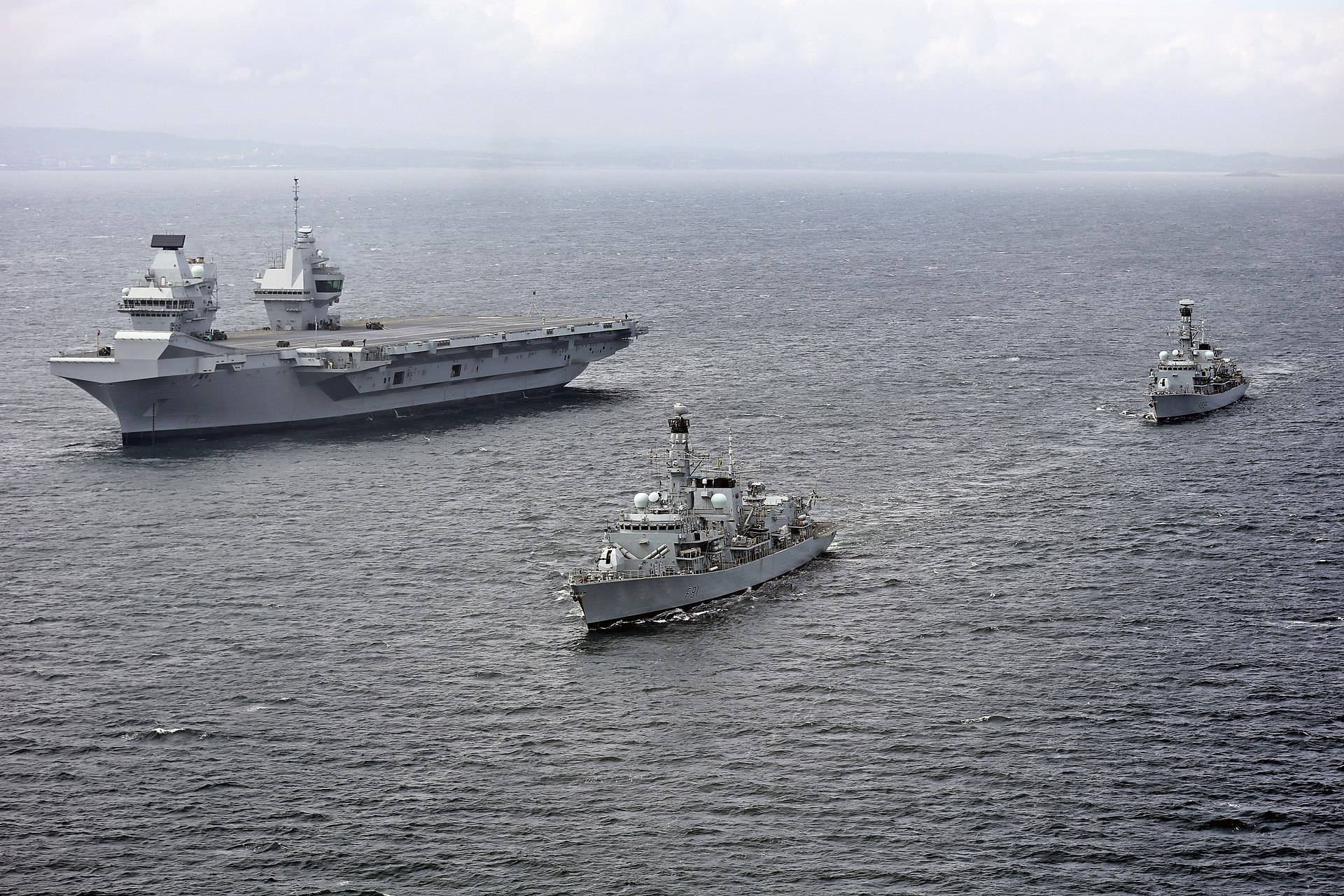
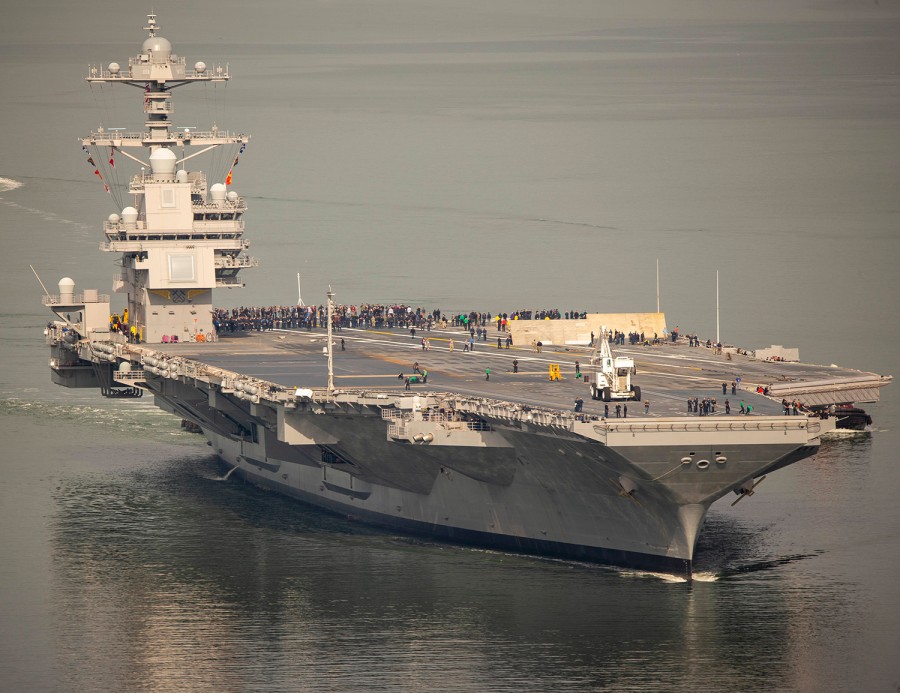
Yet nothing remains static. The carriers have ruled the waves since December 7th 1941. But the massive aircraft carriers which have ruled the seas since the Second World War are not necessarily invincible and depending on how technology progresses could be heading into obsolescence, and may end up serving in support roles or being paid off. Yet that being said the United States is continuing to construct carriers of the Ford Class, the British the Queen Elizabeth Class, while the Chinese and Indian Navies pursue the development of new super carriers, while the French Navy operates the CVN Charles De Gaulle.  

But with the development of more and more relatively cheap, long range, and maneuverable land based anti-ship missile systems, and the capabilities of modern submarines we have to ask the legitimate question, is the aircraft carrier’s reign of the seas in jeopardy? This is a good question, but not the only one because since World War II there have been no carrier versus carrier engagements on the high seas. There are some places that are outside the range of land based anti-ship weapons, although submarines may prove a problem for surface forces to deal with, and for carriers their survival.

But since there have been no carrier versus carrier actions since the Second World War it would be interesting to see how the current carriers now operational or being developed would fare against each other if such an encounter occurred. It would be a test of air wings, ship design, and the protective capabilities of their escorts, as well as the cyber realm, on, above, and below the surface. Until such an engagement occurred all opinions, even those done in computer simulations are at best guesses as most of the weapons systems have never been tried in actual combat against peer competitors. Thus, like the carriers and their escorts designed before the Second World War, they will have to be tested in combat to see if they are still relevant in their designed role, or if they will be relegated to support roles which could be done by less costly alternatives such as the LHA/LHD type ships of the United States, France, Japan, and South Korea, or the the Sea Control Ship derivations in other smaller Navies in Europe and Asia.

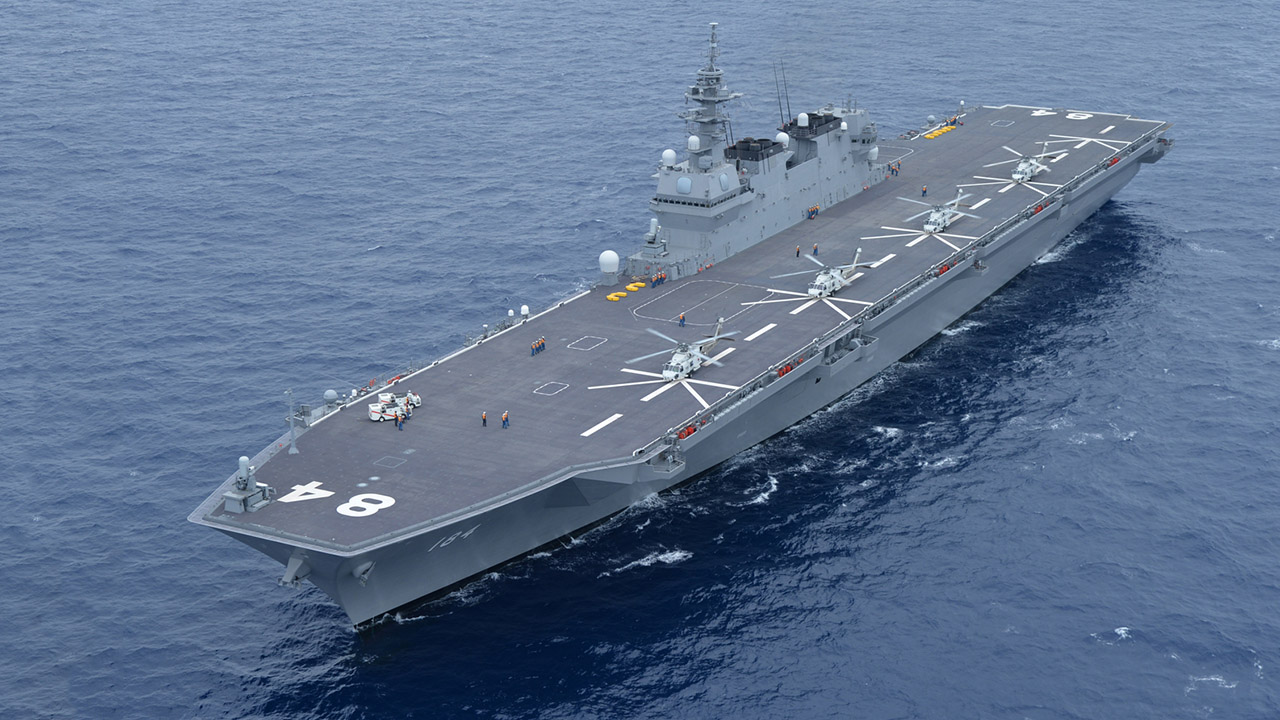
Perhaps to meet some missions smaller and cheaper carriers will be developed, or existing platforms modified to carry more capable aircraft as the Japanese are doing with their Izumo and Hyuga Class “Helicopter Destroyers,” and the South Koreans are doing with their two Dokto Class LPH (Landing Platform Helicoptor) both of which may soon begin to operate the F35B fighter aircraft purchased from the United States, the same aircraft with will operate from United States Navy LHAs and LHDs as well as the British Queen Elizabeth Class. 

JMSDF “Helicopter Destroyer” Kaga 

Thus, one might wonder if the large new aircraft carriers currently being built by the United States, Britain, China, India, and other nations will also be displaced by advancing technology as were the battlecrusiers of the 1920s. It is a question that must be asked. There are certainly arguments for them, but what would the effect be on the United States Navy if one of the Nimitz or Ford Class carriers was sunk by the Chinese, or evening the Iranians? My guess is that it would be the same kind of shock that hit the Royal Navy after Jutland, and the U.S. Navy after Pearl Harbor.

I still believe in the aircraft carrier, as a weapon of deterrence, support of operations ashore, and against enemy ships on the high seas. But eight decades is a long run for any weapons system, and it is possible that despite the major power’s investment in carriers, that their reign may be coming to an end, at the same time it may be too early to count out the Super Carriers. Perhaps their mission will be modified to support smaller ships in sea control missions and reserved for potential combat with countries which have no answer to them, or against similar platforms in open ocean battles.

USS Gerald R. Ford 

I believe that the future has not been decided in relation to the aircraft carrier and much of that will have to do with how the operators of such vessels adapt to a changing world with many more threats, in order to maximize their capabilities while minimizing the dangers to such expensive national security assets. This is the aspect of war and national security that is within the control of human beings. I think of Admiral Arleigh Burke’s words at times like this:

“For in this modern world, the instruments of warfare are not solely for waging war. Far more importantly, they are the means for controlling peace. Naval officers must therefore understand not only how to fight a war, but how to use the tremendous power which they operate to sustain a world of liberty and justice, without unleashing the powerful instruments of destruction and chaos that they have at their command.”

he other possibility is that the navies that operate them decide that they are too expensive, and that their vulnerabilities outweigh their capabilities. This was the case in the 1920s with the battlecruisers then under construction.

Until tomorrow,

Peace

Padre Steve+

2 Comments

Filed under History, Military, national security, Navy Ships, News and current events, US Navy, World War II at Sea

Christmas Tragedy: The Senseless Loss of the Scharnhorst at North Cape

Friends of Padre Steve’s World,

Today is the Second Day of Christmas or as it is also known, the Feast of St. Stephen; and Boxing Day, oh for the days of Ali and Frazier… but I digress…

Christmastide is a joyous time for many, but in the course of history there have been times that military men have fought and died in hopeless battles far from their families. Thus it is often a time of sorrow, especially for those that die alone. Among those who died alone in the Arctic darkness of December 26th 1943 were the officers and crew of the German battlecruiser Scharnhorst.

Schlachtschiff

The Scharnhorst along with her sister ship Gneisenau were the product of the naval architects of Germany who in the early 1930s designed some of the most beautiful as well as deadly warships of the Second World War.  Following Germany’s rejection of the provisions of the Treaty of Versailles the Kreigsmarine enacted a building program to enlarge and modernize the German Navy which then was composed of obsolete pre-Dreadnaught battleships and a few modern light cruisers and destroyers.   The first major units constructed were actually begun by the predecessor to the Kreigsmarine, the Reichsmarine Of the Weimar Republic.  These were the Deutschland class Armored Ships, sometimes called “Pocket Battleships” and later reclassified as Heavy Cruisers. These ships were designed to replace the old pre-Dreadnaught battleships and incorporated electric welds to reduce displacement, diesel engines for extended cruise range to enable them to serve as commerce raiders and a battery of six 11” guns.  While an advance over anything in the German inventory they were outclassed by the British battle cruisers Hood, Renown and Repulse.

However, the first true capital ships built by the Kriegsmarine were the Scharnhorst and Gneisenau They were classed as battleships by the Germans, but in reality they were battle cruisers because of their light main battery of 11” guns as opposed to the 14”, 15” or 16” batteries of other nations battleships.  In fact, their main battery was Despite this in displacement and armor protection of the ships was comparable to other battleships of the era and their designed speed of 31.5 knots was superior to almost all other battleships of the era including the British King George V Class and the US Navy’s  North Carolina class.  Only the massive battlecruiser HMS Hood was their superior in speed and firepower.

As built Scharnhorst and Gneisenau displaced 31,000 toms, however at full combat load they both weighed in at nearly 38,000 tons and were 772 feet long.  They had an armor belt that was nearly 14 inches thick.  Armed with a main battery of nine 11” guns and a secondary armament of twelve 5.9 inch guns they also mounted a powerful for the time anti- aircraft battery of fourteen 4.1 inch guns, 16 37mm and 16 20mm anti-aircraft cannons.  Additionally they mounted six 21” torpedo tubes and carried three Arado 196 A3 scout planes.  The main battery was eventually to be replaced by six 15” guns but this never occurred; Gneisenau was taken in hand to mount the new weapons but the conversion was never completed due to Hitler’s anger after the failure of a German task force during the Battle of the Barents Sea in December 1942.

scharnhorst2

Scharnhorst firing at HMS Glorious 

Laid down on 15 June 1935 and launched 3 October 1936 Scharnhorst was commissioned 7 January 1939.  Her sister Gneisenau was laid down 6 May 1935, launched 8 December 1936 and commissioned 21 May 1938.  Upon the commencement of the Second World War the two sisters began a reign of destruction on British shipping. In November they sank the Armed Merchant Cruiser HMS Rawalpindi During Operation Weserübung the pair surprised sank the aircraft carrier HMS Glorious and her two escorting destroyers, the only time a Fleet carrier was caught and sunk by battleships during the war.   From January to March 1941 they conducted Operation Berlin against British merchant shipping in the North Atlantic sinking 22 ships before returning to base.

eeb893a0b92de4ae595de56fe0fd90ca

Scharnhorst and Gneisenau during Operation Cerebus

While in the port of Brest Gneisenau was bombed and torpedoed requiring extensive repairs.  Due to the exposed location of the port the German high command decided to return the ships to Germany along with the Heavy Cruiser Prinz Eugen.  The operation was called Operation Cerberus and it took place from 11-13 February 1942. The ships made a dash up the English Channel which was unsuccessfully contested by the British Royal Air Force and Royal Navy. However, both Scharnhorst and Gneisenau were damaged by mines and needed subsequent repairs.  While undergoing repairs in Kiel Gneisenau was further damaged by the Royal Air Force requiring repairs in or to steam to the port of Gotenhafen for repair and conversion.  Although some work was completed she was decommissioned and sunk as a blockship on 23 March 1945.  Following the war she was raised by the Poles and scrapped.

Scharnhorst was repaired following Operation Cerberes and in March 1943 was transferred to Norway where along with Tirpitz, Admiral Scheer, Lutzow (the former Deutschland), Admiral Hipper and Prinz Eugen she became part of a “fleet in being” poised to strike the Allied convoys bound for Russia.

Admiral_Bruce_Fraser_1943_IWM_A_16489

Admiral Bruce Fraser

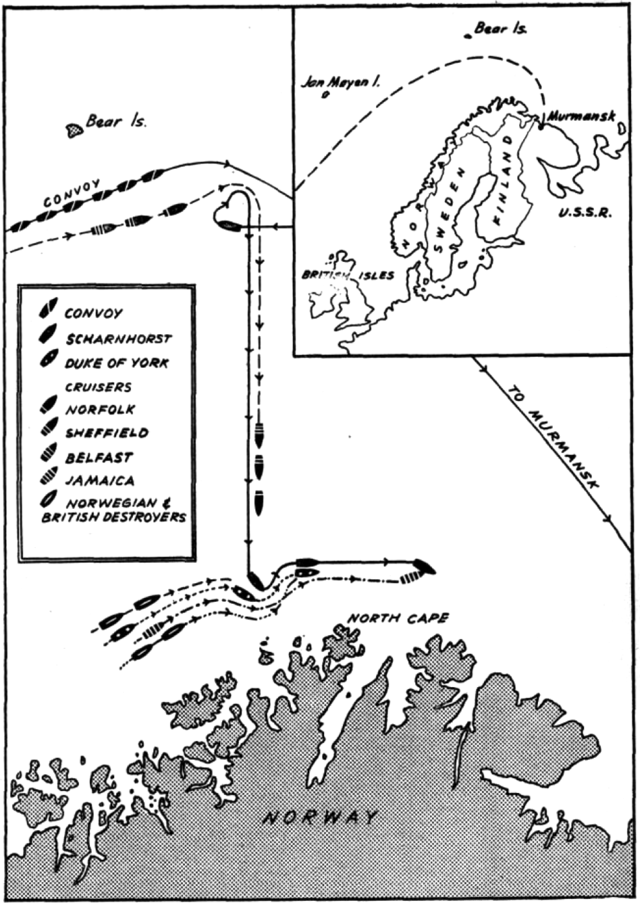
The German surface ships were a potent force that if the circumstances allowed could devastate the Russia bound convoys and the Commander of the British Home Fleet, Admiral Bruce Fraser was determined to entrap and destroy any of these ships that threatened any convoy. As such in December 1943 Fraser formed a task group built around the HMS Duke of York to be ready to pounce on any German raider that threatened the convoys. His intent was to catch any of these ships, especially Scharnhorst and trap them between the convoys and their base, in conduction with a second task group centered around the cruisers HMS Belfast, HMS Norfolk, and HMS Sheffield, Known as Force One, and destroy the German battleship.

The key to British the British operation was Enigma the German code machine and cipher system which they had acquired from captured U-Boats, and which British code-breakers had mastered. The Germans decided to send Scharnhorst and five destroyers to locate and destroy convoy JW-55B which had been spotted by Luftwaffe reconnaissance aircraft. Because of Enigma, Fraser knew that Scharnhorst would attempt to intercept the convoy and put his plan to set the trap in motion.

Battle_of_North_Cape_26_December_1943_map

Scharnhorst and her escorts set sail on Christmas Day 1943 under the command of Rear Admiral Erich Bey to conduct Operation Ostfront. But Bey was new to command, he had been promoted to Konteradmiral on the day the force sailed, having taken the place of Admiral Oskar Kummetz who had left for Germany to take a long convalescent leave. Bey was an experienced commander, but all of his experience was on destroyers. He was a torpedo expert, but had never served aboard a battleship, or even a cruiser, and he was a a novice when it came to the large caliber guns aboard the Scharnhorst. His position was made worse by the fact that the task force staff had been thinned out by the Navy, for few expected it to be sent in combat.

However, Grand Admiral Karl Dönitz, had decided that given the right conditions, specifically that an exposed convey without heavy support which could be engaged with a high degree of success could be attacked. This convoy was JW-55B, which had been spotted by a German weather observation aircraft on the 22nd Of December. However, the weather was so foul that no further spotting of it or any other British ships was made. There was no question that further air reconnaissance was possible, Berlin was satisfied that the convoy had no support, as German Historian Wolfgang Zank wrote that Berlin followed its motto: “Was nicht gemeldet wird, ist auch nicht da” or “What isn’t reported, isn’t there.” 

Bey wasn’t convinced while still transiting Alta Fjord, he radioed Berlin to inform the high command of how the weather would interfere with the operations of his five destroyers, after all he was a destroyerman and had commanded destroyers in such weather. He was attempting to get the mission called off, but Berlin insisted on the attack. Dönitz replied “I believe in your attacking spirit. Sieg Heil!” With no recourse, Bey put to sea.

However, his destroyers could not keep pace with Scharnhorst so Bey detached them and sailed alone to fight the enemy.

Since Fraser knew that the Germans were coming he had the convoy to temporarily reverse course. This action caused Bey to find nothing where he expected the convoy to be, but he did encounter and engage at long range Fraser’s cruisers including HMS Norfolk, HMS Sheffield both veterans of the the hunt for and sinking of the Bismarck and the HMS Belfast. Scharnhorst’s guns damaged the heavy cruiser Norfolk, but the radar directed fire of the British cruisers landed a hit which knocked out her search radar leaving the German ship virtually blind as the weather worsened and darkness set in.

Bey, thinking he had shaken his pursuers, set course for Alta Fjord at full speed, however, Belfast had maintained contact and Fraser with Duke of York closed the distance and at 1617 her radar picked up the German at a range of 45,500 yards. By 1632 she was 29,700 yards away. Scharnhorst was oblivious to the danger, and at 1648 Belfast illuminated the German ship and Duke of York opened fire at just under 12,000 yards scoring hits which disabled Scharnhorst’s forward turrets and destroyed her airplane hanger. Bey changed course and increased speed, briefly opening the range and momentarily giving the Germans hope, but that was not to be.

At 1820 Duke of York struck a devastating blow on the German ship. A 14” shell pierced the armored belt and exploded in Scharnhorst’s number one boiler room reducing her speed to just 10 knots. Quick repairs were made enabling the ship to steam at 22 knots, but now she was vulnerable to torpedo attacks by the British destroyers.

When he did not find the convoy in the expected location Bey detached his destroyers to expand the search area, leaving Scharnhorst alone to face the enemy.

Rear Admiral Erich Bey

At about 0900 on December 26th 1943 the cruisers of Force One discovered Scharnhorst and the  Battle of North Cape was on. Though little damage was suffered in the first engagement, the radar of Scharnhorst was knocked out, leaving her not only without air support or escort, but blind.

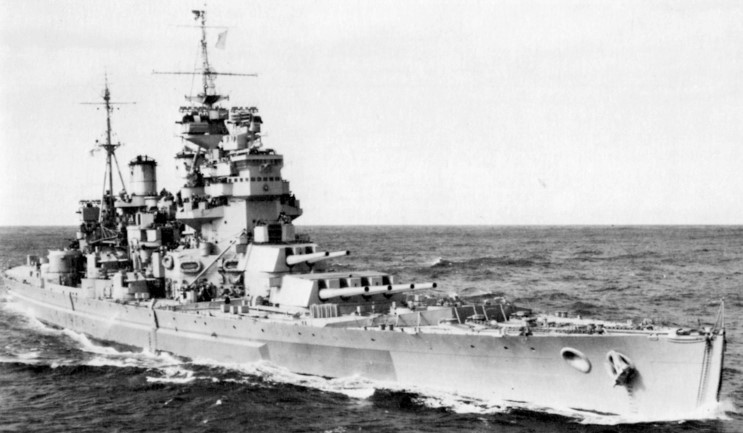
HMS Duke of York underway, and firing her main battery

Scharnhorst attempted to flee, but Fraser’s Duke of York  and her four escorting destroyers destroyers intercepted her. Without radar in the blinding snow squalls Scharnhorst was surprise by their appearance. Duke of York’s first radar direct salvos knocked out her forward main battery but the German ship appeared to be making a getaway when a shell from Duke of York hit her number one boiler room and reduced her speed to barely ten knots. Although the German engineers and damage control teams made some repairs and were able to bring her speed back up to 22 knots, the British ships rapidly made up the distance enabling the British destroyers to launch torpedo attacks.

Knowing the ship was doomed Admiral Bey dispatched a message to the high command of the Kriegsmarine: “We will fight on until the last shell is fired.” 

While Scharnhorst attempted to fight off her attackers and escape she was struck by torpedoes from several destroyers as being punished at distance of under 10,000 yards by Duke of York’s 14″ shells, as well as the 6″ shells of HMS Belfast and HMS Jamaica. Savaged by at least 13 hits by Duke of York’s 14” shells and numerous torpedo hits, incapable of further resistance, the German ship capsized and sank, her massive screws still turning at 1945 hours with the loss of all but 36 of her 1968 man crew. Admiral Bey was not among the survivors, though he was spotted in the water

As she sank bow first survivors attempted to abaneon ship. Günter Sträter, who survived amd was rescued noted:

“In the water now the sailors were looking to get the rafts”,… those  who found a place on the rafts sang both verses of the song: ‘On a sailor’s grave, there are no roses blooming.’ I did not hear cries for help. It all happened exactly and without panic. “

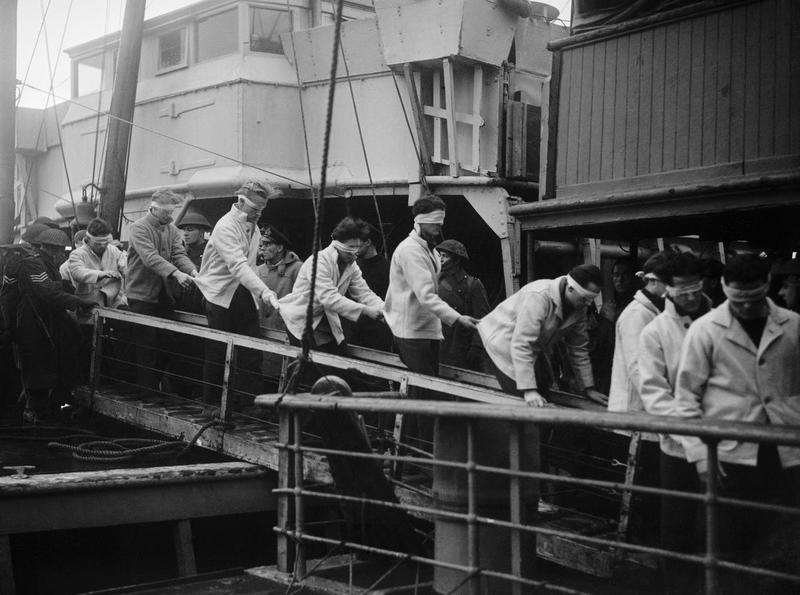
Survivors were rescued by the British destroyers HMS wreck was discovered on October 3rd 2000 some 70 miles north of North Cape Norway. Of the ships engaged, only HMS Belfast survives, as a museum ship in the Thames River in London.

Scharnhorst_survivors_A_021202

Survivors of Scharnhorst 

Admiral Fraser praised the gallantry of the German ship to his officers later that night saying: “Gentlemen, the battle against Scharnhorst has ended in victory for us. I hope that if any of you are ever called upon to lead a ship into action against an opponent many times superior, you will command your ship as gallantly as Scharnhorst was commanded today”

After the battle Grand Admiral Erich Raeder who had authorized the sortie was relieved as commander in chief of the navy and was replaced by Grand Admiral Karl Donitz who commanded the U-Boat forces. Hitler was furious and ended most surface naval operations.

800px-Scharnhorst-WHV-April-2011

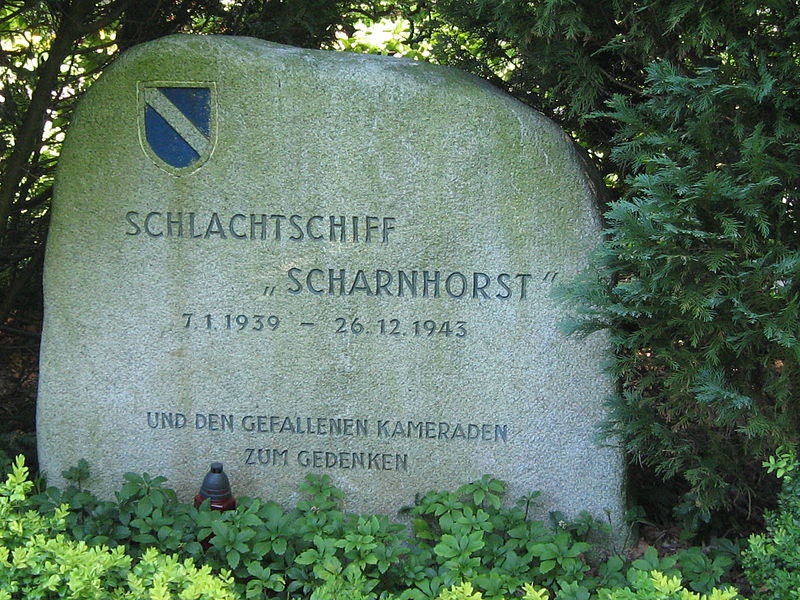
Memorial to Scharnhorst and her crew at Kiel and the HMS Belfast moored as a Museum ship in the Thames River, London 

I have written many times about the tragedy of war, on land and at sea. Having served in combat zones on land and having been shot at by the enemy, as well as having served at sea on a cruiser I have a sense of what these men must have gone through on that final day of their lives. Though I am a realist and know that such tragedies will likely occur again, in fact I expect them and predict that the United States Navy will see its share of nautical disasters when it faces well equipped and trained opponents.

All that being said, I really do pray for the day that war will be no more and that those who serve in harm’s way will never have to do so again.

Peace

Padre Steve+

1 Comment

Filed under History, Military, Navy Ships, nazi germany, World War II at Sea, world war two in europe

The Remarkable Salvage Divers of Pearl Harbor

Friends of Padre Steve’s World,

For today a final article about Pearl Harbor before moving on to different subjects. In light of our declining shipyard and salvage capabilities I doubt if such miraculous work could occur today should the Navy every experience a calamity such as Pearl Harbor again.

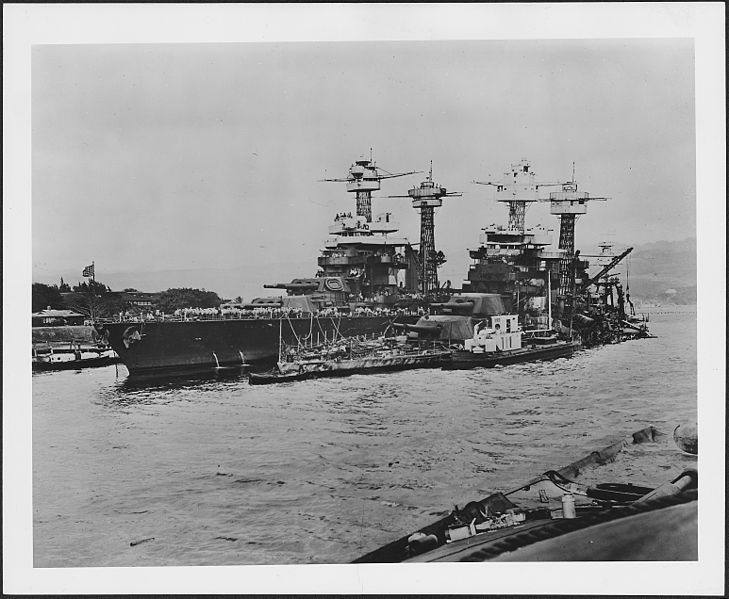
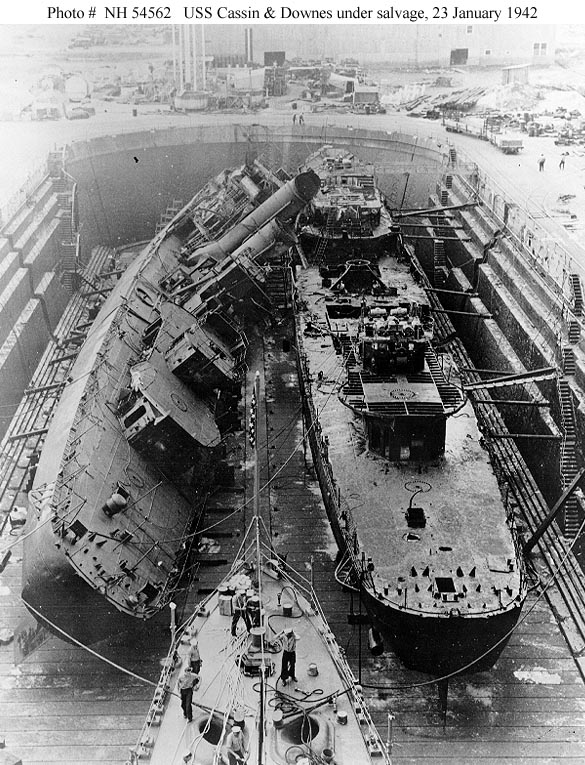
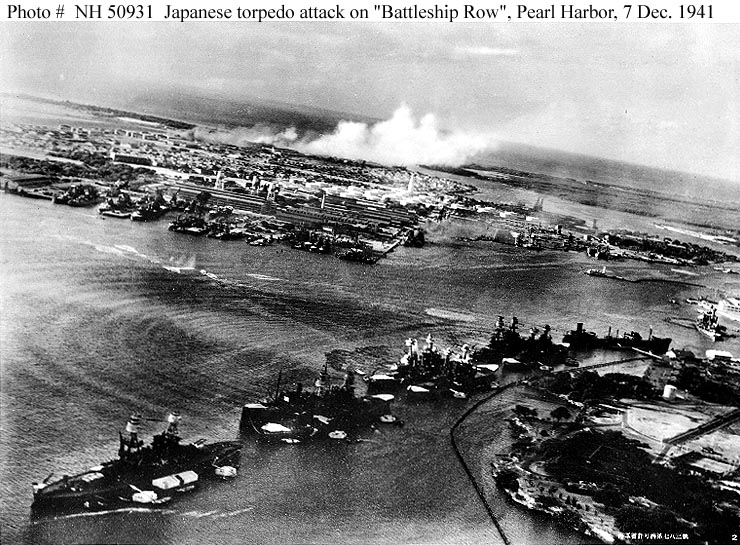
One of the more interesting aspects of the Pearl Harbor attack were the efforts of the US Navy to salvage and return to duty the ships sunk or so heavily damaged that they were thought to be irreparable after the attack. 19 ships were sunk or damaged during the attack, or roughly 20% of the fleet present on December 7th 1941. Unlike other great feats of maritime salvage like that of the German Fleet at Scapa Flow after the First World War, this massive effort led to the majority of the ships being returned to an operational status for further service in the war.

I first learned about the dangers of the salvage operations when I visited Pearl Harbor on an NJROTC cadet training cruise in the spring of 1978. During the week we spent in Pearl between the outbound leg on the USS Frederick LST-1184 and our return to California aboard the USS Gray FF-1054, we had a visit with the Navy dive team stationed at Pearl Harbor. They explained how they did their jobs as well as the dangers still encountered diving on the wreck of the USS Arizona.

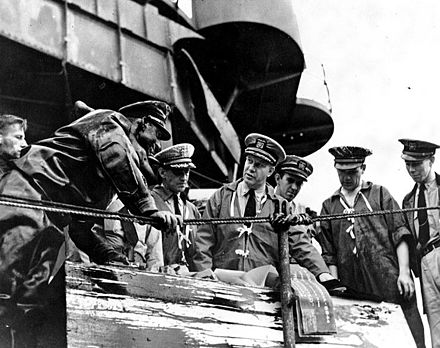
Captain Homer Wallin directing Salvage Operations

Many people know something about the attack, but one of the most remarkable aspects of it was the effort to salvage the fleet in the months following the attack. Under the leadership of Captain Homer N. Wallin teams of Navy and civilian divers from the Pacific Bridge Company worked day and night to salvage the sunken ships. The divers spent over 20,000 man hours under water in the highly hazardous waters; which were filled with unexploded ordinance, and contaminated by fuel and sadly decomposing human bodies. Wallin wrote: 

The scene to the newcomer was foreboding indeed. There was a general feeling of depression throughout the Pearl Harbor area when it was seen and firmly believed that none of the ships sunk would ever fight again.” 

The divers wore were rubberized coveralls with gloves. The divers were equipped with a lead-weighted belt which weighed 84 pounds and lead-weighted shoes, each of which weighed 36 pounds. Each diver wore a copper helmet attached to a breastplate. Air was supplied through a hose which was attached to the helmet and ran up to a compressor monitored by men on the surface.

The work was extremely hazardous, the wrecked ships contained numerous hazards, any of which could cut his air hose and cause his death, and they also contained highly toxic gasses. They often worked in total darkness and had to communicate with the men on the surface via a telephone cable. The divers had to be exceptionally talented to and needed a great amount of coordination senses and balance to work with welding torches, suction hoses, and heavy equipment in the confines of the shattered ships. During the salvage operations a number of divers lost their lives.

Before the ships could be raised ammunition, including the massive 14 and 16 inch shells weighing anywhere from 1300 to 2000 pounds each, Japanese bombs and torpedoes, fuel oil, gasoline, electrical equipment and batteries, weapons, and whenever possible the bodies of the entombed crews had to be removed, and then every hole had to be patched to make them buoyant. After the ships were raised cleanup crews had to go aboard and clear the ships of other hazardous waste as repair crews began their work to repair the basic systems needed to get the ships to West Coast shipyards for the major overhauls, The herculean effort was one of the greatest engineering feats in maritime history.

Of these were battleships, the USS Arizona sunk by a cataclysmic explosion, her broken hulk with her collapsed foremast the iconic symbol of the attack. USS Oklahoma was capsized on Battleship Row.  USS Nevada was grounded and sunk off Hospital Point after an abortive attempt to sortie during the attack. USS Californiaand USS West Virginia lay upright on the bottom of Pearl Harbor, their superstructure, distinctive cage masts and gun turrets visible above the oily water.

The former battleship USS Utah lay capsized on the far side of Ford Island while the light cruiser USS Raleigh was fighting for her life barely afloat near Utah.  The ancient Minelayer USS Oglala was laying on her side next to the light cruiser USS Helena at the 1010 Dock. She was not hit by a bomb or torpedo but was said to have “died of fright” when Helena was hit by a torpedo, the blast which opened the seams of her hull. The destroyers USS Cassin and USS Downes were wrecks in the main dry dock. USS Shaw was minus her bow in the floating dry dock after exploding in what was one of the more iconic images of the attack. Other ships received varying amounts of damage.

As the engineers, damage control and salvage experts looked at the damage they realized that every ship would be needed for the long term fight. The building program of the US Navy was just beginning to pick up steam and it would be some time before new construction could not only make up for the losses but also be ready to fight a Two Ocean War. The decision was made to salvage and return to duty any ship deemed salvageable.

Even the seemingly less important ships needed to be rapidly salvaged. Some which initially appeared to be unsalvageable needed at the minimum to be cleared from dry docks and docks needed by operational or less damaged ships. Likewise equipment, machinery and armaments from these ships needed to be salvaged for use in other ships.

Even by modern standards the efforts of the Navy divers and salvage experts and the civilians who worked alongside them were amazing. In the end only three of the 19 ships never returned to service. The work began quickly and on December 14th Commander James Steele began to direct the salvage operations on the sunken hulks. Captain Wallin relieved Steele on January 9th 1942. Wallin formed a salvage organization of Navy officers and civilian contractors. The civilian contractors were instrumental in the operation. Many of the civilians had experience in salvage operations, or underwater construction efforts, such as working on the Golden Gate Bridge which often exceeded the experience of the Navy divers.

The divers recovered bodies whenever possible, salvaged equipment, removed weapons and ammunition, made temporary repairs and help rig the ships for righting or re-floating. In each case the salvage experts, divers and engineers faced different challenges.

Arizona was never raised. Her superstructure was cut down, main battery and some anti-aircraft guns removed. The main batter guns were delivered to the Army Coastal Artillery for use as shore batteries but none reached an operational status before the end of the war. The dives aboard were so dangerous that eventually the attempts to recover bodies ceased as several divers lost their lives in the wreck.  Over the years the National Parks Service has continued to dive on the wreck to assess it as a war grave and memorial.

Utah too was not raised. She was righted in 1942 but efforts to do more were halted because the elderly wreck had no remaining military value. Her wreck along with that of Arizona are war graves, many of their crew members, including over 1000 of Arizona’s men forever remain entombed in their ships. When I visited Pearl Harbor in 1978 as a Navy Junior ROTC Cadet and visited both memorials I was humbled at what I saw. They are haunting reminders of the cost paid by sailors during wartime.

Nevada was the first major ship salvaged. She was re-floated in February 1942 and after temporary repairs sailed to the West Coast on her own power. After repairs and a significant modernization of her anti-aircraft systems was complete she returned to action in 1943 in the invasion of Attu Alaska. She participated in many amphibious operations including Normandy, Southern France, Iwo Jim and Okinawa. She survived the Atomic Bomb tests in 1946 but wrecked and radioactive she was sunk as a target off Hawaii in 1948.

The salvage of the Oklahoma was one of the more challenging endeavors faced by Wallin’s men. Hit by at least five torpedoes during the attack the great ship capsized, her tripod masts digging deep into the mud of the harbor as she settled. Over 400 over her crew lay dead inside the ship. Since it was apparent that the ship was a total loss the salvage operations did not commence until the middle of 1942. The primary goal of the operation was to clear needed space for berthing large ships along Battleship Row. The operation involved making the ship as watertight as possible, solidifying the bottom of the harbor around her to enable her to roll and emplacing a massive system of righting frames, anchor chains and shore mounted winches and cables. The process involved cutting away wrecked superstructure, removing ammunition, weapons and the bodies of those entombed in their former home. She was completely righted in July 1943, and floated again in November. Moved to a dry dock in December she was made watertight and moored in another part of the harbor. Following the war she was being towed to a scrap yard but sank in a storm in May 1947.

California was raised in March and after temporary repairs sailed under her own power to the West Coast. Her repairs and modernization were a major undertaking. Fully reconditioned and modernized to standards of most modern battleships she returned to service in January 1944. She served in retaking Saipan, Guam, Tinian, as well as Leyte Gulf were she had a significant part in the Battle of Surigao Strait. Hit by a Kamikaze she was repaired and returned to action at Okinawa and support the occupation operations of the Japanese Home Islands. She was decommissioned in 1947 and sold for scrapping in 1959.

West Virginia suffered the most severe damage of the battleships returned to duty. She was raised in July 1942 and after repairs sailed to Puget Sound Naval Shipyard. Like California she was completely rebuilt and returned to action in October 1944 in time to take the lead role in destroying the Japanese Battleship Yamashiro. She served throughout the remainder of the war in the Pacific at Iwo Jima, Okinawa and the occupation of Japan.

                                      Cassin following Rebuilding 

The Mahan Class destroyers Cassin and Downes were so badly damaged sitting in the Dry Dock Number One with Pennsylvania so that initially they were believed beyond salvage. However after closer inspection it was determined that the hull fittings, main weapons systems and propulsion machinery on both ships were worth salvaging. These items were removed, shipped to Mare Island Naval Shipyard and installed on new hulls being constructed. The hulks of the old ships were scrapped at Pearl Harbor. Those ships were commissioned as the Cassin and Downes and served throughout the war.

Both were decommissioned in 1945 and scrapped in 1947. Their sister ship Shaw which had blown up in the floating dry dock was wrecked from her bridge forward. However the rest of the ship including her engineering spaces were intact. A temporary bow was fashioned and the ship sailed to Mare Island under her own power. Completely overhauled she was back in service by July 1942. She was decommissioned in 1945 and scrapped in 1946.

The ancient minelayer Oglala was raised in July and sent back to the West Coast where she was repaired and recommissioned as an internal combustion engine repair ship. She survived the war was decommissioned and transferred to Maritime Commission custody. She was a depot ship at the Suisun Bay Reserve Fleet until 1965 when she was sold for scrap.

If you are interested, Captain Wallin’s complete report can be read here:

https://www.history.navy.mil/content/dam/nhhc/research/library/online-reading-room/war-and-conflict/wwii/pearl-harbor/pearlharborwallin/d767_92_w3.pdf

Wallin later served in the Pacific as Force Maintenance Officer South Pacific, and commanded a variety of Naval Yards, including Philadelphia and Norfolk Naval Shipyard where I currently serve. He retired in 1953 as a Vice Admiral and lived to the age of 89 years, when he died in 1984.

The salvage feat to return these ships to duty was one of the most remarkable operations of its type ever conducted. Not only were most of the ships salvaged but most returned to duty. While none survive today many played key roles during the war. Artifacts of some of the ships are on display at various Naval Bases, Museums and State Capitals. They, their brave crews, and the Navy Divers and civilian diving and salvage experts who conducted this task exhibited the finest traditions of the US Navy. The successors of the Navy divers at Mobile Diving Salvage Units One and Two still carry on that tradition today, and sadly, most Americans don’t know anything about Homer Wallin and his remarkable Navy and civilian divers.

Peace

Padre Steve+

2 Comments

Filed under History, Military, national security, Navy Ships, US Navy, World War II at Sea, world war two in the pacific

Taking Increased Devotion on the Anniversary of the Day of Infamy: A Personal Reflection

uss-arizona-memorial-pearl-harbor

Friends of Padre Steve’s World,

I never will forget the day that I took a Navy launch from Naval Station Pearl Harbor to the USS Arizona Memorial. It was Easter Sunday, March 26th 1978, the day before my 18th birthday and I was in Pearl Harbor as part of a Naval Junior ROTC Cadet Cruise. Cadets from my school sailed aboard the USS Frederick LST-1184 from San Diego to Pearl, and remained there for a week until returning to San Diego aboard the USS Gray FF-1054.

I honestly don’t know how many young people ever have had that kind of adventure, but for me I know that those three weeks were profoundly important in who I am today, but the one that constantly reverberates in me is the visit to the Arizona Memorial. Back then there was no visitor center on Ford Island, nor was the USS Missouri moored where the USS Oklahoma was that fateful Sunday. The day was sunny with partly cloudy skies, the sunlight reflected on the placid waters of Pearl Harbor. As the launch, manned by Sailor’s in Dress Whites neared Ford Island the bridge like white memorial loomed ahead, the rusty barbette of the battleship’s “C” turret rose slightly out of the water aft of the memorial, and the mooring quay with the USS Arizona inscribed upon it glinted in the bright morning sunlight. To our rear cruisers and destroyers lined the piers of the Naval Station.

uss-airzona-shrine-wall

Alighting from the launch I went aboard the memorial at the entry room and walked across the bridge and the assembly room before entering the shrine. As I walked slowly across the bridge I peered into the water below thinking about all the men still entombed in the wreck. Pausing in the shrine I read the names of the 1,177 men killed aboard Arizona that Sunday morning, one of those was the ship’s chaplain, Captain Thomas Kirkpatrick. It was a pivotal moment for me. I had begun to feel a call to the ministry but in that moment I was sure that I wanted to serve as a Navy Chaplain. I remember finding a post card that I had sent my grandparents from the USS Gray when we returned to San Diego, my words were “Dear Ma Maw and Pa Paw, I think I am supposed to be a Navy Chaplain.” I laughed when I saw it because I was then serving as a Chaplain in the Army Reserve. Sadly, when my grandmother died in November 1996 I was deployed, and that simple postcard, my link with that part of my past was discarded by family members who did not think enough to read it, or if they did didn’t give enough of a damn about me to save it. I should have taken it when I had the chance, but sometimes I am too sentimental.

chaplain-thomas-kirkpatrick

It took me a while to get there, my long strange trip included a 17 ½ year detour in the U.S. Army before I became a Navy Chaplain in February 1999.

Abraham Lincoln spoke of the ground that was hallowed at Gettysburg in his Gettysburg Address. The wreck of the Arizona is also hallowed. Despite our best efforts we cannot consecrate it more than the men who served aboard her that day seventy-five years ago, but we can as Lincoln said so well be dedicated here to the unfinished work which they who fought here have thus far so nobly advanced. It is rather for us to be here dedicated to the great task remaining before us — that from these honored dead we take increased devotion to that cause for which they gave the last full measure of devotion — that we here highly resolve that these dead shall not have died in vain — that this nation, under God, shall have a new birth of freedom — and that government of the people, by the people, for the people, shall not perish from the earth.”

For me that means to continue to serve as a Chaplain in the Navy, never forgetting that the duty of a Chaplain is with his or her Sailors, Marines, Soldiers, and Airmen, especially when they go in harm’s way.

Of course my service will come to an end on the 1st of August 2020. I will retire on my statutory retirement date. However, I will continue to write and serve people in whatever way I can. I will retire with no personal regrets, but regret the condition of the country today under President Trump, that is why I will continue “take increased devotion… that this nation, under God shall have a new birth of freedom – and that government of the people, by the people, for the people, shall not perish from the earth.”  Though I will be retired my service will not end.

Peace

Padre Steve+

Leave a comment

Filed under History, Loose thoughts and musings, Military, national security, Navy Ships, News and current events, Political Commentary, US Navy, world war two in the pacific

“Defenseless under the night Our world in stupor lies…” The Day Before Pearl Harbor and Today

h97398

Friends of Padre Steve’s World,

The late historian Walter Lord wrote in his book Day of Infamy: “A nation brought up on peace was going to war and didn’t know how.”

For most Americans and Western Europeans this is time of peace. Well, at least the illusion of peace. It doesn’t matter that the Soviets by another name have been conducting acts of war against the institutions of western democratic states, and waged a war against Ukraine to capture Crimea. It doesn’t that Tens thousands of American, NATO and European Union troops operating in a number of mandates are in harm’s way. In some places like Afghanistan they are at war, in others attempting to keep the peace. Around the world regional conflicts, civil wars, insurgencies  and revolutions threaten not only regional peace but the world peace and economy. Traditional national rivalries and ethnic and religious tensions especially in Asia and the broader Middle East have great potential to escalate into wars that should they actually break will involve the US, NATO and the EU, if not militarily economically and diplomatically. Add to all of this, tat the American President seems intent on helping authoritarian regimes around the world and working to establish one in the United States. But for most Americans, so long as their economic needs appear to be safe, or the President backs their revanchist social and religions policies and inflicts them on other Americans, all is well. To those who believe that everything is okay I say Bullshit, as a historian and a theologian.

But, since we live in a dream world an illusory world of peace, the words of  W.H. Auden come to mind. In his  poem September 1st 1939 he wrote:

Defenseless under the night
Our world in stupor lies…

On December 6th 1941 the world was already at war and the United States was edging into the war. The blood of Americans has already been shed but for the vast majority of Americans the events in Europe and Asia were far away and not our problem.  Even in 1941 isolationists and American Fascists, such as the German Bund, the KKK, and the Silvershirts tried to tip the American Public into supporting the totalitarian regimes of Germany, Japan, and Italy.

Though President Roosevelt had began the expansion of the military there were those in Congress seeking to demobilize troops and fought all attempts at to intervene against the Nazis, the Italian Fascists, and the Japanese warmongers.

maltese-falcon-by-content-artofmanlinessdotcomw499h371

Most people went about their business on December 6th, that last furtive day of peace without a second thought. People went about doing their Christmas shopping, going to movies like The Maltese Falcon staring Humphrey Bogart or the new short Tom and Jerry cartoon, The Night Before Christmas.

Tom And Jerry

Others went to football games. UCLA and USC had played their annual rivalry game to a 7-7 tie, Texas crushed Oregon in Austin by a score of 71-7 while Texas A&M defeated Washington State in the Evergreen Bowl in Tacoma by a score of 7-0.

0-3

In Europe a Soviet counter-offensive was hammering a freezing and exhausted German Wehrmacht at the gates of Moscow. U-Boats were taking a distressing toll of ships bound for Britain including neutral US merchant ships and warships, including the USS Reuben James, and USS Kearney. American Airmen were flying as the volunteer Flying Tigers for the Nationalist Chinese against the Japanese invaders. Other Americans volunteers to fight alongside the British Royal Air Force as volunteers in the 71st, 131st, and 133rd Eagle Squadrons against the German Luftwaffe. After war was declared these squadrons became part of the U.S. Army Air Corps. 

decwarp1

War was everywhere but Most Americans lived under the illusion of peace. When the messages came out of Pearl Harbor the next morning it was already early afternoon on the East Coast. The Japanese Ambassador was intentionally delayed by his government in delivering the Japanese declaration of war. When the attack occurred many people across the country going about their Sunday business, going to church, relaxing or listening to the radio. Thus when war came, despite all the precursors and warnings, most Americans were taken by surprise. A sailor at Pearl Harbor was heard to remark I didn’t even know they were mad at us.” 

When the attack happened it took the nation by surprise. Walter Lord wrote in his classic account of the Pearl Harbor attack Day of Infamy: “A nation brought up on peace was going to war and didn’t know how.”

By the end of the day over 2400 Americans were dead and over 1200 more wounded. The battleships of the Pacific Fleet were shattered. 4 sunk, one grounded and 3 more damaged. 10 other ships were sunk or damaged in the attack. 188 aircraft were destroyed and 159 damaged.

cn3992

The next day President Franklin D. Roosevelt called the nation to action requesting that Congress declare war on Japan. It was a speech that galvanized the American public. http://www.youtube.com/watch?v=ufoUtoQLGQY

Mr. Vice President, and Mr. Speaker, and Members of the Senate and House of Representatives:

Yesterday, December 7, 1941 — a date which will live in infamy — the United States of America was suddenly and deliberately attacked by naval and air forces of the Empire of Japan.

The United States was at peace with that Nation and, at the solicitation of Japan, was still in conversation with its Government and its Emperor looking toward the maintenance of peace in the Pacific. Indeed, one hour after Japanese air squadrons had commenced bombing in the American Island of Oahu, the Japanese Ambassador to the United States and his colleague delivered to our Secretary of State a formal reply to a recent American message. And while this reply stated that it seemed useless to continue the existing diplomatic negotiations, it contained no threat or hint of war or of armed attack.

It will be recorded that the distance of Hawaii from Japan makes it obvious that the attack was deliberately planned many days or even weeks ago. During the intervening time the Japanese Government has deliberately sought to deceive the United States by false statements and expressions of hope for continued peace.

The attack yesterday on the Hawaiian Islands has caused severe damage to American naval and military forces. I regret to tell you that very many American lives have been lost. In addition American ships have been reported torpedoed on the high seas between San Francisco and Honolulu.

Yesterday the Japanese Government also launched an attack against Malaya.
Last night Japanese forces attacked Hong Kong.
Last night Japanese forces attacked Guam.
Last night Japanese forces attacked the Philippine Islands.
Last night the Japanese attacked Wake Island. And this morning the Japanese attacked Midway Island.

Japan has, therefore, undertaken a surprise offensive extending throughout the Pacific area. The facts of yesterday and today speak for themselves. The people of the United States have already formed their opinions and well understand the implications to the very life and safety of our Nation.

As Commander in Chief of the Army and Navy I have directed that all measures be taken for our defense.

But always will our whole Nation remember the character of the onslaught against us.

No matter how long it may take us to overcome this premeditated invasion, the American people in their righteous might will win through to absolute victory. I believe that I interpret the will of the Congress and of the people when I assert that we will not only defend ourselves to the uttermost but will make it very certain that this form of treachery shall never again endanger us.

Hostilities exist. There is no blinking at the fact that our people, our territory, and our interests are in grave danger.

With confidence in our armed forces- with the unbounding determination of our people- we will gain the inevitable triumph- so help us God.

I ask that the Congress declare that since the unprovoked and dastardly attack by Japan on Sunday, December 7, 1941, a state of war has existed between the United States and the Japanese Empire.

171-0417042317-pearlharbor_paper

The day after the attack, Japanese Ambassador Oshima visited German Foreign Minister Von Ribbentrop to pressure Germany into joining the war. But Von Ribbentrop attempted to keep Germany out of the war fearing that adding the United States to The List of Germany’s opponents would doom them to defeat. He was overruled by Hitler, whose personal loathing of Roosevelt, disrespect for the American military, overestimation of Japan’s military and industrial power, and belief that Japan would quickly defeat Britain and the United States in the Pacific.

On December 11th, Germany and Italy declared war against the United States, while Germany’s erstwhile ally Japan, refused to declare war on the Soviet Union to relieve the pressure on Germany. Japan and the Soviets maintained their non-aggression pact until after the Americans dropped the Atomic Bomb on Hiroshima. Then and only then did the Soviets join the war against Japan.

Today tens of thousands of US and NATO troops are deployed in Afghanistan. Some of them are dying that people that most of us do not care about in the least might have a chance at peace and a better life. Eleanor Roosevelt reflected:

“Lest I keep my complacent way I must remember somewhere out there a person died for me today. As long as there must be war, I ask and I must answer was I worth dying for?”

Wars, revolutions and other tensions in other parts of the world threaten on every side, but most Americans and Europeans live in the illusion of peace.  A very few professi0onals are given the task of preparing for and fighting wars that our politicians, business leaders, Armageddon seeking preachers and the talking heads of the media sow the seeds. As such many have no idea of the human, material and spiritual cost of war and when it comes again in all of its awful splendor few will be prepared.

We do not know what tomorrow will bring and unfortunately for the vast bulk of Americans and Western Europeans the comments of W. H. Auden are as applicable today as they were on December 7th 1941: Defenseless under the night, Our world in stupor lies…

Personally, I cannot imagine Donald Trump, the current American President tak the stand that Franklin Delano Roosevelt did. against Germany, Japan, and Italy, nor could I imagine his supporters abandon him even if it meant the loss of every American ideal, law, and institution. that is difficult for a member of the Trump cult to stomach, but not so difficult if one believes the ideals of the Declaration of Independence, the Constitution, or the Gettysburg Address.

So until tomorrow,

Peace,

Padre Steve+

3 Comments

Filed under Foreign Policy, History, imperial japan, leadership, Military, national security, Navy Ships, News and current events, Political Commentary, US Army Air Corps, US Navy, World War II at Sea, world war two in europe, world war two in the pacific

Pearl Harbor and the Advent of the Aircraft Carrier, But Can the Carrier Remain Supreme?

h50931

Friends of Padre Steve’s World,

On the morning of December 7th 1941 8 of the 9 Battleships assigned to the US Pacific Fleet were in Pearl Harbor. Seven, the USS California, USS Maryland, USS Oklahoma, USS Tennessee, USS West Virginia, USS Arizona and USS Nevada were moored on Battleship Row. The USS Pennsylvania was in the massive dry dock which she shared with the destroyers USS Cassin and USS Downes. The USS Colorado, a sister ship of Maryland and West Virginia was at the Puget Sound Naval Yard being overhauled.

pearlharbor_wide-6febcbc3473e02a65f9b7b9e151905b7300c328f-s6-c30

USS West Virginia sinking at left and USS Tennessee burning at Pearl Harbor

At the time both the United States Navy and the Japanese Imperial Navy still viewed the Battleships as the heart of the fleet and the essence of naval power. Aircraft Carriers were still viewed as an adjunct and support to the traditional battle line.

Japanese-carriersJapanese Aircraft preparing to launch at Pearl Harbor

Thus as the Japanese Carrier Strike Group, the Kido Butai under the command of Vice Admiral Chūichi Nagumo approached Pearl Harbor and intelligence reports came in indicating that the carriers were not present the Japanese were not overly concerned. The lack of concern was in a sense ironic because the force they assigned to destroy the Battleships of the Pacific Fleet was the carrier strike group, not their battle line. The Kido Butai was the largest carrier strike group assembled until late 1943 when the U.S. Pacific Fleet fielded a larger carrier strike group, something no other country has done since.

Kido-Butai-in-the-North-Pacific

The Kido Butai enroute to Pearl Harbor

Comprised of six carriers, the Akagi, Kaga, Hiryu, Soryu, Shokaku and Zuikaku the force embarked over 300 first line aircraft. The aviators of the air groups aboard the carriers had been training for months to attack Pearl Harbor. Their aircraft had been specially outfitted with Type 91 Model 2 aerial torpedoes designed to run in the shallow waters of Pearl Harbor and Type 99 Model 5 armor piecing bombs modified from battleship shells. These weapons would be employed with a devastating effect on the morning of December 7th 1941.

The three carriers assigned to the Pacific Fleet, the USS Saratoga, USS Lexington and USS Enterprise had been dispatched on missions that took them away from Pearl Harbor that fateful Sunday.

USS_Lexington

USS Lexington

The Lexington and Task Force 12 had departed Pearl Harbor on December 5th to ferry 18 SB2U Vindicator Dive Bombers of VSMB-231 to Midway Island. These aircraft would ultimately take part in the Battle of Midway and the sinking of the Japanese Cruiser Mikuma. Saratoga was entering San Diego to embark her air group, and Enterprise which had left Pearl Harbor on November 28th to deliver VMF-211 to Wake Island was due to return to Pearl Harbor on the 7th of December. As such none of these ships were in Pearl Harbor at the time of the attack. Their absence helped save the United States and Allied cause in the Pacific.

USS_Saratoga_CV-3_underway_1942

USS Saratoga

The United States had other carriers but all were assigned to the Atlantic Fleet due to the belief that Nazi Germany was a greater threat than Japan. The USS Yorktown was at Norfolk in between deployments in support of the Neutrality Patrol. USS Ranger was returning to Norfolk from a Neutrality patrol, USS Wasp was at Grassy Bay Bermuda and the newly commissioned USS Hornet was training out of Norfolk. The USS Long Island, the first Escort carrier was undergoing operational tests and training out of Norfolk.

cv-6-01USS Enterprise at Midway

Had any of the three carriers assigned to the Pacific Fleet been in Pearl Harbor on the morning of the Japanese attack the results would have been even more disastrous for the United States. Instead these carriers began operations against the Japanese almost immediately. Carriers based on the East Coast including Hornet, Yorktown and Wasp were transferred to the Pacific. In the perilous months following the Pearl Harbor attack the US carriers took the fight to the Japanese conducting raids against Japanese held islands. In April 1942 the Enterprise and Hornet, the latter with 16 B-25 Mitchell bombers under the command of Colonel Jimmy Doolittle struck Tokyo.

gallery_30225_28868_12824874244ae0d6734af3b

USS Hornet launching the Doolittle Raiders

The result of that attack resulted in a severe embarrassment and loss of face to the Imperial Navy. the strategic and psychological implications were such that Admiral Isoruku Yamamoto decided to attack Midway Island to force the US fleet and its carriers into a decisive battle. Although the Japanese had lost a good number of aircrew from Shokaku and Zuikaku at the Battle of Coral Sea, while sinking Lexington Yamamoto remained committed to the decisive battle.

That battle was decisive, but not in the way Yamamoto had planned. Akagi, Kaga, Hiryu and Soryu were sunk by aircraft operating from Enterprise, Yorktown and Hornet. Yorktown was lost in the battle bat it was a decisive defeat for the Japanese. From that point, though they still were superior to the U.S. Navy in numbers of Carriers and surface warships, and still maintained a massive number of islands which they had fortified and built airbases on in defiance of treaties they agreed to at the end of the First World War,

Attack_of_the_Akagi

Sinking the Akagi at Midway

In the succeeding months in the vicious battles around the Solomon Islands the remaining US carriers proved decisive. Although Wasp and Hornet were sunk in those battles and both Saratoga and Enterprise were often heavily damaged, they held the line. The carriers that the Japanese missed proved decisive in turning the tide and winning the war.

22_bb48

Raised from the mud of Pearl Harbor the USS West Virginia in Tokyo Bay

Though Yamamoto did not realize it, the attack on Pearl Harbor signaled the end of the supremacy of the Battleship and the ascendency of the Aircraft Carrier. By 1943 Battleships were regulated to escorting the fast carrier task forces or conducting shore bombardments. The ultimate irony was that the last battleship engagement in history was won by the survivors of the attack on Pearl Harbor. Raised from the mud the West Virginia, Tennessee, California, Maryland and Pennsylvania joined by the USS Mississippi rained destruction on two Japanese task forces attempting to penetrate Leyte Gulf and destroy the US invasion force transports at the Battle of Surigao Strait.

It was a fascinating turn of events. The Japanese dispatched the cream of their carrier air forces to destroy the U.S. Pacific Fleet at Pearl. Harbor, and though they crippled the battleships they failed to destroy the American aircraft carriers, at Pearl Harbor, Coral Sea, Midway, or the Guadalcanal campaign. In the following years the Enterprise and Saratoga, bolstered by the carriers of the Essex Class, and the Light Fleet Carriers of the Independence Class, and helped by the addition of dozens of Escort Carriers, which relieved them of the mundane tasks of convoy escort and amphibious landing support, wreaked havoc on the Imperial Japanese Navy from late 1943 on. The Battles of the Philippine Sea, Leyte Gulf, the raid on Formosa, and the strikes on the Japanese homeland proved the superiority of the carrier force the Japanese missed at Pearl Harbor and failed to destroy in subsequent engagements.

Today, nearly eight decades later there is a question of the relevance of aircraft carriers, even though the United States, Great Britain, China, Russia, India, and other nations continue their development. I have to admit, that with the development of other weapons platforms and technologies, that I do not know the ultimate fate of the aircraft carrier. However, like the Ships of the Line that dominated late 17th, 18th, and early 19th centuries., the Ironclads that dominated the late 19th Century, and the Dreadnaughts that dominated until Pearl Harbor.

Pearl Harbor was 78 years ago. Since then carrier and submarine eclipsed the power of the the battleship. We cannot assume that the era of the aircraft carrier will continue without end. The Japanese discounted the power of the aircraft carrier and submarine, assuming that battleships supported by carriers and submarines would maintain control of the Oceans. They were wrong. Regardless of what weapons system we presume will dominate the future, we also must admit the very real possibility that we could be wrong. Technologies that we have not ever began to imagine, except possibly in the realm of science fiction may change everything we believed possible.

i am neither the prophet nor the son of the prophet, thus my opinion is only that: I believe that the carrier will remain the centerpiece of Naval power and strategy for the next decade, and possibly another, but as a military and Naval historian I cannot predict that they remain so longer than that. Thus the United States Navy, and for that matter all navies begin looking toward and planning for technologies that are either in their infancy or not yet imagined. To ignore that fact would be to ignore history. We do that to our detriment.

Until tomorrow,

Peace,

Padre Steve+
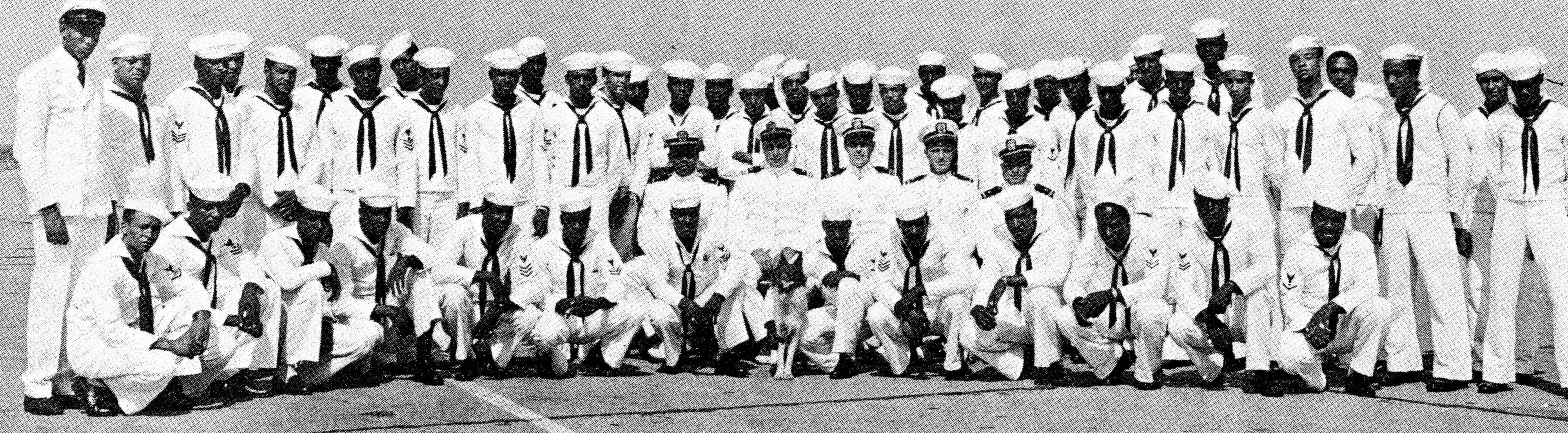
5 Comments

Filed under History, imperial japan, Military, national security, Navy Ships, News and current events, US Navy, World War II at Sea, world war two in the pacific